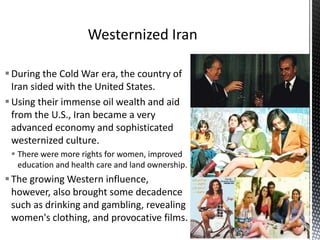

During the Cold War era, the country of
Iran sided with the United States.
Using their immense oil wealth and aid
from the U.S., Iran became a very
advanced economy and sophisticated
westernized culture.
 There were more rights for women, improved
education and health care and land ownership.
The growing Western influence,
however, also brought some decadence
such as drinking and gambling, revealing
women's clothing, and provocative films.
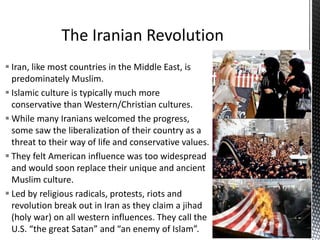
 Iran, like most countries in the Middle East, is
predominately Muslim.
 Islamic culture is typically much more
conservative than Western/Christian cultures.
 While many Iranians welcomed the progress,
some saw the liberalization of their country as a
threat to their way of life and conservative values.
 They felt American influence was too widespread
and would soon replace their unique and ancient
Muslim culture.
 Led by religious radicals, protests, riots and
revolution break out in Iran as they claim a jihad
(holy war) on all western influences. They call the
U.S. “the great Satan” and “an enemy of Islam”.
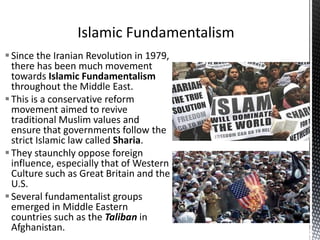
Since the Iranian Revolution in 1979,
there has been much movement
towards Islamic Fundamentalism
throughout the Middle East.
This is a conservative reform
movement aimed to revive
traditional Muslim values and
ensure that governments follow the
strict Islamic law called Sharia.
They staunchly oppose foreign
influence, especially that of Western
Culture such as Great Britain and the
U.S.
Several fundamentalist groups
emerged in Middle Eastern
countries such as the Taliban in
Afghanistan.
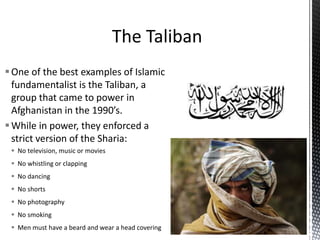
One of the best examples of Islamic
fundamentalist is the Taliban, a
group that came to power in
Afghanistan in the 1990’s.
While in power, they enforced a
strict version of the Sharia:
 No television, music or movies
 No whistling or clapping
 No dancing
 No shorts
 No photography
 No smoking
 Men must have a beard and wear a head covering
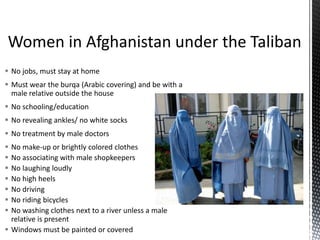
 No jobs, must stay at home
 Must wear the burqa (Arabic covering) and be with a
male relative outside the house
 No schooling/education
 No revealing ankles/ no white socks
 No treatment by male doctors
 No make-up or brightly colored clothes
 No associating with male shopkeepers
 No laughing loudly
 No high heels
 No driving
 No riding bicycles
 No washing clothes next to a river unless a male
relative is present
 Windows must be painted or covered
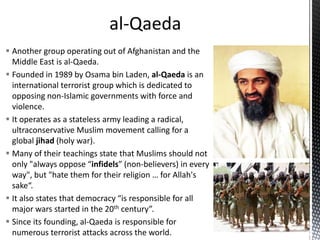
 Another group operating out of Afghanistan and the
Middle East is al-Qaeda.
 Founded in 1989 by Osama bin Laden, al-Qaeda is an
international terrorist group which is dedicated to
opposing non-Islamic governments with force and
violence.
 It operates as a stateless army leading a radical,
ultraconservative Muslim movement calling for a
global jihad (holy war).
 Many of their teachings state that Muslims should not
only "always oppose “infidels” (non-believers) in every
way", but "hate them for their religion … for Allah's
sake“.
 It also states that democracy “is responsible for all
major wars started in the 20th century”.
 Since its founding, al-Qaeda is responsible for
numerous terrorist attacks across the world.
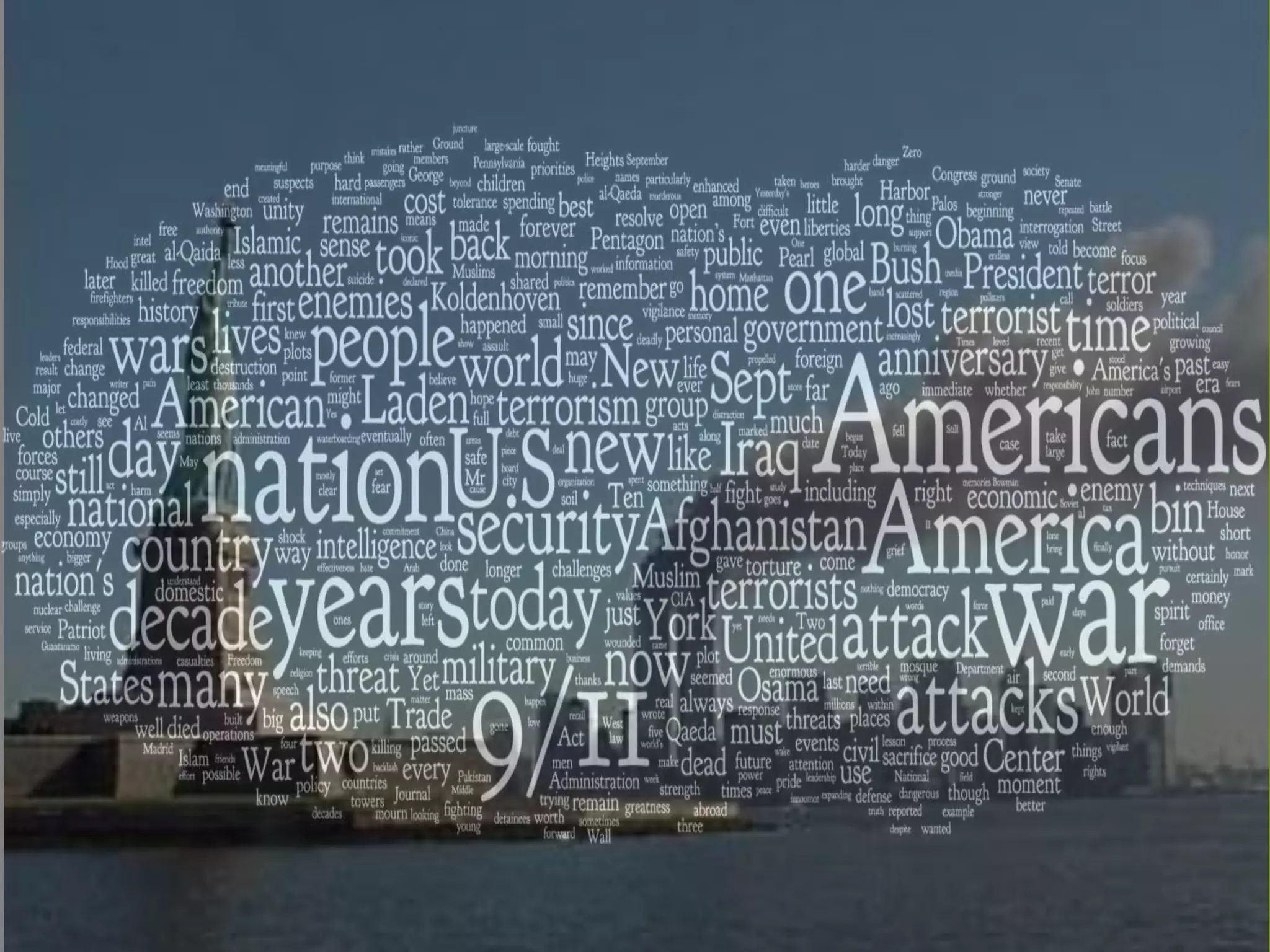
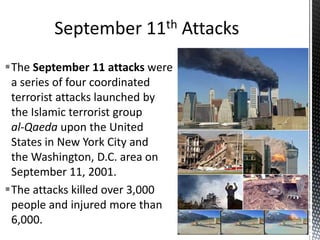
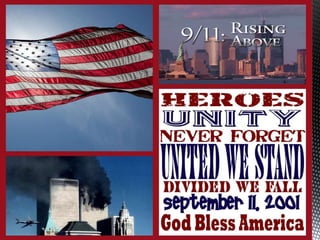
The September 11 attacks were
a series of four coordinated
terrorist attacks launched by
the Islamic terrorist group
al-Qaeda upon the United
States in New York City and
the Washington, D.C. area on
September 11, 2001.
The attacks killed over 3,000
people and injured more than
6,000.
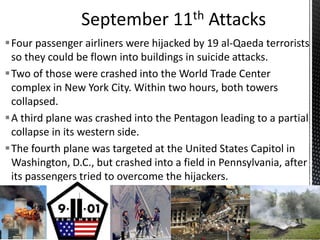
Four passenger airliners were hijacked by 19 al-Qaeda terrorists
so they could be flown into buildings in suicide attacks.
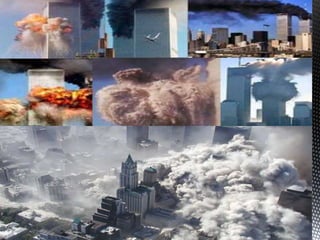
Two of those were crashed into the World Trade Center
complex in New York City. Within two hours, both towers
collapsed.
A third plane was crashed into the Pentagon leading to a partial
collapse in its western side.
The fourth plane was targeted at the United States Capitol in
Washington, D.C., but crashed into a field in Pennsylvania, after
its passengers tried to overcome the hijackers.
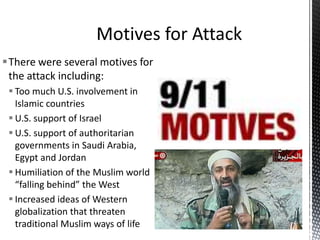
There were several motives for
the attack including:
 Too much U.S. involvement in
Islamic countries
 U.S. support of Israel
 U.S. support of authoritarian
governments in Saudi Arabia,
Egypt and Jordan
 Humiliation of the Muslim world
“falling behind” the West
 Increased ideas of Western
globalization that threaten
traditional Muslim ways of life
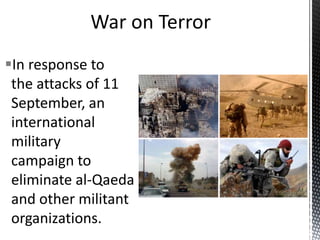
In response to
the attacks of 11
September, an
international
military
campaign to
eliminate al-Qaeda
and other militant
organizations.
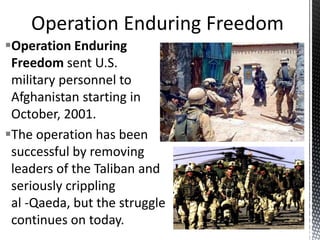
Operation Enduring
Freedom sent U.S.
military personnel to
Afghanistan starting in
October, 2001.
The operation has been
successful by removing
leaders of the Taliban and
seriously crippling
al -Qaeda, but the struggle
continues on today.
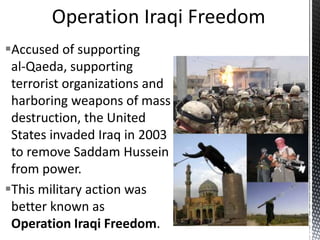
Accused of supporting
al-Qaeda, supporting
terrorist organizations and
harboring weapons of mass
destruction, the United
States invaded Iraq in 2003
to remove Saddam Hussein
from power.
This military action was
better known as
Operation Iraqi Freedom.
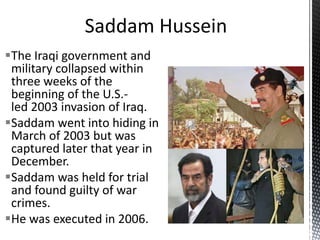
The Iraqi government and
military collapsed within
three weeks of the
beginning of the U.S.-
led 2003 invasion of Iraq.
Saddam went into hiding in
March of 2003 but was
captured later that year in
December.
Saddam was held for trial
and found guilty of war
crimes.
He was executed in 2006.
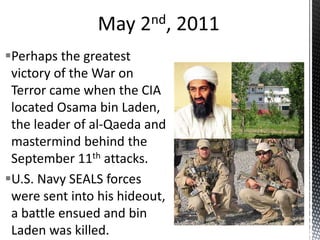
Perhaps the greatest
victory of the War on
Terror came when the CIA
located Osama bin Laden,
the leader of al-Qaeda and
mastermind behind the
September 11th attacks.
U.S. Navy SEALS forces
were sent into his hideout,
a battle ensued and bin
Laden was killed.
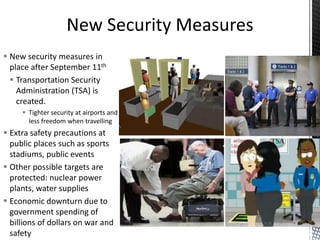
 New security measures in
place after September 11th
 Transportation Security
Administration (TSA) is
created.
 Tighter security at airports and
less freedom when travelling
 Extra safety precautions at
public places such as sports
stadiums, public events
 Other possible targets are
protected: nuclear power
plants, water supplies
 Economic downturn due to
government spending of
billions of dollars on war and
safety
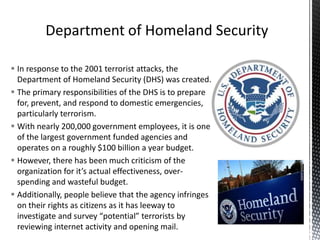
 In response to the 2001 terrorist attacks, the
Department of Homeland Security (DHS) was created.
 The primary responsibilities of the DHS is to prepare
for, prevent, and respond to domestic emergencies,
particularly terrorism.
 With nearly 200,000 government employees, it is one
of the largest government funded agencies and
operates on a roughly $100 billion a year budget.
 However, there has been much criticism of the
organization for it’s actual effectiveness, over-
spending and wasteful budget.
 Additionally, people believe that the agency infringes
on their rights as citizens as it has leeway to
investigate and survey “potential” terrorists by
reviewing internet activity and opening mail.
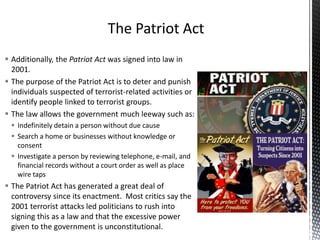
 Additionally, the Patriot Act was signed into law in
2001.
 The purpose of the Patriot Act is to deter and punish
individuals suspected of terrorist-related activities or
identify people linked to terrorist groups.
 The law allows the government much leeway such as:
 Indefinitely detain a person without due cause
 Search a home or businesses without knowledge or
consent
 Investigate a person by reviewing telephone, e-mail, and
financial records without a court order as well as place
wire taps
 The Patriot Act has generated a great deal of
controversy since its enactment. Most critics say the
2001 terrorist attacks led politicians to rush into
signing this as a law and that the excessive power
given to the government is unconstitutional.
While most agree that is important to have security
measures in place to prevent terrorism, many people feel
the buildup of American security because of the 9/11
attacks has gotten downright absurd.
In the end, we are trying to protect our freedom by taking
it away.
Since 2001, about 3,200 Americans have fallen victim to
terrorism (including the 3,000 killed in 9/11).
Here’s a list of 10 things that are (statistically) more likely
to kill you than terrorism.
Here’s a list of 10 things that you are
(statistically) more likely to die from than
terrorism.
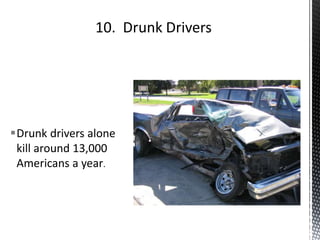
Drunk drivers alone
kill around 13,000
Americans a year.
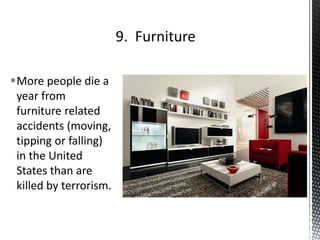
More people die a
year from
furniture related
accidents (moving,
tipping or falling)
in the United
States than are
killed by terrorism.
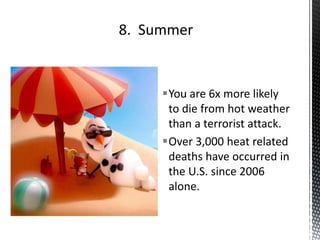
You are 6x more likely
to die from hot weather
than a terrorist attack.
Over 3,000 heat related
deaths have occurred in
the U.S. since 2006
alone.
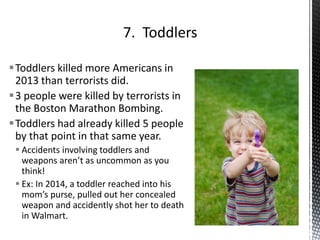
Toddlers killed more Americans in
2013 than terrorists did.
3 people were killed by terrorists in
the Boston Marathon Bombing.
Toddlers had already killed 5 people
by that point in that same year.
 Accidents involving toddlers and
weapons aren’t as uncommon as you
think!
 Ex: In 2014, a toddler reached into his
mom’s purse, pulled out her concealed
weapon and accidently shot her to death
in Walmart.
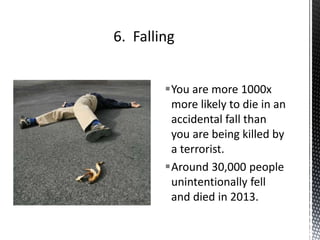
You are more 1000x
more likely to die in an
accidental fall than
you are being killed by
a terrorist.
Around 30,000 people
unintentionally fell
and died in 2013.
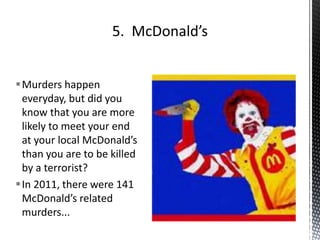
Murders happen
everyday, but did you
know that you are more
likely to meet your end
at your local McDonald’s
than you are to be killed
by a terrorist?
In 2011, there were 141
McDonald’s related
murders...
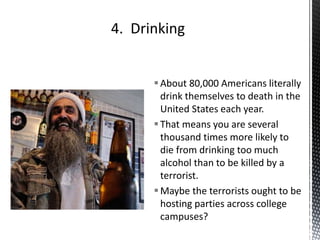
About 80,000 Americans literally
drink themselves to death in the
United States each year.
That means you are several
thousand times more likely to
die from drinking too much
alcohol than to be killed by a
terrorist.
Maybe the terrorists ought to be
hosting parties across college
campuses?
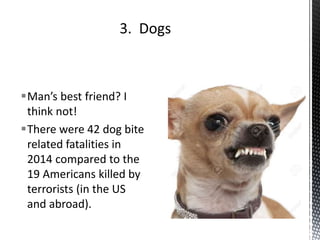
Man’s best friend? I
think not!
There were 42 dog bite
related fatalities in
2014 compared to the
19 Americans killed by
terrorists (in the US
and abroad).
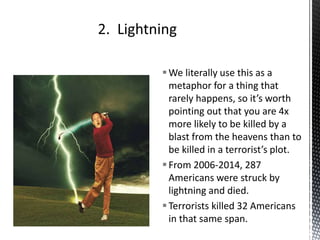
We literally use this as a
metaphor for a thing that
rarely happens, so it’s worth
pointing out that you are 4x
more likely to be killed by a
blast from the heavens than to
be killed in a terrorist’s plot.
From 2006-2014, 287
Americans were struck by
lightning and died.
Terrorists killed 32 Americans
in that same span.
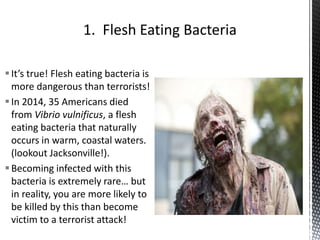
It’s true! Flesh eating bacteria is
more dangerous than terrorists!
In 2014, 35 Americans died
from Vibrio vulnificus, a flesh
eating bacteria that naturally
occurs in warm, coastal waters.
(lookout Jacksonville!).
Becoming infected with this
bacteria is extremely rare… but
in reality, you are more likely to
be killed by this than become
victim to a terrorist attack!
Since that fateful September day, our lives have changed--
some of those changes seemed to have been temporary and
other changes appear to be with us forever.
We do not need to live our lives with fear or hatred, but we
do need to remember that we are vulnerable and somehow
we need to find the strength to carry on.
Take time to stop and think about those who have lost loved
ones in this tragedy. Take time to say thanks to those who
are serving in the military, firefighters, police officers and
rescue workers.
Thank God for our blessings, our country and our freedom.
Spend time with your family, friends and loved ones.
And never forget 9/11.
September 11th Terrorist Attacks

September 11th Terrorist Attacks

  • 5.
    During the ColdWar era, the country of Iran sided with the United States. Using their immense oil wealth and aid from the U.S., Iran became a very advanced economy and sophisticated westernized culture.  There were more rights for women, improved education and health care and land ownership. The growing Western influence, however, also brought some decadence such as drinking and gambling, revealing women's clothing, and provocative films.
  • 6.
     Iran, likemost countries in the Middle East, is predominately Muslim.  Islamic culture is typically much more conservative than Western/Christian cultures.  While many Iranians welcomed the progress, some saw the liberalization of their country as a threat to their way of life and conservative values.  They felt American influence was too widespread and would soon replace their unique and ancient Muslim culture.  Led by religious radicals, protests, riots and revolution break out in Iran as they claim a jihad (holy war) on all western influences. They call the U.S. “the great Satan” and “an enemy of Islam”.
  • 7.
    Since the IranianRevolution in 1979, there has been much movement towards Islamic Fundamentalism throughout the Middle East. This is a conservative reform movement aimed to revive traditional Muslim values and ensure that governments follow the strict Islamic law called Sharia. They staunchly oppose foreign influence, especially that of Western Culture such as Great Britain and the U.S. Several fundamentalist groups emerged in Middle Eastern countries such as the Taliban in Afghanistan.
  • 8.
    One of thebest examples of Islamic fundamentalist is the Taliban, a group that came to power in Afghanistan in the 1990’s. While in power, they enforced a strict version of the Sharia:  No television, music or movies  No whistling or clapping  No dancing  No shorts  No photography  No smoking  Men must have a beard and wear a head covering
  • 9.
     No jobs,must stay at home  Must wear the burqa (Arabic covering) and be with a male relative outside the house  No schooling/education  No revealing ankles/ no white socks  No treatment by male doctors  No make-up or brightly colored clothes  No associating with male shopkeepers  No laughing loudly  No high heels  No driving  No riding bicycles  No washing clothes next to a river unless a male relative is present  Windows must be painted or covered
  • 10.
     Another groupoperating out of Afghanistan and the Middle East is al-Qaeda.  Founded in 1989 by Osama bin Laden, al-Qaeda is an international terrorist group which is dedicated to opposing non-Islamic governments with force and violence.  It operates as a stateless army leading a radical, ultraconservative Muslim movement calling for a global jihad (holy war).  Many of their teachings state that Muslims should not only "always oppose “infidels” (non-believers) in every way", but "hate them for their religion … for Allah's sake“.  It also states that democracy “is responsible for all major wars started in the 20th century”.  Since its founding, al-Qaeda is responsible for numerous terrorist attacks across the world.
  • 12.
    The September 11attacks were a series of four coordinated terrorist attacks launched by the Islamic terrorist group al-Qaeda upon the United States in New York City and the Washington, D.C. area on September 11, 2001. The attacks killed over 3,000 people and injured more than 6,000.
  • 13.
    Four passenger airlinerswere hijacked by 19 al-Qaeda terrorists so they could be flown into buildings in suicide attacks. Two of those were crashed into the World Trade Center complex in New York City. Within two hours, both towers collapsed. A third plane was crashed into the Pentagon leading to a partial collapse in its western side. The fourth plane was targeted at the United States Capitol in Washington, D.C., but crashed into a field in Pennsylvania, after its passengers tried to overcome the hijackers.
  • 15.
    There were severalmotives for the attack including:  Too much U.S. involvement in Islamic countries  U.S. support of Israel  U.S. support of authoritarian governments in Saudi Arabia, Egypt and Jordan  Humiliation of the Muslim world “falling behind” the West  Increased ideas of Western globalization that threaten traditional Muslim ways of life
  • 17.
    In response to theattacks of 11 September, an international military campaign to eliminate al-Qaeda and other militant organizations.
  • 18.
    Operation Enduring Freedom sentU.S. military personnel to Afghanistan starting in October, 2001. The operation has been successful by removing leaders of the Taliban and seriously crippling al -Qaeda, but the struggle continues on today.
  • 19.
    Accused of supporting al-Qaeda,supporting terrorist organizations and harboring weapons of mass destruction, the United States invaded Iraq in 2003 to remove Saddam Hussein from power. This military action was better known as Operation Iraqi Freedom.
  • 20.
    The Iraqi governmentand military collapsed within three weeks of the beginning of the U.S.- led 2003 invasion of Iraq. Saddam went into hiding in March of 2003 but was captured later that year in December. Saddam was held for trial and found guilty of war crimes. He was executed in 2006.
  • 21.
    Perhaps the greatest victoryof the War on Terror came when the CIA located Osama bin Laden, the leader of al-Qaeda and mastermind behind the September 11th attacks. U.S. Navy SEALS forces were sent into his hideout, a battle ensued and bin Laden was killed.
  • 23.
     New securitymeasures in place after September 11th  Transportation Security Administration (TSA) is created.  Tighter security at airports and less freedom when travelling  Extra safety precautions at public places such as sports stadiums, public events  Other possible targets are protected: nuclear power plants, water supplies  Economic downturn due to government spending of billions of dollars on war and safety
  • 24.
     In responseto the 2001 terrorist attacks, the Department of Homeland Security (DHS) was created.  The primary responsibilities of the DHS is to prepare for, prevent, and respond to domestic emergencies, particularly terrorism.  With nearly 200,000 government employees, it is one of the largest government funded agencies and operates on a roughly $100 billion a year budget.  However, there has been much criticism of the organization for it’s actual effectiveness, over- spending and wasteful budget.  Additionally, people believe that the agency infringes on their rights as citizens as it has leeway to investigate and survey “potential” terrorists by reviewing internet activity and opening mail.
  • 25.
     Additionally, thePatriot Act was signed into law in 2001.  The purpose of the Patriot Act is to deter and punish individuals suspected of terrorist-related activities or identify people linked to terrorist groups.  The law allows the government much leeway such as:  Indefinitely detain a person without due cause  Search a home or businesses without knowledge or consent  Investigate a person by reviewing telephone, e-mail, and financial records without a court order as well as place wire taps  The Patriot Act has generated a great deal of controversy since its enactment. Most critics say the 2001 terrorist attacks led politicians to rush into signing this as a law and that the excessive power given to the government is unconstitutional.
  • 27.
    While most agreethat is important to have security measures in place to prevent terrorism, many people feel the buildup of American security because of the 9/11 attacks has gotten downright absurd. In the end, we are trying to protect our freedom by taking it away. Since 2001, about 3,200 Americans have fallen victim to terrorism (including the 3,000 killed in 9/11). Here’s a list of 10 things that are (statistically) more likely to kill you than terrorism.
  • 28.
    Here’s a listof 10 things that you are (statistically) more likely to die from than terrorism.
  • 29.
    Drunk drivers alone killaround 13,000 Americans a year.
  • 30.
    More people diea year from furniture related accidents (moving, tipping or falling) in the United States than are killed by terrorism.
  • 31.
    You are 6xmore likely to die from hot weather than a terrorist attack. Over 3,000 heat related deaths have occurred in the U.S. since 2006 alone.
  • 32.
    Toddlers killed moreAmericans in 2013 than terrorists did. 3 people were killed by terrorists in the Boston Marathon Bombing. Toddlers had already killed 5 people by that point in that same year.  Accidents involving toddlers and weapons aren’t as uncommon as you think!  Ex: In 2014, a toddler reached into his mom’s purse, pulled out her concealed weapon and accidently shot her to death in Walmart.
  • 33.
    You are more1000x more likely to die in an accidental fall than you are being killed by a terrorist. Around 30,000 people unintentionally fell and died in 2013.
  • 34.
    Murders happen everyday, butdid you know that you are more likely to meet your end at your local McDonald’s than you are to be killed by a terrorist? In 2011, there were 141 McDonald’s related murders...
  • 35.
    About 80,000 Americansliterally drink themselves to death in the United States each year. That means you are several thousand times more likely to die from drinking too much alcohol than to be killed by a terrorist. Maybe the terrorists ought to be hosting parties across college campuses?
  • 36.
    Man’s best friend?I think not! There were 42 dog bite related fatalities in 2014 compared to the 19 Americans killed by terrorists (in the US and abroad).
  • 37.
    We literally usethis as a metaphor for a thing that rarely happens, so it’s worth pointing out that you are 4x more likely to be killed by a blast from the heavens than to be killed in a terrorist’s plot. From 2006-2014, 287 Americans were struck by lightning and died. Terrorists killed 32 Americans in that same span.
  • 38.
    It’s true! Flesheating bacteria is more dangerous than terrorists! In 2014, 35 Americans died from Vibrio vulnificus, a flesh eating bacteria that naturally occurs in warm, coastal waters. (lookout Jacksonville!). Becoming infected with this bacteria is extremely rare… but in reality, you are more likely to be killed by this than become victim to a terrorist attack!
  • 40.
    Since that fatefulSeptember day, our lives have changed-- some of those changes seemed to have been temporary and other changes appear to be with us forever. We do not need to live our lives with fear or hatred, but we do need to remember that we are vulnerable and somehow we need to find the strength to carry on. Take time to stop and think about those who have lost loved ones in this tragedy. Take time to say thanks to those who are serving in the military, firefighters, police officers and rescue workers. Thank God for our blessings, our country and our freedom. Spend time with your family, friends and loved ones. And never forget 9/11.