September 20, 2012
1. Khan Academy Registration: There are a few people whose name I
cannot tell from their login name. Please check your email. You are
not getting credit as of now if I don't know who you are.

2. New Khan Mastery Topics posted for the rest of September and all
of October. This should take us to the end of the 1st quarter.

3. Bonus Points: Every few days, a bonus question is posted on the
v6math site. First 5 people who email the correct answer get 10 xtra
credit pts. Those 5 get email. If no email, then you were too late.

4. The library is open from 7:00 a.m. - 4:00 p.m. if you do not have
   internet access for the Khan Academy.

5. The last quiz was not graded: 2nd/4th

6. Text/Work Book for download: Pls. do this.
September 20, 2012
Review: Integers, Expressions, Translations, Order of
   Operations, Distributive Property
Class work: Order of Operations, Distributive Prop.
1. There are two ways to combine long strings of integers.
   A. Add all the positive numbers, then add all the negative
   numbers. Then combine the two numbers using rule for
   opposite signs.
   B. Combine all numbers in order from left to right.
Use method A for these numbers:
              -3 + (-5) + 6 + 9 + 2 + (-4)
6 + 9 + 2 = 17; -3 + (-5) + (-4) = -12; 17 - 12 = 5
 Use Method B: 5 + (-4) + (-6) + 8 + (-3) + 3 =

          1 -6 = -5 + 8 = 13 - 3 = -0 + 3 = 13
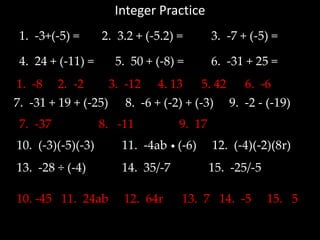
Integer Practice
 1. -3+(-5) =      2. 3.2 + (-5.2) =        3. -7 + (-5) =

 4. 24 + (-11) =       5. 50 + (-8) =       6. -31 + 25 =
1. -8     2. -2       3. -12   4. 13      5. 42      6. -6
7. -31 + 19 + (-25)      8. -6 + (-2) + (-3)      9. -2 - (-19)
 7. -37            8. -11           9. 17
10. (-3)(-5)(-3)        11. -4ab • (-6)     12. (-4)(-2)(8r)
13. -28 ÷ (-4)          14. 35/-7           15. -25/-5

10. -45 11. 24ab        12. 64r      13. 7 14. -5        15. 5
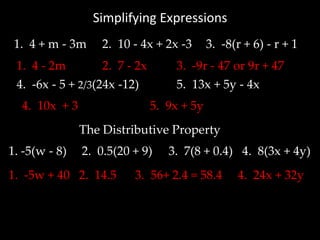
Simplifying Expressions
 1. 4 + m - 3m     2. 10 - 4x + 2x -3       3. -8(r + 6) - r + 1
 1. 4 - 2m         2. 7 - 2x       3. -9r - 47 or 9r + 47
 4. -6x - 5 + 2/3(24x -12)         5. 13x + 5y - 4x
  4. 10x + 3                   5. 9x + 5y
               The Distributive Property
1. -5(w - 8)   2. 0.5(20 + 9)     3. 7(8 + 0.4) 4. 8(3x + 4y)
1. -5w + 40 2. 14.5      3. 56+ 2.4 = 58.4        4. 24x + 32y
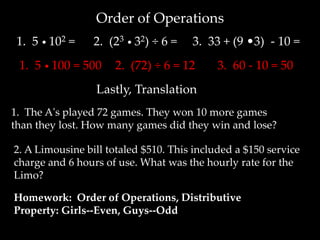
Order of Operations
 1. 5 • 102 =    2. (23 • 32) ÷ 6 =   3. 33 + (9 •3) - 10 =
 1. 5 • 100 = 500    2. (72) ÷ 6 = 12       3. 60 - 10 = 50
                 Lastly, Translation
1. The A's played 72 games. They won 10 more games
than they lost. How many games did they win and lose?

2. A Limousine bill totaled $510. This included a $150 service
charge and 6 hours of use. What was the hourly rate for the
Limo?

Homework: Order of Operations, Distributive
Property: Girls--Even, Guys--Odd
September 21, 2012

• Absolute Value: The absolute value of x, denoted "| x |" (and
  which is read as "the absolute value of x"), is the distance of x
  from zero. This is why absolute value is never negative; absolute
  value only asks "how far?", not "in which direction?" This means
  not only that | 3 | = 3, because 3 is three units to the right of
  zero, but also that | –3 | = 3, because –3 is three units to the
  left of zero.
• Warning: The absolute-value notation is bars, not parentheses
  or brackets. Use the proper notation; the other notations do not
  mean the same thing.
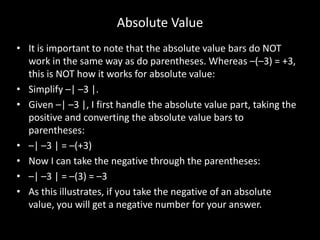
Absolute Value
• It is important to note that the absolute value bars do NOT
  work in the same way as do parentheses. Whereas –(–3) = +3,
  this is NOT how it works for absolute value:
• Simplify –| –3 |.
• Given –| –3 |, I first handle the absolute value part, taking the
  positive and converting the absolute value bars to
  parentheses:
• –| –3 | = –(+3)
• Now I can take the negative through the parentheses:
• –| –3 | = –(3) = –3
• As this illustrates, if you take the negative of an absolute
  value, you will get a negative number for your answer.
Absolute Value
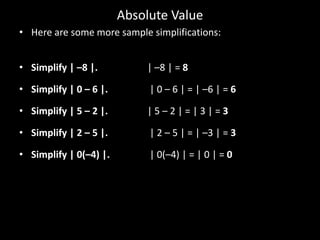
• Here are some more sample simplifications:


• Simplify | –8 |.          | –8 | = 8

• Simplify | 0 – 6 |.        | 0 – 6 | = | –6 | = 6

• Simplify | 5 – 2 |.       |5–2|=|3|=3

• Simplify | 2 – 5 |.        | 2 – 5 | = | –3 | = 3

• Simplify | 0(–4) |.        | 0(–4) | = | 0 | = 0
Absolute Value
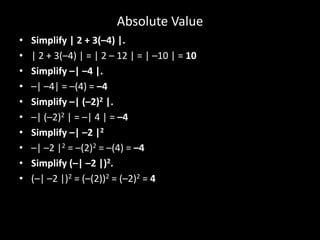
•   Simplify | 2 + 3(–4) |.
•   | 2 + 3(–4) | = | 2 – 12 | = | –10 | = 10
•   Simplify –| –4 |.
•   –| –4| = –(4) = –4
•   Simplify –| (–2)2 |.
•   –| (–2)2 | = –| 4 | = –4
•   Simplify –| –2 |2
•   –| –2 |2 = –(2)2 = –(4) = –4
•   Simplify (–| –2 |)2.
•   (–| –2 |)2 = (–(2))2 = (–2)2 = 4
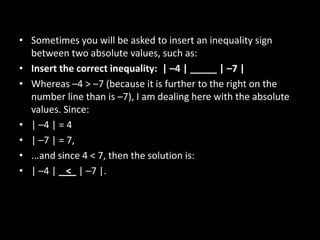
• Sometimes you will be asked to insert an inequality sign
  between two absolute values, such as:
• Insert the correct inequality: | –4 | _____ | –7 |
• Whereas –4 > –7 (because it is further to the right on the
  number line than is –7), I am dealing here with the absolute
  values. Since:
• | –4 | = 4
• | –7 | = 7,
• ...and since 4 < 7, then the solution is:
• | –4 | < | –7 |.
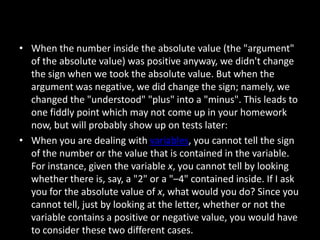
• When the number inside the absolute value (the "argument"
  of the absolute value) was positive anyway, we didn't change
  the sign when we took the absolute value. But when the
  argument was negative, we did change the sign; namely, we
  changed the "understood" "plus" into a "minus". This leads to
  one fiddly point which may not come up in your homework
  now, but will probably show up on tests later:
• When you are dealing with variables, you cannot tell the sign
  of the number or the value that is contained in the variable.
  For instance, given the variable x, you cannot tell by looking
  whether there is, say, a "2" or a "–4" contained inside. If I ask
  you for the absolute value of x, what would you do? Since you
  cannot tell, just by looking at the letter, whether or not the
  variable contains a positive or negative value, you would have
  to consider these two different cases.
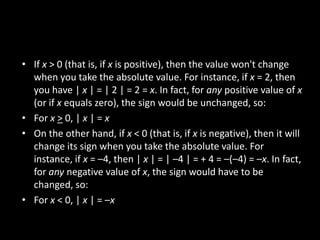
• If x > 0 (that is, if x is positive), then the value won't change
  when you take the absolute value. For instance, if x = 2, then
  you have | x | = | 2 | = 2 = x. In fact, for any positive value of x
  (or if x equals zero), the sign would be unchanged, so:
• For x > 0, | x | = x
• On the other hand, if x < 0 (that is, if x is negative), then it will
  change its sign when you take the absolute value. For
  instance, if x = –4, then | x | = | –4 | = + 4 = –(–4) = –x. In fact,
  for any negative value of x, the sign would have to be
  changed, so:
• For x < 0, | x | = –x
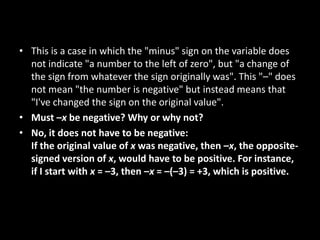
• This is a case in which the "minus" sign on the variable does
  not indicate "a number to the left of zero", but "a change of
  the sign from whatever the sign originally was". This "–" does
  not mean "the number is negative" but instead means that
  "I've changed the sign on the original value".
• Must –x be negative? Why or why not?
• No, it does not have to be negative:
  If the original value of x was negative, then –x, the opposite-
  signed version of x, would have to be positive. For instance,
  if I start with x = –3, then –x = –(–3) = +3, which is positive.
Sept. 20
Sept. 20
Sept. 20

Sept. 20

  • 1.
  • 2.
    1. Khan AcademyRegistration: There are a few people whose name I cannot tell from their login name. Please check your email. You are not getting credit as of now if I don't know who you are. 2. New Khan Mastery Topics posted for the rest of September and all of October. This should take us to the end of the 1st quarter. 3. Bonus Points: Every few days, a bonus question is posted on the v6math site. First 5 people who email the correct answer get 10 xtra credit pts. Those 5 get email. If no email, then you were too late. 4. The library is open from 7:00 a.m. - 4:00 p.m. if you do not have internet access for the Khan Academy. 5. The last quiz was not graded: 2nd/4th 6. Text/Work Book for download: Pls. do this.
  • 3.
    September 20, 2012 Review:Integers, Expressions, Translations, Order of Operations, Distributive Property Class work: Order of Operations, Distributive Prop. 1. There are two ways to combine long strings of integers. A. Add all the positive numbers, then add all the negative numbers. Then combine the two numbers using rule for opposite signs. B. Combine all numbers in order from left to right. Use method A for these numbers: -3 + (-5) + 6 + 9 + 2 + (-4) 6 + 9 + 2 = 17; -3 + (-5) + (-4) = -12; 17 - 12 = 5 Use Method B: 5 + (-4) + (-6) + 8 + (-3) + 3 = 1 -6 = -5 + 8 = 13 - 3 = -0 + 3 = 13
  • 4.
    Integer Practice 1.-3+(-5) = 2. 3.2 + (-5.2) = 3. -7 + (-5) = 4. 24 + (-11) = 5. 50 + (-8) = 6. -31 + 25 = 1. -8 2. -2 3. -12 4. 13 5. 42 6. -6 7. -31 + 19 + (-25) 8. -6 + (-2) + (-3) 9. -2 - (-19) 7. -37 8. -11 9. 17 10. (-3)(-5)(-3) 11. -4ab • (-6) 12. (-4)(-2)(8r) 13. -28 ÷ (-4) 14. 35/-7 15. -25/-5 10. -45 11. 24ab 12. 64r 13. 7 14. -5 15. 5
  • 5.
    Simplifying Expressions 1.4 + m - 3m 2. 10 - 4x + 2x -3 3. -8(r + 6) - r + 1 1. 4 - 2m 2. 7 - 2x 3. -9r - 47 or 9r + 47 4. -6x - 5 + 2/3(24x -12) 5. 13x + 5y - 4x 4. 10x + 3 5. 9x + 5y The Distributive Property 1. -5(w - 8) 2. 0.5(20 + 9) 3. 7(8 + 0.4) 4. 8(3x + 4y) 1. -5w + 40 2. 14.5 3. 56+ 2.4 = 58.4 4. 24x + 32y
  • 6.
    Order of Operations 1. 5 • 102 = 2. (23 • 32) ÷ 6 = 3. 33 + (9 •3) - 10 = 1. 5 • 100 = 500 2. (72) ÷ 6 = 12 3. 60 - 10 = 50 Lastly, Translation 1. The A's played 72 games. They won 10 more games than they lost. How many games did they win and lose? 2. A Limousine bill totaled $510. This included a $150 service charge and 6 hours of use. What was the hourly rate for the Limo? Homework: Order of Operations, Distributive Property: Girls--Even, Guys--Odd
  • 7.
    September 21, 2012 •Absolute Value: The absolute value of x, denoted "| x |" (and which is read as "the absolute value of x"), is the distance of x from zero. This is why absolute value is never negative; absolute value only asks "how far?", not "in which direction?" This means not only that | 3 | = 3, because 3 is three units to the right of zero, but also that | –3 | = 3, because –3 is three units to the left of zero. • Warning: The absolute-value notation is bars, not parentheses or brackets. Use the proper notation; the other notations do not mean the same thing.
  • 8.
    Absolute Value • Itis important to note that the absolute value bars do NOT work in the same way as do parentheses. Whereas –(–3) = +3, this is NOT how it works for absolute value: • Simplify –| –3 |. • Given –| –3 |, I first handle the absolute value part, taking the positive and converting the absolute value bars to parentheses: • –| –3 | = –(+3) • Now I can take the negative through the parentheses: • –| –3 | = –(3) = –3 • As this illustrates, if you take the negative of an absolute value, you will get a negative number for your answer.
  • 9.
    Absolute Value • Hereare some more sample simplifications: • Simplify | –8 |. | –8 | = 8 • Simplify | 0 – 6 |. | 0 – 6 | = | –6 | = 6 • Simplify | 5 – 2 |. |5–2|=|3|=3 • Simplify | 2 – 5 |. | 2 – 5 | = | –3 | = 3 • Simplify | 0(–4) |. | 0(–4) | = | 0 | = 0
  • 10.
    Absolute Value • Simplify | 2 + 3(–4) |. • | 2 + 3(–4) | = | 2 – 12 | = | –10 | = 10 • Simplify –| –4 |. • –| –4| = –(4) = –4 • Simplify –| (–2)2 |. • –| (–2)2 | = –| 4 | = –4 • Simplify –| –2 |2 • –| –2 |2 = –(2)2 = –(4) = –4 • Simplify (–| –2 |)2. • (–| –2 |)2 = (–(2))2 = (–2)2 = 4
  • 11.
    • Sometimes youwill be asked to insert an inequality sign between two absolute values, such as: • Insert the correct inequality: | –4 | _____ | –7 | • Whereas –4 > –7 (because it is further to the right on the number line than is –7), I am dealing here with the absolute values. Since: • | –4 | = 4 • | –7 | = 7, • ...and since 4 < 7, then the solution is: • | –4 | < | –7 |.
  • 12.
    • When thenumber inside the absolute value (the "argument" of the absolute value) was positive anyway, we didn't change the sign when we took the absolute value. But when the argument was negative, we did change the sign; namely, we changed the "understood" "plus" into a "minus". This leads to one fiddly point which may not come up in your homework now, but will probably show up on tests later: • When you are dealing with variables, you cannot tell the sign of the number or the value that is contained in the variable. For instance, given the variable x, you cannot tell by looking whether there is, say, a "2" or a "–4" contained inside. If I ask you for the absolute value of x, what would you do? Since you cannot tell, just by looking at the letter, whether or not the variable contains a positive or negative value, you would have to consider these two different cases.
  • 13.
    • If x> 0 (that is, if x is positive), then the value won't change when you take the absolute value. For instance, if x = 2, then you have | x | = | 2 | = 2 = x. In fact, for any positive value of x (or if x equals zero), the sign would be unchanged, so: • For x > 0, | x | = x • On the other hand, if x < 0 (that is, if x is negative), then it will change its sign when you take the absolute value. For instance, if x = –4, then | x | = | –4 | = + 4 = –(–4) = –x. In fact, for any negative value of x, the sign would have to be changed, so: • For x < 0, | x | = –x
  • 14.
    • This isa case in which the "minus" sign on the variable does not indicate "a number to the left of zero", but "a change of the sign from whatever the sign originally was". This "–" does not mean "the number is negative" but instead means that "I've changed the sign on the original value". • Must –x be negative? Why or why not? • No, it does not have to be negative: If the original value of x was negative, then –x, the opposite- signed version of x, would have to be positive. For instance, if I start with x = –3, then –x = –(–3) = +3, which is positive.