By : Rasika Dixit Hatolkar.
•A group of words that is arranged
in a proper order and gives a
complete meaning is called a
sentence.
• A group of words that express a complete
thought or ideas.
• It has two parts subject and predicate.
• Composed of at least one independent
clause.
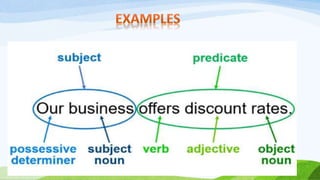
1. a subject (what the sentence is
about, the topic of the sentence)
2. a predicate (what is
said about the subject)
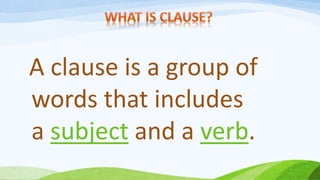
A clause is a group of
words that includes
a subject and a verb.
• I want some cereal.
• Marie likes cats.
• Joseph is a good soccer
player.
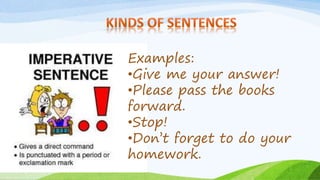
Examples:
•Give me your answer!
•Please pass the books
forward.
•Stop!
•Don’t forget to do your
homework.
Examples:
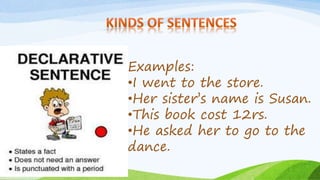
•I went to the store.
•Her sister’s name is Susan.
•This book cost 12rs.
•He asked her to go to the
dance.
Examples:
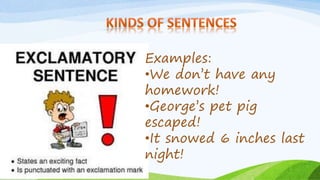
•We don’t have any
homework!
•George’s pet pig
escaped!
•It snowed 6 inches last
night!
Examples:
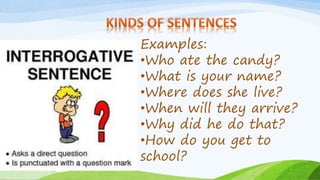
•Who ate the candy?
•What is your name?
•Where does she live?
•When will they arrive?
•Why did he do that?
•How do you get to
school?
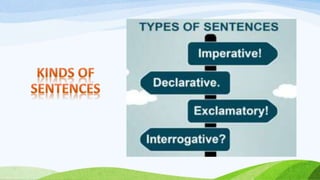
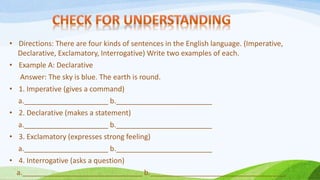
• Directions: There are four kinds of sentences in the English language. (Imperative,
Declarative, Exclamatory, Interrogative) Write two examples of each.
• Example A: Declarative
Answer: The sky is blue. The earth is round.
• 1. Imperative (gives a command)
a._____________________ b.________________________
• 2. Declarative (makes a statement)
a._____________________ b.________________________
• 3. Exclamatory (expresses strong feeling)
a._____________________ b.________________________
• 4. Interrogative (asks a question)
a.______________________________ b.__________________________________

Sentences

  • 1.
    By : RasikaDixit Hatolkar.
  • 2.
    •A group ofwords that is arranged in a proper order and gives a complete meaning is called a sentence.
  • 3.
    • A groupof words that express a complete thought or ideas. • It has two parts subject and predicate. • Composed of at least one independent clause.
  • 4.
    1. a subject(what the sentence is about, the topic of the sentence) 2. a predicate (what is said about the subject)
  • 6.
    A clause isa group of words that includes a subject and a verb.
  • 7.
    • I wantsome cereal. • Marie likes cats. • Joseph is a good soccer player.
  • 9.
    Examples: •Give me youranswer! •Please pass the books forward. •Stop! •Don’t forget to do your homework.
  • 10.
    Examples: •I went tothe store. •Her sister’s name is Susan. •This book cost 12rs. •He asked her to go to the dance.
  • 11.
    Examples: •We don’t haveany homework! •George’s pet pig escaped! •It snowed 6 inches last night!
  • 12.
    Examples: •Who ate thecandy? •What is your name? •Where does she live? •When will they arrive? •Why did he do that? •How do you get to school?
  • 13.
    • Directions: Thereare four kinds of sentences in the English language. (Imperative, Declarative, Exclamatory, Interrogative) Write two examples of each. • Example A: Declarative Answer: The sky is blue. The earth is round. • 1. Imperative (gives a command) a._____________________ b.________________________ • 2. Declarative (makes a statement) a._____________________ b.________________________ • 3. Exclamatory (expresses strong feeling) a._____________________ b.________________________ • 4. Interrogative (asks a question) a.______________________________ b.__________________________________