Sentence
Building Blocks
& Structures
Instructor Sandi Weisel
Grammar – the study
of the way the sentences of a
language are constructed.
Sentence – has a subject, a
verb, and a complete
thought.
Sentences are formed with groups
of words called clauses and
phrases.
Clause – a group of words
with a subject and verb that
forms part of a sentence or
a complete simple sentence.
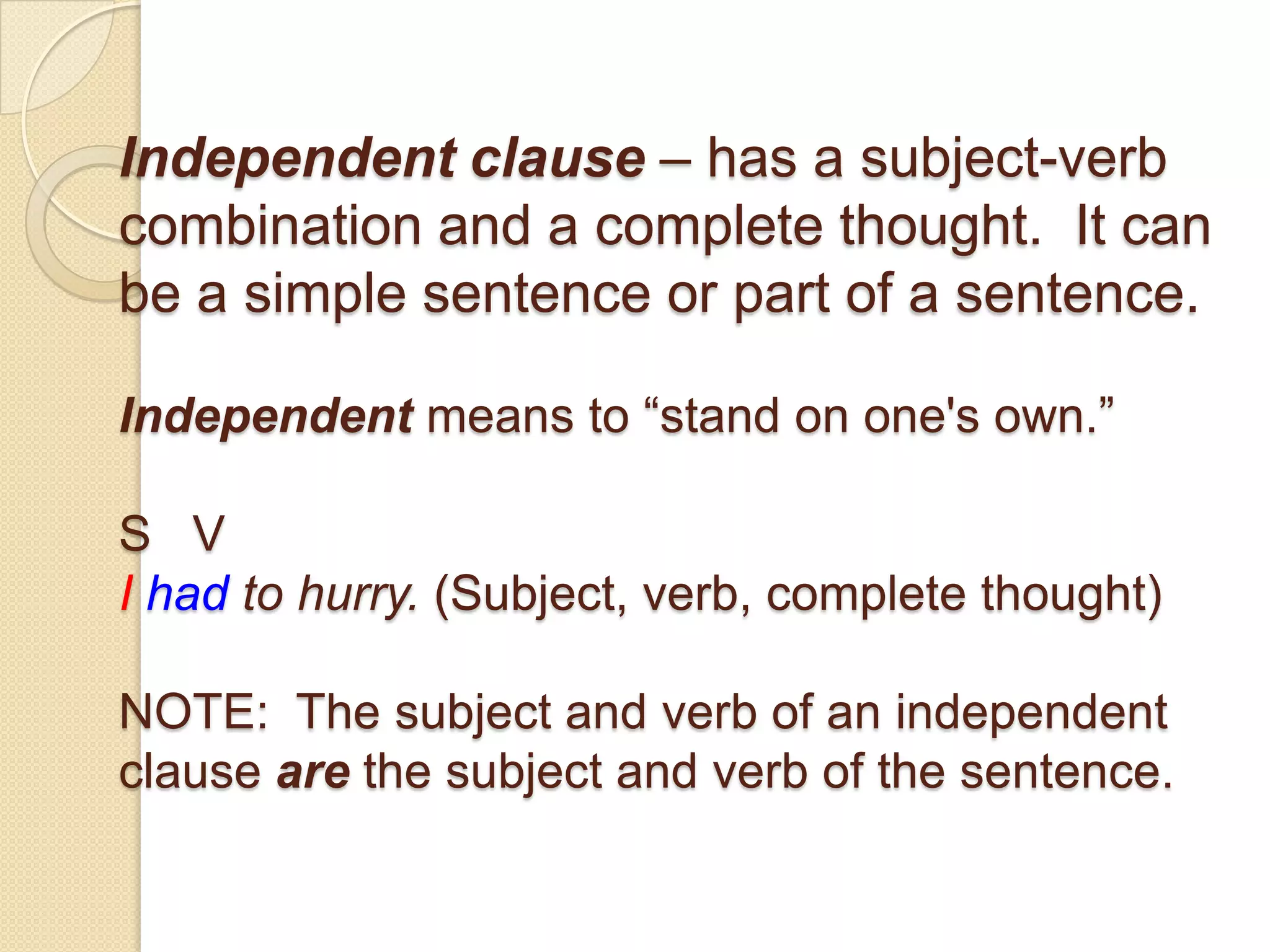
Independent clause – has a subject-verb
combination and a complete thought. It can
be a simple sentence or part of a sentence.
Independent means to ―stand on one's own.‖
S V
I had to hurry. (Subject, verb, complete thought)
NOTE: The subject and verb of an independent
clause are the subject and verb of the sentence.
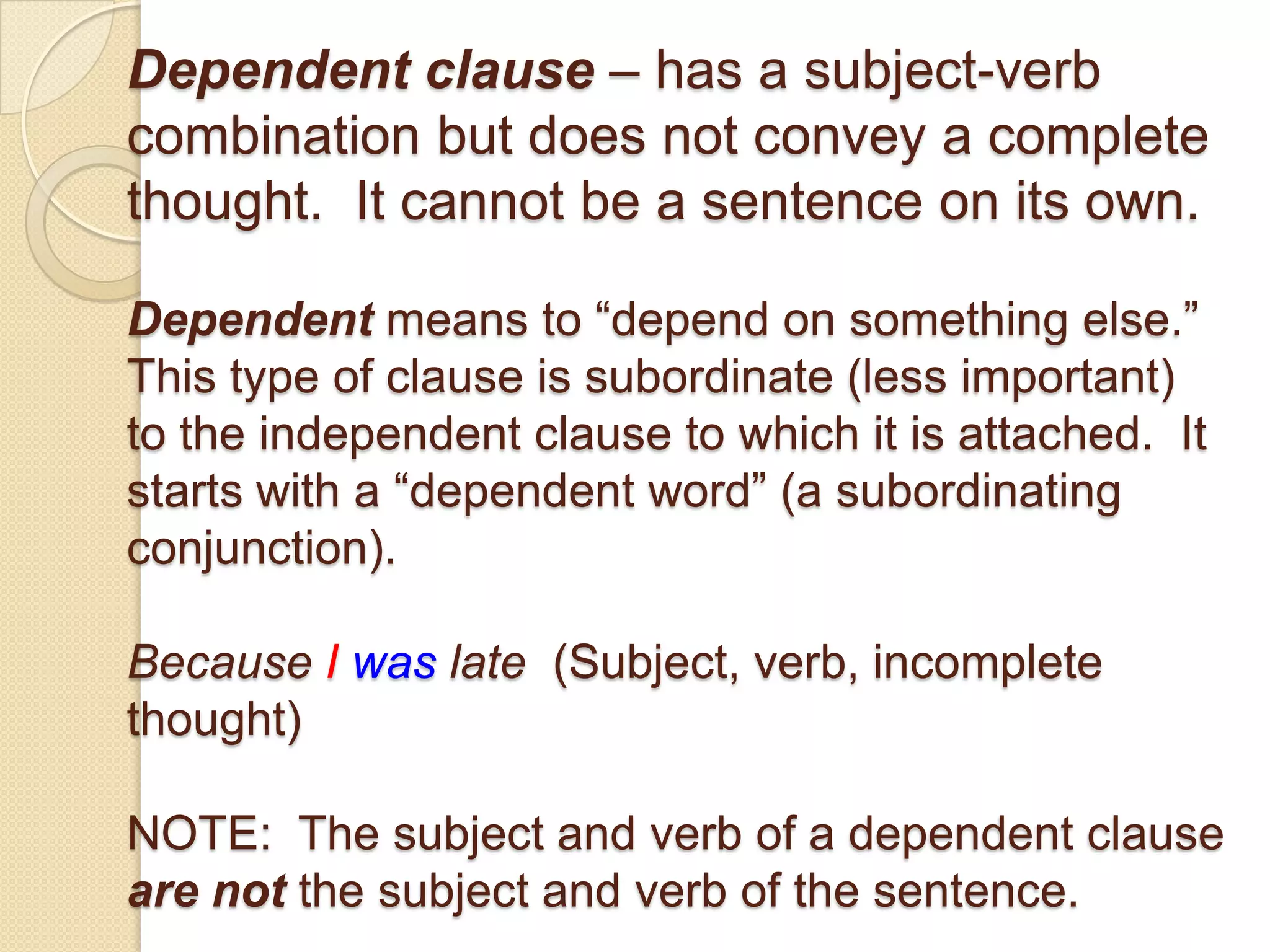
Dependent clause – has a subject-verb
combination but does not convey a complete
thought. It cannot be a sentence on its own.
Dependent means to ―depend on something else.‖
This type of clause is subordinate (less important)
to the independent clause to which it is attached. It
starts with a ―dependent word‖ (a subordinating
conjunction).
Because I was late (Subject, verb, incomplete
thought)
NOTE: The subject and verb of a dependent clause
are not the subject and verb of the sentence.
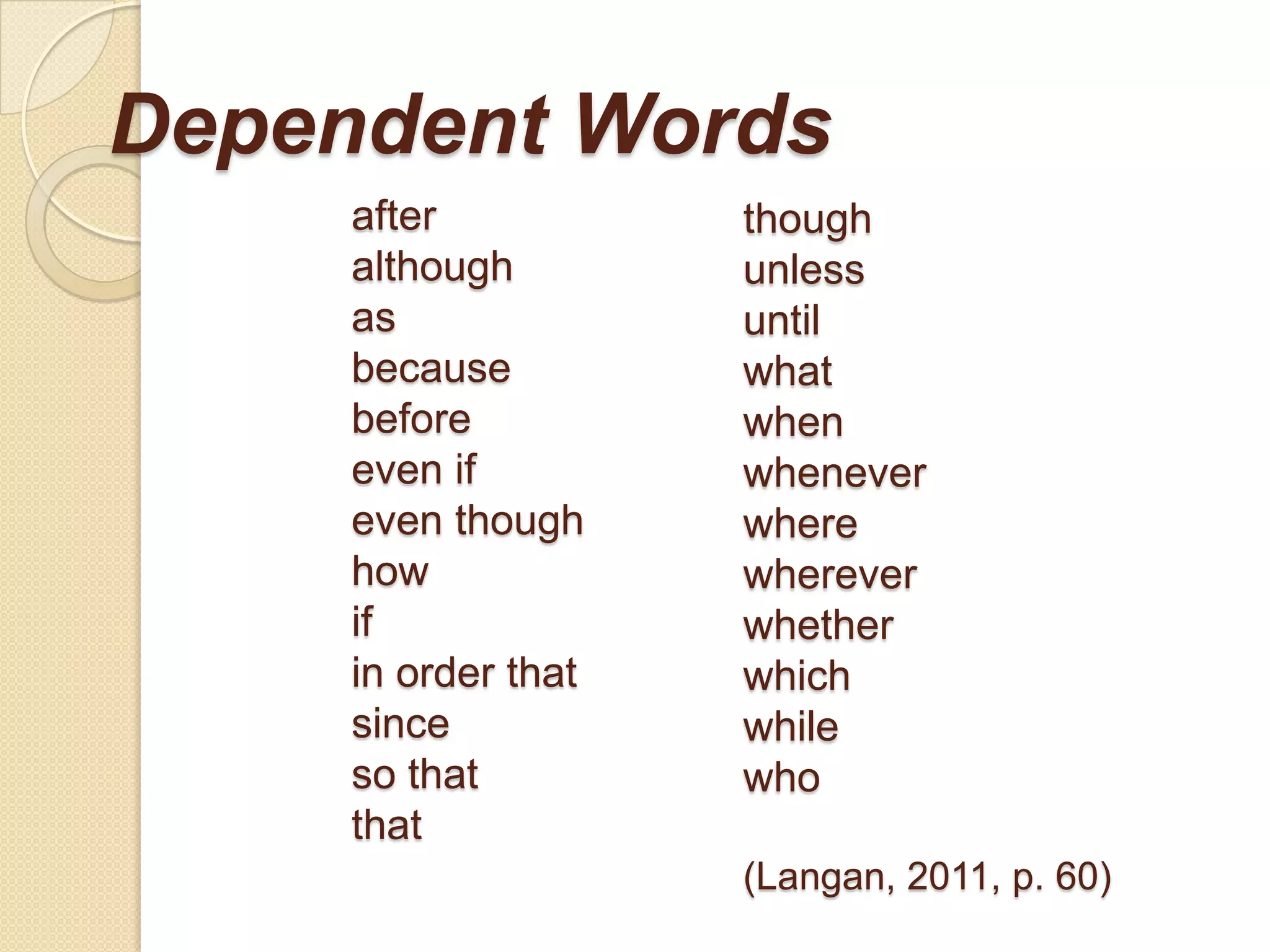
Dependent Words
after
although
as
because
before
even if
even though
how
if
in order that
since
so that
that
though
unless
until
what
when
whenever
where
wherever
whether
which
while
who
(Langan, 2011, p. 60)
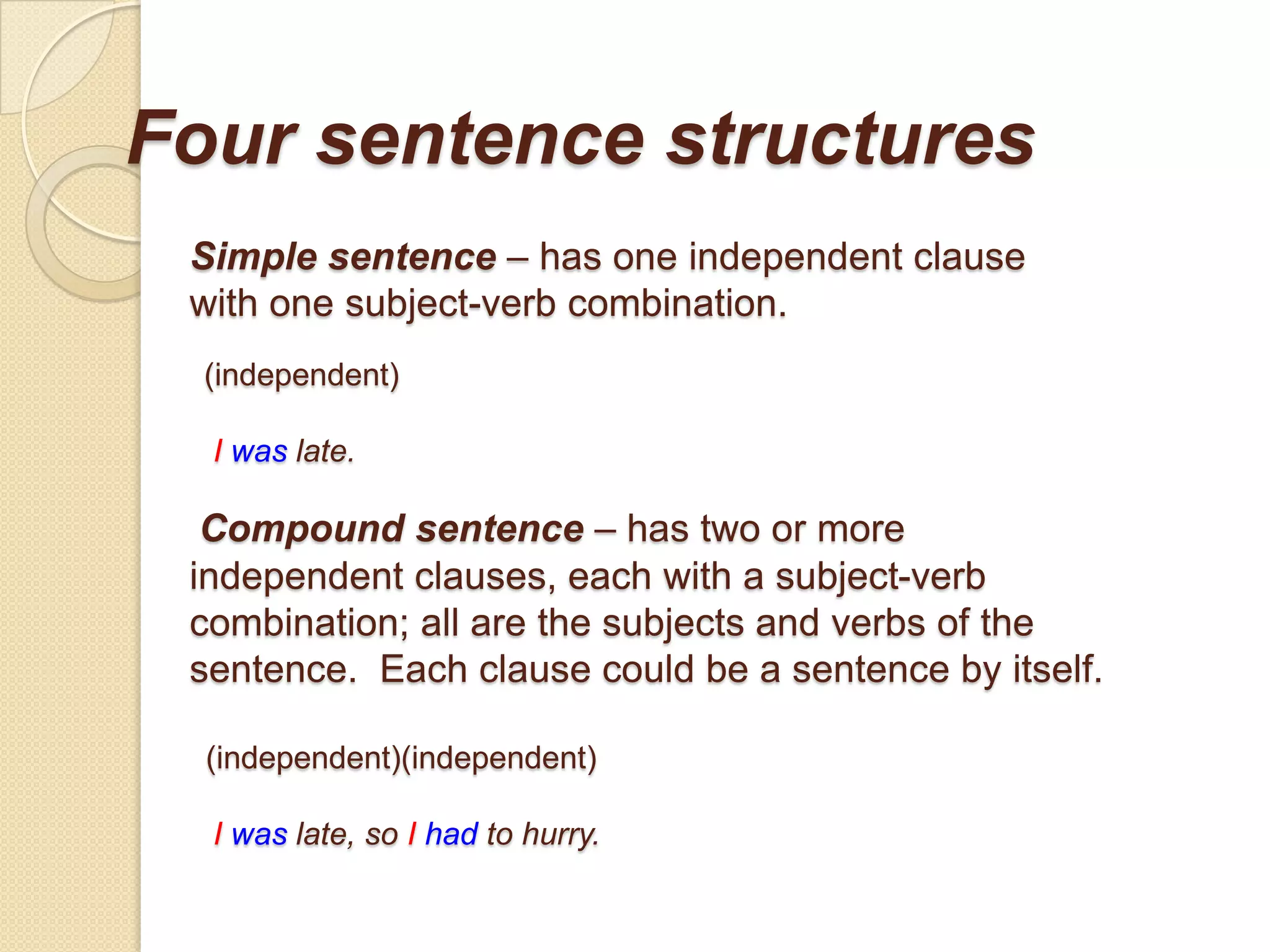
Four sentence structures
Simple sentence – has one independent clause
with one subject-verb combination.
X
(independent)
S V
I was late.
X
Compound sentence – has two or more
independent clauses, each with a subject-verb
combination; all are the subjects and verbs of the
sentence. Each clause could be a sentence by itself.
Xxx
(independent)(independent)
S V S V
I was late, so I had to hurry.
Four sentence structures
con’t.
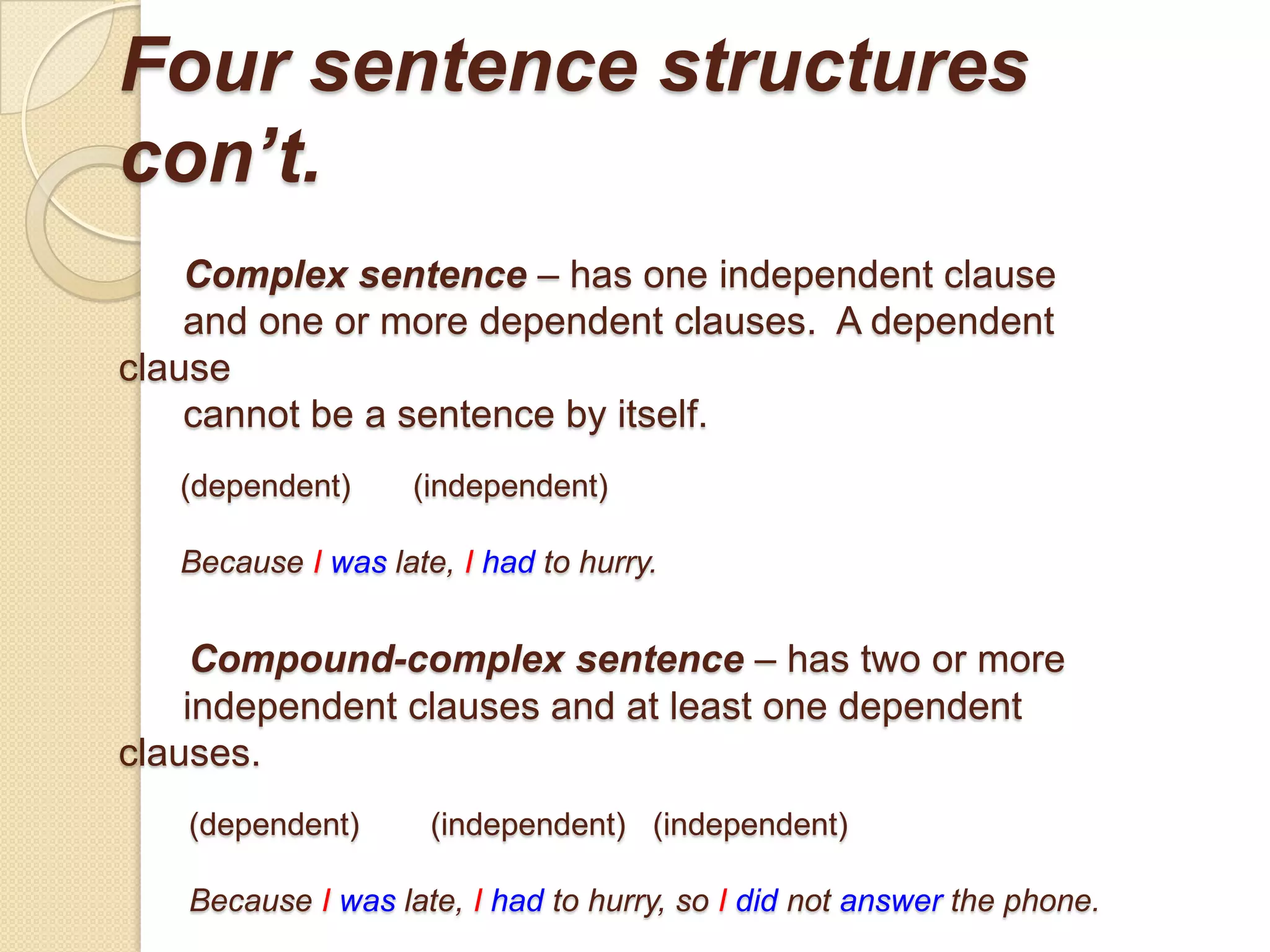
Complex sentence – has one independent clause
and one or more dependent clauses. A dependent
clause
cannot be a sentence by itself.
X
(dependent) (independent)
s v S V
Because I was late, I had to hurry.
Compound-complex sentence – has two or more
independent clauses and at least one dependent
clauses.
X
(dependent) (independent) (independent)
s v S V S V V
Because I was late, I had to hurry, so I did not answer the phone.
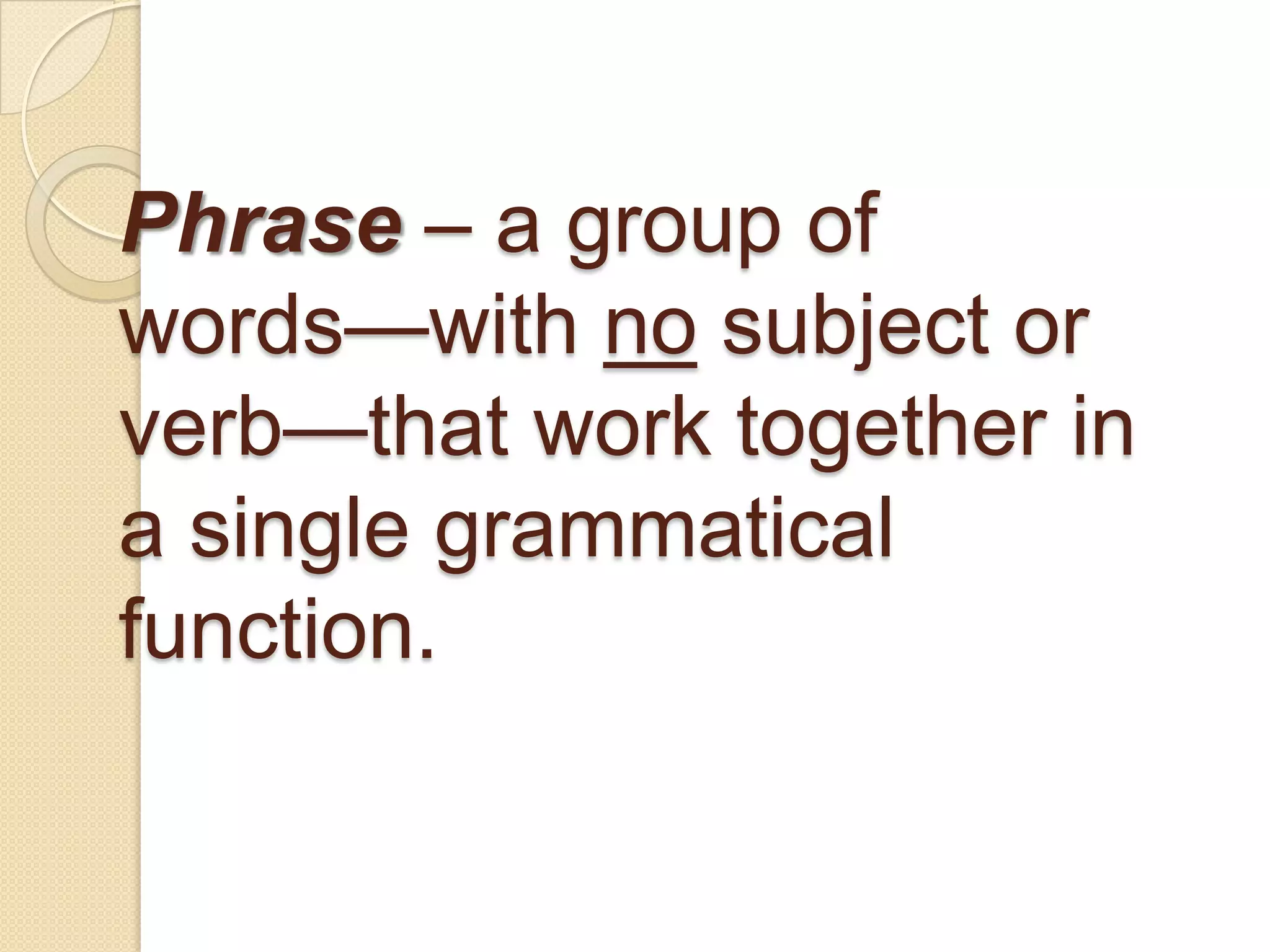
Phrase – a group of
words—with no subject or
verb—that work together in
a single grammatical
function.
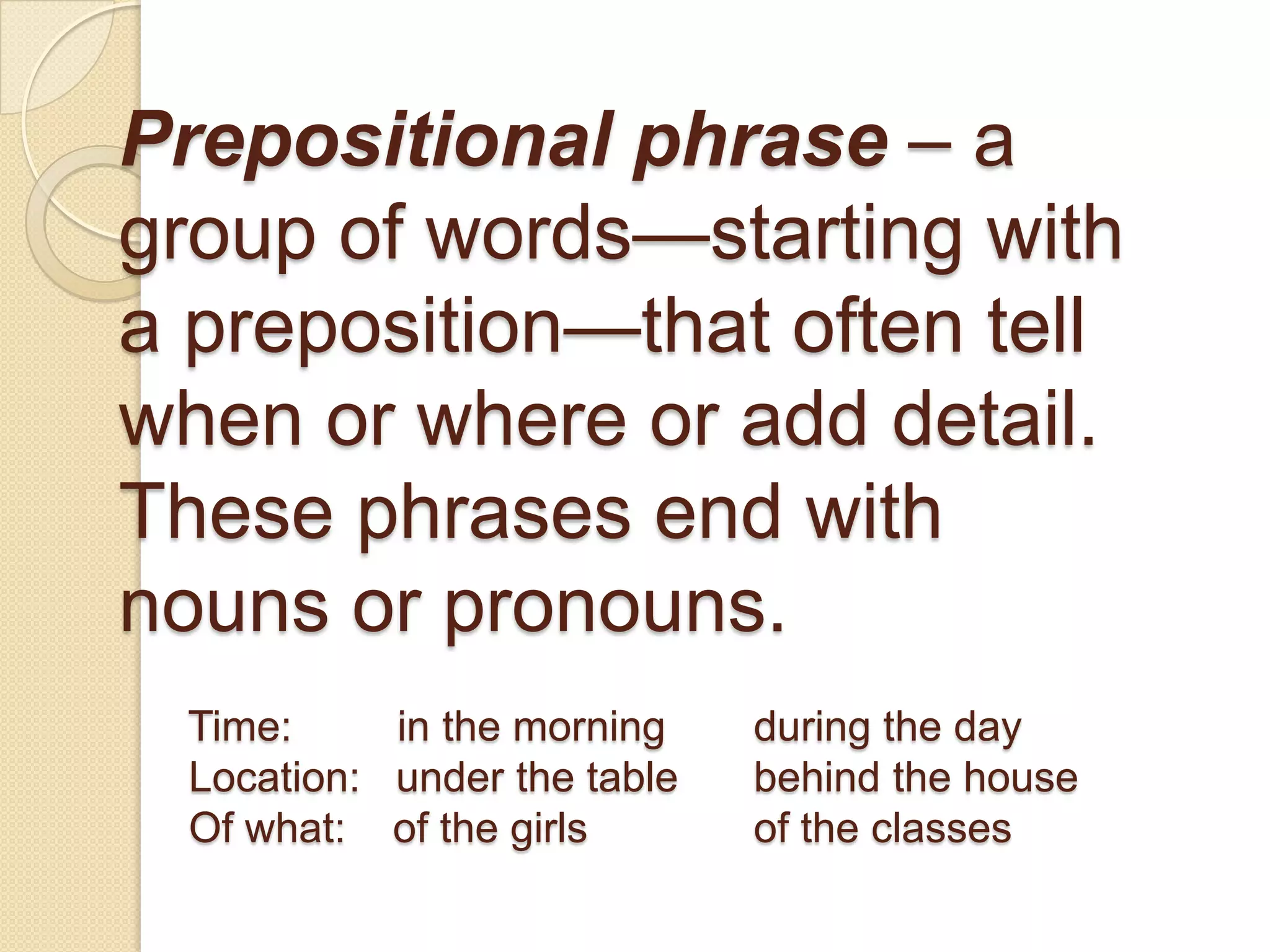
Prepositional phrase – a
group of words—starting with
a preposition—that often tell
when or where or add detail.
These phrases end with
nouns or pronouns.
Time: in the morning during the day
Location: under the table behind the house
Of what: of the girls of the classes
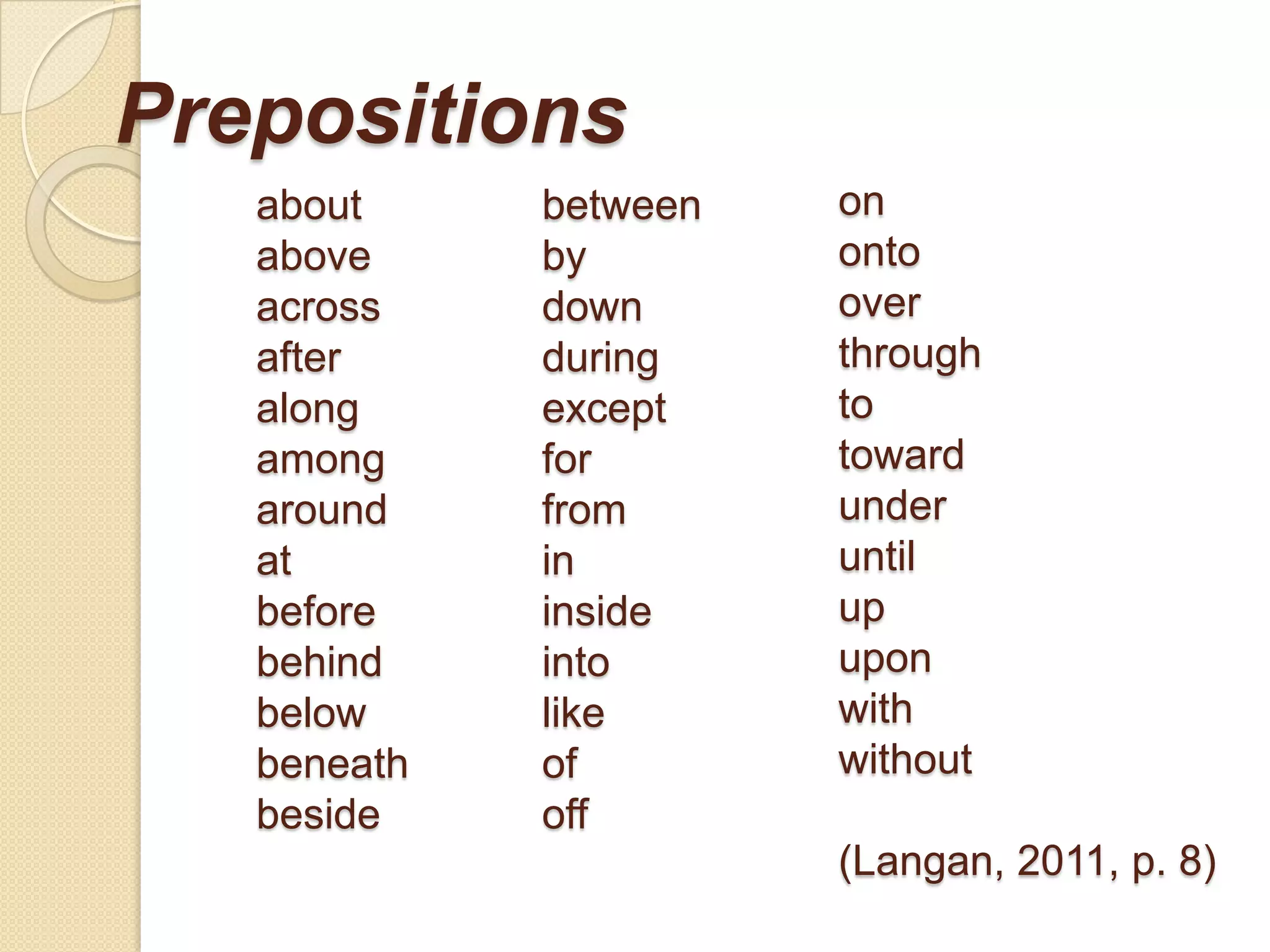
Prepositions
about
above
across
after
along
among
around
at
before
behind
below
beneath
beside
between
by
down
during
except
for
from
in
inside
into
like
of
off
on
onto
over
through
to
toward
under
until
up
upon
with
without
(Langan, 2011, p. 8)
Summary
Clauses and phrases are
used to form sentences in
English. The four basic
sentence structures are built
with independent and/or
dependent clauses.
Reference
Langan, J. , & Goldstein, J. M. (2011). English
xxxxbrushup (5th ed.). New York, NY:
xxxxMcGraw-Hill.

Sentence Building Blocks & Structures

  • 1.
  • 2.
    Grammar – thestudy of the way the sentences of a language are constructed.
  • 3.
    Sentence – hasa subject, a verb, and a complete thought. Sentences are formed with groups of words called clauses and phrases.
  • 4.
    Clause – agroup of words with a subject and verb that forms part of a sentence or a complete simple sentence.
  • 5.
    Independent clause –has a subject-verb combination and a complete thought. It can be a simple sentence or part of a sentence. Independent means to ―stand on one's own.‖ S V I had to hurry. (Subject, verb, complete thought) NOTE: The subject and verb of an independent clause are the subject and verb of the sentence.
  • 6.
    Dependent clause –has a subject-verb combination but does not convey a complete thought. It cannot be a sentence on its own. Dependent means to ―depend on something else.‖ This type of clause is subordinate (less important) to the independent clause to which it is attached. It starts with a ―dependent word‖ (a subordinating conjunction). Because I was late (Subject, verb, incomplete thought) NOTE: The subject and verb of a dependent clause are not the subject and verb of the sentence.
  • 7.
    Dependent Words after although as because before even if eventhough how if in order that since so that that though unless until what when whenever where wherever whether which while who (Langan, 2011, p. 60)
  • 8.
    Four sentence structures Simplesentence – has one independent clause with one subject-verb combination. X (independent) S V I was late. X Compound sentence – has two or more independent clauses, each with a subject-verb combination; all are the subjects and verbs of the sentence. Each clause could be a sentence by itself. Xxx (independent)(independent) S V S V I was late, so I had to hurry.
  • 9.
    Four sentence structures con’t. Complexsentence – has one independent clause and one or more dependent clauses. A dependent clause cannot be a sentence by itself. X (dependent) (independent) s v S V Because I was late, I had to hurry. Compound-complex sentence – has two or more independent clauses and at least one dependent clauses. X (dependent) (independent) (independent) s v S V S V V Because I was late, I had to hurry, so I did not answer the phone.
  • 10.
    Phrase – agroup of words—with no subject or verb—that work together in a single grammatical function.
  • 11.
    Prepositional phrase –a group of words—starting with a preposition—that often tell when or where or add detail. These phrases end with nouns or pronouns. Time: in the morning during the day Location: under the table behind the house Of what: of the girls of the classes
  • 12.
  • 13.
    Summary Clauses and phrasesare used to form sentences in English. The four basic sentence structures are built with independent and/or dependent clauses.
  • 14.
    Reference Langan, J. ,& Goldstein, J. M. (2011). English xxxxbrushup (5th ed.). New York, NY: xxxxMcGraw-Hill.