International Journal of Mechanical Engineering and Technology (IJMET), ISSN 0976 –
6340(Print), ISSN 0976 – 6359(Online), Volume 5, Issue 2, February (2014), pp. 17-25, © IAEME
17
SENSITIVITY ANALYSIS OF HEAT RECOVERY STEAM GENERATOR
FOR A GE 6FA GAS TURBINE
S.Naga Kishorea
, Dr. T.V.Raob
a, b
Department of Mechanical Engineering, DBS Institute of Technology, Kavali-524201
ABSTRACT
The objective of the present study is to optimize the bottoming cycle for a 6 FA gas turbine.
The present work focuses on optimization of steam cycle alone by analyzing the sensitivity of steam
pressure and steam temperature and configuration of waste heat recovery boiler. A two pressure
configuration will have better opportunity for power generation and for applying service steam for
feed stack and drying etc. From cycle analysis at 4 kg/cm2
low pressure steam appear to be most
suitable for the thermodynamic cycle. Also from the analysis of various configurations a two
pressure steam cycle was chosen with integrated deaerator. Both low temperature and intermediate
pressure were used to extract maximum heat from the gas turbine exhaust. A fixed 2% blow down
steam was assumed as per the industrial practice. Two super heater sections were introduced with a
desuperheater to minimize the energy loss. The temperature of the high pressure steam was kept at
5000
c and the pressure of steam has varied to calculate the variation of power and efficiency. And
also keeping the steam temperature at 4000
C, 4500
C. The power and efficiency at different pressures
ranging from 40 ata to 62 ata were calculated to get an operating point and to allow the steam turbine
designer to have suitable pressure and temperature variation to select the appropriate steam turbine at
bottom cycle.
Keywords: Combined Cycle (Cc), HRSG, Efficiency, NTU, Off Design, Effectiveness.
INTRODUCTION
The gas/steam combined cycle has already become a well-proven and important technology
for power generation due to its numerous advantages. The advantages include its high efficiency in
utilizing energy resources, low environmental emissions, short duration of construction, low initial
investment cost, low operation and maintenance cost, and flexibility in fuel selection, etc.[11]. These
features justify the fact that the combined cycle power plants are quite competitive in the power
market.
INTERNATIONAL JOURNAL OF MECHANICAL ENGINEERING
AND TECHNOLOGY (IJMET)
ISSN 0976 – 6340 (Print)
ISSN 0976 – 6359 (Online)
Volume 5, Issue 2, February (2014), pp. 17-25
© IAEME: www.iaeme.com/ijmet.asp
Journal Impact Factor (2014): 3.8231 (Calculated by GISI)
www.jifactor.com
IJMET
© I A E M E
International Journal of Mechanical Engineering and Technology (IJMET), ISSN 0976 –
6340(Print), ISSN 0976 – 6359(Online), Volume 5, Issue 2, February (2014), pp. 17-25, © IAEME
18
The heat recovery steam generator (HRSG) is the component of the bottoming steam cycle,
which absorbs energy of exhaust gas of the gas turbine and produces steam at subcritical pressures
suitable for the process or for further electricity generation by a steam turbine. Power plant engineers
can design their own HRSGs and the bottoming steam cycles at the initial stage. On the other hand,
gas turbine is not made in order and steam turbine is selected according to the condition of the steam
delivered from a HRSG. In this respect, the design of a HRSG is indispensable to the improvement
of the overall system efficiency and power output, and to the reduction of the main equipment cost
[5, 8, 9]. HRSGs are classified into single, dual, and triple pressure types depending on the number
of drums in the boiler. Dual pressure HRSGs have been widely used because they showed higher
efficiency than single pressure systems and lower investment cost than triple pressure HRSGs.
Murad A Rahim et al studied three types of HRSG and worked on the effects of HRSG design to the
net power generation and overall efficiency of the cycle was performed. Steam pressure, pinch point
temperature difference and approach temperature difference were taken as variables [1]. Meeta
Sharma and Onkar Singh presented a detailed mathematical modeling and analysis for segmented fin
in the HRSG for its various sub-components. The optimization was also done on the basis of
maximum heat recovery with minimum pressure drop for a given heat flow [2]. P.Ravindra Kumar
and V.Dhana Raju studied the operating characteristics of triple pressure reheat HRSGs which were
analyzed. The effects of the configuration of HP superheater and reheater on the thermal
performance and economics of the plant were investigated. The arrangement of Intermediate-
Temperature components such as intermediate pressure (IP) superheater, HP economizer, and low
pressure (LP) superheater were changed to check its effect on the performance of a steam turbine.
The off-design performance was also examined considering the operating ranges of the plant [3].
Mustafa Zeki Yilmazoglu and Ehsan Amirabedin carried out exergy analysis of a combined cycle
gas turbine (CCGT) power plant, in Ankara, in an exergy aspect. The exergy efficiency of each
component and overall plant was studied by calculating exergy destructions and sensitivity analysis
was performed by changing some critical parameters of the system [4]. C.Casarosa and Franco
investigated the thermodynamic analysis to design the operating parameters for the various
configurations of HRSG systems to minimize Exergy losses, taking into account only the
irreversibility due to the temperature difference between the hot and cold streams (pressure drop not
accounting). All the solutions lead to the zero pinch point and infinite heat transfer surface [7].
T.Srinivas projected thermodynamic modelling and optimization of a dual pressure reheating HRSG
in the CC with a deaerator. The variations in CC performance were plotted with the compressor
pressure ratio, gas turbine inlet temperature, HRSG HP, steam reheat pressure and deaerator
pressure. From this study of thermodynamic modelling, the optimized conditions to air compressor,
HP steam, LP steam, steam reheater and deaerator were developed [13].
In this study, sensitivity analysis of a heat recovery steam generator in a combined cycle gas turbine
(CCGT) power plant for GE 6FA Gas Turbine is performed. The power and efficiency at different
pressures ranging from 40 ata to 62 ata are calculated by varying temperatures of steam from 400o
C
to 500o
C for getting an operating point and for allowing the steam turbine designer to have suitable
pressure and temperature variation to select the appropriate steam turbine at bottom cycle.
PLANT DESCRIPTION
The heat recovery steam generator is a series of heat exchangers. It consists of three heat
exchangers (economizer, evaporator, superheater) for every pressure level. Economizers are used to
heat water close to saturation, evaporators to produce saturated steam and superheaters to produce
superheated steam. Every heat exchanger is a bundle tubes placed in-line or staggered arrangement
according to the manufacture. The flow of working fluid (water or steam) in the pipes is horizontal
flow and the flow of exhaust is vertical flow that's mean, each heat exchanger in the HRSG could be
International Journal of Mechanical Engineering and Technology (IJMET), ISSN 0976 –
6340(Print), ISSN 0976 – 6359(Online), Volume 5, Issue 2, February (2014), pp. 17-25, © IAEME
19
considered a cross flow heat exchanger. The type of circulation fluid in the evaporator is a forced
circulation by circulated pump for each pressure level. Steam drums are used in HRSG to separate
the water from outlet steam from evaporator .The exhaust gases of the gas turbine consider are a
wake heat transfer coefficients comparison with heat transfer coefficients of working fluid in
evaporator and economizer therefore, finned tubes are used in HRSG. Fins can be sold or serrated
.The most important parameters of HRSGs are pinch point, approach point and gas side pressure
drop through the heat recovery system, which affect the effectiveness of heat exchange. Pinch point
is the difference between the gas temperature leaving the evaporator section of the system and the
saturation temperature corresponding to the steam pressure in that section. Approach point is the
difference between the saturation temperature of fluid and inlet temperature of fluid in evaporator.
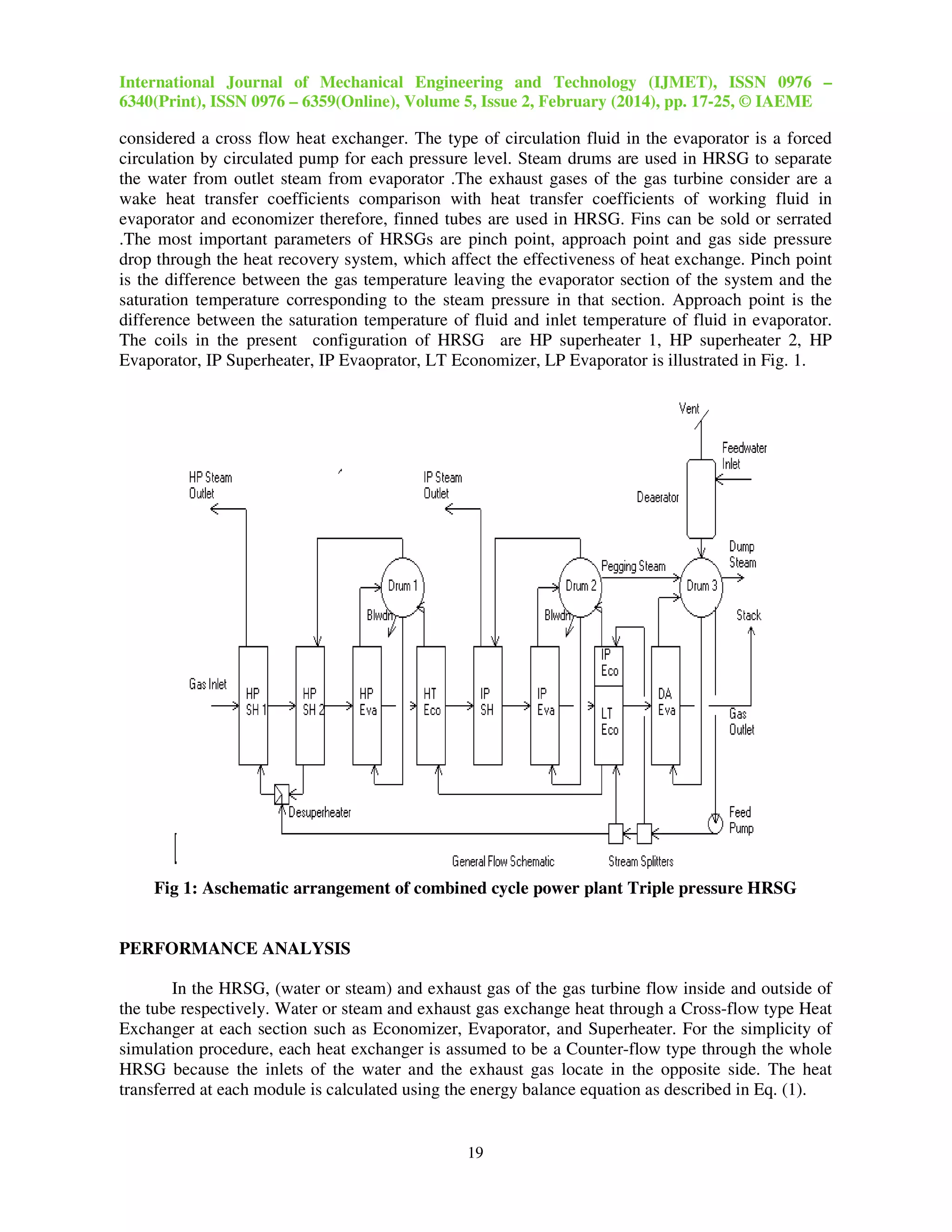
The coils in the present configuration of HRSG are HP superheater 1, HP superheater 2, HP
Evaporator, IP Superheater, IP Evaoprator, LT Economizer, LP Evaporator is illustrated in Fig. 1.
Fig 1: Aschematic arrangement of combined cycle power plant Triple pressure HRSG
PERFORMANCE ANALYSIS
In the HRSG, (water or steam) and exhaust gas of the gas turbine flow inside and outside of
the tube respectively. Water or steam and exhaust gas exchange heat through a Cross-flow type Heat
Exchanger at each section such as Economizer, Evaporator, and Superheater. For the simplicity of
simulation procedure, each heat exchanger is assumed to be a Counter-flow type through the whole
HRSG because the inlets of the water and the exhaust gas locate in the opposite side. The heat
transferred at each module is calculated using the energy balance equation as described in Eq. (1).
International Journal of Mechanical Engineering and Technology (IJMET), ISSN 0976 –
6340(Print), ISSN 0976 – 6359(Online), Volume 5, Issue 2, February (2014), pp. 17-25, © IAEME
20
----------(1)
The gas side and water/steam side temperatures at the inlet and outlet of each section of the
HRSG are determined using this energy balance equation Using the well Known effectiveness –NTU
method with overall heat transfer coefficient, Udesign, the area of HRSG together with other related
parameters is calculated based on design parameters shown in equation
---------------(2)
Q max is the maximum heat transfer rate that could possibly be delivered by the heat
exchanger [12].
The heat transfer area can be evaluated with the fin geometry data, and this area should match
the one determined by the effectiveness-NTU method as above. Through the iterative procedure, the
area is determined when the one equals to the other within a prescribed criterion.
Off-design performance analysis of the HRSG [6] is carried out using the design parameters
described as above. The procedure to determine the thermodynamic properties at each section (T, p ,
h ) is repeated until the parameters converge to the assumed value. For illustration, the NTU at off-
design operation is given by Eq. (3).
----------------(3)
Then, we can determine effectiveness as a function of NTU and actual heat transfer rate, as in
Eq. (4). Also we can determine thermodynamic properties such as temperature, pressure, and
enthalpy at each heat exchanger during off-design operation.
-----------------(4)
Off-design performance of gas turbine is estimated with the gas turbine performance curves.
Steam turbine is assumed to operate on the sliding pressure mode during off-design operation.
Performance of each section of steam turbine is analyzed using the well-known
Spencer/Cotton/Cannon correlations [10]
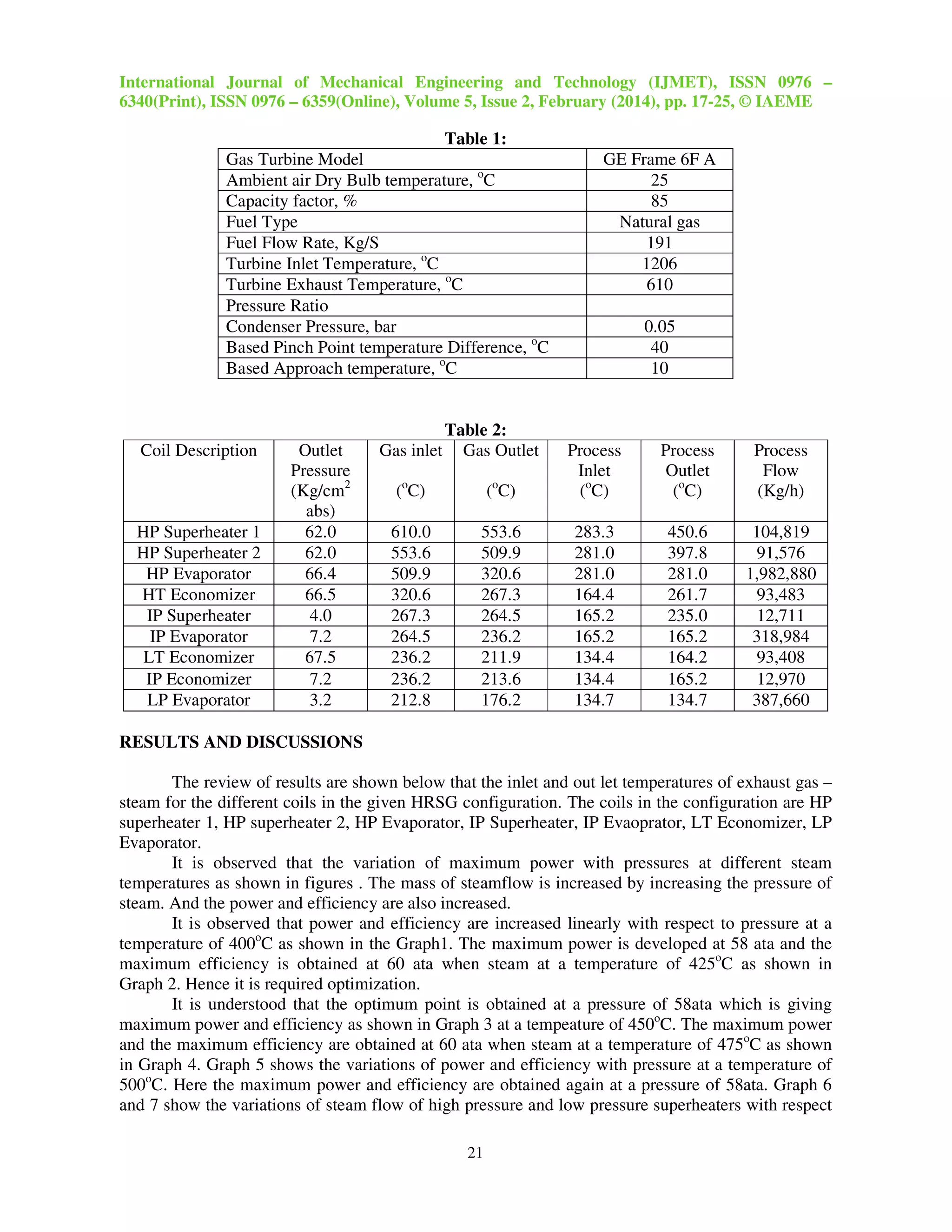
Design conditions such as atmospheric conditions and cycle parameters are shown in Table 1.
At this working condition, the exhaust gas of gas turbine is 687,747 kg/hr in flow rate and 610°C in
temperature, which is suitable for the conventional steam turbine. The total heat transfer area of heat
exchangers is found 21971.1263 m2
. Mass flow rate, absolute pressure and temperature of various
heat exchangers are shown in Table 2.
International Journal of Mechanical Engineering and Technology (IJMET), ISSN 0976 –
6340(Print), ISSN 0976 – 6359(Online), Volume 5, Issue 2, February (2014), pp. 17-25, © IAEME
21
Table 1:
Gas Turbine Model GE Frame 6F A
Ambient air Dry Bulb temperature, o
C 25
Capacity factor, % 85
Fuel Type Natural gas
Fuel Flow Rate, Kg/S 191
Turbine Inlet Temperature, o
C 1206
Turbine Exhaust Temperature, o
C 610
Pressure Ratio
Condenser Pressure, bar 0.05
Based Pinch Point temperature Difference, o
C 40
Based Approach temperature, o
C 10
Table 2:
Coil Description Outlet
Pressure
(Kg/cm2
abs)
Gas inlet
(o
C)
Gas Outlet
(o
C)
Process
Inlet
(o
C)
Process
Outlet
(o
C)
Process
Flow
(Kg/h)
HP Superheater 1 62.0 610.0 553.6 283.3 450.6 104,819
HP Superheater 2 62.0 553.6 509.9 281.0 397.8 91,576
HP Evaporator 66.4 509.9 320.6 281.0 281.0 1,982,880
HT Economizer 66.5 320.6 267.3 164.4 261.7 93,483
IP Superheater 4.0 267.3 264.5 165.2 235.0 12,711
IP Evaporator 7.2 264.5 236.2 165.2 165.2 318,984
LT Economizer 67.5 236.2 211.9 134.4 164.2 93,408
IP Economizer 7.2 236.2 213.6 134.4 165.2 12,970
LP Evaporator 3.2 212.8 176.2 134.7 134.7 387,660
RESULTS AND DISCUSSIONS
The review of results are shown below that the inlet and out let temperatures of exhaust gas –
steam for the different coils in the given HRSG configuration. The coils in the configuration are HP
superheater 1, HP superheater 2, HP Evaporator, IP Superheater, IP Evaoprator, LT Economizer, LP
Evaporator.
It is observed that the variation of maximum power with pressures at different steam
temperatures as shown in figures . The mass of steamflow is increased by increasing the pressure of
steam. And the power and efficiency are also increased.
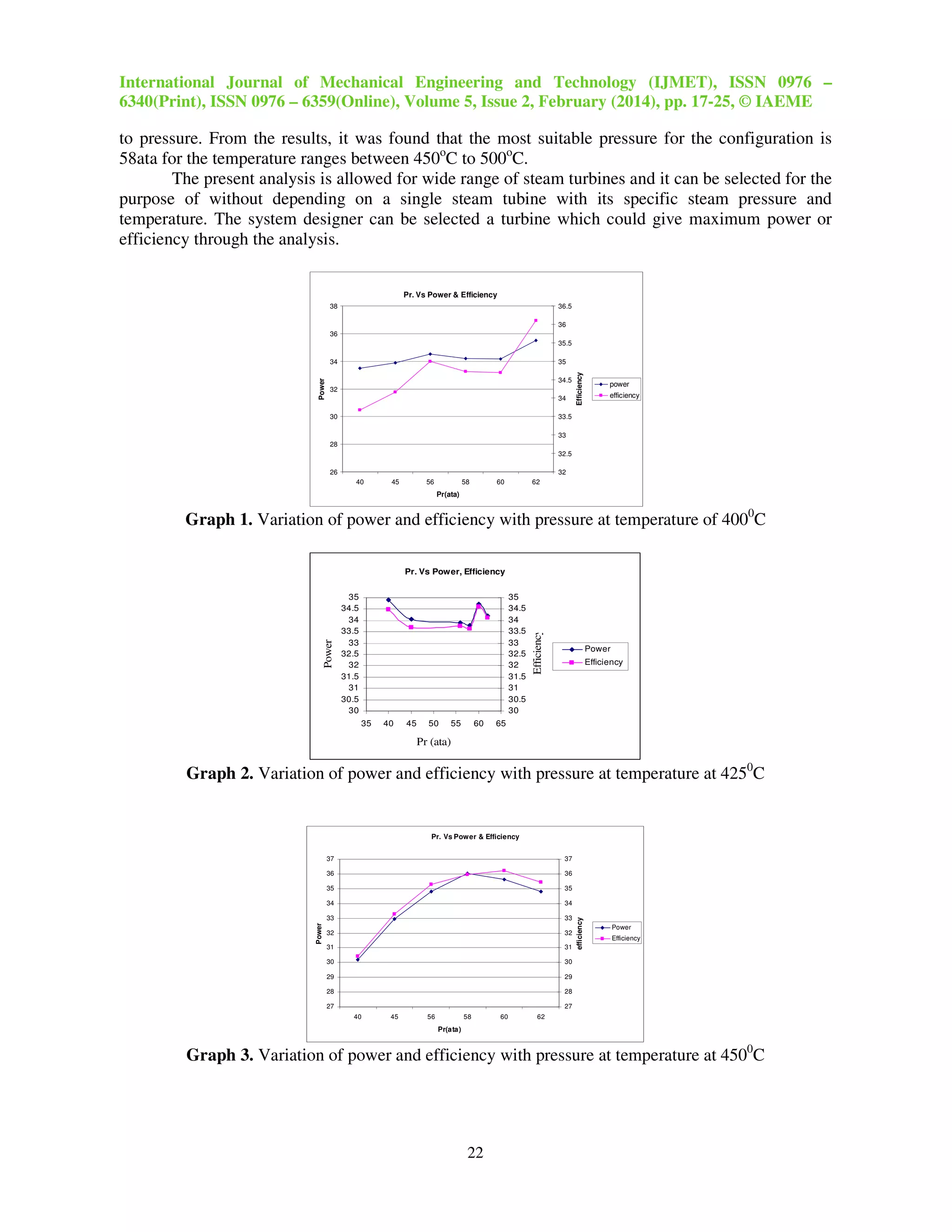
It is observed that power and efficiency are increased linearly with respect to pressure at a
temperature of 400o
C as shown in the Graph1. The maximum power is developed at 58 ata and the
maximum efficiency is obtained at 60 ata when steam at a temperature of 425o
C as shown in
Graph 2. Hence it is required optimization.
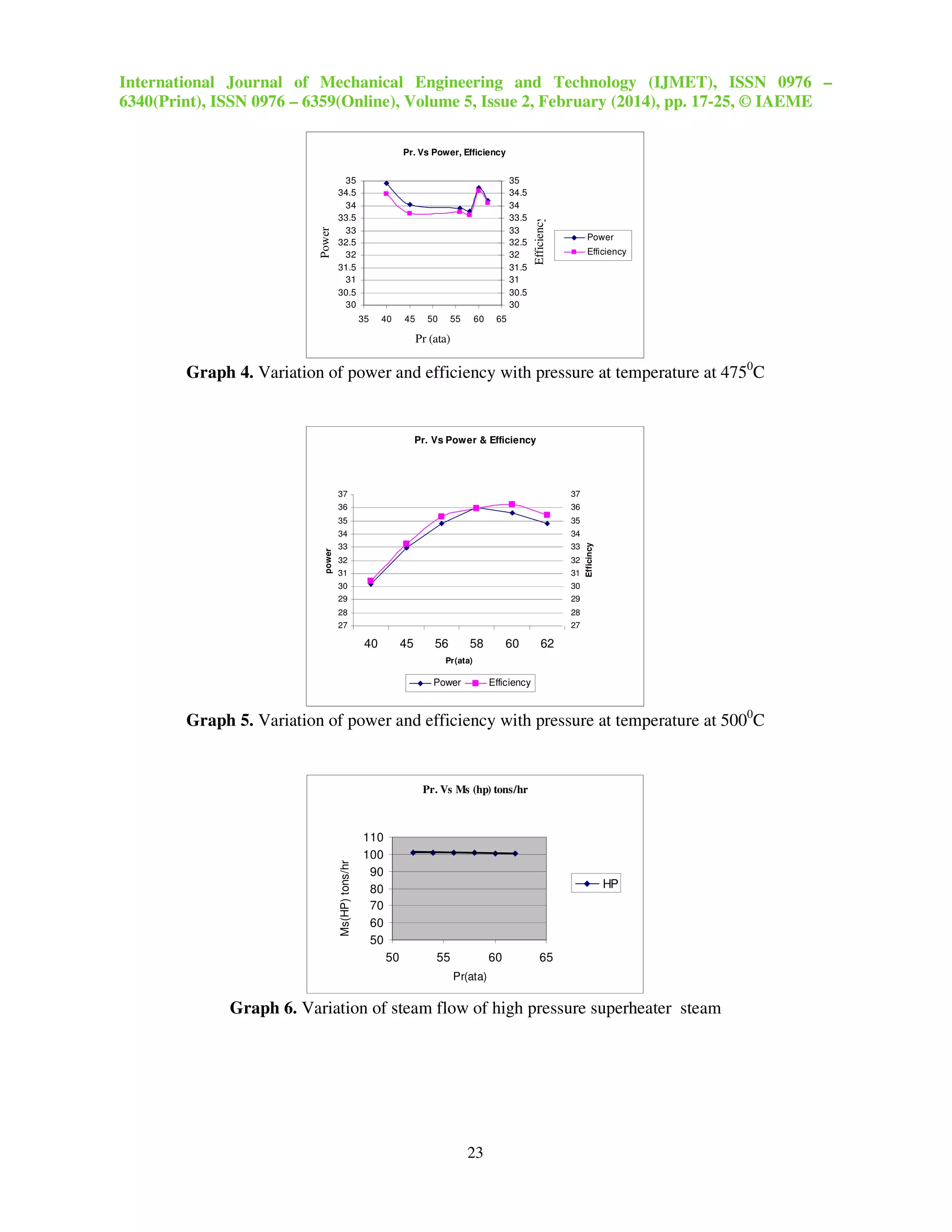
It is understood that the optimum point is obtained at a pressure of 58ata which is giving
maximum power and efficiency as shown in Graph 3 at a tempeature of 450o
C. The maximum power
and the maximum efficiency are obtained at 60 ata when steam at a temperature of 475o
C as shown
in Graph 4. Graph 5 shows the variations of power and efficiency with pressure at a temperature of
500o
C. Here the maximum power and efficiency are obtained again at a pressure of 58ata. Graph 6
and 7 show the variations of steam flow of high pressure and low pressure superheaters with respect
International Journal of Mechanical Engineering and Technology (IJMET), ISSN 0976 –
6340(Print), ISSN 0976 – 6359(Online), Volume 5, Issue 2, February (2014), pp. 17-25, © IAEME
22
to pressure. From the results, it was found that the most suitable pressure for the configuration is
58ata for the temperature ranges between 450o
C to 500o
C.
The present analysis is allowed for wide range of steam turbines and it can be selected for the
purpose of without depending on a single steam tubine with its specific steam pressure and
temperature. The system designer can be selected a turbine which could give maximum power or
efficiency through the analysis.
Graph 1. Variation of power and efficiency with pressure at temperature of 4000
C
Graph 2. Variation of power and efficiency with pressure at temperature at 4250
C
Graph 3. Variation of power and efficiency with pressure at temperature at 4500
C
Pr. Vs Power & Efficiency
26
28
30
32
34
36
38
40 45 56 58 60 62
Pr(ata)
Power
32
32.5
33
33.5
34
34.5
35
35.5
36
36.5
Efficiency
power
efficiency
Pr. Vs Power, Efficiency
30
30.5
31
31.5
32
32.5
33
33.5
34
34.5
35
35 40 45 50 55 60 65
Pr (ata)
Power
30
30.5
31
31.5
32
32.5
33
33.5
34
34.5
35
Efficiency
Power
Efficiency
Pr. Vs Power & Efficiency
27
28
29
30
31
32
33
34
35
36
37
40 45 56 58 60 62
Pr(ata)
Power
27
28
29
30
31
32
33
34
35
36
37
efficiency
Power
Efficiency
International Journal of Mechanical Engineering and Technology (IJMET), ISSN 0976 –
6340(Print), ISSN 0976 – 6359(Online), Volume 5, Issue 2, February (2014), pp. 17-25, © IAEME
23
Graph 4. Variation of power and efficiency with pressure at temperature at 4750
C
Graph 5. Variation of power and efficiency with pressure at temperature at 5000
C
Graph 6. Variation of steam flow of high pressure superheater steam
Pr. Vs Power, Efficiency
30
30.5
31
31.5
32
32.5
33
33.5
34
34.5
35
35 40 45 50 55 60 65
Pr (ata)
Power
30
30.5
31
31.5
32
32.5
33
33.5
34
34.5
35
Efficiency
Power
Efficiency
Pr. Vs Power & Efficiency
27
28
29
30
31
32
33
34
35
36
37
40 45 56 58 60 62
Pr(ata)
power
27
28
29
30
31
32
33
34
35
36
37
Efficincy
Power Efficiency
Pr. Vs Ms (hp) tons/hr
50
60
70
80
90
100
110
50 55 60 65
Pr(ata)
Ms(HP)tons/hr
HP
International Journal of Mechanical Engineering and Technology (IJMET), ISSN 0976 –
6340(Print), ISSN 0976 – 6359(Online), Volume 5, Issue 2, February (2014), pp. 17-25, © IAEME
24
Graph 7. Variation of steam flow of low pressure superheater steam
CONCLUSIONS
1) From the sensitivity analysis it was found that most suitable pressure appears to be at 58 ata
and steam temperature between 450o
Cand 500o
c will be adequate to give for 100MW power
output and system efficiency around 35% which is on the higher side for that rating. Avoiding
reheating the system cycle configuration was kept crucial.
2) The present analysis allows a wide range of steam turbine that can be selected for the purpose
with out depending on a single steam turbine with its specific steam pressure and temperature.
Through the analysis the system designer select a turbine which could give maximum power
or efficiency.
3) The detailed mechanical design also carried out which provides a reasonable size for the waste
recovery boiler. Two pressure steam not only gives higher power using injection in steam
turbine but also if required provide service steam for drying and process requirement.
4) BHEL manufactures 6 FA gas turbine under license, 6 FA was selected because it was locally
manufactured is having higher efficiency. This is mostly suitable for IGCC plant. It can also to
be noted that the work carried out at so much work for burning low Btu gas such as coal gas
generated in fluidized bed using air whose calorific value is limited to be about 1000 kcal/kg.
Low Btu gas increases the pressure drop in combustion chamber and requires modification for
combustion stability and also air fuel ratio to maintain same entry turbine temperature as
desired, inspite of 7 to 8 times low calorific value has been introduced in the combustion
chamber. This requires modification of gas feeding system, blade cooling concept as well as
fuel gas controlling system.
REFERENCES
[1] Murad A.Rahim, Eshan Amirabedin, M.Zeki Yilmazoglu and “Ali Durmaz, Analysis of Heat
Recovery Steam generators in Combined Cycle Power Plants,” The Second International
conference on Nuclear and Renewable Energy Resources, 4-7 July 2012, Ankara Turkey.
[2] Meeta Sharma, Onkar Singh, “Thermodynamic Evaluation of WHRB for it’s Optimum
performance in Combined Cycle Power Plants,” IOSR Journal of Engineering (IOSRJEN),
Vol. 2 Issue 1, pp. 11-19, Jan.2012.
[3] P.Ravindra Kumar and V.Dhana Raju, 2012, “Off Design Performance Analysis of a Triple
Pressure Reheat Heat Recovery Steam Generator,” International Journal of Engineering
Research & Technology (IJERT) ,Vol. 1 Issue 5, pp. 01-10,July – 2012.
Pr. Vs Ms(IP)
9.5
9.9
10.3
10.7
11.1
11.5
0 20 40 60 80
Pr(ata)
Ms(IP)tons/hr
International Journal of Mechanical Engineering and Technology (IJMET), ISSN 0976 –
6340(Print), ISSN 0976 – 6359(Online), Volume 5, Issue 2, February (2014), pp. 17-25, © IAEME
25
[4] Mustafa Zeki Yilmazoglu and Ehsan Amirabedin, “Second Law And Sensitivity Analysis Of
A Combined Cycle Power Plant In Turkey,” Journal of Thermal Science and Technology,
pp 41-50, 2011.
[5]. Ganapathy, V., "Heat-Recovery Boiler Design for Cogeneration," Oil & Gas Journal,
Vol. 83, pp. 116-125, 1985.
[6]. Kehlhofer, R., “Combined-Cycle Gas & Steam Turbine Power Plants,” The Fairmont Press,
Inc., Georgia, 1991.
[7]. CASAROSA and A. FRANCO, "Thermodynamic Optimization of the Recovery in
Combined Power Plants,” International Journal on Applied Thermodynamics, Vol.4, issue 1,
pp.43-52, March-2005.
[8]. Manen, A. V., "HRSG Design for Optimum Combined Cycle Performance," ASME Paper
94-GT-278, 1994.
[9]. Pasha, A. and Jolly, S., "Combined Cycle Heat Recovery Steam Generators Optimum
Capabilities and Selection Criteria," Heat Recovery Systems & CHP, Vol. 15, No. 2,
pp. 147-154, 1995.
[10]. Spencer, R. C, Cotton, K. C, and Canon, C.N., "A Method for Predicting the Performance of
Steam Turbine-Generators,” Journal of Engineering for Power, Vol. 85, pp. 249-301, 1963.
[11]. El-Masri, M. A. and Foster-Pegg, R. W., "Design of Gas Turbine Combined Cycle and
Cogeneration Systems," Technical Course Lecture Note of GTPRO, 1996.
[12]. Incropera, F. P. and DeWitt, D. P., “Fundamentals of Heat and Mass Transfer,” 4th ed., John
Wiley & Sons Inc., New York, 1996.
[13] T SRINIVAS, “Thermodynamic modelling and optimization of a dual pressure reheat
combined power cycle,” Indian Academy of Sciences, Sadhana Vol. 35, Part 5, pp. 597–608,
October 2010.
[14] P.S. Jeyalaxmi And Dr.G.Kalivarathan, “CFD Analysis of Turbulence in a Gas Turbine
Combustor with Reference to the Context of Exit Phenomenon” International Journal of
Advanced Research in Engineering & Technology (IJARET), Volume 4, Issue 2, 2013,
pp. 1 - 7, ISSN Print: 0976-6480, ISSN Online: 0976-6499.
[15] Aram Mohammed Ahmed and Dr. Mohammad Tariq, “Thermal Analysis of a Gas Turbine
Power Plant to Improve Performance Efficiency”, International Journal of Mechanical
Engineering & Technology (IJMET), Volume 4, Issue 6, 2013, pp. 43 - 54, ISSN Print: 0976
– 6340, ISSN Online: 0976 – 6359,

SENSITIVITY ANALYSIS OF HEAT RECOVERY STEAM GENERATOR FOR A GE 6FA GAS TURBINE

  • 1.
    International Journal ofMechanical Engineering and Technology (IJMET), ISSN 0976 – 6340(Print), ISSN 0976 – 6359(Online), Volume 5, Issue 2, February (2014), pp. 17-25, © IAEME 17 SENSITIVITY ANALYSIS OF HEAT RECOVERY STEAM GENERATOR FOR A GE 6FA GAS TURBINE S.Naga Kishorea , Dr. T.V.Raob a, b Department of Mechanical Engineering, DBS Institute of Technology, Kavali-524201 ABSTRACT The objective of the present study is to optimize the bottoming cycle for a 6 FA gas turbine. The present work focuses on optimization of steam cycle alone by analyzing the sensitivity of steam pressure and steam temperature and configuration of waste heat recovery boiler. A two pressure configuration will have better opportunity for power generation and for applying service steam for feed stack and drying etc. From cycle analysis at 4 kg/cm2 low pressure steam appear to be most suitable for the thermodynamic cycle. Also from the analysis of various configurations a two pressure steam cycle was chosen with integrated deaerator. Both low temperature and intermediate pressure were used to extract maximum heat from the gas turbine exhaust. A fixed 2% blow down steam was assumed as per the industrial practice. Two super heater sections were introduced with a desuperheater to minimize the energy loss. The temperature of the high pressure steam was kept at 5000 c and the pressure of steam has varied to calculate the variation of power and efficiency. And also keeping the steam temperature at 4000 C, 4500 C. The power and efficiency at different pressures ranging from 40 ata to 62 ata were calculated to get an operating point and to allow the steam turbine designer to have suitable pressure and temperature variation to select the appropriate steam turbine at bottom cycle. Keywords: Combined Cycle (Cc), HRSG, Efficiency, NTU, Off Design, Effectiveness. INTRODUCTION The gas/steam combined cycle has already become a well-proven and important technology for power generation due to its numerous advantages. The advantages include its high efficiency in utilizing energy resources, low environmental emissions, short duration of construction, low initial investment cost, low operation and maintenance cost, and flexibility in fuel selection, etc.[11]. These features justify the fact that the combined cycle power plants are quite competitive in the power market. INTERNATIONAL JOURNAL OF MECHANICAL ENGINEERING AND TECHNOLOGY (IJMET) ISSN 0976 – 6340 (Print) ISSN 0976 – 6359 (Online) Volume 5, Issue 2, February (2014), pp. 17-25 © IAEME: www.iaeme.com/ijmet.asp Journal Impact Factor (2014): 3.8231 (Calculated by GISI) www.jifactor.com IJMET © I A E M E
  • 2.
    International Journal ofMechanical Engineering and Technology (IJMET), ISSN 0976 – 6340(Print), ISSN 0976 – 6359(Online), Volume 5, Issue 2, February (2014), pp. 17-25, © IAEME 18 The heat recovery steam generator (HRSG) is the component of the bottoming steam cycle, which absorbs energy of exhaust gas of the gas turbine and produces steam at subcritical pressures suitable for the process or for further electricity generation by a steam turbine. Power plant engineers can design their own HRSGs and the bottoming steam cycles at the initial stage. On the other hand, gas turbine is not made in order and steam turbine is selected according to the condition of the steam delivered from a HRSG. In this respect, the design of a HRSG is indispensable to the improvement of the overall system efficiency and power output, and to the reduction of the main equipment cost [5, 8, 9]. HRSGs are classified into single, dual, and triple pressure types depending on the number of drums in the boiler. Dual pressure HRSGs have been widely used because they showed higher efficiency than single pressure systems and lower investment cost than triple pressure HRSGs. Murad A Rahim et al studied three types of HRSG and worked on the effects of HRSG design to the net power generation and overall efficiency of the cycle was performed. Steam pressure, pinch point temperature difference and approach temperature difference were taken as variables [1]. Meeta Sharma and Onkar Singh presented a detailed mathematical modeling and analysis for segmented fin in the HRSG for its various sub-components. The optimization was also done on the basis of maximum heat recovery with minimum pressure drop for a given heat flow [2]. P.Ravindra Kumar and V.Dhana Raju studied the operating characteristics of triple pressure reheat HRSGs which were analyzed. The effects of the configuration of HP superheater and reheater on the thermal performance and economics of the plant were investigated. The arrangement of Intermediate- Temperature components such as intermediate pressure (IP) superheater, HP economizer, and low pressure (LP) superheater were changed to check its effect on the performance of a steam turbine. The off-design performance was also examined considering the operating ranges of the plant [3]. Mustafa Zeki Yilmazoglu and Ehsan Amirabedin carried out exergy analysis of a combined cycle gas turbine (CCGT) power plant, in Ankara, in an exergy aspect. The exergy efficiency of each component and overall plant was studied by calculating exergy destructions and sensitivity analysis was performed by changing some critical parameters of the system [4]. C.Casarosa and Franco investigated the thermodynamic analysis to design the operating parameters for the various configurations of HRSG systems to minimize Exergy losses, taking into account only the irreversibility due to the temperature difference between the hot and cold streams (pressure drop not accounting). All the solutions lead to the zero pinch point and infinite heat transfer surface [7]. T.Srinivas projected thermodynamic modelling and optimization of a dual pressure reheating HRSG in the CC with a deaerator. The variations in CC performance were plotted with the compressor pressure ratio, gas turbine inlet temperature, HRSG HP, steam reheat pressure and deaerator pressure. From this study of thermodynamic modelling, the optimized conditions to air compressor, HP steam, LP steam, steam reheater and deaerator were developed [13]. In this study, sensitivity analysis of a heat recovery steam generator in a combined cycle gas turbine (CCGT) power plant for GE 6FA Gas Turbine is performed. The power and efficiency at different pressures ranging from 40 ata to 62 ata are calculated by varying temperatures of steam from 400o C to 500o C for getting an operating point and for allowing the steam turbine designer to have suitable pressure and temperature variation to select the appropriate steam turbine at bottom cycle. PLANT DESCRIPTION The heat recovery steam generator is a series of heat exchangers. It consists of three heat exchangers (economizer, evaporator, superheater) for every pressure level. Economizers are used to heat water close to saturation, evaporators to produce saturated steam and superheaters to produce superheated steam. Every heat exchanger is a bundle tubes placed in-line or staggered arrangement according to the manufacture. The flow of working fluid (water or steam) in the pipes is horizontal flow and the flow of exhaust is vertical flow that's mean, each heat exchanger in the HRSG could be
  • 3.
    International Journal ofMechanical Engineering and Technology (IJMET), ISSN 0976 – 6340(Print), ISSN 0976 – 6359(Online), Volume 5, Issue 2, February (2014), pp. 17-25, © IAEME 19 considered a cross flow heat exchanger. The type of circulation fluid in the evaporator is a forced circulation by circulated pump for each pressure level. Steam drums are used in HRSG to separate the water from outlet steam from evaporator .The exhaust gases of the gas turbine consider are a wake heat transfer coefficients comparison with heat transfer coefficients of working fluid in evaporator and economizer therefore, finned tubes are used in HRSG. Fins can be sold or serrated .The most important parameters of HRSGs are pinch point, approach point and gas side pressure drop through the heat recovery system, which affect the effectiveness of heat exchange. Pinch point is the difference between the gas temperature leaving the evaporator section of the system and the saturation temperature corresponding to the steam pressure in that section. Approach point is the difference between the saturation temperature of fluid and inlet temperature of fluid in evaporator. The coils in the present configuration of HRSG are HP superheater 1, HP superheater 2, HP Evaporator, IP Superheater, IP Evaoprator, LT Economizer, LP Evaporator is illustrated in Fig. 1. Fig 1: Aschematic arrangement of combined cycle power plant Triple pressure HRSG PERFORMANCE ANALYSIS In the HRSG, (water or steam) and exhaust gas of the gas turbine flow inside and outside of the tube respectively. Water or steam and exhaust gas exchange heat through a Cross-flow type Heat Exchanger at each section such as Economizer, Evaporator, and Superheater. For the simplicity of simulation procedure, each heat exchanger is assumed to be a Counter-flow type through the whole HRSG because the inlets of the water and the exhaust gas locate in the opposite side. The heat transferred at each module is calculated using the energy balance equation as described in Eq. (1).
  • 4.
    International Journal ofMechanical Engineering and Technology (IJMET), ISSN 0976 – 6340(Print), ISSN 0976 – 6359(Online), Volume 5, Issue 2, February (2014), pp. 17-25, © IAEME 20 ----------(1) The gas side and water/steam side temperatures at the inlet and outlet of each section of the HRSG are determined using this energy balance equation Using the well Known effectiveness –NTU method with overall heat transfer coefficient, Udesign, the area of HRSG together with other related parameters is calculated based on design parameters shown in equation ---------------(2) Q max is the maximum heat transfer rate that could possibly be delivered by the heat exchanger [12]. The heat transfer area can be evaluated with the fin geometry data, and this area should match the one determined by the effectiveness-NTU method as above. Through the iterative procedure, the area is determined when the one equals to the other within a prescribed criterion. Off-design performance analysis of the HRSG [6] is carried out using the design parameters described as above. The procedure to determine the thermodynamic properties at each section (T, p , h ) is repeated until the parameters converge to the assumed value. For illustration, the NTU at off- design operation is given by Eq. (3). ----------------(3) Then, we can determine effectiveness as a function of NTU and actual heat transfer rate, as in Eq. (4). Also we can determine thermodynamic properties such as temperature, pressure, and enthalpy at each heat exchanger during off-design operation. -----------------(4) Off-design performance of gas turbine is estimated with the gas turbine performance curves. Steam turbine is assumed to operate on the sliding pressure mode during off-design operation. Performance of each section of steam turbine is analyzed using the well-known Spencer/Cotton/Cannon correlations [10] Design conditions such as atmospheric conditions and cycle parameters are shown in Table 1. At this working condition, the exhaust gas of gas turbine is 687,747 kg/hr in flow rate and 610°C in temperature, which is suitable for the conventional steam turbine. The total heat transfer area of heat exchangers is found 21971.1263 m2 . Mass flow rate, absolute pressure and temperature of various heat exchangers are shown in Table 2.
  • 5.
    International Journal ofMechanical Engineering and Technology (IJMET), ISSN 0976 – 6340(Print), ISSN 0976 – 6359(Online), Volume 5, Issue 2, February (2014), pp. 17-25, © IAEME 21 Table 1: Gas Turbine Model GE Frame 6F A Ambient air Dry Bulb temperature, o C 25 Capacity factor, % 85 Fuel Type Natural gas Fuel Flow Rate, Kg/S 191 Turbine Inlet Temperature, o C 1206 Turbine Exhaust Temperature, o C 610 Pressure Ratio Condenser Pressure, bar 0.05 Based Pinch Point temperature Difference, o C 40 Based Approach temperature, o C 10 Table 2: Coil Description Outlet Pressure (Kg/cm2 abs) Gas inlet (o C) Gas Outlet (o C) Process Inlet (o C) Process Outlet (o C) Process Flow (Kg/h) HP Superheater 1 62.0 610.0 553.6 283.3 450.6 104,819 HP Superheater 2 62.0 553.6 509.9 281.0 397.8 91,576 HP Evaporator 66.4 509.9 320.6 281.0 281.0 1,982,880 HT Economizer 66.5 320.6 267.3 164.4 261.7 93,483 IP Superheater 4.0 267.3 264.5 165.2 235.0 12,711 IP Evaporator 7.2 264.5 236.2 165.2 165.2 318,984 LT Economizer 67.5 236.2 211.9 134.4 164.2 93,408 IP Economizer 7.2 236.2 213.6 134.4 165.2 12,970 LP Evaporator 3.2 212.8 176.2 134.7 134.7 387,660 RESULTS AND DISCUSSIONS The review of results are shown below that the inlet and out let temperatures of exhaust gas – steam for the different coils in the given HRSG configuration. The coils in the configuration are HP superheater 1, HP superheater 2, HP Evaporator, IP Superheater, IP Evaoprator, LT Economizer, LP Evaporator. It is observed that the variation of maximum power with pressures at different steam temperatures as shown in figures . The mass of steamflow is increased by increasing the pressure of steam. And the power and efficiency are also increased. It is observed that power and efficiency are increased linearly with respect to pressure at a temperature of 400o C as shown in the Graph1. The maximum power is developed at 58 ata and the maximum efficiency is obtained at 60 ata when steam at a temperature of 425o C as shown in Graph 2. Hence it is required optimization. It is understood that the optimum point is obtained at a pressure of 58ata which is giving maximum power and efficiency as shown in Graph 3 at a tempeature of 450o C. The maximum power and the maximum efficiency are obtained at 60 ata when steam at a temperature of 475o C as shown in Graph 4. Graph 5 shows the variations of power and efficiency with pressure at a temperature of 500o C. Here the maximum power and efficiency are obtained again at a pressure of 58ata. Graph 6 and 7 show the variations of steam flow of high pressure and low pressure superheaters with respect
  • 6.
    International Journal ofMechanical Engineering and Technology (IJMET), ISSN 0976 – 6340(Print), ISSN 0976 – 6359(Online), Volume 5, Issue 2, February (2014), pp. 17-25, © IAEME 22 to pressure. From the results, it was found that the most suitable pressure for the configuration is 58ata for the temperature ranges between 450o C to 500o C. The present analysis is allowed for wide range of steam turbines and it can be selected for the purpose of without depending on a single steam tubine with its specific steam pressure and temperature. The system designer can be selected a turbine which could give maximum power or efficiency through the analysis. Graph 1. Variation of power and efficiency with pressure at temperature of 4000 C Graph 2. Variation of power and efficiency with pressure at temperature at 4250 C Graph 3. Variation of power and efficiency with pressure at temperature at 4500 C Pr. Vs Power & Efficiency 26 28 30 32 34 36 38 40 45 56 58 60 62 Pr(ata) Power 32 32.5 33 33.5 34 34.5 35 35.5 36 36.5 Efficiency power efficiency Pr. Vs Power, Efficiency 30 30.5 31 31.5 32 32.5 33 33.5 34 34.5 35 35 40 45 50 55 60 65 Pr (ata) Power 30 30.5 31 31.5 32 32.5 33 33.5 34 34.5 35 Efficiency Power Efficiency Pr. Vs Power & Efficiency 27 28 29 30 31 32 33 34 35 36 37 40 45 56 58 60 62 Pr(ata) Power 27 28 29 30 31 32 33 34 35 36 37 efficiency Power Efficiency
  • 7.
    International Journal ofMechanical Engineering and Technology (IJMET), ISSN 0976 – 6340(Print), ISSN 0976 – 6359(Online), Volume 5, Issue 2, February (2014), pp. 17-25, © IAEME 23 Graph 4. Variation of power and efficiency with pressure at temperature at 4750 C Graph 5. Variation of power and efficiency with pressure at temperature at 5000 C Graph 6. Variation of steam flow of high pressure superheater steam Pr. Vs Power, Efficiency 30 30.5 31 31.5 32 32.5 33 33.5 34 34.5 35 35 40 45 50 55 60 65 Pr (ata) Power 30 30.5 31 31.5 32 32.5 33 33.5 34 34.5 35 Efficiency Power Efficiency Pr. Vs Power & Efficiency 27 28 29 30 31 32 33 34 35 36 37 40 45 56 58 60 62 Pr(ata) power 27 28 29 30 31 32 33 34 35 36 37 Efficincy Power Efficiency Pr. Vs Ms (hp) tons/hr 50 60 70 80 90 100 110 50 55 60 65 Pr(ata) Ms(HP)tons/hr HP
  • 8.
    International Journal ofMechanical Engineering and Technology (IJMET), ISSN 0976 – 6340(Print), ISSN 0976 – 6359(Online), Volume 5, Issue 2, February (2014), pp. 17-25, © IAEME 24 Graph 7. Variation of steam flow of low pressure superheater steam CONCLUSIONS 1) From the sensitivity analysis it was found that most suitable pressure appears to be at 58 ata and steam temperature between 450o Cand 500o c will be adequate to give for 100MW power output and system efficiency around 35% which is on the higher side for that rating. Avoiding reheating the system cycle configuration was kept crucial. 2) The present analysis allows a wide range of steam turbine that can be selected for the purpose with out depending on a single steam turbine with its specific steam pressure and temperature. Through the analysis the system designer select a turbine which could give maximum power or efficiency. 3) The detailed mechanical design also carried out which provides a reasonable size for the waste recovery boiler. Two pressure steam not only gives higher power using injection in steam turbine but also if required provide service steam for drying and process requirement. 4) BHEL manufactures 6 FA gas turbine under license, 6 FA was selected because it was locally manufactured is having higher efficiency. This is mostly suitable for IGCC plant. It can also to be noted that the work carried out at so much work for burning low Btu gas such as coal gas generated in fluidized bed using air whose calorific value is limited to be about 1000 kcal/kg. Low Btu gas increases the pressure drop in combustion chamber and requires modification for combustion stability and also air fuel ratio to maintain same entry turbine temperature as desired, inspite of 7 to 8 times low calorific value has been introduced in the combustion chamber. This requires modification of gas feeding system, blade cooling concept as well as fuel gas controlling system. REFERENCES [1] Murad A.Rahim, Eshan Amirabedin, M.Zeki Yilmazoglu and “Ali Durmaz, Analysis of Heat Recovery Steam generators in Combined Cycle Power Plants,” The Second International conference on Nuclear and Renewable Energy Resources, 4-7 July 2012, Ankara Turkey. [2] Meeta Sharma, Onkar Singh, “Thermodynamic Evaluation of WHRB for it’s Optimum performance in Combined Cycle Power Plants,” IOSR Journal of Engineering (IOSRJEN), Vol. 2 Issue 1, pp. 11-19, Jan.2012. [3] P.Ravindra Kumar and V.Dhana Raju, 2012, “Off Design Performance Analysis of a Triple Pressure Reheat Heat Recovery Steam Generator,” International Journal of Engineering Research & Technology (IJERT) ,Vol. 1 Issue 5, pp. 01-10,July – 2012. Pr. Vs Ms(IP) 9.5 9.9 10.3 10.7 11.1 11.5 0 20 40 60 80 Pr(ata) Ms(IP)tons/hr
  • 9.
    International Journal ofMechanical Engineering and Technology (IJMET), ISSN 0976 – 6340(Print), ISSN 0976 – 6359(Online), Volume 5, Issue 2, February (2014), pp. 17-25, © IAEME 25 [4] Mustafa Zeki Yilmazoglu and Ehsan Amirabedin, “Second Law And Sensitivity Analysis Of A Combined Cycle Power Plant In Turkey,” Journal of Thermal Science and Technology, pp 41-50, 2011. [5]. Ganapathy, V., "Heat-Recovery Boiler Design for Cogeneration," Oil & Gas Journal, Vol. 83, pp. 116-125, 1985. [6]. Kehlhofer, R., “Combined-Cycle Gas & Steam Turbine Power Plants,” The Fairmont Press, Inc., Georgia, 1991. [7]. CASAROSA and A. FRANCO, "Thermodynamic Optimization of the Recovery in Combined Power Plants,” International Journal on Applied Thermodynamics, Vol.4, issue 1, pp.43-52, March-2005. [8]. Manen, A. V., "HRSG Design for Optimum Combined Cycle Performance," ASME Paper 94-GT-278, 1994. [9]. Pasha, A. and Jolly, S., "Combined Cycle Heat Recovery Steam Generators Optimum Capabilities and Selection Criteria," Heat Recovery Systems & CHP, Vol. 15, No. 2, pp. 147-154, 1995. [10]. Spencer, R. C, Cotton, K. C, and Canon, C.N., "A Method for Predicting the Performance of Steam Turbine-Generators,” Journal of Engineering for Power, Vol. 85, pp. 249-301, 1963. [11]. El-Masri, M. A. and Foster-Pegg, R. W., "Design of Gas Turbine Combined Cycle and Cogeneration Systems," Technical Course Lecture Note of GTPRO, 1996. [12]. Incropera, F. P. and DeWitt, D. P., “Fundamentals of Heat and Mass Transfer,” 4th ed., John Wiley & Sons Inc., New York, 1996. [13] T SRINIVAS, “Thermodynamic modelling and optimization of a dual pressure reheat combined power cycle,” Indian Academy of Sciences, Sadhana Vol. 35, Part 5, pp. 597–608, October 2010. [14] P.S. Jeyalaxmi And Dr.G.Kalivarathan, “CFD Analysis of Turbulence in a Gas Turbine Combustor with Reference to the Context of Exit Phenomenon” International Journal of Advanced Research in Engineering & Technology (IJARET), Volume 4, Issue 2, 2013, pp. 1 - 7, ISSN Print: 0976-6480, ISSN Online: 0976-6499. [15] Aram Mohammed Ahmed and Dr. Mohammad Tariq, “Thermal Analysis of a Gas Turbine Power Plant to Improve Performance Efficiency”, International Journal of Mechanical Engineering & Technology (IJMET), Volume 4, Issue 6, 2013, pp. 43 - 54, ISSN Print: 0976 – 6340, ISSN Online: 0976 – 6359,