Semiotic Analysis:
A Research Guide
Presented by Megan Henley, Michelle Keddy, Benjamin
Kinsman, Michelle Muggridge and Karen Shields.
Introduction
Although the earliest origins of semiotics can be traced back to
Aristotle and Augustine, it didn’t begin to be fully developed
until the late nineteenth and early twentieth centuries.
Semiotics is a broad topic which can be applied to many different
fields, including media studies, theatre and music. Musical
semiotics is a complex and relatively new topic; consequently
materials explaining musical semiotics were very difficult to find
in our library. Thus, the following presentation will not explain
musical semiotics, but will show how one might further research
this topic.
Semiotics
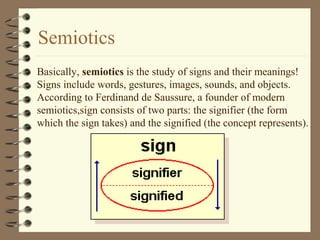
Basically, semiotics is the study of signs and their meanings!
Signs include words, gestures, images, sounds, and objects.
According to Ferdinand de Saussure, a founder of modern
semiotics,sign consists of two parts: the signifier (the form
which the sign takes) and the signified (the concept represents).
Semiotics
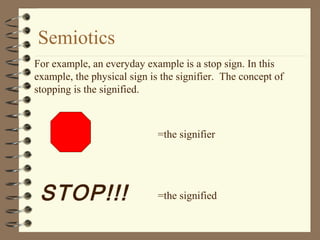
For example, an everyday example is a stop sign. In this
example, the physical sign is the signifier. The concept of
stopping is the signified.
=the signifier
STOP!!! =the signified
Semiotics
However, signfiers can have multiple signifieds. Take the color
red for example:
RED
APPLE
LoveFIRE
Blood
Problems with Semiotics
“Semiotics is essentially a theoretical approach to communication
in that its aim is to establish widely applicable principles…It is
thus vulnerable to the criticism that it is too theoretical, too
speculative and that semioticians make no attempt to prove or
disprove their theories in an objective, scientific way.” (Fiske
1982, 118)
“A musical phrase or even a tone has, as any musician...knows,
many possible kinds of signification and significance -- i.e.
‘meaning’.” (Coker 1972, 2)
Semiotic Terms
Semantics: the relations of signs to their
contexts and to what they signify.
Syntactics: the kinds of signs, their
ordering, and their relations to one another.
Pragmatics: the ways in which signs are
used and interpreted.
The Semiotic Square
Opposites give each other meaning. For
example, black & white, love & hate.
Binary Opposition: One signifier (A) vs.
another signifier (B) For example, good
guy vs. bad guy, tonality vs. modality.
Semiotic Square: A visual representation
of the logical articulations of any semantic
category.
Semiotic Square
The semiotic square diagrams the ways in
which, starting from any given term, a
complete meaning system can be derived
through exhaustion of logical possibilities.
This is accomplished by developing the
traditional logical concepts of contradictory
(diagonal arrows) and contrary (horizontal
arrow)
The Semiotic Square
S1
S2S1
S2
opposite
Mediates between
S1 and S2
Negates both S1 and S2
Past
Present
Future
Atemporality
A Musical Example
Actor A
Actor B Actor C
Actor D
vouloir être vouloir faire
vouloir non-faire vouloir non-être
Historical Context
Musical Semiotics is essentially a new concept of musical
analysis and is very subjective. Although it can be applied to all
forms of music, it is best used on chance and program music.
Websites
http://www.hum.aau.dk/semiotics/
University of Aarhus Center for Semiotics Homepage
http://www.aber.ac.uk/~dgc/semind.html
Semiotics for Beginners
http://boethius.music.ucsb.edu/mto/mtohome.html
Music Theory Online (go to All Issues, then, Search the
Database, then Order Form, select search type and enter
semiotics to get a list of articles on musical semiotics.)
http://www.epas.utoronto.ca:8080/french/as-sa/EngSem1.html
Sites of Significance for Semiotics.
Application
Applications of semiotics include:
It represents a methodology for the analysis of "texts" regardless
of the medium in which it is presented. For these purposes, "text“
is any message preserved in a form whose existence
is independent of both sender and receiver;
It may improve ergonomic design in situations where
it is important to ensure that human beings are able to interact
more effectively with their environments, whether it be on a
large scale,as in architecture, or on a small scale, such as
the configuration of instrumentation for
human use.
I
Websites
http://www.cudenver.edu/~mryder/itc_data/semiotics.html
Semiotics - University of Colorado and Denver
http://www.azstarnet.com/~solo/ Solomon's Music Theory &
Composition Resources
http://www.lib.monash.edu.au/arts/music/semimusi.htm
Bibliographic sources
http://www.er.uqam.ca/nobel/rssi/rssihe.html
Canadian Semiotic Association
Website
http://www.newcastle.edu.au/department/fad/fi/woodrow/
semiotic.htm Semiotic Analysis of Images.

Semiotic

  • 1.
    Semiotic Analysis: A ResearchGuide Presented by Megan Henley, Michelle Keddy, Benjamin Kinsman, Michelle Muggridge and Karen Shields.
  • 2.
    Introduction Although the earliestorigins of semiotics can be traced back to Aristotle and Augustine, it didn’t begin to be fully developed until the late nineteenth and early twentieth centuries. Semiotics is a broad topic which can be applied to many different fields, including media studies, theatre and music. Musical semiotics is a complex and relatively new topic; consequently materials explaining musical semiotics were very difficult to find in our library. Thus, the following presentation will not explain musical semiotics, but will show how one might further research this topic.
  • 3.
    Semiotics Basically, semiotics isthe study of signs and their meanings! Signs include words, gestures, images, sounds, and objects. According to Ferdinand de Saussure, a founder of modern semiotics,sign consists of two parts: the signifier (the form which the sign takes) and the signified (the concept represents).
  • 4.
    Semiotics For example, aneveryday example is a stop sign. In this example, the physical sign is the signifier. The concept of stopping is the signified. =the signifier STOP!!! =the signified
  • 5.
    Semiotics However, signfiers canhave multiple signifieds. Take the color red for example: RED APPLE LoveFIRE Blood
  • 6.
    Problems with Semiotics “Semioticsis essentially a theoretical approach to communication in that its aim is to establish widely applicable principles…It is thus vulnerable to the criticism that it is too theoretical, too speculative and that semioticians make no attempt to prove or disprove their theories in an objective, scientific way.” (Fiske 1982, 118) “A musical phrase or even a tone has, as any musician...knows, many possible kinds of signification and significance -- i.e. ‘meaning’.” (Coker 1972, 2)
  • 7.
    Semiotic Terms Semantics: therelations of signs to their contexts and to what they signify. Syntactics: the kinds of signs, their ordering, and their relations to one another. Pragmatics: the ways in which signs are used and interpreted.
  • 8.
    The Semiotic Square Oppositesgive each other meaning. For example, black & white, love & hate. Binary Opposition: One signifier (A) vs. another signifier (B) For example, good guy vs. bad guy, tonality vs. modality. Semiotic Square: A visual representation of the logical articulations of any semantic category.
  • 9.
    Semiotic Square The semioticsquare diagrams the ways in which, starting from any given term, a complete meaning system can be derived through exhaustion of logical possibilities. This is accomplished by developing the traditional logical concepts of contradictory (diagonal arrows) and contrary (horizontal arrow)
  • 10.
    The Semiotic Square S1 S2S1 S2 opposite Mediatesbetween S1 and S2 Negates both S1 and S2 Past Present Future Atemporality
  • 11.
    A Musical Example ActorA Actor B Actor C Actor D vouloir être vouloir faire vouloir non-faire vouloir non-être
  • 12.
    Historical Context Musical Semioticsis essentially a new concept of musical analysis and is very subjective. Although it can be applied to all forms of music, it is best used on chance and program music.
  • 13.
    Websites http://www.hum.aau.dk/semiotics/ University of AarhusCenter for Semiotics Homepage http://www.aber.ac.uk/~dgc/semind.html Semiotics for Beginners http://boethius.music.ucsb.edu/mto/mtohome.html Music Theory Online (go to All Issues, then, Search the Database, then Order Form, select search type and enter semiotics to get a list of articles on musical semiotics.) http://www.epas.utoronto.ca:8080/french/as-sa/EngSem1.html Sites of Significance for Semiotics.
  • 14.
    Application Applications of semioticsinclude: It represents a methodology for the analysis of "texts" regardless of the medium in which it is presented. For these purposes, "text“ is any message preserved in a form whose existence is independent of both sender and receiver; It may improve ergonomic design in situations where it is important to ensure that human beings are able to interact more effectively with their environments, whether it be on a large scale,as in architecture, or on a small scale, such as the configuration of instrumentation for human use. I
  • 15.
    Websites http://www.cudenver.edu/~mryder/itc_data/semiotics.html Semiotics - Universityof Colorado and Denver http://www.azstarnet.com/~solo/ Solomon's Music Theory & Composition Resources http://www.lib.monash.edu.au/arts/music/semimusi.htm Bibliographic sources http://www.er.uqam.ca/nobel/rssi/rssihe.html Canadian Semiotic Association
  • 16.