DIGITAL TWIN
TECHNOLOGY
BIJOY T MATHEW
DEPARTMENT OF COMPUTER ENGINEERING
NSS POLYTECHNIC COLLEGE, PANDALAM
CONTENTS
1. What are digital twins?
2. Why do we need Digital twin?
3. Characteristics of Digital twin
4. Architecture
5. Architecture Diagram
6. Features of Digital twin
7. Advantages and Disadvantages
8. Applications
9. Conclusion
10. References
What are Digital
Twins ?
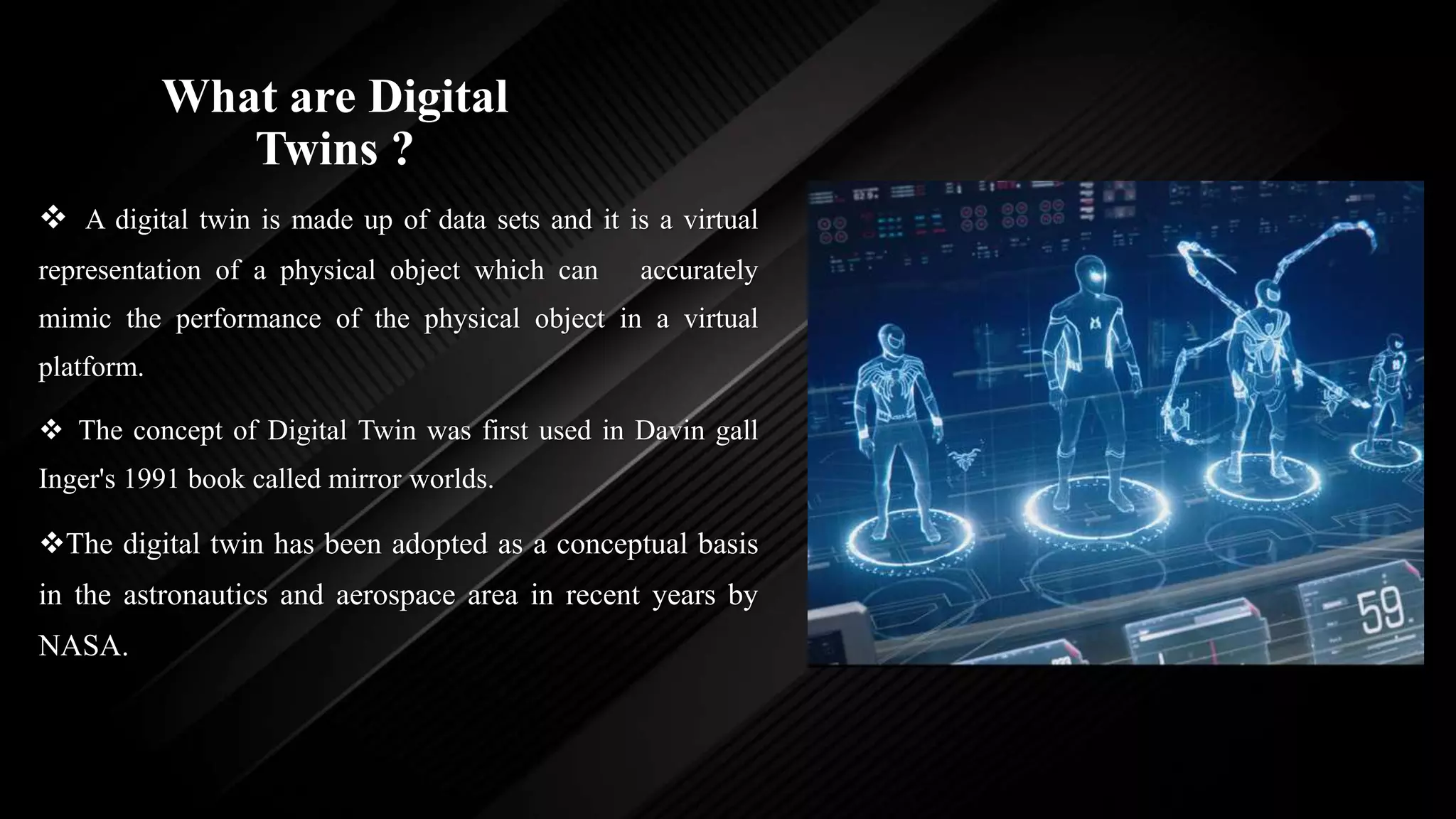
 A digital twin is made up of data sets and it is a virtual
representation of a physical object which can accurately
mimic the performance of the physical object in a virtual
platform.
 The concept of Digital Twin was first used in Davin gall
Inger's 1991 book called mirror worlds.
The digital twin has been adopted as a conceptual basis
in the astronautics and aerospace area in recent years by
NASA.
Why do we need
Digital twin?
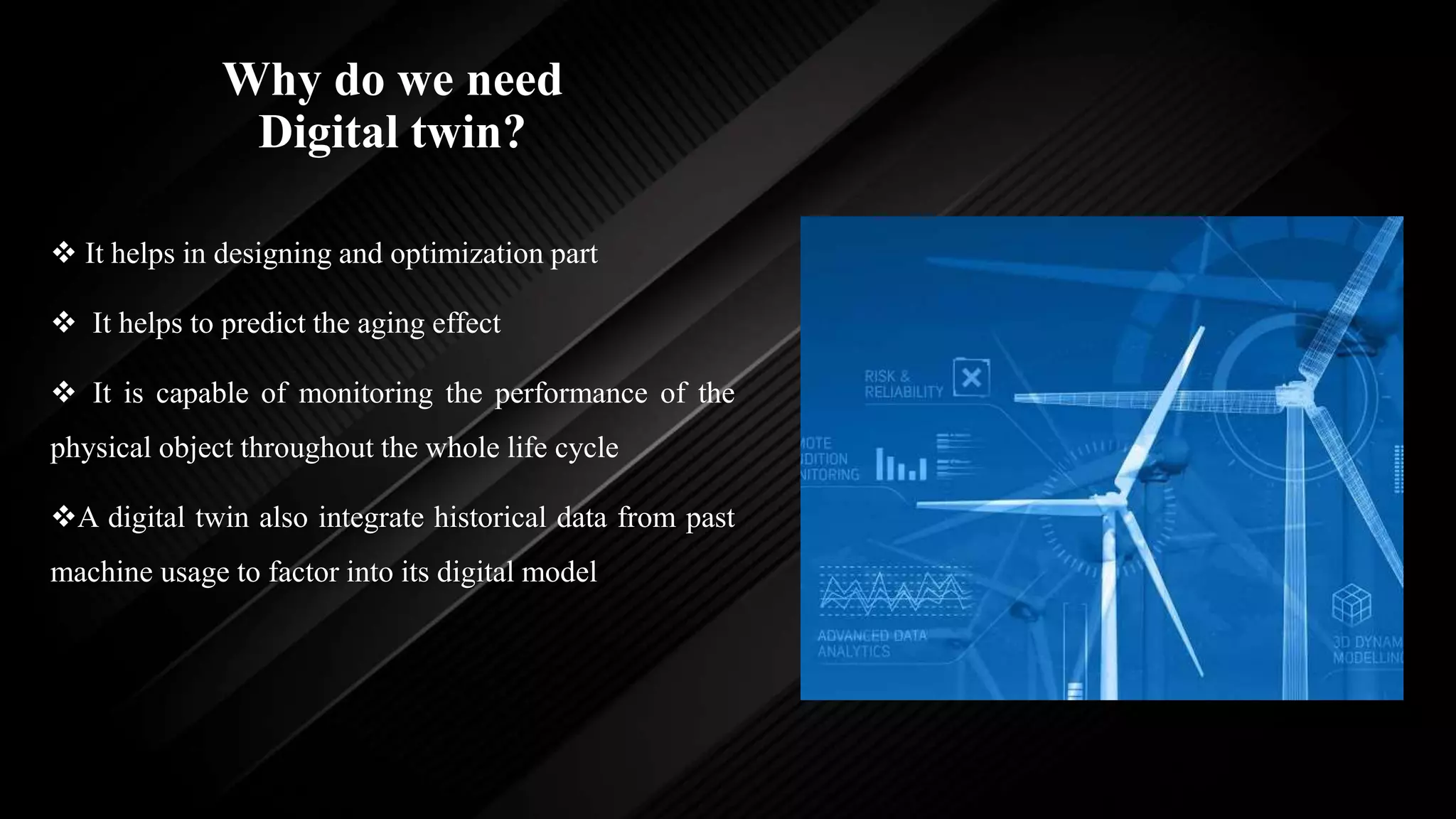
 It helps in designing and optimization part
 It helps to predict the aging effect
 It is capable of monitoring the performance of the
physical object throughout the whole life cycle
A digital twin also integrate historical data from past
machine usage to factor into its digital model
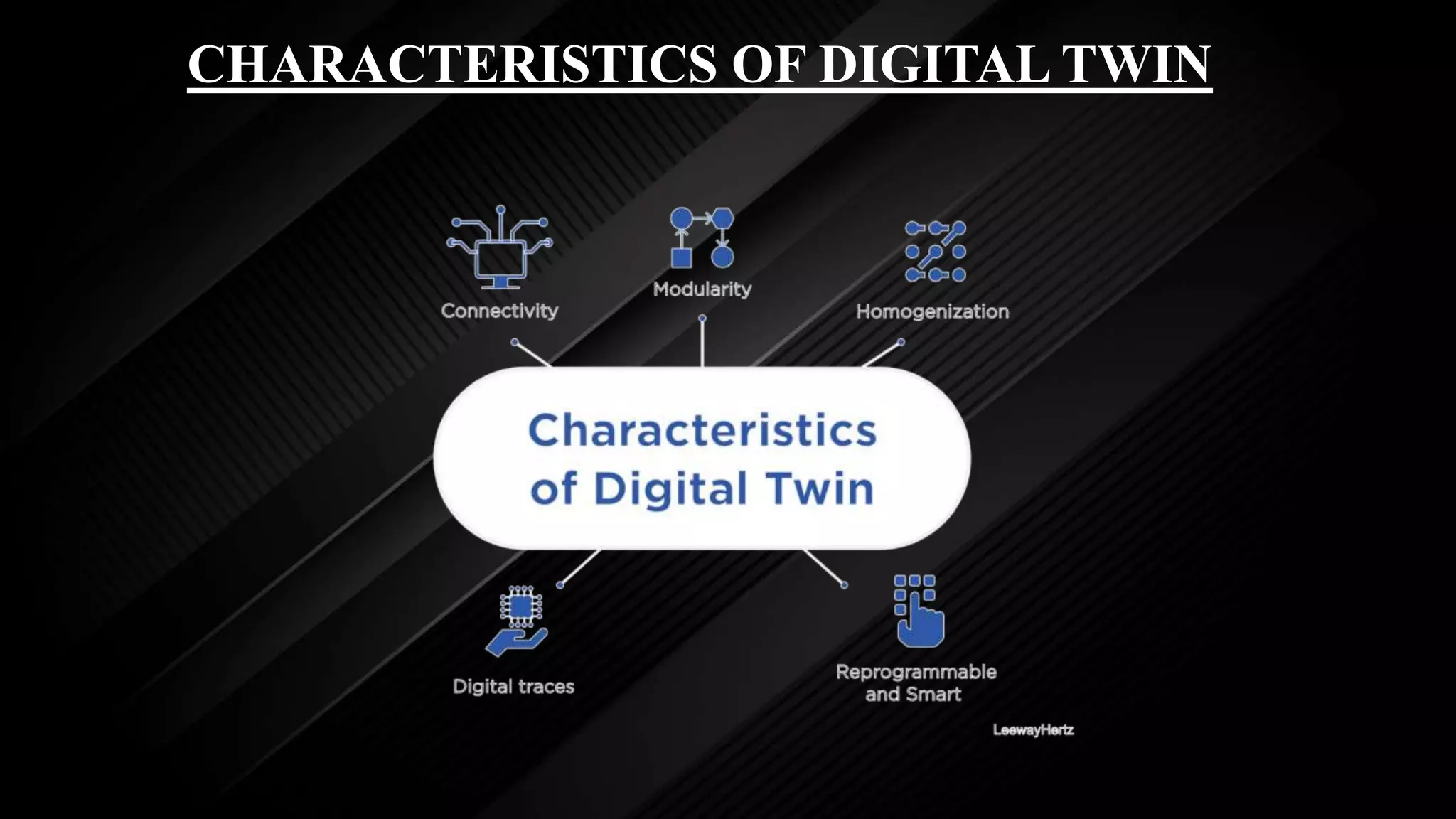
CHARACTERISTICS OF DIGITAL TWIN
Connectivity
A digital twin is based on connectivity. It enables connection between
the physical element and its digital counterpart. The sensors create the
connectivity of physical products that obtain, integrate and
communicate data using various integration technologies.
Homogenization
Homogenization has two component steps; firstly, spatially aligning
data; and secondly ensuring the quality of the data is compatible
Digital twins are both the consequence and enabler of homogenization
of data. It allows the decoupling of information from its physical form
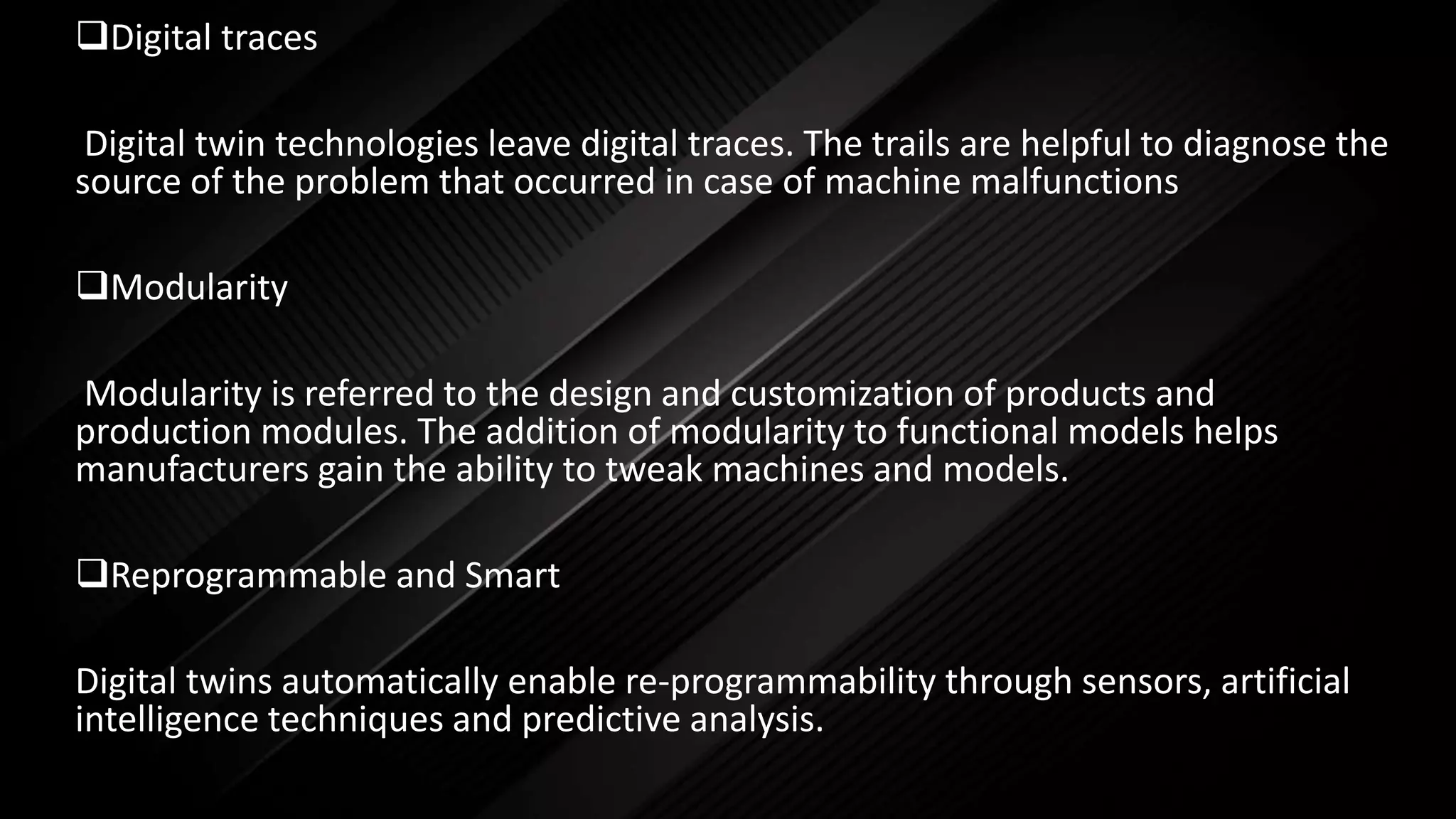
Digital traces
Digital twin technologies leave digital traces. The trails are helpful to diagnose the
source of the problem that occurred in case of machine malfunctions
Modularity
Modularity is referred to the design and customization of products and
production modules. The addition of modularity to functional models helps
manufacturers gain the ability to tweak machines and models.
Reprogrammable and Smart
Digital twins automatically enable re-programmability through sensors, artificial
intelligence techniques and predictive analysis.
ARCHITECTURE DIAGRAM
ARCHITECTURE
The different stages in the architecture of Digital Twin service
involves;-
 Data and Data Collection
 Data Pipelines
 Data Integrity
 Data Egress
 Data and Data Collection
There is two types of data;
 Model Data
Used to construct digital representation of real world thing by using graph models.
 Time Series Data
Represent the observation of the state of some physical thing at a given time. It can be
continuous or discrete.
 Data Pipelines
Merge all data sources from data collection into a single model and exported into element
graph.
 Data Integrity
It also looks at the actual data stream for reducing issues with calibrations, connectivity
physical issues with the instrumentation that collect the physical data. This is a set of
analysis on either single varied or multi varied data.
 Data Egress
The collected and organised data into digital twin is analyse to ensure the accuracy of that
data. The final stage is making use of that digital twin, we have built to analogue a whole
range of analytics value.
FEATURES
FEATURES FUNCTIONALITY
Document Management All document (drawings,instructions,etc.)
Assossiated to equipment throughout its
lifecycle.
Model Digital representation of the equipment that can
mimic properties and behaviors of a physical device
3D Representation Properties of a physical device (measured or
simulated) mapped to a 3D digital representation
Simulation Representation of a physical device in a simulation
Environment to study its behavior
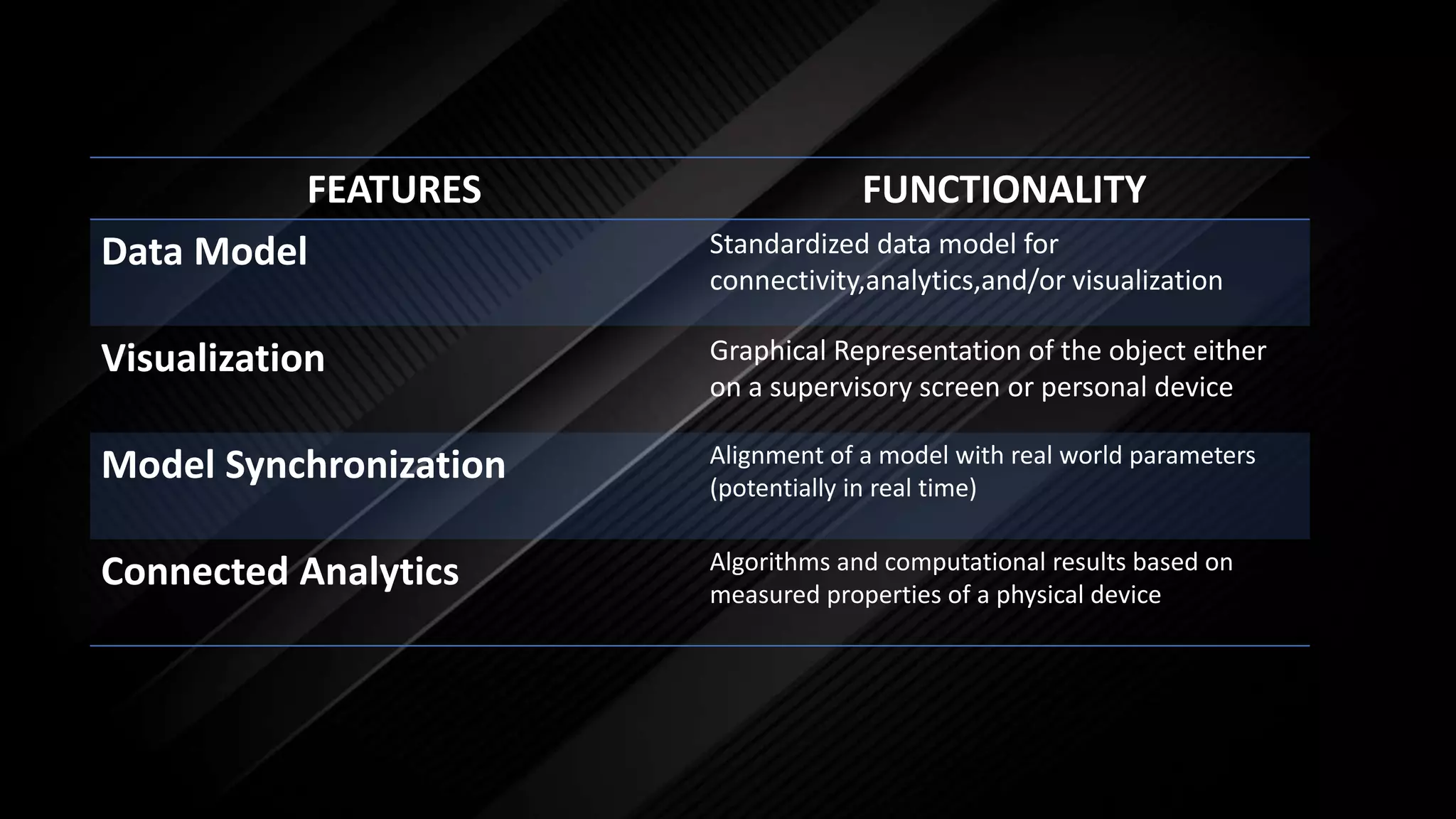
FEATURES FUNCTIONALITY
Data Model Standardized data model for
connectivity,analytics,and/or visualization
Visualization Graphical Representation of the object either
on a supervisory screen or personal device
Model Synchronization Alignment of a model with real world parameters
(potentially in real time)
Connected Analytics Algorithms and computational results based on
measured properties of a physical device
ADVANTAGES
 Improved design
 Improved build
 Better early detection and warnings
 New opportunities
 Aggregated data
 Post-manufacturing visibility of products
DISADVANTAGES
 The success of technology is dependent on internet connectivity.
 The security is at stake.
 The digital twins concept is based on 3D models and not on 2D
drawings
 Digital twin will be required across entire supply chains.
 The challenges involved here include globalization and new
manufacturing techniques.
Applications of Digital twins
Manufacturing
In the manufacturing industry, digital twins are used for
facilitating product development, design customization, shop
floor performance improvement and predictive maintenance.
In the manufacturing industry
Product development
Engineers gain benefits from digital twins as it helps to test the
feasibility of upcoming products before launching
Design customization
Digital twins help businesses design multiple permutations of the
product and offer personalized products and services to their clients.
Shop floor performance improvement
Digital twins are helpful in monitoring and analyzing the end products. It
helps engineers to spot the defective and low-performing products in the lot.
Predictive maintenance
Digital twins help manufacturers predict potential downtimes of machines to
improve their overall productivity by minimizing non-value-adding
maintenance activities.
Other Applications
Retail
In the retail sector, digital twins are used for modeling and augment
customer experience at prominent shopping centers and individual stores.
Automotive
Digital twins are highly used for creating virtual models of connected
vehicles. Automotive companies simulate and analyze the production phase
to identify the potential problems during production or when the car hits the
roads.
Healthcare
Digital twins virtualize healthcare services and help healthcare providers to
optimize patient care, cost and performance. It aims to improve the
operational efficiency of healthcare processes and enhance personalized
care.
Smart cities
The digital twin can help cities to become more economically, socially and
environmentally sustainable. Virtual models can guide planning decisions
and offer solutions to the many complex challenges faced by modern cities.
CONCLUSION
combined with the latest machine learning and artificial intelligence
tools which helping companies across many industries reduce
operational costs, increase productivity, improve performance, and
change the way predictive maintenance is done. For product
manufacturers in particular, digital twin technology is crucial to
achieving more efficient production lines and faster time-to-market.
REFRENCES
httpswww.marketsandmarkets.comMarket-Reportsdigital-twin-
market-225269522.html
httpswww.gartner.comennewsroompress-releases2019-02-20-
gartner-survey-reveals-digital-twins-are-entering.html
https://www.gartner.com/doc/3873175
Thank You

Digital Twin

  • 1.
    DIGITAL TWIN TECHNOLOGY BIJOY TMATHEW DEPARTMENT OF COMPUTER ENGINEERING NSS POLYTECHNIC COLLEGE, PANDALAM
  • 2.
    CONTENTS 1. What aredigital twins? 2. Why do we need Digital twin? 3. Characteristics of Digital twin 4. Architecture 5. Architecture Diagram 6. Features of Digital twin 7. Advantages and Disadvantages 8. Applications 9. Conclusion 10. References
  • 3.
    What are Digital Twins?  A digital twin is made up of data sets and it is a virtual representation of a physical object which can accurately mimic the performance of the physical object in a virtual platform.  The concept of Digital Twin was first used in Davin gall Inger's 1991 book called mirror worlds. The digital twin has been adopted as a conceptual basis in the astronautics and aerospace area in recent years by NASA.
  • 4.
    Why do weneed Digital twin?  It helps in designing and optimization part  It helps to predict the aging effect  It is capable of monitoring the performance of the physical object throughout the whole life cycle A digital twin also integrate historical data from past machine usage to factor into its digital model
  • 5.
  • 6.
    CHARACTERISTICS OF DIGITALTWIN Connectivity A digital twin is based on connectivity. It enables connection between the physical element and its digital counterpart. The sensors create the connectivity of physical products that obtain, integrate and communicate data using various integration technologies. Homogenization Homogenization has two component steps; firstly, spatially aligning data; and secondly ensuring the quality of the data is compatible Digital twins are both the consequence and enabler of homogenization of data. It allows the decoupling of information from its physical form
  • 7.
    Digital traces Digital twintechnologies leave digital traces. The trails are helpful to diagnose the source of the problem that occurred in case of machine malfunctions Modularity Modularity is referred to the design and customization of products and production modules. The addition of modularity to functional models helps manufacturers gain the ability to tweak machines and models. Reprogrammable and Smart Digital twins automatically enable re-programmability through sensors, artificial intelligence techniques and predictive analysis.
  • 8.
  • 9.
    ARCHITECTURE The different stagesin the architecture of Digital Twin service involves;-  Data and Data Collection  Data Pipelines  Data Integrity  Data Egress
  • 10.
     Data andData Collection There is two types of data;  Model Data Used to construct digital representation of real world thing by using graph models.  Time Series Data Represent the observation of the state of some physical thing at a given time. It can be continuous or discrete.  Data Pipelines Merge all data sources from data collection into a single model and exported into element graph.
  • 11.
     Data Integrity Italso looks at the actual data stream for reducing issues with calibrations, connectivity physical issues with the instrumentation that collect the physical data. This is a set of analysis on either single varied or multi varied data.  Data Egress The collected and organised data into digital twin is analyse to ensure the accuracy of that data. The final stage is making use of that digital twin, we have built to analogue a whole range of analytics value.
  • 12.
    FEATURES FEATURES FUNCTIONALITY Document ManagementAll document (drawings,instructions,etc.) Assossiated to equipment throughout its lifecycle. Model Digital representation of the equipment that can mimic properties and behaviors of a physical device 3D Representation Properties of a physical device (measured or simulated) mapped to a 3D digital representation Simulation Representation of a physical device in a simulation Environment to study its behavior
  • 13.
    FEATURES FUNCTIONALITY Data ModelStandardized data model for connectivity,analytics,and/or visualization Visualization Graphical Representation of the object either on a supervisory screen or personal device Model Synchronization Alignment of a model with real world parameters (potentially in real time) Connected Analytics Algorithms and computational results based on measured properties of a physical device
  • 14.
    ADVANTAGES  Improved design Improved build  Better early detection and warnings  New opportunities  Aggregated data  Post-manufacturing visibility of products
  • 15.
    DISADVANTAGES  The successof technology is dependent on internet connectivity.  The security is at stake.  The digital twins concept is based on 3D models and not on 2D drawings  Digital twin will be required across entire supply chains.  The challenges involved here include globalization and new manufacturing techniques.
  • 16.
    Applications of Digitaltwins Manufacturing In the manufacturing industry, digital twins are used for facilitating product development, design customization, shop floor performance improvement and predictive maintenance.
  • 17.
    In the manufacturingindustry Product development Engineers gain benefits from digital twins as it helps to test the feasibility of upcoming products before launching Design customization Digital twins help businesses design multiple permutations of the product and offer personalized products and services to their clients.
  • 18.
    Shop floor performanceimprovement Digital twins are helpful in monitoring and analyzing the end products. It helps engineers to spot the defective and low-performing products in the lot. Predictive maintenance Digital twins help manufacturers predict potential downtimes of machines to improve their overall productivity by minimizing non-value-adding maintenance activities.
  • 19.
    Other Applications Retail In theretail sector, digital twins are used for modeling and augment customer experience at prominent shopping centers and individual stores. Automotive Digital twins are highly used for creating virtual models of connected vehicles. Automotive companies simulate and analyze the production phase to identify the potential problems during production or when the car hits the roads.
  • 20.
    Healthcare Digital twins virtualizehealthcare services and help healthcare providers to optimize patient care, cost and performance. It aims to improve the operational efficiency of healthcare processes and enhance personalized care. Smart cities The digital twin can help cities to become more economically, socially and environmentally sustainable. Virtual models can guide planning decisions and offer solutions to the many complex challenges faced by modern cities.
  • 22.
    CONCLUSION combined with thelatest machine learning and artificial intelligence tools which helping companies across many industries reduce operational costs, increase productivity, improve performance, and change the way predictive maintenance is done. For product manufacturers in particular, digital twin technology is crucial to achieving more efficient production lines and faster time-to-market.
  • 23.
  • 24.