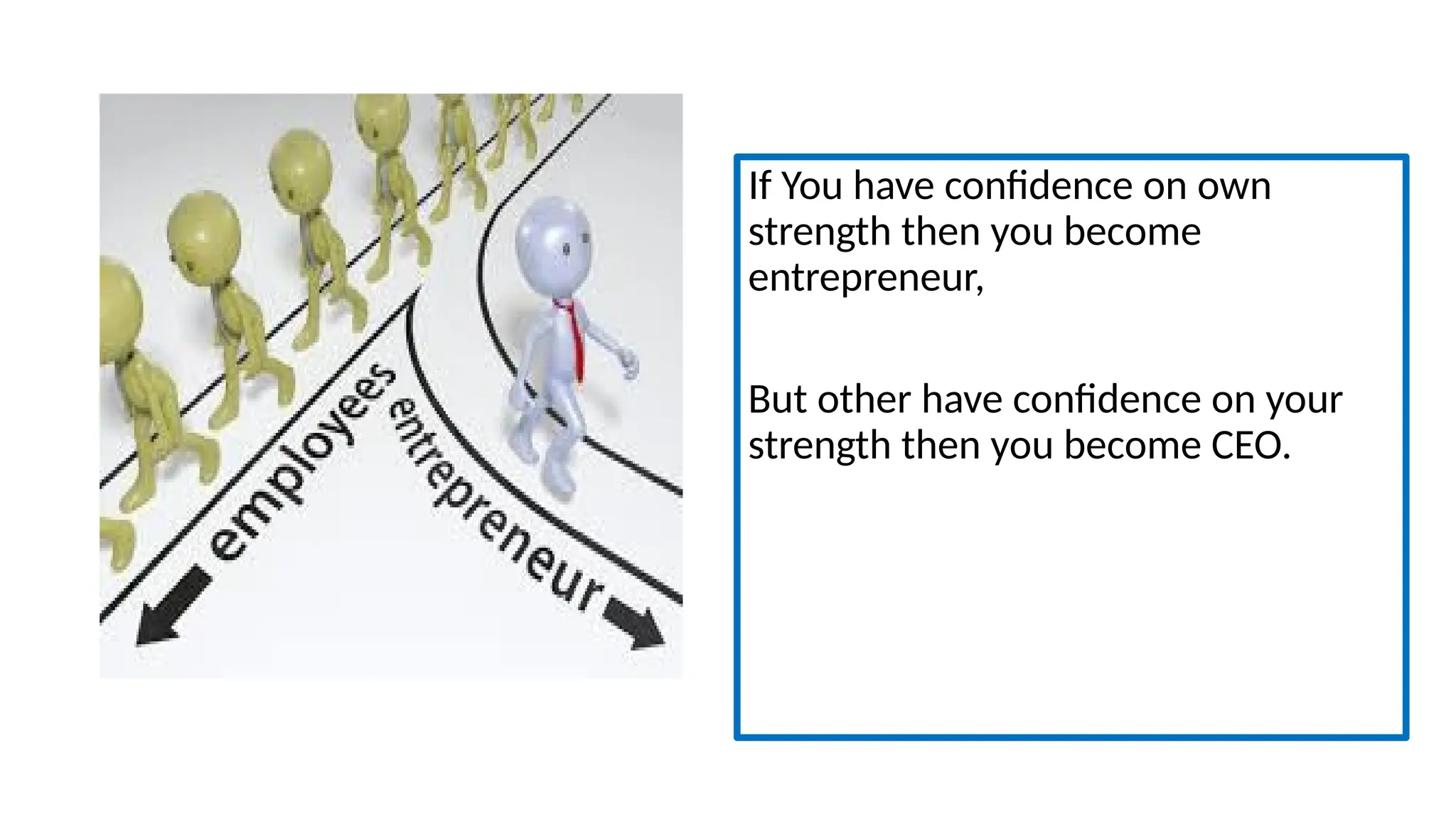
If You have confidence on own
strength then you become
entrepreneur,
But other have confidence on your
strength then you become CEO.
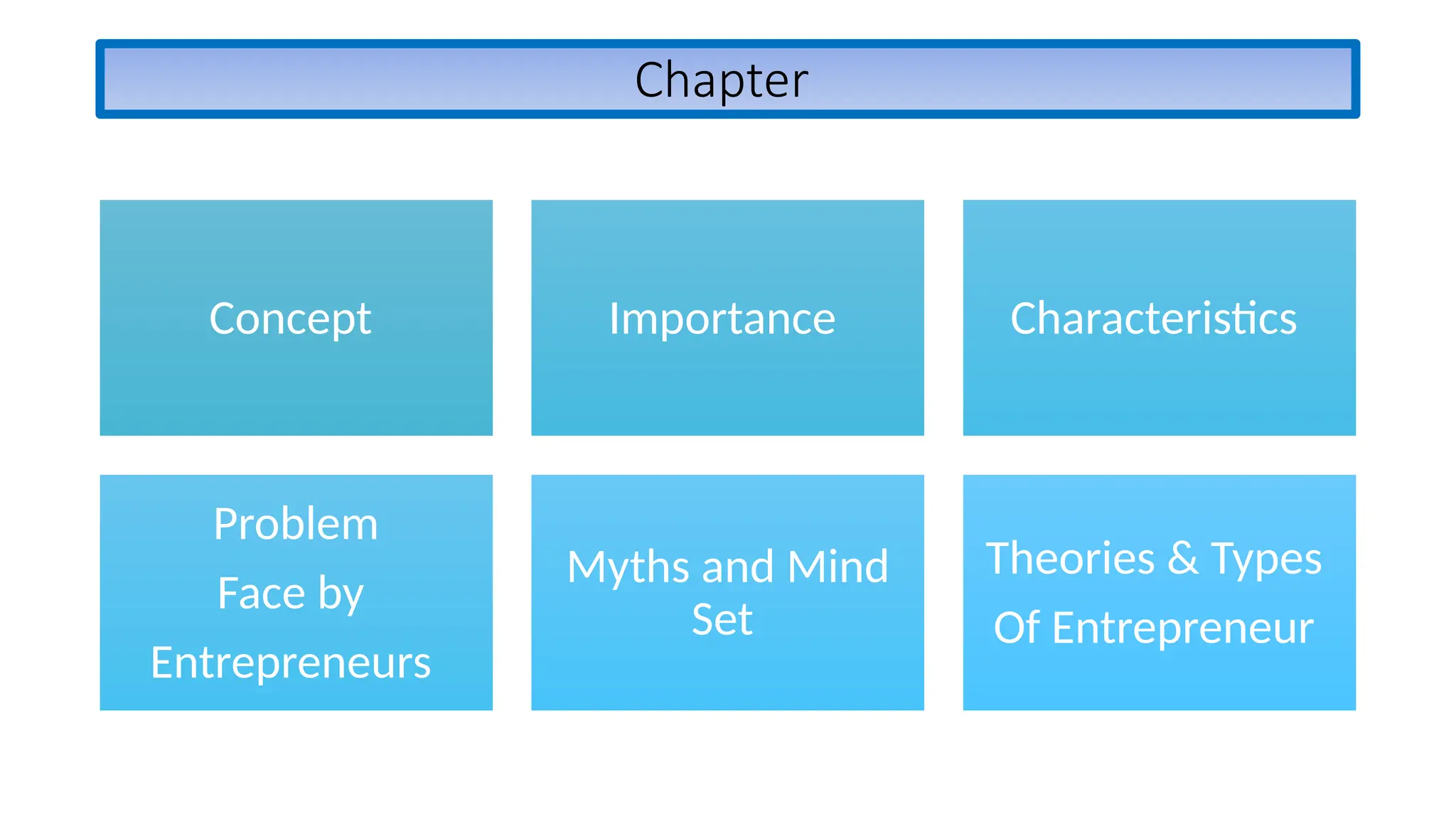
Chapter
Concept Importance Characteristics
Problem
Face by
Entrepreneurs
Myths and Mind
Set
Theories & Types
Of Entrepreneur
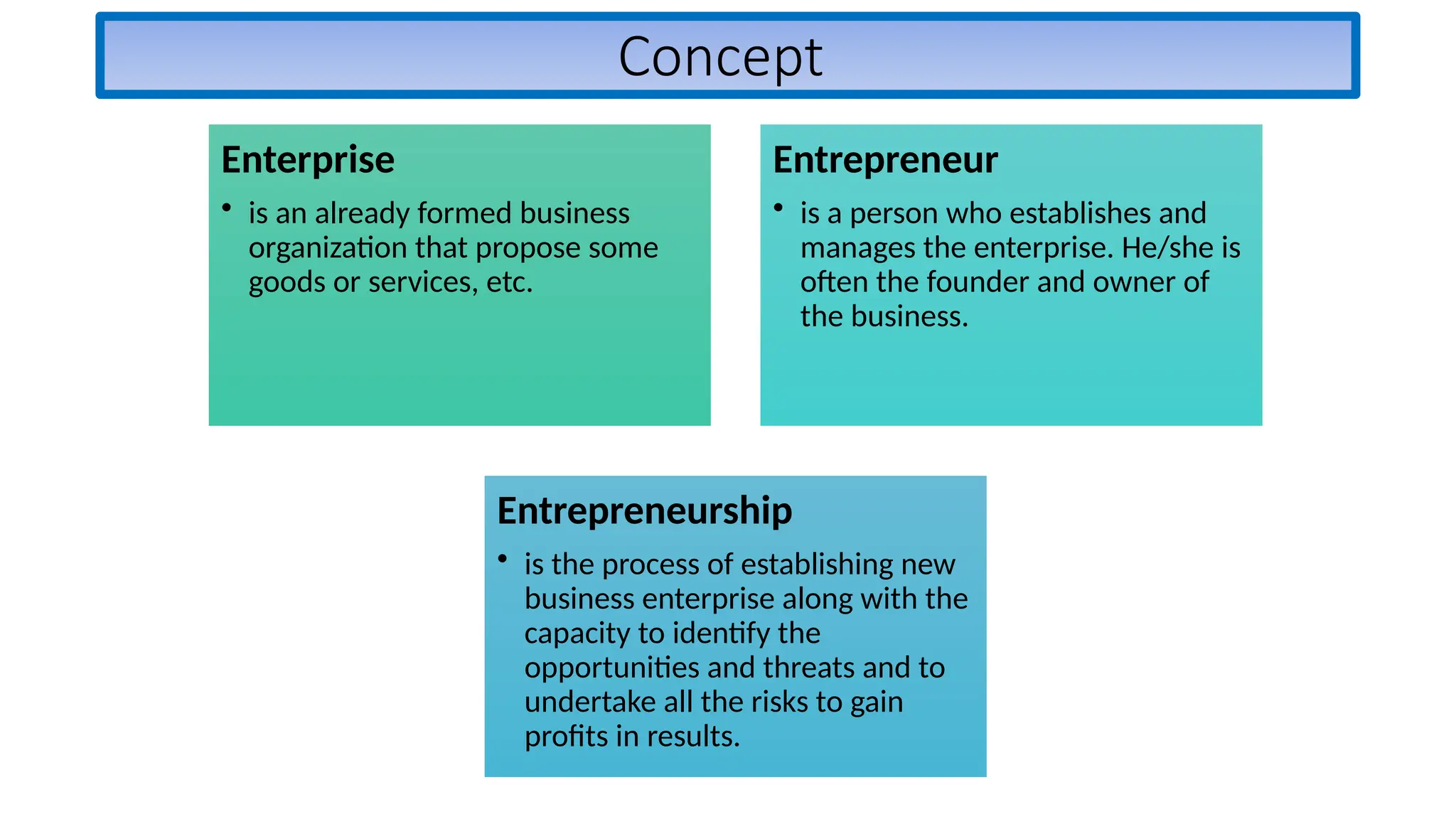
Concept
Enterprise
• is an already formed business
organization that propose some
goods or services, etc.
Entrepreneur
• is a person who establishes and
manages the enterprise. He/she is
often the founder and owner of
the business.
Entrepreneurship
• is the process of establishing new
business enterprise along with the
capacity to identify the
opportunities and threats and to
undertake all the risks to gain
profits in results.
CONCEPT
• It was the beginning of 18th
Century when the word was used to refer to
economic aspect
• Richard Cantillon is the first one who introduced the term Entrepreneur with
some economical aspect
• According to him - “Entrepreneur as an agent who buy factors of
production at certain price in order to combine them to produce product with
a view to selling it in uncertain price in the future” (FARMER)
• According to Knight - “Entrepreneur is the economic functionary who
undertakes such responsibility of uncertainty which is not insured nor
capitalized nor salaried”
THE CONCEPT OF ENTREPRENEUR
 This views are classified in three groups
1. Risk Bearer
2. Organizer
3. Innovator
THE CONCEPT OF ENTREPRENEUR
• According to New Encyclopedia Britannica
“An entrepreneur is an individual who bear the risk of operating business in face of
uncertainty about future condition”
• According to Peter Drucker
“An entrepreneur is one who always searches for change, respond to it and exploit it as an
opportunity. Innovation is a specific tools of an entrepreneur by which they can exploit
change as an opportunity for different business and service”
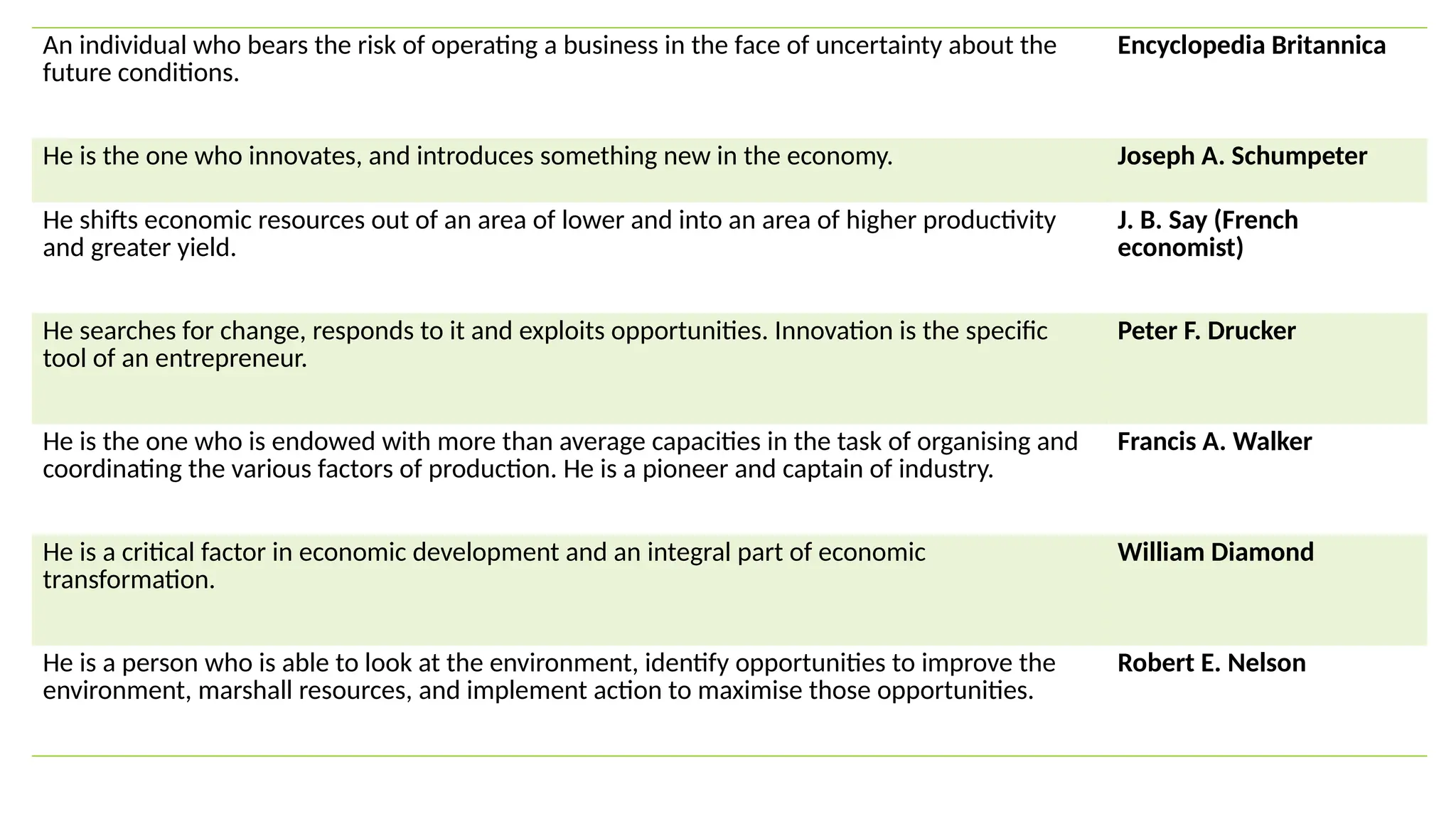
DEFINITION
An individual who bears the risk of operating a business in the face of uncertainty about the
future conditions.
Encyclopedia Britannica
He is the one who innovates, and introduces something new in the economy. Joseph A. Schumpeter
He shifts economic resources out of an area of lower and into an area of higher productivity
and greater yield.
J. B. Say (French
economist)
He searches for change, responds to it and exploits opportunities. Innovation is the specific
tool of an entrepreneur.
Peter F. Drucker
He is the one who is endowed with more than average capacities in the task of organising and
coordinating the various factors of production. He is a pioneer and captain of industry.
Francis A. Walker
He is a critical factor in economic development and an integral part of economic
transformation.
William Diamond
He is a person who is able to look at the environment, identify opportunities to improve the
environment, marshall resources, and implement action to maximise those opportunities.
Robert E. Nelson
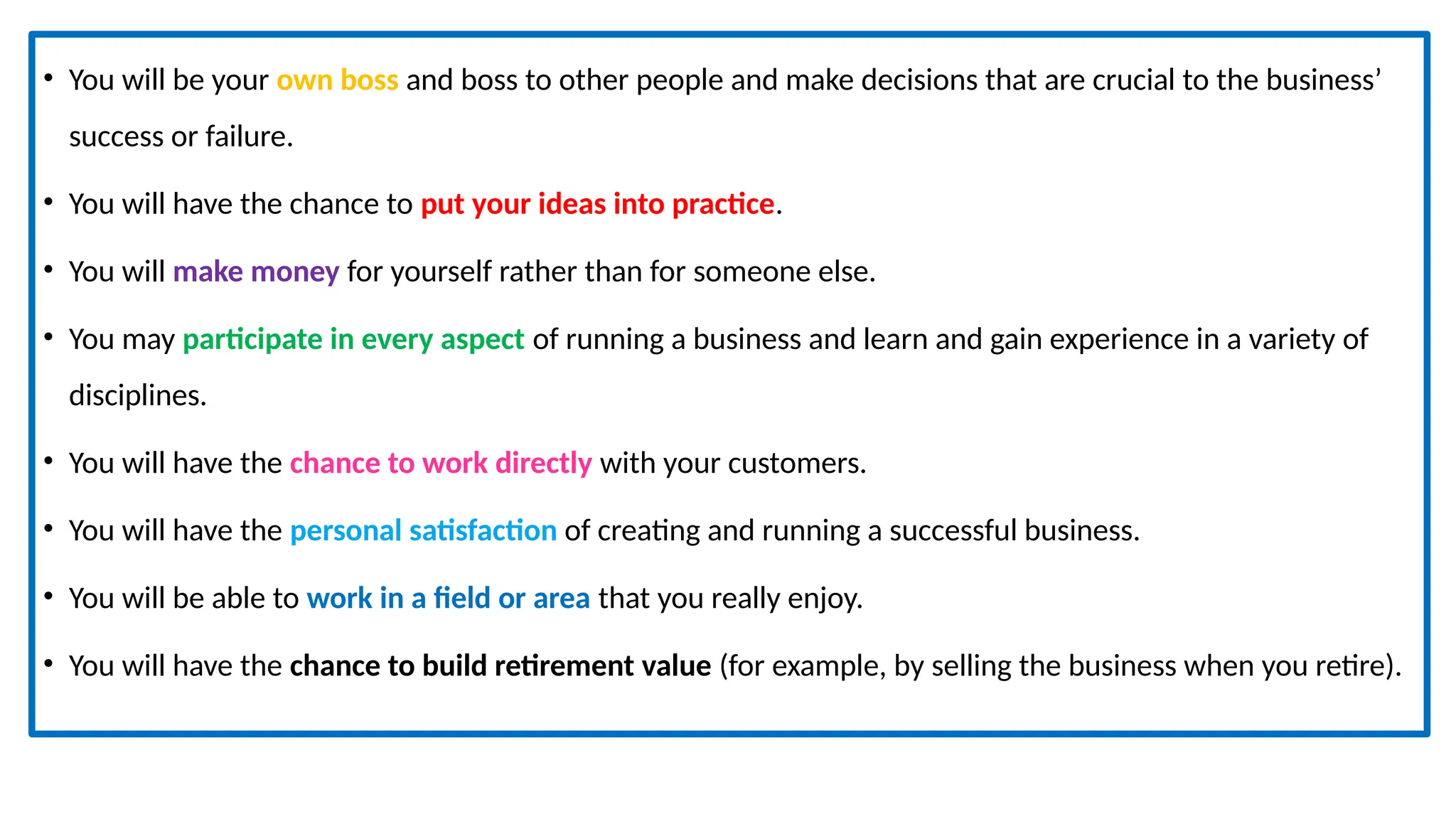
Why Should You Become an
Entrepreneur?
• You will be your own boss and boss to other people and make decisions that are crucial to the business’
success or failure.
• You will have the chance to put your ideas into practice.
• You will make money for yourself rather than for someone else.
• You may participate in every aspect of running a business and learn and gain experience in a variety of
disciplines.
• You will have the chance to work directly with your customers.
• You will have the personal satisfaction of creating and running a successful business.
• You will be able to work in a field or area that you really enjoy.
• You will have the chance to build retirement value (for example, by selling the business when you retire).
Importance of Entrepreneur
IMPORTANCE
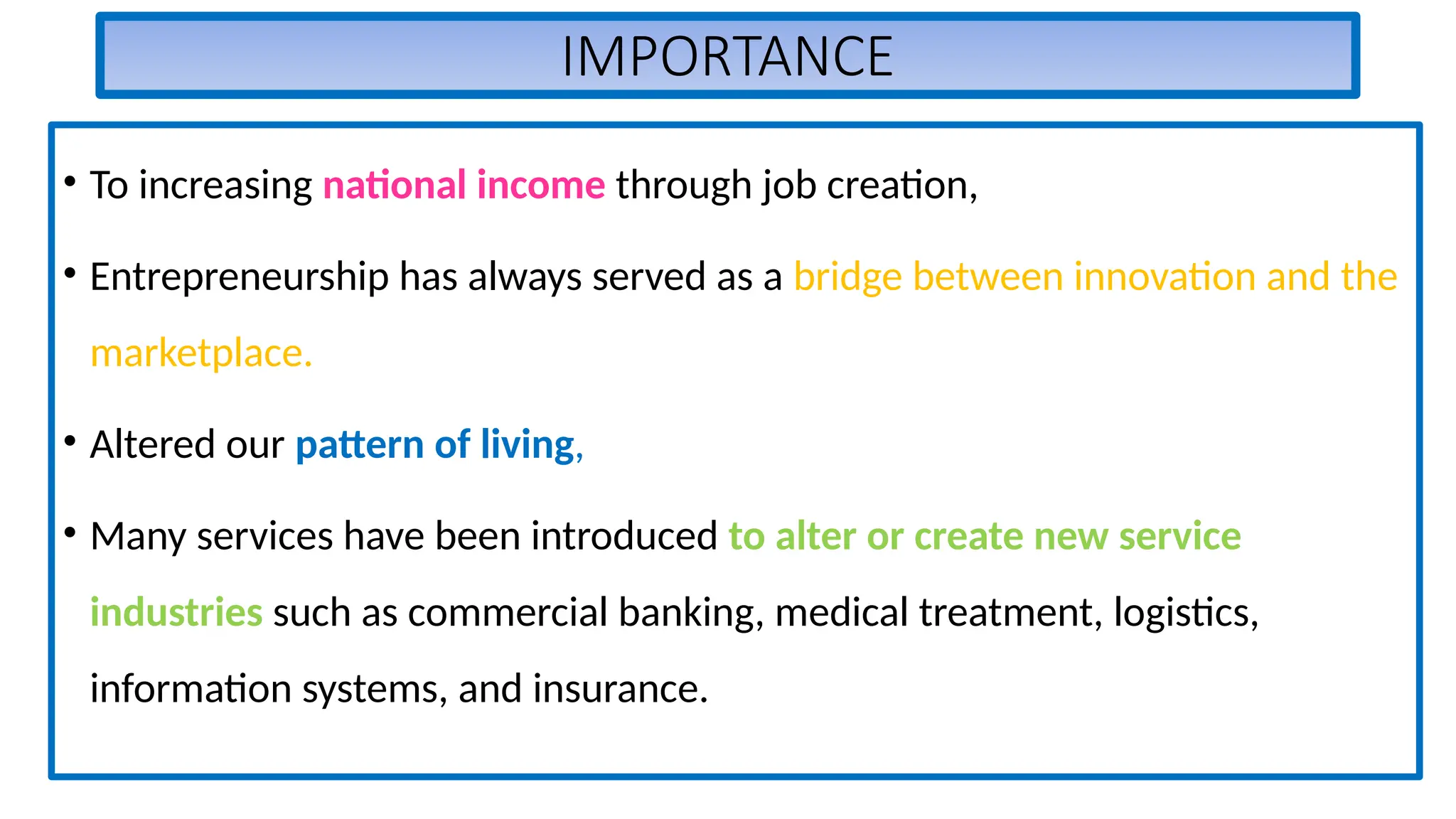
• To increasing national income through job creation,
• Entrepreneurship has always served as a bridge between innovation and the
marketplace.
• Altered our pattern of living,
• Many services have been introduced to alter or create new service
industries such as commercial banking, medical treatment, logistics,
information systems, and insurance.
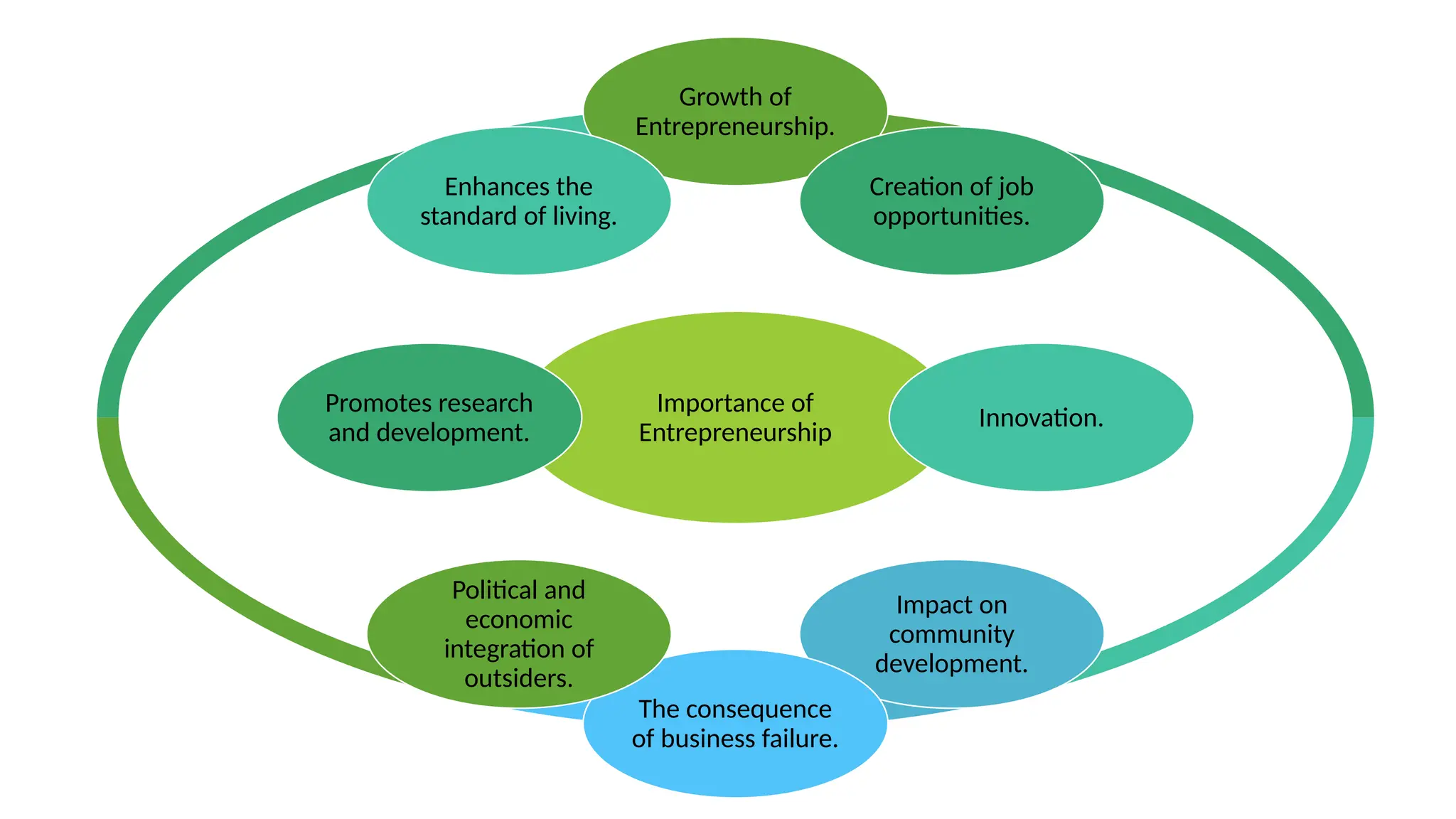
Importance of
Entrepreneurship
Growth of
Entrepreneurship.
Creation of job
opportunities.
Innovation.
Impact on
community
development.
The consequence
of business failure.
Political and
economic
integration of
outsiders.
Promotes research
and development.
Enhances the
standard of living.
1. Contribution to GNP and per capita income:
• Entrepreneurship contributes to economic stability by introducing new products
• services in the market and encouraging effective resource mobilization.
• This helps in increasing the gross national product as well as per capita income of the people in the country.
• Economic stability leads to increased institutional investment for productive activities and is a sign of
economic growth.
2. Employment generation:
• Entrepreneurs are not only self-employed but also provide employment to others.
• For example, when the information technology boom occurred in India, it led to several successful
entrepreneurial ventures. This provided employment to many and also led to the launch of a number of
engineering colleges, development of real-estate and hospitality ventures, and infrastructural facilities.
• 3. Balanced regional development:
• The development of enterprises in less-developed regions promotes balanced regional development in the country.
• Entrepreneurship stimulates the distribution of wealth and income to more and more individuals (such as
stakeholders) and geographical areas, thus benefiting larger sections of society.
• 4. Promotion of export and trade:
• Entrepreneurship promotes the country’s export trade and earns foreign exchange.
• This earning can help combat the country’s import dues requirements. International trade brings economic strength
and techno-economic reliance.
• 5. Improvement in the standard of living:
• Entrepreneurs bring a wide variety of products and services into the market.
• This increases competition in the market and makes it possible for people to avail of a better quality of products and
services at lower and more competitive prices, resulting in an improvement of the country’s overall standard of living.
• 6. Increased innovation:
• With the liberalization of the Indian economy, the increased competition in the
domestic and international market has encouraged entrepreneurs to be more
creative.
• 7. Overall development of the economy:
• Entrepreneurs create new technologies, products, processes, and services that
become the next wave of new industries, and these in turn drive the economy.
Entrepreneurs are change agents in society. They create wealth and value, and
generate employment in society. This naturally leads to social and economic growth.
Characteristics of a Successful Entrepreneur
1. Creativity
• Creativity is “the ability to bring something new into existence”.
• This definition emphasises the “ability”, not the “activity,” of bringing
something new into existence.
• A person may therefore conceive of something new and envision how it will
be useful, but not necessarily take the necessary action to make it a reality.
• Innovation is the process of doing new things, but creativity is a prerequisite
(requirement) to innovation.
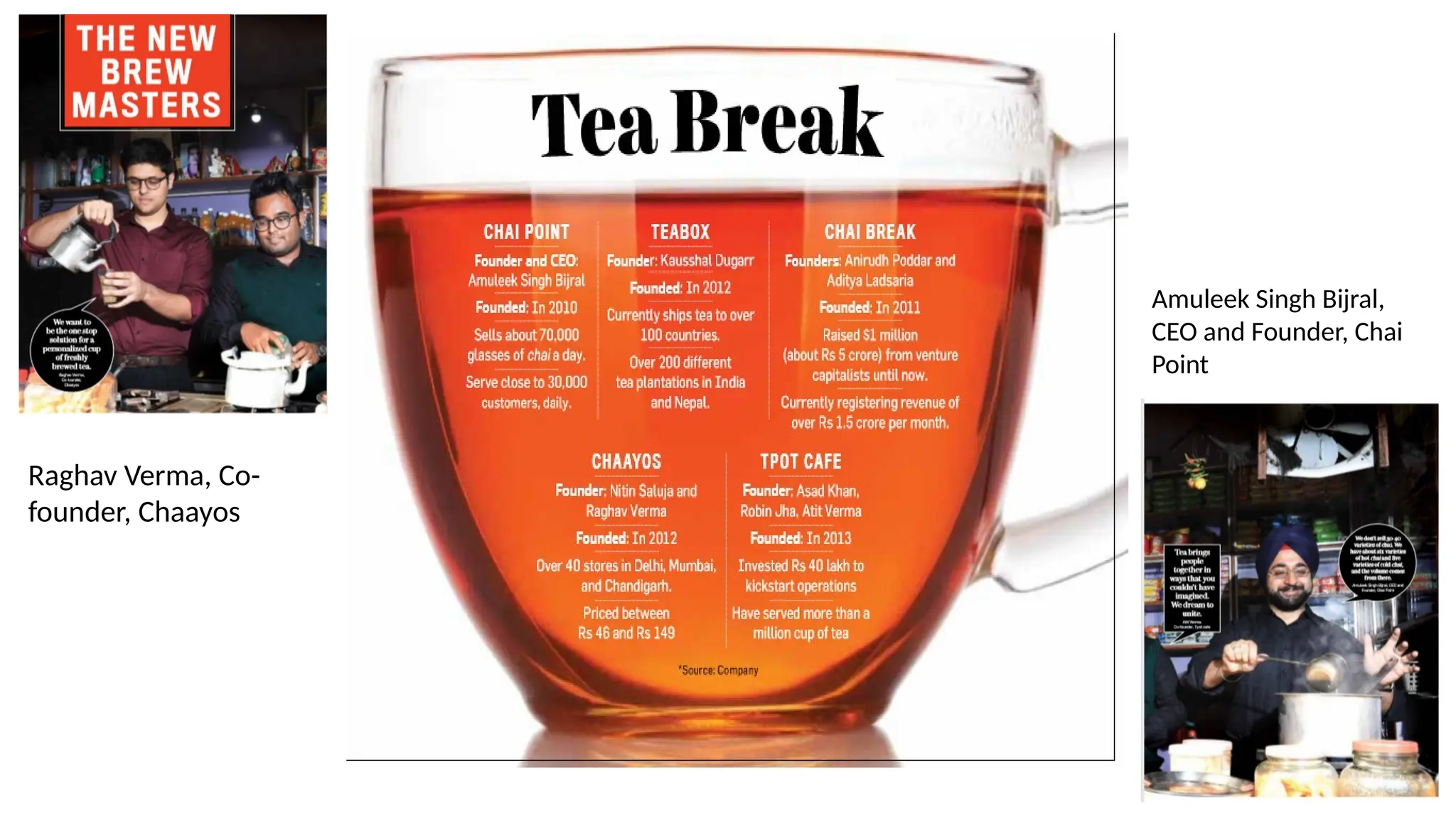
Raghav Verma, Co-
founder, Chaayos
Amuleek Singh Bijral,
CEO and Founder, Chai
Point
2. Innovation
• Innovation is the specific instrument of entrepreneurship.
• It is the act that endows resources with a new capacity to create wealth.
• Innovation, indeed, creates a resource.
• Successful entrepreneurs, whatever their individual motivation—be it money,
power, curiosity, or the desire for fame and recognition—try to create value
and to make a contribution.
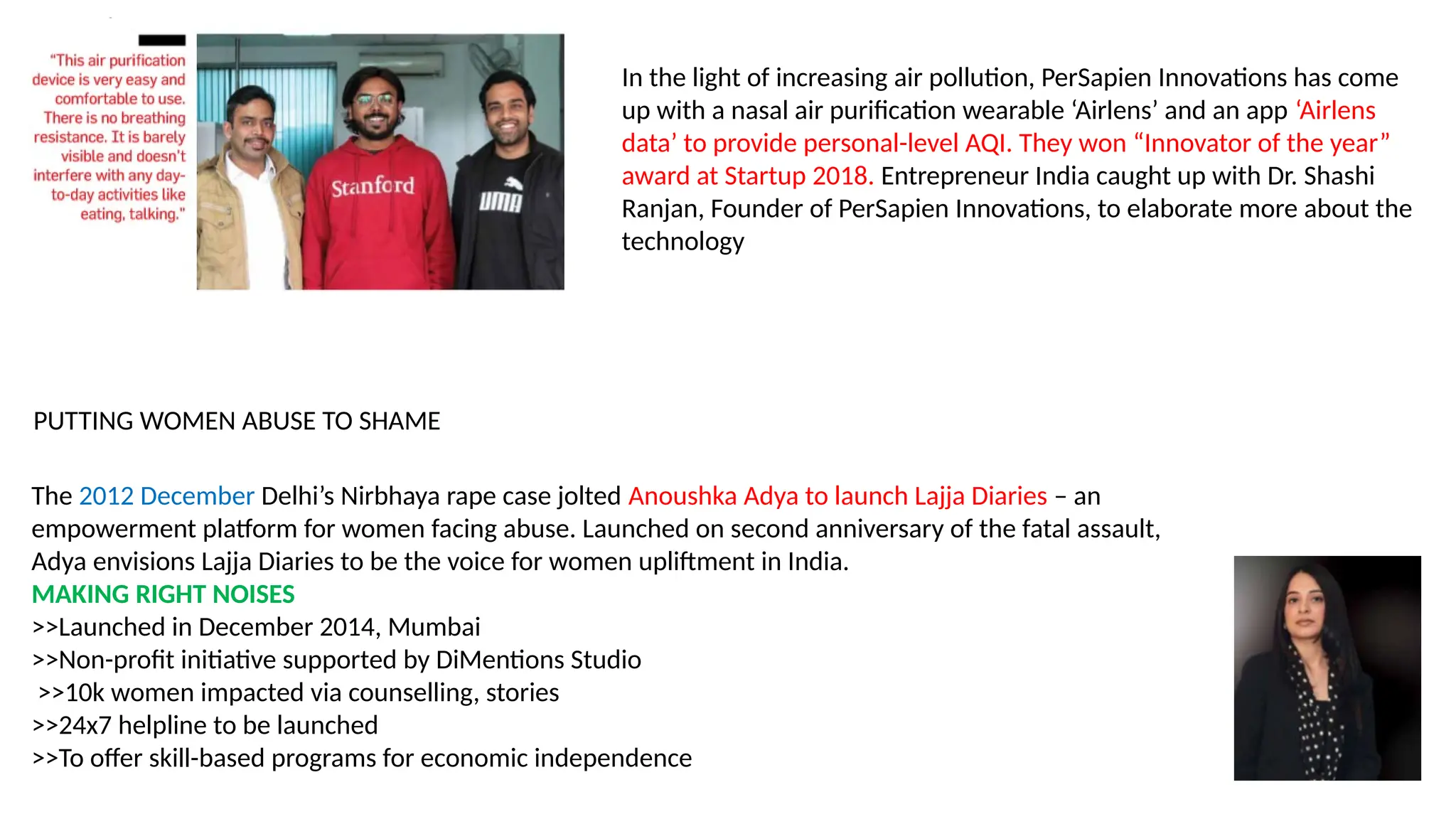
In the light of increasing air pollution, PerSapien Innovations has come
up with a nasal air purification wearable ‘Airlens’ and an app ‘Airlens
data’ to provide personal-level AQI. They won “Innovator of the year”
award at Startup 2018. Entrepreneur India caught up with Dr. Shashi
Ranjan, Founder of PerSapien Innovations, to elaborate more about the
technology
PUTTING WOMEN ABUSE TO SHAME
The 2012 December Delhi’s Nirbhaya rape case jolted Anoushka Adya to launch Lajja Diaries – an
empowerment platform for women facing abuse. Launched on second anniversary of the fatal assault,
Adya envisions Lajja Diaries to be the voice for women upliftment in India.
MAKING RIGHT NOISES
>>Launched in December 2014, Mumbai
>>Non-profit initiative supported by DiMentions Studio
>>10k women impacted via counselling, stories
>>24x7 helpline to be launched
>>To offer skill-based programs for economic independence
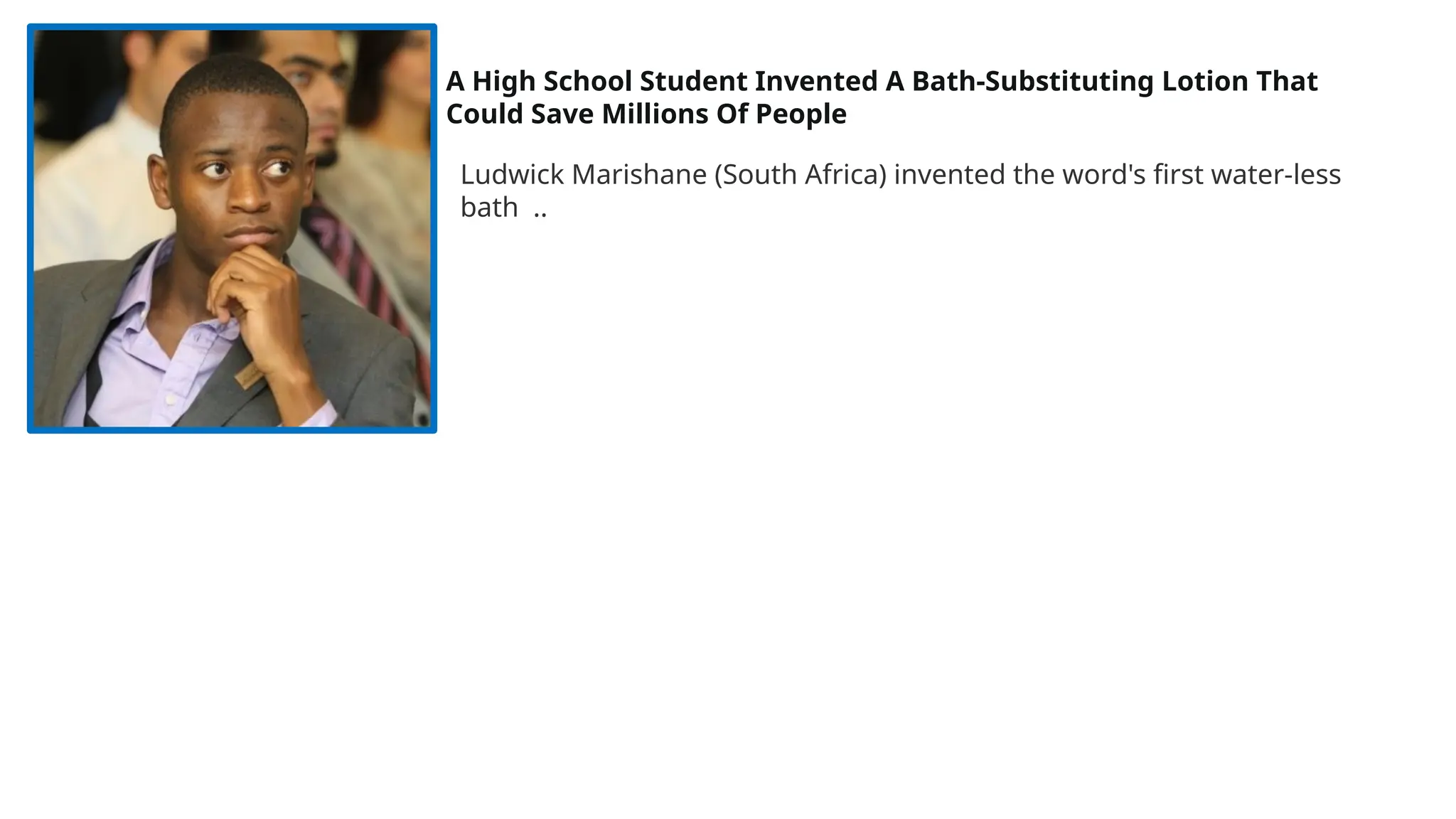
A High School Student Invented A Bath-Substituting Lotion That
Could Save Millions Of People
Ludwick Marishane (South Africa) invented the word's first water-less
bath ..
3. Dynamism:
• The enterprise may open up new vistas, better product mix, or charismatic product image
stimulating steady growth.
• A dynamic entrepreneur is always pragmatic (Practical / Ralistic).
• Given the potentialities of the enterprises, he sets attainable goals, which are to be accomplished
within specific timeframes.
• An entrepreneur tends to approach problems to solve them rather than running away from them.
• Being the decision maker, he cannot wish away problems.
• They have to be analysed systematically and solved in the interest of the enterprise.
• He must believe in, create, and practice “win-win” situations.
Manish Khera, a former
banker, quits his job to form
Happy Loans
After 10 years as a software
professional, Sriram Aravamudan
found his calling in beautifying
Bengaluru’s balconies with My
Sunny Balcony.
•Rahul Narvekar
Harvard Business School,
Founder Scale Ventures Fund ,
Founder India Network , Ex-
CEO : NDTV Ethnic ,Fashion &
You
4. Leadership:
• This spirit keeps him paces forward in any field.
• The quality of his leadership is clear from personal relationships, mode of
handling a problem, generating resources and taking others in to ones own
stride.
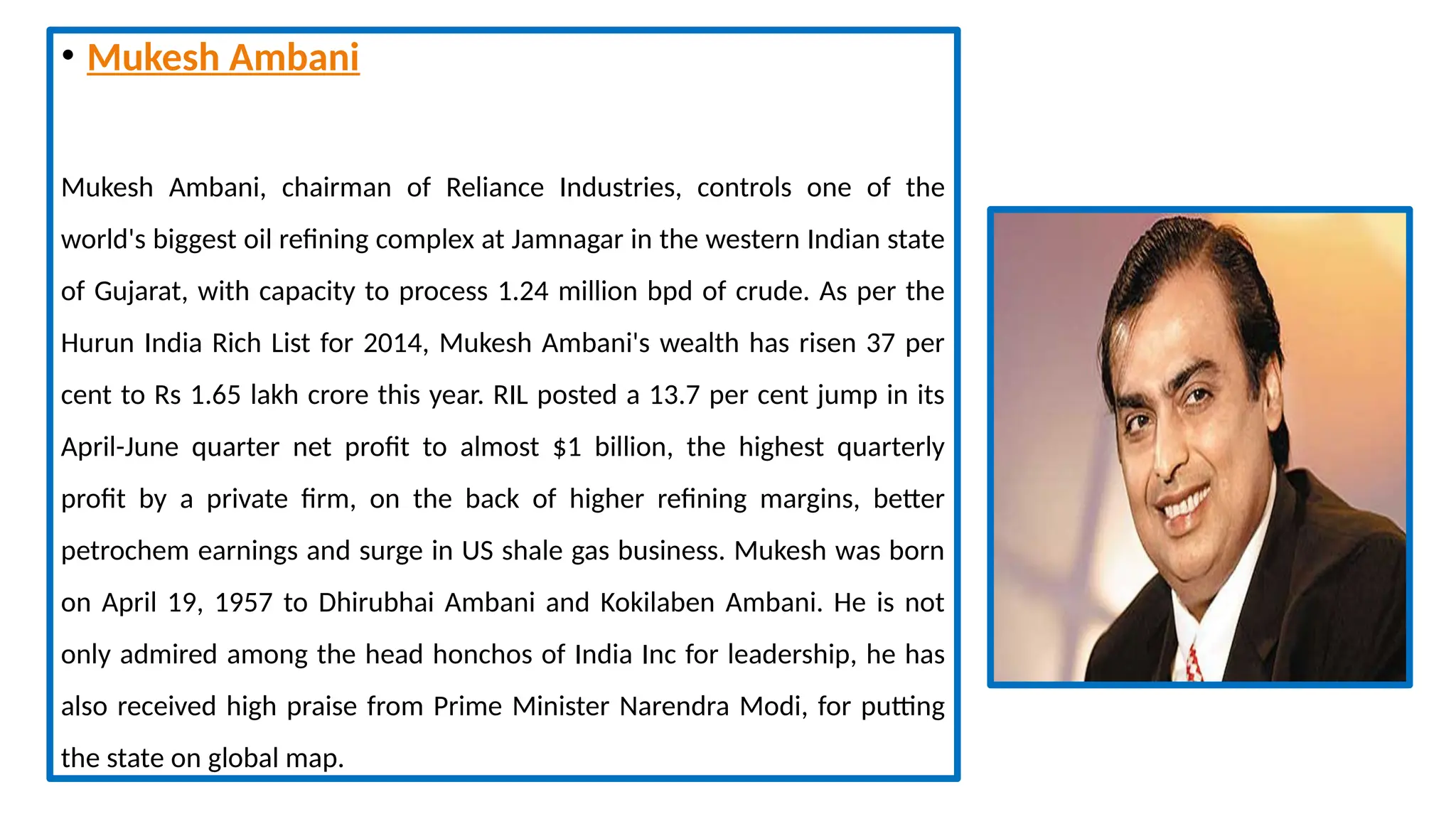
• Reliance Industries Chairman Mukesh Ambani, human rights lawyer Indira Jaising, and architect Balkrishna Doshi earn
spots in Fortune magazine's recent 50 Greatest Leaders of 2018 list.
The secret? Offering dirt-cheap data and free calls (and plowing billions of dollars into the infrastructure that transmits
them). The effect, dubbed “Jio-fication”, has driven India's higher-price carriers to drop costs (if not run them out of
business), and fueled a 1,100 per cent rise in India's monthly data consumption.
• When the poorest in India need a voice, they find one in Jaising, a lawyer who has dedicated her life to battling injustice.
• The recipient of the Pritzker Prize, he has spent 70 years in the field of architecture and is often called the “architect for
the poor”.
5. Teambuilding:
• A team is a group of individuals with a common purpose, that is focused and
aligned to achieve a specific task or set of outcomes.
• The teambuilding skill consists of the following steps.
• Step 1 Wanting to feel better
• Step 2 Identifying the problem and needs of the enterprise
• Step 3 Creating a vision
• Step 4 Setting goals for the group
• Step 5 Reviewing progress
6. Achievement motivation:
• Entrepreneurs can be classified into three categories.
• 1. Some are only dreamers and though they indulge in nice dreams, they are not capable of
translating their dreams into action. The growth of such entrepreneurs is soon stunted.
• 2.Some entrepreneurs belong to the category of doubters.
• a negative attitude, never expand their activities, never take any risk, and never go out of their way
to achieve anything, doubt their own capacity to do anything new., Never innovative and they
follow the line of least resistance.
• 3.The third category of entrepreneurs are the doers. They always accept any challenge and take a
calculated risk to do something worthwhile. It is necessary to contact such highly successful
entrepreneurs and ask them what motivated them to become successful in their life.
• These entrepreneurs believed in “Slow and steady wins the race”.
• To learn anything and everything directly or indirectly related to their business.
• They were professional in their thinking and approach. T
• hey were never content (satisfied) after achieving initial success.
• They did not fall prey to complacency, hypocrisy, sycophancy, idiosyncrasy, and obsolescence.
• They obtained interpersonal support.
• They were taskmasters and did not neglect even the smallest tasks assigned by them to their
subordinates.
• They also took a considerable interest in their personal life and were always cheerful.
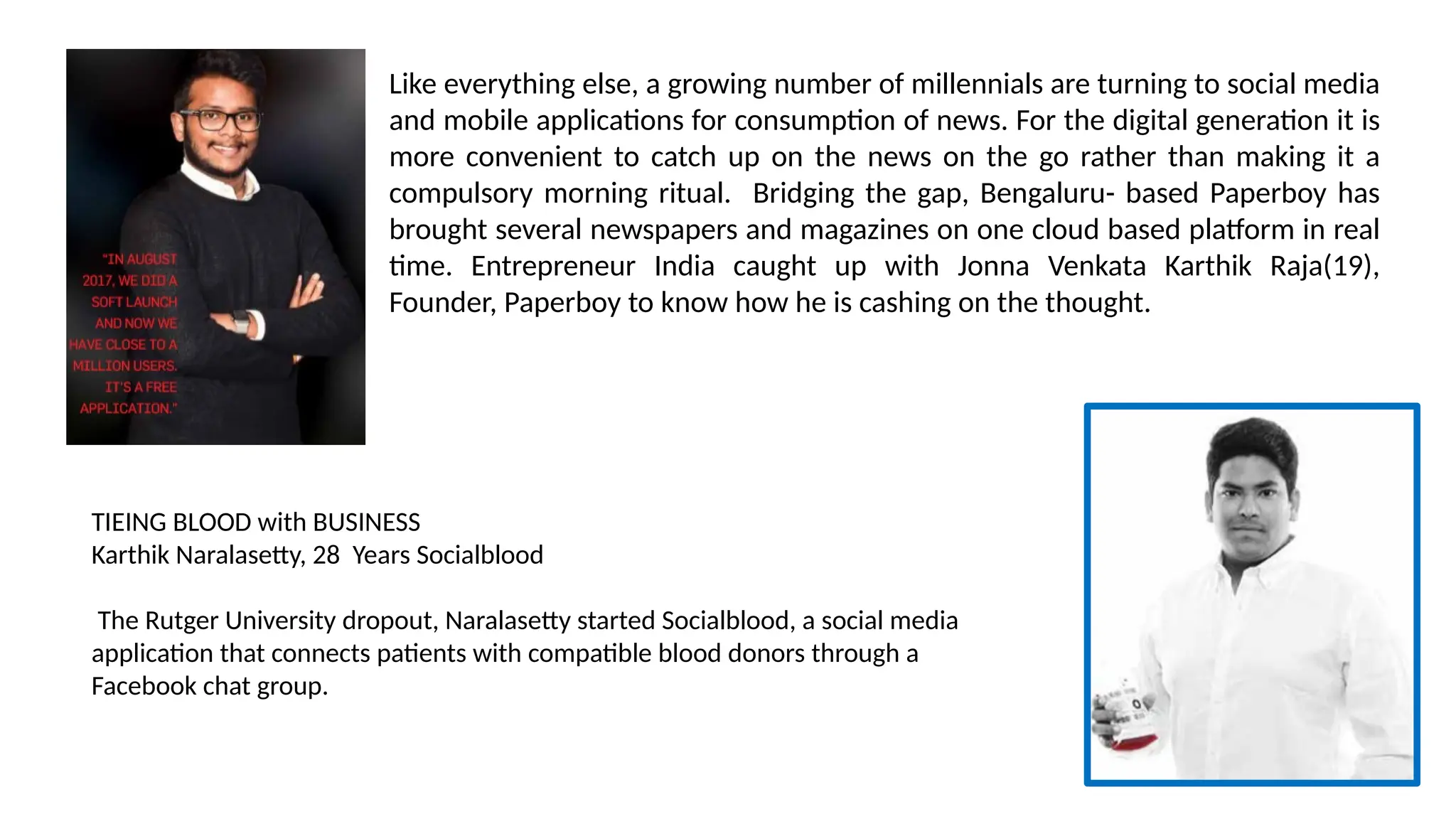
Like everything else, a growing number of millennials are turning to social media
and mobile applications for consumption of news. For the digital generation it is
more convenient to catch up on the news on the go rather than making it a
compulsory morning ritual. Bridging the gap, Bengaluru- based Paperboy has
brought several newspapers and magazines on one cloud based platform in real
time. Entrepreneur India caught up with Jonna Venkata Karthik Raja(19),
Founder, Paperboy to know how he is cashing on the thought.
TIEING BLOOD with BUSINESS
Karthik Naralasetty, 28 Years Socialblood
The Rutger University dropout, Naralasetty started Socialblood, a social media
application that connects patients with compatible blood donors through a
Facebook chat group.
• Aniruddha Sharma, the inspiration to building Carbon Clean, a company to regulate
industrial (air) pollution and use it to make by-products
• Aniruddha Sharma, 30 age, Founder of Carbon Clean
GOING AGAINST CONVENTIONS
Trishneet Arora l 24 l Founder and CEO, TAC Security
A school dropout, Arora is one of the youngest ethical hacker
India ever had. With 40 per cent growth in the first quarter of
every financial year, he intends to go 4x by the end of 2018. Back
in 2013, he started TAC with the motto - ‘Hack it yourself, before
you get hacked’. “That time, Today, more than 300+ mobile
applications use TAC security. Moreover, with 15 international
clients like IBM and Cognizant, Arora has also tied up with the
Central Bureau of Investigation and Government of India to ease
out Unified Payment Interface application.
Momo
7. Problem solving:
• An entrepreneur should be able to solve problems and not avoid them.
• A formal problem-solving model helps entrepreneurs solve problems on a
logical manner.
• The model consists of six steps.
• Define the problem
• Gather information
• Identify various solutions
• Evaluate alternatives and select the best option
• Take action
• Evaluate the action taken
• Brainstorming is a creative group problem-solving technique that involves
generating a large number of fresh ideas.
• Ideas are not analysed or criticised at a brainstorming session.
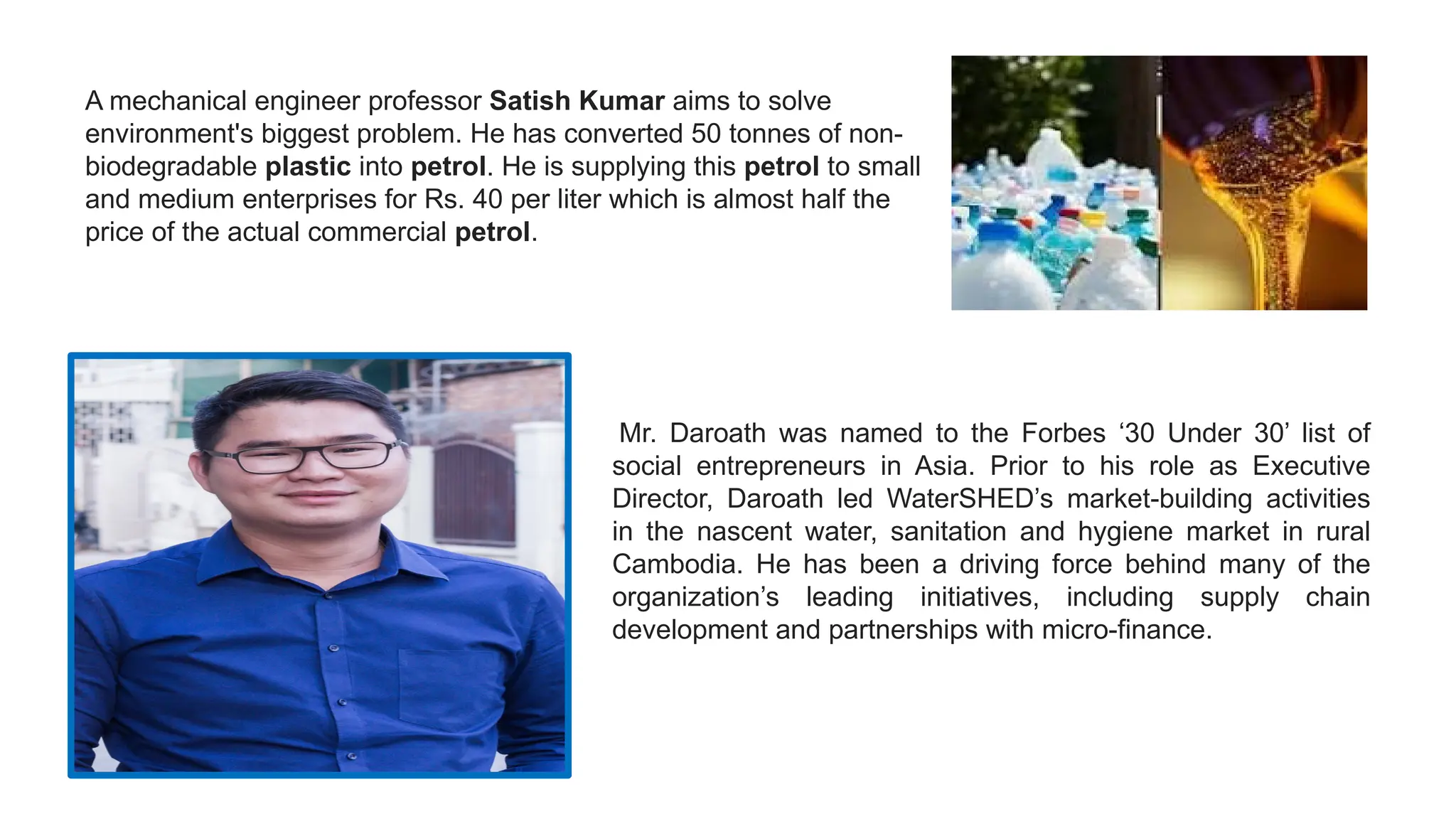
A mechanical engineer professor Satish Kumar aims to solve
environment's biggest problem. He has converted 50 tonnes of non-
biodegradable plastic into petrol. He is supplying this petrol to small
and medium enterprises for Rs. 40 per liter which is almost half the
price of the actual commercial petrol.
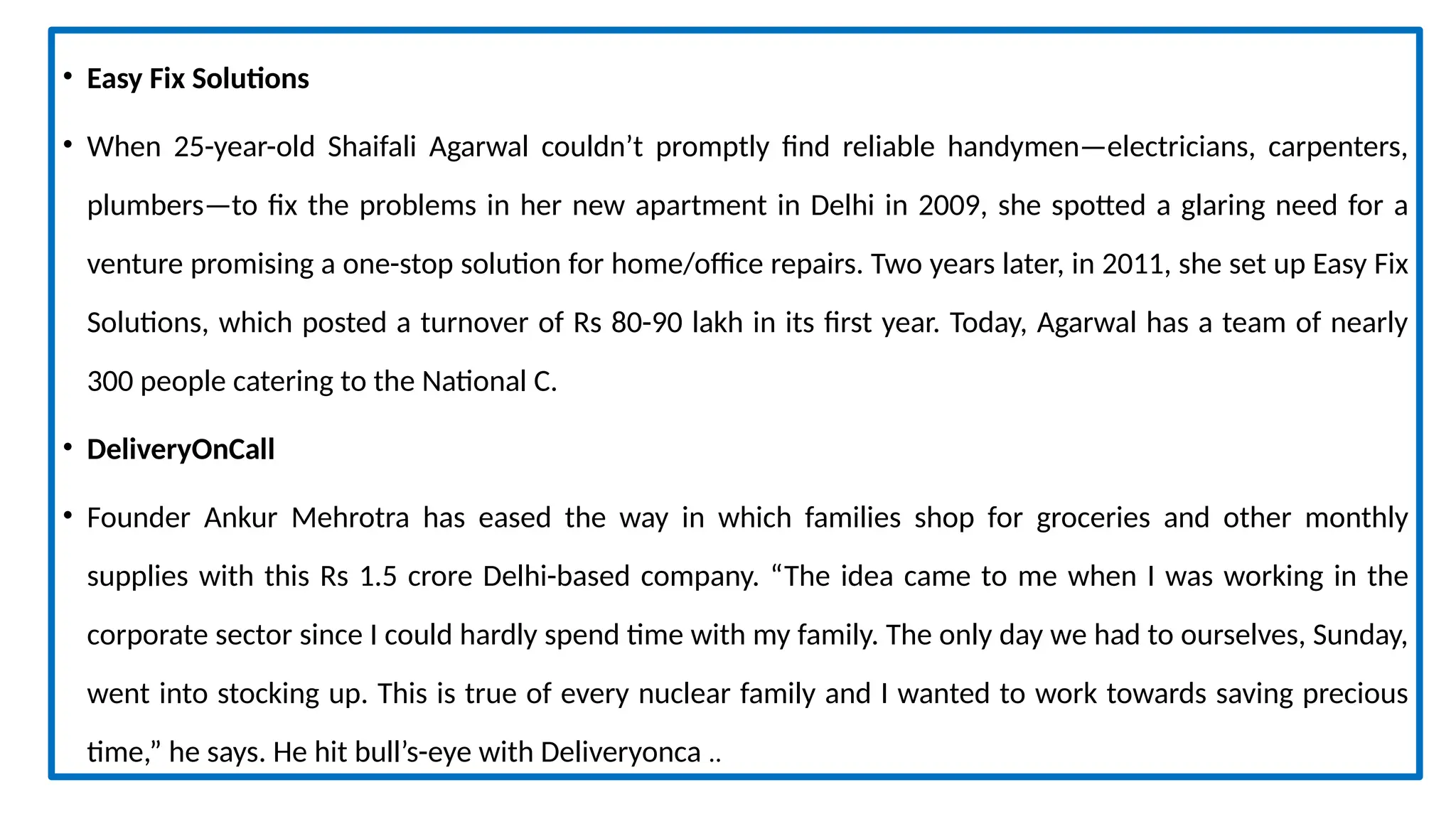
Mr. Daroath was named to the Forbes ‘30 Under 30’ list of
social entrepreneurs in Asia. Prior to his role as Executive
Director, Daroath led WaterSHED’s market-building activities
in the nascent water, sanitation and hygiene market in rural
Cambodia. He has been a driving force behind many of the
organization’s leading initiatives, including supply chain
development and partnerships with micro-finance.
• Easy Fix Solutions
• When 25-year-old Shaifali Agarwal couldn’t promptly find reliable handymen—electricians, carpenters,
plumbers—to fix the problems in her new apartment in Delhi in 2009, she spotted a glaring need for a
venture promising a one-stop solution for home/office repairs. Two years later, in 2011, she set up Easy Fix
Solutions, which posted a turnover of Rs 80-90 lakh in its first year. Today, Agarwal has a team of nearly
300 people catering to the National C.
• DeliveryOnCall
• Founder Ankur Mehrotra has eased the way in which families shop for groceries and other monthly
supplies with this Rs 1.5 crore Delhi-based company. “The idea came to me when I was working in the
corporate sector since I could hardly spend time with my family. The only day we had to ourselves, Sunday,
went into stocking up. This is true of every nuclear family and I wanted to work towards saving precious
time,” he says. He hit bull’s-eye with Deliveryonca ..
• Farm2kitchen.com
Seema Dholi launched this Gurgaon-based company in 2011 after the birth of her
baby. “When I was pregnant with my first child, I was very particular about the
food I ate. There was not even a single organic food supplier and hardly anyone
knew what organic meant. That was the trigger for me,” she says. Today, the
company has its presence in 262 cities across the country.
• 7C Home Cleaning Services
Superior Cleaning Solutions With an outstanding reputation for quality, integrity
and service, we can clean anything you throw at us!
• Vinisha Enterprise Professional Housekeeping and Home Cleaning Services
House Cleaning and Professional Housekeeping Services. Open 24 hours
7C Home Cleaning Services
8. Goal orientation:
• Goal setting is the achievement of targets and objectives for successful
performance of an entrepreneur, both long run and short run.
The goal-setting process requires three steps
• Definition of goal
• Specific goals
• Feedback about goal achieved
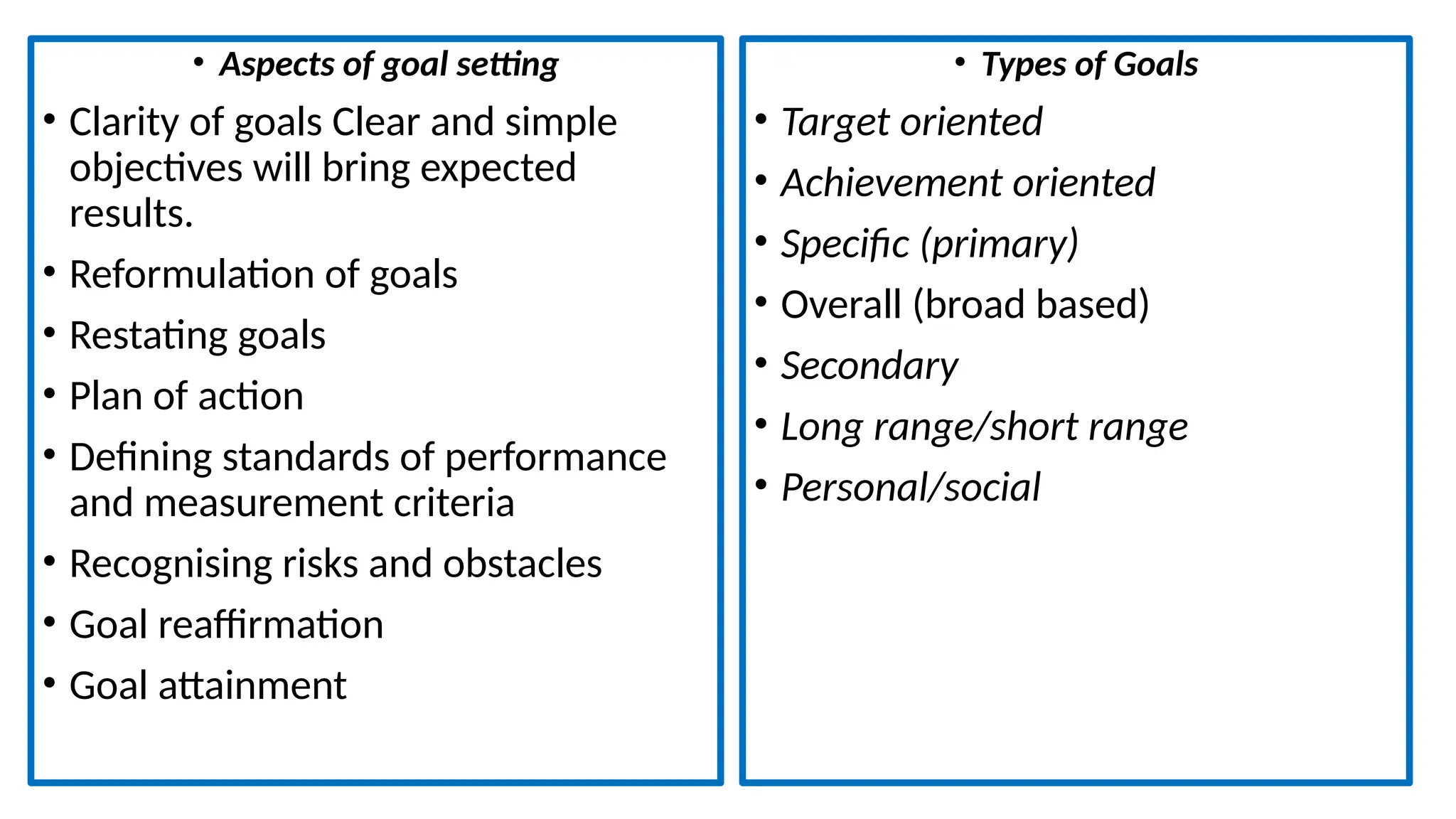
• Aspects of goal setting
• Clarity of goals Clear and simple
objectives will bring expected
results.
• Reformulation of goals
• Restating goals
• Plan of action
• Defining standards of performance
and measurement criteria
• Recognising risks and obstacles
• Goal reaffirmation
• Goal attainment
• Types of Goals
• Target oriented
• Achievement oriented
• Specific (primary)
• Overall (broad based)
• Secondary
• Long range/short range
• Personal/social
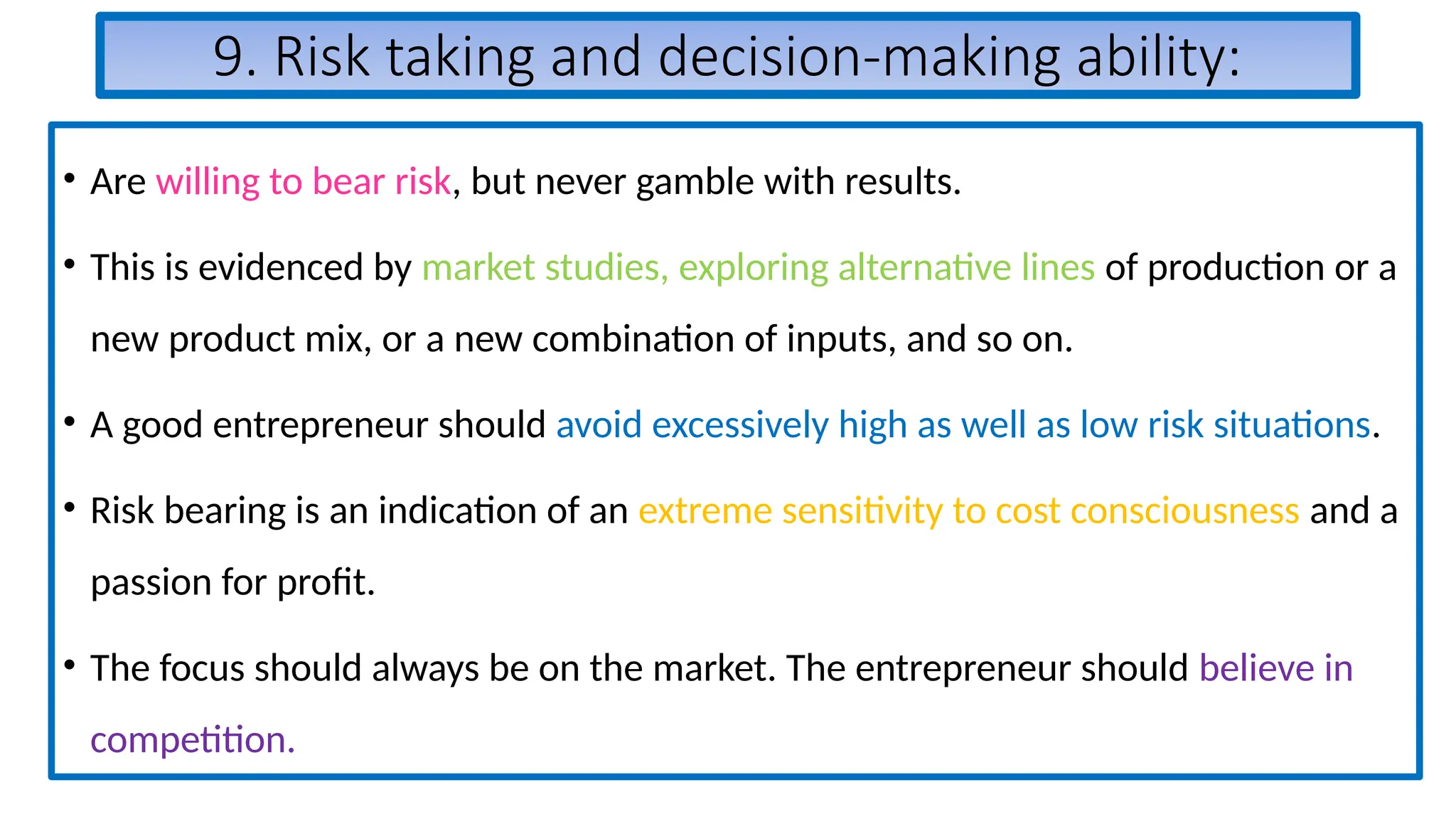
9. Risk taking and decision-making ability:
• Are willing to bear risk, but never gamble with results.
• This is evidenced by market studies, exploring alternative lines of production or a
new product mix, or a new combination of inputs, and so on.
• A good entrepreneur should avoid excessively high as well as low risk situations.
• Risk bearing is an indication of an extreme sensitivity to cost consciousness and a
passion for profit.
• The focus should always be on the market. The entrepreneur should believe in
competition.
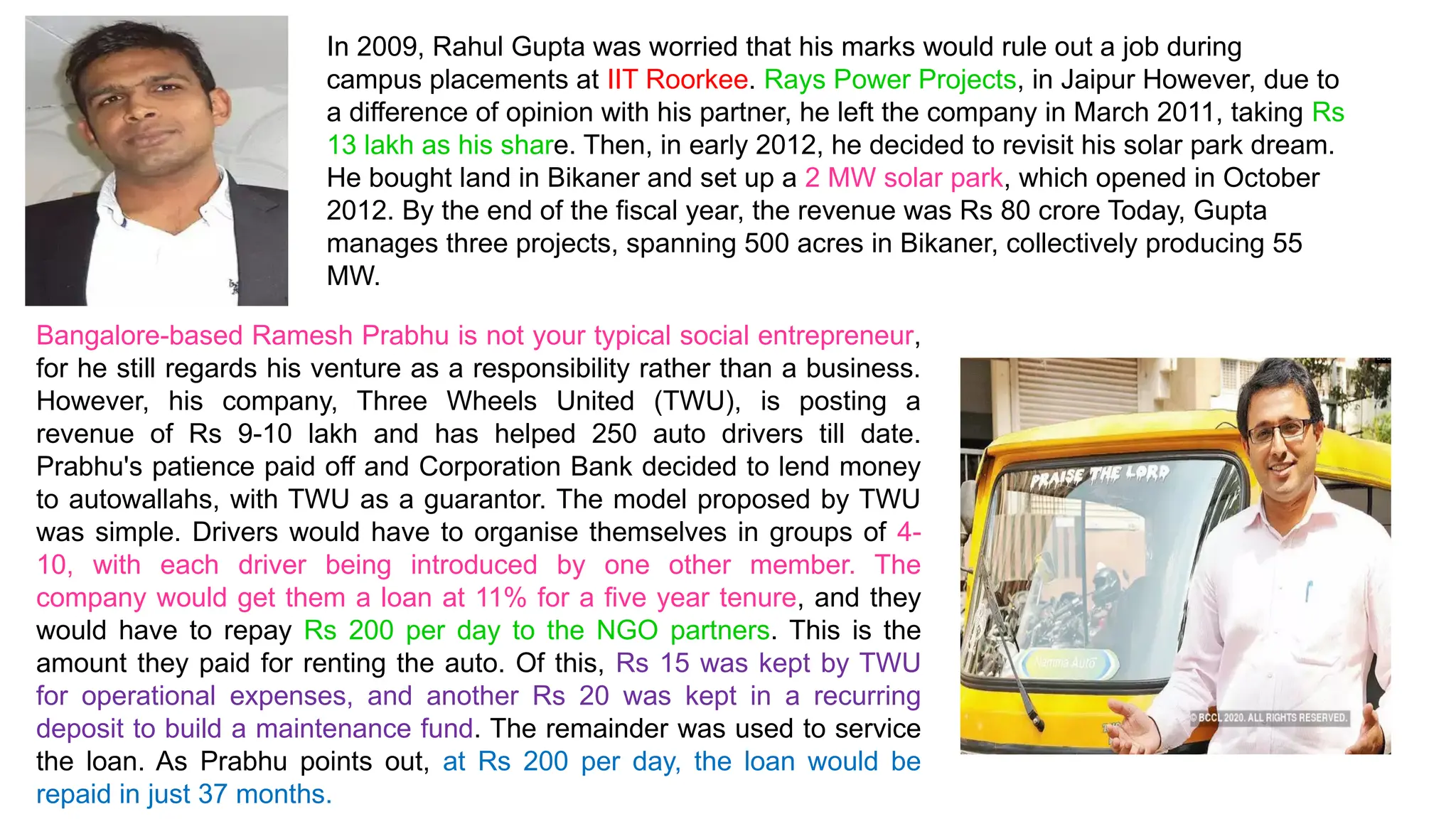
In 2009, Rahul Gupta was worried that his marks would rule out a job during
campus placements at IIT Roorkee. Rays Power Projects, in Jaipur However, due to
a difference of opinion with his partner, he left the company in March 2011, taking Rs
13 lakh as his share. Then, in early 2012, he decided to revisit his solar park dream.
He bought land in Bikaner and set up a 2 MW solar park, which opened in October
2012. By the end of the fiscal year, the revenue was Rs 80 crore Today, Gupta
manages three projects, spanning 500 acres in Bikaner, collectively producing 55
MW.
Bangalore-based Ramesh Prabhu is not your typical social entrepreneur,
for he still regards his venture as a responsibility rather than a business.
However, his company, Three Wheels United (TWU), is posting a
revenue of Rs 9-10 lakh and has helped 250 auto drivers till date.
Prabhu's patience paid off and Corporation Bank decided to lend money
to autowallahs, with TWU as a guarantor. The model proposed by TWU
was simple. Drivers would have to organise themselves in groups of 4-
10, with each driver being introduced by one other member. The
company would get them a loan at 11% for a five year tenure, and they
would have to repay Rs 200 per day to the NGO partners. This is the
amount they paid for renting the auto. Of this, Rs 15 was kept by TWU
for operational expenses, and another Rs 20 was kept in a recurring
deposit to build a maintenance fund. The remainder was used to service
the loan. As Prabhu points out, at Rs 200 per day, the loan would be
repaid in just 37 months.
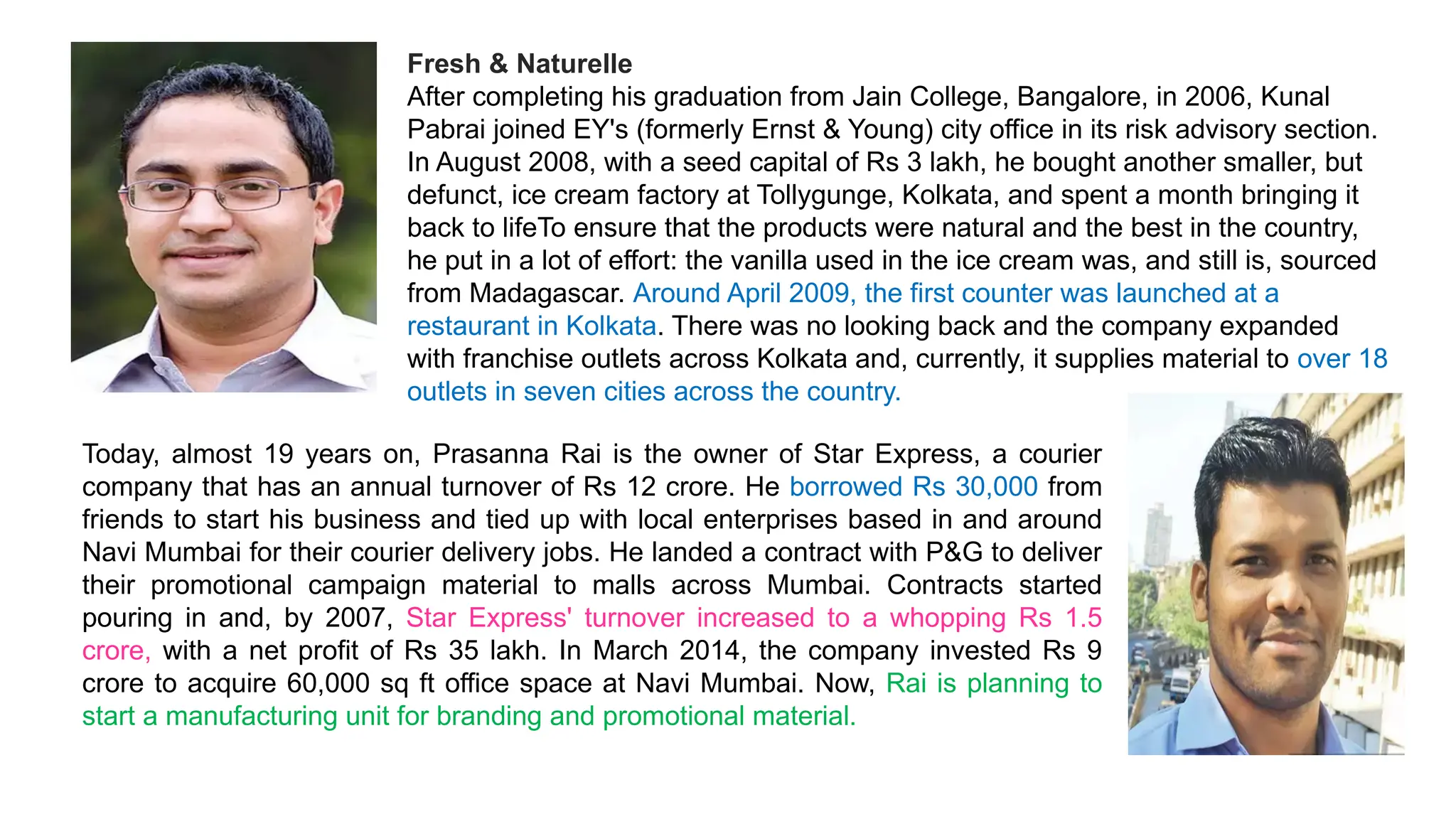
Fresh & Naturelle
After completing his graduation from Jain College, Bangalore, in 2006, Kunal
Pabrai joined EY's (formerly Ernst & Young) city office in its risk advisory section.
In August 2008, with a seed capital of Rs 3 lakh, he bought another smaller, but
defunct, ice cream factory at Tollygunge, Kolkata, and spent a month bringing it
back to lifeTo ensure that the products were natural and the best in the country,
he put in a lot of effort: the vanilla used in the ice cream was, and still is, sourced
from Madagascar. Around April 2009, the first counter was launched at a
restaurant in Kolkata. There was no looking back and the company expanded
with franchise outlets across Kolkata and, currently, it supplies material to over 18
outlets in seven cities across the country.
Today, almost 19 years on, Prasanna Rai is the owner of Star Express, a courier
company that has an annual turnover of Rs 12 crore. He borrowed Rs 30,000 from
friends to start his business and tied up with local enterprises based in and around
Navi Mumbai for their courier delivery jobs. He landed a contract with P&G to deliver
their promotional campaign material to malls across Mumbai. Contracts started
pouring in and, by 2007, Star Express' turnover increased to a whopping Rs 1.5
crore, with a net profit of Rs 35 lakh. In March 2014, the company invested Rs 9
crore to acquire 60,000 sq ft office space at Navi Mumbai. Now, Rai is planning to
start a manufacturing unit for branding and promotional material.
A Fire Engineering graduate from National Institute of Fire Engineering with
multiple certifications and a strong experience in Customer Service industry.
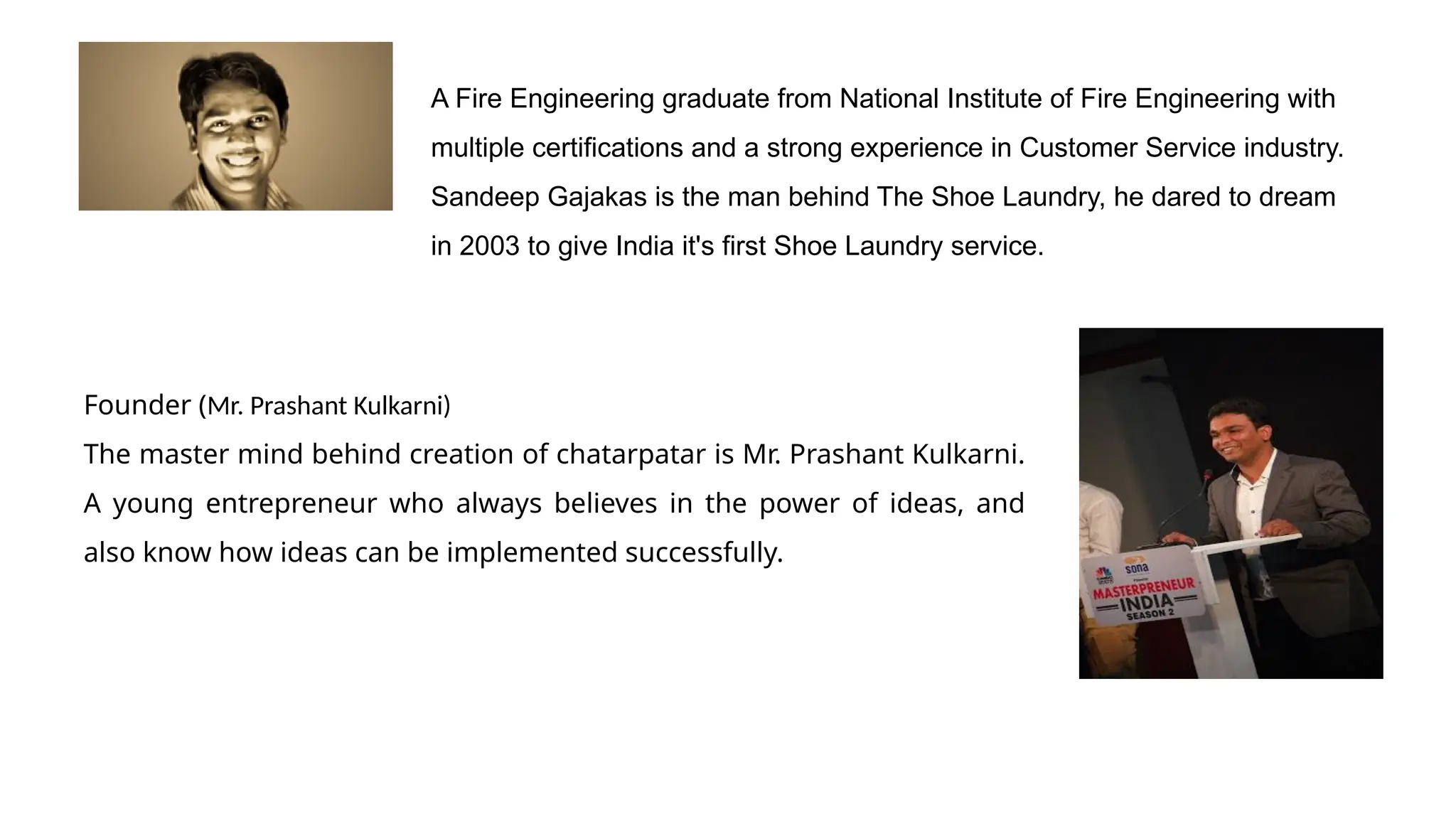
Sandeep Gajakas is the man behind The Shoe Laundry, he dared to dream
in 2003 to give India it's first Shoe Laundry service.
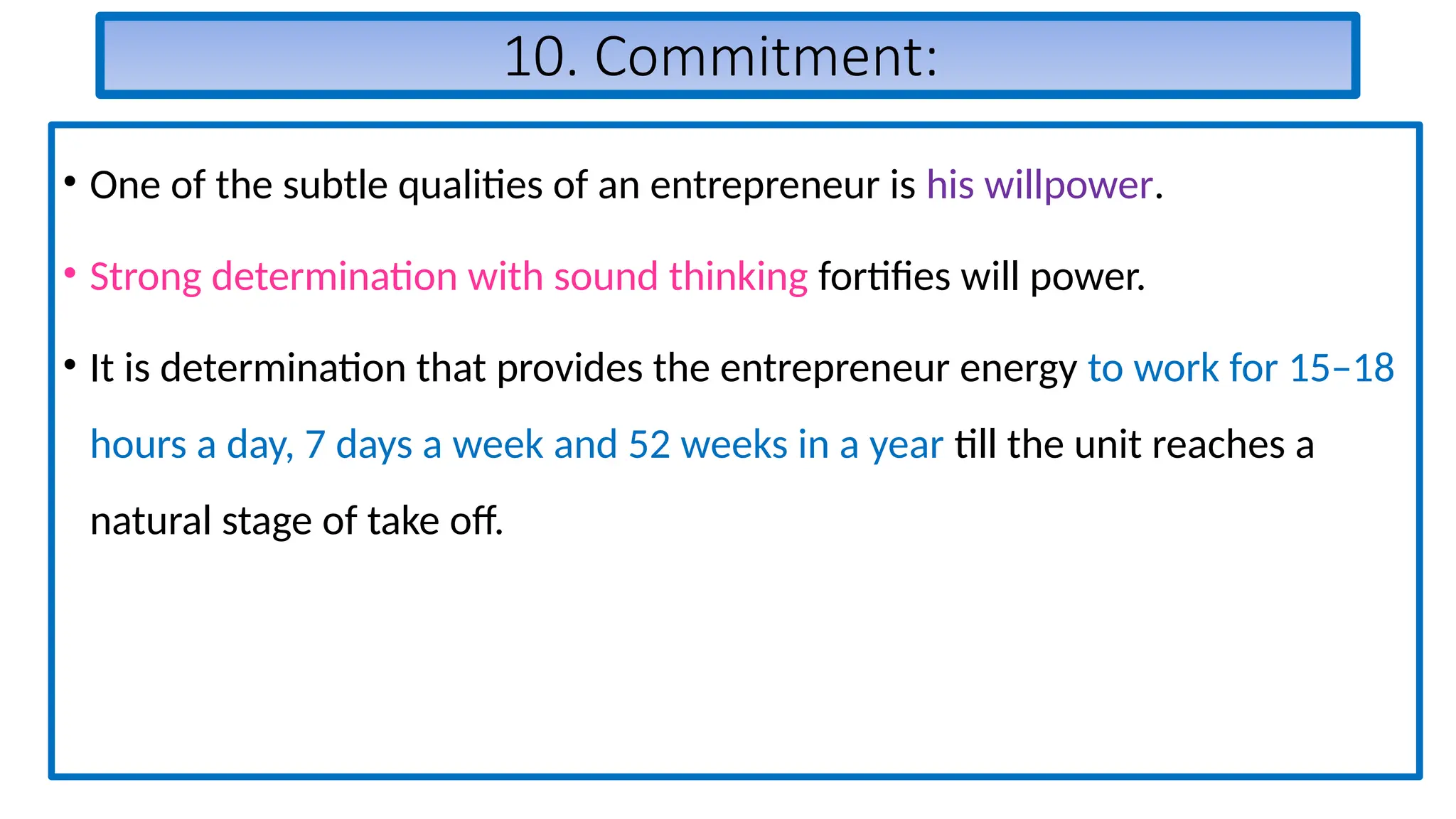
Founder (Mr. Prashant Kulkarni)
The master mind behind creation of chatarpatar is Mr. Prashant Kulkarni.
A young entrepreneur who always believes in the power of ideas, and
also know how ideas can be implemented successfully.
10. Commitment:
• One of the subtle qualities of an entrepreneur is his willpower.
• Strong determination with sound thinking fortifies will power.
• It is determination that provides the entrepreneur energy to work for 15–18
hours a day, 7 days a week and 52 weeks in a year till the unit reaches a
natural stage of take off.
Founded in 1996 by VSS Mani, the company is headquartered in Mumbai, India. In addition to its
headquarters, Justdial has offices in Ahmedabad, Bangalore, Chandigarh, Chennai, Coimbatore, New Delhi,
Hyderabad, Jaipur, Kolkata, and Pune.
Organization type: Company
Founders: V.S.S. Mani
Geographic scope: India
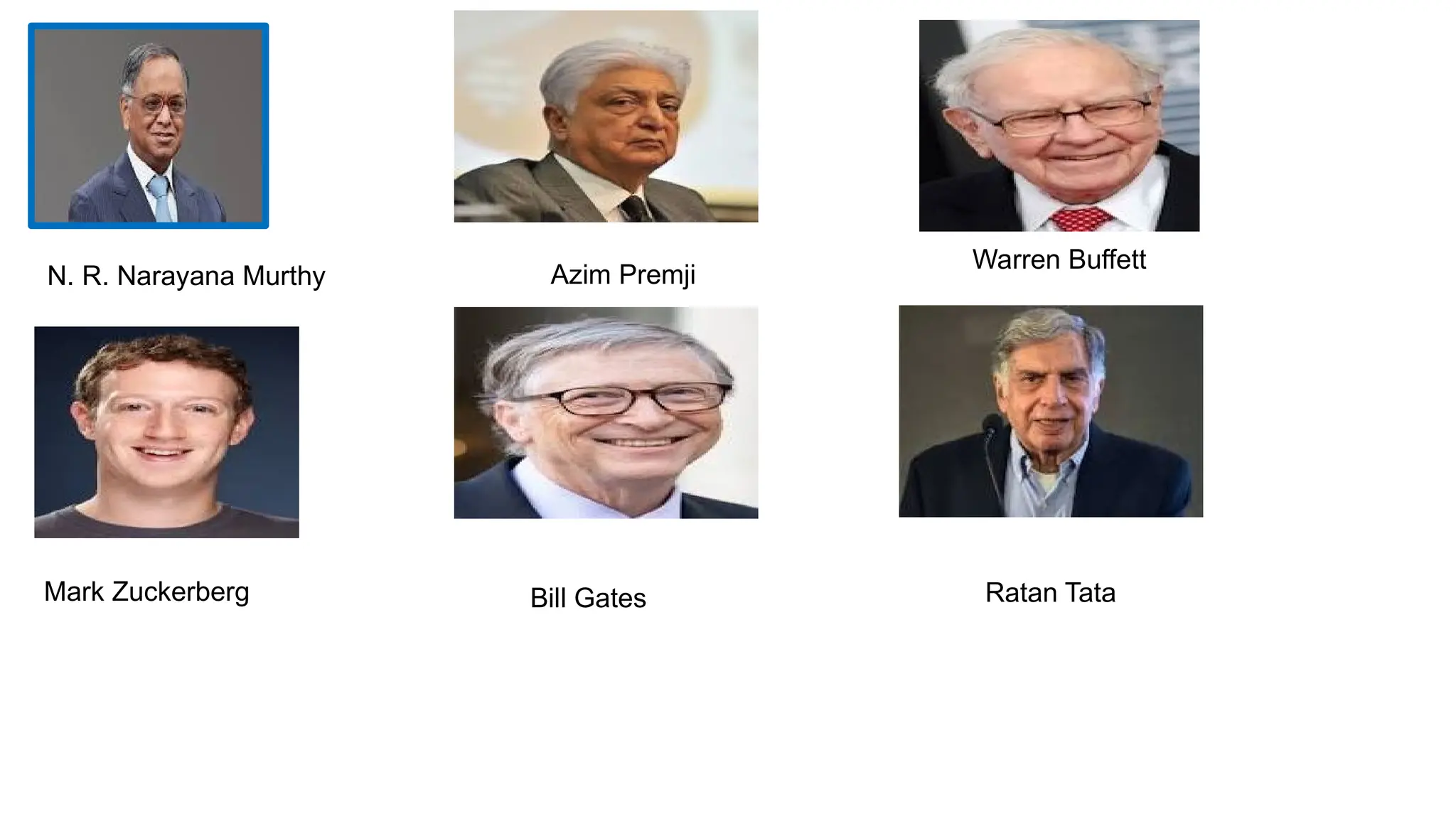
N. R. Narayana Murthy Azim Premji
Warren Buffett
Mark Zuckerberg Bill Gates Ratan Tata
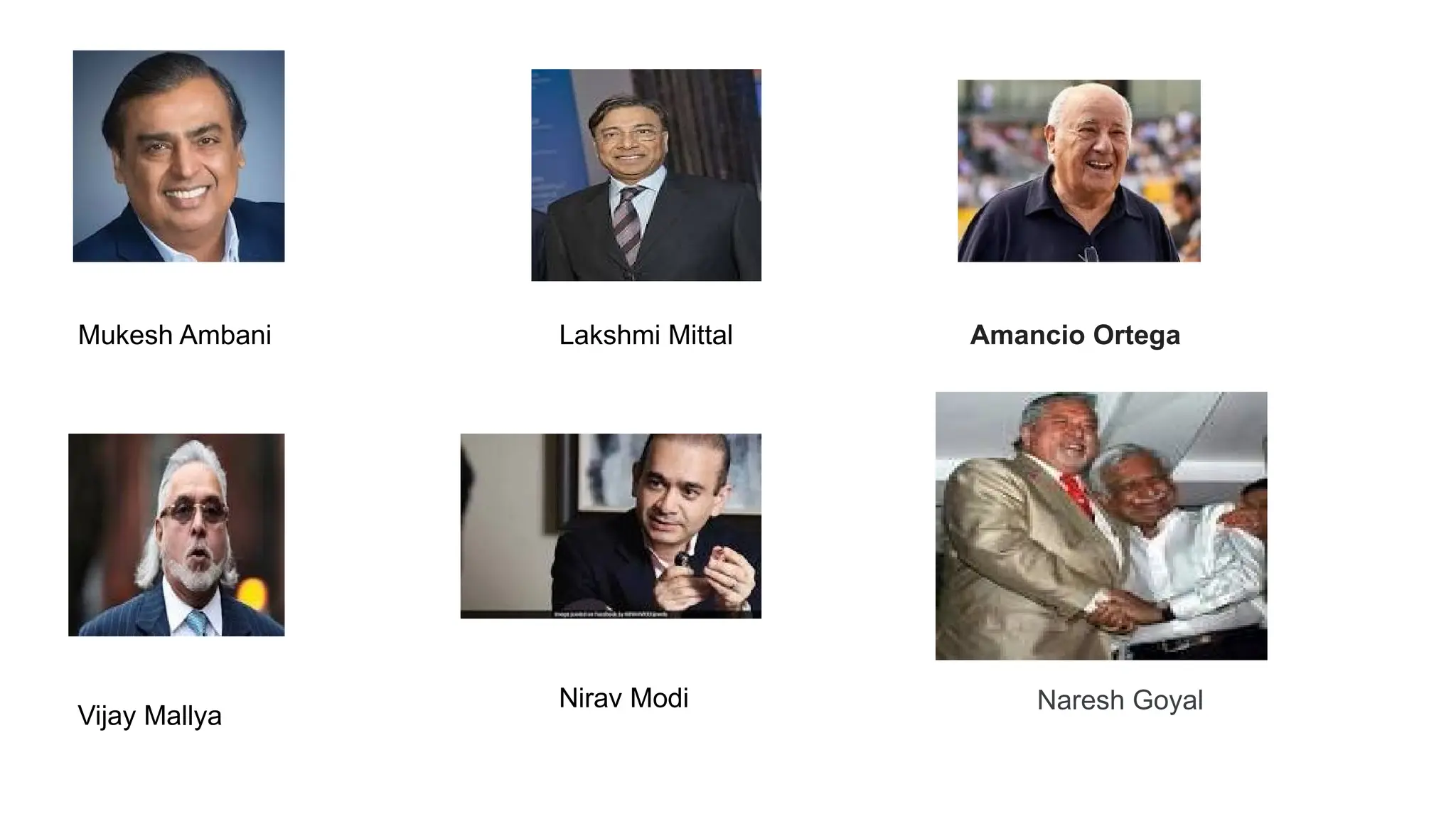
Mukesh Ambani Lakshmi Mittal
Vijay Mallya
Nirav Modi
Amancio Ortega
Naresh Goyal
PROBLEMS FACED BY ENTREPRENEUR
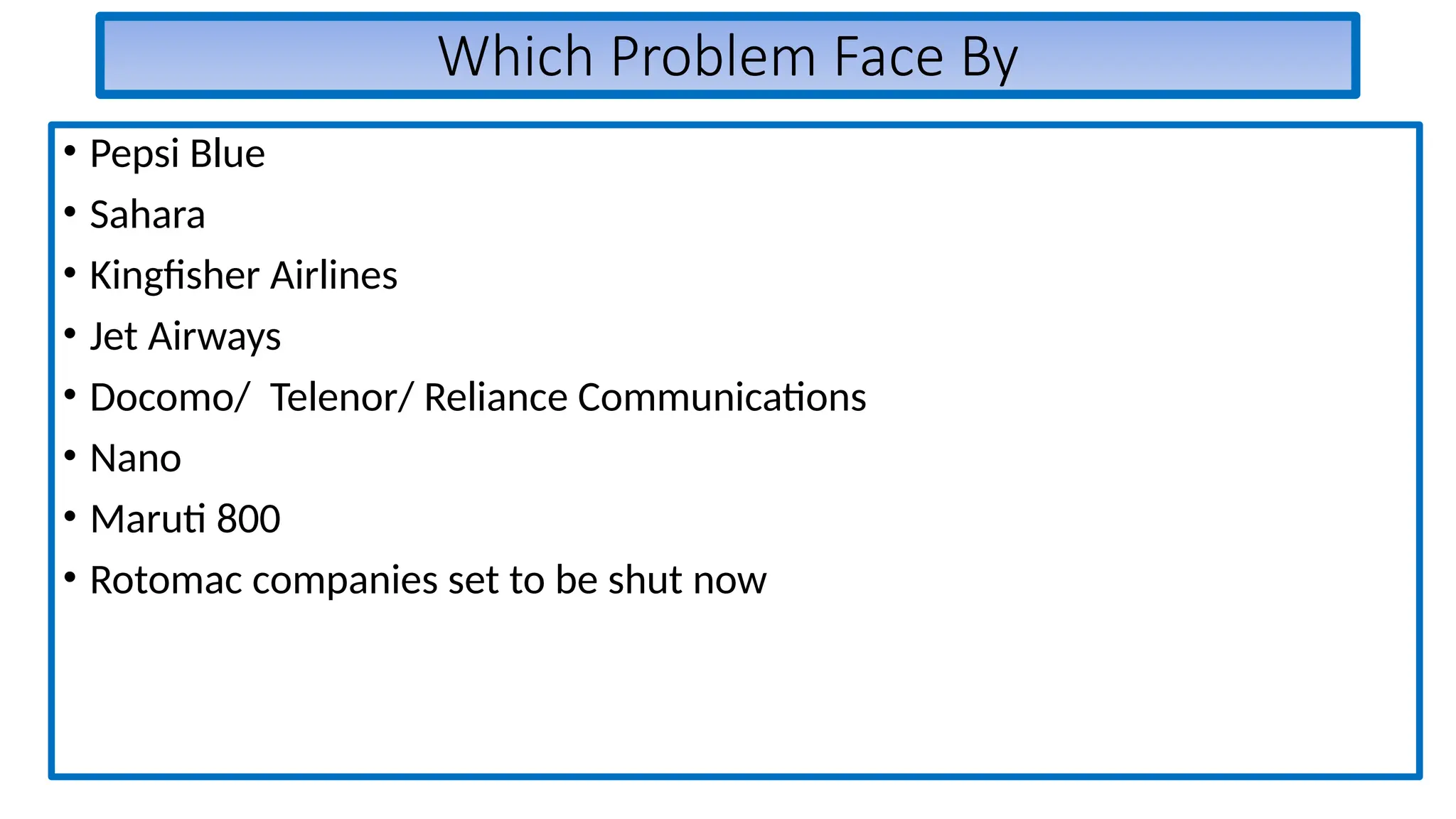
Which Problem Face By
• Pepsi Blue
• Sahara
• Kingfisher Airlines
• Jet Airways
• Docomo/ Telenor/ Reliance Communications
• Nano
• Maruti 800
• Rotomac companies set to be shut now
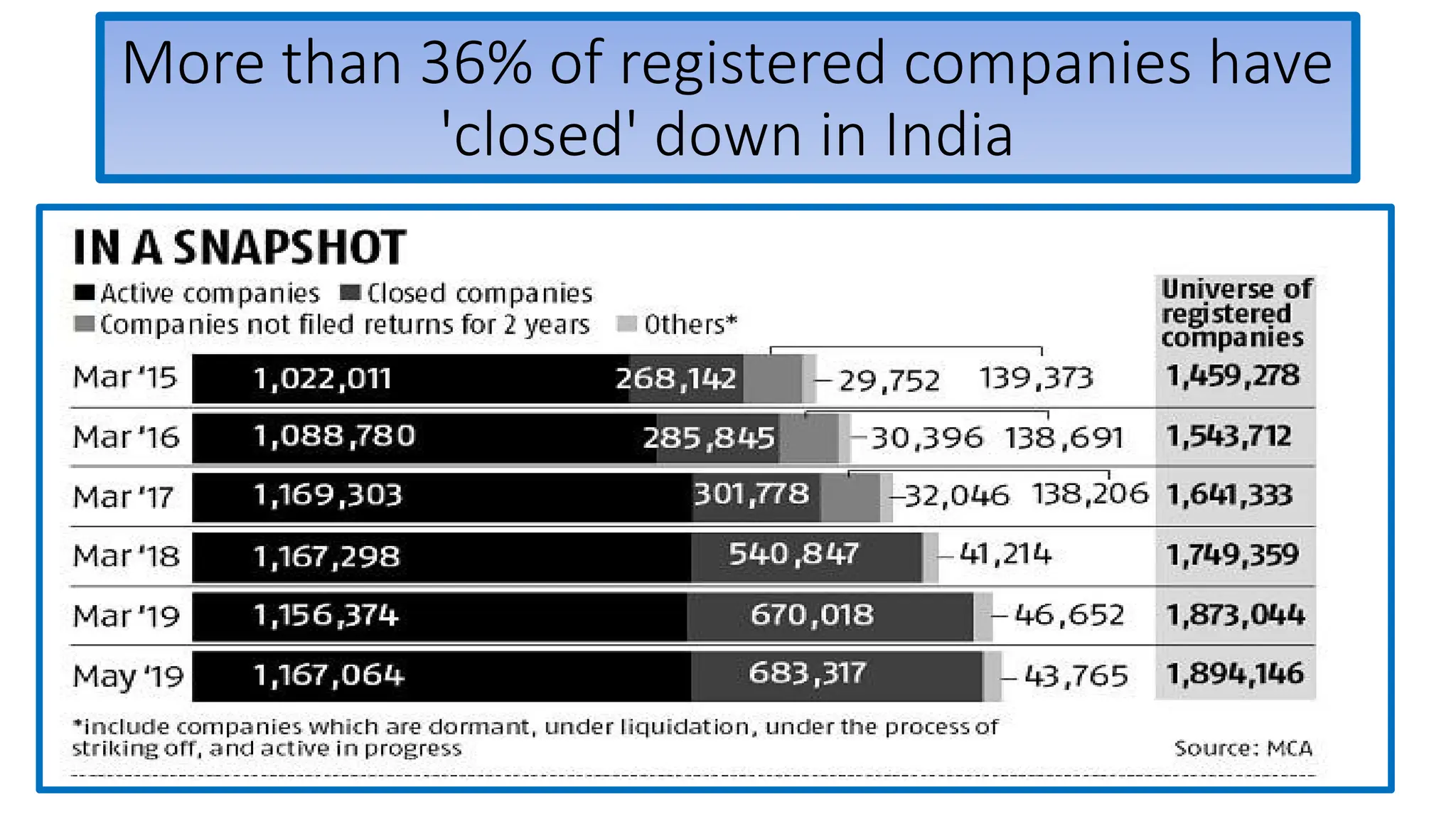
More than 36% of registered companies have
'closed' down in India
• Problems faced by entrepreneurs are:
a. Internal problems
b. External problems and
c. Specific management problems.
• To build capacity for entrepreneurship following measures can be taken:
• Availability of credit, imported raw materials, skilled labour, Technology and
Equipment, Infrastructural facilities, Advisory Services and access to market.
1. Internal Problems of Entrepreneurs
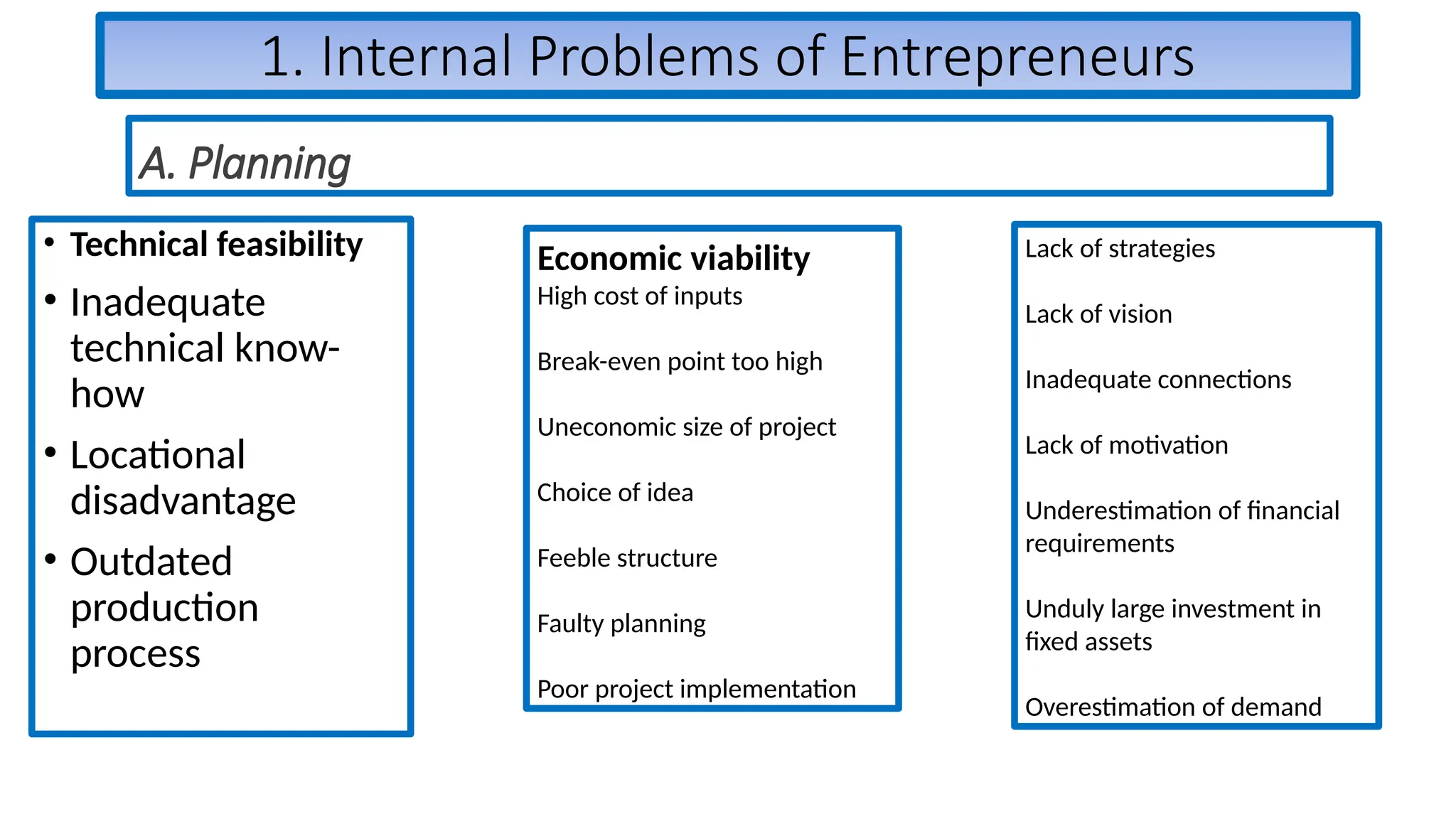
• Technical feasibility
• Inadequate
technical know-
how
• Locational
disadvantage
• Outdated
production
process
A. Planning
Economic viability
High cost of inputs
Break-even point too high
Uneconomic size of project
Choice of idea
Feeble structure
Faulty planning
Poor project implementation
Lack of strategies
Lack of vision
Inadequate connections
Lack of motivation
Underestimation of financial
requirements
Unduly large investment in
fixed assets
Overestimation of demand
1. Internal Problems of Entrepreneurs
• B. Implementation
• Cost over-runs resulting from delays in getting licences, sanctions, and so on, and inadequate
mobilisation of finance.
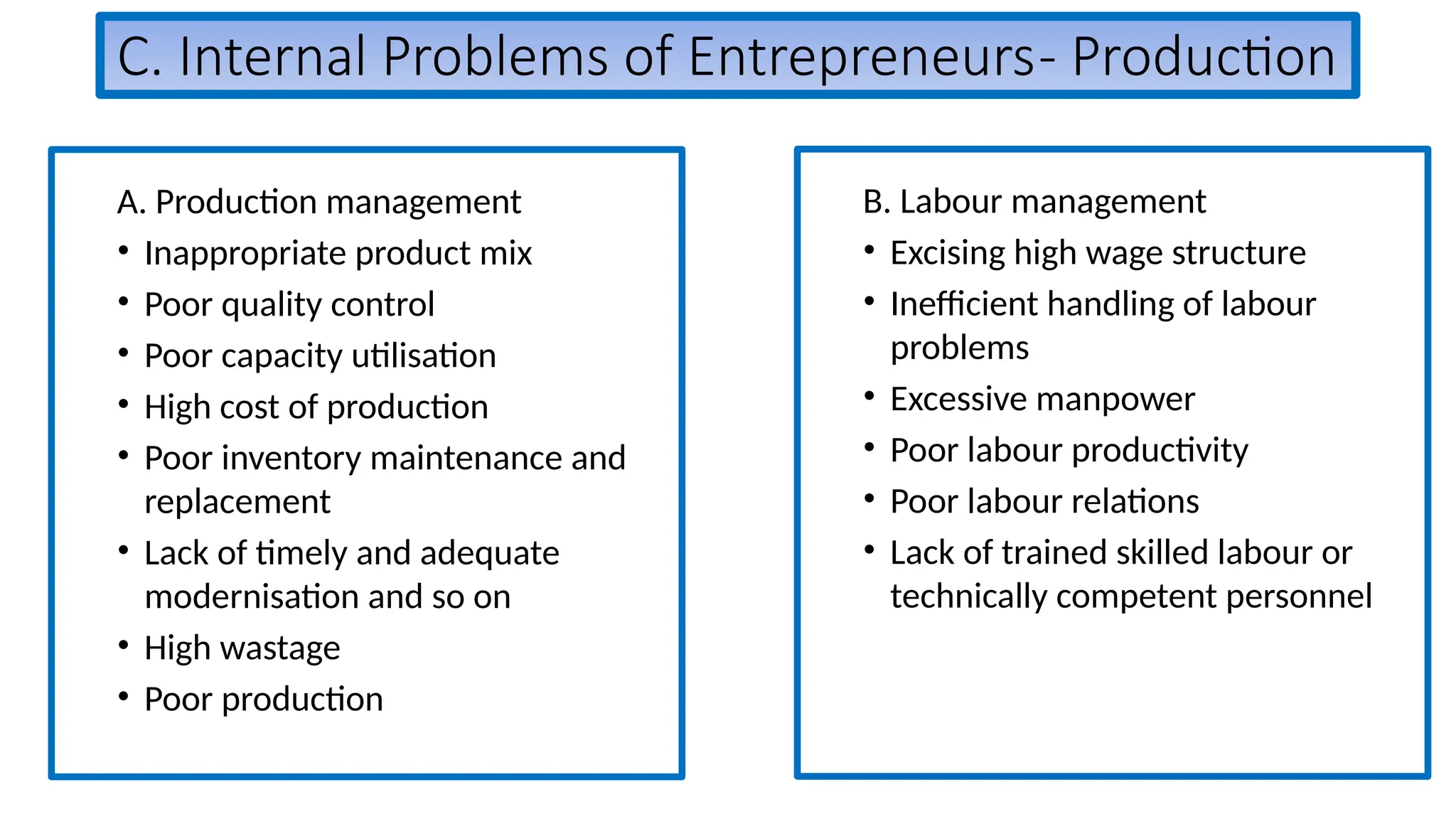
C. Internal Problems of Entrepreneurs- Production
A. Production management
• Inappropriate product mix
• Poor quality control
• Poor capacity utilisation
• High cost of production
• Poor inventory maintenance and
replacement
• Lack of timely and adequate
modernisation and so on
• High wastage
• Poor production
B. Labour management
• Excising high wage structure
• Inefficient handling of labour
problems
• Excessive manpower
• Poor labour productivity
• Poor labour relations
• Lack of trained skilled labour or
technically competent personnel
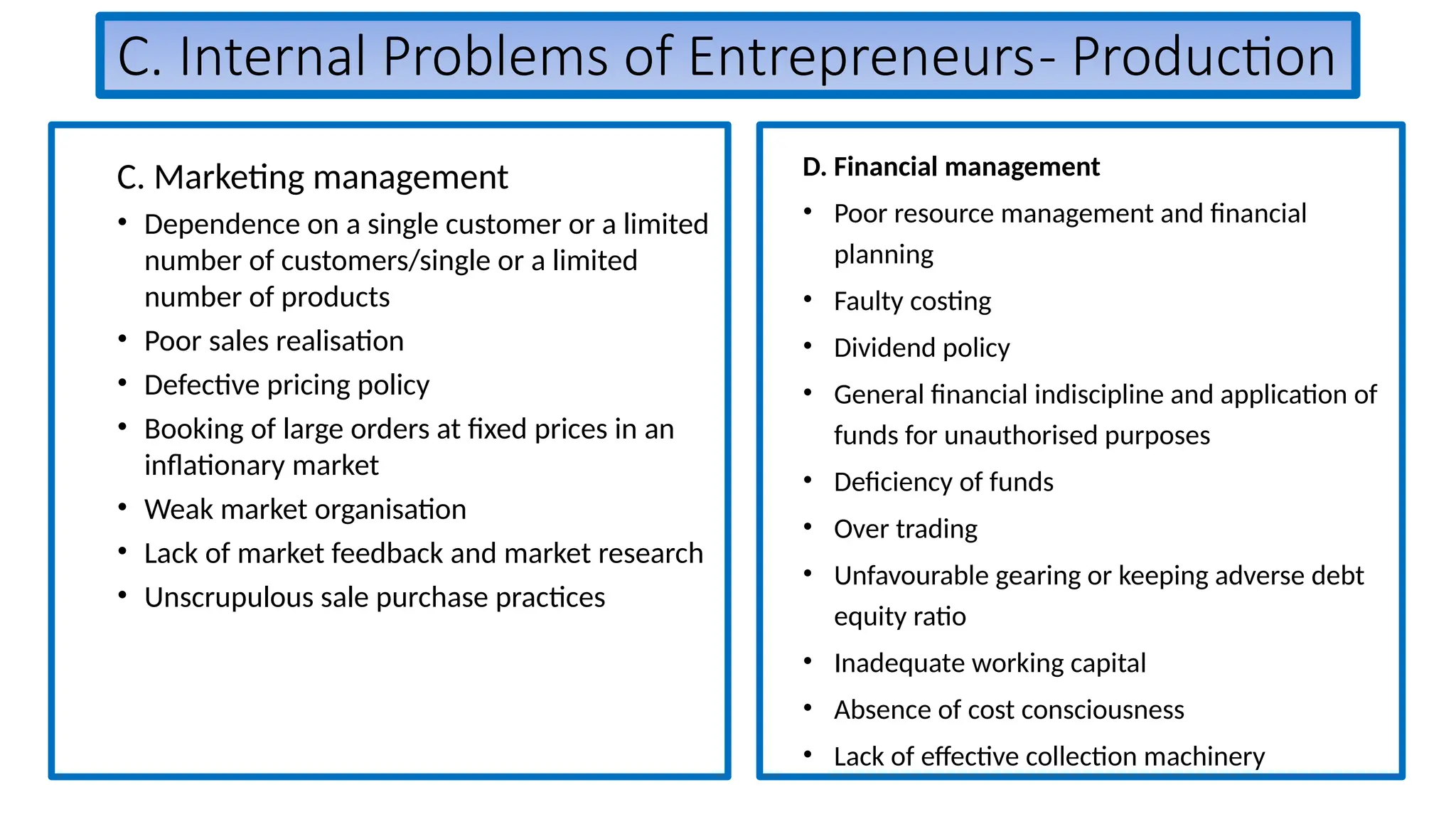
C. Internal Problems of Entrepreneurs- Production
C. Marketing management
• Dependence on a single customer or a limited
number of customers/single or a limited
number of products
• Poor sales realisation
• Defective pricing policy
• Booking of large orders at fixed prices in an
inflationary market
• Weak market organisation
• Lack of market feedback and market research
• Unscrupulous sale purchase practices
D. Financial management
• Poor resource management and financial
planning
• Faulty costing
• Dividend policy
• General financial indiscipline and application of
funds for unauthorised purposes
• Deficiency of funds
• Over trading
• Unfavourable gearing or keeping adverse debt
equity ratio
• Inadequate working capital
• Absence of cost consciousness
• Lack of effective collection machinery
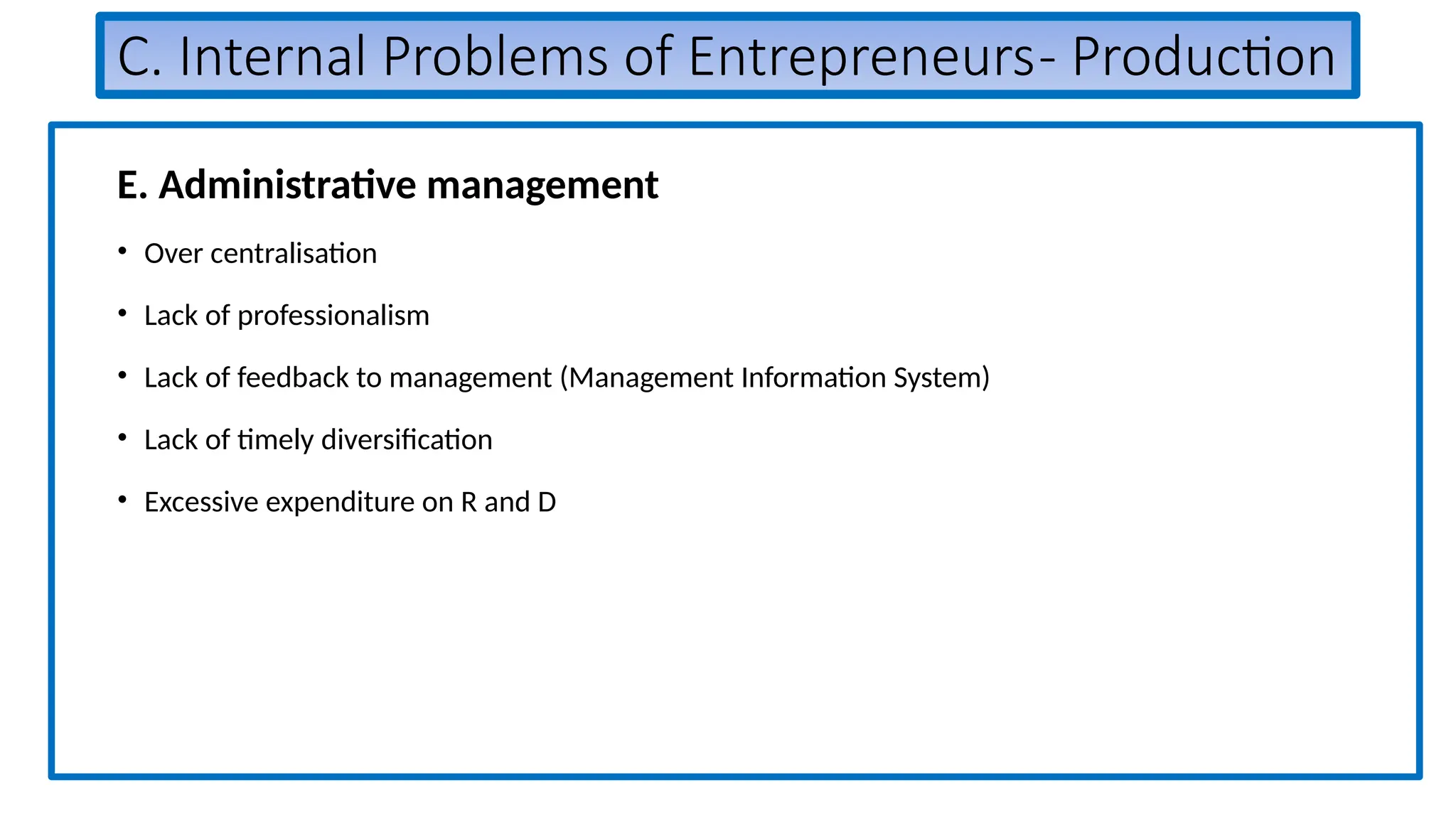
C. Internal Problems of Entrepreneurs- Production
E. Administrative management
• Over centralisation
• Lack of professionalism
• Lack of feedback to management (Management Information System)
• Lack of timely diversification
• Excessive expenditure on R and D
2. External Problems of Entrepreneurs
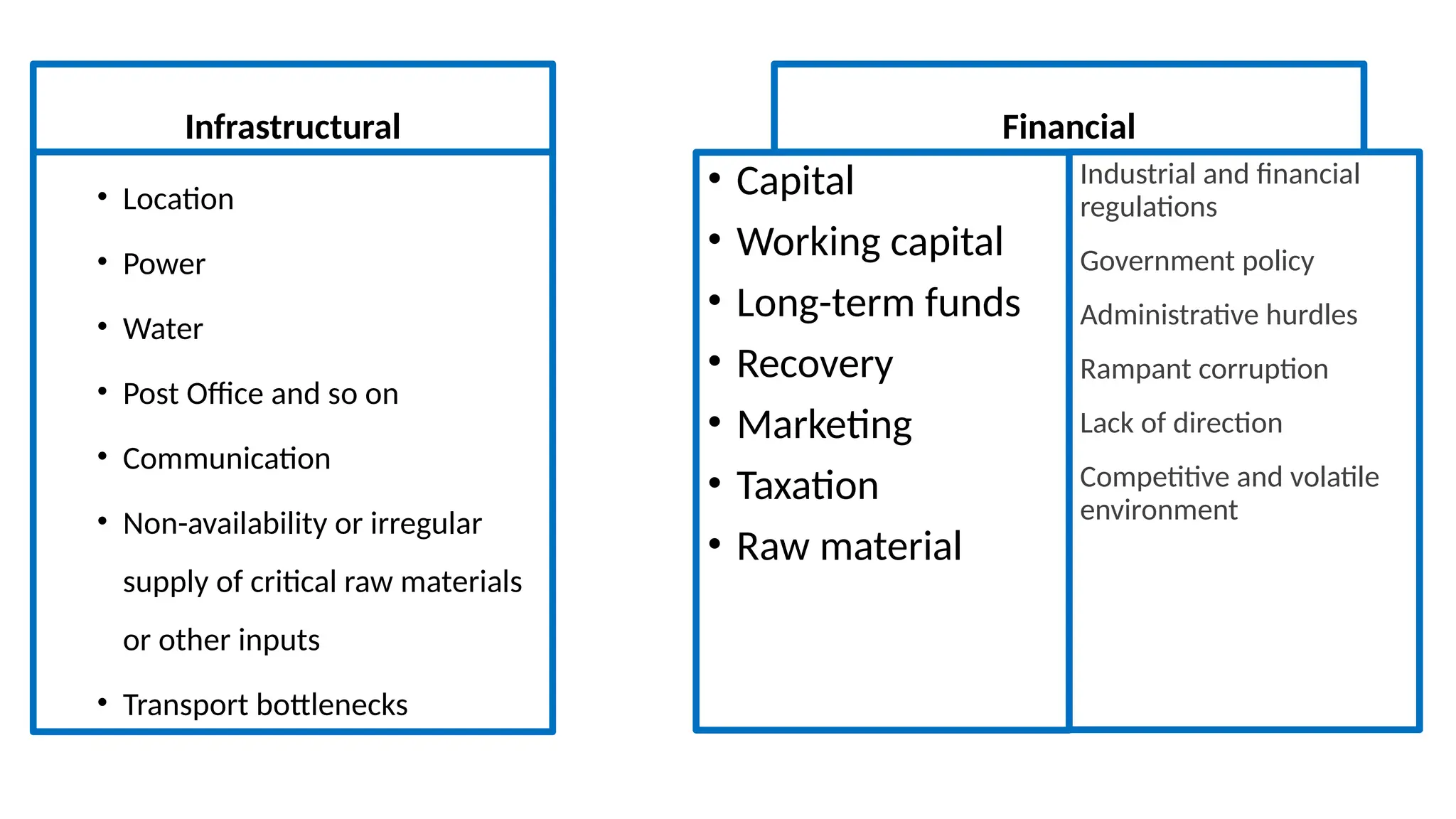
Infrastructural
• Location
• Power
• Water
• Post Office and so on
• Communication
• Non-availability or irregular
supply of critical raw materials
or other inputs
• Transport bottlenecks
Financial
• Capital
• Working capital
• Long-term funds
• Recovery
• Marketing
• Taxation
• Raw material
Industrial and financial
regulations
Government policy
Administrative hurdles
Rampant corruption
Lack of direction
Competitive and volatile
environment
3. Specific Management Problems
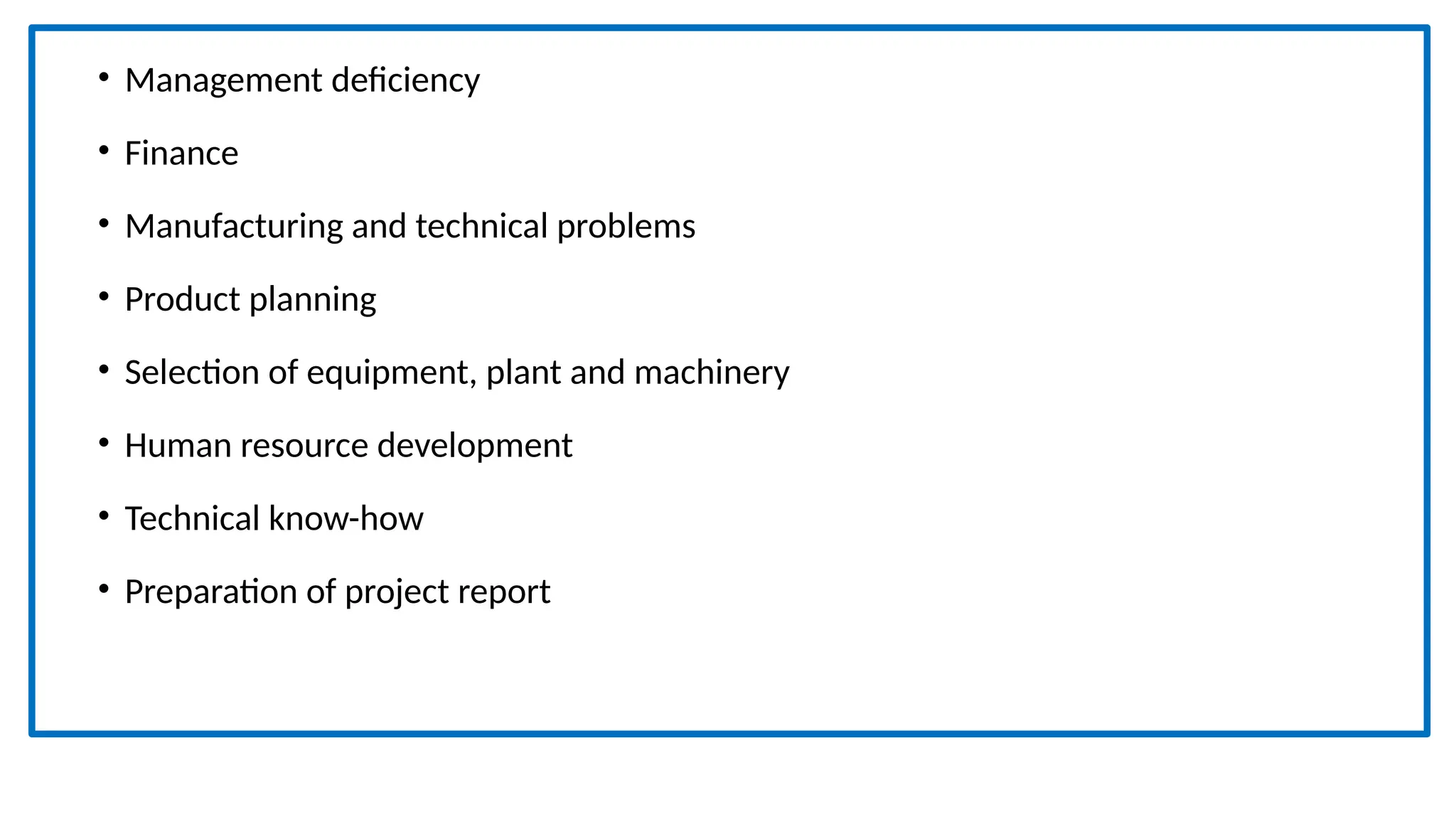
• Management deficiency
• Finance
• Manufacturing and technical problems
• Product planning
• Selection of equipment, plant and machinery
• Human resource development
• Technical know-how
• Preparation of project report
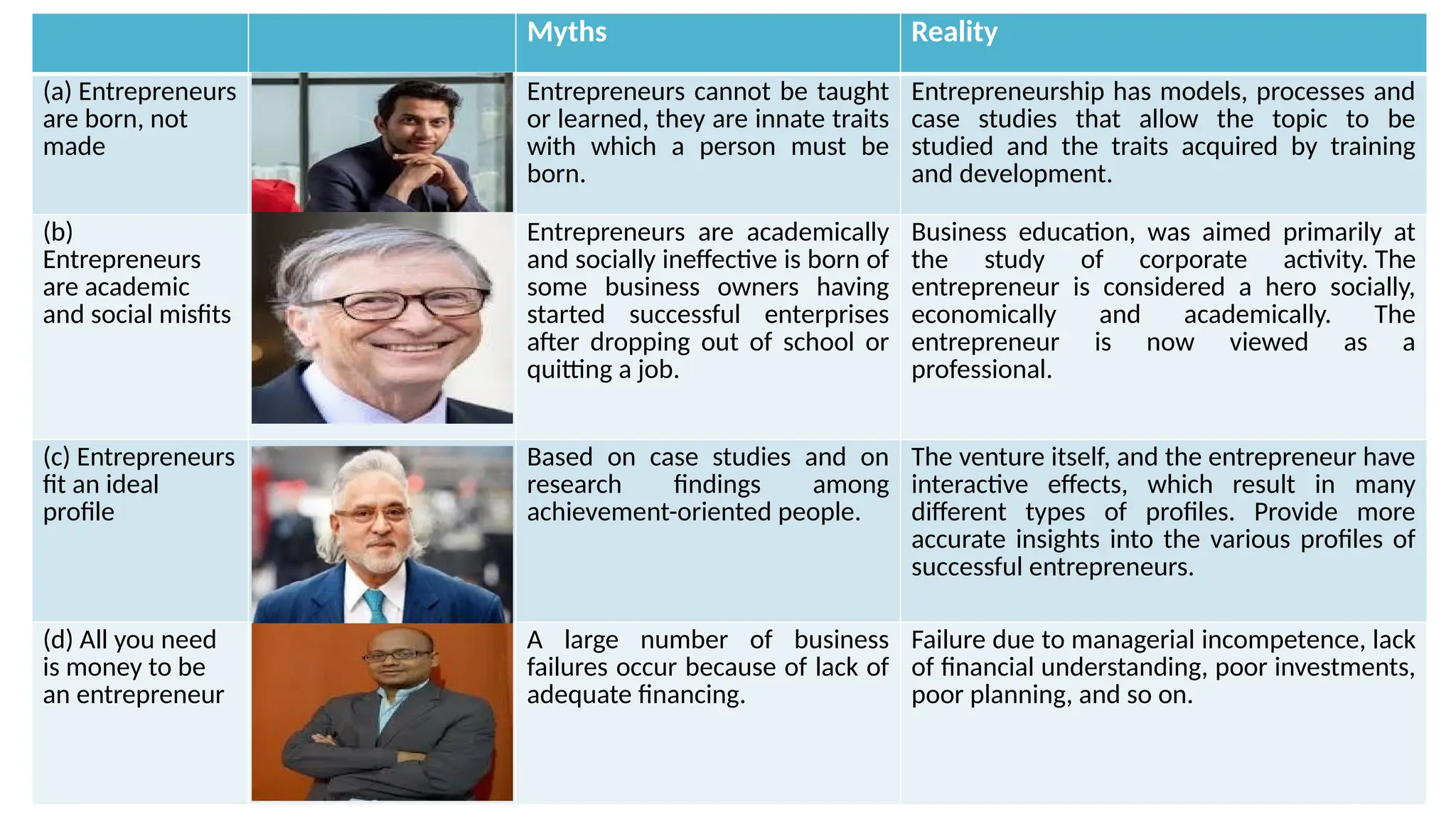
Myths
Myths Reality
(a) Entrepreneurs
are born, not
made
Entrepreneurs cannot be taught
or learned, they are innate traits
with which a person must be
born.
Entrepreneurship has models, processes and
case studies that allow the topic to be
studied and the traits acquired by training
and development.
(b)
Entrepreneurs
are academic
and social misfits
Entrepreneurs are academically
and socially ineffective is born of
some business owners having
started successful enterprises
after dropping out of school or
quitting a job.
Business education, was aimed primarily at
the study of corporate activity. The
entrepreneur is considered a hero socially,
economically and academically. The
entrepreneur is now viewed as a
professional.
(c) Entrepreneurs
fit an ideal
profile
Based on case studies and on
research findings among
achievement-oriented people.
The venture itself, and the entrepreneur have
interactive effects, which result in many
different types of profiles. Provide more
accurate insights into the various profiles of
successful entrepreneurs.
(d) All you need
is money to be
an entrepreneur
A large number of business
failures occur because of lack of
adequate financing.
Failure due to managerial incompetence, lack
of financial understanding, poor investments,
poor planning, and so on.
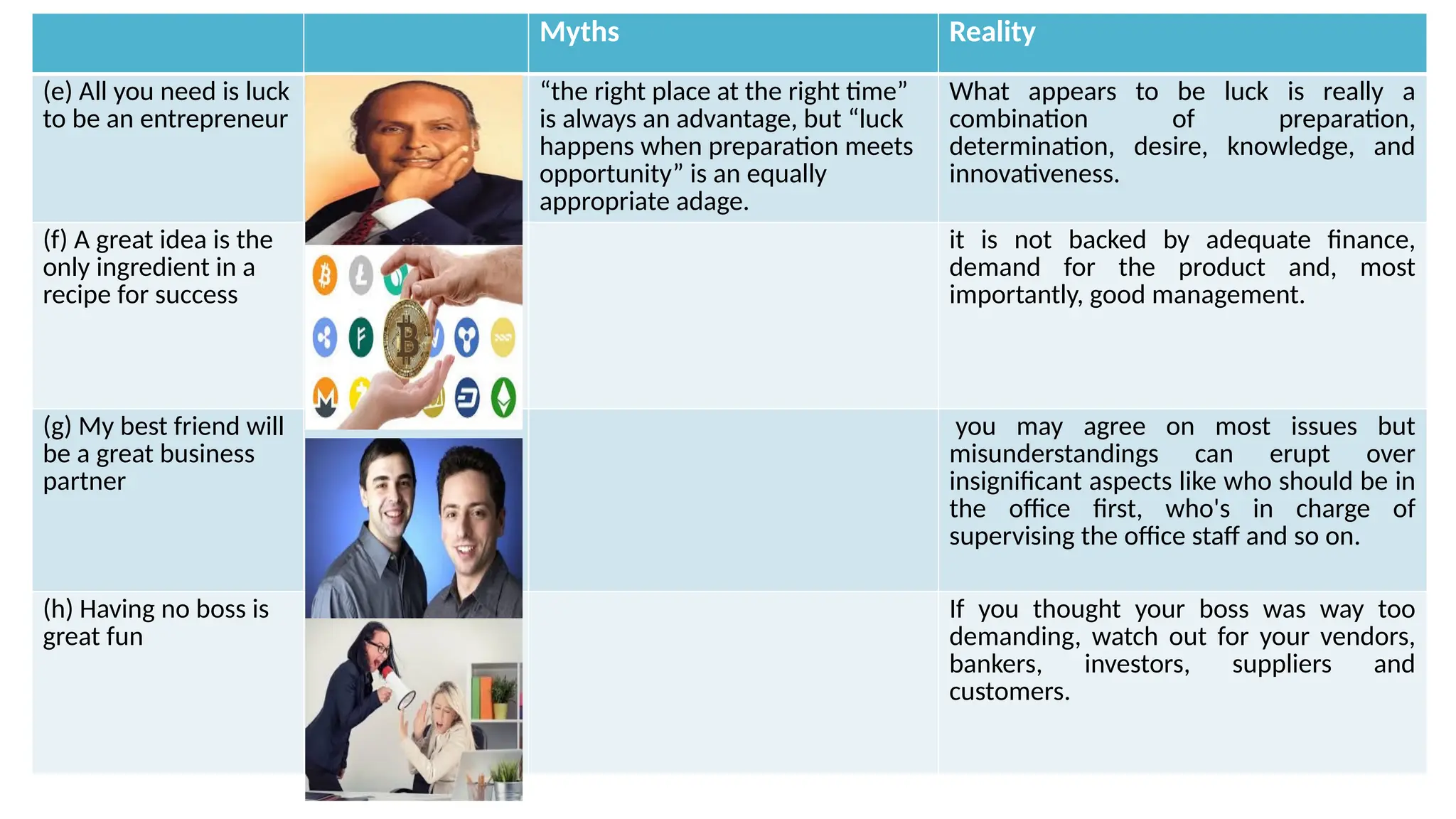
Myths Reality
(e) All you need is luck
to be an entrepreneur
“the right place at the right time”
is always an advantage, but “luck
happens when preparation meets
opportunity” is an equally
appropriate adage.
What appears to be luck is really a
combination of preparation,
determination, desire, knowledge, and
innovativeness.
(f) A great idea is the
only ingredient in a
recipe for success
it is not backed by adequate finance,
demand for the product and, most
importantly, good management.
(g) My best friend will
be a great business
partner
you may agree on most issues but
misunderstandings can erupt over
insignificant aspects like who should be in
the office first, who's in charge of
supervising the office staff and so on.
(h) Having no boss is
great fun
If you thought your boss was way too
demanding, watch out for your vendors,
bankers, investors, suppliers and
customers.
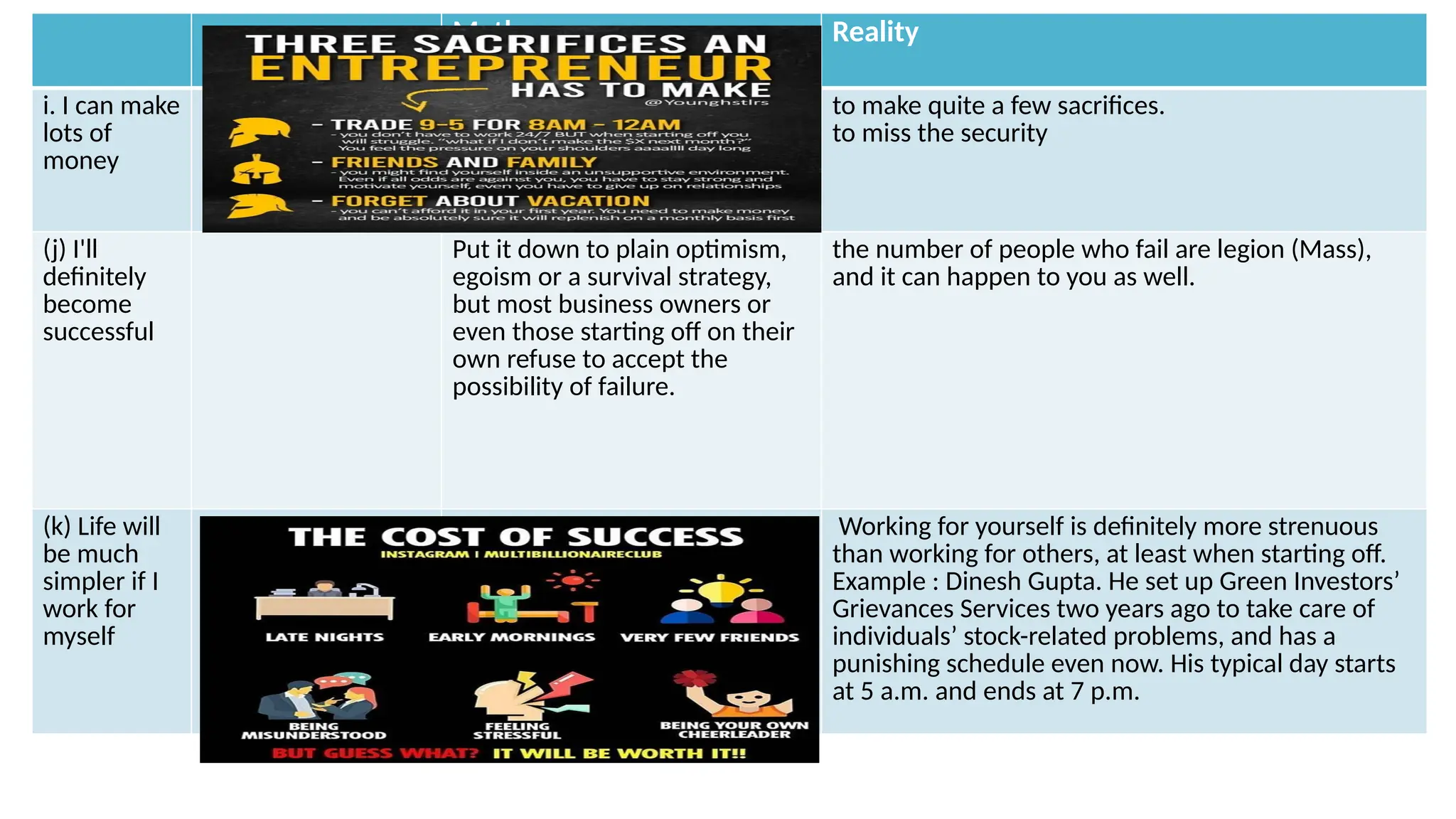
Myths Reality
i. I can make
lots of
money
to make quite a few sacrifices.
to miss the security
(j) I'll
definitely
become
successful
Put it down to plain optimism,
egoism or a survival strategy,
but most business owners or
even those starting off on their
own refuse to accept the
possibility of failure.
the number of people who fail are legion (Mass),
and it can happen to you as well.
(k) Life will
be much
simpler if I
work for
myself
Working for yourself is definitely more strenuous
than working for others, at least when starting off.
Example : Dinesh Gupta. He set up Green Investors’
Grievances Services two years ago to take care of
individuals’ stock-related problems, and has a
punishing schedule even now. His typical day starts
at 5 a.m. and ends at 7 p.m.
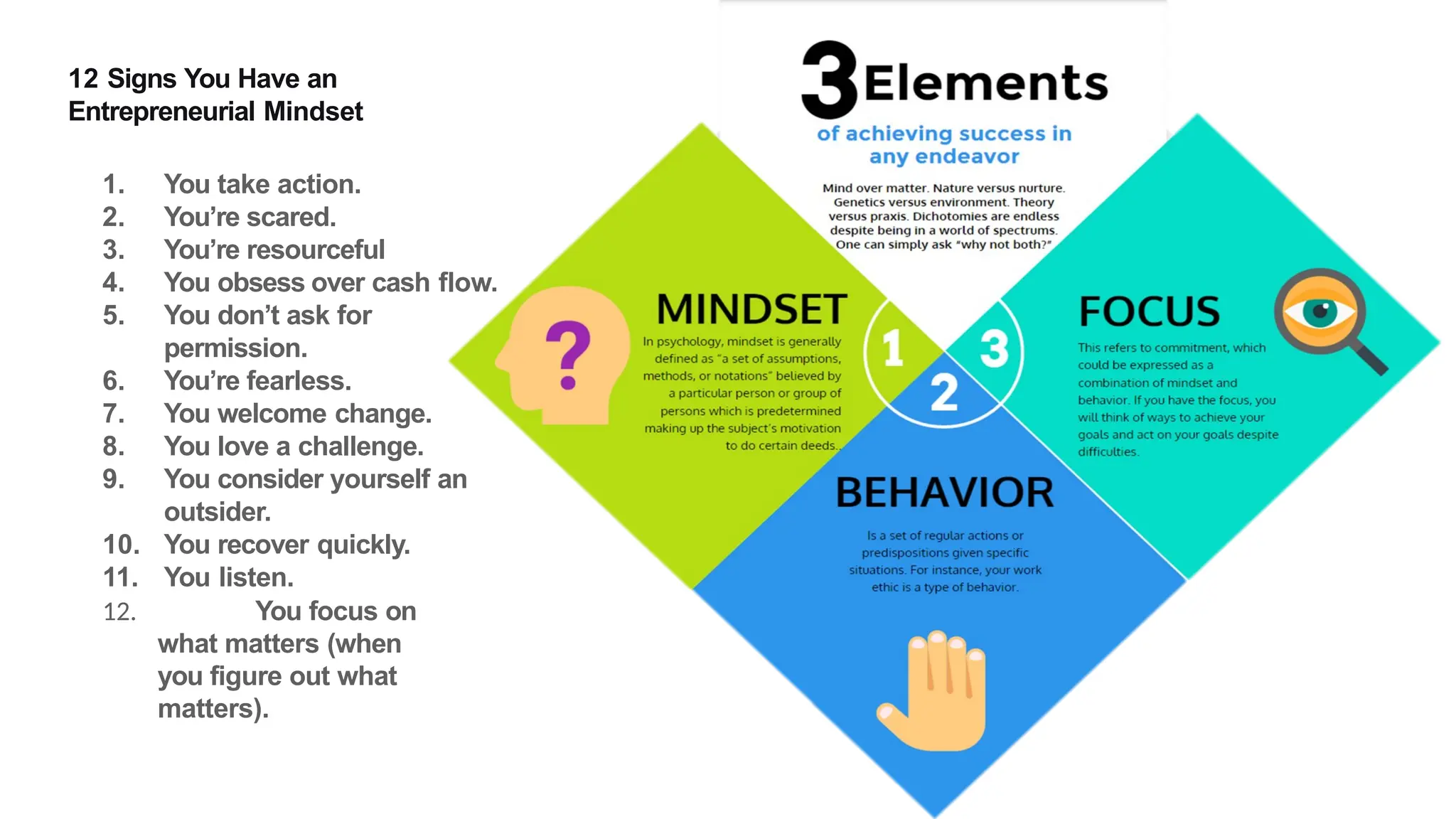
12 Signs You Have an
Entrepreneurial Mindset
1. You take action.
2. You’re scared.
3. You’re resourceful
4. You obsess over cash flow.
5. You don’t ask for
permission.
6. You’re fearless.
7. You welcome change.
8. You love a challenge.
9. You consider yourself an
outsider.
10. You recover quickly.
11. You listen.
12. You focus on
what matters (when
you figure out what
matters).
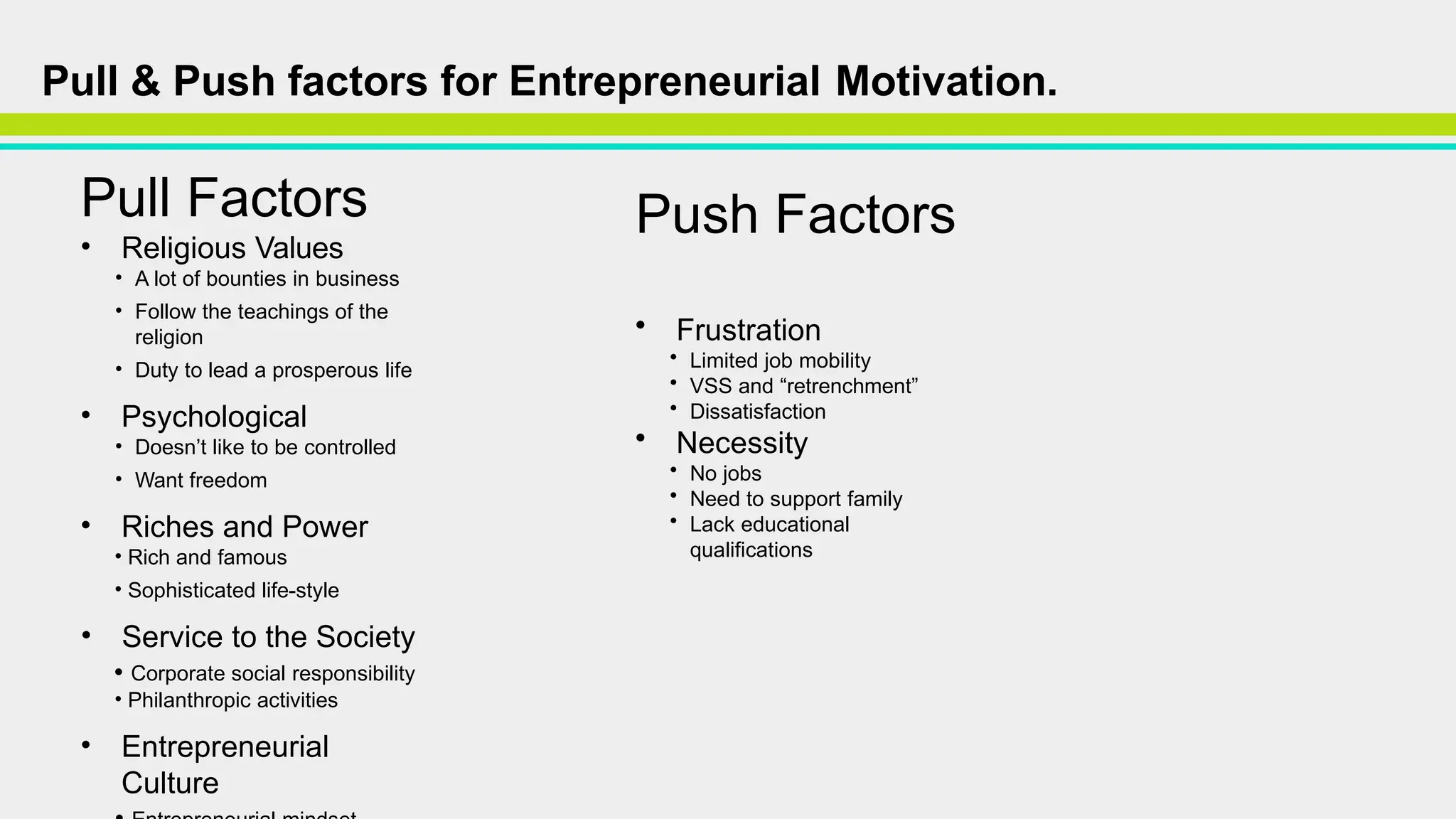
Pull Factors
• Religious Values
• A lot of bounties in business
• Follow the teachings of the
religion
• Duty to lead a prosperous life
• Psychological
• Doesn’t like to be controlled
• Want freedom
• Riches and Power
• Rich and famous
• Sophisticated life-style
• Service to the Society
• Corporate social responsibility
• Philanthropic activities
• Entrepreneurial
Culture
Push Factors
• Frustration
• Limited job mobility
• VSS and “retrenchment”
• Dissatisfaction
• Necessity
• No jobs
• Need to support family
• Lack educational
qualifications
Pull & Push factors for Entrepreneurial Motivation.
Models of Entrepreneurship Development
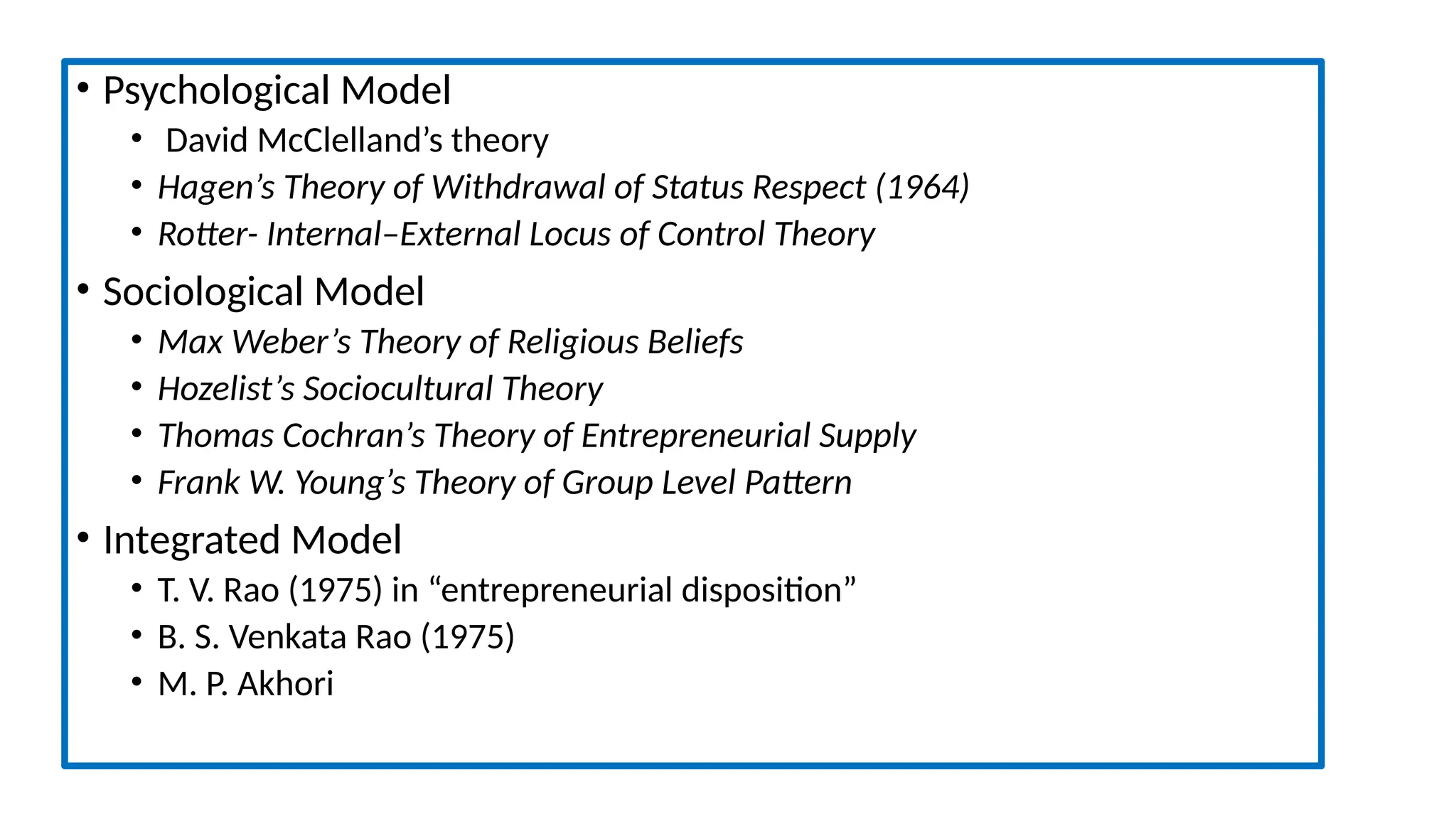
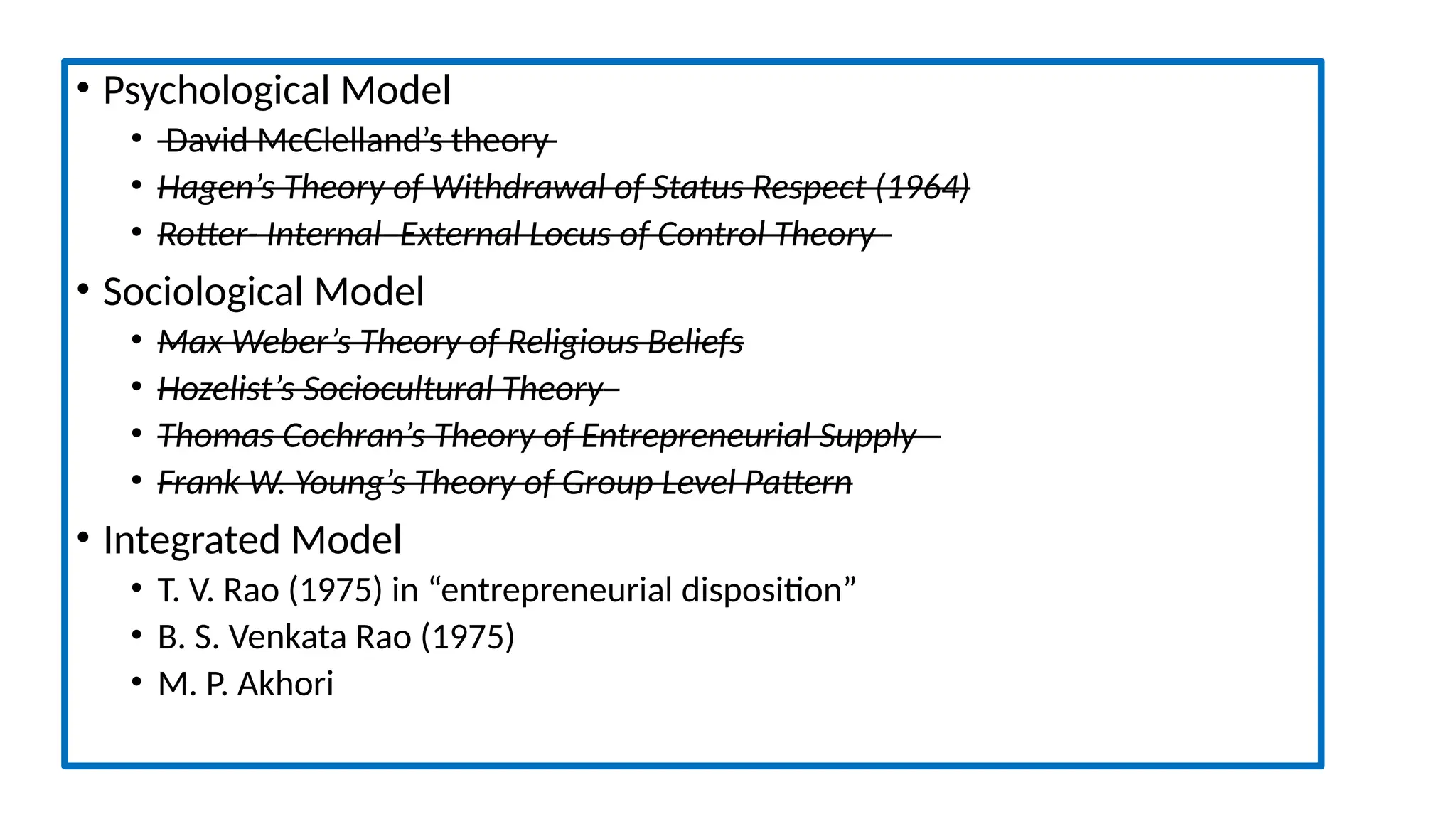
• Psychological Model
• David McClelland’s theory
• Hagen’s Theory of Withdrawal of Status Respect (1964)
• Rotter- Internal–External Locus of Control Theory
• Sociological Model
• Max Weber’s Theory of Religious Beliefs
• Hozelist’s Sociocultural Theory
• Thomas Cochran’s Theory of Entrepreneurial Supply
• Frank W. Young’s Theory of Group Level Pattern
• Integrated Model
• T. V. Rao (1975) in “entrepreneurial disposition”
• B. S. Venkata Rao (1975)
• M. P. Akhori
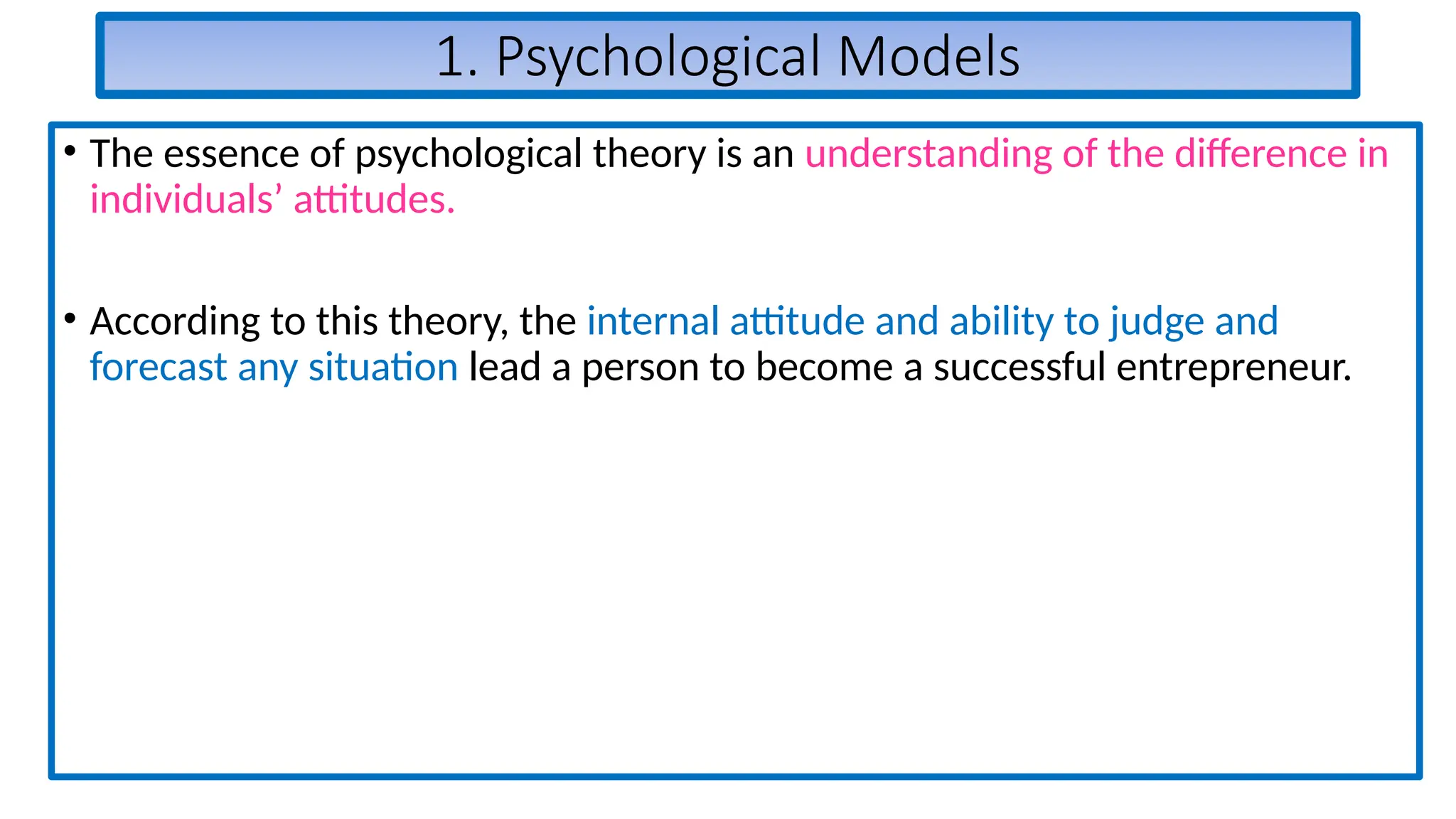
1. Psychological Models
• The essence of psychological theory is an understanding of the difference in
individuals’ attitudes.
• According to this theory, the internal attitude and ability to judge and
forecast any situation lead a person to become a successful entrepreneur.
David McClelland’s theory
• Need for achievement is the most important among the various
psychological theories on entrepreneurship.
• In his theory, McClelland emphasized the relationship of need for
achievement or achievement motivation to economic development via
entrepreneurial activities.
• He considers “achievement motivation” to be the major determinant of
entrepreneurial development.
• three motives for accomplishing things:
• Need for Power (nP), or the drive to influence others and any given situation.
• Need for Affiliation (nAff), or the drive for interpersonal relationship.
• Need for Achievement (nAch), or the drive to excel, advance, and grow.
Hagen’s Theory of Withdrawal of Status Respect (1964)
• Everett Hagen’s concept of the entrepreneur is that of a “creative personality”
interested in accelerating change and driven by a motivation to achieve.
• According to Hagen, entrepreneurial growth has been very gradual and may or may not
even occur in the same generation. In his theory of withdrawal of status respect,
• Everett Hagen’s argument is that certain social changes may disrupt the stability of
traditional society and cause psychological changes in a group or in an individual.
• The withdrawal of status respect may occur when a traditional, group is displaced from its
previous status or on migration to some other place or to a new society. Hagen uses the
case of Japanese history to substantiate his argument.
Rotter- Internal–External Locus of Control Theory
• Professor J. D. Rotter of Ohio University introduced the Internal–External
Locus of Control Theory, which highlights the self-confidence of a person,
and the dependency on fortune and external environment for becoming an
entrepreneur.
• According to this theory, the internal locus of control comprises self-
confidence, extreme belief in one’s own ability, and initiatives taken by an
individual.
• Locus of control determines whether a person perceives a potential goal to be
attainable through one’s own actions (internal locus of control) or through
uncontrollable external factors (external locus of control).
• Psychological Model
• David McClelland’s theory
• Hagen’s Theory of Withdrawal of Status Respect (1964)
• Rotter- Internal–External Locus of Control Theory
• Sociological Model
• Max Weber’s Theory of Religious Beliefs
• Hozelist’s Sociocultural Theory
• Thomas Cochran’s Theory of Entrepreneurial Supply
• Frank W. Young’s Theory of Group Level Pattern
• Integrated Model
• T. V. Rao (1975) in “entrepreneurial disposition”
• B. S. Venkata Rao (1975)
• M. P. Akhori
2. Sociological Model
• Social cultures to be the driving force behind entrepreneurship.
• The entrepreneur becomes a role performer in conformity with the role
expectations of society.
• Such role expectations are based on religious beliefs, taboos, and customs.
Max Weber’s Theory of Religious Beliefs
• According to Max Weber, religious beliefs are the driving or restraining forces
for entrepreneurial activity.
• Religious beliefs play a crucial role in determining the attitude of the
entrepreneur towards generating or limiting profits.
• Weber took the position that entrepreneurial growth is dependent upon the
ethical values (due to religion) of society.
• Capitalism thrives under the Protestant work ethic that advocates hard work,
honesty, and discipline. The spirit of capitalism, coupled with the motive of
profit, results in the creation of a large number of successful business
enterprises.
• Weber distinguished between the “spirit of capitalism” and the “adventurous
spirit.” The spirit of capitalism is influenced by a strict discipline, whereas the
adventurous spirit comes from the free force of impulse.
Hozelist’s Sociocultural Theory
• According to Hozelist, a specific social culture leads to growth in
entrepreneurship. Social sanctions, cultural values, and role expectations are
responsible for the emergence of entrepreneurship.
• also propounded that entrepreneurship grows in societies that permit
variability in choice of paths of life and non-standard socialization of
individuals.
Thomas Cochran’s Theory of Entrepreneurial Supply
• According to him, the supply of entrepreneurs in society needs to be seen
with reference to prevailing child-rearing practices. the environment in
which an individual is brought up determines his entrepreneurial urge.
• He stated that the performance of the entrepreneur might be seen in
reference to his own attitudes towards an occupation.
• Values and role expectations of the particular social group to which he
belongs are the most important determinants in the performance of
business entrepreneurial roles.
Frank W. Young’s Theory of Group Level Pattern
• Young’s model of entrepreneurship suggests the creation of supporting
institutions in society, such as the family, as the determinant of
entrepreneurship.
• Theory of entrepreneurship is one of change based upon society’s
incorporation of relative sub-groups within society.
• Psychological Model
• David McClelland’s theory
• Hagen’s Theory of Withdrawal of Status Respect (1964)
• Rotter- Internal–External Locus of Control Theory
• Sociological Model
• Max Weber’s Theory of Religious Beliefs
• Hozelist’s Sociocultural Theory
• Thomas Cochran’s Theory of Entrepreneurial Supply
• Frank W. Young’s Theory of Group Level Pattern
• Integrated Model
• T. V. Rao (1975) in “entrepreneurial disposition”
• B. S. Venkata Rao (1975)
• M. P. Akhori
3. Integrated Models
• Explanation to be added…
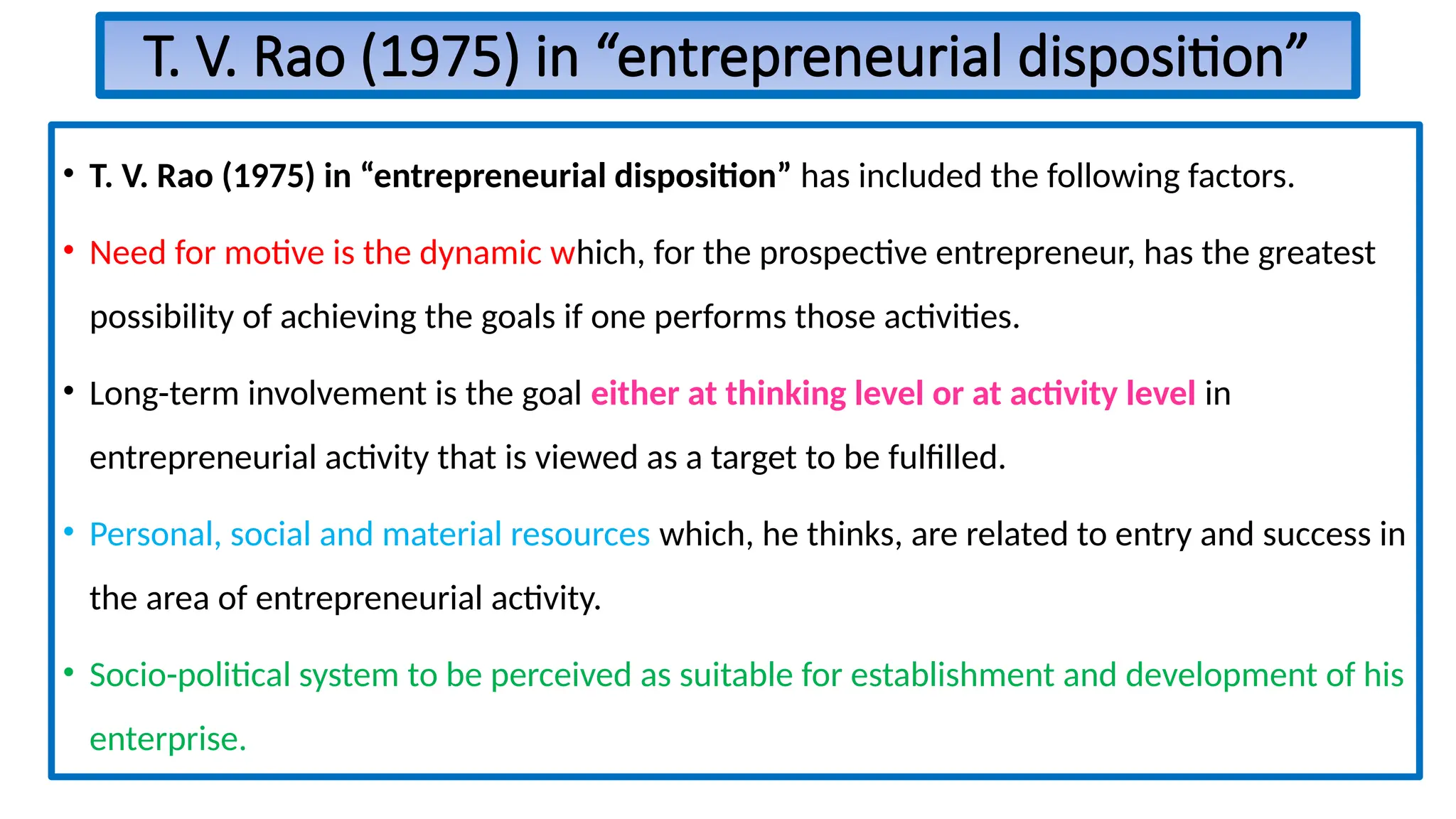
T. V. Rao (1975) in “entrepreneurial disposition”
• T. V. Rao (1975) in “entrepreneurial disposition” has included the following factors.
• Need for motive is the dynamic which, for the prospective entrepreneur, has the greatest
possibility of achieving the goals if one performs those activities.
• Long-term involvement is the goal either at thinking level or at activity level in
entrepreneurial activity that is viewed as a target to be fulfilled.
• Personal, social and material resources which, he thinks, are related to entry and success in
the area of entrepreneurial activity.
• Socio-political system to be perceived as suitable for establishment and development of his
enterprise.
B. S. Venkata Rao (1975)
• B. S. Venkata Rao (1975) described the following five stages for promoting small entrepreneurship.
• Stimulation
• Identification
• Development
• Promotion
• Follow up
• Stimulation: This stage includes the creation of an industrial atmosphere, policy statement
emphasizing the role of small industry, wide publicity of industrial development programmes, and
formation of special schemes and creation of support institutions. This stage is necessary to stimulate
interest of the backward regions in industrial activity and to create awareness.
• Identification: This stage is necessary to identify prospective entrepreneurs. The prospective
entrepreneurial force can be identified in rural artisans, factory workers, persons with formal training
in engineering and technology, and graduates in business administration and management.
• Development: This stage would include organisation of motivation and managerial training
programmes along with advice on technology, formulation of bankable project, location, and so on.
• Promotion: This stage would include government policy initiatives for promoting small
entrepreneurship.
• Follow up: This stage includes reviewing the policies and programmes of the government and
seeking follow up with a view to making them more effective.
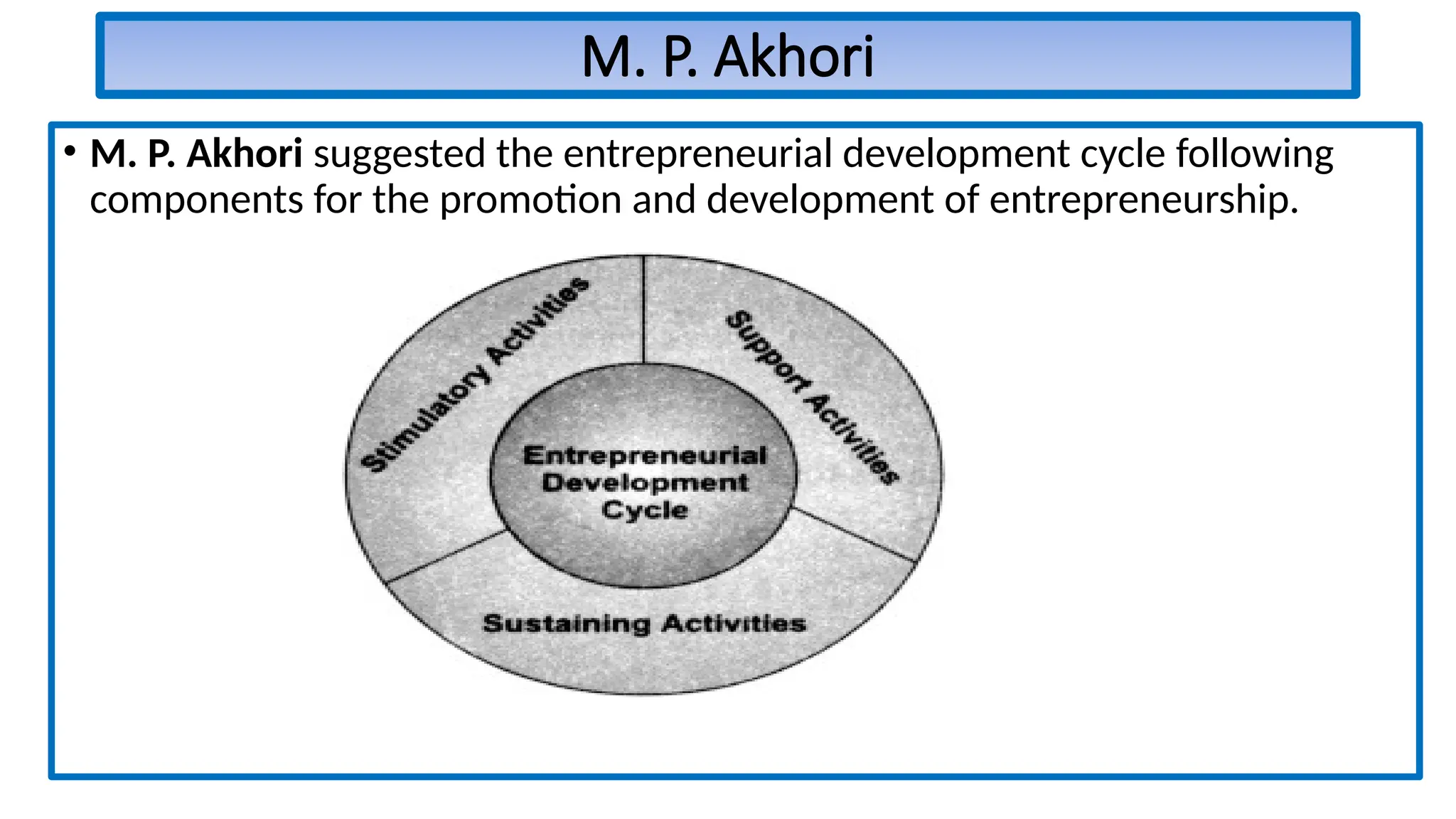
M. P. Akhori
• M. P. Akhori suggested the entrepreneurial development cycle following
components for the promotion and development of entrepreneurship.
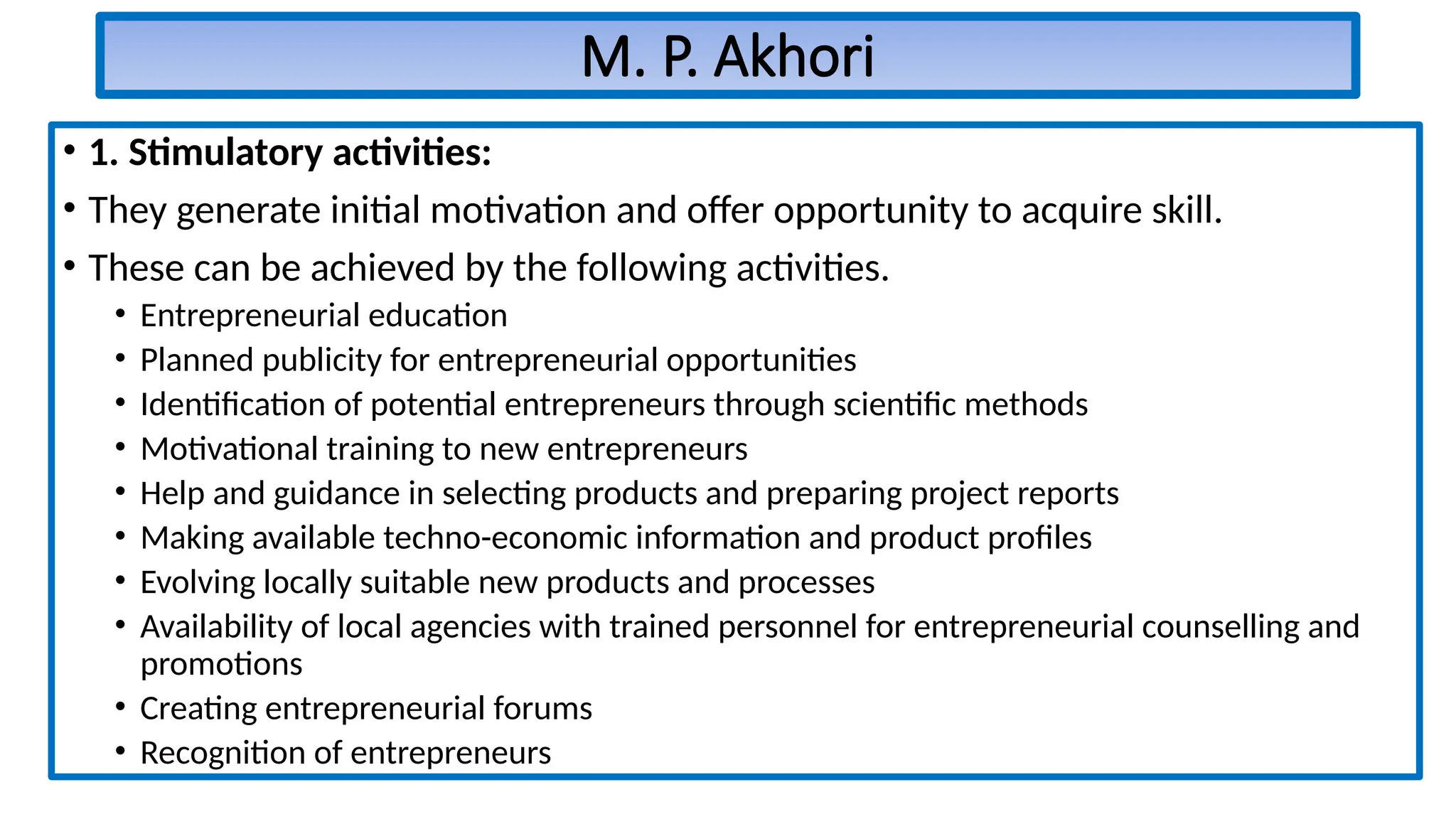
M. P. Akhori
• 1. Stimulatory activities:
• They generate initial motivation and offer opportunity to acquire skill.
• These can be achieved by the following activities.
• Entrepreneurial education
• Planned publicity for entrepreneurial opportunities
• Identification of potential entrepreneurs through scientific methods
• Motivational training to new entrepreneurs
• Help and guidance in selecting products and preparing project reports
• Making available techno-economic information and product profiles
• Evolving locally suitable new products and processes
• Availability of local agencies with trained personnel for entrepreneurial counselling and
promotions
• Creating entrepreneurial forums
• Recognition of entrepreneurs
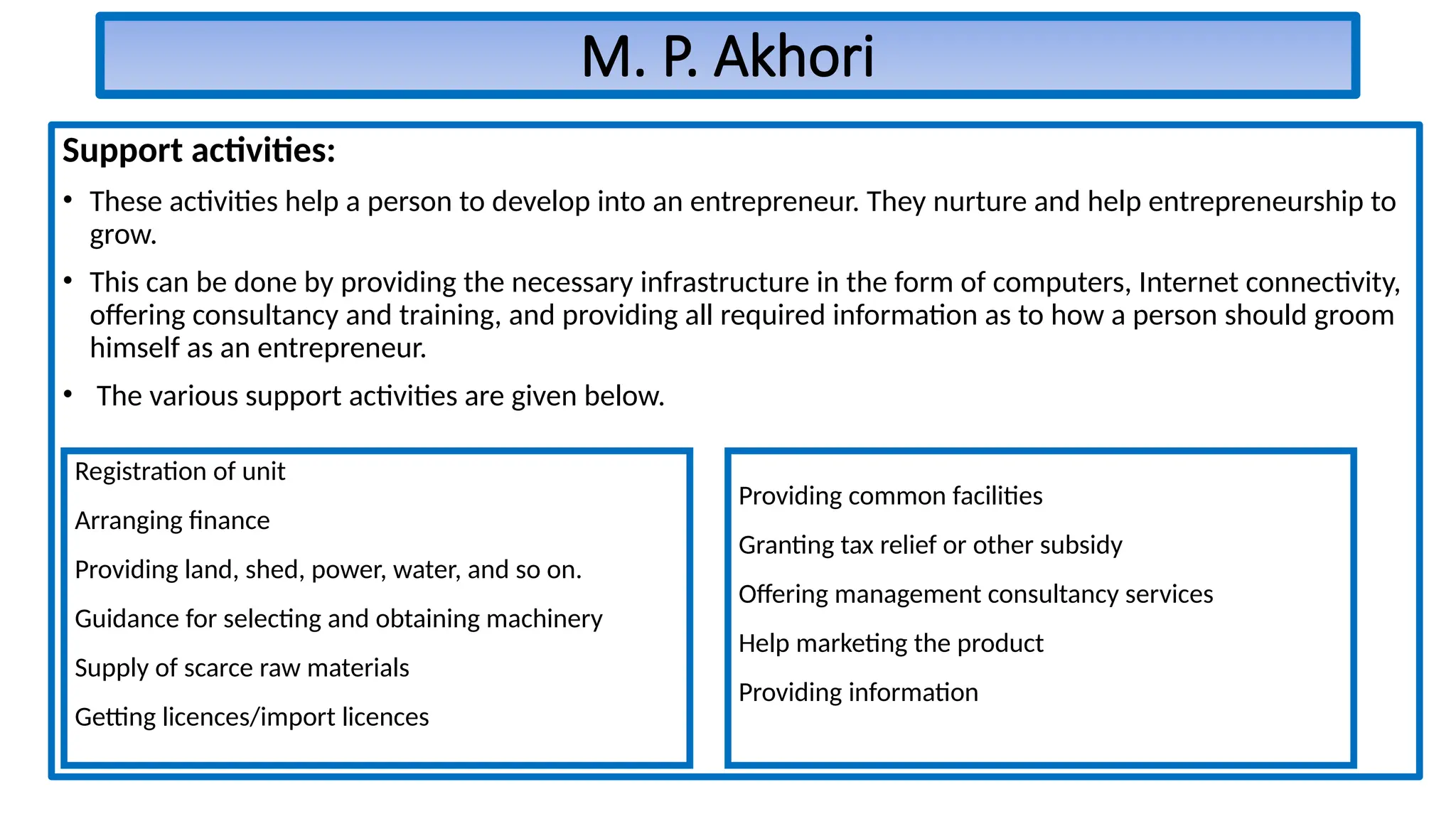
M. P. Akhori
Support activities:
• These activities help a person to develop into an entrepreneur. They nurture and help entrepreneurship to
grow.
• This can be done by providing the necessary infrastructure in the form of computers, Internet connectivity,
offering consultancy and training, and providing all required information as to how a person should groom
himself as an entrepreneur.
• The various support activities are given below.
Registration of unit
Arranging finance
Providing land, shed, power, water, and so on.
Guidance for selecting and obtaining machinery
Supply of scarce raw materials
Getting licences/import licences
Providing common facilities
Granting tax relief or other subsidy
Offering management consultancy services
Help marketing the product
Providing information
M. P. Akhori
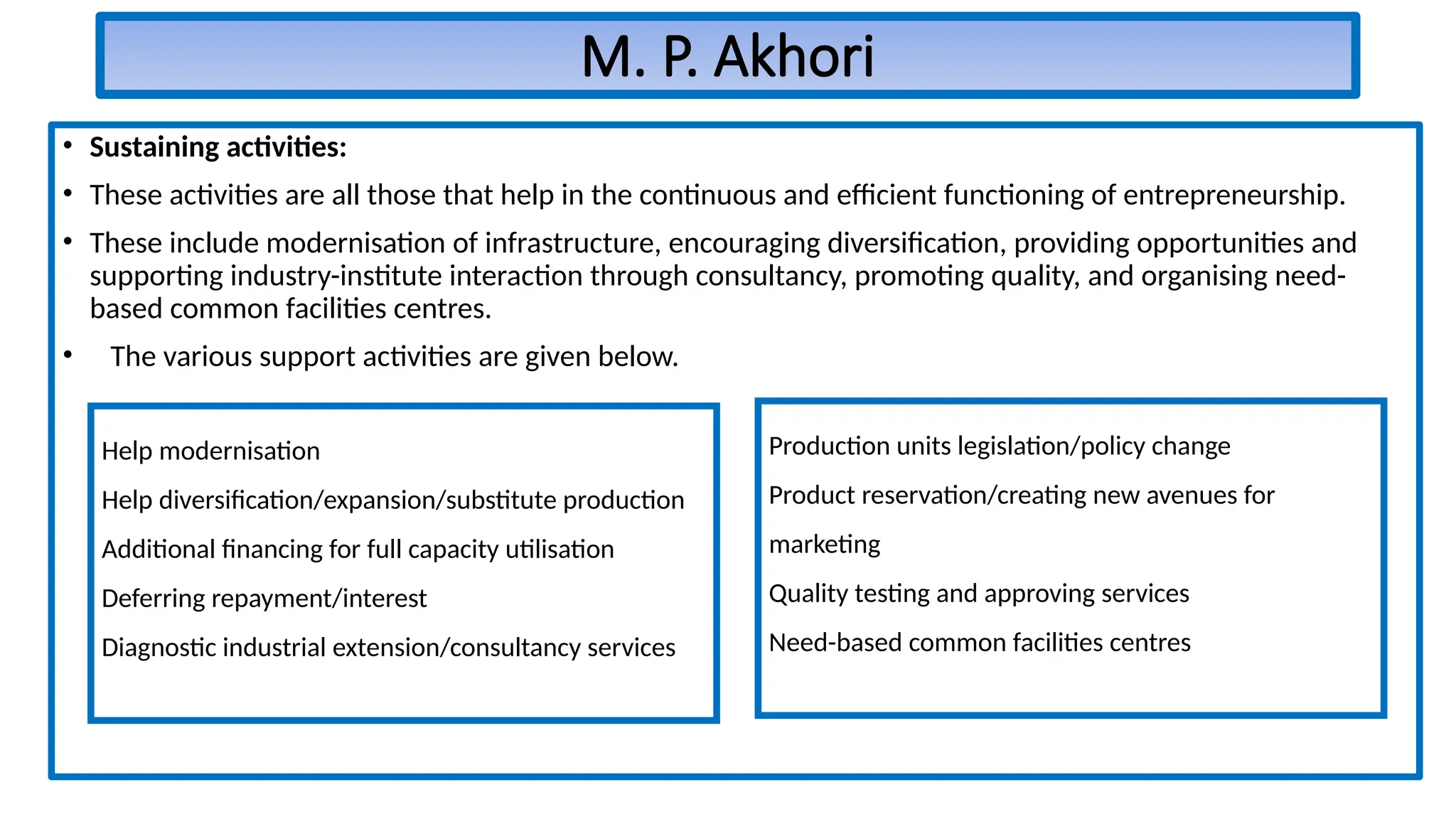
• Sustaining activities:
• These activities are all those that help in the continuous and efficient functioning of entrepreneurship.
• These include modernisation of infrastructure, encouraging diversification, providing opportunities and
supporting industry-institute interaction through consultancy, promoting quality, and organising need-
based common facilities centres.
• The various support activities are given below.
Help modernisation
Help diversification/expansion/substitute production
Additional financing for full capacity utilisation
Deferring repayment/interest
Diagnostic industrial extension/consultancy services
Production units legislation/policy change
Product reservation/creating new avenues for
marketing
Quality testing and approving services
Need-based common facilities centres
Types of Entrepreneur
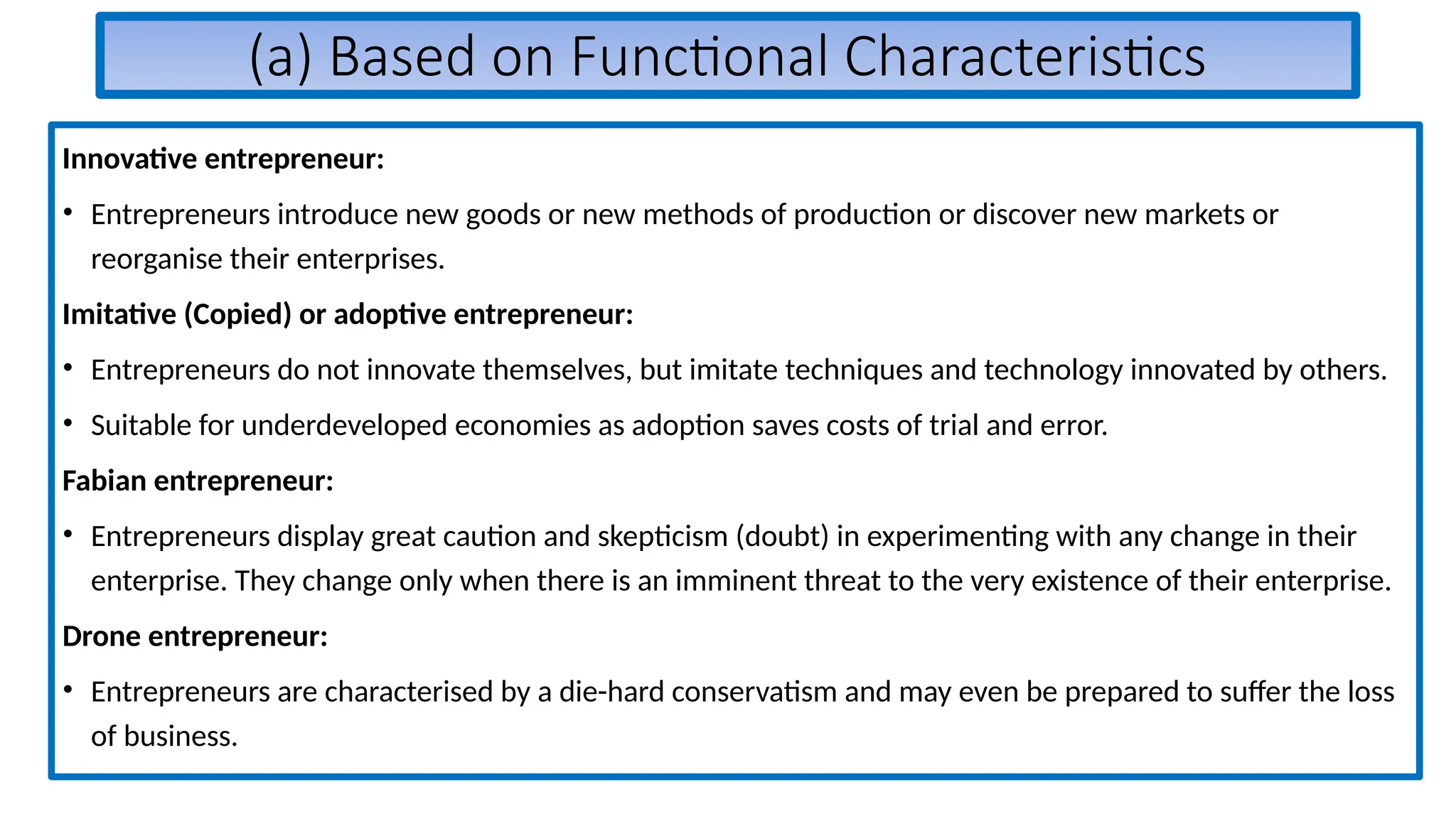
(a) Based on Functional Characteristics
Innovative entrepreneur:
• Entrepreneurs introduce new goods or new methods of production or discover new markets or
reorganise their enterprises.
Imitative (Copied) or adoptive entrepreneur:
• Entrepreneurs do not innovate themselves, but imitate techniques and technology innovated by others.
• Suitable for underdeveloped economies as adoption saves costs of trial and error.
Fabian entrepreneur:
• Entrepreneurs display great caution and skepticism (doubt) in experimenting with any change in their
enterprise. They change only when there is an imminent threat to the very existence of their enterprise.
Drone entrepreneur:
• Entrepreneurs are characterised by a die-hard conservatism and may even be prepared to suffer the loss
of business.
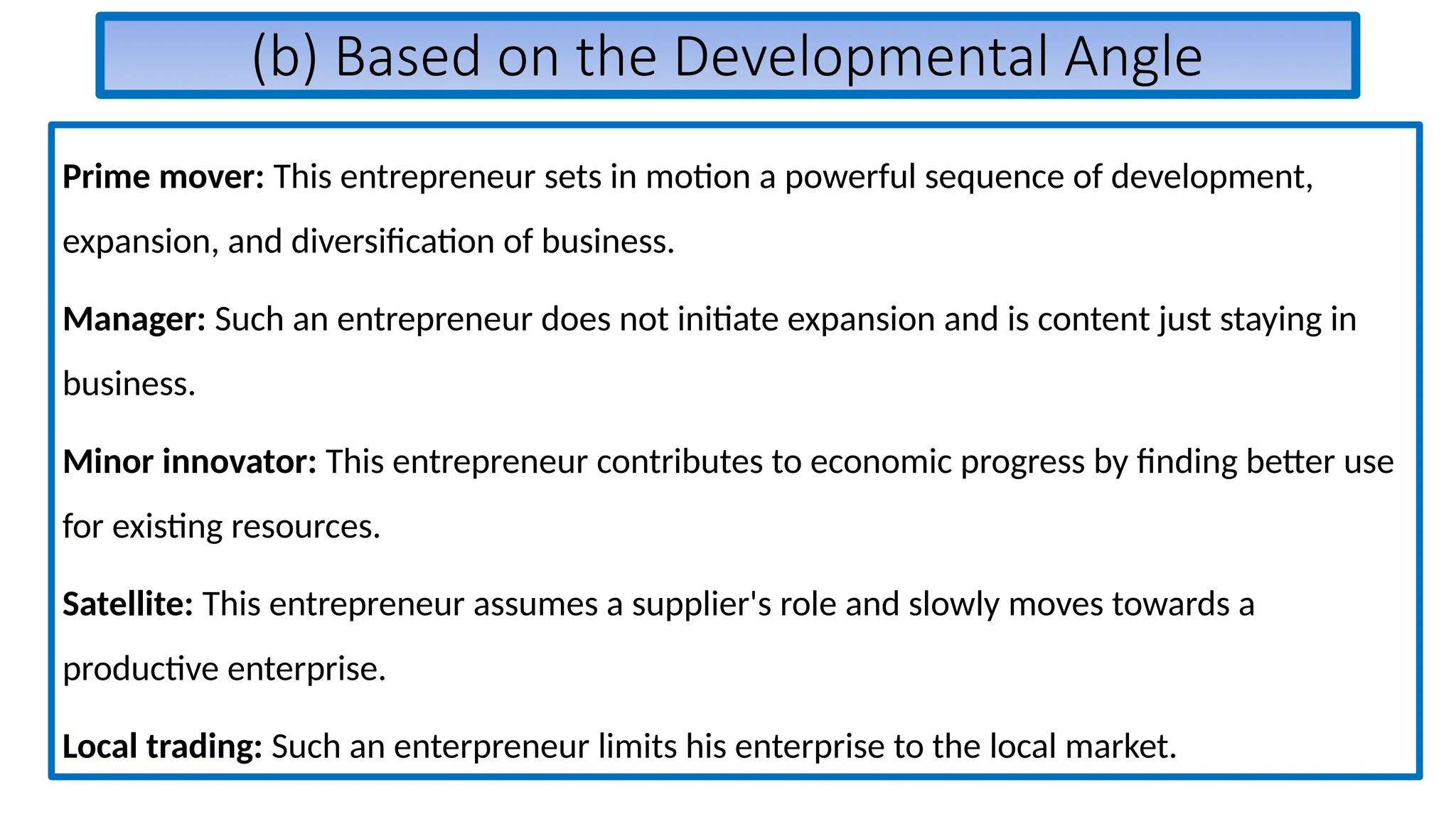
(b) Based on the Developmental Angle
Prime mover: This entrepreneur sets in motion a powerful sequence of development,
expansion, and diversification of business.
Manager: Such an entrepreneur does not initiate expansion and is content just staying in
business.
Minor innovator: This entrepreneur contributes to economic progress by finding better use
for existing resources.
Satellite: This entrepreneur assumes a supplier's role and slowly moves towards a
productive enterprise.
Local trading: Such an enterpreneur limits his enterprise to the local market.
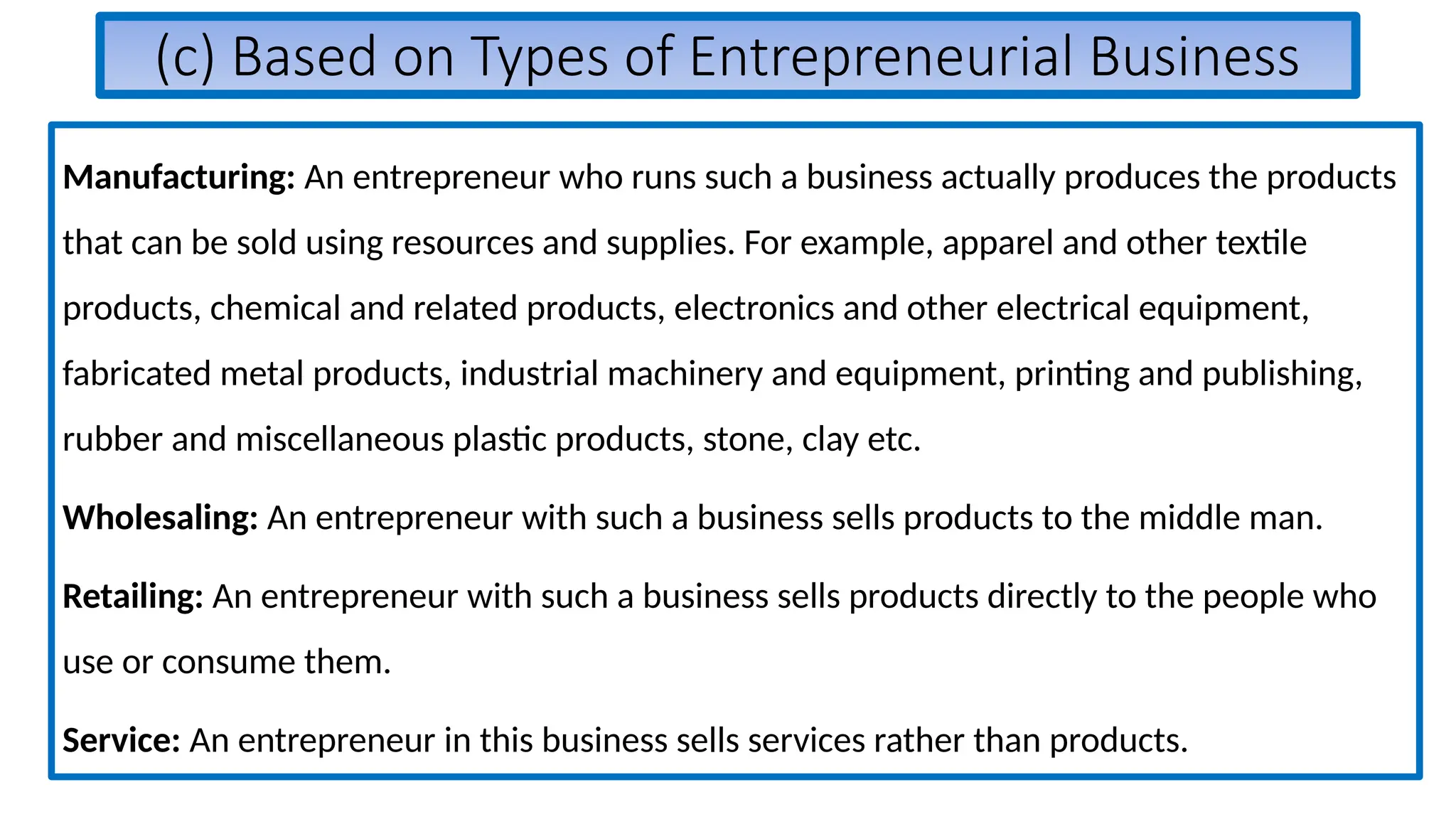
(c) Based on Types of Entrepreneurial Business
Manufacturing: An entrepreneur who runs such a business actually produces the products
that can be sold using resources and supplies. For example, apparel and other textile
products, chemical and related products, electronics and other electrical equipment,
fabricated metal products, industrial machinery and equipment, printing and publishing,
rubber and miscellaneous plastic products, stone, clay etc.
Wholesaling: An entrepreneur with such a business sells products to the middle man.
Retailing: An entrepreneur with such a business sells products directly to the people who
use or consume them.
Service: An entrepreneur in this business sells services rather than products.
(d) Based on the Nine Personality Types of Entrepreneurs
• Begin identifying dominant personality theme and understand how operate in business.
1. The Improver:
• If you operate your business predominately in the improver mode,
• It focused on using company as a means to improve the world.
• Overarching motto is: morally correct companies will be rewarded working on a noble cause.
Improvers have an unwavering ability to run their business with high integrity and ethics.
• Personality alert: be aware of tendency to be a perfectionist and over-critical of employees
and customers.
• Entrepreneur example: Anita Roddick, founder of the body shop.
2. The Advisor:
• This business personality type will provide an extremely high level of assistance and
advice to customers.
• The advisor's motto is: the customer is right and we must do everything to please
them. Companies built by advisors become customer focused.
• Personality Alert: Advisors can become totally focused on the needs of their business
and customers that they may ignore their own needs and ultimately burn out.
• Entrepreneur example: John W. Nordstrom, Founder Nordstrom.
• The Superstar:
• the business is centered on the charisma and high energy of the Superstar CEO. This personality often will cause you
to build your business around your own personal brand.
• Personality Alert: Superstarts Can be too competitive and workaholics.
• Entrepreneur example: Donald Trump, CEO of Trump Hotels & Casino Resorts.
• The Artist:
• This business personality is the reserved but a highly creative type. Often found in businesses demanding creativity
such as web design and ad agencies. As an artist type you'll tend to build your business around the unique talents
and creativities that you have.
• Personality Alert: You may be overly sensitive to your customer's responses even if the feedback is constructive. Let
go the negative self-image.
• Entrepreneur example: Scott Adams, Creator of Dilbert.
The Visionary:
• A business built by a Visionary will often be based on the future vision and thoughts of the founder. You will
have a high degree of curiosity to understand the world around you and will set-up plan to avoid the landmines.
• Personality Alert: Visionaries can be too focused on the dream with little focus on reality. Action must precede
vision.
• Entrepreneurial example: Bill Gates, Founder of Microsoft Inc.
The Analyst:
• If you run a business as an Analyst, your company focus is on fixing problems in a systematic way. Often the
basis for science, engineering or computer firms, Analyst companies excel at problem solving.
• Personality Alert: Be aware of analysis paralysis. Work on trusting others.
• Entrepreneurial example: Intel Founder, Gordon Moore.
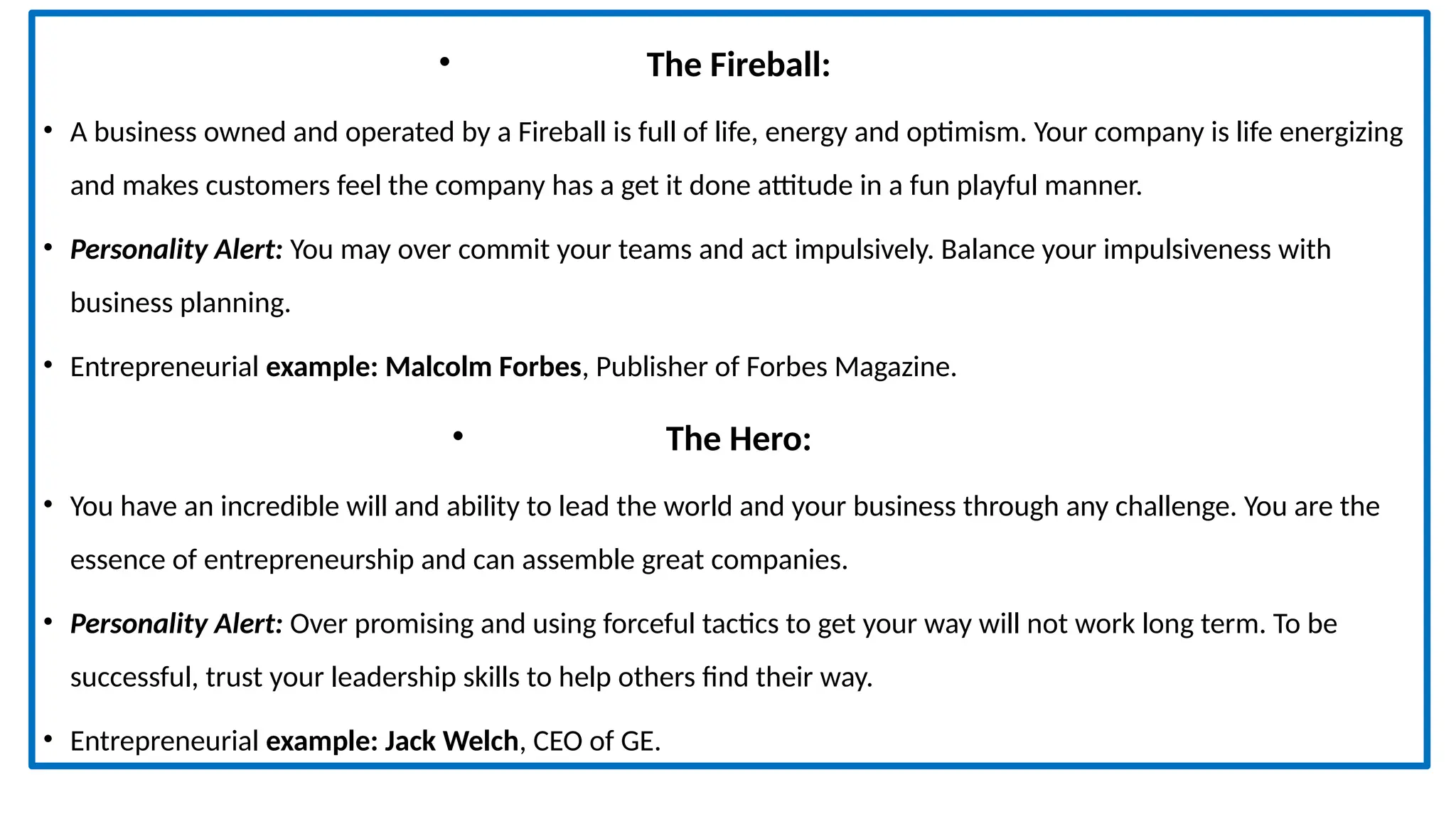
• The Fireball:
• A business owned and operated by a Fireball is full of life, energy and optimism. Your company is life energizing
and makes customers feel the company has a get it done attitude in a fun playful manner.
• Personality Alert: You may over commit your teams and act impulsively. Balance your impulsiveness with
business planning.
• Entrepreneurial example: Malcolm Forbes, Publisher of Forbes Magazine.
• The Hero:
• You have an incredible will and ability to lead the world and your business through any challenge. You are the
essence of entrepreneurship and can assemble great companies.
• Personality Alert: Over promising and using forceful tactics to get your way will not work long term. To be
successful, trust your leadership skills to help others find their way.
• Entrepreneurial example: Jack Welch, CEO of GE.
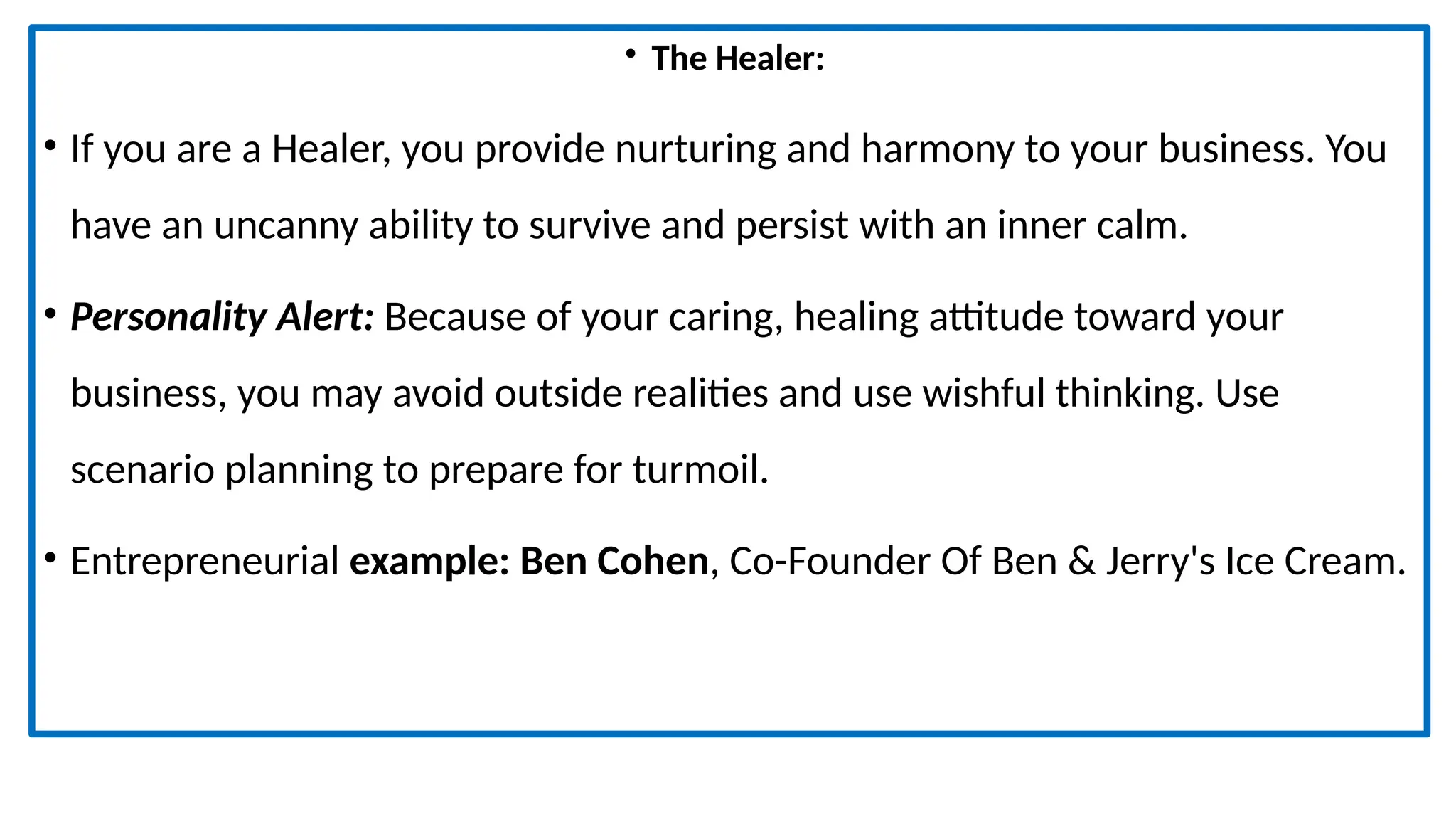
• The Healer:
• If you are a Healer, you provide nurturing and harmony to your business. You
have an uncanny ability to survive and persist with an inner calm.
• Personality Alert: Because of your caring, healing attitude toward your
business, you may avoid outside realities and use wishful thinking. Use
scenario planning to prepare for turmoil.
• Entrepreneurial example: Ben Cohen, Co-Founder Of Ben & Jerry's Ice Cream.
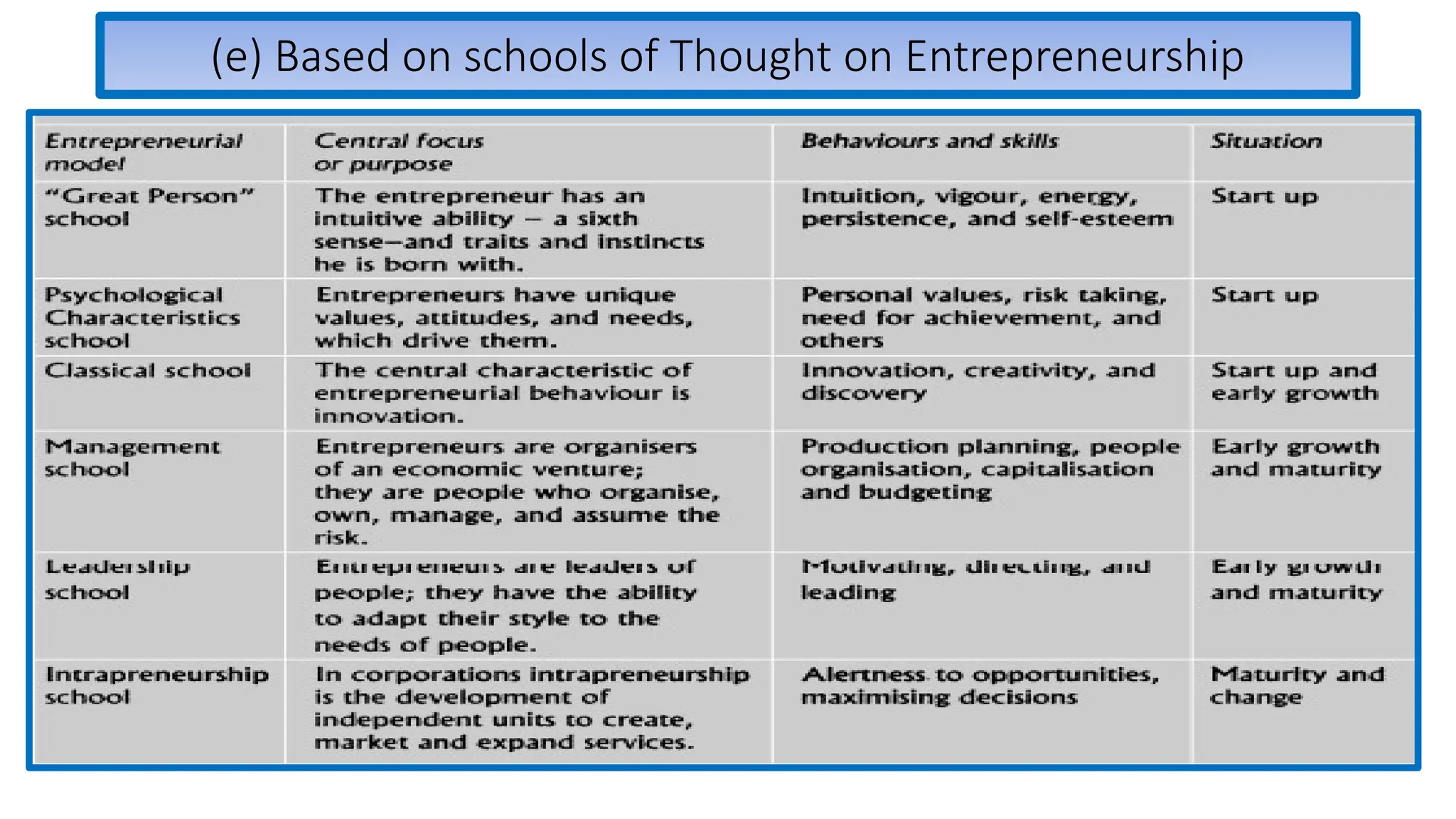
(e) Based on schools of Thought on Entrepreneurship
Creativity and Innovation
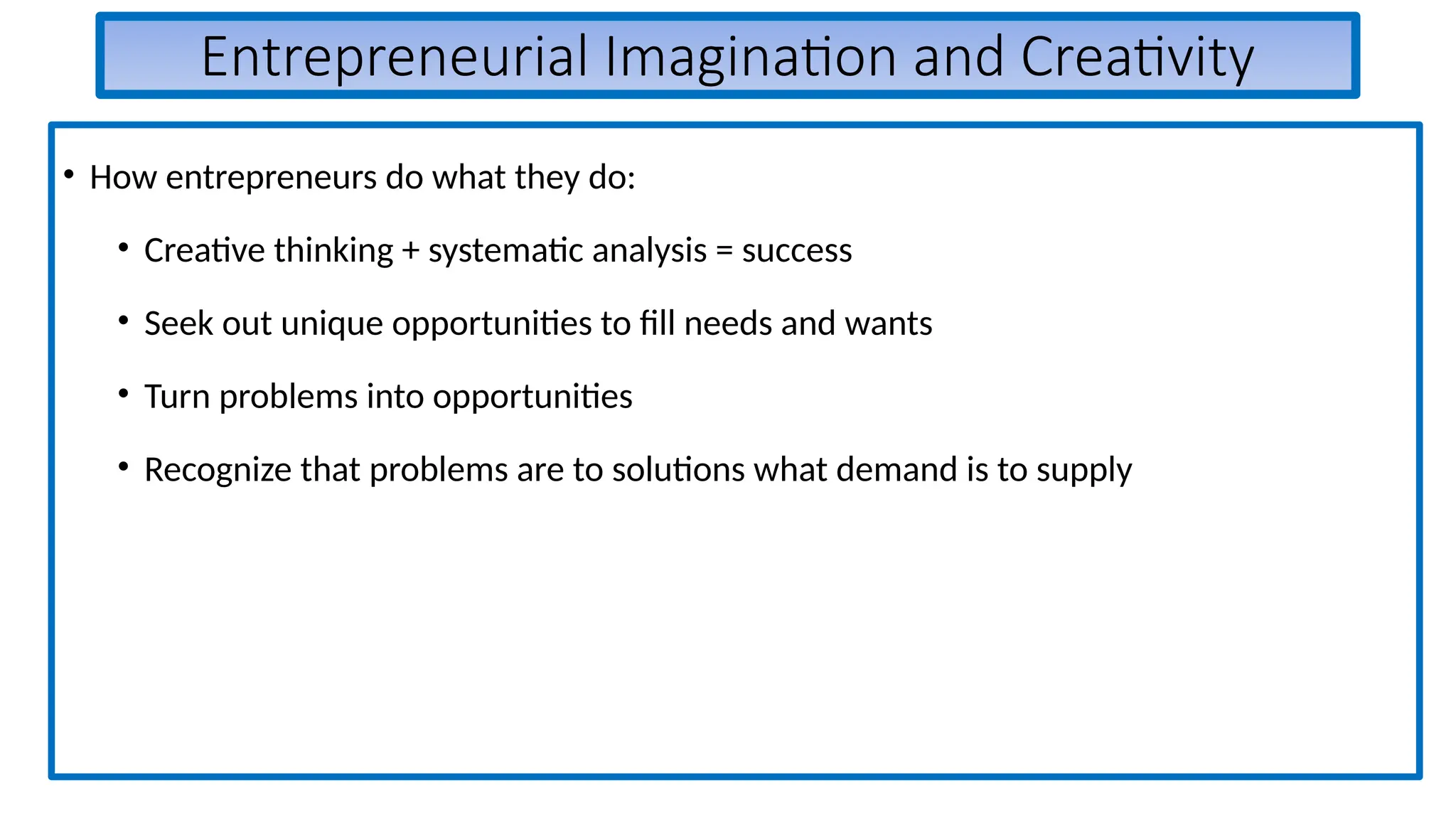
piezoelectricity
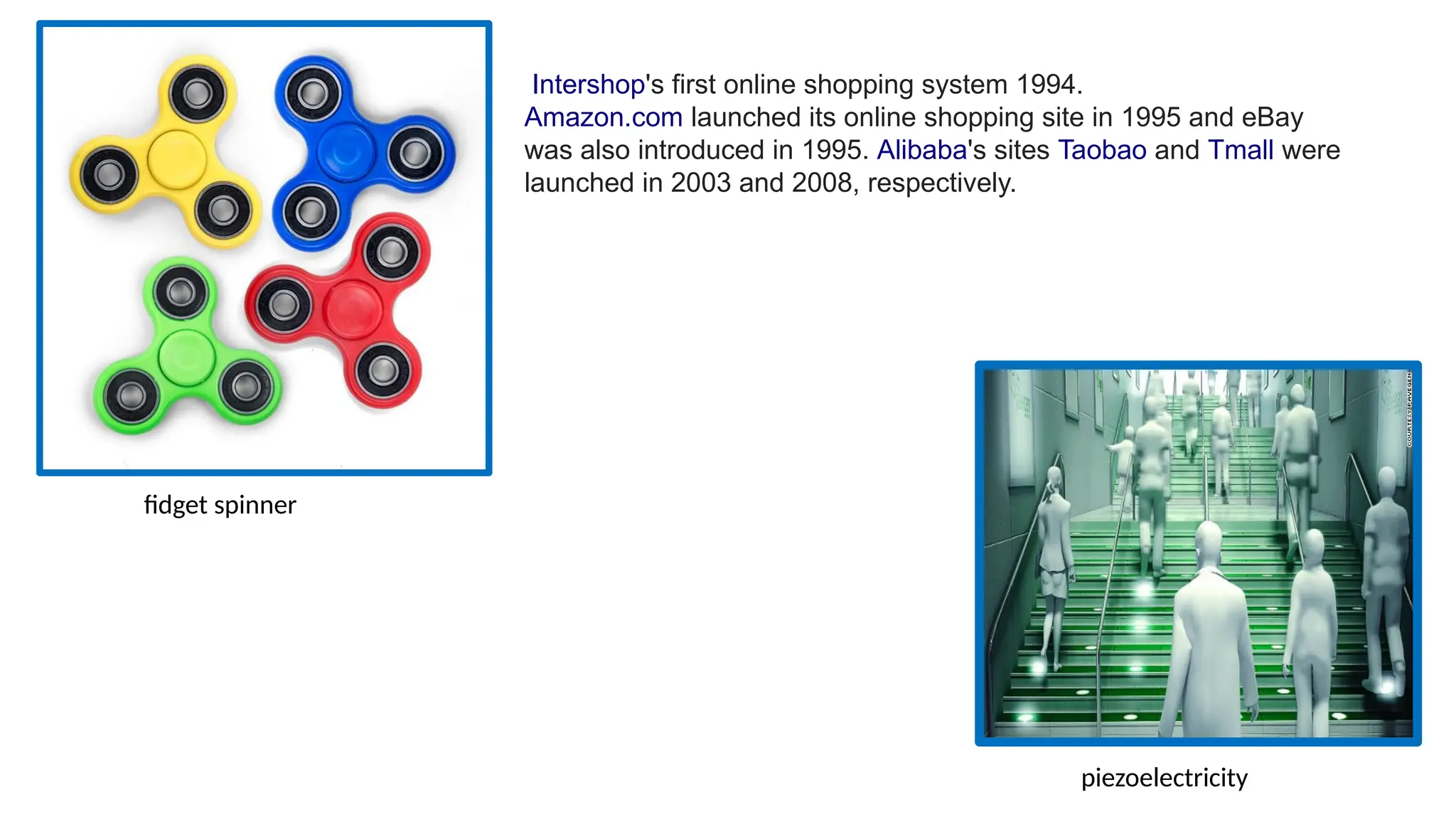
fidget spinner
Intershop's first online shopping system 1994.
Amazon.com launched its online shopping site in 1995 and eBay
was also introduced in 1995. Alibaba's sites Taobao and Tmall were
launched in 2003 and 2008, respectively.
Entrepreneurial Imagination and Creativity
• How entrepreneurs do what they do:
• Creative thinking + systematic analysis = success
• Seek out unique opportunities to fill needs and wants
• Turn problems into opportunities
• Recognize that problems are to solutions what demand is to supply
1. Creativity:
• Creativity is “the ability to bring something new into existence”.
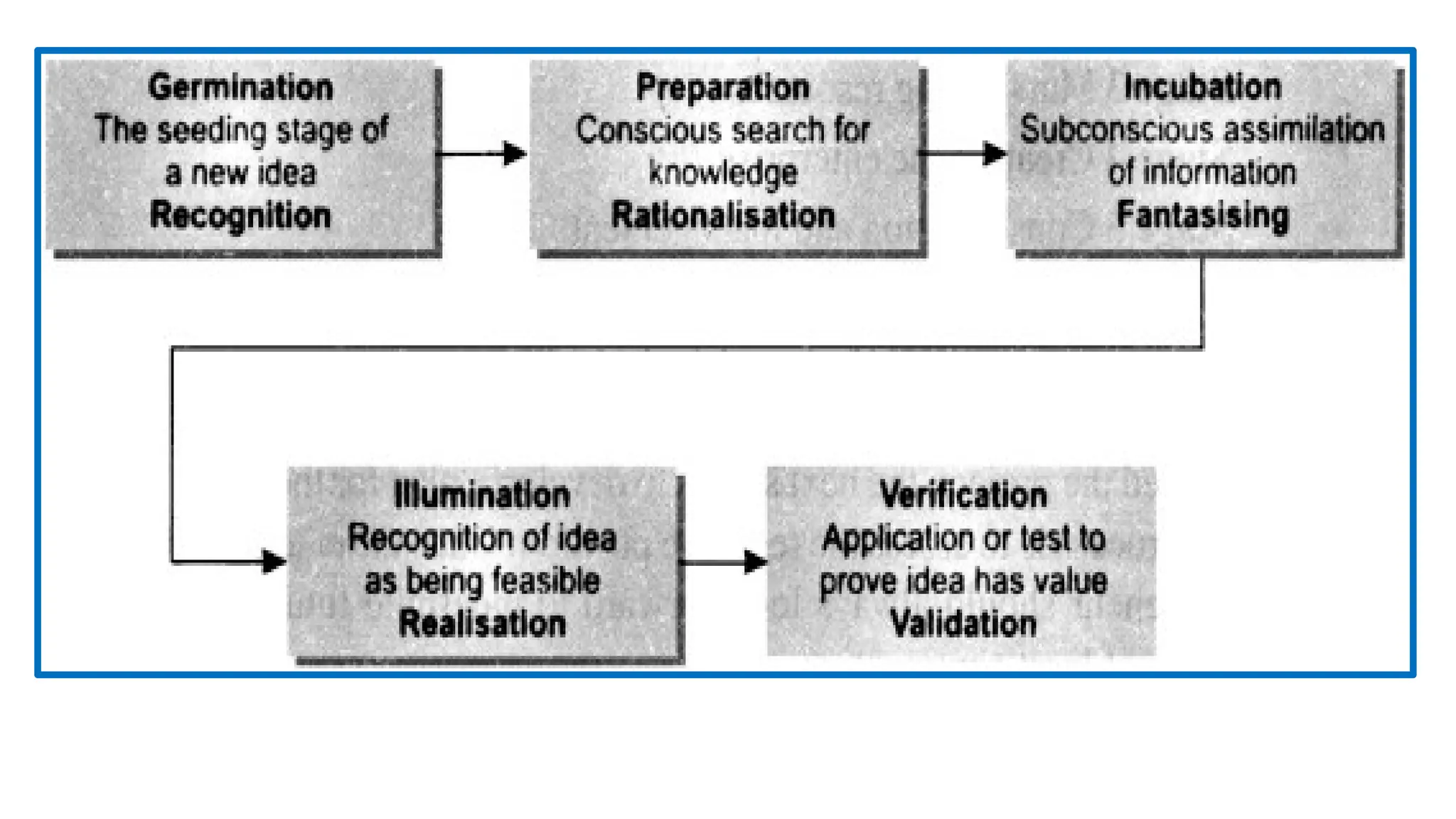
• The creative process for an idea involves five stages
• A. Germination: The germination stage is the seeding process.
• The exact manner in which an idea is germinated is a mystery; it is not something that can
be examined under a microscope. However, most creative ideas can be traced to an
individual's interest in or curiosity about a specific problem or area of study.
• B. Preparation: If it is a problem they are trying to
• They begin an intellectual journey, seeking information about the problem and how others
have tried to resolve it.
• If it is an idea for a new product or service, then market research is the business equivalent.
• Inventors will set up laboratory experiments, designers will begin engineering new product
ideas, and marketers will study consumer-buying habits.
• Any individual with an idea will consequently think about it, concentrating his or her
energies on rational extensions of the idea and how it might become a reality.
1. Creativity:
• 3. Incubation: Incubation is a stage of “mulling it over” while the
subconscious intellect assumes control of the creative process.
• It is consciously focus on a problem, behave rationally to attempt to find
systematic resolutions.
• 4. Illumination : occurs when the idea resurfaces as a realistic creation.
• Reaching the illumination stage separates daydreamers and tinkerers from
creative people who find a way to transmute value.
• 5. Verification: to translate an illuminated idea into a verified, realistic, and
useful application.
• to finding a way to “harvest” the practical results of his or her creation.
Developing Your Creativity
• Recognizing Relationships
• Looking for different or unorthodox relationships among the elements and people around
you.
• Developing a Functional Perspective
• Viewing things and people in terms of how they can satisfy his or her needs and help
complete a project.
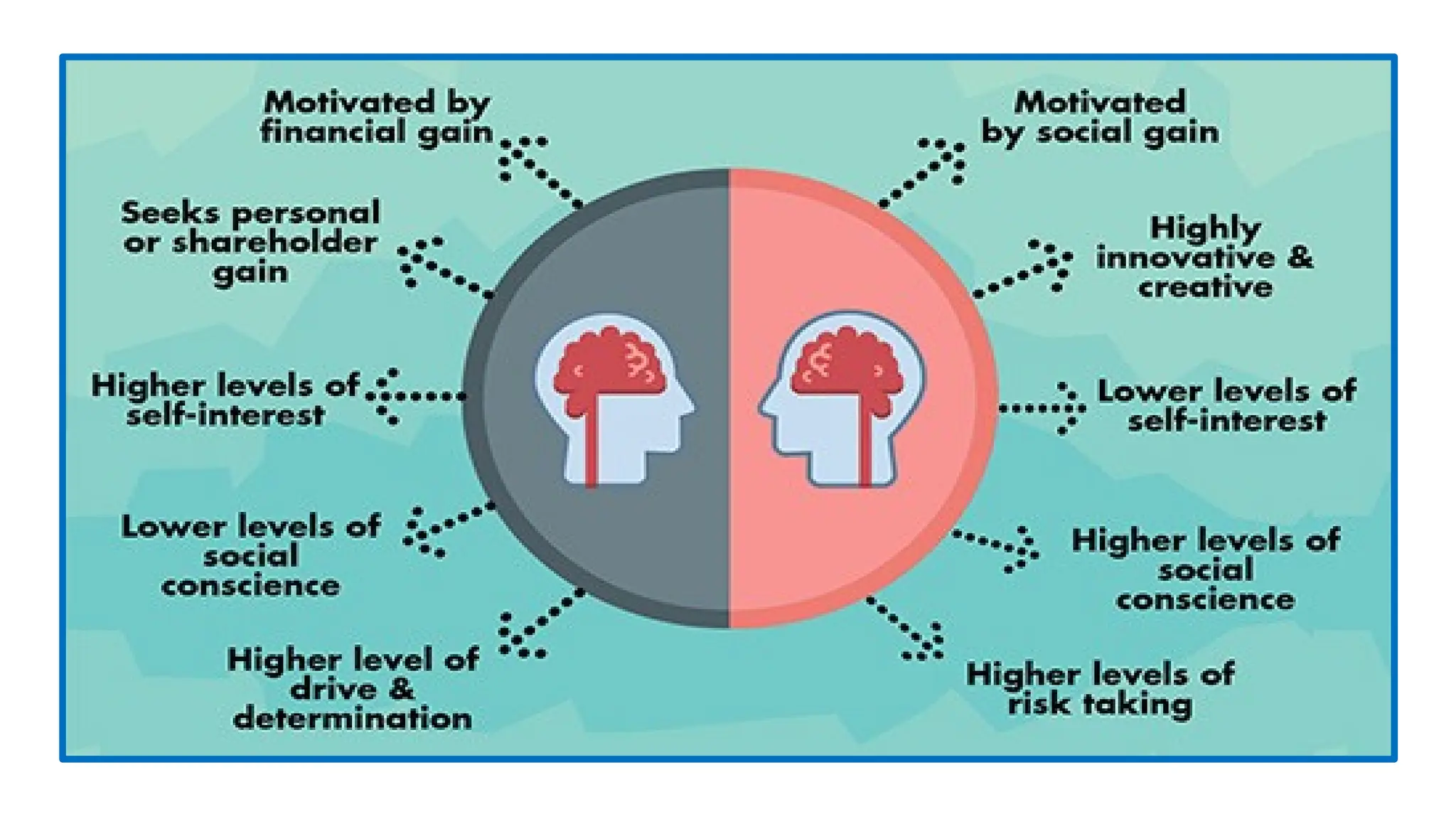
• Using Your Brains
• The right brain helps us understand analogies, imagine things, and synthesize information.
• The left brain helps us analyze, verbalize, and use rational approaches to problem solving.
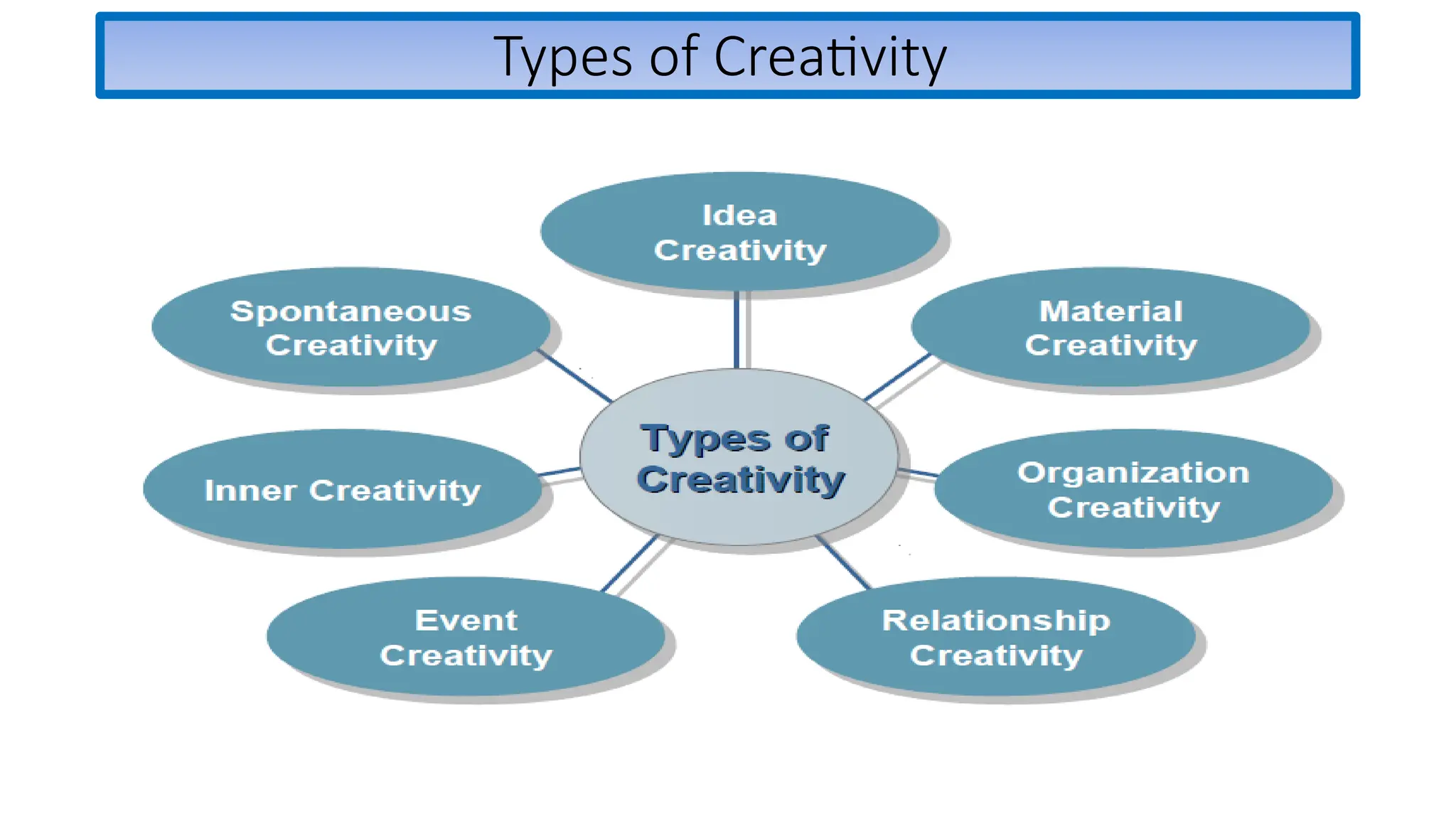
Types of Creativity
Characteristics of a creative climate:
• A trustful management that does not overcontrol the personnel
• Open channels of communication among all business members
• Considerable contact and communication with outsiders
• A large variety of personality types
• A willingness to accept change
• An enjoyment in experimenting with new ideas
• Little fear of negative consequences for making a mistake
• The selection and promotion of employees on the basis of merit
• The use of techniques that encourage ideas, including suggestion systems and
brainstorming
• Sufficient financial, managerial, human, and time resources for accomplishing goals
Innovation
Innovation:
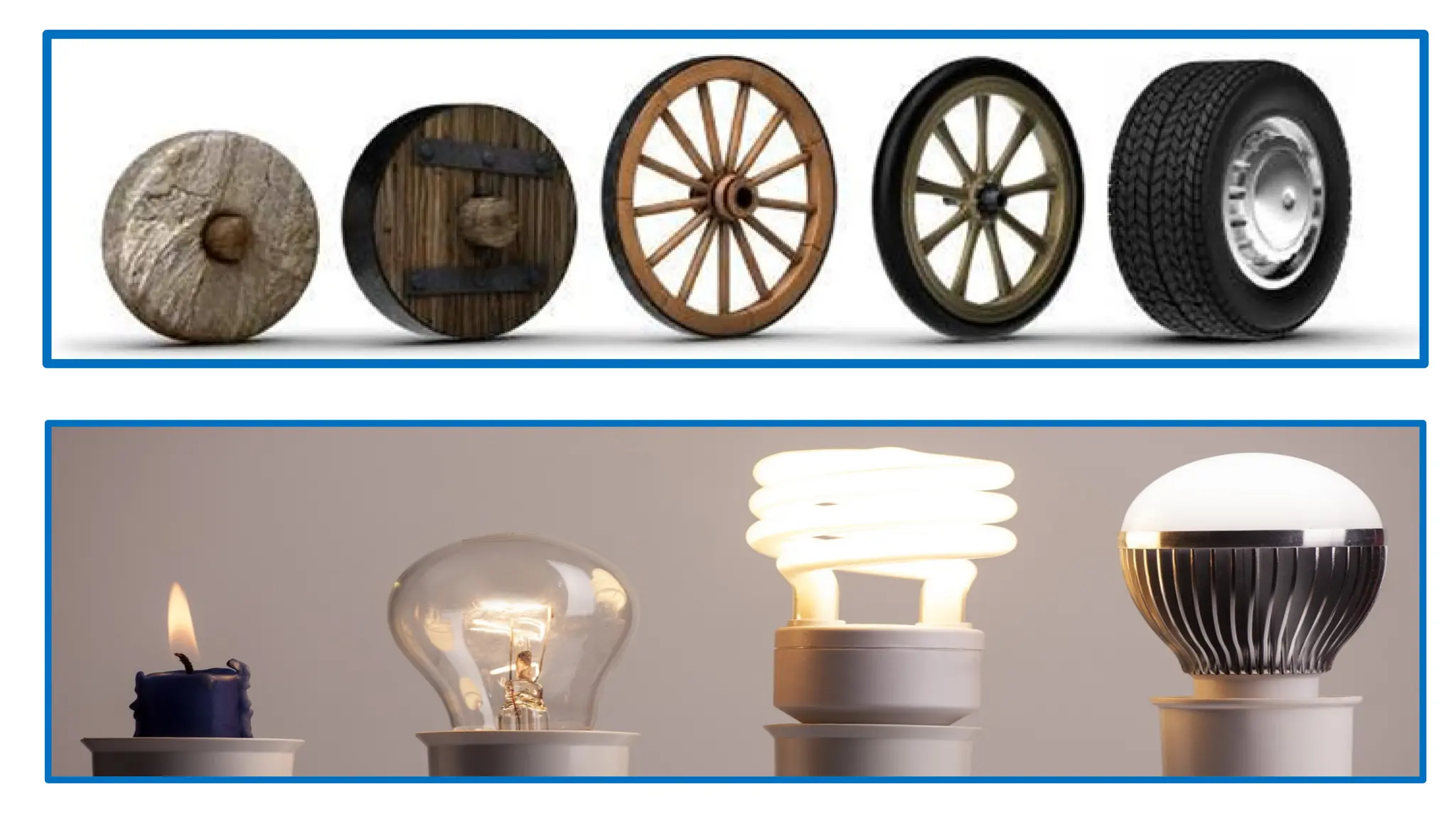
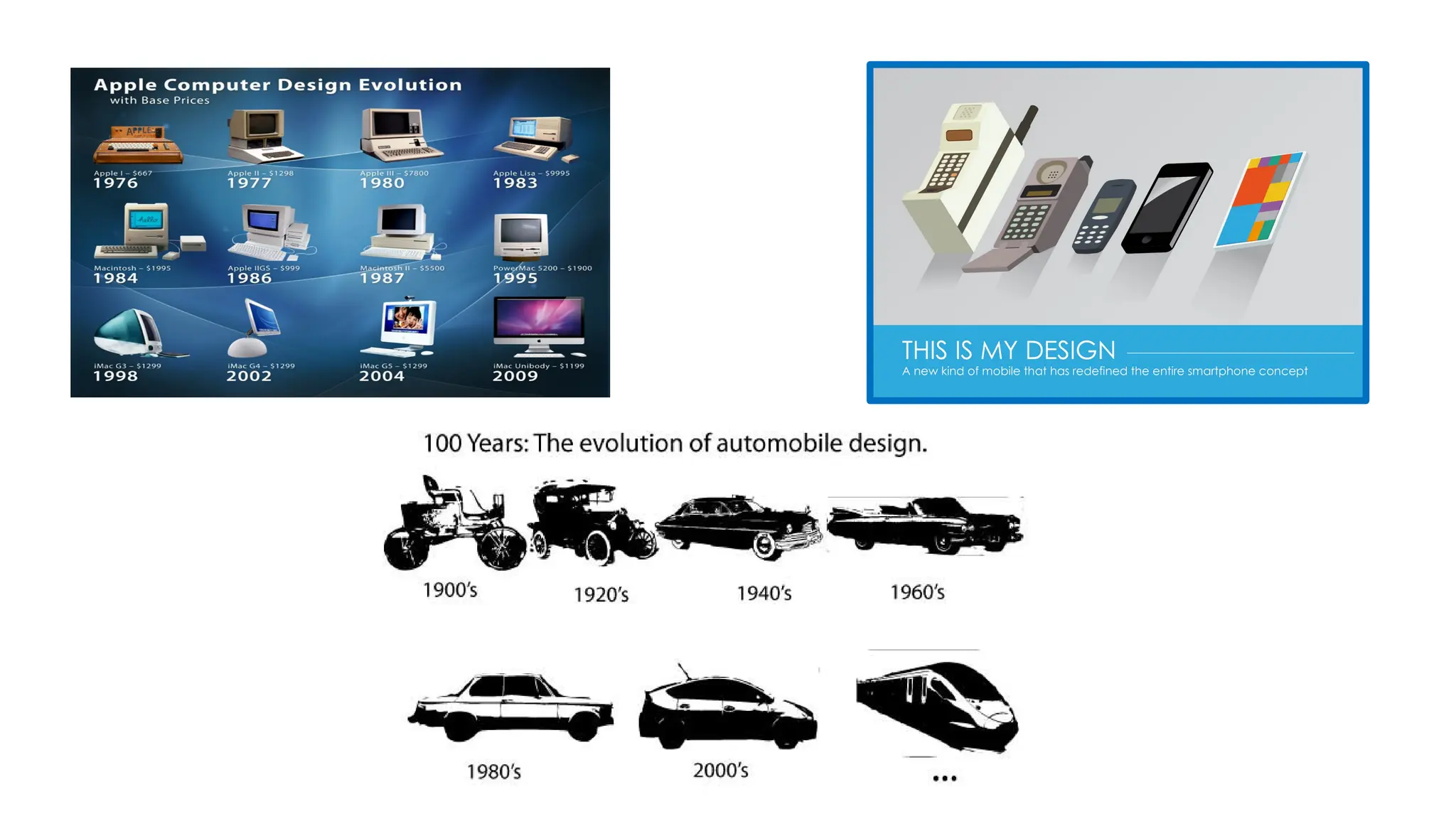
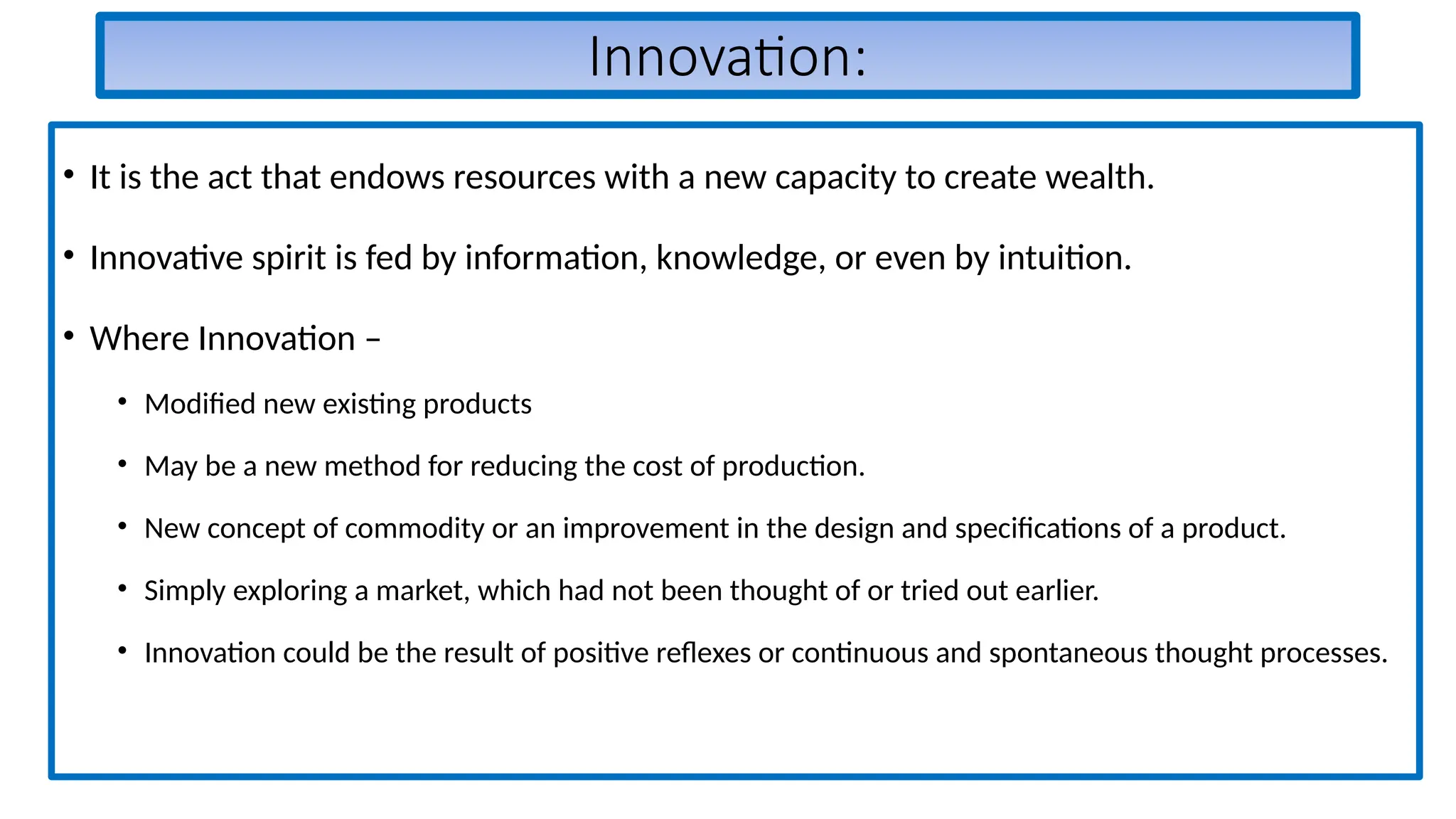
• It is the act that endows resources with a new capacity to create wealth.
• Innovative spirit is fed by information, knowledge, or even by intuition.
• Where Innovation –
• Modified new existing products
• May be a new method for reducing the cost of production.
• New concept of commodity or an improvement in the design and specifications of a product.
• Simply exploring a market, which had not been thought of or tried out earlier.
• Innovation could be the result of positive reflexes or continuous and spontaneous thought processes.
Innovation:
• Is the process by which entrepreneurs convert opportunities into marketable ideas.
• Is a combination of the vision to create a good idea and the perseverance and
dedication to remain with the concept through implementation.
• Is a key function in the entrepreneurial process.
• Is the specific function of entrepreneurship.
• Seven Sources For Innovative
• The unexpected—unexpected success, unexpected failure, unexpected outside event.
• The incongruity—between reality as it actually is and reality as it is assumed to be or as it “ought
to be”
• Innovation based on process need
• Changes in industry structure or market structure that catches everyone unawares
• Demographics (population changes)
• Changes in perception, mood, and meaning
• New knowledge—scientific and non-scientific
•
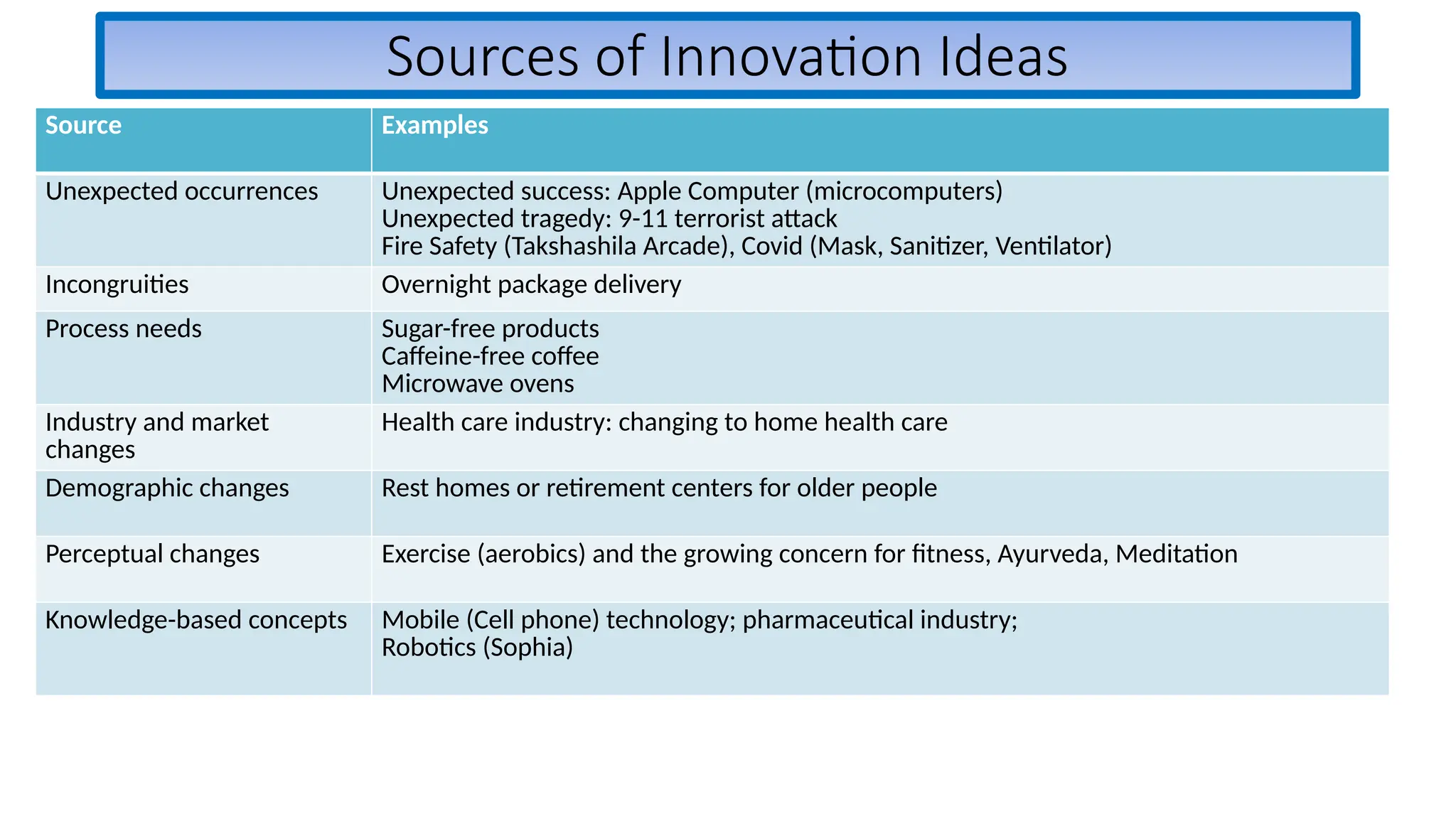
Sources of Innovation Ideas
Source Examples
Unexpected occurrences Unexpected success: Apple Computer (microcomputers)
Unexpected tragedy: 9-11 terrorist attack
Fire Safety (Takshashila Arcade), Covid (Mask, Sanitizer, Ventilator)
Incongruities Overnight package delivery
Process needs Sugar-free products
Caffeine-free coffee
Microwave ovens
Industry and market
changes
Health care industry: changing to home health care
Demographic changes Rest homes or retirement centers for older people
Perceptual changes Exercise (aerobics) and the growing concern for fitness, Ayurveda, Meditation
Knowledge-based concepts Mobile (Cell phone) technology; pharmaceutical industry;
Robotics (Sophia)
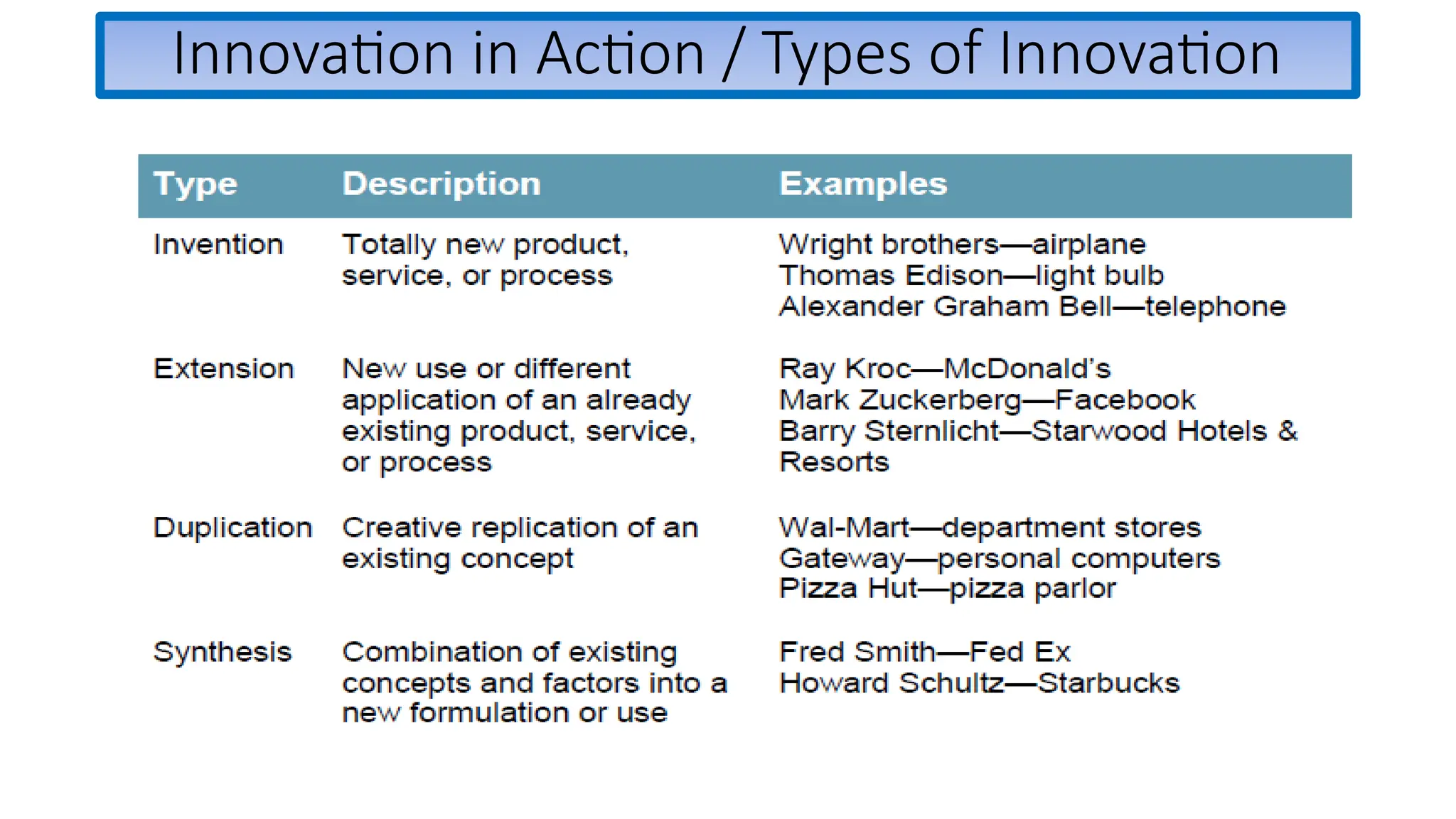
Innovation in Action / Types of Innovation
Major Innovation Myths
• Myth 1: Innovation is planned and predictable
• Myth 2: Technical specifications should be thoroughly prepared
• Myth 3: Creativity relies on dreams and bluesky ideas
• Myth 4: Big projects will develop better innovations than smaller ones
• Myth 5: Technology is the driving force of innovation success
Principles of Innovation
• Be action oriented.
• Make the product, process, or service simple and understandable.
• Make the product, process, or service customer-based.
• Start small.
• Aim high.
• Try/test/revise.
• Learn from failures
• Follow a milestone schedule.
• Reward heroic activity.
• Work, work, work.
Types of Business Organization
Meaning of an Organization
“Organization is a group of people working together to create a surplus /
profit, satisfaction of needs, and achievement of goals viz. organizational
as well as individual.”
Types of Organization
• Proprietorship
• Partnership
• Cooperative / Society / Trusts
• Company : a)Private Ltd. b)Public Ltd.
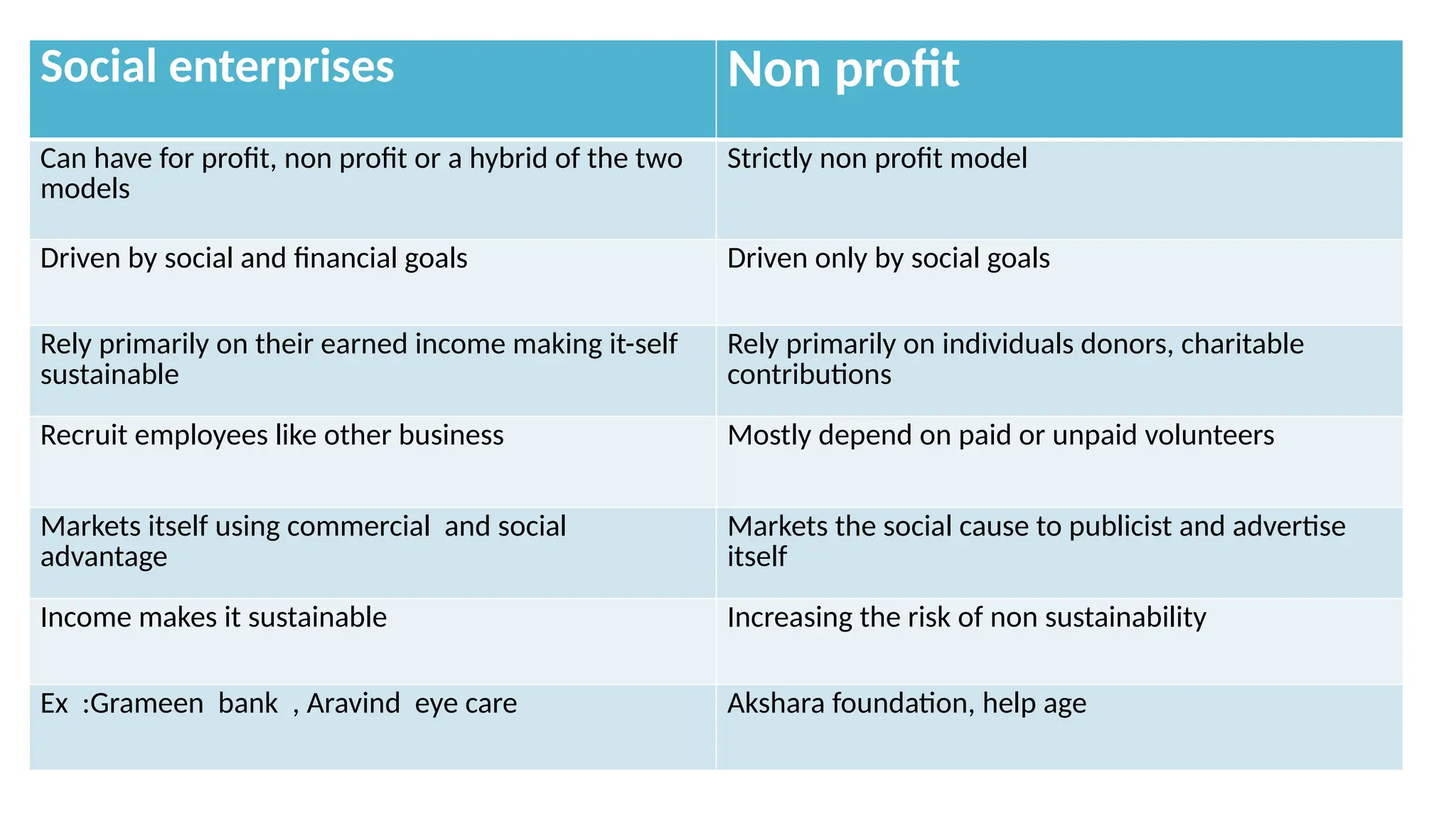
• Non Profit Organisation
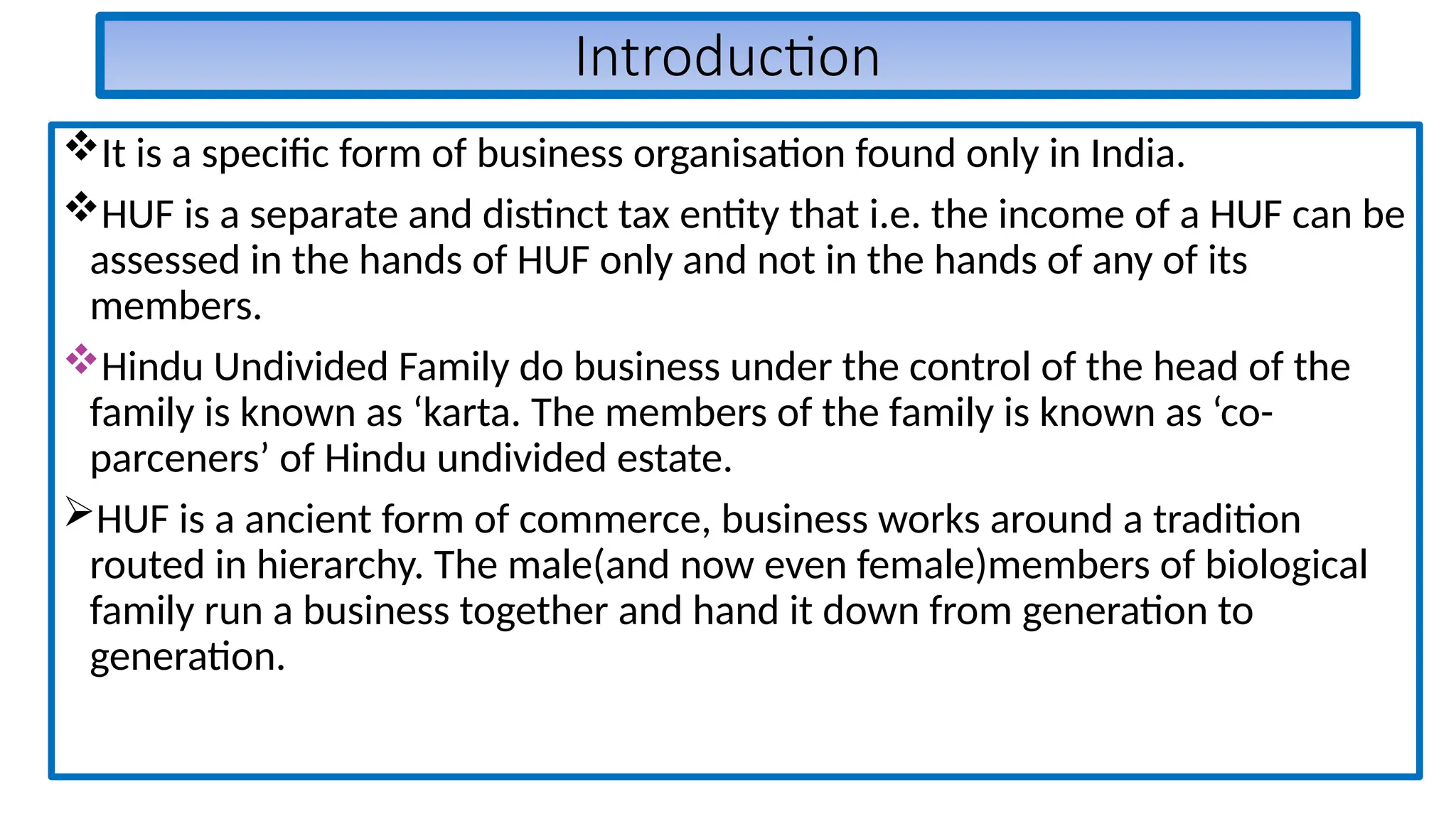
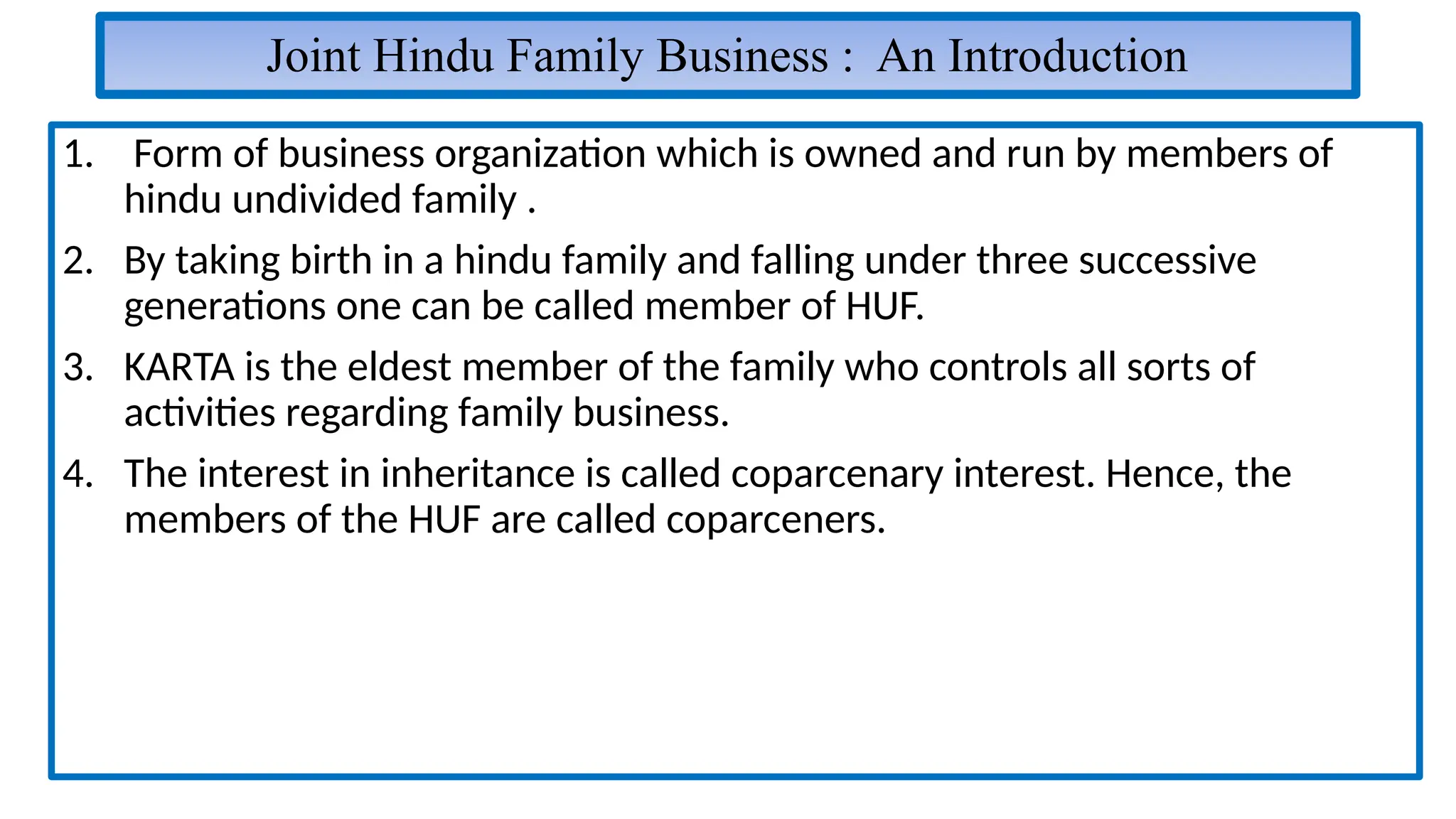
• Hindu Undivided Family (HUF)
• Formation of Company
1. Sole Proprietorship
• J.L. Hanson: “A type of business unit where one person is solely responsible
for providing the capital and bearing the risk of the enterprise, and for the
management of the business.”An individual start a business on his own,
without any registration.
• Can we say that “Sole Proprietorship refers to a business enterprise
exclusively owned, managed and controlled by a single person”
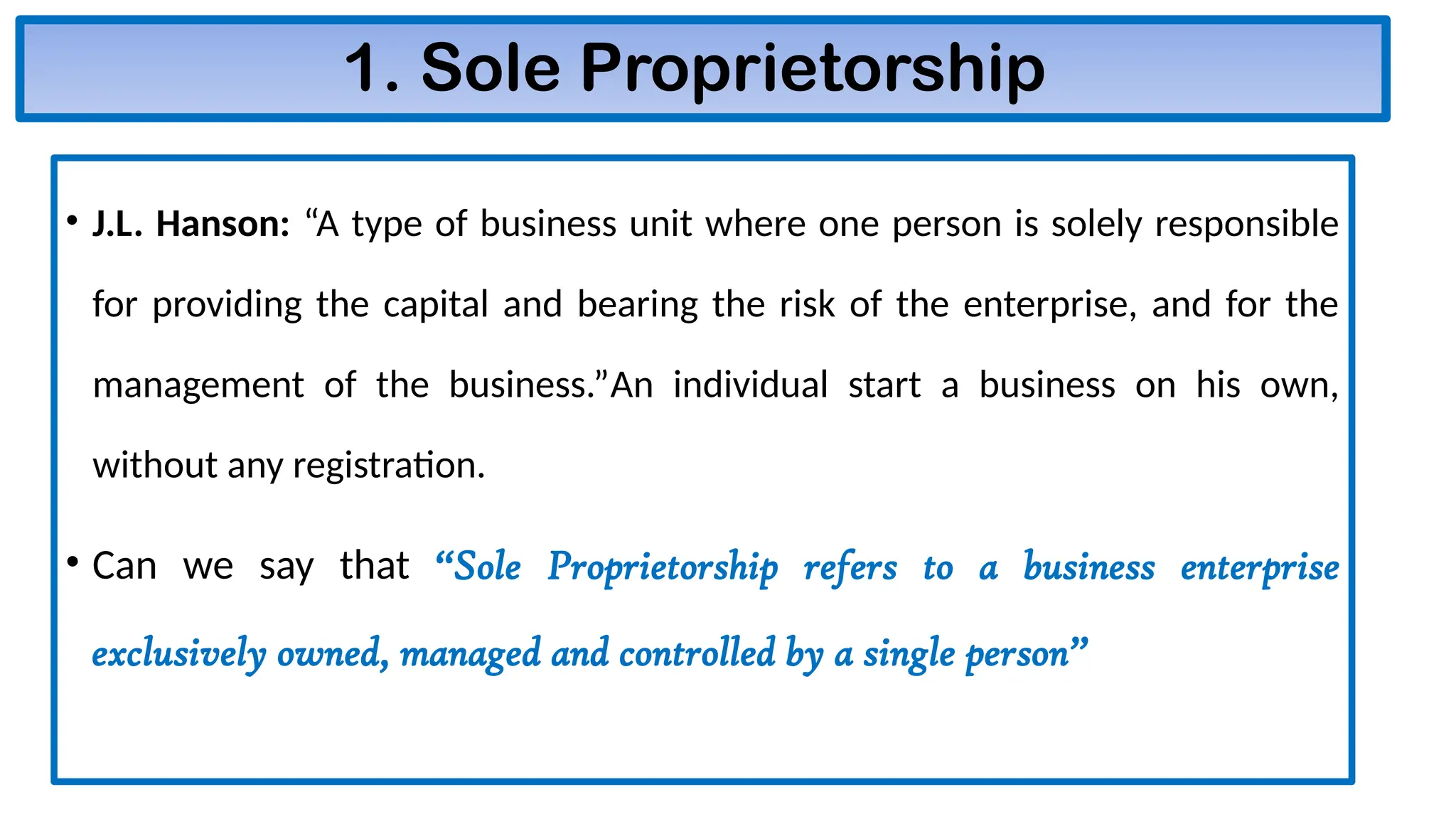
MRS Bector Food
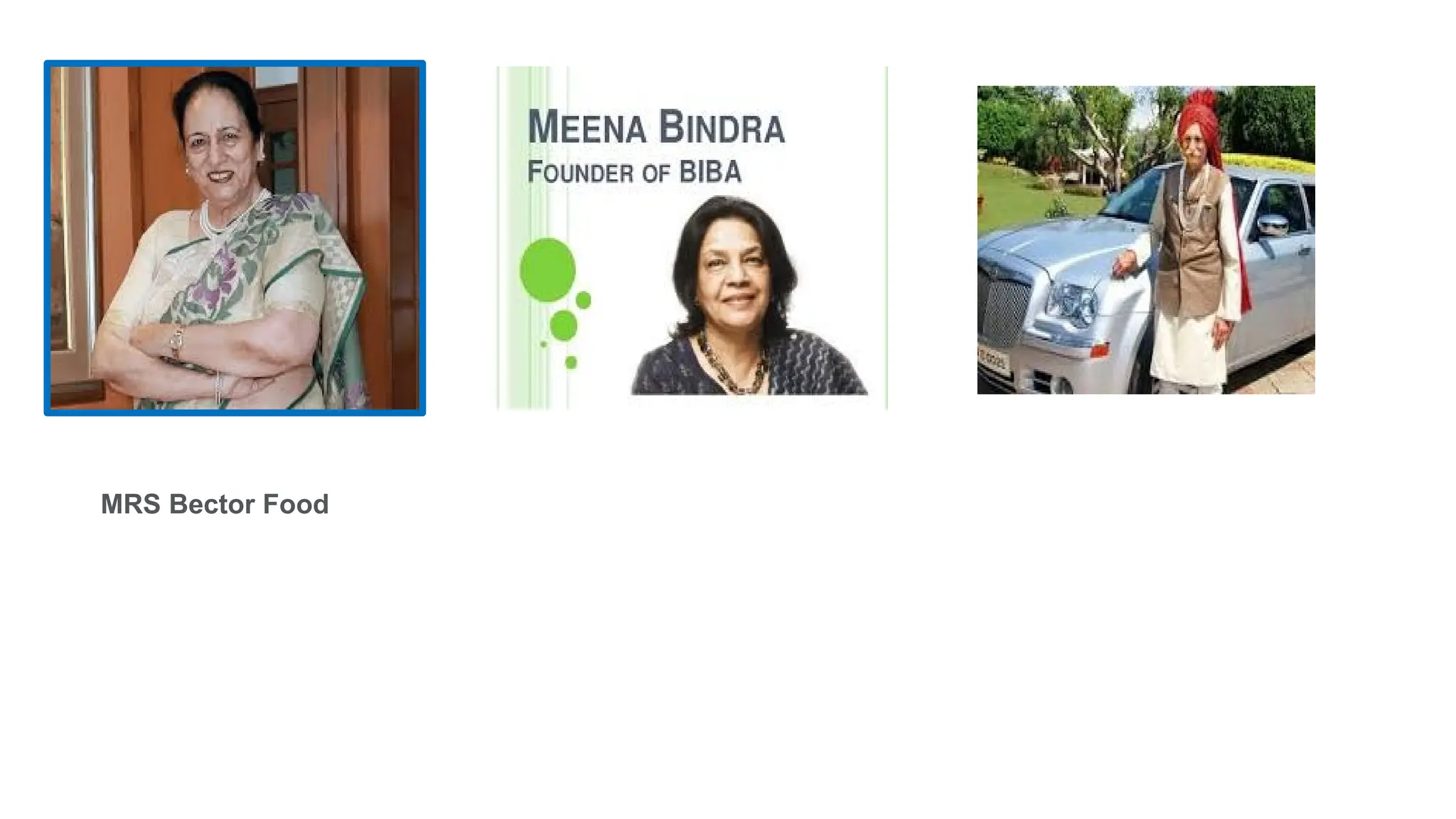
FEATURE
S
Easy formation
and closure
Unlimited
liability
Sole risk bearer
and profit
recipient
No separate
entity
Absolute
control
Lack of
business
continuity
MERITS Quick
decision
making
Confidentiality
of
information
Direct
incentive
Sense of
accomplishment
Ease of
formation
and closure
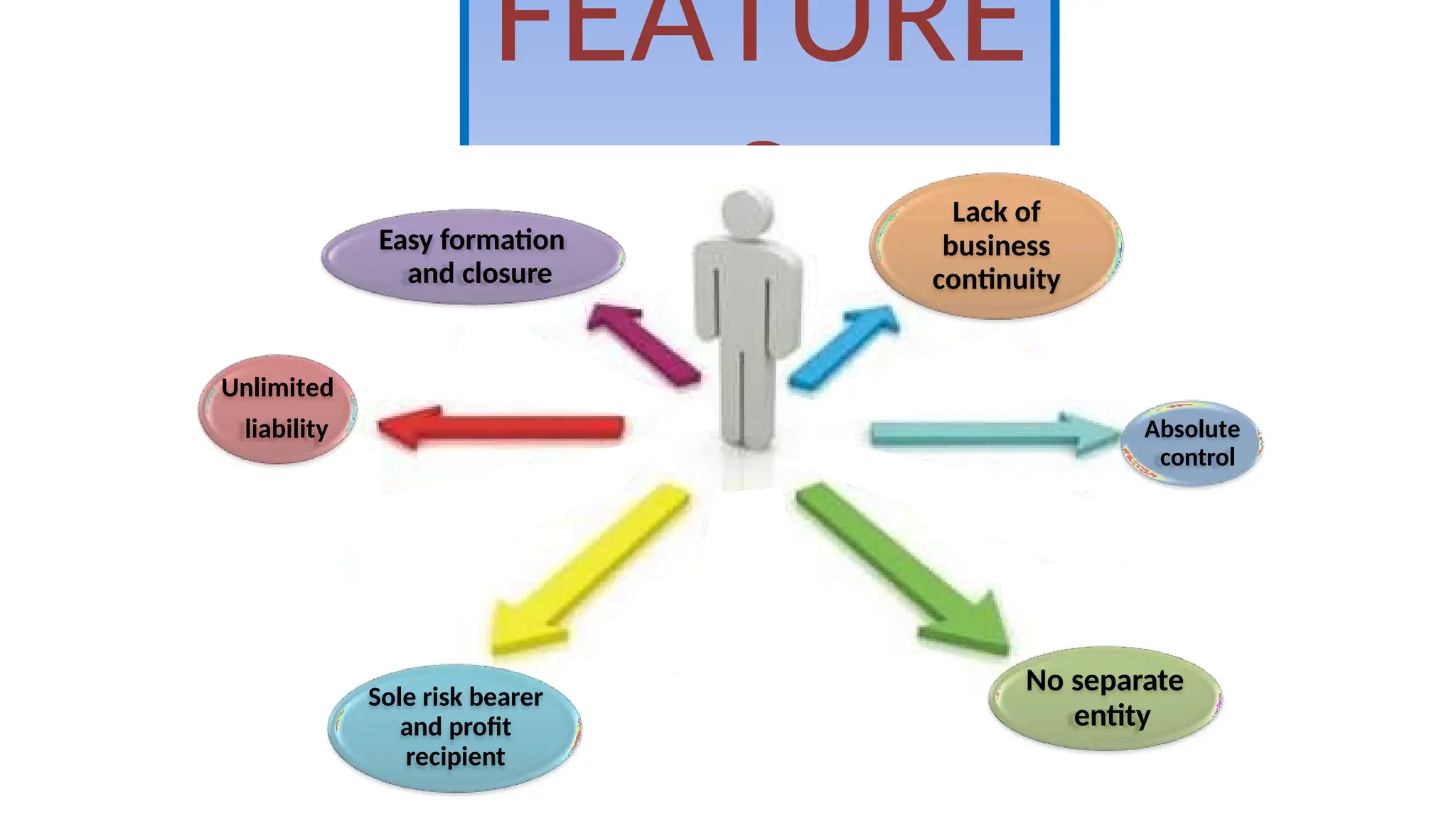
LIMITATION
S
Limited
Resource
s
Limited life
of a business
concern
Unlimited
liability
Limited
managerial
skills
OPTIONS FOR A SOLE PROPRIETOR
Procedure for Register Sole Proprietorship Firm
• Prepare documents required for sole Proprietorship Registration.
• Apply for MSME + CA Certification or GST Registration as per your
business need.
• Get Certification from the Government after the approval.
• Apply for a current bank account in any bank with your complete
documentation.
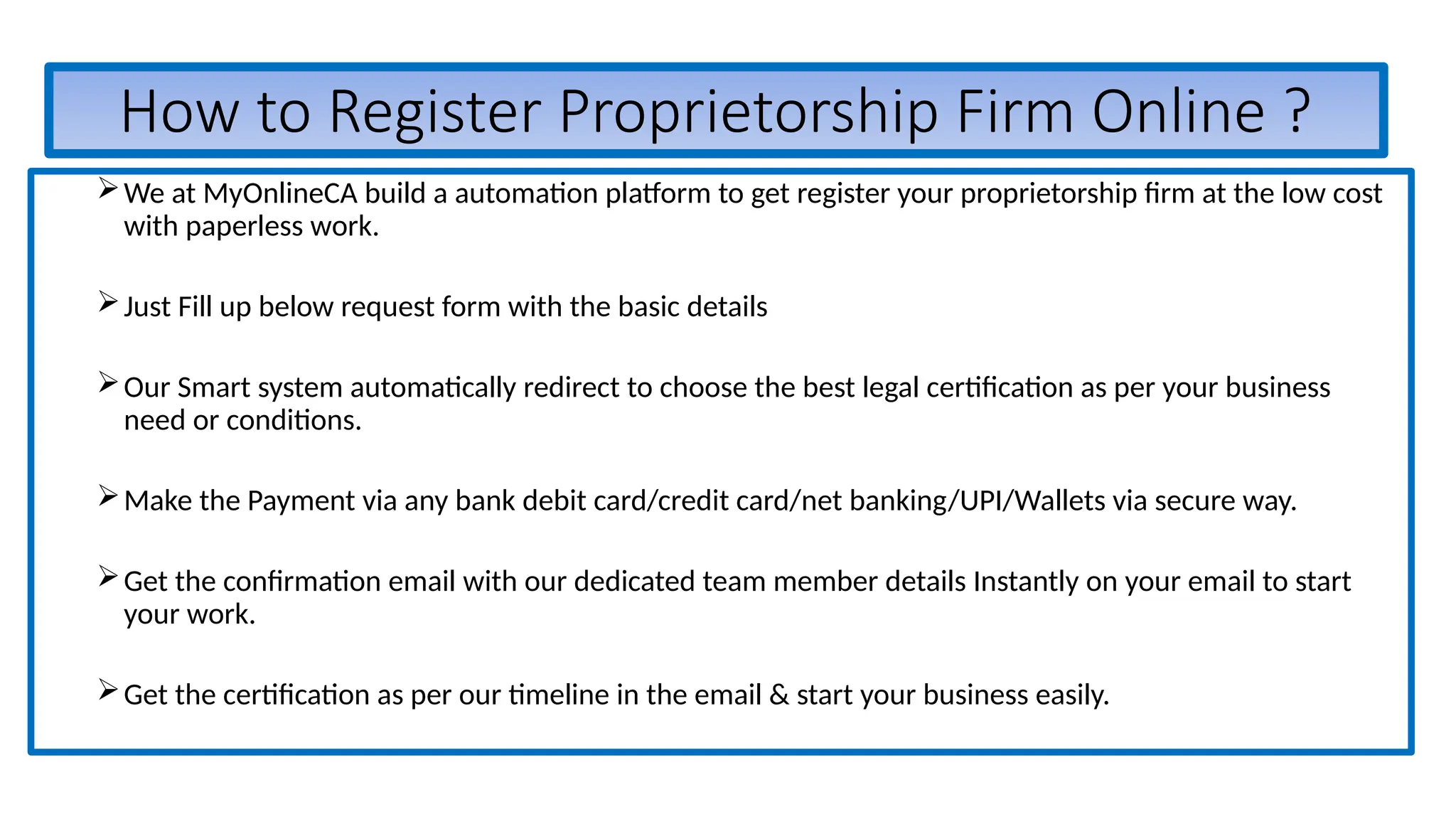
How to Register Proprietorship Firm Online ?
We at MyOnlineCA build a automation platform to get register your proprietorship firm at the low cost
with paperless work.
Just Fill up below request form with the basic details
Our Smart system automatically redirect to choose the best legal certification as per your business
need or conditions.
Make the Payment via any bank debit card/credit card/net banking/UPI/Wallets via secure way.
Get the confirmation email with our dedicated team member details Instantly on your email to start
your work.
Get the certification as per our timeline in the email & start your business easily.
According to The
Indian Partnership
Act, 1932,
“Partnership is
the
relation between 2
persons who have
agreed to share the
profit of the
business carried on
by all or any one of
them acing for all.”
Partnership
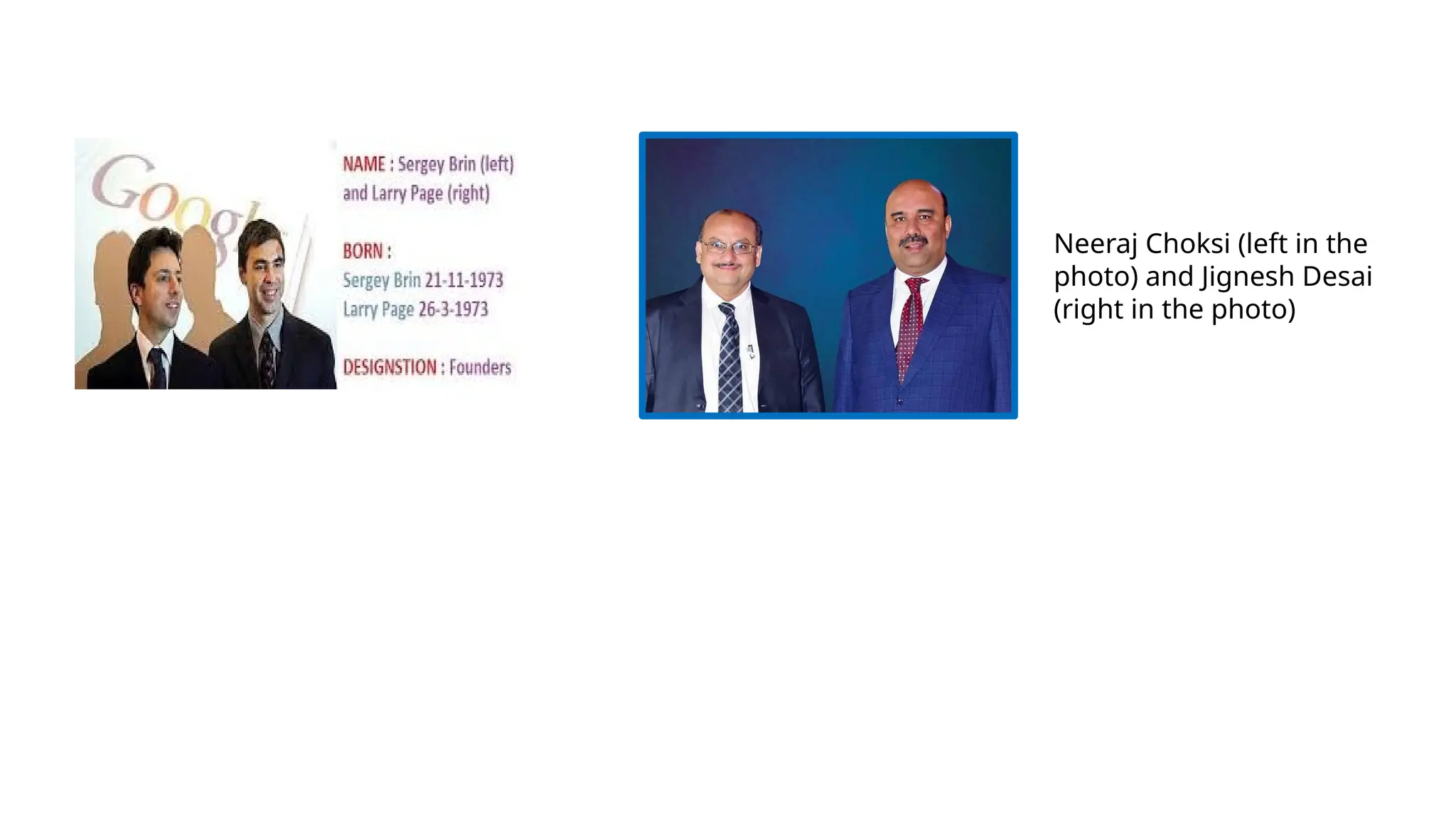
Neeraj Choksi (left in the
photo) and Jignesh Desai
(right in the photo)
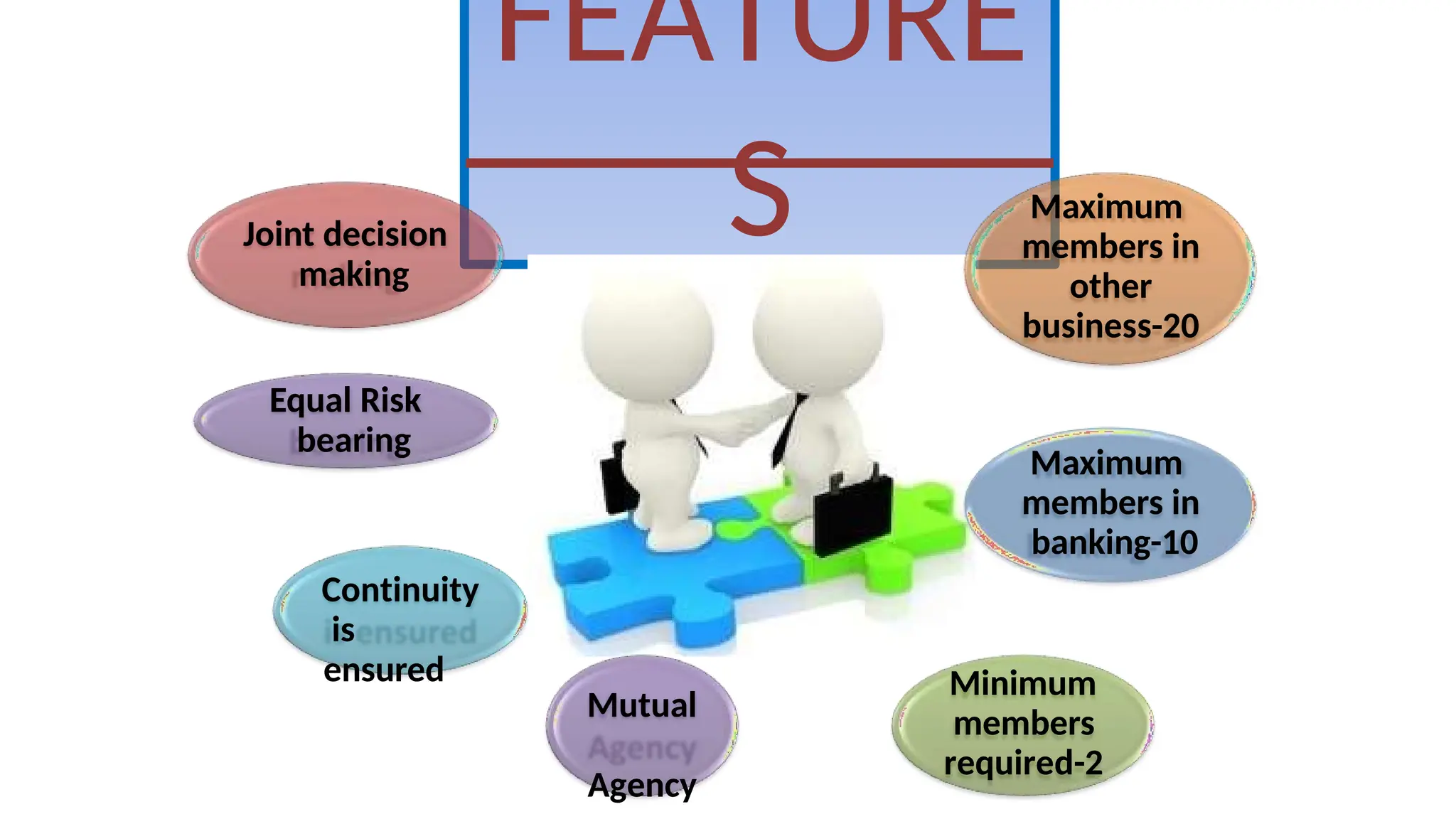
FEATURE
S
Equal Risk
bearing
Joint decision
making
Continuity
is
ensured Minimum
members
required-2
Maximum
members in
banking-10
Maximum
members in
other
business-20
Mutual
Agency
MERITS
Balanced
decision
making
Ease of
formation
and closure
More funds
Sharing of
risks
Secrecy
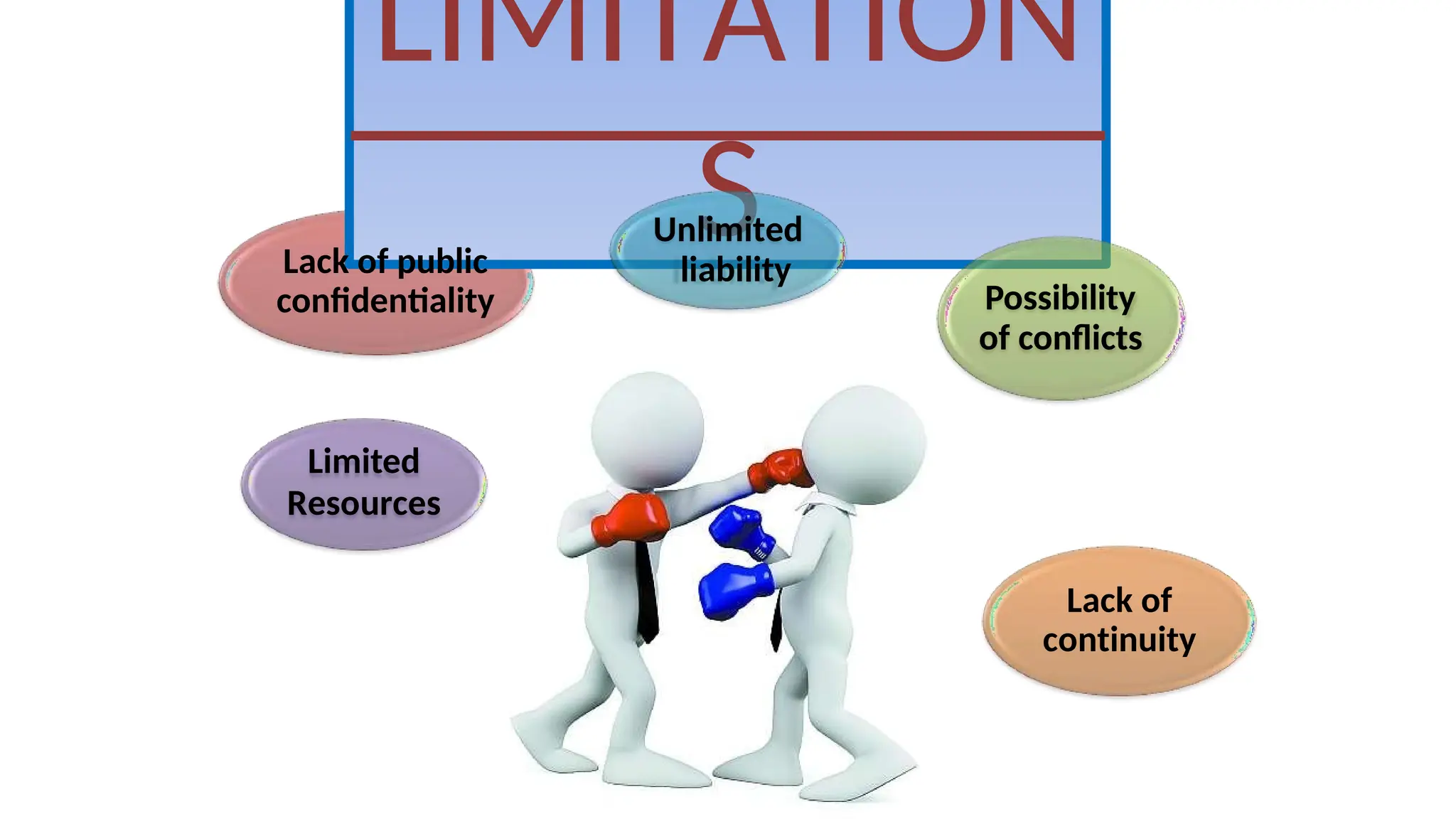
LIMITATION
S
Limited
Resources
Possibility
of conflicts
Unlimited
liability
Lack of
continuity
Lack of public
confidentiality
TYPES OF PARTNERS
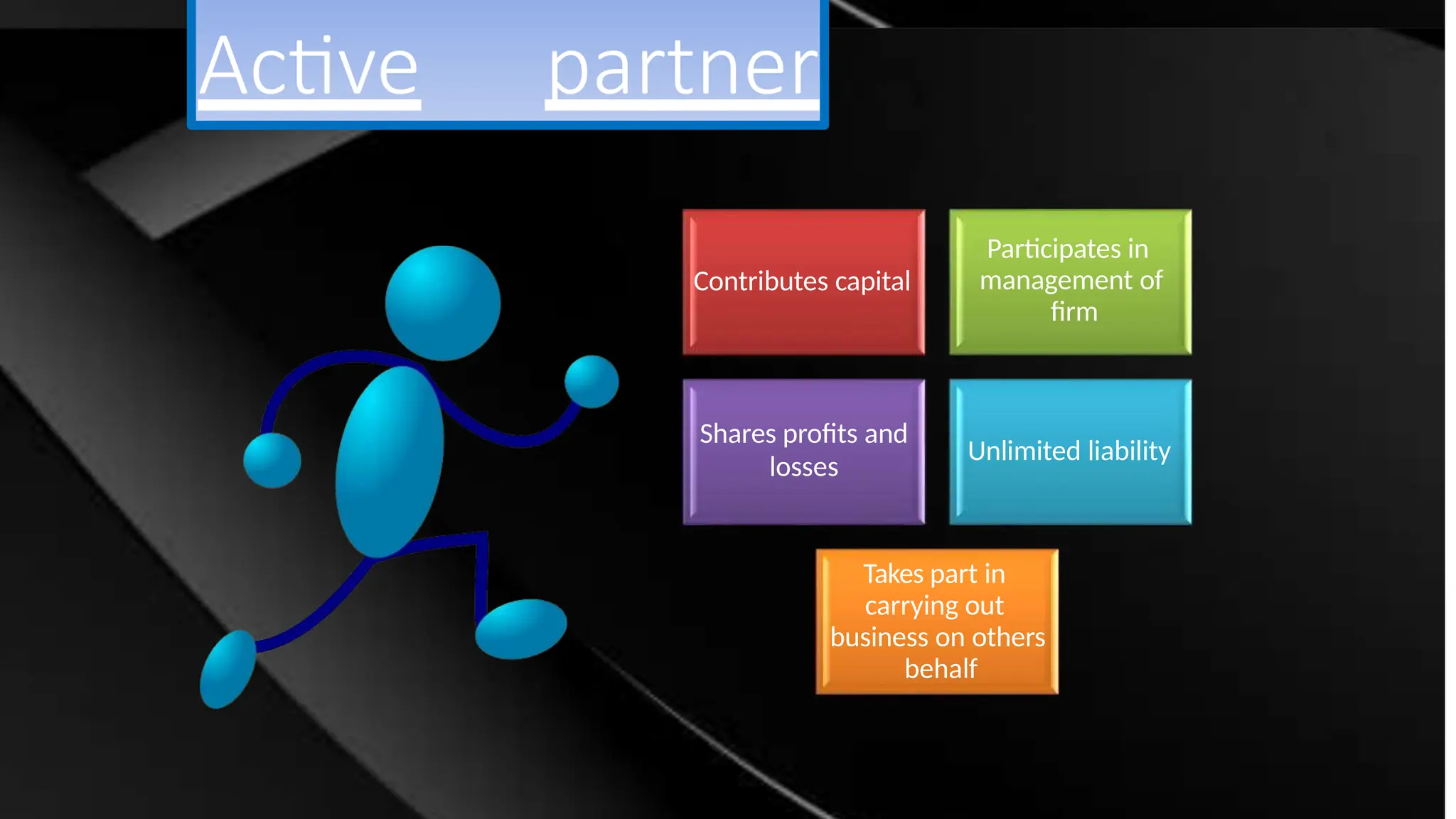
Active partner
Contributes capital
Participates in
management of
firm
Shares profits and
losses
Unlimited liability
Takes part in
carrying out
business on others
behalf
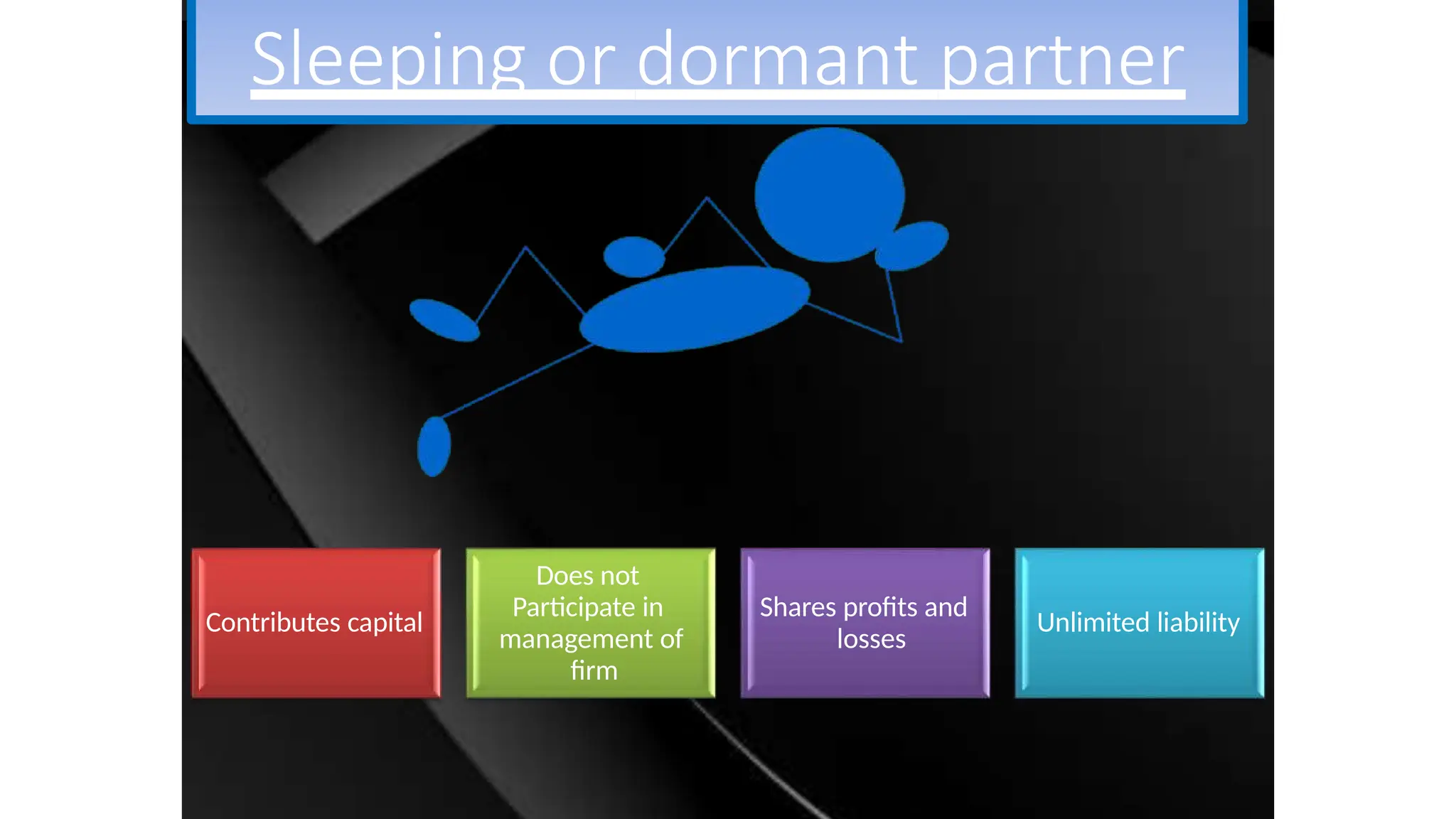
Sleeping or dormant partner
Contributes capital
Does not
Participate in
management of
firm
Shares profits and
losses
Unlimited liability
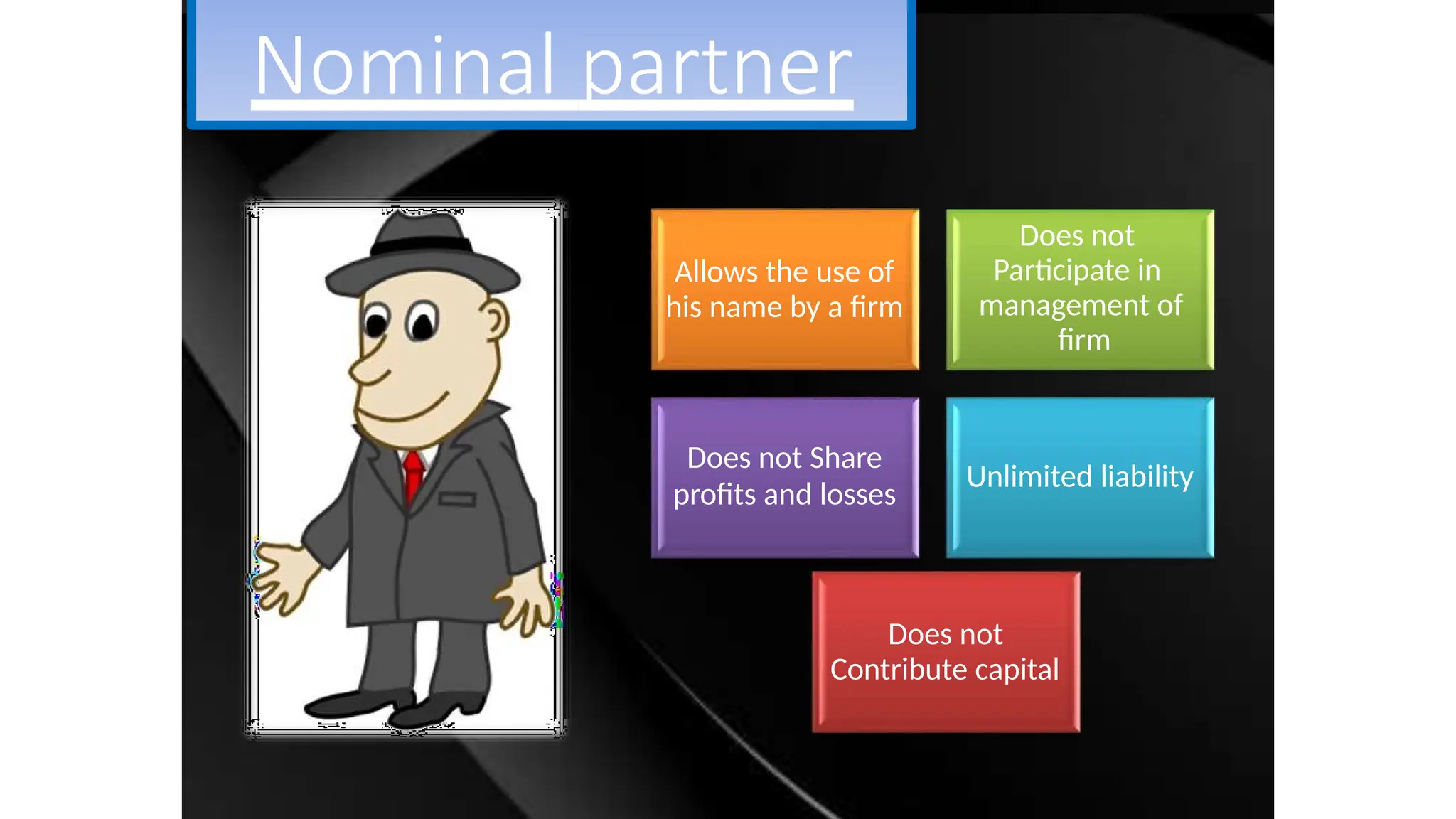
Nominal partner
Does not
Contribute capital
Does not
Participate in
management of
firm
Does not Share
profits and losses
Unlimited liability
Allows the use of
his name by a firm
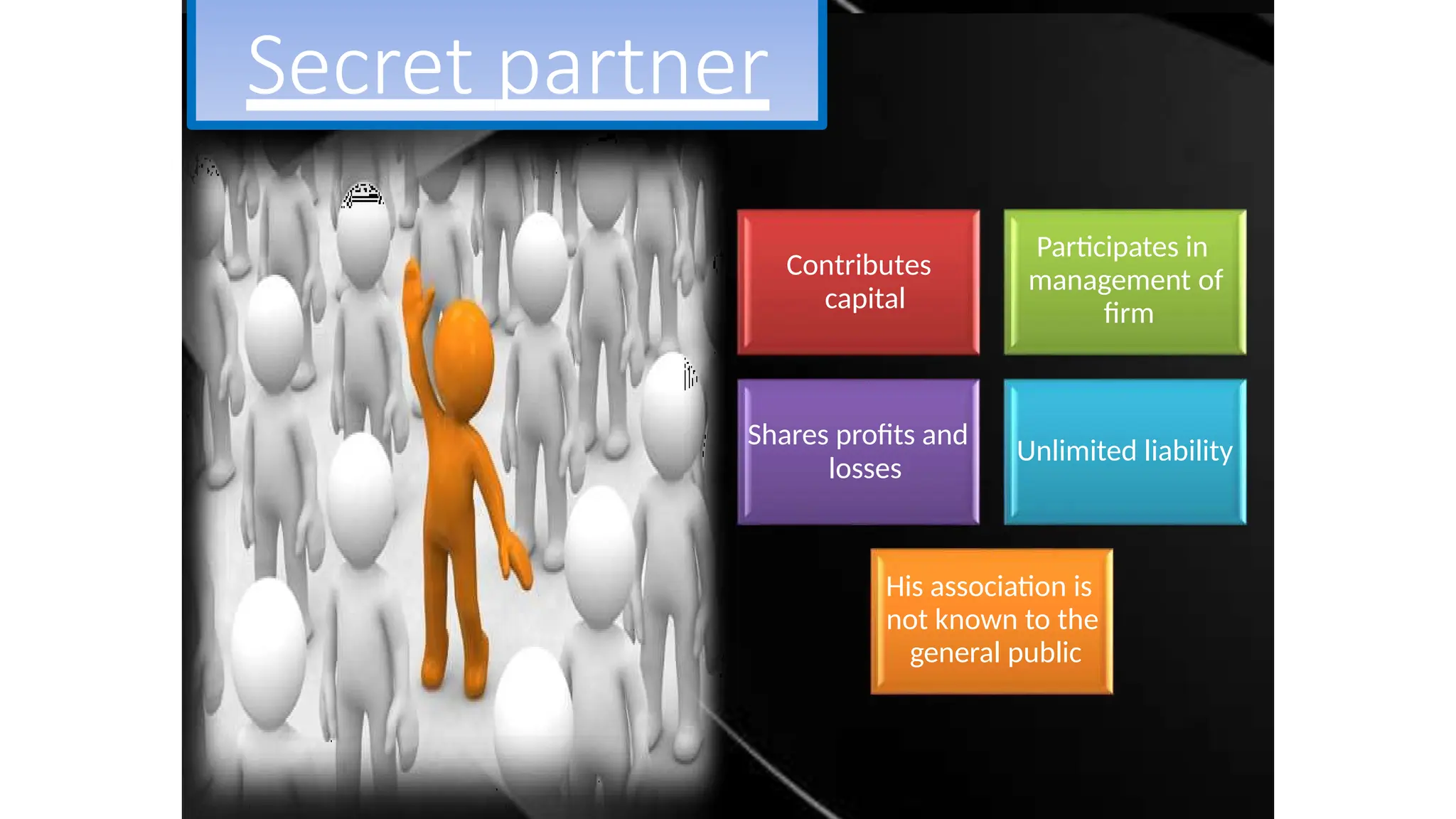
Secret partner
Contributes
capital
Participates in
management of
firm
Shares profits and
losses
Unlimited liability
His association is
not known to the
general public
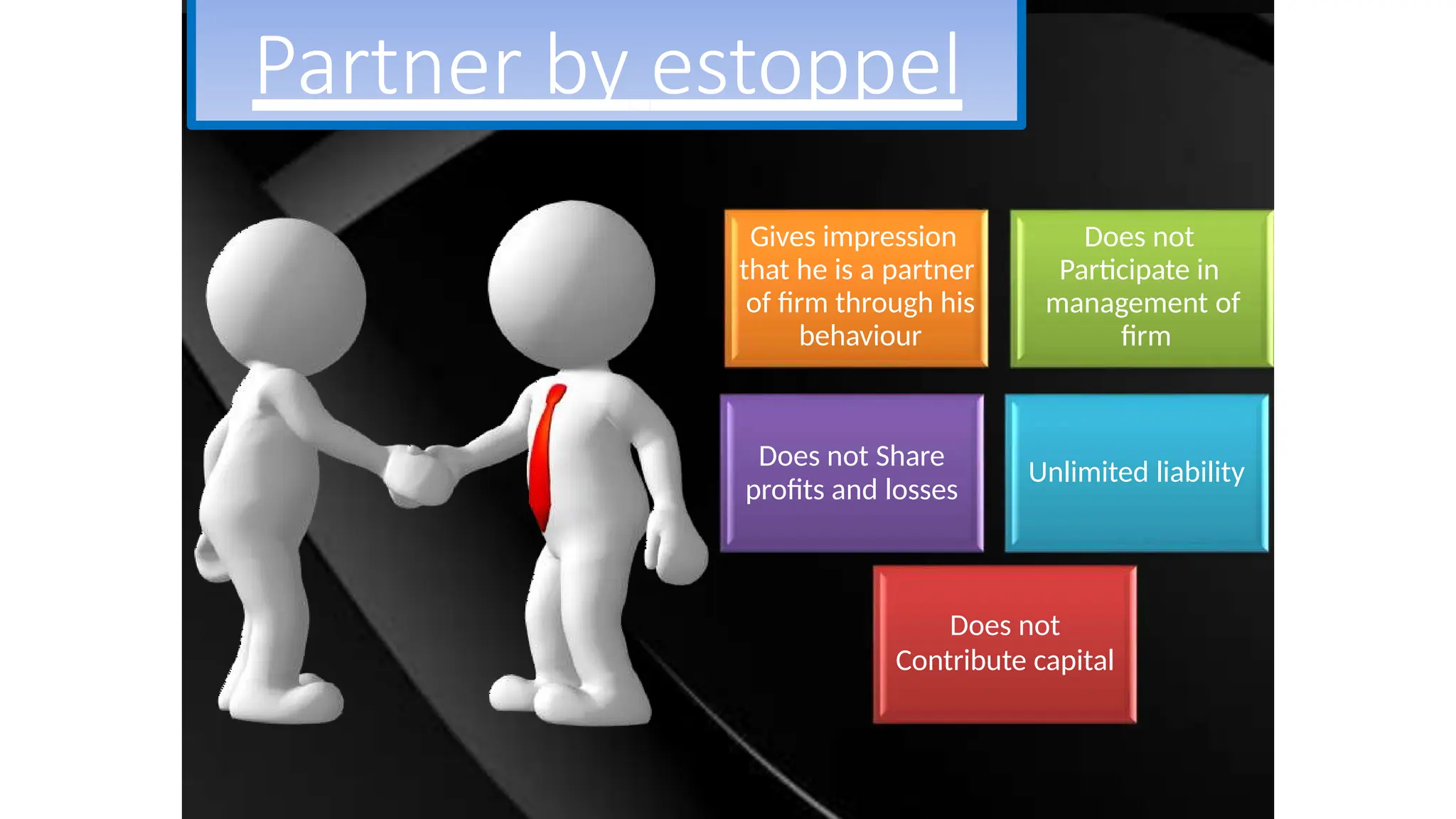
Partner by estoppel
Does not
Contribute capital
Does not
Participate in
management of
firm
Does not Share
profits and losses
Unlimited liability
Gives impression
that he is a partner
of firm through his
behaviour
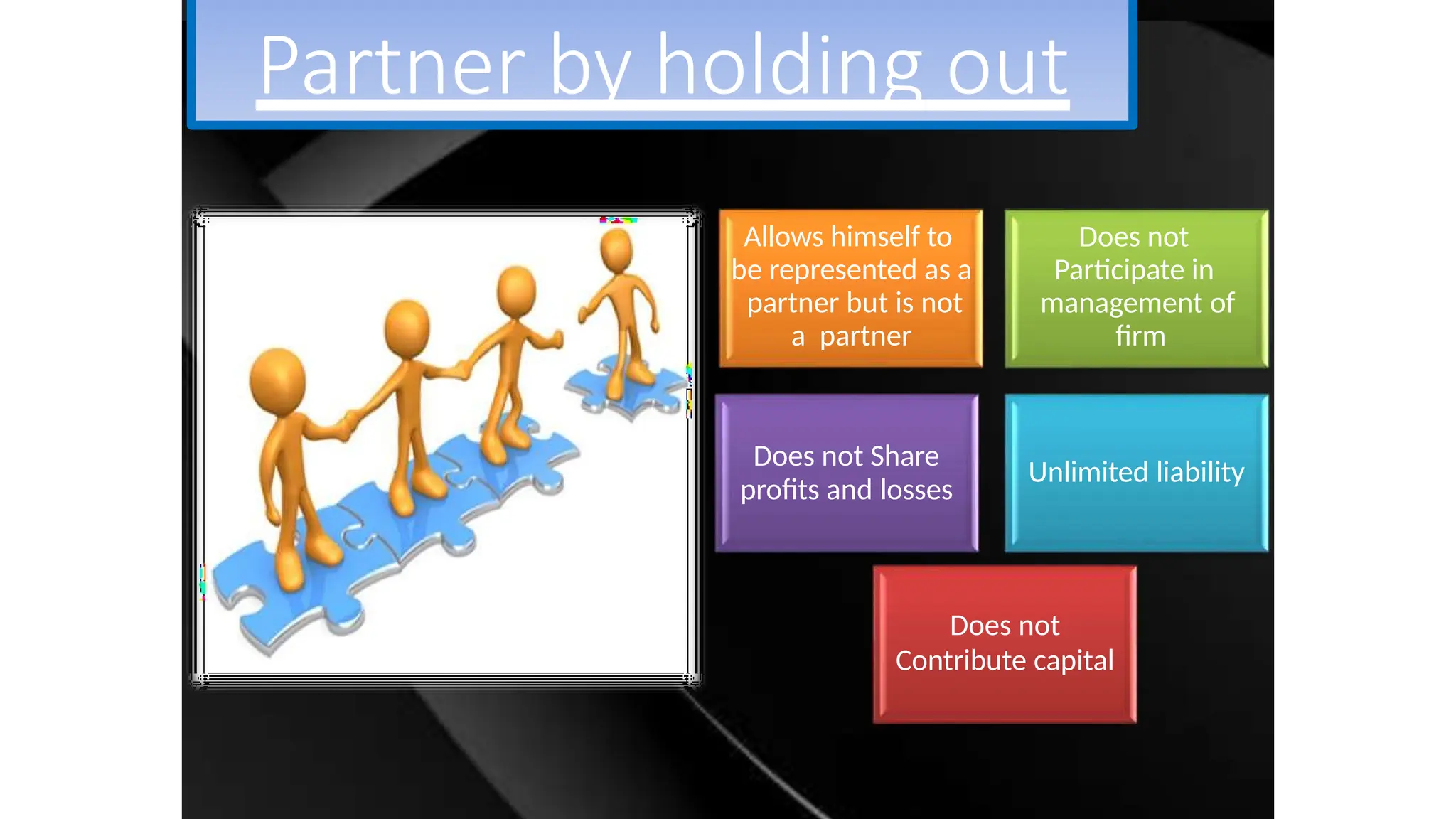
Partner by holding out
Does not
Contribute capital
Does not
Participate in
management of
firm
Does not Share
profits and losses
Unlimited liability
Allows himself to
be represented as a
partner but is not
a partner
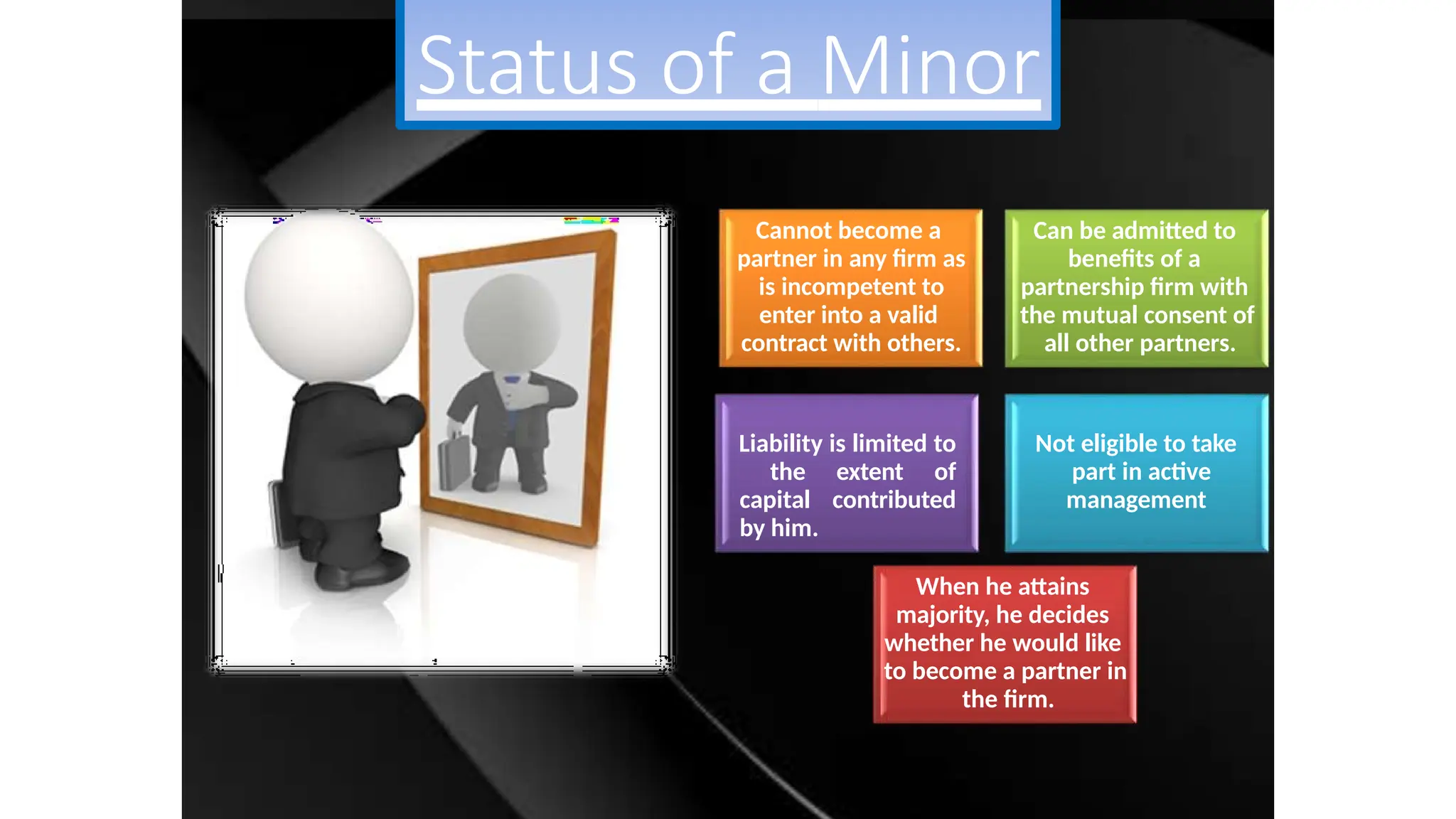
Status of a Minor
When he attains
majority, he decides
whether he would like
to become a partner in
the firm.
Can be admitted to
benefits of a
partnership firm with
the mutual consent of
all other partners.
Liability is limited to
the extent of
capital contributed
by him.
Not eligible to take
part in active
management
Cannot become a
partner in any firm as
is incompetent to
enter into a valid
contract with others.
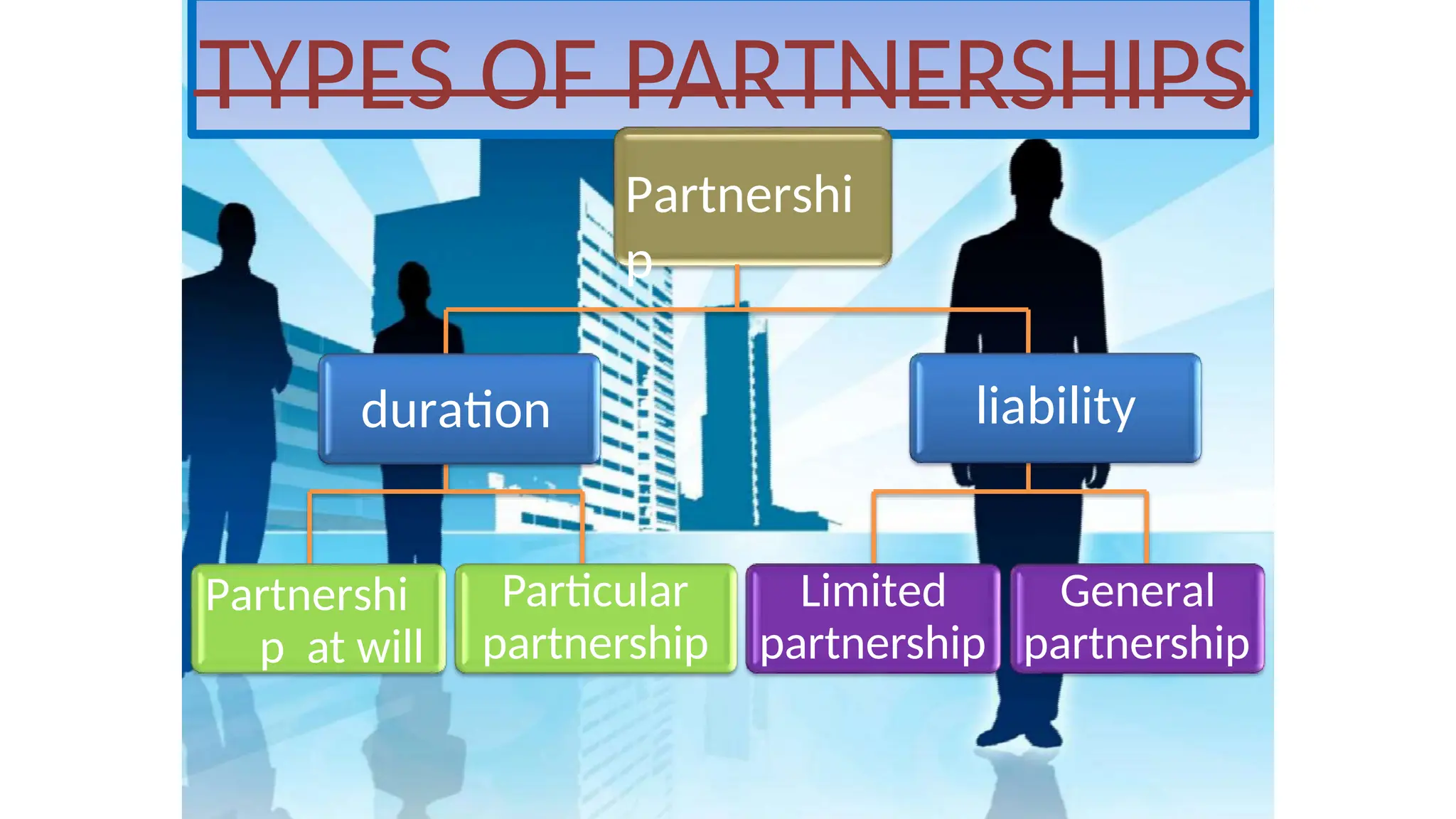
TYPES OF PARTNERSHIPS
Partnershi
p
duration liability
Partnershi
p at will
Particular
partnership
Limited
partnership
General
partnership
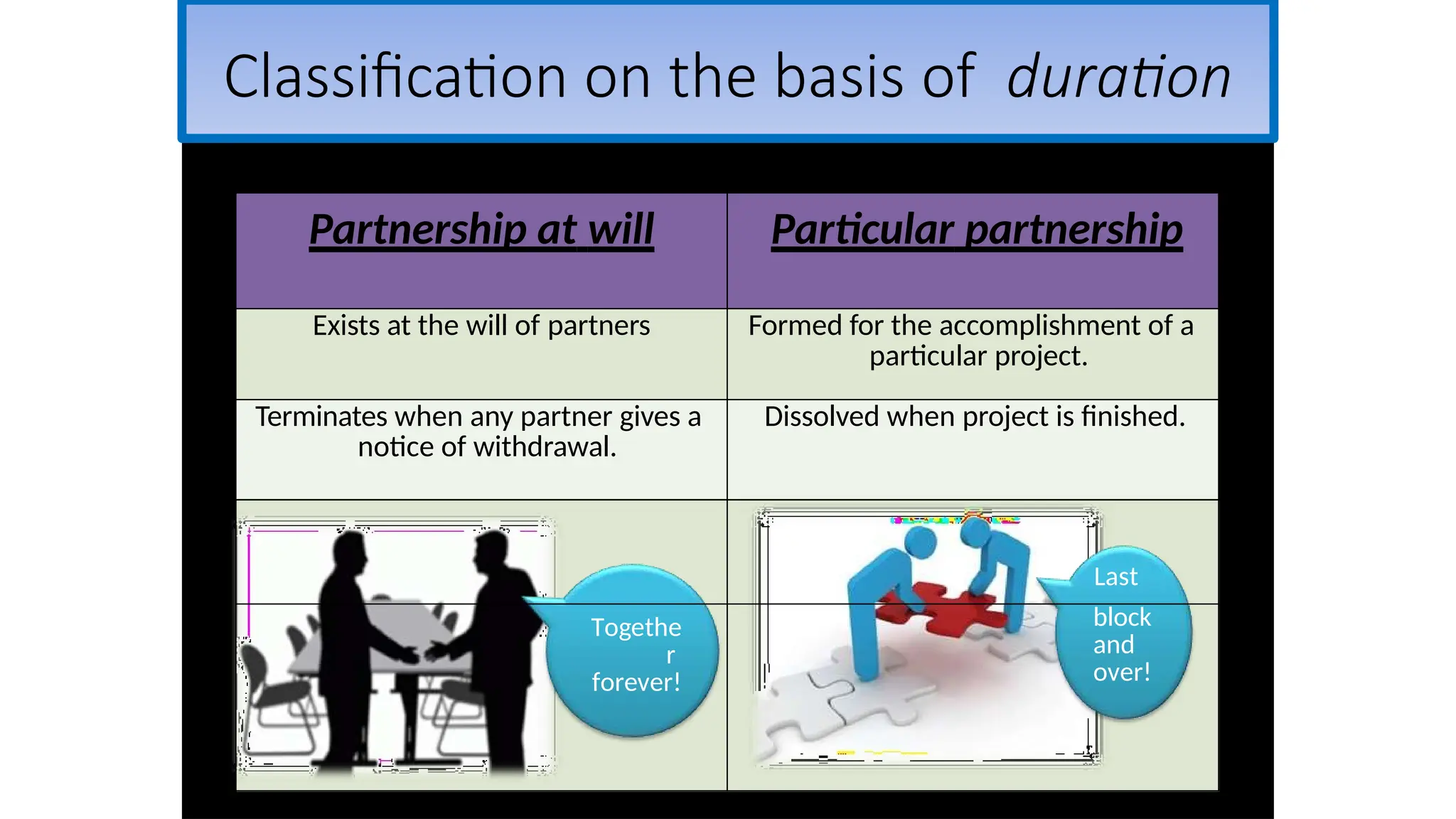
Classification on the basis of duration
Partnership at will Particular partnership
Exists at the will of partners Formed for the accomplishment of a
particular project.
Terminates when any partner gives a
notice of withdrawal.
Dissolved when project is finished.
Last
Togethe
r
forever!
block
and
over!
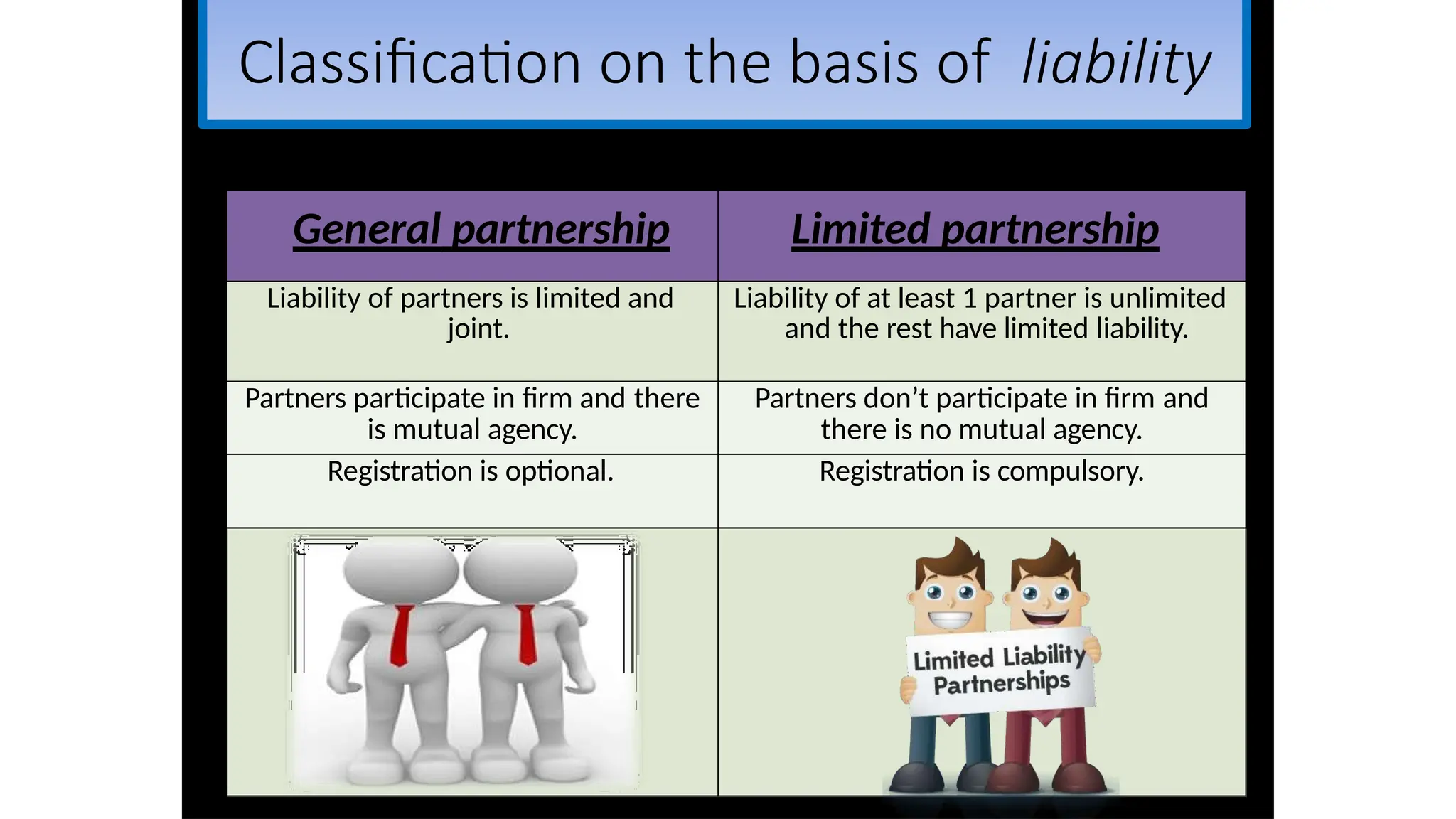
Classification on the basis of liability
General partnership Limited partnership
Liability of partners is limited and
joint.
Liability of at least 1 partner is unlimited
and the rest have limited liability.
Partners participate in firm and there
is mutual agency.
Partners don’t participate in firm and
there is no mutual agency.
Registration is optional. Registration is compulsory.
EXISTING PARTNERSHIPS
Partnership deed
The written
agreement which
specifies the terms
and conditions
that govern the
partnership is
called a
partnership deed.
Contents of a
partnership
deed
Name
of
the
firm
Nature
and
location of
business
Duration
of
business
Investmen
t made by
each
partner
Distribution
of profits
and losses
Duties and
obligations
of the
partners
Salaries and
withdrawal
of the
partners
Terms
governing
admission,
retirement
and expulsion
of a partner
Interest on
capital
and
drawings
Procedure
for
dissolution
of firm
Preparation
and
auditing of
accounts
Methods
of
solving
disputes
Registration of a firm means the entering of
firm’s name, along with the relevant
prescribed particulars, I the register of firm
kept with the Registrar of Firms.
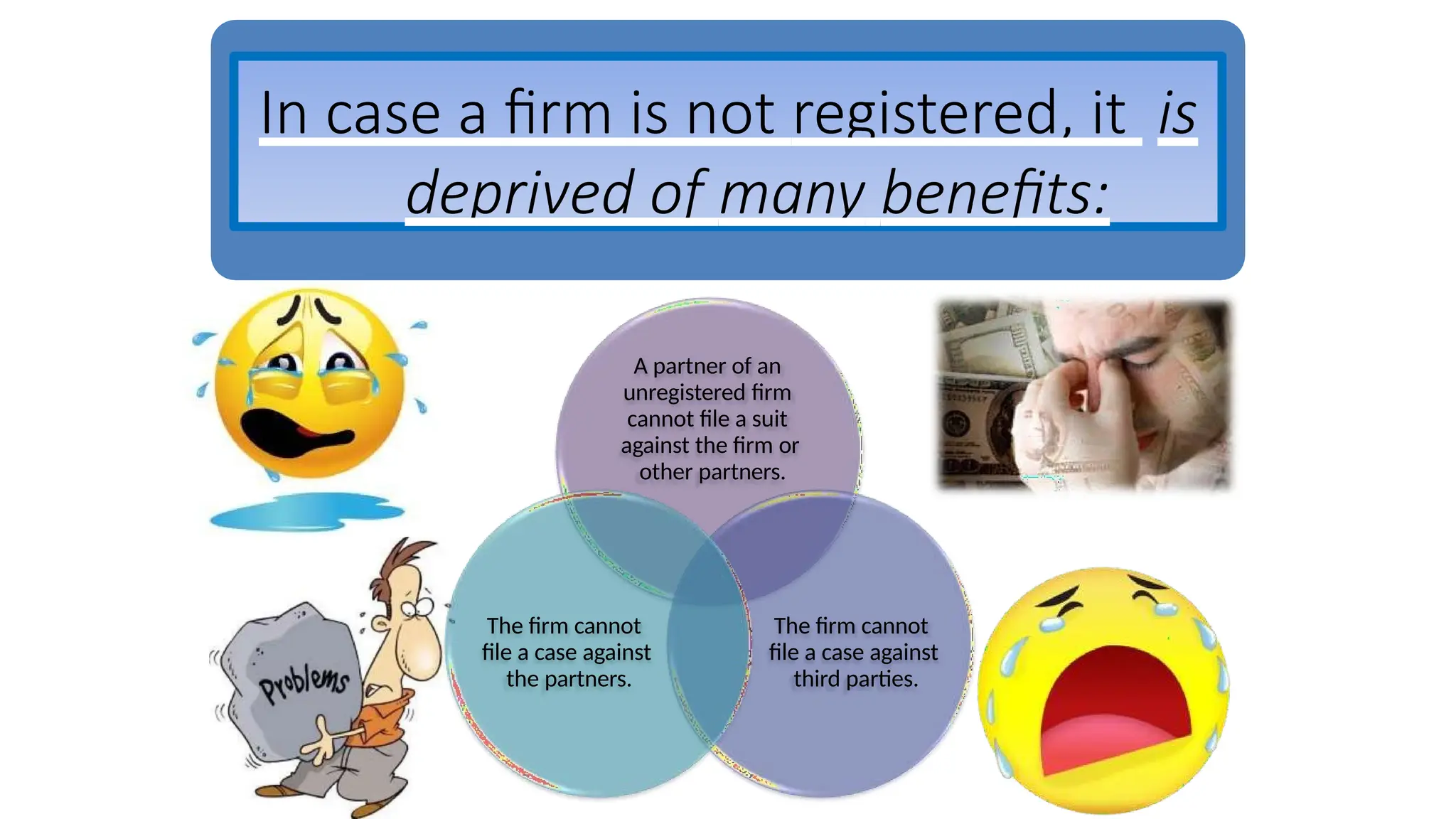
In case a firm is not registered, it is
deprived of many benefits:
A partner of an
unregistered firm
cannot file a suit
against the firm or
other partners.
The firm cannot
file a case against
third parties.
The firm cannot
file a case against
the partners.
Procedure for registration
1.Submission of
application in the
prescribed form
to the Registrar of
firms. The
application should
include:
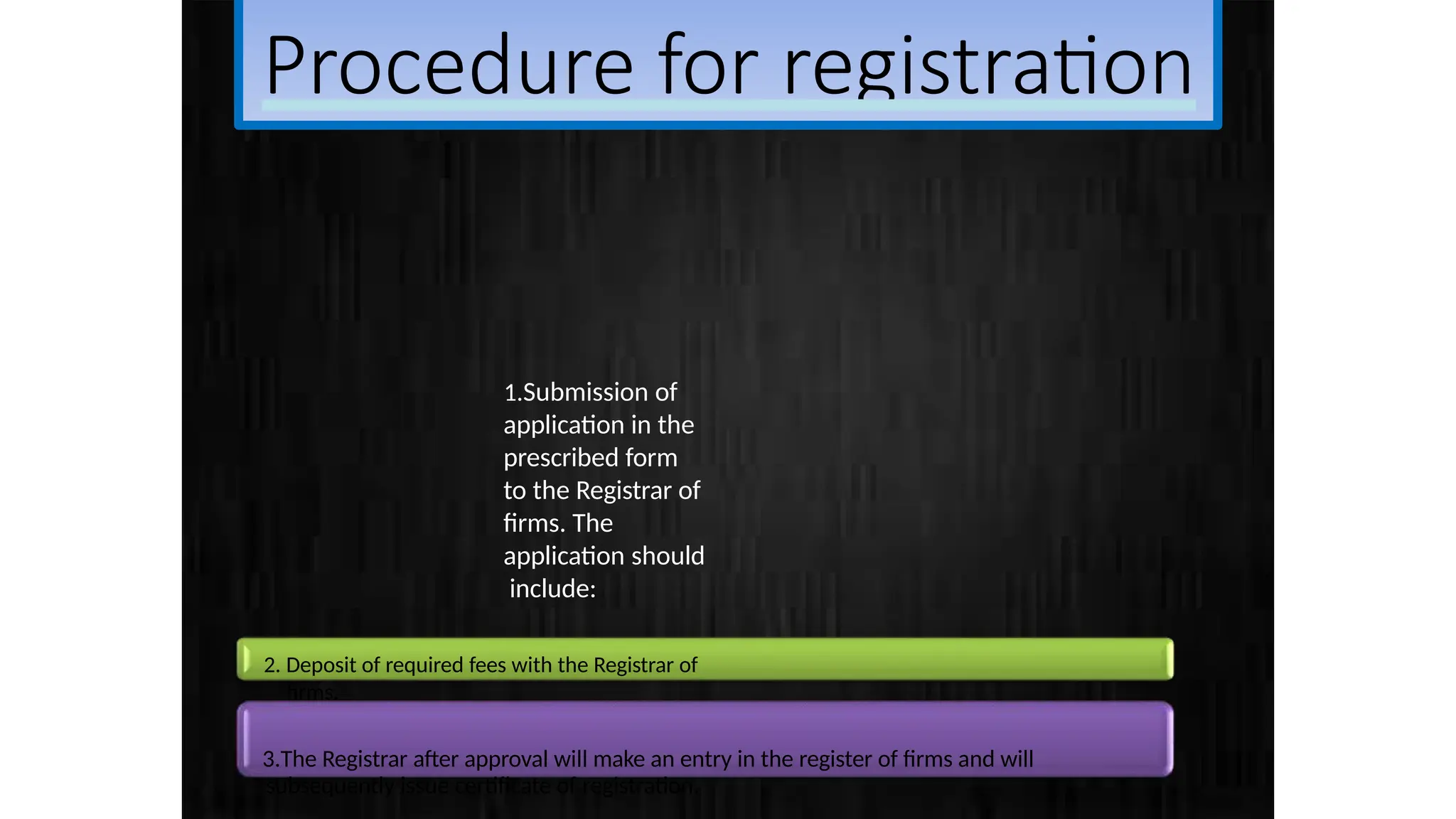
2. Deposit of required fees with the Registrar of
firms.
3.The Registrar after approval will make an entry in the register of firms and will
subsequently issue certificate of registration.
3. Cooperative / Society / Trusts
• Term cooperation is derived from the Latin word ‘co-operari’, where the word ‘Co’ means
‘with’ and ‘operari’ mean ‘to work’.
• It is a voluntary association of persons who work together to promote their economic interest.
• A corporation or an association that conducts business for the benefit of the general public
without a profit motive.
• The most basic difference is that nonprofit corporations cannot operate for profit. That is, they
cannot distribute corporate income to shareholders.
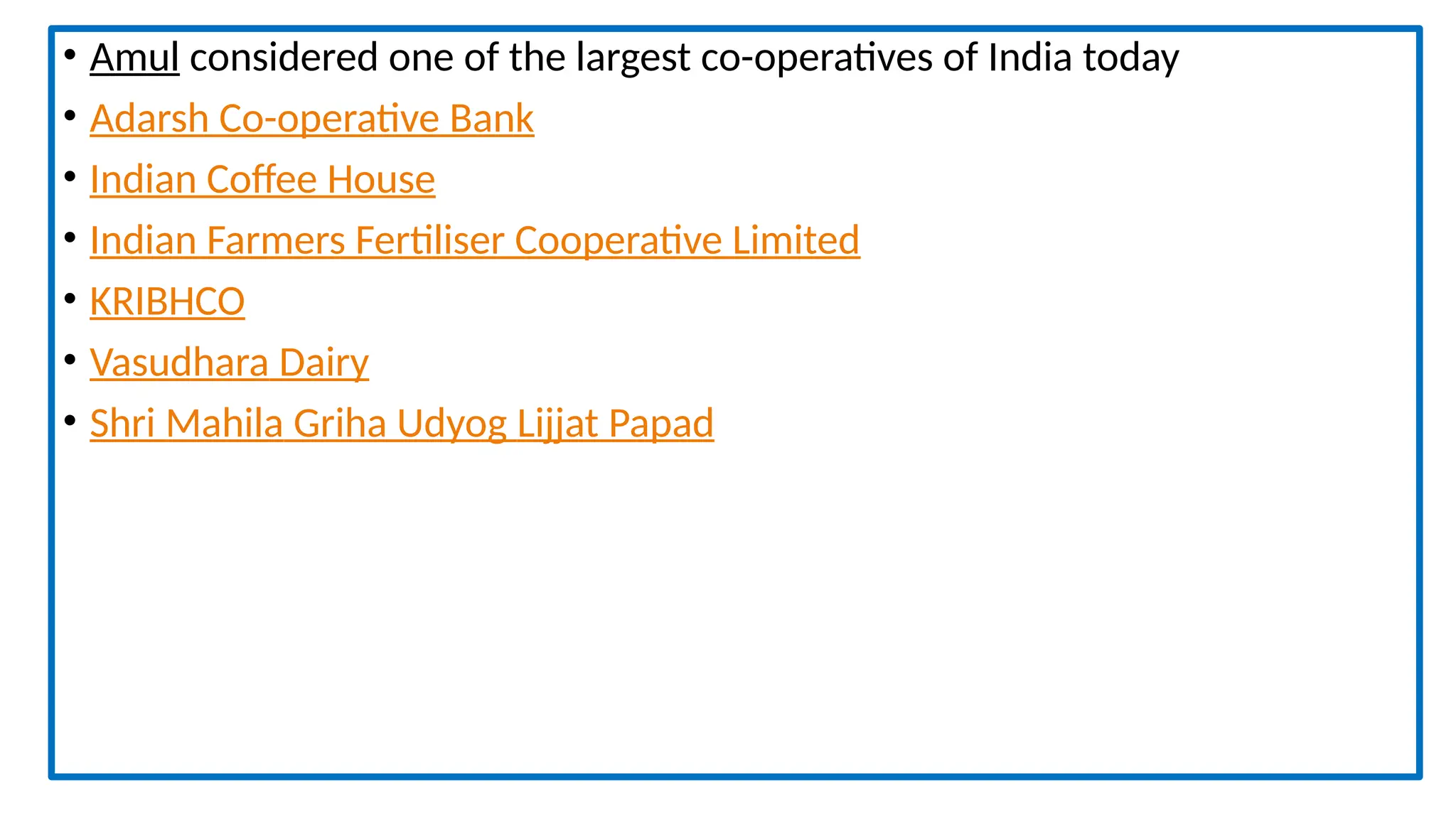
• Amul considered one of the largest co-operatives of India today
• Adarsh Co-operative Bank
• Indian Coffee House
• Indian Farmers Fertiliser Cooperative Limited
• KRIBHCO
• Vasudhara Dairy
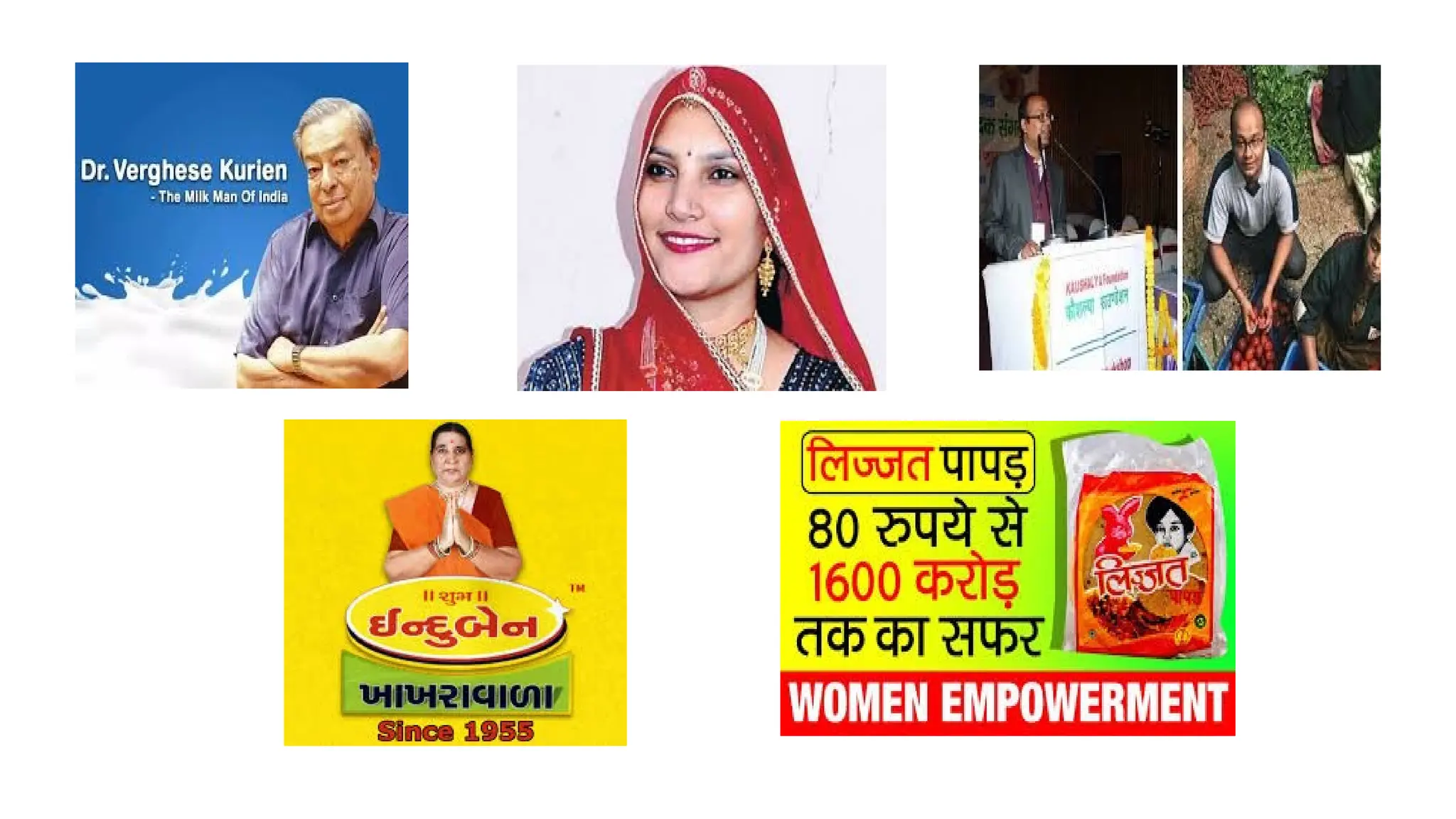
• Shri Mahila Griha Udyog Lijjat Papad
Characteristics
• Voluntary Association
• Open Membership
• Service Motive
• Distribution of Surplus
• Number of Members
• Registration of the Society: registered under The Cooperative Societies Act 1912
• Capital
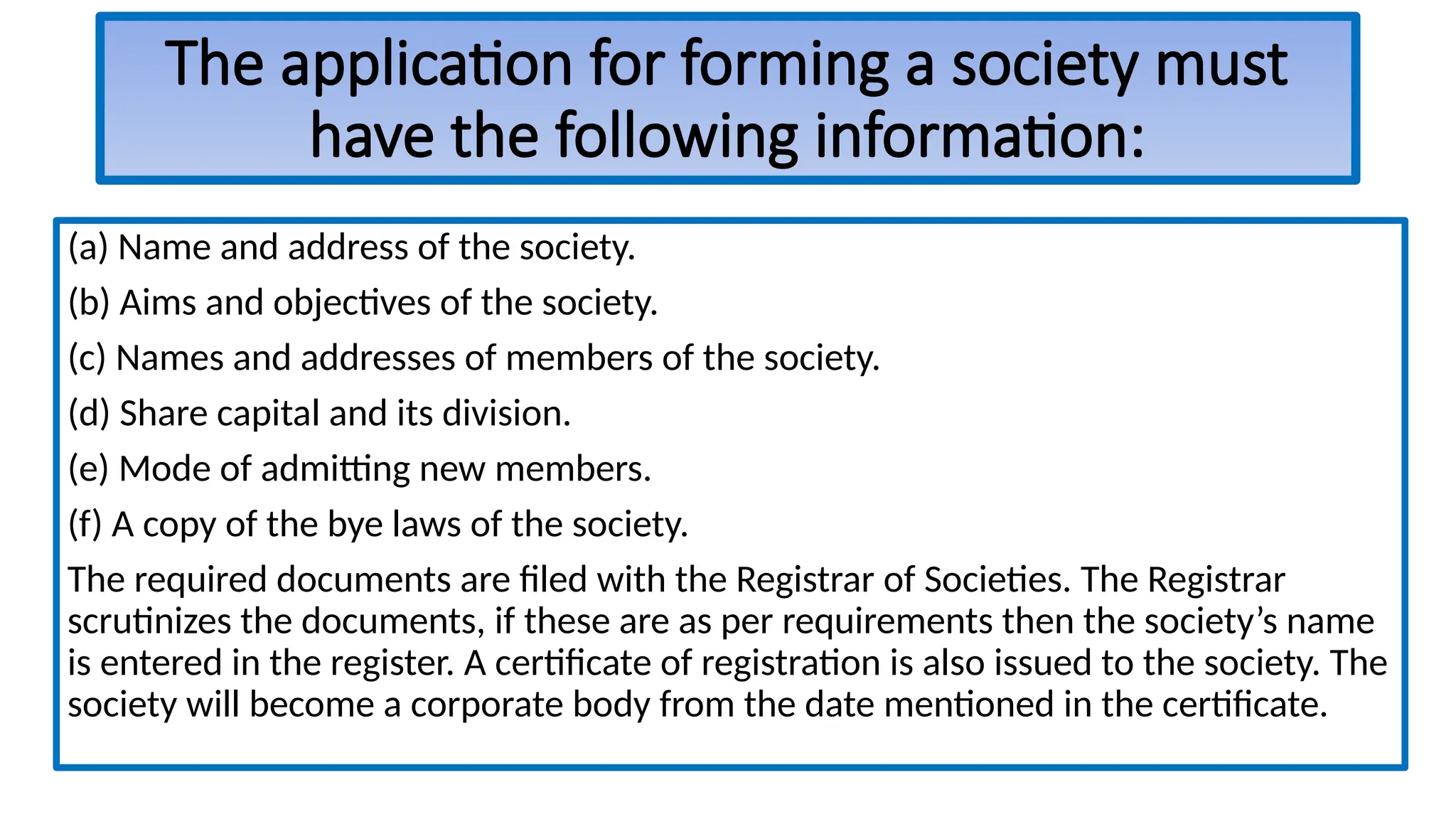
The application for forming a society must
have the following information:
(a) Name and address of the society.
(b) Aims and objectives of the society.
(c) Names and addresses of members of the society.
(d) Share capital and its division.
(e) Mode of admitting new members.
(f) A copy of the bye laws of the society.
The required documents are filed with the Registrar of Societies. The Registrar
scrutinizes the documents, if these are as per requirements then the society’s name
is entered in the register. A certificate of registration is also issued to the society. The
society will become a corporate body from the date mentioned in the certificate.
Definition
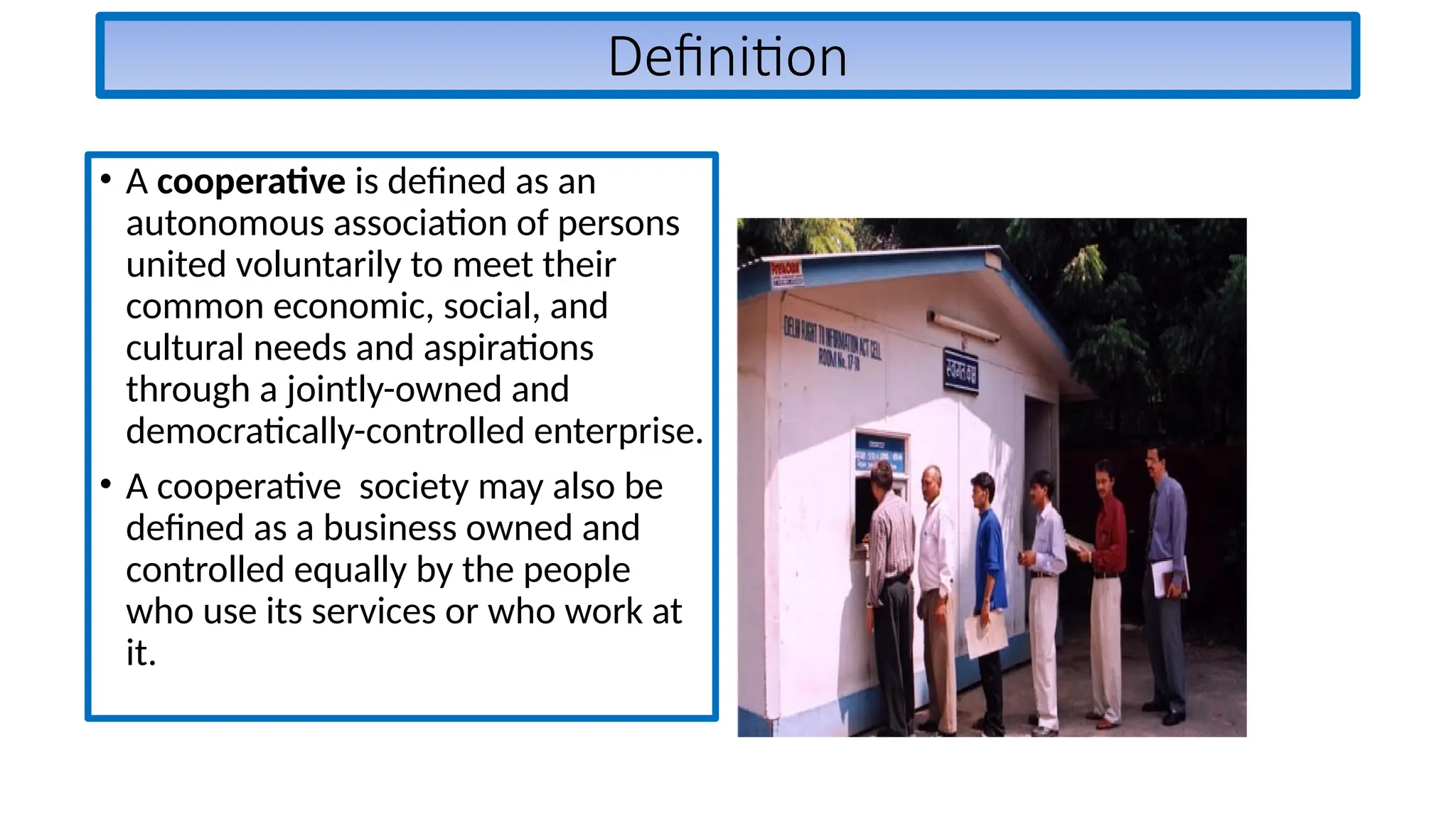
• A cooperative is defined as an
autonomous association of persons
united voluntarily to meet their
common economic, social, and
cultural needs and aspirations
through a jointly-owned and
democratically-controlled enterprise.
• A cooperative society may also be
defined as a business owned and
controlled equally by the people
who use its services or who work at
it.
Formation of a Co-operative Society
• A Co-operative Society can be formed as per the provisions of the
Cooperative Societies Act, 1912.
• At least ten persons having the capacity to enter into a contract with
common economic objectives, like farming, weaving, consuming, etc. can
form a Co-operative Society.
• A joint application along with the bye-laws of the society containing the
details about the society and its members, has to be submitted to the
Registrar of Co-operative Societies of the concerned state.
• After scrutiny of the application and the bye–laws, the registrar issues a
Certificate of Registration.
Types of Co-operative Societies
1. Consumers’ Co-operative Society: to protect the interest of general consumers by
making consumer goods available at a reasonable price.
2. Producers’ Co-operative Society: to protect the interest of small producers by
making available items of their need for production like raw materials, tools and
equipments, machinery, etc. Bayanika, Haryana Handloom, is example of producers’ co-
operative society.
3. Co-operative Marketing Society: These societies are formed by small producers
and manufacturers who find it difficult to sell their products individually.
Types of Co-operative Societies
4. Co-operative Credit Society: to provide financial support to the
members. The society accepts deposits from members and grants them
loans at reasonable rate of interest in times of need.
Examples: Village Co-operative Society, Urban Cooperative Banks
5. Co-operative Farming Society: These societies are formed by small
farmers to work jointly and thereby enjoy the benefits of large-scale
farming. Examples: Ex: Pani-panchayats
6. Housing Co-operative Society: to provide residential houses to
members they purchase land, and construct houses or flats and allot
the same to members. Some societies also provide loans at low rate of
interest to members to construct their own houses.
Examples: The Employees’ Housing Societies , Metropolitan Housing Co-
operative Society
Characteristics of Co-operative Society
I. Open membership: A minimum of ten members are required to form a co-
operative society. The Co–operative societies Act does not specify the maximum
number of members for any co-operative society.
ii. Voluntary Association: Members join as well as leave the co-operative society
voluntarily, that is by choice.
iii. State control: To protect the interest of members, co-operative societies are
placed under state control through registration.
iv Sources of Finance: In a co-operative society capital is contributed by all the
members. However, it can easily raise loans and secure grants from government
after its registration.
v. Democratic Management: The society is managed by a group known as
“Board of Directors”. The members of the board of directors are the elected
representatives of the society.
Characteristics
vi. Service motive: Co-operatives are not formed to maximize profit like
other forms of business organization.
vii. Separate Legal Entity: A Co-operative Society is registered under the Co-
operative Societies Act. After registration a society becomes a separate
legal entity, with limited liability of its members.
viii. Distribution of Surplus: Every co-operative society in addition to
providing services to its members, also generates some profit while
conducting business.
ix. Self-help through mutual cooperation: Co-operative Societies thrive on
the principle of mutual help. They are the organizations of financially weaker
sections of society.
Advantages
• Easy to Form
• Economic Operation
• Limited Liability
• Open Membership
• Tax Concession
• Democratic Management
Disadvantages
• Limited Capital
• Inefficient Management
• Absence of Motive
• Conflicts among Member
• Rigid Govt. Rules and Regulations
Top
4. Company / Joint Stock Company
• A Joint Stock Company or simply a company is a voluntary association of persons
generally formed for undertaking some big business activity
• It is established by law and can be dissolved by law only.
• According to the Act, a company means ‘a company formed and registered under this Act
or an existing company’.
• According to Company’s Act 1956, A form of business organization recognized by law a
separate legal entity having all as an individual.
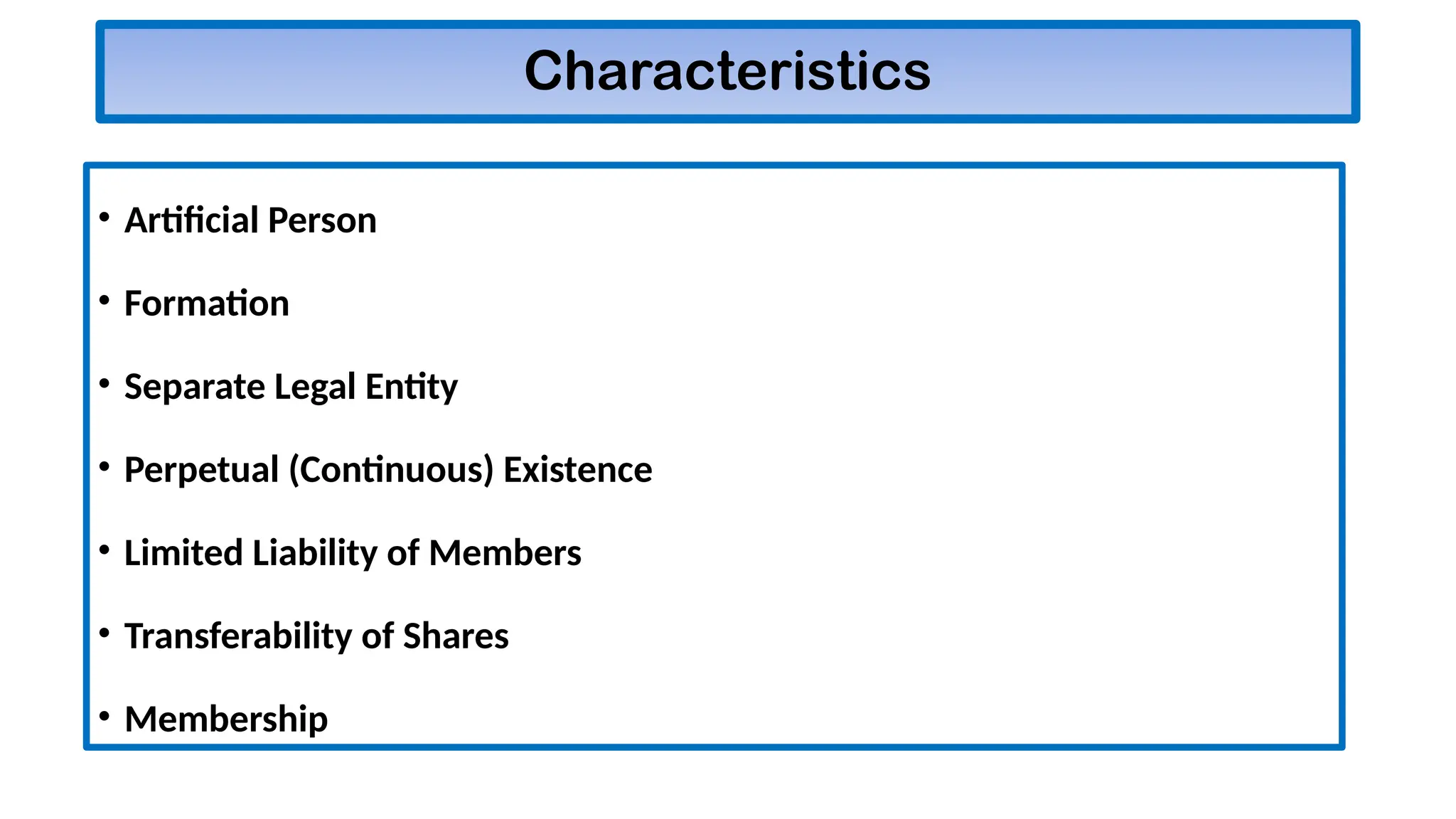
Characteristics
• Artificial Person
• Formation
• Separate Legal Entity
• Perpetual (Continuous) Existence
• Limited Liability of Members
• Transferability of Shares
• Membership
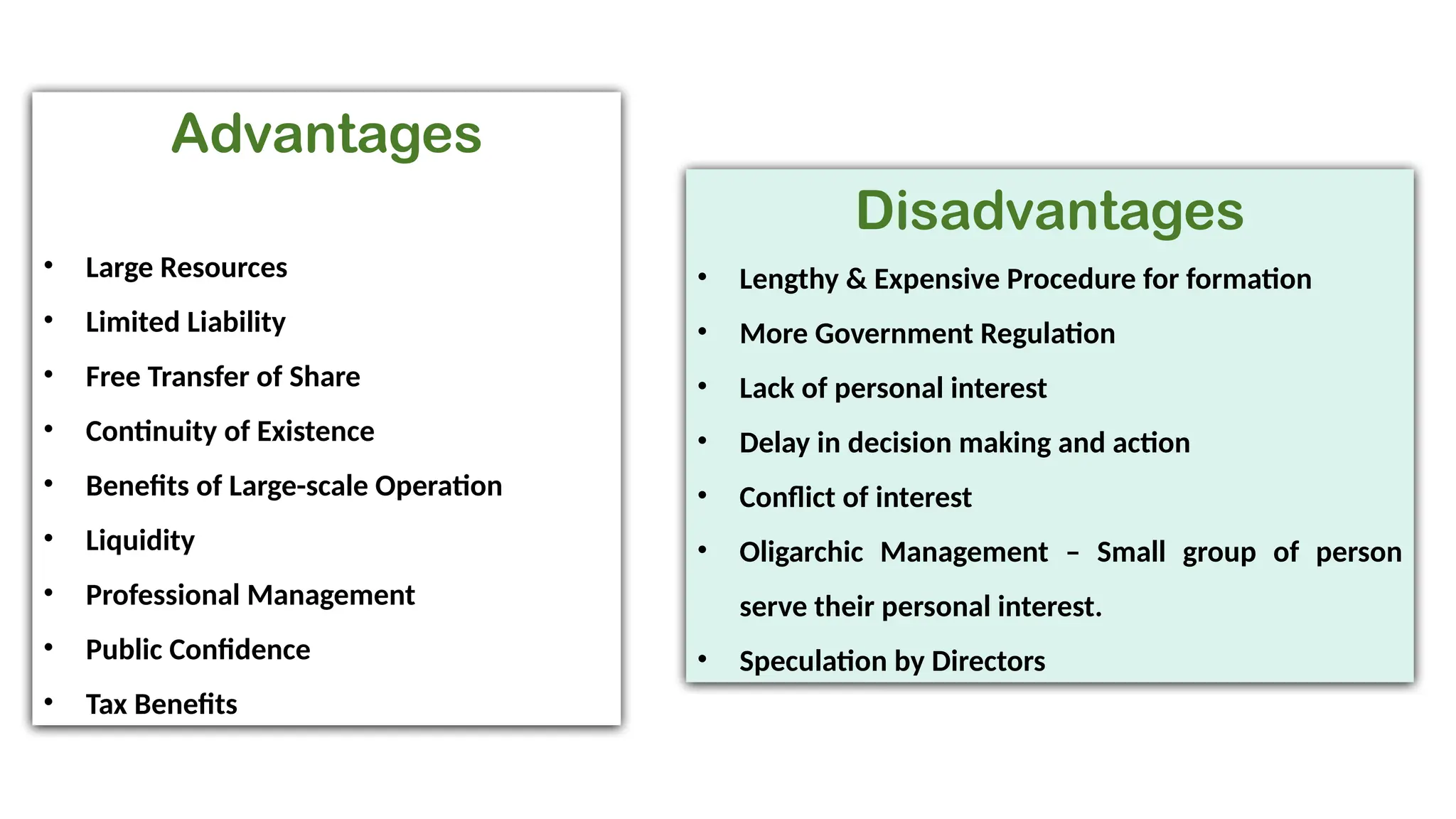
Advantages
• Large Resources
• Limited Liability
• Free Transfer of Share
• Continuity of Existence
• Benefits of Large-scale Operation
• Liquidity
• Professional Management
• Public Confidence
• Tax Benefits
Disadvantages
• Lengthy & Expensive Procedure for formation
• More Government Regulation
• Lack of personal interest
• Delay in decision making and action
• Conflict of interest
• Oligarchic Management – Small group of person
serve their personal interest.
• Speculation by Directors
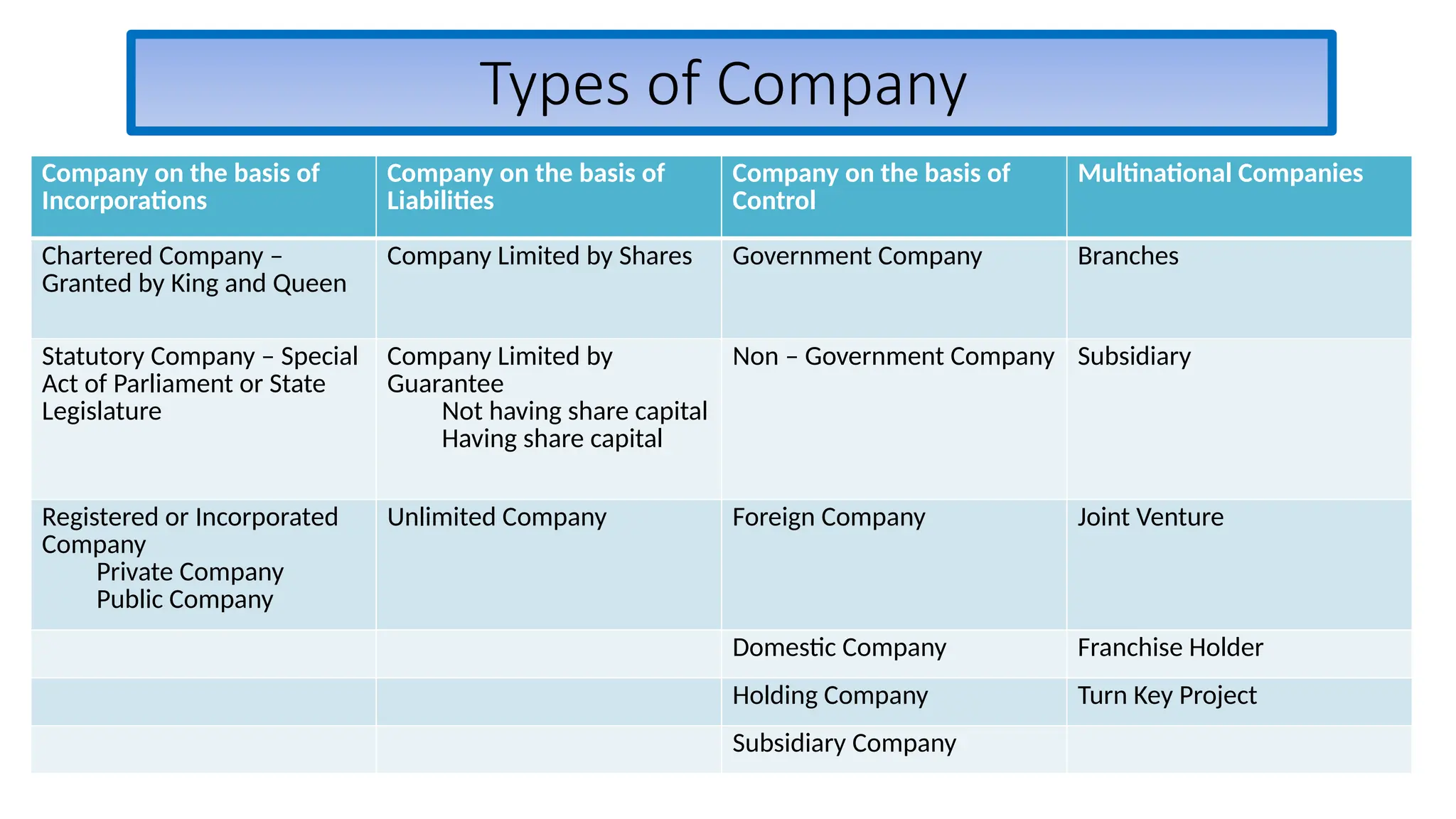
Types of Company
Company on the basis of
Incorporations
Company on the basis of
Liabilities
Company on the basis of
Control
Multinational Companies
Chartered Company –
Granted by King and Queen
Company Limited by Shares Government Company Branches
Statutory Company – Special
Act of Parliament or State
Legislature
Company Limited by
Guarantee
Not having share capital
Having share capital
Non – Government Company Subsidiary
Registered or Incorporated
Company
Private Company
Public Company
Unlimited Company Foreign Company Joint Venture
Domestic Company Franchise Holder
Holding Company Turn Key Project
Subsidiary Company
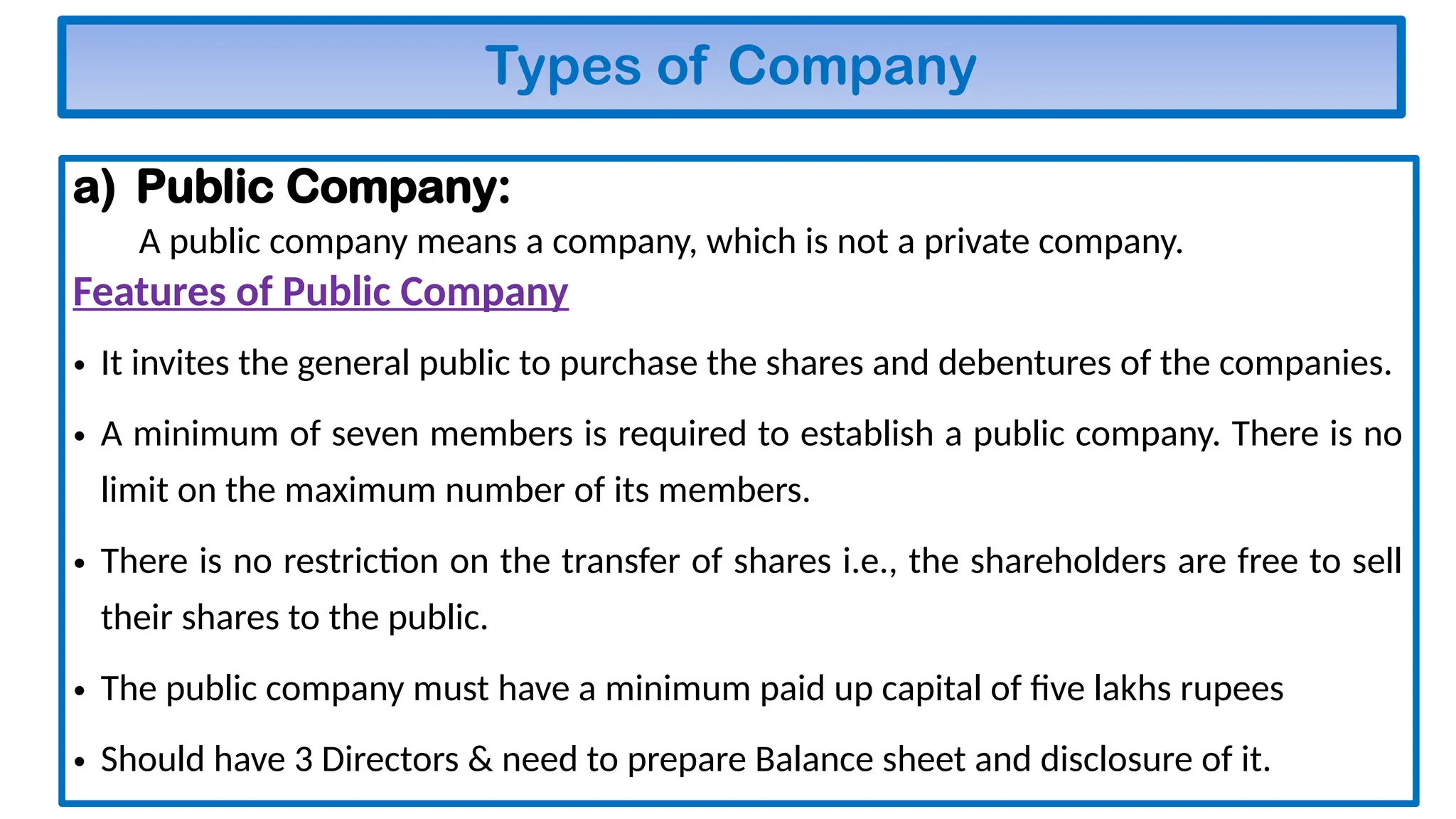
Types of Company
a) Public Company:
A public company means a company, which is not a private company.
Features of Public Company
• It invites the general public to purchase the shares and debentures of the companies.
• A minimum of seven members is required to establish a public company. There is no
limit on the maximum number of its members.
• There is no restriction on the transfer of shares i.e., the shareholders are free to sell
their shares to the public.
• The public company must have a minimum paid up capital of five lakhs rupees
• Should have 3 Directors & need to prepare Balance sheet and disclosure of it.
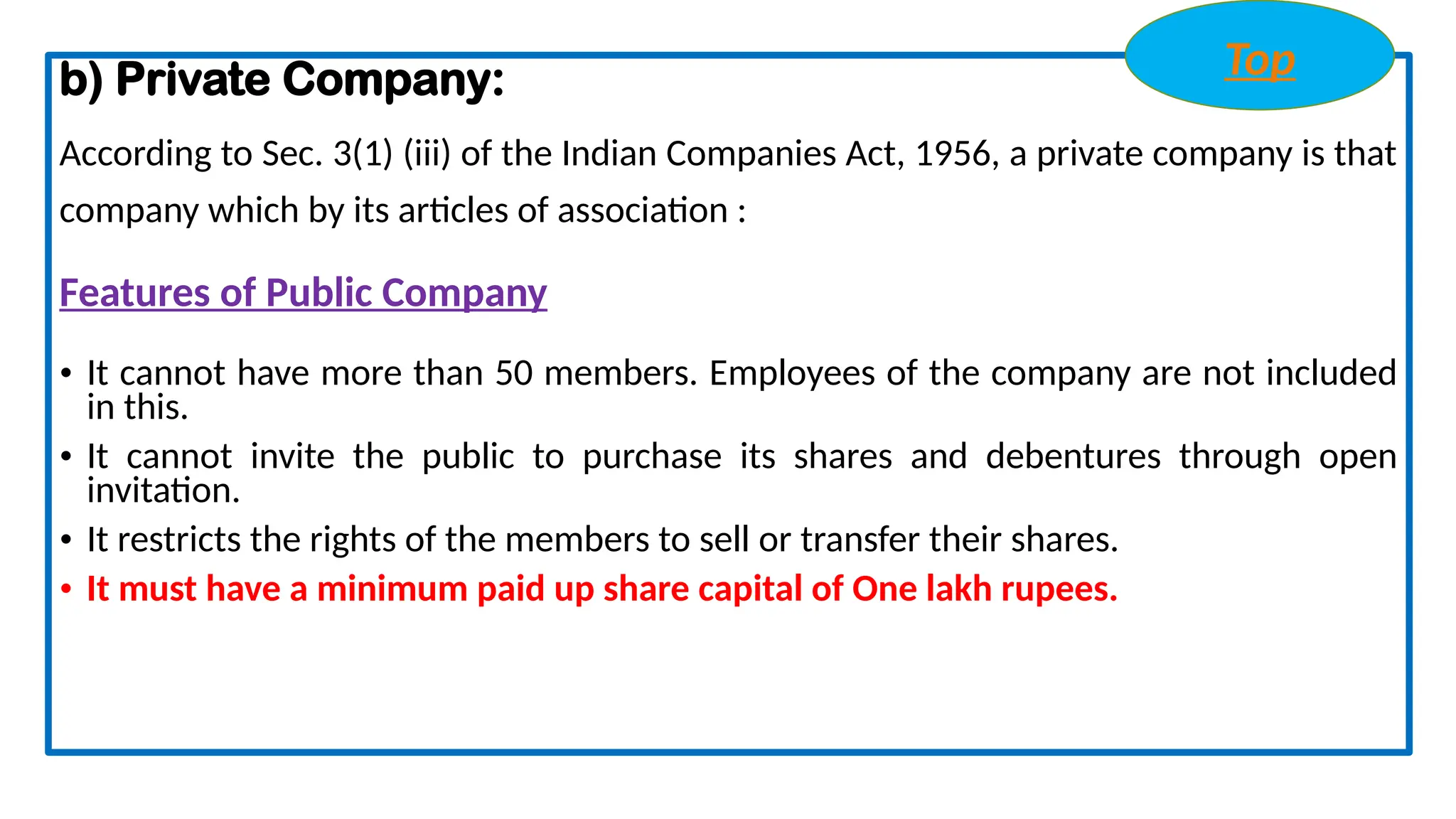
b) Private Company:
According to Sec. 3(1) (iii) of the Indian Companies Act, 1956, a private company is that
company which by its articles of association :
Features of Public Company
• It cannot have more than 50 members. Employees of the company are not included
in this.
• It cannot invite the public to purchase its shares and debentures through open
invitation.
• It restricts the rights of the members to sell or transfer their shares.
• It must have a minimum paid up share capital of One lakh rupees.
Top
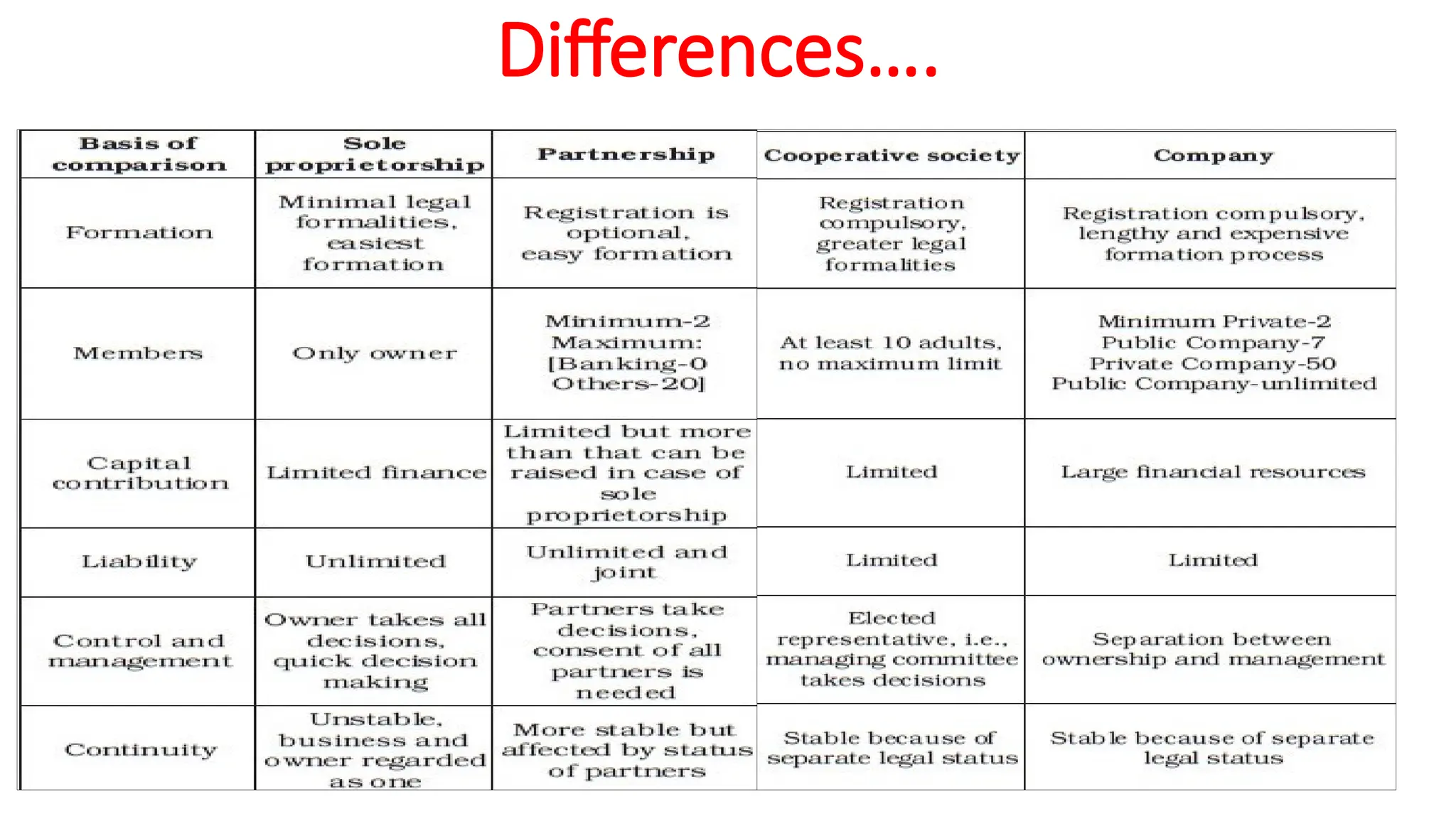
Differences….
Non Profit Organisation
Types of NGOs
• BINGO: business-friendly international NGO (example: Red Cross)
• ENGO: environmental NGO (Greenpeace and World Wildlife Fund)
• GONGO: government-organized non-governmental organization
(International Union for Conservation of Nature)
• INGO: international NGO (Oxfam)
• QUANGO: quasi-autonomous NGO (International Organization for
Standardization [ISO])
Nonprofit Organization
• Definition: An organization in which no owner, stockholder or trustee
shares in profits and losses, and which exists not to earn revenue but
to promote a mission that enhances the public welfare. These
organizations are often eligible for tax-exempt status and some, but
not all, can receive tax deductible contributions.
• Nonprofit refers to groups whose purposes are to benefit the public. A
nonprofit is exempt from income tax under Sections 501(c)(3) or 501(c)(4) of
the federal Internal Revenue Code. There are actually 20 categores of tax-
exampt organizations under Section 501 of the tax code. All of these are
considered "nonprofit" organizations.
Purposes :
• Charities are classified as 501(c)(3) tax-exempt organizations. These include
organizations whose
• Charitable
• Religious
• Educational
• Scientific
• Literary
• Testing For Public Safety
• Fostering National Or International Amateur Athletic Competition
• Preventing Cruelty to children or animals.
• Furthermore, "charitable purposes" are defined as activities beneficial to the public
interest and serving an open class of people, not a limited number of identified people.
Social Enterprises
• A Social Enterprise has been defined by the UK government as:
‘a business or service with primarily social objectives whose surpluses are
principally reinvested for that purpose in the community, rather than being
driven by the need to maximise profit for shareholders and owners.’
Social enterprises Non profit
Can have for profit, non profit or a hybrid of the two
models
Strictly non profit model
Driven by social and financial goals Driven only by social goals
Rely primarily on their earned income making it-self
sustainable
Rely primarily on individuals donors, charitable
contributions
Recruit employees like other business Mostly depend on paid or unpaid volunteers
Markets itself using commercial and social
advantage
Markets the social cause to publicist and advertise
itself
Income makes it sustainable Increasing the risk of non sustainability
Ex :Grameen bank , Aravind eye care Akshara foundation, help age
Hindu Undivided Family
Introduction
It is a specific form of business organisation found only in India.
HUF is a separate and distinct tax entity that i.e. the income of a HUF can be
assessed in the hands of HUF only and not in the hands of any of its
members.
Hindu Undivided Family do business under the control of the head of the
family is known as ‘karta. The members of the family is known as ‘co-
parceners’ of Hindu undivided estate.
HUF is a ancient form of commerce, business works around a tradition
routed in hierarchy. The male(and now even female)members of biological
family run a business together and hand it down from generation to
generation.
Joint Hindu Family Business : An Introduction
1. Form of business organization which is owned and run by members of
hindu undivided family .
2. By taking birth in a hindu family and falling under three successive
generations one can be called member of HUF.
3. KARTA is the eldest member of the family who controls all sorts of
activities regarding family business.
4. The interest in inheritance is called coparcenary interest. Hence, the
members of the HUF are called coparceners.
Features:
 FORMATION: Joint Hindu family cannot be formed or created by any
contract or agreement because this organisation came into existence
because by the operation of Hindu succession act 1956.
 MEMBERSHIP: it requires minimum of 2 people {at least one male
member}
KARTA: Is the elder male member of the family, who controls and manages
the business.
CO-PARCENERS: Other family members who by birth acquires an interest in
the joint property of the family, whether inherited or acquires by the family.
There is no limit for membership because membership is by birth.
FEATURES:
 LIABILITY: The liability of the KARTA is unlimited because he is
the only deciding authority, Whereas the liability of CO-
PARCENERS is limited upto their share in the capital of the family.
 SHARING OF PROFIT AND LOSSES: According to Hindu
Succession Act,1956,all the members of Hindu Undivided Family
have equal rights to share the profits as well as losses of the
business.
 CONTROL: the control of the family lies with the karta. He takes
all the decision and authorizes to manage the business.
Features:
CONTINUITY AND STABILITY: This organization enjoys long and stable
life as it is not affected by death, insolvency, insanity of any of its member.
In other words if KARTA dies and became incapable of managing the
business then the succeeding CO-PARCENERS will act as KARTA.
 MINOR MEMBERS: the inclusion of an individual into the business
occurs due to birth in a Hindu undivided family.
BUSINESS SECRECY: There is a great deal of business secrecy in the
organization.
The business secrets are known to the CO-PARCENERS in general and KARTA
in particular.
It is not obligatory for them to publish their accounts, which results in great
deal of privacy and secrecy
Pros and cons:
PROS: Ease of formation.
Continuity of operations.
Effective control
Increased loyalty and cooperation
Family co-operation and trust
Quick and prompt decisions by karta
Tax benefits
Continuity and stability
Credit worthiness more than sole
propritership.
Cannot sue or be sued
CONS: Confined to Joint Hindu
Families.
Relatively limited capital.
Limited managerial talents.
Unlimited Liability of the
KARTA.
Gujarati Entrepreneur and
Contribution to India and World
Economy
• Mukesh Ambani
Mukesh Ambani, chairman of Reliance Industries, controls one of the
world's biggest oil refining complex at Jamnagar in the western Indian state
of Gujarat, with capacity to process 1.24 million bpd of crude. As per the
Hurun India Rich List for 2014, Mukesh Ambani's wealth has risen 37 per
cent to Rs 1.65 lakh crore this year. RIL posted a 13.7 per cent jump in its
April-June quarter net profit to almost $1 billion, the highest quarterly
profit by a private firm, on the back of higher refining margins, better
petrochem earnings and surge in US shale gas business. Mukesh was born
on April 19, 1957 to Dhirubhai Ambani and Kokilaben Ambani. He is not
only admired among the head honchos of India Inc for leadership, he has
also received high praise from Prime Minister Narendra Modi, for putting
the state on global map.
• Dilip Shanghvi
•
Dilip Shanghvi is the founder of Sun Pharmaceutical
and is credited to build Sun into one of the most
profitable generic drugs companies in the world. Sun
has become the country's most valuable drug company
and has plans to take its NYSE-listed subsidiary Taro
Pharmaceutical Industries, in which it has nearly a two
thirds stake. Dilip is now ready to steer Sun into its next
growth phase
• Gautam Adani
Gautam Adani is a self-made billionaire and chairman of power-focused Adani Group,
which owns Mundra Port. He is the first billionaire from the city of Ahmedabad.
According to a latest Hurun Report, a sharp 152 per cent jump in his wealth saw
Adani Group chairman Gautam Adani break into the list of 10 richest Indians even as
Mukesh Ambani retained the pole position. Adani blazed into the top league riding
on the runaway share prices of his companies in recent past, pegging his wealth at Rs
44,000 crore, the report said. His success in the business world is a glaring example
of the fact that the vision to build a successful enterprise does not require an MBA
from a blue-chip B-School. Gautam S. After completing high school at the Seth C.N.
Vidyalaya in Ahmedabad, he enrolled for B.Com at the Gujarat University but
dropped out during the second year and relocated to Mumbai at the age of 18,
starting his career as a diamond sorter with Mahendra Brothers. Two years later he
started his own company for trading in diamonds, and in the early 1980s moved back
to Ahmedabad to manage a plastics unit for his elder brother. Soon he started
importing PVC, under his own company, Adani Exports, and during the post-
liberalization period, it became one of the largest players in the sector. At present
Adani Group have interests in edible oil, coal trading/mining, power, oil and gas
exploration, export-import of pulses and fruits. Mr. Adani lives in Ahmedabad along
with his wife Priti, who is a dentist and head of the Adani Foundation.
• Sudhir Mehta
•
Sudhir Uttamlal Mehta serves as the Chairman of Torrent Group, of
which Torrent Pharmaceuticals Limited is the flagship company. He
has been instrumental in steering the growth of Torrent
Pharmaceuticals through strategic alliances with international
giants from UK, Germany, France and USA. He also serves as a
director of The Surat Electricity Company Ltd., Torrent Pvt Ltd. and
Torrel Cosmetics Pvt Ltd. He is a Science graduate from Gujarat
University. Earlier, Sudhir Mehta and his brother Samir Mehta
came into limelight by buying a 1,112.4 sq yards bungalow on
Dharam Marg in Chanakyapuri, near the American embassy, for Rs
111 crore. The Ahmedabad-based drug-to-power group bought the
bungalow for Rs 10 lakh per yard.
• Samir Mehta
•
Samir Mehta is the vice chairman of Torrent Group. Born in 1963,
Samir Mehta began his career alongside his brother to contribute to
the development of Torrent Pharmaceuticals. He took over the
management of the pharma business of the group, which was
concentrating on psychotropic drugs manufactured in their own plant
at Vatva with focus on exports. Apart from overseeing the operations,
he is contributing in the areas of HR, finance and general
management. He was also behind setting-up of a state-of-the-art
research and development center and a second manufacturing plant
at Baddi, Himachal Pradesh. He is holding positions on board of
Torrent Power Generation Ltd., Torrent Pharmaceuticals Ltd., Torrent
Power SEC Ltd, Torrent Power AEC Ltd., and Torrent Private Ltd.
• Pankaj Patel
•
Pankaj Ramanbhai Patel is the chairman and managing
director of Cadila Healthcare. He comes from Ahmedabad
and is the son of a pharmacy professor. With over 30 years
of experience in the pharma industry, he is one of the most
successful pharma entrepreneurs in the country. Zydus
Cadilla is a well known brand now and enjoys good
reputation in the pharma industry. Zydus enjoys presence
in segments like cardiovasculars and gastrointestinals. It
has 17 brands that feature amongst the top 300
pharmaceutical brands in India. In 2006, the group was
featured in the Forbes list of 'Best Under a Billion'
company from amongst 200 companies in Asia.
• Romesh Wadhwani
•
Romesh T. Wadhwani is the founder and chairman of Symphony Technology Group, a
private equity firm investing in software and software services companies. He is a
Silicon Valley serial entrepreneur, having created and sold three companies in 30
years. In 2000, Wadhwani's e-commerce start-up Aspect Development Inc was
acquired by i2 Technologies, another Indian-owned company, in a historic and one of
the largest deals in the US software industry that year. His Wadhwani Centre for
Entrepreneurial Development at the Indian School of Business focuses on on broad-
based policy research. Romesh currently serves on the boards of directors of STG
companies SymphonyIRI Group, Symphony Services, Lawson, MSC Software and
Shopzilla. Romesh says strengthening Indian entrepreneurship in the technology
domain will accelerate the economic development in the country while contributing
positively to the global business scenario.
• Uday Kotak
• Uday Kotak is the vice-chairman and managing
director of Kotak Mahindra Bank. He owns a 50 per
cent stake in Kotak Mahindra Bank, which he
founded and runs. He is among India's first billionaire
banker who started out with a small finance firm in
1985 and then made it a full-fledged bank after
acquiring banking license in 2003. The bank has over
320 branches and 2.7 million customers. Uday Kotak
was born in Mumbai, India and belongs to traditional
Gujarati cotton trader's family.
Introduction to International
Entrepreneurship, Modes of
Entry
International Entrepreneurship
International Entrepreneurship is the process of an
entrepreneur conducting business activities across
national boundaries.
Another Definition of IE
The process of creatively discovering and exploiting
opportunities that lie outside a firm’s domestic market in
the pursuit of competitive advantage.
Traditional Motivations
 Sales to other Markets
 Avoid Changing Domestic Conditions
 Access to Lower Cost Structures
Importance of International Entrepreneurship
International business has become increasingly important
to firms of all sizes
Successful entrepreneur is someone who fully understand
International entrepreneurship and differs from purely
domestic business and is able to respond accordingly
International Vs Domestic Entrepreneurship
International entrepreneurial decisions are more complex due to uncontrollable factors such as the following;
Economics
 A domestic business strategy is designed under a single economic system
 Creating a business strategy for multiple countries means dealing with different levels of economic
development and different distribution systems
Political-Legal Environment
 Multiple political and legal environments are opening some opportunities while eliminating others
 Differences in Value added-tax
 Differences in Advertising campaign
 Differences in labeling, ingredients, packaging
 Laws governing business arrangements also vary greatly in the 150 different legal systems and sets of
national laws
International Vs Domestic Entrepreneurship
Cultural Environment
 Understanding the local culture is necessary when developing worldwide plans
 Language barrier
 Bribes and corruption culture
Technological Environment
 Technology varies significantly across countries
 New products in a country are created based on the conditions andinfrastructure of that country
 Example of cars based on roads and price of gasoline
Entrepreneurial Entry into International
Business
The modes of entering an international business in divided
into three categories;
1. Exporting
2. Non-equity arrangements
3. Direct foreign investment
Entrepreneurial Entryinto International Business
1. Exporting: selling goods made in one country to another
Indirect exporting involves using a foreign purchaser( or export management firm) in a
local market or selling goods to another country through a person in the entrepreneur’s
home market
 Direct exporting uses independent distributors or selling goods to another country by
taking care of the transaction
Opening their own overseas office for sales
Entrepreneurial Entryinto International Business
2. Nonequity arrangement: Doing international business through an
arrangement that does not involve any investment


Licensing: Allowing someone else to use something of the Company’s
Entrepreneur who is a manufacturer(Licensee) giving a foreign manufacturer (licensor)
the right to use a patent, trademark, technology, production process or product in
return for the payment of royalty
 Turn-Key Projects: Developing and operationalizing something in a
foreign country



Management Contracts: A method for doing a specific international task
Management techniques & skills
Acquiring foreign expertise without giving ownership of resources to foreigner
Entrepreneurial Entryinto International Business
3. Direct Foreign Investment: the percentage of ownership is
related to the amount of money invested, the nature of the
industry, and the rules of the host government
4. Minority interests: Having less than 50% ownership
position
5. Majority Interest: having more than 50% ownership
position
6. JointVenture: Two companies forming a third company
Thejoint venture should have synergy!
 Synergy means that the whole is greater than
the sum of its parts or
The two parties having things in common
1  1
 3
Entrepreneurial Entryinto International Business
4. Mergers: An entrepreneur can obtain 100% ownership
Horizontal Merger: combination of at least two firms doing similar business at the same
market level (e.g.; 7 Eleven Stores)
Vertical Merger: Combination of at least two firms at different market level (stabilizes supply &
production e.g. walls & polka)
Product Extension Merger: Combination of two firms with noncompeting products (related
production/distribution activities e.g. Western publishing (kids books) by Mattel (toys))
 Market extension Merger: Combination of at least two firms with similar products in different
geographical markets (e.g. Diamond chain: west coast retailer by Dayton Hudson a Minneapolis retailer)
Diversified Activity Merger: Combination of at least two totally unrelated firms (e.g.
Hillenbrand (hospital furniture manufacturer byAmerican tourists (a luggage manufacturer))
Organizations overcoming Barriers to International Trade
 Trade barriers: Hindrances to doing
international business
 Some countries (Japan) allegedly present barriers due to their
complicated distribution system
 GATT (the General Agreement on Tariffs and Trade)
seeks to help overcome barriers
 FTA’s (free trade agreements) such as NAFTA reduce barriers and
encourage investment between countries (in this case the U.S.,
Canada and Mexico)
Entrepreneurial Partnering is one good
strategy of entering international market!!

Introduction to Entrepreneurship - MBA Sem 2

  • 2.
    If You haveconfidence on own strength then you become entrepreneur, But other have confidence on your strength then you become CEO.
  • 4.
    Chapter Concept Importance Characteristics Problem Faceby Entrepreneurs Myths and Mind Set Theories & Types Of Entrepreneur
  • 5.
    Concept Enterprise • is analready formed business organization that propose some goods or services, etc. Entrepreneur • is a person who establishes and manages the enterprise. He/she is often the founder and owner of the business. Entrepreneurship • is the process of establishing new business enterprise along with the capacity to identify the opportunities and threats and to undertake all the risks to gain profits in results.
  • 6.
    CONCEPT • It wasthe beginning of 18th Century when the word was used to refer to economic aspect • Richard Cantillon is the first one who introduced the term Entrepreneur with some economical aspect • According to him - “Entrepreneur as an agent who buy factors of production at certain price in order to combine them to produce product with a view to selling it in uncertain price in the future” (FARMER) • According to Knight - “Entrepreneur is the economic functionary who undertakes such responsibility of uncertainty which is not insured nor capitalized nor salaried”
  • 7.
    THE CONCEPT OFENTREPRENEUR  This views are classified in three groups 1. Risk Bearer 2. Organizer 3. Innovator
  • 8.
    THE CONCEPT OFENTREPRENEUR • According to New Encyclopedia Britannica “An entrepreneur is an individual who bear the risk of operating business in face of uncertainty about future condition” • According to Peter Drucker “An entrepreneur is one who always searches for change, respond to it and exploit it as an opportunity. Innovation is a specific tools of an entrepreneur by which they can exploit change as an opportunity for different business and service”
  • 9.
  • 10.
    An individual whobears the risk of operating a business in the face of uncertainty about the future conditions. Encyclopedia Britannica He is the one who innovates, and introduces something new in the economy. Joseph A. Schumpeter He shifts economic resources out of an area of lower and into an area of higher productivity and greater yield. J. B. Say (French economist) He searches for change, responds to it and exploits opportunities. Innovation is the specific tool of an entrepreneur. Peter F. Drucker He is the one who is endowed with more than average capacities in the task of organising and coordinating the various factors of production. He is a pioneer and captain of industry. Francis A. Walker He is a critical factor in economic development and an integral part of economic transformation. William Diamond He is a person who is able to look at the environment, identify opportunities to improve the environment, marshall resources, and implement action to maximise those opportunities. Robert E. Nelson
  • 11.
    Why Should YouBecome an Entrepreneur?
  • 12.
    • You willbe your own boss and boss to other people and make decisions that are crucial to the business’ success or failure. • You will have the chance to put your ideas into practice. • You will make money for yourself rather than for someone else. • You may participate in every aspect of running a business and learn and gain experience in a variety of disciplines. • You will have the chance to work directly with your customers. • You will have the personal satisfaction of creating and running a successful business. • You will be able to work in a field or area that you really enjoy. • You will have the chance to build retirement value (for example, by selling the business when you retire).
  • 13.
  • 15.
    IMPORTANCE • To increasingnational income through job creation, • Entrepreneurship has always served as a bridge between innovation and the marketplace. • Altered our pattern of living, • Many services have been introduced to alter or create new service industries such as commercial banking, medical treatment, logistics, information systems, and insurance.
  • 16.
    Importance of Entrepreneurship Growth of Entrepreneurship. Creationof job opportunities. Innovation. Impact on community development. The consequence of business failure. Political and economic integration of outsiders. Promotes research and development. Enhances the standard of living.
  • 17.
    1. Contribution toGNP and per capita income: • Entrepreneurship contributes to economic stability by introducing new products • services in the market and encouraging effective resource mobilization. • This helps in increasing the gross national product as well as per capita income of the people in the country. • Economic stability leads to increased institutional investment for productive activities and is a sign of economic growth. 2. Employment generation: • Entrepreneurs are not only self-employed but also provide employment to others. • For example, when the information technology boom occurred in India, it led to several successful entrepreneurial ventures. This provided employment to many and also led to the launch of a number of engineering colleges, development of real-estate and hospitality ventures, and infrastructural facilities.
  • 18.
    • 3. Balancedregional development: • The development of enterprises in less-developed regions promotes balanced regional development in the country. • Entrepreneurship stimulates the distribution of wealth and income to more and more individuals (such as stakeholders) and geographical areas, thus benefiting larger sections of society. • 4. Promotion of export and trade: • Entrepreneurship promotes the country’s export trade and earns foreign exchange. • This earning can help combat the country’s import dues requirements. International trade brings economic strength and techno-economic reliance. • 5. Improvement in the standard of living: • Entrepreneurs bring a wide variety of products and services into the market. • This increases competition in the market and makes it possible for people to avail of a better quality of products and services at lower and more competitive prices, resulting in an improvement of the country’s overall standard of living.
  • 19.
    • 6. Increasedinnovation: • With the liberalization of the Indian economy, the increased competition in the domestic and international market has encouraged entrepreneurs to be more creative. • 7. Overall development of the economy: • Entrepreneurs create new technologies, products, processes, and services that become the next wave of new industries, and these in turn drive the economy. Entrepreneurs are change agents in society. They create wealth and value, and generate employment in society. This naturally leads to social and economic growth.
  • 20.
    Characteristics of aSuccessful Entrepreneur
  • 24.
    1. Creativity • Creativityis “the ability to bring something new into existence”. • This definition emphasises the “ability”, not the “activity,” of bringing something new into existence. • A person may therefore conceive of something new and envision how it will be useful, but not necessarily take the necessary action to make it a reality. • Innovation is the process of doing new things, but creativity is a prerequisite (requirement) to innovation.
  • 25.
    Raghav Verma, Co- founder,Chaayos Amuleek Singh Bijral, CEO and Founder, Chai Point
  • 26.
    2. Innovation • Innovationis the specific instrument of entrepreneurship. • It is the act that endows resources with a new capacity to create wealth. • Innovation, indeed, creates a resource. • Successful entrepreneurs, whatever their individual motivation—be it money, power, curiosity, or the desire for fame and recognition—try to create value and to make a contribution.
  • 28.
    In the lightof increasing air pollution, PerSapien Innovations has come up with a nasal air purification wearable ‘Airlens’ and an app ‘Airlens data’ to provide personal-level AQI. They won “Innovator of the year” award at Startup 2018. Entrepreneur India caught up with Dr. Shashi Ranjan, Founder of PerSapien Innovations, to elaborate more about the technology PUTTING WOMEN ABUSE TO SHAME The 2012 December Delhi’s Nirbhaya rape case jolted Anoushka Adya to launch Lajja Diaries – an empowerment platform for women facing abuse. Launched on second anniversary of the fatal assault, Adya envisions Lajja Diaries to be the voice for women upliftment in India. MAKING RIGHT NOISES >>Launched in December 2014, Mumbai >>Non-profit initiative supported by DiMentions Studio >>10k women impacted via counselling, stories >>24x7 helpline to be launched >>To offer skill-based programs for economic independence
  • 29.
    A High SchoolStudent Invented A Bath-Substituting Lotion That Could Save Millions Of People Ludwick Marishane (South Africa) invented the word's first water-less bath ..
  • 30.
    3. Dynamism: • Theenterprise may open up new vistas, better product mix, or charismatic product image stimulating steady growth. • A dynamic entrepreneur is always pragmatic (Practical / Ralistic). • Given the potentialities of the enterprises, he sets attainable goals, which are to be accomplished within specific timeframes. • An entrepreneur tends to approach problems to solve them rather than running away from them. • Being the decision maker, he cannot wish away problems. • They have to be analysed systematically and solved in the interest of the enterprise. • He must believe in, create, and practice “win-win” situations.
  • 31.
    Manish Khera, aformer banker, quits his job to form Happy Loans After 10 years as a software professional, Sriram Aravamudan found his calling in beautifying Bengaluru’s balconies with My Sunny Balcony. •Rahul Narvekar Harvard Business School, Founder Scale Ventures Fund , Founder India Network , Ex- CEO : NDTV Ethnic ,Fashion & You
  • 32.
    4. Leadership: • Thisspirit keeps him paces forward in any field. • The quality of his leadership is clear from personal relationships, mode of handling a problem, generating resources and taking others in to ones own stride.
  • 33.
    • Reliance IndustriesChairman Mukesh Ambani, human rights lawyer Indira Jaising, and architect Balkrishna Doshi earn spots in Fortune magazine's recent 50 Greatest Leaders of 2018 list. The secret? Offering dirt-cheap data and free calls (and plowing billions of dollars into the infrastructure that transmits them). The effect, dubbed “Jio-fication”, has driven India's higher-price carriers to drop costs (if not run them out of business), and fueled a 1,100 per cent rise in India's monthly data consumption. • When the poorest in India need a voice, they find one in Jaising, a lawyer who has dedicated her life to battling injustice. • The recipient of the Pritzker Prize, he has spent 70 years in the field of architecture and is often called the “architect for the poor”.
  • 34.
    5. Teambuilding: • Ateam is a group of individuals with a common purpose, that is focused and aligned to achieve a specific task or set of outcomes. • The teambuilding skill consists of the following steps. • Step 1 Wanting to feel better • Step 2 Identifying the problem and needs of the enterprise • Step 3 Creating a vision • Step 4 Setting goals for the group • Step 5 Reviewing progress
  • 36.
    6. Achievement motivation: •Entrepreneurs can be classified into three categories. • 1. Some are only dreamers and though they indulge in nice dreams, they are not capable of translating their dreams into action. The growth of such entrepreneurs is soon stunted. • 2.Some entrepreneurs belong to the category of doubters. • a negative attitude, never expand their activities, never take any risk, and never go out of their way to achieve anything, doubt their own capacity to do anything new., Never innovative and they follow the line of least resistance. • 3.The third category of entrepreneurs are the doers. They always accept any challenge and take a calculated risk to do something worthwhile. It is necessary to contact such highly successful entrepreneurs and ask them what motivated them to become successful in their life.
  • 37.
    • These entrepreneursbelieved in “Slow and steady wins the race”. • To learn anything and everything directly or indirectly related to their business. • They were professional in their thinking and approach. T • hey were never content (satisfied) after achieving initial success. • They did not fall prey to complacency, hypocrisy, sycophancy, idiosyncrasy, and obsolescence. • They obtained interpersonal support. • They were taskmasters and did not neglect even the smallest tasks assigned by them to their subordinates. • They also took a considerable interest in their personal life and were always cheerful.
  • 38.
    Like everything else,a growing number of millennials are turning to social media and mobile applications for consumption of news. For the digital generation it is more convenient to catch up on the news on the go rather than making it a compulsory morning ritual. Bridging the gap, Bengaluru- based Paperboy has brought several newspapers and magazines on one cloud based platform in real time. Entrepreneur India caught up with Jonna Venkata Karthik Raja(19), Founder, Paperboy to know how he is cashing on the thought. TIEING BLOOD with BUSINESS Karthik Naralasetty, 28 Years Socialblood The Rutger University dropout, Naralasetty started Socialblood, a social media application that connects patients with compatible blood donors through a Facebook chat group.
  • 39.
    • Aniruddha Sharma,the inspiration to building Carbon Clean, a company to regulate industrial (air) pollution and use it to make by-products • Aniruddha Sharma, 30 age, Founder of Carbon Clean GOING AGAINST CONVENTIONS Trishneet Arora l 24 l Founder and CEO, TAC Security A school dropout, Arora is one of the youngest ethical hacker India ever had. With 40 per cent growth in the first quarter of every financial year, he intends to go 4x by the end of 2018. Back in 2013, he started TAC with the motto - ‘Hack it yourself, before you get hacked’. “That time, Today, more than 300+ mobile applications use TAC security. Moreover, with 15 international clients like IBM and Cognizant, Arora has also tied up with the Central Bureau of Investigation and Government of India to ease out Unified Payment Interface application. Momo
  • 40.
    7. Problem solving: •An entrepreneur should be able to solve problems and not avoid them. • A formal problem-solving model helps entrepreneurs solve problems on a logical manner. • The model consists of six steps. • Define the problem • Gather information • Identify various solutions • Evaluate alternatives and select the best option • Take action • Evaluate the action taken • Brainstorming is a creative group problem-solving technique that involves generating a large number of fresh ideas. • Ideas are not analysed or criticised at a brainstorming session.
  • 41.
    A mechanical engineerprofessor Satish Kumar aims to solve environment's biggest problem. He has converted 50 tonnes of non- biodegradable plastic into petrol. He is supplying this petrol to small and medium enterprises for Rs. 40 per liter which is almost half the price of the actual commercial petrol. Mr. Daroath was named to the Forbes ‘30 Under 30’ list of social entrepreneurs in Asia. Prior to his role as Executive Director, Daroath led WaterSHED’s market-building activities in the nascent water, sanitation and hygiene market in rural Cambodia. He has been a driving force behind many of the organization’s leading initiatives, including supply chain development and partnerships with micro-finance.
  • 42.
    • Easy FixSolutions • When 25-year-old Shaifali Agarwal couldn’t promptly find reliable handymen—electricians, carpenters, plumbers—to fix the problems in her new apartment in Delhi in 2009, she spotted a glaring need for a venture promising a one-stop solution for home/office repairs. Two years later, in 2011, she set up Easy Fix Solutions, which posted a turnover of Rs 80-90 lakh in its first year. Today, Agarwal has a team of nearly 300 people catering to the National C. • DeliveryOnCall • Founder Ankur Mehrotra has eased the way in which families shop for groceries and other monthly supplies with this Rs 1.5 crore Delhi-based company. “The idea came to me when I was working in the corporate sector since I could hardly spend time with my family. The only day we had to ourselves, Sunday, went into stocking up. This is true of every nuclear family and I wanted to work towards saving precious time,” he says. He hit bull’s-eye with Deliveryonca ..
  • 43.
    • Farm2kitchen.com Seema Dholilaunched this Gurgaon-based company in 2011 after the birth of her baby. “When I was pregnant with my first child, I was very particular about the food I ate. There was not even a single organic food supplier and hardly anyone knew what organic meant. That was the trigger for me,” she says. Today, the company has its presence in 262 cities across the country. • 7C Home Cleaning Services Superior Cleaning Solutions With an outstanding reputation for quality, integrity and service, we can clean anything you throw at us! • Vinisha Enterprise Professional Housekeeping and Home Cleaning Services House Cleaning and Professional Housekeeping Services. Open 24 hours 7C Home Cleaning Services
  • 44.
    8. Goal orientation: •Goal setting is the achievement of targets and objectives for successful performance of an entrepreneur, both long run and short run. The goal-setting process requires three steps • Definition of goal • Specific goals • Feedback about goal achieved
  • 45.
    • Aspects ofgoal setting • Clarity of goals Clear and simple objectives will bring expected results. • Reformulation of goals • Restating goals • Plan of action • Defining standards of performance and measurement criteria • Recognising risks and obstacles • Goal reaffirmation • Goal attainment • Types of Goals • Target oriented • Achievement oriented • Specific (primary) • Overall (broad based) • Secondary • Long range/short range • Personal/social
  • 46.
    9. Risk takingand decision-making ability: • Are willing to bear risk, but never gamble with results. • This is evidenced by market studies, exploring alternative lines of production or a new product mix, or a new combination of inputs, and so on. • A good entrepreneur should avoid excessively high as well as low risk situations. • Risk bearing is an indication of an extreme sensitivity to cost consciousness and a passion for profit. • The focus should always be on the market. The entrepreneur should believe in competition.
  • 47.
    In 2009, RahulGupta was worried that his marks would rule out a job during campus placements at IIT Roorkee. Rays Power Projects, in Jaipur However, due to a difference of opinion with his partner, he left the company in March 2011, taking Rs 13 lakh as his share. Then, in early 2012, he decided to revisit his solar park dream. He bought land in Bikaner and set up a 2 MW solar park, which opened in October 2012. By the end of the fiscal year, the revenue was Rs 80 crore Today, Gupta manages three projects, spanning 500 acres in Bikaner, collectively producing 55 MW. Bangalore-based Ramesh Prabhu is not your typical social entrepreneur, for he still regards his venture as a responsibility rather than a business. However, his company, Three Wheels United (TWU), is posting a revenue of Rs 9-10 lakh and has helped 250 auto drivers till date. Prabhu's patience paid off and Corporation Bank decided to lend money to autowallahs, with TWU as a guarantor. The model proposed by TWU was simple. Drivers would have to organise themselves in groups of 4- 10, with each driver being introduced by one other member. The company would get them a loan at 11% for a five year tenure, and they would have to repay Rs 200 per day to the NGO partners. This is the amount they paid for renting the auto. Of this, Rs 15 was kept by TWU for operational expenses, and another Rs 20 was kept in a recurring deposit to build a maintenance fund. The remainder was used to service the loan. As Prabhu points out, at Rs 200 per day, the loan would be repaid in just 37 months.
  • 48.
    Fresh & Naturelle Aftercompleting his graduation from Jain College, Bangalore, in 2006, Kunal Pabrai joined EY's (formerly Ernst & Young) city office in its risk advisory section. In August 2008, with a seed capital of Rs 3 lakh, he bought another smaller, but defunct, ice cream factory at Tollygunge, Kolkata, and spent a month bringing it back to lifeTo ensure that the products were natural and the best in the country, he put in a lot of effort: the vanilla used in the ice cream was, and still is, sourced from Madagascar. Around April 2009, the first counter was launched at a restaurant in Kolkata. There was no looking back and the company expanded with franchise outlets across Kolkata and, currently, it supplies material to over 18 outlets in seven cities across the country. Today, almost 19 years on, Prasanna Rai is the owner of Star Express, a courier company that has an annual turnover of Rs 12 crore. He borrowed Rs 30,000 from friends to start his business and tied up with local enterprises based in and around Navi Mumbai for their courier delivery jobs. He landed a contract with P&G to deliver their promotional campaign material to malls across Mumbai. Contracts started pouring in and, by 2007, Star Express' turnover increased to a whopping Rs 1.5 crore, with a net profit of Rs 35 lakh. In March 2014, the company invested Rs 9 crore to acquire 60,000 sq ft office space at Navi Mumbai. Now, Rai is planning to start a manufacturing unit for branding and promotional material.
  • 49.
    A Fire Engineeringgraduate from National Institute of Fire Engineering with multiple certifications and a strong experience in Customer Service industry. Sandeep Gajakas is the man behind The Shoe Laundry, he dared to dream in 2003 to give India it's first Shoe Laundry service. Founder (Mr. Prashant Kulkarni) The master mind behind creation of chatarpatar is Mr. Prashant Kulkarni. A young entrepreneur who always believes in the power of ideas, and also know how ideas can be implemented successfully.
  • 50.
    10. Commitment: • Oneof the subtle qualities of an entrepreneur is his willpower. • Strong determination with sound thinking fortifies will power. • It is determination that provides the entrepreneur energy to work for 15–18 hours a day, 7 days a week and 52 weeks in a year till the unit reaches a natural stage of take off.
  • 51.
    Founded in 1996by VSS Mani, the company is headquartered in Mumbai, India. In addition to its headquarters, Justdial has offices in Ahmedabad, Bangalore, Chandigarh, Chennai, Coimbatore, New Delhi, Hyderabad, Jaipur, Kolkata, and Pune. Organization type: Company Founders: V.S.S. Mani Geographic scope: India
  • 52.
    N. R. NarayanaMurthy Azim Premji Warren Buffett Mark Zuckerberg Bill Gates Ratan Tata
  • 53.
    Mukesh Ambani LakshmiMittal Vijay Mallya Nirav Modi Amancio Ortega Naresh Goyal
  • 54.
    PROBLEMS FACED BYENTREPRENEUR
  • 55.
    Which Problem FaceBy • Pepsi Blue • Sahara • Kingfisher Airlines • Jet Airways • Docomo/ Telenor/ Reliance Communications • Nano • Maruti 800 • Rotomac companies set to be shut now
  • 56.
    More than 36%of registered companies have 'closed' down in India
  • 61.
    • Problems facedby entrepreneurs are: a. Internal problems b. External problems and c. Specific management problems. • To build capacity for entrepreneurship following measures can be taken: • Availability of credit, imported raw materials, skilled labour, Technology and Equipment, Infrastructural facilities, Advisory Services and access to market.
  • 62.
    1. Internal Problemsof Entrepreneurs
  • 63.
    1. Internal Problemsof Entrepreneurs • Technical feasibility • Inadequate technical know- how • Locational disadvantage • Outdated production process A. Planning Economic viability High cost of inputs Break-even point too high Uneconomic size of project Choice of idea Feeble structure Faulty planning Poor project implementation Lack of strategies Lack of vision Inadequate connections Lack of motivation Underestimation of financial requirements Unduly large investment in fixed assets Overestimation of demand
  • 64.
    1. Internal Problemsof Entrepreneurs • B. Implementation • Cost over-runs resulting from delays in getting licences, sanctions, and so on, and inadequate mobilisation of finance.
  • 65.
    C. Internal Problemsof Entrepreneurs- Production A. Production management • Inappropriate product mix • Poor quality control • Poor capacity utilisation • High cost of production • Poor inventory maintenance and replacement • Lack of timely and adequate modernisation and so on • High wastage • Poor production B. Labour management • Excising high wage structure • Inefficient handling of labour problems • Excessive manpower • Poor labour productivity • Poor labour relations • Lack of trained skilled labour or technically competent personnel
  • 66.
    C. Internal Problemsof Entrepreneurs- Production C. Marketing management • Dependence on a single customer or a limited number of customers/single or a limited number of products • Poor sales realisation • Defective pricing policy • Booking of large orders at fixed prices in an inflationary market • Weak market organisation • Lack of market feedback and market research • Unscrupulous sale purchase practices D. Financial management • Poor resource management and financial planning • Faulty costing • Dividend policy • General financial indiscipline and application of funds for unauthorised purposes • Deficiency of funds • Over trading • Unfavourable gearing or keeping adverse debt equity ratio • Inadequate working capital • Absence of cost consciousness • Lack of effective collection machinery
  • 67.
    C. Internal Problemsof Entrepreneurs- Production E. Administrative management • Over centralisation • Lack of professionalism • Lack of feedback to management (Management Information System) • Lack of timely diversification • Excessive expenditure on R and D
  • 68.
    2. External Problemsof Entrepreneurs
  • 69.
    Infrastructural • Location • Power •Water • Post Office and so on • Communication • Non-availability or irregular supply of critical raw materials or other inputs • Transport bottlenecks Financial • Capital • Working capital • Long-term funds • Recovery • Marketing • Taxation • Raw material Industrial and financial regulations Government policy Administrative hurdles Rampant corruption Lack of direction Competitive and volatile environment
  • 70.
  • 71.
    • Management deficiency •Finance • Manufacturing and technical problems • Product planning • Selection of equipment, plant and machinery • Human resource development • Technical know-how • Preparation of project report
  • 72.
  • 73.
    Myths Reality (a) Entrepreneurs areborn, not made Entrepreneurs cannot be taught or learned, they are innate traits with which a person must be born. Entrepreneurship has models, processes and case studies that allow the topic to be studied and the traits acquired by training and development. (b) Entrepreneurs are academic and social misfits Entrepreneurs are academically and socially ineffective is born of some business owners having started successful enterprises after dropping out of school or quitting a job. Business education, was aimed primarily at the study of corporate activity. The entrepreneur is considered a hero socially, economically and academically. The entrepreneur is now viewed as a professional. (c) Entrepreneurs fit an ideal profile Based on case studies and on research findings among achievement-oriented people. The venture itself, and the entrepreneur have interactive effects, which result in many different types of profiles. Provide more accurate insights into the various profiles of successful entrepreneurs. (d) All you need is money to be an entrepreneur A large number of business failures occur because of lack of adequate financing. Failure due to managerial incompetence, lack of financial understanding, poor investments, poor planning, and so on.
  • 74.
    Myths Reality (e) Allyou need is luck to be an entrepreneur “the right place at the right time” is always an advantage, but “luck happens when preparation meets opportunity” is an equally appropriate adage. What appears to be luck is really a combination of preparation, determination, desire, knowledge, and innovativeness. (f) A great idea is the only ingredient in a recipe for success it is not backed by adequate finance, demand for the product and, most importantly, good management. (g) My best friend will be a great business partner you may agree on most issues but misunderstandings can erupt over insignificant aspects like who should be in the office first, who's in charge of supervising the office staff and so on. (h) Having no boss is great fun If you thought your boss was way too demanding, watch out for your vendors, bankers, investors, suppliers and customers.
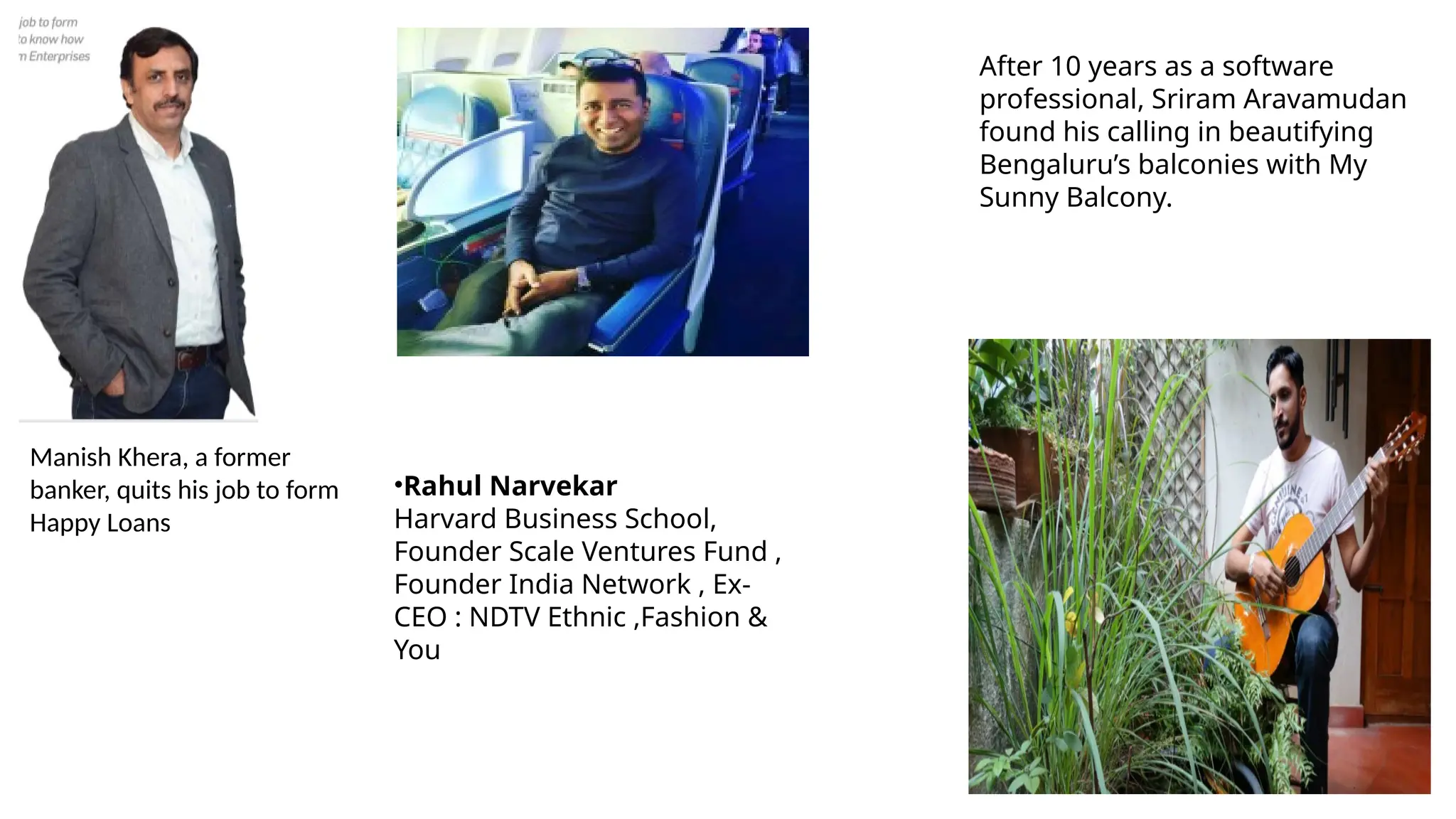
  • 75.
    Myths Reality i. Ican make lots of money to make quite a few sacrifices. to miss the security (j) I'll definitely become successful Put it down to plain optimism, egoism or a survival strategy, but most business owners or even those starting off on their own refuse to accept the possibility of failure. the number of people who fail are legion (Mass), and it can happen to you as well. (k) Life will be much simpler if I work for myself Working for yourself is definitely more strenuous than working for others, at least when starting off. Example : Dinesh Gupta. He set up Green Investors’ Grievances Services two years ago to take care of individuals’ stock-related problems, and has a punishing schedule even now. His typical day starts at 5 a.m. and ends at 7 p.m.
  • 76.
    12 Signs YouHave an Entrepreneurial Mindset 1. You take action. 2. You’re scared. 3. You’re resourceful 4. You obsess over cash flow. 5. You don’t ask for permission. 6. You’re fearless. 7. You welcome change. 8. You love a challenge. 9. You consider yourself an outsider. 10. You recover quickly. 11. You listen. 12. You focus on what matters (when you figure out what matters).
  • 77.
    Pull Factors • ReligiousValues • A lot of bounties in business • Follow the teachings of the religion • Duty to lead a prosperous life • Psychological • Doesn’t like to be controlled • Want freedom • Riches and Power • Rich and famous • Sophisticated life-style • Service to the Society • Corporate social responsibility • Philanthropic activities • Entrepreneurial Culture Push Factors • Frustration • Limited job mobility • VSS and “retrenchment” • Dissatisfaction • Necessity • No jobs • Need to support family • Lack educational qualifications Pull & Push factors for Entrepreneurial Motivation.
  • 78.
  • 79.
    • Psychological Model •David McClelland’s theory • Hagen’s Theory of Withdrawal of Status Respect (1964) • Rotter- Internal–External Locus of Control Theory • Sociological Model • Max Weber’s Theory of Religious Beliefs • Hozelist’s Sociocultural Theory • Thomas Cochran’s Theory of Entrepreneurial Supply • Frank W. Young’s Theory of Group Level Pattern • Integrated Model • T. V. Rao (1975) in “entrepreneurial disposition” • B. S. Venkata Rao (1975) • M. P. Akhori
  • 80.
    1. Psychological Models •The essence of psychological theory is an understanding of the difference in individuals’ attitudes. • According to this theory, the internal attitude and ability to judge and forecast any situation lead a person to become a successful entrepreneur.
  • 81.
    David McClelland’s theory •Need for achievement is the most important among the various psychological theories on entrepreneurship. • In his theory, McClelland emphasized the relationship of need for achievement or achievement motivation to economic development via entrepreneurial activities. • He considers “achievement motivation” to be the major determinant of entrepreneurial development. • three motives for accomplishing things: • Need for Power (nP), or the drive to influence others and any given situation. • Need for Affiliation (nAff), or the drive for interpersonal relationship. • Need for Achievement (nAch), or the drive to excel, advance, and grow.
  • 82.
    Hagen’s Theory ofWithdrawal of Status Respect (1964) • Everett Hagen’s concept of the entrepreneur is that of a “creative personality” interested in accelerating change and driven by a motivation to achieve. • According to Hagen, entrepreneurial growth has been very gradual and may or may not even occur in the same generation. In his theory of withdrawal of status respect, • Everett Hagen’s argument is that certain social changes may disrupt the stability of traditional society and cause psychological changes in a group or in an individual. • The withdrawal of status respect may occur when a traditional, group is displaced from its previous status or on migration to some other place or to a new society. Hagen uses the case of Japanese history to substantiate his argument.
  • 83.
    Rotter- Internal–External Locusof Control Theory • Professor J. D. Rotter of Ohio University introduced the Internal–External Locus of Control Theory, which highlights the self-confidence of a person, and the dependency on fortune and external environment for becoming an entrepreneur. • According to this theory, the internal locus of control comprises self- confidence, extreme belief in one’s own ability, and initiatives taken by an individual. • Locus of control determines whether a person perceives a potential goal to be attainable through one’s own actions (internal locus of control) or through uncontrollable external factors (external locus of control).
  • 84.
    • Psychological Model •David McClelland’s theory • Hagen’s Theory of Withdrawal of Status Respect (1964) • Rotter- Internal–External Locus of Control Theory • Sociological Model • Max Weber’s Theory of Religious Beliefs • Hozelist’s Sociocultural Theory • Thomas Cochran’s Theory of Entrepreneurial Supply • Frank W. Young’s Theory of Group Level Pattern • Integrated Model • T. V. Rao (1975) in “entrepreneurial disposition” • B. S. Venkata Rao (1975) • M. P. Akhori
  • 85.
    2. Sociological Model •Social cultures to be the driving force behind entrepreneurship. • The entrepreneur becomes a role performer in conformity with the role expectations of society. • Such role expectations are based on religious beliefs, taboos, and customs.
  • 86.
    Max Weber’s Theoryof Religious Beliefs • According to Max Weber, religious beliefs are the driving or restraining forces for entrepreneurial activity. • Religious beliefs play a crucial role in determining the attitude of the entrepreneur towards generating or limiting profits. • Weber took the position that entrepreneurial growth is dependent upon the ethical values (due to religion) of society. • Capitalism thrives under the Protestant work ethic that advocates hard work, honesty, and discipline. The spirit of capitalism, coupled with the motive of profit, results in the creation of a large number of successful business enterprises. • Weber distinguished between the “spirit of capitalism” and the “adventurous spirit.” The spirit of capitalism is influenced by a strict discipline, whereas the adventurous spirit comes from the free force of impulse.
  • 87.
    Hozelist’s Sociocultural Theory •According to Hozelist, a specific social culture leads to growth in entrepreneurship. Social sanctions, cultural values, and role expectations are responsible for the emergence of entrepreneurship. • also propounded that entrepreneurship grows in societies that permit variability in choice of paths of life and non-standard socialization of individuals.
  • 88.
    Thomas Cochran’s Theoryof Entrepreneurial Supply • According to him, the supply of entrepreneurs in society needs to be seen with reference to prevailing child-rearing practices. the environment in which an individual is brought up determines his entrepreneurial urge. • He stated that the performance of the entrepreneur might be seen in reference to his own attitudes towards an occupation. • Values and role expectations of the particular social group to which he belongs are the most important determinants in the performance of business entrepreneurial roles.
  • 89.
    Frank W. Young’sTheory of Group Level Pattern • Young’s model of entrepreneurship suggests the creation of supporting institutions in society, such as the family, as the determinant of entrepreneurship. • Theory of entrepreneurship is one of change based upon society’s incorporation of relative sub-groups within society.
  • 90.
    • Psychological Model •David McClelland’s theory • Hagen’s Theory of Withdrawal of Status Respect (1964) • Rotter- Internal–External Locus of Control Theory • Sociological Model • Max Weber’s Theory of Religious Beliefs • Hozelist’s Sociocultural Theory • Thomas Cochran’s Theory of Entrepreneurial Supply • Frank W. Young’s Theory of Group Level Pattern • Integrated Model • T. V. Rao (1975) in “entrepreneurial disposition” • B. S. Venkata Rao (1975) • M. P. Akhori
  • 91.
    3. Integrated Models •Explanation to be added…
  • 92.
    T. V. Rao(1975) in “entrepreneurial disposition” • T. V. Rao (1975) in “entrepreneurial disposition” has included the following factors. • Need for motive is the dynamic which, for the prospective entrepreneur, has the greatest possibility of achieving the goals if one performs those activities. • Long-term involvement is the goal either at thinking level or at activity level in entrepreneurial activity that is viewed as a target to be fulfilled. • Personal, social and material resources which, he thinks, are related to entry and success in the area of entrepreneurial activity. • Socio-political system to be perceived as suitable for establishment and development of his enterprise.
  • 93.
    B. S. VenkataRao (1975) • B. S. Venkata Rao (1975) described the following five stages for promoting small entrepreneurship. • Stimulation • Identification • Development • Promotion • Follow up • Stimulation: This stage includes the creation of an industrial atmosphere, policy statement emphasizing the role of small industry, wide publicity of industrial development programmes, and formation of special schemes and creation of support institutions. This stage is necessary to stimulate interest of the backward regions in industrial activity and to create awareness.
  • 94.
    • Identification: Thisstage is necessary to identify prospective entrepreneurs. The prospective entrepreneurial force can be identified in rural artisans, factory workers, persons with formal training in engineering and technology, and graduates in business administration and management. • Development: This stage would include organisation of motivation and managerial training programmes along with advice on technology, formulation of bankable project, location, and so on. • Promotion: This stage would include government policy initiatives for promoting small entrepreneurship. • Follow up: This stage includes reviewing the policies and programmes of the government and seeking follow up with a view to making them more effective.
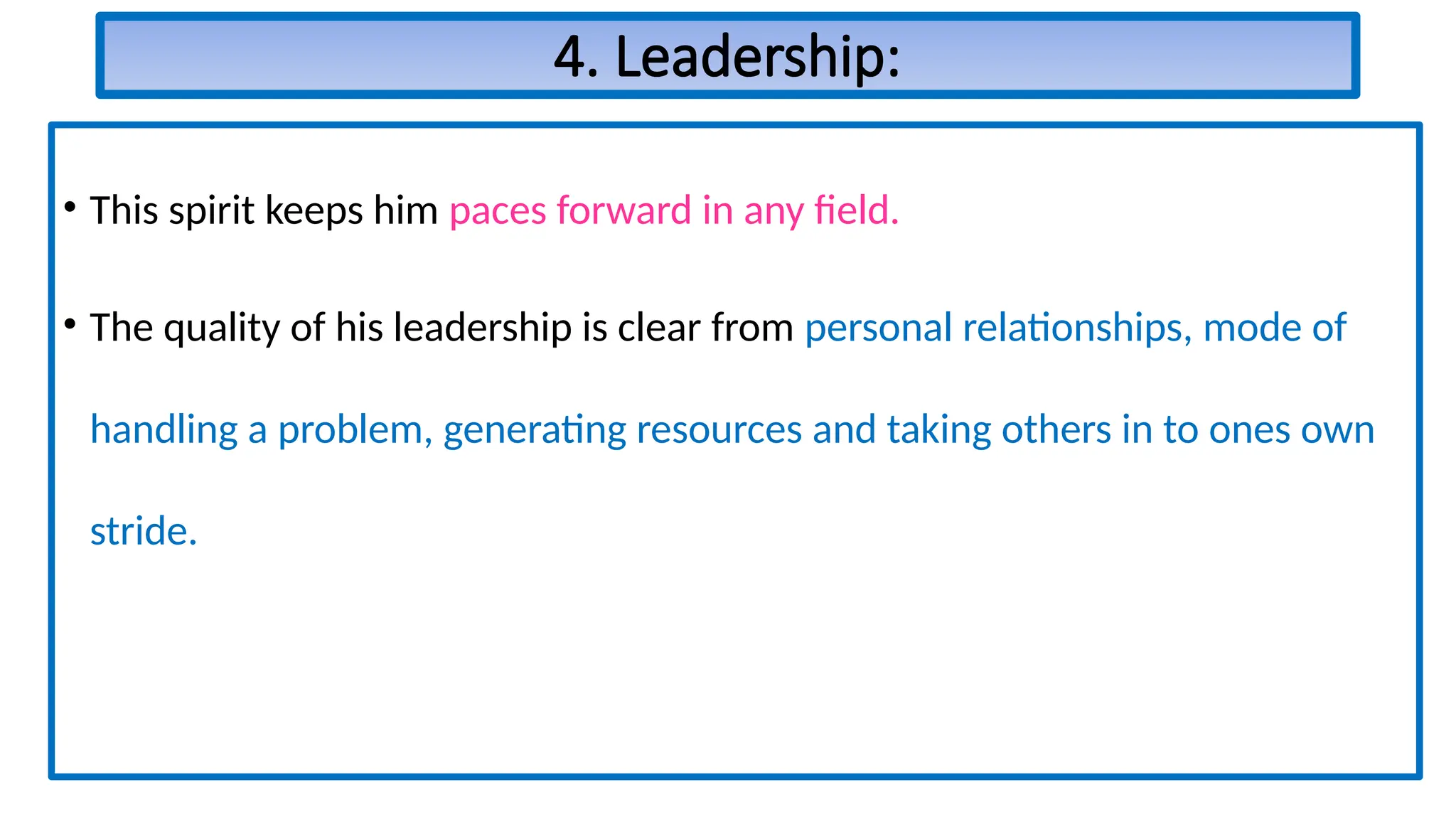
  • 95.
    M. P. Akhori •M. P. Akhori suggested the entrepreneurial development cycle following components for the promotion and development of entrepreneurship.
  • 96.
    M. P. Akhori •1. Stimulatory activities: • They generate initial motivation and offer opportunity to acquire skill. • These can be achieved by the following activities. • Entrepreneurial education • Planned publicity for entrepreneurial opportunities • Identification of potential entrepreneurs through scientific methods • Motivational training to new entrepreneurs • Help and guidance in selecting products and preparing project reports • Making available techno-economic information and product profiles • Evolving locally suitable new products and processes • Availability of local agencies with trained personnel for entrepreneurial counselling and promotions • Creating entrepreneurial forums • Recognition of entrepreneurs
  • 97.
    M. P. Akhori Supportactivities: • These activities help a person to develop into an entrepreneur. They nurture and help entrepreneurship to grow. • This can be done by providing the necessary infrastructure in the form of computers, Internet connectivity, offering consultancy and training, and providing all required information as to how a person should groom himself as an entrepreneur. • The various support activities are given below. Registration of unit Arranging finance Providing land, shed, power, water, and so on. Guidance for selecting and obtaining machinery Supply of scarce raw materials Getting licences/import licences Providing common facilities Granting tax relief or other subsidy Offering management consultancy services Help marketing the product Providing information
  • 98.
    M. P. Akhori •Sustaining activities: • These activities are all those that help in the continuous and efficient functioning of entrepreneurship. • These include modernisation of infrastructure, encouraging diversification, providing opportunities and supporting industry-institute interaction through consultancy, promoting quality, and organising need- based common facilities centres. • The various support activities are given below. Help modernisation Help diversification/expansion/substitute production Additional financing for full capacity utilisation Deferring repayment/interest Diagnostic industrial extension/consultancy services Production units legislation/policy change Product reservation/creating new avenues for marketing Quality testing and approving services Need-based common facilities centres
  • 99.
  • 100.
    (a) Based onFunctional Characteristics Innovative entrepreneur: • Entrepreneurs introduce new goods or new methods of production or discover new markets or reorganise their enterprises. Imitative (Copied) or adoptive entrepreneur: • Entrepreneurs do not innovate themselves, but imitate techniques and technology innovated by others. • Suitable for underdeveloped economies as adoption saves costs of trial and error. Fabian entrepreneur: • Entrepreneurs display great caution and skepticism (doubt) in experimenting with any change in their enterprise. They change only when there is an imminent threat to the very existence of their enterprise. Drone entrepreneur: • Entrepreneurs are characterised by a die-hard conservatism and may even be prepared to suffer the loss of business.
  • 101.
    (b) Based onthe Developmental Angle Prime mover: This entrepreneur sets in motion a powerful sequence of development, expansion, and diversification of business. Manager: Such an entrepreneur does not initiate expansion and is content just staying in business. Minor innovator: This entrepreneur contributes to economic progress by finding better use for existing resources. Satellite: This entrepreneur assumes a supplier's role and slowly moves towards a productive enterprise. Local trading: Such an enterpreneur limits his enterprise to the local market.
  • 102.
    (c) Based onTypes of Entrepreneurial Business Manufacturing: An entrepreneur who runs such a business actually produces the products that can be sold using resources and supplies. For example, apparel and other textile products, chemical and related products, electronics and other electrical equipment, fabricated metal products, industrial machinery and equipment, printing and publishing, rubber and miscellaneous plastic products, stone, clay etc. Wholesaling: An entrepreneur with such a business sells products to the middle man. Retailing: An entrepreneur with such a business sells products directly to the people who use or consume them. Service: An entrepreneur in this business sells services rather than products.
  • 103.
    (d) Based onthe Nine Personality Types of Entrepreneurs • Begin identifying dominant personality theme and understand how operate in business. 1. The Improver: • If you operate your business predominately in the improver mode, • It focused on using company as a means to improve the world. • Overarching motto is: morally correct companies will be rewarded working on a noble cause. Improvers have an unwavering ability to run their business with high integrity and ethics. • Personality alert: be aware of tendency to be a perfectionist and over-critical of employees and customers. • Entrepreneur example: Anita Roddick, founder of the body shop.
  • 104.
    2. The Advisor: •This business personality type will provide an extremely high level of assistance and advice to customers. • The advisor's motto is: the customer is right and we must do everything to please them. Companies built by advisors become customer focused. • Personality Alert: Advisors can become totally focused on the needs of their business and customers that they may ignore their own needs and ultimately burn out. • Entrepreneur example: John W. Nordstrom, Founder Nordstrom.
  • 105.
    • The Superstar: •the business is centered on the charisma and high energy of the Superstar CEO. This personality often will cause you to build your business around your own personal brand. • Personality Alert: Superstarts Can be too competitive and workaholics. • Entrepreneur example: Donald Trump, CEO of Trump Hotels & Casino Resorts. • The Artist: • This business personality is the reserved but a highly creative type. Often found in businesses demanding creativity such as web design and ad agencies. As an artist type you'll tend to build your business around the unique talents and creativities that you have. • Personality Alert: You may be overly sensitive to your customer's responses even if the feedback is constructive. Let go the negative self-image. • Entrepreneur example: Scott Adams, Creator of Dilbert.
  • 106.
    The Visionary: • Abusiness built by a Visionary will often be based on the future vision and thoughts of the founder. You will have a high degree of curiosity to understand the world around you and will set-up plan to avoid the landmines. • Personality Alert: Visionaries can be too focused on the dream with little focus on reality. Action must precede vision. • Entrepreneurial example: Bill Gates, Founder of Microsoft Inc. The Analyst: • If you run a business as an Analyst, your company focus is on fixing problems in a systematic way. Often the basis for science, engineering or computer firms, Analyst companies excel at problem solving. • Personality Alert: Be aware of analysis paralysis. Work on trusting others. • Entrepreneurial example: Intel Founder, Gordon Moore.
  • 107.
    • The Fireball: •A business owned and operated by a Fireball is full of life, energy and optimism. Your company is life energizing and makes customers feel the company has a get it done attitude in a fun playful manner. • Personality Alert: You may over commit your teams and act impulsively. Balance your impulsiveness with business planning. • Entrepreneurial example: Malcolm Forbes, Publisher of Forbes Magazine. • The Hero: • You have an incredible will and ability to lead the world and your business through any challenge. You are the essence of entrepreneurship and can assemble great companies. • Personality Alert: Over promising and using forceful tactics to get your way will not work long term. To be successful, trust your leadership skills to help others find their way. • Entrepreneurial example: Jack Welch, CEO of GE.
  • 108.
    • The Healer: •If you are a Healer, you provide nurturing and harmony to your business. You have an uncanny ability to survive and persist with an inner calm. • Personality Alert: Because of your caring, healing attitude toward your business, you may avoid outside realities and use wishful thinking. Use scenario planning to prepare for turmoil. • Entrepreneurial example: Ben Cohen, Co-Founder Of Ben & Jerry's Ice Cream.
  • 109.
    (e) Based onschools of Thought on Entrepreneurship
  • 110.
  • 111.
    piezoelectricity fidget spinner Intershop's firstonline shopping system 1994. Amazon.com launched its online shopping site in 1995 and eBay was also introduced in 1995. Alibaba's sites Taobao and Tmall were launched in 2003 and 2008, respectively.
  • 112.
    Entrepreneurial Imagination andCreativity • How entrepreneurs do what they do: • Creative thinking + systematic analysis = success • Seek out unique opportunities to fill needs and wants • Turn problems into opportunities • Recognize that problems are to solutions what demand is to supply
  • 113.
    1. Creativity: • Creativityis “the ability to bring something new into existence”. • The creative process for an idea involves five stages • A. Germination: The germination stage is the seeding process. • The exact manner in which an idea is germinated is a mystery; it is not something that can be examined under a microscope. However, most creative ideas can be traced to an individual's interest in or curiosity about a specific problem or area of study. • B. Preparation: If it is a problem they are trying to • They begin an intellectual journey, seeking information about the problem and how others have tried to resolve it. • If it is an idea for a new product or service, then market research is the business equivalent. • Inventors will set up laboratory experiments, designers will begin engineering new product ideas, and marketers will study consumer-buying habits. • Any individual with an idea will consequently think about it, concentrating his or her energies on rational extensions of the idea and how it might become a reality.
  • 114.
    1. Creativity: • 3.Incubation: Incubation is a stage of “mulling it over” while the subconscious intellect assumes control of the creative process. • It is consciously focus on a problem, behave rationally to attempt to find systematic resolutions. • 4. Illumination : occurs when the idea resurfaces as a realistic creation. • Reaching the illumination stage separates daydreamers and tinkerers from creative people who find a way to transmute value. • 5. Verification: to translate an illuminated idea into a verified, realistic, and useful application. • to finding a way to “harvest” the practical results of his or her creation.
  • 116.
    Developing Your Creativity •Recognizing Relationships • Looking for different or unorthodox relationships among the elements and people around you. • Developing a Functional Perspective • Viewing things and people in terms of how they can satisfy his or her needs and help complete a project. • Using Your Brains • The right brain helps us understand analogies, imagine things, and synthesize information. • The left brain helps us analyze, verbalize, and use rational approaches to problem solving.
  • 117.
  • 118.
    Characteristics of acreative climate: • A trustful management that does not overcontrol the personnel • Open channels of communication among all business members • Considerable contact and communication with outsiders • A large variety of personality types • A willingness to accept change • An enjoyment in experimenting with new ideas • Little fear of negative consequences for making a mistake • The selection and promotion of employees on the basis of merit • The use of techniques that encourage ideas, including suggestion systems and brainstorming • Sufficient financial, managerial, human, and time resources for accomplishing goals
  • 119.
  • 122.
    Innovation: • It isthe act that endows resources with a new capacity to create wealth. • Innovative spirit is fed by information, knowledge, or even by intuition. • Where Innovation – • Modified new existing products • May be a new method for reducing the cost of production. • New concept of commodity or an improvement in the design and specifications of a product. • Simply exploring a market, which had not been thought of or tried out earlier. • Innovation could be the result of positive reflexes or continuous and spontaneous thought processes.
  • 123.
    Innovation: • Is theprocess by which entrepreneurs convert opportunities into marketable ideas. • Is a combination of the vision to create a good idea and the perseverance and dedication to remain with the concept through implementation. • Is a key function in the entrepreneurial process. • Is the specific function of entrepreneurship.
  • 124.
    • Seven SourcesFor Innovative • The unexpected—unexpected success, unexpected failure, unexpected outside event. • The incongruity—between reality as it actually is and reality as it is assumed to be or as it “ought to be” • Innovation based on process need • Changes in industry structure or market structure that catches everyone unawares • Demographics (population changes) • Changes in perception, mood, and meaning • New knowledge—scientific and non-scientific •
  • 125.
    Sources of InnovationIdeas Source Examples Unexpected occurrences Unexpected success: Apple Computer (microcomputers) Unexpected tragedy: 9-11 terrorist attack Fire Safety (Takshashila Arcade), Covid (Mask, Sanitizer, Ventilator) Incongruities Overnight package delivery Process needs Sugar-free products Caffeine-free coffee Microwave ovens Industry and market changes Health care industry: changing to home health care Demographic changes Rest homes or retirement centers for older people Perceptual changes Exercise (aerobics) and the growing concern for fitness, Ayurveda, Meditation Knowledge-based concepts Mobile (Cell phone) technology; pharmaceutical industry; Robotics (Sophia)
  • 126.
    Innovation in Action/ Types of Innovation
  • 127.
    Major Innovation Myths •Myth 1: Innovation is planned and predictable • Myth 2: Technical specifications should be thoroughly prepared • Myth 3: Creativity relies on dreams and bluesky ideas • Myth 4: Big projects will develop better innovations than smaller ones • Myth 5: Technology is the driving force of innovation success
  • 128.
    Principles of Innovation •Be action oriented. • Make the product, process, or service simple and understandable. • Make the product, process, or service customer-based. • Start small. • Aim high. • Try/test/revise. • Learn from failures • Follow a milestone schedule. • Reward heroic activity. • Work, work, work.
  • 129.
    Types of BusinessOrganization
  • 130.
    Meaning of anOrganization “Organization is a group of people working together to create a surplus / profit, satisfaction of needs, and achievement of goals viz. organizational as well as individual.”
  • 131.
    Types of Organization •Proprietorship • Partnership • Cooperative / Society / Trusts • Company : a)Private Ltd. b)Public Ltd. • Non Profit Organisation • Hindu Undivided Family (HUF) • Formation of Company
  • 132.
    1. Sole Proprietorship •J.L. Hanson: “A type of business unit where one person is solely responsible for providing the capital and bearing the risk of the enterprise, and for the management of the business.”An individual start a business on his own, without any registration. • Can we say that “Sole Proprietorship refers to a business enterprise exclusively owned, managed and controlled by a single person”
  • 133.
  • 134.
    FEATURE S Easy formation and closure Unlimited liability Solerisk bearer and profit recipient No separate entity Absolute control Lack of business continuity
  • 135.
  • 136.
    LIMITATION S Limited Resource s Limited life of abusiness concern Unlimited liability Limited managerial skills
  • 137.
    OPTIONS FOR ASOLE PROPRIETOR
  • 138.
    Procedure for RegisterSole Proprietorship Firm • Prepare documents required for sole Proprietorship Registration. • Apply for MSME + CA Certification or GST Registration as per your business need. • Get Certification from the Government after the approval. • Apply for a current bank account in any bank with your complete documentation.
  • 139.
    How to RegisterProprietorship Firm Online ? We at MyOnlineCA build a automation platform to get register your proprietorship firm at the low cost with paperless work. Just Fill up below request form with the basic details Our Smart system automatically redirect to choose the best legal certification as per your business need or conditions. Make the Payment via any bank debit card/credit card/net banking/UPI/Wallets via secure way. Get the confirmation email with our dedicated team member details Instantly on your email to start your work. Get the certification as per our timeline in the email & start your business easily.
  • 140.
    According to The IndianPartnership Act, 1932, “Partnership is the relation between 2 persons who have agreed to share the profit of the business carried on by all or any one of them acing for all.” Partnership
  • 141.
    Neeraj Choksi (leftin the photo) and Jignesh Desai (right in the photo)
  • 143.
    FEATURE S Equal Risk bearing Joint decision making Continuity is ensuredMinimum members required-2 Maximum members in banking-10 Maximum members in other business-20 Mutual Agency
  • 144.
  • 145.
  • 146.
  • 147.
    Active partner Contributes capital Participatesin management of firm Shares profits and losses Unlimited liability Takes part in carrying out business on others behalf
  • 148.
    Sleeping or dormantpartner Contributes capital Does not Participate in management of firm Shares profits and losses Unlimited liability
  • 149.
    Nominal partner Does not Contributecapital Does not Participate in management of firm Does not Share profits and losses Unlimited liability Allows the use of his name by a firm
  • 150.
    Secret partner Contributes capital Participates in managementof firm Shares profits and losses Unlimited liability His association is not known to the general public
  • 151.
    Partner by estoppel Doesnot Contribute capital Does not Participate in management of firm Does not Share profits and losses Unlimited liability Gives impression that he is a partner of firm through his behaviour
  • 152.
    Partner by holdingout Does not Contribute capital Does not Participate in management of firm Does not Share profits and losses Unlimited liability Allows himself to be represented as a partner but is not a partner
  • 153.
    Status of aMinor When he attains majority, he decides whether he would like to become a partner in the firm. Can be admitted to benefits of a partnership firm with the mutual consent of all other partners. Liability is limited to the extent of capital contributed by him. Not eligible to take part in active management Cannot become a partner in any firm as is incompetent to enter into a valid contract with others.
  • 155.
    TYPES OF PARTNERSHIPS Partnershi p durationliability Partnershi p at will Particular partnership Limited partnership General partnership
  • 156.
    Classification on thebasis of duration Partnership at will Particular partnership Exists at the will of partners Formed for the accomplishment of a particular project. Terminates when any partner gives a notice of withdrawal. Dissolved when project is finished. Last Togethe r forever! block and over!
  • 157.
    Classification on thebasis of liability General partnership Limited partnership Liability of partners is limited and joint. Liability of at least 1 partner is unlimited and the rest have limited liability. Partners participate in firm and there is mutual agency. Partners don’t participate in firm and there is no mutual agency. Registration is optional. Registration is compulsory.
  • 158.
  • 160.
    Partnership deed The written agreementwhich specifies the terms and conditions that govern the partnership is called a partnership deed.
  • 161.
    Contents of a partnership deed Name of the firm Nature and locationof business Duration of business Investmen t made by each partner Distribution of profits and losses Duties and obligations of the partners Salaries and withdrawal of the partners Terms governing admission, retirement and expulsion of a partner Interest on capital and drawings Procedure for dissolution of firm Preparation and auditing of accounts Methods of solving disputes
  • 162.
    Registration of afirm means the entering of firm’s name, along with the relevant prescribed particulars, I the register of firm kept with the Registrar of Firms.
  • 163.
    In case afirm is not registered, it is deprived of many benefits: A partner of an unregistered firm cannot file a suit against the firm or other partners. The firm cannot file a case against third parties. The firm cannot file a case against the partners.
  • 164.
    Procedure for registration 1.Submissionof application in the prescribed form to the Registrar of firms. The application should include: 2. Deposit of required fees with the Registrar of firms. 3.The Registrar after approval will make an entry in the register of firms and will subsequently issue certificate of registration.
  • 165.
    3. Cooperative /Society / Trusts • Term cooperation is derived from the Latin word ‘co-operari’, where the word ‘Co’ means ‘with’ and ‘operari’ mean ‘to work’. • It is a voluntary association of persons who work together to promote their economic interest. • A corporation or an association that conducts business for the benefit of the general public without a profit motive. • The most basic difference is that nonprofit corporations cannot operate for profit. That is, they cannot distribute corporate income to shareholders.
  • 166.
    • Amul consideredone of the largest co-operatives of India today • Adarsh Co-operative Bank • Indian Coffee House • Indian Farmers Fertiliser Cooperative Limited • KRIBHCO • Vasudhara Dairy • Shri Mahila Griha Udyog Lijjat Papad
  • 167.
    Characteristics • Voluntary Association •Open Membership • Service Motive • Distribution of Surplus • Number of Members • Registration of the Society: registered under The Cooperative Societies Act 1912 • Capital
  • 168.
    The application forforming a society must have the following information: (a) Name and address of the society. (b) Aims and objectives of the society. (c) Names and addresses of members of the society. (d) Share capital and its division. (e) Mode of admitting new members. (f) A copy of the bye laws of the society. The required documents are filed with the Registrar of Societies. The Registrar scrutinizes the documents, if these are as per requirements then the society’s name is entered in the register. A certificate of registration is also issued to the society. The society will become a corporate body from the date mentioned in the certificate.
  • 169.
    Definition • A cooperativeis defined as an autonomous association of persons united voluntarily to meet their common economic, social, and cultural needs and aspirations through a jointly-owned and democratically-controlled enterprise. • A cooperative society may also be defined as a business owned and controlled equally by the people who use its services or who work at it.
  • 170.
    Formation of aCo-operative Society • A Co-operative Society can be formed as per the provisions of the Cooperative Societies Act, 1912. • At least ten persons having the capacity to enter into a contract with common economic objectives, like farming, weaving, consuming, etc. can form a Co-operative Society. • A joint application along with the bye-laws of the society containing the details about the society and its members, has to be submitted to the Registrar of Co-operative Societies of the concerned state. • After scrutiny of the application and the bye–laws, the registrar issues a Certificate of Registration.
  • 171.
    Types of Co-operativeSocieties 1. Consumers’ Co-operative Society: to protect the interest of general consumers by making consumer goods available at a reasonable price. 2. Producers’ Co-operative Society: to protect the interest of small producers by making available items of their need for production like raw materials, tools and equipments, machinery, etc. Bayanika, Haryana Handloom, is example of producers’ co- operative society. 3. Co-operative Marketing Society: These societies are formed by small producers and manufacturers who find it difficult to sell their products individually.
  • 172.
    Types of Co-operativeSocieties 4. Co-operative Credit Society: to provide financial support to the members. The society accepts deposits from members and grants them loans at reasonable rate of interest in times of need. Examples: Village Co-operative Society, Urban Cooperative Banks 5. Co-operative Farming Society: These societies are formed by small farmers to work jointly and thereby enjoy the benefits of large-scale farming. Examples: Ex: Pani-panchayats 6. Housing Co-operative Society: to provide residential houses to members they purchase land, and construct houses or flats and allot the same to members. Some societies also provide loans at low rate of interest to members to construct their own houses. Examples: The Employees’ Housing Societies , Metropolitan Housing Co- operative Society
  • 173.
    Characteristics of Co-operativeSociety I. Open membership: A minimum of ten members are required to form a co- operative society. The Co–operative societies Act does not specify the maximum number of members for any co-operative society. ii. Voluntary Association: Members join as well as leave the co-operative society voluntarily, that is by choice. iii. State control: To protect the interest of members, co-operative societies are placed under state control through registration. iv Sources of Finance: In a co-operative society capital is contributed by all the members. However, it can easily raise loans and secure grants from government after its registration. v. Democratic Management: The society is managed by a group known as “Board of Directors”. The members of the board of directors are the elected representatives of the society.
  • 174.
    Characteristics vi. Service motive:Co-operatives are not formed to maximize profit like other forms of business organization. vii. Separate Legal Entity: A Co-operative Society is registered under the Co- operative Societies Act. After registration a society becomes a separate legal entity, with limited liability of its members. viii. Distribution of Surplus: Every co-operative society in addition to providing services to its members, also generates some profit while conducting business. ix. Self-help through mutual cooperation: Co-operative Societies thrive on the principle of mutual help. They are the organizations of financially weaker sections of society.
  • 175.
    Advantages • Easy toForm • Economic Operation • Limited Liability • Open Membership • Tax Concession • Democratic Management Disadvantages • Limited Capital • Inefficient Management • Absence of Motive • Conflicts among Member • Rigid Govt. Rules and Regulations Top
  • 176.
    4. Company /Joint Stock Company • A Joint Stock Company or simply a company is a voluntary association of persons generally formed for undertaking some big business activity • It is established by law and can be dissolved by law only. • According to the Act, a company means ‘a company formed and registered under this Act or an existing company’. • According to Company’s Act 1956, A form of business organization recognized by law a separate legal entity having all as an individual.
  • 177.
    Characteristics • Artificial Person •Formation • Separate Legal Entity • Perpetual (Continuous) Existence • Limited Liability of Members • Transferability of Shares • Membership
  • 178.
    Advantages • Large Resources •Limited Liability • Free Transfer of Share • Continuity of Existence • Benefits of Large-scale Operation • Liquidity • Professional Management • Public Confidence • Tax Benefits Disadvantages • Lengthy & Expensive Procedure for formation • More Government Regulation • Lack of personal interest • Delay in decision making and action • Conflict of interest • Oligarchic Management – Small group of person serve their personal interest. • Speculation by Directors
  • 179.
    Types of Company Companyon the basis of Incorporations Company on the basis of Liabilities Company on the basis of Control Multinational Companies Chartered Company – Granted by King and Queen Company Limited by Shares Government Company Branches Statutory Company – Special Act of Parliament or State Legislature Company Limited by Guarantee Not having share capital Having share capital Non – Government Company Subsidiary Registered or Incorporated Company Private Company Public Company Unlimited Company Foreign Company Joint Venture Domestic Company Franchise Holder Holding Company Turn Key Project Subsidiary Company
  • 180.
    Types of Company a)Public Company: A public company means a company, which is not a private company. Features of Public Company • It invites the general public to purchase the shares and debentures of the companies. • A minimum of seven members is required to establish a public company. There is no limit on the maximum number of its members. • There is no restriction on the transfer of shares i.e., the shareholders are free to sell their shares to the public. • The public company must have a minimum paid up capital of five lakhs rupees • Should have 3 Directors & need to prepare Balance sheet and disclosure of it.
  • 181.
    b) Private Company: Accordingto Sec. 3(1) (iii) of the Indian Companies Act, 1956, a private company is that company which by its articles of association : Features of Public Company • It cannot have more than 50 members. Employees of the company are not included in this. • It cannot invite the public to purchase its shares and debentures through open invitation. • It restricts the rights of the members to sell or transfer their shares. • It must have a minimum paid up share capital of One lakh rupees. Top
  • 183.
  • 184.
  • 187.
    Types of NGOs •BINGO: business-friendly international NGO (example: Red Cross) • ENGO: environmental NGO (Greenpeace and World Wildlife Fund) • GONGO: government-organized non-governmental organization (International Union for Conservation of Nature) • INGO: international NGO (Oxfam) • QUANGO: quasi-autonomous NGO (International Organization for Standardization [ISO])
  • 188.
    Nonprofit Organization • Definition:An organization in which no owner, stockholder or trustee shares in profits and losses, and which exists not to earn revenue but to promote a mission that enhances the public welfare. These organizations are often eligible for tax-exempt status and some, but not all, can receive tax deductible contributions. • Nonprofit refers to groups whose purposes are to benefit the public. A nonprofit is exempt from income tax under Sections 501(c)(3) or 501(c)(4) of the federal Internal Revenue Code. There are actually 20 categores of tax- exampt organizations under Section 501 of the tax code. All of these are considered "nonprofit" organizations.
  • 189.
    Purposes : • Charitiesare classified as 501(c)(3) tax-exempt organizations. These include organizations whose • Charitable • Religious • Educational • Scientific • Literary • Testing For Public Safety • Fostering National Or International Amateur Athletic Competition • Preventing Cruelty to children or animals. • Furthermore, "charitable purposes" are defined as activities beneficial to the public interest and serving an open class of people, not a limited number of identified people.
  • 190.
    Social Enterprises • ASocial Enterprise has been defined by the UK government as: ‘a business or service with primarily social objectives whose surpluses are principally reinvested for that purpose in the community, rather than being driven by the need to maximise profit for shareholders and owners.’
  • 191.
    Social enterprises Nonprofit Can have for profit, non profit or a hybrid of the two models Strictly non profit model Driven by social and financial goals Driven only by social goals Rely primarily on their earned income making it-self sustainable Rely primarily on individuals donors, charitable contributions Recruit employees like other business Mostly depend on paid or unpaid volunteers Markets itself using commercial and social advantage Markets the social cause to publicist and advertise itself Income makes it sustainable Increasing the risk of non sustainability Ex :Grameen bank , Aravind eye care Akshara foundation, help age
  • 192.
  • 193.
    Introduction It is aspecific form of business organisation found only in India. HUF is a separate and distinct tax entity that i.e. the income of a HUF can be assessed in the hands of HUF only and not in the hands of any of its members. Hindu Undivided Family do business under the control of the head of the family is known as ‘karta. The members of the family is known as ‘co- parceners’ of Hindu undivided estate. HUF is a ancient form of commerce, business works around a tradition routed in hierarchy. The male(and now even female)members of biological family run a business together and hand it down from generation to generation.
  • 194.
    Joint Hindu FamilyBusiness : An Introduction 1. Form of business organization which is owned and run by members of hindu undivided family . 2. By taking birth in a hindu family and falling under three successive generations one can be called member of HUF. 3. KARTA is the eldest member of the family who controls all sorts of activities regarding family business. 4. The interest in inheritance is called coparcenary interest. Hence, the members of the HUF are called coparceners.
  • 195.
    Features:  FORMATION: JointHindu family cannot be formed or created by any contract or agreement because this organisation came into existence because by the operation of Hindu succession act 1956.  MEMBERSHIP: it requires minimum of 2 people {at least one male member} KARTA: Is the elder male member of the family, who controls and manages the business. CO-PARCENERS: Other family members who by birth acquires an interest in the joint property of the family, whether inherited or acquires by the family. There is no limit for membership because membership is by birth.
  • 196.
    FEATURES:  LIABILITY: Theliability of the KARTA is unlimited because he is the only deciding authority, Whereas the liability of CO- PARCENERS is limited upto their share in the capital of the family.  SHARING OF PROFIT AND LOSSES: According to Hindu Succession Act,1956,all the members of Hindu Undivided Family have equal rights to share the profits as well as losses of the business.  CONTROL: the control of the family lies with the karta. He takes all the decision and authorizes to manage the business.
  • 197.
    Features: CONTINUITY AND STABILITY:This organization enjoys long and stable life as it is not affected by death, insolvency, insanity of any of its member. In other words if KARTA dies and became incapable of managing the business then the succeeding CO-PARCENERS will act as KARTA.  MINOR MEMBERS: the inclusion of an individual into the business occurs due to birth in a Hindu undivided family. BUSINESS SECRECY: There is a great deal of business secrecy in the organization. The business secrets are known to the CO-PARCENERS in general and KARTA in particular. It is not obligatory for them to publish their accounts, which results in great deal of privacy and secrecy
  • 198.
    Pros and cons: PROS:Ease of formation. Continuity of operations. Effective control Increased loyalty and cooperation Family co-operation and trust Quick and prompt decisions by karta Tax benefits Continuity and stability Credit worthiness more than sole propritership. Cannot sue or be sued CONS: Confined to Joint Hindu Families. Relatively limited capital. Limited managerial talents. Unlimited Liability of the KARTA.
  • 199.
    Gujarati Entrepreneur and Contributionto India and World Economy
  • 200.
    • Mukesh Ambani MukeshAmbani, chairman of Reliance Industries, controls one of the world's biggest oil refining complex at Jamnagar in the western Indian state of Gujarat, with capacity to process 1.24 million bpd of crude. As per the Hurun India Rich List for 2014, Mukesh Ambani's wealth has risen 37 per cent to Rs 1.65 lakh crore this year. RIL posted a 13.7 per cent jump in its April-June quarter net profit to almost $1 billion, the highest quarterly profit by a private firm, on the back of higher refining margins, better petrochem earnings and surge in US shale gas business. Mukesh was born on April 19, 1957 to Dhirubhai Ambani and Kokilaben Ambani. He is not only admired among the head honchos of India Inc for leadership, he has also received high praise from Prime Minister Narendra Modi, for putting the state on global map.
  • 201.
    • Dilip Shanghvi • DilipShanghvi is the founder of Sun Pharmaceutical and is credited to build Sun into one of the most profitable generic drugs companies in the world. Sun has become the country's most valuable drug company and has plans to take its NYSE-listed subsidiary Taro Pharmaceutical Industries, in which it has nearly a two thirds stake. Dilip is now ready to steer Sun into its next growth phase
  • 202.
    • Gautam Adani GautamAdani is a self-made billionaire and chairman of power-focused Adani Group, which owns Mundra Port. He is the first billionaire from the city of Ahmedabad. According to a latest Hurun Report, a sharp 152 per cent jump in his wealth saw Adani Group chairman Gautam Adani break into the list of 10 richest Indians even as Mukesh Ambani retained the pole position. Adani blazed into the top league riding on the runaway share prices of his companies in recent past, pegging his wealth at Rs 44,000 crore, the report said. His success in the business world is a glaring example of the fact that the vision to build a successful enterprise does not require an MBA from a blue-chip B-School. Gautam S. After completing high school at the Seth C.N. Vidyalaya in Ahmedabad, he enrolled for B.Com at the Gujarat University but dropped out during the second year and relocated to Mumbai at the age of 18, starting his career as a diamond sorter with Mahendra Brothers. Two years later he started his own company for trading in diamonds, and in the early 1980s moved back to Ahmedabad to manage a plastics unit for his elder brother. Soon he started importing PVC, under his own company, Adani Exports, and during the post- liberalization period, it became one of the largest players in the sector. At present Adani Group have interests in edible oil, coal trading/mining, power, oil and gas exploration, export-import of pulses and fruits. Mr. Adani lives in Ahmedabad along with his wife Priti, who is a dentist and head of the Adani Foundation.
  • 203.
    • Sudhir Mehta • SudhirUttamlal Mehta serves as the Chairman of Torrent Group, of which Torrent Pharmaceuticals Limited is the flagship company. He has been instrumental in steering the growth of Torrent Pharmaceuticals through strategic alliances with international giants from UK, Germany, France and USA. He also serves as a director of The Surat Electricity Company Ltd., Torrent Pvt Ltd. and Torrel Cosmetics Pvt Ltd. He is a Science graduate from Gujarat University. Earlier, Sudhir Mehta and his brother Samir Mehta came into limelight by buying a 1,112.4 sq yards bungalow on Dharam Marg in Chanakyapuri, near the American embassy, for Rs 111 crore. The Ahmedabad-based drug-to-power group bought the bungalow for Rs 10 lakh per yard.
  • 204.
    • Samir Mehta • SamirMehta is the vice chairman of Torrent Group. Born in 1963, Samir Mehta began his career alongside his brother to contribute to the development of Torrent Pharmaceuticals. He took over the management of the pharma business of the group, which was concentrating on psychotropic drugs manufactured in their own plant at Vatva with focus on exports. Apart from overseeing the operations, he is contributing in the areas of HR, finance and general management. He was also behind setting-up of a state-of-the-art research and development center and a second manufacturing plant at Baddi, Himachal Pradesh. He is holding positions on board of Torrent Power Generation Ltd., Torrent Pharmaceuticals Ltd., Torrent Power SEC Ltd, Torrent Power AEC Ltd., and Torrent Private Ltd.
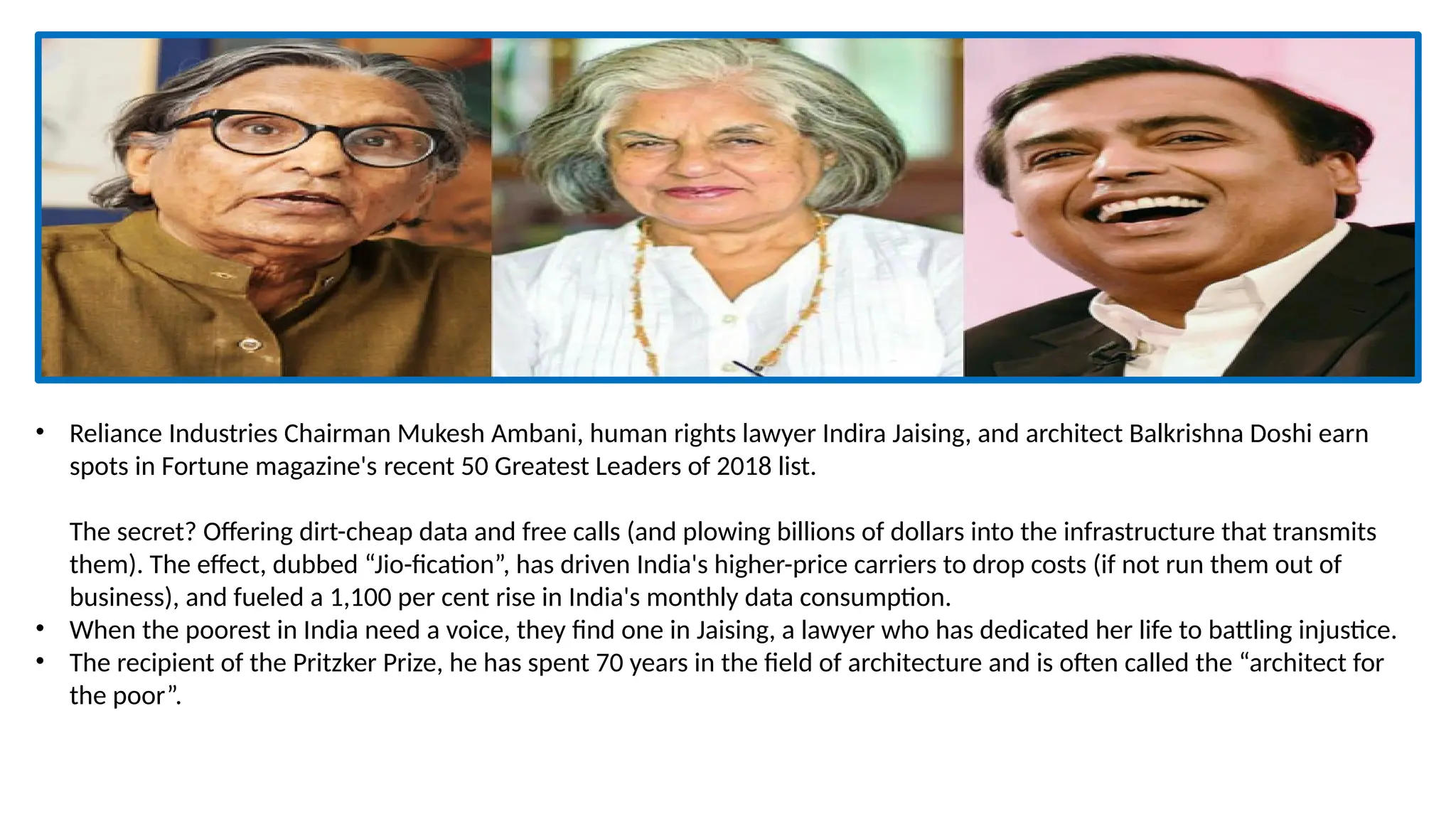
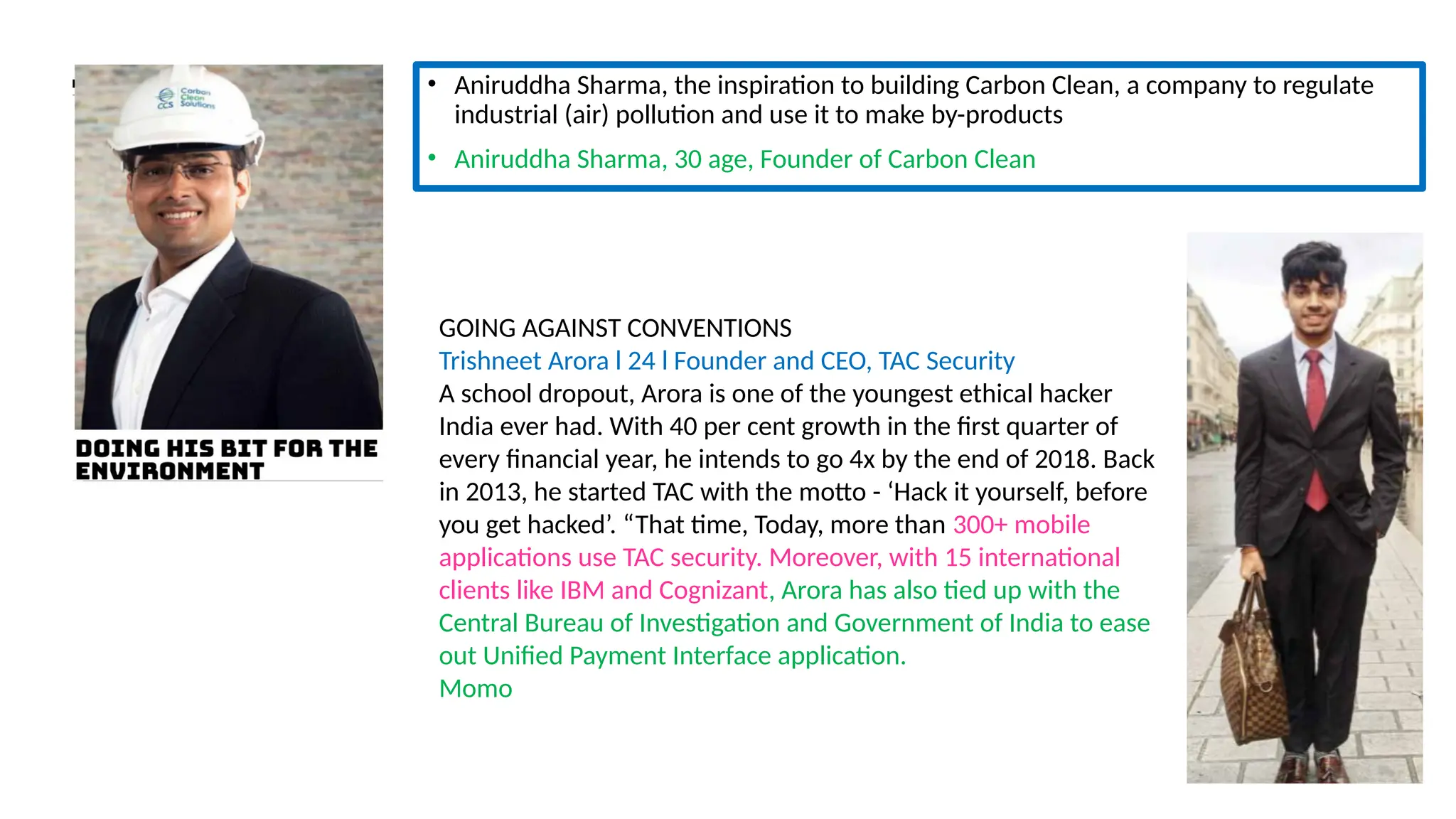
  • 205.
    • Pankaj Patel • PankajRamanbhai Patel is the chairman and managing director of Cadila Healthcare. He comes from Ahmedabad and is the son of a pharmacy professor. With over 30 years of experience in the pharma industry, he is one of the most successful pharma entrepreneurs in the country. Zydus Cadilla is a well known brand now and enjoys good reputation in the pharma industry. Zydus enjoys presence in segments like cardiovasculars and gastrointestinals. It has 17 brands that feature amongst the top 300 pharmaceutical brands in India. In 2006, the group was featured in the Forbes list of 'Best Under a Billion' company from amongst 200 companies in Asia.
  • 206.
    • Romesh Wadhwani • RomeshT. Wadhwani is the founder and chairman of Symphony Technology Group, a private equity firm investing in software and software services companies. He is a Silicon Valley serial entrepreneur, having created and sold three companies in 30 years. In 2000, Wadhwani's e-commerce start-up Aspect Development Inc was acquired by i2 Technologies, another Indian-owned company, in a historic and one of the largest deals in the US software industry that year. His Wadhwani Centre for Entrepreneurial Development at the Indian School of Business focuses on on broad- based policy research. Romesh currently serves on the boards of directors of STG companies SymphonyIRI Group, Symphony Services, Lawson, MSC Software and Shopzilla. Romesh says strengthening Indian entrepreneurship in the technology domain will accelerate the economic development in the country while contributing positively to the global business scenario.
  • 207.
    • Uday Kotak •Uday Kotak is the vice-chairman and managing director of Kotak Mahindra Bank. He owns a 50 per cent stake in Kotak Mahindra Bank, which he founded and runs. He is among India's first billionaire banker who started out with a small finance firm in 1985 and then made it a full-fledged bank after acquiring banking license in 2003. The bank has over 320 branches and 2.7 million customers. Uday Kotak was born in Mumbai, India and belongs to traditional Gujarati cotton trader's family.
  • 209.
  • 210.
    International Entrepreneurship International Entrepreneurshipis the process of an entrepreneur conducting business activities across national boundaries.
  • 211.
    Another Definition ofIE The process of creatively discovering and exploiting opportunities that lie outside a firm’s domestic market in the pursuit of competitive advantage.
  • 212.
    Traditional Motivations  Salesto other Markets  Avoid Changing Domestic Conditions  Access to Lower Cost Structures
  • 213.
    Importance of InternationalEntrepreneurship International business has become increasingly important to firms of all sizes Successful entrepreneur is someone who fully understand International entrepreneurship and differs from purely domestic business and is able to respond accordingly
  • 214.
    International Vs DomesticEntrepreneurship International entrepreneurial decisions are more complex due to uncontrollable factors such as the following; Economics  A domestic business strategy is designed under a single economic system  Creating a business strategy for multiple countries means dealing with different levels of economic development and different distribution systems Political-Legal Environment  Multiple political and legal environments are opening some opportunities while eliminating others  Differences in Value added-tax  Differences in Advertising campaign  Differences in labeling, ingredients, packaging  Laws governing business arrangements also vary greatly in the 150 different legal systems and sets of national laws
  • 215.
    International Vs DomesticEntrepreneurship Cultural Environment  Understanding the local culture is necessary when developing worldwide plans  Language barrier  Bribes and corruption culture Technological Environment  Technology varies significantly across countries  New products in a country are created based on the conditions andinfrastructure of that country  Example of cars based on roads and price of gasoline
  • 216.
    Entrepreneurial Entry intoInternational Business The modes of entering an international business in divided into three categories; 1. Exporting 2. Non-equity arrangements 3. Direct foreign investment
  • 217.
    Entrepreneurial Entryinto InternationalBusiness 1. Exporting: selling goods made in one country to another Indirect exporting involves using a foreign purchaser( or export management firm) in a local market or selling goods to another country through a person in the entrepreneur’s home market  Direct exporting uses independent distributors or selling goods to another country by taking care of the transaction Opening their own overseas office for sales
  • 218.
    Entrepreneurial Entryinto InternationalBusiness 2. Nonequity arrangement: Doing international business through an arrangement that does not involve any investment   Licensing: Allowing someone else to use something of the Company’s Entrepreneur who is a manufacturer(Licensee) giving a foreign manufacturer (licensor) the right to use a patent, trademark, technology, production process or product in return for the payment of royalty  Turn-Key Projects: Developing and operationalizing something in a foreign country    Management Contracts: A method for doing a specific international task Management techniques & skills Acquiring foreign expertise without giving ownership of resources to foreigner
  • 219.
    Entrepreneurial Entryinto InternationalBusiness 3. Direct Foreign Investment: the percentage of ownership is related to the amount of money invested, the nature of the industry, and the rules of the host government 4. Minority interests: Having less than 50% ownership position 5. Majority Interest: having more than 50% ownership position 6. JointVenture: Two companies forming a third company
  • 220.
    Thejoint venture shouldhave synergy!  Synergy means that the whole is greater than the sum of its parts or The two parties having things in common 1  1  3
  • 221.
    Entrepreneurial Entryinto InternationalBusiness 4. Mergers: An entrepreneur can obtain 100% ownership Horizontal Merger: combination of at least two firms doing similar business at the same market level (e.g.; 7 Eleven Stores) Vertical Merger: Combination of at least two firms at different market level (stabilizes supply & production e.g. walls & polka) Product Extension Merger: Combination of two firms with noncompeting products (related production/distribution activities e.g. Western publishing (kids books) by Mattel (toys))  Market extension Merger: Combination of at least two firms with similar products in different geographical markets (e.g. Diamond chain: west coast retailer by Dayton Hudson a Minneapolis retailer) Diversified Activity Merger: Combination of at least two totally unrelated firms (e.g. Hillenbrand (hospital furniture manufacturer byAmerican tourists (a luggage manufacturer))
  • 222.
    Organizations overcoming Barriersto International Trade  Trade barriers: Hindrances to doing international business  Some countries (Japan) allegedly present barriers due to their complicated distribution system  GATT (the General Agreement on Tariffs and Trade) seeks to help overcome barriers  FTA’s (free trade agreements) such as NAFTA reduce barriers and encourage investment between countries (in this case the U.S., Canada and Mexico)
  • 223.
    Entrepreneurial Partnering isone good strategy of entering international market!!