GREEN HOUSE & GLOBAL WARMING
Name :- Darshan Rajput [16BEITV124]
Dhrumil Patel [16BEUTV123]
Ankur Sangani [16BEITV122]
 DEFINATION
 Green house is house of glass used for raising delicate plants in cold
countries
 It give idol situation for them
 A green house has higher temperature inside than outside because
of following facts
1. Glass walls
2. High carbon dioxide
3. Higher water vapour content of air in green house
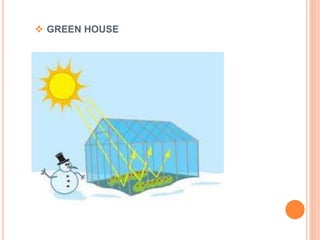
 GREEN HOUSE
 They let short wave radiation(0.15-0.4) to pass through them
but prevent the escape of infrared radiation emitted by the
earth surface, this make inside house warmer than outside
 Some of the atmospheric gases and air pollutions have the
property similar to glass.
 These type of gases called greenhouse gases
1) CO2
2) N2O
3) CH4
4) CFC
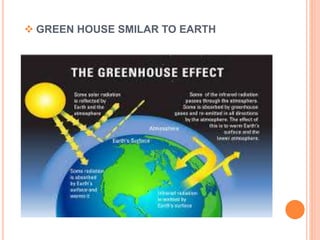
 GREEN HOUSE SMILAR TO EARTH
 Among these CO2 is mainly responsible for green house
effect.
 Warming of earth by green house occurring since many
centuries .
 It is due to this effect that good temperature for living is
maintained on surface
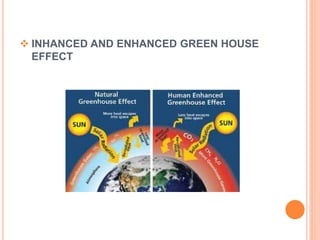
 The natural green house effect is called as enhanced green
house effect.
 And due to pollutant gas cause to green house is called
enhanced green house effect
 INHANCED AND ENHANCED GREEN HOUSE
EFFECT
 GREEN HOUSE GASES
1) CO2 : It contribute 55-60%to global warming from green
house effect.
It is main source to fossil fuel burning deforestation.
2) CFC : It contribute 14-20%.
It main source because of air conditioner and
refrigerator s air leakage.
3) CH4 : It contribute18-20%.
4) N2O : It contribute 6% .Main source of agriculture,
biomass burning.
 GREEN HOUSE EFFECT CAUSE GLOBAL WARMING
 Global warming potential (GWP) is the ratio of the warming
caused by a substance compared to the warming caused by a
similar mass of CO2.
 The GWP of CO2 is 1.0.
 Global warming means increase in any temperature of the
earth due to green house gases.
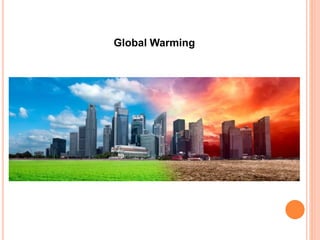
Global Warming
 IMPACTS OF GLOBAL WARMING
I. Global temperature increase
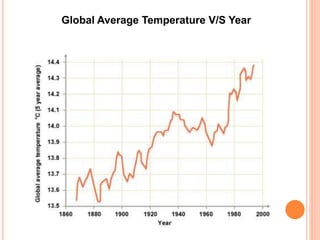
 It is estimated that average temperature of earth may increase
by 1.4 C to 5.8 C by the year 2100 from year 1990.
 In the 20th century, the global mean temperature has
increased by about 0.6 C.
II. Rise in sea level
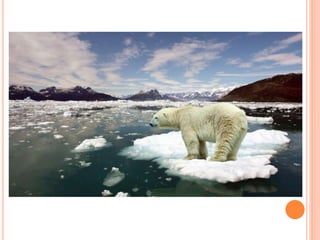
 With increasing global temperature polar ice caps and glaciers
will melt.
 It will also cause thermal expansion of sea water resulting in
further rice in sea level.
Global Average Temperature V/S Year
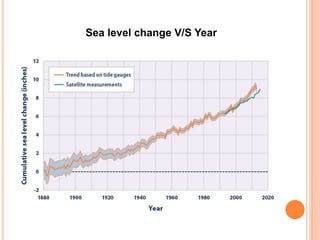
 Average global sea level will rise by 0.2 to 1.5 meters over next 50
to 100 years.
 The countries most at risk are the river delta areas of Bangladesh,
India, Egypt, Thailand and China but many small islands will also
suffer.
 The immediate effect of inundation will be crop destruction but
more importantly, the surrounding ground waters will become
increasingly saline and large areas of productive land rendered
permanently useless.
III. Effect on human health
 The global warming will lead to changes in the rainfall pattern in
many areas, thereby affecting the distribution of vector- borne
diseases like malaria, filariasis, elephantiasis etc.
Sea level change V/S Year
IV. Effect on food Production
 Global warming will reduce crop production due to increased
incidence of plant diseases and pests, explosive growths of
weeds.
 It is estimated that the yield of rice along in South East Asia
will decrease by 5% for each 1C rise in temperature.
V. Other climatic effects include unequal distribution of rain
which may results in flooding in some areas and drought in
some areas.
 In temperate regions, the summers will be longer and hotter
whereas the winters will be shorter and warmer.
 The already dry sub-tropical regions may become drier and
tropical regions may become wetter.
THANK YOU

seminar for collage level

  • 1.
    GREEN HOUSE &GLOBAL WARMING Name :- Darshan Rajput [16BEITV124] Dhrumil Patel [16BEUTV123] Ankur Sangani [16BEITV122]
  • 2.
     DEFINATION  Greenhouse is house of glass used for raising delicate plants in cold countries  It give idol situation for them  A green house has higher temperature inside than outside because of following facts 1. Glass walls 2. High carbon dioxide 3. Higher water vapour content of air in green house
  • 3.
  • 4.
     They letshort wave radiation(0.15-0.4) to pass through them but prevent the escape of infrared radiation emitted by the earth surface, this make inside house warmer than outside  Some of the atmospheric gases and air pollutions have the property similar to glass.  These type of gases called greenhouse gases 1) CO2 2) N2O 3) CH4 4) CFC
  • 5.
     GREEN HOUSESMILAR TO EARTH
  • 6.
     Among theseCO2 is mainly responsible for green house effect.  Warming of earth by green house occurring since many centuries .  It is due to this effect that good temperature for living is maintained on surface  The natural green house effect is called as enhanced green house effect.  And due to pollutant gas cause to green house is called enhanced green house effect
  • 7.
     INHANCED ANDENHANCED GREEN HOUSE EFFECT
  • 8.
     GREEN HOUSEGASES 1) CO2 : It contribute 55-60%to global warming from green house effect. It is main source to fossil fuel burning deforestation. 2) CFC : It contribute 14-20%. It main source because of air conditioner and refrigerator s air leakage. 3) CH4 : It contribute18-20%. 4) N2O : It contribute 6% .Main source of agriculture, biomass burning.
  • 9.
     GREEN HOUSEEFFECT CAUSE GLOBAL WARMING  Global warming potential (GWP) is the ratio of the warming caused by a substance compared to the warming caused by a similar mass of CO2.  The GWP of CO2 is 1.0.  Global warming means increase in any temperature of the earth due to green house gases.
  • 10.
  • 11.
     IMPACTS OFGLOBAL WARMING I. Global temperature increase  It is estimated that average temperature of earth may increase by 1.4 C to 5.8 C by the year 2100 from year 1990.  In the 20th century, the global mean temperature has increased by about 0.6 C. II. Rise in sea level  With increasing global temperature polar ice caps and glaciers will melt.  It will also cause thermal expansion of sea water resulting in further rice in sea level.
  • 12.
  • 13.
     Average globalsea level will rise by 0.2 to 1.5 meters over next 50 to 100 years.  The countries most at risk are the river delta areas of Bangladesh, India, Egypt, Thailand and China but many small islands will also suffer.  The immediate effect of inundation will be crop destruction but more importantly, the surrounding ground waters will become increasingly saline and large areas of productive land rendered permanently useless. III. Effect on human health  The global warming will lead to changes in the rainfall pattern in many areas, thereby affecting the distribution of vector- borne diseases like malaria, filariasis, elephantiasis etc.
  • 14.
  • 15.
    IV. Effect onfood Production  Global warming will reduce crop production due to increased incidence of plant diseases and pests, explosive growths of weeds.  It is estimated that the yield of rice along in South East Asia will decrease by 5% for each 1C rise in temperature. V. Other climatic effects include unequal distribution of rain which may results in flooding in some areas and drought in some areas.  In temperate regions, the summers will be longer and hotter whereas the winters will be shorter and warmer.  The already dry sub-tropical regions may become drier and tropical regions may become wetter.
  • 17.