University of Agronomic Sciences and Veterinary Medicine Bucharest
Coordinating teacher: Mihai Daniel Frumușelu Student: Neda Denisa Gabriela
8205
What is global warming?
Global warming is a long-term rise in the average temperature of the Earth's
climate system, an aspect of climate change shown by temperature
measurements and by multiple effects of the warming.The term commonly refers
to the mainly human-caused observed warming since pre-industrial times and its
projected continuation, though there were also much earlier periods of global
warming. In the modern context the terms global warming and climate change are
commonly used interchangeably but global warming more specifically relates to
worldwide surface temperature increases; while climate change is any regional or
global statistically identifiable persistent change in the state of climate which lasts
for decades or longer, including warming or cooling.
Greenhouse gases
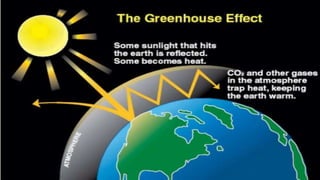
The greenhouse effect is the process by which absorption and emission of
infrared radiation by gases in a planet's atmosphere warm its lower
atmosphere and surface. On Earth, an atmosphere containing naturally
occurring amounts of greenhouse gases causes air temperature near the
surface to be warmer by about 33 °C (59 °F) than it would be in their
absence. Without the Earth's atmosphere, the Earth's average
temperature would be well below the freezing temperature of water.
Human activity since the Industrial Revolution has increased the
amount of greenhouse gases in the atmosphere, leading to increased
radiative forcing from CO2, methane, tropospheric ozone and nitrous
oxide.
Aerosols and soot
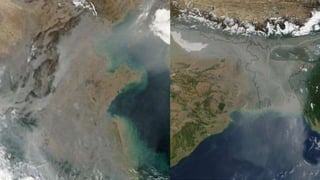
Global dimming, a gradual reduction in the amount of global direct
irradiance at the Earth's surface, was observed from 1961 until at least
1990. Solid and liquid particles known as aerosols, produced by
volcanoes and human-made pollutants, are thought to be the main
cause of this dimming.They exert a cooling effect by increasing the
reflection of incoming sunlight.This effect also causes droplets to be
of more uniform size, which reduces growth of raindrops and makes
the cloud more reflective to incoming sunlight, known as the Albrecht
effect. Indirect effects are most noticeable in marine stratiform clouds,
and have very little radiative effect on convective clouds. Indirect
effects of aerosols represent the largest uncertainty in radiative
forcing.
Solar activity
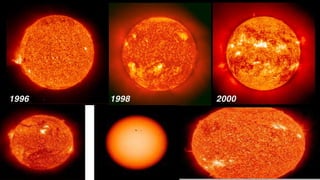
Since 1978, solar irradiance has been measured by satellites.
Climate models have been used to examine the role of the Sun in
recent climate change. Models are unable to reproduce the rapid
warming observed in recent decades when only taking into account
variations in solar output and volcanic activity.
Another line of evidence for the Sun's non-attributability is the
differing temperature changes at different levels in the Earth's
atmosphere. According to basic physical principles, the greenhouse
effect produces warming of the lower atmosphere (the troposphere),
but cooling of the upper atmosphere (the stratosphere). If solar
variations were responsible for the observed warming, warming of
both the troposphere and the stratosphere would be expected.
Effects
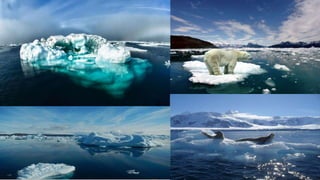
• Arctic sea ice decline, sea level rise, retreat of glaciers: Global warming has led
to decades of shrinking and thinning in a warm climate that has put the Arctic
sea ice in a precarious position, it is now vulnerable to atmospheric anomalies.
Projections of declines in Arctic sea ice vary. Recent projections suggest that
Arctic summers could be ice-free (defined as ice extent less than 1 million
square km) as early as 2025–2030. The sea level rise since 1993 has been
estimated to have been on average 2.6 mm and 2.9 mm per year ± 0.4 mm.
Additionally, sea level rise has accelerated from 1995 to 2015. Over the 21st
century, the IPCC projects for a high emissions scenario, that global mean sea
level could rise by 52–98 cm.
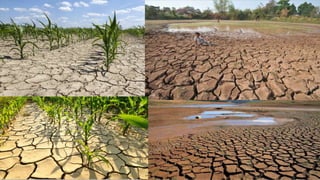
• Extreme weather, extreme events, tropical cyclones:
Data analysis of extreme events from 1960 until 2010
suggests that droughts and heat waves appear
simultaneously with increased frequency. Extremely
wet or dry events within the monsoon period have
increased since 1980.Projections suggest a probable
increase in the frequency and severity of some
extreme weather events, such as heat waves.
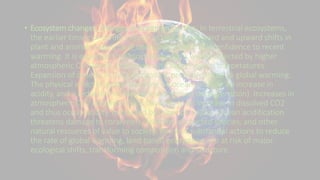
• Ecosystem changes, changes in ocean properties: In terrestrial ecosystems,
the earlier timing of spring events, as well as poleward and upward shifts in
plant and animal ranges, have been linked with high confidence to recent
warming. It is expected that most ecosystems will be affected by higher
atmospheric CO2 levels, combined with higher global temperatures.
Expansion of deserts in the subtropics is probably linked to global warming.
The physical effect of global warming on oceans include an increase in
acidity, and a reduction of oxygen levels (ocean deoxygenation). Increases in
atmospheric CO2 concentrations have led to an increase in dissolved CO2
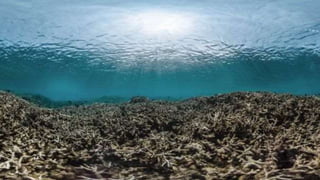
and thus ocean acidity, measured by lower pH values. Ocean acidification
threatens damage to coral reefs, fisheries, protected species, and other
natural resources of value to society. Without substantial actions to reduce
the rate of global warming, land based ecosystems are at risk of major
ecological shifts, transforming composition and structure.
Can we stop it?
The devastating impacts of climate change are clear. Our world is warmer
than ever before, and people and wildlife are already suffering the
consequences. But that’s nothing compared to what we’re leaving future
generations if these trends continue. It’s time to stop the destruction. It’s
time for an energy [r]evolution. With technology already available, renewable
energy sources like wind, solar, and geothermal can provide 96 percent of our
electricity and 98 percent of heating demand — the vast majority of U.S.
energy use. Still, we need more. We’ve got great opportunities today to build
a cleaner energy system in time to avoid the worst impacts of climate change.
Big companies like Apple and Google are setting great examples, committing
to 100 percent renewable energy and making record-breaking investments in
wind and solar. And across the country, everyday Americans are joining the
energy revolution by through projects like community solar.
BIBLIOGRAPHY:
• https://www.greenpeace.org/usa/global-warming/
• https://en.wikipedia.org/wiki/Global_warming#Scientific_discussion
• https://en.wikipedia.org/wiki/Greenhouse_gas
Global warming

Global warming

  • 1.
    University of AgronomicSciences and Veterinary Medicine Bucharest Coordinating teacher: Mihai Daniel Frumușelu Student: Neda Denisa Gabriela 8205
  • 2.
    What is globalwarming? Global warming is a long-term rise in the average temperature of the Earth's climate system, an aspect of climate change shown by temperature measurements and by multiple effects of the warming.The term commonly refers to the mainly human-caused observed warming since pre-industrial times and its projected continuation, though there were also much earlier periods of global warming. In the modern context the terms global warming and climate change are commonly used interchangeably but global warming more specifically relates to worldwide surface temperature increases; while climate change is any regional or global statistically identifiable persistent change in the state of climate which lasts for decades or longer, including warming or cooling.
  • 3.
    Greenhouse gases The greenhouseeffect is the process by which absorption and emission of infrared radiation by gases in a planet's atmosphere warm its lower atmosphere and surface. On Earth, an atmosphere containing naturally occurring amounts of greenhouse gases causes air temperature near the surface to be warmer by about 33 °C (59 °F) than it would be in their absence. Without the Earth's atmosphere, the Earth's average temperature would be well below the freezing temperature of water. Human activity since the Industrial Revolution has increased the amount of greenhouse gases in the atmosphere, leading to increased radiative forcing from CO2, methane, tropospheric ozone and nitrous oxide.
  • 5.
    Aerosols and soot Globaldimming, a gradual reduction in the amount of global direct irradiance at the Earth's surface, was observed from 1961 until at least 1990. Solid and liquid particles known as aerosols, produced by volcanoes and human-made pollutants, are thought to be the main cause of this dimming.They exert a cooling effect by increasing the reflection of incoming sunlight.This effect also causes droplets to be of more uniform size, which reduces growth of raindrops and makes the cloud more reflective to incoming sunlight, known as the Albrecht effect. Indirect effects are most noticeable in marine stratiform clouds, and have very little radiative effect on convective clouds. Indirect effects of aerosols represent the largest uncertainty in radiative forcing.
  • 7.
    Solar activity Since 1978,solar irradiance has been measured by satellites. Climate models have been used to examine the role of the Sun in recent climate change. Models are unable to reproduce the rapid warming observed in recent decades when only taking into account variations in solar output and volcanic activity. Another line of evidence for the Sun's non-attributability is the differing temperature changes at different levels in the Earth's atmosphere. According to basic physical principles, the greenhouse effect produces warming of the lower atmosphere (the troposphere), but cooling of the upper atmosphere (the stratosphere). If solar variations were responsible for the observed warming, warming of both the troposphere and the stratosphere would be expected.
  • 9.
    Effects • Arctic seaice decline, sea level rise, retreat of glaciers: Global warming has led to decades of shrinking and thinning in a warm climate that has put the Arctic sea ice in a precarious position, it is now vulnerable to atmospheric anomalies. Projections of declines in Arctic sea ice vary. Recent projections suggest that Arctic summers could be ice-free (defined as ice extent less than 1 million square km) as early as 2025–2030. The sea level rise since 1993 has been estimated to have been on average 2.6 mm and 2.9 mm per year ± 0.4 mm. Additionally, sea level rise has accelerated from 1995 to 2015. Over the 21st century, the IPCC projects for a high emissions scenario, that global mean sea level could rise by 52–98 cm.
  • 11.
    • Extreme weather,extreme events, tropical cyclones: Data analysis of extreme events from 1960 until 2010 suggests that droughts and heat waves appear simultaneously with increased frequency. Extremely wet or dry events within the monsoon period have increased since 1980.Projections suggest a probable increase in the frequency and severity of some extreme weather events, such as heat waves.
  • 13.
    • Ecosystem changes,changes in ocean properties: In terrestrial ecosystems, the earlier timing of spring events, as well as poleward and upward shifts in plant and animal ranges, have been linked with high confidence to recent warming. It is expected that most ecosystems will be affected by higher atmospheric CO2 levels, combined with higher global temperatures. Expansion of deserts in the subtropics is probably linked to global warming. The physical effect of global warming on oceans include an increase in acidity, and a reduction of oxygen levels (ocean deoxygenation). Increases in atmospheric CO2 concentrations have led to an increase in dissolved CO2 and thus ocean acidity, measured by lower pH values. Ocean acidification threatens damage to coral reefs, fisheries, protected species, and other natural resources of value to society. Without substantial actions to reduce the rate of global warming, land based ecosystems are at risk of major ecological shifts, transforming composition and structure.
  • 15.
    Can we stopit? The devastating impacts of climate change are clear. Our world is warmer than ever before, and people and wildlife are already suffering the consequences. But that’s nothing compared to what we’re leaving future generations if these trends continue. It’s time to stop the destruction. It’s time for an energy [r]evolution. With technology already available, renewable energy sources like wind, solar, and geothermal can provide 96 percent of our electricity and 98 percent of heating demand — the vast majority of U.S. energy use. Still, we need more. We’ve got great opportunities today to build a cleaner energy system in time to avoid the worst impacts of climate change. Big companies like Apple and Google are setting great examples, committing to 100 percent renewable energy and making record-breaking investments in wind and solar. And across the country, everyday Americans are joining the energy revolution by through projects like community solar.
  • 16.