GLOBAL WARMING
What is global warming?
Global Warming is the increase of
Earth's average surface temperature
due to effect of greenhouse gases,
such as carbon dioxide emissions
from burning fossil fuels or from
deforestation, which trap heat that
would otherwise escape from Earth.
This is a type of greenhouse effect..
What are the Greenhouse Gases?
The most significant greenhouse
gas is actually water vapor, not
something produced directly by
humankind in significant
amounts. However, even slight
increases in atmospheric levels
of carbon dioxide (CO2) can
cause a substantial increase in
temperature.
Sources of green house effect
The gases responsible for green house effect are:
1. Carbon Di Oxide (CO2)
2. Methane (CH4)
3. Cloro Fluro Carbon (CFC)
4. Nitrous Oxide (N2O)
CO2 is responsible for half of the global
warming. In recent years, rise in CO2 level
ranging from 0.8 to 1.9 PP per year.
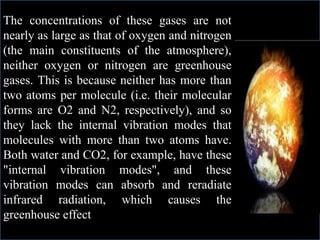
The concentrations of these gases are not
nearly as large as that of oxygen and nitrogen
(the main constituents of the atmosphere),
neither oxygen or nitrogen are greenhouse
gases. This is because neither has more than
two atoms per molecule (i.e. their molecular
forms are O2 and N2, respectively), and so
they lack the internal vibration modes that
molecules with more than two atoms have.
Both water and CO2, for example, have these
"internal vibration modes", and these
vibration modes can absorb and reradiate
infrared radiation, which causes the
greenhouse effect
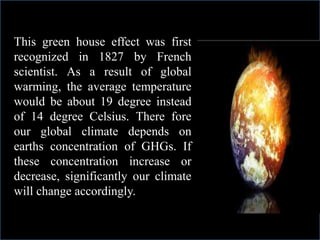
This green house effect was first
recognized in 1827 by French
scientist. As a result of global
warming, the average temperature
would be about 19 degree instead
of 14 degree Celsius. There fore
our global climate depends on
earths concentration of GHGs. If
these concentration increase or
decrease, significantly our climate
will change accordingly.
Contributions to global warming
1985 data shows that developed
countries emission of CO2 was 3.95
billion tones and expected to rise
6.71 billion tones by 2025. The
developing countries emission is only
1.29 billion tones. India's
contribution to global warming is 4%
in 1990. India's CO2 contribution is
2.8% of global CO2 contribution and
methane is 2% of global level.
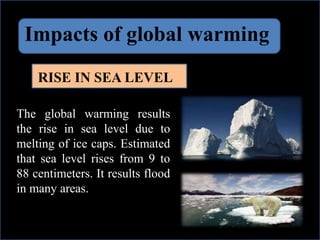
Impacts of global warming
RISE IN SEA LEVEL
The global warming results
the rise in sea level due to
melting of ice caps. Estimated
that sea level rises from 9 to
88 centimeters. It results flood
in many areas.
Impacts of global warming
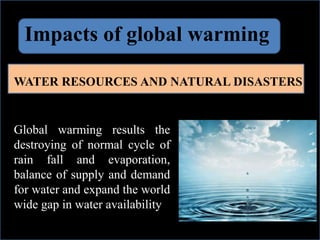
WATER RESOURCES AND NATURAL DISASTERS
Global warming results the
destroying of normal cycle of
rain fall and evaporation,
balance of supply and demand
for water and expand the world
wide gap in water availability.
Impacts of global warming
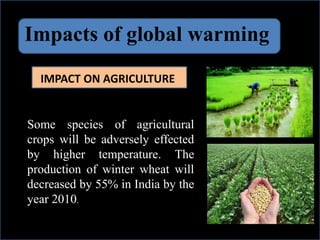
IMPACT ON AGRICULTURE
Some species of agricultural
crops will be adversely effected
by higher temperature. The
production of winter wheat will
decreased by 55% in India by the
year 2010.
Impacts of global warming
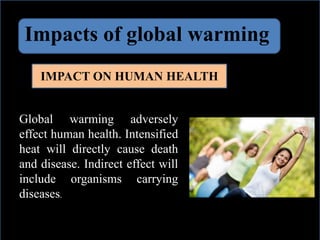
IMPACT ON HUMAN HEALTH
Global warming adversely
effect human health. Intensified
heat will directly cause death
and disease. Indirect effect will
include organisms carrying
diseases.
Impacts of global warming
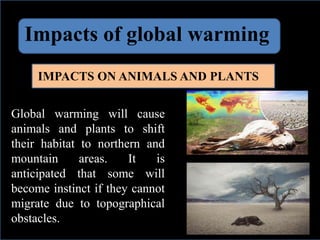
IMPACTS ON ANIMALS AND PLANTS
Global warming will cause
animals and plants to shift
their habitat to northern and
mountain areas. It is
anticipated that some will
become instinct if they cannot
migrate due to topographical
obstacles.
Impacts of global warming
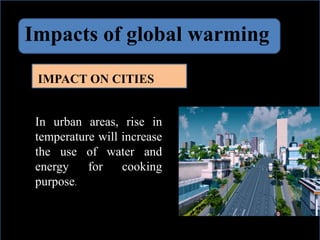
IMPACT ON CITIES
In urban areas, rise in
temperature will increase
the use of water and
energy for cooking
purpose.
Suggestions to reduce the
global warming
1. Increased energy efficiency in consumption
and production
2. Switch over to law or non carbon fuels.
3. Using substances of CFC in refrigerator and
AC.
4. Increased full efficiency in vehicles through
proper maintenance.
Suggestions to reduce the
global warming
5. Reduce methane production.
6. Switch over to non-fossil fuel source of energy.
7. Increased a forestation.
8. Implement policy tools
a). Carbon tax
b). Transferable Discharge Permit (TDP).
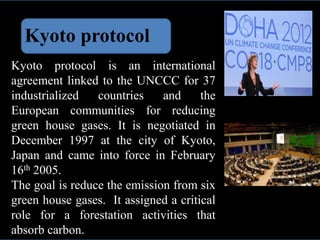
Kyoto protocol
Kyoto protocol is an international
agreement linked to the UNCCC for 37
industrialized countries and the
European communities for reducing
green house gases. It is negotiated in
December 1997 at the city of Kyoto,
Japan and came into force in February
16th 2005.
The goal is reduce the emission from six
green house gases. It assigned a critical
role for a forestation activities that
absorb carbon.

Global warming

  • 1.
  • 2.
    What is globalwarming? Global Warming is the increase of Earth's average surface temperature due to effect of greenhouse gases, such as carbon dioxide emissions from burning fossil fuels or from deforestation, which trap heat that would otherwise escape from Earth. This is a type of greenhouse effect..
  • 3.
    What are theGreenhouse Gases? The most significant greenhouse gas is actually water vapor, not something produced directly by humankind in significant amounts. However, even slight increases in atmospheric levels of carbon dioxide (CO2) can cause a substantial increase in temperature.
  • 4.
    Sources of greenhouse effect The gases responsible for green house effect are: 1. Carbon Di Oxide (CO2) 2. Methane (CH4) 3. Cloro Fluro Carbon (CFC) 4. Nitrous Oxide (N2O) CO2 is responsible for half of the global warming. In recent years, rise in CO2 level ranging from 0.8 to 1.9 PP per year.
  • 5.
    The concentrations ofthese gases are not nearly as large as that of oxygen and nitrogen (the main constituents of the atmosphere), neither oxygen or nitrogen are greenhouse gases. This is because neither has more than two atoms per molecule (i.e. their molecular forms are O2 and N2, respectively), and so they lack the internal vibration modes that molecules with more than two atoms have. Both water and CO2, for example, have these "internal vibration modes", and these vibration modes can absorb and reradiate infrared radiation, which causes the greenhouse effect
  • 6.
    This green houseeffect was first recognized in 1827 by French scientist. As a result of global warming, the average temperature would be about 19 degree instead of 14 degree Celsius. There fore our global climate depends on earths concentration of GHGs. If these concentration increase or decrease, significantly our climate will change accordingly.
  • 7.
    Contributions to globalwarming 1985 data shows that developed countries emission of CO2 was 3.95 billion tones and expected to rise 6.71 billion tones by 2025. The developing countries emission is only 1.29 billion tones. India's contribution to global warming is 4% in 1990. India's CO2 contribution is 2.8% of global CO2 contribution and methane is 2% of global level.
  • 8.
    Impacts of globalwarming RISE IN SEA LEVEL The global warming results the rise in sea level due to melting of ice caps. Estimated that sea level rises from 9 to 88 centimeters. It results flood in many areas.
  • 9.
    Impacts of globalwarming WATER RESOURCES AND NATURAL DISASTERS Global warming results the destroying of normal cycle of rain fall and evaporation, balance of supply and demand for water and expand the world wide gap in water availability.
  • 10.
    Impacts of globalwarming IMPACT ON AGRICULTURE Some species of agricultural crops will be adversely effected by higher temperature. The production of winter wheat will decreased by 55% in India by the year 2010.
  • 11.
    Impacts of globalwarming IMPACT ON HUMAN HEALTH Global warming adversely effect human health. Intensified heat will directly cause death and disease. Indirect effect will include organisms carrying diseases.
  • 12.
    Impacts of globalwarming IMPACTS ON ANIMALS AND PLANTS Global warming will cause animals and plants to shift their habitat to northern and mountain areas. It is anticipated that some will become instinct if they cannot migrate due to topographical obstacles.
  • 13.
    Impacts of globalwarming IMPACT ON CITIES In urban areas, rise in temperature will increase the use of water and energy for cooking purpose.
  • 14.
    Suggestions to reducethe global warming 1. Increased energy efficiency in consumption and production 2. Switch over to law or non carbon fuels. 3. Using substances of CFC in refrigerator and AC. 4. Increased full efficiency in vehicles through proper maintenance.
  • 15.
    Suggestions to reducethe global warming 5. Reduce methane production. 6. Switch over to non-fossil fuel source of energy. 7. Increased a forestation. 8. Implement policy tools a). Carbon tax b). Transferable Discharge Permit (TDP).
  • 16.
    Kyoto protocol Kyoto protocolis an international agreement linked to the UNCCC for 37 industrialized countries and the European communities for reducing green house gases. It is negotiated in December 1997 at the city of Kyoto, Japan and came into force in February 16th 2005. The goal is reduce the emission from six green house gases. It assigned a critical role for a forestation activities that absorb carbon.