What is Semantics?
Semantics is a study of
meaning in language,
which is branch of
linguistics .
Semantic relations among words
A term used to designate a particular member of a
broader class. For instance, daisy and rose are hyponyms
of flower.
The semantic relation that holds
between two words that can (in a given
context) express opposite meanings.
Example: Long : Short.
Antonymy
The semantic relation that holds
between two words that can (in a given
context) express the same meaning.
Example: Beautiful; Pretty.
Synonymy
Hyponymy
Homophony
Homophony exists where a single
phonetic form has two or more
entirely distinct meanings. In such
cases, it is assumed that these are
separate words with the same
pronunciation rather than a single
word with different meanings.
Example: light, meaning 1 ‘not heavy’
meaning 2 ‘illumination’.
Semantic relations among words
It occurs when the same word has
different meanings being written in the
same way. Example: Pomegranate
(explosive; fruit).
A term that is used to describe or
encompass other more specific terms.
Example: Insect: wasp, ant, fly,
mantis.
Hypernymy
This semantic relationship occurs
when two words that have different
meanings are pronounced in the
same way. Example: They had a very
romantic date .
Homonymy
Polysemy
Two sentences that have essentially the
same meaning are said to be paraphrases of
each other. Example:
a. The police chased the burglar.
b. The burglar was chased by the police.
Semantic relations involving sentences
Paraphrase Entailment
When the truth of one sentence
guarantees the truth of another
sentence, we say that there is a relation
of entailment. Example:
a. The park wardens killed the bear.
b. The bear is dead.
Contradiction
Sometimes it turns out that if one sentence is true, then another sentence must be false.
Example:
a. Charles is a bachelor.
b. Charles is married.
If it is true that Charles is a bachelor, then it cannot be true that he is married. When two
sentences cannot both be true, we say that there is a contradiction.
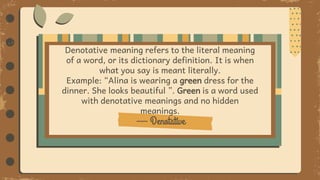
— Denotative
Denotative meaning refers to the literal meaning
of a word, or its dictionary definition. It is when
what you say is meant literally.
Example: “Alina is wearing a green dress for the
dinner. She looks beautiful ”. Green is a word used
with denotative meanings and no hidden
meanings.
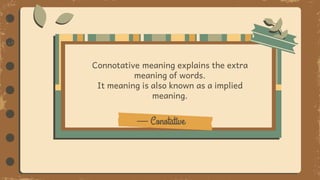
— Conotative
Connotative meaning explains the extra
meaning of words.
It meaning is also known as a implied
meaning.
Thank You

Semantics.pptx

  • 2.
    What is Semantics? Semanticsis a study of meaning in language, which is branch of linguistics .
  • 3.
    Semantic relations amongwords A term used to designate a particular member of a broader class. For instance, daisy and rose are hyponyms of flower. The semantic relation that holds between two words that can (in a given context) express opposite meanings. Example: Long : Short. Antonymy The semantic relation that holds between two words that can (in a given context) express the same meaning. Example: Beautiful; Pretty. Synonymy Hyponymy Homophony Homophony exists where a single phonetic form has two or more entirely distinct meanings. In such cases, it is assumed that these are separate words with the same pronunciation rather than a single word with different meanings. Example: light, meaning 1 ‘not heavy’ meaning 2 ‘illumination’.
  • 4.
    Semantic relations amongwords It occurs when the same word has different meanings being written in the same way. Example: Pomegranate (explosive; fruit). A term that is used to describe or encompass other more specific terms. Example: Insect: wasp, ant, fly, mantis. Hypernymy This semantic relationship occurs when two words that have different meanings are pronounced in the same way. Example: They had a very romantic date . Homonymy Polysemy
  • 5.
    Two sentences thathave essentially the same meaning are said to be paraphrases of each other. Example: a. The police chased the burglar. b. The burglar was chased by the police. Semantic relations involving sentences Paraphrase Entailment When the truth of one sentence guarantees the truth of another sentence, we say that there is a relation of entailment. Example: a. The park wardens killed the bear. b. The bear is dead. Contradiction Sometimes it turns out that if one sentence is true, then another sentence must be false. Example: a. Charles is a bachelor. b. Charles is married. If it is true that Charles is a bachelor, then it cannot be true that he is married. When two sentences cannot both be true, we say that there is a contradiction.
  • 6.
    — Denotative Denotative meaningrefers to the literal meaning of a word, or its dictionary definition. It is when what you say is meant literally. Example: “Alina is wearing a green dress for the dinner. She looks beautiful ”. Green is a word used with denotative meanings and no hidden meanings.
  • 7.
    — Conotative Connotative meaningexplains the extra meaning of words. It meaning is also known as a implied meaning.
  • 8.