Series editors
Keith Brown, Eve V.Clark, Jim Miller, Lesley Milroy,
Geoffrey K. Pullum, and Peter Roach
Meaning in Language
An Introductionto Semantics and Pragmatics
Meaning in Language
An Introduction to
Semantics and
Pragmatics
D.Alan Cruse
University of Manchester
OXFORD
UNIVERSITY PRESS
This page intentionally left blank
OXFORD
UNIVERSITY PRESS
Great Clarendon Street, OxfordOX2 6DP
Oxford University Press is a department of the University of Oxford.
It furthers the University's objective ofexcellence in research, scholarship,
and education bypublishing worldwidein
Oxford NewYork
Athens Auckland Bangkok Bogota Buenos Aires Calcutta
Cape Town Chennai Dar es Salaam Delhi Florence Hong Kong Istanbul
Karachi Kuala Lumpur Madrid Melbourne Mexico City Mumbai
Nairobi Paris Sao Paulo Singapore Taipei Tokyo Toronto Warsaw
with associated companies in Berlin Ibadan
Oxford is a trade mark of Oxford University Press
in the UK and in certain other countries
Published in the United States
by Oxford UniversityPress Inc., NewYork
© Oxford University Press 2000
The moral rights of the author havebeen asserted
Database right Oxford University Press (maker)
All rights reserved. No part of this publication may be reproduced,
stored in a retrieval system,or transmitted, in any form or by any means,
without the prior permission in writingof Oxford University Press,
or as expresslypermitted by law,or under terms agreed withthe appropriate
reprographics rights organizations. Enquiriesconcerning reproduction
outside the scope of the above should be sent to the Rights Department,
Oxford UniversityPress, at the address above
You must not circulatethis book in any other binding or cover
and youmust impose the same condition on any acquirer
British Library Cataloguing in Publication Data
Data available
Library of Congress Cataloging in Publication Data
(Data applied for)
ISBN 0-19-870010-5
10 9 8 7 6 5 4 3 2
Typeset by RefineCatch Limited, Bungay, Suffolk
Printed in Great Britain
on acid-free paper by
Bath Press Ltd., Bath, Avon
To Paute, Pierre, and Lisette
This page intentionally left blank
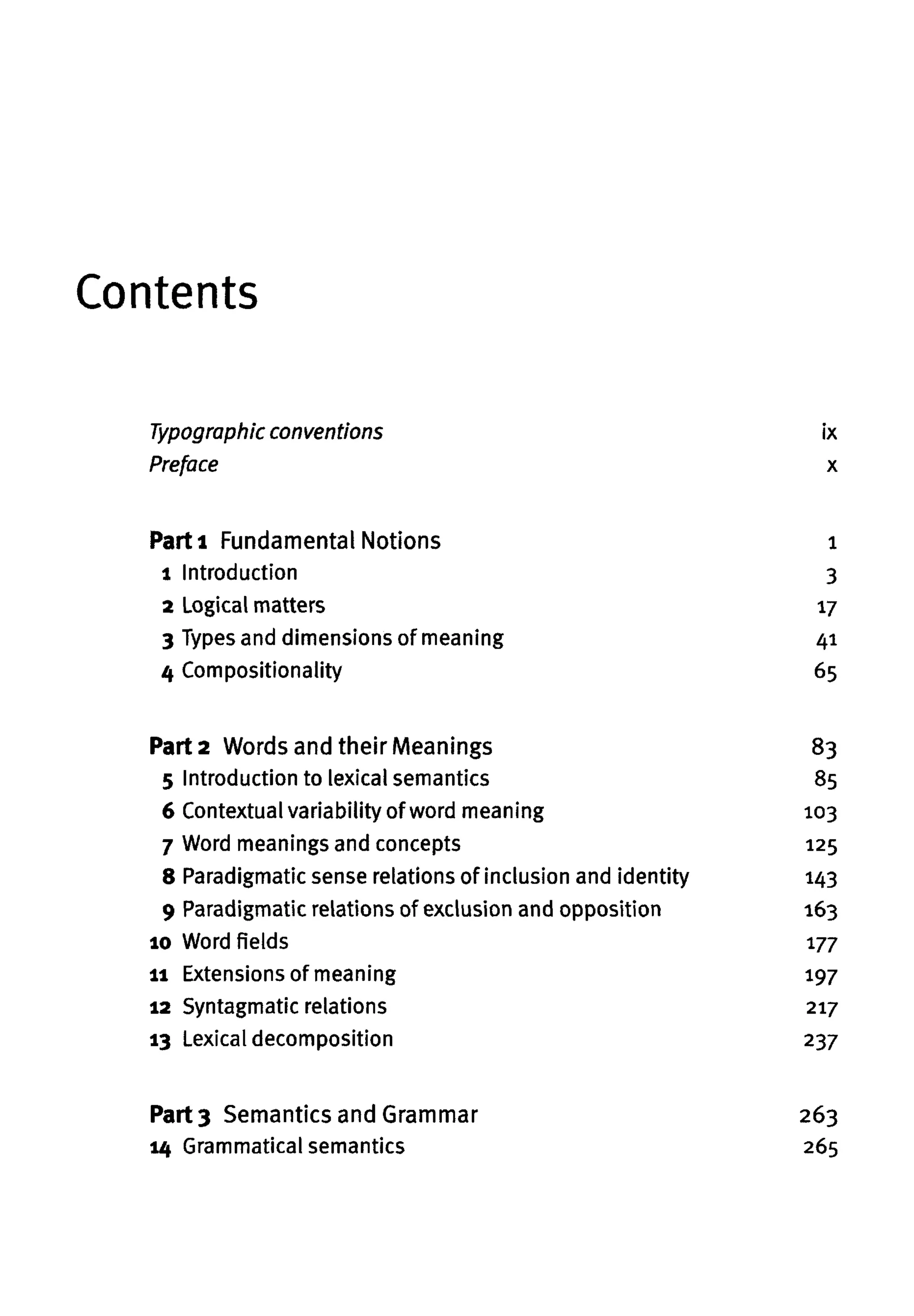
Contents
Part 2 Words and their Meanings
5 Introduction to lexical semantics
6 Contextual variability of word meaning
7 Word meanings and concepts
8 Paradigmatic sense relations of inclusion and identity
9 Paradigmatic relations of exclusion and opposition
10 Word fields
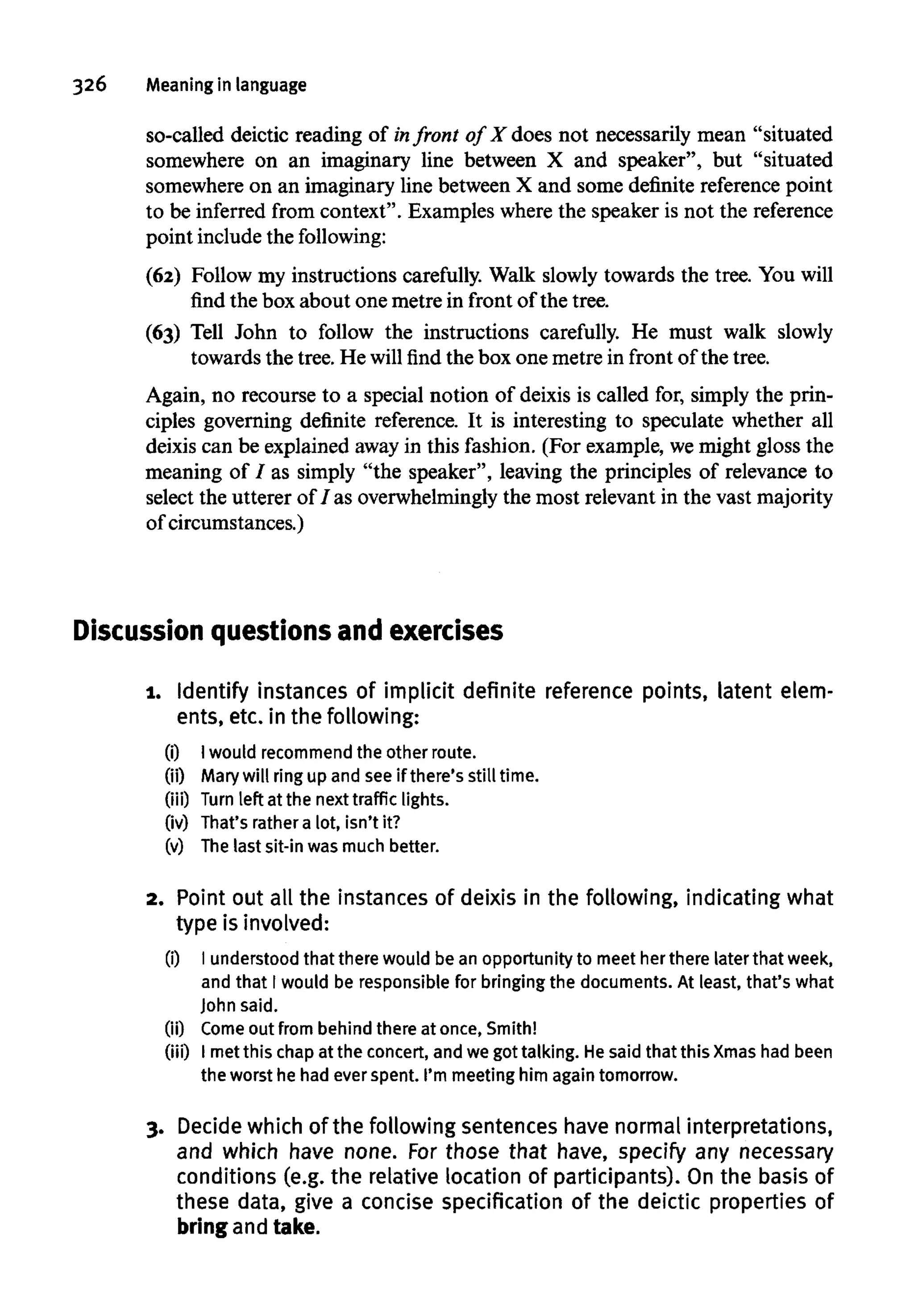
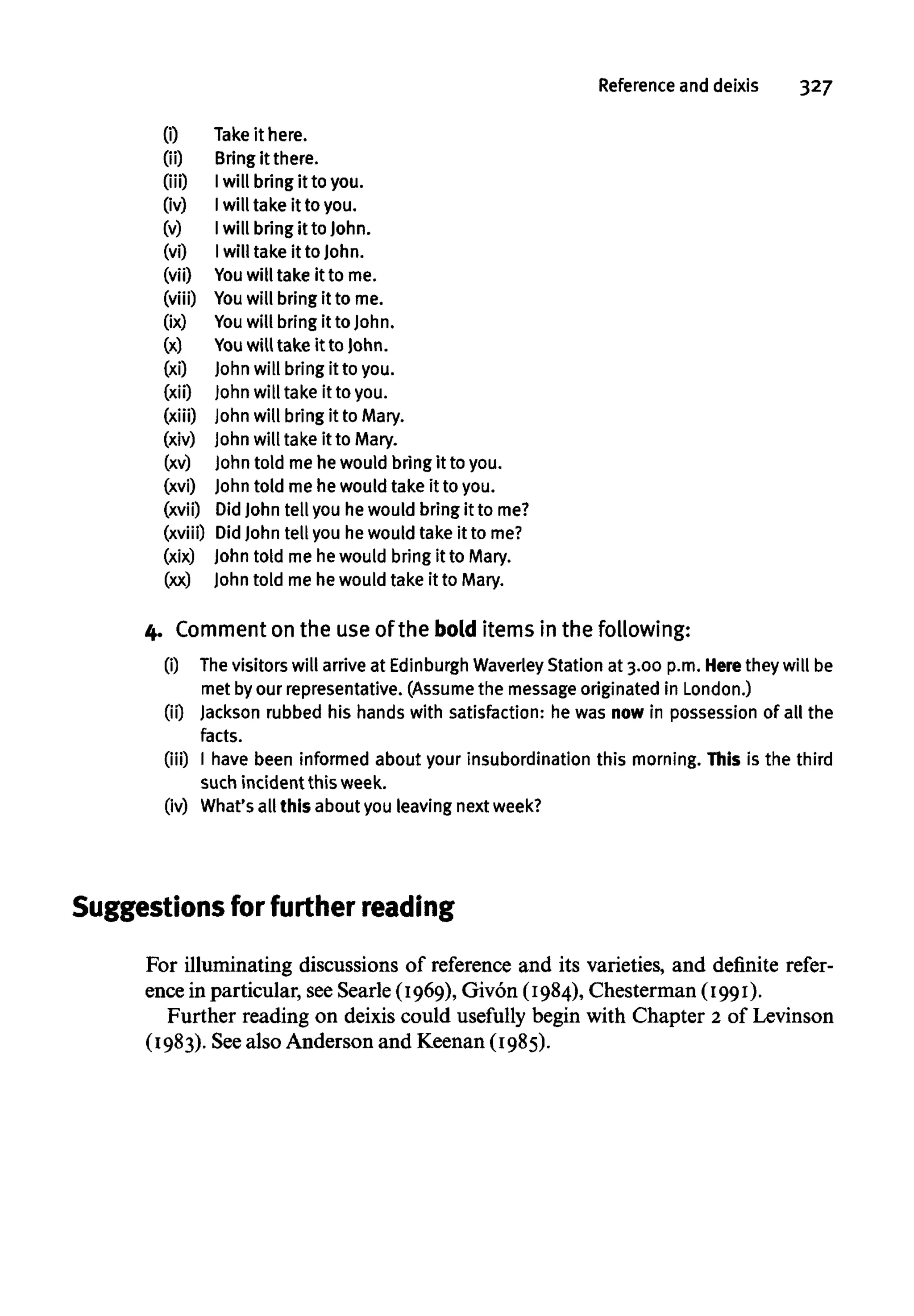
11 Extensions of meaning
12 Syntagmatic relations
13 Lexical decomposition
Part 3 Semantics and Grammar
14 Grammatical semantics
Parti Fundamental Notions
1 Introduction
2 Logical matters
3 Types and dimensions of meaning
4 Compositionality
Typographic conventions
Preface
ix
x
1
3
17
41
65
83
85
103
125
143
163
177
197
217
237
263
265
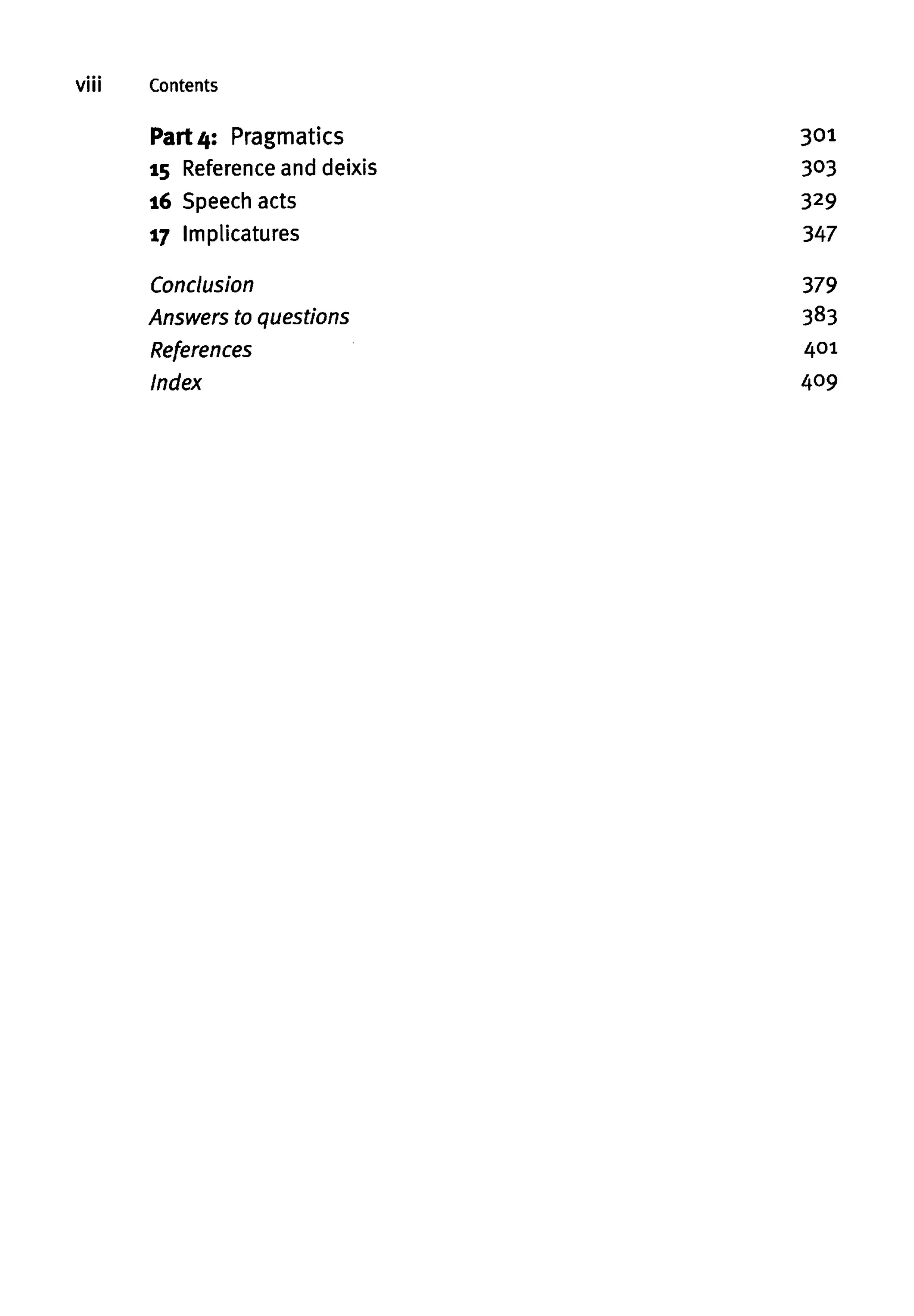
viii Contents
Part 4: Pragmatics
15 Referenceand deixis
16 Speech acts
17 Implicatures
Conclusion
Answers to questions
References
Index
301
303
329
347
379
383
401
409
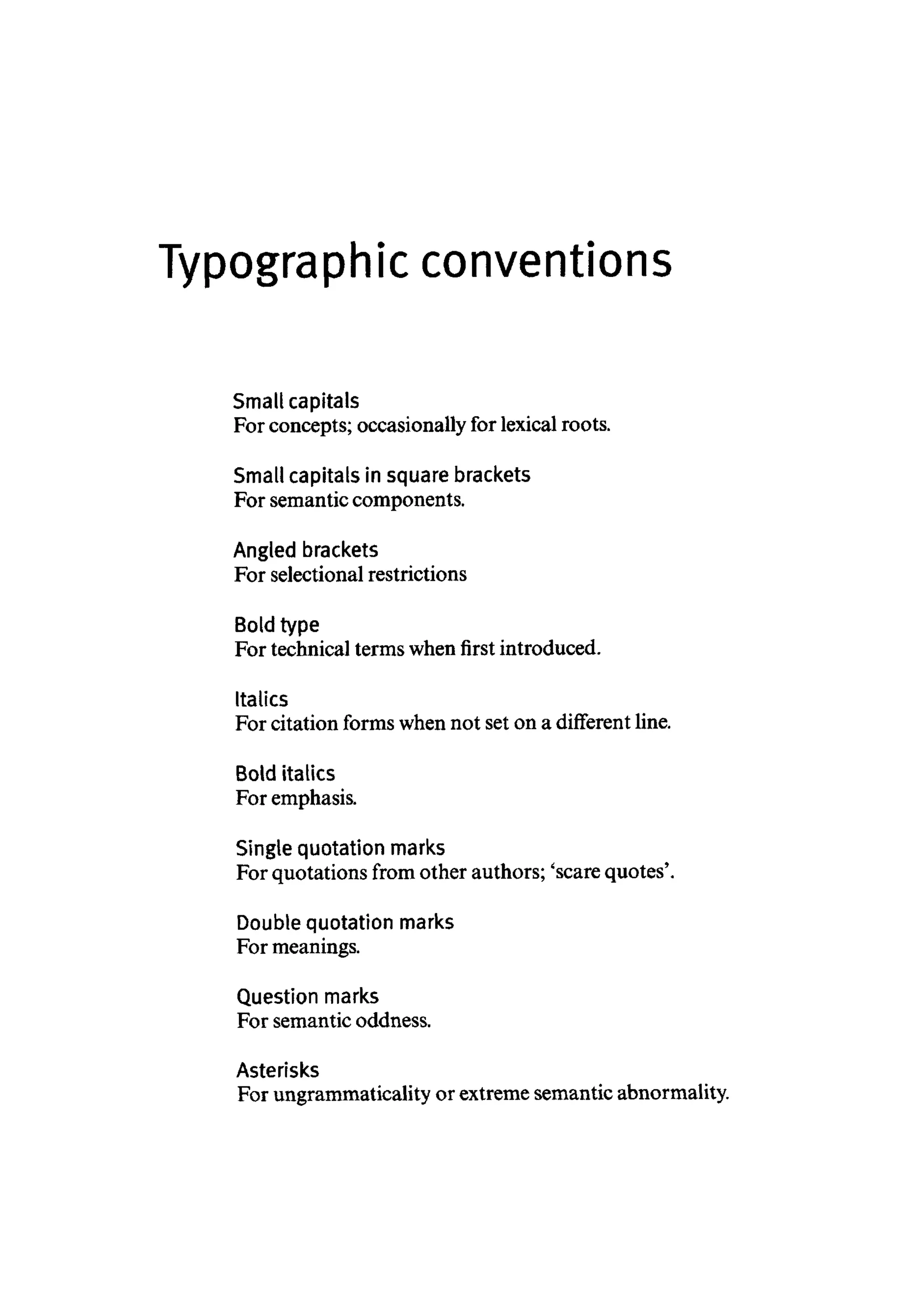
Typographic conventions
Small capitals
For concepts; occasionally for lexical roots.
Small capitals in square brackets
For semantic components.
Angled brackets
For selectional restrictions
Bold type
For technical termswhen first introduced.
Italics
For citation forms whennot set on a different line.
Bold italics
For emphasis.
Single quotation marks
For quotations from other authors; 'scare quotes'.
Double quotation marks
For meanings.
Question marks
For semantic oddness.
Asterisks
For ungrammaticalityor extremesemantic abnormality.
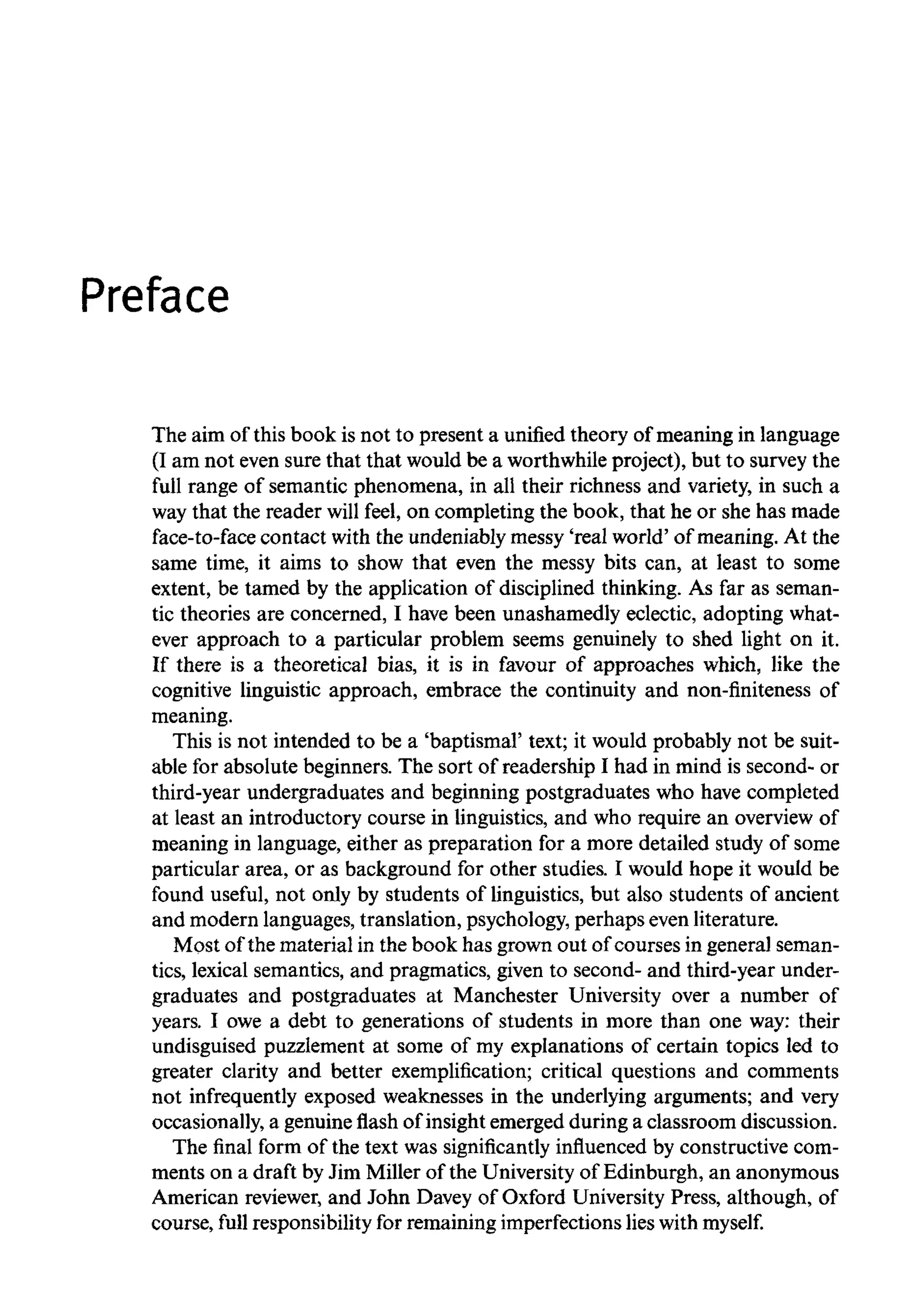
Preface
The aim of this book is not to present a unified theory of meaning inlanguage
(I am not even sure that that would be a worthwhileproject), but to survey the
full range of semantic phenomena, in all their richness and variety, in such a
way that the reader will feel, on completing the book, that he or she has made
face-to-face contact with the undeniably messy 'real world' of meaning. At the
same time, it aims to show that even the messy bits can, at least to some
extent, be tamed by the application of disciplined thinking. As far as seman-
tic theories are concerned, I have been unashamedly eclectic, adopting what-
ever approach to a particular problem seems genuinely to shed light on it.
If there is a theoretical bias, it is in favour of approaches which, like the
cognitive linguistic approach, embrace the continuity and non-finiteness of
meaning.
This is not intended to be a 'baptismal' text; it would probably not be suit-
able for absolute beginners. The sort of readership I had in mind is second- or
third-year undergraduates and beginning postgraduates who have completed
at least an introductory course in linguistics, and who require an overviewof
meaning in language, either as preparation for a more detailed study of some
particular area, or as background for other studies. I would hope it would be
found useful, not only by students of linguistics, but also students of ancient
and modern languages,translation, psychology,perhaps even literature.
Most of the material in the book has grown out of courses in general seman-
tics, lexical semantics, and pragmatics, given to second- and third-year under-
graduates and postgraduates at Manchester University over a number of
years. I owe a debt to generations of students in more than one way: their
undisguised puzzlement at some of my explanations of certain topics led to
greater clarity and better exemplification; critical questions and comments
not infrequently exposed weaknesses in the underlying arguments; and very
occasionally, a genuineflashof insight emerged during a classroom discussion.
The final form of the text was significantly influenced by constructive com-
ments on a draft by Jim Miller of the Universityof Edinburgh, an anonymous
American reviewer,and John Davey of Oxford University Press, although, of
course, full responsibility for remaining imperfectionslieswith myself.
Preface xi
The organization of the book is as follows. It is in four parts. Part I dis-
cusses a range of basic notions that underlie virtually all discussions of mean-
ing within linguistics; Part 2 concentrates on aspects of the meanings of
words; Part 3 deals with semantic aspects of grammar; Part 4 introduces the
core areas of pragmatics, and highlights the relations between meaning and
context.
Within Part I, Chapter I provides a very general introduction to questions
of meaning, locating the linguistic study of meaning within the wider context
of the study of signs and communication in general. Chapter 2 introduces a
set of fundamental conceptual tools, mostly drawn from the field of logic,
which, because of their wide currency in discussions of semantic matters,
constitute indispensable background knowledge for a study of meaning in
language. In Chapter 3, a number of concepts are introduced for the descrip-
tion of meanings and differences of meaning. A basic dichotomy (based on
Lyons 1977) is introduced between descriptive and non-descriptive meaning
and, under each of these headings, important types and dimensions of vari-
ation are described. It is rare to encounter any extended treatment of these
topics in semantics textbooks, yet a mastery of them is essential to anyonewho
wishes to talk in a disciplined way about meanings. Chapter 4 discusses the
way(s) in which simpler meanings are combined to form more complex
meanings.
In Part 2, Chapter 5 provides a general introduction to the study of word
meanings, first discussing whether there are any restrictions on what sort of
meanings words can bear, then distinguishing the meaning of a word from that
of a sentence or discourse, and the meanings of full lexical items from the
meanings of grammatical elements. In this chapter the major approaches to
lexical semantics are also outlined. In Chapter 6, the focus is on the range of
variation observable in a single word form in different contexts, ranging from
arbitrarily juxtaposed homonymies to subtle modulations of sense. Chapter 7
introduces a conceptual approach to lexical semantics, beginning with a dis-
cussion of whether and to what extent word meanings can be equated with
concepts. The discussion continues with an outline of prototype theory, the
currently dominant approach to natural conceptual categories, and its rele-
vance for the study of word meanings. Chapters 8 and 9 deal with relations of
sense between lexical items which can occupy the same syntacticposition—in
other words, paradigmatic sense relations, such as hyponymy, meronymy,
incompatibility, synonymy,antonymy, complementarity, reversivity, and con-
verseness. Chapter 10 looks at larger groupings of words—word fields—
mainly structured by the sense relations examined in the previous two chap-
ters. Chapter 11 describes the main types of process, such as metaphor and
metonymy, which enable new meanings to be produced from old ones. In
Chapter 12,meaning relations between words in the same syntactic construc-
tion, that is, syntagmatic sense relations, are examined. Topics discussed
include the nature of normal and abnormal collocations, reasons for a
xii Preface
tendency for certain types of words to co-occur, and the nature and con-
sequences of selectional pressures of words on their partners in a string.
Chapter 13 outlines the componential approach to the description of word
meaning, which specifiesmeaning in terms of semantic primitives.
The focus in Chapter 14, which constitutes the whole of Part 3, is on the
sorts of meanings associated with various grammatical entities. First there is a
discussion of the problem of whether there are any constant meanings
attached to categories such as noun, verb, and adjective, and functions such as
subject and object. There then follows a survey of the sorts of meaning borne
by grammatical elements of various sorts, such as number and gender in the
noun phrase, tense, aspect, and modality in connection with the verb, degree in
the adjective, and so on.
Part 4 covers topics which are usually considered to fall under pragmatics,
in that either they involve aspects of meaning which cannot be satisfactorily
treated unless context is taken into account, or they are not propositional in
nature (or both). Chapter 15is concerned with reference, that is,establishing
connections between utterances and the extralinguistic world. Reference is
portrayed as the assigning of values to variables, the variables being signalled
by definite expressions and the values being items in the extralinguisticworld.
Various strategies for indicating (on the part of the speaker) and determining
(on the part of the hearer) correct referents are discussed, including the use
and interpretation of deictic elements, names, and descriptions. Chapter 16
provides an outline of speech act theory, mainly following Austin and Searle
(1969). It discusses the acts that people perform when they are speaking—acts
such as stating, requesting, warning, congratulating, commanding, and so on.
The range of different types of speech act is surveyed and their nature exam-
ined. Chapter 17deals with conversational implicatures, that is, those aspects
of the intended meaningof an utterance which are not encoded in its linguistic
structure, but are, as it were, 'read between the lines'. Different types of con-
versational implicature are described and some proposed explanations of how
they arise are considered.
The concluding chapter briefly surveys the areas covered in the book, sug-
gests practical applications of the study of meaning, and highlights areas
which are currently poorly understood, and where further research is needed.
Each chapter except Chapter I and Chapter 5 contains a set of discussion
questions and/or exercises, suggested answers to which will be found at the end
of the book.
Part 1
In this first part of the book, a number of fundamental, but fairly generalnotions are
introduced, which need to be grasped before the more detailed discussions in later
sections can be properly appreciated. Chapter 1 has a scene-setting function, identi-
fying the place of linguistic signs and linguistic communication in the broader
domains of semiotics and communication in general. Chapter 2 introduces a num-
ber of vital conceptual tools drawn from the field of logic. Chapter 3 surveys the
range of different sorts of meaning, and dimensions of variation in meaning. Chapter
4 discusses the notion of compositionality, one of the essential properties of lan-
guage, andits limits.
Fundamental Notions
This page intentionally left blank
CHAPTER 1
Introduction
1.1 Communication
1.2 Semiotics: somebasic notions
1.3 Language and other communicative
channels
1.4 Characteristics of linguistic channels
5 1.5 Approachesto the study of meaning
7 1.6 The linguisticstudyof meaning
1.7 Branches of the study of meaning
8
Suggestions forfurther reading
9
10
12
15
16
This page intentionally left blank
CHAPTER 1
Introduction
1.1 Communication
Meaning makes little sense except in the context of communication: the
notion of communication therefore provides as good a place as any to start an
exploration of meaning. Communication can be conceived very broadly,
including within its scope such matters as the transfer of information between
biological generations via the genetic code, the interaction between a driver
and his car, and indeed any sort of stimulus-response situation. Here weshall
confine ourselves to what is surely the paradigm communicative scenario,
namely, the transfer of information between human beings.
1.1.1 Asimple model
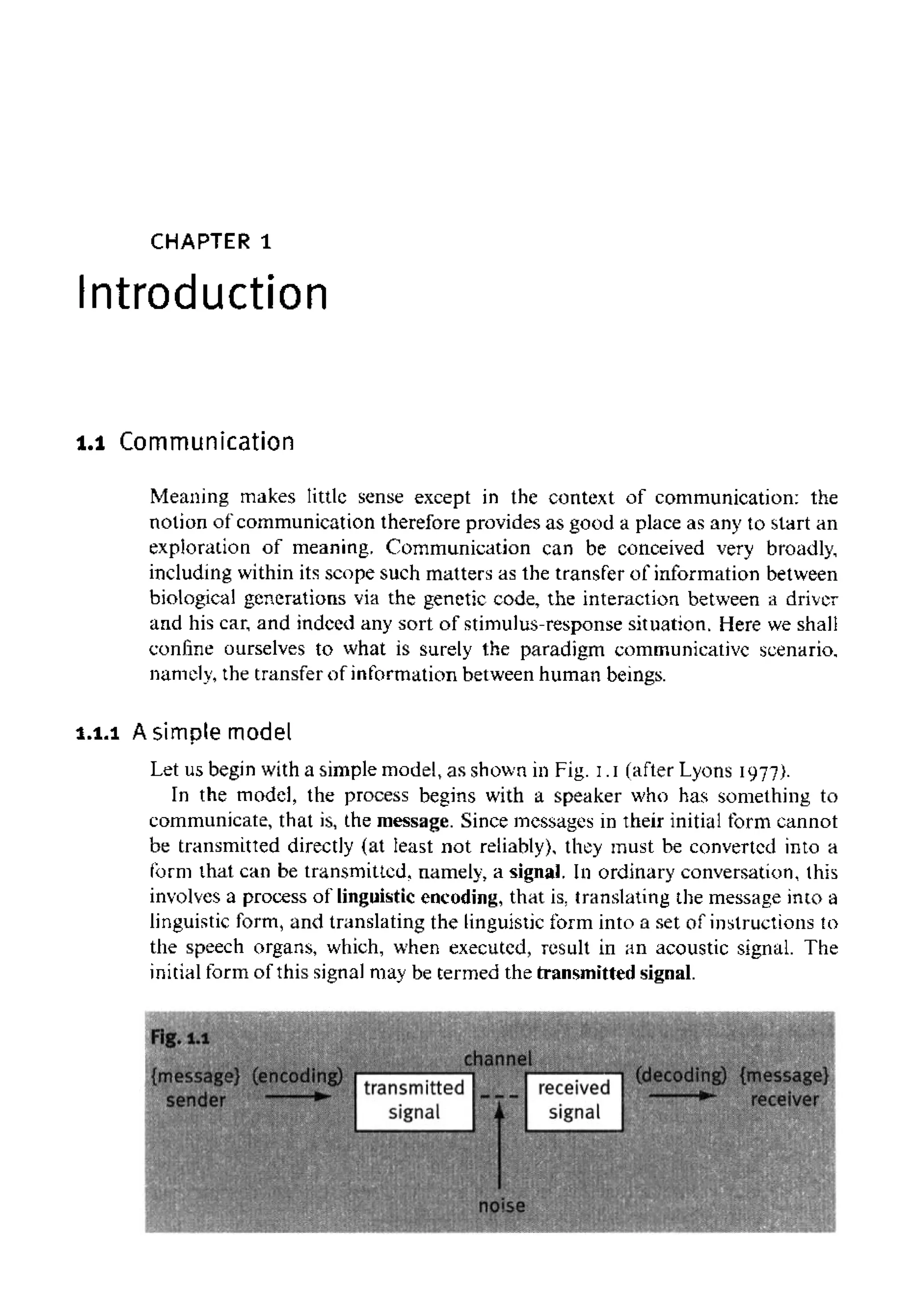
Let us begin with a simple model, as shown in Fig. I.I (after Lyons 1977).
In the model, the process begins with a speaker who has something to
communicate, that is, the message. Since messages in their initial form cannot
be transmitted directly (at least not reliably), they must be converted into a
form that can be transmitted, namely, a signal. In ordinary conversation, this
involves a process of linguisticencoding, that is. translating the message into a
linguistic form, and translating the linguisticform into a set of instructions to
the speech organs, which, when executed, result in an acoustic signal. The
initial form of this signal may be termed the transmitted signal.
6 Meaning in language
Every mode of communication has a channel, through which the signal
travels: for speech, we have the auditory channel, for normal writingand sign
language, the visual channel, for Braille, the tactile channel, and so on. As the
signal travels from sender to receiver, it alters in various ways, through distor-
tion, interference from irrelevantstimuli or loss through fading.These changes
are referred to collectively as noise. As a result, the signal picked up by the
receiver (the received signal) is never precisely the same as the transmitted
signal. If every detail of the transmitted signal was crucial for the message
being transmitted, communication would be a chancy business. However, effi-
cient communicating systems like language compensate for this loss of infor-
mation by building a degree of redundancy into the signal. Essentially this
means that the information in a signal is given more than once, or is at least
partially predictable from other parts of the signal, so that the entire message
can be reconstructed even if there is significant loss. It is said that language is
roughly 50per cent redundant.
Once the signal has been received by the receiver, it has to be decoded in
order to retrieve the original message. In the ideal case, the message
reconstructed by the receiver would be identical to the message that the
speaker started out with. Almost certainly, this rarely, if ever, happens; how-
ever, we may presume that in the majority of cases it is 'close enough'. All the
same, it isworth distinguishingthree aspects of meaning:
(i) speaker's meaning:
(ii) hearer's meaning:
(iii) sign meaning:
In the case of an established signalling system like language, the meanings of
the signs are not under the control of the users; the signs are the property of
the speech community and have fixed meanings. Of course on any particular
occasion, the signs used may be ad hoc or conventional, if ad hoc, they may be
prearranged or spontaneous.
speaker's intended message
hearer's inferredmessage
this can be taken to be the sum of the properties
of the signal which make it (a) more apt than
other signals for conveying speaker's intended
message, and (b) more apt for conveying some
messages than others.
1.1.2 Language as a sign system
Any natural human language is a complex sign system, 'designed' to ensure
infinite expressive capacity, that is to say, there is nothing that is thinkable
which cannot in principle be encoded (provided no limit is placed on the
complexity of utterances). Each elementary sign is a stable symbolic associ-
ation between a meaning and a form (phonetic or graphic); elementary signs
may combine together in a rule-governed way to form complex signs which
convey correspondingly complex meanings.
Introduction 7
1.2 Semiotics: some basic notions
1.2.1 Iconicity
Signs can generally be classified as iconic or arbitrary. Iconic signs are those
whose forms mirror their meanings in some respect; signs with no natural
analogical correspondences between their forms and their meanings are called
arbitrary. A simple example is provided by the Arabic and Roman numerals
for "three": 3 and III. The Arabic form gives no clue to its meaning; the
Roman version, on the other hand, incorporates "threeness" into its shape,
and is thus iconic. Iconicity is a matter of degree, and usually coexists with
some degree of arbitrariness. Three horizontal lines would bejust as iconic as
the Roman III: the fact that in the Roman symbol the lines are vertical is
arbitrary, as is the fact that its sizecorresponds to that of letters.
Iconicity enters language in several guises. The majority of words in a
natural language are arbitrary: the form of the word dog, for instance, does
not mirror its meaning in any respect. However, the so-called onomatopoeic
words display a degree of iconicity, in that their sounds are suggestive (to
varying degrees) of their meanings:
bang clank tinkle miaow splash cuckoo peewit curlew
whoosh thud crack ring wheeze howl rumble,etc.
The predominance of arbitrariness in the vocabulary is not an accidental
feature, but is a crucial 'design feature' of natural language. There is a limited
stock of dimensions of formal variation in linguistic signs; if all signs were
iconic, it is difficult to seehow universalexpressivitycould be achieved.
Some iconicity is also apparent in grammar. For instance, words which
belong together tend to occur together. In The tall boy kissed theyoung girl we
know that tall modifies boy and not girl because tall and boy come next to each
other in the sentence. In some languages this relationship might be shown by
grammatical agreement, which is a kind of resemblance, and therefore also
iconic. Another way in which iconicity appears in the grammar is that
grammatical complexity by and large mirrors semanticcomplexity.
1.2.2 Conventionality
Many of the signs used by humans in communication are natural in the sense
that they are part of geneticallyinherited biological make-upand do not have
to be learned, although a maturational period may be necessary before they
appear in an individual, and they may be moulded in various ways to fit
particular cultural styles. The sort of signs which are natural in this sense will
presumably include facial expressions like smiling, frowning, indications of
fear and surprise, and so on, perhaps manyof the postural and proxemicsigns
8 Meaning in language
that constitute the so-called 'body language', certain types of gesture, vocal
indications of excitement, desire, etc. (whether or not linguistic), and many
more. Natural signs are likelyto be the most cross-culturally interpretable.
Other signs have conventionally assigned meanings; they have to be specif-
ically learned, and are likely to differ in different communities. Linguistic signs
are the prototypical conventional signs. Even onomatopoeic words usually
have a significant conventional element; often the iconic nature of the word
can only be appreciated, as it were, with hindsight. Take the Turkish word
bulbul. What does it refer to? A baby's babbling? The noise of a mountain
spring? In fact, it means "nightingale". Looking back, one can make the
connection. It is not only linguistic signs that are conventional. Obscene or
offensive gestures, for instance, can vary quite remarkably cross culturally: I
was once reprimanded for pointing the soles of my feet at the Prime Minister
of Iraq (in Arab culture this is disrespectful: my disrespect was entirely
inadvertent). Even in Europe, conventional gestures can differ: Greeks are
famously—and slightly inaccurately—said to shake their heads to say "Yes",
and nod to say "No".
1.2.3 Discreteness
Some signs can vary gradually in their form, and their meanings vary in paral-
lel with the change of form, like the fisherman's indication of the size of 'the
one that got away'; these are called continuous signs. Other signs have fixed
shapes, and must be chosen from a limited inventory: intermediate forms are
not allowed, the range of possibilities is 'chunked'; such signs are described as
discrete. Linguistic signs are virtually all of the discrete variety. Again, this
is not an accidental feature, but has a close connection with iconicity and
arbitrariness: continuous signs are necessarily iconic; arbitrary signs are
necessarily discrete.
1.3 Language and other communicative channels
The prototypical scenario for linguistic communication is two people
engaged in face-to-face conversation. Of course, in such an encounter, lan-
guage signals are exchanged; but normally so are many other types of signal,
and these modify and/or supplement the linguistically encoded message. Let
us, then, briefly look at the semiotic environment of language in a typical
conversation.
The signs that accompany language can be divided into two major types—
paralinguistic and non-linguistic. The defining characteristic of paralinguistic
signs will be taken here to be an extreme dependence on the accompanying
language. Either they cannot be produced except during speech (because they
are carried on the voice), or they cannot be interpreted except in conjunction
Introduction 9
with accompanying language. Examples of the first variety are abnormal
volume, tempo, pitch, and voice quality; to function as signs, there must be a
departure from some (personal) baseline or norm. For instance, abnormally
high volume, fast tempo, or high pitch typically signal a heightened emo-
tional state. Examples of the second variety include pausing, emphatic ges-
tures, and gestures which metaphorically depict, for instance, direction of
motion.
The functions of paralinguistic signs can be conveniently classified under
three headings:
(i) Punctuation: there are signs which have functions parallel to those of
punctuation in written language, mainly to segment the stream of
speech so as to facilitate processing.
(ii) Modulation: this involves the addition of an emotive or attitudinal
colouring to the linguistically encoded message.
(iii) Illustration:some signs 'depict' a key element in the message, such as
a direction of movement, or a shape; the depiction may be relatively
literal, like the hand movements of someone describing the climbingof
a spiral staircase, or metaphorical, as when vertical and parallel hands
accompany the setting of limitsof some kind.
Not all the signs that occur alongside language are paralinguistic in the
sense defined. For instance, one may smile or frown while speaking, and this
may well 'modulate' the message. But smiles and frowns (and many other
signs) are perfectly interpretable and capable of being produced in the absence
of any accompanying language. These are therefore to be considered as
non-linguistic.
1.4 Characteristics of linguistic signs
Paralinguistic signs are typically natural, continuous, and iconic, whereas
linguistic signs are for the most part arbitrary, discrete, and conventional.
1.4.1 Simple and complex signs
Linguistic signs may be simple or complex. This does not just mean that they
can occur singly or in groups of various sizes: the occurrence of two or more
signs together does not necessarily result in a complex sign. Take the case of
someone who answers a question with the word Yes,at a higher than usual
pitch, and at the same time smiling. This person has not produced a complex
sign with three constituents, only three simple signs simultaneously. The mean-
ings of the three signs are simply added together: there is no interaction
between the signs other than additivity. Contrast this with a minimally com-
plex sign such as red wine: to obtain the meaning of this sign, we do not simply
10 Meaning in language
add the meaning of red to the meaning of wine (that would give us something
like "wine plus redness"). What happens is the meaning of red interacts with
the meaning of wine by restricting it.
There is no theoretical upper limit to the complexity of linguistic signs. This
is rendered possible by the recursive nature of syntax, that is, the existence of
rules which can be applied indefinitely many times (like the one which yields
This is the dog that worried the cat that killed the rat that ate the com that . . .).
Such rules are an essential prerequisite for the 'universal expressivity' of
language—the fact that anything thinkable is expressible, or at least can be
approximated to any given degree of accuracy.
1.4.2 Signs at different linguistic levels
A linguistic sign may be no more than a phoneme (or two): this is one inter-
pretation of the sl- of slimy, slovenly, slug, slag, slum, slink, slattern, slut, slob,
etc. which seems to indicate something unpleasant, or the gl- of glare, glimmer,
glitter, glisten, glow, gleam, etc. which all have something to do with light
effects. These have no grammatical status, and no contrastive value, but the
intuitions of native speakers leave no doubt that they should receive some
recognition. Other signs occur at higher levels of linguistic organization, from
morpheme level (e.g. the -s of dogs), through word level (e.g. denationaliza-
tion), clause level (e.g. the formal difference between John is here and Is John
here? which signals that one is a question and the other a statement), sentence
level (e.g. We'll do it as soon as you arrive as opposed to As soon as you arrive,
we'll do it), up to text level (e.g. the fact that a stretch of text constitutes a
sonnet is indicated by the form of the text as a whole: this form therefore
constitutes a high-levelsign).
The fact that a sign manifests itself at a particular level does not entail that
it is to be interpreted at that level. A fewexampleswill illustrate this point. The
item the, a word, exerts its semantic effect on a whole noun phrase the littleold
lady who lives in the cottage on the hill; the -ed of John kissed Mary, a bound
morpheme, semantically situates the time relative to the moment of utterance
of the whole event symbolized by John kiss Mary; a single word like matri-
mony maymark a whole discourse as being in a certain register.
1.5 Approaches to the study of meaning
Meaning may be studied as a part of various academic disciplines. There is of
course a significant degree of overlap between disciplines, but characteristic-
ally all have something idiosyncratic and unique in their approach (the
following remarks are merely illustrative).
Introduction 11
1.5.1 Philosophy
Linguists typically take the existence of meaning for granted and accept it as
an intuitively accessible 'natural kind'. They do not ask questions like How isit
possible for anything to mean something? or What sort of relation must hold
between X and Yfor it to be the case that X means Y? Such questions are the
province of the philosopher, particularly the philosopher of language.
1.5.2 Psychology
Meaning is a major concern of the psychology of language and psycho-
linguistics. (I shall not attempt to distinguish these.) A distinctive feature here
is the experimental study of how meanings are represented in the mind, and
what mechanisms are involved in encoding and decoding messages. An
example of a fact that could only emerge within a psycholinguistic framework
is that in the lexical decision task, where experimental subjects observe strings
of letters flashed on a screen and must indicate by pressing the appropriate
button whether the string represents a word or not, responses are faster to
words with concrete meanings than to words with abstract meanings, even
when extraneous factors like length and frequency are rigorously controlled.
This observation presumably provides a clue to the role of meaning in word
recognition (to the best of myknowledgeit is still a puzzle).
1.5.3 Neurology
Psychologists take a 'macro' view of mental states and processes. Neurologists,
on the other hand, want to know how these states and processes are imple-
mented at the neuronal level. A psychologist might be broadly compared with
a computer programmer, and a neurologist to the designer of computer chips.
Meaning, like everything else in mental life (at least if one is a physicalist)
must boil down ultimatelyto connections between neurons.
1.5.4 Semiotics
Semioticians view language as one sign system amongst many, and seek out
those features which render it so successful. They are also likely to give
emphasis to marginal aspects of linguistic signification. The recent strong
interest in iconicity in language represents a significant overlap between the
linguistic and semiotic approaches to meaning.
1.5.5 Linguistics
It is not easy to encapsulate the linguistic approach to meaning in language
succinctly. There are perhaps three key aspects. The first is that native
speakers' semantic intuitions are centre-stage, in all their subtlety and
nuances: they constitute the main source of primary data. The second is the
12 Meaning in language
importance of relating meaning to the manifold surface forms of language.
The third isthe respect paid not just to language, but to languages.
1.6 Thelinguistic study of meaningin language
1.6.1 What is linguisticmeaning?
Here we attempt to say what is to count as meaning in language. Following an
impulse towards generosity rather than austerity, we shall as a first step say
that all meaning is potentially reflected in fitness for communicative intent. It
will be assumed that a way of tapping into this is in terms of contextual
normality: every difference of meaning between two expressions will show up
as a difference of normality in some context. Thus, we know that illness and
disease do not mean the same, because during his illness is normal, but during
his disease is not; almost and nearly do not have precisely the same meaning
because very nearly is normal but very almost is not; pass away and kick the
bucket have different meanings because It is with great sadness that we report
that our Beloved Ruler kicked the bucket two minutes after midnightis odd, but
It is with great sadness that we report that our Beloved Rulerpassed away two
minutes after midnight is normal. We take normalityloddness and relative
oddnesslnormality to be primitive intuitions.
It will be noticed that the move in the above characterization was from
meaning to contextual abnormality. Unfortunately, the move cannot without
further ado be made from abnormality to meaning, because there are other
factors besides meaning which affect normality.
Let us assume that we are dealing with spoken language and that the utter-
ance is correctly pronounced. The two sources of abnormality that wewish to
eliminate if possible are grammatical deviance and 'meaning' that is non-
linguistic in origin. Let us make the simplifying assumption that if a pin-
pointed deviance is grammatical in nature, it will not prove possible to reduce
it by contextual manipulation, for instance by interpreting it as metaphor,
science fiction, or fairy-tale. Thus, They goes is irredeemably deviant in any
context, whereas / shallgo there yesterday might just make sense in a setting
where time travel (or at least temporal scrambling) is possible. That leaves non-
linguistic meaning to be taken care of. Consider the possibility that a certain
type of delivery, not amounting to mispronunciation, may be a sign that the
speaker is under the influence of some pharmacological substance. Let us
make the further assumption that some speaker is deliberately trying to con-
vey this information. This might well be odd in, for instance, the context of a
sermon. Is this linguistic meaning? (In the case described, it is certainly a kind
of meaning, and language is used to convey it.) Presumably it is not linguistic
meaning, but how do we exclude it? One way is to stipulate that linguistic
meaning must either be conventionally associated with the linguistic forms
used, or be inferable from the latter in conjunction with contextual knowledge.
Introduction 13
One indication that the above example is not of this type would be its
insensitivitv to the actual words used.
1.6.2 What arewe trying to achieve?
I.6.2.I Specifying/describing meanings
A very important task is to discover a way of specifying or describing mean-
ings, whether of isolated words or sentences, or of utterances in context. The
position taken in this book isthat in general, meanings are not finitely describ-
able, so this task boils down to finding the best way to approximate meanings
as closely as is necessary for current purposes (lexicographers have long had to
confront this problem for words).
I.6.2.2 How meaning varies with context
The meanings of all linguistic expressions vary with the context in whichthey
occur. For instance, the shade of colour indicated by a redhead and red wine
are markedlydifferent; the periods of time denoted by monthin (I) and (2) are
quite likely to be different:
(I) He's here for a month. (could be four weeks; not dependent on time of
utterance)
(2) He's here for the month. (will depend on time of utterance, but could be
31days)
Some variations, like the sex of the doctor in Our doctor hasjust married a
policeman and Our doctor has just married an actress can be predicted
by general principles; other variants are less, or not at all predictable.
Semanticians seek a revealing account of contextual variation.
I.6.2.3 Kinds of meaning
There are different sorts of meaning, each with different properties. For
instance, whatever the difference in meaning between (3) and (4), it does not
affect the truth or falsity of the statement:
(3) Old Joshua Hobblethwaite popped his clogs lastweek.
(4) Old Joshua Hobblethwaite passed away last week.
I.6.2.4 What happens when meanings combine?
Another vital aspect of semantics is how simple(r) meaningscombine to form
more complex meanings. To some extent this is a function of grammatical
structure: for instance, the way redand hat combine in a redhat is not the same
as the way turn and red combine in to turn red. But differences occur even
within the same grammatical construction: the mode of combination of red
and hat in a red hat is different from that of long and eyelash in long eyelashes
(compare long eyelashes and a long river).
14 Meaning in language
I.6.2.5 Systematicity and structure; possibility of formalization
All semanticians are to some extent looking for regularities and system in the
way meanings behave, as this leads to maximally economical descriptions. The
most dedicated to this aspect of semantics are those who attempt to model
the semantic behaviour of natural language expressions by means of a strict
logical or quasi-mathematical formalism. This route will not be followed in
this book.
I.6.2.6 New meanings from old
A striking feature of linguistic expressions is their semantic flexibility: beyond
their normal contextual variability, they can be bent to semantic ends far
removed from their conventional value, witness She swallowed it hook, line and
sinker or You'll find her in the telephone book. The study of such extensions of
meaning is an important task for semantics.
I.6.2.7 Role(s) of context
It is usually assumed that linguistic expressions can be assigned some sort of
context-independent semantic value, although there is much disagreement
regarding exactly what this is. There is also general agreement that context is
of vital importance in arriving at the meaning of an utterance. The role of
context ranges from disambiguating ambiguous expressions as in Wejust got
to the bank in time, through identification of referents (who is he, where is
there, in time for what, in He didn't get there in time), to working out 'between
the lines' messages like B's ignorance of the whereabouts of the corkscrew in:
(5) A: Where's the corkscrew?
B: It's either in the top drawer in the kitchen, or it's fallen behind the
piano.
1.6.3 Theapproachadopted in this book
We are not yet in a position to rule out any approaches which yield insights,
even if some such approaches appear at first sight incompatible. This book
therefore takes an ecumenical position on many issues. In so far as there is a
theoretical bias, it is towards the cognitive semantic position. This means, in
particular, that the meaning of a linguistic expression is taken to arise from the
fact that the latter gives access to a particular conceptual content. This maybe
of indeterminate extent: no distinction is made between linguistic meaning
and encyclopaedic knowledge.
Since this book is not intended to propound a body of theory, but to
acquaint non-specialists with the range of semantic phenomena in language,
there is a bias towards descriptive coverage at the expense of theoretical
rigour.
Introduction 15
1.7 Branches of the study of meaning in language
The following are the main broadly distinguishable areas of interest in the
study of meaning. They do not by any means form watertight compartments:
there are many points of overlap.
1.7.1 Lexicalsemantics
Lexical semantics studies the meanings of words; the focus here is on 'content'
words like tiger, daffodil, inconsiderate, and woo, rather than 'form'/
'grammatical' words like the, of, than, and so on. To a non-specialist, the
notion of meaning probably has a stronger link with the idea of the word than
with any other linguistic unit: words are, after all, what are listed in dictionar-
ies, and the main function of a dictionary is to tell us what the listed words
mean. For this reason, lexical semantics perhaps provides the easiest access
route into the mysteries of semantics in general, and this is one reason why it
has been given a prominent place in this book, and whyit comes early.
1.7.2 Grammatical semantics
Grammatical semantics studies aspects of meaning which have direct rele-
vance to syntax. This has many manifestations, which can only be briefly
illustrated here. One problem is the meaning of syntactic categories (problem-
atic, because not everyone believes they can be assigned meanings). Consider,
for instance, the differences in the meaning of yellow in thefollowing:
(6) Shewore a yellow hat. (adjective)
(7) They painted the room a glowingyellow.(noun)
(8) The leavesyellowrapidly once the frosts arrive. (verb)
Another aspect of grammatical semantics is the meaning of grammatical
morphemes like the -ed of walked, the -er of longer, the re- and the -al of
retrial, and so on.
Clearly this overlaps with lexical semantics, partly because some grammat-
ical elements are words (like the, and of), but more particularly because some
aspects of the meanings of full lexical items determine to some degree their
grammatical behaviour (for instance, the fact that / am studying that question
is grammatical, but not I am knowing the answer to that question).
1.7.3 Logical semantics
Logical semantics studies the relations between natural language and formal
logical systems such as the propositional and predicate calculi. Such studies
usually aim at modelling natural language as closely as possible using a tightly
controlled, maximally austere logical formalism. It is arguable that sometimes
such studies shed more light on the formalismused than on the language being
16 Meaning in language
modelled; none the less, valuable insights have come from this approach. To
date, most such studies have concentrated on the propositional/sentential level
of meaning, and have rarely attempted to delve into the meanings of words.
1.7.4 Linguistic pragmatics
For present purposes, pragmatics can be taken to be concerned with aspects of
information (in the widest sense) conveyed through language which (a) are not
encoded by generally accepted convention in the linguistic forms used, but
which (b) none the less arise naturally out of and depend on the meanings
conventionally encoded in the linguistic forms used, taken in conjunction with
the context in which the forms are used. This rather cumbersome formulation
is intended to allow into pragmatics things like the identity of the individual
referred to by John in / sawJohn today, and the assumption that the room in
question had several lights in John entered the room; all the lights were on, at
the same time excluding, for instance, the possibility that the person saying /
saw John today had a private ad hoc arrangement with the hearer that when-
ever he said John, he should be taken to mean "Mary" (since it does not arise
naturally out of the normal meaning of John), and excludingalso the possibil-
ity of someone's inferring from a speaker's slurred speech that they were
drunk (since this does not depend on the conventional meanings of the words
uttered). Pragmatics is usually contrasted with semantics, which therefore
deals with conventionalized meaning; obviously, the three divisions discussed
above belong to semantics.
Suggestions for furtherreading
Much fuller accounts of the semiotic environment of spoken language can be
found in Argyle (1972), Beattie (1983), Ellis and Beattie (1986) and Clark
CHAPTER 2
Logical matters
2.1 Introduction
2.2 Argumentsand predicates
2.3 Sense, denotation, and reference:
intension and extension
2.4 Sentence, statement, utterance,
and proposition
2.5 Logical properties ofsentences
19
19
21
22
28
2.6 Logical classes
2.7 Logical relations
2.8 Quantification
2.9 Useand mention
Discussion questions and
exercises
Suggestions for further reading
32
34
35
36
37
39
This page intentionally left blank
CHAPTER 2
Logicalmatters
2.1 Introduction
This chapter introduces a set of fundamental conceptual tools, mostly drawn
from the field of logic, which, because of their widecurrency in discussions of
semantic matters, constitute indispensable background knowledgefor a study
of meaning in language. The level of treatment here is fairly elementary; some
of the notions introduced will be further refined in subsequent chapters.
2.2 Argumentsandpredicates
A closely linked pair of concepts which are absolutely fundamental to both
logic and semantics are argument and predicate.No attempt will be made here
to explore the philosophical background and underpinning of these notions:
the basic notions are fairly accessible and they willbe treated in an elementary
fashion. Put simply, an argument designates some entity or group of entities,
whereas a predicate attributes some property to the entity denoted by the
argument, or a relation between the entities denoted by the arguments, if there
is more than one. Thus, in John is tall, we can identify John as the argument,
and is tall as the predicate. In John likes Mary, both John and Mary are
arguments, and likes is the predicate which attributes a particular relationship
between the entitiesdenoted by the arguments; in John gave Mary a rose, there
are three arguments, John, Mary and the rose,with gave as the predicate. The
combination of an argument and a predicate forms a proposition: notice that
a proposition may have only one predicate, but may have more than one
argument. It is not clear whether there is any theoretical upper limit to the
number of arguments a predicate may take, but the most one is likely to
encounter in linguistic semantic discussions is four, exemplifiedby Mary paid
John £500for the car:
Arguments: Mary, John, £500,thecar
Predicate: paid (for)
20 Meaning in language
An argument may have a more or less complex internal structure. For
instance, a whole proposition, itself possessing argument(s) and predicate,
may constitute an argument, as in John wassurprised that the man wastall.
Arguments: (i) John (ii) that the man wastall
Predicate: was surprised
Argument (ii) Argument: the man
Predicate: wastall
There are various ways of incorporating propositions as constituents of
complex arguments, and there is no limit to the resulting degree of complexity.
An account of this is beyond the scope of this book.
Predicates are commonly described as one-place, two-place, three-place, etc.
according to the number of arguments they take, so that, for instance, ispoor
is a one-place predicate, and teach is a three-place predicate (John taught Mary
French). But what does it mean to say that teach is a three-place predicate?
How do wedetermine how many places a predicate has?
This is, in fact, a very difficult question, but we can get some handle on it by
looking at a few verbs. Let us start by looking at teach. One aspect of the
problem is immediately obvious when we look at examples such as the
following:
(1) John taught Mary French.
(2) John taught French for two years.
(3) A: What does John do?
B: I think he teaches at Lowhampton High.
(4) Anybody who teaches teenagers should get double salary.
Do we say that teach is three-place in (1), two-place in (2) and (4), and one-
place in (3)? While there is some justification for such an analysis, there is
intuitively a sense in which the (overt) argument structure of (1) is basic, and
irreducible. Logically, for an act of teaching to take place, there must be some-
one who does the teaching, someone who undergoes the teaching (whether or
not they actually learn anything!), and some item of knowledge or skill which
it is hoped will be acquired by the latter. Without at least one each of these
requirements, the notion of teaching is not logically coherent. What, then, are
we to make of (2)-(4) above? It seems that we assume that the missing argu-
ments could in principle be supplied, but the speaker has not supplied them,
presumably because they are not currently relevant, or perhaps in some cases
because they are extremely obvious. In (2), we do not have a vision of John
discoursing in solitude on the French language; nor do we imagine that John
in (3) does something like sneezing, which needs neither audience nor topic.
By the same sort of criteria, read is a basically two-place verb, in spite of the
existence of sentences such as John is reading and John is learning to read. We
cannot make sense of read unless wehave someone to do the reading and some
coded signal to decode. As a final example, consider buy. This requires four
Logical matters 21
arguments, as in John sold the car to Mary for £500. If John receives no money,
he is simply giving the car away; if there is no car, Mary is just giving John
some money; if there is no one to receive the money and concede ownership of
the car, then Mary is throwing her money away and taking possession of the
car. And so on. In this way, it is usually possible to determine a basic logically
minimum number of arguments for a predicate.
But our problems are not over. Acts of reading, teaching, and selling (and
sneezing) take place at particular times and particular places. Wemay say that
unlocated, timeless acts of reading, etc., are logically impossible. It is also
necessarily the case that the ambient temperature has such and such a value.
Whereas it is relatively easy to establish the minimum number of arguments for
a predicate, how do we establish a maximum? Or perhaps there is no such
thing? After all, if we learn that John sneezed, we assume that the event
happened at a particular place and time, and that even if the speaker did not
specify these items, they could in principle be specified, along with countless
other things. What is the difference in status, therefore, between the time and
place of John's sneezing, and the subject that John teaches? One approach is
to say that although a verb like sneeze in a sense conjures up a rather complex
picture of a person in a setting acting in a certain way, it highlights only
certain aspects of that scene, but without obliterating or denying the rest.
These highlighted aspects are what distinguish the act denoted from other
possible acts. This means that if we wish to ascertain whether a John-sneeze-
event has occurred, we need only observe happenings pertaining closely to
John; we do not need to check time, place, or temperature. In this way we can
check that the minimawe previously established for the number of arguments
a predicate takes are generally also maxima.
2.3 Sense, denotation, and reference: intension and extension
Language is used to communicate about things, happenings, and states of
affairs in the world, and one way of approaching the study of meaning is to
attempt to correlate expressions in language with aspects of the world. This is
known as the extensional approach to meaning.
The thing or things in the world referred to by a particular expression is its
referent(s): in saying The cat's hungry, I am (normally)referringto a particular
cat, and that cat is the referent of the expression the cat. The whole utterance
attributes a particular state to the cat in question. We can also consider the
whole class of potential referents of the word cat, namely, the class of cats.
This, too, is sometimes called the reference of the word cat. But this is clearly
different from the designation of particular individuals as in the case of The
cat's hungry, so, to avoid confusion, we shall follow Lyons and say that
the class of cats constitutes the denotation of the word cat. So, in the case of
22 Meaning in language
The cat's hungry, the word cat denotes the class of cats, but the cat refers to a
particular cat.
The alternative to an extensional approach to meaning is an intensional
approach. Take the word cat.Whydo weuseit to refer to cats, rather than,say,
to platypuses or aardvarks or spiny anteaters? One answer is that the word is
associated with some kind of mental representation of the type of thing that it
can be used to refer to, and aardvarks do not fit the description associated with
the word cat. This representation constitutes what is called the sense of the
word (or at least part of it). We shall assume in this book that the main
function of linguistic expressions is to mobilize concepts, that concepts are the
main constituents of sense, and that sense (and hence concepts) constrains
(even if it does not completely determine) reference. (It should be noted that
some authors, for instance Lyons, understand sense in a different way. For
them, sense is a matter of the relations between a word and other words in a
language. So, for instance, the sense of cat would be constituted by its relations
with other words such as dog(a cat is necessarily not a dog), animal(a cat is an
animal), miaow (Thecat miaowed is normal but ?The dog miaowed is not).)
2.4 Sentence, statement, utterance and proposition
A number of distinctions need now to be made which at first sight might seem
to be academic nit-picking of the worst sort. However, they are absolutely
vital for clarity in semantics. For the sake of simplicity of exposition, the
distinctions will first of all be explained in connection with declarative sen-
tences only;how the variousnotions apply to non-declarative sentenceswill be
dealt withlater.
2.4.1 Sentence meaning;truth conditions; propositionalcontent
A sentence is a grammatical unit, that is, it is a string of words of a particular
type, whose well-formednessconditions are specified in the grammar of the
language. Thus, The cat sat on the mat and John put his hat on the table are
sentences of English; John put on the table and Is the of mother boy swim are
not. We shall not spend too much time on discussing what distinguishes a
sentence from other grammatical units, such as a phrase, or a word, except to
say that a sentencemust contain at least one independentclause (i.e., one that
does not need another clause, to be grammatical), and a clause must contain at
least one predication (i.e., an argument-predicate structure). The sentence is
thus the smallestlinguisticunit that can be used in an act of 'telling'. Compare
the following for normality/oddness:
(5) A: Tell me something nice.
B: Chocolate.
Logical matters 23
A: What do you mean?
B: Well,chocolate is nice.
(6) A: Tellme something nice.
B: Love is a many-splendoured thing.
A: Ah! How true!
The oddness of B's reply in (5) consists in the fact that it neither overtly forms
a sentence, nor permits a plausible sentence to be reconstructed from the
context, as in, for instance, (7):
(7) A: He asked me what I wanted.
B: What did you tell him?
A: Icecream.
Here, the full act of telling is reconstructible as I want ice cream, which
involves a sentence. Henceforward we shall use our intuitions as to what con-
stitutes a sentence.
Notice that we said above that the sentence was 'used in the act of telling':
the sentence itself, on its own, does not in fact tell us anything. What does the
sentence The cat sat on the mat tell us? Is it true? There is no way of knowing,
or rather, the question does not make sense: sentences of themselves do not
necessarily have truth values (some, arguably, have: A molecule of water con-
tains two hydrogen atomsand one oxygen atom).Yet presumably no one would
wish to say that The cat sat on the mat was meaningless. Let us introduce the
notion sentence meaning to designate the semantic properties a sentence pos-
sesses merely by virtue of being a well-formed sentence (of English), before
any question of context or use arises. A sentence possesses this meaning
exclusively by virtue of the words it contains, and their grammatical arrange-
ment. (I assume, here, that words have at least some context-independent
conventionally assigned semantic properties.) We may assume that the gram-
mar of a language is associated with principles of composition, that is, rules
which tell us how to put together the meanings of the constituents of a con-
struction to get the global meaning of the construction. Thus, in The big cat
sat on the smallmat we know, for instance, that smallness is attributed to the
mat and not to the cat, and that a superior vertical position is attributed to the
cat; we know, furthermore, what sort of animal is involved, and that only one
of them would be intended as a referent in any actual use of the sentence. And
so on. In a fairly obvious sense, the meaning of a sentence will constrain the
uses to whichit can be put, at least without the setting up of additional adhoc
conventions. (For example, // / say How are things?, you will know it's my
husband on thephone: that is not what How are things?, by general convention,
means.)
Although a sentence, outside of particular uses, does not have a truth value,
it does have truth conditions, that is, conditions which must hold for the
sentence to be used to make a true statement. Thus, before we can truthfully
24 Meaning in language
say, on some occasion, The cat is on the mat, there must be some relevant feline
occupying a specific position relative to an appropriate item of floor-covering.
Those aspects of the meaning of a sentence which determine whether a state-
ment the sentence is being used to make, in a particular situation, is true or
false, are collectively known as the propositional content of the sentence. Two
sentences with identical propositional content will yield statements with the
same truth values on all occasions of use, as for instance: John caressed Mary
and Mary was caressed by John. By the same token, if two sentences have
different propositional content, there will necessarily exist some conceivable
situation in which they will yield statements with opposite truth values.
Propositional content does not by any means make up the whole of sen-
tence meaning, as conceived here. For instance, the interrogativemeaning of a
question is not included, nor the imperative meaning of a command (more
generally, illocutionary meaning falls outside propositional content). The
force of such words as yet, still and already (sometimes called conventional
implicature) is excluded; the following two sentences, for instance, have the
same propositional content, since their truth conditions are the same, but one
would not want to say that they were identical in meaning (nor are they
appropriate in the same circumstances):
(8) John has not arrived.
(9) John has not yet arrived.
Other aspects of meaning which do not fall under propositional content are
expressive meaning:
(10) It's very cold in here.
(11) It's bloody cold in here.
and features of register such as the formal/colloquial distinction:
(12) My old man kicked the bucket yesterday.
(13) My father passed awayyesterday.
To qualify as part of sentence meaning, a semantic property simply has to
be a stable conventional property of some linguisticexpression. We shall not
even demand that it be manifested on every occasion of use of the expression
in question: it is sufficient that it be potentially present, and not attributable to
context. We shall be particularly impressed by evidence that expressions with
closely similar propositional content do not possess the property in question.
An example of this is the potential expressive nature of the word baby
compared with infant (see Chapter 3 for a more extensive discussion of
non-propositional meaning).
2.4.2 Statement meaning
One does not make a statement simply by producing a sentence of declarative
Logical matters 25
form. Someone in a language class, for instance, practising the tenses of Eng-
lish, who says:
Thecat sat on the mat.
The cat sits on the mat.
The cat will sit on the mat.
is not making a series of statements. The first requirement for a statement to
have been made is that a proposition must have been expressed; the second
requirement is that an appropriate commitment be made to the truth of the
proposition. Let us dwell on this for a moment, beginningwith the notion of a
proposition.
2.4.2.1 Propositions
A simple proposition attributes some property to an entity, or a relation
between two or more entities. It is either true or false (even if it is not practic-
ally or even physically possible to ascertain which):truth or falsehood is a sign
that at least one proposition has been expressed. A proposition is not a specif-
ically linguisticentity (although we shall not dwelltoo long on the problem of
what sort of entity it is, and in what Platonic or other realm it subsists). The
same proposition may be expressed by an indefinitely large number of
sentences:
John sawMary.
John sawhis sister.
Mary was seen by Peter's uncle.
etc.
These can all express the same proposition, provided, of course, that Mary is
John's sister, and that John is Peter's uncle, and so on.
Why, then, is The cat sat on the mat not a proposition? As it stands, it is
neither true nor false. It becomes true or false when it is asserted of some
specific cat and some specific mat. Until definite referring expressions in a
sentence have been assigned referents, it does not express a specific prop-
osition. A sentence like The cat sat on the mat can be used to express an
indefinitely large number of different propositions (i.e., with reference to dif-
ferent cats and different mats) on different occasions of use.
2.4.2.2 Epistemic commitment
A proposition may be 'entertained', without any stance being adopted
towards its truth or falsehood, as, for instance, in a logic class, where proposi-
tions are entertained, and their interrelationships studied, such as
(14) All aardvarks are purple.
Tinkerbelle is an aardvark.
Hence, Tinkerbelle is purple.
26 Meaning in language
However, a proposition on its owncannot actually communicate anything: it is
not an item of knowledge. To communicate, it must be energized with some
kind of illocutionary force. For instance, the proposition expressed by The
earth isapolyhedron is of no interest until someone claims it is true (or false): a
true or false proposition is an item of knowledge. The illocutionary force in
such a case would be that of assertion. A (minimum) statement is therefore a
proposition uttered, as Lyons puts it, 'with epistemic commitment'. There are
other possibilities for illocutionary force, to be studied in due course.
2.4.2.3 Incomplete propositions
Consider the following exchange:
(15) A: What's the time?
B: Half-past four.
Is B telling A anything? Obviously he is. Then what proposition is he express-
ing? Again the answer is obvious: "The time is 4.30". But this is not what he
actually says. In such cases, it is up to the hearer to reconstruct the full form of
the proposition on the basis of contextual clues, but there is no doubt that it is
the full form of the proposition that the speaker intends to convey, and this
should form part of statement meaning.
We are now in a position to spell out what statement meaning consists of.
First of all, statement meaning incorporates in its entirety all aspects of sen-
tence meaning which belong to the sentence used in making the statement.
Secondly, statement meaning includes a specific proposition or propositions,
the identification of which requires that (a) referents be assigned to any def-
inite referring expressions in the sentence, and (b) incomplete propositions
be completed. It is assumed that the proposition(s) is expressed with the
appropriate epistemic commitment.
2.4.3 Utterance meaning
Even a fully elaborated statement meaning may not adequately represent
everything the speaker intended to convey by uttering the sentence to which it
applies. To take a verysimple example, consider the following:
(16) A: Haveyou cleared the table and washed the dishes?
B: I've cleared the table.
In normal circumstances, it would clearly be part of B's intended message that
s/he had not washed the dishes. Yet this cannot be obtained by elaborating or
completing the proposition expressed. This is even clearer in the following case
where it is obviously the speaker's intention to convey the proposition that A
is too late for supper:
(17) A: Am I in time for supper?
B: I've cleared the table.
Logical matters 27
These extra (i.e. covert) propositions are expected to be inferred by the hearer
on the basis of contextual information, but they go well beyond the mere
filling out of missing bits in what is actually said. We shall give the name
utterance meaning to the totality of what the speaker intends to convey by
making an utterance, within certain necessary limits.
Two people might, for instance, have an arrangement such that How was
your day? means "How was your day?", but How was the day today? means
"My husband is going to his club this evening—we'llhave plenty of time for
fun". Wewould wish to exclude this sort of meaning from utterance meaning.
I think the key point is that such a use requires a special ad hoc stipulation
on the part of speaker and hearer: the hearer's understanding of the clue does
not arise entirely from his general knowledge of the rules and conventions
governing the use of the forms in question.
Once again, utterance meaning subsumes statement meaning, but only in
the sense that the latter must be traversed in order to arrive at the former, i.e. is
a necessary step in derivation: utterance meaning does not necessarily
incorporate statement meaning as a proper part (although, of course, it may
do).
2.4.4 Non-declaratives
So far, we have looked only at declarative sentences. However, the notions
elaborated above apply equally to non-declarative sentences. Take the case of
a question. The general notion of sentence meaning is probably unproblematic
here. The equivalent to statement meaning will be question meaning. Recall
that the propositional content of a statement determined whether it was true
or false in a given situation. Now questions do not have truth values, but they
do have propositional content. Although a question does not have a truth
value, a given question-statement pair has what might be called an answer
value, that is, the statement is or is not an answer to the question, and if it is,
it is either true or false. This answer value is determined equally by the
propositional content of the question and the statement:
(18) A: What day is it today? (said on Tuesday)
B: It's Monday today, (false answer)
A: What day is it today? (said on Monday)
B: It's Monday today. (true answer)
A: Who do you lovebest?
B: It's Monday today. (no answer)
Just as a declarative sentence has truth conditions, we can postulate that a
question-and-answer pair, considered as sentences, has answer conditions, that
is,the conditions whichmust hold for the statement to constitute a true answer
to the question.
The same trick can be played with imperatives, except that a linguistic
28 Meaning in language
response is not always, perhaps not usually, what an imperative sets out to
elicit. Generally what is required is an action (in the broadest sense, which
covers such cases as Don't move!). In the case of a fully contextualized com-
mand, where a full command meaningis operative, a given action either counts
as compliance or does not, that is, it has a compliance value, equivalent (in the
relevant respects) to the truth value of a statement. What its compliance value
is, is determined by the propositional content of the command. An imperative
sentence has a set of compliance conditions, but no compliance value (how do
you obey Put it there,withoutknowingwhat it is, or where thereis?).
Let us now try to summarize and generalize. Declarative sentences, in gen-
eral, do not, in themselves, make statements, interrogative sentences do not
ask questions, and imperative sentences do not issue commands. These only
result when the sentences are fully contextualized. Each of these, however, has
propositional content, which governs what illocutions it can be used to per-
form when properly contextualized, that is, which statements can be made,
questions asked, and commands issued, etc.
2.5 Logicalpropertiesof sentences
2.5.1 Logicalrelations betweensentences
A number of logical relations between sentences make a not infrequent
appearance in semantic discussions, especially in lexical semantics. They are
related to, but not identical to, relations that logicians recognize between pro-
positions. It is, however, necessary to bear in mind their logical basis, if confu-
sion is to be avoided. Five relations will be recognized here: implication/
entailment, equivalence,contrariety, contradiction, and independence.
2.5.1.1 Entailment
This and the following relations strictly speaking hold between propositions,
and that is how we shall treat them to begin with; the connection with sen-
tences will be dealt with later. Entailment is the relation which holds between
the P and the corresponding Q items in the following:
P
It's a dog.
John killed the wasp.
All dogs are purple.
Q
It's an animal.
The wasp died.
My dog is purple.
Notice that we are assuming that these sentences express propositions; that is
to say, the sentences are being used in a particular context with particular
reference. We are further assuming that in the first pair it refers to the same
entity in each case, and in the second pair, the same wasp and the same event
are being referred to. To say that proposition P entails proposition Q means
Logical matters 29
that the truth of Q follows logically and inescapably from the truth of P, and
the falsity of P follows likewise from the falsity of Q. So, in the first pair of
sentences above, if it is true of some entity that it is a dog, then it follows
ineluctably that it is an animal, and if it is not an animal, then there is no way
it can be a dog. Similarly,in the second pair, if John killed some wasp, then we
cannot avoid the conclusion that the wasp died, and if the wasp did not die,
then it cannot be the case that John killed it.
Entailment, as used by linguistic semanticists, is to be distinguished from
what logicians call material implication. A proposition P materially implies
another proposition Q if and only if (henceforward iff) it is never the case that
P is true and Q false. At first sight this seems to be essentially the same as
entailment. However, there is a crucial difference: the definition of material
implication makes no reference to the meanings of the propositions, merely to
a relation between their truth values; entailment, on the other hand, (some-
times called strict implication) is essentially a relation between meanings. To
illustrate this point, consider the propositions It's a dog and All bachelors are
unmarried. It can never be the case that the first is true while the second is false,
so wehave a case of material implication. But this is not entailment, because it
is not a consequence of the meaning relations between the two propositions,
but of the fact that the second proposition cannot under any circumstances
(except by altering the meanings of the components) be false. On the other
hand, although it is true that It's a dog materially implies It's an animal,
because the former cannot be true while the latter is false, it is also the case
that the former entails the latter, because the truth-value relation holds by
virtue of the relation in meaning between dog and animal.Material implica-
tion is essentially of no interest to linguistic semantics, although the status of
All bachelors are unmarried as being always true is of interest (see 2.5.2.1
below: analytic expressions).
Strictly speaking, entailment does not hold between sentences, because
sentences do not have truth values. However, one frequently encounters
in semantic texts statements to the effect that such-and-such a sentenceentails
some other sentence. This can be taken as a kind of shorthand for something
slightly more complex. Saying that sentence S1
entails sentence S2
means that
in any context where S1
expresses a true proposition, S2
also necessarily
expresses a true proposition, provided that corresponding definite referring
expressions in the two sentences are co-referential. Obviously, in the case of
It's a dog and It's an animal, the two occurrences of it must refer to the same
entity for the logical relation to hold, and in the case of John killed the wasp
and The wasp died, we must be talking about the same wasp, and the time
references must be the same.
Two other properties of entailment must be emphasized. The first is that the
relation is not determined by context: it is context independent, since it
depends entirely on the meanings of the constituents of the sentences. Con-
sider a case where John has in front of him a box of coloured disks, in which
30 Meaningin language
all the red disks are round in shape, and all the green disks are square. In such
circumstances, the truth of John picked a square disk from the box follows
inescapably from the truth of John pickeda green diskfrom the box.But clearly
this relation of truth values does not arise from relations between green and
square, but from the context: it would in principle have been just as easy to
have all the red disks square, and the green disks round. On the other hand, the
relation between It's a dog and It's an animalis independent of any particular
contexts.
The second property is that the truth of the entailed sentence must follow
inescapably from the truth of the entailing sentence. It is not enough for it to
be usually true, or even almost always true; it has to be unthinkable that it
might be false. Consider the relation between It's a dog and (i)It'sapet and(ii)
It canbark. Most dogs that most people encounter are pets, but there are such
things as wild dogs, so the relationship is merely one of expectation. This is not
entailment. Likewise in the case of (ii),most dogs can bark, but a dog with a
defective larynx does not thereby cease to be a dog,so the relationship is not
logically necessary. Only logically necessary, context-independent relation-
ships count as entailment. (Weshall modify this position in Chapter 3, but for
the moment it stands.)
2.5.1.2 Equivalence
Propositional equivalence between two sentences can be straightforwardly
defined as mutual entailment. That is, in effect, equivalent to saying that the
two sentences always express the same proposition (provided, of course, that
corresponding definite referring expressions are co-referential). The following
are examplesof equivalence:
John killedthe wasp.
The wasp is dead.
It began at 10o'clock.
The wasp was killedby John.
The wasp is not alive.
It commenced at 10o'clock.
If it is true that John killed the wasp, then it is also true that the wasp was
killed by John and if it is true that the wasp was killed by John, then it is also
necessarily true that John killed the wasp; a parallel two-wayentailment holds
between the members of the other two pairs.
2.5.1.3 Contrariety
Contrary propositions may not be simultaneously true, although they may be
simultaneously false. The followingare examples:
John killedthe wasp.
John killed the wasp.
This paint is red.
The waspisalive.
Mary killedthe wasp.
This paint is green.
It cannot be simultaneously true of some wasp both that John killed it and
that it is still alive; on the other hand, if the wasp is actually dead, but it was
Logical matters 31
Bill who killed it, then both John killed the wasp and The wasp is alive are false.
We can define this relation in terms of entailment, by saying that S1
and S2
are
contraries iff S1
entails not-S2
, but not-S2
does not entail S1
(and vice versa).
Thus, This paint is redentails This paint is not green, but This paint is not green
does not entail Thispaint is red,since it might well be, for instance, yellow.
2.5.1.4 Contradiction
Contradictory propositions must have opposite truth values in every circum-
stance: that is, they cannot be either both true or both false. In any particular
circumstance, one member of a contradictory pair must be true and the other
false. The following sentencesexemplify contradictory pairs:
The wasp is dead.
John is still singing.
No dogs are brown.
The wasp isalive.
John isno longer singing.
At least some dogs are brown.
If John is still singing, then it is false that he is no longer singing; to this extent,
this is like contrariety. However, there is a crucial difference: if it is false that
John is still singing, then it must be the case that he is no longer singing, and if
it is false that he is no longer singing, then he must be still singing. We can
define contradiction in terms of entailment, by saying that S1
and S2
are
contradictories iffS1
entails not-S2
, and not-S2
entails S1
(and viceversa).
2
.
5
.
1
.
5 Independence
For some pairs of propositions, the truth values vary independently of one
another: they maybe both true, both false, or one true and the other false:
John isretired.
It isTuesday today.
Mary is married.
Christmas day falls on a Wednesdaythisyear.
The relations described in this section havean important role in the analysis of
meaning relations between words, as weshall seein later chapters.
2.5.2 Analytic, paradoxical, and synthetic sentences
2.5.2.1 Analyticity
Analytic sentences are sentences which automatically express true proposi-
tions in any context, by virtue of the meanings of their constituent words and
their arrangement. The following sentences are therefore analytical:
Bachelors are unmarried.
John's uncle is a man.
This proposition iseither true or false.
2.5.2.2 Paradox
Paradoxical sentences automatically express false propositions:
32 Meaning in language
Bachelors are married.
John's sister isa man.
This red paint isgreen.
2.5.2.3 Syntheticity
Synthetic sentences are those which express true propositions in some (con-
ceivable) contexts (although they may be false of the world as weknowit) and
false ones in others (this is the normal kind of sentence used in
communication):
John's sister is married.
This paint isgreen.
All dogs are brown.
(The last sentence is actually false, but it is not logically false; it is easy to
imagine circumstances in whichit would be true.)
2.6 Logical classes
2.6.1 Class relations
2.6.1.1 Identity
Two classes C1
and C2
are said to be identical if everything that belongs to C1
also belongs to C2
, and vice versa. Thus, the class of fathers and the class of
male parents are identical, as are the class of pairs of spectacles and the class
of pairs of glasses (on the relevant interpretation of glasses).
2.6.1.2 Inclusion
Class C1
is said to include class C2
if everything that isa memberof C2
is also a
member of C1
, but not vice versa. Thus, for instance, the class of animals
includes the class of dogs, the class of aardvarks, etc. The set of dogs is
described as a subclass of the set of animals, and the set of animals as
a superclass of the set of dogs. (Inclusion is defined here so as to exclude
identity; it can be defined so as to include identity.)
2.6.1.3 Disjunction
Classes C1
and C2
are said to be disjunct if no member of C1
is also a member
of C2
. The class of cats and the class of aardvarks are disjunct in this sense, as
are the class of red things and the class of green things.
2.6.1.4 Intersection
Classes C1
and C2
are said to intersect if they have some membersin common,
but each has members which do not belong to the other (i.e. complete inter-
Logical matters 33
section, or identity, is excluded here). The class of red things and the class of
round things intersect in this fashion, as do the class of architects and the class
of amateur musicians. The set of common members to two (or more) overlap-
ping classesis often referred to as the intersection of the two (or more) classes.
2.6.1.5 Union
The combined set of members belonging to either of two (or more) classes
(including overlapping classes) is called the union of the two (or more) classes.
Thus the union of the class of dogs and the class of cats is constituted by the
class of all entitieswhich are either cats or dogs.
2.6.2 Class relationsand propositionalrelations
There are obvious connections between the class relations described above and
the propositional relations described earlier. For instance, the fact that It's a
dog entails It's an animal is not unconnected to the fact that the class of dogs is
a subclass of the class of animals (although the connection is not a necessary
one unlesswedefine the class of dogs as "the class of all possible dogs"). Some
relations emerge more naturally within one approach than another. For
instance, we gave no propositional parallel for class overlap. This could be
called propositional independence, since the truth of either proposition in
such a pair imposes no logical restraint on the truth value of the other, as in
the case of John is an architect and John is an amateur musician.The relation
of contradiction, on the other hand, emerges more naturally within the prop-
ositional approach. To find an equivalent of the relation between, say dead
and alive within the class approach, wewould have to say that the class of dead
things and the class of alive things were (i) disjunct and (ii) exhaustive of a
superclass of animate things.
2.6.3 Mapping
It sometimes happens that the members of one class have a relation of cor-
respondence of some kind with one or more members of a parallel class. This
type of correspondence is known as mapping. An examplewillmake this clear.
It is a well-knownfact that a person's fingerprints are uniquely distinctive.If,
therefore, we think of the class of persons and the class of fingerprints, there is
a straightforward mapping relation between the two classes, in that each
member of one class corresponds to a specific member of the other set. This is
known as one-to-one mapping. Contrast this situation with the two classes
FATHERS and CHILDREN. Everymember of the FATHERS class corresponds to one
or more members of the CHILDREN class, but every member of the CHILDREN
class corresponds to a single specific member of the FATHERS class. Here we
have one-to-many mapping between fathers and children, but many-to-one
mapping between children and fathers. Yet another elementary mapping rela-
tion holds between the class of word forms and the class of meanings. If we
34 Meaning in language
allow the possibility of synonymy,then some word forms (e.g. perhaps begin
and commence) will map on to the same meaning, whereas other word forms
(e.g. bank) will map on to more than one meaning. This is known as many-to-
many mapping (see section 7.1.2 for a more detailed consideration of mapping
between words and meanings).
2.7 Logicalrelations
Another useful set of concepts borrowed from logic are to do with relations
between individual entities. The entities may be anything at all: objects, people,
places, ideas. So can the relations be anything: "brother of, "smaller than",
"has played string quartets with", "logically depends on". The logical proper-
ties of such relations can be grouped under four headings: transitivity,
symmetry, reflexivity, and converseness.
2.7.1 Transitivity
A relation that is transitive is one such that if A is related in this specific way to
B and B to C, then it follows inescapably that A stands in the relation to C.
Suppose A, B, and C are people, and the relation is "is taller than". Then if A
is taller than B and B is taller than C, then A is necessarily taller than C. If a
relation is intransitive, then if A stands in the relation to B and Bto C, then it is
logically impossible for A to stand in the relation to C. This is the case with "is
the mother of": if A is the mother of B and B the mother of C, then A cannot
be the mother of C. A relation may be neither transitive nor intransitive;we
shall call such a relation non-transitive. If John has played duets with Bill, and
Bill has played duets with Tom, then we are not in a position to conclude
anything regarding John's musical relations with Tom.
2.7.2 Symmetry
A symmetricrelation is one such that if A stands in a particular relation to B,
then B necessarily stands in that same relation to A. For instance, if A is near
to B, then B is near to A. If a relation is asymmetric, then if A stands in the
relation to B, B cannot stand in the same relation to A. An example of an
asymmetric relation is "is taller than". Once again, it is useful to have a desig-
nation for relations that are neither symmetric nor asymmetric, such as "is
sexually attracted by"; we shall label these non-symmetric.
2.7.3 Reflexivity
The property of reflexivity is not of great usefulness in semantic analysis: it is
included for the sake of completeness. A relation is reflexive if something
necessarily stands in that relation to itself. This includes most types of identity
Logical matters 35
relation such as "has the same name as", "is the same age as", etc. Again,we
can recognize irreflexive relations like "is taller than", and non-reflexive
relations such as "knows theweight of.
2.7.4 Converseness
Converseness is a relation between relations. Tworelations are conversesif one
yields the same proposition as the other when the arguments are reversed. By
this criterion, "above" and "below" are converses (perhaps more strictly "is
above" and "is below"), because A isbelow B, assuming constancy of A and B,
expresses the same proposition as B is above A. Other examples of (sentences
expressing) converse relations are: A is B's offspring/B is A's parent, A saw BIB
was seen by A, A sold B to C/C bought B from A (it is usual to disregard
'automatic' adjustments in grammatical realization, such as the change from
to to from in the case of buy and sell). We have defined Converseness in terms
of two-wayentailment between two sentences (e.g. A is taller than B and B is
shorter than A). It is useful to havea relation defined on a one-way entailment.
For instance, A is B's doctor entails B is A's patient, but the reverse entailment
does not hold because other practitioners in the medical and para-medical
field, such as dentists and speech therapists, also have patients. We shall say
that doctor is a semi-converse of patient.
2.8 Quantification
2.8.1 Quantifiers
In standard first-order predicate calculus, propositional functions are con-
strained by quantifiers: these in effect limit the applicability of the predicate to
the argument(s). Classical logic only has two quantifiers, the existential quan-
tifierand the universal quantifier. The existential quantifier says somethinglike
this:
There exists at least one 'x' such that 'x sneezed'.
This is typicallyexpressed in logical notation as:
3x (sneezed (x)).
This could be roughly translated as Someonesneezed. A man sneezed would go
into this speciallogical languageas:
There existsat least one individualx such that x is a man and x sneezed.
3x (sneezed (x) & man (x)).
The universal quantifier corresponds roughly to the ordinary language all,
every. Thus Dogs areanimals would translate as:
36 Meaning in language
For all x, x isa dogentails x isananimal.
Vx (dog (x) —>animal(x) ).
2.8.2 Scope
In the sentence Mary ruffled John's hair and kissed him again we do not know
without further contextual evidence, whether it was only Mary's kissing of
John that was repeated, or the double action of ruffling the hair and kissing.
This is an ambiguity of scope: we do not know how much of the previous
sentence is included in the range of applicability of again. The term scope is
usually used in connection with quantifiers: again is a kind of quantifier over
events. An example involving a more traditional quantifier is: Some womenand
foreigners must register with the police. Here we are uncertain whether only
some foreigners should register, or whether they all should (which would be
the most natural interpretation of Foreigners must register). Reversing the
order of constituents would remove the ambiguity: Foreigners and some
women must register.The possibilities for variations of scope of this sort are
tightly constrained by syntactic structure. (For a more detailed discussion of
quantification, see Chapter 14,section 14.6.)
2.9 Useand mention
Consider the difference between (19) and (20):
(19) Snow has four letters.
Snow is a noun.
Snow is a natural kind term.
Snow is an English word.
Snow iseasy to pronounce.
(20) Snow iswhite.
Snow damages crops.
Snow is frozen water.
The difference between these two sets is usually designated as a difference
between use (here, of the word snow), as in (20), and mention (of the word
snow), as in (19). In the sentences in (19) we are using the word form snow to
identify a word of the language, and we then proceed to say something about
that word; in the sentences in (20) we are using the word form to identify a
substance in the world, prior to predicating something of it. A simple way of
distinguishing the two is to apostrophize (or italicize) the language unit in
question. If this makes a negligible effect on the meaning, then it is a case of
mention:
Snow has four letters.
Snow is an English word.
Logical matters 37
*Snow is white.
*Snow damages crops.
Mention may involve any stretch of language:
Go to home is ungrammatical.
*Go to home is ungrammatical.
This brings us to the end of our brief survey of useful logical notions, and
provides an elementary toolkit which will be drawn upon, and sometimes
further refined, as and when the occasion demands.
Discussion questions and exercises
1. Argumentsand predicates
Mark the following predicates as one-, two-, three-, or four-place (1,2,3,4) (think
in terms of semantics rather than syntax):
yawn steal thank pay be tall be taller than meet put Imagine
day-dream cost understand explain
2. Sentence,statement, utterance, and proposition
Of which of the above can the following be said?
X was inaudible.
X was uninformative.
X was false.
X was in a foreign accent.
X was ungrammatical.
X was insincere.
3. For each of the following pairs of sentences, say whether the
propositional contentof the membersis the same or different:
(i) (a) Take your hands off me! (said by a woman to a man)
(b) Take your filthy paws off me! (ditto)
(ii) (a) I always get my bread from Gregg's, because it's cheaper.
(b) I always buymybread from Gregg's, because it's cheaper.
(iii) (a) Don't you find him rather skinny?
(b) Don't you find him rather thin?
(iv) (a) Haveyou read the stuff he wrote about telepathy?
(b) Haveyou read the garbage he wrote about telepathy?
38 Meaning in language
(v) (a) Shewas there at the start of the race.
(b) Shewas there at the beginning of the race.
(vi) (a) John hasn't turned up.
(b) John hasn't turned up yet.
(vii) (a) Old Joshua Hobblethwaite died last week.
(b) Old Joshua Hobblethwaite passed away last week.
4. In which of the following does the (a)-sentence entail the (b)-
sentence? Are there any problems?
(i) (a) X is acat.
(b) X has four legs.
(ii) (a) Xis acat.
(b) X is an animal.
(iii) (a) X is acat.
(b) X is a quadruped.
(iv) (a) X is a quadruped.
(b) X has four legs.
(v) (a) X is a quadruped.
(b) X is an animal.
(vi) (a) X is a pet.
(b) X is an animal.
(vii) (a) X is a pet.
(b) Xis alive.
(viii) (a) Xis not dead.
(b) X is alive.
(ix) (a) X has stopped smoking.
(b) X doesn't smokeany more.
(x) (a) Xtaught YZ.
(b) Y learnt Z.
(xi) (a) X killedY.
(b) Yis not alive.
(xii) (a) X watchedY.
(b) Ywas doing something.
5. Mark the propositional relationship between the members of the
following pairs of sentences as either EQUIVALENCE, CONTRARIETY,
CONTRADICTION, Or CONVERSENESS:
(i) (a) Proposition Pis true.
(b) PropositionPis false.
(ii) (a) John likes Mary.
(b) John dislikes Mary.
(iii) (a) Maryagrees with the statement.
(b) Mary disagrees with the statement.
(iv) (a) Mary borrowedthe book from John.
(b) John lent the bookto Mary.
(v) (a) John killed the wasp.
(b) Thewasp is still alive.
(vi) (a) John is not married.
(b) John is abachelor.
Logical matters 39
6. Classify the following relations with regard to their TRANSITIVITY (i.e.,
as TRANSITIVE, INTRANSITIVE,Or NON-TRANSITIVE) and their SYMMETRY
(i.e., as SYMMETRIC, ASYMMETRIC, Or NON-SYMMETRIC):
parent of ancestor of brother of related to sibling of friend of near to
to the right of far from resembles
Suggestions for further reading
The treatment here has been very informal. A similar elementary treatment,
but with more practical exercises, will be found in Hurford and Heasley
(1983). Lyons (1995) develops the philosophical background more fully, but
still at an elementary level. Those requiring initiation into logical formaliza-
tion will find an accessible introduction in Allwood, Anderson, and Dahl,
(1977). Lyons (1977) gives a more detailed treatment of many of the topics
touched on here. Cann (1993), McCawley (1981), and Larson and Segal (1995)
are only for those who are really serious about the application of logic to
language.
This page intentionally left blank
CHAPTER 3
Types and dimensions of meaning
3.1 Introduction
3.2 Descriptive and non-descriptive
meaning
3.3 Dimensionsof non-descriptive
meaning
43
46
48
3.4 Non-descriptivedimensions
Discussion questions andexercises
Suggestions for further reading
58
62
63
This page intentionally left blank
CHAPTER 3
Types and dimensions of meaning
3.1 Introduction
The purpose of the present chapter is to survey (albeit somewhat superficially)
the range of possible varieties of meaning in language. Before we can do this,
we need some idea of what is to count as meaning. There are many different
opinions on this question, but the matter will not be argued in detail here,
since many of the divergent views are simply a question of terminology—one
is to some extent at least free to stipulate what is to count. In this book a broad
characterization of meaning will be adopted: meaning is anything that affects
the relative normality of grammatical expressions. This is an example of a
contextual approach to meaning, because relative normality is a concept which
applies only to combinations of elements; that is to say,it implies that meaning
is to be studied by observing the interactions between elements and other
elements, in larger constructions such as sentences. It follows from this
characterization that if two expressions differ in meaning, then this will show
up in the fact that a context can be found in which they differ in normality;
conversely, two expressions with the same meaning will have the same
normality in all contexts. So, for instance, we know that dog and cat differ in
meaning (to take a crudely obvious case) because (for example) Our cat has
had kittens is more normal than ?Our dog has just had kittens. Likewise, we
know that pullover and sweater are at least very close in meaning, because of
the difficulty in finding contexts in which they differ in normality (for further
discussion of synonymy, seeChapter 8). (Note that 'mention' contexts, such as
Pulloverl?Sweater has eight letters, do not count.) It also follows from the
characterization adopted here that the normality profile of a linguistic item,
that is to say, its pattern of normality and abnormality across the full range of
possible contexts, gives in some sense a picture of its meaning. It does not,
however, tell us what meaning really is. This is a deep and controversial ques-
tion; it will be generally assumed in this book that meaning is in essence
conceptual (see Chapter 6), but is most easily studied through language.
44 Meaning in language
3.1.1 Semantic anomaly versus grammatical anomaly
For the characterization of meaning given above to work, we need to be able
to separate semantic anomaly from grammatical anomaly. This is another
contentious issue, but I believeit ispossible to get some grip on it. The account
given here largely follows that given in Cruse (1986).
The most commonly encountered criterion for separating the two types of
anomaly is corrigibility:it is claimed that grammatical anomalies are typically
corrigible in the sense that it is obvious what the 'correct' version should be,
whereas semantic anomalies are typically not corrigible. Thus, *Me seed two
mouses can easily be corrected to / saw twomice,whereas there is no obvious
way of amending *The noiseless typewriter-blasts squirmed faithfully. How-
ever, whilethis may be generally true, it is not difficult to find easily correctable
anomalies which intuitively are clearly semantic:* This hole is too large for
John to crawl through.
There is a basic drawback with the notion of corrigibility, which is that it is
presupposed that one knows what was originally intended. A better approach
is to ask what is the minimum change to the sentence (or whatever) that will
remove the anomaly. There are three possibilities (assuming that the anomaly
has a single source):
(i) The anomaly can only be cured by replacing one (or more) of the full
lexical elements (i.e. a noun, verb, adjective, or adverb). In this case we
can be reasonably certain that weare dealing with a semantic anomaly:
(I) John istoo *small to get through this hole.
Vbig
(ii) The anomaly can only be cured by changing one or more grammatical
elements (affixes, particles, determiners, etc.), but not by changing a
full lexical item. In this case we can be sure that the anomaly is
grammatical:
(2) Mary *begoing home.
Vis
(iii) The anomaly can be cured either by grammatical or by lexical adjust-
ment. In this case we need to know whether the lexical possibilities
form a natural semantic class or not: if they do, the anomaly can be
taken as semantic. Compare (3)and (4):
(3) *Mary went home tomorrow./Mary will go home tomorrow.
(grammatical adjustment)
Mary wenthome *tomorrow.
yesterday.
last week.
etc.
(lexical adjustment)
Types and dimensions of meaning 45
There is one more possible diagnostic criterion: a semantic anomaly can
often be improved by manipulating the context, whereas this is usually not
possible with pure syntactic anomalies:
(5) The chair sawMary.
(Mary has a persecution mania. She believes all her accidents are due to
malevolent forces. No doubt the chair saw her, computed her path across
the room, and placed itselfjust whereshewould trip over it.)
No amount of contextual elaboration can reduce the anomaly of The mans
possess threecar.
3.1.2 Typesof anomaly
We have so far treated anomaly as a unitary phenomenon, without trying to
distinguish different sorts. It is quite a useful analytical tool, even without
further refinement, as most speakers have sensitive intuitions regarding the
normality or oddness of a bit of language. But it is sometimes useful to make a
distinction between different types of anomaly. The following are the main
varieties (they are only illustrated here: more detailed discussion will be found
in Chapter 12).
3.1.2.1 Pleonasm
John chewedit with his teeth.
It was stolenillegally.
Mary deliberately made a speech.
These examples give a feeling of redundancy: how else can you chew some-
thing, if not with your teeth? How can anybody make a speech accidentally?
We shall look further into the reasons for pleonasm in a later chapter: for the
moment an intuitivegrasp is sufficient.
In this case the items which remove the anomaly have nothing in com-
mon semantically, and the anomaly of (4) can hence be diagnosed as
grammatical.
(4) *Le livreest sur le table./Le livre est sur la table.
(grammatical adjustment)
Le livre est sur le *table.
fauteuil.
plancher.
buffet.
rocher.
frigo.
Here the items which remove the anomaly share a component of mean-
ing, namely, an indication ofpast time.
46 Meaning in language
3.1.2.2 Dissonance
The balloon rose ever lower.
The hamster was only slightlydead.
Singing hypotenusesmelted in everyeye.
Here there is a sense of ill-matched meanings clashing, giving rise to paradox,
contradiction, a need to look forfigurativereadings (interpretability varies).
3.1.2.3 Zeugma
Mary picked the roses shehad planted the year before.
John expired on the same day as his TV licence.
A sense of punning is an unmistakable symptom of zeugma. The essence of
zeugma is the attempt to make a single expression do two semantic jobs at the
same time.
3.1.2.4 Improbability
The puppy finished off a whole bottle of whisky.
The throne wasoccupied by a gun-toting baboon.
In the last analysis, there is probably a continuum between improbability and
dissonance. For present purposes, we shall distinguish improbability by the
fact that I don't believe it!,How fantastic!, and That's a lie!, etc. are appropriate
responses.
3.2 Descriptive and non-descriptive meaning
Several scholars have proposed ways of classifying meaning into types, and the
various proposals by no means agree in their details. But there is one type of
meaning on which there is substantial agreement, and we shall start by separ-
ating this type from all the rest, although, as we shall see, the division is not
quite so clear-cut as it may at first seem. The type of meaning in question is
variously labelled ideational (Halliday), descriptive (Lyons), referential, logical
or propositional(many). These are characterized in different ways by different
scholars, but there is substantial overlap in respect of the sort of meaning they
are referring to; we shall adopt Lyons's term descriptive as being the best
suited to our purposes. The prototypical characteristics of this type of mean-
ing are as follows (thesepoints are not necessarily independent):
(i) It is this aspect of the meaning of a sentence which determines whether
or not any proposition it expresses is true or false (see the discussion in
Chapter 2). This property justifies the labels logical and propositional
for this type of meaning.
(ii) It is this aspect of the meaning of an expression which constrains what
the expression can be used to refer to; from another point of view, it is
Types and dimensions of meaning 47
this type of meaning which guides the hearer in identifying the intended
referent(s); this isthe motivation for the label referential.
(iii) It is objectivein the sense that it interposes a kind of distance between
the speaker and what he says. It is displaced in Hockett's sense of not
being tied to the here-and-now of the current speech situation.
(iv) It is fully conceptualized. That is to say, it provides a set of conceptual
categories into which aspects of experience may be sorted. Such a
categorization effectively 'describes' the experiences and licenses
further inferencesabout their properties, and so on.
(v) Descriptive aspects of the meaning of a sentence are 'exposed' in the
sense that they can potentially be negated or questioned. A reply from
an interlocutor such as That's a lie or That's not true, targets the
descriptive meaning within a statement.
Let us see how these criteria operate with a sentence which contains both
descriptive and non-descriptive meaning:
(6) A: What's the matter?
B: Somebody's turned the bloody lights off.
Taking point (i) first, in B's utterance, bloody makes no contribution to the
truth or falsity of the statement. That is to say, Somebody's turned the lights off
and Somebody's turned the bloody lights off are true and false in exactly the
same range of situations. On the other hand, of course, in a situation where
Somebody's turned the lights off is true, Somebody's turned the lights on would
be false, therefore what off signifies is part of the descriptive meaning of the
utterance.
With respect to points (ii) and (iv), it is clear that Somebody's turned the
lights off functions to inform A what has happened: it describes an event, in
terms of shared conceptual categories such as TURN OFFand LIGHTS. The
word bloody, however, has no descriptive function: it does not specify a sub-
category of lights, nor give any help to the hearer in identifying the lights in
question. It has a function which is entirely non-descriptive, which we will
come to later.
As far as point (iii) is concerned, the descriptive meaning of the sentence
can be displaced in the sense that it can be used to refer to events distant in
time and space from the speech event:
(7) Somebody will go there and turn the lights off.
Notice, however, that the exasperation expressed by bloody cannot be dis-
placed. In fact, in B's utterance in (6), while the descriptive meaning desig-
nates a previous event, bloody expresses B's exasperation at the moment of
utterance.
Finally, the meaning of bloody is not amenable to straightforward contra-
diction. If someone replies That's a lie to B's statement, that would mean, not
48 Meaninginlanguage
that B is not exasperated, but that the lights had not been turned off;that is
to say, only the descriptive meaning would be denied. A reply such as They
are not bloody lights cannot mean "You are misleading me by expressing
exasperation"; such a reply would be, to say the least, unusual, but it could
have a metalinguistic meaning such as "You shouldn't have used the word
bloody".
We shall adopt the above criteria for our conception of descriptive meaning,
with two modifications, or provisos. The first is that we shall not require
descriptive meaning to be categorically determinant for truth values/
conditions, but merely that it should be directly relevant to truth in the sense
of rendering the truth of a proposition more or less likely. For instance, the
truth of "Fido is an animal" may be said to be crucial to the truth of "Fido is
a dog", in that if Fido is not an animal, then he/it can in no wise be a dog.
However, "Fido can bark" is not crucial in this way:it is quite conceivable that
a particular dog may not be able to bark. But if "Fido can bark" is false, that
makes it less likely that Fido is a dog. Of course, "Fido can bark" is part of a
normal description of a normal dog, so the inclusion of such matters under
the heading of descriptive meaning is not so perverse.
The second hedge is that we shall not require of descriptive meaning that it
be within the normal scope of negation, questioning, etc., provided that it isof
the type that can normally be negated, or whatever. In other words, we shall
distinguish between descriptive meaning which is, as it were 'ring-fenced'
against contradiction, and meaning which cannot be contradicted because it is
the wrong type (usually because it does not present a proposition). For
instance, It's a dog will normally be taken to indicate that (the referent of) it is
an animal, that is, its being an animal is part (in some sense) of the meaning of
It's a dog. But if someone points to a creature and says Is that a dog?, they are
unlikely to be asking whether or not the referent of that is an animal.
With these provisos, let us proceed to an examination of a number of
dimensions along which descriptive meaning mayvary.
3.3 Dimensions of descriptive meaning
3.3.1 Intrinsicdimensions
Intrinsic dimensions are semantic properties an element possesses in and of
itself, without (overt) reference to other elements.
3.3.1.1 Quality
What we shall call quality is at one and the same time the most obvious and
important dimension of variation within descriptive meaning, and the one
about which we shall say the least. It is this which constitutes the difference
between red and green, dog and cat, apple and orange, run and walk, hate and
Types and dimensions of meaning 49
fear, here and there. Pure differences of quality are to be observed only
between items which are equal on the scales of intensity and specificity (see
below). A rough-and-ready check on difference of quality is whether one can
say not X but Y and not Y but X without oddness:
(8) It's not here, it's there.
It's not there, it's here.
(9) I didn't run, Iwalked.
I didn't walk,I ran.
(10) Her dress isnot red, it's green.
Her dress isnot green, it's red.
These may be contrasted with the following, where there is a semantic dif-
ference, but not one ofa descriptivenature:
(11) ?That's not myfather, that's my Dad.
?She didn't pass away,she kicked the bucket.
Notice that items which differ in specificitywill pass only half of this test:
(12) It's an animal, but it's not a dog,
*It's a dog, but it's not an animal.
Differences of quality can be observed at all levels of specificity. We may
think of hierarchies of semantic domains of various scope, or, alternatively of
different ontological types. A typical set of ontological types at the highest
level of generality is the following:
THING QUALITY QUANTITY PLACE TIME STATE PROCESS EVENT ACTION
RELATION MANNER
These represent fundamental modes of conception that the human mind is
presumably innately predisposed to adopt. At lower levels of generality, we
find (among other types) hierarchically arranged sets of conceptual categories:
Living things: animals, fish, insects, reptiles. . .
Animals: dogs, cats, lions, elephants. ..
Dogs: collies, alsatians, pekinese, spaniels. ..
3.3.1.2 Intensity
Descriptive meaning may vary in intensity, without change of quality. For
instance, one would not wish to say that large and huge differ in quality: they
designate the same area of semantic quality space, but differ in intensity. It is
characteristic of intensity differences that they yield normal results in the
following test frame(s):
(13) It wasn't just X, it was Y.
I wouldn't go so far as to sayit was Y,but it was X.
50 Meaning in language
If these are normal, then Y is more intense than X:
(14) It wasn't just large, it washuge.
(cf. ?It wasn't just huge, it was large.)
I wouldn't go so far as to sayit was huge, but it was large.
(15) I wasn't just scared of her, I was terrified of her.
I wouldn't go so far as to say I was terrified of her, but I was scared of
her.
From (14) and (15) we can conclude that huge is more intense than large,
and terrified than scared. (Note that virtuallyany pair of items can be made to
seem normal in this frame, given a suitably elaborated context: the test is
intended to work in a zero context.)
Variation in intensity is of course possible only in certain areas of quality
space. But it is not confined to those areas designated by gradable adjectives
(i.e., is not confined to the domain of QUALITIES). Examples from other
areas are:
(16) It wasn'tjust a mist, it wasafog.
I wouldn't go so far as to sayit was a fog, but it was a mist.
(17) He didn't just beat her, he thrashed her.
I wouldn't go so far as to sayhe thrashed her, but he did beat her.
3.3.1.3 Specificity
Differences of descriptive specificity show up in various logical properties.
These differ according to the exact type of specificity involved (see below). For
one major type of specificity, these properties include, for instance, unilateral
entailment (in appropriate contexts):
(18) It's a dogunilaterally entails It's an animal.
It's not an animal unilaterally entails It's not a dog.
Note also that dogs and other animals is normal, but not ?animals and other
dogs.
From all this, we can conclude that dog is more specific than animal (alter-
natively, animalis more general than dog). Similarly, slap is more specific than
hit, scarlet is more specific than red,woman is more specific than person.In all
these cases one can saythat one term (the more general one) designates a more
extensive area of quality space than the other. Langacker (1993) likens differ-
ence of linguistic specificityto viewing something from different distances, the
less specific the greater the distance. For instance, from a great distance, a dog
mayjust look like an object; from closer in, one can seeit is an animal, but not
what kind of animal; closer still,and the fact that it is a dog becomes clear, but
perhaps not what variety of dog, and so on.
It is possible to distinguish several types of specificity. All the cases illus-
trated above involve type-specificity, that is to say, the more specific term
Types and dimensions of meaning 51
denotes a subtype included within the more general type. But there is also
part-specificity, illustrated by, for instance, hand-finger (where finger is the
more specific), bicycle:wheel, university:faculty. John injured his finger is more
specific than John injured his hand. The logical consequences of this type of
specificity are different to those for type-specificity. Unilateral entailment
appears (in general) only with locative expressions:
(19) The boil is on John's elbow unilaterally entails The boil is on John's arm.
John lectures in the Arts Faculty unilaterally entails John lectures in the
university.
A third type of specificity is intensity-specificity, where one range of degrees
of some property is included in another range. For instance, one reading of
large includes all ranges of intensity of "greater than average size". Hence It's
huge entails It's large, but It's large does not entail It's huge. The logical
properties here are the same as fortype-specificity.
3.3.1.4 Vagueness
We shall say that the meaning of a word is vague to the extent that the criteria
governing its use are not precisely statable. Before examining this notion in
greater detail, it is necessary to make as clear a distinction as possible between
it and certain other notions with which it is often coupled in discussions, if not
actually confused. The first of these is generality. Although someone who says
I saw a reptile is not giving as much information as someone who says I saw a
snake, they are not being any more vague. That is to say, the notion "reptile" is
as clearly delimitable as the notion "snake", it is just that it denotes a more
inclusive class. Another notion which must be distinguished from vagueness
is abstractness. For instance, the notion of "entailment" is abstract, but is
relatively well defined, and therefore not vague.
Under the heading of vagueness we shall distinguish two different subdi-
mensions. The first is ill-definedness, and the second is laxness. These can vary
independently. Ill-definedness is well illustrated by terms which designate a
region on a gradable scale such as middle-aged. Age varies continuously:
middle-aged occupies a region on this scale. But at what age does someone
begin to be middle-aged, and at what age does one cease to be middle-aged
and become old? There is quite an overlap between middle-aged and in their
fifties, but the latter is significantly better defined: weknow in principle how to
determine whether someone is in their fifties or not. General terms may be
better defined than their subclasses. For instance, vertebrate and mammal are
relatively well defined, whereas the everyday words dog, cat, and so on are
much less easily definable.
The second subtype of vagueness is laxness (vs. strictness) of application.
For some terms, their essence is easily defined, but they are habitually applied
in a loose way. This seems to be a characteristic of individual words. For
instance, the notion of a circle is capable of a clear definition, and everyone is
52 Meaning in language
capable of grasping the strict notion, even if they cannot give a correct math-
ematical specification. But the word circle is habitually used very loosely, as in,
for instance, The mourners stood in a circle round the grave. No one expects the
people to form an exact circle here, yet there is no sense of metaphorical or
extended use. Contrast this with odd number,which is not only clearly defin-
able, but is always applied strictly, so that, for instance, it would not do to call
2.8 an odd number, on the grounds that it was 'near enough to 3'. A word
like dog could be said to be relatively ill defined, but it is strictly applied, in
that applying it to something which is known not to be a dog is felt to be
metaphorical, even if the referent looks like a dog.
3.3.1.5 Basicness
Another dimension along which descriptive meanings can vary is that of
basicness: some meanings are considered more basic than others. This is a
complex topic and cannot be fully explored here. There are several different
interpretations of the notion. Weshall look at three broad ways of thinkingof
basicness.
In many, extremely varied, approaches to language and meaning a distinc-
tion is made between words or features which are close to concrete everyday
experience, and those which, though in some way ultimately derived from
these, are to various degrees remote from actual bodily experience. For
instance, the meaning of cold can be directly experienced through the senses,
but the meaning of gradable as applied to adjectives (e.g. a little bit/slightly/
quite/rather/very/extremely cold) cannot, though there is undoubtedly a con-
nection of some sort between bodily experiences of coldness and the abstract
notion of gradability. The distinction we are making here corresponds to one
meaning of concrete (has spatio-temporal location) as opposed to abstract
(does not have spatio-temporal location). A standard picture of meaningwith-
in the philosophy of language identifies a set of words, known as the observa-
tion vocabulary, whose meanings are fixed by their relations with observable
properties of the environment. The meanings of words not belonging to this
set are fixed by a network of inferential or other relations to the meanings of
other words, including those belonging to the observation vocabulary. Wecan
take observation vocabulary items to be the more basic. A general assumption
is that the concrete/observable/basic terms will be the first learned, probably
the first to arise in the evolution of human language, the most accessible in
psycholinguistic terms, the most likely to be points of convergence between
widely different languages, and so on. Cognitive linguists believe that cogni-
tion is built up as it were from concrete to abstract, and concrete domains
function as source domains for metaphorical processes involved in creating
abstract domains.
Another way of looking at more and less basic meanings is in terms of
independence and dependence: one meaning may presuppose, or depend on,
another. As an example of dependency, consider the case of acceleration. This
Types and dimensions of meaning 53
presupposes/depends on the notion of speed, which in turn presupposes the
yet more basic notion of movement,down to the most basic notions of all:
physical object, location, and time. Notice that acceleration is not more specific
than speed, in the way that dog is more specific than animal, or finger than
hand, but it ismore complex, in that it builds on more basic meanings.
A natural way of thinking about this type of dependency is in terms of
constituency: the dependent meanings, being more complex, are built up out
of the more basic meanings. For instance, if we define acceleration as "rate of
change of speed with time", we incorporate the simpler notion "speed" into
the definition. A similar definition of speed would not need to make any
reference to a notion of "acceleration" (e.g. "rate of change of location with
time"). In a similar way, the meaning of stallion is built out of the more basic
meanings "male" and "horse". On this view,the most basic meanings are the
so-called semantic primes—elementary notions out of which all other mean-
ings are built. There is no agreement on any set of primes. (This topic will be
discussed in more detail in Chapter 13.)
Yet another interpretation of the notion of basicness is the cognitive psy-
chologists' concept of a basic level category. This is treated in more detail in
Chapter 7. Briefly, basic level categories are easier to use than other categories:
examples are APPLE, ROSE, cow, CAR, BUTTERFLY, as opposed to FRUIT, FLOWER,
ANIMAL, VEHICLE, or INSECT on the one hand, or RUSSET, HYBRID TEA, JERSEY
cow, HATCHBACK, or SWALLOWTAIL on the other.
3.3.1.6 Viewpoint
A number of linguistic expressions encode as part of their meaning a particu-
lar viewpoint on the events or states of affairs designated. Perhaps the most
obvious example of this is provided by deictic expressions (see Chapter 15 for
more details), such as this, that, here, there,now, then, and so on, which are
usually claimed to encode the viewpoint of the speaker at the moment of
utterance. So, for instance, the book on the table, if it was valid for one speaker
in a particular context, would be valid for anyone present; however,the valid-
ity of this book here,as a description of the same book, would clearly depend
on the position of the speaker relative to the book in question.
There are less obvious encodings of viewpoint. Consider the difference
between (20),(21), (22),and (23):
(20) The villageis on the north side of the hill.
(21) The villageis on the other side of the hill.
(22) The villageis over the hill.
(23) The villageis round the other side of the hill.
It is easy to envisage a situation in which all four sentences give the same
information. But they differ in respect of implicit viewpoint: (20) gives what
might be called a viewpoint-free description of the position of the village; (21)
requires knowledge of a reference point to be interpretable (other side from
54 Meaningin language
what?); (22) and (23) adopt (and encode) different viewpoints, but are similar
in that they take the viewpoint of someone travelling to the village from the
speaker's location, in the case of (22) a journey straight over the hill, in the
case of (23)a less strenuousjourney round the hill.
3.3.2 Relative dimensions
Under the next three headings, weshall look at parameters whichrelate not so
much to complete meanings, but to semantic features which form part of a
complete lexical sense. (The notion of decomposing meanings into features or
components is discussed in greater detail in Chapter 13.Here we take a fairly
naiveview.)
3.3.2.1 Necessity and expectedness
The first parameter is necessity. The simple viewof this parameter is to make a
sharp dichotomy between necessary and contingent logical relationships, and
use entailment to determine whether or not a feature isnecessary. On the basis
of the following we could say that "being an animal" is a necessary feature of
dog, whereas "ability to bark" is not:
(24) X isa dog entailsX isan animal.
X isa dog does not entail X canbark.
As a first step towards moving away from a simple dichotomy, I would
like to try to undermine the reader's confidence in the notion of entailment.
How confident are we in our ability to say definitively whether some sen-
tence A entails another sentence B? Consider the following putative
entailments:
(25) X stopped singing ?entails? X did not continue singing.
(26) X is a cat ?entails?X is an animal.
(27) X ispregnant ?entails? X is female.
(28) X isaphysical object ?entails?X has weight.
(29) X is a quadruped ?entails?X has 4 legs.
(30) X is Y's wife ?entails? X is not Y's daughter.
Presumably most speakers will have the greatest confidence in the entailment
in (25):this seems to depend not on the structure of the world as we know it,
but purely on the meanings of stop and continue: there is no conceivableworld
or universe in which the words mean what they mean in current English and
this entailment does not hold. In (26)-(3o), however, the solidity of the
entailment is less certain.
Take (26), first. The well-known 'robot cat' argument is relevant here. It
goes something like this. Suppose one day it was discovered that cats were not
animals, as everyone has always thought, but highly sophisticated self-
replicating robots. Other supposed animals retained their biological status.
Types and dimensions of meaning 55
Under such circumstances, would we be more ready to respond to the infor-
mation with (31)or (32)?
(31) Aha! Sothere are no such things as cats, after all!
(32) Aha! So cats are not what wethought they were!
The vast majority of ordinary speakers unhesitatingly opt for (32), which at
the very least suggests that animalhood is not a necessary criterion for cat-
hood, since speakers are inclined to retain the name cat,but change their ideas
about thereferents.
This interpretation is strengthened by contrast with cases where speakers
are not so accommodating. Suppose that it was discovered that there were no
male horses; what wehad been used to think of as stallions, actually belonged
to a different species, and foals were produced parthenogenetically. Under
these circumstances, wouldwebe more ready to exclaim(33)or (34)?
(33) Aha! So there are no such things asstallions!
(34) Aha! So stallions are not what wethought theywere!
This time, a majority of speakers is happier with (33), although less over-
whelmingly than in the previous case, from whichit appears that maleness and
equinity ARE criterial to stallionhood (or, strictly, at least one of them is). It
seems there are two different types of word, one with referential stabilityin the
face of radical changes in the nature of the conceptual category, and the other
without such stability. The first type are known as natural kind terms,and the
latter, as nominal kindterms.
In the case of sentence (27)above, the argument against entailment is slight-
ly different. Lyons points out that according to certain authorities, the bio-
technology exists to implant a fertilized embryo into the body of a man, in
such a way as to allow it to develop, and ultimately, be born. Would we be
prepared to apply the term pregnant to such a man? (Most people are so
prepared, even if reluctantly.) If so, the relationship in (27) is contingent on
the wayour world usuallyis—it isnot a logical relationship.
People are less sure about examples like (28), which involvescientific truths
of some fundamentality.Is it conceivable that the fundamentallaws of physics
might have been different? When faced with such a notion, the majority of
people concede that they could, thus destroying the logical necessity of the
relation.
Example (29) involves a different point. If a cat loses a leg in an accident,
does it cease to be a quadruped? The majority view is that it does not, whichis
slightly disturbing in that "having four legs" is obviouslypart of the definition
of a quadruped. However, the matter is fairly easily resolved (but it leaves the
entailment in (29) in tatters): what the definition defines is not any quadruped,
but a well-formed quadruped.
Example (30) is slightlydubious. In one sense it is not a logical relationship,
but one contingent on particular social rules, which could well be different in
56 Meaning in language
different societies. On the other hand, the relation arises from a legaldefinition
(in one society). (One could perhaps say that for the logical relation to hold
one wouldhaveto say:
(35) X is Y's legal wife under English law entails X is not Y's daughter.
Even then it is not certain that the relation is a logically watertight one. Sup-
pose that neither X nor Y knew that X wasY's daughter, and they got married
in good faith. Would it not be the case that X would be Y's legal wife unless
and until it could be proved that shewas his daughter?)
It seems clear that some of the relations illustrated in (26)-(30) are stronger
than others, and that it would be more useful to recognize a scale of degreesof
necessity. In fact we can go the whole hog and extend the scale to cover
negative necessity, in other words, impossibility. A convenient and roughway
of measuring degree of necessity is by means of the but-test. It operates as
follows:
(36) It's a dog, but it's an animal, (tautology)
It's a dog, but it's not an animal, (contradiction)
("is an animal" is a necessary featureof dog)
(37) It's a dog, but it barks,(odd—tautology)
It's a dog, but it doesn't bark, (normal)
("barks" is an expectedfeature of dog)
(38) It's a dog, but it's brown, (odd)
It's a dog, but it's not brown, (odd)
("brown" is a possible feature of dog).
(39) It's a dog, but it sings, (normal description of an abnormal dog)
It's a dog, but it doesn't sing, (odd—tautology)
("sings" is an unexpected featureof dog)
(40) It's a dog, but it's a fish, (contradiction)
It's a dog, but it's not afish,(tautology)
("is a fish" is an impossiblefeatureof dog)
Finer distinctions are possible (and worth while), especially in the upper
reaches of the expected region of the scale of necessity. Lyons (1981) suggests
natural necessity for expectations based on the nature of the physical universe,
and social necessity for expectations based on human laws and social conven-
tions. Cruse (1986) has canonical necessity for such cases as (29); this could
conceivably be extended to include cases like (27), since a male pregnancy,
although not a logical contradiction, would be some sort of aberration, that is,
it would be non-canonical. Obviously if the process became more common,
"female" would fall down the necessity scale to being a merely expected fea-
ture of pregnant.
Types and dimensions of meaning 57
3.3.2.2 Sufficiency
Sufficiency is a kind of converse of necessity. We normally speak of the joint
sufficiency of a set of features (for instance, the features [MALE] and [HORSE] are
jointly sufficient to guarantee that anything possessing them is a stallion). We
may interpret the notion as it applies to a single feature in terms ofdiagnostic-
ity, an obviously gradable notion. For instance, the feature [BREATHES] is not
very diagnostic for BIRD, since many other creatures breathe. The feature
[TWO LEGGED] is much better, but applies also to humans. A maximally diag-
nostic feature for BIRD is [FEATHERED], since no other creature has feathers.
Notice that all of these have the same degree of necessity (i.e. canonical). The
but-test can be made to give results for diagnosticity comparable to those for
necessity. Thus [CANONICALLYFOUR LEGGED] is what might be called logically
diagnostic for quadruped, since X canonically hasfour legs, but it's a quadruped
is a tautology and X canonically has four legs but it isn't a quadruped is a
contradiction.
[CANONICALLY FEATHERED] comes out as naturally diagnostic in that while
there are no known creatures with feathers other than birds (i.e., that is a
feature of the world as we know it), the idea of, say, a feathered mammal is not
a logical contradiction (cf. Angela Carter's (1984) Nights at the Circus): so, X
has feathers but it's a bird is an odd use of but, whereas X hasfeathers but it
isn't a bird is normal.
3.3.2.3 Salience
Things which are salient stand out from their background in some way, and
have a superior power of commanding attention. This property may be shown
by one linguistic element vis-a-vis other elements in a larger expression, or by
one feature of the meaning of a word vis-a-vis other features of the same
word. I would like to distinguish two types of saliency (without, however,
wishing to denytheir interrelationships).
One way of interpreting the notion of salience is in terms of the ease of
access of information. Obviously,featureswhich are easy to get at are going to
play a larger role in semantic processing in real time than those which are
harder to get at. Certainly, many of the so-called prototype effects observable
between items and categories seem to depend on ease of access, and it would
be reasonable to expect the same to be true of features. When people are asked
to list the characteristics of some entity, under time pressure, there is a strong
tendency for certain features to be mentioned early in everyone's lists. This is
presumably because they are the easiest features to access.
A type of salience which is at least partly different from simple ease of
access is degree of foregrounding or backgrounding. One reason for thinking
it is different from simple ease of access is that it can be manipulated by
speakers. This is most usually discussed in dichotomous terms as thefigure-
ground effect. For many purposes, this may be adequate, but I prefer to think
in terms of continuously variable foregrounding vs. backgrounding. The effect
58 Meaning inlanguage
can be very easily illustrated by one use of verb aspect in English: the con-
tinuous aspect is regularly used to indicate a background against which
information signalled by a simple tense verb is highlighted. Thus, in (41), the
highlighted part of the message is "John watched the programme", which is
presented against the background of another activity of John's, whereas in
(42), the prominence relations are reversed:
(41) John watched the programme whilehe was having supper.
(42) John had his supper whilehe waswatching the programme.
There are various syntactic devices which have the function of highlighting/
backgroundinginformation.For instance,in (43)the spotlight isthrownback on
to what was backgrounded in (41),without changing the aspect of the verbs:
(43) It was whilehe was havingsupper that John watched the programme.
One of the symptoms of backgrounding is that backgrounded information
is not in the scope of, for instance, negation or questioning. In (44) and (45),
for instance, the fact that John watched the programme is not questioned or
negated, but is taken for granted, assumed by the speaker to be known as a
fact to the hearer, or, as the technical term has it, presupposed:
(44) Wasit while he was having supper that John watched the programme?
(45) It wasn't while he was havingsupper that John watched the programme.
Differences of relative prominence can also be observed within a simple
sentence. Consider the difference between John resembles Billand John is taller
than Bill, and between Bill resembles John and Bill is shorter than John. The
sentences in each pair may be mutually entailing, but they do not mean the
same thing. In each one, the less prominent direct object is presented as a kind
of standard against which the more prominent subject is assessed.
Less obviously, there can be prominence differences in the features of the
meaning of a single word. For instance, (a} blonde, woman, and actor all
designate human beings, and this is part of their meaning, but it is back-
grounded; what they highlight, respectively,is hair colour, sex, and profession.
Hence, if some one says It wasn't a blonde thatI saw, the likeliest interpretation
is that both [HUMAN BEING] and [FEMALE] are outside the scope of the negative,
and only [FAIR-HAIRED] is being negated.
3.4 Non-descriptive dimensions
3.4.1 Expressive meaning
Consider the difference between (46) and (47):
(46) Gosh!
(47) I am surprised.
Types and dimensions of meaning 59
Sentence (46) is subjective, and does not present a conceptual category to the
hearer: it expresses an emotional state in much the same wayas a cat's purr or
a baby's cry. Its validity is restricted to the current state of the speaker: it
cannot be put into the past tense. No proposition is expressed: the hearer
cannot reply Are you? or That's a lie! (which are perfectly possible responses to
(47)). Sentence (46) is also prosodically gradable, in that greater surprise is
expressed by both greater volume and greater pitch range. By contrast, (47)
expresses a proposition, which can be questioned or denied, and can be
expressed equally well by someone else or at a different place or time: Youare
surprised (said by hearer); He was surprised (said at a later time). It offers
conceptual categories (CURRENT SPEAKER, SURPRISED), under which a given
state of affairs can be subsumed. In a sense, of course, (46) and (47) 'mean the
same thing', which suggests that the difference between descriptive and expres-
sive meaning is a matter not of semantic quality (area of semantic space), but
of mode of signification.
Some words possess only expressive and no descriptive meaning and to
these wecan assign the termexpletives:
(48) It's freezing—shut the bloody window!
(49) Oh, hell! Wow! Oops! Ouch!
Notice that expressive meaning does not contribute to propositional content,
so the action requested in (48) would not change if bloody were omitted: a
bloody window(in this sense) is not a special kind of window.
Some words have both descriptive and expressive meaning:
(50) It was damn cold. (cf.extremely,whichhas only descriptive meaning)
(51) Stop blubbering, (cf. crying)
Questions and negatives only operate on the descriptive meaning in such sen-
tences, so, for instance It wasn't all that cold in reply to (50) would deny the
degree of cold indicated, but would not call into question the speaker's
expressed feelings. Evaluative meaning has a variable status: sometimes it
seems to be prepositional:
(52) A: Don't read that—it's a rag.
B: No, it isn't, it's ajolly good paper.
There is no doubt that ragexpresses contempt for the newspaper in question,
but B's reply is not at all odd, which suggests that there is also an element of
objective conceptualization. In the set horse, nag,steed, my intuitions are that
the difference between horse and steed is purely expressive(you can't say: ?It's
not a steed, it's just a horse), but the difference between horse and nag is
propositional/descriptive.
The expressive words we have considered so far cannot be used unexpres-
sively. However, some words seem to be potentially, but not necessarily
60 Meaning in language
expressive. With one type of such words, the expressivity appears only when
appropriate intonation and stress are added:
(53) still, yet, already
Does she still live in Manchester?
Has the postman been yet?
The railway station had already been closed whenwecame to live here.
These sentences all seem to be expressively neutral, but feeling can be added
prosodically:
(54) Are you stillhere?
Surely she hasn't gone already?
You mean you haven't done ityet?
What in Chapter 9 are called implicit superlatives (such as huge,tiny,beauti-
ful, brilliant) are expressively neutral if not stressed, but seem to be able to
acquire an expressive element if stressed. They contrast remarkably in this
respect with their non-superlative counterparts:
(55) It was absolutelyhuge.
?It was absolutely large.
(56) It was absolutely tiny.
?It was absolutely small.
Out of a set of near-synonyms, it sometimes happens that some but not others
can be expressively stressed:
(57) baby vs. infant, child,neonate
Mother and baby are doingwell.
Oh, look! It's a baby! Isn't helovely?
?Oh, look! It's a childlinfantlneonate! Isn't helovely?
Some words (called in Cruse 1986 expressive amplifiers) can be used with
neutral expression, but can also pick up and amplify any expressiveness in
their context without needing any prosodic assistance and in this respect they
often contrast with synonyms (which frequently are Latinate). For instance,
there is little or no difference between (58) and (59), whereas there is a more
palpable difference between (60) and (61):
(58) I want you to go on with the treatment for a fewmore weeks.
(59) I want you to continue with the treatment for a fewmore weeks.
(60) They went on banging on the wall for ages.
(61) They continued banging on the wall for ages.
3.4.2 Dialect and register allegiance: evoked meaning
Put briefly (and simplistically), dialectal variation is variation in language use
according to speaker, and register variation is variation within the speech of a
Types anddimensions of meaning 6l
single community according to situation. Usages characteristic of a particular
dialect or register have the power of evoking their home contexts, and in the
case of register variants, of actually creating a situation. Such associations,
which haveno propositional content,are called evoked meaningin Cruse (1986).
Evoked meaning may be very powerful. It would be almost unthinkable for
publicity material for tourism in Scotland to refer to the geographical features
through which rivers run as valleys, although that isprecisely what they are: the
Scottish dialect word glen is de rigeur, because of its rich evoked meaning.
Three main types of dialect can be distinguished: geographical, temporal,
and social. The first type is self-explanatory; dialects of the second type vary
according to the age of the speaker (who now speaks of the wireless, even
though modern radios have far fewer wires than their forebears?); the third
type vary according to the social class of the speaker.
A well-known division of register is into field, mode, and style. Field refers
to the area of discourse: specialists in a particular field often employ technical
vocabulary to refer to things which have everyday names. For instance, doc-
tors, when talking to other doctors, will speak of apyrexia, which in ordinary
language would be called afever, orjust a temperature. Of course, the apparent
sameness of meaning between an expert word and an everyday word is some-
times illusory, since the technical term may have a strict definition which
makes it descriptively different from the everyday term. This is true, for
instance, of our use of the term utterance in the last chapter, which can
scarcely occur in everyday language without sounding pompous; its closest
correspondent in ordinary language would probably be what X said, which is
much more loosely defined.
Mode refers to the difference between language characteristic of different
channels, such as spoken, written, in the old days, telegraphic, and perhaps
nowadays, e-mail. For instance,further to is more or less exclusive to written
language, whereas like (as in I asked him, like, where he wasgoing) is definitely
spoken. (Problems with the taxonomy show up in the fact that further to is
probably also characteristic of business correspondence—a matter of field—
and like is definitely informal, and is at least partly also a matter of the next
sub-dimension, style.)
Style is a matter of the formality/informality of an utterance. So, for
instance, pass away belongs to a higher (more formal) register than, say, die,
and kick the bucket belongs to a lower register. But things are more compli-
cated than that. Take the sexual domain. Looking at descriptively equivalent
expressions, have intercourse with is relatively formal, have sex with/go to bed
with/sleep with are fairly neutral, but while bonk, do it with and fuck are all
informal, there are significantdifferences between them. Did you do it with her?
might be described as 'neutral informal'; however, bonk is humorous, whereas
fuck, screw, and shag are somehow aggressively obscene (although perhaps to
different degrees). In the same humorous-informal category as bonk, we find
willie (cf. penis),boobs (cf.breasts), and perhaps pussy (cf. vagina).
62 Meaning in language
Discussion questions and exercises
1. Types of anomaly
Attempt to identify the types of anomaly present in the following, noting any
difficulties:
(i) Your misfortune is better than mine.
00 What happened tomorrowwas a bad disaster.
(iii) Someone's coming! Quickly, concealin the wardrobe!
(iv) Dogs,on average,are heavier than bitches, but are easierto breedthan cats.
(v) Twoof the mice in the front row weren't in tune.
2. Degree of necessity
Given the truth of X is a cat,assign a 'degree of necessity' (e.g. logically neces-.
sary, canonically necessary, expected, possible, etc.)to the following:
(i) Xlikes classical music.
(ii) X has a tail.
(iii) Xcatches mice.
(iv) X divides by 2 without remainder.
(v) X is visible (i.e. reflects light).
(vi) X is not a dog.
(vii) Xis ginger and white.
(viii) X haswhiskers.
3. What are the presuppositions of the following?
(i) Lesley is a lesbian.
(ii) Lesley plays the clarinet brilliantly.
(iii) Lesleywill graduate next year.
(iv) Lesley is sorryfor all the trouble she hascaused.
(v) It was Lesleywho wrote the letter.
(vi) When Lesley was ill, Jane deputized for her on the committee.
4. Onwhat dimension of descriptive meaning do the following differ?
(i) a. Theprisoner was killed,
b. The prisonerwas murdered.
(ii) a. The prisoner was murdered,
b. The prisonerwas executed.
(iii) a. Theshirt was not clean.
b. Theshirt was filthy,
(iv) a. Lesleyis a youngwoman.
b. Lesley is in her twenties,
(v) a. We're coming up to the exams.
b. Theexams will soon be here.
Types and dimensions of meaning 63
5. On what dimension(s) of non-descriptive meaning do the following
differ?
(i) a. Are you leaving?
b. You're not leaving, surely?
(ii) a. He's been dismissed,
b. He's got the sack.
(iii) a. Hehas a fractured humerus.
b. He has a broken arm.
(iv) a. Get lost!
b. Please go away.
(The sentence pairs in question 3, chapter 2, can also be examined from this
point of view.)
Suggestions for further reading
For syntactic versus semantic anomaly, see Cruse (1986: ch. I); for types and
degrees of semantic anomaly, seeCruse (1986: ch. 4.12).
Lyons's categorization of meaning into descriptive and non-descriptive
types can be found in Lyons (1977:ch. 2.4). Also worth looking at for classifi-
cations of meaning types are Halliday (1970) and Leech (1974). The account
given here largely follows Cruse (1986: ch. 12.2) (this section describes
allowable differences between prepositional synonyms).
Presupposition is just touched on in this chapter; Cruse (1992d) gives a
fuller, but still introductory, survey of different theoretical approaches; a much
more detailed account can be found in Levinson (1983:ch. 4).
Langacker (1991b: ch. I) discusses a variety of dimensions along which
meaning can vary; see also Cruse (forthcoming c) for dimensions of
descriptive meaning.

This page intentionally left blank
4.1 The principle of compositionality 67
4.2 Modes of combination 68
4.3 Limits to compositionality I: idioms,
etc. 70
4.4 Limits to compositionality II: non-
compositional aspects of
compositional expressions 77
4.5 Somereflections on compositionality 79
Discussion questionsand exercises 80
Suggestions for further reading 81
CHAPTER 4
Compositionality
This page intentionally left blank
CHAPTER 4
Compositionality
4.1 Theprinciple of Compositionality
In this chapter, the focus is on the way meanings combine together to form
more complex meanings. Webegin by considering a basic principle governing
the interpretation of complex linguistic expressions, namely, the principle of
Compositionality. The strongest version of this principle runs as follows:
(I) The meaning of a grammatically complex form is a compositional
function of the meanings of its grammatical constituents.
This incorporates three separate claims:
(i) The meaning of a complex expression is completely determined by the
meanings of its constituents.
(ii) The meaning of a complex expression is completely predictable by gen-
eral rules from the meanings of its constituents.
(iii) Every grammatical constituent has a meaning which contributes to the
meaning of the whole.
(Claim (ii) incorporates claim (i), but claim (i) could be true without claim (ii)
being true. Claim (iii) is presupposed by the other two, as they are formulated
above.)
What is the rationale behind this principle? It derives mainly from two
deeper presuppositions. The first is that a language has an infinite number of
grammatical sentences; the second is that language has unlimited expressive
power, that is, anything which can be conceived of can be expressed in lan-
guage. There is no way that the meanings of an infinite number of sentences
can be stored in a kind of sentence dictionary—there is not enough room in a
finite brain for that. The infinite inventory of sentences arises from rule-
governed combinations of elements from a finite list according to generative
rules at least some of which are recursive; the only way such sentences could,
in their entirety, be interpretable, is if their meanings are composed in rule-
governed waysout of the meanings of their parts.
68 Meaningin language
To begin with we shall assume that there is nothing problematic about the
principle of compositionality and consider only straightforward cases; later
we shall deconstruct the notion to some extent (although, in one form or
another, it is inescapable).
4.2 Modes of combination
The principle of compositionality, although basic, does not take us very far in
understanding how meanings are combined. There is more than one way of
combining two meanings to make a third (to take the simplest case). Wemay
make a first division between additive modes of combination and interactive
modes. A combination will be said to be additive if the meanings of the
constituents are simply added together, and both survive without radical
change in the combination. Typical of additive combinations are simple syn-
tactic co-ordinations:
(1) [Aman and a woman] [entered the room and sat down].
(2) Jane is [tall and fair].
In interactive types of combination, the meaning of at least one constituent is
radically modified. We can distinguish two types of interactive modification;
first, the endocentric type, where the resultant meaning is of the same basic
type as one of the constituents, and the exocentric type, where the resultant
meaning is of a different basic type to either of the constituents. Let us look
first at endocentric interactive combinations.
4.2.1 Endocentric combinations
Even under the general heading of endocentric combinations there are differ-
ent modes of interaction between meanings. The following are illustrative (but
not necessarily exhaustive).
4.2.1.1 Boolean combinations
The Boolean combination is the most elementary type, and is illustrated byred
hats. Extensionally, the class of red hats is constituted by the intersection of
the class of hats and the class of red things; in other words, red hats are things
that are simultaneously hats and red. Notice first, that what a redhat denotes
is of the same basic ontological type as what a hat denotes (i.e. a THING), hence
we are dealing with an endocentric combination; second, the effect of red is to
restrict the applicability of hat, hence we are dealing with an interactive
combination.
4.2.1.2 Relative descriptors
The relative descriptor exemplifiesa more complex interaction between mean-
Compositionality 69
ings. It is illustrated by a large mouse. This cannot be glossed "something
which is large and is a mouse", because all mice, even large ones, are small
animals. Large must be interpreted relative to the norm of size for the class of
mice, and means something more like "significantly larger than the average
mouse". Here we have a two-way interaction, because mouse determines how
large is to be interpreted, and large limits the application of mouse.It is none
the less the case that what a large mouse denotes is of the same basic onto-
logical type as what mouse denotes, so we are still in the realm of endocentric
combinations.
4.2.1.3 Negational descriptors
In negational descriptors, the effect of the modifier is to negate the head, while
at the same time giving indications as to where to look for the intended refer-
ent. The following are examples of this type:
(3) a former President
an ex-lover
a fake Mingvase
an imitation fur coat
reproduction antiques
Notice that an imitation fur coat is not something that is simultaneously a fur
coat and an imitation: it is an imitation, but it is not strictly a fur coat. On the
other hand, there is no radical change in basic ontological type as a result of
combining the meanings.
4.2.1.4 Indirect types
Indirect combinations require a more complex compositional process, but
still can be held to be rule governed. Consider the (often-discussed) case of a
beautiful dancer. This phrase is ambiguous. One of the readings is of the
standard Boolean type, denoting someone who is simultaneously beautiful
and a dancer. The other reading, however, requires some semantic
reconstruction of the phrase so that beautiful becomes an adverbial modifier
of the verbal root dance and the phrase means "someone who dances
beautifully".
4.2.2 Exocentric combinations
An exocentriccombination is one where the resultant meaning is of a radically
different ontological type from that of any of the constituent meanings; in
other words, there has been some sort of transformation. An example of this
would be the combination between a preposition such as in, which denotes a
relation, and a noun phrase such as thebox, which denotes a thing, producing
a prepositional phrase in the box, which denotes a place. Another example
would be the production of a proposition from the combination of, say, John,
7O Meaning in language
a person, and laughed, an action. These types, especially the latter one, are in
some waysdeeply mysterious, but weshall not dwell on them any further here.
4.3 Limits to compositionality I: idioms, etc.
There are some aspects of the combination of meanings which seem to call
into question the principle of compositionality, and while the abandonment
of the principle would seem too drastic, it may be that it should be recon-
sidered and perhaps reformulated. Weare not talking here about the existence
of non-compositional expressions, which can be accommodated by areformu-
lation of the principle: what is being referred to here concerns the validity of
the principle in cases where it is usually considered to be operative. We shall
look at three types of case which might undermine one's faith in the principle.
But first wemust look at non-compositional expressions.
4.3.1 Non-compositional expressions
The principle of compositionality as set out above is not universally valid,
although it must in some sense be a default assumption. That is, someone
hearing a combination for the first time (i.e., one that has not been learned as a
phrasal unit) will attempt to process it compositionally, and the speaker will
expect this. The reason for the non-applicability of the principle is the exist-
ence of expressions not all of whose grammatical constituents contribute an
identifiable component of its meaning. Think of phrases like paint the townred
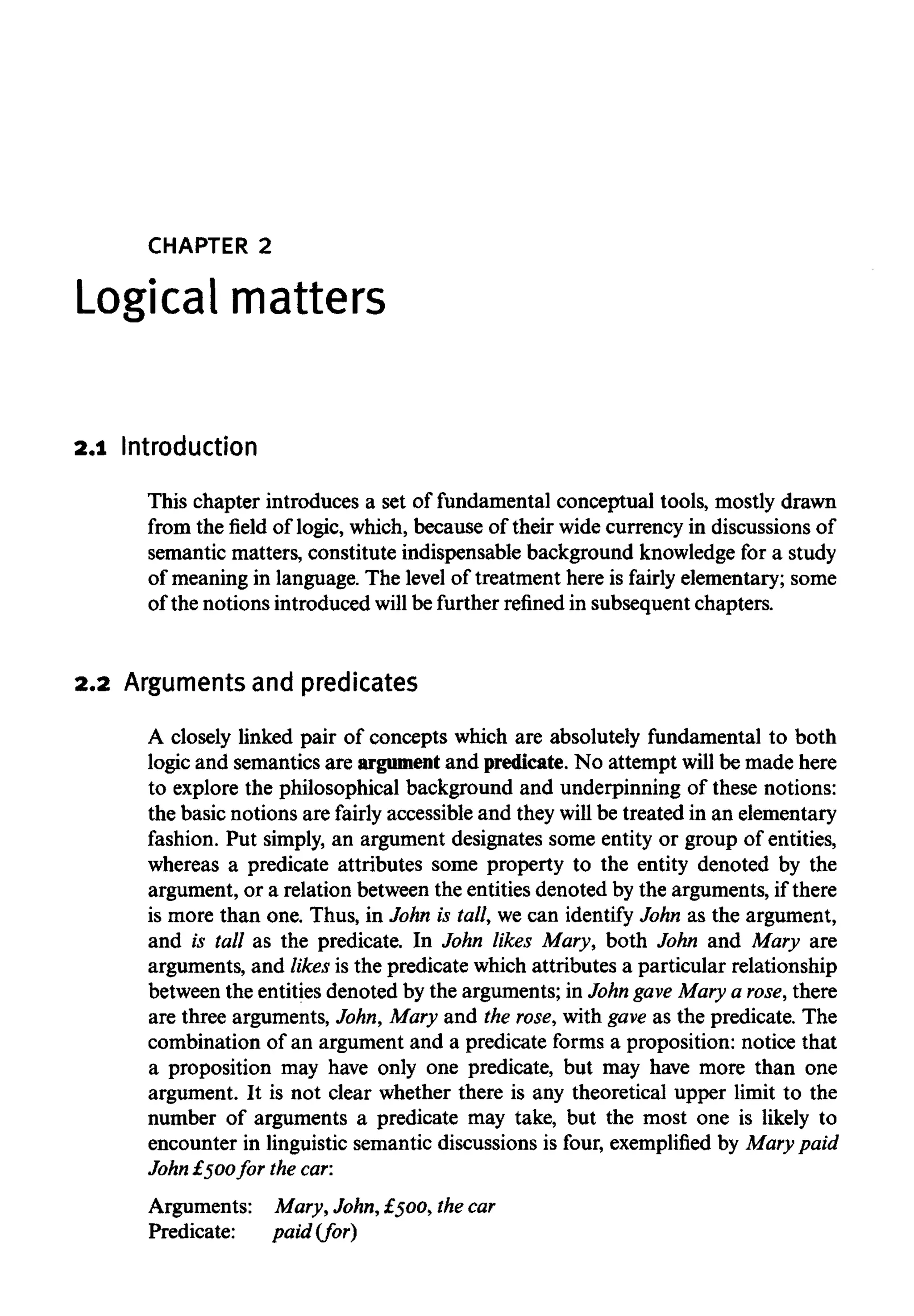
or a white elephant: knowing what white means and what elephant means is no
help whatsoever in decoding the meaning of white elephant. It is possible to
reformulate the principle to cover such cases:
(II) The meaning of a complex expression is a compositional function of the
meanings of its semantic constituents, that is, those constituents which
exhaustively partition the complex, and whose meanings, when
appropriately compounded, yield the (full) global meaning.
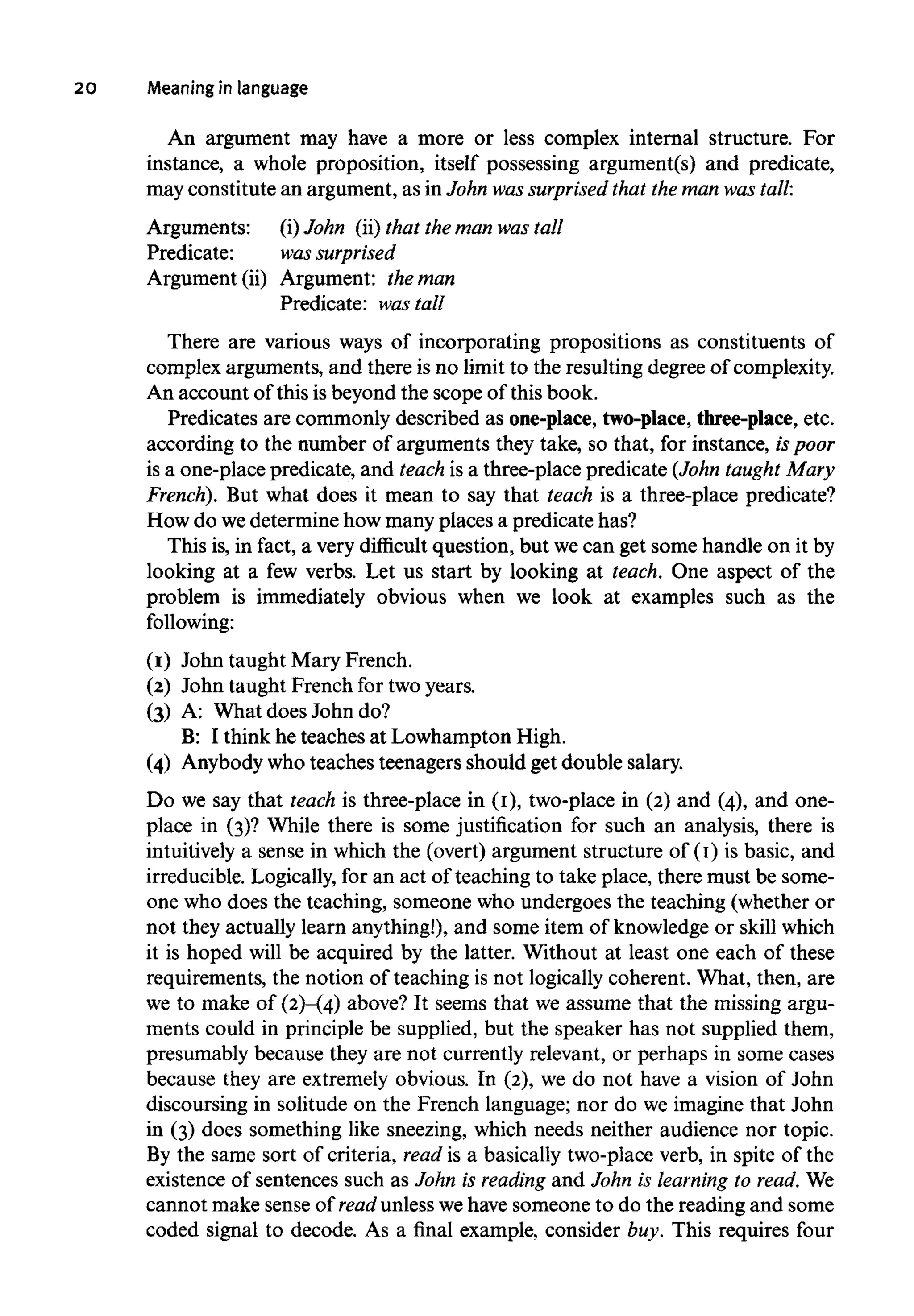
Notice that this version is tautologous unless the notion "semantic constitu-
ent" can be defined independently. If it can, then we will have a way of
accurately characterizing expressions (at least some of) whose grammatical
constituents are not semantic constituents (thereby abandoning assumption
(iii) given earlier).
4.3.1.1 Semantic constituents
Semantic constituents can in general be recognized by the recurrentcontrast
test. Prototypically, semantic constituents havethe following characteristics:
(i) They can be substituted by something else (belonging to the same
grammatical class), giving a different meaning.
Compositionality 71
This expresses the old principle "Meaning implies choice": that is, an expres-
sion cannot have meaning unless it was chosen from a set of possible alterna-
tives. The corollary of this is that if an element is obligatory, it cannot be said to
have meaning. So, for instance, cat in The cat sat on the mat satisfies this
criterion because it can be substituted by dog giving the semantically different
The dogsat onthemat; conversely, toin I want to eatdoesnot satisfy thiscriterion
because it is both grammatically obligatory and unique. As we shall see, this
criterion is too strict and is probably best regarded as prototypically valid.
(ii) At least some of the contrasts of meaning produced by substitution in
one context should be reproducible usingthe same items in a (formally)
different context.
This sounds clumsy and obscure. It attempts to state precisely the simple idea
that a meaningful linguistic item should be capable of carrying a constant
meaning from context to context. Let us now look at some examples of this
test in operation:
(4) (mat/box) The cat sat on a —. =
(mat/box) The—is dirty.
Here we have two items, mat and box, which produce the same semantic
contrast in two different contexts. These two items therefore pass the recurrent
contrast test for semantic constituency, and can be considered to be semantic
constituents of the sentences which result when they are placed in the
appropriate slots. Although we have shown that, for example, mat is a seman-
tic constituent of The cat sat on the mat, we have not shown that it is a minimal
semantic constituent, that is, one that cannot be divided into yet smaller
semantic constituents. For that wemust test the parts of mat. Let us nowapply
the recurrentcontrast test to the -at of mat:
(5) (-at/-oss) The cat sat on the m—.=(?)(-at/-oss) He has a newb—.
Notice first of all that the first part of the test is satisfied: substituting -at by
-oss gives us The cat sat on the moss,whose meaning is different from that of
The cat sat on the mat. The second part of the test is not satisfied, however,
because no context can be found where putting -ossin place of -at produces
the same contrast of meaning that it does in The cat sat on the mat. (Only one
of the contexts where the substitution of forms is possible is illustrated in (5).)
What is being claimed is that the contrast between The cat sat on the mat and
The cat sat on the moss is not the same as that between He has a new bat and
He has a new boss,and that an equivalent contrast can never be produced by
switching between -at and -oss. Some people are uncertain what is meant by
'the same contrast'. It may be helpful to think in terms of a semantic pro-
portionality like stallion:mare::ram:ewe ("stallion is to mare as ram is to
ewe"), which can be verbalized as 'the contrast between mare and stallion is
the same as that between eweand ram'.
72 Meaning in language
It is useful to run through a few of the results of this test. We find, for
instance, that although the dis- of disapprove comes out as a semantic con-
stituent (because the presence vs. absence of dis-has the same semantic effect
in the context of approve as it has in the context of like), the dis-of disappoint
is not a semantic constituent because the semantic effect of removing it does
not recur with any other stem (intuitively, adding dis- does not create an
opposite, as it does with both approve and mount). On the same basis, the re-
of re-count ("count again") is a semantic constituent, but not the re- of re-
count ("narrate"), nor the re- of report, receive, revolve, etc. The reader should
find that, on reflection, these results accord with intuition. Perhaps less in
accord with intuition, at least initially, isthe fact that neither the straw- nor the
-berry of strawberry, and neither the black- nor the -bird of blackbird, pass the
test for semantic constituency. Let us take the blackbird example (the same
arguments apply to lots of similar cases). Surely a blackbird is not only a
bird, but also black?Yes, of course. However the test says not only that the
contrast between, A blackbird was singing and A bird was singing is not
matched by that between, say, John was wearing a black suit and John was
wearing a suit, but that it cannot be matched at all. Think of it this way:
adding together the meaning of black and the meaning of bird does not give
us the meaning of blackbird, it gives us the meaning of black bird. To under-
stand what blackbird means, we have to have learned to attach a meaning to
the whole complex blackbird which is not derivable from black and bird. Some
might wish to argue that black- in blackbird carries whatever meaning
differentiates blackbirds from other kinds of bird. However, this is not
intuitively appealing: can one give even an approximate paraphrase of this
meaning? Furthermore, there is no evidencethat elements like black- behavein
any way like semantic constituents (for more detailed arguments, see Cruse
(1986: ch. 2.4)).
With this notion of semantic constituent we can make non-tautologous
sense of the principle of compositionality as expressed in (II). We can also
characterize a type of grammatically complex expression not all of whose
grammatical constituents are semantic constituents. These we shall call
idioms. By this definition, blackbird is an idiom, but the term is more usually
applied to phrasal units, and weshall now consider some of these.
4.3.1.2 Idioms
Phrasal idioms are expressions like:
to pull(someone)'s leg
to paint the town red
to kick the bucket
to be round the twist
to be up the creek
to havea beein (one)'s bonnet
etc.
Compositionality 73
It is important to realize that when one of these expressions is used in a
sentence, it is rare that the whole sentence is idiomatic in the sense defined
above. Take the case of Jane pulled Martha's leg about her boyfriend. By the
recurrent contrast test, the following items come out as (minimal) semantic
constituents: Jane, -ed,Martha, about,her,boyfriend (possibly boy and friend),
pull- —'s leg. Strictly, it is only the last item which is an idiom; notice that it is
semantically equivalent to a single lexical item, such as tease orcongratulate.
All the items except those which form part of the idiom can be changed
without destroying the idiomatic meaning; however, changing pull, or leg,
causes the idiomatic meaning to be lost. Although it isnot true of all idioms, it
seems fruitless to ask whatpull and leg mean in topull someone's leg:they do
not mean anything, just as the m- of mat does not mean anything—all the
meaning of the phrasal unit attaches to the phrase, and none to its
constituents.
Phrasal idioms have some peculiar grammatical properties, which can be
attributed either to the fact that their constituents have no meaning, or to the
fact that such meaning is not independently active. The following are the main
points:
(i) Elements are not separately modifiable without loss of idiomatic
meaning:
(6) *She pulled her brother's legs.
(7) *She pulled her brother's left leg.
(8) *She pulled her brother's legwith a sharp tug.
Only the idiom as a whole is modifiable:
(9) She pulled her brother's legmercilessly.
(ii) Elements do not co-ordinate with genuine semantic constituents:
(10) *She pulled and twisted her brother's leg.
(11) *She pulled her brother's legand arm.
(Notice, however, the normality of She pulled her brother's and herfather's leg,
where only semantic constituents are co-ordinated.) The asterisks in (10) and
(ii) apply only to the idiomatic reading.
(iii) Elements cannot take contrastive stress, or be the focus of topicalizing
transformations, andthe like:
(12) *It was her brother's LEG that she pulled.
(cf. It was her brother's leg that shepulled, which is normal.)
(13) *What shedid to her brother's legwaspull it.
(iv) Elements cannot be referred back to anaphorically:
(14) *Mary pulled her brother's leg; John pulled it, too.
74 Meaninginlanguage
(cf. the normality of Mary pulled her brother's leg; John did, too, where the
whole idiom is referred to anaphorically.)
(v) An idiom does not survive the substitution of any of its constituent
elements by a synonym or near-synonym:
(15) *The poor old chap kicked the pail.
(16) *She tugged his legabout it.
(17) *She pulled his lower limb about it.
In all these respects the superficially anomalous behaviour of idioms is in
fact a natural consequence of the fact that their constituents are, in a real
sense, meaningless. For instance, the typical function of an adjective is to
restrict or modify in some way the meaning of the noun it modifies. But if the
noun has no meaning, it is scarcely surprising that appending an adjective to it
should be anomalous. The same applies to processes which normally function
to highlight or focus on the meaning of a particular element, as in (iii) above.
Finally, sincepull in topull someone's leg does not have any meaning, no sense
can be attached to the notion of replacing it with a synonymous item
(any more than there is sense in the idea of replacing the m- in mat with a
synonymous item).
(vi) Some aspects of grammar (e.g.voice) mayor maynot be part of an idiom:
(18) His legwas being pulled continually by the other boys.
(The idiomatic meaning is not destroyed here, so 'active voice' is not part of
the idiom proper.)
(19) *The bucket was kicked by him.
(Here the idiomatic meaning is destroyed when voice is changed, and therefore
can be considered part of the idiom proper.)
4.3.1.3 Frozen metaphors
We havebeen looking at idioms which are non-compositional in the sense that
their apparent constituents are not real semantic constituents, and the mean-
ings which such constituents have in expressions where they are semantic con-
stituents may not have any relevance at all to the meaning of the phrasal (or
other) unit, or, if this is not the case, then do not allow the meaning of the
complex expression to be inferred by any normal compositional process. There
is, however, a class of idiom-like expressions, which come out as non-
compositional by the recurrent contrast test, and may show some of the
features of syntactic frozenness typical of idioms, such as resistance to modi-
fication, transformation, and so forth, but which differ from idioms in an
important respect, namely, that the effect of synonym substitution is not a
complete collapse of the non-literal reading. Compare the substitutions in(20)
with those in (21):
Compositionality 75
(20) The ball's in your court now.
on your side of the net
A cat can look at a queen,
mouse archbishop
I can read her like a open book,
decipher
He has one foot in the grave,
both feet tomb
one leg coffin
(21) I gave him a piece of my mind.
part conceptual system
He drives me up the wall.
forces room partition
He has a beein his bonnet about it.
hornet helmet
In the examples in (20) one can hardly say that the substitution has no effect,
but the non-literal meaning is still recoverable, or at least approximately so,
and the change in meaning is commensurate with the closeness of the syn-
onymy relation. This seems to indicate that the connection between the mean-
ings which results from normal compositional processes in these expressions
and their non-compositional readings is not an arbitrary one. What seems to
happen on synonym substitution is that the original metaphorical process is
revived, yielding a reading not far from the conventionalized reading. In the
examples in (21), there is always an element of the global meaning of the
complex expression (sometimes all of it) which is arbitrary with respect to
the 'free' meanings of the constituents.
It has been implied in the preceding discussion that the literal meanings of
the constituents of idioms are not always completely inactive or irrelevant to
the idiomatic reading. The degree of relatedness between literal and non-
literal meanings of idioms varies continuously from none at all to such a high
degree that the expression falls into a shadowy border area between idiomatic-
ity and full compositionality. If we look for a change at noun compounds, a
red herring represents one end of the scale, namely zero relatedness between
literal and non-literal readings; blackbird is an intermediate case; bread and
butter is in the borderline zone: what is not recoverable from a straightforward
composition in this case is the fact that the bread is sliced and the butter
spread on it (a loaf of bread and a pack of butter would qualify as butterand
bread, but arguably not as bread and butter).
76 Meaninginlanguage
4.3.1.4 Collocations
We have so far been thinking of compositionality exclusivelyfrom the point of
view of the hearer: given an expression consisting of more than one meaning-
ful element, how do wework out what the global meaning of the expressionis?
There is, however, another side to compositionality, namely the point of view
of the speaker: given that a speaker wishes to formulate a particular message,
and no single elementis available, how do they construct a complex expression
to convey it? Corresponding to the speaker's viewpoint, there are idioms of
encoding. Some of these are also idioms of decoding, but there are others
which are not idioms of decoding. To these we shall give the name colloca-
tions. Like the more familiar kind of idioms, they have to be individually
learned.
As examples of collocations take the intensifiers great, heavy, high, utter,
extreme, and severe. The following table shows that they have definite prefer-
ences and dispreferences:
4.3.1.5 Cliches
Some expressions which are apparently fully compositional should arguably
be included in the class of phrasal units; these are the so-called cliches. Let us
take as an example the politician's I've made mypositionabsolutely clear (when
he's been slithering and swerving for five minutes in the course of a probing
interview). In so far as its propositional meaning is concerned, this expression
would have to be categorized as fully compositional. However, it does have
global properties, as a whole phrase, although of a more subtle kind. It seems
highly likely that such phrases are stored as complete units in the brains of
both speaker and hearer; as such, they are easy to retrieve while speaking and
easy to decode for the hearer. They also tend to slip past without making much
of an impact, their truth or falsehood not seriously examined. They function
as default encodings of certain meanings. The effect of using a non-default
encoding of the same meaning is to call attention to the utterance, it becomes
'marked'. Beingless frequently encountered, it takes more processing effort on
great
frost
rain
wind
surprise
distress
temperature
speed
-
-
?
+
+
7
+
heavy
+
+
-
-
-
-
-
high
-
-
+
-
-
+
+
utter
-
—
-
+
-
-
-
extreme
?
-
-
+
+
+
7
deep
—
-
-
-
+
-
-
severe
+
-
-
-
+
-
-
Compositionality 77
the part of both encoder and decoder and, by the principle of relevance, the
hearer looks for some modification of the message that would have been con-
veyed by the default form. In the case of an alternative formulation of the
same prepositional content like I've given an unambiguous exposition of my
views, the message might be harder to dismiss, but also the speaker might be
taken to be stepping outside his conventional role as politician, which might
on certain occasions not be desirable.
The exact relation between minimal idioms like bread and butter and what
we have called cliches is not clear. It may be that the latter should be con-
sidered to lie on the same scale as the former, but are even more minimally
idiomatic, since no prepositional difference isinvolved.
4.4 Limits to compositionality II: Non-compositional aspects of
compositional expressions
4.4.1 Noun compounds
Many noun compounds can be considered to be idioms (see below) by our
criteria. For instance, tea-towel is clearly of the same general type as blackbird.
But there are other examples which show recurrent semantic properties, which
enable the constituents to satisfy the criteria for semantic constituents, but
which display semantic properties that are not predictable in any wayexcept
perhaps on the basis of pragmatic world knowledge.For instance, consider the
different relations between the first and second elements in the following:
pocket knife ("knife that can be carried in the pocket")
(The same relationship appears in pocket calculator and handgun.)
kitchen knife ("knife for use in the kitchen")
(The same relationship appears in kitchenpaper and garden knife.)
meat knife ("knife for cuttingmeat")
(The same relationship appears in meat tenderizer and bread knife.)
The relations fall into clear types (to a large extent), but there is no obvious
way of predicting that for instance, a tablecloth is used to cover a table, but a
dishcloth is used to wipedishes.
4.4.2 Active zones
Active zone is Langacker's term for the precise locus of interaction between
two meanings in combination, typically an adjective and its head noun, or a
verb and its complement. Some examples will make the notion clear. Take the
case of a colour adjective and its head noun. Very often the colour does not
apply globally to the object denoted by the head noun (although it may do),
but only to a part:
78 Meaninginlanguage
Is this idiom? Intuitivelyit is not, and the constituents of such expressions can
easily be shown to pass the recurrent contrast test (it may of course be the case
that the test is faulty, or insufficiently sensitive). These cases also seem to be
different from the noun-compound cases: here, specification of the active zone
in different ways does not radically change the mode of interaction: in all the
above cases we know that the colour adjective indicates that the referent of the
head noun is distinctive by virtue of its possession of an area with certain
perceptual properties. But active zones need in some sense to be learned, and
are not predictable by any sort of formal rule.
4.4.3 Complex categories
The point at issue in relation to complex categories is what happens when
simple categories are merged to form a complex category. This is known in
prototype theoretical circles as the guppy effect. Essentially, it is claimed that
certain properties of a complex category cannot be predicted from the corres-
ponding properties of the constituent categories. The example which gives its
name to the 'effect' brings us back once again to noun compounds. When
informants are asked to say what they consider to be the best or most repre-
sentative example(s) of the category PET, they tend to go for cats and dogs;
when asked to name the best examples of the category FISH, they choose trout,
or salmon, or something of the sort. However, when asked for the best
example of the category PET FISH, the answer is guppy, which is not regarded as
central in either of the constituent categories. The effect is not confined to
noun compounds: the same can be observed with an adjective-noun phrase
such as orange apple. Items chosen by subjects as the best examples of the
category ORANGE APPLE are different from those chosen as the best examples
of the category APPLE, and their colour does not correspond to that chosen
when asked which from a range of colours is the best example of the colour
ORANGE. We shall return to the guppy effect and its significancein Chapter 7;
for the moment we shall merely note its existence and the fact that it indicates
a limitation on compositionality.
The guppy effect has given rise to much comment. Some have argued that
the lack of compositionality reveals a weakness in prototype theory; simul-
a red hat
a redbook
a red apple
a yellowpeach
apink grapefruit
a red traffic sign
a redpencil (1)
a redpencil (2)
red eyes
blue eyes
whole hat is red
outside covers are red
a significant portion of outer skin isred
inner flesh isyellow
inner flesh is pink
symbols only are red
red on outside
writes red
'white' of eyesis red
iris is blue
Compositionality 79
taneously, prototype theorists have laboured to devise an algorithm which
will enable the prototype of a complex category to be calculated from the
individual prototypes of the component categories (with limited success).
My own feeling is that the characteristics of a complex category ARE calcul-
able from those of its component categories; the problem is that current
descriptions of categories are so impoverished. Suppose we take a thorough-
going holistic view of categories, in which the entirety of encyclopaedic infor-
mation about a category is a legitimate part of its characterization. So, for
instance, the description of ORANGE would provide a complete range of hues
falling under ORANGE, together with an index of centrality (or whatever);like-
wise, the description of APPLE would include, among other things, an indica-
tion of all the hues that apples can manifest. Given this information, the
prototypical ORANGE APPLES are simply those APPLES whose hues approximate
most closely to a prototypical ORANGE. There is obviously no requirementhere
for the resultant apples either to be prototypical apples, or for them to have a
prototypical orange colour. Where is the mystery?The same argument applies
to PET FISH: the prototypical pet fish are those fish which manifest the greatest
proportion of the characteristics of prototypical pets: to work this out we
need a detailed enough knowledgeof the range of characteristics displayed by
fish and by pets. (Notice that the grammar has some influence here: prototype
pet fish are those fish nearest to prototype pets; this is not necessarilythe same
category as those pets which are nearest to prototypefish.)
4.5 Some reflections on compositionality
The debate about compositionality is by no means over. Let us conclude by
distinguishing three positions vis-a-vis the principle of compositionality.
(i) The building-block model (alternatively, 'check-list theories'). This is
intimately connected with strong componentialism: the meaning of an
expression can be finitely described, and is totally accounted for by
standard compositional processes acting on the equally determinate
meanings of its component parts.
(ii) The scaffolding model (perhaps better, 'the semantic skeleton' model).
According to this view, what compositionality provides is the bare
bones of a semanticstructure for a complex expression, which isfleshed
out by less predictable pragmatic means, using encyclopaedic know-
ledge, context, and so on. This can be viewed as a weaker version of the
principle of compositionality.
(iii) The holistic model. This, too, is a strong version of compositionality. It
requires that the meaning of every item is an indefinitely large entity
which consists of its relations with all other items in the language. In a
8o Meaning in language
sense, all the effects of combination with other items are already pres-
ent in the meaning: all that is needed is to extract the relevant portions.
This radical view has its own problems, but it should be considered
alongside the others.
Discussion questionsand exercises
1. Identify thetype of combination exhibited inthefollowing phrases:
a forged passport
a clever footballer
a former MissWorld
a poor singer
a dead cat
a high price
a black hat
a small planet
longeyelashes
artificial cream
a brilliant pianist
a striped dress
2. Each of the following sentencescontains at least one conventional-
ized expressionof some sort. Attempt a classification of these under
the following headings (usingthe definitions given in the chapter):
(a) true idioms; (b) frozen metaphors; (c) collocations; (d) cliches (fixed, but
more-or-less transparent expressions).
(i) Youhave to hand it to him — he's got guts.
(ii) The ball's in your court now.
(iii) You'recompletely up the creek on this one.
(iv) Whydon't you just wait and see?
(v) She's got a bee in her bonnet about it.
(vi) Theaffair was blown up out of all proportion.
(vii) He took it in good part.
(viii) Use your loaf!
(ix) Thesituation went from badto worse.
(x) Heswallowed it lock, stock and barrel.
(xi) They beat the livingdaylights out of him.
(xii) Well, you live and learn, don'tyou?
3. Make a study of English words carrying the prefix dis-. In how many of
these is the prefix an independent semantic constituent? (See Cruse
1986: ch. 2.) Wheredis- is a semantic constituent, how many distinct
sense relations doesX: dis-X represent? Discussany difficulties.
Compositionality 81
4. Consider what the active zones are in the following:
(0 The irate father spanked his son.
(ii) Mary filled the car up with petrol before drivingon to the ferry,
(iii) Blue spectacles,
(iv) Tinted spectacles,
(v) A red knife,
(vi) A sharp knife,
(vii) Afast computer program,
(viii) A quick cup of coffee.
Suggestions for further reading
The principle of Compositionality is a key feature of any formal approach to
semantics. Chapter 1 of Cann (1993) provides a good introduction; a more
advanced treatment can be found in Partee (1984) and Bartsch (forthcoming).
The account of idioms given here follows that of Cruse (1986: ch. 2). For a
comprehensive survey of English idioms, see Makkai (1972). The syntactic
behaviour of idioms is discussed in Fraser (1970), Katz (1973), Newmeyer
(1974). An interesting discussion of idioms from a psycholinguistic point of
view is Gibbs (1990). (Gibbs's position on idioms is not as incompatible with
Cruse 1986as he seems to think.)
For collocations (defined more inclusively than here) seeMackin (1978).
Langacker's notion of 'active zones' is expounded in Langacker (1991b:
189-201).
For different types of adjective-noun combination, seeDillon (1979).
This page intentionally left blank
Part 2
Words and their Meanings
To the layman, words are par excellence the bearers of meaning in language. While it
is in danger of understating the importance of other linguistic structures and phe-
nomena in the elaboration of meaning, this view is not entirely unjustified: words do
have a central role to play in the coding of meaning, and are responsible for much of
the richness and subtlety of messages conveyed linguistically. Hence it is no acci-
dent that this part of the book is the most substantial. Here, after the introductory
Chapter 5, we discuss how word meanings vary with context (Chapter 6), the
relations between word meanings and concepts (Chapter 7), paradigmatic sense
relations (Chapters 8 and 9), larger vocabulary structures (Chapter 10), how new
meanings grow out of old ones (Chapter 11), how words affect the meanings of their
syntagmatic neighbours (Chapter 12), and finally, theories of lexical decomposition
(Chapter 13).
This page intentionally left blank
CHAPTER 5
Introduction to lexical semantics
5.1 The nature ofword meaning
5.2 The major problems of lexical
semantics
87 5-3 Approaches to lexical semantics
Suggestions for further reading
95
96
102
This page intentionally left blank
CHAPTER 5
Introduction to lexicalsemantics
5.1 Thenature of word meaning
In a descriptive introduction to meaning such as this, it is inevitable that the
meanings of words should loom large, even though in more formally oriented
accounts, word meanings are left largely unanalysed, or are reduced to mere
skeletons of their true selves. There are, of course, more or less reputable
justifications for such neglect. However, most (linguistically innocent) people
have an intuition that meaning is intimately bound up with individual words;
indeed, this, par excellence, is what words are for. While such an intuition
seriously underestimates other aspects of meaning, it is not, in itself, wrong,
and an adequate introduction to meaning should not shrink from the slipperi-
ness and complexity of word meaning simply because it cannot be neatly
corralled into a favoured formalization. Hence, the present and the following
eight chapters willbe devoted to various aspects oflexical semantics.
5.1.1 What is a word?
There has been a great deal of discussion of the nature of the word as a
grammatical unit, too much even to summarize here. Most of it, anyway, is not
relevant to our concerns. But it is as well to have some idea of what we are
dealing with. The notion has notoriously resisted precise definition. Probably
the best approach is a prototypic one: what is a prototypical word like? Well,
for our purposes, the classical characterization as 'a minimal permutable
element' will serve. This attributes two features to a prototypical word:
(i) It can be moved about in the sentence, or at least its position relative to
other constituents can be altered byinserting newmaterial.
(ii) It cannot be interrupted or its parts reordered.
In other words, in makingchanges to a sentence, weare by and large obliged
to treat its words as structurally inviolable wholes. Let's see briefly how this
works. Take a sentence like (I):
88 Meaninginlanguage
(I) The government is strongly opposed to denationalization.
Reordering appears in such examples as (2)-(4):
(2) The government is opposed todenationalization—strongly.
(3) What the government is strongly opposed to is denationalization.
(4) It isdenationalization that the government isopposed to.
And the possibilities for the insertion of newmaterial are asfollows:
(5) The (present) government, (apparently), is (very) strongly (and implac-
ably) opposed (not only) to (creeping) denationalization, but. . . etc.
Notice that the only possible insertion points are between words. Words, of
course, are separated by spaces in writing, although not usually by silences in
speech. They also have a characteristic internal structure, in that they proto-
typically have no more than one lexical root. (This notion will become clearer
below, but, for instance, the lexical roots of the followingwords are shown in
capitals:
GOVERNment reORDERing STRONGly deNATIONalization
OPPOSed TYPically CLEARer LEXical)
Some words, such as HEDGE-HOG, BUTTER-FLY, and BLACK-BOARD
seem to havemore than one lexical root. These, however,are atypical, and for
many of them it is possible to argue that the apparent roots are not fully
autonomous, semantically, but form a fused root. Other words have no lexical
roots at all: these are the so-called grammatical words like the, and, and of.
There will be more on the 'lexical'/'non-lexical' distinction below.
At this point it is necessary to be somewhat more precise about what we
mean by a word. In one sense, obey, obeys, obeying, and obeyed are different
words (e.g. for crossword purposes); in another sense, they are merely different
forms of the same word (and one would not, generally speaking, expect them
to have separate entries in a dictionary). On the other hand, obey and disobey
are different words in both senses, whereas bank (river) and bank (money) are
the same word for crossword purposes, but we would expect them to have
separate dictionary entries and they are therefore different words in the second
sense. Finer distinctions are possible, but for our purposes it will be sufficient
to distinguish word forms and lexemes. Word forms, as the name suggests, are
individuated by their form, whether phonological or graphic (most of our
examples will be both); lexemes can be regarded as groupings of one or more
word forms, which are individuated by their roots and/or derivational affixes.
So,run,runs, running,and ranare word forms belongingto the samelexemerun,
while walk, walks, walking, and walked belong to a different lexeme, walk, dis-
tinguished from the formerbyits root; likewise,obey,obeys, obeying, and obeyed
belong to a single lexeme and disobey, disobeys, disobeying, and disobeyed, des-
pite having the same root as the first set, belong to a different lexeme, dis-
Lexical semantics 89
tinguished this time bythe possession of the derivational affix dis-.A simple test
for derivational affixes (the matter is in reality, however, complex and contro-
versial) is that they are never grammatically obligatory. For instance, in John is
disobeying me, disobey can be substituted by watch,without giving an ungram-
matical sentence, whichshowsthat dis- isnot essential to the grammatical struc-
ture of the sentence. This is true of all occurrences of dis-.On the other hand,
any verb which will fit grammatically into the frame John is — me must bear the
affix -ing,showing that it is not a derivational,but an inflectional affix: word
forms that differ onlyin respect of inflectional affixes belong to the same lexeme.
It is the word-as-lexemewhichis the significantunit for lexical semantics.
5.1.2 Lexicaland grammatical meaning
A distinction is often made between lexical and grammatical meaning (some-
times only the latter is allowed as being properly linguistic). There are dangers
in all dichotomies; this one is harmless provided it is borne in mind that in
reality there is a continuously varying scale, of what might be termed lexicality
and grammaticality. A convenient wayof presenting the distinction is in terms
of the sorts of element which carry the meaning in question. We can divide
grammatical units into closed-set itemsand open-set items(another dichotomy
which disguises a graded scale). Central examples of closed-set items have the
following characteristics:
(i) They belong to small substitution sets (perhaps as small as one).
(ii) Their principal function is to articulate the grammatical structure of
sentences.
(iii) They change at a relatively slow rate through time, so that a single
speaker is unlikelyto see loss or gain of items in their lifetime. (No new
tense markers or determiners haveappeared in English for a longtime.)
In other words, the inventory of items in a particular closed-set
grammatical category iseffectively fixed (i.e. 'closed', hence the name).
These may be contrasted with open-set items, which have the following
characteristics:
(i) They belong to relatively large substitution sets (especially if semantic
plausibility is ignored).
(ii) There is a relatively rapid turnover in membership of substitution
classes, and a single speaker is likely to encounter many lossesand gains
in a single lifetime. (Think of the proliferation of words relating to
space travel, or computing, in recent years.)
(iii) Their principal function is to carry the meaning of a sentence.
Both closed- and open-set items carry meaning, but their different functions
mean that there are differences in the characteristics of the meanings that they
typically carry.
90 Meaning in language
A closed-set item, in order to be able to function properly as a grammatical
element, has to be able to combine without anomaly with a wide range of
roots, and for this to be possible, it must have a meaning which is flexible, or
broad enough, or sufficiently 'attenuated' not to generate clashes too easily,
and it must signal contrasts which recur frequently. Hence, meanings such as
"past", "present", and "future", which can co-occur with virtually any verbal
notion, and "one" and "many", which can co-occur with vast numbers of
nominal notions, are prototypical grammatical meanings.
In contrast, there is no limit to the particularity or richness of the meaning
an open-set element may carry, as there are no requirements for recurrent
meanings or wide co-occurrence possibilities. Hence, open-set itemstypically
carry the burden of the semantic content of utterances. Because of the rich-
ness of their meanings and their unrestricted numbers, they participate in
complex paradigmatic and syntagmatic structures.
What are called content words (basically nouns, verbs, adjectives, and
adverbs) prototypically have one open-set morpheme (usually called the root
morpheme) and may also have one or more closed-set items in the form of
affixes. Lexical semantics is by and large the study of the meanings of content
words, and is oriented principally to the contribution that open-set itemsmake
to these. Grammatical semantics concentrates on the meanings of closed-set
items. However,a strict separation between grammatical and lexicalsemantics
is not possible because the meanings of the two kinds of element interact in
complex ways.
5.1.3 Word meaningand sentence meaning
In general, word meanings are not the sort of semantic units that one can
communicate with on an individual basis, unless other meaning compon-
ents are implicit. A word, on its own, does not actually say anything,
does not convey 'a whole thought': for that purpose, more complex seman-
tic entities are necessary—built out of words, certainly—having at least the
complexity of propositions (argument+predicate). Words (and at a more
basic level, morphemes) form the building blocks for these more complex
structures.
5.1.4 Thenotion "possible word meaning"
It is worth while to pose the question of whether there are any restrictions on
possible meanings for words. Wemay approach this in two stages. Wecan first
ask whether there are any universal restrictions; and wecan then enquire as to
the existence of language-specific restrictions.
Let us take the first question first. Is there anything conceivable that could
never be the meaning of a word? It will be as well to restrict ourselves to
notions that can be expressed by a combination of words, otherwise we shall
be in really deep water. One line of thinking can, I think, be disposed of
Lexical semantics 91
relatively quickly. It may be thought that no language could possibly have a
word meaning, for instance, "to face west on a sunny morning while doing
something quickly". I confess that I would be astonished to find such a word.
But the reason is not that it is theoretically impossible, but that it would be of
such limited utility. Languages have words, at least partly, because in the cul-
tures they serve,the meanings such words carry need to be communicated. (Of
course, cultural evolution can leave words stranded, as it were, but this does
not invalidate the basic point that words at some stage must be motivated in
terms of possible use.) This means that if some culture had a use for the notion
expressed, then it would not be surprising if there were a word for it. In the
case in question, for instance, maybe the word could designate a specific sort
of act of disrespect towards the Sun God, which carried specific penalties. If
we take into account the possibility of outlandish (to us) religious beliefs, it is
clear that the scope for improbable word meanings of this sort is (almost)
unlimited.
Now let us look at a different sort of case. Take the sentence (6):
(6) The woman drank the wine slowly.
The notion "drank slowly" could easily be lexicalized (i.e. expressed by asingle
word): we have in English, after all, verbs such as quaff, and sip, which com-
bine the meaning of "drink" with some adverbial manner component. Simi-
larly, a verb meaning "drink wine" is not at all implausible, as one of the
senses of drink in English is specifically "drink alcoholic beverage" (as in Mary
doesn't drink, she'll just have an orangejuice). In contrast to these more-or-less
plausible word meanings, consider next the possibility of having a word mean-
ing "The woman drank" (blisk), or "the wine slowly" (blenk). On this system,
Blisk wine wouldmean "The woman drank wine", and The woman drank blenk
would mean "The woman drank the wine slowly". It seems clear that here we
are in the realms not of implausibility, but of impossibility. As a further
example, consider the phrase very sweet coffee. It is perfectly within the
bounds of possibility that there should be a single word meaning "sweet
coffee", or "very sweet", even "very sweetcoffee", but it is not conceivable that
there should be a word meaning "very — coffee" (i.e. any adjective applied
to coffee would be automatically intensified). What is the difference between
the possible and the impossible cases? There seem to be two parts to the
answer. First, a word meaning is not allowed to straddle the vital subject-
predicate divide. Second, possible word meanings are constrained in a strange
way by semantic dependencies. It is first necessary to distinguishdependent
and independent components of a semantic combination. The independent
component is the one which determines the semantic relations of the combin-
ation as a whole with external iems. So, for instance, in very large, it is large
which governs the combinability of the phrase very large with other items.
Thus the oddness of, say, ?a very large wind is attributable to a semantic
incompatibility between large and wind—there is no inherent clash between
92 Meaninginlanguage
very and wind, as the normality of a very hot wind demonstrates. By similar
reasoning, the independent item in warm milk is milk, and in drink warm milk
is drink.By followingthis line of reasoning, we can establish chains of seman-
tic dependencies. For instance, the chain for very youngboy is:
"very" -»"young"-> "boy"
and that for drink warm milk is:
"warm" ->"milk" -» "drink"
The constraint that weare looking at says that the elements that constitute the
meaning of a word must form a continuous dependency chain. This means,
first, that there must be a relation of dependency between elements. This rules
out "wine slowly" as a possible word meaning, because there is no dependency
between "wine" and "slowly" in "Drink wine slowly". Second, there must be
no gaps in the chain which need to be filled by semantic elements from outside
the word. This rules out cases like "very —milk", wherethe dependency chain
would have to be completed by an external item such as "hot".
Another way of approaching the question under discussion is to take an
extensional viewpoint and ask what are the characteristics of a 'possible
nameable'. A full answer to this question would deal with possible nameable
objects, events, states, and so on. The present discussion willdeal only with the
first of these, and will follow Pulman (I983). Nameables, in general, are dis-
tinguished linguistically by the ability to take proper names (obviously), but
also by the ability to be referred to by means of singular, non-collective count
nouns (at least in English). (The characterization of nameability in states,
processes, events, and so on, would require referenceto adjectives and verbs, as
well as nouns.)
We shall illustrate the sort of argument involved in saying what is nameable
by reference to a particular sort of nameable, namely, physical objects. The
concept of physical object seems to involve at least the notions of perceiv-
ability, relative continuity in space and time, and potential detachability from
surroundings. However,not all physical objects, by these criteria, arenaturally
nameable. A couple of quotations from Chomsky are relevanthere:
(i) the most elementary notion we have, the notion 'physical object'. . .seems to be
quite complex. . .Onewing of an aeroplane is an object, but its left half, though
equally continuous, isnot. (1976:203.)
(Since, in an obvious sense, the left half of an aeroplane wing is a physical
thing, wemay interpret Chomsky as talking about nameability.)
(ii) there are no logical grounds for the apparent non-existence of words such as
LIMB, similar to limb except that it designates the single object consisting of a
dog's four legs so that its LIMB is brown. . .would mean that the object consist-
ing of its four legs is brown. Similarly, there is no a priori reason why a natural
language could not containa word HERD, like the collectiveherd except that it
Lexical semantics 93
denotes a single scattered object with cows as parts, so that a cow lost a leg
implies the HERD lost a leg, etc. (1965:201.)
The existence of physical things which intuitively do not seem to be name-
able implies the existence of principles of nameability, which may not be rigid,
but which will at least render some 'things' more readily nameable than others.
(The notion of 'prototypical', to be discussed in Chapter 7, is relevant here:
what we are looking for are the prototypic features of nameability.) A fairly
basic suggestion isthat to be nameable, a physical thing must be bounded, that
is, it must have boundaries set on the basis of either physical detachability, or
characteristic function, appearance, or behaviour. This is, of course, pretty
vague, and a full treatment would critically examine all these terms, but take,
for instance, Chomsky's left half of an aeroplane wing. This is physical, but
while the whole wing is bounded by distinctive function and appearance, the
left half is not separated from the rest of the wing by any salient function or
visual discontinuity, nor does it behave in a characteristic way.In this way, the
left part of an aeroplane wing differs from an earlobe, which is visually separ-
ated from the rest of the ear, and the tip of the tongue, which has no visual
separateness, but has its owncharacteristic functions and a special place in our
experience of our bodies. (Notice that some nameables, by the definitiongiven
above, will count as whole things and others as parts of those wholes; that is a
separate question.)
Chomsky's examples of LIMB and HERD are more difficult and controversial.
First it must be recognized that some 'scattered' individuals are nameable,
such as fences, constellations, villages, forests, and so on. To adapt Pulman
slightly, we can say that nameable collections of otherwise independently
nameable entities generally show one (or more) of the following features:
(i) The collection is relatively spatio-temporally contiguous (fence, forest,
village).
(ii) It is the product of human agency (fence, village, artistic installation)
(iii) The members of the collection jointly fulfil a function not fulfilled by
any of them separately (fence,bikini).
Notice that both Chomsky and Pulman insist on a distinction between
singular scattered objects and collectives. But the criteria are not clear. Pulman
refers to "things which are designated by singular count nouns or proper
names but nevertheless regarded as plural: collective words like herd, pile and
flock, and proper names like the United States or the Commonwealth". (Notice
that the possession of one of the features mentioned above seems to be neces-
sary for these collective words.) But what ismeant by "are regarded as plural"?
A word like committee can take plural concord with a verb: The committee
have decided, but this is not the case with, for instance, pile: *Thepile of stones
areblack.
Chomsky is not much more explicit for LIMB, although he is for HERD. In the
94 Meaning in language
case of LIMB, he gives as the sort of sentence which would prove that there was
a genuine word LIMB, something like The LIMB of the dog is brown. Actually,
such cases are not rare: Thefoliage of this tree is light green means simply that
the leaves of the tree are light green. Chomsky's requirements for HERD are
perhaps more strict. It seems that for HERD to be a bona fide example, a part of
a cow must count as a part of a HERD (which it clearly does not for the
'normal' word herd). Notice that this criterion would rule out foliage: one
would not say Thefoliage of this tree hasprominent veins, but The leaves of this
tree have prominent veins. (Similarly: *John's priceless library of first editions
has lost several pages.) But it is not clear that it holds for fence, either (and
others discussed by Pulman as bona fide singular non-collectives). If the sep-
arate (and separated) posts which constituted a fence each had a hole in it,
would one say Thefence has holes in it or Thefence poles have holes in them? I
would be happier with the latter. On the other hand, I would be happy with
You can't wear this bikini because it has holes in it (cf. also This bikini has a
reinforced gusset).
I suspect that there is, in fact, no sharp distinction between the HERDtype of
example and the herd type. I am inclined to agree with Chomsky, however, to
the extent that the HERD type are somewhat rare. (It may be that more relevant
factors remain to be discovered.) Obviously a similar investigation needs to be
carried out on states, actions, processes and events, and so on, to see what
factors determine nameability by a single lexical item (notice that proper
names are largely (?totally) confinedto nouns).
Of a more controversial status are cases like the putative 'impossible' words
benter and succeive (Jackendoff I990:26I). Let us consider benter first. This is
proposed as a logically coherent converse of enter which cannot be lexically
realized. Sentences such as (7)are fully normal:
(7) Mary entered the room.
The proposed converse of this would be (8):
(8) The room bentered Mary.
(On the pattern of: Mary followed John and its converse John preceded Mary.)
The other example sometimes cited is succeive, which is intended to denote
the true converse of receive:
(9) John received the parcel.
(I0) The parcel succeived John.
The explanation given for these constraints is expressed in terms of semantic
roles such as agent, patient, etc. There isa certain plausibilityabout the claims.
However, although there may be some resistance to words having such mean-
ings, and in the cases cited there are no obvious candidates, the prohibition is
perhaps not absolute, as the following observations suggest. First, themeaning
of benter is not all that far removed from one reading of receive. We also have
Lexical semantics 95
words such as envelop, incorporate, which seem to have the right sort of mean-
ing. In the case of succeive, the word reach appears to encode approximately
the right sort of meaning:
(II) I sent John a parcel; he received it yesterday.
(I2) I sent John a parcel; it reached him yesterday.
The constraints on word meaning discussed above would seem to be universal
in nature. However, there also exist constraints of a more language-specific
type. Some languages seem to proscribe the packaging together of certain
sorts of meaning in a single word. A single example will suffice. Consider
sentence (I3):
(I3) John ran up the stairs.
Here, the word ran encapsulates two notions, that of movement, and that of
manner. This is a common pattern in English:
(I4) John crawledacross the road.
staggered into the room.
waltzed through the office.
etc.
However, this pattern is not possible in many languages, includingFrench. In
French, such sentences must be rendered as in (I5):
(I5) Jean monta 1'escalier en courant.
Here, the notions of motion and direction arejointly packaged into monta, but
mannerhasto beexpressedseparately. (Notice that theFrench pattern isnot pro-
hibited in English:John mounted thestairs running,but ismarkedlyless natural.)
5.2 The major problems of lexical semantics
Linguists with different theoretical commitments will give different accounts
of what the core tasks of lexical semantics are; the following is an attempt at a
relatively theoretically neutral summary.
5.2.1 Description ofcontent
Describing content is in a sense the most obvious task: how do we say what a
word means? Unfortunately, even at this level of generality it is impossible to
escape the tentacles of theory, because there are scholars who maintain that
the notion 'the meaning of a word' is not a coherent one; and for those who
believe there is such a thing, the nature of the description of it will hang
crucially on what sort of thing it is believed to be. We shall look briefly below
at some of the options.
96 Meaning in language
5.2.2 Contextualvariation
However one characterizes the notion of the meaning of a word, one is forced
to confront the fact that the semantic import of a single word form can vary
greatly from one context to another. There are various theory-dependent
strategies for attacking this problem, but the facts will not go away: the vari-
ation must be accounted for. Variation is not random: part of a satisfactory
account will identify and explain patterns of variation.
5.2.3 Sense relationsand structuresin the lexicon
Regular patterns appear not only in the nature and distribution of the
meanings of a single word in different contexts, but also between different
words in the same context. This results in structured groupings of words in the
vocabulary on the basis of recurrent meaning relations.
5.2.4 Word meaning and syntacticproperties
An important question is whether and to what extent the syntactic properties
of words are independent of, or are controlled by, their meanings. There are
still many different viewson this topic.
5.3 Approachesto lexical semantics
5.3.1 One-level vs. two-level approaches
A major dividing line which separates semanticists is the question of whether
a distinction can be made between semantics and encyclopaedic knowledge.
Those who believe such a division can be made often draw an analogy with
phonetics and phonology. Human beings can make and learn to recognize an
almost infinite variety of speech sounds, but in any particular language, only a
handful of these function distinctively to convey meanings, or enter into sys-
tematic relations of any complexity. These are the true linguistic elements on
the 'sound' side of language (Saussure's expression plane). In a similar way,the
variety of 'raw' meanings is virtually infinite, but only a limited number of
these are truly linguistic and interact systematically with other aspects of the
linguistic system. The vast detailed knowledge of the world, which speakers
undoubtedly possess, is, according to the dual-level view, a property, not of
language elements, but of concepts, which are strictly extralinguistic. Truly
linguistic meaning elements are of a much 'leaner' sort, and are (typically)
thought of as (more) amenable to formalization. One criterion suggested for
recognizing 'linguistic' meaning is involvement with syntax, whether by virtue
of being the meaning carried by some grammatical element, or because it
Lexical semantics 97
correlates with such factors as agreement patterns or sub-categorization of
major syntactic categories.
Partisans of the single-level view claim that no non-arbitrary basis for
assigning aspects of meaning (or knowledge) to the 'semantic' or 'encyclo-
paedic' side of a purported dichotomy has been put forward which survives
even a cursory scrutiny. Most cognitive linguists would take the view that all
meaning is conceptual, and that the 'extra' level of structure proposed by the
two-level camp does not actually do any theoretical work. The distinction
between grammatical and lexical/encyclopaedic meaning is not necessarily
denied, but it is likely to be seen as a continuum, rather than a dichotomy,
and entirelyconceptual in nature.
5.3.2 Monosemicvs. polysemic approaches
The point at issue in relation to the distinction between the monosemic and
the polysemic approach is how many meanings ought to be attributed to a
word. There is no dispute about clear-cut cases of homonymy, like that of
bank, where there is no conceivable way of deriving one meaning from the
other. The dispute centres on clusters of related senses characteristic of
polysemy. (For greater detail, see Chapter 6.) The monosemic view is that as
few senses as possible should be given separate recognition in the (ideal)
lexicon of a language, and as many as possible derived from these. The
argument usually goes like this: if one reading of a word is in any way a
motivated extension of another one, then only one should be recorded, and
the other should be left to the operation of lexical rules, which in general
apply to more than one instance and hence represent systematicity in the
lexicon.
The polysemic approach rejects the assumption that a motivated extension
of a word sense does not need to be recorded in the lexicon. The basic reason
for this is that lexical rules only specify potentialextensions of meaning,only
some of which become conventionalized and incorporated in the lexicon:
others are possible, and may appear as nonce forms, but there is none the less a
clear distinction between these and those which are established (in principle,
anyway: actually there is a continuous scale of establishment). Take the case
of drink. In many contexts, it is clear what is being drunk, but obviously one
would not wish to create a different lexical entry for drink corresponding to
every possible drinkable liquid. To this extent, the monosemists and the
polysemists would agree. However, it is possible for some particular drink-
able items to be incorporated into a specific reading for drink. In principle,
any class of beverage could be incorporated in this way, but in fact, in
English, only "alcoholic beverages" can be encoded thus: I'm afraid John
has started drinking again. Now in principle, this could have happened with
fruit juice instead of alcohol, but it is a fact about the English lexicon that
drink has one of these possibilities, but not the other. The majority view
98 Meaning in language
nowadays is probably monosemic, but the position adopted in this book is
polysemic.
5.3.3 Thecomponential approach
One of the earliest and still most persistent and widespread waysof approach-
ing word meaning is to think of the meaning of a word as being constructed
out of smaller,more elementary, invariant units of meaning, somewhat on the
analogy of the atomic structure of matter (although the immediate inspiration
for the first proposals on these lines was not physics, but phonology). These
'semantic atoms' are variously known as semes, semantic features, semantic
components, semantic markers, semantic primes (to cite a few of the terms).
Here, the merest outline of the approach ispresented; componential semantics
is treated in greater detail in Chapter I3.
Probably the first statement of a componential programme for semantics
within modern linguistics wasdue to Hjelmslev (I96I). He believed as a matter
of principle that the meaning side of the linguisticsign should show the same
structuring principles as the sound side. For him the notion of reductionwas
of major importance. The phonological structure of hundreds of thousands
of different signs in a language can be analysed as combinations of syllables
drawn from a list of a fewhundred, and these, in turn, can be shown to be built
out of phonemes belonging to an inventory of fifty or so, thus arriving at the
ultimate phonological building blocks, the distinctive features, whose number
is of the order of a dozen. In the same way, the meaning side of signs should
be reducible to combinations drawn from an inventory significantly less
numerous than the stock of signs being analysed. Hjelmslev did not have any
universalist pretensions, each language being unique and needing an analysis
in its own terms, nor were his 'figurae' (his term for the basic elements)in any
way abstract: they were the meanings of words in the language. What he
seemed to have in mind, therefore, was the discovery of a set of basic words,
out of whose meanings all other word meanings could be constructed.
Hjelmslev was the first structural semanticist: the approach was developed
considerably by European linguists, with a German variety and a French
variety.
A componential approach developed in America, seemingly independently
(and largely in ignorance) of the movement in Europe. It first appeared
amongst anthropological linguists, and scored a significant success in reducing
the apparent impenetrable complexity of kinship systems to combinations
from a limited set of features. A new version, proposed by Katz and Fodor
(I963), appeared in the context of early Chomskyan generative grammar. This
was much more ambitious than anything which had appeared previously:first,
it formed an integral part of a complete theory of language; second, it made
claims of universality and psychological reality; and third, the features were
not confined to the meanings of existing words, but were of an abstract nature.
Lexical semantics 99
This approach did not take hold in mainstream generative linguistics, and
among current generativists a thoroughgoing componential approach is found
only in the work of Jackendoff (I983, I990, I996).
An extreme version of componential semantics is found in the work of
Wierzbicka (I996). This isa highly original approach, which isnot an offshoot
of any of the approaches described above, but takes its inspiration from much
earlier philosophical work, notably by Leibniz (I903). Wierzbicka's view is
that there exists a very restricted set of universal semantic atoms in terms of
which all conceivable meanings can be expressed. Her inventory of primes is
astonishingly small (she started out with eleven, but the list has now grown to
fifty or so), and they are not abstract, and hence unverifiable by direct intu-
ition, like those of Katz and Fodor, but are concrete, and any analysis should
satisfy the intuitions of native speakers.
5.3.4 'Holist' approaches
It is a belief of all componentialists that the meaning of a word can, in some
useful sense, be finitely specified, in isolation from the meanings of other
words in the language. Among philosophers of language, this is known as the
localist view. For a localist, contextual variation can be accounted for by rules
of interaction with contexts. The contrary position is the holistic view, accord-
ing to which the meaning of a word cannot be known without taking into
account the meanings of all the other words in a language. There are various
versions of holism: two will be outlined here.
5.3.4.I Haas
I first learnt semantics from W.Haas (I962, I964), whose highly idiosyncratic
view of meaning derives from an aspect of Wittgenstein's work, namely, his
'use' theory of meaning, which is encapsulated in the dictum: "Don't look for
the meaning—lookfor the use." In other words, the meaning of an expression
is the use to which it is put. As it stands, this is not very helpful, merely
suggestive. Haas gave it a personal twist, inspired by J. R. Firth's dictum:
"Words shall be known by the company they keep." This interprets 'use' as the
contexts, actual and potential, in which the expression occurs normally (i.e.
without anomaly). Haas went further than this. He said that the meaning of a
word was a semanticfield(not the usual semantic field) which had two dimen-
sions: a syntagmatic dimension, in which all possible (grammatically well-
formed) contexts of the word were arranged in order of normality; and a
paradigmatic dimension, in which for each context, the possible paradigmatic
substitutes for the word were arranged in order of normality. Relative normal-
ity was for Haas a primitive. In principle, 'context' includes extralinguistic
context; but Haas argued that since every relevant aspect of extralinguistic
context can be coded linguistically, nothing is lost by restricting attention
to linguistic contexts. The word's semantic field, as understood by Haas,
100 Meaning in language
constitutes its meaning. Notice that every word therefore participates in the
meaning of every other word (he was inspired here by Leibniz's monads);
there is therefore no distinction between word meaning and encyclopaedic
knowledge. Haas's view was that the semantic field of a word (as he defined it)
actually constituted the meaning of the word; here, the view will be taken that
the semantic field of a word reflects its meaning.
5.3.4.2 Lyons
A second variety of holism is represented by Lyons (I977). The essence of this
approach is the quintessentially Saussurean belief that meanings are not sub-
stantive, but relational, and are constituted by contrasts within the same sys-
tem. Lyons states that the sense of a lexical item consists of the set of sense
relations which the item contracts with other items which participate in the
same field. Sense relations, he insists, are not relations between independently
established senses; one should rather say that senses are constituted out of
sense relations. So, for instance, the meaning of horse should be portrayed
along the lines shown in Fig. 5.I.
In this system, the links are of specific sorts, such as "is a kind of" (c.g.
horse:animal), "is not a kind of" (e.g. horse:cow), "is a part of" (e.g. mane-
:horsc), "is characteristic noise produced by" (e.g. neigh:horse), "is a dwelling
place for" (e.g. stable:horse), and so on. Since the words illustrated also enter
into relations with other words than horse, the full meaning of horse is a
complex network of relations potentially encompassing the whole lexicon.
5.3.5 Conceptual approaches
Conceptual approaches (at least as the term is used here) are single-level
approaches and identify the meaning of a word (or at least a major part of it)
Lexical semantics 101
with the concept or concepts it gives access to in the cognitive system. Among
cognitive linguists, the prototype model of concept structure holds sway.
The origins of the prototype approach can be traced to Wittgenstein (I972)
(who initiated more than one line of thinking that was to influence linguistics).
He is usuallycredited with being the first to challenge the classical Aristotelian
notion of natural categories as being definable in terms of necessary and
sufficient criteria. He put forward the well-known example of GAME, chal-
lenging his readers to come up with the necessary and sufficient criteria for
something being a game. None of the obvious suggestionsis criterial:
involves physical activity
has winners and losers
is played for amusement
has rules, etc.
None of these is either exclusive to games or necessary for something to be a
game. Wittgenstein proposed the notion of family resemblance: the members
of a large family typically resemble one another in a variety of ways, but there
are no features which they all have, and there may be members who share no
features, but these will none the less be linked to the others by a chain of
resemblance. Although important in breaking the stranglehold of the
Aristotelian theory, this notion is not very helpful for semantic analysis. Witt-
genstein did not say what family resemblance consisted of, in particular, how
in-family resemblances differ from out-family resemblances. In other words,
there was nothing other than arbitrary stipulation to stop everyone in the
world from belonging to the same family. (However, a similar problem still
bedevils modern descendants of Wittgenstein's family resemblance.)
The notion of non-Aristotelian categories was taken up and further refined
by cognitive psychologists, especially Rosch (I973, I978) and her co-workers,
who established what is now known as prototype theory as an account of
natural categories. On this account, members of a category are not equal—
they vary in how good they are, or how representative, of the category. The
very best are the prototypical members, and the category is essentially built
round these: other examples are assimilated to the category or not, according
to how closely they resemble the prototype. A fuller account of prototype
theory will be found in Chapter 7.
Jackendoff (I983, i990, I996) is another linguist who locates word meaning
in conceptual structure (his picture of conceptual structure bears strong
resemblances to that of the cognitive linguists). Like the cognitive linguists,he
sees no need for an intermediate 'linguistic semantics'. Unlike manycognitive
linguists, however, he is strongly componentialist, and believes that intuitively
perceived relationships should (must) be accounted for in terms of shared
semantic building blocks. He also has a strong predilection for precisely for-
malized representations. Perhaps the most important characteristic separating
Jackendoff from the cognitive linguists is his continued espousal of the
102 Meaning in language
Chomskyan precepts of strong innateness, the insufficiency of general cogni-
tive abilities to explainalllinguistic behaviour, and the autonomy ofsyntax.
5.3.6 Formal approaches
Formal approaches to semantics attempt to express the facts of meaning
through a strict formalism, preferably closely related to one of the standard
logics. The hoped-for pay-off from adopting this sort of approach includes
greater explicitness, testability of hypotheses, easier link-up with syntax, and
machine implementability. Those who are less sympathetic to this kind of
approach point to the existence of significant aspects of semantics which are
continuously variable, and to the somewhat meagre descriptive results so
far achieved. Formalist approaches will not be given any prominence in the
present work, which aims rather at a certain descriptive richness.
Suggestions for furtherreading
This chapter mostly serves as an introduction to topics which are treated in
greater detail in later chapters, so most of the relevant reading is given later.
For the same reason, no discussion questions are included.
On wordand lexeme,seeLyons (I977: ch. I3). Pulman (I983) has been cited
in the furead as a major referencefor nameability; see also Jackendoif (I990),
for benter and succeive. For the different ways of 'packaging' meaning in
lexical items, seeTalmy (I985).
For Lyons's notion of sense, see Lyons (I977: ch. 7.3); for Haas's contextual
approach, seeHaas (I962, I964).
CHAPTER 6
Contextual variability of word
meaning
6.1 Preliminaries 105
6.2 Aspects of distinctness 106
6.3 Senses 108
6.4 Varieties ofpolysemy no
6.5 Betweenpolysemy and monosemy 114
6.6 Sense modulation 120
Discussion questions and exercises 123
Suggestions for further reading 124
This page intentionally left blank
CHAPTER 6
Contextual variabilityof word
meaning
6.1 Preliminaries
Once we try to grapple with the notion 'the meaning of a word', we come up
against a serious problem, namely, that the interpretation wegive to a particu-
lar word form can vary so greatly from context to context. The observable
variations range from very gross, with little or no perceptible connection
between the readings, as in: They moored the boat to the bank and He is the
manager of a local bank, through clearly different but intuitively related read-
ings, as in My father's firm built this school (school here refers to the building)
and John's school won the Football Charity Shield last year (in this case school
refers to (a subset of) the human population of the school), to relativelysubtle
variations, as in the case of path in He was coming down the path to meet me
even before I reached the garden gate and Wefollowed a winding path through
the woods (a different mental image of a path is conjured up in the two cases),
or walk in Alice can walk already and she's only 11 months old and / usually
walk to work, where not only is the manner of walking different, but so also
are the implicit contrasts (in the first case, talking and standing up unaided,
and in the second case, driving or going bybus/train, etc.).
This type of variation, which is endemic in the vocabulary of any natural
language, means that answers must be sought to questions like: Do words
typically havemultiplemeanings? How do wedecide what constitutes 'a mean-
ing'? Is there a finite number of such meanings?How are the meanings related
to one another? The present chapter attempts to address questions of this sort.
We shall begin by identifying two properties of variant readings of a word
which are relevant to the problem of individuating and counting them. Sup-
pose we find a perceptible difference in the readings of a word in two contexts.
We can first of all ask whether (or to what extent) there is a sharp semantic
boundary between the two readings (in our terms, how discrete are they?); a
second question is whether they are mutually exclusive (in our terms, are they
106 Meaning in language
antagonistic?). Both of these will be taken as aspects of the distinctness of two
readings.
6.2 Aspects of distinctness
6.2.1 Discreteness
To begin with, only enough criteria will be given to establish the notion of
discreteness; more subtle types of evidence, valid in particular contexts, will be
brought into the discussion later. Four criteria will be considered here; three of
them have often been regarded as ambiguity tests (and latterly dismissed as
such). There are good reasons, however, for claiming that they are not tests for
ambiguity (see later), but for discreteness.
6.2.1.1 The identity test
The first criterion goes under the name of the identity test. Consider the
following sentence:
(1) Mary iswearing a light coat; so is Jane.
Intuitively, light means two different things: "light in colour", or "light in
weight". Bearing in mind these two interpretations, there are four different
situations with regard to the properties of Mary's and Jane's coats: (i) they are
both lightweight, (ii) they are both light coloured, (iii) Mary's coat is light-
weight and Jane's is light coloured, (iv)Jane's coat is lightweightand Mary's is
light coloured. Notice, however, that sentence (1) is capable of designating
only two of these situations, namely, (i) and (ii). In other words, once one has
decided on a reading for light one must stick with it, at least through sub-
sequent anaphoric back-references. This is known as the identity constraint.
The constraint applies equally to speaker and hearer. A speaker can be held to
account for the use of the above construction if they intended two different
readings of light; in the case of the hearer, there is a processing constraint
which makes it difficult to attach both readings simultaneously to one occur-
rence of the word. Notice that the pressure for identity of reading is much
reduced (although perhaps not completely absent) if light is mentioned twice;
(2) is not anomalous:
(2) Mary is wearing a light coat; Jane is wearing a light coat, too, as a matter
of fact. However, whereas Mary's coat is light in colour but heavy,Jane's is
dark in colour, but lightweight.
The identity constraint observed in (1) should be contrasted with its absence in
(3):
(3) Mary has adopted a child; so has Jane,
Contextual variability of word meaning 107
The child must obviously be either a boy or a girl, but there are no constraints
on the possible readings: the child adopted by Jane does not have to be of the
same sex as Mary's, hence there is no support here for any suggestion that
"boy" and "girl" correspond to distinct readings of child.
6.2.1.2 Independent truth conditions
The second criterion for the discreteness of two readings is that they have
independent truth-conditional properties. A good test of this is whether a
context can be imagined in which a Yes/No question containing the relevant
word can be answered truthfully with both Yes and No. Consider the case
where Mary is wearing a light-coloured, heavyweightcoat. If someone asks
Were you wearing a light coat?, Mary can truthfully answer either in the
positive or the negative: Yes,I was wearing my pale green winter coat/No, I
was wearing my thick winter coat. On the other hand, if one were to ask the
Mary in (3) Is it true that you have adopted a child?, there are no conceivable
circumstances in which she could truthfully answer both Yesand No.
6.2.1.3 Independent sense relations
The third indicator of discreteness is the possession by two readings of genu-
inely independentsets of sense relations (these are treated in detail in Chapters
8 and 9). Some care must be taken in the definition of independent; here,
however, we shall confine ourselves to clear cases. For instance, the two read-
ings of light have distinct opposites, namely, dark and heavy. The fact that
these two are completely unrelated strengthens the case for discreteness. The
two obvious readings of bank also have quite independent sense relations. The
(river) bank is a meronym (i.e. designates a part) of river, and has mouth,
source, and bed among its co-meronyms (i.e. sister part-names). The (money)
bank is not a part of anything, but is a subtype of financial institution,and has,
for instance, building society as one of its sisters.
6.2.1.4 Autonomy
The fourth indicator of discreteness is what we shall call autonomy.Basically
this refers to the usability of the word form in one of the senses when the other
is explicitlydenied, or ruled out by reason of anomaly, or some such. Consider
the two readings of the word dog, namely "canine species" and "male of
canine species". In the sentence: I prefer dogs to bitches,the general sense is
ruled out on the grounds of semantic anomaly (compare ?I prefer fruit to
apples), but the sentence is fully normal. This shows that the specific sense has
autonomy. Compare this with the sex-specific interpretation of child, as
in This child seems to have lost his parents. Although / prefer boys to girls
is normal, ?Iprefer children to girls is not, showing that the sex-specificinter-
pretation of child is not autonomous, and hence, in the absence of other
indications, not discrete.
108 Meaning in language
6.2.2 Antagonism
The readings of an indisputably ambiguous word such as bank display another
property besides discreteness, which we shall regard as criterial for ambiguity.
This is antagonism. Consider a sentence which admits both readings, such as
We finally reached the bank. It is impossible to focus one's attention on both
readings at once: they compete with one another, and the best one can do is to
switch rapidly from one to the other. In any normal use of this sentence, the
speaker will have one reading in mind, and the hearer will be expected to
recover that reading on the basis of contextual clues: the choice cannot nor-
mally be left open. If the hearer finds it impossible to choose between the
readings, the utterance will be judged unsatisfactory, and further clarification
will be sought.
A sentence which calls for two discrete and antagonistic readings to be
activated at the same time will give rise to the phenomenon of zeugma, or
punning, as in ?John and his driving licence expired last Thursday (John calls for
the "die" reading of expire, while his driving licence calls for the "come to the
end of a period of validity" reading); another example of punning is When the
Chair in the Philosophy Department became vacant, the Appointments Commit-
tee sat on itfor six months (this plays on multiple meanings of both chair and
sit on).
It may be presumed that antagonistic readings are ipso facto also discrete,
and therefore that antagonism represents the highest degree of distinctness.
6.3 Senses
We shall take antagonism between readings as a defining criterion for the
ambiguity of a linguistic expression. Where the ambiguous expression is a
word, like bank or light, weshall saythat it has more than one sense. (Later on,
degrees of distinctness that fall short of full sensehood will be introduced.)
6.3.1 Establishment
It is almost certainly the case that all words are potentially usable with mean-
ings other than their default readings (i.e. the meanings which would come to
mind in the absence of any contextual information). Examples such as the
following can be multiplied indefinitely:
(4) (a) John ordered a pizza.
(b) The pizza doesn't look too happy with what he's been given.
(5) (a) Some of the guests are wearing roses, some carnations.
(b) The carnations are to sit on the left.
(6) (a) 'I'm off to lunch', said John.
(b) 'This ismy lunch', said John, waving a five-pound note.
(4)
(5)
(6)
(a)
(b)
(a)
(b)
(a)
(b)
John ordered a pizza.
The pizza doesn't look too happy with what he's been given.
Some of the guests are wearing roses, some carnations.
The carnations are to sit on the left.
'I'm off to lunch', said John.
'This ismylunch', said John, waving a five-pound note.
Contextual variability of word meaning 109
However, although one has no trouble working out what is meant, no one
would dream of registering the (b) readings above in a dictionary, nor is there
any reason to suppose that they are permanently stored in the mental lexicon.
In the following cases, however, it is fairly safe to assume that both readings
are permanently laid down in some internal store:
(7) (a) John planted five roses,
(b) John pickedfiveroses.
(8) (a) That must be an uncomfortableposition to sleep in.
(b) What isyour position on capital punishment?
These may be described as established, and the former set as non-established.
For a word to be described as ambiguous, it must haveat least two established
senses.
6.3.2 Motivation: homonymyand polysemy
Given that a word is ambiguous, it may be the case that there is an intelligible
connection of some sort between the readings, or it may be seemingly arbi-
trary. For instance, few people can intuit any relationship between bank
(money) and bank (river), although a connection between bank (money) and,
say, blood bank is not difficult to construe (both are used for the safe keeping
of something valuable), or between river bank and cloud bank. In the case of
bank (river) and bank (money), we say that bank displays homonymy, or is
homonymous, and the two readings are homonyms. It is normal to say in such
circumstances that there are two different words which happen to have the
same formal properties (phonological and graphic). A lexicographer would
normally give two main entries, bank1
and bank2
.Where there is a connection
between the senses, as in position in (8a) and (8b), we say that the word is
polysemous, or manifests polysemy.In this book the less common practice will
be adopted of referring to the related readings of a polysemous word as
polysemes.
Of course, the degree to which two readings can be related forms a continu-
ous scale, and there is no sharp dividing line between relatedness and
unrelatedness; furthermore, individual speakers differ in their judgements of
relatedness. However, this does not render the distinction betweenpolysemy
and homonymy useless, because there are many clear cases. Notice that
homonymy is possible only with established readings. It is probably wise to
reserve the term polysemy, too, for established senses, like those of position,
and to designate cases like pizza in (4a) and (4b) by the expression coerced
polysemy.
6.3.3 Non-lexical sources of ambiguity
Ambiguity has been presented here as a lexicalphenomenon; it isimportant to
emphasize, however, that there are other sources of ambiguity. One of these,
110 Meaninginlanguage
of course, is syntax, as in Mary saw the man with the telescope. Many syntactic
ambiguities arise from the possibility of alternative constituent structures, as
here: with the telescope is either a manner adverbial modifying saw, or a prep-
ositional phrase modifyingthe man. In neither case is there any other syntactic
difference. An identity constraint operates here, too, in that co-ordinated items
must have identical positions in the constituent structure. Hence, (9) has only
one reading:
(9) Mary sawthe man with the telescope and the bowler hat.
A syntactic ambiguity may involve functional alternation in one or more
items, as in Hockett's classic telegram: Ship sails today, where ship and sails
both change their syntactic categories in the two readings.
A word should be said about cases like The man entered the room. In any
specific context of use, the man and the room will designate a particular man
and a particular room, and in a different context, a different man and a
different room. Is this ambiguity? It is not usually recognized as such, since
there is no evidence that multiple entries will be necessary, either in the mental
lexicon, or in any ideal language description. However, there seems no great
harm in calling this phenomenon pragmatic ambiguity or open ambiguity
(because the number of readings is potentially infinite).
6.4 Varietiesofpolysemy
There is, by definition, a motivated relationship between polysemous senses.
There are various ways of classifying the sorts of relation that can hold
between polysemous senses. We shall begin by distinguishing linear and
non-linear relations.
6.4.1 Linear relationsbetween polysemes
Senses have a linear relation if one is a specialization of (i.e. is a hyponym or
meronym of—see Chapter 8, section 2.1) the other (which of course entails
that the latter is a generalization of the former). Wecan distinguish specializa-
tion from generalization if we recognize one of the senses as more basic than
the other: if A ismore basic than B, and B ismore specialized than A, then Bis
a specialization of A (mutatismutandisfor generalization).
6.4.1.1 Autohyponymy
Autohyponymy occurs when a word has a default general sense, and a con-
textually restricted sense which is more specific in that it denotes a subvariety
of the general sense. An example of this is dog,which has two senses, a general
sense, "member of canine race", as in Dog and cat owners must register their
pets, and a more specific reading, as in That's not a dog,it's a bitch.Notice that
Contextual variability of wordmeaning 111
the specific reading demonstrates autonomy, since the second clause contra-
dicts the general reading of dog: if the animal is a bitch, then it IS a dog.
Another example is drink, whose general reading occurs in Youmust not drink
anything on the day of the operation,and whose specific reading isexemplified
in John doesn't drink—he'll have an orangejuice, which also exhibits autonomy,
because presumably John is going to drink (general reading) the orange juice.
6.4.1.2 Automeronymy
Automeronymy occurs in a parallel way to autohyponymy, except that the
more specific reading denotes subpart rather than a subtype, although it is by
no means always easy to determine whether we should be talking about
automeronymy or autoholonymy, that is to say,it is not easy to seewhichis the
more basic use. An example of this may be door, which can refer to either the
whole set-up, with jambs, lintel, threshold, hinges, and the leaf panel itself, as
in Go through that door, or just the leaf, as in Take the door off its hinges.
Notice the zeugma in the following, which confirms the discreteness of the
specific reading: ?We took the door off its hinges and walked through it.
6.4.1.3 Autosuperordination
An example of autosuperordination is the use of man to refer to the human
race (or indeed any use of masculine terms to embrace the feminine).There is
no doubt that these are contextually restricted. (This fact may lend some force
to the feminist argument that such uses should be suppressed; if the "male"
reading is the default one, then the notion that the sentence applies mainly to
males could arise by a kind of inertia.) Another example, but involving the
generalization of a feminine term is the use of cow to refer to bovines of both
sexes, especially when there is a mixed group (as in a field full of cows, which
does not exclude the possibility of the odd bull); the normal reference of the
term is the female animal.
6.4.1.4 Autoholonymy
As was mentioned above, discriminating automeronymy from autoholonymy
is not easy, because there seem often to be different default readings in differ-
ent contexts, that is to say, different contexts, which in themselves appear to
exert no particular selective pressure, none the less induce different readings.
Consider the case of body, as in Jane loves to show off her body. This surely
denotes the whole body, not just the trunk (even though a lot of what Jane
presumably enjoys displaying is actually part of the trunk!). But consider She
received some serious injuries/blows to the body. Here, just the trunk is indi-
cated. Another similar example is arm:a scratch on the arm is definitely on the
non-hand part of the arm, but in He lost an arm in the accident, or She was
waving her arms about, the whole arm is indicated. We shall tentatively con-
sider these to be cases of autoholonymy, on the grounds that the inclusion of
the hand in the latter cases is pragmatically entailed in those contexts, whereas
112 Meaningin language
the exclusion of the hand in the former case is totally unmotivated (admit-
tedly, the case of body is not quite so clear). There are clearer cases in other
languages, for instance, the well-known Have you eaten rice? in, for instance,
Malay, as a way of enquiring whether someone has had a meal (whichwould
prototypically include rice as a part).
6.4.2 Non-linear polysemy
6.4.2.1 Metaphor
Many polysemous senses are clearly related metaphorically. A detailedcon-
sideration of metaphor will be postponed until Chapter 11:here we willsimply
characterize metaphor as figurative usage based on resemblance. A good
example of a set of readings related metaphorically is provided byposition:
That isan uncomfortablepositionto sleep in.
This is a good position to seethe procession.
John has an excellentposition in ICI.
What is yourposition on EU membership?
You've put me in an awkwardposition.
You mustposition yourselfso shecan't missyou.
6.4.2.2 Metonymy
Another rich source of polysemous variation is metonymy,which is also dealt
with in greater detail later, but may be characterized for the moment as
figurative use based on association:
There are too many mouthsto feed.
(Don't talk withyour mouth full.)
That's a nice bit of skirt.
(She worea red skirt.)
John has his own wheels.
(One of the wheels fell off.)
Jane married a large bankaccount.
(Jane has a bank account.)
He is the voice of the people.
(He has a loud voice.)
6.4.2.3 Miscellaneous
For some polysemous senses, although they are obviously related, it does not
seem very illuminating to describe their relationship in terms of either meta-
phor or metonymy.An example is the calendric and non-calendric readings of
words denoting periods of time, such as week, month, year. The clearest
example is probably month,because the two readings do not even indicate the
same length of time. A calendric month begins on the first day of the said
Contextual variability of word meaning 113
month, and ends on the day before the first of the following month; a
non-calendric month starts on anyday, and ends four weekslater.
6.4.3 Systematic polysemy
Some cases of polysemy are systematic in the sense that the relationship
between the readings recurs over a range of lexical items that is at least partly
predictable on semantic grounds. Probably the least systematic is metaphor.
There seemsto be littlepressure for systematicity in metaphor. For instance, in
metaphors derived from the human body, one cannot assume that iffoot is
used for the lowest part of something, then head will be used for the upper part
(or vice versa):
foot of mountain
foot of tree
head of a pin
*head/top of mountain
*head/crown of tree
*foot/point of a pin
We do speak of the head and the foot of a bed, but this is arguably a case of
metonymy, that is to say,it indicates whichpart of the body is normallyin that
position.
The most systematic metaphors are probably the most basic ones, many of
which are so naturalized that they hardly feel like metaphors any more. I am
referring to cases like UPis MORE/DOWN is LESS. That is to say, if one can refer
to something as rising (prices, popularity, hopes, etc.), the chances are pretty
good that they are also capable of falling.
Metonymy can be highlysystematic. Some examples are the following:
"tree species'/'type ofwood"
"fruit"/"tree species"
"flower"/"plant"
"animal"/"meat"
"composer"/"music by same"
"food"/"person ordering same"
beech, walnut,oak
apple, pear, cherry
rose, daffodil, azalea
rabbit, chicken, armadillo
Beethoven was deaf.
Do you likeBeethoven?
The omelette is overcooked
The omelette complained.
There is some systematicity,too, in linear polysemy.Take the case of dog. The
story is that in a situation where a category has a binary subdivision, and only
one of the subdivisionshas a name, then the superordinate term will develop a
more specific reading to fill the gap. So, for instance, in the case of dog, of the
subcategories of male and female animals, only the female has a distinct name,
namely bitch,so the superordinate term moves down to fill the gap. In the case
of duck, it is the female subcategory which is unnamed, so duck functions as
partner for drake as well as denoting the kind of bird. In other cases one can
argue that the development has proceeded in the other direction, in that the
name of one of the sub-categories (typically the most significant and familiar
114 Meaning in language
one, if there is a difference), moves up to function as a superordinate. This is
perhaps what has happened in the case of cow, and presumably, too, in the
case of rice mentioned earlier.
6.5 Between polysemy and monosemy
In most accounts of contextual variation in the meaning of a word, a sharp
distinction is drawn between "one meaning" and "many meanings", between
monosemy and polysemy. But this is too crude: there are many degrees of
distinctness which fall short of full sensehood, but which are none the less to
be distinguishedfrom contextual modulation (seebelow).
6.5.1 Facets
We have taken antagonism as a criterion for ambiguity, and hence for full
sensehood; however,by no means all discrete readings of a word are mutually
antagonistic. A clear example of this is provided by the word book. Sentences
(10) and (11)belowexemplify two such readings:
(10) Please put this book back on the shelf,
(11) I find this book unreadable.
In the first case it is the physical object which is referred to, in the second case,
the text which the physical object embodies. However, this is not ordinary
ambiguity: the two readings co-ordinate quite happily, without producing a
sense of punning:
(12) Put this book back on the shelf: it's quite unreadable.
Such readings are called facets, and wemay refer, for convenience, to the [TEXT]
facet and the [TOME] facet (hopefully the labels are self-explanatory). There is
considerable evidence of the discreteness of facets:
6.5.1.1 Identity constraint
Consider the following sentence: John thinks this is the most remarkable book
of the century; so does Mary. If it is known that John is speaking of the text,
there is a strong presumption that that is what Mary admires, too; likewise if
John isimpressed by the physical presentation.
6.5.1.2 Independent truth conditions
Consider the following exchange:
(13) A: Do you like the book?
B: (i) No, it's terribly badlywritten.
(ii) Yes,it's beautifully produced.
(13) A:
B:
Do you like the book?
(i) No, it's terribly badlywritten.
(ii) Yes,it's beautifully produced.
Contextual variability of word meaning 115
It is possible to conceive of a situation in which both of B's replies are true
simultaneously. In reply (i), book is being interpreted as if only the [TEXT] facet
was relevant, and in (ii), as if only the [TOME] facet was relevant. This
independence of the facets is an indication of their distinctness.
6.5.1.3 Independent sense relations
The subvarieties of book [TEXT] are such things as novel, biography, dictionary,
and so on. These do not correspond to subvarieties of book [TOME], the phys-
ical format of books, likepaperback, hardback, and so on; that is to say, it is
not the case that novels are typically hardbacks and biographies paperbacks,
or whatever. Similarly, the parts of a text: chapter, paragraph, sentence, and so
on, do not regularly correspond to the parts of a physical book, such as cover,
page, or spine.
6.5.1.4 Ambiguity in containing constructions
The phrase a newbook has two readings: "a new text" and "a new tome". This
is genuine ambiguity:the two interpretations are fully antagonistic. But there
is neither lexical nor syntactic ambiguity present. What happens is that the
modifying adjective new is required to attach itself to one facet or another
(this is the origin of the antagonism). However, two different adjectives, say
interesting and heavy, may attach themselves to two different facets without
tension, as in Fig, 6.1:
6.5.1.5 Independent metaphorical extension
In the phrase a book of matches, the metaphor relates only to the [TOME] facet;
the [TEXT] facet is completely irrelevant,
6.5.1.6 Independent proper noun
David Copperfield can be loosely described as the name of a book; but strictly
speaking it is the name of a [TEXT], not of a [TOME].
Facets are not merely discrete, they are also autonomous. Consider the
following:
(14) I'm not interested in the cover design, layout, printing, and so on, I'm
interested in the book itself.
(15) I'm not interested in the plot, characters, or the quality of the writing,
I'm interested in the book itself.
ll6 Meaning inlanguage
In (14) there are no problems about interpreting book as [TEXT], and in (15), as
[TOME]. This use of the X itself is a particularly strict test for autonomy. A
further indication of autonomy is that book can refer to only a text, or only a
tome, that is, a text that has been composed, but is not yet embodied, or a
book which has as yet no text in it (I've bought a book to write the minutes of
the meetingin).
Facets can be described as fully discrete but non-antagonistic readings of a
word. Another important characteristic is that they are characteristically of
distinct ontological types. However, in spite of their discreteness and onto-
logical distinctness it would not be correct to saythat they represented distinct
concepts: they are somehow fused into a single conceptual unit. Amongst the
evidence for this claim the followingmay be cited:
(i) Ordinary speakers are not normally aware of the dual nature of book: it
has to be pointed out to them (however, once pointed out, it becomes
obvious). The facets form a single, unified 'gestalt'. The default reading
of book is the combined one.
(ii) As we have seen, predicates selecting different facets can co-ordinate
without zeugma, and there is no normal requirement for speakers to
intend, or hearers to identify, only one of the facets, as is the case with
true ambiguity.
(iii) The combined reading functions as a basic level item.
(iv) Some predicates require both facets to be present: publish a book, John
is reading a book.
(v) The combined meaning can be metaphorically extended: John's mind is
a closed book to me. This cannot be construed unless one takes into
account both facets.
(vi) The combination may bear a proper name (e.g. Britain(see below)).
These points, although perhaps none of them is conclusive on its own, add up
to an impressivecase for the conceptual unity of the meaning of book.
It is not at present clear quite how widespread in the vocabulary the facet
phenomenon is. It is certainly not unique to book; in fact anything that can be
thought of as having both concrete form and semantic (in the widest sense)
content seems to display facets. So, for instance, John's speech was inaudible
and John's speech was very interesting manifest different facets of speech.
Likewise, a beautiful CD and a flexible CD (and the ambiguity of a new CD),
point to the dual nature of the meaning of CD.
An example of another large group of faceted words is bank:
(16) The bank in the High Street was blown up last night.
(17) That used to be the friendliestbank in town.
(18) This bank was foundedin 1575.
These sentences involve facets which can be designated, respectively, as [PREM-
Contextual variability of word meaning 117
ISES], [PERSONNEL], and [INSTITUTION]. These can co-ordinate together without
zeugma:
(19) The friendly bank in the High Street that was founded in 1575was blown
up last night by terrorists.
A parallel set of facets will be found in school, and in university. A third group
is represented by Britainin the following:
(20) Britain lies under one metre of snow.
(21) Britain mourns the death of the Queen Mother's corgi.
(22) Britain has declared war on San Marino.
In (20) Britain designates a concrete geographical entity, in (21), the popula-
tion, a human entity, and in (22),an abstract political entity. According to
my intuitions, although they are discrete, they all co-ordinate together fairly
happily without zeugma,as in (23):
(23) Britain, despite the fact that it is lying under one metre of snow and is
mourning the death of the Queen Mother's corgi, has declared war on
San Marino.
6.5.2 Perspectives
There is another type of difference between readings which displays a certain
level of discreteness without antagonism, but not as much as facets do, and
without autonomy. These will be referred to as perspectives.A simple way of
explaining these would be by analogy with looking at an everyday object from
in front, from the sides, from behind, from on top,etc.All these different views
are perceptually distinct, but the mind unifies them into a single conceptual
unity. Something similar happens with meaning. As an example consider the
case of house. A house can be thought of as an example of a particular
architectural style, as a dwelling, as a piece of property, or as a piece of
construction work. Each of these points of view causes a transformation in
the accessibility profile of knowledge associated with the lexical item house.
Some of these profiles may be sufficiently distinct to give rise to discontinuity
phenomena, such as ambiguous phrases without ambiguous lexical items. An
example might be 'a delightful house',which could be delightful from the point
of view of its architectural qualities, or because of its qualities as a place to
live in. (It could, of course, be both, but my intuition is that one would mean
either one thing or the other.) Think also of John began the book. This is
ambiguous, and two of its possible readings are that John began reading the
book, and that he began writing it. Notice that in both cases it is the [TEXT]
facet which is involved, so the ambiguity here cannot be explained by appeal
to facets.
How many different perspectives are there? One might suppose there to be
an indefinitelylarge number; but if we apply the constraint that different ways
118 Meaning in language
of seeing must give some evidence of discreteness, such as the possibility of
ambiguous phrases, there seem not to be so very many. On one account, there
are only four, which we shall illustrate in connection with the word horse.
(What follows is a reinterpretation of Pustejovsky's qualiaroles, as expounded
in Pustejovsky(1995).)
6.5.2.1 Seeing something as a whole consistingof parts
Consider the viewpoint of a veterinarian, acting in a professional capacity.
Such a person is primarily concerned with the proper functioning of the
horse's body and its parts. Their approach has parallels with that of a garage
mechanic to a car. (This corresponds to Pustejovsky's constitutiverole.)
6.5.2.2 Seeing something as a kind, in contrast with other kinds
For this perspective, think of the way a taxonomic zoologist would view a
horse. This would involve the way horses differ from other species, such as
deer, and zebras and so on, and also how the various subspecies and varieties
of horse differ from one another. Ordinary speakers, too, have a 'mindset' for
classification; most 'folk taxonomies' depend heavily on perceptual features
such as size, shape, colour, and so on, so these will figure largely in this per-
spective. (Some of the classificatory features will inevitably involve parts, but
the point of view is different.) (This corresponds to Pustejovsky's formalrole.)
6.5.2.3 Seeing something as having a certain function
A characteristic wayof looking at things is in terms of their function: think of
the way a jockey, or a Kazakh tribesman, will view his horse. Some things, of
course, have many different uses, and each use will cause a different highlight-
ing and backgrounding of conceptual material. But it is implicit in the four-
fold division we are adopting here that within-perspective differences will be
markedly less distinct (by various measures) than between-perspective differ-
ences. This is an empirical matter which has not been properly explored. As an
example of between-perspective distinctness, think of a veterinarian's
and a jockey's/racehorse trainer's differing interpretations of This horse is in
excellent condition: health and race fitness are not the same thing. (This
corresponds to Pustejovsky's telicrole.)
6.5.2.4 Seeing something from the point of view of its origins
Adopting this perspective means thinking of something in terms of how it
came into being. For a living thing, like a horse, this would involve the life
cycle, conception and birth, and so on. It would also include the poet's view of
their poem, a builder's view of a house, a farmer's view of farm products, and
so on. Mention has already been made of the ambiguity of John began the
book, which is ambiguous even when book is interpreted exclusivelyas [TEXT]:
the ambiguity can be explained by saying that on the interpretation "John
began reading the book", a functional perspective is being taken, since the
Contextual variability of word meaning 119
purpose of a book is to be read, whereas on the interpretation "John began
writing a book", a 'life cycle' perspective (in the broadest sense) is being taken.
(There is a third possible interpretation, namely, that John began binding, or
putting together a book physically. This, too, would be to take a 'life cycle'
perspective. (This corresponds to Pustejovsky's agenriverole.))
6.5.3 Subsenses
Antagonism should probably be regarded as a scalar property, which the truly
ambiguous items (i.e. fully fledged independent senses) presented above dis-
play to a high degree. However, there are also readings with a lower level of
both discreteness and antagonism than full senses, and we shall call these
subsenses. A good example of this is afforded by the word knife. Although
there is a superordinate sense of knife, according to which a penknife, a table
knife, and apruning knife are all knives,in certain contexts, the default reading
of knife is a specific one appropriate to the context. Consider a mealtime
context. Johnny is tearing pieces of meat with his fingers. He has a penknifein
hispocket, but not a knifeof the appropriate kind:
Mother: Johnny,use your knife.
Johnny: I haven't got one.
Johnny's response is perfectly appropriate: he does not need to be more spe-
cific. In this context, knife means "knife of the sort used at table". The
independence of this reading is further confirmedby the fact that it forms part
of a lexical hierarchy, with cutlery as an inclusive term, andfork and spoon as
sister cutlery items. The inclusive reading is backgrounded in the above
example, and probably only ever appears under contextual pressure; it is also
relatively vague, whereas the specific readings are relatively rich and clearly
defined. Other readings of knife have different sense relations. For instance, a
pruning knife is a tool, a commando's knife is a weapon, and a surgeon's knife
is a surgical instrument.There is reason to believe that the mental representa-
tion of a word like knife is a collection of specific readings loosely held
together under a sketchy superordinate umbrella, rather than as a schematic
specification which is enriched in various ways in particular contexts. That is
to say, the specific readings of knife are selected from an established set, and
are not the result of contextual enrichment of the inclusive reading (i.e. they
are not the result of contextual modulation (seebelow)).
6.5.4 Sense spectra
Subsenses function like senses within their home domain, but they are less
accessible from other domains. Another similar phenomenon is that of the
local sense. These, too, are domain specific; they differ from subsenses, how-
ever, in that (i) they are points on a semantic continuum (called in Cruse 1986
a sense spectrum);(ii) the degree of antagonism between readings depends on
120 Meaning inlanguage
how far apart they are on the spectrum (in other words, superordination is also
local); (iii) literal and figurative readings can be intuited; and (iv) there is no
inclusive reading. The example of a sense spectrum given in Cruse (1986) was
that of mouth. We may presume that the core (literal) meaning of mouth is the
mouth of an animal or human, and that the other readings are metaphorical
extensions of this. One of the most 'distant' extensions (in the sense of being
farthest away from the literal meaning) is mouth of river. If we try to co-
ordinate this with the literal reading, zeugma results: ?The poisoned chocolate
slipped into the Contessa's mouth just as her yacht entered that of the river.
However, co-ordination of readings closer together on the spectrum produces
no zeugma: The mouthof the cave resembles that of a bottle.
Points on the spectrum that are close together in the sense that they co-
ordinate without zeugma, are none the less fairly insulated from one another
in actual use, as they typically belong to different domains. Within their home
domains they are quite like normal senses, with their own sense relations and
so on. Thus mouth in the river domain is a meronym (designates a part) of
river, with source, bank, and bed as sister parts; mouth in the bottle domain
also designates a part, and has neck and base among its sister parts. Notice
that there is no overall category of mouths which covers all the metaphorical
extensions. Semantic spectra seem to be characteristic of situations where a
core sense has a variety of relatively minor metaphorical extensions, and seem
particularly prevalent when the basis of the metaphor is physical shape (as
with tongue,foot, head, arm, pin, etc.).
6.6 Sense modulation
The effects of context on the meaning of a word can be summarized under the
three headings selection, coercion, and modulation.All the examples of con-
textual variation in word meaningthat we haveexamined so far haveinvolved,
as it were, ready-made bundles of meaning, selectively activated by contexts.
This selection operates largely through the suppression of readings which give
rise to some sort of semantic clash with the context (see Chapter 12for more
detailed discussion of this). If all the readings are suppressed except one, then
this one will be 'selected', and generally in such a situation the alternatives do
not even enter the consciousness of either speaker or hearer. It sometimes
happens that none of the established readings of a word is compatible with the
context. Because of a tacit assumption that speakers are usually trying to
convey an intelligible message, this typically triggers off a search through
possible meaning extensions, such as metaphor or metonymy, for a reading
which is compatible with the context. If one is found, this will be taken to be
the intended reading, and we can say that context has coerced a new reading.
However, selection and coercion do not exhaust the possibilities of contextual
Contextualvariability of word meaning 121
variation: a lot of variation arises as a result of contextual effects which do not
go beyond the bounds of a single sense. This is called here contextualmodula-
tion. There are two main varieties, enrichmentand impoverishment, according
to whether the effect is to add or removemeaning.
6.6.1 Enrichment
The most obvious effect of context is to add semantic content, that is, to
enrich a meaningor make it more specific. The enrichmentsarise as a resultof
processes of inferencewhichare in principle no different from those operating
more generally in language understanding (for instance, those which generate
conversational implicatures (see chapter 17)). There are two main ways of
being more specific: by narrowing down to a subclass (i.e. hyponymic special-
ization), and by narrowing down to a subpart (i.e. meronymic specialization).
Both may, of course, operate at the sametime.
6.6.1.1 Hyponymic enrichment
The context may simply add features of meaning to a word which are not
made explicit by the lexical item itself. For instance, gender may be
determined:
(24) Our maths teacher is on maternityleave.
or height:
(25) My brother alwaysbumps his head when he goes through the door.
or temperature:
(26) The coffee burnt my tongue.
or legality:
(27) Our house was burgled while we were away. They only took the video,
though.
Contextual determination may be to a specific kind of the class normally
denoted by the lexicalitem employed, rather than adding a feature:
(28) I wishthat animal would stopbarking/miaowing.
(29) John isgoingwell in the 1500-metres freestyle.
In some cases, the specialization isto a prototypical example:
(30) I wishI could fly like a bird.
Notice that prototypical and non-prototypical interpretations co-ordinate
without zeugma:
(31) An ostrich isa bird, but it can'tflylike one.
122 Meaningin language
The first occurrence of bird designates the whole class, but the second (via
anaphora) must receive a prototypical interpretation. The normality of (31)
shows that weare not dealing with separate senses.
6.6.1.2 Meronymic enrichment
Specification may also be to part of what the lexical item used normally refers
to. This may be a definite identifiablepart:
(32) The car has a puncture.
The only part of a car that this can refer to is one of the tyres. The specifica-
tion may,on the other hand, be less definite:
(33) The car wasdamaged whenJohn drove it into a tree.
Here the damage can be located at the front end of the car rather than the rear
end, but there is still a range of possibilities, and the damaged area may not
constitute a definite part. This kind of narrowing down to a part iswidespread
in language use and not usually noticed. For instance, a red book has red
covers, not red letters, whereas a red warning sign most likely has red letters; a
red apple is red on the outside, but the colour terms in a yellow peach and a
pink grapefruit refer to the flesh; Mary's eyes are red and Mary's eyes are blue
are not necessarily contradictory, because redand blue select different parts of
the eye. Such cases can be multiplied adinfinitum.
6.6.2 Impoverishment
The effect of context is not always to enrich: it may also impoverish, if it
makes clear that a lexical item is being used in a vague sense. Compare the
following:
(34) The draughtsman carefully drewa circle.
(35) The children formed a circleround the teacher.
It is clear that the use of circle in (34) is in some sense the core one: the
occurrence in (35) represents a kind of relaxation of the central, prototypical
meaning, in that no one would expect the children to form a geometrically
exact circle, and the description is vague in the sense (a) that it covers a range
of possible dispositions of the children, and (b) that it is not clear what
arrangements are excluded. The vague use of words is widespread and
normal.
It may be useful to distinguish cases like (35), where context demands a
vague use, but there is no explicit signal of vagueness, from cases like (36),
where it is arguablethat the word turban is not being usedvaguely:
(36) He waswearinga sort of turban.
Here, of course, the phrase a sort of turban is vague. It is also worth pointing
Contextualvariability of word meaning 123
out that although all words in principle are to some extent susceptible to vague
use, some words are more susceptible than others. Just to give one example,
although strictly speaking twelve and a dozen are synonymous, the latter lends
itself more readily to approximate use.
Discussion questions and exercises
1. Howwould you characterize the differences between the (a), (b), and
(c) readings of the underlined items in the following?
(i) (a) A volume of verse.
(b) Avolume of 20 litres.
(ii) (a) Mary ordered anomelette.
(b) Theomelettewants his coffee now.
(iii) (a) John is a complete soldier.
(b) Haveyou got a complete soldier? (No, the right leg is missing.)
(iv) (a) Theschool in GeorgeStreet is going to be closed down.
(b) Thewhole school joined the protest march.
(c) That school is always beingvandalized.
(v) (a) Thedrawer contained a collection of knives of various sorts.
(b) Whenyou set the table, make sure that the knives are clean.
(vi) (a) They led the prisoner away.
(b) Theyled him to believe that he would be freed.
(vii) (a) She wastold not to eat or drink after 8 a.m.
(b) It was after her husband left her that she began to drink.
(viii) (a) Mycousin married an actress.
(b) My cousin married a policeman.
(ix) (a) Putthat encyclopaedia down!
(b) I can't understand this encyclopaedia.
(x) (a) He has a light workload this semester.
(b) Therewill be some tight rain in the evening.
2. Consider how many distinct meanings of collect are represented in the
following. How would you organize them in a dictionary entry? Com-
pare your results with the treatment given in one or more standard
dictionaries.
(a) The books collected dust.
(b) Hecollects stamps.
(c) Thepostman collects the mail every day.
(0
00
(iii)
(iv)
(v)
(vi)
(vii)
(viii)
Ox)
(x)
(a) A volume of verse.
(b) Avolume of 20 litres.
(a) Mary ordered an omelette.
(b) Theomelettewants his coffee now.
(a) John is a complete soldier.
(b) Haveyou got a complete soldier? (No, the right leg is missing.)
(a) Theschool in GeorgeStreet is going to be closed down.
(b) Thewhole school joined the protest march.
(c) That school is always beingvandalized.
(a) Thedrawer contained a collection of knives of various sorts.
(b) Whenyou set the table, make sure that the knives are clean.
(a) They led the prisoner away.
(b) Theyled him to believe that he would be freed.
(a) She wastold not to eat or drink after 8 a.m.
(b) It was after her husband left her that she began to drink.
(a) My cousin married an actress.
(b) My cousin married a policeman.
(a) Putthat encyclopaedia down!
(b) I can't understand this encyclopaedia.
(a) He has a light workload this semester.
(b) Therewill be some tight rain in the evening.
2. Consider how many distinct meanings of collect are represented in the
following. How would you organize them in a dictionary entry? Com-
pare your results with the treatment given in one or more standard
dictionaries.
(a)
(b)
(c)
The books collected dust.
He collects stamps.
The postman collects the mail every day.
124 Meaning in language
(d) Shecollectedher things and left.
(e) Shesat down to collecther thoughts.
(f) Shecollects the childrenfrom school at 4o'clock.
(g) Dust collects on the books.
(h) Thestudents collected in frontof the noticeboard.
(i) They arecollectingfor Oxfam.
0) Hecollects his pension on Thursdays.
(k) Thedustmen collect the garbage on Wednesdays.
(1) She collected two gold medals in Tokyo.
(m) They collected rainwater in abucket.
(n) They collect the rent once a fortnight.
(o) He will collect quite a lot on his accident insurance.
Suggestions for further reading
For a useful discussion of a range of approaches to polysemy see Geeraerts
(1993). Chapter 3 of Cruse (1986) deals with context variants, but the present
account differs from this in certain important respects, and is closer to Cruse
(1995).
Most linguists take a more monosemic view than the one presented here.
For an extrememonosemic position, see Ruhl (1989) (Cruse (1992b) is a crit-
ical review of this). Among those accepting a high degree of polysemy is
Langacker—see, for instance, Chapter 10 of Langacker (1991b); the elabor-
ation of Langacker's account in Tuggy (1993) is of particular interest. For a
discussion of vagueness in language, seeChannell (1994).
CHAPTER 7
Word meanings and concepts
7.1 Introduction 127
7.2 The nature of concepts 130
7.3 Domains 140
Discussion questions and exercises 141
Suggestions for further reading 142
This page intentionally left blank
CHAPTER 7
Word meanings andconcepts
7.1 Introduction
As has already been stated, the view taken in this book is that the approach to
meaning which promises to be most fruitful is to regard it as conceptual in
nature. This is not to deny that there are (presumably important) relations
between linguistic forms and extralinguistic reality. Our approach is,however,
based on the assumption that the most direct connections of linguistic forms
(phonological and syntactic) are with conceptual structures, and until these
are sorted out, there is little hope of making progress with the more indirect
links with the outside world. The consequences of this view for lexical
semantics are spelled out in more detail in this chapter.
7.1.1 Theimportance of concepts
Concepts are absolutely vital to the efficient functioning of complex organ-
isms like human beings. They are organized bundles of stored knowledge
representing an articulation of events, entities, situations, and so on in our
experience. If we were not able to assign aspects of our experience to stable
categories, it would remain disorganized chaos. Wewould not be able to learn
from it because each experience would be unique, and would not happen to us
again. It is only because we can put elements of experience into categories,
that wecan recognize them as having happened before, and wecan remember
our previous reactions to their occurrence, and whether they were successful
or not. Furthermore, shared categories are a prerequisite to communication.
7.1.2 Word-concept mapping
We shall assume a fairly simplistic model both of conceptual structure and of
the relations between linguistic forms and concepts. In this model, concepts
are linked together in a complex multi-dimensionalnetwork (see Fig. 7.1).
The links are of specific types (e.g. is a kind of, is a part of, is usedfor, etc.)
and are of variable strength. These links correspond to concepts of a more
128 Meaning in language
schematic kind than the concepts which they serve to connect, which are
typically richer and more complex.
Linguistic forms map on to conceptual structures of comparable complex-
ity. Here we shall confine our attention to individual words. Each full lexical
item directly activates a concept and indirectly activates linked concepts
according to the strength of the link. There is no direct link between, for
instance, the word horse and the concept ANIMAL: the word horse has a direct
link only with the concept HORSE.
The mapping between words and concepts may be any of the following:
(i) one-to-one: in this arrangement, a word gives access to a single con-
cept; an example might be:
syzygy — SYZYGY
(ii) one to many:
(iii) many-to-one:
Word meanings and concepts 129
(It is assumed here that words which make the same contribution to the truth
conditions of sentences map on to the same concept.)
(iv) a many-to-many mapping is also possible, but it arises from a combin-
ation of (ii)and (iii) above.
The three words/expressions which map on to DIEin (iii) above are not
identical in meaning, therefore since they all map on to the same concept, the
differences between them must be a property of the words themselves,not of
the concepts; these may be termed word-specific properties. Among words
mapping on to a single concept, we can distinguish words like die,horse, and
cry, whichactivate their associated concepts (DIE, HORSE, and CRY) in a neutral
way, from those like kick the bucket, pass away, nag, steed, blubber, which
modulate the concept by adding emotive or other features.From this it follows
that the meaning of a word consists of word-specific properties plus the
properties of the associated concept.
7.1.3 Conceptualstructure
Before wego on to a detailed look at the nature of concepts, it willbe useful to
stand back and take a look at conceptual structure in a wider perspective. The
view outlined here is quite close to what Jackendoff has developed over the
last decade or so.
It is usually taken for granted that the expressive possibilities of language
are infinite: not only is there an infinite number of possible grammatical con-
structions in a language, there is no area of semantic space that cannot be
designated linguistically, and semantic space is considered also to be in prin-
ciple infinite. Since the brain is a finite physical object, it cannot store an
infinite number of linguistic forms mapped on to an infinite number of con-
cepts. Hence,just as the formal side of language solves the problem of infinity
by providing a set of units with recursive rules for combination, in a similar
way there must be primitives and formation rules, which specify well-formed
complex conceptual structures.
Three independent levels of structure are proposed by Jackendoff: phono-
logical, syntactic, and conceptual, the latter constituting the level of mean-
ing. A complete description of a language must incorporate a specification
of primitives and formation rules for each level, together with correspond-
ence rules, which indicate the relationships between structures on the three
levels.
It is a general requirement of any account of conceptual structure that it be
rich enough to account for every last nuance expressible in language. Con-
ceptual structure could in principle be richer than expressible linguistic mean-
ings, but it cannot be less rich. Jackendoff calls this the expressive constraint.
(He also has a grammatical constraint, which amounts to a bias in favour of
conceptual structures that can be put into transparent correspondence with
130 Meaning in language
surface syntactic structures, and against 'deep structures' of a radically differ-
ent form to the corresponding surfaceforms.)
In many linguistic theories, a level of semantic structure is postulated, in
addition to conceptual structure. Only the former is 'truly linguistic', the latter
being part of general cognition. The arguments on this topic are complex and
controversial. However, the view taken in this book is that there is only one
level; that is to say, syntactic structures map directly on to conceptual struc-
tures. The basis for this view is that there is no work for a distinct semantic
level to do: everything needed to motivate grammatical structure is present in
conceptual structure. The simplest arrangement should be adopted until there
is overwhelming evidence that only a more complex system can handle the
facts: such evidence, in our view, is at present lacking.
7.2 The nature of concepts
Concepts havethe status of categories: they classify experience and give access
to knowledge concerning entities which fall into them. In this section weshall
consider howconceptual categories can best be characterized.
7.2.1 The classical approach
The classical approach to categorization, which goes back at least to Aristotle,
but is still often taken for granted, defines a category in terms of a set of
necessary and sufficient criteria (or conditions, or features) for membership.
So, for instance, the criteria for some X to qualify for inclusion in the category
GIRL are:
X ishuman
X is female
X is young
If any of these criteria are not satisfied, then X is not a girl (i.e. the criteria are
individually necessary); if all the criteria are satisfied, then X is a girl (i.e. the
criteria are jointly sufficient). (The above set of criteria can be taken as a
definition of the meaning of girl.)
7.2.2 Some problemsof the classicalapproach
There is a certain undeniable obviousness about this way of defining categor-
ies. However,it has a number of shortcomings.
7.2.2.1 Lack of plausible analyses
The superficial plausibility of the Aristotelian analysis of girl (and similar
words) is misleading. The words like girl, which apparently can be satisfactor-
Word meanings and concepts 131
ily defined by means of a set of necessary and sufficient features constitute a
relatively small proportion of the vocabulary at large, and are confined to
certain semantic areas, such as kinship, and specialized terms for animals
specifying age and sex, and so on. There are many everyday words whose
meanings cannot be captured by means of a set of necessary and sufficient
features. Wittgenstein's famous example isgame.He argued that it was impos-
sible to draw up a list of features possessed by all games which jointly dis-
tinguish games from non-games. One might suggest the following as possible
criteria:
(i) involves winning and losing: there are many games which do not
involve winning and losing: party games, such as charades, Matthew,
Mark, Luke, and John, kissing games; children's games such as
leapfrog, hallalevo, and hopscotch, etc.
(ii) involves more than oneperson: solitaire isa game for oneperson.
(iii) has arbitrary rules: again, children's games, such as dressing-up games,
and ducksand drakes, haveno statable rules.
(iv) done purely for enjoyment: many games are played professionally.
In spite of the lack of compliance with these criteria, we communicate using
the word game perfectly successfully, and without any sense of linguistic
imperfection. Such examples can be multiplied almost indefinitely: apple, dog,
table, water, house,flower,dance, violin,etc., etc.
7.2.2.2 Fuzzy boundaries
An Aristotelian definition of a category implies a sharp, fixed boundary. How-
ever, much empirical research on category structure has shown that the
boundaries of natural categories are fuzzy and contextually flexible. For
instance, Berlin and Kay (1969), who studied colour categories, found that
while judgements of central examples of colours were relatively constant
across subjects and reliable within subjects on different occasions, judgements
of borderline instances, for instance between red and orange, or between blue
and purple, showed neither agreement amongst subjects nor reliability with a
single subject on different occasions. Labov (1973) studied subjects' naming of
line drawings illustrating cups, mugs, vases, bowls, and the like which system-
atically varied parameters such as ratio of height to width, curved or straight
sides, presence or absence of a handle. Again, the finding was that certain
items received reliable assignation to a particular category, while others were
uncertain. He also found that contextual conditions could alter subjects'
responses, so that, for instance, an instruction to imagine all the items as
containing rice extended the boundaries of the BOWL category, while a similar
instruction to imagine coffee as contents extended the CUPcategory. Such
results receive no natural explanation within the classical (Aristotelian)
picture.
132 Meaning in language
7.2.2.3 Internal structure of categories
As far as the classical conception of categories goes, everything that satisfies
the criteria has the same status, that is to say, something is either in the cat-
egory, or not in it, and that is all there is to say about the matter. However,
language users haveclear intuitions about differences of status of items within
a category: some members are felt to be 'better' examples of the category than
others. For instance, an apple is a better example of a fruit than is a date, or an
olive. In other words, categories have internal structure: there are central
members, less central members, and borderline cases. No account of these
facts can be given usingthe classical approach.
7.2.3 Thestandardprototypeapproach
We shall first of all describe what might be called the 'standard' approach to
prototype theory, deriving from the work of Eleanor Rosch (1973, 1978) and
her co-workers (Rosch and Mervis 1975). The main thrust of Rosch's work
has been to argue that natural conceptual categories are structured around the
'best' examples, or prototypes of the categories, and that other items are
assimilated to a category according to whether they sufficiently resemble the
prototype or not.
7.2.3.1 GOE and family resemblance
Rosch's most basic experimental technique is the elicitation of subjects'
Goodness-of-Exemplar (GOE) ratings. Subjects are asked to give a numerical
value to their estimate of how good an example something is of a given
category. The rating scale typicallygoes something like this:
1: verygood example
2: good example
3: fairly good example
4: moderately good example
5: fairly poor example
6: bad example
7: very bad example/not an example at all
So, for instance, if the category was VEGETABLE, the ratings of various items
might be as follows:
POTATO, CARROT I
TURNIP, CABBAGE 2
CELERY, BEETROOT 3
AUBERGINE, COURGETTE 4
PARSLEY, BASIL 5
RHUBARB 6
LEMON 7
Word meanings and concepts 133
Significantly, subjects do not find this to be a totally meaningless task. While
there is of course a great deal of variation between subjects, statistically, the
results within a culturally and linguistically homogeneous population cluster
strongly round particular values. The prototypes of categories are determined
by selecting the itemwiththe lowest averagenumerical score.
Ratings of GOE may be strongly culture dependent. (Familiarity is
undoubtedly a factor influencing GOE scores, but the scores cannot be
reduced to familiarity.) For instance, in a British context (say, a typical class of
undergraduates), DATE typically receives a GOE score of 3-5 relative to the
category of FRUIT, but an audience of Jordanians accorded it an almost
unanimous1.
Wittgenstein described the instances of the category GAME as manifestinga
relationship of family resemblance: the members of a human familytypically
resemble one another, but there may well not be any set of features that they
all possess, and it may be possible to find two memberswho haveno featuresin
common. However, they will be linked by a chain of intermediate members
with whom they do share features. So, for example, A may have no features in
common with C, but has the same nose as B, who in turn has the same eyes as
C. Prototype theory embraces Wittgenstein's notion that family resemblance
unites the members of a category, but adds to it the vital idea of central and
peripheral members.
7.2.3.2 Prototype effects
Taken in isolation, the existence of stable GOE scores might be thought to be
of minor cognitive significance.However, there is abundant evidence that pro-
totypicality, as measured by GOE scores, correlates strongly with important
aspects of cognitive behaviour. Such correlations are usually referred to as
prototype effects. The principal prototype effects are as follows:
Order of mention
When subjects are asked to list the members of a category, and especially if
they are put under time pressure, the order of listing correlates with GOE
ratings, with the prototypical member showing a strong tendency to appear
early in the list.
Overall frequency
The overall frequency of mention in such lists also correlates withGOE score.
Order of acquisition
Prototypical members of categories tend to be acquired first, and order of
acquisition correlates withGOE rating.
Vocabulary learning
Children at later stages of language acquisition, when vocabularyenlargement
134 Meaning in language
can be greatly influenced by explicit teaching, learn new words more readily if
they are provided with definitions that focus on prototypical instantiations
than if they are given an abstract definition that more accurately reflects the
total range of the word's meaning.
Speed of verification
In psycholinguistic experiments in which subjects are required to respond as
quickly as they can to a categorization task, subjects produce faster responses
if the tasks involve a prototypical member. In a typical set-up, subjects see a
pair of words, say FRUIT:BANANA, flashed up on a screen, and they are to
respond as quickly as possible by pressing one of two buttons, the one labelled
Yes if the second named item belongs to the category indicated by the first item
and No otherwise. Results show that responses to, for instance,FRUIT:APPLE,
where the second item is a prototypical member of the class denoted by the
first, are faster than, say,FRUIT:DATE (foraverage British subjects).
Priming
Another psycholinguistic technique involves the phenomenon of priming. In a
typical set-up, subjects see strings of letters flashed on to a screen and their
task is to respond Yes (by pressing the appropriate button) if the string of
letters makes a word of (say) English, and No if it does not. Responses are
timed electronically.It is a well-established experimental fact that if a word is
preceded by a semantically related word, response to it will be speeded up. So,
for instance, a Yes response to DOCTOR will be faster if NURSE has been
just previously presented. It is found that the presentation of a category name
has the greatest speeding-up effect on the prototype of a category, and the
effect is proportionately less as we move away from the centre of the category
to the periphery (as measured by GOE scores).
7.2.3.3 Intuitive unity, definitional polyvalence
Most of the work on prototypes has been carried out by psychologists, and the
nature of the experiments reflects this. A purely linguistic characterization of
categories with a prototypic organization (it is not necessary to assume that
ALL categories have this sort of structure) is that they show intuitive unity, but
are definitionally polyvalent. That is to say, they cannot be captured by means
of a single definition, but require a set of definitions. For instance, the seman-
tic field covered by the term game can be quite well described by means of a
restricted set of definitions, but no satisfactory unitary definition exists.
7.2.3.4 Fuzzy boundaries
A common position is to maintain that only the prototype has 100per cent
membership of a category, the degree of membership of other items being
dependent on their degree of resemblance to the prototype, this, in turn, being
reflected by their GOE score. (It has sometimes been claimed—wrongly, in my
Word meanings and concepts 135
opinion—that when subjects give GOE ratings, they are actually judging
degree of membership.) From this one would have to conclude that a natural
category has no real boundaries, and indeed this has been explicitly claimed
by, for instance, Langacker:
There is no fixed limit on how far something can depart from the prototype and still
be assimilated to the class, if the categorizer is perceptive or clever enough to find
some point of resemblance to typical instances. (Langacker 1991b: 266.)
Not all scholars belonging to the cognitive linguistics fraternity agree that
GOE and DOM (degree of membership) should be equated. However, there is
general agreement that category boundaries are typically fuzzy. (Arguments
against the GOE=DOM claim will be detailed below.)
7.2.3.5 The mental representation ofcategories
The earliest hypotheses regarding the mental representation of categories sug-
gested that there was some sort of portrait of the prototypical member,
against which the similarity of other items could be computed and their status
in the category determined. This idea fell out of favour when it was realized
that many 'portraits' would have to be three-dimensional and would have to
incorporate characteristic behaviour (although Jackendoff still envisages all
these possibilities for his 3-D representation of conceptual categories). Many
prototype theorists (e.g. Lakoff) speak only of 'prototype effects', and remain
uncommitted on the subject of the form of mental representations.
More recently, feature-based treatments of prototype structure have
appeared. With these, categories with a prototype structure are represented by
a set of features. However, unlike the classical features, these do not constitute
a set of necessary and sufficient criteria, except perhaps for the prototype
itself. Rather, the features are such that the more of them that are manifested
in some particular instantiation, the higher the GOE score the item in ques-
tion will obtain (note that in GOE terms, a score of 1 is high and 7 low). In
such systems, features may be differentially weighted, that is to say, some
features will have a greater effect on determining centrality in the category
than others (there isnothing in principle to prevent some features being neces-
sary). The general idea can be illustrated using the category VEHICLE. The
features listed in (1)would seem to be plausible (note that these have not been
subjected to empirical testing, they are based on my intuitions: the list is
illustrative, not necessarily exhaustive):
(1) (a) Designed to goon roads.
(b) Has its own propulsive power.
(c) Can go faster than an unaided human.
(d) Can carry persons/goods in addition to driver.
(e) Has four wheels.
(f) Metallic construction.
136 Meaning in language
(g) Persons/goods enclosed.
(h) Manoeuvrable.
Clearly a central example of the category of vehicle, such as CAR, will have all
these features. If they are correct, it ought to be possible, for itemsjudged not
to be central, to pinpoint features they do not possess. For instance, a typical
class of students will mark the following items as non-prototypical in the class
of VEHICLE. For each of them, there are features from the above list which are
missing:
TRAIN: Not designed to go on roads.
Notmanoeuvrable.
TRACTOR: Not designed to go on roads.
Driver not alwayscovered.
BICYCLE Doesn't haveown propulsive power.
Does not carry persons/goods in addition to driver.
(The category VEHICLE, like GAME, is one for which it is not possible to draw up
an adequate set of necessary and sufficient features;notice, however,that there
may be features—[CONCRETE] is a possible example—which are necessary.)
7.2.3.6 Basic-level categories
Categories occur at different levels of inclusiveness, as shown in (2):
(2) (a)vehicle—car—hatchback.
(b) fruit—apple—Granny Smith.
(c) livingthing—creature—animal—cat—Manx cat.
(d) object—implement—cutlery—spoon—teaspoon.
One level of specificity in each set has a special status (shown in bold in (2)),
called basic or generic level of specificity. Characteristics of basic-level items
are as follows.
(i) The most inclusive level at which there are characteristic patterns of
behavioural interaction: imagine being asked to mime how one would
behave with an animal. This is rather difficult without knowingwhether
the animal in question is a crocodile or a hamster. Likewise with, say,
an item of furniture. However, the assignment is relatively easy if it
involves a cat, horse, mouse, or chair.
(ii) The most inclusive level for which a clear visual image can be formed:
this is similar in principle to the previous characteristic: try to visualize
an item of cutlery or a vehicle, without its being any specific type. A
fork or a lorry, however, are easy to visualize.
(iii) Used for neutral, everyday reference. Often felt by speakers to be the
'real' name of the referent: suppose A and B are sitting at home; A
hears a noise outside and says What's that? B looks out of the window
Word meanings and concepts 137
and sees an alsatian in the garden. How does B reply? Out of the
following choices, normally (b) will be chosen:
(3) (a) It's an animal.
(b) It's a dog.
(c) It's an alsatian.
The other two responses would require special contextual conditions.
(iv) The basic level is the level at which the best categories can be created.
Good categories are those which maximize the following
characteristics:
(a) distinctness from neighbouringcategories;
(b) internal homogeneity;
(c) differential informativeness.
Generally speaking, categories which are more inclusive than the basic level
(e.g. ANIMAL) have less internalhomogeneity,while narrowercategories (e.g.
ALSATIAN) show less distinctness from neighbouring categories. The above
characteristics are to be understood encyclopaedically. For instance, a div-
ision of animals into male and female would yield two clear categories
which might have utility in certain circumstances. But they would not be
good categories by the above criteria because (a) distinctness from neigh-
bouring categories is restricted to one feature, (b) internal homogeneity
is likewise restricted: as a result, a female mouse resembles a male mouse
far more than it resembles a female elephant (and the same is true for all
animals), even though it fallsinto a different category.
(v) Names of basic level categories tend to be morphologically simple, and
'original', in the sense of not being metaphorical extensions from other
categories: take the case of spoon, which is a basic-level term; all the
more specific categories have more complex names: teaspoon, table-
spoon, soup spoon, coffee spoon, etc.
7.2.4 Problematic aspects of prototype model
While the standard prototype-theoretical approach undoubtedly sheds light
on the nature of natural conceptual categories, it is not without its problematic
aspects.
7.2.4.1 The bases of GOE ratings
The first point is that although subjects readily enough make GOE judge-
ments on the basis of two words (category name and item name), this issurely
rather unnatural: it would presumably be more revealing to produce GOE
ratings for actual objects or events, etc. Furthermore, this would be likely to
highlight the fact that the GOE scale is a conflation of several more basic
scales. One of these is undoubtedly familiarity, although it can be shown that
138 Meaning in language
GOE ratings cannot be reduced to familiarity ratings. Another is well-
formedness: APPLE may well receive a high rating in the category FRUIT if only
the words are presented, but what if an actual apple were presented, and it
happened to be rotten? Well-formedness does not necessarily correlate with
familiarity. Most mushrooms are at least slightly deformed in one way or
another. Yet there seems little doubt that a perfectly formed specimen would
receive the highest GOE rating (other things being equal). Another factor is
important, which in Cruse (1990) is called 'quality'. Think of an emerald.
Most emeralds are pale in colour and have faults in the form of tiny cracks,
etc. The best emeralds are deep in colour, but these are rare, and are even more
susceptible to faults. An emerald with a deep glowing green colour would be
voted the prototype on the basis of its 'quality', which is distinct from fre-
quency and well-formedness. Here, then, we have at least three independent
strands potentiallymaking up a GOE score, and there maybe more.
7.2.4.2 Category boundaries and boundary effects
One of the most serious shortcomings of the 'standard' prototype view is that
no category boundary is recognized (see the quotation from Langacker at
section 7.2.3.4). The fewscholars who do admit that a boundary exists,evince
little interest in it (e.g. Lakoff). Yet a category without a boundary isvirtually
useless: a primary function of a category is to discriminate between things
which are in it and things which are not in it. The classical view of categories,
with necessary and sufficient features, set a boundary (albeit an unnaturally
sharp one) but allowed no internal structure. In throwing this out, prototype
theory has thrown out one of the baby twins with the proverbial bath water.
The view taken here is that a fully satisfactory description of a category must
specify both internal structure and location of boundary area. It is accepted
that category boundaries are to a greater or lesser extent fuzzy (so classical
definitions are not adequate); but even fuzzy boundaries have locations, which
are in principle specifiable. Both category centres and category boundaries
have both linguistic and behavioural correlates, and should be given equal
status in accounts of category structure.
7.2.4.3 Degrees of membership
As we have seen, the standard prototype view is that only the prototype of a
category has 100per cent membership of the category, other items having a
degree of membership dependent on their resemblance to the prototype. Such
a view is possible only if categories are not assigned boundaries. Once bound-
aries are assigned, then an item must be a full member of the category, not a
member at all, or a borderline example. Even a non-central member of a
category, like OSTRICH in the category of BIRD, is a full member. On this view,
the notion of degree of membership of a category applies only to borderline
cases. For instance, most people would probably judge BICYCLE and SKATE-
BOARD to be borderline instances of the category VEHICLE. Here, the notion of
Word meanings and concepts 139
degree of membership becomes operational, and I myself, for instance, would
judge BICYCLE to havea higher degree of membership thanSKATEBOARD.
7.2.4.4 Compound categories
The categories which result from the combination of two (or more) basic
categories are often regarded as presenting particular problems for prototype
theory. The most famousexample is PET FISH, which was discussed in Chapter
4.4.3. To recapitulate briefly, the item emerges as prototypical in studies of this
category (at least in an American setting) is GUPPY. This is held to be a prob-
lem because a guppy is notjudged, in separate tests, either to be a prototypical
fish (e.g. TROUT israted morehighly),or a prototypical pet (e.g. CAT and DOGare
rated more highly). As weargued earlier, it is probably unreasonable to expect
that the prototype of a compound category XxY should be prototypical in X
and Y separately. However, it might be reasonably demanded of a prototype
approach that the prototype of a compound category should be predictable
from the representations of the component categories. Some attempts have
been made to do this, but they are inconclusive (for a worthy try, see Hampton
(1992)).
7.2.4.5 Context sensitivity
From our point of view, the GUPPY problem is one aspect of a much wider
problem in prototype theory, namely,the contextual sensitivity of 'centrality'.
Typically, GOE ratings are assigned to putative membersof named categories
out of context. But it is intuitively obvious that judgements of the 'best'
examples of, say,the category [CAR] are going to depend on whetherone has in
mind a racing context, a context of town use, or long-distance travel. It seems
likely that if none of these is made explicit, then the word car evokessome sort
of 'default' context; it is unlikely that we make our judgements in a genuine
zero context. How to achieve a wayof specifying categories so that contextual
effects can be predicted is a difficult problem, but it must be envisaged as a
long-term aim, because human users of natural conceptual categories haveno
difficulty in adjusting to context.
7.2.5 Typesof conceptual category
It is worth while considering briefly the characteristics of the category NAT-
URAL CONCEPTUAL CATEGORY. In particular, we might speculate on what the
features of a good example of such a category might be. First, it seems clear
that a good category will distinguish clearly between things that are in it and
things that are not in it; in other words, it will have a relatively well-defined
boundary. Second, bearing in mind that a major function of conceptual cat-
egories is to provide headings under which information/knowledge can be
economically stored, it is reasonable to expect a good category to be richly
informative, in the sense that knowing that some entity belongs to a particular
140 Meaningin language
category gives access to a substantial body of knowledge about the entity.
This, in turn, would seem to correlate with a well-developed and richly articu-
lated internal structure.
It is almost certainly a mistake to imagine that all categories are built to the
same pattern. There is, for instance, variation in the relative importance of the
internal structure and the boundary. An extreme case would be a category
with boundaries but no internal structure at all. This would be the case for a
category defined purely by means of a list of members (it is not clear that any
natural categories are so constituted, or at least not any of the more perman-
ent type that get associated with lexical items: nonce categories can be likethis,
e.g. dividing people into groups on the basis of the alphabetical position of
their names). The balance of salience between boundary and internal structure
can vary.For instance, GAMEhas veryfuzzy boundaries, but a rich internal struc-
ture, whereas ODD NUMBER has clear boundaries, but a relatively weak internal
structure (people do make differential GOE judgements on odd numbers: 3, 5,
and 7arejudged to be the 'best', and such numbers as 319,947come lowdown
on the list, but the basis for suchjudgements seems to be relatively'thin').
7.3 Domains
An important aspect of conceptual structure is emphasized by Langacker and
his followers, and that is that concepts only make sense when viewed against
the background of certain domains,which are usually themselves concepts of
a more general or inclusive nature. To take an obvious example, an autono-
mous, free-standing specification of the concept FINGER is well-nigh unthink-
able; it is an essential feature of this notion that it is a spotlighted portion of a
HAND. Separated from a hand, a finger is a sausage-shaped piece of bone and
flesh. Notice that HAND and FINGER are dependent on one another: HAND can-
not be properly characterized without making any reference to FINGER. As
another example, consider the wheel of a bicycle. In isolation from a bicycle
(or other wheeled device), a wheel isjust a circular structure; but the concept
WHEEL is more than this, and can only be characterized by reference to a more
inclusive domain of some kind such as BICYCLE, or WHEELBARROW, etc. Lan-
gacker refers to the region or aspect of a domain highlighted by a concept as
the profile, and the domain part of which is rendered salient in this way is
called the base; thus, WHEEL profiles a region of the base BICYCLE. According
to Langacker, the profile cannot be apprehended on its own.
It is important to note that profile and base are relational terms, not abso-
lute ones. Take the case of WHEEL. This profiles a region of its base BICYCLE.
But it in turn functionsas the base domain for more specific profilings,such as
HUB and RIMand SPOKE. And FINGER functions as a base for more specific
profilings such as (FINGER)NAIL and KNUCKLE. In other words, the base-profile
Word meanings and concepts 141
relation forms chains of elements (the term domain is usually reserved for
concepts which function as a base for at least one profile). However, the chains
are not endless: in the direction of specificity, NAIL, for instance, is probably
the end of the chain involving HAND for most of us. There is also a limit
to the degree of inclusiveness, in that there are some domains which are
not profiles of anything more inclusive; these are called basic domains and
include such elementary notions as SPACE, TIME, MATTER, QUANTITY,
CHANGE, and so forth (these bear some resemblance to Jackendoff's basic
ontological categories, but they are not identical).
To complete this elementary sketch of the relation between concepts and
domains, one further elaboration is necessary. This is that a concept is typic-
ally profiled, not against a single base domain, but against several, the whole
complex going under the name of domain matrix. As a relatively simple
example, take the notion of TENNIS BALL. This is obviously profiled against
BALL, along with sister categories such as CRICKET BALL, FOOTBALL, etc. BALL in
turn is profiled against SPHERE (then SHAPE and ultimately SPACE, as well as (at
least) THING, SIZE, WEIGHT, and ELASTICITY). At some stage, TENNIS BALL pre-
supposes TENNIS, but the relationship is perhaps not immediate: we perhaps
have TENNIS EQUIPMENT as an intermediate domain, which will also include
RACKET, COURT, and NET, and TENNIS ACTIONS (forwant of a better name) such
as SERVICE, RETURN, LOB, and so on which will be immediate base domains for
BALL, and probably also TENNIS JUDGEMENTS such as IN, OUT, FAULT, LET, and
SCORING, all of which crucially involve BALL, and must be considered add-
itional base domains. A lot of this is speculative and arguable, but it is clear
that from the cognitive linguistic perspective, a full comprehension of the
meaning of tennis ball is going to involveall these things.
Discussion questions and exercises
1. Which of the following are'plain' words (i.e. words which mapontoa
concept without 'modulating' it)?
guffaw money inebriated tickle slim funny uxorious crestfallen surprised
stroll pedagogue doctor vandal infant fiddle (n.)
a. Suggest a set of prototype features for one or more of the following
conceptual categories(or selectyour own example(s)):
CLOTHES FRUIT MUSICALINSTRUMENT HOBBY BUILDING HOUSEHOLD APPLIANCE
For each category, draw up a list of possible members, including some marginal
cases, and ask another person to assign GOEratings. Considerto what extent
the ratings can be accountedfor in terms of your suggested features.
142 Meaningin language
3. Which of the following would you consider to be basic-level
categories?
BIRO TEASPOON SANDAL UNDERWEAR SEAGULL DAISY GRASS BULLDOZER BUS
MOUNTAIN BIKE SELF-RAISING FLOUR WALNUT SUGAR ARMCHAIR DELICATESSEN
SUPERMARKET PETROLSTATION TOWN HALL PARK MOTORWAY ROAD CANAL
POLICE STATION BUILDING GROCERIES WINE CHAMPAGNE BEVERAGE MILK
Suggestions for further reading
That meaning is essentially conceptual in nature is one of the central tenets of
cognitive linguistics. The best introduction to cognitive linguistics currently
available is Ungerer and Schmid (1996). Ultimately, a reader interested in this
approach will eventually want to tackle the foundational text. The 'bible' of
the cognitive approach is Langacker's two-volume Foundations of Cognitive
Grammar (1987 and 1991a). However, this is not an easy read; fortunately,
many of the basic topics are expounded in a much more accessible form in
Langacker (1991b). The interested reader will also find articles on a widerange
of cognitive linguistic topics in thejournal CognitiveLinguistics.
An alternative 'conceptual' approach to meaning can be found in the works
of Jackendoff; Jackendoff (1983) provides a good introduction. An interesting
comparison between Jackendoff's approach and the cognitive linguistic
approach (including a contribution from Jackendoff himself) can be found in
Volume 7 (1) of Cognitive Linguistics, which also gives a fairly full bibli-
ography of Jackendoff's later work.
Cruse (1990) provides an introduction to prototype theory as applied to
lexical semantics. (The volume which includes this article also contains many
other articles on the topic.) A fuller account is to be found in Taylor (1989);
Cruse (1992c) is a critical review of this. Ungerer and Schmid (1996) has an
interesting chapter on categorization. For a more psychological view of the
prototype approach to meaning, see the articles in Schwanenflugel (1991),
especially those by Hampton and Murphy. Cruse (1995) attempts to apply
prototype theory to lexical relations.
CHAPTER 8
Paradigmatic sense relations of
inclusion and identity
8.1 Thenatureof sense relations
8.2 Paradigmatic relations of identity
and inclusion
145 Discussionquestionsandexercises
Suggestions for further reading
150
160
161
This page intentionally left blank
CHAPTER 8
Paradigmatic sense relations of
inclusion and identity
8.1 Thenature of sense relations
This chapter is mainly about a particular type of sense relation, that is, a
semantic relation between units of meaning. But before discussing this in
detail,wemust look at the idea of a sense relation from a broader perspective.
8.1.1 What makes a significant senserelation?
Taking the most general view, there is a unique sense relation of some sort
holding between any two words chosen at random, say, dog and banana. We
could even give this one a name, say, dogbananonymy. However, it would not
be a very interesting or significant relation. We need, therefore, to consider
what makes a sense relation significant.
8.1.1.1Recurrence
Probably the first point to make is that one of the main ways that sense
relations can be significant is in structuring the vocabulary of a language.
Natural vocabularies are not random assemblages of points in semantic space:
there are quite strong regularizing and structuring tendencies, and one type of
these manifests itself through sense relations. Now it is obvious that a sense
relation which holds between only two vocabulary items cannot play much of
a role in structuring a vocabulary. So sense relations which recur frequently
across the vocabulary are at a premium. For instance, the relation betweendog
and animaland between banana andfruit is much more 'interesting', from this
point of view, than that between dog and banana.
8.1.1.2 Discrimination
Conversely, a relation which holds between all pairs in the language, or even
the majority, is for that reason less interesting as a relation. In other words, to
146 Meaning in language
be interesting, a sense relation must not only include a significant number of
lexical pairs, but also exclude a significant number. An example of a non-
discriminating relation is "can occur in the same English sentence as. . .". The
relation between dog and animalis discriminating in this sense, because it does
not hold between, for instance, dog and banana, or between dogand fruit.
8.1.1.3 Lexicalizability
The significance of a relation is enhanced if it corresponds to an easily intuited
concept, especially if the concept has been lexicalized or is readily expressible
in verbal form. (This betrays the cognitive bias of the author, and no apology
is offered.) A sense relation which ordinary speakers find hard to grasp is
probably not worth recognizing (or, at least, it will have to earn its status in
some other way). On this basis, too, the relation between dog and animal
comes out as significant, since it is easily verbalizable as A dog is a kind of
animal; likewise, the relation between long and short is captured by the ordin-
ary everydayword opposite.
8.1.1.4 Abstract vs.concrete relations
Sense relations may be relatively abstract or relatively concrete. This distinc-
tion can best be explained by example. Suppose we are told that lexical items
X and Y manifest the same relation as dog:animal and apple:fruit. What can
we say about the semantic area to which X and Y belong, or about the nature
of the meaning which differentiates X from Y? The answer is: nothing at all.
All we know is that X is more specific than Y,and that, prototypically, all the
features of Y are contained in the meaning of X. Suppose, now, that we are
told that the lexical items A and B are related in the same way that mare and
stallion, and ewe and ram are related. In this case, we can say much more
about the meanings of A and B, and what differentiates them. We know, for
example, that A and B refer to members of one species of animal, and that
what differentiatesA from B is that A refers to the female of the species and B
to the male. The (relevant) relation between X and Y is, by our terminology,
an abstract one, whereas that between A and B is (semantically) concrete.
Lexical semanticists have mostly been concerned with abstract relations, and
it is with these that we shall begin. This does not mean, however, that more
concrete relations are without interest; examples will crop up in later
discussions.
8.1.1.5 Multiple simultaneous relations
It is perfectly possible for a number of relations to hold simultaneously
between a pair of lexical items, even without taking account of polysemy.This
is because relations, like word meanings, come in varyingdegrees of specificity.
For instance, taking the pair true and false as an illustration, the following
relations hold between them:
Relations of inclusion and identity 147
(i) True has a different meaning from false.
(ii) True andfalse cannot both be true when applied to the same proposition.
(iii) True and false are opposites.
(iv) True and false cannot both be false when applied to the same
proposition.
These relations are progressively more specific, and later relations presuppose
relations occurring earlier in the list. Thus, relation (i) holds between father:
architect, red:green, long:short, as well as true:false. Relation (ii) presupposes
relation (i) but is more specific, as it holds between red:blue, long:short, and
true:false, but not fatheriarchitect; relation (iii) presupposes relation (ii), and
holds between long:short and true:false, but not red:blue; relation (iv) presup-
poses relation (iii) and holds between trm:false but not long:short. All of these
relations are abstract, and each of them has some significance in lexical
semantics, as we shall see.
8.1.2 What sort of entities do sense relations relate?
Sense relations are uncontroversially relations OFsense, but what are they
relations between? The obvious answer is that they are relations between units
of sense. In a way, this, too, is uncontroversial. But as we have seen, there are
units of sense with different levels of discreteness, ranging from homonyms,
through polysemes, to facets, ways of seeing and subsenses. In fact, we used
the possession of distinct sense relations as one of the diagnostic features for a
unit of sense. What this means is that, since units of sense are contextually
sensitive, so are sense relations. Knife has the same, or a closely similar, relation
to cutlery as dog has to animalonly in appropriate contexts. However, I would
like to distinguish this notion of the contextual dependence of sense relations
from Lyons's notion (at least as it appears in Lyons 1968). Lyons suggests that,
for instance, horse and mare are synonyms in This — hasjust given birth to a
foal, but not in I havejust bought a —. His reasoning, which I do not wish to
dispute, is that substitution of horse for mare in the first sentential frame
makes no difference to the truth conditions of the resulting sentence, whereas
it does in the second. However,according to the position adopted here, there is
no synonymy between mare and horse in either of these frames: the first frame
does not select a particular discrete reading of horse, but rather adds the
feature [FEMALE] to the general reading. This difference, between the selection
of a unit of sense and the modulation of a unit of sense, is discussed more
fully in Chapter 6.
8.1.3 Varietiesof sense relation
Sense relations situate themselves on one of three major axes: paradigmatic,
syntagmatic, or derivational. The significance of each of these three types of
relation is different.
148 Meaning in language
8.1.3.1 Paradigmatic relations
Paradigmatic relations reflect the semantic choices available at a particular
structure point in a sentence. For instance:
beer
wine
water
lemonade
etc.
Typically, paradigmatic relations involve words belonging to the same syn-
tactic category, although not infrequently there are minor differences:
Here, cutlery is a mass noun, whereas all the others in the list are count nouns.
In principle, paradigmatic relations may hold between members of any of the
major syntactic categories. The following are examples involving verbs and
adjectivesrespectively:
John —across the field,
ran
walked
crawled
I'd like a glass of — sherry.
dry
sweet
Notice that the pairs knives/forks, knives/cutlery, and dry/sweet exemplify dif-
ferent paradigmatic sense relations. These will be dealt with in greater detail
below.
8.1.3.2 Syntagmatic relations
Syntagmatic relations hold between items which occur in the same sentence,
particularly those which stand in an intimate syntactic relationship. For
instance, it is by virtue of Syntagmatic sense relations, in this case between
adjective and head noun, that I'd like a glass of dry sherry is normal, whereas
I'd like aglass of striped sherry is odd. For similar reasons,
(1) The girl ran across thefield.
is normal, but
I'll have a glass of — .
We bought some —.
knives
forks
spoons
cutlery
Relations of inclusionand identity 149
(2) The girl sat across the field.
and
(3) The smell ran across thefield.
are odd. Notice that in (2) it is the combination of verb and prepositional
phrase (i.e. sat and across the field) which causes the oddness, whereasin (3), it
is the combination of subject and verb (i.e. the smell and ran).
Any well-formed sentence of a natural language can be thought of as a
string of elements, each one chosen from a set of possibilities provided by the
language (at least, each one which is not uniquely determined by the syntax,
like the to of / want to leave now). In each case, the set of possibilities from
which the choice was made is not completely free, but is constrained by the
other elements in the sentence, in the sense that a choice from outside a certain
range will result in semantic incoherence. Thus, if wedo not choose something
from the realm of liquids for the completion of John drank a glass of —, the
result will not be coherent. Syntagmatic sense relations, therefore, are an
expression of coherence constraints. Paradigmatic sense relations, on the other
hand, operate within the sets of choices. Each such set represents the way the
language articulates, or divides up, some conceptual area, and each displays a
greater or lesser degree of systematic structuring. Paradigmatic relations are
an expression of such structuring. For instance, in the conceptual area of
drinkable things, English provides a cover term, liquid, and a range of more
specific terms such as milk, beer, lemonade, brandy, and so on; the more spe-
cific terms all stand in a particular semantic relation with the cover term, and
in a different relation with each other, and some of them, for example wine,
function as cover terms for yet more specific ones, thus extending the structur-
ing of the field. (Relations such as these are discussed in some detail below.) It
can be seen, therefore, that paradigmatic and syntagmaticrelations function in
tandem, syntagmatic relations delimiting the space within which paradigmatic
relations operate.
8.1.3.3 Derivational sense relations
Derivational sense relations are only accidentally found between words form-
ing part of a set of paradigmatic choices, and only accidentally contribute to
cohesion. They do, however, participate in one type of structuring of the
vocabulary of a language, since they manifest themselves between items in
what are called word families (i.e. words derived from a single root). Consider
the following set of words:
(i) cook(v.tr.)
(ii) cook (v.intr.)
(iii) cook (v.intr.)
(iv) cook(n.)
Mary is cooking supper tonight.
Can John cook?
The chicken is cooking.
Lesley isa good cook.
150 Meaning inlanguage
(v)
(vi) cooker
(vii) cooking (n.)
(viii)cookery
Lesley isacook.
We've bought a new cooker.
John's in love with Mary's cooking.
John is takingcookery lessons.
The semantic relations between these words are partly systematic, partly idio-
syncratic. Take the relation between cook (iii) and cooker.There is an obvious
sense in which the -er of cooker has an instrumental meaning: a cooker is
something that is used for cooking. But if John cooks the chicken over a fire,
the fire does not thereby become a cooker. There is therefore some specializa-
tion of sense in the derivation of cooker from cook (iii) (if indeed that is the
true source). However,it does not appear that there is any specialization in the
meaning of the morpheme COOK, nor, indeed, in the meaning of the instru-
mental affix. The specialization seems to operate at the level of the wholeword
cooker. It is not sufficient to say, either, that a cooker must be an apparatus
designed to be used for cooking (this is not true of fires generally), since a
barbecue is not a cooker, nor is a microwave oven. Consider, now, the relation-
ship between cook (iii) and cook (i) and (ii) (which are closely related). Cook
(iii) refers only to the fact that the chicken is undergoing heat treatment so as
to render it more acceptable as food. Sentence (ii), however, is not simply
asking whether John is able to cause foodstuffs to undergo heat treatment
(anyone can drop a chicken into a fire): it enquires whether John has certain
complex and valuable skills. In this case, cook (ii) seems to carry a greater
semantic load than cook (iii).
8.2 Paradigmatic relations of identity and inclusion
For convenience of exposition, we shall divide paradigmatic sense relations
into two broad classes, first those which expressidentity and inclusionbetween
word meanings, and second, those expressing opposition and exclusion. We
shall begin with theformer.
8.2.1 Hyponymy
One of the most important structuring relations in the vocabulary of a lan-
guage ishyponymy. This is the relation betweenapple andfruit, carand vehicle,
slap and hit, and so on. We say that apple is a hyponym of fruit, and conversely,
thatfruit is a superordinate (occasionally hyperonym) of apple. This relation is
often portrayed as one of inclusion. However, what includes what depends on
whether we look at meanings extensionally or intensionally. From the exten-
sional point of view, the class denoted by the superordinate term includes the
class denoted by the hyponymas a subclass; thus, the class of fruit includes the
class of apples as one of its subclasses. If weare dealing with verbs, wehave to
Relations of inclusion and identity 151
say that, for instance, the class of acts of hitting includes as a subclass the class
of acts of slapping. Looking at the meanings intensionally,we may say that
the meaning (sense) of apple is richer than that of fruit and includes, or con-
tains within it, the meaning of fruit. This can be seen more clearly in the case
of words which have obvious definitions. For instance, from the definition of
stallion as "male horse" wecan seethat the meaning of stallion includeswithin
it the meaning of horse plus something else. Similarly, if we define murder as
"kill with intent and illegally", wecan seethat murder both has more meaning
than kill and includes the meaningof kill.
Hyponymy is often defined in terms of entailment between sentenceswhich
differ only in respect of the lexical items being tested: It's an apple entails but is
not entailed by It's afruit, Mary slapped John entails but is not entailed by
Mary hit John. There are two sorts of difficulty withdefininghyponymyin this
way. One is that a sentence containing a hyponym does not invariably entail
the corresponding sentence with the superordinate. For instance, although It's
a tulip entails It's a flower, It's not a tulip does not entail It's not a flower, nor
does The fact that it was a tulip surprised Mary entail The fact that it was a
flower surprised Mary. Ideally, it ought to be possible to specify the sorts of
sentence within which entailment holds; however, this turns out to be no easy
task (see Cruse 1986:ch. 4.4 for some discussion).
The second difficulty is that such definitions are too restrictive (and perhaps
fail to match native speaker intuitions in other ways, too). For instance, many
informants judge dog:pet and knife:cutlery to be at least as good examples of
hyponymy as stallion:horse, even though there is no entailment in the first two
cases (at least on my interpretation of cutlery, according to which only eating
implements qualify). The problem is that entailment needs to be context
independent, whereasjudgements of hyponymy are context sensitive. While it
is true that not all dogs are pets, for most people, in the default context of
everyday urban life, dogs are pets and perhaps the default context evoked by
the lexical item knife out of context is the mealtime context.
Although hyponymy is a paradigmatic relation, it has syntagmatic con-
sequences. There are expressions which prototypically require items related
hyponymously:
apples and other fruit
?fruit and other apples
?apples and other pears
Apples are my favourite fruit.
?Apples are myfavouritepears.
?Fruit are my favourite apples.
Rather than trying to define it in terms of necessary and sufficient criteria,
perhaps the most illuminating way of approaching hyponymy(and a parallel
treatment is possible for other sense relations) is to say that it is a relational
concept with a prototype structure, that is, one which has good and less good
152 Meaning in language
examples, but no clear definition or boundaries (see Chapter 7 for a more
detailed exposition of prototype theory). The concept of hyponymy can be
expressed in ordinary language as X is a type/kind/sort of Y. It is interesting
that some pairs of words that satisfy the logical definition of hyponymycollo-
cate more acceptably in this frame than others:
A horse is a type of animal.
?A kitten is a sort of cat. (A kitten is a young cat.)
?A stallion isa type of horse. (A stallion is a male horse.)
?A queen is a kind of woman. (A queen is awoman.)
In Cruse (1986) the relation exemplified by horse:animal but not stallion:horse
was labelled taxonymy,because of its relevance to classificatory systems. Tax-
onyms typically resist (genuine) analysis in componential terms and do not
have obviousdefinitions:
A stallion isa male horse.
A horse is a —animal.
Notice that A horse is an equine animal is a pseudo-definition, since any
attempt at characterizing the meaning of equine will necessarily be along the
lines of "horse-like" or "pertaining to horses". (See further discussion of this
issue in Chapter 13.) There would seem to be two alternatives here: either we
regard taxonymy as the prototypical form of hyponymy,with non-taxonyms
like stallion:horse being less central (the approach adopted in Cruse (1994b)),
or werecognize two separate relations, hyponymyand taxonymy, each with its
own prototype structure, with good and less good examples, but no definition
and no clear boundaries.
Understood as a purely logical notion, hyponymyis a transitive relation: if
A is a hyponymof B, and B a hyponym of C, then A is necessarily ahyponym
of C (consider A = spaniel, B = dog,C = animal). However,several cases where
transitivity seemsto break down havebeen pointed out:
A hang-glider is a type of glider.
A glider is a typeof aeroplane.
*A hang-glider is a type of aeroplane.
A car-seat is a type of seat.
A seat is a type of furniture.
*A car-seat is a type of furniture.
A possible resolution of this apparent anomaly is to say that informants are
not making theirjudgements in terms of hyponymy, but in terms oftaxonymy,
which is not defined logically, and is not transitive. What the informants are
agreeing to in the case of the first two sentences in each set above is something
like:
A prototypical hang-glider isa type of glider.
Relations of inclusion and identity 153
A prototypical glider isa type of aeroplane.
*A prototypical hang-glider isa type of aeroplane.
Transitivity breaks down here because a hang-glider is not a prototypical
glider.
8.2.2 Meronymy
Another relation of inclusion is meronymy, which is the lexical reflex of the
part-whole relation. Examples of meronymy are: hand:finger, teapot:spout,
wheel:spoke, car:engine, telescope:lens,tree:branch, and so on. In the case of
finger:hand, finger is said to be the meronym (the term partonym is also some-
times found) and hand the holonym. Meronymy shows interesting parallels
with hyponymy.(They must not, of course, be confused: a dog is not a part of
an animal, and a finger is not a kind of hand.) In both cases there is inclusion
in different directions according to whether one takes an extensional or an
intensional view. A hand physically includes the fingers (notice that weare not
dealing with classes here, but individuals); but the meaning of finger somehow
incorporates the sense of hand, (Langacker says that the concept "finger" is
'profiled' against the domain "hand".)
There is no simple logical definition of meronymy in terms of entailment
between sentences, as there is with hyponymy.But the relation does none the
less havelogical properties, which are particularly manifest in connection with
locative predicates. For instance, if X is a meronym of Y,then for an entity A,
A is in X entails but is not entailed by A is in Y. For instance, a cockpit is part
of an aeroplane (this is an oversimplification, but it will do for the moment),
hence John is in the cockpit entails John is in the aeroplane. For similar reasons,
John has a boil on his elbow unilaterally entails John has a boil on his arm.
However, there are too many exceptions for it to be possible to frame a
straightforward definition on this basis: for instance, The wasp is on the
steering-wheel does not entail The wasp is on the car,but rather, The wasp isIN
thecar.
Meronymy can also be characterized in terms of normality in diagnostic
frames, such as An X isapart of a Y, A Y has an XlXes, and so on:
Afingeris a part of a hand.
A hand has fingers.
?A hand ispart of afinger.
?A finger has palms/wheels.
It soon becomes apparent, however, that such definitions do not yield clear-cut
membership decisions for candidate pairs. Meronymy, even more strikingly
than hyponymy,displays a prototypic character, and it seems more profitable
to enquire into the features which contribute to centrality in the concept. The
principal ones would seem to be the following:
154 Meaning in language
8.2.2.1 Necessity
Some parts are necessary to their wholes, whereas others are optional. For
instance, although a beard is part of a face, beards are not necessary to faces.
On the other hand, fingers are necessary to hands. (Weare not talking here of
logical necessity, of course. This is what in Cruse (1986) was called canonical
necessity: that is, a well-formed hand must have fingers.) Necessity also oper-
ates in the reverse direction, that is, some parts are non-canonical if they are
not parts of appropriate wholes (e.g. ringer), whereas some parts are capable
of constituting satisfactory wholes on their own, and are only optionally
parts of something else. Consider the case of a concert hall as part of a
leisure centre. Presumably, other things being equal, necessity points towards
centrality.
8.2.2.2 Integrality
Some parts are more integral to their wholes than others. One wayof diagnos-
ing integrality is by judging how easy it is to describe the part as being
attached to its whole. For instance, both The handle is a part of the door and
The handle is attached to the door are normal, as are The hand is a part of the
arm and The hand is attached to the arm. On the other hand, Thefingersare
attached to the hand and The handle is attached to the spoon are both odd, and
the difference seems to lie in the degree of integration of part into whole. Here
again there seems to be a positive correlation between integrality and the
centrality of a pair as manifestations ofmeronymy.
8.2.2.3 Discreteness
Some parts are more clearly divided from their sister parts than others (within
a properly assembled whole). Obviously if they can be detached without
harm, the division is clear. Likewise, if the part moves independently of the
whole, like an arm with respect to the body, the division is clear. But some
parts, such as the tip of the tongue, or the lobe of the ear, are less clearly
separated. Other things being equal, wemay presume that the more discrete a
part is,the more prototypical the relation is.
8.2.2.4 Motivation
Generally speaking, 'good' parts have an identifiable function of some sort
with respect to their wholes. For example, the handle of a door is for grasping
and opening and shutting the door; the wheels of a car enable it to move
smoothly over the ground; the blade of a knife is what enables the knife to
fulfil its characteristic function of cutting, and so on. Functional motivation is
especially important for a part which is not physically distinct, or is so only
vaguely, like the tip of the tongue.
Relations of inclusion and identity 155
8.2.2.5 Congruence
The featuresof congruence are range, phase, and type.
(i) Range: in many (if not in most) cases, the range of generality of the
meronym is not the same as that of the holonym. The most frequent
non-congruent cases are first, when the meronym is more general than
the holonym but completely includes it, in which case we may speak of
a supermeronym, and second, when the two ranges overlap, in which
case the term semi-meronym may be used. Examples of the former
are: handle:knifelumbrella, spout:teapot/watering can, wheel:carltrain,
leg:chair/table, switch:iron/lamp, and lens:glasseslmicroscope, all of
which may form part of different wholes, as illustrated. As an example
of a semi-meronym, consider handle:door. there are doors without
handles, and handles not attached to doors, so neither range includes
the other.
(ii) Phase: parts and wholes are phase congruent when, as in prototypical
cases, they exist at the same time. But take the case of grape-juice:wine
or flour.bread. It does not seem wholly wrong to say that grape-juice is
part of wine, or that flour is part of bread, but it does not seem right,
either. It is more correct, in these cases, to speak of ingredients, which
go toward the making of something, but may not exist as such in the
final product.
(iii) Type: prototypical parts and wholes are of the same ontological type. I
will not try to define this, but merelyillustrate it. For instance, ideally, if
a part is designated as a mass noun, then the whole should belikewise
(?A grain is a part of sand, ?Wood is part of a table). Think, too, of
vein:hand and nerve:leg (as opposed to palm:hand and calf:leg, on the
one hand, and vein:vascular system and nerve:nervous system, on the
other). The consistent type pairs are somehow 'better'. (Cruse (1986)
refers in such cases to segmental parts (leg, arm, finger) and systemic
parts (nerve,vein, bone, etc.).)
It is interesting to compare 'parts' and 'pieces', with respect to the above
criteria.
(a) Necessity: this criterion is difficult to apply, but there is no reason
why, say, a vase should break in such a way that a particular piece was
formed, so it seems that individual pieces are not necessary.
(b) Integrality: in the unshattered whole vase, there are no pieces, so this
criterion isnot applicable.
(c) Discreteness: pieces are discrete once they have been formed, but in
the unbroken state of the relevant whole, they are not distinguishable,
so it isprobably fair to saythat they are not discrete.
(d) Motivation: pieces are in principle arbitrary, and have no distinct
function with respect to their wholes.
156 Meaningin language
(e) Congruence:
(i) range: pieces have a one-to-one relationship with their wholes and
are therefore fully congruent with respect to range: a piece of one
Ming vase that one has accidentally dropped cannot simul-
taneously be a piece of another;
(ii) phase: in a sense there is a phase discrepancy between pieces and
wholes: during the period when the canonical whole exists there
are no pieces, and the canonical whole ceases to be, the moment
the pieces are formed;
(iii) type: pieces are always of the same ontological type as their
wholes.
It should perhaps be added that pieces do not fall into stable categories that
can be designated by common nouns; also pieces are exclusively concrete,
whereas parts may not be: one can have, say, a part of a concert, but hardly a
piece of a concert.
As with hyponymy,we would expect a logical conception of meronymy to
be transitive: if A is wholly located within the confines of B, and B iswholly
located within the confines of C, then A is necessarily wholly located within
the confines of C. (Notice that the "piece of relation is transitive in thisway.)
However, speakers' judgements of meronymy do not always point to
transitivity:
Fingers are parts of the hand.
The hand isa part of the arm.
?Fingers are parts of the arm.
Cruse (1986) suggests that this failure of transitivity is connected with the
distinction between attachments (i.e. parts of which it can normally be said
that they are attached to their immediate wholes) and integral parts (i.e. parts
that cannot be described in the above way). It seems that transitivity does not
hold across the boundary of an attachment. However, it must be said that this
correlation, even if valid, does not constitute an explanation.
8.2.3 Synonymy
If we interpret synonymy simply as sameness of meaning, then it would
appear to be a rather uninteresting relation; if, however,we say that synonyms
are words whose semantic similarities are more salient than their differences,
then a potential area of interest opens up. What sorts of differences do not
destroy an intuition of sameness?Why are such synonymsso frequent? (Abso-
lute sameness of meaning would seem to be functionally unmotivated.) Do
they proliferate in particular areas of the vocabulary? Some of these questions
are insufficiently researched, and will not be answeredhere.
Let us first distinguish three degrees of synonymy: absolute synonymy,
prepositional synonymy, andnear-synonymy.
Relations of inclusion and identity 157
8.2.3.1 Absolute synonymy
Absolute synonymy refers to complete identity of meaning, and so for the
notion to have any content wemust specify what is to count as meaning. Here
a contextual approach will be adopted, according to which meaning is any-
thing which affects the contextual normality of lexical items in grammatically
well-formed sentential contexts. Against this background, absolute synonyms
can be defined as itemswhich are equinormal in all contexts: that is to say,for
two lexical items X and Y,if they are to be recognized as absolute synonyms,
in any context in which X is fully normal, Y is, too; in any context in which X
is slightly odd, Y is also slightly odd, and in any context in which X is totally
anomalous, the same is true of Y.This is a very severe requirement, and few
pairs, if any, qualify. The following will illustrate the difficulty of finding
uncontroversial pairs of absolute synonyms ('+' indicates "relatively more
normal" and'-' indicates "relatively less normal"):
(i) brave:courageous
Little Billy was so brave at the dentist's this morning. (+)
Little Billy wassocourageous at the dentist's this morning. (-)
(ii) calm:placid
She was quite calmjust a fewminutes ago. (+)
Shewasquite placid just a fewminutes ago. (-)
(iii) big:large
He's a big baby, isn't he? (+)
He's a large baby, isn't he? (-)
(iv) almost:nearly
She looks almost Chinese. (+)
She looks nearly Chinese. (-)
(v) die:kick the bucket
Apparently he died in considerable pain.(+)
Apparently hekicked the bucket in considerable pain. (-)
Among the items sometimes suggested as candidates for absolute syn-
onymy, and for which differentiating contexts are hard to find, are sofa:settee,
and pullover: sweater. However, even for these items, in a typical class of
students, a sizeable minority will find contexts which for them are discrimin-
atory. One thing is clear, and that is that under this description absolute syn-
onyms are vanishingly rare, and do not form a significant feature of natural
vocabularies. The usefulness of the notion lies uniquely in its status as a refer-
ence point on a putative scale ofsynonymity.
Notice that by the definitiongiven above, only one differentiating context is
158 Meaning in language
needed to disqualify a pair of words as absolute synonyms. However, only one
such context would be a suspicious circumstance: unless there was at least one
class of such contexts, one might legitimately doubt whether the effect was a
genuine semantic one.Notice, too, that there is a problem, not taken up here,
of ensuring that the same unit of meaning is involved in all the contexts used
in the argument.
8.2.3.2 Propositional synonymy
Propositional synonymy can be defined, as its name suggests, in terms of
entailment. If two lexical items are propositional synonyms, they can besub-
stituted in any expression with truth-conditional properties without effect on
those properties. Put in another way, two sentences which differ only in that
one has one member of a pair of propositional synonyms where the other has
the other member of the pair are mutually entailing: John bought a violin
entails and is entailed by John bought a fiddle; I heard him tuning his fiddle
entails and is entailed by / heard him tuning his violin; She is going to play a
violin concerto entails and is entailed by She is going to play a fiddle concerto.
Notice that fiddle is less normal in the last example, while leaving truth condi-
tions intact, which shows that fiddle and violin are not absolute synonyms.
Differences in the meanings of propositional synonyms, by definition,
necessarily involve one or more aspects of non-propositional meaning, the
most important being (i) differences in expressive meaning, (ii)differences of
stylistic level (on the colloquial-formal dimension), and (iii) differences of
presupposed field of discourse. Most usually, more than one of these comes
into play at any one time. Take the case of violin:fiddle. Here the difference
depends on certain characteristics of the speaker. If the speaker is an 'out-
sider' to violinistic culture, fiddle is more colloquial, and possibly also jocular
compared with violin. However, if the speaker is a professional violinist talk-
ing to another professional violinist,fiddleis the neutral term, with no jocular-
ity, disrespect, or colloquiality, whereas violin is used mainly to outsiders. In
the case of shin:fibula, the differenceis almost purely one of field of discourse:
shin is the everyday term, with no special expressive or stylistic loading,
whereas fibula is used by medical specialists acting in that role (againneu-
trally). As a final set of examples consider:
This wasthe first time they had had intercourse.
This was the first time they had made love.
This was the first time they had fucked.
The first version would be more likely than the others in a court of law, the
second is probably the most neutral, while the third would be more likely in a
typical novelfound in an airport bookstall.
Propositional synonyms seem to be commonest in areas of special emotive
significance, especially taboo areas, where a finely graded set of terms is often
available occupying different points on the euphemism-dysphemism scale.
Relations of inclusion and identity 159
They also seem to be prevalent in connection with concepts which are applic-
able in distinct contexts, with differing significance and implications in those
contexts.
8.2.3.3 Near-synonymy
The borderline between propositional synonymy and near-synonymy is at
least in principle clear, even if decisions may be difficult in particular cases.
The borderline between near-synonymy and non-synonymy, however, is much
less straightforward and it is not obvious what principle underlies the distinc-
tion. Twopoints should be made at the outset. The first is that language users
do have intuitions as to which pairs of words are synonyms and which are not.
No one is puzzled by the contents of a dictionary of synonyms, or by what
lexicographers in standard dictionaries offer by way of synonyms,eventhough
the great majority of these qualify neither as absolute nor as propositional
synonyms. The second point is that it is not adequate to say simplythat there is
a scale of semantic distance, and that synonyms are words whose meanings are
relatively close. (This would explain the somewhat uncertain lower boundary
of near-synonymy: people are typically vague as to what constitutes, say, an
old woman, or a tall man.) The reason this is not adequate is that there is no
simple correlation between semantic closeness and degree of synonymy. The
items in the following are semantically closer as we go down the list, but they
do not become more synonymous:
entity
living thing
animal
animal
dog
spaniel
etc.
process
object
plant
bird
cat
poodle
In principle this list could continue indefinitely without ever producing syn-
onyms. The point is that these words function primarily to contrast with other
words at the same hierarchical level (see Chapter 10). In other words, a major
function of dog is to indicate "not cat/mouse/camel/(etc.)", that is, to signal a
contrast. Synonyms,on the other hand, do not function primarily to contrast
with one another (this is what was meant by saying earlier that in the case of
synonyms, their common features were more salient than their differences). In
certain contexts, of course, they may contrast, and this is especially true of
near-synonyms:He waskilled, but I can assureyou he wasNormurdered, madam.
Characterizing the sorts of difference which do not destroy synonymy is no
easy matter. As a rough and ready, but not very explicit, generalization it may
be said that permissible differences between near-synonyms must be either
minor, or backgrounded, or both. Among 'minor' differencesmay be counted
thefollowing:
160 Meaning in language
(i) adjacent position on scale of 'degree': fog:mist, laugh:chuckle,
hot:scorching, bigihuge, disaster:catastrophe,pull:heave, weep:sob, etc.;
(ii) certain adverbial specializations of verbs: amble:stroll, chuckle:giggle,
drink:quaff;
(iii) aspectual distinctions: calm:placid (state vs.disposition);
(iv) difference of prototype centre: brave (prototypically
An example of a backgrounded major distinction would be pretty ("female"
presupposed) vs. handsome ("male" presupposed), the propositional meaning
of both of which may be glossed as "good-looking". When the gender distinc-
tion is foregrounded, as in man:woman, the resulting terms are not synonym-
ous. Saying why we get near-synonyms in a particular instance, rather than
fully contrastive terms, is also difficult. A possibility is that contrastive terms
appear when the conceptual differences have concrete behavioural con-
sequences, as in technical and 'expert' fields. Much research remains to be
done in the field of synonymy.
Discussion questions and exercises
1. Which of the following hyponym-superordinate pairs represent
taxonymy?
sow:pig poodle:dog sheepdog:dog mother:woman cottage:house hailstone:
precipitation ice:water teenager:person boot:footwear icing sugar:sugar
2. Classifythe following pairs of words using the following categories:
(a) Central/prototypical examples of meronymy.
(b) Examples of meronymy, but non-central.
(c) Borderline cases.
(d) Not examples of meronymy.
Attempt to explain the degrees of centraliry that you find in terms of a set of
prototypicalfeatures:
belt:buckle
jacket:lapel
hand:vein
beard:hair
hot-water bottle:water
colander:hole
finger:tip
cassette-player:cassette
potato:peelings
shoe:lace
building:facade
bottle:cap
bread:crumb
omelette:egg
fork:prong
bed:sheet
candle:wick
doonhinge
Relations of inclusion and identity 161
3. Considerthe followingset of words:
brave courageous gallant valiant intrepid heroic plucky bold daring
(a) What types of synonymy are represented?
(b) Look the words up in a typical learner's dictionary, such as the Oxford
Advanced Learner's Dictionary, or the Collins Cobuild Dictionary, and consider
how adequately they are differentiated.
Suggestions for further reading
The pioneeringwork on sense relations is Lyons (1963) and (1968).
The topics of this chapter are discussed in greater detail in Cruse (1986),
especially chapters 4 - 8. Cruse (1994b) proposes a prototype-theoretical
treatment of sense relations; an initial attempt at a formal semantic approach
can be found in Cann (1993), and a more developed treatment in Cann (forth-
coming). For a psychologist's view of sense relations, seeChaffin (1992).
For a cross-linguistic (anthropological) treatment of meronymy, seeAnder-
son (1978)and Brown(1976)and (forthcomingb
).
This page intentionally left blank
CHAPTER 9
Paradigmatic relations of exclusion
and opposition
9.1
9.2
Incompatibility and co-taxonymy
Opposites
165
167
Discussion questions and exercises
Suggestions forfurther reading
175
176
This page intentionally left blank
CHAPTER 9
Paradigmatic relations of exclusion
and opposition
9.1 Incompatibility and co-taxonymy
9.1.1 Incompatibility
Very often a superordinate has more than one immediate hyponym (i.e. there
are no intermediate terms), and among these, there is typically a set of terms
each of which is related to all the others by the relation of incompatibility. An
example of this is the set of terms denoting kinds of animal (under the super-
ordinate animal):
superordinate animal
hyponyms dog,cat,mouse, lion, sheep, etc.
superordinate horse
hyponyms stallion, mare, foal
The relation between these hyponyms is an important and rather special one.
It is not simple difference of meaning. Just as hyponymycan be thought of as
a relation of inclusion, incompatibility is a relation of exclusion.This is easiest
to grasp in its extensional manifestation: incompatibles are terms which
denote classes which share no members. Hence, if something is a mouse, then
it is not a dog, horse, or elephant: nothing in the world can belong simul-
taneously to the class of mice and the class of dogs. From the intensional
point of view this is harder to picture, but easier in the case of obviously
composite terms than for taxonyms. Take the case of horse, stallion,and mare:
horse = [ANIMAL] [EQUINE]
stallion = [ANIMAL] [EQUINE] [MALE]
mare = [ANIMAL] [EQUINE] [FEMALE]
In such cases we need to say that incompatibles are distinguished from their
common superordinate by semantic features which cannot be simultaneously
166 Meaning in language
present. This characterization is less satisfactory for co-taxonyms, where no
distinct semantic featuresare identifiable.
It is important to understand that co-hyponyms are not necessarily in-
compatible in the above sense. For instance, queen and mother are both
hyponyms of woman, but there is nothing to prevent someone who is a queen
from at the same time being a mother. (In some cases, the compatibility of co-
hyponyms is only apparent. For instance, novel and paperback at first sight
seem to be compatible co-hyponyms of book. However, a closer study reveals
that they are hyponyms of different sense units within the meaning of
book (i.e. they are facets—see Chapter 6).) The co-hyponyms of each of the
subunits are incompatibles in the orthodox way:
superordinate book (TOME)
hyponyms paperback, hardback
superordinate book (TEXT)
hyponyms novel, biography, textbook
9.1.2 Co-taxonymy
Hyponymy, the logical relation defined by entailment, was distinguished from
taxonymy, the conceptual relation corresponding to X is a kind/type of Y. In
the same way, incompatibility may be given a logical interpretation, defined
by: F(X) unilaterally entails not-F( Y) (e.g. It's a dog entails but is not entailed
by It's not a cat). The corresponding conceptual relation may then be called
co-taxonymy. This is designated in ordinary languageby X is a different kind of
Y from Z. Co-taxonyms are not necessarily strict incompatibles; it is enough
that prototypical cases should be mutually exclusive. Consider, for instance:
Members of our Women's Group come from all walks of life . .. doctors,
teachers, solicitors, housewives, students, prostitutes. There is no logical reason
why someone who is a housewife cannot at the same time be a solicitor or a
student, but prototypically this is not the case, hence the intuitive well-
formedness of the above co-ordinated list. Taxonymyin combination with co-
taxonymy corresponds to a fundamental and vital mode of categorization of
experience: successive subdivision into (prototypically) mutually exclusive
subcategories.
9.1.3 Co-meronymy
A relation of exclusion parallel to that which holds between co-taxonyms
holds also between co-meronyms. If X and Z are sister meronymsof Y,then if
the relation is a strictly logical one, no meronym of X is simultaneously a
meronym of Z. Speaking extensionally, if X' and Z' are parts of some indi-
vidual Y', then A' is apart of X' unilaterally entails A' isnot apart of Z'. Put
in another way, sister parts do not overlap. This strict logical relation holds
between sister pieces, and pieces of pieces. However,if we think of meronyms
Relations of exclusionand opposition 167
as designating concepts, these concepts are by no means as clear-cut as this
picture indicates. In particular, the boundaries of parts often display a degree
of vagueness which destroys the strict logical relationship. Consider the
upper arm and the lower arm. Imagine that you are asked to indicate the
extent of the upper arm, by,for instance, pointing; now indicate the extent of
the lower arm. Did you not include the elbow in both demonstrations? This
indeterminacy isa characteristic ofjoints.
We have seen a number of parallelisms between, on the one hand, taxonyms
and co-taxonyms, and on the other hand, meronyms and co-meronyms.
Further such parallels will be explored in Chapter 10.
9.2 Opposites
Everyone, even quite young children can answer questions like What's the
opposite of big/long/heavy/up/out/etc.? Oppositeness is perhaps the only sense
relation to receive direct lexical recognition in everyday language. It is presum-
ably, therefore,in some way cognitively primitive. However, it is quite hard to
pin down exactly what oppositenessconsistsof. The following points seem to
be relevant (a full account will not be attempted here; see Cruse 1986 for a
fuller treatment):
(i) Binarity:opposites are, of course, incompatibles by the definition given
above: X is long entails X is not short. But they are not just incompati-
bles. There is nothing in the notion of incompatibility itself which
limits the number of terms in a set of incompatibles; but there can
only be two members of a 'set' of opposites. Hence, binarity is a
prerequisite.
(ii) Inherentness: we must, however, distinguish between accidental and
inherent binarity. There are, for instance, only two classes of buses on
the '-decker' dimension, namely single-deckers and double-deckers.
There maywellbe reasons, to do withstabilityand the height of bridges
and so forth, for the absence of triple-deckers, but there is no logical
reason. Likewise,there are only two sources of heat for cooking in the
average suburban kitchen, namely gas and electricity; and only two
sorts of hot drink served after lunch in the Senior Common Room at
Manchester University, tea and coffee. But there is no more than the
feeblest hint of oppositeness about single-decker.double-decker, gas-
electricity, or tea:coffee. That is because the binarity is accidental and
pragmatic, rather than inherent. By contrast, the possibilities of move-
ment along a linear axis are logically limited to two: the binarity of the
pair up:down is thus ineluctable, and they form a satisfactory pair of
opposites. Inherent binarity can thus be considered a prototypical
feature for oppositeness.
168 Meaning in language
(iii) Patency: inherent binarity isnecessary for a prototypical pair of oppos-
ites, but is not sufficient. Take the case of Monday: Wednesday. The time
dimension islinear, and Monday and Wednesday are situated in opposite
directions from Tuesday. Yet they do not feel at all like opposites. What
is the difference between these and yesterday and tomorrow, whichdis-
play amuchmoremarked opposite character? It seemsthat in the caseof
Monday and Wednesday, their location in opposite directions along the
time axis relative to Tuesday (and hence the binarity of their relation-
ship)isnot encoded intheir meanings, but has to be inferred, whereasthe
directionality of yesterday and tomorrow relative to today is a salient
part of their meaning. In Cruse (1986)this difference was referred to as
latent as opposed to patent binarity. The patency of the binary relation
can thus be added to the list of prototypical featuresof opposites.
Lexical opposites fall into a number of different fairly clearlydistinguish-
able types, of which the four principal ones will be described here.
9.2.1 Complementaries
The following pairs represent typical complementaries: dead:alive, true:false,
obey: disobey, inside:outside, continue (V.ing):stop (V.ing),possible:impossible,
stationary: moving, male:female. Complementaries constitute a very basic form
of oppositeness and displayinherent binarityin perhaps its purest form. Some
definite conceptual area is partitioned by the terms of the opposition into two
mutually exclusive compartments, with no possibility of 'sitting on the fence'.
Hence, if anything (within the appropriate area) falls into one of the com-
partments, it cannot fall into the other, and if something does not fall into one
of the compartments, it must fall into the other (this last criterion dis-
tinguishes complementaries from mere incompatibles). Thus if we consider
the conceptual domain of possible responses to a felicitouscommand (i.e. one
where the issuer has authority over the recipient, the action required is both
possible and not already carried out, the recipient can hear and understand
the command and so on), it is clear that responses must fall into either the
category of obedience, or that of disobedience. Likewise, an entity belonging
to the realm of living thingsmust either be alive or dead, and a concrete object
must be either stationary or moving.
Complementarity can be givena strict logicaldefinition:
F(X) entails and is entailed bynot-F(Y)
From this it follows that Y or X is logically equivalent to Y ornot-Y, which is a
tautology; and neither Y nor X is equivalent to neither Y nor not-Y, which is
a contradiction. Thus, This proposition is either true orfalse is a tautology, and
Thisproposition is neither true norfalse is a contradiction.
As we have observed with other sense relations, the logical definition of
complementarity is probably too strict. Some pairs may satisfy the strong
Relations of exclusion and opposition 169
definition (e.g. continue V.ing:stop V.ing, but in most cases we need to add a
hedge of some sort, such as 'in normal circumstances', or perhaps 'proto-
typically', although this is not so straightforward. For instance, neither male
nor female is not logically anomalous, even for an individual belonging to a
normally gendered species, given the possibility of various developmental or
genetic abnormalities and so forth. The same is true of neither dead nor alive.
(It is also true that the point of transition from life to death is vague. But this is
a different point. Here, one might argue that the linguistic division is sharp,
although the mapping on to external reality is uncertain. What I am referring
to is the possibility of exceptional states, such as zombification (the UNDEAD!),
or the vampiric state, which are neither death nor life.) It should also be
emphasized that virtually all complementaries display their characteristic
properties only within certain specific domains.
9.2.2 Antonymy
The most extensively studied opposites are undoubtedly antonyms. (Note that
antonymy is frequently used as a synonym for opposite; it is here used in the
narrower sense introduced by Lyons 1963.) Antonyms, too, fall into several
relatively well-defined groups. One of these has a fair claim to be the central
variety, so this group will be described in some detail, and the others will be
sketched in more briefly.
9.2.2.1 Polar antonyms
The following are examples of polar antonyms:
long:short
fast:slow
wide:narrow
heavy:light
strong:weak
large:small
thick:thin
high:low
deep:shallow
The main diagnostic features of polar antonyms are as follows:
(i) Both terms are fully gradable, that is to say,they occur normally with a
wide range of degree modifiers: very/slightly/rather/quite/a bit/too/long.
(Complementaries characteristically show some reluctance to be
graded: ?very/slightly/a bit/too dead.)
(ii) They occur normally in the comparative and superlative degrees: long,
longer, longest; light, lighter, lightest.But evenwhen used in the positive
degree, they typically need to be interpreted comparatively in relation
to some reference value. This is often contextually determined, but in
the default case is usually some kind of average value for the class of
entities denoted by the head noun. So, for instance, a longpoem would,
out of context, be taken to refer to a poem that was longer than the
average poem. My goodness! Isn't Tom tall? would in all probability
need a reference point drawn from the context, for example, "tall for
his age", "tall since the last time I sawhim", etc.
170 Meaning inlanguage
(iii) They indicate degrees of some objective, unidimensional physical
property, prototypically one which can be measured in conventional
units such as centimetres, kilograms, miles per hour, etc. One of the
terms, when intensified, denotes a progressively higher value of the
property (very long indicates more units of length than long), while the
other term when intensified denotes a lower value of the property (very
short denotes fewer units of length than short).
(iv) They are incompatibles, but not complementaries. Hence, It's neither
long norshort is not a contradiction (it might be of average length), nor
is It's either long or short a tautology.
(v) Comparative forms stand in a converse relationship (see below for
further information on this relation): specifically, if X and Y are
(polar) antonyms, and A and B are nouns, then A is X-er than B entails
and is entailed by B is Y-er than A. (A is heavier than B entails and is
entailed by B is lighter than A.)
(vi) The comparative forms of both terms are impartial, that is to say, use
in the comparative does not presuppose that the term in the positive
degree is applicable. Thus, X is longer than Y does not presuppose that
X is long, similarly with shorter.
(vii) One of the terms yields an impartial question in the frame How X isit?
and an impartial nominalization. Compare How long is it?, which
merely enquires about length without any presuppositions, and How
short is it? Similarly Its length worries me tells us nothing about
whether 'it' is long or short, but Its shortness worries me indicates that
'it' is short. Notice that it is the term that indicates more of the relevant
property that yields the impartial question: How long/strong/big/thick/
wide/fast is it?
9.2.2.2 Equipollent antonyms
The two other main types of antonym can most easily be diagnosed by the
impartiality or otherwise of their comparatives. In the case of equipollent
antonyms, neither term is impartial (i.e. both are committed), hence, for
instance, hotter presupposes "hot", and colder presupposes "cold". For this
reason, both the following are odd:
?This coffee is cold, but it's hotter than that one.
?Thiscoffee is hot, but it's colder than that one.
(It would be more normal to say warmer and cooler, respectively, in these
situations.) Neither term yields a neutral how-question. Equipollent antonym
pairs typically denote sensations (hot:cold, bitter:sweet,painful:pleasurable), or
emotions (happy:sad, proud of:ashamed of).
Relations of exclusion and opposition 171
9.2.2.3 Overlapping antonyms
With overlapping antonyms, for instance good:bad, one member yields an
impartial comparative, and the other a committed comparative:
?John is an excellenttennis player, but he's worse than Tom.
John's a pretty useless tennis player,but he's better thanTom.
In this case, good yields a neutral how-question (How good was the film?),
whereas bad givesa committed question (How bad were the exam results?). All
overlapping antonym pairs have an evaluative polarity as part of their
meaning:
good:bad kind:cruel clever:dull pretty:plain polite:rude
It isinvariably the positively evaluative term which is associated with impartial
use.
A property of overlapping antonyms that is worth pointing out is that of
inherentness. Take the case of bad:good. If two bad things differ in degree of
badness, one may, without oddness, describe one as worse than the other: The
weather last year wasbad, but this year it was worse; This year's drought is worse
than last year's. However, of two bad things, it is not always possible to
describe one as better than the other: The weather is bad this year, but it was
better last year is fine, but ?This year'sfamine wasbetter than last year's, is odd.
The general principle is that only things that are not inherently bad (i.e.where
good examples are possible) can be described using better: inherently bad
things can only be described as worse, and, furthermore, cannot be questioned
using Howgood. . . ?(*How good is Mary's toothache?).
9.2.3 Reversives
Reversives belong to a broader category of directional opposites which include
straightforward directions such as up:down, forwards:backwards, into:out of,
north: south, and so on, and extremes along some axis, top:bottom (called
antipodals in Cruse (1986)). Reversives have the peculiarity of denoting
movement (or more generally, change) in opposite directions, between two
terminal states. They are all verbs. The most elementary exemplars denote
literal movement, or relative movement, in opposite directions: rise:fall,
advance:retreat, enter:leave. (Notice, however, that even in these cases it is the
overall effective direction of movement from origin to goal which counts, not
the details of the path traversed in between). The reversivity of more abstract
examples resides in a change (transitive or intransitive)in opposite directions
between two states: tie:untie, dress:undress, roll:unroll,mount:dismount.
Interestingly, the manner of the process or action seems to havelittle signifi-
cance; at least it does not have to be the same for the two processes or actions.
For instance, the action of tying a bow in a ribbon is likely to be rather
different from the action of untyingthe same bow. What counts here is the fact
172 Meaning inlanguage
that in one case the ribbon starts out untied and ends up tied (for tie) and that
in the other case it starts out tied and ends up untied (for untie).
9.2.4 Converses
Converses are also often considered to be a subtype of directional opposite.
They are also, paradoxically, sometimes considered to be a type of synonym.
There are valid reasons for both views. Take the pair above:below, and three
objects oriented as follows:
A
B
C
We can express the relation between A and B in two ways: wecan say either A
is above B, or B is below A. The logical equivalence between these two expres-
sions is what defines above and below as converses. But since both are capable
of describing the same arrangement, a unique situation among opposites,
there is some point in thinking of them as synonymsconditioned by the order
of their arguments. Consider now, however,A and C in relation to B:clearlyA
is above B and C is below B, hence above and below denote orientations in
opposite directions, and are thereforedirectional opposites.
Other converse pairs with a salient directional character are: precede:follow,
in front of:behind, lend:borrow (the thing borrowed/lent moves away from or
towards the person denoted by the subject of the verb), bequeath:inherit,
buy:sell (a double movement, here, of money and merchandise). The dir-
ectional nature of some converse pairs, however, is pretty hard to discern
(husband:wife, parent:offspring, predator:prey), although it is perhaps not
completely absent.
Converses may be described as two-place if the relational predicate they
denote has two arguments (e.g. above:below) and three-place if it has three (e.g.
lend: borrow: A borrowed Bfrom CIC lent B to A); buy:sell are arguable four-
place converses: John sold the car to Bill for £5,000/Bill bought the car from
Johnfor £5,000.
The members of a converse pair may not be congruent in respect of range.
This is the case, for instance, with doctor:patient, since dentists,physiotherap-
ists, and suchlike also havepatients, and this destroys the strict logical relation,
although it does not disqualify such pairs from being converses. (Here again,
the logical definition is too strict.) A similar lack of congruence can be
observed in lecturer:student and rapist:victim.
9.2.5 Markedness
The notion of markednessis often applied to pairs of opposites: one term is
designated as the marked term and the other as the unmarked term of the
opposition. Unfortunately, this concept is used in a variety of different ways
Relations of exclusion and opposition 173
by different linguists, so it is necessary to be more specific. Lyons (1977) dis-
tinguishes three major conceptions of markedness, which may or may not
coincide in a particular instance or type of instances. The first is morphological
markedness, where one member of the opposition carries a morphological
'mark' that the other lacks. This mark ismost frequently a negative prefix:
possible:impossible happy:unhappy
kind:unkind true:untrue
The second notion of markedness is distributional markedness: the unmarked
term according to this conception is the one which occurs in the widestvariety
of contexts or context-types. By this criterion it could be argued that long is
unmarked with respect to short because it occurs in a variety of expressions
from whichshort is excluded:
This one isten metres long.
What isits length?
How long is it? (neutral question)
The third notion of markedness is the most interesting in the present connec-
tion. Lyons gives it the name semantic markedness.According to this concep-
tion, the unmarked term is the one which is used in contexts where the normal
opposition between the terms is neutralized, or non-operational. In such con-
texts, the meaning of the term is what is common to the two terms of the
opposition. Take the case of lion:lioness. In The lion and the lioness were lying
together, there is a sex contrast between the terms. But in We saw a group of
lions in the distance,the sex contrast is neutralized, and the group may well
contain both males and females. This notion can be applied to, for instance,
antonyms, too. Thus, in the neutral question How long is it?,we can say that
the normal contrast between long and short has been neutralized, and long
refers to what is common to long and short, namely, the scale of length.
(Notice that in some oppositions—those known as 'equipollent'—both terms
aremarked.)
The notion of markedness is sometinies applied to the terms of the oppos-
ition, and sometimes to uses of those terms. Hence, while How long is if! (with
the intonation nucleus on long) represents an unmarked use of the unmarked
term long, How long is it?,(with the intonation nucleus on How),represents a
marked use of the same term, as it presupposes that the referent is long rather
than short. Notice that our use of impartial cannot always be translated as
unmarked. For instance, in the case of a comparative such as shorter, although
it is impartial, because it does not presuppose the applicability of the default
sense of short, it is not unmarked, because the contrast between shorter and
longer is not neutralized.
174 Meaning in language
9.2.6 Polarity
Another notion that is often applied to opposites is polarity, whereby terms
are designated as positiveand negative.This notion is used in an even greater
variety of ways than markedness. The following are the main ones:
(i) Morphological polarity: one term bears a negative affix, the other does
not.
(ii) Logical polarity: the determination of logical polarity depends on the
fact that one negative cancels out another: if John is not not tall, then
John is tall. The prototypical example of this is true:false. Is true to be
analysed as equivalent to notfalse, or isfalse to be glossed "not true"?
Which is the negative term and which the positive? The criteria for
logical polarity givean immediate answer:
It's true that it's true. =It's true.
It's false that it's false. = It's true.
False suffers the reversal when applied to itself, and is thus the negative
term. The followingare further examples of the same phenomenon:
She succeeded in succeeding.
She failed to fail, (reversal)
A large measure of largeness.
A small measure of smallness. (reversal)
This isa good example of a good book.
This is a bad example of a bad book, (reversal)
In each of these cases, the item which produces reversal is the negative
member of the pair.
(iii) Privative polarity: one term is associated with the presence of some-
thing salient, and the other with its absence. On this criterion, alive is
positive and dead negative, because something that is alive possesses
salient properties such as movement, responsiveness, consciousness,
etc. which a dead thing lacks; married is positive and single negative,
because a married person has a spouse, and a single person does not
(notice that we have unmarried, but not *unsingle); dress is positive and
undress negative, because the end result of dressing involves the pres-
ence of clothes, whereas the end result of undressing involves the
absence of clothes. This notion can be generalized to include "relative
abundance" and "relative lack" (of some salient property). This move
allows us to categorize long,heavy, thick, wide, strong, fast, and so on,
as positive in this sense, because they denote a relative abundance of
salient properties such as extension, weight, speed, and so on, com-
pared with their partners short,light, narrow, etc.
Relations of exclusion and opposition 175
(iv) Evaluative polarity: one term is evaluativelypositive, or commendatory,
and the other is negative. The obvious key example of this is good:bad.
Other examples are: kind:cruel,pretty:plain, clean:dirty, safe:dangerous,
brave: cowardly.
There is a relation between polarity and partiality: in the most general
terms, positive members of a pair of opposites have the greater potential for
impartial use. However, there are relations of dominance among the different
types of polarity. For instance, evaluative polarity generally dominates priv-
ative polarity. Take the case of clean:dirty. The most natural analysis in terms
of privativeness is that dean is the 'absence' term (Cleanness is the absence of
dirt) and dirty the 'presence' term (?Dirtiness is the absence of cleanness). Yet it
is clean that yields, for instance, a neutral question: How clean is it? This,
however, is in accordance with the fact that clean is evaluatively positive. Simi-
larly, privative polarity dominates logical polarity. Consider far:near; it seems
thatfar is logically negative:
A is far from everything far from B.=A is near to B.
A is near to everything near to B. = A is near to B.
But far is privatively positive as it denotes the greater amount of the most
salient property, namely distance. The neutral question How far is it? thus
complies with privative rather than logical polarity. The exact details of these
relationships remain to be worked out.
Discussion questions and exercises
1. Identify the types of opposition/exclusion relation exemplified by the
following pairs:
(i) moving:stationary
(ii) aunt:uncle
(iii) engine:chassis (ofcar)
(iv) possible:impossible
(v) fall ill:recover
(vi) black:white
(vii) probable:Jmprobable
(viii) bequeath:inherit
(ix) cricket:football
(x) approve:disapprove
2. Classify the following antonym pairs (as polar, equipollent, overlap-
ping, privative, or implicit superlatives):
far.near happy:unhappy
beneficial:harmful satisfied:unsatisfied
176 Meaning in language
happy:sad
brilliant:stupid
deep:shallow
advantageous:disadvantageous
fat:thin
comfortable:uncomfortable
polite:rude
easy:difficult
thick:thin
rough:calm (of sea)
Suggestions for further reading
Incompatibility is discussed in Cruse (1986: ch. 4.1); see also Cruse (1994b),
and (forthcoming a) for a prototype account.
All aspects of oppositeness are discussed in Cruse (1986: chs. 9-11); seealso
Lehrer (1985). For later developments within this approach, particularly on
antonymy, see Cruse (1992a) and Cruse and Togia (1995); for reversives, see
Cruse (forthcoming b).
Alternative approaches to antonymy can be found in Lehrer and Lehrer
(1982) (a formal account), and Mettinger (1994)(a structuralist approach).
10.1 Introduction
10.2 Hierarchies
10.3 Linear structures
10.4 Grids
10.5 Clusters
179
179
189
191
193
10.6 Miscellaneous types
Discussion questions and
exercises
Suggestions for further reading
194
195
196
CHAPTER 10
Word fields
This page intentionally left blank
CHAPTER 1O
Word fields
10.1 Introduction
The vocabulary of a language is not just a collection of words scattered at
random throughout the mental landscape. It is at least partly structured, and
at various levels. In this chapter we look at some of those structures. There are
various modes of structuring. It is useful, at the outset, to distinguish two
major types of structure, the linguistic and the psycholinguistic. No one with a
cognitive linguistic bias would be willing to concede that these might be
independent; however, the connection might well be indirect. Linguistic
structures in the lexicon are defined linguistically—those which we shall be
concerned with here are defined semantically, in terms of meaning relations;
psycholinguistic structures are defined in terms of such properties as associa-
tive links, priming characteristics, and patterns of speech error. Obviously a
semantic structure will be reflected in some way in patterns of language use,
and in that sense is necessarily 'psychologically real'. But the specific and
characteristic psycholinguistic techniques of investigation may not reveal it as
a coherent structure. The position taken here is that the two approaches are
complementary; the rest of this chapter will concentrate on aspects of lin-
guistic structuring in the lexicon.
Linguistic structures in the lexicon may have a phonological, grammatical,
or semantic basis. Obvious examples of grammatical structuring are word
classes (grouping of words according to their syntactic properties) and word
families (sets of words derived from a common root). Here we shall be con-
cerned with semantically defined structures, particularly those generated by
sense relations, or sets of sense relations. We begin with those based on para-
digmatic sense relations.
10.2 Hierarchies
One of the most important types of paradigmatic structure in the lexicon is
the branchinghierarchy, which prototypically has the form shown in Fig. 10.I.
l8o Meaning in language
A given type of hierarchy can be characterized in terms of two relations, a
relation of dominance and a relation of differentiation. The relation of domin-
ance is the one which holds between A and B, A and C, B and D, B and E, C
and F, and C and G in Fig. 10.I, and is symbolized by the lines joining the
nodes (branching points). The relation of difference is the one which holds
between B and C, D and E, and F and G. In a well-formed hierarchy, the
relations of dominance and differentiation are constant throughout the
structure.
A further characteristic of a well-formed hierarchy is that the branches
never come together again as one descends the hierarchy; to put it in another
way (the so-called unique mother constraint), for any element in the hierarchy
except the highest (A in Fig. 10.I, sometimes called the beginner), there is one
and only one element which immediately dominates it. Only certain types of
relation guarantee this state of affairs.
In a lexical hierarchy, which is the sort that concerns us here, A, B, . . . G
correspond to lexical items (or more accurately, units of sense). There are two
main sorts of lexical hierarchy, (i) taxonomic (or classificatory)hierarchies,in
which the relation of dominance is taxonymy (or, more accurately, its con-
verse, for which there is no special name) and the relation of differentiation is
co-taxonymy, and (ii) mcronomic (or part-whole) hierarchies, in which the
relation of dominance is meronymy (or more accurately, holonymy) and the
relation of differentiation is co-meronymy. We shall consider each of these in
turn.
10.2.1 Taxonomic hierarchies
Taxonomic hierarchies are essentially classificatory systems, and they reflect
the way speakers of a language categorize the world of experience, A well-
formed taxonomy offers an orderly and efficient set of categories at different
levels of specificity An example of (part of) a taxonymy is given in Fig. 10.2.
10.2,1,1 Levels
A characteristic of taxonomic hierarchies is that they havewell-developed
levels. These can be clearly seen in Fig. 10.2. As illustrated, tablewareis at level
Word fields l8l
I, cutlery, etc. at level 2, fork . . . tablecloth at level 3, and so on. Only four
levels have been shown, but it is arguable that this is only a fragment of a
larger hierarchy of something like household goods, in which the sister nodes to
tableware would be occupied by such items as appliances, furniture, soft furnish-
ings, and so on. Levels can be established in two ways, which in a prototypical
hierarchy give the same answer, but in real-life hierarchies sometimes diverge.
To determine the level of an element by the first method one simply counts the
nodes to the top of the hierarchy (the unique item which dominates all the
others in the hierarchy, the beginner) including the element in question. By this
method, one can easily determine that tablespoon is at level 4. Levels estab-
lished by counting nodes are called technical levels in Cruse (1986). The other
approach to levels consists in looking for distinctive characteristics of the items
at different levels. This approach yields substantive levels. The substantive level
displaying the richest set of characteristic properties is undoubtedly what
psychologists call the basic level, and anthropological linguists, the generic
level. The basic level in the hierarchy illustrated in Fig. 10.2is level3.
10.2.I.2 The basic level
The main characteristics of the basic level and the items which occur there are
as follows:
(i) Basic-level categories maximize two properties of 'good' categories:
resemblance between members, and distinctiveness of members from
those in sister categories. In categories at higher levels, internal resem-
blance diminishes; at lower levels, external distinctiveness diminishes.
Basic-level categories are thus the most efficient in the whole hierarchy.
(ii) Basic-levelcategories represent the highest level for which a clearvisual
image can be formed. It is easy to visualize a spoon, but less easy to
visualize an item of cutlery (without selecting one representative
example). Likewise, a dog iseasy to visualize, but an animal is not.
182 Meaning inlanguage
(iii) Basic-level categories represent the highest level for which characteristic
patterns of behavioural interaction can be described. Suppose one were
asked to mime how one behaved with an item of furniture. Impossible.
With, say, a chair (a basic-level item), however,there would be no prob-
lem. Similarly, knife would be easier than itemof cutlery, and horse than
animal.
(iv) Basic-level terms are used for everyday neutral reference; they are, as it
were, the default terms for normal use: the use of non-basic-level terms
needs to be specially motivated. Thus, Would you like an apple? is more
normal than Would you like a Golden Delicious?, even if the fruits on
offer were of that variety, unless either the speaker wished to draw
attention to the variety, or needed to be more specific to distinguish
those apples from those of other varieties. Similarly, Who's going to feed
the dog today? is generally more appropriate as a neutral question than
Who's going tofeed the animal today?, even in a situation wherethe less
specific designation would be referentially successful, unless, of course,
the additional emotive overtones observable with the more general
term are intended.
(v) Anthropological linguists point out that basic-level items tend to be
morphologically simple (this applies to all the items in our example
except tablecloth) and not borrowed by metaphorical extension from
other areas of the vocabulary.
10.2.I.3 Otherlevels
Vocabulary items at levels below the basic level are more likely to be com-
pound words than those at the basic level (think of teaspoon, tablespoon, soup
spoon, coffee spoon, butter-knife, steak knife, cake fork, etc.). In hierarchies
where the basic-level items are count nouns, the items at higher levels are
frequently mass nouns. This is particularly the case for artefacts (or more
generally, words in whose meaning functional rather than perceptual features
are dominant), that is, not for biological species: cutlery, crockery, furniture,
stationery, underwear, hosiery,poultry.
10.2.I.4 Number of levels
Research by anthropological linguists has shown that taxonomic hierarchies
which appear in everydaylanguage rarely havemore than five or six levels, and
even this number is uncommon: they mostly occur in small fragments. Our
example has four levels,fiveif we include household goods. The number limita-
tion does not apply to expert, technical vocabularies.
10.2.I.5 Gaps and autotaxonymy
Lexical gaps are not infrequent in taxonomic hierarchies, especially in levels
above the basic level. Wespeak of a lexical gap when there is intuitive or other
Word fields 183
evidence of the existence of a well-established concept corresponding to the
point in the structure where the gap occurs. For instance, there is no super-
ordinate (in English) for the set of verbs of "going under one's own steam on
land" (for an animal or human), whose hyponymswould be crawl, walk, run,
hop, etc. Nor is there a word for the general notion of "going under one's own
steam", whose hyponyms would include the (missing) word just mentioned,
together with swim and fly, and so on. There is no everyday term for devices
for telling the time (timepiece belongs to a different register from clock and
watch). There is no everydayterm in English for members of the animal king-
dom (equivalent to bete in French, or beastie in Scottish): creature is from a
more formal register, and animal in this sense (as in the animal kingdom) only
occurs in technical registers.
Sometimes (what would otherwise be) a gap in a hierarchy is filled by an
extended sense of an item immediately above or below it, thus creating an
example of autotaxonymy: one reading of a lexical item functioning as a
taxonym/superordinate of another (it is not always easy to tell which is the
original senseand whichthe extended sense). The following are examplesof this:
(Ia) A: Haven't you got any trousers1
to wear?
B: Yes,I've got my newjeans.
(Ib) A: Are yougoing to wear yourjeans?
B: No, I think I'll wear mytrousers2
(2a) Potatoes1
are one of the most nutritious of all vegetables.
(2b) Do you want any vegetables, orjust potatoes2
?
(3a) A: I hear they've bought ahouse1
?
B: Yes,a lovelycottage near Netherfield.
(3b) A: Do they live in a cottage?
B: No, in a house2
.
In all the above, the readings marked with a superscript I are superordinates
of those marked 2.
10.2.I.6 Real-life taxonomies
We have so far been discussing what in some waysare ideal taxonomies. How-
ever, real-life taxonomies are often not so straightforward: branches seem to
converge and the position in the hierarchy of common lexical items may seem
obscure. One of the complicating factors is the existence of terms with a
restricted perspective alongside the purely or predominantly speciating ('kind-
forming', i.e. taxonymic) terms. The field of clothing will be used to illustrate
these points. We shall take clothing as the beginner of the clothing taxonomy
(notice that there is arguably a more inclusive taxonomy of "things you can
wear", which would include, for instance, watches and perfume). The first true
184 Meaning in language
taxonyms we encounter as we go down the hierarchy are those at the basic
level: trousers, jacket, dress, skirt, shoe, bra, knickers. There seems to be no
intermediate level corresponding to cutlery and crockery in the tableware hier-
archy. However, the picture is complicated by the existence of various sorts
of restricted perspective-terms, which look at first as though they were the
counterparts of cutlery and so on. Some of the perspectives are:
where worn relativeto body: underwear, footwear
when worn: evening wear, nightwear
who wears it+only visibleto intimates: lingerie
worn while doing what: sportswear, slumberwear
There is no term for everyday, publicly observable, not-for-special-purpose
clothing; this type functions as a kind of unnamed default category, only
deviations from which are lexicallydistinguished. Notice the following points.
A further specification of 'lingerie' would need to mention vest, knickers,
nightie, pyjamas. But the first two are underwear, and the latter are night/
slumberwear. However, men's vests and men's pyjamas are not lingerie. If we
call the default clothing neutralwear, then a reading of dress, let's call it dress1
,
will appear amongst its taxonyms/hyponyms. But this is a hyponym of a more
general reading of dress, dress2
, which includes both dress1
and evening dress.
Tennis shoe is a hyponym of sportswear, but shoe is also hyponymic to evening
wear and footwear. All this makes it virtually impossible to construct a well-
formed hierarchy from clothing terms. The appearance of chaos can be miti-
gated if webear in mind the following points:
(i) Neat hierarchies appear only if the perspective is kept constant; if this
is not the case, cross-classification can occur.
(ii) Each perspective potentially yields a separate hierarchy,
(iii) Different hierarchies can intersect in variousways
(iv) With the possible exception of hierarchies with unmarked perspective,
the elements in taxonomic hierarchies are not full lexical senses, but
contextually circumscribed subsenses.
Wemight thus expect to beable to establish well-formed, but partial, hierarchies
under specific perspectives. An example might be the WHERE WORN perspec-
tive, whose beginner would not be lexicalized, but which would have as
hyponyms:
underwear,footwear, headwear
These all seem to be mutually exclusive, with no common descendants/ con-
vergent branches. Another perspective might be OCCASION/FUNCTION, again
with a non-lexicalized beginner,whose hyponymswould include:
evening wear,sportswear, leisurewear,slumberwear, outdoor wear
These are less obviously distinct, in that some items could arguably fall under
Word fields 185
more than one heading (e.g. anorak). But if we say that the nodes of the
hierarchy are occupied by subsenses (that is to say, for example, that a leisure-
wear anorak is different from a sportswear anorak), then thewell-formedness
of the hierarchy can be preserved.
10.2.I.7 Contrastive aspects
The taxonomies of different languages can differ not only in the names of the
categories, but also in which categories are recognized. A fewexamples of this
will suffice. Take first the term animalin English, in its everyday sense which
contrasts with bird, fish, and so on. Strange as it may seem to English speakers,
there is no such category in French, and it is difficult to explain to speakers of
French exactly what the category comprises. The French word animal desig-
nates all members of the 'animal kingdom', including birds, fish, insects, etc.
The nearest equivalent to this in English, although it does not belong to the
same register as the French word, is creature. There is thus no single word
translation of animal in, for instance, The Observer's Book of British Wild
Animals; it has to be rendered as something like Les Mammiferes, Reptiles et
Amphibiens Sauvages de la Grande Bretagne.Another similar case is nut in
English, which again has no equivalent in French (nor in German). For Eng-
lish speakers, walnuts, hazelnuts, and almonds belong to a single category,
namely that of nuts', there is no such category for a French speaker (or
thinker!). (There is a botanical category of 'dry fruit', but most French
speakers do not know it.) Other examples: in French, une tarteauxpommes is
a kind of gateau,but an apple tart is not a kind of cake; in French, lamarme-
lade belongs firmly in the category of confiture, but marmalade is felt by
English speakers not to be a kind of jam; in German, an Obstgarten is a kind
of Garten, but an orchard is not a kind of garden for an English speaker. These
sorts of examples could be multiplied indefinitely.
10.2.2 Meronymichierarchies
The second major type of lexical hierarchy is the meronomy, in which the
relation of dominance is (the converse of) meronymy, and the relation of
differentiation is co-meronymy. Probably the most familiar of the extensive
meronomies is the segmental version of the human body as seen from the
outside, as shown in Fig. 10.3.
Some of the details of this hierarchy are disputable; for instance, whether
shoulders are parts of arms, as shown, or parts of the trunk. Commonly
encountered machines also have well-developed meronomies associated with
them, but fewpeople who are not experts could give a full account of the parts
of a car, washingmachine, or computer. Most of our knowledge is in the form
of fragments of meronomies.
186 Meaning in language
10.2.2.1 Levels
The major forma) difference between a taxonomy and a meronomy is the lack
of clear generalized levels in the latter. In a sense the body meronomy illus-
trated is uncharacteristic because of the homologies between the arm and the
leg: knee corresponds to elbow, sole offoot to palm of hand, toes tofingers, etc.
But this does not extend to other parts of the body. Speakers have no intu-
itions as to whether,for instance, the fingernail is or is not at the same level as
the anus, or, in a different domain, the hub-cap to the scat cushions or the
carburettor jets. For this reason, there seems to be no equivalent to the basic
level of a taxonomy, no unmarked level of specificity independent of context.
Of course there are unmarked levels of specificity in particular contexts, but
these appear to be governed by something like Gricean principles (see Chapter
17). For instance, one would be more likely to say Mary felt someone touching
her arm than Mary felt someone touching her upper arm: the latter would
require special contextual conditions. (Even though the arm is part of the
body, Mary felt someone touching her body would be interpreted differently.)
On the other hand, Ahmad came into view, thefalcon chained to his wristwould
be more likely than Ahmad came into view, thefalcon chained to his arm (it is
not immediately clear why this is so).
10.2.2.2 Lexical gaps
In a taxonomic hierarchy, the beginner is frequently not lexicafized. This is
never the case in a meronomy. Gaps do occur, however, and most often in a
characteristic position: not infrequently, the main functional part has no
name, and speakers are embarrassed if they are asked to supply it. For
instance, what do we call the part of a teapot to which the spout, handle, and
Word fields 187
lid are attached? Some people reply: But that is the teapot other responses are
bowl and body. But there seems to be no fully established term. Another
example: a spoon has two main parts, the handle and the ?????. Again the
response is usually hesitation and embarrassment, with some again suggest-
ing bowl and body. Yet another example concerns the part of a pair of
spectacles to which the arms are attached.
Some apparently 'accidental' gaps are found, such as the part of afork to
which the prongs are attached (or, indeed, the part of the hand to which the
fingers are attached, and of which the palm and the back are parts). These are,
however, relatively rare. In some cases we find automeronymy, that is, when
part and immediate whole havethe same name (but distinct senses, cf.autohy-
ponymy). A good example of this is to be found in the human body merono-
my. The term body is used both (i) for the whole ensemble and (ii) as a close
equivalent to trunk (it is, in fact, perhaps the more usual term). It is body in
sense (ii) which is the metaphorical source of the suggestions of body for the
main parts of teapot and spoon. Other possible examples of this are arm, in
two senses, one which includes hand and one which excludes hand, and wheel,
which has two senses, one including and the other excluding tyre.
10.2.2.3 Contrastive aspects
Languages typically show differences in respect of the way wholes are divided
into lexicallydistinguished parts, although there are reasons to believe that the
underlying principles are more or less universal. This means that differences
are mostlyconfined to (i)different groupings of the same smaller units, and (ii)
differences in how far subdivision is carried. Radically non-congruent divi-
sions are rare. An example of (i) is provided by English and Modern Greek in
respect of divisions of the arm. In English, hand extends to the wrist and no
further; in Modern Greek (which is not unique in this respect), xeri goes up to
the elbow. There is a parallel relation betweenfoot and podi: the latter extends
to the knee. Notice that both systems respect the joints as natural boundaries
for parts. Which part of xeri is being referred to in a particular instance is left
to context to determine (there is rarely any ambiguity). But since the part of
xeri which corresponds to hand is the most salient part, and overwhelmingly
the most frequently involved in activities and so on, in the vast majority of
contexts, littleis lost by translating, or otherwise equating hand and xeri.
The other type of difference appears when one language provides finer
divisions than another. One might say, for instance, thatpommette in French is
a subdivision of the part denoted in English by cheek (and French joue). The
pommette is the rounded part of the cheek over the cheekbone; cheekbone will
not do as an equivalent, because one cannot say She has redcheekbones,
whereas in French one can say Elle a les pommettes rouges (this would go
into English as red cheeks). Another example is the Turkish word ense,
which means "back of the neck". It is worth asking whether the absence
of an English equivalent for pommette or ense represents a lexical gap or a
188 Meaning in language
conceptual gap.This distinction is by no means alwayseasy to make, although
there are clear cases. For instance, for French speakers, there is no natural
category to whichpeanuts, almonds, and walnutsbelong (English "nuts"), nor
one which includes rabbits and frogs and crocodiles, but excludes birds and
fish (English "animals"). Here we have a conceptual gap. On the other hand,
English speakers would probably agree that there was a useful concept of
"animal locomotion", but since we have no verb denoting just that, we can
speak of a lexical gap. In the case of pommette, there is probably a conceptual
gap: English speakers feel no need to single out this area of the cheek. The
case of ense (cf. French nuque) is less clear. The concept is easy enough to
grasp for English speakers, but then so are concepts like "the right side of the
head" and "the underside of the tongue", which English speakers can con-
strue whennecessary,but whichwould not be felt to be salient enough to merit
lexical recognition. It might also be relevantto ask whether there is any sign of
(incipient) lexification of back of the neck, such as non-compositional speci-
ficity of meaning (as in the case of blackbird), or morphological evidence such
as the existence of fingertip, but not *nosetip alongside tip of the finger and tip
of the nose: these would point to the emergence of a lexifiable concept. All
things considered, my intuition is that ense,likepommette, does not designate
a viableconcept for an English speaker.
Meronomic systems of different languages also differ in the way analogous
parts of different wholes are grouped for naming purposes. For instance, in
French, the handle of a door, the handle of a suitcase, and the handle of a
pump would be given different names (for a door, bouton (if round, otherwise
poignee); for a suitcase, poignee; for a pump, manivelle). They may also differ
in the way similar parts of the same whole are grouped for naming purposes.
For instance, in English, we distinguish one of the digits of the hand from all
the others by means of the term thumb; there is a sense of finger which
excludes thumb: The hand hasfour fingers and a thumb (as well as one which
includes thumb: five-finger exercises). In Turkish, no such distinction is made
among the digits of the hand, although the thumb, like the other digits, can be
distinguished by the expression buyuk parmagi ("big finger"—cf. English big
toe).
One further point deserves mention. Many languagesdesignate the digitsof
the hand and those of the foot by unrelated terms (finger, toe);many others,
however, call the digits of the foot by a name equivalent to foot-fingers (e.g.
doigts de pied in French). It is claimed that the reverse process, naming the
fingers hand-toes, never occurs, and that this is motivated by the cognitive
salience of the hand as opposed to the foot. This may well be the case, but
perhaps the claim should not be made too strongly. I would not find it
unnatural to refer to the heel of the hand.
Word fields 189
10.3 Linearstructures
10.3.1 Bipoles
The simplest kind of linear structure is a pair of opposites. But there is per-
haps not a great deal to sayabout these as structures, other than what has been
said under the heading of opposites in Chapter 9.
10.3.2 Bipolarchains
However, the scale on which a pair of opposites operates is often host to a
number of terms which denote different degrees of the property. The most
frequent pattern is for implicit superlativeterms of opposite polarity at each
end of the scale (there is a polarity switch between the basic antonym pair):
minuscule tiny small large huge gigantic
Implicit superlatives in English can be recognized by a number of features:
(i) They are resistant to verbal grading compared with normal antonyms:
very huge, huger, extremely tiny, very minuscule,etc. are all to some
degree (some more than others) odd (although comparatives are usu-
ally happier with even: The first one was huge, the second one was even
huger).
(ii) They can be prosodically graded, by varying the pitch range of an
intonational fall carried by the adjective—the greater the fall, the high-
er the degree of the underlying property; normal antonyms sound odd
with this intonation.
(iii) They can be modified by a low-pitch unstressed absolutely:
absolutely huge! absolutely tiny! ?absolutelylarge!
(iv) They resist affixation of -ish:
largish, smallish, *hugish, *minusculish
Further examples of such chains are:
spotless clean dirty filthy
fantastic excellent good bad awful abysmal
beautiful pretty plain ugly
adore love like dislike hate abominate
The temperature terms in English illustrate two much less frequent phenom-
ena in bipolar scales: attenuative terms as well as implicit superlatives (i.e.
warm and cool), which occupy a position on the scale between the basic ant-
onyms, and a term which covers the mid-point between the basic pair of
190 Meaningin language
opposites (lukewarm), which has no polarity (does more lukewarm indicate a
higher or lower temperature than lukewarm?):
freezing cold cool lukewarm warm hot scorching
10.3.3 Monopolar chains
In monopolar chains, there is no sense that terms at the ends of the chains are
oriented in opposite directions. There are various different types of monopo-
lar linear lexical structures. There are also various possible ways of describing
and classifying them. The following system largely follows Cruse (1986).
10.3.3.I Degrees
Degrees incorporate as part of their meaning different degrees of some con-
tinuously scaled property such as size or intensity, but there is no relation of
inclusion. Their boundaries are typically vague, and they have intuitively not
lost all their gradability. We can distinguish cases where the terms actually
designate values of the underlying property from those which do not, but
encapsulate valuesof a gradable property. Examples of the former type are:
fail pass distinction
An example of the second typeis:
mound hillock hill mountain
Notice that these encapsulate some notion of size, but do not actually refer to
sizes, but to types of earth protuberance. Other examples are:
haze mist fog pea-souper
chuckle laugh guffaw
glance look stare
puddle pond lake sea ocean
breeze wind gale hurricane
Word fields 191
inch foot yard (etc.) mile
ounce pound stone (etc.) ton
10.3.3.4 Ranks
In ranks the underlying property does not vary continuously, but in discrete
jumps; there is none the less something that a term has more or less of than its
neighbours:
lecturer senior lecturer reader professor
private corporal sergeant
In the above cases, the underlying property can be considered to be something
like "seniority". But notice that this does not vary gradually: one sergeant
cannot outrank another.
The cardinal integers can be considered to fall under this heading, the vari-
able property being "numerosity" (which again, does not vary continuously:
no group of twelve items can outnumber another group of twelve items). The
levels of a taxonomic hierarchy are also ranks:
variety species genus family
10.3.3.5 Sequences
In all the above cases, there is some property which an item has more of than
items which precede it in the sequence, and less of than items which follow it.
However, there are also ordered terms for which this does not seem to be
the case; these are called sequences. There is nothingthat Tuesday has more of
than Monday:
Monday Tuesday Wednesday Thursday
January February March April
Spring Summer Autumn Winter
morning afternoon evening night
These categories should not be taken too seriously: it will be noticed that
several sets could be considered under more than one heading. There may be a
satisfactory taxonomy, but it has not been found yet: it may be better to think
in terms of features which cross-classify.
10.4 Grids
Grids are generated by recurrent concrete sense relations, or, which comes to
much the same thing, by recurrent (and thereforeindependent) semantic com-
ponents. The unit of a grid is the cell, which consists of four lexical items, any
one of which must be uniquely predictable from the remaining three. The
following are examplesof cells:
192 Meaning inlanguage
(i) man woman (ii) hand finger
ram ewe foot toe
(iii) dog puppy (iv) take steal
cat kitten kill murder
These can be given componential analyses as follows:
(i) [X] [MALE] [X] [FEMALE]
[Y] [MALE] [Y] [FEMALE]
(ii) [X] PC] [DIGIT]
[Y] [Y] [DIGIT]
(iii) [X] [X] [YOUNG]
[Y] [Y] [YOUNG]
(iv) [V.(I)] [V.(I)] [ILLEGALLY]
[V.(2)] [V.(2)] [ILLEGALLY]
Notice that the following is not a well-formed cell:
A word needs to be said about the relations involved in these structures. In
many cases, these are simply concrete versions of already familiar relations.
Consider (ii). The relation between hand and finger is (a concretely specified
version of) the familiar one of meronymy, and that between hand andfoot is (a
concretely specified version of) co-meronymy. But what of the relation
between finger and toe? They are not co-meronyms, because they are not parts
of the same (immediate) whole. This is a new relation, which appears only in
connection with recurrent concrete relations: in Cruse (1986) terms related as
finger and toe are, are termed analogues (the relation may be called analogic-
ity). Another exampleof analogicity is:
captain team
headmaster school
vice-chancellor university
boss business
governor prison
flower tulip
animal cat
In a sense, the relation of taxonymy recurs, here. But the criterion of full
predictability of any item from the other three is not met. Prediction is pos-
sible in one direction:
flower tulip
? cat
But in the other direction prediction is not possible:
flower tulip
animal ?
Word fields 193
The terms on the right are analogues (of one another).
It is clear that the introduction of concrete relations has brought with it
whole new dimensions of structuring in the lexicon. An important and inter-
esting question is whether there is a finite number of such structures, or
whether the number is indefinitely large. Even if the number turns out to be
indefinitely large, there is still a question of whether the number of distinct
relations is finite (indefinitely large structures could in principle be generated
from a finite number of relations). No firm position will be taken on this point
here; but it bears mention that some linguistsbelievethe number to be limited
(one suggestion is 53!).
All the grids illustrated above have been paradigmatically consistent. But
there is nothing in the notion of a grid which imposes paradigmatic con-
straints. The following are well-formed grid cells:
pen write bird fly dog bark
spade dig fish swim cat miaow
However, there must be a paradigmatic relation between analogues; for
instance, anythingwhichbears the same relation to something else aspen does
to write, or spade to dig,must be a noun.
10.5 Clusters
Clusters are essentially groups of synonyms. The name is intended to indicate
that the sharpness and complexity of structuring is much less than in other
types of field: they are somewhat informal groups. There are two main types
of cluster, the centred cluster and the non-centred cluster.
10.5.1 Centred clusters
A centred cluster has a more-or-less clear core of one or two items, and a
penumbra of more peripheral items. Among the characteristics of the core
items are:
(i) They are expressively neutral.
(ii) They are stylistically unmarked, that is, they occur in a wider range of
registers than any of the other terms.
(iii) They are propositionally superordinate.
In the set: die, pass away,pop off, decease, breathe one's last,kick thebucket,
die is clearly the core member: it is expressively neutral, and stylistically
unmarked. Feature (iii) is not applicable, since the members of the set are all
propositionalsynonyms.
In the set: walk, amble, stroll,stride,saunter,walk is the core item: there is no
marked expressivevariation in this set, but walk is stylistically unmarked, and
194 Meaning in language
is a superordinate of all the others. Although amble, stroll, and so on are
hyponyms of walk, they do not form a satisfactory hierarchy, because the
relation of difference is too weak: there is considerable overlap between, say,
amble and stroll, which can be differentiated only by examining their proto-
type centres.
In the set: brave, courageous, intrepid, gallant, fearless, valorous, heroic,
plucky, there are two candidates for the core, brave and courageous. The cri-
teria do not favour either one of these, they are both relatively unrestricted
contextually compared with their fellows,so wemust recognize a two-member
core.
10.5.2 Non-centred clusters
In non-centred clusters, the items spread over a spectrum of sense, but there is
no superordinate item. Typically they display very slight propositional differ-
ences, which do not destroy synonymyas long as the items are reasonably close
together on the spectrum, but may not be felt to be synonyms if they are
widely separated. Typical examples are (taken as referringto sounds):
rap, tap, knock, slap, thwack, crack, bang, thump, bump, pop, tick, click, ring,
tinkle, clink, clank,jingle,jangle,ping,.. .
Clusters may overlap: this is unusual and non-canonical in taxonomic and
meronomic hierarchies. For instance, the following two clusters overlap:
(i) unusual, rare, uncommon, infrequent, etc.
(ii) odd, queer, strange, weird,peculiar, extraordinary, alien, etc.
Group (i) consists of words denoting low frequency of occurrence, whereas
the words in group (ii) denote unfamiliarity (of course, these notions are not
unconnected). Although the groups are in a sense distinct, intuitively, unusual,
odd, and strange(at least) are felt to be synonyms.
10.6 Miscellaneous types
We have now dealt, albeit briefly, with the major types of word field that can
be treated in terms of characteristic structures. There are other important
groupings of words, for which the notion of structure seems less appropriate.
Two examples will be mentioned. First, there are the so-called wordfamilies.
These are words derived from a common root, like cook (v.), cook (n.), cook-
ery, cooker, cooking (n.), etc. Of course there are semantic processes at work
here which recur with other roots, but there does not seem much to say about
this group of words (or other similar ones) as a group. Second, there are
groupings of words by, for instance, register, as in colloquial or formal use, or
by field of discourse, such as the vocabulary appropriate for (and possibly
Word fields 195
restricted to) a religious sermon, a legal document, or a medical textbook.
Again, as structures these have no particularly striking properties.
Discussion questions and exercises
1. Constructthe best lexical hierarchies you canfrom the following sets
of words, noting any difficulties. ForSet A you will need to supply a
number of superordinates.
(A) tablecloth
napkin
tumbler
cake dish
butter-knife
breadboard
serving spoon
(B) jacket
shirt
jeans
sweater
overcoat
skirt
shoes
socks
bodysuit
dressing gown
blouson
bra
(C) book
booklet
programme
preface
pamphlet
index
journal
handbook
newspaper
leader
note
paper
wine glass
teaspoon
vinegar
saucer
corkscrew
butterdish
soup bowl
knickers
blouse
cardigan
suit
waistcoat
anorak
slippers
stockings
kilt
nightdress
blazer
stole
novel
paperback
volume
catalogue
footnote
brochure
circular
article
dictionary
paragraph
chapter
sentence
table mat
breadknife
waterjug
napkin ring
cake-slice
soup spoon
dessertspoon
sportswear
underpants
coat
evening wear
clothes
nightwear
sandals
tights
dress
jeanswear
trenchcoat
gloves
headline
textbook
thesis
hardback
encyclopaedia
questionnaire
manifesto
tract
thesaurus
leaflet
leader
advertisement
salt
coaster
fork
knife
pepper
teaspoon
mug
T-shirt
trousers
pyjamas
vest
underwear
tracksuit
boots
top
knitwear
leggings
briefs
sporran
section
review
title
periodical
biography
memorandum
magazine
page
editorial
letter
monograph
glossary
196 Meaning in language
Suggestions for furtherreading
The topics covered in this chapter are covered in greater detail in Cruse (1986),
chs 5-8.
For discussion of 'folk taxonomies' by anthropological linguists seeBerlin
et al. (1973), Brown et al. (1976), Berlin (1978), Hunn (1983), Brown (1995)
and Brown (forthcoming a). Lehrer (1974) contains a detailed study of the
field of cooking terms in English.
Meronomies are discussed in Brown (1976) and Brown (forthcoming b).
Brown (forthcoming a) and (forthcoming b) are especially interesting on the
general principles of naming.
CHAPTER 11
Extensions of meaning
1
1
.
1 Literalandnon-literal meaning
11.2 Naturalized, established, and
nonce extensions
11.3 Metaphor
199
201
202
11.4 Metonymy
11.5 Semantic change
Discussion questions and
exercises
Suggestions for further reading
211
214
215
216
This page intentionally left blank
CHAPTER 11
Extensions of meaning
11.1 Literal and non-literal meaning
Most people are aware that if someone says Jane's eyes nearly popped out of
her head, a literal truth has not been expressed, Jane's eyes were not, as a
matter of fact, on the point of being projected from her head; the message is
rather that Jane wasvery surprised. At the everydaylevel, the contrast between
literal and figurative use does not seem problematical. It is not so easy, how-
ever, to be more precise about what 'literal meaning' really is. Let us look at
some possible ways of pinning down the essence of literalness.
11.1.1 The reading of a word with the earliestrecorded use
Dictionaries often organize their entries historically, with the earliest first. It
would be a reasonable requirement of a dictionary that it should indicate
which meanings are literal, and which figurative: most users would probably
assume that the literal meaning would be given first. However, this is not really
a satisfactory explanation of what literalness is.The most obvious objection is
that while we might reasonably expect an intelligible path of change from past
meanings to present meanings, most speakers are ignorant of the history of
their language, so history cannot be the (direct) cause of current intuitions.
11.1.2 The most frequentlyoccurring reading of aword
Frequency is another common principle for organizing dictionary entries. At
first sight this seems more promising as a rationale for intuitions of literalness.
However, this turns out not to be so. An example is the verb see. Two of the
readings of this verb are "have a visual experience" and "understand" (as in
Do you see what I mean?). There can be little doubt that it is the first of these
readings which intuition points to as the literal reading. Yetit appears that the
second reading has a greater text frequency. Clearly, we must look elsewhere
for an account of literalness.
200 Meaninginlanguage
11.1.3 Thedefault readingof aword
The default reading of a word is the one which first comes to mind when the
word isencountered out of context, or the reading which one would assume to
be operative in the absence of contextual indications to the contrary. This
criterion would seem to give the right answer for see:it is the first meaning to
come to mind, and if, say, a foreigner were to ask the meaning, one would
hardly begin by saying that it meant to "understand". However, even if the
literal meaning coincides with the default reading, we are still none the wiser
as regards the underlying reason: it should be possible to come up with a
genuinely semantic characterization.
11.1.4 The readingfromwhichthe most plausible path of change begins
Consider the following three readings of the noun position:
(1) Mary has been offered an excellent position with a firm of solicitors.
(2) What is your position on the singlecurrency?
(3) This is an excellent position from whichto watch the parade.
It seems implausible that one could begin with either (1) or (2) and derive the
remaining two readings by metaphorical extension. On the other hand, start-
ing from (3), involving location in physical space, the extension to mental
space in (2) and a place in an institutional hierarchy in (1) seems relatively
natural. Again, it is easy to derive the "understand" reading of see meta-
phorically from the "have a visual experience" reading, but not vice versa. In
both these cases, the most plausible starting point is also intuitively the literal
reading. But what about expire, with its two readings "die" and "come to the
end of a period of validity"? In this case, either reading can be convincingly
derived from the other. Which, then, is the literal reading? According to my
intuitions, the expiring of driving licences is the extended reading, but to my
undergraduate students, it is the other wayround. It is not clear what the basis
for the differing intuitionsis.
11.1.5 The readingmostclosely relatedto basic human experience
The criterion of the reading most closely related to human experience follows
from a claim that not only much of language, but also many conceptual cat-
egories, are metaphorical in nature, and are extensions from basic experience,
especially, but not exclusively,spatial experience. On this basis, the "location in
physical space" reading of position,the "have visual experience" reading ofsee
and the "die" reading of expire would be literal, and their other readings
figurative/extended. However, on its own this factor cannot explain why my
students feel that the "driving licence" reading of expire isthe literal one.
Perhaps a distinction ought to be made between diachronic and synchronic
processes of extension. It seems that for diachrony, the 'plausible path'
Extensions of meaning 201
criterion and the 'basic experience' criterion give the right answer. Let us
suppose that if there is only one plausible path, then the diachronic literal/
figurative relationship persists in the face of later frequencychanges.However,
when there are alternative metaphorical extensions, while these criteria give
the right answer for historical development, synchronically, an individual will
take the most frequent/familiar reading (whichwillprobably, incidentally, also
be the one which is learned first) as literal, and the least familiar as extended.
(Notice that the two directions of derivation for "expire" produce two distinct
metaphors, not the same metaphor from different angles, or whatever.) For
this explanation to be correct, it would have to be the case that when I first
encountered the word expire, the "die"reading was much more frequent than
it isnow.
11.2 Naturalized, established, and nonceextensions
11.2.1 Naturalized extensions
What is historically no doubt an extended meaning may be so entrenched and
familiar a part of a language that its speakers no longer feel that a figure of
speech is involved at all:such readings of a word (or expression) will be said to
be naturalized:
(4) He'sinlove.
(5) It'shard to putintowords.
(6) The kettle's boiling.
11.2.2 Established extensions
There are also readings which are well established, and presumably have
entries in the mentallexicon, but are none the less felt to be figures of speech:
(7) John's aparasite/a loungelizard/a couchpotato.
(8) She swallowedthe story.
(9) There are too manymouthsto feed.
11.2.3 Nonce readings
Nonce readings are ones for which there are no entries in the mental lexicon;
they therefore cannot be 'looked up',but have to be generated and interpreted
using strategies of meaning extension such as metaphor and metonymy. The
following are selected (almost) at random from Patricia Cornwell's best-seller
Hornet's Nest:
(10) Westgave him a look that was heat-seeking, like a missile.
(11) He had never told her his fantasies about being overpowered byher,
202 Meaning in language
cuffed, pinned, held, yoked, and hauled away in the paddy wagon of
erotic captivity.
(12) His heart rolled forward at such a pitch, he could not catch up with it.
11.3 Metaphor
A typical dictionary definition of metaphor is: "The use of a word or phrase
to mean something different from the literal meaning" (Oxford Advanced
Leaner's Dictionary). This is not very enlightening: since it does not even hint
at any rationale for such a curious practice, it makes metaphor seem, at best,
carelessness, and, at worst, perversity. However, as Lakoff (and others) have
persuasively argued, metaphor is all pervasive in language, and is for the most
part effortlessly interpreted, so it deserves more constructive consideration.
11.3.1 Approaches to metaphor
There have been many more or less suggestive commentaries on metaphor,
most, however, leavingmuch to be explained. The Greek word from which the
term metaphor originated literally meant "transfer". For Aristotle, what was
transferred was the meaning of one expression to another expression: for him,
a metaphorical meaningwas always the literal meaning of another expression.
(This is the so-called substitution view of metaphor.) Although Aristotle rec-
ognized the crucial role of resemblance in metaphor, in the classical tradition,
metaphor wasregarded essentially as a decorative device.
Another aspect of metaphor—the usually incongruous nature of the
expression on a literal interpretation—was pointed out by Dr Johnson, who
defined it as "heterogeneous ideas yoked by violence together". There is still a
degree of disagreement (and confusion?) over the exact role of 'deviance' or
'semantic clash' in metaphor; wereturn to this topic below.
In modern times, I.A. Richards (1965) is usually credited with giving an
impetus to metaphor studies. He made a distinction between three aspects of
metaphor: vehicle, the item(s) used metaphorically, tenor, the metaphorical
meaning of the vehicle, and ground, the basis for the metaphorical extension,
essentially the common elements of meaning, which license the metaphor. For
example, in thefoot of the mountain, the word foot is the vehicle, the tenor is
something like "lower portion", that is, the intended meaning of the vehicle,
and the ground (never properly spelled out by Richards) is (presumably) the
spatial parallel between the canonical position of the foot relative to the rest
of the (human) body, and the lower parts of a mountain relative to the rest of
the mountain.
This account at least focused attention on the fact that there must be some
essential connection between tenor and vehicle—a word cannot be used to
mean just anything—butthe nature of the connection, the 'how' of metaphor,
Extensions of meaning 203
was not really elucidated. Richards also rejected the notion that metaphors
can in general be translated into literal language, pointing out that there wasa
species of interaction between meanings ("the interanimation of words") that
cannot be reproduced in literal language.
11.3.1.1 Haas: the interaction of semanticfields
A more thoroughgoing interaction theory, and more solidly grounded in lan-
guage, was that of Haas (see Suggestions for further reading at the end of this
chapter). For Haas, the meaning of a word constituted a 'semantic field'. This
consisted of all the possible contexts of the word organized in terms of nor-
mality, the most normal contexts formingthe 'core' region of the field, and the
least normal forming the periphery. Essentially, the semantic field of every
word encompassed the whole vocabulary, but each word imposed a different
'core-periphery' organization on it. When two words were brought into inter-
action, a new semantic field was created, whose core was formed by the con-
texts with the highest joint degree of normality for both words. This new
semantic field defined a newmeaning, the metaphoric one. For instance, refer-
ring to the metaphor legof the table,Haas has the followingto say:
a word e.g. leg, is transferred to new contexts: from its normal of the — contexts (of
the man/woman/child/horse, etc. to the given new context of the table; and we select
from the more or less normal contexts of the displaced legs just those that fit.
Though the legs of a table do not move or stretch or hurt, are neither quick nor slow,
not muscular or energetic or tired, they are still found to be long or short, strong or
weak, thick or slim, beautiful or ugly, they stand (on) and support, may be broken or
cut, etc.
Although Haas would have no truck with feature theories of meaning, his
account of metaphor is similar in spirit to analyses in terms of semantic
features, in which semantic anomalies are resolved by eliminating incompat-
ible features from a composite expression, and allowing only compatible
features to form part of the resultant meaning of the expression.
11.3.1.2 Black: analogue models
One of the virtues Haas claimed for his account of metaphor was that it
avoided reference to 'pure ideas', 'private thoughts' and 'hidden intentions',
and referred exclusively to 'public occurrences of words—occurrencesin the
contexts, present or remembered, of other words and of situations'. Most
modern accounts, on the other hand, unashamedly embrace 'pure ideas' (in
their modern guise of concepts, domains, and so on).
The ideas of Max Black havebeen influentialin the development of modern
theories of metaphor. First of all, Black rejected both the 'substitution' view
of metaphor (see above) and what he regarded as a special version of it, the
'comparison' view, according to which, the 'literal' equivalent of a metaphor is
the corresponding simile, so that, for instance, the literal equivalent of the leg
204 Meaning in language
of the table would be the part of the table which is like a leg (Haas used to
maintain that no distinction could be drawn in principle between metaphor
and simile).
Black's picture of the mechanism of metaphor involved the projection of a
set of 'associative implications' derived from one entity (the 'secondary sub-
ject') on to another entity ('the primary subject'). In Black's ownexample:
(13) Marriage is a zero-sum game.
the primary subject is marriage and the secondary subject is zero-sum game
(Black makes it clear that the relevant entities ('subjects') are notions in the
minds of speakers and hearers). The relevant associated implications of the
secondary subject might be as follows (after Black 1979:29-30):
(i) A game is a contest
(ii) between two opponents
(iii) in which one player can win only at the expense of the other.
The metaphor worksby imposing the same implications (or similar/analogous
ones) on to the primary subject, as follows:
(iv) A marriage is a sustained struggle
(v) between two contestants
(vi) in which the rewards (power? money? satisfaction?) of one contestant
are gained onlyat the other's expense.
The notion that the implications are not necessarily identical for the two sub-
jects is important: Black sees the 'implicative complex' of the secondary sub-
ject as an 'analogue model' of the implicative complex intended to be inferred
for the primary subject. It is hard to see a Haasian selection of normal
contexts achieving this. On the other hand, Black's view of the workings of
metaphor is remarkably similar to the more recent Lakoffian picture of the
projection of the structure of a 'source domain' on to a 'target domain' (see
below).
11.3.1.3 Relevance theory and metaphor
Sperber and Wilson (1986) make a distinction between 'representative' and
'interpretive' uses of language, which for our present purposes we can take as
parallel to the 'literal/figurative' distinction. Two important insights can be
picked up from their account. The first is that metaphor is nothing special or
deviant, and is simply an extreme case of 'loose talk'. Take the case of The
children stood in a circle round the teacher. Do we imagine the children forming
a geometrically exact circle? No, only a shape which has a sufficient resem-
blance to a circle. We do not feel this to be metaphorical, but this is perhaps
merely a function of the degree of resemblance: for instance, some people
probably find electronic pet slightly metaphorical; a greater proportion will
feel the presence of metaphor in emotional blackmail, and so on. But the
Extensions of meaning 205
mechanism of interpretation is the same for all these: look for relevant
resemblances (this does not explicitly include, but nor does it explicitly
exclude, wider-ranging structural parallels). The second point highlighted by
the relevance-theoretical treatment is that the interpretation of an utterance
used interpretively is very much a function of context: interpreters look to
maximize contextual relevance with the least expenditure of effort (this notion
is explained in greater detail in Chapter 17). This point is also well made by
Black, but it isgiven lessprominence by cognitive linguists.
11.3.1.4 Lakoff
According to Lakoff, metaphors are not merely decorative features of certain
styles, but are an essential component of human cognition. Nor are they
purely linguistic, but are conceptual in nature. They are 'a means wherebyever
more abstract and intangible areas of experience can be conceptualised in
terms of the familiar and concrete'.
Metaphors involve (i) a source domain, usually concrete and familiar, (ii) a
target domain, usually abstract or at least less well structured, and (iii) a set of
mapping relations, or correspondences. For example, the ARGUMENT is WAR
metaphor uses notions drawn from the domain of war, such as winning and
losing, attacking and defending, destroying, undermining, and so on, to
depict what happens during an argument. Likewise, the LIFE is a JOURNEY
metaphor borrows structuring ideas from the domain of a journey and
applies them to life: We've come a long way together, but we have decided to
take our separate paths, He has come to a crossroads in his life, This young man
will go far.
The correspondences involved in metaphor are of two kinds, (i) ontological,
involving entities in the two domains, and (ii) epistemic, involvingrelations of
knowledge about the entities. This can be illustrated using Lakoff's example
of the metaphor which he expresses as ANGER is HEAT OFFLUID IN CONTAINER
(Lakoff (1987: Book II, ch. i)):
(i) Ontological correspondences
source: HEATOF FLUID
container
heat of fluid
heat scale
pressure in container
agitation of boilingfluid
limit of container's resistance
anger
explosion
(ii) Epistemic correspondences:
target: ANGER
body
anger
anger scale
experienced pressure
experienced agitation
limit of person's ability to suppress
loss of control
206 Meaning in language
When fluid in a container is
heated beyond a certain limit,
pressure increases to point at
which container explodes.
An explosion is damaging to con-
tainer and dangerous to
bystanders.
Explosion can be prevented by
applying sufficient force and
counter-pressure.
Controlled release of pressure
may occur, which reduces danger
of explosion.
When anger increases beyond a
certain limit, 'pressure'
increases to point at which
person loses control.
Loss of control is damaging to
person and dangerous to
others.
Anger can be suppressed by
force of will.
Anger can be released in a con-
trolled way, or vented harm-
lessly, thus reducing level.
An important feature of metaphor is that the mapping from source to target
domain is partial: for instance, in the ARGUMENT is WARmetaphor, there are
ARGUMENT correspondences for:
winning and losing
taking up positions
defending one's position against attack
attacking and demolishing opponent's position
probing opponent's weaknesses
usingweapons
shooting down opponent's aircraft, etc.
but no correspondences for:
taking hostages/prisoners
fieldhospital
anti-personnel mines
parachutes, etc.
Similarly, in the ANGER is HEAT OF FLUID INCONTAINER metaphor, the 'cooking'
aspect of, for instance, boiling and simmeringhas no correspondence in the
ANGER domain.
Lakoff emphasizes that metaphors are conceptual, not merely linguistic.
One consequence of this is that often a range of different linguistic expressions
can tap the same metaphor, and this can be doneflexiblyand productively.For
instance, the lexical resources of the source domain can be exploited in the
target domain (this means that a conceptual metaphor cannot be reduced to a
finite set of expressions). What Lakoff calls 'elaborations' involve more spe-
cific versions of the basic metaphor whose characteristics in the source
domain carry over to the target domain. For instance, the difference in inten-
sity between boil and simmer in reference to a heated liquid carries over to
indicate corresponding differences in degree of anger in to boil with anger and
to simmerwith anger.
Extensions of meaning 207
Another consequence of the conceptual nature of metaphor is that certain
patterns of reasoning may carry over from the source domain to the target
domain. Lakoff calls these 'metaphorical entailments'. For instance, if you
destroy all your enemy's weapons, you win the war; similarly, if you demolish
all your opponent's points in an argument, you win the argument.
The existence of a conceptual metaphor explains why new and imaginative
extensions of the mapping can be understood instantly. Lakoff (1990) illus-
trates this using a line from a song:
We're driving in the fast lane on the freeway oflove.
This, according to Lakoff, exploits the LOVE is a JOURNEY metaphor (lovers
=travellers; relationship=vehicle; shared experiences=journey). When you
drive in the fast lane you go a long way (have a lot of shared experiences) in a
short time, and it can be exciting (sexually) and dangerous (relationship may
not last/loversmaybe hurt emotionally).
It is not only complex and intangible concepts like emotions which are
understood metaphorically. According to Lakoff, basic semantic notions such
as time, quantity, state, change, cause, and category membership are also
metaphorically understood as extensions of basic conceptual elementswhich
he calls image-schemas, involvingspace, motion, and force.
(i) Categories: categories are understood in terms of containers/bounded
regions of space. Something can be in or out of a category, and can be
put into, or removed from a category,just as with a container. The logic
of categories is the same as (may even be ultimately derived from) the
logic of containers. If X is inside container A and container A is inside
container B, then X is inside container B: this transitivity carries over
into category membership.
(ii) Quantity: two metaphors are involved in the conceptualization of
quantity:
(a) MORE is UP; LESS is DOWN. This metaphor is exemplified in the
following:
(14) Output rose dramatically.
(15) Fatal accidents are well down on last year.
(16) Efficiency savingshave plateaued.
(17) Our pass rate ismuch higher than theirs.
(b) LINEAR SCALES are PATHS. This metaphor appears in the following:
(18) John isby far the best in the class.
(19) Bill has been catching up fast, and he's now about level with
John in ability.
(20) John is streets ahead of Bill in academic ability.
208 Meaning in language
(The logic of paths carries over into the logic of linear scales. For
instance, if C is ahead of B on a path, and B is ahead of A, then C is also
ahead of A; similarly, if C is ahead of B in ability, and B is ahead of A,
then C isahead of A (i.e. has more ability than A).)
(iii) Time:Time is understood in terms of things, locations, distances, and
motion. Times are things; the passing of time is motion; time intervals
are distances; future times are in front of the observer, past times
behind. The passage of time can be construed in two ways, according to
whether the speaker/observer is stationary or moving (it is always the
case that one thingis moving, and the other is stationary):
(a) Events stationary, observer moving:
(21) We'recomingup to exam time.
(22) I don't knowhow I'm going to get through nextweek.
(23) Wehave left all that behind us.
(b) Events moving; observer stationary:
(24) The examswill be upon us soon.
(25) The dayjust rushed past.
(26) Doomsday is edging closer.
(27) The holidayspassed peacefully enough.
(iv) Causation: causation may be seen as a force which producesmovement
(i.e. change) towards a location, which may be an action (as in (28)), or
a state (as in (29)):
(28) Frustration drove Jane to murder.
(29) John's words sent Jane into a state of panic.
Lakoff's arguments that metaphor has (or at least, has had) an essential
constructive role in our mental life are persuasive. But a number of questions
remain. One of these concerns the status of metaphorical processes in adult
cognition. Obviously, they come into play in the interpretation of fresh meta-
phors (nonce readings); but many of the metaphors Lakoff discusses are fully
naturalized in the language, others are at least established; for both types it
seems necessary to assume that they are permanently laid down (entrenched)
in the mental lexicon. Interpreting these would seem therefore to be a matter
of selection of existing readings, rather than generation using metaphorical
strategies (although we still need to explain the intuitive distinction between
naturalized and merely established metaphors—perhaps this is due to a sub-
liminal activation of the metaphorical process in the latter case). However, it is
possible that metaphor is vitally operative either at earlier stages of the devel-
opment of a language (or, indeed, at earlier stages in the evolution of lan-
guage), or at earlier stages in the acquisition of language, for everyindividual.
Extensions of meaning 209
In spite of Lakoff's insistence on the constructive role of metaphor, and his
criticism of earlier views of metaphor as merely decorative, some of the meta-
phors that he discusses are arguably decorative in function. One of these is the
following, a translation of an Indian poem:
Slowly slowlyrivers in autumn show
sand banks
bashful in first love woman
showing thighs (Lakoff 1990.)
Lakoff calls such metaphors image metaphors:they are characterized by the
fact that both source and target domains are well structured in their own right.
What is the function of the metaphor here? It seems to be merely to invest the
natural features of a landscape with an erotic aura—surely a species of 'decor-
ation'? Lakof (1990: 67) argues that the success of such a metaphor is a
function of the richness of the image-schematic correspondences between the
two domains ('We suggest that conventional mental images are structured by
image-schemas and that image metaphors preserve image-schematic structure,
mapping parts onto parts, wholes onto wholes, containers onto containers,
paths onto paths, and so on.'). There are certainly many correspondences in
the above metaphor between the colour, shape and untouched smoothness of
the sand banks revealed by the slowly falling water level in the river and the
thighs of a shy youngwoman divesting herself for her first lover. But while the
richness of the correspondences may be necessary for a successful metaphor,
they surely are not sufficient—just as important is the appropriate selection of
domains in the first place.
11.3.2 Close relatives ofmetaphor
11.3.2.1 Personifications
Death is frequently personified as a coachman, footman, reaper, devourer,
destroyer, etc. but never as a university lecturer or supermarket manager.
Why? In most personifications events (like death, or natural disasters) are
understood in terms of actions by some agent (like reaping, carrying away, or
destroying), and it is the agent of such actions that is personified. The success
of a personification thus depends (at least in part) on significant correspond-
ences between the event and the implied actions of the agent indicated by the
personification.
11.3.2.2 Proverbs
A proverb describes a specific event or state of affairs which is applicable
metaphorically to a range of different events or states of affairs provided they
have the same or sufficiently similar image-schematic structure.
210 Meaningin language
11.3.3 Metaphor and deviance
There has been much discussion—anddisagreement, not to say confusion—
about the relationship between metaphor and deviance, between those who
maintain that the ubiquity and utter naturalness of metaphor make it perverse
to qualify it as 'deviance', and those who claim that deviance is an essential
clue to the fact that an expression is metaphorical (or at least, not literal). The
reader will probably already have spotted the fact that these two supposedly
opposed viewsdo not really address the same issue, and wemust first clarify a
source of confusion (which is surprisingly prevalent in current discussions).
There can surely be no disagreement about the claim that metaphor is a
natural and vital expression of the human cognitive-linguistic endowment.
However, the question remains of how we recognize that an expression is not
being used literally. This is where the notion of deviance, or at least anomaly,
comes legitimately into the picture. It is perfectly compatible with the idea of
the naturalness of metaphor to claim that figurative expressions are recog-
nized by the fact that they are anomalous on a literal reading, and that this
triggers off a search for a relevant non-literal interpretation derivable from the
literal reading. Haas says:
If there is to be general agreement amongst us about the meaning of a new and
metaphorical utterance, then that agreement can only be due to the fact that the
utterance consistsof familiar words and that its senseis DERIVABLE from the familiar
meanings of those words. Although some part of the utterance (a word or phrase)or
even the whole of it strikes us as displaced in the context in which it occurs, the
abnormal contribution it makes to the sense of the utterance must be derivable from
the knowledge weshare of its normal occurrences.
A word of caution is necessary at this point. There are current claims that
there is no evidence that metaphorical meanings are computed by first com-
puting the literal meanings. However, experiments claiming to demonstrate
this do not clearly separate conventionalized metaphors from fresh meta-
phors: obviously, if a metaphor is conventionalized, its activation is merely a
matter of the selection of an appropriate meaning, no different from the selec-
tion of the appropriate reading of bank in She works in a bank. The mechan-
ism suggested above applies onlyto freshly coined metaphors.
However, even with this proviso, the thesis that anomaly is an essential clue
to non-literalness is not universally accepted. Black (1979) gives the following
example:
Suppose I counter the conversational remark, 'As we know, man is a wolf . . .' by
saying, 'Oh,no, man is not a wolf but an ostrich'.In context, 'Manisnot a wolf isas
metaphorical as its opposite,yetit clearly fails the controversion [=anomaly] test.
However, Black's point is considerably weakened by the observation that the
literal reading of Man is not a wolf would sit very oddly in the context he
provides! And in fact he concedes later in the same article:
Extensions of meaning 211
The decisive reason for the choice of interpretation may be, as it often is, the patent
falsity or incoherence of the literal reading—but it might equally be the banality of
that reading's truth, its pointlessness, or its lack of congruence with the surrounding
text and non-verbal setting.
In other words, we recognize a non-literal expression by the communicative
deviance of its literal reading.
11.4 Metonymy
The second major strategy for extending word meanings is metonymy. Meton-
ymy is responsible for a great proportion of the cases of so-called regular
polysemy.
11.4.1 Metonymy vs. metaphor
Metonymy and metaphor are quite distinct processes of extension, in spite of
the fact that there may exist extensions that cannot be classified, because the
end-point could have been reached by either route. Claimed examples of this
phenomenon are head of the bed and back of the chair: is the reason we label
them as wedo because a person's head normally rests at that part of the bed,
or a person's back rests on that part of a chair? Or is it because of some
resemblance between a bed and a supine person, or between a chair and a
standing person? We may never know. A succinct statement of the difference
between the two tropes was suggested by Jakobson and Halle (1956), who said
that metaphor was based on resemblance, whereas metonymy was based on
'contiguity', which wecan gloss without too much distortion as "association".
Jakobson's dictum captures some of the difference between metaphor and
metonymy, but leaves an important point unhighlighted. Metaphor involves
the use of one domain as an analogical model (in Black's terms) to structure
our conception of another domain; in other words the process crucially
involves two (in the simplest cases) distinct conceptual domains. Metonymy,
on the other hand, relies on an (actual, literal) association between two com-
ponents within a single domain (and no restructuring is involved). Take the
famous ham sandwich case:
(30) The ham sandwich wants his coffee now.
This is, of course, 'cafe language', but is perfectly intelligible to all. The
domain invoked is a cafe, or similar establishment, where a customer is (per-
haps momentarily) distinguished by the fact that he has ordered a ham sand-
wich. This fact associated with the customer serves as a convenient identifying
device. There is no question of drawing any structural parallels between the
person referred to and a ham sandwich. Suppose, however, that the customer
was heavyjowled and of lugubrious mien, and the waitress had said:
212 Meaning in language
(31) The abandoned bloodhound wants his coffee now.
Here the hearer is invited to see the characteristic lineaments of a blood-
hound's face in the customer's visage; no literal association between the cus-
tomer and any actual bloodhound is imputed or evoked.
11.4.2 Patterns ofmetonymy
There are certain highly recurrent types of metonymy. The following may be
signalled:
(i) CONTAINER for CONTAINED
(32) The kettle's boiling.
(33) Room 44wantsa bottle of champagne.
(34) The car in front decided to turn right.
(ii) POSSESSORfor POSSESSED/ATTRIBUTE
(35) WhyisJohn not in Who's Who?
(36) A: John Smith.
B: That'sme!
(37) Where are you parked?
(38) Shares fall 10per cent after Budget.
(iii) REPRESENTED ENTITYforREPRESENTATIVE
(39) England won the World Cup in 1966.
(40) The government will announce new targets next week.
(iv) WHOLEfor PART
(41) I'm going to wash the car/fill up the car with petrol.
(42) Do you need to use the bathroom?
(v) PART for WHOLE
(43) There are too many mouths to feed.
(44) What wewant are more bums on seats.
(45) I noticed several new faces tonight.
(vi) PLACE for INSTITUTION
(46) The White House denies the allegations.
(47) The Palace defends the sackings.
The above list is by no means exhaustive. An interesting and only partially
understood question is why some relationships are metonymically viable, but
others are not, or are considerably less so. Take, for instance, the part-part
relation, which, since it involves items clearly associated within a single
Extensions of meaning 213
domain, might be expected to yield lots of metonymy. But it is relatively rare.
(The following are odd by my intuitions:
(48) I'm havingmywheels serviced. (wheels-» car; car -» engine)
(49) I was obliged to spank one of the newfaces.)
11.4.3 What is metonymy for?
There are many cases where an indirect metonymic strategy of reference
appears to be preferred to a more direct mode of reference. (In some instances,
the metonymicmode may be considered to be conventionalized, but the ques-
tion still arises of why it should be so.) The following are examples (some
repeated for convenience):
(50) Where are you parked?
(51) The kettle's boiling.
(52) Room 44wants a bottle of champagne.
(53) Whyis John not in Who'sWho?
(54) John stroked the dog.
An important question is thus whymetonymy should 'feel' more natural in
these instances. What is the advantage of metonymy here? One possible
motivation is that the expression is rendered shorter, hence more economical
of effort. The full versions of the above would be:
(55) Where isyour car parked?
(56) The water in the kettle is boiling.
(57) The person in Room 44wants a bottle of champagne.
(58) Whyis John's name not in Who'sWho?
(59) John's hand stroked the dog.
However, this cannot be the full story, because many parallel cases can be
invented which do not seem nearly as natural:
(60) Where are you being serviced/repaired? (Where is your car being serviced/
your watch being repaired?)
(61) The oven is burning. (Something/the cake in the oven isburning.)
(62) The office is typing. (The person/the secretary in the office is typing.)
(63) A: Where is yourbriefcase?
B: I'm in the bedroom. (My briefcase is in the bedroom.)
Another possibility is that the target entity is more easily accessible via the
metonymic vehiclethan directly (obviously, the target entity must be uniquely
identifiable—but this is a general requirement for successful reference, and is
not the point at issue here). However, this notion is not so easy to pin down in
a satisfactoryway.
It is also the case that often, even though an indirect metonymic referenceis
214 Meaning in language
not necessarily the preferred, or default strategy, some metonyms are accept-
able, whereas others, ostensibly following the same general principle, are not.
The following are examples of this:
(64) I seeyou've got yourself some wheels/* a clutch pedal.
(65) *We'vebought some new legs. (="a new table".)
(66) Room 23 is not answering.
(67) ?Room 23is asleep/out.
(68) She's in the phone book.
(69) *She's on the back of my hand. (="Her phone number is on the back of
my hand".)
(70) The car in front decided to turn right/*smoke a cigarette.
Clearly, more work needs to be done before it can be claimed that meton-
ymy is well understood. However, it seems that the motivation for using
metonymy will turn out to be one or more of the following:
(i) economy;
(ii) ease of access to referent;
(iii) highlighting of associative relation.
11.5 Semantic change
One can hardly read a chapter of, say, a novel by Jane Austen (to go no further
back in time) without becoming aware of the fact that words change their
meaning through time. In the case of Jane Austen, the changes are relatively
uncommon, and relatively subtle. For instance, interfere has not yet developed
its negative aspect: its meaning is closer to modern intervene; handsome is
applied indifferently to men and women (and girls); amiable was a much more
positive recommendation of a person's character than now; direction no long-
er refers to the indicated destination of a letter . . . and so on. Historical
processes of semantic change are of course intimately linked to synchronic
processes of meaning extension. One possible scenario might run as follows.
(1) Word W has established a literal sense, Si.
(2) Some creative person uses W in a new figurative sense, S2 (according to
the rules of synchronicextension).
(3) S2 'catches on', and becomes established (i.e. laid down as an entry in
the mental lexicons of members of the speech community), so that W
becomes polysemous between S1 and S2. S1 is still perceived as literal,
and S2 asfigurative.
(4) S1 begins to become obsolescent. S2 begins to be perceived as literal,
and S1 as figurative.
(5) S1 islost, at which point the meaning of W has changed from S1 to S2.
Extensions of meaning 215
This can be illustrated with English expire. First, before there were such things
as tickets and licences with limited periods of validity, this just meant "die".
Then, it wasmetaphorically extended to mean "come to the end of a period of
validity", which existed as a clear figurative use alongside the literal use. Now-
adays, the "die" sense is quite uncommon, and classes of students will declare
that for them, it is a metaphorical extension of the "cease to be valid" sense.
Stage (5) is perhaps yet to occur, but there is no doubt that the default reading
has changed.
This example illustrates one way in which synchronic meaning extension
forms an essential part of diachronic change (there are, of course, other scen-
arios). In principle, the meaning of a word may change along any of the
semantic dimensions identifiedin Chapter 3;however,no attempt will be made
here to give a full account of historical change in word meaning.
Discussion questions and exercises
1. Using Lakoff's study of anger as a model, investigate the meta-
phorical representation of other emotional states such as fear and
depression.
2. How many examples of non-literal language use can you find in the
following sentences (from Grafton 1994)? Classify each example as
metaphor, metonymy or hyperbole.
(i) Occasionally I went over to the shallow end of the pool and got myfeet wet. If I
lowered myself into the depths byasmuch assix inches, I suffered shortness of
breath and a nearly overwhelming desire to shriek.
00 I had a quick bowl of soup with Henry and then downed half a pot of coffee,
managing in the processto offset my lethargy and kick into high gear again. It
was time to make contact with some of the principals in the cast.
(iii) The hotel's air-conditioning, which was fitful at best, seemed to drone off and
on in a fruitless attempt to cut into the heat.
(iv) I'm sorry sir, room 323 is not answering.
(v) I went out on to my balcony and leaned my elbows on the railing, staring out at
the night.
(vi) I was aware of the yawning three-storey drop, and I could feel my basic dislike
of heights kick in.
(vii) His name was being withheld from the local papers becauseof his age.
(viii) Icould practically hear Macsquinting through the telephone lines.
(ix) July in SantaTeresa is an unsettling affair.
(x) I rolled out of bed, pulled on mysweats, brushed myteeth and combed my hair,
avoiding the sight of mysleep-smudged face.
216 Meaning in language
(xi) A: "Can you get me an address?"
B: "Shouldn't betoo hard. She's probably in the book."
(xii) He was mortgaged to the eyeballs, so his house wasn't worth a cent.
(xiii) Thedayseemed interminable, all heat and bugs, kids shrieking in the pool with
ear-splitting regularity.
(xiv) "I want to talk to Lieutenant Whiteside first. Canyou have me switched over to
his extension?"
(xv) Steep hills, pleated with erosion, rose up on my left, while to the right, the
heaving gray Pacific was pounding against the shore.
Suggestions forfurther reading
On metaphor, an excellent source of readings is Ortony (1979); the present
account has drawn heavily on the paper by Max Black in this volume, but
many of the other papers are well worth reading, and will give an idea of a
variety of approaches. Haas's account of metaphor has not been published,
but can be accessed at the Manchester University Linguistic Department's
website: http://lings.ln.man.ac.uk/Html/wh. Lakoff's views appear in several
publications: a popular introduction is Lakoff and Johnson (1980); a later
account with a literary focus is Lakoff and Turner (1989). The fullest
exposition of Lakoff's approach, applied particularly to ANGER, is to be found
in Book II, Chapter I of Lakoff (1987), to which may be added Lakoff (1990).
An analysis of LOVE on Lakoffian lines is Kovecses (1988). See also Dirven
(1985).
On metonymy,seeCroft (1993) and Kovecses and Radden (1998).
CHAPTER 12
Syntagmatic relations
12.1 Normal and abnormalco-
occurrences
12.2 Types of abnormality
12.3 Syntagmatic sense relations
12.4 Thedirectionality ofSyntagmatic
constraints
12.5 Syntagmatic and paradigmatic
relations
219
221
224
225
227
12.6 Some puzzles
12.7 Specifying co-occurrence
restrictions
12.8 Co-occurrence patterns between
words
Discussion questions and
exercises
Suggestions forfurther reading
228
229
232
234
235
This page intentionally left blank
CHAPTER 12
Syntagmatic relations
12.1 Normal and abnormal co-occurrence
It is an obvious fact that some combinations of words 'go together' naturally,
and it is easy to imagine a situation in which they could function as part of a
discourse. Other sets of words do not go together in this way: it is impossible,
or at least very difficult, to imagine a situation in which they could be used
(although we must not underestimate the flexibility and ingenuity of the
human mind in this respect). This chapter is about the semantic relations
between lexical units in the same discourse, string, sentence, or other syntactic
structure, which govern their well-formedness. (There are, of course, import-
ant relations between larger discourse elements such as clauses, sentences, and
larger units which are important for discourse cohesion and coherence. Here,
however, weare concerned only with the lexical level.) All meanings co-present
in a discourse affect one another to some degree and in one way or another.
The interactions are complex and not yet fully understood; here only a sketchy
outline can be offered. Before any details can be examined, it is necessary to
make a distinction between two types of interaction between meaningful
elements in a discourse. We shall distinguish the two types by the terms
discourse interaction and syntagmatic interaction. We shall be eventually
concerned mainly with the latter type.
Consider the following sentence:
(I) John and Mary will be joined in holy matrimony next week: who's going
to get the spuds?
There are two sorts of oddness here. The first is the register clash between holy
matrimony and spuds. This can easily be cured:
(2) John and Mary will be joined in holy matrimony next week: who is going
to get the potatoes?
But we are still left with the difficulty of finding the relevance of potatoes to
220 Meaning inlanguage
John and Mary's marriage. (There would be no problem if potatoes was
replaced by confetti, or even, rice.) These are both aspects of discourse inter-
action, as in each case the clash, as wemay call it, is not between one item and
its most intimate syntactic neighbour. The register clash is relatively super-
ficial. Certain lexical items—theymay have any syntactic function—serve as
markers of degree of formality. Obviously contradictory markers are going to
clash. The irreconcilability of marriage and potatoeshas a much deeper origin,
to do with the construction of plausible scenarios involving the two concepts,
and drawing on cultural knowledge, which we cannot go into here, but is not
obviously syntacticallygoverned.
Another distinction needs to be made (it has already been adumbrated
above) before the discussion can be advanced. There are two potential focuses
of interest in studying syntagmatic semantic relations: one is whether, or to
what extent, a particular combination makes sense, the other is whether, or
to what extent, a combination is normal or abnormal. Although these two
characteristics often coincide, they are by no means the same thing. For
instance, My geraniums kicked the bucket in the hot weather is perfectly under-
standable, but is none the less somewhat odd; conversely,a difficult article on a
topic in, say,formal semantics, may have no odd sentences in it. In this chapter
we shall be concentrating mainly on whether syntagmatic combinations are
normal or abnormal; this is both easier to control, and also more revealingof
a wider range of facts.
It is undeniable that the normality of a particular string of words (even one
which is close knit syntactically) can be affected by the wider context in which
they are set. This means that we must be careful what we mean when we say
that a particular string is abnormal. Take a case like heavy on air. This might
strike the ear as odd, if no context is given. But suppose the conversation is
about space travel and the need to develop ways of recycling vital materials
like water and air. In this context it is not difficult to make sense of a statement
to the effect that a particular device is heavy on air. The reason the original
presentation was odd was that the default readings of the constituent items do
not go together; the effect of the context was to enable a relevant selection of
interpretations to be made. Similarly, Chomsky's colourless green ideas might
not be so anomalous if used to describe a boring lecture on environmental
issues. The moral of this is that we are not concerned with strings of words,
but with strings of readings. Very often, a potential anomaly is a clue to the
fact that either a different reading of some item in the string must be selected,
or a newreading must be created.
In some cases, oddness can be alleviated by contextual manipulation
even when there is no change of reading. This is particularly true of zeugma:
it is possible to create a zeugma-like effect which has a purely discourse
origin. However, this can be made to disappear with contextual elaboration.
There are, on the other hand, cases where discourse manipulation does not
serve to remove the zeugma, which is thus shown to be a lexical effect. What
Syntagmatic relations 221
we are interested in here is oddness which cannot be conjured away in this
fashion.
Let us nowlook at different types of inherent combinatory abnormality.
12.2 Typesof abnormality
Two basic types of abnormality resulting from the combination of two senses
can be distinguished. The first is where meanings simply do not 'go together';
the second is when one meaning adds nothing new to another one withwhich
it iscombined and thus appears unnecessary, or redundant. Weshall call these
clash and pleonasm, respectively.
12.2.1 Semantic clash
The sorts of clash we are interested in here are those which resist contextual
manipulation and can reasonably be considered to be lexical in nature. It is a
feature of units of meaning that they impose semantic conditions of some sort
on their syntagmatic partners: if these conditions are satisfied, the result is
semantically well formed, and the combination is readily interpretable; if the
conditions are not satisfied, some sort of clash results, which may trigger off a
semantic transformation of some kind, which produces a reading that does
satisfy the conditions. (Forthis reason, virtually no combination of words can
be ruled out as anomalous.) We shall call the conditions co-occurrence prefer-
ences (rather than, as they are often designated, co-occurrence restrictions,
which suggests a more yes/no, law-like condition than we actually find); they
can also be thought of as presuppositions of the unit which imposes the
conditions. Clashes come in varying degrees of severity.Presumably this prop-
erty varies continuously,but as a first approximation, some distinctions can be
made.
The first distinction is between clashes which result from the non-
satisfaction of collocational preferences, and those which result from the
non-satisfaction of selectional preferences. This latter distinction—between
collocational and selectional preferences—depends on whether the prefer-
ences in question are an inherent consequence of propositional content ornot.
Take the case of My geraniums have kickedthe bucket.There is here a semantic
clash between geraniums and kicked the bucket: for full normality, kick the
bucket requires a human subject. But the propositional content of kick the
bucket is the same as that of die: it would not be honest to answer the question
Did my geraniums kick the bucket while I was away? in the negative, if the
geraniums in question had died, on the grounds that only humans can kick the
bucket. The point is that kicking the bucket is not a special way of dying that
only humans can suffer; it is more correct to say that the expression kick the
bucket can only be used without oddness to refer to dyingif certain contextual
222 Meaning in language
conditions are satisfied, one of them being that the 'patient' should be human,
another being that the situation should be informal. The conditions (prefer-
ences) do not arise ineluctablyfrom the propositional meaning, but are, as it
were, tagged on independently and somewhat arbitrarily. Contrast this case
with the oddness of My letter to Mary kicked the bucket.Here the clash is not
just, or even principally, between letterand the 'tagged on' meaning present in
kicked the bucket, since the oddness is not significantly improved by putting
died in place of kicked the bucket.There is a much more radical clash between
the propositional meaning of kick the bucket and my letter,in that the concept
of dying is only applicable to things/entities that at some time were alive.
"Living subject" can be thought of as a logical presupposition of the default
meaning of die; "human subject" is merely a stylistic presupposition of kick
the bucket. If a collocational preference is contravened, we may say that
inappropriateness results: inappropriateness is then the lowestdegree of clash.
If what is here called a selectional preference is contravened, the clash is
more serious. Twodegrees of clash can just about be distinguished here. Con-
sider The cat barked, or a tiny giant. Bark means "to make a noise" and is
characteristic of dogs. But notice the difference between this case and kick the
bucket in relation to humans. Whereas humans do not have a special way of
dying (at least, this is not what kick the bucket denotes), dogs do have a special
way of making a noise. So bark is not adequately glossed as "make a noise"
(applied to dogs): it must be "make the characteristically canine noise". And it
would not be misleading to answer the question Did I hear the cat bark? in the
negative, if the cat had, in fact, miaowed (or, indeed, if it had been the dog
which had made the noise). On the other hand, bark and miaow are in a sense
the same kind of thing, both animal noises, so the clash is at a sort of inter-
mediate level. In Cruse (1986) this was called paradox. Paradox is also
involved when the 'wrong' value on a dimension is indicated: It's too smallto
fit into this box, Rainfalls upwards, usually, If you walk any faster, you'll be
standing still.Paradoxes are typically 'correctable'.
The most serious degree of clash is incongruity. This is when the ontological
discrepancy is so large that no sense can be extracted at all, without radical
reinterpretation. Since there is not even an inkling of sense, in the worst cases,
there isno feeling that the utterance could becorrected. Examples are:
purple gestures of rat milk
the sky's nipple isa dictionary
crystalline miasmas of safety-pins
in phonemic toe-buckets
This is reminiscent of the worst sort of avant-garde poetry. A way of firming
up these distinctionswill be offered below, but it must be re-emphasized that
degree of clash varies continuously, and the divisions are only first
approximations.
Syntagmatic relations 223
12.2.2 Pleonasm
A pleonastic relation between two elements occurs when one of them seems
redundant, and appears not to add any semantic information not already
given by the other element. So,for instance:
(3) John kicked the ball with his foot.
Here with hisfoot adds nothing, since we know from kick what the instrument
of striking was. Pleonasm can be avoided either by omitting with his foot:
(4) John kicked the ball.
or by replacing kick with strike:
(5) John struck the ball with his foot.
Notice, however,that (6)isnot pleonastic:
(6) John kicked the ball with his left foot.
This is because the phrase with his left foot now contains new information: the
repetition involved in foot is unavoidable as otherwise left could not be
incorporated. Similarly (7) is pleonastic, because male gives no information
that is not already conveyedby uncle:
(7) One of my male uncles told me.
On the other hand, my gay uncle is not pleonastic, although gay (nowadays)
incorporates the notion "male", since gay also brings new information not
present in uncle.
It is important to realize that repetition does not automatically bring about
pleonasm. In some cases it is required by the grammar. For instance, in the
phrase twobooks,one might argue that plurality is signalled twice, once by the
numeral two, and then by the -5 of books. In some languages, for instance,
Turkish, although a plural affix exists, the noun would have no plural marker
in such circumstances: kitaplar ("books", -lar is the plural affix); iki kitap
("two books"). In some cases, the repeated item simply applies twice, some-
times withdramatic effects:
(8) I don't not want it.
Here the negative acts on itself, cancelling itself out. (In many languages there
is obligatory duplication of negative marking, without the above semantic
effect.) In some cases, repetition has an intensifying, rather than a pleonastic
effect:
(9) That is very, very good.
(10) Mary rushed quickly to the window.
224 Meaning in language
Notice that the idea of "quickly" is part of the meaning of rush,which iswhy
we get a paradox ifwequalify an act of rushingwiththe opposite term:
(11) ?Mary rushed slowlyto thewindow.
Sometimes the interpretation is not clear, as in Will you repeat it again,please,
which some speakers will interpret simply as an intensification, while others
require a previous repetition for well-formedness. The underlying rules are not
clear, but it seems that repetition causes intensificationmost frequentlywhena
graded property isinvolved.
12.3 Syntagmatic sense relations
If we try to set up syntagmatic sense relations on the pattern of paradigmatic
relations we find right at the outset that there are certain differences. The main
one is that there are no relations of a syntagmatic nature that havethe general-
ity and context independence of paradigmatic relations such as hyponymyand
meronymy. All relations are tied to particular grammatical constructions, or at
least to families of constructions. To take a simple example, the following
exemplifies a clash between chair and saw:
(12) The chair sawJohn.
But these twowords do not necessarily clash:
(13) John sawthe chair.
The clash only occurs when the words are in a particular grammatical rela-
tionship. Bearing this fact in mind, we can set up three basic relations, accord-
ing to whether the words in question go together normally, clash, or yield
pleonasm:
philonyms: go together normally
SAW the CHAIR
xenonyms: clash
HEARTFELT INSOMNIA
tautonyms: produce pleonasm
an ACADEMIC UNIVERSITY
Remember that in each case the grammatical relation between the terms must
be specified, and that weare assuming the combinations to be fully grammat-
ical. The grammatical relations can be specified in a semantically neutralway:
for instance, chair and see are subject-verb xenonyms,and heartfelt and thanks
are modifier-head philonyms; or they can be specified in a semantically more
concrete way:for instance, man and see are experiencer-verb philonyms, snap
and pleasure are verb-patientxenonyms.
Syntagmatic relations 225
12.4 Thedirectionality of syntagmatic constraints
Constraints on co-occurrence between lexical items usually have directional
properties. Two aspects of this are of particular interest. The first concerns
which item does the selecting (the selector), and which gets selected (the
selectee). It is necessary to separate two notions of selection here. If we are
thinking of the selection from a set of polysemous or homonymous readings,
then in a sense the process is obviously at least potentially bidirectional and
there isno clear distinction between selector and selectee. In the combination a
hard match, for example, hard rules out the reading "device for producing a
flame" for match, and match rules out the reading "not soft" for hard, and we
are left with the interpretation "difficult contest". Here wehave a combination
of two words, each with more than one reading, but there is only one philo-
nymous combination of readings, and this emerges as the preferred interpret-
ation. However, if we look closely at the relations between the meanings of
items in a grammatical construction, we usually find another species of direc-
tionality, in that it is much easier to specify the restrictions imposed by one of
the items than the other. Suppose we set ourselves the task of specifying the
semantic nature of the adjectives which form philonymous modifier-head
pairs with a noun such as match ("contest"). Think of the range of
possibilities:
(14) home, ill-tempered, exciting, hard-fought, postponed, three-day, all-
ticket, important, decisive, qualifying
There is no cover term, or superordinate notion which encompasses all these,
even approximately. The only thing they have in common is that they go
normally with match.But look now at hard ("difficult") and perform the same
exercise:
(15) game,exercise, problem,journey, climb,job, crossword,exam
In this case we can roughly define the qualifying head nouns as falling under
the general heading of "human activity requiring effort". The same can be
done with the other readings of both hard and match: in each case, the philo-
nym partners of the hard readings can be given a general specification, but
those of the match readings cannot. In fact it becomes clear that the mechan-
ism of selection for match readings is as follows: match readings select those
adjectives whose co-occurrence preferences they satisfy. In other words, the
apparent bidirectional selection has a unidirectional basis.
The direction in which selection operates, is correlated with grammar. The
relevant generalization is that adjectives select their head nouns and verbs
select their complements; nouns, in general, are always selectees. This can be
made into a more satisfying generalization in logical terms: predicates select,
and arguments are selected. Whythis should be so is an interesting question.
226 Meaningin language
Perhaps it is something to do with the fact that arguments are so intimately
connected via reference to things in the outside, non-linguistic world, whose
nature is not limited to a finite set of properties. A set of properties may serve
to identify a referent as belonging to this or that class, but the referent itself
goes beyond those properties. For instance, teacher represents a set of proper-
ties, knowledge of which enables us to distinguish teachers from non-teachers
in the world. But once we have identified an extralinguistic teacher, we can
predicate things of them which have nothing to do with the identifying proper-
ties: sad,angry, tall, rich,etc. Predicates, on the other hand, inhabit a different,
conceptual world, whose denizens ARE mutuallylimiting.
The second aspect of directionality concerns the phenomenon of pleonasm.
Generally speaking, if a combination of words is to be normal (i.e. non-
pleonastic), the combination must yield more information (in a broad sense)
than either of the combined items on its own. This must be pretty obvious.
Whatisslightlylessobviousisthattheburden ofprovidingextra information falls
asymmetrically on the combined items. The categories used above, of predi-
cate and argument, are of no help in formulating a regularity here. What we
need instead are the categories of (semantic) head and (semantic)dependant.
Roughly speaking, the semantic head of a combination (construction) is the
element which governs the semantic relations of the combination, viewed as a
unit, with other elements or combinations. Take the case of an adjective-noun
combination: this combination may in turn combine with a verb, but it is only
the semantic properties of the noun which determine whether the combination
is normal or philonymic. Take the combination The small table sneezed, which
we can all agree is odd. Suppose we hold sneezed constant and ask ourselves
what is the minimal change which will restore normality. The answer is thatwe
must change table (The smallboy sneezed); no fiddling about with the adjective
will produce any effect. Of course, small semantically interacts with table (*the
small phoneme/meaning), but once the combination is effected, small has no
further combinatory role to play. Similar arguments show that it is the verb
which governs the combinatorial properties of a verb phrase.
Now that wehave a notion of semantic head and its dependants, we are in a
position to state a generalization regarding pleonasm: it is the duty of a non-
head to bring information not available in the head; the head is under no such
compulsion. This conforms with the observation of pleonasm in:
(16) a female aunt
a newinnovation
Please repeat it for me again.
He kicked it with his foot.
She chewed it in her mouth.
I heard it bylistening,
etc.
(The reader may consider me pedantic on some of these examples.)
Syntagmatic relations 227
12.5 Syntagmatic and paradigmatic relations
There are certain systematic connections between syntagmatic and para-
digmatic sense relations which are worthsignalling.
12.5.1 Pleonasm
In cases of pleonasm, the oddness can in general be 'cured' by substituting one
of the tautonyms by a hyponym or hyponymous expression, or the other by a
superordinate. This gives us a way of identifying the head and dependent
elements: the head is the item whose substitution by a superordinate cures the
pleonasm. What the successful substitutions do, of course, is to restore the
situation where the dependent item contributes new information. Some
examples follow:
(17) male uncle (pleonastic)
gay/macho uncle (normal: gay and machoare hyponymsof male)
male relation (normal: relation is a superordinate of uncle)
(18) He kicked it with his foot. (pleonastic)
He kicked it with his left foot. (normal: left foot is hyponymous to/oof)
He struck it with his foot. (normal: struck is superordinate to kick)
12.5.2 Clash
The severity of a clash can be roughly estimated by examining the minimal
change required to cure it. This enables us to put a little more flesh on the
notions of inappropriateness, paradox, and incongruity. Inappropriateness is a
type of clash which can be cured by substitution of one of the xenonyms by a
propositional synonym:
(19) The geranium passed away. (inappropriateness)
The geranium died. (normal: died is a propositional synonym of pass
away)
Paradox is a more serious type of clash which can be cured by substituting
one of the xenonymsby an incompatible or immediate superordinate:
(20) The cat barked. (paradox)
The dog barked. (normal: dog is an incompatible of cat)
The animal barked. (normal: animalis a superordinate of cat)
The cat emitted a noise. (normal: emit a noise is superordinate to bark)
Incongruity is an incurable clash:
(21) powdered thrills (?finely divided experiences)
228 Meaning in language
12.5.3 Normality/philonyms
It is not generally the case that if X is a philonym of Y,then any superordinate
of X is also a philonym. (One can easily think of cases where the result is
normal: The dog/animal barked, to look no further.) This is because the result
may be pleonastic: He kicked it with his left foot/?foot. Nor is it the case that if
X is a philonym of Y, then any hyponym of X is also a philonym. Again
drawing on the above examples, The dog barked/The collie barked is fine, but
The animalbarked/?The cat barked is not. However, it might be surmised that
if X is a philonym of Y, no superordinate of X can be a xenonym of Y.
Thinking of a hyponym as having 'more meaning' than its superordinate, and
assuming that any clash must be attributable to some bit of the meaning of X,
how can taking away a bit of meaning produce a clash? Well, what about a
homeopathic doctor/?a homeopathic human being! The explanation for this
seems to run as follows. If the meaning of X can be represented as [A] + [B],
then an adjective modifyingX may attach itself uniquely to [B]. Suppose, now,
that Y contains only the component [A]; the adjective is then forced to attach
itself to [A], with which it may clash. This is a plausible explanation of what
happens with homeopathic doctor: if we analyse "doctor" into [HUMAN] +
[PRACTICES MEDICINE], then homeopathic will modify only the second compon-
ent, and when that is removed, it will be forced to modify [HUMAN], withwhich
it clashes. Whether this can happen also with natural kinds is an interesting
question.
12.6 Some puzzles
The effect of putting words together is not always what might be predicted on
general grounds. A particular example of this is the failure of pleonasm to
appear in certain circumstances. Consider the followingexamples:
(22) Mary rushed quickly to the door.
(23) John murmured softly in Bertha's ear.
(24) Some children were shouting loudly in the street.
(25) During last summer's scorching heat-wave ...
(26) Jack gasped—ahuge giant stood at the door.
Somehow, these are not as bad as they should be: after all, surely quickness is
of the essence of rushing, softness of murmuring, loudness of shouting, and
so on. Also, substituting antonyms for these epithets results in paradox:
(27) ?Mary rushed slowlyto the door.
(28) ?John murmured loudly in Mary's ear.
(29) ?Some children were shouting softly in the street.
(30) ?Jack gasped—asmall giant stood at the door.
Syntagmatic relations 229
In examples like (22)-(26), instead of pleonasm, we seem to get either
reinforcement, or something like semantic agreement. It is difficult to say
under what circumstances pleonasm does not appear. All the examples men-
tioned here involve some gradable (adverbial) property which is incorporated
into the meaning of a verb: expressing the same idea with a separate adverb
has the effect of reinforcing the notion. The same effect appears with Johnny
was very, very, very naughty,where every extra very adds intensity; on the other
hand, in Johnny was extremely, extremely, extremely naughty, the extra
extremely's come across (to me at least) as merely redundant.
Another type of situation where pleonasm fails to appear occurs with cer-
tain verbs of bodily motion. Consider the following:
(31) Mary shrugged her shoulders.
(32) Mary stamped her foot in annoyance.
(33) Mary pouted her lips.
Why are these not pleonastic? What else can one shrug with except one's
shoulders, or pout with, except one's lips?Also, What Mary pouted washer lips
and What Mary shrugged were her shoulders are pleonastic, and, of course,
What Mary shrugged were her thighs and What Mary pouted were her ears are
paradoxical. The generalization here seems to be that these verbs denote
actions which can serve as signals. If the body part is not explicitly mentioned,
then the signalling function of the action is highlighted (Mary shrugged, Mary
pouted); if the body part is mentioned, the action itself is highlighted, and this
may, or may not, be intended also to carry the conventional message (cf. John
shrugged his shoulders to dislodge the parrot and ?John shrugged to dislodge the
parrot). The impossibility of *Mary smiled her lips or *Mary frowned her
forehead ispresumably due to the fact that these are basically intransitive verbs
but the question remainsof why this should be so.
12.7 Specifying co-occurrence restrictions
In this section some of the problems of stating the co-occurrence regularities
of words will be discussed, without, perhaps, all of them being resolved.
Classically, selectional restrictions were stated in the form of semantic cat-
egories to which lexical partners had to belong (recall that most selectees are
nouns). Furthermore, these categories were of the classical variety, with sharp
boundaries and necessary and sufficient criteria for membership. So, for
instance, in the case of X drank Y and X poured Y into Z, the selectional
restrictions of both drink andpour require that Y denote a liquid. Violation of
the restriction leads to anomaly. Hence, the following are normal:
(34) John drank the milk.
(35) John poured the milk into the cup.
230 Meaning in language
(36) Mary drank the beer.
(37) Mary poured the petrol into the can.
while the following are not:
(38) ?John drank the bread.
(39) ?John poured the cabbage into the pan.
(40) ?Mary drank her wedding ring.
(41) ?Mary poured the cup into the milk.
In some cases (but probably not any of the above), the anomaly can be
resolved by reinterpreting the sentence as a metaphor:
(42) Mary drank in John's words.
If the patient (i.e. the thing affected) of either of these verbs is not specified,
then the feature [LIQUID] will be transferred to them; thus, in each of the
following, a normal interpretation would be that the patient is in liquid
form:
(43) Mary drank the medicine.
(44) John poured the butter over the meat.
(45) The aliens were drinking a purplish substance.
This is all very well, so far as it goes. However, consider, first, the following:
(46) Mary poured the sugar into the bowl.
(47) The lorry poured the bricks onto the road.
By no stretch of the imagination can the sugar and bricks be considered to
belong to the category of liquids, yet these sentences are not as anomalous
(are they at all?) as they ought to be. One possibility is that we havemisidenti-
fied the selectional restriction: perhaps the restriction for pour, at least, should
require that the patient is capable of flowing. This would seem reasonable for
sugar, but is it plausible for bricks? Do they flow? Here we seem to be stretch-
ing the meaning of flow somewhat.
Second, consider the following:
(48) Mary drank the petrol.
(49) John drank the sulphuric acid.
Are these normal? The patients are certainly liquids. If not, is this a sign that
the selectional restrictions as specified are inadequate? If we think of drinking
as a purely physical activity—the ingestion of liquids—then these are not
odd. If Mary took in some petrol in the way that people normally take in
water, then we would have to describe her action as drinking. However, there
are other aspects to drinking: people usually drink to satisfy a thirst, for
nourishment, or for enjoyment. Drinking harmful liquids is definitely
eccentric.
Syntagmatic relations 231
A way of accommodating both these types of case is to take a view akin to
the prototype view of categories. There are no hard and fast rules for combin-
ing words, combinations are not either normal or anomalous, they are more or
less normal. We can therefore say, for instance, that pour has a preference for
liquid patients; that is, the more the patient behaves like a liquid, the more
normal the result will be (or, the better an example of the use of pour we will
have). In a sense, bricks in large enough numbers falling out of a lorry, and
from a distance, have some of the characteristics of "flowing", and to that
extent resemble a liquid. In the case of drinking, there are prototypical and
less prototypical instances of drinking. Tocharacterize prototypical instances,
we need to bring in more than just the physical nature of what is drunk. For
these reasons, it is better to speak of selectional preferences. And yet there is
still a problem here. In some sense, liquidness is more essential to drinking
than harmlessness. It is necessary, for drinking (or pouring) to occur, that the
patient should be sufficiently liquid-like; it is not necessary that the liquid
should be nourishing, therapeutic, or thirst quenching. So we haven't com-
pletely got rid of necessity.
In some cases it is difficult to pin down exactly what the co-occurrence
constraints are. Take the case of the adjectiveavid. Dictionaries typically men-
tion interest, enthusiasm:
Someone who is avid has an extreme interest in something so that they do it with
enthusiasm. (Collins Cobuild Dictionary.)
strongly interested,enthusiastic.(LongmanDictionary of the English Language.)
These definitions seem to capture the sense of avid in, for example: an avid
reader, an avid television viewer, an avid stamp-collector. But this sense does
not rule out the following less normal collocations, which seem to fall under
the definitions given: ?an avid footballer, an avid gambler, an avid musician
(although an avid concert-goer is OK), an avid botanist. Some sense of con-
sumption or acquisition seems to be necessary: compare ?an avid computer
hacker, which has no orientation towards reception, and an avid net-surfer
which has. Even this is not quite right, because an avid womanizer and an avid
drinker do not feel good either (although the latter case might be explained by
the necessity for "interest"): it seems that satisfaction of the basic appetites
does not count. It is not clear what sort of account of selectional preferencesis
called for in such cases. It may be that we could build up a picture of a
prototypical avid person in terms of which an account of preference grading
could be framed. (The picture is complicated by the slightly different, but none
the less related, requirements of avid for: This is satisfactory in combination
with: praise, affection, knowledge, recognition; but less so with: sex(?), food,
exercise,music, money.)
232 Meaning in language
12.8 Co-occurrence patternsbetween words
It is a commonplace observation that words prefer some partners to others.
And some dictionaries take it upon themselves to impart what they call 'col-
locational information' to their readers. In this section we shall look at the
different factors (not excluding the semantic factors discussed above) which
govern the relative frequency of association of two (or more) words, and in the
process weshall hope to provide a rationale for a useful lexicographic practice.
The question we shall attempt to answer will be formulated comparatively:
Why does A have a greater affinity for X than for Y? This will be helpful in
isolating the different factors. The notion of (collocational) affinity refers to
the ratio between the actual co-occurrence of two words, and their predicted
co-occurrence on the basis of their individual frequencies in the language. The
first distinction to be made is between those cases where the reason for A's
preference for X over Y is due to a semantic clash between A and Y, and the
absence of such a clash between A and X, and those cases where there is no
such clash between A and Y, and yet A has a greater affinity for X. We shall
begin with the latter type of case.
12.8.1 Extralinguistic factors
Some of the possible reasons for the greater affinity of A for X rather than Y
are not located in the language at all, but in the extralinguistic world. For
instance, one reason why Janefried the egg is more frequent than Janefried the
lettuce is simply that people in the world are more likely to fry eggs than
lettuce. It is not that there is anything about lettuce that prevents it being fried:
on the contrary, fried lettuce is delicious. Similarly, the reason oldhas a greater
affinity for clothes than for newspapers is simply that people tend to throw
newspapers away when their day is past, but hang on to clothes a bit longer, so
that there are more old examples around. However, frequency in the extra-
linguistic world is not the only consideration, since something may be very
frequent, but not often noticed or realized, and is therefore not often talked
about. So, for instance, there are probably more old pebbles in the world than
old men, but first, old pebbles do not enter our consciousness very often, that
is to say, they have low salience, and second, it is much less easy to gauge the
age of a pebble than that of a man, that is to say, this is knowledge that we are
less likely to have. A further governing factor is significance: to what extent
does it matter whether something is old or not? It may be presumed that the
more significance something has, the more it gets talked about. Again, there
are probably as many old trees as old men, but it matters little, generally
speaking, whether a tree is old or young. But it makes a great deal of difference
(generally) whether a man is old or young. This is the probable explanation of
why the most frequent collocation of oldin present-day English isman.
Syntagmatic relations 233
12.8.2 Stereotypic combinations
A factor leading to collocational affinity which lies on the border between the
linguistic and the non-linguistic is the existence ofstereotypiccombinations,
such as the co-occurrence of beautiful with flower(s), or dear withfriend. This
is to be distinguished from what will be called cliches below: there, it is a
matter of there being a standardized wayof saying something (although there
are alternatives); here, it is a matter of there being a standardized thing to say,
or perhaps more revealingly,a standardized thing to think. This seems more a
matter of the culture than of the language as such.
12.8.3 Defaultpatterns(cliches)
A number of factors leading to collocational affinity are, of course, part of the
language. We shall make a distinction between patterns of co-occurrence,
divergence from which leads to anomaly of some kind, and those wherethere
is not necessarily any anomaly, merely a degree of markedness or heightened
salience. An example of the latter type is barefaced lie, where shameless,bra-
zen, unabashed, insolent, or blatant would be semantically compatible, but the
choice of one of these would be less 'automatic'. Another example is:
(50) X waslast night under intense pressure to resign.
Here, the meaning of intense would be equally well conveyed by strong or
extreme, but is significantly more likely. Similarly,fresh allegations (cf. new
allegations), gross negligence (cf.great negligence), etc.
12.8.4 'Arbitrary' collocational restrictions
It is obvious enough that the meanings of words have an effect on their col-
locational affinity. A foreigner who knewthe meanings of the wordswould not
need to be told that The farmer killed the rabbit is more likely to occur in
English than Thefarmer killed the gate. It is not that occasions of gate killing
are rare in English-speaking countries (but a national pastime elsewhere);it is
rather that they are inconceivable anywhere. This is because things have to be
alive before they can be killed, and gates are just not livingthings. Here it is a
matter of the satisfaction, or otherwise, of inherent selectional preferences. A
person who consistently got this sort of thing wrong would be suspected of
either a deficient knowledge of the meanings of the words, or insanity.How-
ever, as wesawabove, there are also selectional preferences which are arbitrary
in the sense of not being predictable from general knowledge. For instance,
we say a high wind but heavy rain. In each case the adjective indicates the
degree to which the relevant phenomenon is manifesting itself, and the
degree is the same in both cases. But we cannot say a heavy wind or high rain.
There is no inherent semantic incompatibility between "high degree" and
"wind": the incompatibility is between the word heavy and the word wind.
234 Meaningin language
This is information that even a sane foreign learner cannot be expected to
have, and should be presented in any dictionary that aims at comprehensive-
ness. (Notice that it is not entirely clear that the collocational affinities pro-
posed between kill and rabbit, and between high and wind will show up as
enhanced collocational frequency. In the case of kill and rabbit, the effect
might be masked by the infrequency with which people kill rabbits, or the lack
of newsworthiness of such events. In the case of high and wind, it could well be
that the frequency of high wind is less than what would be predicted from
the separate frequencies of high and wind. The problem here is what should
be counted. If we count word forms, then it is not clear that affinity will be
reflected in frequency. If, on the other hand, we look at occurrences of the
notion "high wind", then we would expect the form high wind to be the most
frequent. Or perhaps we should be more specific still, and ask ourselves, given
that wewish to express the notion "high wind", and given that we wish to use
the word wind, what would be its most likely partner?)
12.8.5 Non-compositional affinities
A special type of affinity holds between lexical items which occur in a non-
compositional (e.g. idiomatic) combination such aspull someone's leg. Expres-
sions of this sort werediscussed in Chapter 4.
Discussion questions and exercises
1. None of the following sentences is ambiguous, although each one
contains at least one ambiguous word. Explain carefully how the
selection of appropriate sensesoperates:
(i) A: Areyou goingto the clubtonight?
B: I'll have to goto the bank first.
(ii) Have you booked the right turn?
(iii) She had gainedseveral pounds since she hadworn this ensemble last.
2. Identify the degree of clash in the following (i.e. inappropriateness,
paradox, incongruity):
(i) She'smore than just a pretty countenance.
(ii) Thepresidentis said to be unconvinced bythe locomotion.
(iii) Mum, it's so nice to be back in myplace of domicile again!
(iv) Thewhole thing was over in an age.
(v) I don't know if heacted from motives of despairor crockery.
3. Consider the selectional restrictions governing the X-position in the
following (give a prototype account where appropriate):
a record X X is sad a leisurely X Can you lend me an X? (consider why tree is
odd in this position)
Syntagmatic relations 235
Suggestions for further reading
This chapter is mostly a development of ideas which first appeared in Cruse
(1986), especiallychs. 4.12 and 12.2.Cruse (forthcoming a) takes a prototype-
theoretical approach to syntagmatic sense relations. The notion of 'semantic
head' presented here is quite closely parallelled by Langacker's 'profile
determinant' (see Langacker 1991b).For a structuralist account of selectional
restrictions, seeKastovsky(1980). Katz and Fodor (1963) give the first genera-
tive version.Jackendoff's'preference rules' (see, for instance, Jackendoff 1983)
yield a prototype-like account of co-occurrencerestrictions/preferences.
This page intentionally left blank
Lexical decomposition
CHAPTER 13
13.1 Introduction
13.2 The prima-faciemotivation for
lexicaldecomposition
13.3 Theaims of lexical decomposition
13.4 Problematicaspectsof lexical
decomposition
239
239
242
254
13.5 What arethe alternatives to
lexical decomposition?
Discussion questions and
exercises
Suggestions for further reading
260
261
261
This page intentionally left blank
CHAPTER 13
Lexical decomposition
13.1 Introduction
The search for semantic atoms, or 'the alphabet of thought'—the smallest
units of meaning out of which all other meanings are built—hasa long his-
tory, and isvery much alivetoday still. It has survivedintenseopposition, even
ridicule. In fact, it is probably true to say that virtually every attempt to expli-
cate a rich word meaning ends up by giving some sort of breakdown into
simpler semantic components. There seems no other way to do it, or at least
nothing that isnot merelya 'notational variant'. Someprototype theorists (see
Chapter 7) valiantly stand out against the general trend, hoping to develop a
more 'analogical' way of approaching meaning (as opposed to the 'digital'
nature of componential theory). But it is none the less strikinghow easilyeven
prototype theorists can slip into using feature representations. However,even
within a broad acceptance of the validity of the feature approach, there is
scope for quite radical disagreements on such topics as the nature of semantic
features, how they are to be discovered and verified, how they combine,
whether all aspects of word meaning are susceptible to a feature analysis, and
so on.
13.2 The prima-faciemotivation for lexical decomposition
It is sometimes proposed that the semantic atoms of a natural language are the
meanings of its lexical items. On this view, complex meanings are certainly
built up out of combinations of simpler ones, but there is no need to break up
the meanings of individual words (or at least, morphemes): they are seen as
unanalysable monads. It would therefore be useful for us to look first of all at
the sort of reasons that have been put forward for lexical decomposition, that
give the componential enterprise a prima-facieplausibility.
240 Meaningin language
13.2.1 Partial similarities
One such reason is the intuition that a pair of words may be partially similar in
meaning and partially different. There is a certain plausibility in construing
this situation in terms of components of meaning some of which are common
to the two words in question, and some of which are not shared. As an
obvious example of such a case, take mare and stallion. The similarity between
these can be expressed by saying that they are both horses, that is, they share
the component [HORSE], and that they differ in that mare has a component
[FEMALE] not shared by stallion,and stallion has [MALE], which is not present in
the meaning of mare. Or take the case of heavy and light: these share the
component of [WEIGHT], and differ in that heavy has a component [MORETHAN
AVERAGE], where light has [LESS THAN AVERAGE]. A concrete analogy for this
might be a mixture of sand and salt, on the one hand, and a mixture of sand
and sugar on the other. Both preparations share a property of grittiness,which
can be attributed to the presence of sand in each; but they differ in taste, which
can be attributed to the fact that one contains sugar and the other, salt. The
concrete analogy of a mixture was chosen deliberately, because in a mixture,
the properties of the individual constituents are still in evidence in the mixture.
Many systems of lexical decomposition seem to aim at something of this sort.
It is worth noticing, however, that if chemical compounding were thought to
be a more appropriate analogy, the nature of semantic composition would
change radically, and we would be looking for quite different sorts of com-
ponents. Take the case of salt, which is a compound of sodium and chlorine:
very few,if any, of the properties of either sodium or chlorine are observable
in salt.
13.2.2 Correlations
The examples of partial similarity whichprovide the most convincing evidence
for lexical decomposition are correlations, where the proposed components
can be seen to be distributed independently of one another. The following are
examples:
The components [MALE] and [FEMALE] are widely distributed in the language;
[FEMALE], for instance, occurs in: mother,daughter, wife, girl,woman, aunt,sow,
cow, doe, filly, vixen,hen, and many others; [HORSE] occurs in horse, mustang,
foal, gelding, and probably also forms part of the definition of stable,jockey,
neigh,fetlock, etc.
Further illustrative examples are given in (2)and (3):
(I)
[SHEEP]
[HORSE]
[MALE]
ram
stallion
[FEMALE]
ewe
mare
Lexical decomposition 241
(2)
[HUMAN]
[SHEEP]
[ADULT]
adult
sheep
[YOUNG]
child
ewe
Notice that when a polysemous word appears in a correlation, only one of its
senses (see Chapter 6) is intended to be operative. For example, there is a sense
in which a lamb is a sheep, but there is nothing odd about saying Make sure
that the lambs do not get separated from the sheep. It is the latter sense which is
intended in (2).(Adult is likewisepolysemous.)
(3)
[MALE]
[FEMALE]
[ADULT]
man
woman
[YOUNG]
boy
girl
A two-dimensional correlation does not necessarily give a full analysis of the
meaning of a word. In (2), [YOUNG] [SHEEP] seems a satisfactory analysis of
lamb, but [YOUNG] [FEMALE] is not a satisfactory analysis of girl: the [HUMAN]
factor ismissing.
13.2.3 Discontinuities
In some cases there is more direct evidence of the functional discreteness of a
portion of meaning, in the form of a discontinuity of some sort in the seman-
tic structure of a sense. Some examples will make this point clearer.
(i) The ambiguity of I almost killed her ("I was on the point of carrying
out an action (e.g. pulling the trigger of a gun) which would have
caused her to die"/"I acted in such a way as to cause her to be almost
dead" (e.g. by squeezingher windpipe)) suggestsa functional autonomy
for components [CAUSE] and [DIE] within the meaning of kill.
(ii) The fact that The astronaut re-entered the atmosphere is appropriate
even on the astronaut's first trip into space, indicates that we must
analyse "re-enter" into (at least) MOVE and IN, since in the case men-
tioned, the recurrence signalled by re- applies only to IN, that is, the
astronaut must on some previous occasion have been located inside the
earth's atmosphere. (According to my intuitions—but this is a matter
for argument—the sentence is not ambiguous: it does not matter
whether the astronaut has had a previous experience of entering the
atmosphere or not.)
(iii) The fact that the default reading of That's not a stallion is that the
animal indicated is a mare, that is to say, the negative applies only to the
[MALE] component, leaving the HORSE component untouched (although
complete negation is of course also possible in appropriate contexts) is
evidence of the separability of [MALE]. (Notice also the potential ambi-
guity of an overworked stallion ("too much pulling of heavy carts"/
242 Meaning in language
"required to perform stud duties with too many mares"), whichtestifies
further to the functional independence of [MALE].)
13.2.4 Simplex: complex parallels
In many cases, grammatically simple forms have semantic properties either
very similar to, or closely parallel to, complex forms. Consider the case of false
and untrue.In the case of untrue,the notions [NOT] and [VERACIOUS] (let's say)
are expressed by different morphemes, so the meaning of untrue must be ana-
lysed as complex. But what about false? There is no morphological evidence
for complexity, but in view of the close meaning relationship to untrue, it
would seem almost perverse not to givefalse the same semantic analysis. There
are countless similar cases. Synonymy is not necessary. Compare rise/fall with
lengthen/shorten (in their intransitive senses). Lengthen and shortenare clearly
related morphologically to long and short,and can be analysed semantically as
[BECOME] [MORE] [LONG] and [BECOME] [MORE] [SHORT]. Now, given that the con-
trast between lengthenand shorten is the same as that between rise and fall,
and given that the semantic relation between lengthenand long is the same as
that between rise and high (and fall and low),surely thisjustifies a componen-
tial analysis of rise and fall as [BECOME] [MORE] [HIGH] and [BECOME] [MORE]
[LOW], respectively?
13.3 Theaims of lexical decomposition
In this section we look in greater detail at the sorts of ideal end-results that
various semanticists have aspired to in embarking on a componential analysis
of general vocabulary. It is worth pointing out that most have been content to
work on small groups of words that were hopefully representative of the lexi-
con as a whole.
13.3.1 Reduction (cf.dictionaries)
An important aim of many componentialists (although not necessarily all) has
been to achieve a genuinely reductive analysis of the realm of meaning. As an
illustration of this 'mindset', we may take the example of the Danish linguist
Louis Hjelmslev.
Hjelmslev was a representative of early European structuralism in lin-
guistics; his was the first definite proposal for a componential semantics, fol-
lowing up a suggestion of Saussure's. He started from Saussure's well-known
conception of the linguistic sign, illustrated in Fig. 13.1.
Saussure imagined a realm of all possible meanings, which he called the
'content plane' of language (originally, 'le plan du contenu') and a realm of all
possible human linguistic sounds, which he called the 'expression plane' (le
Lexical decomposition 243
plan dc l'expression'). He then characterized the linguistic sign as a slice
through the two planes, which created an arbitrary (in the semiotic sense)
association between a specificsound and a specific meaning.
Now, a study of the sound aspect of the signs in any natural language shows
that they lend themselves to a genuine reductive analysis, that is, they can be
progressively analysed into combinations of ever simpler units belonging to
smaller and smaller inventories. Take the case of English.We may take it that
the vocabulary of English comprises several hundreds of thousands of items.
However, the sound structures of these items are not like the pebbles on a
beach, each one idiosyncraticallyindividualand not systematicallyrelated to
any others: ail the words of English (in their sound aspect) can be shown to be
built up out of combinations of smaller units drawn from a much more
restricted list of 200 300 syllables; these in turn can be shown to be made up
of phonemes drawn from an even smaller list (20-80), themselvesanalysable
as combinations of distinctive features numbering no more than a dozen or so.
In this way, the initial bewildering variety is reduced to systematic order,
Hjelmslev believed in the symmetry of the two planes of language, and con-
cluded that it ought to be possible to perform a parallel analysis of the content
plane of signs which would achieve a similar reductionof bewildering variety
to system and order.
For Hjelmslev, the simpler meaning units in question were essentially the
meanings of other words. Hjelmslev thus hoped to arrive at a restricted basic
vocabulary in terms of which all other meanings could be expressed. It is
worth noting that this aspiration is still very much alive in the world of"
244 Meaning in language
lexicography: many modern dictionaries, especially those targeted at foreign
learners, such as the COBUILD dictionary and the OALD, deliberately aim to
define all words using a restricted defining vocabulary.
The method of analysis was based on commutation, originally used to
justify phonemic analysis. A phonemic difference was said to exist between
two distinct elements of the expression plane when substitution of one for
the other entails a change in the content plane. So, for instance, [p] can be
shown to be a different phoneme from [b] in English, because [pin] is associ-
ated with a different meaning from [bin]. However, the aspirated bilabial stop
[ph
] is not a different phoneme from the unaspirated form [p], because a
change of meaning is never associated with the choice of one rather than the
other.
By the principle of symmetry, the same procedure is valid in the reverse
direction, that is, we have isolated a semantic element when changing a bit of
meaning entails a parallel change in the expression plane. For instance, an
analysis of the meaning of mare into [HORSE] [FEMALE] is justified by the fact
that changing [FEMALE]into [MALE] (by a kind of thought experiment) entails a
change of the expression side of the sign to stallion,and changing [HORSE] into
[SHEEP] entails a change of the expression to ram.However, if we postulate that
the meaning of horse includes the semantic component [BLACK], then this is
not supported, because changing it to [BROWN] entails no change in the associ-
ated phonetic form.
A distinction was made between components belonging to restricted inven-
tories and those belonging to unrestricted inventories. Take the case of stallion
analysed as [HORSE] [MALE], once again; the substitution possibilities of [MALE]
are very restricted indeed, the only possibility being [FEMALE]; the possibilities
for [HORSE], however, are much wider. Components belonging to restricted
inventories are the more significant for reductive purposes, since they have the
widest distribution, in the sense of occurring with the greatest variety of other
components.
Mention has been made above of the importance to Hjelmslev of a reduc-
tive analysis. Let us see how this works out in practice. Take a set of words
such as the following:
rise
fall
lengthen (I)
shorten (I])
raise
lower
lengthen (2)
shorten (2)
high
low
long
short
(Lengthen (I) and shorten (I) are intransitive, like rise and fall; lengthen (2)
and shorten (2) are transitive/causative like raise and lower)
This is a highly structured set, with many sets of correlated contrasts. If we
take the lexical items to be the minimal semantic atoms, then this set needs
twelve semantic units for its description. Such a description will not give an
Lexical decomposition 245
account of the parallelisms: these would have to be stated separately. Now
suppose weperform the following analysis:
rise = [BECOME] [MORE] [HIGH]
fall = [BECOME] [MORE] [LOW]
raise = [CAUSE] [BECOME] [MORE] [HIGH]
lower = [CAUSE] [BECOME] [MORE] [LOW]
lengthen (I) = [BECOME] [MORE] [LONG]
shorten (I) = [BECOME] [MORE] [SHORT]
lengthen (2) = [CAUSE] [BECOME] [MORE] [LONG]
shorten (2) = [CAUSE] [BECOME] [MORE] [SHORT]
This new analysis shows that the contrast between, for instance, rise andfall is
the same as that between raise and lower, since both are attributable to the
contrast between [HIGH] and [LOW]. Also, the contrast between high and raise is
the same as that between long and lengthen (2), and so on. Notice that this is
achieved with the use of only seven components, as opposed to twelvewithout
lexical decomposition. The economy becomes more striking if other items are
added to the set:
wide widen (I) widen(2)
narrow narrow (I) narrow (2)
thick thicken (I) thicken (2)
thin thin (2)
strong strengthen (I) strengthen (2)
weak weaken (I) weaken(2)
Without lexical decomposition, these would add eighteen more semantic
atoms, givingthirty in total; with decomposition along the above lines, onlysix
new semantic elements are necessary, giving a total of thirteen for the set.
However, there are correlations in our set of words that cannot be expressed
by our analysis as it stands, for instance:
rise:fall:lengthen (I):shorten (I)
Accounting for this should lead to even greater economy in the inventoryof
components. Consider the following:
raise = [CAUSE] [BECOME] [MORE] [HIGH]
lower = [CAUSE] [BECOME] [MORE] [LOW]
lengthen (2) = [CAUSE] [BECOME] [MORE] [LONG]
shorten (2) = [CAUSE] [BECOME] [MORE] [SHORT]
The parallelism here can be captured if weanalyse as follows:
246 Meaningin language
raise = [CAUSE] [BECOME] [MORE] [HIGH]
lower = [CAUSE] [BECOME] [LESS] [HIGH]
lengthen (2) = [CAUSE] [BECOME] [MORE] [LONG]
shorten (2) = [CAUSE] [BECOME] [LESS] [LONG]
This seems on the right lines, but, as it stands, it loses the parallelism
raise:lower:high:low. It appears that a more radical analysisisrequired:
raise = [CAUSE] [BECOME][MORE] [HEIGHT] [REF: X]
lower = [CAUSE] [BECOME] [LESS] [HEIGHT] [REF: X]
Here we introduce the notion of a reference point: to raise something is to
cause it to be at a greater height than some reference point, normally the
height it was before the act of raising took place. This notion of reference
point can be used also in the analysis of high and low (and mutatismutandis,
long and short) since something which is high is at a greater height (and some-
thing low is at a lesser height) than some referencepoint, often an average of
some sort (see discussion of antonymsin Chapter 9):
high = [MORE] [HEIGHT] [REF: Average]
low = [LESS] [HEIGHT] [REF:Average]
long = [MORE] [LENGTH] [REF: Average]
short = [LESS] [LENGTH] [REF: Average]
At first sight this does not seem to reduce the number of components.
However, the pay-off comes when we extend the analysis to larger sets,
because the addition merely of a single new dimension, for example, [SPEED],
[WEIGHT], [HARDNESS], or whatever, allows us to account for the meanings and
relationships of six newwords.
The discussion so far has sought to illustrate the effects of allowing com-
ponential analysis to be motivated by the existence of correlations and the
need to be reductive. It is as well, however,to bear in mind the limitations of
such an analysis. Twoare worth emphasizing at this point. The first is that the
proportion of the vocabulary which lends itself to this sort of analysis is
relatively restricted: the majority of words remain unanalysed. Areas which
have proved amenable to componential analysis are, for example, kinship
terms, terms referring to male/female/young/adult animals and humans, and
binary oppositions like those discussed above. The second point is that even
when a word can be analysed, like stallion,the analysisleaves much semantic
knowledge unaccountedfor.
A radical, relatively recent proposal for reductive analysis of wordmeaning
is that of Anna Wierzbicka (1996), who is probably the most original of
contemporary componentialists, and is certainly the most thoroughgoing. She
takes her inspiration not from the structuralists, but from much further back
in the past: her source is Leibniz, who was the first to attempt to discover an
Lexical decomposition 247
'alphabet of thought' by reducing complex meanings to combinations of sim-
pler ones. Leibniz followed a Hjelmslev-like procedure of beginning with
complex meanings (like "stallion") and reducing them to simpler ones, guided
by the meanings of other words. When reduction could go no further, Leibniz
thought, one will have arrived at the fundamental units of thought. Wierz-
bicka does things the other way round: she starts with a small list of what
appear to be indispensable notions (her original list had exactly elevenmem-
bers), and tries to express as many meanings as possible with these, only
adding items to the list of primitives when forced to do so. Her current list (not
held to be definitive) runs as follows:
"substantives" [I], [YOU], [SOMEONE], [SOMETHING],
[PEOPLE]
"determiners" [THIS], [THE SAME],[OTHER], [SOME]
"augmentor" [MORE]
"quantifiers" [ONE], [TWO], [MANY/MUCH], [ALL]
"mental predicates" [THINK], [KNOW], [WANT], [FEEL], [SEE],
[HEAR]
"non-mental predicates" [MOVE],[THERE Is], [(BE)ALIVE]
"speech" [SAY]
"actions and events" [DO], [HAPPEN]
"evaluators" [GOOD], [BAD]
"descriptors" [BIG], [SMALL]
"time" [WHEN], [BEFORE], [AFTER], [ALONGTIME],
[A SHORT TIME], [NOW]
"space" [WHERE], [UNDER], [ABOVE], [FAR], [NEAR],
[SIDE], [INSIDE], [HERE]
"partonomy" [PART (OF)]
"taxonomy" [KIND]
"metapredicates" [NO], [CAN], [VERY]
"interclausal linkers" [IF],[BECAUSE],[LIKE]
"imagination and possibility" [IF ... WOULD], [MAYBE]
"words" [WORD]
To qualify as a member of this list, a suggested primitive must be universal
(this is of course hard to check, but it must be expressible in all known lan-
guages). Wierzbicka argues that since all humans are born with the same
innate capacities, if the primitives are a reflection of innate semantic capaci-
ties, then an apparent primitive that appears in some languagesbut not others
must be expressible in terms of primitives that appear in all languages. Primi-
tives must also not be abstract, they must be accessible to direct intuition, and
any proposed analyses should pass the test of native speaker judgements of
plausibility. She dismisses analyses of the Katz and Fodor variety as not so
much genuine analyses of meaning as translations into an artificial language
(sometimes referred to in derogatory fashion as "markerese") for which no one
248 Meaningin language
has any intuitions. The following willgive the flavour of a typical Wierzbickan
analysis:
X punished Y for Z:
(a) Ydid Z.
(b) X thought something like this:
(c) Y did something bad (Z).
(d) I want Y to feel something bad because of this.
(e) It will be good if Y feels something bad because of this.
(f) It will be good if I do something to Y because of this.
(g) X did something to Y because of this.
This analysis is intended to capture in maximally simple terms the fact that
punishment is objectively justifiable causation of suffering for an offence.
Notice that 'it will be good' must be taken to indicate an objective evaluation;
substitution of a subjective evaluation such as I will feel good in (e) and (f)
would yield a definitionof takerevenge on.
The analyses are couched in the form of sentences. This means that there
must also be a set of semantically interpretable syntactic primitives. This
aspect of the system isunder investigation, but iscurrently less well developed.
13.3.2 Lexical contrasts and similarities
A somewhat different approach to componential analysis takes as its primary
aim the explication of lexical contrasts and similarities within the lexicon of a
language. On thisview, a minimal semantic component is the smallest possible
difference between the meanings of two words; all components have to be
justified by actual lexical contrasts; furthermore, the closer two word mean-
ings are, the more components they should have in common. Let us see how
this works out in practice, using in the first place a familiar example (in the
literature). We shall attempt a componential analysis of the word chair. Bear
in mind that the aim is to distinguish chair from every other word in English,
and also to indicate its semantic distance from other items. Weshall begin with
the most distant words and move steadily closer; this is not theoretically neces-
sary, but it is convenient and makes it easier to be systematic. From each of the
following contrasts, we can extract a feature, and the full set adds up to a
specification of the meaning of chair:
chair vs. thought [CONCRETE]
vs. cat [INANIMATE]
vs. trumpet [FURNITURE]
vs. table [FOR SITTING]
vs. sofa [FORONE]
vs. stool [WITH BACK]
Ideally, the components should be necessary, and should therefore be justifi-
Lexical decomposition 249
able by entailment (for instance, It's a chair entails It's inanimate, It's an item
of furniture, etc.). According to the above analysis, chair and thought repre-
sents the most distant pair, whereas chair's nearest neighbours are stool and
sofa, with each of which it shares five out of six components. If the above
analysis is correct and complete, then there is nothing designated by a term in
English which is not a chair and which shares all six features. (This does not
mean that chair cannot be further subdivided: for instance, armchair would
possess all the features of chair, plus [WITH ARMS]. But this is not a true
contrast, since an armchair is a kind of chair.)
An analysis of this type clearly covers the whole vocabulary, and provides a
great deal more information than the previous type. All the same, it is worth
noting that there are things we know about chairs which are not represented,
for instance, that a chair 3 inches wide would be no use, or one whose 'flat'
portion was tilted at an angle of 60 degrees, or one made of cardboard.
(Information of this type would typically be found in a prototype representa-
tion; for more details of this, seeChapter 7.)
As a second example, let us seeif wecan analyse the verb walk:
walk vs. sleep [ACTION]
vs. bite [LOCOMOTION]
vs. drive [USING BODY ONLY]
vs. fly [ONGROUND]
vs. crawl [BIPEDAL]
vs. hop (likefrog) [USING LIMBS ALTERNATELY]
vs. run [ONEFOOT ALWAYSON GROUND]
In this case, it is not quite so clear what should be in the analysis. Should we,
for instance, make a distinction between mental acts like thinkingand physical
acts like walking?Should we distinguish locomotion using mechanicalenergy
from an external source, like driving a car, from, for instance skiing, where
only one's own energy is used? Have we adequately distinguished walk from,
say, dance"? However, the broad linesof the analysis are clear enough.
Notice that this approach does not guarantee a reductive analysis: weshall
almost inevitablyend up with as many components as words weare analysing.
This is because so many features appear in the analysis of a single word: they
are not independently distributed. The names of the animals provide a clear
illustration of this. In order to distinguish cats, dogs, sheep, cows, wolves, seals,
elephants, and so on from one another, each one must be allotted a dis-
tinguishing feature such as [CANINE], [FELINE], [BOVINE], [OVINE], [VULPINE],
[PHOCINE], [ELEPHANTINE]. Hence, an analysis of the set of animal terms
requires more features than there are animals, since each one will contain, in
addition to the unique distinguishing feature, others such as [CONCRETE], [ANI-
MATE], [MAMMAL] and so on.
250 Meaning in language
13.3.3 Lexical relations and entailments
A componential analysis can formalize, at least to some extent, certain recur-
rent meaning relations between lexical items. Sense relations are treated in
greater detail in Chapters 8-10; here we shall concentrate on just two, for the
purposes of illustration, namely, the relation of inclusion which holds between
dog and animal, tulip and flower, and so on (known as hyponymy), and the
relation of exclusion that holds between dog and cat, and between tulip and
rose (incompatibility). The first relation is the easier: we can say that word
W(I) is a hyponym of word W(2) iff all the components of W(2) are included
in the componential specification of W(I). By this definition (which is too
simple, but we shall ignore the complications here) the following hyponymous
relationships can be explicated:
stallion [ANIMAL] [EQUINE] [MALE]is a hyponym of
horse [ANIMAL] [EQUINE]
kitten [ANIMAL] [FELINE] [YOUNG] is a hyponym of
cat [ANIMAL][FELINE]
chair [CONCRETE] [INANIMATE] [FURNITURE]
[FOR SITTING] [FOR ONE] [WITH BACK]is a hyponym of
furniture [CONCRETE] [INANIMATE][FURNITURE]
and so on.
The examples considered so far are very straightforward, but there are some
complications. For instance, we need some way of filtering out cases like kill
([CAUSE] [BECOME] [NOT] [ALIVE]) and die ([BECOME] [NOT] [ALIVE]), because
although the specification of kill includes that of die, kill is not a hyponym of
die, and John killeddoes not entail John died. (Wealso need to ensure that dead
([NOT] [ALIVE]) does not come out as a hyponym of alive ([ALIVE].) The moral
is that a satisfactory system of lexical decomposition must take account of the
different ways in which semantic components combine together (see section
4.5 below).
Explaining incompatibility is a little more complicated. This is because
there is nothing in the specification of, say, horse ([ANIMAL] [EQUINE]) and cat
([ANIMAL] [FELINE]) which enables us to conclude that it is not possible for
something to be both at the same time. Since we can conclude this, if our
descriptive apparatus does not allow us to represent it, then it can be said to be
to that extent deficient. The usual way round this is to include as part of the
semantic theory within which the proposed features operate, a specification of
those sets of features whose members are mutually exclusive(sometimes called
antonymous n-tuples). The followingare examples:
[MALE]/[FEMALE]
[RED]/[GREEN]/[BLUE] etc.
Lexical decomposition 251
[CANINE]/[FELINE]/[OVINE]/[BOVINE] etc.
[CIRCUIAR]/[SQUARE]/[TRIANGUIAR] etc.
Notice that grouping the features in this way means that we do not have to
make special statements for every pair of lexical items. For instance, it is not
only dog and cat that are incompatibles, but also any pair of words such that
one contains one feature belonging to an antonymous n-tuple and the other
contains another feature from the same antonymous n-tuple. Thus puppy,
bitch, spaniel, alsatian, etc., all of which contain [CANINE], are each incompat-
ible with words such as kitten, tom, moggy (which contain [FELINE]), cow, calf,
bull, heifer, (which contain [BOVINE] ), horse, colt, filly, mare, mustang(which
contain [EQUINE]), and so on.
This approach can be extended (with some reservations) to cover certain
entailments and the distinction between analytic and synthetic propositions.
For instance, it was pointed out that hyponymybetween two lexical items in
parallel positions in two propositions may be reflected in a relation of entail-
ment from the proposition containing the hyponym to that containing the
superordinate, as in the case of It's a dog and It's an animal, and A dogpassed
by and An animalpassed by. To the extent that this is valid for hyponyms,it can
easily be expressed in componential terms. But equally, the same reservations
apply, namely,that propositions differing only in the specificity of lexical items
in a particular position do not invariably show entailment. Sometimes the
entailment is in the wrong direction, as in All animals needfood and All dogs
needfood, or That's not an animal and That's not a dog. Sometimes there is no
entailment at all, as in John began to sprint and John began to run (even
though John sprinted across the quad entails John ran across the quad). Some-
times there is entailment without hyponymy,as in Mary's birthmark is on her
thigh and Mary's birthmark is on her leg. The fact that native speakers can
easily assess the presence or absence of entailment presumably means that
there is some systematic relationship between hyponymy and entailment,
which then can be translated into componential terms, but this will be possible
only when the factors governing the different entailment-related effects are
fully understood. To the best of my knowledge, this is not currentlythe case.
13.3.4 Anomaly
The task of predicting whether a combination of words is anomalous or
normal is usually handled within componential systems by specifying selec-
tional restrictions, that is, features which accompanying words must possess
for a normal sentence to result. These also help to account for contextual
disambiguation. So, for example, we can explain why in John expired, expired
means "died", while in My driving licence has expired, it means "has become
invalid". The solution is to specify the relevant selectional restrictions (adopt-
ing the convention that these appear in angled brackets):
252 Meaning in language
expire = [BECOME] [NOT] [ALIVE]< [HUMAN]>
= [BECOME] [NOT] [VALID]<[DOCUMENT]>
Of course, some way is needed of showing that the restrictions apply to the
subject of the verb; we could, for instance, put the restrictions in initial
position:
expire = <[HUMAN]> [BECOME] [NOT] [ALIVE]
= ( [DOCUMENT]>[BECOME] [NOT] [VALID]
This formulation predicts that if the subject of expire is the man, then the
reading "become invalid" will be anomalous, since the specification of the
meaning of the man will not contain the feature [DOCUMENT], but the reading
"die" will be normal, since the specification of the man will contain the feature
[HUMAN]; hence the sentence The man expired will be normal, and because only
one reading is normal, it will be unambiguous; similarly,mutatis mutandis,for
The driving licence expired. It also predicts that if the subject of expire con-
tains neither [HUMAN] nor [DOCUMENT] in its specification, then the sentence
will be anomalous, as in ?The cup expired.
As a second example, consider the word pregnant.At first sight, this seems
straightforward:
pregnant = [WITH CHILD INWOMB]{[ANIMAL] [FEMALE]}
This would correctly predict that My sister is pregnant is normal, and The
chair ispregnant anomalous. However, it would also predict that My neighbour
is pregnant would be anomalous, since although a full specification of the
meaning of neighbour would presumably include [ANIMAL] and [HUMAN], it
would not contain [FEMALE]. How, then, do we account for the difference
between The chair ispregnant and My neighbour ispregnant? Notice that in the
latter sentence,pregnant projects the feature [FEMALE]on to neighbour, whatwe
need, therefore, is something in the specification of neighbour which licenses
this projection, but blocks it in the case of chair. Basically,we need to indicate
that although neighbour is unspecified for sex, it is none the less specifiable. For
instance, somethinglikethe following would do the job:
neighbour [ANIMAL] [HUMAN] [MALE/FEMALE]
[LIVING IN ADJACENT DWELLING]
The case of pregnant illustrates another problematic point, which is that
expressing a co-occurrence restriction, in the form adopted here, seems to
make the restrictions relatively extrinsic to the meaning of the item, where-
as in some cases, they may intuitively be felt to be more essential. In the
case of pregnant, is it not the case that [FEMALE] is central to the meaning?
Take another example, the verb drink. Obviously, this requires its direct
object to have the feature [LIQUID]; but should the analysis be as in (a) or as
in (b)?
Lexical decomposition 253
(a) drink [INCORPORATE] [BYMOUTH],<[LIQUID]>
(b) drink [INCORPORATELIQUID] [BYMOUTH]
There are good reasons for distinguishing relatively extrinsic co-occurrence
restrictions like [HUMAN] for pass away and expire, and the more inherent
restrictions like those for drink and pregnant (see discussion in Chapter 12,
section 8).
13.3.5 Discontinuities
It was suggested in section 2 above that a componential analysis provided a
natural explanation for the apparent discrete nature of the variable scope of
operators such as again, almost, and not within the meanings of lexical items,
as in John opened the door and immediately closed it again vs. John opened the
door and immediately closed it AGAIN, and the ambiguity of When I saw who
it was, I almost closed the door. Two points are worth making in this connec-
tion. The first is that some examples of the phenomenon are moreconvincing
than others. The case of again is convincing, because the possibilities are
strictly limited. For instance, although eat and drink both (presumably)
involve some such feature as [INCORPORATE], the repetition of this feature in 7
drank, then ate again does not license a 'first-time' interpretation of ate; that is,
again cannot take [INCORPORATE] as its scope. The case is much less convincing
with negation, however. It is true that That's not a stallion normally carries
some sort of presumption that a horse is being referred to, and therefore that
the referent is a mare. However, the next step in the argument, that this is
because only [MALE] is within the scope of the negative, is more shaky. The
reason is that negatives typically have the pragmatic function of correcting
some previous or imagined incorrect statement; hence, one says That's not a
stallion when someone has suggested, or seems to think, that it is a stallion.
But this means that what features are denied, and what are left intact depends
on plausible confusionsor errors on someone's part. For instance, (a) and (b)
are both plausible, but (c)is not:
(4) That's not a horse, it's a deer.
(5) That's not a mouse, it's ashrew.
(6) ?That's not a horse, it's a mouse.
To explain this, we would need to say that both horse and deer contained a
feature [LARGE], which was missingfrom mouseand shrew, which, in turn,have
[SMALL], and that these features were outside the scope of the negative in (a)
and (b), respectively. The problem here is that this seems to open the door to
an unlimited number of features, based on the parameters of possible
resemblance/confusion. For instance, the most natural interpretation of (d) is
that there wasa confusion in the identification of a sound:
(7) That wasn't a horse, it wasa car.
254 Meaning in language
Presumably there is some property of the sound which the speaker is not
denying, and which led to the wrong identification. Does this justify yet
anotherfeature?
It will be recalled from Chapter 6 that the facets [TEXT] and [TOME] formed
discrete entities within the meaning of book. The question then arises of
whether we need to make a distinction between [TEXT] and [TOME] within the
meaning of book and, for instance, [MALE] and [EQUINE] within the meaning of
stallion; and if so, what is the difference? Intuitively, there does seem to be a
difference. Both types would seem to be necessary; in fact, we would expect
both [TEXT] and [TOME] to receive an analysis in terms of the other type of
component. This is a difficult question, but perhaps the notion of autonomy is
relevant: both [TEXT] and [TOME] can function as readings of book; on the other
hand, neither [MALE] nor [EQUINE] can function as autonomous readings of
stallion. Another way of looking at the difference is to say that [TEXT] and
[TOME] retain their individual properties within the meaning of book, relatively
unaffected by the presence of the other, somewhat like the components of a
chemical mixture; [MALE] and [EQUINE], on the other hand, interact strongly,in
that the waymaleness manifests itself perceptually in the context of [EQUINE] is
different from the way it manifests itself in the context of, say, [CANINE] (for
instance, a horse's penis isnot the same as a dog's penis).
13.4 Problematic aspects of lexical decomposition
13.4.1 Toohasty analyses:the abstractnessoffeatures
Some superficiallyplausible componential analyses have been attacked on the
grounds that they are too crude and ignore nuances of meaning. For instance,
Lyons questions the legitimacy of the following:
boy = [HUMAN] [MALE] [YOUNG]
girl = [HUMAN] [FEMALE] [YOUNG]
on the grounds that the parallelism man:boy::woman:girl,which is presup-
posed by the analysis, is only an approximate one. He points out that the
transition from boyhood to manhood in ordinary everydayreferenceoccurs at
an earlier age than the corresponding transition from girlhood to womanhood
(things are perhaps changing, but it is still the case that the girls in the Lower
Sixth slides down more easily than the boys in the Lower Sixth, although lads
seemsunobjectionable).
Another well-known example is the analysis of kill as [CAUSE] [DIE],
which has been criticized on the grounds that cause to die is not synonymous
with kill. There are eventswhich count as instantiations of cause to diebut not
of kill. For instance:
Lexical decomposition 255
(8) John caused Bill to die on Saturday by poisoning his cornflakes on Friday.
(9) ?John killed Bill on Saturday by poisoning his cornflakeson Friday.
(10) The lightning caused John to die when it struck the power cable supply-
ing his life-support machine.
(11) ?The lightning killed John when it struck the power cable supplying his
life-support machine.
One response to this sort of criticism is to say that semantic components are
abstract elements in a semantic theory, with specific roles to play in modelling
certain semantic phenomena. They are therefore not to be equated with the
meanings of particular words, or indeed with any 'surface' meanings. A con-
sequence of this is that their presence or absence cannot be directly intuited:
the correctness of an analysis can only be verified by its success in modelling
the relevant phenomena. Wierzbicka strongly criticizes this approach and
insists that semantic primitives must not be abstract, they must be accessible to
direct intuition, and any proposed analyses should pass the test of native
speaker judgements of plausibility. She dismisses analyses of the abstract var-
iety as not so much genuine analyses of meaning as translations into an arti-
ficial language (sometimes referred to in derogatory fashion as "markerese")
for which no one has any intuitions.
13.4.2 Bogus analyses
It has already been mentioned (in Chapter 8) that some pairs of words, like
stallion:horse, wear, as it were, their hyponymous relationship on their sleeve,
since one is readily definable in terms of the other (A stallion is a male horse),
whereas for other hyponymous pairs, like horse:animal (true taxonyms), no
such definition is available. This fact casts some doubt on analyses such as:
horse = [ANIMAL][EQUINE]
and merits a closer look.
One objection to an analysis of this kind runs as follows. Consider, first, a
specification of stallion as [HORSE] [MALE] (leaving horse unanalysed for the
moment). Suppose we remove the feature [MALE], what are we left with?Well,
this is an intelligible question, and obviously we are left with [HORSE]. Likewise,
if we remove the feature [HORSE], we are left with the feature [MALE]. In each
case what remains is an intelligible portion of meaning. But look now at horse
= [ANIMAL] [EQUINE]. Removing [EQUINE] is no problem: we are left with [ANI-
MAL]. But what happens if we remove [ANIMAL]? What is left? In what sense
does [EQUINE] represent an intelligible portion of meaning in the absence of
[ANIMAL]? In fact, the only way of explaining what [EQUINE] means is to relate
it to horse: [EQUINE] = "pertaining to horses". Hence, saying that horse =
[ANIMAL] [EQUINE]is equivalent to saying "a horse is a horsey animal". If this is
an analysis at all, it clearly is of a different type from "a stallion is a male
horse".
256 Meaning in language
13.4.3 Universal vs. language-specificcomponents
Many systems of componential analysis aim at universality (for instance,
Wierzbicka's), that is, the set of semantic components in terms of which
meanings are to be expressed are part of our innate cognitive/linguistic cap-
acity, and should therefore be adequate for the description of any natural
human language. It is worth pointing out, however, that the analytical
methods of such as Hjelmslev and Pottier do not guarantee universality, since
they are based on reduction and/or contrasts within a single language. Univer-
sality would have to be checked out separately, and that is no simple matter.
(Wierzbicka always checks her components against as many languages as
possible, but they are always,in principle, provisional.)
13.4.4 Finiteness andexhaustiveness
There is a basic incompatibility between the aims of finiteness and exhaustive-
ness in a componential analysis, and different theorists attempt to resolve the
conflict in different ways.
A favourite strategy is to have limited aims. For instance, one could say that
the function of semantic components is not to account for lexical meaning in
all its richness, but only to explicate the syntacticproperties of words.
The system devised by Katz and Fodor (1963) illustrates this sort of
approach. First, what they set out to account for is limited to ambiguity,
anomaly, and logical properties such as entailment and analyticity. Second, a
distinction was proposed between those aspects of a word's meaning which
participated in systematic relations with other words, and an idiosyncratic,
unanalysable, unsystematic residue which fell outside the scope of the analysis
(some scholars consign this to a 'pragmatic' component of word meaning).
The systematic aspects were to be exhaustively accounted for by a finite set of
semantic markers drawn from a finite pool. For instance, one of the readings
of the word bachelor had the following analysis:
bachelor = (ANIMAL) (MALE) [young seal without a mate during the breed-
ing season]
(In Katz and Fodor's system, semantic markers were indicated by round
brackets, and semantic distinguishers by square brackets.) The distinction
between markers and distinguishers was severely criticized because of unclear
criteria, but one of the motives was to preserve finiteness. However, the aim of
finiteness is compromised even with the specified limitations. Take the case of
the colour terms. According to Katz and Fodor, these all possessed the marker
(colour) and weredistinguished from one another by distinguishers:
red = (colour) [red]
green = (colour) [green]
and so on.
Lexical decomposition 257
It was pointed out, however, that this failed to predict anomalies such as This
red paint isgreen. This could be averted by promoting the featuresdistinguish-
ing different colours to marker status:
red = (colour) (red)
green = (colour) (green)
and so on.
However, this would havethe unfortunate consequence that every perceptually
discriminable shade of colour would have to be assigned a marker, since they
are all incompatible with one another, and all are potentially designated by
lexical items. Extending this to all areas of the vocabulary would surelymulti-
ply unacceptably the number ofmarkers.
Limiting the role of components to the formalization of lexical contrasts, as
in Pottier's or Nida's systems, would seem to guarantee a finite inventory.
However, if we think that the lexemes of a language at any particular moment
are just a selection from a vastly greater pool of potential words (is this
finite?), any of which might enter the language at some point, then the notion
of finiteness becomes less secure.
It is as well, too, to bear in mind an important distinction between a set of
features which are sufficient to identify a lexeme (i.e. to distinguish it from all
others), and a set of features which provide an exhaustive description of the
meaning of a lexeme. An illuminating analogy is with identification keys for,
say, wild flowers. Typically one is asked a series of questions, each one of
which narrows down the choice until only one possibility remains. Let us
suppose that questions asked establish that the plant has a prostrate habit, the
leaves are grouped in threes on the stem, the flowers are red, and the petals
have a triple notch at the end. Let us further suppose that only one species
shows this particular set of characteristics. It is clear that this set of features,
although adequate to identify our plant, do not in any wayamount to a full
description of the plant. The same is true of features of meaning: what is good
enough for distinguishing from all other meanings does not ipso facto provide
a specification of the meaning. Once the notion of 'full description' is raised,
the notion offinitenessagain begins to look shaky.
It is possible that some aspects of meaning are inherently not amenable to
specification by means of a finite set of components. Plausible candidates for
this status are properties which are continuously graded. Take the property of
anomaly. It varies continuously from very slight, as in The baby is sad (N.B.
The baby looks sad is normal) to extreme, as in Zebra-green gravity evaporates
against tunnels of truth; it does not vary in discrete jumps. Katz and Fodor's
system gives us a simple dichotomous characterization of sentences as anom-
alous or not, but this isnot how things are in reality.There is no waya finite set
of components can model a continuously varying property. Similarly, the Katz
and Fodor system gives a yes/no answer to the question of whether one sen-
tence entails another, rather than a point on a continuous scale of degree of
258 Meaning inlanguage
necessity (see Chapter 3). Another important graded property is prototypical-
ity, or centrality in a category (see Chapter 7).
13.4.5 Binarism
Some systems of componential analysis insist on the binary nature of seman-
tic components, that is to say, components have one of two values, '+' or '-'.
On this system, features are associated together in pairs. Take the case of
"stallion" and "mare", which we analysed earlier as [HORSE] [MALE], and
[HORSE] [FEMALE], respectively. The features [MALE] and [FEMALE] form an obvi-
ous binary pair, and in the binary system wewould need only one component
which could have one of two values. However, we must decide whether it
should be [+/-MALE] or [+/-FEMALE]. One most commonly sees [+/-MALE] in
such circumstances. However, the convention in phonology is for the marked
term of a binary contrast to carry the positive sign and the unmarked term to
bear the negative sign. There are various reasons for claiming that the meaning
"female" is the marked term of the "male"/"female" opposition. One is the
fact that in a great many cases, the word from a related pair referring to a
female is formed from the word referring to the corresponding male by the
addition of a morphological mark in the form of an affix: prince/princess; lion/
lioness; poet/poetess; usher/usherette; waiter/waitress; conductor/conductress;
etc. Cases where the word referring to a male is derived from the word refer-
ring to a female are extremely rare in English: widow/widower. A further indi-
cation of the marked nature of [FEMALE] is the fact that in general only the
term referring to males can also have a generic use. So, for instance, actors can
designate a group of males and females; actresses has no such use. This also
applies where the terms are morphologically unrelated: dogs can be a mixed
set, but not bitches; the man- of mankind embraces males and females. (Ducks
and cows go against this tendency, but such cases are in the minority.) If,
therefore, we follow the phonological convention, then stallionshould be ana-
lysed as [HORSE] [-FEMALE].
A strict adherence to binarist principles leads to a number of problems. Two
will be mentioned here. First, how do we distinguish between for example
horse, which is neither male nor female (it is commonly said in such cases that
the contrast is neutralized),and for example table, which is also neither male
nor female, but differs from horse in that the contrast is not even applicable?
One solution is to allow something like a 'zero' value of the feature, which
indicates a neutralization of the contrast. Adopting this possibility, we would
simply not specify the feature at all for table—the feature isabsent—whereas
for horse we would include the feature in our analysis, but give the zero value
(())), as in [HORSE] [<|>FEMALE]. Notice, however, that in pure binarist terms this is
cheating, as it involves a third value of the component.
A second problem arises when features apparently form a set consisting of
more than two. Take the example of chair, where one of the features was [FOR
Lexical decomposition 259
SITTING]. What are the implicit contrasts here? Well, we need at least [FOR
SLEEPING] (to account for beds), [FOR STORING] (to account for cupboard), and
[FOR EATING AT] (not really satisfactory, but let it pass), for table. A binarist
solution would be to divide these into two groups of two each, then further
divide into two. But there does not appear to be a non-arbitrary way of doing
this. A (not very plausible) suggestion might be to divide furniture into
"human supporters" (chairs and beds) and "thing-supporters" (cupboards
and tables). An even more difficult case would be to give a binary analysis of
colour terms. It seems altogether more plausible to recognise that there are
binary features and non-binary features, without trying to force everything
into the same mould.
Even if a binarist system is not adopted, antonymous n-tuples containing
only two members, like [MALE]/[FEMALE], need to be specially signalled, since
words differentiated by only these features have special properties. For
instance, they are likely to be not only incompatibles, but alsocomplementa-
ries, like man and woman. (It is worth pointing out that defining lexical
complementaries on the basis of differentiation by features drawn from a
two-member set of antonymous n-tuples results in a much larger class of
complementaries than that defined in Chapter 9. For instance, brother and
sister would be complementaries by the feature definition, but That's not my
sister does not entail That's my brother, so they would not qualify as comple-
mentaries by the earlier definition. Generally speaking, the detailed properties
of the different sorts of opposite are very hard to model adequately in terms
of features.)
13.4.6 How do components combine?
Most systemsof lexicaldecomposition are very inexplicit about how the com-
ponents combine to form larger units of meaning. Weinreichadvanced think-
ing somewhat by suggesting that the modes of composition for featureswere
identical to those for words in sentences, and he introduced two basic modes
of composition, according to whether the features in a compound formed
clusters or configurations. In clusters, featurescombined in a Boolean fashion.
This is, for instance, the way in which [HORSE] and [MALE] combine in "stal-
lion": anything which is both male and a horse is a stallion. Some features,
however, combine more in the way in which a verb and its direct object com-
bine: the meaning of drink wine,for instance, is not formedin this way. Weinre-
ich suggested that the features [FURNITURE] and [FOR SITTING] combine in this
way in the meaning of chair. Wierzbicka also has recognized this problem and,
adopting a broadly similar approach, has begun to elaborate a basic universal
semantic grammar which governs the processes of composition. It must be
said, though, that, while equating the composition of components to that of
words in sentences may well be a step forward, the latter remain deeplymys-
terious, and are still mostly taken for granted.
260 Meaninginlanguage
13.5 What arethe alternatives to lexical decomposition?
The question must be asked at some point whether there are any alternatives
to semantic components: can we do without them in semantic analysis? There
is no simple answer to this question. For some phenomena, there does seem to
be an alternative. Take the case of entailment. Instead of saying that It's adog
entails It's an animalbecause all the components defining the meaning of dog
are included in the set defining animal, why do we not simply state that the
entailment holds? The description of the meaning of a word would then con-
sist (at least partly) of a statement of the entailments it gave rise to in various
sentential contexts. Not all entailments would have to be explicitly stated: for
instance, the fact that It's an alsatian entails It's an animalwould follow auto-
matically from the fact that It's an alsatian entails It's a dog, and the latter
entails It's an animal; also, there could presumably be some schematization of
sentential contexts, so that the entailments below would not have to be stated
separately:
I saw a dog I saw ananimal
I bought a dog I bought ananimal
I heard a dog I heard an animal
etc.
(I do not wish to minimize the difficulties of this, but it ought to be possible in
principle.) One advantage of this approach would be that the description of
word meaning could easily be opened up to include relationships with a lower
degree of necessity than full logical entailment (componential analyses nor-
mally require full logical necessity). The result would then be little different
from one type of prototype representation of word meaning (see Chapter 7).
This is, essentially, the method of meaning postulates. Notice that meaning
postulates presuppose nothing about atomicity, or the distinctness of bits of
meaning, or,indeed, finiteness. Most things that can be said about word mean-
ing in componential terms (in addition to entailment) can also be said using
meaning postulates. For instance, instead of saying that drink requires its
direct object to possess the component [LIQUID], we simply say that it must
entail liquid (in suitable contexts). Antonymous n-tuples are automatically
covered in the statements of entailments (e.g. It's red entails It's not green),
instead of requiring a 'special' statement, aswith a componential analysis.
Does this mean that componential analysis is completely dispensable?Well,
not exactly. The prima-facie reasons for believing in semantic components
given at the beginning of this chapter still stand, and a meaning postulate
analysis gives no account of them. A meaning postulate analysis gives the
same description of [MALE] as a component of stallion as of [EQUINE] as a
component of horse; the fact that the former is intuitively satisfying and well
Lexical decomposition 261
supported, whereas the latter is 'bogus' receives no recognition. A possible
conclusion from this line of argument is that 'componentiality' is a property
of some, but not all, aspects of the meaning of some, but not all, words, and
should be recognized in semantic descriptions. Of course, if this were
accepted, there would be no place for a 'componential theory of meaning'.
Discussion questions and exercises
Suggest a componential analysis of the following words along the lines of
Pottier's analysisof chair (rememberthat each feature should be motivatedby
a possible contrast within the field):
skirt book cottage teaspoon violin dream (v.) kiss (v.)
Suggestions for further reading
The earliest proposals for a componential approach to semantics can be found
in Hjelmslev (1961).European structuralism subsequently developed a French
version and a German variety. The main French exponent was Pottier (see
Pottier 1974, and Tutescu 1975; Baldinger 1980 has a summary in English).
For an account of the German variety of structuralism, see Coseriu (1975)
and Geckeler (1971). Nida (1975), although purportedly a contribution to
generative grammar, is very much in the spirit of European structuralism.
The earliest proposals for a componential semantics within the generative
school were from Katz and Fodor (1963), which were further developed in
Weinreich (1966) and Katz (1972). Current exponents are Jackendoff (e.g.
1983) and Pustejovsky(1995)(both of these are fairly technical, especially the
latter).
The most recent account of Wierzbicka's views on semantic primes is
Wierzbicka (1996).
For sceptical views of the componential approach, see Bolinger (1965) and
Sampson (1979); see also Taylor (1996) and Deane (1996) (whose target is
Jackendoff's system).
This page intentionally left blank
Part 3
Semantics and Grammar
Communication using isolated words is necessarily extremely limited: words need to
be used together with other words. But a simple collection of words is not much use,
either: combinations of words need to be governed by grammatical rules. Grammar
has a dual role in producing intelligible messages. First, there are rules of combin-
ation, which determine what sort of global meaning results when constituent mean-
ings are combined. Second, the grammatical elements which articulate grammatical
structures (affixes, particles, constructions, syntactic categories, etc.) carry a dis-
tinguishable sort of meaning, which contributes in a special way to the meaning of
whole constructions and sentences.
In this section, which has only one chapter, we survey those aspects of the
meanings of larger syntactic units which are attributable to grammar.
This page intentionally left blank
CHAPTER 14
Grammatical semantics
14.1 Grammatical meaning 267
14.2 The meaning of major
grammatical categories 267
14.3 Grammatical meaningsassociated
with nounsand noun phrases 268
14.4 Grammatical meanings associated
with the verb 274
14.5 Adjectivesand properties 289
14.6 Quantification 291
Discussion questions and
exercises 298
Suggestions for further reading 299
This page intentionally left blank
CHAPTER 14
Grammatical semantics
14.1 Grammatical meaning
In this chapter we look at the sort of meanings that grammatical elements of
various kinds bear. It will be recalled that to perform their characteristic func-
tions, any meaning carried by a grammatical element must be of an impover-
ished, 'thin', or very general nature, so as to permit wide collocability: typical
'rich' lexicalmeaningsimpose too manyconditions on their collocants.
We shall survey the varieties of grammatical meaning, but no attempt will
be made to be exhaustive (particularly typologically—mostof the examples
will be drawn from English). This is now a complex and well-researched area:
some of the treatment will be fairly traditional, as an exposition of many
modern treatments requires extensive background knowledge for which there
is not sufficient space here.
14.2 The meaningof major grammatical categories
Traditionally, syntactic categories are defined semantically: nouns are defined
as words referring to "persons, places or things", verbs are "doing words",
that is, they refer to actions, whereas adjectives are "describing words". In
early structuralist linguistics such definitions were shown to be seriously
flawed: (a) punch refers to an action, but is a noun; seem is a verb, but does
not refer to an action; in John shouted,shouted describes what John did, but is
not an adjective, and so on. It was recommended that syntactic categories
should be defined on syntactic criteria: for instance, nouns are inflected for
number, gender, and case and take articles as modifiers; verbs are inflected for
tense and aspect, etc. Connections with semantics were held to be non-
systematic. More recently, the question of the semantic basis of grammatical
categories has been raised once again.
One approach has been to utilize the insights of prototype theory: perhaps
grammatical categories are like natural categories such as BIRD and FRUIT, not
268 Meaning in language
definable by a set of necessary and sufficient criteria, but with fuzzy boundar-
ies and graded typicality. We might then say, for instance, that a prototypical
noun refers to a person or thing, a prototypical verb refersto an action, and so
on, but that more marginal examples of these categories may not conform to
these descriptions. There would seem to be some justification in this view. For
instance, there are many respects in which seem does not behave syntactically
like a typical verb: it does not occur in the passive (*happy was seemed by
John), or the progressive aspect (*John is seeminghappy). There is a certain
plausibility in correlating the verb's semantic marginality with its syntactic
marginality. Likewise, a semantically atypical noun likejogging (as in Jogging
is goodfor you) is also syntactically atypical: it can be modified by an adverb
(Jogging gently is goodfor you), it is unhappy with certain determiners (this/
thatjogging), and so on.
A more illuminating and unified approach pictures the difference between
nouns, adjectives, and verbs in terms of temporal stability: all languages have a
way of making a difference between persistent entities whose properties
change relatively little over time, and highly time-sensitive experiences, that is,
between entities and events, with nouns encoding entities and verbs encoding
events. Adjectives, if they occur, denote experiences which fall between the two
poles (but not all languages haveadjectives, the functionsthey typicallyhavein
English being performed either by nouns or verbs).
This approach, too, falls foul of the same sorts of counterexample as the
traditional approach: in what sense isa punch a temporally stable entity? Once
again, one can fall back on the prototype escape clause, but this does not seem
entirely satisfactory. Another line of defence is to say that the characteriza-
tions do not apply directly to referents, but to conceptualizations: when wesay
John punched Bill, we conceive the punch as a time-bound happening; but
when we say Thepunch John threw . . . , we re-conceptualize it as something
with a certain permanence, we, as it were, freeze it in midflight, to allow
ourselves to examineit and saythings about it.
Another approach takes a cognitive view and sees nouns as denoting a
'region of cognitive space' (Langacker 1991b), whereas adjectives and verbs
denote 'relations', adjectives portraying the states of affairs they denote as
atemporal and verbs presenting their denotations as temporal. The cognitive
viewpoint here seems correct. However, the notion of a 'region of cognitive
space' isnot very perspicuous.
14.3 Grammatical meaningsassociated with nounsand noun
phrases
Certain types of meaning are typically carried by grammatical elements-
inflections, clitics, or markers—associated with nouns or noun phrases. The
Grammatical semantics 269
most important of these are: definiteness, number, animacy, gender, and func-
tional roles. Definiteness is dealt with in Chapter 15,and will not be discussed
here; functional roles are as much concerned with verbs as with nouns and will
be discussed in the next section. Here, we shall look at number, animacy, and
gender.
14.3.1 Number
Number is an inflectional category of nouns or noun phrases, which is not
found in all languages. Semantically, number systems are all concerned, one
way or another, with how many there are of some item. Number systems are
not to be confused with numeral systems, which are linguistic devices for
counting (one, two, forty-three, one hundred and ninety, etc.); obviously there
are connections between the two, but numerals are syntactically and semantic-
ally distinct from number markers.
The number system in English has only two terms: singular and plural. We
shall examine the semantics of these in a moment. A minority of languages
have a three-term number system including a dual, used for just two things.
A very small minority have four-term systems, in which the fourth term is
either a trial (for three things), or a paucal (for 'a few' things). No language
has a trial or a paucal without also having singular, dual, and plural; no
language that has a dual does not also have singular and plural. (Of course,
the meaning of plural is not precisely the same in a two-term system as in a
three- or four-term system: plural in English means "more than one"; in a
four-term system it means either "more than three" or "many" (i.e. "more
than a few")).
14.3.1.1 Count nouns and mass nouns
English nouns are traditionally divided into two classes, count nouns and
mass nouns. They can be recognized by the following criteria:
(i) Count nouns:
(a) cannot occur in the singular without a determiner:
This cupl*Cup is clean;
(b) occur normally in the plural;
(c) are quantifiable by afew, many, and numerals:
afew/many cups; (*muchcup),thirty cups.
(ii) Mass nouns:
(a) can occur in the singular without a determiner:
Butter isgoodfor you;
(b) are odd in the plural (or require reinterpretation):
butters, milks',
(c) are quantifiable bya little, much:
a little/muchmilk; (*many milk).
Count nouns present something as being manifested in discrete, bounded
270 Meaning in language
units that in principle can be counted; mass nouns present their referent as an
unbounded mass. Notice that this is a matter of conceptualization, not of
objective reality: the blood referred to in There wasblood on the floor may well
have occurred in discrete drops and patches, but it is thought of as an undif-
ferentiated substance.
What determines whether the name of something is a mass noun or a count
noun? Obviously, if there is nothing to count, as with liquids and gases and
many abstract notions, then the name will be a mass noun. But in the case of
many mass nouns, there are observable particles of some sort: rice comes in
discrete grains, and sugar in grains or crystals; even flour can be seen to consist
of particles. In such cases, the crucial factor seems to be the size of the par-
ticles. The cross-over point seems to be somewhere between the size of an
average pea and that of a typical grain of rice (at least for English). So, we
have beans, peas, noodles, and lentils as count nouns, but barley, rice, sugar,
and flour as mass nouns. The boundary is not rigid: sweet corn and spaghetti
seem on the large side for mass nouns; and it is worth recalling that peas is a
reanalysed form of pease,which was a mass noun. Some things are referable to
indifferently by mass or count nouns. Some such cases are obviously 'mass' in
nature: mashed potatoes/potato, scrambled eggs/egg. The dual use can per-
haps be explained in terms of whether the conceptualization focuses on the
original state of the ingredients (i.e. discrete units), or on the state of the final
product. Cases where the final product is also in the form of discrete units are
harder to explain:poached eggs/egg.
14.3.1.2 Secondary usesof countand massnouns
In the above discussion it has been assumed that a given noun is 'basically'
either mass or count. This has been disputed, on the grounds that the vast
majority of nouns in English can be found with both count and mass uses.
While this is true, it is also true that for the majority of nouns, one use is
intuitively more basic than the other, and this enables us to identify two
significant phenomena and enquire about their semantic correlates: basic
count nouns used as mass nouns, and basic mass nouns used as count
nouns.
Basic count nounsused as mass nouns
Examples:
(1) With a Lada you get a lot of car for yourmoney.
(2) Could you movealong a bit? I haven't got much table.
(3) I can hear too much piano and not enough violin.
Here, the count noun is metonymically reinterpreted to yield a mass notion:
sound, in (3), working space in (2), perhaps just size in (I).
Grammatical semantics 271
Basic mass nouns used as count nouns
Examples:
(4) Three beers/cheeses/cakes/chocolates
(5) Threewines
Mass nouns used as count nouns are usually to be interpreted in one of two
ways, either as unit quantities of the continuous mass, or as different types or
varieties. The first type is illustrated in (4). The type of unit is partly con-
ventionally determined, partly contextually. Thus, three beers probably refers
to three bottles or standard glasses of beer, three cheeses, three spherical
entities with a single rind, as the cheesemaker first produces them, etc. This
alternation does not only apply to edible substances: it is observable in not
much time/they come at different times; not much space/spaces between words,
etc.
The second type is sometimes known as the distributive plural. (Some lan-
guages have a special form for the distributive plural; in others the plural is
only used distributively. For instance, the Arabic ashjaar is a plural of shajar,
meaning "tree", but is indifferent to the number of trees, only to the number
of tree varieties referred to.) Something like a distributive plural can be
observed in English, with words that do not usually take the plural affix, such
as trout,deer, etc. They can, on occasion, take the plural -s, and when they do
the most likely interpretation is a distributive one: the trouts of N. America,the
deers of N. Europe, etc.
The semi-mass use of count nouns
In the previous paragraph weexamined some cases of the anomalous presence
of the plural marker. In this section, we look at the converse of this, namely,
the anomalous absence of the plural marker. The following are examples:
(6) Weshot three lion last week.
(*We shot three fox last week).
(7) He has three hectares of oak.
(8) There is a field of beetroot/turnip.
(9) Tworows of lettuce/*leek/*pea/*bean.
This isnot ordinary mass use, because the words in question are plurals:
(10) Those lion wesawlast weekhavemoved on.
(II) The oak on the other side of the hill are showingsigns of disease.
On the other hand, there is something 'mass-like' about this usage. It seems to
be confinedto experts, hunters, foresters,horticulturists, and so on (as, indeed,
is the use of the anomalous plural -s). Somehow, the individuality of the
referents does not matter, only their species.
272 Meaning in language
14.3.1.3 Singular nouns with (optional) plural concord
Two further number anomalies are worth pointing out. The first concerns so-
called group words. These are count nouns which have the peculiarity that in
the singular form they can take either singular or plural concord with the verb:
(12) The committee is/are considering the matter rightnow.
These words refer prototypically to groups of humans (my student informants
find The flock have gone over the hill odd,but in Gray's Elegy we find The
lowing herd wind slowly o'er the lea;certainly, inanimate 'collections' do not
behave in thisway:
(13) *His library are all leather bound.
(14) The forest are leafless at this timeof the year.).
There is a subtle difference of meaning between the uses. With singular
concord, the group is conceptualized as a unity; with plural concord, it is
conceptualized as constituted out of separate individuals. Predicates which
can only apply to each individual separately are anomalous with singular
concord:
(15) The committee are wearing their hats.
(16) *The committee is wearingits hat/their hats.
Predicates which can only be true of the group as a whole are anomalous
with plural concord:
(17) The committee was/*wereformed sixmonths ago.
It is only verbal concord which may vary: items inside the noun phrase must
be singular:
(18) Those committee are considering the matternow.
14.3.1.4 Plural nouns with (optional) singular concord
The second anomaly is the converse of the first, namely, plural nouns with
singular concord:
(19) Five wives is more than enough for anyone.
This useseems to be confinedto noun phrases with numerals in them:
(20) Those wivesismore than enough for any man.
(21) ?Several wivesis too much for an old man.
In this usage, the quantifiednoun phrase isinterpreted as a singlequantity.
14.3.2 Gender and animacy
Gender is a classification system for nouns, which affects such grammatical
matters as agreement and pronominal reference. Many different types of
Grammatical semantics 273
gender system can be found in the world's languages, some of them quite
exotic (like the case made famous by Lakoff, in which one gender class
includes words referring to 'women, fire and dangerous things'); but the most
widespread are those which correlate to a greater or lesser degree with thesex
of the referent,and the present account will be limited to these.
It is usual to make a distinction between natural gender and grammatical
gender. English is usually said to exhibit natural gender (in so far as it has
gender at all—it affects only pronominal reference),since the appropriate pro-
noun (he, she, or it) can be predicted with a high degree of success purely on
the basis of the sex (male, female, or neuter) of the referent. In languages
possessing grammatical gender, at least a significant proportion of cases of
gender assignment are apparently semantically arbitrary, although in some
cases the arbitrariness is less than it seems at first sight. Often cited as
exemplifying the semantic arbitrariness of gender are the German words
Loffel ("spoon"; masculine); Gabel ("fork": feminine) and Messer ("knife":
neuter). However, in German, as in French, there is a strong tendency for
words referring to male beings (especially humans) to be grammatically mas-
culine,and forwordsreferringto females to begrammaticallyfeminine (thereare
exceptions in both languages). (Since there are no languages withcompletely
arbitrary gender assignment, we should probably think in terms of a scale of
naturalness/arbitrariness, rather than an arbitrary/natural dichotomy.)
Gender is of course intimately bound up with animacy, since prototypically,
only living things can be male or female. Many languages have grammatical
processes which are sensitive to animacy, or relative animacy. On the basis of
an examination of a wide range of languages the following scale has been put
forward (after Frawley, 1992:animacy decreases from right to left):
1stPerson > 2nd Person > 3rd Person > Human >Animal > Inanimate
An examination of the English pronoun system shows that it, too, correlates
to some extent with the animacy scale:
helshe only helshelit it only
non-infant infant humans things
humans animals
gods, angels (cars, ships)
What seems to underlie the scale of animacy is perceived potency, or capacity
to affect other things (including the human mind, hence, also saliency and
relevance) and bring about changes. What a culture regards as potent may not
coincide with our notions: it is reported, for instance, that Yagua, an Amazo-
nian language, uses the same classifier for humans, animals, the moon and
stars, rocks, brooms, and fans, while the sun, spoons, and other inanimates
have a different classifier. This system makes more semantic sense when it is
274 Meaningin language
realized that the Yagua are moon worshippers, while rocks, brooms, and fans
are valued for the effects they produce (in the case of rocks, for crushing food).
14.4 Grammatical meanings associated with the verb
14.4.1 Tense
Semantically, the grammatical feature of tense serves essentially to locate the
event referred to in the sentence with reference to the time at which the utter-
ance was produced (although it may have other secondary functions). Only
languages which encode timing distinctions by means of grammatical elem-
ents (usually inflectional morphemes or grammatical markers such as aux-
iliary verbs) can be properly said to manifest the grammatical feature of tense;
many languages encode the timing of a designated event lexically,by means of
expressions equivalent to yesterday, last year,next week,etc.
A distinction is usually made between primary (or absolute) tenses, which
encode event time directly relative to time of speaking, and secondary (or
relative) tenses, which encode event time relative to a secondary referencetime
which, in turn, is located relative to speaking time, thus making the relation
between eventtime and speaking timean indirect one.
The tense systems of most languages are said to be vectorial, that is, they
essentially indicate the direction along the time-line from speaking time to
event time. Some languages also grammatically encode degrees of remoteness,
equivalent to contrasts such as the following:
(22) I used to go for a run everymorning, once. (distant past)
(23) I went for a run. (past)
(24) I've just been for a run. (recent past)
The alternative to a vectorial system is a metrical system of tense, based on
definite intervals of time. The most frequent is the hodiernal system, which
distinguishes "today" and "not today". Up to six of seven intervals may be
distinguished, with, as in most tense systems, the past being more highlydif-
ferentiated than the future. According to Comrie (1985: 99), Yagua makes the
following distinctions in its grammatical tensesystem:
(i) past (today);
(ii) yesterday;
(iii) withina fewweeks ago;
(iv) within a fewmonths ago;
(v) distant past.
There are three basic primary tenses, past (event occurs before time of
speaking); present (event occurs concurrently with speaking time, or includes
it); and future (event is projected to occur after the time of speaking):
Grammatical semantics 275
(25) John sawBill.
(26) John seesBill.
(27) John will seeBill.
In the case of secondary tenses, there are nine possibilities (in each of the
following, the reference time is John's arrival, and the time of Bill's action is
situated relative to that):
(28) At the time John arrived, Bill had switched on the lights.
(event prior to reference time; referencetime in past)
(29) At the time John arrived, Billswitched on the lights.
(event coincident with referencetime; referencetime in past)
(30) At the time John arrived, Bill was about to/was going to switch on t
lights.
(event subsequent to referencetime; referencetime in past)
(31) At the time John arrives, Bill has switched off the lights.
(event prior to referencetime; referencetime in present—canonly recei
a habitual interpretation)
(32) At the timeJohn arrives, Bill switchesoff the lights.
(event coincident with referencetime, referencetime in present—can or
receive a habitual interpretation)
(33) At the time John arrives, Bill is about to switch off thelights.
(event subsequent to referencetime, referencetime in present)
(34) At the timeJohn arrives, Bill willhave switched off the lights.
(event prior to referencetime; referencetime in future)
(35) At the timeJohn arrives, Bill will switch on the lights.
(event coincidentwith referencetime, referencetime in future)
(36) At the time John arrives, Bill will be about to switch off thelights.
(event subsequent to reference time, reference time in future)
Presumably all languages can express all nine secondary tense relationships
one way or another; however, no language with an inflectional tense system
has distinct inflections for all nine.
14.4.2 Aspect
It is important to distinguish aspect clearly from tense. Tense serves to locate
an event in time; aspect saysnothing about when an event occurred (exceptby
implication), but either encodes a particular way of conceptualizing an event,
or conveysinformation about the way the event unrolls through time. It is also
important to make a distinction between aspect as a semantic phenomenon,
and aspect markers in a particular language, which may have a variety of
semantic functions.To make things even more complicated, a lexical verb may
encode aspectual information as part of lexical meaning; this may affect the
way the meaning of the verb interacts with the meanings of aspectual markers
with whichit is associated.
276 Meaningin language
14.4.2.1 Perfective/imperfective
One of the most widespread aspectual distinctions is that between imper-
fective and perfective. In many languages there is a formal distinction of some
sort whose prototypical semantic function is to signal the perfective/
imperfective contrast (e.g. Czech and Arabic). In English, there is no regular
way of indicating the distinction, but it is often associated with the
progressive/simple alternation and can be observed in the following:
(37) I saw the chicken cross the road. (perfective: the event was viewed in its
entirety and is treated as unanalysable)
(38) I saw the chicken crossing the road. (imperfective: event is viewed as
taking time, allowing other events to be temporally located within its
boundaries. Makes no commitment as to whether the chicken success-
fully made it to the other side of the road, but sees the chicken's move-
ment as part of a complete crossing)
The perfectiveaspect construes an event as completed, and as an unanalys-
able conceptual unit with no internal structure; it is sometimes described as
viewing an event holistically, without any attention being directed to constitu-
ent parts. Notice that it does not say anything about the event itself, for
example whether it is instantaneous, or takes time to happen (although, of
course, events which take an appreciable time to be completed lend themselves
to the imperfective aspect more readily than those which happen in an
instant): what the perfective aspect does is to treat the event as if its time
course was irrelevant. The imperfective aspect, on the other hand, opens up
the internal temporal structure of the event, taking an inner rather than an
outer viewpoint, and allowing intermediate stages between beginning and end
to be relevant.
Although tense and aspect are to be rigorously distinguished, it is some-
times the case that information that is conveyed in one language by the tense
system, is conveyed in another by the aspectual system. This occurs particu-
larly with the perfective/imperfective contrast. It is arguable that Arabic, for
instance, has no tense system. A sentence like John killed is translated into
Arabic as qatala Hanna,whereas John is killingwould be yaqtala Hanna. The
verb qatala is not in the past tense, but in the perfectiveaspect; likewise,yaqtala
is not strictly in the present tense, but the imperfective aspect. The connection
between past tense and perfective aspect is that, prototypically, events that are
complete are ones that happened in the past; similarly, there is a default assump-
tion that an uncompleted event is currently in progress, hence the association
between imperfective and present tense.
14.4.2.2 Perfect/prospective
The English perfect is a typical example. Consider the difference between the
following:
Grammatical semantics 277
(39) John read the book.
(40) John has read the book.
Both indicate that John's reading of the book occurred in the past. But the
first sentence directs our attention into the past, to the specific time when the
event occurred; the second sentence, on the other hand, directs our attention
towards John's present state, or at least at aspects of it which are attributable
to his having read the book at some (indeterminate) time in the past. This is
the essence of the perfect: present relevance of past events. Notice the
incompatibility between a perfect and a definitepast time adverbial:
(41) ?I havedone it yesterday.
and (in British English, at least) between the past tense and now:
(42) ?Ijust did it now.
Some linguists distinguish a counterpart to the perfect, but involving the
future, called the prospective. A gloss of this wouldbe: the present relevance of
a future event. Consider the difference between the following:
(43) John will leave tomorrow.
(44) John is leaving/isgoingto leavetomorrow.
One explanation is that the first sentence can be a pure prediction, and can
apply to an event which is not under the control either of John or of the
speaker. The second sentence, on the other hand, implies that the event is
under the control of one or the other, and that decisions and arrangements are
currently complete; in other words, things are currently in a state such that, if
all goes according to plan, John will leave tomorrow. This would go someway
to explainingwhy, for instance, the following is somewhat odd:
(45) The sun is going to rise at 7.00 a.m. tomorrow.
14.4.2.3 Miscellaneous aspectual distinctions
A number of miscellaneous aspectual distinctions can be illustrated from Eng-
lish, although there is no regular way of signalling themgrammatically.
Punctual/durative
(46) John sat (down) on thechair.3(punctual)
(47) John sat there for two hours without speaking. (durative)
This is fairly self-explanatory. The following is ambiguous between the two
readings:
(48) John sat on the pin.
Punctual/iterative
(49) John sneezed.
278 Meaning inlanguage
(50) John was sneezing.
The first sentence indicates a single sneeze, the second a series of sneezeswith
a relatively short time interval between them.
The iterative aspect is to be distinguished from the habitual, where there is
also a repetition, but over a longer period, and with (potentially) longer inter-
vals between occurrences, as in:
(51) John switches on the lights at 5.00 p.m.
Inchoative/medial/terminative
Inchoative, medial, and terminative do not have stable morphological or syn-
tactic reflexesin English. Inchoative refers to the initiation of an event or state,
as in:
(52) As soon as I sawhim I knew he wasguilty.
Medial refersto the 'body' of the event or state, as in:
(53) I knew the answers to allthe questions.
Terminative focuses on the ending of a state, process, or action, as in:
(54) Wesoon exhausted our stocks of food.
14.4.2.4 The aspectual character of verbs
As mentioned above, verbs often encode aspectual information as part of their
meaning. For instance, be born denotes the beginning of a state (inchoative),
live the middle part (medial), and die the end of a state (terminative). These
verbs are sometimes said to havea particular aspectualcharacter.
It is instructiveto examine the different 'uses' of the English progressive and
simple forms of the verb. It will be seen that the forms have a different effect
according to the semantics of the verb. This can also be regarded as a variety
of aspectual character in verbs.
First, weshall assume that the prototypical meaning of the progressive form
is to indicate that a process, activity, or action is, was, or will be in progress at
some particular (perhaps implicit) reference point in time. For instance, It is
raining indicates that the natural process of precipitation is in progress at the
time of speaking, that is,it started before the time of speaking and isexpected
to continue after the time of speaking. It was raining, on the other hand,
involves an implicit reference point in the past (e.g. It was raining when we left
the house), but the relation to the reference point is the same as in the previous
example.
The effect of combining the progressive form with a verb in English depends
on the semantics of the verb. As already mentioned, with verbs denoting
processes (non-intentional durative 'happenings'), the progressive has its
prototypical value. A subtle difference can be detected between verbs (or
Grammatical semantics 279
expressions) which denote activities (actions which have no natural end-point,
such as swim, walk, dance, breathe,etc. and for which there is no great differ-
ence in meaning between stop V.-ing and finish V.-ing: compare I've stopped
swimming and I've finished swimming), and those which denote accomplish-
ments (actions which havea natural end-point, like wash up, eat an apple, etc.,
and for which there is a marked difference between stop V.-ing and finish
V.-ing: compare I've stopped washing the dishes and I've finished washing the
dishes). The difference with the progressive can be felt with the following:
(55) She's washing the dishes.
(56) She'scrying.
In the first, there is an implication that unless there are unforeseen interrup-
tions or impediments the action will continue to completion: in the second,
there isno such implicit boundary.
With verbal expressions possessing semantic characteristics other than
thosejust discussed, the progressive takes on a different hue. Let us beginwith
stative verbs, that is, those which denote a state of affairs which remains
constant over an appreciable time-scale. Some stative verbs will not accept the
progressive at all; this type includes a number of inanimate types like resemble,
contain,overlook, and so on:
(57) This boxcontains/*is containing 25 matches.
(58) The flat overlooks/*isoverlooking the park.
(59) John resembles/*is resemblingBill.
and also certain mental verbs:
(60) I know/*am knowinghim.
(61) I believe/*am believing that to beso.
With a number of stative verbs, a feature of 'provisionality' is added to the
message. This can take different forms. For instance, in (62) and (63) the
contrast seems to be one of permanence/temporariness:
(62) John lives in London.
(63) John is livingin London.
In (64) and (65), the feature appears as tentativeness, openness to correction:
(64) I assume youwill do it.
(65) I am assuming you will do it.
In (66) and (67), and (68) and (69), the feature appears as doubt of the evi-
dence of one's senses, admission of the possibility of hallucination:
(66) I hear a noise.
(67) I'm hearing a noise.
280 Meaning in language
(68) I think I see something.
(69) I think I am seeing something.
In the case of punctual verbs, that is, verbs or expressions that denote an
instantaneous action, there are two main effects, in each case modifying or
extending the meaning of the verb so as to conform with the prototype. The
first can be observed in (70):
(70) John is coughing.
Here a series of punctual events is being construed as a unified durative pro-
cess. The same interpretation is possible for (71):
(71) John is switching on the lights.
However, this interpretation is not available if the direct object is singular:
(72) John is switching the light on.
In this case, the punctual event is extended to include preparatory actions like
going towards the switch, and in that wayreceives a durative reading.
14.4.3 Voice
In this section weshall look only at the three traditional voices:
(i) Active: John opened the door.
(ii) Passive: The door was opened by John.
The door was opened.
(iii) Middle: The door opened.
To understand the passive, we must first consider the nature of a prototypical
transitive clause. In this, one participant, the most 'active', exerts some kind of
force on a second, less active participant, resulting in some change, denoted by
the verb. In the active voice, the more active participant plays the syntactic role
of subject, and the less active participant plays the syntactic role of direct
object. There is another difference between the two participants, besides their
relative level of activity: the more active, the subject, is thrown into higher
relief than the other—and in the basic form of the clause is the 'topic', the
entity that the clause 'is about'. The effect of passivization is to promote the
less active participant (the logical object), as it were, to the front of the stage
by making it the syntactic subject, and to background the logical subject (to
such an extent that it becomes an optional adjunct). The effect of the middle
voice is to abolish the logical subject altogether, and construe the event as
being causeless. (Even in the short passive, although the logical subject is not
overtly mentioned, the event is construed as being the result of an action by an
'off-stage' agent.)
Clauses whose semantics depart radically from the prototype may resist
passivization:
Grammatical semantics 281
(73) The boxcontains Mary's jewellery.
(74) *Mary'sjewelleryiscontained by the box.
(75) John resembles his brother.
(76) *John's brother is resembled by him.
(Notice that although John resembles Bill is too far, semantically, from the
prototype for passivization to occur, it has not lost all contact with the proto-
type: there are still two participants, one relatively highlighted, the other rela-
tively lessprominent and functioningas a reference point.)
14.4.4 Functional roles
Consider the sentence John opened the door. There are two main participants
in the event, John and the door. These, however, havedifferent relationships to
the act of opening: John is the doer, the agent, and supplies the force needed to
open the door; the door is passive, is affected by the action, and undergoes the
designated change of state. Consider, now, the sentence John saw the door.
Again there are two participants, but at least one of these has a third possible
relation to the verb. John is no longer a supplier of force resulting in the
change of state of the door; in fact, he is now the entity that is affected, in that
he has a perceptual experience. However, it would be misleading to say that
John's experience was caused by the door, in the same sense that the door's
opening was caused by John. Hence we have identified three (possibly four)
different possible relationships that the noun phrase in a minimal transitive
clause can contract with the verb. As a final example, consider This key will
open thedoor. Here the door seems to be in the same relationship with the verb
(plays the same functional role) as it does in John opened the door. The role of
key, however, is a new one: the key although it affects the door, does not
supply the necessary force, it rather transmits it from another entity
(unmentioned). The relationships that have been illustrated are variously
called functional roles,case roles,deepcases, participant roles,thematic roles.
When a wide range of languages is examined, it appears that the same roles
crop up again and again, and it seems that in some sense there is a limited
number of possibilities. There are many accounts of functional roles, which
differ not only in what roles are recognized, but also in the number recognized.
None of the suggestions so far has received general acceptance. A full discus-
sion of this topic is not possible here; what follows is merelyillustrative.
It is first necessary to distinguish between participant roles and circum-
stantial roles, our discussion being confined to the former.
Consider the following sentences:
(77) John put his bicyclein the garage.
(78) John repaired his bicycle in the garage.
In (77), the phrase 'in the garage' has a much more intimate relation to the
282 Meaningin language
verb than the same phrase in (78): it is part of the 'inner' structure of the
clause. In (78), on the other hand, it is external to the clause nucleus. In
traditional terms, in the garage in (77) is a complement (= fulfils a participant
role) of the verb, whereas in (78) it is a clausal adjunct (= fulfils a circum-
stantial role). How do we tell the difference? Well, as a start, all adjuncts are
optional (syntactically—i.e. omitting them does not render the clause
ungrammatical), whereas all obligatory elements are complements. On this
basis, in the garage in (77) is a complement. The major problem with this
characterization concerns optional complements. We shall not delve into this
matter too deeply. The following can be taken as indications of complement
status:
(i) occurrence as subject, direct or indirect object of verb;
(ii) omission leads to 'latency' (i.e. 'missing' element must be recovered
from context, as with the direct object of watch in Somebody's
watching).
We shall now concentrate on complements.
As mentioned above, there is no agreement as to the best way of describing
participant roles, although a significant number of linguists appear to feel that
there is a finite number. It would be impossible in the limited space available to
give a thorough discussion of the various suggestions: what we shall do here is
to go back to the earliest set of proposals, namely those of Fillmore (1968),
and point out some of the difficulties. Fillmore's proposals had an elegant
simplicity, but history shows elegant simplicity to be a fragile thing in lin-
guistics. Fillmore's original list (1968:24-5) went as follows:
[i] AGENTIVE (A), the case of the typically animate perceived instigatorof the action
identified by the verb.
[Mary kicked the cat.]
[ii] INSTRUMENTAL (I), the case of the inanimate force or object causally involved in
the stateor actionidentified by the verb.
[John used the hammer to break thewindow.
The hammerbroke the window.]
[iii] DATIVE (D),the case of the animatebeing affected by the state or action identi-
fied by theverb.
[Mary heard the nightingale.
The nightingale enchanted Mary.]
[iv] FACTITIVE (F),the case of the object or being resulting from the action or state
identified by the verb, or understood as part of the meaning of the verb.
[John cooked a delicious meal.]
[v] LOCATIVE (L), the case which identifies the location or spatial orientation of the
state or action identified by the verb.
Grammatical semantics 283
[Mary vaulted thewall.
John put his finger onthe button.]
[vi] OBJECTIVE(o), the semantically most neutral case, . . . conceivably the concept
should be limited to things which are affected by the actionor state identified by
the verb.
[Mary opened thedoor.
The door opened.]
The following indicates the flavour of some later developments:
(i) Agentive: Most modern treatments subdivide the AGENTIVE role. There
are various problems. A prototypical agent is animate, supplies the
energy for the action, and acts deliberately. First of all, an agent-like
cause may not be animate: The wind rattled the windows. By Fillmore's
definition, wind should be INSTRUMENTAL, but this does not seem satis-
factory; some linguists suggested a new case, FORCE, which was distinct
from AGENTIVE. (Does this apply to computer in The computer is work-
ing out the solution?)Second, there are agent-like entities which do not
really supply the energyfor the action, although they do supply the will,
as in The sergeant-major marched the recruits round the parade ground.
This has been called the INSTIGATOR, although it is then not clear what
role to assign the recruits to. Finally,there are cases wherethe agent-like
entity supplies the energy, but not the will, as in John accidentally
knocked the vase on to the floor. A suggestion for this is EFFECTOR.
(ii) Instrumental: Instruments are supposed to be inanimate; what, then,
are we to make of sniffer dogs in The police used sniffer dogs to locate
the drugs? (This syntactic frame is often put forward as diagnostic for
INSTRUMENTAL.)
(iii) Dative (sometimes called Experiencer): The definition for this role
leaves open the possibility that John in Mary threw John out of the
window is EXPERIENCER, but it does not seem significantly different from
Mary threw John's trousers out of the window (and they co-ordinate
without zeugma, sometimes given as a test for same role: Mary threw
John and his trousers out of the window). One way round this is to stipu-
late that EXPERIENCER can only occur in connection with a process or
action where animacy is crucially involved. This is clearly not the case
in the above example, but is in Mary terrified John, and John heard the
noise. A distinction is often made between EXPERIENCER and BENEFAC-
TIVE, the latter beingexemplified by Mary in John made Mary a cake.
(iv) Factitive: This is not now usually separated from PATIENT (seebelow).
(v) Locative: Various subdivisions can be made of this role. One is a simple,
static location, as in: The Ighzui inhabit a remote island in the Pacific.
Three dynamic subdivisions are possible (i.e. cases where motion is at
least implied. First, we have SOURCE, as in The lamp emits heat; second,
284 Meaning in language
PATH, as in Mary crossed the street; and finally GOAL, as in We finally
reached the igloo.
(vi) Objective: A frequent division under this heading focuses on whether
the affected entity is changed by the process or action, or not. An
unchanged inanimate affected is a THEME, as in John put on his hat; a
changed itemis a PATIENT, as in Mary minced the meat.
Two points should be made about functional roles. The first is that there are
obviously many borderline and intermediate cases—onecan go on subdivid-
ing until the cows come home. Clearly some criteria are needed. Since we are
dealing with grammatical semantics, one criterion is that a proposed sub-
division should have grammatical consequences. Again, there are two possi-
bilities: a case role distinction can be recognized if any language makes the
distinction grammatically; or a distinction can only be justified within a par-
ticular language if that language makes the distinction grammatically. It
should probably be borne in mind also, that necessary and sufficient def-
initions of participant roles are likely to be hard to come by,and that the best
approach maybe to characterize the prototypical cases.
Functional roles provide an approach to the characterization of syntactic
functions such as subject and object. Traditionally, the subject isthe 'doer' and
the object the 'done to' (in the active voice), but it is easy to think of excep-
tions to this. A more promising approach is to establish a scale of 'activity',
and define the subject as the most active participant. Fillmore's activity
hierarchy went as follows:
AGENTIVE > INSTRUMENTAL > EXPERIENCER > LOCATIVE > OBJECTIVE
In English, a subject is obligatory, so if there is only one noun phrase in a
sentence, it automatically becomes subject. The hierarchy explains cases like
the following, where the subject has different roles, but is always the most
active in the sentence:
John cut the wood with asaw.
This sawwon't cut the wood.
Mary opened the door.
Thedoor opened.
Mary sawthe incident.
John frightened Mary.
There are many exceptions: for instance, a change of voice from active to
passive will obviously change the rules for subject. There is not space to go
into details.
14.4.5 Semantics and syntax: a case study
An important question concerning the relation between semantics and syntax
Grammatical semantics 285
is the extent to which the syntactic properties of words are determined by, or
predictable from, their meanings. There is a substantial body of opinion which
holds that there is a significantdegree of arbitrariness in grammar. That this is
so, is suggested by such elementary considerations as the obvious syntactic
differences between near synonyms,as in the following:
(79) Let's hide it.
Let's conceal it.
(80) Let's hide.
*Let's conceal.
(81) We'vefinishedthe job.
We've completed the job.
(82) We've finished.
*We've completed.
Even Langacker, who believes that grammar can only be properly understood
in terms of its semantic function (i.e. every construction at every level must be
seen as symbolizingsome element of conceptual content), none the less denies
that grammar can be predicted from meaning. In one sense, this is obvious,
otherwise all languages would have essentially the same grammar, differing
only in phonetic realization (unless one adopts a strong Whorfian position).
However, it leaves open the possibility that, within a particular grammar,
formal choices may be dictated by meaning. We shall illustrate this point by
referring to a study (reported in Levin and Hovav Rappaport 1992) which
takes up this position, and attempts to support it by showing a tight relation-
ship between the meanings of a set of verbs and their complementation
patterns.
Levin and Hovav Rappaport's study involves what they initially call 'verbs
of removal' (although remove does not belong to the class), such as those in:
(83) John cleared the leaves from the lawn.
(84) Mary wiped the offending words from the blackboard.
Both of these also occur in a pattern in which the location (where the things
are removedfrom) is the direct object of the verb:
(85) John cleared thelawn.
(86) Mary wiped the blackboard.
However, the two verbs differ in their ability to occur in a pattern where the
locatum (the thing which is removed)is expressed by an of-phrase:
(87) John cleared the lawnofleaves.
(88) *Mary wiped the blackboard of offending words.
Wipe can occur in this pattern only if a final state isspecified:
286 Meaning in language
(89) Mary wiped the blackboard clean of offending words.
The patterns in which they occur separate these verbs of removal into two
distinct classes:
I Clear-verbs: clear, clean, empty
II Wipe-verbs: buff, brush, file, mop, pluck, rake, rinse, rub, scour, scrape,
scratch, shear, shovel, sponge, trim, vacuum,wipe
Remove belongs to a third class which do not allow alternative expression of
their arguments:
III Remove-verbs: dislodge, draw, evict, pry, remove, steal, uproot, with-
draw, wrench
Levin and Hovav Rappaport's task, then, is to discover the semantic fea-
tures which determine whether a verb belongs to I, II, or III, above. The
following generalizations emerge:
(i) Clear-verbs: these verbs all encode the final state of the entity being
acted on, but do not encode either the manner in which the final state is
achieved, or the instrument which isused. Consistent with this, they are
typically derived from adjectives denoting the final state: this is true of
the verbs clear, clean, and empty, which are zero-derived from
adjectives.
(ii) Wipe-verbs: these verbs all encode either a manner (e.g. wipe) or an
instrument (e.g. brush), but do not entail that a particular state will
result (as the authors point out, the fact that a blackboard has been
wiped is no guarantee that it is clean). None of these verbs is de-
adjectival; those, like brush,which encode an instrument, are typically
derived from the noun denoting the instrument.
(iii) Remove-verbs: these verbs are characterized by the fact that they
encode neither a final state nor a wayofcarrying out the action.
It is clear from the results of this investigation that, at the very least, there is a
close relationship between meaning and grammatical properties.
14.4.6 Modality
Modal expressions are those which signal a particular attitude on the part of
the speaker to the proposition expressed or the situation described (typically in
a statement). So, for instance, in It's probably the case that imported versions
are cheaper, the words It's probably the case (that) indicate the speaker's
assessment of the likelihood of the proposition imported versions are cheaper
being true. Other modals indicate the degree of desirability (or otherwise) of a
proposition becoming true: / think you should ask John about it first. Here the
speaker indicates his assessment of the merit of bringing about the truth of
the proposition you ask John aboutit first.
Grammatical semantics 287
If we take modality to be a semantic phenomenon, it is clear that it is not
exclusively grammatical in nature. Indeed, in the first sentence quoted in the
previous paragraph, it is expressed by lexical means. In this chapter, however,
we are concerned with grammatical meaning. As far as English is concerned,
this involvesthe so-called modal verbs, such as may, might, should, ought,can,
and so on.
14.4.6.1 Epistemic and deontic modality
Consider sentence (90):
(90) John should be there bynow.
This has two fairly distinct interpretations:
(i) John isunder an obligation to be there bynow.
(ii) It is likely that John is there bynow.
Interpretation (i) is said to be a deontic reading of the modal should, and
interpretation (ii) is said to be an epistemicreading. Halliday (1985) says that
epistemic modality calibrates the area of meaning lying between Yesand No;
whereas deontic modality calibrates the area of meaning between Do it! and
Don't do it!
It is a notable fact that grammatical modal expressions regularly have both
epistemic and deontic uses, and this seems to be a universal phenomenon, not
confined to English. Various suggested explanations havebeen put forward for
this, either by showingthat both are merely special cases of some more general
meaning, or by showing that the derivation of one from the other (by meta-
phor, or whatever), is so 'natural' as to be inevitable; however, none of the
proposed solutions so far is wholly convincing.
14.4.6.2 Values of modals
Halliday recognizes three strengths or levels of modality: high, median, and
low. In the case of epistemic modality, high means a high probability of the
truth of the proposition; in the case of deontic modality, high designates a
high degree of obligation. High and low values can be distinguished from
median values by their behaviour with negatives. It is first necessary to
distinguish between the negation of the modal and the negation of the
proposition. Take the case of (91):
(91) John must leave tomorrow.
If the modal is negated, the meaning would be that John is not obligated to
leave tomorrow; if the proposition is negated, the meaning would be that John
is obligated to not leave tomorrow. In English, a straightforward syntactic
negation results in the proposition being negated semantically:
(92) John must not leavetomorrow.
288 Meaning in language
In order to express the negation of the modal, a different verbis needed:
(93) John need not (i.e. "not-must") leave tomorrow.
It sometimes happens that whether the modal or the proposition is negated by
a syntactic negative depends on whether the modal is functioning epistemic-
ally or deontically. This is the case, for example, with may:
(94) The papers may not be ready. (epistemic: "it is possible that the papers
are not ready"; proposition negated)
(95) You may not leavebeforeyou have finished your work. (deontic: "you are
not allowed to leavebefore you havefinishedyour work"; modal negated)
High and low values of modality are distinguished by the fact that there is a
marked difference in meaning according to whether the modal or the prop-
osition is negated; for a median value modal, there is relatively little difference
of meaning. In the case of high- and low-value modals, negation reverses the
value, so that a high-value modal assumes a lowvalue, and vice versa:
(96) Youmust do it. (high-value modal)
(97) Youmustn't do it. (high-value; proposition negated)
(98) Youneedn't do it. (low-value; modal negated)
(99) Youmay do it. (low-value modal)
(100) Youmay not do it. (deontic: high value; modal negated)
(101) It shouldn't be too difficult. (epistemic; modal negated; median value)
(102) It should be not-too-difficult. (epistemic; proposition negated; median
value)
Halliday classifies modal verbs as follows:
high: must, ought to, need, haveto, is to
median: will,would, shall, should
low: may,might,can, could
14.4.6.3 Modality as deixis
Recently it has been suggested that modality can insightfully be regarded as a
form of deixis with a spatial basis, with modals indicating the extent to which
the speaker associates with or distances themselves from the proposition. This
might have a superficial plausibility, but the arguments are far from compel-
ling. Clearly, modality would have to be seen as a metaphorical extensionof
space (along the lines of John and I are very close). However, modal expres-
sions which contain metaphorically extended spatial terms do not readily
spring to mind (modal verbs haveno overt connection with space). Moreover,
one can just as easily think of modals operating on a scale of something like
certainty, on the model of the scales of length, temperature, or whatever,
which underlie antonym pairs. This, while perhaps ultimately having some
connection with spatial concepts, would indicate a much less direct association
Grammatical semantics 289
between modality and deixis. (Another argument against a deictic analysis of
modality (even if a spatial analysis is accepted) is that objective interpretations
of modals are arguably not oriented towards the speaker.)
14.5 Adjectives and properties
Not all languages have adjectives (the functions that adjectives perform in
English being covered by nouns, verbs, or some combination of these), but in
those languages which have them, adjectives prototypically denote atemporal
properties, that is to say, properties which are relatively stable over tune, or
which are construed in such a way that no account needs to be taken of the
passage of time. Adjectival properties are also prototypically unidimensional,
denoting an easily isolable concept, in contrast to prototypical nouns, which
denote rich, highlyinterconnected complexes of properties.
14.5.1 Modification
The principal function of adjectives is modification: the combination of Adj. +
Noun prototypically restricts the domain designated by the noun alone to a
subpart, and designates a subset of the entities denoted by the noun alone.
There are two main positions for adjectivesin English:
a long book attributive position
the book is long predicative position
Most adjectives can occur in both positions (there are exceptions: The man is
afraid/*the afraid man; the main problem/* The problem is main). One sugges-
tion as to the semantic correlates of this positional difference is that the pre-
dicative position attributes a relatively greater time sensitivity to the desig-
nated state of affairs. So, for instance, (103) is slightly more normal than (104),
because the temperature of water is inherently changeable:
(103) Becareful, that water is hot.
(104) Becareful, that is hot water.
The normalities are reversed in (105)and (106), because softness is arelatively
permanent property:
(105) Don't add too much detergent—our water is soft.
(106) Don't add too much detergent—wehavesoft water.
This proposal would also offer an explanation of the oddness of an afraid man.
Generally speaking, we would expect dispositions to be happier in attribu-
tive position and labile states to be happier in predicative position:
(107) He is calm now.
290 Meaninginlanguage
(108) ?He is a calm man now.
(109) ?He is placid now.
(no) He isa placid man now.
In this connection we may contrast afraid, which is a labile state, and timid,
which is a disposition, and has a preferencefor the attributive position:
(III) John is timid < John is a timid person.
14.5.2 Gradable and non-gradable adjectives
There are two major dichotomies in the classification of adjectives. The first
separates gradable from non-gradableadjectives. This has grammatical con-
sequences, because prototypically, the degree inflectionsoccur only in connec-
tion with gradable adjectives; if an adjective is basically non-gradable, then it
has to be reinterpreted when inflected for degree (the affix coerces a reinterpre-
tation), as in Kate was very married and Mary is very alive. These topics are
treated in some detail in Chapter 9.
14.5.3 Absoluteand syncategorematic adjectives
The second major division among adjectives is between absolute and relative
(or syncategorematic)types. A simple test for this distinction is as follows: if
Adj. + X (always) entails Adj. + Y, where X is a hyponym of Y, then the
adjective is absolute; if there are clear cases where the entailment fails, then the
adjective is a relative one. The essence of a relative adjective is that it cannot be
interpreted except in connection with the head noun. So, for instance, a black
dog is a black animal,hence black is an absolute adjective, but a small tyranno-
saurus is not a smallanimal,so smallis a relativeadjective.
14.5.4 Order ofmodifiers
Adjectives have a tendency to occur in a particular order when there are
several attached to one noun:
(112) Three excellent thick sturdy old black front doors
(113) *Sturdy thick old front black three excellent doors
There have been many attempts to account for this ordering (which is not
identical in all languages, although there are general similarities). One
approach describes the order in terms of general concept types:
Quantity >Value >Physical Property>Age > Colour
This covers English pretty well (ignoring certain specifiable exceptions), but it
leaves much unexplained. An approach that is similar in principle, but more
unified, suggests that adjectives denoting more objective properties, which are
less susceptible to the vagaries of personal judgement, come nearest to the
Grammatical semantics 291
noun, whereas those that are more a matter of personal opinion come furthest
away from the noun. This explains why VALUE is further than COLOUR (this
seems to be true of many languages), but it does not explain, for instance, why
QUANTITY is the farthest, or whylong comes before old.Nor does it explain why
the order is as it is, rather than the reverse. Various partial explanations have
been put forward,but none is comprehensively convincing.
14.6 Quantification
Quantification is concerned with expressions like
No Albanians came to the party.
Some of my best friends are troglodytes.
All aardvarks can singthe 'Marseillaise'.
The subject noun phrases in the above are quantified noun phrases; the sen-
tences express a quantification.
A quantification requires a quantifier, (e.g. no, some, many, all, etc.), a
restriction (which indicates the sort of things being quantified, e.g.Albanians),
and a scope, which expresses what is true of the items designated by the
quantified noun phrase.
14.6.1 Quantifiers in classicalpredicatelogic
Classical predicate logic recognizes just two quantifiers, (i) the existential
quantifier (usually symbolized as 3), which in its quantificational properties
corresponds to such English expressions as somebody, a cat, some book, etc.
and (ii) the universal quantifier (symbolized as V), which corresponds to
expressions like all men, every aardvark, everybody, and so on. Some idea of
the nature of quantifiers can be gained by a closer examination of these.
Consider the English sentencesbelow:
(114) Everybody saw Mary.
(115) Somebody saw Mary.
(116) Mary saw somebody.
(117) Mary saweverybody.
These would be translated into predicate calculus by means of formulae with
roughly the structure of thefollowing:
(i) For all (x), (x) sawMary.
(ii) For some (x), (x) sawMary.
(iii) For some (x), Mary saw(x)
(iv) For all (x), Mary saw(x).
Here, (x)is called a variable, because it does not havea fixed reference, and the
292 Meaningin language
quantifier is said to bind the variable. Mary saw (x) is called apropositional
function and when (x) is given a referential value, it forms/expresses a prop-
osition. For a sentence like All aardvarks areleft-pawed a more complex repre-
sentation isrequired:
For all (x), if (x) is an aardvark then (x) is left-pawed.
And for existential quantification, take An aardvark sang:
For some (x), (x)is an aardvark and (x) sang.
Now let us look at sentenceswith two quantifiers, like:
(118) Every aardvark sawa springbok.
This sentence is ambiguous: either all the aardvarks saw a particular spring-
bok, or every aardvark had a springbok-viewing experience, but not necessar-
ily of the same springbok. This ambiguity can be captured by placing one
quantifier within the scope of the other in two different ways. Suppose we start
with the existential quantifierin the outer position, with the universal quanti-
fierin its scope. The resultant sentence has a 'formal' translation as follows:
There exists some (x), such that (x) is a springbok and for all (y), if (y) is an
aardvark then (y) saw(x).
Reversing the order of the quantifiers yields:
For all (y), if (y) is an aardvark then there exists some (x) such that (x) is a
springbok and (y) saw(x).
Quantifiers interact in regular ways with negatives, and similar sorts of
ambiguities can arise as with two quantifiers. Take the sentence Alf the aard-
vark didn't seea springbok. The most naturalinterpretation of this would be:
It is not the case that there existed a (y) such that (y) was a springbok and Alf
saw (y).
Here, the existential quantifier is within the scope of the negative operator
(translated as it is not the case that. . .). But there is another possible inter-
pretation for this type of structure, as in John did not see a sniper, and wasshot
as he crossed the road. Here the negative is inside the scope of the existential
operator:
There existed an (x) such that (x) was a sniper and it is not the case that John
saw(x).
There is a similar interaction between a negative and a universalquantifier.
Consider the sentence All the aardvarks did not see Pik. The most natural
interpretation of this is once again withthe negative having widest scope:
It is not the case that for all (x), if (x)is an aardvark, (x) sawPik.
Grammatical semantics 293
It is less natural to read this sentence with the quantifier having the widest
scope:
For all (x), if (x)is an aardvark then it is not the case that (x) sawPik.
A more natural encoding of this meaning is None of the aardvarks saw Pik. If
we have two quantifiers and a negative, as in All the aardvarks did not see a
springbok, there are in theory six possible interpretations, although some of
them are somewhat unnatural:
For all (x) if (x) is an aardvark, then it is not the case that there existsa (y) such
that (y) is a springbok and (x) saw(y).
(No aardvark sawa springbok)
For all (x) if (x) is an aardvark, then there exists a (y) such that (y) is a
springbok and it is not the case that (x) sawit.
(For everyaardvark there wasa springbok that it did not see)
It is not the case that for all (x) if (x) is an aardvark, then there existsa (y) such
that (y)is a springbok and (x) saw(y).
(Not all the aardvarks sawany springbok)
It is not the case that there exists a (y) such that (y) is a springbok and for all
(x) if (x) is an aardvark then (x) saw(y).
(No springbok was seen by all the aardvarks)
There exists a (y) such that (y) is a springbok and for all (x) if (x) is an
aardvark, then it isnot the case that (x) saw(y).
(There is a springbok that none of the aardvarks saw)
There exists a (y) such that it is not the case that for all (x) if (x) is an aardvark
then (x) saw(y).
(There is a springbok that was not seen by all the aardvarks)
When one quantifier is within the scope of another, the including quantifier
is said to have wider scope (this applies not only to the 'classical' quantifiers
just dealt with, but to most, many, afew, etc.). It is possible to arrange quanti-
fiers in order of their preferences for wide scope; this at least partially deter-
mines the preferred readings of propositions with more than one quantifier.
One suggestionfor the order of preference is as follows:
each > every > all > most > many > several > some > afew
The effect of these different degrees of inherent tendency to have wide scope
can be seen in the following:
(119) A springbok was seen by many aardvarks.
(120) A springbok was seen by each aardvark.
294 Meaning in language
In the preferred interpretation of (119), many is within the scope of a, and we
take it that a single springbok is involved. In (120), however, the scopes are
reversed, and we assume a plurality of springboks. This is a consequence of
the fact that each has the stronger tendency to wide scope, strong enough to
override the tendency of a subject to take wide scope; many, on the other
hand, isoverridden by a in subject position.
14.6.2 Generalized quantifiers: the 'set' interpretation of quantifiers
The trouble with the classical quantifiers of predicate logic is that, first, there
are quantifying expressions that intuitively belong together with every and
some/a, but which cannot be expressed in the predicate calculus (for instance
many,few, more than half, etc.) and second, there are manywhoseexpressionis
clumsy and counterintuitive (Cann (1993) gives the following as a translation
of At least twostudents laughed:
There existsan (x) and a (y) such that (x) is a student and (y) is a student and
(x) is not the same as (y)and (x)laughed and (y)laughed
This can be adapted for any specificnumber,but at some cost inplausibility.)
A more fruitful way of looking at quantifiers is to say that they express
relations of quantity between sets of elements. These are relations which are
not concerned with the identity of any of the elements in the sets that they
relate to, but only with their numbers. The relevant sets in a quantified sen-
tence such as Every aardvark sneezed are (i) the set of things which satisfy the
subject nominal, that is, the set of aardvarks, and (ii) the set of things which
satisfy the predicate, that is, the set of sneezers.One way of accounting for the
relation between these sets which is expressed by the sentenceis to say that the
set of aardvarks is a subset of the set of sneezers. A more general waywhich
allows a uniform treatment of a wider range of quantifiers is in terms of
cardinality, that is, the number of elements in a set, together with operators
such as '=', '>', '<', etc. This givesthe following interpretations:
(121) Every X is Y: "The number of elements in the set of things that
are X but not in the set of things that are Y is
zero."
(122) Some X are Y: "The number of elements in the set of things that
are both X and Y isgreater than zero."
(123) Five X are Y: "The number of elements in the set of things that
are both X and Y isfive."
(124) Most X are Y: "The number of elements in the set of things that
are both X and Y is greater than the number of
elements in the set of things that are X but not Y."
(125) Neither X is Y: "The number of elements in the set of things that
are both X and Y iszero, and the number of elem-
ents in X is two."
Grammatical semantics 295
Some of these analyses are straightforward, but some merit further discus-
sion. Take the analysis of most: as it stands, it would also serve for the majority
of and more than half. Is this an entirely satisfactory account of most? Cann
(1993) suggests that for at least some speakers most requires a greater propor-
tion than more than half: that is to say, if out of 100aardvarks, 51 sneezed and
49 did not, this would not justify the use of most, but would satisfy the for-
mula given above (and wouldjustify more than half). Cann's solution is to say
that the required proportion for most is pragmatically determined by reference
to context (this should be taken to include the identity of X and Y); he
incorporates a contextual proportional factor in the formula. His account of
most can be expressed verbally as follows:
(126) Most X are Y: "The number of elements in the set of things that
are both X and Y is greater than the number of
elements in the set of things that are X but not Y
multiplied by the contextual factor c."
A contextual factor is also needed for many. Cann points out that the propor-
tion which would justify the use of many need not be as much as more than
half; for instance, Many civil servants receive knighthoods may mean no more
than that the proportion of knighted civil servants is greater than that of other
comparable professions, and may still be quite a small percentage. Cann's
analysis of many is:
(127) Many X are Y: "The number of elements in the set of things that
are both X and Y is greater than the number of
elements in the set of things that are X multiplied
by the contextual factor c."
It should be noted, however, that the c which appears in (126)is not the same
as that which appears in (127); they should therefore be distinguished as c
(most) and c(many).
14.6.3 Conservativity
Conservativity appears to be a property of all natural language quantifiers
(taking as a defining feature of quantifiers that they are syntactically deter-
miners). Consider the following:
(128) Every aardvark sneezed.
Some aardvarks sneezed.
No aardvark sneezed.
In assessing the truth of these sentences, weare constrained to consider the set
of aardvarks, and wedo not need to consider anythingthat is not an aardvark.
The quantified noun phrase establishes the universe of discourse. Contrast
296 Meaning in language
these with (129), where the truth cannot be established by looking only at
aardvarks, sincenon-aardvarksmust also be considered:
(129) Everything except aardvarks sneezed.
The quantifier phrases in (128)are said to be conservative; that in (129)is not
conservative. Cann suggests that conservativity can be recognized by para-
phrasability, as follows:
(130) Every aardvark sneezed. = Every aardvark is an aardvark that
sneezed.
Some aardvarks sneezed. = Some aardvarks are aardvarks that
sneezed.
No aardvark sneezed. =No aardvark is an aardvark that sneezed.
Notice that (129)cannot be paraphrased in thisway:
(131) Everything except aardvarks sneezed. = Everything except aardvarks
is an aardvark that sneezed.
Larson and Segal (1995) point out that it is logically possible to define a
determiner nall with the meaning "everything except", such that Nall aard-
varks sneezed would be synonymouswith (129);however,no such determiner
has been found in any natural language.
14.6.4 Directional entailingness
From sentence (132)
(132) Every dog barked.
we can validlyinfer Every spaniel barked, but not Every animalbarked; we can
also infer Every dog made a noise, but not Every dog barked loudly. Notice that
the valid entailment goes from less specific to more specific for the subject
term, but from more specific to less specific for the predicate term; more
technically, the subject in (132) is downward entailing, and the predicate is
upward entailing. The directional pattern of entailment is characteristic of the
quantifier every, which creates a downward-entailing environmentfor its sub-
ject and an upward-entailingenvironment for its predicate. The full range of
patterns is as follows:
14.6.4.1 Subject upward entailing; predicate upward entailing
(133) If some dogs barked, then some animals barked.
(134) If some animals barked, then some animals made a noise.
(provided someisinterpreted as "at least one")
(135) *If some dogs barked, then some spaniels barked.
(136) *If some dogs barked, then some dogs barked loudly.
Grammatical semantics 297
14.6.4.2 Subject and predicate downward entailing
(137) If no dogs barked, then no spaniels barked.
(138) If no dogs barked, then no dogs barked loudly.
(139) *Ifno dogs barked, then no animals barked.
(140) *Ifno dogs barked, then no dogs made a noise.
14.6.4.3 Subject downward entailing, predicate upward entailing
(141) If everydog barked, then everyspaniel barked.
(142) If everydog barked, then everydog made a noise.
(143) *Ifevery dog barked, then everyanimal barked.
(144) *If every dog barked, then everydog barkedloudly.
14.6.4.4 Subject no entailment, predicate upward entailing
(145) If most dogs barked, then most dogs made a noise.
(provided 'most' isinterpreted not to exclude 'all')
(146) *Ifmost dogs barked, then most spaniels barked.
(147) *Ifmost dogs barked, then most animals barked.
(148) *Ifmost dogs barked, then most dogs barkedloudly.
14.6.5 Negativepolarity items
Directional entailmentproperties correlate in an interestingwaywith so-called
negative polarity items (negpols). These are expressionswhich are only normal
in certain types of environment, typically containing a negative element of
some kind.Typicalexamplesare anyone, anything, ever:
(149) He never says anything.
He rarely saysanything.
I haven't seen anyone.
No one has ever reached thetop.
Few people haveever reached thetop.
Compare the normalityof thesewith those in (151):
(150) *Aman has ever reached thetop.
*A11men haveever reached thetop.
*Some men haveever reached thetop.
*Most men haveever reached thetop.
*Many men haveever reached thetop.
*He alwayssays anything.
*He sometimes saysanything.
*He usuallysaysanything.
The correlation with direction of entailment is that negpols are licensed in
downward-entailing environments, but not in upward-entailing environments
298 Meaning in language
or environmentswherethere is no entailment. This constraint applies to both
the subject and the predicate positions (examples from Larson and Segal):
(151) No [person who has ever visited Boston] has returned to it.
No [person who has visited Boston] has ever returned to it.
*Some [person who has ever visited B.]has returned to it.
*Some [person who has visited B.] has ever returned to it.
Every [person who has evervisited B.] has returned to it.
*Every [person who has visited B.]has ever returned to it.
This correlation is interesting, but it does not really constitute an explan-
ation, and there are other unexplained properties of negpols, such as the fact
that some occur happily with questions, while others do not (and how ques-
tions fit in withthe direction of entailmentfeature):
(152) I didn't sayanything.
Did you sayanything?
I didn't saya word.
*Did you saya word?
It won't take long.
Will it take long?
No one with anywit has taken long to do it.
*No one who has taken long over it has anywit.
Clearly, further research isneeded into this topic.
Discussion questions and exercises
1. In what way(s) is the number-related behaviour of the following Eng-
lish nouns unusual?:
cattle oats scissors iron filings
2. Construct a set of sentences parallel to (28)-(36) in this chapter, but
with the secondary tense in the subordinate clause, and the refer-
ence time in the main clause, as in:
When John had eaten,Bill switched off the lights.
Notice the different distribution of forms.
3. Consider the following verbs in connection with the progressive/
simple alternation:
Grammatical semantics 299
resemble die think (of NPas NP/adj.)
guess (v.i.) look (happy) exaggerate
command graduate feel (cold)
explode
4. Whatcase roles are represented bythe bold items in the following?:
(a) John watched the squirrel.
(b) Mary put the cup on the table.
(c) Youcan taste the wine. (two possibleanswers)
(d) We followed the river for three miles.
(e) John drilled a hole in the wall, then filled it with plaster.
(f) They left Londonyesterday.
(g) Thestorm had rippedthe roof off.
(h) Mary boughtJohn a tie.
5. The notion of modality is sometimesextended beyond modal verbs
proper to expressions like it is possible that. Classify the following as
'high-', 'median-' or 'low-' value modals:
it is probablethat
it is possible that
it is unlikely that
it is certain that
6. Howwould you characterize the following verbs in terms of Levin and
Hovav Rappaport's three classes?
erase drain extract sweep unload scrub
7. Which of the following are implicitly negative (examine their col-
locability with negpols)?
hardly often seldom occasionally
mostly a few far (from) near
free (from) beware of take care to avoid
Suggestions for further reading
The most complete currently available account of grammatical semantics is
Frawley (1992), which covers all the topics dealt with in this chapter in a fairly
accessibleway.
For a fuller treatment of individual topics, the following may also be
consulted:
Number: Allan (1986, Vol. I: 120ff.)and Cruse (1994a).
300 Meaning in language
Tense and aspect: Dahl (1985).
Participant roles: Fillmore (1968)and (1977).
Modality: Palmer (1986), Halliday(1985).
Quantifiers: Cann (1993), Larson and Segal (1995),chs. 7 and 8.
Part 4
Pragmatics
Part 4 deals with topics which are normally held to fall under the heading of prag-
matics. The topics of reference and deixis, and conversational implicatures, dealt
with in Chapters 15 and 17, respectively, belong uncontroversially here, since they
deal not only with aspects of meaning not overtly encoded as the conventional
meaning of any linguistic expressions, but also with how language 'hooks on to' the
extralinguistic world. Speech acts, on the other hand, the topic of Chapter16,strad-
dle the semantics/pragmatics divide somewhat uncomfortably: performative verbs
arguably belong to lexical semantics, and grammatical performatives, like interroga-
tives and imperatives, would not be out of place in Chapter 14. However, much
illocutionary force is implicated, and to that extent belongs in pragmatics. It is
customary to treat the various aspectsof speechact theory as belonging to pragmat-
ics, and this convention hasbeen followed here.
This page intentionally left blank
CHAPTER 15
Reference and deixis
15.1 Reference
15.2 Definitereference
15.3 Deixis
305 Discussionquestionsand exercises
312 Suggestions for further reading
319
326
327
This page intentionally left blank
CHAPTER 15
Reference and deixis
15.1 Reference
The topic of reference has been the cause of an outflow of gallons of recondite
ink: some of the subtlest philosophical minds have grappled with it, and the
debates have been contentious and inconclusive. What is put forward in this
chapter is necessarily of an introductory nature.
Under the heading of reference we encounter one of the most fundamental
and vital aspects of language and language use, namely, the relations between
language, as a medium of communication between human beings, and the
world, about which we communicate. One of the most basic things that we do
when we communicate through language is to pick out entities in the world
and ascribe properties to them, or indicate relations between them. Reference
is concerned with designating entities in the world by linguisticmeans.
Right at the start we encounter deep controversies. One of these concerns
the basic nature of reference. Let us take it for the moment as uncontroversial
(it isn't) that one of the terms in an instance of the relation of reference is
something in the world. What is the other term? The obvious choices are a
linguistic expression, such as Tom, or the man, and the person speaking. It is
commonplace in discussions of linguistic matters to say things like: 'Bill Clin-
ton (in, say,Bill Clinton is to visit Ireland in May) refers to the current president
of the United States.' Here we are putting forward an expression and a person
as the terms of the relation of reference. However, there is no privileged one-
to-one relationship between the expression Bill Clinton and the Bill Clinton
who is president of the USA. There are doubtless hundreds (at least) of Bill
Clintons in the world. Bill Clinton referred to the current president of the USA
only because some speaker intended to use the expression for that purpose on
some particular occasion. Here wehave a unique one-to-one relation, namely,
that between the speaker's intention to refer and the president of the USA.We
shall therefore adopt Searle's (1969) position, and say that reference is not an
inherent property of expressions, but is a speech act. This is not to say, of
course, that the speech act of reference is unconstrained by the linguistic
306 Meaning in language
expressions used; on the contrary, certain expressions are specially adapted for
this function,as weshall see.
Two further uses of the word reference should be signalled, one of which
will be occasionally adopted here, the other not. It is common to speak of the
reference of a linguistic expression, meaning the things it has been used on
some specific occasion to refer to. So, for instance, in a newspaper headline:
Bill Clinton to visit Ireland in May, the reference (in this sense) of Bill Clinton
is the present president of the USA. This seems to be harmless, and does not
lead to confusion. (If there is any danger of confusion we shall use refer-
ent(s).) Another common usage is to say that, for instance, dog refers to the
class of dogs, and that the referenceof dog is the class of dogs. This is contrary
to our usage, and it will not be adopted. Weshall follow Lyons (1968), and say
that dog denotes the class of dogs, and that the class of dogs constitutes the
denotation of dog. (There is, of course, a relation between what an expression
denotes and what acts of reference it can be used in the performance of: the
former constrains the latter.)
We have so far assumed that the distal term of the relation of reference is
something in the world. But this, too, is rife with controversy, and goes even
deeper than the controversyjust mentioned. Are there, indeed, any such things
as 'things in the world'? Are things not mental constructs? In which case we
should specify that reference is to do with things in the experienced world, not
in the objective world. Of course, we assume there is some connection between
these two worlds, but the relation between referrers and the objectiveworld is
indirect. This position is compellingly argued by Jackendoff (1983), and will
be assumed here to be correct, although we shall continue to speak merely of
things in the world.
15.1.1 Definite reference
There are various types and modes of reference. Weshall concentrate on three:
definite reference, indefinite reference, and genericreference. There is no doubt
that it is definite reference which is the most crucial for the functioning of
language. (In the philosophical literature it is usually called singular definite
reference; for our purposes, however, there are no particular problems in
moving from singular to plural.)
To open the discussion of definite reference, consider the two sentences
below:
(1) The man gaveit to her.
(2) A man gave it to her.
How does the meaning of sentence (1) differ from the meaning of sentence
(2)? Obviously both indicate an act of giving by some adult male person (we
shall ignore the rest of the sentence). The features which distinguish (1) from
(2) can be set out as follows:
Reference and deixis 307
(a) The intended referential target is necessarily a particular entity (believed
by the speaker to fall into the category MAN, but notice that the speaker
can be mistaken about this and still, on some particular occasion, success-
fully refer), who can in principle be uniquelyidentified by the speaker.
This means that the speaker should be able, on demand, to give information
that for them distinguishes the (man) in question from all other men. The
speaker may not be able to name the man, or even give any descriptive
information: for instance, what makes the man unique may be only that he
occasioned an auditory experience on the part of the speaker at a particular
time and place.
(b) The speaker intends that the referential target should come to beuniquely
identified for the hearer, too.
This is,in fact, the main point of the act of reference. Once again, the informa-
tion which enables the hearer to uniquelyidentify the intended referent may be
minimal.
(c) The act of referencebrings with it to the hearer an implicit assurance that
they have enough information to uniquely identify the referent, taking
into account the semantic content of the referring expression (or other
properties of the expression which limit the search space), and informa-
tion availablefrom context, whether situational (i.e. currentlyperceivable),
linguistic, or mental (i.e. memory and knowledge).
Searle makes a quaint distinction between a 'successful' act of reference, which
requires only (a) to hold, and a 'fully consummated' act of reference,which
requires also (b). (The act of reference is thus like having an orgasm: one can
do it on one's own, but to be fully consummated we need a partner.) We can
follow Searle, and add the following features/conditions for a fully successful
act of referring (not necessarily distinctive for referring):
(d) Normal input and output conditions hold.
This just means that, for instance, speaker and hearer speak the same lan-
guage, the utterance is both audible and comprehensible to the hearer, and so
on.
(e) The act of referenceisembedded in a more inclusive speech act.
An act of reference cannot stand on its own as a communication: the man
communicates nothing, except when embedded in a sentence like I saw the
man,or as an answer to a question such as What canyou see?
(f) The speaker intends that the hearer should recognize his intention to refer
by virtue of his havingproduced the utterance in question.
308 Meaning in language
(g) Prototypically, the part of the utterance, the production of which is
intended to signal the intention to refer, should have a form which con-
ventionally performs thisfunction.
In general, the identification of the referentsof definite referring expressionsis
necessary so that the hearer can reconstruct the proposition(s) being expressed
by the speaker, as these specify the arguments of such propositions. (Weshall
not discuss here the knotty problem of exactly what the terms of a proposition
are, i.e. whether they are things in the objective world or the experienced
world, or entities in the same sort of platonic realm as numbers, etc.)
15.1.2 Indefinite reference
Sentence (2) above is an example of indefinite reference. The essence of
indefinite reference is that the identity of the referent is not germane to the
message: that is, nothing hinges on the individual features of the referent,only
the class features indicated are presented as relevant. Notice that this has
nothing to do with whether or not either speaker or hearer is in fact able to
effect a unique identification of the referent. Suppose someone complains of
extreme boredom, and in response I pick up a book and offer it to them,
saying either (i) Here, read a book, or (ii) Here, read this book. What is the
difference? In both cases the identity of the book is clear to both participants.
The difference is that in (i), the identity of the book is not germane, just the
fact that it is a book, whereas in (ii), the identity of the book is presented as (a)
important to the message (e.g. You're bound to find this particular one interest-
ing), and (b) accessible to the hearer. (Weshall leave aside for the moment the
question of why it would not be appropriate to say Here, read the book in these
circumstances.)
We have so far only considered the indefinite article as a signal of indefinite-
ness. However,all the following sentences contain indefinite expressions:
Come up and seeme sometime.
I expect he's hiding somewhere.
You'll manage somehow.
Are you looking for something/somebody?
She met this sailor.
Some man gave it to him.
To make the spell work, you haveto say certain words.
Consider now the following sentence:
(3) Toget the automatic door to open you haveto saya word.
This can be interpreted in two ways: either it is the case that any word will
open the door, or a specific one is necessary. This is the classic specific/non-
specific distinction in indefinites,whichhas given rise to much discussion. It is
usually claimed that the distinction is operative only in certain modal contexts,
Reference anddeixis 309
for example with want,must, have to, and so on (the standard example is Mary
wants to marry a Norwegian banker). It is true that there are circumstances
where the difference is hard to intuit (e.g. Mary married a banker), but this may
simply be because it is difficult to construct a context where the distinction
would be relevant. It would be difficult to extend the idea of 'modality' to
cover the following cases, where the distinction can easily be felt:
(4) A: How did he get the door to open?
B: He said a word.
(5) A: Whywas Mary angry?
B: Because John bought a book.
The specific readings of a word in (4) and a book in (5) are very close to "a
certain word" and "a certain book", respectively.This reading shares with the
meaning of a corresponding definite expression(theword and the book) that the
identity of the referent is relevant to the situation described; what distinguishes
these readings from definites is that the speaker does not signal to the hearer
that the identificationof the referent is essential to the message beingconveyed
(I am referringhere to what I assume are central uses of a certain X; there are
(presumably) marginal cases where the use represents the deliberate avoidance
of a proper name for (presumably) non-semantic reasons, that is, the proper
name, would, other thingsbeing equal, havebeen appropriate):
(6) I spoke to a certain person about you-know-what.
Notice that this can also function as a specific indefinite:
(7) Wemet this man in the pub.
This usage seems to signal that the man in question has been introduced as a
topic about which more will be said; a certain man does not function in this
way.
There has been some controversy about whether sentences like (4) are genu-
inely ambiguous between the two readings, or whether the specific reading is
merely a contextual enrichment of the non-specific reading. This is somewhat
difficult to decide. One can point to the fact that in some languages, the dis-
tinction is made grammatically:
(8) Marie cherche un homme qui peutlui faire 1'amour douze fois par jour.
(9) Marie cherche un homme qui puisselui faire 1'amour douze fois par jour.
("Marie is looking for a man who can make love to her twelve times a
day")
In (8), Marie knows exactly who(m) she is looking for; in (9) she is simply
overly optimistic. The difference is signalled by indicative vs. subjunctive
mood in the verb.
In Turkish, a difference of this kind can be signalled by the presence or
absence of the direct object marker on the noun:
310 Meaning in language
(10) Bir kelimesoyledi. ("S/he said a word"; non-specific)
(11) Bir kelimeyi soyledi. ("S/he said a word"; specific)
But such observations are not conclusive as far as ambiguity is concerned.
If we take it that the specific indefinite is more specific than the non-specific
indefinite in the same, or a similar sense in which dog is more specific than
animal, then we can apply the independent truth-condition test. Recall
examples likethe following:
(12) A: Does John drink?
B: No, he'll just have an orangejuice.
This shows that the specific reading of drink (= "drink alcohol") has
independence.
The specific reading of child(="girl"), on the other hand, does not pass this
test:
(13) A: Wasit a child who answered the door?
B: *No, it was a boy.
We can now apply the same test to indefinites. First notice the normality of
the following:
(14) A: Do you haveto saya certain word?
B: No, any word will do.
If a word is ambiguous, with a certain word as one of its readings, the following
ought to be normal:
(15) A: Do you haveto say a word?
B: No, any word will do.
Clearly, this is not normal, and this is evidence for the lack of distinctness of
the specific reading.
At least one analysis of indefinites (Hawkins 1978) claims that the use of an
indefinite implies that reference is being made to one item out of a set of
similar items. Suppose A says, / can't see to read in my bedroom and B replies,
Take a lamp from the dining-room. This seems to implicate that there is more
than one lamp in the dining-room, otherwise B would have said, Take the lamp
from the dining-room. However, this is not quite true: the facts are more com-
plex. Suppose Bdoes not know how many lamps there are in the dining-room.
In that case, Bwill still say, Take a lamp.... That is to say, the true implicature
of a lamp, out of context, is that a plurality of (qualifying) lamps is not
excluded. A will take an implicature that there is more than one lamp only if
they know (or assume) that B knows how many lamps there are. The claim
Hawkins should have made, therefore, is that the use of an indefinite impli-
cates that reference is not knowingly being made to an item uniquely defined
by the linguistic expression used. If the referent is known by the speaker to be
Reference and deixis 311
thus uniquely defined, but the particular identity is not specially relevant, then
some other construction must be used, for instance, There's a lamp in the
dining-room you could use.
15.1.3 Generic reference
Now consider the following sentences:
(16) The tiger is a friendly beast.
(17) A tiger is a friendly beast.
(18) Tigers are friendly beasts.
Sentence (16) is ambiguous, with a reading which is irrelevant to our current
concerns, but all three havereadings which involvewhat is called generic refer-
ence, that is, referenceto a class of referents. All of the above predicate friend-
liness as a general characteristic of the members of the class of tigers. None of
them is inconsistent with minor exceptions, but all of them are inconsistent
with the existence of a significant subclass of unfriendly tigers:
(19) The tiger,with fewexceptions, is a friendly beast.
(20) ?The tiger is a friendly beast, although there are many that are not
friendly.
(21) A tiger isa friendly beast, although there is the occasional exception.
(22) ?Atiger is a friendly beast, although many of them aren't.
(23) Tigers, with fewexceptions, are friendly beasts.
(24) ?Tigers are friendly beasts, although many of them aren't.
None of the above is synonymous with All tigers arefriendly beasts or Every
tiger is afriendly beast:
(25) *A11 tigers are friendly beasts, although there are a few exceptions.
There are two sorts of proposition involving generic reference as argument:
either something is predicated of the whole class referred to, or something is
predicated of each member of the class. These two readings available under
the heading of generic reference are known as the collective reading and the
distributed reading, respectively. Sentences (16), (17), and (18) have different
affinities for these two uses. Sentence (16) strongly prefers the collective
reading:
(26) The tiger isextinct.
(27) The tiger is a widelydistributed species.
It will accept distributive use under certain conditions (which are at present
not clear):
(28) ??Ilikewatching the tiger.
Sentence (17)will accept only distributive uses:
312 Meaninginlanguage
(29) *A tiger is extinct.
(30) *A tiger is widely distributed.
(31) A tiger has a long tail.
(32) I like watchinga tiger.
(Notice that this last sentence is singular, that is to say, it expressesenjoyment
of watching a single tiger. This is whyit will not accept distributive plural uses
(i.e. those where the basic fact involves individuals, not the species, but a
plurality of individuals is necessary):
(33) The computer has revolutionized business practices.
(34) Computers haverevolutionized business practices.
(35) *Acomputer has revolutionized business practices.)
Sentences of the form of (18) will accept either use:
(36) Tigers are extinct.
(37) Tigers are widely distributed.
(38) I like watchingtigers.
(Notice that the last sentence is not plural, that is to say, the plurality does not
fall under the scope of like watching—onecan with perfect propriety reply:
Good, here's onefor you.)
15.1.4 Non-referential uses of referring expressions
It is as well to note that although the expression a tiger in many of its uses can
be used in the act of indefinite reference, it is not always so used, as for
instance in (39):
(39) This animal is a tiger.
Most analysts agree that this sentence does not state that there is a tiger that
this animal is identical with. For instance, it does not make sense to ask Which
tiger is it? It seems clear that a tiger here stands for a set of properties which
are being predicated of this animal.This enables us to give a satisfying account
of (one) reading of John is a complete politician,namely, that John has all the
properties which are characteristic of (prototypical) politicians.
15.2 Definite reference
We shall henceforward concentrate on definite reference, which is arguably the
prototypical type of reference.
15.2.1 Types of definite referring expression
The following types of expression are definitereferringexpressions in English:
Reference and deixis 313
(i) noun phrase with definite determiners: the book, this book, that book,
my book, your book, hisbook, her book, our book, their book;
(ii) personal pronouns: I, you, he, she, it, us,they;
(iii) proper names: John, Mary, Paris, Gone with the Wind, Middlemarch,
Notre Dame, Parsifal, Guernica;
(iv) certain locative adverbs: here, there, yonder;
(v) certain temporal adverbs: now, then, yesterday, next Xmas, (certain
verb tenses).
Definiteness can also be argued to be present in some unexpected places.
Consider the difference between the following two sentences:
(40) Mary's watching.
(41) Mary's reading.
There are several featureswhich these two sentences havein common. Neither
verb makes sense without there being something whichplays the role of direct
object, or patient of the action: one can't read or watch, without reading or
watching something. Furthermore, in neither case is the patient of the action
explicitly mentioned. However, there is a crucial difference between them, and
that is,that the hearer is required to recover (from the context)a specific direct
object for watch, but not for read. We shall borrow Matthews's term and say
that there isa latentdirect object in (40). The evidence for this isas follows.
(i) 'Reading' counts as an autonomous activity. 'Watching' does not.
Imagine someone (A) standing outside the closed door of a room,
speaking to (B)who is inside the room:
(42) A: What are you doing?
B: I'm reading
B: ?I'm watching.
The reason B's second answer is odd is that A is not in a position to recover
the 'missing' direct object.
(ii) Watch gives rise to an identity constraint in verb-phrase anaphora,
whereas read does not:
(43) John is reading; so isBill.
(44) Mary is watching;so is Sue.
For (44) to be normal, Mary and Sue have to be watching the same thing
(which could, of course, be the same television programme on two widely
separated television sets); there is no need for John and Bill in (43) to be
reading the same thing.
The use of a relative adjective like tall can be argued to involve covert
reference to a reference value for underlying variable property. Thus, Mary is
tall means something like "Mary's height is greater than X to a noteworthy
extent", where X is the reference value for height.
314 Meaning in language
The use of an ambiguous word such as bank likewise involves a kind of
definiteness: in, for example, We finally reached the bank, the speaker intends
one specific sense out of the possibilities to be operative, and intends that the
hearer be able to identify the same sense, its identity being crucial to the
message.
Except in the case of zero referring expressions, it is not possible to convey
pure definiteness, and even in such cases, the search space for the intended
referent is heavily constrained by selectional restrictions and so on; that is to
say, it is virtually always the case that some sort of extra help is given to the
hearer in selecting the intended referent(s), and this is typically overtly
encoded. So, for instance, the book indicates that the intended referent falls
within the denotation of book (i.e. is an instance of the concept BOOK), he
indicates that the referent is singular, human, male, and neither speaker nor
hearer in the current speech situation, John constrains the search to those who
bear that name, and so on. The types of 'help' that speakers giveto hearers can
be roughly grouped under three headings: describing (e.g. "human, male",
"book", etc.), pointing (e.g. that book is relatively distant from speaker), and
naming. These are not, of course, mutually exclusive; a given expression may
incorporate more than one of these. We shall now examine separately and in
greater detail, three central types of definite expression: noun phrases with the
definite article, proper names, and deictic expressions.
15.2.2 Definite descriptions (noun phrases with definite article)
It has been sometimes claimed that the way definite descriptions work is to
provide sufficient information to distinguish the referent from all other pos-
sible referents,that is, to render it unique (presumably in the universe). This is
not of course ruled out: if someone refers to the boil on my.nose,and there is
clearly only one boil on the speaker's nose, then that illustriousobject has been
distinguished from all other objects in the universe. But this cannot be a
general truth about definite descriptions. Consider the following three
instances:
(45) A: Have you seen Pride and Prejudice?
B: No, but I've read the book.
The emphasized noun phrase refers successfully, but the only descriptive
information offered is that the referentbelongs to the class of books, and there
are millions of these inexistence.
(46) A: (in restaurant) I didn't want custard on mypie.
B: You should havetold the waitress.
(47) A: (at breakfast in hotel on holiday in Durham) What shall wedo today?
B: I think weshould go and seethe cathedral.
In none of these cases is enough information given overtly within the definite
Reference and deixis 315
noun phrase to uniquely distinguish the intended referent, yet they all refer
successfully. How is this possible? Of course, in each of the above cases, the
hearer ends up in possession of enough information to characterize the refer-
ent uniquely. The question is really, what principles govern the amount of
information the speaker has to provide explicitly? Sometimes, this may be
quite a lot:
(48) Could you send me the small blue book near the right-hand end of the
second shelf from the bottom of the bookshelves in my bedroom?
In (45), (46), and (47), the amount of information is quite limited (even so, it is
perhaps more than strictly necessary in some cases: e.g. in (45), I've read it
would probably do), but at least in some cases it is necessary. So, for instance,
the building would probably not suffice for (47). What we shall say, is that the
job of the speaker is to give enough information to uniquely specify the refer-
ent within some limited domain. Then, provided that the hearer can identify
the relevantdomain, the informationgivenwill suffice. So, for instance, in (45),
the hearer merely needs to identify a book pertaining to something that has
just been mentioned; in (46), there are thousands of waitresses in the world,
but only one relevant to the current immediate situation that A and B find
themselves in; a similar explanation is valid for (47), except that the situation is
a broader and less immediate one. This is all very well, but merely pushes the
problem back one stage: how does the hearer identify the relevant domain
within which the description offered uniquely characterizes the referent? The
process goes something like this. The hearer makes an ordered search through
possible domains, roughly in the order: (i) immediately preceding discourse
(more strictly, within short-term memory), (ii) immediate situation (currently
available to senses), (iii) broader situation, (iv) memory/general knowledge.
We need to assume that these are in decreasing order of accessibility (in terms
of amount of cognitive work needed to activate them). So, if a qualifying
referent is found in the first domain, then that is taken as the intended referent
(if there is more than one qualifying referent in the first domain, the speaker
has failed to refer successfully). If there is no qualifying referent in the first
domain, the hearer then searches the next most accessible domain, and so on,
until he finds a suitable potential referent. This account (adapted from Cruse
(1980)) is broadly compatible with a relevance theoretical (RT) account (see
Chapter 17).
15.2.3 Proper names
Proper names, too, have given rise to a great deal of discussion, especially
within the philosophy of language. There are two diametrically opposed
extreme positions with regard to proper names. One of these says that proper
names have no meaning whatsoever: this is usually expressed by saying that
they have extension, but no intension. That is to say, they are unlike, for
316 Meaning in language
instance, the dog, which can be used to refer to canines in the extralinguistic
world by virtue of the intension, that is, the semantic content, of dog.Whereas
a proper name like John can be used to refer to an individual referent, it does
not do so by virtue of its semantic content, but by virtue of some other
property, namely, that it is borne by the referent as a name. Imagine we have a
batch of identical boxes which we may want to designate individually at some
time. The most convenient waywould be to stick a numbered label on each of
them: wecould then talk about Box 235and so on. It is clear that the numbers
do not constitute in any way descriptions of the boxes, and have no essential
connection with their respective boxes. On the view of proper names currently
under examination, proper names are no more meaningful than the numbers
on the boxes. They function to individuate members of large sets of similar
entities, to distinguish which by means of descriptions would be either cum-
bersome, if sufficient details were known, or impossible, if they are not known.
Hence, we find proper names used particularly for people and places.
The opposite view of proper names from the above is that proper names
function as abbreviated descriptions, that is, they stand for the sum of the
properties that distinguish the bearer from all other referents, or, to put it
another way,they get their meaning by association, not with generic concepts,
in the way that common nouns like dog do, but with individual concepts.
Thus, just as we say It's a dog entails It's an animal, and this is ultimately a
consequence of the properties of the concepts DOGand ANIMAL, in reference to
the present writer,wewould also sayIt's Alan entails It's a man,because of the
relation between the individual concept ALAN CRUSE and the generic concept
MAN. It might be objected here that there are many individuals who bear the
name Alan, and hence the entailment does not hold. However, there is more
than one concept DOG(viz. the part of an old-fashioned fireplace wherevessels
are placed), and hence, by this argument, the former entailment does not hold,
either. But there is no reason why ambiguity should invalidate entailment, as
long as a determinate sense is intended on the occasion of use. On this view,
the only difference between the dog case and the Alan case is the greater degree
of homonymyin the latter. (Notice that in a use such as There were three Alans
in the room,the word Alan is not being used as a proper noun, that is to say,
there is no activation of associated individual concepts; Alan functions in such
cases as a common noun meaning "person bearing the name Alan".)
Here we have two apparently irreconcilable views. In fact, it will be argued
here that both are (partially) correct. Let us first look at objections to each of
the views. A standard argument against the second view, that proper names
are abbreviated descriptions, is that the continuing use of proper names for
reference is immune to changing conceptions of the nature of the referent:
proper names have stable referential properties. Wemay, for instance, discover
that someone we have come to think of as a gypsy princess called Toni turns
out to be a Welshman: we can on such a discovery say, without a hint of
contradiction, My friend Toni isn't a gypsy princess, but a Welsh ex-miner
Reference and deixis 317
(notice wedon't say He's not Toni after all nor Toni doesn't exist any more nor
even Toni has changed). How is this possible, if proper names stand for an
individual concept? We shall return to this in a moment.
There are also arguments against the proposal that proper names are devoid
of meaning. One is that there must be an associated set of properties of some
kind, which are in some way defining, or at least distinctive, otherwise one
would never be able to say No, that's not John, that's Bill. (Notice, that even
after the traumatic discovery of the previous paragraph, one would still not be
in a position to say That's not Toni: it is, on the other hand, inconceivable that
the name would persist if EVERY property changed.) Another argument, or at
least pertinent observation, is that many common nouns have a similar prop-
erty of denotational stability in the face of modifications in the concept. These
are the so-called natural-kind terms, like water, gold, tiger, and so forth. We
shall at some time have to integrate these into our picture. A different line of
argument is to point out that, for instance, it would be odd to christen a girl
John, or The OldMill, or even Littlehampton,nor would weexpect a boy to be
called Daffodil, or a country to be called Mary. We also say things like: He
doesn't look at all like a Cecil. Why do we do this if (a) names haveno semantic
properties and (b) weexpect to be understood?
We seem to faced with a welter of apparently contradictory facts. Yet a
satisfying account of proper-name-hood should accommodate them all with-
out strain. Let us consider in more detail how proper names work, and enquire
why all languages seem to have them, and what distinctive function theyserve.
The question can first be considered in the light of the three ways a speaker
aids a hearer in selecting the appropriate referent. It will be remembered that
three main wayswerepostulated: describing, naming, and pointing. How does
naming help the hearer? The case of naming is not fundamentally different
from the case of describing: a speaker givesenough descriptive information to
render the referent unique in some relevant domain. Something similar is true
of the use of proper names: the speaker uses a proper name when only one
referent within the most relevant domain bears it; in other words, the name
renders the referent unique within the domain. In a definite description, it is
the descriptive information that performs the act of selection. Searle (1969)
makes a point of declaring that "bears the name John" is not an adequate
paraphrase of the meaning of John. And in many important ways this is true.
However, it is by means of this aspect of its meaning that a proper name refers
to or selects its referent. It is clear that in most circumstances, referring by
means of a proper name is much more economical than referring by meansof
description. In most everyday domains, there is only one John: another wayof
referring, however,would be necessary at a congress of Johns. It is probably an
advantage, too, that proper names are, as it were, reusable. Speakersnormally
have a limited inventory of possible proper names (at least for people). It
would be uneconomical to have a different name for everyoneoneknows.
Searle also stresses the importance of the fact that a proper name must be
318 Meaning in language
associated with a set of properties—with an individual concept of some sort,
in our terms. Otherwise it would not be possible to use a proper name consist-
ently, that is, by referring to the same individual on each occasion of use: we
must have some way of recognizing that individual. The importance of the
associated individual concept, however, goes even beyond that: in the act of
expressing a proposition using a proper name in argument position, it is the
individual concept that forms the true argument of which something is predi-
cated. Notice, too, that a sentence like Even John thinks that the story must be
true relies on the association of certain properties with John. It is also true,
however, that we must not lose sight of the fact that changing an individual
concept does not entail a change of name: the concepts associated with proper
names are, in a sense, always 'interim', and liable to modification at any time.
Again, this is unlike descriptions. Searle puts this forward as another func-
tional virtue that proper names possess: their flexibility. It is useful to have
ways of referring that are not tied to particular constant conceptual proper-
ties. It enables us to refer successfully to entities about which we know very
little. A similar functional virtue attaches to natural-kind terms. It might be
proposed that these are particularly adapted to entities whose essences are
mysterious. (It is a moot point whether, for instance, STALLION and HORSE are
different sorts of concept, or whether they are basically the same sort of
concept, but they are attached to the words stallion and horse in different
ways.)
In conclusion, we need to think a little more about the conceptual prefer-
ences of certain proper names. Are these of the same order as the reluctance to
attribute the ability to sing to a dog, or to apply the term aunt to a girl of three,
or bachelor to a priest? (They clearly do not involvelogicallynecessary proper-
ties.) None of these seems to be an appropriate model, because each of them
can be accounted for by reference to the concept denoted by the word. The
properties of proper names we are referring to persist across all the hom-
onymous manifestationsof the terms, and thus cannot be explained by refer-
ence to the associated (individual) concepts. Are there any other models that
might be more apposite? Possibly. In Chapter 7, section 7.1.2, it was claimed
that the difference between, for instance, horse and nag was not to be attrib-
uted to the fact that different concepts were denoted by the two words, but to
semantic properties attaching to the words themselves. If such properties are
possible for common nouns, why should they not also be possible for proper
names? Such a proposal would further undermine the notion that proper
names are meaningless, but would not seriously impinge on the more central
aspects of proper name use and theorizing. Of course, the same problem
would arise here as with common nouns and word-specific properties, namely,
the nature of the connection between word and property, bearing in mind that
word-specific properties are in the last analysis also conceptual, or at least
mediated bythe conceptual system.
Reference and deixis 319
15.3 Deixis
Deixis means different things to different people. For Buhler (1934), any
expression which located a referent in space or time was a deictic expression.
Thus, for him, The cat sat on the mat contained a deictic locative expression,
namely, on themat (the sentence also contains a tense marker, which isusually
considered to be deictic). Later scholars have mostly restricted the term deixis
to cases where the referent is located using the current speech event or one or
more of its participants as reference points. In the sentence The cat sat on the
mat, the cat is located with respect to the mat:the mat is thus the reference
point, and the speech event plays no role. In the sentence That cat sat on the
mat, however, the cat is located not only with respect to the mat, but also with
respect to the speaker, that indicating (probably) that the cat was relatively
distant from the speaker. A point of disagreement concerns the deictic status
of the definite article. Some scholars consider it to be deictic, because the
current context of situation is involved in referent identification. Others
exclude the definite article, because it does not locate the referent on any
specific parameter. We shall, at least at first, include only expressions which
truly locate a referent with respect to (some aspect of) the current speech
situation. We therefore include personal pronouns, but exclude the definite
article. Our key diagnostic criterion for deictic expressions will be the sensitiv-
ity of their use in designating a given referent to certain speech-situational
parameters, particularly location in space and time relative to the speaker, and
participatory status. Thus, someone referring to a book held by another per-
son would say that book, but the holder of the book, referring to the same
book, would say this book; referring to 8 July on 7 July, one would saytomor-
row, but referring to the same day on 9July, one would sayyesterday; a speaker
refers to himself as /, but his hearer, referring to the same person, would say
you. We shall initially recognize five main types of deixis: persondeixis,spatial
deixis, temporal deixis, social deixis, and discoursedeixis.
15.3.1 Person deixis
Person deixis involves basically the speaker, known as the first person, the
addressee, known as the second person, and other significant participants in
the speech situation, neither speaker nor hearer; these are known as third
person. All of these, at least in English, come in singular and plural form and
several are marked for case. (See table p. 320.)
In many languages, pronoun usage encodes social deixis(see below). Notice
that the third person singular forms also encode gender. It is important to
realize that the occurrence of gender in these forms is not deictic, that is to say,
it is not sensitive to aspects of the speech situation. In other words, not all the
meaning of a deictic expression isdeictic in nature.
320 Meaningin language
Singular Plural
1stperson
2nd person
3rd person
I/me
you
he/him, she/her, it
we/us
you
they/them
A couple of remarks are worth making on the subject of plural forms of
personal pronouns. First of all, there is a kind of dominance relation holding
among the terms: first person dominates second and third, and second person
dominates third. This manifests itself in the following way.If the group desig-
nated includesthefirstperson, then afirstperson plural pronoun must be used,
even if there is only one first person and thousands of second and/or third per-
sons. Similarly, if there is no first person in the group designated, but at least
one second person, then a second person pronoun is needed. Only if neither
first person nor second person ispresent can third person pronouns be used.
The second point concerns the representative vs. true use of the plural pro-
nouns. The word we is rarely spoken by a plurality of persons: there is nor-
mally a single speaker. This speaker represents the group to which he or she
refers. On the other hand, they usually designates a plurality of present refer-
ents. Representative use is possible, but is more uncommon (e.g. in pointing to
a single person and saying They are going to Greecefor their holidays). In the
second person, the two possibilities, of representative and true use, are more
or lessequally likely.
15.3.2 Spatialdeixis
Spatial deixis manifests itself principally in the form of locative adverbs such
as here and there, and demonstratives/determiners such as this and that. Eng-
lish has a relatively impoverished spatial deictic system, with only two terms,
usually labelled proximal and distal. Many languages have three or more
terms. The most common types of three-term system subdivide the distal
category. There are two main ways of doing this. The first involves a distal/
remote distinction. (English at one time had such a system, with three terms
here, there, and yonder.) Spanish has such a system. The other type of three-
term system does not strictly depend on distance, but is closely related to the
person system, that is to say, the terms can be glossed "near to me" (= here),
"near to you", and "not near to either you or me" (= third person). Older
analyses of Turkish proposed this analysis. It is nowadays not considered
correct, however. One suggestion as to the true nature of the Turkish spatial
deictics isthat within the distal category there isa gestural/symbolicdistinction
(see below). Deictic systems with more than three terms incorporate such
notions as 'visible'/'invisible', 'below the line of sight'/'above the line of sight',
and so on.
Reference and deixis 321
Let us return now to English (although many of the observations will be
more generally valid). The proximal term here means something like "region
relatively close to the speaker", and there means "relatively distant from the
speaker". It is important to realize, however, that 'relative closeness' is con-
textually determined. Here may represent an area less than the square metre
on which the speaker is standing, or it could be something much vaster, such
as Here in our local galaxy cluster. This is another species of definiteness: here
is meaningless unless the hearer can locate the dividing line (in terms of dis-
tance) between here and there. (Paradoxically, there is no limit to how far away
here can extend.)
The spatial deictics show a similar sort of dominance relation to the per-
sonal pronouns. Wecan illustrate this with this and that. The point is that the
combination of this book and that book must be collectively referred to as
these books, not those books. This encourages us to think of this as a first
person deictic. (There is a small amount of evidence that that is ambiguous
between second person and third person, in that those prefersto be either one
or the other. I can refer to (i) those books thatyou have and (ii) those books that
John has.If I subsequently say Those books are very valuable, there is a strong
preference for interpretingthis as either (i)or (ii), but not both together,unless
you and John can be united in ajoint second-person reference.)
15.3.3 Temporal deixis
Temporal deictics function to locate points or intervals on the time axis, using
(ultimately) the moment of utterance as a referencepoint. There are thus three
major divisions of the time axis: (i) before the moment of utterance, (ii) at the
time of utterance, (iii) after the time of utterance. The most basic temporal
deictics in English are now and then.Now is in some ways a kind of temporal
here, and displays the same capacity for indefinite extension. That is, it can
refer to a precise instant: Press the button—Now!; or it can accommodate a
wide swathe of time: The solar system is now in a relatively stable phase
(notice, however, that the phenomenon of dominance is absent from tem-
poral deictics, as is the association with first person). Then points away from
the present, but is indifferent as to direction, which is normally indicated
contextually (We were happy then; OK, I'll see you then).
Temporal deictics depend heavily on calendric notions, if we understand
that term to subsumeboth clock and calendar. For instance, today, yesterday,
and tomorrow, designate, respectively,"the period of 24 hours beginning at 12
o'clock midnight which includes the time of utterance", "the period of 24
hours which precedes the one including the time of utterance" and "the period
of 24 hours which follows the one including the time of utterance". Notice
that these terms' meanings include both deictic information (past, present, or
future) and non-deictic information ("period of 24hours beginning...", etc.).
Only the 24-hour period has lexicalized deictics. For parallel references to
322 Meaningin language
other periods, wemust use the terms this, last, and next. With these, there are
complications (and uncertainties) according to whether the time period is
referred to by means of a proper name or not. Consider, first, cases where a
proper name is not used. Expressions such as this week, last week, and next
week, this month,last month,and next month,this year, last year, and nextyear
are all interpreted calendrically, that is to say,to take the example of week, last
week means "the period of seven days beginning on Sunday (or Monday)
preceding the corresponding period which includes the time of utterance" (a
non-calendric interpretation would be "the period of seven days preceding the
time of utterance"). Notice that Mary is here for a week/month/year is not
normally interpreted calendrically; Mary is herefor the next week/month/year,
according to myintuitions, can beeither calendric or not.
If the proper name of a period of time is used, additional restrictions come
into play. Take the names of days, first. The lexical items today, yesterday, and
tomorrow have priority, so that, for instance this Wednesday cannot be uttered
on Tuesday, Wednesday, or Thursday. Last Wednesday cannot be uttered on
Thursday to refer to the previous day, but may be used to refer to theWednes-
day of the precedingweek. Speakers disagree as to whether a referenceto, say,
Monday, said on the Wednesday of the same week, should be this Monday or
last Monday; a parallel disagreement applies to a reference, said on the same
day, to the following Saturday—somewould say this Saturday, others next
Saturday. In referring to months, this July means "the July falling within the
calendric year which includes the time of utterance", with the exception that
one does not normally say (with exceptions to be noted in a moment) this July
if one is speaking in July. With months, there is a similar uncertainty concern-
ing the meanings of last and next as with named days.
It is of course possible, and quite normal, to say, for instance, This July is
the hottest I have ever known,when one is still within the period designated by
this July. However,it is important to realize that the this in this usage is not a
temporal this, that is to say, it does not belong to the contrast set which
includes last and next. In fact, it is an extended use of the spatial this, and
contrasts with That July wasthe hottest I have ever known.It is thereforenot a
specifically temporal deictic.
It has already been mentioned that verb tense represents a type of deixis.
This will not be dealt with here; it is discussed in Chapter 14.
15.3.4 Social deixis
Social deixis is exemplified by certain uses of the so-called TV (tulvous) pro-
nouns in many languages. It will be illustrated here using examples from
French. Arguments will be presented that not all the usages of TV pronouns
fall properly under the heading of deixis. One which incontrovertibly does is
where relative social status of speaker and hearer is signalled. There are three
basic possibilities involving two communicants A and B: (i) A addresses B
Reference and deixis 323
with tu, B addresses A with vous; (ii) A addresses B with vous, B addresses A
with tu; (iii) A and B both use the same form (either tu or vous). The basic
parameter here is social status: tu points downwards along the scale of social
status with the speaker's position as reference point, vous points upwards,
while symmetrical use signals social equality.
Turning now to instances of symmetrical usage of TV pronouns, let us
enquire briefly into the factors which determine whether tu or vous is used, and
whether such usage can properly be regarded as deixis. One factor is usually
described by some such term as 'social distance': tu indicates intimacy, vous
indicates lack of intimacy, or distance. It is tempting to draw a parallel here
with the proximal and distal terms in spatial deixis, and say that tu is proximal
and vous distal. I shall suggest two reasons why such a parallel should not be
drawn. The first is that there is no validity in an argument from reverse meta-
phor. That is,just because the [+intimate/-intimate] distinction would make a
satisfying metaphorical extension from the [proximal/distal] distinction of
spatial deixis, it does not follow that that is what it is, especially if the forms
used give no support to the derivation. In the present case, there is no spatial
content in literal uses of tu and vous to support such a derivation. The second
reason is that the dominance relations between [+intimate] and [-intimate] are
the wrong way round. Recall that here dominates there: in the case of TV
pronouns used to signal intimacy (or lack of it), V dominates T. It is hard to
demonstrate this in French, because there is no distinct intimate plural form,
as there is in, for instance, German. But it can be shown. Imagine a group of
people appointing one of their number as a spokesperson to address some
individual. Suppose that the person chosen would naturally say tu to the per-
son being addressed. Suppose further that the group contains individuals who
would naturally say vous to the person being addressed. What form does the
spokesperson choose? French native intuitions unhesitatingly opt for vous.
As a clue to another factor affecting the choice between T and V consider
the following situation. A husband and wife jointly front a news programme
on TV.When they are on the air, they address one another as vous; off-camera,
of course, they use tu. Clearly neither relative social status nor intimacy can
explain this. The deciding factor seems to be the formality or informality of
the situation. It is at least arguable that this cannot be laid at the door of deixis
at all.
15.3.5 Discourse deixis
Discourse deixis refers to such matters as the use of this to point to future
discourse elements, that is, things which are about to be said, as in Listen to
this, it will killyou!,and that to point to past discourse elements, as in That was
not a very nice thing to say. In a similar spirit, the hereby of an explicit per-
formative sentence could be said to point to current discourse: Notice is hereby
served that if payment isfurther delayed, appropriate legal action will be taken.
324 Meaning in language
It is sometimes claimed that certain sentence adverbs, such as therefore and
furthermore, include an element of discourse deixis in their meaning, as they
require the recovery of a piece of previous discourse to be understood. There-
fore andfurthermore could be glossed: "It follows from that" and "In addition
to that", respectively, (where that is a discourse deictic). A distinction can be
made between discourse deixis and anaphora, although the two are obviously
related. Anaphora picks up a previous reference to an extralinguistic entity
and repeats it. In John entered the room. He looked tired, he refers to the same
person that John refers to, but it does not strictly refer to the word John itself.
It must be admitted that in reference to a case like therefore the distinction
between discourse deixis and anaphora becomes somewhat blurred.
15.3.6 Psychological useof spatial deixis
It may be presumed that spatial deixis is the prototypical variety, and is cer-
tainly the source for much metaphoric generalization. A relatively simple
extension is into what Langacker calls 'abstract space'. This is exemplified by
such usages as: Here the argument runs into difficulties, What do you think of
this idea of mine/that idea of George's? Ideas and arguments do not literally
occupy space, but it is easy to think of them as if they did. This use of deixis
sometimes seems to invalidate the generalization just given above regarding
discourse deixis, namely, that this points forwards in discourse: 2 + 2=4, The
truth of thisproposition is guaranteed by mathematicallogic. We would have to
say, here, that this is not discourse deictic (otherwise we would be obliged to
use that), but means something like "the proposition we have in the forefront
of our minds".
Another extended use of spatial deixis is to signal emotive distancing or
closeness:
(49) A: Here comes Jane.
B: I can't stand that woman.
(50) This beautiful city of ours.
15.3.7 Gestural and symbolicdeixis
Some uses of deictics require for their interpretation continuous monitoring
of relevant aspects of the speech situation: in the clearest cases, the hearer has
to be able to seethe speaker and their gestures:
(51) Put one over there and the other one here.
(52) This isthe finger that hurts, not that one.
(53) Press the button whenI give the word — now!
(54) I want three volunteers: you, you, and you.
These are examples of gestural deixis. In other cases, such minute monitoring
Reference and deixis 325
of the speech situation is not necessary, and in general, the relevant param-
eters for the deictic interpretation are established over relatively long periods
of a conversation/discourse. This is called symbolicdeixis:
(55) (people at an exhibition) Isn't it interesting!
(56) Isn't this weather gorgeous?
(57) I've lived in this town for twenty years.
(58) Those foreigners are always whinging.
In general, the difference between these would seem to be a matter of degree.
However, there is one significant consequence of the distinction, and that is
that it is only in the case of gestural use that the place denoted by here need not
include the location of the speaker (e.g. Will you pleasesign here, sir?).
15.3.8 Deictic vs. non-deictic uses of locative expressions
It is sometimes claimed that certain locative expressions can be used either
deictically or non-deictically. An example is the following:
(59) Mary livesin the house opposite the church.
(60) Mary lives in the house opposite.
The claim is that opposite is used non-deictically in (59), but deictically in (60)
where it is interpreted as "the house opposite the speaker". However, this
claim is at least disputable. An alternative explanation is that in (60), opposite
has a definite zero complement (like the latent direct object in Mary's watch-
ing). The definitezero complement must be inferredcontextually,that is, if it is
not made explicit, one must always enquire opposite what? In some situations,
the most relevant complement will be the speaker, as in (60), but this is not
necessarily the case:
(61) Go along this road until you come to a church. Mary lives in the house
opposite.
In (61), the most relevant complement is the church. In other words, there is no
need to invoke deixisin such cases; they are explained by general principles of
definiteness. A slightly more complex example involvesexpressions likein front
of. Many objects have a 'canonical' front and back: persons, buildings,
vehicles, and so on. Other objects do not have a canonical front and back: a
tree, a dustbin, a lamppost. If an object X does not have a canonical front and
back, the expression in front of X is claimed to mean generally "situated
somewhere on an imaginary line between X and speaker". If an object has a
canonical front and back, then infront of X is ambiguous, and means either
"at or near the canonical front of X" or "situated somewhere on an imaginary
line between X and speaker". The former reading is claimed to be non-deictic,
and the latter reading deictic. However, the same type of objection can be
made as with the so-called deictic reading of opposite. That is to say, the
326 Meaning in language
so-called deictic reading of infront of X does not necessarily mean "situated
somewhere on an imaginary line between X and speaker", but "situated
somewhere on an imaginary line between X and some definite reference point
to be inferred from context". Examples where the speaker is not the reference
point includethe following:
(62) Follow my instructions carefully. Walk slowly towards the tree. You will
find the box about one metre in front of the tree.
(63) Tell John to follow the instructions carefully. He must walk slowly
towards the tree. He will find the box one metre in front of the tree.
Again, no recourse to a special notion of deixis is called for, simply the prin-
ciples governing definite reference. It is interesting to speculate whether all
deixis can be explained awayin this fashion. (For example, wemight gloss the
meaning of / as simply "the speaker", leaving the principles of relevance to
select the utterer of I as overwhelminglythe most relevant in the vastmajority
of circumstances.)
Discussion questions and exercises
1. Identify instances of implicit definite reference points, latent elem-
ents, etc. in the following:
(i) Iwould recommend the other route.
(ii) Mary will ring up and seeif there's still time.
(iii) Turn left at the nexttraffic lights.
(iv) That's rathera lot, isn't it?
(v) The last sit-in was much better.
2. Point out all the instancesof deixis in the following, indicating what
type is involved:
(i) I understoodthat therewould bean opportunity to meet herthere later that week,
and that I would be responsible for bringing the documents. At least, that's what
John said.
(ii) Come out from behind there at once,Smith!
(iii) I metthis chap at the concert,and we gottalking. Hesaid that this Xmas had been
the worst he had ever spent. I'm meeting him again tomorrow.
3. Decide which of the following sentences have normal interpretations,
and which have none. For those that have, specify any necessary
conditions (e.g. the relative location of participants). On the basis of
these data, give a concise specification of the deictic properties of
bringandtake.
Reference and deixis 327
(i) Take it here.
(ii) Bring it there.
(iii) Iwill bring it to you.
(iv) Iwill take it toyou.
(v) Iwill bring it toJohn.
(vi) Iwill take it to John.
(vii) You will take it to me.
(viii) You will bring it to me.
(ix) You will bring it to John.
(x) You willtake it to John.
(xi) John will bring it to you.
(xii) John will take it to you.
(xiii) John will bring it to Mary.
(xiv) John will take it to Mary.
(xv) John told mehe would bringit to you.
(xvi) John told me he would take it to you.
(xvii) DidJohn tell you hewould bring it tome?
(xviii) DidJohn tell you hewould take it tome?
(xix) John told me hewould bring it to Mary.
(xx) John told me he would take it to Mary.
4. Comment on the use of the bold items in the following:
(i) Thevisitors will arrive at Edinburgh Waverley Station at 3.00 p.m. Herethey will be
met byour representative.(Assume the message originated in London.)
(ii) Jackson rubbed his hands with satisfaction: he was nowin possessionof all the
facts.
(iii) I have been informed about your insubordination this morning. This is the third
such incident this week.
(iv) What'sall this about you leaving next week?
Suggestions for furtherreading
For illuminating discussions of reference and its varieties, and definite refer-
ence in particular, seeSearle (1969), Givon (1984), Chesterman (1991).
Further reading on deixis could usefully begin with Chapter 2 of Levinson
(1983). Seealso Anderson and Keenan (1985).
This page intentionally left blank
CHAPTER 16
Speech acts
16.1 Locutionary, pertocutionary, and
illocutionary acts
16.2 Illocutionary acts
16.3 Classifying speech acts
331
333
342
16.4 Conditions for the successful
performance of speech acts
Discussion questions and exercises
Suggestions for further reading
343
345
345
This page intentionally left blank
CHAPTER 16
Speech acts
16.1 Locutionary, perlocutionary, and illocutionary acts
Communication is not just a matter of expressing propositions. A 'naked'
proposition, as we saw in Chapter I, cannot communicate anything at all. To
communicate we must express propositions with a particular illocutionary
force, and in so doing we perform particular kinds of action such as stating,
promising, warning, and so on, which havecome to be called speech acts. It is,
however, important to distinguish between three sorts of things that one is
doing in the course of producing an utterance. These are usually distinguished
by the terms locutionary acts, perlocutionary acts, and illocutionary acts.
16.1.1 Locutionary acts
Locutionary acts wereexplained by Austin (1962) as follows:
The utterance of certain noises . . . certain words in a certain construction, and the
utterance of them with a certain sense and a certain reference.
Notice that this conflates a number of distinguishable 'acts'; Lyons sets these
out as follows:
(a) produce an utterance inscription;
(b) compose a sentence;
(c) contextualize.
The first of these refers to the physical act of speaking, that is, producing a
certain type of noise (or, in the case of written language, a set of written
symbols). In principle, a parrot could do this. The second refers to the act of
composing a string of words conforming to the grammar of some language
(more or less well). (Searle (1969) groups these two together as performing an
utterance act.) The third itself has two components. First, many sentences
contain either lexical or grammatical ambiguities. Normally only one of the
possible readings is 'intended': the speaker's intention in this regard forms
part of the specification of the locutionary act being performed. The second
332 Meaning in language
component is that any definite referring expressions in an uttered sentence
normally have extralinguistic referents intended by the speaker. The assigna-
tion of these, too, forms part of the locutionary act. It can be seen, therefore,
that if the sentence uttered is declarative in form, then performing a locution-
ary act includes the expression of one or more propositions. (Searle refers to
propositional acts.) As far as is at present known, parrots cannot perform (b)
or (c).
16.1.2 Perlocutionary acts
Perlocutionary acts are acts performed by means of language, using language
as a tool. The elementswhich define the act are external to the locutionary act.
Take the act of persuading someone to do something, or getting them to
believe that something is the case. In order to persuade someone to do some-
thing, one normally must speak to them. But the speaking, even accompanied
by appropriate intentions and so on, does not of itself constitute the act of
persuasion. For that, the person being persuaded has to do what the speaker is
urging. The same is true of the act of cheering someone up: this may well be
accomplished through language, in which case it is a perlocutionary act, but
even then the act does not consist in saying certain things in a certain way, but
in havinga certain effect, which in principle could have been produced in some
otherway.
16.1.3 Illocutionaryacts
Illocutionary acts are acts which are internal to the locutionary act, in the
sense that, if the contextual conditions are appropriate (see below), once the
locutionary act has been performed, so has the illocutionary act. Take the act
of promising. If someone says to another Ipromise to buy you a ring they have,
by simply saying these words, performed the act of promising. Notice that it
makes sense to say: / tried to persuade her to come, but I failed, or: 7 tried to
cheer him up, butfailed, but it makes no sense to say: 7 tried topromise to come,
but I failed, except in the sense that one failed to utter the words, that is, to
perform the locutionary act.
The same illocutionary act can be performed via different locutionary acts:
for instance I saw Jane today and I saw your wife today (on the assumption, of
course, that the addressee's wife is called Jane). Furthermore, the same locu-
tionary act can realize different illocutionary acts: for instance, I'll be there can
function as a promise, prediction, or warning, and so on. It is also the case that
a locutionary act can be performed without an illocutionary act thereby being
performed (although Searle, for instance, denies this). For instance, in classes
in elementary logic, propositions such as All men are mortal are often 'enter-
tained' without anything being expressed beyond the bare proposition. The
focus of the present chapter is on illocutionary acts.
16.2 Illocutionary acts
16.2.1 Implicit and explicitillocutionaryforce
The illocutionary act aimed at by producing an utterance is known as the
illocutionary force of the utterance. There is no communication without
illocutionary force. How does a speaker convey, or a hearer understand, the
illocutionary force of an utterance? We can first of all distinguish between
explicit and implicit illocutionary force. In the former case, there is a specific
linguistic signal whose function is to encode illocutionary force. We can dis-
tinguish two types, lexical and grammatical. The lexical type are illustrated by
the following:
I promise you I will leave infiveminutes.
I warn you I shall leaveinfiveminutes.
I begyounot to leave so soon.
I thank you for staying.
The verbs promise, warn, beg, thank are known as performative verbs: they
function specifically to encode illocutionary force. The grammatical type is
illustrated by the following:
You wrote the article.
Did you write the article?
Write the article!
In these cases it is the grammatical form that encodes the illocutionary
force.
According to what has just been said, it would appear that illocutionary
force is always explicit. In the sense that every utterance encodes some indi-
cation of illocutionary force, this is probably true. However, the illocutionary
force of an utterance is not always fully specified linguistically: what is not so
specified is implicit. There are two main ways in which the effective force of
an utterance may deviate from the overtly expressed force. First of all, it may
differ in strength. For instance, the difference between a statement and an
emphatic assertion is one of strength. A declarative sentence simply encodes
the force of a statement: where it functions as an emphatic assertion, the
difference may well be implicit, and must be recovered on the basis of con-
text. The second way in which the effective force of an utterance may differ
from the overtly expressed force is when it performs a different illocutionary
act. For instance, You will leave immediately has declarative form, that is, it
encodes the force of a statement; but it could well be used to issue a com-
mand. In the latter type of case, it is common to speak of indirect speech
acts.
16.2.2 Explicit performativity
16.2.2.1 Performative verbs
Performative verbs, that is, those verbs one of whose functions is to signal
specific speech acts, havecertain peculiar properties which set them apart from
non-performative verbs. First of all, they can generally be recognized by the
fact that they can occur normally with hereby (we are talking here about
semantic normality, that is, lack of anomaly; the result may well be somewhat
stilted):
(1) I hereby undertake to carry out faithfully the duties of Royal Egg-Sexer.
(2) I hereby declare the bridge open.
(3) I herebycommand youto surrender.
This use of hereby is not possible with non-performative verbs of speaking:
(4) *I hereby persuade you to accompany me.
(5) *I hereby recount the history of my family.
(6) *I hereby tell the truth.
Performative verbs can be used either performatively or descriptively; in the
latter use they are no different from non-performative verbs:
(7) John is alwayspromising to do things, but he never does them.
(8) He ordered them to leavethe premises.
(9) Who is going to christen the baby?
(10) He went round congratulating everyone.
Notice that in such descriptive uses of performative verbs, hereby is ruled
out:
(11) *John is alwayshereby promising to do things.
(12) *He hereby ordered them to leavethe premises.
The performative use of performative verbs is extremely restricted grammat-
ically. They must be in the simple present tense. They may be active or passive;
if active, then they must also be in the first person. Consider, first, active uses.
Notice the following contrasts:
(13) I (hereby) promise to pay you next week.
I (*hereby) promised to pay him the following week.
(14) I hereby declare John Smith the duly elected Member for this
constituency.
I have (*hereby) declared John Smith the duly elected Member for this
constituency.
(15) I hereby warn you that legal action will be taken.
I am (?hereby)warningyou that legal action will be taken.
Speech acts 335
Similar contrasts are possible with passive uses:
(16) Passengers are (hereby) requested not to smoke.
Passengers were (*hereby) requested not to smoke.
(17) You are (hereby) warned to leave immediately.
They will be (*hereby) warned to leaveimmediately.
They are at this moment being (*hereby) warned to leave.
Notice that there is no grammatical restriction on descriptive use, that is to
say, the use of a performative verb in, say, present simple first person active
form isnot necessarily a performative use:
(18) A: Are you clear about what you haveto do?
B: Yes, I (*hereby) christen the baby Jonathan, then I (*hereby) con-
gratulate the parents and then I (*hereby) confess that I am the baby's
father and (*hereby) promise neverto reveal the fact.
The same istrue of passive uses:
(19) Passengers are (*hereby) regularly requested not to smoke.
Performative verbs are thus ambiguous in certain of their forms, and context
is needed to disambiguate them. (Unresolved ambiguities are vanishingly
rare.)
Performative verbs used performatively are often held to be non-truth con-
ditional (although there are alternative claims). Some cases seem clear enough.
If someone says / warn you to stay awayfrom her!it doesn't make much sense
to reply That's not true.(Notice that in reply to I warned you to stay away from
her, a reply of That's not true would be perfectly normal.) Similarly with I
congratulate you onyourpromotion.Other cases are not so clear. For instance,
it does seem to make sense to reply That's not true to / confess that I took the
money. However, it still can be claimed that it is not the veracity of the fact
that a confession isbeing made that isbeing called into question, but the truth
of the proposition that forms the content of the confession. This can perhaps
be seen more clearly in the following case:
(20) A: I predict that the world willend tomorrow.
B: That's not true.
Here, B might be claimed not to be challenging the fact that A is making a
prediction, but is denying the truth of what he is predicting. However,weneed
to be clearer about what is happening here. Take the case of / confess. . . If
someone says something, then it is either true or false that they are making a
confession. Therefore it does not make sense to saythat I confess. . . cannot be
assessed for truth value. However, confession consists in saying certain words
(although sincere confession obviously demands more), so the truth of the
proposition that A is confessing is a necessary consequence of A's uttering
appropriate words, among which are the words I confess. . . In other words, the
336 Meaning in language
reason wecannot say That's not true to someone who says / confess. . ., is that
it is necessarily true, like Bachelors are unmarried.
Something more needs to be said, however, about whyit is acceptable to say
That's not true in response to I predict the world will end tomorrow, but not in
response to 7 congratulate you on your promotion, or / warn you to leave
immediately. Actually, two reasons are involved here. First of all, one can only
deny the truth of an expressed proposition; if the utterance in question does
not actually express a proposition (other than the necessarily true performa-
tive part) then one cannot deny its truth. This is the case with I warn you to
leave. If the utterance does express a proposition whose truth is contingent
rather than necessary, the normality of saying That's not true depends on the
relative salience of the performative part of the meaning and the propositional
part. For instance, in the case of I warn you the roads are slippery, the import-
ant part of the meaning (for most hearers) is that the roads are slippery, not
that the speaker is delivering a warning. On the other hand, in 7bet you £500
that I can get Mary to go to bed with me, the nature of the performative act is
crucial. It is thereforea matter of salience, and graded normality.Of course, it
must also be borne in mind that there is a difference between saying7warn you
the roads are slippery and The roads are slippery (even when uttered with the
intention of warningthe hearer): in the former case the speaker is constraining
the hearer's interpretation, bymaking the intentions more explicit.
16.2.2.2 Grammatical performativity
Most languages have grammatical ways of indicating the illocutionary force
of an utterance (this isnot intended to be an exhaustivelist):
(21) John isbrave.
(22) Is Johnbrave?
(23) Bebrave, John!
(24) Whatbravery!
These grammatical forms perform the same sort of function that performative
verbs do. Thus, the first three sentences above have an obvious relation to the
following:
(25) I (hereby) state that John isbrave.
(26) I (hereby) enquirewhether John is brave.
(27) I (hereby) urge John to be brave.
(Interestingly, the fourth has no performative verb equivalent: ??1hereby
exclaim. . .This point will befurtherelaborated below.)
However, the range of choice of forms is much more limited than is the case
with performative verbs, and hence the meanings are much less specific. It is
therefore not possible, in general, to paraphrase the grammatical forms pre-
cisely in terms of explicit performative verbs. Let us examine more closely the
four types illustrated.
Speech acts 337
Declaratives
Sentence (21) is in declarative form. Now, obviously, a sentence in declarative
form can have a widerange of illocutionary force. Something like He's leaving
can function to informsomeone of the fact, to ask whetherit is true (normally
with appropriate intonation), as a promise, or a threat, or a command, or even
a congratulation. Because of this wide range, doubts have been expressed as to
whether declarative form encodes any sort of speech act at all (in fact the
doubts in some quarters extend to interrogatives and imperatives). Austin's
original treatment drew a distinction between what he called performative
sentences and constarives, and declaratives fell into the latter category. Later he
decided that declaratives, too, were performatives, and that there was no dif-
ference in principle between John is brave and / (hereby) state that John is
brave,except that in the latter case the performative verb was explicit. It is also
worth remembering that declarative sentence form has often been regarded as
in some sense the 'basic' sentence form (as in early versions of transform-
ational grammar), and it is easy to go from this to regarding it as a 'neutral'
form, from which all others are 'derived'. It is therefore not surprising that it
has a wide range of applicability. This notion of basicness has a parallel in
lexical meanings. Compare the colour name red with, say, orange. Red has a
wide range of 'extended' uses, as in red hair,red earth,red wine, many ofwhich
are not objectively red at all. Orange, on the other hand, cannot be used so
freely: something described as orange must have a colour much closer to the
prototype. However, redalso has a clear prototype. This phenomenon is quite
widespread. Take circle and pentagon.If someone says: The mourners stoodin
a circle around the grave, the circle may be very approximate indeed. But if
someone says: The mourners stood in a pentagon round the grave, the dis-
position of the mourners is much more constrained. It is in this sense, perhaps,
that the declarative sentence form can be viewed as basic. Being 'basic', it can
be extended in waysthat other forms cannot. But it none the less has a much
more restricted, non-extended range of interpretations. And in its prototypical
manifestations, it commits the speaker to the truth of the expressed prop-
osition, and thus belongs to the same family of illocutionary meanings as
assert, state, declare, claim, etc. The various performative verbsmentioned can
be regarded as specifications of the meaning of the straight declarative proto-
type. (The use of a performative verb also has the effect of highlighting the
performative aspect of the sentence: with all grammatical performatives, the
performative meaning is relativelybackgrounded, but this is especially the case
with declaratives.) It would be a mistake, however, to believe that every
declarative, to be understood, must be 'translated' into a sentence containing
one of the overt performatives. (This is no more true than a claim that, for
instance, It's redcannot be understood unless the precise named shade of red,
e.g. scarlet, crimson, maroon,brick red,can be recovered.) An alternative view
is that the declarative form does nothing but express the proposition, and that
any performativeforce arises in the form of implicatures. This approach, how-
338 Meaning in language
ever, ignores the fact of the prototypical nature of what might be called
assertiveness.
Interrogates
All interrogatives, at least in their prototypical uses, express ignorance on
some point, and aim at eliciting a response from a hearer which will remove
the ignorance. There are two sorts of question. The first sort effectively specify
a proposition and express ignorance as to its truth: these are the so-called Yesl
No questions, because they can be so answered. So, for instance, Is John brave?
presents the proposition John is brave and aims at eliciting a response which
indicates whether that proposition is true or not. The other sort present an
incomplete proposition, and aim at eliciting a response which completes the
skeleton proposition in such a way that the resulting proposition is true. So,
for instance, the question What time is it? presents the skeleton proposition
The timeisX, and aims at eliciting a response that provides a value forXwhich
makes the complete proposition true. Interrogatives (of both types), too, have
a wide range of non-prototypical uses, but in their prototypical uses, they fall
into the same sort of semantic area as performativeverbs such as ask, enquire,
demand to know, and so on. But again, they are not, in every instance of use,
reducible to one of the overt performatives.
Interrogatives are sometimes held to be a type of imperative. Thus, the
meaning of Is John brave? might be paraphrased "Say Yes if the proposition
JOHN Is BRAVE is true and No if it is false". Likewise, the meaning of What is the
time? can be paraphrased "Give me a value for X such that the propositionTHE
TIMEISX is true". These paraphrases are obviously imperative in nature, and
equally clearly, capture directly at least some of the meaning of the corres-
ponding interrogatives. This analysis gives a good account of examination
questions. These have the function of instructing candidates to produce a
quantity of linguistic output under certain semantic (and secondarily syn-
tactic, etc.) constraints. Notice the absolute equivalence between What arethe
reasons for. . .? and State the reasons for. . . in an exam context. Notice also
that a form such as State the reasonsfor. . . will still be regarded as an examin-
ation QUESTION. Another interesting observation is the parallelism between
Open the door, pleaseand What is the time,please?
However, the imperative analysis deals less successfully with cases like Now
where did I leave my wallet?, said when one is alone. It might be argued that the
speaker in such a case is addressing the question to an imaginary hearer, and
ordering him to give an answer. But this does not seem intuitively correct: such
questions are not usually accompanied by such images. Lyons (1977) suggests
that in such cases one is not asking a question, but merely posing it, and that
posing a question is expressing doubt or ignorance. Lyons also points to the
fact that if someone says No! in answer to a command, one is refusing to carry
out the desired action, but if one says No in answer to Is John here?, one is not
refusing to answer the question, but isactually answering the question.
Speech acts 339
It is necessary to make a distinction between sayingthat questions are a type
of imperative, and saying that questions have an imperative-type component
to their meaning. There is also a distinction between saying this and saying
that questions prototypically have an imperative-like component. (The latter is
what will be claimed here.) Notice that the strong imperative analysis omits
any mention of an expression of ignorance. Such analyses rely on this being
supplied inferentially in the contexts in which it occurs; likewise with the
expression of a desire for the ignorance to be removed.
An alternative analysis on the lines of the imperative analysis is to say that
what a question really means is an expression of ignorance, leaving the
imperative component to be supplied inferentially in the contexts which call
for it. This analysis handles the Where did I put my wallet? case, but deals less
well with the examination case.
It is argued here that none of these reductive analyses account satisfactorily
for the overwhelminglystrong intuition that the real meaning of a question, its
prototype, includes at least the imperative component, the desire for the
removal of ignorance, and the expression of ignorance. With this complex as
central, it is easy to see other, non-prototypical readings clustering round it,
forming a family resemblance structure with varyingdegrees of resemblance.
Imperatives
Imperatives resemble declaratives and interrogatives in that there is a proto-
typical use, whosemain component isto get someone to do something, aswith
Shut that door!, and a cluster of non-prototypical uses, such as Take another
step, and I'll shoot,which manifestly does not aim at eliciting the action repre-
sented by the verb in the imperative, but rather the opposite. The negative
force of thisuse of the imperative showsup in the (relative) normality of:
(28) Take another step and I'll shoot. And don't moveyour hand, either.
Once again, the prototypical meaning of the grammatical imperative lies in
the same area as that of a set of explicit performatives, such as order, com-
mand, enjoin, beg,beseech, request, and so on, but as usual, is not synonymous
with any of them.
Some analyses of imperatives (for instance, Palmer (1986: 29-30)) argue
that the strong directive force observable in, say, a military command, is not a
property of the imperative as such, but arises from the recognized authority of
the speaker. Palmer points to the fact that 'Come in!' in response to a knock
on the door is not stronglydirective, but is in fact a granting of permission. He
suggests that the basic meaning of the imperative is the expression of a gener-
ally favourable attitude to the action indicated (if a higher-ranking military
person expresses a favourable attitude to some action, a lower-ranking
addressee will infer that he or she had jolly well better do it!). However, this is
not entirely convincing. If someone says, 'Peel those potatoes!' the directive
force is not at all dependent on the authority of the speaker (although the
34° Meaning in language
felicity of the command is). The directive force is, however, dependent on
whether the action is more likely to benefit the speaker or the hearer (see the
discussion of the 'cost-benefit' scale in the next chapter). It is arguable that the
prototypical use of the imperative is to elicit actions which are beneficial to
the speaker: cases like 'Come in!' in answer to a knock on the door, or 'Have a
nice holiday!', on this view would not be prototypical uses.
With the three grammatical performatives we have looked at so far, the
following characteristics are observable:
(i) They all have a range of uses which goes well beyond that of any
explicitperformative.
(ii) Their meanings are not identical with that of any explicit performative,
(iii) Their prototypical meanings are at the same time superordinate to, and
more 'basic' than, the meanings of related performative verbs.
Exclamations
Curiously, exclamations cannot be performed by any performative verbs,
although there are verbswithmeanings describing such actions:
(29) What a lovelyday it is!
*I hereby exclaimwhat a lovelyday it is.
(I exclaimed what a lovelyday it was.)
It seems that one does not exclaim by saying the word exclaim: one exclaims by
calling something out in a loud voice:
(30) ?'How boring it all is', exclaimed John in a barely perceptiblewhisper.
The word exclaim therefore does not encode an illocutionary act. It is too
loaded withmanner meaning, like whisper:
(31) ?Ihereby whisper that youmustn't do that in the presence of the Queen.
What, then, is one doing with the exclamative form? Is it a speech act?
Notice that it istruth conditional:
(32) A: What a lovely day it is!
B: Is it hell!
But it isnot the primary purpose of an exclamation to inform:
(33) A: Tell me about your day.
B: *What a lovelyday I've had.
The encapsulated information seems to be presupposed (although one can
enter the house after a day at the beach, and say What a lovely day I've had as a
way of informing the occupants of the fact that one has had a lovely day.
However, this can usually be done with presuppositions). All that is expressed
is a psychological attitude to the fact. Intuitively, it is not performativizable,
but it is still a mysterywhy not.
Speech acts 341
16.2.3 The'performative hypothesis'
There are certain types of utterance whose properties seem to suggest that
even implicit performatives havea 'hidden' or underlying explicit performative
verb. This is the essence of the performative hypothesis, according to which
every implicit performativehas a 'deep' structure something like:
I (hereby)Vp you(that) S
where Vp is a performative verb, and I (hereby) Vp you (that) is optionally
deletable without change of meaning. The claimed advantages of this pro-
posal are that certain otherwise puzzling phenomena receive a natural
explanation.
16.2.3.1 Reflexives:
(34) The letter wasaddressed to John and myself.
(35) People likeyourself should be givenevery assistance.
(36) ?The letter was addressed toherself.
On the face of it, there is no antecedent for the reflexive pronoun in (34) and
(35) (notice the ungrammatically of (36)), but if there is an underlying per-
formative verb with a first person subject and second person indirect object,
then the mysteryisexplained.
16.2.3.2 Adverbs
(37) Frankly, I couldn't care less.
(38) What's the time, because I don't want to miss mytrain?
At first sight, it is not clear whatfrankly in (37) and the because-clause in (38)
modify; however, the natural interpretation of these suggests that it is the
performative verb in each case: "I tell you frankly that I couldn't care less"; "I
ask youwhat the time is,because I don't want to miss mytrain".
Attractive though it might seem, this analysis runs into serious difficulties,
and is now out of favour. Two of the problems may be mentioned. Consider
sentences (39) and (40):
(39) I hereby state that I am innocent.
(40) I am innocent.
By the performative hypothesis, these should mean the same and therefore
should have identical truth conditions. But even if we admit that (39) has a
truth condition (which is denied by many) it is true irrespective of whether the
speaker is innocent or not; this cannot be the case with (40).
More problems occur with adverbs. For instance, there seems no reason,
under the performative hypothesis, why hereby is not allowed with implicit
performatives:
(41) *Hereby what is the time?/*Hereby it is three o'clock.
342 Meaning in language
(42) I hereby ask you what the timeis.
Also the interpretation of many adverbs seems to require the (underlying)
presence of verbs not proposed in the performative hypothesis:
(43) Honestly, who do you think will win?
This does not mean "I ask youhonestly. . .", but "Tell mehonestly. . .".
16.3 Classifying speech acts
Performative verbs fall fairly naturally under a small number of headings. It is
useful to group them in this way,as it enables us to gain a picture of the range
of functions that these verbs perform. The classification we shall illustrate
below is due to Searle. It is not a perfect taxonomy, as it is in many cases
possible to place verbs under more than one heading, that is to say, thecat-
egories are not mutuallyexclusive. But it enables us to take a synoptic view.
16.3.1 Assertives
Assertives commit the speaker to the truth of the expressed proposition:
state, suggest, boast, complain, claim, report, warn (that)
Notice that boast and complain also express an attitude to the proposition
expressed other than a belief in its truth.
16.3.2 Directives
Directives have the intention of eliciting some sort of action on the part of the
hearer:
order, command, request, beg,beseech, advise (to), warn (to), recommend,ask,
ask (to)
16.3.3 Commissives
Commissives commit the speaker to some future action:
promise, vow, offer, undertake, contract, threaten
16.3.4 Expressives
Expressives make known the speaker's psychological attitude to a presup-
posed state of affairs:
thank, congratulate, condole,praise, blame,forgive, pardon
What seems to distinguish these from boast and complain is that the attitude
expressed by the latter is primarily an attitude towards the state of affairs (or
the proposition). In the case of Searle's expressives, the attitude is more
towards the persons involved. These do form an intuitively satisfying set, and
boast and complain intuitively do not belong here.
16.3.5 Declaratives
Declaratives are said to bring about a change in reality: that isto say,the world
is in some way no longer the same after they have been said. Now in an
obvious sense this is true of all the performative verbs: after someone has
congratulated someone, for instance, a new world comes into being in which
that congratulation has taken place. What is special about declaratives? The
point about these is, first, that theycause a change in the world over and above
the fact that they have been carried out. This, however, is again true of all the
other verbs, but notice that in the case, say, of congratulate, such effects would
be perlocutionary, whereas in the case of declaratives they are illocutionary.
The second point is that they standardly encode such changes. So, if someone
says / resign, then thereafter they no longer hold the post they originally held,
with all that that entails.
resign, dismiss, divorce (in Islam), christen, name, open (e.g. an exhibition),
excommunicate, sentence (in court), consecrate, bid (at auction), declare (at
cricket)
There is a finite number of explicit performative verbs in English (several
hundred), but there is no reason to believe that there is a theoretically finite set
of possible speech acts.
16.4 Conditions for the successful performance of speech acts
There are normally contextual conditions which must be fulfilled before a
speech act can be said to have been properly performed. These are usually
called happiness conditions or felicity conditions. Some of these are of course
conditions on any sort of linguistic communication, such as the fact that
speaker and hearer understand one another (usually speak the same lan-
guage), can hear one another, and so on. The following conditions are more
germane to the present chapter and are worth spellingout (after Searle).
16.4.1 Preparatory conditions
Preparatory conditions do not define the speech act, but are necessary in the
sense that if they do not hold, the act has not been carried out (it is said to
have misfired). In the case of declarative speech acts, the person performing
the act must have authority to do it, and must do it in appropriate circum-
344 Meaning in language
stances and with appropriate actions. For instance, it is not enough for some-
one to break a bottle of champagne on the bows of a ship, and say I name this
ship Venus, for the ship either to acquire an official name, or to change its
name. A proper ceremony must be enacted, with officially recognized partici-
pants. The same is true of christening a baby. Even in the case of resigning
from a job or position, just saying the words / resign, at breakfast, say, does
not constitute a resignation: there are proper ways of resigning and channels
for communicating such a decision. In the case of a promise, the hearer must
prefer the promised action's accomplishment to its non-accomplishment, and
the speaker must have reason to believe that the eventuality promised will not
happen in the normal course of events. For a command, the speaker must be
in authority over the hearer, must believe that the desired action has not
already been carried out,and that it is possible for the hearer to carry itout.
And so on.
16.4.2 Sincerity conditions
For sincerity conditions to be fulfilled, the person performing the act must
have appropriate beliefs or feelings. For instance, in performing an act of
asserting, the speaker must believe the proposition they are expressing; when
thanking someone, one ought to have feelings of gratitude; when making a
promise, one should sincerelyintend to carry it out, and so on.
If the sincerity conditions are not met,the act is actually performed, but
there is said to be an abuse.
16.4.3 Essential conditions
Essential conditions basically define the act being carried out.Thus, for a
promise, the speaker must intend his utterance to put him under an obligation
to carry out the act which corresponds to its propositional content. For a
request, the speaker must intend that the utterance count as an attempt to get
the hearer to do what is requested; for a statement, the hearer must intend that
the utterance count as a guarantee of the truth of the statement; for a ques-
tion, the hearer must intend that the utterance count as an attempt to elicit the
appropriate answer from the hearer, and so on. If the essential conditions are
not met, the act has not really been carriedout.
16.4.4 Other conditions
Prototypically, the hearer should recognize the speaker's intention to perform
the illocutionary act in question in uttering the words in question. This is
called uptake. Uptake must be distinguished from acceptance: the fact that one
refuses to accept, say,an apology or a resignation does not mean that the
speaker's intention has not been recognized. Generally, uptake does not seem
to be a necessary condition for speech acts, but there are doubtful cases. Take
Speech acts 345
the case of boasting. Does someone boast if nobody who hears the utterance
thinks it's a boast? There are indications that it is still a boast. First, it is
anomalous to say: ?John tried to boast, but everyone thought he wasjust stating
the facts. Second, one can hear a statement and subsequently find out that
someone was boasting: He told me he hadjust lost £10,000—I didn't realize at
the time that he wasboasting.
Ideally, the speaker's actions subsequent to the utterance should be consist-
ent with the purport of the speech act carried out. Thus, someone who makes
a promise should carry out the promised action; someone who orders some-
one else to do something should not be angry if they subsequently do it; after
asking a question, one should give time for an answer to be given; someone
who names a ship should not thereafter refer to it by a different name, etc.
These inappropriate actions do not destroy the validity of the speech act, but
they none the less indicate that something is amiss. They may be termed
breaches ofcommitment.
Discussion questions and exercises
1. Which ofthe following verbs are performatives?
bet (consider both meanings)
pray (in the religious sense)
admire
interrogate
deplore
regret
celebrate
2. Thinking of locutionary, illocutionary and perlocutionary acts (and
their components), consider what (a) a parrot, and (b) a computer
could reasonably be expected to be able to do.
3. Which of the following performative verbs can be classified under
more than one of Searle'sheadings?
complain warn confess bemoan
Suggestions for further reading
For the 'Austin-Searle' version of speech act theory see Austin (1962) and
Searle (1969). A good survey of various approaches to speech acts (but not
including Leech or relevance theory) is Chapter 5 of Levinson (1983). For a
346 Meaning in language
discussion of grammatical performativity, see Palmer (1986: 1.4) The views of
Leech (who rejects the Austin-Searle position) can be found in Leech (1983).
The outlines of a relevance-theoretical account are given in Chapter 6 of
CHAPTER 17
Implicatures
17.1 Conversational implicatures 349
17.2 Grice's conversational maxims 355
17.3 Politeness: principles and maxims 361
17.4 Relevance theory 368
Discussion questionsand exercises 377
Suggestions for further reading 378
This page intentionally left blank
CHAPTER 17
Implicatures
17.1 Conversational implicatures
We have already encountered conversational implicatures in Chapter 2,where
theywerebriefly characterized aspropositionsor assumptions not encoded, com-
pletely or incompletely,in what is actually said. Recall the following example:
(I) A: AmI in time for supper?
B: I've cleared the table.
Here it is obviously B's intention to convey the proposition that A is too late
for supper, but this has to be worked out by the hearer. In this chapter wetake
a closer look at conversational implicatures and proposals for explaining how
they arise. Webegin by considering how they might be defined.
17.1.1 Howto recognize conversationalimplicatures
The following are amongst the criteria which have been proposed to dis-
tinguish conversational implicatures from other semantic/pragmatic phenom-
ena with which they might be confused. These criteria are not entirelylogically
independent from one another.
17.I.I.I Contextdependence
An expression with a singlemeaning (i.e. expressing the same proposition) can
give rise to different conversational implicatures in different contexts.
(2) A: Haveyou cleared the table and washed the dishes?
B: I've cleared the table.
(3) A: Am I in time for supper?
B: I've cleared the table.
The purpose of this criterion is to distinguish conversational implicatures
from, on the one hand, entailments, and on the other hand, what have been
called conventionalimplicatures. Take entailments first. There is no context in
which (4) does not entail (5):
350 Meaning in language
(4) John killed the wasp.
(5) The wasp died.
According to the criterion (of context dependence), therefore, (5) is not a
conversational implicature of (4). Conventional implicatures is the name given
by some to non-truth-conditional aspects of meaning which are convention-
ally attached to particular linguistic forms. For instance, the meaning which
distinguishes but from and is of this nature, as is also the difference between
/ haven't cleared the table and / haven't cleared the table yet, and between
John killed the wasp and It was John who killed the wasp. These differences
are part of the meaning of certain linguistic forms, and if these forms are
used without the intention of carrying the meaning, then they are being
misused.
17.I.I.2 Defeasibility/cancellability
Conversational implicatures can be cancelled by additional material withou
contradiction or anomaly.
(6) A: Did the Minister attend the meeting and sign the agreement?
B(I): The Minister attended the meeting.
B(2): The Minister attended the meeting; a statement will be issued later
with regard to the agreement.
B's first answer as it stands creates quite a strong presumption that the Minis-
ter did not sign the agreement. However, the additional material in B(2) sup-
presses the implicature: we are no longer entitled, or invited, to conclude that
the agreement was not signed. In the case of a conventional implicature, sub-
sequent inconsistent material simply givesrise to anomaly:
(7) ?John hasn't arrived yet: I know for a fact he's not coming.
Although defeasibility or cancellability is one of the standard criteria for CI, it
is none the less questionable. The reason is that adding material changes the
context: there is no way of suppressing the implicature without doing this. In
other words, this criterion adds nothing that is not covered by the criterion of
context dependence.
17.I.I.3 Non-detachability
The same propositional content in the same context will always give rise to the
same conversational implicature, in whatever form it is expressed (that is to
say, the implicature is tied to meaning,and not to form):
(8) A: Haveyou cleared the table and washed the dishes?
B: I've taken all the things off the table.
This is not the case withconventional implicatures. In the following, (9)impli-
cates (IO), but (II), which is usually considered to be propositionally identical
Implicatures 351
with (9), does not implicate (10). In other words, the implicature (10) is tied to
the lexical item manage:
(9) John didn't manage to walk as far as the crossroads.
(10) John attempted to walk as far as the crossroads.
(11) John didn't walk as far as the crossroads.
17.1.1.4 Calculability
A conversational implicature must be calculable, using statable general prin-
ciples, on the basis of conventional meaning together with contextual
information.
The nature of the calculation will be discussed below. This criterion serves
to distinguish conversational implicatures from special arrangements whereby,
for instance, two people agree (arbitrarily) that whenever one of them says X,
they actually mean Y. For instance, a husband and wife might fix it between
them that if one of them says Have you seen anything of Clive recently? it will
mean "Let's leave in fifteen minutes". This will not be calculable, by general
principles, from the conventional meaning of the utterance together with con-
textualinformation.
17.1.2 Implicatures, 'saying', and contradictability
While speakers are to a certain extent held responsible for their implicatures,
the degree of responsibilityis generally less than for the content of explicature.
There seems to be a difference between telling an outright lie, and conveyinga
misleading implicature. Consider the following again:
(12) A: Has John cleared the table and washed the dishes?
B: He's cleared the table.
Suppose that (a) A and B both know that John has washed the dishes, and (b)
A is fairly certain that B knows (that is to say, we can rule out the implicature
that B actually does not know whether John has washed the dishes or not).
Suppose, further, that A is subjecting B to some sort of test. Under these
circumstances, none of the following responses on the part of A would be
appropriate:
(13) Yes,he did. (i.e. did wash the dishes)
(14) Yousaid John hadn't washed the dishes.
(15) That's a lie—John did wash the dishes.
Sentence (13) shows that an implicature cannot be the intended source for the
recovery of ellipted material, as can the same information expressed explicitly:
(16) B: He has cleared the table, but he hasn't washed the dishes.
A: Yes,he has.
Sentence (14) shows that B cannot be held to have said that John hadn't
352 Meaningin language
washed the dishes, but it would be appropriate to say You implied that John
hadn't washed the dishes. Sentence (15) shows that B cannot be held to have
told a lie. It seems that the most B can be accused of is being misleading.
Notice, however,that unexpressed parts of explicatures can constitute lying:
(17) A: What time is the train for London?
B: 2.30.
Suppose that B knew the train was at 2.15 and wanted A to miss it. All the
following are then possible retorts:
(18) No, it isn't.
(19) You said it was at 2.30.
(20) Youtold a lie.
even though, in one sense, Bdid not actually say that the train for London was
at 2.30.
This criterion can be adapted to distinguish implicated commands and
questions, too. The following illustrates how it might work for commands.
Suppose that B receives a cheque for £200, and A issues the following
command:
(21) Put it into the bank.
In normal circumstances, this can be taken to implicate:
(22) (Put it into the bank and) leaveit there.
Suppose, now, that B puts the cheque into the bank, but then immediately
withdraws the money from the cash-dispensing machine. The following would
seem to be the case:
(i) A did not actuallyTELL Bto put the money into the bank and leaveit.
(ii) Bhas not strictlydisobeyed A.
17.1.3 The relation of conversational implicaturestopropositions
expressed
Relevance theorists explain the difference between the implicit parts of the
explicature of an utterance and the implicatures of the utterance as follows.
Let us assume we are talking about declarative sentences, so the presumption
is that some proposition is being expressed. However, in many, in fact, prob-
ably in the majority of cases, the proposition or propositions whichconstitute
the explicature are not fully encoded in explicit linguistic form: the informa-
tion conveyed by the overt linguistic form of the utterance needs to be sup-
plemented by processes of completion and/or enrichment. (The proposed
mechanism underlying this process of enrichment is essentially the same as
that which gives rise to the generation of implicatures; this will be dealt with
below.) The process can be illustrated asfollows:
Implicatures 353
(23) A: What time is your train?
B: 10.30.
To retrieve B's explicature, we need first of all to fill out his utterance to
something like:
(24) My train leavesat 10.30.
This is closer to a prepositional form and we can call the process which leads
to it completion. But more is needed than this. Sentence (24) contains the
definite referring expressions my train and 10.30 and before the expressed
proposition can be identified, referents in the extralinguistic world must be
assigned to these expressions. The expression my train refers to some specific
rail service, and 10.30 refers to a specific time (either a.m. or p.m.) on a specific
day. Supplyingthis extra information involvesenrichment.
Now, according to relevance theorists, none of the above involvesimplica-
tures: implicatures are inferred assumptions which cannot be directly derived
from overt linguistic form by completion or enrichment. Consider the follow-
ing example from Blakemore(1992):
(25) A: Did I get invited to the conference?
B: Yourpaper was too long.
(26) Speaker A did not get invited to the conference.
According to Blakemore, (26)is an implicature because there is no connection
between it and the linguistic properties of B's reply in (25), that is to say, as I
understand it, that (26)cannot be derived from B's reply in (25)by completion
or enrichment. Presumably Grice's (1975)exampleillustratesthe same point:
(27) A: (stranded motorist) I've run out of petrol.
B: (passer-by) There's a garagejust round the corner.
(28) The garage sells petrol.
17.1.4 Some problems
If we compare the three types of criteria, it seems, first, that the first set will
not discriminate between true implicatures and implicit elements of the expli-
cature, at least as these are defined in relevance theory, since these are context
sensitive, non-detachable, and calculable. (It is not clear how to apply the test
of defeasibility, but since it was shown above that this falls under the criterion
of context sensitivityanyway,perhaps we can disregard it.) With regard to the
relevance-theoretical distinctions one might wonder if the stated criterion is
adequate to explain their own examples. Take the case of (25) and (26).Why
don't wesaythat B's answer in (25)must be enriched/completed to(29):
(29) Youdidn't getinvited to the conference because your paper wastoo long.
Similarly, B's answer in (27)could be enriched/completed as in (30):
354 Meaningin language
(30) There's a garage that sells petrol just round the corner.
The difficulty is that it is not clear exactly how much enrichment is allowed for
elements of explicature; it looks as though, in the absence of some other
criterion, there is a danger that an arbitrary cut-off point will have to be
applied. Notice, however, that the latter two cases do not satisfy the second
criterion:
(31) A: Did I get invited to the conference?
B: Your paper was too long.
A: That's a lie. (can only mean that the paper was not too long, not that
the speaker believeshe was invited to the conference)
(32) A: I'm out of petrol.
B: There's a garagejust around the corner.
A: *No, it doesn't, it's only for repairs.
Whether this criterion is adequate on its own is not at present clear. However,
it does seem that it would make a useful addition to the armoury of criteria for
separating explicatures and implicatures.
17.1.5 Approaches to explanation
Assuming that we now have some idea as to what implicatures are, a natural
question is how to explain their generation. Implicatures clearly play an
important part in communication, and equally clearly, there is a great deal of
consensus as to what the implicatures of particular situated utterances are.
There must therefore exist a principled mechanism (or mechanisms) which
licenses a set of inferences, given an utterance and its setting. It is this mechan-
ism, and various proposals as to its nature, which form the main topic of the
rest of this chapter.
There are two main lines of contention among those for whom this area of
meaning is a major concern. The first is between those who see the rules
involved in the generation of implicatures as no different in principle from
those involved in computing semantic representations of explicatures on the
basis of lexical entries and grammar, except that they make reference to fea-
tures of context. On this view, messages are coded in their entirety, and com-
munication is a matter of encoding and decoding according to a (admittedly
very extensive)set of rules whose observance guarantees a successful outcome.
(This is known as the coding hypothesis.) The alternative view restricts the
coding mechanism, with its strict, explicit algorithms, to the explicature, and
explains implicatures by a much more fluid mechanism, governed by more
general principles capable of responding to totally new situations. On the
second view, there is no set of rules whose observance will guarantee success:
success is simply not guaranteed, but the systemworks well enough in practice.
The second line of contention is between what might be called maxim-based
accounts and relevance-based accounts. Maxim-based accounts propound a
Implicatures 355
general principle, and a set of more specific maxims. Implicatures are
explained as the result of the resolution of conflicts between specific maxims
in the light of the general principle. Relevance-based accounts essentially dis-
pense with the maxims,claiming that a satisfactory general principle can han-
dleeverything.
We shall begin by looking at Grice's maxim-based approach, then at add-
itions proposed by Leech. Finally, we shall consider Sperber and Wilson's
relevance-based approach.
17.2 Grice's conversational maxims
17.2.1 Theco-operative principle
One of the most influential accounts of implicature is that of Grice. Grice
framed his account as an account of conversations; it can be extended in
obvious ways to other communicative situations, but we shall confine our-
selves for the sake of economy to conversations. Let us think in terms of a
prototypical conversation. Such a conversation is not a random succession of
unrelated utterances produced alternately by participants: a prototypical con-
versation has something in the nature of a general purpose or direction, and
the contributions of the participants are intelligibly related both to one
another and to the overall aim of the conversation. By participating in a
conversation, a speaker implicitlysignals that they agree to co-operate in the
joint activity,to abide by the rules, as it were.Grice's version of what a conver-
sationalist implicitly endorses (by accepting to take part in the conversation)
runs as follows:
(i) Make your conversational contribution such as is required, at the stage
at which it occurs, by the accepted purpose or direction of the talk
exchange in which you are engaged.
This principle is elaborated by means of a set of maxims, which spell out what
it means to co-operate in a conversationalway.
17.2.1.1 The maxim of quality
The maximof qualityisconcerned with truth telling,and has two parts:
(0 Do not saywhat you believe to be false.
(ii) Do not saythat for which you lack adequate evidence.
One could argue that the second sub-maxim entails the first: there will obvi-
ously not be adequate evidence for a false statement. Wecan paraphrase this
maxim as Do not makeunsupported statements.
It may strike some that in real life, this maxim is honoured more in the
breach than the observance. However, a moment's reflection should convince
356 Meaning in language
anyone that without a default truth-telling presumption of some sort, that is,
unless we can count on at least a tendency for utterances to correspond to
states of affairs, language would be unlearnable and unworkable. This does
not necessarily mean that Grice's formulation is the optimum one. We shall
return to this point in due course.
17.2.1.2 The maxim of quantity
The maxim of quantity is concerned with the amount of information (taken in
its broadest sense) an utterance conveys.
(i) Make your contribution as informative as is required for the current
purposes of the exchange in which you are engaged.
(ii) Donot makeyour contribution more informative than is required.
Imagine a conversation between Mother and Daughter:
(33) M: What did you havefor lunch today?
(34) D: Baked beans on toast.
(35) D: ?Food.
(36) D: ?I had 87warmed-up baked beans (although eight of them were slight-
ly crushed) served on a slice of toast 12.7cm. by 10.3cm. which had been
unevenly toasted...
(34) isa 'normal' answer; (35) gives too little information; (36) gives too much.
17.2.1.3 The maxim of relation
The maximis verysimple:
Be relevant.
The point of this maxim is that it is not sufficient for a statement to be true for
it to constitute an acceptable conversational contribution:
(37) A: Haveyou seen Mary today?
B: ?I'm breathing.
Notice that this maxim is implicated in the Maxim of Quantity, which could
easily be reformulatedas in Levinson (1983:106,fn.):
[Make] the strongest statement that can be relevantly made.
Here, the strongest relevant claim is not materially different from as much
information as is required. The close relationships among the three maxims of
Quantity, Quality, and Relation haveled some scholars to combine them into a
single maxim. For instance, Levinson's version could easily be extended to
'[Make] the strongest statement that can be relevantly made that isjustifiable
by your evidence.' Here,justifiable by your evidence corresponds to the Maxim
of Quality. The relative 'strength' of two statements can be judged by the
entailment relations between them: the stronger of the two entails the weaker.
Hence, John captured a badger is stronger than Somebody caught an animal.
Implicatures 357
The Maxim of Relation can be understood on the everyday interpretation
of the notion of relevance. But so much hinges on it, that it really ought to be
more explicitlydefined. Leech's version willsuffice for the time being:
'An utterance U is relevant to a speech situation to the extent that U can be inter-
preted ascontributing to the conversational goals of Sor H.'
Relevance theorists havetheir own version, which will be outlined below.
17.2.1.4 The maxim of manner
The maxim of manner has four components:
(i) Avoid obscurity
(ii) Avoid ambiguity.
(iii) Avoid unnecessary prolixity.
(iv) Be orderly.
It is generally regarded as being less important than the others. It is largely
self-explanatory, except that:
(i) ambiguity, of course, means "ambiguity in context": it is virtually
impossible to avoid potential ambiguity;
(ii) not everybody knows what prolixity means! The Concise Oxford Dic-
tionary has "lengthy, tediously wordy";
(iii) the orderliness Grice had in mind was recounting events in the order
that they occurred (if temporal relations are not explicitly signalled). A
well-known infringement of this sub-maxim is:
(38) The lone ranger rode off into the sunset and jumped on his horse.
(Of course, there is nothing wrong with: The lone ranger rode off into thesunset
after jumping on his horse—well, not much wrong with it.)
17.2.2 The nature of the maxims
A number of points need to be made about the nature of the maxims.The first
is that they are not rules, after the fashion of grammatical rules. They are
much moreflexible,more likeguidelines. Infringing a rule of grammar leads to
an ill-formed utterance; the maxims can be creatively infringed, frequently
conflict with one another, and are to be followed by and large, to the best of
one's ability.
Grice is at pains to emphasize that the maxims are not culture-bound con-
ventions like table manners: they are rationally based, and would hence be
expected to be observable in any human society. In fact, Grice claims that
similar maxims govern any co-operative activity. So, for instance, if workman
A asks fellow workman B to pass him a chisel, B does not hand over a saw
(maxim of quality), give two chisels (maxim of quantity), hand over a saw
when none has been requested or seems necessary (maxim of relation), nor
358 Meaning in language
does he indicate the location of the chisel by means of a riddle (maxim of
manner). This does not entail, however, that there are no cultural differences
to be observed. One way in which cultures can differ is in the relative import-
ance allotted to the maxims. For instance, a strict adherence to the maxim of
quality may lead to no information at all being given. In some cultures, this
may come across as rudeness, and to avoid this result, it may be preferable to
provide fictitious information in order to make up a seemly response.
17.2.3 How implicaturesarise
It is now time to consider the question of how implicatures arise. In Grice's
system, there are two main mechanisms. The first, which gives rise to what are
sometimes called standard implicatures, requires the assumption that the
speaker is doing their best to follow the co-operative principle, even though the
result may not be the best, from the point of view of the hearer. The second
mechanism involves a deliberate flouting of the maxims, which is intended to
be perceived as deliberate by the hearer, but at the same time as none the less
intending a sincere communication, that is to say, without abandonment of
the co-operative principle. Let us look first of all at the first type.
17.2.3.1 Standard implicatures
In some cases, a single maxim seems sufficient to explain an implicature.
Examples of this are easiest to find with the maxim of relation. One such is
Grice's own example (already quoted: repeated here for convenience):
(39) A: (stranded motorist) I've run out of petrol.
B: (passer-by) There's a garagejust round the corner.
On the assumption that the speaker is obeying the relation maxim, B's reply
in (39) implicates that the garage both sells petrol and is open, to the best of
the speaker's knowledge; if neither of these were the case, the utterance
would not be relevant in this context. Another example might be the implica-
tures of questions in various contexts. Let us assume that the conventional
force of an interrogative is to induce the hearer to produce an utterance with
certain aspects of its content specified (as we saw in Chapter 16, this is not
the only possible interpretation of interrogatives). A likely implicature of
What's the time?, on the assumption that the speaker is observing the maxim,
would be that the speaker did not know what the time was. However, in the
context of an exam, it is not a plausible implicature of What are the reasons
for the decline of the Roman Empire? that the utterer does not know the
answer. It is more likely that they wish to assess the quality of the hearer's
answer.
In most cases (probably), more than one maxim is involved. A number of
implicature types can be attributed to Levinson's conflated maxim (expanded
and repeated for convenience):
Implicatures 359
[Make] the strongest statement that can be relevantly madethat is justifiable byyour
evidence.
Consider the following:
(40) A: Where's the corkscrew?
B: It's either in the top drawerinthe kitchen or it's fallen behind the piano.
The information given here is not really enough to satisfy the questioner, but if
we suppose that B is doing his best to follow the co-operative principle, then
we must conclude that something is preventing him from giving more. A likely
possibility is that he doesn't actually know any more than he says, and to say
more would violate the last clause of the (conflated)maxim.
Another related type of implicature goes under the generic heading of
scalar implicature. For instance:
(41) A: Have you read any of Hardy's novels?
B: I've read some of them.
B's reply implicates that he has not read all of them. If he had, in fact, read all
of them, in the context of the question this would have been (a) relevant
information, and (b) stronger than what was said, and the maxim would
require it to have been given. Since the stronger statement was not made, there
is an implicature that something prevents it. In this case, the most likely possi-
bility is that it would not be true. In the following case, B would be seriously
misleading the police officer (although perhaps not actually telling a lie) if he
had in addition drunkfivedoublewhiskies:
(42) A (police officer): How much have you had to drink, sir?
B (motorist): A half pint of lager, officer.
The implicature is that no relevant, true, stronger statement could be made,
that is,B's alcohol intake was limited to half a pint of lager.
Yet another type of case explicable (partly) by Levinson's maxim is the
following:
(43) A: What do you think of Mr X's candidacy for the post of Professor of
Brain Surgery?
B: Well, he's an excellent golfer, and a damn nice chap.
The implicature here isthat surgical skill and experience do not figure amongst
Mr X's qualities, otherwise they would be mentioned. However, to explicitly
point out their lack would be insulting. It could be argued that the co-
operative principle cannot wholly account for this, and a politeness principle is
needed. This will be taken up below.
An exampleinvolvingthe maxims of relation and manner is the following:
(44) In order to obtain a ticket, take up a position with the feet no more than
50 cm. from the base of the machine, bending slightly from the waist
360 Meaning in language
towards the machine. Take a 20p coin, holding it vertically between
thumb and forefinger. Insert the coin carefully into the slot indicated, and
release it when inserted more than half-way.The ticket will appear in the
lower left-hand slot of the machine.
(45) To obtain a ticket, insert a 20pcoin into the machine.
Under normal circumstances, (44) is far more detailed than is required ((45)
would be enough), and thus apparently infringes the 'avoid unnecessary pro-
lixity' injunction. However, assuming the speaker is obeying the co-operative
principle, and is not given to verbosity,a possible reason for going against the
relation maxim is that what is, at first sight, redundant information is, in fact,
relevant, and hence a likelyimplicature is that the situation is not normal, and
the instructions must be followed to the letter, otherwise unpleasant con-
sequences (or some such) may ensue.
17.2.3.2 Flouting the maxims
The other wayin which implicatures arise is through deliberate flouting of the
maxims in circumstances in which (a) it is obvious to the hearer that the
maxims are being flouted, (b) it is obvious to the hearer that the speaker
intends the hearer to be awarethat the maxims are being flouted, and (c)there
are no signs that the speaker is opting out of the co-operative principle. The
hearer is thus given a signal that the utterances are not to be taken at face
value, and that some sort of extra processing is called for.A weakness of these
proposals is that no explanation or motivation is provided with respect to the
exact nature of the extra processing. Any of the maxims may be violated in
this benign way.
The maxim of quality
(46) The mushroom omelette wants his coffee with.
(47) I married a rat.
(48) It'll cost the earth, but what the hell!
In their most likely contexts of use, none of the above sentences is likely to be
literally true, but equally, none of them is likely to mislead a hearer. In each
case some additional interpretive process will be brought into play. In the first
example, the interpretive process will be a metonymic one, and the understood
message will be that the person who ordered a mushroom omelette wants his
coffee served with the omelette, rather than afterwards.In the second example,
the interpretive process will be a metaphoric one. In the third example, the
implicatures are not so obvious, but hyperbole of this kind can implicate a
relaxed, informal relationship with interlocutors.
The maxim of quantity
(49) Boyswill be boys.
Implicatures 361
At first pass this gives no information at all. At second pass, we interpret the
first boys in a subtly different way from the second boys. The first includesall
boys, even those we thought had been tamed and could be relied on for good
behaviour. The second is predicative, and presents certain stereotypic proper-
ties of boys as beinginnate and unavoidable.
(50) It must besomewhere.
Of course, it must be somewhere! Completely pointless? Not quite: it impli-
cates that a moredetermined search willbe likelyto result in success.
(51) Mother: What did you do?
Daughter: (with exaggerated patience, elaborates a long list of totally
uninteresting details)
This represents the inverse of the two previous examples, in that here, too
much information is given. The implicature is that the mother is too damn
curious, and overworried about her daughter's doings.
The maximof relation
(52) A: I say,did you hear about Mary's...
B: Yes,well, it rained nearly the wholetime wewerethere.
This is an obviously irrelevant comment. Assume that A and B are having a
conversation about a colleague, Mary. Mary approaches them, seen by B but
not by A. The implicatureis: Watch out!Here comes Mary!
The maximof manner
(53) A: I'll look after Samantha for you, don't worry.We'll have a lovelytime.
Won't we,Sam?
B: Great, but if you don't mind, don't offer her any post-prandial con-
coctions involving supercooled oxide of hydrogen. It usuallygivesrise
to convulsivenausea.
The implicature arising from this unnecessary prolixity is obviously that B
does not want Samantha to knowwhat sheissaying.
17.3. Politeness:principles andmaxims
17.3.1 Thepoliteness principle
There is no doubt that the co-operative principle can go some way towards
explaining the generation of implicatures. But one class of implicature which
receives no account under this heading concerns implicatures of politeness.
For this, Leech has proposed an independent pragmatic principle, to function
alongside the co-operative principle, whichhe calls the politenessprinciple.
362 Meaning in language
Before we discuss this principle and its maxims, some discussion of polite-
ness is in order. Politeness is, first and foremost, a matter of what is said, and
not a matter of what is thought or believed. Leech expresses the politeness
principle thus:
(I) Minimize the expression of impolite beliefs.
This is not an ideal formulation, as politeness does not essentially concern
beliefs. However, it does have the merit of throwing the weight on to expres-
sion. Let us rephrase the principle as follows:
(II) Choose expressionswhich minimally belittle the hearer's status.
The sorts of thing which may be thought to belittle the hearer's status (or,
alternatively expressed, "cause the minimum loss of face to the hearer") are:
• Treating the hearer as subservient to one's will, by desiring the hearer
to do something which will cost effort, or restrict freedom, etc.
• Saying bad things about the hearer or people or things related to the
hearer.
• Expressing pleasure at the hearer's misfortunes.
• Disagreeing with the hearer, thus denigrating the hearer's thoughts.
• Praising oneself,or dwellingon one's good fortune, or superiority.
The purpose of politeness is the maintenance of harmonious and smooth
social relations in the face of the necessity to convey belittling messages. Of
course, the nature of reality, social, psychological, and physical, constrains the
scope for politeness: if our world is to 'work', we must respect this reality.We
can think of the co-operative principle as a restraining influence on the polite-
ness principle.
It is worth while distinguishing between positive and negative politeness.
Negative politeness mitigates the effect of belittlingexpressions:
(54) Help me to move this piano.
(55) Youcouldn't possiblygive me a hand withthis piano, could you?
Positive politeness emphasizes the hearer's positive status:
(56) Thank you, that wasextremely helpful.
Generally speaking, we are more concerned, as social beings, with negative
politeness, as breakdowns in social harmony are much more likely as a result
of the expression of belittling thoughts. Another dichotomy in politeness phe-
nomena is between speaker-related and hearer-related effects. Generally,
speaker-oriented politeness involves self-belittlement, as any aggrandizement
of self implies a relative belittling of the hearer. As a general rule, hearer-
oriented politeness ismore salient and more crucial.
Certain language expressions are specialized for polite use, such as please
and thank you. But the greater part of politeness comes across in the form of
Implicatures 363
implicatures. The overall mechanism Leech proposes for the generation of
implicatures via the politeness principle is similar to that proposed by Grice
for the co-operative principle. Each principle, is accompanied by a set of more
specific maxims.
17.3.1.1 The tact maxim
The tact maxim is oriented towards the hearer and has positive and negative
sub-maxims:
Minimize cost to the hearer.
Maximize benefit to the hearer.
The operation of this maxim can be clearly seen in the context of impositives,
that is, utterances which have the function of getting the hearer to do some-
thing (the term impositive includes commands, requests, beseechments, etc.).
We can roughly order impositives in terms of the cost to the hearer, greatest
cost first:
Lend me your wife.
Wash the dishes.
Pass the salt.
Say Ah!
Have another sandwich.
Have a niceweekend.
We can think of this as a continuous (cost-benefit) scale, although, of course,
there is a switch-over, somewhere in the middle of the list, from cost to benefit.
How does the tact maxim work?Well, it is obvious that the linguistic form of
the impositive is not going to affect the real cost or benefit to the hearer: what
the maxim means is that in order to get a hearer to do something which
involves a cost, a polite speaker will cast his utterance in a form which softens
the effect of the impositive. Conversely, to get the hearer to do something to
his benefit, a polite speaker will strengthen the impositive. What is meant by
softening, or weakening an impositive is, essentially, making it easier for the
hearer to refuse. This can be done by increasing optionality or by increasing
indirectness. These two factors cannot necessarily be clearly separated. For
instance, (57)is more polite than (58), and (59) is even more polite:
(57) Could you wash the dishes?
(58) Wash the dishes!
(59) I waswonderingif you could possibly wash the dishes.
Sentence (57) does not directly encode an imposition; its literal force is to
enquire about the hearer's ability to perform the task, and leaves the imposi-
tive force to implicature. It is therefore more indirect than (58). Implicatures
are inherently weaker than explicatures, so the impositive force is weaker, and
a refusal by the hearer would be less impolite. Sentence (59) is even more
364 Meaning in language
indirect, as it does not, literally, even ask a question, but merely voices the
speaker's internal musings.
Looking at impositives which correspond to a benefit to the hearer, wemay
first note that (60) isdefinitely not more polite than (61):
(60) I waswondering if you could possibly enjoy your holiday.
(61) Enjoy your holiday!
For impositives beneficial to the hearer, the situation is reversed, and the
stronger impositives are the more polite. Sentence (60) is actually rather rude:
it suggests that the hearer is a habitually gloomy, complaining type.
Notice that the politeness in the cases discussed does not inhere in the
linguistic forms: there is nothing inherently polite in / was wondering if you
could possibly V. Politeness is an implicature arising from a three-way inter-
action between explicature, the context, and the politeness principle.
17.3.1.2 The generosity maxim
The generosity maxim is a sister to the tact maxim, and is oriented towards
costs and benefits to the speaker:
Minimize benefit to self.
Maximize cost to self.
This maxim works in a way parallel to that of the tact maxim, except that the
effects are reversed. So, for instance, offers to do something which involves
benefit to her hearer, but cost to the speaker must be made as directly as
possible, for politeness. Hence, (62) ismore polite than (63):
(62) Let mewash the dishes.
(63) I waswonderingif I could possibly wash the dishes.
On the other hand, politeness demands that requests for benefit to the speaker
beweakened:
(64) I want to borrow your car.
(65) Could I possibly borrow your car?
17.3.1.3 The praise maxim
The maxims of praise and modesty form another natural duo, concerned, in
this case, with the expression of positive or negative opinions about speaker or
hearer. The maxim of praise is oriented towards the hearer, and goes as
follows:
Minimize dispraise of the hearer.
Maximize praise of the hearer.
As usual, negative politeness is the more crucial, hence the first sub-maxim is
the more likely to be brought into play.The effect is to tone down any criticism
or unfavourable comment:
Implicatures 365
(66) A: Do you like mynewdress?
B: *No.
Well, yes, but it's not myfavourite.
(67) A: Oh! I've been so thoughtless.
B: *Yes, haven't you?
Not at all—think nothing of it.
The effect of the second sub-maximis to exaggerate praise:
(68) Thank you so much for inviting us. Wehad an absolutely wonderful time!
17.3.1.4 The modesty maxim
The modesty maxim is the natural partner of the previous one, being oriented
towards the speaker,with the relevant 'values' reversed:
Minimize praise ofself.
Maximize dispraise of self.
Praising oneself is inherently impolite, so negative politeness here is a matter
of toning down self-congratulation:
(69) A: Youdid brilliantly!
B: *Yes, didn't I?
Well, I thought I didn't do too badly.
Positive politeness under this heading, that is, exaggerating protestations of
worthlessness, tends in the direction of grovelling:
(70) Your Majesty, I am a mere worm, a disgusting toad, a dog's turd, and I
deserve no forgiveness! I throw myself at Your Majesty's feet!
It is perhaps worth pointing out here the paradoxical fact that implicatures
of politeness only arise when it is clear to the hearer that the speaker's utter-
ance is not completely sincere. If someone does something very well and one
tells them so, although such praise is, in a sense, inherently polite, and is
enjoined by the maxim, it does not seem satisfactory to say that there is an
implicature of politeness. The implicature is paradoxical because it indicates
that the speaker's opinion is in reality less complimentary, or more critical, as
the case maybe,and this is,of course, less polite. In other words, the message /
am beingpoliteis itself impolite, although indirectly and therefore weakly. This
kind of paradox runs through all politeness phenomena (see Leech for more
detailed exemplification and discussion).
17.3.1.5 The agreement maxim
The final two maxims do not form a pair. This is not, as Leech claims, because
they do not involvebipolar scales (at least one of them does), but because they
are inherently relational in a waythat the others are not. That is to say, agree-
ment is a relation between the opinions of the speaker and those of the hearer.
366 Meaning in language
One cannot contrast an orientation towards self with an orientation towards
hearer, as with praise, and benefit/cost: it does not matter whether agree-
ment forms a bipolar scale or not (one could argue about agreement (i.e.
whether disagreement is zero agreement, or whether there is a midpoint zero
of 'no contact', with agreement and disagreement as polar extremes), but
sympathy/antipathy (see next maxim) definitely is bipolar, with a central
"indifference" representing zero between the two extremes). This maxim is
simply:
Minimize disagreement with the hearer.
Maximize agreement with the hearer.
The sub-maxims are not clearly distinct. A typical strategy is to begin with
partial agreement beforeexpressing disagreement:
(71) A: Sheshould be sacked immediately. Wecan't tolerate unpunctuality.
B: *I disagree.
I agree with the general principle, but in this case there are mitigating
circumstances.
17.3.1.6 The sympathy maxim
Sympathy is again a matter of a relation between speaker and hearer, and
cannot, therefore,be differentially speaker- or hearer-oriented:
Maximize sympathy (expression of positive feelings) towards the hearer.
Minimize antipathy (expression of negative feelings) towards the hearer.
As Leech points out, this maxim renders congratulations and commiserations
or condolences inherently polite acts. However, once again, it seems we can
speak of implicatures of politeness only if a discrepancy can be intuited
between what the speaker says and what he or she feels.
17.3.1.7 The consideration maxim
Leech presents the consideration maxim as a separate principle (the Pollyanna
Principle), with, in my opinion, very littlejustification, as it worksjust like the
other maxims:
Minimize the hearer's discomfort/displeasure.
Maximize the hearer's comfort/pleasure.
Negative politeness under this maxim involves the softening, by various
devices, of references to painful, distressing, embarrassing or shocking events,
facts, or things, etc. For instance, if someone's husband has recently died, it is
more polite to say/ wassorry to hear about your husband than / wassorry to
hear about yourhusband's death,as the latter highlights the distressing event to
a greater degree. Another typical manifestationof this sub-maxim is euphem-
ism, where indirectness of various kinds is employed to avoid mention of
Implicatures 367
words likely to cause offence. The following examples use a despecifying
strategy:
(72) Shehas a lovely figure.
*She has beautifulbreasts.
(73) Heexposed his parts.
*He exposed his penis.
The following example uses a kind of frozen metonymy (at one time one
had to put a penny in the door of a public toilet to get in):
(74) Hang on a minute, I need to spend apenny.
*Hang on a minute,I need to piss.
The converse sub-maxim, concerned with positive politeness, requires one, for
instance, to be more specific when referring to things the thought of which is
likely to give the hearer pleasure. Thus, if the hearer's daughter, Jennifer, has
just won an Oscar, then (75) is more polite than (76):
(75) That wasgreat newsabout Jennifer's Oscar.
(76) That was great newsabout Jennifer.
17.3.2 Miscellaneous principles
Leech proposes two more principles, independent of both the politeness prin-
ciple and the co-operative principle. We shall not propose additional prin-
ciples, but follow the Gricean example and speak instead of deliberateflouting
of the principleof politeness. There are two basic possibilities here; one can be
superficially polite, but patently insincere, leading to rudeness by implicature,
or one can be superficially rude, but patently insincere, leading to politeness by
implicature. The insincerity must be indeed patent, for the trick to work, and
the strategy carries a certain risk that one might be taken at one's word. Leech
groups the following sort of example under what he calls the irony principle:
(77) You're a fine friend!(withappropriate intonation)
(78) Do help yourself! (to someone who helps himself unjustifiably, without
invitation)
(79) Well, thank you very much! (someone parks his car in front of yourdrive,
so youcan't get out)
The opposite sort of case comes under Leech's banter principle (actually
both involvea type of irony):
(80) Look what the cat'sjust brought in.
(81) Youstupid bitch! (to a close friend who'sjust done something daft)
The implicature here is that the relationship is so solid that politeness is not
necessary, and this is,of course, a polite implicature.
368 Meaning in language
17.3.3 General discussion
Like the co-operative principle, the politeness principle is intended to be uni-
versal, that is, not culture dependent, in its application. However, probably
even more than the maxims of conversation, the politeness maxims are given
different relative weightingsin different cultures, with the result that politeness
phenomena in speech can have a very different superficial appearance, and a
knowledge of the maxims is no guarantee that one can avoid solecisms. The
relative weighting of co-operative as against politeness maxims also varies. For
instance, a British hostess will probably take a compliment on her cooking
something likethis:
(82) Guest: Oh, Jane, that wasa delicious meal.
Jane: Thank you.I'm glad youenjoyed it.
However, a Japanese hostess in a similar situation (so it is reported) isobliged
by politeness rules to deny any merit whatsoever in her efforts to entertain, so
that quite long 'arguments' can ensue, with the guest praising the meal and the
hostess denigrating it. This can be explained by the high weightinggiven to the
modesty maxim in Japanese culture (and the relatively low weighting to the
quality maxim, since it is unlikely that the Japanese hostess actuallybelieves
her meal to have been worthless). (The rules have, I understand, been different
at an earlier period in certain sections of British society, where the guest's
comment in (82) would have been taken as an insult. The reason is that it
would have been understood as the expression of a newsworthy proposition,
that is, something unexpected! This presumably has something to do with the
status of the maxim of relevance.)
17.4 Relevancetheory
We have so far been discussing implicatures on the assumption that human
linguistic communication is governed by a set of more or less independent
maxims, and we have looked at two more or less self-consistent sets, each set
subsumable under a very general principle. Let us concentrate on the Gricean
maxims for a while: Leech's maxims have an important, but rather different
job to do—let us saythey are less to do with 'content' than with 'manner'. At
several points in the discussion of the Gricean maxims it was noted that the
maxim of relation had to be implicated in the interpretation of a particular
maxim. For instance, the maxim of quantity boiled down to something like
maximize relevant information, and the avoidprolixity sub-maxim needed to be
interpreted as don't be irrelevantly verbose. In fact all the maxims can be dis-
regarded, provided some relevant message can be inferred. This suggests that
perhaps some reduction in the complexity of the system is possible: perhaps
the only maxim that really matters, the only one that cannot be broken, is the
Implicatures 369
maxim of relation. In other words, it looks as though the only requirement for
bona fide communicative utterances might be that they should be maximally
relevant on all salient parameters. This is the basis of relevance theory.
Relevance theory makes the followingcriticisms of the Gricean approach:
(i) Implicatures are derived by combining explicature and context, but it is
assumed that context is unproblematic and 'given'. But how do hearers
select the relevant features ofcontext?
(ii) No definition of relevance is offered.
(iii) The methods of deriving implicatures are inexplicit and ad hoc
(iv) The notion of "flouting the maxims" is paradoxical, when in every case
a relevant message ensues. If relevance is the key,perhaps the notion of
flouting can be dispensed with.
17.4.1 The principle of relevance
In relevance theory, the co-operative principle is replaced by the principle of
relevance, and this in turn is claimed to make the separate maxims redundant.
The principle of relevance may be expressed (without too much distortion) as
follows:
(IV) Every bona fide act of linguistic communication automatically carries
with it, by the mere fact of its being executed, the utterer's belief in its
optimal relevance.
In other words, by saying something (in the normal course of human inter-
action) one is telling the hearer(s) not only that one thinks that what one says
is worth the time and effort it will take to process it, but also that no more
easily processed utterance would give the sameresult.
The degree of relevance of a communicated fact is governed by two factors:
(i) Contextual effects: the more of these there are, the greater the relevance
of a particular fact. Contextual effects are such thingsas:
(a) adding new information;
(b) strengthening old information;
(c) weakening old information;
(d) cancelling old information.
A new fact which is totally unconnected with anythingalready known is
probably not worth processing. A new fact which, taken together with
old information, allows many new inferences, is probably worth
processing.
(ii) Processing effort: the less effort it takes to recover a fact, the greater the
relevance of the fact. In particular, the following general points can be
noted:
(a) More salient facts take less effort to access than less salient facts.
(b) Direct inferences take less effort than indirect inferences.
370 Meaning in language
17.4.2 Theproblem ofcontext
The proper context for the interpretation of an utterance is not given in
advance; it is chosen by the hearer. The correct context is the set of assump-
tions which yields adequate contextual effects compared with effort required
when combined withnewinformation contained in the utterance.
The speaker has the prime responsibility in communication: the speaker
assumes certain facts about the hearer's knowledge and its organization, in
particular, the relative accessibility of facts. The speaker produces an utterance
which will enable the hearer to make the correct inferences with minimum
expenditure of cognitive effort.
The hearer's role is more passive. The hearer tries possible contexts in
order of accessibility, and the first one to yield relevant inferences com-
mensurate with the effort expended up to that point is the one intended by
the speaker.
17.4.3 Explicature and under-specification
In relevance theory, the explicature of an utterance consists of all the proposi-
tions that are explicitly communicated by the speaker through that utterance.
Obviously, some of the speaker's intentions are encoded in the linguistic forms
used. However, not everything that is explicitlycommunicated islinguistically
encoded; some of it has to be inferred by a relevance-driven process like that
which givesrise to implicatures.Wecan distinguish four aspects ofexplicature
where recourse to inference,guided by relevance, is required.
17.4.3.1 Disambiguation
Normal language is full of potential ambiguities, but these are only rarely
noticed, because they are disambiguated by context. This disambiguation pro-
cess is relevance driven. Each of the following sentences contains at least one
ambiguous word, but none of them is intuitively ambiguous, even out of
context. In (83) and (84), the disambiguating information is at least partially
given in the sentence, although relevance plays a part in both cases. In (83), the
presence of cheek in the sentence predisposes us to select the reading "small
dark spot on the skin" for mole,largelybecause the cognitiveeffort involvedin
creating a plausible scenario in which that particular proposition played a
part, is significantly less than that required to construct a scenario in which a
furry animal or an industrial spy was involved. Less effort entails greater
relevance, hence that is the reading selected. In (84), the "small dark spot"
reading of mole is ruled out as anomalous, but the relative difficulty of scen-
ario construction for "industrial spy" as compared with "furry animal"
ensures that the former is selected. Sentence (85) contains nothing specific to
bias the interpretation towards a financial bank, but it is none the less the case
that it is easier to envisage a scene wherea financial bank is involved, than one
where the bank of a river is involved. This is because our memories contain
Implicatures 371
records of frequently encountered scenarios which can relatively easily be
retrieved.
(83) Shehas a mole on her left cheek.
(84) They managed to place a mole in the rival organization.
(85) I can't seeyou now,I've got to go to the bank.
17.4.3.2 Reference assignment
A second important role for inference in the construction of an explicature is
in the identification of the referents of definite referring expressions. Obvi-
ously, context is crucial here. As an illustration, consider (86) (slightly adapted
from Blakemore):
(86) A: I'll make the salad dressing.
B: The oil's on the top shelf.
A: I can't seeit.
We shall ignore the problem of identifying the referent for the salad dressing
and move to the question of the referent of the oil.No oil has been mentioned
up to that point, so which oil are we talking about? Relevance requires us to
maximize contextual effects, and one way of doing this is to integrate an
utterance with previous discourse. In the present instance, this can be done by
retrieving an item of knowledge from memory to the effect that one of the
ingredients of salad dressing is oil. This is known as bridgingand is a common
discourse-processing device. In this way,an integration is accomplished, with
satisfactory inferentialconsequences, by identifyingthe referent of oil with the
oil needed to make the salad dressing. This is possible without any more
contextual information.
But suppose, now, that A and B are in B's garage at the time of the utter-
ance, and A is about to do some work on B's car. This context raises the
possibility of an alternative referent for oil, namely engine oil. But notice that
the referent of oil most likely would not change in the new context as
described: this suggests that making connections with previous discourse has
some kind of priority over making connections with immediate context—one
may surmise that this is because it is more easily accessed. But then think of
what would happen if A was actually working on the car, had the bonnet lid
up, and the oil filler cap off, and A was looking around, scratching his head.
Surely then we would interpret oil as engineoil?There must thereforebe some
point at which the salience (ease of access) of "engine oil" overtakes that of
"salad oil", that is, when immediate situational context takes precedence over
previous discourse. It seems that immediate context has to be very salient to
suppress previous discourse. Clearly, too, previous discourse becomes less
accessible the further back in time it is relativeto the production of the definite
referring expression, and presumably the easier it is for situational context to
prevail.
372 Meaning in language
What happens if there is no referent either in previous discourse or in
immediate context (and none can be inferred by bridging)? In such a case it is
possible to use general knowledge, as in (87):
(87) (Tourists A and B are having breakfast in a London hotel; the hotel has
no tower, none has been mentioned, none is visible from where they are
sitting)
A: What shall wedo today?
B: Let's visit the Tower. (N.B. speech has no capital letters!)
From the above considerations it seems we can state an order of preference
for domains wherein a referent might be found, and this is probably the order
in which they are searched:
Previous discourse > Immediate situation > Stored knowledge
Clearly the processes of referent identification are complex and subtle, and the
above discussion has no more than scratched the surface of the problem.
17.4.3.3 Enrichment
An important part of the process of constructing the explicature of an utter-
ance is the recovery of missing components of the expressed propositions by
enrichment. This involves fleshing out skeletal propositions, but not radically
changing them (this notion is not entirely clear). Two varieties of enrichment
can be distinguished: recovering ellipted elements and resolving semantic
incompleteness. The first of these is straightforward enough:
(88) A: When you've finished the dishes will you post these letters?
B: I will.
Obviously, what B 'really means' is I willpost those letters when I've finished the
dishes. Any assessment of the truth value of B's utterance will take this as
read. The missing portion can be reconstructed by grammatical rules.
The resolution of semantic incompleteness is less straightforward, at least in
some cases, but the general idea is convincing enough. Usually, the missing
information cannot be grammatically specified. The following are relatively
clear examples:
(89) That one is too big.
Here we need to recover the standard against which size is being assessed: too
big for what? Without this, the statement is virtually meaningless. Such
examples are legion. Take (90) compared with (91):
(90) The petrol tank exploded some time after the impact.
(91) Her first suicideattempt occurred some time after her divorce.
Even if we take some to mean "relatively great", it seems likely to be inter-
preted in quite different terms in the two sentences: probably, in (90) it is to be
Implicatures 373
taken as referring to minutes or even seconds, and in (91) as years. Sentence
(92) is presumably to be taken as meaning that the speaker has brushed their
teeth on the day of speaking, and not, for instance, at some point in their life;
in (93), on the other hand, the latter interpretation could well be the speaker's
intention.
(92) I've brushed my teeth.
(93) I've seen the Northern Lights.
Notice that if the last time the speaker of (92) had brushed their teeth was the
day before, then No, you haven't would be a perfectly reasonable retort.
Finally, in this connection, consider (94):
(94) The plate washot and he dropped it.
According to Blakemore's account, the explicature here will contain informa-
tion to the effect that the hotness of the plate was the cause of its being
dropped. This is supported by the normality of That's not the reason—he was
drunk as a subsequent comment.
17.4.3.4 Higher-order explicatures
According to relevance theory theorists, the specification of communicated
speech acts will be part of explicature but not that of non-communicated
speech acts. So, for instance, if (95) represents a bet, then that must be
recovered and incorporated as part of the explicature:
(95) Jane will leavethe room before John arrives.
On the other hand, whether (96) is intended as a warning or not will be a
matter ofimplicatures:
(96) The plates are hot.
17.4.4 Implicatures
17.4.4.1 Implicature vs.explicature
The following is a sketch of the relevance-theoretical position; it sticksclosely
to Sperber and Wilson, and Blakemore. Sentence (98) can be regarded as the
full form of what was intended by B in (97):
(97) A: Whywasn't I invited to theconference?
B: Yourpaper is too long.
(98) The article the hearer has written is too long to fit into a standard time-
slot for the conference.
Notice that yourpaper has been disambiguated, and the reference length for
too long has been supplied. Getting this additional information requires the
use of inference based on contextual information (including general
374 Meaning in language
knowledge about the organization of conferences) together with the principle
of relevance. But (98) has a close relationship with the linguistic form of (97B
):
it represents an enrichment of (97B
). (Sentence 98) is therefore part of the
explicature of (97B
). Consider, now,(99) and (100):
(99) A: Did I get invited to theconference?
B: Yourpaper wastoo long.
(100) A did not get invited to the conference.
Here, A will infer (100) from B's answer in (99), after accessing stored know-
ledge such as (101):
(101) If one's paper is too long for the conference one will not be invited.
Proposition (100), says Blakemore, cannot be regarded as an enrichment of
B's utterance in (99), since there is no relationship between the linguistic form
of B's utterance and assumption (100). She points out that (100) can only be
inferred once the fully enriched form of B's utterance (i.e. (98)) has been
retrieved. Hence (100) is not part of the explicature of (99B
), but is an
implicature.
Suppose someone wereto ask whyA does not infer (102):
(102) Nigel will not attend the conference.
Neither (102) nor (100) follows logically from (98); (100) follows only when
taken together with (101), an item of knowledge presumably stored in A's
memory. But maybeA also has access to (103):
(103) If your paper is too long for the conference, you will not be invited.
If you are not invited to the conference, there will be no papers on
pragmatics.
If there are no papers on pragmatics at the conference, then Nigel will
not attend.
Why should A assume that (100) is B's intended message, rather than (102)?
The reasoning goes something like this:
(i) The principle of relevance entitles the hearer to expect that they can
obtain adequate contextual effects for a minimumcost in processing.
(ii) The more items of knowledge that need to be recovered, either from
memory or current situation, and the less accessible they are, the great-
er the processing effort.
(iii) A was able to obtain adequate effects with one easily accessible item of
knowledge, and is therefore entitled to conclude that no further cogni-
tive work was required, and to accept this as the whole of B's intended
message.
The question must then be asked why B did not simply say (104) in answer
to A's question in (99):
Implicatures 375
(104) No, you were not invited.
After all, (99B
) requires more processing effort than (104) would have done.
As Sperber and Wilson point out (1986: 197): 'it follows from the principle of
relevance that the surplus of information given in an indirect answer must
achieve some relevance in its own right.'. That is to say, (99B
) must produce
more contextual effects than (104) would have done, and these must be suf-
ficient to justify the extra effort that the speaker requires of the hearer. In this
case, a reason is given for the refusal of the paper, and this could, for instance,
forestall an anticipated follow-up question.
17.4.4.2 Implicated premises and implicated conclusions
Recall the following exchange:
(105) A: Am I in time for supper?
B: I've cleared the table.
B's reply does not directly answer A's question, but it enables A to recover
information about mealtime scenarios and B's willingness to be put to a lot of
extra trouble, which presumably includes at least some of the itemsin (106):
(106) When the table iscleared, there is no food, etc. on the table.
For someone to have supper, food, etc. must be put on the table.
Putting food on the table will require effort on someone's part.
Someone who has just cleared the table will resent having to put it
back.
B's reply in (105) and (106) taken together yield(107):
(107) A is too late for supper.
The propositions in (106) are implicatedpremises of B's reply in (105); (106) is
an implicated conclusion. All implicatures fall into one of these categories.
Implicated premises are part of the context that the hearer must construct in
order to recover the implicated conclusion which is the main point of the
utterance. Sentence (106) plays the same role in the derivation of (106) that
bridging implicatures play in identifying referents.
17.4.4.3 Strong implicatures and weak implicatures
Consider example (108) (the examples in this section are taken from Sperber
and Wilson (1986:194-8)):
(108) Peter: Would youdrive a Mercedes?
Mary: I wouldn't drive ANYexpensive car.
What is explicitly conveyed in Mary's utterance does not directly answer
Peter's question; however, Mary might reasonably assume that Peter can
retrieve the information in (109) from his general knowledge:
376 Meaning in language
(109) A Mercedes is an expensive car
and using this as context (implicated premise), will derive the implicature
(110):
(no) Mary wouldn't drive a Mercedes.
Sentences (109) and (no) are strong (i.e. fully determinate) implicatures, for
the following reasons:
(i) Mary expects their exact logical form to be recovered.
(ii) Mary is responsible for their truth. If Peter previously thought that
Mercedes were cheap, or merely suspected that they were expensive,
then Mary's reply in (108) would provide as much disconfirmation of
the former or strengthening of the latter as an explicit statement.
By the principle of relevance, (no) cannot be all Mary wishes to communi-
cate. However, the extra implicatures do not necessarily form a determinate
set. Implicatures vary in strength, and it is not possible to set a determinate
value belowwhichtheyare not intended by the speaker.
For instance, Peter might add (111) and (112) to the context, and derive
(113) and (114):
(111) A Rolls Royce is an expensive car.
(112) A Cadillac is an expensive car.
(113) Mary wouldn't drive a Rolls Royce.
(114) Mary wouldn't drive a Cadillac.
Or he might add (115)to the context and derive(116):
(115) People who refuse to drive expensive cars disapprove of displays of
wealth.
(116) Mary disapproves of displays of wealth.
What about (117)? Can we be sure that everyone would class a BMW as an
expensive car?
(117) Mary wouldn't drive aBMW.
Or, going further, would it be legitimate for Peter to use (118) to derive
(119)?
(118) People who would not drive an expensive car would not go on a cruise,
either.
(119) Mary would not go on a cruise.
Sentences (114), (116), (117),and (119)seem to be progressivelyweakerimpli-
catures. The weaker the implicature, the less responsibility the speaker takes
for their truth, i.e. the more they are the responsibility of the hearer. To quote
Sperber and Wilson (1986: 199):
Implicatures 377
The strongest possible implicatures are those fully determinate premises or conclu-
sions. . .which must actually be supplied if the interpretation is to be consistent with
the principle of relevance, and for which the speaker takes full responsibility. Strong
implicatures are those premises and conclusions...which the hearer is strongly
encouraged but not actually forced to supply. The weaker the encouragement, and
the wider the range of possibilities among which the hearer can choose, the weaker
the implicatures. Eventually...a point is reached at which the hearer receives no
encouragement at all to supply any particular premise and conclusion, and he takes
the entire responsibility for supplying them himself.
Sperber and Wilson suggest that 'poetic effects' are explicable in terms
of richness of weak implicatures. There are many other ramifications of
relevance theory—probably the most thoroughly worked-out theory of
pragmatics currently available—which there is no space here to explore.
Discussion questionsandexercises
1. By selecting suitable utterances for A, show how B's utterance can
give rise to six different implicatures:
A:
B: Herblack dress cost£500.
2. Each of the following conversational fragments is to some degree
odd. To what extent can the oddness be explained by reference to
Grice's co-operative principle and/or Leech's politeness principle?
(a) A: Haveyou seen Petertoday?
B: Well, if Ididn't deny seeing him Iwouldn't betelling a lie.
(b) A: Are you there?
B: No, I'm here.
(c) A: What did you do yesterday?
B: I hada swim, changed into myswimming trunks, andwent to the beach.
(d) A: Thankyou for your help,you've been most kind.
B: Yes,I have.
(e) A: Canyou tell mewhere Mr Smith's office is?
B: Yes,not here.
(0 A: We're off to Mallorca tomorrow.
B: Iwaswondering if youwouldn't mind enjoying your holiday.
(g) A: Would you like some coffee?
B: Mary's a beautifuldancer.
(h) A: Would you like some more dessert, or coffee,perhaps?
B: I'd like to goto the lavatory.
(i) A: Thankyou for awonderful evening. Themeal was delicious.
B: No,it wasn't.
A: Yes,really, we enjoyed it enormously.
378 Meaning inlanguage
B: It wasdisgusting, and Iwas pathetic.
(j) A: Hasthe postman been?
B: Heleant his bicycle against the fence,openedthe gate, strode briskly down the
path, stopped to stroke the cat,reached into his bag,pulled out a bundle of
letters and pushedthemthrough our letter-box.
3. Classify the propositions in bracketsin each of the following as (i) an
entailment from the explicature, (ii) a conventional implicature, (iii)
part of explicature by enrichment, (iv) a conversationalimplicature, or
(v) only possible by an ad hoc agreementbetweenA and B:
(a) A: What happened to the rat?
B: John killed it.
("The rat is dead")
(b) A: Where's the corkscrew?
B: It's either in the top drawerin the kitchen, or it's fallen behind the piano.
("B doesn'tknow the exact location of thecorkscrew")
(c) A: What'sBill's new house like?
B: Thegarden's beautiful.
("Bill's new house hasa garden")
(d) A: Did you bringthe photos?
B: I left them onthe kitchen table.
("It's timeto leave")
(e) A: Did you speak to John about theCD?
B: It wasn'tJohn that borrowed it.
("Somebody borrowed the CD")
Suggestions for further reading
The seminal writings on the topic, namely Grice (1975), are a must. The
commentary in Levinson (1983) provides amplification and discusses some of
the trickier points. Grice's intellectual heirs are of two main sorts. The so-
called 'Neo-Griceans' seek to refine his system and remedy perceived weak
points. The main proponents of this approach are Horn and Levinson, and
their views can be sampled in Horn (1984) and Levinson (1989). Leech (1983)
uses a Grice-like approach to explain implicatures of politeness, which he
claims are overlooked by the standard Gricean account. A more radical chal-
lenge is provided by relevance theory. The source text for this is Sperber and
Wilson (1986); a simpler introduction is Blakemore (1992), but it is probably
worth the extra effort to go straight for Sperber and Wilson.
Conclusion
We have now completed our survey of the landscape of meaning in language.
Having acquired a basic conceptual toolkit for semantic analysis, we have
looked in some detail at the principal bearers of meaning in language, namely
words, at their meanings, their interrelations, how they combine, how new
meanings are created, in both the short term and the long term, and how
grammar contributes to (indeed, is vital to) the assembling of complex mean-
ing structures.
Of course language is not a self-sufficient, hermetically sealed system. It has
to make contact with the world in which we live, one way or another. Wehave
accordingly looked at principles and mechanisms of reference. We have also
taken note of the fact that what people say typically encodes only part of their
intended message, and we have looked at the principles which enable hearers
to 'flesh out' the encoded meaning to yield a much richer message.
The survey has necessarily left many details and complications unexplored,
but at least wehave over-flown the entire terrain, and picked out the principal
landmarks.
We started out by relating the notion of meaning in language to the wider
one of communication. It is important to emphasize that all the complexities
and richness we have observed in connection with meaning phenomena exist/
have evolved because they are essential to a communication medium which is
efficient and flexible and has unlimited expressivepower.
All systematic aspects of meaning contribute to efficiency in storage and
use: recurrent sense relations, patterns of sense extension, compositional prin-
ciples. Pragmatic principles which allow many message components to be
inferred rather than being overtly encoded ensure economy in use by reducing
the length of utterances.
Flexibility is ensured by the fact that new meanings can be either created in
response to thefleetingdemands of a particular situation (nonce readings), or
permanently laid down for long-term use in response to large-scale changes in
the physical, social, or conceptual environment.
A recursive syntax, together with principles of compositionality, is essential
to a communication medium which has universal expressive power. Probably
380 Meaning in language
few messages, if any,in the real world are conveyedwithout any loss occurring
between the speaker's intention and the hearer's apprehension. However, the
design of human language allows us to approach as nearly as is necessary to
any point or area in semantic space.
Is the study of meaning in language of any practical utility? Well, yes, at
least potentially. For instance, everyone concerned with the teaching of lan-
guage can benefit from, on the one hand, being made aware of aspects of
meaning of which they formerly only had a subliminal knowledge, and on the
other hand, by acquiring an arsenal of descriptive concepts and techniques
which lend discipline and precision to thinking.
A field of endeavour where lexical semantics is of potential utility is the
making of dictionaries. The theoretical concerns of lexical semanticsimpinge
on the practical concerns of lexicography at a number of points. One is in
establishing criteria for sense division—at present a somewhat hit-or-miss
affair, as can be seen by comparing different dictionaries. Another is in the
ordering of material in articles so as to highlight relationships. Others include:
the structure of definitions, establishing criteria for deciding what collocational
information to include, the discrimination of near-synonyms (something
current dictionaries are rather bad at), and so on.
As a final example, mention might be made of a field whose promise is yet
to be realized, and that is the electronic processing of language, whether for
the purpose of machine translation, designing 'intelligent' robots capable of
responding to ordinary language commands, and systems whereby humans
can interrogate large databases in ordinary language and receive answers
likewise. Progress is unlikely on any of these fronts without a deep
knowledge of how meaning works in normal human interaction, even if, in
the end, successful automated systems are not merely copies of human
models.
The current state of knowledge about meaning phenomena is very patchy:
some areas are relatively well charted compared with others. But in all
domains, serious black holes of ignorance abound. Many of the fields of
uncertainty involvevery fundamental issues: for instance:
How best to represent the semantic properties of a word? Should we aim
for some sort of core meaning, from which variations in context can be
predicted? (No one has yet come up with a satisfactory way of doing
this, although as a programme it has its attractions.) Or should we
accept that any such 'core' is merely an attempted distillation from a
chaotic mass of memory traces of actual usage, which is never wholly
successful?
Are there such things as conceptual primitives, semantic atoms? If so,what
are they like, and, indeed, what are they?Is the task likethe human genome
project—almost unimaginably complex, but in principle feasible, given
time and money, or isit fundamentallyflawed?
Progress has undoubtedly been made in the understanding of metaphor
Conclusion 381
and metonymy,yet the true secret of what makes a successful metaphor or
metonym seems still to elude the grasp of researchers.
The constraints on the possible meanings of words seem to be only par-
tially understood.
I have no doubt that relevance is one of the keyconcepts of pragmatics, but
in spite of the efforts of relevance theorists, for my money, the bird of
relevance is still flying free in the bush.
Finally, in this (somewhat selective) inventory of knowledge gaps, very
little has been established regarding the most fundamental question of all:
how does language connect up with the things and events in the world
around us?How does the whole system work?
It sometimes seems that everyone has been as it were paddling at the edge
of the ocean. However, this is perhaps overly pessimistic: progress has
undoubtedly been made, and will continue to be made—and the enterprise is a
worthwhile one.
This page intentionally left blank
Answers to questions
Chapter 2: Logical matters
1. Argumentsand predicates
yawn
steal
thank
pay
be tall
be taller than
meet
put
imagine
day-dream
cost
understand
explain
one-place
three-place (Xstole Yfrom Z)
three-place (x thanked Yfor Z)
four-place (A paid B Cfor D)
one-place
two-place
two-place
three-place (Xpuf Ysomewhere)
two-place (one place may be occupied by a proposition, as in A
imagined X stealing Yfrom 2)
one-place
syntactically three-place, but arguably four-place semantically, like
buy, sell, pay, etc.
two-place
three-place (mjohn explained the problem, there is an implicit
audience for John's explanation)
2. Sentence, statement, utterance, and proposition
X was inaudible.
X was uninformative.
utterance
statement, utterance (a proposition onlybecomes
(potentially) informative when we know whether it is true
or false: in itself, it tells us nothing; astatement comes
with the 'epistemic commitment"of the speaker)
statement, utterance, proposition
utterance
sentence, statement, utterance
statement, utterance
X was false.
X was in a foreign accent.
Xwas ungrammatical.
X was insincere.
384 Answersto questions
3. Prepositionaland non-propositionalmeaning
(i) Non-propositional. The desired action is the same for both, but there is a differ-
ence in expressivemeaning.
(ii) One answer is that these are propositionally identical, because the context of
cheaper indicates that get is to be interpreted as "buy". However,it is not totally
out of the question that get is used to mean "steal", and cheaper refersto the cost
of gettingto Gregg's, in which case the difference would be propositional.
(iii) Intuitions differ here. Forsome, the only difference is in the attitude expressed,
which is non-propositional. For others, there is no contradiction in sayingJohn's
thin, but he's not skinny, which suggests that skinny not only expresses an atti-
tude, but also denotes a higher degree of thinness, in which case there are both
propositional and non-propositional differences.
(iv) Propositional. Sentence (a) perhaps expresses disrespect for the writings, but
passes no judgement; sentence (b) passes a negative judgement, and can be
contradicted with It wasn'tgarbage.
(v) Propositional, even if both are interpreted to refer to time. The start of a race is a
more precisely delimited time than the beginning, so (b) could be true and (a)
false.
(vi) Non-propositional. There is no conceivable circumstance in which one could be
true and the other false. Yet expresses some sort of expectation, but non-
propositionally.
(vii) Non-propositional. Thedifferenceis one of register.
4. Entailments
(0 Noentailment. A cat may lose a leg without ceasingto be a cat.
(ii) (a)entails (b).
(iii) (a)entails (b).
(iv) No entailment. On the assumption that quadruped denotes an animal which in
its well-formed state has four legs, a cat which lost a leg would not thereby lose
its status as a quadruped.
(v) (a) entails (b), but only if we take animal to mean "belongs to the animal king-
dom". In the more everyday sense of animal which contrasts with fish, bird,
insect, etc., there is no entailment.
(vi) (a) entails (b) (with the same proviso as in (v)).
(vii) Here we encountertwo problems. The first concerns the status of 'cyberpets': are
they pets? If the answer is 'yes', then presumably there is no entailment. But
even if the answer is 'no', there is still the problem of dead pets. If living means
"belongs to the realm of organic matter" (or some such —it is actually quite
difficult to formulate), and we exclude cyberpets, then we can saythat (a) entails
(b).
(viii) (a) entails (b), but only if X belongs to the realm of entities of which "dead" and
"alive" can properly be predicated. The table Is not dead does not entail The
table is alive.
(ix) First we have to decide whether (a) means that X has given up the habit, or has
just put out a cigarette. There is a possibility of entailment only in the first case.
But even that is arguable, becausethere are people who give up smoking several
Answers to questions 385
times during their life. Strictly speaking, all that is entailed is that there was at
least one period when Xdid not smoke,
(x) If Z is something like French, or Mathematics, then, alas, there is no entailment.
But curiously, if Z is expressed as an infinitive, as in John taught Bill to swim,
then according to my intuitions, there is entailment.
(xi) At first sight, (a) seems to entail (b), but this ignores the possibility of resurrec-
tion. Strictly, all that is entailed is that there was a period when Y became not
alive,
(xii) In normal use, watch presupposes a changing stimulus, so we watch a game, but
look at a painting. However, the mere expectation of change is sufficient to
license the use of watch,so there is no entailment.
5. Relations between propositions
(i) Contradiction.
(ii) Contrariety (John may be indifferent).
(iii) Contradiction, assuming that normal presuppositions are satisfied, e.g. that Mary
understands the statement, and hasan opinion about it; otherwise, contrariety,
(iv) These are converses (and are equivalent),
(v) Contradiction (barring resurrection for wasps),
(vi) If we interpret bachelor as meaning "marriageable man who is not married"
(thereby excluding three-year-old boys and the Pope), then there is no logical
relation. If, on the other hand, bachelor simply means "unmarried male person",
then (a) and (b) are equivalent.
6. Logical relations
parent of Intransitive; asymmetrical.
ancestor of Transitive; asymmetrical.
brother of Transitive; non-symmetrical(if A is B's brother, B might beA's sister).
related to Transitive (for blood relations; for relations by marriage things are
not so clear—is one's brother in-law's cousin a relation?).
sibling of Transitive; symmetrical.
friend of Non-transitive; symmetrical.
near to Non-transitive (if A is at the limit of what can be described asnear to B,
and Cis similarly disposed with respectto B, but in the other direction
from A, then A may not be near enough to C to count); symmetrical.
to the right of Transitive (assuming a constant reference point);asymmetrical.
far from Non-transitive; symmetrical.
resembles Non-transitive; in some sensesymmetricalfrom the strictly logical
point of view, but notice that while it might be acceptable to say My
brother resembles Julius Caesar, it would be decidedly odd
to sayJulius Caesar resembles my brother.
386 Answers to questions
Chapter 3: Types and dimensions of meaning
i. Types of anomaly
(i) Dissonance; notice that substitution of not as bad as for better than removes the
anomaly (for discussion, seeChapter 9, section 9.2.2.3).
(ii) There aretwo anomalies here. What happened tomorrow involves a dissonance;a
bad disaster illustrates pleonasm (all disastersare bad; notice that substitution of
bad with terrible removes the pleonasm, becausesome disasters are worsethan
others).
(iii) The anomaly can be cured either by substituting conceal with the near-
synonymous hide, or by adding a closed-set item, namely yourself-, it istherefore
grammatical in nature.
(iv) Zeugma; plays on two readings of dog—"member of canine species"/"male of
canine species".
(v) Improbability.
2. Degreesof necessity
(i) Improbable.
(ii) Expected.
(iii) Expected.
(iv) Impossible.
(v) Naturalnecessity.
(vi) Logically necessary.
(vii) Possible.
(viii) Canonicallynecessary.
3. Presuppositions
(i) Lesley is a woman.
(ii) Lesley playsthe clarinet.
(iii) Lesley is an undergraduate.
(iv) Lesley has caused a lot of trouble.
(v) Somebody wrote the letter.
(vi) Lesley wasill; Lesley serves on the committee.
4. Dimensions of descriptive meaning
(i) Specificity,
(ii) Quality,
(iii) Intensity,
(iv) Vagueness,
(v) Viewpoint.
5. Dimensions of non-descriptive meaning
(i) Expressive meaning (surprise?).
Answers to questions 387
00 Evoked meaning: style,
(iii) Evoked meaning: field.
(iv) Expressive meaning (intensity of desire; politeness); evoked meaning (register:
style).
2. Conventionalized expressions
(i) Youhave to handit to him: frozenmetaphor
he's got guts: compositional: non-default reading of guts.
(ii) Frozenmetaphor (drawn from tennis).
(Hi) Idiom.
(iv) Compositional:cliche,
(v) Idiom,
(vi) Frozen metaphor,
(vii) Idiom.
(viii) Compositional: collocation—non-default reading of loaf.
(ix) Compositional: cliche,
(x) Heswallowed it: collocation—non-default readingof swallow.
lock, stock, and barrel: for those who know that these are parts of a rifle,frozen
metaphor; for most of us, idiom,
(xi) Idiom,
(xii) Cliche.
3. Semantic constituents
A full answer is not possible here. Thefollowing are some suggestions:
(i) Fully meaningful:
(a) dislike, disapprove (like and dislike, approve and disapprove,are closest to
antonyms—see Chapter9);
Chapter 4: Compositionality
i. Modes of combination
a forgedpassport
a dead cat
long eyelashes
a clever footballer
a high price
artificial cream
a formerMissWorld
a black hat
a brilliant pianist
a poor singer
a small planet
a striped dress
negational
Boolean
relative
indirect/relative (ambiguous)
relative
negational
negational
Boolean
indirect/relative (ambiguous)
relative
Boolean
388 Answers to questions
(b) dismount, disembark (mount and dismount are reversives);
(c) discolour, displace (discolour means something like "cause to become wrong
in respect of colour"; displace (on one reading) means "cause to become
wrong in respect of place")
(d) (a case can perhaps be made for disconfirm and dispossess, but neither mean-
ing is recurrent).
(ii) For most words beginning with dis- the prefix is not independently meaningful:
(a) disgust, dismay, disgruntle, disturb, disport, discover, disconcert, etc.
4. Active zones
(i) Father's hand; son's buttocks.
(ii) Petrol tank.
(iii) Ambiguous: frames or lenses.
(iv) Unambiguous: lenses.
(v) Handle.
(vi) Blade.
(vii) Thecarrying out of operations.
(viii) The drinking of it.
Chapter 6: Contextualvariability
1. Distinctness of readings
(i) Homonymous senses (these are etymologically related, but I imagine few
speakers of current English can intuit a relationship),
(ii) Polysemous senses,
(iii) Different perspectives,
(iv) Different facets,
(v) Subsenses.
(vi) Polysemous senses.
(vii) Polysemous senses; (autohyponymy: (b) is hyponymous to (a)),
(viii) Contextual modulation,
(ix) Different facets,
(x) A difficult case:these maywell be local senseson a sense spectrum.
2. How many senses?
This is quite a difficult exercise, and illustrates the problems of 'real-life' lexi-
cography. My analysiswould be as follows, but there is roomfordisagreement.
There seem to be two basic meaningsof collect:
(A) "bring scattered or distributed items together in one place";
(B) "pick up and take away".
A straightforwardexample of (A) is: (d); (e) is a straightforward metaphorical
Answers to questions 389
extension; (b) and (i) are distinct specializations (in (i), the direct object (pre-
sumably money) is incorporated into the meaning of the verb).
Examples of (B) are: (c), (f), 0). 00, and (n). The instances in (l) and (o) are
presumably metaphorical extensions of this sense (in neither case do the
recipients literally 'pick up' anything).
Readings (a) and (g) are obviously related (although distinct by our criteria),
and differ from (A) and (B) in that book designates a location in both cases.
There is an intuitive connection between these and (h), but this has to be
considered separate, as there is no transitive version (*The notice board collects
students).
We have not yet accounted for (m). There is a possible connection with (A)
(They survived by collecting mushrooms from the fields and rainwater in a
bucket); but there is also a possible relation to (a)/(g) (Rainwater collects in the
bucket). My vote would go to the former solution, but the matter is far from
clear-cut.
Chapter 7: Word meanings and concepts
i. Plainwords
money, tickle, funny, surprised, doctor, vandal.
3. Basic-level categories
The following would be basic level for me:
SANDAL SEAGULL DAISY GRASS BULLDOZER BUS SUGAR
DELI(CATESSEN) SUPERMARKET PETROL STATION TOWN HALL MOTORWAY
ROAD PARK CANAL POLICE STATION WINE MILK
(It is true that in one of the senses of road a motorway is a kind of road, but the
default reading of road is one that excludes motorways.)
Chapter 8: Paradigmatic sense relationsof inclusion and
identity
1. Taxonymy
The following are related by taxonymy:
poodle:dog
cottage-.house
hailstone-.precipitation
boot:footwear
icing sugansugar
390 Answersto questions
2. Meronymy
Readers will have to give their own answers to this. My judgements would be as
follows:
(a) prototypical examples
belt-.buckle; jacket-.lapel; fork-.prong; candle:wick;door-.hinge
(b) non-prototypical examples
shoe:lace; hand:vein; beard:hair; fingertip;
(c) borderline
building:facade; bread:crumb; omelette:egg; colander:hole; potato:peelings
(d) non-examples
bottle:cap; hot-water bottle:water; bed:sheet; cassette-player:cassette
The non-examples all seem to lack the feature of integrality. The borderline
cases are not sufficiently congruent in some respect. I am less sure about the
non-prototypical examples: lace is not sufficiently necessary for shoe; hand and
vein are non-congruent with respect to type; the tip of a finger is perhaps not
sufficiently distinct; perhaps prototypical parts need to be different from their
sister-parts, and that is why beard:hair is not prototypical.
3. Synonyms
(a) There are no absolute synonyms; all are at least near-synonyms. I would put
brave, courageous, gallant, and plucky together in a group of propositional
synonyms, since it seems paradoxical to assert any one and deny another.
Heroic and valiant differ from the members of the first group in degree, and
therefore are not propositionally synonymous with them, since one can sayHe
was brave (etc), but not heroic but not ?Hewas heroic, but not brave. Probably
heroic and valiant differ in degree, too, with the former denoting the higher
degree of the quality. Bold and daring should probably be separated from the
rest because the others express a degree of approval of the action qualified,
hence the oddness of ?abrave/courageous/etc, robbery; also, daring indicates
a higher degree of fearlessnessthan bold.
Within the group of propositional synonyms, there are none the less differ-
ences. Forinstance, a prototypical courageous act has a moral dimension, and
requires awarenessof wider issues, hence it is odd to describe a child or a dog
as courageous, although they may be brave; bravery is prototypically displayed
in the face of physical danger or suffering. Gallant is usually used of persons
engaged in battle (as is valiant); intrepid is more at home in non-combatant
situations (according to my intuitions, one can be brave without being intrepid,
the latter indicating a lack of fear, rather than the ability to overcome fear);
plucky expressescondescensiontowards the referent, but according to my intu-
itions is not propositionally distinct.
(b) Most dictionaries are rather bad at discriminating near-synonyms.
Answers to questions 391
Chapter 9: Paradigmatic relations of exclusion and opposition
Chapter 10:Word fields
There is no 'correct answer' here, but workingthrough the sets will dispel any
notion that vocabularies oblige us by falling into neat, well-structured fields.
Structuring is present, but mostly in smallish fragments,and there is quite a lot
of messiness.
(A) The following words must be added to the set: tableware,glassware, table linen,
crockery, cutlery, condiments.Mostly, this set is not problematic. There is a prob-
lem, however, of how to place the likes of breadboard, table mat, napkin ring, and
so on. Also, assuming a cake-sliceis an item of cutlery, does it fall under knife?
2. Antonyms
far:near
beneficlal:harmful
happy:sad
brilliant:stupid
deep:shallow
advantageous:disadvantageous
fat:thin
happy:unhappy
satisfied:unsatisfled
comfortable:uncomfortable
polite:rude
easy:difflcult
thick:thin
rough:calm
polar
equipollent
equipollent
implicit superlatives
polar
equipollent
(for the majority of mystudents these are equipollent)
referring to an emotional state, overlapping in the
sense of "happy/unhappy with something", privative
privative
intuitions differ: for me,they are privatives
overlapping
polar
polar
privative (calm denotesthe absence of waves)
1. Types ofopposition
(0 Complementaries.
(ii) Incompatibles.
(iii) Co-meronymy.
(iv) Complementaries.
(v) Reversives.
(vi) Antipodals.
(vii) Antonyms,
(viii) Converses,
(ix) Incompatibles.
(x) Antonyms(on the assumption that (a) one can have a neutral stance and (b) there
are degreesof approval and disapproval).
392 Answers to questions
(B) There are several problems with this set.One is the lack of superordinate terms,
for instance, for clothes that are prototypically worn indoors on everyday occa-
sions, like jacket, trousers, shirt, sweater, skirt, and so on; also for clothes nor-
mally worn outdoors, such as overcoat, anorak, etc. Another difficulty is the fact
that the branches of the hierarchy have a tendency to intersect. Forinstance, vest
can fall under underwear and sportswear, sweater under knitwear and 'ordinary
wear", outdoor wear and sportswear overlap, but not completely, and so on. This is
because the superordinate terms embody different dassificatory principles which
are not necessarily mutually exclusive (sportswear: purpose; nightwear/
slumberwear: time; underwear: position relative to body, and so on).Men's and
women's clothes partially overlap (but we have no superordinate terms for them).
Some items double as 'free-standing' items and parts of an ensemble (e.g.suit
and jacket).
(C) In this set, taxonomic relations (like dictionary:book) must be carefully dis-
tinguished from part-whole relations (like page:book). Even so, there is a problem
of intersecting branches: for instance page will come under several headings. Do
we say that different subsenses are involved? Account must also be taken of
facets.
Chapter 11:Extensions of meaning
2. Examples of non-literal use
(i) a nearly overwhelming desire
(ii) a quick bowl of soup
kick into high gear
the principals in the cast
(iii) afruitless attempt
to cut into the heat
(iv) room 323 is not answering
(v) staring out at the night
(vi) the yawning three-storey drop
kick in
(vii) his name wasbeing withheld
withheld from the local papers
(viii) / could practically hear...
hear Mac squinting
(ix) July... is an unsettling affair
(x) my sleep-smudged face
(xi) she's probably in the book
(xii) mortgaged to the eyeballs
wasn't worth a cent
hyperbole
metonymy
metaphor
metaphor
metaphor
metaphor
metonymy
metonymy
metaphor
metaphor
metaphor
metonymy
hyperbole
metonymy (his voice betrayed an emotion
which typically makes a person squint)
metonymy
metaphor (viewing sleep as a substance)
metonymy
metaphor (debt is a liquid—which can
drown a person)
hyperbole
Answers to questions 393
(xiii) the day [was] all heat and bugs
ear-splitting regularity
(xiv) haveme switched over
(xv) pleated with erosion
the hills rose up
the heaving gray Pacific
Chapter 12: Syntagmatic relations
1. Contextual selection
(i) Going to has as selectional preference "location". Club is ambiguous ("blunt
instrument"/"place of entertainment"), but only one reading is a philonym of
going to; bank is also ambiguous, but both readings are philonyms of go to.
Selection is therefore by discourse coherence.
(ii) Book has several readings, "record a sporting offence", "reserve a place at a
restaurant, theatre, etc.", "engage a performer". Neither of the first two has its
selectional preferences satisfied by any reading of what follows. However, one of
the readings of turn satisfies the preferences of the third reading of book; there is
thus a species of mutual selection. Finally, only one of the readings of right has its
selectional preferencessatisfied bythe sense of turn compatible with book.
(iii) Gain several pounds is only two-ways ambiguous, although both gain ("earn/
win"; "put on") and pounds ("money"; "weight") are ambiguous. This is because
for each reading of gain, only one reading of pound satisfies it, so the pairs are
mutually selecting. In the case of wear an ensemble there is only one pair of
philonyms, namely wear = "carry on body" and ensemble = "set of clothes", the
reading "group of musicians" for ensemble being excluded bysemantic clash. The
reading "put on weight" for gain several pounds is selected becauseof the great-
er accessibility of a plausible scenario in which the whole sentence might be
used.
2. Degreeof clash
(i) Inappropriateness.
(ii) Incongruity.
(iii) Inappropriateness.
(iv) Paradox(can be normalized by substituting a different period of time).
(v) Incongruity.
3. Selectional restrictions
a record X score, price, distance, temperature, speed: requires some
variable property that can be calibrated on a numerical
scale (notice that record kindness/politeness/hardness are
slightly odd).
metonymy
hyperbole (also metonymy?—regularity
doesn't split ears)
metonymy
metaphor
metonymy
metaphor
394 Answersto questions
a sad X ?X is sad woman, teacher, class: requires a human being, or group of
human beings (?The horseis sad),who has enough maturity to
grasp a situation (?The baby is sad).
film, book, poem, song, event: requires something which
expresses, describesor denotes a state of affairs.
a leisurely X meal, tour, walk round the park, cycle ride, shopping trip:
human activity, usually involving moving about;
voluntary;
can be performed for enjoyment;
speed variable without interfering with purpose.
Can you lend meX? your car,a fiver, a pen, a tie, some sugar:
inanimate;
useful;
control transferable temporarily;
can be restored unchanged or replacedwithsame.
Chapter 13: Lexical decomposition
None of the following suggested analyses is fully satisfactory, and for each there
are (at least) equally good alternatives:
skirt object
clothing
worn by women
on lower part of body
attached at waist
legs not individually covered
normally visible
book object
serves as locus of text
has many pagesbound together
has cover
not part of an indefinite seriesappearingat regular intervals
cottage object
dwelling
small
permanent
stone or brick
teaspoon object
implement
cutlery
with cup-shaped concavityat one end
for adding sugar and stirring tea in cup
violin object
musical instrument
Answers to questions 395
stringed
played with bow
lowest note: Gbelow middle C
dream process
mental
during sleep
experience unreal events
kiss (v.) action
physical
intentional
apply lips to something
functions asconventional signal
Chapter 14:Grammaticalsemantics
1. Number
cattle Singular in form, plural concord: These cattle are...;
unhappy when explicitly counted, exceptwith classifier:
?seven cattle,seven head of cattle; no singular use.
oofs Plural concord: These oats are..., but (for me) more normal toexpress
quantities with muchthan withmany.
How much/?many oatsdoes that sack contain?
This feed has too much/?many oats in it.
Singular form has a distributive meaning: This is an excellent oat for acid
soil,
scissors Plural in form and concord: These scissors are...; singular reference
(so-called pluralla tanta);needsclassifier for counting: one/two pair(s) of
scissors,
iron filings Plural in form, concordand reference:these iron filings are...; odd
in singular: ?aniron filing, but no obvious classifier.
2. Tenses
When John had eaten, Bill switched off the lights.
When John waseating, Bill switched off the lights.
When John wasabout to eat.Bill switched off the lights.
When John haseaten, Bill switchesoff the lights.
When John is eating, Bill switches off the lights.
When John is about to eat, Bill switches off the lights.
When John haseaten, Bill will switch off the lights.
When John is eating, Bill will switch off the lights.
When John is about to eat, Billwill switch off the lights.
396 Answers to questions
3. Aspects
resemble
die
thinkof.. .as
guess (v. i.)
look happy
exaggerate
command
simple form:
no progressive
simple form:
progressive:
simple form:
progressive:
simple form:
progressive:
(Does he know?
simple form:
progressive:
(asguess)
simple form:
progressive:
(as die)
(as look happy)
simple form:
progressive:
stative
perfective
approaching end-point ofprocess
actual (Wethink of you as our leader)
potential (Weare thinking of you as our leader)
habitual
in progresson particular occasion
Wo, hejust guesses
No, he'sjust guessing)
(relatively) permanent
(relatively) temporary
performative; if non-performative,habitual
emphasizes a previous performative
perfective, single event (The bomb exploded)
series of events (The bombs are exploding)
4. Case roles
(a) John:
the squirrel
(b) onthe table
(c) You
(d) the river
(e) a hole
it
(f) London
(g) Thestorm
(h) John
agentive
objective
locative (goal)
agentive (Goand tastethat wine)
dative (experience) (/ can taste the wine in this sauce)
locative (path)
factitive
objective
locative (source)
instrument (orforce)
dative (beneficiary)
5. Modals
it is probable that
it is possible that
it is unlikely that
it is certainthat
median
low
low
high
6. Levin and Hovav Rappaport's classes
clear-type
wipe-type
remove-type
drain
sweep, scrub, unload
erase,extract
Answers to questions 397
7. Negpols
Negative items: hardly, seldom, far from, free from, beware of, avoid
Chapter 15: Reference and deixis
1. Implicit reference points
(i) recommend for what purpose?
other than what?
route from where to where? (cf. road, which has no inherent latent
complements)
(ii) ring up who or what? (cf. Mary is telephoning does not have a latent
direct object)
time for what?
(iii) left requires an implicit orientation to be identified
next after what?
(iv) rather a lot needs an implicit reference point—compared with what?
(v) the last requires identification of this sit-in, or some such
better than what? The one after?The one before? Something else?
in what respect?
from whose point of view? (For instance, from the point of view of
the participants, a better sit-in is probably one that more people
joined, and that was more disruptive.)
2. Deixis
(i) /, her person deixis
understood temporal deixis (past tense)
meet her there spatial deixis (symbolic)
that week extended spatialdeixis
bringing spatial deixis
that's what... discourse deixis
said temporal deixis (past tense)
(ii) Come out spatial deixis
there spatial deixis (gestural?—the distinction is sometimes hard to
apply)
at once temporal deixis (gestural)
(iii) /, we,he, etc. person deixis
this Xmas temporal deixis (symbolic)
met, got, said, etc. temporal deixis (tense)
tomorrow temporal deixis (symbolic)
3. Bring and take
For me, the normal sentences are: (iii), (v), (vi), (viii), (ix), (x), (xi), (xiii), (xiv),
(xv), (xvi), (xvii), (xviii), (xix), (xx).
398 Answers to questions
The rule appears to be that in direct speech, bring requires motion towards
speaker or hearer, or someone/something in vicinity of speaker or hearer,
otherwise take is used. In indirect speech, it appears that the deictic centre may
be either the reporting speaker or the original speaker. (Note that these remarks
may not bevalid for all readers' usage.)
4. Non-prototypical usesof deictics
(i) The deictic centre is projected to 'the visitors' (notice that they are not the
addressees).
(ii) Thedeictic centre is projected on to Jackson.
(iii) If this was discourse deixis, one would expect that. Perhapsthis is a psychological
use of spatial deixis, implyingthat the matter touches the speaker personally,
(iv) Similar to (iii)?
Chapter 16: Speech acts
1. Performativeverbs
bet as in / bet you £50 she refuses
but not as in / bet he drinks Carling Black Label
pray as in We pray thee 0 Godthat thou wilt deliver us
deplore
celebrate as in Wecelebrate our team's splendid victory!
but not as in WecelebrateXmas at home
2. Locutionaryacts, etc.
(a) parrot Produce an utterance inscription (but not compose it, or contextual-
ize it);
No true illocutionary act possible (although a parrot might possibly
intend to attract attention by producing a bit of language, but that
would not function byvirtue of its meaning);
There may be perlocutionary effects.
(Note that there are reports of parrots using language meaningfully;
if these reports aretrue, the above will have to be revised!)
(b) computer Clearly, a sufficiently sophisticated computer could do everything.
(Most everyday computer messages, though, like You are running
out of memory and Save large clipboard? are not composed.)
3. Classifyingperformative verbs
complain assertive (according to Searle)
directive? (aims to elicit some action, but this is not normally specified)
expressive (expresses an attitude to a state of affairs)
warn to directive (according to Searle)
Answers to questions 399
warn that assertive (according to Searte)
directive? (aims to elicit some action, but this is not normally specified)
confess assertive (committed to truth of confession)
expressive (expresses contrition)
declarative? (in the context of a police interrogation, a confession is to
some extent ritualized, and could be said to 'change reality')
bemoan expressive
assertive? (speaker is committed to truth of state of affairsbemoaned)
Chapter 17: Implicaturcs
1. Siximplicatures
Everyone will have their own answers to this. Here are a few suggestions (the
implicatures vary in strength):
(i) Shedoesn't spend much on clothes.
(Implicature: "Yes, she does spend a lot on clothes.")
(ii) I don't know if she hasanything left from the £500 shewon at bingo.
(Implicature: "She has nothing left from the £500 shewon at bingo.")
(iii) Does shestill push drugs?
(Implicature: "She still pushes drugs.")
2. Anomalies
(a) Infringes the maxim of manner: Avoid obscurity.
Avoid unnecessary prolixity.
(b) Infringes the maxim of manner: Be orderly.
(c) Infringes the modesty maxim.
(d) Infringes the maxim of quantity (gives too little information).
(e) Infringes the tact maxim by being indirect when directnesswould be polite.
(f) Infringes the maxim of relation
(g) Infringes the consideration maxim.
(h) Excessive adherence to modesty maxim (not really explained by the maxim itself).
(0 Infringes the Maxim of Manner: Avoid unnecessaryprolixity.
3. Classifying propositions
(a) Entailment.
(b) Conversational implicature.
(c) Partof explicature by enrichment.
(d) Ad hoc arrangement.
(e) Conventionalimplicature (part of meaning of syntactic construction).
This page intentionally left blank
References
ALLAN, KEITH (1986), LinguisticMeaning.London: Routledge & Kegan Paul.
ALLWOOD, J., ANDERSON, L.-G., and Dahl, 6. (1977), Logic in Linguistics.
Cambridge: Cambridge University Press.
ANDERSON, E. S. (1978), 'Lexical universals of body-part terminology', in J. H.
Greenberg, C. H. Ferguson, and E. A. Moravscik (eds.), Universals of Human
Language, Vol.3: Word Structure.Stanford: Stanford University Press, 335-68.
ANDERSON, STEPHEN, and KEENAN, EDWARD (1985), 'Deixis', In T. Shopen (ed.),
Language Typology and Syntactic Description III: Grammatical Categories and the
Lexicon. Cambridge: Cambridge UniversityPress, 259-308.
ARGYLE, M. (1972), The Psychology of Interpersonal Behaviour (2nd edn.). London:
Penguin.
ASHER, R. E., and SIMPSON, J. M. Y.(eds.) (1994), The Encyclopedia of Language and
Linguistics. Oxford: Pergamon Press.
AUSTIN, J. L. (1962), How to Do Things with Words. Oxford: Clarendon Press.
BACH, E., and HARMS, R. T. (eds.) (1968), Universals in LinguisticTheory. New York:
Holt Rinehart.
BALDINGER, KURT (1980) Semantic Theory: Towards a Modem Semantics, translated
by W.C. Brownand edited by R. Wright. Oxford: Basil Blackwell.
BARTSCH, RENATE (forthcoming), 'Kompositionalitat und ihre Grenzen', in D. A.
Cruse, et al. (eds.) (forthcoming), Ch. 78.
BEATTIE, G. W. (1983), Talk: An Analysis of Speech and Non-verbal Behaviour.
Milton Keynes: Open University Press.
BERLIN, BRENT (1978), 'Ethnobiological classification', in E. H. Rosch and B. Lloyd
(eds.), Cognition and Categorization. Hillsdale, NJ: Lawrence Erlbaum Associates.
BREEDLOVE, D. E. and RAVEN, P. H. (1973), 'General principles of classification
and nomenclature in folk biology'. AmericanAnthropologist 75, 214-42.
and KAY, PAUL (1969), Basic Color Terms: Their Universality and Evolution.
Berkeley: Universityof California Press.
BLACK, MAX(1962), Models and Metaphors: Studies in Language and Philosophy.
Ithaca, NY:Cornell University Press.
(1979), 'More about metaphor', in A. Ortony (ed.) (1979), 19-45.
BLAKEMORE, DIANE (1992), Understanding Utterances: An Introduction to
Pragmatics. Oxford: Blackwell.
BOLINGER, DWIGHT (1965), The atomization of meaning', Language 41, 555-73.
BROWN, C. H. (1976), 'General principles of human anatomical partonomy and
402 References
speculations on the growth of partonomic nomenclature', AmericanEthnologist 3,
3, 400-24.
(1995), 'Lexical acculturation and ethnobiology: Utilitarianism versus
intellectualism'. Journal of Linguistic Anthropology 5, 51-64.
BROWN, C. H. (forthcoming a), 'Paradigmatic relations of inclusion and identity I:
Hyponymy', in D. A. Cruse et al. (eds.) (forthcoming),ch. 47.
(forthcoming b), 'Paradigmatic relations of inclusion and identity II:
Meronymy', in D. A. Cruse et al. (eds.) (forthcoming),ch. 47.
KOLAR, J., TORREY, B. J., TRUONg-QUANG, T., and VOLKMAN,P. (1976) 'Some
general principles of biological and non-biological folk classification'.American
Ethnologist 3, 73-85.
BUHLER, K. (1934), Sprachtheorie. Jena: Fischer.
CANN, RONNIE (1993),Formal Semantics. Cambridge: Cambridge UniversityPress.
(forthcoming), 'Descriptive models for sense relations III: Formal Semantics',
in Handbook of Lexicology. Berlin: De Gruyter.
CARTER, A. (1984), Nights at the Circus. London: Chatto & Windus, The Hogarth
Press.
CHAFFIN, ROGER (1992), 'The concept of a semantic relation', in E. F. Kittay and A. J.
Lehrer (eds.) (1992)253-88.
CHANNELL, JOANNA(1994), Vague Language. Oxford: Oxford University Press.
CHESTERMAN, ANDREW (1991), On Definiteness: A Study with Special Reference to
English andFinnish. Cambridge: Cambridge University Press.
CHOMSKY, NOAM (1965), Aspects of the Theory of Syntax. Cambridge, MA: MIT
Press.
(1976), Reflections on Language. London: Temple Smith.
CLARK, H. H. (1996) Using Language. Cambridge: Cambridge University Press.
COLE, P., and MORGAN, J. L. (eds.) (1975), Syntax and SemanticsVol.3: Speech Acts.
New York:Academic Press.
and SADOCK, J. M. (eds.) (1977), Syntax and Semantics, Vol. 8: Grammatical
Relations.New York:Academic Press.
COMRIE, B. (1985), Tense. Cambridge: Cambridge University Press.
CORNWELL, PATRICIA(1997), Hornet'sNest. London:Warner Books.
COSERIU, E. (1975), 'Vers une typologie des champs lexicaux', Cahiers de Lexicologie,
27, 30-51.
CROFT, W. A. (1993) 'The role of domains in the interpretation of metaphors and
metonymies', Cognitive Linguistics 4, 335-370.
CRUSE, D. A. (1980), 'Review of J. A. Hawkins, Definiteness and Indefiniteness',
Journal of Linguistics 16, 308-16.
(1986), Lexical Semantics. Cambridge: Cambridge University Press.
(1990), 'Prototype theory and lexical semantics', in S. L. Tsohatzidis (ed.),
Meanings and Prototypes: Studies in Linguistic Categorization. London:
Routledge, 382-402.
(19920) 'Antonymy revisited: Some thoughts on the relation between words
and concepts', in E. F. Kittay and A. J. Lehrer (eds.) (1992), 289-306.
(1992b), 'Monosemy vs. polysemy. Review article on Ruhl (1989)',Linguistics
30, 577-99-
(1992c), 'Cognitive linguistics and word meaning: Taylor on linguistic
References 403
categorization. Review article on J. R. Taylor, Linguistic Categorization:
Prototypes in LinguisticTheory', Journal of Linguistics 28, 165-83.
(I992d), 'Presupposition', in Encyclopedia of Artificial Intelligence, 2nd edn.
New York:John Wiley& Sons, 1194-1201.
(1994a), 'Number and number systems', in R. E. Asher and J. M. Y. Simpson
(eds.) (1994), 2857-61.
——(19946), 'Prototype theory and lexical relations', Rivista di Linguistica 6.2,
167-88.
(1995), 'Polysemy and related phenomena from a cognitive linguistic
viewpoint', in P.St. Dizier and E. Viegas (eds.), Computational LexicalSemantics.
Cambridge: Cambridge UniversityPress, 33-49.
(forthcoming a), 'Descriptive models for sense relations II: Cognitive
semantics', in D. A. Cruse et al. (eds.) (forthcoming),ch. 74.
(forthcoming b), 'Paradigmatic relations of exclusion and opposition III:
Reversivity', in D. A. Cruse et al. (eds.) (forthcoming), ch. 69.
—— (forthcoming c), 'Dimensions of meaning II: Descriptive aspects', in D. A.
Cruse et al. (eds.) (forthcoming),ch. 47.
and TOGIA, PAGONA (1995), 'Towards a cognitive model of antonymy',
Lexicology 1.95, 113-41.
HUNDSNURSCHER, E, JOB, M., and LUTZEIER, P.-R. (eds.) (forthcoming),
Handbook of Lexicology. Berlin:De Gruyter.
DAHL, OSTEN (1985), Tense and Aspect Systems. Oxford:Blackwell.
DEANE, P. D. (1996), 'On Jackendoffs conceptual semantics'. CognitiveLinguistics
7-1, 35-92.
DILLON, G. L. (1979), Introduction to Contemporary Linguistic Semantics. New
York: Holt, Rinehart & Winston.
DIRVEN, RENE (1985), 'Metaphor as a basic means for extending the lexicon', in W.
Paprotte and R. Dirven (eds.), The Ubiquity of Metaphor. Amsterdam: John
Benjamins.
ELLIS, A., and BEATTIE, G. W. (1986) The Psychology of Language and
Communication. London: Geo. Weidenfeld &Nicolson.
FILLMORE, C. J. (1968), The case for case', in E. Bach and R. T. Harms (eds.) (1968),
1-88.
(1977), The case for case reopened', in P.Cole and V.M. Sadock (eds.) (1977),
59-81.
FRASER, B. (1970), 'Idioms within a transformational grammar', Foundations of
Language 6, 22-42.
FRAWLEY, WILLIAM (1992), Linguistic Semantics.Hillsdale, NJ: Lawrence Erlbaum
Associates.
GECKELER, HORST (1971), Strukturelle Semantik und Wortfeldtheorie. Munich:
Fink.
GEERAERTS, DIRK (1993), 'Vagueness's puzzles, polysemy's vagaries', Cognitive
Linguistics 4.3, 223-72.
GIBBS, R. W. (1990), 'Psycholinguistic studies on the conceptual basis of
idiomaticity', Cognitive Linguistics1.4,417-51.
GIVON, TALMY (1984), Syntax: A Functional-Typological Introduction I. Amsterdam:
Benjamins.
404 References
GRAFTON, SUE (1994), J isfor Judgement. London: Pan Books.
GRICE, H. P. (1975), 'Logic and conversation', in P. Cole and J. L. Morgan (eds.)
(1975), 41-58.
HAAS, W. (1962), 'The theory of translation', Philosphy 37, 208-28. Reprinted in
G. H. R. Parkinson (ed.), The Theory of Meaning. Oxford: Oxford University
Press, 1968, pp. 86-108.
(1964), 'Semantic value', in Proceedings of the IXth International Congress of
Linguists. The Hague: Mouton, pp. 1066-72.
HALLIDAY, M. A. K. (1970), 'Functional diversity in language', Foundations of
Language 6, 322-61.
(1985), An Introduction toFunctional Grammar. London: Edward Arnold.
HAMPTON, J. (1991), 'The combination of prototype concepts', in P. Schwanenflugel
(ed.) (1991), 91-116.
HAWKINS, J. (1978), Definiteness and Indefiniteness. A Study in Reference and
Grammaticality Prediction. London: Croom Helm.
HJELMSLEV, Louis (1961), Prolegomena to a Theory of Language, translated by F. J.
Whitfield. Madison: University of Wisconsin Press.
HOCKETT, C. F. (1958), A Course in Modern Linguistics. New York: Macmillan.
HORN, L. (1984), 'Toward a new taxonomy for pragmatic inference: Q-based and
R-based implicature', in D. Schiffrin (ed.), Georgetown University Round Table
on Language and Linguistics 1984:Meaning, Form and Use in Context:Linguistic
Applications. Washington, DC: Georgetown University Press, 11-42.
HUNN, E. S. (1983), "The utilitarian factor in folk biological classification', American
Anthropologist 84, 830-47.
HURFORD, J. R., and HEASLEY, B. (1983), Semantics: A Coursebook. London and
New York: Cambridge University Press.
JACKENDOFF, RAY(1983), Semanticsand Cognition. Cambridge, MA: MIT Press.
(1990), SemanticStructures. Cambridge, MA: MIT Press.
(1996), 'Conceptual semantics and cognitive linguistics', Cognitive Linguistics
7.1, 93-129.
JAKOBSON, R., and HALLE, M. (1956), Fundamentals of Language. The Hague:
Mouton.
KASTOVSKY, DIETER (1980), 'Selectional restrictions and lexical solidarities', in
D. Kastovsky (ed.), Perspektiven der lexikalischen Semantik. Bonn: Bouvier Verlag
Herbert Grundmann, 70-92.
KATZ, J. J. (1972), Semantic Theory. New York:Harper &Row.
and FODOR, J. A. (1963), "The structure of a semantic theory', Language39,
170-210. Reprinted in J. A. Fodor and J. J. Katz (eds.) (1964), The Structure of
Language: Readings in the Philosophy of Language. Englewood Cliffs, NJ:
Prentice-Hall, 479-518.
KITTAY, E. R, and LEHRER, A. J. (eds.) (1992), Frames, Fields and Contrasts: New
Essays in Semantic and Lexical Organization. Hillsdale, NJ: Lawrence Erlbaum
Associates.
K6vECSES,ZOLTAN(1988),TheLanguageof Love.Lewisburg:BucknellUniversityPress.
and RADDEN, GUNTER (1998), 'Metonymy: developing a cognitive linguistic
view', Cognitive Linguistics 9.1, 37-77.
LABOV, WILLIAM (1973), 'The boundaries of words and their meanings', in C.-J. N.
References 405
Bailey and R. W. Shuy (eds.), New Ways of Analyzing Variation in English.
Washington: Georgetown University Press, 340-73.
LAKOFF, GEORGE (1987), Women, Fire and Dangerous Things. Chicago: Universityof
Chicago Press.
-—(1990), The invariance hypothesis: is abstract reason based on image-
schemas?' Cognitive Linguistics 12.1,39-74.
—— and JOHNSON, MARK (1980), Metaphors We Live By, Chicago and London:
Chicago University Press.
and TURNER, MARK (1989), Beyond Cool Reason: A Field Guide to Poetic
Metaphor. Chicago and London: Universityof Chicago Press.
LANGACKER, R. W. (1987), Foundations of Cognitive Grammar, Vol. 1, Theoretical
Prerequisites. Stanford: StanfordUniversity Press.
(1991a), Foundations of Cognitive Grammar, Vol. 2, Descriptive Application.
Stanford: Stanford UniversityPress.
(1991b), Concept, Image and Symbol: The Cognitive Basis of Grammar. Berlin:
Mouton de Gruyter.
(1993), Lecture given to International Conference: 'New Trends in Semantics
and Lexicography",held in Kazimierz, Poland, December 1993.
LARSON, RICHARD, and SEGAL, GABRIEL (1995), Knowledge of Meaning. Cambridge,
MA: MIT Press.
LEECH, G. N. (1974),Semantics. Harmondsworth: Penguin.
(1983), Principles of Pragmatics. London:Longman.
LEHRER, A. I (1974), Semantic Fields and Lexical Structure. Amsterdam: North
Holland.
(1985), 'Markedness and antonymy', Journal of Linguistics 21, 397-421.
and LEHRER, KEITH (1982), 'Antonymy', Linguistics and Philosophy 5,
483-501.
LEIBNIZ, GOTTFRIED WILHELM (1903), Opuscules et fragments in edits de Leibniz, ed.
Louis Couturat. Paris: Presses Universitaires de France.
LEVIN, BETH, and PINKER, STEVEN (eds.) (1992), Lexical & Conceptual Semantics.
Oxford: Blackwell.
and HOVAV RAPPAPORT, MALKA (1992), 'Wiping the slate clean: A lexical
semantic exploration', in B.Levin and S.Pinker (eds.) (1992), 123-52.
LEVIN, S. R. (1977), The Semantics of Metaphor. Baltimore and London: Johns
Hopkins University Press.
LEVINSON, S.C. (1983), Pragmatics. Cambridge: Cambridge University Press.
(1989), 'Review of Sperber and Wilson: Relevance', Journal of Linguistics 25,
455-72.
LYONS, JOHN (1963),Structural Semantics. Cambridge: CambridgeUniversity Press.
(1968), Introduction to Theoretical Linguistics. Cambridge: Cambridge
University Press.
(1977), Semantics. Cambridge: Cambridge University Press.
(1981), Language, Meaning and Context.London: Fontana.
(1995), Linguistic Semantics. Cambridge: Cambridge UniversityPress.
McCAWLEY, J. D. (1981), Everything that Linguists have Always Wanted to Know
about Logic*. Oxford:Basil Blackwell.
MACKIN, R. (1978), 'On collocations: words shall be known by the company they
406 References
keep', in P. Strevens (ed.), In Honour of A. S. Hornby. Oxford: Oxford University
Press.
MAKKAI, ADAM (1972), Idiom StructureinEnglish. The Hague: Mouton.
METTINGER, ARTHUR (1994), Aspects of Semantic Opposition in English. Oxford:
Clarendon Press.
MURPHY, G. L. (1991), 'Meaning and concepts', in P. Schwanenflugel (ed.) (1991),
11-36.
NEWMEYER, FREDRICK (1974), 'The regularity of idiom behaviour', Lingua 34, 327-
42.
NIDA, E. A. (1975), Componential Analysis of Meaning: An Introduction to Semantic
Structures.The Hague: Mouton.
ORTONY, ANDREW (ed.) (1979), Metaphor and Thought. Cambridge: Cambridge
University Press.
PALMER, F. R. (1986), Mood and Modality. Cambridge: Cambridge University
Press.
PARTEE, B. H. (1984), 'Compositionality', in F. Landman and F. Veldman (eds.),
Varieties of Formal Semantics.Dordrecht: Foris, 281-311.
POTTIER, BERNARD (1974),Linguistique Generale. Paris: Klincksieck.
PULMAN, S. G. (1983), Word Meaning and Belief. London: Croom Helm.
PUSTEJOVSKY, JAMES(1995), The Generative Lexicon. Cambridge, MA: MIT Press.
RICHARDS, I. A. (1965), The Philosphy of Rhetoric. New York: Oxford University
Press.
ROSCH, E. H. (1973), 'Natural categories', Cognitive Psychology 4, 328-50.
(1978), 'Principles of categorisation', in E. Rosch and B. Lloyd (eds.), Cognition
and Categorisation. Hillside, NJ: Lawrence Erlbaum Associates.
and MERVIS, C. (1975), 'Family resemblances: Studies in the internal structure
of categories', Cognitive Psychology 7, 573-605.
RUHL, CHARLES (1989), On Monosemy: A Study in Linguistic Semantics. SUNY
Series in Linguistics. Albany: State University of New York Press.
SAMPSON, GEOFFREY (1979), 'The indivisibility of words', Journal of Linguistics 15,
39-47-
SCHWANENFLUGEL, P.J. (ed.) (1991), The Psychology of Word Meanings. Hillsdale, NJ:
Lawrence Erlbaum Associates.
SEARLE, J. R. (1969), Speech Acts: An Essay in the Philosophy of Language.
Cambridge: Cambridge University Press.
SEBEOK, T. A. (ed.) (1966), Current Trends in Linguistics, Vol. 3. The Hague:
Mouton.
SPERBER, DAN and WILSON, DEIRDRE (1986), Relevance: Communication and
Cognition. Oxford: BasilBlackwell.
TALMY, LEONARD (1985), 'Lexicalization patterns: semantic structure in lexical
forms', in T. Shopen (ed.), Language Typology and Syntactic Description, III,
Cambridge: Cambridge University Press, 57-149.
TAYLOR, J.R. (1989), Linguistic Categorization: Prototypes in Linguistic Theory.
Oxford: Clarendon Press.
(1996), 'On running and jogging', Cognitive Linguistics7.1, 21-34.
TSOHATZIDIS, S. L. (ed.) (1992), Meanings and Prototypes: Studies in Linguistic
Categorization, London: Routledge.
References 407
TUGGY, DAVID (1993), 'Ambiguity, polysemy and vagueness', Cognitive Linguistics
4-3, 273-90.
TUtESCU, M. (1975), Precis de Semantique Francaise. Paris: Klincksieck.
UNGERER, F., and SCHMID, H.-J. (1996), An Introduction to Cognitive Linguistics.
London: Longman.
WEINREICH, URIEL (1966), 'Explorations in semantic theory', in T. A. Sebeok (ed.)
(1966), 395-477.
WIERZBICKA, ANNA (1996), Semantics: Primes and Universals. Oxford: Oxford
University Press.
WITTGENSTEIN, L. (1972), Philosophical Investigations, trans. G. E. M. Anscombe.
Oxford: Basil Blackwell.
This page intentionally left blank
Subject index
abnormality (semantic) 219-24
clash 221-2
pleonasm 221,223-4
absolute adjectives 290
absolute synonymy 157
abuse (of speech act) 344
accomplishments 279
active (voice) 280-1
active zones 77
activities 279
activity hierarchy 284
adjectives 289-90
absolute vs syncategorematic 290
attributive vspredicative 289-90
gradable vsnon-gradable 290
modification 289
order of modifiers 290-1
agentive (qualia) role 118
agentiverole 283-4
effector 283
force 283
instigator 283
Agreement Maxim 365-6
ambiguity 106-10, 309
ambiguity tests 106
autonomy 107
identity test 106, 107
independent sense relations 107
independent truth conditions 107
zeugma
antagonism 108
independent truth conditions 107
non-lexical sources 109-10
pragmatic (open) ambiguity 110
of scope 36
analogues (lexical) 192
analytic sentences, analyticity 31,251
animacy, animacy scale 273
anomaly 44-6
corrigibility 44
'cure' by replacement 44
grammatical improvement by
contextual manipulation 45
semantic 45-6,251-3
dissonance 46
improbability 46
pleonasm 45
vs grammatical
zeugma 46, 108
antagonism (between readings) 106, 108
antonymous n-tuples 250
antonymy, antonyms 169-71
equipollent antonyms 170
characteristic meanings 170
committedness of comparatives 170
overlapping antonyms 171
evaluative polarity 171
inherentness 171
partiality of comparatives 171
polar antonyms 169-70
characteristic meanings 170
converseness of comparatives
gradability 169
impartiality of comparatives 170
non-complementarity 170
approaches to meaning 10
contextual 43
linguistic 11-14
neurological 11
philosophical 11
psychological 11
semiotic 11
410 Subject index
arguments and predicates 19-21
aspect (grammatical) 275-80
habitual 278
inchoative, medial, terminative 278
perfect vs prospective 276-7
perfective vs imperfective 276
punctual vsdurative 277
punctual vsiterative 276
uses of English progressive 278-80
aspectual character 278-80
assertives 342
attachments 156
attenuative 189
attributive adjectives 289
autohyponymy no
automeronymy 187
backgrounding 58
Banter Principle 367
basic domains 141
basic level, basic-level categories 53,
136-7, 181
basicness 52, 53
basic-level categories 53, 136-7,
181
dependence and independence 52-3
observation vocabulary 52
primitivity 53
benefactive role 283
binarism 257
binarity and oppositeness 167
binding (of variables) 292
bipolar chains 189
attenuatives 189-90
implicit superlatives 189
bipoles 189
breaches of commitment 345
bridging inferences 371
calculability (implicatures) 351
cancellability (implicatures) 350
canonical necessity 56, 154
case roles see under functional roles
281-4
category boundaries 138-9
centred clusters 193
circumstantial roles 281
clash (semantic) 227
class relations 32-4
and propositional relations 33
disjunction 32
identity 32
inclusion 32
intersection 32
mapping 33, 34
many-to-many 34
many-to-one 33
one-to-many 33
one-to-one 33
union 33
cliches 76
closed set items 89-90
clusters (lexical) 193-4
centred clusters 193-4
co-hyponyms 166
co-meronymy 166-7
co-occurrence patterns between words
232
extralinguistic factors 232
co-taxonymy 166
coding hypothesis 354
coercion of senses 120
collocational preferences 221
collocations 76
command-meaning 28
compliance-value 28
commissives 342
communication 5-6
channel 6
hearer's meaning 6
model 5
noise 6
sign meaning 6
speaker's meaning 6
commutation 244
complementaries 168
domain dependence 169
logical definition 168
complex categories 78
compositionality 67-79
limits to compositionality 70-9
active zones 77
non-compositional aspectsof
compositional expressions
77-9
active zones 78
complex categories 78-9
noun compounds 77
non-compositional expressions
70-5
Subject index 411
cliches 76
collocations 76
frozen metaphors 74-5
idioms 72-4
models
building-Mock 79
holistic 79
scaffolding 79
modes of combination 68-9
additive 68
interactive 68-9
endocentric
indirect types 69
negational descriptors 69
relative descriptors 69
exocentric 69
principle of compositionality 67,72
compound categories 139
concepts 127-40
classical approach 130-2
necessary and sufficient criteria 130
problems 130-2
concept network 127-8
domains 140
fuzzy boundaries 131
importance of 127
internal structure 132
links between concepts 128
profile and base 140
prototype theory 132-40
basic level categories 53, 136-7,
181
family resemblance 133
goodness-of-exemplar 132-3
mental representation 135-6
feature-based model 136
portrait model 135
problematic aspects 137-9
category boundaries 138
compound categories 139
context sensitivity 139
prototype effects 133-4
priming experiments 134
speed of verification experiments
134
types of conceptual category 139-40
word-concept mapping 127-8
conceptual categories as containers 206
conceptual gap 188
conceptual structure 129
conservativity 295-6
Consideration Maxim 366-7
constatives 337
constitutive (qualia) rote 118
content plane 243
content words 90
context dependence (of conversational
implicatures) 349-50
context in Relevance Theory 370
context sensitivity(prototypes) 139
contextual approach to meaning 43
contextual effects and relevance 369
contradictory propositions 31
contrary propositions 30-31
conventional implicature 24
conventional implicatures 349-50
conversational implicatures 349-61,
373-7
calculability 351
coding hypothesis 354
context dependence 349-50
conversational maxims 355-8
the Cooperative Principle 355-6
defeasibility/cancellability 350
flouting the maxims 360-1
Maxim of Manner 361
Maxim of Quality 360
Maxim of Quantity 360-1
Maxim of Relation 361
implicatures of politeness 361-8
maxim-based vs relevance-based
accounts 354-5
non-detachability 350-1
problems of definition 353-4
relation to expressed proposition
352-3
relevance-theoretical approach 373-7
saying and contradictability 351-2
scalar implicature 359
standard implicatures 357-9
conversational maxims 355-8
Maxim of Manner 357
Maxim of Quality 355-6
Maxim of Quantity 356
Maxim of Relation 356-7
non-linguistic analogues 357-8
relation to cultural conventions
357-8
converseness 35
converses (lexical) 172
412 Subject index
congruence 172
two-and three-place 172
correspondences (betweendomains in
metaphor) 205-6
cost-benefit scale 363-4
count nouns 269-70
secondary uses 270
semi-mass use 271
dative/experiencer role 283
declaratives 337
declaratives (performative vbs) 343
deep cases see under functional roles
281-4
defeasibility (implicatures) 350
definite descriptions 314-15
definite reference 306-8, 312-18
conditions for success 306-8
definite descriptions 314-15
deixis 319-26
latent elements 313
proper names 313, 315-18
definite referringexpressions 312-14
latent elements 313
NPs withdefinite determiners 314-15
personal pronouns 313
proper names 313, 315-18
temporal adverbs 313
degrees of membership (categories) 138
deixis 319-26
deictic vs non-deictic uses of locatives
32-5
discourse 323-4
non-deictic meaningin deictic
elements 319
person, personal pronouns 319-20
social 322-3
spatial 320-1, 324
temporal 321-2
denotation 306
deontic modality 287-8
dependant (semantic) 226
derivational affix 89
derivational sense relations 149-50
descriptive meaning 46-58
characteristics 46-7
conceptualisation 47
displacement 47
logical 46
objectivity 47
referential 46-7
intrinsic dimensions 48-54
basicness 52-3
intensity 49-50
quality 48-9
specificity 50-1
vagueness 51-2
viewpoint 53-4
relative dimensions 54-8
necessity 54-6
salience 57
figure-ground effect 57
highlighting and backgrounding
58
presupposition 58
sufficiency 57
diagnosticity see also sufficiency 57
logical diagnosticity 57
natural diagnosticity 57
dimensions of meaning 43-61
descriptive 46-58
evoked 60-1
expressive 58-60
directional entailingness 296-8
downward entailment 296-7
negative polarity items 297-8
upward entailment 296-7
directionality ofsyntagmatic constraints
225-6
selector vs selectee 225
semantic head vs semantic dependant
226
directives 342
disambiguation 370-71
discontinuities (semantic) 241-2,253-4
discourse deixis 323-4
discreteness, distinctness (of readings)
105-6
dissonance (semantic) 46
distinctness, distinctness (of readings)
105-6
antagonism 106
discreteness 105-6
distributional markedness 173
distributive plural 271
domain matrix 141
domains 140-1
basic domains 141
domain matrix 141
dual (number) 269
Subject index 413
durative (aspect) 277
dysphemism 158
ellipted elements 372
enrichment (contextual) 353,372
entailment 28-30, 250,349-50
epistemic commitment 25
epistemic modality 287
equipollent antonyms 170
essential conditions 344
establishment (of readings) 108-10
established vs non-established
readings 109
euphemism 158
evaluative meaning 59
evoked meaning 60-1
field, mode and style 61
exclamations 340
existential quantifier 291
experiencer role 283
expletives 59
explicature 370-3
disambiguation 370-1
enrichment 372-3
reference assignment 371-2
semantic incompleteness 372-3
explicit performativity 334-6
expression plane 243
expressive amplifiers 60
expressive constraint 129
expressive meaning 58-60
evaluative meaning 59
expletives 59
expressive amplifiers 60
prosodic gradability 59
expressives (performativevbs) 342-3
extensional approach to meaning 21
extensions of meaning 199-215
literal vsnon-literal meaning 199-
201
metaphor 202-11
metonymy 211-12
naturalised, established and nonce
extensions 201
semantic change 214-15
facets 114-17, 147,254
ambiguityincontaining constructions
115
autonomy 115-16
identity constraint 114
independent metaphorical extensions
"5
independent proper nouns 115
independent sense relations 115
independent truth conditions 114
unity 116
factitive role 282,283
family resemblance 101, 132-3
felicity conditions 343-5
essential 344
preparatory 343-4
sincerity 344
figure-ground effect 57
flouting the maxims 360-1
frozen metaphors 74
functional roles 281-4
activity hierarchy 284
agentive 281,283
dative/experiencer 282,283
factitive 283
instrumental 282,283
locative 282,283-4
objective 282,284
participant vscircumstantial roles
281-2
fuzzy boundaries 131
gender and animacy 272-4
natural vsgrammatical gender
273
generalised quantifiers 294-5
generic level 181
generic reference 311-12
collective reading 311-12
distributed reading 311
Generosity Maxim 364
gestural deixis 324-5
Goodness-of-Exemplar ratings 132
gradability 169
gradable adjectives 290
grammatical constraint 129
grammatical meaning 89,267
adjectives and properties 289
aspect 275-8
functional roles 281-4
gender and animacy 272-4
modality 286-9
number 269-72
syntactctic categories 267-8
414 Subject index
tense 274-5
voice 280-1
grammatical performativity 336-40
declaratives 337
exclamations 340
imperatives 339-40
interrogatives 338-9
grammatical word 88
grids 191-3
analogues, analogicity 192-3
ground (of metaphor) 202
guppy effect 78
habitual (aspect) 278
happiness conditions 343-5
head (semantic) 226
hierarchies 79-88
branching 179-88
beginner 180
meronomies 185-6
nodes 180
relation of differentiation 180
relation of dominance 180
taxonomies 180-1
higher order explicatures 373
highlighting 58
holonym 153
homonyms 109, 147
homonymy 109, 147
hyperonym 150
hyponymy, hyponyms 150-3, 250
difficulties of definition 151
hyponyms and superordinates 150-1
prototype approach 151-2
syntagmatic consequences 151
taxonymy 152
transitivity 152-3
ideational meaning 46
identity constraint 106,114
identity test 106
idioms 72, 77
illocutionary acts 331-42
performative verbs 334-6
performativity 334-43
illocutionary force 26, 333-42
explicit vs implicit 333
image metaphors 209
image-schemas 207
impartiality 170
impartiality in polar antonyms 170
imperatives 339-40
imperfective (aspect) 276
implicated conclusions 375
implicated premises 375
impticatures 349-77
conventional 349-50
conversational 349-61, 373-7
implicit superlatives 189
impositives 363-4
impoverishment (of sense) 122-3
inappropriateness (semantic) 222
inchoative (aspect) 278
incompatibility, incompatibfes 165-6,
250
co-taxonymy 166
incongruity 222
indefinite reference 308-10
ambiguity claims 309
specific vs non-specific 308-10
indirect speech acts 333
inflectional affix 89
ingredients 155
inherentness in antonyms 171
instrumental role 282,283
integral parts 156
intensional approach to meaning 22
interrogatives 338-9
Irony Principle 367
iterative (aspect) 277-8
latency 282, 313
latent opposition 168
lexeme 88-9
lexical decomposition 239-61
aims 242-54
accounting for discontinuities
253-4
lexical contrasts and similarities
248-9
lexical relations and entailments
250-51
predicting anomaly 251-3
reduction 242-8
alternatives 260-1
correlations 240-1
discontinuities 241,253-4
prima facie motivation 239-42
problematic aspects 254-7
binarism 258-9
Subject index 415
bogus analyses 255
finitenessand exhaustiveness 256-7
modes of combination 259
over-hasty analyses 254-5
universal vs language-specific
components 256
simplex-complex parallels 242
lexical gap 182-3, 187
lexical meaning 89, 111-19
between polysemy and monosemy
114-19
facets 114-17
perspectives 117-19
qualia roles 119
sense spectra, local senses 119-20
sub-senses 119
polysemy, polysemes 111-13
linear relations between polysemes
110-11
autoholonymy 111
autohyponymy 110-11
automeronymy 111
autosuperordination111non-linear polysemy 112
metaphor 112
systematic polysemy 113
lexical root 88
lexical rules 97
lexical semantics 85-261
approaches 96-102
componential 98-9
conceptual 100-1
formal 102
holistic 99-100
Haas 99, 100
Lyons 100
one-level vs two-level 96-7
polysemic vs monosemic 97
major problems 96
description of content 95-6
sense relations 96
structures in the lexicon 96
word meaning and syntactic
properties 96
lexical senses 108, 122,129
establishment 108-9
established vs non-established
readings 109
homonymy vs polysemy 109
modulation 122,129
enrichment 121
hyponymic 121-2
meronymic 122
impoverishment 122
selection, coercion and modulation
120
literal meaning 199-201
closest to basic human experience
200-1
default reading 200
earliest recorded use 199
most frequent reading 199
start of most plausible path of change
200
synchrony and diachrony 201
local sense 119-20
locative adverbs 313, 320-1
locative role 282,283-4
goal 284
path 284
source 283
locutionary acts 331-2
logical equivalence 30
logical relations 34
converses 35
reflexive, irreflexive and non-reflexive
34
semi-converses 35
symmetric, asymmetric and non-
symmetric 34
transitive, intransitive and non-
transitive 34
loose talk 204
mapping 33, 127
word-concept mapping 127
marked term 172
markedness 172-3, 258
markedness and partiality 173
semantic markedness 173
mass nouns 269-71
secondary uses 270-71
material implication 29
Maxim of Manner 357
Maxim of Quality 355-6
Maxim of Quantity 356
Maxim of Relation 356
meaning postulates 260
medial (aspect) 278
mention see use and mention 36
416 Subject index
meronomies 185-8
automeronymy 187
contrastive aspects 187-8
levels 186
lexical gaps 186-8
meronymy, meronyms 153-6
diagnostic frames 153
ingredients 155
integral parts vsattachments 156
logical properties 153
meronyms and holonyms 153
parts vspieces 155-6
prototype features 153-5
congruence 155
discreteness 154
integrality 154
motivation 154
necessity 154
supermeronyms and semi-meronyms
155
transitivity 156
metaphor 112, 202-10
analogue model (Black) 203-4
primary and secondary subject 204
and deviance 210-11
conceptual approach (Lakoff) 205-9
correspondences 205-6
epistemic 206
image metaphors 209
ontological 205-6
image-schemas 207-8
metaphorical entailments 207
personifications 209
proverbs 209
source domain 205
target domain 205
decorative function 209
interaction of semanticfields(Haas)
203
Relevance Theory 204-5
substitution view 202
vehicle, tenor and ground 202
metonymy 112, 211-13
functions 213-14
metonymy vsmetaphor 211-12
recurrent patterns 212-13
middle (voice) 280-1
minimal semantic constituent 71
misfiring (of speech act) 343
modality 286-9
effects of negation 288
epistemic vs deontic 287
relation to deixis 288-9
values of modals 287-8
modes of semantic combination 68,
259
additive 68
clusters 259
configurations 259
interactive 68
endocentric 68
Boolean 68
relative descriptors 68
exocentric 68
Modesty Maxim 365
modification 289
modulation of sense 120-3
enrichment 121-2
hyponymic 122
meronymic 122
impoverishment 122-3
monopolar chains 190-1
degrees 190
measures 190-1
ranks 191
sequences 191
stages 190
morphological markedness 173
natural kind terms 55,317
natural necessity 56
naturalised extensions 201
near-synonymy 159-60
necessity 54-6
canonical necessity 56
natural necessity 56
social necessity 56
negative polarity items (negpols) 297-8
neutralisation 173,258
nominal kind terms 55
non-descriptive dimensions of meaning
58-61
non-detachability (implicatures)
350-1
non-gradable adjectives 290
non-literal meaning 198-201
nonce readings 201-2
normality profile 43
noun compounds (semantics of) 77
number (grammatical) 269-72
Subject index 417
countability 269-71
plural nouns with (optional) singular
concord 272
secondary uses of count and mass
nouns 270-1
semi-mass use of count nouns 271
singular nouns with (optional) plural
concord 272
singular, plural, dual, trial, paucal 269
objective role 282,283
patient 284
theme 284
observation vocabulary 52
ontological types 49
open (pragmatic) ambiguity 110
open set items 89
opposites 167-75
antonyms 169-71
characteristic features
binarity 167
inherentness 167
patency 168
complementaries 168
directional opposites 171-2
antipodals 171
converses 172
reversives 171
markedness 172
distributional markedness 173
markedness and partiality 173
morphological markedness 173
semantic markedness 173
polarity 174-5
overlapping antonyms 171
paradigmatic sense relations 143-76
relations of identity and inclusion
150-61
hyponymy 150-3
meronymy 153-6
synonymy 156-60
paradox 31, 222,227
participant rolessee under functional
roles 281-4
partonym 153
passive (voice) 280-1
patency in opposites 168
paucal (number) 269
perfect (aspect) 276-7
perfective (aspect) 276
performative hypothesis 341-2
performative sentences 337
performative verbs 333-6,342
assertives 342
commissives 342
declaratives 343
directives 342
expressives 342-3
truth-conditionality 335-6
performativity 333-40
grammatical 336-40
performative hypothesis 341-2
perlocutionary acts 331,332
person deixis 319-20
personal pronouns 313, 319-20
ego-dominance 320
representative vs true use of plurals
320
personifications 209
perspectives, waysof seeing 117-19, 147
qualia roles 118-19
agentive 118-19
constitutive role 118
formal role 118
telic 118
perspectives, ways of seeing 147
philonyms 224
pleonasm 45, 223-9
and repetition 223
conditions for occurrence 226
plural 269-72
polar antonyms 169-70
polarity 174
evaluative 175
logical 174
morphological 174
polarity and partiality 175
positive and negative 174
privative 174
politeness 361-8
cost-benefit scale 363-4
impositives 363-4
maxims 363-8
Agreement Maxim 365-6
Consideration Maxim 366-7
Generosity Maxim 364
Modesty Maxim 365
Praise Maxim 365-6
Sympathy Maxim 366
418 Subject index
Tact Maxim 363-4
Politeness Principle 361-3,368
positive vs negative 362
Pollyanna Principle 366
polysemy, polysemes 109-10, 147,
210-1
coerced polysemy 109
linear relations between polysemes
no
regular 211
potency 273
pragmatic ambiguity no
Praise Maxim 364-5
predicative adjectives 289-90
presupposition 58
priming experiments 134
Principle of Relevance 77, 369
processing effort and relevance 369
profile and base 140
progressive (English), meanings of
278-80
punctual verbs 280
stative verbs 279
verbs of perception 279-80
proper names 315-18
prepositional acts 332
prepositional content 24
prepositional function 292
prepositional independence 31
prepositional meaning 46
prepositional synonymy 158
propositions 25-6
incomplete propositions 26
prospective (aspect) 276-7
prototype theory 101, 132, 136-40
basic level categories 136-7
goodness-of-exemplar 132-3
mental representation 136
feature-based model 136
portrait model 135
problematic aspects 138,139
category boundaries 138
compound categories 139
prototype effects 133-4
priming experiments 134
speed of verification experiments
134
types of conceptual category 140
proverbs 209
punctual (aspect) 277-8
punning see under zeugma 108
qualia roles 118-19
agentive 118-19
constitutive 118
formal 118
telic 118
quantification, quantifiers 35-6, 291-5
ambiguities of scope 292-4
conservativity 295-6
directional entailingness 296
existential quantifier 35, 291
generalised quantifier 294-5
interaction with negatives 291-3
prepositional function 292
quantified NPs 291
quantifiers 291-5
restriction 291
scope 36, 291-4
universal quantifier 291-4
variable binding 291-2
wide scope preferencehierarchy 293
question meaning 27
answer-conditions 27
answer-value 27
recurrent contrast test 70
reductive analysis 98, 242-8
reference 305-26
definite 306-8, 312-18
definite reference 306-8, 312-18
generic 311-2
indefinite 308-11
non-referential usesof referring
expressions 312
referential meaning 46
referential stability 55
regular polysemy 211
Relevance Theory 368-77
criticisms of Gricean approach 369
explicature 370-73
higher order explicatures 373
implicated premises vs implicated
conclusions 375
implicature vsexplicature 373-5
Principle of Relevance 369
problem of context 370
strong vs weak implicatures 375-7
reversives 171-2
root morpheme 90
Subject index 419
salience 57-8
figure-ground effect 57
highlighting and backgrounding 58
presupposition 58
scalar implicature 359
scope 36, 291-4
of quantifier 291
ambiguity 292
segmental parts 155
vs systemicparts 155
selectee 225
selection of senses 120
selectional preferences 221
selector 225
semantic change 214-15
semantic clash 221
collocational vs selectional
preferences 221
inappropriateness 222
incongruity 222
paradox 222
semantic constituent 70-2
minimal semantic constituent 71
semantic features 56
semantic incompleteness 372-3
semantic markedness 173
semantic primitives 247-8
semantic proportionality 71
semantics and syntax: a case study
284-6
'clear' verbs 286
'remove' verbs 286
'wipe' verbs 286
semi-meronym 155
semiotics 7-10
continuous and discrete signs 8
iconic and arbitrary signs 7
inguistic signs 9
linguistic signs
functional levels 10
simple and complex 9
natural and conventional signs 7
paralinguistic signs 8-9
illustration 9
modulation 9
punctuation 9
sense relations (general discussion)
145-9
abstract vs concrete 146
context sensitivity 147
derivational 149-50
discrimination 145
lexicalisability 146
multiple simultaneous relations 146-7
paradigmatic 148
recurrence 145
related entities 147
significance 149
syntagmatic 148-9
sense spectra 119
sense, denotation and reference 21,22
senses see under lexical senses 108
sentence meaning 22-4, 90
sincerity conditions 344
singular (number) 269
social deixis 322-3
social necessity 56
spatial deixis 320
ego-dominance 321
gestural vs symbolic 320, 324-5
proximal, distal and remote 320
psychological use 324
specificity 50
speech acts 331-45
abuse 344
breach of commitment 345
felicity conditions 343-5
indirect 333
locutionary 331-2
misfiring 343
types
illocutionary 332-43
assertives 342
commissives 342
declarative 343
directives 342
expressives 342-3
locutionary 331-2
perlocutionary 332
uptake 344-5
speed of verification experiments 134
standard implicatures 357-9
statement meaning 24-6
stative verbs in progressive 278
strict implication 29
strong implicatures 375-6
stylistic presupposition 221
sub-senses 119,147
subject (grammatical), meaning of 283
sufficiency 57
42O Subject index
supermeronym 155
superordinate 150
symbolic deixis 324-5
Sympathy Maxim 366
syncategorematic adjectives 290
synonymy, synonyms 156-60
absolute synonymy 157-8
near-synonymy 159-60
prepositional synonymy 158
scale of synonymity 157
syntactic categories (meanings of) 267-8
syntagmaticrelations ofmeaning 219-34
abnormality 221-4
directionality of constraints 225-6
discourse interaction vs syntagmatic
interaction 219-21
normal vsabnormal cooccurrence
219-21
normality vs interpretability 220
pleonasm 223-4
puzzling aspects 228-9
specifying co-occurrence patterns
between words 232-4
arbitrary restrictions 233-4
cliches 233
non-compositional affinities 234
stereotypic combinations 233
specifying co-occurrence restrictions
229-31
syntagmatic sense relations 148-9,224
philonyms 224
syntagmatic-paradigmatic
connections 227-8
tautonyms 224
xenonyms 224
synthetic sentences, syntheticity 32,251
systematic polysemy 113
systemic parts 155
Tact Maxim 363-4
tautonyms 224
taxonomies 180-3
contrastive aspects 185
intersecting 184
levels 180-3
basic level 181-2
gaps and auto-taxonymy 182-3
number of levels 182
substantive 181
technical 181
natural vsideal 183-4
taxonymy, taxonyms 152
telic (qualia) role 118
temporal adverbs 313
temporal deixis 321-2
calendric vs non-calendric
interpretations 321-2
tenor (of metaphor) 202
tense 274-5
hodiernal systems 274
metrical systems 274
primary tenses 274-5
primary vs secondary tenses 274
secondary tenses 275
vectorial systems 274
terminative (aspect) 278
thematic roles see under functional
roles 281-4
transitivity (of meronymy) 156
transitivity (logical) 34
trial (number) 269
truth conditions 147
under-specification of messages
370
universal quantifier 291
unmarked term 172
uptake (of speech act) 344-5
use and mention 36-7
utterance act 331
utterance meaning 26-7
vagueness 51-2, 122-3
ill-definedness 51
laxness (vs strictness) 51-2
values of modals 287-8
vehicle (of metaphor) 202
voice (grammatical) 280-1
active 280-1
middle 280-1
passive 280-1
weak implicatures 375-7
wide scope (quantifiers) 293-4
wide scope preferencehierarchy 293-4
word 87-9
derivational affix 89
grammatical word 88
inflectional affix 89
lexeme 88-9
Subject index 421
lexical root 88
word form 88-9
word families 149
word fields 179, 189-94
clusters 193-4
grids 191-2
hierarchies 179-80
branching hierarchies 179-80
linear structures 189
bipolar chains 189
bipoles 189
miscellaneous types 194
word-families 194
monopolar chains 190-1
word meaning 89-95
lexical vs grammatical meaning 89
content words 90
open vs closed set items 89-90
possible word meanings 90-5
word vs sentence meaning 90
Word-concept mapping 127-8
many-to-one 128
one-to-many 128
one-to-one 128
word-families 194
word-specific semantic properties 129
xenonyms 224
zeugma 46, 108
This page intentionally left blank
Author index
Allan, K. 299
Allwood, J.A. 39
Anderson, L.-G. 39
Anderson, E.S. 161
Anderson, S. 327
Argyle, M. 16
Aristotle 202
Austin, J.L. 331, 345
Baldinger, K. 261
Beattie, G.W. 16
Berlin, B. 131, 196
Black, M. 202, 203-4, 2ID-11, 216
Blakemore, D. 346, 353, 371, 373,374,
378
Bolinger, D. 261
Brown, C.H. 161
Biihler, K. 319
Cann, R. 39, 81, 161,294,295,296,300
Chaffin,R. 161
Chesterman, A. 327
Chomsky, A. 92, 93, 94, 98, 102,220
Comrie, B. 274
Cornwell, P. 201-2
Coseriu, E. 261
Croft, W.A. 216
Cruse, D.A. 44, 56, 60, 63, 72, 80, 81,
119, 124, 138, 142, 151-2, 154-6
161, 167, 171, 176, 190, 192, 195,
222, 235, 299,315
Dahl, O. 39,300
Deane, P.D. 261
Dillon, G.L. 81
Dirven, R. 216
Ellis, A. 16
Fillmore, C.J. 282-4,300
Firth, J.R. 99
Fodor 98-9, 235,247, 256-7,261
Fraser.B. 81
Frawley, W. 299
Gibbs, R.W. 81
Geckeler, H. 261
Geeraerts, D. 124
Givon, T. 327
Grafton, S. 215-6
Grice,H.P. 353, 355-61, 363, 368, 369,
378
Haas, W. 99, 100, 102,203,204, 210,
216
Halliday, M.A.K. 46, 63, 287-8,300
Hampton, J. 139,142
Hawkins, J 310
Heasley, B. 39
Hjelmslev, L. 98, 242-8, 261
Hockett, C.F. 47
Horn, L. 378
Hovav Rappaport, M. 285-6
Hunn.E.S. 196
Hurford, J.R. 39
Jackendoff,R. 94, 101, 102, 142,235,
261, 306
Jakobson, R. 211
Kastovsky, D. 235
Katz,J.J. 81, 98, 99, 235,247,256-7,
261
424 Authorindex
Kay, P. 131
Kovecses, Z. 216
Labov, W. 131
Lakoff, G. 135, 138, 205-9,216,
273
Langacker, R.W. 50, 63, 81, 124, 135,
138, 140, 235, 268, 285
Larson, R. 39,298, 300
Leech, G.N. 63, 346, 355, 361-8,
378
Lehrer, A.J. 196
Lehrer, K. 176
Leibniz, G.W. 99, 247
Levin, B. 285-6
Levinson, S.C. 63, 327, 345, 356, 358,
378
Lyons, J. 5,22, 39, 46, 56, 63, too, 102,
147, 161, 169, 173, 338
McCawley, J.D. 39
Mackin, R. 81
Makkai, A. 81
Mettinger, A. 176
Murphy, G.L. 142
Newmeyer, F. 81
Nida, E.A. 256,261
Ortony, A. 216
Palmer, F.R. 300, 339, 346
Partee, B.H. 81
Pottier, B. 256, 257,261
Pulman, S.G. 92-3, 102
Pustejovsky, J. 118, 261
Richards, LA. 202-3
Rosch, E.H. 101, 132
Ruhl, C. 124
Sampson, G. 261
Saussure, F.de 100, 242-3
Schmid, H.-J. 142
Schwanenflugel, P.J. 142
Searle, J.R. 307, 317-8, 327, 332, 342-3,
345
Segal, G. 39, 298,300
Sperber, D. 204, 355, 368-77
Talmy, L. 102
Taylor, J.R. 142,261
Togia, P. 176
Tuggy.D. 124
Turner, M. 216
Tutescu, M. 261
Ungerer, F. 142
Weinreich, U. 261
Wierzbicka, A. 99, 246-8, 255,256,
261
Wilson, D. 204, 355, 368-77, 378
Wittgenstein, L. 101

Meaning-in-Language-an-Introduc (2).pdf

  • 2.
    Series editors Keith Brown,Eve V.Clark, Jim Miller, Lesley Milroy, Geoffrey K. Pullum, and Peter Roach Meaning in Language An Introductionto Semantics and Pragmatics
  • 3.
    Meaning in Language AnIntroduction to Semantics and Pragmatics D.Alan Cruse University of Manchester OXFORD UNIVERSITY PRESS
  • 4.
  • 5.
    OXFORD UNIVERSITY PRESS Great ClarendonStreet, OxfordOX2 6DP Oxford University Press is a department of the University of Oxford. It furthers the University's objective ofexcellence in research, scholarship, and education bypublishing worldwidein Oxford NewYork Athens Auckland Bangkok Bogota Buenos Aires Calcutta Cape Town Chennai Dar es Salaam Delhi Florence Hong Kong Istanbul Karachi Kuala Lumpur Madrid Melbourne Mexico City Mumbai Nairobi Paris Sao Paulo Singapore Taipei Tokyo Toronto Warsaw with associated companies in Berlin Ibadan Oxford is a trade mark of Oxford University Press in the UK and in certain other countries Published in the United States by Oxford UniversityPress Inc., NewYork © Oxford University Press 2000 The moral rights of the author havebeen asserted Database right Oxford University Press (maker) All rights reserved. No part of this publication may be reproduced, stored in a retrieval system,or transmitted, in any form or by any means, without the prior permission in writingof Oxford University Press, or as expresslypermitted by law,or under terms agreed withthe appropriate reprographics rights organizations. Enquiriesconcerning reproduction outside the scope of the above should be sent to the Rights Department, Oxford UniversityPress, at the address above You must not circulatethis book in any other binding or cover and youmust impose the same condition on any acquirer British Library Cataloguing in Publication Data Data available Library of Congress Cataloging in Publication Data (Data applied for) ISBN 0-19-870010-5 10 9 8 7 6 5 4 3 2 Typeset by RefineCatch Limited, Bungay, Suffolk Printed in Great Britain on acid-free paper by Bath Press Ltd., Bath, Avon
  • 6.
    To Paute, Pierre,and Lisette
  • 7.
  • 8.
    Contents Part 2 Wordsand their Meanings 5 Introduction to lexical semantics 6 Contextual variability of word meaning 7 Word meanings and concepts 8 Paradigmatic sense relations of inclusion and identity 9 Paradigmatic relations of exclusion and opposition 10 Word fields 11 Extensions of meaning 12 Syntagmatic relations 13 Lexical decomposition Part 3 Semantics and Grammar 14 Grammatical semantics Parti Fundamental Notions 1 Introduction 2 Logical matters 3 Types and dimensions of meaning 4 Compositionality Typographic conventions Preface ix x 1 3 17 41 65 83 85 103 125 143 163 177 197 217 237 263 265
  • 9.
    viii Contents Part 4:Pragmatics 15 Referenceand deixis 16 Speech acts 17 Implicatures Conclusion Answers to questions References Index 301 303 329 347 379 383 401 409
  • 10.
    Typographic conventions Small capitals Forconcepts; occasionally for lexical roots. Small capitals in square brackets For semantic components. Angled brackets For selectional restrictions Bold type For technical termswhen first introduced. Italics For citation forms whennot set on a different line. Bold italics For emphasis. Single quotation marks For quotations from other authors; 'scare quotes'. Double quotation marks For meanings. Question marks For semantic oddness. Asterisks For ungrammaticalityor extremesemantic abnormality.
  • 11.
    Preface The aim ofthis book is not to present a unified theory of meaning inlanguage (I am not even sure that that would be a worthwhileproject), but to survey the full range of semantic phenomena, in all their richness and variety, in such a way that the reader will feel, on completing the book, that he or she has made face-to-face contact with the undeniably messy 'real world' of meaning. At the same time, it aims to show that even the messy bits can, at least to some extent, be tamed by the application of disciplined thinking. As far as seman- tic theories are concerned, I have been unashamedly eclectic, adopting what- ever approach to a particular problem seems genuinely to shed light on it. If there is a theoretical bias, it is in favour of approaches which, like the cognitive linguistic approach, embrace the continuity and non-finiteness of meaning. This is not intended to be a 'baptismal' text; it would probably not be suit- able for absolute beginners. The sort of readership I had in mind is second- or third-year undergraduates and beginning postgraduates who have completed at least an introductory course in linguistics, and who require an overviewof meaning in language, either as preparation for a more detailed study of some particular area, or as background for other studies. I would hope it would be found useful, not only by students of linguistics, but also students of ancient and modern languages,translation, psychology,perhaps even literature. Most of the material in the book has grown out of courses in general seman- tics, lexical semantics, and pragmatics, given to second- and third-year under- graduates and postgraduates at Manchester University over a number of years. I owe a debt to generations of students in more than one way: their undisguised puzzlement at some of my explanations of certain topics led to greater clarity and better exemplification; critical questions and comments not infrequently exposed weaknesses in the underlying arguments; and very occasionally, a genuineflashof insight emerged during a classroom discussion. The final form of the text was significantly influenced by constructive com- ments on a draft by Jim Miller of the Universityof Edinburgh, an anonymous American reviewer,and John Davey of Oxford University Press, although, of course, full responsibility for remaining imperfectionslieswith myself.
  • 12.
    Preface xi The organizationof the book is as follows. It is in four parts. Part I dis- cusses a range of basic notions that underlie virtually all discussions of mean- ing within linguistics; Part 2 concentrates on aspects of the meanings of words; Part 3 deals with semantic aspects of grammar; Part 4 introduces the core areas of pragmatics, and highlights the relations between meaning and context. Within Part I, Chapter I provides a very general introduction to questions of meaning, locating the linguistic study of meaning within the wider context of the study of signs and communication in general. Chapter 2 introduces a set of fundamental conceptual tools, mostly drawn from the field of logic, which, because of their wide currency in discussions of semantic matters, constitute indispensable background knowledge for a study of meaning in language. In Chapter 3, a number of concepts are introduced for the descrip- tion of meanings and differences of meaning. A basic dichotomy (based on Lyons 1977) is introduced between descriptive and non-descriptive meaning and, under each of these headings, important types and dimensions of vari- ation are described. It is rare to encounter any extended treatment of these topics in semantics textbooks, yet a mastery of them is essential to anyonewho wishes to talk in a disciplined way about meanings. Chapter 4 discusses the way(s) in which simpler meanings are combined to form more complex meanings. In Part 2, Chapter 5 provides a general introduction to the study of word meanings, first discussing whether there are any restrictions on what sort of meanings words can bear, then distinguishing the meaning of a word from that of a sentence or discourse, and the meanings of full lexical items from the meanings of grammatical elements. In this chapter the major approaches to lexical semantics are also outlined. In Chapter 6, the focus is on the range of variation observable in a single word form in different contexts, ranging from arbitrarily juxtaposed homonymies to subtle modulations of sense. Chapter 7 introduces a conceptual approach to lexical semantics, beginning with a dis- cussion of whether and to what extent word meanings can be equated with concepts. The discussion continues with an outline of prototype theory, the currently dominant approach to natural conceptual categories, and its rele- vance for the study of word meanings. Chapters 8 and 9 deal with relations of sense between lexical items which can occupy the same syntacticposition—in other words, paradigmatic sense relations, such as hyponymy, meronymy, incompatibility, synonymy,antonymy, complementarity, reversivity, and con- verseness. Chapter 10 looks at larger groupings of words—word fields— mainly structured by the sense relations examined in the previous two chap- ters. Chapter 11 describes the main types of process, such as metaphor and metonymy, which enable new meanings to be produced from old ones. In Chapter 12,meaning relations between words in the same syntactic construc- tion, that is, syntagmatic sense relations, are examined. Topics discussed include the nature of normal and abnormal collocations, reasons for a
  • 13.
    xii Preface tendency forcertain types of words to co-occur, and the nature and con- sequences of selectional pressures of words on their partners in a string. Chapter 13 outlines the componential approach to the description of word meaning, which specifiesmeaning in terms of semantic primitives. The focus in Chapter 14, which constitutes the whole of Part 3, is on the sorts of meanings associated with various grammatical entities. First there is a discussion of the problem of whether there are any constant meanings attached to categories such as noun, verb, and adjective, and functions such as subject and object. There then follows a survey of the sorts of meaning borne by grammatical elements of various sorts, such as number and gender in the noun phrase, tense, aspect, and modality in connection with the verb, degree in the adjective, and so on. Part 4 covers topics which are usually considered to fall under pragmatics, in that either they involve aspects of meaning which cannot be satisfactorily treated unless context is taken into account, or they are not propositional in nature (or both). Chapter 15is concerned with reference, that is,establishing connections between utterances and the extralinguistic world. Reference is portrayed as the assigning of values to variables, the variables being signalled by definite expressions and the values being items in the extralinguisticworld. Various strategies for indicating (on the part of the speaker) and determining (on the part of the hearer) correct referents are discussed, including the use and interpretation of deictic elements, names, and descriptions. Chapter 16 provides an outline of speech act theory, mainly following Austin and Searle (1969). It discusses the acts that people perform when they are speaking—acts such as stating, requesting, warning, congratulating, commanding, and so on. The range of different types of speech act is surveyed and their nature exam- ined. Chapter 17deals with conversational implicatures, that is, those aspects of the intended meaningof an utterance which are not encoded in its linguistic structure, but are, as it were, 'read between the lines'. Different types of con- versational implicature are described and some proposed explanations of how they arise are considered. The concluding chapter briefly surveys the areas covered in the book, sug- gests practical applications of the study of meaning, and highlights areas which are currently poorly understood, and where further research is needed. Each chapter except Chapter I and Chapter 5 contains a set of discussion questions and/or exercises, suggested answers to which will be found at the end of the book.
  • 14.
    Part 1 In thisfirst part of the book, a number of fundamental, but fairly generalnotions are introduced, which need to be grasped before the more detailed discussions in later sections can be properly appreciated. Chapter 1 has a scene-setting function, identi- fying the place of linguistic signs and linguistic communication in the broader domains of semiotics and communication in general. Chapter 2 introduces a num- ber of vital conceptual tools drawn from the field of logic. Chapter 3 surveys the range of different sorts of meaning, and dimensions of variation in meaning. Chapter 4 discusses the notion of compositionality, one of the essential properties of lan- guage, andits limits. Fundamental Notions
  • 15.
  • 16.
    CHAPTER 1 Introduction 1.1 Communication 1.2Semiotics: somebasic notions 1.3 Language and other communicative channels 1.4 Characteristics of linguistic channels 5 1.5 Approachesto the study of meaning 7 1.6 The linguisticstudyof meaning 1.7 Branches of the study of meaning 8 Suggestions forfurther reading 9 10 12 15 16
  • 17.
  • 18.
    CHAPTER 1 Introduction 1.1 Communication Meaningmakes little sense except in the context of communication: the notion of communication therefore provides as good a place as any to start an exploration of meaning. Communication can be conceived very broadly, including within its scope such matters as the transfer of information between biological generations via the genetic code, the interaction between a driver and his car, and indeed any sort of stimulus-response situation. Here weshall confine ourselves to what is surely the paradigm communicative scenario, namely, the transfer of information between human beings. 1.1.1 Asimple model Let us begin with a simple model, as shown in Fig. I.I (after Lyons 1977). In the model, the process begins with a speaker who has something to communicate, that is, the message. Since messages in their initial form cannot be transmitted directly (at least not reliably), they must be converted into a form that can be transmitted, namely, a signal. In ordinary conversation, this involves a process of linguisticencoding, that is. translating the message into a linguistic form, and translating the linguisticform into a set of instructions to the speech organs, which, when executed, result in an acoustic signal. The initial form of this signal may be termed the transmitted signal.
  • 19.
    6 Meaning inlanguage Every mode of communication has a channel, through which the signal travels: for speech, we have the auditory channel, for normal writingand sign language, the visual channel, for Braille, the tactile channel, and so on. As the signal travels from sender to receiver, it alters in various ways, through distor- tion, interference from irrelevantstimuli or loss through fading.These changes are referred to collectively as noise. As a result, the signal picked up by the receiver (the received signal) is never precisely the same as the transmitted signal. If every detail of the transmitted signal was crucial for the message being transmitted, communication would be a chancy business. However, effi- cient communicating systems like language compensate for this loss of infor- mation by building a degree of redundancy into the signal. Essentially this means that the information in a signal is given more than once, or is at least partially predictable from other parts of the signal, so that the entire message can be reconstructed even if there is significant loss. It is said that language is roughly 50per cent redundant. Once the signal has been received by the receiver, it has to be decoded in order to retrieve the original message. In the ideal case, the message reconstructed by the receiver would be identical to the message that the speaker started out with. Almost certainly, this rarely, if ever, happens; how- ever, we may presume that in the majority of cases it is 'close enough'. All the same, it isworth distinguishingthree aspects of meaning: (i) speaker's meaning: (ii) hearer's meaning: (iii) sign meaning: In the case of an established signalling system like language, the meanings of the signs are not under the control of the users; the signs are the property of the speech community and have fixed meanings. Of course on any particular occasion, the signs used may be ad hoc or conventional, if ad hoc, they may be prearranged or spontaneous. speaker's intended message hearer's inferredmessage this can be taken to be the sum of the properties of the signal which make it (a) more apt than other signals for conveying speaker's intended message, and (b) more apt for conveying some messages than others. 1.1.2 Language as a sign system Any natural human language is a complex sign system, 'designed' to ensure infinite expressive capacity, that is to say, there is nothing that is thinkable which cannot in principle be encoded (provided no limit is placed on the complexity of utterances). Each elementary sign is a stable symbolic associ- ation between a meaning and a form (phonetic or graphic); elementary signs may combine together in a rule-governed way to form complex signs which convey correspondingly complex meanings.
  • 20.
    Introduction 7 1.2 Semiotics:some basic notions 1.2.1 Iconicity Signs can generally be classified as iconic or arbitrary. Iconic signs are those whose forms mirror their meanings in some respect; signs with no natural analogical correspondences between their forms and their meanings are called arbitrary. A simple example is provided by the Arabic and Roman numerals for "three": 3 and III. The Arabic form gives no clue to its meaning; the Roman version, on the other hand, incorporates "threeness" into its shape, and is thus iconic. Iconicity is a matter of degree, and usually coexists with some degree of arbitrariness. Three horizontal lines would bejust as iconic as the Roman III: the fact that in the Roman symbol the lines are vertical is arbitrary, as is the fact that its sizecorresponds to that of letters. Iconicity enters language in several guises. The majority of words in a natural language are arbitrary: the form of the word dog, for instance, does not mirror its meaning in any respect. However, the so-called onomatopoeic words display a degree of iconicity, in that their sounds are suggestive (to varying degrees) of their meanings: bang clank tinkle miaow splash cuckoo peewit curlew whoosh thud crack ring wheeze howl rumble,etc. The predominance of arbitrariness in the vocabulary is not an accidental feature, but is a crucial 'design feature' of natural language. There is a limited stock of dimensions of formal variation in linguistic signs; if all signs were iconic, it is difficult to seehow universalexpressivitycould be achieved. Some iconicity is also apparent in grammar. For instance, words which belong together tend to occur together. In The tall boy kissed theyoung girl we know that tall modifies boy and not girl because tall and boy come next to each other in the sentence. In some languages this relationship might be shown by grammatical agreement, which is a kind of resemblance, and therefore also iconic. Another way in which iconicity appears in the grammar is that grammatical complexity by and large mirrors semanticcomplexity. 1.2.2 Conventionality Many of the signs used by humans in communication are natural in the sense that they are part of geneticallyinherited biological make-upand do not have to be learned, although a maturational period may be necessary before they appear in an individual, and they may be moulded in various ways to fit particular cultural styles. The sort of signs which are natural in this sense will presumably include facial expressions like smiling, frowning, indications of fear and surprise, and so on, perhaps manyof the postural and proxemicsigns
  • 21.
    8 Meaning inlanguage that constitute the so-called 'body language', certain types of gesture, vocal indications of excitement, desire, etc. (whether or not linguistic), and many more. Natural signs are likelyto be the most cross-culturally interpretable. Other signs have conventionally assigned meanings; they have to be specif- ically learned, and are likely to differ in different communities. Linguistic signs are the prototypical conventional signs. Even onomatopoeic words usually have a significant conventional element; often the iconic nature of the word can only be appreciated, as it were, with hindsight. Take the Turkish word bulbul. What does it refer to? A baby's babbling? The noise of a mountain spring? In fact, it means "nightingale". Looking back, one can make the connection. It is not only linguistic signs that are conventional. Obscene or offensive gestures, for instance, can vary quite remarkably cross culturally: I was once reprimanded for pointing the soles of my feet at the Prime Minister of Iraq (in Arab culture this is disrespectful: my disrespect was entirely inadvertent). Even in Europe, conventional gestures can differ: Greeks are famously—and slightly inaccurately—said to shake their heads to say "Yes", and nod to say "No". 1.2.3 Discreteness Some signs can vary gradually in their form, and their meanings vary in paral- lel with the change of form, like the fisherman's indication of the size of 'the one that got away'; these are called continuous signs. Other signs have fixed shapes, and must be chosen from a limited inventory: intermediate forms are not allowed, the range of possibilities is 'chunked'; such signs are described as discrete. Linguistic signs are virtually all of the discrete variety. Again, this is not an accidental feature, but has a close connection with iconicity and arbitrariness: continuous signs are necessarily iconic; arbitrary signs are necessarily discrete. 1.3 Language and other communicative channels The prototypical scenario for linguistic communication is two people engaged in face-to-face conversation. Of course, in such an encounter, lan- guage signals are exchanged; but normally so are many other types of signal, and these modify and/or supplement the linguistically encoded message. Let us, then, briefly look at the semiotic environment of language in a typical conversation. The signs that accompany language can be divided into two major types— paralinguistic and non-linguistic. The defining characteristic of paralinguistic signs will be taken here to be an extreme dependence on the accompanying language. Either they cannot be produced except during speech (because they are carried on the voice), or they cannot be interpreted except in conjunction
  • 22.
    Introduction 9 with accompanyinglanguage. Examples of the first variety are abnormal volume, tempo, pitch, and voice quality; to function as signs, there must be a departure from some (personal) baseline or norm. For instance, abnormally high volume, fast tempo, or high pitch typically signal a heightened emo- tional state. Examples of the second variety include pausing, emphatic ges- tures, and gestures which metaphorically depict, for instance, direction of motion. The functions of paralinguistic signs can be conveniently classified under three headings: (i) Punctuation: there are signs which have functions parallel to those of punctuation in written language, mainly to segment the stream of speech so as to facilitate processing. (ii) Modulation: this involves the addition of an emotive or attitudinal colouring to the linguistically encoded message. (iii) Illustration:some signs 'depict' a key element in the message, such as a direction of movement, or a shape; the depiction may be relatively literal, like the hand movements of someone describing the climbingof a spiral staircase, or metaphorical, as when vertical and parallel hands accompany the setting of limitsof some kind. Not all the signs that occur alongside language are paralinguistic in the sense defined. For instance, one may smile or frown while speaking, and this may well 'modulate' the message. But smiles and frowns (and many other signs) are perfectly interpretable and capable of being produced in the absence of any accompanying language. These are therefore to be considered as non-linguistic. 1.4 Characteristics of linguistic signs Paralinguistic signs are typically natural, continuous, and iconic, whereas linguistic signs are for the most part arbitrary, discrete, and conventional. 1.4.1 Simple and complex signs Linguistic signs may be simple or complex. This does not just mean that they can occur singly or in groups of various sizes: the occurrence of two or more signs together does not necessarily result in a complex sign. Take the case of someone who answers a question with the word Yes,at a higher than usual pitch, and at the same time smiling. This person has not produced a complex sign with three constituents, only three simple signs simultaneously. The mean- ings of the three signs are simply added together: there is no interaction between the signs other than additivity. Contrast this with a minimally com- plex sign such as red wine: to obtain the meaning of this sign, we do not simply
  • 23.
    10 Meaning inlanguage add the meaning of red to the meaning of wine (that would give us something like "wine plus redness"). What happens is the meaning of red interacts with the meaning of wine by restricting it. There is no theoretical upper limit to the complexity of linguistic signs. This is rendered possible by the recursive nature of syntax, that is, the existence of rules which can be applied indefinitely many times (like the one which yields This is the dog that worried the cat that killed the rat that ate the com that . . .). Such rules are an essential prerequisite for the 'universal expressivity' of language—the fact that anything thinkable is expressible, or at least can be approximated to any given degree of accuracy. 1.4.2 Signs at different linguistic levels A linguistic sign may be no more than a phoneme (or two): this is one inter- pretation of the sl- of slimy, slovenly, slug, slag, slum, slink, slattern, slut, slob, etc. which seems to indicate something unpleasant, or the gl- of glare, glimmer, glitter, glisten, glow, gleam, etc. which all have something to do with light effects. These have no grammatical status, and no contrastive value, but the intuitions of native speakers leave no doubt that they should receive some recognition. Other signs occur at higher levels of linguistic organization, from morpheme level (e.g. the -s of dogs), through word level (e.g. denationaliza- tion), clause level (e.g. the formal difference between John is here and Is John here? which signals that one is a question and the other a statement), sentence level (e.g. We'll do it as soon as you arrive as opposed to As soon as you arrive, we'll do it), up to text level (e.g. the fact that a stretch of text constitutes a sonnet is indicated by the form of the text as a whole: this form therefore constitutes a high-levelsign). The fact that a sign manifests itself at a particular level does not entail that it is to be interpreted at that level. A fewexampleswill illustrate this point. The item the, a word, exerts its semantic effect on a whole noun phrase the littleold lady who lives in the cottage on the hill; the -ed of John kissed Mary, a bound morpheme, semantically situates the time relative to the moment of utterance of the whole event symbolized by John kiss Mary; a single word like matri- mony maymark a whole discourse as being in a certain register. 1.5 Approaches to the study of meaning Meaning may be studied as a part of various academic disciplines. There is of course a significant degree of overlap between disciplines, but characteristic- ally all have something idiosyncratic and unique in their approach (the following remarks are merely illustrative).
  • 24.
    Introduction 11 1.5.1 Philosophy Linguiststypically take the existence of meaning for granted and accept it as an intuitively accessible 'natural kind'. They do not ask questions like How isit possible for anything to mean something? or What sort of relation must hold between X and Yfor it to be the case that X means Y? Such questions are the province of the philosopher, particularly the philosopher of language. 1.5.2 Psychology Meaning is a major concern of the psychology of language and psycho- linguistics. (I shall not attempt to distinguish these.) A distinctive feature here is the experimental study of how meanings are represented in the mind, and what mechanisms are involved in encoding and decoding messages. An example of a fact that could only emerge within a psycholinguistic framework is that in the lexical decision task, where experimental subjects observe strings of letters flashed on a screen and must indicate by pressing the appropriate button whether the string represents a word or not, responses are faster to words with concrete meanings than to words with abstract meanings, even when extraneous factors like length and frequency are rigorously controlled. This observation presumably provides a clue to the role of meaning in word recognition (to the best of myknowledgeit is still a puzzle). 1.5.3 Neurology Psychologists take a 'macro' view of mental states and processes. Neurologists, on the other hand, want to know how these states and processes are imple- mented at the neuronal level. A psychologist might be broadly compared with a computer programmer, and a neurologist to the designer of computer chips. Meaning, like everything else in mental life (at least if one is a physicalist) must boil down ultimatelyto connections between neurons. 1.5.4 Semiotics Semioticians view language as one sign system amongst many, and seek out those features which render it so successful. They are also likely to give emphasis to marginal aspects of linguistic signification. The recent strong interest in iconicity in language represents a significant overlap between the linguistic and semiotic approaches to meaning. 1.5.5 Linguistics It is not easy to encapsulate the linguistic approach to meaning in language succinctly. There are perhaps three key aspects. The first is that native speakers' semantic intuitions are centre-stage, in all their subtlety and nuances: they constitute the main source of primary data. The second is the
  • 25.
    12 Meaning inlanguage importance of relating meaning to the manifold surface forms of language. The third isthe respect paid not just to language, but to languages. 1.6 Thelinguistic study of meaningin language 1.6.1 What is linguisticmeaning? Here we attempt to say what is to count as meaning in language. Following an impulse towards generosity rather than austerity, we shall as a first step say that all meaning is potentially reflected in fitness for communicative intent. It will be assumed that a way of tapping into this is in terms of contextual normality: every difference of meaning between two expressions will show up as a difference of normality in some context. Thus, we know that illness and disease do not mean the same, because during his illness is normal, but during his disease is not; almost and nearly do not have precisely the same meaning because very nearly is normal but very almost is not; pass away and kick the bucket have different meanings because It is with great sadness that we report that our Beloved Ruler kicked the bucket two minutes after midnightis odd, but It is with great sadness that we report that our Beloved Rulerpassed away two minutes after midnight is normal. We take normalityloddness and relative oddnesslnormality to be primitive intuitions. It will be noticed that the move in the above characterization was from meaning to contextual abnormality. Unfortunately, the move cannot without further ado be made from abnormality to meaning, because there are other factors besides meaning which affect normality. Let us assume that we are dealing with spoken language and that the utter- ance is correctly pronounced. The two sources of abnormality that wewish to eliminate if possible are grammatical deviance and 'meaning' that is non- linguistic in origin. Let us make the simplifying assumption that if a pin- pointed deviance is grammatical in nature, it will not prove possible to reduce it by contextual manipulation, for instance by interpreting it as metaphor, science fiction, or fairy-tale. Thus, They goes is irredeemably deviant in any context, whereas / shallgo there yesterday might just make sense in a setting where time travel (or at least temporal scrambling) is possible. That leaves non- linguistic meaning to be taken care of. Consider the possibility that a certain type of delivery, not amounting to mispronunciation, may be a sign that the speaker is under the influence of some pharmacological substance. Let us make the further assumption that some speaker is deliberately trying to con- vey this information. This might well be odd in, for instance, the context of a sermon. Is this linguistic meaning? (In the case described, it is certainly a kind of meaning, and language is used to convey it.) Presumably it is not linguistic meaning, but how do we exclude it? One way is to stipulate that linguistic meaning must either be conventionally associated with the linguistic forms used, or be inferable from the latter in conjunction with contextual knowledge.
  • 26.
    Introduction 13 One indicationthat the above example is not of this type would be its insensitivitv to the actual words used. 1.6.2 What arewe trying to achieve? I.6.2.I Specifying/describing meanings A very important task is to discover a way of specifying or describing mean- ings, whether of isolated words or sentences, or of utterances in context. The position taken in this book isthat in general, meanings are not finitely describ- able, so this task boils down to finding the best way to approximate meanings as closely as is necessary for current purposes (lexicographers have long had to confront this problem for words). I.6.2.2 How meaning varies with context The meanings of all linguistic expressions vary with the context in whichthey occur. For instance, the shade of colour indicated by a redhead and red wine are markedlydifferent; the periods of time denoted by monthin (I) and (2) are quite likely to be different: (I) He's here for a month. (could be four weeks; not dependent on time of utterance) (2) He's here for the month. (will depend on time of utterance, but could be 31days) Some variations, like the sex of the doctor in Our doctor hasjust married a policeman and Our doctor has just married an actress can be predicted by general principles; other variants are less, or not at all predictable. Semanticians seek a revealing account of contextual variation. I.6.2.3 Kinds of meaning There are different sorts of meaning, each with different properties. For instance, whatever the difference in meaning between (3) and (4), it does not affect the truth or falsity of the statement: (3) Old Joshua Hobblethwaite popped his clogs lastweek. (4) Old Joshua Hobblethwaite passed away last week. I.6.2.4 What happens when meanings combine? Another vital aspect of semantics is how simple(r) meaningscombine to form more complex meanings. To some extent this is a function of grammatical structure: for instance, the way redand hat combine in a redhat is not the same as the way turn and red combine in to turn red. But differences occur even within the same grammatical construction: the mode of combination of red and hat in a red hat is different from that of long and eyelash in long eyelashes (compare long eyelashes and a long river).
  • 27.
    14 Meaning inlanguage I.6.2.5 Systematicity and structure; possibility of formalization All semanticians are to some extent looking for regularities and system in the way meanings behave, as this leads to maximally economical descriptions. The most dedicated to this aspect of semantics are those who attempt to model the semantic behaviour of natural language expressions by means of a strict logical or quasi-mathematical formalism. This route will not be followed in this book. I.6.2.6 New meanings from old A striking feature of linguistic expressions is their semantic flexibility: beyond their normal contextual variability, they can be bent to semantic ends far removed from their conventional value, witness She swallowed it hook, line and sinker or You'll find her in the telephone book. The study of such extensions of meaning is an important task for semantics. I.6.2.7 Role(s) of context It is usually assumed that linguistic expressions can be assigned some sort of context-independent semantic value, although there is much disagreement regarding exactly what this is. There is also general agreement that context is of vital importance in arriving at the meaning of an utterance. The role of context ranges from disambiguating ambiguous expressions as in Wejust got to the bank in time, through identification of referents (who is he, where is there, in time for what, in He didn't get there in time), to working out 'between the lines' messages like B's ignorance of the whereabouts of the corkscrew in: (5) A: Where's the corkscrew? B: It's either in the top drawer in the kitchen, or it's fallen behind the piano. 1.6.3 Theapproachadopted in this book We are not yet in a position to rule out any approaches which yield insights, even if some such approaches appear at first sight incompatible. This book therefore takes an ecumenical position on many issues. In so far as there is a theoretical bias, it is towards the cognitive semantic position. This means, in particular, that the meaning of a linguistic expression is taken to arise from the fact that the latter gives access to a particular conceptual content. This maybe of indeterminate extent: no distinction is made between linguistic meaning and encyclopaedic knowledge. Since this book is not intended to propound a body of theory, but to acquaint non-specialists with the range of semantic phenomena in language, there is a bias towards descriptive coverage at the expense of theoretical rigour.
  • 28.
    Introduction 15 1.7 Branchesof the study of meaning in language The following are the main broadly distinguishable areas of interest in the study of meaning. They do not by any means form watertight compartments: there are many points of overlap. 1.7.1 Lexicalsemantics Lexical semantics studies the meanings of words; the focus here is on 'content' words like tiger, daffodil, inconsiderate, and woo, rather than 'form'/ 'grammatical' words like the, of, than, and so on. To a non-specialist, the notion of meaning probably has a stronger link with the idea of the word than with any other linguistic unit: words are, after all, what are listed in dictionar- ies, and the main function of a dictionary is to tell us what the listed words mean. For this reason, lexical semantics perhaps provides the easiest access route into the mysteries of semantics in general, and this is one reason why it has been given a prominent place in this book, and whyit comes early. 1.7.2 Grammatical semantics Grammatical semantics studies aspects of meaning which have direct rele- vance to syntax. This has many manifestations, which can only be briefly illustrated here. One problem is the meaning of syntactic categories (problem- atic, because not everyone believes they can be assigned meanings). Consider, for instance, the differences in the meaning of yellow in thefollowing: (6) Shewore a yellow hat. (adjective) (7) They painted the room a glowingyellow.(noun) (8) The leavesyellowrapidly once the frosts arrive. (verb) Another aspect of grammatical semantics is the meaning of grammatical morphemes like the -ed of walked, the -er of longer, the re- and the -al of retrial, and so on. Clearly this overlaps with lexical semantics, partly because some grammat- ical elements are words (like the, and of), but more particularly because some aspects of the meanings of full lexical items determine to some degree their grammatical behaviour (for instance, the fact that / am studying that question is grammatical, but not I am knowing the answer to that question). 1.7.3 Logical semantics Logical semantics studies the relations between natural language and formal logical systems such as the propositional and predicate calculi. Such studies usually aim at modelling natural language as closely as possible using a tightly controlled, maximally austere logical formalism. It is arguable that sometimes such studies shed more light on the formalismused than on the language being
  • 29.
    16 Meaning inlanguage modelled; none the less, valuable insights have come from this approach. To date, most such studies have concentrated on the propositional/sentential level of meaning, and have rarely attempted to delve into the meanings of words. 1.7.4 Linguistic pragmatics For present purposes, pragmatics can be taken to be concerned with aspects of information (in the widest sense) conveyed through language which (a) are not encoded by generally accepted convention in the linguistic forms used, but which (b) none the less arise naturally out of and depend on the meanings conventionally encoded in the linguistic forms used, taken in conjunction with the context in which the forms are used. This rather cumbersome formulation is intended to allow into pragmatics things like the identity of the individual referred to by John in / sawJohn today, and the assumption that the room in question had several lights in John entered the room; all the lights were on, at the same time excluding, for instance, the possibility that the person saying / saw John today had a private ad hoc arrangement with the hearer that when- ever he said John, he should be taken to mean "Mary" (since it does not arise naturally out of the normal meaning of John), and excludingalso the possibil- ity of someone's inferring from a speaker's slurred speech that they were drunk (since this does not depend on the conventional meanings of the words uttered). Pragmatics is usually contrasted with semantics, which therefore deals with conventionalized meaning; obviously, the three divisions discussed above belong to semantics. Suggestions for furtherreading Much fuller accounts of the semiotic environment of spoken language can be found in Argyle (1972), Beattie (1983), Ellis and Beattie (1986) and Clark
  • 30.
    CHAPTER 2 Logical matters 2.1Introduction 2.2 Argumentsand predicates 2.3 Sense, denotation, and reference: intension and extension 2.4 Sentence, statement, utterance, and proposition 2.5 Logical properties ofsentences 19 19 21 22 28 2.6 Logical classes 2.7 Logical relations 2.8 Quantification 2.9 Useand mention Discussion questions and exercises Suggestions for further reading 32 34 35 36 37 39
  • 31.
  • 32.
    CHAPTER 2 Logicalmatters 2.1 Introduction Thischapter introduces a set of fundamental conceptual tools, mostly drawn from the field of logic, which, because of their widecurrency in discussions of semantic matters, constitute indispensable background knowledgefor a study of meaning in language. The level of treatment here is fairly elementary; some of the notions introduced will be further refined in subsequent chapters. 2.2 Argumentsandpredicates A closely linked pair of concepts which are absolutely fundamental to both logic and semantics are argument and predicate.No attempt will be made here to explore the philosophical background and underpinning of these notions: the basic notions are fairly accessible and they willbe treated in an elementary fashion. Put simply, an argument designates some entity or group of entities, whereas a predicate attributes some property to the entity denoted by the argument, or a relation between the entities denoted by the arguments, if there is more than one. Thus, in John is tall, we can identify John as the argument, and is tall as the predicate. In John likes Mary, both John and Mary are arguments, and likes is the predicate which attributes a particular relationship between the entitiesdenoted by the arguments; in John gave Mary a rose, there are three arguments, John, Mary and the rose,with gave as the predicate. The combination of an argument and a predicate forms a proposition: notice that a proposition may have only one predicate, but may have more than one argument. It is not clear whether there is any theoretical upper limit to the number of arguments a predicate may take, but the most one is likely to encounter in linguistic semantic discussions is four, exemplifiedby Mary paid John £500for the car: Arguments: Mary, John, £500,thecar Predicate: paid (for)
  • 33.
    20 Meaning inlanguage An argument may have a more or less complex internal structure. For instance, a whole proposition, itself possessing argument(s) and predicate, may constitute an argument, as in John wassurprised that the man wastall. Arguments: (i) John (ii) that the man wastall Predicate: was surprised Argument (ii) Argument: the man Predicate: wastall There are various ways of incorporating propositions as constituents of complex arguments, and there is no limit to the resulting degree of complexity. An account of this is beyond the scope of this book. Predicates are commonly described as one-place, two-place, three-place, etc. according to the number of arguments they take, so that, for instance, ispoor is a one-place predicate, and teach is a three-place predicate (John taught Mary French). But what does it mean to say that teach is a three-place predicate? How do wedetermine how many places a predicate has? This is, in fact, a very difficult question, but we can get some handle on it by looking at a few verbs. Let us start by looking at teach. One aspect of the problem is immediately obvious when we look at examples such as the following: (1) John taught Mary French. (2) John taught French for two years. (3) A: What does John do? B: I think he teaches at Lowhampton High. (4) Anybody who teaches teenagers should get double salary. Do we say that teach is three-place in (1), two-place in (2) and (4), and one- place in (3)? While there is some justification for such an analysis, there is intuitively a sense in which the (overt) argument structure of (1) is basic, and irreducible. Logically, for an act of teaching to take place, there must be some- one who does the teaching, someone who undergoes the teaching (whether or not they actually learn anything!), and some item of knowledge or skill which it is hoped will be acquired by the latter. Without at least one each of these requirements, the notion of teaching is not logically coherent. What, then, are we to make of (2)-(4) above? It seems that we assume that the missing argu- ments could in principle be supplied, but the speaker has not supplied them, presumably because they are not currently relevant, or perhaps in some cases because they are extremely obvious. In (2), we do not have a vision of John discoursing in solitude on the French language; nor do we imagine that John in (3) does something like sneezing, which needs neither audience nor topic. By the same sort of criteria, read is a basically two-place verb, in spite of the existence of sentences such as John is reading and John is learning to read. We cannot make sense of read unless wehave someone to do the reading and some coded signal to decode. As a final example, consider buy. This requires four
  • 34.
    Logical matters 21 arguments,as in John sold the car to Mary for £500. If John receives no money, he is simply giving the car away; if there is no car, Mary is just giving John some money; if there is no one to receive the money and concede ownership of the car, then Mary is throwing her money away and taking possession of the car. And so on. In this way, it is usually possible to determine a basic logically minimum number of arguments for a predicate. But our problems are not over. Acts of reading, teaching, and selling (and sneezing) take place at particular times and particular places. Wemay say that unlocated, timeless acts of reading, etc., are logically impossible. It is also necessarily the case that the ambient temperature has such and such a value. Whereas it is relatively easy to establish the minimum number of arguments for a predicate, how do we establish a maximum? Or perhaps there is no such thing? After all, if we learn that John sneezed, we assume that the event happened at a particular place and time, and that even if the speaker did not specify these items, they could in principle be specified, along with countless other things. What is the difference in status, therefore, between the time and place of John's sneezing, and the subject that John teaches? One approach is to say that although a verb like sneeze in a sense conjures up a rather complex picture of a person in a setting acting in a certain way, it highlights only certain aspects of that scene, but without obliterating or denying the rest. These highlighted aspects are what distinguish the act denoted from other possible acts. This means that if we wish to ascertain whether a John-sneeze- event has occurred, we need only observe happenings pertaining closely to John; we do not need to check time, place, or temperature. In this way we can check that the minimawe previously established for the number of arguments a predicate takes are generally also maxima. 2.3 Sense, denotation, and reference: intension and extension Language is used to communicate about things, happenings, and states of affairs in the world, and one way of approaching the study of meaning is to attempt to correlate expressions in language with aspects of the world. This is known as the extensional approach to meaning. The thing or things in the world referred to by a particular expression is its referent(s): in saying The cat's hungry, I am (normally)referringto a particular cat, and that cat is the referent of the expression the cat. The whole utterance attributes a particular state to the cat in question. We can also consider the whole class of potential referents of the word cat, namely, the class of cats. This, too, is sometimes called the reference of the word cat. But this is clearly different from the designation of particular individuals as in the case of The cat's hungry, so, to avoid confusion, we shall follow Lyons and say that the class of cats constitutes the denotation of the word cat. So, in the case of
  • 35.
    22 Meaning inlanguage The cat's hungry, the word cat denotes the class of cats, but the cat refers to a particular cat. The alternative to an extensional approach to meaning is an intensional approach. Take the word cat.Whydo weuseit to refer to cats, rather than,say, to platypuses or aardvarks or spiny anteaters? One answer is that the word is associated with some kind of mental representation of the type of thing that it can be used to refer to, and aardvarks do not fit the description associated with the word cat. This representation constitutes what is called the sense of the word (or at least part of it). We shall assume in this book that the main function of linguistic expressions is to mobilize concepts, that concepts are the main constituents of sense, and that sense (and hence concepts) constrains (even if it does not completely determine) reference. (It should be noted that some authors, for instance Lyons, understand sense in a different way. For them, sense is a matter of the relations between a word and other words in a language. So, for instance, the sense of cat would be constituted by its relations with other words such as dog(a cat is necessarily not a dog), animal(a cat is an animal), miaow (Thecat miaowed is normal but ?The dog miaowed is not).) 2.4 Sentence, statement, utterance and proposition A number of distinctions need now to be made which at first sight might seem to be academic nit-picking of the worst sort. However, they are absolutely vital for clarity in semantics. For the sake of simplicity of exposition, the distinctions will first of all be explained in connection with declarative sen- tences only;how the variousnotions apply to non-declarative sentenceswill be dealt withlater. 2.4.1 Sentence meaning;truth conditions; propositionalcontent A sentence is a grammatical unit, that is, it is a string of words of a particular type, whose well-formednessconditions are specified in the grammar of the language. Thus, The cat sat on the mat and John put his hat on the table are sentences of English; John put on the table and Is the of mother boy swim are not. We shall not spend too much time on discussing what distinguishes a sentence from other grammatical units, such as a phrase, or a word, except to say that a sentencemust contain at least one independentclause (i.e., one that does not need another clause, to be grammatical), and a clause must contain at least one predication (i.e., an argument-predicate structure). The sentence is thus the smallestlinguisticunit that can be used in an act of 'telling'. Compare the following for normality/oddness: (5) A: Tell me something nice. B: Chocolate.
  • 36.
    Logical matters 23 A:What do you mean? B: Well,chocolate is nice. (6) A: Tellme something nice. B: Love is a many-splendoured thing. A: Ah! How true! The oddness of B's reply in (5) consists in the fact that it neither overtly forms a sentence, nor permits a plausible sentence to be reconstructed from the context, as in, for instance, (7): (7) A: He asked me what I wanted. B: What did you tell him? A: Icecream. Here, the full act of telling is reconstructible as I want ice cream, which involves a sentence. Henceforward we shall use our intuitions as to what con- stitutes a sentence. Notice that we said above that the sentence was 'used in the act of telling': the sentence itself, on its own, does not in fact tell us anything. What does the sentence The cat sat on the mat tell us? Is it true? There is no way of knowing, or rather, the question does not make sense: sentences of themselves do not necessarily have truth values (some, arguably, have: A molecule of water con- tains two hydrogen atomsand one oxygen atom).Yet presumably no one would wish to say that The cat sat on the mat was meaningless. Let us introduce the notion sentence meaning to designate the semantic properties a sentence pos- sesses merely by virtue of being a well-formed sentence (of English), before any question of context or use arises. A sentence possesses this meaning exclusively by virtue of the words it contains, and their grammatical arrange- ment. (I assume, here, that words have at least some context-independent conventionally assigned semantic properties.) We may assume that the gram- mar of a language is associated with principles of composition, that is, rules which tell us how to put together the meanings of the constituents of a con- struction to get the global meaning of the construction. Thus, in The big cat sat on the smallmat we know, for instance, that smallness is attributed to the mat and not to the cat, and that a superior vertical position is attributed to the cat; we know, furthermore, what sort of animal is involved, and that only one of them would be intended as a referent in any actual use of the sentence. And so on. In a fairly obvious sense, the meaning of a sentence will constrain the uses to whichit can be put, at least without the setting up of additional adhoc conventions. (For example, // / say How are things?, you will know it's my husband on thephone: that is not what How are things?, by general convention, means.) Although a sentence, outside of particular uses, does not have a truth value, it does have truth conditions, that is, conditions which must hold for the sentence to be used to make a true statement. Thus, before we can truthfully
  • 37.
    24 Meaning inlanguage say, on some occasion, The cat is on the mat, there must be some relevant feline occupying a specific position relative to an appropriate item of floor-covering. Those aspects of the meaning of a sentence which determine whether a state- ment the sentence is being used to make, in a particular situation, is true or false, are collectively known as the propositional content of the sentence. Two sentences with identical propositional content will yield statements with the same truth values on all occasions of use, as for instance: John caressed Mary and Mary was caressed by John. By the same token, if two sentences have different propositional content, there will necessarily exist some conceivable situation in which they will yield statements with opposite truth values. Propositional content does not by any means make up the whole of sen- tence meaning, as conceived here. For instance, the interrogativemeaning of a question is not included, nor the imperative meaning of a command (more generally, illocutionary meaning falls outside propositional content). The force of such words as yet, still and already (sometimes called conventional implicature) is excluded; the following two sentences, for instance, have the same propositional content, since their truth conditions are the same, but one would not want to say that they were identical in meaning (nor are they appropriate in the same circumstances): (8) John has not arrived. (9) John has not yet arrived. Other aspects of meaning which do not fall under propositional content are expressive meaning: (10) It's very cold in here. (11) It's bloody cold in here. and features of register such as the formal/colloquial distinction: (12) My old man kicked the bucket yesterday. (13) My father passed awayyesterday. To qualify as part of sentence meaning, a semantic property simply has to be a stable conventional property of some linguisticexpression. We shall not even demand that it be manifested on every occasion of use of the expression in question: it is sufficient that it be potentially present, and not attributable to context. We shall be particularly impressed by evidence that expressions with closely similar propositional content do not possess the property in question. An example of this is the potential expressive nature of the word baby compared with infant (see Chapter 3 for a more extensive discussion of non-propositional meaning). 2.4.2 Statement meaning One does not make a statement simply by producing a sentence of declarative
  • 38.
    Logical matters 25 form.Someone in a language class, for instance, practising the tenses of Eng- lish, who says: Thecat sat on the mat. The cat sits on the mat. The cat will sit on the mat. is not making a series of statements. The first requirement for a statement to have been made is that a proposition must have been expressed; the second requirement is that an appropriate commitment be made to the truth of the proposition. Let us dwell on this for a moment, beginningwith the notion of a proposition. 2.4.2.1 Propositions A simple proposition attributes some property to an entity, or a relation between two or more entities. It is either true or false (even if it is not practic- ally or even physically possible to ascertain which):truth or falsehood is a sign that at least one proposition has been expressed. A proposition is not a specif- ically linguisticentity (although we shall not dwelltoo long on the problem of what sort of entity it is, and in what Platonic or other realm it subsists). The same proposition may be expressed by an indefinitely large number of sentences: John sawMary. John sawhis sister. Mary was seen by Peter's uncle. etc. These can all express the same proposition, provided, of course, that Mary is John's sister, and that John is Peter's uncle, and so on. Why, then, is The cat sat on the mat not a proposition? As it stands, it is neither true nor false. It becomes true or false when it is asserted of some specific cat and some specific mat. Until definite referring expressions in a sentence have been assigned referents, it does not express a specific prop- osition. A sentence like The cat sat on the mat can be used to express an indefinitely large number of different propositions (i.e., with reference to dif- ferent cats and different mats) on different occasions of use. 2.4.2.2 Epistemic commitment A proposition may be 'entertained', without any stance being adopted towards its truth or falsehood, as, for instance, in a logic class, where proposi- tions are entertained, and their interrelationships studied, such as (14) All aardvarks are purple. Tinkerbelle is an aardvark. Hence, Tinkerbelle is purple.
  • 39.
    26 Meaning inlanguage However, a proposition on its owncannot actually communicate anything: it is not an item of knowledge. To communicate, it must be energized with some kind of illocutionary force. For instance, the proposition expressed by The earth isapolyhedron is of no interest until someone claims it is true (or false): a true or false proposition is an item of knowledge. The illocutionary force in such a case would be that of assertion. A (minimum) statement is therefore a proposition uttered, as Lyons puts it, 'with epistemic commitment'. There are other possibilities for illocutionary force, to be studied in due course. 2.4.2.3 Incomplete propositions Consider the following exchange: (15) A: What's the time? B: Half-past four. Is B telling A anything? Obviously he is. Then what proposition is he express- ing? Again the answer is obvious: "The time is 4.30". But this is not what he actually says. In such cases, it is up to the hearer to reconstruct the full form of the proposition on the basis of contextual clues, but there is no doubt that it is the full form of the proposition that the speaker intends to convey, and this should form part of statement meaning. We are now in a position to spell out what statement meaning consists of. First of all, statement meaning incorporates in its entirety all aspects of sen- tence meaning which belong to the sentence used in making the statement. Secondly, statement meaning includes a specific proposition or propositions, the identification of which requires that (a) referents be assigned to any def- inite referring expressions in the sentence, and (b) incomplete propositions be completed. It is assumed that the proposition(s) is expressed with the appropriate epistemic commitment. 2.4.3 Utterance meaning Even a fully elaborated statement meaning may not adequately represent everything the speaker intended to convey by uttering the sentence to which it applies. To take a verysimple example, consider the following: (16) A: Haveyou cleared the table and washed the dishes? B: I've cleared the table. In normal circumstances, it would clearly be part of B's intended message that s/he had not washed the dishes. Yet this cannot be obtained by elaborating or completing the proposition expressed. This is even clearer in the following case where it is obviously the speaker's intention to convey the proposition that A is too late for supper: (17) A: Am I in time for supper? B: I've cleared the table.
  • 40.
    Logical matters 27 Theseextra (i.e. covert) propositions are expected to be inferred by the hearer on the basis of contextual information, but they go well beyond the mere filling out of missing bits in what is actually said. We shall give the name utterance meaning to the totality of what the speaker intends to convey by making an utterance, within certain necessary limits. Two people might, for instance, have an arrangement such that How was your day? means "How was your day?", but How was the day today? means "My husband is going to his club this evening—we'llhave plenty of time for fun". Wewould wish to exclude this sort of meaning from utterance meaning. I think the key point is that such a use requires a special ad hoc stipulation on the part of speaker and hearer: the hearer's understanding of the clue does not arise entirely from his general knowledge of the rules and conventions governing the use of the forms in question. Once again, utterance meaning subsumes statement meaning, but only in the sense that the latter must be traversed in order to arrive at the former, i.e. is a necessary step in derivation: utterance meaning does not necessarily incorporate statement meaning as a proper part (although, of course, it may do). 2.4.4 Non-declaratives So far, we have looked only at declarative sentences. However, the notions elaborated above apply equally to non-declarative sentences. Take the case of a question. The general notion of sentence meaning is probably unproblematic here. The equivalent to statement meaning will be question meaning. Recall that the propositional content of a statement determined whether it was true or false in a given situation. Now questions do not have truth values, but they do have propositional content. Although a question does not have a truth value, a given question-statement pair has what might be called an answer value, that is, the statement is or is not an answer to the question, and if it is, it is either true or false. This answer value is determined equally by the propositional content of the question and the statement: (18) A: What day is it today? (said on Tuesday) B: It's Monday today, (false answer) A: What day is it today? (said on Monday) B: It's Monday today. (true answer) A: Who do you lovebest? B: It's Monday today. (no answer) Just as a declarative sentence has truth conditions, we can postulate that a question-and-answer pair, considered as sentences, has answer conditions, that is,the conditions whichmust hold for the statement to constitute a true answer to the question. The same trick can be played with imperatives, except that a linguistic
  • 41.
    28 Meaning inlanguage response is not always, perhaps not usually, what an imperative sets out to elicit. Generally what is required is an action (in the broadest sense, which covers such cases as Don't move!). In the case of a fully contextualized com- mand, where a full command meaningis operative, a given action either counts as compliance or does not, that is, it has a compliance value, equivalent (in the relevant respects) to the truth value of a statement. What its compliance value is, is determined by the propositional content of the command. An imperative sentence has a set of compliance conditions, but no compliance value (how do you obey Put it there,withoutknowingwhat it is, or where thereis?). Let us now try to summarize and generalize. Declarative sentences, in gen- eral, do not, in themselves, make statements, interrogative sentences do not ask questions, and imperative sentences do not issue commands. These only result when the sentences are fully contextualized. Each of these, however, has propositional content, which governs what illocutions it can be used to per- form when properly contextualized, that is, which statements can be made, questions asked, and commands issued, etc. 2.5 Logicalpropertiesof sentences 2.5.1 Logicalrelations betweensentences A number of logical relations between sentences make a not infrequent appearance in semantic discussions, especially in lexical semantics. They are related to, but not identical to, relations that logicians recognize between pro- positions. It is, however, necessary to bear in mind their logical basis, if confu- sion is to be avoided. Five relations will be recognized here: implication/ entailment, equivalence,contrariety, contradiction, and independence. 2.5.1.1 Entailment This and the following relations strictly speaking hold between propositions, and that is how we shall treat them to begin with; the connection with sen- tences will be dealt with later. Entailment is the relation which holds between the P and the corresponding Q items in the following: P It's a dog. John killed the wasp. All dogs are purple. Q It's an animal. The wasp died. My dog is purple. Notice that we are assuming that these sentences express propositions; that is to say, the sentences are being used in a particular context with particular reference. We are further assuming that in the first pair it refers to the same entity in each case, and in the second pair, the same wasp and the same event are being referred to. To say that proposition P entails proposition Q means
  • 42.
    Logical matters 29 thatthe truth of Q follows logically and inescapably from the truth of P, and the falsity of P follows likewise from the falsity of Q. So, in the first pair of sentences above, if it is true of some entity that it is a dog, then it follows ineluctably that it is an animal, and if it is not an animal, then there is no way it can be a dog. Similarly,in the second pair, if John killed some wasp, then we cannot avoid the conclusion that the wasp died, and if the wasp did not die, then it cannot be the case that John killed it. Entailment, as used by linguistic semanticists, is to be distinguished from what logicians call material implication. A proposition P materially implies another proposition Q if and only if (henceforward iff) it is never the case that P is true and Q false. At first sight this seems to be essentially the same as entailment. However, there is a crucial difference: the definition of material implication makes no reference to the meanings of the propositions, merely to a relation between their truth values; entailment, on the other hand, (some- times called strict implication) is essentially a relation between meanings. To illustrate this point, consider the propositions It's a dog and All bachelors are unmarried. It can never be the case that the first is true while the second is false, so wehave a case of material implication. But this is not entailment, because it is not a consequence of the meaning relations between the two propositions, but of the fact that the second proposition cannot under any circumstances (except by altering the meanings of the components) be false. On the other hand, although it is true that It's a dog materially implies It's an animal, because the former cannot be true while the latter is false, it is also the case that the former entails the latter, because the truth-value relation holds by virtue of the relation in meaning between dog and animal.Material implica- tion is essentially of no interest to linguistic semantics, although the status of All bachelors are unmarried as being always true is of interest (see 2.5.2.1 below: analytic expressions). Strictly speaking, entailment does not hold between sentences, because sentences do not have truth values. However, one frequently encounters in semantic texts statements to the effect that such-and-such a sentenceentails some other sentence. This can be taken as a kind of shorthand for something slightly more complex. Saying that sentence S1 entails sentence S2 means that in any context where S1 expresses a true proposition, S2 also necessarily expresses a true proposition, provided that corresponding definite referring expressions in the two sentences are co-referential. Obviously, in the case of It's a dog and It's an animal, the two occurrences of it must refer to the same entity for the logical relation to hold, and in the case of John killed the wasp and The wasp died, we must be talking about the same wasp, and the time references must be the same. Two other properties of entailment must be emphasized. The first is that the relation is not determined by context: it is context independent, since it depends entirely on the meanings of the constituents of the sentences. Con- sider a case where John has in front of him a box of coloured disks, in which
  • 43.
    30 Meaningin language allthe red disks are round in shape, and all the green disks are square. In such circumstances, the truth of John picked a square disk from the box follows inescapably from the truth of John pickeda green diskfrom the box.But clearly this relation of truth values does not arise from relations between green and square, but from the context: it would in principle have been just as easy to have all the red disks square, and the green disks round. On the other hand, the relation between It's a dog and It's an animalis independent of any particular contexts. The second property is that the truth of the entailed sentence must follow inescapably from the truth of the entailing sentence. It is not enough for it to be usually true, or even almost always true; it has to be unthinkable that it might be false. Consider the relation between It's a dog and (i)It'sapet and(ii) It canbark. Most dogs that most people encounter are pets, but there are such things as wild dogs, so the relationship is merely one of expectation. This is not entailment. Likewise in the case of (ii),most dogs can bark, but a dog with a defective larynx does not thereby cease to be a dog,so the relationship is not logically necessary. Only logically necessary, context-independent relation- ships count as entailment. (Weshall modify this position in Chapter 3, but for the moment it stands.) 2.5.1.2 Equivalence Propositional equivalence between two sentences can be straightforwardly defined as mutual entailment. That is, in effect, equivalent to saying that the two sentences always express the same proposition (provided, of course, that corresponding definite referring expressions are co-referential). The following are examplesof equivalence: John killedthe wasp. The wasp is dead. It began at 10o'clock. The wasp was killedby John. The wasp is not alive. It commenced at 10o'clock. If it is true that John killed the wasp, then it is also true that the wasp was killed by John and if it is true that the wasp was killed by John, then it is also necessarily true that John killed the wasp; a parallel two-wayentailment holds between the members of the other two pairs. 2.5.1.3 Contrariety Contrary propositions may not be simultaneously true, although they may be simultaneously false. The followingare examples: John killedthe wasp. John killed the wasp. This paint is red. The waspisalive. Mary killedthe wasp. This paint is green. It cannot be simultaneously true of some wasp both that John killed it and that it is still alive; on the other hand, if the wasp is actually dead, but it was
  • 44.
    Logical matters 31 Billwho killed it, then both John killed the wasp and The wasp is alive are false. We can define this relation in terms of entailment, by saying that S1 and S2 are contraries iff S1 entails not-S2 , but not-S2 does not entail S1 (and vice versa). Thus, This paint is redentails This paint is not green, but This paint is not green does not entail Thispaint is red,since it might well be, for instance, yellow. 2.5.1.4 Contradiction Contradictory propositions must have opposite truth values in every circum- stance: that is, they cannot be either both true or both false. In any particular circumstance, one member of a contradictory pair must be true and the other false. The following sentencesexemplify contradictory pairs: The wasp is dead. John is still singing. No dogs are brown. The wasp isalive. John isno longer singing. At least some dogs are brown. If John is still singing, then it is false that he is no longer singing; to this extent, this is like contrariety. However, there is a crucial difference: if it is false that John is still singing, then it must be the case that he is no longer singing, and if it is false that he is no longer singing, then he must be still singing. We can define contradiction in terms of entailment, by saying that S1 and S2 are contradictories iffS1 entails not-S2 , and not-S2 entails S1 (and viceversa). 2 . 5 . 1 . 5 Independence For some pairs of propositions, the truth values vary independently of one another: they maybe both true, both false, or one true and the other false: John isretired. It isTuesday today. Mary is married. Christmas day falls on a Wednesdaythisyear. The relations described in this section havean important role in the analysis of meaning relations between words, as weshall seein later chapters. 2.5.2 Analytic, paradoxical, and synthetic sentences 2.5.2.1 Analyticity Analytic sentences are sentences which automatically express true proposi- tions in any context, by virtue of the meanings of their constituent words and their arrangement. The following sentences are therefore analytical: Bachelors are unmarried. John's uncle is a man. This proposition iseither true or false. 2.5.2.2 Paradox Paradoxical sentences automatically express false propositions:
  • 45.
    32 Meaning inlanguage Bachelors are married. John's sister isa man. This red paint isgreen. 2.5.2.3 Syntheticity Synthetic sentences are those which express true propositions in some (con- ceivable) contexts (although they may be false of the world as weknowit) and false ones in others (this is the normal kind of sentence used in communication): John's sister is married. This paint isgreen. All dogs are brown. (The last sentence is actually false, but it is not logically false; it is easy to imagine circumstances in whichit would be true.) 2.6 Logical classes 2.6.1 Class relations 2.6.1.1 Identity Two classes C1 and C2 are said to be identical if everything that belongs to C1 also belongs to C2 , and vice versa. Thus, the class of fathers and the class of male parents are identical, as are the class of pairs of spectacles and the class of pairs of glasses (on the relevant interpretation of glasses). 2.6.1.2 Inclusion Class C1 is said to include class C2 if everything that isa memberof C2 is also a member of C1 , but not vice versa. Thus, for instance, the class of animals includes the class of dogs, the class of aardvarks, etc. The set of dogs is described as a subclass of the set of animals, and the set of animals as a superclass of the set of dogs. (Inclusion is defined here so as to exclude identity; it can be defined so as to include identity.) 2.6.1.3 Disjunction Classes C1 and C2 are said to be disjunct if no member of C1 is also a member of C2 . The class of cats and the class of aardvarks are disjunct in this sense, as are the class of red things and the class of green things. 2.6.1.4 Intersection Classes C1 and C2 are said to intersect if they have some membersin common, but each has members which do not belong to the other (i.e. complete inter-
  • 46.
    Logical matters 33 section,or identity, is excluded here). The class of red things and the class of round things intersect in this fashion, as do the class of architects and the class of amateur musicians. The set of common members to two (or more) overlap- ping classesis often referred to as the intersection of the two (or more) classes. 2.6.1.5 Union The combined set of members belonging to either of two (or more) classes (including overlapping classes) is called the union of the two (or more) classes. Thus the union of the class of dogs and the class of cats is constituted by the class of all entitieswhich are either cats or dogs. 2.6.2 Class relationsand propositionalrelations There are obvious connections between the class relations described above and the propositional relations described earlier. For instance, the fact that It's a dog entails It's an animal is not unconnected to the fact that the class of dogs is a subclass of the class of animals (although the connection is not a necessary one unlesswedefine the class of dogs as "the class of all possible dogs"). Some relations emerge more naturally within one approach than another. For instance, we gave no propositional parallel for class overlap. This could be called propositional independence, since the truth of either proposition in such a pair imposes no logical restraint on the truth value of the other, as in the case of John is an architect and John is an amateur musician.The relation of contradiction, on the other hand, emerges more naturally within the prop- ositional approach. To find an equivalent of the relation between, say dead and alive within the class approach, wewould have to say that the class of dead things and the class of alive things were (i) disjunct and (ii) exhaustive of a superclass of animate things. 2.6.3 Mapping It sometimes happens that the members of one class have a relation of cor- respondence of some kind with one or more members of a parallel class. This type of correspondence is known as mapping. An examplewillmake this clear. It is a well-knownfact that a person's fingerprints are uniquely distinctive.If, therefore, we think of the class of persons and the class of fingerprints, there is a straightforward mapping relation between the two classes, in that each member of one class corresponds to a specific member of the other set. This is known as one-to-one mapping. Contrast this situation with the two classes FATHERS and CHILDREN. Everymember of the FATHERS class corresponds to one or more members of the CHILDREN class, but every member of the CHILDREN class corresponds to a single specific member of the FATHERS class. Here we have one-to-many mapping between fathers and children, but many-to-one mapping between children and fathers. Yet another elementary mapping rela- tion holds between the class of word forms and the class of meanings. If we
  • 47.
    34 Meaning inlanguage allow the possibility of synonymy,then some word forms (e.g. perhaps begin and commence) will map on to the same meaning, whereas other word forms (e.g. bank) will map on to more than one meaning. This is known as many-to- many mapping (see section 7.1.2 for a more detailed consideration of mapping between words and meanings). 2.7 Logicalrelations Another useful set of concepts borrowed from logic are to do with relations between individual entities. The entities may be anything at all: objects, people, places, ideas. So can the relations be anything: "brother of, "smaller than", "has played string quartets with", "logically depends on". The logical proper- ties of such relations can be grouped under four headings: transitivity, symmetry, reflexivity, and converseness. 2.7.1 Transitivity A relation that is transitive is one such that if A is related in this specific way to B and B to C, then it follows inescapably that A stands in the relation to C. Suppose A, B, and C are people, and the relation is "is taller than". Then if A is taller than B and B is taller than C, then A is necessarily taller than C. If a relation is intransitive, then if A stands in the relation to B and Bto C, then it is logically impossible for A to stand in the relation to C. This is the case with "is the mother of": if A is the mother of B and B the mother of C, then A cannot be the mother of C. A relation may be neither transitive nor intransitive;we shall call such a relation non-transitive. If John has played duets with Bill, and Bill has played duets with Tom, then we are not in a position to conclude anything regarding John's musical relations with Tom. 2.7.2 Symmetry A symmetricrelation is one such that if A stands in a particular relation to B, then B necessarily stands in that same relation to A. For instance, if A is near to B, then B is near to A. If a relation is asymmetric, then if A stands in the relation to B, B cannot stand in the same relation to A. An example of an asymmetric relation is "is taller than". Once again, it is useful to have a desig- nation for relations that are neither symmetric nor asymmetric, such as "is sexually attracted by"; we shall label these non-symmetric. 2.7.3 Reflexivity The property of reflexivity is not of great usefulness in semantic analysis: it is included for the sake of completeness. A relation is reflexive if something necessarily stands in that relation to itself. This includes most types of identity
  • 48.
    Logical matters 35 relationsuch as "has the same name as", "is the same age as", etc. Again,we can recognize irreflexive relations like "is taller than", and non-reflexive relations such as "knows theweight of. 2.7.4 Converseness Converseness is a relation between relations. Tworelations are conversesif one yields the same proposition as the other when the arguments are reversed. By this criterion, "above" and "below" are converses (perhaps more strictly "is above" and "is below"), because A isbelow B, assuming constancy of A and B, expresses the same proposition as B is above A. Other examples of (sentences expressing) converse relations are: A is B's offspring/B is A's parent, A saw BIB was seen by A, A sold B to C/C bought B from A (it is usual to disregard 'automatic' adjustments in grammatical realization, such as the change from to to from in the case of buy and sell). We have defined Converseness in terms of two-wayentailment between two sentences (e.g. A is taller than B and B is shorter than A). It is useful to havea relation defined on a one-way entailment. For instance, A is B's doctor entails B is A's patient, but the reverse entailment does not hold because other practitioners in the medical and para-medical field, such as dentists and speech therapists, also have patients. We shall say that doctor is a semi-converse of patient. 2.8 Quantification 2.8.1 Quantifiers In standard first-order predicate calculus, propositional functions are con- strained by quantifiers: these in effect limit the applicability of the predicate to the argument(s). Classical logic only has two quantifiers, the existential quan- tifierand the universal quantifier. The existential quantifier says somethinglike this: There exists at least one 'x' such that 'x sneezed'. This is typicallyexpressed in logical notation as: 3x (sneezed (x)). This could be roughly translated as Someonesneezed. A man sneezed would go into this speciallogical languageas: There existsat least one individualx such that x is a man and x sneezed. 3x (sneezed (x) & man (x)). The universal quantifier corresponds roughly to the ordinary language all, every. Thus Dogs areanimals would translate as:
  • 49.
    36 Meaning inlanguage For all x, x isa dogentails x isananimal. Vx (dog (x) —>animal(x) ). 2.8.2 Scope In the sentence Mary ruffled John's hair and kissed him again we do not know without further contextual evidence, whether it was only Mary's kissing of John that was repeated, or the double action of ruffling the hair and kissing. This is an ambiguity of scope: we do not know how much of the previous sentence is included in the range of applicability of again. The term scope is usually used in connection with quantifiers: again is a kind of quantifier over events. An example involving a more traditional quantifier is: Some womenand foreigners must register with the police. Here we are uncertain whether only some foreigners should register, or whether they all should (which would be the most natural interpretation of Foreigners must register). Reversing the order of constituents would remove the ambiguity: Foreigners and some women must register.The possibilities for variations of scope of this sort are tightly constrained by syntactic structure. (For a more detailed discussion of quantification, see Chapter 14,section 14.6.) 2.9 Useand mention Consider the difference between (19) and (20): (19) Snow has four letters. Snow is a noun. Snow is a natural kind term. Snow is an English word. Snow iseasy to pronounce. (20) Snow iswhite. Snow damages crops. Snow is frozen water. The difference between these two sets is usually designated as a difference between use (here, of the word snow), as in (20), and mention (of the word snow), as in (19). In the sentences in (19) we are using the word form snow to identify a word of the language, and we then proceed to say something about that word; in the sentences in (20) we are using the word form to identify a substance in the world, prior to predicating something of it. A simple way of distinguishing the two is to apostrophize (or italicize) the language unit in question. If this makes a negligible effect on the meaning, then it is a case of mention: Snow has four letters. Snow is an English word.
  • 50.
    Logical matters 37 *Snowis white. *Snow damages crops. Mention may involve any stretch of language: Go to home is ungrammatical. *Go to home is ungrammatical. This brings us to the end of our brief survey of useful logical notions, and provides an elementary toolkit which will be drawn upon, and sometimes further refined, as and when the occasion demands. Discussion questions and exercises 1. Argumentsand predicates Mark the following predicates as one-, two-, three-, or four-place (1,2,3,4) (think in terms of semantics rather than syntax): yawn steal thank pay be tall be taller than meet put Imagine day-dream cost understand explain 2. Sentence,statement, utterance, and proposition Of which of the above can the following be said? X was inaudible. X was uninformative. X was false. X was in a foreign accent. X was ungrammatical. X was insincere. 3. For each of the following pairs of sentences, say whether the propositional contentof the membersis the same or different: (i) (a) Take your hands off me! (said by a woman to a man) (b) Take your filthy paws off me! (ditto) (ii) (a) I always get my bread from Gregg's, because it's cheaper. (b) I always buymybread from Gregg's, because it's cheaper. (iii) (a) Don't you find him rather skinny? (b) Don't you find him rather thin? (iv) (a) Haveyou read the stuff he wrote about telepathy? (b) Haveyou read the garbage he wrote about telepathy?
  • 51.
    38 Meaning inlanguage (v) (a) Shewas there at the start of the race. (b) Shewas there at the beginning of the race. (vi) (a) John hasn't turned up. (b) John hasn't turned up yet. (vii) (a) Old Joshua Hobblethwaite died last week. (b) Old Joshua Hobblethwaite passed away last week. 4. In which of the following does the (a)-sentence entail the (b)- sentence? Are there any problems? (i) (a) X is acat. (b) X has four legs. (ii) (a) Xis acat. (b) X is an animal. (iii) (a) X is acat. (b) X is a quadruped. (iv) (a) X is a quadruped. (b) X has four legs. (v) (a) X is a quadruped. (b) X is an animal. (vi) (a) X is a pet. (b) X is an animal. (vii) (a) X is a pet. (b) Xis alive. (viii) (a) Xis not dead. (b) X is alive. (ix) (a) X has stopped smoking. (b) X doesn't smokeany more. (x) (a) Xtaught YZ. (b) Y learnt Z. (xi) (a) X killedY. (b) Yis not alive. (xii) (a) X watchedY. (b) Ywas doing something. 5. Mark the propositional relationship between the members of the following pairs of sentences as either EQUIVALENCE, CONTRARIETY, CONTRADICTION, Or CONVERSENESS: (i) (a) Proposition Pis true. (b) PropositionPis false. (ii) (a) John likes Mary. (b) John dislikes Mary. (iii) (a) Maryagrees with the statement. (b) Mary disagrees with the statement. (iv) (a) Mary borrowedthe book from John. (b) John lent the bookto Mary. (v) (a) John killed the wasp. (b) Thewasp is still alive. (vi) (a) John is not married. (b) John is abachelor.
  • 52.
    Logical matters 39 6.Classify the following relations with regard to their TRANSITIVITY (i.e., as TRANSITIVE, INTRANSITIVE,Or NON-TRANSITIVE) and their SYMMETRY (i.e., as SYMMETRIC, ASYMMETRIC, Or NON-SYMMETRIC): parent of ancestor of brother of related to sibling of friend of near to to the right of far from resembles Suggestions for further reading The treatment here has been very informal. A similar elementary treatment, but with more practical exercises, will be found in Hurford and Heasley (1983). Lyons (1995) develops the philosophical background more fully, but still at an elementary level. Those requiring initiation into logical formaliza- tion will find an accessible introduction in Allwood, Anderson, and Dahl, (1977). Lyons (1977) gives a more detailed treatment of many of the topics touched on here. Cann (1993), McCawley (1981), and Larson and Segal (1995) are only for those who are really serious about the application of logic to language.
  • 53.
  • 54.
    CHAPTER 3 Types anddimensions of meaning 3.1 Introduction 3.2 Descriptive and non-descriptive meaning 3.3 Dimensionsof non-descriptive meaning 43 46 48 3.4 Non-descriptivedimensions Discussion questions andexercises Suggestions for further reading 58 62 63
  • 55.
  • 56.
    CHAPTER 3 Types anddimensions of meaning 3.1 Introduction The purpose of the present chapter is to survey (albeit somewhat superficially) the range of possible varieties of meaning in language. Before we can do this, we need some idea of what is to count as meaning. There are many different opinions on this question, but the matter will not be argued in detail here, since many of the divergent views are simply a question of terminology—one is to some extent at least free to stipulate what is to count. In this book a broad characterization of meaning will be adopted: meaning is anything that affects the relative normality of grammatical expressions. This is an example of a contextual approach to meaning, because relative normality is a concept which applies only to combinations of elements; that is to say,it implies that meaning is to be studied by observing the interactions between elements and other elements, in larger constructions such as sentences. It follows from this characterization that if two expressions differ in meaning, then this will show up in the fact that a context can be found in which they differ in normality; conversely, two expressions with the same meaning will have the same normality in all contexts. So, for instance, we know that dog and cat differ in meaning (to take a crudely obvious case) because (for example) Our cat has had kittens is more normal than ?Our dog has just had kittens. Likewise, we know that pullover and sweater are at least very close in meaning, because of the difficulty in finding contexts in which they differ in normality (for further discussion of synonymy, seeChapter 8). (Note that 'mention' contexts, such as Pulloverl?Sweater has eight letters, do not count.) It also follows from the characterization adopted here that the normality profile of a linguistic item, that is to say, its pattern of normality and abnormality across the full range of possible contexts, gives in some sense a picture of its meaning. It does not, however, tell us what meaning really is. This is a deep and controversial ques- tion; it will be generally assumed in this book that meaning is in essence conceptual (see Chapter 6), but is most easily studied through language.
  • 57.
    44 Meaning inlanguage 3.1.1 Semantic anomaly versus grammatical anomaly For the characterization of meaning given above to work, we need to be able to separate semantic anomaly from grammatical anomaly. This is another contentious issue, but I believeit ispossible to get some grip on it. The account given here largely follows that given in Cruse (1986). The most commonly encountered criterion for separating the two types of anomaly is corrigibility:it is claimed that grammatical anomalies are typically corrigible in the sense that it is obvious what the 'correct' version should be, whereas semantic anomalies are typically not corrigible. Thus, *Me seed two mouses can easily be corrected to / saw twomice,whereas there is no obvious way of amending *The noiseless typewriter-blasts squirmed faithfully. How- ever, whilethis may be generally true, it is not difficult to find easily correctable anomalies which intuitively are clearly semantic:* This hole is too large for John to crawl through. There is a basic drawback with the notion of corrigibility, which is that it is presupposed that one knows what was originally intended. A better approach is to ask what is the minimum change to the sentence (or whatever) that will remove the anomaly. There are three possibilities (assuming that the anomaly has a single source): (i) The anomaly can only be cured by replacing one (or more) of the full lexical elements (i.e. a noun, verb, adjective, or adverb). In this case we can be reasonably certain that weare dealing with a semantic anomaly: (I) John istoo *small to get through this hole. Vbig (ii) The anomaly can only be cured by changing one or more grammatical elements (affixes, particles, determiners, etc.), but not by changing a full lexical item. In this case we can be sure that the anomaly is grammatical: (2) Mary *begoing home. Vis (iii) The anomaly can be cured either by grammatical or by lexical adjust- ment. In this case we need to know whether the lexical possibilities form a natural semantic class or not: if they do, the anomaly can be taken as semantic. Compare (3)and (4): (3) *Mary went home tomorrow./Mary will go home tomorrow. (grammatical adjustment) Mary wenthome *tomorrow. yesterday. last week. etc. (lexical adjustment)
  • 58.
    Types and dimensionsof meaning 45 There is one more possible diagnostic criterion: a semantic anomaly can often be improved by manipulating the context, whereas this is usually not possible with pure syntactic anomalies: (5) The chair sawMary. (Mary has a persecution mania. She believes all her accidents are due to malevolent forces. No doubt the chair saw her, computed her path across the room, and placed itselfjust whereshewould trip over it.) No amount of contextual elaboration can reduce the anomaly of The mans possess threecar. 3.1.2 Typesof anomaly We have so far treated anomaly as a unitary phenomenon, without trying to distinguish different sorts. It is quite a useful analytical tool, even without further refinement, as most speakers have sensitive intuitions regarding the normality or oddness of a bit of language. But it is sometimes useful to make a distinction between different types of anomaly. The following are the main varieties (they are only illustrated here: more detailed discussion will be found in Chapter 12). 3.1.2.1 Pleonasm John chewedit with his teeth. It was stolenillegally. Mary deliberately made a speech. These examples give a feeling of redundancy: how else can you chew some- thing, if not with your teeth? How can anybody make a speech accidentally? We shall look further into the reasons for pleonasm in a later chapter: for the moment an intuitivegrasp is sufficient. In this case the items which remove the anomaly have nothing in com- mon semantically, and the anomaly of (4) can hence be diagnosed as grammatical. (4) *Le livreest sur le table./Le livre est sur la table. (grammatical adjustment) Le livre est sur le *table. fauteuil. plancher. buffet. rocher. frigo. Here the items which remove the anomaly share a component of mean- ing, namely, an indication ofpast time.
  • 59.
    46 Meaning inlanguage 3.1.2.2 Dissonance The balloon rose ever lower. The hamster was only slightlydead. Singing hypotenusesmelted in everyeye. Here there is a sense of ill-matched meanings clashing, giving rise to paradox, contradiction, a need to look forfigurativereadings (interpretability varies). 3.1.2.3 Zeugma Mary picked the roses shehad planted the year before. John expired on the same day as his TV licence. A sense of punning is an unmistakable symptom of zeugma. The essence of zeugma is the attempt to make a single expression do two semantic jobs at the same time. 3.1.2.4 Improbability The puppy finished off a whole bottle of whisky. The throne wasoccupied by a gun-toting baboon. In the last analysis, there is probably a continuum between improbability and dissonance. For present purposes, we shall distinguish improbability by the fact that I don't believe it!,How fantastic!, and That's a lie!, etc. are appropriate responses. 3.2 Descriptive and non-descriptive meaning Several scholars have proposed ways of classifying meaning into types, and the various proposals by no means agree in their details. But there is one type of meaning on which there is substantial agreement, and we shall start by separ- ating this type from all the rest, although, as we shall see, the division is not quite so clear-cut as it may at first seem. The type of meaning in question is variously labelled ideational (Halliday), descriptive (Lyons), referential, logical or propositional(many). These are characterized in different ways by different scholars, but there is substantial overlap in respect of the sort of meaning they are referring to; we shall adopt Lyons's term descriptive as being the best suited to our purposes. The prototypical characteristics of this type of mean- ing are as follows (thesepoints are not necessarily independent): (i) It is this aspect of the meaning of a sentence which determines whether or not any proposition it expresses is true or false (see the discussion in Chapter 2). This property justifies the labels logical and propositional for this type of meaning. (ii) It is this aspect of the meaning of an expression which constrains what the expression can be used to refer to; from another point of view, it is
  • 60.
    Types and dimensionsof meaning 47 this type of meaning which guides the hearer in identifying the intended referent(s); this isthe motivation for the label referential. (iii) It is objectivein the sense that it interposes a kind of distance between the speaker and what he says. It is displaced in Hockett's sense of not being tied to the here-and-now of the current speech situation. (iv) It is fully conceptualized. That is to say, it provides a set of conceptual categories into which aspects of experience may be sorted. Such a categorization effectively 'describes' the experiences and licenses further inferencesabout their properties, and so on. (v) Descriptive aspects of the meaning of a sentence are 'exposed' in the sense that they can potentially be negated or questioned. A reply from an interlocutor such as That's a lie or That's not true, targets the descriptive meaning within a statement. Let us see how these criteria operate with a sentence which contains both descriptive and non-descriptive meaning: (6) A: What's the matter? B: Somebody's turned the bloody lights off. Taking point (i) first, in B's utterance, bloody makes no contribution to the truth or falsity of the statement. That is to say, Somebody's turned the lights off and Somebody's turned the bloody lights off are true and false in exactly the same range of situations. On the other hand, of course, in a situation where Somebody's turned the lights off is true, Somebody's turned the lights on would be false, therefore what off signifies is part of the descriptive meaning of the utterance. With respect to points (ii) and (iv), it is clear that Somebody's turned the lights off functions to inform A what has happened: it describes an event, in terms of shared conceptual categories such as TURN OFFand LIGHTS. The word bloody, however, has no descriptive function: it does not specify a sub- category of lights, nor give any help to the hearer in identifying the lights in question. It has a function which is entirely non-descriptive, which we will come to later. As far as point (iii) is concerned, the descriptive meaning of the sentence can be displaced in the sense that it can be used to refer to events distant in time and space from the speech event: (7) Somebody will go there and turn the lights off. Notice, however, that the exasperation expressed by bloody cannot be dis- placed. In fact, in B's utterance in (6), while the descriptive meaning desig- nates a previous event, bloody expresses B's exasperation at the moment of utterance. Finally, the meaning of bloody is not amenable to straightforward contra- diction. If someone replies That's a lie to B's statement, that would mean, not
  • 61.
    48 Meaninginlanguage that Bis not exasperated, but that the lights had not been turned off;that is to say, only the descriptive meaning would be denied. A reply such as They are not bloody lights cannot mean "You are misleading me by expressing exasperation"; such a reply would be, to say the least, unusual, but it could have a metalinguistic meaning such as "You shouldn't have used the word bloody". We shall adopt the above criteria for our conception of descriptive meaning, with two modifications, or provisos. The first is that we shall not require descriptive meaning to be categorically determinant for truth values/ conditions, but merely that it should be directly relevant to truth in the sense of rendering the truth of a proposition more or less likely. For instance, the truth of "Fido is an animal" may be said to be crucial to the truth of "Fido is a dog", in that if Fido is not an animal, then he/it can in no wise be a dog. However, "Fido can bark" is not crucial in this way:it is quite conceivable that a particular dog may not be able to bark. But if "Fido can bark" is false, that makes it less likely that Fido is a dog. Of course, "Fido can bark" is part of a normal description of a normal dog, so the inclusion of such matters under the heading of descriptive meaning is not so perverse. The second hedge is that we shall not require of descriptive meaning that it be within the normal scope of negation, questioning, etc., provided that it isof the type that can normally be negated, or whatever. In other words, we shall distinguish between descriptive meaning which is, as it were 'ring-fenced' against contradiction, and meaning which cannot be contradicted because it is the wrong type (usually because it does not present a proposition). For instance, It's a dog will normally be taken to indicate that (the referent of) it is an animal, that is, its being an animal is part (in some sense) of the meaning of It's a dog. But if someone points to a creature and says Is that a dog?, they are unlikely to be asking whether or not the referent of that is an animal. With these provisos, let us proceed to an examination of a number of dimensions along which descriptive meaning mayvary. 3.3 Dimensions of descriptive meaning 3.3.1 Intrinsicdimensions Intrinsic dimensions are semantic properties an element possesses in and of itself, without (overt) reference to other elements. 3.3.1.1 Quality What we shall call quality is at one and the same time the most obvious and important dimension of variation within descriptive meaning, and the one about which we shall say the least. It is this which constitutes the difference between red and green, dog and cat, apple and orange, run and walk, hate and
  • 62.
    Types and dimensionsof meaning 49 fear, here and there. Pure differences of quality are to be observed only between items which are equal on the scales of intensity and specificity (see below). A rough-and-ready check on difference of quality is whether one can say not X but Y and not Y but X without oddness: (8) It's not here, it's there. It's not there, it's here. (9) I didn't run, Iwalked. I didn't walk,I ran. (10) Her dress isnot red, it's green. Her dress isnot green, it's red. These may be contrasted with the following, where there is a semantic dif- ference, but not one ofa descriptivenature: (11) ?That's not myfather, that's my Dad. ?She didn't pass away,she kicked the bucket. Notice that items which differ in specificitywill pass only half of this test: (12) It's an animal, but it's not a dog, *It's a dog, but it's not an animal. Differences of quality can be observed at all levels of specificity. We may think of hierarchies of semantic domains of various scope, or, alternatively of different ontological types. A typical set of ontological types at the highest level of generality is the following: THING QUALITY QUANTITY PLACE TIME STATE PROCESS EVENT ACTION RELATION MANNER These represent fundamental modes of conception that the human mind is presumably innately predisposed to adopt. At lower levels of generality, we find (among other types) hierarchically arranged sets of conceptual categories: Living things: animals, fish, insects, reptiles. . . Animals: dogs, cats, lions, elephants. .. Dogs: collies, alsatians, pekinese, spaniels. .. 3.3.1.2 Intensity Descriptive meaning may vary in intensity, without change of quality. For instance, one would not wish to say that large and huge differ in quality: they designate the same area of semantic quality space, but differ in intensity. It is characteristic of intensity differences that they yield normal results in the following test frame(s): (13) It wasn't just X, it was Y. I wouldn't go so far as to sayit was Y,but it was X.
  • 63.
    50 Meaning inlanguage If these are normal, then Y is more intense than X: (14) It wasn't just large, it washuge. (cf. ?It wasn't just huge, it was large.) I wouldn't go so far as to sayit was huge, but it was large. (15) I wasn't just scared of her, I was terrified of her. I wouldn't go so far as to say I was terrified of her, but I was scared of her. From (14) and (15) we can conclude that huge is more intense than large, and terrified than scared. (Note that virtuallyany pair of items can be made to seem normal in this frame, given a suitably elaborated context: the test is intended to work in a zero context.) Variation in intensity is of course possible only in certain areas of quality space. But it is not confined to those areas designated by gradable adjectives (i.e., is not confined to the domain of QUALITIES). Examples from other areas are: (16) It wasn'tjust a mist, it wasafog. I wouldn't go so far as to sayit was a fog, but it was a mist. (17) He didn't just beat her, he thrashed her. I wouldn't go so far as to sayhe thrashed her, but he did beat her. 3.3.1.3 Specificity Differences of descriptive specificity show up in various logical properties. These differ according to the exact type of specificity involved (see below). For one major type of specificity, these properties include, for instance, unilateral entailment (in appropriate contexts): (18) It's a dogunilaterally entails It's an animal. It's not an animal unilaterally entails It's not a dog. Note also that dogs and other animals is normal, but not ?animals and other dogs. From all this, we can conclude that dog is more specific than animal (alter- natively, animalis more general than dog). Similarly, slap is more specific than hit, scarlet is more specific than red,woman is more specific than person.In all these cases one can saythat one term (the more general one) designates a more extensive area of quality space than the other. Langacker (1993) likens differ- ence of linguistic specificityto viewing something from different distances, the less specific the greater the distance. For instance, from a great distance, a dog mayjust look like an object; from closer in, one can seeit is an animal, but not what kind of animal; closer still,and the fact that it is a dog becomes clear, but perhaps not what variety of dog, and so on. It is possible to distinguish several types of specificity. All the cases illus- trated above involve type-specificity, that is to say, the more specific term
  • 64.
    Types and dimensionsof meaning 51 denotes a subtype included within the more general type. But there is also part-specificity, illustrated by, for instance, hand-finger (where finger is the more specific), bicycle:wheel, university:faculty. John injured his finger is more specific than John injured his hand. The logical consequences of this type of specificity are different to those for type-specificity. Unilateral entailment appears (in general) only with locative expressions: (19) The boil is on John's elbow unilaterally entails The boil is on John's arm. John lectures in the Arts Faculty unilaterally entails John lectures in the university. A third type of specificity is intensity-specificity, where one range of degrees of some property is included in another range. For instance, one reading of large includes all ranges of intensity of "greater than average size". Hence It's huge entails It's large, but It's large does not entail It's huge. The logical properties here are the same as fortype-specificity. 3.3.1.4 Vagueness We shall say that the meaning of a word is vague to the extent that the criteria governing its use are not precisely statable. Before examining this notion in greater detail, it is necessary to make as clear a distinction as possible between it and certain other notions with which it is often coupled in discussions, if not actually confused. The first of these is generality. Although someone who says I saw a reptile is not giving as much information as someone who says I saw a snake, they are not being any more vague. That is to say, the notion "reptile" is as clearly delimitable as the notion "snake", it is just that it denotes a more inclusive class. Another notion which must be distinguished from vagueness is abstractness. For instance, the notion of "entailment" is abstract, but is relatively well defined, and therefore not vague. Under the heading of vagueness we shall distinguish two different subdi- mensions. The first is ill-definedness, and the second is laxness. These can vary independently. Ill-definedness is well illustrated by terms which designate a region on a gradable scale such as middle-aged. Age varies continuously: middle-aged occupies a region on this scale. But at what age does someone begin to be middle-aged, and at what age does one cease to be middle-aged and become old? There is quite an overlap between middle-aged and in their fifties, but the latter is significantly better defined: weknow in principle how to determine whether someone is in their fifties or not. General terms may be better defined than their subclasses. For instance, vertebrate and mammal are relatively well defined, whereas the everyday words dog, cat, and so on are much less easily definable. The second subtype of vagueness is laxness (vs. strictness) of application. For some terms, their essence is easily defined, but they are habitually applied in a loose way. This seems to be a characteristic of individual words. For instance, the notion of a circle is capable of a clear definition, and everyone is
  • 65.
    52 Meaning inlanguage capable of grasping the strict notion, even if they cannot give a correct math- ematical specification. But the word circle is habitually used very loosely, as in, for instance, The mourners stood in a circle round the grave. No one expects the people to form an exact circle here, yet there is no sense of metaphorical or extended use. Contrast this with odd number,which is not only clearly defin- able, but is always applied strictly, so that, for instance, it would not do to call 2.8 an odd number, on the grounds that it was 'near enough to 3'. A word like dog could be said to be relatively ill defined, but it is strictly applied, in that applying it to something which is known not to be a dog is felt to be metaphorical, even if the referent looks like a dog. 3.3.1.5 Basicness Another dimension along which descriptive meanings can vary is that of basicness: some meanings are considered more basic than others. This is a complex topic and cannot be fully explored here. There are several different interpretations of the notion. Weshall look at three broad ways of thinkingof basicness. In many, extremely varied, approaches to language and meaning a distinc- tion is made between words or features which are close to concrete everyday experience, and those which, though in some way ultimately derived from these, are to various degrees remote from actual bodily experience. For instance, the meaning of cold can be directly experienced through the senses, but the meaning of gradable as applied to adjectives (e.g. a little bit/slightly/ quite/rather/very/extremely cold) cannot, though there is undoubtedly a con- nection of some sort between bodily experiences of coldness and the abstract notion of gradability. The distinction we are making here corresponds to one meaning of concrete (has spatio-temporal location) as opposed to abstract (does not have spatio-temporal location). A standard picture of meaningwith- in the philosophy of language identifies a set of words, known as the observa- tion vocabulary, whose meanings are fixed by their relations with observable properties of the environment. The meanings of words not belonging to this set are fixed by a network of inferential or other relations to the meanings of other words, including those belonging to the observation vocabulary. Wecan take observation vocabulary items to be the more basic. A general assumption is that the concrete/observable/basic terms will be the first learned, probably the first to arise in the evolution of human language, the most accessible in psycholinguistic terms, the most likely to be points of convergence between widely different languages, and so on. Cognitive linguists believe that cogni- tion is built up as it were from concrete to abstract, and concrete domains function as source domains for metaphorical processes involved in creating abstract domains. Another way of looking at more and less basic meanings is in terms of independence and dependence: one meaning may presuppose, or depend on, another. As an example of dependency, consider the case of acceleration. This
  • 66.
    Types and dimensionsof meaning 53 presupposes/depends on the notion of speed, which in turn presupposes the yet more basic notion of movement,down to the most basic notions of all: physical object, location, and time. Notice that acceleration is not more specific than speed, in the way that dog is more specific than animal, or finger than hand, but it ismore complex, in that it builds on more basic meanings. A natural way of thinking about this type of dependency is in terms of constituency: the dependent meanings, being more complex, are built up out of the more basic meanings. For instance, if we define acceleration as "rate of change of speed with time", we incorporate the simpler notion "speed" into the definition. A similar definition of speed would not need to make any reference to a notion of "acceleration" (e.g. "rate of change of location with time"). In a similar way, the meaning of stallion is built out of the more basic meanings "male" and "horse". On this view,the most basic meanings are the so-called semantic primes—elementary notions out of which all other mean- ings are built. There is no agreement on any set of primes. (This topic will be discussed in more detail in Chapter 13.) Yet another interpretation of the notion of basicness is the cognitive psy- chologists' concept of a basic level category. This is treated in more detail in Chapter 7. Briefly, basic level categories are easier to use than other categories: examples are APPLE, ROSE, cow, CAR, BUTTERFLY, as opposed to FRUIT, FLOWER, ANIMAL, VEHICLE, or INSECT on the one hand, or RUSSET, HYBRID TEA, JERSEY cow, HATCHBACK, or SWALLOWTAIL on the other. 3.3.1.6 Viewpoint A number of linguistic expressions encode as part of their meaning a particu- lar viewpoint on the events or states of affairs designated. Perhaps the most obvious example of this is provided by deictic expressions (see Chapter 15 for more details), such as this, that, here, there,now, then, and so on, which are usually claimed to encode the viewpoint of the speaker at the moment of utterance. So, for instance, the book on the table, if it was valid for one speaker in a particular context, would be valid for anyone present; however,the valid- ity of this book here,as a description of the same book, would clearly depend on the position of the speaker relative to the book in question. There are less obvious encodings of viewpoint. Consider the difference between (20),(21), (22),and (23): (20) The villageis on the north side of the hill. (21) The villageis on the other side of the hill. (22) The villageis over the hill. (23) The villageis round the other side of the hill. It is easy to envisage a situation in which all four sentences give the same information. But they differ in respect of implicit viewpoint: (20) gives what might be called a viewpoint-free description of the position of the village; (21) requires knowledge of a reference point to be interpretable (other side from
  • 67.
    54 Meaningin language what?);(22) and (23) adopt (and encode) different viewpoints, but are similar in that they take the viewpoint of someone travelling to the village from the speaker's location, in the case of (22) a journey straight over the hill, in the case of (23)a less strenuousjourney round the hill. 3.3.2 Relative dimensions Under the next three headings, weshall look at parameters whichrelate not so much to complete meanings, but to semantic features which form part of a complete lexical sense. (The notion of decomposing meanings into features or components is discussed in greater detail in Chapter 13.Here we take a fairly naiveview.) 3.3.2.1 Necessity and expectedness The first parameter is necessity. The simple viewof this parameter is to make a sharp dichotomy between necessary and contingent logical relationships, and use entailment to determine whether or not a feature isnecessary. On the basis of the following we could say that "being an animal" is a necessary feature of dog, whereas "ability to bark" is not: (24) X isa dog entailsX isan animal. X isa dog does not entail X canbark. As a first step towards moving away from a simple dichotomy, I would like to try to undermine the reader's confidence in the notion of entailment. How confident are we in our ability to say definitively whether some sen- tence A entails another sentence B? Consider the following putative entailments: (25) X stopped singing ?entails? X did not continue singing. (26) X is a cat ?entails?X is an animal. (27) X ispregnant ?entails? X is female. (28) X isaphysical object ?entails?X has weight. (29) X is a quadruped ?entails?X has 4 legs. (30) X is Y's wife ?entails? X is not Y's daughter. Presumably most speakers will have the greatest confidence in the entailment in (25):this seems to depend not on the structure of the world as we know it, but purely on the meanings of stop and continue: there is no conceivableworld or universe in which the words mean what they mean in current English and this entailment does not hold. In (26)-(3o), however, the solidity of the entailment is less certain. Take (26), first. The well-known 'robot cat' argument is relevant here. It goes something like this. Suppose one day it was discovered that cats were not animals, as everyone has always thought, but highly sophisticated self- replicating robots. Other supposed animals retained their biological status.
  • 68.
    Types and dimensionsof meaning 55 Under such circumstances, would we be more ready to respond to the infor- mation with (31)or (32)? (31) Aha! Sothere are no such things as cats, after all! (32) Aha! So cats are not what wethought they were! The vast majority of ordinary speakers unhesitatingly opt for (32), which at the very least suggests that animalhood is not a necessary criterion for cat- hood, since speakers are inclined to retain the name cat,but change their ideas about thereferents. This interpretation is strengthened by contrast with cases where speakers are not so accommodating. Suppose that it was discovered that there were no male horses; what wehad been used to think of as stallions, actually belonged to a different species, and foals were produced parthenogenetically. Under these circumstances, wouldwebe more ready to exclaim(33)or (34)? (33) Aha! So there are no such things asstallions! (34) Aha! So stallions are not what wethought theywere! This time, a majority of speakers is happier with (33), although less over- whelmingly than in the previous case, from whichit appears that maleness and equinity ARE criterial to stallionhood (or, strictly, at least one of them is). It seems there are two different types of word, one with referential stabilityin the face of radical changes in the nature of the conceptual category, and the other without such stability. The first type are known as natural kind terms,and the latter, as nominal kindterms. In the case of sentence (27)above, the argument against entailment is slight- ly different. Lyons points out that according to certain authorities, the bio- technology exists to implant a fertilized embryo into the body of a man, in such a way as to allow it to develop, and ultimately, be born. Would we be prepared to apply the term pregnant to such a man? (Most people are so prepared, even if reluctantly.) If so, the relationship in (27) is contingent on the wayour world usuallyis—it isnot a logical relationship. People are less sure about examples like (28), which involvescientific truths of some fundamentality.Is it conceivable that the fundamentallaws of physics might have been different? When faced with such a notion, the majority of people concede that they could, thus destroying the logical necessity of the relation. Example (29) involves a different point. If a cat loses a leg in an accident, does it cease to be a quadruped? The majority view is that it does not, whichis slightly disturbing in that "having four legs" is obviouslypart of the definition of a quadruped. However, the matter is fairly easily resolved (but it leaves the entailment in (29) in tatters): what the definition defines is not any quadruped, but a well-formed quadruped. Example (30) is slightlydubious. In one sense it is not a logical relationship, but one contingent on particular social rules, which could well be different in
  • 69.
    56 Meaning inlanguage different societies. On the other hand, the relation arises from a legaldefinition (in one society). (One could perhaps say that for the logical relation to hold one wouldhaveto say: (35) X is Y's legal wife under English law entails X is not Y's daughter. Even then it is not certain that the relation is a logically watertight one. Sup- pose that neither X nor Y knew that X wasY's daughter, and they got married in good faith. Would it not be the case that X would be Y's legal wife unless and until it could be proved that shewas his daughter?) It seems clear that some of the relations illustrated in (26)-(30) are stronger than others, and that it would be more useful to recognize a scale of degreesof necessity. In fact we can go the whole hog and extend the scale to cover negative necessity, in other words, impossibility. A convenient and roughway of measuring degree of necessity is by means of the but-test. It operates as follows: (36) It's a dog, but it's an animal, (tautology) It's a dog, but it's not an animal, (contradiction) ("is an animal" is a necessary featureof dog) (37) It's a dog, but it barks,(odd—tautology) It's a dog, but it doesn't bark, (normal) ("barks" is an expectedfeature of dog) (38) It's a dog, but it's brown, (odd) It's a dog, but it's not brown, (odd) ("brown" is a possible feature of dog). (39) It's a dog, but it sings, (normal description of an abnormal dog) It's a dog, but it doesn't sing, (odd—tautology) ("sings" is an unexpected featureof dog) (40) It's a dog, but it's a fish, (contradiction) It's a dog, but it's not afish,(tautology) ("is a fish" is an impossiblefeatureof dog) Finer distinctions are possible (and worth while), especially in the upper reaches of the expected region of the scale of necessity. Lyons (1981) suggests natural necessity for expectations based on the nature of the physical universe, and social necessity for expectations based on human laws and social conven- tions. Cruse (1986) has canonical necessity for such cases as (29); this could conceivably be extended to include cases like (27), since a male pregnancy, although not a logical contradiction, would be some sort of aberration, that is, it would be non-canonical. Obviously if the process became more common, "female" would fall down the necessity scale to being a merely expected fea- ture of pregnant.
  • 70.
    Types and dimensionsof meaning 57 3.3.2.2 Sufficiency Sufficiency is a kind of converse of necessity. We normally speak of the joint sufficiency of a set of features (for instance, the features [MALE] and [HORSE] are jointly sufficient to guarantee that anything possessing them is a stallion). We may interpret the notion as it applies to a single feature in terms ofdiagnostic- ity, an obviously gradable notion. For instance, the feature [BREATHES] is not very diagnostic for BIRD, since many other creatures breathe. The feature [TWO LEGGED] is much better, but applies also to humans. A maximally diag- nostic feature for BIRD is [FEATHERED], since no other creature has feathers. Notice that all of these have the same degree of necessity (i.e. canonical). The but-test can be made to give results for diagnosticity comparable to those for necessity. Thus [CANONICALLYFOUR LEGGED] is what might be called logically diagnostic for quadruped, since X canonically hasfour legs, but it's a quadruped is a tautology and X canonically has four legs but it isn't a quadruped is a contradiction. [CANONICALLY FEATHERED] comes out as naturally diagnostic in that while there are no known creatures with feathers other than birds (i.e., that is a feature of the world as we know it), the idea of, say, a feathered mammal is not a logical contradiction (cf. Angela Carter's (1984) Nights at the Circus): so, X has feathers but it's a bird is an odd use of but, whereas X hasfeathers but it isn't a bird is normal. 3.3.2.3 Salience Things which are salient stand out from their background in some way, and have a superior power of commanding attention. This property may be shown by one linguistic element vis-a-vis other elements in a larger expression, or by one feature of the meaning of a word vis-a-vis other features of the same word. I would like to distinguish two types of saliency (without, however, wishing to denytheir interrelationships). One way of interpreting the notion of salience is in terms of the ease of access of information. Obviously,featureswhich are easy to get at are going to play a larger role in semantic processing in real time than those which are harder to get at. Certainly, many of the so-called prototype effects observable between items and categories seem to depend on ease of access, and it would be reasonable to expect the same to be true of features. When people are asked to list the characteristics of some entity, under time pressure, there is a strong tendency for certain features to be mentioned early in everyone's lists. This is presumably because they are the easiest features to access. A type of salience which is at least partly different from simple ease of access is degree of foregrounding or backgrounding. One reason for thinking it is different from simple ease of access is that it can be manipulated by speakers. This is most usually discussed in dichotomous terms as thefigure- ground effect. For many purposes, this may be adequate, but I prefer to think in terms of continuously variable foregrounding vs. backgrounding. The effect
  • 71.
    58 Meaning inlanguage canbe very easily illustrated by one use of verb aspect in English: the con- tinuous aspect is regularly used to indicate a background against which information signalled by a simple tense verb is highlighted. Thus, in (41), the highlighted part of the message is "John watched the programme", which is presented against the background of another activity of John's, whereas in (42), the prominence relations are reversed: (41) John watched the programme whilehe was having supper. (42) John had his supper whilehe waswatching the programme. There are various syntactic devices which have the function of highlighting/ backgroundinginformation.For instance,in (43)the spotlight isthrownback on to what was backgrounded in (41),without changing the aspect of the verbs: (43) It was whilehe was havingsupper that John watched the programme. One of the symptoms of backgrounding is that backgrounded information is not in the scope of, for instance, negation or questioning. In (44) and (45), for instance, the fact that John watched the programme is not questioned or negated, but is taken for granted, assumed by the speaker to be known as a fact to the hearer, or, as the technical term has it, presupposed: (44) Wasit while he was having supper that John watched the programme? (45) It wasn't while he was havingsupper that John watched the programme. Differences of relative prominence can also be observed within a simple sentence. Consider the difference between John resembles Billand John is taller than Bill, and between Bill resembles John and Bill is shorter than John. The sentences in each pair may be mutually entailing, but they do not mean the same thing. In each one, the less prominent direct object is presented as a kind of standard against which the more prominent subject is assessed. Less obviously, there can be prominence differences in the features of the meaning of a single word. For instance, (a} blonde, woman, and actor all designate human beings, and this is part of their meaning, but it is back- grounded; what they highlight, respectively,is hair colour, sex, and profession. Hence, if some one says It wasn't a blonde thatI saw, the likeliest interpretation is that both [HUMAN BEING] and [FEMALE] are outside the scope of the negative, and only [FAIR-HAIRED] is being negated. 3.4 Non-descriptive dimensions 3.4.1 Expressive meaning Consider the difference between (46) and (47): (46) Gosh! (47) I am surprised.
  • 72.
    Types and dimensionsof meaning 59 Sentence (46) is subjective, and does not present a conceptual category to the hearer: it expresses an emotional state in much the same wayas a cat's purr or a baby's cry. Its validity is restricted to the current state of the speaker: it cannot be put into the past tense. No proposition is expressed: the hearer cannot reply Are you? or That's a lie! (which are perfectly possible responses to (47)). Sentence (46) is also prosodically gradable, in that greater surprise is expressed by both greater volume and greater pitch range. By contrast, (47) expresses a proposition, which can be questioned or denied, and can be expressed equally well by someone else or at a different place or time: Youare surprised (said by hearer); He was surprised (said at a later time). It offers conceptual categories (CURRENT SPEAKER, SURPRISED), under which a given state of affairs can be subsumed. In a sense, of course, (46) and (47) 'mean the same thing', which suggests that the difference between descriptive and expres- sive meaning is a matter not of semantic quality (area of semantic space), but of mode of signification. Some words possess only expressive and no descriptive meaning and to these wecan assign the termexpletives: (48) It's freezing—shut the bloody window! (49) Oh, hell! Wow! Oops! Ouch! Notice that expressive meaning does not contribute to propositional content, so the action requested in (48) would not change if bloody were omitted: a bloody window(in this sense) is not a special kind of window. Some words have both descriptive and expressive meaning: (50) It was damn cold. (cf.extremely,whichhas only descriptive meaning) (51) Stop blubbering, (cf. crying) Questions and negatives only operate on the descriptive meaning in such sen- tences, so, for instance It wasn't all that cold in reply to (50) would deny the degree of cold indicated, but would not call into question the speaker's expressed feelings. Evaluative meaning has a variable status: sometimes it seems to be prepositional: (52) A: Don't read that—it's a rag. B: No, it isn't, it's ajolly good paper. There is no doubt that ragexpresses contempt for the newspaper in question, but B's reply is not at all odd, which suggests that there is also an element of objective conceptualization. In the set horse, nag,steed, my intuitions are that the difference between horse and steed is purely expressive(you can't say: ?It's not a steed, it's just a horse), but the difference between horse and nag is propositional/descriptive. The expressive words we have considered so far cannot be used unexpres- sively. However, some words seem to be potentially, but not necessarily
  • 73.
    60 Meaning inlanguage expressive. With one type of such words, the expressivity appears only when appropriate intonation and stress are added: (53) still, yet, already Does she still live in Manchester? Has the postman been yet? The railway station had already been closed whenwecame to live here. These sentences all seem to be expressively neutral, but feeling can be added prosodically: (54) Are you stillhere? Surely she hasn't gone already? You mean you haven't done ityet? What in Chapter 9 are called implicit superlatives (such as huge,tiny,beauti- ful, brilliant) are expressively neutral if not stressed, but seem to be able to acquire an expressive element if stressed. They contrast remarkably in this respect with their non-superlative counterparts: (55) It was absolutelyhuge. ?It was absolutely large. (56) It was absolutely tiny. ?It was absolutely small. Out of a set of near-synonyms, it sometimes happens that some but not others can be expressively stressed: (57) baby vs. infant, child,neonate Mother and baby are doingwell. Oh, look! It's a baby! Isn't helovely? ?Oh, look! It's a childlinfantlneonate! Isn't helovely? Some words (called in Cruse 1986 expressive amplifiers) can be used with neutral expression, but can also pick up and amplify any expressiveness in their context without needing any prosodic assistance and in this respect they often contrast with synonyms (which frequently are Latinate). For instance, there is little or no difference between (58) and (59), whereas there is a more palpable difference between (60) and (61): (58) I want you to go on with the treatment for a fewmore weeks. (59) I want you to continue with the treatment for a fewmore weeks. (60) They went on banging on the wall for ages. (61) They continued banging on the wall for ages. 3.4.2 Dialect and register allegiance: evoked meaning Put briefly (and simplistically), dialectal variation is variation in language use according to speaker, and register variation is variation within the speech of a
  • 74.
    Types anddimensions ofmeaning 6l single community according to situation. Usages characteristic of a particular dialect or register have the power of evoking their home contexts, and in the case of register variants, of actually creating a situation. Such associations, which haveno propositional content,are called evoked meaningin Cruse (1986). Evoked meaning may be very powerful. It would be almost unthinkable for publicity material for tourism in Scotland to refer to the geographical features through which rivers run as valleys, although that isprecisely what they are: the Scottish dialect word glen is de rigeur, because of its rich evoked meaning. Three main types of dialect can be distinguished: geographical, temporal, and social. The first type is self-explanatory; dialects of the second type vary according to the age of the speaker (who now speaks of the wireless, even though modern radios have far fewer wires than their forebears?); the third type vary according to the social class of the speaker. A well-known division of register is into field, mode, and style. Field refers to the area of discourse: specialists in a particular field often employ technical vocabulary to refer to things which have everyday names. For instance, doc- tors, when talking to other doctors, will speak of apyrexia, which in ordinary language would be called afever, orjust a temperature. Of course, the apparent sameness of meaning between an expert word and an everyday word is some- times illusory, since the technical term may have a strict definition which makes it descriptively different from the everyday term. This is true, for instance, of our use of the term utterance in the last chapter, which can scarcely occur in everyday language without sounding pompous; its closest correspondent in ordinary language would probably be what X said, which is much more loosely defined. Mode refers to the difference between language characteristic of different channels, such as spoken, written, in the old days, telegraphic, and perhaps nowadays, e-mail. For instance,further to is more or less exclusive to written language, whereas like (as in I asked him, like, where he wasgoing) is definitely spoken. (Problems with the taxonomy show up in the fact that further to is probably also characteristic of business correspondence—a matter of field— and like is definitely informal, and is at least partly also a matter of the next sub-dimension, style.) Style is a matter of the formality/informality of an utterance. So, for instance, pass away belongs to a higher (more formal) register than, say, die, and kick the bucket belongs to a lower register. But things are more compli- cated than that. Take the sexual domain. Looking at descriptively equivalent expressions, have intercourse with is relatively formal, have sex with/go to bed with/sleep with are fairly neutral, but while bonk, do it with and fuck are all informal, there are significantdifferences between them. Did you do it with her? might be described as 'neutral informal'; however, bonk is humorous, whereas fuck, screw, and shag are somehow aggressively obscene (although perhaps to different degrees). In the same humorous-informal category as bonk, we find willie (cf. penis),boobs (cf.breasts), and perhaps pussy (cf. vagina).
  • 75.
    62 Meaning inlanguage Discussion questions and exercises 1. Types of anomaly Attempt to identify the types of anomaly present in the following, noting any difficulties: (i) Your misfortune is better than mine. 00 What happened tomorrowwas a bad disaster. (iii) Someone's coming! Quickly, concealin the wardrobe! (iv) Dogs,on average,are heavier than bitches, but are easierto breedthan cats. (v) Twoof the mice in the front row weren't in tune. 2. Degree of necessity Given the truth of X is a cat,assign a 'degree of necessity' (e.g. logically neces-. sary, canonically necessary, expected, possible, etc.)to the following: (i) Xlikes classical music. (ii) X has a tail. (iii) Xcatches mice. (iv) X divides by 2 without remainder. (v) X is visible (i.e. reflects light). (vi) X is not a dog. (vii) Xis ginger and white. (viii) X haswhiskers. 3. What are the presuppositions of the following? (i) Lesley is a lesbian. (ii) Lesley plays the clarinet brilliantly. (iii) Lesleywill graduate next year. (iv) Lesley is sorryfor all the trouble she hascaused. (v) It was Lesleywho wrote the letter. (vi) When Lesley was ill, Jane deputized for her on the committee. 4. Onwhat dimension of descriptive meaning do the following differ? (i) a. Theprisoner was killed, b. The prisonerwas murdered. (ii) a. The prisoner was murdered, b. The prisonerwas executed. (iii) a. Theshirt was not clean. b. Theshirt was filthy, (iv) a. Lesleyis a youngwoman. b. Lesley is in her twenties, (v) a. We're coming up to the exams. b. Theexams will soon be here.
  • 76.
    Types and dimensionsof meaning 63 5. On what dimension(s) of non-descriptive meaning do the following differ? (i) a. Are you leaving? b. You're not leaving, surely? (ii) a. He's been dismissed, b. He's got the sack. (iii) a. Hehas a fractured humerus. b. He has a broken arm. (iv) a. Get lost! b. Please go away. (The sentence pairs in question 3, chapter 2, can also be examined from this point of view.) Suggestions for further reading For syntactic versus semantic anomaly, see Cruse (1986: ch. I); for types and degrees of semantic anomaly, seeCruse (1986: ch. 4.12). Lyons's categorization of meaning into descriptive and non-descriptive types can be found in Lyons (1977:ch. 2.4). Also worth looking at for classifi- cations of meaning types are Halliday (1970) and Leech (1974). The account given here largely follows Cruse (1986: ch. 12.2) (this section describes allowable differences between prepositional synonyms). Presupposition is just touched on in this chapter; Cruse (1992d) gives a fuller, but still introductory, survey of different theoretical approaches; a much more detailed account can be found in Levinson (1983:ch. 4). Langacker (1991b: ch. I) discusses a variety of dimensions along which meaning can vary; see also Cruse (forthcoming c) for dimensions of descriptive meaning.
  • 77.
  • 78.
    4.1 The principleof compositionality 67 4.2 Modes of combination 68 4.3 Limits to compositionality I: idioms, etc. 70 4.4 Limits to compositionality II: non- compositional aspects of compositional expressions 77 4.5 Somereflections on compositionality 79 Discussion questionsand exercises 80 Suggestions for further reading 81 CHAPTER 4 Compositionality
  • 79.
  • 80.
    CHAPTER 4 Compositionality 4.1 Theprincipleof Compositionality In this chapter, the focus is on the way meanings combine together to form more complex meanings. Webegin by considering a basic principle governing the interpretation of complex linguistic expressions, namely, the principle of Compositionality. The strongest version of this principle runs as follows: (I) The meaning of a grammatically complex form is a compositional function of the meanings of its grammatical constituents. This incorporates three separate claims: (i) The meaning of a complex expression is completely determined by the meanings of its constituents. (ii) The meaning of a complex expression is completely predictable by gen- eral rules from the meanings of its constituents. (iii) Every grammatical constituent has a meaning which contributes to the meaning of the whole. (Claim (ii) incorporates claim (i), but claim (i) could be true without claim (ii) being true. Claim (iii) is presupposed by the other two, as they are formulated above.) What is the rationale behind this principle? It derives mainly from two deeper presuppositions. The first is that a language has an infinite number of grammatical sentences; the second is that language has unlimited expressive power, that is, anything which can be conceived of can be expressed in lan- guage. There is no way that the meanings of an infinite number of sentences can be stored in a kind of sentence dictionary—there is not enough room in a finite brain for that. The infinite inventory of sentences arises from rule- governed combinations of elements from a finite list according to generative rules at least some of which are recursive; the only way such sentences could, in their entirety, be interpretable, is if their meanings are composed in rule- governed waysout of the meanings of their parts.
  • 81.
    68 Meaningin language Tobegin with we shall assume that there is nothing problematic about the principle of compositionality and consider only straightforward cases; later we shall deconstruct the notion to some extent (although, in one form or another, it is inescapable). 4.2 Modes of combination The principle of compositionality, although basic, does not take us very far in understanding how meanings are combined. There is more than one way of combining two meanings to make a third (to take the simplest case). Wemay make a first division between additive modes of combination and interactive modes. A combination will be said to be additive if the meanings of the constituents are simply added together, and both survive without radical change in the combination. Typical of additive combinations are simple syn- tactic co-ordinations: (1) [Aman and a woman] [entered the room and sat down]. (2) Jane is [tall and fair]. In interactive types of combination, the meaning of at least one constituent is radically modified. We can distinguish two types of interactive modification; first, the endocentric type, where the resultant meaning is of the same basic type as one of the constituents, and the exocentric type, where the resultant meaning is of a different basic type to either of the constituents. Let us look first at endocentric interactive combinations. 4.2.1 Endocentric combinations Even under the general heading of endocentric combinations there are differ- ent modes of interaction between meanings. The following are illustrative (but not necessarily exhaustive). 4.2.1.1 Boolean combinations The Boolean combination is the most elementary type, and is illustrated byred hats. Extensionally, the class of red hats is constituted by the intersection of the class of hats and the class of red things; in other words, red hats are things that are simultaneously hats and red. Notice first, that what a redhat denotes is of the same basic ontological type as what a hat denotes (i.e. a THING), hence we are dealing with an endocentric combination; second, the effect of red is to restrict the applicability of hat, hence we are dealing with an interactive combination. 4.2.1.2 Relative descriptors The relative descriptor exemplifiesa more complex interaction between mean-
  • 82.
    Compositionality 69 ings. Itis illustrated by a large mouse. This cannot be glossed "something which is large and is a mouse", because all mice, even large ones, are small animals. Large must be interpreted relative to the norm of size for the class of mice, and means something more like "significantly larger than the average mouse". Here we have a two-way interaction, because mouse determines how large is to be interpreted, and large limits the application of mouse.It is none the less the case that what a large mouse denotes is of the same basic onto- logical type as what mouse denotes, so we are still in the realm of endocentric combinations. 4.2.1.3 Negational descriptors In negational descriptors, the effect of the modifier is to negate the head, while at the same time giving indications as to where to look for the intended refer- ent. The following are examples of this type: (3) a former President an ex-lover a fake Mingvase an imitation fur coat reproduction antiques Notice that an imitation fur coat is not something that is simultaneously a fur coat and an imitation: it is an imitation, but it is not strictly a fur coat. On the other hand, there is no radical change in basic ontological type as a result of combining the meanings. 4.2.1.4 Indirect types Indirect combinations require a more complex compositional process, but still can be held to be rule governed. Consider the (often-discussed) case of a beautiful dancer. This phrase is ambiguous. One of the readings is of the standard Boolean type, denoting someone who is simultaneously beautiful and a dancer. The other reading, however, requires some semantic reconstruction of the phrase so that beautiful becomes an adverbial modifier of the verbal root dance and the phrase means "someone who dances beautifully". 4.2.2 Exocentric combinations An exocentriccombination is one where the resultant meaning is of a radically different ontological type from that of any of the constituent meanings; in other words, there has been some sort of transformation. An example of this would be the combination between a preposition such as in, which denotes a relation, and a noun phrase such as thebox, which denotes a thing, producing a prepositional phrase in the box, which denotes a place. Another example would be the production of a proposition from the combination of, say, John,
  • 83.
    7O Meaning inlanguage a person, and laughed, an action. These types, especially the latter one, are in some waysdeeply mysterious, but weshall not dwell on them any further here. 4.3 Limits to compositionality I: idioms, etc. There are some aspects of the combination of meanings which seem to call into question the principle of compositionality, and while the abandonment of the principle would seem too drastic, it may be that it should be recon- sidered and perhaps reformulated. Weare not talking here about the existence of non-compositional expressions, which can be accommodated by areformu- lation of the principle: what is being referred to here concerns the validity of the principle in cases where it is usually considered to be operative. We shall look at three types of case which might undermine one's faith in the principle. But first wemust look at non-compositional expressions. 4.3.1 Non-compositional expressions The principle of compositionality as set out above is not universally valid, although it must in some sense be a default assumption. That is, someone hearing a combination for the first time (i.e., one that has not been learned as a phrasal unit) will attempt to process it compositionally, and the speaker will expect this. The reason for the non-applicability of the principle is the exist- ence of expressions not all of whose grammatical constituents contribute an identifiable component of its meaning. Think of phrases like paint the townred or a white elephant: knowing what white means and what elephant means is no help whatsoever in decoding the meaning of white elephant. It is possible to reformulate the principle to cover such cases: (II) The meaning of a complex expression is a compositional function of the meanings of its semantic constituents, that is, those constituents which exhaustively partition the complex, and whose meanings, when appropriately compounded, yield the (full) global meaning. Notice that this version is tautologous unless the notion "semantic constitu- ent" can be defined independently. If it can, then we will have a way of accurately characterizing expressions (at least some of) whose grammatical constituents are not semantic constituents (thereby abandoning assumption (iii) given earlier). 4.3.1.1 Semantic constituents Semantic constituents can in general be recognized by the recurrentcontrast test. Prototypically, semantic constituents havethe following characteristics: (i) They can be substituted by something else (belonging to the same grammatical class), giving a different meaning.
  • 84.
    Compositionality 71 This expressesthe old principle "Meaning implies choice": that is, an expres- sion cannot have meaning unless it was chosen from a set of possible alterna- tives. The corollary of this is that if an element is obligatory, it cannot be said to have meaning. So, for instance, cat in The cat sat on the mat satisfies this criterion because it can be substituted by dog giving the semantically different The dogsat onthemat; conversely, toin I want to eatdoesnot satisfy thiscriterion because it is both grammatically obligatory and unique. As we shall see, this criterion is too strict and is probably best regarded as prototypically valid. (ii) At least some of the contrasts of meaning produced by substitution in one context should be reproducible usingthe same items in a (formally) different context. This sounds clumsy and obscure. It attempts to state precisely the simple idea that a meaningful linguistic item should be capable of carrying a constant meaning from context to context. Let us now look at some examples of this test in operation: (4) (mat/box) The cat sat on a —. = (mat/box) The—is dirty. Here we have two items, mat and box, which produce the same semantic contrast in two different contexts. These two items therefore pass the recurrent contrast test for semantic constituency, and can be considered to be semantic constituents of the sentences which result when they are placed in the appropriate slots. Although we have shown that, for example, mat is a seman- tic constituent of The cat sat on the mat, we have not shown that it is a minimal semantic constituent, that is, one that cannot be divided into yet smaller semantic constituents. For that wemust test the parts of mat. Let us nowapply the recurrentcontrast test to the -at of mat: (5) (-at/-oss) The cat sat on the m—.=(?)(-at/-oss) He has a newb—. Notice first of all that the first part of the test is satisfied: substituting -at by -oss gives us The cat sat on the moss,whose meaning is different from that of The cat sat on the mat. The second part of the test is not satisfied, however, because no context can be found where putting -ossin place of -at produces the same contrast of meaning that it does in The cat sat on the mat. (Only one of the contexts where the substitution of forms is possible is illustrated in (5).) What is being claimed is that the contrast between The cat sat on the mat and The cat sat on the moss is not the same as that between He has a new bat and He has a new boss,and that an equivalent contrast can never be produced by switching between -at and -oss. Some people are uncertain what is meant by 'the same contrast'. It may be helpful to think in terms of a semantic pro- portionality like stallion:mare::ram:ewe ("stallion is to mare as ram is to ewe"), which can be verbalized as 'the contrast between mare and stallion is the same as that between eweand ram'.
  • 85.
    72 Meaning inlanguage It is useful to run through a few of the results of this test. We find, for instance, that although the dis- of disapprove comes out as a semantic con- stituent (because the presence vs. absence of dis-has the same semantic effect in the context of approve as it has in the context of like), the dis-of disappoint is not a semantic constituent because the semantic effect of removing it does not recur with any other stem (intuitively, adding dis- does not create an opposite, as it does with both approve and mount). On the same basis, the re- of re-count ("count again") is a semantic constituent, but not the re- of re- count ("narrate"), nor the re- of report, receive, revolve, etc. The reader should find that, on reflection, these results accord with intuition. Perhaps less in accord with intuition, at least initially, isthe fact that neither the straw- nor the -berry of strawberry, and neither the black- nor the -bird of blackbird, pass the test for semantic constituency. Let us take the blackbird example (the same arguments apply to lots of similar cases). Surely a blackbird is not only a bird, but also black?Yes, of course. However the test says not only that the contrast between, A blackbird was singing and A bird was singing is not matched by that between, say, John was wearing a black suit and John was wearing a suit, but that it cannot be matched at all. Think of it this way: adding together the meaning of black and the meaning of bird does not give us the meaning of blackbird, it gives us the meaning of black bird. To under- stand what blackbird means, we have to have learned to attach a meaning to the whole complex blackbird which is not derivable from black and bird. Some might wish to argue that black- in blackbird carries whatever meaning differentiates blackbirds from other kinds of bird. However, this is not intuitively appealing: can one give even an approximate paraphrase of this meaning? Furthermore, there is no evidencethat elements like black- behavein any way like semantic constituents (for more detailed arguments, see Cruse (1986: ch. 2.4)). With this notion of semantic constituent we can make non-tautologous sense of the principle of compositionality as expressed in (II). We can also characterize a type of grammatically complex expression not all of whose grammatical constituents are semantic constituents. These we shall call idioms. By this definition, blackbird is an idiom, but the term is more usually applied to phrasal units, and weshall now consider some of these. 4.3.1.2 Idioms Phrasal idioms are expressions like: to pull(someone)'s leg to paint the town red to kick the bucket to be round the twist to be up the creek to havea beein (one)'s bonnet etc.
  • 86.
    Compositionality 73 It isimportant to realize that when one of these expressions is used in a sentence, it is rare that the whole sentence is idiomatic in the sense defined above. Take the case of Jane pulled Martha's leg about her boyfriend. By the recurrent contrast test, the following items come out as (minimal) semantic constituents: Jane, -ed,Martha, about,her,boyfriend (possibly boy and friend), pull- —'s leg. Strictly, it is only the last item which is an idiom; notice that it is semantically equivalent to a single lexical item, such as tease orcongratulate. All the items except those which form part of the idiom can be changed without destroying the idiomatic meaning; however, changing pull, or leg, causes the idiomatic meaning to be lost. Although it isnot true of all idioms, it seems fruitless to ask whatpull and leg mean in topull someone's leg:they do not mean anything, just as the m- of mat does not mean anything—all the meaning of the phrasal unit attaches to the phrase, and none to its constituents. Phrasal idioms have some peculiar grammatical properties, which can be attributed either to the fact that their constituents have no meaning, or to the fact that such meaning is not independently active. The following are the main points: (i) Elements are not separately modifiable without loss of idiomatic meaning: (6) *She pulled her brother's legs. (7) *She pulled her brother's left leg. (8) *She pulled her brother's legwith a sharp tug. Only the idiom as a whole is modifiable: (9) She pulled her brother's legmercilessly. (ii) Elements do not co-ordinate with genuine semantic constituents: (10) *She pulled and twisted her brother's leg. (11) *She pulled her brother's legand arm. (Notice, however, the normality of She pulled her brother's and herfather's leg, where only semantic constituents are co-ordinated.) The asterisks in (10) and (ii) apply only to the idiomatic reading. (iii) Elements cannot take contrastive stress, or be the focus of topicalizing transformations, andthe like: (12) *It was her brother's LEG that she pulled. (cf. It was her brother's leg that shepulled, which is normal.) (13) *What shedid to her brother's legwaspull it. (iv) Elements cannot be referred back to anaphorically: (14) *Mary pulled her brother's leg; John pulled it, too.
  • 87.
    74 Meaninginlanguage (cf. thenormality of Mary pulled her brother's leg; John did, too, where the whole idiom is referred to anaphorically.) (v) An idiom does not survive the substitution of any of its constituent elements by a synonym or near-synonym: (15) *The poor old chap kicked the pail. (16) *She tugged his legabout it. (17) *She pulled his lower limb about it. In all these respects the superficially anomalous behaviour of idioms is in fact a natural consequence of the fact that their constituents are, in a real sense, meaningless. For instance, the typical function of an adjective is to restrict or modify in some way the meaning of the noun it modifies. But if the noun has no meaning, it is scarcely surprising that appending an adjective to it should be anomalous. The same applies to processes which normally function to highlight or focus on the meaning of a particular element, as in (iii) above. Finally, sincepull in topull someone's leg does not have any meaning, no sense can be attached to the notion of replacing it with a synonymous item (any more than there is sense in the idea of replacing the m- in mat with a synonymous item). (vi) Some aspects of grammar (e.g.voice) mayor maynot be part of an idiom: (18) His legwas being pulled continually by the other boys. (The idiomatic meaning is not destroyed here, so 'active voice' is not part of the idiom proper.) (19) *The bucket was kicked by him. (Here the idiomatic meaning is destroyed when voice is changed, and therefore can be considered part of the idiom proper.) 4.3.1.3 Frozen metaphors We havebeen looking at idioms which are non-compositional in the sense that their apparent constituents are not real semantic constituents, and the mean- ings which such constituents have in expressions where they are semantic con- stituents may not have any relevance at all to the meaning of the phrasal (or other) unit, or, if this is not the case, then do not allow the meaning of the complex expression to be inferred by any normal compositional process. There is, however, a class of idiom-like expressions, which come out as non- compositional by the recurrent contrast test, and may show some of the features of syntactic frozenness typical of idioms, such as resistance to modi- fication, transformation, and so forth, but which differ from idioms in an important respect, namely, that the effect of synonym substitution is not a complete collapse of the non-literal reading. Compare the substitutions in(20) with those in (21):
  • 88.
    Compositionality 75 (20) Theball's in your court now. on your side of the net A cat can look at a queen, mouse archbishop I can read her like a open book, decipher He has one foot in the grave, both feet tomb one leg coffin (21) I gave him a piece of my mind. part conceptual system He drives me up the wall. forces room partition He has a beein his bonnet about it. hornet helmet In the examples in (20) one can hardly say that the substitution has no effect, but the non-literal meaning is still recoverable, or at least approximately so, and the change in meaning is commensurate with the closeness of the syn- onymy relation. This seems to indicate that the connection between the mean- ings which results from normal compositional processes in these expressions and their non-compositional readings is not an arbitrary one. What seems to happen on synonym substitution is that the original metaphorical process is revived, yielding a reading not far from the conventionalized reading. In the examples in (21), there is always an element of the global meaning of the complex expression (sometimes all of it) which is arbitrary with respect to the 'free' meanings of the constituents. It has been implied in the preceding discussion that the literal meanings of the constituents of idioms are not always completely inactive or irrelevant to the idiomatic reading. The degree of relatedness between literal and non- literal meanings of idioms varies continuously from none at all to such a high degree that the expression falls into a shadowy border area between idiomatic- ity and full compositionality. If we look for a change at noun compounds, a red herring represents one end of the scale, namely zero relatedness between literal and non-literal readings; blackbird is an intermediate case; bread and butter is in the borderline zone: what is not recoverable from a straightforward composition in this case is the fact that the bread is sliced and the butter spread on it (a loaf of bread and a pack of butter would qualify as butterand bread, but arguably not as bread and butter).
  • 89.
    76 Meaninginlanguage 4.3.1.4 Collocations Wehave so far been thinking of compositionality exclusivelyfrom the point of view of the hearer: given an expression consisting of more than one meaning- ful element, how do wework out what the global meaning of the expressionis? There is, however, another side to compositionality, namely the point of view of the speaker: given that a speaker wishes to formulate a particular message, and no single elementis available, how do they construct a complex expression to convey it? Corresponding to the speaker's viewpoint, there are idioms of encoding. Some of these are also idioms of decoding, but there are others which are not idioms of decoding. To these we shall give the name colloca- tions. Like the more familiar kind of idioms, they have to be individually learned. As examples of collocations take the intensifiers great, heavy, high, utter, extreme, and severe. The following table shows that they have definite prefer- ences and dispreferences: 4.3.1.5 Cliches Some expressions which are apparently fully compositional should arguably be included in the class of phrasal units; these are the so-called cliches. Let us take as an example the politician's I've made mypositionabsolutely clear (when he's been slithering and swerving for five minutes in the course of a probing interview). In so far as its propositional meaning is concerned, this expression would have to be categorized as fully compositional. However, it does have global properties, as a whole phrase, although of a more subtle kind. It seems highly likely that such phrases are stored as complete units in the brains of both speaker and hearer; as such, they are easy to retrieve while speaking and easy to decode for the hearer. They also tend to slip past without making much of an impact, their truth or falsehood not seriously examined. They function as default encodings of certain meanings. The effect of using a non-default encoding of the same meaning is to call attention to the utterance, it becomes 'marked'. Beingless frequently encountered, it takes more processing effort on great frost rain wind surprise distress temperature speed - - ? + + 7 + heavy + + - - - - - high - - + - - + + utter - — - + - - - extreme ? - - + + + 7 deep — - - - + - - severe + - - - + - -
  • 90.
    Compositionality 77 the partof both encoder and decoder and, by the principle of relevance, the hearer looks for some modification of the message that would have been con- veyed by the default form. In the case of an alternative formulation of the same prepositional content like I've given an unambiguous exposition of my views, the message might be harder to dismiss, but also the speaker might be taken to be stepping outside his conventional role as politician, which might on certain occasions not be desirable. The exact relation between minimal idioms like bread and butter and what we have called cliches is not clear. It may be that the latter should be con- sidered to lie on the same scale as the former, but are even more minimally idiomatic, since no prepositional difference isinvolved. 4.4 Limits to compositionality II: Non-compositional aspects of compositional expressions 4.4.1 Noun compounds Many noun compounds can be considered to be idioms (see below) by our criteria. For instance, tea-towel is clearly of the same general type as blackbird. But there are other examples which show recurrent semantic properties, which enable the constituents to satisfy the criteria for semantic constituents, but which display semantic properties that are not predictable in any wayexcept perhaps on the basis of pragmatic world knowledge.For instance, consider the different relations between the first and second elements in the following: pocket knife ("knife that can be carried in the pocket") (The same relationship appears in pocket calculator and handgun.) kitchen knife ("knife for use in the kitchen") (The same relationship appears in kitchenpaper and garden knife.) meat knife ("knife for cuttingmeat") (The same relationship appears in meat tenderizer and bread knife.) The relations fall into clear types (to a large extent), but there is no obvious way of predicting that for instance, a tablecloth is used to cover a table, but a dishcloth is used to wipedishes. 4.4.2 Active zones Active zone is Langacker's term for the precise locus of interaction between two meanings in combination, typically an adjective and its head noun, or a verb and its complement. Some examples will make the notion clear. Take the case of a colour adjective and its head noun. Very often the colour does not apply globally to the object denoted by the head noun (although it may do), but only to a part:
  • 91.
    78 Meaninginlanguage Is thisidiom? Intuitivelyit is not, and the constituents of such expressions can easily be shown to pass the recurrent contrast test (it may of course be the case that the test is faulty, or insufficiently sensitive). These cases also seem to be different from the noun-compound cases: here, specification of the active zone in different ways does not radically change the mode of interaction: in all the above cases we know that the colour adjective indicates that the referent of the head noun is distinctive by virtue of its possession of an area with certain perceptual properties. But active zones need in some sense to be learned, and are not predictable by any sort of formal rule. 4.4.3 Complex categories The point at issue in relation to complex categories is what happens when simple categories are merged to form a complex category. This is known in prototype theoretical circles as the guppy effect. Essentially, it is claimed that certain properties of a complex category cannot be predicted from the corres- ponding properties of the constituent categories. The example which gives its name to the 'effect' brings us back once again to noun compounds. When informants are asked to say what they consider to be the best or most repre- sentative example(s) of the category PET, they tend to go for cats and dogs; when asked to name the best examples of the category FISH, they choose trout, or salmon, or something of the sort. However, when asked for the best example of the category PET FISH, the answer is guppy, which is not regarded as central in either of the constituent categories. The effect is not confined to noun compounds: the same can be observed with an adjective-noun phrase such as orange apple. Items chosen by subjects as the best examples of the category ORANGE APPLE are different from those chosen as the best examples of the category APPLE, and their colour does not correspond to that chosen when asked which from a range of colours is the best example of the colour ORANGE. We shall return to the guppy effect and its significancein Chapter 7; for the moment we shall merely note its existence and the fact that it indicates a limitation on compositionality. The guppy effect has given rise to much comment. Some have argued that the lack of compositionality reveals a weakness in prototype theory; simul- a red hat a redbook a red apple a yellowpeach apink grapefruit a red traffic sign a redpencil (1) a redpencil (2) red eyes blue eyes whole hat is red outside covers are red a significant portion of outer skin isred inner flesh isyellow inner flesh is pink symbols only are red red on outside writes red 'white' of eyesis red iris is blue
  • 92.
    Compositionality 79 taneously, prototypetheorists have laboured to devise an algorithm which will enable the prototype of a complex category to be calculated from the individual prototypes of the component categories (with limited success). My own feeling is that the characteristics of a complex category ARE calcul- able from those of its component categories; the problem is that current descriptions of categories are so impoverished. Suppose we take a thorough- going holistic view of categories, in which the entirety of encyclopaedic infor- mation about a category is a legitimate part of its characterization. So, for instance, the description of ORANGE would provide a complete range of hues falling under ORANGE, together with an index of centrality (or whatever);like- wise, the description of APPLE would include, among other things, an indica- tion of all the hues that apples can manifest. Given this information, the prototypical ORANGE APPLES are simply those APPLES whose hues approximate most closely to a prototypical ORANGE. There is obviously no requirementhere for the resultant apples either to be prototypical apples, or for them to have a prototypical orange colour. Where is the mystery?The same argument applies to PET FISH: the prototypical pet fish are those fish which manifest the greatest proportion of the characteristics of prototypical pets: to work this out we need a detailed enough knowledgeof the range of characteristics displayed by fish and by pets. (Notice that the grammar has some influence here: prototype pet fish are those fish nearest to prototype pets; this is not necessarilythe same category as those pets which are nearest to prototypefish.) 4.5 Some reflections on compositionality The debate about compositionality is by no means over. Let us conclude by distinguishing three positions vis-a-vis the principle of compositionality. (i) The building-block model (alternatively, 'check-list theories'). This is intimately connected with strong componentialism: the meaning of an expression can be finitely described, and is totally accounted for by standard compositional processes acting on the equally determinate meanings of its component parts. (ii) The scaffolding model (perhaps better, 'the semantic skeleton' model). According to this view, what compositionality provides is the bare bones of a semanticstructure for a complex expression, which isfleshed out by less predictable pragmatic means, using encyclopaedic know- ledge, context, and so on. This can be viewed as a weaker version of the principle of compositionality. (iii) The holistic model. This, too, is a strong version of compositionality. It requires that the meaning of every item is an indefinitely large entity which consists of its relations with all other items in the language. In a
  • 93.
    8o Meaning inlanguage sense, all the effects of combination with other items are already pres- ent in the meaning: all that is needed is to extract the relevant portions. This radical view has its own problems, but it should be considered alongside the others. Discussion questionsand exercises 1. Identify thetype of combination exhibited inthefollowing phrases: a forged passport a clever footballer a former MissWorld a poor singer a dead cat a high price a black hat a small planet longeyelashes artificial cream a brilliant pianist a striped dress 2. Each of the following sentencescontains at least one conventional- ized expressionof some sort. Attempt a classification of these under the following headings (usingthe definitions given in the chapter): (a) true idioms; (b) frozen metaphors; (c) collocations; (d) cliches (fixed, but more-or-less transparent expressions). (i) Youhave to hand it to him — he's got guts. (ii) The ball's in your court now. (iii) You'recompletely up the creek on this one. (iv) Whydon't you just wait and see? (v) She's got a bee in her bonnet about it. (vi) Theaffair was blown up out of all proportion. (vii) He took it in good part. (viii) Use your loaf! (ix) Thesituation went from badto worse. (x) Heswallowed it lock, stock and barrel. (xi) They beat the livingdaylights out of him. (xii) Well, you live and learn, don'tyou? 3. Make a study of English words carrying the prefix dis-. In how many of these is the prefix an independent semantic constituent? (See Cruse 1986: ch. 2.) Wheredis- is a semantic constituent, how many distinct sense relations doesX: dis-X represent? Discussany difficulties.
  • 94.
    Compositionality 81 4. Considerwhat the active zones are in the following: (0 The irate father spanked his son. (ii) Mary filled the car up with petrol before drivingon to the ferry, (iii) Blue spectacles, (iv) Tinted spectacles, (v) A red knife, (vi) A sharp knife, (vii) Afast computer program, (viii) A quick cup of coffee. Suggestions for further reading The principle of Compositionality is a key feature of any formal approach to semantics. Chapter 1 of Cann (1993) provides a good introduction; a more advanced treatment can be found in Partee (1984) and Bartsch (forthcoming). The account of idioms given here follows that of Cruse (1986: ch. 2). For a comprehensive survey of English idioms, see Makkai (1972). The syntactic behaviour of idioms is discussed in Fraser (1970), Katz (1973), Newmeyer (1974). An interesting discussion of idioms from a psycholinguistic point of view is Gibbs (1990). (Gibbs's position on idioms is not as incompatible with Cruse 1986as he seems to think.) For collocations (defined more inclusively than here) seeMackin (1978). Langacker's notion of 'active zones' is expounded in Langacker (1991b: 189-201). For different types of adjective-noun combination, seeDillon (1979).
  • 95.
  • 96.
    Part 2 Words andtheir Meanings To the layman, words are par excellence the bearers of meaning in language. While it is in danger of understating the importance of other linguistic structures and phe- nomena in the elaboration of meaning, this view is not entirely unjustified: words do have a central role to play in the coding of meaning, and are responsible for much of the richness and subtlety of messages conveyed linguistically. Hence it is no acci- dent that this part of the book is the most substantial. Here, after the introductory Chapter 5, we discuss how word meanings vary with context (Chapter 6), the relations between word meanings and concepts (Chapter 7), paradigmatic sense relations (Chapters 8 and 9), larger vocabulary structures (Chapter 10), how new meanings grow out of old ones (Chapter 11), how words affect the meanings of their syntagmatic neighbours (Chapter 12), and finally, theories of lexical decomposition (Chapter 13).
  • 97.
  • 98.
    CHAPTER 5 Introduction tolexical semantics 5.1 The nature ofword meaning 5.2 The major problems of lexical semantics 87 5-3 Approaches to lexical semantics Suggestions for further reading 95 96 102
  • 99.
  • 100.
    CHAPTER 5 Introduction tolexicalsemantics 5.1 Thenature of word meaning In a descriptive introduction to meaning such as this, it is inevitable that the meanings of words should loom large, even though in more formally oriented accounts, word meanings are left largely unanalysed, or are reduced to mere skeletons of their true selves. There are, of course, more or less reputable justifications for such neglect. However, most (linguistically innocent) people have an intuition that meaning is intimately bound up with individual words; indeed, this, par excellence, is what words are for. While such an intuition seriously underestimates other aspects of meaning, it is not, in itself, wrong, and an adequate introduction to meaning should not shrink from the slipperi- ness and complexity of word meaning simply because it cannot be neatly corralled into a favoured formalization. Hence, the present and the following eight chapters willbe devoted to various aspects oflexical semantics. 5.1.1 What is a word? There has been a great deal of discussion of the nature of the word as a grammatical unit, too much even to summarize here. Most of it, anyway, is not relevant to our concerns. But it is as well to have some idea of what we are dealing with. The notion has notoriously resisted precise definition. Probably the best approach is a prototypic one: what is a prototypical word like? Well, for our purposes, the classical characterization as 'a minimal permutable element' will serve. This attributes two features to a prototypical word: (i) It can be moved about in the sentence, or at least its position relative to other constituents can be altered byinserting newmaterial. (ii) It cannot be interrupted or its parts reordered. In other words, in makingchanges to a sentence, weare by and large obliged to treat its words as structurally inviolable wholes. Let's see briefly how this works. Take a sentence like (I):
  • 101.
    88 Meaninginlanguage (I) Thegovernment is strongly opposed to denationalization. Reordering appears in such examples as (2)-(4): (2) The government is opposed todenationalization—strongly. (3) What the government is strongly opposed to is denationalization. (4) It isdenationalization that the government isopposed to. And the possibilities for the insertion of newmaterial are asfollows: (5) The (present) government, (apparently), is (very) strongly (and implac- ably) opposed (not only) to (creeping) denationalization, but. . . etc. Notice that the only possible insertion points are between words. Words, of course, are separated by spaces in writing, although not usually by silences in speech. They also have a characteristic internal structure, in that they proto- typically have no more than one lexical root. (This notion will become clearer below, but, for instance, the lexical roots of the followingwords are shown in capitals: GOVERNment reORDERing STRONGly deNATIONalization OPPOSed TYPically CLEARer LEXical) Some words, such as HEDGE-HOG, BUTTER-FLY, and BLACK-BOARD seem to havemore than one lexical root. These, however,are atypical, and for many of them it is possible to argue that the apparent roots are not fully autonomous, semantically, but form a fused root. Other words have no lexical roots at all: these are the so-called grammatical words like the, and, and of. There will be more on the 'lexical'/'non-lexical' distinction below. At this point it is necessary to be somewhat more precise about what we mean by a word. In one sense, obey, obeys, obeying, and obeyed are different words (e.g. for crossword purposes); in another sense, they are merely different forms of the same word (and one would not, generally speaking, expect them to have separate entries in a dictionary). On the other hand, obey and disobey are different words in both senses, whereas bank (river) and bank (money) are the same word for crossword purposes, but we would expect them to have separate dictionary entries and they are therefore different words in the second sense. Finer distinctions are possible, but for our purposes it will be sufficient to distinguish word forms and lexemes. Word forms, as the name suggests, are individuated by their form, whether phonological or graphic (most of our examples will be both); lexemes can be regarded as groupings of one or more word forms, which are individuated by their roots and/or derivational affixes. So,run,runs, running,and ranare word forms belongingto the samelexemerun, while walk, walks, walking, and walked belong to a different lexeme, walk, dis- tinguished from the formerbyits root; likewise,obey,obeys, obeying, and obeyed belong to a single lexeme and disobey, disobeys, disobeying, and disobeyed, des- pite having the same root as the first set, belong to a different lexeme, dis-
  • 102.
    Lexical semantics 89 tinguishedthis time bythe possession of the derivational affix dis-.A simple test for derivational affixes (the matter is in reality, however, complex and contro- versial) is that they are never grammatically obligatory. For instance, in John is disobeying me, disobey can be substituted by watch,without giving an ungram- matical sentence, whichshowsthat dis- isnot essential to the grammatical struc- ture of the sentence. This is true of all occurrences of dis-.On the other hand, any verb which will fit grammatically into the frame John is — me must bear the affix -ing,showing that it is not a derivational,but an inflectional affix: word forms that differ onlyin respect of inflectional affixes belong to the same lexeme. It is the word-as-lexemewhichis the significantunit for lexical semantics. 5.1.2 Lexicaland grammatical meaning A distinction is often made between lexical and grammatical meaning (some- times only the latter is allowed as being properly linguistic). There are dangers in all dichotomies; this one is harmless provided it is borne in mind that in reality there is a continuously varying scale, of what might be termed lexicality and grammaticality. A convenient wayof presenting the distinction is in terms of the sorts of element which carry the meaning in question. We can divide grammatical units into closed-set itemsand open-set items(another dichotomy which disguises a graded scale). Central examples of closed-set items have the following characteristics: (i) They belong to small substitution sets (perhaps as small as one). (ii) Their principal function is to articulate the grammatical structure of sentences. (iii) They change at a relatively slow rate through time, so that a single speaker is unlikelyto see loss or gain of items in their lifetime. (No new tense markers or determiners haveappeared in English for a longtime.) In other words, the inventory of items in a particular closed-set grammatical category iseffectively fixed (i.e. 'closed', hence the name). These may be contrasted with open-set items, which have the following characteristics: (i) They belong to relatively large substitution sets (especially if semantic plausibility is ignored). (ii) There is a relatively rapid turnover in membership of substitution classes, and a single speaker is likely to encounter many lossesand gains in a single lifetime. (Think of the proliferation of words relating to space travel, or computing, in recent years.) (iii) Their principal function is to carry the meaning of a sentence. Both closed- and open-set items carry meaning, but their different functions mean that there are differences in the characteristics of the meanings that they typically carry.
  • 103.
    90 Meaning inlanguage A closed-set item, in order to be able to function properly as a grammatical element, has to be able to combine without anomaly with a wide range of roots, and for this to be possible, it must have a meaning which is flexible, or broad enough, or sufficiently 'attenuated' not to generate clashes too easily, and it must signal contrasts which recur frequently. Hence, meanings such as "past", "present", and "future", which can co-occur with virtually any verbal notion, and "one" and "many", which can co-occur with vast numbers of nominal notions, are prototypical grammatical meanings. In contrast, there is no limit to the particularity or richness of the meaning an open-set element may carry, as there are no requirements for recurrent meanings or wide co-occurrence possibilities. Hence, open-set itemstypically carry the burden of the semantic content of utterances. Because of the rich- ness of their meanings and their unrestricted numbers, they participate in complex paradigmatic and syntagmatic structures. What are called content words (basically nouns, verbs, adjectives, and adverbs) prototypically have one open-set morpheme (usually called the root morpheme) and may also have one or more closed-set items in the form of affixes. Lexical semantics is by and large the study of the meanings of content words, and is oriented principally to the contribution that open-set itemsmake to these. Grammatical semantics concentrates on the meanings of closed-set items. However,a strict separation between grammatical and lexicalsemantics is not possible because the meanings of the two kinds of element interact in complex ways. 5.1.3 Word meaningand sentence meaning In general, word meanings are not the sort of semantic units that one can communicate with on an individual basis, unless other meaning compon- ents are implicit. A word, on its own, does not actually say anything, does not convey 'a whole thought': for that purpose, more complex seman- tic entities are necessary—built out of words, certainly—having at least the complexity of propositions (argument+predicate). Words (and at a more basic level, morphemes) form the building blocks for these more complex structures. 5.1.4 Thenotion "possible word meaning" It is worth while to pose the question of whether there are any restrictions on possible meanings for words. Wemay approach this in two stages. Wecan first ask whether there are any universal restrictions; and wecan then enquire as to the existence of language-specific restrictions. Let us take the first question first. Is there anything conceivable that could never be the meaning of a word? It will be as well to restrict ourselves to notions that can be expressed by a combination of words, otherwise we shall be in really deep water. One line of thinking can, I think, be disposed of
  • 104.
    Lexical semantics 91 relativelyquickly. It may be thought that no language could possibly have a word meaning, for instance, "to face west on a sunny morning while doing something quickly". I confess that I would be astonished to find such a word. But the reason is not that it is theoretically impossible, but that it would be of such limited utility. Languages have words, at least partly, because in the cul- tures they serve,the meanings such words carry need to be communicated. (Of course, cultural evolution can leave words stranded, as it were, but this does not invalidate the basic point that words at some stage must be motivated in terms of possible use.) This means that if some culture had a use for the notion expressed, then it would not be surprising if there were a word for it. In the case in question, for instance, maybe the word could designate a specific sort of act of disrespect towards the Sun God, which carried specific penalties. If we take into account the possibility of outlandish (to us) religious beliefs, it is clear that the scope for improbable word meanings of this sort is (almost) unlimited. Now let us look at a different sort of case. Take the sentence (6): (6) The woman drank the wine slowly. The notion "drank slowly" could easily be lexicalized (i.e. expressed by asingle word): we have in English, after all, verbs such as quaff, and sip, which com- bine the meaning of "drink" with some adverbial manner component. Simi- larly, a verb meaning "drink wine" is not at all implausible, as one of the senses of drink in English is specifically "drink alcoholic beverage" (as in Mary doesn't drink, she'll just have an orangejuice). In contrast to these more-or-less plausible word meanings, consider next the possibility of having a word mean- ing "The woman drank" (blisk), or "the wine slowly" (blenk). On this system, Blisk wine wouldmean "The woman drank wine", and The woman drank blenk would mean "The woman drank the wine slowly". It seems clear that here we are in the realms not of implausibility, but of impossibility. As a further example, consider the phrase very sweet coffee. It is perfectly within the bounds of possibility that there should be a single word meaning "sweet coffee", or "very sweet", even "very sweetcoffee", but it is not conceivable that there should be a word meaning "very — coffee" (i.e. any adjective applied to coffee would be automatically intensified). What is the difference between the possible and the impossible cases? There seem to be two parts to the answer. First, a word meaning is not allowed to straddle the vital subject- predicate divide. Second, possible word meanings are constrained in a strange way by semantic dependencies. It is first necessary to distinguishdependent and independent components of a semantic combination. The independent component is the one which determines the semantic relations of the combin- ation as a whole with external iems. So, for instance, in very large, it is large which governs the combinability of the phrase very large with other items. Thus the oddness of, say, ?a very large wind is attributable to a semantic incompatibility between large and wind—there is no inherent clash between
  • 105.
    92 Meaninginlanguage very andwind, as the normality of a very hot wind demonstrates. By similar reasoning, the independent item in warm milk is milk, and in drink warm milk is drink.By followingthis line of reasoning, we can establish chains of seman- tic dependencies. For instance, the chain for very youngboy is: "very" -»"young"-> "boy" and that for drink warm milk is: "warm" ->"milk" -» "drink" The constraint that weare looking at says that the elements that constitute the meaning of a word must form a continuous dependency chain. This means, first, that there must be a relation of dependency between elements. This rules out "wine slowly" as a possible word meaning, because there is no dependency between "wine" and "slowly" in "Drink wine slowly". Second, there must be no gaps in the chain which need to be filled by semantic elements from outside the word. This rules out cases like "very —milk", wherethe dependency chain would have to be completed by an external item such as "hot". Another way of approaching the question under discussion is to take an extensional viewpoint and ask what are the characteristics of a 'possible nameable'. A full answer to this question would deal with possible nameable objects, events, states, and so on. The present discussion willdeal only with the first of these, and will follow Pulman (I983). Nameables, in general, are dis- tinguished linguistically by the ability to take proper names (obviously), but also by the ability to be referred to by means of singular, non-collective count nouns (at least in English). (The characterization of nameability in states, processes, events, and so on, would require referenceto adjectives and verbs, as well as nouns.) We shall illustrate the sort of argument involved in saying what is nameable by reference to a particular sort of nameable, namely, physical objects. The concept of physical object seems to involve at least the notions of perceiv- ability, relative continuity in space and time, and potential detachability from surroundings. However,not all physical objects, by these criteria, arenaturally nameable. A couple of quotations from Chomsky are relevanthere: (i) the most elementary notion we have, the notion 'physical object'. . .seems to be quite complex. . .Onewing of an aeroplane is an object, but its left half, though equally continuous, isnot. (1976:203.) (Since, in an obvious sense, the left half of an aeroplane wing is a physical thing, wemay interpret Chomsky as talking about nameability.) (ii) there are no logical grounds for the apparent non-existence of words such as LIMB, similar to limb except that it designates the single object consisting of a dog's four legs so that its LIMB is brown. . .would mean that the object consist- ing of its four legs is brown. Similarly, there is no a priori reason why a natural language could not containa word HERD, like the collectiveherd except that it
  • 106.
    Lexical semantics 93 denotesa single scattered object with cows as parts, so that a cow lost a leg implies the HERD lost a leg, etc. (1965:201.) The existence of physical things which intuitively do not seem to be name- able implies the existence of principles of nameability, which may not be rigid, but which will at least render some 'things' more readily nameable than others. (The notion of 'prototypical', to be discussed in Chapter 7, is relevant here: what we are looking for are the prototypic features of nameability.) A fairly basic suggestion isthat to be nameable, a physical thing must be bounded, that is, it must have boundaries set on the basis of either physical detachability, or characteristic function, appearance, or behaviour. This is, of course, pretty vague, and a full treatment would critically examine all these terms, but take, for instance, Chomsky's left half of an aeroplane wing. This is physical, but while the whole wing is bounded by distinctive function and appearance, the left half is not separated from the rest of the wing by any salient function or visual discontinuity, nor does it behave in a characteristic way.In this way, the left part of an aeroplane wing differs from an earlobe, which is visually separ- ated from the rest of the ear, and the tip of the tongue, which has no visual separateness, but has its owncharacteristic functions and a special place in our experience of our bodies. (Notice that some nameables, by the definitiongiven above, will count as whole things and others as parts of those wholes; that is a separate question.) Chomsky's examples of LIMB and HERD are more difficult and controversial. First it must be recognized that some 'scattered' individuals are nameable, such as fences, constellations, villages, forests, and so on. To adapt Pulman slightly, we can say that nameable collections of otherwise independently nameable entities generally show one (or more) of the following features: (i) The collection is relatively spatio-temporally contiguous (fence, forest, village). (ii) It is the product of human agency (fence, village, artistic installation) (iii) The members of the collection jointly fulfil a function not fulfilled by any of them separately (fence,bikini). Notice that both Chomsky and Pulman insist on a distinction between singular scattered objects and collectives. But the criteria are not clear. Pulman refers to "things which are designated by singular count nouns or proper names but nevertheless regarded as plural: collective words like herd, pile and flock, and proper names like the United States or the Commonwealth". (Notice that the possession of one of the features mentioned above seems to be neces- sary for these collective words.) But what ismeant by "are regarded as plural"? A word like committee can take plural concord with a verb: The committee have decided, but this is not the case with, for instance, pile: *Thepile of stones areblack. Chomsky is not much more explicit for LIMB, although he is for HERD. In the
  • 107.
    94 Meaning inlanguage case of LIMB, he gives as the sort of sentence which would prove that there was a genuine word LIMB, something like The LIMB of the dog is brown. Actually, such cases are not rare: Thefoliage of this tree is light green means simply that the leaves of the tree are light green. Chomsky's requirements for HERD are perhaps more strict. It seems that for HERD to be a bona fide example, a part of a cow must count as a part of a HERD (which it clearly does not for the 'normal' word herd). Notice that this criterion would rule out foliage: one would not say Thefoliage of this tree hasprominent veins, but The leaves of this tree have prominent veins. (Similarly: *John's priceless library of first editions has lost several pages.) But it is not clear that it holds for fence, either (and others discussed by Pulman as bona fide singular non-collectives). If the sep- arate (and separated) posts which constituted a fence each had a hole in it, would one say Thefence has holes in it or Thefence poles have holes in them? I would be happier with the latter. On the other hand, I would be happy with You can't wear this bikini because it has holes in it (cf. also This bikini has a reinforced gusset). I suspect that there is, in fact, no sharp distinction between the HERDtype of example and the herd type. I am inclined to agree with Chomsky, however, to the extent that the HERD type are somewhat rare. (It may be that more relevant factors remain to be discovered.) Obviously a similar investigation needs to be carried out on states, actions, processes and events, and so on, to see what factors determine nameability by a single lexical item (notice that proper names are largely (?totally) confinedto nouns). Of a more controversial status are cases like the putative 'impossible' words benter and succeive (Jackendoff I990:26I). Let us consider benter first. This is proposed as a logically coherent converse of enter which cannot be lexically realized. Sentences such as (7)are fully normal: (7) Mary entered the room. The proposed converse of this would be (8): (8) The room bentered Mary. (On the pattern of: Mary followed John and its converse John preceded Mary.) The other example sometimes cited is succeive, which is intended to denote the true converse of receive: (9) John received the parcel. (I0) The parcel succeived John. The explanation given for these constraints is expressed in terms of semantic roles such as agent, patient, etc. There isa certain plausibilityabout the claims. However, although there may be some resistance to words having such mean- ings, and in the cases cited there are no obvious candidates, the prohibition is perhaps not absolute, as the following observations suggest. First, themeaning of benter is not all that far removed from one reading of receive. We also have
  • 108.
    Lexical semantics 95 wordssuch as envelop, incorporate, which seem to have the right sort of mean- ing. In the case of succeive, the word reach appears to encode approximately the right sort of meaning: (II) I sent John a parcel; he received it yesterday. (I2) I sent John a parcel; it reached him yesterday. The constraints on word meaning discussed above would seem to be universal in nature. However, there also exist constraints of a more language-specific type. Some languages seem to proscribe the packaging together of certain sorts of meaning in a single word. A single example will suffice. Consider sentence (I3): (I3) John ran up the stairs. Here, the word ran encapsulates two notions, that of movement, and that of manner. This is a common pattern in English: (I4) John crawledacross the road. staggered into the room. waltzed through the office. etc. However, this pattern is not possible in many languages, includingFrench. In French, such sentences must be rendered as in (I5): (I5) Jean monta 1'escalier en courant. Here, the notions of motion and direction arejointly packaged into monta, but mannerhasto beexpressedseparately. (Notice that theFrench pattern isnot pro- hibited in English:John mounted thestairs running,but ismarkedlyless natural.) 5.2 The major problems of lexical semantics Linguists with different theoretical commitments will give different accounts of what the core tasks of lexical semantics are; the following is an attempt at a relatively theoretically neutral summary. 5.2.1 Description ofcontent Describing content is in a sense the most obvious task: how do we say what a word means? Unfortunately, even at this level of generality it is impossible to escape the tentacles of theory, because there are scholars who maintain that the notion 'the meaning of a word' is not a coherent one; and for those who believe there is such a thing, the nature of the description of it will hang crucially on what sort of thing it is believed to be. We shall look briefly below at some of the options.
  • 109.
    96 Meaning inlanguage 5.2.2 Contextualvariation However one characterizes the notion of the meaning of a word, one is forced to confront the fact that the semantic import of a single word form can vary greatly from one context to another. There are various theory-dependent strategies for attacking this problem, but the facts will not go away: the vari- ation must be accounted for. Variation is not random: part of a satisfactory account will identify and explain patterns of variation. 5.2.3 Sense relationsand structuresin the lexicon Regular patterns appear not only in the nature and distribution of the meanings of a single word in different contexts, but also between different words in the same context. This results in structured groupings of words in the vocabulary on the basis of recurrent meaning relations. 5.2.4 Word meaning and syntacticproperties An important question is whether and to what extent the syntactic properties of words are independent of, or are controlled by, their meanings. There are still many different viewson this topic. 5.3 Approachesto lexical semantics 5.3.1 One-level vs. two-level approaches A major dividing line which separates semanticists is the question of whether a distinction can be made between semantics and encyclopaedic knowledge. Those who believe such a division can be made often draw an analogy with phonetics and phonology. Human beings can make and learn to recognize an almost infinite variety of speech sounds, but in any particular language, only a handful of these function distinctively to convey meanings, or enter into sys- tematic relations of any complexity. These are the true linguistic elements on the 'sound' side of language (Saussure's expression plane). In a similar way,the variety of 'raw' meanings is virtually infinite, but only a limited number of these are truly linguistic and interact systematically with other aspects of the linguistic system. The vast detailed knowledge of the world, which speakers undoubtedly possess, is, according to the dual-level view, a property, not of language elements, but of concepts, which are strictly extralinguistic. Truly linguistic meaning elements are of a much 'leaner' sort, and are (typically) thought of as (more) amenable to formalization. One criterion suggested for recognizing 'linguistic' meaning is involvement with syntax, whether by virtue of being the meaning carried by some grammatical element, or because it
  • 110.
    Lexical semantics 97 correlateswith such factors as agreement patterns or sub-categorization of major syntactic categories. Partisans of the single-level view claim that no non-arbitrary basis for assigning aspects of meaning (or knowledge) to the 'semantic' or 'encyclo- paedic' side of a purported dichotomy has been put forward which survives even a cursory scrutiny. Most cognitive linguists would take the view that all meaning is conceptual, and that the 'extra' level of structure proposed by the two-level camp does not actually do any theoretical work. The distinction between grammatical and lexical/encyclopaedic meaning is not necessarily denied, but it is likely to be seen as a continuum, rather than a dichotomy, and entirelyconceptual in nature. 5.3.2 Monosemicvs. polysemic approaches The point at issue in relation to the distinction between the monosemic and the polysemic approach is how many meanings ought to be attributed to a word. There is no dispute about clear-cut cases of homonymy, like that of bank, where there is no conceivable way of deriving one meaning from the other. The dispute centres on clusters of related senses characteristic of polysemy. (For greater detail, see Chapter 6.) The monosemic view is that as few senses as possible should be given separate recognition in the (ideal) lexicon of a language, and as many as possible derived from these. The argument usually goes like this: if one reading of a word is in any way a motivated extension of another one, then only one should be recorded, and the other should be left to the operation of lexical rules, which in general apply to more than one instance and hence represent systematicity in the lexicon. The polysemic approach rejects the assumption that a motivated extension of a word sense does not need to be recorded in the lexicon. The basic reason for this is that lexical rules only specify potentialextensions of meaning,only some of which become conventionalized and incorporated in the lexicon: others are possible, and may appear as nonce forms, but there is none the less a clear distinction between these and those which are established (in principle, anyway: actually there is a continuous scale of establishment). Take the case of drink. In many contexts, it is clear what is being drunk, but obviously one would not wish to create a different lexical entry for drink corresponding to every possible drinkable liquid. To this extent, the monosemists and the polysemists would agree. However, it is possible for some particular drink- able items to be incorporated into a specific reading for drink. In principle, any class of beverage could be incorporated in this way, but in fact, in English, only "alcoholic beverages" can be encoded thus: I'm afraid John has started drinking again. Now in principle, this could have happened with fruit juice instead of alcohol, but it is a fact about the English lexicon that drink has one of these possibilities, but not the other. The majority view
  • 111.
    98 Meaning inlanguage nowadays is probably monosemic, but the position adopted in this book is polysemic. 5.3.3 Thecomponential approach One of the earliest and still most persistent and widespread waysof approach- ing word meaning is to think of the meaning of a word as being constructed out of smaller,more elementary, invariant units of meaning, somewhat on the analogy of the atomic structure of matter (although the immediate inspiration for the first proposals on these lines was not physics, but phonology). These 'semantic atoms' are variously known as semes, semantic features, semantic components, semantic markers, semantic primes (to cite a few of the terms). Here, the merest outline of the approach ispresented; componential semantics is treated in greater detail in Chapter I3. Probably the first statement of a componential programme for semantics within modern linguistics wasdue to Hjelmslev (I96I). He believed as a matter of principle that the meaning side of the linguisticsign should show the same structuring principles as the sound side. For him the notion of reductionwas of major importance. The phonological structure of hundreds of thousands of different signs in a language can be analysed as combinations of syllables drawn from a list of a fewhundred, and these, in turn, can be shown to be built out of phonemes belonging to an inventory of fifty or so, thus arriving at the ultimate phonological building blocks, the distinctive features, whose number is of the order of a dozen. In the same way, the meaning side of signs should be reducible to combinations drawn from an inventory significantly less numerous than the stock of signs being analysed. Hjelmslev did not have any universalist pretensions, each language being unique and needing an analysis in its own terms, nor were his 'figurae' (his term for the basic elements)in any way abstract: they were the meanings of words in the language. What he seemed to have in mind, therefore, was the discovery of a set of basic words, out of whose meanings all other word meanings could be constructed. Hjelmslev was the first structural semanticist: the approach was developed considerably by European linguists, with a German variety and a French variety. A componential approach developed in America, seemingly independently (and largely in ignorance) of the movement in Europe. It first appeared amongst anthropological linguists, and scored a significant success in reducing the apparent impenetrable complexity of kinship systems to combinations from a limited set of features. A new version, proposed by Katz and Fodor (I963), appeared in the context of early Chomskyan generative grammar. This was much more ambitious than anything which had appeared previously:first, it formed an integral part of a complete theory of language; second, it made claims of universality and psychological reality; and third, the features were not confined to the meanings of existing words, but were of an abstract nature.
  • 112.
    Lexical semantics 99 Thisapproach did not take hold in mainstream generative linguistics, and among current generativists a thoroughgoing componential approach is found only in the work of Jackendoff (I983, I990, I996). An extreme version of componential semantics is found in the work of Wierzbicka (I996). This isa highly original approach, which isnot an offshoot of any of the approaches described above, but takes its inspiration from much earlier philosophical work, notably by Leibniz (I903). Wierzbicka's view is that there exists a very restricted set of universal semantic atoms in terms of which all conceivable meanings can be expressed. Her inventory of primes is astonishingly small (she started out with eleven, but the list has now grown to fifty or so), and they are not abstract, and hence unverifiable by direct intu- ition, like those of Katz and Fodor, but are concrete, and any analysis should satisfy the intuitions of native speakers. 5.3.4 'Holist' approaches It is a belief of all componentialists that the meaning of a word can, in some useful sense, be finitely specified, in isolation from the meanings of other words in the language. Among philosophers of language, this is known as the localist view. For a localist, contextual variation can be accounted for by rules of interaction with contexts. The contrary position is the holistic view, accord- ing to which the meaning of a word cannot be known without taking into account the meanings of all the other words in a language. There are various versions of holism: two will be outlined here. 5.3.4.I Haas I first learnt semantics from W.Haas (I962, I964), whose highly idiosyncratic view of meaning derives from an aspect of Wittgenstein's work, namely, his 'use' theory of meaning, which is encapsulated in the dictum: "Don't look for the meaning—lookfor the use." In other words, the meaning of an expression is the use to which it is put. As it stands, this is not very helpful, merely suggestive. Haas gave it a personal twist, inspired by J. R. Firth's dictum: "Words shall be known by the company they keep." This interprets 'use' as the contexts, actual and potential, in which the expression occurs normally (i.e. without anomaly). Haas went further than this. He said that the meaning of a word was a semanticfield(not the usual semantic field) which had two dimen- sions: a syntagmatic dimension, in which all possible (grammatically well- formed) contexts of the word were arranged in order of normality; and a paradigmatic dimension, in which for each context, the possible paradigmatic substitutes for the word were arranged in order of normality. Relative normal- ity was for Haas a primitive. In principle, 'context' includes extralinguistic context; but Haas argued that since every relevant aspect of extralinguistic context can be coded linguistically, nothing is lost by restricting attention to linguistic contexts. The word's semantic field, as understood by Haas,
  • 113.
    100 Meaning inlanguage constitutes its meaning. Notice that every word therefore participates in the meaning of every other word (he was inspired here by Leibniz's monads); there is therefore no distinction between word meaning and encyclopaedic knowledge. Haas's view was that the semantic field of a word (as he defined it) actually constituted the meaning of the word; here, the view will be taken that the semantic field of a word reflects its meaning. 5.3.4.2 Lyons A second variety of holism is represented by Lyons (I977). The essence of this approach is the quintessentially Saussurean belief that meanings are not sub- stantive, but relational, and are constituted by contrasts within the same sys- tem. Lyons states that the sense of a lexical item consists of the set of sense relations which the item contracts with other items which participate in the same field. Sense relations, he insists, are not relations between independently established senses; one should rather say that senses are constituted out of sense relations. So, for instance, the meaning of horse should be portrayed along the lines shown in Fig. 5.I. In this system, the links are of specific sorts, such as "is a kind of" (c.g. horse:animal), "is not a kind of" (e.g. horse:cow), "is a part of" (e.g. mane- :horsc), "is characteristic noise produced by" (e.g. neigh:horse), "is a dwelling place for" (e.g. stable:horse), and so on. Since the words illustrated also enter into relations with other words than horse, the full meaning of horse is a complex network of relations potentially encompassing the whole lexicon. 5.3.5 Conceptual approaches Conceptual approaches (at least as the term is used here) are single-level approaches and identify the meaning of a word (or at least a major part of it)
  • 114.
    Lexical semantics 101 withthe concept or concepts it gives access to in the cognitive system. Among cognitive linguists, the prototype model of concept structure holds sway. The origins of the prototype approach can be traced to Wittgenstein (I972) (who initiated more than one line of thinking that was to influence linguistics). He is usuallycredited with being the first to challenge the classical Aristotelian notion of natural categories as being definable in terms of necessary and sufficient criteria. He put forward the well-known example of GAME, chal- lenging his readers to come up with the necessary and sufficient criteria for something being a game. None of the obvious suggestionsis criterial: involves physical activity has winners and losers is played for amusement has rules, etc. None of these is either exclusive to games or necessary for something to be a game. Wittgenstein proposed the notion of family resemblance: the members of a large family typically resemble one another in a variety of ways, but there are no features which they all have, and there may be members who share no features, but these will none the less be linked to the others by a chain of resemblance. Although important in breaking the stranglehold of the Aristotelian theory, this notion is not very helpful for semantic analysis. Witt- genstein did not say what family resemblance consisted of, in particular, how in-family resemblances differ from out-family resemblances. In other words, there was nothing other than arbitrary stipulation to stop everyone in the world from belonging to the same family. (However, a similar problem still bedevils modern descendants of Wittgenstein's family resemblance.) The notion of non-Aristotelian categories was taken up and further refined by cognitive psychologists, especially Rosch (I973, I978) and her co-workers, who established what is now known as prototype theory as an account of natural categories. On this account, members of a category are not equal— they vary in how good they are, or how representative, of the category. The very best are the prototypical members, and the category is essentially built round these: other examples are assimilated to the category or not, according to how closely they resemble the prototype. A fuller account of prototype theory will be found in Chapter 7. Jackendoff (I983, i990, I996) is another linguist who locates word meaning in conceptual structure (his picture of conceptual structure bears strong resemblances to that of the cognitive linguists). Like the cognitive linguists,he sees no need for an intermediate 'linguistic semantics'. Unlike manycognitive linguists, however, he is strongly componentialist, and believes that intuitively perceived relationships should (must) be accounted for in terms of shared semantic building blocks. He also has a strong predilection for precisely for- malized representations. Perhaps the most important characteristic separating Jackendoff from the cognitive linguists is his continued espousal of the
  • 115.
    102 Meaning inlanguage Chomskyan precepts of strong innateness, the insufficiency of general cogni- tive abilities to explainalllinguistic behaviour, and the autonomy ofsyntax. 5.3.6 Formal approaches Formal approaches to semantics attempt to express the facts of meaning through a strict formalism, preferably closely related to one of the standard logics. The hoped-for pay-off from adopting this sort of approach includes greater explicitness, testability of hypotheses, easier link-up with syntax, and machine implementability. Those who are less sympathetic to this kind of approach point to the existence of significant aspects of semantics which are continuously variable, and to the somewhat meagre descriptive results so far achieved. Formalist approaches will not be given any prominence in the present work, which aims rather at a certain descriptive richness. Suggestions for furtherreading This chapter mostly serves as an introduction to topics which are treated in greater detail in later chapters, so most of the relevant reading is given later. For the same reason, no discussion questions are included. On wordand lexeme,seeLyons (I977: ch. I3). Pulman (I983) has been cited in the furead as a major referencefor nameability; see also Jackendoif (I990), for benter and succeive. For the different ways of 'packaging' meaning in lexical items, seeTalmy (I985). For Lyons's notion of sense, see Lyons (I977: ch. 7.3); for Haas's contextual approach, seeHaas (I962, I964).
  • 116.
    CHAPTER 6 Contextual variabilityof word meaning 6.1 Preliminaries 105 6.2 Aspects of distinctness 106 6.3 Senses 108 6.4 Varieties ofpolysemy no 6.5 Betweenpolysemy and monosemy 114 6.6 Sense modulation 120 Discussion questions and exercises 123 Suggestions for further reading 124
  • 117.
  • 118.
    CHAPTER 6 Contextual variabilityofword meaning 6.1 Preliminaries Once we try to grapple with the notion 'the meaning of a word', we come up against a serious problem, namely, that the interpretation wegive to a particu- lar word form can vary so greatly from context to context. The observable variations range from very gross, with little or no perceptible connection between the readings, as in: They moored the boat to the bank and He is the manager of a local bank, through clearly different but intuitively related read- ings, as in My father's firm built this school (school here refers to the building) and John's school won the Football Charity Shield last year (in this case school refers to (a subset of) the human population of the school), to relativelysubtle variations, as in the case of path in He was coming down the path to meet me even before I reached the garden gate and Wefollowed a winding path through the woods (a different mental image of a path is conjured up in the two cases), or walk in Alice can walk already and she's only 11 months old and / usually walk to work, where not only is the manner of walking different, but so also are the implicit contrasts (in the first case, talking and standing up unaided, and in the second case, driving or going bybus/train, etc.). This type of variation, which is endemic in the vocabulary of any natural language, means that answers must be sought to questions like: Do words typically havemultiplemeanings? How do wedecide what constitutes 'a mean- ing'? Is there a finite number of such meanings?How are the meanings related to one another? The present chapter attempts to address questions of this sort. We shall begin by identifying two properties of variant readings of a word which are relevant to the problem of individuating and counting them. Sup- pose we find a perceptible difference in the readings of a word in two contexts. We can first of all ask whether (or to what extent) there is a sharp semantic boundary between the two readings (in our terms, how discrete are they?); a second question is whether they are mutually exclusive (in our terms, are they
  • 119.
    106 Meaning inlanguage antagonistic?). Both of these will be taken as aspects of the distinctness of two readings. 6.2 Aspects of distinctness 6.2.1 Discreteness To begin with, only enough criteria will be given to establish the notion of discreteness; more subtle types of evidence, valid in particular contexts, will be brought into the discussion later. Four criteria will be considered here; three of them have often been regarded as ambiguity tests (and latterly dismissed as such). There are good reasons, however, for claiming that they are not tests for ambiguity (see later), but for discreteness. 6.2.1.1 The identity test The first criterion goes under the name of the identity test. Consider the following sentence: (1) Mary iswearing a light coat; so is Jane. Intuitively, light means two different things: "light in colour", or "light in weight". Bearing in mind these two interpretations, there are four different situations with regard to the properties of Mary's and Jane's coats: (i) they are both lightweight, (ii) they are both light coloured, (iii) Mary's coat is light- weight and Jane's is light coloured, (iv)Jane's coat is lightweightand Mary's is light coloured. Notice, however, that sentence (1) is capable of designating only two of these situations, namely, (i) and (ii). In other words, once one has decided on a reading for light one must stick with it, at least through sub- sequent anaphoric back-references. This is known as the identity constraint. The constraint applies equally to speaker and hearer. A speaker can be held to account for the use of the above construction if they intended two different readings of light; in the case of the hearer, there is a processing constraint which makes it difficult to attach both readings simultaneously to one occur- rence of the word. Notice that the pressure for identity of reading is much reduced (although perhaps not completely absent) if light is mentioned twice; (2) is not anomalous: (2) Mary is wearing a light coat; Jane is wearing a light coat, too, as a matter of fact. However, whereas Mary's coat is light in colour but heavy,Jane's is dark in colour, but lightweight. The identity constraint observed in (1) should be contrasted with its absence in (3): (3) Mary has adopted a child; so has Jane,
  • 120.
    Contextual variability ofword meaning 107 The child must obviously be either a boy or a girl, but there are no constraints on the possible readings: the child adopted by Jane does not have to be of the same sex as Mary's, hence there is no support here for any suggestion that "boy" and "girl" correspond to distinct readings of child. 6.2.1.2 Independent truth conditions The second criterion for the discreteness of two readings is that they have independent truth-conditional properties. A good test of this is whether a context can be imagined in which a Yes/No question containing the relevant word can be answered truthfully with both Yes and No. Consider the case where Mary is wearing a light-coloured, heavyweightcoat. If someone asks Were you wearing a light coat?, Mary can truthfully answer either in the positive or the negative: Yes,I was wearing my pale green winter coat/No, I was wearing my thick winter coat. On the other hand, if one were to ask the Mary in (3) Is it true that you have adopted a child?, there are no conceivable circumstances in which she could truthfully answer both Yesand No. 6.2.1.3 Independent sense relations The third indicator of discreteness is the possession by two readings of genu- inely independentsets of sense relations (these are treated in detail in Chapters 8 and 9). Some care must be taken in the definition of independent; here, however, we shall confine ourselves to clear cases. For instance, the two read- ings of light have distinct opposites, namely, dark and heavy. The fact that these two are completely unrelated strengthens the case for discreteness. The two obvious readings of bank also have quite independent sense relations. The (river) bank is a meronym (i.e. designates a part) of river, and has mouth, source, and bed among its co-meronyms (i.e. sister part-names). The (money) bank is not a part of anything, but is a subtype of financial institution,and has, for instance, building society as one of its sisters. 6.2.1.4 Autonomy The fourth indicator of discreteness is what we shall call autonomy.Basically this refers to the usability of the word form in one of the senses when the other is explicitlydenied, or ruled out by reason of anomaly, or some such. Consider the two readings of the word dog, namely "canine species" and "male of canine species". In the sentence: I prefer dogs to bitches,the general sense is ruled out on the grounds of semantic anomaly (compare ?I prefer fruit to apples), but the sentence is fully normal. This shows that the specific sense has autonomy. Compare this with the sex-specific interpretation of child, as in This child seems to have lost his parents. Although / prefer boys to girls is normal, ?Iprefer children to girls is not, showing that the sex-specificinter- pretation of child is not autonomous, and hence, in the absence of other indications, not discrete.
  • 121.
    108 Meaning inlanguage 6.2.2 Antagonism The readings of an indisputably ambiguous word such as bank display another property besides discreteness, which we shall regard as criterial for ambiguity. This is antagonism. Consider a sentence which admits both readings, such as We finally reached the bank. It is impossible to focus one's attention on both readings at once: they compete with one another, and the best one can do is to switch rapidly from one to the other. In any normal use of this sentence, the speaker will have one reading in mind, and the hearer will be expected to recover that reading on the basis of contextual clues: the choice cannot nor- mally be left open. If the hearer finds it impossible to choose between the readings, the utterance will be judged unsatisfactory, and further clarification will be sought. A sentence which calls for two discrete and antagonistic readings to be activated at the same time will give rise to the phenomenon of zeugma, or punning, as in ?John and his driving licence expired last Thursday (John calls for the "die" reading of expire, while his driving licence calls for the "come to the end of a period of validity" reading); another example of punning is When the Chair in the Philosophy Department became vacant, the Appointments Commit- tee sat on itfor six months (this plays on multiple meanings of both chair and sit on). It may be presumed that antagonistic readings are ipso facto also discrete, and therefore that antagonism represents the highest degree of distinctness. 6.3 Senses We shall take antagonism between readings as a defining criterion for the ambiguity of a linguistic expression. Where the ambiguous expression is a word, like bank or light, weshall saythat it has more than one sense. (Later on, degrees of distinctness that fall short of full sensehood will be introduced.) 6.3.1 Establishment It is almost certainly the case that all words are potentially usable with mean- ings other than their default readings (i.e. the meanings which would come to mind in the absence of any contextual information). Examples such as the following can be multiplied indefinitely: (4) (a) John ordered a pizza. (b) The pizza doesn't look too happy with what he's been given. (5) (a) Some of the guests are wearing roses, some carnations. (b) The carnations are to sit on the left. (6) (a) 'I'm off to lunch', said John. (b) 'This ismy lunch', said John, waving a five-pound note. (4) (5) (6) (a) (b) (a) (b) (a) (b) John ordered a pizza. The pizza doesn't look too happy with what he's been given. Some of the guests are wearing roses, some carnations. The carnations are to sit on the left. 'I'm off to lunch', said John. 'This ismylunch', said John, waving a five-pound note.
  • 122.
    Contextual variability ofword meaning 109 However, although one has no trouble working out what is meant, no one would dream of registering the (b) readings above in a dictionary, nor is there any reason to suppose that they are permanently stored in the mental lexicon. In the following cases, however, it is fairly safe to assume that both readings are permanently laid down in some internal store: (7) (a) John planted five roses, (b) John pickedfiveroses. (8) (a) That must be an uncomfortableposition to sleep in. (b) What isyour position on capital punishment? These may be described as established, and the former set as non-established. For a word to be described as ambiguous, it must haveat least two established senses. 6.3.2 Motivation: homonymyand polysemy Given that a word is ambiguous, it may be the case that there is an intelligible connection of some sort between the readings, or it may be seemingly arbi- trary. For instance, few people can intuit any relationship between bank (money) and bank (river), although a connection between bank (money) and, say, blood bank is not difficult to construe (both are used for the safe keeping of something valuable), or between river bank and cloud bank. In the case of bank (river) and bank (money), we say that bank displays homonymy, or is homonymous, and the two readings are homonyms. It is normal to say in such circumstances that there are two different words which happen to have the same formal properties (phonological and graphic). A lexicographer would normally give two main entries, bank1 and bank2 .Where there is a connection between the senses, as in position in (8a) and (8b), we say that the word is polysemous, or manifests polysemy.In this book the less common practice will be adopted of referring to the related readings of a polysemous word as polysemes. Of course, the degree to which two readings can be related forms a continu- ous scale, and there is no sharp dividing line between relatedness and unrelatedness; furthermore, individual speakers differ in their judgements of relatedness. However, this does not render the distinction betweenpolysemy and homonymy useless, because there are many clear cases. Notice that homonymy is possible only with established readings. It is probably wise to reserve the term polysemy, too, for established senses, like those of position, and to designate cases like pizza in (4a) and (4b) by the expression coerced polysemy. 6.3.3 Non-lexical sources of ambiguity Ambiguity has been presented here as a lexicalphenomenon; it isimportant to emphasize, however, that there are other sources of ambiguity. One of these,
  • 123.
    110 Meaninginlanguage of course,is syntax, as in Mary saw the man with the telescope. Many syntactic ambiguities arise from the possibility of alternative constituent structures, as here: with the telescope is either a manner adverbial modifying saw, or a prep- ositional phrase modifyingthe man. In neither case is there any other syntactic difference. An identity constraint operates here, too, in that co-ordinated items must have identical positions in the constituent structure. Hence, (9) has only one reading: (9) Mary sawthe man with the telescope and the bowler hat. A syntactic ambiguity may involve functional alternation in one or more items, as in Hockett's classic telegram: Ship sails today, where ship and sails both change their syntactic categories in the two readings. A word should be said about cases like The man entered the room. In any specific context of use, the man and the room will designate a particular man and a particular room, and in a different context, a different man and a different room. Is this ambiguity? It is not usually recognized as such, since there is no evidence that multiple entries will be necessary, either in the mental lexicon, or in any ideal language description. However, there seems no great harm in calling this phenomenon pragmatic ambiguity or open ambiguity (because the number of readings is potentially infinite). 6.4 Varietiesofpolysemy There is, by definition, a motivated relationship between polysemous senses. There are various ways of classifying the sorts of relation that can hold between polysemous senses. We shall begin by distinguishing linear and non-linear relations. 6.4.1 Linear relationsbetween polysemes Senses have a linear relation if one is a specialization of (i.e. is a hyponym or meronym of—see Chapter 8, section 2.1) the other (which of course entails that the latter is a generalization of the former). Wecan distinguish specializa- tion from generalization if we recognize one of the senses as more basic than the other: if A ismore basic than B, and B ismore specialized than A, then Bis a specialization of A (mutatismutandisfor generalization). 6.4.1.1 Autohyponymy Autohyponymy occurs when a word has a default general sense, and a con- textually restricted sense which is more specific in that it denotes a subvariety of the general sense. An example of this is dog,which has two senses, a general sense, "member of canine race", as in Dog and cat owners must register their pets, and a more specific reading, as in That's not a dog,it's a bitch.Notice that
  • 124.
    Contextual variability ofwordmeaning 111 the specific reading demonstrates autonomy, since the second clause contra- dicts the general reading of dog: if the animal is a bitch, then it IS a dog. Another example is drink, whose general reading occurs in Youmust not drink anything on the day of the operation,and whose specific reading isexemplified in John doesn't drink—he'll have an orangejuice, which also exhibits autonomy, because presumably John is going to drink (general reading) the orange juice. 6.4.1.2 Automeronymy Automeronymy occurs in a parallel way to autohyponymy, except that the more specific reading denotes subpart rather than a subtype, although it is by no means always easy to determine whether we should be talking about automeronymy or autoholonymy, that is to say,it is not easy to seewhichis the more basic use. An example of this may be door, which can refer to either the whole set-up, with jambs, lintel, threshold, hinges, and the leaf panel itself, as in Go through that door, or just the leaf, as in Take the door off its hinges. Notice the zeugma in the following, which confirms the discreteness of the specific reading: ?We took the door off its hinges and walked through it. 6.4.1.3 Autosuperordination An example of autosuperordination is the use of man to refer to the human race (or indeed any use of masculine terms to embrace the feminine).There is no doubt that these are contextually restricted. (This fact may lend some force to the feminist argument that such uses should be suppressed; if the "male" reading is the default one, then the notion that the sentence applies mainly to males could arise by a kind of inertia.) Another example, but involving the generalization of a feminine term is the use of cow to refer to bovines of both sexes, especially when there is a mixed group (as in a field full of cows, which does not exclude the possibility of the odd bull); the normal reference of the term is the female animal. 6.4.1.4 Autoholonymy As was mentioned above, discriminating automeronymy from autoholonymy is not easy, because there seem often to be different default readings in differ- ent contexts, that is to say, different contexts, which in themselves appear to exert no particular selective pressure, none the less induce different readings. Consider the case of body, as in Jane loves to show off her body. This surely denotes the whole body, not just the trunk (even though a lot of what Jane presumably enjoys displaying is actually part of the trunk!). But consider She received some serious injuries/blows to the body. Here, just the trunk is indi- cated. Another similar example is arm:a scratch on the arm is definitely on the non-hand part of the arm, but in He lost an arm in the accident, or She was waving her arms about, the whole arm is indicated. We shall tentatively con- sider these to be cases of autoholonymy, on the grounds that the inclusion of the hand in the latter cases is pragmatically entailed in those contexts, whereas
  • 125.
    112 Meaningin language theexclusion of the hand in the former case is totally unmotivated (admit- tedly, the case of body is not quite so clear). There are clearer cases in other languages, for instance, the well-known Have you eaten rice? in, for instance, Malay, as a way of enquiring whether someone has had a meal (whichwould prototypically include rice as a part). 6.4.2 Non-linear polysemy 6.4.2.1 Metaphor Many polysemous senses are clearly related metaphorically. A detailedcon- sideration of metaphor will be postponed until Chapter 11:here we willsimply characterize metaphor as figurative usage based on resemblance. A good example of a set of readings related metaphorically is provided byposition: That isan uncomfortablepositionto sleep in. This is a good position to seethe procession. John has an excellentposition in ICI. What is yourposition on EU membership? You've put me in an awkwardposition. You mustposition yourselfso shecan't missyou. 6.4.2.2 Metonymy Another rich source of polysemous variation is metonymy,which is also dealt with in greater detail later, but may be characterized for the moment as figurative use based on association: There are too many mouthsto feed. (Don't talk withyour mouth full.) That's a nice bit of skirt. (She worea red skirt.) John has his own wheels. (One of the wheels fell off.) Jane married a large bankaccount. (Jane has a bank account.) He is the voice of the people. (He has a loud voice.) 6.4.2.3 Miscellaneous For some polysemous senses, although they are obviously related, it does not seem very illuminating to describe their relationship in terms of either meta- phor or metonymy.An example is the calendric and non-calendric readings of words denoting periods of time, such as week, month, year. The clearest example is probably month,because the two readings do not even indicate the same length of time. A calendric month begins on the first day of the said
  • 126.
    Contextual variability ofword meaning 113 month, and ends on the day before the first of the following month; a non-calendric month starts on anyday, and ends four weekslater. 6.4.3 Systematic polysemy Some cases of polysemy are systematic in the sense that the relationship between the readings recurs over a range of lexical items that is at least partly predictable on semantic grounds. Probably the least systematic is metaphor. There seemsto be littlepressure for systematicity in metaphor. For instance, in metaphors derived from the human body, one cannot assume that iffoot is used for the lowest part of something, then head will be used for the upper part (or vice versa): foot of mountain foot of tree head of a pin *head/top of mountain *head/crown of tree *foot/point of a pin We do speak of the head and the foot of a bed, but this is arguably a case of metonymy, that is to say,it indicates whichpart of the body is normallyin that position. The most systematic metaphors are probably the most basic ones, many of which are so naturalized that they hardly feel like metaphors any more. I am referring to cases like UPis MORE/DOWN is LESS. That is to say, if one can refer to something as rising (prices, popularity, hopes, etc.), the chances are pretty good that they are also capable of falling. Metonymy can be highlysystematic. Some examples are the following: "tree species'/'type ofwood" "fruit"/"tree species" "flower"/"plant" "animal"/"meat" "composer"/"music by same" "food"/"person ordering same" beech, walnut,oak apple, pear, cherry rose, daffodil, azalea rabbit, chicken, armadillo Beethoven was deaf. Do you likeBeethoven? The omelette is overcooked The omelette complained. There is some systematicity,too, in linear polysemy.Take the case of dog. The story is that in a situation where a category has a binary subdivision, and only one of the subdivisionshas a name, then the superordinate term will develop a more specific reading to fill the gap. So, for instance, in the case of dog, of the subcategories of male and female animals, only the female has a distinct name, namely bitch,so the superordinate term moves down to fill the gap. In the case of duck, it is the female subcategory which is unnamed, so duck functions as partner for drake as well as denoting the kind of bird. In other cases one can argue that the development has proceeded in the other direction, in that the name of one of the sub-categories (typically the most significant and familiar
  • 127.
    114 Meaning inlanguage one, if there is a difference), moves up to function as a superordinate. This is perhaps what has happened in the case of cow, and presumably, too, in the case of rice mentioned earlier. 6.5 Between polysemy and monosemy In most accounts of contextual variation in the meaning of a word, a sharp distinction is drawn between "one meaning" and "many meanings", between monosemy and polysemy. But this is too crude: there are many degrees of distinctness which fall short of full sensehood, but which are none the less to be distinguishedfrom contextual modulation (seebelow). 6.5.1 Facets We have taken antagonism as a criterion for ambiguity, and hence for full sensehood; however,by no means all discrete readings of a word are mutually antagonistic. A clear example of this is provided by the word book. Sentences (10) and (11)belowexemplify two such readings: (10) Please put this book back on the shelf, (11) I find this book unreadable. In the first case it is the physical object which is referred to, in the second case, the text which the physical object embodies. However, this is not ordinary ambiguity: the two readings co-ordinate quite happily, without producing a sense of punning: (12) Put this book back on the shelf: it's quite unreadable. Such readings are called facets, and wemay refer, for convenience, to the [TEXT] facet and the [TOME] facet (hopefully the labels are self-explanatory). There is considerable evidence of the discreteness of facets: 6.5.1.1 Identity constraint Consider the following sentence: John thinks this is the most remarkable book of the century; so does Mary. If it is known that John is speaking of the text, there is a strong presumption that that is what Mary admires, too; likewise if John isimpressed by the physical presentation. 6.5.1.2 Independent truth conditions Consider the following exchange: (13) A: Do you like the book? B: (i) No, it's terribly badlywritten. (ii) Yes,it's beautifully produced. (13) A: B: Do you like the book? (i) No, it's terribly badlywritten. (ii) Yes,it's beautifully produced.
  • 128.
    Contextual variability ofword meaning 115 It is possible to conceive of a situation in which both of B's replies are true simultaneously. In reply (i), book is being interpreted as if only the [TEXT] facet was relevant, and in (ii), as if only the [TOME] facet was relevant. This independence of the facets is an indication of their distinctness. 6.5.1.3 Independent sense relations The subvarieties of book [TEXT] are such things as novel, biography, dictionary, and so on. These do not correspond to subvarieties of book [TOME], the phys- ical format of books, likepaperback, hardback, and so on; that is to say, it is not the case that novels are typically hardbacks and biographies paperbacks, or whatever. Similarly, the parts of a text: chapter, paragraph, sentence, and so on, do not regularly correspond to the parts of a physical book, such as cover, page, or spine. 6.5.1.4 Ambiguity in containing constructions The phrase a newbook has two readings: "a new text" and "a new tome". This is genuine ambiguity:the two interpretations are fully antagonistic. But there is neither lexical nor syntactic ambiguity present. What happens is that the modifying adjective new is required to attach itself to one facet or another (this is the origin of the antagonism). However, two different adjectives, say interesting and heavy, may attach themselves to two different facets without tension, as in Fig, 6.1: 6.5.1.5 Independent metaphorical extension In the phrase a book of matches, the metaphor relates only to the [TOME] facet; the [TEXT] facet is completely irrelevant, 6.5.1.6 Independent proper noun David Copperfield can be loosely described as the name of a book; but strictly speaking it is the name of a [TEXT], not of a [TOME]. Facets are not merely discrete, they are also autonomous. Consider the following: (14) I'm not interested in the cover design, layout, printing, and so on, I'm interested in the book itself. (15) I'm not interested in the plot, characters, or the quality of the writing, I'm interested in the book itself.
  • 129.
    ll6 Meaning inlanguage In(14) there are no problems about interpreting book as [TEXT], and in (15), as [TOME]. This use of the X itself is a particularly strict test for autonomy. A further indication of autonomy is that book can refer to only a text, or only a tome, that is, a text that has been composed, but is not yet embodied, or a book which has as yet no text in it (I've bought a book to write the minutes of the meetingin). Facets can be described as fully discrete but non-antagonistic readings of a word. Another important characteristic is that they are characteristically of distinct ontological types. However, in spite of their discreteness and onto- logical distinctness it would not be correct to saythat they represented distinct concepts: they are somehow fused into a single conceptual unit. Amongst the evidence for this claim the followingmay be cited: (i) Ordinary speakers are not normally aware of the dual nature of book: it has to be pointed out to them (however, once pointed out, it becomes obvious). The facets form a single, unified 'gestalt'. The default reading of book is the combined one. (ii) As we have seen, predicates selecting different facets can co-ordinate without zeugma, and there is no normal requirement for speakers to intend, or hearers to identify, only one of the facets, as is the case with true ambiguity. (iii) The combined reading functions as a basic level item. (iv) Some predicates require both facets to be present: publish a book, John is reading a book. (v) The combined meaning can be metaphorically extended: John's mind is a closed book to me. This cannot be construed unless one takes into account both facets. (vi) The combination may bear a proper name (e.g. Britain(see below)). These points, although perhaps none of them is conclusive on its own, add up to an impressivecase for the conceptual unity of the meaning of book. It is not at present clear quite how widespread in the vocabulary the facet phenomenon is. It is certainly not unique to book; in fact anything that can be thought of as having both concrete form and semantic (in the widest sense) content seems to display facets. So, for instance, John's speech was inaudible and John's speech was very interesting manifest different facets of speech. Likewise, a beautiful CD and a flexible CD (and the ambiguity of a new CD), point to the dual nature of the meaning of CD. An example of another large group of faceted words is bank: (16) The bank in the High Street was blown up last night. (17) That used to be the friendliestbank in town. (18) This bank was foundedin 1575. These sentences involve facets which can be designated, respectively, as [PREM-
  • 130.
    Contextual variability ofword meaning 117 ISES], [PERSONNEL], and [INSTITUTION]. These can co-ordinate together without zeugma: (19) The friendly bank in the High Street that was founded in 1575was blown up last night by terrorists. A parallel set of facets will be found in school, and in university. A third group is represented by Britainin the following: (20) Britain lies under one metre of snow. (21) Britain mourns the death of the Queen Mother's corgi. (22) Britain has declared war on San Marino. In (20) Britain designates a concrete geographical entity, in (21), the popula- tion, a human entity, and in (22),an abstract political entity. According to my intuitions, although they are discrete, they all co-ordinate together fairly happily without zeugma,as in (23): (23) Britain, despite the fact that it is lying under one metre of snow and is mourning the death of the Queen Mother's corgi, has declared war on San Marino. 6.5.2 Perspectives There is another type of difference between readings which displays a certain level of discreteness without antagonism, but not as much as facets do, and without autonomy. These will be referred to as perspectives.A simple way of explaining these would be by analogy with looking at an everyday object from in front, from the sides, from behind, from on top,etc.All these different views are perceptually distinct, but the mind unifies them into a single conceptual unity. Something similar happens with meaning. As an example consider the case of house. A house can be thought of as an example of a particular architectural style, as a dwelling, as a piece of property, or as a piece of construction work. Each of these points of view causes a transformation in the accessibility profile of knowledge associated with the lexical item house. Some of these profiles may be sufficiently distinct to give rise to discontinuity phenomena, such as ambiguous phrases without ambiguous lexical items. An example might be 'a delightful house',which could be delightful from the point of view of its architectural qualities, or because of its qualities as a place to live in. (It could, of course, be both, but my intuition is that one would mean either one thing or the other.) Think also of John began the book. This is ambiguous, and two of its possible readings are that John began reading the book, and that he began writing it. Notice that in both cases it is the [TEXT] facet which is involved, so the ambiguity here cannot be explained by appeal to facets. How many different perspectives are there? One might suppose there to be an indefinitelylarge number; but if we apply the constraint that different ways
  • 131.
    118 Meaning inlanguage of seeing must give some evidence of discreteness, such as the possibility of ambiguous phrases, there seem not to be so very many. On one account, there are only four, which we shall illustrate in connection with the word horse. (What follows is a reinterpretation of Pustejovsky's qualiaroles, as expounded in Pustejovsky(1995).) 6.5.2.1 Seeing something as a whole consistingof parts Consider the viewpoint of a veterinarian, acting in a professional capacity. Such a person is primarily concerned with the proper functioning of the horse's body and its parts. Their approach has parallels with that of a garage mechanic to a car. (This corresponds to Pustejovsky's constitutiverole.) 6.5.2.2 Seeing something as a kind, in contrast with other kinds For this perspective, think of the way a taxonomic zoologist would view a horse. This would involve the way horses differ from other species, such as deer, and zebras and so on, and also how the various subspecies and varieties of horse differ from one another. Ordinary speakers, too, have a 'mindset' for classification; most 'folk taxonomies' depend heavily on perceptual features such as size, shape, colour, and so on, so these will figure largely in this per- spective. (Some of the classificatory features will inevitably involve parts, but the point of view is different.) (This corresponds to Pustejovsky's formalrole.) 6.5.2.3 Seeing something as having a certain function A characteristic wayof looking at things is in terms of their function: think of the way a jockey, or a Kazakh tribesman, will view his horse. Some things, of course, have many different uses, and each use will cause a different highlight- ing and backgrounding of conceptual material. But it is implicit in the four- fold division we are adopting here that within-perspective differences will be markedly less distinct (by various measures) than between-perspective differ- ences. This is an empirical matter which has not been properly explored. As an example of between-perspective distinctness, think of a veterinarian's and a jockey's/racehorse trainer's differing interpretations of This horse is in excellent condition: health and race fitness are not the same thing. (This corresponds to Pustejovsky's telicrole.) 6.5.2.4 Seeing something from the point of view of its origins Adopting this perspective means thinking of something in terms of how it came into being. For a living thing, like a horse, this would involve the life cycle, conception and birth, and so on. It would also include the poet's view of their poem, a builder's view of a house, a farmer's view of farm products, and so on. Mention has already been made of the ambiguity of John began the book, which is ambiguous even when book is interpreted exclusivelyas [TEXT]: the ambiguity can be explained by saying that on the interpretation "John began reading the book", a functional perspective is being taken, since the
  • 132.
    Contextual variability ofword meaning 119 purpose of a book is to be read, whereas on the interpretation "John began writing a book", a 'life cycle' perspective (in the broadest sense) is being taken. (There is a third possible interpretation, namely, that John began binding, or putting together a book physically. This, too, would be to take a 'life cycle' perspective. (This corresponds to Pustejovsky's agenriverole.)) 6.5.3 Subsenses Antagonism should probably be regarded as a scalar property, which the truly ambiguous items (i.e. fully fledged independent senses) presented above dis- play to a high degree. However, there are also readings with a lower level of both discreteness and antagonism than full senses, and we shall call these subsenses. A good example of this is afforded by the word knife. Although there is a superordinate sense of knife, according to which a penknife, a table knife, and apruning knife are all knives,in certain contexts, the default reading of knife is a specific one appropriate to the context. Consider a mealtime context. Johnny is tearing pieces of meat with his fingers. He has a penknifein hispocket, but not a knifeof the appropriate kind: Mother: Johnny,use your knife. Johnny: I haven't got one. Johnny's response is perfectly appropriate: he does not need to be more spe- cific. In this context, knife means "knife of the sort used at table". The independence of this reading is further confirmedby the fact that it forms part of a lexical hierarchy, with cutlery as an inclusive term, andfork and spoon as sister cutlery items. The inclusive reading is backgrounded in the above example, and probably only ever appears under contextual pressure; it is also relatively vague, whereas the specific readings are relatively rich and clearly defined. Other readings of knife have different sense relations. For instance, a pruning knife is a tool, a commando's knife is a weapon, and a surgeon's knife is a surgical instrument.There is reason to believe that the mental representa- tion of a word like knife is a collection of specific readings loosely held together under a sketchy superordinate umbrella, rather than as a schematic specification which is enriched in various ways in particular contexts. That is to say, the specific readings of knife are selected from an established set, and are not the result of contextual enrichment of the inclusive reading (i.e. they are not the result of contextual modulation (seebelow)). 6.5.4 Sense spectra Subsenses function like senses within their home domain, but they are less accessible from other domains. Another similar phenomenon is that of the local sense. These, too, are domain specific; they differ from subsenses, how- ever, in that (i) they are points on a semantic continuum (called in Cruse 1986 a sense spectrum);(ii) the degree of antagonism between readings depends on
  • 133.
    120 Meaning inlanguage howfar apart they are on the spectrum (in other words, superordination is also local); (iii) literal and figurative readings can be intuited; and (iv) there is no inclusive reading. The example of a sense spectrum given in Cruse (1986) was that of mouth. We may presume that the core (literal) meaning of mouth is the mouth of an animal or human, and that the other readings are metaphorical extensions of this. One of the most 'distant' extensions (in the sense of being farthest away from the literal meaning) is mouth of river. If we try to co- ordinate this with the literal reading, zeugma results: ?The poisoned chocolate slipped into the Contessa's mouth just as her yacht entered that of the river. However, co-ordination of readings closer together on the spectrum produces no zeugma: The mouthof the cave resembles that of a bottle. Points on the spectrum that are close together in the sense that they co- ordinate without zeugma, are none the less fairly insulated from one another in actual use, as they typically belong to different domains. Within their home domains they are quite like normal senses, with their own sense relations and so on. Thus mouth in the river domain is a meronym (designates a part) of river, with source, bank, and bed as sister parts; mouth in the bottle domain also designates a part, and has neck and base among its sister parts. Notice that there is no overall category of mouths which covers all the metaphorical extensions. Semantic spectra seem to be characteristic of situations where a core sense has a variety of relatively minor metaphorical extensions, and seem particularly prevalent when the basis of the metaphor is physical shape (as with tongue,foot, head, arm, pin, etc.). 6.6 Sense modulation The effects of context on the meaning of a word can be summarized under the three headings selection, coercion, and modulation.All the examples of con- textual variation in word meaningthat we haveexamined so far haveinvolved, as it were, ready-made bundles of meaning, selectively activated by contexts. This selection operates largely through the suppression of readings which give rise to some sort of semantic clash with the context (see Chapter 12for more detailed discussion of this). If all the readings are suppressed except one, then this one will be 'selected', and generally in such a situation the alternatives do not even enter the consciousness of either speaker or hearer. It sometimes happens that none of the established readings of a word is compatible with the context. Because of a tacit assumption that speakers are usually trying to convey an intelligible message, this typically triggers off a search through possible meaning extensions, such as metaphor or metonymy, for a reading which is compatible with the context. If one is found, this will be taken to be the intended reading, and we can say that context has coerced a new reading. However, selection and coercion do not exhaust the possibilities of contextual
  • 134.
    Contextualvariability of wordmeaning 121 variation: a lot of variation arises as a result of contextual effects which do not go beyond the bounds of a single sense. This is called here contextualmodula- tion. There are two main varieties, enrichmentand impoverishment, according to whether the effect is to add or removemeaning. 6.6.1 Enrichment The most obvious effect of context is to add semantic content, that is, to enrich a meaningor make it more specific. The enrichmentsarise as a resultof processes of inferencewhichare in principle no different from those operating more generally in language understanding (for instance, those which generate conversational implicatures (see chapter 17)). There are two main ways of being more specific: by narrowing down to a subclass (i.e. hyponymic special- ization), and by narrowing down to a subpart (i.e. meronymic specialization). Both may, of course, operate at the sametime. 6.6.1.1 Hyponymic enrichment The context may simply add features of meaning to a word which are not made explicit by the lexical item itself. For instance, gender may be determined: (24) Our maths teacher is on maternityleave. or height: (25) My brother alwaysbumps his head when he goes through the door. or temperature: (26) The coffee burnt my tongue. or legality: (27) Our house was burgled while we were away. They only took the video, though. Contextual determination may be to a specific kind of the class normally denoted by the lexicalitem employed, rather than adding a feature: (28) I wishthat animal would stopbarking/miaowing. (29) John isgoingwell in the 1500-metres freestyle. In some cases, the specialization isto a prototypical example: (30) I wishI could fly like a bird. Notice that prototypical and non-prototypical interpretations co-ordinate without zeugma: (31) An ostrich isa bird, but it can'tflylike one.
  • 135.
    122 Meaningin language Thefirst occurrence of bird designates the whole class, but the second (via anaphora) must receive a prototypical interpretation. The normality of (31) shows that weare not dealing with separate senses. 6.6.1.2 Meronymic enrichment Specification may also be to part of what the lexical item used normally refers to. This may be a definite identifiablepart: (32) The car has a puncture. The only part of a car that this can refer to is one of the tyres. The specifica- tion may,on the other hand, be less definite: (33) The car wasdamaged whenJohn drove it into a tree. Here the damage can be located at the front end of the car rather than the rear end, but there is still a range of possibilities, and the damaged area may not constitute a definite part. This kind of narrowing down to a part iswidespread in language use and not usually noticed. For instance, a red book has red covers, not red letters, whereas a red warning sign most likely has red letters; a red apple is red on the outside, but the colour terms in a yellow peach and a pink grapefruit refer to the flesh; Mary's eyes are red and Mary's eyes are blue are not necessarily contradictory, because redand blue select different parts of the eye. Such cases can be multiplied adinfinitum. 6.6.2 Impoverishment The effect of context is not always to enrich: it may also impoverish, if it makes clear that a lexical item is being used in a vague sense. Compare the following: (34) The draughtsman carefully drewa circle. (35) The children formed a circleround the teacher. It is clear that the use of circle in (34) is in some sense the core one: the occurrence in (35) represents a kind of relaxation of the central, prototypical meaning, in that no one would expect the children to form a geometrically exact circle, and the description is vague in the sense (a) that it covers a range of possible dispositions of the children, and (b) that it is not clear what arrangements are excluded. The vague use of words is widespread and normal. It may be useful to distinguish cases like (35), where context demands a vague use, but there is no explicit signal of vagueness, from cases like (36), where it is arguablethat the word turban is not being usedvaguely: (36) He waswearinga sort of turban. Here, of course, the phrase a sort of turban is vague. It is also worth pointing
  • 136.
    Contextualvariability of wordmeaning 123 out that although all words in principle are to some extent susceptible to vague use, some words are more susceptible than others. Just to give one example, although strictly speaking twelve and a dozen are synonymous, the latter lends itself more readily to approximate use. Discussion questions and exercises 1. Howwould you characterize the differences between the (a), (b), and (c) readings of the underlined items in the following? (i) (a) A volume of verse. (b) Avolume of 20 litres. (ii) (a) Mary ordered anomelette. (b) Theomelettewants his coffee now. (iii) (a) John is a complete soldier. (b) Haveyou got a complete soldier? (No, the right leg is missing.) (iv) (a) Theschool in GeorgeStreet is going to be closed down. (b) Thewhole school joined the protest march. (c) That school is always beingvandalized. (v) (a) Thedrawer contained a collection of knives of various sorts. (b) Whenyou set the table, make sure that the knives are clean. (vi) (a) They led the prisoner away. (b) Theyled him to believe that he would be freed. (vii) (a) She wastold not to eat or drink after 8 a.m. (b) It was after her husband left her that she began to drink. (viii) (a) Mycousin married an actress. (b) My cousin married a policeman. (ix) (a) Putthat encyclopaedia down! (b) I can't understand this encyclopaedia. (x) (a) He has a light workload this semester. (b) Therewill be some tight rain in the evening. 2. Consider how many distinct meanings of collect are represented in the following. How would you organize them in a dictionary entry? Com- pare your results with the treatment given in one or more standard dictionaries. (a) The books collected dust. (b) Hecollects stamps. (c) Thepostman collects the mail every day. (0 00 (iii) (iv) (v) (vi) (vii) (viii) Ox) (x) (a) A volume of verse. (b) Avolume of 20 litres. (a) Mary ordered an omelette. (b) Theomelettewants his coffee now. (a) John is a complete soldier. (b) Haveyou got a complete soldier? (No, the right leg is missing.) (a) Theschool in GeorgeStreet is going to be closed down. (b) Thewhole school joined the protest march. (c) That school is always beingvandalized. (a) Thedrawer contained a collection of knives of various sorts. (b) Whenyou set the table, make sure that the knives are clean. (a) They led the prisoner away. (b) Theyled him to believe that he would be freed. (a) She wastold not to eat or drink after 8 a.m. (b) It was after her husband left her that she began to drink. (a) My cousin married an actress. (b) My cousin married a policeman. (a) Putthat encyclopaedia down! (b) I can't understand this encyclopaedia. (a) He has a light workload this semester. (b) Therewill be some tight rain in the evening. 2. Consider how many distinct meanings of collect are represented in the following. How would you organize them in a dictionary entry? Com- pare your results with the treatment given in one or more standard dictionaries. (a) (b) (c) The books collected dust. He collects stamps. The postman collects the mail every day.
  • 137.
    124 Meaning inlanguage (d) Shecollectedher things and left. (e) Shesat down to collecther thoughts. (f) Shecollects the childrenfrom school at 4o'clock. (g) Dust collects on the books. (h) Thestudents collected in frontof the noticeboard. (i) They arecollectingfor Oxfam. 0) Hecollects his pension on Thursdays. (k) Thedustmen collect the garbage on Wednesdays. (1) She collected two gold medals in Tokyo. (m) They collected rainwater in abucket. (n) They collect the rent once a fortnight. (o) He will collect quite a lot on his accident insurance. Suggestions for further reading For a useful discussion of a range of approaches to polysemy see Geeraerts (1993). Chapter 3 of Cruse (1986) deals with context variants, but the present account differs from this in certain important respects, and is closer to Cruse (1995). Most linguists take a more monosemic view than the one presented here. For an extrememonosemic position, see Ruhl (1989) (Cruse (1992b) is a crit- ical review of this). Among those accepting a high degree of polysemy is Langacker—see, for instance, Chapter 10 of Langacker (1991b); the elabor- ation of Langacker's account in Tuggy (1993) is of particular interest. For a discussion of vagueness in language, seeChannell (1994).
  • 138.
    CHAPTER 7 Word meaningsand concepts 7.1 Introduction 127 7.2 The nature of concepts 130 7.3 Domains 140 Discussion questions and exercises 141 Suggestions for further reading 142
  • 139.
  • 140.
    CHAPTER 7 Word meaningsandconcepts 7.1 Introduction As has already been stated, the view taken in this book is that the approach to meaning which promises to be most fruitful is to regard it as conceptual in nature. This is not to deny that there are (presumably important) relations between linguistic forms and extralinguistic reality. Our approach is,however, based on the assumption that the most direct connections of linguistic forms (phonological and syntactic) are with conceptual structures, and until these are sorted out, there is little hope of making progress with the more indirect links with the outside world. The consequences of this view for lexical semantics are spelled out in more detail in this chapter. 7.1.1 Theimportance of concepts Concepts are absolutely vital to the efficient functioning of complex organ- isms like human beings. They are organized bundles of stored knowledge representing an articulation of events, entities, situations, and so on in our experience. If we were not able to assign aspects of our experience to stable categories, it would remain disorganized chaos. Wewould not be able to learn from it because each experience would be unique, and would not happen to us again. It is only because we can put elements of experience into categories, that wecan recognize them as having happened before, and wecan remember our previous reactions to their occurrence, and whether they were successful or not. Furthermore, shared categories are a prerequisite to communication. 7.1.2 Word-concept mapping We shall assume a fairly simplistic model both of conceptual structure and of the relations between linguistic forms and concepts. In this model, concepts are linked together in a complex multi-dimensionalnetwork (see Fig. 7.1). The links are of specific types (e.g. is a kind of, is a part of, is usedfor, etc.) and are of variable strength. These links correspond to concepts of a more
  • 141.
    128 Meaning inlanguage schematic kind than the concepts which they serve to connect, which are typically richer and more complex. Linguistic forms map on to conceptual structures of comparable complex- ity. Here we shall confine our attention to individual words. Each full lexical item directly activates a concept and indirectly activates linked concepts according to the strength of the link. There is no direct link between, for instance, the word horse and the concept ANIMAL: the word horse has a direct link only with the concept HORSE. The mapping between words and concepts may be any of the following: (i) one-to-one: in this arrangement, a word gives access to a single con- cept; an example might be: syzygy — SYZYGY (ii) one to many: (iii) many-to-one:
  • 142.
    Word meanings andconcepts 129 (It is assumed here that words which make the same contribution to the truth conditions of sentences map on to the same concept.) (iv) a many-to-many mapping is also possible, but it arises from a combin- ation of (ii)and (iii) above. The three words/expressions which map on to DIEin (iii) above are not identical in meaning, therefore since they all map on to the same concept, the differences between them must be a property of the words themselves,not of the concepts; these may be termed word-specific properties. Among words mapping on to a single concept, we can distinguish words like die,horse, and cry, whichactivate their associated concepts (DIE, HORSE, and CRY) in a neutral way, from those like kick the bucket, pass away, nag, steed, blubber, which modulate the concept by adding emotive or other features.From this it follows that the meaning of a word consists of word-specific properties plus the properties of the associated concept. 7.1.3 Conceptualstructure Before wego on to a detailed look at the nature of concepts, it willbe useful to stand back and take a look at conceptual structure in a wider perspective. The view outlined here is quite close to what Jackendoff has developed over the last decade or so. It is usually taken for granted that the expressive possibilities of language are infinite: not only is there an infinite number of possible grammatical con- structions in a language, there is no area of semantic space that cannot be designated linguistically, and semantic space is considered also to be in prin- ciple infinite. Since the brain is a finite physical object, it cannot store an infinite number of linguistic forms mapped on to an infinite number of con- cepts. Hence,just as the formal side of language solves the problem of infinity by providing a set of units with recursive rules for combination, in a similar way there must be primitives and formation rules, which specify well-formed complex conceptual structures. Three independent levels of structure are proposed by Jackendoff: phono- logical, syntactic, and conceptual, the latter constituting the level of mean- ing. A complete description of a language must incorporate a specification of primitives and formation rules for each level, together with correspond- ence rules, which indicate the relationships between structures on the three levels. It is a general requirement of any account of conceptual structure that it be rich enough to account for every last nuance expressible in language. Con- ceptual structure could in principle be richer than expressible linguistic mean- ings, but it cannot be less rich. Jackendoff calls this the expressive constraint. (He also has a grammatical constraint, which amounts to a bias in favour of conceptual structures that can be put into transparent correspondence with
  • 143.
    130 Meaning inlanguage surface syntactic structures, and against 'deep structures' of a radically differ- ent form to the corresponding surfaceforms.) In many linguistic theories, a level of semantic structure is postulated, in addition to conceptual structure. Only the former is 'truly linguistic', the latter being part of general cognition. The arguments on this topic are complex and controversial. However, the view taken in this book is that there is only one level; that is to say, syntactic structures map directly on to conceptual struc- tures. The basis for this view is that there is no work for a distinct semantic level to do: everything needed to motivate grammatical structure is present in conceptual structure. The simplest arrangement should be adopted until there is overwhelming evidence that only a more complex system can handle the facts: such evidence, in our view, is at present lacking. 7.2 The nature of concepts Concepts havethe status of categories: they classify experience and give access to knowledge concerning entities which fall into them. In this section weshall consider howconceptual categories can best be characterized. 7.2.1 The classical approach The classical approach to categorization, which goes back at least to Aristotle, but is still often taken for granted, defines a category in terms of a set of necessary and sufficient criteria (or conditions, or features) for membership. So, for instance, the criteria for some X to qualify for inclusion in the category GIRL are: X ishuman X is female X is young If any of these criteria are not satisfied, then X is not a girl (i.e. the criteria are individually necessary); if all the criteria are satisfied, then X is a girl (i.e. the criteria are jointly sufficient). (The above set of criteria can be taken as a definition of the meaning of girl.) 7.2.2 Some problemsof the classicalapproach There is a certain undeniable obviousness about this way of defining categor- ies. However,it has a number of shortcomings. 7.2.2.1 Lack of plausible analyses The superficial plausibility of the Aristotelian analysis of girl (and similar words) is misleading. The words like girl, which apparently can be satisfactor-
  • 144.
    Word meanings andconcepts 131 ily defined by means of a set of necessary and sufficient features constitute a relatively small proportion of the vocabulary at large, and are confined to certain semantic areas, such as kinship, and specialized terms for animals specifying age and sex, and so on. There are many everyday words whose meanings cannot be captured by means of a set of necessary and sufficient features. Wittgenstein's famous example isgame.He argued that it was impos- sible to draw up a list of features possessed by all games which jointly dis- tinguish games from non-games. One might suggest the following as possible criteria: (i) involves winning and losing: there are many games which do not involve winning and losing: party games, such as charades, Matthew, Mark, Luke, and John, kissing games; children's games such as leapfrog, hallalevo, and hopscotch, etc. (ii) involves more than oneperson: solitaire isa game for oneperson. (iii) has arbitrary rules: again, children's games, such as dressing-up games, and ducksand drakes, haveno statable rules. (iv) done purely for enjoyment: many games are played professionally. In spite of the lack of compliance with these criteria, we communicate using the word game perfectly successfully, and without any sense of linguistic imperfection. Such examples can be multiplied almost indefinitely: apple, dog, table, water, house,flower,dance, violin,etc., etc. 7.2.2.2 Fuzzy boundaries An Aristotelian definition of a category implies a sharp, fixed boundary. How- ever, much empirical research on category structure has shown that the boundaries of natural categories are fuzzy and contextually flexible. For instance, Berlin and Kay (1969), who studied colour categories, found that while judgements of central examples of colours were relatively constant across subjects and reliable within subjects on different occasions, judgements of borderline instances, for instance between red and orange, or between blue and purple, showed neither agreement amongst subjects nor reliability with a single subject on different occasions. Labov (1973) studied subjects' naming of line drawings illustrating cups, mugs, vases, bowls, and the like which system- atically varied parameters such as ratio of height to width, curved or straight sides, presence or absence of a handle. Again, the finding was that certain items received reliable assignation to a particular category, while others were uncertain. He also found that contextual conditions could alter subjects' responses, so that, for instance, an instruction to imagine all the items as containing rice extended the boundaries of the BOWL category, while a similar instruction to imagine coffee as contents extended the CUPcategory. Such results receive no natural explanation within the classical (Aristotelian) picture.
  • 145.
    132 Meaning inlanguage 7.2.2.3 Internal structure of categories As far as the classical conception of categories goes, everything that satisfies the criteria has the same status, that is to say, something is either in the cat- egory, or not in it, and that is all there is to say about the matter. However, language users haveclear intuitions about differences of status of items within a category: some members are felt to be 'better' examples of the category than others. For instance, an apple is a better example of a fruit than is a date, or an olive. In other words, categories have internal structure: there are central members, less central members, and borderline cases. No account of these facts can be given usingthe classical approach. 7.2.3 Thestandardprototypeapproach We shall first of all describe what might be called the 'standard' approach to prototype theory, deriving from the work of Eleanor Rosch (1973, 1978) and her co-workers (Rosch and Mervis 1975). The main thrust of Rosch's work has been to argue that natural conceptual categories are structured around the 'best' examples, or prototypes of the categories, and that other items are assimilated to a category according to whether they sufficiently resemble the prototype or not. 7.2.3.1 GOE and family resemblance Rosch's most basic experimental technique is the elicitation of subjects' Goodness-of-Exemplar (GOE) ratings. Subjects are asked to give a numerical value to their estimate of how good an example something is of a given category. The rating scale typicallygoes something like this: 1: verygood example 2: good example 3: fairly good example 4: moderately good example 5: fairly poor example 6: bad example 7: very bad example/not an example at all So, for instance, if the category was VEGETABLE, the ratings of various items might be as follows: POTATO, CARROT I TURNIP, CABBAGE 2 CELERY, BEETROOT 3 AUBERGINE, COURGETTE 4 PARSLEY, BASIL 5 RHUBARB 6 LEMON 7
  • 146.
    Word meanings andconcepts 133 Significantly, subjects do not find this to be a totally meaningless task. While there is of course a great deal of variation between subjects, statistically, the results within a culturally and linguistically homogeneous population cluster strongly round particular values. The prototypes of categories are determined by selecting the itemwiththe lowest averagenumerical score. Ratings of GOE may be strongly culture dependent. (Familiarity is undoubtedly a factor influencing GOE scores, but the scores cannot be reduced to familiarity.) For instance, in a British context (say, a typical class of undergraduates), DATE typically receives a GOE score of 3-5 relative to the category of FRUIT, but an audience of Jordanians accorded it an almost unanimous1. Wittgenstein described the instances of the category GAME as manifestinga relationship of family resemblance: the members of a human familytypically resemble one another, but there may well not be any set of features that they all possess, and it may be possible to find two memberswho haveno featuresin common. However, they will be linked by a chain of intermediate members with whom they do share features. So, for example, A may have no features in common with C, but has the same nose as B, who in turn has the same eyes as C. Prototype theory embraces Wittgenstein's notion that family resemblance unites the members of a category, but adds to it the vital idea of central and peripheral members. 7.2.3.2 Prototype effects Taken in isolation, the existence of stable GOE scores might be thought to be of minor cognitive significance.However, there is abundant evidence that pro- totypicality, as measured by GOE scores, correlates strongly with important aspects of cognitive behaviour. Such correlations are usually referred to as prototype effects. The principal prototype effects are as follows: Order of mention When subjects are asked to list the members of a category, and especially if they are put under time pressure, the order of listing correlates with GOE ratings, with the prototypical member showing a strong tendency to appear early in the list. Overall frequency The overall frequency of mention in such lists also correlates withGOE score. Order of acquisition Prototypical members of categories tend to be acquired first, and order of acquisition correlates withGOE rating. Vocabulary learning Children at later stages of language acquisition, when vocabularyenlargement
  • 147.
    134 Meaning inlanguage can be greatly influenced by explicit teaching, learn new words more readily if they are provided with definitions that focus on prototypical instantiations than if they are given an abstract definition that more accurately reflects the total range of the word's meaning. Speed of verification In psycholinguistic experiments in which subjects are required to respond as quickly as they can to a categorization task, subjects produce faster responses if the tasks involve a prototypical member. In a typical set-up, subjects see a pair of words, say FRUIT:BANANA, flashed up on a screen, and they are to respond as quickly as possible by pressing one of two buttons, the one labelled Yes if the second named item belongs to the category indicated by the first item and No otherwise. Results show that responses to, for instance,FRUIT:APPLE, where the second item is a prototypical member of the class denoted by the first, are faster than, say,FRUIT:DATE (foraverage British subjects). Priming Another psycholinguistic technique involves the phenomenon of priming. In a typical set-up, subjects see strings of letters flashed on to a screen and their task is to respond Yes (by pressing the appropriate button) if the string of letters makes a word of (say) English, and No if it does not. Responses are timed electronically.It is a well-established experimental fact that if a word is preceded by a semantically related word, response to it will be speeded up. So, for instance, a Yes response to DOCTOR will be faster if NURSE has been just previously presented. It is found that the presentation of a category name has the greatest speeding-up effect on the prototype of a category, and the effect is proportionately less as we move away from the centre of the category to the periphery (as measured by GOE scores). 7.2.3.3 Intuitive unity, definitional polyvalence Most of the work on prototypes has been carried out by psychologists, and the nature of the experiments reflects this. A purely linguistic characterization of categories with a prototypic organization (it is not necessary to assume that ALL categories have this sort of structure) is that they show intuitive unity, but are definitionally polyvalent. That is to say, they cannot be captured by means of a single definition, but require a set of definitions. For instance, the seman- tic field covered by the term game can be quite well described by means of a restricted set of definitions, but no satisfactory unitary definition exists. 7.2.3.4 Fuzzy boundaries A common position is to maintain that only the prototype has 100per cent membership of a category, the degree of membership of other items being dependent on their degree of resemblance to the prototype, this, in turn, being reflected by their GOE score. (It has sometimes been claimed—wrongly, in my
  • 148.
    Word meanings andconcepts 135 opinion—that when subjects give GOE ratings, they are actually judging degree of membership.) From this one would have to conclude that a natural category has no real boundaries, and indeed this has been explicitly claimed by, for instance, Langacker: There is no fixed limit on how far something can depart from the prototype and still be assimilated to the class, if the categorizer is perceptive or clever enough to find some point of resemblance to typical instances. (Langacker 1991b: 266.) Not all scholars belonging to the cognitive linguistics fraternity agree that GOE and DOM (degree of membership) should be equated. However, there is general agreement that category boundaries are typically fuzzy. (Arguments against the GOE=DOM claim will be detailed below.) 7.2.3.5 The mental representation ofcategories The earliest hypotheses regarding the mental representation of categories sug- gested that there was some sort of portrait of the prototypical member, against which the similarity of other items could be computed and their status in the category determined. This idea fell out of favour when it was realized that many 'portraits' would have to be three-dimensional and would have to incorporate characteristic behaviour (although Jackendoff still envisages all these possibilities for his 3-D representation of conceptual categories). Many prototype theorists (e.g. Lakoff) speak only of 'prototype effects', and remain uncommitted on the subject of the form of mental representations. More recently, feature-based treatments of prototype structure have appeared. With these, categories with a prototype structure are represented by a set of features. However, unlike the classical features, these do not constitute a set of necessary and sufficient criteria, except perhaps for the prototype itself. Rather, the features are such that the more of them that are manifested in some particular instantiation, the higher the GOE score the item in ques- tion will obtain (note that in GOE terms, a score of 1 is high and 7 low). In such systems, features may be differentially weighted, that is to say, some features will have a greater effect on determining centrality in the category than others (there isnothing in principle to prevent some features being neces- sary). The general idea can be illustrated using the category VEHICLE. The features listed in (1)would seem to be plausible (note that these have not been subjected to empirical testing, they are based on my intuitions: the list is illustrative, not necessarily exhaustive): (1) (a) Designed to goon roads. (b) Has its own propulsive power. (c) Can go faster than an unaided human. (d) Can carry persons/goods in addition to driver. (e) Has four wheels. (f) Metallic construction.
  • 149.
    136 Meaning inlanguage (g) Persons/goods enclosed. (h) Manoeuvrable. Clearly a central example of the category of vehicle, such as CAR, will have all these features. If they are correct, it ought to be possible, for itemsjudged not to be central, to pinpoint features they do not possess. For instance, a typical class of students will mark the following items as non-prototypical in the class of VEHICLE. For each of them, there are features from the above list which are missing: TRAIN: Not designed to go on roads. Notmanoeuvrable. TRACTOR: Not designed to go on roads. Driver not alwayscovered. BICYCLE Doesn't haveown propulsive power. Does not carry persons/goods in addition to driver. (The category VEHICLE, like GAME, is one for which it is not possible to draw up an adequate set of necessary and sufficient features;notice, however,that there may be features—[CONCRETE] is a possible example—which are necessary.) 7.2.3.6 Basic-level categories Categories occur at different levels of inclusiveness, as shown in (2): (2) (a)vehicle—car—hatchback. (b) fruit—apple—Granny Smith. (c) livingthing—creature—animal—cat—Manx cat. (d) object—implement—cutlery—spoon—teaspoon. One level of specificity in each set has a special status (shown in bold in (2)), called basic or generic level of specificity. Characteristics of basic-level items are as follows. (i) The most inclusive level at which there are characteristic patterns of behavioural interaction: imagine being asked to mime how one would behave with an animal. This is rather difficult without knowingwhether the animal in question is a crocodile or a hamster. Likewise with, say, an item of furniture. However, the assignment is relatively easy if it involves a cat, horse, mouse, or chair. (ii) The most inclusive level for which a clear visual image can be formed: this is similar in principle to the previous characteristic: try to visualize an item of cutlery or a vehicle, without its being any specific type. A fork or a lorry, however, are easy to visualize. (iii) Used for neutral, everyday reference. Often felt by speakers to be the 'real' name of the referent: suppose A and B are sitting at home; A hears a noise outside and says What's that? B looks out of the window
  • 150.
    Word meanings andconcepts 137 and sees an alsatian in the garden. How does B reply? Out of the following choices, normally (b) will be chosen: (3) (a) It's an animal. (b) It's a dog. (c) It's an alsatian. The other two responses would require special contextual conditions. (iv) The basic level is the level at which the best categories can be created. Good categories are those which maximize the following characteristics: (a) distinctness from neighbouringcategories; (b) internal homogeneity; (c) differential informativeness. Generally speaking, categories which are more inclusive than the basic level (e.g. ANIMAL) have less internalhomogeneity,while narrowercategories (e.g. ALSATIAN) show less distinctness from neighbouring categories. The above characteristics are to be understood encyclopaedically. For instance, a div- ision of animals into male and female would yield two clear categories which might have utility in certain circumstances. But they would not be good categories by the above criteria because (a) distinctness from neigh- bouring categories is restricted to one feature, (b) internal homogeneity is likewise restricted: as a result, a female mouse resembles a male mouse far more than it resembles a female elephant (and the same is true for all animals), even though it fallsinto a different category. (v) Names of basic level categories tend to be morphologically simple, and 'original', in the sense of not being metaphorical extensions from other categories: take the case of spoon, which is a basic-level term; all the more specific categories have more complex names: teaspoon, table- spoon, soup spoon, coffee spoon, etc. 7.2.4 Problematic aspects of prototype model While the standard prototype-theoretical approach undoubtedly sheds light on the nature of natural conceptual categories, it is not without its problematic aspects. 7.2.4.1 The bases of GOE ratings The first point is that although subjects readily enough make GOE judge- ments on the basis of two words (category name and item name), this issurely rather unnatural: it would presumably be more revealing to produce GOE ratings for actual objects or events, etc. Furthermore, this would be likely to highlight the fact that the GOE scale is a conflation of several more basic scales. One of these is undoubtedly familiarity, although it can be shown that
  • 151.
    138 Meaning inlanguage GOE ratings cannot be reduced to familiarity ratings. Another is well- formedness: APPLE may well receive a high rating in the category FRUIT if only the words are presented, but what if an actual apple were presented, and it happened to be rotten? Well-formedness does not necessarily correlate with familiarity. Most mushrooms are at least slightly deformed in one way or another. Yet there seems little doubt that a perfectly formed specimen would receive the highest GOE rating (other things being equal). Another factor is important, which in Cruse (1990) is called 'quality'. Think of an emerald. Most emeralds are pale in colour and have faults in the form of tiny cracks, etc. The best emeralds are deep in colour, but these are rare, and are even more susceptible to faults. An emerald with a deep glowing green colour would be voted the prototype on the basis of its 'quality', which is distinct from fre- quency and well-formedness. Here, then, we have at least three independent strands potentiallymaking up a GOE score, and there maybe more. 7.2.4.2 Category boundaries and boundary effects One of the most serious shortcomings of the 'standard' prototype view is that no category boundary is recognized (see the quotation from Langacker at section 7.2.3.4). The fewscholars who do admit that a boundary exists,evince little interest in it (e.g. Lakoff). Yet a category without a boundary isvirtually useless: a primary function of a category is to discriminate between things which are in it and things which are not in it. The classical view of categories, with necessary and sufficient features, set a boundary (albeit an unnaturally sharp one) but allowed no internal structure. In throwing this out, prototype theory has thrown out one of the baby twins with the proverbial bath water. The view taken here is that a fully satisfactory description of a category must specify both internal structure and location of boundary area. It is accepted that category boundaries are to a greater or lesser extent fuzzy (so classical definitions are not adequate); but even fuzzy boundaries have locations, which are in principle specifiable. Both category centres and category boundaries have both linguistic and behavioural correlates, and should be given equal status in accounts of category structure. 7.2.4.3 Degrees of membership As we have seen, the standard prototype view is that only the prototype of a category has 100per cent membership of the category, other items having a degree of membership dependent on their resemblance to the prototype. Such a view is possible only if categories are not assigned boundaries. Once bound- aries are assigned, then an item must be a full member of the category, not a member at all, or a borderline example. Even a non-central member of a category, like OSTRICH in the category of BIRD, is a full member. On this view, the notion of degree of membership of a category applies only to borderline cases. For instance, most people would probably judge BICYCLE and SKATE- BOARD to be borderline instances of the category VEHICLE. Here, the notion of
  • 152.
    Word meanings andconcepts 139 degree of membership becomes operational, and I myself, for instance, would judge BICYCLE to havea higher degree of membership thanSKATEBOARD. 7.2.4.4 Compound categories The categories which result from the combination of two (or more) basic categories are often regarded as presenting particular problems for prototype theory. The most famousexample is PET FISH, which was discussed in Chapter 4.4.3. To recapitulate briefly, the item emerges as prototypical in studies of this category (at least in an American setting) is GUPPY. This is held to be a prob- lem because a guppy is notjudged, in separate tests, either to be a prototypical fish (e.g. TROUT israted morehighly),or a prototypical pet (e.g. CAT and DOGare rated more highly). As weargued earlier, it is probably unreasonable to expect that the prototype of a compound category XxY should be prototypical in X and Y separately. However, it might be reasonably demanded of a prototype approach that the prototype of a compound category should be predictable from the representations of the component categories. Some attempts have been made to do this, but they are inconclusive (for a worthy try, see Hampton (1992)). 7.2.4.5 Context sensitivity From our point of view, the GUPPY problem is one aspect of a much wider problem in prototype theory, namely,the contextual sensitivity of 'centrality'. Typically, GOE ratings are assigned to putative membersof named categories out of context. But it is intuitively obvious that judgements of the 'best' examples of, say,the category [CAR] are going to depend on whetherone has in mind a racing context, a context of town use, or long-distance travel. It seems likely that if none of these is made explicit, then the word car evokessome sort of 'default' context; it is unlikely that we make our judgements in a genuine zero context. How to achieve a wayof specifying categories so that contextual effects can be predicted is a difficult problem, but it must be envisaged as a long-term aim, because human users of natural conceptual categories haveno difficulty in adjusting to context. 7.2.5 Typesof conceptual category It is worth while considering briefly the characteristics of the category NAT- URAL CONCEPTUAL CATEGORY. In particular, we might speculate on what the features of a good example of such a category might be. First, it seems clear that a good category will distinguish clearly between things that are in it and things that are not in it; in other words, it will have a relatively well-defined boundary. Second, bearing in mind that a major function of conceptual cat- egories is to provide headings under which information/knowledge can be economically stored, it is reasonable to expect a good category to be richly informative, in the sense that knowing that some entity belongs to a particular
  • 153.
    140 Meaningin language categorygives access to a substantial body of knowledge about the entity. This, in turn, would seem to correlate with a well-developed and richly articu- lated internal structure. It is almost certainly a mistake to imagine that all categories are built to the same pattern. There is, for instance, variation in the relative importance of the internal structure and the boundary. An extreme case would be a category with boundaries but no internal structure at all. This would be the case for a category defined purely by means of a list of members (it is not clear that any natural categories are so constituted, or at least not any of the more perman- ent type that get associated with lexical items: nonce categories can be likethis, e.g. dividing people into groups on the basis of the alphabetical position of their names). The balance of salience between boundary and internal structure can vary.For instance, GAMEhas veryfuzzy boundaries, but a rich internal struc- ture, whereas ODD NUMBER has clear boundaries, but a relatively weak internal structure (people do make differential GOE judgements on odd numbers: 3, 5, and 7arejudged to be the 'best', and such numbers as 319,947come lowdown on the list, but the basis for suchjudgements seems to be relatively'thin'). 7.3 Domains An important aspect of conceptual structure is emphasized by Langacker and his followers, and that is that concepts only make sense when viewed against the background of certain domains,which are usually themselves concepts of a more general or inclusive nature. To take an obvious example, an autono- mous, free-standing specification of the concept FINGER is well-nigh unthink- able; it is an essential feature of this notion that it is a spotlighted portion of a HAND. Separated from a hand, a finger is a sausage-shaped piece of bone and flesh. Notice that HAND and FINGER are dependent on one another: HAND can- not be properly characterized without making any reference to FINGER. As another example, consider the wheel of a bicycle. In isolation from a bicycle (or other wheeled device), a wheel isjust a circular structure; but the concept WHEEL is more than this, and can only be characterized by reference to a more inclusive domain of some kind such as BICYCLE, or WHEELBARROW, etc. Lan- gacker refers to the region or aspect of a domain highlighted by a concept as the profile, and the domain part of which is rendered salient in this way is called the base; thus, WHEEL profiles a region of the base BICYCLE. According to Langacker, the profile cannot be apprehended on its own. It is important to note that profile and base are relational terms, not abso- lute ones. Take the case of WHEEL. This profiles a region of its base BICYCLE. But it in turn functionsas the base domain for more specific profilings,such as HUB and RIMand SPOKE. And FINGER functions as a base for more specific profilings such as (FINGER)NAIL and KNUCKLE. In other words, the base-profile
  • 154.
    Word meanings andconcepts 141 relation forms chains of elements (the term domain is usually reserved for concepts which function as a base for at least one profile). However, the chains are not endless: in the direction of specificity, NAIL, for instance, is probably the end of the chain involving HAND for most of us. There is also a limit to the degree of inclusiveness, in that there are some domains which are not profiles of anything more inclusive; these are called basic domains and include such elementary notions as SPACE, TIME, MATTER, QUANTITY, CHANGE, and so forth (these bear some resemblance to Jackendoff's basic ontological categories, but they are not identical). To complete this elementary sketch of the relation between concepts and domains, one further elaboration is necessary. This is that a concept is typic- ally profiled, not against a single base domain, but against several, the whole complex going under the name of domain matrix. As a relatively simple example, take the notion of TENNIS BALL. This is obviously profiled against BALL, along with sister categories such as CRICKET BALL, FOOTBALL, etc. BALL in turn is profiled against SPHERE (then SHAPE and ultimately SPACE, as well as (at least) THING, SIZE, WEIGHT, and ELASTICITY). At some stage, TENNIS BALL pre- supposes TENNIS, but the relationship is perhaps not immediate: we perhaps have TENNIS EQUIPMENT as an intermediate domain, which will also include RACKET, COURT, and NET, and TENNIS ACTIONS (forwant of a better name) such as SERVICE, RETURN, LOB, and so on which will be immediate base domains for BALL, and probably also TENNIS JUDGEMENTS such as IN, OUT, FAULT, LET, and SCORING, all of which crucially involve BALL, and must be considered add- itional base domains. A lot of this is speculative and arguable, but it is clear that from the cognitive linguistic perspective, a full comprehension of the meaning of tennis ball is going to involveall these things. Discussion questions and exercises 1. Which of the following are'plain' words (i.e. words which mapontoa concept without 'modulating' it)? guffaw money inebriated tickle slim funny uxorious crestfallen surprised stroll pedagogue doctor vandal infant fiddle (n.) a. Suggest a set of prototype features for one or more of the following conceptual categories(or selectyour own example(s)): CLOTHES FRUIT MUSICALINSTRUMENT HOBBY BUILDING HOUSEHOLD APPLIANCE For each category, draw up a list of possible members, including some marginal cases, and ask another person to assign GOEratings. Considerto what extent the ratings can be accountedfor in terms of your suggested features.
  • 155.
    142 Meaningin language 3.Which of the following would you consider to be basic-level categories? BIRO TEASPOON SANDAL UNDERWEAR SEAGULL DAISY GRASS BULLDOZER BUS MOUNTAIN BIKE SELF-RAISING FLOUR WALNUT SUGAR ARMCHAIR DELICATESSEN SUPERMARKET PETROLSTATION TOWN HALL PARK MOTORWAY ROAD CANAL POLICE STATION BUILDING GROCERIES WINE CHAMPAGNE BEVERAGE MILK Suggestions for further reading That meaning is essentially conceptual in nature is one of the central tenets of cognitive linguistics. The best introduction to cognitive linguistics currently available is Ungerer and Schmid (1996). Ultimately, a reader interested in this approach will eventually want to tackle the foundational text. The 'bible' of the cognitive approach is Langacker's two-volume Foundations of Cognitive Grammar (1987 and 1991a). However, this is not an easy read; fortunately, many of the basic topics are expounded in a much more accessible form in Langacker (1991b). The interested reader will also find articles on a widerange of cognitive linguistic topics in thejournal CognitiveLinguistics. An alternative 'conceptual' approach to meaning can be found in the works of Jackendoff; Jackendoff (1983) provides a good introduction. An interesting comparison between Jackendoff's approach and the cognitive linguistic approach (including a contribution from Jackendoff himself) can be found in Volume 7 (1) of Cognitive Linguistics, which also gives a fairly full bibli- ography of Jackendoff's later work. Cruse (1990) provides an introduction to prototype theory as applied to lexical semantics. (The volume which includes this article also contains many other articles on the topic.) A fuller account is to be found in Taylor (1989); Cruse (1992c) is a critical review of this. Ungerer and Schmid (1996) has an interesting chapter on categorization. For a more psychological view of the prototype approach to meaning, see the articles in Schwanenflugel (1991), especially those by Hampton and Murphy. Cruse (1995) attempts to apply prototype theory to lexical relations.
  • 156.
    CHAPTER 8 Paradigmatic senserelations of inclusion and identity 8.1 Thenatureof sense relations 8.2 Paradigmatic relations of identity and inclusion 145 Discussionquestionsandexercises Suggestions for further reading 150 160 161
  • 157.
  • 158.
    CHAPTER 8 Paradigmatic senserelations of inclusion and identity 8.1 Thenature of sense relations This chapter is mainly about a particular type of sense relation, that is, a semantic relation between units of meaning. But before discussing this in detail,wemust look at the idea of a sense relation from a broader perspective. 8.1.1 What makes a significant senserelation? Taking the most general view, there is a unique sense relation of some sort holding between any two words chosen at random, say, dog and banana. We could even give this one a name, say, dogbananonymy. However, it would not be a very interesting or significant relation. We need, therefore, to consider what makes a sense relation significant. 8.1.1.1Recurrence Probably the first point to make is that one of the main ways that sense relations can be significant is in structuring the vocabulary of a language. Natural vocabularies are not random assemblages of points in semantic space: there are quite strong regularizing and structuring tendencies, and one type of these manifests itself through sense relations. Now it is obvious that a sense relation which holds between only two vocabulary items cannot play much of a role in structuring a vocabulary. So sense relations which recur frequently across the vocabulary are at a premium. For instance, the relation betweendog and animaland between banana andfruit is much more 'interesting', from this point of view, than that between dog and banana. 8.1.1.2 Discrimination Conversely, a relation which holds between all pairs in the language, or even the majority, is for that reason less interesting as a relation. In other words, to
  • 159.
    146 Meaning inlanguage be interesting, a sense relation must not only include a significant number of lexical pairs, but also exclude a significant number. An example of a non- discriminating relation is "can occur in the same English sentence as. . .". The relation between dog and animalis discriminating in this sense, because it does not hold between, for instance, dog and banana, or between dogand fruit. 8.1.1.3 Lexicalizability The significance of a relation is enhanced if it corresponds to an easily intuited concept, especially if the concept has been lexicalized or is readily expressible in verbal form. (This betrays the cognitive bias of the author, and no apology is offered.) A sense relation which ordinary speakers find hard to grasp is probably not worth recognizing (or, at least, it will have to earn its status in some other way). On this basis, too, the relation between dog and animal comes out as significant, since it is easily verbalizable as A dog is a kind of animal; likewise, the relation between long and short is captured by the ordin- ary everydayword opposite. 8.1.1.4 Abstract vs.concrete relations Sense relations may be relatively abstract or relatively concrete. This distinc- tion can best be explained by example. Suppose we are told that lexical items X and Y manifest the same relation as dog:animal and apple:fruit. What can we say about the semantic area to which X and Y belong, or about the nature of the meaning which differentiates X from Y? The answer is: nothing at all. All we know is that X is more specific than Y,and that, prototypically, all the features of Y are contained in the meaning of X. Suppose, now, that we are told that the lexical items A and B are related in the same way that mare and stallion, and ewe and ram are related. In this case, we can say much more about the meanings of A and B, and what differentiates them. We know, for example, that A and B refer to members of one species of animal, and that what differentiatesA from B is that A refers to the female of the species and B to the male. The (relevant) relation between X and Y is, by our terminology, an abstract one, whereas that between A and B is (semantically) concrete. Lexical semanticists have mostly been concerned with abstract relations, and it is with these that we shall begin. This does not mean, however, that more concrete relations are without interest; examples will crop up in later discussions. 8.1.1.5 Multiple simultaneous relations It is perfectly possible for a number of relations to hold simultaneously between a pair of lexical items, even without taking account of polysemy.This is because relations, like word meanings, come in varyingdegrees of specificity. For instance, taking the pair true and false as an illustration, the following relations hold between them:
  • 160.
    Relations of inclusionand identity 147 (i) True has a different meaning from false. (ii) True andfalse cannot both be true when applied to the same proposition. (iii) True and false are opposites. (iv) True and false cannot both be false when applied to the same proposition. These relations are progressively more specific, and later relations presuppose relations occurring earlier in the list. Thus, relation (i) holds between father: architect, red:green, long:short, as well as true:false. Relation (ii) presupposes relation (i) but is more specific, as it holds between red:blue, long:short, and true:false, but not fatheriarchitect; relation (iii) presupposes relation (ii), and holds between long:short and true:false, but not red:blue; relation (iv) presup- poses relation (iii) and holds between trm:false but not long:short. All of these relations are abstract, and each of them has some significance in lexical semantics, as we shall see. 8.1.2 What sort of entities do sense relations relate? Sense relations are uncontroversially relations OFsense, but what are they relations between? The obvious answer is that they are relations between units of sense. In a way, this, too, is uncontroversial. But as we have seen, there are units of sense with different levels of discreteness, ranging from homonyms, through polysemes, to facets, ways of seeing and subsenses. In fact, we used the possession of distinct sense relations as one of the diagnostic features for a unit of sense. What this means is that, since units of sense are contextually sensitive, so are sense relations. Knife has the same, or a closely similar, relation to cutlery as dog has to animalonly in appropriate contexts. However, I would like to distinguish this notion of the contextual dependence of sense relations from Lyons's notion (at least as it appears in Lyons 1968). Lyons suggests that, for instance, horse and mare are synonyms in This — hasjust given birth to a foal, but not in I havejust bought a —. His reasoning, which I do not wish to dispute, is that substitution of horse for mare in the first sentential frame makes no difference to the truth conditions of the resulting sentence, whereas it does in the second. However,according to the position adopted here, there is no synonymy between mare and horse in either of these frames: the first frame does not select a particular discrete reading of horse, but rather adds the feature [FEMALE] to the general reading. This difference, between the selection of a unit of sense and the modulation of a unit of sense, is discussed more fully in Chapter 6. 8.1.3 Varietiesof sense relation Sense relations situate themselves on one of three major axes: paradigmatic, syntagmatic, or derivational. The significance of each of these three types of relation is different.
  • 161.
    148 Meaning inlanguage 8.1.3.1 Paradigmatic relations Paradigmatic relations reflect the semantic choices available at a particular structure point in a sentence. For instance: beer wine water lemonade etc. Typically, paradigmatic relations involve words belonging to the same syn- tactic category, although not infrequently there are minor differences: Here, cutlery is a mass noun, whereas all the others in the list are count nouns. In principle, paradigmatic relations may hold between members of any of the major syntactic categories. The following are examples involving verbs and adjectivesrespectively: John —across the field, ran walked crawled I'd like a glass of — sherry. dry sweet Notice that the pairs knives/forks, knives/cutlery, and dry/sweet exemplify dif- ferent paradigmatic sense relations. These will be dealt with in greater detail below. 8.1.3.2 Syntagmatic relations Syntagmatic relations hold between items which occur in the same sentence, particularly those which stand in an intimate syntactic relationship. For instance, it is by virtue of Syntagmatic sense relations, in this case between adjective and head noun, that I'd like a glass of dry sherry is normal, whereas I'd like aglass of striped sherry is odd. For similar reasons, (1) The girl ran across thefield. is normal, but I'll have a glass of — . We bought some —. knives forks spoons cutlery
  • 162.
    Relations of inclusionandidentity 149 (2) The girl sat across the field. and (3) The smell ran across thefield. are odd. Notice that in (2) it is the combination of verb and prepositional phrase (i.e. sat and across the field) which causes the oddness, whereasin (3), it is the combination of subject and verb (i.e. the smell and ran). Any well-formed sentence of a natural language can be thought of as a string of elements, each one chosen from a set of possibilities provided by the language (at least, each one which is not uniquely determined by the syntax, like the to of / want to leave now). In each case, the set of possibilities from which the choice was made is not completely free, but is constrained by the other elements in the sentence, in the sense that a choice from outside a certain range will result in semantic incoherence. Thus, if wedo not choose something from the realm of liquids for the completion of John drank a glass of —, the result will not be coherent. Syntagmatic sense relations, therefore, are an expression of coherence constraints. Paradigmatic sense relations, on the other hand, operate within the sets of choices. Each such set represents the way the language articulates, or divides up, some conceptual area, and each displays a greater or lesser degree of systematic structuring. Paradigmatic relations are an expression of such structuring. For instance, in the conceptual area of drinkable things, English provides a cover term, liquid, and a range of more specific terms such as milk, beer, lemonade, brandy, and so on; the more spe- cific terms all stand in a particular semantic relation with the cover term, and in a different relation with each other, and some of them, for example wine, function as cover terms for yet more specific ones, thus extending the structur- ing of the field. (Relations such as these are discussed in some detail below.) It can be seen, therefore, that paradigmatic and syntagmaticrelations function in tandem, syntagmatic relations delimiting the space within which paradigmatic relations operate. 8.1.3.3 Derivational sense relations Derivational sense relations are only accidentally found between words form- ing part of a set of paradigmatic choices, and only accidentally contribute to cohesion. They do, however, participate in one type of structuring of the vocabulary of a language, since they manifest themselves between items in what are called word families (i.e. words derived from a single root). Consider the following set of words: (i) cook(v.tr.) (ii) cook (v.intr.) (iii) cook (v.intr.) (iv) cook(n.) Mary is cooking supper tonight. Can John cook? The chicken is cooking. Lesley isa good cook.
  • 163.
    150 Meaning inlanguage (v) (vi)cooker (vii) cooking (n.) (viii)cookery Lesley isacook. We've bought a new cooker. John's in love with Mary's cooking. John is takingcookery lessons. The semantic relations between these words are partly systematic, partly idio- syncratic. Take the relation between cook (iii) and cooker.There is an obvious sense in which the -er of cooker has an instrumental meaning: a cooker is something that is used for cooking. But if John cooks the chicken over a fire, the fire does not thereby become a cooker. There is therefore some specializa- tion of sense in the derivation of cooker from cook (iii) (if indeed that is the true source). However,it does not appear that there is any specialization in the meaning of the morpheme COOK, nor, indeed, in the meaning of the instru- mental affix. The specialization seems to operate at the level of the wholeword cooker. It is not sufficient to say, either, that a cooker must be an apparatus designed to be used for cooking (this is not true of fires generally), since a barbecue is not a cooker, nor is a microwave oven. Consider, now, the relation- ship between cook (iii) and cook (i) and (ii) (which are closely related). Cook (iii) refers only to the fact that the chicken is undergoing heat treatment so as to render it more acceptable as food. Sentence (ii), however, is not simply asking whether John is able to cause foodstuffs to undergo heat treatment (anyone can drop a chicken into a fire): it enquires whether John has certain complex and valuable skills. In this case, cook (ii) seems to carry a greater semantic load than cook (iii). 8.2 Paradigmatic relations of identity and inclusion For convenience of exposition, we shall divide paradigmatic sense relations into two broad classes, first those which expressidentity and inclusionbetween word meanings, and second, those expressing opposition and exclusion. We shall begin with theformer. 8.2.1 Hyponymy One of the most important structuring relations in the vocabulary of a lan- guage ishyponymy. This is the relation betweenapple andfruit, carand vehicle, slap and hit, and so on. We say that apple is a hyponym of fruit, and conversely, thatfruit is a superordinate (occasionally hyperonym) of apple. This relation is often portrayed as one of inclusion. However, what includes what depends on whether we look at meanings extensionally or intensionally. From the exten- sional point of view, the class denoted by the superordinate term includes the class denoted by the hyponymas a subclass; thus, the class of fruit includes the class of apples as one of its subclasses. If weare dealing with verbs, wehave to
  • 164.
    Relations of inclusionand identity 151 say that, for instance, the class of acts of hitting includes as a subclass the class of acts of slapping. Looking at the meanings intensionally,we may say that the meaning (sense) of apple is richer than that of fruit and includes, or con- tains within it, the meaning of fruit. This can be seen more clearly in the case of words which have obvious definitions. For instance, from the definition of stallion as "male horse" wecan seethat the meaning of stallion includeswithin it the meaning of horse plus something else. Similarly, if we define murder as "kill with intent and illegally", wecan seethat murder both has more meaning than kill and includes the meaningof kill. Hyponymy is often defined in terms of entailment between sentenceswhich differ only in respect of the lexical items being tested: It's an apple entails but is not entailed by It's afruit, Mary slapped John entails but is not entailed by Mary hit John. There are two sorts of difficulty withdefininghyponymyin this way. One is that a sentence containing a hyponym does not invariably entail the corresponding sentence with the superordinate. For instance, although It's a tulip entails It's a flower, It's not a tulip does not entail It's not a flower, nor does The fact that it was a tulip surprised Mary entail The fact that it was a flower surprised Mary. Ideally, it ought to be possible to specify the sorts of sentence within which entailment holds; however, this turns out to be no easy task (see Cruse 1986:ch. 4.4 for some discussion). The second difficulty is that such definitions are too restrictive (and perhaps fail to match native speaker intuitions in other ways, too). For instance, many informants judge dog:pet and knife:cutlery to be at least as good examples of hyponymy as stallion:horse, even though there is no entailment in the first two cases (at least on my interpretation of cutlery, according to which only eating implements qualify). The problem is that entailment needs to be context independent, whereasjudgements of hyponymy are context sensitive. While it is true that not all dogs are pets, for most people, in the default context of everyday urban life, dogs are pets and perhaps the default context evoked by the lexical item knife out of context is the mealtime context. Although hyponymy is a paradigmatic relation, it has syntagmatic con- sequences. There are expressions which prototypically require items related hyponymously: apples and other fruit ?fruit and other apples ?apples and other pears Apples are my favourite fruit. ?Apples are myfavouritepears. ?Fruit are my favourite apples. Rather than trying to define it in terms of necessary and sufficient criteria, perhaps the most illuminating way of approaching hyponymy(and a parallel treatment is possible for other sense relations) is to say that it is a relational concept with a prototype structure, that is, one which has good and less good
  • 165.
    152 Meaning inlanguage examples, but no clear definition or boundaries (see Chapter 7 for a more detailed exposition of prototype theory). The concept of hyponymy can be expressed in ordinary language as X is a type/kind/sort of Y. It is interesting that some pairs of words that satisfy the logical definition of hyponymycollo- cate more acceptably in this frame than others: A horse is a type of animal. ?A kitten is a sort of cat. (A kitten is a young cat.) ?A stallion isa type of horse. (A stallion is a male horse.) ?A queen is a kind of woman. (A queen is awoman.) In Cruse (1986) the relation exemplified by horse:animal but not stallion:horse was labelled taxonymy,because of its relevance to classificatory systems. Tax- onyms typically resist (genuine) analysis in componential terms and do not have obviousdefinitions: A stallion isa male horse. A horse is a —animal. Notice that A horse is an equine animal is a pseudo-definition, since any attempt at characterizing the meaning of equine will necessarily be along the lines of "horse-like" or "pertaining to horses". (See further discussion of this issue in Chapter 13.) There would seem to be two alternatives here: either we regard taxonymy as the prototypical form of hyponymy,with non-taxonyms like stallion:horse being less central (the approach adopted in Cruse (1994b)), or werecognize two separate relations, hyponymyand taxonymy, each with its own prototype structure, with good and less good examples, but no definition and no clear boundaries. Understood as a purely logical notion, hyponymyis a transitive relation: if A is a hyponymof B, and B a hyponym of C, then A is necessarily ahyponym of C (consider A = spaniel, B = dog,C = animal). However,several cases where transitivity seemsto break down havebeen pointed out: A hang-glider is a type of glider. A glider is a typeof aeroplane. *A hang-glider is a type of aeroplane. A car-seat is a type of seat. A seat is a type of furniture. *A car-seat is a type of furniture. A possible resolution of this apparent anomaly is to say that informants are not making theirjudgements in terms of hyponymy, but in terms oftaxonymy, which is not defined logically, and is not transitive. What the informants are agreeing to in the case of the first two sentences in each set above is something like: A prototypical hang-glider isa type of glider.
  • 166.
    Relations of inclusionand identity 153 A prototypical glider isa type of aeroplane. *A prototypical hang-glider isa type of aeroplane. Transitivity breaks down here because a hang-glider is not a prototypical glider. 8.2.2 Meronymy Another relation of inclusion is meronymy, which is the lexical reflex of the part-whole relation. Examples of meronymy are: hand:finger, teapot:spout, wheel:spoke, car:engine, telescope:lens,tree:branch, and so on. In the case of finger:hand, finger is said to be the meronym (the term partonym is also some- times found) and hand the holonym. Meronymy shows interesting parallels with hyponymy.(They must not, of course, be confused: a dog is not a part of an animal, and a finger is not a kind of hand.) In both cases there is inclusion in different directions according to whether one takes an extensional or an intensional view. A hand physically includes the fingers (notice that weare not dealing with classes here, but individuals); but the meaning of finger somehow incorporates the sense of hand, (Langacker says that the concept "finger" is 'profiled' against the domain "hand".) There is no simple logical definition of meronymy in terms of entailment between sentences, as there is with hyponymy.But the relation does none the less havelogical properties, which are particularly manifest in connection with locative predicates. For instance, if X is a meronym of Y,then for an entity A, A is in X entails but is not entailed by A is in Y. For instance, a cockpit is part of an aeroplane (this is an oversimplification, but it will do for the moment), hence John is in the cockpit entails John is in the aeroplane. For similar reasons, John has a boil on his elbow unilaterally entails John has a boil on his arm. However, there are too many exceptions for it to be possible to frame a straightforward definition on this basis: for instance, The wasp is on the steering-wheel does not entail The wasp is on the car,but rather, The wasp isIN thecar. Meronymy can also be characterized in terms of normality in diagnostic frames, such as An X isapart of a Y, A Y has an XlXes, and so on: Afingeris a part of a hand. A hand has fingers. ?A hand ispart of afinger. ?A finger has palms/wheels. It soon becomes apparent, however, that such definitions do not yield clear-cut membership decisions for candidate pairs. Meronymy, even more strikingly than hyponymy,displays a prototypic character, and it seems more profitable to enquire into the features which contribute to centrality in the concept. The principal ones would seem to be the following:
  • 167.
    154 Meaning inlanguage 8.2.2.1 Necessity Some parts are necessary to their wholes, whereas others are optional. For instance, although a beard is part of a face, beards are not necessary to faces. On the other hand, fingers are necessary to hands. (Weare not talking here of logical necessity, of course. This is what in Cruse (1986) was called canonical necessity: that is, a well-formed hand must have fingers.) Necessity also oper- ates in the reverse direction, that is, some parts are non-canonical if they are not parts of appropriate wholes (e.g. ringer), whereas some parts are capable of constituting satisfactory wholes on their own, and are only optionally parts of something else. Consider the case of a concert hall as part of a leisure centre. Presumably, other things being equal, necessity points towards centrality. 8.2.2.2 Integrality Some parts are more integral to their wholes than others. One wayof diagnos- ing integrality is by judging how easy it is to describe the part as being attached to its whole. For instance, both The handle is a part of the door and The handle is attached to the door are normal, as are The hand is a part of the arm and The hand is attached to the arm. On the other hand, Thefingersare attached to the hand and The handle is attached to the spoon are both odd, and the difference seems to lie in the degree of integration of part into whole. Here again there seems to be a positive correlation between integrality and the centrality of a pair as manifestations ofmeronymy. 8.2.2.3 Discreteness Some parts are more clearly divided from their sister parts than others (within a properly assembled whole). Obviously if they can be detached without harm, the division is clear. Likewise, if the part moves independently of the whole, like an arm with respect to the body, the division is clear. But some parts, such as the tip of the tongue, or the lobe of the ear, are less clearly separated. Other things being equal, wemay presume that the more discrete a part is,the more prototypical the relation is. 8.2.2.4 Motivation Generally speaking, 'good' parts have an identifiable function of some sort with respect to their wholes. For example, the handle of a door is for grasping and opening and shutting the door; the wheels of a car enable it to move smoothly over the ground; the blade of a knife is what enables the knife to fulfil its characteristic function of cutting, and so on. Functional motivation is especially important for a part which is not physically distinct, or is so only vaguely, like the tip of the tongue.
  • 168.
    Relations of inclusionand identity 155 8.2.2.5 Congruence The featuresof congruence are range, phase, and type. (i) Range: in many (if not in most) cases, the range of generality of the meronym is not the same as that of the holonym. The most frequent non-congruent cases are first, when the meronym is more general than the holonym but completely includes it, in which case we may speak of a supermeronym, and second, when the two ranges overlap, in which case the term semi-meronym may be used. Examples of the former are: handle:knifelumbrella, spout:teapot/watering can, wheel:carltrain, leg:chair/table, switch:iron/lamp, and lens:glasseslmicroscope, all of which may form part of different wholes, as illustrated. As an example of a semi-meronym, consider handle:door. there are doors without handles, and handles not attached to doors, so neither range includes the other. (ii) Phase: parts and wholes are phase congruent when, as in prototypical cases, they exist at the same time. But take the case of grape-juice:wine or flour.bread. It does not seem wholly wrong to say that grape-juice is part of wine, or that flour is part of bread, but it does not seem right, either. It is more correct, in these cases, to speak of ingredients, which go toward the making of something, but may not exist as such in the final product. (iii) Type: prototypical parts and wholes are of the same ontological type. I will not try to define this, but merelyillustrate it. For instance, ideally, if a part is designated as a mass noun, then the whole should belikewise (?A grain is a part of sand, ?Wood is part of a table). Think, too, of vein:hand and nerve:leg (as opposed to palm:hand and calf:leg, on the one hand, and vein:vascular system and nerve:nervous system, on the other). The consistent type pairs are somehow 'better'. (Cruse (1986) refers in such cases to segmental parts (leg, arm, finger) and systemic parts (nerve,vein, bone, etc.).) It is interesting to compare 'parts' and 'pieces', with respect to the above criteria. (a) Necessity: this criterion is difficult to apply, but there is no reason why, say, a vase should break in such a way that a particular piece was formed, so it seems that individual pieces are not necessary. (b) Integrality: in the unshattered whole vase, there are no pieces, so this criterion isnot applicable. (c) Discreteness: pieces are discrete once they have been formed, but in the unbroken state of the relevant whole, they are not distinguishable, so it isprobably fair to saythat they are not discrete. (d) Motivation: pieces are in principle arbitrary, and have no distinct function with respect to their wholes.
  • 169.
    156 Meaningin language (e)Congruence: (i) range: pieces have a one-to-one relationship with their wholes and are therefore fully congruent with respect to range: a piece of one Ming vase that one has accidentally dropped cannot simul- taneously be a piece of another; (ii) phase: in a sense there is a phase discrepancy between pieces and wholes: during the period when the canonical whole exists there are no pieces, and the canonical whole ceases to be, the moment the pieces are formed; (iii) type: pieces are always of the same ontological type as their wholes. It should perhaps be added that pieces do not fall into stable categories that can be designated by common nouns; also pieces are exclusively concrete, whereas parts may not be: one can have, say, a part of a concert, but hardly a piece of a concert. As with hyponymy,we would expect a logical conception of meronymy to be transitive: if A is wholly located within the confines of B, and B iswholly located within the confines of C, then A is necessarily wholly located within the confines of C. (Notice that the "piece of relation is transitive in thisway.) However, speakers' judgements of meronymy do not always point to transitivity: Fingers are parts of the hand. The hand isa part of the arm. ?Fingers are parts of the arm. Cruse (1986) suggests that this failure of transitivity is connected with the distinction between attachments (i.e. parts of which it can normally be said that they are attached to their immediate wholes) and integral parts (i.e. parts that cannot be described in the above way). It seems that transitivity does not hold across the boundary of an attachment. However, it must be said that this correlation, even if valid, does not constitute an explanation. 8.2.3 Synonymy If we interpret synonymy simply as sameness of meaning, then it would appear to be a rather uninteresting relation; if, however,we say that synonyms are words whose semantic similarities are more salient than their differences, then a potential area of interest opens up. What sorts of differences do not destroy an intuition of sameness?Why are such synonymsso frequent? (Abso- lute sameness of meaning would seem to be functionally unmotivated.) Do they proliferate in particular areas of the vocabulary? Some of these questions are insufficiently researched, and will not be answeredhere. Let us first distinguish three degrees of synonymy: absolute synonymy, prepositional synonymy, andnear-synonymy.
  • 170.
    Relations of inclusionand identity 157 8.2.3.1 Absolute synonymy Absolute synonymy refers to complete identity of meaning, and so for the notion to have any content wemust specify what is to count as meaning. Here a contextual approach will be adopted, according to which meaning is any- thing which affects the contextual normality of lexical items in grammatically well-formed sentential contexts. Against this background, absolute synonyms can be defined as itemswhich are equinormal in all contexts: that is to say,for two lexical items X and Y,if they are to be recognized as absolute synonyms, in any context in which X is fully normal, Y is, too; in any context in which X is slightly odd, Y is also slightly odd, and in any context in which X is totally anomalous, the same is true of Y.This is a very severe requirement, and few pairs, if any, qualify. The following will illustrate the difficulty of finding uncontroversial pairs of absolute synonyms ('+' indicates "relatively more normal" and'-' indicates "relatively less normal"): (i) brave:courageous Little Billy was so brave at the dentist's this morning. (+) Little Billy wassocourageous at the dentist's this morning. (-) (ii) calm:placid She was quite calmjust a fewminutes ago. (+) Shewasquite placid just a fewminutes ago. (-) (iii) big:large He's a big baby, isn't he? (+) He's a large baby, isn't he? (-) (iv) almost:nearly She looks almost Chinese. (+) She looks nearly Chinese. (-) (v) die:kick the bucket Apparently he died in considerable pain.(+) Apparently hekicked the bucket in considerable pain. (-) Among the items sometimes suggested as candidates for absolute syn- onymy, and for which differentiating contexts are hard to find, are sofa:settee, and pullover: sweater. However, even for these items, in a typical class of students, a sizeable minority will find contexts which for them are discrimin- atory. One thing is clear, and that is that under this description absolute syn- onyms are vanishingly rare, and do not form a significant feature of natural vocabularies. The usefulness of the notion lies uniquely in its status as a refer- ence point on a putative scale ofsynonymity. Notice that by the definitiongiven above, only one differentiating context is
  • 171.
    158 Meaning inlanguage needed to disqualify a pair of words as absolute synonyms. However, only one such context would be a suspicious circumstance: unless there was at least one class of such contexts, one might legitimately doubt whether the effect was a genuine semantic one.Notice, too, that there is a problem, not taken up here, of ensuring that the same unit of meaning is involved in all the contexts used in the argument. 8.2.3.2 Propositional synonymy Propositional synonymy can be defined, as its name suggests, in terms of entailment. If two lexical items are propositional synonyms, they can besub- stituted in any expression with truth-conditional properties without effect on those properties. Put in another way, two sentences which differ only in that one has one member of a pair of propositional synonyms where the other has the other member of the pair are mutually entailing: John bought a violin entails and is entailed by John bought a fiddle; I heard him tuning his fiddle entails and is entailed by / heard him tuning his violin; She is going to play a violin concerto entails and is entailed by She is going to play a fiddle concerto. Notice that fiddle is less normal in the last example, while leaving truth condi- tions intact, which shows that fiddle and violin are not absolute synonyms. Differences in the meanings of propositional synonyms, by definition, necessarily involve one or more aspects of non-propositional meaning, the most important being (i) differences in expressive meaning, (ii)differences of stylistic level (on the colloquial-formal dimension), and (iii) differences of presupposed field of discourse. Most usually, more than one of these comes into play at any one time. Take the case of violin:fiddle. Here the difference depends on certain characteristics of the speaker. If the speaker is an 'out- sider' to violinistic culture, fiddle is more colloquial, and possibly also jocular compared with violin. However, if the speaker is a professional violinist talk- ing to another professional violinist,fiddleis the neutral term, with no jocular- ity, disrespect, or colloquiality, whereas violin is used mainly to outsiders. In the case of shin:fibula, the differenceis almost purely one of field of discourse: shin is the everyday term, with no special expressive or stylistic loading, whereas fibula is used by medical specialists acting in that role (againneu- trally). As a final set of examples consider: This wasthe first time they had had intercourse. This was the first time they had made love. This was the first time they had fucked. The first version would be more likely than the others in a court of law, the second is probably the most neutral, while the third would be more likely in a typical novelfound in an airport bookstall. Propositional synonyms seem to be commonest in areas of special emotive significance, especially taboo areas, where a finely graded set of terms is often available occupying different points on the euphemism-dysphemism scale.
  • 172.
    Relations of inclusionand identity 159 They also seem to be prevalent in connection with concepts which are applic- able in distinct contexts, with differing significance and implications in those contexts. 8.2.3.3 Near-synonymy The borderline between propositional synonymy and near-synonymy is at least in principle clear, even if decisions may be difficult in particular cases. The borderline between near-synonymy and non-synonymy, however, is much less straightforward and it is not obvious what principle underlies the distinc- tion. Twopoints should be made at the outset. The first is that language users do have intuitions as to which pairs of words are synonyms and which are not. No one is puzzled by the contents of a dictionary of synonyms, or by what lexicographers in standard dictionaries offer by way of synonyms,eventhough the great majority of these qualify neither as absolute nor as propositional synonyms. The second point is that it is not adequate to say simplythat there is a scale of semantic distance, and that synonyms are words whose meanings are relatively close. (This would explain the somewhat uncertain lower boundary of near-synonymy: people are typically vague as to what constitutes, say, an old woman, or a tall man.) The reason this is not adequate is that there is no simple correlation between semantic closeness and degree of synonymy. The items in the following are semantically closer as we go down the list, but they do not become more synonymous: entity living thing animal animal dog spaniel etc. process object plant bird cat poodle In principle this list could continue indefinitely without ever producing syn- onyms. The point is that these words function primarily to contrast with other words at the same hierarchical level (see Chapter 10). In other words, a major function of dog is to indicate "not cat/mouse/camel/(etc.)", that is, to signal a contrast. Synonyms,on the other hand, do not function primarily to contrast with one another (this is what was meant by saying earlier that in the case of synonyms, their common features were more salient than their differences). In certain contexts, of course, they may contrast, and this is especially true of near-synonyms:He waskilled, but I can assureyou he wasNormurdered, madam. Characterizing the sorts of difference which do not destroy synonymy is no easy matter. As a rough and ready, but not very explicit, generalization it may be said that permissible differences between near-synonyms must be either minor, or backgrounded, or both. Among 'minor' differencesmay be counted thefollowing:
  • 173.
    160 Meaning inlanguage (i) adjacent position on scale of 'degree': fog:mist, laugh:chuckle, hot:scorching, bigihuge, disaster:catastrophe,pull:heave, weep:sob, etc.; (ii) certain adverbial specializations of verbs: amble:stroll, chuckle:giggle, drink:quaff; (iii) aspectual distinctions: calm:placid (state vs.disposition); (iv) difference of prototype centre: brave (prototypically An example of a backgrounded major distinction would be pretty ("female" presupposed) vs. handsome ("male" presupposed), the propositional meaning of both of which may be glossed as "good-looking". When the gender distinc- tion is foregrounded, as in man:woman, the resulting terms are not synonym- ous. Saying why we get near-synonyms in a particular instance, rather than fully contrastive terms, is also difficult. A possibility is that contrastive terms appear when the conceptual differences have concrete behavioural con- sequences, as in technical and 'expert' fields. Much research remains to be done in the field of synonymy. Discussion questions and exercises 1. Which of the following hyponym-superordinate pairs represent taxonymy? sow:pig poodle:dog sheepdog:dog mother:woman cottage:house hailstone: precipitation ice:water teenager:person boot:footwear icing sugar:sugar 2. Classifythe following pairs of words using the following categories: (a) Central/prototypical examples of meronymy. (b) Examples of meronymy, but non-central. (c) Borderline cases. (d) Not examples of meronymy. Attempt to explain the degrees of centraliry that you find in terms of a set of prototypicalfeatures: belt:buckle jacket:lapel hand:vein beard:hair hot-water bottle:water colander:hole finger:tip cassette-player:cassette potato:peelings shoe:lace building:facade bottle:cap bread:crumb omelette:egg fork:prong bed:sheet candle:wick doonhinge
  • 174.
    Relations of inclusionand identity 161 3. Considerthe followingset of words: brave courageous gallant valiant intrepid heroic plucky bold daring (a) What types of synonymy are represented? (b) Look the words up in a typical learner's dictionary, such as the Oxford Advanced Learner's Dictionary, or the Collins Cobuild Dictionary, and consider how adequately they are differentiated. Suggestions for further reading The pioneeringwork on sense relations is Lyons (1963) and (1968). The topics of this chapter are discussed in greater detail in Cruse (1986), especially chapters 4 - 8. Cruse (1994b) proposes a prototype-theoretical treatment of sense relations; an initial attempt at a formal semantic approach can be found in Cann (1993), and a more developed treatment in Cann (forth- coming). For a psychologist's view of sense relations, seeChaffin (1992). For a cross-linguistic (anthropological) treatment of meronymy, seeAnder- son (1978)and Brown(1976)and (forthcomingb ).
  • 175.
  • 176.
    CHAPTER 9 Paradigmatic relationsof exclusion and opposition 9.1 9.2 Incompatibility and co-taxonymy Opposites 165 167 Discussion questions and exercises Suggestions forfurther reading 175 176
  • 177.
  • 178.
    CHAPTER 9 Paradigmatic relationsof exclusion and opposition 9.1 Incompatibility and co-taxonymy 9.1.1 Incompatibility Very often a superordinate has more than one immediate hyponym (i.e. there are no intermediate terms), and among these, there is typically a set of terms each of which is related to all the others by the relation of incompatibility. An example of this is the set of terms denoting kinds of animal (under the super- ordinate animal): superordinate animal hyponyms dog,cat,mouse, lion, sheep, etc. superordinate horse hyponyms stallion, mare, foal The relation between these hyponyms is an important and rather special one. It is not simple difference of meaning. Just as hyponymycan be thought of as a relation of inclusion, incompatibility is a relation of exclusion.This is easiest to grasp in its extensional manifestation: incompatibles are terms which denote classes which share no members. Hence, if something is a mouse, then it is not a dog, horse, or elephant: nothing in the world can belong simul- taneously to the class of mice and the class of dogs. From the intensional point of view this is harder to picture, but easier in the case of obviously composite terms than for taxonyms. Take the case of horse, stallion,and mare: horse = [ANIMAL] [EQUINE] stallion = [ANIMAL] [EQUINE] [MALE] mare = [ANIMAL] [EQUINE] [FEMALE] In such cases we need to say that incompatibles are distinguished from their common superordinate by semantic features which cannot be simultaneously
  • 179.
    166 Meaning inlanguage present. This characterization is less satisfactory for co-taxonyms, where no distinct semantic featuresare identifiable. It is important to understand that co-hyponyms are not necessarily in- compatible in the above sense. For instance, queen and mother are both hyponyms of woman, but there is nothing to prevent someone who is a queen from at the same time being a mother. (In some cases, the compatibility of co- hyponyms is only apparent. For instance, novel and paperback at first sight seem to be compatible co-hyponyms of book. However, a closer study reveals that they are hyponyms of different sense units within the meaning of book (i.e. they are facets—see Chapter 6).) The co-hyponyms of each of the subunits are incompatibles in the orthodox way: superordinate book (TOME) hyponyms paperback, hardback superordinate book (TEXT) hyponyms novel, biography, textbook 9.1.2 Co-taxonymy Hyponymy, the logical relation defined by entailment, was distinguished from taxonymy, the conceptual relation corresponding to X is a kind/type of Y. In the same way, incompatibility may be given a logical interpretation, defined by: F(X) unilaterally entails not-F( Y) (e.g. It's a dog entails but is not entailed by It's not a cat). The corresponding conceptual relation may then be called co-taxonymy. This is designated in ordinary languageby X is a different kind of Y from Z. Co-taxonyms are not necessarily strict incompatibles; it is enough that prototypical cases should be mutually exclusive. Consider, for instance: Members of our Women's Group come from all walks of life . .. doctors, teachers, solicitors, housewives, students, prostitutes. There is no logical reason why someone who is a housewife cannot at the same time be a solicitor or a student, but prototypically this is not the case, hence the intuitive well- formedness of the above co-ordinated list. Taxonymyin combination with co- taxonymy corresponds to a fundamental and vital mode of categorization of experience: successive subdivision into (prototypically) mutually exclusive subcategories. 9.1.3 Co-meronymy A relation of exclusion parallel to that which holds between co-taxonyms holds also between co-meronyms. If X and Z are sister meronymsof Y,then if the relation is a strictly logical one, no meronym of X is simultaneously a meronym of Z. Speaking extensionally, if X' and Z' are parts of some indi- vidual Y', then A' is apart of X' unilaterally entails A' isnot apart of Z'. Put in another way, sister parts do not overlap. This strict logical relation holds between sister pieces, and pieces of pieces. However,if we think of meronyms
  • 180.
    Relations of exclusionandopposition 167 as designating concepts, these concepts are by no means as clear-cut as this picture indicates. In particular, the boundaries of parts often display a degree of vagueness which destroys the strict logical relationship. Consider the upper arm and the lower arm. Imagine that you are asked to indicate the extent of the upper arm, by,for instance, pointing; now indicate the extent of the lower arm. Did you not include the elbow in both demonstrations? This indeterminacy isa characteristic ofjoints. We have seen a number of parallelisms between, on the one hand, taxonyms and co-taxonyms, and on the other hand, meronyms and co-meronyms. Further such parallels will be explored in Chapter 10. 9.2 Opposites Everyone, even quite young children can answer questions like What's the opposite of big/long/heavy/up/out/etc.? Oppositeness is perhaps the only sense relation to receive direct lexical recognition in everyday language. It is presum- ably, therefore,in some way cognitively primitive. However, it is quite hard to pin down exactly what oppositenessconsistsof. The following points seem to be relevant (a full account will not be attempted here; see Cruse 1986 for a fuller treatment): (i) Binarity:opposites are, of course, incompatibles by the definition given above: X is long entails X is not short. But they are not just incompati- bles. There is nothing in the notion of incompatibility itself which limits the number of terms in a set of incompatibles; but there can only be two members of a 'set' of opposites. Hence, binarity is a prerequisite. (ii) Inherentness: we must, however, distinguish between accidental and inherent binarity. There are, for instance, only two classes of buses on the '-decker' dimension, namely single-deckers and double-deckers. There maywellbe reasons, to do withstabilityand the height of bridges and so forth, for the absence of triple-deckers, but there is no logical reason. Likewise,there are only two sources of heat for cooking in the average suburban kitchen, namely gas and electricity; and only two sorts of hot drink served after lunch in the Senior Common Room at Manchester University, tea and coffee. But there is no more than the feeblest hint of oppositeness about single-decker.double-decker, gas- electricity, or tea:coffee. That is because the binarity is accidental and pragmatic, rather than inherent. By contrast, the possibilities of move- ment along a linear axis are logically limited to two: the binarity of the pair up:down is thus ineluctable, and they form a satisfactory pair of opposites. Inherent binarity can thus be considered a prototypical feature for oppositeness.
  • 181.
    168 Meaning inlanguage (iii) Patency: inherent binarity isnecessary for a prototypical pair of oppos- ites, but is not sufficient. Take the case of Monday: Wednesday. The time dimension islinear, and Monday and Wednesday are situated in opposite directions from Tuesday. Yet they do not feel at all like opposites. What is the difference between these and yesterday and tomorrow, whichdis- play amuchmoremarked opposite character? It seemsthat in the caseof Monday and Wednesday, their location in opposite directions along the time axis relative to Tuesday (and hence the binarity of their relation- ship)isnot encoded intheir meanings, but has to be inferred, whereasthe directionality of yesterday and tomorrow relative to today is a salient part of their meaning. In Cruse (1986)this difference was referred to as latent as opposed to patent binarity. The patency of the binary relation can thus be added to the list of prototypical featuresof opposites. Lexical opposites fall into a number of different fairly clearlydistinguish- able types, of which the four principal ones will be described here. 9.2.1 Complementaries The following pairs represent typical complementaries: dead:alive, true:false, obey: disobey, inside:outside, continue (V.ing):stop (V.ing),possible:impossible, stationary: moving, male:female. Complementaries constitute a very basic form of oppositeness and displayinherent binarityin perhaps its purest form. Some definite conceptual area is partitioned by the terms of the opposition into two mutually exclusive compartments, with no possibility of 'sitting on the fence'. Hence, if anything (within the appropriate area) falls into one of the com- partments, it cannot fall into the other, and if something does not fall into one of the compartments, it must fall into the other (this last criterion dis- tinguishes complementaries from mere incompatibles). Thus if we consider the conceptual domain of possible responses to a felicitouscommand (i.e. one where the issuer has authority over the recipient, the action required is both possible and not already carried out, the recipient can hear and understand the command and so on), it is clear that responses must fall into either the category of obedience, or that of disobedience. Likewise, an entity belonging to the realm of living thingsmust either be alive or dead, and a concrete object must be either stationary or moving. Complementarity can be givena strict logicaldefinition: F(X) entails and is entailed bynot-F(Y) From this it follows that Y or X is logically equivalent to Y ornot-Y, which is a tautology; and neither Y nor X is equivalent to neither Y nor not-Y, which is a contradiction. Thus, This proposition is either true orfalse is a tautology, and Thisproposition is neither true norfalse is a contradiction. As we have observed with other sense relations, the logical definition of complementarity is probably too strict. Some pairs may satisfy the strong
  • 182.
    Relations of exclusionand opposition 169 definition (e.g. continue V.ing:stop V.ing, but in most cases we need to add a hedge of some sort, such as 'in normal circumstances', or perhaps 'proto- typically', although this is not so straightforward. For instance, neither male nor female is not logically anomalous, even for an individual belonging to a normally gendered species, given the possibility of various developmental or genetic abnormalities and so forth. The same is true of neither dead nor alive. (It is also true that the point of transition from life to death is vague. But this is a different point. Here, one might argue that the linguistic division is sharp, although the mapping on to external reality is uncertain. What I am referring to is the possibility of exceptional states, such as zombification (the UNDEAD!), or the vampiric state, which are neither death nor life.) It should also be emphasized that virtually all complementaries display their characteristic properties only within certain specific domains. 9.2.2 Antonymy The most extensively studied opposites are undoubtedly antonyms. (Note that antonymy is frequently used as a synonym for opposite; it is here used in the narrower sense introduced by Lyons 1963.) Antonyms, too, fall into several relatively well-defined groups. One of these has a fair claim to be the central variety, so this group will be described in some detail, and the others will be sketched in more briefly. 9.2.2.1 Polar antonyms The following are examples of polar antonyms: long:short fast:slow wide:narrow heavy:light strong:weak large:small thick:thin high:low deep:shallow The main diagnostic features of polar antonyms are as follows: (i) Both terms are fully gradable, that is to say,they occur normally with a wide range of degree modifiers: very/slightly/rather/quite/a bit/too/long. (Complementaries characteristically show some reluctance to be graded: ?very/slightly/a bit/too dead.) (ii) They occur normally in the comparative and superlative degrees: long, longer, longest; light, lighter, lightest.But evenwhen used in the positive degree, they typically need to be interpreted comparatively in relation to some reference value. This is often contextually determined, but in the default case is usually some kind of average value for the class of entities denoted by the head noun. So, for instance, a longpoem would, out of context, be taken to refer to a poem that was longer than the average poem. My goodness! Isn't Tom tall? would in all probability need a reference point drawn from the context, for example, "tall for his age", "tall since the last time I sawhim", etc.
  • 183.
    170 Meaning inlanguage (iii)They indicate degrees of some objective, unidimensional physical property, prototypically one which can be measured in conventional units such as centimetres, kilograms, miles per hour, etc. One of the terms, when intensified, denotes a progressively higher value of the property (very long indicates more units of length than long), while the other term when intensified denotes a lower value of the property (very short denotes fewer units of length than short). (iv) They are incompatibles, but not complementaries. Hence, It's neither long norshort is not a contradiction (it might be of average length), nor is It's either long or short a tautology. (v) Comparative forms stand in a converse relationship (see below for further information on this relation): specifically, if X and Y are (polar) antonyms, and A and B are nouns, then A is X-er than B entails and is entailed by B is Y-er than A. (A is heavier than B entails and is entailed by B is lighter than A.) (vi) The comparative forms of both terms are impartial, that is to say, use in the comparative does not presuppose that the term in the positive degree is applicable. Thus, X is longer than Y does not presuppose that X is long, similarly with shorter. (vii) One of the terms yields an impartial question in the frame How X isit? and an impartial nominalization. Compare How long is it?, which merely enquires about length without any presuppositions, and How short is it? Similarly Its length worries me tells us nothing about whether 'it' is long or short, but Its shortness worries me indicates that 'it' is short. Notice that it is the term that indicates more of the relevant property that yields the impartial question: How long/strong/big/thick/ wide/fast is it? 9.2.2.2 Equipollent antonyms The two other main types of antonym can most easily be diagnosed by the impartiality or otherwise of their comparatives. In the case of equipollent antonyms, neither term is impartial (i.e. both are committed), hence, for instance, hotter presupposes "hot", and colder presupposes "cold". For this reason, both the following are odd: ?This coffee is cold, but it's hotter than that one. ?Thiscoffee is hot, but it's colder than that one. (It would be more normal to say warmer and cooler, respectively, in these situations.) Neither term yields a neutral how-question. Equipollent antonym pairs typically denote sensations (hot:cold, bitter:sweet,painful:pleasurable), or emotions (happy:sad, proud of:ashamed of).
  • 184.
    Relations of exclusionand opposition 171 9.2.2.3 Overlapping antonyms With overlapping antonyms, for instance good:bad, one member yields an impartial comparative, and the other a committed comparative: ?John is an excellenttennis player, but he's worse than Tom. John's a pretty useless tennis player,but he's better thanTom. In this case, good yields a neutral how-question (How good was the film?), whereas bad givesa committed question (How bad were the exam results?). All overlapping antonym pairs have an evaluative polarity as part of their meaning: good:bad kind:cruel clever:dull pretty:plain polite:rude It isinvariably the positively evaluative term which is associated with impartial use. A property of overlapping antonyms that is worth pointing out is that of inherentness. Take the case of bad:good. If two bad things differ in degree of badness, one may, without oddness, describe one as worse than the other: The weather last year wasbad, but this year it was worse; This year's drought is worse than last year's. However, of two bad things, it is not always possible to describe one as better than the other: The weather is bad this year, but it was better last year is fine, but ?This year'sfamine wasbetter than last year's, is odd. The general principle is that only things that are not inherently bad (i.e.where good examples are possible) can be described using better: inherently bad things can only be described as worse, and, furthermore, cannot be questioned using Howgood. . . ?(*How good is Mary's toothache?). 9.2.3 Reversives Reversives belong to a broader category of directional opposites which include straightforward directions such as up:down, forwards:backwards, into:out of, north: south, and so on, and extremes along some axis, top:bottom (called antipodals in Cruse (1986)). Reversives have the peculiarity of denoting movement (or more generally, change) in opposite directions, between two terminal states. They are all verbs. The most elementary exemplars denote literal movement, or relative movement, in opposite directions: rise:fall, advance:retreat, enter:leave. (Notice, however, that even in these cases it is the overall effective direction of movement from origin to goal which counts, not the details of the path traversed in between). The reversivity of more abstract examples resides in a change (transitive or intransitive)in opposite directions between two states: tie:untie, dress:undress, roll:unroll,mount:dismount. Interestingly, the manner of the process or action seems to havelittle signifi- cance; at least it does not have to be the same for the two processes or actions. For instance, the action of tying a bow in a ribbon is likely to be rather different from the action of untyingthe same bow. What counts here is the fact
  • 185.
    172 Meaning inlanguage thatin one case the ribbon starts out untied and ends up tied (for tie) and that in the other case it starts out tied and ends up untied (for untie). 9.2.4 Converses Converses are also often considered to be a subtype of directional opposite. They are also, paradoxically, sometimes considered to be a type of synonym. There are valid reasons for both views. Take the pair above:below, and three objects oriented as follows: A B C We can express the relation between A and B in two ways: wecan say either A is above B, or B is below A. The logical equivalence between these two expres- sions is what defines above and below as converses. But since both are capable of describing the same arrangement, a unique situation among opposites, there is some point in thinking of them as synonymsconditioned by the order of their arguments. Consider now, however,A and C in relation to B:clearlyA is above B and C is below B, hence above and below denote orientations in opposite directions, and are thereforedirectional opposites. Other converse pairs with a salient directional character are: precede:follow, in front of:behind, lend:borrow (the thing borrowed/lent moves away from or towards the person denoted by the subject of the verb), bequeath:inherit, buy:sell (a double movement, here, of money and merchandise). The dir- ectional nature of some converse pairs, however, is pretty hard to discern (husband:wife, parent:offspring, predator:prey), although it is perhaps not completely absent. Converses may be described as two-place if the relational predicate they denote has two arguments (e.g. above:below) and three-place if it has three (e.g. lend: borrow: A borrowed Bfrom CIC lent B to A); buy:sell are arguable four- place converses: John sold the car to Bill for £5,000/Bill bought the car from Johnfor £5,000. The members of a converse pair may not be congruent in respect of range. This is the case, for instance, with doctor:patient, since dentists,physiotherap- ists, and suchlike also havepatients, and this destroys the strict logical relation, although it does not disqualify such pairs from being converses. (Here again, the logical definition is too strict.) A similar lack of congruence can be observed in lecturer:student and rapist:victim. 9.2.5 Markedness The notion of markednessis often applied to pairs of opposites: one term is designated as the marked term and the other as the unmarked term of the opposition. Unfortunately, this concept is used in a variety of different ways
  • 186.
    Relations of exclusionand opposition 173 by different linguists, so it is necessary to be more specific. Lyons (1977) dis- tinguishes three major conceptions of markedness, which may or may not coincide in a particular instance or type of instances. The first is morphological markedness, where one member of the opposition carries a morphological 'mark' that the other lacks. This mark ismost frequently a negative prefix: possible:impossible happy:unhappy kind:unkind true:untrue The second notion of markedness is distributional markedness: the unmarked term according to this conception is the one which occurs in the widestvariety of contexts or context-types. By this criterion it could be argued that long is unmarked with respect to short because it occurs in a variety of expressions from whichshort is excluded: This one isten metres long. What isits length? How long is it? (neutral question) The third notion of markedness is the most interesting in the present connec- tion. Lyons gives it the name semantic markedness.According to this concep- tion, the unmarked term is the one which is used in contexts where the normal opposition between the terms is neutralized, or non-operational. In such con- texts, the meaning of the term is what is common to the two terms of the opposition. Take the case of lion:lioness. In The lion and the lioness were lying together, there is a sex contrast between the terms. But in We saw a group of lions in the distance,the sex contrast is neutralized, and the group may well contain both males and females. This notion can be applied to, for instance, antonyms, too. Thus, in the neutral question How long is it?,we can say that the normal contrast between long and short has been neutralized, and long refers to what is common to long and short, namely, the scale of length. (Notice that in some oppositions—those known as 'equipollent'—both terms aremarked.) The notion of markedness is sometinies applied to the terms of the oppos- ition, and sometimes to uses of those terms. Hence, while How long is if! (with the intonation nucleus on long) represents an unmarked use of the unmarked term long, How long is it?,(with the intonation nucleus on How),represents a marked use of the same term, as it presupposes that the referent is long rather than short. Notice that our use of impartial cannot always be translated as unmarked. For instance, in the case of a comparative such as shorter, although it is impartial, because it does not presuppose the applicability of the default sense of short, it is not unmarked, because the contrast between shorter and longer is not neutralized.
  • 187.
    174 Meaning inlanguage 9.2.6 Polarity Another notion that is often applied to opposites is polarity, whereby terms are designated as positiveand negative.This notion is used in an even greater variety of ways than markedness. The following are the main ones: (i) Morphological polarity: one term bears a negative affix, the other does not. (ii) Logical polarity: the determination of logical polarity depends on the fact that one negative cancels out another: if John is not not tall, then John is tall. The prototypical example of this is true:false. Is true to be analysed as equivalent to notfalse, or isfalse to be glossed "not true"? Which is the negative term and which the positive? The criteria for logical polarity givean immediate answer: It's true that it's true. =It's true. It's false that it's false. = It's true. False suffers the reversal when applied to itself, and is thus the negative term. The followingare further examples of the same phenomenon: She succeeded in succeeding. She failed to fail, (reversal) A large measure of largeness. A small measure of smallness. (reversal) This isa good example of a good book. This is a bad example of a bad book, (reversal) In each of these cases, the item which produces reversal is the negative member of the pair. (iii) Privative polarity: one term is associated with the presence of some- thing salient, and the other with its absence. On this criterion, alive is positive and dead negative, because something that is alive possesses salient properties such as movement, responsiveness, consciousness, etc. which a dead thing lacks; married is positive and single negative, because a married person has a spouse, and a single person does not (notice that we have unmarried, but not *unsingle); dress is positive and undress negative, because the end result of dressing involves the pres- ence of clothes, whereas the end result of undressing involves the absence of clothes. This notion can be generalized to include "relative abundance" and "relative lack" (of some salient property). This move allows us to categorize long,heavy, thick, wide, strong, fast, and so on, as positive in this sense, because they denote a relative abundance of salient properties such as extension, weight, speed, and so on, com- pared with their partners short,light, narrow, etc.
  • 188.
    Relations of exclusionand opposition 175 (iv) Evaluative polarity: one term is evaluativelypositive, or commendatory, and the other is negative. The obvious key example of this is good:bad. Other examples are: kind:cruel,pretty:plain, clean:dirty, safe:dangerous, brave: cowardly. There is a relation between polarity and partiality: in the most general terms, positive members of a pair of opposites have the greater potential for impartial use. However, there are relations of dominance among the different types of polarity. For instance, evaluative polarity generally dominates priv- ative polarity. Take the case of clean:dirty. The most natural analysis in terms of privativeness is that dean is the 'absence' term (Cleanness is the absence of dirt) and dirty the 'presence' term (?Dirtiness is the absence of cleanness). Yet it is clean that yields, for instance, a neutral question: How clean is it? This, however, is in accordance with the fact that clean is evaluatively positive. Simi- larly, privative polarity dominates logical polarity. Consider far:near; it seems thatfar is logically negative: A is far from everything far from B.=A is near to B. A is near to everything near to B. = A is near to B. But far is privatively positive as it denotes the greater amount of the most salient property, namely distance. The neutral question How far is it? thus complies with privative rather than logical polarity. The exact details of these relationships remain to be worked out. Discussion questions and exercises 1. Identify the types of opposition/exclusion relation exemplified by the following pairs: (i) moving:stationary (ii) aunt:uncle (iii) engine:chassis (ofcar) (iv) possible:impossible (v) fall ill:recover (vi) black:white (vii) probable:Jmprobable (viii) bequeath:inherit (ix) cricket:football (x) approve:disapprove 2. Classify the following antonym pairs (as polar, equipollent, overlap- ping, privative, or implicit superlatives): far.near happy:unhappy beneficial:harmful satisfied:unsatisfied
  • 189.
    176 Meaning inlanguage happy:sad brilliant:stupid deep:shallow advantageous:disadvantageous fat:thin comfortable:uncomfortable polite:rude easy:difficult thick:thin rough:calm (of sea) Suggestions for further reading Incompatibility is discussed in Cruse (1986: ch. 4.1); see also Cruse (1994b), and (forthcoming a) for a prototype account. All aspects of oppositeness are discussed in Cruse (1986: chs. 9-11); seealso Lehrer (1985). For later developments within this approach, particularly on antonymy, see Cruse (1992a) and Cruse and Togia (1995); for reversives, see Cruse (forthcoming b). Alternative approaches to antonymy can be found in Lehrer and Lehrer (1982) (a formal account), and Mettinger (1994)(a structuralist approach).
  • 190.
    10.1 Introduction 10.2 Hierarchies 10.3Linear structures 10.4 Grids 10.5 Clusters 179 179 189 191 193 10.6 Miscellaneous types Discussion questions and exercises Suggestions for further reading 194 195 196 CHAPTER 10 Word fields
  • 191.
  • 192.
    CHAPTER 1O Word fields 10.1Introduction The vocabulary of a language is not just a collection of words scattered at random throughout the mental landscape. It is at least partly structured, and at various levels. In this chapter we look at some of those structures. There are various modes of structuring. It is useful, at the outset, to distinguish two major types of structure, the linguistic and the psycholinguistic. No one with a cognitive linguistic bias would be willing to concede that these might be independent; however, the connection might well be indirect. Linguistic structures in the lexicon are defined linguistically—those which we shall be concerned with here are defined semantically, in terms of meaning relations; psycholinguistic structures are defined in terms of such properties as associa- tive links, priming characteristics, and patterns of speech error. Obviously a semantic structure will be reflected in some way in patterns of language use, and in that sense is necessarily 'psychologically real'. But the specific and characteristic psycholinguistic techniques of investigation may not reveal it as a coherent structure. The position taken here is that the two approaches are complementary; the rest of this chapter will concentrate on aspects of lin- guistic structuring in the lexicon. Linguistic structures in the lexicon may have a phonological, grammatical, or semantic basis. Obvious examples of grammatical structuring are word classes (grouping of words according to their syntactic properties) and word families (sets of words derived from a common root). Here we shall be con- cerned with semantically defined structures, particularly those generated by sense relations, or sets of sense relations. We begin with those based on para- digmatic sense relations. 10.2 Hierarchies One of the most important types of paradigmatic structure in the lexicon is the branchinghierarchy, which prototypically has the form shown in Fig. 10.I.
  • 193.
    l8o Meaning inlanguage A given type of hierarchy can be characterized in terms of two relations, a relation of dominance and a relation of differentiation. The relation of domin- ance is the one which holds between A and B, A and C, B and D, B and E, C and F, and C and G in Fig. 10.I, and is symbolized by the lines joining the nodes (branching points). The relation of difference is the one which holds between B and C, D and E, and F and G. In a well-formed hierarchy, the relations of dominance and differentiation are constant throughout the structure. A further characteristic of a well-formed hierarchy is that the branches never come together again as one descends the hierarchy; to put it in another way (the so-called unique mother constraint), for any element in the hierarchy except the highest (A in Fig. 10.I, sometimes called the beginner), there is one and only one element which immediately dominates it. Only certain types of relation guarantee this state of affairs. In a lexical hierarchy, which is the sort that concerns us here, A, B, . . . G correspond to lexical items (or more accurately, units of sense). There are two main sorts of lexical hierarchy, (i) taxonomic (or classificatory)hierarchies,in which the relation of dominance is taxonymy (or, more accurately, its con- verse, for which there is no special name) and the relation of differentiation is co-taxonymy, and (ii) mcronomic (or part-whole) hierarchies, in which the relation of dominance is meronymy (or more accurately, holonymy) and the relation of differentiation is co-meronymy. We shall consider each of these in turn. 10.2.1 Taxonomic hierarchies Taxonomic hierarchies are essentially classificatory systems, and they reflect the way speakers of a language categorize the world of experience, A well- formed taxonomy offers an orderly and efficient set of categories at different levels of specificity An example of (part of) a taxonymy is given in Fig. 10.2. 10.2,1,1 Levels A characteristic of taxonomic hierarchies is that they havewell-developed levels. These can be clearly seen in Fig. 10.2. As illustrated, tablewareis at level
  • 194.
    Word fields l8l I,cutlery, etc. at level 2, fork . . . tablecloth at level 3, and so on. Only four levels have been shown, but it is arguable that this is only a fragment of a larger hierarchy of something like household goods, in which the sister nodes to tableware would be occupied by such items as appliances, furniture, soft furnish- ings, and so on. Levels can be established in two ways, which in a prototypical hierarchy give the same answer, but in real-life hierarchies sometimes diverge. To determine the level of an element by the first method one simply counts the nodes to the top of the hierarchy (the unique item which dominates all the others in the hierarchy, the beginner) including the element in question. By this method, one can easily determine that tablespoon is at level 4. Levels estab- lished by counting nodes are called technical levels in Cruse (1986). The other approach to levels consists in looking for distinctive characteristics of the items at different levels. This approach yields substantive levels. The substantive level displaying the richest set of characteristic properties is undoubtedly what psychologists call the basic level, and anthropological linguists, the generic level. The basic level in the hierarchy illustrated in Fig. 10.2is level3. 10.2.I.2 The basic level The main characteristics of the basic level and the items which occur there are as follows: (i) Basic-level categories maximize two properties of 'good' categories: resemblance between members, and distinctiveness of members from those in sister categories. In categories at higher levels, internal resem- blance diminishes; at lower levels, external distinctiveness diminishes. Basic-level categories are thus the most efficient in the whole hierarchy. (ii) Basic-levelcategories represent the highest level for which a clearvisual image can be formed. It is easy to visualize a spoon, but less easy to visualize an item of cutlery (without selecting one representative example). Likewise, a dog iseasy to visualize, but an animal is not.
  • 195.
    182 Meaning inlanguage (iii)Basic-level categories represent the highest level for which characteristic patterns of behavioural interaction can be described. Suppose one were asked to mime how one behaved with an item of furniture. Impossible. With, say, a chair (a basic-level item), however,there would be no prob- lem. Similarly, knife would be easier than itemof cutlery, and horse than animal. (iv) Basic-level terms are used for everyday neutral reference; they are, as it were, the default terms for normal use: the use of non-basic-level terms needs to be specially motivated. Thus, Would you like an apple? is more normal than Would you like a Golden Delicious?, even if the fruits on offer were of that variety, unless either the speaker wished to draw attention to the variety, or needed to be more specific to distinguish those apples from those of other varieties. Similarly, Who's going to feed the dog today? is generally more appropriate as a neutral question than Who's going tofeed the animal today?, even in a situation wherethe less specific designation would be referentially successful, unless, of course, the additional emotive overtones observable with the more general term are intended. (v) Anthropological linguists point out that basic-level items tend to be morphologically simple (this applies to all the items in our example except tablecloth) and not borrowed by metaphorical extension from other areas of the vocabulary. 10.2.I.3 Otherlevels Vocabulary items at levels below the basic level are more likely to be com- pound words than those at the basic level (think of teaspoon, tablespoon, soup spoon, coffee spoon, butter-knife, steak knife, cake fork, etc.). In hierarchies where the basic-level items are count nouns, the items at higher levels are frequently mass nouns. This is particularly the case for artefacts (or more generally, words in whose meaning functional rather than perceptual features are dominant), that is, not for biological species: cutlery, crockery, furniture, stationery, underwear, hosiery,poultry. 10.2.I.4 Number of levels Research by anthropological linguists has shown that taxonomic hierarchies which appear in everydaylanguage rarely havemore than five or six levels, and even this number is uncommon: they mostly occur in small fragments. Our example has four levels,fiveif we include household goods. The number limita- tion does not apply to expert, technical vocabularies. 10.2.I.5 Gaps and autotaxonymy Lexical gaps are not infrequent in taxonomic hierarchies, especially in levels above the basic level. Wespeak of a lexical gap when there is intuitive or other
  • 196.
    Word fields 183 evidenceof the existence of a well-established concept corresponding to the point in the structure where the gap occurs. For instance, there is no super- ordinate (in English) for the set of verbs of "going under one's own steam on land" (for an animal or human), whose hyponymswould be crawl, walk, run, hop, etc. Nor is there a word for the general notion of "going under one's own steam", whose hyponyms would include the (missing) word just mentioned, together with swim and fly, and so on. There is no everyday term for devices for telling the time (timepiece belongs to a different register from clock and watch). There is no everydayterm in English for members of the animal king- dom (equivalent to bete in French, or beastie in Scottish): creature is from a more formal register, and animal in this sense (as in the animal kingdom) only occurs in technical registers. Sometimes (what would otherwise be) a gap in a hierarchy is filled by an extended sense of an item immediately above or below it, thus creating an example of autotaxonymy: one reading of a lexical item functioning as a taxonym/superordinate of another (it is not always easy to tell which is the original senseand whichthe extended sense). The following are examplesof this: (Ia) A: Haven't you got any trousers1 to wear? B: Yes,I've got my newjeans. (Ib) A: Are yougoing to wear yourjeans? B: No, I think I'll wear mytrousers2 (2a) Potatoes1 are one of the most nutritious of all vegetables. (2b) Do you want any vegetables, orjust potatoes2 ? (3a) A: I hear they've bought ahouse1 ? B: Yes,a lovelycottage near Netherfield. (3b) A: Do they live in a cottage? B: No, in a house2 . In all the above, the readings marked with a superscript I are superordinates of those marked 2. 10.2.I.6 Real-life taxonomies We have so far been discussing what in some waysare ideal taxonomies. How- ever, real-life taxonomies are often not so straightforward: branches seem to converge and the position in the hierarchy of common lexical items may seem obscure. One of the complicating factors is the existence of terms with a restricted perspective alongside the purely or predominantly speciating ('kind- forming', i.e. taxonymic) terms. The field of clothing will be used to illustrate these points. We shall take clothing as the beginner of the clothing taxonomy (notice that there is arguably a more inclusive taxonomy of "things you can wear", which would include, for instance, watches and perfume). The first true
  • 197.
    184 Meaning inlanguage taxonyms we encounter as we go down the hierarchy are those at the basic level: trousers, jacket, dress, skirt, shoe, bra, knickers. There seems to be no intermediate level corresponding to cutlery and crockery in the tableware hier- archy. However, the picture is complicated by the existence of various sorts of restricted perspective-terms, which look at first as though they were the counterparts of cutlery and so on. Some of the perspectives are: where worn relativeto body: underwear, footwear when worn: evening wear, nightwear who wears it+only visibleto intimates: lingerie worn while doing what: sportswear, slumberwear There is no term for everyday, publicly observable, not-for-special-purpose clothing; this type functions as a kind of unnamed default category, only deviations from which are lexicallydistinguished. Notice the following points. A further specification of 'lingerie' would need to mention vest, knickers, nightie, pyjamas. But the first two are underwear, and the latter are night/ slumberwear. However, men's vests and men's pyjamas are not lingerie. If we call the default clothing neutralwear, then a reading of dress, let's call it dress1 , will appear amongst its taxonyms/hyponyms. But this is a hyponym of a more general reading of dress, dress2 , which includes both dress1 and evening dress. Tennis shoe is a hyponym of sportswear, but shoe is also hyponymic to evening wear and footwear. All this makes it virtually impossible to construct a well- formed hierarchy from clothing terms. The appearance of chaos can be miti- gated if webear in mind the following points: (i) Neat hierarchies appear only if the perspective is kept constant; if this is not the case, cross-classification can occur. (ii) Each perspective potentially yields a separate hierarchy, (iii) Different hierarchies can intersect in variousways (iv) With the possible exception of hierarchies with unmarked perspective, the elements in taxonomic hierarchies are not full lexical senses, but contextually circumscribed subsenses. Wemight thus expect to beable to establish well-formed, but partial, hierarchies under specific perspectives. An example might be the WHERE WORN perspec- tive, whose beginner would not be lexicalized, but which would have as hyponyms: underwear,footwear, headwear These all seem to be mutually exclusive, with no common descendants/ con- vergent branches. Another perspective might be OCCASION/FUNCTION, again with a non-lexicalized beginner,whose hyponymswould include: evening wear,sportswear, leisurewear,slumberwear, outdoor wear These are less obviously distinct, in that some items could arguably fall under
  • 198.
    Word fields 185 morethan one heading (e.g. anorak). But if we say that the nodes of the hierarchy are occupied by subsenses (that is to say, for example, that a leisure- wear anorak is different from a sportswear anorak), then thewell-formedness of the hierarchy can be preserved. 10.2.I.7 Contrastive aspects The taxonomies of different languages can differ not only in the names of the categories, but also in which categories are recognized. A fewexamples of this will suffice. Take first the term animalin English, in its everyday sense which contrasts with bird, fish, and so on. Strange as it may seem to English speakers, there is no such category in French, and it is difficult to explain to speakers of French exactly what the category comprises. The French word animal desig- nates all members of the 'animal kingdom', including birds, fish, insects, etc. The nearest equivalent to this in English, although it does not belong to the same register as the French word, is creature. There is thus no single word translation of animal in, for instance, The Observer's Book of British Wild Animals; it has to be rendered as something like Les Mammiferes, Reptiles et Amphibiens Sauvages de la Grande Bretagne.Another similar case is nut in English, which again has no equivalent in French (nor in German). For Eng- lish speakers, walnuts, hazelnuts, and almonds belong to a single category, namely that of nuts', there is no such category for a French speaker (or thinker!). (There is a botanical category of 'dry fruit', but most French speakers do not know it.) Other examples: in French, une tarteauxpommes is a kind of gateau,but an apple tart is not a kind of cake; in French, lamarme- lade belongs firmly in the category of confiture, but marmalade is felt by English speakers not to be a kind of jam; in German, an Obstgarten is a kind of Garten, but an orchard is not a kind of garden for an English speaker. These sorts of examples could be multiplied indefinitely. 10.2.2 Meronymichierarchies The second major type of lexical hierarchy is the meronomy, in which the relation of dominance is (the converse of) meronymy, and the relation of differentiation is co-meronymy. Probably the most familiar of the extensive meronomies is the segmental version of the human body as seen from the outside, as shown in Fig. 10.3. Some of the details of this hierarchy are disputable; for instance, whether shoulders are parts of arms, as shown, or parts of the trunk. Commonly encountered machines also have well-developed meronomies associated with them, but fewpeople who are not experts could give a full account of the parts of a car, washingmachine, or computer. Most of our knowledge is in the form of fragments of meronomies.
  • 199.
    186 Meaning inlanguage 10.2.2.1 Levels The major forma) difference between a taxonomy and a meronomy is the lack of clear generalized levels in the latter. In a sense the body meronomy illus- trated is uncharacteristic because of the homologies between the arm and the leg: knee corresponds to elbow, sole offoot to palm of hand, toes tofingers, etc. But this does not extend to other parts of the body. Speakers have no intu- itions as to whether,for instance, the fingernail is or is not at the same level as the anus, or, in a different domain, the hub-cap to the scat cushions or the carburettor jets. For this reason, there seems to be no equivalent to the basic level of a taxonomy, no unmarked level of specificity independent of context. Of course there are unmarked levels of specificity in particular contexts, but these appear to be governed by something like Gricean principles (see Chapter 17). For instance, one would be more likely to say Mary felt someone touching her arm than Mary felt someone touching her upper arm: the latter would require special contextual conditions. (Even though the arm is part of the body, Mary felt someone touching her body would be interpreted differently.) On the other hand, Ahmad came into view, thefalcon chained to his wristwould be more likely than Ahmad came into view, thefalcon chained to his arm (it is not immediately clear why this is so). 10.2.2.2 Lexical gaps In a taxonomic hierarchy, the beginner is frequently not lexicafized. This is never the case in a meronomy. Gaps do occur, however, and most often in a characteristic position: not infrequently, the main functional part has no name, and speakers are embarrassed if they are asked to supply it. For instance, what do we call the part of a teapot to which the spout, handle, and
  • 200.
    Word fields 187 lidare attached? Some people reply: But that is the teapot other responses are bowl and body. But there seems to be no fully established term. Another example: a spoon has two main parts, the handle and the ?????. Again the response is usually hesitation and embarrassment, with some again suggest- ing bowl and body. Yet another example concerns the part of a pair of spectacles to which the arms are attached. Some apparently 'accidental' gaps are found, such as the part of afork to which the prongs are attached (or, indeed, the part of the hand to which the fingers are attached, and of which the palm and the back are parts). These are, however, relatively rare. In some cases we find automeronymy, that is, when part and immediate whole havethe same name (but distinct senses, cf.autohy- ponymy). A good example of this is to be found in the human body merono- my. The term body is used both (i) for the whole ensemble and (ii) as a close equivalent to trunk (it is, in fact, perhaps the more usual term). It is body in sense (ii) which is the metaphorical source of the suggestions of body for the main parts of teapot and spoon. Other possible examples of this are arm, in two senses, one which includes hand and one which excludes hand, and wheel, which has two senses, one including and the other excluding tyre. 10.2.2.3 Contrastive aspects Languages typically show differences in respect of the way wholes are divided into lexicallydistinguished parts, although there are reasons to believe that the underlying principles are more or less universal. This means that differences are mostlyconfined to (i)different groupings of the same smaller units, and (ii) differences in how far subdivision is carried. Radically non-congruent divi- sions are rare. An example of (i) is provided by English and Modern Greek in respect of divisions of the arm. In English, hand extends to the wrist and no further; in Modern Greek (which is not unique in this respect), xeri goes up to the elbow. There is a parallel relation betweenfoot and podi: the latter extends to the knee. Notice that both systems respect the joints as natural boundaries for parts. Which part of xeri is being referred to in a particular instance is left to context to determine (there is rarely any ambiguity). But since the part of xeri which corresponds to hand is the most salient part, and overwhelmingly the most frequently involved in activities and so on, in the vast majority of contexts, littleis lost by translating, or otherwise equating hand and xeri. The other type of difference appears when one language provides finer divisions than another. One might say, for instance, thatpommette in French is a subdivision of the part denoted in English by cheek (and French joue). The pommette is the rounded part of the cheek over the cheekbone; cheekbone will not do as an equivalent, because one cannot say She has redcheekbones, whereas in French one can say Elle a les pommettes rouges (this would go into English as red cheeks). Another example is the Turkish word ense, which means "back of the neck". It is worth asking whether the absence of an English equivalent for pommette or ense represents a lexical gap or a
  • 201.
    188 Meaning inlanguage conceptual gap.This distinction is by no means alwayseasy to make, although there are clear cases. For instance, for French speakers, there is no natural category to whichpeanuts, almonds, and walnutsbelong (English "nuts"), nor one which includes rabbits and frogs and crocodiles, but excludes birds and fish (English "animals"). Here we have a conceptual gap. On the other hand, English speakers would probably agree that there was a useful concept of "animal locomotion", but since we have no verb denoting just that, we can speak of a lexical gap. In the case of pommette, there is probably a conceptual gap: English speakers feel no need to single out this area of the cheek. The case of ense (cf. French nuque) is less clear. The concept is easy enough to grasp for English speakers, but then so are concepts like "the right side of the head" and "the underside of the tongue", which English speakers can con- strue whennecessary,but whichwould not be felt to be salient enough to merit lexical recognition. It might also be relevantto ask whether there is any sign of (incipient) lexification of back of the neck, such as non-compositional speci- ficity of meaning (as in the case of blackbird), or morphological evidence such as the existence of fingertip, but not *nosetip alongside tip of the finger and tip of the nose: these would point to the emergence of a lexifiable concept. All things considered, my intuition is that ense,likepommette, does not designate a viableconcept for an English speaker. Meronomic systems of different languages also differ in the way analogous parts of different wholes are grouped for naming purposes. For instance, in French, the handle of a door, the handle of a suitcase, and the handle of a pump would be given different names (for a door, bouton (if round, otherwise poignee); for a suitcase, poignee; for a pump, manivelle). They may also differ in the way similar parts of the same whole are grouped for naming purposes. For instance, in English, we distinguish one of the digits of the hand from all the others by means of the term thumb; there is a sense of finger which excludes thumb: The hand hasfour fingers and a thumb (as well as one which includes thumb: five-finger exercises). In Turkish, no such distinction is made among the digits of the hand, although the thumb, like the other digits, can be distinguished by the expression buyuk parmagi ("big finger"—cf. English big toe). One further point deserves mention. Many languagesdesignate the digitsof the hand and those of the foot by unrelated terms (finger, toe);many others, however, call the digits of the foot by a name equivalent to foot-fingers (e.g. doigts de pied in French). It is claimed that the reverse process, naming the fingers hand-toes, never occurs, and that this is motivated by the cognitive salience of the hand as opposed to the foot. This may well be the case, but perhaps the claim should not be made too strongly. I would not find it unnatural to refer to the heel of the hand.
  • 202.
    Word fields 189 10.3Linearstructures 10.3.1 Bipoles The simplest kind of linear structure is a pair of opposites. But there is per- haps not a great deal to sayabout these as structures, other than what has been said under the heading of opposites in Chapter 9. 10.3.2 Bipolarchains However, the scale on which a pair of opposites operates is often host to a number of terms which denote different degrees of the property. The most frequent pattern is for implicit superlativeterms of opposite polarity at each end of the scale (there is a polarity switch between the basic antonym pair): minuscule tiny small large huge gigantic Implicit superlatives in English can be recognized by a number of features: (i) They are resistant to verbal grading compared with normal antonyms: very huge, huger, extremely tiny, very minuscule,etc. are all to some degree (some more than others) odd (although comparatives are usu- ally happier with even: The first one was huge, the second one was even huger). (ii) They can be prosodically graded, by varying the pitch range of an intonational fall carried by the adjective—the greater the fall, the high- er the degree of the underlying property; normal antonyms sound odd with this intonation. (iii) They can be modified by a low-pitch unstressed absolutely: absolutely huge! absolutely tiny! ?absolutelylarge! (iv) They resist affixation of -ish: largish, smallish, *hugish, *minusculish Further examples of such chains are: spotless clean dirty filthy fantastic excellent good bad awful abysmal beautiful pretty plain ugly adore love like dislike hate abominate The temperature terms in English illustrate two much less frequent phenom- ena in bipolar scales: attenuative terms as well as implicit superlatives (i.e. warm and cool), which occupy a position on the scale between the basic ant- onyms, and a term which covers the mid-point between the basic pair of
  • 203.
    190 Meaningin language opposites(lukewarm), which has no polarity (does more lukewarm indicate a higher or lower temperature than lukewarm?): freezing cold cool lukewarm warm hot scorching 10.3.3 Monopolar chains In monopolar chains, there is no sense that terms at the ends of the chains are oriented in opposite directions. There are various different types of monopo- lar linear lexical structures. There are also various possible ways of describing and classifying them. The following system largely follows Cruse (1986). 10.3.3.I Degrees Degrees incorporate as part of their meaning different degrees of some con- tinuously scaled property such as size or intensity, but there is no relation of inclusion. Their boundaries are typically vague, and they have intuitively not lost all their gradability. We can distinguish cases where the terms actually designate values of the underlying property from those which do not, but encapsulate valuesof a gradable property. Examples of the former type are: fail pass distinction An example of the second typeis: mound hillock hill mountain Notice that these encapsulate some notion of size, but do not actually refer to sizes, but to types of earth protuberance. Other examples are: haze mist fog pea-souper chuckle laugh guffaw glance look stare puddle pond lake sea ocean breeze wind gale hurricane
  • 204.
    Word fields 191 inchfoot yard (etc.) mile ounce pound stone (etc.) ton 10.3.3.4 Ranks In ranks the underlying property does not vary continuously, but in discrete jumps; there is none the less something that a term has more or less of than its neighbours: lecturer senior lecturer reader professor private corporal sergeant In the above cases, the underlying property can be considered to be something like "seniority". But notice that this does not vary gradually: one sergeant cannot outrank another. The cardinal integers can be considered to fall under this heading, the vari- able property being "numerosity" (which again, does not vary continuously: no group of twelve items can outnumber another group of twelve items). The levels of a taxonomic hierarchy are also ranks: variety species genus family 10.3.3.5 Sequences In all the above cases, there is some property which an item has more of than items which precede it in the sequence, and less of than items which follow it. However, there are also ordered terms for which this does not seem to be the case; these are called sequences. There is nothingthat Tuesday has more of than Monday: Monday Tuesday Wednesday Thursday January February March April Spring Summer Autumn Winter morning afternoon evening night These categories should not be taken too seriously: it will be noticed that several sets could be considered under more than one heading. There may be a satisfactory taxonomy, but it has not been found yet: it may be better to think in terms of features which cross-classify. 10.4 Grids Grids are generated by recurrent concrete sense relations, or, which comes to much the same thing, by recurrent (and thereforeindependent) semantic com- ponents. The unit of a grid is the cell, which consists of four lexical items, any one of which must be uniquely predictable from the remaining three. The following are examplesof cells:
  • 205.
    192 Meaning inlanguage (i)man woman (ii) hand finger ram ewe foot toe (iii) dog puppy (iv) take steal cat kitten kill murder These can be given componential analyses as follows: (i) [X] [MALE] [X] [FEMALE] [Y] [MALE] [Y] [FEMALE] (ii) [X] PC] [DIGIT] [Y] [Y] [DIGIT] (iii) [X] [X] [YOUNG] [Y] [Y] [YOUNG] (iv) [V.(I)] [V.(I)] [ILLEGALLY] [V.(2)] [V.(2)] [ILLEGALLY] Notice that the following is not a well-formed cell: A word needs to be said about the relations involved in these structures. In many cases, these are simply concrete versions of already familiar relations. Consider (ii). The relation between hand and finger is (a concretely specified version of) the familiar one of meronymy, and that between hand andfoot is (a concretely specified version of) co-meronymy. But what of the relation between finger and toe? They are not co-meronyms, because they are not parts of the same (immediate) whole. This is a new relation, which appears only in connection with recurrent concrete relations: in Cruse (1986) terms related as finger and toe are, are termed analogues (the relation may be called analogic- ity). Another exampleof analogicity is: captain team headmaster school vice-chancellor university boss business governor prison flower tulip animal cat In a sense, the relation of taxonymy recurs, here. But the criterion of full predictability of any item from the other three is not met. Prediction is pos- sible in one direction: flower tulip ? cat But in the other direction prediction is not possible: flower tulip animal ?
  • 206.
    Word fields 193 Theterms on the right are analogues (of one another). It is clear that the introduction of concrete relations has brought with it whole new dimensions of structuring in the lexicon. An important and inter- esting question is whether there is a finite number of such structures, or whether the number is indefinitely large. Even if the number turns out to be indefinitely large, there is still a question of whether the number of distinct relations is finite (indefinitely large structures could in principle be generated from a finite number of relations). No firm position will be taken on this point here; but it bears mention that some linguistsbelievethe number to be limited (one suggestion is 53!). All the grids illustrated above have been paradigmatically consistent. But there is nothing in the notion of a grid which imposes paradigmatic con- straints. The following are well-formed grid cells: pen write bird fly dog bark spade dig fish swim cat miaow However, there must be a paradigmatic relation between analogues; for instance, anythingwhichbears the same relation to something else aspen does to write, or spade to dig,must be a noun. 10.5 Clusters Clusters are essentially groups of synonyms. The name is intended to indicate that the sharpness and complexity of structuring is much less than in other types of field: they are somewhat informal groups. There are two main types of cluster, the centred cluster and the non-centred cluster. 10.5.1 Centred clusters A centred cluster has a more-or-less clear core of one or two items, and a penumbra of more peripheral items. Among the characteristics of the core items are: (i) They are expressively neutral. (ii) They are stylistically unmarked, that is, they occur in a wider range of registers than any of the other terms. (iii) They are propositionally superordinate. In the set: die, pass away,pop off, decease, breathe one's last,kick thebucket, die is clearly the core member: it is expressively neutral, and stylistically unmarked. Feature (iii) is not applicable, since the members of the set are all propositionalsynonyms. In the set: walk, amble, stroll,stride,saunter,walk is the core item: there is no marked expressivevariation in this set, but walk is stylistically unmarked, and
  • 207.
    194 Meaning inlanguage is a superordinate of all the others. Although amble, stroll, and so on are hyponyms of walk, they do not form a satisfactory hierarchy, because the relation of difference is too weak: there is considerable overlap between, say, amble and stroll, which can be differentiated only by examining their proto- type centres. In the set: brave, courageous, intrepid, gallant, fearless, valorous, heroic, plucky, there are two candidates for the core, brave and courageous. The cri- teria do not favour either one of these, they are both relatively unrestricted contextually compared with their fellows,so wemust recognize a two-member core. 10.5.2 Non-centred clusters In non-centred clusters, the items spread over a spectrum of sense, but there is no superordinate item. Typically they display very slight propositional differ- ences, which do not destroy synonymyas long as the items are reasonably close together on the spectrum, but may not be felt to be synonyms if they are widely separated. Typical examples are (taken as referringto sounds): rap, tap, knock, slap, thwack, crack, bang, thump, bump, pop, tick, click, ring, tinkle, clink, clank,jingle,jangle,ping,.. . Clusters may overlap: this is unusual and non-canonical in taxonomic and meronomic hierarchies. For instance, the following two clusters overlap: (i) unusual, rare, uncommon, infrequent, etc. (ii) odd, queer, strange, weird,peculiar, extraordinary, alien, etc. Group (i) consists of words denoting low frequency of occurrence, whereas the words in group (ii) denote unfamiliarity (of course, these notions are not unconnected). Although the groups are in a sense distinct, intuitively, unusual, odd, and strange(at least) are felt to be synonyms. 10.6 Miscellaneous types We have now dealt, albeit briefly, with the major types of word field that can be treated in terms of characteristic structures. There are other important groupings of words, for which the notion of structure seems less appropriate. Two examples will be mentioned. First, there are the so-called wordfamilies. These are words derived from a common root, like cook (v.), cook (n.), cook- ery, cooker, cooking (n.), etc. Of course there are semantic processes at work here which recur with other roots, but there does not seem much to say about this group of words (or other similar ones) as a group. Second, there are groupings of words by, for instance, register, as in colloquial or formal use, or by field of discourse, such as the vocabulary appropriate for (and possibly
  • 208.
    Word fields 195 restrictedto) a religious sermon, a legal document, or a medical textbook. Again, as structures these have no particularly striking properties. Discussion questions and exercises 1. Constructthe best lexical hierarchies you canfrom the following sets of words, noting any difficulties. ForSet A you will need to supply a number of superordinates. (A) tablecloth napkin tumbler cake dish butter-knife breadboard serving spoon (B) jacket shirt jeans sweater overcoat skirt shoes socks bodysuit dressing gown blouson bra (C) book booklet programme preface pamphlet index journal handbook newspaper leader note paper wine glass teaspoon vinegar saucer corkscrew butterdish soup bowl knickers blouse cardigan suit waistcoat anorak slippers stockings kilt nightdress blazer stole novel paperback volume catalogue footnote brochure circular article dictionary paragraph chapter sentence table mat breadknife waterjug napkin ring cake-slice soup spoon dessertspoon sportswear underpants coat evening wear clothes nightwear sandals tights dress jeanswear trenchcoat gloves headline textbook thesis hardback encyclopaedia questionnaire manifesto tract thesaurus leaflet leader advertisement salt coaster fork knife pepper teaspoon mug T-shirt trousers pyjamas vest underwear tracksuit boots top knitwear leggings briefs sporran section review title periodical biography memorandum magazine page editorial letter monograph glossary
  • 209.
    196 Meaning inlanguage Suggestions for furtherreading The topics covered in this chapter are covered in greater detail in Cruse (1986), chs 5-8. For discussion of 'folk taxonomies' by anthropological linguists seeBerlin et al. (1973), Brown et al. (1976), Berlin (1978), Hunn (1983), Brown (1995) and Brown (forthcoming a). Lehrer (1974) contains a detailed study of the field of cooking terms in English. Meronomies are discussed in Brown (1976) and Brown (forthcoming b). Brown (forthcoming a) and (forthcoming b) are especially interesting on the general principles of naming.
  • 210.
    CHAPTER 11 Extensions ofmeaning 1 1 . 1 Literalandnon-literal meaning 11.2 Naturalized, established, and nonce extensions 11.3 Metaphor 199 201 202 11.4 Metonymy 11.5 Semantic change Discussion questions and exercises Suggestions for further reading 211 214 215 216
  • 211.
  • 212.
    CHAPTER 11 Extensions ofmeaning 11.1 Literal and non-literal meaning Most people are aware that if someone says Jane's eyes nearly popped out of her head, a literal truth has not been expressed, Jane's eyes were not, as a matter of fact, on the point of being projected from her head; the message is rather that Jane wasvery surprised. At the everydaylevel, the contrast between literal and figurative use does not seem problematical. It is not so easy, how- ever, to be more precise about what 'literal meaning' really is. Let us look at some possible ways of pinning down the essence of literalness. 11.1.1 The reading of a word with the earliestrecorded use Dictionaries often organize their entries historically, with the earliest first. It would be a reasonable requirement of a dictionary that it should indicate which meanings are literal, and which figurative: most users would probably assume that the literal meaning would be given first. However, this is not really a satisfactory explanation of what literalness is.The most obvious objection is that while we might reasonably expect an intelligible path of change from past meanings to present meanings, most speakers are ignorant of the history of their language, so history cannot be the (direct) cause of current intuitions. 11.1.2 The most frequentlyoccurring reading of aword Frequency is another common principle for organizing dictionary entries. At first sight this seems more promising as a rationale for intuitions of literalness. However, this turns out not to be so. An example is the verb see. Two of the readings of this verb are "have a visual experience" and "understand" (as in Do you see what I mean?). There can be little doubt that it is the first of these readings which intuition points to as the literal reading. Yetit appears that the second reading has a greater text frequency. Clearly, we must look elsewhere for an account of literalness.
  • 213.
    200 Meaninginlanguage 11.1.3 Thedefaultreadingof aword The default reading of a word is the one which first comes to mind when the word isencountered out of context, or the reading which one would assume to be operative in the absence of contextual indications to the contrary. This criterion would seem to give the right answer for see:it is the first meaning to come to mind, and if, say, a foreigner were to ask the meaning, one would hardly begin by saying that it meant to "understand". However, even if the literal meaning coincides with the default reading, we are still none the wiser as regards the underlying reason: it should be possible to come up with a genuinely semantic characterization. 11.1.4 The readingfromwhichthe most plausible path of change begins Consider the following three readings of the noun position: (1) Mary has been offered an excellent position with a firm of solicitors. (2) What is your position on the singlecurrency? (3) This is an excellent position from whichto watch the parade. It seems implausible that one could begin with either (1) or (2) and derive the remaining two readings by metaphorical extension. On the other hand, start- ing from (3), involving location in physical space, the extension to mental space in (2) and a place in an institutional hierarchy in (1) seems relatively natural. Again, it is easy to derive the "understand" reading of see meta- phorically from the "have a visual experience" reading, but not vice versa. In both these cases, the most plausible starting point is also intuitively the literal reading. But what about expire, with its two readings "die" and "come to the end of a period of validity"? In this case, either reading can be convincingly derived from the other. Which, then, is the literal reading? According to my intuitions, the expiring of driving licences is the extended reading, but to my undergraduate students, it is the other wayround. It is not clear what the basis for the differing intuitionsis. 11.1.5 The readingmostclosely relatedto basic human experience The criterion of the reading most closely related to human experience follows from a claim that not only much of language, but also many conceptual cat- egories, are metaphorical in nature, and are extensions from basic experience, especially, but not exclusively,spatial experience. On this basis, the "location in physical space" reading of position,the "have visual experience" reading ofsee and the "die" reading of expire would be literal, and their other readings figurative/extended. However, on its own this factor cannot explain why my students feel that the "driving licence" reading of expire isthe literal one. Perhaps a distinction ought to be made between diachronic and synchronic processes of extension. It seems that for diachrony, the 'plausible path'
  • 214.
    Extensions of meaning201 criterion and the 'basic experience' criterion give the right answer. Let us suppose that if there is only one plausible path, then the diachronic literal/ figurative relationship persists in the face of later frequencychanges.However, when there are alternative metaphorical extensions, while these criteria give the right answer for historical development, synchronically, an individual will take the most frequent/familiar reading (whichwillprobably, incidentally, also be the one which is learned first) as literal, and the least familiar as extended. (Notice that the two directions of derivation for "expire" produce two distinct metaphors, not the same metaphor from different angles, or whatever.) For this explanation to be correct, it would have to be the case that when I first encountered the word expire, the "die"reading was much more frequent than it isnow. 11.2 Naturalized, established, and nonceextensions 11.2.1 Naturalized extensions What is historically no doubt an extended meaning may be so entrenched and familiar a part of a language that its speakers no longer feel that a figure of speech is involved at all:such readings of a word (or expression) will be said to be naturalized: (4) He'sinlove. (5) It'shard to putintowords. (6) The kettle's boiling. 11.2.2 Established extensions There are also readings which are well established, and presumably have entries in the mentallexicon, but are none the less felt to be figures of speech: (7) John's aparasite/a loungelizard/a couchpotato. (8) She swallowedthe story. (9) There are too manymouthsto feed. 11.2.3 Nonce readings Nonce readings are ones for which there are no entries in the mental lexicon; they therefore cannot be 'looked up',but have to be generated and interpreted using strategies of meaning extension such as metaphor and metonymy. The following are selected (almost) at random from Patricia Cornwell's best-seller Hornet's Nest: (10) Westgave him a look that was heat-seeking, like a missile. (11) He had never told her his fantasies about being overpowered byher,
  • 215.
    202 Meaning inlanguage cuffed, pinned, held, yoked, and hauled away in the paddy wagon of erotic captivity. (12) His heart rolled forward at such a pitch, he could not catch up with it. 11.3 Metaphor A typical dictionary definition of metaphor is: "The use of a word or phrase to mean something different from the literal meaning" (Oxford Advanced Leaner's Dictionary). This is not very enlightening: since it does not even hint at any rationale for such a curious practice, it makes metaphor seem, at best, carelessness, and, at worst, perversity. However, as Lakoff (and others) have persuasively argued, metaphor is all pervasive in language, and is for the most part effortlessly interpreted, so it deserves more constructive consideration. 11.3.1 Approaches to metaphor There have been many more or less suggestive commentaries on metaphor, most, however, leavingmuch to be explained. The Greek word from which the term metaphor originated literally meant "transfer". For Aristotle, what was transferred was the meaning of one expression to another expression: for him, a metaphorical meaningwas always the literal meaning of another expression. (This is the so-called substitution view of metaphor.) Although Aristotle rec- ognized the crucial role of resemblance in metaphor, in the classical tradition, metaphor wasregarded essentially as a decorative device. Another aspect of metaphor—the usually incongruous nature of the expression on a literal interpretation—was pointed out by Dr Johnson, who defined it as "heterogeneous ideas yoked by violence together". There is still a degree of disagreement (and confusion?) over the exact role of 'deviance' or 'semantic clash' in metaphor; wereturn to this topic below. In modern times, I.A. Richards (1965) is usually credited with giving an impetus to metaphor studies. He made a distinction between three aspects of metaphor: vehicle, the item(s) used metaphorically, tenor, the metaphorical meaning of the vehicle, and ground, the basis for the metaphorical extension, essentially the common elements of meaning, which license the metaphor. For example, in thefoot of the mountain, the word foot is the vehicle, the tenor is something like "lower portion", that is, the intended meaning of the vehicle, and the ground (never properly spelled out by Richards) is (presumably) the spatial parallel between the canonical position of the foot relative to the rest of the (human) body, and the lower parts of a mountain relative to the rest of the mountain. This account at least focused attention on the fact that there must be some essential connection between tenor and vehicle—a word cannot be used to mean just anything—butthe nature of the connection, the 'how' of metaphor,
  • 216.
    Extensions of meaning203 was not really elucidated. Richards also rejected the notion that metaphors can in general be translated into literal language, pointing out that there wasa species of interaction between meanings ("the interanimation of words") that cannot be reproduced in literal language. 11.3.1.1 Haas: the interaction of semanticfields A more thoroughgoing interaction theory, and more solidly grounded in lan- guage, was that of Haas (see Suggestions for further reading at the end of this chapter). For Haas, the meaning of a word constituted a 'semantic field'. This consisted of all the possible contexts of the word organized in terms of nor- mality, the most normal contexts formingthe 'core' region of the field, and the least normal forming the periphery. Essentially, the semantic field of every word encompassed the whole vocabulary, but each word imposed a different 'core-periphery' organization on it. When two words were brought into inter- action, a new semantic field was created, whose core was formed by the con- texts with the highest joint degree of normality for both words. This new semantic field defined a newmeaning, the metaphoric one. For instance, refer- ring to the metaphor legof the table,Haas has the followingto say: a word e.g. leg, is transferred to new contexts: from its normal of the — contexts (of the man/woman/child/horse, etc. to the given new context of the table; and we select from the more or less normal contexts of the displaced legs just those that fit. Though the legs of a table do not move or stretch or hurt, are neither quick nor slow, not muscular or energetic or tired, they are still found to be long or short, strong or weak, thick or slim, beautiful or ugly, they stand (on) and support, may be broken or cut, etc. Although Haas would have no truck with feature theories of meaning, his account of metaphor is similar in spirit to analyses in terms of semantic features, in which semantic anomalies are resolved by eliminating incompat- ible features from a composite expression, and allowing only compatible features to form part of the resultant meaning of the expression. 11.3.1.2 Black: analogue models One of the virtues Haas claimed for his account of metaphor was that it avoided reference to 'pure ideas', 'private thoughts' and 'hidden intentions', and referred exclusively to 'public occurrences of words—occurrencesin the contexts, present or remembered, of other words and of situations'. Most modern accounts, on the other hand, unashamedly embrace 'pure ideas' (in their modern guise of concepts, domains, and so on). The ideas of Max Black havebeen influentialin the development of modern theories of metaphor. First of all, Black rejected both the 'substitution' view of metaphor (see above) and what he regarded as a special version of it, the 'comparison' view, according to which, the 'literal' equivalent of a metaphor is the corresponding simile, so that, for instance, the literal equivalent of the leg
  • 217.
    204 Meaning inlanguage of the table would be the part of the table which is like a leg (Haas used to maintain that no distinction could be drawn in principle between metaphor and simile). Black's picture of the mechanism of metaphor involved the projection of a set of 'associative implications' derived from one entity (the 'secondary sub- ject') on to another entity ('the primary subject'). In Black's ownexample: (13) Marriage is a zero-sum game. the primary subject is marriage and the secondary subject is zero-sum game (Black makes it clear that the relevant entities ('subjects') are notions in the minds of speakers and hearers). The relevant associated implications of the secondary subject might be as follows (after Black 1979:29-30): (i) A game is a contest (ii) between two opponents (iii) in which one player can win only at the expense of the other. The metaphor worksby imposing the same implications (or similar/analogous ones) on to the primary subject, as follows: (iv) A marriage is a sustained struggle (v) between two contestants (vi) in which the rewards (power? money? satisfaction?) of one contestant are gained onlyat the other's expense. The notion that the implications are not necessarily identical for the two sub- jects is important: Black sees the 'implicative complex' of the secondary sub- ject as an 'analogue model' of the implicative complex intended to be inferred for the primary subject. It is hard to see a Haasian selection of normal contexts achieving this. On the other hand, Black's view of the workings of metaphor is remarkably similar to the more recent Lakoffian picture of the projection of the structure of a 'source domain' on to a 'target domain' (see below). 11.3.1.3 Relevance theory and metaphor Sperber and Wilson (1986) make a distinction between 'representative' and 'interpretive' uses of language, which for our present purposes we can take as parallel to the 'literal/figurative' distinction. Two important insights can be picked up from their account. The first is that metaphor is nothing special or deviant, and is simply an extreme case of 'loose talk'. Take the case of The children stood in a circle round the teacher. Do we imagine the children forming a geometrically exact circle? No, only a shape which has a sufficient resem- blance to a circle. We do not feel this to be metaphorical, but this is perhaps merely a function of the degree of resemblance: for instance, some people probably find electronic pet slightly metaphorical; a greater proportion will feel the presence of metaphor in emotional blackmail, and so on. But the
  • 218.
    Extensions of meaning205 mechanism of interpretation is the same for all these: look for relevant resemblances (this does not explicitly include, but nor does it explicitly exclude, wider-ranging structural parallels). The second point highlighted by the relevance-theoretical treatment is that the interpretation of an utterance used interpretively is very much a function of context: interpreters look to maximize contextual relevance with the least expenditure of effort (this notion is explained in greater detail in Chapter 17). This point is also well made by Black, but it isgiven lessprominence by cognitive linguists. 11.3.1.4 Lakoff According to Lakoff, metaphors are not merely decorative features of certain styles, but are an essential component of human cognition. Nor are they purely linguistic, but are conceptual in nature. They are 'a means wherebyever more abstract and intangible areas of experience can be conceptualised in terms of the familiar and concrete'. Metaphors involve (i) a source domain, usually concrete and familiar, (ii) a target domain, usually abstract or at least less well structured, and (iii) a set of mapping relations, or correspondences. For example, the ARGUMENT is WAR metaphor uses notions drawn from the domain of war, such as winning and losing, attacking and defending, destroying, undermining, and so on, to depict what happens during an argument. Likewise, the LIFE is a JOURNEY metaphor borrows structuring ideas from the domain of a journey and applies them to life: We've come a long way together, but we have decided to take our separate paths, He has come to a crossroads in his life, This young man will go far. The correspondences involved in metaphor are of two kinds, (i) ontological, involving entities in the two domains, and (ii) epistemic, involvingrelations of knowledge about the entities. This can be illustrated using Lakoff's example of the metaphor which he expresses as ANGER is HEAT OFFLUID IN CONTAINER (Lakoff (1987: Book II, ch. i)): (i) Ontological correspondences source: HEATOF FLUID container heat of fluid heat scale pressure in container agitation of boilingfluid limit of container's resistance anger explosion (ii) Epistemic correspondences: target: ANGER body anger anger scale experienced pressure experienced agitation limit of person's ability to suppress loss of control
  • 219.
    206 Meaning inlanguage When fluid in a container is heated beyond a certain limit, pressure increases to point at which container explodes. An explosion is damaging to con- tainer and dangerous to bystanders. Explosion can be prevented by applying sufficient force and counter-pressure. Controlled release of pressure may occur, which reduces danger of explosion. When anger increases beyond a certain limit, 'pressure' increases to point at which person loses control. Loss of control is damaging to person and dangerous to others. Anger can be suppressed by force of will. Anger can be released in a con- trolled way, or vented harm- lessly, thus reducing level. An important feature of metaphor is that the mapping from source to target domain is partial: for instance, in the ARGUMENT is WARmetaphor, there are ARGUMENT correspondences for: winning and losing taking up positions defending one's position against attack attacking and demolishing opponent's position probing opponent's weaknesses usingweapons shooting down opponent's aircraft, etc. but no correspondences for: taking hostages/prisoners fieldhospital anti-personnel mines parachutes, etc. Similarly, in the ANGER is HEAT OF FLUID INCONTAINER metaphor, the 'cooking' aspect of, for instance, boiling and simmeringhas no correspondence in the ANGER domain. Lakoff emphasizes that metaphors are conceptual, not merely linguistic. One consequence of this is that often a range of different linguistic expressions can tap the same metaphor, and this can be doneflexiblyand productively.For instance, the lexical resources of the source domain can be exploited in the target domain (this means that a conceptual metaphor cannot be reduced to a finite set of expressions). What Lakoff calls 'elaborations' involve more spe- cific versions of the basic metaphor whose characteristics in the source domain carry over to the target domain. For instance, the difference in inten- sity between boil and simmer in reference to a heated liquid carries over to indicate corresponding differences in degree of anger in to boil with anger and to simmerwith anger.
  • 220.
    Extensions of meaning207 Another consequence of the conceptual nature of metaphor is that certain patterns of reasoning may carry over from the source domain to the target domain. Lakoff calls these 'metaphorical entailments'. For instance, if you destroy all your enemy's weapons, you win the war; similarly, if you demolish all your opponent's points in an argument, you win the argument. The existence of a conceptual metaphor explains why new and imaginative extensions of the mapping can be understood instantly. Lakoff (1990) illus- trates this using a line from a song: We're driving in the fast lane on the freeway oflove. This, according to Lakoff, exploits the LOVE is a JOURNEY metaphor (lovers =travellers; relationship=vehicle; shared experiences=journey). When you drive in the fast lane you go a long way (have a lot of shared experiences) in a short time, and it can be exciting (sexually) and dangerous (relationship may not last/loversmaybe hurt emotionally). It is not only complex and intangible concepts like emotions which are understood metaphorically. According to Lakoff, basic semantic notions such as time, quantity, state, change, cause, and category membership are also metaphorically understood as extensions of basic conceptual elementswhich he calls image-schemas, involvingspace, motion, and force. (i) Categories: categories are understood in terms of containers/bounded regions of space. Something can be in or out of a category, and can be put into, or removed from a category,just as with a container. The logic of categories is the same as (may even be ultimately derived from) the logic of containers. If X is inside container A and container A is inside container B, then X is inside container B: this transitivity carries over into category membership. (ii) Quantity: two metaphors are involved in the conceptualization of quantity: (a) MORE is UP; LESS is DOWN. This metaphor is exemplified in the following: (14) Output rose dramatically. (15) Fatal accidents are well down on last year. (16) Efficiency savingshave plateaued. (17) Our pass rate ismuch higher than theirs. (b) LINEAR SCALES are PATHS. This metaphor appears in the following: (18) John isby far the best in the class. (19) Bill has been catching up fast, and he's now about level with John in ability. (20) John is streets ahead of Bill in academic ability.
  • 221.
    208 Meaning inlanguage (The logic of paths carries over into the logic of linear scales. For instance, if C is ahead of B on a path, and B is ahead of A, then C is also ahead of A; similarly, if C is ahead of B in ability, and B is ahead of A, then C isahead of A (i.e. has more ability than A).) (iii) Time:Time is understood in terms of things, locations, distances, and motion. Times are things; the passing of time is motion; time intervals are distances; future times are in front of the observer, past times behind. The passage of time can be construed in two ways, according to whether the speaker/observer is stationary or moving (it is always the case that one thingis moving, and the other is stationary): (a) Events stationary, observer moving: (21) We'recomingup to exam time. (22) I don't knowhow I'm going to get through nextweek. (23) Wehave left all that behind us. (b) Events moving; observer stationary: (24) The examswill be upon us soon. (25) The dayjust rushed past. (26) Doomsday is edging closer. (27) The holidayspassed peacefully enough. (iv) Causation: causation may be seen as a force which producesmovement (i.e. change) towards a location, which may be an action (as in (28)), or a state (as in (29)): (28) Frustration drove Jane to murder. (29) John's words sent Jane into a state of panic. Lakoff's arguments that metaphor has (or at least, has had) an essential constructive role in our mental life are persuasive. But a number of questions remain. One of these concerns the status of metaphorical processes in adult cognition. Obviously, they come into play in the interpretation of fresh meta- phors (nonce readings); but many of the metaphors Lakoff discusses are fully naturalized in the language, others are at least established; for both types it seems necessary to assume that they are permanently laid down (entrenched) in the mental lexicon. Interpreting these would seem therefore to be a matter of selection of existing readings, rather than generation using metaphorical strategies (although we still need to explain the intuitive distinction between naturalized and merely established metaphors—perhaps this is due to a sub- liminal activation of the metaphorical process in the latter case). However, it is possible that metaphor is vitally operative either at earlier stages of the devel- opment of a language (or, indeed, at earlier stages in the evolution of lan- guage), or at earlier stages in the acquisition of language, for everyindividual.
  • 222.
    Extensions of meaning209 In spite of Lakoff's insistence on the constructive role of metaphor, and his criticism of earlier views of metaphor as merely decorative, some of the meta- phors that he discusses are arguably decorative in function. One of these is the following, a translation of an Indian poem: Slowly slowlyrivers in autumn show sand banks bashful in first love woman showing thighs (Lakoff 1990.) Lakoff calls such metaphors image metaphors:they are characterized by the fact that both source and target domains are well structured in their own right. What is the function of the metaphor here? It seems to be merely to invest the natural features of a landscape with an erotic aura—surely a species of 'decor- ation'? Lakof (1990: 67) argues that the success of such a metaphor is a function of the richness of the image-schematic correspondences between the two domains ('We suggest that conventional mental images are structured by image-schemas and that image metaphors preserve image-schematic structure, mapping parts onto parts, wholes onto wholes, containers onto containers, paths onto paths, and so on.'). There are certainly many correspondences in the above metaphor between the colour, shape and untouched smoothness of the sand banks revealed by the slowly falling water level in the river and the thighs of a shy youngwoman divesting herself for her first lover. But while the richness of the correspondences may be necessary for a successful metaphor, they surely are not sufficient—just as important is the appropriate selection of domains in the first place. 11.3.2 Close relatives ofmetaphor 11.3.2.1 Personifications Death is frequently personified as a coachman, footman, reaper, devourer, destroyer, etc. but never as a university lecturer or supermarket manager. Why? In most personifications events (like death, or natural disasters) are understood in terms of actions by some agent (like reaping, carrying away, or destroying), and it is the agent of such actions that is personified. The success of a personification thus depends (at least in part) on significant correspond- ences between the event and the implied actions of the agent indicated by the personification. 11.3.2.2 Proverbs A proverb describes a specific event or state of affairs which is applicable metaphorically to a range of different events or states of affairs provided they have the same or sufficiently similar image-schematic structure.
  • 223.
    210 Meaningin language 11.3.3Metaphor and deviance There has been much discussion—anddisagreement, not to say confusion— about the relationship between metaphor and deviance, between those who maintain that the ubiquity and utter naturalness of metaphor make it perverse to qualify it as 'deviance', and those who claim that deviance is an essential clue to the fact that an expression is metaphorical (or at least, not literal). The reader will probably already have spotted the fact that these two supposedly opposed viewsdo not really address the same issue, and wemust first clarify a source of confusion (which is surprisingly prevalent in current discussions). There can surely be no disagreement about the claim that metaphor is a natural and vital expression of the human cognitive-linguistic endowment. However, the question remains of how we recognize that an expression is not being used literally. This is where the notion of deviance, or at least anomaly, comes legitimately into the picture. It is perfectly compatible with the idea of the naturalness of metaphor to claim that figurative expressions are recog- nized by the fact that they are anomalous on a literal reading, and that this triggers off a search for a relevant non-literal interpretation derivable from the literal reading. Haas says: If there is to be general agreement amongst us about the meaning of a new and metaphorical utterance, then that agreement can only be due to the fact that the utterance consistsof familiar words and that its senseis DERIVABLE from the familiar meanings of those words. Although some part of the utterance (a word or phrase)or even the whole of it strikes us as displaced in the context in which it occurs, the abnormal contribution it makes to the sense of the utterance must be derivable from the knowledge weshare of its normal occurrences. A word of caution is necessary at this point. There are current claims that there is no evidence that metaphorical meanings are computed by first com- puting the literal meanings. However, experiments claiming to demonstrate this do not clearly separate conventionalized metaphors from fresh meta- phors: obviously, if a metaphor is conventionalized, its activation is merely a matter of the selection of an appropriate meaning, no different from the selec- tion of the appropriate reading of bank in She works in a bank. The mechan- ism suggested above applies onlyto freshly coined metaphors. However, even with this proviso, the thesis that anomaly is an essential clue to non-literalness is not universally accepted. Black (1979) gives the following example: Suppose I counter the conversational remark, 'As we know, man is a wolf . . .' by saying, 'Oh,no, man is not a wolf but an ostrich'.In context, 'Manisnot a wolf isas metaphorical as its opposite,yetit clearly fails the controversion [=anomaly] test. However, Black's point is considerably weakened by the observation that the literal reading of Man is not a wolf would sit very oddly in the context he provides! And in fact he concedes later in the same article:
  • 224.
    Extensions of meaning211 The decisive reason for the choice of interpretation may be, as it often is, the patent falsity or incoherence of the literal reading—but it might equally be the banality of that reading's truth, its pointlessness, or its lack of congruence with the surrounding text and non-verbal setting. In other words, we recognize a non-literal expression by the communicative deviance of its literal reading. 11.4 Metonymy The second major strategy for extending word meanings is metonymy. Meton- ymy is responsible for a great proportion of the cases of so-called regular polysemy. 11.4.1 Metonymy vs. metaphor Metonymy and metaphor are quite distinct processes of extension, in spite of the fact that there may exist extensions that cannot be classified, because the end-point could have been reached by either route. Claimed examples of this phenomenon are head of the bed and back of the chair: is the reason we label them as wedo because a person's head normally rests at that part of the bed, or a person's back rests on that part of a chair? Or is it because of some resemblance between a bed and a supine person, or between a chair and a standing person? We may never know. A succinct statement of the difference between the two tropes was suggested by Jakobson and Halle (1956), who said that metaphor was based on resemblance, whereas metonymy was based on 'contiguity', which wecan gloss without too much distortion as "association". Jakobson's dictum captures some of the difference between metaphor and metonymy, but leaves an important point unhighlighted. Metaphor involves the use of one domain as an analogical model (in Black's terms) to structure our conception of another domain; in other words the process crucially involves two (in the simplest cases) distinct conceptual domains. Metonymy, on the other hand, relies on an (actual, literal) association between two com- ponents within a single domain (and no restructuring is involved). Take the famous ham sandwich case: (30) The ham sandwich wants his coffee now. This is, of course, 'cafe language', but is perfectly intelligible to all. The domain invoked is a cafe, or similar establishment, where a customer is (per- haps momentarily) distinguished by the fact that he has ordered a ham sand- wich. This fact associated with the customer serves as a convenient identifying device. There is no question of drawing any structural parallels between the person referred to and a ham sandwich. Suppose, however, that the customer was heavyjowled and of lugubrious mien, and the waitress had said:
  • 225.
    212 Meaning inlanguage (31) The abandoned bloodhound wants his coffee now. Here the hearer is invited to see the characteristic lineaments of a blood- hound's face in the customer's visage; no literal association between the cus- tomer and any actual bloodhound is imputed or evoked. 11.4.2 Patterns ofmetonymy There are certain highly recurrent types of metonymy. The following may be signalled: (i) CONTAINER for CONTAINED (32) The kettle's boiling. (33) Room 44wantsa bottle of champagne. (34) The car in front decided to turn right. (ii) POSSESSORfor POSSESSED/ATTRIBUTE (35) WhyisJohn not in Who's Who? (36) A: John Smith. B: That'sme! (37) Where are you parked? (38) Shares fall 10per cent after Budget. (iii) REPRESENTED ENTITYforREPRESENTATIVE (39) England won the World Cup in 1966. (40) The government will announce new targets next week. (iv) WHOLEfor PART (41) I'm going to wash the car/fill up the car with petrol. (42) Do you need to use the bathroom? (v) PART for WHOLE (43) There are too many mouths to feed. (44) What wewant are more bums on seats. (45) I noticed several new faces tonight. (vi) PLACE for INSTITUTION (46) The White House denies the allegations. (47) The Palace defends the sackings. The above list is by no means exhaustive. An interesting and only partially understood question is why some relationships are metonymically viable, but others are not, or are considerably less so. Take, for instance, the part-part relation, which, since it involves items clearly associated within a single
  • 226.
    Extensions of meaning213 domain, might be expected to yield lots of metonymy. But it is relatively rare. (The following are odd by my intuitions: (48) I'm havingmywheels serviced. (wheels-» car; car -» engine) (49) I was obliged to spank one of the newfaces.) 11.4.3 What is metonymy for? There are many cases where an indirect metonymic strategy of reference appears to be preferred to a more direct mode of reference. (In some instances, the metonymicmode may be considered to be conventionalized, but the ques- tion still arises of why it should be so.) The following are examples (some repeated for convenience): (50) Where are you parked? (51) The kettle's boiling. (52) Room 44wants a bottle of champagne. (53) Whyis John not in Who'sWho? (54) John stroked the dog. An important question is thus whymetonymy should 'feel' more natural in these instances. What is the advantage of metonymy here? One possible motivation is that the expression is rendered shorter, hence more economical of effort. The full versions of the above would be: (55) Where isyour car parked? (56) The water in the kettle is boiling. (57) The person in Room 44wants a bottle of champagne. (58) Whyis John's name not in Who'sWho? (59) John's hand stroked the dog. However, this cannot be the full story, because many parallel cases can be invented which do not seem nearly as natural: (60) Where are you being serviced/repaired? (Where is your car being serviced/ your watch being repaired?) (61) The oven is burning. (Something/the cake in the oven isburning.) (62) The office is typing. (The person/the secretary in the office is typing.) (63) A: Where is yourbriefcase? B: I'm in the bedroom. (My briefcase is in the bedroom.) Another possibility is that the target entity is more easily accessible via the metonymic vehiclethan directly (obviously, the target entity must be uniquely identifiable—but this is a general requirement for successful reference, and is not the point at issue here). However, this notion is not so easy to pin down in a satisfactoryway. It is also the case that often, even though an indirect metonymic referenceis
  • 227.
    214 Meaning inlanguage not necessarily the preferred, or default strategy, some metonyms are accept- able, whereas others, ostensibly following the same general principle, are not. The following are examples of this: (64) I seeyou've got yourself some wheels/* a clutch pedal. (65) *We'vebought some new legs. (="a new table".) (66) Room 23 is not answering. (67) ?Room 23is asleep/out. (68) She's in the phone book. (69) *She's on the back of my hand. (="Her phone number is on the back of my hand".) (70) The car in front decided to turn right/*smoke a cigarette. Clearly, more work needs to be done before it can be claimed that meton- ymy is well understood. However, it seems that the motivation for using metonymy will turn out to be one or more of the following: (i) economy; (ii) ease of access to referent; (iii) highlighting of associative relation. 11.5 Semantic change One can hardly read a chapter of, say, a novel by Jane Austen (to go no further back in time) without becoming aware of the fact that words change their meaning through time. In the case of Jane Austen, the changes are relatively uncommon, and relatively subtle. For instance, interfere has not yet developed its negative aspect: its meaning is closer to modern intervene; handsome is applied indifferently to men and women (and girls); amiable was a much more positive recommendation of a person's character than now; direction no long- er refers to the indicated destination of a letter . . . and so on. Historical processes of semantic change are of course intimately linked to synchronic processes of meaning extension. One possible scenario might run as follows. (1) Word W has established a literal sense, Si. (2) Some creative person uses W in a new figurative sense, S2 (according to the rules of synchronicextension). (3) S2 'catches on', and becomes established (i.e. laid down as an entry in the mental lexicons of members of the speech community), so that W becomes polysemous between S1 and S2. S1 is still perceived as literal, and S2 asfigurative. (4) S1 begins to become obsolescent. S2 begins to be perceived as literal, and S1 as figurative. (5) S1 islost, at which point the meaning of W has changed from S1 to S2.
  • 228.
    Extensions of meaning215 This can be illustrated with English expire. First, before there were such things as tickets and licences with limited periods of validity, this just meant "die". Then, it wasmetaphorically extended to mean "come to the end of a period of validity", which existed as a clear figurative use alongside the literal use. Now- adays, the "die" sense is quite uncommon, and classes of students will declare that for them, it is a metaphorical extension of the "cease to be valid" sense. Stage (5) is perhaps yet to occur, but there is no doubt that the default reading has changed. This example illustrates one way in which synchronic meaning extension forms an essential part of diachronic change (there are, of course, other scen- arios). In principle, the meaning of a word may change along any of the semantic dimensions identifiedin Chapter 3;however,no attempt will be made here to give a full account of historical change in word meaning. Discussion questions and exercises 1. Using Lakoff's study of anger as a model, investigate the meta- phorical representation of other emotional states such as fear and depression. 2. How many examples of non-literal language use can you find in the following sentences (from Grafton 1994)? Classify each example as metaphor, metonymy or hyperbole. (i) Occasionally I went over to the shallow end of the pool and got myfeet wet. If I lowered myself into the depths byasmuch assix inches, I suffered shortness of breath and a nearly overwhelming desire to shriek. 00 I had a quick bowl of soup with Henry and then downed half a pot of coffee, managing in the processto offset my lethargy and kick into high gear again. It was time to make contact with some of the principals in the cast. (iii) The hotel's air-conditioning, which was fitful at best, seemed to drone off and on in a fruitless attempt to cut into the heat. (iv) I'm sorry sir, room 323 is not answering. (v) I went out on to my balcony and leaned my elbows on the railing, staring out at the night. (vi) I was aware of the yawning three-storey drop, and I could feel my basic dislike of heights kick in. (vii) His name was being withheld from the local papers becauseof his age. (viii) Icould practically hear Macsquinting through the telephone lines. (ix) July in SantaTeresa is an unsettling affair. (x) I rolled out of bed, pulled on mysweats, brushed myteeth and combed my hair, avoiding the sight of mysleep-smudged face.
  • 229.
    216 Meaning inlanguage (xi) A: "Can you get me an address?" B: "Shouldn't betoo hard. She's probably in the book." (xii) He was mortgaged to the eyeballs, so his house wasn't worth a cent. (xiii) Thedayseemed interminable, all heat and bugs, kids shrieking in the pool with ear-splitting regularity. (xiv) "I want to talk to Lieutenant Whiteside first. Canyou have me switched over to his extension?" (xv) Steep hills, pleated with erosion, rose up on my left, while to the right, the heaving gray Pacific was pounding against the shore. Suggestions forfurther reading On metaphor, an excellent source of readings is Ortony (1979); the present account has drawn heavily on the paper by Max Black in this volume, but many of the other papers are well worth reading, and will give an idea of a variety of approaches. Haas's account of metaphor has not been published, but can be accessed at the Manchester University Linguistic Department's website: http://lings.ln.man.ac.uk/Html/wh. Lakoff's views appear in several publications: a popular introduction is Lakoff and Johnson (1980); a later account with a literary focus is Lakoff and Turner (1989). The fullest exposition of Lakoff's approach, applied particularly to ANGER, is to be found in Book II, Chapter I of Lakoff (1987), to which may be added Lakoff (1990). An analysis of LOVE on Lakoffian lines is Kovecses (1988). See also Dirven (1985). On metonymy,seeCroft (1993) and Kovecses and Radden (1998).
  • 230.
    CHAPTER 12 Syntagmatic relations 12.1Normal and abnormalco- occurrences 12.2 Types of abnormality 12.3 Syntagmatic sense relations 12.4 Thedirectionality ofSyntagmatic constraints 12.5 Syntagmatic and paradigmatic relations 219 221 224 225 227 12.6 Some puzzles 12.7 Specifying co-occurrence restrictions 12.8 Co-occurrence patterns between words Discussion questions and exercises Suggestions forfurther reading 228 229 232 234 235
  • 231.
  • 232.
    CHAPTER 12 Syntagmatic relations 12.1Normal and abnormal co-occurrence It is an obvious fact that some combinations of words 'go together' naturally, and it is easy to imagine a situation in which they could function as part of a discourse. Other sets of words do not go together in this way: it is impossible, or at least very difficult, to imagine a situation in which they could be used (although we must not underestimate the flexibility and ingenuity of the human mind in this respect). This chapter is about the semantic relations between lexical units in the same discourse, string, sentence, or other syntactic structure, which govern their well-formedness. (There are, of course, import- ant relations between larger discourse elements such as clauses, sentences, and larger units which are important for discourse cohesion and coherence. Here, however, weare concerned only with the lexical level.) All meanings co-present in a discourse affect one another to some degree and in one way or another. The interactions are complex and not yet fully understood; here only a sketchy outline can be offered. Before any details can be examined, it is necessary to make a distinction between two types of interaction between meaningful elements in a discourse. We shall distinguish the two types by the terms discourse interaction and syntagmatic interaction. We shall be eventually concerned mainly with the latter type. Consider the following sentence: (I) John and Mary will be joined in holy matrimony next week: who's going to get the spuds? There are two sorts of oddness here. The first is the register clash between holy matrimony and spuds. This can easily be cured: (2) John and Mary will be joined in holy matrimony next week: who is going to get the potatoes? But we are still left with the difficulty of finding the relevance of potatoes to
  • 233.
    220 Meaning inlanguage Johnand Mary's marriage. (There would be no problem if potatoes was replaced by confetti, or even, rice.) These are both aspects of discourse inter- action, as in each case the clash, as wemay call it, is not between one item and its most intimate syntactic neighbour. The register clash is relatively super- ficial. Certain lexical items—theymay have any syntactic function—serve as markers of degree of formality. Obviously contradictory markers are going to clash. The irreconcilability of marriage and potatoeshas a much deeper origin, to do with the construction of plausible scenarios involving the two concepts, and drawing on cultural knowledge, which we cannot go into here, but is not obviously syntacticallygoverned. Another distinction needs to be made (it has already been adumbrated above) before the discussion can be advanced. There are two potential focuses of interest in studying syntagmatic semantic relations: one is whether, or to what extent, a particular combination makes sense, the other is whether, or to what extent, a combination is normal or abnormal. Although these two characteristics often coincide, they are by no means the same thing. For instance, My geraniums kicked the bucket in the hot weather is perfectly under- standable, but is none the less somewhat odd; conversely,a difficult article on a topic in, say,formal semantics, may have no odd sentences in it. In this chapter we shall be concentrating mainly on whether syntagmatic combinations are normal or abnormal; this is both easier to control, and also more revealingof a wider range of facts. It is undeniable that the normality of a particular string of words (even one which is close knit syntactically) can be affected by the wider context in which they are set. This means that we must be careful what we mean when we say that a particular string is abnormal. Take a case like heavy on air. This might strike the ear as odd, if no context is given. But suppose the conversation is about space travel and the need to develop ways of recycling vital materials like water and air. In this context it is not difficult to make sense of a statement to the effect that a particular device is heavy on air. The reason the original presentation was odd was that the default readings of the constituent items do not go together; the effect of the context was to enable a relevant selection of interpretations to be made. Similarly, Chomsky's colourless green ideas might not be so anomalous if used to describe a boring lecture on environmental issues. The moral of this is that we are not concerned with strings of words, but with strings of readings. Very often, a potential anomaly is a clue to the fact that either a different reading of some item in the string must be selected, or a newreading must be created. In some cases, oddness can be alleviated by contextual manipulation even when there is no change of reading. This is particularly true of zeugma: it is possible to create a zeugma-like effect which has a purely discourse origin. However, this can be made to disappear with contextual elaboration. There are, on the other hand, cases where discourse manipulation does not serve to remove the zeugma, which is thus shown to be a lexical effect. What
  • 234.
    Syntagmatic relations 221 weare interested in here is oddness which cannot be conjured away in this fashion. Let us nowlook at different types of inherent combinatory abnormality. 12.2 Typesof abnormality Two basic types of abnormality resulting from the combination of two senses can be distinguished. The first is where meanings simply do not 'go together'; the second is when one meaning adds nothing new to another one withwhich it iscombined and thus appears unnecessary, or redundant. Weshall call these clash and pleonasm, respectively. 12.2.1 Semantic clash The sorts of clash we are interested in here are those which resist contextual manipulation and can reasonably be considered to be lexical in nature. It is a feature of units of meaning that they impose semantic conditions of some sort on their syntagmatic partners: if these conditions are satisfied, the result is semantically well formed, and the combination is readily interpretable; if the conditions are not satisfied, some sort of clash results, which may trigger off a semantic transformation of some kind, which produces a reading that does satisfy the conditions. (Forthis reason, virtually no combination of words can be ruled out as anomalous.) We shall call the conditions co-occurrence prefer- ences (rather than, as they are often designated, co-occurrence restrictions, which suggests a more yes/no, law-like condition than we actually find); they can also be thought of as presuppositions of the unit which imposes the conditions. Clashes come in varying degrees of severity.Presumably this prop- erty varies continuously,but as a first approximation, some distinctions can be made. The first distinction is between clashes which result from the non- satisfaction of collocational preferences, and those which result from the non-satisfaction of selectional preferences. This latter distinction—between collocational and selectional preferences—depends on whether the prefer- ences in question are an inherent consequence of propositional content ornot. Take the case of My geraniums have kickedthe bucket.There is here a semantic clash between geraniums and kicked the bucket: for full normality, kick the bucket requires a human subject. But the propositional content of kick the bucket is the same as that of die: it would not be honest to answer the question Did my geraniums kick the bucket while I was away? in the negative, if the geraniums in question had died, on the grounds that only humans can kick the bucket. The point is that kicking the bucket is not a special way of dying that only humans can suffer; it is more correct to say that the expression kick the bucket can only be used without oddness to refer to dyingif certain contextual
  • 235.
    222 Meaning inlanguage conditions are satisfied, one of them being that the 'patient' should be human, another being that the situation should be informal. The conditions (prefer- ences) do not arise ineluctablyfrom the propositional meaning, but are, as it were, tagged on independently and somewhat arbitrarily. Contrast this case with the oddness of My letter to Mary kicked the bucket.Here the clash is not just, or even principally, between letterand the 'tagged on' meaning present in kicked the bucket, since the oddness is not significantly improved by putting died in place of kicked the bucket.There is a much more radical clash between the propositional meaning of kick the bucket and my letter,in that the concept of dying is only applicable to things/entities that at some time were alive. "Living subject" can be thought of as a logical presupposition of the default meaning of die; "human subject" is merely a stylistic presupposition of kick the bucket. If a collocational preference is contravened, we may say that inappropriateness results: inappropriateness is then the lowestdegree of clash. If what is here called a selectional preference is contravened, the clash is more serious. Twodegrees of clash can just about be distinguished here. Con- sider The cat barked, or a tiny giant. Bark means "to make a noise" and is characteristic of dogs. But notice the difference between this case and kick the bucket in relation to humans. Whereas humans do not have a special way of dying (at least, this is not what kick the bucket denotes), dogs do have a special way of making a noise. So bark is not adequately glossed as "make a noise" (applied to dogs): it must be "make the characteristically canine noise". And it would not be misleading to answer the question Did I hear the cat bark? in the negative, if the cat had, in fact, miaowed (or, indeed, if it had been the dog which had made the noise). On the other hand, bark and miaow are in a sense the same kind of thing, both animal noises, so the clash is at a sort of inter- mediate level. In Cruse (1986) this was called paradox. Paradox is also involved when the 'wrong' value on a dimension is indicated: It's too smallto fit into this box, Rainfalls upwards, usually, If you walk any faster, you'll be standing still.Paradoxes are typically 'correctable'. The most serious degree of clash is incongruity. This is when the ontological discrepancy is so large that no sense can be extracted at all, without radical reinterpretation. Since there is not even an inkling of sense, in the worst cases, there isno feeling that the utterance could becorrected. Examples are: purple gestures of rat milk the sky's nipple isa dictionary crystalline miasmas of safety-pins in phonemic toe-buckets This is reminiscent of the worst sort of avant-garde poetry. A way of firming up these distinctionswill be offered below, but it must be re-emphasized that degree of clash varies continuously, and the divisions are only first approximations.
  • 236.
    Syntagmatic relations 223 12.2.2Pleonasm A pleonastic relation between two elements occurs when one of them seems redundant, and appears not to add any semantic information not already given by the other element. So,for instance: (3) John kicked the ball with his foot. Here with hisfoot adds nothing, since we know from kick what the instrument of striking was. Pleonasm can be avoided either by omitting with his foot: (4) John kicked the ball. or by replacing kick with strike: (5) John struck the ball with his foot. Notice, however,that (6)isnot pleonastic: (6) John kicked the ball with his left foot. This is because the phrase with his left foot now contains new information: the repetition involved in foot is unavoidable as otherwise left could not be incorporated. Similarly (7) is pleonastic, because male gives no information that is not already conveyedby uncle: (7) One of my male uncles told me. On the other hand, my gay uncle is not pleonastic, although gay (nowadays) incorporates the notion "male", since gay also brings new information not present in uncle. It is important to realize that repetition does not automatically bring about pleonasm. In some cases it is required by the grammar. For instance, in the phrase twobooks,one might argue that plurality is signalled twice, once by the numeral two, and then by the -5 of books. In some languages, for instance, Turkish, although a plural affix exists, the noun would have no plural marker in such circumstances: kitaplar ("books", -lar is the plural affix); iki kitap ("two books"). In some cases, the repeated item simply applies twice, some- times withdramatic effects: (8) I don't not want it. Here the negative acts on itself, cancelling itself out. (In many languages there is obligatory duplication of negative marking, without the above semantic effect.) In some cases, repetition has an intensifying, rather than a pleonastic effect: (9) That is very, very good. (10) Mary rushed quickly to the window.
  • 237.
    224 Meaning inlanguage Notice that the idea of "quickly" is part of the meaning of rush,which iswhy we get a paradox ifwequalify an act of rushingwiththe opposite term: (11) ?Mary rushed slowlyto thewindow. Sometimes the interpretation is not clear, as in Will you repeat it again,please, which some speakers will interpret simply as an intensification, while others require a previous repetition for well-formedness. The underlying rules are not clear, but it seems that repetition causes intensificationmost frequentlywhena graded property isinvolved. 12.3 Syntagmatic sense relations If we try to set up syntagmatic sense relations on the pattern of paradigmatic relations we find right at the outset that there are certain differences. The main one is that there are no relations of a syntagmatic nature that havethe general- ity and context independence of paradigmatic relations such as hyponymyand meronymy. All relations are tied to particular grammatical constructions, or at least to families of constructions. To take a simple example, the following exemplifies a clash between chair and saw: (12) The chair sawJohn. But these twowords do not necessarily clash: (13) John sawthe chair. The clash only occurs when the words are in a particular grammatical rela- tionship. Bearing this fact in mind, we can set up three basic relations, accord- ing to whether the words in question go together normally, clash, or yield pleonasm: philonyms: go together normally SAW the CHAIR xenonyms: clash HEARTFELT INSOMNIA tautonyms: produce pleonasm an ACADEMIC UNIVERSITY Remember that in each case the grammatical relation between the terms must be specified, and that weare assuming the combinations to be fully grammat- ical. The grammatical relations can be specified in a semantically neutralway: for instance, chair and see are subject-verb xenonyms,and heartfelt and thanks are modifier-head philonyms; or they can be specified in a semantically more concrete way:for instance, man and see are experiencer-verb philonyms, snap and pleasure are verb-patientxenonyms.
  • 238.
    Syntagmatic relations 225 12.4Thedirectionality of syntagmatic constraints Constraints on co-occurrence between lexical items usually have directional properties. Two aspects of this are of particular interest. The first concerns which item does the selecting (the selector), and which gets selected (the selectee). It is necessary to separate two notions of selection here. If we are thinking of the selection from a set of polysemous or homonymous readings, then in a sense the process is obviously at least potentially bidirectional and there isno clear distinction between selector and selectee. In the combination a hard match, for example, hard rules out the reading "device for producing a flame" for match, and match rules out the reading "not soft" for hard, and we are left with the interpretation "difficult contest". Here wehave a combination of two words, each with more than one reading, but there is only one philo- nymous combination of readings, and this emerges as the preferred interpret- ation. However, if we look closely at the relations between the meanings of items in a grammatical construction, we usually find another species of direc- tionality, in that it is much easier to specify the restrictions imposed by one of the items than the other. Suppose we set ourselves the task of specifying the semantic nature of the adjectives which form philonymous modifier-head pairs with a noun such as match ("contest"). Think of the range of possibilities: (14) home, ill-tempered, exciting, hard-fought, postponed, three-day, all- ticket, important, decisive, qualifying There is no cover term, or superordinate notion which encompasses all these, even approximately. The only thing they have in common is that they go normally with match.But look now at hard ("difficult") and perform the same exercise: (15) game,exercise, problem,journey, climb,job, crossword,exam In this case we can roughly define the qualifying head nouns as falling under the general heading of "human activity requiring effort". The same can be done with the other readings of both hard and match: in each case, the philo- nym partners of the hard readings can be given a general specification, but those of the match readings cannot. In fact it becomes clear that the mechan- ism of selection for match readings is as follows: match readings select those adjectives whose co-occurrence preferences they satisfy. In other words, the apparent bidirectional selection has a unidirectional basis. The direction in which selection operates, is correlated with grammar. The relevant generalization is that adjectives select their head nouns and verbs select their complements; nouns, in general, are always selectees. This can be made into a more satisfying generalization in logical terms: predicates select, and arguments are selected. Whythis should be so is an interesting question.
  • 239.
    226 Meaningin language Perhapsit is something to do with the fact that arguments are so intimately connected via reference to things in the outside, non-linguistic world, whose nature is not limited to a finite set of properties. A set of properties may serve to identify a referent as belonging to this or that class, but the referent itself goes beyond those properties. For instance, teacher represents a set of proper- ties, knowledge of which enables us to distinguish teachers from non-teachers in the world. But once we have identified an extralinguistic teacher, we can predicate things of them which have nothing to do with the identifying proper- ties: sad,angry, tall, rich,etc. Predicates, on the other hand, inhabit a different, conceptual world, whose denizens ARE mutuallylimiting. The second aspect of directionality concerns the phenomenon of pleonasm. Generally speaking, if a combination of words is to be normal (i.e. non- pleonastic), the combination must yield more information (in a broad sense) than either of the combined items on its own. This must be pretty obvious. Whatisslightlylessobviousisthattheburden ofprovidingextra information falls asymmetrically on the combined items. The categories used above, of predi- cate and argument, are of no help in formulating a regularity here. What we need instead are the categories of (semantic) head and (semantic)dependant. Roughly speaking, the semantic head of a combination (construction) is the element which governs the semantic relations of the combination, viewed as a unit, with other elements or combinations. Take the case of an adjective-noun combination: this combination may in turn combine with a verb, but it is only the semantic properties of the noun which determine whether the combination is normal or philonymic. Take the combination The small table sneezed, which we can all agree is odd. Suppose we hold sneezed constant and ask ourselves what is the minimal change which will restore normality. The answer is thatwe must change table (The smallboy sneezed); no fiddling about with the adjective will produce any effect. Of course, small semantically interacts with table (*the small phoneme/meaning), but once the combination is effected, small has no further combinatory role to play. Similar arguments show that it is the verb which governs the combinatorial properties of a verb phrase. Now that wehave a notion of semantic head and its dependants, we are in a position to state a generalization regarding pleonasm: it is the duty of a non- head to bring information not available in the head; the head is under no such compulsion. This conforms with the observation of pleonasm in: (16) a female aunt a newinnovation Please repeat it for me again. He kicked it with his foot. She chewed it in her mouth. I heard it bylistening, etc. (The reader may consider me pedantic on some of these examples.)
  • 240.
    Syntagmatic relations 227 12.5Syntagmatic and paradigmatic relations There are certain systematic connections between syntagmatic and para- digmatic sense relations which are worthsignalling. 12.5.1 Pleonasm In cases of pleonasm, the oddness can in general be 'cured' by substituting one of the tautonyms by a hyponym or hyponymous expression, or the other by a superordinate. This gives us a way of identifying the head and dependent elements: the head is the item whose substitution by a superordinate cures the pleonasm. What the successful substitutions do, of course, is to restore the situation where the dependent item contributes new information. Some examples follow: (17) male uncle (pleonastic) gay/macho uncle (normal: gay and machoare hyponymsof male) male relation (normal: relation is a superordinate of uncle) (18) He kicked it with his foot. (pleonastic) He kicked it with his left foot. (normal: left foot is hyponymous to/oof) He struck it with his foot. (normal: struck is superordinate to kick) 12.5.2 Clash The severity of a clash can be roughly estimated by examining the minimal change required to cure it. This enables us to put a little more flesh on the notions of inappropriateness, paradox, and incongruity. Inappropriateness is a type of clash which can be cured by substitution of one of the xenonyms by a propositional synonym: (19) The geranium passed away. (inappropriateness) The geranium died. (normal: died is a propositional synonym of pass away) Paradox is a more serious type of clash which can be cured by substituting one of the xenonymsby an incompatible or immediate superordinate: (20) The cat barked. (paradox) The dog barked. (normal: dog is an incompatible of cat) The animal barked. (normal: animalis a superordinate of cat) The cat emitted a noise. (normal: emit a noise is superordinate to bark) Incongruity is an incurable clash: (21) powdered thrills (?finely divided experiences)
  • 241.
    228 Meaning inlanguage 12.5.3 Normality/philonyms It is not generally the case that if X is a philonym of Y,then any superordinate of X is also a philonym. (One can easily think of cases where the result is normal: The dog/animal barked, to look no further.) This is because the result may be pleonastic: He kicked it with his left foot/?foot. Nor is it the case that if X is a philonym of Y, then any hyponym of X is also a philonym. Again drawing on the above examples, The dog barked/The collie barked is fine, but The animalbarked/?The cat barked is not. However, it might be surmised that if X is a philonym of Y, no superordinate of X can be a xenonym of Y. Thinking of a hyponym as having 'more meaning' than its superordinate, and assuming that any clash must be attributable to some bit of the meaning of X, how can taking away a bit of meaning produce a clash? Well, what about a homeopathic doctor/?a homeopathic human being! The explanation for this seems to run as follows. If the meaning of X can be represented as [A] + [B], then an adjective modifyingX may attach itself uniquely to [B]. Suppose, now, that Y contains only the component [A]; the adjective is then forced to attach itself to [A], with which it may clash. This is a plausible explanation of what happens with homeopathic doctor: if we analyse "doctor" into [HUMAN] + [PRACTICES MEDICINE], then homeopathic will modify only the second compon- ent, and when that is removed, it will be forced to modify [HUMAN], withwhich it clashes. Whether this can happen also with natural kinds is an interesting question. 12.6 Some puzzles The effect of putting words together is not always what might be predicted on general grounds. A particular example of this is the failure of pleonasm to appear in certain circumstances. Consider the followingexamples: (22) Mary rushed quickly to the door. (23) John murmured softly in Bertha's ear. (24) Some children were shouting loudly in the street. (25) During last summer's scorching heat-wave ... (26) Jack gasped—ahuge giant stood at the door. Somehow, these are not as bad as they should be: after all, surely quickness is of the essence of rushing, softness of murmuring, loudness of shouting, and so on. Also, substituting antonyms for these epithets results in paradox: (27) ?Mary rushed slowlyto the door. (28) ?John murmured loudly in Mary's ear. (29) ?Some children were shouting softly in the street. (30) ?Jack gasped—asmall giant stood at the door.
  • 242.
    Syntagmatic relations 229 Inexamples like (22)-(26), instead of pleonasm, we seem to get either reinforcement, or something like semantic agreement. It is difficult to say under what circumstances pleonasm does not appear. All the examples men- tioned here involve some gradable (adverbial) property which is incorporated into the meaning of a verb: expressing the same idea with a separate adverb has the effect of reinforcing the notion. The same effect appears with Johnny was very, very, very naughty,where every extra very adds intensity; on the other hand, in Johnny was extremely, extremely, extremely naughty, the extra extremely's come across (to me at least) as merely redundant. Another type of situation where pleonasm fails to appear occurs with cer- tain verbs of bodily motion. Consider the following: (31) Mary shrugged her shoulders. (32) Mary stamped her foot in annoyance. (33) Mary pouted her lips. Why are these not pleonastic? What else can one shrug with except one's shoulders, or pout with, except one's lips?Also, What Mary pouted washer lips and What Mary shrugged were her shoulders are pleonastic, and, of course, What Mary shrugged were her thighs and What Mary pouted were her ears are paradoxical. The generalization here seems to be that these verbs denote actions which can serve as signals. If the body part is not explicitly mentioned, then the signalling function of the action is highlighted (Mary shrugged, Mary pouted); if the body part is mentioned, the action itself is highlighted, and this may, or may not, be intended also to carry the conventional message (cf. John shrugged his shoulders to dislodge the parrot and ?John shrugged to dislodge the parrot). The impossibility of *Mary smiled her lips or *Mary frowned her forehead ispresumably due to the fact that these are basically intransitive verbs but the question remainsof why this should be so. 12.7 Specifying co-occurrence restrictions In this section some of the problems of stating the co-occurrence regularities of words will be discussed, without, perhaps, all of them being resolved. Classically, selectional restrictions were stated in the form of semantic cat- egories to which lexical partners had to belong (recall that most selectees are nouns). Furthermore, these categories were of the classical variety, with sharp boundaries and necessary and sufficient criteria for membership. So, for instance, in the case of X drank Y and X poured Y into Z, the selectional restrictions of both drink andpour require that Y denote a liquid. Violation of the restriction leads to anomaly. Hence, the following are normal: (34) John drank the milk. (35) John poured the milk into the cup.
  • 243.
    230 Meaning inlanguage (36) Mary drank the beer. (37) Mary poured the petrol into the can. while the following are not: (38) ?John drank the bread. (39) ?John poured the cabbage into the pan. (40) ?Mary drank her wedding ring. (41) ?Mary poured the cup into the milk. In some cases (but probably not any of the above), the anomaly can be resolved by reinterpreting the sentence as a metaphor: (42) Mary drank in John's words. If the patient (i.e. the thing affected) of either of these verbs is not specified, then the feature [LIQUID] will be transferred to them; thus, in each of the following, a normal interpretation would be that the patient is in liquid form: (43) Mary drank the medicine. (44) John poured the butter over the meat. (45) The aliens were drinking a purplish substance. This is all very well, so far as it goes. However, consider, first, the following: (46) Mary poured the sugar into the bowl. (47) The lorry poured the bricks onto the road. By no stretch of the imagination can the sugar and bricks be considered to belong to the category of liquids, yet these sentences are not as anomalous (are they at all?) as they ought to be. One possibility is that we havemisidenti- fied the selectional restriction: perhaps the restriction for pour, at least, should require that the patient is capable of flowing. This would seem reasonable for sugar, but is it plausible for bricks? Do they flow? Here we seem to be stretch- ing the meaning of flow somewhat. Second, consider the following: (48) Mary drank the petrol. (49) John drank the sulphuric acid. Are these normal? The patients are certainly liquids. If not, is this a sign that the selectional restrictions as specified are inadequate? If we think of drinking as a purely physical activity—the ingestion of liquids—then these are not odd. If Mary took in some petrol in the way that people normally take in water, then we would have to describe her action as drinking. However, there are other aspects to drinking: people usually drink to satisfy a thirst, for nourishment, or for enjoyment. Drinking harmful liquids is definitely eccentric.
  • 244.
    Syntagmatic relations 231 Away of accommodating both these types of case is to take a view akin to the prototype view of categories. There are no hard and fast rules for combin- ing words, combinations are not either normal or anomalous, they are more or less normal. We can therefore say, for instance, that pour has a preference for liquid patients; that is, the more the patient behaves like a liquid, the more normal the result will be (or, the better an example of the use of pour we will have). In a sense, bricks in large enough numbers falling out of a lorry, and from a distance, have some of the characteristics of "flowing", and to that extent resemble a liquid. In the case of drinking, there are prototypical and less prototypical instances of drinking. Tocharacterize prototypical instances, we need to bring in more than just the physical nature of what is drunk. For these reasons, it is better to speak of selectional preferences. And yet there is still a problem here. In some sense, liquidness is more essential to drinking than harmlessness. It is necessary, for drinking (or pouring) to occur, that the patient should be sufficiently liquid-like; it is not necessary that the liquid should be nourishing, therapeutic, or thirst quenching. So we haven't com- pletely got rid of necessity. In some cases it is difficult to pin down exactly what the co-occurrence constraints are. Take the case of the adjectiveavid. Dictionaries typically men- tion interest, enthusiasm: Someone who is avid has an extreme interest in something so that they do it with enthusiasm. (Collins Cobuild Dictionary.) strongly interested,enthusiastic.(LongmanDictionary of the English Language.) These definitions seem to capture the sense of avid in, for example: an avid reader, an avid television viewer, an avid stamp-collector. But this sense does not rule out the following less normal collocations, which seem to fall under the definitions given: ?an avid footballer, an avid gambler, an avid musician (although an avid concert-goer is OK), an avid botanist. Some sense of con- sumption or acquisition seems to be necessary: compare ?an avid computer hacker, which has no orientation towards reception, and an avid net-surfer which has. Even this is not quite right, because an avid womanizer and an avid drinker do not feel good either (although the latter case might be explained by the necessity for "interest"): it seems that satisfaction of the basic appetites does not count. It is not clear what sort of account of selectional preferencesis called for in such cases. It may be that we could build up a picture of a prototypical avid person in terms of which an account of preference grading could be framed. (The picture is complicated by the slightly different, but none the less related, requirements of avid for: This is satisfactory in combination with: praise, affection, knowledge, recognition; but less so with: sex(?), food, exercise,music, money.)
  • 245.
    232 Meaning inlanguage 12.8 Co-occurrence patternsbetween words It is a commonplace observation that words prefer some partners to others. And some dictionaries take it upon themselves to impart what they call 'col- locational information' to their readers. In this section we shall look at the different factors (not excluding the semantic factors discussed above) which govern the relative frequency of association of two (or more) words, and in the process weshall hope to provide a rationale for a useful lexicographic practice. The question we shall attempt to answer will be formulated comparatively: Why does A have a greater affinity for X than for Y? This will be helpful in isolating the different factors. The notion of (collocational) affinity refers to the ratio between the actual co-occurrence of two words, and their predicted co-occurrence on the basis of their individual frequencies in the language. The first distinction to be made is between those cases where the reason for A's preference for X over Y is due to a semantic clash between A and Y, and the absence of such a clash between A and X, and those cases where there is no such clash between A and Y, and yet A has a greater affinity for X. We shall begin with the latter type of case. 12.8.1 Extralinguistic factors Some of the possible reasons for the greater affinity of A for X rather than Y are not located in the language at all, but in the extralinguistic world. For instance, one reason why Janefried the egg is more frequent than Janefried the lettuce is simply that people in the world are more likely to fry eggs than lettuce. It is not that there is anything about lettuce that prevents it being fried: on the contrary, fried lettuce is delicious. Similarly, the reason oldhas a greater affinity for clothes than for newspapers is simply that people tend to throw newspapers away when their day is past, but hang on to clothes a bit longer, so that there are more old examples around. However, frequency in the extra- linguistic world is not the only consideration, since something may be very frequent, but not often noticed or realized, and is therefore not often talked about. So, for instance, there are probably more old pebbles in the world than old men, but first, old pebbles do not enter our consciousness very often, that is to say, they have low salience, and second, it is much less easy to gauge the age of a pebble than that of a man, that is to say, this is knowledge that we are less likely to have. A further governing factor is significance: to what extent does it matter whether something is old or not? It may be presumed that the more significance something has, the more it gets talked about. Again, there are probably as many old trees as old men, but it matters little, generally speaking, whether a tree is old or young. But it makes a great deal of difference (generally) whether a man is old or young. This is the probable explanation of why the most frequent collocation of oldin present-day English isman.
  • 246.
    Syntagmatic relations 233 12.8.2Stereotypic combinations A factor leading to collocational affinity which lies on the border between the linguistic and the non-linguistic is the existence ofstereotypiccombinations, such as the co-occurrence of beautiful with flower(s), or dear withfriend. This is to be distinguished from what will be called cliches below: there, it is a matter of there being a standardized wayof saying something (although there are alternatives); here, it is a matter of there being a standardized thing to say, or perhaps more revealingly,a standardized thing to think. This seems more a matter of the culture than of the language as such. 12.8.3 Defaultpatterns(cliches) A number of factors leading to collocational affinity are, of course, part of the language. We shall make a distinction between patterns of co-occurrence, divergence from which leads to anomaly of some kind, and those wherethere is not necessarily any anomaly, merely a degree of markedness or heightened salience. An example of the latter type is barefaced lie, where shameless,bra- zen, unabashed, insolent, or blatant would be semantically compatible, but the choice of one of these would be less 'automatic'. Another example is: (50) X waslast night under intense pressure to resign. Here, the meaning of intense would be equally well conveyed by strong or extreme, but is significantly more likely. Similarly,fresh allegations (cf. new allegations), gross negligence (cf.great negligence), etc. 12.8.4 'Arbitrary' collocational restrictions It is obvious enough that the meanings of words have an effect on their col- locational affinity. A foreigner who knewthe meanings of the wordswould not need to be told that The farmer killed the rabbit is more likely to occur in English than Thefarmer killed the gate. It is not that occasions of gate killing are rare in English-speaking countries (but a national pastime elsewhere);it is rather that they are inconceivable anywhere. This is because things have to be alive before they can be killed, and gates are just not livingthings. Here it is a matter of the satisfaction, or otherwise, of inherent selectional preferences. A person who consistently got this sort of thing wrong would be suspected of either a deficient knowledge of the meanings of the words, or insanity.How- ever, as wesawabove, there are also selectional preferences which are arbitrary in the sense of not being predictable from general knowledge. For instance, we say a high wind but heavy rain. In each case the adjective indicates the degree to which the relevant phenomenon is manifesting itself, and the degree is the same in both cases. But we cannot say a heavy wind or high rain. There is no inherent semantic incompatibility between "high degree" and "wind": the incompatibility is between the word heavy and the word wind.
  • 247.
    234 Meaningin language Thisis information that even a sane foreign learner cannot be expected to have, and should be presented in any dictionary that aims at comprehensive- ness. (Notice that it is not entirely clear that the collocational affinities pro- posed between kill and rabbit, and between high and wind will show up as enhanced collocational frequency. In the case of kill and rabbit, the effect might be masked by the infrequency with which people kill rabbits, or the lack of newsworthiness of such events. In the case of high and wind, it could well be that the frequency of high wind is less than what would be predicted from the separate frequencies of high and wind. The problem here is what should be counted. If we count word forms, then it is not clear that affinity will be reflected in frequency. If, on the other hand, we look at occurrences of the notion "high wind", then we would expect the form high wind to be the most frequent. Or perhaps we should be more specific still, and ask ourselves, given that wewish to express the notion "high wind", and given that we wish to use the word wind, what would be its most likely partner?) 12.8.5 Non-compositional affinities A special type of affinity holds between lexical items which occur in a non- compositional (e.g. idiomatic) combination such aspull someone's leg. Expres- sions of this sort werediscussed in Chapter 4. Discussion questions and exercises 1. None of the following sentences is ambiguous, although each one contains at least one ambiguous word. Explain carefully how the selection of appropriate sensesoperates: (i) A: Areyou goingto the clubtonight? B: I'll have to goto the bank first. (ii) Have you booked the right turn? (iii) She had gainedseveral pounds since she hadworn this ensemble last. 2. Identify the degree of clash in the following (i.e. inappropriateness, paradox, incongruity): (i) She'smore than just a pretty countenance. (ii) Thepresidentis said to be unconvinced bythe locomotion. (iii) Mum, it's so nice to be back in myplace of domicile again! (iv) Thewhole thing was over in an age. (v) I don't know if heacted from motives of despairor crockery. 3. Consider the selectional restrictions governing the X-position in the following (give a prototype account where appropriate): a record X X is sad a leisurely X Can you lend me an X? (consider why tree is odd in this position)
  • 248.
    Syntagmatic relations 235 Suggestionsfor further reading This chapter is mostly a development of ideas which first appeared in Cruse (1986), especiallychs. 4.12 and 12.2.Cruse (forthcoming a) takes a prototype- theoretical approach to syntagmatic sense relations. The notion of 'semantic head' presented here is quite closely parallelled by Langacker's 'profile determinant' (see Langacker 1991b).For a structuralist account of selectional restrictions, seeKastovsky(1980). Katz and Fodor (1963) give the first genera- tive version.Jackendoff's'preference rules' (see, for instance, Jackendoff 1983) yield a prototype-like account of co-occurrencerestrictions/preferences.
  • 249.
  • 250.
    Lexical decomposition CHAPTER 13 13.1Introduction 13.2 The prima-faciemotivation for lexicaldecomposition 13.3 Theaims of lexical decomposition 13.4 Problematicaspectsof lexical decomposition 239 239 242 254 13.5 What arethe alternatives to lexical decomposition? Discussion questions and exercises Suggestions for further reading 260 261 261
  • 251.
  • 252.
    CHAPTER 13 Lexical decomposition 13.1Introduction The search for semantic atoms, or 'the alphabet of thought'—the smallest units of meaning out of which all other meanings are built—hasa long his- tory, and isvery much alivetoday still. It has survivedintenseopposition, even ridicule. In fact, it is probably true to say that virtually every attempt to expli- cate a rich word meaning ends up by giving some sort of breakdown into simpler semantic components. There seems no other way to do it, or at least nothing that isnot merelya 'notational variant'. Someprototype theorists (see Chapter 7) valiantly stand out against the general trend, hoping to develop a more 'analogical' way of approaching meaning (as opposed to the 'digital' nature of componential theory). But it is none the less strikinghow easilyeven prototype theorists can slip into using feature representations. However,even within a broad acceptance of the validity of the feature approach, there is scope for quite radical disagreements on such topics as the nature of semantic features, how they are to be discovered and verified, how they combine, whether all aspects of word meaning are susceptible to a feature analysis, and so on. 13.2 The prima-faciemotivation for lexical decomposition It is sometimes proposed that the semantic atoms of a natural language are the meanings of its lexical items. On this view, complex meanings are certainly built up out of combinations of simpler ones, but there is no need to break up the meanings of individual words (or at least, morphemes): they are seen as unanalysable monads. It would therefore be useful for us to look first of all at the sort of reasons that have been put forward for lexical decomposition, that give the componential enterprise a prima-facieplausibility.
  • 253.
    240 Meaningin language 13.2.1Partial similarities One such reason is the intuition that a pair of words may be partially similar in meaning and partially different. There is a certain plausibility in construing this situation in terms of components of meaning some of which are common to the two words in question, and some of which are not shared. As an obvious example of such a case, take mare and stallion. The similarity between these can be expressed by saying that they are both horses, that is, they share the component [HORSE], and that they differ in that mare has a component [FEMALE] not shared by stallion,and stallion has [MALE], which is not present in the meaning of mare. Or take the case of heavy and light: these share the component of [WEIGHT], and differ in that heavy has a component [MORETHAN AVERAGE], where light has [LESS THAN AVERAGE]. A concrete analogy for this might be a mixture of sand and salt, on the one hand, and a mixture of sand and sugar on the other. Both preparations share a property of grittiness,which can be attributed to the presence of sand in each; but they differ in taste, which can be attributed to the fact that one contains sugar and the other, salt. The concrete analogy of a mixture was chosen deliberately, because in a mixture, the properties of the individual constituents are still in evidence in the mixture. Many systems of lexical decomposition seem to aim at something of this sort. It is worth noticing, however, that if chemical compounding were thought to be a more appropriate analogy, the nature of semantic composition would change radically, and we would be looking for quite different sorts of com- ponents. Take the case of salt, which is a compound of sodium and chlorine: very few,if any, of the properties of either sodium or chlorine are observable in salt. 13.2.2 Correlations The examples of partial similarity whichprovide the most convincing evidence for lexical decomposition are correlations, where the proposed components can be seen to be distributed independently of one another. The following are examples: The components [MALE] and [FEMALE] are widely distributed in the language; [FEMALE], for instance, occurs in: mother,daughter, wife, girl,woman, aunt,sow, cow, doe, filly, vixen,hen, and many others; [HORSE] occurs in horse, mustang, foal, gelding, and probably also forms part of the definition of stable,jockey, neigh,fetlock, etc. Further illustrative examples are given in (2)and (3): (I) [SHEEP] [HORSE] [MALE] ram stallion [FEMALE] ewe mare
  • 254.
    Lexical decomposition 241 (2) [HUMAN] [SHEEP] [ADULT] adult sheep [YOUNG] child ewe Noticethat when a polysemous word appears in a correlation, only one of its senses (see Chapter 6) is intended to be operative. For example, there is a sense in which a lamb is a sheep, but there is nothing odd about saying Make sure that the lambs do not get separated from the sheep. It is the latter sense which is intended in (2).(Adult is likewisepolysemous.) (3) [MALE] [FEMALE] [ADULT] man woman [YOUNG] boy girl A two-dimensional correlation does not necessarily give a full analysis of the meaning of a word. In (2), [YOUNG] [SHEEP] seems a satisfactory analysis of lamb, but [YOUNG] [FEMALE] is not a satisfactory analysis of girl: the [HUMAN] factor ismissing. 13.2.3 Discontinuities In some cases there is more direct evidence of the functional discreteness of a portion of meaning, in the form of a discontinuity of some sort in the seman- tic structure of a sense. Some examples will make this point clearer. (i) The ambiguity of I almost killed her ("I was on the point of carrying out an action (e.g. pulling the trigger of a gun) which would have caused her to die"/"I acted in such a way as to cause her to be almost dead" (e.g. by squeezingher windpipe)) suggestsa functional autonomy for components [CAUSE] and [DIE] within the meaning of kill. (ii) The fact that The astronaut re-entered the atmosphere is appropriate even on the astronaut's first trip into space, indicates that we must analyse "re-enter" into (at least) MOVE and IN, since in the case men- tioned, the recurrence signalled by re- applies only to IN, that is, the astronaut must on some previous occasion have been located inside the earth's atmosphere. (According to my intuitions—but this is a matter for argument—the sentence is not ambiguous: it does not matter whether the astronaut has had a previous experience of entering the atmosphere or not.) (iii) The fact that the default reading of That's not a stallion is that the animal indicated is a mare, that is to say, the negative applies only to the [MALE] component, leaving the HORSE component untouched (although complete negation is of course also possible in appropriate contexts) is evidence of the separability of [MALE]. (Notice also the potential ambi- guity of an overworked stallion ("too much pulling of heavy carts"/
  • 255.
    242 Meaning inlanguage "required to perform stud duties with too many mares"), whichtestifies further to the functional independence of [MALE].) 13.2.4 Simplex: complex parallels In many cases, grammatically simple forms have semantic properties either very similar to, or closely parallel to, complex forms. Consider the case of false and untrue.In the case of untrue,the notions [NOT] and [VERACIOUS] (let's say) are expressed by different morphemes, so the meaning of untrue must be ana- lysed as complex. But what about false? There is no morphological evidence for complexity, but in view of the close meaning relationship to untrue, it would seem almost perverse not to givefalse the same semantic analysis. There are countless similar cases. Synonymy is not necessary. Compare rise/fall with lengthen/shorten (in their intransitive senses). Lengthen and shortenare clearly related morphologically to long and short,and can be analysed semantically as [BECOME] [MORE] [LONG] and [BECOME] [MORE] [SHORT]. Now, given that the con- trast between lengthenand shorten is the same as that between rise and fall, and given that the semantic relation between lengthenand long is the same as that between rise and high (and fall and low),surely thisjustifies a componen- tial analysis of rise and fall as [BECOME] [MORE] [HIGH] and [BECOME] [MORE] [LOW], respectively? 13.3 Theaims of lexical decomposition In this section we look in greater detail at the sorts of ideal end-results that various semanticists have aspired to in embarking on a componential analysis of general vocabulary. It is worth pointing out that most have been content to work on small groups of words that were hopefully representative of the lexi- con as a whole. 13.3.1 Reduction (cf.dictionaries) An important aim of many componentialists (although not necessarily all) has been to achieve a genuinely reductive analysis of the realm of meaning. As an illustration of this 'mindset', we may take the example of the Danish linguist Louis Hjelmslev. Hjelmslev was a representative of early European structuralism in lin- guistics; his was the first definite proposal for a componential semantics, fol- lowing up a suggestion of Saussure's. He started from Saussure's well-known conception of the linguistic sign, illustrated in Fig. 13.1. Saussure imagined a realm of all possible meanings, which he called the 'content plane' of language (originally, 'le plan du contenu') and a realm of all possible human linguistic sounds, which he called the 'expression plane' (le
  • 256.
    Lexical decomposition 243 plandc l'expression'). He then characterized the linguistic sign as a slice through the two planes, which created an arbitrary (in the semiotic sense) association between a specificsound and a specific meaning. Now, a study of the sound aspect of the signs in any natural language shows that they lend themselves to a genuine reductive analysis, that is, they can be progressively analysed into combinations of ever simpler units belonging to smaller and smaller inventories. Take the case of English.We may take it that the vocabulary of English comprises several hundreds of thousands of items. However, the sound structures of these items are not like the pebbles on a beach, each one idiosyncraticallyindividualand not systematicallyrelated to any others: ail the words of English (in their sound aspect) can be shown to be built up out of combinations of smaller units drawn from a much more restricted list of 200 300 syllables; these in turn can be shown to be made up of phonemes drawn from an even smaller list (20-80), themselvesanalysable as combinations of distinctive features numbering no more than a dozen or so. In this way, the initial bewildering variety is reduced to systematic order, Hjelmslev believed in the symmetry of the two planes of language, and con- cluded that it ought to be possible to perform a parallel analysis of the content plane of signs which would achieve a similar reductionof bewildering variety to system and order. For Hjelmslev, the simpler meaning units in question were essentially the meanings of other words. Hjelmslev thus hoped to arrive at a restricted basic vocabulary in terms of which all other meanings could be expressed. It is worth noting that this aspiration is still very much alive in the world of"
  • 257.
    244 Meaning inlanguage lexicography: many modern dictionaries, especially those targeted at foreign learners, such as the COBUILD dictionary and the OALD, deliberately aim to define all words using a restricted defining vocabulary. The method of analysis was based on commutation, originally used to justify phonemic analysis. A phonemic difference was said to exist between two distinct elements of the expression plane when substitution of one for the other entails a change in the content plane. So, for instance, [p] can be shown to be a different phoneme from [b] in English, because [pin] is associ- ated with a different meaning from [bin]. However, the aspirated bilabial stop [ph ] is not a different phoneme from the unaspirated form [p], because a change of meaning is never associated with the choice of one rather than the other. By the principle of symmetry, the same procedure is valid in the reverse direction, that is, we have isolated a semantic element when changing a bit of meaning entails a parallel change in the expression plane. For instance, an analysis of the meaning of mare into [HORSE] [FEMALE] is justified by the fact that changing [FEMALE]into [MALE] (by a kind of thought experiment) entails a change of the expression side of the sign to stallion,and changing [HORSE] into [SHEEP] entails a change of the expression to ram.However, if we postulate that the meaning of horse includes the semantic component [BLACK], then this is not supported, because changing it to [BROWN] entails no change in the associ- ated phonetic form. A distinction was made between components belonging to restricted inven- tories and those belonging to unrestricted inventories. Take the case of stallion analysed as [HORSE] [MALE], once again; the substitution possibilities of [MALE] are very restricted indeed, the only possibility being [FEMALE]; the possibilities for [HORSE], however, are much wider. Components belonging to restricted inventories are the more significant for reductive purposes, since they have the widest distribution, in the sense of occurring with the greatest variety of other components. Mention has been made above of the importance to Hjelmslev of a reduc- tive analysis. Let us see how this works out in practice. Take a set of words such as the following: rise fall lengthen (I) shorten (I]) raise lower lengthen (2) shorten (2) high low long short (Lengthen (I) and shorten (I) are intransitive, like rise and fall; lengthen (2) and shorten (2) are transitive/causative like raise and lower) This is a highly structured set, with many sets of correlated contrasts. If we take the lexical items to be the minimal semantic atoms, then this set needs twelve semantic units for its description. Such a description will not give an
  • 258.
    Lexical decomposition 245 accountof the parallelisms: these would have to be stated separately. Now suppose weperform the following analysis: rise = [BECOME] [MORE] [HIGH] fall = [BECOME] [MORE] [LOW] raise = [CAUSE] [BECOME] [MORE] [HIGH] lower = [CAUSE] [BECOME] [MORE] [LOW] lengthen (I) = [BECOME] [MORE] [LONG] shorten (I) = [BECOME] [MORE] [SHORT] lengthen (2) = [CAUSE] [BECOME] [MORE] [LONG] shorten (2) = [CAUSE] [BECOME] [MORE] [SHORT] This new analysis shows that the contrast between, for instance, rise andfall is the same as that between raise and lower, since both are attributable to the contrast between [HIGH] and [LOW]. Also, the contrast between high and raise is the same as that between long and lengthen (2), and so on. Notice that this is achieved with the use of only seven components, as opposed to twelvewithout lexical decomposition. The economy becomes more striking if other items are added to the set: wide widen (I) widen(2) narrow narrow (I) narrow (2) thick thicken (I) thicken (2) thin thin (2) strong strengthen (I) strengthen (2) weak weaken (I) weaken(2) Without lexical decomposition, these would add eighteen more semantic atoms, givingthirty in total; with decomposition along the above lines, onlysix new semantic elements are necessary, giving a total of thirteen for the set. However, there are correlations in our set of words that cannot be expressed by our analysis as it stands, for instance: rise:fall:lengthen (I):shorten (I) Accounting for this should lead to even greater economy in the inventoryof components. Consider the following: raise = [CAUSE] [BECOME] [MORE] [HIGH] lower = [CAUSE] [BECOME] [MORE] [LOW] lengthen (2) = [CAUSE] [BECOME] [MORE] [LONG] shorten (2) = [CAUSE] [BECOME] [MORE] [SHORT] The parallelism here can be captured if weanalyse as follows:
  • 259.
    246 Meaningin language raise= [CAUSE] [BECOME] [MORE] [HIGH] lower = [CAUSE] [BECOME] [LESS] [HIGH] lengthen (2) = [CAUSE] [BECOME] [MORE] [LONG] shorten (2) = [CAUSE] [BECOME] [LESS] [LONG] This seems on the right lines, but, as it stands, it loses the parallelism raise:lower:high:low. It appears that a more radical analysisisrequired: raise = [CAUSE] [BECOME][MORE] [HEIGHT] [REF: X] lower = [CAUSE] [BECOME] [LESS] [HEIGHT] [REF: X] Here we introduce the notion of a reference point: to raise something is to cause it to be at a greater height than some reference point, normally the height it was before the act of raising took place. This notion of reference point can be used also in the analysis of high and low (and mutatismutandis, long and short) since something which is high is at a greater height (and some- thing low is at a lesser height) than some referencepoint, often an average of some sort (see discussion of antonymsin Chapter 9): high = [MORE] [HEIGHT] [REF: Average] low = [LESS] [HEIGHT] [REF:Average] long = [MORE] [LENGTH] [REF: Average] short = [LESS] [LENGTH] [REF: Average] At first sight this does not seem to reduce the number of components. However, the pay-off comes when we extend the analysis to larger sets, because the addition merely of a single new dimension, for example, [SPEED], [WEIGHT], [HARDNESS], or whatever, allows us to account for the meanings and relationships of six newwords. The discussion so far has sought to illustrate the effects of allowing com- ponential analysis to be motivated by the existence of correlations and the need to be reductive. It is as well, however,to bear in mind the limitations of such an analysis. Twoare worth emphasizing at this point. The first is that the proportion of the vocabulary which lends itself to this sort of analysis is relatively restricted: the majority of words remain unanalysed. Areas which have proved amenable to componential analysis are, for example, kinship terms, terms referring to male/female/young/adult animals and humans, and binary oppositions like those discussed above. The second point is that even when a word can be analysed, like stallion,the analysisleaves much semantic knowledge unaccountedfor. A radical, relatively recent proposal for reductive analysis of wordmeaning is that of Anna Wierzbicka (1996), who is probably the most original of contemporary componentialists, and is certainly the most thoroughgoing. She takes her inspiration not from the structuralists, but from much further back in the past: her source is Leibniz, who was the first to attempt to discover an
  • 260.
    Lexical decomposition 247 'alphabetof thought' by reducing complex meanings to combinations of sim- pler ones. Leibniz followed a Hjelmslev-like procedure of beginning with complex meanings (like "stallion") and reducing them to simpler ones, guided by the meanings of other words. When reduction could go no further, Leibniz thought, one will have arrived at the fundamental units of thought. Wierz- bicka does things the other way round: she starts with a small list of what appear to be indispensable notions (her original list had exactly elevenmem- bers), and tries to express as many meanings as possible with these, only adding items to the list of primitives when forced to do so. Her current list (not held to be definitive) runs as follows: "substantives" [I], [YOU], [SOMEONE], [SOMETHING], [PEOPLE] "determiners" [THIS], [THE SAME],[OTHER], [SOME] "augmentor" [MORE] "quantifiers" [ONE], [TWO], [MANY/MUCH], [ALL] "mental predicates" [THINK], [KNOW], [WANT], [FEEL], [SEE], [HEAR] "non-mental predicates" [MOVE],[THERE Is], [(BE)ALIVE] "speech" [SAY] "actions and events" [DO], [HAPPEN] "evaluators" [GOOD], [BAD] "descriptors" [BIG], [SMALL] "time" [WHEN], [BEFORE], [AFTER], [ALONGTIME], [A SHORT TIME], [NOW] "space" [WHERE], [UNDER], [ABOVE], [FAR], [NEAR], [SIDE], [INSIDE], [HERE] "partonomy" [PART (OF)] "taxonomy" [KIND] "metapredicates" [NO], [CAN], [VERY] "interclausal linkers" [IF],[BECAUSE],[LIKE] "imagination and possibility" [IF ... WOULD], [MAYBE] "words" [WORD] To qualify as a member of this list, a suggested primitive must be universal (this is of course hard to check, but it must be expressible in all known lan- guages). Wierzbicka argues that since all humans are born with the same innate capacities, if the primitives are a reflection of innate semantic capaci- ties, then an apparent primitive that appears in some languagesbut not others must be expressible in terms of primitives that appear in all languages. Primi- tives must also not be abstract, they must be accessible to direct intuition, and any proposed analyses should pass the test of native speaker judgements of plausibility. She dismisses analyses of the Katz and Fodor variety as not so much genuine analyses of meaning as translations into an artificial language (sometimes referred to in derogatory fashion as "markerese") for which no one
  • 261.
    248 Meaningin language hasany intuitions. The following willgive the flavour of a typical Wierzbickan analysis: X punished Y for Z: (a) Ydid Z. (b) X thought something like this: (c) Y did something bad (Z). (d) I want Y to feel something bad because of this. (e) It will be good if Y feels something bad because of this. (f) It will be good if I do something to Y because of this. (g) X did something to Y because of this. This analysis is intended to capture in maximally simple terms the fact that punishment is objectively justifiable causation of suffering for an offence. Notice that 'it will be good' must be taken to indicate an objective evaluation; substitution of a subjective evaluation such as I will feel good in (e) and (f) would yield a definitionof takerevenge on. The analyses are couched in the form of sentences. This means that there must also be a set of semantically interpretable syntactic primitives. This aspect of the system isunder investigation, but iscurrently less well developed. 13.3.2 Lexical contrasts and similarities A somewhat different approach to componential analysis takes as its primary aim the explication of lexical contrasts and similarities within the lexicon of a language. On thisview, a minimal semantic component is the smallest possible difference between the meanings of two words; all components have to be justified by actual lexical contrasts; furthermore, the closer two word mean- ings are, the more components they should have in common. Let us see how this works out in practice, using in the first place a familiar example (in the literature). We shall attempt a componential analysis of the word chair. Bear in mind that the aim is to distinguish chair from every other word in English, and also to indicate its semantic distance from other items. Weshall begin with the most distant words and move steadily closer; this is not theoretically neces- sary, but it is convenient and makes it easier to be systematic. From each of the following contrasts, we can extract a feature, and the full set adds up to a specification of the meaning of chair: chair vs. thought [CONCRETE] vs. cat [INANIMATE] vs. trumpet [FURNITURE] vs. table [FOR SITTING] vs. sofa [FORONE] vs. stool [WITH BACK] Ideally, the components should be necessary, and should therefore be justifi-
  • 262.
    Lexical decomposition 249 ableby entailment (for instance, It's a chair entails It's inanimate, It's an item of furniture, etc.). According to the above analysis, chair and thought repre- sents the most distant pair, whereas chair's nearest neighbours are stool and sofa, with each of which it shares five out of six components. If the above analysis is correct and complete, then there is nothing designated by a term in English which is not a chair and which shares all six features. (This does not mean that chair cannot be further subdivided: for instance, armchair would possess all the features of chair, plus [WITH ARMS]. But this is not a true contrast, since an armchair is a kind of chair.) An analysis of this type clearly covers the whole vocabulary, and provides a great deal more information than the previous type. All the same, it is worth noting that there are things we know about chairs which are not represented, for instance, that a chair 3 inches wide would be no use, or one whose 'flat' portion was tilted at an angle of 60 degrees, or one made of cardboard. (Information of this type would typically be found in a prototype representa- tion; for more details of this, seeChapter 7.) As a second example, let us seeif wecan analyse the verb walk: walk vs. sleep [ACTION] vs. bite [LOCOMOTION] vs. drive [USING BODY ONLY] vs. fly [ONGROUND] vs. crawl [BIPEDAL] vs. hop (likefrog) [USING LIMBS ALTERNATELY] vs. run [ONEFOOT ALWAYSON GROUND] In this case, it is not quite so clear what should be in the analysis. Should we, for instance, make a distinction between mental acts like thinkingand physical acts like walking?Should we distinguish locomotion using mechanicalenergy from an external source, like driving a car, from, for instance skiing, where only one's own energy is used? Have we adequately distinguished walk from, say, dance"? However, the broad linesof the analysis are clear enough. Notice that this approach does not guarantee a reductive analysis: weshall almost inevitablyend up with as many components as words weare analysing. This is because so many features appear in the analysis of a single word: they are not independently distributed. The names of the animals provide a clear illustration of this. In order to distinguish cats, dogs, sheep, cows, wolves, seals, elephants, and so on from one another, each one must be allotted a dis- tinguishing feature such as [CANINE], [FELINE], [BOVINE], [OVINE], [VULPINE], [PHOCINE], [ELEPHANTINE]. Hence, an analysis of the set of animal terms requires more features than there are animals, since each one will contain, in addition to the unique distinguishing feature, others such as [CONCRETE], [ANI- MATE], [MAMMAL] and so on.
  • 263.
    250 Meaning inlanguage 13.3.3 Lexical relations and entailments A componential analysis can formalize, at least to some extent, certain recur- rent meaning relations between lexical items. Sense relations are treated in greater detail in Chapters 8-10; here we shall concentrate on just two, for the purposes of illustration, namely, the relation of inclusion which holds between dog and animal, tulip and flower, and so on (known as hyponymy), and the relation of exclusion that holds between dog and cat, and between tulip and rose (incompatibility). The first relation is the easier: we can say that word W(I) is a hyponym of word W(2) iff all the components of W(2) are included in the componential specification of W(I). By this definition (which is too simple, but we shall ignore the complications here) the following hyponymous relationships can be explicated: stallion [ANIMAL] [EQUINE] [MALE]is a hyponym of horse [ANIMAL] [EQUINE] kitten [ANIMAL] [FELINE] [YOUNG] is a hyponym of cat [ANIMAL][FELINE] chair [CONCRETE] [INANIMATE] [FURNITURE] [FOR SITTING] [FOR ONE] [WITH BACK]is a hyponym of furniture [CONCRETE] [INANIMATE][FURNITURE] and so on. The examples considered so far are very straightforward, but there are some complications. For instance, we need some way of filtering out cases like kill ([CAUSE] [BECOME] [NOT] [ALIVE]) and die ([BECOME] [NOT] [ALIVE]), because although the specification of kill includes that of die, kill is not a hyponym of die, and John killeddoes not entail John died. (Wealso need to ensure that dead ([NOT] [ALIVE]) does not come out as a hyponym of alive ([ALIVE].) The moral is that a satisfactory system of lexical decomposition must take account of the different ways in which semantic components combine together (see section 4.5 below). Explaining incompatibility is a little more complicated. This is because there is nothing in the specification of, say, horse ([ANIMAL] [EQUINE]) and cat ([ANIMAL] [FELINE]) which enables us to conclude that it is not possible for something to be both at the same time. Since we can conclude this, if our descriptive apparatus does not allow us to represent it, then it can be said to be to that extent deficient. The usual way round this is to include as part of the semantic theory within which the proposed features operate, a specification of those sets of features whose members are mutually exclusive(sometimes called antonymous n-tuples). The followingare examples: [MALE]/[FEMALE] [RED]/[GREEN]/[BLUE] etc.
  • 264.
    Lexical decomposition 251 [CANINE]/[FELINE]/[OVINE]/[BOVINE]etc. [CIRCUIAR]/[SQUARE]/[TRIANGUIAR] etc. Notice that grouping the features in this way means that we do not have to make special statements for every pair of lexical items. For instance, it is not only dog and cat that are incompatibles, but also any pair of words such that one contains one feature belonging to an antonymous n-tuple and the other contains another feature from the same antonymous n-tuple. Thus puppy, bitch, spaniel, alsatian, etc., all of which contain [CANINE], are each incompat- ible with words such as kitten, tom, moggy (which contain [FELINE]), cow, calf, bull, heifer, (which contain [BOVINE] ), horse, colt, filly, mare, mustang(which contain [EQUINE]), and so on. This approach can be extended (with some reservations) to cover certain entailments and the distinction between analytic and synthetic propositions. For instance, it was pointed out that hyponymybetween two lexical items in parallel positions in two propositions may be reflected in a relation of entail- ment from the proposition containing the hyponym to that containing the superordinate, as in the case of It's a dog and It's an animal, and A dogpassed by and An animalpassed by. To the extent that this is valid for hyponyms,it can easily be expressed in componential terms. But equally, the same reservations apply, namely,that propositions differing only in the specificity of lexical items in a particular position do not invariably show entailment. Sometimes the entailment is in the wrong direction, as in All animals needfood and All dogs needfood, or That's not an animal and That's not a dog. Sometimes there is no entailment at all, as in John began to sprint and John began to run (even though John sprinted across the quad entails John ran across the quad). Some- times there is entailment without hyponymy,as in Mary's birthmark is on her thigh and Mary's birthmark is on her leg. The fact that native speakers can easily assess the presence or absence of entailment presumably means that there is some systematic relationship between hyponymy and entailment, which then can be translated into componential terms, but this will be possible only when the factors governing the different entailment-related effects are fully understood. To the best of my knowledge, this is not currentlythe case. 13.3.4 Anomaly The task of predicting whether a combination of words is anomalous or normal is usually handled within componential systems by specifying selec- tional restrictions, that is, features which accompanying words must possess for a normal sentence to result. These also help to account for contextual disambiguation. So, for example, we can explain why in John expired, expired means "died", while in My driving licence has expired, it means "has become invalid". The solution is to specify the relevant selectional restrictions (adopt- ing the convention that these appear in angled brackets):
  • 265.
    252 Meaning inlanguage expire = [BECOME] [NOT] [ALIVE]< [HUMAN]> = [BECOME] [NOT] [VALID]<[DOCUMENT]> Of course, some way is needed of showing that the restrictions apply to the subject of the verb; we could, for instance, put the restrictions in initial position: expire = <[HUMAN]> [BECOME] [NOT] [ALIVE] = ( [DOCUMENT]>[BECOME] [NOT] [VALID] This formulation predicts that if the subject of expire is the man, then the reading "become invalid" will be anomalous, since the specification of the meaning of the man will not contain the feature [DOCUMENT], but the reading "die" will be normal, since the specification of the man will contain the feature [HUMAN]; hence the sentence The man expired will be normal, and because only one reading is normal, it will be unambiguous; similarly,mutatis mutandis,for The driving licence expired. It also predicts that if the subject of expire con- tains neither [HUMAN] nor [DOCUMENT] in its specification, then the sentence will be anomalous, as in ?The cup expired. As a second example, consider the word pregnant.At first sight, this seems straightforward: pregnant = [WITH CHILD INWOMB]{[ANIMAL] [FEMALE]} This would correctly predict that My sister is pregnant is normal, and The chair ispregnant anomalous. However, it would also predict that My neighbour is pregnant would be anomalous, since although a full specification of the meaning of neighbour would presumably include [ANIMAL] and [HUMAN], it would not contain [FEMALE]. How, then, do we account for the difference between The chair ispregnant and My neighbour ispregnant? Notice that in the latter sentence,pregnant projects the feature [FEMALE]on to neighbour, whatwe need, therefore, is something in the specification of neighbour which licenses this projection, but blocks it in the case of chair. Basically,we need to indicate that although neighbour is unspecified for sex, it is none the less specifiable. For instance, somethinglikethe following would do the job: neighbour [ANIMAL] [HUMAN] [MALE/FEMALE] [LIVING IN ADJACENT DWELLING] The case of pregnant illustrates another problematic point, which is that expressing a co-occurrence restriction, in the form adopted here, seems to make the restrictions relatively extrinsic to the meaning of the item, where- as in some cases, they may intuitively be felt to be more essential. In the case of pregnant, is it not the case that [FEMALE] is central to the meaning? Take another example, the verb drink. Obviously, this requires its direct object to have the feature [LIQUID]; but should the analysis be as in (a) or as in (b)?
  • 266.
    Lexical decomposition 253 (a)drink [INCORPORATE] [BYMOUTH],<[LIQUID]> (b) drink [INCORPORATELIQUID] [BYMOUTH] There are good reasons for distinguishing relatively extrinsic co-occurrence restrictions like [HUMAN] for pass away and expire, and the more inherent restrictions like those for drink and pregnant (see discussion in Chapter 12, section 8). 13.3.5 Discontinuities It was suggested in section 2 above that a componential analysis provided a natural explanation for the apparent discrete nature of the variable scope of operators such as again, almost, and not within the meanings of lexical items, as in John opened the door and immediately closed it again vs. John opened the door and immediately closed it AGAIN, and the ambiguity of When I saw who it was, I almost closed the door. Two points are worth making in this connec- tion. The first is that some examples of the phenomenon are moreconvincing than others. The case of again is convincing, because the possibilities are strictly limited. For instance, although eat and drink both (presumably) involve some such feature as [INCORPORATE], the repetition of this feature in 7 drank, then ate again does not license a 'first-time' interpretation of ate; that is, again cannot take [INCORPORATE] as its scope. The case is much less convincing with negation, however. It is true that That's not a stallion normally carries some sort of presumption that a horse is being referred to, and therefore that the referent is a mare. However, the next step in the argument, that this is because only [MALE] is within the scope of the negative, is more shaky. The reason is that negatives typically have the pragmatic function of correcting some previous or imagined incorrect statement; hence, one says That's not a stallion when someone has suggested, or seems to think, that it is a stallion. But this means that what features are denied, and what are left intact depends on plausible confusionsor errors on someone's part. For instance, (a) and (b) are both plausible, but (c)is not: (4) That's not a horse, it's a deer. (5) That's not a mouse, it's ashrew. (6) ?That's not a horse, it's a mouse. To explain this, we would need to say that both horse and deer contained a feature [LARGE], which was missingfrom mouseand shrew, which, in turn,have [SMALL], and that these features were outside the scope of the negative in (a) and (b), respectively. The problem here is that this seems to open the door to an unlimited number of features, based on the parameters of possible resemblance/confusion. For instance, the most natural interpretation of (d) is that there wasa confusion in the identification of a sound: (7) That wasn't a horse, it wasa car.
  • 267.
    254 Meaning inlanguage Presumably there is some property of the sound which the speaker is not denying, and which led to the wrong identification. Does this justify yet anotherfeature? It will be recalled from Chapter 6 that the facets [TEXT] and [TOME] formed discrete entities within the meaning of book. The question then arises of whether we need to make a distinction between [TEXT] and [TOME] within the meaning of book and, for instance, [MALE] and [EQUINE] within the meaning of stallion; and if so, what is the difference? Intuitively, there does seem to be a difference. Both types would seem to be necessary; in fact, we would expect both [TEXT] and [TOME] to receive an analysis in terms of the other type of component. This is a difficult question, but perhaps the notion of autonomy is relevant: both [TEXT] and [TOME] can function as readings of book; on the other hand, neither [MALE] nor [EQUINE] can function as autonomous readings of stallion. Another way of looking at the difference is to say that [TEXT] and [TOME] retain their individual properties within the meaning of book, relatively unaffected by the presence of the other, somewhat like the components of a chemical mixture; [MALE] and [EQUINE], on the other hand, interact strongly,in that the waymaleness manifests itself perceptually in the context of [EQUINE] is different from the way it manifests itself in the context of, say, [CANINE] (for instance, a horse's penis isnot the same as a dog's penis). 13.4 Problematic aspects of lexical decomposition 13.4.1 Toohasty analyses:the abstractnessoffeatures Some superficiallyplausible componential analyses have been attacked on the grounds that they are too crude and ignore nuances of meaning. For instance, Lyons questions the legitimacy of the following: boy = [HUMAN] [MALE] [YOUNG] girl = [HUMAN] [FEMALE] [YOUNG] on the grounds that the parallelism man:boy::woman:girl,which is presup- posed by the analysis, is only an approximate one. He points out that the transition from boyhood to manhood in ordinary everydayreferenceoccurs at an earlier age than the corresponding transition from girlhood to womanhood (things are perhaps changing, but it is still the case that the girls in the Lower Sixth slides down more easily than the boys in the Lower Sixth, although lads seemsunobjectionable). Another well-known example is the analysis of kill as [CAUSE] [DIE], which has been criticized on the grounds that cause to die is not synonymous with kill. There are eventswhich count as instantiations of cause to diebut not of kill. For instance:
  • 268.
    Lexical decomposition 255 (8)John caused Bill to die on Saturday by poisoning his cornflakes on Friday. (9) ?John killed Bill on Saturday by poisoning his cornflakeson Friday. (10) The lightning caused John to die when it struck the power cable supply- ing his life-support machine. (11) ?The lightning killed John when it struck the power cable supplying his life-support machine. One response to this sort of criticism is to say that semantic components are abstract elements in a semantic theory, with specific roles to play in modelling certain semantic phenomena. They are therefore not to be equated with the meanings of particular words, or indeed with any 'surface' meanings. A con- sequence of this is that their presence or absence cannot be directly intuited: the correctness of an analysis can only be verified by its success in modelling the relevant phenomena. Wierzbicka strongly criticizes this approach and insists that semantic primitives must not be abstract, they must be accessible to direct intuition, and any proposed analyses should pass the test of native speaker judgements of plausibility. She dismisses analyses of the abstract var- iety as not so much genuine analyses of meaning as translations into an arti- ficial language (sometimes referred to in derogatory fashion as "markerese") for which no one has any intuitions. 13.4.2 Bogus analyses It has already been mentioned (in Chapter 8) that some pairs of words, like stallion:horse, wear, as it were, their hyponymous relationship on their sleeve, since one is readily definable in terms of the other (A stallion is a male horse), whereas for other hyponymous pairs, like horse:animal (true taxonyms), no such definition is available. This fact casts some doubt on analyses such as: horse = [ANIMAL][EQUINE] and merits a closer look. One objection to an analysis of this kind runs as follows. Consider, first, a specification of stallion as [HORSE] [MALE] (leaving horse unanalysed for the moment). Suppose we remove the feature [MALE], what are we left with?Well, this is an intelligible question, and obviously we are left with [HORSE]. Likewise, if we remove the feature [HORSE], we are left with the feature [MALE]. In each case what remains is an intelligible portion of meaning. But look now at horse = [ANIMAL] [EQUINE]. Removing [EQUINE] is no problem: we are left with [ANI- MAL]. But what happens if we remove [ANIMAL]? What is left? In what sense does [EQUINE] represent an intelligible portion of meaning in the absence of [ANIMAL]? In fact, the only way of explaining what [EQUINE] means is to relate it to horse: [EQUINE] = "pertaining to horses". Hence, saying that horse = [ANIMAL] [EQUINE]is equivalent to saying "a horse is a horsey animal". If this is an analysis at all, it clearly is of a different type from "a stallion is a male horse".
  • 269.
    256 Meaning inlanguage 13.4.3 Universal vs. language-specificcomponents Many systems of componential analysis aim at universality (for instance, Wierzbicka's), that is, the set of semantic components in terms of which meanings are to be expressed are part of our innate cognitive/linguistic cap- acity, and should therefore be adequate for the description of any natural human language. It is worth pointing out, however, that the analytical methods of such as Hjelmslev and Pottier do not guarantee universality, since they are based on reduction and/or contrasts within a single language. Univer- sality would have to be checked out separately, and that is no simple matter. (Wierzbicka always checks her components against as many languages as possible, but they are always,in principle, provisional.) 13.4.4 Finiteness andexhaustiveness There is a basic incompatibility between the aims of finiteness and exhaustive- ness in a componential analysis, and different theorists attempt to resolve the conflict in different ways. A favourite strategy is to have limited aims. For instance, one could say that the function of semantic components is not to account for lexical meaning in all its richness, but only to explicate the syntacticproperties of words. The system devised by Katz and Fodor (1963) illustrates this sort of approach. First, what they set out to account for is limited to ambiguity, anomaly, and logical properties such as entailment and analyticity. Second, a distinction was proposed between those aspects of a word's meaning which participated in systematic relations with other words, and an idiosyncratic, unanalysable, unsystematic residue which fell outside the scope of the analysis (some scholars consign this to a 'pragmatic' component of word meaning). The systematic aspects were to be exhaustively accounted for by a finite set of semantic markers drawn from a finite pool. For instance, one of the readings of the word bachelor had the following analysis: bachelor = (ANIMAL) (MALE) [young seal without a mate during the breed- ing season] (In Katz and Fodor's system, semantic markers were indicated by round brackets, and semantic distinguishers by square brackets.) The distinction between markers and distinguishers was severely criticized because of unclear criteria, but one of the motives was to preserve finiteness. However, the aim of finiteness is compromised even with the specified limitations. Take the case of the colour terms. According to Katz and Fodor, these all possessed the marker (colour) and weredistinguished from one another by distinguishers: red = (colour) [red] green = (colour) [green] and so on.
  • 270.
    Lexical decomposition 257 Itwas pointed out, however, that this failed to predict anomalies such as This red paint isgreen. This could be averted by promoting the featuresdistinguish- ing different colours to marker status: red = (colour) (red) green = (colour) (green) and so on. However, this would havethe unfortunate consequence that every perceptually discriminable shade of colour would have to be assigned a marker, since they are all incompatible with one another, and all are potentially designated by lexical items. Extending this to all areas of the vocabulary would surelymulti- ply unacceptably the number ofmarkers. Limiting the role of components to the formalization of lexical contrasts, as in Pottier's or Nida's systems, would seem to guarantee a finite inventory. However, if we think that the lexemes of a language at any particular moment are just a selection from a vastly greater pool of potential words (is this finite?), any of which might enter the language at some point, then the notion of finiteness becomes less secure. It is as well, too, to bear in mind an important distinction between a set of features which are sufficient to identify a lexeme (i.e. to distinguish it from all others), and a set of features which provide an exhaustive description of the meaning of a lexeme. An illuminating analogy is with identification keys for, say, wild flowers. Typically one is asked a series of questions, each one of which narrows down the choice until only one possibility remains. Let us suppose that questions asked establish that the plant has a prostrate habit, the leaves are grouped in threes on the stem, the flowers are red, and the petals have a triple notch at the end. Let us further suppose that only one species shows this particular set of characteristics. It is clear that this set of features, although adequate to identify our plant, do not in any wayamount to a full description of the plant. The same is true of features of meaning: what is good enough for distinguishing from all other meanings does not ipso facto provide a specification of the meaning. Once the notion of 'full description' is raised, the notion offinitenessagain begins to look shaky. It is possible that some aspects of meaning are inherently not amenable to specification by means of a finite set of components. Plausible candidates for this status are properties which are continuously graded. Take the property of anomaly. It varies continuously from very slight, as in The baby is sad (N.B. The baby looks sad is normal) to extreme, as in Zebra-green gravity evaporates against tunnels of truth; it does not vary in discrete jumps. Katz and Fodor's system gives us a simple dichotomous characterization of sentences as anom- alous or not, but this isnot how things are in reality.There is no waya finite set of components can model a continuously varying property. Similarly, the Katz and Fodor system gives a yes/no answer to the question of whether one sen- tence entails another, rather than a point on a continuous scale of degree of
  • 271.
    258 Meaning inlanguage necessity(see Chapter 3). Another important graded property is prototypical- ity, or centrality in a category (see Chapter 7). 13.4.5 Binarism Some systems of componential analysis insist on the binary nature of seman- tic components, that is to say, components have one of two values, '+' or '-'. On this system, features are associated together in pairs. Take the case of "stallion" and "mare", which we analysed earlier as [HORSE] [MALE], and [HORSE] [FEMALE], respectively. The features [MALE] and [FEMALE] form an obvi- ous binary pair, and in the binary system wewould need only one component which could have one of two values. However, we must decide whether it should be [+/-MALE] or [+/-FEMALE]. One most commonly sees [+/-MALE] in such circumstances. However, the convention in phonology is for the marked term of a binary contrast to carry the positive sign and the unmarked term to bear the negative sign. There are various reasons for claiming that the meaning "female" is the marked term of the "male"/"female" opposition. One is the fact that in a great many cases, the word from a related pair referring to a female is formed from the word referring to the corresponding male by the addition of a morphological mark in the form of an affix: prince/princess; lion/ lioness; poet/poetess; usher/usherette; waiter/waitress; conductor/conductress; etc. Cases where the word referring to a male is derived from the word refer- ring to a female are extremely rare in English: widow/widower. A further indi- cation of the marked nature of [FEMALE] is the fact that in general only the term referring to males can also have a generic use. So, for instance, actors can designate a group of males and females; actresses has no such use. This also applies where the terms are morphologically unrelated: dogs can be a mixed set, but not bitches; the man- of mankind embraces males and females. (Ducks and cows go against this tendency, but such cases are in the minority.) If, therefore, we follow the phonological convention, then stallionshould be ana- lysed as [HORSE] [-FEMALE]. A strict adherence to binarist principles leads to a number of problems. Two will be mentioned here. First, how do we distinguish between for example horse, which is neither male nor female (it is commonly said in such cases that the contrast is neutralized),and for example table, which is also neither male nor female, but differs from horse in that the contrast is not even applicable? One solution is to allow something like a 'zero' value of the feature, which indicates a neutralization of the contrast. Adopting this possibility, we would simply not specify the feature at all for table—the feature isabsent—whereas for horse we would include the feature in our analysis, but give the zero value (())), as in [HORSE] [<|>FEMALE]. Notice, however, that in pure binarist terms this is cheating, as it involves a third value of the component. A second problem arises when features apparently form a set consisting of more than two. Take the example of chair, where one of the features was [FOR
  • 272.
    Lexical decomposition 259 SITTING].What are the implicit contrasts here? Well, we need at least [FOR SLEEPING] (to account for beds), [FOR STORING] (to account for cupboard), and [FOR EATING AT] (not really satisfactory, but let it pass), for table. A binarist solution would be to divide these into two groups of two each, then further divide into two. But there does not appear to be a non-arbitrary way of doing this. A (not very plausible) suggestion might be to divide furniture into "human supporters" (chairs and beds) and "thing-supporters" (cupboards and tables). An even more difficult case would be to give a binary analysis of colour terms. It seems altogether more plausible to recognise that there are binary features and non-binary features, without trying to force everything into the same mould. Even if a binarist system is not adopted, antonymous n-tuples containing only two members, like [MALE]/[FEMALE], need to be specially signalled, since words differentiated by only these features have special properties. For instance, they are likely to be not only incompatibles, but alsocomplementa- ries, like man and woman. (It is worth pointing out that defining lexical complementaries on the basis of differentiation by features drawn from a two-member set of antonymous n-tuples results in a much larger class of complementaries than that defined in Chapter 9. For instance, brother and sister would be complementaries by the feature definition, but That's not my sister does not entail That's my brother, so they would not qualify as comple- mentaries by the earlier definition. Generally speaking, the detailed properties of the different sorts of opposite are very hard to model adequately in terms of features.) 13.4.6 How do components combine? Most systemsof lexicaldecomposition are very inexplicit about how the com- ponents combine to form larger units of meaning. Weinreichadvanced think- ing somewhat by suggesting that the modes of composition for featureswere identical to those for words in sentences, and he introduced two basic modes of composition, according to whether the features in a compound formed clusters or configurations. In clusters, featurescombined in a Boolean fashion. This is, for instance, the way in which [HORSE] and [MALE] combine in "stal- lion": anything which is both male and a horse is a stallion. Some features, however, combine more in the way in which a verb and its direct object com- bine: the meaning of drink wine,for instance, is not formedin this way. Weinre- ich suggested that the features [FURNITURE] and [FOR SITTING] combine in this way in the meaning of chair. Wierzbicka also has recognized this problem and, adopting a broadly similar approach, has begun to elaborate a basic universal semantic grammar which governs the processes of composition. It must be said, though, that, while equating the composition of components to that of words in sentences may well be a step forward, the latter remain deeplymys- terious, and are still mostly taken for granted.
  • 273.
    260 Meaninginlanguage 13.5 Whatarethe alternatives to lexical decomposition? The question must be asked at some point whether there are any alternatives to semantic components: can we do without them in semantic analysis? There is no simple answer to this question. For some phenomena, there does seem to be an alternative. Take the case of entailment. Instead of saying that It's adog entails It's an animalbecause all the components defining the meaning of dog are included in the set defining animal, why do we not simply state that the entailment holds? The description of the meaning of a word would then con- sist (at least partly) of a statement of the entailments it gave rise to in various sentential contexts. Not all entailments would have to be explicitly stated: for instance, the fact that It's an alsatian entails It's an animalwould follow auto- matically from the fact that It's an alsatian entails It's a dog, and the latter entails It's an animal; also, there could presumably be some schematization of sentential contexts, so that the entailments below would not have to be stated separately: I saw a dog I saw ananimal I bought a dog I bought ananimal I heard a dog I heard an animal etc. (I do not wish to minimize the difficulties of this, but it ought to be possible in principle.) One advantage of this approach would be that the description of word meaning could easily be opened up to include relationships with a lower degree of necessity than full logical entailment (componential analyses nor- mally require full logical necessity). The result would then be little different from one type of prototype representation of word meaning (see Chapter 7). This is, essentially, the method of meaning postulates. Notice that meaning postulates presuppose nothing about atomicity, or the distinctness of bits of meaning, or,indeed, finiteness. Most things that can be said about word mean- ing in componential terms (in addition to entailment) can also be said using meaning postulates. For instance, instead of saying that drink requires its direct object to possess the component [LIQUID], we simply say that it must entail liquid (in suitable contexts). Antonymous n-tuples are automatically covered in the statements of entailments (e.g. It's red entails It's not green), instead of requiring a 'special' statement, aswith a componential analysis. Does this mean that componential analysis is completely dispensable?Well, not exactly. The prima-facie reasons for believing in semantic components given at the beginning of this chapter still stand, and a meaning postulate analysis gives no account of them. A meaning postulate analysis gives the same description of [MALE] as a component of stallion as of [EQUINE] as a component of horse; the fact that the former is intuitively satisfying and well
  • 274.
    Lexical decomposition 261 supported,whereas the latter is 'bogus' receives no recognition. A possible conclusion from this line of argument is that 'componentiality' is a property of some, but not all, aspects of the meaning of some, but not all, words, and should be recognized in semantic descriptions. Of course, if this were accepted, there would be no place for a 'componential theory of meaning'. Discussion questions and exercises Suggest a componential analysis of the following words along the lines of Pottier's analysisof chair (rememberthat each feature should be motivatedby a possible contrast within the field): skirt book cottage teaspoon violin dream (v.) kiss (v.) Suggestions for further reading The earliest proposals for a componential approach to semantics can be found in Hjelmslev (1961).European structuralism subsequently developed a French version and a German variety. The main French exponent was Pottier (see Pottier 1974, and Tutescu 1975; Baldinger 1980 has a summary in English). For an account of the German variety of structuralism, see Coseriu (1975) and Geckeler (1971). Nida (1975), although purportedly a contribution to generative grammar, is very much in the spirit of European structuralism. The earliest proposals for a componential semantics within the generative school were from Katz and Fodor (1963), which were further developed in Weinreich (1966) and Katz (1972). Current exponents are Jackendoff (e.g. 1983) and Pustejovsky(1995)(both of these are fairly technical, especially the latter). The most recent account of Wierzbicka's views on semantic primes is Wierzbicka (1996). For sceptical views of the componential approach, see Bolinger (1965) and Sampson (1979); see also Taylor (1996) and Deane (1996) (whose target is Jackendoff's system).
  • 275.
  • 276.
    Part 3 Semantics andGrammar Communication using isolated words is necessarily extremely limited: words need to be used together with other words. But a simple collection of words is not much use, either: combinations of words need to be governed by grammatical rules. Grammar has a dual role in producing intelligible messages. First, there are rules of combin- ation, which determine what sort of global meaning results when constituent mean- ings are combined. Second, the grammatical elements which articulate grammatical structures (affixes, particles, constructions, syntactic categories, etc.) carry a dis- tinguishable sort of meaning, which contributes in a special way to the meaning of whole constructions and sentences. In this section, which has only one chapter, we survey those aspects of the meanings of larger syntactic units which are attributable to grammar.
  • 277.
  • 278.
    CHAPTER 14 Grammatical semantics 14.1Grammatical meaning 267 14.2 The meaning of major grammatical categories 267 14.3 Grammatical meaningsassociated with nounsand noun phrases 268 14.4 Grammatical meanings associated with the verb 274 14.5 Adjectivesand properties 289 14.6 Quantification 291 Discussion questions and exercises 298 Suggestions for further reading 299
  • 279.
  • 280.
    CHAPTER 14 Grammatical semantics 14.1Grammatical meaning In this chapter we look at the sort of meanings that grammatical elements of various kinds bear. It will be recalled that to perform their characteristic func- tions, any meaning carried by a grammatical element must be of an impover- ished, 'thin', or very general nature, so as to permit wide collocability: typical 'rich' lexicalmeaningsimpose too manyconditions on their collocants. We shall survey the varieties of grammatical meaning, but no attempt will be made to be exhaustive (particularly typologically—mostof the examples will be drawn from English). This is now a complex and well-researched area: some of the treatment will be fairly traditional, as an exposition of many modern treatments requires extensive background knowledge for which there is not sufficient space here. 14.2 The meaningof major grammatical categories Traditionally, syntactic categories are defined semantically: nouns are defined as words referring to "persons, places or things", verbs are "doing words", that is, they refer to actions, whereas adjectives are "describing words". In early structuralist linguistics such definitions were shown to be seriously flawed: (a) punch refers to an action, but is a noun; seem is a verb, but does not refer to an action; in John shouted,shouted describes what John did, but is not an adjective, and so on. It was recommended that syntactic categories should be defined on syntactic criteria: for instance, nouns are inflected for number, gender, and case and take articles as modifiers; verbs are inflected for tense and aspect, etc. Connections with semantics were held to be non- systematic. More recently, the question of the semantic basis of grammatical categories has been raised once again. One approach has been to utilize the insights of prototype theory: perhaps grammatical categories are like natural categories such as BIRD and FRUIT, not
  • 281.
    268 Meaning inlanguage definable by a set of necessary and sufficient criteria, but with fuzzy boundar- ies and graded typicality. We might then say, for instance, that a prototypical noun refers to a person or thing, a prototypical verb refersto an action, and so on, but that more marginal examples of these categories may not conform to these descriptions. There would seem to be some justification in this view. For instance, there are many respects in which seem does not behave syntactically like a typical verb: it does not occur in the passive (*happy was seemed by John), or the progressive aspect (*John is seeminghappy). There is a certain plausibility in correlating the verb's semantic marginality with its syntactic marginality. Likewise, a semantically atypical noun likejogging (as in Jogging is goodfor you) is also syntactically atypical: it can be modified by an adverb (Jogging gently is goodfor you), it is unhappy with certain determiners (this/ thatjogging), and so on. A more illuminating and unified approach pictures the difference between nouns, adjectives, and verbs in terms of temporal stability: all languages have a way of making a difference between persistent entities whose properties change relatively little over time, and highly time-sensitive experiences, that is, between entities and events, with nouns encoding entities and verbs encoding events. Adjectives, if they occur, denote experiences which fall between the two poles (but not all languages haveadjectives, the functionsthey typicallyhavein English being performed either by nouns or verbs). This approach, too, falls foul of the same sorts of counterexample as the traditional approach: in what sense isa punch a temporally stable entity? Once again, one can fall back on the prototype escape clause, but this does not seem entirely satisfactory. Another line of defence is to say that the characteriza- tions do not apply directly to referents, but to conceptualizations: when wesay John punched Bill, we conceive the punch as a time-bound happening; but when we say Thepunch John threw . . . , we re-conceptualize it as something with a certain permanence, we, as it were, freeze it in midflight, to allow ourselves to examineit and saythings about it. Another approach takes a cognitive view and sees nouns as denoting a 'region of cognitive space' (Langacker 1991b), whereas adjectives and verbs denote 'relations', adjectives portraying the states of affairs they denote as atemporal and verbs presenting their denotations as temporal. The cognitive viewpoint here seems correct. However, the notion of a 'region of cognitive space' isnot very perspicuous. 14.3 Grammatical meaningsassociated with nounsand noun phrases Certain types of meaning are typically carried by grammatical elements- inflections, clitics, or markers—associated with nouns or noun phrases. The
  • 282.
    Grammatical semantics 269 mostimportant of these are: definiteness, number, animacy, gender, and func- tional roles. Definiteness is dealt with in Chapter 15,and will not be discussed here; functional roles are as much concerned with verbs as with nouns and will be discussed in the next section. Here, we shall look at number, animacy, and gender. 14.3.1 Number Number is an inflectional category of nouns or noun phrases, which is not found in all languages. Semantically, number systems are all concerned, one way or another, with how many there are of some item. Number systems are not to be confused with numeral systems, which are linguistic devices for counting (one, two, forty-three, one hundred and ninety, etc.); obviously there are connections between the two, but numerals are syntactically and semantic- ally distinct from number markers. The number system in English has only two terms: singular and plural. We shall examine the semantics of these in a moment. A minority of languages have a three-term number system including a dual, used for just two things. A very small minority have four-term systems, in which the fourth term is either a trial (for three things), or a paucal (for 'a few' things). No language has a trial or a paucal without also having singular, dual, and plural; no language that has a dual does not also have singular and plural. (Of course, the meaning of plural is not precisely the same in a two-term system as in a three- or four-term system: plural in English means "more than one"; in a four-term system it means either "more than three" or "many" (i.e. "more than a few")). 14.3.1.1 Count nouns and mass nouns English nouns are traditionally divided into two classes, count nouns and mass nouns. They can be recognized by the following criteria: (i) Count nouns: (a) cannot occur in the singular without a determiner: This cupl*Cup is clean; (b) occur normally in the plural; (c) are quantifiable by afew, many, and numerals: afew/many cups; (*muchcup),thirty cups. (ii) Mass nouns: (a) can occur in the singular without a determiner: Butter isgoodfor you; (b) are odd in the plural (or require reinterpretation): butters, milks', (c) are quantifiable bya little, much: a little/muchmilk; (*many milk). Count nouns present something as being manifested in discrete, bounded
  • 283.
    270 Meaning inlanguage units that in principle can be counted; mass nouns present their referent as an unbounded mass. Notice that this is a matter of conceptualization, not of objective reality: the blood referred to in There wasblood on the floor may well have occurred in discrete drops and patches, but it is thought of as an undif- ferentiated substance. What determines whether the name of something is a mass noun or a count noun? Obviously, if there is nothing to count, as with liquids and gases and many abstract notions, then the name will be a mass noun. But in the case of many mass nouns, there are observable particles of some sort: rice comes in discrete grains, and sugar in grains or crystals; even flour can be seen to consist of particles. In such cases, the crucial factor seems to be the size of the par- ticles. The cross-over point seems to be somewhere between the size of an average pea and that of a typical grain of rice (at least for English). So, we have beans, peas, noodles, and lentils as count nouns, but barley, rice, sugar, and flour as mass nouns. The boundary is not rigid: sweet corn and spaghetti seem on the large side for mass nouns; and it is worth recalling that peas is a reanalysed form of pease,which was a mass noun. Some things are referable to indifferently by mass or count nouns. Some such cases are obviously 'mass' in nature: mashed potatoes/potato, scrambled eggs/egg. The dual use can per- haps be explained in terms of whether the conceptualization focuses on the original state of the ingredients (i.e. discrete units), or on the state of the final product. Cases where the final product is also in the form of discrete units are harder to explain:poached eggs/egg. 14.3.1.2 Secondary usesof countand massnouns In the above discussion it has been assumed that a given noun is 'basically' either mass or count. This has been disputed, on the grounds that the vast majority of nouns in English can be found with both count and mass uses. While this is true, it is also true that for the majority of nouns, one use is intuitively more basic than the other, and this enables us to identify two significant phenomena and enquire about their semantic correlates: basic count nouns used as mass nouns, and basic mass nouns used as count nouns. Basic count nounsused as mass nouns Examples: (1) With a Lada you get a lot of car for yourmoney. (2) Could you movealong a bit? I haven't got much table. (3) I can hear too much piano and not enough violin. Here, the count noun is metonymically reinterpreted to yield a mass notion: sound, in (3), working space in (2), perhaps just size in (I).
  • 284.
    Grammatical semantics 271 Basicmass nouns used as count nouns Examples: (4) Three beers/cheeses/cakes/chocolates (5) Threewines Mass nouns used as count nouns are usually to be interpreted in one of two ways, either as unit quantities of the continuous mass, or as different types or varieties. The first type is illustrated in (4). The type of unit is partly con- ventionally determined, partly contextually. Thus, three beers probably refers to three bottles or standard glasses of beer, three cheeses, three spherical entities with a single rind, as the cheesemaker first produces them, etc. This alternation does not only apply to edible substances: it is observable in not much time/they come at different times; not much space/spaces between words, etc. The second type is sometimes known as the distributive plural. (Some lan- guages have a special form for the distributive plural; in others the plural is only used distributively. For instance, the Arabic ashjaar is a plural of shajar, meaning "tree", but is indifferent to the number of trees, only to the number of tree varieties referred to.) Something like a distributive plural can be observed in English, with words that do not usually take the plural affix, such as trout,deer, etc. They can, on occasion, take the plural -s, and when they do the most likely interpretation is a distributive one: the trouts of N. America,the deers of N. Europe, etc. The semi-mass use of count nouns In the previous paragraph weexamined some cases of the anomalous presence of the plural marker. In this section, we look at the converse of this, namely, the anomalous absence of the plural marker. The following are examples: (6) Weshot three lion last week. (*We shot three fox last week). (7) He has three hectares of oak. (8) There is a field of beetroot/turnip. (9) Tworows of lettuce/*leek/*pea/*bean. This isnot ordinary mass use, because the words in question are plurals: (10) Those lion wesawlast weekhavemoved on. (II) The oak on the other side of the hill are showingsigns of disease. On the other hand, there is something 'mass-like' about this usage. It seems to be confinedto experts, hunters, foresters,horticulturists, and so on (as, indeed, is the use of the anomalous plural -s). Somehow, the individuality of the referents does not matter, only their species.
  • 285.
    272 Meaning inlanguage 14.3.1.3 Singular nouns with (optional) plural concord Two further number anomalies are worth pointing out. The first concerns so- called group words. These are count nouns which have the peculiarity that in the singular form they can take either singular or plural concord with the verb: (12) The committee is/are considering the matter rightnow. These words refer prototypically to groups of humans (my student informants find The flock have gone over the hill odd,but in Gray's Elegy we find The lowing herd wind slowly o'er the lea;certainly, inanimate 'collections' do not behave in thisway: (13) *His library are all leather bound. (14) The forest are leafless at this timeof the year.). There is a subtle difference of meaning between the uses. With singular concord, the group is conceptualized as a unity; with plural concord, it is conceptualized as constituted out of separate individuals. Predicates which can only apply to each individual separately are anomalous with singular concord: (15) The committee are wearing their hats. (16) *The committee is wearingits hat/their hats. Predicates which can only be true of the group as a whole are anomalous with plural concord: (17) The committee was/*wereformed sixmonths ago. It is only verbal concord which may vary: items inside the noun phrase must be singular: (18) Those committee are considering the matternow. 14.3.1.4 Plural nouns with (optional) singular concord The second anomaly is the converse of the first, namely, plural nouns with singular concord: (19) Five wives is more than enough for anyone. This useseems to be confinedto noun phrases with numerals in them: (20) Those wivesismore than enough for any man. (21) ?Several wivesis too much for an old man. In this usage, the quantifiednoun phrase isinterpreted as a singlequantity. 14.3.2 Gender and animacy Gender is a classification system for nouns, which affects such grammatical matters as agreement and pronominal reference. Many different types of
  • 286.
    Grammatical semantics 273 gendersystem can be found in the world's languages, some of them quite exotic (like the case made famous by Lakoff, in which one gender class includes words referring to 'women, fire and dangerous things'); but the most widespread are those which correlate to a greater or lesser degree with thesex of the referent,and the present account will be limited to these. It is usual to make a distinction between natural gender and grammatical gender. English is usually said to exhibit natural gender (in so far as it has gender at all—it affects only pronominal reference),since the appropriate pro- noun (he, she, or it) can be predicted with a high degree of success purely on the basis of the sex (male, female, or neuter) of the referent. In languages possessing grammatical gender, at least a significant proportion of cases of gender assignment are apparently semantically arbitrary, although in some cases the arbitrariness is less than it seems at first sight. Often cited as exemplifying the semantic arbitrariness of gender are the German words Loffel ("spoon"; masculine); Gabel ("fork": feminine) and Messer ("knife": neuter). However, in German, as in French, there is a strong tendency for words referring to male beings (especially humans) to be grammatically mas- culine,and forwordsreferringto females to begrammaticallyfeminine (thereare exceptions in both languages). (Since there are no languages withcompletely arbitrary gender assignment, we should probably think in terms of a scale of naturalness/arbitrariness, rather than an arbitrary/natural dichotomy.) Gender is of course intimately bound up with animacy, since prototypically, only living things can be male or female. Many languages have grammatical processes which are sensitive to animacy, or relative animacy. On the basis of an examination of a wide range of languages the following scale has been put forward (after Frawley, 1992:animacy decreases from right to left): 1stPerson > 2nd Person > 3rd Person > Human >Animal > Inanimate An examination of the English pronoun system shows that it, too, correlates to some extent with the animacy scale: helshe only helshelit it only non-infant infant humans things humans animals gods, angels (cars, ships) What seems to underlie the scale of animacy is perceived potency, or capacity to affect other things (including the human mind, hence, also saliency and relevance) and bring about changes. What a culture regards as potent may not coincide with our notions: it is reported, for instance, that Yagua, an Amazo- nian language, uses the same classifier for humans, animals, the moon and stars, rocks, brooms, and fans, while the sun, spoons, and other inanimates have a different classifier. This system makes more semantic sense when it is
  • 287.
    274 Meaningin language realizedthat the Yagua are moon worshippers, while rocks, brooms, and fans are valued for the effects they produce (in the case of rocks, for crushing food). 14.4 Grammatical meanings associated with the verb 14.4.1 Tense Semantically, the grammatical feature of tense serves essentially to locate the event referred to in the sentence with reference to the time at which the utter- ance was produced (although it may have other secondary functions). Only languages which encode timing distinctions by means of grammatical elem- ents (usually inflectional morphemes or grammatical markers such as aux- iliary verbs) can be properly said to manifest the grammatical feature of tense; many languages encode the timing of a designated event lexically,by means of expressions equivalent to yesterday, last year,next week,etc. A distinction is usually made between primary (or absolute) tenses, which encode event time directly relative to time of speaking, and secondary (or relative) tenses, which encode event time relative to a secondary referencetime which, in turn, is located relative to speaking time, thus making the relation between eventtime and speaking timean indirect one. The tense systems of most languages are said to be vectorial, that is, they essentially indicate the direction along the time-line from speaking time to event time. Some languages also grammatically encode degrees of remoteness, equivalent to contrasts such as the following: (22) I used to go for a run everymorning, once. (distant past) (23) I went for a run. (past) (24) I've just been for a run. (recent past) The alternative to a vectorial system is a metrical system of tense, based on definite intervals of time. The most frequent is the hodiernal system, which distinguishes "today" and "not today". Up to six of seven intervals may be distinguished, with, as in most tense systems, the past being more highlydif- ferentiated than the future. According to Comrie (1985: 99), Yagua makes the following distinctions in its grammatical tensesystem: (i) past (today); (ii) yesterday; (iii) withina fewweeks ago; (iv) within a fewmonths ago; (v) distant past. There are three basic primary tenses, past (event occurs before time of speaking); present (event occurs concurrently with speaking time, or includes it); and future (event is projected to occur after the time of speaking):
  • 288.
    Grammatical semantics 275 (25)John sawBill. (26) John seesBill. (27) John will seeBill. In the case of secondary tenses, there are nine possibilities (in each of the following, the reference time is John's arrival, and the time of Bill's action is situated relative to that): (28) At the time John arrived, Bill had switched on the lights. (event prior to reference time; referencetime in past) (29) At the time John arrived, Billswitched on the lights. (event coincident with referencetime; referencetime in past) (30) At the time John arrived, Bill was about to/was going to switch on t lights. (event subsequent to referencetime; referencetime in past) (31) At the time John arrives, Bill has switched off the lights. (event prior to referencetime; referencetime in present—canonly recei a habitual interpretation) (32) At the timeJohn arrives, Bill switchesoff the lights. (event coincident with referencetime, referencetime in present—can or receive a habitual interpretation) (33) At the time John arrives, Bill is about to switch off thelights. (event subsequent to referencetime, referencetime in present) (34) At the timeJohn arrives, Bill willhave switched off the lights. (event prior to referencetime; referencetime in future) (35) At the timeJohn arrives, Bill will switch on the lights. (event coincidentwith referencetime, referencetime in future) (36) At the time John arrives, Bill will be about to switch off thelights. (event subsequent to reference time, reference time in future) Presumably all languages can express all nine secondary tense relationships one way or another; however, no language with an inflectional tense system has distinct inflections for all nine. 14.4.2 Aspect It is important to distinguish aspect clearly from tense. Tense serves to locate an event in time; aspect saysnothing about when an event occurred (exceptby implication), but either encodes a particular way of conceptualizing an event, or conveysinformation about the way the event unrolls through time. It is also important to make a distinction between aspect as a semantic phenomenon, and aspect markers in a particular language, which may have a variety of semantic functions.To make things even more complicated, a lexical verb may encode aspectual information as part of lexical meaning; this may affect the way the meaning of the verb interacts with the meanings of aspectual markers with whichit is associated.
  • 289.
    276 Meaningin language 14.4.2.1Perfective/imperfective One of the most widespread aspectual distinctions is that between imper- fective and perfective. In many languages there is a formal distinction of some sort whose prototypical semantic function is to signal the perfective/ imperfective contrast (e.g. Czech and Arabic). In English, there is no regular way of indicating the distinction, but it is often associated with the progressive/simple alternation and can be observed in the following: (37) I saw the chicken cross the road. (perfective: the event was viewed in its entirety and is treated as unanalysable) (38) I saw the chicken crossing the road. (imperfective: event is viewed as taking time, allowing other events to be temporally located within its boundaries. Makes no commitment as to whether the chicken success- fully made it to the other side of the road, but sees the chicken's move- ment as part of a complete crossing) The perfectiveaspect construes an event as completed, and as an unanalys- able conceptual unit with no internal structure; it is sometimes described as viewing an event holistically, without any attention being directed to constitu- ent parts. Notice that it does not say anything about the event itself, for example whether it is instantaneous, or takes time to happen (although, of course, events which take an appreciable time to be completed lend themselves to the imperfective aspect more readily than those which happen in an instant): what the perfective aspect does is to treat the event as if its time course was irrelevant. The imperfective aspect, on the other hand, opens up the internal temporal structure of the event, taking an inner rather than an outer viewpoint, and allowing intermediate stages between beginning and end to be relevant. Although tense and aspect are to be rigorously distinguished, it is some- times the case that information that is conveyed in one language by the tense system, is conveyed in another by the aspectual system. This occurs particu- larly with the perfective/imperfective contrast. It is arguable that Arabic, for instance, has no tense system. A sentence like John killed is translated into Arabic as qatala Hanna,whereas John is killingwould be yaqtala Hanna. The verb qatala is not in the past tense, but in the perfectiveaspect; likewise,yaqtala is not strictly in the present tense, but the imperfective aspect. The connection between past tense and perfective aspect is that, prototypically, events that are complete are ones that happened in the past; similarly, there is a default assump- tion that an uncompleted event is currently in progress, hence the association between imperfective and present tense. 14.4.2.2 Perfect/prospective The English perfect is a typical example. Consider the difference between the following:
  • 290.
    Grammatical semantics 277 (39)John read the book. (40) John has read the book. Both indicate that John's reading of the book occurred in the past. But the first sentence directs our attention into the past, to the specific time when the event occurred; the second sentence, on the other hand, directs our attention towards John's present state, or at least at aspects of it which are attributable to his having read the book at some (indeterminate) time in the past. This is the essence of the perfect: present relevance of past events. Notice the incompatibility between a perfect and a definitepast time adverbial: (41) ?I havedone it yesterday. and (in British English, at least) between the past tense and now: (42) ?Ijust did it now. Some linguists distinguish a counterpart to the perfect, but involving the future, called the prospective. A gloss of this wouldbe: the present relevance of a future event. Consider the difference between the following: (43) John will leave tomorrow. (44) John is leaving/isgoingto leavetomorrow. One explanation is that the first sentence can be a pure prediction, and can apply to an event which is not under the control either of John or of the speaker. The second sentence, on the other hand, implies that the event is under the control of one or the other, and that decisions and arrangements are currently complete; in other words, things are currently in a state such that, if all goes according to plan, John will leave tomorrow. This would go someway to explainingwhy, for instance, the following is somewhat odd: (45) The sun is going to rise at 7.00 a.m. tomorrow. 14.4.2.3 Miscellaneous aspectual distinctions A number of miscellaneous aspectual distinctions can be illustrated from Eng- lish, although there is no regular way of signalling themgrammatically. Punctual/durative (46) John sat (down) on thechair.3(punctual) (47) John sat there for two hours without speaking. (durative) This is fairly self-explanatory. The following is ambiguous between the two readings: (48) John sat on the pin. Punctual/iterative (49) John sneezed.
  • 291.
    278 Meaning inlanguage (50)John was sneezing. The first sentence indicates a single sneeze, the second a series of sneezeswith a relatively short time interval between them. The iterative aspect is to be distinguished from the habitual, where there is also a repetition, but over a longer period, and with (potentially) longer inter- vals between occurrences, as in: (51) John switches on the lights at 5.00 p.m. Inchoative/medial/terminative Inchoative, medial, and terminative do not have stable morphological or syn- tactic reflexesin English. Inchoative refers to the initiation of an event or state, as in: (52) As soon as I sawhim I knew he wasguilty. Medial refersto the 'body' of the event or state, as in: (53) I knew the answers to allthe questions. Terminative focuses on the ending of a state, process, or action, as in: (54) Wesoon exhausted our stocks of food. 14.4.2.4 The aspectual character of verbs As mentioned above, verbs often encode aspectual information as part of their meaning. For instance, be born denotes the beginning of a state (inchoative), live the middle part (medial), and die the end of a state (terminative). These verbs are sometimes said to havea particular aspectualcharacter. It is instructiveto examine the different 'uses' of the English progressive and simple forms of the verb. It will be seen that the forms have a different effect according to the semantics of the verb. This can also be regarded as a variety of aspectual character in verbs. First, weshall assume that the prototypical meaning of the progressive form is to indicate that a process, activity, or action is, was, or will be in progress at some particular (perhaps implicit) reference point in time. For instance, It is raining indicates that the natural process of precipitation is in progress at the time of speaking, that is,it started before the time of speaking and isexpected to continue after the time of speaking. It was raining, on the other hand, involves an implicit reference point in the past (e.g. It was raining when we left the house), but the relation to the reference point is the same as in the previous example. The effect of combining the progressive form with a verb in English depends on the semantics of the verb. As already mentioned, with verbs denoting processes (non-intentional durative 'happenings'), the progressive has its prototypical value. A subtle difference can be detected between verbs (or
  • 292.
    Grammatical semantics 279 expressions)which denote activities (actions which have no natural end-point, such as swim, walk, dance, breathe,etc. and for which there is no great differ- ence in meaning between stop V.-ing and finish V.-ing: compare I've stopped swimming and I've finished swimming), and those which denote accomplish- ments (actions which havea natural end-point, like wash up, eat an apple, etc., and for which there is a marked difference between stop V.-ing and finish V.-ing: compare I've stopped washing the dishes and I've finished washing the dishes). The difference with the progressive can be felt with the following: (55) She's washing the dishes. (56) She'scrying. In the first, there is an implication that unless there are unforeseen interrup- tions or impediments the action will continue to completion: in the second, there isno such implicit boundary. With verbal expressions possessing semantic characteristics other than thosejust discussed, the progressive takes on a different hue. Let us beginwith stative verbs, that is, those which denote a state of affairs which remains constant over an appreciable time-scale. Some stative verbs will not accept the progressive at all; this type includes a number of inanimate types like resemble, contain,overlook, and so on: (57) This boxcontains/*is containing 25 matches. (58) The flat overlooks/*isoverlooking the park. (59) John resembles/*is resemblingBill. and also certain mental verbs: (60) I know/*am knowinghim. (61) I believe/*am believing that to beso. With a number of stative verbs, a feature of 'provisionality' is added to the message. This can take different forms. For instance, in (62) and (63) the contrast seems to be one of permanence/temporariness: (62) John lives in London. (63) John is livingin London. In (64) and (65), the feature appears as tentativeness, openness to correction: (64) I assume youwill do it. (65) I am assuming you will do it. In (66) and (67), and (68) and (69), the feature appears as doubt of the evi- dence of one's senses, admission of the possibility of hallucination: (66) I hear a noise. (67) I'm hearing a noise.
  • 293.
    280 Meaning inlanguage (68) I think I see something. (69) I think I am seeing something. In the case of punctual verbs, that is, verbs or expressions that denote an instantaneous action, there are two main effects, in each case modifying or extending the meaning of the verb so as to conform with the prototype. The first can be observed in (70): (70) John is coughing. Here a series of punctual events is being construed as a unified durative pro- cess. The same interpretation is possible for (71): (71) John is switching on the lights. However, this interpretation is not available if the direct object is singular: (72) John is switching the light on. In this case, the punctual event is extended to include preparatory actions like going towards the switch, and in that wayreceives a durative reading. 14.4.3 Voice In this section weshall look only at the three traditional voices: (i) Active: John opened the door. (ii) Passive: The door was opened by John. The door was opened. (iii) Middle: The door opened. To understand the passive, we must first consider the nature of a prototypical transitive clause. In this, one participant, the most 'active', exerts some kind of force on a second, less active participant, resulting in some change, denoted by the verb. In the active voice, the more active participant plays the syntactic role of subject, and the less active participant plays the syntactic role of direct object. There is another difference between the two participants, besides their relative level of activity: the more active, the subject, is thrown into higher relief than the other—and in the basic form of the clause is the 'topic', the entity that the clause 'is about'. The effect of passivization is to promote the less active participant (the logical object), as it were, to the front of the stage by making it the syntactic subject, and to background the logical subject (to such an extent that it becomes an optional adjunct). The effect of the middle voice is to abolish the logical subject altogether, and construe the event as being causeless. (Even in the short passive, although the logical subject is not overtly mentioned, the event is construed as being the result of an action by an 'off-stage' agent.) Clauses whose semantics depart radically from the prototype may resist passivization:
  • 294.
    Grammatical semantics 281 (73)The boxcontains Mary's jewellery. (74) *Mary'sjewelleryiscontained by the box. (75) John resembles his brother. (76) *John's brother is resembled by him. (Notice that although John resembles Bill is too far, semantically, from the prototype for passivization to occur, it has not lost all contact with the proto- type: there are still two participants, one relatively highlighted, the other rela- tively lessprominent and functioningas a reference point.) 14.4.4 Functional roles Consider the sentence John opened the door. There are two main participants in the event, John and the door. These, however, havedifferent relationships to the act of opening: John is the doer, the agent, and supplies the force needed to open the door; the door is passive, is affected by the action, and undergoes the designated change of state. Consider, now, the sentence John saw the door. Again there are two participants, but at least one of these has a third possible relation to the verb. John is no longer a supplier of force resulting in the change of state of the door; in fact, he is now the entity that is affected, in that he has a perceptual experience. However, it would be misleading to say that John's experience was caused by the door, in the same sense that the door's opening was caused by John. Hence we have identified three (possibly four) different possible relationships that the noun phrase in a minimal transitive clause can contract with the verb. As a final example, consider This key will open thedoor. Here the door seems to be in the same relationship with the verb (plays the same functional role) as it does in John opened the door. The role of key, however, is a new one: the key although it affects the door, does not supply the necessary force, it rather transmits it from another entity (unmentioned). The relationships that have been illustrated are variously called functional roles,case roles,deepcases, participant roles,thematic roles. When a wide range of languages is examined, it appears that the same roles crop up again and again, and it seems that in some sense there is a limited number of possibilities. There are many accounts of functional roles, which differ not only in what roles are recognized, but also in the number recognized. None of the suggestions so far has received general acceptance. A full discus- sion of this topic is not possible here; what follows is merelyillustrative. It is first necessary to distinguish between participant roles and circum- stantial roles, our discussion being confined to the former. Consider the following sentences: (77) John put his bicyclein the garage. (78) John repaired his bicycle in the garage. In (77), the phrase 'in the garage' has a much more intimate relation to the
  • 295.
    282 Meaningin language verbthan the same phrase in (78): it is part of the 'inner' structure of the clause. In (78), on the other hand, it is external to the clause nucleus. In traditional terms, in the garage in (77) is a complement (= fulfils a participant role) of the verb, whereas in (78) it is a clausal adjunct (= fulfils a circum- stantial role). How do we tell the difference? Well, as a start, all adjuncts are optional (syntactically—i.e. omitting them does not render the clause ungrammatical), whereas all obligatory elements are complements. On this basis, in the garage in (77) is a complement. The major problem with this characterization concerns optional complements. We shall not delve into this matter too deeply. The following can be taken as indications of complement status: (i) occurrence as subject, direct or indirect object of verb; (ii) omission leads to 'latency' (i.e. 'missing' element must be recovered from context, as with the direct object of watch in Somebody's watching). We shall now concentrate on complements. As mentioned above, there is no agreement as to the best way of describing participant roles, although a significant number of linguists appear to feel that there is a finite number. It would be impossible in the limited space available to give a thorough discussion of the various suggestions: what we shall do here is to go back to the earliest set of proposals, namely those of Fillmore (1968), and point out some of the difficulties. Fillmore's proposals had an elegant simplicity, but history shows elegant simplicity to be a fragile thing in lin- guistics. Fillmore's original list (1968:24-5) went as follows: [i] AGENTIVE (A), the case of the typically animate perceived instigatorof the action identified by the verb. [Mary kicked the cat.] [ii] INSTRUMENTAL (I), the case of the inanimate force or object causally involved in the stateor actionidentified by the verb. [John used the hammer to break thewindow. The hammerbroke the window.] [iii] DATIVE (D),the case of the animatebeing affected by the state or action identi- fied by theverb. [Mary heard the nightingale. The nightingale enchanted Mary.] [iv] FACTITIVE (F),the case of the object or being resulting from the action or state identified by the verb, or understood as part of the meaning of the verb. [John cooked a delicious meal.] [v] LOCATIVE (L), the case which identifies the location or spatial orientation of the state or action identified by the verb.
  • 296.
    Grammatical semantics 283 [Maryvaulted thewall. John put his finger onthe button.] [vi] OBJECTIVE(o), the semantically most neutral case, . . . conceivably the concept should be limited to things which are affected by the actionor state identified by the verb. [Mary opened thedoor. The door opened.] The following indicates the flavour of some later developments: (i) Agentive: Most modern treatments subdivide the AGENTIVE role. There are various problems. A prototypical agent is animate, supplies the energy for the action, and acts deliberately. First of all, an agent-like cause may not be animate: The wind rattled the windows. By Fillmore's definition, wind should be INSTRUMENTAL, but this does not seem satis- factory; some linguists suggested a new case, FORCE, which was distinct from AGENTIVE. (Does this apply to computer in The computer is work- ing out the solution?)Second, there are agent-like entities which do not really supply the energyfor the action, although they do supply the will, as in The sergeant-major marched the recruits round the parade ground. This has been called the INSTIGATOR, although it is then not clear what role to assign the recruits to. Finally,there are cases wherethe agent-like entity supplies the energy, but not the will, as in John accidentally knocked the vase on to the floor. A suggestion for this is EFFECTOR. (ii) Instrumental: Instruments are supposed to be inanimate; what, then, are we to make of sniffer dogs in The police used sniffer dogs to locate the drugs? (This syntactic frame is often put forward as diagnostic for INSTRUMENTAL.) (iii) Dative (sometimes called Experiencer): The definition for this role leaves open the possibility that John in Mary threw John out of the window is EXPERIENCER, but it does not seem significantly different from Mary threw John's trousers out of the window (and they co-ordinate without zeugma, sometimes given as a test for same role: Mary threw John and his trousers out of the window). One way round this is to stipu- late that EXPERIENCER can only occur in connection with a process or action where animacy is crucially involved. This is clearly not the case in the above example, but is in Mary terrified John, and John heard the noise. A distinction is often made between EXPERIENCER and BENEFAC- TIVE, the latter beingexemplified by Mary in John made Mary a cake. (iv) Factitive: This is not now usually separated from PATIENT (seebelow). (v) Locative: Various subdivisions can be made of this role. One is a simple, static location, as in: The Ighzui inhabit a remote island in the Pacific. Three dynamic subdivisions are possible (i.e. cases where motion is at least implied. First, we have SOURCE, as in The lamp emits heat; second,
  • 297.
    284 Meaning inlanguage PATH, as in Mary crossed the street; and finally GOAL, as in We finally reached the igloo. (vi) Objective: A frequent division under this heading focuses on whether the affected entity is changed by the process or action, or not. An unchanged inanimate affected is a THEME, as in John put on his hat; a changed itemis a PATIENT, as in Mary minced the meat. Two points should be made about functional roles. The first is that there are obviously many borderline and intermediate cases—onecan go on subdivid- ing until the cows come home. Clearly some criteria are needed. Since we are dealing with grammatical semantics, one criterion is that a proposed sub- division should have grammatical consequences. Again, there are two possi- bilities: a case role distinction can be recognized if any language makes the distinction grammatically; or a distinction can only be justified within a par- ticular language if that language makes the distinction grammatically. It should probably be borne in mind also, that necessary and sufficient def- initions of participant roles are likely to be hard to come by,and that the best approach maybe to characterize the prototypical cases. Functional roles provide an approach to the characterization of syntactic functions such as subject and object. Traditionally, the subject isthe 'doer' and the object the 'done to' (in the active voice), but it is easy to think of excep- tions to this. A more promising approach is to establish a scale of 'activity', and define the subject as the most active participant. Fillmore's activity hierarchy went as follows: AGENTIVE > INSTRUMENTAL > EXPERIENCER > LOCATIVE > OBJECTIVE In English, a subject is obligatory, so if there is only one noun phrase in a sentence, it automatically becomes subject. The hierarchy explains cases like the following, where the subject has different roles, but is always the most active in the sentence: John cut the wood with asaw. This sawwon't cut the wood. Mary opened the door. Thedoor opened. Mary sawthe incident. John frightened Mary. There are many exceptions: for instance, a change of voice from active to passive will obviously change the rules for subject. There is not space to go into details. 14.4.5 Semantics and syntax: a case study An important question concerning the relation between semantics and syntax
  • 298.
    Grammatical semantics 285 isthe extent to which the syntactic properties of words are determined by, or predictable from, their meanings. There is a substantial body of opinion which holds that there is a significantdegree of arbitrariness in grammar. That this is so, is suggested by such elementary considerations as the obvious syntactic differences between near synonyms,as in the following: (79) Let's hide it. Let's conceal it. (80) Let's hide. *Let's conceal. (81) We'vefinishedthe job. We've completed the job. (82) We've finished. *We've completed. Even Langacker, who believes that grammar can only be properly understood in terms of its semantic function (i.e. every construction at every level must be seen as symbolizingsome element of conceptual content), none the less denies that grammar can be predicted from meaning. In one sense, this is obvious, otherwise all languages would have essentially the same grammar, differing only in phonetic realization (unless one adopts a strong Whorfian position). However, it leaves open the possibility that, within a particular grammar, formal choices may be dictated by meaning. We shall illustrate this point by referring to a study (reported in Levin and Hovav Rappaport 1992) which takes up this position, and attempts to support it by showing a tight relation- ship between the meanings of a set of verbs and their complementation patterns. Levin and Hovav Rappaport's study involves what they initially call 'verbs of removal' (although remove does not belong to the class), such as those in: (83) John cleared the leaves from the lawn. (84) Mary wiped the offending words from the blackboard. Both of these also occur in a pattern in which the location (where the things are removedfrom) is the direct object of the verb: (85) John cleared thelawn. (86) Mary wiped the blackboard. However, the two verbs differ in their ability to occur in a pattern where the locatum (the thing which is removed)is expressed by an of-phrase: (87) John cleared the lawnofleaves. (88) *Mary wiped the blackboard of offending words. Wipe can occur in this pattern only if a final state isspecified:
  • 299.
    286 Meaning inlanguage (89) Mary wiped the blackboard clean of offending words. The patterns in which they occur separate these verbs of removal into two distinct classes: I Clear-verbs: clear, clean, empty II Wipe-verbs: buff, brush, file, mop, pluck, rake, rinse, rub, scour, scrape, scratch, shear, shovel, sponge, trim, vacuum,wipe Remove belongs to a third class which do not allow alternative expression of their arguments: III Remove-verbs: dislodge, draw, evict, pry, remove, steal, uproot, with- draw, wrench Levin and Hovav Rappaport's task, then, is to discover the semantic fea- tures which determine whether a verb belongs to I, II, or III, above. The following generalizations emerge: (i) Clear-verbs: these verbs all encode the final state of the entity being acted on, but do not encode either the manner in which the final state is achieved, or the instrument which isused. Consistent with this, they are typically derived from adjectives denoting the final state: this is true of the verbs clear, clean, and empty, which are zero-derived from adjectives. (ii) Wipe-verbs: these verbs all encode either a manner (e.g. wipe) or an instrument (e.g. brush), but do not entail that a particular state will result (as the authors point out, the fact that a blackboard has been wiped is no guarantee that it is clean). None of these verbs is de- adjectival; those, like brush,which encode an instrument, are typically derived from the noun denoting the instrument. (iii) Remove-verbs: these verbs are characterized by the fact that they encode neither a final state nor a wayofcarrying out the action. It is clear from the results of this investigation that, at the very least, there is a close relationship between meaning and grammatical properties. 14.4.6 Modality Modal expressions are those which signal a particular attitude on the part of the speaker to the proposition expressed or the situation described (typically in a statement). So, for instance, in It's probably the case that imported versions are cheaper, the words It's probably the case (that) indicate the speaker's assessment of the likelihood of the proposition imported versions are cheaper being true. Other modals indicate the degree of desirability (or otherwise) of a proposition becoming true: / think you should ask John about it first. Here the speaker indicates his assessment of the merit of bringing about the truth of the proposition you ask John aboutit first.
  • 300.
    Grammatical semantics 287 Ifwe take modality to be a semantic phenomenon, it is clear that it is not exclusively grammatical in nature. Indeed, in the first sentence quoted in the previous paragraph, it is expressed by lexical means. In this chapter, however, we are concerned with grammatical meaning. As far as English is concerned, this involvesthe so-called modal verbs, such as may, might, should, ought,can, and so on. 14.4.6.1 Epistemic and deontic modality Consider sentence (90): (90) John should be there bynow. This has two fairly distinct interpretations: (i) John isunder an obligation to be there bynow. (ii) It is likely that John is there bynow. Interpretation (i) is said to be a deontic reading of the modal should, and interpretation (ii) is said to be an epistemicreading. Halliday (1985) says that epistemic modality calibrates the area of meaning lying between Yesand No; whereas deontic modality calibrates the area of meaning between Do it! and Don't do it! It is a notable fact that grammatical modal expressions regularly have both epistemic and deontic uses, and this seems to be a universal phenomenon, not confined to English. Various suggested explanations havebeen put forward for this, either by showingthat both are merely special cases of some more general meaning, or by showing that the derivation of one from the other (by meta- phor, or whatever), is so 'natural' as to be inevitable; however, none of the proposed solutions so far is wholly convincing. 14.4.6.2 Values of modals Halliday recognizes three strengths or levels of modality: high, median, and low. In the case of epistemic modality, high means a high probability of the truth of the proposition; in the case of deontic modality, high designates a high degree of obligation. High and low values can be distinguished from median values by their behaviour with negatives. It is first necessary to distinguish between the negation of the modal and the negation of the proposition. Take the case of (91): (91) John must leave tomorrow. If the modal is negated, the meaning would be that John is not obligated to leave tomorrow; if the proposition is negated, the meaning would be that John is obligated to not leave tomorrow. In English, a straightforward syntactic negation results in the proposition being negated semantically: (92) John must not leavetomorrow.
  • 301.
    288 Meaning inlanguage In order to express the negation of the modal, a different verbis needed: (93) John need not (i.e. "not-must") leave tomorrow. It sometimes happens that whether the modal or the proposition is negated by a syntactic negative depends on whether the modal is functioning epistemic- ally or deontically. This is the case, for example, with may: (94) The papers may not be ready. (epistemic: "it is possible that the papers are not ready"; proposition negated) (95) You may not leavebeforeyou have finished your work. (deontic: "you are not allowed to leavebefore you havefinishedyour work"; modal negated) High and low values of modality are distinguished by the fact that there is a marked difference in meaning according to whether the modal or the prop- osition is negated; for a median value modal, there is relatively little difference of meaning. In the case of high- and low-value modals, negation reverses the value, so that a high-value modal assumes a lowvalue, and vice versa: (96) Youmust do it. (high-value modal) (97) Youmustn't do it. (high-value; proposition negated) (98) Youneedn't do it. (low-value; modal negated) (99) Youmay do it. (low-value modal) (100) Youmay not do it. (deontic: high value; modal negated) (101) It shouldn't be too difficult. (epistemic; modal negated; median value) (102) It should be not-too-difficult. (epistemic; proposition negated; median value) Halliday classifies modal verbs as follows: high: must, ought to, need, haveto, is to median: will,would, shall, should low: may,might,can, could 14.4.6.3 Modality as deixis Recently it has been suggested that modality can insightfully be regarded as a form of deixis with a spatial basis, with modals indicating the extent to which the speaker associates with or distances themselves from the proposition. This might have a superficial plausibility, but the arguments are far from compel- ling. Clearly, modality would have to be seen as a metaphorical extensionof space (along the lines of John and I are very close). However, modal expres- sions which contain metaphorically extended spatial terms do not readily spring to mind (modal verbs haveno overt connection with space). Moreover, one can just as easily think of modals operating on a scale of something like certainty, on the model of the scales of length, temperature, or whatever, which underlie antonym pairs. This, while perhaps ultimately having some connection with spatial concepts, would indicate a much less direct association
  • 302.
    Grammatical semantics 289 betweenmodality and deixis. (Another argument against a deictic analysis of modality (even if a spatial analysis is accepted) is that objective interpretations of modals are arguably not oriented towards the speaker.) 14.5 Adjectives and properties Not all languages have adjectives (the functions that adjectives perform in English being covered by nouns, verbs, or some combination of these), but in those languages which have them, adjectives prototypically denote atemporal properties, that is to say, properties which are relatively stable over tune, or which are construed in such a way that no account needs to be taken of the passage of time. Adjectival properties are also prototypically unidimensional, denoting an easily isolable concept, in contrast to prototypical nouns, which denote rich, highlyinterconnected complexes of properties. 14.5.1 Modification The principal function of adjectives is modification: the combination of Adj. + Noun prototypically restricts the domain designated by the noun alone to a subpart, and designates a subset of the entities denoted by the noun alone. There are two main positions for adjectivesin English: a long book attributive position the book is long predicative position Most adjectives can occur in both positions (there are exceptions: The man is afraid/*the afraid man; the main problem/* The problem is main). One sugges- tion as to the semantic correlates of this positional difference is that the pre- dicative position attributes a relatively greater time sensitivity to the desig- nated state of affairs. So, for instance, (103) is slightly more normal than (104), because the temperature of water is inherently changeable: (103) Becareful, that water is hot. (104) Becareful, that is hot water. The normalities are reversed in (105)and (106), because softness is arelatively permanent property: (105) Don't add too much detergent—our water is soft. (106) Don't add too much detergent—wehavesoft water. This proposal would also offer an explanation of the oddness of an afraid man. Generally speaking, we would expect dispositions to be happier in attribu- tive position and labile states to be happier in predicative position: (107) He is calm now.
  • 303.
    290 Meaninginlanguage (108) ?Heis a calm man now. (109) ?He is placid now. (no) He isa placid man now. In this connection we may contrast afraid, which is a labile state, and timid, which is a disposition, and has a preferencefor the attributive position: (III) John is timid < John is a timid person. 14.5.2 Gradable and non-gradable adjectives There are two major dichotomies in the classification of adjectives. The first separates gradable from non-gradableadjectives. This has grammatical con- sequences, because prototypically, the degree inflectionsoccur only in connec- tion with gradable adjectives; if an adjective is basically non-gradable, then it has to be reinterpreted when inflected for degree (the affix coerces a reinterpre- tation), as in Kate was very married and Mary is very alive. These topics are treated in some detail in Chapter 9. 14.5.3 Absoluteand syncategorematic adjectives The second major division among adjectives is between absolute and relative (or syncategorematic)types. A simple test for this distinction is as follows: if Adj. + X (always) entails Adj. + Y, where X is a hyponym of Y, then the adjective is absolute; if there are clear cases where the entailment fails, then the adjective is a relative one. The essence of a relative adjective is that it cannot be interpreted except in connection with the head noun. So, for instance, a black dog is a black animal,hence black is an absolute adjective, but a small tyranno- saurus is not a smallanimal,so smallis a relativeadjective. 14.5.4 Order ofmodifiers Adjectives have a tendency to occur in a particular order when there are several attached to one noun: (112) Three excellent thick sturdy old black front doors (113) *Sturdy thick old front black three excellent doors There have been many attempts to account for this ordering (which is not identical in all languages, although there are general similarities). One approach describes the order in terms of general concept types: Quantity >Value >Physical Property>Age > Colour This covers English pretty well (ignoring certain specifiable exceptions), but it leaves much unexplained. An approach that is similar in principle, but more unified, suggests that adjectives denoting more objective properties, which are less susceptible to the vagaries of personal judgement, come nearest to the
  • 304.
    Grammatical semantics 291 noun,whereas those that are more a matter of personal opinion come furthest away from the noun. This explains why VALUE is further than COLOUR (this seems to be true of many languages), but it does not explain, for instance, why QUANTITY is the farthest, or whylong comes before old.Nor does it explain why the order is as it is, rather than the reverse. Various partial explanations have been put forward,but none is comprehensively convincing. 14.6 Quantification Quantification is concerned with expressions like No Albanians came to the party. Some of my best friends are troglodytes. All aardvarks can singthe 'Marseillaise'. The subject noun phrases in the above are quantified noun phrases; the sen- tences express a quantification. A quantification requires a quantifier, (e.g. no, some, many, all, etc.), a restriction (which indicates the sort of things being quantified, e.g.Albanians), and a scope, which expresses what is true of the items designated by the quantified noun phrase. 14.6.1 Quantifiers in classicalpredicatelogic Classical predicate logic recognizes just two quantifiers, (i) the existential quantifier (usually symbolized as 3), which in its quantificational properties corresponds to such English expressions as somebody, a cat, some book, etc. and (ii) the universal quantifier (symbolized as V), which corresponds to expressions like all men, every aardvark, everybody, and so on. Some idea of the nature of quantifiers can be gained by a closer examination of these. Consider the English sentencesbelow: (114) Everybody saw Mary. (115) Somebody saw Mary. (116) Mary saw somebody. (117) Mary saweverybody. These would be translated into predicate calculus by means of formulae with roughly the structure of thefollowing: (i) For all (x), (x) sawMary. (ii) For some (x), (x) sawMary. (iii) For some (x), Mary saw(x) (iv) For all (x), Mary saw(x). Here, (x)is called a variable, because it does not havea fixed reference, and the
  • 305.
    292 Meaningin language quantifieris said to bind the variable. Mary saw (x) is called apropositional function and when (x) is given a referential value, it forms/expresses a prop- osition. For a sentence like All aardvarks areleft-pawed a more complex repre- sentation isrequired: For all (x), if (x) is an aardvark then (x) is left-pawed. And for existential quantification, take An aardvark sang: For some (x), (x)is an aardvark and (x) sang. Now let us look at sentenceswith two quantifiers, like: (118) Every aardvark sawa springbok. This sentence is ambiguous: either all the aardvarks saw a particular spring- bok, or every aardvark had a springbok-viewing experience, but not necessar- ily of the same springbok. This ambiguity can be captured by placing one quantifier within the scope of the other in two different ways. Suppose we start with the existential quantifierin the outer position, with the universal quanti- fierin its scope. The resultant sentence has a 'formal' translation as follows: There exists some (x), such that (x) is a springbok and for all (y), if (y) is an aardvark then (y) saw(x). Reversing the order of the quantifiers yields: For all (y), if (y) is an aardvark then there exists some (x) such that (x) is a springbok and (y) saw(x). Quantifiers interact in regular ways with negatives, and similar sorts of ambiguities can arise as with two quantifiers. Take the sentence Alf the aard- vark didn't seea springbok. The most naturalinterpretation of this would be: It is not the case that there existed a (y) such that (y) was a springbok and Alf saw (y). Here, the existential quantifier is within the scope of the negative operator (translated as it is not the case that. . .). But there is another possible inter- pretation for this type of structure, as in John did not see a sniper, and wasshot as he crossed the road. Here the negative is inside the scope of the existential operator: There existed an (x) such that (x) was a sniper and it is not the case that John saw(x). There is a similar interaction between a negative and a universalquantifier. Consider the sentence All the aardvarks did not see Pik. The most natural interpretation of this is once again withthe negative having widest scope: It is not the case that for all (x), if (x)is an aardvark, (x) sawPik.
  • 306.
    Grammatical semantics 293 Itis less natural to read this sentence with the quantifier having the widest scope: For all (x), if (x)is an aardvark then it is not the case that (x) sawPik. A more natural encoding of this meaning is None of the aardvarks saw Pik. If we have two quantifiers and a negative, as in All the aardvarks did not see a springbok, there are in theory six possible interpretations, although some of them are somewhat unnatural: For all (x) if (x) is an aardvark, then it is not the case that there existsa (y) such that (y) is a springbok and (x) saw(y). (No aardvark sawa springbok) For all (x) if (x) is an aardvark, then there exists a (y) such that (y) is a springbok and it is not the case that (x) sawit. (For everyaardvark there wasa springbok that it did not see) It is not the case that for all (x) if (x) is an aardvark, then there existsa (y) such that (y)is a springbok and (x) saw(y). (Not all the aardvarks sawany springbok) It is not the case that there exists a (y) such that (y) is a springbok and for all (x) if (x) is an aardvark then (x) saw(y). (No springbok was seen by all the aardvarks) There exists a (y) such that (y) is a springbok and for all (x) if (x) is an aardvark, then it isnot the case that (x) saw(y). (There is a springbok that none of the aardvarks saw) There exists a (y) such that it is not the case that for all (x) if (x) is an aardvark then (x) saw(y). (There is a springbok that was not seen by all the aardvarks) When one quantifier is within the scope of another, the including quantifier is said to have wider scope (this applies not only to the 'classical' quantifiers just dealt with, but to most, many, afew, etc.). It is possible to arrange quanti- fiers in order of their preferences for wide scope; this at least partially deter- mines the preferred readings of propositions with more than one quantifier. One suggestionfor the order of preference is as follows: each > every > all > most > many > several > some > afew The effect of these different degrees of inherent tendency to have wide scope can be seen in the following: (119) A springbok was seen by many aardvarks. (120) A springbok was seen by each aardvark.
  • 307.
    294 Meaning inlanguage In the preferred interpretation of (119), many is within the scope of a, and we take it that a single springbok is involved. In (120), however, the scopes are reversed, and we assume a plurality of springboks. This is a consequence of the fact that each has the stronger tendency to wide scope, strong enough to override the tendency of a subject to take wide scope; many, on the other hand, isoverridden by a in subject position. 14.6.2 Generalized quantifiers: the 'set' interpretation of quantifiers The trouble with the classical quantifiers of predicate logic is that, first, there are quantifying expressions that intuitively belong together with every and some/a, but which cannot be expressed in the predicate calculus (for instance many,few, more than half, etc.) and second, there are manywhoseexpressionis clumsy and counterintuitive (Cann (1993) gives the following as a translation of At least twostudents laughed: There existsan (x) and a (y) such that (x) is a student and (y) is a student and (x) is not the same as (y)and (x)laughed and (y)laughed This can be adapted for any specificnumber,but at some cost inplausibility.) A more fruitful way of looking at quantifiers is to say that they express relations of quantity between sets of elements. These are relations which are not concerned with the identity of any of the elements in the sets that they relate to, but only with their numbers. The relevant sets in a quantified sen- tence such as Every aardvark sneezed are (i) the set of things which satisfy the subject nominal, that is, the set of aardvarks, and (ii) the set of things which satisfy the predicate, that is, the set of sneezers.One way of accounting for the relation between these sets which is expressed by the sentenceis to say that the set of aardvarks is a subset of the set of sneezers. A more general waywhich allows a uniform treatment of a wider range of quantifiers is in terms of cardinality, that is, the number of elements in a set, together with operators such as '=', '>', '<', etc. This givesthe following interpretations: (121) Every X is Y: "The number of elements in the set of things that are X but not in the set of things that are Y is zero." (122) Some X are Y: "The number of elements in the set of things that are both X and Y isgreater than zero." (123) Five X are Y: "The number of elements in the set of things that are both X and Y isfive." (124) Most X are Y: "The number of elements in the set of things that are both X and Y is greater than the number of elements in the set of things that are X but not Y." (125) Neither X is Y: "The number of elements in the set of things that are both X and Y iszero, and the number of elem- ents in X is two."
  • 308.
    Grammatical semantics 295 Someof these analyses are straightforward, but some merit further discus- sion. Take the analysis of most: as it stands, it would also serve for the majority of and more than half. Is this an entirely satisfactory account of most? Cann (1993) suggests that for at least some speakers most requires a greater propor- tion than more than half: that is to say, if out of 100aardvarks, 51 sneezed and 49 did not, this would not justify the use of most, but would satisfy the for- mula given above (and wouldjustify more than half). Cann's solution is to say that the required proportion for most is pragmatically determined by reference to context (this should be taken to include the identity of X and Y); he incorporates a contextual proportional factor in the formula. His account of most can be expressed verbally as follows: (126) Most X are Y: "The number of elements in the set of things that are both X and Y is greater than the number of elements in the set of things that are X but not Y multiplied by the contextual factor c." A contextual factor is also needed for many. Cann points out that the propor- tion which would justify the use of many need not be as much as more than half; for instance, Many civil servants receive knighthoods may mean no more than that the proportion of knighted civil servants is greater than that of other comparable professions, and may still be quite a small percentage. Cann's analysis of many is: (127) Many X are Y: "The number of elements in the set of things that are both X and Y is greater than the number of elements in the set of things that are X multiplied by the contextual factor c." It should be noted, however, that the c which appears in (126)is not the same as that which appears in (127); they should therefore be distinguished as c (most) and c(many). 14.6.3 Conservativity Conservativity appears to be a property of all natural language quantifiers (taking as a defining feature of quantifiers that they are syntactically deter- miners). Consider the following: (128) Every aardvark sneezed. Some aardvarks sneezed. No aardvark sneezed. In assessing the truth of these sentences, weare constrained to consider the set of aardvarks, and wedo not need to consider anythingthat is not an aardvark. The quantified noun phrase establishes the universe of discourse. Contrast
  • 309.
    296 Meaning inlanguage these with (129), where the truth cannot be established by looking only at aardvarks, sincenon-aardvarksmust also be considered: (129) Everything except aardvarks sneezed. The quantifier phrases in (128)are said to be conservative; that in (129)is not conservative. Cann suggests that conservativity can be recognized by para- phrasability, as follows: (130) Every aardvark sneezed. = Every aardvark is an aardvark that sneezed. Some aardvarks sneezed. = Some aardvarks are aardvarks that sneezed. No aardvark sneezed. =No aardvark is an aardvark that sneezed. Notice that (129)cannot be paraphrased in thisway: (131) Everything except aardvarks sneezed. = Everything except aardvarks is an aardvark that sneezed. Larson and Segal (1995) point out that it is logically possible to define a determiner nall with the meaning "everything except", such that Nall aard- varks sneezed would be synonymouswith (129);however,no such determiner has been found in any natural language. 14.6.4 Directional entailingness From sentence (132) (132) Every dog barked. we can validlyinfer Every spaniel barked, but not Every animalbarked; we can also infer Every dog made a noise, but not Every dog barked loudly. Notice that the valid entailment goes from less specific to more specific for the subject term, but from more specific to less specific for the predicate term; more technically, the subject in (132) is downward entailing, and the predicate is upward entailing. The directional pattern of entailment is characteristic of the quantifier every, which creates a downward-entailing environmentfor its sub- ject and an upward-entailingenvironment for its predicate. The full range of patterns is as follows: 14.6.4.1 Subject upward entailing; predicate upward entailing (133) If some dogs barked, then some animals barked. (134) If some animals barked, then some animals made a noise. (provided someisinterpreted as "at least one") (135) *If some dogs barked, then some spaniels barked. (136) *If some dogs barked, then some dogs barked loudly.
  • 310.
    Grammatical semantics 297 14.6.4.2Subject and predicate downward entailing (137) If no dogs barked, then no spaniels barked. (138) If no dogs barked, then no dogs barked loudly. (139) *Ifno dogs barked, then no animals barked. (140) *Ifno dogs barked, then no dogs made a noise. 14.6.4.3 Subject downward entailing, predicate upward entailing (141) If everydog barked, then everyspaniel barked. (142) If everydog barked, then everydog made a noise. (143) *Ifevery dog barked, then everyanimal barked. (144) *If every dog barked, then everydog barkedloudly. 14.6.4.4 Subject no entailment, predicate upward entailing (145) If most dogs barked, then most dogs made a noise. (provided 'most' isinterpreted not to exclude 'all') (146) *Ifmost dogs barked, then most spaniels barked. (147) *Ifmost dogs barked, then most animals barked. (148) *Ifmost dogs barked, then most dogs barkedloudly. 14.6.5 Negativepolarity items Directional entailmentproperties correlate in an interestingwaywith so-called negative polarity items (negpols). These are expressionswhich are only normal in certain types of environment, typically containing a negative element of some kind.Typicalexamplesare anyone, anything, ever: (149) He never says anything. He rarely saysanything. I haven't seen anyone. No one has ever reached thetop. Few people haveever reached thetop. Compare the normalityof thesewith those in (151): (150) *Aman has ever reached thetop. *A11men haveever reached thetop. *Some men haveever reached thetop. *Most men haveever reached thetop. *Many men haveever reached thetop. *He alwayssays anything. *He sometimes saysanything. *He usuallysaysanything. The correlation with direction of entailment is that negpols are licensed in downward-entailing environments, but not in upward-entailing environments
  • 311.
    298 Meaning inlanguage or environmentswherethere is no entailment. This constraint applies to both the subject and the predicate positions (examples from Larson and Segal): (151) No [person who has ever visited Boston] has returned to it. No [person who has visited Boston] has ever returned to it. *Some [person who has ever visited B.]has returned to it. *Some [person who has visited B.] has ever returned to it. Every [person who has evervisited B.] has returned to it. *Every [person who has visited B.]has ever returned to it. This correlation is interesting, but it does not really constitute an explan- ation, and there are other unexplained properties of negpols, such as the fact that some occur happily with questions, while others do not (and how ques- tions fit in withthe direction of entailmentfeature): (152) I didn't sayanything. Did you sayanything? I didn't saya word. *Did you saya word? It won't take long. Will it take long? No one with anywit has taken long to do it. *No one who has taken long over it has anywit. Clearly, further research isneeded into this topic. Discussion questions and exercises 1. In what way(s) is the number-related behaviour of the following Eng- lish nouns unusual?: cattle oats scissors iron filings 2. Construct a set of sentences parallel to (28)-(36) in this chapter, but with the secondary tense in the subordinate clause, and the refer- ence time in the main clause, as in: When John had eaten,Bill switched off the lights. Notice the different distribution of forms. 3. Consider the following verbs in connection with the progressive/ simple alternation:
  • 312.
    Grammatical semantics 299 resembledie think (of NPas NP/adj.) guess (v.i.) look (happy) exaggerate command graduate feel (cold) explode 4. Whatcase roles are represented bythe bold items in the following?: (a) John watched the squirrel. (b) Mary put the cup on the table. (c) Youcan taste the wine. (two possibleanswers) (d) We followed the river for three miles. (e) John drilled a hole in the wall, then filled it with plaster. (f) They left Londonyesterday. (g) Thestorm had rippedthe roof off. (h) Mary boughtJohn a tie. 5. The notion of modality is sometimesextended beyond modal verbs proper to expressions like it is possible that. Classify the following as 'high-', 'median-' or 'low-' value modals: it is probablethat it is possible that it is unlikely that it is certain that 6. Howwould you characterize the following verbs in terms of Levin and Hovav Rappaport's three classes? erase drain extract sweep unload scrub 7. Which of the following are implicitly negative (examine their col- locability with negpols)? hardly often seldom occasionally mostly a few far (from) near free (from) beware of take care to avoid Suggestions for further reading The most complete currently available account of grammatical semantics is Frawley (1992), which covers all the topics dealt with in this chapter in a fairly accessibleway. For a fuller treatment of individual topics, the following may also be consulted: Number: Allan (1986, Vol. I: 120ff.)and Cruse (1994a).
  • 313.
    300 Meaning inlanguage Tense and aspect: Dahl (1985). Participant roles: Fillmore (1968)and (1977). Modality: Palmer (1986), Halliday(1985). Quantifiers: Cann (1993), Larson and Segal (1995),chs. 7 and 8.
  • 314.
    Part 4 Pragmatics Part 4deals with topics which are normally held to fall under the heading of prag- matics. The topics of reference and deixis, and conversational implicatures, dealt with in Chapters 15 and 17, respectively, belong uncontroversially here, since they deal not only with aspects of meaning not overtly encoded as the conventional meaning of any linguistic expressions, but also with how language 'hooks on to' the extralinguistic world. Speech acts, on the other hand, the topic of Chapter16,strad- dle the semantics/pragmatics divide somewhat uncomfortably: performative verbs arguably belong to lexical semantics, and grammatical performatives, like interroga- tives and imperatives, would not be out of place in Chapter 14. However, much illocutionary force is implicated, and to that extent belongs in pragmatics. It is customary to treat the various aspectsof speechact theory as belonging to pragmat- ics, and this convention hasbeen followed here.
  • 315.
  • 316.
    CHAPTER 15 Reference anddeixis 15.1 Reference 15.2 Definitereference 15.3 Deixis 305 Discussionquestionsand exercises 312 Suggestions for further reading 319 326 327
  • 317.
  • 318.
    CHAPTER 15 Reference anddeixis 15.1 Reference The topic of reference has been the cause of an outflow of gallons of recondite ink: some of the subtlest philosophical minds have grappled with it, and the debates have been contentious and inconclusive. What is put forward in this chapter is necessarily of an introductory nature. Under the heading of reference we encounter one of the most fundamental and vital aspects of language and language use, namely, the relations between language, as a medium of communication between human beings, and the world, about which we communicate. One of the most basic things that we do when we communicate through language is to pick out entities in the world and ascribe properties to them, or indicate relations between them. Reference is concerned with designating entities in the world by linguisticmeans. Right at the start we encounter deep controversies. One of these concerns the basic nature of reference. Let us take it for the moment as uncontroversial (it isn't) that one of the terms in an instance of the relation of reference is something in the world. What is the other term? The obvious choices are a linguistic expression, such as Tom, or the man, and the person speaking. It is commonplace in discussions of linguistic matters to say things like: 'Bill Clin- ton (in, say,Bill Clinton is to visit Ireland in May) refers to the current president of the United States.' Here we are putting forward an expression and a person as the terms of the relation of reference. However, there is no privileged one- to-one relationship between the expression Bill Clinton and the Bill Clinton who is president of the USA. There are doubtless hundreds (at least) of Bill Clintons in the world. Bill Clinton referred to the current president of the USA only because some speaker intended to use the expression for that purpose on some particular occasion. Here wehave a unique one-to-one relation, namely, that between the speaker's intention to refer and the president of the USA.We shall therefore adopt Searle's (1969) position, and say that reference is not an inherent property of expressions, but is a speech act. This is not to say, of course, that the speech act of reference is unconstrained by the linguistic
  • 319.
    306 Meaning inlanguage expressions used; on the contrary, certain expressions are specially adapted for this function,as weshall see. Two further uses of the word reference should be signalled, one of which will be occasionally adopted here, the other not. It is common to speak of the reference of a linguistic expression, meaning the things it has been used on some specific occasion to refer to. So, for instance, in a newspaper headline: Bill Clinton to visit Ireland in May, the reference (in this sense) of Bill Clinton is the present president of the USA. This seems to be harmless, and does not lead to confusion. (If there is any danger of confusion we shall use refer- ent(s).) Another common usage is to say that, for instance, dog refers to the class of dogs, and that the referenceof dog is the class of dogs. This is contrary to our usage, and it will not be adopted. Weshall follow Lyons (1968), and say that dog denotes the class of dogs, and that the class of dogs constitutes the denotation of dog. (There is, of course, a relation between what an expression denotes and what acts of reference it can be used in the performance of: the former constrains the latter.) We have so far assumed that the distal term of the relation of reference is something in the world. But this, too, is rife with controversy, and goes even deeper than the controversyjust mentioned. Are there, indeed, any such things as 'things in the world'? Are things not mental constructs? In which case we should specify that reference is to do with things in the experienced world, not in the objective world. Of course, we assume there is some connection between these two worlds, but the relation between referrers and the objectiveworld is indirect. This position is compellingly argued by Jackendoff (1983), and will be assumed here to be correct, although we shall continue to speak merely of things in the world. 15.1.1 Definite reference There are various types and modes of reference. Weshall concentrate on three: definite reference, indefinite reference, and genericreference. There is no doubt that it is definite reference which is the most crucial for the functioning of language. (In the philosophical literature it is usually called singular definite reference; for our purposes, however, there are no particular problems in moving from singular to plural.) To open the discussion of definite reference, consider the two sentences below: (1) The man gaveit to her. (2) A man gave it to her. How does the meaning of sentence (1) differ from the meaning of sentence (2)? Obviously both indicate an act of giving by some adult male person (we shall ignore the rest of the sentence). The features which distinguish (1) from (2) can be set out as follows:
  • 320.
    Reference and deixis307 (a) The intended referential target is necessarily a particular entity (believed by the speaker to fall into the category MAN, but notice that the speaker can be mistaken about this and still, on some particular occasion, success- fully refer), who can in principle be uniquelyidentified by the speaker. This means that the speaker should be able, on demand, to give information that for them distinguishes the (man) in question from all other men. The speaker may not be able to name the man, or even give any descriptive information: for instance, what makes the man unique may be only that he occasioned an auditory experience on the part of the speaker at a particular time and place. (b) The speaker intends that the referential target should come to beuniquely identified for the hearer, too. This is,in fact, the main point of the act of reference. Once again, the informa- tion which enables the hearer to uniquelyidentify the intended referent may be minimal. (c) The act of referencebrings with it to the hearer an implicit assurance that they have enough information to uniquely identify the referent, taking into account the semantic content of the referring expression (or other properties of the expression which limit the search space), and informa- tion availablefrom context, whether situational (i.e. currentlyperceivable), linguistic, or mental (i.e. memory and knowledge). Searle makes a quaint distinction between a 'successful' act of reference, which requires only (a) to hold, and a 'fully consummated' act of reference,which requires also (b). (The act of reference is thus like having an orgasm: one can do it on one's own, but to be fully consummated we need a partner.) We can follow Searle, and add the following features/conditions for a fully successful act of referring (not necessarily distinctive for referring): (d) Normal input and output conditions hold. This just means that, for instance, speaker and hearer speak the same lan- guage, the utterance is both audible and comprehensible to the hearer, and so on. (e) The act of referenceisembedded in a more inclusive speech act. An act of reference cannot stand on its own as a communication: the man communicates nothing, except when embedded in a sentence like I saw the man,or as an answer to a question such as What canyou see? (f) The speaker intends that the hearer should recognize his intention to refer by virtue of his havingproduced the utterance in question.
  • 321.
    308 Meaning inlanguage (g) Prototypically, the part of the utterance, the production of which is intended to signal the intention to refer, should have a form which con- ventionally performs thisfunction. In general, the identification of the referentsof definite referring expressionsis necessary so that the hearer can reconstruct the proposition(s) being expressed by the speaker, as these specify the arguments of such propositions. (Weshall not discuss here the knotty problem of exactly what the terms of a proposition are, i.e. whether they are things in the objective world or the experienced world, or entities in the same sort of platonic realm as numbers, etc.) 15.1.2 Indefinite reference Sentence (2) above is an example of indefinite reference. The essence of indefinite reference is that the identity of the referent is not germane to the message: that is, nothing hinges on the individual features of the referent,only the class features indicated are presented as relevant. Notice that this has nothing to do with whether or not either speaker or hearer is in fact able to effect a unique identification of the referent. Suppose someone complains of extreme boredom, and in response I pick up a book and offer it to them, saying either (i) Here, read a book, or (ii) Here, read this book. What is the difference? In both cases the identity of the book is clear to both participants. The difference is that in (i), the identity of the book is not germane, just the fact that it is a book, whereas in (ii), the identity of the book is presented as (a) important to the message (e.g. You're bound to find this particular one interest- ing), and (b) accessible to the hearer. (Weshall leave aside for the moment the question of why it would not be appropriate to say Here, read the book in these circumstances.) We have so far only considered the indefinite article as a signal of indefinite- ness. However,all the following sentences contain indefinite expressions: Come up and seeme sometime. I expect he's hiding somewhere. You'll manage somehow. Are you looking for something/somebody? She met this sailor. Some man gave it to him. To make the spell work, you haveto say certain words. Consider now the following sentence: (3) Toget the automatic door to open you haveto saya word. This can be interpreted in two ways: either it is the case that any word will open the door, or a specific one is necessary. This is the classic specific/non- specific distinction in indefinites,whichhas given rise to much discussion. It is usually claimed that the distinction is operative only in certain modal contexts,
  • 322.
    Reference anddeixis 309 forexample with want,must, have to, and so on (the standard example is Mary wants to marry a Norwegian banker). It is true that there are circumstances where the difference is hard to intuit (e.g. Mary married a banker), but this may simply be because it is difficult to construct a context where the distinction would be relevant. It would be difficult to extend the idea of 'modality' to cover the following cases, where the distinction can easily be felt: (4) A: How did he get the door to open? B: He said a word. (5) A: Whywas Mary angry? B: Because John bought a book. The specific readings of a word in (4) and a book in (5) are very close to "a certain word" and "a certain book", respectively.This reading shares with the meaning of a corresponding definite expression(theword and the book) that the identity of the referent is relevant to the situation described; what distinguishes these readings from definites is that the speaker does not signal to the hearer that the identificationof the referent is essential to the message beingconveyed (I am referringhere to what I assume are central uses of a certain X; there are (presumably) marginal cases where the use represents the deliberate avoidance of a proper name for (presumably) non-semantic reasons, that is, the proper name, would, other thingsbeing equal, havebeen appropriate): (6) I spoke to a certain person about you-know-what. Notice that this can also function as a specific indefinite: (7) Wemet this man in the pub. This usage seems to signal that the man in question has been introduced as a topic about which more will be said; a certain man does not function in this way. There has been some controversy about whether sentences like (4) are genu- inely ambiguous between the two readings, or whether the specific reading is merely a contextual enrichment of the non-specific reading. This is somewhat difficult to decide. One can point to the fact that in some languages, the dis- tinction is made grammatically: (8) Marie cherche un homme qui peutlui faire 1'amour douze fois par jour. (9) Marie cherche un homme qui puisselui faire 1'amour douze fois par jour. ("Marie is looking for a man who can make love to her twelve times a day") In (8), Marie knows exactly who(m) she is looking for; in (9) she is simply overly optimistic. The difference is signalled by indicative vs. subjunctive mood in the verb. In Turkish, a difference of this kind can be signalled by the presence or absence of the direct object marker on the noun:
  • 323.
    310 Meaning inlanguage (10) Bir kelimesoyledi. ("S/he said a word"; non-specific) (11) Bir kelimeyi soyledi. ("S/he said a word"; specific) But such observations are not conclusive as far as ambiguity is concerned. If we take it that the specific indefinite is more specific than the non-specific indefinite in the same, or a similar sense in which dog is more specific than animal, then we can apply the independent truth-condition test. Recall examples likethe following: (12) A: Does John drink? B: No, he'll just have an orangejuice. This shows that the specific reading of drink (= "drink alcohol") has independence. The specific reading of child(="girl"), on the other hand, does not pass this test: (13) A: Wasit a child who answered the door? B: *No, it was a boy. We can now apply the same test to indefinites. First notice the normality of the following: (14) A: Do you haveto saya certain word? B: No, any word will do. If a word is ambiguous, with a certain word as one of its readings, the following ought to be normal: (15) A: Do you haveto say a word? B: No, any word will do. Clearly, this is not normal, and this is evidence for the lack of distinctness of the specific reading. At least one analysis of indefinites (Hawkins 1978) claims that the use of an indefinite implies that reference is being made to one item out of a set of similar items. Suppose A says, / can't see to read in my bedroom and B replies, Take a lamp from the dining-room. This seems to implicate that there is more than one lamp in the dining-room, otherwise B would have said, Take the lamp from the dining-room. However, this is not quite true: the facts are more com- plex. Suppose Bdoes not know how many lamps there are in the dining-room. In that case, Bwill still say, Take a lamp.... That is to say, the true implicature of a lamp, out of context, is that a plurality of (qualifying) lamps is not excluded. A will take an implicature that there is more than one lamp only if they know (or assume) that B knows how many lamps there are. The claim Hawkins should have made, therefore, is that the use of an indefinite impli- cates that reference is not knowingly being made to an item uniquely defined by the linguistic expression used. If the referent is known by the speaker to be
  • 324.
    Reference and deixis311 thus uniquely defined, but the particular identity is not specially relevant, then some other construction must be used, for instance, There's a lamp in the dining-room you could use. 15.1.3 Generic reference Now consider the following sentences: (16) The tiger is a friendly beast. (17) A tiger is a friendly beast. (18) Tigers are friendly beasts. Sentence (16) is ambiguous, with a reading which is irrelevant to our current concerns, but all three havereadings which involvewhat is called generic refer- ence, that is, referenceto a class of referents. All of the above predicate friend- liness as a general characteristic of the members of the class of tigers. None of them is inconsistent with minor exceptions, but all of them are inconsistent with the existence of a significant subclass of unfriendly tigers: (19) The tiger,with fewexceptions, is a friendly beast. (20) ?The tiger is a friendly beast, although there are many that are not friendly. (21) A tiger isa friendly beast, although there is the occasional exception. (22) ?Atiger is a friendly beast, although many of them aren't. (23) Tigers, with fewexceptions, are friendly beasts. (24) ?Tigers are friendly beasts, although many of them aren't. None of the above is synonymous with All tigers arefriendly beasts or Every tiger is afriendly beast: (25) *A11 tigers are friendly beasts, although there are a few exceptions. There are two sorts of proposition involving generic reference as argument: either something is predicated of the whole class referred to, or something is predicated of each member of the class. These two readings available under the heading of generic reference are known as the collective reading and the distributed reading, respectively. Sentences (16), (17), and (18) have different affinities for these two uses. Sentence (16) strongly prefers the collective reading: (26) The tiger isextinct. (27) The tiger is a widelydistributed species. It will accept distributive use under certain conditions (which are at present not clear): (28) ??Ilikewatching the tiger. Sentence (17)will accept only distributive uses:
  • 325.
    312 Meaninginlanguage (29) *Atiger is extinct. (30) *A tiger is widely distributed. (31) A tiger has a long tail. (32) I like watchinga tiger. (Notice that this last sentence is singular, that is to say, it expressesenjoyment of watching a single tiger. This is whyit will not accept distributive plural uses (i.e. those where the basic fact involves individuals, not the species, but a plurality of individuals is necessary): (33) The computer has revolutionized business practices. (34) Computers haverevolutionized business practices. (35) *Acomputer has revolutionized business practices.) Sentences of the form of (18) will accept either use: (36) Tigers are extinct. (37) Tigers are widely distributed. (38) I like watchingtigers. (Notice that the last sentence is not plural, that is to say, the plurality does not fall under the scope of like watching—onecan with perfect propriety reply: Good, here's onefor you.) 15.1.4 Non-referential uses of referring expressions It is as well to note that although the expression a tiger in many of its uses can be used in the act of indefinite reference, it is not always so used, as for instance in (39): (39) This animal is a tiger. Most analysts agree that this sentence does not state that there is a tiger that this animal is identical with. For instance, it does not make sense to ask Which tiger is it? It seems clear that a tiger here stands for a set of properties which are being predicated of this animal.This enables us to give a satisfying account of (one) reading of John is a complete politician,namely, that John has all the properties which are characteristic of (prototypical) politicians. 15.2 Definite reference We shall henceforward concentrate on definite reference, which is arguably the prototypical type of reference. 15.2.1 Types of definite referring expression The following types of expression are definitereferringexpressions in English:
  • 326.
    Reference and deixis313 (i) noun phrase with definite determiners: the book, this book, that book, my book, your book, hisbook, her book, our book, their book; (ii) personal pronouns: I, you, he, she, it, us,they; (iii) proper names: John, Mary, Paris, Gone with the Wind, Middlemarch, Notre Dame, Parsifal, Guernica; (iv) certain locative adverbs: here, there, yonder; (v) certain temporal adverbs: now, then, yesterday, next Xmas, (certain verb tenses). Definiteness can also be argued to be present in some unexpected places. Consider the difference between the following two sentences: (40) Mary's watching. (41) Mary's reading. There are several featureswhich these two sentences havein common. Neither verb makes sense without there being something whichplays the role of direct object, or patient of the action: one can't read or watch, without reading or watching something. Furthermore, in neither case is the patient of the action explicitly mentioned. However, there is a crucial difference between them, and that is,that the hearer is required to recover (from the context)a specific direct object for watch, but not for read. We shall borrow Matthews's term and say that there isa latentdirect object in (40). The evidence for this isas follows. (i) 'Reading' counts as an autonomous activity. 'Watching' does not. Imagine someone (A) standing outside the closed door of a room, speaking to (B)who is inside the room: (42) A: What are you doing? B: I'm reading B: ?I'm watching. The reason B's second answer is odd is that A is not in a position to recover the 'missing' direct object. (ii) Watch gives rise to an identity constraint in verb-phrase anaphora, whereas read does not: (43) John is reading; so isBill. (44) Mary is watching;so is Sue. For (44) to be normal, Mary and Sue have to be watching the same thing (which could, of course, be the same television programme on two widely separated television sets); there is no need for John and Bill in (43) to be reading the same thing. The use of a relative adjective like tall can be argued to involve covert reference to a reference value for underlying variable property. Thus, Mary is tall means something like "Mary's height is greater than X to a noteworthy extent", where X is the reference value for height.
  • 327.
    314 Meaning inlanguage The use of an ambiguous word such as bank likewise involves a kind of definiteness: in, for example, We finally reached the bank, the speaker intends one specific sense out of the possibilities to be operative, and intends that the hearer be able to identify the same sense, its identity being crucial to the message. Except in the case of zero referring expressions, it is not possible to convey pure definiteness, and even in such cases, the search space for the intended referent is heavily constrained by selectional restrictions and so on; that is to say, it is virtually always the case that some sort of extra help is given to the hearer in selecting the intended referent(s), and this is typically overtly encoded. So, for instance, the book indicates that the intended referent falls within the denotation of book (i.e. is an instance of the concept BOOK), he indicates that the referent is singular, human, male, and neither speaker nor hearer in the current speech situation, John constrains the search to those who bear that name, and so on. The types of 'help' that speakers giveto hearers can be roughly grouped under three headings: describing (e.g. "human, male", "book", etc.), pointing (e.g. that book is relatively distant from speaker), and naming. These are not, of course, mutually exclusive; a given expression may incorporate more than one of these. We shall now examine separately and in greater detail, three central types of definite expression: noun phrases with the definite article, proper names, and deictic expressions. 15.2.2 Definite descriptions (noun phrases with definite article) It has been sometimes claimed that the way definite descriptions work is to provide sufficient information to distinguish the referent from all other pos- sible referents,that is, to render it unique (presumably in the universe). This is not of course ruled out: if someone refers to the boil on my.nose,and there is clearly only one boil on the speaker's nose, then that illustriousobject has been distinguished from all other objects in the universe. But this cannot be a general truth about definite descriptions. Consider the following three instances: (45) A: Have you seen Pride and Prejudice? B: No, but I've read the book. The emphasized noun phrase refers successfully, but the only descriptive information offered is that the referentbelongs to the class of books, and there are millions of these inexistence. (46) A: (in restaurant) I didn't want custard on mypie. B: You should havetold the waitress. (47) A: (at breakfast in hotel on holiday in Durham) What shall wedo today? B: I think weshould go and seethe cathedral. In none of these cases is enough information given overtly within the definite
  • 328.
    Reference and deixis315 noun phrase to uniquely distinguish the intended referent, yet they all refer successfully. How is this possible? Of course, in each of the above cases, the hearer ends up in possession of enough information to characterize the refer- ent uniquely. The question is really, what principles govern the amount of information the speaker has to provide explicitly? Sometimes, this may be quite a lot: (48) Could you send me the small blue book near the right-hand end of the second shelf from the bottom of the bookshelves in my bedroom? In (45), (46), and (47), the amount of information is quite limited (even so, it is perhaps more than strictly necessary in some cases: e.g. in (45), I've read it would probably do), but at least in some cases it is necessary. So, for instance, the building would probably not suffice for (47). What we shall say, is that the job of the speaker is to give enough information to uniquely specify the refer- ent within some limited domain. Then, provided that the hearer can identify the relevantdomain, the informationgivenwill suffice. So, for instance, in (45), the hearer merely needs to identify a book pertaining to something that has just been mentioned; in (46), there are thousands of waitresses in the world, but only one relevant to the current immediate situation that A and B find themselves in; a similar explanation is valid for (47), except that the situation is a broader and less immediate one. This is all very well, but merely pushes the problem back one stage: how does the hearer identify the relevant domain within which the description offered uniquely characterizes the referent? The process goes something like this. The hearer makes an ordered search through possible domains, roughly in the order: (i) immediately preceding discourse (more strictly, within short-term memory), (ii) immediate situation (currently available to senses), (iii) broader situation, (iv) memory/general knowledge. We need to assume that these are in decreasing order of accessibility (in terms of amount of cognitive work needed to activate them). So, if a qualifying referent is found in the first domain, then that is taken as the intended referent (if there is more than one qualifying referent in the first domain, the speaker has failed to refer successfully). If there is no qualifying referent in the first domain, the hearer then searches the next most accessible domain, and so on, until he finds a suitable potential referent. This account (adapted from Cruse (1980)) is broadly compatible with a relevance theoretical (RT) account (see Chapter 17). 15.2.3 Proper names Proper names, too, have given rise to a great deal of discussion, especially within the philosophy of language. There are two diametrically opposed extreme positions with regard to proper names. One of these says that proper names have no meaning whatsoever: this is usually expressed by saying that they have extension, but no intension. That is to say, they are unlike, for
  • 329.
    316 Meaning inlanguage instance, the dog, which can be used to refer to canines in the extralinguistic world by virtue of the intension, that is, the semantic content, of dog.Whereas a proper name like John can be used to refer to an individual referent, it does not do so by virtue of its semantic content, but by virtue of some other property, namely, that it is borne by the referent as a name. Imagine we have a batch of identical boxes which we may want to designate individually at some time. The most convenient waywould be to stick a numbered label on each of them: wecould then talk about Box 235and so on. It is clear that the numbers do not constitute in any way descriptions of the boxes, and have no essential connection with their respective boxes. On the view of proper names currently under examination, proper names are no more meaningful than the numbers on the boxes. They function to individuate members of large sets of similar entities, to distinguish which by means of descriptions would be either cum- bersome, if sufficient details were known, or impossible, if they are not known. Hence, we find proper names used particularly for people and places. The opposite view of proper names from the above is that proper names function as abbreviated descriptions, that is, they stand for the sum of the properties that distinguish the bearer from all other referents, or, to put it another way,they get their meaning by association, not with generic concepts, in the way that common nouns like dog do, but with individual concepts. Thus, just as we say It's a dog entails It's an animal, and this is ultimately a consequence of the properties of the concepts DOGand ANIMAL, in reference to the present writer,wewould also sayIt's Alan entails It's a man,because of the relation between the individual concept ALAN CRUSE and the generic concept MAN. It might be objected here that there are many individuals who bear the name Alan, and hence the entailment does not hold. However, there is more than one concept DOG(viz. the part of an old-fashioned fireplace wherevessels are placed), and hence, by this argument, the former entailment does not hold, either. But there is no reason why ambiguity should invalidate entailment, as long as a determinate sense is intended on the occasion of use. On this view, the only difference between the dog case and the Alan case is the greater degree of homonymyin the latter. (Notice that in a use such as There were three Alans in the room,the word Alan is not being used as a proper noun, that is to say, there is no activation of associated individual concepts; Alan functions in such cases as a common noun meaning "person bearing the name Alan".) Here we have two apparently irreconcilable views. In fact, it will be argued here that both are (partially) correct. Let us first look at objections to each of the views. A standard argument against the second view, that proper names are abbreviated descriptions, is that the continuing use of proper names for reference is immune to changing conceptions of the nature of the referent: proper names have stable referential properties. Wemay, for instance, discover that someone we have come to think of as a gypsy princess called Toni turns out to be a Welshman: we can on such a discovery say, without a hint of contradiction, My friend Toni isn't a gypsy princess, but a Welsh ex-miner
  • 330.
    Reference and deixis317 (notice wedon't say He's not Toni after all nor Toni doesn't exist any more nor even Toni has changed). How is this possible, if proper names stand for an individual concept? We shall return to this in a moment. There are also arguments against the proposal that proper names are devoid of meaning. One is that there must be an associated set of properties of some kind, which are in some way defining, or at least distinctive, otherwise one would never be able to say No, that's not John, that's Bill. (Notice, that even after the traumatic discovery of the previous paragraph, one would still not be in a position to say That's not Toni: it is, on the other hand, inconceivable that the name would persist if EVERY property changed.) Another argument, or at least pertinent observation, is that many common nouns have a similar prop- erty of denotational stability in the face of modifications in the concept. These are the so-called natural-kind terms, like water, gold, tiger, and so forth. We shall at some time have to integrate these into our picture. A different line of argument is to point out that, for instance, it would be odd to christen a girl John, or The OldMill, or even Littlehampton,nor would weexpect a boy to be called Daffodil, or a country to be called Mary. We also say things like: He doesn't look at all like a Cecil. Why do we do this if (a) names haveno semantic properties and (b) weexpect to be understood? We seem to faced with a welter of apparently contradictory facts. Yet a satisfying account of proper-name-hood should accommodate them all with- out strain. Let us consider in more detail how proper names work, and enquire why all languages seem to have them, and what distinctive function theyserve. The question can first be considered in the light of the three ways a speaker aids a hearer in selecting the appropriate referent. It will be remembered that three main wayswerepostulated: describing, naming, and pointing. How does naming help the hearer? The case of naming is not fundamentally different from the case of describing: a speaker givesenough descriptive information to render the referent unique in some relevant domain. Something similar is true of the use of proper names: the speaker uses a proper name when only one referent within the most relevant domain bears it; in other words, the name renders the referent unique within the domain. In a definite description, it is the descriptive information that performs the act of selection. Searle (1969) makes a point of declaring that "bears the name John" is not an adequate paraphrase of the meaning of John. And in many important ways this is true. However, it is by means of this aspect of its meaning that a proper name refers to or selects its referent. It is clear that in most circumstances, referring by means of a proper name is much more economical than referring by meansof description. In most everyday domains, there is only one John: another wayof referring, however,would be necessary at a congress of Johns. It is probably an advantage, too, that proper names are, as it were, reusable. Speakersnormally have a limited inventory of possible proper names (at least for people). It would be uneconomical to have a different name for everyoneoneknows. Searle also stresses the importance of the fact that a proper name must be
  • 331.
    318 Meaning inlanguage associated with a set of properties—with an individual concept of some sort, in our terms. Otherwise it would not be possible to use a proper name consist- ently, that is, by referring to the same individual on each occasion of use: we must have some way of recognizing that individual. The importance of the associated individual concept, however, goes even beyond that: in the act of expressing a proposition using a proper name in argument position, it is the individual concept that forms the true argument of which something is predi- cated. Notice, too, that a sentence like Even John thinks that the story must be true relies on the association of certain properties with John. It is also true, however, that we must not lose sight of the fact that changing an individual concept does not entail a change of name: the concepts associated with proper names are, in a sense, always 'interim', and liable to modification at any time. Again, this is unlike descriptions. Searle puts this forward as another func- tional virtue that proper names possess: their flexibility. It is useful to have ways of referring that are not tied to particular constant conceptual proper- ties. It enables us to refer successfully to entities about which we know very little. A similar functional virtue attaches to natural-kind terms. It might be proposed that these are particularly adapted to entities whose essences are mysterious. (It is a moot point whether, for instance, STALLION and HORSE are different sorts of concept, or whether they are basically the same sort of concept, but they are attached to the words stallion and horse in different ways.) In conclusion, we need to think a little more about the conceptual prefer- ences of certain proper names. Are these of the same order as the reluctance to attribute the ability to sing to a dog, or to apply the term aunt to a girl of three, or bachelor to a priest? (They clearly do not involvelogicallynecessary proper- ties.) None of these seems to be an appropriate model, because each of them can be accounted for by reference to the concept denoted by the word. The properties of proper names we are referring to persist across all the hom- onymous manifestationsof the terms, and thus cannot be explained by refer- ence to the associated (individual) concepts. Are there any other models that might be more apposite? Possibly. In Chapter 7, section 7.1.2, it was claimed that the difference between, for instance, horse and nag was not to be attrib- uted to the fact that different concepts were denoted by the two words, but to semantic properties attaching to the words themselves. If such properties are possible for common nouns, why should they not also be possible for proper names? Such a proposal would further undermine the notion that proper names are meaningless, but would not seriously impinge on the more central aspects of proper name use and theorizing. Of course, the same problem would arise here as with common nouns and word-specific properties, namely, the nature of the connection between word and property, bearing in mind that word-specific properties are in the last analysis also conceptual, or at least mediated bythe conceptual system.
  • 332.
    Reference and deixis319 15.3 Deixis Deixis means different things to different people. For Buhler (1934), any expression which located a referent in space or time was a deictic expression. Thus, for him, The cat sat on the mat contained a deictic locative expression, namely, on themat (the sentence also contains a tense marker, which isusually considered to be deictic). Later scholars have mostly restricted the term deixis to cases where the referent is located using the current speech event or one or more of its participants as reference points. In the sentence The cat sat on the mat, the cat is located with respect to the mat:the mat is thus the reference point, and the speech event plays no role. In the sentence That cat sat on the mat, however, the cat is located not only with respect to the mat, but also with respect to the speaker, that indicating (probably) that the cat was relatively distant from the speaker. A point of disagreement concerns the deictic status of the definite article. Some scholars consider it to be deictic, because the current context of situation is involved in referent identification. Others exclude the definite article, because it does not locate the referent on any specific parameter. We shall, at least at first, include only expressions which truly locate a referent with respect to (some aspect of) the current speech situation. We therefore include personal pronouns, but exclude the definite article. Our key diagnostic criterion for deictic expressions will be the sensitiv- ity of their use in designating a given referent to certain speech-situational parameters, particularly location in space and time relative to the speaker, and participatory status. Thus, someone referring to a book held by another per- son would say that book, but the holder of the book, referring to the same book, would say this book; referring to 8 July on 7 July, one would saytomor- row, but referring to the same day on 9July, one would sayyesterday; a speaker refers to himself as /, but his hearer, referring to the same person, would say you. We shall initially recognize five main types of deixis: persondeixis,spatial deixis, temporal deixis, social deixis, and discoursedeixis. 15.3.1 Person deixis Person deixis involves basically the speaker, known as the first person, the addressee, known as the second person, and other significant participants in the speech situation, neither speaker nor hearer; these are known as third person. All of these, at least in English, come in singular and plural form and several are marked for case. (See table p. 320.) In many languages, pronoun usage encodes social deixis(see below). Notice that the third person singular forms also encode gender. It is important to realize that the occurrence of gender in these forms is not deictic, that is to say, it is not sensitive to aspects of the speech situation. In other words, not all the meaning of a deictic expression isdeictic in nature.
  • 333.
    320 Meaningin language SingularPlural 1stperson 2nd person 3rd person I/me you he/him, she/her, it we/us you they/them A couple of remarks are worth making on the subject of plural forms of personal pronouns. First of all, there is a kind of dominance relation holding among the terms: first person dominates second and third, and second person dominates third. This manifests itself in the following way.If the group desig- nated includesthefirstperson, then afirstperson plural pronoun must be used, even if there is only one first person and thousands of second and/or third per- sons. Similarly, if there is no first person in the group designated, but at least one second person, then a second person pronoun is needed. Only if neither first person nor second person ispresent can third person pronouns be used. The second point concerns the representative vs. true use of the plural pro- nouns. The word we is rarely spoken by a plurality of persons: there is nor- mally a single speaker. This speaker represents the group to which he or she refers. On the other hand, they usually designates a plurality of present refer- ents. Representative use is possible, but is more uncommon (e.g. in pointing to a single person and saying They are going to Greecefor their holidays). In the second person, the two possibilities, of representative and true use, are more or lessequally likely. 15.3.2 Spatialdeixis Spatial deixis manifests itself principally in the form of locative adverbs such as here and there, and demonstratives/determiners such as this and that. Eng- lish has a relatively impoverished spatial deictic system, with only two terms, usually labelled proximal and distal. Many languages have three or more terms. The most common types of three-term system subdivide the distal category. There are two main ways of doing this. The first involves a distal/ remote distinction. (English at one time had such a system, with three terms here, there, and yonder.) Spanish has such a system. The other type of three- term system does not strictly depend on distance, but is closely related to the person system, that is to say, the terms can be glossed "near to me" (= here), "near to you", and "not near to either you or me" (= third person). Older analyses of Turkish proposed this analysis. It is nowadays not considered correct, however. One suggestion as to the true nature of the Turkish spatial deictics isthat within the distal category there isa gestural/symbolicdistinction (see below). Deictic systems with more than three terms incorporate such notions as 'visible'/'invisible', 'below the line of sight'/'above the line of sight', and so on.
  • 334.
    Reference and deixis321 Let us return now to English (although many of the observations will be more generally valid). The proximal term here means something like "region relatively close to the speaker", and there means "relatively distant from the speaker". It is important to realize, however, that 'relative closeness' is con- textually determined. Here may represent an area less than the square metre on which the speaker is standing, or it could be something much vaster, such as Here in our local galaxy cluster. This is another species of definiteness: here is meaningless unless the hearer can locate the dividing line (in terms of dis- tance) between here and there. (Paradoxically, there is no limit to how far away here can extend.) The spatial deictics show a similar sort of dominance relation to the per- sonal pronouns. Wecan illustrate this with this and that. The point is that the combination of this book and that book must be collectively referred to as these books, not those books. This encourages us to think of this as a first person deictic. (There is a small amount of evidence that that is ambiguous between second person and third person, in that those prefersto be either one or the other. I can refer to (i) those books thatyou have and (ii) those books that John has.If I subsequently say Those books are very valuable, there is a strong preference for interpretingthis as either (i)or (ii), but not both together,unless you and John can be united in ajoint second-person reference.) 15.3.3 Temporal deixis Temporal deictics function to locate points or intervals on the time axis, using (ultimately) the moment of utterance as a referencepoint. There are thus three major divisions of the time axis: (i) before the moment of utterance, (ii) at the time of utterance, (iii) after the time of utterance. The most basic temporal deictics in English are now and then.Now is in some ways a kind of temporal here, and displays the same capacity for indefinite extension. That is, it can refer to a precise instant: Press the button—Now!; or it can accommodate a wide swathe of time: The solar system is now in a relatively stable phase (notice, however, that the phenomenon of dominance is absent from tem- poral deictics, as is the association with first person). Then points away from the present, but is indifferent as to direction, which is normally indicated contextually (We were happy then; OK, I'll see you then). Temporal deictics depend heavily on calendric notions, if we understand that term to subsumeboth clock and calendar. For instance, today, yesterday, and tomorrow, designate, respectively,"the period of 24 hours beginning at 12 o'clock midnight which includes the time of utterance", "the period of 24 hours which precedes the one including the time of utterance" and "the period of 24 hours which follows the one including the time of utterance". Notice that these terms' meanings include both deictic information (past, present, or future) and non-deictic information ("period of 24hours beginning...", etc.). Only the 24-hour period has lexicalized deictics. For parallel references to
  • 335.
    322 Meaningin language otherperiods, wemust use the terms this, last, and next. With these, there are complications (and uncertainties) according to whether the time period is referred to by means of a proper name or not. Consider, first, cases where a proper name is not used. Expressions such as this week, last week, and next week, this month,last month,and next month,this year, last year, and nextyear are all interpreted calendrically, that is to say,to take the example of week, last week means "the period of seven days beginning on Sunday (or Monday) preceding the corresponding period which includes the time of utterance" (a non-calendric interpretation would be "the period of seven days preceding the time of utterance"). Notice that Mary is here for a week/month/year is not normally interpreted calendrically; Mary is herefor the next week/month/year, according to myintuitions, can beeither calendric or not. If the proper name of a period of time is used, additional restrictions come into play. Take the names of days, first. The lexical items today, yesterday, and tomorrow have priority, so that, for instance this Wednesday cannot be uttered on Tuesday, Wednesday, or Thursday. Last Wednesday cannot be uttered on Thursday to refer to the previous day, but may be used to refer to theWednes- day of the precedingweek. Speakers disagree as to whether a referenceto, say, Monday, said on the Wednesday of the same week, should be this Monday or last Monday; a parallel disagreement applies to a reference, said on the same day, to the following Saturday—somewould say this Saturday, others next Saturday. In referring to months, this July means "the July falling within the calendric year which includes the time of utterance", with the exception that one does not normally say (with exceptions to be noted in a moment) this July if one is speaking in July. With months, there is a similar uncertainty concern- ing the meanings of last and next as with named days. It is of course possible, and quite normal, to say, for instance, This July is the hottest I have ever known,when one is still within the period designated by this July. However,it is important to realize that the this in this usage is not a temporal this, that is to say, it does not belong to the contrast set which includes last and next. In fact, it is an extended use of the spatial this, and contrasts with That July wasthe hottest I have ever known.It is thereforenot a specifically temporal deictic. It has already been mentioned that verb tense represents a type of deixis. This will not be dealt with here; it is discussed in Chapter 14. 15.3.4 Social deixis Social deixis is exemplified by certain uses of the so-called TV (tulvous) pro- nouns in many languages. It will be illustrated here using examples from French. Arguments will be presented that not all the usages of TV pronouns fall properly under the heading of deixis. One which incontrovertibly does is where relative social status of speaker and hearer is signalled. There are three basic possibilities involving two communicants A and B: (i) A addresses B
  • 336.
    Reference and deixis323 with tu, B addresses A with vous; (ii) A addresses B with vous, B addresses A with tu; (iii) A and B both use the same form (either tu or vous). The basic parameter here is social status: tu points downwards along the scale of social status with the speaker's position as reference point, vous points upwards, while symmetrical use signals social equality. Turning now to instances of symmetrical usage of TV pronouns, let us enquire briefly into the factors which determine whether tu or vous is used, and whether such usage can properly be regarded as deixis. One factor is usually described by some such term as 'social distance': tu indicates intimacy, vous indicates lack of intimacy, or distance. It is tempting to draw a parallel here with the proximal and distal terms in spatial deixis, and say that tu is proximal and vous distal. I shall suggest two reasons why such a parallel should not be drawn. The first is that there is no validity in an argument from reverse meta- phor. That is,just because the [+intimate/-intimate] distinction would make a satisfying metaphorical extension from the [proximal/distal] distinction of spatial deixis, it does not follow that that is what it is, especially if the forms used give no support to the derivation. In the present case, there is no spatial content in literal uses of tu and vous to support such a derivation. The second reason is that the dominance relations between [+intimate] and [-intimate] are the wrong way round. Recall that here dominates there: in the case of TV pronouns used to signal intimacy (or lack of it), V dominates T. It is hard to demonstrate this in French, because there is no distinct intimate plural form, as there is in, for instance, German. But it can be shown. Imagine a group of people appointing one of their number as a spokesperson to address some individual. Suppose that the person chosen would naturally say tu to the per- son being addressed. Suppose further that the group contains individuals who would naturally say vous to the person being addressed. What form does the spokesperson choose? French native intuitions unhesitatingly opt for vous. As a clue to another factor affecting the choice between T and V consider the following situation. A husband and wife jointly front a news programme on TV.When they are on the air, they address one another as vous; off-camera, of course, they use tu. Clearly neither relative social status nor intimacy can explain this. The deciding factor seems to be the formality or informality of the situation. It is at least arguable that this cannot be laid at the door of deixis at all. 15.3.5 Discourse deixis Discourse deixis refers to such matters as the use of this to point to future discourse elements, that is, things which are about to be said, as in Listen to this, it will killyou!,and that to point to past discourse elements, as in That was not a very nice thing to say. In a similar spirit, the hereby of an explicit per- formative sentence could be said to point to current discourse: Notice is hereby served that if payment isfurther delayed, appropriate legal action will be taken.
  • 337.
    324 Meaning inlanguage It is sometimes claimed that certain sentence adverbs, such as therefore and furthermore, include an element of discourse deixis in their meaning, as they require the recovery of a piece of previous discourse to be understood. There- fore andfurthermore could be glossed: "It follows from that" and "In addition to that", respectively, (where that is a discourse deictic). A distinction can be made between discourse deixis and anaphora, although the two are obviously related. Anaphora picks up a previous reference to an extralinguistic entity and repeats it. In John entered the room. He looked tired, he refers to the same person that John refers to, but it does not strictly refer to the word John itself. It must be admitted that in reference to a case like therefore the distinction between discourse deixis and anaphora becomes somewhat blurred. 15.3.6 Psychological useof spatial deixis It may be presumed that spatial deixis is the prototypical variety, and is cer- tainly the source for much metaphoric generalization. A relatively simple extension is into what Langacker calls 'abstract space'. This is exemplified by such usages as: Here the argument runs into difficulties, What do you think of this idea of mine/that idea of George's? Ideas and arguments do not literally occupy space, but it is easy to think of them as if they did. This use of deixis sometimes seems to invalidate the generalization just given above regarding discourse deixis, namely, that this points forwards in discourse: 2 + 2=4, The truth of thisproposition is guaranteed by mathematicallogic. We would have to say, here, that this is not discourse deictic (otherwise we would be obliged to use that), but means something like "the proposition we have in the forefront of our minds". Another extended use of spatial deixis is to signal emotive distancing or closeness: (49) A: Here comes Jane. B: I can't stand that woman. (50) This beautiful city of ours. 15.3.7 Gestural and symbolicdeixis Some uses of deictics require for their interpretation continuous monitoring of relevant aspects of the speech situation: in the clearest cases, the hearer has to be able to seethe speaker and their gestures: (51) Put one over there and the other one here. (52) This isthe finger that hurts, not that one. (53) Press the button whenI give the word — now! (54) I want three volunteers: you, you, and you. These are examples of gestural deixis. In other cases, such minute monitoring
  • 338.
    Reference and deixis325 of the speech situation is not necessary, and in general, the relevant param- eters for the deictic interpretation are established over relatively long periods of a conversation/discourse. This is called symbolicdeixis: (55) (people at an exhibition) Isn't it interesting! (56) Isn't this weather gorgeous? (57) I've lived in this town for twenty years. (58) Those foreigners are always whinging. In general, the difference between these would seem to be a matter of degree. However, there is one significant consequence of the distinction, and that is that it is only in the case of gestural use that the place denoted by here need not include the location of the speaker (e.g. Will you pleasesign here, sir?). 15.3.8 Deictic vs. non-deictic uses of locative expressions It is sometimes claimed that certain locative expressions can be used either deictically or non-deictically. An example is the following: (59) Mary livesin the house opposite the church. (60) Mary lives in the house opposite. The claim is that opposite is used non-deictically in (59), but deictically in (60) where it is interpreted as "the house opposite the speaker". However, this claim is at least disputable. An alternative explanation is that in (60), opposite has a definite zero complement (like the latent direct object in Mary's watch- ing). The definitezero complement must be inferredcontextually,that is, if it is not made explicit, one must always enquire opposite what? In some situations, the most relevant complement will be the speaker, as in (60), but this is not necessarily the case: (61) Go along this road until you come to a church. Mary lives in the house opposite. In (61), the most relevant complement is the church. In other words, there is no need to invoke deixisin such cases; they are explained by general principles of definiteness. A slightly more complex example involvesexpressions likein front of. Many objects have a 'canonical' front and back: persons, buildings, vehicles, and so on. Other objects do not have a canonical front and back: a tree, a dustbin, a lamppost. If an object X does not have a canonical front and back, the expression in front of X is claimed to mean generally "situated somewhere on an imaginary line between X and speaker". If an object has a canonical front and back, then infront of X is ambiguous, and means either "at or near the canonical front of X" or "situated somewhere on an imaginary line between X and speaker". The former reading is claimed to be non-deictic, and the latter reading deictic. However, the same type of objection can be made as with the so-called deictic reading of opposite. That is to say, the
  • 339.
    326 Meaning inlanguage so-called deictic reading of infront of X does not necessarily mean "situated somewhere on an imaginary line between X and speaker", but "situated somewhere on an imaginary line between X and some definite reference point to be inferred from context". Examples where the speaker is not the reference point includethe following: (62) Follow my instructions carefully. Walk slowly towards the tree. You will find the box about one metre in front of the tree. (63) Tell John to follow the instructions carefully. He must walk slowly towards the tree. He will find the box one metre in front of the tree. Again, no recourse to a special notion of deixis is called for, simply the prin- ciples governing definite reference. It is interesting to speculate whether all deixis can be explained awayin this fashion. (For example, wemight gloss the meaning of / as simply "the speaker", leaving the principles of relevance to select the utterer of I as overwhelminglythe most relevant in the vastmajority of circumstances.) Discussion questions and exercises 1. Identify instances of implicit definite reference points, latent elem- ents, etc. in the following: (i) Iwould recommend the other route. (ii) Mary will ring up and seeif there's still time. (iii) Turn left at the nexttraffic lights. (iv) That's rathera lot, isn't it? (v) The last sit-in was much better. 2. Point out all the instancesof deixis in the following, indicating what type is involved: (i) I understoodthat therewould bean opportunity to meet herthere later that week, and that I would be responsible for bringing the documents. At least, that's what John said. (ii) Come out from behind there at once,Smith! (iii) I metthis chap at the concert,and we gottalking. Hesaid that this Xmas had been the worst he had ever spent. I'm meeting him again tomorrow. 3. Decide which of the following sentences have normal interpretations, and which have none. For those that have, specify any necessary conditions (e.g. the relative location of participants). On the basis of these data, give a concise specification of the deictic properties of bringandtake.
  • 340.
    Reference and deixis327 (i) Take it here. (ii) Bring it there. (iii) Iwill bring it to you. (iv) Iwill take it toyou. (v) Iwill bring it toJohn. (vi) Iwill take it to John. (vii) You will take it to me. (viii) You will bring it to me. (ix) You will bring it to John. (x) You willtake it to John. (xi) John will bring it to you. (xii) John will take it to you. (xiii) John will bring it to Mary. (xiv) John will take it to Mary. (xv) John told mehe would bringit to you. (xvi) John told me he would take it to you. (xvii) DidJohn tell you hewould bring it tome? (xviii) DidJohn tell you hewould take it tome? (xix) John told me hewould bring it to Mary. (xx) John told me he would take it to Mary. 4. Comment on the use of the bold items in the following: (i) Thevisitors will arrive at Edinburgh Waverley Station at 3.00 p.m. Herethey will be met byour representative.(Assume the message originated in London.) (ii) Jackson rubbed his hands with satisfaction: he was nowin possessionof all the facts. (iii) I have been informed about your insubordination this morning. This is the third such incident this week. (iv) What'sall this about you leaving next week? Suggestions for furtherreading For illuminating discussions of reference and its varieties, and definite refer- ence in particular, seeSearle (1969), Givon (1984), Chesterman (1991). Further reading on deixis could usefully begin with Chapter 2 of Levinson (1983). Seealso Anderson and Keenan (1985).
  • 341.
  • 342.
    CHAPTER 16 Speech acts 16.1Locutionary, pertocutionary, and illocutionary acts 16.2 Illocutionary acts 16.3 Classifying speech acts 331 333 342 16.4 Conditions for the successful performance of speech acts Discussion questions and exercises Suggestions for further reading 343 345 345
  • 343.
  • 344.
    CHAPTER 16 Speech acts 16.1Locutionary, perlocutionary, and illocutionary acts Communication is not just a matter of expressing propositions. A 'naked' proposition, as we saw in Chapter I, cannot communicate anything at all. To communicate we must express propositions with a particular illocutionary force, and in so doing we perform particular kinds of action such as stating, promising, warning, and so on, which havecome to be called speech acts. It is, however, important to distinguish between three sorts of things that one is doing in the course of producing an utterance. These are usually distinguished by the terms locutionary acts, perlocutionary acts, and illocutionary acts. 16.1.1 Locutionary acts Locutionary acts wereexplained by Austin (1962) as follows: The utterance of certain noises . . . certain words in a certain construction, and the utterance of them with a certain sense and a certain reference. Notice that this conflates a number of distinguishable 'acts'; Lyons sets these out as follows: (a) produce an utterance inscription; (b) compose a sentence; (c) contextualize. The first of these refers to the physical act of speaking, that is, producing a certain type of noise (or, in the case of written language, a set of written symbols). In principle, a parrot could do this. The second refers to the act of composing a string of words conforming to the grammar of some language (more or less well). (Searle (1969) groups these two together as performing an utterance act.) The third itself has two components. First, many sentences contain either lexical or grammatical ambiguities. Normally only one of the possible readings is 'intended': the speaker's intention in this regard forms part of the specification of the locutionary act being performed. The second
  • 345.
    332 Meaning inlanguage component is that any definite referring expressions in an uttered sentence normally have extralinguistic referents intended by the speaker. The assigna- tion of these, too, forms part of the locutionary act. It can be seen, therefore, that if the sentence uttered is declarative in form, then performing a locution- ary act includes the expression of one or more propositions. (Searle refers to propositional acts.) As far as is at present known, parrots cannot perform (b) or (c). 16.1.2 Perlocutionary acts Perlocutionary acts are acts performed by means of language, using language as a tool. The elementswhich define the act are external to the locutionary act. Take the act of persuading someone to do something, or getting them to believe that something is the case. In order to persuade someone to do some- thing, one normally must speak to them. But the speaking, even accompanied by appropriate intentions and so on, does not of itself constitute the act of persuasion. For that, the person being persuaded has to do what the speaker is urging. The same is true of the act of cheering someone up: this may well be accomplished through language, in which case it is a perlocutionary act, but even then the act does not consist in saying certain things in a certain way, but in havinga certain effect, which in principle could have been produced in some otherway. 16.1.3 Illocutionaryacts Illocutionary acts are acts which are internal to the locutionary act, in the sense that, if the contextual conditions are appropriate (see below), once the locutionary act has been performed, so has the illocutionary act. Take the act of promising. If someone says to another Ipromise to buy you a ring they have, by simply saying these words, performed the act of promising. Notice that it makes sense to say: / tried to persuade her to come, but I failed, or: 7 tried to cheer him up, butfailed, but it makes no sense to say: 7 tried topromise to come, but I failed, except in the sense that one failed to utter the words, that is, to perform the locutionary act. The same illocutionary act can be performed via different locutionary acts: for instance I saw Jane today and I saw your wife today (on the assumption, of course, that the addressee's wife is called Jane). Furthermore, the same locu- tionary act can realize different illocutionary acts: for instance, I'll be there can function as a promise, prediction, or warning, and so on. It is also the case that a locutionary act can be performed without an illocutionary act thereby being performed (although Searle, for instance, denies this). For instance, in classes in elementary logic, propositions such as All men are mortal are often 'enter- tained' without anything being expressed beyond the bare proposition. The focus of the present chapter is on illocutionary acts.
  • 346.
    16.2 Illocutionary acts 16.2.1Implicit and explicitillocutionaryforce The illocutionary act aimed at by producing an utterance is known as the illocutionary force of the utterance. There is no communication without illocutionary force. How does a speaker convey, or a hearer understand, the illocutionary force of an utterance? We can first of all distinguish between explicit and implicit illocutionary force. In the former case, there is a specific linguistic signal whose function is to encode illocutionary force. We can dis- tinguish two types, lexical and grammatical. The lexical type are illustrated by the following: I promise you I will leave infiveminutes. I warn you I shall leaveinfiveminutes. I begyounot to leave so soon. I thank you for staying. The verbs promise, warn, beg, thank are known as performative verbs: they function specifically to encode illocutionary force. The grammatical type is illustrated by the following: You wrote the article. Did you write the article? Write the article! In these cases it is the grammatical form that encodes the illocutionary force. According to what has just been said, it would appear that illocutionary force is always explicit. In the sense that every utterance encodes some indi- cation of illocutionary force, this is probably true. However, the illocutionary force of an utterance is not always fully specified linguistically: what is not so specified is implicit. There are two main ways in which the effective force of an utterance may deviate from the overtly expressed force. First of all, it may differ in strength. For instance, the difference between a statement and an emphatic assertion is one of strength. A declarative sentence simply encodes the force of a statement: where it functions as an emphatic assertion, the difference may well be implicit, and must be recovered on the basis of con- text. The second way in which the effective force of an utterance may differ from the overtly expressed force is when it performs a different illocutionary act. For instance, You will leave immediately has declarative form, that is, it encodes the force of a statement; but it could well be used to issue a com- mand. In the latter type of case, it is common to speak of indirect speech acts.
  • 347.
    16.2.2 Explicit performativity 16.2.2.1Performative verbs Performative verbs, that is, those verbs one of whose functions is to signal specific speech acts, havecertain peculiar properties which set them apart from non-performative verbs. First of all, they can generally be recognized by the fact that they can occur normally with hereby (we are talking here about semantic normality, that is, lack of anomaly; the result may well be somewhat stilted): (1) I hereby undertake to carry out faithfully the duties of Royal Egg-Sexer. (2) I hereby declare the bridge open. (3) I herebycommand youto surrender. This use of hereby is not possible with non-performative verbs of speaking: (4) *I hereby persuade you to accompany me. (5) *I hereby recount the history of my family. (6) *I hereby tell the truth. Performative verbs can be used either performatively or descriptively; in the latter use they are no different from non-performative verbs: (7) John is alwayspromising to do things, but he never does them. (8) He ordered them to leavethe premises. (9) Who is going to christen the baby? (10) He went round congratulating everyone. Notice that in such descriptive uses of performative verbs, hereby is ruled out: (11) *John is alwayshereby promising to do things. (12) *He hereby ordered them to leavethe premises. The performative use of performative verbs is extremely restricted grammat- ically. They must be in the simple present tense. They may be active or passive; if active, then they must also be in the first person. Consider, first, active uses. Notice the following contrasts: (13) I (hereby) promise to pay you next week. I (*hereby) promised to pay him the following week. (14) I hereby declare John Smith the duly elected Member for this constituency. I have (*hereby) declared John Smith the duly elected Member for this constituency. (15) I hereby warn you that legal action will be taken. I am (?hereby)warningyou that legal action will be taken.
  • 348.
    Speech acts 335 Similarcontrasts are possible with passive uses: (16) Passengers are (hereby) requested not to smoke. Passengers were (*hereby) requested not to smoke. (17) You are (hereby) warned to leave immediately. They will be (*hereby) warned to leaveimmediately. They are at this moment being (*hereby) warned to leave. Notice that there is no grammatical restriction on descriptive use, that is to say, the use of a performative verb in, say, present simple first person active form isnot necessarily a performative use: (18) A: Are you clear about what you haveto do? B: Yes, I (*hereby) christen the baby Jonathan, then I (*hereby) con- gratulate the parents and then I (*hereby) confess that I am the baby's father and (*hereby) promise neverto reveal the fact. The same istrue of passive uses: (19) Passengers are (*hereby) regularly requested not to smoke. Performative verbs are thus ambiguous in certain of their forms, and context is needed to disambiguate them. (Unresolved ambiguities are vanishingly rare.) Performative verbs used performatively are often held to be non-truth con- ditional (although there are alternative claims). Some cases seem clear enough. If someone says / warn you to stay awayfrom her!it doesn't make much sense to reply That's not true.(Notice that in reply to I warned you to stay away from her, a reply of That's not true would be perfectly normal.) Similarly with I congratulate you onyourpromotion.Other cases are not so clear. For instance, it does seem to make sense to reply That's not true to / confess that I took the money. However, it still can be claimed that it is not the veracity of the fact that a confession isbeing made that isbeing called into question, but the truth of the proposition that forms the content of the confession. This can perhaps be seen more clearly in the following case: (20) A: I predict that the world willend tomorrow. B: That's not true. Here, B might be claimed not to be challenging the fact that A is making a prediction, but is denying the truth of what he is predicting. However,weneed to be clearer about what is happening here. Take the case of / confess. . . If someone says something, then it is either true or false that they are making a confession. Therefore it does not make sense to saythat I confess. . . cannot be assessed for truth value. However, confession consists in saying certain words (although sincere confession obviously demands more), so the truth of the proposition that A is confessing is a necessary consequence of A's uttering appropriate words, among which are the words I confess. . . In other words, the
  • 349.
    336 Meaning inlanguage reason wecannot say That's not true to someone who says / confess. . ., is that it is necessarily true, like Bachelors are unmarried. Something more needs to be said, however, about whyit is acceptable to say That's not true in response to I predict the world will end tomorrow, but not in response to 7 congratulate you on your promotion, or / warn you to leave immediately. Actually, two reasons are involved here. First of all, one can only deny the truth of an expressed proposition; if the utterance in question does not actually express a proposition (other than the necessarily true performa- tive part) then one cannot deny its truth. This is the case with I warn you to leave. If the utterance does express a proposition whose truth is contingent rather than necessary, the normality of saying That's not true depends on the relative salience of the performative part of the meaning and the propositional part. For instance, in the case of I warn you the roads are slippery, the import- ant part of the meaning (for most hearers) is that the roads are slippery, not that the speaker is delivering a warning. On the other hand, in 7bet you £500 that I can get Mary to go to bed with me, the nature of the performative act is crucial. It is thereforea matter of salience, and graded normality.Of course, it must also be borne in mind that there is a difference between saying7warn you the roads are slippery and The roads are slippery (even when uttered with the intention of warningthe hearer): in the former case the speaker is constraining the hearer's interpretation, bymaking the intentions more explicit. 16.2.2.2 Grammatical performativity Most languages have grammatical ways of indicating the illocutionary force of an utterance (this isnot intended to be an exhaustivelist): (21) John isbrave. (22) Is Johnbrave? (23) Bebrave, John! (24) Whatbravery! These grammatical forms perform the same sort of function that performative verbs do. Thus, the first three sentences above have an obvious relation to the following: (25) I (hereby) state that John isbrave. (26) I (hereby) enquirewhether John is brave. (27) I (hereby) urge John to be brave. (Interestingly, the fourth has no performative verb equivalent: ??1hereby exclaim. . .This point will befurtherelaborated below.) However, the range of choice of forms is much more limited than is the case with performative verbs, and hence the meanings are much less specific. It is therefore not possible, in general, to paraphrase the grammatical forms pre- cisely in terms of explicit performative verbs. Let us examine more closely the four types illustrated.
  • 350.
    Speech acts 337 Declaratives Sentence(21) is in declarative form. Now, obviously, a sentence in declarative form can have a widerange of illocutionary force. Something like He's leaving can function to informsomeone of the fact, to ask whetherit is true (normally with appropriate intonation), as a promise, or a threat, or a command, or even a congratulation. Because of this wide range, doubts have been expressed as to whether declarative form encodes any sort of speech act at all (in fact the doubts in some quarters extend to interrogatives and imperatives). Austin's original treatment drew a distinction between what he called performative sentences and constarives, and declaratives fell into the latter category. Later he decided that declaratives, too, were performatives, and that there was no dif- ference in principle between John is brave and / (hereby) state that John is brave,except that in the latter case the performative verb was explicit. It is also worth remembering that declarative sentence form has often been regarded as in some sense the 'basic' sentence form (as in early versions of transform- ational grammar), and it is easy to go from this to regarding it as a 'neutral' form, from which all others are 'derived'. It is therefore not surprising that it has a wide range of applicability. This notion of basicness has a parallel in lexical meanings. Compare the colour name red with, say, orange. Red has a wide range of 'extended' uses, as in red hair,red earth,red wine, many ofwhich are not objectively red at all. Orange, on the other hand, cannot be used so freely: something described as orange must have a colour much closer to the prototype. However, redalso has a clear prototype. This phenomenon is quite widespread. Take circle and pentagon.If someone says: The mourners stoodin a circle around the grave, the circle may be very approximate indeed. But if someone says: The mourners stood in a pentagon round the grave, the dis- position of the mourners is much more constrained. It is in this sense, perhaps, that the declarative sentence form can be viewed as basic. Being 'basic', it can be extended in waysthat other forms cannot. But it none the less has a much more restricted, non-extended range of interpretations. And in its prototypical manifestations, it commits the speaker to the truth of the expressed prop- osition, and thus belongs to the same family of illocutionary meanings as assert, state, declare, claim, etc. The various performative verbsmentioned can be regarded as specifications of the meaning of the straight declarative proto- type. (The use of a performative verb also has the effect of highlighting the performative aspect of the sentence: with all grammatical performatives, the performative meaning is relativelybackgrounded, but this is especially the case with declaratives.) It would be a mistake, however, to believe that every declarative, to be understood, must be 'translated' into a sentence containing one of the overt performatives. (This is no more true than a claim that, for instance, It's redcannot be understood unless the precise named shade of red, e.g. scarlet, crimson, maroon,brick red,can be recovered.) An alternative view is that the declarative form does nothing but express the proposition, and that any performativeforce arises in the form of implicatures. This approach, how-
  • 351.
    338 Meaning inlanguage ever, ignores the fact of the prototypical nature of what might be called assertiveness. Interrogates All interrogatives, at least in their prototypical uses, express ignorance on some point, and aim at eliciting a response from a hearer which will remove the ignorance. There are two sorts of question. The first sort effectively specify a proposition and express ignorance as to its truth: these are the so-called Yesl No questions, because they can be so answered. So, for instance, Is John brave? presents the proposition John is brave and aims at eliciting a response which indicates whether that proposition is true or not. The other sort present an incomplete proposition, and aim at eliciting a response which completes the skeleton proposition in such a way that the resulting proposition is true. So, for instance, the question What time is it? presents the skeleton proposition The timeisX, and aims at eliciting a response that provides a value forXwhich makes the complete proposition true. Interrogatives (of both types), too, have a wide range of non-prototypical uses, but in their prototypical uses, they fall into the same sort of semantic area as performativeverbs such as ask, enquire, demand to know, and so on. But again, they are not, in every instance of use, reducible to one of the overt performatives. Interrogatives are sometimes held to be a type of imperative. Thus, the meaning of Is John brave? might be paraphrased "Say Yes if the proposition JOHN Is BRAVE is true and No if it is false". Likewise, the meaning of What is the time? can be paraphrased "Give me a value for X such that the propositionTHE TIMEISX is true". These paraphrases are obviously imperative in nature, and equally clearly, capture directly at least some of the meaning of the corres- ponding interrogatives. This analysis gives a good account of examination questions. These have the function of instructing candidates to produce a quantity of linguistic output under certain semantic (and secondarily syn- tactic, etc.) constraints. Notice the absolute equivalence between What arethe reasons for. . .? and State the reasons for. . . in an exam context. Notice also that a form such as State the reasonsfor. . . will still be regarded as an examin- ation QUESTION. Another interesting observation is the parallelism between Open the door, pleaseand What is the time,please? However, the imperative analysis deals less successfully with cases like Now where did I leave my wallet?, said when one is alone. It might be argued that the speaker in such a case is addressing the question to an imaginary hearer, and ordering him to give an answer. But this does not seem intuitively correct: such questions are not usually accompanied by such images. Lyons (1977) suggests that in such cases one is not asking a question, but merely posing it, and that posing a question is expressing doubt or ignorance. Lyons also points to the fact that if someone says No! in answer to a command, one is refusing to carry out the desired action, but if one says No in answer to Is John here?, one is not refusing to answer the question, but isactually answering the question.
  • 352.
    Speech acts 339 Itis necessary to make a distinction between sayingthat questions are a type of imperative, and saying that questions have an imperative-type component to their meaning. There is also a distinction between saying this and saying that questions prototypically have an imperative-like component. (The latter is what will be claimed here.) Notice that the strong imperative analysis omits any mention of an expression of ignorance. Such analyses rely on this being supplied inferentially in the contexts in which it occurs; likewise with the expression of a desire for the ignorance to be removed. An alternative analysis on the lines of the imperative analysis is to say that what a question really means is an expression of ignorance, leaving the imperative component to be supplied inferentially in the contexts which call for it. This analysis handles the Where did I put my wallet? case, but deals less well with the examination case. It is argued here that none of these reductive analyses account satisfactorily for the overwhelminglystrong intuition that the real meaning of a question, its prototype, includes at least the imperative component, the desire for the removal of ignorance, and the expression of ignorance. With this complex as central, it is easy to see other, non-prototypical readings clustering round it, forming a family resemblance structure with varyingdegrees of resemblance. Imperatives Imperatives resemble declaratives and interrogatives in that there is a proto- typical use, whosemain component isto get someone to do something, aswith Shut that door!, and a cluster of non-prototypical uses, such as Take another step, and I'll shoot,which manifestly does not aim at eliciting the action repre- sented by the verb in the imperative, but rather the opposite. The negative force of thisuse of the imperative showsup in the (relative) normality of: (28) Take another step and I'll shoot. And don't moveyour hand, either. Once again, the prototypical meaning of the grammatical imperative lies in the same area as that of a set of explicit performatives, such as order, com- mand, enjoin, beg,beseech, request, and so on, but as usual, is not synonymous with any of them. Some analyses of imperatives (for instance, Palmer (1986: 29-30)) argue that the strong directive force observable in, say, a military command, is not a property of the imperative as such, but arises from the recognized authority of the speaker. Palmer points to the fact that 'Come in!' in response to a knock on the door is not stronglydirective, but is in fact a granting of permission. He suggests that the basic meaning of the imperative is the expression of a gener- ally favourable attitude to the action indicated (if a higher-ranking military person expresses a favourable attitude to some action, a lower-ranking addressee will infer that he or she had jolly well better do it!). However, this is not entirely convincing. If someone says, 'Peel those potatoes!' the directive force is not at all dependent on the authority of the speaker (although the
  • 353.
    34° Meaning inlanguage felicity of the command is). The directive force is, however, dependent on whether the action is more likely to benefit the speaker or the hearer (see the discussion of the 'cost-benefit' scale in the next chapter). It is arguable that the prototypical use of the imperative is to elicit actions which are beneficial to the speaker: cases like 'Come in!' in answer to a knock on the door, or 'Have a nice holiday!', on this view would not be prototypical uses. With the three grammatical performatives we have looked at so far, the following characteristics are observable: (i) They all have a range of uses which goes well beyond that of any explicitperformative. (ii) Their meanings are not identical with that of any explicit performative, (iii) Their prototypical meanings are at the same time superordinate to, and more 'basic' than, the meanings of related performative verbs. Exclamations Curiously, exclamations cannot be performed by any performative verbs, although there are verbswithmeanings describing such actions: (29) What a lovelyday it is! *I hereby exclaimwhat a lovelyday it is. (I exclaimed what a lovelyday it was.) It seems that one does not exclaim by saying the word exclaim: one exclaims by calling something out in a loud voice: (30) ?'How boring it all is', exclaimed John in a barely perceptiblewhisper. The word exclaim therefore does not encode an illocutionary act. It is too loaded withmanner meaning, like whisper: (31) ?Ihereby whisper that youmustn't do that in the presence of the Queen. What, then, is one doing with the exclamative form? Is it a speech act? Notice that it istruth conditional: (32) A: What a lovely day it is! B: Is it hell! But it isnot the primary purpose of an exclamation to inform: (33) A: Tell me about your day. B: *What a lovelyday I've had. The encapsulated information seems to be presupposed (although one can enter the house after a day at the beach, and say What a lovely day I've had as a way of informing the occupants of the fact that one has had a lovely day. However, this can usually be done with presuppositions). All that is expressed is a psychological attitude to the fact. Intuitively, it is not performativizable, but it is still a mysterywhy not.
  • 354.
    Speech acts 341 16.2.3The'performative hypothesis' There are certain types of utterance whose properties seem to suggest that even implicit performatives havea 'hidden' or underlying explicit performative verb. This is the essence of the performative hypothesis, according to which every implicit performativehas a 'deep' structure something like: I (hereby)Vp you(that) S where Vp is a performative verb, and I (hereby) Vp you (that) is optionally deletable without change of meaning. The claimed advantages of this pro- posal are that certain otherwise puzzling phenomena receive a natural explanation. 16.2.3.1 Reflexives: (34) The letter wasaddressed to John and myself. (35) People likeyourself should be givenevery assistance. (36) ?The letter was addressed toherself. On the face of it, there is no antecedent for the reflexive pronoun in (34) and (35) (notice the ungrammatically of (36)), but if there is an underlying per- formative verb with a first person subject and second person indirect object, then the mysteryisexplained. 16.2.3.2 Adverbs (37) Frankly, I couldn't care less. (38) What's the time, because I don't want to miss mytrain? At first sight, it is not clear whatfrankly in (37) and the because-clause in (38) modify; however, the natural interpretation of these suggests that it is the performative verb in each case: "I tell you frankly that I couldn't care less"; "I ask youwhat the time is,because I don't want to miss mytrain". Attractive though it might seem, this analysis runs into serious difficulties, and is now out of favour. Two of the problems may be mentioned. Consider sentences (39) and (40): (39) I hereby state that I am innocent. (40) I am innocent. By the performative hypothesis, these should mean the same and therefore should have identical truth conditions. But even if we admit that (39) has a truth condition (which is denied by many) it is true irrespective of whether the speaker is innocent or not; this cannot be the case with (40). More problems occur with adverbs. For instance, there seems no reason, under the performative hypothesis, why hereby is not allowed with implicit performatives: (41) *Hereby what is the time?/*Hereby it is three o'clock.
  • 355.
    342 Meaning inlanguage (42) I hereby ask you what the timeis. Also the interpretation of many adverbs seems to require the (underlying) presence of verbs not proposed in the performative hypothesis: (43) Honestly, who do you think will win? This does not mean "I ask youhonestly. . .", but "Tell mehonestly. . .". 16.3 Classifying speech acts Performative verbs fall fairly naturally under a small number of headings. It is useful to group them in this way,as it enables us to gain a picture of the range of functions that these verbs perform. The classification we shall illustrate below is due to Searle. It is not a perfect taxonomy, as it is in many cases possible to place verbs under more than one heading, that is to say, thecat- egories are not mutuallyexclusive. But it enables us to take a synoptic view. 16.3.1 Assertives Assertives commit the speaker to the truth of the expressed proposition: state, suggest, boast, complain, claim, report, warn (that) Notice that boast and complain also express an attitude to the proposition expressed other than a belief in its truth. 16.3.2 Directives Directives have the intention of eliciting some sort of action on the part of the hearer: order, command, request, beg,beseech, advise (to), warn (to), recommend,ask, ask (to) 16.3.3 Commissives Commissives commit the speaker to some future action: promise, vow, offer, undertake, contract, threaten 16.3.4 Expressives Expressives make known the speaker's psychological attitude to a presup- posed state of affairs: thank, congratulate, condole,praise, blame,forgive, pardon What seems to distinguish these from boast and complain is that the attitude
  • 356.
    expressed by thelatter is primarily an attitude towards the state of affairs (or the proposition). In the case of Searle's expressives, the attitude is more towards the persons involved. These do form an intuitively satisfying set, and boast and complain intuitively do not belong here. 16.3.5 Declaratives Declaratives are said to bring about a change in reality: that isto say,the world is in some way no longer the same after they have been said. Now in an obvious sense this is true of all the performative verbs: after someone has congratulated someone, for instance, a new world comes into being in which that congratulation has taken place. What is special about declaratives? The point about these is, first, that theycause a change in the world over and above the fact that they have been carried out. This, however, is again true of all the other verbs, but notice that in the case, say, of congratulate, such effects would be perlocutionary, whereas in the case of declaratives they are illocutionary. The second point is that they standardly encode such changes. So, if someone says / resign, then thereafter they no longer hold the post they originally held, with all that that entails. resign, dismiss, divorce (in Islam), christen, name, open (e.g. an exhibition), excommunicate, sentence (in court), consecrate, bid (at auction), declare (at cricket) There is a finite number of explicit performative verbs in English (several hundred), but there is no reason to believe that there is a theoretically finite set of possible speech acts. 16.4 Conditions for the successful performance of speech acts There are normally contextual conditions which must be fulfilled before a speech act can be said to have been properly performed. These are usually called happiness conditions or felicity conditions. Some of these are of course conditions on any sort of linguistic communication, such as the fact that speaker and hearer understand one another (usually speak the same lan- guage), can hear one another, and so on. The following conditions are more germane to the present chapter and are worth spellingout (after Searle). 16.4.1 Preparatory conditions Preparatory conditions do not define the speech act, but are necessary in the sense that if they do not hold, the act has not been carried out (it is said to have misfired). In the case of declarative speech acts, the person performing the act must have authority to do it, and must do it in appropriate circum-
  • 357.
    344 Meaning inlanguage stances and with appropriate actions. For instance, it is not enough for some- one to break a bottle of champagne on the bows of a ship, and say I name this ship Venus, for the ship either to acquire an official name, or to change its name. A proper ceremony must be enacted, with officially recognized partici- pants. The same is true of christening a baby. Even in the case of resigning from a job or position, just saying the words / resign, at breakfast, say, does not constitute a resignation: there are proper ways of resigning and channels for communicating such a decision. In the case of a promise, the hearer must prefer the promised action's accomplishment to its non-accomplishment, and the speaker must have reason to believe that the eventuality promised will not happen in the normal course of events. For a command, the speaker must be in authority over the hearer, must believe that the desired action has not already been carried out,and that it is possible for the hearer to carry itout. And so on. 16.4.2 Sincerity conditions For sincerity conditions to be fulfilled, the person performing the act must have appropriate beliefs or feelings. For instance, in performing an act of asserting, the speaker must believe the proposition they are expressing; when thanking someone, one ought to have feelings of gratitude; when making a promise, one should sincerelyintend to carry it out, and so on. If the sincerity conditions are not met,the act is actually performed, but there is said to be an abuse. 16.4.3 Essential conditions Essential conditions basically define the act being carried out.Thus, for a promise, the speaker must intend his utterance to put him under an obligation to carry out the act which corresponds to its propositional content. For a request, the speaker must intend that the utterance count as an attempt to get the hearer to do what is requested; for a statement, the hearer must intend that the utterance count as a guarantee of the truth of the statement; for a ques- tion, the hearer must intend that the utterance count as an attempt to elicit the appropriate answer from the hearer, and so on. If the essential conditions are not met, the act has not really been carriedout. 16.4.4 Other conditions Prototypically, the hearer should recognize the speaker's intention to perform the illocutionary act in question in uttering the words in question. This is called uptake. Uptake must be distinguished from acceptance: the fact that one refuses to accept, say,an apology or a resignation does not mean that the speaker's intention has not been recognized. Generally, uptake does not seem to be a necessary condition for speech acts, but there are doubtful cases. Take
  • 358.
    Speech acts 345 thecase of boasting. Does someone boast if nobody who hears the utterance thinks it's a boast? There are indications that it is still a boast. First, it is anomalous to say: ?John tried to boast, but everyone thought he wasjust stating the facts. Second, one can hear a statement and subsequently find out that someone was boasting: He told me he hadjust lost £10,000—I didn't realize at the time that he wasboasting. Ideally, the speaker's actions subsequent to the utterance should be consist- ent with the purport of the speech act carried out. Thus, someone who makes a promise should carry out the promised action; someone who orders some- one else to do something should not be angry if they subsequently do it; after asking a question, one should give time for an answer to be given; someone who names a ship should not thereafter refer to it by a different name, etc. These inappropriate actions do not destroy the validity of the speech act, but they none the less indicate that something is amiss. They may be termed breaches ofcommitment. Discussion questions and exercises 1. Which ofthe following verbs are performatives? bet (consider both meanings) pray (in the religious sense) admire interrogate deplore regret celebrate 2. Thinking of locutionary, illocutionary and perlocutionary acts (and their components), consider what (a) a parrot, and (b) a computer could reasonably be expected to be able to do. 3. Which of the following performative verbs can be classified under more than one of Searle'sheadings? complain warn confess bemoan Suggestions for further reading For the 'Austin-Searle' version of speech act theory see Austin (1962) and Searle (1969). A good survey of various approaches to speech acts (but not including Leech or relevance theory) is Chapter 5 of Levinson (1983). For a
  • 359.
    346 Meaning inlanguage discussion of grammatical performativity, see Palmer (1986: 1.4) The views of Leech (who rejects the Austin-Searle position) can be found in Leech (1983). The outlines of a relevance-theoretical account are given in Chapter 6 of
  • 360.
    CHAPTER 17 Implicatures 17.1 Conversationalimplicatures 349 17.2 Grice's conversational maxims 355 17.3 Politeness: principles and maxims 361 17.4 Relevance theory 368 Discussion questionsand exercises 377 Suggestions for further reading 378
  • 361.
  • 362.
    CHAPTER 17 Implicatures 17.1 Conversationalimplicatures We have already encountered conversational implicatures in Chapter 2,where theywerebriefly characterized aspropositionsor assumptions not encoded, com- pletely or incompletely,in what is actually said. Recall the following example: (I) A: AmI in time for supper? B: I've cleared the table. Here it is obviously B's intention to convey the proposition that A is too late for supper, but this has to be worked out by the hearer. In this chapter wetake a closer look at conversational implicatures and proposals for explaining how they arise. Webegin by considering how they might be defined. 17.1.1 Howto recognize conversationalimplicatures The following are amongst the criteria which have been proposed to dis- tinguish conversational implicatures from other semantic/pragmatic phenom- ena with which they might be confused. These criteria are not entirelylogically independent from one another. 17.I.I.I Contextdependence An expression with a singlemeaning (i.e. expressing the same proposition) can give rise to different conversational implicatures in different contexts. (2) A: Haveyou cleared the table and washed the dishes? B: I've cleared the table. (3) A: Am I in time for supper? B: I've cleared the table. The purpose of this criterion is to distinguish conversational implicatures from, on the one hand, entailments, and on the other hand, what have been called conventionalimplicatures. Take entailments first. There is no context in which (4) does not entail (5):
  • 363.
    350 Meaning inlanguage (4) John killed the wasp. (5) The wasp died. According to the criterion (of context dependence), therefore, (5) is not a conversational implicature of (4). Conventional implicatures is the name given by some to non-truth-conditional aspects of meaning which are convention- ally attached to particular linguistic forms. For instance, the meaning which distinguishes but from and is of this nature, as is also the difference between / haven't cleared the table and / haven't cleared the table yet, and between John killed the wasp and It was John who killed the wasp. These differences are part of the meaning of certain linguistic forms, and if these forms are used without the intention of carrying the meaning, then they are being misused. 17.I.I.2 Defeasibility/cancellability Conversational implicatures can be cancelled by additional material withou contradiction or anomaly. (6) A: Did the Minister attend the meeting and sign the agreement? B(I): The Minister attended the meeting. B(2): The Minister attended the meeting; a statement will be issued later with regard to the agreement. B's first answer as it stands creates quite a strong presumption that the Minis- ter did not sign the agreement. However, the additional material in B(2) sup- presses the implicature: we are no longer entitled, or invited, to conclude that the agreement was not signed. In the case of a conventional implicature, sub- sequent inconsistent material simply givesrise to anomaly: (7) ?John hasn't arrived yet: I know for a fact he's not coming. Although defeasibility or cancellability is one of the standard criteria for CI, it is none the less questionable. The reason is that adding material changes the context: there is no way of suppressing the implicature without doing this. In other words, this criterion adds nothing that is not covered by the criterion of context dependence. 17.I.I.3 Non-detachability The same propositional content in the same context will always give rise to the same conversational implicature, in whatever form it is expressed (that is to say, the implicature is tied to meaning,and not to form): (8) A: Haveyou cleared the table and washed the dishes? B: I've taken all the things off the table. This is not the case withconventional implicatures. In the following, (9)impli- cates (IO), but (II), which is usually considered to be propositionally identical
  • 364.
    Implicatures 351 with (9),does not implicate (10). In other words, the implicature (10) is tied to the lexical item manage: (9) John didn't manage to walk as far as the crossroads. (10) John attempted to walk as far as the crossroads. (11) John didn't walk as far as the crossroads. 17.1.1.4 Calculability A conversational implicature must be calculable, using statable general prin- ciples, on the basis of conventional meaning together with contextual information. The nature of the calculation will be discussed below. This criterion serves to distinguish conversational implicatures from special arrangements whereby, for instance, two people agree (arbitrarily) that whenever one of them says X, they actually mean Y. For instance, a husband and wife might fix it between them that if one of them says Have you seen anything of Clive recently? it will mean "Let's leave in fifteen minutes". This will not be calculable, by general principles, from the conventional meaning of the utterance together with con- textualinformation. 17.1.2 Implicatures, 'saying', and contradictability While speakers are to a certain extent held responsible for their implicatures, the degree of responsibilityis generally less than for the content of explicature. There seems to be a difference between telling an outright lie, and conveyinga misleading implicature. Consider the following again: (12) A: Has John cleared the table and washed the dishes? B: He's cleared the table. Suppose that (a) A and B both know that John has washed the dishes, and (b) A is fairly certain that B knows (that is to say, we can rule out the implicature that B actually does not know whether John has washed the dishes or not). Suppose, further, that A is subjecting B to some sort of test. Under these circumstances, none of the following responses on the part of A would be appropriate: (13) Yes,he did. (i.e. did wash the dishes) (14) Yousaid John hadn't washed the dishes. (15) That's a lie—John did wash the dishes. Sentence (13) shows that an implicature cannot be the intended source for the recovery of ellipted material, as can the same information expressed explicitly: (16) B: He has cleared the table, but he hasn't washed the dishes. A: Yes,he has. Sentence (14) shows that B cannot be held to have said that John hadn't
  • 365.
    352 Meaningin language washedthe dishes, but it would be appropriate to say You implied that John hadn't washed the dishes. Sentence (15) shows that B cannot be held to have told a lie. It seems that the most B can be accused of is being misleading. Notice, however,that unexpressed parts of explicatures can constitute lying: (17) A: What time is the train for London? B: 2.30. Suppose that B knew the train was at 2.15 and wanted A to miss it. All the following are then possible retorts: (18) No, it isn't. (19) You said it was at 2.30. (20) Youtold a lie. even though, in one sense, Bdid not actually say that the train for London was at 2.30. This criterion can be adapted to distinguish implicated commands and questions, too. The following illustrates how it might work for commands. Suppose that B receives a cheque for £200, and A issues the following command: (21) Put it into the bank. In normal circumstances, this can be taken to implicate: (22) (Put it into the bank and) leaveit there. Suppose, now, that B puts the cheque into the bank, but then immediately withdraws the money from the cash-dispensing machine. The following would seem to be the case: (i) A did not actuallyTELL Bto put the money into the bank and leaveit. (ii) Bhas not strictlydisobeyed A. 17.1.3 The relation of conversational implicaturestopropositions expressed Relevance theorists explain the difference between the implicit parts of the explicature of an utterance and the implicatures of the utterance as follows. Let us assume we are talking about declarative sentences, so the presumption is that some proposition is being expressed. However, in many, in fact, prob- ably in the majority of cases, the proposition or propositions whichconstitute the explicature are not fully encoded in explicit linguistic form: the informa- tion conveyed by the overt linguistic form of the utterance needs to be sup- plemented by processes of completion and/or enrichment. (The proposed mechanism underlying this process of enrichment is essentially the same as that which gives rise to the generation of implicatures; this will be dealt with below.) The process can be illustrated asfollows:
  • 366.
    Implicatures 353 (23) A:What time is your train? B: 10.30. To retrieve B's explicature, we need first of all to fill out his utterance to something like: (24) My train leavesat 10.30. This is closer to a prepositional form and we can call the process which leads to it completion. But more is needed than this. Sentence (24) contains the definite referring expressions my train and 10.30 and before the expressed proposition can be identified, referents in the extralinguistic world must be assigned to these expressions. The expression my train refers to some specific rail service, and 10.30 refers to a specific time (either a.m. or p.m.) on a specific day. Supplyingthis extra information involvesenrichment. Now, according to relevance theorists, none of the above involvesimplica- tures: implicatures are inferred assumptions which cannot be directly derived from overt linguistic form by completion or enrichment. Consider the follow- ing example from Blakemore(1992): (25) A: Did I get invited to the conference? B: Yourpaper was too long. (26) Speaker A did not get invited to the conference. According to Blakemore, (26)is an implicature because there is no connection between it and the linguistic properties of B's reply in (25), that is to say, as I understand it, that (26)cannot be derived from B's reply in (25)by completion or enrichment. Presumably Grice's (1975)exampleillustratesthe same point: (27) A: (stranded motorist) I've run out of petrol. B: (passer-by) There's a garagejust round the corner. (28) The garage sells petrol. 17.1.4 Some problems If we compare the three types of criteria, it seems, first, that the first set will not discriminate between true implicatures and implicit elements of the expli- cature, at least as these are defined in relevance theory, since these are context sensitive, non-detachable, and calculable. (It is not clear how to apply the test of defeasibility, but since it was shown above that this falls under the criterion of context sensitivityanyway,perhaps we can disregard it.) With regard to the relevance-theoretical distinctions one might wonder if the stated criterion is adequate to explain their own examples. Take the case of (25) and (26).Why don't wesaythat B's answer in (25)must be enriched/completed to(29): (29) Youdidn't getinvited to the conference because your paper wastoo long. Similarly, B's answer in (27)could be enriched/completed as in (30):
  • 367.
    354 Meaningin language (30)There's a garage that sells petrol just round the corner. The difficulty is that it is not clear exactly how much enrichment is allowed for elements of explicature; it looks as though, in the absence of some other criterion, there is a danger that an arbitrary cut-off point will have to be applied. Notice, however, that the latter two cases do not satisfy the second criterion: (31) A: Did I get invited to the conference? B: Your paper was too long. A: That's a lie. (can only mean that the paper was not too long, not that the speaker believeshe was invited to the conference) (32) A: I'm out of petrol. B: There's a garagejust around the corner. A: *No, it doesn't, it's only for repairs. Whether this criterion is adequate on its own is not at present clear. However, it does seem that it would make a useful addition to the armoury of criteria for separating explicatures and implicatures. 17.1.5 Approaches to explanation Assuming that we now have some idea as to what implicatures are, a natural question is how to explain their generation. Implicatures clearly play an important part in communication, and equally clearly, there is a great deal of consensus as to what the implicatures of particular situated utterances are. There must therefore exist a principled mechanism (or mechanisms) which licenses a set of inferences, given an utterance and its setting. It is this mechan- ism, and various proposals as to its nature, which form the main topic of the rest of this chapter. There are two main lines of contention among those for whom this area of meaning is a major concern. The first is between those who see the rules involved in the generation of implicatures as no different in principle from those involved in computing semantic representations of explicatures on the basis of lexical entries and grammar, except that they make reference to fea- tures of context. On this view, messages are coded in their entirety, and com- munication is a matter of encoding and decoding according to a (admittedly very extensive)set of rules whose observance guarantees a successful outcome. (This is known as the coding hypothesis.) The alternative view restricts the coding mechanism, with its strict, explicit algorithms, to the explicature, and explains implicatures by a much more fluid mechanism, governed by more general principles capable of responding to totally new situations. On the second view, there is no set of rules whose observance will guarantee success: success is simply not guaranteed, but the systemworks well enough in practice. The second line of contention is between what might be called maxim-based accounts and relevance-based accounts. Maxim-based accounts propound a
  • 368.
    Implicatures 355 general principle,and a set of more specific maxims. Implicatures are explained as the result of the resolution of conflicts between specific maxims in the light of the general principle. Relevance-based accounts essentially dis- pense with the maxims,claiming that a satisfactory general principle can han- dleeverything. We shall begin by looking at Grice's maxim-based approach, then at add- itions proposed by Leech. Finally, we shall consider Sperber and Wilson's relevance-based approach. 17.2 Grice's conversational maxims 17.2.1 Theco-operative principle One of the most influential accounts of implicature is that of Grice. Grice framed his account as an account of conversations; it can be extended in obvious ways to other communicative situations, but we shall confine our- selves for the sake of economy to conversations. Let us think in terms of a prototypical conversation. Such a conversation is not a random succession of unrelated utterances produced alternately by participants: a prototypical con- versation has something in the nature of a general purpose or direction, and the contributions of the participants are intelligibly related both to one another and to the overall aim of the conversation. By participating in a conversation, a speaker implicitlysignals that they agree to co-operate in the joint activity,to abide by the rules, as it were.Grice's version of what a conver- sationalist implicitly endorses (by accepting to take part in the conversation) runs as follows: (i) Make your conversational contribution such as is required, at the stage at which it occurs, by the accepted purpose or direction of the talk exchange in which you are engaged. This principle is elaborated by means of a set of maxims, which spell out what it means to co-operate in a conversationalway. 17.2.1.1 The maxim of quality The maximof qualityisconcerned with truth telling,and has two parts: (0 Do not saywhat you believe to be false. (ii) Do not saythat for which you lack adequate evidence. One could argue that the second sub-maxim entails the first: there will obvi- ously not be adequate evidence for a false statement. Wecan paraphrase this maxim as Do not makeunsupported statements. It may strike some that in real life, this maxim is honoured more in the breach than the observance. However, a moment's reflection should convince
  • 369.
    356 Meaning inlanguage anyone that without a default truth-telling presumption of some sort, that is, unless we can count on at least a tendency for utterances to correspond to states of affairs, language would be unlearnable and unworkable. This does not necessarily mean that Grice's formulation is the optimum one. We shall return to this point in due course. 17.2.1.2 The maxim of quantity The maxim of quantity is concerned with the amount of information (taken in its broadest sense) an utterance conveys. (i) Make your contribution as informative as is required for the current purposes of the exchange in which you are engaged. (ii) Donot makeyour contribution more informative than is required. Imagine a conversation between Mother and Daughter: (33) M: What did you havefor lunch today? (34) D: Baked beans on toast. (35) D: ?Food. (36) D: ?I had 87warmed-up baked beans (although eight of them were slight- ly crushed) served on a slice of toast 12.7cm. by 10.3cm. which had been unevenly toasted... (34) isa 'normal' answer; (35) gives too little information; (36) gives too much. 17.2.1.3 The maxim of relation The maximis verysimple: Be relevant. The point of this maxim is that it is not sufficient for a statement to be true for it to constitute an acceptable conversational contribution: (37) A: Haveyou seen Mary today? B: ?I'm breathing. Notice that this maxim is implicated in the Maxim of Quantity, which could easily be reformulatedas in Levinson (1983:106,fn.): [Make] the strongest statement that can be relevantly made. Here, the strongest relevant claim is not materially different from as much information as is required. The close relationships among the three maxims of Quantity, Quality, and Relation haveled some scholars to combine them into a single maxim. For instance, Levinson's version could easily be extended to '[Make] the strongest statement that can be relevantly made that isjustifiable by your evidence.' Here,justifiable by your evidence corresponds to the Maxim of Quality. The relative 'strength' of two statements can be judged by the entailment relations between them: the stronger of the two entails the weaker. Hence, John captured a badger is stronger than Somebody caught an animal.
  • 370.
    Implicatures 357 The Maximof Relation can be understood on the everyday interpretation of the notion of relevance. But so much hinges on it, that it really ought to be more explicitlydefined. Leech's version willsuffice for the time being: 'An utterance U is relevant to a speech situation to the extent that U can be inter- preted ascontributing to the conversational goals of Sor H.' Relevance theorists havetheir own version, which will be outlined below. 17.2.1.4 The maxim of manner The maxim of manner has four components: (i) Avoid obscurity (ii) Avoid ambiguity. (iii) Avoid unnecessary prolixity. (iv) Be orderly. It is generally regarded as being less important than the others. It is largely self-explanatory, except that: (i) ambiguity, of course, means "ambiguity in context": it is virtually impossible to avoid potential ambiguity; (ii) not everybody knows what prolixity means! The Concise Oxford Dic- tionary has "lengthy, tediously wordy"; (iii) the orderliness Grice had in mind was recounting events in the order that they occurred (if temporal relations are not explicitly signalled). A well-known infringement of this sub-maxim is: (38) The lone ranger rode off into the sunset and jumped on his horse. (Of course, there is nothing wrong with: The lone ranger rode off into thesunset after jumping on his horse—well, not much wrong with it.) 17.2.2 The nature of the maxims A number of points need to be made about the nature of the maxims.The first is that they are not rules, after the fashion of grammatical rules. They are much moreflexible,more likeguidelines. Infringing a rule of grammar leads to an ill-formed utterance; the maxims can be creatively infringed, frequently conflict with one another, and are to be followed by and large, to the best of one's ability. Grice is at pains to emphasize that the maxims are not culture-bound con- ventions like table manners: they are rationally based, and would hence be expected to be observable in any human society. In fact, Grice claims that similar maxims govern any co-operative activity. So, for instance, if workman A asks fellow workman B to pass him a chisel, B does not hand over a saw (maxim of quality), give two chisels (maxim of quantity), hand over a saw when none has been requested or seems necessary (maxim of relation), nor
  • 371.
    358 Meaning inlanguage does he indicate the location of the chisel by means of a riddle (maxim of manner). This does not entail, however, that there are no cultural differences to be observed. One way in which cultures can differ is in the relative import- ance allotted to the maxims. For instance, a strict adherence to the maxim of quality may lead to no information at all being given. In some cultures, this may come across as rudeness, and to avoid this result, it may be preferable to provide fictitious information in order to make up a seemly response. 17.2.3 How implicaturesarise It is now time to consider the question of how implicatures arise. In Grice's system, there are two main mechanisms. The first, which gives rise to what are sometimes called standard implicatures, requires the assumption that the speaker is doing their best to follow the co-operative principle, even though the result may not be the best, from the point of view of the hearer. The second mechanism involves a deliberate flouting of the maxims, which is intended to be perceived as deliberate by the hearer, but at the same time as none the less intending a sincere communication, that is to say, without abandonment of the co-operative principle. Let us look first of all at the first type. 17.2.3.1 Standard implicatures In some cases, a single maxim seems sufficient to explain an implicature. Examples of this are easiest to find with the maxim of relation. One such is Grice's own example (already quoted: repeated here for convenience): (39) A: (stranded motorist) I've run out of petrol. B: (passer-by) There's a garagejust round the corner. On the assumption that the speaker is obeying the relation maxim, B's reply in (39) implicates that the garage both sells petrol and is open, to the best of the speaker's knowledge; if neither of these were the case, the utterance would not be relevant in this context. Another example might be the implica- tures of questions in various contexts. Let us assume that the conventional force of an interrogative is to induce the hearer to produce an utterance with certain aspects of its content specified (as we saw in Chapter 16, this is not the only possible interpretation of interrogatives). A likely implicature of What's the time?, on the assumption that the speaker is observing the maxim, would be that the speaker did not know what the time was. However, in the context of an exam, it is not a plausible implicature of What are the reasons for the decline of the Roman Empire? that the utterer does not know the answer. It is more likely that they wish to assess the quality of the hearer's answer. In most cases (probably), more than one maxim is involved. A number of implicature types can be attributed to Levinson's conflated maxim (expanded and repeated for convenience):
  • 372.
    Implicatures 359 [Make] thestrongest statement that can be relevantly madethat is justifiable byyour evidence. Consider the following: (40) A: Where's the corkscrew? B: It's either in the top drawerinthe kitchen or it's fallen behind the piano. The information given here is not really enough to satisfy the questioner, but if we suppose that B is doing his best to follow the co-operative principle, then we must conclude that something is preventing him from giving more. A likely possibility is that he doesn't actually know any more than he says, and to say more would violate the last clause of the (conflated)maxim. Another related type of implicature goes under the generic heading of scalar implicature. For instance: (41) A: Have you read any of Hardy's novels? B: I've read some of them. B's reply implicates that he has not read all of them. If he had, in fact, read all of them, in the context of the question this would have been (a) relevant information, and (b) stronger than what was said, and the maxim would require it to have been given. Since the stronger statement was not made, there is an implicature that something prevents it. In this case, the most likely possi- bility is that it would not be true. In the following case, B would be seriously misleading the police officer (although perhaps not actually telling a lie) if he had in addition drunkfivedoublewhiskies: (42) A (police officer): How much have you had to drink, sir? B (motorist): A half pint of lager, officer. The implicature is that no relevant, true, stronger statement could be made, that is,B's alcohol intake was limited to half a pint of lager. Yet another type of case explicable (partly) by Levinson's maxim is the following: (43) A: What do you think of Mr X's candidacy for the post of Professor of Brain Surgery? B: Well, he's an excellent golfer, and a damn nice chap. The implicature here isthat surgical skill and experience do not figure amongst Mr X's qualities, otherwise they would be mentioned. However, to explicitly point out their lack would be insulting. It could be argued that the co- operative principle cannot wholly account for this, and a politeness principle is needed. This will be taken up below. An exampleinvolvingthe maxims of relation and manner is the following: (44) In order to obtain a ticket, take up a position with the feet no more than 50 cm. from the base of the machine, bending slightly from the waist
  • 373.
    360 Meaning inlanguage towards the machine. Take a 20p coin, holding it vertically between thumb and forefinger. Insert the coin carefully into the slot indicated, and release it when inserted more than half-way.The ticket will appear in the lower left-hand slot of the machine. (45) To obtain a ticket, insert a 20pcoin into the machine. Under normal circumstances, (44) is far more detailed than is required ((45) would be enough), and thus apparently infringes the 'avoid unnecessary pro- lixity' injunction. However, assuming the speaker is obeying the co-operative principle, and is not given to verbosity,a possible reason for going against the relation maxim is that what is, at first sight, redundant information is, in fact, relevant, and hence a likelyimplicature is that the situation is not normal, and the instructions must be followed to the letter, otherwise unpleasant con- sequences (or some such) may ensue. 17.2.3.2 Flouting the maxims The other wayin which implicatures arise is through deliberate flouting of the maxims in circumstances in which (a) it is obvious to the hearer that the maxims are being flouted, (b) it is obvious to the hearer that the speaker intends the hearer to be awarethat the maxims are being flouted, and (c)there are no signs that the speaker is opting out of the co-operative principle. The hearer is thus given a signal that the utterances are not to be taken at face value, and that some sort of extra processing is called for.A weakness of these proposals is that no explanation or motivation is provided with respect to the exact nature of the extra processing. Any of the maxims may be violated in this benign way. The maxim of quality (46) The mushroom omelette wants his coffee with. (47) I married a rat. (48) It'll cost the earth, but what the hell! In their most likely contexts of use, none of the above sentences is likely to be literally true, but equally, none of them is likely to mislead a hearer. In each case some additional interpretive process will be brought into play. In the first example, the interpretive process will be a metonymic one, and the understood message will be that the person who ordered a mushroom omelette wants his coffee served with the omelette, rather than afterwards.In the second example, the interpretive process will be a metaphoric one. In the third example, the implicatures are not so obvious, but hyperbole of this kind can implicate a relaxed, informal relationship with interlocutors. The maxim of quantity (49) Boyswill be boys.
  • 374.
    Implicatures 361 At firstpass this gives no information at all. At second pass, we interpret the first boys in a subtly different way from the second boys. The first includesall boys, even those we thought had been tamed and could be relied on for good behaviour. The second is predicative, and presents certain stereotypic proper- ties of boys as beinginnate and unavoidable. (50) It must besomewhere. Of course, it must be somewhere! Completely pointless? Not quite: it impli- cates that a moredetermined search willbe likelyto result in success. (51) Mother: What did you do? Daughter: (with exaggerated patience, elaborates a long list of totally uninteresting details) This represents the inverse of the two previous examples, in that here, too much information is given. The implicature is that the mother is too damn curious, and overworried about her daughter's doings. The maximof relation (52) A: I say,did you hear about Mary's... B: Yes,well, it rained nearly the wholetime wewerethere. This is an obviously irrelevant comment. Assume that A and B are having a conversation about a colleague, Mary. Mary approaches them, seen by B but not by A. The implicatureis: Watch out!Here comes Mary! The maximof manner (53) A: I'll look after Samantha for you, don't worry.We'll have a lovelytime. Won't we,Sam? B: Great, but if you don't mind, don't offer her any post-prandial con- coctions involving supercooled oxide of hydrogen. It usuallygivesrise to convulsivenausea. The implicature arising from this unnecessary prolixity is obviously that B does not want Samantha to knowwhat sheissaying. 17.3. Politeness:principles andmaxims 17.3.1 Thepoliteness principle There is no doubt that the co-operative principle can go some way towards explaining the generation of implicatures. But one class of implicature which receives no account under this heading concerns implicatures of politeness. For this, Leech has proposed an independent pragmatic principle, to function alongside the co-operative principle, whichhe calls the politenessprinciple.
  • 375.
    362 Meaning inlanguage Before we discuss this principle and its maxims, some discussion of polite- ness is in order. Politeness is, first and foremost, a matter of what is said, and not a matter of what is thought or believed. Leech expresses the politeness principle thus: (I) Minimize the expression of impolite beliefs. This is not an ideal formulation, as politeness does not essentially concern beliefs. However, it does have the merit of throwing the weight on to expres- sion. Let us rephrase the principle as follows: (II) Choose expressionswhich minimally belittle the hearer's status. The sorts of thing which may be thought to belittle the hearer's status (or, alternatively expressed, "cause the minimum loss of face to the hearer") are: • Treating the hearer as subservient to one's will, by desiring the hearer to do something which will cost effort, or restrict freedom, etc. • Saying bad things about the hearer or people or things related to the hearer. • Expressing pleasure at the hearer's misfortunes. • Disagreeing with the hearer, thus denigrating the hearer's thoughts. • Praising oneself,or dwellingon one's good fortune, or superiority. The purpose of politeness is the maintenance of harmonious and smooth social relations in the face of the necessity to convey belittling messages. Of course, the nature of reality, social, psychological, and physical, constrains the scope for politeness: if our world is to 'work', we must respect this reality.We can think of the co-operative principle as a restraining influence on the polite- ness principle. It is worth while distinguishing between positive and negative politeness. Negative politeness mitigates the effect of belittlingexpressions: (54) Help me to move this piano. (55) Youcouldn't possiblygive me a hand withthis piano, could you? Positive politeness emphasizes the hearer's positive status: (56) Thank you, that wasextremely helpful. Generally speaking, we are more concerned, as social beings, with negative politeness, as breakdowns in social harmony are much more likely as a result of the expression of belittling thoughts. Another dichotomy in politeness phe- nomena is between speaker-related and hearer-related effects. Generally, speaker-oriented politeness involves self-belittlement, as any aggrandizement of self implies a relative belittling of the hearer. As a general rule, hearer- oriented politeness ismore salient and more crucial. Certain language expressions are specialized for polite use, such as please and thank you. But the greater part of politeness comes across in the form of
  • 376.
    Implicatures 363 implicatures. Theoverall mechanism Leech proposes for the generation of implicatures via the politeness principle is similar to that proposed by Grice for the co-operative principle. Each principle, is accompanied by a set of more specific maxims. 17.3.1.1 The tact maxim The tact maxim is oriented towards the hearer and has positive and negative sub-maxims: Minimize cost to the hearer. Maximize benefit to the hearer. The operation of this maxim can be clearly seen in the context of impositives, that is, utterances which have the function of getting the hearer to do some- thing (the term impositive includes commands, requests, beseechments, etc.). We can roughly order impositives in terms of the cost to the hearer, greatest cost first: Lend me your wife. Wash the dishes. Pass the salt. Say Ah! Have another sandwich. Have a niceweekend. We can think of this as a continuous (cost-benefit) scale, although, of course, there is a switch-over, somewhere in the middle of the list, from cost to benefit. How does the tact maxim work?Well, it is obvious that the linguistic form of the impositive is not going to affect the real cost or benefit to the hearer: what the maxim means is that in order to get a hearer to do something which involves a cost, a polite speaker will cast his utterance in a form which softens the effect of the impositive. Conversely, to get the hearer to do something to his benefit, a polite speaker will strengthen the impositive. What is meant by softening, or weakening an impositive is, essentially, making it easier for the hearer to refuse. This can be done by increasing optionality or by increasing indirectness. These two factors cannot necessarily be clearly separated. For instance, (57)is more polite than (58), and (59) is even more polite: (57) Could you wash the dishes? (58) Wash the dishes! (59) I waswonderingif you could possibly wash the dishes. Sentence (57) does not directly encode an imposition; its literal force is to enquire about the hearer's ability to perform the task, and leaves the imposi- tive force to implicature. It is therefore more indirect than (58). Implicatures are inherently weaker than explicatures, so the impositive force is weaker, and a refusal by the hearer would be less impolite. Sentence (59) is even more
  • 377.
    364 Meaning inlanguage indirect, as it does not, literally, even ask a question, but merely voices the speaker's internal musings. Looking at impositives which correspond to a benefit to the hearer, wemay first note that (60) isdefinitely not more polite than (61): (60) I waswondering if you could possibly enjoy your holiday. (61) Enjoy your holiday! For impositives beneficial to the hearer, the situation is reversed, and the stronger impositives are the more polite. Sentence (60) is actually rather rude: it suggests that the hearer is a habitually gloomy, complaining type. Notice that the politeness in the cases discussed does not inhere in the linguistic forms: there is nothing inherently polite in / was wondering if you could possibly V. Politeness is an implicature arising from a three-way inter- action between explicature, the context, and the politeness principle. 17.3.1.2 The generosity maxim The generosity maxim is a sister to the tact maxim, and is oriented towards costs and benefits to the speaker: Minimize benefit to self. Maximize cost to self. This maxim works in a way parallel to that of the tact maxim, except that the effects are reversed. So, for instance, offers to do something which involves benefit to her hearer, but cost to the speaker must be made as directly as possible, for politeness. Hence, (62) ismore polite than (63): (62) Let mewash the dishes. (63) I waswonderingif I could possibly wash the dishes. On the other hand, politeness demands that requests for benefit to the speaker beweakened: (64) I want to borrow your car. (65) Could I possibly borrow your car? 17.3.1.3 The praise maxim The maxims of praise and modesty form another natural duo, concerned, in this case, with the expression of positive or negative opinions about speaker or hearer. The maxim of praise is oriented towards the hearer, and goes as follows: Minimize dispraise of the hearer. Maximize praise of the hearer. As usual, negative politeness is the more crucial, hence the first sub-maxim is the more likely to be brought into play.The effect is to tone down any criticism or unfavourable comment:
  • 378.
    Implicatures 365 (66) A:Do you like mynewdress? B: *No. Well, yes, but it's not myfavourite. (67) A: Oh! I've been so thoughtless. B: *Yes, haven't you? Not at all—think nothing of it. The effect of the second sub-maximis to exaggerate praise: (68) Thank you so much for inviting us. Wehad an absolutely wonderful time! 17.3.1.4 The modesty maxim The modesty maxim is the natural partner of the previous one, being oriented towards the speaker,with the relevant 'values' reversed: Minimize praise ofself. Maximize dispraise of self. Praising oneself is inherently impolite, so negative politeness here is a matter of toning down self-congratulation: (69) A: Youdid brilliantly! B: *Yes, didn't I? Well, I thought I didn't do too badly. Positive politeness under this heading, that is, exaggerating protestations of worthlessness, tends in the direction of grovelling: (70) Your Majesty, I am a mere worm, a disgusting toad, a dog's turd, and I deserve no forgiveness! I throw myself at Your Majesty's feet! It is perhaps worth pointing out here the paradoxical fact that implicatures of politeness only arise when it is clear to the hearer that the speaker's utter- ance is not completely sincere. If someone does something very well and one tells them so, although such praise is, in a sense, inherently polite, and is enjoined by the maxim, it does not seem satisfactory to say that there is an implicature of politeness. The implicature is paradoxical because it indicates that the speaker's opinion is in reality less complimentary, or more critical, as the case maybe,and this is,of course, less polite. In other words, the message / am beingpoliteis itself impolite, although indirectly and therefore weakly. This kind of paradox runs through all politeness phenomena (see Leech for more detailed exemplification and discussion). 17.3.1.5 The agreement maxim The final two maxims do not form a pair. This is not, as Leech claims, because they do not involvebipolar scales (at least one of them does), but because they are inherently relational in a waythat the others are not. That is to say, agree- ment is a relation between the opinions of the speaker and those of the hearer.
  • 379.
    366 Meaning inlanguage One cannot contrast an orientation towards self with an orientation towards hearer, as with praise, and benefit/cost: it does not matter whether agree- ment forms a bipolar scale or not (one could argue about agreement (i.e. whether disagreement is zero agreement, or whether there is a midpoint zero of 'no contact', with agreement and disagreement as polar extremes), but sympathy/antipathy (see next maxim) definitely is bipolar, with a central "indifference" representing zero between the two extremes). This maxim is simply: Minimize disagreement with the hearer. Maximize agreement with the hearer. The sub-maxims are not clearly distinct. A typical strategy is to begin with partial agreement beforeexpressing disagreement: (71) A: Sheshould be sacked immediately. Wecan't tolerate unpunctuality. B: *I disagree. I agree with the general principle, but in this case there are mitigating circumstances. 17.3.1.6 The sympathy maxim Sympathy is again a matter of a relation between speaker and hearer, and cannot, therefore,be differentially speaker- or hearer-oriented: Maximize sympathy (expression of positive feelings) towards the hearer. Minimize antipathy (expression of negative feelings) towards the hearer. As Leech points out, this maxim renders congratulations and commiserations or condolences inherently polite acts. However, once again, it seems we can speak of implicatures of politeness only if a discrepancy can be intuited between what the speaker says and what he or she feels. 17.3.1.7 The consideration maxim Leech presents the consideration maxim as a separate principle (the Pollyanna Principle), with, in my opinion, very littlejustification, as it worksjust like the other maxims: Minimize the hearer's discomfort/displeasure. Maximize the hearer's comfort/pleasure. Negative politeness under this maxim involves the softening, by various devices, of references to painful, distressing, embarrassing or shocking events, facts, or things, etc. For instance, if someone's husband has recently died, it is more polite to say/ wassorry to hear about your husband than / wassorry to hear about yourhusband's death,as the latter highlights the distressing event to a greater degree. Another typical manifestationof this sub-maxim is euphem- ism, where indirectness of various kinds is employed to avoid mention of
  • 380.
    Implicatures 367 words likelyto cause offence. The following examples use a despecifying strategy: (72) Shehas a lovely figure. *She has beautifulbreasts. (73) Heexposed his parts. *He exposed his penis. The following example uses a kind of frozen metonymy (at one time one had to put a penny in the door of a public toilet to get in): (74) Hang on a minute, I need to spend apenny. *Hang on a minute,I need to piss. The converse sub-maxim, concerned with positive politeness, requires one, for instance, to be more specific when referring to things the thought of which is likely to give the hearer pleasure. Thus, if the hearer's daughter, Jennifer, has just won an Oscar, then (75) is more polite than (76): (75) That wasgreat newsabout Jennifer's Oscar. (76) That was great newsabout Jennifer. 17.3.2 Miscellaneous principles Leech proposes two more principles, independent of both the politeness prin- ciple and the co-operative principle. We shall not propose additional prin- ciples, but follow the Gricean example and speak instead of deliberateflouting of the principleof politeness. There are two basic possibilities here; one can be superficially polite, but patently insincere, leading to rudeness by implicature, or one can be superficially rude, but patently insincere, leading to politeness by implicature. The insincerity must be indeed patent, for the trick to work, and the strategy carries a certain risk that one might be taken at one's word. Leech groups the following sort of example under what he calls the irony principle: (77) You're a fine friend!(withappropriate intonation) (78) Do help yourself! (to someone who helps himself unjustifiably, without invitation) (79) Well, thank you very much! (someone parks his car in front of yourdrive, so youcan't get out) The opposite sort of case comes under Leech's banter principle (actually both involvea type of irony): (80) Look what the cat'sjust brought in. (81) Youstupid bitch! (to a close friend who'sjust done something daft) The implicature here is that the relationship is so solid that politeness is not necessary, and this is,of course, a polite implicature.
  • 381.
    368 Meaning inlanguage 17.3.3 General discussion Like the co-operative principle, the politeness principle is intended to be uni- versal, that is, not culture dependent, in its application. However, probably even more than the maxims of conversation, the politeness maxims are given different relative weightingsin different cultures, with the result that politeness phenomena in speech can have a very different superficial appearance, and a knowledge of the maxims is no guarantee that one can avoid solecisms. The relative weighting of co-operative as against politeness maxims also varies. For instance, a British hostess will probably take a compliment on her cooking something likethis: (82) Guest: Oh, Jane, that wasa delicious meal. Jane: Thank you.I'm glad youenjoyed it. However, a Japanese hostess in a similar situation (so it is reported) isobliged by politeness rules to deny any merit whatsoever in her efforts to entertain, so that quite long 'arguments' can ensue, with the guest praising the meal and the hostess denigrating it. This can be explained by the high weightinggiven to the modesty maxim in Japanese culture (and the relatively low weighting to the quality maxim, since it is unlikely that the Japanese hostess actuallybelieves her meal to have been worthless). (The rules have, I understand, been different at an earlier period in certain sections of British society, where the guest's comment in (82) would have been taken as an insult. The reason is that it would have been understood as the expression of a newsworthy proposition, that is, something unexpected! This presumably has something to do with the status of the maxim of relevance.) 17.4 Relevancetheory We have so far been discussing implicatures on the assumption that human linguistic communication is governed by a set of more or less independent maxims, and we have looked at two more or less self-consistent sets, each set subsumable under a very general principle. Let us concentrate on the Gricean maxims for a while: Leech's maxims have an important, but rather different job to do—let us saythey are less to do with 'content' than with 'manner'. At several points in the discussion of the Gricean maxims it was noted that the maxim of relation had to be implicated in the interpretation of a particular maxim. For instance, the maxim of quantity boiled down to something like maximize relevant information, and the avoidprolixity sub-maxim needed to be interpreted as don't be irrelevantly verbose. In fact all the maxims can be dis- regarded, provided some relevant message can be inferred. This suggests that perhaps some reduction in the complexity of the system is possible: perhaps the only maxim that really matters, the only one that cannot be broken, is the
  • 382.
    Implicatures 369 maxim ofrelation. In other words, it looks as though the only requirement for bona fide communicative utterances might be that they should be maximally relevant on all salient parameters. This is the basis of relevance theory. Relevance theory makes the followingcriticisms of the Gricean approach: (i) Implicatures are derived by combining explicature and context, but it is assumed that context is unproblematic and 'given'. But how do hearers select the relevant features ofcontext? (ii) No definition of relevance is offered. (iii) The methods of deriving implicatures are inexplicit and ad hoc (iv) The notion of "flouting the maxims" is paradoxical, when in every case a relevant message ensues. If relevance is the key,perhaps the notion of flouting can be dispensed with. 17.4.1 The principle of relevance In relevance theory, the co-operative principle is replaced by the principle of relevance, and this in turn is claimed to make the separate maxims redundant. The principle of relevance may be expressed (without too much distortion) as follows: (IV) Every bona fide act of linguistic communication automatically carries with it, by the mere fact of its being executed, the utterer's belief in its optimal relevance. In other words, by saying something (in the normal course of human inter- action) one is telling the hearer(s) not only that one thinks that what one says is worth the time and effort it will take to process it, but also that no more easily processed utterance would give the sameresult. The degree of relevance of a communicated fact is governed by two factors: (i) Contextual effects: the more of these there are, the greater the relevance of a particular fact. Contextual effects are such thingsas: (a) adding new information; (b) strengthening old information; (c) weakening old information; (d) cancelling old information. A new fact which is totally unconnected with anythingalready known is probably not worth processing. A new fact which, taken together with old information, allows many new inferences, is probably worth processing. (ii) Processing effort: the less effort it takes to recover a fact, the greater the relevance of the fact. In particular, the following general points can be noted: (a) More salient facts take less effort to access than less salient facts. (b) Direct inferences take less effort than indirect inferences.
  • 383.
    370 Meaning inlanguage 17.4.2 Theproblem ofcontext The proper context for the interpretation of an utterance is not given in advance; it is chosen by the hearer. The correct context is the set of assump- tions which yields adequate contextual effects compared with effort required when combined withnewinformation contained in the utterance. The speaker has the prime responsibility in communication: the speaker assumes certain facts about the hearer's knowledge and its organization, in particular, the relative accessibility of facts. The speaker produces an utterance which will enable the hearer to make the correct inferences with minimum expenditure of cognitive effort. The hearer's role is more passive. The hearer tries possible contexts in order of accessibility, and the first one to yield relevant inferences com- mensurate with the effort expended up to that point is the one intended by the speaker. 17.4.3 Explicature and under-specification In relevance theory, the explicature of an utterance consists of all the proposi- tions that are explicitly communicated by the speaker through that utterance. Obviously, some of the speaker's intentions are encoded in the linguistic forms used. However, not everything that is explicitlycommunicated islinguistically encoded; some of it has to be inferred by a relevance-driven process like that which givesrise to implicatures.Wecan distinguish four aspects ofexplicature where recourse to inference,guided by relevance, is required. 17.4.3.1 Disambiguation Normal language is full of potential ambiguities, but these are only rarely noticed, because they are disambiguated by context. This disambiguation pro- cess is relevance driven. Each of the following sentences contains at least one ambiguous word, but none of them is intuitively ambiguous, even out of context. In (83) and (84), the disambiguating information is at least partially given in the sentence, although relevance plays a part in both cases. In (83), the presence of cheek in the sentence predisposes us to select the reading "small dark spot on the skin" for mole,largelybecause the cognitiveeffort involvedin creating a plausible scenario in which that particular proposition played a part, is significantly less than that required to construct a scenario in which a furry animal or an industrial spy was involved. Less effort entails greater relevance, hence that is the reading selected. In (84), the "small dark spot" reading of mole is ruled out as anomalous, but the relative difficulty of scen- ario construction for "industrial spy" as compared with "furry animal" ensures that the former is selected. Sentence (85) contains nothing specific to bias the interpretation towards a financial bank, but it is none the less the case that it is easier to envisage a scene wherea financial bank is involved, than one where the bank of a river is involved. This is because our memories contain
  • 384.
    Implicatures 371 records offrequently encountered scenarios which can relatively easily be retrieved. (83) Shehas a mole on her left cheek. (84) They managed to place a mole in the rival organization. (85) I can't seeyou now,I've got to go to the bank. 17.4.3.2 Reference assignment A second important role for inference in the construction of an explicature is in the identification of the referents of definite referring expressions. Obvi- ously, context is crucial here. As an illustration, consider (86) (slightly adapted from Blakemore): (86) A: I'll make the salad dressing. B: The oil's on the top shelf. A: I can't seeit. We shall ignore the problem of identifying the referent for the salad dressing and move to the question of the referent of the oil.No oil has been mentioned up to that point, so which oil are we talking about? Relevance requires us to maximize contextual effects, and one way of doing this is to integrate an utterance with previous discourse. In the present instance, this can be done by retrieving an item of knowledge from memory to the effect that one of the ingredients of salad dressing is oil. This is known as bridgingand is a common discourse-processing device. In this way,an integration is accomplished, with satisfactory inferentialconsequences, by identifyingthe referent of oil with the oil needed to make the salad dressing. This is possible without any more contextual information. But suppose, now, that A and B are in B's garage at the time of the utter- ance, and A is about to do some work on B's car. This context raises the possibility of an alternative referent for oil, namely engine oil. But notice that the referent of oil most likely would not change in the new context as described: this suggests that making connections with previous discourse has some kind of priority over making connections with immediate context—one may surmise that this is because it is more easily accessed. But then think of what would happen if A was actually working on the car, had the bonnet lid up, and the oil filler cap off, and A was looking around, scratching his head. Surely then we would interpret oil as engineoil?There must thereforebe some point at which the salience (ease of access) of "engine oil" overtakes that of "salad oil", that is, when immediate situational context takes precedence over previous discourse. It seems that immediate context has to be very salient to suppress previous discourse. Clearly, too, previous discourse becomes less accessible the further back in time it is relativeto the production of the definite referring expression, and presumably the easier it is for situational context to prevail.
  • 385.
    372 Meaning inlanguage What happens if there is no referent either in previous discourse or in immediate context (and none can be inferred by bridging)? In such a case it is possible to use general knowledge, as in (87): (87) (Tourists A and B are having breakfast in a London hotel; the hotel has no tower, none has been mentioned, none is visible from where they are sitting) A: What shall wedo today? B: Let's visit the Tower. (N.B. speech has no capital letters!) From the above considerations it seems we can state an order of preference for domains wherein a referent might be found, and this is probably the order in which they are searched: Previous discourse > Immediate situation > Stored knowledge Clearly the processes of referent identification are complex and subtle, and the above discussion has no more than scratched the surface of the problem. 17.4.3.3 Enrichment An important part of the process of constructing the explicature of an utter- ance is the recovery of missing components of the expressed propositions by enrichment. This involves fleshing out skeletal propositions, but not radically changing them (this notion is not entirely clear). Two varieties of enrichment can be distinguished: recovering ellipted elements and resolving semantic incompleteness. The first of these is straightforward enough: (88) A: When you've finished the dishes will you post these letters? B: I will. Obviously, what B 'really means' is I willpost those letters when I've finished the dishes. Any assessment of the truth value of B's utterance will take this as read. The missing portion can be reconstructed by grammatical rules. The resolution of semantic incompleteness is less straightforward, at least in some cases, but the general idea is convincing enough. Usually, the missing information cannot be grammatically specified. The following are relatively clear examples: (89) That one is too big. Here we need to recover the standard against which size is being assessed: too big for what? Without this, the statement is virtually meaningless. Such examples are legion. Take (90) compared with (91): (90) The petrol tank exploded some time after the impact. (91) Her first suicideattempt occurred some time after her divorce. Even if we take some to mean "relatively great", it seems likely to be inter- preted in quite different terms in the two sentences: probably, in (90) it is to be
  • 386.
    Implicatures 373 taken asreferring to minutes or even seconds, and in (91) as years. Sentence (92) is presumably to be taken as meaning that the speaker has brushed their teeth on the day of speaking, and not, for instance, at some point in their life; in (93), on the other hand, the latter interpretation could well be the speaker's intention. (92) I've brushed my teeth. (93) I've seen the Northern Lights. Notice that if the last time the speaker of (92) had brushed their teeth was the day before, then No, you haven't would be a perfectly reasonable retort. Finally, in this connection, consider (94): (94) The plate washot and he dropped it. According to Blakemore's account, the explicature here will contain informa- tion to the effect that the hotness of the plate was the cause of its being dropped. This is supported by the normality of That's not the reason—he was drunk as a subsequent comment. 17.4.3.4 Higher-order explicatures According to relevance theory theorists, the specification of communicated speech acts will be part of explicature but not that of non-communicated speech acts. So, for instance, if (95) represents a bet, then that must be recovered and incorporated as part of the explicature: (95) Jane will leavethe room before John arrives. On the other hand, whether (96) is intended as a warning or not will be a matter ofimplicatures: (96) The plates are hot. 17.4.4 Implicatures 17.4.4.1 Implicature vs.explicature The following is a sketch of the relevance-theoretical position; it sticksclosely to Sperber and Wilson, and Blakemore. Sentence (98) can be regarded as the full form of what was intended by B in (97): (97) A: Whywasn't I invited to theconference? B: Yourpaper is too long. (98) The article the hearer has written is too long to fit into a standard time- slot for the conference. Notice that yourpaper has been disambiguated, and the reference length for too long has been supplied. Getting this additional information requires the use of inference based on contextual information (including general
  • 387.
    374 Meaning inlanguage knowledge about the organization of conferences) together with the principle of relevance. But (98) has a close relationship with the linguistic form of (97B ): it represents an enrichment of (97B ). (Sentence 98) is therefore part of the explicature of (97B ). Consider, now,(99) and (100): (99) A: Did I get invited to theconference? B: Yourpaper wastoo long. (100) A did not get invited to the conference. Here, A will infer (100) from B's answer in (99), after accessing stored know- ledge such as (101): (101) If one's paper is too long for the conference one will not be invited. Proposition (100), says Blakemore, cannot be regarded as an enrichment of B's utterance in (99), since there is no relationship between the linguistic form of B's utterance and assumption (100). She points out that (100) can only be inferred once the fully enriched form of B's utterance (i.e. (98)) has been retrieved. Hence (100) is not part of the explicature of (99B ), but is an implicature. Suppose someone wereto ask whyA does not infer (102): (102) Nigel will not attend the conference. Neither (102) nor (100) follows logically from (98); (100) follows only when taken together with (101), an item of knowledge presumably stored in A's memory. But maybeA also has access to (103): (103) If your paper is too long for the conference, you will not be invited. If you are not invited to the conference, there will be no papers on pragmatics. If there are no papers on pragmatics at the conference, then Nigel will not attend. Why should A assume that (100) is B's intended message, rather than (102)? The reasoning goes something like this: (i) The principle of relevance entitles the hearer to expect that they can obtain adequate contextual effects for a minimumcost in processing. (ii) The more items of knowledge that need to be recovered, either from memory or current situation, and the less accessible they are, the great- er the processing effort. (iii) A was able to obtain adequate effects with one easily accessible item of knowledge, and is therefore entitled to conclude that no further cogni- tive work was required, and to accept this as the whole of B's intended message. The question must then be asked why B did not simply say (104) in answer to A's question in (99):
  • 388.
    Implicatures 375 (104) No,you were not invited. After all, (99B ) requires more processing effort than (104) would have done. As Sperber and Wilson point out (1986: 197): 'it follows from the principle of relevance that the surplus of information given in an indirect answer must achieve some relevance in its own right.'. That is to say, (99B ) must produce more contextual effects than (104) would have done, and these must be suf- ficient to justify the extra effort that the speaker requires of the hearer. In this case, a reason is given for the refusal of the paper, and this could, for instance, forestall an anticipated follow-up question. 17.4.4.2 Implicated premises and implicated conclusions Recall the following exchange: (105) A: Am I in time for supper? B: I've cleared the table. B's reply does not directly answer A's question, but it enables A to recover information about mealtime scenarios and B's willingness to be put to a lot of extra trouble, which presumably includes at least some of the itemsin (106): (106) When the table iscleared, there is no food, etc. on the table. For someone to have supper, food, etc. must be put on the table. Putting food on the table will require effort on someone's part. Someone who has just cleared the table will resent having to put it back. B's reply in (105) and (106) taken together yield(107): (107) A is too late for supper. The propositions in (106) are implicatedpremises of B's reply in (105); (106) is an implicated conclusion. All implicatures fall into one of these categories. Implicated premises are part of the context that the hearer must construct in order to recover the implicated conclusion which is the main point of the utterance. Sentence (106) plays the same role in the derivation of (106) that bridging implicatures play in identifying referents. 17.4.4.3 Strong implicatures and weak implicatures Consider example (108) (the examples in this section are taken from Sperber and Wilson (1986:194-8)): (108) Peter: Would youdrive a Mercedes? Mary: I wouldn't drive ANYexpensive car. What is explicitly conveyed in Mary's utterance does not directly answer Peter's question; however, Mary might reasonably assume that Peter can retrieve the information in (109) from his general knowledge:
  • 389.
    376 Meaning inlanguage (109) A Mercedes is an expensive car and using this as context (implicated premise), will derive the implicature (110): (no) Mary wouldn't drive a Mercedes. Sentences (109) and (no) are strong (i.e. fully determinate) implicatures, for the following reasons: (i) Mary expects their exact logical form to be recovered. (ii) Mary is responsible for their truth. If Peter previously thought that Mercedes were cheap, or merely suspected that they were expensive, then Mary's reply in (108) would provide as much disconfirmation of the former or strengthening of the latter as an explicit statement. By the principle of relevance, (no) cannot be all Mary wishes to communi- cate. However, the extra implicatures do not necessarily form a determinate set. Implicatures vary in strength, and it is not possible to set a determinate value belowwhichtheyare not intended by the speaker. For instance, Peter might add (111) and (112) to the context, and derive (113) and (114): (111) A Rolls Royce is an expensive car. (112) A Cadillac is an expensive car. (113) Mary wouldn't drive a Rolls Royce. (114) Mary wouldn't drive a Cadillac. Or he might add (115)to the context and derive(116): (115) People who refuse to drive expensive cars disapprove of displays of wealth. (116) Mary disapproves of displays of wealth. What about (117)? Can we be sure that everyone would class a BMW as an expensive car? (117) Mary wouldn't drive aBMW. Or, going further, would it be legitimate for Peter to use (118) to derive (119)? (118) People who would not drive an expensive car would not go on a cruise, either. (119) Mary would not go on a cruise. Sentences (114), (116), (117),and (119)seem to be progressivelyweakerimpli- catures. The weaker the implicature, the less responsibility the speaker takes for their truth, i.e. the more they are the responsibility of the hearer. To quote Sperber and Wilson (1986: 199):
  • 390.
    Implicatures 377 The strongestpossible implicatures are those fully determinate premises or conclu- sions. . .which must actually be supplied if the interpretation is to be consistent with the principle of relevance, and for which the speaker takes full responsibility. Strong implicatures are those premises and conclusions...which the hearer is strongly encouraged but not actually forced to supply. The weaker the encouragement, and the wider the range of possibilities among which the hearer can choose, the weaker the implicatures. Eventually...a point is reached at which the hearer receives no encouragement at all to supply any particular premise and conclusion, and he takes the entire responsibility for supplying them himself. Sperber and Wilson suggest that 'poetic effects' are explicable in terms of richness of weak implicatures. There are many other ramifications of relevance theory—probably the most thoroughly worked-out theory of pragmatics currently available—which there is no space here to explore. Discussion questionsandexercises 1. By selecting suitable utterances for A, show how B's utterance can give rise to six different implicatures: A: B: Herblack dress cost£500. 2. Each of the following conversational fragments is to some degree odd. To what extent can the oddness be explained by reference to Grice's co-operative principle and/or Leech's politeness principle? (a) A: Haveyou seen Petertoday? B: Well, if Ididn't deny seeing him Iwouldn't betelling a lie. (b) A: Are you there? B: No, I'm here. (c) A: What did you do yesterday? B: I hada swim, changed into myswimming trunks, andwent to the beach. (d) A: Thankyou for your help,you've been most kind. B: Yes,I have. (e) A: Canyou tell mewhere Mr Smith's office is? B: Yes,not here. (0 A: We're off to Mallorca tomorrow. B: Iwaswondering if youwouldn't mind enjoying your holiday. (g) A: Would you like some coffee? B: Mary's a beautifuldancer. (h) A: Would you like some more dessert, or coffee,perhaps? B: I'd like to goto the lavatory. (i) A: Thankyou for awonderful evening. Themeal was delicious. B: No,it wasn't. A: Yes,really, we enjoyed it enormously.
  • 391.
    378 Meaning inlanguage B:It wasdisgusting, and Iwas pathetic. (j) A: Hasthe postman been? B: Heleant his bicycle against the fence,openedthe gate, strode briskly down the path, stopped to stroke the cat,reached into his bag,pulled out a bundle of letters and pushedthemthrough our letter-box. 3. Classify the propositions in bracketsin each of the following as (i) an entailment from the explicature, (ii) a conventional implicature, (iii) part of explicature by enrichment, (iv) a conversationalimplicature, or (v) only possible by an ad hoc agreementbetweenA and B: (a) A: What happened to the rat? B: John killed it. ("The rat is dead") (b) A: Where's the corkscrew? B: It's either in the top drawerin the kitchen, or it's fallen behind the piano. ("B doesn'tknow the exact location of thecorkscrew") (c) A: What'sBill's new house like? B: Thegarden's beautiful. ("Bill's new house hasa garden") (d) A: Did you bringthe photos? B: I left them onthe kitchen table. ("It's timeto leave") (e) A: Did you speak to John about theCD? B: It wasn'tJohn that borrowed it. ("Somebody borrowed the CD") Suggestions for further reading The seminal writings on the topic, namely Grice (1975), are a must. The commentary in Levinson (1983) provides amplification and discusses some of the trickier points. Grice's intellectual heirs are of two main sorts. The so- called 'Neo-Griceans' seek to refine his system and remedy perceived weak points. The main proponents of this approach are Horn and Levinson, and their views can be sampled in Horn (1984) and Levinson (1989). Leech (1983) uses a Grice-like approach to explain implicatures of politeness, which he claims are overlooked by the standard Gricean account. A more radical chal- lenge is provided by relevance theory. The source text for this is Sperber and Wilson (1986); a simpler introduction is Blakemore (1992), but it is probably worth the extra effort to go straight for Sperber and Wilson.
  • 392.
    Conclusion We have nowcompleted our survey of the landscape of meaning in language. Having acquired a basic conceptual toolkit for semantic analysis, we have looked in some detail at the principal bearers of meaning in language, namely words, at their meanings, their interrelations, how they combine, how new meanings are created, in both the short term and the long term, and how grammar contributes to (indeed, is vital to) the assembling of complex mean- ing structures. Of course language is not a self-sufficient, hermetically sealed system. It has to make contact with the world in which we live, one way or another. Wehave accordingly looked at principles and mechanisms of reference. We have also taken note of the fact that what people say typically encodes only part of their intended message, and we have looked at the principles which enable hearers to 'flesh out' the encoded meaning to yield a much richer message. The survey has necessarily left many details and complications unexplored, but at least wehave over-flown the entire terrain, and picked out the principal landmarks. We started out by relating the notion of meaning in language to the wider one of communication. It is important to emphasize that all the complexities and richness we have observed in connection with meaning phenomena exist/ have evolved because they are essential to a communication medium which is efficient and flexible and has unlimited expressivepower. All systematic aspects of meaning contribute to efficiency in storage and use: recurrent sense relations, patterns of sense extension, compositional prin- ciples. Pragmatic principles which allow many message components to be inferred rather than being overtly encoded ensure economy in use by reducing the length of utterances. Flexibility is ensured by the fact that new meanings can be either created in response to thefleetingdemands of a particular situation (nonce readings), or permanently laid down for long-term use in response to large-scale changes in the physical, social, or conceptual environment. A recursive syntax, together with principles of compositionality, is essential to a communication medium which has universal expressive power. Probably
  • 393.
    380 Meaning inlanguage few messages, if any,in the real world are conveyedwithout any loss occurring between the speaker's intention and the hearer's apprehension. However, the design of human language allows us to approach as nearly as is necessary to any point or area in semantic space. Is the study of meaning in language of any practical utility? Well, yes, at least potentially. For instance, everyone concerned with the teaching of lan- guage can benefit from, on the one hand, being made aware of aspects of meaning of which they formerly only had a subliminal knowledge, and on the other hand, by acquiring an arsenal of descriptive concepts and techniques which lend discipline and precision to thinking. A field of endeavour where lexical semantics is of potential utility is the making of dictionaries. The theoretical concerns of lexical semanticsimpinge on the practical concerns of lexicography at a number of points. One is in establishing criteria for sense division—at present a somewhat hit-or-miss affair, as can be seen by comparing different dictionaries. Another is in the ordering of material in articles so as to highlight relationships. Others include: the structure of definitions, establishing criteria for deciding what collocational information to include, the discrimination of near-synonyms (something current dictionaries are rather bad at), and so on. As a final example, mention might be made of a field whose promise is yet to be realized, and that is the electronic processing of language, whether for the purpose of machine translation, designing 'intelligent' robots capable of responding to ordinary language commands, and systems whereby humans can interrogate large databases in ordinary language and receive answers likewise. Progress is unlikely on any of these fronts without a deep knowledge of how meaning works in normal human interaction, even if, in the end, successful automated systems are not merely copies of human models. The current state of knowledge about meaning phenomena is very patchy: some areas are relatively well charted compared with others. But in all domains, serious black holes of ignorance abound. Many of the fields of uncertainty involvevery fundamental issues: for instance: How best to represent the semantic properties of a word? Should we aim for some sort of core meaning, from which variations in context can be predicted? (No one has yet come up with a satisfactory way of doing this, although as a programme it has its attractions.) Or should we accept that any such 'core' is merely an attempted distillation from a chaotic mass of memory traces of actual usage, which is never wholly successful? Are there such things as conceptual primitives, semantic atoms? If so,what are they like, and, indeed, what are they?Is the task likethe human genome project—almost unimaginably complex, but in principle feasible, given time and money, or isit fundamentallyflawed? Progress has undoubtedly been made in the understanding of metaphor
  • 394.
    Conclusion 381 and metonymy,yetthe true secret of what makes a successful metaphor or metonym seems still to elude the grasp of researchers. The constraints on the possible meanings of words seem to be only par- tially understood. I have no doubt that relevance is one of the keyconcepts of pragmatics, but in spite of the efforts of relevance theorists, for my money, the bird of relevance is still flying free in the bush. Finally, in this (somewhat selective) inventory of knowledge gaps, very little has been established regarding the most fundamental question of all: how does language connect up with the things and events in the world around us?How does the whole system work? It sometimes seems that everyone has been as it were paddling at the edge of the ocean. However, this is perhaps overly pessimistic: progress has undoubtedly been made, and will continue to be made—and the enterprise is a worthwhile one.
  • 395.
  • 396.
    Answers to questions Chapter2: Logical matters 1. Argumentsand predicates yawn steal thank pay be tall be taller than meet put imagine day-dream cost understand explain one-place three-place (Xstole Yfrom Z) three-place (x thanked Yfor Z) four-place (A paid B Cfor D) one-place two-place two-place three-place (Xpuf Ysomewhere) two-place (one place may be occupied by a proposition, as in A imagined X stealing Yfrom 2) one-place syntactically three-place, but arguably four-place semantically, like buy, sell, pay, etc. two-place three-place (mjohn explained the problem, there is an implicit audience for John's explanation) 2. Sentence, statement, utterance, and proposition X was inaudible. X was uninformative. utterance statement, utterance (a proposition onlybecomes (potentially) informative when we know whether it is true or false: in itself, it tells us nothing; astatement comes with the 'epistemic commitment"of the speaker) statement, utterance, proposition utterance sentence, statement, utterance statement, utterance X was false. X was in a foreign accent. Xwas ungrammatical. X was insincere.
  • 397.
    384 Answersto questions 3.Prepositionaland non-propositionalmeaning (i) Non-propositional. The desired action is the same for both, but there is a differ- ence in expressivemeaning. (ii) One answer is that these are propositionally identical, because the context of cheaper indicates that get is to be interpreted as "buy". However,it is not totally out of the question that get is used to mean "steal", and cheaper refersto the cost of gettingto Gregg's, in which case the difference would be propositional. (iii) Intuitions differ here. Forsome, the only difference is in the attitude expressed, which is non-propositional. For others, there is no contradiction in sayingJohn's thin, but he's not skinny, which suggests that skinny not only expresses an atti- tude, but also denotes a higher degree of thinness, in which case there are both propositional and non-propositional differences. (iv) Propositional. Sentence (a) perhaps expresses disrespect for the writings, but passes no judgement; sentence (b) passes a negative judgement, and can be contradicted with It wasn'tgarbage. (v) Propositional, even if both are interpreted to refer to time. The start of a race is a more precisely delimited time than the beginning, so (b) could be true and (a) false. (vi) Non-propositional. There is no conceivable circumstance in which one could be true and the other false. Yet expresses some sort of expectation, but non- propositionally. (vii) Non-propositional. Thedifferenceis one of register. 4. Entailments (0 Noentailment. A cat may lose a leg without ceasingto be a cat. (ii) (a)entails (b). (iii) (a)entails (b). (iv) No entailment. On the assumption that quadruped denotes an animal which in its well-formed state has four legs, a cat which lost a leg would not thereby lose its status as a quadruped. (v) (a) entails (b), but only if we take animal to mean "belongs to the animal king- dom". In the more everyday sense of animal which contrasts with fish, bird, insect, etc., there is no entailment. (vi) (a) entails (b) (with the same proviso as in (v)). (vii) Here we encountertwo problems. The first concerns the status of 'cyberpets': are they pets? If the answer is 'yes', then presumably there is no entailment. But even if the answer is 'no', there is still the problem of dead pets. If living means "belongs to the realm of organic matter" (or some such —it is actually quite difficult to formulate), and we exclude cyberpets, then we can saythat (a) entails (b). (viii) (a) entails (b), but only if X belongs to the realm of entities of which "dead" and "alive" can properly be predicated. The table Is not dead does not entail The table is alive. (ix) First we have to decide whether (a) means that X has given up the habit, or has just put out a cigarette. There is a possibility of entailment only in the first case. But even that is arguable, becausethere are people who give up smoking several
  • 398.
    Answers to questions385 times during their life. Strictly speaking, all that is entailed is that there was at least one period when Xdid not smoke, (x) If Z is something like French, or Mathematics, then, alas, there is no entailment. But curiously, if Z is expressed as an infinitive, as in John taught Bill to swim, then according to my intuitions, there is entailment. (xi) At first sight, (a) seems to entail (b), but this ignores the possibility of resurrec- tion. Strictly, all that is entailed is that there was a period when Y became not alive, (xii) In normal use, watch presupposes a changing stimulus, so we watch a game, but look at a painting. However, the mere expectation of change is sufficient to license the use of watch,so there is no entailment. 5. Relations between propositions (i) Contradiction. (ii) Contrariety (John may be indifferent). (iii) Contradiction, assuming that normal presuppositions are satisfied, e.g. that Mary understands the statement, and hasan opinion about it; otherwise, contrariety, (iv) These are converses (and are equivalent), (v) Contradiction (barring resurrection for wasps), (vi) If we interpret bachelor as meaning "marriageable man who is not married" (thereby excluding three-year-old boys and the Pope), then there is no logical relation. If, on the other hand, bachelor simply means "unmarried male person", then (a) and (b) are equivalent. 6. Logical relations parent of Intransitive; asymmetrical. ancestor of Transitive; asymmetrical. brother of Transitive; non-symmetrical(if A is B's brother, B might beA's sister). related to Transitive (for blood relations; for relations by marriage things are not so clear—is one's brother in-law's cousin a relation?). sibling of Transitive; symmetrical. friend of Non-transitive; symmetrical. near to Non-transitive (if A is at the limit of what can be described asnear to B, and Cis similarly disposed with respectto B, but in the other direction from A, then A may not be near enough to C to count); symmetrical. to the right of Transitive (assuming a constant reference point);asymmetrical. far from Non-transitive; symmetrical. resembles Non-transitive; in some sensesymmetricalfrom the strictly logical point of view, but notice that while it might be acceptable to say My brother resembles Julius Caesar, it would be decidedly odd to sayJulius Caesar resembles my brother.
  • 399.
    386 Answers toquestions Chapter 3: Types and dimensions of meaning i. Types of anomaly (i) Dissonance; notice that substitution of not as bad as for better than removes the anomaly (for discussion, seeChapter 9, section 9.2.2.3). (ii) There aretwo anomalies here. What happened tomorrow involves a dissonance;a bad disaster illustrates pleonasm (all disastersare bad; notice that substitution of bad with terrible removes the pleonasm, becausesome disasters are worsethan others). (iii) The anomaly can be cured either by substituting conceal with the near- synonymous hide, or by adding a closed-set item, namely yourself-, it istherefore grammatical in nature. (iv) Zeugma; plays on two readings of dog—"member of canine species"/"male of canine species". (v) Improbability. 2. Degreesof necessity (i) Improbable. (ii) Expected. (iii) Expected. (iv) Impossible. (v) Naturalnecessity. (vi) Logically necessary. (vii) Possible. (viii) Canonicallynecessary. 3. Presuppositions (i) Lesley is a woman. (ii) Lesley playsthe clarinet. (iii) Lesley is an undergraduate. (iv) Lesley has caused a lot of trouble. (v) Somebody wrote the letter. (vi) Lesley wasill; Lesley serves on the committee. 4. Dimensions of descriptive meaning (i) Specificity, (ii) Quality, (iii) Intensity, (iv) Vagueness, (v) Viewpoint. 5. Dimensions of non-descriptive meaning (i) Expressive meaning (surprise?).
  • 400.
    Answers to questions387 00 Evoked meaning: style, (iii) Evoked meaning: field. (iv) Expressive meaning (intensity of desire; politeness); evoked meaning (register: style). 2. Conventionalized expressions (i) Youhave to handit to him: frozenmetaphor he's got guts: compositional: non-default reading of guts. (ii) Frozenmetaphor (drawn from tennis). (Hi) Idiom. (iv) Compositional:cliche, (v) Idiom, (vi) Frozen metaphor, (vii) Idiom. (viii) Compositional: collocation—non-default reading of loaf. (ix) Compositional: cliche, (x) Heswallowed it: collocation—non-default readingof swallow. lock, stock, and barrel: for those who know that these are parts of a rifle,frozen metaphor; for most of us, idiom, (xi) Idiom, (xii) Cliche. 3. Semantic constituents A full answer is not possible here. Thefollowing are some suggestions: (i) Fully meaningful: (a) dislike, disapprove (like and dislike, approve and disapprove,are closest to antonyms—see Chapter9); Chapter 4: Compositionality i. Modes of combination a forgedpassport a dead cat long eyelashes a clever footballer a high price artificial cream a formerMissWorld a black hat a brilliant pianist a poor singer a small planet a striped dress negational Boolean relative indirect/relative (ambiguous) relative negational negational Boolean indirect/relative (ambiguous) indirect/relative (ambiguous) relative Boolean
  • 401.
    388 Answers toquestions (b) dismount, disembark (mount and dismount are reversives); (c) discolour, displace (discolour means something like "cause to become wrong in respect of colour"; displace (on one reading) means "cause to become wrong in respect of place") (d) (a case can perhaps be made for disconfirm and dispossess, but neither mean- ing is recurrent). (ii) For most words beginning with dis- the prefix is not independently meaningful: (a) disgust, dismay, disgruntle, disturb, disport, discover, disconcert, etc. 4. Active zones (i) Father's hand; son's buttocks. (ii) Petrol tank. (iii) Ambiguous: frames or lenses. (iv) Unambiguous: lenses. (v) Handle. (vi) Blade. (vii) Thecarrying out of operations. (viii) The drinking of it. Chapter 6: Contextualvariability 1. Distinctness of readings (i) Homonymous senses (these are etymologically related, but I imagine few speakers of current English can intuit a relationship), (ii) Polysemous senses, (iii) Different perspectives, (iv) Different facets, (v) Subsenses. (vi) Polysemous senses. (vii) Polysemous senses; (autohyponymy: (b) is hyponymous to (a)), (viii) Contextual modulation, (ix) Different facets, (x) A difficult case:these maywell be local senseson a sense spectrum. 2. How many senses? This is quite a difficult exercise, and illustrates the problems of 'real-life' lexi- cography. My analysiswould be as follows, but there is roomfordisagreement. There seem to be two basic meaningsof collect: (A) "bring scattered or distributed items together in one place"; (B) "pick up and take away". A straightforwardexample of (A) is: (d); (e) is a straightforward metaphorical
  • 402.
    Answers to questions389 extension; (b) and (i) are distinct specializations (in (i), the direct object (pre- sumably money) is incorporated into the meaning of the verb). Examples of (B) are: (c), (f), 0). 00, and (n). The instances in (l) and (o) are presumably metaphorical extensions of this sense (in neither case do the recipients literally 'pick up' anything). Readings (a) and (g) are obviously related (although distinct by our criteria), and differ from (A) and (B) in that book designates a location in both cases. There is an intuitive connection between these and (h), but this has to be considered separate, as there is no transitive version (*The notice board collects students). We have not yet accounted for (m). There is a possible connection with (A) (They survived by collecting mushrooms from the fields and rainwater in a bucket); but there is also a possible relation to (a)/(g) (Rainwater collects in the bucket). My vote would go to the former solution, but the matter is far from clear-cut. Chapter 7: Word meanings and concepts i. Plainwords money, tickle, funny, surprised, doctor, vandal. 3. Basic-level categories The following would be basic level for me: SANDAL SEAGULL DAISY GRASS BULLDOZER BUS SUGAR DELI(CATESSEN) SUPERMARKET PETROL STATION TOWN HALL MOTORWAY ROAD PARK CANAL POLICE STATION WINE MILK (It is true that in one of the senses of road a motorway is a kind of road, but the default reading of road is one that excludes motorways.) Chapter 8: Paradigmatic sense relationsof inclusion and identity 1. Taxonymy The following are related by taxonymy: poodle:dog cottage-.house hailstone-.precipitation boot:footwear icing sugansugar
  • 403.
    390 Answersto questions 2.Meronymy Readers will have to give their own answers to this. My judgements would be as follows: (a) prototypical examples belt-.buckle; jacket-.lapel; fork-.prong; candle:wick;door-.hinge (b) non-prototypical examples shoe:lace; hand:vein; beard:hair; fingertip; (c) borderline building:facade; bread:crumb; omelette:egg; colander:hole; potato:peelings (d) non-examples bottle:cap; hot-water bottle:water; bed:sheet; cassette-player:cassette The non-examples all seem to lack the feature of integrality. The borderline cases are not sufficiently congruent in some respect. I am less sure about the non-prototypical examples: lace is not sufficiently necessary for shoe; hand and vein are non-congruent with respect to type; the tip of a finger is perhaps not sufficiently distinct; perhaps prototypical parts need to be different from their sister-parts, and that is why beard:hair is not prototypical. 3. Synonyms (a) There are no absolute synonyms; all are at least near-synonyms. I would put brave, courageous, gallant, and plucky together in a group of propositional synonyms, since it seems paradoxical to assert any one and deny another. Heroic and valiant differ from the members of the first group in degree, and therefore are not propositionally synonymous with them, since one can sayHe was brave (etc), but not heroic but not ?Hewas heroic, but not brave. Probably heroic and valiant differ in degree, too, with the former denoting the higher degree of the quality. Bold and daring should probably be separated from the rest because the others express a degree of approval of the action qualified, hence the oddness of ?abrave/courageous/etc, robbery; also, daring indicates a higher degree of fearlessnessthan bold. Within the group of propositional synonyms, there are none the less differ- ences. Forinstance, a prototypical courageous act has a moral dimension, and requires awarenessof wider issues, hence it is odd to describe a child or a dog as courageous, although they may be brave; bravery is prototypically displayed in the face of physical danger or suffering. Gallant is usually used of persons engaged in battle (as is valiant); intrepid is more at home in non-combatant situations (according to my intuitions, one can be brave without being intrepid, the latter indicating a lack of fear, rather than the ability to overcome fear); plucky expressescondescensiontowards the referent, but according to my intu- itions is not propositionally distinct. (b) Most dictionaries are rather bad at discriminating near-synonyms.
  • 404.
    Answers to questions391 Chapter 9: Paradigmatic relations of exclusion and opposition Chapter 10:Word fields There is no 'correct answer' here, but workingthrough the sets will dispel any notion that vocabularies oblige us by falling into neat, well-structured fields. Structuring is present, but mostly in smallish fragments,and there is quite a lot of messiness. (A) The following words must be added to the set: tableware,glassware, table linen, crockery, cutlery, condiments.Mostly, this set is not problematic. There is a prob- lem, however, of how to place the likes of breadboard, table mat, napkin ring, and so on. Also, assuming a cake-sliceis an item of cutlery, does it fall under knife? 2. Antonyms far:near beneficlal:harmful happy:sad brilliant:stupid deep:shallow advantageous:disadvantageous fat:thin happy:unhappy satisfied:unsatisfled comfortable:uncomfortable polite:rude easy:difflcult thick:thin rough:calm polar equipollent equipollent implicit superlatives polar equipollent (for the majority of mystudents these are equipollent) referring to an emotional state, overlapping in the sense of "happy/unhappy with something", privative privative intuitions differ: for me,they are privatives overlapping polar polar privative (calm denotesthe absence of waves) 1. Types ofopposition (0 Complementaries. (ii) Incompatibles. (iii) Co-meronymy. (iv) Complementaries. (v) Reversives. (vi) Antipodals. (vii) Antonyms, (viii) Converses, (ix) Incompatibles. (x) Antonyms(on the assumption that (a) one can have a neutral stance and (b) there are degreesof approval and disapproval).
  • 405.
    392 Answers toquestions (B) There are several problems with this set.One is the lack of superordinate terms, for instance, for clothes that are prototypically worn indoors on everyday occa- sions, like jacket, trousers, shirt, sweater, skirt, and so on; also for clothes nor- mally worn outdoors, such as overcoat, anorak, etc. Another difficulty is the fact that the branches of the hierarchy have a tendency to intersect. Forinstance, vest can fall under underwear and sportswear, sweater under knitwear and 'ordinary wear", outdoor wear and sportswear overlap, but not completely, and so on. This is because the superordinate terms embody different dassificatory principles which are not necessarily mutually exclusive (sportswear: purpose; nightwear/ slumberwear: time; underwear: position relative to body, and so on).Men's and women's clothes partially overlap (but we have no superordinate terms for them). Some items double as 'free-standing' items and parts of an ensemble (e.g.suit and jacket). (C) In this set, taxonomic relations (like dictionary:book) must be carefully dis- tinguished from part-whole relations (like page:book). Even so, there is a problem of intersecting branches: for instance page will come under several headings. Do we say that different subsenses are involved? Account must also be taken of facets. Chapter 11:Extensions of meaning 2. Examples of non-literal use (i) a nearly overwhelming desire (ii) a quick bowl of soup kick into high gear the principals in the cast (iii) afruitless attempt to cut into the heat (iv) room 323 is not answering (v) staring out at the night (vi) the yawning three-storey drop kick in (vii) his name wasbeing withheld withheld from the local papers (viii) / could practically hear... hear Mac squinting (ix) July... is an unsettling affair (x) my sleep-smudged face (xi) she's probably in the book (xii) mortgaged to the eyeballs wasn't worth a cent hyperbole metonymy metaphor metaphor metaphor metaphor metonymy metonymy metaphor metaphor metaphor metonymy hyperbole metonymy (his voice betrayed an emotion which typically makes a person squint) metonymy metaphor (viewing sleep as a substance) metonymy metaphor (debt is a liquid—which can drown a person) hyperbole
  • 406.
    Answers to questions393 (xiii) the day [was] all heat and bugs ear-splitting regularity (xiv) haveme switched over (xv) pleated with erosion the hills rose up the heaving gray Pacific Chapter 12: Syntagmatic relations 1. Contextual selection (i) Going to has as selectional preference "location". Club is ambiguous ("blunt instrument"/"place of entertainment"), but only one reading is a philonym of going to; bank is also ambiguous, but both readings are philonyms of go to. Selection is therefore by discourse coherence. (ii) Book has several readings, "record a sporting offence", "reserve a place at a restaurant, theatre, etc.", "engage a performer". Neither of the first two has its selectional preferences satisfied by any reading of what follows. However, one of the readings of turn satisfies the preferences of the third reading of book; there is thus a species of mutual selection. Finally, only one of the readings of right has its selectional preferencessatisfied bythe sense of turn compatible with book. (iii) Gain several pounds is only two-ways ambiguous, although both gain ("earn/ win"; "put on") and pounds ("money"; "weight") are ambiguous. This is because for each reading of gain, only one reading of pound satisfies it, so the pairs are mutually selecting. In the case of wear an ensemble there is only one pair of philonyms, namely wear = "carry on body" and ensemble = "set of clothes", the reading "group of musicians" for ensemble being excluded bysemantic clash. The reading "put on weight" for gain several pounds is selected becauseof the great- er accessibility of a plausible scenario in which the whole sentence might be used. 2. Degreeof clash (i) Inappropriateness. (ii) Incongruity. (iii) Inappropriateness. (iv) Paradox(can be normalized by substituting a different period of time). (v) Incongruity. 3. Selectional restrictions a record X score, price, distance, temperature, speed: requires some variable property that can be calibrated on a numerical scale (notice that record kindness/politeness/hardness are slightly odd). metonymy hyperbole (also metonymy?—regularity doesn't split ears) metonymy metaphor metonymy metaphor
  • 407.
    394 Answersto questions asad X ?X is sad woman, teacher, class: requires a human being, or group of human beings (?The horseis sad),who has enough maturity to grasp a situation (?The baby is sad). film, book, poem, song, event: requires something which expresses, describesor denotes a state of affairs. a leisurely X meal, tour, walk round the park, cycle ride, shopping trip: human activity, usually involving moving about; voluntary; can be performed for enjoyment; speed variable without interfering with purpose. Can you lend meX? your car,a fiver, a pen, a tie, some sugar: inanimate; useful; control transferable temporarily; can be restored unchanged or replacedwithsame. Chapter 13: Lexical decomposition None of the following suggested analyses is fully satisfactory, and for each there are (at least) equally good alternatives: skirt object clothing worn by women on lower part of body attached at waist legs not individually covered normally visible book object serves as locus of text has many pagesbound together has cover not part of an indefinite seriesappearingat regular intervals cottage object dwelling small permanent stone or brick teaspoon object implement cutlery with cup-shaped concavityat one end for adding sugar and stirring tea in cup violin object musical instrument
  • 408.
    Answers to questions395 stringed played with bow lowest note: Gbelow middle C dream process mental during sleep experience unreal events kiss (v.) action physical intentional apply lips to something functions asconventional signal Chapter 14:Grammaticalsemantics 1. Number cattle Singular in form, plural concord: These cattle are...; unhappy when explicitly counted, exceptwith classifier: ?seven cattle,seven head of cattle; no singular use. oofs Plural concord: These oats are..., but (for me) more normal toexpress quantities with muchthan withmany. How much/?many oatsdoes that sack contain? This feed has too much/?many oats in it. Singular form has a distributive meaning: This is an excellent oat for acid soil, scissors Plural in form and concord: These scissors are...; singular reference (so-called pluralla tanta);needsclassifier for counting: one/two pair(s) of scissors, iron filings Plural in form, concordand reference:these iron filings are...; odd in singular: ?aniron filing, but no obvious classifier. 2. Tenses When John had eaten, Bill switched off the lights. When John waseating, Bill switched off the lights. When John wasabout to eat.Bill switched off the lights. When John haseaten, Bill switchesoff the lights. When John is eating, Bill switches off the lights. When John is about to eat, Bill switches off the lights. When John haseaten, Bill will switch off the lights. When John is eating, Bill will switch off the lights. When John is about to eat, Billwill switch off the lights.
  • 409.
    396 Answers toquestions 3. Aspects resemble die thinkof.. .as guess (v. i.) look happy exaggerate command simple form: no progressive simple form: progressive: simple form: progressive: simple form: progressive: (Does he know? simple form: progressive: (asguess) simple form: progressive: (as die) (as look happy) simple form: progressive: stative perfective approaching end-point ofprocess actual (Wethink of you as our leader) potential (Weare thinking of you as our leader) habitual in progresson particular occasion Wo, hejust guesses No, he'sjust guessing) (relatively) permanent (relatively) temporary performative; if non-performative,habitual emphasizes a previous performative perfective, single event (The bomb exploded) series of events (The bombs are exploding) 4. Case roles (a) John: the squirrel (b) onthe table (c) You (d) the river (e) a hole it (f) London (g) Thestorm (h) John agentive objective locative (goal) agentive (Goand tastethat wine) dative (experience) (/ can taste the wine in this sauce) locative (path) factitive objective locative (source) instrument (orforce) dative (beneficiary) 5. Modals it is probable that it is possible that it is unlikely that it is certainthat median low low high 6. Levin and Hovav Rappaport's classes clear-type wipe-type remove-type drain sweep, scrub, unload erase,extract
  • 410.
    Answers to questions397 7. Negpols Negative items: hardly, seldom, far from, free from, beware of, avoid Chapter 15: Reference and deixis 1. Implicit reference points (i) recommend for what purpose? other than what? route from where to where? (cf. road, which has no inherent latent complements) (ii) ring up who or what? (cf. Mary is telephoning does not have a latent direct object) time for what? (iii) left requires an implicit orientation to be identified next after what? (iv) rather a lot needs an implicit reference point—compared with what? (v) the last requires identification of this sit-in, or some such better than what? The one after?The one before? Something else? in what respect? from whose point of view? (For instance, from the point of view of the participants, a better sit-in is probably one that more people joined, and that was more disruptive.) 2. Deixis (i) /, her person deixis understood temporal deixis (past tense) meet her there spatial deixis (symbolic) that week extended spatialdeixis bringing spatial deixis that's what... discourse deixis said temporal deixis (past tense) (ii) Come out spatial deixis there spatial deixis (gestural?—the distinction is sometimes hard to apply) at once temporal deixis (gestural) (iii) /, we,he, etc. person deixis this Xmas temporal deixis (symbolic) met, got, said, etc. temporal deixis (tense) tomorrow temporal deixis (symbolic) 3. Bring and take For me, the normal sentences are: (iii), (v), (vi), (viii), (ix), (x), (xi), (xiii), (xiv), (xv), (xvi), (xvii), (xviii), (xix), (xx).
  • 411.
    398 Answers toquestions The rule appears to be that in direct speech, bring requires motion towards speaker or hearer, or someone/something in vicinity of speaker or hearer, otherwise take is used. In indirect speech, it appears that the deictic centre may be either the reporting speaker or the original speaker. (Note that these remarks may not bevalid for all readers' usage.) 4. Non-prototypical usesof deictics (i) The deictic centre is projected to 'the visitors' (notice that they are not the addressees). (ii) Thedeictic centre is projected on to Jackson. (iii) If this was discourse deixis, one would expect that. Perhapsthis is a psychological use of spatial deixis, implyingthat the matter touches the speaker personally, (iv) Similar to (iii)? Chapter 16: Speech acts 1. Performativeverbs bet as in / bet you £50 she refuses but not as in / bet he drinks Carling Black Label pray as in We pray thee 0 Godthat thou wilt deliver us deplore celebrate as in Wecelebrate our team's splendid victory! but not as in WecelebrateXmas at home 2. Locutionaryacts, etc. (a) parrot Produce an utterance inscription (but not compose it, or contextual- ize it); No true illocutionary act possible (although a parrot might possibly intend to attract attention by producing a bit of language, but that would not function byvirtue of its meaning); There may be perlocutionary effects. (Note that there are reports of parrots using language meaningfully; if these reports aretrue, the above will have to be revised!) (b) computer Clearly, a sufficiently sophisticated computer could do everything. (Most everyday computer messages, though, like You are running out of memory and Save large clipboard? are not composed.) 3. Classifyingperformative verbs complain assertive (according to Searle) directive? (aims to elicit some action, but this is not normally specified) expressive (expresses an attitude to a state of affairs) warn to directive (according to Searle)
  • 412.
    Answers to questions399 warn that assertive (according to Searte) directive? (aims to elicit some action, but this is not normally specified) confess assertive (committed to truth of confession) expressive (expresses contrition) declarative? (in the context of a police interrogation, a confession is to some extent ritualized, and could be said to 'change reality') bemoan expressive assertive? (speaker is committed to truth of state of affairsbemoaned) Chapter 17: Implicaturcs 1. Siximplicatures Everyone will have their own answers to this. Here are a few suggestions (the implicatures vary in strength): (i) Shedoesn't spend much on clothes. (Implicature: "Yes, she does spend a lot on clothes.") (ii) I don't know if she hasanything left from the £500 shewon at bingo. (Implicature: "She has nothing left from the £500 shewon at bingo.") (iii) Does shestill push drugs? (Implicature: "She still pushes drugs.") 2. Anomalies (a) Infringes the maxim of manner: Avoid obscurity. Avoid unnecessary prolixity. (b) Infringes the maxim of manner: Be orderly. (c) Infringes the modesty maxim. (d) Infringes the maxim of quantity (gives too little information). (e) Infringes the tact maxim by being indirect when directnesswould be polite. (f) Infringes the maxim of relation (g) Infringes the consideration maxim. (h) Excessive adherence to modesty maxim (not really explained by the maxim itself). (0 Infringes the Maxim of Manner: Avoid unnecessaryprolixity. 3. Classifying propositions (a) Entailment. (b) Conversational implicature. (c) Partof explicature by enrichment. (d) Ad hoc arrangement. (e) Conventionalimplicature (part of meaning of syntactic construction).
  • 413.
  • 414.
    References ALLAN, KEITH (1986),LinguisticMeaning.London: Routledge & Kegan Paul. ALLWOOD, J., ANDERSON, L.-G., and Dahl, 6. (1977), Logic in Linguistics. Cambridge: Cambridge University Press. ANDERSON, E. S. (1978), 'Lexical universals of body-part terminology', in J. H. Greenberg, C. H. Ferguson, and E. A. Moravscik (eds.), Universals of Human Language, Vol.3: Word Structure.Stanford: Stanford University Press, 335-68. ANDERSON, STEPHEN, and KEENAN, EDWARD (1985), 'Deixis', In T. Shopen (ed.), Language Typology and Syntactic Description III: Grammatical Categories and the Lexicon. Cambridge: Cambridge UniversityPress, 259-308. ARGYLE, M. (1972), The Psychology of Interpersonal Behaviour (2nd edn.). London: Penguin. ASHER, R. E., and SIMPSON, J. M. Y.(eds.) (1994), The Encyclopedia of Language and Linguistics. Oxford: Pergamon Press. AUSTIN, J. L. (1962), How to Do Things with Words. Oxford: Clarendon Press. BACH, E., and HARMS, R. T. (eds.) (1968), Universals in LinguisticTheory. New York: Holt Rinehart. BALDINGER, KURT (1980) Semantic Theory: Towards a Modem Semantics, translated by W.C. Brownand edited by R. Wright. Oxford: Basil Blackwell. BARTSCH, RENATE (forthcoming), 'Kompositionalitat und ihre Grenzen', in D. A. Cruse, et al. (eds.) (forthcoming), Ch. 78. BEATTIE, G. W. (1983), Talk: An Analysis of Speech and Non-verbal Behaviour. Milton Keynes: Open University Press. BERLIN, BRENT (1978), 'Ethnobiological classification', in E. H. Rosch and B. Lloyd (eds.), Cognition and Categorization. Hillsdale, NJ: Lawrence Erlbaum Associates. BREEDLOVE, D. E. and RAVEN, P. H. (1973), 'General principles of classification and nomenclature in folk biology'. AmericanAnthropologist 75, 214-42. and KAY, PAUL (1969), Basic Color Terms: Their Universality and Evolution. Berkeley: Universityof California Press. BLACK, MAX(1962), Models and Metaphors: Studies in Language and Philosophy. Ithaca, NY:Cornell University Press. (1979), 'More about metaphor', in A. Ortony (ed.) (1979), 19-45. BLAKEMORE, DIANE (1992), Understanding Utterances: An Introduction to Pragmatics. Oxford: Blackwell. BOLINGER, DWIGHT (1965), The atomization of meaning', Language 41, 555-73. BROWN, C. H. (1976), 'General principles of human anatomical partonomy and
  • 415.
    402 References speculations onthe growth of partonomic nomenclature', AmericanEthnologist 3, 3, 400-24. (1995), 'Lexical acculturation and ethnobiology: Utilitarianism versus intellectualism'. Journal of Linguistic Anthropology 5, 51-64. BROWN, C. H. (forthcoming a), 'Paradigmatic relations of inclusion and identity I: Hyponymy', in D. A. Cruse et al. (eds.) (forthcoming),ch. 47. (forthcoming b), 'Paradigmatic relations of inclusion and identity II: Meronymy', in D. A. Cruse et al. (eds.) (forthcoming),ch. 47. KOLAR, J., TORREY, B. J., TRUONg-QUANG, T., and VOLKMAN,P. (1976) 'Some general principles of biological and non-biological folk classification'.American Ethnologist 3, 73-85. BUHLER, K. (1934), Sprachtheorie. Jena: Fischer. CANN, RONNIE (1993),Formal Semantics. Cambridge: Cambridge UniversityPress. (forthcoming), 'Descriptive models for sense relations III: Formal Semantics', in Handbook of Lexicology. Berlin: De Gruyter. CARTER, A. (1984), Nights at the Circus. London: Chatto & Windus, The Hogarth Press. CHAFFIN, ROGER (1992), 'The concept of a semantic relation', in E. F. Kittay and A. J. Lehrer (eds.) (1992)253-88. CHANNELL, JOANNA(1994), Vague Language. Oxford: Oxford University Press. CHESTERMAN, ANDREW (1991), On Definiteness: A Study with Special Reference to English andFinnish. Cambridge: Cambridge University Press. CHOMSKY, NOAM (1965), Aspects of the Theory of Syntax. Cambridge, MA: MIT Press. (1976), Reflections on Language. London: Temple Smith. CLARK, H. H. (1996) Using Language. Cambridge: Cambridge University Press. COLE, P., and MORGAN, J. L. (eds.) (1975), Syntax and SemanticsVol.3: Speech Acts. New York:Academic Press. and SADOCK, J. M. (eds.) (1977), Syntax and Semantics, Vol. 8: Grammatical Relations.New York:Academic Press. COMRIE, B. (1985), Tense. Cambridge: Cambridge University Press. CORNWELL, PATRICIA(1997), Hornet'sNest. London:Warner Books. COSERIU, E. (1975), 'Vers une typologie des champs lexicaux', Cahiers de Lexicologie, 27, 30-51. CROFT, W. A. (1993) 'The role of domains in the interpretation of metaphors and metonymies', Cognitive Linguistics 4, 335-370. CRUSE, D. A. (1980), 'Review of J. A. Hawkins, Definiteness and Indefiniteness', Journal of Linguistics 16, 308-16. (1986), Lexical Semantics. Cambridge: Cambridge University Press. (1990), 'Prototype theory and lexical semantics', in S. L. Tsohatzidis (ed.), Meanings and Prototypes: Studies in Linguistic Categorization. London: Routledge, 382-402. (19920) 'Antonymy revisited: Some thoughts on the relation between words and concepts', in E. F. Kittay and A. J. Lehrer (eds.) (1992), 289-306. (1992b), 'Monosemy vs. polysemy. Review article on Ruhl (1989)',Linguistics 30, 577-99- (1992c), 'Cognitive linguistics and word meaning: Taylor on linguistic
  • 416.
    References 403 categorization. Reviewarticle on J. R. Taylor, Linguistic Categorization: Prototypes in LinguisticTheory', Journal of Linguistics 28, 165-83. (I992d), 'Presupposition', in Encyclopedia of Artificial Intelligence, 2nd edn. New York:John Wiley& Sons, 1194-1201. (1994a), 'Number and number systems', in R. E. Asher and J. M. Y. Simpson (eds.) (1994), 2857-61. ——(19946), 'Prototype theory and lexical relations', Rivista di Linguistica 6.2, 167-88. (1995), 'Polysemy and related phenomena from a cognitive linguistic viewpoint', in P.St. Dizier and E. Viegas (eds.), Computational LexicalSemantics. Cambridge: Cambridge UniversityPress, 33-49. (forthcoming a), 'Descriptive models for sense relations II: Cognitive semantics', in D. A. Cruse et al. (eds.) (forthcoming),ch. 74. (forthcoming b), 'Paradigmatic relations of exclusion and opposition III: Reversivity', in D. A. Cruse et al. (eds.) (forthcoming), ch. 69. —— (forthcoming c), 'Dimensions of meaning II: Descriptive aspects', in D. A. Cruse et al. (eds.) (forthcoming),ch. 47. and TOGIA, PAGONA (1995), 'Towards a cognitive model of antonymy', Lexicology 1.95, 113-41. HUNDSNURSCHER, E, JOB, M., and LUTZEIER, P.-R. (eds.) (forthcoming), Handbook of Lexicology. Berlin:De Gruyter. DAHL, OSTEN (1985), Tense and Aspect Systems. Oxford:Blackwell. DEANE, P. D. (1996), 'On Jackendoffs conceptual semantics'. CognitiveLinguistics 7-1, 35-92. DILLON, G. L. (1979), Introduction to Contemporary Linguistic Semantics. New York: Holt, Rinehart & Winston. DIRVEN, RENE (1985), 'Metaphor as a basic means for extending the lexicon', in W. Paprotte and R. Dirven (eds.), The Ubiquity of Metaphor. Amsterdam: John Benjamins. ELLIS, A., and BEATTIE, G. W. (1986) The Psychology of Language and Communication. London: Geo. Weidenfeld &Nicolson. FILLMORE, C. J. (1968), The case for case', in E. Bach and R. T. Harms (eds.) (1968), 1-88. (1977), The case for case reopened', in P.Cole and V.M. Sadock (eds.) (1977), 59-81. FRASER, B. (1970), 'Idioms within a transformational grammar', Foundations of Language 6, 22-42. FRAWLEY, WILLIAM (1992), Linguistic Semantics.Hillsdale, NJ: Lawrence Erlbaum Associates. GECKELER, HORST (1971), Strukturelle Semantik und Wortfeldtheorie. Munich: Fink. GEERAERTS, DIRK (1993), 'Vagueness's puzzles, polysemy's vagaries', Cognitive Linguistics 4.3, 223-72. GIBBS, R. W. (1990), 'Psycholinguistic studies on the conceptual basis of idiomaticity', Cognitive Linguistics1.4,417-51. GIVON, TALMY (1984), Syntax: A Functional-Typological Introduction I. Amsterdam: Benjamins.
  • 417.
    404 References GRAFTON, SUE(1994), J isfor Judgement. London: Pan Books. GRICE, H. P. (1975), 'Logic and conversation', in P. Cole and J. L. Morgan (eds.) (1975), 41-58. HAAS, W. (1962), 'The theory of translation', Philosphy 37, 208-28. Reprinted in G. H. R. Parkinson (ed.), The Theory of Meaning. Oxford: Oxford University Press, 1968, pp. 86-108. (1964), 'Semantic value', in Proceedings of the IXth International Congress of Linguists. The Hague: Mouton, pp. 1066-72. HALLIDAY, M. A. K. (1970), 'Functional diversity in language', Foundations of Language 6, 322-61. (1985), An Introduction toFunctional Grammar. London: Edward Arnold. HAMPTON, J. (1991), 'The combination of prototype concepts', in P. Schwanenflugel (ed.) (1991), 91-116. HAWKINS, J. (1978), Definiteness and Indefiniteness. A Study in Reference and Grammaticality Prediction. London: Croom Helm. HJELMSLEV, Louis (1961), Prolegomena to a Theory of Language, translated by F. J. Whitfield. Madison: University of Wisconsin Press. HOCKETT, C. F. (1958), A Course in Modern Linguistics. New York: Macmillan. HORN, L. (1984), 'Toward a new taxonomy for pragmatic inference: Q-based and R-based implicature', in D. Schiffrin (ed.), Georgetown University Round Table on Language and Linguistics 1984:Meaning, Form and Use in Context:Linguistic Applications. Washington, DC: Georgetown University Press, 11-42. HUNN, E. S. (1983), "The utilitarian factor in folk biological classification', American Anthropologist 84, 830-47. HURFORD, J. R., and HEASLEY, B. (1983), Semantics: A Coursebook. London and New York: Cambridge University Press. JACKENDOFF, RAY(1983), Semanticsand Cognition. Cambridge, MA: MIT Press. (1990), SemanticStructures. Cambridge, MA: MIT Press. (1996), 'Conceptual semantics and cognitive linguistics', Cognitive Linguistics 7.1, 93-129. JAKOBSON, R., and HALLE, M. (1956), Fundamentals of Language. The Hague: Mouton. KASTOVSKY, DIETER (1980), 'Selectional restrictions and lexical solidarities', in D. Kastovsky (ed.), Perspektiven der lexikalischen Semantik. Bonn: Bouvier Verlag Herbert Grundmann, 70-92. KATZ, J. J. (1972), Semantic Theory. New York:Harper &Row. and FODOR, J. A. (1963), "The structure of a semantic theory', Language39, 170-210. Reprinted in J. A. Fodor and J. J. Katz (eds.) (1964), The Structure of Language: Readings in the Philosophy of Language. Englewood Cliffs, NJ: Prentice-Hall, 479-518. KITTAY, E. R, and LEHRER, A. J. (eds.) (1992), Frames, Fields and Contrasts: New Essays in Semantic and Lexical Organization. Hillsdale, NJ: Lawrence Erlbaum Associates. K6vECSES,ZOLTAN(1988),TheLanguageof Love.Lewisburg:BucknellUniversityPress. and RADDEN, GUNTER (1998), 'Metonymy: developing a cognitive linguistic view', Cognitive Linguistics 9.1, 37-77. LABOV, WILLIAM (1973), 'The boundaries of words and their meanings', in C.-J. N.
  • 418.
    References 405 Bailey andR. W. Shuy (eds.), New Ways of Analyzing Variation in English. Washington: Georgetown University Press, 340-73. LAKOFF, GEORGE (1987), Women, Fire and Dangerous Things. Chicago: Universityof Chicago Press. -—(1990), The invariance hypothesis: is abstract reason based on image- schemas?' Cognitive Linguistics 12.1,39-74. —— and JOHNSON, MARK (1980), Metaphors We Live By, Chicago and London: Chicago University Press. and TURNER, MARK (1989), Beyond Cool Reason: A Field Guide to Poetic Metaphor. Chicago and London: Universityof Chicago Press. LANGACKER, R. W. (1987), Foundations of Cognitive Grammar, Vol. 1, Theoretical Prerequisites. Stanford: StanfordUniversity Press. (1991a), Foundations of Cognitive Grammar, Vol. 2, Descriptive Application. Stanford: Stanford UniversityPress. (1991b), Concept, Image and Symbol: The Cognitive Basis of Grammar. Berlin: Mouton de Gruyter. (1993), Lecture given to International Conference: 'New Trends in Semantics and Lexicography",held in Kazimierz, Poland, December 1993. LARSON, RICHARD, and SEGAL, GABRIEL (1995), Knowledge of Meaning. Cambridge, MA: MIT Press. LEECH, G. N. (1974),Semantics. Harmondsworth: Penguin. (1983), Principles of Pragmatics. London:Longman. LEHRER, A. I (1974), Semantic Fields and Lexical Structure. Amsterdam: North Holland. (1985), 'Markedness and antonymy', Journal of Linguistics 21, 397-421. and LEHRER, KEITH (1982), 'Antonymy', Linguistics and Philosophy 5, 483-501. LEIBNIZ, GOTTFRIED WILHELM (1903), Opuscules et fragments in edits de Leibniz, ed. Louis Couturat. Paris: Presses Universitaires de France. LEVIN, BETH, and PINKER, STEVEN (eds.) (1992), Lexical & Conceptual Semantics. Oxford: Blackwell. and HOVAV RAPPAPORT, MALKA (1992), 'Wiping the slate clean: A lexical semantic exploration', in B.Levin and S.Pinker (eds.) (1992), 123-52. LEVIN, S. R. (1977), The Semantics of Metaphor. Baltimore and London: Johns Hopkins University Press. LEVINSON, S.C. (1983), Pragmatics. Cambridge: Cambridge University Press. (1989), 'Review of Sperber and Wilson: Relevance', Journal of Linguistics 25, 455-72. LYONS, JOHN (1963),Structural Semantics. Cambridge: CambridgeUniversity Press. (1968), Introduction to Theoretical Linguistics. Cambridge: Cambridge University Press. (1977), Semantics. Cambridge: Cambridge University Press. (1981), Language, Meaning and Context.London: Fontana. (1995), Linguistic Semantics. Cambridge: Cambridge UniversityPress. McCAWLEY, J. D. (1981), Everything that Linguists have Always Wanted to Know about Logic*. Oxford:Basil Blackwell. MACKIN, R. (1978), 'On collocations: words shall be known by the company they
  • 419.
    406 References keep', inP. Strevens (ed.), In Honour of A. S. Hornby. Oxford: Oxford University Press. MAKKAI, ADAM (1972), Idiom StructureinEnglish. The Hague: Mouton. METTINGER, ARTHUR (1994), Aspects of Semantic Opposition in English. Oxford: Clarendon Press. MURPHY, G. L. (1991), 'Meaning and concepts', in P. Schwanenflugel (ed.) (1991), 11-36. NEWMEYER, FREDRICK (1974), 'The regularity of idiom behaviour', Lingua 34, 327- 42. NIDA, E. A. (1975), Componential Analysis of Meaning: An Introduction to Semantic Structures.The Hague: Mouton. ORTONY, ANDREW (ed.) (1979), Metaphor and Thought. Cambridge: Cambridge University Press. PALMER, F. R. (1986), Mood and Modality. Cambridge: Cambridge University Press. PARTEE, B. H. (1984), 'Compositionality', in F. Landman and F. Veldman (eds.), Varieties of Formal Semantics.Dordrecht: Foris, 281-311. POTTIER, BERNARD (1974),Linguistique Generale. Paris: Klincksieck. PULMAN, S. G. (1983), Word Meaning and Belief. London: Croom Helm. PUSTEJOVSKY, JAMES(1995), The Generative Lexicon. Cambridge, MA: MIT Press. RICHARDS, I. A. (1965), The Philosphy of Rhetoric. New York: Oxford University Press. ROSCH, E. H. (1973), 'Natural categories', Cognitive Psychology 4, 328-50. (1978), 'Principles of categorisation', in E. Rosch and B. Lloyd (eds.), Cognition and Categorisation. Hillside, NJ: Lawrence Erlbaum Associates. and MERVIS, C. (1975), 'Family resemblances: Studies in the internal structure of categories', Cognitive Psychology 7, 573-605. RUHL, CHARLES (1989), On Monosemy: A Study in Linguistic Semantics. SUNY Series in Linguistics. Albany: State University of New York Press. SAMPSON, GEOFFREY (1979), 'The indivisibility of words', Journal of Linguistics 15, 39-47- SCHWANENFLUGEL, P.J. (ed.) (1991), The Psychology of Word Meanings. Hillsdale, NJ: Lawrence Erlbaum Associates. SEARLE, J. R. (1969), Speech Acts: An Essay in the Philosophy of Language. Cambridge: Cambridge University Press. SEBEOK, T. A. (ed.) (1966), Current Trends in Linguistics, Vol. 3. The Hague: Mouton. SPERBER, DAN and WILSON, DEIRDRE (1986), Relevance: Communication and Cognition. Oxford: BasilBlackwell. TALMY, LEONARD (1985), 'Lexicalization patterns: semantic structure in lexical forms', in T. Shopen (ed.), Language Typology and Syntactic Description, III, Cambridge: Cambridge University Press, 57-149. TAYLOR, J.R. (1989), Linguistic Categorization: Prototypes in Linguistic Theory. Oxford: Clarendon Press. (1996), 'On running and jogging', Cognitive Linguistics7.1, 21-34. TSOHATZIDIS, S. L. (ed.) (1992), Meanings and Prototypes: Studies in Linguistic Categorization, London: Routledge.
  • 420.
    References 407 TUGGY, DAVID(1993), 'Ambiguity, polysemy and vagueness', Cognitive Linguistics 4-3, 273-90. TUtESCU, M. (1975), Precis de Semantique Francaise. Paris: Klincksieck. UNGERER, F., and SCHMID, H.-J. (1996), An Introduction to Cognitive Linguistics. London: Longman. WEINREICH, URIEL (1966), 'Explorations in semantic theory', in T. A. Sebeok (ed.) (1966), 395-477. WIERZBICKA, ANNA (1996), Semantics: Primes and Universals. Oxford: Oxford University Press. WITTGENSTEIN, L. (1972), Philosophical Investigations, trans. G. E. M. Anscombe. Oxford: Basil Blackwell.
  • 421.
  • 422.
    Subject index abnormality (semantic)219-24 clash 221-2 pleonasm 221,223-4 absolute adjectives 290 absolute synonymy 157 abuse (of speech act) 344 accomplishments 279 active (voice) 280-1 active zones 77 activities 279 activity hierarchy 284 adjectives 289-90 absolute vs syncategorematic 290 attributive vspredicative 289-90 gradable vsnon-gradable 290 modification 289 order of modifiers 290-1 agentive (qualia) role 118 agentiverole 283-4 effector 283 force 283 instigator 283 Agreement Maxim 365-6 ambiguity 106-10, 309 ambiguity tests 106 autonomy 107 identity test 106, 107 independent sense relations 107 independent truth conditions 107 zeugma antagonism 108 independent truth conditions 107 non-lexical sources 109-10 pragmatic (open) ambiguity 110 of scope 36 analogues (lexical) 192 analytic sentences, analyticity 31,251 animacy, animacy scale 273 anomaly 44-6 corrigibility 44 'cure' by replacement 44 grammatical improvement by contextual manipulation 45 semantic 45-6,251-3 dissonance 46 improbability 46 pleonasm 45 vs grammatical zeugma 46, 108 antagonism (between readings) 106, 108 antonymous n-tuples 250 antonymy, antonyms 169-71 equipollent antonyms 170 characteristic meanings 170 committedness of comparatives 170 overlapping antonyms 171 evaluative polarity 171 inherentness 171 partiality of comparatives 171 polar antonyms 169-70 characteristic meanings 170 converseness of comparatives gradability 169 impartiality of comparatives 170 non-complementarity 170 approaches to meaning 10 contextual 43 linguistic 11-14 neurological 11 philosophical 11 psychological 11 semiotic 11
  • 423.
    410 Subject index argumentsand predicates 19-21 aspect (grammatical) 275-80 habitual 278 inchoative, medial, terminative 278 perfect vs prospective 276-7 perfective vs imperfective 276 punctual vsdurative 277 punctual vsiterative 276 uses of English progressive 278-80 aspectual character 278-80 assertives 342 attachments 156 attenuative 189 attributive adjectives 289 autohyponymy no automeronymy 187 backgrounding 58 Banter Principle 367 basic domains 141 basic level, basic-level categories 53, 136-7, 181 basicness 52, 53 basic-level categories 53, 136-7, 181 dependence and independence 52-3 observation vocabulary 52 primitivity 53 benefactive role 283 binarism 257 binarity and oppositeness 167 binding (of variables) 292 bipolar chains 189 attenuatives 189-90 implicit superlatives 189 bipoles 189 breaches of commitment 345 bridging inferences 371 calculability (implicatures) 351 cancellability (implicatures) 350 canonical necessity 56, 154 case roles see under functional roles 281-4 category boundaries 138-9 centred clusters 193 circumstantial roles 281 clash (semantic) 227 class relations 32-4 and propositional relations 33 disjunction 32 identity 32 inclusion 32 intersection 32 mapping 33, 34 many-to-many 34 many-to-one 33 one-to-many 33 one-to-one 33 union 33 cliches 76 closed set items 89-90 clusters (lexical) 193-4 centred clusters 193-4 co-hyponyms 166 co-meronymy 166-7 co-occurrence patterns between words 232 extralinguistic factors 232 co-taxonymy 166 coding hypothesis 354 coercion of senses 120 collocational preferences 221 collocations 76 command-meaning 28 compliance-value 28 commissives 342 communication 5-6 channel 6 hearer's meaning 6 model 5 noise 6 sign meaning 6 speaker's meaning 6 commutation 244 complementaries 168 domain dependence 169 logical definition 168 complex categories 78 compositionality 67-79 limits to compositionality 70-9 active zones 77 non-compositional aspectsof compositional expressions 77-9 active zones 78 complex categories 78-9 noun compounds 77 non-compositional expressions 70-5
  • 424.
    Subject index 411 cliches76 collocations 76 frozen metaphors 74-5 idioms 72-4 models building-Mock 79 holistic 79 scaffolding 79 modes of combination 68-9 additive 68 interactive 68-9 endocentric indirect types 69 negational descriptors 69 relative descriptors 69 exocentric 69 principle of compositionality 67,72 compound categories 139 concepts 127-40 classical approach 130-2 necessary and sufficient criteria 130 problems 130-2 concept network 127-8 domains 140 fuzzy boundaries 131 importance of 127 internal structure 132 links between concepts 128 profile and base 140 prototype theory 132-40 basic level categories 53, 136-7, 181 family resemblance 133 goodness-of-exemplar 132-3 mental representation 135-6 feature-based model 136 portrait model 135 problematic aspects 137-9 category boundaries 138 compound categories 139 context sensitivity 139 prototype effects 133-4 priming experiments 134 speed of verification experiments 134 types of conceptual category 139-40 word-concept mapping 127-8 conceptual categories as containers 206 conceptual gap 188 conceptual structure 129 conservativity 295-6 Consideration Maxim 366-7 constatives 337 constitutive (qualia) rote 118 content plane 243 content words 90 context dependence (of conversational implicatures) 349-50 context in Relevance Theory 370 context sensitivity(prototypes) 139 contextual approach to meaning 43 contextual effects and relevance 369 contradictory propositions 31 contrary propositions 30-31 conventional implicature 24 conventional implicatures 349-50 conversational implicatures 349-61, 373-7 calculability 351 coding hypothesis 354 context dependence 349-50 conversational maxims 355-8 the Cooperative Principle 355-6 defeasibility/cancellability 350 flouting the maxims 360-1 Maxim of Manner 361 Maxim of Quality 360 Maxim of Quantity 360-1 Maxim of Relation 361 implicatures of politeness 361-8 maxim-based vs relevance-based accounts 354-5 non-detachability 350-1 problems of definition 353-4 relation to expressed proposition 352-3 relevance-theoretical approach 373-7 saying and contradictability 351-2 scalar implicature 359 standard implicatures 357-9 conversational maxims 355-8 Maxim of Manner 357 Maxim of Quality 355-6 Maxim of Quantity 356 Maxim of Relation 356-7 non-linguistic analogues 357-8 relation to cultural conventions 357-8 converseness 35 converses (lexical) 172
  • 425.
    412 Subject index congruence172 two-and three-place 172 correspondences (betweendomains in metaphor) 205-6 cost-benefit scale 363-4 count nouns 269-70 secondary uses 270 semi-mass use 271 dative/experiencer role 283 declaratives 337 declaratives (performative vbs) 343 deep cases see under functional roles 281-4 defeasibility (implicatures) 350 definite descriptions 314-15 definite reference 306-8, 312-18 conditions for success 306-8 definite descriptions 314-15 deixis 319-26 latent elements 313 proper names 313, 315-18 definite referringexpressions 312-14 latent elements 313 NPs withdefinite determiners 314-15 personal pronouns 313 proper names 313, 315-18 temporal adverbs 313 degrees of membership (categories) 138 deixis 319-26 deictic vs non-deictic uses of locatives 32-5 discourse 323-4 non-deictic meaningin deictic elements 319 person, personal pronouns 319-20 social 322-3 spatial 320-1, 324 temporal 321-2 denotation 306 deontic modality 287-8 dependant (semantic) 226 derivational affix 89 derivational sense relations 149-50 descriptive meaning 46-58 characteristics 46-7 conceptualisation 47 displacement 47 logical 46 objectivity 47 referential 46-7 intrinsic dimensions 48-54 basicness 52-3 intensity 49-50 quality 48-9 specificity 50-1 vagueness 51-2 viewpoint 53-4 relative dimensions 54-8 necessity 54-6 salience 57 figure-ground effect 57 highlighting and backgrounding 58 presupposition 58 sufficiency 57 diagnosticity see also sufficiency 57 logical diagnosticity 57 natural diagnosticity 57 dimensions of meaning 43-61 descriptive 46-58 evoked 60-1 expressive 58-60 directional entailingness 296-8 downward entailment 296-7 negative polarity items 297-8 upward entailment 296-7 directionality ofsyntagmatic constraints 225-6 selector vs selectee 225 semantic head vs semantic dependant 226 directives 342 disambiguation 370-71 discontinuities (semantic) 241-2,253-4 discourse deixis 323-4 discreteness, distinctness (of readings) 105-6 dissonance (semantic) 46 distinctness, distinctness (of readings) 105-6 antagonism 106 discreteness 105-6 distributional markedness 173 distributive plural 271 domain matrix 141 domains 140-1 basic domains 141 domain matrix 141 dual (number) 269
  • 426.
    Subject index 413 durative(aspect) 277 dysphemism 158 ellipted elements 372 enrichment (contextual) 353,372 entailment 28-30, 250,349-50 epistemic commitment 25 epistemic modality 287 equipollent antonyms 170 essential conditions 344 establishment (of readings) 108-10 established vs non-established readings 109 euphemism 158 evaluative meaning 59 evoked meaning 60-1 field, mode and style 61 exclamations 340 existential quantifier 291 experiencer role 283 expletives 59 explicature 370-3 disambiguation 370-1 enrichment 372-3 reference assignment 371-2 semantic incompleteness 372-3 explicit performativity 334-6 expression plane 243 expressive amplifiers 60 expressive constraint 129 expressive meaning 58-60 evaluative meaning 59 expletives 59 expressive amplifiers 60 prosodic gradability 59 expressives (performativevbs) 342-3 extensional approach to meaning 21 extensions of meaning 199-215 literal vsnon-literal meaning 199- 201 metaphor 202-11 metonymy 211-12 naturalised, established and nonce extensions 201 semantic change 214-15 facets 114-17, 147,254 ambiguityincontaining constructions 115 autonomy 115-16 identity constraint 114 independent metaphorical extensions "5 independent proper nouns 115 independent sense relations 115 independent truth conditions 114 unity 116 factitive role 282,283 family resemblance 101, 132-3 felicity conditions 343-5 essential 344 preparatory 343-4 sincerity 344 figure-ground effect 57 flouting the maxims 360-1 frozen metaphors 74 functional roles 281-4 activity hierarchy 284 agentive 281,283 dative/experiencer 282,283 factitive 283 instrumental 282,283 locative 282,283-4 objective 282,284 participant vscircumstantial roles 281-2 fuzzy boundaries 131 gender and animacy 272-4 natural vsgrammatical gender 273 generalised quantifiers 294-5 generic level 181 generic reference 311-12 collective reading 311-12 distributed reading 311 Generosity Maxim 364 gestural deixis 324-5 Goodness-of-Exemplar ratings 132 gradability 169 gradable adjectives 290 grammatical constraint 129 grammatical meaning 89,267 adjectives and properties 289 aspect 275-8 functional roles 281-4 gender and animacy 272-4 modality 286-9 number 269-72 syntactctic categories 267-8
  • 427.
    414 Subject index tense274-5 voice 280-1 grammatical performativity 336-40 declaratives 337 exclamations 340 imperatives 339-40 interrogatives 338-9 grammatical word 88 grids 191-3 analogues, analogicity 192-3 ground (of metaphor) 202 guppy effect 78 habitual (aspect) 278 happiness conditions 343-5 head (semantic) 226 hierarchies 79-88 branching 179-88 beginner 180 meronomies 185-6 nodes 180 relation of differentiation 180 relation of dominance 180 taxonomies 180-1 higher order explicatures 373 highlighting 58 holonym 153 homonyms 109, 147 homonymy 109, 147 hyperonym 150 hyponymy, hyponyms 150-3, 250 difficulties of definition 151 hyponyms and superordinates 150-1 prototype approach 151-2 syntagmatic consequences 151 taxonymy 152 transitivity 152-3 ideational meaning 46 identity constraint 106,114 identity test 106 idioms 72, 77 illocutionary acts 331-42 performative verbs 334-6 performativity 334-43 illocutionary force 26, 333-42 explicit vs implicit 333 image metaphors 209 image-schemas 207 impartiality 170 impartiality in polar antonyms 170 imperatives 339-40 imperfective (aspect) 276 implicated conclusions 375 implicated premises 375 impticatures 349-77 conventional 349-50 conversational 349-61, 373-7 implicit superlatives 189 impositives 363-4 impoverishment (of sense) 122-3 inappropriateness (semantic) 222 inchoative (aspect) 278 incompatibility, incompatibfes 165-6, 250 co-taxonymy 166 incongruity 222 indefinite reference 308-10 ambiguity claims 309 specific vs non-specific 308-10 indirect speech acts 333 inflectional affix 89 ingredients 155 inherentness in antonyms 171 instrumental role 282,283 integral parts 156 intensional approach to meaning 22 interrogatives 338-9 Irony Principle 367 iterative (aspect) 277-8 latency 282, 313 latent opposition 168 lexeme 88-9 lexical decomposition 239-61 aims 242-54 accounting for discontinuities 253-4 lexical contrasts and similarities 248-9 lexical relations and entailments 250-51 predicting anomaly 251-3 reduction 242-8 alternatives 260-1 correlations 240-1 discontinuities 241,253-4 prima facie motivation 239-42 problematic aspects 254-7 binarism 258-9
  • 428.
    Subject index 415 bogusanalyses 255 finitenessand exhaustiveness 256-7 modes of combination 259 over-hasty analyses 254-5 universal vs language-specific components 256 simplex-complex parallels 242 lexical gap 182-3, 187 lexical meaning 89, 111-19 between polysemy and monosemy 114-19 facets 114-17 perspectives 117-19 qualia roles 119 sense spectra, local senses 119-20 sub-senses 119 polysemy, polysemes 111-13 linear relations between polysemes 110-11 autoholonymy 111 autohyponymy 110-11 automeronymy 111 autosuperordination111non-linear polysemy 112 metaphor 112 systematic polysemy 113 lexical root 88 lexical rules 97 lexical semantics 85-261 approaches 96-102 componential 98-9 conceptual 100-1 formal 102 holistic 99-100 Haas 99, 100 Lyons 100 one-level vs two-level 96-7 polysemic vs monosemic 97 major problems 96 description of content 95-6 sense relations 96 structures in the lexicon 96 word meaning and syntactic properties 96 lexical senses 108, 122,129 establishment 108-9 established vs non-established readings 109 homonymy vs polysemy 109 modulation 122,129 enrichment 121 hyponymic 121-2 meronymic 122 impoverishment 122 selection, coercion and modulation 120 literal meaning 199-201 closest to basic human experience 200-1 default reading 200 earliest recorded use 199 most frequent reading 199 start of most plausible path of change 200 synchrony and diachrony 201 local sense 119-20 locative adverbs 313, 320-1 locative role 282,283-4 goal 284 path 284 source 283 locutionary acts 331-2 logical equivalence 30 logical relations 34 converses 35 reflexive, irreflexive and non-reflexive 34 semi-converses 35 symmetric, asymmetric and non- symmetric 34 transitive, intransitive and non- transitive 34 loose talk 204 mapping 33, 127 word-concept mapping 127 marked term 172 markedness 172-3, 258 markedness and partiality 173 semantic markedness 173 mass nouns 269-71 secondary uses 270-71 material implication 29 Maxim of Manner 357 Maxim of Quality 355-6 Maxim of Quantity 356 Maxim of Relation 356 meaning postulates 260 medial (aspect) 278 mention see use and mention 36
  • 429.
    416 Subject index meronomies185-8 automeronymy 187 contrastive aspects 187-8 levels 186 lexical gaps 186-8 meronymy, meronyms 153-6 diagnostic frames 153 ingredients 155 integral parts vsattachments 156 logical properties 153 meronyms and holonyms 153 parts vspieces 155-6 prototype features 153-5 congruence 155 discreteness 154 integrality 154 motivation 154 necessity 154 supermeronyms and semi-meronyms 155 transitivity 156 metaphor 112, 202-10 analogue model (Black) 203-4 primary and secondary subject 204 and deviance 210-11 conceptual approach (Lakoff) 205-9 correspondences 205-6 epistemic 206 image metaphors 209 ontological 205-6 image-schemas 207-8 metaphorical entailments 207 personifications 209 proverbs 209 source domain 205 target domain 205 decorative function 209 interaction of semanticfields(Haas) 203 Relevance Theory 204-5 substitution view 202 vehicle, tenor and ground 202 metonymy 112, 211-13 functions 213-14 metonymy vsmetaphor 211-12 recurrent patterns 212-13 middle (voice) 280-1 minimal semantic constituent 71 misfiring (of speech act) 343 modality 286-9 effects of negation 288 epistemic vs deontic 287 relation to deixis 288-9 values of modals 287-8 modes of semantic combination 68, 259 additive 68 clusters 259 configurations 259 interactive 68 endocentric 68 Boolean 68 relative descriptors 68 exocentric 68 Modesty Maxim 365 modification 289 modulation of sense 120-3 enrichment 121-2 hyponymic 122 meronymic 122 impoverishment 122-3 monopolar chains 190-1 degrees 190 measures 190-1 ranks 191 sequences 191 stages 190 morphological markedness 173 natural kind terms 55,317 natural necessity 56 naturalised extensions 201 near-synonymy 159-60 necessity 54-6 canonical necessity 56 natural necessity 56 social necessity 56 negative polarity items (negpols) 297-8 neutralisation 173,258 nominal kind terms 55 non-descriptive dimensions of meaning 58-61 non-detachability (implicatures) 350-1 non-gradable adjectives 290 non-literal meaning 198-201 nonce readings 201-2 normality profile 43 noun compounds (semantics of) 77 number (grammatical) 269-72
  • 430.
    Subject index 417 countability269-71 plural nouns with (optional) singular concord 272 secondary uses of count and mass nouns 270-1 semi-mass use of count nouns 271 singular nouns with (optional) plural concord 272 singular, plural, dual, trial, paucal 269 objective role 282,283 patient 284 theme 284 observation vocabulary 52 ontological types 49 open (pragmatic) ambiguity 110 open set items 89 opposites 167-75 antonyms 169-71 characteristic features binarity 167 inherentness 167 patency 168 complementaries 168 directional opposites 171-2 antipodals 171 converses 172 reversives 171 markedness 172 distributional markedness 173 markedness and partiality 173 morphological markedness 173 semantic markedness 173 polarity 174-5 overlapping antonyms 171 paradigmatic sense relations 143-76 relations of identity and inclusion 150-61 hyponymy 150-3 meronymy 153-6 synonymy 156-60 paradox 31, 222,227 participant rolessee under functional roles 281-4 partonym 153 passive (voice) 280-1 patency in opposites 168 paucal (number) 269 perfect (aspect) 276-7 perfective (aspect) 276 performative hypothesis 341-2 performative sentences 337 performative verbs 333-6,342 assertives 342 commissives 342 declaratives 343 directives 342 expressives 342-3 truth-conditionality 335-6 performativity 333-40 grammatical 336-40 performative hypothesis 341-2 perlocutionary acts 331,332 person deixis 319-20 personal pronouns 313, 319-20 ego-dominance 320 representative vs true use of plurals 320 personifications 209 perspectives, waysof seeing 117-19, 147 qualia roles 118-19 agentive 118-19 constitutive role 118 formal role 118 telic 118 perspectives, ways of seeing 147 philonyms 224 pleonasm 45, 223-9 and repetition 223 conditions for occurrence 226 plural 269-72 polar antonyms 169-70 polarity 174 evaluative 175 logical 174 morphological 174 polarity and partiality 175 positive and negative 174 privative 174 politeness 361-8 cost-benefit scale 363-4 impositives 363-4 maxims 363-8 Agreement Maxim 365-6 Consideration Maxim 366-7 Generosity Maxim 364 Modesty Maxim 365 Praise Maxim 365-6 Sympathy Maxim 366
  • 431.
    418 Subject index TactMaxim 363-4 Politeness Principle 361-3,368 positive vs negative 362 Pollyanna Principle 366 polysemy, polysemes 109-10, 147, 210-1 coerced polysemy 109 linear relations between polysemes no regular 211 potency 273 pragmatic ambiguity no Praise Maxim 364-5 predicative adjectives 289-90 presupposition 58 priming experiments 134 Principle of Relevance 77, 369 processing effort and relevance 369 profile and base 140 progressive (English), meanings of 278-80 punctual verbs 280 stative verbs 279 verbs of perception 279-80 proper names 315-18 prepositional acts 332 prepositional content 24 prepositional function 292 prepositional independence 31 prepositional meaning 46 prepositional synonymy 158 propositions 25-6 incomplete propositions 26 prospective (aspect) 276-7 prototype theory 101, 132, 136-40 basic level categories 136-7 goodness-of-exemplar 132-3 mental representation 136 feature-based model 136 portrait model 135 problematic aspects 138,139 category boundaries 138 compound categories 139 prototype effects 133-4 priming experiments 134 speed of verification experiments 134 types of conceptual category 140 proverbs 209 punctual (aspect) 277-8 punning see under zeugma 108 qualia roles 118-19 agentive 118-19 constitutive 118 formal 118 telic 118 quantification, quantifiers 35-6, 291-5 ambiguities of scope 292-4 conservativity 295-6 directional entailingness 296 existential quantifier 35, 291 generalised quantifier 294-5 interaction with negatives 291-3 prepositional function 292 quantified NPs 291 quantifiers 291-5 restriction 291 scope 36, 291-4 universal quantifier 291-4 variable binding 291-2 wide scope preferencehierarchy 293 question meaning 27 answer-conditions 27 answer-value 27 recurrent contrast test 70 reductive analysis 98, 242-8 reference 305-26 definite 306-8, 312-18 definite reference 306-8, 312-18 generic 311-2 indefinite 308-11 non-referential usesof referring expressions 312 referential meaning 46 referential stability 55 regular polysemy 211 Relevance Theory 368-77 criticisms of Gricean approach 369 explicature 370-73 higher order explicatures 373 implicated premises vs implicated conclusions 375 implicature vsexplicature 373-5 Principle of Relevance 369 problem of context 370 strong vs weak implicatures 375-7 reversives 171-2 root morpheme 90
  • 432.
    Subject index 419 salience57-8 figure-ground effect 57 highlighting and backgrounding 58 presupposition 58 scalar implicature 359 scope 36, 291-4 of quantifier 291 ambiguity 292 segmental parts 155 vs systemicparts 155 selectee 225 selection of senses 120 selectional preferences 221 selector 225 semantic change 214-15 semantic clash 221 collocational vs selectional preferences 221 inappropriateness 222 incongruity 222 paradox 222 semantic constituent 70-2 minimal semantic constituent 71 semantic features 56 semantic incompleteness 372-3 semantic markedness 173 semantic primitives 247-8 semantic proportionality 71 semantics and syntax: a case study 284-6 'clear' verbs 286 'remove' verbs 286 'wipe' verbs 286 semi-meronym 155 semiotics 7-10 continuous and discrete signs 8 iconic and arbitrary signs 7 inguistic signs 9 linguistic signs functional levels 10 simple and complex 9 natural and conventional signs 7 paralinguistic signs 8-9 illustration 9 modulation 9 punctuation 9 sense relations (general discussion) 145-9 abstract vs concrete 146 context sensitivity 147 derivational 149-50 discrimination 145 lexicalisability 146 multiple simultaneous relations 146-7 paradigmatic 148 recurrence 145 related entities 147 significance 149 syntagmatic 148-9 sense spectra 119 sense, denotation and reference 21,22 senses see under lexical senses 108 sentence meaning 22-4, 90 sincerity conditions 344 singular (number) 269 social deixis 322-3 social necessity 56 spatial deixis 320 ego-dominance 321 gestural vs symbolic 320, 324-5 proximal, distal and remote 320 psychological use 324 specificity 50 speech acts 331-45 abuse 344 breach of commitment 345 felicity conditions 343-5 indirect 333 locutionary 331-2 misfiring 343 types illocutionary 332-43 assertives 342 commissives 342 declarative 343 directives 342 expressives 342-3 locutionary 331-2 perlocutionary 332 uptake 344-5 speed of verification experiments 134 standard implicatures 357-9 statement meaning 24-6 stative verbs in progressive 278 strict implication 29 strong implicatures 375-6 stylistic presupposition 221 sub-senses 119,147 subject (grammatical), meaning of 283 sufficiency 57
  • 433.
    42O Subject index supermeronym155 superordinate 150 symbolic deixis 324-5 Sympathy Maxim 366 syncategorematic adjectives 290 synonymy, synonyms 156-60 absolute synonymy 157-8 near-synonymy 159-60 prepositional synonymy 158 scale of synonymity 157 syntactic categories (meanings of) 267-8 syntagmaticrelations ofmeaning 219-34 abnormality 221-4 directionality of constraints 225-6 discourse interaction vs syntagmatic interaction 219-21 normal vsabnormal cooccurrence 219-21 normality vs interpretability 220 pleonasm 223-4 puzzling aspects 228-9 specifying co-occurrence patterns between words 232-4 arbitrary restrictions 233-4 cliches 233 non-compositional affinities 234 stereotypic combinations 233 specifying co-occurrence restrictions 229-31 syntagmatic sense relations 148-9,224 philonyms 224 syntagmatic-paradigmatic connections 227-8 tautonyms 224 xenonyms 224 synthetic sentences, syntheticity 32,251 systematic polysemy 113 systemic parts 155 Tact Maxim 363-4 tautonyms 224 taxonomies 180-3 contrastive aspects 185 intersecting 184 levels 180-3 basic level 181-2 gaps and auto-taxonymy 182-3 number of levels 182 substantive 181 technical 181 natural vsideal 183-4 taxonymy, taxonyms 152 telic (qualia) role 118 temporal adverbs 313 temporal deixis 321-2 calendric vs non-calendric interpretations 321-2 tenor (of metaphor) 202 tense 274-5 hodiernal systems 274 metrical systems 274 primary tenses 274-5 primary vs secondary tenses 274 secondary tenses 275 vectorial systems 274 terminative (aspect) 278 thematic roles see under functional roles 281-4 transitivity (of meronymy) 156 transitivity (logical) 34 trial (number) 269 truth conditions 147 under-specification of messages 370 universal quantifier 291 unmarked term 172 uptake (of speech act) 344-5 use and mention 36-7 utterance act 331 utterance meaning 26-7 vagueness 51-2, 122-3 ill-definedness 51 laxness (vs strictness) 51-2 values of modals 287-8 vehicle (of metaphor) 202 voice (grammatical) 280-1 active 280-1 middle 280-1 passive 280-1 weak implicatures 375-7 wide scope (quantifiers) 293-4 wide scope preferencehierarchy 293-4 word 87-9 derivational affix 89 grammatical word 88 inflectional affix 89 lexeme 88-9
  • 434.
    Subject index 421 lexicalroot 88 word form 88-9 word families 149 word fields 179, 189-94 clusters 193-4 grids 191-2 hierarchies 179-80 branching hierarchies 179-80 linear structures 189 bipolar chains 189 bipoles 189 miscellaneous types 194 word-families 194 monopolar chains 190-1 word meaning 89-95 lexical vs grammatical meaning 89 content words 90 open vs closed set items 89-90 possible word meanings 90-5 word vs sentence meaning 90 Word-concept mapping 127-8 many-to-one 128 one-to-many 128 one-to-one 128 word-families 194 word-specific semantic properties 129 xenonyms 224 zeugma 46, 108
  • 435.
  • 436.
    Author index Allan, K.299 Allwood, J.A. 39 Anderson, L.-G. 39 Anderson, E.S. 161 Anderson, S. 327 Argyle, M. 16 Aristotle 202 Austin, J.L. 331, 345 Baldinger, K. 261 Beattie, G.W. 16 Berlin, B. 131, 196 Black, M. 202, 203-4, 2ID-11, 216 Blakemore, D. 346, 353, 371, 373,374, 378 Bolinger, D. 261 Brown, C.H. 161 Biihler, K. 319 Cann, R. 39, 81, 161,294,295,296,300 Chaffin,R. 161 Chesterman, A. 327 Chomsky, A. 92, 93, 94, 98, 102,220 Comrie, B. 274 Cornwell, P. 201-2 Coseriu, E. 261 Croft, W.A. 216 Cruse, D.A. 44, 56, 60, 63, 72, 80, 81, 119, 124, 138, 142, 151-2, 154-6 161, 167, 171, 176, 190, 192, 195, 222, 235, 299,315 Dahl, O. 39,300 Deane, P.D. 261 Dillon, G.L. 81 Dirven, R. 216 Ellis, A. 16 Fillmore, C.J. 282-4,300 Firth, J.R. 99 Fodor 98-9, 235,247, 256-7,261 Fraser.B. 81 Frawley, W. 299 Gibbs, R.W. 81 Geckeler, H. 261 Geeraerts, D. 124 Givon, T. 327 Grafton, S. 215-6 Grice,H.P. 353, 355-61, 363, 368, 369, 378 Haas, W. 99, 100, 102,203,204, 210, 216 Halliday, M.A.K. 46, 63, 287-8,300 Hampton, J. 139,142 Hawkins, J 310 Heasley, B. 39 Hjelmslev, L. 98, 242-8, 261 Hockett, C.F. 47 Horn, L. 378 Hovav Rappaport, M. 285-6 Hunn.E.S. 196 Hurford, J.R. 39 Jackendoff,R. 94, 101, 102, 142,235, 261, 306 Jakobson, R. 211 Kastovsky, D. 235 Katz,J.J. 81, 98, 99, 235,247,256-7, 261
  • 437.
    424 Authorindex Kay, P.131 Kovecses, Z. 216 Labov, W. 131 Lakoff, G. 135, 138, 205-9,216, 273 Langacker, R.W. 50, 63, 81, 124, 135, 138, 140, 235, 268, 285 Larson, R. 39,298, 300 Leech, G.N. 63, 346, 355, 361-8, 378 Lehrer, A.J. 196 Lehrer, K. 176 Leibniz, G.W. 99, 247 Levin, B. 285-6 Levinson, S.C. 63, 327, 345, 356, 358, 378 Lyons, J. 5,22, 39, 46, 56, 63, too, 102, 147, 161, 169, 173, 338 McCawley, J.D. 39 Mackin, R. 81 Makkai, A. 81 Mettinger, A. 176 Murphy, G.L. 142 Newmeyer, F. 81 Nida, E.A. 256,261 Ortony, A. 216 Palmer, F.R. 300, 339, 346 Partee, B.H. 81 Pottier, B. 256, 257,261 Pulman, S.G. 92-3, 102 Pustejovsky, J. 118, 261 Richards, LA. 202-3 Rosch, E.H. 101, 132 Ruhl, C. 124 Sampson, G. 261 Saussure, F.de 100, 242-3 Schmid, H.-J. 142 Schwanenflugel, P.J. 142 Searle, J.R. 307, 317-8, 327, 332, 342-3, 345 Segal, G. 39, 298,300 Sperber, D. 204, 355, 368-77 Talmy, L. 102 Taylor, J.R. 142,261 Togia, P. 176 Tuggy.D. 124 Turner, M. 216 Tutescu, M. 261 Ungerer, F. 142 Weinreich, U. 261 Wierzbicka, A. 99, 246-8, 255,256, 261 Wilson, D. 204, 355, 368-77, 378 Wittgenstein, L. 101