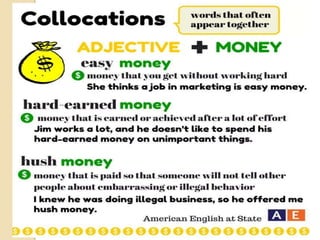
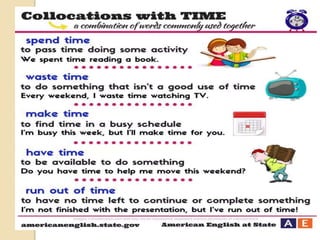
“Collocations”
BLOG: susilestari771.blogspot.co.id
BY : Susi Lestari Situmorang
What is a collocation?
A collocation is two or more words that
often go together. These combinations just
sound "right" to native English speakers, who
use them all the time.
Why learn collocations?
 Your language will be more natural and more
easily understood.
 You will have alternative and richer ways of
expressing yourself.
 It is easier for our brains to remember and use
language in chunks or blocks rather than as
single words.
How to learn collocations?
 . Be aware of collocations, and try to recognize them when
you see or hear them.
 When you learn a new word, write down other words that
collocate with it (remember rightly, remember distinctly,
remember vaguely, remember vividly).
 Read as much as possible. Reading is an excellent way to learn
vocabulary and collocations in context and naturally,
 Revise what you learn regularly. Practise using new
collocations in context as soon as possible after learning them.
 You can find information on collocations in any good learner's
dictionary. And you can also find specialized dictionaries of
collocations
Types of collocation
1. adverb + adjective
 Invading that country was an utterly
stupid thing to do.
 We entered a richly decorated room.
 Are you fully aware of the
implications of your action?
2. adjective + noun
 The doctor ordered him to take regular
exercise.
 The Titanic sank on its maiden voyage.
 He was writhing on the ground in
excruciating pain.
3. noun + noun
 Let's give Mr Jones a round of applause.
 The ceasefire agreement came into effect
at 11am.
 I'd like to buy two bars of soap please.
4. noun + verb
 The lion started to roar when it heard the
dog barking.
 Snow was falling as our plane took off.
 The bomb went off when he started the
car engine.
5. verb + noun
 The prisoner was hanged for committing
murder.
 I always try to do my homework in the
morning, after making my bed.
 He has been asked to give a presentation
about his work.
6. verb + preposition
 We had to return home because we had
run out of money.
 At first her eyes filled with horror, and
then she burst into tears.
 Their behaviour was enough to drive
anybody to crime.
7. verb + adverb
 She placed her keys gently on the table and
sat down.
 Mary whispered softly in John's ear.
 I vaguely remember that it was growing dark
when we left.

Verb collocations
THANKS FOR YOUR ATTENTIONS...!!! 

Semantics, ku

  • 1.
  • 2.
    What is acollocation? A collocation is two or more words that often go together. These combinations just sound "right" to native English speakers, who use them all the time.
  • 3.
    Why learn collocations? Your language will be more natural and more easily understood.  You will have alternative and richer ways of expressing yourself.  It is easier for our brains to remember and use language in chunks or blocks rather than as single words.
  • 4.
    How to learncollocations?  . Be aware of collocations, and try to recognize them when you see or hear them.  When you learn a new word, write down other words that collocate with it (remember rightly, remember distinctly, remember vaguely, remember vividly).  Read as much as possible. Reading is an excellent way to learn vocabulary and collocations in context and naturally,  Revise what you learn regularly. Practise using new collocations in context as soon as possible after learning them.  You can find information on collocations in any good learner's dictionary. And you can also find specialized dictionaries of collocations
  • 5.
    Types of collocation 1.adverb + adjective  Invading that country was an utterly stupid thing to do.  We entered a richly decorated room.  Are you fully aware of the implications of your action?
  • 6.
    2. adjective +noun  The doctor ordered him to take regular exercise.  The Titanic sank on its maiden voyage.  He was writhing on the ground in excruciating pain.
  • 7.
    3. noun +noun  Let's give Mr Jones a round of applause.  The ceasefire agreement came into effect at 11am.  I'd like to buy two bars of soap please.
  • 8.
    4. noun +verb  The lion started to roar when it heard the dog barking.  Snow was falling as our plane took off.  The bomb went off when he started the car engine.
  • 9.
    5. verb +noun  The prisoner was hanged for committing murder.  I always try to do my homework in the morning, after making my bed.  He has been asked to give a presentation about his work.
  • 10.
    6. verb +preposition  We had to return home because we had run out of money.  At first her eyes filled with horror, and then she burst into tears.  Their behaviour was enough to drive anybody to crime.
  • 11.
    7. verb +adverb  She placed her keys gently on the table and sat down.  Mary whispered softly in John's ear.  I vaguely remember that it was growing dark when we left. 
  • 12.
  • 21.
    THANKS FOR YOURATTENTIONS...!!! 