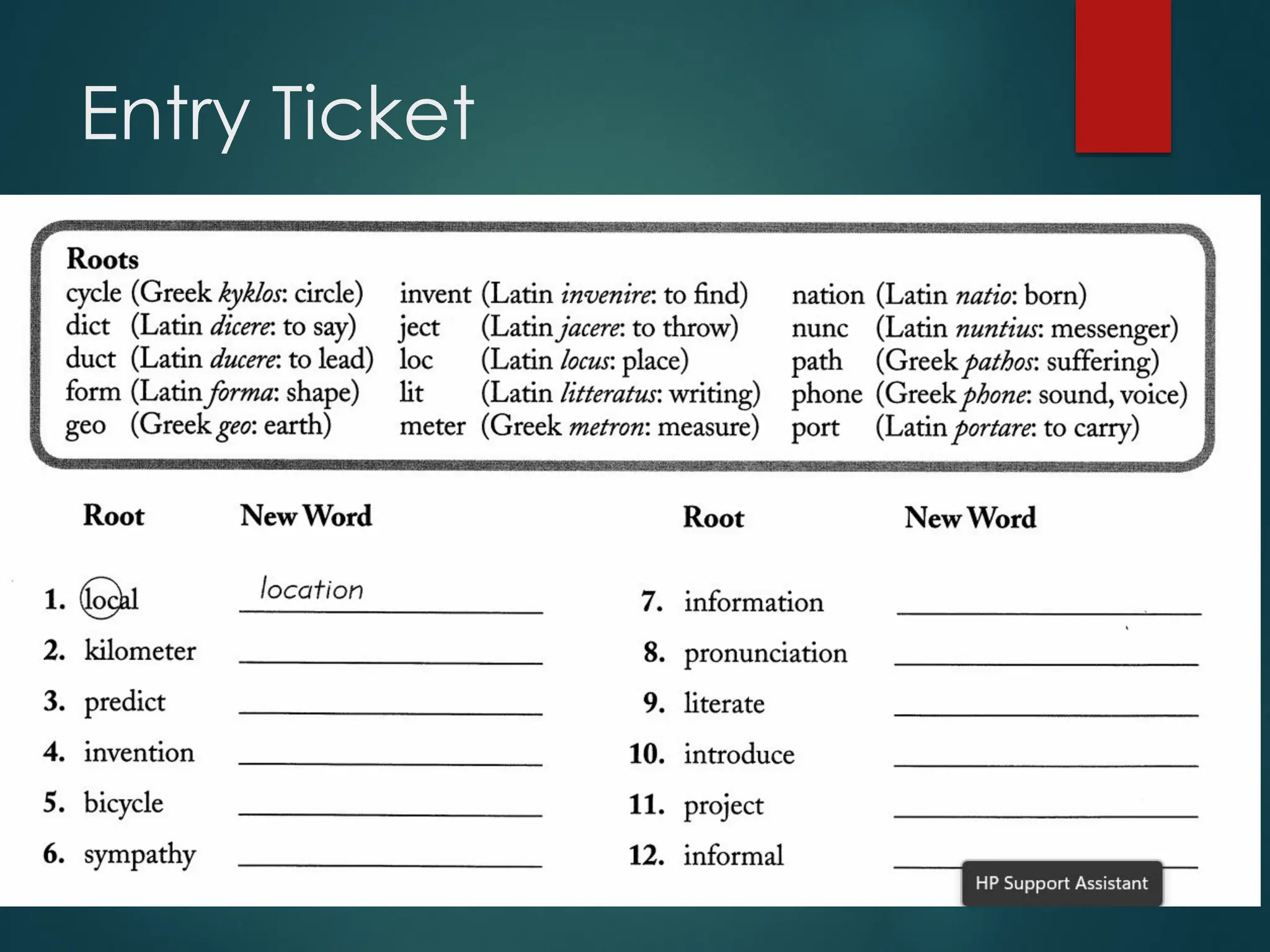
Entry Ticket
Topic
Collocation
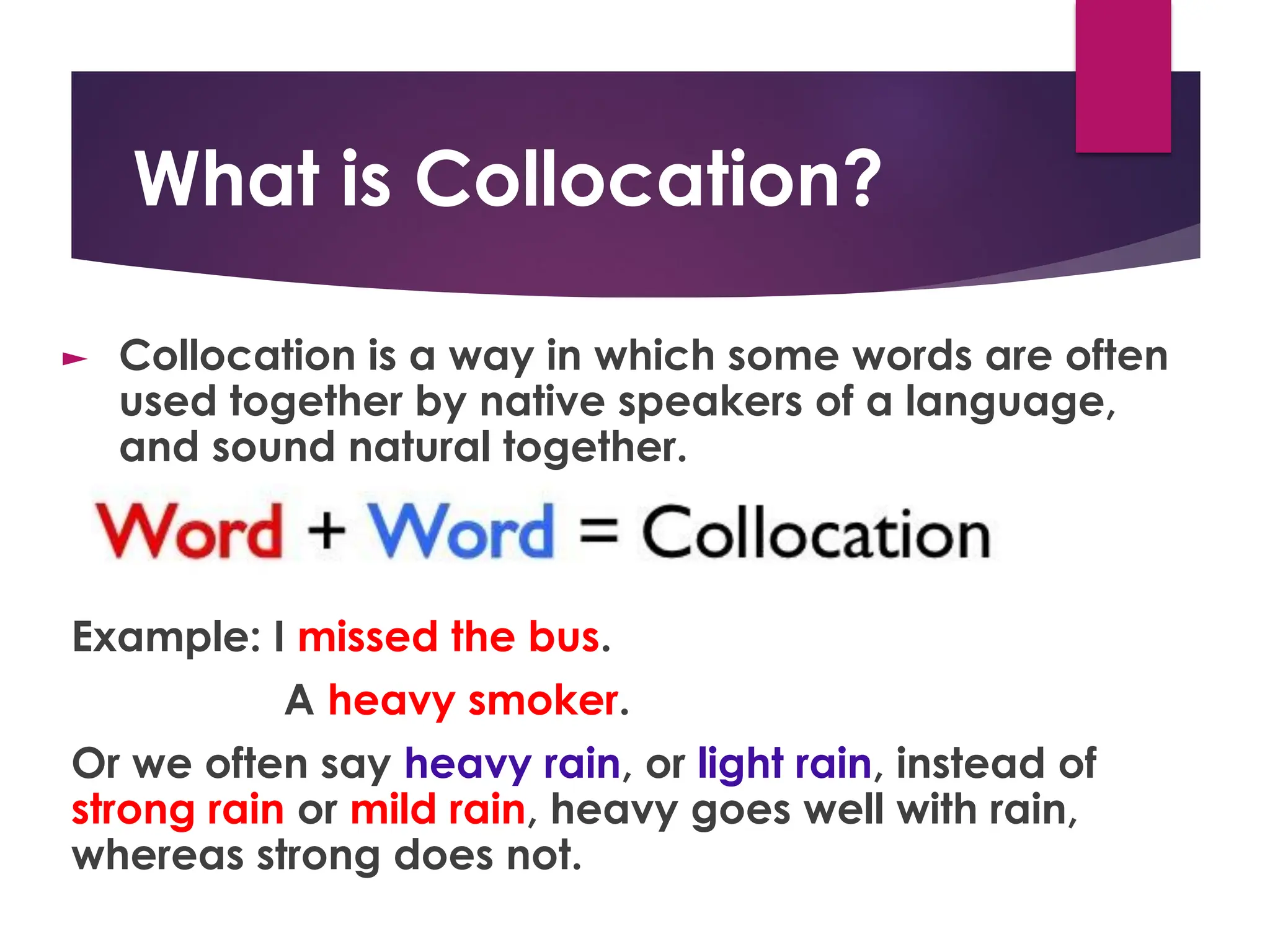
What is Collocation?
► Collocation is a way in which some words are often
used together by native speakers of a language,
and sound natural together.
Example: I missed the bus.
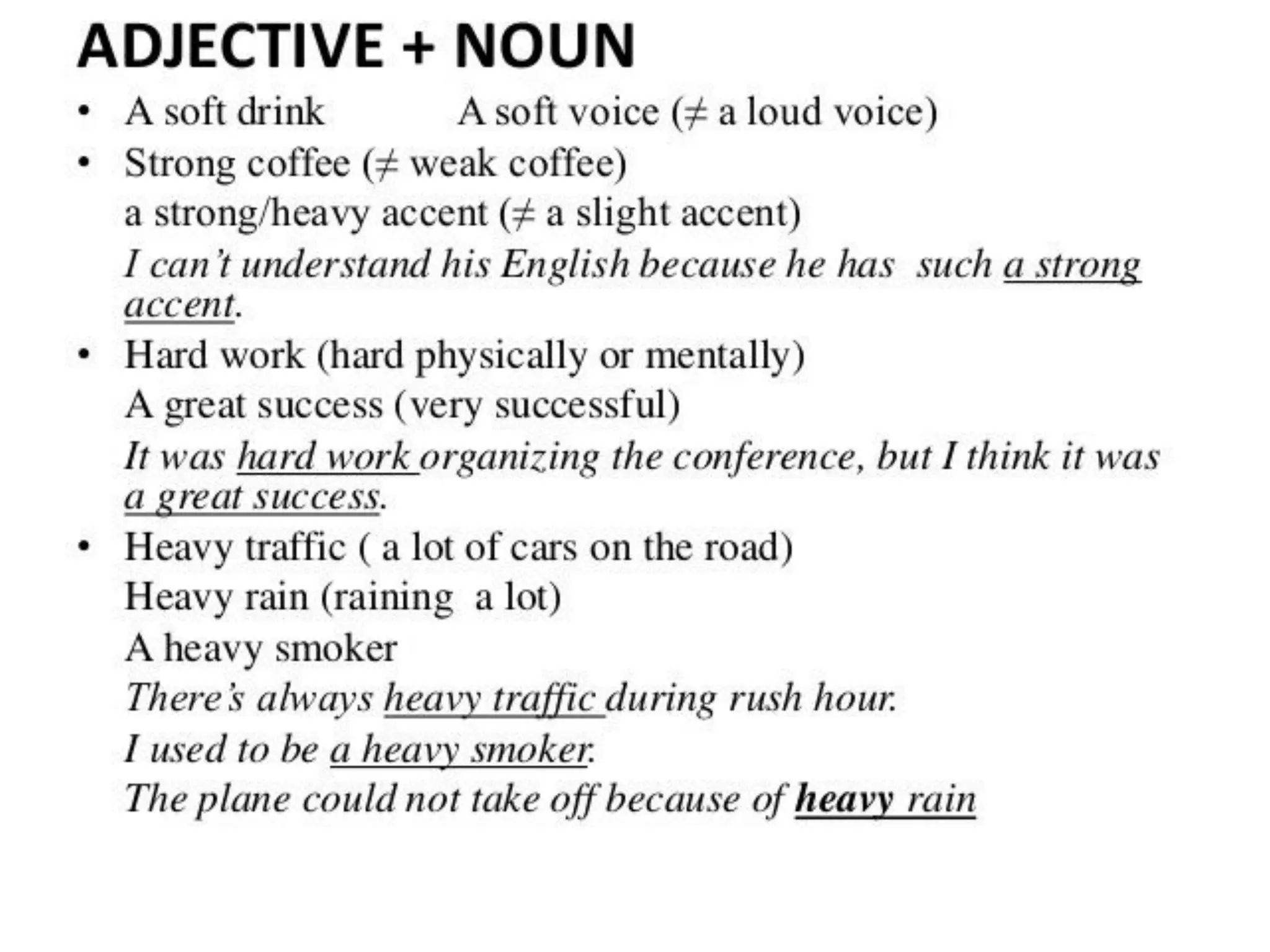
A heavy smoker.
Or we often say heavy rain, or light rain, instead of
strong rain or mild rain, heavy goes well with rain,
whereas strong does not.
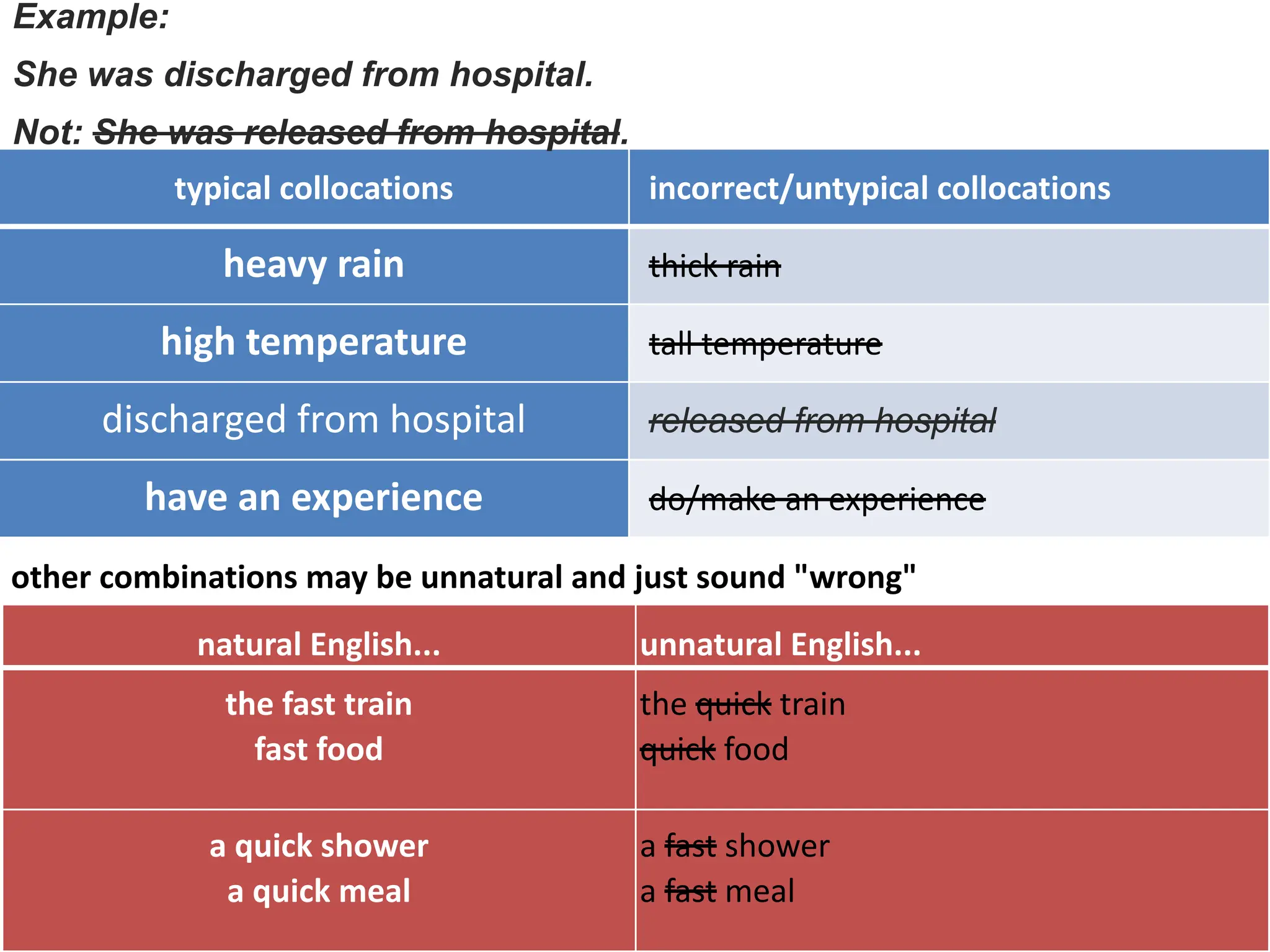
typical collocations incorrect/untypical collocations
heavy rain thick rain
high temperature tall temperature
discharged from hospital released from hospital
have an experience do/make an experience
Example:
She was discharged from hospital.
Not: She was released from hospital.
other combinations may be unnatural and just sound "wrong"
natural English... unnatural English...
the fast train
fast food
the quick train
quick food
a quick shower
a quick meal
a fast shower
a fast meal
Hmmmm
https://www.baamboozle.com/game/1902531
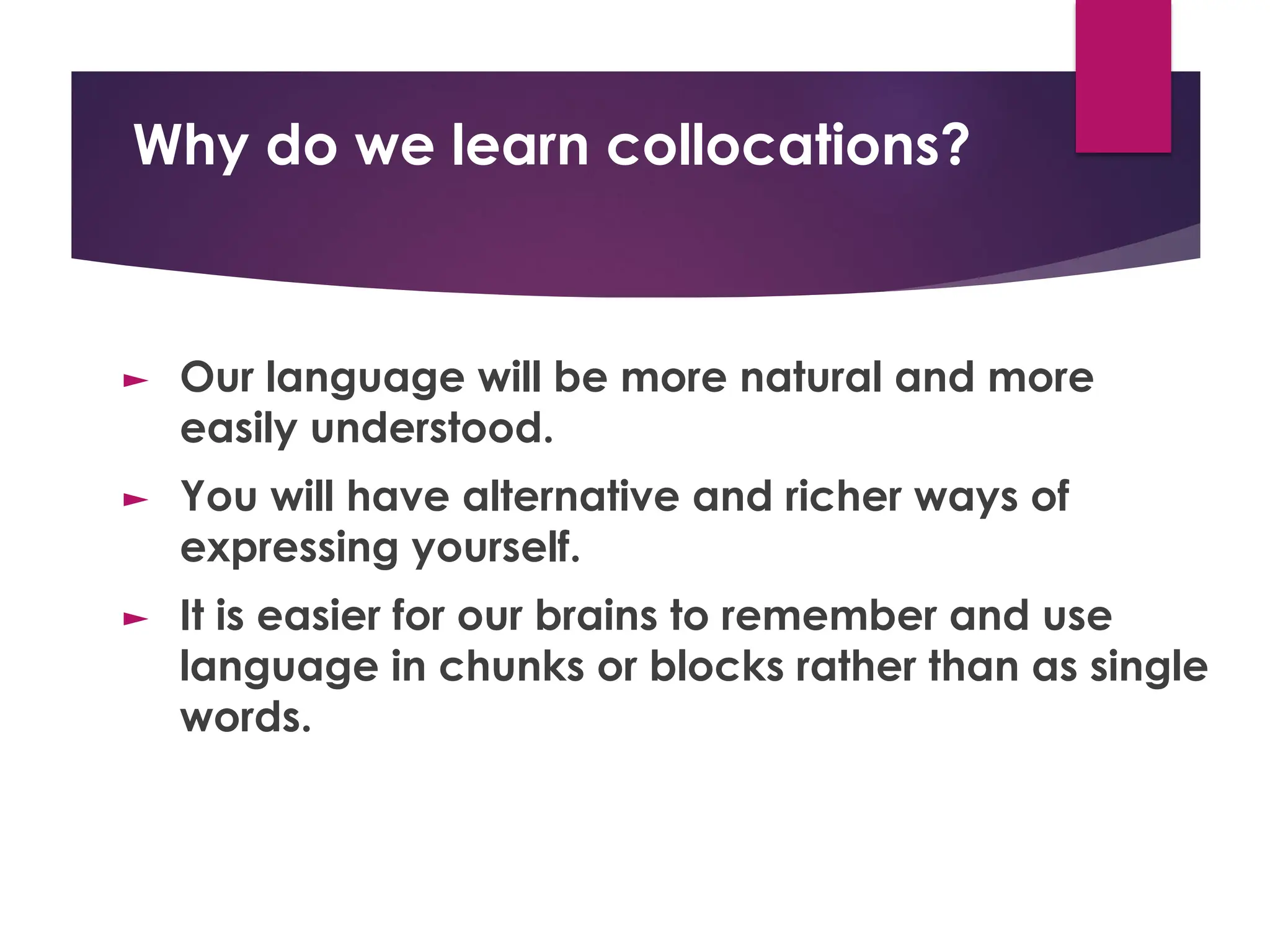
Why do we learn collocations?
► Our language will be more natural and more
easily understood.
► You will have alternative and richer ways of
expressing yourself.
► It is easier for our brains to remember and use
language in chunks or blocks rather than as single
words.
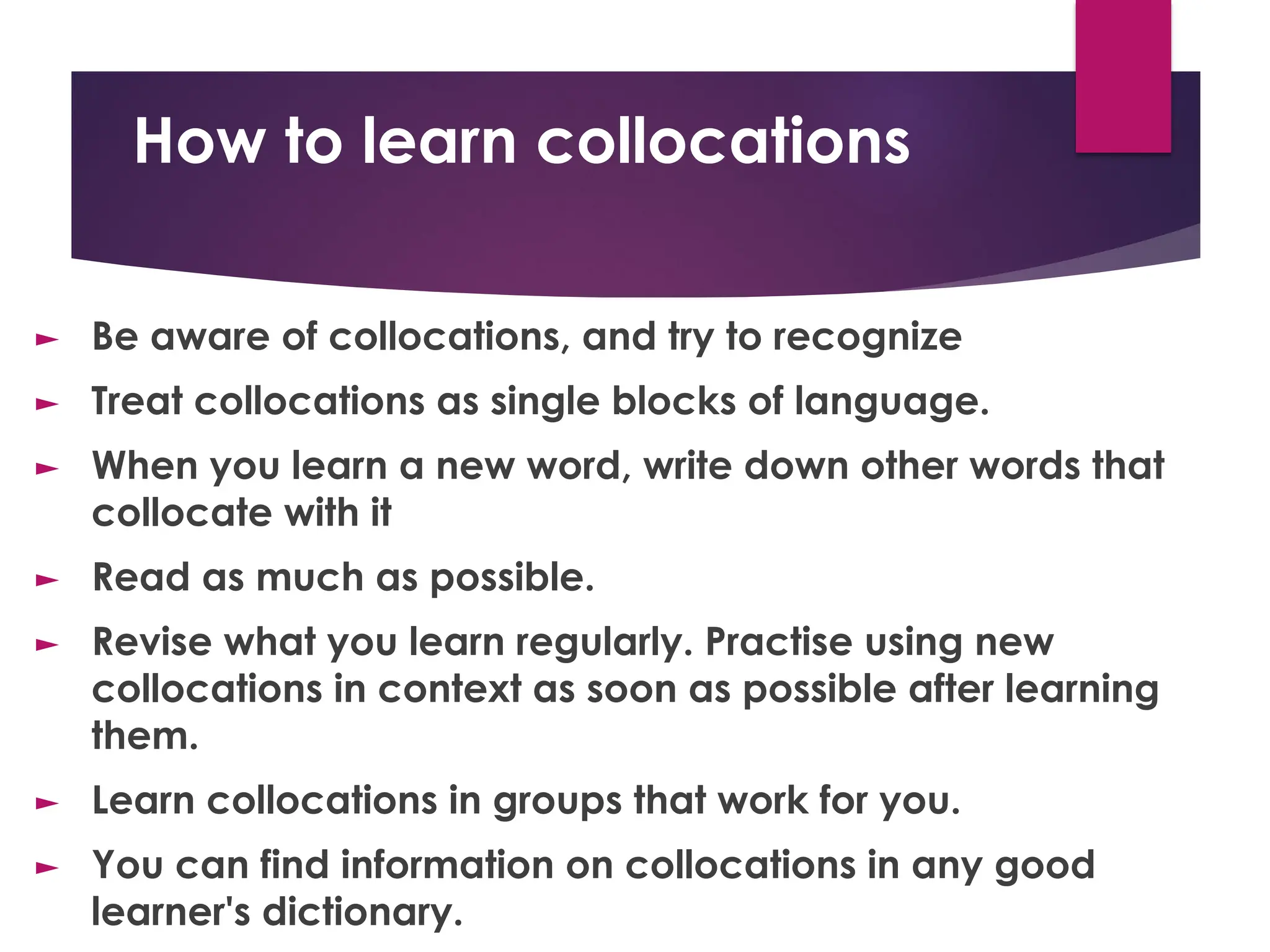
How to learn collocations
► Be aware of collocations, and try to recognize
► Treat collocations as single blocks of language.
► When you learn a new word, write down other words that
collocate with it
► Read as much as possible.
► Revise what you learn regularly. Practise using new
collocations in context as soon as possible after learning
them.
► Learn collocations in groups that work for you.
► You can find information on collocations in any good
learner's dictionary.
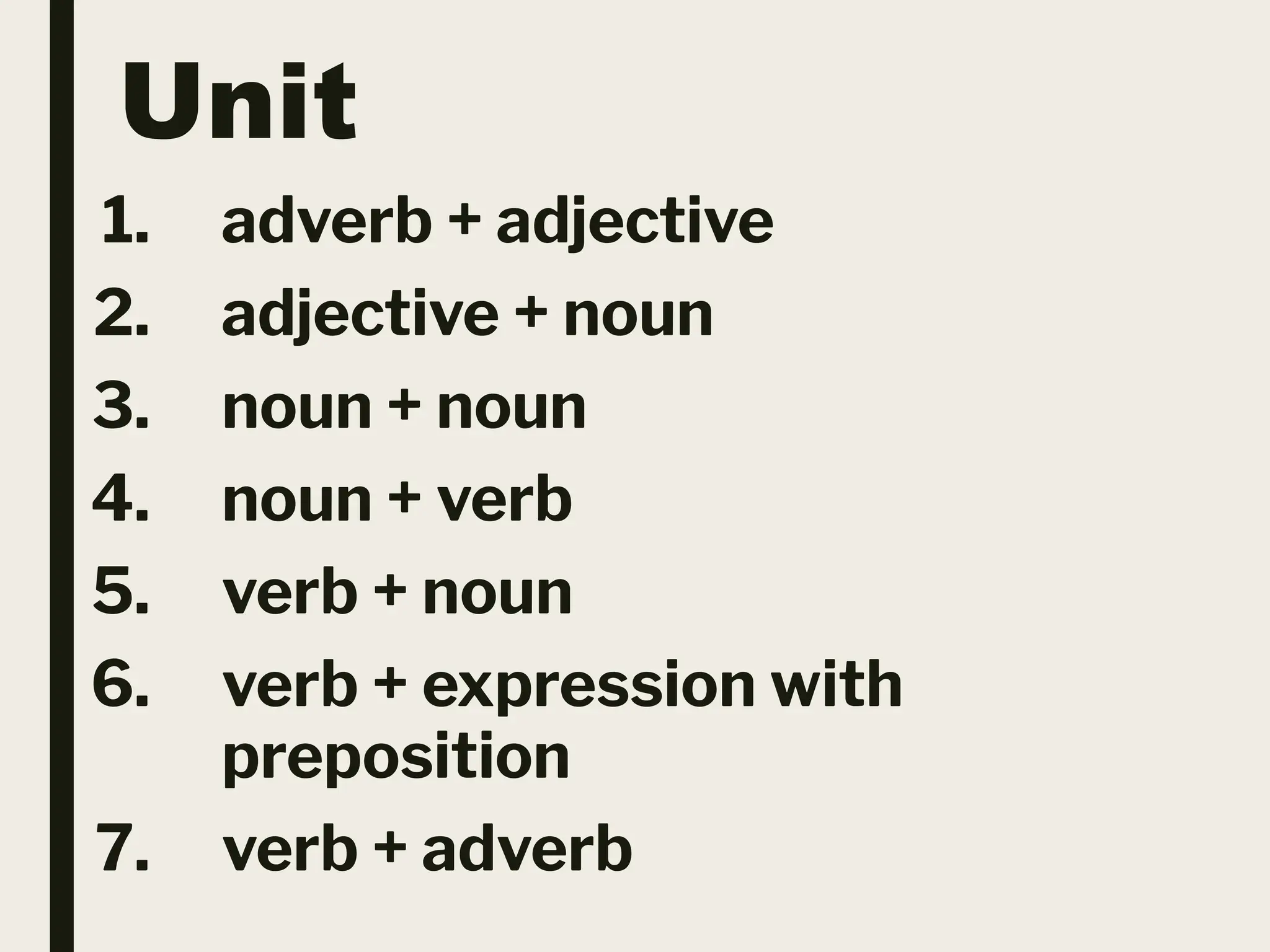
Unit
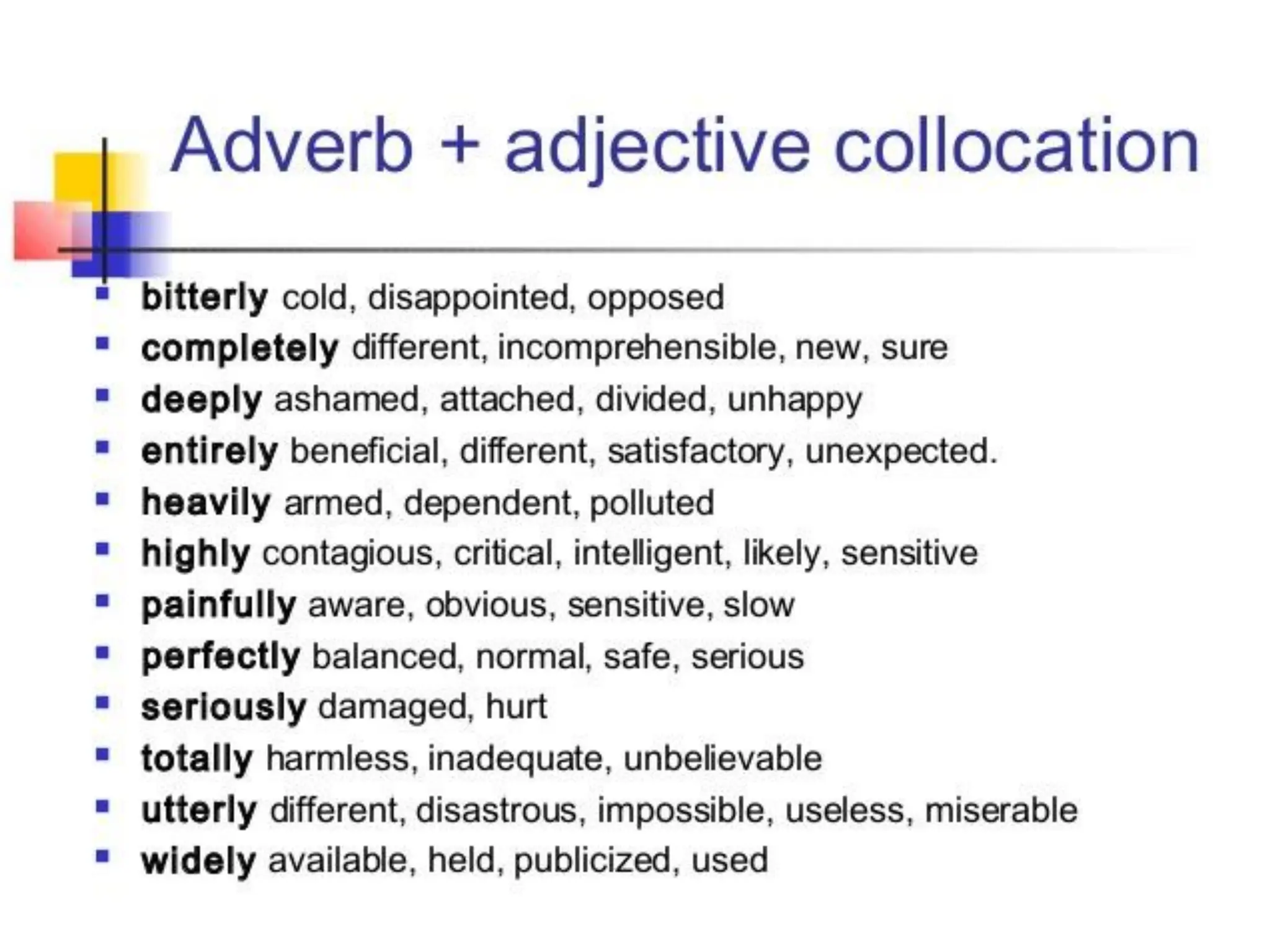
1. adverb + adjective
2. adjective + noun
3. noun + noun
4. noun + verb
5. verb + noun
6. verb + expression with
preposition
7. verb + adverb
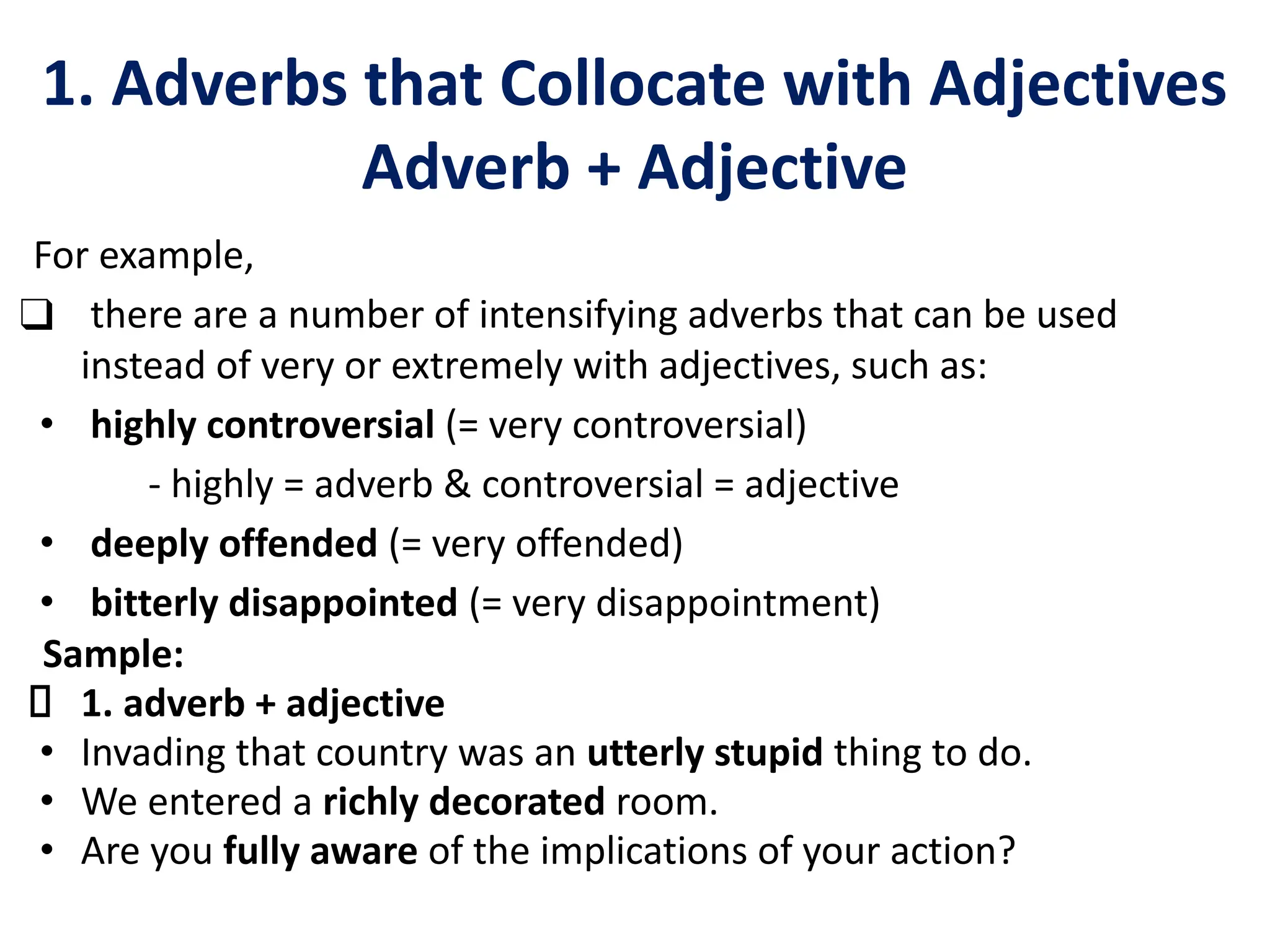
1. Adverbs that Collocate with Adjectives
Adverb + Adjective
For example,
❑ there are a number of intensifying adverbs that can be used
instead of very or extremely with adjectives, such as:
• highly controversial (= very controversial)
- highly = adverb & controversial = adjective
• deeply offended (= very offended)
• bitterly disappointed (= very disappointment)
Sample:
1. adverb + adjective
• Invading that country was an utterly stupid thing to do.
• We entered a richly decorated room.
• Are you fully aware of the implications of your action?
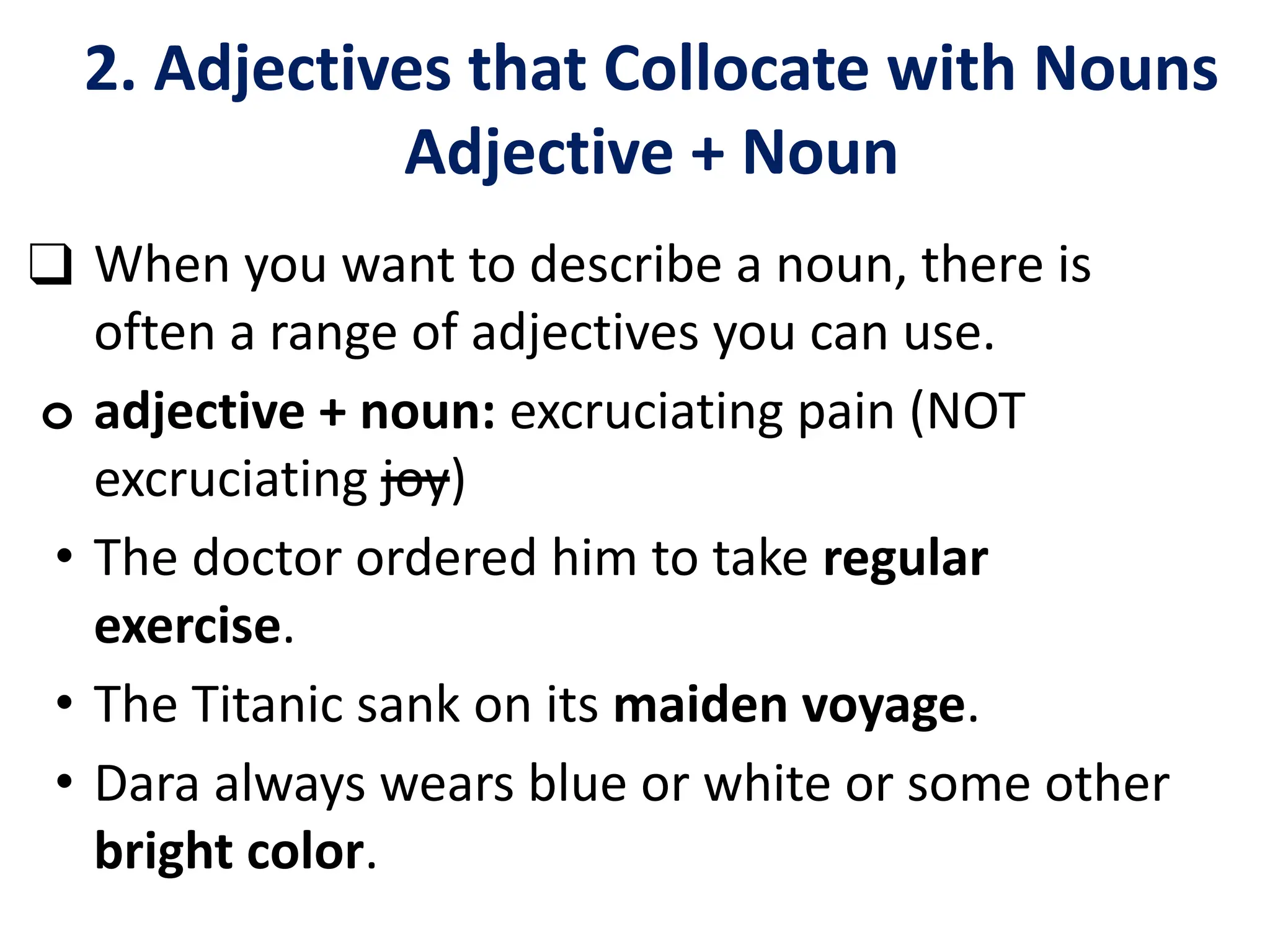
2. Adjectives that Collocate with Nouns
Adjective + Noun
❑ When you want to describe a noun, there is
often a range of adjectives you can use.
o adjective + noun: excruciating pain (NOT
excruciating joy)
• The doctor ordered him to take regular
exercise.
• The Titanic sank on its maiden voyage.
• Dara always wears blue or white or some other
bright color.
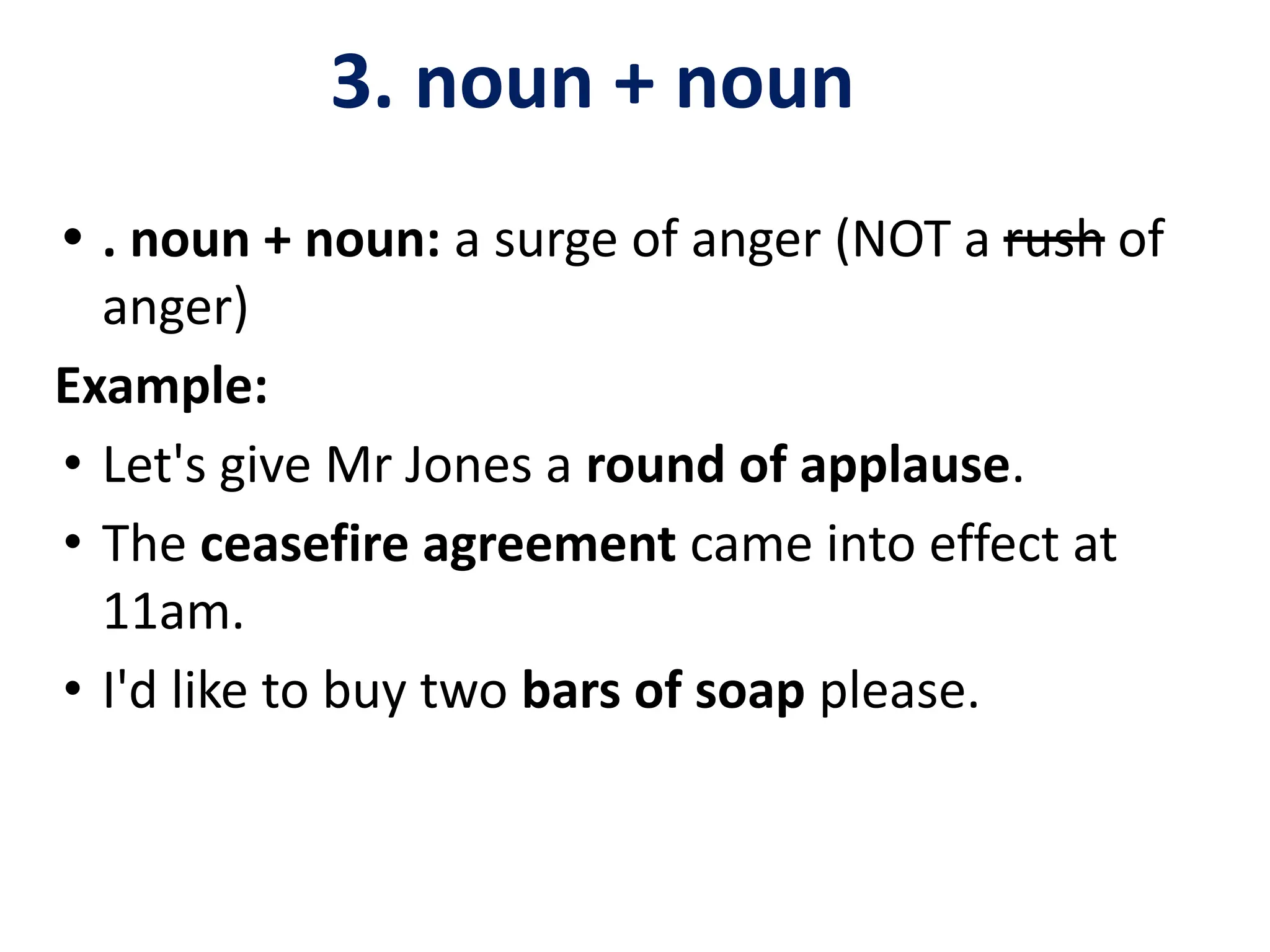
3. noun + noun
• . noun + noun: a surge of anger (NOT a rush of
anger)
Example:
• Let's give Mr Jones a round of applause.
• The ceasefire agreement came into effect at
11am.
• I'd like to buy two bars of soap please.
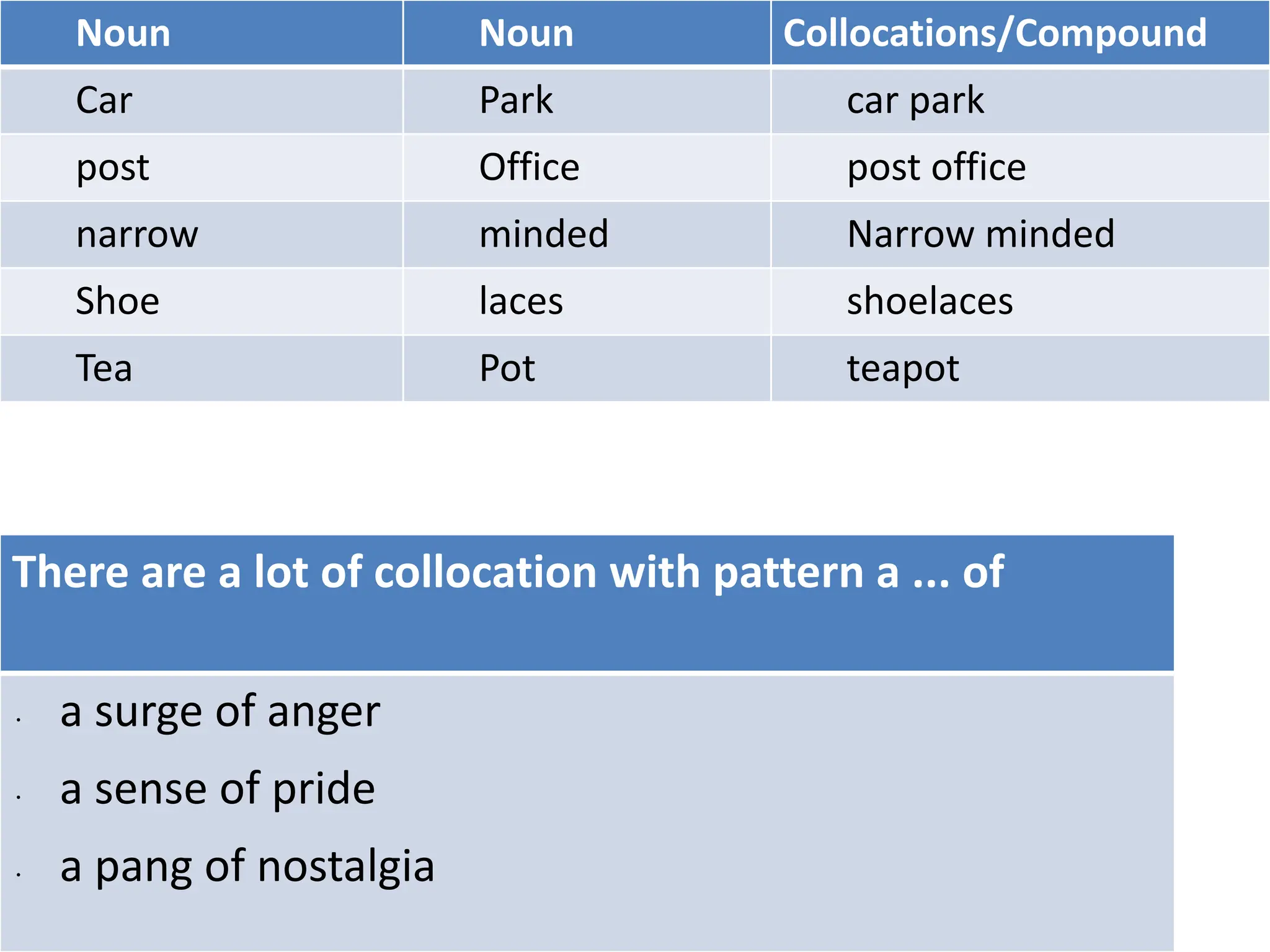
Noun Noun Collocations/Compound
Car Park car park
post Office post office
narrow minded Narrow minded
Shoe laces shoelaces
Tea Pot teapot
There are a lot of collocation with pattern a ... of
∙ a surge of anger
∙ a sense of pride
∙ a pang of nostalgia
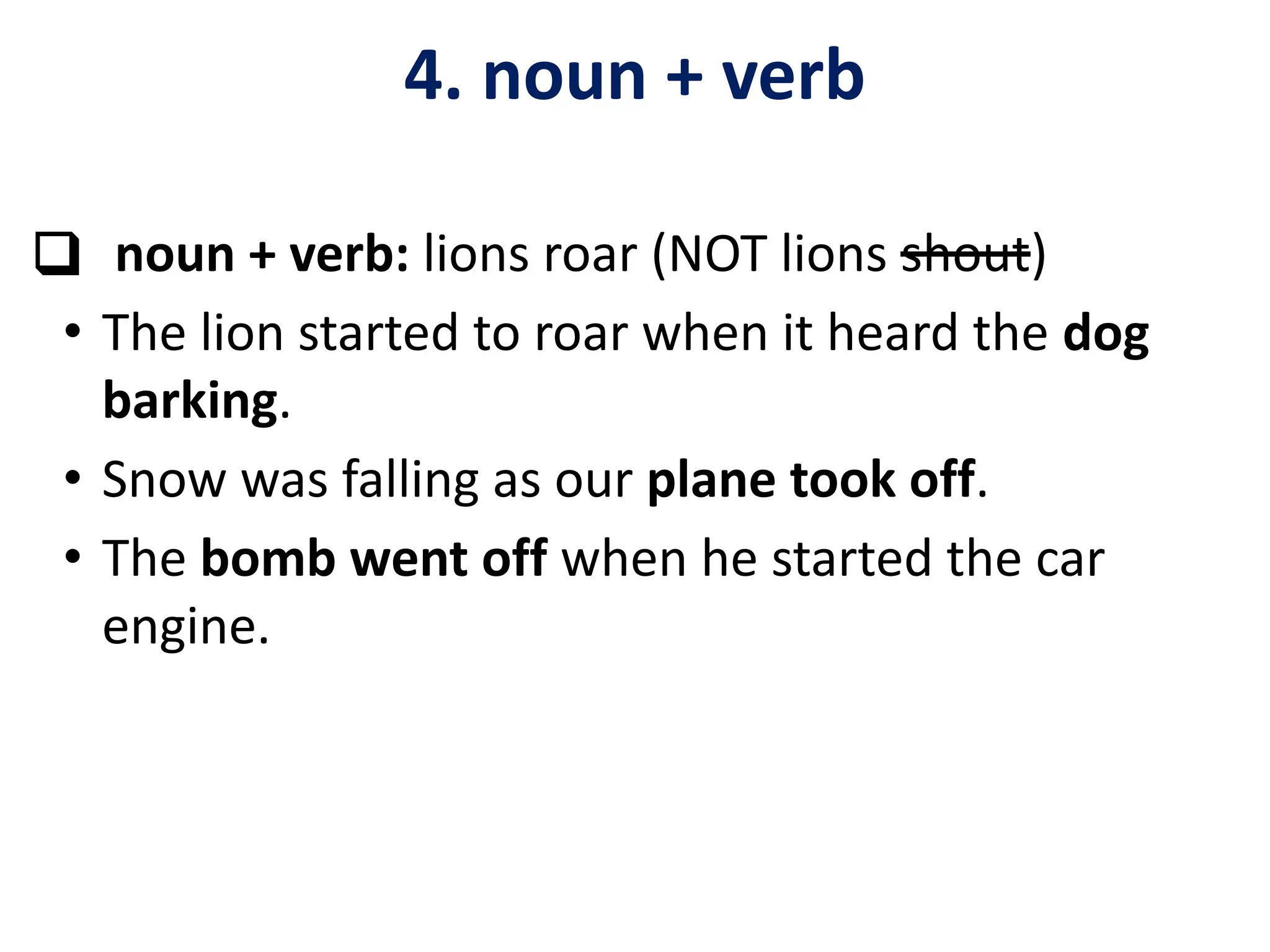
❑ noun + verb: lions roar (NOT lions shout)
• The lion started to roar when it heard the dog
barking.
• Snow was falling as our plane took off.
• The bomb went off when he started the car
engine.
4. noun + verb
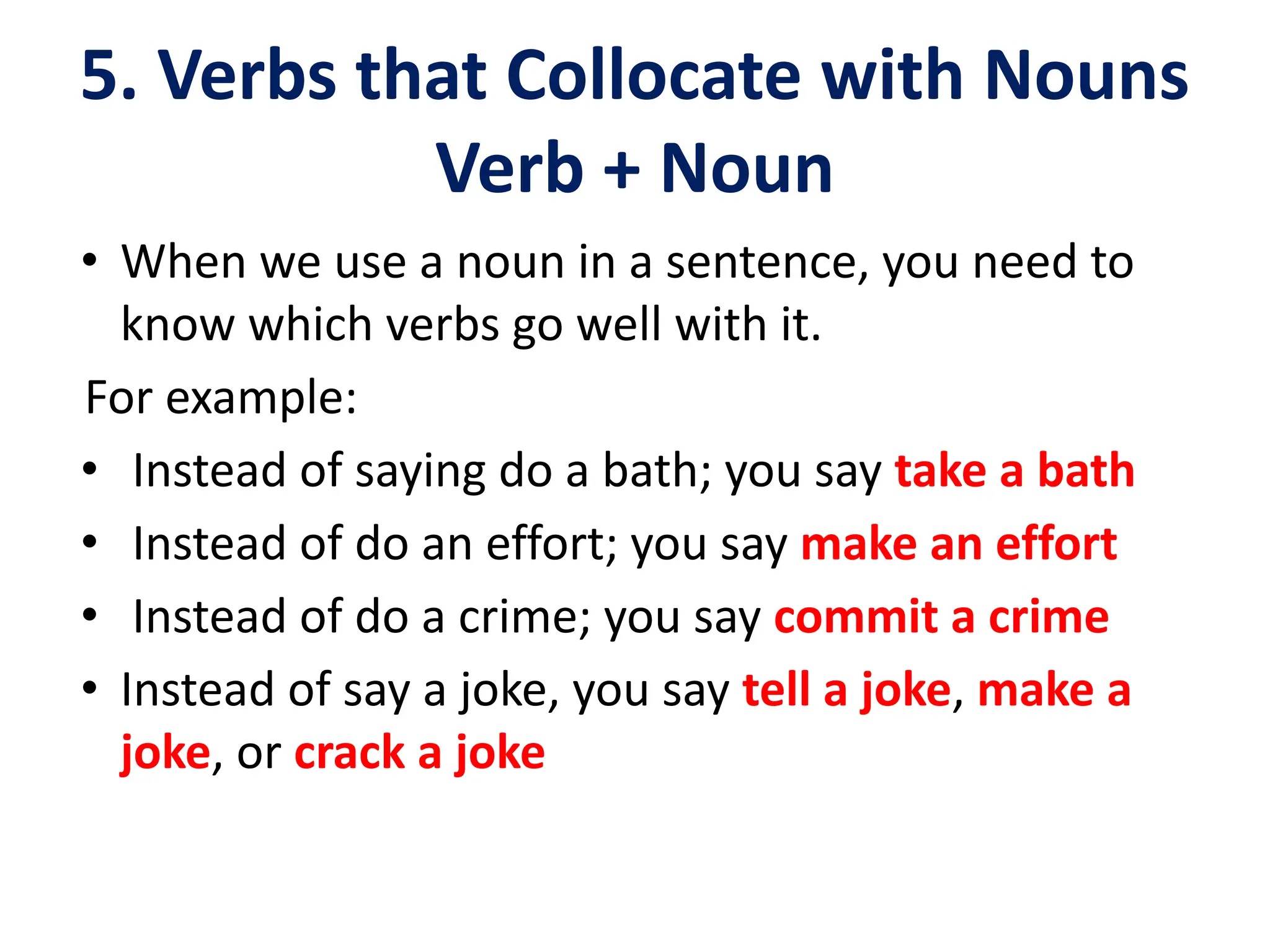
5. Verbs that Collocate with Nouns
Verb + Noun
• When we use a noun in a sentence, you need to
know which verbs go well with it.
For example:
• Instead of saying do a bath; you say take a bath
• Instead of do an effort; you say make an effort
• Instead of do a crime; you say commit a crime
• Instead of say a joke, you say tell a joke, make a
joke, or crack a joke
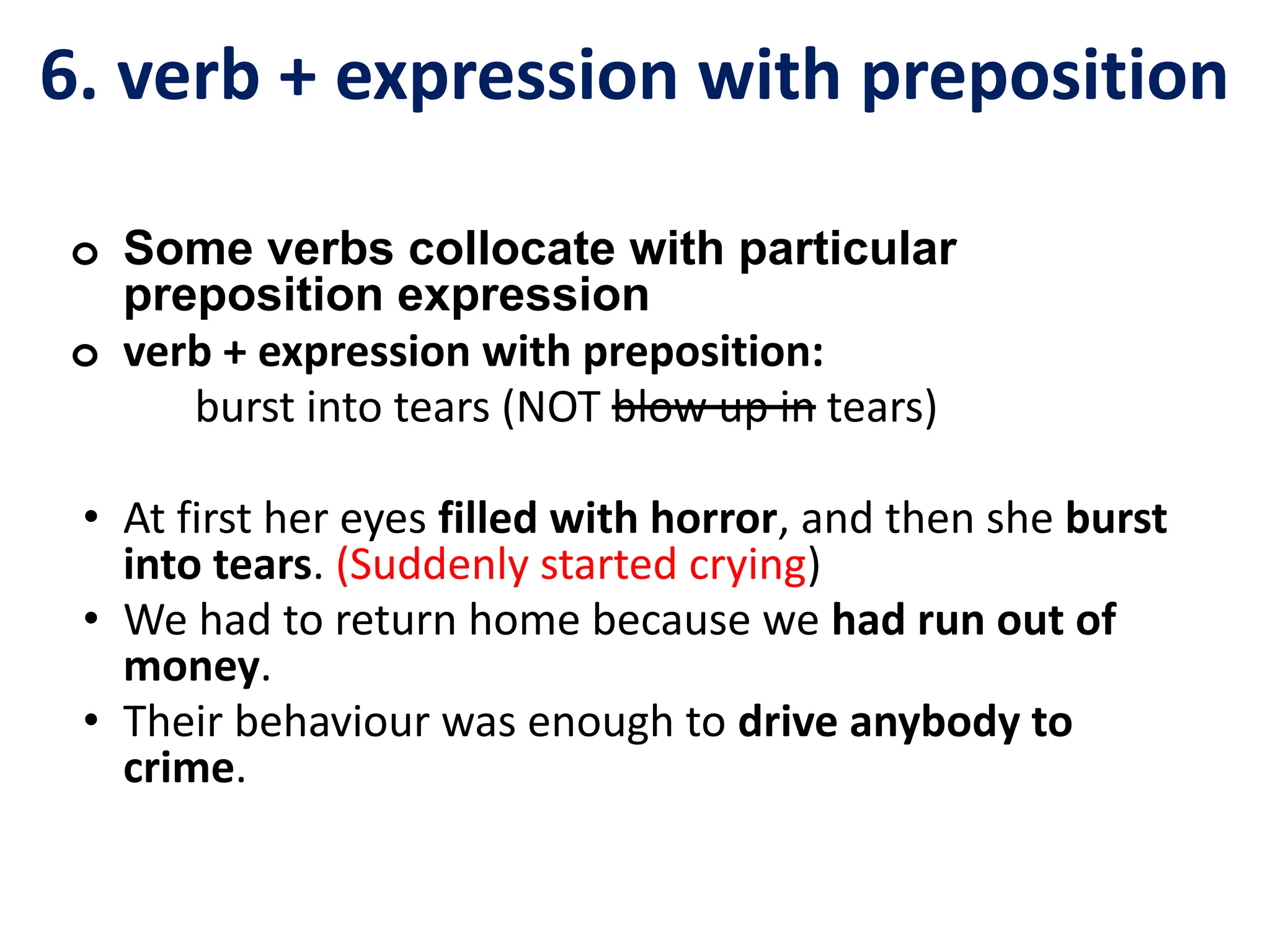
6. verb + expression with preposition
o Some verbs collocate with particular
preposition expression
o verb + expression with preposition:
burst into tears (NOT blow up in tears)
• At first her eyes filled with horror, and then she burst
into tears. (Suddenly started crying)
• We had to return home because we had run out of
money.
• Their behaviour was enough to drive anybody to
crime.
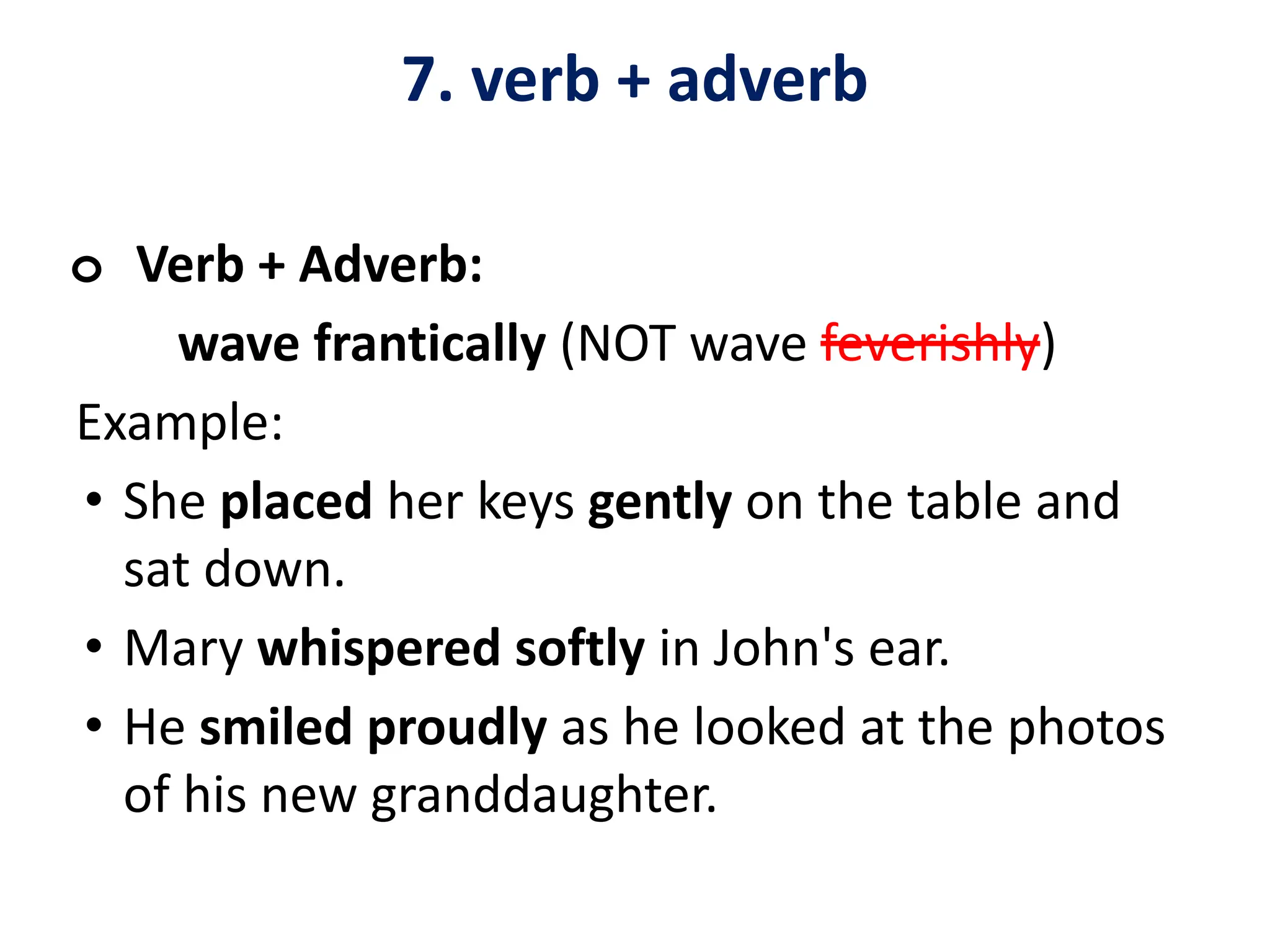
7. verb + adverb
o Verb + Adverb:
wave frantically (NOT wave feverishly)
Example:
• She placed her keys gently on the table and
sat down.
• Mary whispered softly in John's ear.
• He smiled proudly as he looked at the photos
of his new granddaughter.
Thank you!!
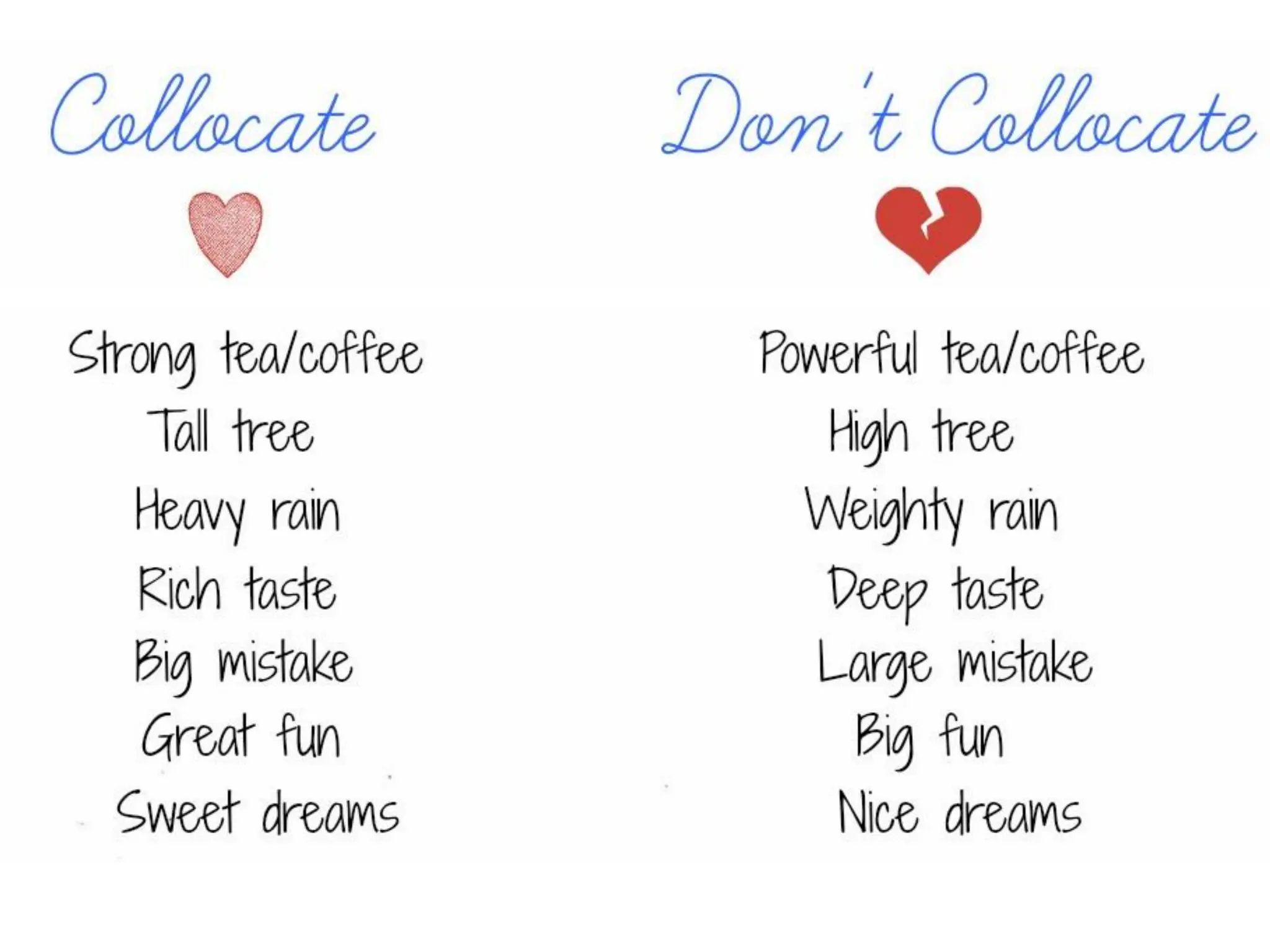
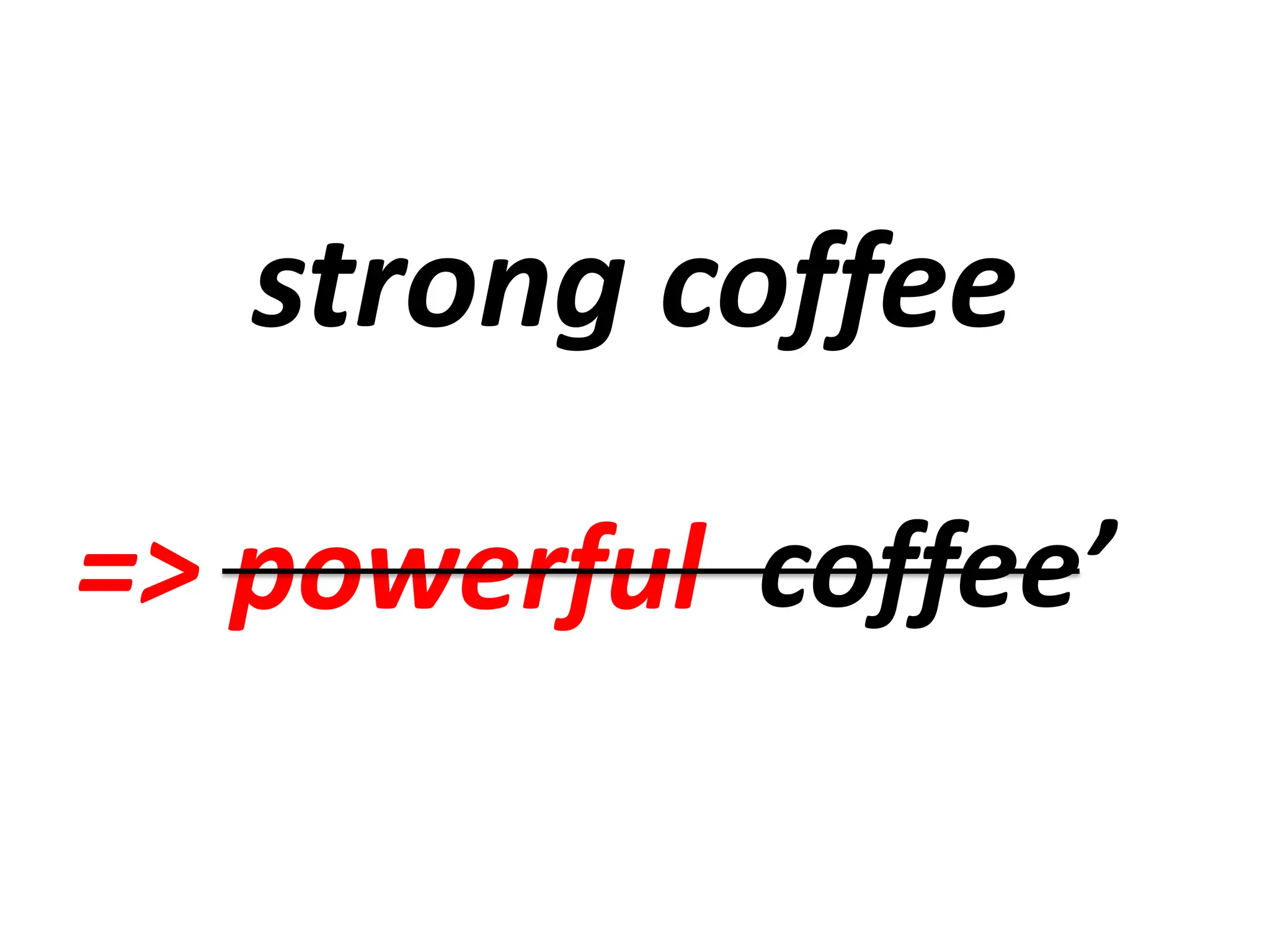
strong coffee
=> powerful coffee’
Let’s Try
https://create.kahoot.it/creator/e64028a1-fd36
-4dee-b07a-d86fee99123e
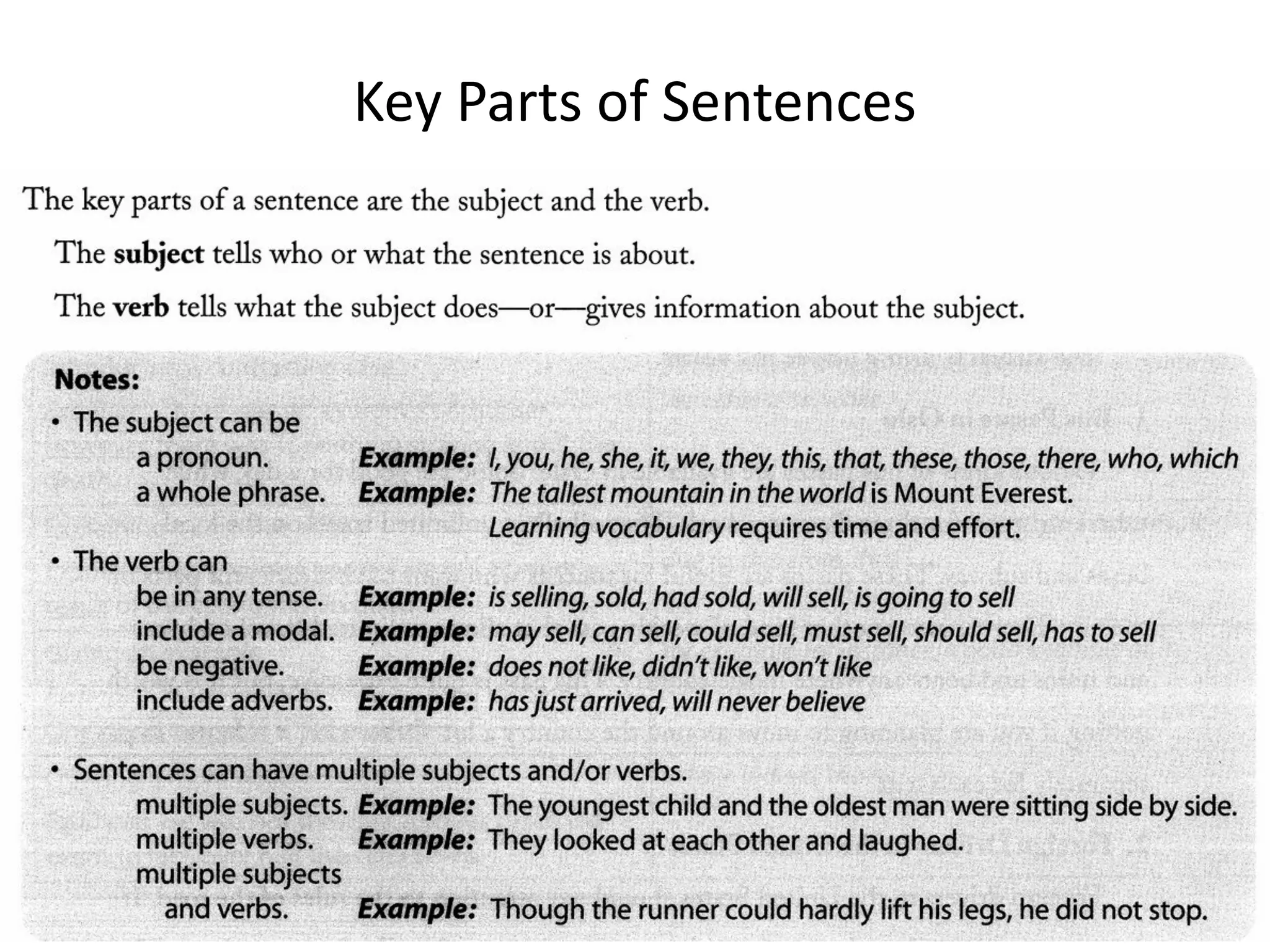
Key Parts of Sentences
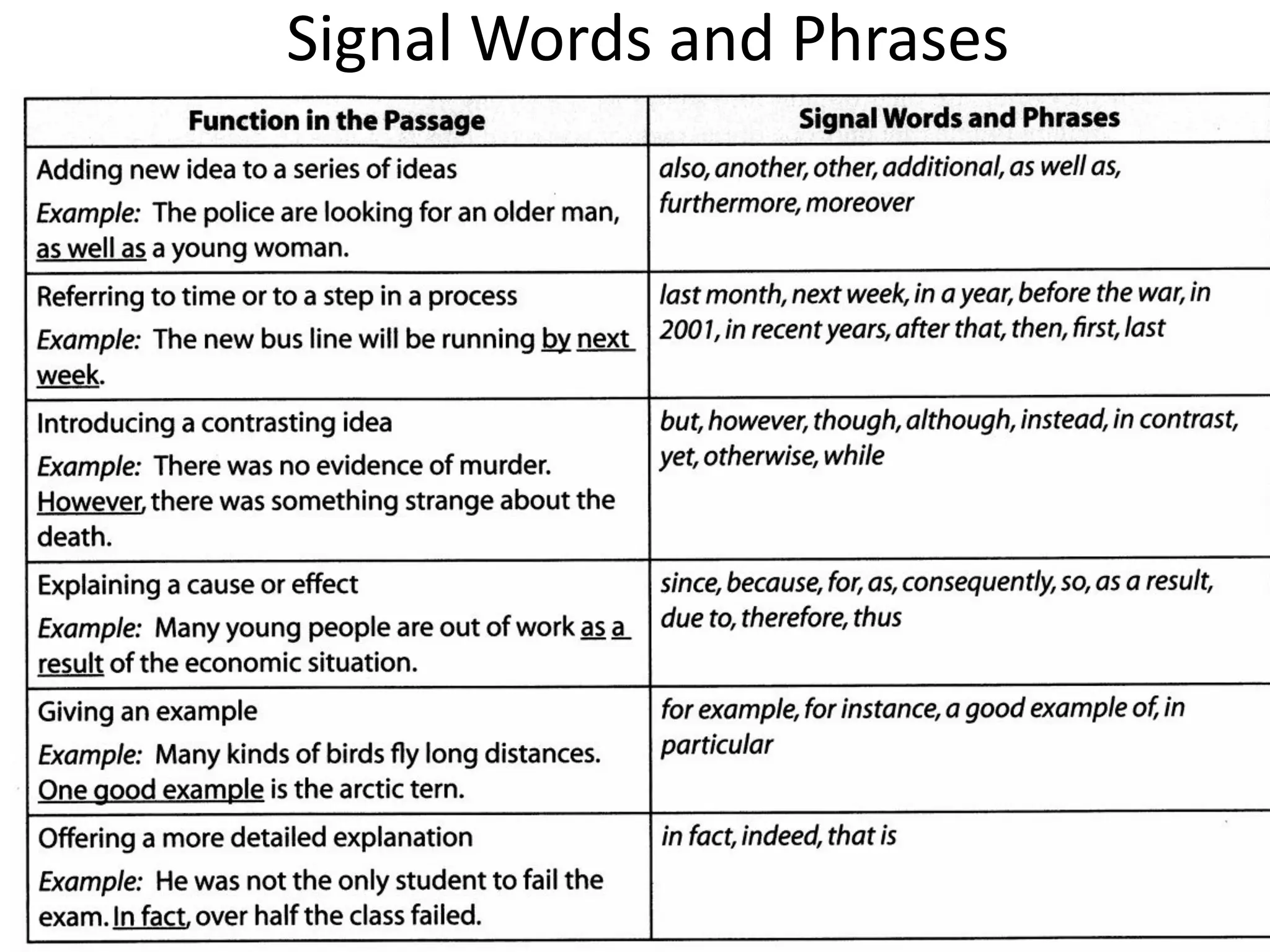
Signal Words and Phrases
Sentence Structure
https://www.baamboozle.com/game/761328
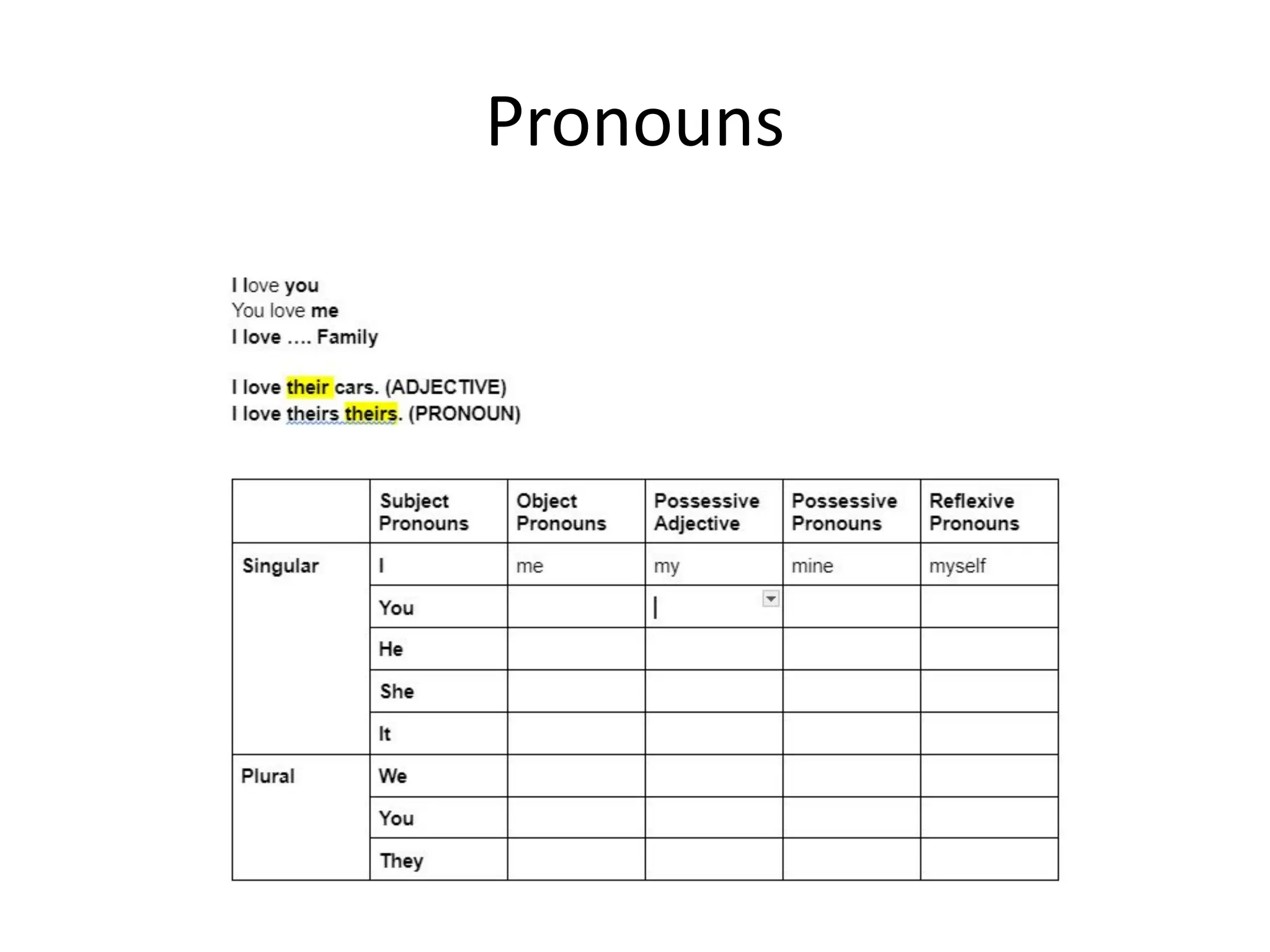
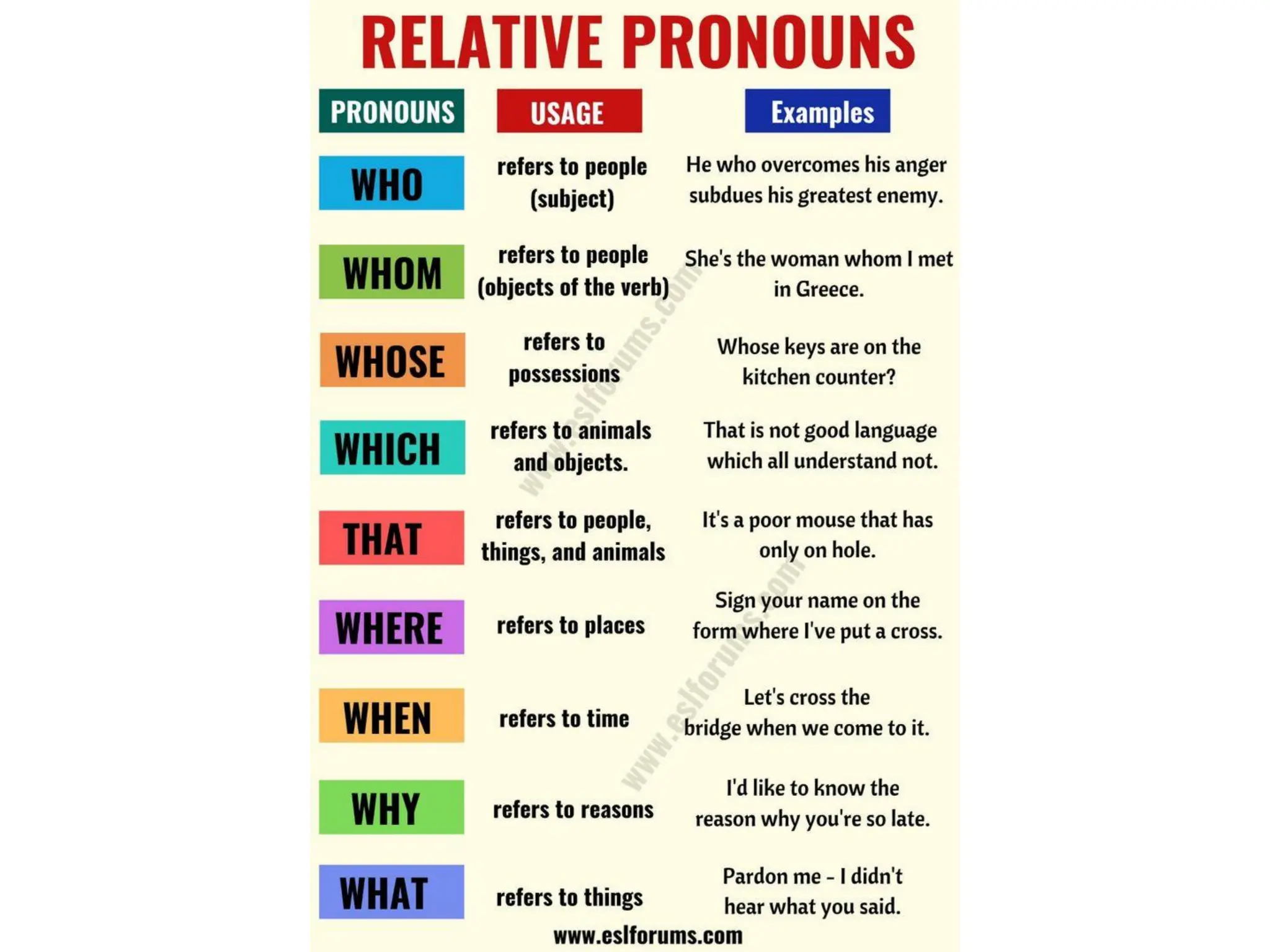
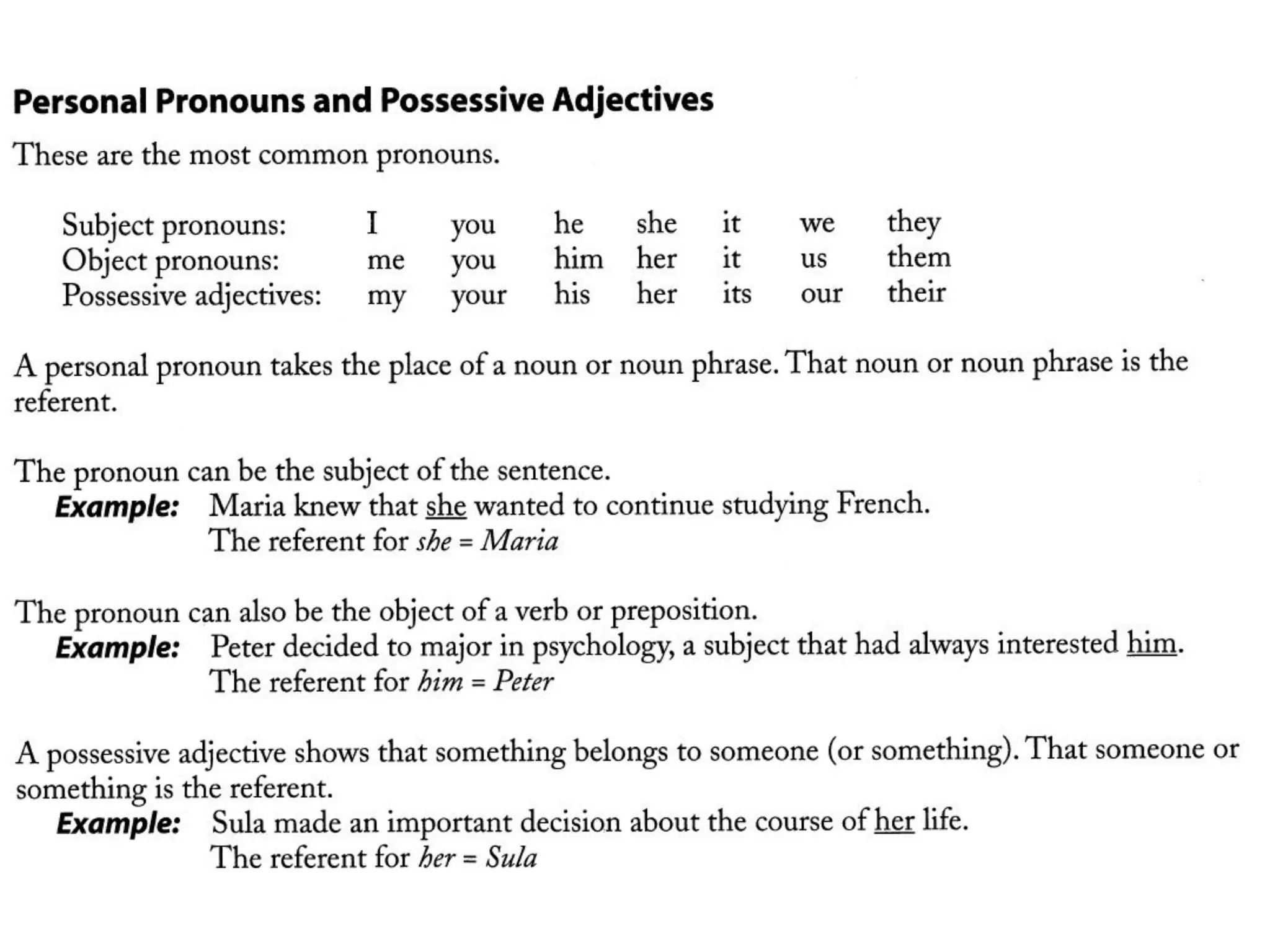
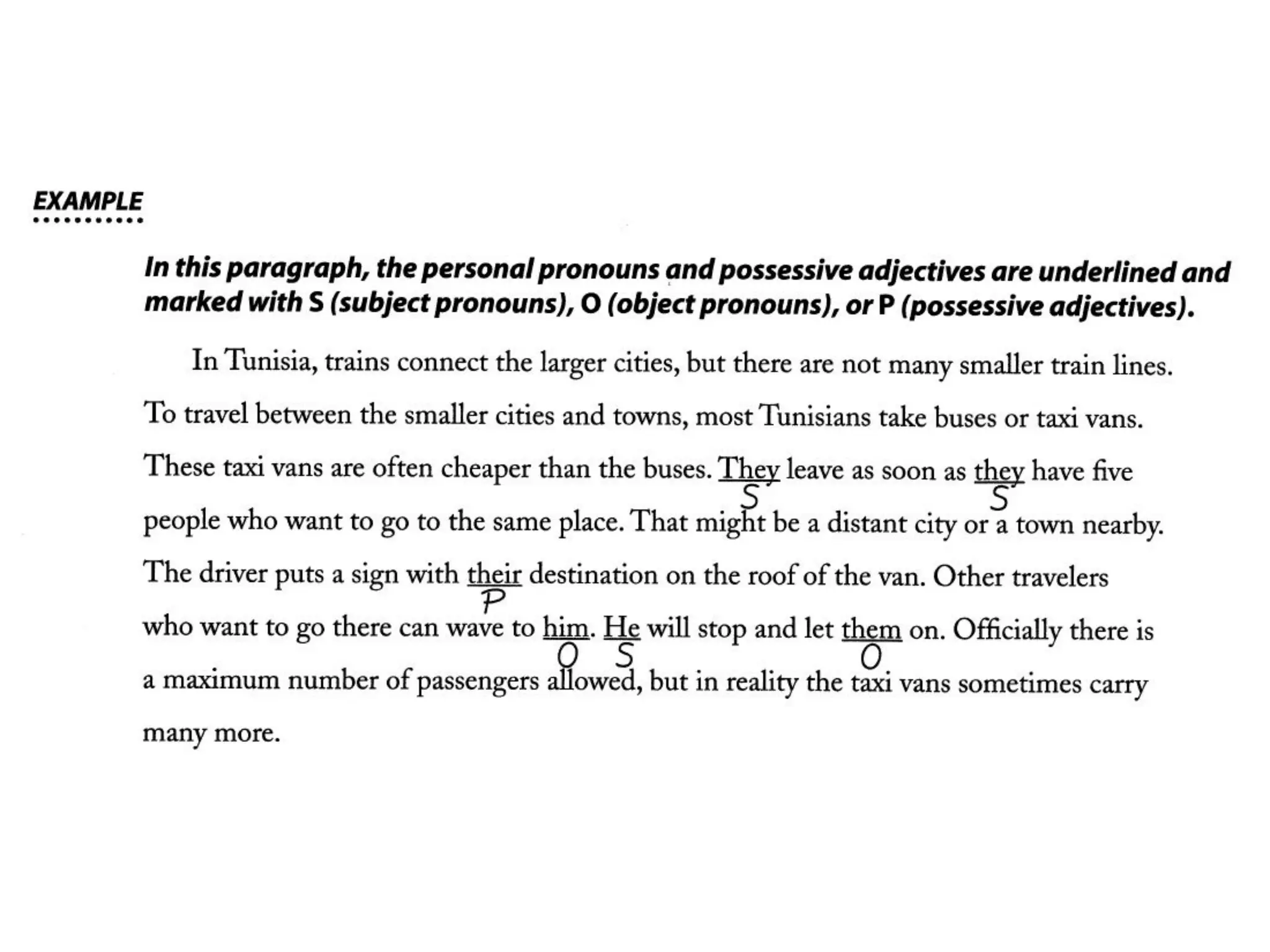
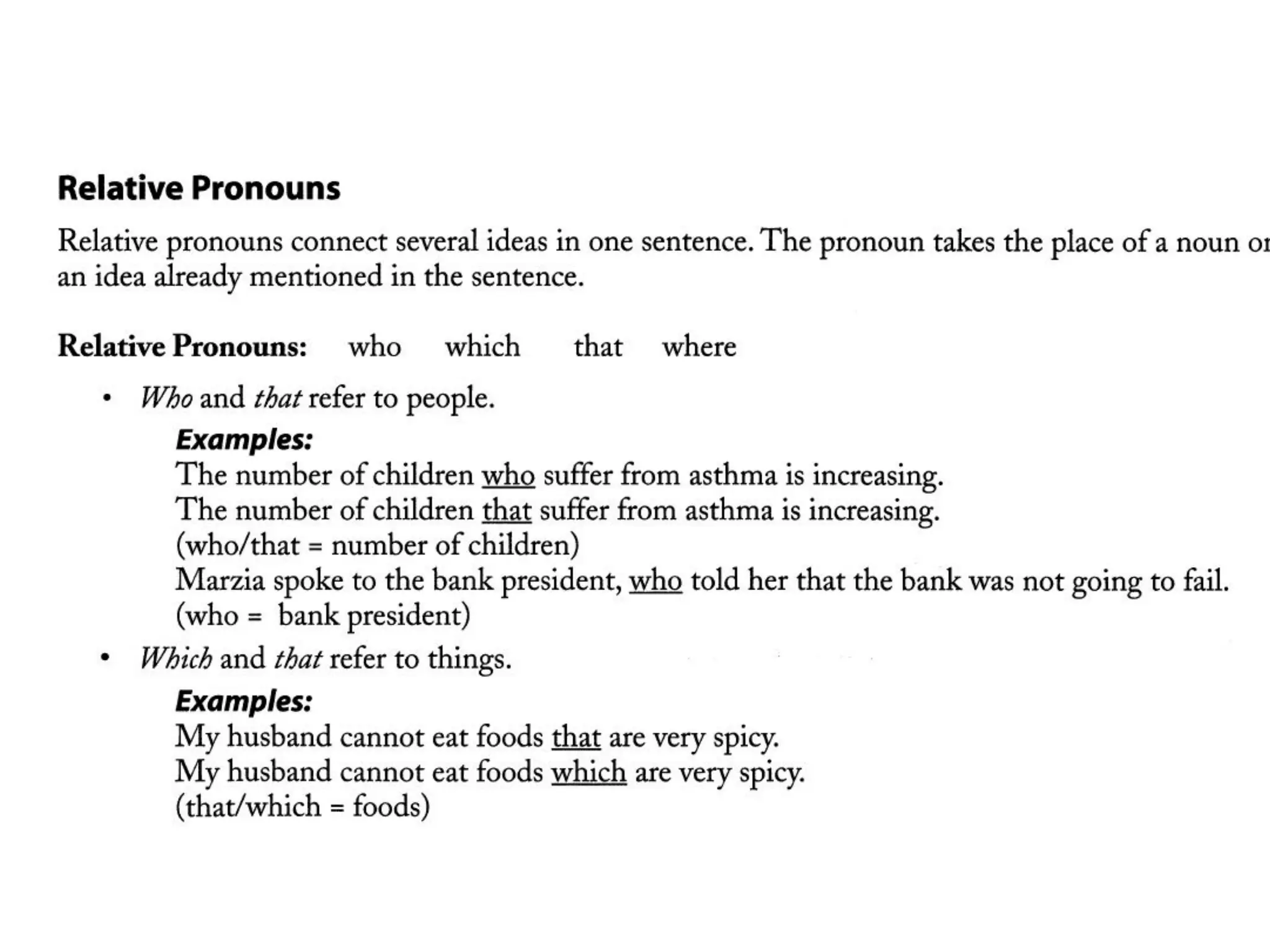
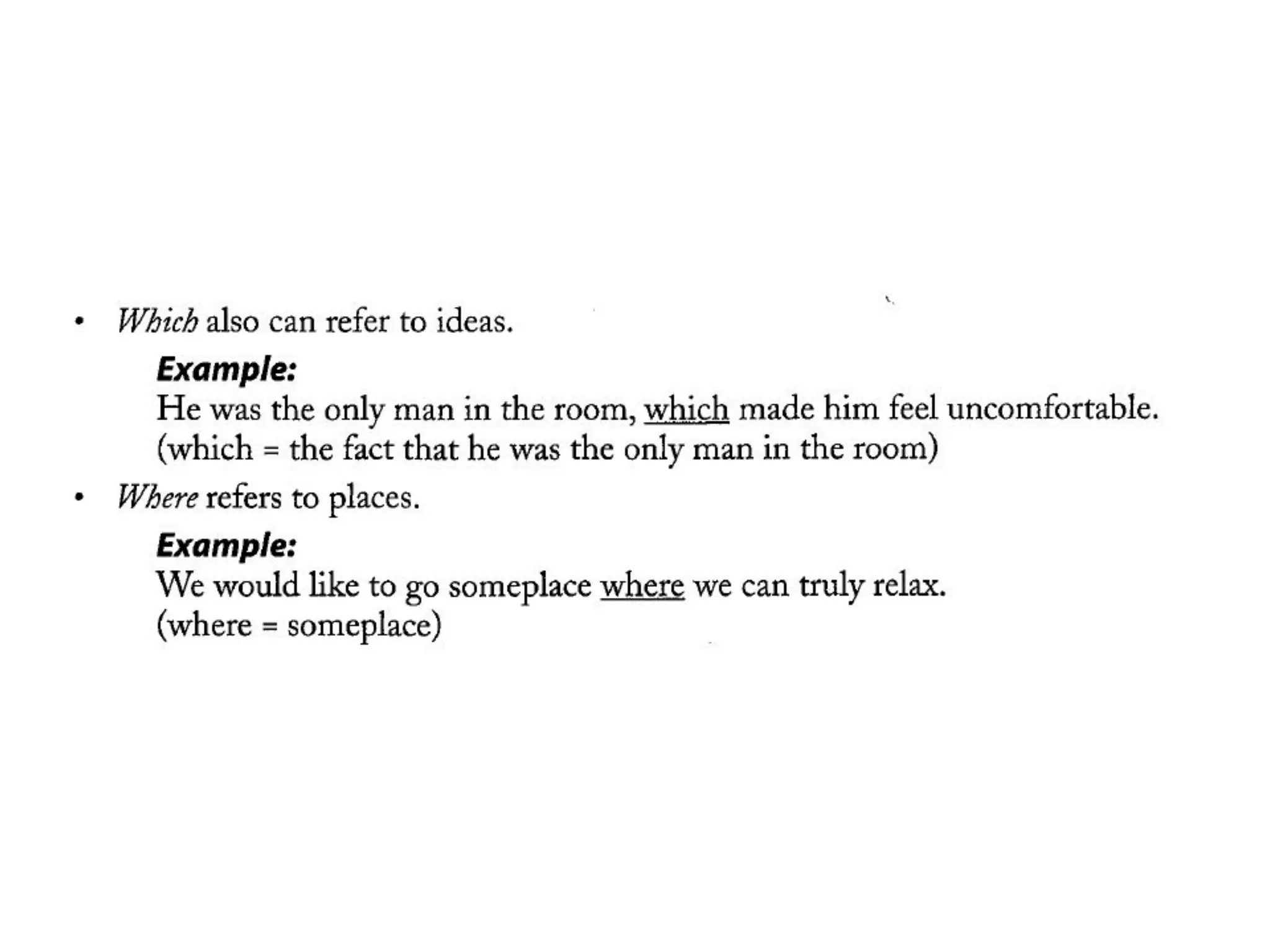
Pronouns
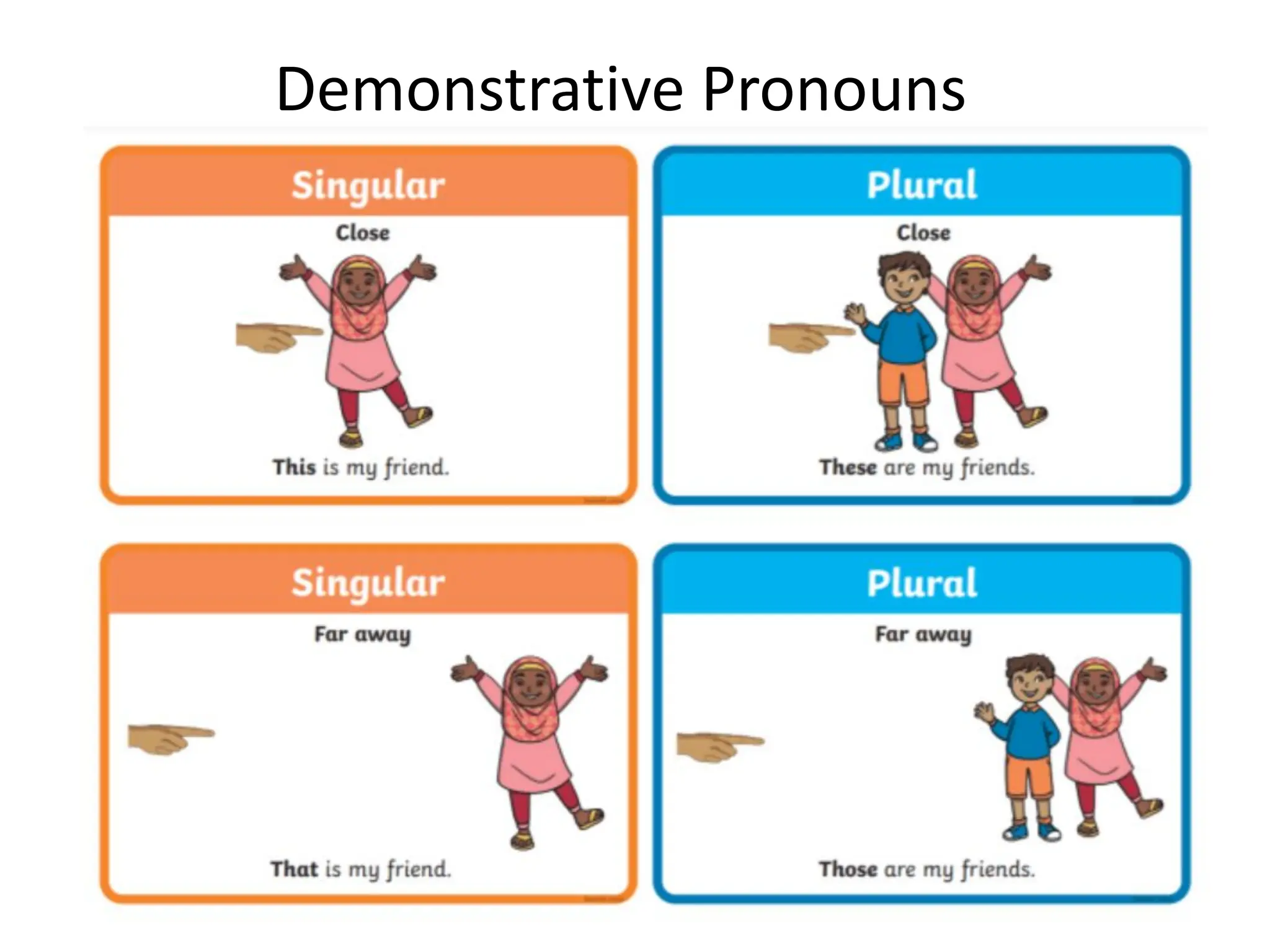
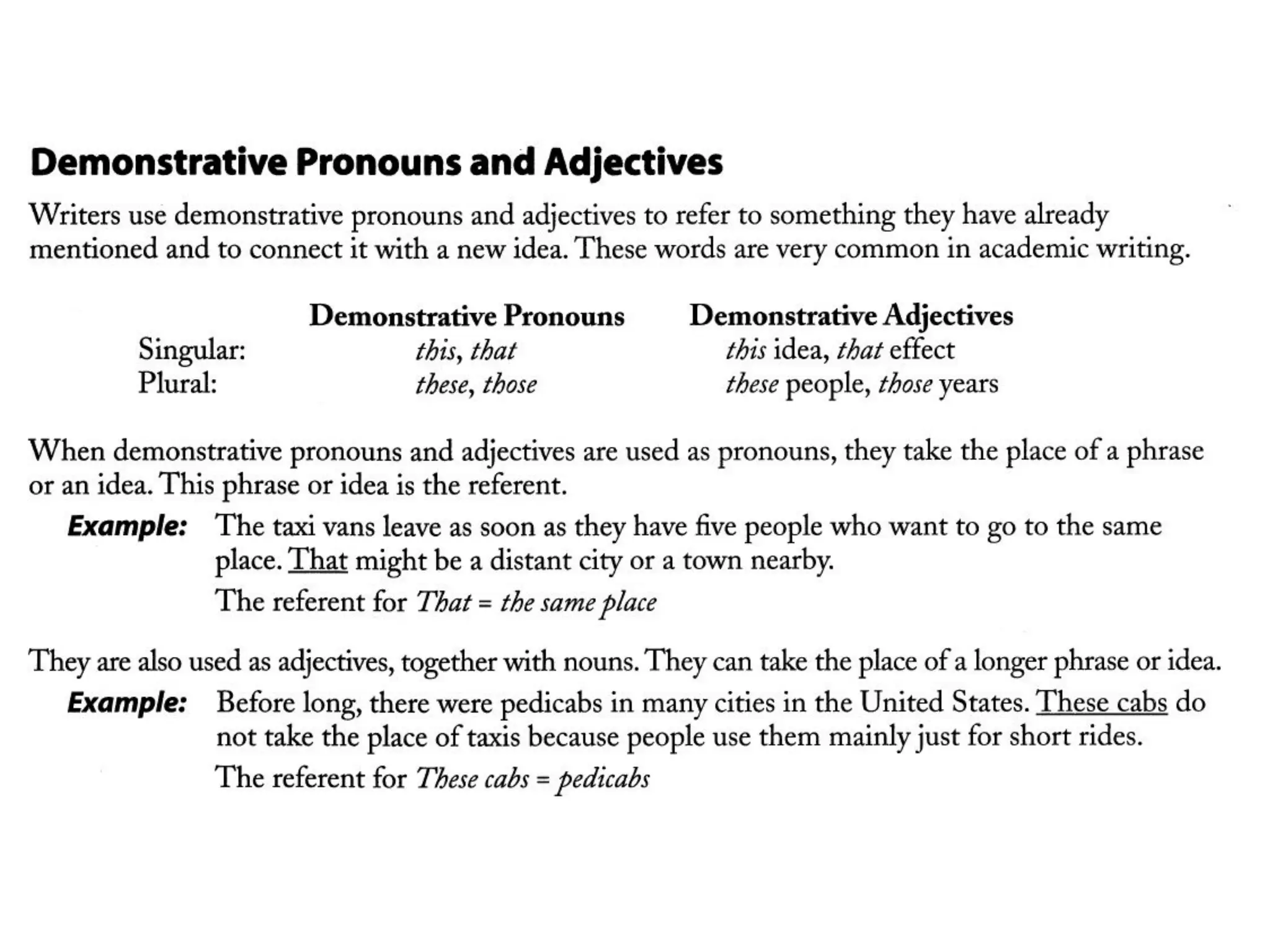
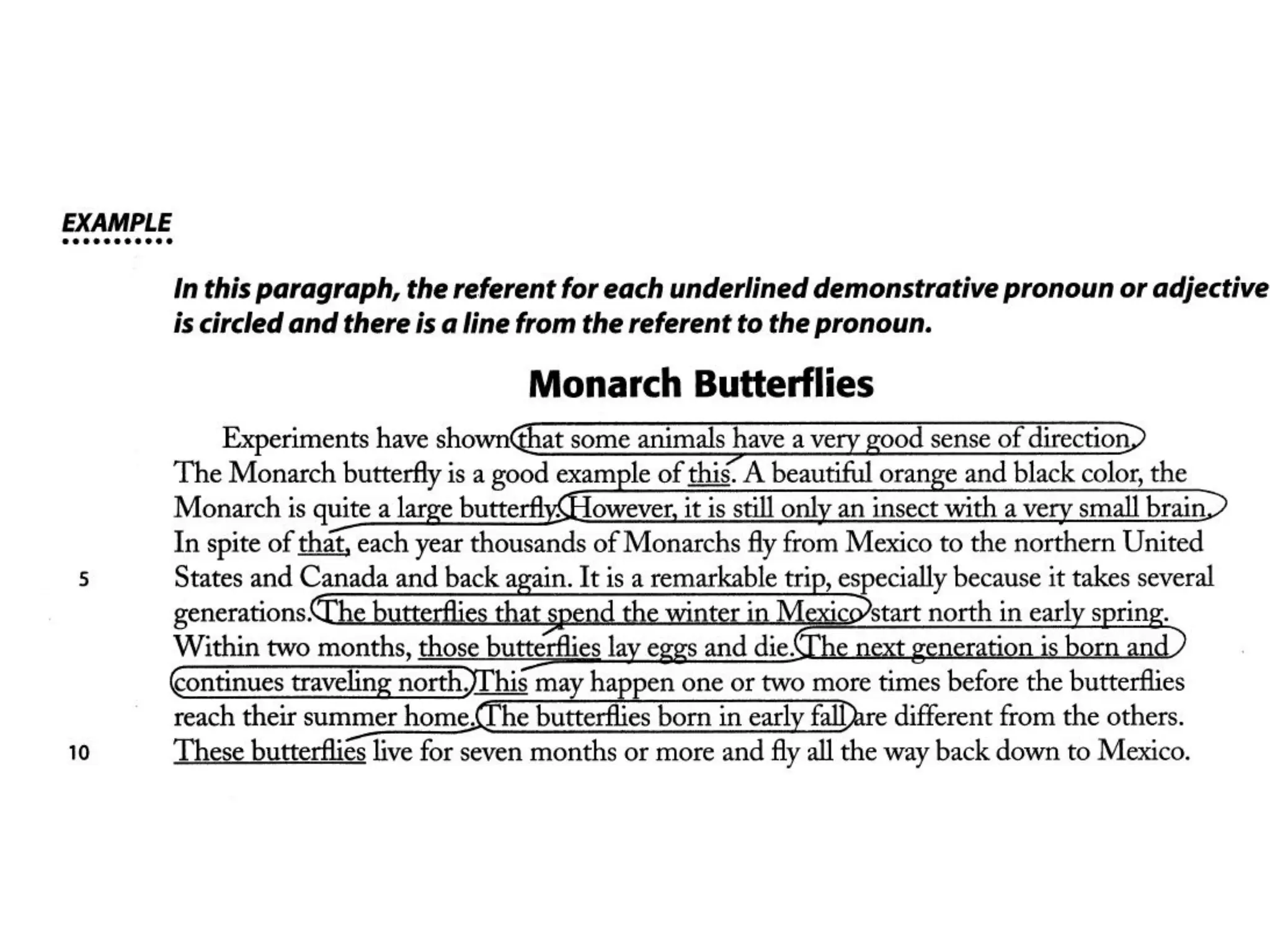
Demonstrative Pronouns
Exit Ticket
Make 5 sentences using the words available
Collocation used in the reading text for students

Collocation used in the reading text for students

  • 1.
  • 2.
  • 3.
    What is Collocation? ►Collocation is a way in which some words are often used together by native speakers of a language, and sound natural together. Example: I missed the bus. A heavy smoker. Or we often say heavy rain, or light rain, instead of strong rain or mild rain, heavy goes well with rain, whereas strong does not.
  • 4.
    typical collocations incorrect/untypicalcollocations heavy rain thick rain high temperature tall temperature discharged from hospital released from hospital have an experience do/make an experience Example: She was discharged from hospital. Not: She was released from hospital. other combinations may be unnatural and just sound "wrong" natural English... unnatural English... the fast train fast food the quick train quick food a quick shower a quick meal a fast shower a fast meal
  • 6.
  • 7.
    Why do welearn collocations? ► Our language will be more natural and more easily understood. ► You will have alternative and richer ways of expressing yourself. ► It is easier for our brains to remember and use language in chunks or blocks rather than as single words.
  • 8.
    How to learncollocations ► Be aware of collocations, and try to recognize ► Treat collocations as single blocks of language. ► When you learn a new word, write down other words that collocate with it ► Read as much as possible. ► Revise what you learn regularly. Practise using new collocations in context as soon as possible after learning them. ► Learn collocations in groups that work for you. ► You can find information on collocations in any good learner's dictionary.
  • 9.
    Unit 1. adverb +adjective 2. adjective + noun 3. noun + noun 4. noun + verb 5. verb + noun 6. verb + expression with preposition 7. verb + adverb
  • 10.
    1. Adverbs thatCollocate with Adjectives Adverb + Adjective For example, ❑ there are a number of intensifying adverbs that can be used instead of very or extremely with adjectives, such as: • highly controversial (= very controversial) - highly = adverb & controversial = adjective • deeply offended (= very offended) • bitterly disappointed (= very disappointment) Sample: 1. adverb + adjective • Invading that country was an utterly stupid thing to do. • We entered a richly decorated room. • Are you fully aware of the implications of your action?
  • 12.
    2. Adjectives thatCollocate with Nouns Adjective + Noun ❑ When you want to describe a noun, there is often a range of adjectives you can use. o adjective + noun: excruciating pain (NOT excruciating joy) • The doctor ordered him to take regular exercise. • The Titanic sank on its maiden voyage. • Dara always wears blue or white or some other bright color.
  • 14.
    3. noun +noun • . noun + noun: a surge of anger (NOT a rush of anger) Example: • Let's give Mr Jones a round of applause. • The ceasefire agreement came into effect at 11am. • I'd like to buy two bars of soap please.
  • 15.
    Noun Noun Collocations/Compound CarPark car park post Office post office narrow minded Narrow minded Shoe laces shoelaces Tea Pot teapot There are a lot of collocation with pattern a ... of ∙ a surge of anger ∙ a sense of pride ∙ a pang of nostalgia
  • 16.
    ❑ noun +verb: lions roar (NOT lions shout) • The lion started to roar when it heard the dog barking. • Snow was falling as our plane took off. • The bomb went off when he started the car engine. 4. noun + verb
  • 17.
    5. Verbs thatCollocate with Nouns Verb + Noun • When we use a noun in a sentence, you need to know which verbs go well with it. For example: • Instead of saying do a bath; you say take a bath • Instead of do an effort; you say make an effort • Instead of do a crime; you say commit a crime • Instead of say a joke, you say tell a joke, make a joke, or crack a joke
  • 19.
    6. verb +expression with preposition o Some verbs collocate with particular preposition expression o verb + expression with preposition: burst into tears (NOT blow up in tears) • At first her eyes filled with horror, and then she burst into tears. (Suddenly started crying) • We had to return home because we had run out of money. • Their behaviour was enough to drive anybody to crime.
  • 20.
    7. verb +adverb o Verb + Adverb: wave frantically (NOT wave feverishly) Example: • She placed her keys gently on the table and sat down. • Mary whispered softly in John's ear. • He smiled proudly as he looked at the photos of his new granddaughter.
  • 22.
  • 24.
  • 25.
  • 26.
    Key Parts ofSentences
  • 27.
  • 28.
  • 29.
  • 30.
  • 32.
    Exit Ticket Make 5sentences using the words available