ÑAÏI HOÏC QUOÁC GIA THAØNH PHOÁ HOÀ CHÍ MINH
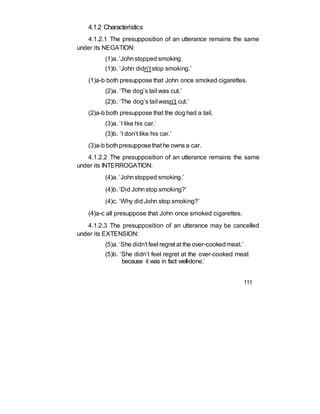
TRÖÔØNGÑAÏIHOÏCKHOAHOÏCXAÕHOÄIVAØ NHAÂNVAÊN
Toâ Minh Thanh
GIAÙO TRÌNH
NHAØ XUAÁT BAÛN ÑAÏI HOÏC QUOÁC GIA
TP HOÀ CHÍ MINH — 2007
LÔØI NOÙI ÑAÀU
Giaùo trình Ngöõ nghóa hoïc tieáng Anh ñöôïc biên soạn một
cách có hệ thống, dựa trên cơ sở tham khảo có chọn lọc nhöõng tư
liệu cuûa nước ngoài, kết hợp với kinh nghiệm giảng dạy nhiều năm
về môn học này của tác giả và tập thể giảng viên trong Bộ môn Ngữ
học Anh. Đây là tập giáo trình được biên soạn duøng để giảng dạy
môn học Ngữ nghĩa học tiếng Anh (English Semantics) cho sinh
viên năm thứ tư Khoa Ngữ văn Anh, Trường Đại học Khoa học Xã
hội và Nhân văn, Đại học Quốc gia Thành phố Hồ Chí Minh.
Giaùo trình gồm bốn phaàn:
1. Introduction (phaàn daãn nhaäp)
2. Word meaning (nghóa cuûa töø);
3. Sentence meaning (nghóa cuûa caâu);
4. Utterance meaning (nghóa cuûa phaùt ngoân)
Lần đầu tiên biên soạn giáo trình này, chúng tôi không tránh
khỏi những sai sót, những khuyết điểm. Rất mong nhận được nhiều
ý kiến đóng góp của bạn đọc vaø của bạn bè đồng nghiệp để giáo
trình ngày càng hoàn thiện hơn, phục vụ giảng dạy sinh viên đạt chất
lượng toát hơn. Ý kiến đóng góp về tập giáo trình này xin gửi về Hội
đồng Khoa học Khoa Ngữ văn Anh, Trường Đại học Khoa học Xã
hội và Nhân văn, Đại học Quốc gia Thành phố Hồ Chí Minh, số 10-
12 Đinh Tiên Hoàng Quận 1, Thành phố Hồ Chí Minh. Điện thoại:
(08)8243328.
Thaønh phoáHoàChíMinh, ngaøy 14thaùng12naêm2006
Toâ Minh Thanh
iii
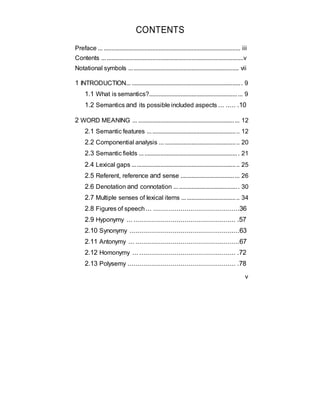
CONTENTS
Preface ... ....................................................................................... iii
Contents ..........................................................................................v
Notational symbols ...................................................................... vii
1 INTRODUCTION... ...................................................................... 9
1.1 What is semantics?........................................................... 9
1.2 Semantics and its possible included aspects ... ..... .10
2 WORD MEANING ... ................................................................ 12
2.1 Semantic features .......................................................... 12
2.2 Componential analysis ... ............................................... 20
2.3 Semantic fields ............................................................... 21
2.4 Lexical gaps .................................................................... 25
2.5 Referent, reference and sense ..................................... 26
2.6 Denotation and connotation ......................................... 30
2.7 Multiple senses of lexical items .................................... 34
2.8 Figures of speech... ............................................36
2.9 Hyponymy ... .................................................... .57
2.10 Synonymy ........................................................63
2.11 Antonymy ... .....................................................67
2.12 Homonymy ... ................................................. .72
2.13 Polysemy ....................................................... .78
v
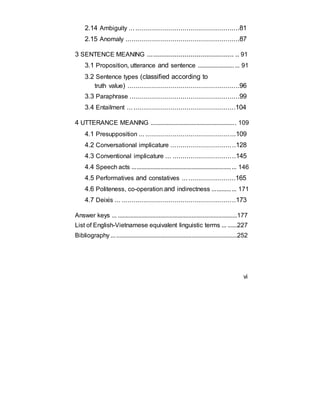
2.14 Ambiguity ........................................................81
2.15 Anomaly ..........................................................87
3 SENTENCE MEANING ............................................ .. 91
3.1 Proposition, utterance and sentence .......................... 91
3.2 Sentence types (classified according to
truth value) .........................................................96
3.3 Paraphrase ........................................................99
3.4 Entailment .......................................................104
4 UTTERANCE MEANING ...................................................... 109
4.1 Presupposition .................................................109
4.2 Conversational implicature .................................128
4.3 Conventional implicature ... ................................145
4.4 Speech acts .................................................................. 146
4.5 Performatives and constatives ...........................165
4.6 Politeness, co-operation and indirectness ............... 171
4.7 Deixis ... ..........................................................173
Answer keys ... ............................................................................177
List of English-Vietnamese equivalent linguistic terms ... ......227
Bibliography ................................................................................252
vi
NOTATIONALSYMBOLS
Most of the symbols used in this text follow conventions, but
since conventions vary, the following list indicates the meanings
assigned to them here.
A: adjunct
AdjP: adjective phrase
AdvP: adverb phrase
C: countable
dO: direct object
Ex: example
mono-trans: mono-transitive verb
n: noun
NP: noun phrase
op: optional
opA of Means: optional adjunct of means
Pro: pronoun
PP: prepositional phrase
RP: Received Pronunciation S:
sentence
Vgrp: verb group
VP: verb phrase
* : unaccepted form
iv
-- : related insome way
[ ] : embedded unit
/ : or
⇒ : one-way dependence
 : two-way dependence
= : be equivalent to
+ : with the semantic feature specified
 : without the semantic feature specified
 : with or without the semantic feature specified
v
Section
1
INTRODUCTION
1.1 What is semantics?
Semantics is a branch of linguistics which deals with
meaning. In order to understand this definition, we need to know what
meaning is. However, before we discuss the "meaning" of meaning, it is
necessary to talk about the main branches of linguistics.
Linguistics has three main branches: syntax, semantics and
pragmatics. Syntax is the study of grammar (consisting of
phonology, morphology, syntax, and textual grammar)
whereas semantics and pragmatics deal with meaning.
Semantics is the study of meaning in language (i.e. what language
means) while pragmatics is concerned with meaning in context
(i.e. what people mean by the language they use). Although this is
a semantics course, part of what we are going to discuss is
concerned with pragmatics, for semantics and pragmatics are
closely related.
Take the distinction between semantic meaning and pragmatic
meaning as an illustration of how semantics is different from but, at the
same time, closely related to pragmatics.
Semantic meaning is context-free whereas pragmatic meaning is
context-dependent.
(1) A: ‘Would you like a piece of cake?’
B: ‘I’m on a diet.’
9
The semantic meaning of ‘I’m on a diet’ in (1) is ‘I want to
lose weight by eating the food which is not rich in fat, sugar, etc.’
The pragmatic meaning of ‘I’m on a diet’ in (1) is ‘I don’t want
any piece of cake’ or ‘I’m afraid that I have to refuse your invitation.’
(2) Tom: ‘Do you like the wine I picked out?’
Gina: ‘It’s Italian, isn’t it?’
The semantic meaning of ‘It’s Italian, isn’t it?’ in (2) is ‘Is it
right that the wine is made in Italy?’
The pragmatic meaning of ‘It’s Italian, isn’t it?’ in (2) is ‘I
don’t like the wine you picked out.’
1.2 Semantics and its possible included aspects
"Semantics is a technical term used to refer to the study of
meaning, and since meaning is part of language, semantics is
part of linguistics. Unfortunately, ‘meaning’ covers a variety of
aspects of language, there is no general agreement about the
nature of meaning, what aspects of it may properly be
included in semantics, or the way in which it should be
described." [Palmer, 1981: 1] This little textbook will try to show
three main aspects that are commonly considered as included in
semantics: word meaning (or, to be more precise, lexical
meaning) [Lyons, 1995: 33], sentence meaning and utterance
meaning.1
1
In semantics it is necessary to make a careful distinction between utterances
and sentences. In particular we need some way of making it clear when we are
discussing sentences and when utterances. We adopt the convention that anything
10
The meaning of remarried, for example, can be analysed in
the three different levels.
At the word level, remarried may be regarded a set of the
four following semantic features: [+human], [male], [+used to be
married], and [+married again].
At the sentence level when remarried occurs in She is not
remarried, only the fourth semantic feature of the word,
namely [+married again], is informative, i.e. it is part of the
statement.
At the utterance level within the particular context of the
following conversation when remarried occurs in B’s response, it
is the word that helps the utterance presuppose that pastors are
allowed by rule to get married and implicate that the pastor was
once married.
A: ‘How is the pastor?’
B: ‘He is remarried.’
Because of the nature of the subject and the variety of views
on semantics and its possible included aspects, the little
textbook cannot hope to be more than an introductory survey.
written between single quotation marks represents ‘an utterance’, and
anything italicized represents a sentence or (similarly abstract) part of a
sentence, such as a phrase or a word:
‘She is not remarried’ represents an utterance.
She is not remarried represents a sentence.
Marriedrepresents a word conceived as part of a sentence.
11
Section
2
WORD MEANING
WORD MEANING is what a word means, i.e. "what counts as
the equivalent in the language concerned." [Hurford and Heasley,
1984: 3]
2.1 Semantic features
2.1.1 Definition
Semantic features2 are "the smallest units of meaning in a
word." [Richards et al, 1987: 254]
We identify the meaning of a word by its semantic
features. For example, father may have the following semantic
features: [+human], [+male], [+mature], [+parental] and
[+paternal]. And hen may be described as a set of the following
semantic features: [+animate], [+bird], [+fowl], [+fully grown]
and [+female].
2.1.2 Characteristics
2.1.2.1 Some semantic features need not be specifically
mentioned. For example, if a word is [+human] it is
“automatically" [+animate]. This generalization can be expressed
as a redundancy rule:
2
Semantic features are also referred to as semantic components or semantic
properties.
12
A word that is [+human] is [+animate].
That is why [+animate] need not be specified as a semantic
feature of father, girl, professor, etc. since the semantic feature can
be inferred from [+human].
Some redundancy rules infer negative semantic
features. Thus, semantic features are often shown in the form of
binary oppositions, which can be stated in terms of pluses and
minuses (that is, [+] and []):
If father is [+human], it is therefore [inhuman];
If father is [+male], it is therefore [female];
If father is [+mature], it is therefore [immature];
If father is [+paternal], it is therefore [maternal].
Notice that we identify the meaning of a word according to its
primitive semantic features first, e.g. [+animate], [+human],
[+male], etc.; and then with the assistance of its other semantic
features, e.g. [+parental], [+paternal], etc.
2.1.2.2 Different words may share the same semantic
feature. In other words, the same semantic feature can be
found in many different words.
Ex1: Doctor, engineer, teacher, physicist, chemist,
tailor, hairdresser, etc. all share the same semantic feature
[+professional].
Ex2: Mother, father, son, daughter, brother, sister,
grandparent, aunt, uncle, etc. are all [+kinship].
13
2.1.2.3 The same semantic feature can occur in words of
different parts of speech. In other words, words of different
parts of speech may share the same semantic feature.
For example, [+female] is part of the meaning of the noun
mother, the verb breast-feed and the adjective pregnant. And
[+educational] is a semantic feature found in the nouns school,
teacher, textbook, etc. and in the verbs teach, educate,
instruct, etc.
2.1.2.4 Fromkin and Rodman [1993: 148-149] confirm that
"the semantic properties of words determine what other
words they can be combined with." These authors give the two
following sentences that are grammatically correct and
syntactically perfect but semantically anomalous:
(1) My brother is an only child.
(2) The bachelor is pregnant.
(1) is strange, or semantically anomalous, because this
sentence represents a contradiction: brother is [+having at least
one sibling] while an only child is [+having no other sibling];
(2) is semantically anomalous for a similar reason: bachelor is
[+male] whereas pregnant is [+female].
Here, Fromkin and Rodman also cite Noam Chomsky’s famous
classic example of semantically anomalous sentences:
(3) Colorless green ideas sleep furiously.
This sentence seems to obey all the syntactic rules of English:
its subject is colorless green ideas and its predicate is sleep
furiously; but there is obviously something semantically wrong
14
with the sentence. The adjective colorless is [colour], but it
occurs with the adjective green the semantic feature of which
[+green in colour]. How can something be [colour] and [+green
in colour] at the same time? In the same way, the noun ideas,
which is [+abstract], is semantically incompatible with the verb
sleep the noun phrase subject of which must be [+concrete] and
[+animate]. How can an abstract notion like ideas sleep? Then,
the verb sleep, whose adverbial collocations3 are well, badly and
soundly, is semantically incompatible with the adverb furiously.
How can a living being sleep when he is full of violent anger?
In conclusion, knowing all the possible semantic features of a
word enables us to combine semantically compatible words
together to form larger but meaningful linguistic units such as
phrases, clauses and sentences.
Fromkin and Rodman [1993:134] also believe that "because
we know the semantic properties of words, we know when two
words are antonyms, synonyms or homonyms, or are unrelated
in meaning."
Exercise 1: For each group of words given below, state what
semantic features are shared by the (a) words and the (b)
words, and what semantic features distinguish between the
classes of (a) words and (b) words. The first one is done as an
example.
3
Collocations are regular combinations of words, e.g. by accident and strong tea are
English collocations.
Adverbial collocations refer to the adverbs regularly used together with a certain
verb.
15
1. (a) lobster, shrimp, crab, oyster, mussel
(b) trout, sole, herring, salmon, mackerel
The (a) and (b) words are [+edible water animal].
The (a) words are [+shellfish].
The (b) words are [+fish].
2. (a) widow, mother, sister, aunt, seamstress
(b) widower, father, brother, uncle, tailor
The (a) and (b) words are ___________________________
The (a) words are
The (b) words are __________________________________
3. (a) bachelor, son, paperboy, pope, chief
(b) bull, rooster, drake, ram, stallion
The (a) and (b) words are ___________________________
The (a) words are
__________________________________ The(b)wordsare
4. (a) table, pencil, cup, house, ship, car
(b) milk, tea, wine, beer, water, soft drink
The (a) and (b) words are ____________________________
The (a) words are
__________________________________
The (b) words are
__________________________________
5. (a) book, temple, mountain, road, tractor
(b) idea, love, charity, sincerity, bravery, fear
16
The (a) and (b) words are ____________________________
The (a) words are
__________________________________
The (b) words are
__________________________________
6. (a) rose, lily, tulip, daisy, sunflower, violet
(b) ash, oak, sycamore, willow, beech
(c) pine, cedar, jew, spruce, cypress
The (a) (b) and (c) words are _________________________
The (a) words are
__________________________________
The (b) words are
__________________________________
The (c) words are
__________________________________
7. (a) book, letter, encyclopaedia, novel, notebook, dictionary
(b) typewriter, pencil, ballpoint, crayon, quill, charcoal, chalk
The (a) and (b) words are ____________________________
The (a) words are __________________________________
The (b) words are __________________________________
8. (a) walk, run, skip, jump, hop, swim
(b) fly, skate, ski, ride, cycle, canoe, hang-glide
The (a) and (b) words are ____________________________
The (a) words are
__________________________________
The (b) words are
__________________________________
9. (a) ask, tell, say, talk, converse
(b) shout, whisper, mutter, drawl, holler
17
The (a) and (b) words are ____________________________
The (a) words are
__________________________________
The (b) words are
__________________________________
10. (a) alive, asleep, awake, dead, half-dead, pregnant
(b) depressed, bored, excited, upset, amazed,
surprised
The (a) and (b) words are ____________________________
The (a) words are
__________________________________
The (b) words are
__________________________________
Exercise 2: Identify the semantic features in each of the
following words.
1. Child:_____________________________________________
2. Aunt:
3. Hen:
4. Oak (-tree):
5. Flower: ___________________________________________
6. Palm: _____________________________________________
7. Bachelor: _________________________________________
8. Actress: __________________________________________
9. Plod:
10. Ewe:_____________________________________________
11. Fly:
18
12. Stallion: _________________________________________
13. Police-officer:
14. Beauty: __________________________________________
15. Imagine: _________________________________________
16. Doe:
17. Drive: ___________________________________________
18. Home:
19. Elm:
20. Chalk: ___________________________________________
21. Rose: ____________________________________________
22. Chick: ___________________________________________
23. Pap: _____________________________________________
24. Tiptoe: __________________________________________
25. Pine (-tree):
26. Owe: ____________________________________________
27. Computer: _______________________________________
28. Honesty:
29. Maid:
30. Spinster: ________________________________________
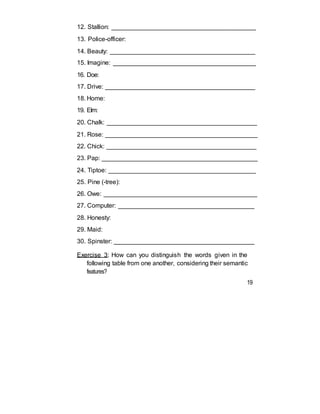
Exercise 3: How can you distinguish the words given in the
following table from one another, considering their semantic
features?
19
Malay English Vietnamese Chinese
anh huynh
brother
e
sadara em
muoi
sister
ch ty
2.2 Componential analysis
In Semantics, componential analysis is "an approach to the
study of meaning which analyses a word into a set of
meaning components or semantic features." [Richards et al,
1987: 53]
For example, the meaning of boy may be shown as [+human],
[+male] and [adult] while that of man may be a combination of
[+human], [+male] and [+adult]. Thus, man is different from boy
basically in one primitive semantic feature: [adult].
20
Generally speaking, componential analysis is applied to a
group of related words which may differ from one another only by
one or two semantic features.
2.3 Semantic fields
2.3.1 Definition
A semantic field4 is "the organization of related words
and expressions into a system which shows their
relationship to one another." [Richards et al, 1987: 53]
A semantic field can also be defined as "a set of words with
identifiable semantic affinities." [Finegan, 1994: 164]
Ex1. The semantic field of kinship terms: father, mother,
brother, sister, uncle, aunt, etc.
Ex2. The semantic field of adjectives describing human
emotional states: angry, sad, happy, exuberant,
depressed, afraid, etc.
Ex3. The semantic field of drinking vessels: cup, mug,
tumbler, wine glass, beer glass, etc.
2.3.2 Ways of organising semanticallysimilar items into
semantic fields
There are various ways according to which semantically
similar items are related to one another:
(a) Items related by topics:
4
A semantic field is also referred to as a lexical field or a lexical set.
21
 Types of fruit: apples, oranges, grapes, bananas, pears,
plums, etc.
 Pieces of furniture: seats, tables, beds, storage, etc.
 Terms of colour: blue, red, yellow, green, black, white, etc.
(b) Items similar in meaning:
 Ways of cooking: stew, boil, fry, steam, roast, grill, smoke,
etc.
 Ways of looking5: gaze, glance, peer, squint, stare, etc.
 Ways in which a liquid escapes from its container6
: drip,
leak, ooze, run, seep, etc.
5
Gaze = look long and steadily (at somebody/something) usuallyin surprise or
admiration:She gazed atme in disbeliefwhen Itold her the news.
Glance = take a quick look at:She glanced shylyathim and then lowered her eyes.
Peer (at,through,up,etc,) = look closelyand carefully,especiallyas ifunableto see
well:peer atsomebody,peer outofthe window,peer over the wall,peer through
the gap, peer over one’s spectacles, etc.
Squint(at,through,up,etc,) = look (at somebody/something) with eyes halfshutor
turn sideways,or through narrow opening:squintin the lightofsunshine,squint
throughthe letter box.
Stare = look (at somebody/something) with the eyes wide open in a fixed gaze (in
astonishment, wonder, fear, etc.): They all stared in/with amazement. It’s rude to stare.
6
Drip (allow liquidto) fall in drops:Rain was dripping down from the trees.Is that
roofstill dripping?
Leak (allow liquid or air to) get in or out wrongly: The boat leaks like a sieve. Air
leakedoutofthe balloon.
Ooze (from/out of something; out/away) = (allow a thick liquid to) come or flow out slowly:
Black oil was oozingoutofthe engine.All the toothpastehas oozedout.
Run = (allow a liquid to) flow: The River Rhine runs into the North Sea.Water was
running all over thebathroom floor.The bathroom floor was running with water.
Seep (through/into/outofsomething;through/out) = (ofa liquid)flowslowlyandinsmall
quantities through a substance: Water seeped through the roof of the tunnel.
22
(c) Terms describing people whose weight is below
normal:7 thin, bony, skinny, scrawny, underweight,
emaciated, slender, slim, etc.
(d) Items which form pairs of antonyms: long/short,
light/heavy, alive/dead, love/hate,
approve/disapprove, approve/disapprove, begin/end,
inside/outside, upstairs/downstairs, etc.
Oil is seepingthrougha crackin thetank.
“Drip, leak, ooze, run, seep indicate the way in which a liquid escape from a
container or tap. Most (not seep) also indicate the way in which a container or tap
allows a liquid to escape. 1 Drip = (allow sth to) fall in regular drops: Water is
dripping from the pipe. The pipe is dripping (water). 2 Leak = (allow sth to) get
out (through a hole in sth): Wine is leaking from the barrel. The barrel is leaking
(wine). 3 Ooze = (allow sth to) move slowly (out of sth) because thick: Blood is
oozing from the wound. The wound is oozing (blood). 4 Run = (allow sth to) flow
continuously (from sth): Water is running from the tap. The tap is running. 5
Seep = move slowly(through a small opening in sth) because thick: Oil is seeping
from the engine." [Crowther (ed.), 1992: 272]
7
"When describing peoplewhose weightis belownormal,thin is the mostgeneralword,
It may be negative,suggesting weakness or lack of health:She‘s gone terriblythin
since operation.Bony is often applied to parts of the body such as hands or face;
skinnyand scrawnyare negative and can suggestlack ofstrength:He looks much
too skinny/scrawny to be a weight-lifter. Underweight is the most neural: The
doctor says I’m underweight.Emaciatedindicates a serious condition resultingfrom
starvation. It is often thought desirable to be slim or slender, slim being used
especiallyofthose who have reduced their weightby dietor exercise:I wish I was
as slim as you.You have a beautifullyslender figure."[Crowther (ed.),1992:947]
23
(e) Items which form pairs or trios of synonyms:
smart/bright/intelligent, conserve/preserve/safeguard,
fix/repair/mend, kind/sort/type/variety, happy/glad, etc.
(f) Items grouped as an activity or a process:
 Do the housework: clean the rooms, do the washing, iron
the clothes, get the food, prepare a meal, wash up, etc.
 Do research: make hypotheses, collect data, analyze data,
get results and come to conclusions.
(g) Items classified according to:
Male: waiter, tiger, actor, host, landlord, sir, etc.
 Sex
Female: waitress, tigress, actress, hostess,
landlady, madam, etc.
 Age: grown-ups, adults, elderly people, middle-aged
people, teenagers, children, infants, babies, etc.
 Age and sex:
horse ⇒ stallion:[+male],[+fully grown] dog ⇒ dog: [+male],[+fully grown]
mare:[+female],[+fullygrown] bitch:[+female],[+fullygrown]
foal: [male],[fullygrown] puppy: [male],[fullygrown]
Exercise 4: Organisethe givenwords (and probablythose of your
own) into three semantic fields: shirts, end, forward(s), new,
hats, lend, coats, shorts, beginning, trousers, amble, out,
24
limp, tiptoe, plod, socks, trudge, borrow, stomp, in, stump,
old, backward(s), and tramp.
1._________________________________________________
2._________________________________________________
3._________________________________________________
2.4 Lexical gaps
“The absence of a word in a particular place in a lexical
field of a language" is called a lexical gap. [Richards et al, 1987:
164]
For example, in English there is no singular noun that covers
bull, cow and calf either as horse covers stallion, mare and foal or
as goat covers billy-goat, nanny-goat and kid.
horse goat ?
stallion mare foal billy-goat nanny-goat kid bull cow calf
Exercise 5: Try to fill in each of the two blanks with an
appropriate word to prove that there is no lexical gap in the
given semantic fields.
25
sheep giraffe
ram ewe male giraffe baby giraffe
2.5 Referent, reference and sense
2.5.1 Distinction between referent, reference and sense
In Semantics, a distinction is often made between referent,
reference and sense:
2.5.1.1 A referent is an object or an entity in the real
world or in the world of your imagination, e.g. your school,
your classmates, your teacher, any thing you can see in the
classroom right now, the idealistic working conditions you have
ever dreamed of, etc. that is talked about.
Several words, especially the so-called function words8, have no
obvious referents: the, could, in, since, and, etc.
2.5.1.2 The reference of a word9 or a linguistic expression is the
relationship between that word or expression and the thing (book),
the action (read), the event (graduate from university), the quality
(sincerity), etc. it refers to.
8
It is commonly believed that function words like prepositions (of, in, etc.),
definite and indefinite articles (the, a/an), conjunctions (if, however, or, etc.),
and auxiliaries (may, should, will, etc.) only "signal grammatical relations."
[Finegan, 1994: 175]
9
Or, to be more precise, a lexical item
26
For example, the reference of Peter’s house is the
relationship between this English noun phrase and the house that
belongs to Peter.
Peter’s house the house that belongs to Peter
(in the Eng. language) REFERENCE (in the real world)
2.5.1.3 The sense10 of a word or a linguistic expression11
shows the internal relationship between that word or expression and
others in the vocabulary of a language.
Ex1. Teacher and student have the sense relationship of the former
is the one who gives a lesson and the latter is the one
who has the lesson given by the former.
Ex2. A dog is chasing a cat has some sense. However, a dog is
human has no sense.
Ex3. The King of Vietnam is bald has some sense: its sense is
constructed by its individual lexical components and its
syntactic structure. However, this sentence has no reference: it
does not refer to any real person because the King of
Vietnam does not exist nowadays.
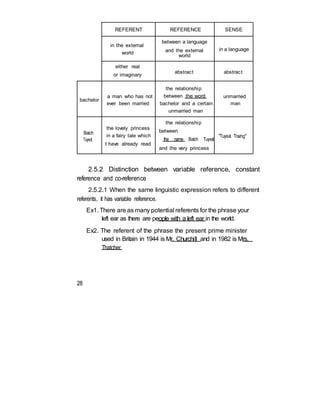
Consider the following table and identify referent,
reference and sense via their main features.
10
It is necessary to notice that the two linguistic terms sense and meaningwill be
used interchangeably from now on in this text.
11
"The SENSE of an expression is its indispensable hardcore ofmeaning."
[Hurford and Heasley,1984: 91]
27
REFERENT REFERENCE SENSE
in the external
world
between a language
and the external
world
in a language
either real
or imaginary
abstract abstract
the relationship
bachelor
a man who has not
ever been married
between the word
bachelor and a certain
unmarried man
unmarried
man
the relationship
Baïch
Tuyeát
the lovely princess
in a fairy tale which
I have already read
between
the name Baïch Tuyeát
and the very princess
"Tuyeát Traéng"
2.5.2 Distinction between variable reference, constant
reference and co-reference
2.5.2.1 When the same linguistic expression refers to different
referents, it has variable reference.
Ex1. There are as many potential referents for the phrase your
left ear as there are people with a left ear in the world.
Ex2. The referent of the phrase the present prime minister
used in Britain in 1944 is Mr. Churchill and in 1982 is Mrs.
Thatcher.
28
2.5.2.2 When one linguistic expression refers to one and the
same referent, it has constant reference: the sun, the moon,
Halley’s comet12, the People’s Republic of China, Angola, the
United Nations, FIFA, UNESCO, etc.
2.5.2.3 When two or more linguistic expressions share the
same referent, they have co-reference.
Ex1. The morning star and the evening star both refer to
theplanetcalled Venus.
Ex2. In a conversation about Britain in 1982, the Prime
Minister and the leader of the Conservative Party
share the same referent: Mrs Thatcher.
Ex3. If we are talking about a situation in which John is
standing alone in the corner, John and the person in
the corner share the same referent.
Exercise 6: What is identified by the word mean or meaning in
the following examples, i.e. reference or sense? Write R for
reference and S for sense.
_____ 1. When Albert talks about "his former friend", he means me.
_____ 2. Daddy, what does logic mean?
_____ 3. Purchase has the same meaning as buy.
12
Halley’s cometis the brightcometwhichreappears aboutevery76 years.Itwas first
recorded in 240 BC, and the fact of its regular return was established byEdmond
Halley.Its nextreappearance is due in2061.
29
_____ 4. Look up the meaning of democracy in your dictionary.
_____ 5. If you look out of the window now, you’ll see who I mean.
2.6 Denotation13 and connotation14
2.6.1 Definition
The denotation of a word is the core, central or
referential meaning of the word found in a dictionary. In
English, a content word15 may have its denotation described in
terms of a set of semantic features that serve to identify the
particular concept associated with the word.
The connotation of a word is the additional meaning that
the word has beyond its denotative meaning. It shows
people’s emotions and/or attitudes16 towards what the word
refers to.
13
Denotation is also referred to as denotative meaning.
14
Connotation is also referred to as connotative meaning.
15
Content words — principally nouns, verbs, adjectives and adverbs like
democracy, mother, stir-fry, happy, and totally — "have meaning in that they
refer to objects, events, and abstract concepts" [Finegan, 1994: 161] while
function words specifically articles, prepositions, conjunctions and auxiliaries
like a/an, including, nevertheless, but, should, etc. also carry meaning, though
in a different way from content words: "to signal grammatical relations."
[Finegan, 1994: 175]
16
"The referential meaning of a word or sentence is frequently called its
denotation, in contrast to the connotation, which includes both its social and
affective meaning." [Finegan, 1994: 161]
30
Ex1. Child is denotatively described as [+human], [mature]
and [±male].
Under a certain circumstance, child may positively be
connoted as [+affectionate] or [+innocent].
Under another circumstance, child may negatively be connoted as
[+noisy] or [+irritating].
Ex2. Woman is denotatively described as [+human], [+mature]
and [+female].
Under a certain circumstance, woman may positively be
connoted as [+devoted] or [+patient].
Under another circumstance, woman may negatively be
connoted as [+wicked] or [+talkative].
The denotation of a word can easily be found in a dictionary
while its connotation(s) may probably depend on such factors as
(1) the culture in which the word is used; (2) the language user’s
family and/or educational background; (3) the language user’s
social and/or political class; (4) the language user’s speech
community and/or ethnic group; etc. In brief, these factors are by
virtue of personal and cultural associations.
2.6.2 Distinction between denotation and connotation
Consider the following table and identify denotation and
connotation via their main features.
31
DENOTATION CONNOTATION
what a lexical item emotions and/or attitudes towards
means what a lexical item refers to
core, central peripheral
referential social, affective
- still single after the usual age for marrying
- decided by himself to stay single
bachelor unmarried man
- enjoying freedom, friendship, life, etc.
- ready for his impending marriage
- still single after the usual age for marrying
- not decided by herself to stay single
spinster unmarried woman
- left in an unfavourable state
- a symbol for some failure in life
bad weather (usually rainy or snowy),
the twelfth month
dark evening, grey sky, slippery streets,
December of the year, next
holiday season, Christmas, winter break,
after November
loneliness, separation from the beloved
Ex1. The word fox almost always has a negative connotation in
English when it is associated with any person who is cunning
or deceitful.
32
Ex2. Some Englishwords usually have positive connotations (+);
others usually have neutral connotations (); still others
usually have negative connotations ():
- mother/mom (+), woman (), witch ();
- father/dad (+), man (), the old man ();
- slender (+), thin (), skinny ();
- plump (+), overweight (), fat ().
Ex3. Synonyms, words that have the same basic meaning, do
not always have the same emotional meaning. For
example, the words stingy and frugal both mean ‘careful
with money.’ However, to call a person stingy is an insult,
while the word frugal has a much more positive connotation.
Similarly, a person wants to be slender but not skinny, and
aggressive17 but not pushy. Therefore, you should be
careful in choosing words because many so-called
synonyms are not really synonyms at all.
Exercise 7: Identify all the possible connotations associated with
the word Christmas.
17
Aggressive (often approved) = forceful = (self-)assertive = showing strong and
confident personality; expressing one’s views;demands;etc. confidently:
A good salesman must be aggressive if he wants to be succeeded.
Pushy (also pushing, informally derogative) = trying constantly to draw attention to
oneself and gain an advantage:
He made himself unpopular by being so pushy.
33
2.7 Multiple senses of lexical items
2.7.1 Primary meaning vs. secondary meaning
The first and foremost distinction made in multiple senses of a
word is between its primary and secondary meanings.
2.7.1.1 The primary meaning of a word (or, to be more
precise, a lexical item) is the first meaning or usage that the
word will suggest to most people when it is said in isolation.
The primary meaning of the English noun wing, for instance,
is ‘either of the pair of feathered limbs that a bird uses to fly.’
2.7.1.2 Secondary meanings of a word are the meanings
besides its primary meaning. They are said to be not central but
peripheral.
In addition, secondary meanings of a word are
contextbound whereas its primary meaning is not.
In He usually plays on the wing, for example, wing means
‘side part of the playing area in football, hockey, etc.’ Such a
secondary meaning is derived from the context denoted by the
verb plays.
2.7.2 Literal meaning vs. figurative meaning
It is time to distinguish then within all the possible meanings of the
English noun wing, for example, those that are literal and those that are
figurative.
2.7.2.1 "The basic or usual meaning of a word" [Crowther
(ed.), 1992: 527] is usually referred to as its literal meaning.
34
Some literal meanings are identifiedvia context inthe noun wing:
Part that projects from the side of an aircraft and supports it
in the air: the two wings of an airplane;
Part of a building that projects from the main part:
the east/west wing of a house;
Projecting part of the body of a motor vehicle above the wheel:
The left wing of his car was damaged in the collision;
Part of a political party that holds certain views or has a
particular function: the radical wing of the Labour Party.
2.7.2.2 The figurative meaning of a word is one which is
different from its usual (literal) meaning and which create
vivid mental images to readers or listeners.
Below are some figurative meanings of the noun wing:
- We hope college life will help him to spread his wings a bit.
(= extend his activities and interests)
- Having a new baby to look after has clipped her wings a bit.
(= has prevented her from achieving her ambition)
- She immediatelytook the new arrivals under her wing.
(= looked after the new arrivals)
- He retires as chairman next year; his successor is waiting in the
wings. (= is ready to replace him)
Wing is an English word that has several closely related but
slightly different meanings. It is said to be polysemous.
35
2.8 Figures of speech
A figure of speech is "a word or phrase which is used for
special effect, and which does not have its usual or literal
meaning." [Richards et al, 1987: 105]
2.8.1 Simile and metaphor
2.8.1.1 Definition
Simile is "the use of comparison of one thing with
another, eg. as brave as a lion, a face like a mask. [Crowther (ed.),
1992: 848]
It is incredible to notice that not all comparisons belong to simile, eg.
He is much taller than his elder brother. Only the comparisons clearly
employed as examples of figures of speech do.
Metaphor is "the use of a word or phrase to indicate
something different from (though related in some way to) the
literal meaning, as inI’ll make him eat his words or She has a heart of
stone." [Crowther (ed.), 1992: 564]
2.8.1.2 Distinction between a simile and a metaphor
A simile is an explicit or direct comparison in which
something is compared to something else by the use of a
function word such as like or as:
- My hands are as cold as ice. (= My hands are very cold.)
- Tom eats like a horse.
(= Tom eats as much as a horse does. In other words, Tom’s
appetite IS explicitly COMPARED TO that of a horse.)
36
A metaphor is an implicit or indirect comparison in which no
function word is used. Something is described by stating another thing
with which it can be compared:
- She has a heart of stone.
(= She has a pitiless and unfeeling nature.)
- I’ll make him eat his word.
(= I’ll make him admit that what he’s said is wrong.)
- He was a lion in the fight.
(= He fought bravely and successfully just like a lion
in the fight for food.)
- His words stabbed at her heart.
(= Like a knife, his words are so sharp that they can
cause great pain or much unhappiness for her. In other
words, his words did not actually stab, but their effect IS
implicitly COMPAREDTO the stabbing of a knife.)
2.8.1.3 Distinction between dead metaphors18 and live metaphors
Dead metaphors are used so often that they have lost
their metaphoric characteristics: the leg/face of the table, the
back of the chair, the mouth of the river, the head of the state,
the childhood of the earth, etc.
Dead metaphors are in fact idioms19 or fixed expressions
that native speakers of a language give special meanings and use
18
Dead metaphors are also called either unconscious or fossilized metaphors.
19 An idiom is an expression which functions as a single unitand whose meaning
cannotbe worked outfrom its separate parts. Thus, we cannot understand an
37
naturally and unconsciously: these speakers do not pay attention to the
implicit comparison found in any dead metaphor; they just think
directly of its meaning used in a given context:
- He looks as though he hasn’t had a square meal for months.
(= a large and satisfying meal)
- He washed his hand out of the matter.
(= refused to have anything more to do with the matter)
Live metaphors20 are implied or indirect comparisons
which have a variety of figurative meanings through their
endless use: Tom is a pig may be interpreted as Tom is short
and fat, Tom is slow and lazy, Tom is greedy, Tom is not
intelligent, Tom is neither intelligent nor ambitious, etc.
Live metaphors can only be understood after the implicit
comparison found in any of them is seriously considered and
fully appreciated. Native speakers of a language use live
metaphors intentionally and creatively in order to make their
speech more vivid, figurative, concise, etc.: You are a mist that
appears for a little time and then vanishes.
(= You are implicitly compared to a mist that does not last
long, i.e. you come and leave quickly.)
idiom just by looking at the separate meanings or the word classes of its
members. We have to consider an idiom as a whole and figure out its meaning
in context.
- His excuses cutno ice with me. (= had little or no effect on me)
- The project has been going greatguns.(=proceeding vigorously & successfully) 20
Live metaphors are also called conscious metaphors.
38
2.8.2 Personification
Personification is a special kind of metaphor in which some
human characteristic is attributed to an inanimate object
or abstract notion; that is, a lifeless thing or quality is
stated as if it were living, as in pitiless cold, cruel heat, a
treacherous calm, a sullen sky, a frowning rock, the thirsty
ground, the laughing harvest, the childhood of the world, the
anger of the tempest, the deceitfulness of riches, etc.
2.8.3 Metonymy
2.8.3.1 Definition
Metonymy is the substitution of the name of one thing for
that of another to which it is related/with which it is
associated. (In Greek, meta- means ‘substitution’ and onyma
means ‘name’.)
(a) A sign substitutes for the person or the object it signifies or
symbolizes.
- He succeeded to the crown (= the royal office).
- She is a fighter against red tape (= bureaucracy, office routine).
- The new proposal might affect the cloth (= the clergy) in some way.
- Backstairs did influence.
(=intrigues, secretplans todosomething bad,secret arrangements)
- Canyou protect your childrenfrom the cradle to the grave?
(= from childhood to death)
39
(b) An instrument substitutes for an agent.
-The pen(= the writer) has more influence thanthe sword
(= the soldier).
- He is the best pen (= the best writer) of the day.
- Who brought fire and sword (= adestructive war) into our country?
- We need a force of a thousand rifles (= soldiers).
- Sceptre and crown (= kings)
Must tumble down,
And in the dust be equal made
With the poor crooked scythe and spade (= peasants).
[James Shirley]
(= Like peasants, kings must die.)
(c) A container substitutes for the thing contained.
- The kettle (= the water in the kettle) is boiling.
- He drank the cup.
(= the coffee, the tea, the chocolate, etc. in the cup)
- He is too fond of the bottle (= the liquor in the bottle).
- The conquerors smote the city (= the inhabitants of the city).
- Why don’t you recognize the power of the purse?
(= the money kept in the purse)
(d) The concrete, like an organ of the human body,
substitutes for the abstract such as love, hatred, sincerity, a
mental ability, anatural talent, etc.
40
- She has an ear for music. (= She possesses a remarkable talent
for learning, imitating, appreciating, etc. music.)
- She has a good head of business.
(= She is gifted in/is clever at dealing with business.)
(e) The abstract substitutes for the concrete:
- His Majesty(= the king) died a year ago.
- His Holiness (= the Pope) has just come back to Rome.
- The authorities put an end to the riot.
(= the group ofpeople who have the power togive orders or take action)
(f) The material substitutes for the thing made.
- The marble (= the marble statue21) speaks.
- All our glass is kept in the cupboard.
(= vessels and articles made of glass)
- He was buried under this stone.
(= this tomb made of stone, this tombstone)
(g) An author/a producer/a place where goods are made
substitutes for his work(s)/its product(s).
- I have never read Keat (= Keat’s poems).
- Have you ever read Homer (= the works of Homer)?
- I love old china (= crockery made in China).
21
A scene found in a fairly tale shows the prince of a kingdom going for a walk in
his garden. When passing by the marble statue, he notices a sweet call: "My
dear prince!"
41
2.8.3.2 Distinction between metaphor and metonymy
On the one hand, metaphor is based on the associated
similarity shared by the two things being implicitly
compared. In other words, only if A and B are similar to each other in
some way can the name commonly referred to A be
metaphorically used to refer to B.
On the other hand, metonymy does not depend on such
similarity.
Let’s consider the two following sentences:
(1) The organizationis keeping the brake onpayrises.
(2) No manis an island: entire of itself; everymanis a piece of the
continent.
The sentence marked (1) exemplifies a metaphor: the core
meaning of keep the brake on a certain vehicle in order to reduce
its speed or to stop it has been changed to its metaphoric
meaning: control pay rises or cause pay rises to slow down.
The whole sentence means the organization is controlling the
increase in the amounts/sums of money paid for its current
activities.
This sentence marked (2) consists of two metonymies:
respectively, an island and the continent, which are both
[+concrete], stand for isolation and community, which are both
[+abstract].
The whole sentence means no one can isolate himself from the
community he has been living in.
42
2.8.4 Synecdoche
2.8.4.1 Definition
Synecdoche is a special kind of metonymy in which "a part or
aspect of a person, object, etc. is meant to refer to the whole
person, object, etc." [Crowther (ed.), 1992: 925]
- They organized a fleet of fifty sails (= ships).
- He is a man of seventy winters (= years of age).
- He managed to earn his bread (= necessaries).
- This is a village of only more than one hundred souls
(= people).
- Gray hairs (= old or elderly people) should be respected.
Synecdoche also involves a whole or genus used to
substitute for a part or species: vessel for ship, the smiling
year for the smiling season of the year, especially the spring, the
Christian world for the Christian Church as a whole, etc.
2.8.4.2 Distinction between metonymy and synecdoche Let’s
consider the four following sentences:
(1) The princess captures the hearts of the nation.
The hearts, which is [+organ of the human body] and thus
[+concrete], is used to stand for the love, which is [+emotional
experience] and thus [+abstract]. The hearts in this case is a
metonymy. The sentence means all the people of that country love
the princess.
43
(2) He has a kind heart.
A heart, which is [+organ of the human body], [+concrete] and
[+part], is used to stand for a person, which is [+human], [+concrete]
and [+whole]. A kind heart in this case is a synecdoche. The
sentence means he is a kind/kind-hearted person who is concerned for
others around him.
(3) Spare the rod and spoil the child.
The rod, which is [+thing] and thus [+concrete], is used to stand
for the punishment, which is [+human activity], [+intention] and thus
more or less [+abstract]. The rod in this case is a metonymy. The
sentence means if you do not punish a child when he does wrong, you will spoil
his character.
(4) All hands on deck didhelp.
Hands, which is [+organ of the human body], [+concrete] and
[+part], is used to stand for people, which is [+human], [+concrete]
and [+whole]. In this case, hands must be a synecdoche. This
sentence means all the people on one of the floors of the ship worked hard to
accomplish a certain task.
2.8.5 Hyperbole
Hyperbole, which is also called overstatement, is the use of
"exaggerated statement that is made for special effect
and is not meant to be taken literally." [Crowther (ed.), 1992:
446]
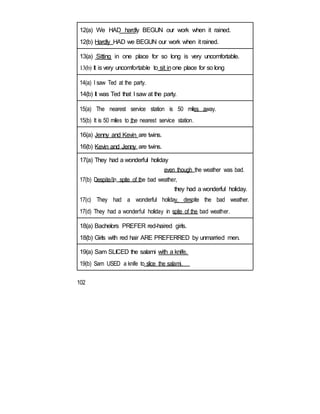
44
Below are a few hyperboles or overstatements:
- I’ve invited millions of (= a lot of) people to myparty.
- She sheds floods of tears (= cries a lot) whenever she is upset.
- Don’t live in such a sea of doubt!
(= Don’t be too suspicious!)
- Never in a millionyears will he admit defeat.
(= He will never admit defeat.)
- I haven’t seenyou for ages.
(= for a few weeks, for acouple of months, for a while)
2.8.6 Litotes
Litotes, which is also called meiosis, is the use of
deliberately gentler, milder or weaker statements to
express something in a controlled way.
- I don’t think I would agree with you. (= I disagree withyou.)
- I am afraid that no passenger is allowed to smoke in here.
(= You are not allowed to smoke in here.)
Quite often, an expression of litotes is an “ironical
understatement, especially using a negative to emphasize the
contrary.” [Crowther (ed.), 1992: 527]
- It’s not bad. (= It is fine.)
- It wasn’t easy. (= It was very difficult.)
- Always remember that she is no fool.
(= She is worldly-wise, in fact.)
- Jim was rather upset when he againfailed inthe final exam.
(= very upset)
45
2.8.7 Irony
Irony is the "expression of one’s meaning by saying the
direct opposite of one’s thoughts in order to be emphatic, amusing,
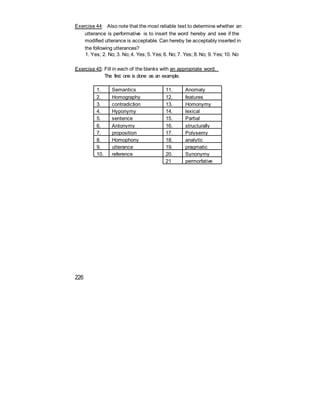
sarcastic, etc." [Crowther (ed.), 1992: 479]
Below are a few expressions of irony:
- What a lovely dayit was! Everything I had went wrong.
- He is so intelligent that no examiner has agreed to pass him
so far.
- He is lucky to have such an ugly and awkward wife.
- She is extremely unlucky to be born
in such a prosperous family in a developed European country.
- Your plan is really tricky. The other team will figure it out
in about one play.
2.8.8 Euphemism
2.8.8.1 Definition
Euphemism is "the use of pleasant, mild or indirect words or
phrases in place of more accurate or direct ones."
[Crowther (ed.), 1992: 305] Respectively, morticians (also called
undertakers) and a garbage man may be euphemistically replaced by
funeral directors and a sanitation engineer.
2.8.8.2 Distinction between a taboo word and a euphemism.
A taboo word, a ‘dirty’ word, is the word or the linguistic
expression that refers to a taboo act or behaviour in a society, a
culture or a speech community while a euphemism is the word or the
linguistic expression that replaces a taboo word or serves to
avoid a frightening or unpleasant subject.
46
It is crucial to recognize that a taboo word and its
euphemism share the same denotative meaning but they differ in
their connotative meanings: the taboo word has a negative
connotation whereas its euphemism has a positive connotation.
Below areanumber of common euphemisms andtheir taboowords:
Euphemisms Taboo words
social disease syphilis
criminal assault rape
handicapped crippled
mentally ill insane
underprivileged poor
developing or less developed(country) poor (country)
(more) developed (country) rich(country)
senior citizens the aged
laid to rest buried
perspiration sweat
intoxicated drunk
abdomen belly
odour stink or smell
expectorate spit
retarded or unusual mentally defective
hard of hearing deaf
love child bastard
47
Below are a few expressions of euphemism:
- Pass awayis a euphemism for die.
- He was his Majesty’s guest for two years is a euphemism for
He was in jail for two years.
2.8.9 Onomatopoeia
Onomatopoeia is the imitation of natural sounds by means of
words or groups of words. Hiss, cuckoo, thud, moo, baa, hush,
pop, etc. are onomatopoeic words. Growl, splash, crackle, etc.
exemplify semi-onomatopoeia.
Onomatopoeia can be identified in the following sentences:
- She is always squeakingand squawking.
- We could hear the enemy guns booming (away) in the distance.
- He felt a tap on his shoulder.
- Rain was dripping down from the trees. Its steady drip kept me
awake all night long.
Exercise 8: Interpret the meaning the following sentences and
state what kind of figures of speech (also called figurative
language) used in each of them.
1. When he gets going, Jack is a streak of lightning.
48
2. I found the fifty-two pounds of books you left for me to carry. Your
kindness really moved me.
3. The man is a demon for work.
4. When you take that course, plan to study thirty hours a day.
5. The wind howled angrily around the house all night.
6. When the White House called, the ambassador went at once.
7. My dormitory room is like a cave.
49
8. Come to the dormitory and see what a cave I live in.
9. Dick was fairly pleased when he won the brand-new car in the contest.
10. If you are not happy with the service, go and talk to the City Hall.
11. Man does not live by bread alone.
12. We now live under the same roof.
13. Albert was as sharp as a tack this morning. He answered every
question as soon as it was asked.
50
14. The river ate the bank away.
15. Keep overeating like that and pretty soon you’ll weigh a
thousand pounds.
16. After she heard the good news, she grinned like a mule eating briars.
17. The captain was in charge of one hundred horses.
18. Joe cried a little when he lost the thousand dollars.
19. You can depend on Gina; she is a rock when trouble comes.
51
20. Life is a dream.
21. He’s so hardheaded that he won’t listen to anyone.
22. Research says that these methods are best.
23. Right at this minute, I could drink a barrel of water without
stopping.
24. It is amazing what a great mind he is.
25. Alice came in gently, like a May breeze.
52
26. Susie is a picture of loveliness in her new dress.
27. A thousand thanks are for your kindness.
28. I walked past the big sad mouth which didn’t know what to say then.
29. We are tired to death of such movies.
30. Give every man thine ears, bid a few thy voice.
31. There was a storm in Parliament last night.
53
32. I’m afraid he has misrepresented the facts.
33. He worked and worked until he breathed his last.
34. We’ll just have to go our separate ways.
35. They were vital, unforgettable matches that gave us a new
window on the game.
36. I’ve told you a thousand times not to touch that again.
37. He is as mute as a fish.
54
38. We stopped to drink in the beautiful scenery.
39. His words can be trusted.
40. The police team has cemented close ties with the hospital staff.
41. The boss gave her a hot look.
42. He could not bridle his anger.
43. He attacked every weak point in my argument.
55
44. In 1940, after the fall of France, England had no defense left but
her ancient valor.
45. The fire snaps and crackles like a whip; its sharp acrid smoke stings
the eyes. It is the fire that drives athorn of memory in my heart.
46. The organization is keeping the brake on pay rises.
47. Her father is a captain of industry.
48. I am the captain of my soul.
49. To fall out of a tree inone’s earlychildhood isnot a particularly
reassuring experience.
56
50. No man is an island: entire of itself; every man is a piece of the continent.
2.9 Hyponymy
2.9.1 Definition
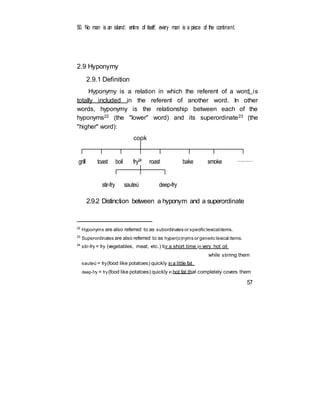
Hyponymy is a relation in which the referent of a word is
totally included in the referent of another word. In other
words, hyponymy is the relationship between each of the
hyponyms22 (the "lower" word) and its superordinate23 (the
"higher" word):
cook
grill toast boil fry24 roast bake smoke ………
stir-fry sauteù deep-fry
2.9.2 Distinction between a hyponym and a superordinate
22
Hyponyms are also referred to as subordinates or specific lexicalitems.
23
Superordinates are also referred to as hyper(o)nyms or generic lexical items.
24
stir-fry = fry (vegetables, meat, etc.) for a short time in very hot oil
while stirring them
sauteù = fry(food like potatoes) quickly in a little fat
deep-fry = fry(food like potatoes) quickly in hot fat that completely covers them
57
A hyponym is a word "whose referent is totally included in
the referent of another word (the prefix hypo- in hyponym
means ‘below’)." [Finegan, 1994: 165]
Accordingly, a superordinate is a word whose referent
covers all the referents of its hyponyms. (The prefix hyperin
hyper(o)nym means ‘over.’)
Ex1. plant
tree bush(shrub) flowering plant moss grass ………
Hyponyms oftenexist at more than one level, resulting in
multiple layers of hyponymic relationships:
Ex2. colour
blue red yellow green black ………
turquoise25 aquamarine royal blue
In this case, blue is a word that has a hyponym and a
superordinate at the same time. Since turquoise, aquamarine and
royal blue refer to different shades of blue, these words are
IMMEDIATE hyponyms [Palmer: 1981: 87] of blue. The word
blue in its turn is, along with many other colour terms, an
IMMEDIATE hyponym of colour. We thus obtain a hierarchy of
25
Turquoise = greenish blue; aquamarine= bluish green; royal blue = deep
bright blue
58
terms related to each other through hyponymic relationships.
Similar hierarchies can be established for many lexical fields:
Ex3. physical entity
plant animal rock
fish bird insect bug reptile mammal ………
sparrow hawk crow fowl ……… human animal (beast)
chicken turkey quail ……… dog cat cow ………
Note in this case that the word animal appears on two different
levels. English speakers indeed use the word to refer to at least
two different referents: animals as distinct from plants and rocks,
and animals (generally mammals other than humans) as distinct
from humans.
2.9.3 Hyponymy and inclusion
"HYPONYMY involves us in the notion INCLUSION in the
sense that tulip and rose are included in flower, and lion and
elephant in mammal (or perhaps animal). Similarly, scarlet is
included in red. Inclusion is thus a matter of class
membership. The ‘super’ term is the SUPERORDINATE and the
‘lower’ term is the HYPONYM." [Palmer, 1981: 85]
59
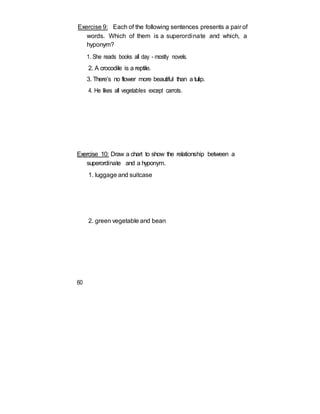
Exercise 9: Each of the following sentences presents a pair of
words. Which of them is a superordinate and which, a
hyponym?
1. She reads books all day - mostly novels.
2. A crocodile is a reptile.
3. There’s no flower more beautiful than a tulip.
4. He likes all vegetables except carrots.
Exercise 10: Draw a chart to show the relationship between a
superordinate and a hyponym.
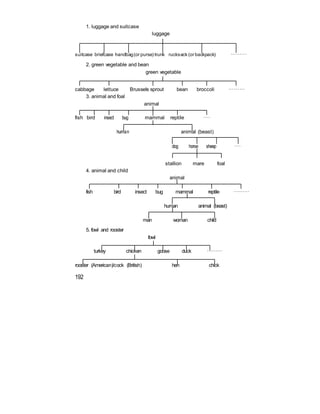
1. luggage and suitcase
xxxxxxxxxxxxxxxxxxxxxxxxxxxxxxx
2. green vegetable and bean
60
3. animal and foal
4. animal and child
5. fowl and rooster
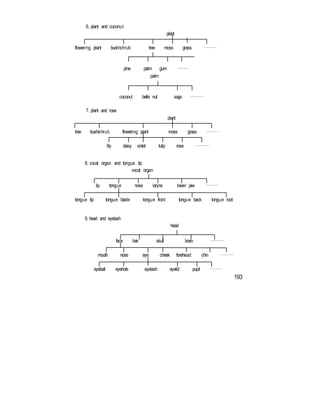
6. plant and coconut
7. plant and rose
61
8. vocal organ and tongue tip
9. head and eyelash
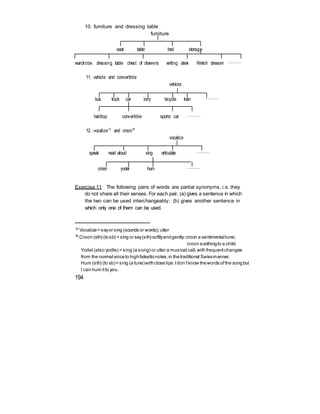
10. furniture and dressing table
11. vehicle and convertible
12. vocalize and croon
62
2.10 Synonymy
2.10.1 Definition
Synonymy is a relation in which various words have different
(written and sound) forms but have the same or nearly the
same meaning.
Ex1: The two English verbs hide and conceal are synonyms; they
both mean keep somebody/something from being seen or
known about.
Ex2: The four English nouns kind, type, sort and variety are
synonyms; they all refer to a group having similar
characteristics.
2.10.2 Distinction between true synonymy and
partial synonymy
2.10.2.1 True synonymy
There are few true synonyms in the lexicon of a language.
Ex1. Movie, film, flick26 and motion picture may be considered
as synonyms because they all refer to the same set of referents
in the real world. In other words, they have the same
denotative meaning. However, these lexical items differ in
their connotative meanings: movie may strike you as American
while film may strike you as British or as appropriate for
movie classics or art movies; flick is used chiefly in very
informal contexts whereas motion picture is quaintly
outdated and has connotations as a term from the thirties or
forties of the 20th century.
26
flick n [C] (dated, informal) cinema film
63
In brief, movie, film, flick and motion picture are not true
synonyms.
Ex2. Fast, quick and rapid may be considered as synonyms
because they may be used interchangeably in reference to
someone’s running speed: He’s a fast/quick/rapid runner.
However; a fast talker, one who is able to get out of trouble
by talking cleverly, is different from a quick talker, one who
usually talks in a rapid manner; some people may lead their
lives in the fast lane, not in the rapid lane or in the quick
lane; he has a quick mind, not a rapid mind or a fast mind; he
gave her a quick glance, not a rapid glance or a fast glance;
and rapid is the usual term when reference is made to a
person’s strides, especially metaphorical strides: Tom has made
rapid strides in his math this term. In brief, fast, quick and
rapid are not true synonyms.
Quite often, words that appear synonymous at first glance
actually refer to slightly different sets of concepts or are used in
different situations. "The fact that there are few true synonyms in
the lexicon of a language reflects the general tendency of language
users to make most of what is available to them. If two terms have the
same referent, the meaning of one of them is usually modified to
express differences in referential, social or affective meaning27.
Although true synonymy is rare, the notion is useful because it
helps describe similarities between the meanings of different
terms in the lexicon." [Finegan, 1994: 168]
27
In other words, synonyms usually have different connotations:mother,Mum,
Mom,Mummy,and Mommy.
64
2.10.2.2 Partial synonymy
Partial synonymy is a relation in which a polysemous word
shares one of its meanings with another word.
For example, one meaning of deep is synonymous with
profound in the pair of sentences marked (1)a-b. In other words,
deep and profound can be used interchangeably in (1)a-b. No
such interchange can be found in (2)a-b:
(1)a. You have my deep sympathy.
(1)b. You have my profound sympathy.
(2)a. The river is very deep at this point.
(2)b. *The river is very profound at this point.
Partial synonymy leads to collocations: a bunch of keys, a
herd of sheep, a school of ants, a flock of birds, a group of
teachers, a gang of thieves, etc.
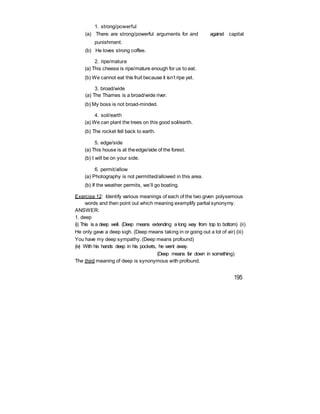
Exercise 11: The following pairs of words are partial synonyms,
i.e. they do not share all their senses. For each pair, (a) gives a
sentence in which the two can be used interchangeably; (b)
gives another sentence in which only one of them can be used.
1. strong/powerful
(a) ________________________________________________
(b) ________________________________________________
2. ripe/mature
(a) ________________________________________________
(b) ________________________________________________
65
3. broad/wide
(a) ________________________________________________
(b) _______________________________________________
4. soil/earth
(a) ________________________________________________
(b)
5. edge/side
(a) ________________________________________________
(b) ________________________________________________
6. permit/allow
(a)_________________________________________________
(b)_________________________________________________
Exercise 12: Identify various meanings of each of the two given
polysemous words and then point out which meaning exemplify
partial synonymy.
1. deep
(i) This is a deep well.
(ii) He only gave a deep sigh.
(iii) You have my deep sympathy.
(iv) With his hands deep in his pockets, he went away.
The ________meaning of deep is synonymous with__________.
66
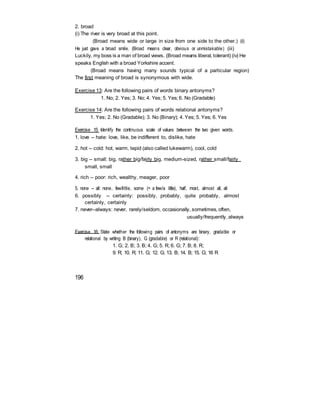
2. broad
(i) The river is very broad at this point. (ii)
He just gave a broad smile.
(iii) Luckily, my boss is a man of broad views.
(iv) He speaks English with a broad Yorkshire accent.
The _________ meaning of broadis synonymous with ________.
2.11 Antonymy
2.11.1 Definition
Antonymy is a relation in which two words have different
(written and sound) forms and are opposite in meaning.
Ex1: Pass--fail, hot--cold and thinner--fatter are three
pairs of antonyms.
Ex2: True--false, big--small and buy--sell are three pairs of
antonyms.
2.11.2 Classification
2.11.2.1 Binary antonymy28 and gradable antonymy
2.11.2.1.1 Below is probably a common way of telling binary
antonymy from gradable antonymy:
Binary antonymy is a relation in which two members of a pair of
antonyms:
28
Binaryantonymyis also referred to as complementaryantonymy.
67
(a) are mutually exclusive: not alive is dead and not dead is alive.
(b) cannot be used in a comparative or superlative sense:
*He is more single/more married than his brother.
(c) cannot be used in questions with how to ask about degrees:
*How single/How married is he?
Thus, alive--dead and married--single are two pairs of
binary antonyms.
Gradable antonymy is a relation in which two members of a
pair of antonyms:
(a) are gradable: between hot and cold are three
"intermediate terms" [Palmer, 1981: 95] warm, tepid (or
lukewarm) and cool.
(b) can be used ina comparative or superlative sense: wider is
less narrow, more difficult is less easy, etc.
(c) can be used in questions with how to ask about degrees:
How difficult is the test?29
Thus, hot--cold and difficult--easy are two pairs of
gradable antonyms.
2.11.2.1.2 The distinction between binary antonymy and
gradable antonymy is sometimes blurred by language users. In
English, for example, it is reasonable to assume that whatever is
alive is not dead and that whatever is dead is not alive, and thus
29
How easyis the test? is also possible, but its context is very restricted, e.g. to
show that one can manage to pass the test without any difficulty.
68
that the adjectives dead and alive form a pair of binary antonyms.
However, we do have expressions like half-dead, barely alive,
and more dead than alive, which suggest that, in some contexts,
we see alive and dead as gradable antonyms. Nevertheless, the
distinction between the two types of antonyms is useful in
that it describes an important distinction between two types of
word relationships.
2.11.2.2 Relational antonymy
Two members of a pair of relational antonyms30 display
symmetry in their meaning. The "if…, then …" formula can be
used to test and identify relational antonyms: if Mr. Brown is
Jack’s employer, then Jack is Mr. Brown’s employee; if Jenny is
thinner than Mary, then Mary is fatter than Jenny; if John
bought a car from Fred, then Fred sold a car to John; etc.
Thus, buy--sell, employer--employee, and thinner--fatter
are three pairs of relational antonyms.
Relational antonyms belong to various word classes:
Verbs: buy--sell, give--receive, lend--borrow, import--
export, own--belong to, etc.
Nouns: employer--employee, grandparent--grandchild,
father/mother--son/daughter, fianceù--fianceùe,
parent--child/offspring, professor--student,
teacher--pupil, doctor--patient, debtor--creditor,
landlord/landlady--tenant, husband--wife,
uncle/aunt--nephew/niece, etc.
30
Relational antonyms are also called converses.
69
Comparative adjectives: thinner--fatter, cheaper --
more expensive, greater than--less than, etc.
Comparative adverbs: more efficiently--less efficiently,
faster--more slowly, etc.
Prepositions: above--below, in front of--behind,
over--under, before--after, north of--south of,
west of--east of, etc.
2.11.3 Antonymy and (un)markedness
Words that are in an antonymous relationship often do
not have equal status with respect to markedness. In a pair of
antonyms, one member is more unmarked (or less marked) and
the other is more marked (or less unmarked), e.g. high--low, tall-
-short, heavy--light, far--near, expensive--cheap, hot--cold,
long--short, wide--narrow, deep--shallow, difficult--easy,
married--single, well--badly, etc.
The unmarkedness of one member of any pair of antonyms
enables it to occur in questions of degree like How heavy is it?
(not How light is it?), How tall are you? (not How short are
you?), How deep is the canal? (not How shallow is the canal?),
How expensive is this bracelet? (not How cheap is this bracelet?),
How well can you speak English? (not How badly can you speak
English?), etc.
Similarly, since married is less marked than single, we say we
talk about one’s marital status, and not about one’s single status.
70
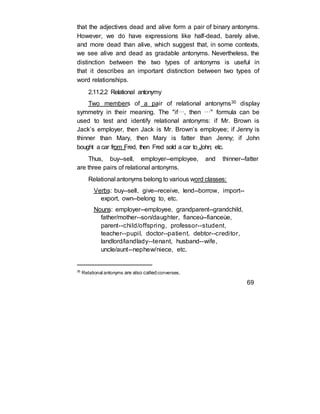
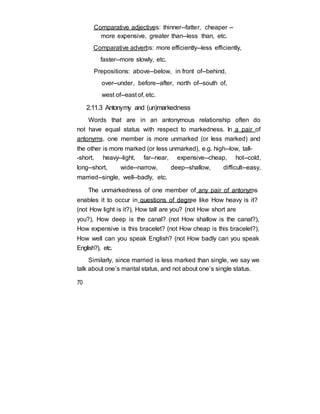
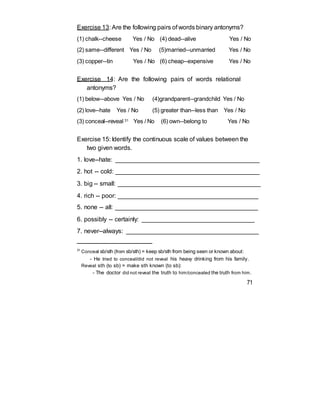
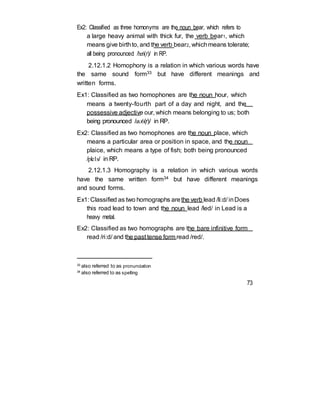
Exercise 13: Are the following pairs of words binary antonyms?
(1) chalk--cheese Yes / No (4) dead--alive Yes / No
(2) same--different Yes / No (5)married--unmarried Yes / No
(3) copper--tin Yes / No (6) cheap--expensive Yes / No
Exercise 14: Are the following pairs of words relational
antonyms?
(1) below--above Yes / No (4)grandparent--grandchild Yes / No
(2) love--hate Yes / No (5) greater than--less than Yes / No
(3) conceal--reveal 31 Yes / No (6) own--belong to Yes / No
Exercise 15: Identify the continuous scale of values between the
two given words.
1. love--hate: _________________________________________
2. hot -- cold: _________________________________________
3. big -- small: _________________________________________
4. rich -- poor: ________________________________________
5. none -- all: _________________________________________
6. possibly -- certainly: ________________________________
7. never--always: ______________________________________
31
Conceal sb/sth (from sb/sth) = keep sb/sth from being seen or known about:
- He tried to conceal/did not reveal his heavy drinking from his family.
Reveal sth (to sb) = make sth known (to sb):
- The doctor did not reveal the truth to him/concealed the truth from him.
71
Exercise 16: State whether the following pairs of antonyms are
binary, gradable or relational by writing B (binary), G
(gradable) or R (relational):
1. good--bad: ______________
2. pass--fail:
3.deciduous--evergreen:_____
4.expensive— cheap: ________
5.parent--offspring: ________
6. beautiful--ugly: __________
7. false--true:______________
8. lessor--lessee: ___________
2.12 Homonymy
9. import--export: ______________
10. better than--worse than: ____
11. easy--difficult: _____________
12. hot--cold:
__________________ 13. legal--
illegal:
14. asleep--awake:
______________ 15. rude--
polite:________________ 16.
husband--wife:
2.12.1 Distinction between homonymy, homophony and
homography
2.12.1.1 Homonymy is a relation in which various words have
the same (sound and written) form but have different
meanings.
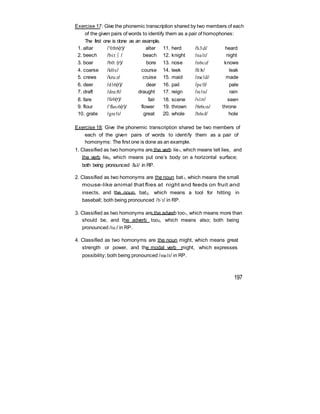
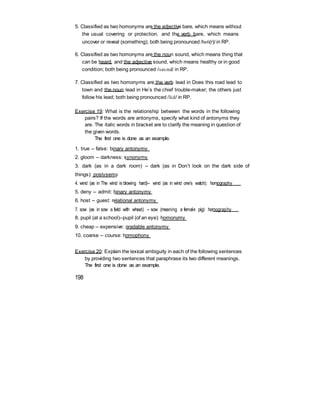
Ex1: Classified as two homonyms are the noun bank1, which
means a financial institution, and the noun bank2, which
means the shore of a river; both being pronounced /b`7k/ in
RP32.
32
Received Pronunciation (usually abbreviated to RP) "is most familiar as the
accent used by most announcers and newsreaders on serious national and
international BBC broadcasting channels." Also, it "is often most recommended for
foreign learners studying British English." [Roach, 1991: 4]
72
Ex2: Classified as three homonyms are the noun bear, which refers to
a large heavy animal with thick fur, the verb bear1, which
means give birthto, and the verb bear2, whichmeans tolerate;
all being pronounced /be6(r)/ in RP.
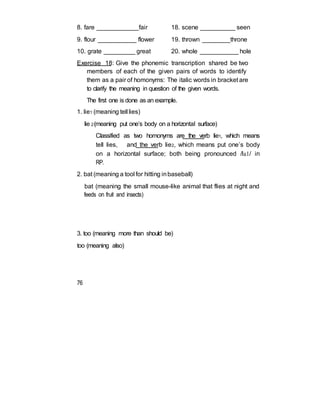
2.12.1.2 Homophony is a relation in which various words have
the same sound form33 but have different meanings and
written forms.
Ex1: Classified as two homophones are the noun hour, which
means a twenty-fourth part of a day and night, and the
possessive adjective our, which means belonging to us; both
being pronounced /a6(r)/ in RP.
Ex2: Classified as two homophones are the noun place, which
means a particular area or position in space, and the noun
plaice, which means a type of fish; both being pronounced
/ple1s/ in RP.
2.12.1.3 Homography is a relation in which various words
have the same written form34 but have different meanings
and sound forms.
Ex1: Classified as two homographs arethe verb lead /li:d/ inDoes
this road lead to town and the noun lead /led/ in Lead is a
heavy metal.
Ex2: Classified as two homographs are the bare infinitive form
read /ri:d/ and the past tense form read /red/.
33
also referred to as pronunciation
34
also referred to as spelling
73
2.12.2 Homophones as a distinct type of homonyms
“The terminological relationship between homonymy,
homography, and homophony is not entirely clear. For instance,
homophones that are not homographs are sometimes
classified as a distinct type of homonyms, but the formal identity
of homonyms may also be defined so strictly as to exclude non-
homographic homophones from the class of homonyms (at least
for those languages that have written records). The very fact that
homonyms are different words (i.e., that they are distinct entities in
the lexicon) implies that they are semantically distinct." [Asher
and Simpson, 1994: 1595]
Consider the following table and identify antonymy,
synonymy, homonymy, homophony, and homography via their
main features.
Writtenform Sound form Meaning
antonymy   

synonymy   +
homonymy + + 

homophony  + 

homography +  
+ : the same or nearly the same; 
: different or opposite
74
Among a number of linguists who regard non-homographic
homophones as a distinct type of homonyms are Fromkin and
Rodman [1993: 129]: "Homonyms are different words that are
pronounced the same, but may or may not spelled the same. To,
two and too are homonyms because they are pronounced the
same, despite their spelling differences."
These authors and many others may require homonymy
redefined:
Homonymy is a sense relation in which various words are
written the same way and/or sound alike but have different
meanings, e.g. feat (strength or courage) and feet (plural of
foot), know (have something in one’s mind) and no (not any), row
(a quarrel) and row (a line), wound (an injury) and wound (past of
wind), etc.
Exercise 17: Give the phonemic transcription shared by two
members of each of the given pairs of words to identify
them as a pair of homophones:
The first one is done as an example.
1. altar /‘0:lt6(r)/ alter
2. beech __________ beach
3. boar ___________ bore
4. coarse _________ course
5. crews ___________ cruise
6. deer ____________ dear
7. draft ___________ draught
11. herd __________ heard
12. knight _________ night
13. nose __________ knows
14. leek ____________ leak
15. maid ___________ made
16. pail _____________ pale
17. reign ___________ rain
75
8. fare ____________fair 18. scene __________ seen
9. flour ___________ flower 19. thrown ________throne
10. grate _________ great 20. whole ___________ hole
Exercise 18: Give the phonemic transcription shared be two
members of each of the given pairs of words to identify
them as a pair of homonyms: The italic words in bracket are
to clarify the meaning in question of the given words.
The first one is done as an example.
1. lie1 (meaning tell lies)
lie 2(meaning put one’s body on a horizontal surface)
Classified as two homonyms are the verb lie1, which means
tell lies, and the verb lie2, which means put one’s body
on a horizontal surface; both being pronounced /la1/ in
RP.
2. bat (meaning a tool for hitting inbaseball)
bat (meaning the small mouse-like animal that flies at night and
feeds on fruit and insects)
3. too (meaning more than should be)
too (meaning also)
76
4. might (meaning great strength or power)
might (expressing possibility)
5. bare (meaning without the usual covering or protection)
bare (meaning uncover or reveal something)
6. sound (meaning thing that can be heard)
sound (meaning healthy or in good condition)
7. lead (as in Does this road lead to town)
lead (as in He’s the chief trouble-maker; the others just follow his
lead)
Exercise 19: What is the relationship between the words in the
following pairs? If the words are antonyms, specifywhat kind
of antonyms they are. The italic words inbracket are to clarify
the meaning inquestion of the given words.
77
The first one is done as an example.
1. true -- false: binary antonymy
2. gloom -- darkness: __________________
3. dark (as in a dark room) -- dark (as in Don’t look on the dark
side of things): __________________
4. wind (as in The wind is blowing hard) -- wind (as in wind one’s
watch): __________________
5. deny -- admit: __________________
6. host -- guest: __________________
7. sow (as in sow a field with wheat) -- sow (meaning a female
pig): __________________
8. pupil (at a school) -- pupil (of an eye): __________________
9. cheap -- expensive: __________________
10. coarse -- course: __________________
2.13 Polysemy
2.13.1 Definition
Polysemy is a relation in which a single word has two or more
slightly different but closely related meanings.
Ex1: The noun chip has the three following meanings:
(i) a small piece of some hard substance which has been
broken off from something larger: a chip of wood/glass.
78
(ii) a small cut piece of potato whichis fried for eating: CanI
try one of your chips?
(iii) a small but vital piece of a computer: This computer has
got a faster chip than the old one.
The three meanings are closely related because they all
contain the semantic feature [+small piece].
Ex2: The verb break has the two following meanings:
(i) separate into two or more parts as a result of force
or strain (but not cutting): He broke that cup.
(ii) become unusable bybeing damaged; make (something)
unusable by damaging: My watch is broken.
The two meanings are closely related because both contain the
semantic feature [+can no longer be used].
2.13.2 Distinction between polysemy and homonymy
A well-known problem in semantics is how to decide whether we
are dealing with a single polysemous word (like plain) or with two or
more homonyms (like port1, as in The ship left port, and port2, as
in He drank port). In other words, how do you know when you
have separate lexical items rather than a single word with different
meanings?
Using SPELLING as a criterion is misleading: many sets of
words are obviously distinct but have the same spelling as, for
example, the noun sound meaning noise and the adjective sound
meaning healthy, or the noun bank1 meaning financial institution
and the noun bank2 meaning shore of a river.
79
One modestly reliable criterion is the word’s ETYMOLOGY, or
historical origin. Take as an example the two English words which
derive from different Anglo-Saxon roots: bank1 meaning financial
institution is an early borrowing from French while bank2 meaning
shore of a river has a Scandinavian origin.
The various ANTONYMS and SYNONYMS of a word provide a
different kind of criterion that can be useful in distinguishing
between HOMONYMY and POLYSEMY. Since the two senses of
plain, which are (1) clear or easy and (2) undecorated, share a
synonym in simple and an antonym in complex. This fact suggests
that they are indeed two meanings of one and the same
POLYSEMIC word. No such shared synonym or antonym can be
identified for the two meanings of sound, which is, by chance, the
form of two different words, sound1 and sound2, which have the
same spelling and thus, also sound alike.
Another interesting question is whether there is any
COMMONALITY between the different meanings of what
appears to be the same word. The two meanings of plain can be
characterized as devoid of complexity, which suggests that they are
related, but no such description exists for bank1 and bank2. Thus
plain in these two senses is POLYSEMIC, while the two senses of
bank reflect HOMONYMIC lexical items.
There is no doubt that it is often difficult to decide whether a
particular pair of look-alike and sound-alike word forms are two
separate homonymous words or simply a polysemic word with
different meanings. Though HOMONYMY and
POLYSEMY can be distinguished as different notions, the
boundary between them is not clear-cut.
80
Also notice that homonyms like bank1 and bank2, port1 and
port2, sound1 and sound2, etc. are treated in distinct dictionary
entries whereas two or more closely related meanings of the
polysemous word foot, chip, or plain are linked together within
only one dictionary entry.
2.14 Ambiguity
2.14.1 Structural ambiguity
A sentence is considered as structurally ambiguous when its
structure permits more than one interpretation.
For example, we can consider the prepositional phrase with
binoculars in We watched the hunters with binoculars either as an
adjectival to be the post-nominal modifier of the noun phrase the
hunters or as an adverbial to be the optional adjunct of means of the
verb watched.
S S
NP1 VP NP1 VP1
Pro Vgrp NP2 Pro VP2 AdvP
[mono-trans] [dO] [opA of Means]
Vgrp NP2
NP3 AdjP [mono-trans] [dO] PP
We watched thehunters withbinoculars.We watched the hunters with binoculars.
81
2.14.2 Lexical ambiguity
Any ambiguity resulting from the ambiguity of a word is
lexical ambiguity.
Ex1. We can interpret the sentence Theywere waiting at the bank
in two different ways because the two nouns bank — bank1,
which means financial institution and bank2, which means
shore of the river — are two homonyms.
Ex2. We can interpret the sentence That robot is bright in two
different ways because the adjective bright is a polysemous
word which has two slightly different but closely related
meanings: shining and intelligent.
Thus, both polysemy and homonymy contribute to lexical
ambiguity.
Exercise 20: Explain the lexical ambiguity in each of the
following sentences by providing two sentences that
paraphrase its two different meanings.
The first one is done as an example.
1. They were waiting at the bank.
Meaning one: They were waiting at the financial institution.
Meaning two: They were waiting at the shore of the river.
2. The long drill is boring.
Meaning one:
______________________________________
Meaning two:
______________________________________
82
3. When he got the clear title to the land, it was a good deed.
Meaning one:
______________________________________
Meaning two:
______________________________________
4. The proprietor of the fish store was the sole owner.
Meaning one:
______________________________________
Meaning two:
______________________________________
5. We like the ball.
Meaning one:
______________________________________
Meaning two:
______________________________________
6. They passed the port at night.
Meaning one:
______________________________________
Meaning two:
______________________________________
7. The captain corrected the list.
Meaning one:
______________________________________
Meaning two:
______________________________________
8. He was knocked over by the punch.
Meaning one:
______________________________________
Meaning two:
______________________________________
9. The camel swallowed the chocolate and then ate it.
Meaning one:
______________________________________
Meaning two:
______________________________________
83
Exercise 21: Does polysemy or homonymy contribute to the lexical
ambiguity in each of the two given sentences.
(1) She cannot bear children.
(2) The cat sat on the mat.
Exercise 22: In what way are homonyms related to lexical
ambiguity?
Exercise 23: In what way is a polysemous word relatedto lexical
ambiguity?
84
Exercise 24: Explain the structural ambiguity in each of the
following sentences:
1. The drunkard visitor
rolled up the carpet.
2. Is he really that kind?
3. My fianceùe is reserved.
4. I saw her slip.
5. I saw her duck.
6. They are cooking bananas.
7. They are moving sidewalks. 8.
John
loves Richard more than Martha.
9. Old men and women
will be served first.
10. The thing that bothered Bill
was crouching under the table.
1(a) The drunkard visitor 1(b) The drunkard visitor
rolled up the carpet. rolled up the carpet.
2(a) Is he really that kind? 2(b) Is he really that kind?
3 (a) My fianceùe is reserved. 3(b) My fianceùe is reserved.
85
4(a) I saw her slip. 4(b) I saw her slip.
5(a) We saw her duck. 5(b) We saw her duck.
6(a) They are cooking bananas. 6(b) They are cooking bananas.
7(a) They are moving sidewalks. 7(b) They are moving sidewalks.
8(a) John loves Richard 8(b) John loves Richard
more than Martha. more than Martha.
86
9(a) Old men and women 9(b) Old men and women
will be served first. will be served first.
10(a) The thing that bothered Bill 10(b)The thing that bothered Bill
was crouching under the table. was crouching under the table.
2.15 Anomaly
2.15.1 Definition
Anomaly is "a violation of semantic rules to create
nonsense." [Finegan, 1993: 148]
Ex1. That bachelor is pregnant is semantically anomalous because
bachelor is [+male] whereas pregnant is [+female].
Ex2. My brother is the only child in the family is an English
sentence that is grammatically correct and syntactically
perfect; however, it is semantically anomalous because it
represents a contradiction. The meaning of brother includes
the semantic feature [+having at least one sibling] whereas
the only child in the family is [+having no other sibling].
87
2.15.2 Anomaly and contradiction
Anomaly involves us in the notion contradiction in the sense that
semantically anomalous sentences constitute a type of
contradictory sentences. For example, John killed Bill, who
remained alive for many years after is semantically anomalous
because the so-called sentence represents a contradiction: no living
organism can remain alive after being killed. In fact, Bill died right at
the moment John killed him.
Exercise 25: Explain the anomaly of each of the following
sentences.
1. Christopher is killing phonemes.
2. My brother is a spinster.
3. The boy swallowed the chocolate and then chewed it.
4. Babies can lift one ton.
88
5. Puppies are human.
6. My unmarried sister is married to a bachelor.
7. The bigger key and John opened the door.
8. James sliced the ideas.
9. Jack’s courage chewed the bones.
10. I hear the cloud.
11. The tiger remained alive for an hour after the hunter killed it.
89
Exercise 26: How caneachof the givensentences be changed to
avoid anomaly?
1. ____________________________________________________
2. ____________________________________________________
3. ____________________________________________________
4. ____________________________________________________
5. ____________________________________________________
6. ____________________________________________________
7. ____________________________________________________
8. ____________________________________________________
9. ____________________________________________________
10. ___________________________________________________
11. __________________________________________________
90
Section
3
SENTENCE MEANING
“SENTENCE MEANING is what a sentence means,
regardless of the context and situation in which it may be used."
[Hurford and Heasley, 1984: 269]
3.1 Proposition, utterance and sentence
3.1.1 "A PROPOSITION is that part of the meaning of the
utterance of a declarative sentence which describes some
state of affairs. The state of affairs typically involves persons or
things referred to by expressions in the sentence. In uttering a
declarative sentence a speaker typically asserts a proposition."
[Hurford and Heasley, 1984: 19]
Ex1. The following pair of sentences expresses the same
proposition:
1(a) Harry took out the garbage.
1(b) Harry took the garbage out.
The following pair of sentences expresses different propositions:
2(a) Isobel loves Tony.
2(b) Tony loves Isobel.
91
Ex2. The following pair of sentences expresses the same
proposition:
3(a) John gave Mary a book.
3(b) Mary was given a book by John.
The following pair of sentences expresses different propositions:
4(a) George danced with Ethel.
4(b) George didn’t dance withEthel.
Exercise 27: Do the two following sentences have the same
proposition?
(1) Mr Dindlaykilled Janet.
(2) Mr Dindlay caused Janet to die.
Exercise 28: Explain why the two members of each of the
following pairs of sentences35 do not share the same
proposition.
35
This means the two members of each pair are not paraphrases of each other.
92
1(a) John is the parent of James. 3(a) The fly was on the wall.
1(b) James is the parent of John. 3(b) The wall was under the fly.
2(a) The hunter bit the lion. 4(a) Jack was injured by a stone.
2(b) The lion bit the hunter. 4(b) Jack was injured with a stone.
3.1.2 Distinction between a proposition and a sentence
“Propositions, unlike sentences, cannot be said to belong to
any particular language. Sentences in different languages can
correspond to the same proposition, if the two sentences are
perfect translations of each other." [Hurford and Heasley, 1984:
21-22] For example, English I’am cold, French J’ai froid, German
Mir ist kalt and Vietnamese Toâi laïnh can, to the extent to which
they are perfect translations of each other, be said to correspond to
the same proposition.
93
3.1.3 Distinction between an utterance and a sentence
“An UTTERANCE is the USE by a particular speaker, on a
particular occasion, for a particular purpose, of a piece of
language, such as a sequence of sentences, or a single phrase, or
even a single word." [Hurford and Heasley, 1984: 15]
“A SENTENCE is neither a physical event nor a physical
object. It is conceived abstractly, a string of words put
together by the grammatical rules of a language. A sentence
can be thought of as the IDEAL string of words behind various
realizations in utterances and inscriptions." [Hurford and Heasley,
1984: 16]
Jane: ‘Coffee?’  Would you like some coffee?
Steve: ‘Sure!’  I’m sure to love it.
Jane: ‘White?’  Would you like (black coffee or) white coffee?
Steve: ‘Black.’  I’d like black coffee, please.
(One-word utterances) (Well-formed sentences)
“The distinction between sentence and utterance is of
fundamental importance to both semantics and pragmatics.
Essentially, we want to say that a sentence is an abstract
theoretical entity defined within a theory of grammar, while
utterance is the issuance of a sentence." [Levinson, 1983: 18]
“Utterances of non-sentences, e.g. short phrases or
single words, are used by people in communication all the time.
People do not converse wholly in (tokens of) well-formed
sentences. But the abstract idea of a sentence is the basis for
understanding even those expressions, which are not
94
sentences. In the overwhelming majority of cases, the meaning of
non-sentences can be best analysed by considering them to be
abbreviations, or incomplete versions, of whole sentences."
[Hurford and Heasley, 1984: 18]
“The term ‘utterance’ can be used to refer either to the
process (or activity) of uttering or to the product of that
process (or activity). Utterances in the first of these two senses are
commonly referred to nowadays as speech acts; utterances in the
second sense may be referred to — in a specialized sense of the
term — as inscriptions36." [Lyons, 1995: 235]
3.1.3 Distinction between a proposition, a sentence and an
utterance
3.1.3.1 "It is useful to envisage the kind of family tree
relationship between the three notions shown in the diagram. For
example, a single proposition could be expressed by using
several sentences (say The Monday Club deposed Mrs Thatcher, or
Mrs Thatcher was deposed by The Monday Club) and each of these
sentences could be uttered an indefinite number of times."
[Hurford and Heasley, 1984: 23]
PROPOSITION
SENTENCE SENTENCE SENTENCE
UTTERANCE UTTERANCE UTTERANCE UTTERANCE UTTERANCE UTTERANCE
36
The term ‘inscriptions’ is "not widely used by linguists. It must be interpreted as
being more appropriate to the written than it is to the spoken language." [Lyons,
1995: 235]
95
3.1.3.2 Also, it is interesting to note that the same
proposition can be expressed by different sentences and that the
same sentence can be realised by different utterances on
particular occasions.
Exercise 29: Fill in the following chart given by Hurford and
Heasley [1984: 23] with ‘+’ or ‘-’ as appropriate. Thus, for
example, if it makes sense to think of a propositionbeing a
particular regional accent, put a ‘+’ in the appropriate box; if
not put a ‘-.’
Utterances Sentences Propositions
Can be loud or quiet
Can be grammatical or not
Can be true or false
In aparticularregionalaccent
In a particularlanguage
3.2 Sentence types (classified according to truth value37)
37
"You can understand well-formed sentences of your language without knowing
their truth value. Knowing the truth conditions is not the same as knowing the
actual facts. Rather, the truth conditions, the meaning, permit you to examine the
world and learn the actual facts … Knowing a language includes knowing the
semantic rules for combining meanings and the conditions under which
sentences are true or false." [Fromkin and Rodman, 1993: 146]
96
3.2.1 "An ANALYTIC sentence is one that is necessarily
TRUE, as a result of the senses of the words in it." [Hurford and
Heasley, 1984: 91-92]
Ex1. All elephants are animals.
The truth of this sentence follows from the senses of
elephants and animals.
Ex2. Sam’s wife is married.
The truth of this sentence follows from the senses of wife and
married.
3.2.2 A contradictory sentence, which is also called "A
CONTRADICTION38, is a sentence that is necessarily FALSE, as a
result of the senses of the words in it. Thus a contradiction is in a
way the opposite of an analytic sentence." [Hurford and Heasley,
1984: 93]
Ex1. This animal is a vegetable is a contradictory sentence; it
must be false because of the senses of animal and vegetable.
Ex2. Sam is older than himself 39 is a contradictory sentence; it
must be false because of the senses of older than and
himself. In fact, Sam canbe older (or younger) thansomebody
else, but not than himself.
38
A contradictory sentence is also referred to as a contradiction by Peccei
[1999: 9] and Hurford and Heasley [1984: 93]. Goddard [1998: 17] uses the term
contradiction to refer to a somewhat different notion: “Contradiction is where a
sentencemust be falsebecause ofthe meanings involved.”
39
Notice that Sam looks older than he is proves to be a synthetic sentence.
97
3.2.3 "A SYNTHETIC sentence is one which is NOT analytic,
but may be either true or false, depending on the way the world is."
[Hurford and Heasley, 1984: 92]
Ex1. John is from Ireland.
There is nothing in the senses of John, Ireland or from
which makes the sentence necessarily true or false.
Ex2. Sam’s wife is German.
There is nothing in the senses of Sam’s, wife or German
which makes the sentence necessarily true or false.
Exercise 30: Circle the following sentences A for analytic, S for
synthetic or C for contradiction, as appropriate.
1. John’s nine-year-old brother is a boy. A / S / C
2. John’s brother is nine years old. A / S / C
3. Cats are not vegetables. A / S / C
4. No cats like to bathe. A / S / C
5. Cats never live more than 20 years. A / S / C
6. My watch is slow. A / S / C
7. My watch is a device for telling the time. A / S / C
8. That girl is her own mother’s mother. A / S / C
9. That boy is his own father’s son. A / S / C
10. Alice is Ken’s sister. A / S / C
11. Some typewriters are dusty. A / S / C
12. If it breaks, it breaks. A / S / C
13. John killed Bill, who remained alive for many years after. A / S / C
14. Bachelors cannot form lasting relationships. A / S / C
15. Bachelors are lonely. A / S / C
98
3.3 Paraphrase
3.3.1 Definition
3.3.1.1 PARAPHRASE is "the relationship between a word
and a combination of other words with the same meaning. For
instance, many people would agree that loud means something like
can be heard from far away. Ultimately, the whole project of
describing or explaining word-meanings depends on paraphrase
because we must use words — or other equivalent symbols — to
explain other words." [Goddard, 1998: 18]
3.3.1.2 "When asked what a sentence means, people usually
provide another sentence that has virtually the same
meaning, a paraphrase." [Peccei, 1999: 3]
3.3.1.3 "A sentence which expresses the same proposition as
another sentence is a paraphrase of that sentence."
[Hurford and Heasley, 1984: 104]
3.3.1.4 "Sentences are paraphrases if they have the same
meaning (except possibly for minor differences in
emphases)." [Fromkin and Rodman, 1993: 132]
Consider the two following sentences:
(1) The girl kissed the boy.
(2) The boy was kissed by the girl.
Although there may be a difference in the emphasis in these two
sentences — in the second the emphasis is on what happened to the
boy, whereas in the first the emphasis is on what the girl did — the
meaning relations between the verb kiss and the two noun
99
phrases the girl and the boy are the same in both cases, and on this
basis the two sentences are paraphrases of each other.
3.3.2 Possible ways to paraphrase a sentence
There are a variety of ways that we could paraphrase a sentence:
(1) Change individual words:
1(a) using synonyms:
Cats DRINK cream.  Domestic felines CONSUME
the liquid fat of milk.
1(b) using relational antonyms (also called converses):
I LENT that book to Jim.  Jim BORROWED that book from me.
(2) Change sentence structure:
Cats DRINK cream.  CreamIS DRUNK bycats.
(3) Change both individual words and sentence structure:
Cats DRINK cream.  The liquid fat of milk IS DRUNK
by domestic felines.
To provide a paraphrase we use our knowledge of both the
meanings of individual words and of the English grammar.
Exercise 31: The following pairs are paraphrasesof eachother.
Identify the way employed to paraphrase them.
1(a) The house was CONCEALED by the tree. 1(b)
The house was HIDDEN by the tree.
100
2(a) The needle is too short.
2(b) The needle is not long enough.
3(a) Some countries have no coastline.
3(b) Not all countries have a coastline.
4(a) Watching television is not a waste of time.
4(b) Watching television is a good way to spend one’s time.
5(a) My friend LOATHES string beans.
5(b) My pal HATES pole beans.
6(a) I’ll LOOK FOR that book right now.
6(b) I’ll SEEK FOR that book at once/immediately.
7(a) Steve HUGGED Jane.
7(b) Steve GAVE Jane a hug.
8(a) John is the parent of James.
8(b) James is the child of John.
9(a) My father OWNS this car.
9(b) This car BELONGS TO my father.
10(a) John SOLD the book to David.
10(b) David BOUGHT the book from John.
11(a) Steve HUGGED Jane.
11(b) Jane WAS HUGGED by Steve.
101
12(a) We HAD hardly BEGUN our work when it rained.
12(b) Hardly HAD we BEGUN our work when it rained.
13(a) Sitting in one place for so long is very uncomfortable.
13(b) It is very uncomfortable to sit inone place for so long
14(a) I saw Ted at the party.
14(b) It was Ted that I saw at the party.
15(a) The nearest service station is 50 miles away.
15(b) It is 50 miles to the nearest service station.
16(a) Jenny and Kevin are twins.
16(b) Kevin and Jenny are twins.
17(a) They had a wonderful holiday
even though the weather was bad.
17(b) Despite/In spite of the bad weather,
they had a wonderful holiday.
17(c) They had a wonderful holiday, despite the bad weather.
17(d) They had a wonderful holiday in spite of the bad weather.
18(a) Bachelors PREFER red-haired girls.
18(b) Girls with red hair ARE PREFERRED by unmarried men.
19(a) Sam SLICED the salami with a knife.
19(b) Sam USED a knife to slice the salami.
102
20(a) Considering your condition, we won’t press charges.
20(b) Under the circumstances, we won’t press charges.
21(a) The laser HAS a wide variety of applications.
21(b) As we have seen, the use of the laser IS numerous.
22(a) In order to make a good impression at a job interview,
you should prepare well for the interview.
22(b) As you can see, it is necessary to be well prepared for
the job interview.
23(a) Synonyms, words that have the same basic meaning,
do not always have the same emotional meaning.
23(b) Many so-called synonyms are not really synonyms at all.
24(a) The compositionproficiencyrequirements as now stated
should not apply.
24(b) I would propose that the standard used to judge international
studentpapersberelaxedor doneaway with.
25(a) Although Grants Pass, Oregon, is a fairly small town,
it offers much to amuse summer visitors.
25(b) If you want to give your family a nice, wholesome
vacation, try visiting Grants Pass, Oregon.
103
3.4 Entailment
3.4.1 Definition
3.4.1.1 "Entailment is a relationship that applies between two
sentences40, where the truth of one implies the truth of the
other because of the meanings of the words involved." [Goddard,
1998: 17]
For example, John was killed entails John died. Obviously,
John died could not be true any time before it was true that John was
killed.
3.4.1.2 "An entailment is something that logically follows
from what is asserted in the utterance." [Yule, 1996: 25]
Shirley: ‘It’s so sad. George regrets getting Mary pregnant.’
Jean: ‘But he didn’t get her pregnant. We know that now.’
In the above conversation, Jean’s utterance of ‘he didn’t get
her pregnant’ actually entails ‘George didn’t get Mary pregnant’
as a logical consequence. "The entailment (a necessary
consequence of what is said) is simply more powerful than the
presupposition (an earlier assumption41)." [Yule, 1996: 32]
3.4.1.3 "Entailments are inferences that can be drawn
solely from our knowledge about the semantic relationships
40
For brevity here, as elsewhere in the little textbook, we speak of entailment
between sentences, rather than, more strictly, between the propositions
underlying sentences.
41
Quite contrary to the entailment ‘George didn’t get Mary pregnant’ is the
earlier assumption that ‘George got Mary pregnant’.
104
in a language. This knowledge allows us to communicate much
more than we actually ‘say’." [Peccei, 1999: 14]
3.4.2 Characteristics
3.4.2.1 "Entailment applies cumulatively. Thus if X entails Y
and Y entails Z, then X entails Z." [Hurford and Heasley, 1984: 108]
Take the following as an example:
X, Some boys ran down the street entails Y, Some kids ran
down the street.
Y, Some kids ran down the street entails Z, Some kids went
down the street.
Therefore
X, Some boys ran down the street entails Z, Some kids went
down the street.
3.4.2.2 "Hyponymy involves entailment. To say This is a
tulip entails This is a flower, and This is scarlet entails This is
red." [Palmer, 1981: 87] The relation between tulip and flower
and between scarlet and red brings out the HIERARCHICAL
CLASSIFICATION involved in hyponymy.
3.4.3 Types of entailment
There are two types of entailment:
(i) One-way entailment:
The entailments of this first type come about because of
hyponymic relations between words:
Ex1. Alfred saw a bear asymmetricallyentailsAlfredsaw an animal.
105
If Alfred saw a bear then he necessarily saw an animal; but if
Alfred saw an animal, he could have seen a bear but not
necessarily. It could be a big bad wolf, for example.
Ex2. Max ate the pizza asymmetrically entails
Max did something to the pizza.
Since the meaning do something to is found in eat, the
sentence Max ate the pizza asymmetrically entails Max did
something to the pizza; but if Max did something to the pizza, he
could have eaten it but not necessarily. He could have baked or
bought it, for example.
(ii) Two-way entailment42:
The entailments between a pair of sentences are mutual since the
truth of either sentence guarantees the truth of the other.
Ex1. Paul borrowed a car from Sue symmetrically entails
Sue lent a car to Paul.
Ex2. The police chasedthe burglar symmetricallyentails
The burglar was chased by the police.
It is interesting to notice that hyponymic relations
between words result in a great number of one-way
entailments; paraphrases are two-way entailments; and
relational pairs of antonyms such as sell--buy, lend--borrow,
own--belong to, etc. do contribute to two-way entailments.
42
Two-way entailment is also referred as mutual entailment by Peccei [1999: 12].
106
Exercise 32: Use ⇒ to show one-way entailment and  to show
two-way entailment in each of the following pairs of
sentences:
1(a) John is a bachelor.
1(b) John is a man.
2(a) I’m wearing black boots.
2(b)I’m wearing black footwear.
3(a) Mary owns three houses.
3(b) Mary owns a house.
4(a) Alvin is Mary’s husband.
4(b) Mary is married.
5(a) The wolf killed the bear.
5(b) The bear is dead.
6(a) My father owns this car.
6(b) This car belongs to my father.
7(a) I gave Erin the summons.
7(b) I gave the summons to Erin.
8(a) John is the parent of James.
8(b) James is the child of John.
9(a) Jenny and Kevin are twins.
9(b) Kevin and Jenny are twins.
10(a) The bear killed the wolf.
10(b) The wolf was killed
by the bear
11(a) Eliza plays the flute.
11(b) Someone/Eliza plays a musical instrument.
12(a) Alan planted roses.
12(b) Someone/Alan planted flowers.
13(a) All dogs have fleas.
13(b) My dog has fleas./Some dogs have fleas.
14(a) My uncle teaches at the community college.
14(b) My uncle is a teacher.
15(a) My pet cobra likes the taste of chocolate.
15(b) My pet cobra finds chocolate tasty.
16(a) The Jones sold their house to the Cruses.
16(b) The Cruses bought the house from the Jones.
17(a) Some countries have no coastline.
17(b) Not all countries have a coastline.
18(a) I saw Ted at the party.
18(b) It was Ted that I saw at the party. 19(a) It is
50 miles to the nearest service station. 19(b) The
nearest service station is 50 miles away. 20(a)
Bachelors prefer red-haired girls. 20(b) Girls
with red hair are preferred
by unmarried men.
107
Exercise 33: What sense relation holds between the two
sentences in each of the following pairs:
1(a) Tom is married to Mary. 6(a) Jim is fatter than Ed
1(b) Mary is married to Tom. and Ed is fatter than Bob.
6(b) Jim is fatter than Bob.
2(a) John is the father of Neil. 7(a) Some of the students came to my party.
2(b) Neil is the father of John. 7(b) Not all of the students came to my party.
3(a) Dick is a bachelor. 8(a) The fly was over the wall.
3(b) Dick is a man. 8(b) The wall was under the fly.
4(a) Gina plays tennis. 9(a) Jane is a spinster.
4(b) Someone/Gina plays sports. 9(b) Jane is married.
5(a) Kevin boiled an egg. 10(a) The beetle is alive.
5(b) Kevin cooked an egg. 10(b) The beetle is dead.
108
Section
4
UTTERANCE MEANING
“UTTERANCE MEANING is what a speaker means when
he makes an utterance in a particular situation." [Hurford and
Heasley, 1984: 269]
4.1 Presupposition43
4.1.1 Definition and characteristics
4.1.1.1 Presupposition is "what a speaker or writer
assumes that the receiver of the message already knows."
[Richards et al, 1987: 228] Thus, ‘John doesn’t write poems
anymore’ presupposes that John once wrote poetry. And
‘Would you like another beer?’ presupposes that the person called
you here has already had at least one beer.
4.1.1.2 "Presuppositions are inferences about what is
assumed to be true in the utterance rather than directly
asserted to be true:
‘Faye has looked for the keys’ directly asserts Faye has
looked for the keys
43
"It is proved very difficult for authors in the area to agree on a definition for it. This
definition problem is partlya reflection ofthe fuzzy boundarybetween pragmatics
and semantics."[Peccei,1999:19]
109
‘Where has Faye looked for the keys? ’ presupposes Faye
has looked for the keys
‘Annie has a sofa’ directlyasserts Annie has a sofa
‘Don’t sit on Annie’s sofa’ presupposes Annie has a sofa."
[Peccei, 1999: 19]
4.1.1.3 "Speakers often make implicit assumptions about
the real world, and the sense of an utterance may depend on
those assumptions, which some linguists term
presuppositions.44" [Fromkinand Rodman, 1993: 161]
In the following dialogue, for example, both A and B know (1)
who Simon and Monica are; that (2) Simon has a vehicle, most
probably a car; and that (3) Monica has no vehicle at the moment.
A: ‘What about inviting Simontonight?’
B: ‘What a good idea; thenhe can give Monica a lift.’
4.1.1.4 Presuppositions can be used to communicate
information indirectly. If someone says My brother is rich, we assume
that the person has a brother, even though that fact is not
explicitly stated. Much of the information that is exchanged in a
conversation or discourse is of this kind. Often, after a conversation
has ended, we will realize that some fact imparted to us was not
specifically mentioned. That fact is often a presupposition.
44
"Other linguists describe the same phenomenon as implication. Presupposition
is used here because it seems to be more widely accepted usage." [Fromkin
et al, 1990: 193]
110
4.1.2 Characteristics
4.1.2.1 The presupposition of an utterance remains the same
under its NEGATION:
(1)a. ‘Johnstopped smoking.
(1)b. ‘John didn’t stop smoking.’
(1)a-b both presuppose that John once smoked cigarettes.
(2)a. ‘The dog’s tail was cut.’
(2)b. ‘The dog’s tail wasn’t cut.’
(2)a-b both presuppose that the dog had a tail.
(3)a. ‘I like his car.’
(3)b. ‘I don’t like his car.’
(3)a-b bothpresupposethat he owns a car.
4.1.2.2 The presupposition of an utterance remains the same
under its INTERROGATION:
(4)a. ‘Johnstopped smoking.’
(4)b. ‘Did Johnstop smoking?’
(4)c. ‘Why did John stop smoking?’
(4)a-c all presuppose that John once smoked cigarettes.
4.1.2.3 The presupposition of an utterance may be cancelled
under its EXTENSION:
(5)a. ‘She didn’t feel regret at the over-cookedmeat.’
(5)b. ‘She didn’t feel regret at the over-cooked meat
because it was in fact well-done.’
111
(5)a presupposes that the meat was overcooked while (5)b
presupposes that the meat was well-done.
4.1.3 Classification
There exist a number of different types of presupposition.
4.1.3.1 The existential presupposition
A possessive45 noun phrase (abbreviated to NP)
⇒ a complete statement: X had /has / will have + an indefinite46 NP
1. ‘They haven’t spoken to each other since their last week’s quarrel.’
(countable noun: singular) their last week’s quarrel
The utterance presupposes that they had a quarrel last week.
2. ‘I lost my watch yesterday at Beán Thaønh market.’
(countable noun: singular) my watch
The utterance presupposes that I had a watch.
3. ‘That her turtle ran away made Emily very sad.’
(countable noun: singular) her turtle
The utterance presupposes that Emily had a (pet) turtle.
4. ‘John’s sisterhas beeninhospital for a week.’
(countable noun: singular) John’s sister
The utterance presupposes that John has a sister.
45
My, your, their, John’s, thebook’s, etc. make a noun phrase possessive.
46
The indefinite article a/an makes a singular noun phrase indefinite.
Respectively, to signal that a noun phrase whose head noun is either
uncountable or plural is indefinite, one may use some or a number of instead
of a/an.
112
5. ‘Could youcome to our partythis weekend?’
our party (countable noun: singular)
The utterance presupposes that
we are going to47 have a partythis weekend.
6. ‘This is my youngest sister.’
my youngest sister
The utterance presupposes that I have a number of younger sisters.
7. ‘I try to hand in this assignment on time.’ (countable noun: singular)
an assignment of mine = my assignment = this assignment
The utterance presupposes that I have an assignment.
8. ‘Her mother’s death was a great blow to Mary.’
‘Mary can’t get over her mother’s death.’
The utterance presupposes that
Mary’s mother died. (intransitive verb)
Mary’s mother is dead. (be + adjective)
A definite48 NP⇒ a completestatement
There is/was/are/were (not)+ an indefinite NP (+adjunct of place)
There exist/exists/existed + an indefinite NP (+adjunct of place)
47
Are going to is [+future], [+near], and [+arrangement].
48
The definite article the as well as the demonstrative adjectives this, that,
these, and those make a noun phrase definite.
113
9. ‘The Americangirl next door is having a party.’
the American girl next door (countable noun: singular)
The utterance presupposes that
there is an American girl next door.
there is a girl from the USA living next door.
10. ‘Childrenlike all the pictures inthis book very much.’
all the pictures in this book (countable noun: plural)
The utterance presupposes that
there are/exist a number of pictures in this book.
a number of pictures can be found in this book.
11. ‘The king of Sweden has just left for France.’
(countable noun: plural) the king of Sweden
The utterance presupposes that there is/exists a king in Sweden.
The utterance presupposes that the king of Sweden exists.
12. ‘They searched everywhere for the missing child.’
(countable noun: singular) the missing child
The utterance presupposes that there was a child who was missing. The
utterance presupposes that achild was missing.
A definite NP ⇒ an indefinite NP
13. ‘The book you gave me is worth reading.
the book (= which/that) you gave me
The utterance presupposes that you gave me a book.
114
4.1.3.2 The factive presupposition
14. ‘Nobodyrealized that Kelly was ill.’
The utterance presupposes that Kelly was ill.
15. ‘Ed realized/didn’t realize that he was in debt.’
The utterance presupposes that Ed was in debt.
16. ‘I was aware/wasn’t aware that she was married.’
The utterance presupposes that she was married.
17. ‘It is odd/isn’t odd that he left early.’
The utterance presupposesthat he left early.
18. ‘I am glad that it’s over.’
The utterance presupposes that it’s over.
19. ‘We regret(ted) telling him the truth.’
The utterance presupposes that we told him the truth.
20. ‘He regretted/didn’t regret not booking the ticket inadvance.’
The utterance presupposes that he did not book the ticket in advance.
(The speaker assumes that
the hearer already knows what the ticket is.)
4.1.3.3 The non-factive presupposition
21. ‘I imagined that Kelly was ill.’
The utterance presupposesthat Kellywas not ill.
22. ‘I dreamed that I was rich.’
The utterance presupposes that I was not rich.
115
23. ‘We imaginedthat we were inHawaii.’
The utterance presupposes that we were not in Hawaii.
24. ‘He pretends to be ill.’
The utterance presupposes that he is not ill.
25. ‘She pretended that he had understood what she meant.’
The utterance presupposes that
he did not understand what she meant.
4.1.3.4 The lexical presupposition
26. ‘You’re late again.’
The utterance presupposes that you were late before.
27. ‘The Brazilianteam beat the Frenchteam again.’
The utterance presupposes that
the Brazilianteam beat/hadbeatenthe Frenchteam before.
28. ‘I’m not going to let him come under my roof anymore.’
The utterance presupposes that
he often comes under my roof/to my house.’
29. ‘I ’m going to change job.’
The utterance presupposes that I have a job already.
30. ‘My sister’s going to change job. ’
The utterance presupposes that my sister has a job already.
The utterance presupposes that
I have a sister and she has a job already.
31. ‘I’ve just got a driving license.’
116
The utterance presupposes that I had no driving license before. The
utterance presupposes that
I did not have a driving licensebefore.
32. ‘Jim wants more popcorn.’
The utterance presupposes that
Jim has had/has eatensome popcorn.
33. ‘She managed/didn’t manage to payher debt.’
The utterance presupposes that she tried to pay her debt.
The utterance presupposes that
she owed a debt and she tried to pay it.
34. ‘Canyou stop making that noise?’
The utterance presupposes that you are making that noise.
The utterance presupposes that
there is some noise and you are making it.
35. ‘He stopped smoking.’
The utterance presupposes that
he used to smoke/he once smoked.
36. ‘After a while they stopped arguing.’
The utterance presupposes that they had been arguing.
37. ‘The police ordered the teenagers to stop drinking.’
The utterance presupposes that
the teenagers had been drinking.
(The speaker assumes that
the hearer already knows who the teenagers are.)
117
38. ‘They started complaining.’
The utterance presupposes that
they had never complained before.
4.1.3.5 The structural presupposition
A Wh-question ⇒ a complete statement
39. ‘Where did you buy the bike?’
The utterance presupposes that you bought a bike.
(The speaker assumes that
the hearer already knows what the bike is.)
40. ‘How long has your grandfather beeninhospital?’
The utterance presupposes that
your grandfather has been inhospital.
41. ‘When did he leave?’
The utterance presupposesthat he left.
42. ‘What do you usually do in your free time?’
The utterance presupposes that you have some free time
and that you do something at leisure.
43. ‘When did you get your bachelor degree?’
The utterance presupposes that you got a bachelor degree.
44. ‘How long have you beenselling cocaine?’
The utterance presupposes that you have been selling cocaine.
118
45. ‘Why don’t pigs have wings?’
The utterance presupposes that pigs don’t have wings.
46. ‘How did you know the defendant had bought a knife?’
The utterance presupposes that
you knew the defendant had bought a knife.
(The speaker assumesthat
the hearer already knows who the defendant is.)
47. ‘Who is going to give me a lift to the airport?’
The utterance presupposes (1) that the speaker needs to go
to the airport, (2) that the hearers already know what the
airport is and where it is located, and (3) that the hearers own a
vehicle, most probably a car, and are able to drive.’
A Wh-embedded clause ⇒ a complete statement
48. ‘I was eating popcorn when Mike smashed the television set.’
The utterance presupposes that Mike smashed the television set.
(The speaker assumes that
the hearer already knows what the television set is.)
49. ‘I don’t know why I’ve got an average mark.’
The utterance presupposes that I’ve got an average mark.
50. ‘How fast was the car going whenit ran the red light?’
The utterance presupposes that the car ran the red light.
(The speaker assumes that
the hearer already knows what the car is.)
119
51. ‘It is odd how proud he was.’
The utterance presupposes that he was proud.
52. ‘I wonder how he managed49 to get the job.’
The utterance presupposes that he managed to get a job.
(The speaker assumes that
the hearer already knows what the job is.)
4.1.3.6 The counter-factual presupposition
An if clause ⇒ a complete statement
53. ‘If I had enough money, I would buy that house.’
if I had enough money
The utterance presupposes that I do not have enough money.
54. ‘If I had had enough money, I would have bought that house.’
if I had had enoughmoney
The utterance presupposes that I did not have enough money.
55. ‘If you were my friend, you’d have helped me.’
if you were my friend
The utterance presupposes that you are not my friend.
56. ‘If he hadn’t made such a terrible mistake, we would be very
happy now.’
if he hadn’t made sucha terrible mistake
49 The utterance ‘He managed to get the job’ presupposes that he tried to get the
job.
120
The utterance presupposes that
he did make/madea terrible mistake.
An embeddedclause after ‘wish’ ⇒ a complete statement
57. ‘They wish they could go on vacationnow.’
they could go on vacation now
The utterance presupposes that they cannot go on vacation now.
58. ‘I wish I had studied medicine.’
I had studied medicine
The utterance presupposes that I did not study medicine.
A clause with a modal perfect verb form ⇒ a complete statement
59. ‘You shouldn’t have seen such a horror film.’
The utterance presupposes that
you did see/saw a horror film.
60. ‘You could have talked to the dean.’
The utterance presupposes that you did not talk to the dean.
In brief, it is believed that "presuppositions are closely
linked to the words and grammatical structures that are
actually used in the utterance and our knowledge about the
way language users conventionally interpret them" and that
"presuppositions can be drawn when there is little or no
surrounding context." [Peccei, 1999: 22]
121
Exercise 34: Identify the presupposition(s) in each of the
following sentences.
1. ‘I am sorryI cannot find your book right now.’
The utterance presupposes that_________________________
2. ‘On the occasion of my friend's birthday, I intend to buy her a
new vase.’
The utterance presupposes that_________________________
3. ‘The exam is not so difficult.’
The utterance presupposes that_________________________
4. ‘She is not happy about the chemistry course she's taking.’
The utterance presupposes that_________________________
5. ‘We haven't heard anything from Barbara.’
The utterance presupposes that_________________________
6. ‘They were rich.’
The utterance presupposes that_________________________
7. ‘Can you stop playing with your cat?’
122
The utterance presupposes that_________________________
8. ‘She was not aware that her son had an accident.’
The utterance presupposes that_________________________
9. ‘The explosion was so loud that it could be heard from miles
away.’
The utterance presupposes that_________________________
10. ‘I wish I had not booked the tickets.’
The utterance presupposes that_________________________
11. ‘Tom might find the chocolate cakeinthe kitchen.’
The utterance presupposes that_________________________
12. ‘You will be amazed when you see the view.’
The utterance presupposes that_________________________
13. ‘I am so sorry, I am in a hurry and I can't answer your question
right now.’
The utterance presupposes that_________________________
123
14. ‘She was not aware that it would hurt her so much.’
The utterance presupposes that_________________________
16. ‘Could youdrive me to the airport?’
The utterance presupposes that_________________________
17. ‘It took us two days to come back from Hanoi by train.’
The utterance presupposes that_________________________
18. ‘It is going to rainfor a long time.’
The utterance presupposes that_________________________
19. ‘I am going to have a final examination in Semantics.’
The utterance presupposes that_________________________
20. ‘We are going to be teachers of English.’
The utterance presupposes that_________________________
21. ‘I think I will pass the exam.’
The utterance presupposes that_________________________
124
22. ‘I hope to have a good result for this exam.’
The utterance presupposes that_________________________
23. ‘But before your encouragement, we would have given up.’
The utterance presupposes that_________________________
24. ‘I got an excellent mark for my essaylast time.’
The utterance presupposes that_________________________
25. ‘I missed my class on Monday because I overslept.’
The utterance presupposes that_________________________
26. ‘Mysister is going to graduatefrom university.’
The utterance presupposes that_________________________
27. ‘I've got a good mark for the exam in American Literature.’
The utterance presupposes that_________________________
28. ‘I am going to have a new grammar book.’
The utterance presupposes that_________________________
125
29. ‘When did you give up teaching?’
The utterance presupposes that_________________________
30. ‘Whendid youstop beating your wife?’
The utterance presupposes that_________________________
31. ‘Fred continued/didn't continue speaking.’
The utterance presupposes that_________________________
32. ‘I cleaned/didn't cleanthe room.’
The utterance presupposes that_________________________
33. ‘He killed/didn't kill the bird.’
The utterance presupposes that_________________________
34. ‘What was John worried about?’
The utterance presupposes that_________________________
35. ‘Bill drank another glass of beer?’
The utterance presupposes that_________________________
126
36. ‘Could youlend me the novel when you finishit?’
The utterance presupposes that_________________________
37. ‘I can't guess when the rain stops?’
The utterance presupposes that_________________________
38. ‘Please take me to the circus again.’
The utterance presupposes that_________________________
39. ‘He pretended to be pleased with the gift.’
The utterance presupposes that_________________________
40. ‘If only you had taken his offer.’
The utterance presupposes that_________________________
Exercise 35: Which of the following utterances share the same
presupposition?
(1) ‘Did Mike smashthe televisionset?’
(2) ‘Whendid Mike smashthe televisionset?’
(3) ‘I was eating popcorn when Mike smashed the television set.’
(4) ‘Why did Mike smashthe televisionset?’
127
(5) ‘I don’t understand why Mike smashed the television set.’
(6) ‘I wonder if Mike smashed the televisionset.’
(7) ‘I wonder how Mike smashedthe televisionset.’
4.2 Conversational implicature
4.2.1 Introduction
In the middle of their lunch hour, one woman asks another how
she likes the hamburger she is eating, and receives the answer in
(1):
(1) ‘A hamburger is a hamburger.’
When the listener hears the utterance marked (1), she first has to
assume that the speaker is being co-operative and intends to
communicate something. "That something must be more than
just what the words mean. It is an additional conveyed
meaning, called an implicature." [Yule, 1996: 35]
The notion implicature, which is the shortened form of the
notion conversational implicature (although distinctions between
this and another kind of implicature namely conventional
implicature should be introduced later, in Section 4.3), provides
some explicit account of how it is possible to mean more than
what is really ‘said’:
128
(2) A: ‘I hope you brought the bread and the cheese.’
B: ‘Ah, I brought the bread.’
B’s utterance may implicate that B did not bring the cheese, since
what is not mentioned was not brought.
4.2.2 Definition
Conversational implicature promises to bridge "the gap
between what is literally said and what is conveyed."
[Levinson, 1983: 98]
(3)a A: ‘Coffee?’
B: ‘It would keep me awake all night.’
B’s utterance may implicate that B would rather not drink
coffee.
(4)a A: ‘Have you finished the student’s evaluation form and
reading list?’
B: ‘I’ve done the reading list.’
B’s utterance may implicate that B has not done the evaluation
form, since what is not mentioned has not been done yet.
(5)a Phil: ‘Are yougoing to Mark’s barbecue?’
Jean: ‘Well, Mark’sgot those dogs now.’
Jean’s utterance may implicate that she is not going to Mark’s
barbecue.
4.2.3 Characteristics
129
4.2.3.1 People may draw somewhat different
conversational implicature from a certain utterance. For
example, not everyone infers from (6)a that Mike was not very
keen on the dessert and from (7)a that Mary does not like the hat:
(6)a Annie: ‘Was the dessert any good?’
Mike: ‘Annie, cherry pie is cherry pie.’
Mike’s utterance may implicate that he was not very keen on the
dessert.
(7)a Virginia: ‘Doyoulike my new hat?’
Mary: ‘It’s pink.’
Mary’s utterance may implicate that she does not like the hat.
Respectively compare (3-7)a with (3-7)b to see that a
different conversation implicature may be drawn despite the
fact that the content of the second speaker’s utterance
remains the same.
(3)b A: ‘We went to see The Omen last night but it wasn’t very
scary.’
B: ‘It would keep me awake all night.’
B’s utterance may implicate that B thinks The Omen is scary.’
(4)b A: ‘You look very pleased withyourself.’
B: ‘I’ve done the reading lists.’
B’s utterance may implicate that B’s pleased with himself
because he’s done the reading lists.
130
(5)b Phil: ‘His garden looks awful.’
Jean: ‘Well, Mark’s got those dogs now.’
Jean’s utterance may implicate that Mark’s dogs have wrecked
the garden.
(6)b Annie: ‘Ithought the pie would cheer you up.’
Mike: ‘Annie, cherrypieis cherrypie.’
Mike’s utterance may implicate that it takes more than cherry pie
to cheer him up.
(7)b Virginia: ‘Trythe roast pork.’
Mary: ‘It’s pink.’
Mary’s utterance may implicate that she is not having the
roast pork.
In brief, "unlike presuppositions and entailments,
implicatures50 are inferences51 that cannot be made in isolated
utterances. They are dependent on the context of the
utterance and shared knowledge between the speaker and
the hearer." [Peccei, 1999: 30]
4.2.3.2 Conversational implicature can be suspended or
denied. Since conversational implicature is part of what is
50
This is true only for conversational implicatures, not for conventional
implicatures.
51
"An INFERENCE is any conclusion that one reasonably entitled to draw from a
sentence or utterance. All entailments are inferences, but not all inferences are
entailments. Implicature … is another kind of inference, distinct from
entailment." [Hurford and Heasley, 1984: 279-280]
131
communicated and not said, the speaker can explicitly suspend or
deny that he/she intended to communicate such meaning in
different ways.
The speaker can suspend the implicature that the hearer only
won five dollars by using the expression at least, as in (8)b; the
speaker can deny the implicature by either adding further
information, often following the expression in fact, as in (8)c or
reinforcing the implicature with additional information, as in (8)d:
(8)a. ‘You have won five dollars.’
b. ‘You have at least won five dollars.’
c. ‘You have won five dollars, infact, you’ve won ten!’
d. ‘You have won five dollars, that’s four more than one.’
4.2.3.3 Conversational implicatures are "conclusions drawn
from utterances on particular occasions and not from isolated
sentences … In this respect the problem of implicature resembles
the problem of how a hearer arrives at the indirect illocutions of
utterances." [Hurford and Heasley, 1984: 280]
4.2.4 Grice’ theory of conversational implicature
Grice [1975, 1978]52 has proposed a way of analysing
conversational implicature based on the co-operative principle
and its four basic maxims of Quality, Quantity, Relevance, and
Manner.
52
The key ideas concerning conversational implicature "were proposed by Grice in
the William James lectures delivered at Harvard in 1967 and still only partially
published." [Levinson, 1983: 100]
132
The co-operative principle, which can be stated simply as
"be as helpful to your hearer as you can" [Hurford and Heasley,
1984: 281] and which "controls the way in which a conversation
may proceed" [Palmer, 1981: 173], and its maxims, which are
"guidelines for the efficient and effective use of language in
conversation" [Levinson, 1983: 101], are expressed as follows:
“The co-operative principle
make your contribution such as is required, at the stage at
which it occurs, by the accepted purpose or direction of the talk
exchange in which you are engaged
The maxim of Quality
try to make your contribution one that is true, specifically:
(i) do not say what you believe to be false
(ii) do not say that for which you lack adequate evidence
The maxim of Quantity
(i) make your contribution as informative as required for current
purposesoftheexchange
(ii) do not make your contribution more informative than is required The
maxim ofRelevance
make your contribution relevant The
maxim of Manner
be perspicuous53, and specifically:
(i) avoid obscurity54
(ii) avoid ambiguity
(iii) be brief
(iv) be orderly
53
Be perspicuous means ‘express yourself clearly’.
54
Obscuritymeans ‘state of being unclear’.
133
In short, these maxims specify what participants have to do in
order to converse in a maximally efficient, rational, co-operative
way: they should speak sincerely, relevantly and clearly, while
providing sufficient information." [Levinson, 1983: 101-102] In
fact, these conversational maxims are not always observed.
One way, Grice believes, in which conversational implicatures
may be derived is where the speaker observes the maxims in a
fairly direct way: he may amplify what he says by some
straightforward inferences:
(9) A (to a passer-by): ‘I am out of petrol.’
B: ‘Oh; there is a garage just around the corner.’
B’s utterance may implicate that the garage is probably open
and A may obtain petrol there.
Another way in which implicatures may be derived is where
the speaker deliberately and ostentatiously breaches or (as
Grice put it) flouts the maxims:
(10) A: ‘Let’s get the kids something.’
B: ‘Okay, but I veto I-C-E C-R-E-A-M-S.’
B’s utterance may implicate that it is not allowed to mention
ice-cream directly in front of the kids.
In this example, "B ostentatiously infringes the maxim of
Manner (be perspicuous) by spelling out the word ice-creams, and
thereby conveys to A that B would rather not have ice-creams
mentioned directly in the presence of the children, in case they are
thereby prompted to demand some." [Levinson, 1983: 104-105]
4.2.5 Classification
134
The two following types of conversational implicature are
both of great interest.
4.2.5.1 Those that derive from the observation of
conversational maxims:
Maxim of Quantity: Make your contribution as informative as required and
donot make your contribution more informative than
is required.
(11) Mother: ‘Have you finished your homework
and put your books away?’
Son: ‘I have finished my homework.’
B’s utterance may implicate that B has not put his books away or
the books have not been put away yet.
Maxim of Relevance: Make your contribution relevant.
(12) A: ‘Canyou tell me the time?’
B: ‘Well, the milkman has come.’
B’s utterance may implicate that B does not know the exact time of the
present moment, but B can provide some information from which
A may be able to deduce the approximate time, namely the
milkman has come.
4.2.5.2 Those that derive from the violation of conversational
maxims:
Maxim of Quality: Make your contribution one that is true.
(13) A: ‘John has two PhDs.’
B: ‘Johnhas two PhDs but I don’t believe he has.’
B’s utterance may implicate that A should be suspicious of the
true value of John’s two PhDs.
135
Here B’s contribution, taken literally, is pragmatically
anomalous because, by violating the maxim of Quality, "it
contradicts the standard Quality implicature55 that one
believes what one asserts." [Palmer, 1981:105] At some
deeper (non-superficial) level, however, B’s contribution should not
in fact be anomalous for "implicatures (as we shall see) are
deniable." [Levinson, 1983: 105]
(14) A: ‘Does your farm contain 400 acres56?’
B: ‘I don’t know that it does, and I want to know if it does.’
B’s utterance may implicate that B does not think that his/her
farm contains 400 acres.
B’s contribution violates the maxim of Quality by pointing out
that since A does not ask sincerely and hence does not lack and require
the requested information, B does not need to try to make his/her
response one that is true, i.e. B is also free to say what he/she
believes to be false.
Maxim of Relevance: Make your contribution relevant.
(15) A: ‘Where’s Bill?’
B: ‘There’s a yellow VW outside Sue’shouse.’
B’s utterance may implicate that if Bill has a yellow VW, he is
now in Sue’s house.
B’s contribution, taken literally, fails to answer A’s question,
and thus seems to violate at least the maxims of Quantity and
Relevance. Despite this apparent failure of co-operation, there
could be possible connection between the location of Bill and that
55
Levinson [1983: 104] calls the inferences that arise from observing the four
basic maxims of conversation ‘standardimplicatures’.
56
An acre is a measure of land which equals 4,050 square meters or 4,840 square
yards.
136
of a yellow VW. Thus, at some deeper (non-superficial) level, B’s
contribution is in fact co-operative since it implicates that Bill is
probably in Sue’s house.
Exercise 36: Write down one implicature that can be drawn from
the second speaker’s response in each of the following
conversations:
(1) Mary: ‘Did youmanage to fixthat leak?’
Jim: ‘I tried to.’
Jim’s utterance may implicate that ______________________
(2) Steve: ‘What happened to your flowers?’
Jane: ‘A dog got into the garden.’
Jane’s utterance mayimplicate that ______________________
(3) Laura: ‘Who used all the printer paper?’
Dick: ‘Iused some of it.’
Dick’s utterance mayimplicate that _____________________
(4) Gina: ‘I hear you’re always late withthe rent.’
Robin: ‘Well, sometimes Iam.’
Robin’s utterance may implicate that ____________________
(5) Jenny: ‘Mike and Annie should be here by now. Was their
plane late?’
Alfred: ‘Possibly.’
137
Alfred’s utterance may implicate that ____________________
(6) Gwen: ‘This cheese looks funny. The label said not to store the
cheese in the freezer.’
Alvin: ‘Yeah, I did see the label.’
Alvin’s utterance may implicate that _____________________
(7) Mat: ‘What’s withyour mother?’
Bob: ‘Let’s goto the garden.’
Bob’s utterance may implicate that ______________________
(8) Carmen: ‘Did youbuy the car?’
Maria: ‘It cost twice as muchas I thought it would.’
Patricia’s utterance mayimplicate that ___________________
(9) Robert: ‘Where’s the salad dressing?’
Gabriela: ‘We’ve run out of olive oil.’
Gabriela’s utterance mayimplicate that __________________
(10) Maggie: ‘The bathroom’s flooded!’
Jim: ‘Someone must have left the tap on.’
Jim’s utterance may implicate that ______________________
(11) Austin: ‘Want some fudge brownies?’
Jenny: ‘There must be 20,000 calories there.’
138
Jenny’s utterance may implicatethat _____________________
(12) Alice: ‘Have you seen my sweater?’
Max: ‘There’s a sweater onthe sofa.’
Max’s utterance may implicate that ______________________
(13) Phil’s mother: ‘How did you do on these exams?’
Phil: ‘I failed physics.’
Phil’s utterance may implicate that ______________________
(14) Paul: ‘I didn’t take it.’
Virginia: ‘Whydo you always lie?’
Virginia’sutterance may implicate that ___________________
(15)Tom: ‘It works now.’
Janet: ‘When did Eric fixit?’
Janet’s utterance mayimplicate that _____________________
(16) Liza: ‘I hear you’ve invited Mat and Chris.’
Ed: ‘I didn’t invite Mat.’
Ed’s utterance may implicate that _______________________
(17) A: ‘What are the Nelsons like?’
B: ‘They were rich.’
139
B’s utterance may implicate that ________________________
(18) A: ‘What is this examinationinSemanticslike?’
B: ‘It is so easythis time.’
B’s utterance may implicate that ________________________
(19) A: ‘Did you get the milk and the eggs?’
B: ‘I got the milk.’
B’s utterance may implicate that ________________________
(20) A: ‘DidCarmenlike the party?’
B: ‘She left after an hour.’
B’s utterance may implicate that ________________________
Exercise 37: In each case below decide which maxim has not
been observed and what conversational implicature might
be drawn. Background informationis giveninsquare brackets.
(1)A: ‘I really like that dinner.’
B: ‘I’m a vegetarian.’
(2) A: ‘Would you like a cocktail? It’s my own invention.’
B: ‘Well, mmm uh it’s not that we don’t drink.’
140
(3) A: ‘How are you?’
B: ‘I’m dead.’
(4) A: ‘We’re going to the movies.’
B: ‘I’ve got an exam tomorrow.’
(5) A: ‘Are yougoing to Steve’s barbecue?’
B: ‘A barbecueis anoutdoor party.’
(6) Teacher [towards the end of a lecture]: ‘What time is it?’
Student: ‘It is 10: 44 and 35.6 seconds.’
(7) Policeman[at the front door]: ‘Is your father or your mother at
home?’
Small boy [who knows that his father is at home]: ‘Either my
mother’s gone out shopping or she hasn’t.’
141
(8) Mother: ‘Now tell me the truth. Who put the ferret in the
bathtub?’
Son[who knows who did it]: ‘Someone put it there.’
4.2.6 Distinction between presupposition and conversational
implicature
4.2.6.1 A presupposition is "anything the speaker assumes
to be true before making the utterance" [Peccei, 1999: 19]
while a conversational implicature is an inference or an
additional unstated meaning drawn from any conversation.
(1) A: ‘What happened to my calculator?’
B: ‘Someone used it this morning.’
A’s utterance presupposes that A has a calculator
and that the calculator worked well before.
B’s utterance may implicate that it is not B who broke the
calculator.
(2) A: ‘Will your brother go to the conference this afternoon?’
B: ‘He’s gone to Hanoi.’
A’s utterance presupposes that B has a brother
and that there will be a conference this afternoon.
142
B’s utterance may implicate that B’s brother will not go to the
conference.
4.2.6.2 Compare their few main properties to distinguish
presupposition from conversational implicature:
PRESUPPOSITION CONVERSATIONAL IMPLICATURE
Presupposition is more
straightforward and more
objective.
It is easily drawn before making an
utterance.
Conversational implicature is less
straightforward and more
subjective/personal.
It is derived from observing or
violating one or more maxims and
drawn after a conversation is over.
Ex: ‘Is the Pope Catholic?’ Ex: A: ‘Do you like apples?’
The utterance presupposes that B: ‘Is the Pope Catholic?’
the Pope does exist in the world. B’s utterance may implicate that
he/she does like apples.
Exercise 38: In each of the following decide whether each of the
inferences inbracketsis a presupposition(P) or animplicature
(I) derived from the underlined utterance.
(1) A: ‘My girlfriend lives in New York.’
B: ‘My girlfriend lives in Boston.’ (I have a girlfriend.)
(2) A: ‘What?’
B: ‘Why are you laughing at me?’ (You are laughing at me.)
(3) A: ‘Why is she eating those?’
B: ‘Her father didn’t give her any supper.’ (She didn’t have any
supper.)
143
(4) A: ‘Is John engaged?’
B: ‘He’s bought a ring.’ (John is engaged.)
(5) A: ‘You look pleased.’
B: ‘I managed to pass the exam.’ (I tried to pass the exam.)
(6) A: ‘Did you finish that report?’
B: ‘I started it.’ (I didn’t finish it.)
(7) Paul: ‘I didn’t take it.’
Virginia: ‘Whydo you always lie?’ (Youalways lie.)
Exercise 39: In each of the following decide whether each of the
inferences in brackets is a presupposition (P) or an implicature (I).
(1) A: ‘What’s with Jean?’
B: ‘She discovered that her central heating is broken.’
(Her central heating is broken.)
(2) A: ‘How do you like your bath?’
B: ‘Warm.’ (I don’t like it hot.)
(3) A: ‘What do you think of this necklace and bracelet?’
B: ‘The bracelet is beautiful.’ (The necklace is not beautiful.)
(4) A: ‘Has the kitchenbeenpainted?’
B: ‘Tom’s away.’ (No.)
(5) A: ‘How come Mary’s all dressed up?
B: ‘We’re going to the D-E-N-T-I-S-T.’
(Mary hates the dentist.)
144
(6) A: ‘It works now.’
B: ‘When did Eric fix it?’ (Eric fixed it.)
4.3 Conventional implicature
Unlike conversational implicatures, conventional
implicatures "don’t have to occur in conversation, and they don’t
depend on special contexts for their interpretation. Not unlike
lexical presuppositions, conventional implicatures are
associated with specific words and result in additional conveyed
meanings when those words are used." [Yule, 1996: 45] Among
these words are and, but, even, and yet.
(1) ‘Linda suggested black, but Ichose white.’
The utterance may implicate that the speaker does
something in contrast to what has been suggested.
(2) ‘Even John came to the party.’
The utterance may implicate that contrary to the speaker’s
expectation, John came.
(3) ‘Jenny isn’t here yet.’
The utterance may implicate that the speaker expects that
Jenny should be there by then.
(4) ‘She put on her clothes and left the house.’
The utterance may implicate that there are two action
occurring in sequence, i.e. one after another.
145
4.4 Speech acts
“An important part of the meaning of utterances is what
speakers DO by uttering them." [Hurford and Heasley, 1984: 334]
4.4.1 Definition
“A speech act is an UTTERANCE as a functional unit in
communication." [Richards et al, 1985: 265]
“Quite contrary to the popular belief that actions and words
are entirely distinct, many actions can actually be performed with
words." [Hurford and Heasley, 1984: 235]
4.4.2 Characteristics
A speech act has two kinds of meaning:
(a) locutionary meaning (also known as propositional
meaning), which is its basic literal meaning conveyed by its
particular words and structure(s);
(b) illocutionary meaning (also known as illocutionary
force), which is the effect the utterance might have on
the hearer. [Richards et al, 1985: 265]
Consider the two following sample dialogues:
(1) Sam: ‘I am thirsty.’
(= ‘Give me something to drink, please.’)
Annie: ‘I’ll bring you a glass of water.’
The locutionarymeaning of ‘I am thirsty’ is
I am suffering from my thirst.
The illocutionary meaning of ‘I am thirsty’ is Sam indirectly
requests Annie to give him something to drink.
146
(2) Jane: ‘Canyou shut the window?’
(= ‘Shut the window, please.’)
Jane’s husband: ‘Certainly.’
The locutionary meaning of ‘Can you shut the window?’ is
I wonder whether you are able to shut the window.
The illocutionarymeaning of ‘Canyoushut the window?’ is
Jane indirectly requests her husband to shut the window.
4.4.3 Classification
There are five main types of speech acts, according to Searl
[1981]:
4.4.3.1 The representative describes a state of affairs in the
world: asserting, stating, claiming, affirming, making hypotheses,
describing, predicting, reporting, etc. The representative can
generally be characterized as being true or false.
(3) Tom: ‘Where are you from?’
David: ‘I’m from Canada.’57
‘I’m from Canada’ is a representative: David directly gives a
piece of information concerning where he was born and grew
up.
57
Describing a state of affairs requested by its precedingquestion, a response is
usually classified as a representative.
147
(4) Teacher: ‘There are only two seasons in the south: the
dry season and the rainy season.’58
Student 1: ‘Then, each season is exactly six months long?’
Student 2: ‘Is there any transitional period between them?’
‘There are only two seasons in the south: the dry season and the
rainy season’ is a representative: the teacher directly informs
his/her students of what the weather is like in the south.
4.4.3.2 The commissive commits the speaker to a course of
action: promising, vowing, threatening, offering, etc.
(5) Jenny: ‘If you don’t stop fighting, I’ll call the police.’
Bill: ‘Call them at once to turn your brother in.’
‘I’ll call the police’ is a commissive: Jenny directly threatens to call the
police if Bill and her brother don’t stop fighting.
(6) Alice: ‘When will I receive my reimbursement?’
Victor: ‘Authors always pay their debts.’
(= ‘I’ll pay you back later.’)
‘Authors always pay their debts’ is a commissive: Victor indirectly
promises to pay Alice back later.
4.4.3.3 The declarative changes the world by bringing
about or altering the state of affairs it names: dismissing,
sentencing, naming, announcing marriage, etc.
58
The teacher’s statement is true when it is used to describe the weather in the
south of Vietnam, for example. This statement may be false when it refers to the
weather in the south of China.
148
(7) Vicar: ‘I now pronounce you man and wife.’ [at
the wedding ceremony held in a church]
‘I now pronounce you man and wife’ is a declarative: the vicar is
directly announcing the legal and permanent union between a man
and a woman as husband and wife, simultaneously changing their
marital status.
(8) Minister of Education: ‘I resign.’
Prime Minister: ‘You’ll be free from tomorrow.’
(= ‘I dismiss you from your current position.’) ‘I
resign’ is a declarative: the Minister of Education directly
declares to give up his/her current position.
‘You’ll be free from tomorrow’ is also a declarative: the Prime
Minister indirectly declares to dismiss the Minister of Education
from his/her current position.
This type of speech acts is quite special that it can only count if
the speaker has the appropriate authority to perform the type of acts.
4.4.3.4 The directive intends to get the listener to carry out
an action: commanding, requesting, begging, warning,
challenging, inviting, suggesting, giving advice, etc.
(9) Ed: ‘The garage is a mess.’
Faye: ‘Clean it up.’
‘Clean it up’ is a directive: Faye directly orders Ed to make the
garage tidy.
149
(10) George: ‘How about a dinner out?’
Beth: ‘My essay is due tomorrow morning.’
(= ‘Leave me alone to write my essay.’)
‘My essay is due tomorrow morning’ is a directive: Beth indirectly
asks/requests George to leave her alone, writing her essay.
4.4.3.5 The expressive indicates the speaker’s
psychological state(s) or feeling(s)/attitude(s) about
something: greeting, apologizing, complaining, thanking, etc.
(11) Desk clerk: ‘I beg your pardon. I’ll be right back.’
Client: ‘No problem.’
‘I beg your pardon’ is an expressive: the desk clerk directly
apologizes to the client for his/her absence for a while.
(12) Jack’s friend: ‘This beer is disgusting.’
Jack: ‘Why don’t you learn to take the bad with the good?’
‘This beer is disgusting’ is an expressive: Jack’s friend directly
shows that he/she extremely dislikes the beer.
Leech (1983) proposed an extra category, which is called the
rogative.
4.4.3.6 The rogative refers to a special kind of directives
which deals with requests for information and which is
typically in form of a question.
(13) Tom: ‘Where are you from?’
David: ‘I’m from Canada.’
150
‘Where are you from’ is a rogative: Tom directly asks/requests
David for some information on his nationality or origin.
Peccei [1999: 54] gives the following linguistic expressions
typically related to various types of speech acts:
Speech-act
category
Typical expression
Example
Declaratives
declarative structure
with speaker as subject and
a performative verb
in simple present tense
We find the defendant guilty.
I resign.
Representatives
declarative structure Tom’s eating grapes.
Bill was an accountant.
Expressives
declarative structure with
words referring to feelings
I’m sorry to hear that.
This beer is disgusting.
Directives
imperative sentence Sit down!
Fasten your seat belts.
Rogatives
interrogative sentence Where did he go?
Is she leaving?
declarative structure I’ll call youtonight.
Commissives with speaker as subject and We ’re going to turn you in.
future time expressed
4.4.4 Distinction between direct and indirect speech acts
“Speech acts can be classified as direct or indirect. In a direct
speech act there is a direct relationship between its linguistic
structure and the work it is doing. In indirect speech acts the
speech act is performed indirectly through the performance of
another speech act." [Peccei, 1999: 56]
Performing a direct speech act, the speaker utters a
sentence which means exactly what he or she says:
151
1(a) ‘Come in, please.’ is a direct request.
2(a) ‘It is quite wrong to condone robbery.’ is a direct assertion
against robbery.
3(a) ‘You should go to the doctor.’ is a direct piece of advice.
Performing an indirect speech act, the speaker utters a
sentence which does not mean exactly what he or she says:
1(b) ‘Won’t youcome in?’ is not merelya Yes-No question. It is an
indirect request made in a very concerned manner.
2(b) ‘Is it right to condone robbery?’ is anindirect assertion against
robbery though it is in form of a Yes-No question.
3(b) ‘Why don’t you go to the doctor?’ is not used to ask for any
reason. Instead, it is used to give an indirect piece of advice
though it is in form of a Wh-question.
Indirect speech acts are often felt to be more polite ways of
performing certain kinds of speech acts, such as requests and refusals. It is
crucial for any language learner to approach indirect speech acts and learn
how to recognize them and then use them in context.
Exercise 40: Give a situation in which each of the following
utterances occurs, interpret its meaning and then classify it
according to different types of speech acts.
1. ‘Let’s go to our place for a beer.’
A:
_____________________________________________
B:
______________________________________________
2. ‘I don’t know how to answer this question.’
152
A:
_____________________________________________
B:
______________________________________________
3. ‘Mind your head!’
A:
_____________________________________________
B:
______________________________________________
4. ‘How nice to see you!’
A:
_____________________________________________
B:
______________________________________________
5. ‘Who will believe this story?’
A:
B: ______________________________________________
6. ‘Is it right to cheat in any exam?’
A:
_____________________________________________
B:
______________________________________________
7. ‘Would you like a cup of coffee?’
A: _____________________________________________
153
B: ______________________________________________
8. ‘I was so sorry to hear about your loss.’
A:
_____________________________________________
B:
______________________________________________
9. ‘I’m dead tired now!’
A:
_____________________________________________
B:
______________________________________________
10. ‘I’m awfully sorryI wasn’t at the meeting this morning.’
A:
_____________________________________________
B:
______________________________________________
11. ‘If you don’t try your best, you’ll fail in the exam.’
A:
_____________________________________________
B:
______________________________________________
12. ‘Why don’t you take a seat?’
A:
_____________________________________________
B:
______________________________________________
154
13. ‘How dare you speak to her like that?’
A:
_____________________________________________
B:
______________________________________________
14. ‘You look lovely todayinyour new dress.’
A:
_____________________________________________
B:
______________________________________________
15. ‘I’d sell it if I were you.’
A:
_____________________________________________
B:
______________________________________________
16. ‘I’ll be right back.’
A:
_____________________________________________
B:
______________________________________________
17. ‘I beg you to reconsider your decision.’
A:
_____________________________________________
B:
______________________________________________
18. ‘Do you think I’m an idiot?’
A: _____________________________________________
155
B: ______________________________________________
19. ‘MayI hand in my final paper the dayafter tomorrow.’
A:
_____________________________________________
B:
______________________________________________
20. ‘We select Alfred as the head of our group.’
A:
_____________________________________________
B:
______________________________________________
21. ‘I’ll payyou back intwo days.’
A:
_____________________________________________
B:
______________________________________________
22. ‘We are going to turnyou in.’
A:
_____________________________________________
B:
______________________________________________
23. ‘I would appreciate it if youwent away.’
A:
_____________________________________________
B:
______________________________________________
156
24. ‘CanI help you?’
A:
_____________________________________________
B:
______________________________________________
25. ‘I’ve stopped smoking.’
A:
_____________________________________________
B:
______________________________________________
26. ‘Goodness!’
A:
_____________________________________________
B:
______________________________________________
27. ‘Drink a cup of coffee.’
A:
_____________________________________________
B:
______________________________________________
28. ‘That doesn’t sound very serious.’
A:
_____________________________________________
B:
______________________________________________
29. ‘I’ve got to go now.’
A: _____________________________________________
157
B: ______________________________________________
30. ‘Someone said you got fired.’
A:
_____________________________________________
B:
______________________________________________
Exercise 41: For each of the following utterances, provide two
situations so that one utterance performs two different acts.
Interpret the utterances and identify the acts performed inthe
light of the situations you provide.
1. ‘Do youfeel better today?’
SITUATION 1:
A:
_____________________________________________
B:
______________________________________________
SITUATION 2:
A:
_____________________________________________
B:
______________________________________________
2. ‘I beg your pardon.’
SITUATION 1:
A: _____________________________________________
158
B: ______________________________________________
SITUATION 2:
A:
_____________________________________________
B:
______________________________________________
3. ‘It’s going to rain.’
SITUATION 1:
A:
_____________________________________________
B:
______________________________________________
SITUATION 2:
A:
_____________________________________________
B:
______________________________________________
4. ‘It’s snowing.’
SITUATION 1:
A:
_____________________________________________
B:
______________________________________________
SITUATION 2:
A: _____________________________________________
159
B: ______________________________________________
5. ‘I said I didn’t.’
SITUATION 1:
A:
_____________________________________________
B:
______________________________________________
SITUATION 2:
A:
_____________________________________________
B:
______________________________________________
6. ‘There’s a bend ahead.’
SITUATION 1:
A:
_____________________________________________
B:
______________________________________________
SITUATION 2:
A:
_____________________________________________
B:
______________________________________________
7. ‘Keep off the grass.’
SITUATION 1:
160
A:
_____________________________________________
B:
______________________________________________
SITUATION 2:
A:
_____________________________________________
B:
______________________________________________
8. ‘I’m very upset that so many of you are talking.’
SITUATION 1:
A:
_____________________________________________
B:
______________________________________________
SITUATION 2:
A:
_____________________________________________
B:
______________________________________________
9. ‘Be aware of dogs.’
SITUATION 1:
A:
_____________________________________________
B:
______________________________________________
SITUATION 2:
161
A:
_____________________________________________
B:
______________________________________________
10. ‘What else do you want?’
SITUATION 1:
A:
_____________________________________________
B:
______________________________________________
SITUATION 2:
A:
_____________________________________________
B:
______________________________________________
4.4.5 Distinction between locution, illocution and perlocution
4.4.5.1 "A locutionary act is the saying of something which is
meaningful and can be understood. For example, saying the
sentence Shoot the snake is a locutionary act if hearers
understand the words shoot, the, snake and can identify the
particular snake referred to.
4.4.5.2 An illocutionary act is using a sentence to perform a
function. For example, ‘Shoot the snake’ may be intended as an
order or a piece of advice.
4.4.5.3 A perlocutionary act is the results or effects that
are produced by means of saying something. For example,
shooting the snake would be a perlocutionary act.
162
The above-mentioned three-part distinction by Austin [1962] is
less frequently used than a two-part distinction between the
propositional content of a sentence (the PROPOSITION(S)
which a sentence expresses or implies) and the illocutionary
force or intended effects of speech acts." [Richards et al, 1985:
168-169]
In brief, the LOCUTION of an utterance is producing an
utterance, which is "a meaningful linguistic expression" [Jule,
1996: 48]; the ILLOCUTION of an utterance is using such an
utterance "to perform a function" [Richards et al, 1985: 168];
the PERLOCUTION of an utterance is "causing a certain effect
on the hearer or others." [Hurford and Heasley, 1984: 243]
Exercise 42: Using the locution, illocution, perlocution
analysis, analyse the underlined utterance in each of the
following dialogues.
(1) Mrs Smith’s neighbour: ‘I was so sorry to hear about your loss.’
Mrs Smith: ‘Thank you. Itwas agreat shock, but Imust getused toit.’
Locution:_______________________________________________
Illocution:_____________________________________________
163
Perlocution:____________________________________________
(2) A: ‘Would you like a cup of coffee?’
B: ‘Yes, please.’
Locution:_______________________________________________
Illocution:_____________________________________________
Perlocution:____________________________________________
(3) Son: ‘CanI go out for a while, Mum?’
Mother: ‘You can playoutside for half anhour.’
Locution:_______________________________________________
Illocution:_____________________________________________
Perlocution:____________________________________________
164
4.4.6 Felicityconditions
“FELICITY CONDITIONS are the conditions which must
be fulfilled for a speech act to be satisfactorily performed or
realized.
The felicityconditions necessaryfor promises are:
(a) A sentence is used which states a future act ofthe speaker.
(b) The speaker has the ability to do the act.
(c) The hearer prefers the speaker to do the act rather than not to do
it.
(d) The speaker would not otherwise usually do the act.
(e) The speaker intends to do the act." [Richards et al, 1987: 104]
4.5 Performatives and constatives
4.5.1 Definition
A performative is "one that actually describes the act
that it performs, i.e. it PERFORMS some act and
SIMULTANEOUSLY DESCRIBES that act." [Hurford and
Heasley, 1984: 235]
For example, ‘I promise to repay you tomorrow’ is a
performative because insaying it the speaker actually does what the
utterance describes, i.e. he promises to repay the hearer the next
day. The utterance both describes and is a promise.
A constative asserts something that is either true or false.
165
For example, ‘John promised to repay me tomorrow’ is a
constative because the utterance does not simultaneously do
what it describes, i.e. John promised to repay the hearer the next
day. The utterance describes a promise but is not itself a promise.
Exercise 43: Are the following utterances performative59 (P) or
constative (C)?
1. ‘I NAME this ship Hibernia.’ P / C
2. ‘I BELIEVE inthe dictatorshipof the Proletariat.’ P / C
3. ‘I ADMIT I was hasty.’ P / C
4. ‘I THINK I was wrong.’ P / C
5. ‘I hereby INFORM you that you are sacked.’ P / C
6. ‘I GIVE you supper everynight.’ P / C
7. ‘I WARN you not to come any closer.’ P / C
8. ‘I TRY to get this box openwitha screwdriver.’ P / C
9. ‘I PRONOUNCE you manand wife.’ P / C
10. ‘I SENTENCEyouto be hanged bythe neck.’ P / C
Exercise 44: Also note that the most reliable test to determine
whether an utterance is performative is to insert the word
hereby and see if the modified utterance is acceptable. Can
herebybe acceptablyinsertedinthe following utterances?
59
Note that direct performative utterances contain A PERFORMATIVE VERB,
"one which, when used in a simple positive presenttense sentence, with a 1st
person singular subject, can make the utterance of that sentence
performative." [Hurford and Heasley, 1984: 237]
166
1. ‘I ( ) GIVE notice that Iwill lock thesedoors in 60 seconds.’ Yes/No
2. ‘I ( ) PROMISED him thatIwould be at the stationat 3:00pm.’Yes/No
3. ‘It ( ) GIVES me great pleasureto open this building.’ Yes/No
4. ‘I ( ) WARN you not to talk to my sister again.’ Yes/No
5. ‘I ( ) WARN you that you will fail.’ Yes/No
6. ‘They ( ) WARN her that she will fail.’ Yes/No
7. ‘I ( ) COMMAND you to teach first-yearSemantics.’ Yes/No
8. ‘Tokyo ( ) IS the captainof Japan.’ Yes/No
9. ‘I ( ) ASK you to mind your head.’ Yes/No
10. ‘I ( ) BELIEVE in God the Father Almighty,
Creator of Heaven and Earth.’ Yes/No
4.5.2 Characteristics
“Performative utterances contain a performative verb and
many have 1st person singular subjects and are in the present
tense." [Hurford and Heasley, 1984: 238] But there are exceptions
to this pattern. Some performatives do not have a 1st person
singular subject.
4.5.2.1 To make his/her utterance more polite, the speaker
tends to replace an active performative with the 1st person
singular subject by its passive version with the 2nd or 3rd
person singular/plural subject:
1(a) ‘You ARE hereby FORBIDDEN to leave this room.’
1(b) ‘I hereby FORBID you to leave this room.’
167
2(a) ‘Spitting IS hereby FORBIDDEN.’
2(b) ‘I hereby FORBID you to spit.’
3(a) ‘All passengers on flight number forty-seven
ARE REQUESTED to proceed to gate ten.’
3(b) ‘I REQUEST all passengers on flight number forty-seven
to proceed to gate ten.’
4(a) ‘ListenersARE (hereby) REMINDED
that BBC wireless licenses expire on April 9th.’
4(b) ‘I (hereby) REMIND listeners
that BBC wireless licensesexpireonApril 9th.’
4.5.2.2 The 1st person singular subject, which is I, can be
replaced by the 1st person plural subject, which is we:
5(a) ‘We hereby THANK you for
the compliments you have paid us.’
5(b) ‘My wife and I hereby THANK you for
the compliments you have paid us.’
4.5.2.3 The 1st person singular subject, which is I, can be
replaced by the 3rd person plural subject, which is the
management, for example:
6(a) ‘The management hereby WARN customers that
mistakes in change cannot be rectified once the
customer has left the counter.’
168
6(b) ‘I hereby WARN customers that mistakes in change cannot
be rectified once the customer has left the counter.’
4.5.3 Distinction between explicit performatives and implicit
performatives
Explicit performatives are those that contain A
PERFORMATIVE VERB while implicit performatives are those
that do not contain A PERFORMATIVE VERB.
Ex1. ‘I hereby WARN you that you will fail’ is an explicit
performative (i.e. a verbalized warning) while ‘If you do
not try your best, you’ll fail in the exam’ is an implicit
performative (i.e. an implied warning).
Ex2. ‘I PROMISE to give you a helpful hand when you are in
need’ is an explicit performative (i.e. a verbalized
promise) while ‘If you need me at any time, just call’ is an
implicit performative (i.e. an implied promise).
Exercise 45: Fill in each of the blanks with an appropriate word.
The first one is done as an example.
1. Semantics is a branchof linguistics whichdealswithmeaning.
2. __________ is a relationinwhichvarious words have the same
written form but have different meanings and sound forms.
3. A ________is a sentencethat is necessarilyfalse, as a result of
the senses of the words in it.
4. _________ is a relationinwhich the referent of a word is totally
included in the referent of another word.
169
5. A ______ is an ideal string of words put together by the
grammatical rules of a language.
6. _________ is a relation in which two words have different
(written and sound) forms and are opposite in meaning.
7. A _________ is that part of the meaning of the utterance of a
declarative sentence which describes some state of affairs.
8. ___________is a relationinwhichvarious words have the same
sound form but have different meanings and written forms.
9. An ________is the use by a particular speaker, ona particular
occasion, for a particular purpose, of a piece of language, such as a
sequence of sentences, or a single phrase, or even a single word.
10. The _____ of a word or an expression is the relationship
betweenthat word or expressionand the thing, the action, the
event, the state of affairs, etc. it refers to.
11. _________ is a violation of semantic rules to create nonsense.
12. Semantic _______ are the smallest units of meaning in a word.
13. _________ is a relationinwhichvarious words have the same
(sound and written) form but have different meanings.
14. Any ambiguity resulting from the ambiguity of a word is
__________ ambiguity.
15. ________ synonymy is a relationin which a polysemous word
shares one of its meanings with another word.
16. A sentence is considered as __________ambiguous when its
structure permits more than one interpretation.
17. ________ is a relationinwhich a single word has two or more
slightlydifferent but closelyrelated meanings.
170
18. An _____ sentence is one that is necessarily true, as a result of
the senses of the words in it.
19. Semantic meaning is context-free whereas ______________
meaning is context-dependent.
20. _________ is a relationinwhich various words have different
(written and sound) forms but have the same or nearly the same
meaning.
21. A ______ performs some act and simultaneously describes that
act.
4.6 Politeness, co-operation and indirectness
4.6.1 The principle of politeness
Leech [1983] proposes two maxims concerning the principle of
politeness:
- The approbationmaxim: Minimize dispraise of the other;
maximize praise of the other.
- The tact maxim: Minimize the cost to the other;
maximize the benefit to the other.
Accordingly, some utterances seem more polite than others.
The higher the cost of the direct act, the more likely it is for the
speaker to use an indirect form.
(1) ‘Set the table.’ (the least polite)
(2) ‘Can you set the table?’
(3) ‘Could I possibly ask you to set the table?’ (the most polite)
171
4.6.2 Politeness and co-operation
There is no doubt that politeness and co-operation are often in
conflict with each other. Language users must be consciously
aware of this conflict and flexibly apply both of the principles in
face-to-face conversation.
(1) Tom: ‘Do you like the wine I picked out?’
Gina: ‘Not really.’ (+direct, +negative)
(2) Tom: ‘Do you like the wine I picked out?’
Gina: ‘It’s Italian, isn’t it?’ (direct, +negative)
In (2), ‘It’s Italian, isn’t it?’ implies a less than whole-hearted
endorsement of the wine by failing to be relevant since the topic
was the wine’s taste not its country of origin. Still, Gina was
being more polite than coming right out with the fact that she did
not like the wine as in (1), though she has proved to observe the
maxim of Relevance of the co-operation principle strictly.
4.6.3 Politeness and indirectness
Politeness and indirectness are closely related to each
other and that is why indirect negative responses are more
polite than direct ones:
(1) Jenny: ‘Well, I’ve done this. I’ve dyed my hair blonde.’
Ed: (a) ‘You look awful.’ (+direct, +negative)
(b) ‘You look amazing.’ (direct, negative)
172
(2) Jean: ‘What did the students say about my teaching?’
Kate: (a) ‘Pretty bad.’ (+direct, +negative)
(b) ‘Let’s hope none of them are lawyers.’
(direct, +negative)
(c) ‘Some students are very positive.’
(direct, +negative)
In (1), the ambiguity of amazing (amazing for its beauty or
amazing for its awfulness) in ‘You look amazing’ allows the
speaker to be truthful and yet somewhat more polite than the direct
answer ‘You look awful.’
In (2), ‘Let’s hope none of them are lawyers’ and ‘Some
students are very positive’ both imply rather than directly state
that overall the student evaluations were not good and
therefore are more polite than ‘Pretty bad.’
4.7 Deixis
4.7.1 Definition
“Deixis is a technical term (from Greek) for one of the most
basic things we do with utterances. It means ‘pointing’ via
language. Any linguistic form used to accomplish this ‘pointing’ is
called a deictic expression. When you notice a strange object
and ask, ‘What’s that?’, you are using a deictic expression
(‘that’) to indicate something in the immediate context. Deictic
expressions are also sometimes called indexicals." [Yule, 1996: 9]
4.7.2 Classification
173
Deixis consists of three notions:
(i) Personal deixis "can mark a number of overlapping
distinction: person, gender, number, and social relations."
[Finegan, 1994: 178] Pronouns and their alternative forms are
usually markers of personal deixis. The system of English pronouns
contrasts in person between first person, second person and third
person and in number between singular and plural. The gender
distinction is made in English in the third person singular only: he for
masculine referents and she for feminine referents. Unlike French,
for example, the choice of an English pronoun in the second person
does not clearly reflect the social status of referents:
(1) ‘In this family, we rarely smoke or drink.’
(2) ‘Did youget the cartonof milk I asked youto?’
(ii) Spatial deixis is "the marking in language of the
orientation or position in space of the referent of a linguistic
expression." [Finegan, 1994: 179] Common markers of spatial
deixis in English are demonstratives (this vs. that) and such
adverbs of place as here, there and the like:
(3) ‘I’m over here.’
(4) ‘Would you like this one or that one?’
(iii) Temporal deixis is "the orientation or position of the
reference of actions and events in time." [Finegan, 1994: 180] In
English, temporal deixis can be marked either by such words and
phrases as before, last time, now, then, tomorrow, and the like or
through tense, encoded on the verb with affixes or expressed in an
independent morpheme:
174
(5) ‘I walked to school every day.’
(6) ‘Tomorrow is a holiday.’
4.7.3 Complexity in the use of deictic expressions
4.7.3.1 As for the first person plural in (7), "there is, in
English, a potential ambiguity in such uses which allows two
different interpretations. There is an exclusive ‘we’ (speaker plus
other(s), excluding addressee) and an inclusive ‘we’ (speaker and
addressee included)." [Yule, 1996: 11]
(7) ‘We clean up after ourselves around here.’
4.7.3.2 "The distance associated with third person forms"
[Yule, 1996: 11] is also used to make potential accusations (for
example, ‘you didn’t clean up’) less direct, as in 8(a), or make a
potential personal issue seem like an impersonal one, based on a
general rule, as in 8(b):
8(a) ‘Somebodydidn’t cleanup after himself.’
8(b) ‘Eachpersonhas to cleanup after him or herself.’
4.7.3.3 If here means the place of the speaker’s utterance and
now means the time of the speaker’s utterance, an utterance such as
(9) should be nonsense:
(9) ‘I am not here now.’
However, one can say (9) into the recorder of a telephone
answering machine, projection that now will apply to anytime
someone tries to call him/her, not to when he/she actually records
the word.
175
4.7.3.4 Then applies to both past in 10(a) and present in (10)b
time relative to the speaker’s present time:
(10)a ‘April 29th, 1999? Iwas in Hanoi then.’
(10)b ‘Dinner at 8:30 onFriday? Okay, I’ll see you then.’
4.7.3.5 "The present tense is the proximal form and the
past tense is the distal form." [Yule, 1996: 15] Treated as
distant from the speaker’s current situation are both, typically,
something that has taken place in the past, as in 11(a), and,
less obviously, something that is treated as extremely
unlikely, as in 11(b):
(11)a ‘At ten, I could ride a bicycle.’
(11)b ‘I could buy the house, if I had enough money.’
4.7.3.6 "There exists in English a distinction between "the
‘near speaker’ meaning of direct speech and the ‘away from
speaker’ meaning of indirect speech." [Yule, 1996: 16]
(12)a ‘I’ll call you tonight.’
(12)b ‘He promised to call me that night.’
176
ANSWER KEYS
Exercise 1: For each group of words given below, state what semantic features
are shared by the (a) words and the (b) words, and what semantic features
distinguish between the classes of (a) words and (b) words.
The first is done as example.
1. (a) lobster, shrimp, crab, oyster, mussel
(b) trout, sole, herring, salmon, mackerel
The (a) and (b) words are [+edible water animal]. The
(a) words are [+shellfish].
The (b) words are [+fish].
2. (a) widow, mother, sister, aunt, seamstress
(b) widower, father, brother, uncle, tailor
The (a) and (b) words are [+human].
The (a) words are [+female].
The (b) words are [+male].
3. (a) bachelor, son, paperboy, pope, chief
(b) bull, rooster, drake, ram, stallion
The (a) and (b) words are [+animate] and [+male].
The (a) words are [+human].
The (b) words are [+animal].
4. (a) table, pencil, cup, house, ship, car
(b) milk, tea, wine, beer, water, soft drink
The (a) and (b) words are [+inanimate] and [+concrete].
The (a) words are [+solid].
The (b) words are [+liquid].
5. (a) book, temple, mountain, road, tractor
(b) idea, love, charity, sincerity, bravery, fear
The (a) and (b) words are [+inanimate].
The (a) words are [+concrete thing].
The (b) words are [+abstract notion].
177
6. (a) rose, lily, tulip, daisy, sunflower, violet
(b) ash (taàn bì), oak (soài), sycamore (sung daâu), willow (lieãu),
beech (soài)
(c) pine (thoâng), cedar (tuyeát tuøng), jew (thuûy tuøng), spruce (vaân
sam), cypress (baùch)
The (a) (b) and (c) words are [+plant].
The (a) words are [+flowering plant].
The (b) words are [+deciduous tree].
The (c) words are [+evergreen tree].
7. (a) book, letter, encyclopedia, novel, notebook, dictionary
(b) typewriter, pencil, ballpoint, crayon, quill, charcoal, chalk
The (a) and (b) words are [+non-living thing].
The (a) words are [+thing to read or write].
The (b) words are [+thing used to write or draw with].
8. (a) walk, run, skip, jump, hop, swim
(b) fly, skate, ski, ride, cycle, canoe, hang-glide
The (a) and (b) words are [+motion] or [+way of movement].
The (a) words are [+movement made without the help of any means].
The (b) words are [+movement made with the help of a certain kind of means].
9. (a) ask, tell, say, talk, converse
(b) shout, whisper, mutter, drawl, holler
The (a) and (b) words are [+way of talking].
The (a) words are [+generic].
The (b) words are [+specific].
10. (a) alive, asleep, awake, dead, half-dead, pregnant
(b) depressed, bored, excited, upset, amazed, surprised
The (a) and (b) words are [+state closely associated with living things].
The (a) words are [+physical state].
The (b) words are [+emotional state].
Exercise 2: Identify the semantic features in each of the following words.
1. Child: [+human], [mature], [male], [+innocent]1
1
This semantic featureis optional.
178
2. Aunt: [+human], [mature], [+female], [+father’s/mother’s sister (-in-law)]
3. Hen: [+animate], [+bird], [+fowl], [+fully grown], [+female]
4. Oak (-tree): [+plant], [+deciduous tree], [+tough hard wood]
5. Flower: [+part of a plant], [+colored], [+usually good-smelling],
[+bloom/blossom], [+fruit or seed is developed]
6a. Palm: [+part of a hand], [+inner surface], [+between the wrist and the fingers] 6b.
Palm (-tree): [+plant], [+tree] [branches] [+a mass of large wide
leaves at the top], [+in warm or tropical climates]
7. Bachelor: [+human], [+mature], [+male], [+stay single]2
8. Actress: [+human], [+female], [+professionally artistic], [+perform a role]
9. Plod: [+motion], [+walk], [+slowly and laboriously]
10. Ewe: [+animate], [+sheep], [+fully grown], [+female], [+producing wool
and meat]
11a. Fly: [+motion], [+through air or space], [+fast], [+wings or a means of
transport]
11b. Fly: [+animate], [+insect], [+two wings], [+in and around houses]
12. Stallion: [+animate], [+horse], [+fully grown], [+male], [+for breeding]
13. Police-officer: [+human], [male], [+member of the police force],
[+disciplined]
14. Beauty: [+attractive feature], [+combination of shape, color, behavior,
etc.], [+giving pleasure to senses]
15. Imagine: [+mental state], [+form a concept or an image], [+thoughtfulness]
16. Doe: [+animate], [+deer, reindeer, rabbit or hare], [+fully grown],
[+female]
17. Drive: [+motion], [+operate/direct], [+related to a vehicle]
18. Home: [+thing], [+place for human habitation], [+closely related to a
family or its life]
19. Elm: [+plant], [+deciduous tree], [+large rough-edged leaves], [+tough
hard wood]
20. Chalk: [+thing], [+limestone], [+soft], [+white or colored], [+for writing
or drawing]
2
This semantic feature is required.
179
21. Rose: [+plant], [+bush/shrub], [+sweet-smelling flowers], [+different
colors, usually pinkish or red], [+thorns], [+symbol for love]
22. Chick: [+animate], [+bird], [+fowl], [fully grown], [male]
23. Pap: [+thing], [+food], [+soft or semi-liquid], [+for babies or invalids]
24. Tiptoe: [+motion], [+walk], [+on toes], [+silently]
25. Pine(-tree): [+plant], [+evergreen tree], [+needle-shaped leaves],
[+pale soft wood]
26. Owe: [+state], [+be in debt], [+obligation/duty], [+pay/repay]
27. Computer: [+thing], [+electric/electronic device], [+storing/processing
data], [+making calculations], [+controlling machinery]
28. Honesty: [+abstract notion], [+virtue], [+trustfulness], [+hard to evaluate]
29. Maid: [+human], [+mature], [+female], [+servant]
30. Spinster: [+human], [+mature], [+female], [+stay single]
Exercise 3: How can you distinguish the words given in the following table
from one another, considering their semantic features?
Malay English Vietnamese Chinese
brother
sadara
sister
anh
em
ch
huynh
e
muoi
ty
To distinguish the given words, their one or more prominent
semantic features must be considered with care:
 Sadara has one prominent semantic feature: [+born by the same parents].
 Brother and sister share their two prominent semantic features:
[+born by the same parents] and [male].
 Anh and chò share their three prominent semantic features: [+born by
the same parents], [male] and [+older] while em is marked by its two
prominent semantic features: [+born by the same parents] and
[+younger]. That is, to the Vietnamese people, it is unnecessary to
distinguish the sex of younger siblings though it is a must whenever they deal
with their older siblings.
180
 Huynh, ñeä, tyû and muoäi all share their three prominent semantic
features: [+born by the same parents], [male] and [older].
Exercise 4: Organise the given words (and probably those of your own) into
three semantic fields: shirts, end, short, forward(s), long, hats, lend,
coats, shorts, beginning, trousers, amble, out, limp, tiptoe, plod,
socks, trudge, borrow, stomp, in, stump, backward(s), and tramp.
ANSWER:
(1) Articles of clothing: shirts, socks, hats, coats, shorts, trousers, etc.
(2) Ways of walking3
: amble, limp, tiptoe, plod, trudge, stomp,
stump, tramp, etc.
3
Amble = ride or walk ata slow,leisurelypace:He came ambling down the road.
Limp = walk unevenly,as when one footor leg is hurtor stiff:
That dog mustbe hurt — he’s limping.
Plod (along/on)= walk with heavysteps or withdifficulty:
Labourers ploddedhomethrough themuddyfields.
Tiptoe = walk quietly and carefully on the tips of one’s toes/with one’s heels not
touching the ground:She tiptoedto the bed where the child layasleep.
Trudge = walk slowlyor with difficultybecauseone is tired,on a longjourney,etc.:
He trudgedalong formorethan2 miles.
Stump = walk stifflyor noisily:Theystumped up the hill.He stumped outin fury.
Stomp (about, around,off, etc.) = move, dance,or walk with a heavy step (in a
specifieddirection):Shestompedabout noisily.
Tramp = walk with heavy or noisy steps: We could hear him tramping about upstairs.
"Stomp, stump, plod, trudge, and tramp all indicate styles of walking with
heavy steps.Stomp and stump can both suggest making noise while walking in
order to show anger: She slammed the door and stomped/stumped upstairs.
Additionally,stumpcan indicate walking with stiffs legs: stumping up the garden
path.Stomp can suggest clumsy and noisy walking or dancing: He looked funny
stomping around the dance floor. Plod and trudge indicate a slow weary walk
towards a particular destination.Plodsuggests a steady pace and trudge suggests
greater effort: They had to plod wearily on up the hill. We trudged home through
deep snow. Tramp indicates walking over long distances, possibly with no
specified destination: They tramped the streets, looking for somewhere to
stay the night." [Crowther (ed.), 1992: 908]
181
(3) Items which form pairs of antonyms: long/short,
forward(s)/backward(s), in/out, beginning/end, lend/borrow, etc.
Exercise 5: Try to fill in the each of the two blanks with an appropriate word
to prove that there is no lexical gap in the given semantic fields.
sheep giraffe
ram ewe lamb male giraffe female giraffe baby giraffe
Exercise 6: What is identified by the word mean or meaning in the
following examples, i.e. reference or sense? Write R for reference and S
for sense.
1. R; 2. S; 3. S; 4. S; 5. R
Exercise 7: Identify all the possible connotations associated with the word
Christmas.
The word Christmas could call up "images of Christ trees, family
gatherings, presents and carols"; "these associations may be specific for a
particular culture or group of people; they may even be individual. [Asher
and Simpson, 1994: 2155].
Exercise 8: Interpret the meaning the following sentences and state what
kind of figure of speech (also called figurative language) used in each of
them.
1. When he gets going, Jack is a streak of lightning.
Jack is a streak of lightning is a metaphor which means Jack is very
fast.
2. I found the fifty-two pounds of books you left for me to carry.
Your kindness really movedme.
Your kindness really moved me is an expression of irony which
means you were not kind to me at all.
3. The man is a demon for work.
182
The man is a demon for work is a metaphor which means the man is an
energetic person who works very hard.
4. When you take that course, plan to study thirty hours a day.
Study thirty hours a day is an overstatement/a hyperbole which
means study for a long time every day.
5. The wind howled angrily around the house all night.
The wind is [animate] and/or [human] while howled angrily is
[+animate] and/or [+human]. Therefore, howled angrily is an
expression of personification which means blew strongly.
6. When the White House called, the ambassador went at once.
The White House, which is [+sign], is a metonymy meaning the US
President, which is [+person].
7. My dormitory room is like a cave.
My dormitory room is like a cave is a simile which means my
dormitory room is small and uncomfortable. In this case, my
dormitory room is explicitly compared to a cave.
8. Come to the dormitory and see what a cave I live in.
A cave is a metaphor which means a small and uncomfortable room.
In this case, my dormitory room is implicitly compared to a cave.
9. Dick was fairly pleased when he won the brand-new car in the
contest.
Fairly pleased is an ironical understatement which means very
pleased.
10. If you are not happy with the service, go and talk to the City Hall.
The City Hall, which is [+sign], is a metonymy meaning the city’s
Mayor, which is [+person].
11. Man does not live by bread alone.
183
Bread, which is [+part], is a synecdoche which means necessaries or
things needed for living, which is [+whole].
12. We now live under the same roof.
Roof is [+part] while house is [+whole]. Therefore, live under the
same roof is a synecdoche which means live in the same house.
13. Albert was as sharp as a tack this morning. He answered every
question as soon as it was asked.
Albert was as sharp as a tack is a simile which means Albert was
quick-minded.
14. The river ate the bank away.
The river is [animate] and/or [human] while ate away is
[+animate] and/or [+human]. Therefore, ate the bank away is an
expression of personification which means eroded the bank or
gradually destroyed the bank.
15. Keep overeatinglike thatand pretty soon you’llweigh a thousand
pounds.
Weigh a thousand pounds is an overstatement/a hyperbole which
means be too heavy or get too fat.
16. After she heard the good news, she grinned like a mule eating
briars.
Grinned like a mule eating briars is a simile which means smiled
broadly.
17. The captain was in charge of one hundred horses.
Horses, which is [+instrument], is a metonymy which means
cavalries or soldiers fighting on horseback,which is [+agent].
18. Joe cried a little when he lost the thousand dollars.
Cried a little is an ironicalunderstatementwhich means cried a lot.
19. You can depend on Gina; she is a rock when trouble comes.
184
She is a rock is a metaphor which means she is strong-minded or she has
strong nerves.
20. Life is a dream.
There may be two possible ways to interpret this sentence:
Life is a dream is a metaphor which means life is short or life passes
quickly.
Life is a dream is a metaphor which means life is as beautiful as a
dream.
21. He’s so hardheaded that he won’t listen to anyone.
Hardheaded is an idiom/a dead metaphor which means obstinate or
stubborn.
22. Research says that these methods are best.
There may be two possible ways to interpret this sentence:
 The first way: Research is [animate] and/or [human] while
says is [+animate] and/or [+human]. Therefore, the whole
sentence is an expression of personification which means
researchers say that these methods are best.
 The second way: Research, which is [+controlled], stands
for/substitutes for researchers, which is [+controller]. This is a
metonymy. The whole sentence means researchers say that
these methods are best.
23. Right at this minute, I could drink a barrel of water without
stopping.
A barrel of water is an overstatement/a hyperbole which means a lot of
water.
24. It is amazing what a great mind he is.
A great mind, which is [+part], stands for/substitutes for an erudite
scholar, which is [+whole]. This is a synecdoche. The whole sentence
means I am amazed by his intellectual power.
185
25. Alice came in gently, like a May breeze.
Alice is like a May breeze is a simile which means Alice is as young,
fresh, sweet and warm as a breeze signaling the beginning of a
summer.
26. Susie is a picture of loveliness in her new dress.
Susie is a picture of loveliness is a metaphor which means Susie is very
lovely.
27. A thousand thanks are for your kindness.
A thousand thanks are for your kindness is an overstatement/a
hyperbole which means thank you very much for your kindness.
28. I walked past the big sad mouth which didn’t know what to say
then.
Mouth, which is [+part],stands for person, which is [+whole]. This is a
synecdoche.
The whole sentence means I passed by the talkative person who was
then too upset to give an immediate response.
29. We are tired to death of such movies.
Tired to death is an overstatement/a hyperbole which means
extremely bored with.
30. Give every man thine ears, bid a few thy voice.
This sentence consists of two metonymies: give every man thine4 ears
which means listen to everyone, and bid a few thy voice which means
talk to only a few people. The whole sentence means you should
listen to everyone but talk to only a few people.
31. There was a storm in Parliament last night.
4
Both thine and thy mean your. Respectively, thine and thy occur before a
noun beginning with a vowel and a consonant.
186
A storm is a metaphor which means a heated argument, a bitter
disagreement or a terrible conflict.
32. I’m afraid he has misrepresented the facts.
He has misrepresented5 thefacts is a euphemism which means he has
lied or he has told lies.
33. He worked and worked until he breathed his last.
Breathed his last is a euphemism which means died.
34. We’ll just have to go our separate ways.
Go our separate ways is a metaphor which implies that life is a
journey.
35. Theywere vital, unforgettablematchesthatgave usa new windowonthe
game.
A new window on the game is a metaphor meaning a new
understanding of the game.
36. I’ve told you a thousand times not to touch that again.
A thousand times is an overstatement/a hyperbole which means
more than one time.
37. He is as mute as a fish.
He is as mute as a fish is a simile which means he rarely speaks or he is
quiet.
38. We stopped to drink in the beautiful scenery.
Drink in is a metaphor which means enjoy or admire. In other words,
the beautiful scenery is implicitly compared to a delicious drink.
39. His words can be trusted.
5
Mis- is a verb-forming prefix meaning ‘wrongly.’ Re- is another
verbforming prefix meaning ‘again.’
187
His words stands for/substitutes for that person himself. This is a
metonymy.
The whole sentence means you can trust him.
40. The police team has cemented close ties with the hospital staff.
- Cemented literally means joined (the police team and the hospital
staff) together as with cement.
- Cemented in this context is a metaphor which means firmly
established or strengthened.
The whole sentence means close connections have been established
between the police team and the hospital staff.
41. The boss gave her a hot look.
A hot look is a metaphor which means an angry look.
The whole sentence means the boss looked at her angrily.
42. He could not bridle his anger.
- Bridle literally means put on a horse part of a harness, including the
metal bit for the mouth, the straps and the reins.
- Bridle in this context is a metaphor which means control or
restrain.
The whole sentence means he failed to control his anger.
43. He attacked every weak point in my argument.
- Attacked literally means made a violent attempt to defeat
(somebody).
- Attacked is a metaphor which means criticized (somebody)
severely.
- Attacked every weak point in my argument is another metaphor
which implies that argument is war.
The whole sentence means he severely criticized every weak point in
my argument.
188
44. In 1940, after the fall of France, England had no defense left but
her ancient valor.
The fall of France is a metaphor which means the failure of France.
England is compared to a woman who had no defense left but her
former bravery in war. This is an expression of personification.
The whole sentence means after the failure of France in 1940,
England could not defend herself against her war enemy/enemies.
45. The fire snaps6 and crackles7 like a whip8; its sharp9 acrid10 smoke
stings11 the eyes.It is the fire that drives12 a thorn13 of memory in
my heart.
- In the fire crackles like a whip, the sound of fire is explicitly
compared to that of a whip. This is a simile.
- Smoke and fire are each given a human act: sting the eyes and
drives a thorn in the heart. These are two expressions of
personification.
6
Snaps = makes sudden sharp sounds
7
Crackles = makes small cracking sounds as when dry sticks burn
8
A whip = a length of cord or a strip of leather fastened to a handle, used
especially for urging on an animal (especially a horse)
9
Sharp (adj., usually attributive, of sounds) = shrill, piercing: a sharpcry of
distress, the sharp raucous cawing of a crow
10
Acrid (adj) = having a strong bitter smell or taste: acrid fumes from burning
rubber
11
A sting = a sharp pointed organ of some insects, e.g. bees, wasps, etc.,
used for wounding or injecting poison
Stings = pricks or wounds (somebody) with or as if with a sting; causes
(somebody) to feel sharp pain: A bee stung me on the cheek.
12
Drives = forces (something) to go in a specified direction or into a
specified position: drive a nail into wood
13
A thorn = a sharp pointed growth on the stem of a plant: The thorns on the
roses scratch her hands
189
- A thorn of memory is a metaphor which means some unpleasant
thing, event, situation, etc. that one can hardly forget.
The whole sentence means the fire, withits sharpacridsmoke and
small crackling sounds, reminds me of some unpleasant thing that I can
hardly forget.
46. The organization is keeping the brake on pay rises.
Keep the brake on pay rises is a metaphor which means control pay
rises.
The whole sentence means the organization is controlling the
increase in the amounts/sums of money paid for its current activities.
47. Her father is a captain of industry.
This sentence consists of an idiom/a dead metaphor — a captain of
industry, which means one who manages a large industrial
company.
48. I am the captain of my soul.
This sentence consists of two metonymies:
(1) The captain, which is [+specific]14,stands for the leader, which is
[+generic].
(2) My soul, which is [+more abstract], stands for my life, which is
[+less abstract].
The whole sentence means I can decide my own life or I can control
myself.
49. To fall out of a tree in one’s early childhood is not a particularly
reassuring experience.
To fall out of a tree is a metaphor which means to be exposed to real
life.
14
Captain (n) 1 person in charge of a ship or civil aircraft. 2 (a) officer in the
British Army between the ranks of lieutenant and major; (b) officer in the British
Navy between the ranks of commander and admiral. 3 person given authority
over a group or team: He was (the) captain of the football team for five years.
190
The whole sentence means it is terrible to be exposed to real life in
one’s early childhood without any parental protection.
50. No man is an island: entire of itself; every man is a piece of the
continent.
This sentence consists of two metonymies:
(1) An island, which is [+concrete], stands for isolation, which is
[+abstract];
(2) The continent, whichis [+concrete], stands for community, which
is [+abstract].
The whole sentence means no one can isolate himself from the
community he has been living in.
Exercise 9: Each of the following sentences presents a pair of words. Which of
them is a superordinate and which, a hyponym?
1. She reads books all day - mostly novels.
2. A crocodile is a reptile.
3. There’s no flower more beautiful than a tulip.
4. He likes all vegetables except carrots.
ANSWER:
SUPERORDINATE HYPONYM
1.
2.
3.
4.
books novels
reptile crocodile
flower tulip
vegetables carrots
Exercise 10: Draw a chart to show the relationship between a superordinate
and a hyponym.
191
1. luggage and suitcase
luggage
suitcase briefcase handbag(or purse) trunk rucksack (or backpack) ………
2. green vegetable and bean
green vegetable
cabbage lettuce Brussels sprout bean broccoli ………
3. animal and foal
animal
fish bird insect bug
human
4. animal and child
mammal reptile ………
animal (beast)
dog horse sheep ………
stallion mare foal
animal
fish bird insect bug mammal reptile ………
human animal (beast)
man woman child
5. fowl and rooster
fowl
turkey chicken goose duck ………
rooster (American)/cock (British) hen chick
192
6. plant and coconut
plant
flowering plant bush/shrub tree moss grass ………
pine palm gum ………
palm
coconut betle nut sago ………
7. plant and rose
plant
tree bush/shrub flowering plant moss grass ………
lily daisy violet tulip rose ………
8. vocal organ and tongue tip
vocal organ
lip tongue nose larynx lower jaw ………
tongue tip tongue blade tongue front tongue back tongue root
9. head and eyelash
head
face hair skull brain ………
mouth nose eye cheek forehead chin ………
eyeball eyehole eyelash eyelid pupil ………
193
10. furniture and dressing table
furniture
seat table bed storage
wardrobe dressing table chest of drawers writing desk Welsh dresser ………
11. vehicle and convertible
vehicle
bus truck car lorry bicycle train ………
hardtop convertible sports car ………
12. vocalize15
and croon16
vocalize
speak read aloud sing articulate ………
croon yodel hum ………
Exercise 11: The following pairs of words are partial synonyms, i.e. they
do not share all their senses. For each pair, (a) gives a sentence in which
the two can be used interchangeably; (b) gives another sentence in
which only one of them can be used.
15
Vocalize= sayor sing (sounds or words);utter
16
Croon (sth) (tosb) = sing or say(sth) softlyandgently:croon a sentimentaltune;
croon soothingto a child.
Yodel (also yodle) = sing (a song) or utter a musical call,with frequentchanges
from the normalvoiceto highfalsettonotes,in thetraditional Swissmanner.
Hum (sth) (to sb)= sing (a tune)withclose lips:Idon’tknow thewords ofthe songbut
I can hum itto you.
194
1. strong/powerful
(a) There are strong/powerful arguments for and against capital
punishment.
(b) He loves strong coffee.
2. ripe/mature
(a) This cheese is ripe/mature enough for us to eat.
(b) We cannot eat this fruit because it isn’t ripe yet.
3. broad/wide
(a) The Thames is a broad/wide river.
(b) My boss is not broad-minded.
4. soil/earth
(a) We can plant the trees on this good soil/earth.
(b) The rocket fell back to earth.
5. edge/side
(a) This house is at theedge/side of the forest.
(b) I will be on your side.
6. permit/allow
(a) Photography is not permitted/allowed in this area.
(b) If the weather permits, we’ll go boating.
Exercise 12: Identify various meanings of each of the two given polysemous
words and then point out which meaning exemplify partial synonymy.
ANSWER:
1. deep
(i) This is a deep well. (Deep means extending a long way from top to bottom) (ii)
He only gave a deep sigh. (Deep means taking in or going out a lot of air) (iii)
You have my deep sympathy. (Deep means profound)
(iv) With his hands deep in his pockets, he went away.
(Deep means far down in something)
The third meaning of deep is synonymous with profound.
195
2. broad
(i) The river is very broad at this point.
(Broad means wide or large in size from one side to the other.) (ii)
He just gave a broad smile. (Broad means clear, obvious or unmistakable) (iii)
Luckily, my boss is a man of broad views. (Broad means liberal, tolerant) (iv) He
speaks English with a broad Yorkshire accent.
(Broad means having many sounds typical of a particular region)
The first meaning of broad is synonymous with wide.
Exercise 13: Are the following pairs of words binary antonyms?
1. No; 2. Yes; 3. No; 4. Yes; 5. Yes; 6. No (Gradable)
Exercise 14: Are the following pairs of words relational antonyms?
1. Yes; 2. No (Gradable); 3. No (Binary); 4. Yes; 5. Yes; 6. Yes
Exercise 15: Identify the continuous scale of values between the two given words.
1. love -- hate: love, like, be indifferent to, dislike, hate
2. hot -- cold: hot, warm, tepid (also called lukewarm), cool, cold
3. big -- small: big, rather big/fairly big, medium-sized, rather small/fairly
small, small
4. rich -- poor: rich, wealthy, meager, poor
5. none -- all: none, few/little, some (= a few/a little), half, most, almost all, all
6. possibly -- certainly: possibly, probably, quite probably, almost
certainly, certainly
7. never--always: never, rarely/seldom, occasionally, sometimes, often,
usually/frequently, always
Exercise 16: State whether the following pairs of antonyms are binary, gradable or
relational by writing B (binary), G (gradable) or R (relational):
1. G; 2. B; 3. B; 4. G; 5. R; 6. G; 7. B; 8. R;
9. R; 10. R; 11. G; 12. G; 13. B; 14. B; 15. G; 16 R
196
Exercise 17: Give the phonemic transcription shared by two members of each
of the given pairs of words to identify them as a pair of homophones:
The first one is done as an example.
1. altar /‘0:lt6(r)/ alter 11. herd /h3:d/ heard
2. beech /bi:t∫/ beach 12. knight /na1t/ night
3. boar /b0: (r)/ bore 13. nose /n6z/ knows
4. coarse /k0:s/ course 14. leek /li:k/ leak
5. crews /kru:z/ cruise 15. maid /me1d/ made
6. deer /d16(r)/ dear 16. pail /pe1l/ pale
7. draft /dra:ft/ draught 17. reign /re1n/ rain
8. fare /fe6(r)/ fair 18. scene /si:n/ seen
9. flour /‘fla6(r)/ flower 19. thrown /8r6n/ throne
10. grate /gre1t/ great 20. whole /h6l/ hole
Exercise 18: Give the phonemic transcription shared be two members of
each of the given pairs of words to identify them as a pair of
homonyms: The first one is done as an example.
1. Classified as two homonyms are the verb lie1, which means tell lies, and
the verb lie2, which means put one’s body on a horizontal surface;
both being pronounced /la1/ in RP.
2. Classified as two homonyms are the noun bat1, which means the small
mouse-like animal that flies at night and feeds on fruit and
insects, and the noun bat2, which means a tool for hitting in
baseball; both being pronounced /b`t/ in RP.
3. Classified as two homonyms are the adverb too1, which means more than
should be, and the adverb too2, which means also; both being
pronounced /tu:/ in RP.
4. Classified as two homonyms are the noun might, which means great
strength or power, and the modal verb might, which expresses
possibility; both being pronounced /ma1t/ in RP.
197
5. Classified as two homonyms are the adjective bare, which means without
the usual covering or protection, and the verb bare, which means
uncover or reveal (something); both being pronounced /be6(r)/ in RP.
6. Classified as two homonyms are the noun sound, which means thing that
can be heard, and the adjective sound, which means healthy or in good
condition; both being pronounced /sand/ in RP.
7. Classified as two homonyms are the verb lead in Does this road lead to
town and the noun lead in He’s the chief trouble-maker; the others just
follow his lead; both being pronounced /li:d/ in RP.
Exercise 19: What is the relationship between the words in the following
pairs? If the words are antonyms, specify what kind of antonyms they
are. The italic words in bracket are to clarify the meaning in question of
the given words.
The first one is done as an example.
1. true -- false: binary antonymy
2. gloom -- darkness: synonymy
3. dark (as in a dark room) -- dark (as in Don’t look on the dark side of
things): poslysemy
4. wind (as in The wind is blowing hard)-- wind (as in wind one’s watch): homography
5. deny -- admit: binary antonymy
6. host -- guest: relational antonymy
7. sow (as in sow a field with wheat) -- sow (meaning a female pig): homography
8. pupil (at a school)--pupil (of an eye): homonymy
9. cheap -- expensive: gradable antonymy
10. coarse -- course: homophony
Exercise 20: Explain the lexical ambiguity in each of the following sentences
by providing two sentences that paraphrase its two different meanings.
The first one is done as an example.
198
1. They WERE WAITING at the bank.
Meaning one: They WERE WAITING at the financial institution.
Meaning two: They WERE WAITING at the shore of the river.
2. The long drill IS boring.
Meaning one: The long tool for drilling MAKES me bored/tired.
In other words, the tool for drilling IS blunt/not sharp enough.
Meaning two: The long training exercise IS uninteresting/dull/tedious.
3. When he got the clear title to the land, it WAS a good deed.
Meaning one: When he got the clear title to the land, it WAS a good act.
Meaning two: When he got the clear title to the land, it WAS a great
achievement.
4. The proprietor of the fish store WAS the sole owner.
Meaning one: The proprietor of the fish store WAS the only owner.
Meaning two: The proprietor of the fish store WAS single/unmarried.
5. We LIKE the ball.
Meaning one: We LIKE the sphere.
Meaning two: We LIKE the formal social gathering for dancing.
6. They PASSED the port at night.
Meaning one: They WENT by the harbour at night.
Meaning two: They DELIVERED the Portuguese wine 17
at night.
7. The captain CORRECTED the list.
Meaning one: The captain CORRECTED the tilt 18
.
Meaning two: The captain CORRECTED the inventory 19
.
8. He WAS KNOCKED OVER by the punch.
17
Strong,sweet(usuallydark red)winemadeinPortugal
18
the listingposition= the position ofa shipthatleans over one side 19
the detailed list of task done during a journey
199
Meaning one: He WAS KNOCKED OVER because of a blow given with the fist.
Meaning two: He WAS KNOCKED OVER near/beside
the tool/the machine for cutting holes in leather, metal, paper, etc.
9. The camel SWALLOWED the chocolate and then ate it.
Meaning one: The camel GULPED the chocolate down and then ate it.
Meaning two: The camel easily BELIEVED something to be chocolate and
then ate it.
Exercise 21: Explain the lexical ambiguity in each of the two given
sentences. Does polysemy or homonymy contribute to such ambiguity.
(1) She cannot bear children.
(2) The cat sat on the mat.
We can interpret (1) in two different ways because the two verbs bear — bear1,
which means give birth to and bear2, whish means tolerate — are two homonyms.
We can interpret (2) in two different ways because the noun mat is a polysemous word
which has two slightly different but closely related meanings:
(i) piece of material, made of straw, fibre, rushes, etc. used to cover part of a floor; (ii)
small piece of material placed under a hot dish, a glass, a vase, etc.
Exercise 22: In what way are homonyms related to lexical ambiguity?
Homonyms can create lexical ambiguity.
She cannot bear children, for example, is lexically ambiguous because the
sentence contains one ambiguous word — bear. The sentence may mean
either she is unable to give birth to children or she cannot tolerate children.
The lexical ambiguity of the sentence in question is due to the two
homonyms, bear1 and bear2, with two quite different meanings.
Exercise 23: In what way is a polysemous word related to lexical ambiguity? A
polysemous word can create lexical ambiguity.
That robot is bright, for example, is lexically ambiguous because it contains
one ambiguous word — bright. The sentence may mean either that robot is
shining or that robot is intelligent.
200
The lexical ambiguity of the sentence in question is due to the two slightly
different but closely related meanings of the polysemous word bright —
shining and intelligent.
Exercise 24: Explain the structural ambiguity in each of the following
sentences.
1. The drunkard visitor rolled up the carpet. 6. They are cooking bananas.
2. Is he really that kind?
3. My fianceùe is reserved.
4. I saw her slip.
5. I saw her duck
7. They are moving sidewalks.
8. John loves Richard more than Martha.
9. Old men and women will be served first.
10. The thing that bothered Bill was crouching
under the table.
1(a) The drunkard visitor FOLDED the carpet over on itself.
(Rolled up is a transitive separable phrasal verb and the carpet is a
noun phrase functioning as the direct object of the verb head.)
1(b) The drunkard visitor TURNED over and over up the carpet.
(Rolled is an intransitive verb and up the carpet is a prepositional
phrase functioning as the adverbial adjunct of place of the verb head.)
S
NP1 VP1 S
Vgrp NP2 NP1 VP1
[mono-trans] [dO]
VP2 AdvP
[op A of place]
1(a)The drunkard visitor ROLLED UP the carpet. Vgrp
[intrans]
PP
1(b) The drunkard visitor ROLLED up the carpet.
201
2(a) Is he really that kind?
That is a demonstrative adjective, a
pre-nominal modifier of the noun kind.
2(a) means ‘Does he really belong
to that kind of people?’
3(a) My fianceùe IS RESERVED.
Reserved is a past participle, part of
the finite verb is reserved.
3(a) means ‘My fianceùe is kept only
for me.’ In other words, you should
always stay away from her.
4(a) I SAW her slip.
Slip is a noun meaning ‘petticoat;
loose sleeveless garment worn
under a dress.’
4(a) means ‘We saw the petticoat
that belongs to her.’
5(a) We SAW her duck.
Duck is a noun meaning ‘domestic
water bird.’
5(a) means ‘We saw the domestic
water bird that belongs to her.’
6(a) They ARE COOKING bananas.
Cooking is a present participle, part
of the finite verb are cooking.
6(a) means ‘Bananas are cooked.’
2(b) Is he really that kind?
That is an adverb of degree
meaning ‘to such a degree’,
pre-modifying the adjective kind.
2(b) means ‘Is he really so kind?’
3(b) My fianceùe IS reserved.
Reserved is an adjective meaning ‘quiet’.
3 (b) means ‘My fianceùe rarely talks.’
4(b) I SAW her SLIP.
Slip is a verb meaning ‘lose one’s
balance and (nearly) fall in this way.’
4(b) means ‘We saw her lose
her balance and nearly fall.’
5(b) We SAW her DUCK.
Duck is a verb meaning ‘move (one’s
head) down quickly, to avoid being
seen or hit.’
5 (b) means ‘We saw her lower her head.’
6(b) They ARE cooking bananas.
Cooking is a gerund, a pre-nominal
modifier of bananas.
6(b) means
‘They are bananas for cooking.’
202
7(a) They ARE MOVING sidewalks.
Moving is a present participle, part of
the finite verb are moving.
7 (a) means ‘the sidewalks are moved.’
7(b) They ARE moving sidewalks.
Moving is a present participle, a
pre-nominal modifier of sidewalks.
7(b) means ‘they are the
sidewalks that are movable.’
8(a) John LOVES Richard more
S1 V1 dO1
than Martha (LOVES Richard).
S2 V2 dO2
In 8(a), loves Richard is omitted.
8(b) John LOVES Richard more
S1 V1 dO1
than (he LOVES) Martha.
S2 V2 dO2
In 8(b), he loves is omitted.
9 (a)Old men and women WILL BE
SERVED first.
Old only modifies men.
9(a) means ‘we first serve the men
who are old and all of the women,
irrespective of their age.’
9(b)Old men and women WILL BE
SERVED first.
Old modifies men and women. 9(b)
means ‘we first serve the
men and women who are all old.’
10 (a) The thing that bothered Bill WAS
CROUCHING under the table.
Crouching is a present participle,
part of the finite verb was crouching.
10(b) means ‘Bill was annoyed by
the thing that was crouching
under the table.’
10(b) The thing that bothered Bill
WAS crouching under the table.
Crouching is a gerund, head of the
phrase crouching under the table.
10(b) means ‘it is crouching under
the table that annoyed Bill.’
Exercise 25: Explain the anomaly of each of the following sentences.
1. Christopher is killing phonemes.
This sentence is semantically anomalous because killing and phonemes
are not semantically compatible to be combined in this way. Kill means
‘cause the death of a living organism’ whereas phonemes are non-living
things — things that cannot be killed.
203
2. My brother is a spinster.
This sentence is semantically anomalous because my brother is [+male]
whereas a spinster is [+female].
3. The boy swallowed the chocolate and then chewed it.
This sentence is semantically anomalous because of the wrong order of the
two verb phrases — swallowed the chocolate and chewed it.
4. Babies can lift one ton.
This sentence is semantically anomalous because babies are [+young]
and [strong]. How can they lift a weight of 2,240 pounds in Britain or of
2,000 pounds in the U.S.A.?
5. Puppies are human.
This sentence is semantically anomalous because puppies are
[+animate] and thus [ human].
6. My unmarried sister is married to a bachelor.
This sentence is semantically anomalous because both my unmarried
sister and a bachelor are [+single], and thus they can’t be husband and wife.
7. The bigger key and John opened the door.
This sentence is semantically anomalous because its instrument (the
bigger key) cannot be conjoined with its agent (John).
8. James sliced the ideas.
This sentence is semantically anomalous because the ideas are
[+abstract notion] while only concrete things that are long, round, and
soft enough like a sausage or a tomato can be sliced.
9. Jack’s courage chewed the bones.
This sentence is semantically anomalous because Jack’s courage is
[+abstract notion], and thus it could not chew anything.
204
10. I hear the cloud.
This sentence is semantically anomalous because "hear, presumably,
presupposes that its object is audible" [Palmer, 1981: 170] while the cloud
is [ audible].
11. The tiger remained alive for an hour after the hunter killed it.
This sentence is semantically anomalous because no living organism can
remain alive after being killed. In fact, the tiger died right at the moment the
hunter killed it.
Exercise 26: How can each of the given sentences be changed to avoid
anomaly?
1. Christopher is killing himself.
2. My brother is a bachelor.
3. The boy chewed the chocolate and then swallowed it.
4. This crane can lift one ton.
5. Puppies are not human.
6. My unmarried sister will be married to a bachelor.
7. John (the agent) opened the door with the bigger key (the instrument).
8. James sliced the tomatoes or James raised/ could finally come up with
the ideas.
9. Jack chewed the bones.
10. I hear the piece of news already / I see the cloud.
11. The tiger remained alive for an hour after the hunter injured it.
205
Exercise 27: Do the two following sentences have the same proposition?
(1) Mr Dindlay killed Janet.
(2) Mr Dindlay caused Janet to die.
No, they don’t. Killed somebody in (1) implies [+intentionally]
whereas caused somebody to die in (2) implies [+accidentally]. The
semantic feature [intention] is crucial in distinguishing the different
propositions in (1-2).
Exercise 28: Explain why the two members of each of the following pairs of
sentences do not share the same proposition.
1(a) John is the parent of James. 3(a) The fly was on the wall.
1(b) James is the parent of John. 3(b) The wall was under the fly.
2(a) The hunter bit the lion. 4(a) Jack was injured by a stone.
2(b) The lion bit the hunter. 4(b) Jack was injured with a stone.
ANSWER:
The two pairs of sentences marked 1(a-b) and 2(a-b) are not related to
each other. In other words, they indicate different states of affairs:
1(a) tells us about John, 1(b) tells us about James, 2(a) tells us about the
hunter, and 2(b) tells us about the lion.
The pair of sentences marked 3(a-b) expresses different propositions.
On the one hand, the preposition on in 3(a) indicates that the fly was in a
position that allows it to touch the wall. On the other hand, the preposition
under in 3(b) indicates that though the wall was in a position directly below
the fly, there was no touching between them. The semantic feature
[touching] is crucial in distinguishing different propositions in 3(a-b).
The preposition by in 4(a) tells us that a stone fell and accidentally
injured Jack whereas the preposition with in 4(b) implies that somebody
intentionally used a stone as a means to injure Jack. The semantic feature
[intention] is crucial in distinguishing different propositions in 4(a-b).
206
Exercise 29: Fill in the following chart given by Hurford and Heasley [1984:
23] with ‘+’ or ‘-’ as appropriate. Thus, for example, if it makes sense
to think of a proposition being in a particular regional accent, put a ‘+’ in
the appropriate box; if not put a ‘-.’
Utterances Sentences Propositions
Can be loud or quiet + - -
Can be grammatical or not + + -
Can be true or false + + +
In a particular regional accent + - -
In a particular language + + -
Exercise 30: Circle the following sentences A for analytic, S for synthetic
or C for contradiction, as appropriate.
1. A; 2. S; 3. A; 4. S; 5. S; 6. S; 7. A; 8. C; 9. A; 10. S;
11. S; 12. A; 13. C; 14. S; 15. S
Exercise 31: The following pairs are paraphrases of each other. Identify the
way employed to paraphrase them.
- Change individual words by using synonyms: 1-7(a-b)
- Change individual words by using relational antonyms: 8-10(a-b)
- Change sentence structure: 11-16(a-b) and 17(a-d)
- Change both individual words and sentence structure: 18-25(a-b)
Exercise 32: Use ⇒ to show one-way entailment and  to show two-way
entailment in each of the following pairs of sentences:
- One-way entailment (⇒): 1-5(a-b) and 11-15(a-b)
- Two-way entailment (): 6-10(a-b) and 16-20(a-b)
Exercise 33: What sense relation holds between the two sentences of each pair:
- 1(a-b) and 7-8(a-b) are the paraphrases of each other.
- 2(a-b) and 9-10(a-b) contradict each other.
- Respectively, 3-6(a) asymmetrically entail 3-6(b)
207
Exercise 34: Identify the presupposition(s) in each of the following sentences.
1. ‘I am sorry I cannot find your book right now.’
The utterance presupposes that you have/own a book, and you have lent it to me.
2. ‘On the occasion of my friend's birthday, I intend to buy her a new vase.’
The utterance presupposes that (1) I have a friend, (2) soon comes her
birthday, and (3) she has a vase already.
3. ‘The exam is not so difficult.’
The utterance presupposes that there is an exam
and that the hearer already knows what the exam is.
The speaker assumes that the hearer already knows what the exam is.
4. ‘She is not happy about the chemistry course she’s taking.’
The utterance presupposes that she’s taking a chemistry course.
The utterance presupposes that there is a chemistry course and she’s taking it.
5. ‘We haven’t heard anything from Barbara.’
The utterance presupposes that the hearer already knows who Barbara is.
The speaker assumes that the hearer already knows who Barbara is.
6. ‘They were rich.’
The utterance presupposes that the hearer already knows who they are.
The speaker assumes that the hearer already knows who they are.
7. ‘Can you stop playing with your cat?’
The utterance presupposes that
you have a cat, and you’re playing with him/her.
8. ‘She was not aware that her son had an accident.’
The utterance presupposes her son had an accident.
The utterance presupposes that she has a son, and he had an accident.
9. ‘The explosion was so loud that it could be heard from miles away.’
The utterance presupposes that there was an explosion somewhere.
10. ‘I wish I had not booked the tickets.’
208
The utterance presupposes that I booked the tickets.
(The speaker assumes that the hearer already knows what the tickets are.)
11. ‘Tom might find the chocolate cake in the kitchen.’
The utterance presupposes that there is a chocolate cake in the kitchen.
12. ‘You will be amazed when you see the view.’
The utterance presupposes that you will see a beautiful view.
The utterance presupposes that
there is a beautiful view somewhere and that you will see the view soon.
13. ‘I am so sorry, I am in a hurry and I can’t answer your question right now.’
The utterance presupposes that you’ve asked me a question.
14. ‘She was not aware that it would hurt her so much.’
The utterance presupposes that it (did) hurt her very much.
16. ‘Could you drive me to the airport?’
The utterance presupposesthat
the hearer already knows what the airport is and where it is located.
17. ‘It took us two days to come back from Hanoi by train.’
The utterance presupposes that we once went to Hanoi.
18. ‘It is going to rain for a long time.’ (a prediction)
The utterance presupposes that it is raining now or it has been raining.
19. ‘I am going to have a final examination in Semantics.’
(Near future with arrangement)
The utterance presupposes that I haven’t taken the final exam in Semantics yet.
20. ‘We are going to be teachers of English.’
The utterance presupposes that we haven’t been teachers of English yet.
The utterance presupposes
(1) that the hearer already knows who the other members of this group are
and (2) that the persons in question haven’t been teachers of English yet.
21. ‘I think I will pass the exam.’
209
The utterance presupposes that there was an exam, and I have taken it. The
utterance presupposes that
there will be an exam soon, and I’m going to take it.
22. ‘I hope to have a good result for this exam.’
The utterance presupposes that there was an exam, and I have taken it.
The utterance presupposes that
there will be an exam soon, and I’m going to take it.
23. ‘But before your encouragement, we would have given up.’
The utterance presupposes that you encouraged us.
24. ‘I got an excellent mark for my essay last time.’
The utterance presupposes that I wrote/ I had written an essay.
25. ‘I missed my class on Monday because I overslept.’
The utterance presupposes that I had a class on Monday.
26. ‘My sister is going to graduate from university.’
The utterance presupposes that
I have a sister, and she hasn’t graduated from university yet.
27. ‘I've got a good mark for the exam in American Literature.’
The utterance presupposes that
there was an exam in American Literature, and I have taken it.
28. ‘I am going to have a new grammar book.’
The utterance presupposes that
I have a grammar book, and I haven’t bought any new one yet.
29. ‘When did you give up teaching?’
The utterance presupposes that you gave up teaching.
30. ‘When did you stop beating your wife?’
The utterance presupposes that
you once beat your wife, and you stopped beating her.
31. ‘Fred continued/didn’t continue speaking.’
210
The utterance presupposes that Fred was speaking previously.
(The speaker assumes that the hearer already knows who Fred is.)
32. ‘I cleaned/didn’t clean the room.’
The utterance presupposes that the room was dirty.
(The speaker assumes that the hearer already knows what the room is.)
33. ‘He killed/didn’t kill the bird.’
The utterance presupposes that the bird was alive.
(The speaker assumes that the hearer already knows what the bird is.)
34. ‘What was John worried about?’
The utterance presupposes that John was worried.
(The speaker assumes that the hearer already knows who John is.)
35. ‘Bill drank another glass of beer?’
The utterance presupposes that Bill had drunk at least one.
(The speaker assumes that the hearer already knows who Bill is.)
36. ‘Could you lend me the novel [when you finish it]?’
(non-fact  fact: +  ) you finish the novel
The utterance presupposes that you haven’t finished (reading) the novel yet.
(The speaker assumes that the hearer already knows what the novel is.)
37. ‘I can’t guess when the rain stops?’
the rain stops (non-fact  fact:   +)
The utterance presupposes that rain is falling / it is raining.
38. ‘Please take me to the circus again.’
The utterance presupposes thatthe speaker was at the circus before.
The utterance presupposes that the speaker has been to the circus before/ at
least once.
The utterance presupposes that the hearer has taken the speaker to the
circus before/at least once.
(The speaker assumes that the hearer already knows what the circus is.)
211
39. ‘He pretended to be pleased with the gift.’
The utterance presupposes that he was not pleased with the gift.
40. ‘If only you had taken his offer.’
The utterance presupposes that you didn’t take his offer.
Exercise 35: Which of the following utterances share the same
presupposition?
The utterances marked (2), (3), (4), (5), and (7) all presuppose that Mike
smashed the television set whereas the utterances marked (1) and (6) both
presuppose that the speaker does not know whether (or not) Mike smashed the
television set.
Exercise 36: Write down one implicature that can be drawn from the second
speaker’s response in each of the following conversations:
(1) Mary: ‘Did you manage to fix that leak?’
Jim: ‘I tried to.’
His utterance may implicate that Jim did not fix theleak.
(2) Steve: ‘What happened to your flowers?’
Jane: ‘A dog got into the garden.’
Jane’s utterance may implicate that the dog was not Jane’s
and that her flowers got destroyed.
(3) Laura: ‘Who used all the printer paper?’
Dick: ‘I used some of it.’
His utterance may implicate that Dick did notuse all thepaper.
(4) Gina: ‘I hear you’re always late with the rent.’
Robin: ‘Well, sometimes I am.’
His utterance may implicate that Robin is not always late with the rent.
(5) Jenny: ‘Mike and Annie should be here by now. Was their plane late?’
Alfred: ‘Possibly.’
His utterance may implicate that
Alfred’s not certain that the plane was late.
212
(6) Gwen: ‘This cheese looks funny. The label said not to store the
cheese in the freezer.’
Alvin: ‘Yeah, I did see the label.’
His utterance may implicate that Alvin did not freeze thecheese.
(7) Mat: ‘What’s with your mother?’
Bob: ‘Let’s go to the garden.’
His utterance may implicate that
Bob cannot talk about his mother’s problem in the very place.
(8) Carmen: ‘Did you buy the car?’
Maria: ‘It cost twice as much as I thought it would.’
Her utterance may implicate that Maria did not buy the car.
(9) Robert: ‘Where’s the salad dressing?’
Gabriela: ‘We’ve run out of olive oil.’
Gabriela’s utterance may implicate that there is not any salad dressing left.
(10) Maggie: ‘The bathroom’s flooded!’
Jim: ‘Someone must have left the tap on.’
His utterance may implicate that Jim did not leave the tap on.
(11) Austin: ‘Want some fudge brownies?’
Jenny: ‘There must be 20,000 calories there.’
Her utterance may implicate that
Jenny does not want any fudge brownies.
(12) Alice: ‘Have you seen my sweater?’
Max: ‘There’s a sweater on the sofa.’
His utterance may implicate that
Max is not sure whether the sweater on the sofa is Alice’s.
(13) Phil’s mother: ‘How did you do on these exams?’
Phil: ‘I failed physics.’
His utterance may implicate that
Phil passed/did not fail the other exams.
(14) Paul: ‘I didn’t take it.’
Virginia: ‘Why do you always lie?’
Virginia’s utterance may implicate that it is Paul who took it.
213
(15) Tom: ‘It works now.’
Janet: ‘When did Eric fix it?’
Janet’s utterance may implicate that it is Eric, not Tom, whofixed it.
(16) Liza: ‘I hear you’ve invited Mat and Chris.’
Ed: ‘I didn’t invite Mat.’
His utterance may implicate that Ed invited Chris.
(17) A: ‘What are the Nelsons like?’
B: ‘They were rich.’
B’s utterance may implicatethat theNelsons are notrich any more.
(18) A: ‘What is this examination in Semantics like?’
B: ‘It is so easy this time.’
B’s utterance may implicate that
the last examination in Semantics was really difficult.
(19) A: ‘Did you get the milk and the eggs?’
B: ‘I got the milk.’
B’s utterance may implicate that he/she did not getthe eggs.
(20) A: ‘Did Carmen like the party?’
B: ‘She left after an hour.’
B’s utterance may implicatethat Carmen did notlike theparty.
Exercise 37: In each case below decide which maxim has not been
observed and what conversational implicature might be drawn.
Background information is given in square brackets.
(1) is a flouting of the maxim of Relevance. If meat had been the main course, A
would probably draw the implicature that B didn’t like the dinner.
(2) is a flouting of the maxim of Manner. Since B could not help being
unclear, A would probably draw the implicature that B is a bit dubious
about drinking that cocktail.
(3) is a flouting of the maxim of Quality. B can only be co-operative if A
would draw the implicature that B was very tired.
214
(4) is a flouting of the maxim of Relevance. B’s exam is not apparently
relevant to a discussion about going to the movies. A would draw the
implicature that B is not going to the movies.
(5) is a flouting of the maxim of Quantity. Stating that a barbecue is an
outdoor party is apparently both too informative (since people all know that a
barbecue is an outdoor party) and not informative enough since B has not
directly answered the question. A would draw the implicature that B is
possibly not coming to the barbecue.
(6) is a flouting of the maxim of Quantity. The student is providing much
more information than is normally required in this situation. The teacher
would probably draw the implicature that the student was bored and
"counted the minutes" until the end of the lecture.
(7) is a flouting of the maxim of Quantity. The small boy is unhelpful in
someway because he fails to give enough information explicitly requested by
the policeman, i.e. the boy does not say anything about his father, who is in
fact at home.
(8) is a flouting of the maxim of Quality. The son refused to release the
name of the one who put the ferret in the bathtub though he certainly knows
who did it. A would draw the implicature that it is not B who put the
ferret in the bathtub.
Exercise 38: In each of the following decide whether each of the
inferences in brackets is a presupposition (P) or an implicature (I)
derived from the underlined utterance.
1. P; 2. P; 3. I; 4. I; 5. P; 6. I, 7. P
Exercise 39: In each of the following decide whether each of the
inferences in brackets is a presupposition (P) or an implicature (I).
1. P; 2. I; 3. I; 4. I; 5. I; 6. P
215
Exercise 40: Give a situation in which each of the following utterances
occurs, interpret its meaning and then classify it according to
different types of speech acts.
1. ‘Let’s go to our place for a beer.’
A: ‘Let’s go to our place for a beer.’
B: ‘All right.’
A informally invites B to go and have a glass of beer.
This is A DIRECTIVE.
2. ‘I don’t know how to answer this question.’
A: ‘Why did you divorce her?’
B: ‘I don’t know how to answer this question.’
(By acknowledging his failure to give an appropriate answer to A’s
question,)
B indirectly conceals the real reason of the divorce from his ex-wife.
This is AN EXPRESSIVE.
3. ‘Mind your head!’
A: ‘Mind your head!’
B: ‘Thanks for your timely warning.’
A directly warns B of a danger. This is A DIRECTIVE.
4. ‘How nice to see you!’
A: ‘How nice to see you!’
B: ‘Yes, it’s been quite a while.’
A greets B in a friendly and somewhat surprising manner.
This is AN EXPRESSIVE.
5. ‘Who will believe this story?’
A: ‘To make a long story short, Ed’s girlfriend falls in love with
Ed’s younger brother.’
B: ‘Who will believe this story?’
(By making a Wh-question which needs no answer,)
B indirectly shows his or her doubt about such a crazy story.
This is AN EXPRESSIVE.
6. ‘Is it right to cheat in any exam?’
216
Student [taking an exam]: ‘I’ve just asked my neighbor for a
correction pen.’
Teacher: ‘Is it right to cheat in any exam?’
(= ‘It is quite wrong to cheat in any exam.’)
The teacher indirectly says that cheating is not accepted in any exam.
This is A REPRESENTATIVE.
7. ‘Would you like a cup of coffee?’
A: ‘Would you like a cup of coffee?’ (= ‘Have some coffe, please.’) B:
‘Yes, please.’
As the hostess, A indirectly invites B, her honored guest, to have a cup of
coffee. This is A DIRECTIVE.
8. ‘I was so sorry to hear about your loss.’
A: ‘I was so sorry to hear about your loss.’ B:
‘Thank you for your great sympathy.’
A directly shows his/her willingness to share B’s suffering.
This is AN EXPRESSIVE.
9. ‘I’m dead tired now!’
Wife: ‘Dinner is almost ready. Can you set the table, dear?’
Husband [complaining about his tiredness]: ‘I’m dead tired now!’ The
husband indirectly refuses to set the table for dinner.
This is AN EXPRESSIVE.
10. ‘I’m awfully sorry I wasn’t at the meeting this morning.’
A: ‘I’m awfully sorry I wasn’t at the meeting this morning.’ B:
‘You don’t need to apologize.’
A directly apologizes to B. This is AN EXPRESSIVE.
11. ‘If you don’t try your best, you’ll fail in the exam.’
Professor: ‘If you don’t try your best, you’ll fail in the exam.’ (= ‘I’ll
refuse to pass those who have not tried their best to take the course.’)
Student 1: ‘Oh, my goodness!’
Student 2: ‘There is no doubt about that.’
Student 3: ‘I’m sure to take the make-up exam.’
The professor indirectly commits to fail those who have not tried their
best to take the course. This is A COMMISSIVE.
217
12. ‘Why don’t you take a seat?’
A: ‘Can I talk to you for a while?’
B: ‘Certainly. ‘Why don’t you take a seat?’ (= ‘Sit down, please.’) B
indirectly requests A to sit down. This is A DIRECTIVE.
13. ‘How dare you speak to her like that?’
Tom: ‘I told Jane that she was a talented liar.’
Jack: ‘How dare you speak to her like that?’
Jack is annoyed by Tom’s rudeness. This is AN EXPRESSIVE.
14. ‘You look lovely today in your new dress.’
Manager: ‘You look lovely today in your new dress.’
Secretary: ‘Thanks/Thank you for your nice compliment.’
The manager directly compliments his secretary on her new dress.
This is AN EXPRESSIVE.
15. ‘I’d sell it if I were you.’
Gordon’s friend: ‘My car breaks down again.’
Gordon: ‘I’d sell it if I were you.’ (= ‘You should sell it.’)
Gordon indirectly advises his friend to get rid of the frustrating car. This
is A DIRECTIVE.
16. ‘I’ll be right back.’
Desk clerk: ‘I beg your pardon. I’ll be right back.’
Client: ‘No problem.’
The desk clerk directly promises to return in a few minutes.
This is A COMMISSIVE.
17. ‘I beg you to reconsider your decision.’
Mrs. Brown: ‘I beg you to reconsider your decision.’
(= ‘Please think it over.’)
Mr. Brown: ‘I have nothing to reconsider.’
Mrs. Brown earnestly asks her husband to give his decision a second
thought. This is A DIRECTIVE.
18. ‘Do you think I’m an idiot?’
Paul: ‘Why don’t you marry her?’
Morris: ‘Do you think I’m an idiot?’
218
(By making a Yes-No question theanswer of which must be no,)
Morris indirectly rejects Paul’s suggestion. This is AN EXPRESSIVE.
19. ‘May I hand in my final paper the day after tomorrow?’
Student: ‘May I hand in my final paper the day after tomorrow?’
Professor: ‘I’m afraid that I cannot give you any more time.’
The student directly asks for permission to hand in his/her final paper in
two days. This is A DIRECTIVE.
20. ‘We select Alfred as the head of our group.’
Teacher: ‘Who is the head of Group 2?’
Doris: ‘We select Alfred as the head of our group.’
(On behalf of all the members of Group 2, who have just selected Alfred to be
their head,) Doris is directly announcing her group’s selection.
This is A DECLARATIVE.
21. ‘I’ll pay you back in two days.’
Carol: ‘I’ll pay you back in two days.’
Laura: ‘Can I trust your words?’
Carol directly promises to pay Laura back in two days.
This is A COMMISSIVE.
22. ‘We are going to turn you in.’
A drunken relative: ‘Just bring me another bottle of red wine.’
The host: ‘If you keep on misbehaving, we are going to turn you in.’ On
behalf of his wife, the speaker, who is the host of a party, threatens to let the
police arrest the hearer, who is a drunken irritating relative.
This is A COMMISSIVE.
23. ‘I would appreciate it if you went away.’
A: ‘I can’t live without your love.’
B: ‘I would appreciate it if you went away.’ (= ‘Go away.’) B
indirectly orders A to go away.
This is A DIRECTIVE.
24. ‘Can I help you?’
Shop assistant: ‘Can I help you?’
Customer: ‘Yes, I’m looking for some cheap shoes.’
219
The shop assistant directly asks the customer for some information.
This is A ROGATIVE.
The shop assistant indirectly offers the customer some help.
This is A COMMISSIVE.
25. ‘I’ve stopped smoking.’
A: ‘Have a cigarette!’
B: ‘No, thanks. I’ve stopped smoking.’
B directly explains why he/she refuses A’s invitation.
This is A REPRESENTATIVE.
26. ‘Goodness!’
John’s mother [talking on the phone]: ‘John had thirteen friends to tea on
his birthday yesterday.’
John’s grandmother: ‘Goodness! I didn’t think a three-year-old like him
had as many as thirteen friends.’
John’s grandmother directly cries out in surprise.
This is AN EXPRESSIVE.
27. ‘Drink a cup of coffee.’
A: ‘I can’t keep awake.’
B: ‘Drink a cup of coffee.’
B directly advises A to drink a cup of coffee. This is A DIRECTIVE.
28. ‘That doesn’t sound very serious.’
A: ‘I’ve got a sore throat.’
B: ‘That doesn’t sound very serious.’
B directly shows no sympathy towards A’s sore throat.
This is AN EXPRESSIVE.
29. ‘I’ve got to go now.’
A: ‘I’ve got to go now.’
B: ‘OK. See you later.’
A: ‘See you.’
A indirectly pre-closes the conversation between him/her and B.
This is AN EXPRESSIVE.
30. ‘Someone said you got fired.’
220
Mother: ‘Someone said you got fired.’ (= ‘Did you get fired?’)
Daughter: ‘Yes, but I’ve already applied for another job.’
The mother indirectly asks her daughter for some information.
This is A ROGATIVE.
Exercise 41: For each of the following utterances, provide two situations so
that one utterance performs two different acts. Interpret the utterances
and identify the acts performed in the light of the situations you provide.
1. ‘Do you feel better today?’
SITUATION 1:
Doctor: ‘Do you feel better today?’
Patient: ‘Yes, I do.’
The doctor directly asks her patient for some information.
This is A ROGATIVE.
SITUATION 2:
Mother [in hospital for a while]: ‘I’m glad that you’re here with me again.’
Son [in a very concerned manner]: ‘Do you feel better today?’
The son indirectly expresses his worry about his mother’s health. This is
AN EXPRESSIVE.
2. ‘I beg your pardon.’
SITUATION 1:
A: ‘Take this paper to the lady over there and ask for her signature.’ B: ‘I
beg your pardon (= Repeat, please). I didn’t hear what you said.’ B
indirectly requests A to repeat what he/she has just said.
This is A DIRECTIVE.
SITUATION 2:
A: ‘You’ve taken my seat.’
B: ‘Oh, I beg your pardon.’ (= ‘I’m terribly sorry.’) B
directly apologizes to A for taking A’s seat by mistake.
This is AN EXPRESSIVE.
3. ‘It’s going to rain.’
SITUATION 1:
Wife: ‘It’s going to rain.’
(= ‘Remember to bring the new raincoat with you.’)
221
Husband: ‘I’ll bring the new raincoat with me.’ (= ‘I will.’)
The wife indirectly reminds her husband to bring the new raincoat with him. This
is A DIRECTIVE.
SITUATION 2:
Wife: ‘The weatherman says that it’s going to rain.’
Husband: ‘I heard that on theradio this morning, too.’
The wife directly reports what the weatherman has said.
This is A REPRESENTATIVE.
4. ‘It’s snowing.’
SITUATION 1:
Mary: ‘What’s the weather like in Boston?’
Steve: ‘It’s snowing.’
Steve directly gives a piece of information (to answer Mary’s
question). This is A REPRESENTATIVE.
SITUATION 2:
Hazel: ‘Could you go and post this letter?’
Glen: ‘It’s snowing.’ (= ‘I’m afraid that I have to say ‘no’ to your
request.’)
(By stating the fact that it’s snowing,) Glen indirectly refuses to go and
post the letter for Hazel.
This is AN EXPRESSIVE.
5. ‘I said I didn’t.’
SITUATION 1:
A: ‘Did you go to the theater last night?’ B:
‘I didn’t.’
A: ‘Tell me the truth. Did you go to the theater last night?’ B: ‘I
said I didn’t.’
B is annoyed by A’s repetition of the same question.
This is AN EXPRESSIVE.
SITUATION 2:
Jane: ‘Mum asked me if I knew your new address.’
Jane’s sister: ‘And what did you say?’
Jane: ‘I said I didn’t.’
Jane directly gives a piece of information (to answer her sister’s question).
222
This is A REPRESENTATIVE.
6. ‘There’s a bend ahead.’
SITUATION 1:
A: ‘Is there any bend near here?’
B: ‘There’s a bend ahead.’
B directly informs A of the fact that there is a bend ahead of them.
This is A REPRESENTATIVE.
SITUATION 2:
A: ‘Be careful. There’s a bend ahead.’
(= ‘Drive carefully and slow down a bit.’)
B: ‘Thanks for your timely warning.’
A indirectly asks B to drive carefully and slow down a bit (because
there’s a bend ahead). This is A DIRECTIVE.
7. ‘Keep off the grass.’
SITUATION 1:
Son: ‘What does the sign say, Mum.’
Mother: ‘Keep off the grass.’
The mother directly gives a piece of information (to answer her son’s
question). This is A REPRESENTATIVE.
SITUATION 2:
A: ‘How smooth the lawn is!’
B: ‘Keep off the grass.’
B directly orders A not to walk on the lawn. This is A DIRECTIVE.
8. ‘I’m very upset that so many of you are talking.’
SITUATION 1:
Joe: ‘It’s my book.’
Jenny: ‘Your book is over there. This one’s mine.’
Jack: ‘Your book is there and over there is Joe’s. This one’s mine.’
Mother: ‘I’m very upset that so many of you are talking.’ The
mother of three young children directly shows that she is
extremely annoyed by her children’s talkativeness.
This is AN EXPRESSIVE.
SITUATION 2:
223
Teacher: ‘I’m very upset that so many of you are talking.’
Class monitor: ‘Be quiet, please.’
The teacher of a big class indirectly orders her pupils to stop talking
(and the monitor just paraphrases what the teacher has really said).
This is A DIRECTIVE.
9. ‘Be aware of dogs.’
SITUATION 1: [There are some dogs in the street. A sees the dogs
approaching B.]
A: ‘Be aware of dogs.’
B: ‘Thanks for your timely warning.’
A directly warns B of the dogs’ approaching. This is A DIRECTIVE.
SITUATION 2:
Daughter: ‘What does the sign mean, Mum?’
Mother: ‘Be aware of dogs.’
The mother directly provides her daughter with a piece of information.
This is A REPRESENTATIVE.
10. ‘What else do you want?’
SITUATION 1: [Mary goes shopping. She’s already chosen a fashionable blouse
and a well-formed skirt.]
Shop assistant: ‘What else do you want?’
Mary: ‘That’s all. Thanks.’
The shop assistant directly asks Mary for some information.
This is A ROGATIVE.
SITUATION 2:
A misbehaved seven-year-old boy keeps asking his mother to do this or
that for him while she is busy with a lot of housework. Being annoyed, the
mother shouts: ‘What else do you want?’ The mother indirectly expresses
her annoyance.
This is AN EXPRESSIVE.
Exercise 42: Use the locution, illocution, and perlocution analysis to
analyse the underlined utterance in each of the following dialogues.
224
(1) Mrs Smith’s neighbour: ‘I was so sorry to hear about your loss.’
Mrs Smith: ‘Thank you. It was a great shock, but I must get used to it.’
Locution: Mrs Smith’s neighbour uttered the words ‘I was so sorry to hear
about your loss’, which can be semantically paraphrased as ‘You
have my great sympathy’, with I referring tothe neighbour.
Illocution: The neighbour performed the act of condoling.
Perlocution: Mrs Smith, who is a recently bereaved widow and who expects
the neighbour’s utterance, gives a prepared reply: ‘Thank you.
It was a great shock, but I must get used to it.’
(2) A: ‘Would you like a cup of coffee?’
B: ‘Yes, please.’
Locution: A uttered the words ‘Would you like a cup of coffee’, which can
be semantically paraphrased as ‘Have a cup of coffee, please’,
with you referring to B.
Illocution: A performed the act of offering.
Perlocution: The utterance may cause B, who is the hearer, to think the
speaker, who is A, is more generous than he/she thought.
(3) Son: ‘Can I go out for a while, Mum?’
Mother: ‘You can play outside for half an hour.’
Locution: The mother uttered the words ‘You can play outside for half an
hour’, which can be semantically paraphrased as ‘You have my
permission to go out for a while’, withyou referring to the son.
Illocution: The mother performed the act of giving permission.
Perlocution: The utterance may cause the son to race out of the room,
picking up his football on the way.
Exercise 43: Are the following utterances performative (P) or constative (C)?
1. P; 2. C; 3. P; 4. C; 5. P; 6. C; 7. P; 8. C; 9. P; 10. P
225
Exercise 44: Also note that the most reliable test to determine whether an
utterance is performative is to insert the word hereby and see if the
modified utterance is acceptable. Can hereby be acceptably inserted in
the following utterances?
1. Yes; 2. No; 3. No; 4. Yes; 5. Yes; 6. No; 7. Yes; 8. No; 9. Yes; 10. No
Exercise 45: Fill in each of the blanks with an appropriate word.
The first one is done as an example.
1. Semantics 11. Anomaly
2. Homography 12. features
3. contradiction 13. Homonymy
4. Hyponymy 14. lexical
5. sentence 15. Partial
6. Antonymy 16. structurally
7. proposition 17. Polysemy
8. Homophony 18. analytic
9. utterance 19. pragmatic
10. reference 20. Synonymy
21 permorfative
226
LIST OF ENGLISH-VIETNAMESE
EQUIVALENT LINGUISTIC TERMS
(in alphabetical order)
abbreviation daïng ruùt goïn, daïng tænh löôïc
abstract (coù tính) tröøu töôïng
additional phuï, boå sung
adjectival phuï ngöõ laø tính töø
adjunct traïng ngöõ cuûa vò töø
adverb traïng töø
adverbial (1) (coù tính) traïng ngöõ
adverbial (2) phuï ngöõ laø traïng töø
article quaùn töø
ambiguity tính mô hoàveà nghóa,
tính löôõng nghóa
ambiguous (coù tính) mô hoà veà nghóa,
löôõng nghóa
analytic sentence caâu phaân tích
approbation maxim phöông chaâm taùn ñoàng
assert tuyeân boá
assertion (söï/lôøi) tuyeân boá
assume nhaän ñònh
assumption (söï/lôøi) nhaän ñònh
asymmetric khoâng ñoái xöùng
asymmetrically (moät caùch) khoâng ñoái xöùng
anomaly tính baát thöôøng
anomalous (coù tính) baát thöôøng
antonym töø traùi nghóa
antonymy quan heä/tính traùi nghóa
227
binary antonym
binary antonymy
binary oppositions
class
class membership
co-reference
co-operative
co-operative
co-operative principle
collocation (1)
collocation (2)
commonality
commissive
compatibility
compatible
componential analysis
concrete
connotation
connotative meaning
conscious metaphor
constant reference
constative (1)
constative (2)
content word
context
context-bound
context-dependent
context-free
continuous scale of values
228
töø traùi nghóa löôõng phaân
quan heä/tính traùi nghóa löôõng phaân
theá ñoái laäp coù-khoâng
lôùp, chuûng loaïi
tö caùch laø thaønh vieân cuûa moät lôùp
(quan heä) ñoàng sôû chæ
tính hôïp taùc
(coù tính) hôïp taùc
nguyeân taéc hôïp taùc
quan heä keát hôïp
keát ngoân, ngöõ coá ñònh
tính chaát chung
haønh ñoäng cam keát
tính töông hôïp
(coù tính) töông hôïp
söï phaân tích nghóa toá
(coù tính) cuï theå
nghóa lieân töôûng
nghóa lieân töôûng
aån duï coùyù thöùc
sôû chæ coá ñònh
(coù tính) nhaän ñònh
caâu nhaän ñònh
thực từ
ngoân caûnh
bò ngoân caûnh raøng buoäc
khoâng bò ngoân caûnh raøng buoäc
thang giaù trò lieân tuïc
contradiction söï/caâu nghòch lyù
contradictory sentence caâu nghòch lyù
conventional implicature haøm ngoân öôùc ñònh
conversational implicature haøm ngoân hoäi thoaïi
conversational maxim phöông chaâm hoäi thoaïi
converse töø traùi nghóa nghòch ñaûo
core meaning nghóa coát loõi
countable coù theå ñeám ñöôïc
counter-factual presupposition tieàn giaû ñònh phaûn hàm thực
dead metaphor aån duï cheát
declarative haønh ñoäng tuyeân boá
declarative sentence caâu traàn thuaät
definite xaùc ñònh
definite article quaùn töø xaùc ñònh
deixis tröïc chæ
deictic (coù tính) tröïc chæ
deictic expression töø tröïc chæ
demonstrative adjective tính töø chæ xuaát
deny phuû nhaän, choái boû đ
deniable coù theå bò phuû nhaän,
coù theå phuû nhaän ñược
denotation nghóa sôû thò
denotative meaning nghóa sôû thò
dictionary entry haïng muïc (lieät keâ) trong töø ñieån
direct (coù tính) tröïc tieáp
direct speech act haønh ñoäng ngoân töø tröïc tieáp
directness tính tröïc tieáp
directive haønh ñoäng caàu khieán
distinct (coù tính) khu bieät
distinction söï khu bieät
229
entail
entailment
entity
explicit
explicit performative
explicitly
explicitness
etymology
exclusive
exclusive ‘we’
expressive
keùotheo
quan heä/caâu keùo theo
thöïc theå
(coù tính) hieån ngoân
caâu haønh ngoân hieån ngoân
(moät caùch) hieån ngoân
tính hieån ngoân
töø nguyeân (hoïc)
loaïi tröø
chuùng toâi
haønh ñoäng bieåu caûm
expression of personification lôøi noùi coù nhaân caùch hoaù
existential presupposition
extension
euphemism (1)
euphemism (2)
factual presupposition
felicity condition
figurative language
figurative meaning
figure of speech
fixed expression
flout (conversational maxim)
flouting
(of conversational maxim)
form
fossilized metaphor
function word
generic
generic lexical item
230
tieàn giaû ñònh tồn tại
söï/quaù trình môû roäng
pheùp noùi kheùo
lôøi noùi kheùo, uyeån ngöõ
tieàn giaûñònh hàm thực
ñieàu kieän höõu hieäu
ngoânngöõtöôïng/gôïi hình
nghóa boùng
hình thaùi tu töø
caùch bieåu ñaït coá ñònh, ngöõ coá ñònh vi
phaïm, baát chaáp (phöông chaâm hoäi thoaïi) söï vi
phaïm, vieäc baát chaáp
(phöôngchaâmhoäithoaïi)
hình thaùi, hình thöùc, daïng
aån duï hoùa thaïch
hư từ, từ chức năng
(coù tính) toång loaïi
töø ngöõ coù nghóa toång loaïi
gradable antonym
gradable antonymy
grammar
grammatical
grammatical rule
grammatical structure
grammatically
grammatically correct
hierarchy
hierarchical
hierarchical classification
homograph
homographic
homography
homonym
homonymic
homonymy
homophone
homophonic
homophony
hyperbole (1)
hyperbole (2)
hyper(o)nym
hyponym
hyponymic
hyponymic relation(ship)
hyponymy
ideal
idiom
töø traùi nghóa coù thang ñoä
quan heä/tính traùi nghóa coù thang ñoä
ngöõ phaùp
(coù tính) ngöõ phaùp
quy taéc ngöõ phaùp
caáu truùc ngöõ phaùp
(veà maët) ngöõ phaùp
ñuùng ngöõ phaùp
(heä) toân ty
(coù tính) toân ty
söï phaân loaïi toân ty
töø ñoàng töï
(coù tính) ñoàng töï
quan heä/tính ñoàng töï
töø ñoàng aâm ñoàng töï
(coù tính) ñoàng aâm ñoàng töï quan
heä/tính ñoàng aâm ñoàng töï töø ñoàng
aâm dò töï
(coù tính) ñoàng aâm dò töï
quan heä/tính ñoàng aâm dò töï
pheùp noùi khoa tröông, ngoa duï
lôøi noùi khoa tröông, ngoa duï
thöôïng danh
haï danh
(coù tính) bao nghóa
quanheäbaonghóa
quan heä/tính baonghóa
(coù tính) lyù töôûng
thaønh ngöõ
231
illocution/illocutionary act
illocutionary force/
illocutionary meaning
implicate
implicature
implicit
implicit performative
implicitness
imply
implied
inclusion
inclusive ‘we’
incompatibility
incompatible
incomplete version
indefinite
indefinite article
indexical
indirect
indirect speech act
indirectness
infer
inference
informative
interrogation
inscription
irony
ironical
ironical understatement
lexical
232
haønh ñoäng taïi ngoân
löïc taïi ngoân
coù haøm yù laø
haøm ngoân
(coù tính) haøm aån
caâu haønh ngoân haøm aån
tính haøm aån
aùm chæ
(coù tính) haøm aån
quanheäbaonghóa
chuùng ta
tính khoâng töông hôïp
khoâng (coù tính) töông hôïp
phieân baûn khoâng hoaøn chænh
baát ñònh
quaùn töø baát ñònh
töø tröïc chæ
(coù tính) giaùn tieáp
haønh ñoäng ngoân töø giaùn tieáp tính
giaùn tieáp
suydieãn
söï/ñieàu suy dieãn
coù giaù trò thoâng tin
söï/quaù trình nghi vaán hoaù
vaên töï
pheùp noùi mæa
(coùtính) mæa mai
lôøi noùi giaûm ñeå mæa mai
(thuoäc/coù tính) töø vöïng
lexical ambiguity
lexically ambiguous
lexical field
lexical gap
lexical item
lexical meaning
lexical presupposition
lexical set
lexicon
linguistic
linguistic expression
linguistics
literal
literal meaning
literally
litotes
live metaphor
locution/locutionary act
locutionary meaning
marked
markedness
maxim of Manner
maxim of Relevance
maxim of Quality
maxim of Quantity
meaning
meiosis
metaphor (1)
metaphor (2)
tính löôõng nghóa töø vöïng
(coù tính) löôõng nghóa töø vöïng
tröôøng từ vựng
oâ troáng töø vöïng
(yeáu toá) töø vöïng
nghóa töø vöïng
tieàn giaûñònh từ vựng
tröôøng từ vựng
(voán) töø vöïng
(thuoäc) ngoân ngöõ
caùch bieåu ñaït baèng ngoân töø
ngoân ngöõ hoïc
(thuoäc) nghóa ñen
nghóa ñen, nghóa nguyeân vaên
(xeùt veà) nghóa ñen
pheùp noùi giaûm, khieâm duï
aån duï soáng
haønh ñoäng taïo ngoân
nghóa meänh ñeà
(coù tính) höõu tröng, coù ñaùnh daáu tính
höõu tröng, tính chaát coù ñaùnh daáu
phöôngchaâmveàphöôngthöùc
phöông chaâm veà tính quan yeáu
phöông chaâm veà chaát
phöôngchaâmveàlöôïng
nghóa
pheùp noùi giaûm, khieâm duï
pheùp aån duï
aån duï
233
metaphoric (coù tính) aån duï
metaphoric meaning nghóa aån duï
metonymy (1) pheùp hoaùn duï
metonymy (2) hoaùn duï
morphology hình thaùi hoïc
multiple ña, nhieàu
multiple senses nhieàu nghóa
mutual laãn nhau
mutual entailment quan heä/caâu keùo theo laãn nhau
mutually laãn nhau
mutually exclusive loaïi tröø laãn nhau
negation söï/quaù trình phuû ñònh
negative connotation nghóa lieân töôûng tieâu cöïc
neutral connotation nghóa lieân töôûng trung hoøa
non-factual presupposition tieàn giaû ñònh hàm hư
non-homographic khoâng (coù tính) ñoàng töï
non-sentence (caáu truùc) khoâng phaûi caâu
non-superficial saâu, saâu hôn
nonsense caùi voâ nghóa
notion khaùi nieäm
observation vieäc tuaân thuû
(of conversationalmaxim) (phöôngchaâm hoäithoaïi)
observe tuaân thuû
(conversationalmaxim) (phöôngchaâm hoäithoaïi)
one-way entailment quan heä/caâu keùo theo moät chieàu
onomatopoeia pheùp duøng töø töôïng thanh
onamatopoeic word töø töôïng thanh
opposite (1) ñoái laäp, traùi ngöôïc
opposite (2) caùi ñoái laäp
optional tuøy choïn
234
overstatement (1) pheùp noùi khoa tröông, ngoa duï
overstatement (2) lôøi noùi khoa tröông, ngoa duï
paraphrase (1) phoûng nghóa
paraphrase (2) quan heä/caâu phoûng nghóa
partial synonym töø ñoàng nghóa boä phaän
partial synonymy quan heä/tính ñoàng nghóa boä phaän
particular (coù tính) caù bieät
performative (1) (coù tính) haønh ngoân
performative (2) caâu haønh ngoân
performative verb vò töø haønh ngoân
perlocution/
perlocutionary act haønh ñoäng xuyeân ngoân
personal deixis tröïc chæ ngöôøi
personification pheùp nhaân caùch hoùa
phonology aâm vò hoïc, ngöõ aâm hoïc
politeness tính lòch söï
polysemy quan heä/tính ña nghóa
polysemic (coù tính) ña nghóa
polysemous (coù tính) ña nghóa
polysemous word töø ña nghóa
positive connotation nghóa lieân töôûng tích cöïc
possessive (coù tính) sôû höõu
post-nominal (ñöùng/theo) sau danh töø
pragmatic (coù tính) ngữ duïng
pragmatic meaning nghóa ngöõ duïng
pragmatically (veà maët) ngöõ duïng
pragmatically anomalous baát thöôøng veà ngöõ duïng
pragmatics ngữ duïng học
presuppose tieàn giaû ñònh
presupposition tieàn giaû ñònh
235
primary meaning
primitive semantic feature
principle of politeness
pronunciation
proposition
propositional meaning
redundancy rule
referent
reference
referential
referential meaning
regional accent
relation
relational antonym
relational antonymy
relationship
relevance
relevant
representative
rogative
secondarymeaning
semantic
semantic component
semantic feature
semantic field
semantic meaning
semantic property
semantic rule
semantically
236
nghóa nguyeân caáp
neùt nghóa goác
nguyeân taéc lòch söï
caùch phaùt aâm, daïng aâm thanh
meänh ñeà
nghóa meänh ñeà
pheùp thöøa
vaät sôû chæ
sôû chæ
(thuoäc) sôû chæ
nghóa sôû chæ
gioïng ñòa phöông
(moái) quan heä
töø traùi nghóa nghòch ñaûo
quan heä/tính traùi nghóa nghòch ñaûo
(moái) quan heä
tính quan yeáu
(coùtính) quan yeáu
haønh ñoäng bieåu hieän
haønh ñoäng caàu khieán ñeå xin thoâng tin
nghóa thứ caáp
(coù tính) ngữ nghĩa
neùt nghóa
neùt nghóa
tröôøng từ vựng
nghóa ngöõ nghóa
neùt nghóa
quy taéc ngöõ nghóa
(veà maët) ngữ nghĩa
semantically anomalous baát thöôøng veà ngöõ nghóa
semantically compatible töông hôïp veà ngöõ nghóa
semantically incompatible khoâng töông hôïp veà ngöõ nghóa
semantics ngữ nghĩa học
semi-onomatopoeia pheùp duøng töø baùn töôïng thanh
semi-onamatopoeic word töø baùn töôïng thanh
sense nghóa
sense relation quan heä veà nghóa
sentence caâu
sentence meaning nghóa cuûa caâu
sentence type loaïi caâu
simile (1) pheùp tyû duï
simile (2) tyû duï
situation tình huoáng, tình theá
sound form hình thöùc/daïng aâm thanh
spatial deixis tröïc chæ khoâng gian
specific (coù tính) loaïi bieät, cuï theå
specific lexical item töø ngöõ coù nghóa loaïi bieät, cuï theå
specifically (moät caùch) cuï theå
speech lôøi noùi, ngoân töø, dieãn ngoân
speech act haønh ñoäng ngoân töø
speech-act category tieåu loaïi haønh ñoäng ngoân töø
spelling caùch ñaùnh vaàn, daïng chöõ vieát
state khaúng ñònh
statement lôøi/caâu khaúng ñònh
state ofaffairs söï tình, söï theå
structure caáu truùc
structural (coù tính) caáu truùc
structural ambiguity tính löôõng nghóa caáu truùc
237
structural presupposition
structurally
structurally ambiguous
subordinate
superordinate
symmetric
symmetrically
symmetry
synecdoche (1)
synecdoche (2)
synonym
synonymic
synonymous
synonymy
synthetic sentence
syntax
syntactic
syntactically
syntactically perfect
taboo word
tact maxim
taken literally
temporal deixis
text(ual) grammar
theory
theorical
true synonym
true synonymy
term
238
tieàn giaûñònh cấu trúc
(veà maët) cấu trúc
(coù tính) löôõng nghóa caáu truùc haï
danh
thöôïng danh
ñoái xöùng
(moät caùch) ñoái xöùng
söï ñoái xöùng
pheùp caûi dung
lôøi noùi coù pheùp caûi dung
töø ñoàng nghóa
(coù tính) ñoàng nghóa
quanheä/tínhñoàngnghóa
caâu toång hôïp
cuù phaùp (hoïc)
(coù tính) cuù phaùp
(veà maët) cuù phaùp
hoaøn haûo veà cuù phaùp
töø kieângkî
phöôngchaâm xöû trí
ñöôïc hieåu theo nghóa ñen
tröïc chæ thôøi gian
ngöõ phaùp vaên baûn
lyù thuyeát
(coù tính) lyù thuyeát
töø ñoàng nghóa toaøn phaàn
quan heä/tính ñoàng nghóa toaøn phaàn töø,
thuaät ngöõ
terminological
terminological relationship
terminology
truth value
two-way entailment
unconcious metaphor
uncountable
understatement (1)
understatement (2)
unmarked
unmarkedness
unverbalized
utter
utterance
utterance meaning
variable reference
verbalized
violate
(conversational maxim)
violation
(of conversational maxim)
well-formed sentence
word
word meaning
written form
(coù tính) thuaät ngöõ
quan heä giöõa caùc thuaät ngöõ
thuaät ngöõ
giaù trò chaân nguïy, giaù trò chaân lyù
quan heä/caâu keùo theo hai chieàu aån
duï voâ thöùc
khoâng theå ñeám ñöôïc
pheùp noùi giaûm, khieâm duï
lôøi noùi giaûm, khieâm duï
(coù tính) voâ tröng, khoâng ñaùnh daáu
tính voâ tröng, tính chaát khoâng ñaùnh daáu
khoâng ñöôïc noùi ra, haøm aån
phaùt ngoân, noùi ra
phaùt ngoân
nghóa cuûa phaùt ngoân
sôû chæ khoâng coá ñònh
ñöôïc noùi ra (thaønh lôøi), hieån ngoân vi
phaïm, baát chaáp
(phöôngchaâmhoäithoaïi)
söï vi phaïm, vieäc baát chaáp
(phöôngchaâmhoäithoaïi)
caâu chænh, caâu ñuùng ngöõ phaùp từ,
tiếng
nghóa cuûa töø
hình thöùc/daïng chöõ vieát
239
LIST OF ENGLISH-VIETNAMESE
EQUIVALENT LINGUISTIC TERMS
(in related groups of notions as well as in alphabetical order)
abbreviation
abstract
additional
adjectival
adjunct
adverb
adverbial (1)
adverbial (2)
ambiguity
lexical ambiguity
structural ambiguity
ambiguous
lexically ambiguous
structurally ambiguous
article
definite article
indefinite article
assert
assertion
assume
assumption
asymmetric
asymmetrically
anomaly
anomalous
240
daïng ruùt goïn, daïng tænh löôïc
(coù tính) tröøu töôïng
phuï, boå sung
phuï ngöõ laø tính töø
traïng ngöõ cuûa vò töø
traïng töø
(coù tính) traïng ngöõ
phuï ngöõ laø traïng töø
tính mô hoà veà nghóa,
tính löôõng nghóa
tính löôõng nghóa töø vöïng tính
löôõng nghóa caáu truùc mô hoà veà
nghóa, löôõng nghóa löôõng nghóa
töø vöïng
löôõng nghóa caáu truùc
quaùn töø
quaùn töø xaùc ñònh
quaùn töø baát ñònh
tuyeân boá
(söï/lôøi) tuyeân boá
nhaän ñònh
(vieäc/lôøi) nhaän ñònh
khoâng ñoái xöùng
(moät caùch) khoâng ñoái xöùng
tính baát thöôøng
(coù tính) baát thöôøng
semanticallyanomalous
pragmatically anomalous
antonym
binary antonym
gradable antonym
relational antonym/
converse
antonymy
binary antonymy
gradable antonymy
relational antonymy
binary oppositions
class
class membership
collocation (1)
collocation (2)
commonality
compatibility
compatible
semantically compatible
componential analysis
concrete
co-operative principle
constative (1)
constative (2)
context
context-bound/
context-dependent
context-free
contextual
baát thöôøng veà ngöõ nghóa
baát thöôøng veà ngöõ duïng
töø traùi nghóa
töø traùi nghóa löôõng phaân
töø traùi nghóa coù thang ñoä
töø traùi nghóa nghòch ñaûo
quanheä/tínhtraùinghóa
quan heä/tính traùi nghóa löôõng phaân
quan heä/tính traùi nghóa coù thang ñoä
quan heä/tính traùi nghóa nghòch ñaûo theá
ñoái laäp coù-khoâng
lôùp, chuûng loaïi
tö caùch laø thaønh vieân cuûa moät lôùp
quan heä keát hôïp
keát ngoân, ngöõ coá ñònh
tính chaát chung
tính töông hôïp
(coù tính) töông hôïp
töông hôïp veà ngöõ nghóa
söï phaân tích nghóa toá
(coù tính) cuï theå
nguyeân taéc hôïp taùc
(coù tính) nhaän ñònh
caâu nhaän ñònh
ngoân caûnh
bò ngoân caûnh raøng buoäc
khoâng bò ngoân caûnh raøng buoäc
(thuoäc/coù tính) ngoân caûnh
241
continuous scale of values
conversational maxim
maxim of Manner
maxim of Relevance
maxim of Quality
maxim of Quantity
approbationmaxim
tact maxim
countable
declarative sentence
definite
deixis
personal deixis
spatial deixis
temporal deixis
deictic
deictic expression/indexical
demonstrative adjective
deny
deniable
dictionary entry
direct
directness
distinct
distinction
entail
entailment
one-way entailment
two-way entailment
242
thang giaù trò lieân tuïc
phöôngchaâm hoäi thoaïi
phöôngchaâmveàphöôngthöùc
phöôngchaâm veà tínhquanyeáu
phöông chaâm veà chaát
phöông chaâm veà löôïng
phöông chaâm taùn ñoàng
phöôngchaâm xöû trí
coù theå ñeám ñöôïc
caâu traàn thuaät
xaùc ñònh
tröïc chæ
tröïc chæ ngöôøi
tröïc chæ khoâng gian
tröïc chæ thôøi gian
(coù tính) tröïc chæ
töø tröïc chæ
tính töø chæ xuaát
phuû nhaän, choái boû
coù theå bò phuû nhaän,
coù theåphuû nhaän được
haïng muïc (lieät keâ) trong töø ñieån
(coù tính) tröïc tieáp
tính tröïc tieáp
khu bieät
söï khu bieät
keùotheo
quan heä/caâu keùo theo
quan heä/caâu keùo theo moät chieàu
quan heä/caâu keùo theo hai chieàu
mutual entailment quan heä/caâu keùo theo laãn nhau
entity thöïc theå
etymology töø nguyeân (hoïc)
exclusive loaïi tröø
exclusive ‘we’ chuùng toâi
explicit/verbalized (coù tính) hieån ngoân
explicitly (moät caùch) hieån ngoân
explicitness tính hieån ngoân
extension söï/quaù trình môû roäng
felicity condition ñieàu kieän höõu hieäu
figurative language ngoân ngöõ töôïng/gôïi hình
simile pheùp tyû duï
metaphor pheùp aån duï
personification pheùp nhaân caùch hoùa
metonymy pheùp hoaùn duï
synecdoche pheùp caûi dung
hyperbole/overstatement pheùp noùi khoa tröông, ngoa duï
litotes/meiosis/
understatement pheùp noùi giaûm, khieâm duï
irony pheùp noùi mæa
euphemism pheùp noùi kheùo
onomatopoeia pheùp duøng töø töôïng thanh
semi-onomatopoeia pheùp duøng töø baùn töôïng thanh
figure of speech hình thaùi tu töø
simile tyû duï
metaphor aån duï
dead metaphor aån duï cheát
fossilized metaphor aån duï hoùa thaïch
unconcious metaphor aån duï voâ thöùc
idiom thaønh ngöõ
243
fixed expression
live metaphor
conscious metaphor
expression of personification
metonymy
synecdoche
overstatement/hyperbole
understatement
ironical understatement
taboo word
euphemism
onamatopoeic word
semi-onamatopoeic word
flout/violate/breach/infrindge
(conversationalmaxim)
flouting/violation
(of conversational maxim)
form
sound form/pronunciation
written form/spelling
grammar
grammatical
grammatical rule
grammatical structure
grammatically
grammatically correct
hierarchy
hierarchical
hierarchical classification
hyponymy
244
caùch bieåu ñaït coá ñònh
aån duï soáng
aån duï coùyù thöùc
lôøi noùi coù nhaân caùch hoaù
hoaùn duï
lôøi noùi coù pheùp caûi dung
lôøi noùi khoa tröông, ngoa duï
lôøi noùi giaûm, khieâm duï
lôøi noùi giaûm ñeå mỉa mai
töø kieângkî
lôøi noùi kheùo, uyeån ngöõ
töø töôïngthanh
töø baùn töôïng thanh
vi phaïm, baát chaáp
(phöôngchaâmhoäithoaïi)
söï vi phaïm, vieäc baát chaáp
(phöôngchaâmhoäithoaïi)
hình thaùi, hình thöùc, daïng
hình thöùc/daïng aâm thanh
hình thöùc/daïng chöõ vieát
ngöõ phaùp
(coù tính) ngöõ phaùp
quy taéc ngöõ phaùp
caáu truùc ngöõ phaùp
(veà maët) ngöõ phaùp
ñuùng ngöõ phaùp
(heä) toân ty
(coù tính) toân ty
söï phaân loaïi toân ty
quan heä/tính baonghóa
hyponymic
hyponymic relation(ship)
hyponym/subordinate
immediate hyponym
superordinate/hyper(o)nym
homography
homographic
non-homographic
homograph
homophony
homophonic
homophone
homonymy
homonymic
homonym
ideal
implicate
implicature
conversational implicature
conventional implicature
implicit/implied/unverbalized
implicitness
imply
inclusion
inclusive ‘we’
incompatibility
incompatible
semantically incompatible
incomplete version
(coù tính) bao nghóa
quanheäbaonghóa
haï danh
haïdanhtröïctieáp
thöôïng danh
quan heä/tính ñoàng töï
(coù tính) ñoàng töï
khoâng (coù tính) ñoàng töï
töø ñoàng töï
quan heä/tính ñoàng aâm dò töï
(coù tính) ñoàng aâm dò töï
töø ñoàng aâm dò töï
quan heä/tính ñoàng aâm ñoàng töï
(coù tính) ñoàng aâm ñoàng töï töø
ñoàng aâm ñoàng töï
(coù tính) lyù töôûng
coù haøm yù laø
haøm ngoân
haøm ngoân hoäi thoaïi
haøm ngoân öôùc ñònh
(coù tính) haøm aån
tính haøm aån
aùm chæ
quanheäbaonghóa
chuùng ta
tính khoâng töông hôïp
khoâng töông hôïp
khoâng töông hôïp veà ngöõ nghóa
phieân baûn khoâng hoaøn chænh
245
indefinite baát ñònh
indexical/deictic expression töø tröïc chæ
indirect (coù tính) giaùn tieáp
indirectness tính giaùn tieáp
infer suy dieãn
inference söï/ñieàu suy dieãn
informative coù giaù trò thoâng tin
inscription vaên töï
interrogation söï/quaù trình nghi vaán hoaù
lexical (thuoäc/coù tính) töø vöïng
lexical gap oâ troáng töø vöïng
lexical item (yeáu toá) töø vöïng
generic lexical item töø ngöõ coù nghóa toång loaïi
specific lexical item töø ngöõ coù nghóa loaïi bieät
lexical meaning nghóa töø vöïng
lexicon (voán) töø vöïng
linguistics ngoân ngöõ hoïc
linguistic (thuoäc) ngoân ngöõ
linguistic expression caùch bieåu ñaït baèng ngoân töø
literal (thuoäc) nghóa ñen
literally (xeùt veà) nghóa ñen
taken literally ñöôïc hieåu theo nghóa ñen
markedness tính höõu tröng, tính chaát coù ñaùnh daáu
marked (coù tính) höõu tröng, coù ñaùnh daáu
meaning nghóa
denotation/
denotative meaning nghóa sôû thò
referential meaning nghóa sôû chæ
connotation/
connotative meaning nghóa lieân töôûng
246
positive connotation nghóa lieân töôûng tích cöïc
negative connotation nghóa lieân töôûng tieâu cöïc
neutral connotation nghóa lieân töôûng trung hoøa
primary meaning nghóa nguyeân caáp
secondary meaning nghóa thöù caáp
literal meaning nghóa ñen
figurative meaning nghóa boùng
core meaning nghóa coát loõi
metaphoric meaning nghóa aån duï
word meaning nghóa cuûa töø
lexical meaning nghóa töø vöïng
sentence meaning nghóa cuûa caâu
utterance meaning nghóa cuûa phaùt ngoân
semantic meaning nghóa ngöõ nghóa
pragmatic meaning nghóa ngöõ duïng
morphology hình thaùi hoïc
multiple ña, nhieàu
mutual laãn nhau
mutually laãn nhau
mutually exclusive loaïi tröø laãn nhau
negation söï/quaù trình phuû ñònh
non-superficial saâu, saâu hôn
notion khaùi nieäm
observation söï/vieäc tuaân thuû
(of conversational implicature) (phöông chaâm hoäithoaïi)
observe tuaân thuû
(conversational implicature) (phöông chaâm hoäithoaïi)
opposite (1) ñoái laäp, traùi ngöôïc
opposite (2) caùi ñoái laäp
optional (coù tính) tuøy choïn
247
paraphrase (1)
paraphrase (2)
performative (1)
performative (2)
explicit performative
implicit performative
performative verb
particular
phonology
politeness
polysemy
polysemous/polysemic
polysemous word
possessive
post-nominal
pragmatics
pragmatic
pragmatically
pragmatically anomalous
presuppose
presupposition
existential presupposition
factual presupposition
non-factual presupposition
lexical presupposition
structural presupposition
counter-factual presupposition
principle of politeness
proposition
248
phoûng nghóa
quan heä/caâu phoûng nghóa
(coù tính) haønh ngoân
caâu haønh ngoân
caâu haønh ngoân hieån ngoân
caâu haønh ngoân haøm aån vò töø
haønh ngoân
(coù tính) caù bieät
aâm vò hoïc, ngöõ aâm hoïc
tính lòch söï
quan heä/tính ña nghóa
(coù tính) ña nghóa
töø ña nghóa
(coù tính) sôû höõu
(ñöùng/theo) sau danh töø
ngữ duïng học
(coù tính) ngữ duïng
(veà maët) ngữ duïng
baát thöôøng veà ngöõ duïng
tieàn giaû ñònh
tieàn giaû ñònh
tieàn giaû ñònh tồn tại
tieàn giaû ñònh hàm thực
tieàn giaû ñònh hàm hư
tieàn giaûñònh từ vựng
tieàn giaûñònh cấu trúc
tieàngiaûñònh phaûn hàm thực
nguyeân taéc lòch söï
meänh ñeà
redundancy rule
reference
constant reference
variable reference
co-reference
referent
regional accent
relation/relationship
relevance
relevant
semantics
semantic
pheùp thöøa
sôû chæ
sôû chæ coá ñònh
sôû chæ khoâng coá ñònh
(quan heä) ñoàng sôû chæ
vaät sôû chæ
gioïng ñòa phöông
(moái) quan heä
tính quan yeáu
(coù tính) quan yeáu
ngữ nghĩa học
(coù tính) ngữ nghĩa
semanticfeature/component/property neùt nghóa
primitive semantic feature neùt nghóa goác
semantic field/lexical field/lexical set tröôøng từ vựng
semantic rule quy taéc ngöõ nghóa
semantically (veà maët) ngữ nghĩa
semantically anomolous baát thöôøng veà ngöõ nghóa
semantically compatible töông hôïp veà ngöõ nghóa
semantically incompatible khoâng töông hôïp veà ngöõ nghóa
sense nghóa
multiple senses nhieàu nghóa
sense relation quan heä veà nghóa
nonsense caùi voâ nghóa
sentence caâu
sentence type loaïi caâu
analytic sentence caâu phaân tích
synthetic sentence caâu toång hôïp
contradiction/
contradictory sentence caâu nghòch lyù
249
well-formed sentence
non-sentence
declarative sentence
situation
speech
speech act
direct speechact
indirect speech act
locution/locutionary act
illocution/illocutionary act
caâu chænh, caâu ñuùng ngöõ phaùp
(caáu truùc) khoâng phaûi caâu
caâu traàn thuaät
tìnhhuoáng, tìnhtheá
lôøi noùi, ngoân töø, dieãn ngoân
haønh ñoäng ngoân töø
haønh ñoäng ngoân töø tröïc tieáp
haønh ñoäng ngoân töø giaùn tieáp
haønh ñoäng taïo ngoân
haønh ñoäng taïi ngoân
perlocution/perlocutionary act haønh ñoäng xuyeân ngoân
locutionary meaning/
propositional meaning nghóa meänh ñeà
illocutionary meaning/
illocutionary force löïc taïi ngoân
speech-act category tieåu loaïi haønh ñoäng ngoân töø
representative haønh ñoäng bieåu hieän
commissive haønh ñoäng cam keát
declarative haønh ñoäng tuyeân boá
expressive haønh ñoäng bieåu caûm
directive haønh ñoäng caàu khieán
rogative haønhñoängcaàukhieán ñeåxin thoângtin
state khaúng ñònh
statement (lôøi/caâu) khaúng ñònh
state of affairs söï tình, söï theå
structure caáu truùc
symmetry söï ñoái xöùng
symmetric ñoái xöùng
symmetrically (moät caùch) ñoái xöùng
synonymy quan heä/tính ñoàng nghóa
250
true synonymy quan heä/tính ñoàng nghóa toaøn phaàn
partial synonymy quan heä/tính ñoàng nghóa boä phaän
synonym töø ñoàng nghóa
true synonym töø ñoàng nghóa toaøn phaàn
partial synonym töø ñoàng nghóa boäphaän
synonymic (coù tính) ñoàng nghóa
syntax cuù phaùp
syntactic (thuoäc/mang tính) cuù phaùp
syntactically (veà maët) cuù phaùp
syntactically perfect hoaøn haûo veà cuù phaùp
term töø, thuaät ngöõ
terminological (coù tính) thuaät ngöõ
terminological relationship quan heä giöõa caùc thuaät ngöõ
terminology thuaät ngöõ
text(ual) grammar ngöõ phaùp vaên baûn
truth value giaù trò chaân nguïy, giaù tròchaân lyù
uncountable khoâng theå ñeám ñöôïc
unmarkedness tính voâ tröng,
tính chaát khoâng ñaùnh daáu
unmarked (coù tính) voâ tröng, khoâng ñaùnh daáu
utter phaùt ngoân, noùi ra
utterance phaùt ngoân
word từ, tiếng
content word thực từ
function word hư từ, từ chức năng
word relationship quan heä giöõa caùc töø
251
BIBLIOGRAPHY
Asher, R. E. and Simpson, J. M. Y. (eds.) (1994) The
Encyclopedia of Language and Linguistics. Oxford,
New York, Seoul and Tokyo: Pergamon Press
Austin, J. L. (1962) How to do things with words. Oxford:
Oxford University Press.
Cole, P. and Morgan, J. L. (eds.) (1975) Syntax and semantics
3: speechacts. New York: AcademicPress.
Cole, P. (ed.) (1978) Syntax and semantics 9: Pragmatics.
New York: Academic Press.
Crowther, J. (ed.) (1992) Oxford advanced learner’s
dictionary. Encyclopedic edition. Oxford: Oxford
University Press
Finegan, E. (1994) Language — Its Structure and Use. New
York: Harcourt Brace College Publishers
Fromkin, V., Rodman, R., Collins P., and Blair, D. (1990) An
Introduction to Language. Australian Edition. Sydney,
New York, London, Toroto, Tokyo, and Hong Kong: Holt.
Renehart and Winston
Fromkin, V. and Rodman, R. (1993) An Introduction to
Language. Fifth Edition. New York: Harcourt Brace
Jovanovich College Publishers
252
Goddard, C. (1998) Semantic Analysis — A Practical
Introduction. Oxford and New York: Oxford University
Press
Grice, H. P. (1967) Logic and conversation. Unpublished MS. of
Williams James Lectures, Harvard University
Grice, H. P. (1975) Logic and conversation. In Cole and Morgan
[1975: 41-58] (part of Girce[1967])
Grice, H. P. (1978) Further notes on logic and conversation.
In Cole [1978: 113-28] (part of Girce[1967])
Grice, H. P. (1989) Studies in the Way of Words, Cambridge,
MA: Harvard UniversityPress
Hurford, J. R. and Heasley, B. (1984) Semantics — A course
book. Cambridge: Cambridge University Press
Kearns, K. (2000) Semantics. Houndmill, Basingtoke,
Hampshire and London: MacMillan Press LTD; New
York: St. Martin’s Press LLC
Lakoff, R. (1983) Questionable Answers and Answerable
questions. In B. B. Kachru, R. B. Lees, Y. Malkiel, A.
Pietrangeli, and S. Saporta (eds.), ‘Issues in Linguistics:
Papers in Honor of Henry and Reneùe Kahane’. Urbana:
University of Illinois Press: 453-67
Levinson, S. C. (1983) Pragmatics. Cambridge: Cambridge
University Press
Leech, G. (1983) Principles of Pragmatics. London: Longman
Group Limited
253
Lyons, J. (1995) Linguistic semantics: An Introduction.
Cambridge: Cambridge University Press
Palmer, F. R. (1981) Semantics. Second edition. Cambridge:
Cambridge University Press
Peccei, J. S. (1999) Pragmatics. London and New York:
Routledge
Richards, J.; Platt, J. and Weber. H. (1987) LongmanDictionary
of Applied Linguistics. London: LongmanGroup Limited
Roach, P. (1991) English Phonetics and Phonology — A
practical course. Second Edition. Cambridge: Cambridge
University Press
Searl, J. R. (1981) Speech Acts. Second Edition. Cambridge:
Cambridge University Press
Yule, G. (1996) Pragmatics. Oxford: Oxford UniversityPress
254

Semantic

  • 1.
    ÑAÏI HOÏC QUOÁCGIA THAØNH PHOÁ HOÀ CHÍ MINH TRÖÔØNGÑAÏIHOÏCKHOAHOÏCXAÕHOÄIVAØ NHAÂNVAÊN Toâ Minh Thanh GIAÙO TRÌNH NHAØ XUAÁT BAÛN ÑAÏI HOÏC QUOÁC GIA TP HOÀ CHÍ MINH — 2007
  • 2.
    LÔØI NOÙI ÑAÀU Giaùotrình Ngöõ nghóa hoïc tieáng Anh ñöôïc biên soạn một cách có hệ thống, dựa trên cơ sở tham khảo có chọn lọc nhöõng tư liệu cuûa nước ngoài, kết hợp với kinh nghiệm giảng dạy nhiều năm về môn học này của tác giả và tập thể giảng viên trong Bộ môn Ngữ học Anh. Đây là tập giáo trình được biên soạn duøng để giảng dạy môn học Ngữ nghĩa học tiếng Anh (English Semantics) cho sinh viên năm thứ tư Khoa Ngữ văn Anh, Trường Đại học Khoa học Xã hội và Nhân văn, Đại học Quốc gia Thành phố Hồ Chí Minh. Giaùo trình gồm bốn phaàn: 1. Introduction (phaàn daãn nhaäp) 2. Word meaning (nghóa cuûa töø); 3. Sentence meaning (nghóa cuûa caâu); 4. Utterance meaning (nghóa cuûa phaùt ngoân) Lần đầu tiên biên soạn giáo trình này, chúng tôi không tránh khỏi những sai sót, những khuyết điểm. Rất mong nhận được nhiều ý kiến đóng góp của bạn đọc vaø của bạn bè đồng nghiệp để giáo trình ngày càng hoàn thiện hơn, phục vụ giảng dạy sinh viên đạt chất lượng toát hơn. Ý kiến đóng góp về tập giáo trình này xin gửi về Hội đồng Khoa học Khoa Ngữ văn Anh, Trường Đại học Khoa học Xã hội và Nhân văn, Đại học Quốc gia Thành phố Hồ Chí Minh, số 10- 12 Đinh Tiên Hoàng Quận 1, Thành phố Hồ Chí Minh. Điện thoại: (08)8243328. Thaønh phoáHoàChíMinh, ngaøy 14thaùng12naêm2006 Toâ Minh Thanh iii
  • 3.
    CONTENTS Preface ... .......................................................................................iii Contents ..........................................................................................v Notational symbols ...................................................................... vii 1 INTRODUCTION... ...................................................................... 9 1.1 What is semantics?........................................................... 9 1.2 Semantics and its possible included aspects ... ..... .10 2 WORD MEANING ... ................................................................ 12 2.1 Semantic features .......................................................... 12 2.2 Componential analysis ... ............................................... 20 2.3 Semantic fields ............................................................... 21 2.4 Lexical gaps .................................................................... 25 2.5 Referent, reference and sense ..................................... 26 2.6 Denotation and connotation ......................................... 30 2.7 Multiple senses of lexical items .................................... 34 2.8 Figures of speech... ............................................36 2.9 Hyponymy ... .................................................... .57 2.10 Synonymy ........................................................63 2.11 Antonymy ... .....................................................67 2.12 Homonymy ... ................................................. .72 2.13 Polysemy ....................................................... .78 v
  • 4.
    2.14 Ambiguity ........................................................81 2.15Anomaly ..........................................................87 3 SENTENCE MEANING ............................................ .. 91 3.1 Proposition, utterance and sentence .......................... 91 3.2 Sentence types (classified according to truth value) .........................................................96 3.3 Paraphrase ........................................................99 3.4 Entailment .......................................................104 4 UTTERANCE MEANING ...................................................... 109 4.1 Presupposition .................................................109 4.2 Conversational implicature .................................128 4.3 Conventional implicature ... ................................145 4.4 Speech acts .................................................................. 146 4.5 Performatives and constatives ...........................165 4.6 Politeness, co-operation and indirectness ............... 171 4.7 Deixis ... ..........................................................173 Answer keys ... ............................................................................177 List of English-Vietnamese equivalent linguistic terms ... ......227 Bibliography ................................................................................252 vi
  • 5.
    NOTATIONALSYMBOLS Most of thesymbols used in this text follow conventions, but since conventions vary, the following list indicates the meanings assigned to them here. A: adjunct AdjP: adjective phrase AdvP: adverb phrase C: countable dO: direct object Ex: example mono-trans: mono-transitive verb n: noun NP: noun phrase op: optional opA of Means: optional adjunct of means Pro: pronoun PP: prepositional phrase RP: Received Pronunciation S: sentence Vgrp: verb group VP: verb phrase * : unaccepted form iv
  • 6.
    -- : relatedinsome way [ ] : embedded unit / : or ⇒ : one-way dependence  : two-way dependence = : be equivalent to + : with the semantic feature specified  : without the semantic feature specified  : with or without the semantic feature specified v
  • 7.
    Section 1 INTRODUCTION 1.1 What issemantics? Semantics is a branch of linguistics which deals with meaning. In order to understand this definition, we need to know what meaning is. However, before we discuss the "meaning" of meaning, it is necessary to talk about the main branches of linguistics. Linguistics has three main branches: syntax, semantics and pragmatics. Syntax is the study of grammar (consisting of phonology, morphology, syntax, and textual grammar) whereas semantics and pragmatics deal with meaning. Semantics is the study of meaning in language (i.e. what language means) while pragmatics is concerned with meaning in context (i.e. what people mean by the language they use). Although this is a semantics course, part of what we are going to discuss is concerned with pragmatics, for semantics and pragmatics are closely related. Take the distinction between semantic meaning and pragmatic meaning as an illustration of how semantics is different from but, at the same time, closely related to pragmatics. Semantic meaning is context-free whereas pragmatic meaning is context-dependent. (1) A: ‘Would you like a piece of cake?’ B: ‘I’m on a diet.’ 9
  • 8.
    The semantic meaningof ‘I’m on a diet’ in (1) is ‘I want to lose weight by eating the food which is not rich in fat, sugar, etc.’ The pragmatic meaning of ‘I’m on a diet’ in (1) is ‘I don’t want any piece of cake’ or ‘I’m afraid that I have to refuse your invitation.’ (2) Tom: ‘Do you like the wine I picked out?’ Gina: ‘It’s Italian, isn’t it?’ The semantic meaning of ‘It’s Italian, isn’t it?’ in (2) is ‘Is it right that the wine is made in Italy?’ The pragmatic meaning of ‘It’s Italian, isn’t it?’ in (2) is ‘I don’t like the wine you picked out.’ 1.2 Semantics and its possible included aspects "Semantics is a technical term used to refer to the study of meaning, and since meaning is part of language, semantics is part of linguistics. Unfortunately, ‘meaning’ covers a variety of aspects of language, there is no general agreement about the nature of meaning, what aspects of it may properly be included in semantics, or the way in which it should be described." [Palmer, 1981: 1] This little textbook will try to show three main aspects that are commonly considered as included in semantics: word meaning (or, to be more precise, lexical meaning) [Lyons, 1995: 33], sentence meaning and utterance meaning.1 1 In semantics it is necessary to make a careful distinction between utterances and sentences. In particular we need some way of making it clear when we are discussing sentences and when utterances. We adopt the convention that anything 10
  • 9.
    The meaning ofremarried, for example, can be analysed in the three different levels. At the word level, remarried may be regarded a set of the four following semantic features: [+human], [male], [+used to be married], and [+married again]. At the sentence level when remarried occurs in She is not remarried, only the fourth semantic feature of the word, namely [+married again], is informative, i.e. it is part of the statement. At the utterance level within the particular context of the following conversation when remarried occurs in B’s response, it is the word that helps the utterance presuppose that pastors are allowed by rule to get married and implicate that the pastor was once married. A: ‘How is the pastor?’ B: ‘He is remarried.’ Because of the nature of the subject and the variety of views on semantics and its possible included aspects, the little textbook cannot hope to be more than an introductory survey. written between single quotation marks represents ‘an utterance’, and anything italicized represents a sentence or (similarly abstract) part of a sentence, such as a phrase or a word: ‘She is not remarried’ represents an utterance. She is not remarried represents a sentence. Marriedrepresents a word conceived as part of a sentence. 11
  • 10.
    Section 2 WORD MEANING WORD MEANINGis what a word means, i.e. "what counts as the equivalent in the language concerned." [Hurford and Heasley, 1984: 3] 2.1 Semantic features 2.1.1 Definition Semantic features2 are "the smallest units of meaning in a word." [Richards et al, 1987: 254] We identify the meaning of a word by its semantic features. For example, father may have the following semantic features: [+human], [+male], [+mature], [+parental] and [+paternal]. And hen may be described as a set of the following semantic features: [+animate], [+bird], [+fowl], [+fully grown] and [+female]. 2.1.2 Characteristics 2.1.2.1 Some semantic features need not be specifically mentioned. For example, if a word is [+human] it is “automatically" [+animate]. This generalization can be expressed as a redundancy rule: 2 Semantic features are also referred to as semantic components or semantic properties. 12
  • 11.
    A word thatis [+human] is [+animate]. That is why [+animate] need not be specified as a semantic feature of father, girl, professor, etc. since the semantic feature can be inferred from [+human]. Some redundancy rules infer negative semantic features. Thus, semantic features are often shown in the form of binary oppositions, which can be stated in terms of pluses and minuses (that is, [+] and []): If father is [+human], it is therefore [inhuman]; If father is [+male], it is therefore [female]; If father is [+mature], it is therefore [immature]; If father is [+paternal], it is therefore [maternal]. Notice that we identify the meaning of a word according to its primitive semantic features first, e.g. [+animate], [+human], [+male], etc.; and then with the assistance of its other semantic features, e.g. [+parental], [+paternal], etc. 2.1.2.2 Different words may share the same semantic feature. In other words, the same semantic feature can be found in many different words. Ex1: Doctor, engineer, teacher, physicist, chemist, tailor, hairdresser, etc. all share the same semantic feature [+professional]. Ex2: Mother, father, son, daughter, brother, sister, grandparent, aunt, uncle, etc. are all [+kinship]. 13
  • 12.
    2.1.2.3 The samesemantic feature can occur in words of different parts of speech. In other words, words of different parts of speech may share the same semantic feature. For example, [+female] is part of the meaning of the noun mother, the verb breast-feed and the adjective pregnant. And [+educational] is a semantic feature found in the nouns school, teacher, textbook, etc. and in the verbs teach, educate, instruct, etc. 2.1.2.4 Fromkin and Rodman [1993: 148-149] confirm that "the semantic properties of words determine what other words they can be combined with." These authors give the two following sentences that are grammatically correct and syntactically perfect but semantically anomalous: (1) My brother is an only child. (2) The bachelor is pregnant. (1) is strange, or semantically anomalous, because this sentence represents a contradiction: brother is [+having at least one sibling] while an only child is [+having no other sibling]; (2) is semantically anomalous for a similar reason: bachelor is [+male] whereas pregnant is [+female]. Here, Fromkin and Rodman also cite Noam Chomsky’s famous classic example of semantically anomalous sentences: (3) Colorless green ideas sleep furiously. This sentence seems to obey all the syntactic rules of English: its subject is colorless green ideas and its predicate is sleep furiously; but there is obviously something semantically wrong 14
  • 13.
    with the sentence.The adjective colorless is [colour], but it occurs with the adjective green the semantic feature of which [+green in colour]. How can something be [colour] and [+green in colour] at the same time? In the same way, the noun ideas, which is [+abstract], is semantically incompatible with the verb sleep the noun phrase subject of which must be [+concrete] and [+animate]. How can an abstract notion like ideas sleep? Then, the verb sleep, whose adverbial collocations3 are well, badly and soundly, is semantically incompatible with the adverb furiously. How can a living being sleep when he is full of violent anger? In conclusion, knowing all the possible semantic features of a word enables us to combine semantically compatible words together to form larger but meaningful linguistic units such as phrases, clauses and sentences. Fromkin and Rodman [1993:134] also believe that "because we know the semantic properties of words, we know when two words are antonyms, synonyms or homonyms, or are unrelated in meaning." Exercise 1: For each group of words given below, state what semantic features are shared by the (a) words and the (b) words, and what semantic features distinguish between the classes of (a) words and (b) words. The first one is done as an example. 3 Collocations are regular combinations of words, e.g. by accident and strong tea are English collocations. Adverbial collocations refer to the adverbs regularly used together with a certain verb. 15
  • 14.
    1. (a) lobster,shrimp, crab, oyster, mussel (b) trout, sole, herring, salmon, mackerel The (a) and (b) words are [+edible water animal]. The (a) words are [+shellfish]. The (b) words are [+fish]. 2. (a) widow, mother, sister, aunt, seamstress (b) widower, father, brother, uncle, tailor The (a) and (b) words are ___________________________ The (a) words are The (b) words are __________________________________ 3. (a) bachelor, son, paperboy, pope, chief (b) bull, rooster, drake, ram, stallion The (a) and (b) words are ___________________________ The (a) words are __________________________________ The(b)wordsare 4. (a) table, pencil, cup, house, ship, car (b) milk, tea, wine, beer, water, soft drink The (a) and (b) words are ____________________________ The (a) words are __________________________________ The (b) words are __________________________________ 5. (a) book, temple, mountain, road, tractor (b) idea, love, charity, sincerity, bravery, fear 16
  • 15.
    The (a) and(b) words are ____________________________ The (a) words are __________________________________ The (b) words are __________________________________ 6. (a) rose, lily, tulip, daisy, sunflower, violet (b) ash, oak, sycamore, willow, beech (c) pine, cedar, jew, spruce, cypress The (a) (b) and (c) words are _________________________ The (a) words are __________________________________ The (b) words are __________________________________ The (c) words are __________________________________ 7. (a) book, letter, encyclopaedia, novel, notebook, dictionary (b) typewriter, pencil, ballpoint, crayon, quill, charcoal, chalk The (a) and (b) words are ____________________________ The (a) words are __________________________________ The (b) words are __________________________________ 8. (a) walk, run, skip, jump, hop, swim (b) fly, skate, ski, ride, cycle, canoe, hang-glide The (a) and (b) words are ____________________________ The (a) words are __________________________________ The (b) words are __________________________________ 9. (a) ask, tell, say, talk, converse (b) shout, whisper, mutter, drawl, holler 17
  • 16.
    The (a) and(b) words are ____________________________ The (a) words are __________________________________ The (b) words are __________________________________ 10. (a) alive, asleep, awake, dead, half-dead, pregnant (b) depressed, bored, excited, upset, amazed, surprised The (a) and (b) words are ____________________________ The (a) words are __________________________________ The (b) words are __________________________________ Exercise 2: Identify the semantic features in each of the following words. 1. Child:_____________________________________________ 2. Aunt: 3. Hen: 4. Oak (-tree): 5. Flower: ___________________________________________ 6. Palm: _____________________________________________ 7. Bachelor: _________________________________________ 8. Actress: __________________________________________ 9. Plod: 10. Ewe:_____________________________________________ 11. Fly: 18
  • 17.
    12. Stallion: _________________________________________ 13.Police-officer: 14. Beauty: __________________________________________ 15. Imagine: _________________________________________ 16. Doe: 17. Drive: ___________________________________________ 18. Home: 19. Elm: 20. Chalk: ___________________________________________ 21. Rose: ____________________________________________ 22. Chick: ___________________________________________ 23. Pap: _____________________________________________ 24. Tiptoe: __________________________________________ 25. Pine (-tree): 26. Owe: ____________________________________________ 27. Computer: _______________________________________ 28. Honesty: 29. Maid: 30. Spinster: ________________________________________ Exercise 3: How can you distinguish the words given in the following table from one another, considering their semantic features? 19
  • 18.
    Malay English VietnameseChinese anh huynh brother e sadara em muoi sister ch ty 2.2 Componential analysis In Semantics, componential analysis is "an approach to the study of meaning which analyses a word into a set of meaning components or semantic features." [Richards et al, 1987: 53] For example, the meaning of boy may be shown as [+human], [+male] and [adult] while that of man may be a combination of [+human], [+male] and [+adult]. Thus, man is different from boy basically in one primitive semantic feature: [adult]. 20
  • 19.
    Generally speaking, componentialanalysis is applied to a group of related words which may differ from one another only by one or two semantic features. 2.3 Semantic fields 2.3.1 Definition A semantic field4 is "the organization of related words and expressions into a system which shows their relationship to one another." [Richards et al, 1987: 53] A semantic field can also be defined as "a set of words with identifiable semantic affinities." [Finegan, 1994: 164] Ex1. The semantic field of kinship terms: father, mother, brother, sister, uncle, aunt, etc. Ex2. The semantic field of adjectives describing human emotional states: angry, sad, happy, exuberant, depressed, afraid, etc. Ex3. The semantic field of drinking vessels: cup, mug, tumbler, wine glass, beer glass, etc. 2.3.2 Ways of organising semanticallysimilar items into semantic fields There are various ways according to which semantically similar items are related to one another: (a) Items related by topics: 4 A semantic field is also referred to as a lexical field or a lexical set. 21
  • 20.
     Types offruit: apples, oranges, grapes, bananas, pears, plums, etc.  Pieces of furniture: seats, tables, beds, storage, etc.  Terms of colour: blue, red, yellow, green, black, white, etc. (b) Items similar in meaning:  Ways of cooking: stew, boil, fry, steam, roast, grill, smoke, etc.  Ways of looking5: gaze, glance, peer, squint, stare, etc.  Ways in which a liquid escapes from its container6 : drip, leak, ooze, run, seep, etc. 5 Gaze = look long and steadily (at somebody/something) usuallyin surprise or admiration:She gazed atme in disbeliefwhen Itold her the news. Glance = take a quick look at:She glanced shylyathim and then lowered her eyes. Peer (at,through,up,etc,) = look closelyand carefully,especiallyas ifunableto see well:peer atsomebody,peer outofthe window,peer over the wall,peer through the gap, peer over one’s spectacles, etc. Squint(at,through,up,etc,) = look (at somebody/something) with eyes halfshutor turn sideways,or through narrow opening:squintin the lightofsunshine,squint throughthe letter box. Stare = look (at somebody/something) with the eyes wide open in a fixed gaze (in astonishment, wonder, fear, etc.): They all stared in/with amazement. It’s rude to stare. 6 Drip (allow liquidto) fall in drops:Rain was dripping down from the trees.Is that roofstill dripping? Leak (allow liquid or air to) get in or out wrongly: The boat leaks like a sieve. Air leakedoutofthe balloon. Ooze (from/out of something; out/away) = (allow a thick liquid to) come or flow out slowly: Black oil was oozingoutofthe engine.All the toothpastehas oozedout. Run = (allow a liquid to) flow: The River Rhine runs into the North Sea.Water was running all over thebathroom floor.The bathroom floor was running with water. Seep (through/into/outofsomething;through/out) = (ofa liquid)flowslowlyandinsmall quantities through a substance: Water seeped through the roof of the tunnel. 22
  • 21.
    (c) Terms describingpeople whose weight is below normal:7 thin, bony, skinny, scrawny, underweight, emaciated, slender, slim, etc. (d) Items which form pairs of antonyms: long/short, light/heavy, alive/dead, love/hate, approve/disapprove, approve/disapprove, begin/end, inside/outside, upstairs/downstairs, etc. Oil is seepingthrougha crackin thetank. “Drip, leak, ooze, run, seep indicate the way in which a liquid escape from a container or tap. Most (not seep) also indicate the way in which a container or tap allows a liquid to escape. 1 Drip = (allow sth to) fall in regular drops: Water is dripping from the pipe. The pipe is dripping (water). 2 Leak = (allow sth to) get out (through a hole in sth): Wine is leaking from the barrel. The barrel is leaking (wine). 3 Ooze = (allow sth to) move slowly (out of sth) because thick: Blood is oozing from the wound. The wound is oozing (blood). 4 Run = (allow sth to) flow continuously (from sth): Water is running from the tap. The tap is running. 5 Seep = move slowly(through a small opening in sth) because thick: Oil is seeping from the engine." [Crowther (ed.), 1992: 272] 7 "When describing peoplewhose weightis belownormal,thin is the mostgeneralword, It may be negative,suggesting weakness or lack of health:She‘s gone terriblythin since operation.Bony is often applied to parts of the body such as hands or face; skinnyand scrawnyare negative and can suggestlack ofstrength:He looks much too skinny/scrawny to be a weight-lifter. Underweight is the most neural: The doctor says I’m underweight.Emaciatedindicates a serious condition resultingfrom starvation. It is often thought desirable to be slim or slender, slim being used especiallyofthose who have reduced their weightby dietor exercise:I wish I was as slim as you.You have a beautifullyslender figure."[Crowther (ed.),1992:947] 23
  • 22.
    (e) Items whichform pairs or trios of synonyms: smart/bright/intelligent, conserve/preserve/safeguard, fix/repair/mend, kind/sort/type/variety, happy/glad, etc. (f) Items grouped as an activity or a process:  Do the housework: clean the rooms, do the washing, iron the clothes, get the food, prepare a meal, wash up, etc.  Do research: make hypotheses, collect data, analyze data, get results and come to conclusions. (g) Items classified according to: Male: waiter, tiger, actor, host, landlord, sir, etc.  Sex Female: waitress, tigress, actress, hostess, landlady, madam, etc.  Age: grown-ups, adults, elderly people, middle-aged people, teenagers, children, infants, babies, etc.  Age and sex: horse ⇒ stallion:[+male],[+fully grown] dog ⇒ dog: [+male],[+fully grown] mare:[+female],[+fullygrown] bitch:[+female],[+fullygrown] foal: [male],[fullygrown] puppy: [male],[fullygrown] Exercise 4: Organisethe givenwords (and probablythose of your own) into three semantic fields: shirts, end, forward(s), new, hats, lend, coats, shorts, beginning, trousers, amble, out, 24
  • 23.
    limp, tiptoe, plod,socks, trudge, borrow, stomp, in, stump, old, backward(s), and tramp. 1._________________________________________________ 2._________________________________________________ 3._________________________________________________ 2.4 Lexical gaps “The absence of a word in a particular place in a lexical field of a language" is called a lexical gap. [Richards et al, 1987: 164] For example, in English there is no singular noun that covers bull, cow and calf either as horse covers stallion, mare and foal or as goat covers billy-goat, nanny-goat and kid. horse goat ? stallion mare foal billy-goat nanny-goat kid bull cow calf Exercise 5: Try to fill in each of the two blanks with an appropriate word to prove that there is no lexical gap in the given semantic fields. 25
  • 24.
    sheep giraffe ram ewemale giraffe baby giraffe 2.5 Referent, reference and sense 2.5.1 Distinction between referent, reference and sense In Semantics, a distinction is often made between referent, reference and sense: 2.5.1.1 A referent is an object or an entity in the real world or in the world of your imagination, e.g. your school, your classmates, your teacher, any thing you can see in the classroom right now, the idealistic working conditions you have ever dreamed of, etc. that is talked about. Several words, especially the so-called function words8, have no obvious referents: the, could, in, since, and, etc. 2.5.1.2 The reference of a word9 or a linguistic expression is the relationship between that word or expression and the thing (book), the action (read), the event (graduate from university), the quality (sincerity), etc. it refers to. 8 It is commonly believed that function words like prepositions (of, in, etc.), definite and indefinite articles (the, a/an), conjunctions (if, however, or, etc.), and auxiliaries (may, should, will, etc.) only "signal grammatical relations." [Finegan, 1994: 175] 9 Or, to be more precise, a lexical item 26
  • 25.
    For example, thereference of Peter’s house is the relationship between this English noun phrase and the house that belongs to Peter. Peter’s house the house that belongs to Peter (in the Eng. language) REFERENCE (in the real world) 2.5.1.3 The sense10 of a word or a linguistic expression11 shows the internal relationship between that word or expression and others in the vocabulary of a language. Ex1. Teacher and student have the sense relationship of the former is the one who gives a lesson and the latter is the one who has the lesson given by the former. Ex2. A dog is chasing a cat has some sense. However, a dog is human has no sense. Ex3. The King of Vietnam is bald has some sense: its sense is constructed by its individual lexical components and its syntactic structure. However, this sentence has no reference: it does not refer to any real person because the King of Vietnam does not exist nowadays. Consider the following table and identify referent, reference and sense via their main features. 10 It is necessary to notice that the two linguistic terms sense and meaningwill be used interchangeably from now on in this text. 11 "The SENSE of an expression is its indispensable hardcore ofmeaning." [Hurford and Heasley,1984: 91] 27
  • 26.
    REFERENT REFERENCE SENSE inthe external world between a language and the external world in a language either real or imaginary abstract abstract the relationship bachelor a man who has not ever been married between the word bachelor and a certain unmarried man unmarried man the relationship Baïch Tuyeát the lovely princess in a fairy tale which I have already read between the name Baïch Tuyeát and the very princess "Tuyeát Traéng" 2.5.2 Distinction between variable reference, constant reference and co-reference 2.5.2.1 When the same linguistic expression refers to different referents, it has variable reference. Ex1. There are as many potential referents for the phrase your left ear as there are people with a left ear in the world. Ex2. The referent of the phrase the present prime minister used in Britain in 1944 is Mr. Churchill and in 1982 is Mrs. Thatcher. 28
  • 27.
    2.5.2.2 When onelinguistic expression refers to one and the same referent, it has constant reference: the sun, the moon, Halley’s comet12, the People’s Republic of China, Angola, the United Nations, FIFA, UNESCO, etc. 2.5.2.3 When two or more linguistic expressions share the same referent, they have co-reference. Ex1. The morning star and the evening star both refer to theplanetcalled Venus. Ex2. In a conversation about Britain in 1982, the Prime Minister and the leader of the Conservative Party share the same referent: Mrs Thatcher. Ex3. If we are talking about a situation in which John is standing alone in the corner, John and the person in the corner share the same referent. Exercise 6: What is identified by the word mean or meaning in the following examples, i.e. reference or sense? Write R for reference and S for sense. _____ 1. When Albert talks about "his former friend", he means me. _____ 2. Daddy, what does logic mean? _____ 3. Purchase has the same meaning as buy. 12 Halley’s cometis the brightcometwhichreappears aboutevery76 years.Itwas first recorded in 240 BC, and the fact of its regular return was established byEdmond Halley.Its nextreappearance is due in2061. 29
  • 28.
    _____ 4. Lookup the meaning of democracy in your dictionary. _____ 5. If you look out of the window now, you’ll see who I mean. 2.6 Denotation13 and connotation14 2.6.1 Definition The denotation of a word is the core, central or referential meaning of the word found in a dictionary. In English, a content word15 may have its denotation described in terms of a set of semantic features that serve to identify the particular concept associated with the word. The connotation of a word is the additional meaning that the word has beyond its denotative meaning. It shows people’s emotions and/or attitudes16 towards what the word refers to. 13 Denotation is also referred to as denotative meaning. 14 Connotation is also referred to as connotative meaning. 15 Content words — principally nouns, verbs, adjectives and adverbs like democracy, mother, stir-fry, happy, and totally — "have meaning in that they refer to objects, events, and abstract concepts" [Finegan, 1994: 161] while function words specifically articles, prepositions, conjunctions and auxiliaries like a/an, including, nevertheless, but, should, etc. also carry meaning, though in a different way from content words: "to signal grammatical relations." [Finegan, 1994: 175] 16 "The referential meaning of a word or sentence is frequently called its denotation, in contrast to the connotation, which includes both its social and affective meaning." [Finegan, 1994: 161] 30
  • 29.
    Ex1. Child isdenotatively described as [+human], [mature] and [±male]. Under a certain circumstance, child may positively be connoted as [+affectionate] or [+innocent]. Under another circumstance, child may negatively be connoted as [+noisy] or [+irritating]. Ex2. Woman is denotatively described as [+human], [+mature] and [+female]. Under a certain circumstance, woman may positively be connoted as [+devoted] or [+patient]. Under another circumstance, woman may negatively be connoted as [+wicked] or [+talkative]. The denotation of a word can easily be found in a dictionary while its connotation(s) may probably depend on such factors as (1) the culture in which the word is used; (2) the language user’s family and/or educational background; (3) the language user’s social and/or political class; (4) the language user’s speech community and/or ethnic group; etc. In brief, these factors are by virtue of personal and cultural associations. 2.6.2 Distinction between denotation and connotation Consider the following table and identify denotation and connotation via their main features. 31
  • 30.
    DENOTATION CONNOTATION what alexical item emotions and/or attitudes towards means what a lexical item refers to core, central peripheral referential social, affective - still single after the usual age for marrying - decided by himself to stay single bachelor unmarried man - enjoying freedom, friendship, life, etc. - ready for his impending marriage - still single after the usual age for marrying - not decided by herself to stay single spinster unmarried woman - left in an unfavourable state - a symbol for some failure in life bad weather (usually rainy or snowy), the twelfth month dark evening, grey sky, slippery streets, December of the year, next holiday season, Christmas, winter break, after November loneliness, separation from the beloved Ex1. The word fox almost always has a negative connotation in English when it is associated with any person who is cunning or deceitful. 32
  • 31.
    Ex2. Some Englishwordsusually have positive connotations (+); others usually have neutral connotations (); still others usually have negative connotations (): - mother/mom (+), woman (), witch (); - father/dad (+), man (), the old man (); - slender (+), thin (), skinny (); - plump (+), overweight (), fat (). Ex3. Synonyms, words that have the same basic meaning, do not always have the same emotional meaning. For example, the words stingy and frugal both mean ‘careful with money.’ However, to call a person stingy is an insult, while the word frugal has a much more positive connotation. Similarly, a person wants to be slender but not skinny, and aggressive17 but not pushy. Therefore, you should be careful in choosing words because many so-called synonyms are not really synonyms at all. Exercise 7: Identify all the possible connotations associated with the word Christmas. 17 Aggressive (often approved) = forceful = (self-)assertive = showing strong and confident personality; expressing one’s views;demands;etc. confidently: A good salesman must be aggressive if he wants to be succeeded. Pushy (also pushing, informally derogative) = trying constantly to draw attention to oneself and gain an advantage: He made himself unpopular by being so pushy. 33
  • 32.
    2.7 Multiple sensesof lexical items 2.7.1 Primary meaning vs. secondary meaning The first and foremost distinction made in multiple senses of a word is between its primary and secondary meanings. 2.7.1.1 The primary meaning of a word (or, to be more precise, a lexical item) is the first meaning or usage that the word will suggest to most people when it is said in isolation. The primary meaning of the English noun wing, for instance, is ‘either of the pair of feathered limbs that a bird uses to fly.’ 2.7.1.2 Secondary meanings of a word are the meanings besides its primary meaning. They are said to be not central but peripheral. In addition, secondary meanings of a word are contextbound whereas its primary meaning is not. In He usually plays on the wing, for example, wing means ‘side part of the playing area in football, hockey, etc.’ Such a secondary meaning is derived from the context denoted by the verb plays. 2.7.2 Literal meaning vs. figurative meaning It is time to distinguish then within all the possible meanings of the English noun wing, for example, those that are literal and those that are figurative. 2.7.2.1 "The basic or usual meaning of a word" [Crowther (ed.), 1992: 527] is usually referred to as its literal meaning. 34
  • 33.
    Some literal meaningsare identifiedvia context inthe noun wing: Part that projects from the side of an aircraft and supports it in the air: the two wings of an airplane; Part of a building that projects from the main part: the east/west wing of a house; Projecting part of the body of a motor vehicle above the wheel: The left wing of his car was damaged in the collision; Part of a political party that holds certain views or has a particular function: the radical wing of the Labour Party. 2.7.2.2 The figurative meaning of a word is one which is different from its usual (literal) meaning and which create vivid mental images to readers or listeners. Below are some figurative meanings of the noun wing: - We hope college life will help him to spread his wings a bit. (= extend his activities and interests) - Having a new baby to look after has clipped her wings a bit. (= has prevented her from achieving her ambition) - She immediatelytook the new arrivals under her wing. (= looked after the new arrivals) - He retires as chairman next year; his successor is waiting in the wings. (= is ready to replace him) Wing is an English word that has several closely related but slightly different meanings. It is said to be polysemous. 35
  • 34.
    2.8 Figures ofspeech A figure of speech is "a word or phrase which is used for special effect, and which does not have its usual or literal meaning." [Richards et al, 1987: 105] 2.8.1 Simile and metaphor 2.8.1.1 Definition Simile is "the use of comparison of one thing with another, eg. as brave as a lion, a face like a mask. [Crowther (ed.), 1992: 848] It is incredible to notice that not all comparisons belong to simile, eg. He is much taller than his elder brother. Only the comparisons clearly employed as examples of figures of speech do. Metaphor is "the use of a word or phrase to indicate something different from (though related in some way to) the literal meaning, as inI’ll make him eat his words or She has a heart of stone." [Crowther (ed.), 1992: 564] 2.8.1.2 Distinction between a simile and a metaphor A simile is an explicit or direct comparison in which something is compared to something else by the use of a function word such as like or as: - My hands are as cold as ice. (= My hands are very cold.) - Tom eats like a horse. (= Tom eats as much as a horse does. In other words, Tom’s appetite IS explicitly COMPARED TO that of a horse.) 36
  • 35.
    A metaphor isan implicit or indirect comparison in which no function word is used. Something is described by stating another thing with which it can be compared: - She has a heart of stone. (= She has a pitiless and unfeeling nature.) - I’ll make him eat his word. (= I’ll make him admit that what he’s said is wrong.) - He was a lion in the fight. (= He fought bravely and successfully just like a lion in the fight for food.) - His words stabbed at her heart. (= Like a knife, his words are so sharp that they can cause great pain or much unhappiness for her. In other words, his words did not actually stab, but their effect IS implicitly COMPAREDTO the stabbing of a knife.) 2.8.1.3 Distinction between dead metaphors18 and live metaphors Dead metaphors are used so often that they have lost their metaphoric characteristics: the leg/face of the table, the back of the chair, the mouth of the river, the head of the state, the childhood of the earth, etc. Dead metaphors are in fact idioms19 or fixed expressions that native speakers of a language give special meanings and use 18 Dead metaphors are also called either unconscious or fossilized metaphors. 19 An idiom is an expression which functions as a single unitand whose meaning cannotbe worked outfrom its separate parts. Thus, we cannot understand an 37
  • 36.
    naturally and unconsciously:these speakers do not pay attention to the implicit comparison found in any dead metaphor; they just think directly of its meaning used in a given context: - He looks as though he hasn’t had a square meal for months. (= a large and satisfying meal) - He washed his hand out of the matter. (= refused to have anything more to do with the matter) Live metaphors20 are implied or indirect comparisons which have a variety of figurative meanings through their endless use: Tom is a pig may be interpreted as Tom is short and fat, Tom is slow and lazy, Tom is greedy, Tom is not intelligent, Tom is neither intelligent nor ambitious, etc. Live metaphors can only be understood after the implicit comparison found in any of them is seriously considered and fully appreciated. Native speakers of a language use live metaphors intentionally and creatively in order to make their speech more vivid, figurative, concise, etc.: You are a mist that appears for a little time and then vanishes. (= You are implicitly compared to a mist that does not last long, i.e. you come and leave quickly.) idiom just by looking at the separate meanings or the word classes of its members. We have to consider an idiom as a whole and figure out its meaning in context. - His excuses cutno ice with me. (= had little or no effect on me) - The project has been going greatguns.(=proceeding vigorously & successfully) 20 Live metaphors are also called conscious metaphors. 38
  • 37.
    2.8.2 Personification Personification isa special kind of metaphor in which some human characteristic is attributed to an inanimate object or abstract notion; that is, a lifeless thing or quality is stated as if it were living, as in pitiless cold, cruel heat, a treacherous calm, a sullen sky, a frowning rock, the thirsty ground, the laughing harvest, the childhood of the world, the anger of the tempest, the deceitfulness of riches, etc. 2.8.3 Metonymy 2.8.3.1 Definition Metonymy is the substitution of the name of one thing for that of another to which it is related/with which it is associated. (In Greek, meta- means ‘substitution’ and onyma means ‘name’.) (a) A sign substitutes for the person or the object it signifies or symbolizes. - He succeeded to the crown (= the royal office). - She is a fighter against red tape (= bureaucracy, office routine). - The new proposal might affect the cloth (= the clergy) in some way. - Backstairs did influence. (=intrigues, secretplans todosomething bad,secret arrangements) - Canyou protect your childrenfrom the cradle to the grave? (= from childhood to death) 39
  • 38.
    (b) An instrumentsubstitutes for an agent. -The pen(= the writer) has more influence thanthe sword (= the soldier). - He is the best pen (= the best writer) of the day. - Who brought fire and sword (= adestructive war) into our country? - We need a force of a thousand rifles (= soldiers). - Sceptre and crown (= kings) Must tumble down, And in the dust be equal made With the poor crooked scythe and spade (= peasants). [James Shirley] (= Like peasants, kings must die.) (c) A container substitutes for the thing contained. - The kettle (= the water in the kettle) is boiling. - He drank the cup. (= the coffee, the tea, the chocolate, etc. in the cup) - He is too fond of the bottle (= the liquor in the bottle). - The conquerors smote the city (= the inhabitants of the city). - Why don’t you recognize the power of the purse? (= the money kept in the purse) (d) The concrete, like an organ of the human body, substitutes for the abstract such as love, hatred, sincerity, a mental ability, anatural talent, etc. 40
  • 39.
    - She hasan ear for music. (= She possesses a remarkable talent for learning, imitating, appreciating, etc. music.) - She has a good head of business. (= She is gifted in/is clever at dealing with business.) (e) The abstract substitutes for the concrete: - His Majesty(= the king) died a year ago. - His Holiness (= the Pope) has just come back to Rome. - The authorities put an end to the riot. (= the group ofpeople who have the power togive orders or take action) (f) The material substitutes for the thing made. - The marble (= the marble statue21) speaks. - All our glass is kept in the cupboard. (= vessels and articles made of glass) - He was buried under this stone. (= this tomb made of stone, this tombstone) (g) An author/a producer/a place where goods are made substitutes for his work(s)/its product(s). - I have never read Keat (= Keat’s poems). - Have you ever read Homer (= the works of Homer)? - I love old china (= crockery made in China). 21 A scene found in a fairly tale shows the prince of a kingdom going for a walk in his garden. When passing by the marble statue, he notices a sweet call: "My dear prince!" 41
  • 40.
    2.8.3.2 Distinction betweenmetaphor and metonymy On the one hand, metaphor is based on the associated similarity shared by the two things being implicitly compared. In other words, only if A and B are similar to each other in some way can the name commonly referred to A be metaphorically used to refer to B. On the other hand, metonymy does not depend on such similarity. Let’s consider the two following sentences: (1) The organizationis keeping the brake onpayrises. (2) No manis an island: entire of itself; everymanis a piece of the continent. The sentence marked (1) exemplifies a metaphor: the core meaning of keep the brake on a certain vehicle in order to reduce its speed or to stop it has been changed to its metaphoric meaning: control pay rises or cause pay rises to slow down. The whole sentence means the organization is controlling the increase in the amounts/sums of money paid for its current activities. This sentence marked (2) consists of two metonymies: respectively, an island and the continent, which are both [+concrete], stand for isolation and community, which are both [+abstract]. The whole sentence means no one can isolate himself from the community he has been living in. 42
  • 41.
    2.8.4 Synecdoche 2.8.4.1 Definition Synecdocheis a special kind of metonymy in which "a part or aspect of a person, object, etc. is meant to refer to the whole person, object, etc." [Crowther (ed.), 1992: 925] - They organized a fleet of fifty sails (= ships). - He is a man of seventy winters (= years of age). - He managed to earn his bread (= necessaries). - This is a village of only more than one hundred souls (= people). - Gray hairs (= old or elderly people) should be respected. Synecdoche also involves a whole or genus used to substitute for a part or species: vessel for ship, the smiling year for the smiling season of the year, especially the spring, the Christian world for the Christian Church as a whole, etc. 2.8.4.2 Distinction between metonymy and synecdoche Let’s consider the four following sentences: (1) The princess captures the hearts of the nation. The hearts, which is [+organ of the human body] and thus [+concrete], is used to stand for the love, which is [+emotional experience] and thus [+abstract]. The hearts in this case is a metonymy. The sentence means all the people of that country love the princess. 43
  • 42.
    (2) He hasa kind heart. A heart, which is [+organ of the human body], [+concrete] and [+part], is used to stand for a person, which is [+human], [+concrete] and [+whole]. A kind heart in this case is a synecdoche. The sentence means he is a kind/kind-hearted person who is concerned for others around him. (3) Spare the rod and spoil the child. The rod, which is [+thing] and thus [+concrete], is used to stand for the punishment, which is [+human activity], [+intention] and thus more or less [+abstract]. The rod in this case is a metonymy. The sentence means if you do not punish a child when he does wrong, you will spoil his character. (4) All hands on deck didhelp. Hands, which is [+organ of the human body], [+concrete] and [+part], is used to stand for people, which is [+human], [+concrete] and [+whole]. In this case, hands must be a synecdoche. This sentence means all the people on one of the floors of the ship worked hard to accomplish a certain task. 2.8.5 Hyperbole Hyperbole, which is also called overstatement, is the use of "exaggerated statement that is made for special effect and is not meant to be taken literally." [Crowther (ed.), 1992: 446] 44
  • 43.
    Below are afew hyperboles or overstatements: - I’ve invited millions of (= a lot of) people to myparty. - She sheds floods of tears (= cries a lot) whenever she is upset. - Don’t live in such a sea of doubt! (= Don’t be too suspicious!) - Never in a millionyears will he admit defeat. (= He will never admit defeat.) - I haven’t seenyou for ages. (= for a few weeks, for acouple of months, for a while) 2.8.6 Litotes Litotes, which is also called meiosis, is the use of deliberately gentler, milder or weaker statements to express something in a controlled way. - I don’t think I would agree with you. (= I disagree withyou.) - I am afraid that no passenger is allowed to smoke in here. (= You are not allowed to smoke in here.) Quite often, an expression of litotes is an “ironical understatement, especially using a negative to emphasize the contrary.” [Crowther (ed.), 1992: 527] - It’s not bad. (= It is fine.) - It wasn’t easy. (= It was very difficult.) - Always remember that she is no fool. (= She is worldly-wise, in fact.) - Jim was rather upset when he againfailed inthe final exam. (= very upset) 45
  • 44.
    2.8.7 Irony Irony isthe "expression of one’s meaning by saying the direct opposite of one’s thoughts in order to be emphatic, amusing, sarcastic, etc." [Crowther (ed.), 1992: 479] Below are a few expressions of irony: - What a lovely dayit was! Everything I had went wrong. - He is so intelligent that no examiner has agreed to pass him so far. - He is lucky to have such an ugly and awkward wife. - She is extremely unlucky to be born in such a prosperous family in a developed European country. - Your plan is really tricky. The other team will figure it out in about one play. 2.8.8 Euphemism 2.8.8.1 Definition Euphemism is "the use of pleasant, mild or indirect words or phrases in place of more accurate or direct ones." [Crowther (ed.), 1992: 305] Respectively, morticians (also called undertakers) and a garbage man may be euphemistically replaced by funeral directors and a sanitation engineer. 2.8.8.2 Distinction between a taboo word and a euphemism. A taboo word, a ‘dirty’ word, is the word or the linguistic expression that refers to a taboo act or behaviour in a society, a culture or a speech community while a euphemism is the word or the linguistic expression that replaces a taboo word or serves to avoid a frightening or unpleasant subject. 46
  • 45.
    It is crucialto recognize that a taboo word and its euphemism share the same denotative meaning but they differ in their connotative meanings: the taboo word has a negative connotation whereas its euphemism has a positive connotation. Below areanumber of common euphemisms andtheir taboowords: Euphemisms Taboo words social disease syphilis criminal assault rape handicapped crippled mentally ill insane underprivileged poor developing or less developed(country) poor (country) (more) developed (country) rich(country) senior citizens the aged laid to rest buried perspiration sweat intoxicated drunk abdomen belly odour stink or smell expectorate spit retarded or unusual mentally defective hard of hearing deaf love child bastard 47
  • 46.
    Below are afew expressions of euphemism: - Pass awayis a euphemism for die. - He was his Majesty’s guest for two years is a euphemism for He was in jail for two years. 2.8.9 Onomatopoeia Onomatopoeia is the imitation of natural sounds by means of words or groups of words. Hiss, cuckoo, thud, moo, baa, hush, pop, etc. are onomatopoeic words. Growl, splash, crackle, etc. exemplify semi-onomatopoeia. Onomatopoeia can be identified in the following sentences: - She is always squeakingand squawking. - We could hear the enemy guns booming (away) in the distance. - He felt a tap on his shoulder. - Rain was dripping down from the trees. Its steady drip kept me awake all night long. Exercise 8: Interpret the meaning the following sentences and state what kind of figures of speech (also called figurative language) used in each of them. 1. When he gets going, Jack is a streak of lightning. 48
  • 47.
    2. I foundthe fifty-two pounds of books you left for me to carry. Your kindness really moved me. 3. The man is a demon for work. 4. When you take that course, plan to study thirty hours a day. 5. The wind howled angrily around the house all night. 6. When the White House called, the ambassador went at once. 7. My dormitory room is like a cave. 49
  • 48.
    8. Come tothe dormitory and see what a cave I live in. 9. Dick was fairly pleased when he won the brand-new car in the contest. 10. If you are not happy with the service, go and talk to the City Hall. 11. Man does not live by bread alone. 12. We now live under the same roof. 13. Albert was as sharp as a tack this morning. He answered every question as soon as it was asked. 50
  • 49.
    14. The riverate the bank away. 15. Keep overeating like that and pretty soon you’ll weigh a thousand pounds. 16. After she heard the good news, she grinned like a mule eating briars. 17. The captain was in charge of one hundred horses. 18. Joe cried a little when he lost the thousand dollars. 19. You can depend on Gina; she is a rock when trouble comes. 51
  • 50.
    20. Life isa dream. 21. He’s so hardheaded that he won’t listen to anyone. 22. Research says that these methods are best. 23. Right at this minute, I could drink a barrel of water without stopping. 24. It is amazing what a great mind he is. 25. Alice came in gently, like a May breeze. 52
  • 51.
    26. Susie isa picture of loveliness in her new dress. 27. A thousand thanks are for your kindness. 28. I walked past the big sad mouth which didn’t know what to say then. 29. We are tired to death of such movies. 30. Give every man thine ears, bid a few thy voice. 31. There was a storm in Parliament last night. 53
  • 52.
    32. I’m afraidhe has misrepresented the facts. 33. He worked and worked until he breathed his last. 34. We’ll just have to go our separate ways. 35. They were vital, unforgettable matches that gave us a new window on the game. 36. I’ve told you a thousand times not to touch that again. 37. He is as mute as a fish. 54
  • 53.
    38. We stoppedto drink in the beautiful scenery. 39. His words can be trusted. 40. The police team has cemented close ties with the hospital staff. 41. The boss gave her a hot look. 42. He could not bridle his anger. 43. He attacked every weak point in my argument. 55
  • 54.
    44. In 1940,after the fall of France, England had no defense left but her ancient valor. 45. The fire snaps and crackles like a whip; its sharp acrid smoke stings the eyes. It is the fire that drives athorn of memory in my heart. 46. The organization is keeping the brake on pay rises. 47. Her father is a captain of industry. 48. I am the captain of my soul. 49. To fall out of a tree inone’s earlychildhood isnot a particularly reassuring experience. 56
  • 55.
    50. No manis an island: entire of itself; every man is a piece of the continent. 2.9 Hyponymy 2.9.1 Definition Hyponymy is a relation in which the referent of a word is totally included in the referent of another word. In other words, hyponymy is the relationship between each of the hyponyms22 (the "lower" word) and its superordinate23 (the "higher" word): cook grill toast boil fry24 roast bake smoke ……… stir-fry sauteù deep-fry 2.9.2 Distinction between a hyponym and a superordinate 22 Hyponyms are also referred to as subordinates or specific lexicalitems. 23 Superordinates are also referred to as hyper(o)nyms or generic lexical items. 24 stir-fry = fry (vegetables, meat, etc.) for a short time in very hot oil while stirring them sauteù = fry(food like potatoes) quickly in a little fat deep-fry = fry(food like potatoes) quickly in hot fat that completely covers them 57
  • 56.
    A hyponym isa word "whose referent is totally included in the referent of another word (the prefix hypo- in hyponym means ‘below’)." [Finegan, 1994: 165] Accordingly, a superordinate is a word whose referent covers all the referents of its hyponyms. (The prefix hyperin hyper(o)nym means ‘over.’) Ex1. plant tree bush(shrub) flowering plant moss grass ……… Hyponyms oftenexist at more than one level, resulting in multiple layers of hyponymic relationships: Ex2. colour blue red yellow green black ……… turquoise25 aquamarine royal blue In this case, blue is a word that has a hyponym and a superordinate at the same time. Since turquoise, aquamarine and royal blue refer to different shades of blue, these words are IMMEDIATE hyponyms [Palmer: 1981: 87] of blue. The word blue in its turn is, along with many other colour terms, an IMMEDIATE hyponym of colour. We thus obtain a hierarchy of 25 Turquoise = greenish blue; aquamarine= bluish green; royal blue = deep bright blue 58
  • 57.
    terms related toeach other through hyponymic relationships. Similar hierarchies can be established for many lexical fields: Ex3. physical entity plant animal rock fish bird insect bug reptile mammal ……… sparrow hawk crow fowl ……… human animal (beast) chicken turkey quail ……… dog cat cow ……… Note in this case that the word animal appears on two different levels. English speakers indeed use the word to refer to at least two different referents: animals as distinct from plants and rocks, and animals (generally mammals other than humans) as distinct from humans. 2.9.3 Hyponymy and inclusion "HYPONYMY involves us in the notion INCLUSION in the sense that tulip and rose are included in flower, and lion and elephant in mammal (or perhaps animal). Similarly, scarlet is included in red. Inclusion is thus a matter of class membership. The ‘super’ term is the SUPERORDINATE and the ‘lower’ term is the HYPONYM." [Palmer, 1981: 85] 59
  • 58.
    Exercise 9: Eachof the following sentences presents a pair of words. Which of them is a superordinate and which, a hyponym? 1. She reads books all day - mostly novels. 2. A crocodile is a reptile. 3. There’s no flower more beautiful than a tulip. 4. He likes all vegetables except carrots. Exercise 10: Draw a chart to show the relationship between a superordinate and a hyponym. 1. luggage and suitcase xxxxxxxxxxxxxxxxxxxxxxxxxxxxxxx 2. green vegetable and bean 60
  • 59.
    3. animal andfoal 4. animal and child 5. fowl and rooster 6. plant and coconut 7. plant and rose 61
  • 60.
    8. vocal organand tongue tip 9. head and eyelash 10. furniture and dressing table 11. vehicle and convertible 12. vocalize and croon 62
  • 61.
    2.10 Synonymy 2.10.1 Definition Synonymyis a relation in which various words have different (written and sound) forms but have the same or nearly the same meaning. Ex1: The two English verbs hide and conceal are synonyms; they both mean keep somebody/something from being seen or known about. Ex2: The four English nouns kind, type, sort and variety are synonyms; they all refer to a group having similar characteristics. 2.10.2 Distinction between true synonymy and partial synonymy 2.10.2.1 True synonymy There are few true synonyms in the lexicon of a language. Ex1. Movie, film, flick26 and motion picture may be considered as synonyms because they all refer to the same set of referents in the real world. In other words, they have the same denotative meaning. However, these lexical items differ in their connotative meanings: movie may strike you as American while film may strike you as British or as appropriate for movie classics or art movies; flick is used chiefly in very informal contexts whereas motion picture is quaintly outdated and has connotations as a term from the thirties or forties of the 20th century. 26 flick n [C] (dated, informal) cinema film 63
  • 62.
    In brief, movie,film, flick and motion picture are not true synonyms. Ex2. Fast, quick and rapid may be considered as synonyms because they may be used interchangeably in reference to someone’s running speed: He’s a fast/quick/rapid runner. However; a fast talker, one who is able to get out of trouble by talking cleverly, is different from a quick talker, one who usually talks in a rapid manner; some people may lead their lives in the fast lane, not in the rapid lane or in the quick lane; he has a quick mind, not a rapid mind or a fast mind; he gave her a quick glance, not a rapid glance or a fast glance; and rapid is the usual term when reference is made to a person’s strides, especially metaphorical strides: Tom has made rapid strides in his math this term. In brief, fast, quick and rapid are not true synonyms. Quite often, words that appear synonymous at first glance actually refer to slightly different sets of concepts or are used in different situations. "The fact that there are few true synonyms in the lexicon of a language reflects the general tendency of language users to make most of what is available to them. If two terms have the same referent, the meaning of one of them is usually modified to express differences in referential, social or affective meaning27. Although true synonymy is rare, the notion is useful because it helps describe similarities between the meanings of different terms in the lexicon." [Finegan, 1994: 168] 27 In other words, synonyms usually have different connotations:mother,Mum, Mom,Mummy,and Mommy. 64
  • 63.
    2.10.2.2 Partial synonymy Partialsynonymy is a relation in which a polysemous word shares one of its meanings with another word. For example, one meaning of deep is synonymous with profound in the pair of sentences marked (1)a-b. In other words, deep and profound can be used interchangeably in (1)a-b. No such interchange can be found in (2)a-b: (1)a. You have my deep sympathy. (1)b. You have my profound sympathy. (2)a. The river is very deep at this point. (2)b. *The river is very profound at this point. Partial synonymy leads to collocations: a bunch of keys, a herd of sheep, a school of ants, a flock of birds, a group of teachers, a gang of thieves, etc. Exercise 11: The following pairs of words are partial synonyms, i.e. they do not share all their senses. For each pair, (a) gives a sentence in which the two can be used interchangeably; (b) gives another sentence in which only one of them can be used. 1. strong/powerful (a) ________________________________________________ (b) ________________________________________________ 2. ripe/mature (a) ________________________________________________ (b) ________________________________________________ 65
  • 64.
    3. broad/wide (a) ________________________________________________ (b)_______________________________________________ 4. soil/earth (a) ________________________________________________ (b) 5. edge/side (a) ________________________________________________ (b) ________________________________________________ 6. permit/allow (a)_________________________________________________ (b)_________________________________________________ Exercise 12: Identify various meanings of each of the two given polysemous words and then point out which meaning exemplify partial synonymy. 1. deep (i) This is a deep well. (ii) He only gave a deep sigh. (iii) You have my deep sympathy. (iv) With his hands deep in his pockets, he went away. The ________meaning of deep is synonymous with__________. 66
  • 65.
    2. broad (i) Theriver is very broad at this point. (ii) He just gave a broad smile. (iii) Luckily, my boss is a man of broad views. (iv) He speaks English with a broad Yorkshire accent. The _________ meaning of broadis synonymous with ________. 2.11 Antonymy 2.11.1 Definition Antonymy is a relation in which two words have different (written and sound) forms and are opposite in meaning. Ex1: Pass--fail, hot--cold and thinner--fatter are three pairs of antonyms. Ex2: True--false, big--small and buy--sell are three pairs of antonyms. 2.11.2 Classification 2.11.2.1 Binary antonymy28 and gradable antonymy 2.11.2.1.1 Below is probably a common way of telling binary antonymy from gradable antonymy: Binary antonymy is a relation in which two members of a pair of antonyms: 28 Binaryantonymyis also referred to as complementaryantonymy. 67
  • 66.
    (a) are mutuallyexclusive: not alive is dead and not dead is alive. (b) cannot be used in a comparative or superlative sense: *He is more single/more married than his brother. (c) cannot be used in questions with how to ask about degrees: *How single/How married is he? Thus, alive--dead and married--single are two pairs of binary antonyms. Gradable antonymy is a relation in which two members of a pair of antonyms: (a) are gradable: between hot and cold are three "intermediate terms" [Palmer, 1981: 95] warm, tepid (or lukewarm) and cool. (b) can be used ina comparative or superlative sense: wider is less narrow, more difficult is less easy, etc. (c) can be used in questions with how to ask about degrees: How difficult is the test?29 Thus, hot--cold and difficult--easy are two pairs of gradable antonyms. 2.11.2.1.2 The distinction between binary antonymy and gradable antonymy is sometimes blurred by language users. In English, for example, it is reasonable to assume that whatever is alive is not dead and that whatever is dead is not alive, and thus 29 How easyis the test? is also possible, but its context is very restricted, e.g. to show that one can manage to pass the test without any difficulty. 68
  • 67.
    that the adjectivesdead and alive form a pair of binary antonyms. However, we do have expressions like half-dead, barely alive, and more dead than alive, which suggest that, in some contexts, we see alive and dead as gradable antonyms. Nevertheless, the distinction between the two types of antonyms is useful in that it describes an important distinction between two types of word relationships. 2.11.2.2 Relational antonymy Two members of a pair of relational antonyms30 display symmetry in their meaning. The "if…, then …" formula can be used to test and identify relational antonyms: if Mr. Brown is Jack’s employer, then Jack is Mr. Brown’s employee; if Jenny is thinner than Mary, then Mary is fatter than Jenny; if John bought a car from Fred, then Fred sold a car to John; etc. Thus, buy--sell, employer--employee, and thinner--fatter are three pairs of relational antonyms. Relational antonyms belong to various word classes: Verbs: buy--sell, give--receive, lend--borrow, import-- export, own--belong to, etc. Nouns: employer--employee, grandparent--grandchild, father/mother--son/daughter, fianceù--fianceùe, parent--child/offspring, professor--student, teacher--pupil, doctor--patient, debtor--creditor, landlord/landlady--tenant, husband--wife, uncle/aunt--nephew/niece, etc. 30 Relational antonyms are also called converses. 69
  • 68.
    Comparative adjectives: thinner--fatter,cheaper -- more expensive, greater than--less than, etc. Comparative adverbs: more efficiently--less efficiently, faster--more slowly, etc. Prepositions: above--below, in front of--behind, over--under, before--after, north of--south of, west of--east of, etc. 2.11.3 Antonymy and (un)markedness Words that are in an antonymous relationship often do not have equal status with respect to markedness. In a pair of antonyms, one member is more unmarked (or less marked) and the other is more marked (or less unmarked), e.g. high--low, tall- -short, heavy--light, far--near, expensive--cheap, hot--cold, long--short, wide--narrow, deep--shallow, difficult--easy, married--single, well--badly, etc. The unmarkedness of one member of any pair of antonyms enables it to occur in questions of degree like How heavy is it? (not How light is it?), How tall are you? (not How short are you?), How deep is the canal? (not How shallow is the canal?), How expensive is this bracelet? (not How cheap is this bracelet?), How well can you speak English? (not How badly can you speak English?), etc. Similarly, since married is less marked than single, we say we talk about one’s marital status, and not about one’s single status. 70
  • 69.
    Exercise 13: Arethe following pairs of words binary antonyms? (1) chalk--cheese Yes / No (4) dead--alive Yes / No (2) same--different Yes / No (5)married--unmarried Yes / No (3) copper--tin Yes / No (6) cheap--expensive Yes / No Exercise 14: Are the following pairs of words relational antonyms? (1) below--above Yes / No (4)grandparent--grandchild Yes / No (2) love--hate Yes / No (5) greater than--less than Yes / No (3) conceal--reveal 31 Yes / No (6) own--belong to Yes / No Exercise 15: Identify the continuous scale of values between the two given words. 1. love--hate: _________________________________________ 2. hot -- cold: _________________________________________ 3. big -- small: _________________________________________ 4. rich -- poor: ________________________________________ 5. none -- all: _________________________________________ 6. possibly -- certainly: ________________________________ 7. never--always: ______________________________________ 31 Conceal sb/sth (from sb/sth) = keep sb/sth from being seen or known about: - He tried to conceal/did not reveal his heavy drinking from his family. Reveal sth (to sb) = make sth known (to sb): - The doctor did not reveal the truth to him/concealed the truth from him. 71
  • 70.
    Exercise 16: Statewhether the following pairs of antonyms are binary, gradable or relational by writing B (binary), G (gradable) or R (relational): 1. good--bad: ______________ 2. pass--fail: 3.deciduous--evergreen:_____ 4.expensive— cheap: ________ 5.parent--offspring: ________ 6. beautiful--ugly: __________ 7. false--true:______________ 8. lessor--lessee: ___________ 2.12 Homonymy 9. import--export: ______________ 10. better than--worse than: ____ 11. easy--difficult: _____________ 12. hot--cold: __________________ 13. legal-- illegal: 14. asleep--awake: ______________ 15. rude-- polite:________________ 16. husband--wife: 2.12.1 Distinction between homonymy, homophony and homography 2.12.1.1 Homonymy is a relation in which various words have the same (sound and written) form but have different meanings. Ex1: Classified as two homonyms are the noun bank1, which means a financial institution, and the noun bank2, which means the shore of a river; both being pronounced /b`7k/ in RP32. 32 Received Pronunciation (usually abbreviated to RP) "is most familiar as the accent used by most announcers and newsreaders on serious national and international BBC broadcasting channels." Also, it "is often most recommended for foreign learners studying British English." [Roach, 1991: 4] 72
  • 71.
    Ex2: Classified asthree homonyms are the noun bear, which refers to a large heavy animal with thick fur, the verb bear1, which means give birthto, and the verb bear2, whichmeans tolerate; all being pronounced /be6(r)/ in RP. 2.12.1.2 Homophony is a relation in which various words have the same sound form33 but have different meanings and written forms. Ex1: Classified as two homophones are the noun hour, which means a twenty-fourth part of a day and night, and the possessive adjective our, which means belonging to us; both being pronounced /a6(r)/ in RP. Ex2: Classified as two homophones are the noun place, which means a particular area or position in space, and the noun plaice, which means a type of fish; both being pronounced /ple1s/ in RP. 2.12.1.3 Homography is a relation in which various words have the same written form34 but have different meanings and sound forms. Ex1: Classified as two homographs arethe verb lead /li:d/ inDoes this road lead to town and the noun lead /led/ in Lead is a heavy metal. Ex2: Classified as two homographs are the bare infinitive form read /ri:d/ and the past tense form read /red/. 33 also referred to as pronunciation 34 also referred to as spelling 73
  • 72.
    2.12.2 Homophones asa distinct type of homonyms “The terminological relationship between homonymy, homography, and homophony is not entirely clear. For instance, homophones that are not homographs are sometimes classified as a distinct type of homonyms, but the formal identity of homonyms may also be defined so strictly as to exclude non- homographic homophones from the class of homonyms (at least for those languages that have written records). The very fact that homonyms are different words (i.e., that they are distinct entities in the lexicon) implies that they are semantically distinct." [Asher and Simpson, 1994: 1595] Consider the following table and identify antonymy, synonymy, homonymy, homophony, and homography via their main features. Writtenform Sound form Meaning antonymy     synonymy   + homonymy + +   homophony  +   homography +   + : the same or nearly the same;  : different or opposite 74
  • 73.
    Among a numberof linguists who regard non-homographic homophones as a distinct type of homonyms are Fromkin and Rodman [1993: 129]: "Homonyms are different words that are pronounced the same, but may or may not spelled the same. To, two and too are homonyms because they are pronounced the same, despite their spelling differences." These authors and many others may require homonymy redefined: Homonymy is a sense relation in which various words are written the same way and/or sound alike but have different meanings, e.g. feat (strength or courage) and feet (plural of foot), know (have something in one’s mind) and no (not any), row (a quarrel) and row (a line), wound (an injury) and wound (past of wind), etc. Exercise 17: Give the phonemic transcription shared by two members of each of the given pairs of words to identify them as a pair of homophones: The first one is done as an example. 1. altar /‘0:lt6(r)/ alter 2. beech __________ beach 3. boar ___________ bore 4. coarse _________ course 5. crews ___________ cruise 6. deer ____________ dear 7. draft ___________ draught 11. herd __________ heard 12. knight _________ night 13. nose __________ knows 14. leek ____________ leak 15. maid ___________ made 16. pail _____________ pale 17. reign ___________ rain 75
  • 74.
    8. fare ____________fair18. scene __________ seen 9. flour ___________ flower 19. thrown ________throne 10. grate _________ great 20. whole ___________ hole Exercise 18: Give the phonemic transcription shared be two members of each of the given pairs of words to identify them as a pair of homonyms: The italic words in bracket are to clarify the meaning in question of the given words. The first one is done as an example. 1. lie1 (meaning tell lies) lie 2(meaning put one’s body on a horizontal surface) Classified as two homonyms are the verb lie1, which means tell lies, and the verb lie2, which means put one’s body on a horizontal surface; both being pronounced /la1/ in RP. 2. bat (meaning a tool for hitting inbaseball) bat (meaning the small mouse-like animal that flies at night and feeds on fruit and insects) 3. too (meaning more than should be) too (meaning also) 76
  • 75.
    4. might (meaninggreat strength or power) might (expressing possibility) 5. bare (meaning without the usual covering or protection) bare (meaning uncover or reveal something) 6. sound (meaning thing that can be heard) sound (meaning healthy or in good condition) 7. lead (as in Does this road lead to town) lead (as in He’s the chief trouble-maker; the others just follow his lead) Exercise 19: What is the relationship between the words in the following pairs? If the words are antonyms, specifywhat kind of antonyms they are. The italic words inbracket are to clarify the meaning inquestion of the given words. 77
  • 76.
    The first oneis done as an example. 1. true -- false: binary antonymy 2. gloom -- darkness: __________________ 3. dark (as in a dark room) -- dark (as in Don’t look on the dark side of things): __________________ 4. wind (as in The wind is blowing hard) -- wind (as in wind one’s watch): __________________ 5. deny -- admit: __________________ 6. host -- guest: __________________ 7. sow (as in sow a field with wheat) -- sow (meaning a female pig): __________________ 8. pupil (at a school) -- pupil (of an eye): __________________ 9. cheap -- expensive: __________________ 10. coarse -- course: __________________ 2.13 Polysemy 2.13.1 Definition Polysemy is a relation in which a single word has two or more slightly different but closely related meanings. Ex1: The noun chip has the three following meanings: (i) a small piece of some hard substance which has been broken off from something larger: a chip of wood/glass. 78
  • 77.
    (ii) a smallcut piece of potato whichis fried for eating: CanI try one of your chips? (iii) a small but vital piece of a computer: This computer has got a faster chip than the old one. The three meanings are closely related because they all contain the semantic feature [+small piece]. Ex2: The verb break has the two following meanings: (i) separate into two or more parts as a result of force or strain (but not cutting): He broke that cup. (ii) become unusable bybeing damaged; make (something) unusable by damaging: My watch is broken. The two meanings are closely related because both contain the semantic feature [+can no longer be used]. 2.13.2 Distinction between polysemy and homonymy A well-known problem in semantics is how to decide whether we are dealing with a single polysemous word (like plain) or with two or more homonyms (like port1, as in The ship left port, and port2, as in He drank port). In other words, how do you know when you have separate lexical items rather than a single word with different meanings? Using SPELLING as a criterion is misleading: many sets of words are obviously distinct but have the same spelling as, for example, the noun sound meaning noise and the adjective sound meaning healthy, or the noun bank1 meaning financial institution and the noun bank2 meaning shore of a river. 79
  • 78.
    One modestly reliablecriterion is the word’s ETYMOLOGY, or historical origin. Take as an example the two English words which derive from different Anglo-Saxon roots: bank1 meaning financial institution is an early borrowing from French while bank2 meaning shore of a river has a Scandinavian origin. The various ANTONYMS and SYNONYMS of a word provide a different kind of criterion that can be useful in distinguishing between HOMONYMY and POLYSEMY. Since the two senses of plain, which are (1) clear or easy and (2) undecorated, share a synonym in simple and an antonym in complex. This fact suggests that they are indeed two meanings of one and the same POLYSEMIC word. No such shared synonym or antonym can be identified for the two meanings of sound, which is, by chance, the form of two different words, sound1 and sound2, which have the same spelling and thus, also sound alike. Another interesting question is whether there is any COMMONALITY between the different meanings of what appears to be the same word. The two meanings of plain can be characterized as devoid of complexity, which suggests that they are related, but no such description exists for bank1 and bank2. Thus plain in these two senses is POLYSEMIC, while the two senses of bank reflect HOMONYMIC lexical items. There is no doubt that it is often difficult to decide whether a particular pair of look-alike and sound-alike word forms are two separate homonymous words or simply a polysemic word with different meanings. Though HOMONYMY and POLYSEMY can be distinguished as different notions, the boundary between them is not clear-cut. 80
  • 79.
    Also notice thathomonyms like bank1 and bank2, port1 and port2, sound1 and sound2, etc. are treated in distinct dictionary entries whereas two or more closely related meanings of the polysemous word foot, chip, or plain are linked together within only one dictionary entry. 2.14 Ambiguity 2.14.1 Structural ambiguity A sentence is considered as structurally ambiguous when its structure permits more than one interpretation. For example, we can consider the prepositional phrase with binoculars in We watched the hunters with binoculars either as an adjectival to be the post-nominal modifier of the noun phrase the hunters or as an adverbial to be the optional adjunct of means of the verb watched. S S NP1 VP NP1 VP1 Pro Vgrp NP2 Pro VP2 AdvP [mono-trans] [dO] [opA of Means] Vgrp NP2 NP3 AdjP [mono-trans] [dO] PP We watched thehunters withbinoculars.We watched the hunters with binoculars. 81
  • 80.
    2.14.2 Lexical ambiguity Anyambiguity resulting from the ambiguity of a word is lexical ambiguity. Ex1. We can interpret the sentence Theywere waiting at the bank in two different ways because the two nouns bank — bank1, which means financial institution and bank2, which means shore of the river — are two homonyms. Ex2. We can interpret the sentence That robot is bright in two different ways because the adjective bright is a polysemous word which has two slightly different but closely related meanings: shining and intelligent. Thus, both polysemy and homonymy contribute to lexical ambiguity. Exercise 20: Explain the lexical ambiguity in each of the following sentences by providing two sentences that paraphrase its two different meanings. The first one is done as an example. 1. They were waiting at the bank. Meaning one: They were waiting at the financial institution. Meaning two: They were waiting at the shore of the river. 2. The long drill is boring. Meaning one: ______________________________________ Meaning two: ______________________________________ 82
  • 81.
    3. When hegot the clear title to the land, it was a good deed. Meaning one: ______________________________________ Meaning two: ______________________________________ 4. The proprietor of the fish store was the sole owner. Meaning one: ______________________________________ Meaning two: ______________________________________ 5. We like the ball. Meaning one: ______________________________________ Meaning two: ______________________________________ 6. They passed the port at night. Meaning one: ______________________________________ Meaning two: ______________________________________ 7. The captain corrected the list. Meaning one: ______________________________________ Meaning two: ______________________________________ 8. He was knocked over by the punch. Meaning one: ______________________________________ Meaning two: ______________________________________ 9. The camel swallowed the chocolate and then ate it. Meaning one:
  • 82.
  • 83.
    Exercise 21: Doespolysemy or homonymy contribute to the lexical ambiguity in each of the two given sentences. (1) She cannot bear children. (2) The cat sat on the mat. Exercise 22: In what way are homonyms related to lexical ambiguity? Exercise 23: In what way is a polysemous word relatedto lexical ambiguity? 84
  • 84.
    Exercise 24: Explainthe structural ambiguity in each of the following sentences: 1. The drunkard visitor rolled up the carpet. 2. Is he really that kind? 3. My fianceùe is reserved. 4. I saw her slip. 5. I saw her duck. 6. They are cooking bananas. 7. They are moving sidewalks. 8. John loves Richard more than Martha. 9. Old men and women will be served first. 10. The thing that bothered Bill was crouching under the table. 1(a) The drunkard visitor 1(b) The drunkard visitor rolled up the carpet. rolled up the carpet. 2(a) Is he really that kind? 2(b) Is he really that kind? 3 (a) My fianceùe is reserved. 3(b) My fianceùe is reserved. 85
  • 85.
    4(a) I sawher slip. 4(b) I saw her slip. 5(a) We saw her duck. 5(b) We saw her duck. 6(a) They are cooking bananas. 6(b) They are cooking bananas. 7(a) They are moving sidewalks. 7(b) They are moving sidewalks. 8(a) John loves Richard 8(b) John loves Richard more than Martha. more than Martha. 86
  • 86.
    9(a) Old menand women 9(b) Old men and women will be served first. will be served first. 10(a) The thing that bothered Bill 10(b)The thing that bothered Bill was crouching under the table. was crouching under the table. 2.15 Anomaly 2.15.1 Definition Anomaly is "a violation of semantic rules to create nonsense." [Finegan, 1993: 148] Ex1. That bachelor is pregnant is semantically anomalous because bachelor is [+male] whereas pregnant is [+female]. Ex2. My brother is the only child in the family is an English sentence that is grammatically correct and syntactically perfect; however, it is semantically anomalous because it represents a contradiction. The meaning of brother includes the semantic feature [+having at least one sibling] whereas the only child in the family is [+having no other sibling]. 87
  • 87.
    2.15.2 Anomaly andcontradiction Anomaly involves us in the notion contradiction in the sense that semantically anomalous sentences constitute a type of contradictory sentences. For example, John killed Bill, who remained alive for many years after is semantically anomalous because the so-called sentence represents a contradiction: no living organism can remain alive after being killed. In fact, Bill died right at the moment John killed him. Exercise 25: Explain the anomaly of each of the following sentences. 1. Christopher is killing phonemes. 2. My brother is a spinster. 3. The boy swallowed the chocolate and then chewed it. 4. Babies can lift one ton. 88
  • 88.
    5. Puppies arehuman. 6. My unmarried sister is married to a bachelor. 7. The bigger key and John opened the door. 8. James sliced the ideas. 9. Jack’s courage chewed the bones. 10. I hear the cloud. 11. The tiger remained alive for an hour after the hunter killed it. 89
  • 89.
    Exercise 26: Howcaneachof the givensentences be changed to avoid anomaly? 1. ____________________________________________________ 2. ____________________________________________________ 3. ____________________________________________________ 4. ____________________________________________________ 5. ____________________________________________________ 6. ____________________________________________________ 7. ____________________________________________________ 8. ____________________________________________________ 9. ____________________________________________________ 10. ___________________________________________________ 11. __________________________________________________ 90
  • 90.
    Section 3 SENTENCE MEANING “SENTENCE MEANINGis what a sentence means, regardless of the context and situation in which it may be used." [Hurford and Heasley, 1984: 269] 3.1 Proposition, utterance and sentence 3.1.1 "A PROPOSITION is that part of the meaning of the utterance of a declarative sentence which describes some state of affairs. The state of affairs typically involves persons or things referred to by expressions in the sentence. In uttering a declarative sentence a speaker typically asserts a proposition." [Hurford and Heasley, 1984: 19] Ex1. The following pair of sentences expresses the same proposition: 1(a) Harry took out the garbage. 1(b) Harry took the garbage out. The following pair of sentences expresses different propositions: 2(a) Isobel loves Tony. 2(b) Tony loves Isobel. 91
  • 91.
    Ex2. The followingpair of sentences expresses the same proposition: 3(a) John gave Mary a book. 3(b) Mary was given a book by John. The following pair of sentences expresses different propositions: 4(a) George danced with Ethel. 4(b) George didn’t dance withEthel. Exercise 27: Do the two following sentences have the same proposition? (1) Mr Dindlaykilled Janet. (2) Mr Dindlay caused Janet to die. Exercise 28: Explain why the two members of each of the following pairs of sentences35 do not share the same proposition. 35 This means the two members of each pair are not paraphrases of each other. 92
  • 92.
    1(a) John isthe parent of James. 3(a) The fly was on the wall. 1(b) James is the parent of John. 3(b) The wall was under the fly. 2(a) The hunter bit the lion. 4(a) Jack was injured by a stone. 2(b) The lion bit the hunter. 4(b) Jack was injured with a stone. 3.1.2 Distinction between a proposition and a sentence “Propositions, unlike sentences, cannot be said to belong to any particular language. Sentences in different languages can correspond to the same proposition, if the two sentences are perfect translations of each other." [Hurford and Heasley, 1984: 21-22] For example, English I’am cold, French J’ai froid, German Mir ist kalt and Vietnamese Toâi laïnh can, to the extent to which they are perfect translations of each other, be said to correspond to the same proposition. 93
  • 93.
    3.1.3 Distinction betweenan utterance and a sentence “An UTTERANCE is the USE by a particular speaker, on a particular occasion, for a particular purpose, of a piece of language, such as a sequence of sentences, or a single phrase, or even a single word." [Hurford and Heasley, 1984: 15] “A SENTENCE is neither a physical event nor a physical object. It is conceived abstractly, a string of words put together by the grammatical rules of a language. A sentence can be thought of as the IDEAL string of words behind various realizations in utterances and inscriptions." [Hurford and Heasley, 1984: 16] Jane: ‘Coffee?’  Would you like some coffee? Steve: ‘Sure!’  I’m sure to love it. Jane: ‘White?’  Would you like (black coffee or) white coffee? Steve: ‘Black.’  I’d like black coffee, please. (One-word utterances) (Well-formed sentences) “The distinction between sentence and utterance is of fundamental importance to both semantics and pragmatics. Essentially, we want to say that a sentence is an abstract theoretical entity defined within a theory of grammar, while utterance is the issuance of a sentence." [Levinson, 1983: 18] “Utterances of non-sentences, e.g. short phrases or single words, are used by people in communication all the time. People do not converse wholly in (tokens of) well-formed sentences. But the abstract idea of a sentence is the basis for understanding even those expressions, which are not 94
  • 94.
    sentences. In theoverwhelming majority of cases, the meaning of non-sentences can be best analysed by considering them to be abbreviations, or incomplete versions, of whole sentences." [Hurford and Heasley, 1984: 18] “The term ‘utterance’ can be used to refer either to the process (or activity) of uttering or to the product of that process (or activity). Utterances in the first of these two senses are commonly referred to nowadays as speech acts; utterances in the second sense may be referred to — in a specialized sense of the term — as inscriptions36." [Lyons, 1995: 235] 3.1.3 Distinction between a proposition, a sentence and an utterance 3.1.3.1 "It is useful to envisage the kind of family tree relationship between the three notions shown in the diagram. For example, a single proposition could be expressed by using several sentences (say The Monday Club deposed Mrs Thatcher, or Mrs Thatcher was deposed by The Monday Club) and each of these sentences could be uttered an indefinite number of times." [Hurford and Heasley, 1984: 23] PROPOSITION SENTENCE SENTENCE SENTENCE UTTERANCE UTTERANCE UTTERANCE UTTERANCE UTTERANCE UTTERANCE 36 The term ‘inscriptions’ is "not widely used by linguists. It must be interpreted as being more appropriate to the written than it is to the spoken language." [Lyons, 1995: 235] 95
  • 95.
    3.1.3.2 Also, itis interesting to note that the same proposition can be expressed by different sentences and that the same sentence can be realised by different utterances on particular occasions. Exercise 29: Fill in the following chart given by Hurford and Heasley [1984: 23] with ‘+’ or ‘-’ as appropriate. Thus, for example, if it makes sense to think of a propositionbeing a particular regional accent, put a ‘+’ in the appropriate box; if not put a ‘-.’ Utterances Sentences Propositions Can be loud or quiet Can be grammatical or not Can be true or false In aparticularregionalaccent In a particularlanguage 3.2 Sentence types (classified according to truth value37) 37 "You can understand well-formed sentences of your language without knowing their truth value. Knowing the truth conditions is not the same as knowing the actual facts. Rather, the truth conditions, the meaning, permit you to examine the world and learn the actual facts … Knowing a language includes knowing the semantic rules for combining meanings and the conditions under which sentences are true or false." [Fromkin and Rodman, 1993: 146] 96
  • 96.
    3.2.1 "An ANALYTICsentence is one that is necessarily TRUE, as a result of the senses of the words in it." [Hurford and Heasley, 1984: 91-92] Ex1. All elephants are animals. The truth of this sentence follows from the senses of elephants and animals. Ex2. Sam’s wife is married. The truth of this sentence follows from the senses of wife and married. 3.2.2 A contradictory sentence, which is also called "A CONTRADICTION38, is a sentence that is necessarily FALSE, as a result of the senses of the words in it. Thus a contradiction is in a way the opposite of an analytic sentence." [Hurford and Heasley, 1984: 93] Ex1. This animal is a vegetable is a contradictory sentence; it must be false because of the senses of animal and vegetable. Ex2. Sam is older than himself 39 is a contradictory sentence; it must be false because of the senses of older than and himself. In fact, Sam canbe older (or younger) thansomebody else, but not than himself. 38 A contradictory sentence is also referred to as a contradiction by Peccei [1999: 9] and Hurford and Heasley [1984: 93]. Goddard [1998: 17] uses the term contradiction to refer to a somewhat different notion: “Contradiction is where a sentencemust be falsebecause ofthe meanings involved.” 39 Notice that Sam looks older than he is proves to be a synthetic sentence. 97
  • 97.
    3.2.3 "A SYNTHETICsentence is one which is NOT analytic, but may be either true or false, depending on the way the world is." [Hurford and Heasley, 1984: 92] Ex1. John is from Ireland. There is nothing in the senses of John, Ireland or from which makes the sentence necessarily true or false. Ex2. Sam’s wife is German. There is nothing in the senses of Sam’s, wife or German which makes the sentence necessarily true or false. Exercise 30: Circle the following sentences A for analytic, S for synthetic or C for contradiction, as appropriate. 1. John’s nine-year-old brother is a boy. A / S / C 2. John’s brother is nine years old. A / S / C 3. Cats are not vegetables. A / S / C 4. No cats like to bathe. A / S / C 5. Cats never live more than 20 years. A / S / C 6. My watch is slow. A / S / C 7. My watch is a device for telling the time. A / S / C 8. That girl is her own mother’s mother. A / S / C 9. That boy is his own father’s son. A / S / C 10. Alice is Ken’s sister. A / S / C 11. Some typewriters are dusty. A / S / C 12. If it breaks, it breaks. A / S / C 13. John killed Bill, who remained alive for many years after. A / S / C 14. Bachelors cannot form lasting relationships. A / S / C 15. Bachelors are lonely. A / S / C 98
  • 98.
    3.3 Paraphrase 3.3.1 Definition 3.3.1.1PARAPHRASE is "the relationship between a word and a combination of other words with the same meaning. For instance, many people would agree that loud means something like can be heard from far away. Ultimately, the whole project of describing or explaining word-meanings depends on paraphrase because we must use words — or other equivalent symbols — to explain other words." [Goddard, 1998: 18] 3.3.1.2 "When asked what a sentence means, people usually provide another sentence that has virtually the same meaning, a paraphrase." [Peccei, 1999: 3] 3.3.1.3 "A sentence which expresses the same proposition as another sentence is a paraphrase of that sentence." [Hurford and Heasley, 1984: 104] 3.3.1.4 "Sentences are paraphrases if they have the same meaning (except possibly for minor differences in emphases)." [Fromkin and Rodman, 1993: 132] Consider the two following sentences: (1) The girl kissed the boy. (2) The boy was kissed by the girl. Although there may be a difference in the emphasis in these two sentences — in the second the emphasis is on what happened to the boy, whereas in the first the emphasis is on what the girl did — the meaning relations between the verb kiss and the two noun 99
  • 99.
    phrases the girland the boy are the same in both cases, and on this basis the two sentences are paraphrases of each other. 3.3.2 Possible ways to paraphrase a sentence There are a variety of ways that we could paraphrase a sentence: (1) Change individual words: 1(a) using synonyms: Cats DRINK cream.  Domestic felines CONSUME the liquid fat of milk. 1(b) using relational antonyms (also called converses): I LENT that book to Jim.  Jim BORROWED that book from me. (2) Change sentence structure: Cats DRINK cream.  CreamIS DRUNK bycats. (3) Change both individual words and sentence structure: Cats DRINK cream.  The liquid fat of milk IS DRUNK by domestic felines. To provide a paraphrase we use our knowledge of both the meanings of individual words and of the English grammar. Exercise 31: The following pairs are paraphrasesof eachother. Identify the way employed to paraphrase them. 1(a) The house was CONCEALED by the tree. 1(b) The house was HIDDEN by the tree. 100
  • 100.
    2(a) The needleis too short. 2(b) The needle is not long enough. 3(a) Some countries have no coastline. 3(b) Not all countries have a coastline. 4(a) Watching television is not a waste of time. 4(b) Watching television is a good way to spend one’s time. 5(a) My friend LOATHES string beans. 5(b) My pal HATES pole beans. 6(a) I’ll LOOK FOR that book right now. 6(b) I’ll SEEK FOR that book at once/immediately. 7(a) Steve HUGGED Jane. 7(b) Steve GAVE Jane a hug. 8(a) John is the parent of James. 8(b) James is the child of John. 9(a) My father OWNS this car. 9(b) This car BELONGS TO my father. 10(a) John SOLD the book to David. 10(b) David BOUGHT the book from John. 11(a) Steve HUGGED Jane. 11(b) Jane WAS HUGGED by Steve. 101
  • 101.
    12(a) We HADhardly BEGUN our work when it rained. 12(b) Hardly HAD we BEGUN our work when it rained. 13(a) Sitting in one place for so long is very uncomfortable. 13(b) It is very uncomfortable to sit inone place for so long 14(a) I saw Ted at the party. 14(b) It was Ted that I saw at the party. 15(a) The nearest service station is 50 miles away. 15(b) It is 50 miles to the nearest service station. 16(a) Jenny and Kevin are twins. 16(b) Kevin and Jenny are twins. 17(a) They had a wonderful holiday even though the weather was bad. 17(b) Despite/In spite of the bad weather, they had a wonderful holiday. 17(c) They had a wonderful holiday, despite the bad weather. 17(d) They had a wonderful holiday in spite of the bad weather. 18(a) Bachelors PREFER red-haired girls. 18(b) Girls with red hair ARE PREFERRED by unmarried men. 19(a) Sam SLICED the salami with a knife. 19(b) Sam USED a knife to slice the salami. 102
  • 102.
    20(a) Considering yourcondition, we won’t press charges. 20(b) Under the circumstances, we won’t press charges. 21(a) The laser HAS a wide variety of applications. 21(b) As we have seen, the use of the laser IS numerous. 22(a) In order to make a good impression at a job interview, you should prepare well for the interview. 22(b) As you can see, it is necessary to be well prepared for the job interview. 23(a) Synonyms, words that have the same basic meaning, do not always have the same emotional meaning. 23(b) Many so-called synonyms are not really synonyms at all. 24(a) The compositionproficiencyrequirements as now stated should not apply. 24(b) I would propose that the standard used to judge international studentpapersberelaxedor doneaway with. 25(a) Although Grants Pass, Oregon, is a fairly small town, it offers much to amuse summer visitors. 25(b) If you want to give your family a nice, wholesome vacation, try visiting Grants Pass, Oregon. 103
  • 103.
    3.4 Entailment 3.4.1 Definition 3.4.1.1"Entailment is a relationship that applies between two sentences40, where the truth of one implies the truth of the other because of the meanings of the words involved." [Goddard, 1998: 17] For example, John was killed entails John died. Obviously, John died could not be true any time before it was true that John was killed. 3.4.1.2 "An entailment is something that logically follows from what is asserted in the utterance." [Yule, 1996: 25] Shirley: ‘It’s so sad. George regrets getting Mary pregnant.’ Jean: ‘But he didn’t get her pregnant. We know that now.’ In the above conversation, Jean’s utterance of ‘he didn’t get her pregnant’ actually entails ‘George didn’t get Mary pregnant’ as a logical consequence. "The entailment (a necessary consequence of what is said) is simply more powerful than the presupposition (an earlier assumption41)." [Yule, 1996: 32] 3.4.1.3 "Entailments are inferences that can be drawn solely from our knowledge about the semantic relationships 40 For brevity here, as elsewhere in the little textbook, we speak of entailment between sentences, rather than, more strictly, between the propositions underlying sentences. 41 Quite contrary to the entailment ‘George didn’t get Mary pregnant’ is the earlier assumption that ‘George got Mary pregnant’. 104
  • 104.
    in a language.This knowledge allows us to communicate much more than we actually ‘say’." [Peccei, 1999: 14] 3.4.2 Characteristics 3.4.2.1 "Entailment applies cumulatively. Thus if X entails Y and Y entails Z, then X entails Z." [Hurford and Heasley, 1984: 108] Take the following as an example: X, Some boys ran down the street entails Y, Some kids ran down the street. Y, Some kids ran down the street entails Z, Some kids went down the street. Therefore X, Some boys ran down the street entails Z, Some kids went down the street. 3.4.2.2 "Hyponymy involves entailment. To say This is a tulip entails This is a flower, and This is scarlet entails This is red." [Palmer, 1981: 87] The relation between tulip and flower and between scarlet and red brings out the HIERARCHICAL CLASSIFICATION involved in hyponymy. 3.4.3 Types of entailment There are two types of entailment: (i) One-way entailment: The entailments of this first type come about because of hyponymic relations between words: Ex1. Alfred saw a bear asymmetricallyentailsAlfredsaw an animal. 105
  • 105.
    If Alfred sawa bear then he necessarily saw an animal; but if Alfred saw an animal, he could have seen a bear but not necessarily. It could be a big bad wolf, for example. Ex2. Max ate the pizza asymmetrically entails Max did something to the pizza. Since the meaning do something to is found in eat, the sentence Max ate the pizza asymmetrically entails Max did something to the pizza; but if Max did something to the pizza, he could have eaten it but not necessarily. He could have baked or bought it, for example. (ii) Two-way entailment42: The entailments between a pair of sentences are mutual since the truth of either sentence guarantees the truth of the other. Ex1. Paul borrowed a car from Sue symmetrically entails Sue lent a car to Paul. Ex2. The police chasedthe burglar symmetricallyentails The burglar was chased by the police. It is interesting to notice that hyponymic relations between words result in a great number of one-way entailments; paraphrases are two-way entailments; and relational pairs of antonyms such as sell--buy, lend--borrow, own--belong to, etc. do contribute to two-way entailments. 42 Two-way entailment is also referred as mutual entailment by Peccei [1999: 12]. 106
  • 106.
    Exercise 32: Use⇒ to show one-way entailment and  to show two-way entailment in each of the following pairs of sentences: 1(a) John is a bachelor. 1(b) John is a man. 2(a) I’m wearing black boots. 2(b)I’m wearing black footwear. 3(a) Mary owns three houses. 3(b) Mary owns a house. 4(a) Alvin is Mary’s husband. 4(b) Mary is married. 5(a) The wolf killed the bear. 5(b) The bear is dead. 6(a) My father owns this car. 6(b) This car belongs to my father. 7(a) I gave Erin the summons. 7(b) I gave the summons to Erin. 8(a) John is the parent of James. 8(b) James is the child of John. 9(a) Jenny and Kevin are twins. 9(b) Kevin and Jenny are twins. 10(a) The bear killed the wolf. 10(b) The wolf was killed by the bear 11(a) Eliza plays the flute. 11(b) Someone/Eliza plays a musical instrument. 12(a) Alan planted roses. 12(b) Someone/Alan planted flowers. 13(a) All dogs have fleas. 13(b) My dog has fleas./Some dogs have fleas. 14(a) My uncle teaches at the community college. 14(b) My uncle is a teacher. 15(a) My pet cobra likes the taste of chocolate. 15(b) My pet cobra finds chocolate tasty. 16(a) The Jones sold their house to the Cruses. 16(b) The Cruses bought the house from the Jones. 17(a) Some countries have no coastline. 17(b) Not all countries have a coastline. 18(a) I saw Ted at the party. 18(b) It was Ted that I saw at the party. 19(a) It is 50 miles to the nearest service station. 19(b) The nearest service station is 50 miles away. 20(a) Bachelors prefer red-haired girls. 20(b) Girls with red hair are preferred by unmarried men. 107
  • 107.
    Exercise 33: Whatsense relation holds between the two sentences in each of the following pairs: 1(a) Tom is married to Mary. 6(a) Jim is fatter than Ed 1(b) Mary is married to Tom. and Ed is fatter than Bob. 6(b) Jim is fatter than Bob. 2(a) John is the father of Neil. 7(a) Some of the students came to my party. 2(b) Neil is the father of John. 7(b) Not all of the students came to my party. 3(a) Dick is a bachelor. 8(a) The fly was over the wall. 3(b) Dick is a man. 8(b) The wall was under the fly. 4(a) Gina plays tennis. 9(a) Jane is a spinster. 4(b) Someone/Gina plays sports. 9(b) Jane is married. 5(a) Kevin boiled an egg. 10(a) The beetle is alive. 5(b) Kevin cooked an egg. 10(b) The beetle is dead. 108
  • 108.
    Section 4 UTTERANCE MEANING “UTTERANCE MEANINGis what a speaker means when he makes an utterance in a particular situation." [Hurford and Heasley, 1984: 269] 4.1 Presupposition43 4.1.1 Definition and characteristics 4.1.1.1 Presupposition is "what a speaker or writer assumes that the receiver of the message already knows." [Richards et al, 1987: 228] Thus, ‘John doesn’t write poems anymore’ presupposes that John once wrote poetry. And ‘Would you like another beer?’ presupposes that the person called you here has already had at least one beer. 4.1.1.2 "Presuppositions are inferences about what is assumed to be true in the utterance rather than directly asserted to be true: ‘Faye has looked for the keys’ directly asserts Faye has looked for the keys 43 "It is proved very difficult for authors in the area to agree on a definition for it. This definition problem is partlya reflection ofthe fuzzy boundarybetween pragmatics and semantics."[Peccei,1999:19] 109
  • 109.
    ‘Where has Fayelooked for the keys? ’ presupposes Faye has looked for the keys ‘Annie has a sofa’ directlyasserts Annie has a sofa ‘Don’t sit on Annie’s sofa’ presupposes Annie has a sofa." [Peccei, 1999: 19] 4.1.1.3 "Speakers often make implicit assumptions about the real world, and the sense of an utterance may depend on those assumptions, which some linguists term presuppositions.44" [Fromkinand Rodman, 1993: 161] In the following dialogue, for example, both A and B know (1) who Simon and Monica are; that (2) Simon has a vehicle, most probably a car; and that (3) Monica has no vehicle at the moment. A: ‘What about inviting Simontonight?’ B: ‘What a good idea; thenhe can give Monica a lift.’ 4.1.1.4 Presuppositions can be used to communicate information indirectly. If someone says My brother is rich, we assume that the person has a brother, even though that fact is not explicitly stated. Much of the information that is exchanged in a conversation or discourse is of this kind. Often, after a conversation has ended, we will realize that some fact imparted to us was not specifically mentioned. That fact is often a presupposition. 44 "Other linguists describe the same phenomenon as implication. Presupposition is used here because it seems to be more widely accepted usage." [Fromkin et al, 1990: 193] 110
  • 110.
    4.1.2 Characteristics 4.1.2.1 Thepresupposition of an utterance remains the same under its NEGATION: (1)a. ‘Johnstopped smoking. (1)b. ‘John didn’t stop smoking.’ (1)a-b both presuppose that John once smoked cigarettes. (2)a. ‘The dog’s tail was cut.’ (2)b. ‘The dog’s tail wasn’t cut.’ (2)a-b both presuppose that the dog had a tail. (3)a. ‘I like his car.’ (3)b. ‘I don’t like his car.’ (3)a-b bothpresupposethat he owns a car. 4.1.2.2 The presupposition of an utterance remains the same under its INTERROGATION: (4)a. ‘Johnstopped smoking.’ (4)b. ‘Did Johnstop smoking?’ (4)c. ‘Why did John stop smoking?’ (4)a-c all presuppose that John once smoked cigarettes. 4.1.2.3 The presupposition of an utterance may be cancelled under its EXTENSION: (5)a. ‘She didn’t feel regret at the over-cookedmeat.’ (5)b. ‘She didn’t feel regret at the over-cooked meat because it was in fact well-done.’ 111
  • 111.
    (5)a presupposes thatthe meat was overcooked while (5)b presupposes that the meat was well-done. 4.1.3 Classification There exist a number of different types of presupposition. 4.1.3.1 The existential presupposition A possessive45 noun phrase (abbreviated to NP) ⇒ a complete statement: X had /has / will have + an indefinite46 NP 1. ‘They haven’t spoken to each other since their last week’s quarrel.’ (countable noun: singular) their last week’s quarrel The utterance presupposes that they had a quarrel last week. 2. ‘I lost my watch yesterday at Beán Thaønh market.’ (countable noun: singular) my watch The utterance presupposes that I had a watch. 3. ‘That her turtle ran away made Emily very sad.’ (countable noun: singular) her turtle The utterance presupposes that Emily had a (pet) turtle. 4. ‘John’s sisterhas beeninhospital for a week.’ (countable noun: singular) John’s sister The utterance presupposes that John has a sister. 45 My, your, their, John’s, thebook’s, etc. make a noun phrase possessive. 46 The indefinite article a/an makes a singular noun phrase indefinite. Respectively, to signal that a noun phrase whose head noun is either uncountable or plural is indefinite, one may use some or a number of instead of a/an. 112
  • 112.
    5. ‘Could youcometo our partythis weekend?’ our party (countable noun: singular) The utterance presupposes that we are going to47 have a partythis weekend. 6. ‘This is my youngest sister.’ my youngest sister The utterance presupposes that I have a number of younger sisters. 7. ‘I try to hand in this assignment on time.’ (countable noun: singular) an assignment of mine = my assignment = this assignment The utterance presupposes that I have an assignment. 8. ‘Her mother’s death was a great blow to Mary.’ ‘Mary can’t get over her mother’s death.’ The utterance presupposes that Mary’s mother died. (intransitive verb) Mary’s mother is dead. (be + adjective) A definite48 NP⇒ a completestatement There is/was/are/were (not)+ an indefinite NP (+adjunct of place) There exist/exists/existed + an indefinite NP (+adjunct of place) 47 Are going to is [+future], [+near], and [+arrangement]. 48 The definite article the as well as the demonstrative adjectives this, that, these, and those make a noun phrase definite. 113
  • 113.
    9. ‘The Americangirlnext door is having a party.’ the American girl next door (countable noun: singular) The utterance presupposes that there is an American girl next door. there is a girl from the USA living next door. 10. ‘Childrenlike all the pictures inthis book very much.’ all the pictures in this book (countable noun: plural) The utterance presupposes that there are/exist a number of pictures in this book. a number of pictures can be found in this book. 11. ‘The king of Sweden has just left for France.’ (countable noun: plural) the king of Sweden The utterance presupposes that there is/exists a king in Sweden. The utterance presupposes that the king of Sweden exists. 12. ‘They searched everywhere for the missing child.’ (countable noun: singular) the missing child The utterance presupposes that there was a child who was missing. The utterance presupposes that achild was missing. A definite NP ⇒ an indefinite NP 13. ‘The book you gave me is worth reading. the book (= which/that) you gave me The utterance presupposes that you gave me a book. 114
  • 114.
    4.1.3.2 The factivepresupposition 14. ‘Nobodyrealized that Kelly was ill.’ The utterance presupposes that Kelly was ill. 15. ‘Ed realized/didn’t realize that he was in debt.’ The utterance presupposes that Ed was in debt. 16. ‘I was aware/wasn’t aware that she was married.’ The utterance presupposes that she was married. 17. ‘It is odd/isn’t odd that he left early.’ The utterance presupposesthat he left early. 18. ‘I am glad that it’s over.’ The utterance presupposes that it’s over. 19. ‘We regret(ted) telling him the truth.’ The utterance presupposes that we told him the truth. 20. ‘He regretted/didn’t regret not booking the ticket inadvance.’ The utterance presupposes that he did not book the ticket in advance. (The speaker assumes that the hearer already knows what the ticket is.) 4.1.3.3 The non-factive presupposition 21. ‘I imagined that Kelly was ill.’ The utterance presupposesthat Kellywas not ill. 22. ‘I dreamed that I was rich.’ The utterance presupposes that I was not rich. 115
  • 115.
    23. ‘We imaginedthatwe were inHawaii.’ The utterance presupposes that we were not in Hawaii. 24. ‘He pretends to be ill.’ The utterance presupposes that he is not ill. 25. ‘She pretended that he had understood what she meant.’ The utterance presupposes that he did not understand what she meant. 4.1.3.4 The lexical presupposition 26. ‘You’re late again.’ The utterance presupposes that you were late before. 27. ‘The Brazilianteam beat the Frenchteam again.’ The utterance presupposes that the Brazilianteam beat/hadbeatenthe Frenchteam before. 28. ‘I’m not going to let him come under my roof anymore.’ The utterance presupposes that he often comes under my roof/to my house.’ 29. ‘I ’m going to change job.’ The utterance presupposes that I have a job already. 30. ‘My sister’s going to change job. ’ The utterance presupposes that my sister has a job already. The utterance presupposes that I have a sister and she has a job already. 31. ‘I’ve just got a driving license.’ 116
  • 116.
    The utterance presupposesthat I had no driving license before. The utterance presupposes that I did not have a driving licensebefore. 32. ‘Jim wants more popcorn.’ The utterance presupposes that Jim has had/has eatensome popcorn. 33. ‘She managed/didn’t manage to payher debt.’ The utterance presupposes that she tried to pay her debt. The utterance presupposes that she owed a debt and she tried to pay it. 34. ‘Canyou stop making that noise?’ The utterance presupposes that you are making that noise. The utterance presupposes that there is some noise and you are making it. 35. ‘He stopped smoking.’ The utterance presupposes that he used to smoke/he once smoked. 36. ‘After a while they stopped arguing.’ The utterance presupposes that they had been arguing. 37. ‘The police ordered the teenagers to stop drinking.’ The utterance presupposes that the teenagers had been drinking. (The speaker assumes that the hearer already knows who the teenagers are.) 117
  • 117.
    38. ‘They startedcomplaining.’ The utterance presupposes that they had never complained before. 4.1.3.5 The structural presupposition A Wh-question ⇒ a complete statement 39. ‘Where did you buy the bike?’ The utterance presupposes that you bought a bike. (The speaker assumes that the hearer already knows what the bike is.) 40. ‘How long has your grandfather beeninhospital?’ The utterance presupposes that your grandfather has been inhospital. 41. ‘When did he leave?’ The utterance presupposesthat he left. 42. ‘What do you usually do in your free time?’ The utterance presupposes that you have some free time and that you do something at leisure. 43. ‘When did you get your bachelor degree?’ The utterance presupposes that you got a bachelor degree. 44. ‘How long have you beenselling cocaine?’ The utterance presupposes that you have been selling cocaine. 118
  • 118.
    45. ‘Why don’tpigs have wings?’ The utterance presupposes that pigs don’t have wings. 46. ‘How did you know the defendant had bought a knife?’ The utterance presupposes that you knew the defendant had bought a knife. (The speaker assumesthat the hearer already knows who the defendant is.) 47. ‘Who is going to give me a lift to the airport?’ The utterance presupposes (1) that the speaker needs to go to the airport, (2) that the hearers already know what the airport is and where it is located, and (3) that the hearers own a vehicle, most probably a car, and are able to drive.’ A Wh-embedded clause ⇒ a complete statement 48. ‘I was eating popcorn when Mike smashed the television set.’ The utterance presupposes that Mike smashed the television set. (The speaker assumes that the hearer already knows what the television set is.) 49. ‘I don’t know why I’ve got an average mark.’ The utterance presupposes that I’ve got an average mark. 50. ‘How fast was the car going whenit ran the red light?’ The utterance presupposes that the car ran the red light. (The speaker assumes that the hearer already knows what the car is.) 119
  • 119.
    51. ‘It isodd how proud he was.’ The utterance presupposes that he was proud. 52. ‘I wonder how he managed49 to get the job.’ The utterance presupposes that he managed to get a job. (The speaker assumes that the hearer already knows what the job is.) 4.1.3.6 The counter-factual presupposition An if clause ⇒ a complete statement 53. ‘If I had enough money, I would buy that house.’ if I had enough money The utterance presupposes that I do not have enough money. 54. ‘If I had had enough money, I would have bought that house.’ if I had had enoughmoney The utterance presupposes that I did not have enough money. 55. ‘If you were my friend, you’d have helped me.’ if you were my friend The utterance presupposes that you are not my friend. 56. ‘If he hadn’t made such a terrible mistake, we would be very happy now.’ if he hadn’t made sucha terrible mistake 49 The utterance ‘He managed to get the job’ presupposes that he tried to get the job. 120
  • 120.
    The utterance presupposesthat he did make/madea terrible mistake. An embeddedclause after ‘wish’ ⇒ a complete statement 57. ‘They wish they could go on vacationnow.’ they could go on vacation now The utterance presupposes that they cannot go on vacation now. 58. ‘I wish I had studied medicine.’ I had studied medicine The utterance presupposes that I did not study medicine. A clause with a modal perfect verb form ⇒ a complete statement 59. ‘You shouldn’t have seen such a horror film.’ The utterance presupposes that you did see/saw a horror film. 60. ‘You could have talked to the dean.’ The utterance presupposes that you did not talk to the dean. In brief, it is believed that "presuppositions are closely linked to the words and grammatical structures that are actually used in the utterance and our knowledge about the way language users conventionally interpret them" and that "presuppositions can be drawn when there is little or no surrounding context." [Peccei, 1999: 22] 121
  • 121.
    Exercise 34: Identifythe presupposition(s) in each of the following sentences. 1. ‘I am sorryI cannot find your book right now.’ The utterance presupposes that_________________________ 2. ‘On the occasion of my friend's birthday, I intend to buy her a new vase.’ The utterance presupposes that_________________________ 3. ‘The exam is not so difficult.’ The utterance presupposes that_________________________ 4. ‘She is not happy about the chemistry course she's taking.’ The utterance presupposes that_________________________ 5. ‘We haven't heard anything from Barbara.’ The utterance presupposes that_________________________ 6. ‘They were rich.’ The utterance presupposes that_________________________ 7. ‘Can you stop playing with your cat?’ 122
  • 122.
    The utterance presupposesthat_________________________ 8. ‘She was not aware that her son had an accident.’ The utterance presupposes that_________________________ 9. ‘The explosion was so loud that it could be heard from miles away.’ The utterance presupposes that_________________________ 10. ‘I wish I had not booked the tickets.’ The utterance presupposes that_________________________ 11. ‘Tom might find the chocolate cakeinthe kitchen.’ The utterance presupposes that_________________________ 12. ‘You will be amazed when you see the view.’ The utterance presupposes that_________________________ 13. ‘I am so sorry, I am in a hurry and I can't answer your question right now.’ The utterance presupposes that_________________________ 123
  • 123.
    14. ‘She wasnot aware that it would hurt her so much.’ The utterance presupposes that_________________________ 16. ‘Could youdrive me to the airport?’ The utterance presupposes that_________________________ 17. ‘It took us two days to come back from Hanoi by train.’ The utterance presupposes that_________________________ 18. ‘It is going to rainfor a long time.’ The utterance presupposes that_________________________ 19. ‘I am going to have a final examination in Semantics.’ The utterance presupposes that_________________________ 20. ‘We are going to be teachers of English.’ The utterance presupposes that_________________________ 21. ‘I think I will pass the exam.’ The utterance presupposes that_________________________ 124
  • 124.
    22. ‘I hopeto have a good result for this exam.’ The utterance presupposes that_________________________ 23. ‘But before your encouragement, we would have given up.’ The utterance presupposes that_________________________ 24. ‘I got an excellent mark for my essaylast time.’ The utterance presupposes that_________________________ 25. ‘I missed my class on Monday because I overslept.’ The utterance presupposes that_________________________ 26. ‘Mysister is going to graduatefrom university.’ The utterance presupposes that_________________________ 27. ‘I've got a good mark for the exam in American Literature.’ The utterance presupposes that_________________________ 28. ‘I am going to have a new grammar book.’ The utterance presupposes that_________________________ 125
  • 125.
    29. ‘When didyou give up teaching?’ The utterance presupposes that_________________________ 30. ‘Whendid youstop beating your wife?’ The utterance presupposes that_________________________ 31. ‘Fred continued/didn't continue speaking.’ The utterance presupposes that_________________________ 32. ‘I cleaned/didn't cleanthe room.’ The utterance presupposes that_________________________ 33. ‘He killed/didn't kill the bird.’ The utterance presupposes that_________________________ 34. ‘What was John worried about?’ The utterance presupposes that_________________________ 35. ‘Bill drank another glass of beer?’ The utterance presupposes that_________________________ 126
  • 126.
    36. ‘Could youlendme the novel when you finishit?’ The utterance presupposes that_________________________ 37. ‘I can't guess when the rain stops?’ The utterance presupposes that_________________________ 38. ‘Please take me to the circus again.’ The utterance presupposes that_________________________ 39. ‘He pretended to be pleased with the gift.’ The utterance presupposes that_________________________ 40. ‘If only you had taken his offer.’ The utterance presupposes that_________________________ Exercise 35: Which of the following utterances share the same presupposition? (1) ‘Did Mike smashthe televisionset?’ (2) ‘Whendid Mike smashthe televisionset?’ (3) ‘I was eating popcorn when Mike smashed the television set.’ (4) ‘Why did Mike smashthe televisionset?’ 127
  • 127.
    (5) ‘I don’tunderstand why Mike smashed the television set.’ (6) ‘I wonder if Mike smashed the televisionset.’ (7) ‘I wonder how Mike smashedthe televisionset.’ 4.2 Conversational implicature 4.2.1 Introduction In the middle of their lunch hour, one woman asks another how she likes the hamburger she is eating, and receives the answer in (1): (1) ‘A hamburger is a hamburger.’ When the listener hears the utterance marked (1), she first has to assume that the speaker is being co-operative and intends to communicate something. "That something must be more than just what the words mean. It is an additional conveyed meaning, called an implicature." [Yule, 1996: 35] The notion implicature, which is the shortened form of the notion conversational implicature (although distinctions between this and another kind of implicature namely conventional implicature should be introduced later, in Section 4.3), provides some explicit account of how it is possible to mean more than what is really ‘said’: 128
  • 128.
    (2) A: ‘Ihope you brought the bread and the cheese.’ B: ‘Ah, I brought the bread.’ B’s utterance may implicate that B did not bring the cheese, since what is not mentioned was not brought. 4.2.2 Definition Conversational implicature promises to bridge "the gap between what is literally said and what is conveyed." [Levinson, 1983: 98] (3)a A: ‘Coffee?’ B: ‘It would keep me awake all night.’ B’s utterance may implicate that B would rather not drink coffee. (4)a A: ‘Have you finished the student’s evaluation form and reading list?’ B: ‘I’ve done the reading list.’ B’s utterance may implicate that B has not done the evaluation form, since what is not mentioned has not been done yet. (5)a Phil: ‘Are yougoing to Mark’s barbecue?’ Jean: ‘Well, Mark’sgot those dogs now.’ Jean’s utterance may implicate that she is not going to Mark’s barbecue. 4.2.3 Characteristics 129
  • 129.
    4.2.3.1 People maydraw somewhat different conversational implicature from a certain utterance. For example, not everyone infers from (6)a that Mike was not very keen on the dessert and from (7)a that Mary does not like the hat: (6)a Annie: ‘Was the dessert any good?’ Mike: ‘Annie, cherry pie is cherry pie.’ Mike’s utterance may implicate that he was not very keen on the dessert. (7)a Virginia: ‘Doyoulike my new hat?’ Mary: ‘It’s pink.’ Mary’s utterance may implicate that she does not like the hat. Respectively compare (3-7)a with (3-7)b to see that a different conversation implicature may be drawn despite the fact that the content of the second speaker’s utterance remains the same. (3)b A: ‘We went to see The Omen last night but it wasn’t very scary.’ B: ‘It would keep me awake all night.’ B’s utterance may implicate that B thinks The Omen is scary.’ (4)b A: ‘You look very pleased withyourself.’ B: ‘I’ve done the reading lists.’ B’s utterance may implicate that B’s pleased with himself because he’s done the reading lists. 130
  • 130.
    (5)b Phil: ‘Hisgarden looks awful.’ Jean: ‘Well, Mark’s got those dogs now.’ Jean’s utterance may implicate that Mark’s dogs have wrecked the garden. (6)b Annie: ‘Ithought the pie would cheer you up.’ Mike: ‘Annie, cherrypieis cherrypie.’ Mike’s utterance may implicate that it takes more than cherry pie to cheer him up. (7)b Virginia: ‘Trythe roast pork.’ Mary: ‘It’s pink.’ Mary’s utterance may implicate that she is not having the roast pork. In brief, "unlike presuppositions and entailments, implicatures50 are inferences51 that cannot be made in isolated utterances. They are dependent on the context of the utterance and shared knowledge between the speaker and the hearer." [Peccei, 1999: 30] 4.2.3.2 Conversational implicature can be suspended or denied. Since conversational implicature is part of what is 50 This is true only for conversational implicatures, not for conventional implicatures. 51 "An INFERENCE is any conclusion that one reasonably entitled to draw from a sentence or utterance. All entailments are inferences, but not all inferences are entailments. Implicature … is another kind of inference, distinct from entailment." [Hurford and Heasley, 1984: 279-280] 131
  • 131.
    communicated and notsaid, the speaker can explicitly suspend or deny that he/she intended to communicate such meaning in different ways. The speaker can suspend the implicature that the hearer only won five dollars by using the expression at least, as in (8)b; the speaker can deny the implicature by either adding further information, often following the expression in fact, as in (8)c or reinforcing the implicature with additional information, as in (8)d: (8)a. ‘You have won five dollars.’ b. ‘You have at least won five dollars.’ c. ‘You have won five dollars, infact, you’ve won ten!’ d. ‘You have won five dollars, that’s four more than one.’ 4.2.3.3 Conversational implicatures are "conclusions drawn from utterances on particular occasions and not from isolated sentences … In this respect the problem of implicature resembles the problem of how a hearer arrives at the indirect illocutions of utterances." [Hurford and Heasley, 1984: 280] 4.2.4 Grice’ theory of conversational implicature Grice [1975, 1978]52 has proposed a way of analysing conversational implicature based on the co-operative principle and its four basic maxims of Quality, Quantity, Relevance, and Manner. 52 The key ideas concerning conversational implicature "were proposed by Grice in the William James lectures delivered at Harvard in 1967 and still only partially published." [Levinson, 1983: 100] 132
  • 132.
    The co-operative principle,which can be stated simply as "be as helpful to your hearer as you can" [Hurford and Heasley, 1984: 281] and which "controls the way in which a conversation may proceed" [Palmer, 1981: 173], and its maxims, which are "guidelines for the efficient and effective use of language in conversation" [Levinson, 1983: 101], are expressed as follows: “The co-operative principle make your contribution such as is required, at the stage at which it occurs, by the accepted purpose or direction of the talk exchange in which you are engaged The maxim of Quality try to make your contribution one that is true, specifically: (i) do not say what you believe to be false (ii) do not say that for which you lack adequate evidence The maxim of Quantity (i) make your contribution as informative as required for current purposesoftheexchange (ii) do not make your contribution more informative than is required The maxim ofRelevance make your contribution relevant The maxim of Manner be perspicuous53, and specifically: (i) avoid obscurity54 (ii) avoid ambiguity (iii) be brief (iv) be orderly 53 Be perspicuous means ‘express yourself clearly’. 54 Obscuritymeans ‘state of being unclear’. 133
  • 133.
    In short, thesemaxims specify what participants have to do in order to converse in a maximally efficient, rational, co-operative way: they should speak sincerely, relevantly and clearly, while providing sufficient information." [Levinson, 1983: 101-102] In fact, these conversational maxims are not always observed. One way, Grice believes, in which conversational implicatures may be derived is where the speaker observes the maxims in a fairly direct way: he may amplify what he says by some straightforward inferences: (9) A (to a passer-by): ‘I am out of petrol.’ B: ‘Oh; there is a garage just around the corner.’ B’s utterance may implicate that the garage is probably open and A may obtain petrol there. Another way in which implicatures may be derived is where the speaker deliberately and ostentatiously breaches or (as Grice put it) flouts the maxims: (10) A: ‘Let’s get the kids something.’ B: ‘Okay, but I veto I-C-E C-R-E-A-M-S.’ B’s utterance may implicate that it is not allowed to mention ice-cream directly in front of the kids. In this example, "B ostentatiously infringes the maxim of Manner (be perspicuous) by spelling out the word ice-creams, and thereby conveys to A that B would rather not have ice-creams mentioned directly in the presence of the children, in case they are thereby prompted to demand some." [Levinson, 1983: 104-105] 4.2.5 Classification 134
  • 134.
    The two followingtypes of conversational implicature are both of great interest. 4.2.5.1 Those that derive from the observation of conversational maxims: Maxim of Quantity: Make your contribution as informative as required and donot make your contribution more informative than is required. (11) Mother: ‘Have you finished your homework and put your books away?’ Son: ‘I have finished my homework.’ B’s utterance may implicate that B has not put his books away or the books have not been put away yet. Maxim of Relevance: Make your contribution relevant. (12) A: ‘Canyou tell me the time?’ B: ‘Well, the milkman has come.’ B’s utterance may implicate that B does not know the exact time of the present moment, but B can provide some information from which A may be able to deduce the approximate time, namely the milkman has come. 4.2.5.2 Those that derive from the violation of conversational maxims: Maxim of Quality: Make your contribution one that is true. (13) A: ‘John has two PhDs.’ B: ‘Johnhas two PhDs but I don’t believe he has.’ B’s utterance may implicate that A should be suspicious of the true value of John’s two PhDs. 135
  • 135.
    Here B’s contribution,taken literally, is pragmatically anomalous because, by violating the maxim of Quality, "it contradicts the standard Quality implicature55 that one believes what one asserts." [Palmer, 1981:105] At some deeper (non-superficial) level, however, B’s contribution should not in fact be anomalous for "implicatures (as we shall see) are deniable." [Levinson, 1983: 105] (14) A: ‘Does your farm contain 400 acres56?’ B: ‘I don’t know that it does, and I want to know if it does.’ B’s utterance may implicate that B does not think that his/her farm contains 400 acres. B’s contribution violates the maxim of Quality by pointing out that since A does not ask sincerely and hence does not lack and require the requested information, B does not need to try to make his/her response one that is true, i.e. B is also free to say what he/she believes to be false. Maxim of Relevance: Make your contribution relevant. (15) A: ‘Where’s Bill?’ B: ‘There’s a yellow VW outside Sue’shouse.’ B’s utterance may implicate that if Bill has a yellow VW, he is now in Sue’s house. B’s contribution, taken literally, fails to answer A’s question, and thus seems to violate at least the maxims of Quantity and Relevance. Despite this apparent failure of co-operation, there could be possible connection between the location of Bill and that 55 Levinson [1983: 104] calls the inferences that arise from observing the four basic maxims of conversation ‘standardimplicatures’. 56 An acre is a measure of land which equals 4,050 square meters or 4,840 square yards. 136
  • 136.
    of a yellowVW. Thus, at some deeper (non-superficial) level, B’s contribution is in fact co-operative since it implicates that Bill is probably in Sue’s house. Exercise 36: Write down one implicature that can be drawn from the second speaker’s response in each of the following conversations: (1) Mary: ‘Did youmanage to fixthat leak?’ Jim: ‘I tried to.’ Jim’s utterance may implicate that ______________________ (2) Steve: ‘What happened to your flowers?’ Jane: ‘A dog got into the garden.’ Jane’s utterance mayimplicate that ______________________ (3) Laura: ‘Who used all the printer paper?’ Dick: ‘Iused some of it.’ Dick’s utterance mayimplicate that _____________________ (4) Gina: ‘I hear you’re always late withthe rent.’ Robin: ‘Well, sometimes Iam.’ Robin’s utterance may implicate that ____________________ (5) Jenny: ‘Mike and Annie should be here by now. Was their plane late?’ Alfred: ‘Possibly.’ 137
  • 137.
    Alfred’s utterance mayimplicate that ____________________ (6) Gwen: ‘This cheese looks funny. The label said not to store the cheese in the freezer.’ Alvin: ‘Yeah, I did see the label.’ Alvin’s utterance may implicate that _____________________ (7) Mat: ‘What’s withyour mother?’ Bob: ‘Let’s goto the garden.’ Bob’s utterance may implicate that ______________________ (8) Carmen: ‘Did youbuy the car?’ Maria: ‘It cost twice as muchas I thought it would.’ Patricia’s utterance mayimplicate that ___________________ (9) Robert: ‘Where’s the salad dressing?’ Gabriela: ‘We’ve run out of olive oil.’ Gabriela’s utterance mayimplicate that __________________ (10) Maggie: ‘The bathroom’s flooded!’ Jim: ‘Someone must have left the tap on.’ Jim’s utterance may implicate that ______________________ (11) Austin: ‘Want some fudge brownies?’ Jenny: ‘There must be 20,000 calories there.’ 138
  • 138.
    Jenny’s utterance mayimplicatethat _____________________ (12) Alice: ‘Have you seen my sweater?’ Max: ‘There’s a sweater onthe sofa.’ Max’s utterance may implicate that ______________________ (13) Phil’s mother: ‘How did you do on these exams?’ Phil: ‘I failed physics.’ Phil’s utterance may implicate that ______________________ (14) Paul: ‘I didn’t take it.’ Virginia: ‘Whydo you always lie?’ Virginia’sutterance may implicate that ___________________ (15)Tom: ‘It works now.’ Janet: ‘When did Eric fixit?’ Janet’s utterance mayimplicate that _____________________ (16) Liza: ‘I hear you’ve invited Mat and Chris.’ Ed: ‘I didn’t invite Mat.’ Ed’s utterance may implicate that _______________________ (17) A: ‘What are the Nelsons like?’ B: ‘They were rich.’ 139
  • 139.
    B’s utterance mayimplicate that ________________________ (18) A: ‘What is this examinationinSemanticslike?’ B: ‘It is so easythis time.’ B’s utterance may implicate that ________________________ (19) A: ‘Did you get the milk and the eggs?’ B: ‘I got the milk.’ B’s utterance may implicate that ________________________ (20) A: ‘DidCarmenlike the party?’ B: ‘She left after an hour.’ B’s utterance may implicate that ________________________ Exercise 37: In each case below decide which maxim has not been observed and what conversational implicature might be drawn. Background informationis giveninsquare brackets. (1)A: ‘I really like that dinner.’ B: ‘I’m a vegetarian.’ (2) A: ‘Would you like a cocktail? It’s my own invention.’ B: ‘Well, mmm uh it’s not that we don’t drink.’ 140
  • 140.
    (3) A: ‘Howare you?’ B: ‘I’m dead.’ (4) A: ‘We’re going to the movies.’ B: ‘I’ve got an exam tomorrow.’ (5) A: ‘Are yougoing to Steve’s barbecue?’ B: ‘A barbecueis anoutdoor party.’ (6) Teacher [towards the end of a lecture]: ‘What time is it?’ Student: ‘It is 10: 44 and 35.6 seconds.’ (7) Policeman[at the front door]: ‘Is your father or your mother at home?’ Small boy [who knows that his father is at home]: ‘Either my mother’s gone out shopping or she hasn’t.’ 141
  • 141.
    (8) Mother: ‘Nowtell me the truth. Who put the ferret in the bathtub?’ Son[who knows who did it]: ‘Someone put it there.’ 4.2.6 Distinction between presupposition and conversational implicature 4.2.6.1 A presupposition is "anything the speaker assumes to be true before making the utterance" [Peccei, 1999: 19] while a conversational implicature is an inference or an additional unstated meaning drawn from any conversation. (1) A: ‘What happened to my calculator?’ B: ‘Someone used it this morning.’ A’s utterance presupposes that A has a calculator and that the calculator worked well before. B’s utterance may implicate that it is not B who broke the calculator. (2) A: ‘Will your brother go to the conference this afternoon?’ B: ‘He’s gone to Hanoi.’ A’s utterance presupposes that B has a brother and that there will be a conference this afternoon. 142
  • 142.
    B’s utterance mayimplicate that B’s brother will not go to the conference. 4.2.6.2 Compare their few main properties to distinguish presupposition from conversational implicature: PRESUPPOSITION CONVERSATIONAL IMPLICATURE Presupposition is more straightforward and more objective. It is easily drawn before making an utterance. Conversational implicature is less straightforward and more subjective/personal. It is derived from observing or violating one or more maxims and drawn after a conversation is over. Ex: ‘Is the Pope Catholic?’ Ex: A: ‘Do you like apples?’ The utterance presupposes that B: ‘Is the Pope Catholic?’ the Pope does exist in the world. B’s utterance may implicate that he/she does like apples. Exercise 38: In each of the following decide whether each of the inferences inbracketsis a presupposition(P) or animplicature (I) derived from the underlined utterance. (1) A: ‘My girlfriend lives in New York.’ B: ‘My girlfriend lives in Boston.’ (I have a girlfriend.) (2) A: ‘What?’ B: ‘Why are you laughing at me?’ (You are laughing at me.) (3) A: ‘Why is she eating those?’ B: ‘Her father didn’t give her any supper.’ (She didn’t have any supper.) 143
  • 143.
    (4) A: ‘IsJohn engaged?’ B: ‘He’s bought a ring.’ (John is engaged.) (5) A: ‘You look pleased.’ B: ‘I managed to pass the exam.’ (I tried to pass the exam.) (6) A: ‘Did you finish that report?’ B: ‘I started it.’ (I didn’t finish it.) (7) Paul: ‘I didn’t take it.’ Virginia: ‘Whydo you always lie?’ (Youalways lie.) Exercise 39: In each of the following decide whether each of the inferences in brackets is a presupposition (P) or an implicature (I). (1) A: ‘What’s with Jean?’ B: ‘She discovered that her central heating is broken.’ (Her central heating is broken.) (2) A: ‘How do you like your bath?’ B: ‘Warm.’ (I don’t like it hot.) (3) A: ‘What do you think of this necklace and bracelet?’ B: ‘The bracelet is beautiful.’ (The necklace is not beautiful.) (4) A: ‘Has the kitchenbeenpainted?’ B: ‘Tom’s away.’ (No.) (5) A: ‘How come Mary’s all dressed up? B: ‘We’re going to the D-E-N-T-I-S-T.’ (Mary hates the dentist.) 144
  • 144.
    (6) A: ‘Itworks now.’ B: ‘When did Eric fix it?’ (Eric fixed it.) 4.3 Conventional implicature Unlike conversational implicatures, conventional implicatures "don’t have to occur in conversation, and they don’t depend on special contexts for their interpretation. Not unlike lexical presuppositions, conventional implicatures are associated with specific words and result in additional conveyed meanings when those words are used." [Yule, 1996: 45] Among these words are and, but, even, and yet. (1) ‘Linda suggested black, but Ichose white.’ The utterance may implicate that the speaker does something in contrast to what has been suggested. (2) ‘Even John came to the party.’ The utterance may implicate that contrary to the speaker’s expectation, John came. (3) ‘Jenny isn’t here yet.’ The utterance may implicate that the speaker expects that Jenny should be there by then. (4) ‘She put on her clothes and left the house.’ The utterance may implicate that there are two action occurring in sequence, i.e. one after another. 145
  • 145.
    4.4 Speech acts “Animportant part of the meaning of utterances is what speakers DO by uttering them." [Hurford and Heasley, 1984: 334] 4.4.1 Definition “A speech act is an UTTERANCE as a functional unit in communication." [Richards et al, 1985: 265] “Quite contrary to the popular belief that actions and words are entirely distinct, many actions can actually be performed with words." [Hurford and Heasley, 1984: 235] 4.4.2 Characteristics A speech act has two kinds of meaning: (a) locutionary meaning (also known as propositional meaning), which is its basic literal meaning conveyed by its particular words and structure(s); (b) illocutionary meaning (also known as illocutionary force), which is the effect the utterance might have on the hearer. [Richards et al, 1985: 265] Consider the two following sample dialogues: (1) Sam: ‘I am thirsty.’ (= ‘Give me something to drink, please.’) Annie: ‘I’ll bring you a glass of water.’ The locutionarymeaning of ‘I am thirsty’ is I am suffering from my thirst. The illocutionary meaning of ‘I am thirsty’ is Sam indirectly requests Annie to give him something to drink. 146
  • 146.
    (2) Jane: ‘Canyoushut the window?’ (= ‘Shut the window, please.’) Jane’s husband: ‘Certainly.’ The locutionary meaning of ‘Can you shut the window?’ is I wonder whether you are able to shut the window. The illocutionarymeaning of ‘Canyoushut the window?’ is Jane indirectly requests her husband to shut the window. 4.4.3 Classification There are five main types of speech acts, according to Searl [1981]: 4.4.3.1 The representative describes a state of affairs in the world: asserting, stating, claiming, affirming, making hypotheses, describing, predicting, reporting, etc. The representative can generally be characterized as being true or false. (3) Tom: ‘Where are you from?’ David: ‘I’m from Canada.’57 ‘I’m from Canada’ is a representative: David directly gives a piece of information concerning where he was born and grew up. 57 Describing a state of affairs requested by its precedingquestion, a response is usually classified as a representative. 147
  • 147.
    (4) Teacher: ‘Thereare only two seasons in the south: the dry season and the rainy season.’58 Student 1: ‘Then, each season is exactly six months long?’ Student 2: ‘Is there any transitional period between them?’ ‘There are only two seasons in the south: the dry season and the rainy season’ is a representative: the teacher directly informs his/her students of what the weather is like in the south. 4.4.3.2 The commissive commits the speaker to a course of action: promising, vowing, threatening, offering, etc. (5) Jenny: ‘If you don’t stop fighting, I’ll call the police.’ Bill: ‘Call them at once to turn your brother in.’ ‘I’ll call the police’ is a commissive: Jenny directly threatens to call the police if Bill and her brother don’t stop fighting. (6) Alice: ‘When will I receive my reimbursement?’ Victor: ‘Authors always pay their debts.’ (= ‘I’ll pay you back later.’) ‘Authors always pay their debts’ is a commissive: Victor indirectly promises to pay Alice back later. 4.4.3.3 The declarative changes the world by bringing about or altering the state of affairs it names: dismissing, sentencing, naming, announcing marriage, etc. 58 The teacher’s statement is true when it is used to describe the weather in the south of Vietnam, for example. This statement may be false when it refers to the weather in the south of China. 148
  • 148.
    (7) Vicar: ‘Inow pronounce you man and wife.’ [at the wedding ceremony held in a church] ‘I now pronounce you man and wife’ is a declarative: the vicar is directly announcing the legal and permanent union between a man and a woman as husband and wife, simultaneously changing their marital status. (8) Minister of Education: ‘I resign.’ Prime Minister: ‘You’ll be free from tomorrow.’ (= ‘I dismiss you from your current position.’) ‘I resign’ is a declarative: the Minister of Education directly declares to give up his/her current position. ‘You’ll be free from tomorrow’ is also a declarative: the Prime Minister indirectly declares to dismiss the Minister of Education from his/her current position. This type of speech acts is quite special that it can only count if the speaker has the appropriate authority to perform the type of acts. 4.4.3.4 The directive intends to get the listener to carry out an action: commanding, requesting, begging, warning, challenging, inviting, suggesting, giving advice, etc. (9) Ed: ‘The garage is a mess.’ Faye: ‘Clean it up.’ ‘Clean it up’ is a directive: Faye directly orders Ed to make the garage tidy. 149
  • 149.
    (10) George: ‘Howabout a dinner out?’ Beth: ‘My essay is due tomorrow morning.’ (= ‘Leave me alone to write my essay.’) ‘My essay is due tomorrow morning’ is a directive: Beth indirectly asks/requests George to leave her alone, writing her essay. 4.4.3.5 The expressive indicates the speaker’s psychological state(s) or feeling(s)/attitude(s) about something: greeting, apologizing, complaining, thanking, etc. (11) Desk clerk: ‘I beg your pardon. I’ll be right back.’ Client: ‘No problem.’ ‘I beg your pardon’ is an expressive: the desk clerk directly apologizes to the client for his/her absence for a while. (12) Jack’s friend: ‘This beer is disgusting.’ Jack: ‘Why don’t you learn to take the bad with the good?’ ‘This beer is disgusting’ is an expressive: Jack’s friend directly shows that he/she extremely dislikes the beer. Leech (1983) proposed an extra category, which is called the rogative. 4.4.3.6 The rogative refers to a special kind of directives which deals with requests for information and which is typically in form of a question. (13) Tom: ‘Where are you from?’ David: ‘I’m from Canada.’ 150
  • 150.
    ‘Where are youfrom’ is a rogative: Tom directly asks/requests David for some information on his nationality or origin. Peccei [1999: 54] gives the following linguistic expressions typically related to various types of speech acts: Speech-act category Typical expression Example Declaratives declarative structure with speaker as subject and a performative verb in simple present tense We find the defendant guilty. I resign. Representatives declarative structure Tom’s eating grapes. Bill was an accountant. Expressives declarative structure with words referring to feelings I’m sorry to hear that. This beer is disgusting. Directives imperative sentence Sit down! Fasten your seat belts. Rogatives interrogative sentence Where did he go? Is she leaving? declarative structure I’ll call youtonight. Commissives with speaker as subject and We ’re going to turn you in. future time expressed 4.4.4 Distinction between direct and indirect speech acts “Speech acts can be classified as direct or indirect. In a direct speech act there is a direct relationship between its linguistic structure and the work it is doing. In indirect speech acts the speech act is performed indirectly through the performance of another speech act." [Peccei, 1999: 56] Performing a direct speech act, the speaker utters a sentence which means exactly what he or she says: 151
  • 151.
    1(a) ‘Come in,please.’ is a direct request. 2(a) ‘It is quite wrong to condone robbery.’ is a direct assertion against robbery. 3(a) ‘You should go to the doctor.’ is a direct piece of advice. Performing an indirect speech act, the speaker utters a sentence which does not mean exactly what he or she says: 1(b) ‘Won’t youcome in?’ is not merelya Yes-No question. It is an indirect request made in a very concerned manner. 2(b) ‘Is it right to condone robbery?’ is anindirect assertion against robbery though it is in form of a Yes-No question. 3(b) ‘Why don’t you go to the doctor?’ is not used to ask for any reason. Instead, it is used to give an indirect piece of advice though it is in form of a Wh-question. Indirect speech acts are often felt to be more polite ways of performing certain kinds of speech acts, such as requests and refusals. It is crucial for any language learner to approach indirect speech acts and learn how to recognize them and then use them in context. Exercise 40: Give a situation in which each of the following utterances occurs, interpret its meaning and then classify it according to different types of speech acts. 1. ‘Let’s go to our place for a beer.’ A: _____________________________________________ B: ______________________________________________ 2. ‘I don’t know how to answer this question.’ 152
  • 152.
    A: _____________________________________________ B: ______________________________________________ 3. ‘Mind yourhead!’ A: _____________________________________________ B: ______________________________________________ 4. ‘How nice to see you!’ A: _____________________________________________ B: ______________________________________________ 5. ‘Who will believe this story?’ A: B: ______________________________________________ 6. ‘Is it right to cheat in any exam?’ A: _____________________________________________ B: ______________________________________________ 7. ‘Would you like a cup of coffee?’ A: _____________________________________________ 153
  • 153.
    B: ______________________________________________ 8. ‘Iwas so sorry to hear about your loss.’ A: _____________________________________________ B: ______________________________________________ 9. ‘I’m dead tired now!’ A: _____________________________________________ B: ______________________________________________ 10. ‘I’m awfully sorryI wasn’t at the meeting this morning.’ A: _____________________________________________ B: ______________________________________________ 11. ‘If you don’t try your best, you’ll fail in the exam.’ A: _____________________________________________ B: ______________________________________________ 12. ‘Why don’t you take a seat?’ A: _____________________________________________ B: ______________________________________________ 154
  • 154.
    13. ‘How dareyou speak to her like that?’ A: _____________________________________________ B: ______________________________________________ 14. ‘You look lovely todayinyour new dress.’ A: _____________________________________________ B: ______________________________________________ 15. ‘I’d sell it if I were you.’ A: _____________________________________________ B: ______________________________________________ 16. ‘I’ll be right back.’ A: _____________________________________________ B: ______________________________________________ 17. ‘I beg you to reconsider your decision.’ A: _____________________________________________ B: ______________________________________________ 18. ‘Do you think I’m an idiot?’ A: _____________________________________________ 155
  • 155.
    B: ______________________________________________ 19. ‘MayIhand in my final paper the dayafter tomorrow.’ A: _____________________________________________ B: ______________________________________________ 20. ‘We select Alfred as the head of our group.’ A: _____________________________________________ B: ______________________________________________ 21. ‘I’ll payyou back intwo days.’ A: _____________________________________________ B: ______________________________________________ 22. ‘We are going to turnyou in.’ A: _____________________________________________ B: ______________________________________________ 23. ‘I would appreciate it if youwent away.’ A: _____________________________________________ B: ______________________________________________ 156
  • 156.
    24. ‘CanI helpyou?’ A: _____________________________________________ B: ______________________________________________ 25. ‘I’ve stopped smoking.’ A: _____________________________________________ B: ______________________________________________ 26. ‘Goodness!’ A: _____________________________________________ B: ______________________________________________ 27. ‘Drink a cup of coffee.’ A: _____________________________________________ B: ______________________________________________ 28. ‘That doesn’t sound very serious.’ A: _____________________________________________ B: ______________________________________________ 29. ‘I’ve got to go now.’ A: _____________________________________________ 157
  • 157.
    B: ______________________________________________ 30. ‘Someonesaid you got fired.’ A: _____________________________________________ B: ______________________________________________ Exercise 41: For each of the following utterances, provide two situations so that one utterance performs two different acts. Interpret the utterances and identify the acts performed inthe light of the situations you provide. 1. ‘Do youfeel better today?’ SITUATION 1: A: _____________________________________________ B: ______________________________________________ SITUATION 2: A: _____________________________________________ B: ______________________________________________ 2. ‘I beg your pardon.’ SITUATION 1: A: _____________________________________________ 158
  • 158.
    B: ______________________________________________ SITUATION 2: A: _____________________________________________ B: ______________________________________________ 3.‘It’s going to rain.’ SITUATION 1: A: _____________________________________________ B: ______________________________________________ SITUATION 2: A: _____________________________________________ B: ______________________________________________ 4. ‘It’s snowing.’ SITUATION 1: A: _____________________________________________ B: ______________________________________________ SITUATION 2: A: _____________________________________________ 159
  • 159.
    B: ______________________________________________ 5. ‘Isaid I didn’t.’ SITUATION 1: A: _____________________________________________ B: ______________________________________________ SITUATION 2: A: _____________________________________________ B: ______________________________________________ 6. ‘There’s a bend ahead.’ SITUATION 1: A: _____________________________________________ B: ______________________________________________ SITUATION 2: A: _____________________________________________ B: ______________________________________________ 7. ‘Keep off the grass.’ SITUATION 1: 160
  • 160.
    A: _____________________________________________ B: ______________________________________________ SITUATION 2: A: _____________________________________________ B: ______________________________________________ 8. ‘I’mvery upset that so many of you are talking.’ SITUATION 1: A: _____________________________________________ B: ______________________________________________ SITUATION 2: A: _____________________________________________ B: ______________________________________________ 9. ‘Be aware of dogs.’ SITUATION 1: A: _____________________________________________ B: ______________________________________________ SITUATION 2: 161
  • 161.
    A: _____________________________________________ B: ______________________________________________ 10. ‘What elsedo you want?’ SITUATION 1: A: _____________________________________________ B: ______________________________________________ SITUATION 2: A: _____________________________________________ B: ______________________________________________ 4.4.5 Distinction between locution, illocution and perlocution 4.4.5.1 "A locutionary act is the saying of something which is meaningful and can be understood. For example, saying the sentence Shoot the snake is a locutionary act if hearers understand the words shoot, the, snake and can identify the particular snake referred to. 4.4.5.2 An illocutionary act is using a sentence to perform a function. For example, ‘Shoot the snake’ may be intended as an order or a piece of advice. 4.4.5.3 A perlocutionary act is the results or effects that are produced by means of saying something. For example, shooting the snake would be a perlocutionary act. 162
  • 162.
    The above-mentioned three-partdistinction by Austin [1962] is less frequently used than a two-part distinction between the propositional content of a sentence (the PROPOSITION(S) which a sentence expresses or implies) and the illocutionary force or intended effects of speech acts." [Richards et al, 1985: 168-169] In brief, the LOCUTION of an utterance is producing an utterance, which is "a meaningful linguistic expression" [Jule, 1996: 48]; the ILLOCUTION of an utterance is using such an utterance "to perform a function" [Richards et al, 1985: 168]; the PERLOCUTION of an utterance is "causing a certain effect on the hearer or others." [Hurford and Heasley, 1984: 243] Exercise 42: Using the locution, illocution, perlocution analysis, analyse the underlined utterance in each of the following dialogues. (1) Mrs Smith’s neighbour: ‘I was so sorry to hear about your loss.’ Mrs Smith: ‘Thank you. Itwas agreat shock, but Imust getused toit.’ Locution:_______________________________________________ Illocution:_____________________________________________ 163
  • 163.
    Perlocution:____________________________________________ (2) A: ‘Wouldyou like a cup of coffee?’ B: ‘Yes, please.’ Locution:_______________________________________________ Illocution:_____________________________________________ Perlocution:____________________________________________ (3) Son: ‘CanI go out for a while, Mum?’ Mother: ‘You can playoutside for half anhour.’ Locution:_______________________________________________ Illocution:_____________________________________________ Perlocution:____________________________________________ 164
  • 164.
    4.4.6 Felicityconditions “FELICITY CONDITIONSare the conditions which must be fulfilled for a speech act to be satisfactorily performed or realized. The felicityconditions necessaryfor promises are: (a) A sentence is used which states a future act ofthe speaker. (b) The speaker has the ability to do the act. (c) The hearer prefers the speaker to do the act rather than not to do it. (d) The speaker would not otherwise usually do the act. (e) The speaker intends to do the act." [Richards et al, 1987: 104] 4.5 Performatives and constatives 4.5.1 Definition A performative is "one that actually describes the act that it performs, i.e. it PERFORMS some act and SIMULTANEOUSLY DESCRIBES that act." [Hurford and Heasley, 1984: 235] For example, ‘I promise to repay you tomorrow’ is a performative because insaying it the speaker actually does what the utterance describes, i.e. he promises to repay the hearer the next day. The utterance both describes and is a promise. A constative asserts something that is either true or false. 165
  • 165.
    For example, ‘Johnpromised to repay me tomorrow’ is a constative because the utterance does not simultaneously do what it describes, i.e. John promised to repay the hearer the next day. The utterance describes a promise but is not itself a promise. Exercise 43: Are the following utterances performative59 (P) or constative (C)? 1. ‘I NAME this ship Hibernia.’ P / C 2. ‘I BELIEVE inthe dictatorshipof the Proletariat.’ P / C 3. ‘I ADMIT I was hasty.’ P / C 4. ‘I THINK I was wrong.’ P / C 5. ‘I hereby INFORM you that you are sacked.’ P / C 6. ‘I GIVE you supper everynight.’ P / C 7. ‘I WARN you not to come any closer.’ P / C 8. ‘I TRY to get this box openwitha screwdriver.’ P / C 9. ‘I PRONOUNCE you manand wife.’ P / C 10. ‘I SENTENCEyouto be hanged bythe neck.’ P / C Exercise 44: Also note that the most reliable test to determine whether an utterance is performative is to insert the word hereby and see if the modified utterance is acceptable. Can herebybe acceptablyinsertedinthe following utterances? 59 Note that direct performative utterances contain A PERFORMATIVE VERB, "one which, when used in a simple positive presenttense sentence, with a 1st person singular subject, can make the utterance of that sentence performative." [Hurford and Heasley, 1984: 237] 166
  • 166.
    1. ‘I () GIVE notice that Iwill lock thesedoors in 60 seconds.’ Yes/No 2. ‘I ( ) PROMISED him thatIwould be at the stationat 3:00pm.’Yes/No 3. ‘It ( ) GIVES me great pleasureto open this building.’ Yes/No 4. ‘I ( ) WARN you not to talk to my sister again.’ Yes/No 5. ‘I ( ) WARN you that you will fail.’ Yes/No 6. ‘They ( ) WARN her that she will fail.’ Yes/No 7. ‘I ( ) COMMAND you to teach first-yearSemantics.’ Yes/No 8. ‘Tokyo ( ) IS the captainof Japan.’ Yes/No 9. ‘I ( ) ASK you to mind your head.’ Yes/No 10. ‘I ( ) BELIEVE in God the Father Almighty, Creator of Heaven and Earth.’ Yes/No 4.5.2 Characteristics “Performative utterances contain a performative verb and many have 1st person singular subjects and are in the present tense." [Hurford and Heasley, 1984: 238] But there are exceptions to this pattern. Some performatives do not have a 1st person singular subject. 4.5.2.1 To make his/her utterance more polite, the speaker tends to replace an active performative with the 1st person singular subject by its passive version with the 2nd or 3rd person singular/plural subject: 1(a) ‘You ARE hereby FORBIDDEN to leave this room.’ 1(b) ‘I hereby FORBID you to leave this room.’ 167
  • 167.
    2(a) ‘Spitting IShereby FORBIDDEN.’ 2(b) ‘I hereby FORBID you to spit.’ 3(a) ‘All passengers on flight number forty-seven ARE REQUESTED to proceed to gate ten.’ 3(b) ‘I REQUEST all passengers on flight number forty-seven to proceed to gate ten.’ 4(a) ‘ListenersARE (hereby) REMINDED that BBC wireless licenses expire on April 9th.’ 4(b) ‘I (hereby) REMIND listeners that BBC wireless licensesexpireonApril 9th.’ 4.5.2.2 The 1st person singular subject, which is I, can be replaced by the 1st person plural subject, which is we: 5(a) ‘We hereby THANK you for the compliments you have paid us.’ 5(b) ‘My wife and I hereby THANK you for the compliments you have paid us.’ 4.5.2.3 The 1st person singular subject, which is I, can be replaced by the 3rd person plural subject, which is the management, for example: 6(a) ‘The management hereby WARN customers that mistakes in change cannot be rectified once the customer has left the counter.’ 168
  • 168.
    6(b) ‘I herebyWARN customers that mistakes in change cannot be rectified once the customer has left the counter.’ 4.5.3 Distinction between explicit performatives and implicit performatives Explicit performatives are those that contain A PERFORMATIVE VERB while implicit performatives are those that do not contain A PERFORMATIVE VERB. Ex1. ‘I hereby WARN you that you will fail’ is an explicit performative (i.e. a verbalized warning) while ‘If you do not try your best, you’ll fail in the exam’ is an implicit performative (i.e. an implied warning). Ex2. ‘I PROMISE to give you a helpful hand when you are in need’ is an explicit performative (i.e. a verbalized promise) while ‘If you need me at any time, just call’ is an implicit performative (i.e. an implied promise). Exercise 45: Fill in each of the blanks with an appropriate word. The first one is done as an example. 1. Semantics is a branchof linguistics whichdealswithmeaning. 2. __________ is a relationinwhichvarious words have the same written form but have different meanings and sound forms. 3. A ________is a sentencethat is necessarilyfalse, as a result of the senses of the words in it. 4. _________ is a relationinwhich the referent of a word is totally included in the referent of another word. 169
  • 169.
    5. A ______is an ideal string of words put together by the grammatical rules of a language. 6. _________ is a relation in which two words have different (written and sound) forms and are opposite in meaning. 7. A _________ is that part of the meaning of the utterance of a declarative sentence which describes some state of affairs. 8. ___________is a relationinwhichvarious words have the same sound form but have different meanings and written forms. 9. An ________is the use by a particular speaker, ona particular occasion, for a particular purpose, of a piece of language, such as a sequence of sentences, or a single phrase, or even a single word. 10. The _____ of a word or an expression is the relationship betweenthat word or expressionand the thing, the action, the event, the state of affairs, etc. it refers to. 11. _________ is a violation of semantic rules to create nonsense. 12. Semantic _______ are the smallest units of meaning in a word. 13. _________ is a relationinwhichvarious words have the same (sound and written) form but have different meanings. 14. Any ambiguity resulting from the ambiguity of a word is __________ ambiguity. 15. ________ synonymy is a relationin which a polysemous word shares one of its meanings with another word. 16. A sentence is considered as __________ambiguous when its structure permits more than one interpretation. 17. ________ is a relationinwhich a single word has two or more slightlydifferent but closelyrelated meanings. 170
  • 170.
    18. An _____sentence is one that is necessarily true, as a result of the senses of the words in it. 19. Semantic meaning is context-free whereas ______________ meaning is context-dependent. 20. _________ is a relationinwhich various words have different (written and sound) forms but have the same or nearly the same meaning. 21. A ______ performs some act and simultaneously describes that act. 4.6 Politeness, co-operation and indirectness 4.6.1 The principle of politeness Leech [1983] proposes two maxims concerning the principle of politeness: - The approbationmaxim: Minimize dispraise of the other; maximize praise of the other. - The tact maxim: Minimize the cost to the other; maximize the benefit to the other. Accordingly, some utterances seem more polite than others. The higher the cost of the direct act, the more likely it is for the speaker to use an indirect form. (1) ‘Set the table.’ (the least polite) (2) ‘Can you set the table?’ (3) ‘Could I possibly ask you to set the table?’ (the most polite) 171
  • 171.
    4.6.2 Politeness andco-operation There is no doubt that politeness and co-operation are often in conflict with each other. Language users must be consciously aware of this conflict and flexibly apply both of the principles in face-to-face conversation. (1) Tom: ‘Do you like the wine I picked out?’ Gina: ‘Not really.’ (+direct, +negative) (2) Tom: ‘Do you like the wine I picked out?’ Gina: ‘It’s Italian, isn’t it?’ (direct, +negative) In (2), ‘It’s Italian, isn’t it?’ implies a less than whole-hearted endorsement of the wine by failing to be relevant since the topic was the wine’s taste not its country of origin. Still, Gina was being more polite than coming right out with the fact that she did not like the wine as in (1), though she has proved to observe the maxim of Relevance of the co-operation principle strictly. 4.6.3 Politeness and indirectness Politeness and indirectness are closely related to each other and that is why indirect negative responses are more polite than direct ones: (1) Jenny: ‘Well, I’ve done this. I’ve dyed my hair blonde.’ Ed: (a) ‘You look awful.’ (+direct, +negative) (b) ‘You look amazing.’ (direct, negative) 172
  • 172.
    (2) Jean: ‘Whatdid the students say about my teaching?’ Kate: (a) ‘Pretty bad.’ (+direct, +negative) (b) ‘Let’s hope none of them are lawyers.’ (direct, +negative) (c) ‘Some students are very positive.’ (direct, +negative) In (1), the ambiguity of amazing (amazing for its beauty or amazing for its awfulness) in ‘You look amazing’ allows the speaker to be truthful and yet somewhat more polite than the direct answer ‘You look awful.’ In (2), ‘Let’s hope none of them are lawyers’ and ‘Some students are very positive’ both imply rather than directly state that overall the student evaluations were not good and therefore are more polite than ‘Pretty bad.’ 4.7 Deixis 4.7.1 Definition “Deixis is a technical term (from Greek) for one of the most basic things we do with utterances. It means ‘pointing’ via language. Any linguistic form used to accomplish this ‘pointing’ is called a deictic expression. When you notice a strange object and ask, ‘What’s that?’, you are using a deictic expression (‘that’) to indicate something in the immediate context. Deictic expressions are also sometimes called indexicals." [Yule, 1996: 9] 4.7.2 Classification 173
  • 173.
    Deixis consists ofthree notions: (i) Personal deixis "can mark a number of overlapping distinction: person, gender, number, and social relations." [Finegan, 1994: 178] Pronouns and their alternative forms are usually markers of personal deixis. The system of English pronouns contrasts in person between first person, second person and third person and in number between singular and plural. The gender distinction is made in English in the third person singular only: he for masculine referents and she for feminine referents. Unlike French, for example, the choice of an English pronoun in the second person does not clearly reflect the social status of referents: (1) ‘In this family, we rarely smoke or drink.’ (2) ‘Did youget the cartonof milk I asked youto?’ (ii) Spatial deixis is "the marking in language of the orientation or position in space of the referent of a linguistic expression." [Finegan, 1994: 179] Common markers of spatial deixis in English are demonstratives (this vs. that) and such adverbs of place as here, there and the like: (3) ‘I’m over here.’ (4) ‘Would you like this one or that one?’ (iii) Temporal deixis is "the orientation or position of the reference of actions and events in time." [Finegan, 1994: 180] In English, temporal deixis can be marked either by such words and phrases as before, last time, now, then, tomorrow, and the like or through tense, encoded on the verb with affixes or expressed in an independent morpheme: 174
  • 174.
    (5) ‘I walkedto school every day.’ (6) ‘Tomorrow is a holiday.’ 4.7.3 Complexity in the use of deictic expressions 4.7.3.1 As for the first person plural in (7), "there is, in English, a potential ambiguity in such uses which allows two different interpretations. There is an exclusive ‘we’ (speaker plus other(s), excluding addressee) and an inclusive ‘we’ (speaker and addressee included)." [Yule, 1996: 11] (7) ‘We clean up after ourselves around here.’ 4.7.3.2 "The distance associated with third person forms" [Yule, 1996: 11] is also used to make potential accusations (for example, ‘you didn’t clean up’) less direct, as in 8(a), or make a potential personal issue seem like an impersonal one, based on a general rule, as in 8(b): 8(a) ‘Somebodydidn’t cleanup after himself.’ 8(b) ‘Eachpersonhas to cleanup after him or herself.’ 4.7.3.3 If here means the place of the speaker’s utterance and now means the time of the speaker’s utterance, an utterance such as (9) should be nonsense: (9) ‘I am not here now.’ However, one can say (9) into the recorder of a telephone answering machine, projection that now will apply to anytime someone tries to call him/her, not to when he/she actually records the word. 175
  • 175.
    4.7.3.4 Then appliesto both past in 10(a) and present in (10)b time relative to the speaker’s present time: (10)a ‘April 29th, 1999? Iwas in Hanoi then.’ (10)b ‘Dinner at 8:30 onFriday? Okay, I’ll see you then.’ 4.7.3.5 "The present tense is the proximal form and the past tense is the distal form." [Yule, 1996: 15] Treated as distant from the speaker’s current situation are both, typically, something that has taken place in the past, as in 11(a), and, less obviously, something that is treated as extremely unlikely, as in 11(b): (11)a ‘At ten, I could ride a bicycle.’ (11)b ‘I could buy the house, if I had enough money.’ 4.7.3.6 "There exists in English a distinction between "the ‘near speaker’ meaning of direct speech and the ‘away from speaker’ meaning of indirect speech." [Yule, 1996: 16] (12)a ‘I’ll call you tonight.’ (12)b ‘He promised to call me that night.’ 176
  • 176.
    ANSWER KEYS Exercise 1:For each group of words given below, state what semantic features are shared by the (a) words and the (b) words, and what semantic features distinguish between the classes of (a) words and (b) words. The first is done as example. 1. (a) lobster, shrimp, crab, oyster, mussel (b) trout, sole, herring, salmon, mackerel The (a) and (b) words are [+edible water animal]. The (a) words are [+shellfish]. The (b) words are [+fish]. 2. (a) widow, mother, sister, aunt, seamstress (b) widower, father, brother, uncle, tailor The (a) and (b) words are [+human]. The (a) words are [+female]. The (b) words are [+male]. 3. (a) bachelor, son, paperboy, pope, chief (b) bull, rooster, drake, ram, stallion The (a) and (b) words are [+animate] and [+male]. The (a) words are [+human]. The (b) words are [+animal]. 4. (a) table, pencil, cup, house, ship, car (b) milk, tea, wine, beer, water, soft drink The (a) and (b) words are [+inanimate] and [+concrete]. The (a) words are [+solid]. The (b) words are [+liquid]. 5. (a) book, temple, mountain, road, tractor (b) idea, love, charity, sincerity, bravery, fear The (a) and (b) words are [+inanimate]. The (a) words are [+concrete thing]. The (b) words are [+abstract notion]. 177
  • 177.
    6. (a) rose,lily, tulip, daisy, sunflower, violet (b) ash (taàn bì), oak (soài), sycamore (sung daâu), willow (lieãu), beech (soài) (c) pine (thoâng), cedar (tuyeát tuøng), jew (thuûy tuøng), spruce (vaân sam), cypress (baùch) The (a) (b) and (c) words are [+plant]. The (a) words are [+flowering plant]. The (b) words are [+deciduous tree]. The (c) words are [+evergreen tree]. 7. (a) book, letter, encyclopedia, novel, notebook, dictionary (b) typewriter, pencil, ballpoint, crayon, quill, charcoal, chalk The (a) and (b) words are [+non-living thing]. The (a) words are [+thing to read or write]. The (b) words are [+thing used to write or draw with]. 8. (a) walk, run, skip, jump, hop, swim (b) fly, skate, ski, ride, cycle, canoe, hang-glide The (a) and (b) words are [+motion] or [+way of movement]. The (a) words are [+movement made without the help of any means]. The (b) words are [+movement made with the help of a certain kind of means]. 9. (a) ask, tell, say, talk, converse (b) shout, whisper, mutter, drawl, holler The (a) and (b) words are [+way of talking]. The (a) words are [+generic]. The (b) words are [+specific]. 10. (a) alive, asleep, awake, dead, half-dead, pregnant (b) depressed, bored, excited, upset, amazed, surprised The (a) and (b) words are [+state closely associated with living things]. The (a) words are [+physical state]. The (b) words are [+emotional state]. Exercise 2: Identify the semantic features in each of the following words. 1. Child: [+human], [mature], [male], [+innocent]1 1 This semantic featureis optional. 178
  • 178.
    2. Aunt: [+human],[mature], [+female], [+father’s/mother’s sister (-in-law)] 3. Hen: [+animate], [+bird], [+fowl], [+fully grown], [+female] 4. Oak (-tree): [+plant], [+deciduous tree], [+tough hard wood] 5. Flower: [+part of a plant], [+colored], [+usually good-smelling], [+bloom/blossom], [+fruit or seed is developed] 6a. Palm: [+part of a hand], [+inner surface], [+between the wrist and the fingers] 6b. Palm (-tree): [+plant], [+tree] [branches] [+a mass of large wide leaves at the top], [+in warm or tropical climates] 7. Bachelor: [+human], [+mature], [+male], [+stay single]2 8. Actress: [+human], [+female], [+professionally artistic], [+perform a role] 9. Plod: [+motion], [+walk], [+slowly and laboriously] 10. Ewe: [+animate], [+sheep], [+fully grown], [+female], [+producing wool and meat] 11a. Fly: [+motion], [+through air or space], [+fast], [+wings or a means of transport] 11b. Fly: [+animate], [+insect], [+two wings], [+in and around houses] 12. Stallion: [+animate], [+horse], [+fully grown], [+male], [+for breeding] 13. Police-officer: [+human], [male], [+member of the police force], [+disciplined] 14. Beauty: [+attractive feature], [+combination of shape, color, behavior, etc.], [+giving pleasure to senses] 15. Imagine: [+mental state], [+form a concept or an image], [+thoughtfulness] 16. Doe: [+animate], [+deer, reindeer, rabbit or hare], [+fully grown], [+female] 17. Drive: [+motion], [+operate/direct], [+related to a vehicle] 18. Home: [+thing], [+place for human habitation], [+closely related to a family or its life] 19. Elm: [+plant], [+deciduous tree], [+large rough-edged leaves], [+tough hard wood] 20. Chalk: [+thing], [+limestone], [+soft], [+white or colored], [+for writing or drawing] 2 This semantic feature is required. 179
  • 179.
    21. Rose: [+plant],[+bush/shrub], [+sweet-smelling flowers], [+different colors, usually pinkish or red], [+thorns], [+symbol for love] 22. Chick: [+animate], [+bird], [+fowl], [fully grown], [male] 23. Pap: [+thing], [+food], [+soft or semi-liquid], [+for babies or invalids] 24. Tiptoe: [+motion], [+walk], [+on toes], [+silently] 25. Pine(-tree): [+plant], [+evergreen tree], [+needle-shaped leaves], [+pale soft wood] 26. Owe: [+state], [+be in debt], [+obligation/duty], [+pay/repay] 27. Computer: [+thing], [+electric/electronic device], [+storing/processing data], [+making calculations], [+controlling machinery] 28. Honesty: [+abstract notion], [+virtue], [+trustfulness], [+hard to evaluate] 29. Maid: [+human], [+mature], [+female], [+servant] 30. Spinster: [+human], [+mature], [+female], [+stay single] Exercise 3: How can you distinguish the words given in the following table from one another, considering their semantic features? Malay English Vietnamese Chinese brother sadara sister anh em ch huynh e muoi ty To distinguish the given words, their one or more prominent semantic features must be considered with care:  Sadara has one prominent semantic feature: [+born by the same parents].  Brother and sister share their two prominent semantic features: [+born by the same parents] and [male].  Anh and chò share their three prominent semantic features: [+born by the same parents], [male] and [+older] while em is marked by its two prominent semantic features: [+born by the same parents] and [+younger]. That is, to the Vietnamese people, it is unnecessary to distinguish the sex of younger siblings though it is a must whenever they deal with their older siblings. 180
  • 180.
     Huynh, ñeä,tyû and muoäi all share their three prominent semantic features: [+born by the same parents], [male] and [older]. Exercise 4: Organise the given words (and probably those of your own) into three semantic fields: shirts, end, short, forward(s), long, hats, lend, coats, shorts, beginning, trousers, amble, out, limp, tiptoe, plod, socks, trudge, borrow, stomp, in, stump, backward(s), and tramp. ANSWER: (1) Articles of clothing: shirts, socks, hats, coats, shorts, trousers, etc. (2) Ways of walking3 : amble, limp, tiptoe, plod, trudge, stomp, stump, tramp, etc. 3 Amble = ride or walk ata slow,leisurelypace:He came ambling down the road. Limp = walk unevenly,as when one footor leg is hurtor stiff: That dog mustbe hurt — he’s limping. Plod (along/on)= walk with heavysteps or withdifficulty: Labourers ploddedhomethrough themuddyfields. Tiptoe = walk quietly and carefully on the tips of one’s toes/with one’s heels not touching the ground:She tiptoedto the bed where the child layasleep. Trudge = walk slowlyor with difficultybecauseone is tired,on a longjourney,etc.: He trudgedalong formorethan2 miles. Stump = walk stifflyor noisily:Theystumped up the hill.He stumped outin fury. Stomp (about, around,off, etc.) = move, dance,or walk with a heavy step (in a specifieddirection):Shestompedabout noisily. Tramp = walk with heavy or noisy steps: We could hear him tramping about upstairs. "Stomp, stump, plod, trudge, and tramp all indicate styles of walking with heavy steps.Stomp and stump can both suggest making noise while walking in order to show anger: She slammed the door and stomped/stumped upstairs. Additionally,stumpcan indicate walking with stiffs legs: stumping up the garden path.Stomp can suggest clumsy and noisy walking or dancing: He looked funny stomping around the dance floor. Plod and trudge indicate a slow weary walk towards a particular destination.Plodsuggests a steady pace and trudge suggests greater effort: They had to plod wearily on up the hill. We trudged home through deep snow. Tramp indicates walking over long distances, possibly with no specified destination: They tramped the streets, looking for somewhere to stay the night." [Crowther (ed.), 1992: 908] 181
  • 181.
    (3) Items whichform pairs of antonyms: long/short, forward(s)/backward(s), in/out, beginning/end, lend/borrow, etc. Exercise 5: Try to fill in the each of the two blanks with an appropriate word to prove that there is no lexical gap in the given semantic fields. sheep giraffe ram ewe lamb male giraffe female giraffe baby giraffe Exercise 6: What is identified by the word mean or meaning in the following examples, i.e. reference or sense? Write R for reference and S for sense. 1. R; 2. S; 3. S; 4. S; 5. R Exercise 7: Identify all the possible connotations associated with the word Christmas. The word Christmas could call up "images of Christ trees, family gatherings, presents and carols"; "these associations may be specific for a particular culture or group of people; they may even be individual. [Asher and Simpson, 1994: 2155]. Exercise 8: Interpret the meaning the following sentences and state what kind of figure of speech (also called figurative language) used in each of them. 1. When he gets going, Jack is a streak of lightning. Jack is a streak of lightning is a metaphor which means Jack is very fast. 2. I found the fifty-two pounds of books you left for me to carry. Your kindness really movedme. Your kindness really moved me is an expression of irony which means you were not kind to me at all. 3. The man is a demon for work. 182
  • 182.
    The man isa demon for work is a metaphor which means the man is an energetic person who works very hard. 4. When you take that course, plan to study thirty hours a day. Study thirty hours a day is an overstatement/a hyperbole which means study for a long time every day. 5. The wind howled angrily around the house all night. The wind is [animate] and/or [human] while howled angrily is [+animate] and/or [+human]. Therefore, howled angrily is an expression of personification which means blew strongly. 6. When the White House called, the ambassador went at once. The White House, which is [+sign], is a metonymy meaning the US President, which is [+person]. 7. My dormitory room is like a cave. My dormitory room is like a cave is a simile which means my dormitory room is small and uncomfortable. In this case, my dormitory room is explicitly compared to a cave. 8. Come to the dormitory and see what a cave I live in. A cave is a metaphor which means a small and uncomfortable room. In this case, my dormitory room is implicitly compared to a cave. 9. Dick was fairly pleased when he won the brand-new car in the contest. Fairly pleased is an ironical understatement which means very pleased. 10. If you are not happy with the service, go and talk to the City Hall. The City Hall, which is [+sign], is a metonymy meaning the city’s Mayor, which is [+person]. 11. Man does not live by bread alone. 183
  • 183.
    Bread, which is[+part], is a synecdoche which means necessaries or things needed for living, which is [+whole]. 12. We now live under the same roof. Roof is [+part] while house is [+whole]. Therefore, live under the same roof is a synecdoche which means live in the same house. 13. Albert was as sharp as a tack this morning. He answered every question as soon as it was asked. Albert was as sharp as a tack is a simile which means Albert was quick-minded. 14. The river ate the bank away. The river is [animate] and/or [human] while ate away is [+animate] and/or [+human]. Therefore, ate the bank away is an expression of personification which means eroded the bank or gradually destroyed the bank. 15. Keep overeatinglike thatand pretty soon you’llweigh a thousand pounds. Weigh a thousand pounds is an overstatement/a hyperbole which means be too heavy or get too fat. 16. After she heard the good news, she grinned like a mule eating briars. Grinned like a mule eating briars is a simile which means smiled broadly. 17. The captain was in charge of one hundred horses. Horses, which is [+instrument], is a metonymy which means cavalries or soldiers fighting on horseback,which is [+agent]. 18. Joe cried a little when he lost the thousand dollars. Cried a little is an ironicalunderstatementwhich means cried a lot. 19. You can depend on Gina; she is a rock when trouble comes. 184
  • 184.
    She is arock is a metaphor which means she is strong-minded or she has strong nerves. 20. Life is a dream. There may be two possible ways to interpret this sentence: Life is a dream is a metaphor which means life is short or life passes quickly. Life is a dream is a metaphor which means life is as beautiful as a dream. 21. He’s so hardheaded that he won’t listen to anyone. Hardheaded is an idiom/a dead metaphor which means obstinate or stubborn. 22. Research says that these methods are best. There may be two possible ways to interpret this sentence:  The first way: Research is [animate] and/or [human] while says is [+animate] and/or [+human]. Therefore, the whole sentence is an expression of personification which means researchers say that these methods are best.  The second way: Research, which is [+controlled], stands for/substitutes for researchers, which is [+controller]. This is a metonymy. The whole sentence means researchers say that these methods are best. 23. Right at this minute, I could drink a barrel of water without stopping. A barrel of water is an overstatement/a hyperbole which means a lot of water. 24. It is amazing what a great mind he is. A great mind, which is [+part], stands for/substitutes for an erudite scholar, which is [+whole]. This is a synecdoche. The whole sentence means I am amazed by his intellectual power. 185
  • 185.
    25. Alice camein gently, like a May breeze. Alice is like a May breeze is a simile which means Alice is as young, fresh, sweet and warm as a breeze signaling the beginning of a summer. 26. Susie is a picture of loveliness in her new dress. Susie is a picture of loveliness is a metaphor which means Susie is very lovely. 27. A thousand thanks are for your kindness. A thousand thanks are for your kindness is an overstatement/a hyperbole which means thank you very much for your kindness. 28. I walked past the big sad mouth which didn’t know what to say then. Mouth, which is [+part],stands for person, which is [+whole]. This is a synecdoche. The whole sentence means I passed by the talkative person who was then too upset to give an immediate response. 29. We are tired to death of such movies. Tired to death is an overstatement/a hyperbole which means extremely bored with. 30. Give every man thine ears, bid a few thy voice. This sentence consists of two metonymies: give every man thine4 ears which means listen to everyone, and bid a few thy voice which means talk to only a few people. The whole sentence means you should listen to everyone but talk to only a few people. 31. There was a storm in Parliament last night. 4 Both thine and thy mean your. Respectively, thine and thy occur before a noun beginning with a vowel and a consonant. 186
  • 186.
    A storm isa metaphor which means a heated argument, a bitter disagreement or a terrible conflict. 32. I’m afraid he has misrepresented the facts. He has misrepresented5 thefacts is a euphemism which means he has lied or he has told lies. 33. He worked and worked until he breathed his last. Breathed his last is a euphemism which means died. 34. We’ll just have to go our separate ways. Go our separate ways is a metaphor which implies that life is a journey. 35. Theywere vital, unforgettablematchesthatgave usa new windowonthe game. A new window on the game is a metaphor meaning a new understanding of the game. 36. I’ve told you a thousand times not to touch that again. A thousand times is an overstatement/a hyperbole which means more than one time. 37. He is as mute as a fish. He is as mute as a fish is a simile which means he rarely speaks or he is quiet. 38. We stopped to drink in the beautiful scenery. Drink in is a metaphor which means enjoy or admire. In other words, the beautiful scenery is implicitly compared to a delicious drink. 39. His words can be trusted. 5 Mis- is a verb-forming prefix meaning ‘wrongly.’ Re- is another verbforming prefix meaning ‘again.’ 187
  • 187.
    His words standsfor/substitutes for that person himself. This is a metonymy. The whole sentence means you can trust him. 40. The police team has cemented close ties with the hospital staff. - Cemented literally means joined (the police team and the hospital staff) together as with cement. - Cemented in this context is a metaphor which means firmly established or strengthened. The whole sentence means close connections have been established between the police team and the hospital staff. 41. The boss gave her a hot look. A hot look is a metaphor which means an angry look. The whole sentence means the boss looked at her angrily. 42. He could not bridle his anger. - Bridle literally means put on a horse part of a harness, including the metal bit for the mouth, the straps and the reins. - Bridle in this context is a metaphor which means control or restrain. The whole sentence means he failed to control his anger. 43. He attacked every weak point in my argument. - Attacked literally means made a violent attempt to defeat (somebody). - Attacked is a metaphor which means criticized (somebody) severely. - Attacked every weak point in my argument is another metaphor which implies that argument is war. The whole sentence means he severely criticized every weak point in my argument. 188
  • 188.
    44. In 1940,after the fall of France, England had no defense left but her ancient valor. The fall of France is a metaphor which means the failure of France. England is compared to a woman who had no defense left but her former bravery in war. This is an expression of personification. The whole sentence means after the failure of France in 1940, England could not defend herself against her war enemy/enemies. 45. The fire snaps6 and crackles7 like a whip8; its sharp9 acrid10 smoke stings11 the eyes.It is the fire that drives12 a thorn13 of memory in my heart. - In the fire crackles like a whip, the sound of fire is explicitly compared to that of a whip. This is a simile. - Smoke and fire are each given a human act: sting the eyes and drives a thorn in the heart. These are two expressions of personification. 6 Snaps = makes sudden sharp sounds 7 Crackles = makes small cracking sounds as when dry sticks burn 8 A whip = a length of cord or a strip of leather fastened to a handle, used especially for urging on an animal (especially a horse) 9 Sharp (adj., usually attributive, of sounds) = shrill, piercing: a sharpcry of distress, the sharp raucous cawing of a crow 10 Acrid (adj) = having a strong bitter smell or taste: acrid fumes from burning rubber 11 A sting = a sharp pointed organ of some insects, e.g. bees, wasps, etc., used for wounding or injecting poison Stings = pricks or wounds (somebody) with or as if with a sting; causes (somebody) to feel sharp pain: A bee stung me on the cheek. 12 Drives = forces (something) to go in a specified direction or into a specified position: drive a nail into wood 13 A thorn = a sharp pointed growth on the stem of a plant: The thorns on the roses scratch her hands 189
  • 189.
    - A thornof memory is a metaphor which means some unpleasant thing, event, situation, etc. that one can hardly forget. The whole sentence means the fire, withits sharpacridsmoke and small crackling sounds, reminds me of some unpleasant thing that I can hardly forget. 46. The organization is keeping the brake on pay rises. Keep the brake on pay rises is a metaphor which means control pay rises. The whole sentence means the organization is controlling the increase in the amounts/sums of money paid for its current activities. 47. Her father is a captain of industry. This sentence consists of an idiom/a dead metaphor — a captain of industry, which means one who manages a large industrial company. 48. I am the captain of my soul. This sentence consists of two metonymies: (1) The captain, which is [+specific]14,stands for the leader, which is [+generic]. (2) My soul, which is [+more abstract], stands for my life, which is [+less abstract]. The whole sentence means I can decide my own life or I can control myself. 49. To fall out of a tree in one’s early childhood is not a particularly reassuring experience. To fall out of a tree is a metaphor which means to be exposed to real life. 14 Captain (n) 1 person in charge of a ship or civil aircraft. 2 (a) officer in the British Army between the ranks of lieutenant and major; (b) officer in the British Navy between the ranks of commander and admiral. 3 person given authority over a group or team: He was (the) captain of the football team for five years. 190
  • 190.
    The whole sentencemeans it is terrible to be exposed to real life in one’s early childhood without any parental protection. 50. No man is an island: entire of itself; every man is a piece of the continent. This sentence consists of two metonymies: (1) An island, which is [+concrete], stands for isolation, which is [+abstract]; (2) The continent, whichis [+concrete], stands for community, which is [+abstract]. The whole sentence means no one can isolate himself from the community he has been living in. Exercise 9: Each of the following sentences presents a pair of words. Which of them is a superordinate and which, a hyponym? 1. She reads books all day - mostly novels. 2. A crocodile is a reptile. 3. There’s no flower more beautiful than a tulip. 4. He likes all vegetables except carrots. ANSWER: SUPERORDINATE HYPONYM 1. 2. 3. 4. books novels reptile crocodile flower tulip vegetables carrots Exercise 10: Draw a chart to show the relationship between a superordinate and a hyponym. 191
  • 191.
    1. luggage andsuitcase luggage suitcase briefcase handbag(or purse) trunk rucksack (or backpack) ……… 2. green vegetable and bean green vegetable cabbage lettuce Brussels sprout bean broccoli ……… 3. animal and foal animal fish bird insect bug human 4. animal and child mammal reptile ……… animal (beast) dog horse sheep ……… stallion mare foal animal fish bird insect bug mammal reptile ……… human animal (beast) man woman child 5. fowl and rooster fowl turkey chicken goose duck ……… rooster (American)/cock (British) hen chick 192
  • 192.
    6. plant andcoconut plant flowering plant bush/shrub tree moss grass ……… pine palm gum ……… palm coconut betle nut sago ……… 7. plant and rose plant tree bush/shrub flowering plant moss grass ……… lily daisy violet tulip rose ……… 8. vocal organ and tongue tip vocal organ lip tongue nose larynx lower jaw ……… tongue tip tongue blade tongue front tongue back tongue root 9. head and eyelash head face hair skull brain ……… mouth nose eye cheek forehead chin ……… eyeball eyehole eyelash eyelid pupil ……… 193
  • 193.
    10. furniture anddressing table furniture seat table bed storage wardrobe dressing table chest of drawers writing desk Welsh dresser ……… 11. vehicle and convertible vehicle bus truck car lorry bicycle train ……… hardtop convertible sports car ……… 12. vocalize15 and croon16 vocalize speak read aloud sing articulate ……… croon yodel hum ……… Exercise 11: The following pairs of words are partial synonyms, i.e. they do not share all their senses. For each pair, (a) gives a sentence in which the two can be used interchangeably; (b) gives another sentence in which only one of them can be used. 15 Vocalize= sayor sing (sounds or words);utter 16 Croon (sth) (tosb) = sing or say(sth) softlyandgently:croon a sentimentaltune; croon soothingto a child. Yodel (also yodle) = sing (a song) or utter a musical call,with frequentchanges from the normalvoiceto highfalsettonotes,in thetraditional Swissmanner. Hum (sth) (to sb)= sing (a tune)withclose lips:Idon’tknow thewords ofthe songbut I can hum itto you. 194
  • 194.
    1. strong/powerful (a) Thereare strong/powerful arguments for and against capital punishment. (b) He loves strong coffee. 2. ripe/mature (a) This cheese is ripe/mature enough for us to eat. (b) We cannot eat this fruit because it isn’t ripe yet. 3. broad/wide (a) The Thames is a broad/wide river. (b) My boss is not broad-minded. 4. soil/earth (a) We can plant the trees on this good soil/earth. (b) The rocket fell back to earth. 5. edge/side (a) This house is at theedge/side of the forest. (b) I will be on your side. 6. permit/allow (a) Photography is not permitted/allowed in this area. (b) If the weather permits, we’ll go boating. Exercise 12: Identify various meanings of each of the two given polysemous words and then point out which meaning exemplify partial synonymy. ANSWER: 1. deep (i) This is a deep well. (Deep means extending a long way from top to bottom) (ii) He only gave a deep sigh. (Deep means taking in or going out a lot of air) (iii) You have my deep sympathy. (Deep means profound) (iv) With his hands deep in his pockets, he went away. (Deep means far down in something) The third meaning of deep is synonymous with profound. 195
  • 195.
    2. broad (i) Theriver is very broad at this point. (Broad means wide or large in size from one side to the other.) (ii) He just gave a broad smile. (Broad means clear, obvious or unmistakable) (iii) Luckily, my boss is a man of broad views. (Broad means liberal, tolerant) (iv) He speaks English with a broad Yorkshire accent. (Broad means having many sounds typical of a particular region) The first meaning of broad is synonymous with wide. Exercise 13: Are the following pairs of words binary antonyms? 1. No; 2. Yes; 3. No; 4. Yes; 5. Yes; 6. No (Gradable) Exercise 14: Are the following pairs of words relational antonyms? 1. Yes; 2. No (Gradable); 3. No (Binary); 4. Yes; 5. Yes; 6. Yes Exercise 15: Identify the continuous scale of values between the two given words. 1. love -- hate: love, like, be indifferent to, dislike, hate 2. hot -- cold: hot, warm, tepid (also called lukewarm), cool, cold 3. big -- small: big, rather big/fairly big, medium-sized, rather small/fairly small, small 4. rich -- poor: rich, wealthy, meager, poor 5. none -- all: none, few/little, some (= a few/a little), half, most, almost all, all 6. possibly -- certainly: possibly, probably, quite probably, almost certainly, certainly 7. never--always: never, rarely/seldom, occasionally, sometimes, often, usually/frequently, always Exercise 16: State whether the following pairs of antonyms are binary, gradable or relational by writing B (binary), G (gradable) or R (relational): 1. G; 2. B; 3. B; 4. G; 5. R; 6. G; 7. B; 8. R; 9. R; 10. R; 11. G; 12. G; 13. B; 14. B; 15. G; 16 R 196
  • 196.
    Exercise 17: Givethe phonemic transcription shared by two members of each of the given pairs of words to identify them as a pair of homophones: The first one is done as an example. 1. altar /‘0:lt6(r)/ alter 11. herd /h3:d/ heard 2. beech /bi:t∫/ beach 12. knight /na1t/ night 3. boar /b0: (r)/ bore 13. nose /n6z/ knows 4. coarse /k0:s/ course 14. leek /li:k/ leak 5. crews /kru:z/ cruise 15. maid /me1d/ made 6. deer /d16(r)/ dear 16. pail /pe1l/ pale 7. draft /dra:ft/ draught 17. reign /re1n/ rain 8. fare /fe6(r)/ fair 18. scene /si:n/ seen 9. flour /‘fla6(r)/ flower 19. thrown /8r6n/ throne 10. grate /gre1t/ great 20. whole /h6l/ hole Exercise 18: Give the phonemic transcription shared be two members of each of the given pairs of words to identify them as a pair of homonyms: The first one is done as an example. 1. Classified as two homonyms are the verb lie1, which means tell lies, and the verb lie2, which means put one’s body on a horizontal surface; both being pronounced /la1/ in RP. 2. Classified as two homonyms are the noun bat1, which means the small mouse-like animal that flies at night and feeds on fruit and insects, and the noun bat2, which means a tool for hitting in baseball; both being pronounced /b`t/ in RP. 3. Classified as two homonyms are the adverb too1, which means more than should be, and the adverb too2, which means also; both being pronounced /tu:/ in RP. 4. Classified as two homonyms are the noun might, which means great strength or power, and the modal verb might, which expresses possibility; both being pronounced /ma1t/ in RP. 197
  • 197.
    5. Classified astwo homonyms are the adjective bare, which means without the usual covering or protection, and the verb bare, which means uncover or reveal (something); both being pronounced /be6(r)/ in RP. 6. Classified as two homonyms are the noun sound, which means thing that can be heard, and the adjective sound, which means healthy or in good condition; both being pronounced /sand/ in RP. 7. Classified as two homonyms are the verb lead in Does this road lead to town and the noun lead in He’s the chief trouble-maker; the others just follow his lead; both being pronounced /li:d/ in RP. Exercise 19: What is the relationship between the words in the following pairs? If the words are antonyms, specify what kind of antonyms they are. The italic words in bracket are to clarify the meaning in question of the given words. The first one is done as an example. 1. true -- false: binary antonymy 2. gloom -- darkness: synonymy 3. dark (as in a dark room) -- dark (as in Don’t look on the dark side of things): poslysemy 4. wind (as in The wind is blowing hard)-- wind (as in wind one’s watch): homography 5. deny -- admit: binary antonymy 6. host -- guest: relational antonymy 7. sow (as in sow a field with wheat) -- sow (meaning a female pig): homography 8. pupil (at a school)--pupil (of an eye): homonymy 9. cheap -- expensive: gradable antonymy 10. coarse -- course: homophony Exercise 20: Explain the lexical ambiguity in each of the following sentences by providing two sentences that paraphrase its two different meanings. The first one is done as an example. 198
  • 198.
    1. They WEREWAITING at the bank. Meaning one: They WERE WAITING at the financial institution. Meaning two: They WERE WAITING at the shore of the river. 2. The long drill IS boring. Meaning one: The long tool for drilling MAKES me bored/tired. In other words, the tool for drilling IS blunt/not sharp enough. Meaning two: The long training exercise IS uninteresting/dull/tedious. 3. When he got the clear title to the land, it WAS a good deed. Meaning one: When he got the clear title to the land, it WAS a good act. Meaning two: When he got the clear title to the land, it WAS a great achievement. 4. The proprietor of the fish store WAS the sole owner. Meaning one: The proprietor of the fish store WAS the only owner. Meaning two: The proprietor of the fish store WAS single/unmarried. 5. We LIKE the ball. Meaning one: We LIKE the sphere. Meaning two: We LIKE the formal social gathering for dancing. 6. They PASSED the port at night. Meaning one: They WENT by the harbour at night. Meaning two: They DELIVERED the Portuguese wine 17 at night. 7. The captain CORRECTED the list. Meaning one: The captain CORRECTED the tilt 18 . Meaning two: The captain CORRECTED the inventory 19 . 8. He WAS KNOCKED OVER by the punch. 17 Strong,sweet(usuallydark red)winemadeinPortugal 18 the listingposition= the position ofa shipthatleans over one side 19 the detailed list of task done during a journey 199
  • 199.
    Meaning one: HeWAS KNOCKED OVER because of a blow given with the fist. Meaning two: He WAS KNOCKED OVER near/beside the tool/the machine for cutting holes in leather, metal, paper, etc. 9. The camel SWALLOWED the chocolate and then ate it. Meaning one: The camel GULPED the chocolate down and then ate it. Meaning two: The camel easily BELIEVED something to be chocolate and then ate it. Exercise 21: Explain the lexical ambiguity in each of the two given sentences. Does polysemy or homonymy contribute to such ambiguity. (1) She cannot bear children. (2) The cat sat on the mat. We can interpret (1) in two different ways because the two verbs bear — bear1, which means give birth to and bear2, whish means tolerate — are two homonyms. We can interpret (2) in two different ways because the noun mat is a polysemous word which has two slightly different but closely related meanings: (i) piece of material, made of straw, fibre, rushes, etc. used to cover part of a floor; (ii) small piece of material placed under a hot dish, a glass, a vase, etc. Exercise 22: In what way are homonyms related to lexical ambiguity? Homonyms can create lexical ambiguity. She cannot bear children, for example, is lexically ambiguous because the sentence contains one ambiguous word — bear. The sentence may mean either she is unable to give birth to children or she cannot tolerate children. The lexical ambiguity of the sentence in question is due to the two homonyms, bear1 and bear2, with two quite different meanings. Exercise 23: In what way is a polysemous word related to lexical ambiguity? A polysemous word can create lexical ambiguity. That robot is bright, for example, is lexically ambiguous because it contains one ambiguous word — bright. The sentence may mean either that robot is shining or that robot is intelligent. 200
  • 200.
    The lexical ambiguityof the sentence in question is due to the two slightly different but closely related meanings of the polysemous word bright — shining and intelligent. Exercise 24: Explain the structural ambiguity in each of the following sentences. 1. The drunkard visitor rolled up the carpet. 6. They are cooking bananas. 2. Is he really that kind? 3. My fianceùe is reserved. 4. I saw her slip. 5. I saw her duck 7. They are moving sidewalks. 8. John loves Richard more than Martha. 9. Old men and women will be served first. 10. The thing that bothered Bill was crouching under the table. 1(a) The drunkard visitor FOLDED the carpet over on itself. (Rolled up is a transitive separable phrasal verb and the carpet is a noun phrase functioning as the direct object of the verb head.) 1(b) The drunkard visitor TURNED over and over up the carpet. (Rolled is an intransitive verb and up the carpet is a prepositional phrase functioning as the adverbial adjunct of place of the verb head.) S NP1 VP1 S Vgrp NP2 NP1 VP1 [mono-trans] [dO] VP2 AdvP [op A of place] 1(a)The drunkard visitor ROLLED UP the carpet. Vgrp [intrans] PP 1(b) The drunkard visitor ROLLED up the carpet. 201
  • 201.
    2(a) Is hereally that kind? That is a demonstrative adjective, a pre-nominal modifier of the noun kind. 2(a) means ‘Does he really belong to that kind of people?’ 3(a) My fianceùe IS RESERVED. Reserved is a past participle, part of the finite verb is reserved. 3(a) means ‘My fianceùe is kept only for me.’ In other words, you should always stay away from her. 4(a) I SAW her slip. Slip is a noun meaning ‘petticoat; loose sleeveless garment worn under a dress.’ 4(a) means ‘We saw the petticoat that belongs to her.’ 5(a) We SAW her duck. Duck is a noun meaning ‘domestic water bird.’ 5(a) means ‘We saw the domestic water bird that belongs to her.’ 6(a) They ARE COOKING bananas. Cooking is a present participle, part of the finite verb are cooking. 6(a) means ‘Bananas are cooked.’ 2(b) Is he really that kind? That is an adverb of degree meaning ‘to such a degree’, pre-modifying the adjective kind. 2(b) means ‘Is he really so kind?’ 3(b) My fianceùe IS reserved. Reserved is an adjective meaning ‘quiet’. 3 (b) means ‘My fianceùe rarely talks.’ 4(b) I SAW her SLIP. Slip is a verb meaning ‘lose one’s balance and (nearly) fall in this way.’ 4(b) means ‘We saw her lose her balance and nearly fall.’ 5(b) We SAW her DUCK. Duck is a verb meaning ‘move (one’s head) down quickly, to avoid being seen or hit.’ 5 (b) means ‘We saw her lower her head.’ 6(b) They ARE cooking bananas. Cooking is a gerund, a pre-nominal modifier of bananas. 6(b) means ‘They are bananas for cooking.’ 202
  • 202.
    7(a) They AREMOVING sidewalks. Moving is a present participle, part of the finite verb are moving. 7 (a) means ‘the sidewalks are moved.’ 7(b) They ARE moving sidewalks. Moving is a present participle, a pre-nominal modifier of sidewalks. 7(b) means ‘they are the sidewalks that are movable.’ 8(a) John LOVES Richard more S1 V1 dO1 than Martha (LOVES Richard). S2 V2 dO2 In 8(a), loves Richard is omitted. 8(b) John LOVES Richard more S1 V1 dO1 than (he LOVES) Martha. S2 V2 dO2 In 8(b), he loves is omitted. 9 (a)Old men and women WILL BE SERVED first. Old only modifies men. 9(a) means ‘we first serve the men who are old and all of the women, irrespective of their age.’ 9(b)Old men and women WILL BE SERVED first. Old modifies men and women. 9(b) means ‘we first serve the men and women who are all old.’ 10 (a) The thing that bothered Bill WAS CROUCHING under the table. Crouching is a present participle, part of the finite verb was crouching. 10(b) means ‘Bill was annoyed by the thing that was crouching under the table.’ 10(b) The thing that bothered Bill WAS crouching under the table. Crouching is a gerund, head of the phrase crouching under the table. 10(b) means ‘it is crouching under the table that annoyed Bill.’ Exercise 25: Explain the anomaly of each of the following sentences. 1. Christopher is killing phonemes. This sentence is semantically anomalous because killing and phonemes are not semantically compatible to be combined in this way. Kill means ‘cause the death of a living organism’ whereas phonemes are non-living things — things that cannot be killed. 203
  • 203.
    2. My brotheris a spinster. This sentence is semantically anomalous because my brother is [+male] whereas a spinster is [+female]. 3. The boy swallowed the chocolate and then chewed it. This sentence is semantically anomalous because of the wrong order of the two verb phrases — swallowed the chocolate and chewed it. 4. Babies can lift one ton. This sentence is semantically anomalous because babies are [+young] and [strong]. How can they lift a weight of 2,240 pounds in Britain or of 2,000 pounds in the U.S.A.? 5. Puppies are human. This sentence is semantically anomalous because puppies are [+animate] and thus [ human]. 6. My unmarried sister is married to a bachelor. This sentence is semantically anomalous because both my unmarried sister and a bachelor are [+single], and thus they can’t be husband and wife. 7. The bigger key and John opened the door. This sentence is semantically anomalous because its instrument (the bigger key) cannot be conjoined with its agent (John). 8. James sliced the ideas. This sentence is semantically anomalous because the ideas are [+abstract notion] while only concrete things that are long, round, and soft enough like a sausage or a tomato can be sliced. 9. Jack’s courage chewed the bones. This sentence is semantically anomalous because Jack’s courage is [+abstract notion], and thus it could not chew anything. 204
  • 204.
    10. I hearthe cloud. This sentence is semantically anomalous because "hear, presumably, presupposes that its object is audible" [Palmer, 1981: 170] while the cloud is [ audible]. 11. The tiger remained alive for an hour after the hunter killed it. This sentence is semantically anomalous because no living organism can remain alive after being killed. In fact, the tiger died right at the moment the hunter killed it. Exercise 26: How can each of the given sentences be changed to avoid anomaly? 1. Christopher is killing himself. 2. My brother is a bachelor. 3. The boy chewed the chocolate and then swallowed it. 4. This crane can lift one ton. 5. Puppies are not human. 6. My unmarried sister will be married to a bachelor. 7. John (the agent) opened the door with the bigger key (the instrument). 8. James sliced the tomatoes or James raised/ could finally come up with the ideas. 9. Jack chewed the bones. 10. I hear the piece of news already / I see the cloud. 11. The tiger remained alive for an hour after the hunter injured it. 205
  • 205.
    Exercise 27: Dothe two following sentences have the same proposition? (1) Mr Dindlay killed Janet. (2) Mr Dindlay caused Janet to die. No, they don’t. Killed somebody in (1) implies [+intentionally] whereas caused somebody to die in (2) implies [+accidentally]. The semantic feature [intention] is crucial in distinguishing the different propositions in (1-2). Exercise 28: Explain why the two members of each of the following pairs of sentences do not share the same proposition. 1(a) John is the parent of James. 3(a) The fly was on the wall. 1(b) James is the parent of John. 3(b) The wall was under the fly. 2(a) The hunter bit the lion. 4(a) Jack was injured by a stone. 2(b) The lion bit the hunter. 4(b) Jack was injured with a stone. ANSWER: The two pairs of sentences marked 1(a-b) and 2(a-b) are not related to each other. In other words, they indicate different states of affairs: 1(a) tells us about John, 1(b) tells us about James, 2(a) tells us about the hunter, and 2(b) tells us about the lion. The pair of sentences marked 3(a-b) expresses different propositions. On the one hand, the preposition on in 3(a) indicates that the fly was in a position that allows it to touch the wall. On the other hand, the preposition under in 3(b) indicates that though the wall was in a position directly below the fly, there was no touching between them. The semantic feature [touching] is crucial in distinguishing different propositions in 3(a-b). The preposition by in 4(a) tells us that a stone fell and accidentally injured Jack whereas the preposition with in 4(b) implies that somebody intentionally used a stone as a means to injure Jack. The semantic feature [intention] is crucial in distinguishing different propositions in 4(a-b). 206
  • 206.
    Exercise 29: Fillin the following chart given by Hurford and Heasley [1984: 23] with ‘+’ or ‘-’ as appropriate. Thus, for example, if it makes sense to think of a proposition being in a particular regional accent, put a ‘+’ in the appropriate box; if not put a ‘-.’ Utterances Sentences Propositions Can be loud or quiet + - - Can be grammatical or not + + - Can be true or false + + + In a particular regional accent + - - In a particular language + + - Exercise 30: Circle the following sentences A for analytic, S for synthetic or C for contradiction, as appropriate. 1. A; 2. S; 3. A; 4. S; 5. S; 6. S; 7. A; 8. C; 9. A; 10. S; 11. S; 12. A; 13. C; 14. S; 15. S Exercise 31: The following pairs are paraphrases of each other. Identify the way employed to paraphrase them. - Change individual words by using synonyms: 1-7(a-b) - Change individual words by using relational antonyms: 8-10(a-b) - Change sentence structure: 11-16(a-b) and 17(a-d) - Change both individual words and sentence structure: 18-25(a-b) Exercise 32: Use ⇒ to show one-way entailment and  to show two-way entailment in each of the following pairs of sentences: - One-way entailment (⇒): 1-5(a-b) and 11-15(a-b) - Two-way entailment (): 6-10(a-b) and 16-20(a-b) Exercise 33: What sense relation holds between the two sentences of each pair: - 1(a-b) and 7-8(a-b) are the paraphrases of each other. - 2(a-b) and 9-10(a-b) contradict each other. - Respectively, 3-6(a) asymmetrically entail 3-6(b) 207
  • 207.
    Exercise 34: Identifythe presupposition(s) in each of the following sentences. 1. ‘I am sorry I cannot find your book right now.’ The utterance presupposes that you have/own a book, and you have lent it to me. 2. ‘On the occasion of my friend's birthday, I intend to buy her a new vase.’ The utterance presupposes that (1) I have a friend, (2) soon comes her birthday, and (3) she has a vase already. 3. ‘The exam is not so difficult.’ The utterance presupposes that there is an exam and that the hearer already knows what the exam is. The speaker assumes that the hearer already knows what the exam is. 4. ‘She is not happy about the chemistry course she’s taking.’ The utterance presupposes that she’s taking a chemistry course. The utterance presupposes that there is a chemistry course and she’s taking it. 5. ‘We haven’t heard anything from Barbara.’ The utterance presupposes that the hearer already knows who Barbara is. The speaker assumes that the hearer already knows who Barbara is. 6. ‘They were rich.’ The utterance presupposes that the hearer already knows who they are. The speaker assumes that the hearer already knows who they are. 7. ‘Can you stop playing with your cat?’ The utterance presupposes that you have a cat, and you’re playing with him/her. 8. ‘She was not aware that her son had an accident.’ The utterance presupposes her son had an accident. The utterance presupposes that she has a son, and he had an accident. 9. ‘The explosion was so loud that it could be heard from miles away.’ The utterance presupposes that there was an explosion somewhere. 10. ‘I wish I had not booked the tickets.’ 208
  • 208.
    The utterance presupposesthat I booked the tickets. (The speaker assumes that the hearer already knows what the tickets are.) 11. ‘Tom might find the chocolate cake in the kitchen.’ The utterance presupposes that there is a chocolate cake in the kitchen. 12. ‘You will be amazed when you see the view.’ The utterance presupposes that you will see a beautiful view. The utterance presupposes that there is a beautiful view somewhere and that you will see the view soon. 13. ‘I am so sorry, I am in a hurry and I can’t answer your question right now.’ The utterance presupposes that you’ve asked me a question. 14. ‘She was not aware that it would hurt her so much.’ The utterance presupposes that it (did) hurt her very much. 16. ‘Could you drive me to the airport?’ The utterance presupposesthat the hearer already knows what the airport is and where it is located. 17. ‘It took us two days to come back from Hanoi by train.’ The utterance presupposes that we once went to Hanoi. 18. ‘It is going to rain for a long time.’ (a prediction) The utterance presupposes that it is raining now or it has been raining. 19. ‘I am going to have a final examination in Semantics.’ (Near future with arrangement) The utterance presupposes that I haven’t taken the final exam in Semantics yet. 20. ‘We are going to be teachers of English.’ The utterance presupposes that we haven’t been teachers of English yet. The utterance presupposes (1) that the hearer already knows who the other members of this group are and (2) that the persons in question haven’t been teachers of English yet. 21. ‘I think I will pass the exam.’ 209
  • 209.
    The utterance presupposesthat there was an exam, and I have taken it. The utterance presupposes that there will be an exam soon, and I’m going to take it. 22. ‘I hope to have a good result for this exam.’ The utterance presupposes that there was an exam, and I have taken it. The utterance presupposes that there will be an exam soon, and I’m going to take it. 23. ‘But before your encouragement, we would have given up.’ The utterance presupposes that you encouraged us. 24. ‘I got an excellent mark for my essay last time.’ The utterance presupposes that I wrote/ I had written an essay. 25. ‘I missed my class on Monday because I overslept.’ The utterance presupposes that I had a class on Monday. 26. ‘My sister is going to graduate from university.’ The utterance presupposes that I have a sister, and she hasn’t graduated from university yet. 27. ‘I've got a good mark for the exam in American Literature.’ The utterance presupposes that there was an exam in American Literature, and I have taken it. 28. ‘I am going to have a new grammar book.’ The utterance presupposes that I have a grammar book, and I haven’t bought any new one yet. 29. ‘When did you give up teaching?’ The utterance presupposes that you gave up teaching. 30. ‘When did you stop beating your wife?’ The utterance presupposes that you once beat your wife, and you stopped beating her. 31. ‘Fred continued/didn’t continue speaking.’ 210
  • 210.
    The utterance presupposesthat Fred was speaking previously. (The speaker assumes that the hearer already knows who Fred is.) 32. ‘I cleaned/didn’t clean the room.’ The utterance presupposes that the room was dirty. (The speaker assumes that the hearer already knows what the room is.) 33. ‘He killed/didn’t kill the bird.’ The utterance presupposes that the bird was alive. (The speaker assumes that the hearer already knows what the bird is.) 34. ‘What was John worried about?’ The utterance presupposes that John was worried. (The speaker assumes that the hearer already knows who John is.) 35. ‘Bill drank another glass of beer?’ The utterance presupposes that Bill had drunk at least one. (The speaker assumes that the hearer already knows who Bill is.) 36. ‘Could you lend me the novel [when you finish it]?’ (non-fact  fact: +  ) you finish the novel The utterance presupposes that you haven’t finished (reading) the novel yet. (The speaker assumes that the hearer already knows what the novel is.) 37. ‘I can’t guess when the rain stops?’ the rain stops (non-fact  fact:   +) The utterance presupposes that rain is falling / it is raining. 38. ‘Please take me to the circus again.’ The utterance presupposes thatthe speaker was at the circus before. The utterance presupposes that the speaker has been to the circus before/ at least once. The utterance presupposes that the hearer has taken the speaker to the circus before/at least once. (The speaker assumes that the hearer already knows what the circus is.) 211
  • 211.
    39. ‘He pretendedto be pleased with the gift.’ The utterance presupposes that he was not pleased with the gift. 40. ‘If only you had taken his offer.’ The utterance presupposes that you didn’t take his offer. Exercise 35: Which of the following utterances share the same presupposition? The utterances marked (2), (3), (4), (5), and (7) all presuppose that Mike smashed the television set whereas the utterances marked (1) and (6) both presuppose that the speaker does not know whether (or not) Mike smashed the television set. Exercise 36: Write down one implicature that can be drawn from the second speaker’s response in each of the following conversations: (1) Mary: ‘Did you manage to fix that leak?’ Jim: ‘I tried to.’ His utterance may implicate that Jim did not fix theleak. (2) Steve: ‘What happened to your flowers?’ Jane: ‘A dog got into the garden.’ Jane’s utterance may implicate that the dog was not Jane’s and that her flowers got destroyed. (3) Laura: ‘Who used all the printer paper?’ Dick: ‘I used some of it.’ His utterance may implicate that Dick did notuse all thepaper. (4) Gina: ‘I hear you’re always late with the rent.’ Robin: ‘Well, sometimes I am.’ His utterance may implicate that Robin is not always late with the rent. (5) Jenny: ‘Mike and Annie should be here by now. Was their plane late?’ Alfred: ‘Possibly.’ His utterance may implicate that Alfred’s not certain that the plane was late. 212
  • 212.
    (6) Gwen: ‘Thischeese looks funny. The label said not to store the cheese in the freezer.’ Alvin: ‘Yeah, I did see the label.’ His utterance may implicate that Alvin did not freeze thecheese. (7) Mat: ‘What’s with your mother?’ Bob: ‘Let’s go to the garden.’ His utterance may implicate that Bob cannot talk about his mother’s problem in the very place. (8) Carmen: ‘Did you buy the car?’ Maria: ‘It cost twice as much as I thought it would.’ Her utterance may implicate that Maria did not buy the car. (9) Robert: ‘Where’s the salad dressing?’ Gabriela: ‘We’ve run out of olive oil.’ Gabriela’s utterance may implicate that there is not any salad dressing left. (10) Maggie: ‘The bathroom’s flooded!’ Jim: ‘Someone must have left the tap on.’ His utterance may implicate that Jim did not leave the tap on. (11) Austin: ‘Want some fudge brownies?’ Jenny: ‘There must be 20,000 calories there.’ Her utterance may implicate that Jenny does not want any fudge brownies. (12) Alice: ‘Have you seen my sweater?’ Max: ‘There’s a sweater on the sofa.’ His utterance may implicate that Max is not sure whether the sweater on the sofa is Alice’s. (13) Phil’s mother: ‘How did you do on these exams?’ Phil: ‘I failed physics.’ His utterance may implicate that Phil passed/did not fail the other exams. (14) Paul: ‘I didn’t take it.’ Virginia: ‘Why do you always lie?’ Virginia’s utterance may implicate that it is Paul who took it. 213
  • 213.
    (15) Tom: ‘Itworks now.’ Janet: ‘When did Eric fix it?’ Janet’s utterance may implicate that it is Eric, not Tom, whofixed it. (16) Liza: ‘I hear you’ve invited Mat and Chris.’ Ed: ‘I didn’t invite Mat.’ His utterance may implicate that Ed invited Chris. (17) A: ‘What are the Nelsons like?’ B: ‘They were rich.’ B’s utterance may implicatethat theNelsons are notrich any more. (18) A: ‘What is this examination in Semantics like?’ B: ‘It is so easy this time.’ B’s utterance may implicate that the last examination in Semantics was really difficult. (19) A: ‘Did you get the milk and the eggs?’ B: ‘I got the milk.’ B’s utterance may implicate that he/she did not getthe eggs. (20) A: ‘Did Carmen like the party?’ B: ‘She left after an hour.’ B’s utterance may implicatethat Carmen did notlike theparty. Exercise 37: In each case below decide which maxim has not been observed and what conversational implicature might be drawn. Background information is given in square brackets. (1) is a flouting of the maxim of Relevance. If meat had been the main course, A would probably draw the implicature that B didn’t like the dinner. (2) is a flouting of the maxim of Manner. Since B could not help being unclear, A would probably draw the implicature that B is a bit dubious about drinking that cocktail. (3) is a flouting of the maxim of Quality. B can only be co-operative if A would draw the implicature that B was very tired. 214
  • 214.
    (4) is aflouting of the maxim of Relevance. B’s exam is not apparently relevant to a discussion about going to the movies. A would draw the implicature that B is not going to the movies. (5) is a flouting of the maxim of Quantity. Stating that a barbecue is an outdoor party is apparently both too informative (since people all know that a barbecue is an outdoor party) and not informative enough since B has not directly answered the question. A would draw the implicature that B is possibly not coming to the barbecue. (6) is a flouting of the maxim of Quantity. The student is providing much more information than is normally required in this situation. The teacher would probably draw the implicature that the student was bored and "counted the minutes" until the end of the lecture. (7) is a flouting of the maxim of Quantity. The small boy is unhelpful in someway because he fails to give enough information explicitly requested by the policeman, i.e. the boy does not say anything about his father, who is in fact at home. (8) is a flouting of the maxim of Quality. The son refused to release the name of the one who put the ferret in the bathtub though he certainly knows who did it. A would draw the implicature that it is not B who put the ferret in the bathtub. Exercise 38: In each of the following decide whether each of the inferences in brackets is a presupposition (P) or an implicature (I) derived from the underlined utterance. 1. P; 2. P; 3. I; 4. I; 5. P; 6. I, 7. P Exercise 39: In each of the following decide whether each of the inferences in brackets is a presupposition (P) or an implicature (I). 1. P; 2. I; 3. I; 4. I; 5. I; 6. P 215
  • 215.
    Exercise 40: Givea situation in which each of the following utterances occurs, interpret its meaning and then classify it according to different types of speech acts. 1. ‘Let’s go to our place for a beer.’ A: ‘Let’s go to our place for a beer.’ B: ‘All right.’ A informally invites B to go and have a glass of beer. This is A DIRECTIVE. 2. ‘I don’t know how to answer this question.’ A: ‘Why did you divorce her?’ B: ‘I don’t know how to answer this question.’ (By acknowledging his failure to give an appropriate answer to A’s question,) B indirectly conceals the real reason of the divorce from his ex-wife. This is AN EXPRESSIVE. 3. ‘Mind your head!’ A: ‘Mind your head!’ B: ‘Thanks for your timely warning.’ A directly warns B of a danger. This is A DIRECTIVE. 4. ‘How nice to see you!’ A: ‘How nice to see you!’ B: ‘Yes, it’s been quite a while.’ A greets B in a friendly and somewhat surprising manner. This is AN EXPRESSIVE. 5. ‘Who will believe this story?’ A: ‘To make a long story short, Ed’s girlfriend falls in love with Ed’s younger brother.’ B: ‘Who will believe this story?’ (By making a Wh-question which needs no answer,) B indirectly shows his or her doubt about such a crazy story. This is AN EXPRESSIVE. 6. ‘Is it right to cheat in any exam?’ 216
  • 216.
    Student [taking anexam]: ‘I’ve just asked my neighbor for a correction pen.’ Teacher: ‘Is it right to cheat in any exam?’ (= ‘It is quite wrong to cheat in any exam.’) The teacher indirectly says that cheating is not accepted in any exam. This is A REPRESENTATIVE. 7. ‘Would you like a cup of coffee?’ A: ‘Would you like a cup of coffee?’ (= ‘Have some coffe, please.’) B: ‘Yes, please.’ As the hostess, A indirectly invites B, her honored guest, to have a cup of coffee. This is A DIRECTIVE. 8. ‘I was so sorry to hear about your loss.’ A: ‘I was so sorry to hear about your loss.’ B: ‘Thank you for your great sympathy.’ A directly shows his/her willingness to share B’s suffering. This is AN EXPRESSIVE. 9. ‘I’m dead tired now!’ Wife: ‘Dinner is almost ready. Can you set the table, dear?’ Husband [complaining about his tiredness]: ‘I’m dead tired now!’ The husband indirectly refuses to set the table for dinner. This is AN EXPRESSIVE. 10. ‘I’m awfully sorry I wasn’t at the meeting this morning.’ A: ‘I’m awfully sorry I wasn’t at the meeting this morning.’ B: ‘You don’t need to apologize.’ A directly apologizes to B. This is AN EXPRESSIVE. 11. ‘If you don’t try your best, you’ll fail in the exam.’ Professor: ‘If you don’t try your best, you’ll fail in the exam.’ (= ‘I’ll refuse to pass those who have not tried their best to take the course.’) Student 1: ‘Oh, my goodness!’ Student 2: ‘There is no doubt about that.’ Student 3: ‘I’m sure to take the make-up exam.’ The professor indirectly commits to fail those who have not tried their best to take the course. This is A COMMISSIVE. 217
  • 217.
    12. ‘Why don’tyou take a seat?’ A: ‘Can I talk to you for a while?’ B: ‘Certainly. ‘Why don’t you take a seat?’ (= ‘Sit down, please.’) B indirectly requests A to sit down. This is A DIRECTIVE. 13. ‘How dare you speak to her like that?’ Tom: ‘I told Jane that she was a talented liar.’ Jack: ‘How dare you speak to her like that?’ Jack is annoyed by Tom’s rudeness. This is AN EXPRESSIVE. 14. ‘You look lovely today in your new dress.’ Manager: ‘You look lovely today in your new dress.’ Secretary: ‘Thanks/Thank you for your nice compliment.’ The manager directly compliments his secretary on her new dress. This is AN EXPRESSIVE. 15. ‘I’d sell it if I were you.’ Gordon’s friend: ‘My car breaks down again.’ Gordon: ‘I’d sell it if I were you.’ (= ‘You should sell it.’) Gordon indirectly advises his friend to get rid of the frustrating car. This is A DIRECTIVE. 16. ‘I’ll be right back.’ Desk clerk: ‘I beg your pardon. I’ll be right back.’ Client: ‘No problem.’ The desk clerk directly promises to return in a few minutes. This is A COMMISSIVE. 17. ‘I beg you to reconsider your decision.’ Mrs. Brown: ‘I beg you to reconsider your decision.’ (= ‘Please think it over.’) Mr. Brown: ‘I have nothing to reconsider.’ Mrs. Brown earnestly asks her husband to give his decision a second thought. This is A DIRECTIVE. 18. ‘Do you think I’m an idiot?’ Paul: ‘Why don’t you marry her?’ Morris: ‘Do you think I’m an idiot?’ 218
  • 218.
    (By making aYes-No question theanswer of which must be no,) Morris indirectly rejects Paul’s suggestion. This is AN EXPRESSIVE. 19. ‘May I hand in my final paper the day after tomorrow?’ Student: ‘May I hand in my final paper the day after tomorrow?’ Professor: ‘I’m afraid that I cannot give you any more time.’ The student directly asks for permission to hand in his/her final paper in two days. This is A DIRECTIVE. 20. ‘We select Alfred as the head of our group.’ Teacher: ‘Who is the head of Group 2?’ Doris: ‘We select Alfred as the head of our group.’ (On behalf of all the members of Group 2, who have just selected Alfred to be their head,) Doris is directly announcing her group’s selection. This is A DECLARATIVE. 21. ‘I’ll pay you back in two days.’ Carol: ‘I’ll pay you back in two days.’ Laura: ‘Can I trust your words?’ Carol directly promises to pay Laura back in two days. This is A COMMISSIVE. 22. ‘We are going to turn you in.’ A drunken relative: ‘Just bring me another bottle of red wine.’ The host: ‘If you keep on misbehaving, we are going to turn you in.’ On behalf of his wife, the speaker, who is the host of a party, threatens to let the police arrest the hearer, who is a drunken irritating relative. This is A COMMISSIVE. 23. ‘I would appreciate it if you went away.’ A: ‘I can’t live without your love.’ B: ‘I would appreciate it if you went away.’ (= ‘Go away.’) B indirectly orders A to go away. This is A DIRECTIVE. 24. ‘Can I help you?’ Shop assistant: ‘Can I help you?’ Customer: ‘Yes, I’m looking for some cheap shoes.’ 219
  • 219.
    The shop assistantdirectly asks the customer for some information. This is A ROGATIVE. The shop assistant indirectly offers the customer some help. This is A COMMISSIVE. 25. ‘I’ve stopped smoking.’ A: ‘Have a cigarette!’ B: ‘No, thanks. I’ve stopped smoking.’ B directly explains why he/she refuses A’s invitation. This is A REPRESENTATIVE. 26. ‘Goodness!’ John’s mother [talking on the phone]: ‘John had thirteen friends to tea on his birthday yesterday.’ John’s grandmother: ‘Goodness! I didn’t think a three-year-old like him had as many as thirteen friends.’ John’s grandmother directly cries out in surprise. This is AN EXPRESSIVE. 27. ‘Drink a cup of coffee.’ A: ‘I can’t keep awake.’ B: ‘Drink a cup of coffee.’ B directly advises A to drink a cup of coffee. This is A DIRECTIVE. 28. ‘That doesn’t sound very serious.’ A: ‘I’ve got a sore throat.’ B: ‘That doesn’t sound very serious.’ B directly shows no sympathy towards A’s sore throat. This is AN EXPRESSIVE. 29. ‘I’ve got to go now.’ A: ‘I’ve got to go now.’ B: ‘OK. See you later.’ A: ‘See you.’ A indirectly pre-closes the conversation between him/her and B. This is AN EXPRESSIVE. 30. ‘Someone said you got fired.’ 220
  • 220.
    Mother: ‘Someone saidyou got fired.’ (= ‘Did you get fired?’) Daughter: ‘Yes, but I’ve already applied for another job.’ The mother indirectly asks her daughter for some information. This is A ROGATIVE. Exercise 41: For each of the following utterances, provide two situations so that one utterance performs two different acts. Interpret the utterances and identify the acts performed in the light of the situations you provide. 1. ‘Do you feel better today?’ SITUATION 1: Doctor: ‘Do you feel better today?’ Patient: ‘Yes, I do.’ The doctor directly asks her patient for some information. This is A ROGATIVE. SITUATION 2: Mother [in hospital for a while]: ‘I’m glad that you’re here with me again.’ Son [in a very concerned manner]: ‘Do you feel better today?’ The son indirectly expresses his worry about his mother’s health. This is AN EXPRESSIVE. 2. ‘I beg your pardon.’ SITUATION 1: A: ‘Take this paper to the lady over there and ask for her signature.’ B: ‘I beg your pardon (= Repeat, please). I didn’t hear what you said.’ B indirectly requests A to repeat what he/she has just said. This is A DIRECTIVE. SITUATION 2: A: ‘You’ve taken my seat.’ B: ‘Oh, I beg your pardon.’ (= ‘I’m terribly sorry.’) B directly apologizes to A for taking A’s seat by mistake. This is AN EXPRESSIVE. 3. ‘It’s going to rain.’ SITUATION 1: Wife: ‘It’s going to rain.’ (= ‘Remember to bring the new raincoat with you.’) 221
  • 221.
    Husband: ‘I’ll bringthe new raincoat with me.’ (= ‘I will.’) The wife indirectly reminds her husband to bring the new raincoat with him. This is A DIRECTIVE. SITUATION 2: Wife: ‘The weatherman says that it’s going to rain.’ Husband: ‘I heard that on theradio this morning, too.’ The wife directly reports what the weatherman has said. This is A REPRESENTATIVE. 4. ‘It’s snowing.’ SITUATION 1: Mary: ‘What’s the weather like in Boston?’ Steve: ‘It’s snowing.’ Steve directly gives a piece of information (to answer Mary’s question). This is A REPRESENTATIVE. SITUATION 2: Hazel: ‘Could you go and post this letter?’ Glen: ‘It’s snowing.’ (= ‘I’m afraid that I have to say ‘no’ to your request.’) (By stating the fact that it’s snowing,) Glen indirectly refuses to go and post the letter for Hazel. This is AN EXPRESSIVE. 5. ‘I said I didn’t.’ SITUATION 1: A: ‘Did you go to the theater last night?’ B: ‘I didn’t.’ A: ‘Tell me the truth. Did you go to the theater last night?’ B: ‘I said I didn’t.’ B is annoyed by A’s repetition of the same question. This is AN EXPRESSIVE. SITUATION 2: Jane: ‘Mum asked me if I knew your new address.’ Jane’s sister: ‘And what did you say?’ Jane: ‘I said I didn’t.’ Jane directly gives a piece of information (to answer her sister’s question). 222
  • 222.
    This is AREPRESENTATIVE. 6. ‘There’s a bend ahead.’ SITUATION 1: A: ‘Is there any bend near here?’ B: ‘There’s a bend ahead.’ B directly informs A of the fact that there is a bend ahead of them. This is A REPRESENTATIVE. SITUATION 2: A: ‘Be careful. There’s a bend ahead.’ (= ‘Drive carefully and slow down a bit.’) B: ‘Thanks for your timely warning.’ A indirectly asks B to drive carefully and slow down a bit (because there’s a bend ahead). This is A DIRECTIVE. 7. ‘Keep off the grass.’ SITUATION 1: Son: ‘What does the sign say, Mum.’ Mother: ‘Keep off the grass.’ The mother directly gives a piece of information (to answer her son’s question). This is A REPRESENTATIVE. SITUATION 2: A: ‘How smooth the lawn is!’ B: ‘Keep off the grass.’ B directly orders A not to walk on the lawn. This is A DIRECTIVE. 8. ‘I’m very upset that so many of you are talking.’ SITUATION 1: Joe: ‘It’s my book.’ Jenny: ‘Your book is over there. This one’s mine.’ Jack: ‘Your book is there and over there is Joe’s. This one’s mine.’ Mother: ‘I’m very upset that so many of you are talking.’ The mother of three young children directly shows that she is extremely annoyed by her children’s talkativeness. This is AN EXPRESSIVE. SITUATION 2: 223
  • 223.
    Teacher: ‘I’m veryupset that so many of you are talking.’ Class monitor: ‘Be quiet, please.’ The teacher of a big class indirectly orders her pupils to stop talking (and the monitor just paraphrases what the teacher has really said). This is A DIRECTIVE. 9. ‘Be aware of dogs.’ SITUATION 1: [There are some dogs in the street. A sees the dogs approaching B.] A: ‘Be aware of dogs.’ B: ‘Thanks for your timely warning.’ A directly warns B of the dogs’ approaching. This is A DIRECTIVE. SITUATION 2: Daughter: ‘What does the sign mean, Mum?’ Mother: ‘Be aware of dogs.’ The mother directly provides her daughter with a piece of information. This is A REPRESENTATIVE. 10. ‘What else do you want?’ SITUATION 1: [Mary goes shopping. She’s already chosen a fashionable blouse and a well-formed skirt.] Shop assistant: ‘What else do you want?’ Mary: ‘That’s all. Thanks.’ The shop assistant directly asks Mary for some information. This is A ROGATIVE. SITUATION 2: A misbehaved seven-year-old boy keeps asking his mother to do this or that for him while she is busy with a lot of housework. Being annoyed, the mother shouts: ‘What else do you want?’ The mother indirectly expresses her annoyance. This is AN EXPRESSIVE. Exercise 42: Use the locution, illocution, and perlocution analysis to analyse the underlined utterance in each of the following dialogues. 224
  • 224.
    (1) Mrs Smith’sneighbour: ‘I was so sorry to hear about your loss.’ Mrs Smith: ‘Thank you. It was a great shock, but I must get used to it.’ Locution: Mrs Smith’s neighbour uttered the words ‘I was so sorry to hear about your loss’, which can be semantically paraphrased as ‘You have my great sympathy’, with I referring tothe neighbour. Illocution: The neighbour performed the act of condoling. Perlocution: Mrs Smith, who is a recently bereaved widow and who expects the neighbour’s utterance, gives a prepared reply: ‘Thank you. It was a great shock, but I must get used to it.’ (2) A: ‘Would you like a cup of coffee?’ B: ‘Yes, please.’ Locution: A uttered the words ‘Would you like a cup of coffee’, which can be semantically paraphrased as ‘Have a cup of coffee, please’, with you referring to B. Illocution: A performed the act of offering. Perlocution: The utterance may cause B, who is the hearer, to think the speaker, who is A, is more generous than he/she thought. (3) Son: ‘Can I go out for a while, Mum?’ Mother: ‘You can play outside for half an hour.’ Locution: The mother uttered the words ‘You can play outside for half an hour’, which can be semantically paraphrased as ‘You have my permission to go out for a while’, withyou referring to the son. Illocution: The mother performed the act of giving permission. Perlocution: The utterance may cause the son to race out of the room, picking up his football on the way. Exercise 43: Are the following utterances performative (P) or constative (C)? 1. P; 2. C; 3. P; 4. C; 5. P; 6. C; 7. P; 8. C; 9. P; 10. P 225
  • 225.
    Exercise 44: Alsonote that the most reliable test to determine whether an utterance is performative is to insert the word hereby and see if the modified utterance is acceptable. Can hereby be acceptably inserted in the following utterances? 1. Yes; 2. No; 3. No; 4. Yes; 5. Yes; 6. No; 7. Yes; 8. No; 9. Yes; 10. No Exercise 45: Fill in each of the blanks with an appropriate word. The first one is done as an example. 1. Semantics 11. Anomaly 2. Homography 12. features 3. contradiction 13. Homonymy 4. Hyponymy 14. lexical 5. sentence 15. Partial 6. Antonymy 16. structurally 7. proposition 17. Polysemy 8. Homophony 18. analytic 9. utterance 19. pragmatic 10. reference 20. Synonymy 21 permorfative 226
  • 226.
    LIST OF ENGLISH-VIETNAMESE EQUIVALENTLINGUISTIC TERMS (in alphabetical order) abbreviation daïng ruùt goïn, daïng tænh löôïc abstract (coù tính) tröøu töôïng additional phuï, boå sung adjectival phuï ngöõ laø tính töø adjunct traïng ngöõ cuûa vò töø adverb traïng töø adverbial (1) (coù tính) traïng ngöõ adverbial (2) phuï ngöõ laø traïng töø article quaùn töø ambiguity tính mô hoàveà nghóa, tính löôõng nghóa ambiguous (coù tính) mô hoà veà nghóa, löôõng nghóa analytic sentence caâu phaân tích approbation maxim phöông chaâm taùn ñoàng assert tuyeân boá assertion (söï/lôøi) tuyeân boá assume nhaän ñònh assumption (söï/lôøi) nhaän ñònh asymmetric khoâng ñoái xöùng asymmetrically (moät caùch) khoâng ñoái xöùng anomaly tính baát thöôøng anomalous (coù tính) baát thöôøng antonym töø traùi nghóa antonymy quan heä/tính traùi nghóa 227
  • 227.
    binary antonym binary antonymy binaryoppositions class class membership co-reference co-operative co-operative co-operative principle collocation (1) collocation (2) commonality commissive compatibility compatible componential analysis concrete connotation connotative meaning conscious metaphor constant reference constative (1) constative (2) content word context context-bound context-dependent context-free continuous scale of values 228 töø traùi nghóa löôõng phaân quan heä/tính traùi nghóa löôõng phaân theá ñoái laäp coù-khoâng lôùp, chuûng loaïi tö caùch laø thaønh vieân cuûa moät lôùp (quan heä) ñoàng sôû chæ tính hôïp taùc (coù tính) hôïp taùc nguyeân taéc hôïp taùc quan heä keát hôïp keát ngoân, ngöõ coá ñònh tính chaát chung haønh ñoäng cam keát tính töông hôïp (coù tính) töông hôïp söï phaân tích nghóa toá (coù tính) cuï theå nghóa lieân töôûng nghóa lieân töôûng aån duï coùyù thöùc sôû chæ coá ñònh (coù tính) nhaän ñònh caâu nhaän ñònh thực từ ngoân caûnh bò ngoân caûnh raøng buoäc bò ngoân caûnh raøng buoäc khoâng bò ngoân caûnh raøng buoäc thang giaù trò lieân tuïc
  • 228.
    contradiction söï/caâu nghòchlyù contradictory sentence caâu nghòch lyù conventional implicature haøm ngoân öôùc ñònh conversational implicature haøm ngoân hoäi thoaïi conversational maxim phöông chaâm hoäi thoaïi converse töø traùi nghóa nghòch ñaûo core meaning nghóa coát loõi countable coù theå ñeám ñöôïc counter-factual presupposition tieàn giaû ñònh phaûn hàm thực dead metaphor aån duï cheát declarative haønh ñoäng tuyeân boá declarative sentence caâu traàn thuaät definite xaùc ñònh definite article quaùn töø xaùc ñònh deixis tröïc chæ deictic (coù tính) tröïc chæ deictic expression töø tröïc chæ demonstrative adjective tính töø chæ xuaát deny phuû nhaän, choái boû đ deniable coù theå bò phuû nhaän, coù theå phuû nhaän ñược denotation nghóa sôû thò denotative meaning nghóa sôû thò dictionary entry haïng muïc (lieät keâ) trong töø ñieån direct (coù tính) tröïc tieáp direct speech act haønh ñoäng ngoân töø tröïc tieáp directness tính tröïc tieáp directive haønh ñoäng caàu khieán distinct (coù tính) khu bieät distinction söï khu bieät 229
  • 229.
    entail entailment entity explicit explicit performative explicitly explicitness etymology exclusive exclusive ‘we’ expressive keùotheo quanheä/caâu keùo theo thöïc theå (coù tính) hieån ngoân caâu haønh ngoân hieån ngoân (moät caùch) hieån ngoân tính hieån ngoân töø nguyeân (hoïc) loaïi tröø chuùng toâi haønh ñoäng bieåu caûm expression of personification lôøi noùi coù nhaân caùch hoaù existential presupposition extension euphemism (1) euphemism (2) factual presupposition felicity condition figurative language figurative meaning figure of speech fixed expression flout (conversational maxim) flouting (of conversational maxim) form fossilized metaphor function word generic generic lexical item 230 tieàn giaû ñònh tồn tại söï/quaù trình môû roäng pheùp noùi kheùo lôøi noùi kheùo, uyeån ngöõ tieàn giaûñònh hàm thực ñieàu kieän höõu hieäu ngoânngöõtöôïng/gôïi hình nghóa boùng hình thaùi tu töø caùch bieåu ñaït coá ñònh, ngöõ coá ñònh vi phaïm, baát chaáp (phöông chaâm hoäi thoaïi) söï vi phaïm, vieäc baát chaáp (phöôngchaâmhoäithoaïi) hình thaùi, hình thöùc, daïng aån duï hoùa thaïch hư từ, từ chức năng (coù tính) toång loaïi töø ngöõ coù nghóa toång loaïi
  • 230.
    gradable antonym gradable antonymy grammar grammatical grammaticalrule grammatical structure grammatically grammatically correct hierarchy hierarchical hierarchical classification homograph homographic homography homonym homonymic homonymy homophone homophonic homophony hyperbole (1) hyperbole (2) hyper(o)nym hyponym hyponymic hyponymic relation(ship) hyponymy ideal idiom töø traùi nghóa coù thang ñoä quan heä/tính traùi nghóa coù thang ñoä ngöõ phaùp (coù tính) ngöõ phaùp quy taéc ngöõ phaùp caáu truùc ngöõ phaùp (veà maët) ngöõ phaùp ñuùng ngöõ phaùp (heä) toân ty (coù tính) toân ty söï phaân loaïi toân ty töø ñoàng töï (coù tính) ñoàng töï quan heä/tính ñoàng töï töø ñoàng aâm ñoàng töï (coù tính) ñoàng aâm ñoàng töï quan heä/tính ñoàng aâm ñoàng töï töø ñoàng aâm dò töï (coù tính) ñoàng aâm dò töï quan heä/tính ñoàng aâm dò töï pheùp noùi khoa tröông, ngoa duï lôøi noùi khoa tröông, ngoa duï thöôïng danh haï danh (coù tính) bao nghóa quanheäbaonghóa quan heä/tính baonghóa (coù tính) lyù töôûng thaønh ngöõ 231
  • 231.
    illocution/illocutionary act illocutionary force/ illocutionarymeaning implicate implicature implicit implicit performative implicitness imply implied inclusion inclusive ‘we’ incompatibility incompatible incomplete version indefinite indefinite article indexical indirect indirect speech act indirectness infer inference informative interrogation inscription irony ironical ironical understatement lexical 232 haønh ñoäng taïi ngoân löïc taïi ngoân coù haøm yù laø haøm ngoân (coù tính) haøm aån caâu haønh ngoân haøm aån tính haøm aån aùm chæ (coù tính) haøm aån quanheäbaonghóa chuùng ta tính khoâng töông hôïp khoâng (coù tính) töông hôïp phieân baûn khoâng hoaøn chænh baát ñònh quaùn töø baát ñònh töø tröïc chæ (coù tính) giaùn tieáp haønh ñoäng ngoân töø giaùn tieáp tính giaùn tieáp suydieãn söï/ñieàu suy dieãn coù giaù trò thoâng tin söï/quaù trình nghi vaán hoaù vaên töï pheùp noùi mæa (coùtính) mæa mai lôøi noùi giaûm ñeå mæa mai (thuoäc/coù tính) töø vöïng
  • 232.
    lexical ambiguity lexically ambiguous lexicalfield lexical gap lexical item lexical meaning lexical presupposition lexical set lexicon linguistic linguistic expression linguistics literal literal meaning literally litotes live metaphor locution/locutionary act locutionary meaning marked markedness maxim of Manner maxim of Relevance maxim of Quality maxim of Quantity meaning meiosis metaphor (1) metaphor (2) tính löôõng nghóa töø vöïng (coù tính) löôõng nghóa töø vöïng tröôøng từ vựng oâ troáng töø vöïng (yeáu toá) töø vöïng nghóa töø vöïng tieàn giaûñònh từ vựng tröôøng từ vựng (voán) töø vöïng (thuoäc) ngoân ngöõ caùch bieåu ñaït baèng ngoân töø ngoân ngöõ hoïc (thuoäc) nghóa ñen nghóa ñen, nghóa nguyeân vaên (xeùt veà) nghóa ñen pheùp noùi giaûm, khieâm duï aån duï soáng haønh ñoäng taïo ngoân nghóa meänh ñeà (coù tính) höõu tröng, coù ñaùnh daáu tính höõu tröng, tính chaát coù ñaùnh daáu phöôngchaâmveàphöôngthöùc phöông chaâm veà tính quan yeáu phöông chaâm veà chaát phöôngchaâmveàlöôïng nghóa pheùp noùi giaûm, khieâm duï pheùp aån duï aån duï 233
  • 233.
    metaphoric (coù tính)aån duï metaphoric meaning nghóa aån duï metonymy (1) pheùp hoaùn duï metonymy (2) hoaùn duï morphology hình thaùi hoïc multiple ña, nhieàu multiple senses nhieàu nghóa mutual laãn nhau mutual entailment quan heä/caâu keùo theo laãn nhau mutually laãn nhau mutually exclusive loaïi tröø laãn nhau negation söï/quaù trình phuû ñònh negative connotation nghóa lieân töôûng tieâu cöïc neutral connotation nghóa lieân töôûng trung hoøa non-factual presupposition tieàn giaû ñònh hàm hư non-homographic khoâng (coù tính) ñoàng töï non-sentence (caáu truùc) khoâng phaûi caâu non-superficial saâu, saâu hôn nonsense caùi voâ nghóa notion khaùi nieäm observation vieäc tuaân thuû (of conversationalmaxim) (phöôngchaâm hoäithoaïi) observe tuaân thuû (conversationalmaxim) (phöôngchaâm hoäithoaïi) one-way entailment quan heä/caâu keùo theo moät chieàu onomatopoeia pheùp duøng töø töôïng thanh onamatopoeic word töø töôïng thanh opposite (1) ñoái laäp, traùi ngöôïc opposite (2) caùi ñoái laäp optional tuøy choïn 234
  • 234.
    overstatement (1) pheùpnoùi khoa tröông, ngoa duï overstatement (2) lôøi noùi khoa tröông, ngoa duï paraphrase (1) phoûng nghóa paraphrase (2) quan heä/caâu phoûng nghóa partial synonym töø ñoàng nghóa boä phaän partial synonymy quan heä/tính ñoàng nghóa boä phaän particular (coù tính) caù bieät performative (1) (coù tính) haønh ngoân performative (2) caâu haønh ngoân performative verb vò töø haønh ngoân perlocution/ perlocutionary act haønh ñoäng xuyeân ngoân personal deixis tröïc chæ ngöôøi personification pheùp nhaân caùch hoùa phonology aâm vò hoïc, ngöõ aâm hoïc politeness tính lòch söï polysemy quan heä/tính ña nghóa polysemic (coù tính) ña nghóa polysemous (coù tính) ña nghóa polysemous word töø ña nghóa positive connotation nghóa lieân töôûng tích cöïc possessive (coù tính) sôû höõu post-nominal (ñöùng/theo) sau danh töø pragmatic (coù tính) ngữ duïng pragmatic meaning nghóa ngöõ duïng pragmatically (veà maët) ngöõ duïng pragmatically anomalous baát thöôøng veà ngöõ duïng pragmatics ngữ duïng học presuppose tieàn giaû ñònh presupposition tieàn giaû ñònh 235
  • 235.
    primary meaning primitive semanticfeature principle of politeness pronunciation proposition propositional meaning redundancy rule referent reference referential referential meaning regional accent relation relational antonym relational antonymy relationship relevance relevant representative rogative secondarymeaning semantic semantic component semantic feature semantic field semantic meaning semantic property semantic rule semantically 236 nghóa nguyeân caáp neùt nghóa goác nguyeân taéc lòch söï caùch phaùt aâm, daïng aâm thanh meänh ñeà nghóa meänh ñeà pheùp thöøa vaät sôû chæ sôû chæ (thuoäc) sôû chæ nghóa sôû chæ gioïng ñòa phöông (moái) quan heä töø traùi nghóa nghòch ñaûo quan heä/tính traùi nghóa nghòch ñaûo (moái) quan heä tính quan yeáu (coùtính) quan yeáu haønh ñoäng bieåu hieän haønh ñoäng caàu khieán ñeå xin thoâng tin nghóa thứ caáp (coù tính) ngữ nghĩa neùt nghóa neùt nghóa tröôøng từ vựng nghóa ngöõ nghóa neùt nghóa quy taéc ngöõ nghóa (veà maët) ngữ nghĩa
  • 236.
    semantically anomalous baátthöôøng veà ngöõ nghóa semantically compatible töông hôïp veà ngöõ nghóa semantically incompatible khoâng töông hôïp veà ngöõ nghóa semantics ngữ nghĩa học semi-onomatopoeia pheùp duøng töø baùn töôïng thanh semi-onamatopoeic word töø baùn töôïng thanh sense nghóa sense relation quan heä veà nghóa sentence caâu sentence meaning nghóa cuûa caâu sentence type loaïi caâu simile (1) pheùp tyû duï simile (2) tyû duï situation tình huoáng, tình theá sound form hình thöùc/daïng aâm thanh spatial deixis tröïc chæ khoâng gian specific (coù tính) loaïi bieät, cuï theå specific lexical item töø ngöõ coù nghóa loaïi bieät, cuï theå specifically (moät caùch) cuï theå speech lôøi noùi, ngoân töø, dieãn ngoân speech act haønh ñoäng ngoân töø speech-act category tieåu loaïi haønh ñoäng ngoân töø spelling caùch ñaùnh vaàn, daïng chöõ vieát state khaúng ñònh statement lôøi/caâu khaúng ñònh state ofaffairs söï tình, söï theå structure caáu truùc structural (coù tính) caáu truùc structural ambiguity tính löôõng nghóa caáu truùc 237
  • 237.
    structural presupposition structurally structurally ambiguous subordinate superordinate symmetric symmetrically symmetry synecdoche(1) synecdoche (2) synonym synonymic synonymous synonymy synthetic sentence syntax syntactic syntactically syntactically perfect taboo word tact maxim taken literally temporal deixis text(ual) grammar theory theorical true synonym true synonymy term 238 tieàn giaûñònh cấu trúc (veà maët) cấu trúc (coù tính) löôõng nghóa caáu truùc haï danh thöôïng danh ñoái xöùng (moät caùch) ñoái xöùng söï ñoái xöùng pheùp caûi dung lôøi noùi coù pheùp caûi dung töø ñoàng nghóa (coù tính) ñoàng nghóa (coù tính) ñoàng nghóa quanheä/tínhñoàngnghóa caâu toång hôïp cuù phaùp (hoïc) (coù tính) cuù phaùp (veà maët) cuù phaùp hoaøn haûo veà cuù phaùp töø kieângkî phöôngchaâm xöû trí ñöôïc hieåu theo nghóa ñen tröïc chæ thôøi gian ngöõ phaùp vaên baûn lyù thuyeát (coù tính) lyù thuyeát töø ñoàng nghóa toaøn phaàn quan heä/tính ñoàng nghóa toaøn phaàn töø, thuaät ngöõ
  • 238.
    terminological terminological relationship terminology truth value two-wayentailment unconcious metaphor uncountable understatement (1) understatement (2) unmarked unmarkedness unverbalized utter utterance utterance meaning variable reference verbalized violate (conversational maxim) violation (of conversational maxim) well-formed sentence word word meaning written form (coù tính) thuaät ngöõ quan heä giöõa caùc thuaät ngöõ thuaät ngöõ giaù trò chaân nguïy, giaù trò chaân lyù quan heä/caâu keùo theo hai chieàu aån duï voâ thöùc khoâng theå ñeám ñöôïc pheùp noùi giaûm, khieâm duï lôøi noùi giaûm, khieâm duï (coù tính) voâ tröng, khoâng ñaùnh daáu tính voâ tröng, tính chaát khoâng ñaùnh daáu khoâng ñöôïc noùi ra, haøm aån phaùt ngoân, noùi ra phaùt ngoân nghóa cuûa phaùt ngoân sôû chæ khoâng coá ñònh ñöôïc noùi ra (thaønh lôøi), hieån ngoân vi phaïm, baát chaáp (phöôngchaâmhoäithoaïi) söï vi phaïm, vieäc baát chaáp (phöôngchaâmhoäithoaïi) caâu chænh, caâu ñuùng ngöõ phaùp từ, tiếng nghóa cuûa töø hình thöùc/daïng chöõ vieát 239
  • 239.
    LIST OF ENGLISH-VIETNAMESE EQUIVALENTLINGUISTIC TERMS (in related groups of notions as well as in alphabetical order) abbreviation abstract additional adjectival adjunct adverb adverbial (1) adverbial (2) ambiguity lexical ambiguity structural ambiguity ambiguous lexically ambiguous structurally ambiguous article definite article indefinite article assert assertion assume assumption asymmetric asymmetrically anomaly anomalous 240 daïng ruùt goïn, daïng tænh löôïc (coù tính) tröøu töôïng phuï, boå sung phuï ngöõ laø tính töø traïng ngöõ cuûa vò töø traïng töø (coù tính) traïng ngöõ phuï ngöõ laø traïng töø tính mô hoà veà nghóa, tính löôõng nghóa tính löôõng nghóa töø vöïng tính löôõng nghóa caáu truùc mô hoà veà nghóa, löôõng nghóa löôõng nghóa töø vöïng löôõng nghóa caáu truùc quaùn töø quaùn töø xaùc ñònh quaùn töø baát ñònh tuyeân boá (söï/lôøi) tuyeân boá nhaän ñònh (vieäc/lôøi) nhaän ñònh khoâng ñoái xöùng (moät caùch) khoâng ñoái xöùng tính baát thöôøng (coù tính) baát thöôøng
  • 240.
    semanticallyanomalous pragmatically anomalous antonym binary antonym gradableantonym relational antonym/ converse antonymy binary antonymy gradable antonymy relational antonymy binary oppositions class class membership collocation (1) collocation (2) commonality compatibility compatible semantically compatible componential analysis concrete co-operative principle constative (1) constative (2) context context-bound/ context-dependent context-free contextual baát thöôøng veà ngöõ nghóa baát thöôøng veà ngöõ duïng töø traùi nghóa töø traùi nghóa löôõng phaân töø traùi nghóa coù thang ñoä töø traùi nghóa nghòch ñaûo quanheä/tínhtraùinghóa quan heä/tính traùi nghóa löôõng phaân quan heä/tính traùi nghóa coù thang ñoä quan heä/tính traùi nghóa nghòch ñaûo theá ñoái laäp coù-khoâng lôùp, chuûng loaïi tö caùch laø thaønh vieân cuûa moät lôùp quan heä keát hôïp keát ngoân, ngöõ coá ñònh tính chaát chung tính töông hôïp (coù tính) töông hôïp töông hôïp veà ngöõ nghóa söï phaân tích nghóa toá (coù tính) cuï theå nguyeân taéc hôïp taùc (coù tính) nhaän ñònh caâu nhaän ñònh ngoân caûnh bò ngoân caûnh raøng buoäc khoâng bò ngoân caûnh raøng buoäc (thuoäc/coù tính) ngoân caûnh 241
  • 241.
    continuous scale ofvalues conversational maxim maxim of Manner maxim of Relevance maxim of Quality maxim of Quantity approbationmaxim tact maxim countable declarative sentence definite deixis personal deixis spatial deixis temporal deixis deictic deictic expression/indexical demonstrative adjective deny deniable dictionary entry direct directness distinct distinction entail entailment one-way entailment two-way entailment 242 thang giaù trò lieân tuïc phöôngchaâm hoäi thoaïi phöôngchaâmveàphöôngthöùc phöôngchaâm veà tínhquanyeáu phöông chaâm veà chaát phöông chaâm veà löôïng phöông chaâm taùn ñoàng phöôngchaâm xöû trí coù theå ñeám ñöôïc caâu traàn thuaät xaùc ñònh tröïc chæ tröïc chæ ngöôøi tröïc chæ khoâng gian tröïc chæ thôøi gian (coù tính) tröïc chæ töø tröïc chæ tính töø chæ xuaát phuû nhaän, choái boû coù theå bò phuû nhaän, coù theåphuû nhaän được haïng muïc (lieät keâ) trong töø ñieån (coù tính) tröïc tieáp tính tröïc tieáp khu bieät söï khu bieät keùotheo quan heä/caâu keùo theo quan heä/caâu keùo theo moät chieàu quan heä/caâu keùo theo hai chieàu
  • 242.
    mutual entailment quanheä/caâu keùo theo laãn nhau entity thöïc theå etymology töø nguyeân (hoïc) exclusive loaïi tröø exclusive ‘we’ chuùng toâi explicit/verbalized (coù tính) hieån ngoân explicitly (moät caùch) hieån ngoân explicitness tính hieån ngoân extension söï/quaù trình môû roäng felicity condition ñieàu kieän höõu hieäu figurative language ngoân ngöõ töôïng/gôïi hình simile pheùp tyû duï metaphor pheùp aån duï personification pheùp nhaân caùch hoùa metonymy pheùp hoaùn duï synecdoche pheùp caûi dung hyperbole/overstatement pheùp noùi khoa tröông, ngoa duï litotes/meiosis/ understatement pheùp noùi giaûm, khieâm duï irony pheùp noùi mæa euphemism pheùp noùi kheùo onomatopoeia pheùp duøng töø töôïng thanh semi-onomatopoeia pheùp duøng töø baùn töôïng thanh figure of speech hình thaùi tu töø simile tyû duï metaphor aån duï dead metaphor aån duï cheát fossilized metaphor aån duï hoùa thaïch unconcious metaphor aån duï voâ thöùc idiom thaønh ngöõ 243
  • 243.
    fixed expression live metaphor consciousmetaphor expression of personification metonymy synecdoche overstatement/hyperbole understatement ironical understatement taboo word euphemism onamatopoeic word semi-onamatopoeic word flout/violate/breach/infrindge (conversationalmaxim) flouting/violation (of conversational maxim) form sound form/pronunciation written form/spelling grammar grammatical grammatical rule grammatical structure grammatically grammatically correct hierarchy hierarchical hierarchical classification hyponymy 244 caùch bieåu ñaït coá ñònh aån duï soáng aån duï coùyù thöùc lôøi noùi coù nhaân caùch hoaù hoaùn duï lôøi noùi coù pheùp caûi dung lôøi noùi khoa tröông, ngoa duï lôøi noùi giaûm, khieâm duï lôøi noùi giaûm ñeå mỉa mai töø kieângkî lôøi noùi kheùo, uyeån ngöõ töø töôïngthanh töø baùn töôïng thanh vi phaïm, baát chaáp (phöôngchaâmhoäithoaïi) söï vi phaïm, vieäc baát chaáp (phöôngchaâmhoäithoaïi) hình thaùi, hình thöùc, daïng hình thöùc/daïng aâm thanh hình thöùc/daïng chöõ vieát ngöõ phaùp (coù tính) ngöõ phaùp quy taéc ngöõ phaùp caáu truùc ngöõ phaùp (veà maët) ngöõ phaùp ñuùng ngöõ phaùp (heä) toân ty (coù tính) toân ty söï phaân loaïi toân ty quan heä/tính baonghóa
  • 244.
    hyponymic hyponymic relation(ship) hyponym/subordinate immediate hyponym superordinate/hyper(o)nym homography homographic non-homographic homograph homophony homophonic homophone homonymy homonymic homonym ideal implicate implicature conversationalimplicature conventional implicature implicit/implied/unverbalized implicitness imply inclusion inclusive ‘we’ incompatibility incompatible semantically incompatible incomplete version (coù tính) bao nghóa quanheäbaonghóa haï danh haïdanhtröïctieáp thöôïng danh quan heä/tính ñoàng töï (coù tính) ñoàng töï khoâng (coù tính) ñoàng töï töø ñoàng töï quan heä/tính ñoàng aâm dò töï (coù tính) ñoàng aâm dò töï töø ñoàng aâm dò töï quan heä/tính ñoàng aâm ñoàng töï (coù tính) ñoàng aâm ñoàng töï töø ñoàng aâm ñoàng töï (coù tính) lyù töôûng coù haøm yù laø haøm ngoân haøm ngoân hoäi thoaïi haøm ngoân öôùc ñònh (coù tính) haøm aån tính haøm aån aùm chæ quanheäbaonghóa chuùng ta tính khoâng töông hôïp khoâng töông hôïp khoâng töông hôïp veà ngöõ nghóa phieân baûn khoâng hoaøn chænh 245
  • 245.
    indefinite baát ñònh indexical/deicticexpression töø tröïc chæ indirect (coù tính) giaùn tieáp indirectness tính giaùn tieáp infer suy dieãn inference söï/ñieàu suy dieãn informative coù giaù trò thoâng tin inscription vaên töï interrogation söï/quaù trình nghi vaán hoaù lexical (thuoäc/coù tính) töø vöïng lexical gap oâ troáng töø vöïng lexical item (yeáu toá) töø vöïng generic lexical item töø ngöõ coù nghóa toång loaïi specific lexical item töø ngöõ coù nghóa loaïi bieät lexical meaning nghóa töø vöïng lexicon (voán) töø vöïng linguistics ngoân ngöõ hoïc linguistic (thuoäc) ngoân ngöõ linguistic expression caùch bieåu ñaït baèng ngoân töø literal (thuoäc) nghóa ñen literally (xeùt veà) nghóa ñen taken literally ñöôïc hieåu theo nghóa ñen markedness tính höõu tröng, tính chaát coù ñaùnh daáu marked (coù tính) höõu tröng, coù ñaùnh daáu meaning nghóa denotation/ denotative meaning nghóa sôû thò referential meaning nghóa sôû chæ connotation/ connotative meaning nghóa lieân töôûng 246
  • 246.
    positive connotation nghóalieân töôûng tích cöïc negative connotation nghóa lieân töôûng tieâu cöïc neutral connotation nghóa lieân töôûng trung hoøa primary meaning nghóa nguyeân caáp secondary meaning nghóa thöù caáp literal meaning nghóa ñen figurative meaning nghóa boùng core meaning nghóa coát loõi metaphoric meaning nghóa aån duï word meaning nghóa cuûa töø lexical meaning nghóa töø vöïng sentence meaning nghóa cuûa caâu utterance meaning nghóa cuûa phaùt ngoân semantic meaning nghóa ngöõ nghóa pragmatic meaning nghóa ngöõ duïng morphology hình thaùi hoïc multiple ña, nhieàu mutual laãn nhau mutually laãn nhau mutually exclusive loaïi tröø laãn nhau negation söï/quaù trình phuû ñònh non-superficial saâu, saâu hôn notion khaùi nieäm observation söï/vieäc tuaân thuû (of conversational implicature) (phöông chaâm hoäithoaïi) observe tuaân thuû (conversational implicature) (phöông chaâm hoäithoaïi) opposite (1) ñoái laäp, traùi ngöôïc opposite (2) caùi ñoái laäp optional (coù tính) tuøy choïn 247
  • 247.
    paraphrase (1) paraphrase (2) performative(1) performative (2) explicit performative implicit performative performative verb particular phonology politeness polysemy polysemous/polysemic polysemous word possessive post-nominal pragmatics pragmatic pragmatically pragmatically anomalous presuppose presupposition existential presupposition factual presupposition non-factual presupposition lexical presupposition structural presupposition counter-factual presupposition principle of politeness proposition 248 phoûng nghóa quan heä/caâu phoûng nghóa (coù tính) haønh ngoân caâu haønh ngoân caâu haønh ngoân hieån ngoân caâu haønh ngoân haøm aån vò töø haønh ngoân (coù tính) caù bieät aâm vò hoïc, ngöõ aâm hoïc tính lòch söï quan heä/tính ña nghóa (coù tính) ña nghóa töø ña nghóa (coù tính) sôû höõu (ñöùng/theo) sau danh töø ngữ duïng học (coù tính) ngữ duïng (veà maët) ngữ duïng baát thöôøng veà ngöõ duïng tieàn giaû ñònh tieàn giaû ñònh tieàn giaû ñònh tồn tại tieàn giaû ñònh hàm thực tieàn giaû ñònh hàm hư tieàn giaûñònh từ vựng tieàn giaûñònh cấu trúc tieàngiaûñònh phaûn hàm thực nguyeân taéc lòch söï meänh ñeà
  • 248.
    redundancy rule reference constant reference variablereference co-reference referent regional accent relation/relationship relevance relevant semantics semantic pheùp thöøa sôû chæ sôû chæ coá ñònh sôû chæ khoâng coá ñònh (quan heä) ñoàng sôû chæ vaät sôû chæ gioïng ñòa phöông (moái) quan heä tính quan yeáu (coù tính) quan yeáu ngữ nghĩa học (coù tính) ngữ nghĩa semanticfeature/component/property neùt nghóa primitive semantic feature neùt nghóa goác semantic field/lexical field/lexical set tröôøng từ vựng semantic rule quy taéc ngöõ nghóa semantically (veà maët) ngữ nghĩa semantically anomolous baát thöôøng veà ngöõ nghóa semantically compatible töông hôïp veà ngöõ nghóa semantically incompatible khoâng töông hôïp veà ngöõ nghóa sense nghóa multiple senses nhieàu nghóa sense relation quan heä veà nghóa nonsense caùi voâ nghóa sentence caâu sentence type loaïi caâu analytic sentence caâu phaân tích synthetic sentence caâu toång hôïp contradiction/ contradictory sentence caâu nghòch lyù 249
  • 249.
    well-formed sentence non-sentence declarative sentence situation speech speechact direct speechact indirect speech act locution/locutionary act illocution/illocutionary act caâu chænh, caâu ñuùng ngöõ phaùp (caáu truùc) khoâng phaûi caâu caâu traàn thuaät tìnhhuoáng, tìnhtheá lôøi noùi, ngoân töø, dieãn ngoân haønh ñoäng ngoân töø haønh ñoäng ngoân töø tröïc tieáp haønh ñoäng ngoân töø giaùn tieáp haønh ñoäng taïo ngoân haønh ñoäng taïi ngoân perlocution/perlocutionary act haønh ñoäng xuyeân ngoân locutionary meaning/ propositional meaning nghóa meänh ñeà illocutionary meaning/ illocutionary force löïc taïi ngoân speech-act category tieåu loaïi haønh ñoäng ngoân töø representative haønh ñoäng bieåu hieän commissive haønh ñoäng cam keát declarative haønh ñoäng tuyeân boá expressive haønh ñoäng bieåu caûm directive haønh ñoäng caàu khieán rogative haønhñoängcaàukhieán ñeåxin thoângtin state khaúng ñònh statement (lôøi/caâu) khaúng ñònh state of affairs söï tình, söï theå structure caáu truùc symmetry söï ñoái xöùng symmetric ñoái xöùng symmetrically (moät caùch) ñoái xöùng synonymy quan heä/tính ñoàng nghóa 250
  • 250.
    true synonymy quanheä/tính ñoàng nghóa toaøn phaàn partial synonymy quan heä/tính ñoàng nghóa boä phaän synonym töø ñoàng nghóa true synonym töø ñoàng nghóa toaøn phaàn partial synonym töø ñoàng nghóa boäphaän synonymic (coù tính) ñoàng nghóa syntax cuù phaùp syntactic (thuoäc/mang tính) cuù phaùp syntactically (veà maët) cuù phaùp syntactically perfect hoaøn haûo veà cuù phaùp term töø, thuaät ngöõ terminological (coù tính) thuaät ngöõ terminological relationship quan heä giöõa caùc thuaät ngöõ terminology thuaät ngöõ text(ual) grammar ngöõ phaùp vaên baûn truth value giaù trò chaân nguïy, giaù tròchaân lyù uncountable khoâng theå ñeám ñöôïc unmarkedness tính voâ tröng, tính chaát khoâng ñaùnh daáu unmarked (coù tính) voâ tröng, khoâng ñaùnh daáu utter phaùt ngoân, noùi ra utterance phaùt ngoân word từ, tiếng content word thực từ function word hư từ, từ chức năng word relationship quan heä giöõa caùc töø 251
  • 251.
    BIBLIOGRAPHY Asher, R. E.and Simpson, J. M. Y. (eds.) (1994) The Encyclopedia of Language and Linguistics. Oxford, New York, Seoul and Tokyo: Pergamon Press Austin, J. L. (1962) How to do things with words. Oxford: Oxford University Press. Cole, P. and Morgan, J. L. (eds.) (1975) Syntax and semantics 3: speechacts. New York: AcademicPress. Cole, P. (ed.) (1978) Syntax and semantics 9: Pragmatics. New York: Academic Press. Crowther, J. (ed.) (1992) Oxford advanced learner’s dictionary. Encyclopedic edition. Oxford: Oxford University Press Finegan, E. (1994) Language — Its Structure and Use. New York: Harcourt Brace College Publishers Fromkin, V., Rodman, R., Collins P., and Blair, D. (1990) An Introduction to Language. Australian Edition. Sydney, New York, London, Toroto, Tokyo, and Hong Kong: Holt. Renehart and Winston Fromkin, V. and Rodman, R. (1993) An Introduction to Language. Fifth Edition. New York: Harcourt Brace Jovanovich College Publishers 252
  • 252.
    Goddard, C. (1998)Semantic Analysis — A Practical Introduction. Oxford and New York: Oxford University Press Grice, H. P. (1967) Logic and conversation. Unpublished MS. of Williams James Lectures, Harvard University Grice, H. P. (1975) Logic and conversation. In Cole and Morgan [1975: 41-58] (part of Girce[1967]) Grice, H. P. (1978) Further notes on logic and conversation. In Cole [1978: 113-28] (part of Girce[1967]) Grice, H. P. (1989) Studies in the Way of Words, Cambridge, MA: Harvard UniversityPress Hurford, J. R. and Heasley, B. (1984) Semantics — A course book. Cambridge: Cambridge University Press Kearns, K. (2000) Semantics. Houndmill, Basingtoke, Hampshire and London: MacMillan Press LTD; New York: St. Martin’s Press LLC Lakoff, R. (1983) Questionable Answers and Answerable questions. In B. B. Kachru, R. B. Lees, Y. Malkiel, A. Pietrangeli, and S. Saporta (eds.), ‘Issues in Linguistics: Papers in Honor of Henry and Reneùe Kahane’. Urbana: University of Illinois Press: 453-67 Levinson, S. C. (1983) Pragmatics. Cambridge: Cambridge University Press Leech, G. (1983) Principles of Pragmatics. London: Longman Group Limited 253
  • 253.
    Lyons, J. (1995)Linguistic semantics: An Introduction. Cambridge: Cambridge University Press Palmer, F. R. (1981) Semantics. Second edition. Cambridge: Cambridge University Press Peccei, J. S. (1999) Pragmatics. London and New York: Routledge Richards, J.; Platt, J. and Weber. H. (1987) LongmanDictionary of Applied Linguistics. London: LongmanGroup Limited Roach, P. (1991) English Phonetics and Phonology — A practical course. Second Edition. Cambridge: Cambridge University Press Searl, J. R. (1981) Speech Acts. Second Edition. Cambridge: Cambridge University Press Yule, G. (1996) Pragmatics. Oxford: Oxford UniversityPress 254