Chapter 1:
INTRODUCTION TO SEMANTICS
WHAT IS SEMANTICS ABOUT?
Linguistics has three main branches:
Syntax, Semantics, Pragmatics.
Ngôn ngữ học có 3 nhánh chính:
(Cú Pháp Học, Ngữ Nghĩa Học và Ngữ Dụng Học)
Syntax is the study of grammar
(phonology, morphology, syntax
and textual grammar)
Cú Pháp Học là khoa học nghiên cứu về ngữ pháp
(Âm vị học, Hình thái học, Cú pháp học
và Ngữ pháp văn bản)
Semantics and Pragmatics
deal with meaning.
Ngữ Nghĩa Học và Ngữ Dụng Học
đề cập đến nghĩa.
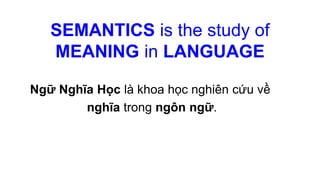
SEMANTICS is the study of
MEANING in LANGUAGE
Ngữ Nghĩa Học là khoa học nghiên cứu về
nghĩa trong ngôn ngữ.
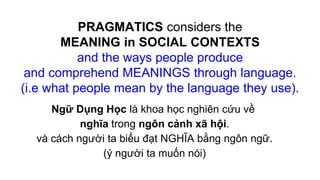
PRAGMATICS considers the
MEANING in SOCIAL CONTEXTS
and the ways people produce
and comprehend MEANINGS through language.
(i.e what people mean by the language they use).
Ngữ Dụng Học là khoa học nghiên cứu về
nghĩa trong ngôn cảnh xã hội.
và cách người ta biểu đạt NGHĨA bằng ngôn ngữ.
(ý người ta muốn nói)
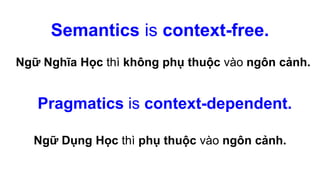
Semantics is context-free.
Ngữ Dụng Học thì phụ thuộc vào ngôn cảnh.
Ngữ Nghĩa Học thì không phụ thuộc vào ngôn cảnh.
Pragmatics is context-dependent.
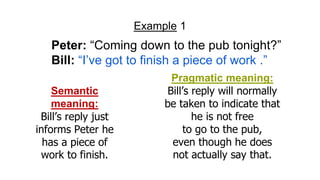
Example 1
Peter: “Coming down to the pub tonight?”
Bill: “I’ve got to finish a piece of work .”
Semantic
meaning:
Bill’s reply just
informs Peter he
has a piece of
work to finish.
Pragmatic meaning:
Bill’s reply will normally
be taken to indicate that
he is not free
to go to the pub,
even though he does
not actually say that.
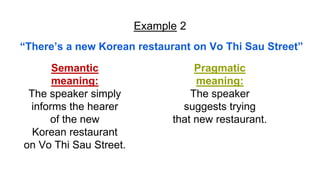
Example 2
“There’s a new Korean restaurant on Vo Thi Sau Street”
Semantic
meaning:
The speaker simply
informs the hearer
of the new
Korean restaurant
on Vo Thi Sau Street.
Pragmatic
meaning:
The speaker
suggests trying
that new restaurant.
Exercise 1 A: ‘Would you like a piece of cake?’
B: ‘I’m on a diet.’
SEMANTIC MEANING PRAGMATIC MEANING
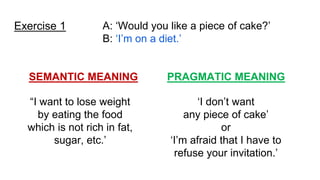
Exercise 1 A: ‘Would you like a piece of cake?’
B: ‘I’m on a diet.’
SEMANTIC MEANING PRAGMATIC MEANING
“I want to lose weight
by eating the food
which is not rich in fat,
sugar, etc.’
‘I don’t want
any piece of cake’
or
‘I’m afraid that I have to
refuse your invitation.’
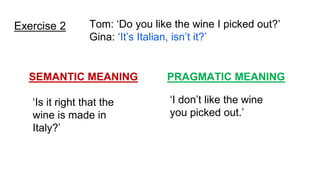
Exercise 2 Tom: ‘Do you like the wine I picked out?’
Gina: ‘It’s Italian, isn’t it?’
SEMANTIC MEANING PRAGMATIC MEANING
Exercise 2 Tom: ‘Do you like the wine I picked out?’
Gina: ‘It’s Italian, isn’t it?’
SEMANTIC MEANING PRAGMATIC MEANING
‘Is it right that the
wine is made in
Italy?’
‘I don’t like the wine
you picked out.’
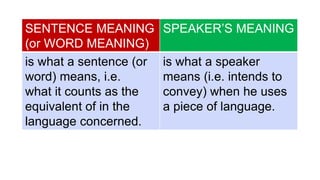
SENTENCE MEANING
(or WORD MEANING)
SPEAKER’S MEANING
is what a sentence (or
word) means, i.e.
what it counts as the
equivalent of in the
language concerned.
is what a speaker
means (i.e. intends to
convey) when he uses
a piece of language.
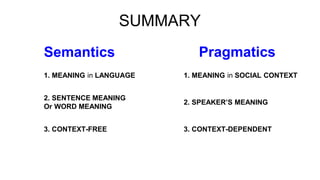
Semantics
SUMMARY
1. MEANING in LANGUAGE
2. SENTENCE MEANING
Or WORD MEANING
3. CONTEXT-FREE
Pragmatics
1. MEANING in SOCIAL CONTEXT
2. SPEAKER’S MEANING
3. CONTEXT-DEPENDENT
https://youtu.be/vDkpwnUybi0

1-1-What-is-Semantics.pptx

  • 1.
    Chapter 1: INTRODUCTION TOSEMANTICS WHAT IS SEMANTICS ABOUT?
  • 2.
    Linguistics has threemain branches: Syntax, Semantics, Pragmatics. Ngôn ngữ học có 3 nhánh chính: (Cú Pháp Học, Ngữ Nghĩa Học và Ngữ Dụng Học)
  • 3.
    Syntax is thestudy of grammar (phonology, morphology, syntax and textual grammar) Cú Pháp Học là khoa học nghiên cứu về ngữ pháp (Âm vị học, Hình thái học, Cú pháp học và Ngữ pháp văn bản)
  • 4.
    Semantics and Pragmatics dealwith meaning. Ngữ Nghĩa Học và Ngữ Dụng Học đề cập đến nghĩa.
  • 5.
    SEMANTICS is thestudy of MEANING in LANGUAGE Ngữ Nghĩa Học là khoa học nghiên cứu về nghĩa trong ngôn ngữ.
  • 6.
    PRAGMATICS considers the MEANINGin SOCIAL CONTEXTS and the ways people produce and comprehend MEANINGS through language. (i.e what people mean by the language they use). Ngữ Dụng Học là khoa học nghiên cứu về nghĩa trong ngôn cảnh xã hội. và cách người ta biểu đạt NGHĨA bằng ngôn ngữ. (ý người ta muốn nói)
  • 7.
    Semantics is context-free. NgữDụng Học thì phụ thuộc vào ngôn cảnh. Ngữ Nghĩa Học thì không phụ thuộc vào ngôn cảnh. Pragmatics is context-dependent.
  • 8.
    Example 1 Peter: “Comingdown to the pub tonight?” Bill: “I’ve got to finish a piece of work .” Semantic meaning: Bill’s reply just informs Peter he has a piece of work to finish. Pragmatic meaning: Bill’s reply will normally be taken to indicate that he is not free to go to the pub, even though he does not actually say that.
  • 9.
    Example 2 “There’s anew Korean restaurant on Vo Thi Sau Street” Semantic meaning: The speaker simply informs the hearer of the new Korean restaurant on Vo Thi Sau Street. Pragmatic meaning: The speaker suggests trying that new restaurant.
  • 10.
    Exercise 1 A:‘Would you like a piece of cake?’ B: ‘I’m on a diet.’ SEMANTIC MEANING PRAGMATIC MEANING
  • 11.
    Exercise 1 A:‘Would you like a piece of cake?’ B: ‘I’m on a diet.’ SEMANTIC MEANING PRAGMATIC MEANING “I want to lose weight by eating the food which is not rich in fat, sugar, etc.’ ‘I don’t want any piece of cake’ or ‘I’m afraid that I have to refuse your invitation.’
  • 12.
    Exercise 2 Tom:‘Do you like the wine I picked out?’ Gina: ‘It’s Italian, isn’t it?’ SEMANTIC MEANING PRAGMATIC MEANING
  • 13.
    Exercise 2 Tom:‘Do you like the wine I picked out?’ Gina: ‘It’s Italian, isn’t it?’ SEMANTIC MEANING PRAGMATIC MEANING ‘Is it right that the wine is made in Italy?’ ‘I don’t like the wine you picked out.’
  • 14.
    SENTENCE MEANING (or WORDMEANING) SPEAKER’S MEANING is what a sentence (or word) means, i.e. what it counts as the equivalent of in the language concerned. is what a speaker means (i.e. intends to convey) when he uses a piece of language.
  • 15.
    Semantics SUMMARY 1. MEANING inLANGUAGE 2. SENTENCE MEANING Or WORD MEANING 3. CONTEXT-FREE Pragmatics 1. MEANING in SOCIAL CONTEXT 2. SPEAKER’S MEANING 3. CONTEXT-DEPENDENT
  • 16.