Analysing and Visualising Energy Related Data in Our Buildings,
Towns and Cities
Barcelona Workshop
1
BAAS project; www.baas-project.eu ; Contract no: 288409
FP7-ICT-2011-7 (ICT-2011-6.2 – ICT systems for Energy Efficiency)
Collaborative project (STREP)
Javier Martín <javier.martin@dalkia.es>
Efficiency Energy Engineer
Dalkia Energía y Servicios
Spain
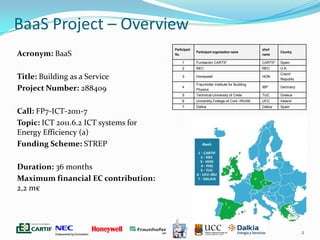
Acronym: BaaS
Title: Building as a Service
Project Number: 288409
Call: FP7-ICT-2011-7
Topic: ICT 2011.6.2 ICT systems for
Energy Efficiency (a)
Funding Scheme: STREP
Duration: 36 months
Maximum financial EC contribution:
2,2 m€
2
Participant
No.
Participant organisation name
short
name
Country
1 Fundación CARTIF CARTIF Spain
2 NEC NEC U.K.
3 Honeywell HON
Czech
Republic
4
Fraunhofer Institute for Building
Physics
IBP Germany
5 Technical University of Crete TUC Greece
6 University College of Cork -IRUSE UCC Ireland
7 Dalkia Dalkia Spain
BaaS Project – Overview
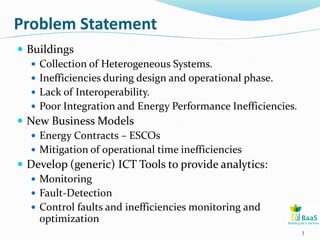
Problem Statement
 Buildings
 Collection of Heterogeneous Systems.
 Inefficiencies during design and operational phase.
 Lack of Interoperability.
 Poor Integration and Energy Performance Inefficiencies.
 New Business Models
 Energy Contracts – ESCOs
 Mitigation of operational time inefficiencies
 Develop (generic) ICT Tools to provide analytics:
 Monitoring
 Fault-Detection
 Control faults and inefficiencies monitoring and
optimization
3
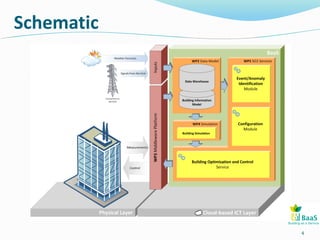
Schematic
4
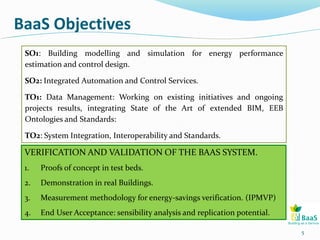
BaaS Objectives
5
SO1: Building modelling and simulation for energy performance
estimation and control design.
SO2: Integrated Automation and Control Services.
TO1: Data Management: Working on existing initiatives and ongoing
projects results, integrating State of the Art of extended BIM, EEB
Ontologies and Standards:
TO2: System Integration, Interoperability and Standards.
VERIFICATION AND VALIDATION OF THE BAAS SYSTEM.
1. Proofs of concept in test beds.
2. Demonstration in real Buildings.
3. Measurement methodology for energy-savings verification. (IPMVP)
4. End User Acceptance: sensibility analysis and replication potential.
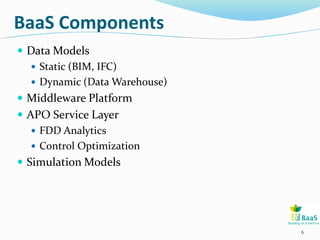
BaaS Components
 Data Models
 Static (BIM, IFC)
 Dynamic (Data Warehouse)
 Middleware Platform
 APO Service Layer
 FDD Analytics
 Control Optimization
 Simulation Models
6
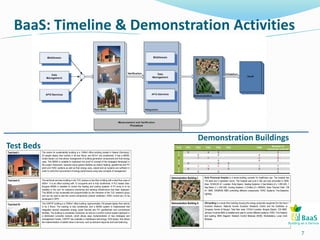
BaaS: Timeline & Demonstration Activities
7
Test-bed I: The centre for sustainability building is a 1348m2 office building located in Kassel (Germany).
23 people deploy their activity in its four floors, and 821m2 are conditioned. It has a BEMS,
model Sauter Lon that allows management of building generation components and final energy
uses. This BEMS is suitable to implement the proof of concept of the strategies developed in
the project framework, because some special facilities as district heating, geothermal and PV
plant and HVAC systems as well as final energy uses, radiant and air systems are sufficient in
order to verify the improvement of energy performance using new concepts of management.
Test-bed II: The technical services building in the TUC campus is two-floor building with a total floor area of
450m2. It is an office building with 12 occupants and is fully conditioned. A PLC-based Saia-
Burgess BEMS is installed to control the heating and cooling systems. A PV array is to be
installed in the roof. An extensive monitoring and sensing infrastructure has been deployed.
This BEMS is fully accessible and programmable by the members of the TUC research group
and can be used to test the control components (natural ventilation, HVAC control etc.) to be
developed in WP5.
Test-bed III: The CARTIF building is a 7500m2 office building. Approximately 150 people deploy their activity
in its 3 floors. The building is fully conditioned, and a BEMS system is implemented that
integrates several renewable energy (solar thermal and PV, geothermal) and conventional
facilities. The building is completely monitored, as well as a comfort control system deployed in
a distributed Lonworks network, which allows easy implementation of new strategies and
management modes. CARTIF has available a middleware technology, SOA based, that allows
the implementation of added value e-services, such as demand response and load balancing.
Demonstration Building I: Ávila Provincial Hospital is a seven-building complex for healthcare use. The hospital has
176 beds and 3 operation rooms. The hospital was built in 50s and was renovated in 2009.
Area: 18.943,05 m2. Location: Ávila (Spain). Heating Systems: 2 Gas Boilers (2 x 1.250 kW), 1
Gas Boiler (1 x 250 kW). Cooling Systems: 2 Chillers (2 x 605kW), Solar Thermal Field: 138
m2. BMS: SIEMENS BMS controlling different components: HVAC Systems, Fire-Detection,
Lighting.
Demonstration Building II: CIS building is a seven-floor building housing the energy production equipment for the Human
Evolution Museum, National Human Evolution Research Centre and the Exhibition and
Congress Centre of Burgos. Total floor area: 2153m2.Location: Burgos (Spain). CIS BMS: A
Johnson Controls BMS is installed and used to control different systems: HVAC, Fire Detection,
and Lighting. BMS Diagram: Network Control Modules (NCM), Workstations, Local Control
Modules.
Test Beds
Demonstration Buildings
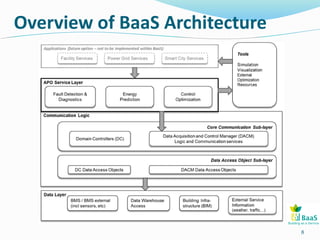
Overview of BaaS Architecture
8
Acknowledgments
The FP7 EU project “Building as a Service” (BAAS) is funded by the
European Commission FP7-ICT-2011-7 (ICT-2011-6.2 – ICT systems for
Energy Efficiency) “ICT for Sustainable Growth” Unit.
9
For more information:
Cesar Valmaseda (cesval@diana.cartif.es)
BaaS Project Coordinator
https://www.baas-project.eu

Semanco workshop Theme2 - Baas

  • 1.
    Analysing and VisualisingEnergy Related Data in Our Buildings, Towns and Cities Barcelona Workshop 1 BAAS project; www.baas-project.eu ; Contract no: 288409 FP7-ICT-2011-7 (ICT-2011-6.2 – ICT systems for Energy Efficiency) Collaborative project (STREP) Javier Martín <javier.martin@dalkia.es> Efficiency Energy Engineer Dalkia Energía y Servicios Spain
  • 2.
    Acronym: BaaS Title: Buildingas a Service Project Number: 288409 Call: FP7-ICT-2011-7 Topic: ICT 2011.6.2 ICT systems for Energy Efficiency (a) Funding Scheme: STREP Duration: 36 months Maximum financial EC contribution: 2,2 m€ 2 Participant No. Participant organisation name short name Country 1 Fundación CARTIF CARTIF Spain 2 NEC NEC U.K. 3 Honeywell HON Czech Republic 4 Fraunhofer Institute for Building Physics IBP Germany 5 Technical University of Crete TUC Greece 6 University College of Cork -IRUSE UCC Ireland 7 Dalkia Dalkia Spain BaaS Project – Overview
  • 3.
    Problem Statement  Buildings Collection of Heterogeneous Systems.  Inefficiencies during design and operational phase.  Lack of Interoperability.  Poor Integration and Energy Performance Inefficiencies.  New Business Models  Energy Contracts – ESCOs  Mitigation of operational time inefficiencies  Develop (generic) ICT Tools to provide analytics:  Monitoring  Fault-Detection  Control faults and inefficiencies monitoring and optimization 3
  • 4.
  • 5.
    BaaS Objectives 5 SO1: Buildingmodelling and simulation for energy performance estimation and control design. SO2: Integrated Automation and Control Services. TO1: Data Management: Working on existing initiatives and ongoing projects results, integrating State of the Art of extended BIM, EEB Ontologies and Standards: TO2: System Integration, Interoperability and Standards. VERIFICATION AND VALIDATION OF THE BAAS SYSTEM. 1. Proofs of concept in test beds. 2. Demonstration in real Buildings. 3. Measurement methodology for energy-savings verification. (IPMVP) 4. End User Acceptance: sensibility analysis and replication potential.
  • 6.
    BaaS Components  DataModels  Static (BIM, IFC)  Dynamic (Data Warehouse)  Middleware Platform  APO Service Layer  FDD Analytics  Control Optimization  Simulation Models 6
  • 7.
    BaaS: Timeline &Demonstration Activities 7 Test-bed I: The centre for sustainability building is a 1348m2 office building located in Kassel (Germany). 23 people deploy their activity in its four floors, and 821m2 are conditioned. It has a BEMS, model Sauter Lon that allows management of building generation components and final energy uses. This BEMS is suitable to implement the proof of concept of the strategies developed in the project framework, because some special facilities as district heating, geothermal and PV plant and HVAC systems as well as final energy uses, radiant and air systems are sufficient in order to verify the improvement of energy performance using new concepts of management. Test-bed II: The technical services building in the TUC campus is two-floor building with a total floor area of 450m2. It is an office building with 12 occupants and is fully conditioned. A PLC-based Saia- Burgess BEMS is installed to control the heating and cooling systems. A PV array is to be installed in the roof. An extensive monitoring and sensing infrastructure has been deployed. This BEMS is fully accessible and programmable by the members of the TUC research group and can be used to test the control components (natural ventilation, HVAC control etc.) to be developed in WP5. Test-bed III: The CARTIF building is a 7500m2 office building. Approximately 150 people deploy their activity in its 3 floors. The building is fully conditioned, and a BEMS system is implemented that integrates several renewable energy (solar thermal and PV, geothermal) and conventional facilities. The building is completely monitored, as well as a comfort control system deployed in a distributed Lonworks network, which allows easy implementation of new strategies and management modes. CARTIF has available a middleware technology, SOA based, that allows the implementation of added value e-services, such as demand response and load balancing. Demonstration Building I: Ávila Provincial Hospital is a seven-building complex for healthcare use. The hospital has 176 beds and 3 operation rooms. The hospital was built in 50s and was renovated in 2009. Area: 18.943,05 m2. Location: Ávila (Spain). Heating Systems: 2 Gas Boilers (2 x 1.250 kW), 1 Gas Boiler (1 x 250 kW). Cooling Systems: 2 Chillers (2 x 605kW), Solar Thermal Field: 138 m2. BMS: SIEMENS BMS controlling different components: HVAC Systems, Fire-Detection, Lighting. Demonstration Building II: CIS building is a seven-floor building housing the energy production equipment for the Human Evolution Museum, National Human Evolution Research Centre and the Exhibition and Congress Centre of Burgos. Total floor area: 2153m2.Location: Burgos (Spain). CIS BMS: A Johnson Controls BMS is installed and used to control different systems: HVAC, Fire Detection, and Lighting. BMS Diagram: Network Control Modules (NCM), Workstations, Local Control Modules. Test Beds Demonstration Buildings
  • 8.
    Overview of BaaSArchitecture 8
  • 9.
    Acknowledgments The FP7 EUproject “Building as a Service” (BAAS) is funded by the European Commission FP7-ICT-2011-7 (ICT-2011-6.2 – ICT systems for Energy Efficiency) “ICT for Sustainable Growth” Unit. 9 For more information: Cesar Valmaseda (cesval@diana.cartif.es) BaaS Project Coordinator https://www.baas-project.eu