Modelling Energy Data in Urban Environments

Álvaro Sicilia
ARC Enginyeria i Arquitectura La Salle
Universitat Ramon Llull, Barcelona


MULTIPLE REPRESENTATIONS                      Barcelona, 11-12 April 2013
CONTENTS


The objective of SEMANCO is to provide methods and tools, based on semantic
modelling of energy information, to help different stakeholders involved in urban
planning to make informed decisions about how to reduce CO2 emissions in cities
by:

•   Supporting access to and analysis of distributed and heterogeneous
    sources of energy related data

•   Modelling energy data according to standards of the Semantic Web

•   Providing integrated tools that access and update the semantically modeled
    data
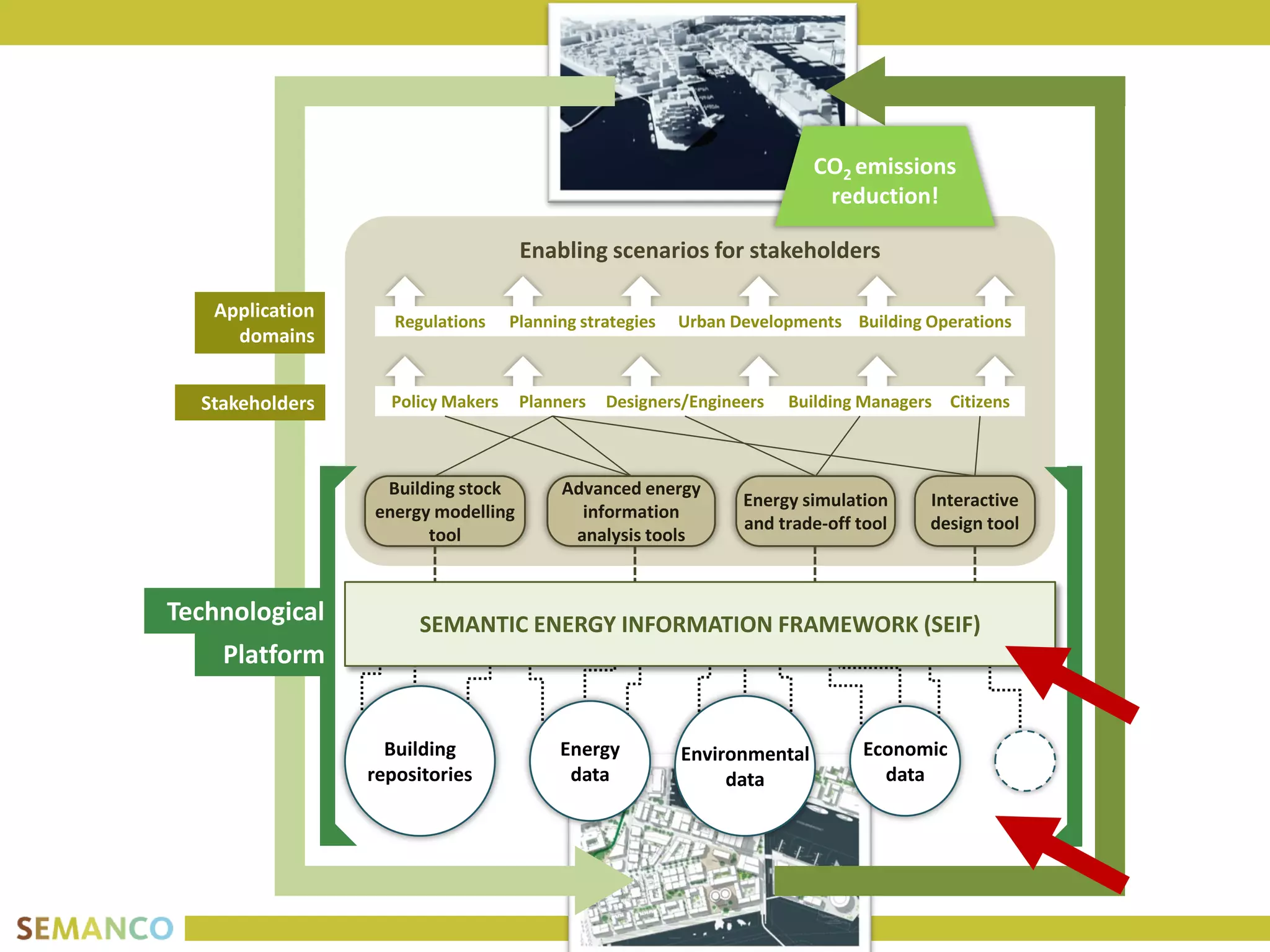
CO2 emissions
                                                                          reduction!

                                    Enabling scenarios for stakeholders

   Application      Regulations    Planning strategies   Urban Developments Building Operations
     domains


  Stakeholders     Policy Makers    Planners   Designers/Engineers   Building Managers Citizens


                  Building stock         Advanced energy
                                                                Energy simulation    Interactive
                 energy modelling          information
                                                                and trade-off tool   design tool
                       tool               analysis tools


Technological          SEMANTIC ENERGY INFORMATION FRAMEWORK (SEIF)
    Platform


                   Building              Energy          Environmental        Economic
                 repositories             data                data              data
ENERGY DATA MODELLING


  Energy data modelling as a process of conceptualization, formalization and codification

1. Informal – dispersed       2. Informal - integrated       3. Formal-computable

Dispersed information which   Integrated information which   Integrated information
can be processed only by      can be processed only by       formalized to be processed
humans.                       humans.                        by humans and computers
ENERGY DATA MODELLING


  Energy data modelling as a process of conceptualization, formalization and codification

1. Informal – dispersed       2. Informal - integrated       3. Formal-computable

Dispersed information which   Integrated information which   Integrated information
can be processed only by      can be processed only by       formalized to be processed
humans.                       humans.                        by humans and computers


     Use cases
                                   Standard
                                    Tables
                                                                 Ontology

   Standards &                                                                              Urban planners
    references
                                                               Data sources
                                                                integration
                                 Data sources
                                  Mapping                                           Analysis and visualization
   Data sources                     Tables                                               Tools/Services
INFORMAL – DISPERSED


       Energy data informally expressed and dispersed in different places and formats


 Use cases: Run energy performance analysis
 - To define the energy performance baseline of a City, Neighborhood,       Tools requirements
 and Buildings.
 - To assess energy impact on new interventions (e.g. building              Data sources needed
 refurbishment, new planning, new policies…)


 International Standards & References
 - International technical standards (e.g. EN ISO 13786 , EN 15193 , EN
 15251, NREL/TP-550-38600, …)
                                                                            Terminology
 - Energy data modelling references (e.g. Tabula, Datamine, …)


 Energy data sources
 - GIS (e.g. Terrain images, 3D building models, Land registry, …)          Terminology
 - Year of construction-based typologies (e.g. energy consumption, socio-
 economic, envelop properties, HVAC system, …)                              Data sources
 - Climate (e.g. temperature, solar radiance, …)
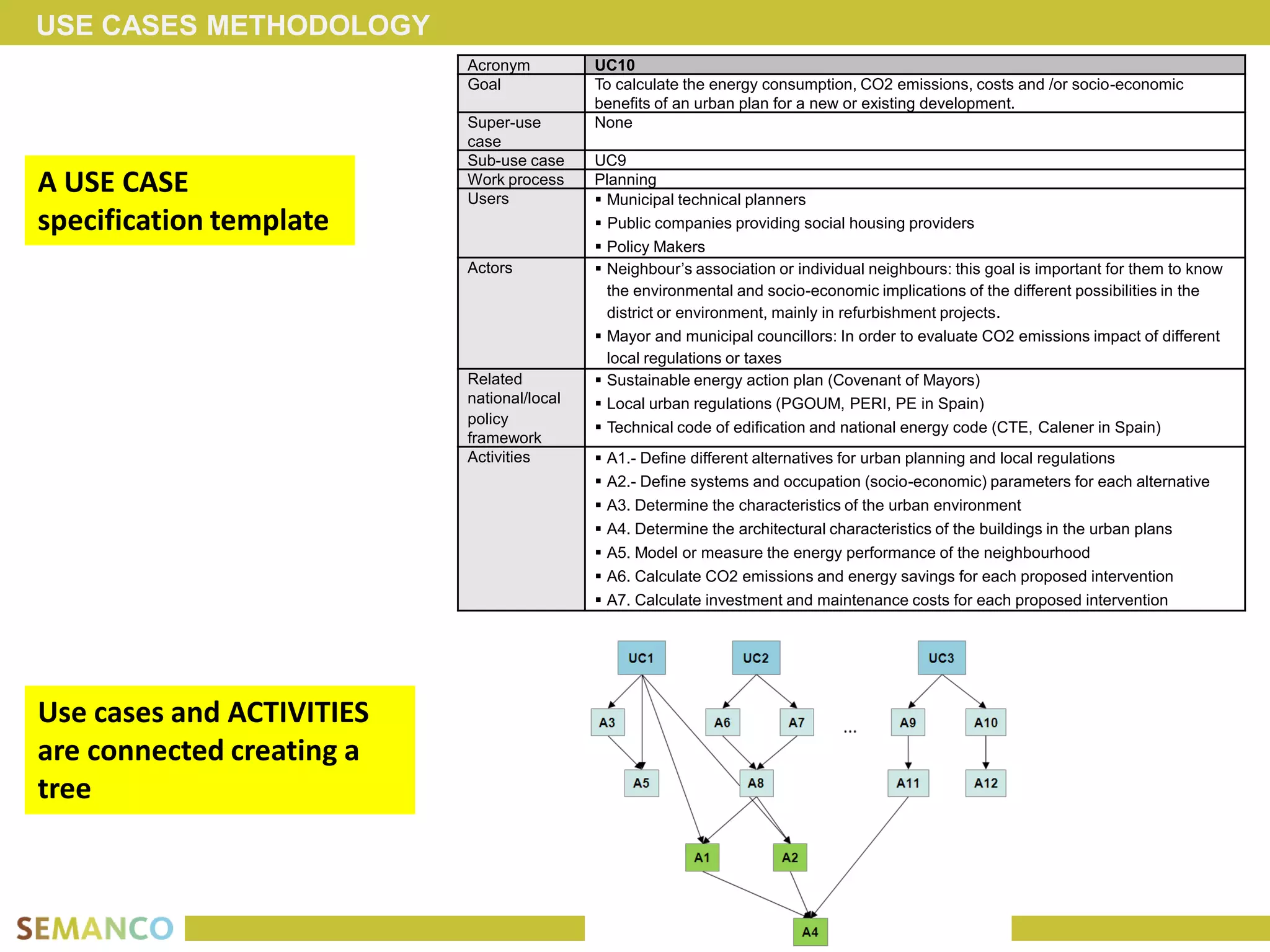
USE CASES METHODOLOGY
                           Acronym          UC10
                           Goal             To calculate the energy consumption, CO2 emissions, costs and /or socio-economic
                                            benefits of an urban plan for a new or existing development.
                           Super-use        None
                           case
                           Sub-use case     UC9
A USE CASE                 Work process
                           Users
                                            Planning
                                             Municipal technical planners
specification template                       Public companies providing social housing providers
                                             Policy Makers
                           Actors            Neighbour’s association or individual neighbours: this goal is important for them to know
                                              the environmental and socio-economic implications of the different possibilities in the
                                              district or environment, mainly in refurbishment projects.
                                             Mayor and municipal councillors: In order to evaluate CO2 emissions impact of different
                                              local regulations or taxes
                           Related           Sustainable energy action plan (Covenant of Mayors)
                           national/local    Local urban regulations (PGOUM, PERI, PE in Spain)
                           policy
                                             Technical code of edification and national energy code (CTE, Calener in Spain)
                           framework
                           Activities          A1.- Define different alternatives for urban planning and local regulations
                                               A2.- Define systems and occupation (socio-economic) parameters for each alternative
                                               A3. Determine the characteristics of the urban environment
                                               A4. Determine the architectural characteristics of the buildings in the urban plans
                                               A5. Model or measure the energy performance of the neighbourhood
                                               A6. Calculate CO2 emissions and energy savings for each proposed intervention
                                               A7. Calculate investment and maintenance costs for each proposed intervention


Use cases and ACTIVITIES
are connected creating a
tree
STANDARD TABLES

Standard tables collect and classifies the information and knowledge from different sources:
Use cases, Standards and data.
                 - 24 categories including building use, climate, territory, socio-economic, and building geometry.

                 - Each category contains terms and their relations (aggregation, subsumption)

                 - Each term is referred to a specific Standard (EN 15603, TABULA,…), is typed (String, integer,…), and if it is
                 applicable is measured (square meters, CO2 tons per year…)

                                    Name/Acronym                    Description                     Reference   Type of data   Unit

                                                    construction as a whole, including its
                                                    envelope and all technical building
                                                    systems, for which energy is used to
 Building                                           condition the indoor climate, to provide        EN 15603         -          -
                                                    domestic hot water and illumination and
                                                    other services related to the use of the
                                                    building

  has   Building_Name                               name (ID) of the building                           -          string       -


  has   Age                                         construction period of the building                 -          string       -

            is   Year_Of_Construction               year of construction of the building                -          string       -
                                                    period of years to be defined according to
                                                    typical construction or building properties
            is   Age_Class                                                                          TABULA         string       -
                                                    (materials, construction principles, building
                                                    shape, ...)
                        has   From_Year             first year of the age class                     TABULA         string       -
                        has   To_Year               last year of the age class                      TABULA         string       -
                                                    specification of the region the age class is
                        has   Allocation                                                            TABULA         string       -
                                                    defined for
                        has   Identifier            -                                                SUMO         A,B,C,D       -

  has   Address                                     address of the building                             -          string       -

                                                    first part of the postcode of the building
  has   First_Part_Of_Postcode                                                                        SAP          string       -
                                                    location

  has   Building_Typology                           building typology                                   -          string       -


            is   Flat                               apartment in a building                             -          string       -

            is   Detached_Building                  small building, without attached buildings      TABULA         string       -

            is   Semi-Detached_Building             small building, with an attached building       TABULA         string       -
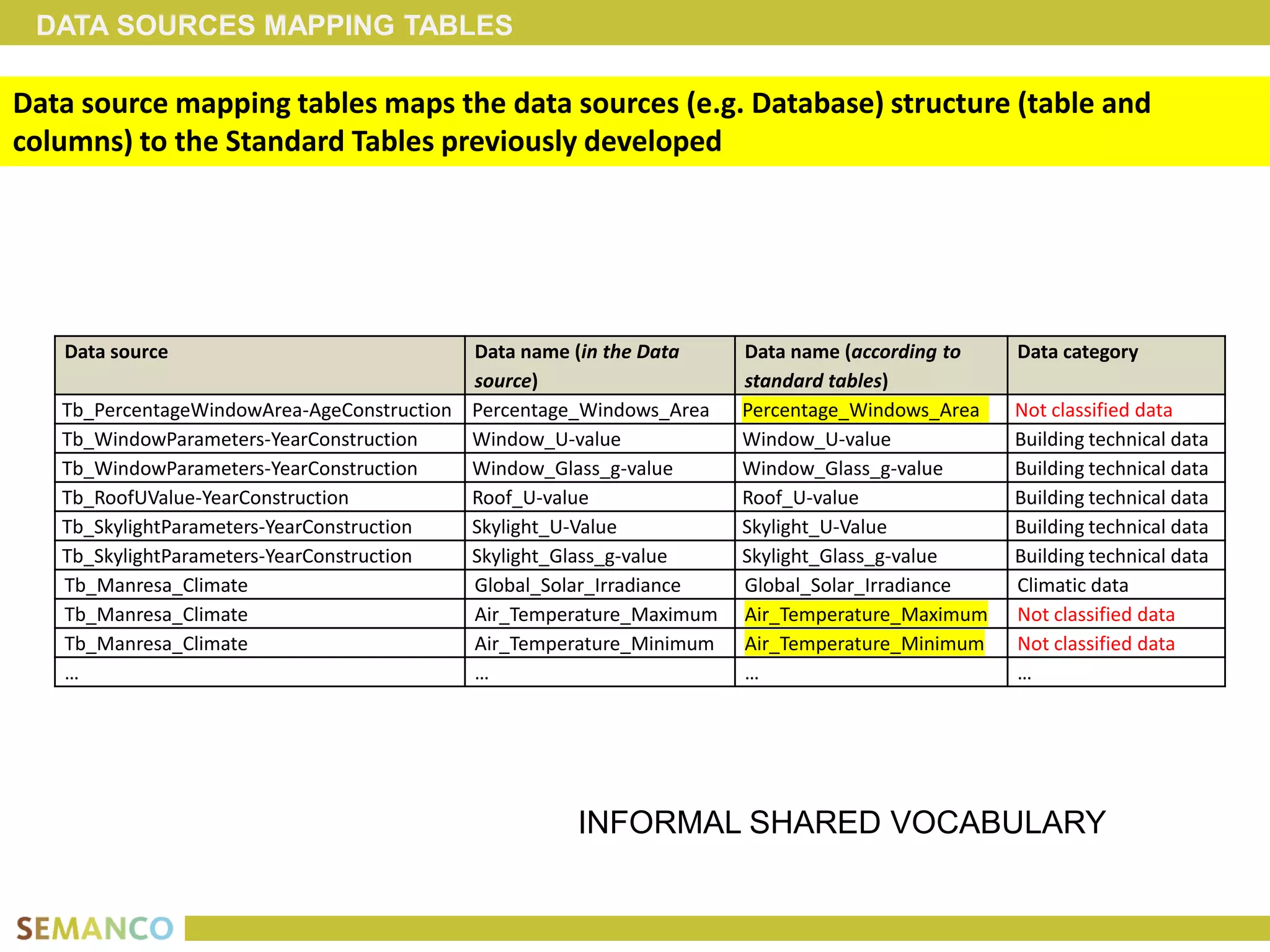
DATA SOURCES MAPPING TABLES

Data source mapping tables maps the data sources (e.g. Database) structure (table and
columns) to the Standard Tables previously developed


   Data source                             Data name (in the Data    Data name (according to   Data category
                                           source)                   standard tables)
   Tb_PercentageWindowArea-AgeConstruction Percentage_Windows_Area   Percentage_Windows_Area   Not classified data
   Tb_WindowParameters-YearConstruction    Window_U-value            Window_U-value            Building technical data
   Tb_WindowParameters-YearConstruction    Window_Glass_g-value      Window_Glass_g-value      Building technical data
   Tb_RoofUValue-YearConstruction          Roof_U-value              Roof_U-value              Building technical data
   Tb_SkylightParameters-YearConstruction  Skylight_U-Value          Skylight_U-Value          Building technical data
   Tb_SkylightParameters-YearConstruction  Skylight_Glass_g-value    Skylight_Glass_g-value    Building technical data
   Tb_Manresa_Climate                      Global_Solar_Irradiance   Global_Solar_Irradiance   Climatic data
   Tb_Manresa_Climate                      Air_Temperature_Maximum   Air_Temperature_Maximum   Not classified data
   Tb_Manresa_Climate                      Air_Temperature_Minimum   Air_Temperature_Minimum   Not classified data
   …                                       …                         …                         …


                                                    INFORMAL SHARED VOCABULARY
ONTOLOGY

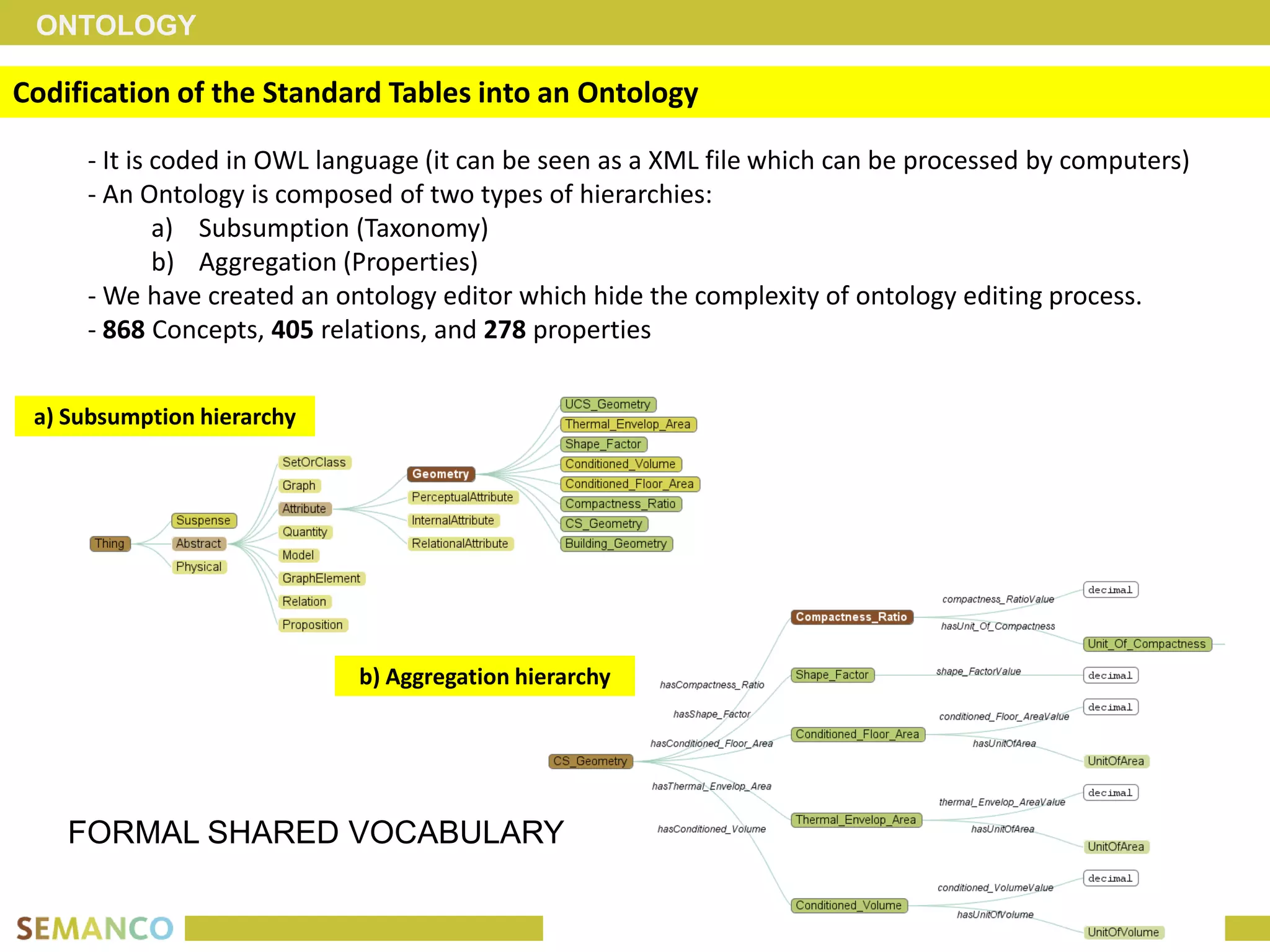
Codification of the Standard Tables into an Ontology

     - It is coded in OWL language (it can be seen as a XML file which can be processed by computers)
     - An Ontology is composed of two types of hierarchies:
             a) Subsumption (Taxonomy)
             b) Aggregation (Properties)
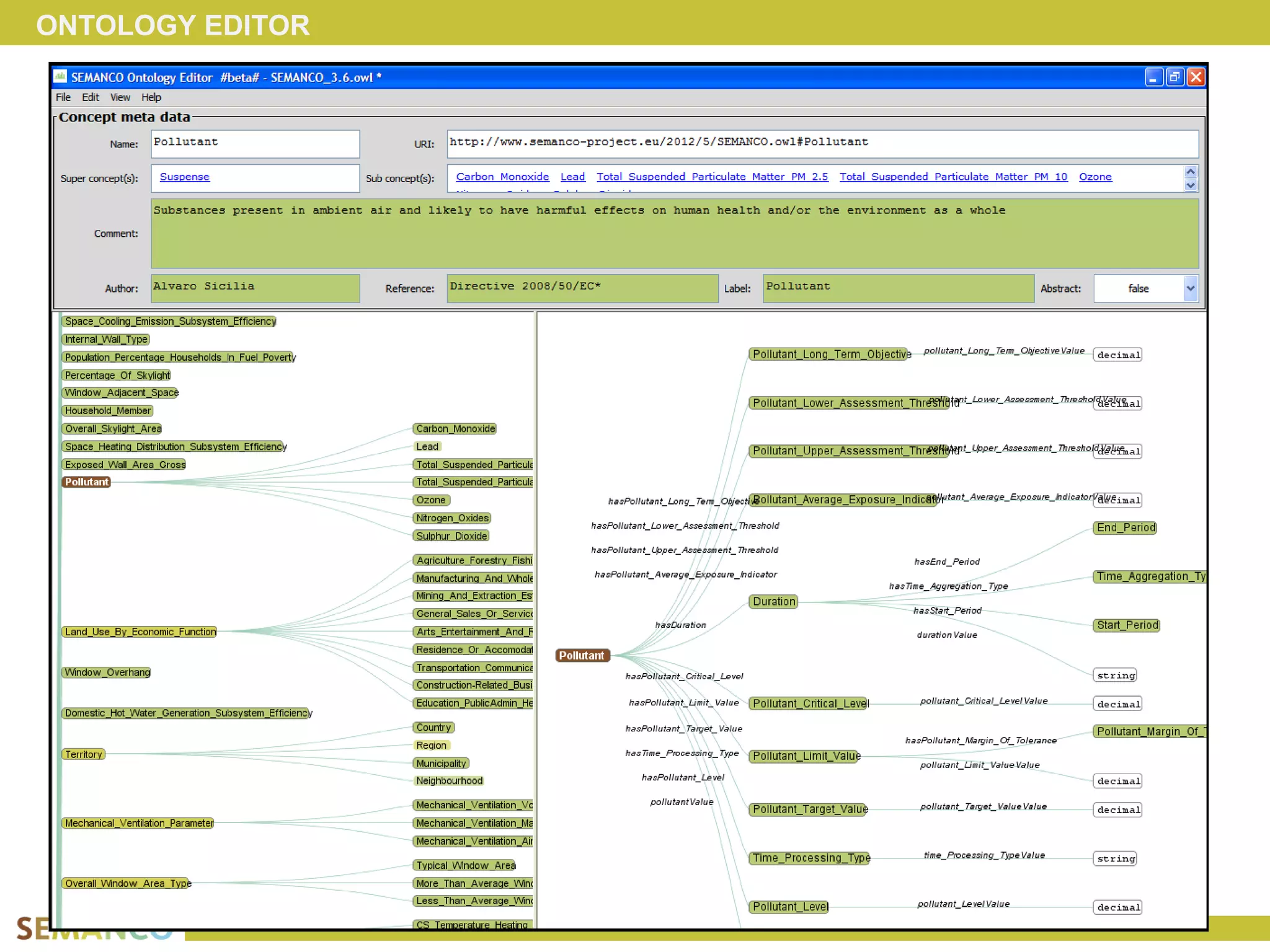
     - We have created an ontology editor which hide the complexity of ontology editing process.
     - 868 Concepts, 405 relations, and 278 properties


 a) Subsumption hierarchy


                            b) Aggregation hierarchy


    FORMAL SHARED VOCABULARY
ONTOLOGY EDITOR
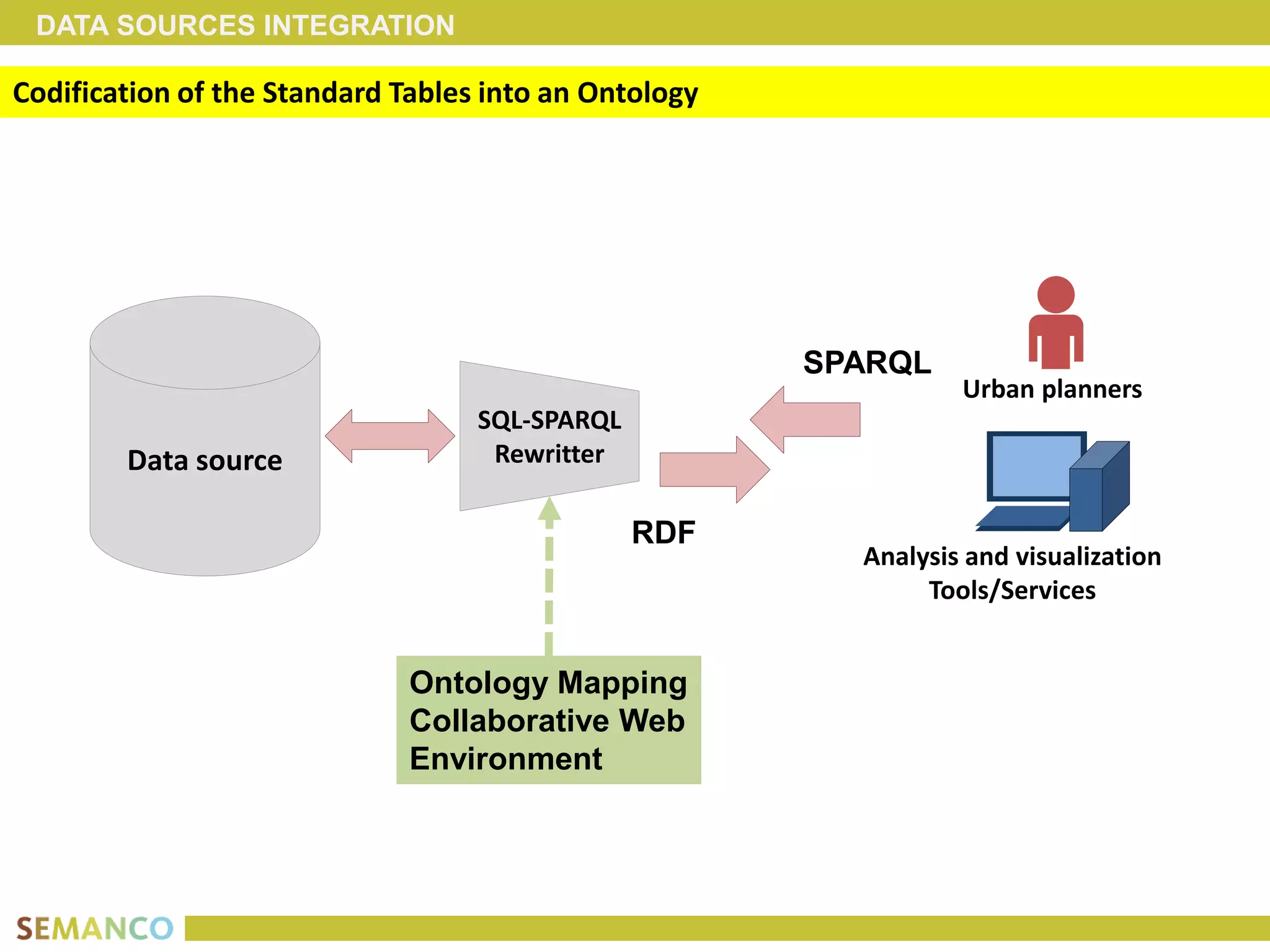
DATA SOURCES INTEGRATION

Codification of the Standard Tables into an Ontology


                                                       SPARQL
                                                                 Urban planners
                                   SQL-SPARQL
        Data source                 Rewritter

                                                RDF
                                                         Analysis and visualization
                                                              Tools/Services


                              Ontology Mapping
                              Collaborative Web
                              Environment
DATA SOURCES INTEGRATION

Ontology Mapping Collaborative Web Environment
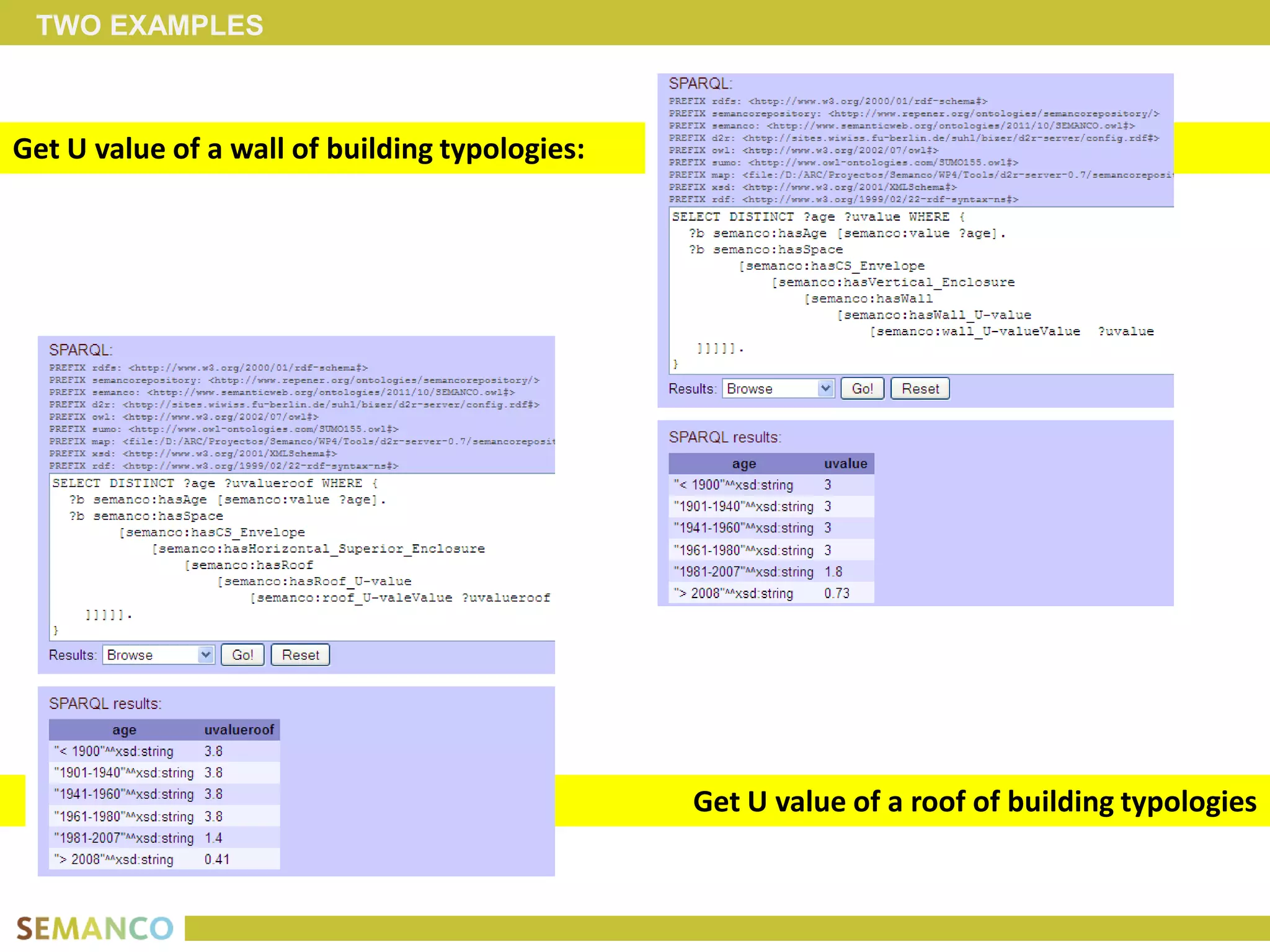
TWO EXAMPLES


Get U value of a wall of building typologies:


                                                Get U value of a roof of building typologies
CONCLUSIONS        SUMMARY


•   We have implemented a set of procedures, templates, methods, tools to conceptualize
    energy data in urban planning.

•   The energy related data –use cases, standards, data sources– have been represented
    in different ways from informally to formal format enabling their processing by
    computers.

•   An ontology including more than 800 concepts has been created modelling the energy-
    related data in the urban planning domain.

•   This way, different data sources from different domains could be integrated and could
    be accessed using the same terminology.
CONCLUSIONS


          If you would like more information, please contact us

                              sicilia@salleurl.edu

                             or visit our web site

                          www.semanco-project.eu


               SEMANCO is being carried out with the support of the European Union’s FP7 Programme
               “ICT for Energy Systems” 2011-2014, under the grant agreement number 287534 .

SEMANCO Workshop Theme1 - Semanco

  • 1.
    Modelling Energy Datain Urban Environments Álvaro Sicilia ARC Enginyeria i Arquitectura La Salle Universitat Ramon Llull, Barcelona MULTIPLE REPRESENTATIONS Barcelona, 11-12 April 2013
  • 2.
    CONTENTS The objective ofSEMANCO is to provide methods and tools, based on semantic modelling of energy information, to help different stakeholders involved in urban planning to make informed decisions about how to reduce CO2 emissions in cities by: • Supporting access to and analysis of distributed and heterogeneous sources of energy related data • Modelling energy data according to standards of the Semantic Web • Providing integrated tools that access and update the semantically modeled data
  • 3.
    CO2 emissions reduction! Enabling scenarios for stakeholders Application Regulations Planning strategies Urban Developments Building Operations domains Stakeholders Policy Makers Planners Designers/Engineers Building Managers Citizens Building stock Advanced energy Energy simulation Interactive energy modelling information and trade-off tool design tool tool analysis tools Technological SEMANTIC ENERGY INFORMATION FRAMEWORK (SEIF) Platform Building Energy Environmental Economic repositories data data data
  • 4.
    ENERGY DATA MODELLING Energy data modelling as a process of conceptualization, formalization and codification 1. Informal – dispersed 2. Informal - integrated 3. Formal-computable Dispersed information which Integrated information which Integrated information can be processed only by can be processed only by formalized to be processed humans. humans. by humans and computers
  • 5.
    ENERGY DATA MODELLING Energy data modelling as a process of conceptualization, formalization and codification 1. Informal – dispersed 2. Informal - integrated 3. Formal-computable Dispersed information which Integrated information which Integrated information can be processed only by can be processed only by formalized to be processed humans. humans. by humans and computers Use cases Standard Tables Ontology Standards & Urban planners references Data sources integration Data sources Mapping Analysis and visualization Data sources Tables Tools/Services
  • 6.
    INFORMAL – DISPERSED Energy data informally expressed and dispersed in different places and formats Use cases: Run energy performance analysis - To define the energy performance baseline of a City, Neighborhood, Tools requirements and Buildings. - To assess energy impact on new interventions (e.g. building Data sources needed refurbishment, new planning, new policies…) International Standards & References - International technical standards (e.g. EN ISO 13786 , EN 15193 , EN 15251, NREL/TP-550-38600, …) Terminology - Energy data modelling references (e.g. Tabula, Datamine, …) Energy data sources - GIS (e.g. Terrain images, 3D building models, Land registry, …) Terminology - Year of construction-based typologies (e.g. energy consumption, socio- economic, envelop properties, HVAC system, …) Data sources - Climate (e.g. temperature, solar radiance, …)
  • 7.
    USE CASES METHODOLOGY Acronym UC10 Goal To calculate the energy consumption, CO2 emissions, costs and /or socio-economic benefits of an urban plan for a new or existing development. Super-use None case Sub-use case UC9 A USE CASE Work process Users Planning  Municipal technical planners specification template  Public companies providing social housing providers  Policy Makers Actors  Neighbour’s association or individual neighbours: this goal is important for them to know the environmental and socio-economic implications of the different possibilities in the district or environment, mainly in refurbishment projects.  Mayor and municipal councillors: In order to evaluate CO2 emissions impact of different local regulations or taxes Related  Sustainable energy action plan (Covenant of Mayors) national/local  Local urban regulations (PGOUM, PERI, PE in Spain) policy  Technical code of edification and national energy code (CTE, Calener in Spain) framework Activities  A1.- Define different alternatives for urban planning and local regulations  A2.- Define systems and occupation (socio-economic) parameters for each alternative  A3. Determine the characteristics of the urban environment  A4. Determine the architectural characteristics of the buildings in the urban plans  A5. Model or measure the energy performance of the neighbourhood  A6. Calculate CO2 emissions and energy savings for each proposed intervention  A7. Calculate investment and maintenance costs for each proposed intervention Use cases and ACTIVITIES are connected creating a tree
  • 8.
    STANDARD TABLES Standard tablescollect and classifies the information and knowledge from different sources: Use cases, Standards and data. - 24 categories including building use, climate, territory, socio-economic, and building geometry. - Each category contains terms and their relations (aggregation, subsumption) - Each term is referred to a specific Standard (EN 15603, TABULA,…), is typed (String, integer,…), and if it is applicable is measured (square meters, CO2 tons per year…) Name/Acronym Description Reference Type of data Unit construction as a whole, including its envelope and all technical building systems, for which energy is used to Building condition the indoor climate, to provide EN 15603 - - domestic hot water and illumination and other services related to the use of the building has Building_Name name (ID) of the building - string - has Age construction period of the building - string - is Year_Of_Construction year of construction of the building - string - period of years to be defined according to typical construction or building properties is Age_Class TABULA string - (materials, construction principles, building shape, ...) has From_Year first year of the age class TABULA string - has To_Year last year of the age class TABULA string - specification of the region the age class is has Allocation TABULA string - defined for has Identifier - SUMO A,B,C,D - has Address address of the building - string - first part of the postcode of the building has First_Part_Of_Postcode SAP string - location has Building_Typology building typology - string - is Flat apartment in a building - string - is Detached_Building small building, without attached buildings TABULA string - is Semi-Detached_Building small building, with an attached building TABULA string -
  • 9.
    DATA SOURCES MAPPINGTABLES Data source mapping tables maps the data sources (e.g. Database) structure (table and columns) to the Standard Tables previously developed Data source Data name (in the Data Data name (according to Data category source) standard tables) Tb_PercentageWindowArea-AgeConstruction Percentage_Windows_Area Percentage_Windows_Area Not classified data Tb_WindowParameters-YearConstruction Window_U-value Window_U-value Building technical data Tb_WindowParameters-YearConstruction Window_Glass_g-value Window_Glass_g-value Building technical data Tb_RoofUValue-YearConstruction Roof_U-value Roof_U-value Building technical data Tb_SkylightParameters-YearConstruction Skylight_U-Value Skylight_U-Value Building technical data Tb_SkylightParameters-YearConstruction Skylight_Glass_g-value Skylight_Glass_g-value Building technical data Tb_Manresa_Climate Global_Solar_Irradiance Global_Solar_Irradiance Climatic data Tb_Manresa_Climate Air_Temperature_Maximum Air_Temperature_Maximum Not classified data Tb_Manresa_Climate Air_Temperature_Minimum Air_Temperature_Minimum Not classified data … … … … INFORMAL SHARED VOCABULARY
  • 10.
    ONTOLOGY Codification of theStandard Tables into an Ontology - It is coded in OWL language (it can be seen as a XML file which can be processed by computers) - An Ontology is composed of two types of hierarchies: a) Subsumption (Taxonomy) b) Aggregation (Properties) - We have created an ontology editor which hide the complexity of ontology editing process. - 868 Concepts, 405 relations, and 278 properties a) Subsumption hierarchy b) Aggregation hierarchy FORMAL SHARED VOCABULARY
  • 11.
  • 12.
    DATA SOURCES INTEGRATION Codificationof the Standard Tables into an Ontology SPARQL Urban planners SQL-SPARQL Data source Rewritter RDF Analysis and visualization Tools/Services Ontology Mapping Collaborative Web Environment
  • 13.
    DATA SOURCES INTEGRATION OntologyMapping Collaborative Web Environment
  • 14.
    TWO EXAMPLES Get Uvalue of a wall of building typologies: Get U value of a roof of building typologies
  • 15.
    CONCLUSIONS SUMMARY • We have implemented a set of procedures, templates, methods, tools to conceptualize energy data in urban planning. • The energy related data –use cases, standards, data sources– have been represented in different ways from informally to formal format enabling their processing by computers. • An ontology including more than 800 concepts has been created modelling the energy- related data in the urban planning domain. • This way, different data sources from different domains could be integrated and could be accessed using the same terminology.
  • 16.
    CONCLUSIONS If you would like more information, please contact us sicilia@salleurl.edu or visit our web site www.semanco-project.eu SEMANCO is being carried out with the support of the European Union’s FP7 Programme “ICT for Energy Systems” 2011-2014, under the grant agreement number 287534 .