GREEK TEAM
Apostolidis Dimos, Valkani Georgia, Golatsis
Chris, Foutsitzi Evi
SELMA
“Hacking Hate” Hackathon
BERLIN Dec, 5-6 2018
Who are we?
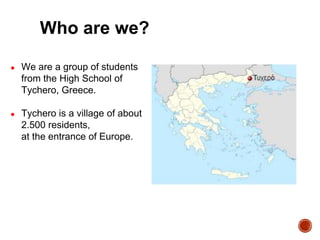
● We are a group of students
from the High School of
Tychero, Greece.
● Tychero is a village of about
2.500 residents,
at the entrance of Europe.
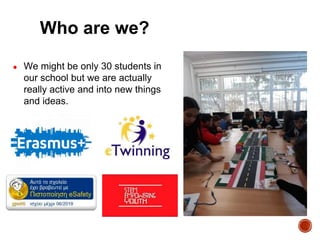
● We might be only 30 students in
our school but we are actually
really active and into new things
and ideas.
Who are we?
How we came up with this idea
The problem
● Young people encounter
hate speech incidents
as a part of their daily
digital life.
● This subject is not
sufficiently covered in
many schools.
The solution
Fight the problem
through:
● education and
● awareness of young
people
Our product
● An app for smart phones
● As an appealing way to approach young
people who...
● prefer mobile devices rather than desktop
computers or even books.
Target group:12+
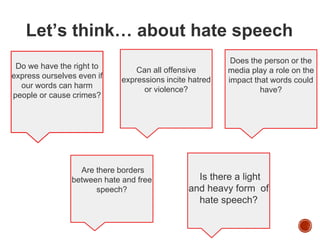
Let’s think… about hate speech
Do we have the right to
express ourselves even if
our words can harm
people or cause crimes?
Does the person or the
media play a role on the
impact that words could
have?
Are there borders
between hate and free
speech?
Can all offensive
expressions incite hatred
or violence?
Is there a light
and heavy form of
hate speech?
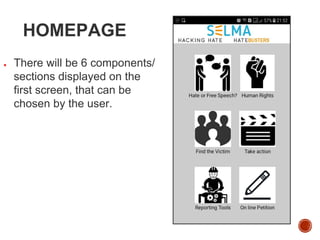
HOMEPAGE
● There will be 6 components/
sections displayed on the
first screen, that can be
chosen by the user.
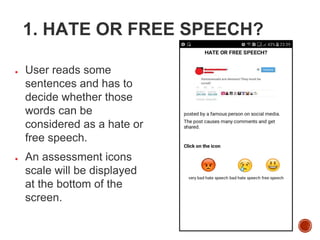
1. HATE OR FREE SPEECH?
● User reads some
sentences and has to
decide whether those
words can be
considered as a hate or
free speech.
● An assessment icons
scale will be displayed
at the bottom of the
screen.
2. HUMAN RIGHTS
● An activity based on human
rights.
● Real hate speech examples
will be displayed and user
has to indicate, from a list
given, which human right is
being violated.
● List: Right to Life/ right to
respect for private and family
life/etc.
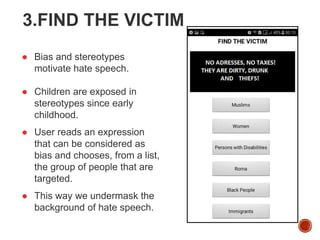
3.FIND THE VICTIM
● Bias and stereotypes
motivate hate speech.
● Children are exposed in
stereotypes since early
childhood.
● User reads an expression
that can be considered as
bias and chooses, from a list,
the group of people that are
targeted.
● This way we undermask the
background of hate speech.
4. TAKE ACTION-TIPS
● What should we do when
we face hate speech
online? Should we ignore
it or take action?
● Here are some tips...
Tips
✓ Reporting to the service provider
✓ Liking or sharing someone else’s
positive post
✓ Replying to negative posts with
supportive, kind or positive
comment about a targeted group
✓ Discussing with a parent, an adult,
a teacher or an expert.
✓ Blocking the person who wrote it
✓
5. REPORTING TOOLS
In this section, a list of reporting tools will be displayed
on the screen that links to sites like
● www.nohatespeechmovement.org
6. ON LINE PETITION
● In this section, there is going to be a
“supportive” text and/or a list of
demands, in the form of an online
petition, encouraging people to support
anti-hate speech movements.
● The user will be able to sign,
anonymously or not.
● When it comes to younger children,
they will be prompted to ask for their
parents’ contribution.
● Data will be collected and published.
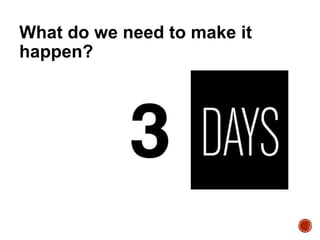
What do we need to make it
happen?
Selm Project hacking hate Hackathon

Selm Project hacking hate Hackathon

  • 1.
    GREEK TEAM Apostolidis Dimos,Valkani Georgia, Golatsis Chris, Foutsitzi Evi SELMA “Hacking Hate” Hackathon BERLIN Dec, 5-6 2018
  • 2.
    Who are we? ●We are a group of students from the High School of Tychero, Greece. ● Tychero is a village of about 2.500 residents, at the entrance of Europe.
  • 3.
    ● We mightbe only 30 students in our school but we are actually really active and into new things and ideas. Who are we?
  • 4.
    How we cameup with this idea The problem ● Young people encounter hate speech incidents as a part of their daily digital life. ● This subject is not sufficiently covered in many schools. The solution Fight the problem through: ● education and ● awareness of young people
  • 5.
    Our product ● Anapp for smart phones ● As an appealing way to approach young people who... ● prefer mobile devices rather than desktop computers or even books. Target group:12+
  • 6.
    Let’s think… abouthate speech Do we have the right to express ourselves even if our words can harm people or cause crimes? Does the person or the media play a role on the impact that words could have? Are there borders between hate and free speech? Can all offensive expressions incite hatred or violence? Is there a light and heavy form of hate speech?
  • 7.
    HOMEPAGE ● There willbe 6 components/ sections displayed on the first screen, that can be chosen by the user.
  • 8.
    1. HATE ORFREE SPEECH? ● User reads some sentences and has to decide whether those words can be considered as a hate or free speech. ● An assessment icons scale will be displayed at the bottom of the screen.
  • 9.
    2. HUMAN RIGHTS ●An activity based on human rights. ● Real hate speech examples will be displayed and user has to indicate, from a list given, which human right is being violated. ● List: Right to Life/ right to respect for private and family life/etc.
  • 10.
    3.FIND THE VICTIM ●Bias and stereotypes motivate hate speech. ● Children are exposed in stereotypes since early childhood. ● User reads an expression that can be considered as bias and chooses, from a list, the group of people that are targeted. ● This way we undermask the background of hate speech.
  • 11.
    4. TAKE ACTION-TIPS ●What should we do when we face hate speech online? Should we ignore it or take action? ● Here are some tips... Tips ✓ Reporting to the service provider ✓ Liking or sharing someone else’s positive post ✓ Replying to negative posts with supportive, kind or positive comment about a targeted group ✓ Discussing with a parent, an adult, a teacher or an expert. ✓ Blocking the person who wrote it ✓
  • 12.
    5. REPORTING TOOLS Inthis section, a list of reporting tools will be displayed on the screen that links to sites like ● www.nohatespeechmovement.org
  • 13.
    6. ON LINEPETITION ● In this section, there is going to be a “supportive” text and/or a list of demands, in the form of an online petition, encouraging people to support anti-hate speech movements. ● The user will be able to sign, anonymously or not. ● When it comes to younger children, they will be prompted to ask for their parents’ contribution. ● Data will be collected and published.
  • 14.
    What do weneed to make it happen?