Cultural Differences in Innovative Behaviour:
4-country Study with Representative Samples


                     Martin Lukeš
                     Alena Černíková
                     Ute Stephan
                     Tomáš Svátek


                     Prague University of Economics

                     14th EAWOP Congress
                     Santiago de Compostela, May 13-16
Study objectives

  Identification of cultural differences in
  innovative behaviour

  Creation of an independent measure of
  innovative behaviour and innovation support

  Comparing the role of culture with other
  factors influencing innovative behaviours
Key definitions

   Innovation
   – process of new idea creation or adoption and a
     subsequent effort to develop it into a new product,
     service, process or business model with an
     expected added value for a potential user


  Culture
   – shows up in the values, beliefs, norms, behavioral
     practices, and symbols shared, acquired, and
     advanced by the members of a large group
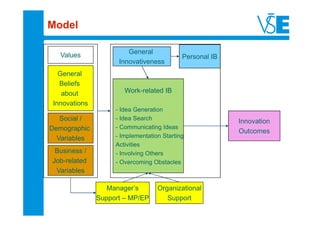
Model

   Values               General
                                            Personal IB
                     Innovativeness
   General
   Beliefs
    about              Work-related IB
 Innovations
                    - Idea Generation
   Social /         - Idea Search
                                                          Innovation
Demographic         - Communicating Ideas
                                                          Outcomes
  Variables         - Implementation Starting
                    Activities
 Business /         - Involving Others
Job-related         - Overcoming Obstacles
 Variables

                  Manager’s        Organizational
               Support – MP/EP        Support
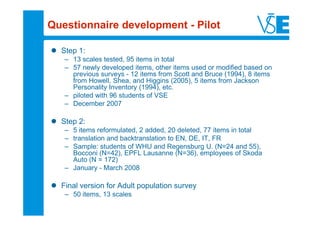
Questionnaire development - Pilot

  Step 1:
   – 13 scales tested, 95 items in total
   – 57 newly developed items, other items used or modified based on
     previous surveys - 12 items from Scott and Bruce (1994), 8 items
     from Howell, Shea, and Higgins (2005), 5 items from Jackson
     Personality Inventory (1994), etc.
   – piloted with 96 students of VSE
   – December 2007

  Step 2:
   – 5 items reformulated, 2 added, 20 deleted, 77 items in total
   – translation and backtranslation to EN, DE, IT, FR
   – Sample: students of WHU and Regensburg U. (N=24 and 55),
     Bocconi (N=42), EPFL Lausanne (N=36), employees of Skoda
     Auto (N = 172)
   – January - March 2008

  Final version for Adult population survey
   – 50 items, 13 scales
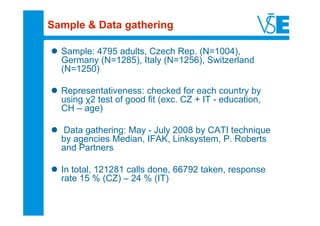
Sample & Data gathering

  Sample: 4795 adults, Czech Rep. (N=1004),
  Germany (N=1285), Italy (N=1256), Switzerland
  (N=1250)

  Representativeness: checked for each country by
  using χ2 test of good fit (exc. CZ + IT - education,
  CH – age)

  Data gathering: May - July 2008 by CATI technique
  by agencies Median, IFAK, Linksystem, P. Roberts
  and Partners

  In total, 121281 calls done, 66792 taken, response
  rate 15 % (CZ) – 24 % (IT)
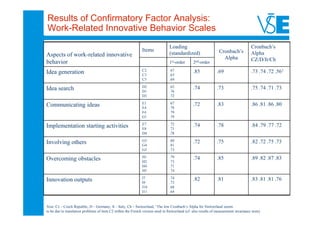
Results of Confirmatory Factor Analysis:
Work-Related Innovative Behavior Scales
                                                                                 Loading                                               Cronbach’s
                                                               Items                                              Cronbach’s
Aspects of work-related innovative                                               (standardized)                                        Alpha
                                                                                                                    Alpha              CZ/D/It/Ch
behavior                                                                         1st-order       2nd-order
                                                               C2                .67             .85             .69                   .73 .74 .72 .561
Idea generation                                                C3                .63
                                                               C5                .69
                                                               D2                .62             .74             .73                   .75 .74 .71 .73
Idea search                                                    D1                .76
                                                               D3                .72
                                                               E1                .67             .72             .83                   .86 .81 .86 .80
Communicating ideas                                            E4                .78
                                                               F4                .79
                                                               G1                .79
                                                               E7                .72             .74             .78                   .84 .79 .77 .72
Implementation starting activities                             E8                .71
                                                               D4                .78
                                                               G3                .60             .72             .75                   .82 .72 .75 .73
Involving others                                               G4                .81
                                                               G5                .73
                                                               H1                .79             .74             .85                   .89 .82 .87 .83
Overcoming obstacles                                           H2                .73
                                                               H4                .71
                                                               H5                .74
                                                               I7                .74             .82             .81                   .83 .81 .81 .76
Innovation outputs                                             I9                .73
                                                               I10               .68
                                                               I11               .64


Note. Cz – Czech Republic, D – Germany, It – Italy, Ch – Switzerland, 1The low Cronbach’s Alpha for Switzerland seems
to be due to translation problems of item C2 within the French version used in Switzerland (cf. also results of measurement invariance tests).
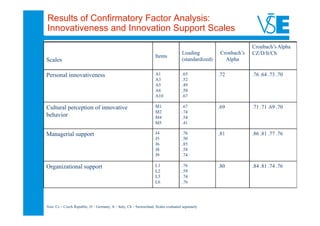
Results of Confirmatory Factor Analysis:
Innovativeness and Innovation Support Scales
                                                                                                                     Cronbach’s Alpha
                                                                                       Loading          Cronbach’s   CZ/D/It/Ch
                                                                      Items
Scales                                                                                 (standardized)     Alpha


Personal innovativeness                                               A1               .65              .72          .76 .64 .73 .70
                                                                      A3               .52
                                                                      A5               .49
                                                                      A6               .50
                                                                      A10              .67

Cultural perception of innovative                                     M1               .67              .69          .71 .71 .69 .70
                                                                      M2               .74
behavior                                                              M4               .54
                                                                      M5               .41

Managerial support                                                    J4               .76              .81          .86 .81 .77 .76
                                                                      J5               .50
                                                                      J6               .85
                                                                      J8               .58
                                                                      J9               .74

Organizational support                                                L1               .76              .80          .84 .81 .74 .76
                                                                      L2               .59
                                                                      L5               .74
                                                                      L6               .76


Note. Cz – Czech Republic, D – Germany, It – Italy, Ch – Switzerland, Scales evaluated separately
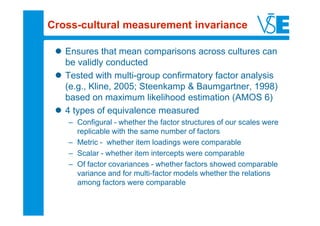
Cross-cultural measurement invariance

   Ensures that mean comparisons across cultures can
   be validly conducted
   Tested with multi-group confirmatory factor analysis
   (e.g., Kline, 2005; Steenkamp & Baumgartner, 1998)
   based on maximum likelihood estimation (AMOS 6)
   4 types of equivalence measured
   – Configural - whether the factor structures of our scales were
     replicable with the same number of factors
   – Metric - whether item loadings were comparable
   – Scalar - whether item intercepts were comparable
   – Of factor covariances - whether factors showed comparable
     variance and for multi-factor models whether the relations
     among factors were comparable
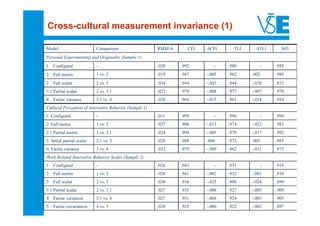
Cross-cultural measurement invariance (1)

Model                       Comparison                  RMSEA      CFI   ∆CFI      TLI     ∆TLI       NFI
Personal Experimenting and Originality (Sample 1)
1 Configural                -                           .020    .992        -    .980           -   .988
2 Full metric               1 vs. 2                     .019    .987     -.005   .982    .002       .980
3 Full scalar               2 vs. 3                     .034    .944     -.043   .944    -.038      .933
3.1 Partial scalar          2 vs. 3.1                   .023    .979     -.008   .975    -.007      .970
4 Factor variance           3.1 vs. 4                   .028    .964     -.015   .961    -.014      .954
Cultural Perception of Innovative Behavior (Sample 1)
1 Configural                -                           .011    .999        -    .996           -   .998
2 Full metric               1 vs. 2                     .027    .986     -.013   .974    -.022      .982
2.1 Partial metric          1 vs. 2.1                   .024    .994     -.005   .979    -.017      .992
3. Initial partial scalar   2.1 vs. 3                   .028    .988     .006    .972    .005       .985
4. Factor variance          3 vs. 4                     .033    .979     -.009   .962    -.011      .975
Work-Related Innovative Behavior Scales (Sample 2)
1 Configural                -                           .026    .943        -    .931           -   .919
2 Full metric               1 vs. 2                     .026    .941     -.002   .932    -.001      .916
3 Full scalar               2 vs. 3                     .030    .916     -.025   .908    -.024      .890
3.1 Partial scalar          2 vs. 3.1                   .027    .935     -.006   .927    -.005      .909
4 Factor variances          3.1 vs. 4                   .027    .931     -.004   .924    -.003      .905
5 Factor covariances        4 vs. 5                     .028    .925     -.006   .922    -.002      .897
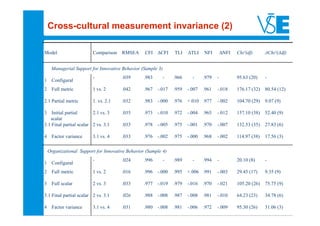
Cross-cultural measurement invariance (2)

Model                    Comparison   RMSEA    CFI ∆CFI        TLI    ∆TLI    NFI        ∆NFI   Chi²(df)      ∆Chi²(∆df)


   Managerial Support for Innovative Behavior (Sample 3)
                         -            .039     .983        -   .966     -     .979   -          95.63 (20)    -
1 Configural
2 Full metric            1 vs. 2      .042     .967   -.017    .959   -.007   .961   -.018      176.17 (32)   80.54 (12)

2.1 Partial metric       1. vs. 2.1   .032     .983   -.000    .976   +.010 .977     -.002      104.70 (29)   9.07 (9)

3 Initial partial        2.1 vs. 3    .035     .973   -.010    .972   -.004   .965   -.012      157.10 (38)   52.40 (9)
   scalar
3.1 Final partial scalar 2 vs. 3.1    .033     .978   -.005    .975   -.001   .970   -.007      132.53 (35)   27.83 (6)

4 Factor variance        3.1 vs. 4    .033     .976   -.002    .975   -.000   .968   -.002      114.97 (38)   17.56 (3)

 Organizational Support for Innovative Behavior (Sample 4)
                         -            .024     .996        -   .989     -     .994   -          20.10 (8)     -
1 Configural
2 Full metric            1 vs. 2      .016     .996   -.000    .995   +.006 .991     -.003      29.45 (17)    9.35 (9)

3 Full scalar            2 vs. 3      .033     .977   -.019    .979   -.016   .970   -.021      105.20 (26)   75.75 (9)

3.1 Final partial scalar 2 vs. 3.1    .026     .988   -.008    .987   -.008   .981   -.010      64.23 (23)    34.78 (6)

4 Factor variance        3.1 vs. 4    .031     .980   -.008    .981   -.006   .972   -.009      95.30 (26)    31.06 (3)
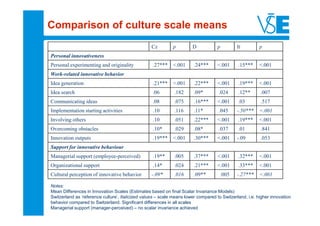
Comparison of culture scale means
                                                  Cz         p         D            p        It          p
Personal innovativeness
Personal experimenting and originality             .27***    <.001      .24***      <.001     .15***     <.001
Work-related innovative behavior
Idea generation                                    .21***    <.001      .22***      <.001     .19***     <.001
Idea search                                        .06        .182      .09*        .024      .12**      .007
Communicating ideas                                .08        .075      .16***      <.001     .03        .517
Implementation starting activities                 .10        .116      .11*        .045     -.50***     <.001
Involving others                                   .10        .051      .22***      <.001     .19***     <.001
Overcoming obstacles                               .10*       .029      .08*        .037      .01        .841
Innovation outputs                                 .19***    <.001      .30***      <.001    -.09        .053
Support for innovative behaviour
Managerial support (employee-perceived)            .19**      .005      .37***      <.001     .32***     <.001
Organizational support                             .14*       .024      .21***      <.001     .33***     <.001
Cultural perception of innovative behavior        -.09*       .016      .09**        .005    -.27***     <.001

Notes:
Mean Differences in Innovation Scales (Estimates based on final Scalar Invariance Models)
Switzerland as ‘reference culture’, Italicized values – scale means lower compared to Switzerland, i.e. higher innovation
behavior compared to Switzerland. Significant differences in all scales
Managerial support (manager-perceived) – no scalar invariance achieved
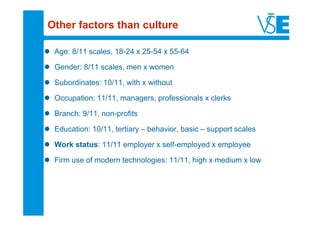
Other factors than culture

 Age: 8/11 scales, 18-24 x 25-54 x 55-64

 Gender: 8/11 scales, men x women

 Subordinates: 10/11, with x without

 Occupation: 11/11, managers, professionals x clerks

 Branch: 9/11, non-profits

 Education: 10/11, tertiary – behavior, basic – support scales

 Work status: 11/11 employer x self-employed x employee

 Firm use of modern technologies: 11/11, high x medium x low
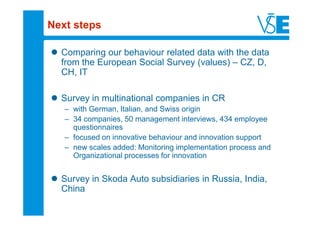
Next steps

  Comparing our behaviour related data with the data
  from the European Social Survey (values) – CZ, D,
  CH, IT

  Survey in multinational companies in CR
   – with German, Italian, and Swiss origin
   – 34 companies, 50 management interviews, 434 employee
     questionnaires
   – focused on innovative behaviour and innovation support
   – new scales added: Monitoring implementation process and
     Organizational processes for innovation


  Survey in Skoda Auto subsidiaries in Russia, India,
  China
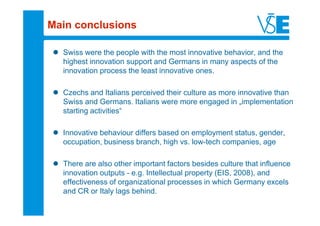
Main conclusions

  Swiss were the people with the most innovative behavior, and the
  highest innovation support and Germans in many aspects of the
  innovation process the least innovative ones.

  Czechs and Italians perceived their culture as more innovative than
  Swiss and Germans. Italians were more engaged in „implementation
  starting activities“

  Innovative behaviour differs based on employment status, gender,
  occupation, business branch, high vs. low-tech companies, age

  There are also other important factors besides culture that influence
  innovation outputs - e.g. Intellectual property (EIS, 2008), and
  effectiveness of organizational processes in which Germany excels
  and CR or Italy lags behind.
Thank you for your attention!


               Martin Lukeš

               University of Economics
               Dept. of Managerial Psychology and
               Sociology
               W. Churchill Sq. 4
               130 67 Prague 3


               lukesm@vse.cz,
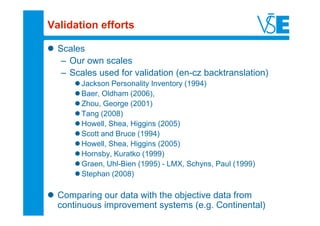
Validation efforts

  Scales
   – Our own scales
   – Scales used for validation (en-cz backtranslation)
        Jackson Personality Inventory (1994)
        Baer, Oldham (2006),
        Zhou, George (2001)
        Tang (2008)
        Howell, Shea, Higgins (2005)
        Scott and Bruce (1994)
        Howell, Shea, Higgins (2005)
        Hornsby, Kuratko (1999)
        Graen, Uhl-Bien (1995) - LMX, Schyns, Paul (1999)
        Stephan (2008)

  Comparing our data with the objective data from
  continuous improvement systems (e.g. Continental)

Lukes Cultural Differences Innovative Behaviour "Cultural Differences in Innovative Behaviour:

  • 1.
    Cultural Differences inInnovative Behaviour: 4-country Study with Representative Samples Martin Lukeš Alena Černíková Ute Stephan Tomáš Svátek Prague University of Economics 14th EAWOP Congress Santiago de Compostela, May 13-16
  • 2.
    Study objectives Identification of cultural differences in innovative behaviour Creation of an independent measure of innovative behaviour and innovation support Comparing the role of culture with other factors influencing innovative behaviours
  • 3.
    Key definitions Innovation – process of new idea creation or adoption and a subsequent effort to develop it into a new product, service, process or business model with an expected added value for a potential user Culture – shows up in the values, beliefs, norms, behavioral practices, and symbols shared, acquired, and advanced by the members of a large group
  • 4.
    Model Values General Personal IB Innovativeness General Beliefs about Work-related IB Innovations - Idea Generation Social / - Idea Search Innovation Demographic - Communicating Ideas Outcomes Variables - Implementation Starting Activities Business / - Involving Others Job-related - Overcoming Obstacles Variables Manager’s Organizational Support – MP/EP Support
  • 5.
    Questionnaire development -Pilot Step 1: – 13 scales tested, 95 items in total – 57 newly developed items, other items used or modified based on previous surveys - 12 items from Scott and Bruce (1994), 8 items from Howell, Shea, and Higgins (2005), 5 items from Jackson Personality Inventory (1994), etc. – piloted with 96 students of VSE – December 2007 Step 2: – 5 items reformulated, 2 added, 20 deleted, 77 items in total – translation and backtranslation to EN, DE, IT, FR – Sample: students of WHU and Regensburg U. (N=24 and 55), Bocconi (N=42), EPFL Lausanne (N=36), employees of Skoda Auto (N = 172) – January - March 2008 Final version for Adult population survey – 50 items, 13 scales
  • 6.
    Sample & Datagathering Sample: 4795 adults, Czech Rep. (N=1004), Germany (N=1285), Italy (N=1256), Switzerland (N=1250) Representativeness: checked for each country by using χ2 test of good fit (exc. CZ + IT - education, CH – age) Data gathering: May - July 2008 by CATI technique by agencies Median, IFAK, Linksystem, P. Roberts and Partners In total, 121281 calls done, 66792 taken, response rate 15 % (CZ) – 24 % (IT)
  • 7.
    Results of ConfirmatoryFactor Analysis: Work-Related Innovative Behavior Scales Loading Cronbach’s Items Cronbach’s Aspects of work-related innovative (standardized) Alpha Alpha CZ/D/It/Ch behavior 1st-order 2nd-order C2 .67 .85 .69 .73 .74 .72 .561 Idea generation C3 .63 C5 .69 D2 .62 .74 .73 .75 .74 .71 .73 Idea search D1 .76 D3 .72 E1 .67 .72 .83 .86 .81 .86 .80 Communicating ideas E4 .78 F4 .79 G1 .79 E7 .72 .74 .78 .84 .79 .77 .72 Implementation starting activities E8 .71 D4 .78 G3 .60 .72 .75 .82 .72 .75 .73 Involving others G4 .81 G5 .73 H1 .79 .74 .85 .89 .82 .87 .83 Overcoming obstacles H2 .73 H4 .71 H5 .74 I7 .74 .82 .81 .83 .81 .81 .76 Innovation outputs I9 .73 I10 .68 I11 .64 Note. Cz – Czech Republic, D – Germany, It – Italy, Ch – Switzerland, 1The low Cronbach’s Alpha for Switzerland seems to be due to translation problems of item C2 within the French version used in Switzerland (cf. also results of measurement invariance tests).
  • 8.
    Results of ConfirmatoryFactor Analysis: Innovativeness and Innovation Support Scales Cronbach’s Alpha Loading Cronbach’s CZ/D/It/Ch Items Scales (standardized) Alpha Personal innovativeness A1 .65 .72 .76 .64 .73 .70 A3 .52 A5 .49 A6 .50 A10 .67 Cultural perception of innovative M1 .67 .69 .71 .71 .69 .70 M2 .74 behavior M4 .54 M5 .41 Managerial support J4 .76 .81 .86 .81 .77 .76 J5 .50 J6 .85 J8 .58 J9 .74 Organizational support L1 .76 .80 .84 .81 .74 .76 L2 .59 L5 .74 L6 .76 Note. Cz – Czech Republic, D – Germany, It – Italy, Ch – Switzerland, Scales evaluated separately
  • 9.
    Cross-cultural measurement invariance Ensures that mean comparisons across cultures can be validly conducted Tested with multi-group confirmatory factor analysis (e.g., Kline, 2005; Steenkamp & Baumgartner, 1998) based on maximum likelihood estimation (AMOS 6) 4 types of equivalence measured – Configural - whether the factor structures of our scales were replicable with the same number of factors – Metric - whether item loadings were comparable – Scalar - whether item intercepts were comparable – Of factor covariances - whether factors showed comparable variance and for multi-factor models whether the relations among factors were comparable
  • 10.
    Cross-cultural measurement invariance(1) Model Comparison RMSEA CFI ∆CFI TLI ∆TLI NFI Personal Experimenting and Originality (Sample 1) 1 Configural - .020 .992 - .980 - .988 2 Full metric 1 vs. 2 .019 .987 -.005 .982 .002 .980 3 Full scalar 2 vs. 3 .034 .944 -.043 .944 -.038 .933 3.1 Partial scalar 2 vs. 3.1 .023 .979 -.008 .975 -.007 .970 4 Factor variance 3.1 vs. 4 .028 .964 -.015 .961 -.014 .954 Cultural Perception of Innovative Behavior (Sample 1) 1 Configural - .011 .999 - .996 - .998 2 Full metric 1 vs. 2 .027 .986 -.013 .974 -.022 .982 2.1 Partial metric 1 vs. 2.1 .024 .994 -.005 .979 -.017 .992 3. Initial partial scalar 2.1 vs. 3 .028 .988 .006 .972 .005 .985 4. Factor variance 3 vs. 4 .033 .979 -.009 .962 -.011 .975 Work-Related Innovative Behavior Scales (Sample 2) 1 Configural - .026 .943 - .931 - .919 2 Full metric 1 vs. 2 .026 .941 -.002 .932 -.001 .916 3 Full scalar 2 vs. 3 .030 .916 -.025 .908 -.024 .890 3.1 Partial scalar 2 vs. 3.1 .027 .935 -.006 .927 -.005 .909 4 Factor variances 3.1 vs. 4 .027 .931 -.004 .924 -.003 .905 5 Factor covariances 4 vs. 5 .028 .925 -.006 .922 -.002 .897
  • 11.
    Cross-cultural measurement invariance(2) Model Comparison RMSEA CFI ∆CFI TLI ∆TLI NFI ∆NFI Chi²(df) ∆Chi²(∆df) Managerial Support for Innovative Behavior (Sample 3) - .039 .983 - .966 - .979 - 95.63 (20) - 1 Configural 2 Full metric 1 vs. 2 .042 .967 -.017 .959 -.007 .961 -.018 176.17 (32) 80.54 (12) 2.1 Partial metric 1. vs. 2.1 .032 .983 -.000 .976 +.010 .977 -.002 104.70 (29) 9.07 (9) 3 Initial partial 2.1 vs. 3 .035 .973 -.010 .972 -.004 .965 -.012 157.10 (38) 52.40 (9) scalar 3.1 Final partial scalar 2 vs. 3.1 .033 .978 -.005 .975 -.001 .970 -.007 132.53 (35) 27.83 (6) 4 Factor variance 3.1 vs. 4 .033 .976 -.002 .975 -.000 .968 -.002 114.97 (38) 17.56 (3) Organizational Support for Innovative Behavior (Sample 4) - .024 .996 - .989 - .994 - 20.10 (8) - 1 Configural 2 Full metric 1 vs. 2 .016 .996 -.000 .995 +.006 .991 -.003 29.45 (17) 9.35 (9) 3 Full scalar 2 vs. 3 .033 .977 -.019 .979 -.016 .970 -.021 105.20 (26) 75.75 (9) 3.1 Final partial scalar 2 vs. 3.1 .026 .988 -.008 .987 -.008 .981 -.010 64.23 (23) 34.78 (6) 4 Factor variance 3.1 vs. 4 .031 .980 -.008 .981 -.006 .972 -.009 95.30 (26) 31.06 (3)
  • 12.
    Comparison of culturescale means Cz p D p It p Personal innovativeness Personal experimenting and originality .27*** <.001 .24*** <.001 .15*** <.001 Work-related innovative behavior Idea generation .21*** <.001 .22*** <.001 .19*** <.001 Idea search .06 .182 .09* .024 .12** .007 Communicating ideas .08 .075 .16*** <.001 .03 .517 Implementation starting activities .10 .116 .11* .045 -.50*** <.001 Involving others .10 .051 .22*** <.001 .19*** <.001 Overcoming obstacles .10* .029 .08* .037 .01 .841 Innovation outputs .19*** <.001 .30*** <.001 -.09 .053 Support for innovative behaviour Managerial support (employee-perceived) .19** .005 .37*** <.001 .32*** <.001 Organizational support .14* .024 .21*** <.001 .33*** <.001 Cultural perception of innovative behavior -.09* .016 .09** .005 -.27*** <.001 Notes: Mean Differences in Innovation Scales (Estimates based on final Scalar Invariance Models) Switzerland as ‘reference culture’, Italicized values – scale means lower compared to Switzerland, i.e. higher innovation behavior compared to Switzerland. Significant differences in all scales Managerial support (manager-perceived) – no scalar invariance achieved
  • 13.
    Other factors thanculture Age: 8/11 scales, 18-24 x 25-54 x 55-64 Gender: 8/11 scales, men x women Subordinates: 10/11, with x without Occupation: 11/11, managers, professionals x clerks Branch: 9/11, non-profits Education: 10/11, tertiary – behavior, basic – support scales Work status: 11/11 employer x self-employed x employee Firm use of modern technologies: 11/11, high x medium x low
  • 14.
    Next steps Comparing our behaviour related data with the data from the European Social Survey (values) – CZ, D, CH, IT Survey in multinational companies in CR – with German, Italian, and Swiss origin – 34 companies, 50 management interviews, 434 employee questionnaires – focused on innovative behaviour and innovation support – new scales added: Monitoring implementation process and Organizational processes for innovation Survey in Skoda Auto subsidiaries in Russia, India, China
  • 15.
    Main conclusions Swiss were the people with the most innovative behavior, and the highest innovation support and Germans in many aspects of the innovation process the least innovative ones. Czechs and Italians perceived their culture as more innovative than Swiss and Germans. Italians were more engaged in „implementation starting activities“ Innovative behaviour differs based on employment status, gender, occupation, business branch, high vs. low-tech companies, age There are also other important factors besides culture that influence innovation outputs - e.g. Intellectual property (EIS, 2008), and effectiveness of organizational processes in which Germany excels and CR or Italy lags behind.
  • 16.
    Thank you foryour attention! Martin Lukeš University of Economics Dept. of Managerial Psychology and Sociology W. Churchill Sq. 4 130 67 Prague 3 lukesm@vse.cz,
  • 17.
    Validation efforts Scales – Our own scales – Scales used for validation (en-cz backtranslation) Jackson Personality Inventory (1994) Baer, Oldham (2006), Zhou, George (2001) Tang (2008) Howell, Shea, Higgins (2005) Scott and Bruce (1994) Howell, Shea, Higgins (2005) Hornsby, Kuratko (1999) Graen, Uhl-Bien (1995) - LMX, Schyns, Paul (1999) Stephan (2008) Comparing our data with the objective data from continuous improvement systems (e.g. Continental)