Abergas, Czarina
    Layug, Eliza
 Lim, Chang Hie
    Mazo, Jamie
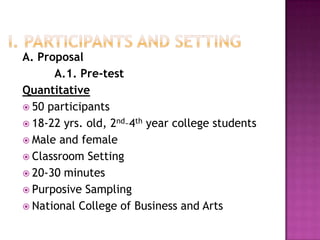
A. Proposal
      A.1. Pre-test
Quantitative
 50 participants
 18-22 yrs. old, 2nd–4th year college students
 Male and female
 Classroom Setting
 20-30 minutes
 Purposive Sampling
 National College of Business and Arts
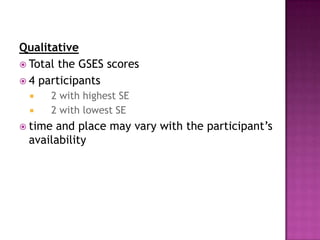
Qualitative
 Total the GSES scores
 4 participants
     2 with highest SE
     2 with lowest SE
 timeand place may vary with the participant’s
 availability
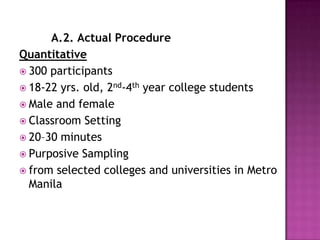
A.2. Actual Procedure
Quantitative
 300 participants
 18-22 yrs. old, 2nd-4th year college students
 Male and female
 Classroom Setting
 20–30 minutes
 Purposive Sampling
 from selected colleges and universities in Metro
  Manila
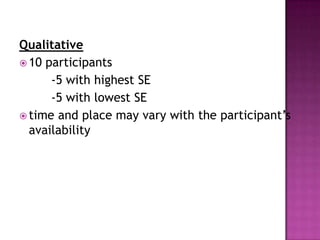
Qualitative
 10 participants
      -5 with highest SE
      -5 with lowest SE
 time and place may vary with the participant’s
  availability
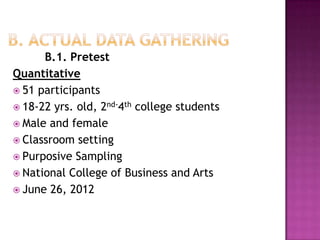
B.1. Pretest
Quantitative
 51 participants
 18-22 yrs. old, 2nd-4th college students
 Male and female
 Classroom setting
 Purposive Sampling
 National College of Business and Arts
 June 26, 2012
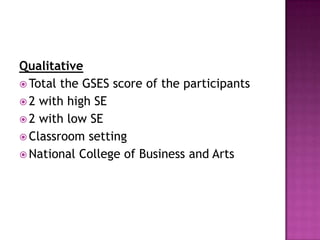
Qualitative
 Total the GSES score of the participants
 2 with high SE
 2 with low SE
 Classroom setting
 National College of Business and Arts
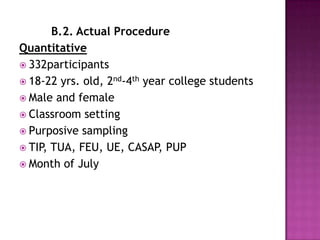
B.2. Actual Procedure
Quantitative
 332participants
 18-22 yrs. old, 2nd-4th year college students
 Male and female
 Classroom setting
 Purposive sampling
 TIP, TUA, FEU, UE, CASAP, PUP
 Month of July
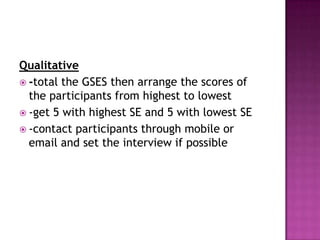
Qualitative
 -total the GSES then arrange the scores of
  the participants from highest to lowest
 -get 5 with highest SE and 5 with lowest SE
 -contact participants through mobile or
  email and set the interview if possible
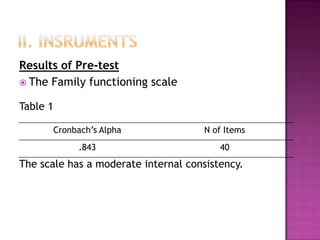
Results of Pre-test
 The Family functioning scale

Table 1

       Cronbach’s Alpha              N of Items
            .843                         40
The scale has a moderate internal consistency.
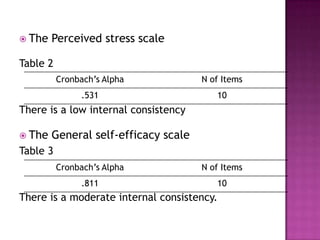
 The   Perceived stress scale

Table 2
          Cronbach’s Alpha            N of Items
               .531                      10
There is a low internal consistency

 The   General self-efficacy scale
Table 3
          Cronbach’s Alpha            N of Items
               .811                      10
There is a moderate internal consistency.
Revisions in instruments
 Briefing and Debriefing scripts
 Information Sheet
 Interview Protocol
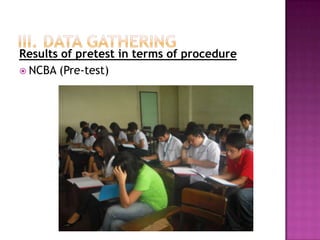
Results of pretest in terms of procedure
 NCBA (Pre-test)
 Step  by step changes in the procedure
 Additional instructions
 Distribution and collection of Scales
 Briefing and debriefing
 Contact information
 Purposive sampling
Revisions in procedure
 Introduction
 Distribution of survey questionnaires/scales
 Briefing and giving of instructions
 Administration of the scale
 Collection of the Scale
 Debriefing of participants
 Giving of tokens
―I learned that connection is very important!... Friends from
   different universities and colleges in Metro Manila are really
   important. It became easier for us to send letters of request
   to the school because of them. Of course, it wasn’t always a
   YES for us.‖

  ―Experience. Nothing beats our experience—travelling, how
  to communicate with people, how to fake smiles when we
  are totally exhausted, how to pretend that we are perfectly
  fine, and especially how to handle problems within the
  group.‖

                                                    -YNA
―Personally, it was not easy than what I expected. First, scheduling with
  the schools was hard because we had to cut classes and catching up
  the lessons is extra work that made me more stressed. Second, the
  distances of the schools were far and we need to ride public
  transportation to save budget. In terms of inner factors, stress from
  lack of time to study, rest, and join other organizations. This stress
  changed me to be highly nervous temperament and easily gets
  irritated.‖
―I believe the cooperative spirit among us is the most important
   facilitator. In last semester, we realized that our working ability
   improves when we work all together in one place or on one task. Most
   of the time, we even went all together to the schools to give request
   letters. What helped me reset my mind when I lost the passion to do
   thesis is by watching other thesis mates working so hard. Now, it is
   not boring for me to meet them and do thesis. We are helping each
   other and we learn and grow from it even if there is temporary pain.‖
                                                        -CHANG HIE
―Every step of the data gathering was an unforgettable experience. The
  running of letters, hassles of commuting back and forth, scheduling
  and conducting tests and interviews, meeting other deadlines and
  exams, settling finances and doing revisions, exhausted and aching
  parts of the body and even the mean students we encounter from
  different schools. Dealing with these things made us stick with each
  other and made us more knowledgeable of each others working ability
  therefore knowing how to adjust.‖

― Personally, I think it made me a better person. I feel responsible and
   flexible especially now that we are on our way through fourth year and
   half way through this thesis. I feel committed to this group not only
   because I started this with them but because I’ve come to know them
   one by one. It made me mature in a way that I am starting to take
   initiative for myself and being able to deal with people outside the
   school.‖

                                                       -ELAI
―Thesis data gathering was but a good blend of pain and joy.‖
―Going to universities and colleges was not at all easy—talking about the hassles
  of commuting, the heat of the sun or the heavy pour of the rain, the huge and
  weighty bags we carry. There was not a time when we did not go home
  exhausted—legs and arms hurting, heads aching. Not to mention that time
  when three of us were all sick. I hated the part that we had to skip classes. It
  was very difficult to catch up with the lessons. There were also moments when
  we argue over things and do not agree on some matters and have
  misunderstandings. We reached that point that we have gotten into fights.‖
―What I really appreciate was it had glued us all the more, not just as thesis
  mates but as friends. I have seen how each of us worked as individuals and as
  a team. I have seen how it has allowed us to be more responsible, flexible,
  and patient. I cannot think of a good english translation for the word but I
  have seen ―saluhan‖ among us. What we did as a group was more than just
  helping and supporting each other.‖
―I am thankful that though this thesis data gathering has cost us - physically and
   most especially financially, it was a learning experience worth remembering
   and sharing to others.‖

                                                                -JAMIE
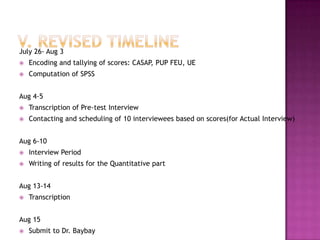
July 26- Aug 3
   Encoding and tallying of scores: CASAP, PUP FEU, UE
   Computation of SPSS


Aug 4-5
   Transcription of Pre-test Interview
   Contacting and scheduling of 10 interviewees based on scores(for Actual Interview)


Aug 6-10
   Interview Period
   Writing of results for the Quantitative part


Aug 13-14
   Transcription


Aug 15
   Submit to Dr. Baybay

Self-Efficacy Progress Report

  • 1.
    Abergas, Czarina Layug, Eliza Lim, Chang Hie Mazo, Jamie
  • 2.
    A. Proposal A.1. Pre-test Quantitative  50 participants  18-22 yrs. old, 2nd–4th year college students  Male and female  Classroom Setting  20-30 minutes  Purposive Sampling  National College of Business and Arts
  • 3.
    Qualitative  Total theGSES scores  4 participants  2 with highest SE  2 with lowest SE  timeand place may vary with the participant’s availability
  • 4.
    A.2. Actual Procedure Quantitative 300 participants  18-22 yrs. old, 2nd-4th year college students  Male and female  Classroom Setting  20–30 minutes  Purposive Sampling  from selected colleges and universities in Metro Manila
  • 5.
    Qualitative  10 participants -5 with highest SE -5 with lowest SE  time and place may vary with the participant’s availability
  • 6.
    B.1. Pretest Quantitative  51participants  18-22 yrs. old, 2nd-4th college students  Male and female  Classroom setting  Purposive Sampling  National College of Business and Arts  June 26, 2012
  • 7.
    Qualitative  Total theGSES score of the participants  2 with high SE  2 with low SE  Classroom setting  National College of Business and Arts
  • 8.
    B.2. Actual Procedure Quantitative 332participants  18-22 yrs. old, 2nd-4th year college students  Male and female  Classroom setting  Purposive sampling  TIP, TUA, FEU, UE, CASAP, PUP  Month of July
  • 9.
    Qualitative  -total theGSES then arrange the scores of the participants from highest to lowest  -get 5 with highest SE and 5 with lowest SE  -contact participants through mobile or email and set the interview if possible
  • 10.
    Results of Pre-test The Family functioning scale Table 1 Cronbach’s Alpha N of Items .843 40 The scale has a moderate internal consistency.
  • 11.
     The Perceived stress scale Table 2 Cronbach’s Alpha N of Items .531 10 There is a low internal consistency  The General self-efficacy scale Table 3 Cronbach’s Alpha N of Items .811 10 There is a moderate internal consistency.
  • 12.
    Revisions in instruments Briefing and Debriefing scripts  Information Sheet  Interview Protocol
  • 13.
    Results of pretestin terms of procedure  NCBA (Pre-test)
  • 14.
     Step by step changes in the procedure  Additional instructions  Distribution and collection of Scales  Briefing and debriefing  Contact information  Purposive sampling
  • 15.
    Revisions in procedure Introduction  Distribution of survey questionnaires/scales  Briefing and giving of instructions  Administration of the scale  Collection of the Scale  Debriefing of participants  Giving of tokens
  • 16.
    ―I learned thatconnection is very important!... Friends from different universities and colleges in Metro Manila are really important. It became easier for us to send letters of request to the school because of them. Of course, it wasn’t always a YES for us.‖ ―Experience. Nothing beats our experience—travelling, how to communicate with people, how to fake smiles when we are totally exhausted, how to pretend that we are perfectly fine, and especially how to handle problems within the group.‖ -YNA
  • 17.
    ―Personally, it wasnot easy than what I expected. First, scheduling with the schools was hard because we had to cut classes and catching up the lessons is extra work that made me more stressed. Second, the distances of the schools were far and we need to ride public transportation to save budget. In terms of inner factors, stress from lack of time to study, rest, and join other organizations. This stress changed me to be highly nervous temperament and easily gets irritated.‖ ―I believe the cooperative spirit among us is the most important facilitator. In last semester, we realized that our working ability improves when we work all together in one place or on one task. Most of the time, we even went all together to the schools to give request letters. What helped me reset my mind when I lost the passion to do thesis is by watching other thesis mates working so hard. Now, it is not boring for me to meet them and do thesis. We are helping each other and we learn and grow from it even if there is temporary pain.‖ -CHANG HIE
  • 18.
    ―Every step ofthe data gathering was an unforgettable experience. The running of letters, hassles of commuting back and forth, scheduling and conducting tests and interviews, meeting other deadlines and exams, settling finances and doing revisions, exhausted and aching parts of the body and even the mean students we encounter from different schools. Dealing with these things made us stick with each other and made us more knowledgeable of each others working ability therefore knowing how to adjust.‖ ― Personally, I think it made me a better person. I feel responsible and flexible especially now that we are on our way through fourth year and half way through this thesis. I feel committed to this group not only because I started this with them but because I’ve come to know them one by one. It made me mature in a way that I am starting to take initiative for myself and being able to deal with people outside the school.‖ -ELAI
  • 19.
    ―Thesis data gatheringwas but a good blend of pain and joy.‖ ―Going to universities and colleges was not at all easy—talking about the hassles of commuting, the heat of the sun or the heavy pour of the rain, the huge and weighty bags we carry. There was not a time when we did not go home exhausted—legs and arms hurting, heads aching. Not to mention that time when three of us were all sick. I hated the part that we had to skip classes. It was very difficult to catch up with the lessons. There were also moments when we argue over things and do not agree on some matters and have misunderstandings. We reached that point that we have gotten into fights.‖ ―What I really appreciate was it had glued us all the more, not just as thesis mates but as friends. I have seen how each of us worked as individuals and as a team. I have seen how it has allowed us to be more responsible, flexible, and patient. I cannot think of a good english translation for the word but I have seen ―saluhan‖ among us. What we did as a group was more than just helping and supporting each other.‖ ―I am thankful that though this thesis data gathering has cost us - physically and most especially financially, it was a learning experience worth remembering and sharing to others.‖ -JAMIE
  • 20.
    July 26- Aug3  Encoding and tallying of scores: CASAP, PUP FEU, UE  Computation of SPSS Aug 4-5  Transcription of Pre-test Interview  Contacting and scheduling of 10 interviewees based on scores(for Actual Interview) Aug 6-10  Interview Period  Writing of results for the Quantitative part Aug 13-14  Transcription Aug 15  Submit to Dr. Baybay