www.martupdate.com56 August 2015 www.martupdate.com 57August 2015
Pavan Sriram
pavan@ittige.com
TALENT MANAGEMENT
Self-Leadership
This is not about leading others. Instead, it is about something more fundamental and more
powerful, leadership that we exercise over ourselves.
There is a person with whom you spend
more time than any other, a person who
has more influence over you, and more
ability to interfere with or to support your
growth than anyone else. This ever-present
companion is your own self – hence our
greatest potential source of leadership
and influence comes not from an external
leader, but from within ourselves!
In taking an initial step towards
understanding and improving our own
selves, we must first recognise that it is
not just an outward process; we can and
do lead ourselves every time. To define
the meaning of the word ‘leadership’ as it
relates to the concept of self-leadership is
simply “a process of influence.”
Without leading yourself first, how can you
effectively lead others? If your own life isn’t
in order, how can you expect to lead others
towards success? Self-Leadership involves
“leading oneself” via the utilisation of both
behavioural and mental techniques. Let me
explain that:-
a) Behavioural Self-Leadership techniques
involve self-observation, self goal-setting,
management of behaviour, modification
of consequences to behaviour (e.g. self-
reinforcement, self-punishment), and
the finding of natural rewards in tasks
performed.
b) Mental Self-Leadership techniques
involve examination and alteration of self-
dialogue, beliefs and assumptions, mental
imagery, and thought patterns (habits in
one’s thinking).
According to a recent survey conducted
by ICF (International Coaching Federation)
across 650 global organisations – 67.6%
of the participating leaders mentioned ‘A
higher level of Self-awareness’ to be the
most required skill for successful leaders in
any business today.
The ancient Greek philosopher Socrates
had a few guiding principles that today’s
leaders would do well to adopt: Socrates
said, “Know Thyself” and “An unexamined
life is not worth living.” Those leaders
who actively pursue gaining a better
understanding of themselves will not
only reduce their number of blind spots,
but they’ll also find developing a sense
of awareness is the key to increasing
emotional intelligence. The better you
know yourself the more effective you’ll be,
and the better you’ll relate to others.
Based on my own leadership journey and
my experience of having been involved
in training leadership for managers – I
believe the following 4 principles of Self-
Leadership are a guiding set of behaviours
and beliefs to help you and your business
managers lead first and thereby more
effectively lead others.
a) Develop self-awareness in all areas of
your life - Get to know your habits, the
good and the bad and your underlying
behaviours. Know which ones to keep and
the ones that sabotage your mission and
vision.
b) Cultivate Emotional Intelligence (EQ) -
This ties right in with self-awareness and is
crucial to all of your interactions, especially
those as a leader. Learn to manage and
regulate your emotions to achieve high
value relationships and results.
c) Be responsible and accountable for your
actions and reactions - Take ownership of
your decisions, actions and outcomes. You
are in a position of power. You are not a
victim. Playing the victim role is easy and
there is no place for it in self-leadership.
You always have a choice in how you react
to any situation.
d) Create goals, systems and habits to
succeed - Without goals, systems and
habits, what are we? To be successful,
to live your mission and to achieve your
vision as a leader, you must establish
goals, systems and habits which move you
forward. You must use systems that push
you out of your comfort zone and discipline
yourself every day.
Recommended Reading: While i haven’t
been able to cover all aspects of Self-
Leadership in this article, I would personally
recommend Ken Blanchard’s phenomenal
bestselling classic “The One Minute
Manager” for you to explore the skills
needed to become an effective self leader.
The book clearly and thoroughly reveals
how power, freedom, and autonomy
can come from having the right mind-set
and the skills needed to take personal
responsibility for success.
I look forward to hear from you at
pavan@ittige.com on how you are
helping your leaders take their first steps
to leadership in your organisation and
unleashing the enormous human potential
to advance both their career and their life’s
leadership opportunities.
The author Pavan Sriram is the Founder and
CEO of ITTIGE Learning, a performance based
training company that works with c-level
executives to improve learning outcomes.
Self-leaders have a drive for autonomy, can make decisions, are
more creative and persist, even in the face of adversity
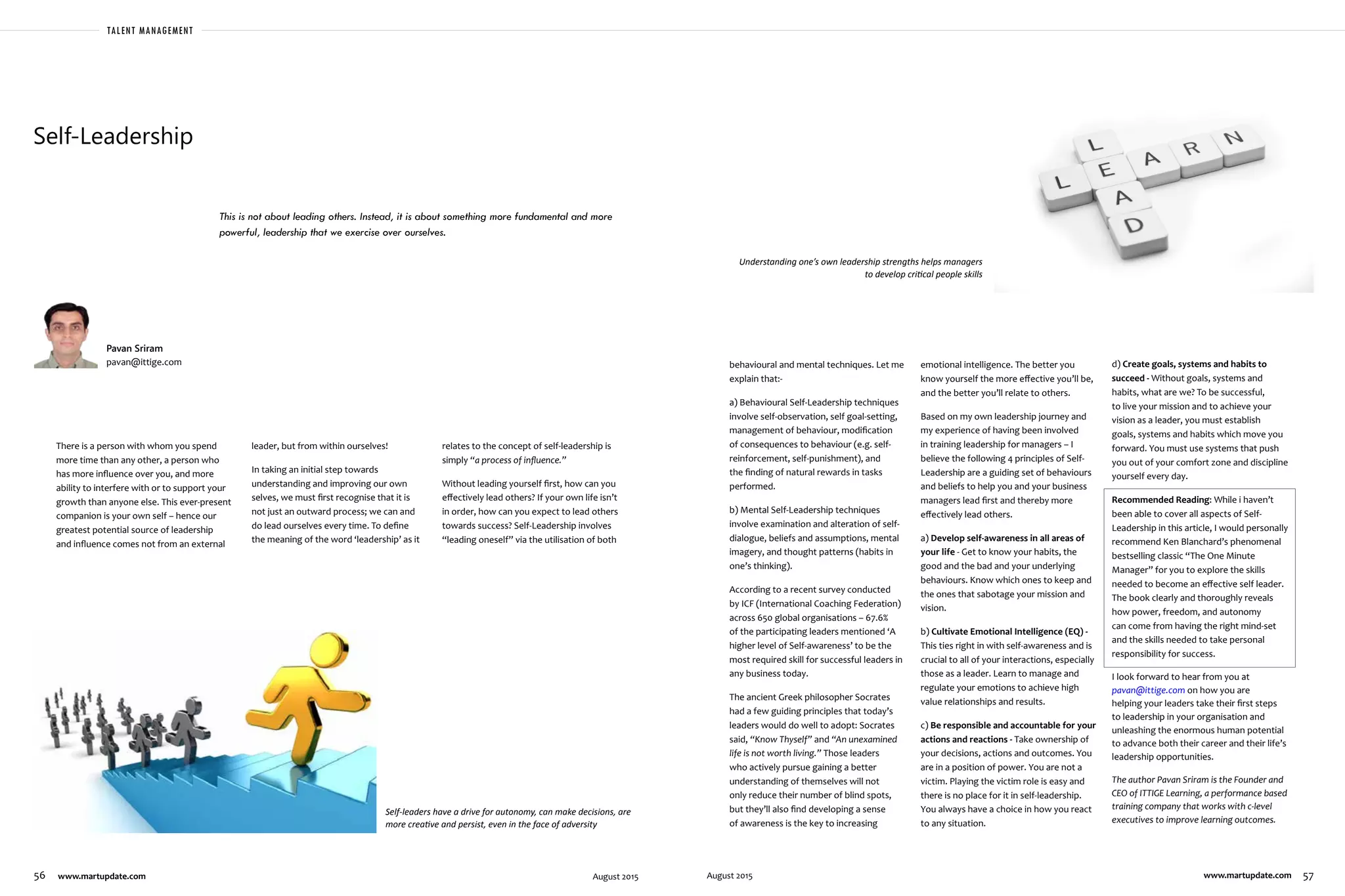
Understanding one’s own leadership strengths helps managers
to develop critical people skills

Self Leadership

  • 1.
    www.martupdate.com56 August 2015www.martupdate.com 57August 2015 Pavan Sriram pavan@ittige.com TALENT MANAGEMENT Self-Leadership This is not about leading others. Instead, it is about something more fundamental and more powerful, leadership that we exercise over ourselves. There is a person with whom you spend more time than any other, a person who has more influence over you, and more ability to interfere with or to support your growth than anyone else. This ever-present companion is your own self – hence our greatest potential source of leadership and influence comes not from an external leader, but from within ourselves! In taking an initial step towards understanding and improving our own selves, we must first recognise that it is not just an outward process; we can and do lead ourselves every time. To define the meaning of the word ‘leadership’ as it relates to the concept of self-leadership is simply “a process of influence.” Without leading yourself first, how can you effectively lead others? If your own life isn’t in order, how can you expect to lead others towards success? Self-Leadership involves “leading oneself” via the utilisation of both behavioural and mental techniques. Let me explain that:- a) Behavioural Self-Leadership techniques involve self-observation, self goal-setting, management of behaviour, modification of consequences to behaviour (e.g. self- reinforcement, self-punishment), and the finding of natural rewards in tasks performed. b) Mental Self-Leadership techniques involve examination and alteration of self- dialogue, beliefs and assumptions, mental imagery, and thought patterns (habits in one’s thinking). According to a recent survey conducted by ICF (International Coaching Federation) across 650 global organisations – 67.6% of the participating leaders mentioned ‘A higher level of Self-awareness’ to be the most required skill for successful leaders in any business today. The ancient Greek philosopher Socrates had a few guiding principles that today’s leaders would do well to adopt: Socrates said, “Know Thyself” and “An unexamined life is not worth living.” Those leaders who actively pursue gaining a better understanding of themselves will not only reduce their number of blind spots, but they’ll also find developing a sense of awareness is the key to increasing emotional intelligence. The better you know yourself the more effective you’ll be, and the better you’ll relate to others. Based on my own leadership journey and my experience of having been involved in training leadership for managers – I believe the following 4 principles of Self- Leadership are a guiding set of behaviours and beliefs to help you and your business managers lead first and thereby more effectively lead others. a) Develop self-awareness in all areas of your life - Get to know your habits, the good and the bad and your underlying behaviours. Know which ones to keep and the ones that sabotage your mission and vision. b) Cultivate Emotional Intelligence (EQ) - This ties right in with self-awareness and is crucial to all of your interactions, especially those as a leader. Learn to manage and regulate your emotions to achieve high value relationships and results. c) Be responsible and accountable for your actions and reactions - Take ownership of your decisions, actions and outcomes. You are in a position of power. You are not a victim. Playing the victim role is easy and there is no place for it in self-leadership. You always have a choice in how you react to any situation. d) Create goals, systems and habits to succeed - Without goals, systems and habits, what are we? To be successful, to live your mission and to achieve your vision as a leader, you must establish goals, systems and habits which move you forward. You must use systems that push you out of your comfort zone and discipline yourself every day. Recommended Reading: While i haven’t been able to cover all aspects of Self- Leadership in this article, I would personally recommend Ken Blanchard’s phenomenal bestselling classic “The One Minute Manager” for you to explore the skills needed to become an effective self leader. The book clearly and thoroughly reveals how power, freedom, and autonomy can come from having the right mind-set and the skills needed to take personal responsibility for success. I look forward to hear from you at pavan@ittige.com on how you are helping your leaders take their first steps to leadership in your organisation and unleashing the enormous human potential to advance both their career and their life’s leadership opportunities. The author Pavan Sriram is the Founder and CEO of ITTIGE Learning, a performance based training company that works with c-level executives to improve learning outcomes. Self-leaders have a drive for autonomy, can make decisions, are more creative and persist, even in the face of adversity Understanding one’s own leadership strengths helps managers to develop critical people skills