Self-
Management
Professional Ethics
What is
Self-
Management?
Professional Ethics
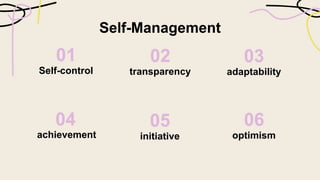
Self-control
01
transparency
06
Self-Management
02
adaptability
optimism
initiative
05
03
04
achievement
Self-Management
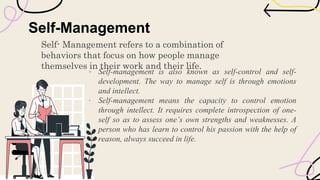
 Self-management is also known as self-control and self-
development. The way to manage self is through emotions
and intellect.
• Self-management means the capacity to control emotion
through intellect. It requires complete introspection of one-
self so as to assess one’s own strengths and weaknesses. A
person who has learn to control his passion with the help of
reason, always succeed in life.
Self- Management refers to a combination of
behaviors that focus on how people manage
themselves in their work and their life.
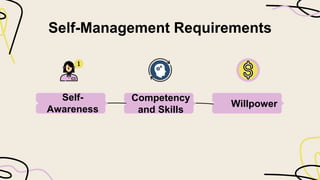
Self-Management Requirements
Self-
Awareness
Competency
and Skills
Willpower
Self-
Awareness
01
Self-Awareness
It is the ability to recognize your emotions
and thoughts, how they influence behavior,
and making accurate assessments of our
strengths and limitation. Self-awareness also
involves an understanding of how our
thoughts, feelings, and behaviors impact our
interactions with our students.
Self-Awareness
Self-management is not possible in
absence of self-awareness. Self-
awareness means becoming aware of
thoughts, feelings, sensations, speech
and actions. It is concerned with the
identification of what one is. The
awareness about the self is not static
rather changes continuously.
Awareness involves acceptance of reality, perceiving things as
they are, balancing emotions and change of direction.
Acceptance of reality means to accept the reality of problem
and seek its solution. One who does not hide his weakness,
imperfection and has the guts to accept the truth then one
sincerely seeks the solution of any problem and willfully
practices the state of awareness. Perceiving things as they are
means to perceiving with an equanimous view one's likes and
dislikes.
A person who can not perceive in relation to likes and
dislikes can not be aware. Balancing emotions is the
art of perceiving to become free from ego and
inferiority complex. When ego and inferiority
complex disappear, only then is a balance achieved. A
person, who has learnt the art of perceiving, can give
up his ego and live a balanced life. Change of
direction means reformation in behavior and conduct
towards truth. Reformation in behavior is the gist of
awareness.
Competency
and skills
02
Self-management is not possible in absence of competency and
the skills required. Competency may be judged through attitude,
skill and right knowledge. So, competency is the combination of
right knowledge, right vision and right conduct. We can assess
self-management through these criterions. Competency is unique
personal resource which one alone can develop and manage.
Self-management is not possible in absence of competency and
the skills required. Competency may be judged through attitude,
skill and right knowledge. So, competency is the combination
of right knowledge, right vision and right conduct. We can
assess self-management through these criterions. Competency is
unique personal resource which one alone can develop and
manage.
Skills refer to the proficiency required to use the
knowledge to do work. There are different ways for
classifying skills and their relevance for self-management.
Willpower
03
Unified willpower implies self-control, self-confidence
and disciplined action. In absence of these features, self-
management is not possible.
1. Self-control is the first feature of unified willpower. The
person who does not know how to control his own
activities or emotions can not manage self.
2. Self-confidence is the second feature of unified
willpower. Self-management can only be achieved if one
has immense confidence in himself.
3. Discipline is the third feature of unified willpower. It
increases mental power. An individual with strong mental
power firmly resolves to fight in the way of obstacles.
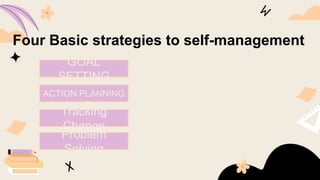
GOAL
SETTING
ACTION PLANNING
Tracking
Change
Problem
Solving
Four Basic strategies to self-management
Self Management - a process
Self-management is a process of maximizing time and
talent which lead efficiency and effectiveness to achieve
worthwhile goals based on a sound vale system.
Management of time and talent play important role in
self-management process. An individual has to learn
and develop a lot, while the time and talent available at
his disposal is short.
Self Management - a process
Unlike other resources, time once lost can never be regained.
With the result, one‟s work suffers in proportion to time lost.
This problem can be overcome by time management. Self-
management is a process of maximising time so that proper
allocation of time to different activities may be possible.
Talent is an individual‟s natural ability, aptitude or capacity;
it is a „human capital‟ for the organisation. Self-management
develops the talent in human being.
Self-management- A criterion for
success
There are two ways to get success.
These are the path of knowledge and the path of desire or emotion.
Personal Mission Statement
The mission statement must reflect what you want to be and what you
want to do. It serves the purpose of acting at the guiding light for
actions and decision.
Setting Goals
A goal is a statement of results to be achieved in a specific
time. It is very important in making a blueprint for success.
Self-management- A criterion for
success
There are two ways to get success.
These are the path of knowledge and the path of desire or emotion.
Meeting Goals
The main purpose of goal setting is to achieve them. In meeting goals, the
monitoring and reviewing of goals is very important. Goals can be set once in a
year but monitoring must be done on weekly basis and reviewing of goals means
adding and modifying them periodically. With the completion of goal the
blueprint for success is ready.
Self-management- A criterion for
success
Self-awareness
The next step for success is self-awareness. Self-awareness
means becoming aware of our thoughts, sensations, speech
and action.
Managing Self
Self-management helps in comprising effectiveness and efficiency because
self-management is a process to maximizing time and talent both. Time and
talent are major factors which need to be managed effectively. Time once
lost can never be regained. With the result, one's work suffers in proportion
to time lost.
Self-management- A criterion for
success
Managing Self
Success eludes the person who is careless about time. So time
management is very important for success. Like time, talent also
plays important role to achieve success. Talent increases
efficiency and effectiveness. Effectiveness is doing right things
and efficiency is doing things right. There is not much difference
between the two. Both the terms are used quite closely and
sometime, interchangeably. The whole notion of success criteria
is similar to efficiency and effectiveness. Both are important for
strategic development of human resources. Work, deed or actions
of a person are not only the reflection of his past experience
Key to self-management is not only about managing self but also
developing self. Self comprises not only the physical body but also the
mind and the heart, feeling and attitudes, character and behavior. Hence,
self-management is not possible in absence of physical, mental and
emotional health. Proper nurturing and development of these elements of
self will achieve success.
Self-
Management
Professional Ethics

Service-delivery-management lesson powerpoint.pptx

  • 1.
  • 2.
  • 3.
  • 4.
    Self-Management  Self-management isalso known as self-control and self- development. The way to manage self is through emotions and intellect. • Self-management means the capacity to control emotion through intellect. It requires complete introspection of one- self so as to assess one’s own strengths and weaknesses. A person who has learn to control his passion with the help of reason, always succeed in life. Self- Management refers to a combination of behaviors that focus on how people manage themselves in their work and their life.
  • 5.
  • 6.
  • 7.
    Self-Awareness It is theability to recognize your emotions and thoughts, how they influence behavior, and making accurate assessments of our strengths and limitation. Self-awareness also involves an understanding of how our thoughts, feelings, and behaviors impact our interactions with our students.
  • 8.
    Self-Awareness Self-management is notpossible in absence of self-awareness. Self- awareness means becoming aware of thoughts, feelings, sensations, speech and actions. It is concerned with the identification of what one is. The awareness about the self is not static rather changes continuously.
  • 9.
    Awareness involves acceptanceof reality, perceiving things as they are, balancing emotions and change of direction. Acceptance of reality means to accept the reality of problem and seek its solution. One who does not hide his weakness, imperfection and has the guts to accept the truth then one sincerely seeks the solution of any problem and willfully practices the state of awareness. Perceiving things as they are means to perceiving with an equanimous view one's likes and dislikes.
  • 10.
    A person whocan not perceive in relation to likes and dislikes can not be aware. Balancing emotions is the art of perceiving to become free from ego and inferiority complex. When ego and inferiority complex disappear, only then is a balance achieved. A person, who has learnt the art of perceiving, can give up his ego and live a balanced life. Change of direction means reformation in behavior and conduct towards truth. Reformation in behavior is the gist of awareness.
  • 11.
  • 12.
    Self-management is notpossible in absence of competency and the skills required. Competency may be judged through attitude, skill and right knowledge. So, competency is the combination of right knowledge, right vision and right conduct. We can assess self-management through these criterions. Competency is unique personal resource which one alone can develop and manage.
  • 13.
    Self-management is notpossible in absence of competency and the skills required. Competency may be judged through attitude, skill and right knowledge. So, competency is the combination of right knowledge, right vision and right conduct. We can assess self-management through these criterions. Competency is unique personal resource which one alone can develop and manage.
  • 14.
    Skills refer tothe proficiency required to use the knowledge to do work. There are different ways for classifying skills and their relevance for self-management.
  • 16.
  • 17.
    Unified willpower impliesself-control, self-confidence and disciplined action. In absence of these features, self- management is not possible. 1. Self-control is the first feature of unified willpower. The person who does not know how to control his own activities or emotions can not manage self. 2. Self-confidence is the second feature of unified willpower. Self-management can only be achieved if one has immense confidence in himself. 3. Discipline is the third feature of unified willpower. It increases mental power. An individual with strong mental power firmly resolves to fight in the way of obstacles.
  • 18.
  • 20.
    Self Management -a process Self-management is a process of maximizing time and talent which lead efficiency and effectiveness to achieve worthwhile goals based on a sound vale system. Management of time and talent play important role in self-management process. An individual has to learn and develop a lot, while the time and talent available at his disposal is short.
  • 21.
    Self Management -a process Unlike other resources, time once lost can never be regained. With the result, one‟s work suffers in proportion to time lost. This problem can be overcome by time management. Self- management is a process of maximising time so that proper allocation of time to different activities may be possible. Talent is an individual‟s natural ability, aptitude or capacity; it is a „human capital‟ for the organisation. Self-management develops the talent in human being.
  • 23.
    Self-management- A criterionfor success There are two ways to get success. These are the path of knowledge and the path of desire or emotion. Personal Mission Statement The mission statement must reflect what you want to be and what you want to do. It serves the purpose of acting at the guiding light for actions and decision. Setting Goals A goal is a statement of results to be achieved in a specific time. It is very important in making a blueprint for success.
  • 24.
    Self-management- A criterionfor success There are two ways to get success. These are the path of knowledge and the path of desire or emotion. Meeting Goals The main purpose of goal setting is to achieve them. In meeting goals, the monitoring and reviewing of goals is very important. Goals can be set once in a year but monitoring must be done on weekly basis and reviewing of goals means adding and modifying them periodically. With the completion of goal the blueprint for success is ready.
  • 25.
    Self-management- A criterionfor success Self-awareness The next step for success is self-awareness. Self-awareness means becoming aware of our thoughts, sensations, speech and action. Managing Self Self-management helps in comprising effectiveness and efficiency because self-management is a process to maximizing time and talent both. Time and talent are major factors which need to be managed effectively. Time once lost can never be regained. With the result, one's work suffers in proportion to time lost.
  • 26.
    Self-management- A criterionfor success Managing Self Success eludes the person who is careless about time. So time management is very important for success. Like time, talent also plays important role to achieve success. Talent increases efficiency and effectiveness. Effectiveness is doing right things and efficiency is doing things right. There is not much difference between the two. Both the terms are used quite closely and sometime, interchangeably. The whole notion of success criteria is similar to efficiency and effectiveness. Both are important for strategic development of human resources. Work, deed or actions of a person are not only the reflection of his past experience
  • 27.
    Key to self-managementis not only about managing self but also developing self. Self comprises not only the physical body but also the mind and the heart, feeling and attitudes, character and behavior. Hence, self-management is not possible in absence of physical, mental and emotional health. Proper nurturing and development of these elements of self will achieve success.
  • 29.