 Self-compacting concrete is a fluid mixture suitable for placing in structures with
congested reinforcement without vibration.
 The SCC can be made by three methods namely powder type ,VMA type and
combined type. VMA type is used in our project and Cement is replaced by fly ash at 20%
by weight of cement.
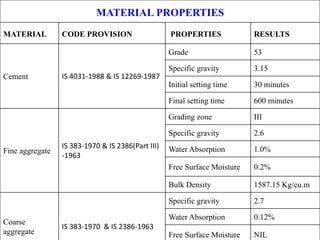
The basic material properties are studied and tabulated
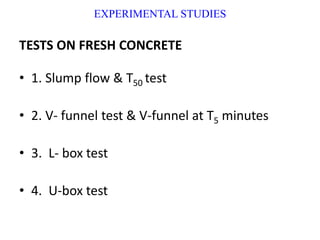
The workability tests on SCC such as Slump Flow, V-Funnel, L-box, U-box test are
conducted on trial mix to optimize the design mix by EFNARC codes
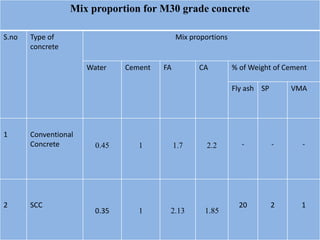
 The final Proportions of Ingredients and Admixtures have been finalized for M30 grade
conventional concrete and SCC.
The basic mechanical properties of conventional concrete and SCC are studied and
compared
The experimental investigation is mainly focused on bond strength and chloride
permeability of self-compacting concrete and the results are compared with CC.
ABOUT SCC:
 Self-compacting concrete does not need additional inner or outer vibration for
compaction.
 With regard to its composition, self-compacting concrete consists of the same
components as conventionally vibrated concrete, which are cement, aggregates
and water, with the addition of chemical and mineral admixtures in different
proportions
 Researchers have set some guidelines for mix proportioning of SCC,
i) reducing the volume ratio of aggregate to cementitious material
(ii) increasing the paste volume and water-cement ratio
(iii) carefully controlling the maximum coarse aggregate size and total volume
(iv) using various viscosity enhancing admixtures
(v) using super plasticizers
BOND STRENGTH OF CONCRETE:
 The bond strength between paste and steel reinforcement plays a major role in RCC
design. Bond strength arises primarily from the friction and adhesion between concrete
and steel.
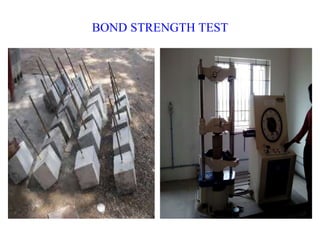
 Bond strength is determined by conducting pull out test on cubes casted with steel rods
(diameter12mm to 20 mm)
A hydraulic machine (UTM) with maximum loading capacity of 30 ton was used to
perform current bond tests. The load was applied with a rate of 2 kN/sec and distributed on
the specimen surface by a square steel plate with size of 20 cm and a hole at the center
The cubes are casted with single reinforcing bar embedded vertically along a central axis
in each specimen
The cube shall be reinforced with a helix of 6 mm diameter plain mild steel bar conforming
to Grade-I of IS: 432 (Part 1)- 1966 at 25 mm pitch, such that the outer diameter of the
helix is equal to the size of the cube.
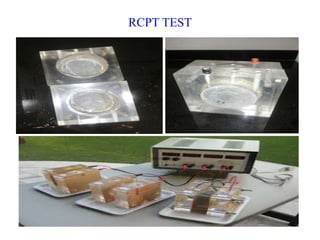
CHLORIDE PERMEABILITY OF CONCRETE:
 Capillary absorption, hydrostatic pressure, and diffusion are the means by
which chloride ions can penetrate concrete.
 The most familiar method is diffusion, the movement of chloride ions under a
concentration gradient.
 the chloride permeability is determined by rapid chloride permeability test.
The cylindrical concrete specimens of 50-mm thick and 100-mm diameter is
used for RCPT test
In the test set up A 60 V DC voltage for 6 hours is applied for the reservoirs
filled with 3.0 M NaCl solution and 0.3 M NaOH solution.
 All the results of total charge passed through standard specimens in 6
hours(the RCPT values), taken as a measure of the chloride permeability
 To study the basic material properties of ingredients
 To determine the design mix for SCC by conducting Slump
Cone Test, U box Test, L Box Test, and V Funnel Test on trial
mix.
 To study the mechanical properties of conventional concrete
and SCC.
 The main objective of this project is to study the bond stregth
and chloride permeability of conventional concrete and SCC
SCC has got many advantages over normal concrete.
 It can even be cheaper than normal concrete if fly ash is locally available
 Faster construction.
 Reduction in site man power.
 Better surface finishes
 Easier placing.
 Reduced noise levels in work site.
 Safer working environment.
 Economical construction.
 Improved filling capacity through highly congested reinforcement.
 Time of construction is minimized.
ADVANTAGES
Ana-ioana petean*, marian sabau and traian oneţ (2000)
• This paper aims to investigate the bond with reinforced bar of a new construction
material, self-compacting concrete, the bond strength between reinforcing steel
andconcretewasdeterminedbybeamtestscarriedoutafter28days.
• Deformed bars S500 with 16 mm and18mm effective diameters were used to
evaluate the bond in C50 and self-compacting concrete, according to RILEM
procedures.
• Also in this study the hardened properties of self-compacting concrete containing
limestone powder were experimentally investigated and compared with those of
normal vibrating concrete.
LITERATURE SURVEY- 1
M. Shahul Hameed 1, V.Saraswathi 2 ,A.S.S. Sekar 3 (2004)
• SCC was developed to ensure adequate compaction through self-consolidation and
facilitate placement of concrete in structures with congested reinforcement and in
restricted areas.
• Marble Sludge Powder (MSP) can be used as filler and helps to reduce the total voids
content in concrete. Consequently, this contributes to improve the strength of concrete.
• Rapid Chloride Permeability test (RCPT) was conducted to measure the chloride
permeability of SCHPGC and the results were compared with the normal concrete made
up of river sand (NCRS) and the normal concrete made up of CRD (NCCRD).
• This paper discusses the effects of several factors, such as cement composition,
replacement of river sand with CRD and MSP on the RCPT results of hardened cement
concrete.
LITERATURE SURVEY- 2
LITERATURE SURVEY- 3
Paratibhaaggarwal, Rafatsiddique, Yogeshaggarwal, Surinder M Gupta (2008)
 Reported that Self-compacting concrete is a fluid mixture suitable for placing in
structures with congested reinforcement without vibration.
 Self-compacting concrete development must ensure a good balance between
deformability and stability.
 Also, compactibility is affected by the characteristics of materials and the mix
proportions; it becomes necessary to evolve a procedure for mix design of SCC
 The test results for acceptance characteristics of self-compacting concrete such as slump
flow; J-ring, V-funnel and L-Box are presented. Further, compressive strength at the ages

of 7, 28, and 90 days was also determined
LITERATURE SURVEY- 4
Ana-ioana petean*, marian sabau and traian oneţ (2000)
 For the design of structural elements, bond behavior plays an important role; therefore it is
important to investigate the bond behavior of normal vibrated concrete in comparison with
self-compacting concrete.
 This paper aims to investigate the bond with reinforced bar of a new construction material,
self-compacting concrete, the bond strength between reinforcing steel
andconcretewasdeterminedbybeamtestscarriedoutafter28days
 .Deformed bars S500 with 16 mm and 18mm effective diameters were used to evaluate the
bond in C50 and self-compacting concrete, according to RILEM procedures.
 Also in this study the hardened properties of self-compacting concrete containing
limestone powder were experimentally investigated and compared with those of
normal vibrating concrete.
LITERATURE SURVEY- 5
Trevor J. Looney, Mahdi Arezoumandi*, Jeffery S. Volz, and John J. Myers (2007)
 An experimental investigation was conducted to compare the bond strength of reinforcing
steel in self-consolidating concrete (SCC) with conventional concrete (CC).
 This study investigated two different compressive strengths of SCC as well as CC. The
experimental program consisted of 24 pull-out specimens as well as 12 full-scale beams
(three for each concrete type and strength).
 The pull-out specimens were based on RILEM recommendations, and the beam specimens
were tested under a simply supported four-point loading condition. The CC test results
served as a control and were used to evaluate the results from the SCC pull-out and beam
specimen tests.
 Furthermore, a comparison was performed between results of this study and a bond
database of CC specimens. These comparisons indicate that SCC beams possess
comparable or slightly greater bond strength than CC beams.
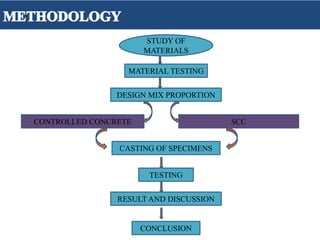
STUDY OF
MATERIALS
MATERIAL TESTING
DESIGN MIX PROPORTION
CONTROLLED CONCRETE SCC
CASTING OF SPECIMENS
TESTING
RESULT AND DISCUSSION
CONCLUSION
MATERIAL PROPERTIES
MATERIAL CODE PROVISION PROPERTIES RESULTS
Cement IS 4031-1988 & IS 12269-1987
Grade 53
Specific gravity 3.15
Initial setting time 30 minutes
Final setting time 600 minutes
Fine aggregate
IS 383-1970 & IS 2386(Part III)
-1963
Grading zone III
Specific gravity 2.6
Water Absorption 1.0%
Free Surface Moisture 0.2%
Bulk Density 1587.15 Kg/cu.m
Coarse
aggregate
IS 383-1970 & IS 2386-1963
Specific gravity 2.7
Water Absorption 0.12%
Free Surface Moisture NIL
Mix proportion for M30 grade concrete
S.no Type of
concrete
Mix proportions
Water Cement FA CA % of Weight of Cement
Fly ash SP VMA
1 Conventional
Concrete 0.45 1 1.7 2.2 - - -
2 SCC
0.35 1 2.13 1.85
20 2 1
EXPERIMENTAL STUDIES
TESTS ON FRESH CONCRETE
• 1. Slump flow & T50 test
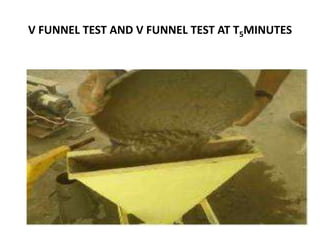
• 2. V- funnel test & V-funnel at T5 minutes
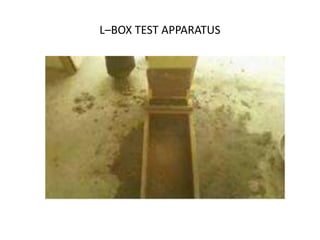
• 3. L- box test
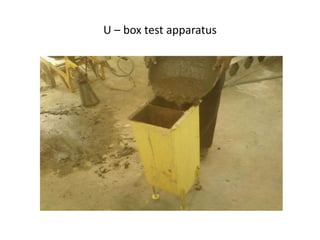
• 4. U-box test
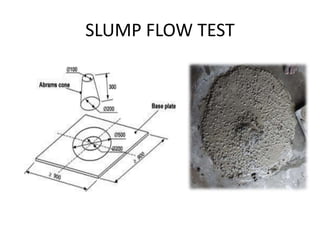
SLUMP FLOW TEST
V FUNNEL TEST AND V FUNNEL TEST AT T5MINUTES
L–BOX TEST APPARATUS
U – box test apparatus
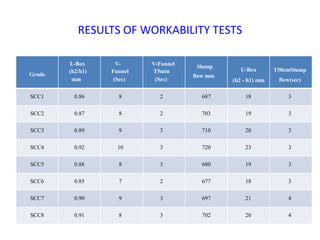
RESULTS OF WORKABILITY TESTS
Grade
L-Box
(h2/h1)
mm
V-
Funnel
(Sec)
V-Funnel
T5min
(Sec)
Slump
flow mm
U-Box
(h2 - h1) mm
T50cmSlump
flow(sec)
SCC1 0.86 8 2 687 18 3
SCC2 0.87 8 2 703 19 3
SCC3 0.89 9 3 710 20 3
SCC4 0.92 10 3 720 23 3
SCC5 0.88 8 3 680 19 3
SCC6 0.85 7 2 677 18 3
SCC7 0.90 9 3 697 21 4
SCC8 0.91 8 3 702 20 4
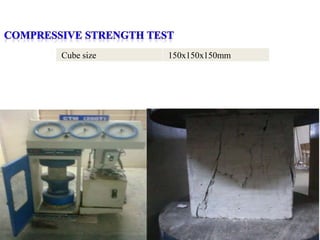
Cube size 150x150x150mm
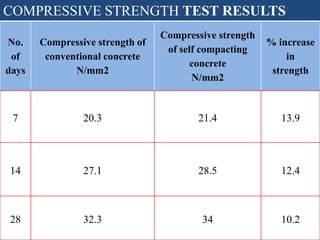
No.
of
days
Compressive strength of
conventional concrete
N/mm2
Compressive strength
of self compacting
concrete
N/mm2
% increase
in
strength
7 20.3 21.4 13.9
14 27.1 28.5 12.4
28 32.3 34 10.2
COMPRESSIVE STRENGTH TEST RESULTS
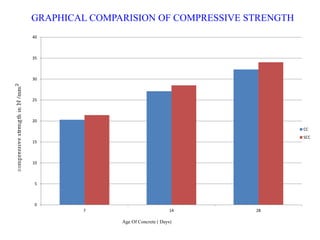
GRAPHICAL COMPARISION OF COMPRESSIVE STRENGTH
0
5
10
15
20
25
30
35
40
7 14 28
CC
SCC
Age Of Concrete ( Days)
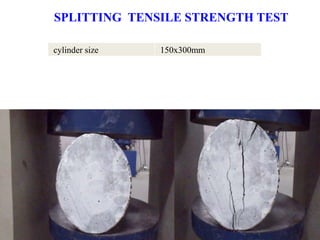
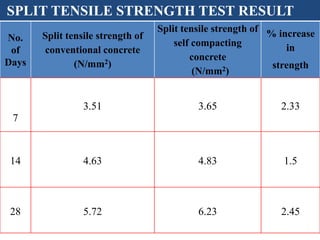
SPLITTING TENSILE STRENGTH TEST
cylinder size 150x300mm
No.
of
Days
Split tensile strength of
conventional concrete
(N/mm2)
Split tensile strength of
self compacting
concrete
(N/mm2)
% increase
in
strength
7
3.51 3.65 2.33
14 4.63 4.83 1.5
28 5.72 6.23 2.45
SPLIT TENSILE STRENGTH TEST RESULT
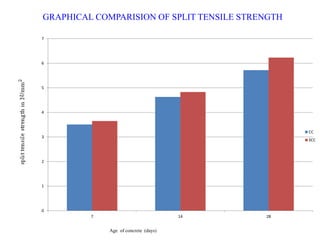
GRAPHICAL COMPARISION OF SPLIT TENSILE STRENGTH
0
1
2
3
4
5
6
7
7 14 28
CC
SCC
Age of concrete (days)
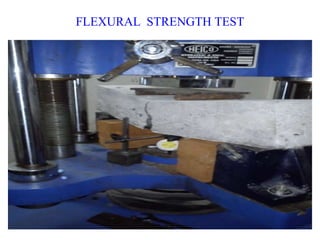
FLEXURAL STRENGTH TEST
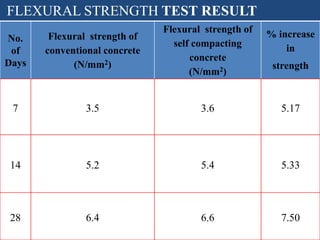
No.
of
Days
Flexural strength of
conventional concrete
(N/mm2)
Flexural strength of
self compacting
concrete
(N/mm2)
% increase
in
strength
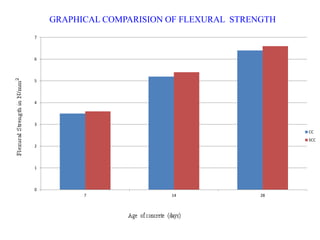
7 3.5 3.6 5.17
14 5.2 5.4 5.33
28 6.4 6.6 7.50
FLEXURAL STRENGTH TEST RESULT
GRAPHICAL COMPARISION OF FLEXURAL STRENGTH
0
1
2
3
4
5
6
7
7 14 28
CC
SCC
BOND STRENGTH TEST
No.
of
Days
Bond Strength of
Controlled Concrete
(N/mm2)
Bond Strength of SCC
(N/mm2)
% increase
in
Strength
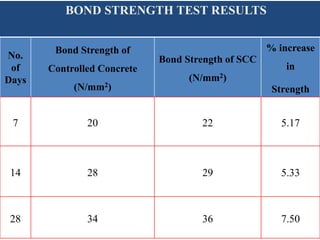
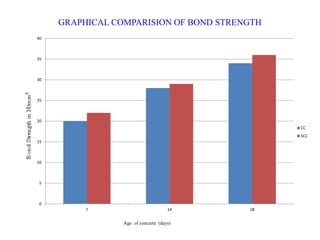
7 20 22 5.17
14 28 29 5.33
28 34 36 7.50
BOND STRENGTH TEST RESULTS
GRAPHICAL COMPARISION OF BOND STRENGTH
0
5
10
15
20
25
30
35
40
7 14 28
CC
SCC
Age of concrete (days)
RCPT TEST
No.
of
Days
RCPT of Controlled
Concrete
(coulombs)
RCPT of SCC
(coulombs)
% increase
in value
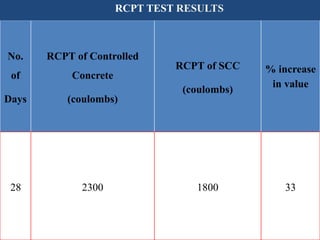
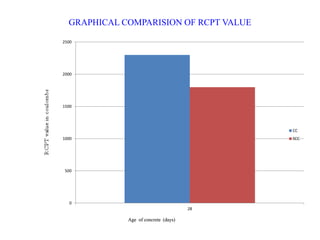
28 2300 1800 33
RCPT TEST RESULTS
GRAPHICAL COMPARISION OF RCPT VALUE
0
500
1000
1500
2000
2500
28
CC
SCC
Age of concrete (days)
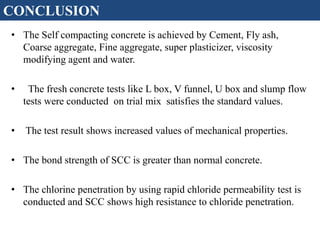
• The Self compacting concrete is achieved by Cement, Fly ash,
Coarse aggregate, Fine aggregate, super plasticizer, viscosity
modifying agent and water.
• The fresh concrete tests like L box, V funnel, U box and slump flow
tests were conducted on trial mix satisfies the standard values.
• The test result shows increased values of mechanical properties.
• The bond strength of SCC is greater than normal concrete.
• The chlorine penetration by using rapid chloride permeability test is
conducted and SCC shows high resistance to chloride penetration.
CONCLUSION
REFERENCES
• Amrutha, GopinathaNayak, Mattur C. Narasimhan and S.V.Rajeeva(2011) ‘Chloride-Ion
Impermeability Of Self-Compacting High-Volume Fly Ash Concrete Mixes’, Vol: 11 No:
04, pp.29-35.
• Ana-ioana petean*, marian sabau and traian oneţ (2000), ‘Self-Compacting Concrete:
Theoretical and experimental study’, Cement and Concrete Research 35, pp.2116 – 2136.
• N R Gaywala, D B Raijiwala (2008), ‘Development of Self Compacting Concrete by use of
Portland Pozzolana Cement, Hydrated Lime and Silica Fume’, ISCA Journal of
Engineering Sciences, Vol. 1(1), pp.35-39.
• GisliGuqmundsson, Grensasvegi (2012), ‘The Chemical, Physical, Mechanical Properties
Of Scc’, A Wide Research Programme In Progress In Italy, 29th Conference on Our World
In Concrete & Structures,pp.69-80.
• Kazim Turk, Mehmet Karatas, TahirGonen (2012) ‘Self Compacting Concrete: A Concrete
Of Next Decade’, Journal of Engineering Research and Studies,Vol:II,pp.213-218.
THANK YOU
THANK YOU

SELF COMPACTING CONCRETE. ppt.pptx

  • 1.
     Self-compacting concreteis a fluid mixture suitable for placing in structures with congested reinforcement without vibration.  The SCC can be made by three methods namely powder type ,VMA type and combined type. VMA type is used in our project and Cement is replaced by fly ash at 20% by weight of cement. The basic material properties are studied and tabulated The workability tests on SCC such as Slump Flow, V-Funnel, L-box, U-box test are conducted on trial mix to optimize the design mix by EFNARC codes  The final Proportions of Ingredients and Admixtures have been finalized for M30 grade conventional concrete and SCC. The basic mechanical properties of conventional concrete and SCC are studied and compared The experimental investigation is mainly focused on bond strength and chloride permeability of self-compacting concrete and the results are compared with CC.
  • 2.
    ABOUT SCC:  Self-compactingconcrete does not need additional inner or outer vibration for compaction.  With regard to its composition, self-compacting concrete consists of the same components as conventionally vibrated concrete, which are cement, aggregates and water, with the addition of chemical and mineral admixtures in different proportions  Researchers have set some guidelines for mix proportioning of SCC, i) reducing the volume ratio of aggregate to cementitious material (ii) increasing the paste volume and water-cement ratio (iii) carefully controlling the maximum coarse aggregate size and total volume (iv) using various viscosity enhancing admixtures (v) using super plasticizers
  • 3.
    BOND STRENGTH OFCONCRETE:  The bond strength between paste and steel reinforcement plays a major role in RCC design. Bond strength arises primarily from the friction and adhesion between concrete and steel.  Bond strength is determined by conducting pull out test on cubes casted with steel rods (diameter12mm to 20 mm) A hydraulic machine (UTM) with maximum loading capacity of 30 ton was used to perform current bond tests. The load was applied with a rate of 2 kN/sec and distributed on the specimen surface by a square steel plate with size of 20 cm and a hole at the center The cubes are casted with single reinforcing bar embedded vertically along a central axis in each specimen The cube shall be reinforced with a helix of 6 mm diameter plain mild steel bar conforming to Grade-I of IS: 432 (Part 1)- 1966 at 25 mm pitch, such that the outer diameter of the helix is equal to the size of the cube.
  • 4.
    CHLORIDE PERMEABILITY OFCONCRETE:  Capillary absorption, hydrostatic pressure, and diffusion are the means by which chloride ions can penetrate concrete.  The most familiar method is diffusion, the movement of chloride ions under a concentration gradient.  the chloride permeability is determined by rapid chloride permeability test. The cylindrical concrete specimens of 50-mm thick and 100-mm diameter is used for RCPT test In the test set up A 60 V DC voltage for 6 hours is applied for the reservoirs filled with 3.0 M NaCl solution and 0.3 M NaOH solution.  All the results of total charge passed through standard specimens in 6 hours(the RCPT values), taken as a measure of the chloride permeability
  • 5.
     To studythe basic material properties of ingredients  To determine the design mix for SCC by conducting Slump Cone Test, U box Test, L Box Test, and V Funnel Test on trial mix.  To study the mechanical properties of conventional concrete and SCC.  The main objective of this project is to study the bond stregth and chloride permeability of conventional concrete and SCC
  • 6.
    SCC has gotmany advantages over normal concrete.  It can even be cheaper than normal concrete if fly ash is locally available  Faster construction.  Reduction in site man power.  Better surface finishes  Easier placing.  Reduced noise levels in work site.  Safer working environment.  Economical construction.  Improved filling capacity through highly congested reinforcement.  Time of construction is minimized. ADVANTAGES
  • 7.
    Ana-ioana petean*, mariansabau and traian oneţ (2000) • This paper aims to investigate the bond with reinforced bar of a new construction material, self-compacting concrete, the bond strength between reinforcing steel andconcretewasdeterminedbybeamtestscarriedoutafter28days. • Deformed bars S500 with 16 mm and18mm effective diameters were used to evaluate the bond in C50 and self-compacting concrete, according to RILEM procedures. • Also in this study the hardened properties of self-compacting concrete containing limestone powder were experimentally investigated and compared with those of normal vibrating concrete. LITERATURE SURVEY- 1
  • 8.
    M. Shahul Hameed1, V.Saraswathi 2 ,A.S.S. Sekar 3 (2004) • SCC was developed to ensure adequate compaction through self-consolidation and facilitate placement of concrete in structures with congested reinforcement and in restricted areas. • Marble Sludge Powder (MSP) can be used as filler and helps to reduce the total voids content in concrete. Consequently, this contributes to improve the strength of concrete. • Rapid Chloride Permeability test (RCPT) was conducted to measure the chloride permeability of SCHPGC and the results were compared with the normal concrete made up of river sand (NCRS) and the normal concrete made up of CRD (NCCRD). • This paper discusses the effects of several factors, such as cement composition, replacement of river sand with CRD and MSP on the RCPT results of hardened cement concrete. LITERATURE SURVEY- 2
  • 9.
    LITERATURE SURVEY- 3 Paratibhaaggarwal,Rafatsiddique, Yogeshaggarwal, Surinder M Gupta (2008)  Reported that Self-compacting concrete is a fluid mixture suitable for placing in structures with congested reinforcement without vibration.  Self-compacting concrete development must ensure a good balance between deformability and stability.  Also, compactibility is affected by the characteristics of materials and the mix proportions; it becomes necessary to evolve a procedure for mix design of SCC  The test results for acceptance characteristics of self-compacting concrete such as slump flow; J-ring, V-funnel and L-Box are presented. Further, compressive strength at the ages of 7, 28, and 90 days was also determined
  • 10.
    LITERATURE SURVEY- 4 Ana-ioanapetean*, marian sabau and traian oneţ (2000)  For the design of structural elements, bond behavior plays an important role; therefore it is important to investigate the bond behavior of normal vibrated concrete in comparison with self-compacting concrete.  This paper aims to investigate the bond with reinforced bar of a new construction material, self-compacting concrete, the bond strength between reinforcing steel andconcretewasdeterminedbybeamtestscarriedoutafter28days  .Deformed bars S500 with 16 mm and 18mm effective diameters were used to evaluate the bond in C50 and self-compacting concrete, according to RILEM procedures.  Also in this study the hardened properties of self-compacting concrete containing limestone powder were experimentally investigated and compared with those of normal vibrating concrete.
  • 11.
    LITERATURE SURVEY- 5 TrevorJ. Looney, Mahdi Arezoumandi*, Jeffery S. Volz, and John J. Myers (2007)  An experimental investigation was conducted to compare the bond strength of reinforcing steel in self-consolidating concrete (SCC) with conventional concrete (CC).  This study investigated two different compressive strengths of SCC as well as CC. The experimental program consisted of 24 pull-out specimens as well as 12 full-scale beams (three for each concrete type and strength).  The pull-out specimens were based on RILEM recommendations, and the beam specimens were tested under a simply supported four-point loading condition. The CC test results served as a control and were used to evaluate the results from the SCC pull-out and beam specimen tests.  Furthermore, a comparison was performed between results of this study and a bond database of CC specimens. These comparisons indicate that SCC beams possess comparable or slightly greater bond strength than CC beams.
  • 12.
    STUDY OF MATERIALS MATERIAL TESTING DESIGNMIX PROPORTION CONTROLLED CONCRETE SCC CASTING OF SPECIMENS TESTING RESULT AND DISCUSSION CONCLUSION
  • 13.
    MATERIAL PROPERTIES MATERIAL CODEPROVISION PROPERTIES RESULTS Cement IS 4031-1988 & IS 12269-1987 Grade 53 Specific gravity 3.15 Initial setting time 30 minutes Final setting time 600 minutes Fine aggregate IS 383-1970 & IS 2386(Part III) -1963 Grading zone III Specific gravity 2.6 Water Absorption 1.0% Free Surface Moisture 0.2% Bulk Density 1587.15 Kg/cu.m Coarse aggregate IS 383-1970 & IS 2386-1963 Specific gravity 2.7 Water Absorption 0.12% Free Surface Moisture NIL
  • 14.
    Mix proportion forM30 grade concrete S.no Type of concrete Mix proportions Water Cement FA CA % of Weight of Cement Fly ash SP VMA 1 Conventional Concrete 0.45 1 1.7 2.2 - - - 2 SCC 0.35 1 2.13 1.85 20 2 1
  • 15.
    EXPERIMENTAL STUDIES TESTS ONFRESH CONCRETE • 1. Slump flow & T50 test • 2. V- funnel test & V-funnel at T5 minutes • 3. L- box test • 4. U-box test
  • 16.
  • 17.
    V FUNNEL TESTAND V FUNNEL TEST AT T5MINUTES
  • 18.
  • 19.
    U – boxtest apparatus
  • 20.
    RESULTS OF WORKABILITYTESTS Grade L-Box (h2/h1) mm V- Funnel (Sec) V-Funnel T5min (Sec) Slump flow mm U-Box (h2 - h1) mm T50cmSlump flow(sec) SCC1 0.86 8 2 687 18 3 SCC2 0.87 8 2 703 19 3 SCC3 0.89 9 3 710 20 3 SCC4 0.92 10 3 720 23 3 SCC5 0.88 8 3 680 19 3 SCC6 0.85 7 2 677 18 3 SCC7 0.90 9 3 697 21 4 SCC8 0.91 8 3 702 20 4
  • 21.
  • 22.
    No. of days Compressive strength of conventionalconcrete N/mm2 Compressive strength of self compacting concrete N/mm2 % increase in strength 7 20.3 21.4 13.9 14 27.1 28.5 12.4 28 32.3 34 10.2 COMPRESSIVE STRENGTH TEST RESULTS
  • 23.
    GRAPHICAL COMPARISION OFCOMPRESSIVE STRENGTH 0 5 10 15 20 25 30 35 40 7 14 28 CC SCC Age Of Concrete ( Days)
  • 24.
    SPLITTING TENSILE STRENGTHTEST cylinder size 150x300mm
  • 25.
    No. of Days Split tensile strengthof conventional concrete (N/mm2) Split tensile strength of self compacting concrete (N/mm2) % increase in strength 7 3.51 3.65 2.33 14 4.63 4.83 1.5 28 5.72 6.23 2.45 SPLIT TENSILE STRENGTH TEST RESULT
  • 26.
    GRAPHICAL COMPARISION OFSPLIT TENSILE STRENGTH 0 1 2 3 4 5 6 7 7 14 28 CC SCC Age of concrete (days)
  • 27.
  • 28.
    No. of Days Flexural strength of conventionalconcrete (N/mm2) Flexural strength of self compacting concrete (N/mm2) % increase in strength 7 3.5 3.6 5.17 14 5.2 5.4 5.33 28 6.4 6.6 7.50 FLEXURAL STRENGTH TEST RESULT
  • 29.
    GRAPHICAL COMPARISION OFFLEXURAL STRENGTH 0 1 2 3 4 5 6 7 7 14 28 CC SCC
  • 30.
  • 31.
    No. of Days Bond Strength of ControlledConcrete (N/mm2) Bond Strength of SCC (N/mm2) % increase in Strength 7 20 22 5.17 14 28 29 5.33 28 34 36 7.50 BOND STRENGTH TEST RESULTS
  • 32.
    GRAPHICAL COMPARISION OFBOND STRENGTH 0 5 10 15 20 25 30 35 40 7 14 28 CC SCC Age of concrete (days)
  • 33.
  • 34.
    No. of Days RCPT of Controlled Concrete (coulombs) RCPTof SCC (coulombs) % increase in value 28 2300 1800 33 RCPT TEST RESULTS
  • 35.
    GRAPHICAL COMPARISION OFRCPT VALUE 0 500 1000 1500 2000 2500 28 CC SCC Age of concrete (days) Age of concrete (days) Age of concrete (days)
  • 36.
    • The Selfcompacting concrete is achieved by Cement, Fly ash, Coarse aggregate, Fine aggregate, super plasticizer, viscosity modifying agent and water. • The fresh concrete tests like L box, V funnel, U box and slump flow tests were conducted on trial mix satisfies the standard values. • The test result shows increased values of mechanical properties. • The bond strength of SCC is greater than normal concrete. • The chlorine penetration by using rapid chloride permeability test is conducted and SCC shows high resistance to chloride penetration. CONCLUSION
  • 37.
    REFERENCES • Amrutha, GopinathaNayak,Mattur C. Narasimhan and S.V.Rajeeva(2011) ‘Chloride-Ion Impermeability Of Self-Compacting High-Volume Fly Ash Concrete Mixes’, Vol: 11 No: 04, pp.29-35. • Ana-ioana petean*, marian sabau and traian oneţ (2000), ‘Self-Compacting Concrete: Theoretical and experimental study’, Cement and Concrete Research 35, pp.2116 – 2136. • N R Gaywala, D B Raijiwala (2008), ‘Development of Self Compacting Concrete by use of Portland Pozzolana Cement, Hydrated Lime and Silica Fume’, ISCA Journal of Engineering Sciences, Vol. 1(1), pp.35-39. • GisliGuqmundsson, Grensasvegi (2012), ‘The Chemical, Physical, Mechanical Properties Of Scc’, A Wide Research Programme In Progress In Italy, 29th Conference on Our World In Concrete & Structures,pp.69-80. • Kazim Turk, Mehmet Karatas, TahirGonen (2012) ‘Self Compacting Concrete: A Concrete Of Next Decade’, Journal of Engineering Research and Studies,Vol:II,pp.213-218.
  • 38.