International Research Journal of Engineering and Technology (IRJET) e-ISSN: 2395-0056
Volume: 05 Issue: 08 | Aug 2018 www.irjet.net p-ISSN: 2395-0072
© 2018, IRJET | Impact Factor value: 7.211 | ISO 9001:2008 Certified Journal | Page 1705
FEASIBLE STUDY ON SELF COMPACTING CONCRETE
SATYAWAN1
1 M.Tech student , Civil Engineering Department , HCTM Technical Campus , Kaithal , Haryana , India
---------------------------------------------------------------------***----------------------------------------------------------------------
Abstract - Self-compacting concrete is a non-segregating concrete that is placed by means of its own weight. Theimportanceof
self-compacting concrete is that maintains all concrete’s durability and characteristics, meeting expected performance
requirements. In certain instances the addition of superplasticizers and viscosity modifier are added to the mix, reducingbleeding
and segregation. Concrete that segregates loses strength and results in honeycombed areas next to the formwork. A welldesigned
SCC mix does not segregate, has high deformability and excellent stability characteristics.
The objective of present research work is to study the effect of incorporation of silica fume and fly ash inSelf-compactingconcrete.
Self-compacting concrete has several advantages over Normally Vibrated Concrete. The addition of silica fume and fly ash
improves behaviour of concrete under different conditions. Thus, SCC and cementitious materialscanbecombinedtoachievemore
durable concrete. The effect of silica fume and fly ash was studied on fresh, strength and durability properties of SCC. Silica fume
and fly ash in varying proportions of 4%, 8%, 12% and 15%, 25%, 35% respectively, by weight of concrete mix were added to SCC
with tests carried out to evaluate the results regarding fresh, strength and durability properties.
Key Words: Self-Compacting Concrete, Normally Vibrated Concrete, Non-Segregating, Durability, Superplasticizers,
Viscosity, Deformability.
1. INTRODUCTION
Compared to normally vibrated concrete (NVC), self-compacting concrete (SCC) possesses enhanced qualities and improves
productivity and working conditions due to the eliminationof compaction. SCC generally hashigher powdercontentthanNVC
and thus it is necessary to replace some of the cement by additions to achieve an economical and durable concrete. Japan has
used self-compacting concrete (SCC) in bridge, building and tunnel construction since the early 1990‘s. In the last five years, a
number of SCC bridges have been constructed in Europe. In the United States, the application of SCC in highway bridge
construction is very limited at this time. However, the U.S. precast concrete industry is beginning to apply the technology to
architectural concrete. SCC has high potential for wider structural applications in highway bridge construction.
1.1 Properties of Self Compacting Concrete
Self-compacting concrete producesresistance to segregation by using mineral fillersorfinesandusingspecialadmixtures.Self-
consolidating concrete is required to flow and fill special forms under its own weight, it shall be flowable enough to pass
through highly reinforced areas, and must be able to avoid aggregate segregation. This type of concrete must meet special
project requirements in terms of placement and flow.
Self-compacting concrete with a similar water cement or cement binder ratio will usually have a slightly higher strength
compared with traditional vibrated concrete, due to the lack of vibration giving an improved interface between the aggregate
and hardened paste. The concrete mix of SCC must be placed at a relatively higher velocity than that of regular concrete. Self-
compacting concrete hasbeen placed at heights taller than 5 meterswithout aggregate segregation. It canalsobeusedinareas
with normal and congested reinforcement, with aggregates as large as 2 inches.
1.2 Uses of Self Compacting Concrete
Self-compacting concrete has been used in bridges and even on pre-cast sections. One of the most remarkable projects built
using self-compacting concrete is the Akashi-Kaikyo Suspension Bridge. In this project, theSCCwasmixedon-siteandpumped
through a piping system to the specified point, located 200 meters away. On this particular project, the construction time was
reduced from 2.5 years to 2 years. This type of concrete is ideal to be used in the following applications:
 Drilled shafts
 Columns
 Earth retaining systems
 Areas with high concentration of rebar and pipes/conduits
International Research Journal of Engineering and Technology (IRJET) e-ISSN: 2395-0056
Volume: 05 Issue: 08 | Aug 2018 www.irjet.net p-ISSN: 2395-0072
© 2018, IRJET | Impact Factor value: 7.211 | ISO 9001:2008 Certified Journal | Page 1706
1.3 SELF COMPACTING CONCRETE BENEFITS
Using self-compacting concrete produce several benefits and advantages over regular concrete. Some of those benefits are:
 Improved constructability.
 Labor reduction.
 Bond to reinforcing steel.
 Improved structural Integrity.
 Accelerates project schedules.
 Reduces skilled labor.
 Flows into complex forms.
 Reduces equipment wear.
 Minimizes voids on highly reinforced areas.
 Produces superior surface finishes.
 Superior strength and durability.
 Allows for easier pumping procedure.
 Fast placement without vibration or mechanical consolidation.
 Lowering noise levels produced by mechanical vibrators.
 Produces a uniform surface.
 Allows for innovative architectural features.
 It is recommended for deep sections or long-span applications.
 Produces a wider variety of placement techniques.
1.4 FACTORS AFFECTING SELF COMPACTING CONCRETE
Using self-compacting concrete must not be used indiscriminately. These factors can affect the behavior and performance of
self-compacting concrete:
 Hot weather
 Long haul distances can reduce flowability of self-compacting concrete.
 Delays on job site could affect the concrete mix design performance.
 Job site water addition to Self-Compacting Concrete may not always yield the expected increase in flowability and
could cause stability problems.
International Research Journal of Engineering and Technology (IRJET) e-ISSN: 2395-0056
Volume: 05 Issue: 08 | Aug 2018 www.irjet.net p-ISSN: 2395-0072
© 2018, IRJET | Impact Factor value: 7.211 | ISO 9001:2008 Certified Journal | Page 1707
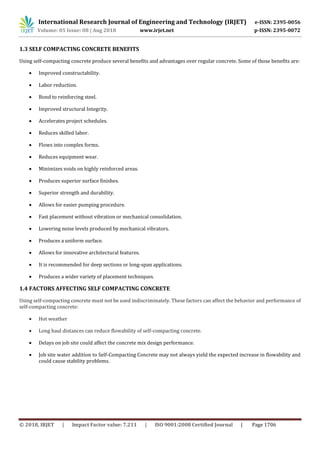
Fig -1: Principles of SCC Mixture Design
2. METHODOLOGY
The methodology adopted in this project is given below:
1. Determination of Compressive Strength of the concrete with and without Fly Ash and Silica Fume.
2. Determination of Split Tensile Strength of the concrete with and without Fly Ash and Silica Fume.
3. Determination of Flexural Strength of the concrete with and without Fly Ash and Silica Fume.
4. Determination of the properties of fresh concrete like slump test, V – Funnel etc.
5. Determination of the durability properties of concrete with and without Fly Ash and Silica Fume.
2.1 MATERIALS USED IN TESTING
1. Cement
2. Fine Aggregates
3. Coarse Aggregates
4. Water
5. Fly Ash
6. Silica Fume
7. Admixtures
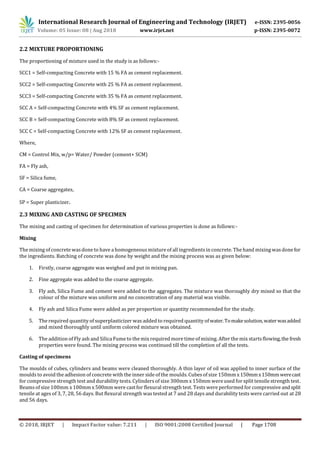
Note:- Superplasticizer STRUCTURO 100(M) (Fosroc chemicals) was used as admixture. Structuro 100(M) combines the
properties of water reduction and workability retention. Specifications of superplasticizer are shown in Table 1.
Table 1:- Specifications of Superplasticizer
Particulars Properties
Appearance Light yellow
Basis Aqueous solution of Carboxylic ether polymer
pH 6.4
Density 1.04 kg/liter
Chloride content Nil ( IS:456 )
Alkali content
Less than 1.6g Na2O equivalent per liter of
admixture
Optimum dosage 0.5 to 3.0 liters per 100kg of cementitious material
International Research Journal of Engineering and Technology (IRJET) e-ISSN: 2395-0056
Volume: 05 Issue: 08 | Aug 2018 www.irjet.net p-ISSN: 2395-0072
© 2018, IRJET | Impact Factor value: 7.211 | ISO 9001:2008 Certified Journal | Page 1708
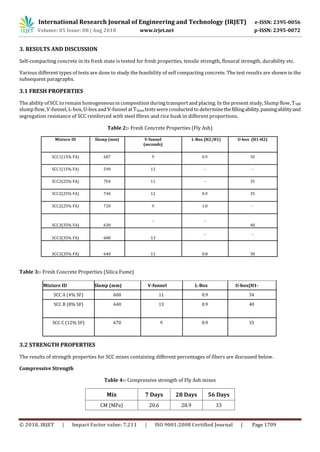
2.2 MIXTURE PROPORTIONING
The proportioning of mixture used in the study is as follows:-
SCC1 = Self-compacting Concrete with 15 % FA as cement replacement.
SCC2 = Self-compacting Concrete with 25 % FA as cement replacement.
SCC3 = Self-compacting Concrete with 35 % FA as cement replacement.
SCC A = Self-compacting Concrete with 4% SF as cement replacement.
SCC B = Self-compacting Concrete with 8% SF as cement replacement.
SCC C = Self-compacting Concrete with 12% SF as cement replacement.
Where,
CM = Control Mix, w/p= Water/ Powder (cement+ SCM)
FA = Fly ash,
SF = Silica fume,
CA = Coarse aggregates,
SP = Super plasticizer.
2.3 MIXING AND CASTING OF SPECIMEN
The mixing and casting of specimen for determination of various properties is done as follows:-
Mixing
The mixing of concrete wasdone to have a homogeneousmixture of all ingredientsin concrete. The hand mixing wasdonefor
the ingredients. Batching of concrete was done by weight and the mixing process was as given below:
1. Firstly, coarse aggregate was weighed and put in mixing pan.
2. Fine aggregate was added to the coarse aggregate.
3. Fly ash, Silica Fume and cement were added to the aggregates. The mixture was thoroughly dry mixed so that the
colour of the mixture was uniform and no concentration of any material was visible.
4. Fly ash and Silica Fume were added as per proportion or quantity recommended for the study.
5. The required quantity of superplasticizer was added to required quantity ofwater.Tomakesolution,waterwasadded
and mixed thoroughly until uniform colored mixture was obtained.
6. The addition of Fly ash and Silica Fume to the mix required more time of mixing. After the mix starts flowing,the fresh
properties were found. The mixing process was continued till the completion of all the tests.
Casting of specimens
The moulds of cubes, cylinders and beams were cleaned thoroughly. A thin layer of oil was applied to inner surface of the
moulds to avoid the adhesion of concrete with the inner side of the moulds. Cubesof size 150mmx150mmx150mmwerecast
for compressive strength test and durability tests. Cylindersof size 300mm x 150mm were used for split tensile strength test.
Beams of size 100mm x 100mm x 500mm were cast for flexural strength test. Tests were performed for compressiveandsplit
tensile at ages of 3, 7, 28, 56 days. But flexural strength was tested at 7 and 28 days and durability tests were carried out at 28
and 56 days.
International Research Journal of Engineering and Technology (IRJET) e-ISSN: 2395-0056
Volume: 05 Issue: 08 | Aug 2018 www.irjet.net p-ISSN: 2395-0072
© 2018, IRJET | Impact Factor value: 7.211 | ISO 9001:2008 Certified Journal | Page 1709
3. RESULTS AND DISCUSSION
Self-compacting concrete in its fresh state is tested for fresh properties, tensile strength, flexural strength, durability etc.
Various different types of tests are done to study the feasibility of self compacting concrete. The test results are shown in the
subsequent paragraphs.
3.1 FRESH PROPERTIES
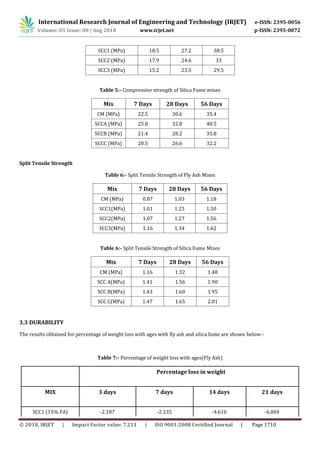
The ability of SCC to remain homogeneousin composition during transport and placing. In the present study, Slump flow, T500
slump flow, V-funnel, L-box, U-box and V-funnel at T5mintests were conducted to determinethefillingability,passingabilityand
segregation resistance of SCC reinforced with steel fibres and rice husk in different proportions.
Table 2:- Fresh Concrete Properties (Fly Ash)
Mixture ID Slump (mm) V-funnel L-Box (H2/H1) U-box (H1-H2)
(seconds)
SCC1(15% FA) 687 9 0.9 30
SCC1(15% FA) 590 13 - -
SCC2(25% FA) 704 11 - 35
SCC2(25% FA) 740 12 0.9 35
SCC2(25% FA) 720 9 1.0 -
SCC3(35% FA) 630
- -
40
SCC3(35% FA) 680 13
- -
SCC3(35% FA) 640 11 0.8 30
Table 3:- Fresh Concrete Properties (Silica Fume)
3.2 STRENGTH PROPERTIES
The results of strength properties for SCC mixes containing different percentages of fibers are discussed below.
Compressive Strength
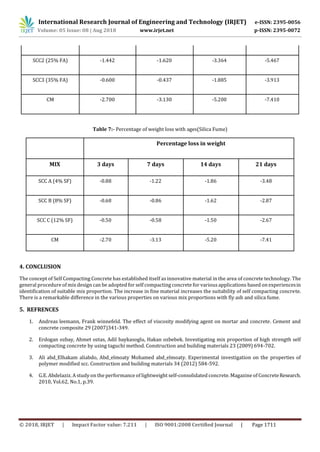
Table 4:- Compressive strength of Fly Ash mixes
Mix 7 Days 28 Days 56 Days
CM (MPa) 20.6 28.9 33
Mixture ID Slump (mm) V-funnel L-Box U-box(H1-
SCC A (4% SF) 600 11 0.9 34
SCC B (8% SF) 640 13 0.9 40
SCC C (12% SF) 670 9 0.9 35
International Research Journal of Engineering and Technology (IRJET) e-ISSN: 2395-0056
Volume: 05 Issue: 08 | Aug 2018 www.irjet.net p-ISSN: 2395-0072
© 2018, IRJET | Impact Factor value: 7.211 | ISO 9001:2008 Certified Journal | Page 1710
SCC1 (MPa) 18.5 27.2 38.5
SCC2 (MPa) 17.9 24.6 33
SCC3 (MPa) 15.2 23.5 29.5
Table 5:- Compressive strength of Silica Fume mixes
Mix 7 Days 28 Days 56 Days
CM (MPa) 22.5 30.6 35.4
SCCA (MPa) 25.0 32.8 40.5
SCCB (MPa) 21.4 28.2 35.8
SCCC (MPa) 20.5 26.6 32.2
Split Tensile Strength
Table 6:- Split Tensile Strength of Fly Ash Mixes
Mix 7 Days 28 Days 56 Days
CM (MPa) 0.87 1.03 1.18
SCC1(MPa) 1.01 1.25 1.50
SCC2(MPa) 1.07 1.27 1.56
SCC3(MPa) 1.16 1.34 1.62
Table 6:- Split Tensile Strength of Silica Fume Mixes
Mix 7 Days 28 Days 56 Days
CM (MPa) 1.16 1.32 1.48
SCC A(MPa) 1.41 1.56 1.90
SCC B(MPa) 1.43 1.60 1.95
SCC C(MPa) 1.47 1.65 2.01
3.3 DURABILITY
The results obtained for percentage of weight loss with ages with fly ash and silica fume are shown below:-
Table 7:- Percentage of weight loss with ages(Fly Ash)
Percentage loss in weight
MIX 3 days 7 days 14 days 21 days
SCC1 (15% FA) -2.187 -2.335 -4.610 -6.804
International Research Journal of Engineering and Technology (IRJET) e-ISSN: 2395-0056
Volume: 05 Issue: 08 | Aug 2018 www.irjet.net p-ISSN: 2395-0072
© 2018, IRJET | Impact Factor value: 7.211 | ISO 9001:2008 Certified Journal | Page 1711
SCC2 (25% FA) -1.442 -1.620 -3.364 -5.467
SCC3 (35% FA) -0.600 -0.437 -1.885 -3.913
CM -2.700 -3.130 -5.200 -7.410
Table 7:- Percentage of weight loss with ages(Silica Fume)
Percentage loss in weight
MIX 3 days 7 days 14 days 21 days
SCC A (4% SF) -0.88 -1.22 -1.86 -3.48
SCC B (8% SF) -0.68 -0.86 -1.62 -2.87
SCC C (12% SF) -0.50 -0.58 -1.50 -2.67
CM -2.70 -3.13 -5.20 -7.41
4. CONCLUSION
The concept of Self Compacting Concrete has established itself as innovative material in the area of concrete technology. The
general procedure of mix design can be adopted for self compacting concrete for variousapplications based on experiencesin
identification of suitable mix proportion. The increase in fine material increases the suitability of self compacting concrete.
There is a remarkable difference in the various properties on various mix proportions with fly ash and silica fume.
5. REFRENCES
1. Andreas leemann, Frank winnefeld. The effect of viscosity modifying agent on mortar and concrete. Cement and
concrete composite 29 (2007)341-349.
2. Erdogan ozbay, Ahmet oztas, Adil baykasoglu, Hakan ozbebek. Investigating mix proportion of high strength self
compacting concrete by using taguchi method. Construction and building materials 23 (2009) 694-702.
3. Ali abd_Elhakam aliabdo, Abd_elmoaty Mohamed abd_elmoaty. Experimental investigation on the properties of
polymer modified scc. Construction and building materials 34 (2012) 584-592.
4. G.E. Abdelaziz. A study on the performance of lightweight self-consolidated concrete. Magazine of ConcreteResearch.
2010, Vol.62, No.1, p.39.

IRJET- Feasible Study on Self Compacting Concrete

  • 1.
    International Research Journalof Engineering and Technology (IRJET) e-ISSN: 2395-0056 Volume: 05 Issue: 08 | Aug 2018 www.irjet.net p-ISSN: 2395-0072 © 2018, IRJET | Impact Factor value: 7.211 | ISO 9001:2008 Certified Journal | Page 1705 FEASIBLE STUDY ON SELF COMPACTING CONCRETE SATYAWAN1 1 M.Tech student , Civil Engineering Department , HCTM Technical Campus , Kaithal , Haryana , India ---------------------------------------------------------------------***---------------------------------------------------------------------- Abstract - Self-compacting concrete is a non-segregating concrete that is placed by means of its own weight. Theimportanceof self-compacting concrete is that maintains all concrete’s durability and characteristics, meeting expected performance requirements. In certain instances the addition of superplasticizers and viscosity modifier are added to the mix, reducingbleeding and segregation. Concrete that segregates loses strength and results in honeycombed areas next to the formwork. A welldesigned SCC mix does not segregate, has high deformability and excellent stability characteristics. The objective of present research work is to study the effect of incorporation of silica fume and fly ash inSelf-compactingconcrete. Self-compacting concrete has several advantages over Normally Vibrated Concrete. The addition of silica fume and fly ash improves behaviour of concrete under different conditions. Thus, SCC and cementitious materialscanbecombinedtoachievemore durable concrete. The effect of silica fume and fly ash was studied on fresh, strength and durability properties of SCC. Silica fume and fly ash in varying proportions of 4%, 8%, 12% and 15%, 25%, 35% respectively, by weight of concrete mix were added to SCC with tests carried out to evaluate the results regarding fresh, strength and durability properties. Key Words: Self-Compacting Concrete, Normally Vibrated Concrete, Non-Segregating, Durability, Superplasticizers, Viscosity, Deformability. 1. INTRODUCTION Compared to normally vibrated concrete (NVC), self-compacting concrete (SCC) possesses enhanced qualities and improves productivity and working conditions due to the eliminationof compaction. SCC generally hashigher powdercontentthanNVC and thus it is necessary to replace some of the cement by additions to achieve an economical and durable concrete. Japan has used self-compacting concrete (SCC) in bridge, building and tunnel construction since the early 1990‘s. In the last five years, a number of SCC bridges have been constructed in Europe. In the United States, the application of SCC in highway bridge construction is very limited at this time. However, the U.S. precast concrete industry is beginning to apply the technology to architectural concrete. SCC has high potential for wider structural applications in highway bridge construction. 1.1 Properties of Self Compacting Concrete Self-compacting concrete producesresistance to segregation by using mineral fillersorfinesandusingspecialadmixtures.Self- consolidating concrete is required to flow and fill special forms under its own weight, it shall be flowable enough to pass through highly reinforced areas, and must be able to avoid aggregate segregation. This type of concrete must meet special project requirements in terms of placement and flow. Self-compacting concrete with a similar water cement or cement binder ratio will usually have a slightly higher strength compared with traditional vibrated concrete, due to the lack of vibration giving an improved interface between the aggregate and hardened paste. The concrete mix of SCC must be placed at a relatively higher velocity than that of regular concrete. Self- compacting concrete hasbeen placed at heights taller than 5 meterswithout aggregate segregation. It canalsobeusedinareas with normal and congested reinforcement, with aggregates as large as 2 inches. 1.2 Uses of Self Compacting Concrete Self-compacting concrete has been used in bridges and even on pre-cast sections. One of the most remarkable projects built using self-compacting concrete is the Akashi-Kaikyo Suspension Bridge. In this project, theSCCwasmixedon-siteandpumped through a piping system to the specified point, located 200 meters away. On this particular project, the construction time was reduced from 2.5 years to 2 years. This type of concrete is ideal to be used in the following applications:  Drilled shafts  Columns  Earth retaining systems  Areas with high concentration of rebar and pipes/conduits
  • 2.
    International Research Journalof Engineering and Technology (IRJET) e-ISSN: 2395-0056 Volume: 05 Issue: 08 | Aug 2018 www.irjet.net p-ISSN: 2395-0072 © 2018, IRJET | Impact Factor value: 7.211 | ISO 9001:2008 Certified Journal | Page 1706 1.3 SELF COMPACTING CONCRETE BENEFITS Using self-compacting concrete produce several benefits and advantages over regular concrete. Some of those benefits are:  Improved constructability.  Labor reduction.  Bond to reinforcing steel.  Improved structural Integrity.  Accelerates project schedules.  Reduces skilled labor.  Flows into complex forms.  Reduces equipment wear.  Minimizes voids on highly reinforced areas.  Produces superior surface finishes.  Superior strength and durability.  Allows for easier pumping procedure.  Fast placement without vibration or mechanical consolidation.  Lowering noise levels produced by mechanical vibrators.  Produces a uniform surface.  Allows for innovative architectural features.  It is recommended for deep sections or long-span applications.  Produces a wider variety of placement techniques. 1.4 FACTORS AFFECTING SELF COMPACTING CONCRETE Using self-compacting concrete must not be used indiscriminately. These factors can affect the behavior and performance of self-compacting concrete:  Hot weather  Long haul distances can reduce flowability of self-compacting concrete.  Delays on job site could affect the concrete mix design performance.  Job site water addition to Self-Compacting Concrete may not always yield the expected increase in flowability and could cause stability problems.
  • 3.
    International Research Journalof Engineering and Technology (IRJET) e-ISSN: 2395-0056 Volume: 05 Issue: 08 | Aug 2018 www.irjet.net p-ISSN: 2395-0072 © 2018, IRJET | Impact Factor value: 7.211 | ISO 9001:2008 Certified Journal | Page 1707 Fig -1: Principles of SCC Mixture Design 2. METHODOLOGY The methodology adopted in this project is given below: 1. Determination of Compressive Strength of the concrete with and without Fly Ash and Silica Fume. 2. Determination of Split Tensile Strength of the concrete with and without Fly Ash and Silica Fume. 3. Determination of Flexural Strength of the concrete with and without Fly Ash and Silica Fume. 4. Determination of the properties of fresh concrete like slump test, V – Funnel etc. 5. Determination of the durability properties of concrete with and without Fly Ash and Silica Fume. 2.1 MATERIALS USED IN TESTING 1. Cement 2. Fine Aggregates 3. Coarse Aggregates 4. Water 5. Fly Ash 6. Silica Fume 7. Admixtures Note:- Superplasticizer STRUCTURO 100(M) (Fosroc chemicals) was used as admixture. Structuro 100(M) combines the properties of water reduction and workability retention. Specifications of superplasticizer are shown in Table 1. Table 1:- Specifications of Superplasticizer Particulars Properties Appearance Light yellow Basis Aqueous solution of Carboxylic ether polymer pH 6.4 Density 1.04 kg/liter Chloride content Nil ( IS:456 ) Alkali content Less than 1.6g Na2O equivalent per liter of admixture Optimum dosage 0.5 to 3.0 liters per 100kg of cementitious material
  • 4.
    International Research Journalof Engineering and Technology (IRJET) e-ISSN: 2395-0056 Volume: 05 Issue: 08 | Aug 2018 www.irjet.net p-ISSN: 2395-0072 © 2018, IRJET | Impact Factor value: 7.211 | ISO 9001:2008 Certified Journal | Page 1708 2.2 MIXTURE PROPORTIONING The proportioning of mixture used in the study is as follows:- SCC1 = Self-compacting Concrete with 15 % FA as cement replacement. SCC2 = Self-compacting Concrete with 25 % FA as cement replacement. SCC3 = Self-compacting Concrete with 35 % FA as cement replacement. SCC A = Self-compacting Concrete with 4% SF as cement replacement. SCC B = Self-compacting Concrete with 8% SF as cement replacement. SCC C = Self-compacting Concrete with 12% SF as cement replacement. Where, CM = Control Mix, w/p= Water/ Powder (cement+ SCM) FA = Fly ash, SF = Silica fume, CA = Coarse aggregates, SP = Super plasticizer. 2.3 MIXING AND CASTING OF SPECIMEN The mixing and casting of specimen for determination of various properties is done as follows:- Mixing The mixing of concrete wasdone to have a homogeneousmixture of all ingredientsin concrete. The hand mixing wasdonefor the ingredients. Batching of concrete was done by weight and the mixing process was as given below: 1. Firstly, coarse aggregate was weighed and put in mixing pan. 2. Fine aggregate was added to the coarse aggregate. 3. Fly ash, Silica Fume and cement were added to the aggregates. The mixture was thoroughly dry mixed so that the colour of the mixture was uniform and no concentration of any material was visible. 4. Fly ash and Silica Fume were added as per proportion or quantity recommended for the study. 5. The required quantity of superplasticizer was added to required quantity ofwater.Tomakesolution,waterwasadded and mixed thoroughly until uniform colored mixture was obtained. 6. The addition of Fly ash and Silica Fume to the mix required more time of mixing. After the mix starts flowing,the fresh properties were found. The mixing process was continued till the completion of all the tests. Casting of specimens The moulds of cubes, cylinders and beams were cleaned thoroughly. A thin layer of oil was applied to inner surface of the moulds to avoid the adhesion of concrete with the inner side of the moulds. Cubesof size 150mmx150mmx150mmwerecast for compressive strength test and durability tests. Cylindersof size 300mm x 150mm were used for split tensile strength test. Beams of size 100mm x 100mm x 500mm were cast for flexural strength test. Tests were performed for compressiveandsplit tensile at ages of 3, 7, 28, 56 days. But flexural strength was tested at 7 and 28 days and durability tests were carried out at 28 and 56 days.
  • 5.
    International Research Journalof Engineering and Technology (IRJET) e-ISSN: 2395-0056 Volume: 05 Issue: 08 | Aug 2018 www.irjet.net p-ISSN: 2395-0072 © 2018, IRJET | Impact Factor value: 7.211 | ISO 9001:2008 Certified Journal | Page 1709 3. RESULTS AND DISCUSSION Self-compacting concrete in its fresh state is tested for fresh properties, tensile strength, flexural strength, durability etc. Various different types of tests are done to study the feasibility of self compacting concrete. The test results are shown in the subsequent paragraphs. 3.1 FRESH PROPERTIES The ability of SCC to remain homogeneousin composition during transport and placing. In the present study, Slump flow, T500 slump flow, V-funnel, L-box, U-box and V-funnel at T5mintests were conducted to determinethefillingability,passingabilityand segregation resistance of SCC reinforced with steel fibres and rice husk in different proportions. Table 2:- Fresh Concrete Properties (Fly Ash) Mixture ID Slump (mm) V-funnel L-Box (H2/H1) U-box (H1-H2) (seconds) SCC1(15% FA) 687 9 0.9 30 SCC1(15% FA) 590 13 - - SCC2(25% FA) 704 11 - 35 SCC2(25% FA) 740 12 0.9 35 SCC2(25% FA) 720 9 1.0 - SCC3(35% FA) 630 - - 40 SCC3(35% FA) 680 13 - - SCC3(35% FA) 640 11 0.8 30 Table 3:- Fresh Concrete Properties (Silica Fume) 3.2 STRENGTH PROPERTIES The results of strength properties for SCC mixes containing different percentages of fibers are discussed below. Compressive Strength Table 4:- Compressive strength of Fly Ash mixes Mix 7 Days 28 Days 56 Days CM (MPa) 20.6 28.9 33 Mixture ID Slump (mm) V-funnel L-Box U-box(H1- SCC A (4% SF) 600 11 0.9 34 SCC B (8% SF) 640 13 0.9 40 SCC C (12% SF) 670 9 0.9 35
  • 6.
    International Research Journalof Engineering and Technology (IRJET) e-ISSN: 2395-0056 Volume: 05 Issue: 08 | Aug 2018 www.irjet.net p-ISSN: 2395-0072 © 2018, IRJET | Impact Factor value: 7.211 | ISO 9001:2008 Certified Journal | Page 1710 SCC1 (MPa) 18.5 27.2 38.5 SCC2 (MPa) 17.9 24.6 33 SCC3 (MPa) 15.2 23.5 29.5 Table 5:- Compressive strength of Silica Fume mixes Mix 7 Days 28 Days 56 Days CM (MPa) 22.5 30.6 35.4 SCCA (MPa) 25.0 32.8 40.5 SCCB (MPa) 21.4 28.2 35.8 SCCC (MPa) 20.5 26.6 32.2 Split Tensile Strength Table 6:- Split Tensile Strength of Fly Ash Mixes Mix 7 Days 28 Days 56 Days CM (MPa) 0.87 1.03 1.18 SCC1(MPa) 1.01 1.25 1.50 SCC2(MPa) 1.07 1.27 1.56 SCC3(MPa) 1.16 1.34 1.62 Table 6:- Split Tensile Strength of Silica Fume Mixes Mix 7 Days 28 Days 56 Days CM (MPa) 1.16 1.32 1.48 SCC A(MPa) 1.41 1.56 1.90 SCC B(MPa) 1.43 1.60 1.95 SCC C(MPa) 1.47 1.65 2.01 3.3 DURABILITY The results obtained for percentage of weight loss with ages with fly ash and silica fume are shown below:- Table 7:- Percentage of weight loss with ages(Fly Ash) Percentage loss in weight MIX 3 days 7 days 14 days 21 days SCC1 (15% FA) -2.187 -2.335 -4.610 -6.804
  • 7.
    International Research Journalof Engineering and Technology (IRJET) e-ISSN: 2395-0056 Volume: 05 Issue: 08 | Aug 2018 www.irjet.net p-ISSN: 2395-0072 © 2018, IRJET | Impact Factor value: 7.211 | ISO 9001:2008 Certified Journal | Page 1711 SCC2 (25% FA) -1.442 -1.620 -3.364 -5.467 SCC3 (35% FA) -0.600 -0.437 -1.885 -3.913 CM -2.700 -3.130 -5.200 -7.410 Table 7:- Percentage of weight loss with ages(Silica Fume) Percentage loss in weight MIX 3 days 7 days 14 days 21 days SCC A (4% SF) -0.88 -1.22 -1.86 -3.48 SCC B (8% SF) -0.68 -0.86 -1.62 -2.87 SCC C (12% SF) -0.50 -0.58 -1.50 -2.67 CM -2.70 -3.13 -5.20 -7.41 4. CONCLUSION The concept of Self Compacting Concrete has established itself as innovative material in the area of concrete technology. The general procedure of mix design can be adopted for self compacting concrete for variousapplications based on experiencesin identification of suitable mix proportion. The increase in fine material increases the suitability of self compacting concrete. There is a remarkable difference in the various properties on various mix proportions with fly ash and silica fume. 5. REFRENCES 1. Andreas leemann, Frank winnefeld. The effect of viscosity modifying agent on mortar and concrete. Cement and concrete composite 29 (2007)341-349. 2. Erdogan ozbay, Ahmet oztas, Adil baykasoglu, Hakan ozbebek. Investigating mix proportion of high strength self compacting concrete by using taguchi method. Construction and building materials 23 (2009) 694-702. 3. Ali abd_Elhakam aliabdo, Abd_elmoaty Mohamed abd_elmoaty. Experimental investigation on the properties of polymer modified scc. Construction and building materials 34 (2012) 584-592. 4. G.E. Abdelaziz. A study on the performance of lightweight self-consolidated concrete. Magazine of ConcreteResearch. 2010, Vol.62, No.1, p.39.