Select Committees:
How they work and how to get involved
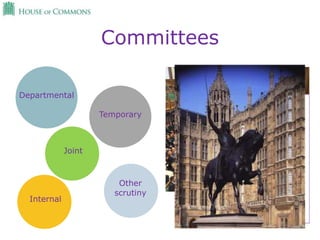
Committees
Departmental
Temporary
Internal
Other
scrutiny
Joint
Scrutiny: What do Select
Committees do?
Core tasks – overall aim
To hold Ministers and Departments to account
for their policy and decision-making and to
support the House in its control of the supply
of public money and scrutiny of legislation
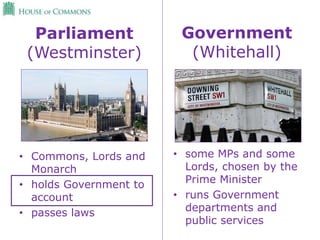
Parliament
(Westminster)
• Commons, Lords and
Monarch
• holds Government to
account
• passes laws
Government
(Whitehall)
• some MPs and some
Lords, chosen by the
Prime Minister
• runs Government
departments and
public services
Vexing civil servants since 1668
“At the office all the morning, where comes a damned summons to attend the
Committee of Miscarriages to-day, which makes me mad, that I should by my
place become the hackney of this Office, in perpetual trouble and vexation,
that need it least.” ~ Sam. Pepys
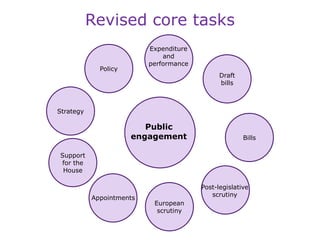
Revised core tasks
Strategy
Support
for the
House
Bills
Draft
bills
Policy
Expenditure
and
performance
Post-legislative
scrutiny
Appointments
Public
engagement
European
scrutiny
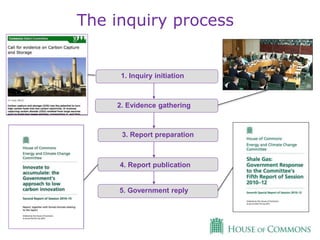
5. Government reply
3. Report preparation
1. Inquiry initiation
2. Evidence gathering
The inquiry process
4. Report publication
The inquiry process
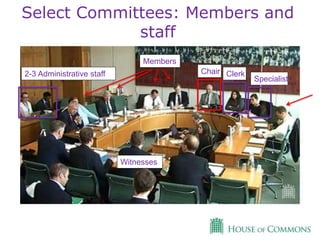
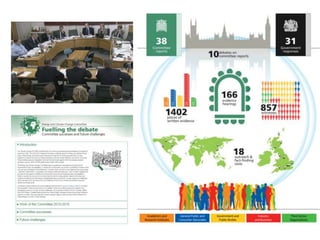
Select Committees in action!Select Committees: Members and
staff
Clerk
Specialist
2-3 Administrative staff Chair
Members
Witnesses
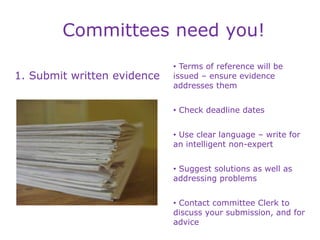
Committees need you!
1. Submit written evidence
• Terms of reference will be
issued – ensure evidence
addresses them
• Check deadline dates
• Use clear language – write for
an intelligent non-expert
• Suggest solutions as well as
addressing problems
• Contact committee Clerk to
discuss your submission, and for
advice
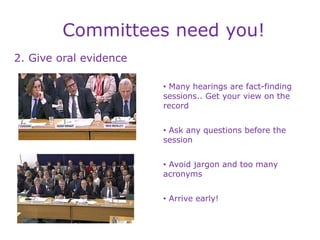
2. Give oral evidence
• Many hearings are fact-finding
sessions.. Get your view on the
record
• Ask any questions before the
session
• Avoid jargon and too many
acronyms
• Arrive early!
Committees need you!
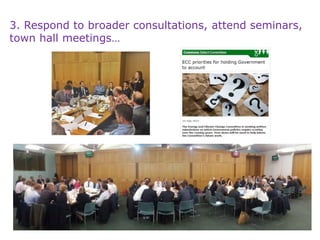
3. Respond to broader consultations, attend seminars,
town hall meetings…
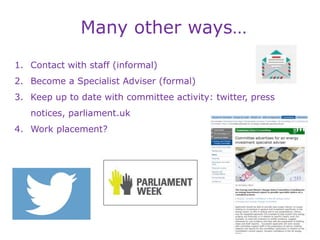
Many other ways…
1. Contact with staff (informal)
2. Become a Specialist Adviser (formal)
3. Keep up to date with committee activity: twitter, press
notices, parliament.uk
4. Work placement?
Informal engagement is important
Further information contacts
– Website:
• www.parliament.uk; www.parliamrnt.uk/ecc
– Twitter:
• @UKParliament, @CommonsECC
– Or get in touch:
• ferratm@parliament.uk; ecc@parliament.uk

Select Committees

  • 1.
    Select Committees: How theywork and how to get involved
  • 2.
  • 3.
    Scrutiny: What doSelect Committees do?
  • 4.
    Core tasks –overall aim To hold Ministers and Departments to account for their policy and decision-making and to support the House in its control of the supply of public money and scrutiny of legislation
  • 5.
    Parliament (Westminster) • Commons, Lordsand Monarch • holds Government to account • passes laws Government (Whitehall) • some MPs and some Lords, chosen by the Prime Minister • runs Government departments and public services
  • 6.
    Vexing civil servantssince 1668 “At the office all the morning, where comes a damned summons to attend the Committee of Miscarriages to-day, which makes me mad, that I should by my place become the hackney of this Office, in perpetual trouble and vexation, that need it least.” ~ Sam. Pepys
  • 7.
    Revised core tasks Strategy Support forthe House Bills Draft bills Policy Expenditure and performance Post-legislative scrutiny Appointments Public engagement European scrutiny
  • 8.
    5. Government reply 3.Report preparation 1. Inquiry initiation 2. Evidence gathering The inquiry process 4. Report publication The inquiry process
  • 9.
    Select Committees inaction!Select Committees: Members and staff Clerk Specialist 2-3 Administrative staff Chair Members Witnesses
  • 10.
    Committees need you! 1.Submit written evidence • Terms of reference will be issued – ensure evidence addresses them • Check deadline dates • Use clear language – write for an intelligent non-expert • Suggest solutions as well as addressing problems • Contact committee Clerk to discuss your submission, and for advice
  • 11.
    2. Give oralevidence • Many hearings are fact-finding sessions.. Get your view on the record • Ask any questions before the session • Avoid jargon and too many acronyms • Arrive early! Committees need you!
  • 13.
    3. Respond tobroader consultations, attend seminars, town hall meetings…
  • 14.
    Many other ways… 1.Contact with staff (informal) 2. Become a Specialist Adviser (formal) 3. Keep up to date with committee activity: twitter, press notices, parliament.uk 4. Work placement?
  • 15.
  • 16.
    Further information contacts –Website: • www.parliament.uk; www.parliamrnt.uk/ecc – Twitter: • @UKParliament, @CommonsECC – Or get in touch: • ferratm@parliament.uk; ecc@parliament.uk