Introduction to
Parliament
Nerys Davies
September 2015
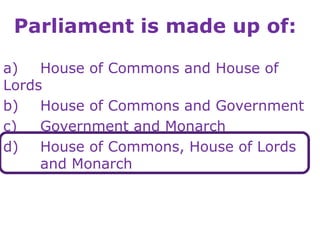
Parliament is made up of:
a) House of Commons and House of
Lords
b) House of Commons and Government
c) Government and Monarch
d) House of Commons, House of Lords
and Monarch
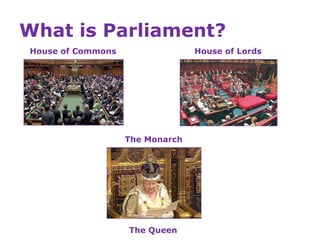
What is Parliament?
House of Commons House of Lords
The Monarch
The Queen
Which TWO answers describe the
work of Parliament?
a) running Government departments
b) checking up on the work of
Government
c) being the highest court of appeal in
the UK
d) making new laws
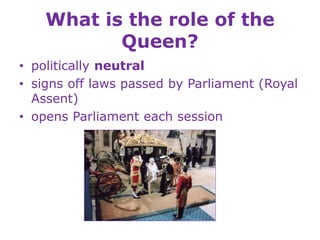
What is the role of the
Queen?
• politically neutral
• signs off laws passed by Parliament (Royal
Assent)
• opens Parliament each session
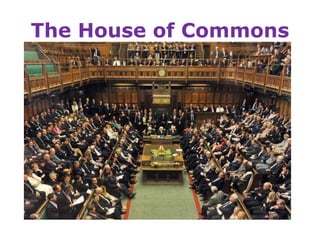
The House of Commons
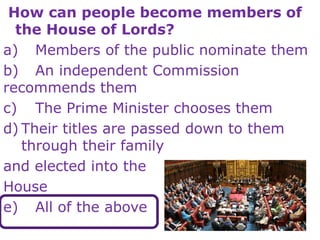
How can people become members of
the House of Lords?
a) Members of the public nominate them
b) An independent Commission
recommends them
c) The Prime Minister chooses them
d) Their titles are passed down to them
through their family
and elected into the
House
e) All of the above
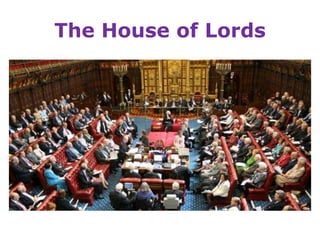
The House of Lords
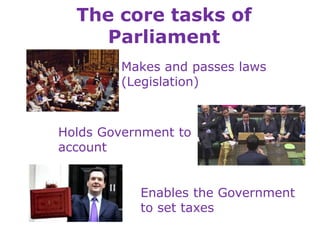
The core tasks of
Parliament
Makes and passes laws
(Legislation)
Holds Government to
account
Enables the Government
to set taxes
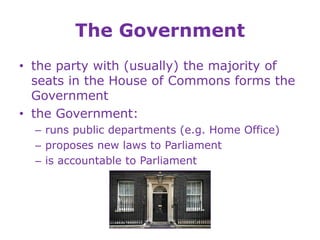
The Government
• the party with (usually) the majority of
seats in the House of Commons forms the
Government
• the Government:
– runs public departments (e.g. Home Office)
– proposes new laws to Parliament
– is accountable to Parliament
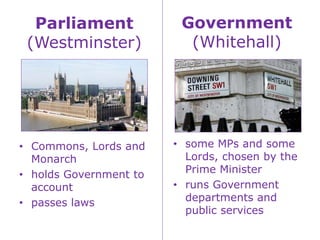
Parliament
(Westminster)
• Commons, Lords and
Monarch
• holds Government to
account
• passes laws
Government
(Whitehall)
• some MPs and some
Lords, chosen by the
Prime Minister
• runs Government
departments and
public services
Legislation
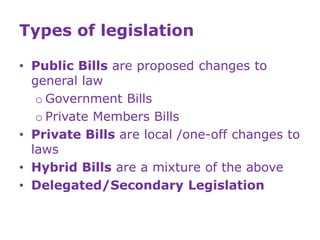
Types of legislation
• Public Bills are proposed changes to
general law
o Government Bills
o Private Members Bills
• Private Bills are local /one-off changes to
laws
• Hybrid Bills are a mixture of the above
• Delegated/Secondary Legislation
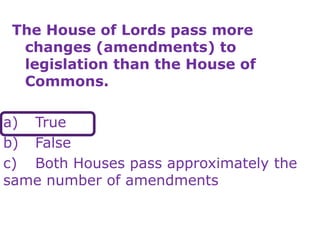
The House of Lords pass more
changes (amendments) to
legislation than the House of
Commons.
a) True
b) False
c) Both Houses pass approximately the
same number of amendments
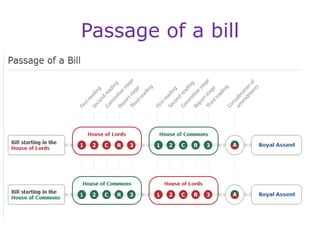
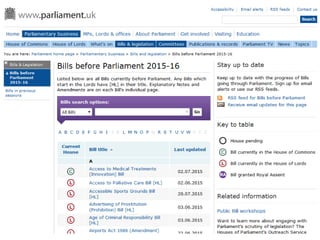
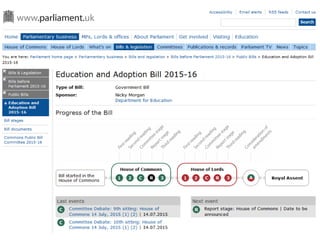
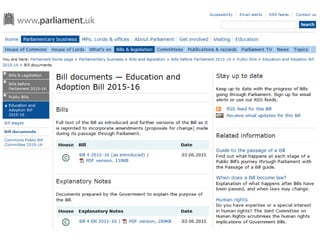
Passage of a bill
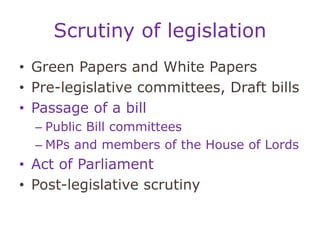
Scrutiny of legislation
• Green Papers and White Papers
• Pre-legislative committees, Draft bills
• Passage of a bill
– Public Bill committees
– MPs and members of the House of Lords
• Act of Parliament
• Post-legislative scrutiny
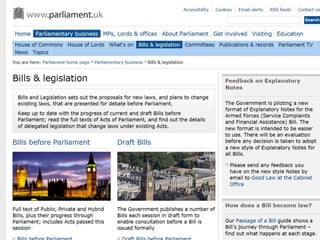
http://services.parliament.uk/bills/
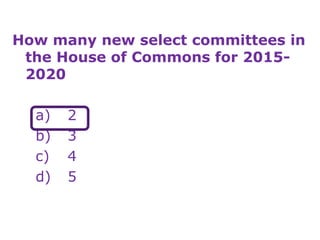
How many new select committees in
the House of Commons for 2015-
2020
a) 2
b) 3
c) 4
d) 5
Petitions Committee
• Provides a better link from the public
to elected representatives
• Joint system for government and
Parliament
• Must call for a specific action from
government or Parliament
• Time in Westminster Hall for debates
if appropriate
http://www.parliament.uk/get-involved/have-your-say/e-
petitions/
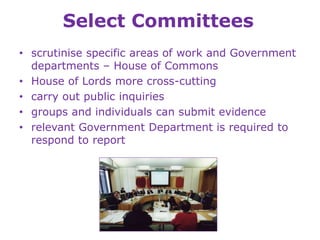
Select Committees
• scrutinise specific areas of work and Government
departments – House of Commons
• House of Lords more cross-cutting
• carry out public inquiries
• groups and individuals can submit evidence
• relevant Government Department is required to
respond to report
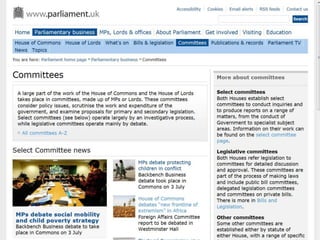
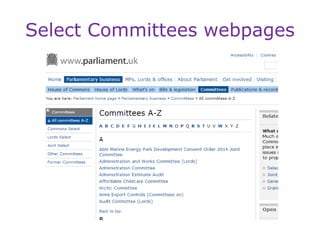
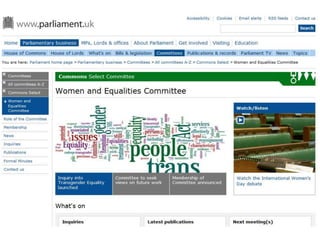
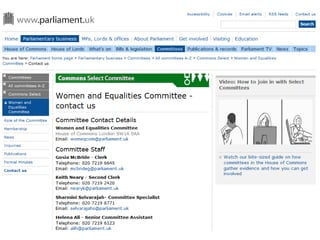
Select Committees webpages
Questions and debates
House of Commons Journal
14 May 1606 p309
“a strange spanyell of mouse-
colour came into the House”
Questions and debates
Parliamentary Questions
• written or spoken questions asked by MPs
and Peers, directed at the Government
Written Ministerial Statements
• Can be in response to oral questions not
answered or ways of informing the House
without coming to the chamber
Debates
• debates happen every day that the House
of Commons or the House of Lords are
sitting.
Other ways MPs can raise
issues?
Petitions
• usually a call on Government for action
regarding an issue (local or national)
Early Day Motions
• a published statement allowing MPs to
show their opinion on a specific subject
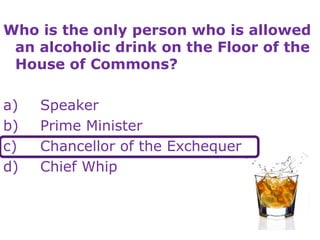
Who is the only person who is allowed
an alcoholic drink on the Floor of the
House of Commons?
a) Speaker
b) Prime Minister
c) Chancellor of the Exchequer
d) Chief Whip
Questions?
Where can I get
information?
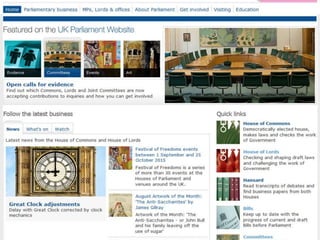
• www.parliament.uk and @UKParliament
• Commons Information Office
020 7219 4272 hcinfo@parliament.uk
• Lords Information Office
020 7219 3107 hlinfo@parliament.uk
• Parliament’s Outreach Service
020 7219 1650
parliamentaryoutreach@parliament.uk
Parliament Explained: Basic Intro to Parliament 03.09.15

Parliament Explained: Basic Intro to Parliament 03.09.15

  • 2.
  • 3.
    Parliament is madeup of: a) House of Commons and House of Lords b) House of Commons and Government c) Government and Monarch d) House of Commons, House of Lords and Monarch
  • 4.
    What is Parliament? Houseof Commons House of Lords The Monarch The Queen
  • 5.
    Which TWO answersdescribe the work of Parliament? a) running Government departments b) checking up on the work of Government c) being the highest court of appeal in the UK d) making new laws
  • 6.
    What is therole of the Queen? • politically neutral • signs off laws passed by Parliament (Royal Assent) • opens Parliament each session
  • 7.
    The House ofCommons
  • 8.
    How can peoplebecome members of the House of Lords? a) Members of the public nominate them b) An independent Commission recommends them c) The Prime Minister chooses them d) Their titles are passed down to them through their family and elected into the House e) All of the above
  • 9.
  • 10.
    The core tasksof Parliament Makes and passes laws (Legislation) Holds Government to account Enables the Government to set taxes
  • 11.
    The Government • theparty with (usually) the majority of seats in the House of Commons forms the Government • the Government: – runs public departments (e.g. Home Office) – proposes new laws to Parliament – is accountable to Parliament
  • 12.
    Parliament (Westminster) • Commons, Lordsand Monarch • holds Government to account • passes laws Government (Whitehall) • some MPs and some Lords, chosen by the Prime Minister • runs Government departments and public services
  • 13.
  • 14.
    Types of legislation •Public Bills are proposed changes to general law o Government Bills o Private Members Bills • Private Bills are local /one-off changes to laws • Hybrid Bills are a mixture of the above • Delegated/Secondary Legislation
  • 15.
    The House ofLords pass more changes (amendments) to legislation than the House of Commons. a) True b) False c) Both Houses pass approximately the same number of amendments
  • 16.
  • 17.
    Scrutiny of legislation •Green Papers and White Papers • Pre-legislative committees, Draft bills • Passage of a bill – Public Bill committees – MPs and members of the House of Lords • Act of Parliament • Post-legislative scrutiny
  • 21.
  • 23.
    How many newselect committees in the House of Commons for 2015- 2020 a) 2 b) 3 c) 4 d) 5
  • 24.
    Petitions Committee • Providesa better link from the public to elected representatives • Joint system for government and Parliament • Must call for a specific action from government or Parliament • Time in Westminster Hall for debates if appropriate http://www.parliament.uk/get-involved/have-your-say/e- petitions/
  • 25.
    Select Committees • scrutinisespecific areas of work and Government departments – House of Commons • House of Lords more cross-cutting • carry out public inquiries • groups and individuals can submit evidence • relevant Government Department is required to respond to report
  • 27.
  • 30.
    Questions and debates Houseof Commons Journal 14 May 1606 p309 “a strange spanyell of mouse- colour came into the House”
  • 31.
    Questions and debates ParliamentaryQuestions • written or spoken questions asked by MPs and Peers, directed at the Government Written Ministerial Statements • Can be in response to oral questions not answered or ways of informing the House without coming to the chamber Debates • debates happen every day that the House of Commons or the House of Lords are sitting.
  • 32.
    Other ways MPscan raise issues? Petitions • usually a call on Government for action regarding an issue (local or national) Early Day Motions • a published statement allowing MPs to show their opinion on a specific subject
  • 33.
    Who is theonly person who is allowed an alcoholic drink on the Floor of the House of Commons? a) Speaker b) Prime Minister c) Chancellor of the Exchequer d) Chief Whip
  • 35.
  • 36.
    Where can Iget information? • www.parliament.uk and @UKParliament • Commons Information Office 020 7219 4272 hcinfo@parliament.uk • Lords Information Office 020 7219 3107 hlinfo@parliament.uk • Parliament’s Outreach Service 020 7219 1650 parliamentaryoutreach@parliament.uk