PUBLIC BILL WORKSHOP
An introduction to House of
Commons Select Committees
Farrah Bhatti
Second Clerk, Transport Committee
27 June 2013
The role of Parliament
2
• Examining and challenging the work of the
Government (scrutiny)
• Debating and passing all laws (legislation)
• Enabling the Government to raise taxes
Committees
3
• Select Committees: report on a range of subject
areas including the work of government
departments.
• Joint Committees: consist of MPs and Lords.
• General Committees (including Public Bill
Committees): look at proposed legislation in detail.
• Grand Committees: Three in the Commons, that look
at questions on Scotland, Wales and Northern
Ireland. Grand Committees in the Lords debate Bills
outside the Lords Chamber.
Commons select committees
4
• Departmental select committees: Examine
spending, policies and administration in each
Government department
• Cross-departmental committees: e.g. Public
Accounts or Environmental Audit
• Domestic committees: concerned with internal
matters e.g. administration of the House itself or
allegations about the conduct of individual MPs
• Liaison Committee: oversight role – made up of all
33 Chairs of select committees
Departmental select committees
5
• Examine spending, policies and administration in
each Government department
• Consist of at least 11 Members (MPs) from different
political parties (according to the proportion of MPs
each Party has in the House)
• Aim to work consensually across party lines
• Chair elected by whole House, other members
appointed by their parties
Committee work
6
• Meet once or twice a week
• Majority of work is based on subject-specific
“inquiries”: written evidence from experts, oral
hearings in public, report findings and
recommendations, Government must respond
(usually within 2 months)
• Other work includes pre-/post-legislative scrutiny,
pre-appointment hearings, seminars, commissioning
research, and sending substantive correspondence
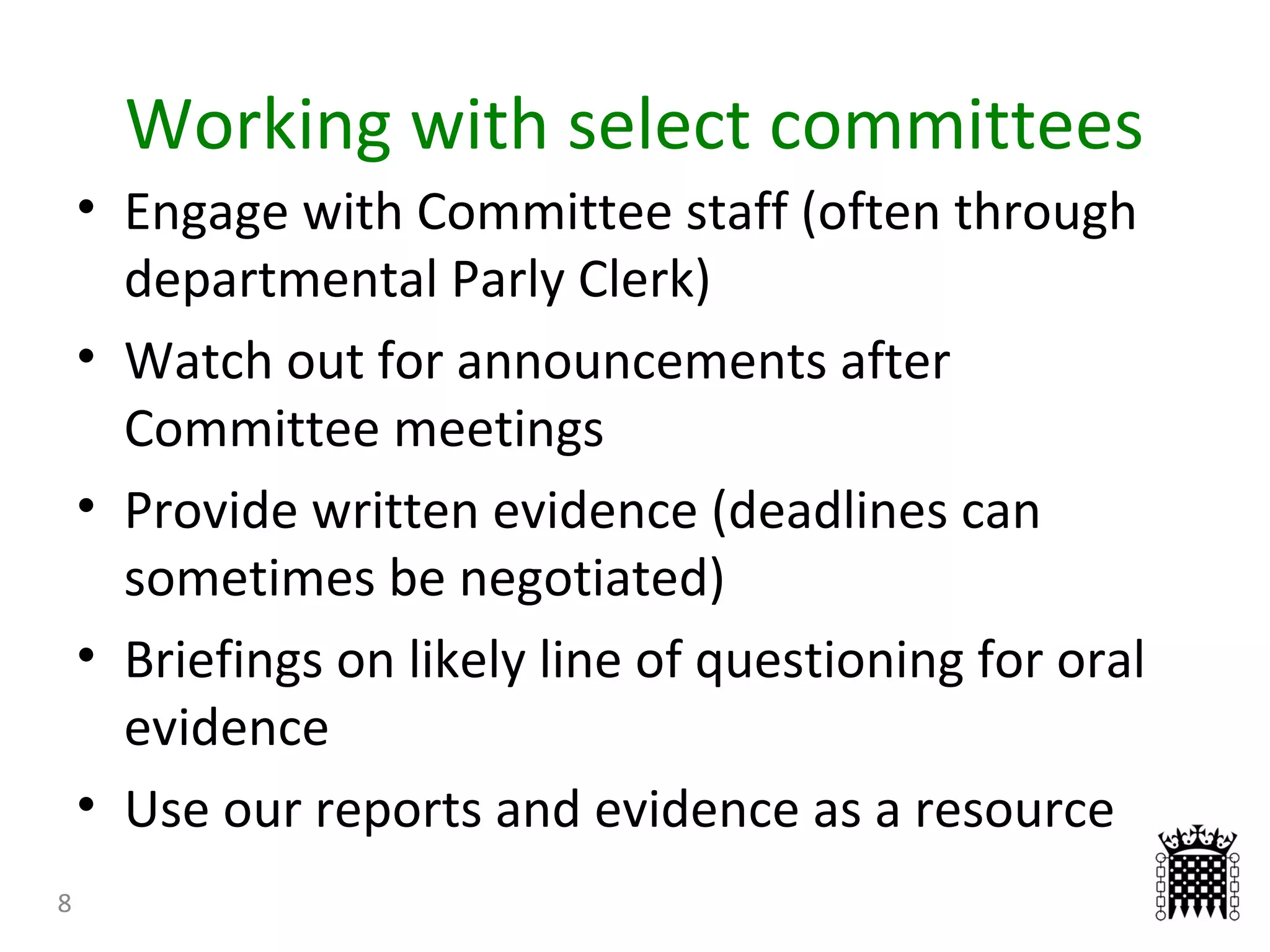
Select committees in action
7
Working with select committees
8
• Engage with Committee staff (often through
departmental Parly Clerk)
• Watch out for announcements after
Committee meetings
• Provide written evidence (deadlines can
sometimes be negotiated)
• Briefings on likely line of questioning for oral
evidence
• Use our reports and evidence as a resource
Committee staff
9
• 2 x Clerks – procedure expert, manages
committee work programme and inquiries
• 1-2 x Committee specialists – subject expert,
manages and advises on inquiries
• 2-3 Administrative staff – admin, processing
evidence and reports, updating website etc
... If in doubt, pick up the phone
... Any Questions?
Farrah Bhatti
Second Clerk, Transport Committee
bhattif@parliament.uk
020 7219 6264

Public bill workshop House of Commons select committees

  • 1.
    PUBLIC BILL WORKSHOP Anintroduction to House of Commons Select Committees Farrah Bhatti Second Clerk, Transport Committee 27 June 2013
  • 2.
    The role ofParliament 2 • Examining and challenging the work of the Government (scrutiny) • Debating and passing all laws (legislation) • Enabling the Government to raise taxes
  • 3.
    Committees 3 • Select Committees:report on a range of subject areas including the work of government departments. • Joint Committees: consist of MPs and Lords. • General Committees (including Public Bill Committees): look at proposed legislation in detail. • Grand Committees: Three in the Commons, that look at questions on Scotland, Wales and Northern Ireland. Grand Committees in the Lords debate Bills outside the Lords Chamber.
  • 4.
    Commons select committees 4 •Departmental select committees: Examine spending, policies and administration in each Government department • Cross-departmental committees: e.g. Public Accounts or Environmental Audit • Domestic committees: concerned with internal matters e.g. administration of the House itself or allegations about the conduct of individual MPs • Liaison Committee: oversight role – made up of all 33 Chairs of select committees
  • 5.
    Departmental select committees 5 •Examine spending, policies and administration in each Government department • Consist of at least 11 Members (MPs) from different political parties (according to the proportion of MPs each Party has in the House) • Aim to work consensually across party lines • Chair elected by whole House, other members appointed by their parties
  • 6.
    Committee work 6 • Meetonce or twice a week • Majority of work is based on subject-specific “inquiries”: written evidence from experts, oral hearings in public, report findings and recommendations, Government must respond (usually within 2 months) • Other work includes pre-/post-legislative scrutiny, pre-appointment hearings, seminars, commissioning research, and sending substantive correspondence
  • 7.
  • 8.
    Working with selectcommittees 8 • Engage with Committee staff (often through departmental Parly Clerk) • Watch out for announcements after Committee meetings • Provide written evidence (deadlines can sometimes be negotiated) • Briefings on likely line of questioning for oral evidence • Use our reports and evidence as a resource
  • 9.
    Committee staff 9 • 2x Clerks – procedure expert, manages committee work programme and inquiries • 1-2 x Committee specialists – subject expert, manages and advises on inquiries • 2-3 Administrative staff – admin, processing evidence and reports, updating website etc ... If in doubt, pick up the phone
  • 10.
    ... Any Questions? FarrahBhatti Second Clerk, Transport Committee bhattif@parliament.uk 020 7219 6264