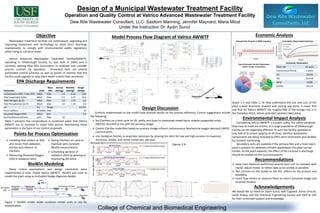
Economic Analysis
Graph 1-3 and Table 2: To help understand the size and cost of the
plant a basic economic analysis and costing was done. A major find
was that for Valrico AWWTF the roughly 60% of the energy cost is in
the Oxidation Ditch, where extended aeration takes place.
Environmental Impact Analysis
Considering Valrico AWWTF is a public utility, the safety standards
they have to meet are stricter, as a large population of Hillsborough
County can be negatively affected. As such the facility operated at
only half of its actual capacity at all times. Harmful wastewater
components are being removed to EPA’s strict restrictions and verified
by constant monitoring.
Secondary units are available if the primary fails and a lined reject
pond is present for additions influent wastewater the plant cannot
handle. As the plant expands, the effect of the increase in discharge
should be studied on the local ecosystems.
Recommendations
 Have mass balances performed around each unit to compare with
model; adjust model to reflect data as accurately as possible.
 Test controls on the model to see the effects on the process and
feasibility.
 Insert flow meters to measure flows on return activated sludge and
recycled streams.
Acknowledgements
We would like to thank Dr. Aydin Sunol, Kyle Cogswell, Aaron Driscoll,
Leslie Knapp, and the Chemical Engineering Faculty and Staff at USF
for their continued support and knowledge.
Design of a Municipal Wastewater Treatment Facility
Operation and Quality Control at Valrico Advanced Wastewater Treatment Facility
Dew Rite Wastewater Consultant, LLC: Sasitorn Manning, Jennifer Maynard, Maria Mical
Under the Instruction Dr. Aydin Sunol
College of Chemical and Biomedical Engineering
Model Process Flow Diagram of Valrico AWWTF
Design Discussion
Controls implemented on the model have positive results on the process efficiency. Control suggestions include
the following:
 Set Clarifiers on a time cycle for fill, settle, and drain to maximized mixed liquor volatile suspended solids
(MLVSS) recycled to mix with the primary sludge.
 Control Clarifier underflow based on primary sludge influent carbonaceous biochemical oxygen demand (cBOD)
concentration
 Use Oxidation Ditches as anaerobic extension by phasing the ditch for low and high aeration to maximize
ammonia, nitrate, and nitrite conversion per pass
Objective
Wastewater treatment facilities are continuously upgrading and
improving equipment and technology to meet strict discharge
requirements to comply with environmental safety regulations
while trying to conserve water.
Valrico Advanced Wastewater Treatment Facility(AWWTF),
operating in Hillsborough County, FL, was built in 1990s and is
currently seeking Dew Rite Consultants to evaluate and consider
process controls for operation. Presented here are several
automated control schemes as well as points of interest that the
Facility could upgrade to help them better control their processes.
EPA Discharge Requirements
Table 1 presents the compositions in reclaimed water that Valrico
AWWTF has to maintain to retain their permit. Maintaining these
parameters is the basis of our control proposals.
Points for Process Optimization
BioWin Modeling
Many critical assumptions and design constraints were
implemented to help model Valrico AWWTF. BioWin was used to
model the plant using an Activated Sludge Digestion Model.
Figure 1: BioWin model made combines similar units in size for
simplification.
 Installing flow meters on RAS
and return from oxidation
ditches and influent to
clarifiers
 Measuring Dissolved Oxygen
(DO) in oxidation ditch
 Seting Clarifiers on cycle to
maintain semi-constant
MLVSS concentrations
 Scheduling aeration of
oxidation ditch by phasing or
monitoring DO levels
Economic Parameters
Plant Life 20 years
Construction Period 2 years
FCI $39 M
WC $3.9 M
NPW $20M
DCFRR 29.6 %
Parameter Units
Max/
Min
Annual
Average
Monthly
Average
Single
Sample
Carbonaceous BOD, 5 day-20oC MG/L Max 5.0 6.25 10.0
Total Suspended Solids MG/L Max 5.0 6.25 10.0
Total Nitrogen (as N) MG/L Max 3.0 3.75 6.0
Total Phosphorous (as P) MG/L Max 1.0 1.25 2.0
pH SU Range - - 6.0-8.5
Fecal Coliform #/100ML Max - - 25
Dissolved Oxygen (DO) MG/L Min - - 5.0
Dichlorobromomethane μG/L Max 22 -
-30
-20
-10
0
10
20
30
40
1 2 3 4 5 6 7 8 9 10 11 12 13 14 15 16 17 18 19 20 21 22 23
CF(milliondolaars)
Time(year)
Annual Cash Flow for 6 MGD Capacity
Aeration
$400k
60%
Wastewater
Pumping $79k
12%
Lighting and
Buildings $39k
6%
Anaerobic
Digestion
$72k
11%
Belt Press
$19k
3%
Clarifiers $19k
3%
Other $33k
5%Other
17%
Typical Extended Aeration Wastewater
System Energy Consumption
Figures 2-6:
$(60.00)
$(40.00)
$(20.00)
$-
$20.00
$40.00
$60.00
$80.00
$100.00
$120.00
1 2 3 4 5 6 7 8 9 10 11 12 13 14 15 16 17 18 19 20 21 22 23
CDCF(milliondollars)
Time(year)
Cumulative Discounted Cash Flow
Optimistic
Base
Pessimistic

WWT Poster

  • 1.
    Economic Analysis Graph 1-3and Table 2: To help understand the size and cost of the plant a basic economic analysis and costing was done. A major find was that for Valrico AWWTF the roughly 60% of the energy cost is in the Oxidation Ditch, where extended aeration takes place. Environmental Impact Analysis Considering Valrico AWWTF is a public utility, the safety standards they have to meet are stricter, as a large population of Hillsborough County can be negatively affected. As such the facility operated at only half of its actual capacity at all times. Harmful wastewater components are being removed to EPA’s strict restrictions and verified by constant monitoring. Secondary units are available if the primary fails and a lined reject pond is present for additions influent wastewater the plant cannot handle. As the plant expands, the effect of the increase in discharge should be studied on the local ecosystems. Recommendations  Have mass balances performed around each unit to compare with model; adjust model to reflect data as accurately as possible.  Test controls on the model to see the effects on the process and feasibility.  Insert flow meters to measure flows on return activated sludge and recycled streams. Acknowledgements We would like to thank Dr. Aydin Sunol, Kyle Cogswell, Aaron Driscoll, Leslie Knapp, and the Chemical Engineering Faculty and Staff at USF for their continued support and knowledge. Design of a Municipal Wastewater Treatment Facility Operation and Quality Control at Valrico Advanced Wastewater Treatment Facility Dew Rite Wastewater Consultant, LLC: Sasitorn Manning, Jennifer Maynard, Maria Mical Under the Instruction Dr. Aydin Sunol College of Chemical and Biomedical Engineering Model Process Flow Diagram of Valrico AWWTF Design Discussion Controls implemented on the model have positive results on the process efficiency. Control suggestions include the following:  Set Clarifiers on a time cycle for fill, settle, and drain to maximized mixed liquor volatile suspended solids (MLVSS) recycled to mix with the primary sludge.  Control Clarifier underflow based on primary sludge influent carbonaceous biochemical oxygen demand (cBOD) concentration  Use Oxidation Ditches as anaerobic extension by phasing the ditch for low and high aeration to maximize ammonia, nitrate, and nitrite conversion per pass Objective Wastewater treatment facilities are continuously upgrading and improving equipment and technology to meet strict discharge requirements to comply with environmental safety regulations while trying to conserve water. Valrico Advanced Wastewater Treatment Facility(AWWTF), operating in Hillsborough County, FL, was built in 1990s and is currently seeking Dew Rite Consultants to evaluate and consider process controls for operation. Presented here are several automated control schemes as well as points of interest that the Facility could upgrade to help them better control their processes. EPA Discharge Requirements Table 1 presents the compositions in reclaimed water that Valrico AWWTF has to maintain to retain their permit. Maintaining these parameters is the basis of our control proposals. Points for Process Optimization BioWin Modeling Many critical assumptions and design constraints were implemented to help model Valrico AWWTF. BioWin was used to model the plant using an Activated Sludge Digestion Model. Figure 1: BioWin model made combines similar units in size for simplification.  Installing flow meters on RAS and return from oxidation ditches and influent to clarifiers  Measuring Dissolved Oxygen (DO) in oxidation ditch  Seting Clarifiers on cycle to maintain semi-constant MLVSS concentrations  Scheduling aeration of oxidation ditch by phasing or monitoring DO levels Economic Parameters Plant Life 20 years Construction Period 2 years FCI $39 M WC $3.9 M NPW $20M DCFRR 29.6 % Parameter Units Max/ Min Annual Average Monthly Average Single Sample Carbonaceous BOD, 5 day-20oC MG/L Max 5.0 6.25 10.0 Total Suspended Solids MG/L Max 5.0 6.25 10.0 Total Nitrogen (as N) MG/L Max 3.0 3.75 6.0 Total Phosphorous (as P) MG/L Max 1.0 1.25 2.0 pH SU Range - - 6.0-8.5 Fecal Coliform #/100ML Max - - 25 Dissolved Oxygen (DO) MG/L Min - - 5.0 Dichlorobromomethane μG/L Max 22 - -30 -20 -10 0 10 20 30 40 1 2 3 4 5 6 7 8 9 10 11 12 13 14 15 16 17 18 19 20 21 22 23 CF(milliondolaars) Time(year) Annual Cash Flow for 6 MGD Capacity Aeration $400k 60% Wastewater Pumping $79k 12% Lighting and Buildings $39k 6% Anaerobic Digestion $72k 11% Belt Press $19k 3% Clarifiers $19k 3% Other $33k 5%Other 17% Typical Extended Aeration Wastewater System Energy Consumption Figures 2-6: $(60.00) $(40.00) $(20.00) $- $20.00 $40.00 $60.00 $80.00 $100.00 $120.00 1 2 3 4 5 6 7 8 9 10 11 12 13 14 15 16 17 18 19 20 21 22 23 CDCF(milliondollars) Time(year) Cumulative Discounted Cash Flow Optimistic Base Pessimistic