Database security class presentation
Providers: Zahra Taghipoor kolaei
Seyyedeh Fatemeh Mousazadeh Mousavi
Professor: Dr.Sadegh Dorri Nogoorani
winter 2022
Security in oracle
1
Oracle database
1
2
About oracle
◉ Relational database
◉ ORDBMS
◉ SQL Based
3
Security
2
4
About Oracle Database security
Oracle Label Security
secures database tables at the
row level, allowing you to
filter user access to row data
based on privileges.
Real Application Security
Administration Console (RASADM)
lets you create Real Application
Security data security policies
using a graphical user interface.
Enterprise User Security
addresses user, administrative, and
security challenges by relying on the
identity management services
supplied by Oracle Internet Directory,
an LDAP-compliant directory service.
5
Transparent Data Encryption
enables you to encrypt data so
that only an authorized recipient
can read it.
Oracle Data Redaction
enables you to redact (mask)
column data using several
redaction types.
Data Masking and Subsetting
process of replacing sensitive
data with fictitious yet realistic
looking data and process of
downsizing either by discarding
or extracting data
continue
Key Vault
enables you to accelerate security
and encryption deployments by
centrally managing encryption
keys, Oracle wallets, Java
keystores, and credential files.
Oracle Audit Vault and Database
Firewall
provides a comprehensive Database
Activity Monitoring (DAM) solution
that combines database audit logs
with SQL traffic capture.
6
Database Assessment Tools
Identify database configuration,
operation, or implementation
introduces risk.
Database Vault
restrict access to application data by
privileged database users.
Reducing the risk of insider and
outside threats.
Oracle Lable Security
3
7
About Oracle Label Security
◉ controls the display of individual table rows using labels
◉ works by comparing the row label with a user's label
authorizations to enable you to easily restrict sensitive information
to only authorized users
◉ based on multi-level security (MLS) requirements
◉ installed by default, but not automatically enabled
8
Benefits of Oracle Label Security
◉ It enables row level data classification and provides out-of-the box
access mediation based on the data classification and the user label
authorization or security clearance.
◉ It enables you to assign label authorizations or security clearances
to both database users and application users.
◉ It provides both APIs and a graphical user interface for defining
and storing data classification labels and user label authorizations.
◉ It integrates with Oracle Database Vault and Oracle Advanced
Security Data Redaction, enabling security clearances to be use in
both Database Vault command rules and Data Redaction policy
definitions.
9
Components of Oracle Label Security
◉ Labels: authorizations for users and program units, govern access
to specified protected objects
• Levels: indicate the type of sensitivity that you want to assign to the row
• Compartments: represent the projects in this example that help define more
precise access controls
• Groups: identify organizations owning or accessing the data
◉ Policy: name associated with these labels, rules, authorizations,
and protected tables
10
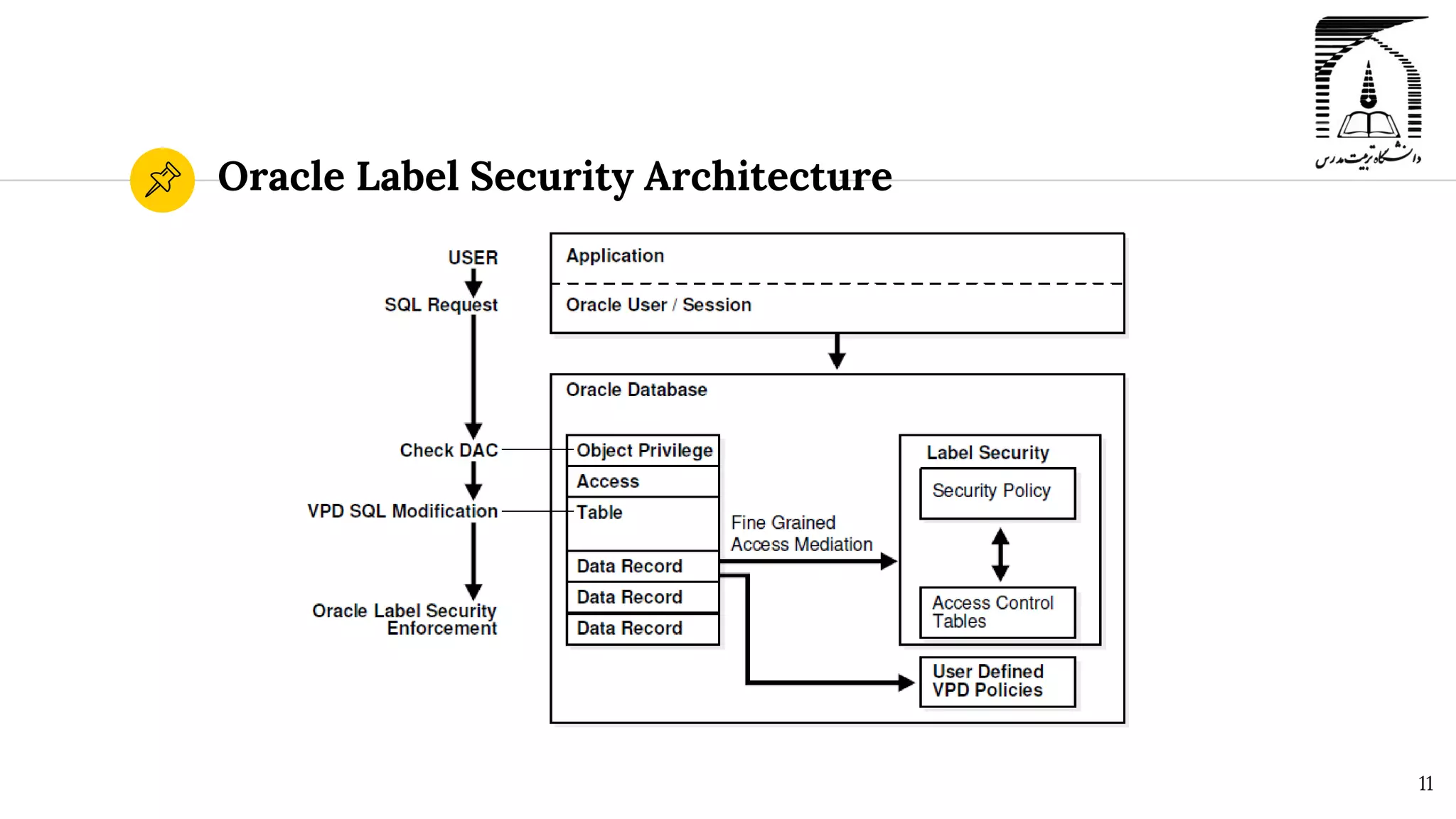
Oracle Label Security Architecture
11
Data Masking and Subsetting
4
12
The Need to Mask and Subset data
◉ Limit sensitive data proliferation
◉ Share what is necessary
◉ Comply with data privacy laws and standards
◉ Minimize storage costs
13
Major Components of Oracle Data
Masking and Subsetting
◉ Application Data Modeling
◉ Data Masking Format Library
◉ Data Masking Transformations
◉ Data Subsetting
◉ Application Templates
14
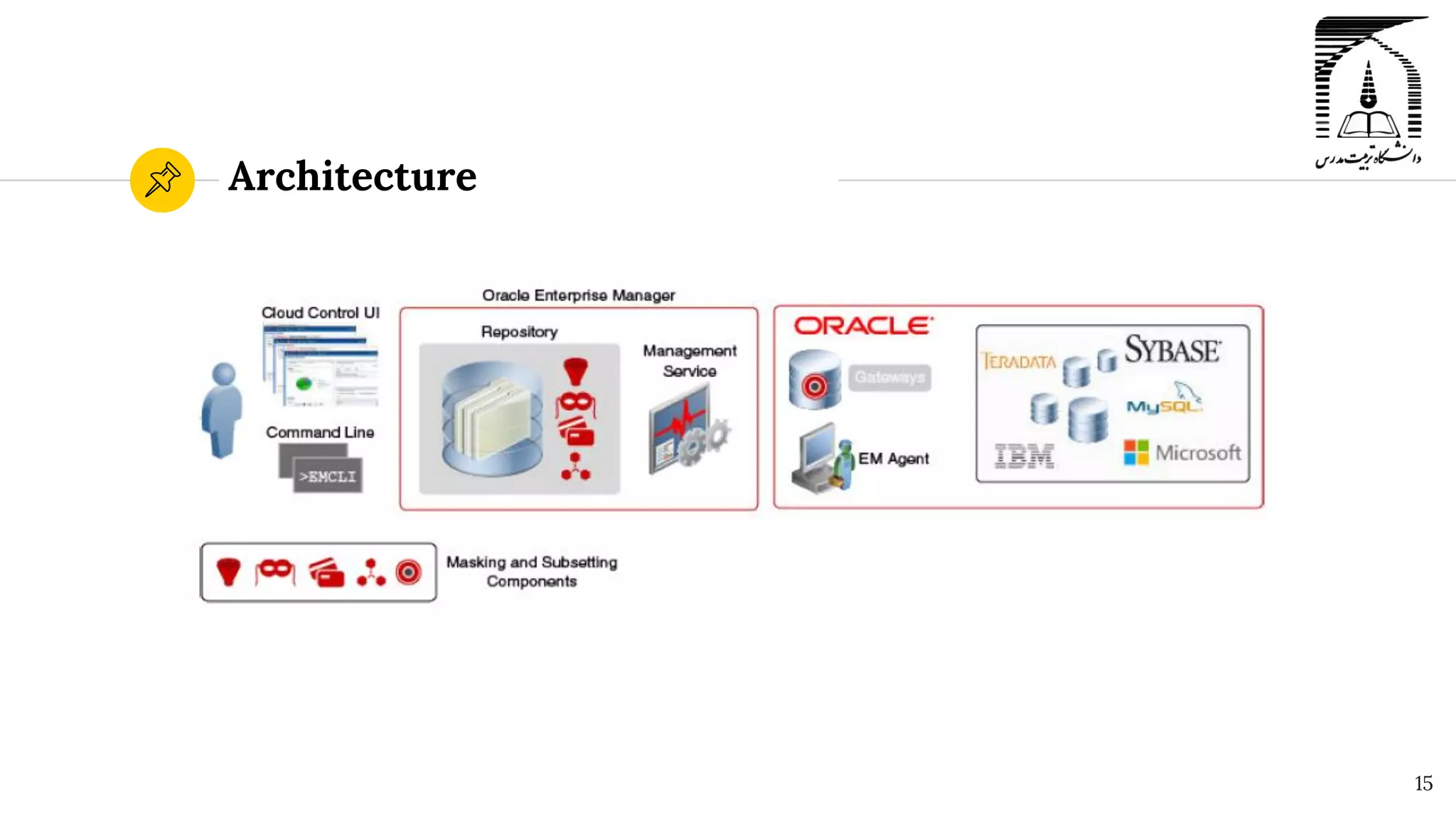
Architecture
15
Deployment Options
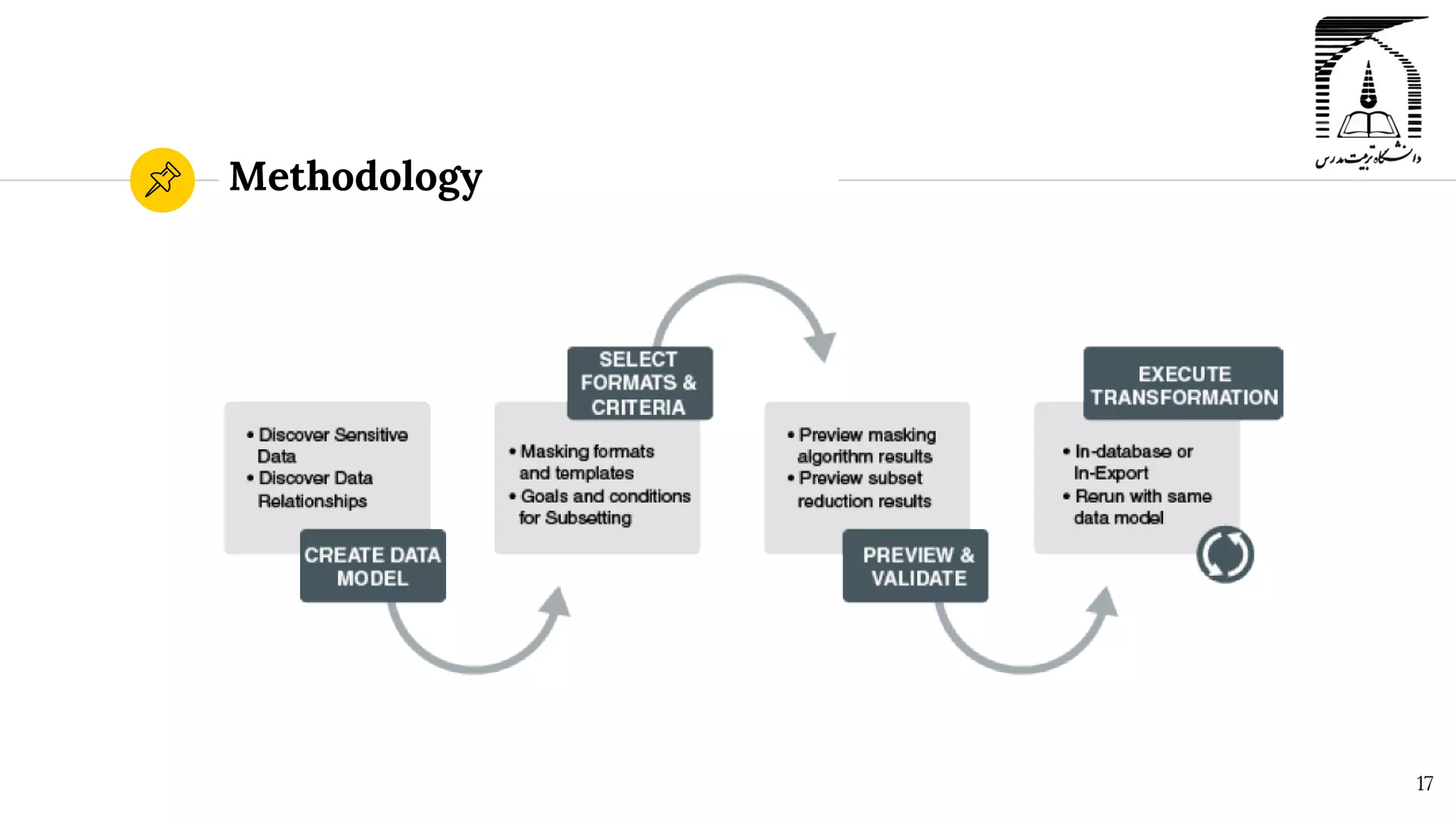
◉ In-Database mode
◉ In-Export mode
◉ Heterogeneous mode
16
Methodology
17
Auditting database activities
5
18
What is Auditing
◉ the monitoring and recording of selected user database actions,
from both database users and nondatabase users
◉ The actions that you audit are recorded in either data dictionary
tables or in operating system files
19
Why is Auditing Used
◉ Enable accountability for actions
◉ Investigate suspicious activity
◉ Notify an auditor of the actions of an unauthorized user
◉ Monitor and gather data about specific database activities
◉ Detect problems with an authorization or access control
implementation
20
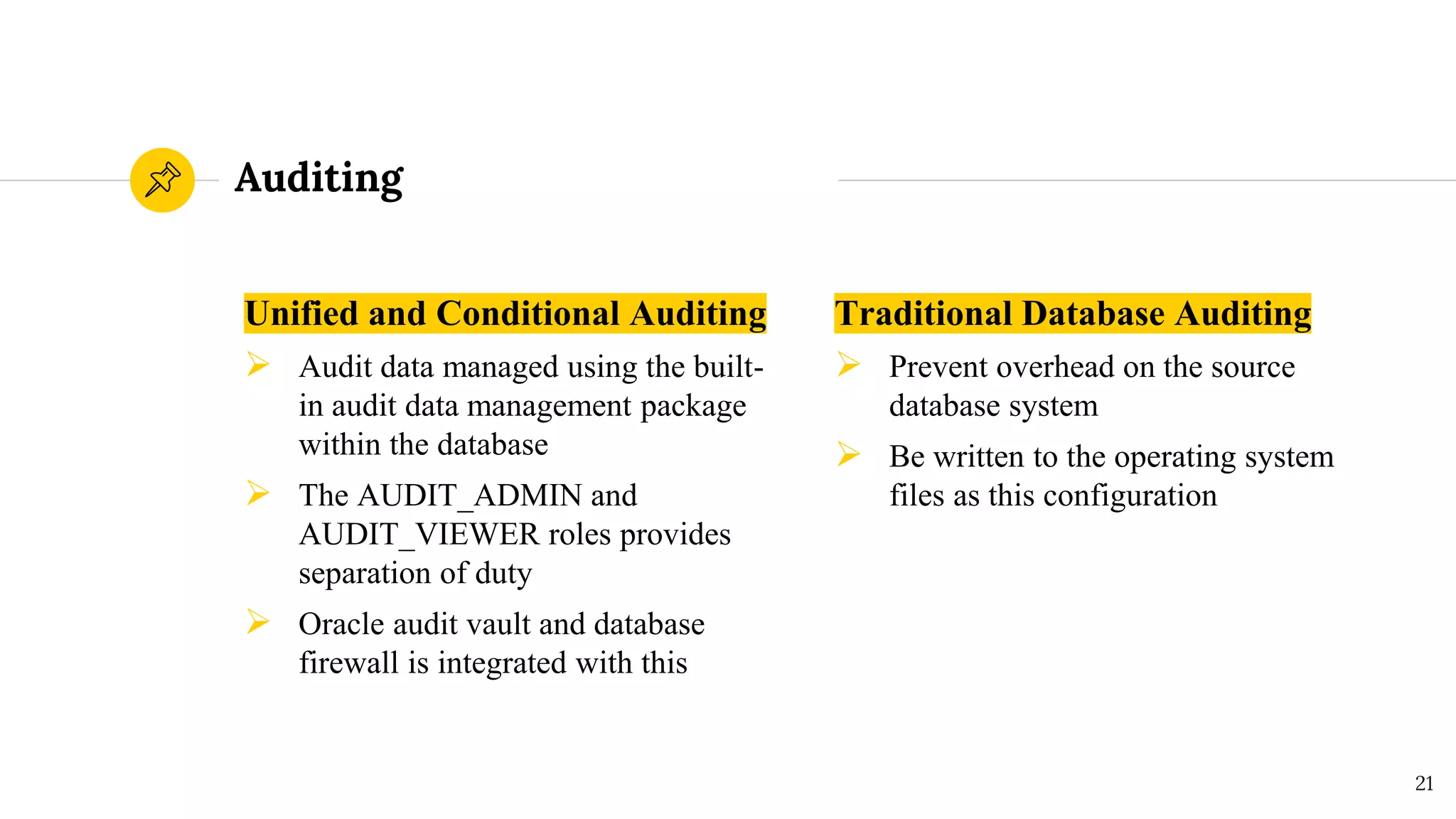
Auditing
Unified and Conditional Auditing
➢ Audit data managed using the built-
in audit data management package
within the database
➢ The AUDIT_ADMIN and
AUDIT_VIEWER roles provides
separation of duty
➢ Oracle audit vault and database
firewall is integrated with this
Traditional Database Auditing
➢ Prevent overhead on the source
database system
➢ Be written to the operating system
files as this configuration
21
references
1) https://docs.oracle.com/en/database/oracle/oracle-database/21/
2) https://docs.oracle.com/cd/E11882_01/network.112/e36292/intro.ht
m#DBSEG001
22
Any questions ?
You can find us at
◉ zahrataghipoor75@gmail.com
◉ sfmousazadeh99@gmail.com
Thanks!
23

Security in oracle

  • 1.
    Database security classpresentation Providers: Zahra Taghipoor kolaei Seyyedeh Fatemeh Mousazadeh Mousavi Professor: Dr.Sadegh Dorri Nogoorani winter 2022 Security in oracle 1
  • 2.
  • 3.
    About oracle ◉ Relationaldatabase ◉ ORDBMS ◉ SQL Based 3
  • 4.
  • 5.
    About Oracle Databasesecurity Oracle Label Security secures database tables at the row level, allowing you to filter user access to row data based on privileges. Real Application Security Administration Console (RASADM) lets you create Real Application Security data security policies using a graphical user interface. Enterprise User Security addresses user, administrative, and security challenges by relying on the identity management services supplied by Oracle Internet Directory, an LDAP-compliant directory service. 5 Transparent Data Encryption enables you to encrypt data so that only an authorized recipient can read it. Oracle Data Redaction enables you to redact (mask) column data using several redaction types. Data Masking and Subsetting process of replacing sensitive data with fictitious yet realistic looking data and process of downsizing either by discarding or extracting data
  • 6.
    continue Key Vault enables youto accelerate security and encryption deployments by centrally managing encryption keys, Oracle wallets, Java keystores, and credential files. Oracle Audit Vault and Database Firewall provides a comprehensive Database Activity Monitoring (DAM) solution that combines database audit logs with SQL traffic capture. 6 Database Assessment Tools Identify database configuration, operation, or implementation introduces risk. Database Vault restrict access to application data by privileged database users. Reducing the risk of insider and outside threats.
  • 7.
  • 8.
    About Oracle LabelSecurity ◉ controls the display of individual table rows using labels ◉ works by comparing the row label with a user's label authorizations to enable you to easily restrict sensitive information to only authorized users ◉ based on multi-level security (MLS) requirements ◉ installed by default, but not automatically enabled 8
  • 9.
    Benefits of OracleLabel Security ◉ It enables row level data classification and provides out-of-the box access mediation based on the data classification and the user label authorization or security clearance. ◉ It enables you to assign label authorizations or security clearances to both database users and application users. ◉ It provides both APIs and a graphical user interface for defining and storing data classification labels and user label authorizations. ◉ It integrates with Oracle Database Vault and Oracle Advanced Security Data Redaction, enabling security clearances to be use in both Database Vault command rules and Data Redaction policy definitions. 9
  • 10.
    Components of OracleLabel Security ◉ Labels: authorizations for users and program units, govern access to specified protected objects • Levels: indicate the type of sensitivity that you want to assign to the row • Compartments: represent the projects in this example that help define more precise access controls • Groups: identify organizations owning or accessing the data ◉ Policy: name associated with these labels, rules, authorizations, and protected tables 10
  • 11.
    Oracle Label SecurityArchitecture 11
  • 12.
    Data Masking andSubsetting 4 12
  • 13.
    The Need toMask and Subset data ◉ Limit sensitive data proliferation ◉ Share what is necessary ◉ Comply with data privacy laws and standards ◉ Minimize storage costs 13
  • 14.
    Major Components ofOracle Data Masking and Subsetting ◉ Application Data Modeling ◉ Data Masking Format Library ◉ Data Masking Transformations ◉ Data Subsetting ◉ Application Templates 14
  • 15.
  • 16.
    Deployment Options ◉ In-Databasemode ◉ In-Export mode ◉ Heterogeneous mode 16
  • 17.
  • 18.
  • 19.
    What is Auditing ◉the monitoring and recording of selected user database actions, from both database users and nondatabase users ◉ The actions that you audit are recorded in either data dictionary tables or in operating system files 19
  • 20.
    Why is AuditingUsed ◉ Enable accountability for actions ◉ Investigate suspicious activity ◉ Notify an auditor of the actions of an unauthorized user ◉ Monitor and gather data about specific database activities ◉ Detect problems with an authorization or access control implementation 20
  • 21.
    Auditing Unified and ConditionalAuditing ➢ Audit data managed using the built- in audit data management package within the database ➢ The AUDIT_ADMIN and AUDIT_VIEWER roles provides separation of duty ➢ Oracle audit vault and database firewall is integrated with this Traditional Database Auditing ➢ Prevent overhead on the source database system ➢ Be written to the operating system files as this configuration 21
  • 22.
  • 23.
    Any questions ? Youcan find us at ◉ zahrataghipoor75@gmail.com ◉ sfmousazadeh99@gmail.com Thanks! 23