Security
Principles
December 2018
Security Architecture Principles
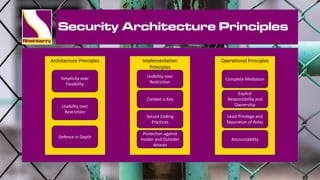
Architecture Principles
Simplicity over
Flexibility
Usability over
Restriction
Defence in Depth
Implementation
Principles
Protection against
Insider and Outsider
Attacks
Usability over
Restriction
Context is Key
Secure Coding
Practices
Operational Principles
Accountability
Complete Mediation
Explicit
Responsibility and
Ownership
Least Privilege and
Separation of Roles
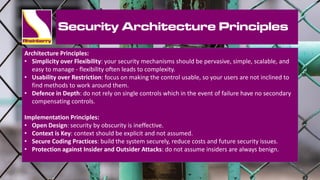
Architecture Principles:
• Simplicity over Flexibility: your security mechanisms should be pervasive, simple, scalable, and
easy to manage - flexibility often leads to complexity.
• Usability over Restriction: focus on making the control usable, so your users are not inclined to
find methods to work around them.
• Defence in Depth: do not rely on single controls which in the event of failure have no secondary
compensating controls.
Implementation Principles:
• Open Design: security by obscurity is ineffective.
• Context is Key: context should be explicit and not assumed.
• Secure Coding Practices: build the system securely, reduce costs and future security issues.
• Protection against Insider and Outsider Attacks: do not assume insiders are always benign.
Security Architecture Principles
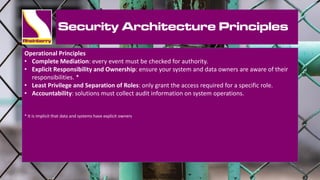
Operational Principles
• Complete Mediation: every event must be checked for authority.
• Explicit Responsibility and Ownership: ensure your system and data owners are aware of their
responsibilities. *
• Least Privilege and Separation of Roles: only grant the access required for a specific role.
• Accountability: solutions must collect audit information on system operations.
* It is implicit that data and systems have explicit owners
Security Architecture Principles
Meeting these objectives ensures your business’s security:
• Focus on the business
• Deliver quality and value to the stakeholders
• Comply with relevant legal and regulatory requirements
• Provide timely and accurate information on security performance
• Evaluate current and future information threats
• Promote continuous improvement in information security
• Adopt a risk-based approach
• Protect classified information
• Concentrate on critical business applications
• Develop systems securely
• Foster a security-positive culture
Security Objectives
Rheinberry – an introduction…
• Rheinberry created in 2014
• Formed by experienced IT and business consultants
• Expertise across aviation, telecoms, utilities, retail, finance, pharmaceuticals and engineering
• Delivery focussed & flexible
• Provision of seasoned consultants providing programme & project management, business &
technical analysis, architecture and strategy
• IBM Business Partner
• Siemens MindSphere Partner
www.rheinberry.com
info@rheinberry.com

Security Architecture Principles

  • 1.
  • 2.
    Security Architecture Principles ArchitecturePrinciples Simplicity over Flexibility Usability over Restriction Defence in Depth Implementation Principles Protection against Insider and Outsider Attacks Usability over Restriction Context is Key Secure Coding Practices Operational Principles Accountability Complete Mediation Explicit Responsibility and Ownership Least Privilege and Separation of Roles
  • 3.
    Architecture Principles: • Simplicityover Flexibility: your security mechanisms should be pervasive, simple, scalable, and easy to manage - flexibility often leads to complexity. • Usability over Restriction: focus on making the control usable, so your users are not inclined to find methods to work around them. • Defence in Depth: do not rely on single controls which in the event of failure have no secondary compensating controls. Implementation Principles: • Open Design: security by obscurity is ineffective. • Context is Key: context should be explicit and not assumed. • Secure Coding Practices: build the system securely, reduce costs and future security issues. • Protection against Insider and Outsider Attacks: do not assume insiders are always benign. Security Architecture Principles
  • 4.
    Operational Principles • CompleteMediation: every event must be checked for authority. • Explicit Responsibility and Ownership: ensure your system and data owners are aware of their responsibilities. * • Least Privilege and Separation of Roles: only grant the access required for a specific role. • Accountability: solutions must collect audit information on system operations. * It is implicit that data and systems have explicit owners Security Architecture Principles
  • 5.
    Meeting these objectivesensures your business’s security: • Focus on the business • Deliver quality and value to the stakeholders • Comply with relevant legal and regulatory requirements • Provide timely and accurate information on security performance • Evaluate current and future information threats • Promote continuous improvement in information security • Adopt a risk-based approach • Protect classified information • Concentrate on critical business applications • Develop systems securely • Foster a security-positive culture Security Objectives
  • 6.
    Rheinberry – anintroduction… • Rheinberry created in 2014 • Formed by experienced IT and business consultants • Expertise across aviation, telecoms, utilities, retail, finance, pharmaceuticals and engineering • Delivery focussed & flexible • Provision of seasoned consultants providing programme & project management, business & technical analysis, architecture and strategy • IBM Business Partner • Siemens MindSphere Partner www.rheinberry.com info@rheinberry.com