














Securing your Big Data
    on its travels


        Marc Vael
        Vice-President
Big Data

IT leaders will need to figure out
• how to coax order out of the chaos from all those
   zeroes and ones
• optimize ROI
• manage data privacy.
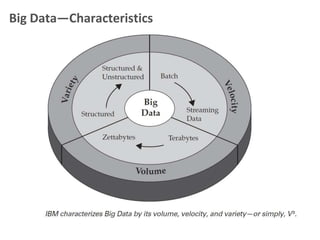
Big Data—Characteristics
Very large, distributed aggregations of loosely
structured data – often incomplete and inaccessible:
• Petabytes/Exabytes of data,
• Millions/billions of people,
• Billions/trillions of records,
• Loosely-structured and often distributed data,
• Flat schemas with few complex interrelationships,
• Coming from diverse sources, including social
   networks, sensor networks, chat sessions, etc.,
• Often involving time-stamped events,
• Often made up of incomplete data,
• Applications that involved big-data either
   Transactional or Analytics
Big Data—Characteristics
Big Data—Challenges
• Increasing volume of unstructured data
• Range/variety of data types/sources
• Complexity of individual data types
• Speed/velocity of data
• Providing analytics from a range of data sources
• Cost of managing data
• Data storage
• Security of data
• Data governance, regulatory compliance, risk
  management
• Energy/power consumption of data
• Providing business insight from massive amounts of
  data
Big Data
Within data, a lot of information is stored
= desire to explore data and to use it for the benefit of
both business and customer.
All of this data creates new opportunities to "extract
more value“ for any organisation.
While some of the data can be considered "structured
information", a big part of that information is
unstructured, not following a predefined data model, but
kept in log files, on file servers, in social networks and
many other places and formats.
Unstructured data will grow faster than any other
information source and will therefore become crucial for
any business the coming decades.
.
Big Data—Context
Traditional relational databases and business
intelligence platforms have great difficulty coping with
both the growing volume and the unstructured nature of
the data. Producing reports and queries take more time
than business users can afford, while changes to the
structure of the database (to cope with unstructured
information) are a bottleneck for your company's
business agility.
Big Data technologies describe a new generation of
technologies and architectures, designed so
organizations like yours can economically extract value
from very large volumes of a wide variety of data by
enabling high-velocity capture, discovery, and/or
analysis.
• Data Analytics—A Practical Approach: organizations should
  aim for early success by
• using analytics across many projects for greater insight,
• performing ad hoc analysis to support key areas of risk,
• defining measures of success along the way.
• Data governance practices : essential for managing data as an
  asset. These practices establish repeatable, measurable
  business processes and manageable policies for improving
  data quality.
• Data governance helps companies meet regulatory
  compliance mandates while improving revenue opportunities
  and customer and partner relationships through the power of
  higher-quality information.
• Despite the universal acceptance that data governance
  practices are worthwhile, businesses have historically
  bypassed the discipline in favor of other initiatives that more
  directly impact the bottom line or provide an immediate
  return on investment (ROI).
• The growing requirements for data privacy and security have
  altered this landscape for the modern organization.
• Today's commercial businesses are being driven into data
  governance action by legislation. Even with these legislative
  motivators, data governance is, at best, inconsistent. Most
  businesses require a guiding hand to assist them with the best
  ways to achieve success.
• Companies are discussing the value of data to their corporate
  operations and attempting to gain insight into corporate
  performance. However, legislative motivators have created a
  tipping point where companies must ensure that they are
  protecting consumer privacy preferences and other personal
  data.
Why Companies Struggle
• Why do companies continue to struggle with this practice
  when the proper management of company data will increase
  revenue, improve customer and partner relationships and
  company operations, and assist with regulatory compliance
  issues?
Why Companies Struggle
• 1. many businesses are shortsighted because they operate on
  a quarter-by-quarter revenue model. In addition, most
  publicly traded companies are focused on ensuring strong
  short-term stock performance. These objectives conflict with
  data governance initiatives, which usually have a less-direct
  ROI cycle, and are competing for precious resources with
  other corporate programs that promise more immediate
  revenue, efficiency or profitability benefits.
Why Companies Struggle
• 2. Data governance & sharing data among product groups or
  divisions of the same company can be highly political. Often,
  business leaders who become territorial about their customer
  data are unwilling to share data, even for the betterment of
  the greater good. This type of "turf war" happens frequently
  and extinguishes an opportunity for the company as a whole
  to perform to its best advantage.
Why Companies Struggle
• 3. Most businesses that have tried to implement a data
  governance practice in their organization have taken the
  wrong approach. Some companies have tried assigning the
  program to a single individual who ultimately fails because
  the job is too big and broad for one person. Still other
  organizations have knitted together a coalition of interested
  director-level parties, which has resulted in limited success
  because this group typically does not have the budget
  authority needed for a proper data governance program, nor
  the influence to shift corporate priorities. The most successful
  initiatives have taken a top-down strategy of appointing an
  executive sponsor whose "day job" is to get a full
Why Companies Struggle
• 4. many companies feel that to achieve data governance
  success, they must take a "boil the ocean" approach. Trying to
  tackle all of their data governance issues in one swoop often
  becomes overwhelming and requires a time investment of
  several years, with costs escalating before any true return is
  realized.
Big Data—Barriers to facilitate BD project
• Lack of right mindset & culture
• Lack of top management support & sponsorship
• Lack of talent, expertise & experience,
• Cost & availability of training
• Lack of knowledge of big data framework & tool
  implementation
• Lack of knowledge of available big data management
• Resources & budget constraints
• Lack of other resources (ICT, fiscal, etc.)
Getting It Together
• Effective data governance program includes the people,
  processes and policies necessary to create a single, consistent
  view of an organization's data. These programs require the
  coordination of myriad people across organizational and
  political boundaries, all of whom have other "day jobs."
  Enlisting senior executives and other employees into a data
  governance program requires a corporate priority shift,
  usually away from more "gratifying" tactical issue resolution
  toward more nebulous and difficult-to-quantify data-quality
  initiatives.
Getting It Together
• Instead of employing a top-down, "all or nothing" approach,
  which requires a complete shift in corporate culture,
  businesses are better served with an iterative approach to
  data governance. They should choose a smaller data set, such
  as customer or product data, and focus their efforts on
  investigating and fixing it, then determine what worked and
  establish policies that can be used to tackle another data set.
  This more cost-effective, iterative approach enables
  companies to secure immediate results within months instead
  of years, while putting into place the scaffolding needed to
  help manage data quality across all systems. An iterative
  approach also allows companies to keep an eye on the
Getting It Together
• Businesses that combine this bite-size strategy with a strong
  team approach to data governance are the most successful.
  The most sensible approach = appoint a senior executive as
  committee chair who reports directly to CEO and have the
  clout to dedicate budget, alter corporate priorities and
  eliminate "turf wars." The chair should oversee a board
  comprised of other executive leaders who have responsibility
  for each of the company's lines of business.
Getting It Together
• Effective data governance team should include individuals
  representing horizontal functions such as finance, human
  resources, IT, accounting and marketing; a group of data
  experts including a data owner, data steward, data architect
  and data modeler; and a group of data analysts:
   ‣ Data owner—Establishes policies and owns data quality for one or
     more master data domains, such as customer data, product data,
     portfolio data and location data
   ‣ Data steward—Implements and enforces policies and business
     rules, and corrects data quality problems including matching
     records, replacing bad data with good data and making
     "survivorship" decisions if more than one record for the same
Getting It Together
• Some basic committee guidelines. Team members should stay
  focused on the end result and avoid endless philosophical
  disagreements about the meaning of data vs. information, the
  exact definition of an entity or attribute, or what type of
  representation to use (entity-relationship diagrams or class
  diagrams). The program will be much more successful if the
  team can deliver something quickly, even though it might not
  be 100 percent perfect in its first iteration. The goal of the
  team should be to complete each iteration rapidly, learn as
  much as possible, employ a "just enough" process to plan and
  measure results, make adjustments for the next iteration, and
  improve the process with each iteration.
Defining Data Governance Processes
• With an iterative approach and the right team in place,
  commercial businesses are ready to define their data
  governance processes. These processes typically begin with a
  business assessment phase and conclude with deployment
  and ongoing maintenance:
   ‣ Business assessment—Articulates various data problems and the
     value of improving them. This step maps to high-level business
     processes and helps companies prioritize the pain, issues, costs and
     value of data. Business assessment results in the definition of the
     biggest areas of pain, opportunity and risk, and quantifies the value
     of fixing problems.
   ‣ Data architecture—Explains the "ecosystem" in which data are
• Businesses see the value of a data governance initiative, but are
  hesitant to begin the process because of concerns about costs
  or ROI cycles, should employ an iterative approach that keeps
  the scope of the project small and focused on one portion of
  business data, such as customer or product information. A
  focused approach enables an organization to realize success
  quickly, while establishing policies and creating frameworks that
  can be applied to other parts of the business in the future.
• A successful data governance initiative also requires a strong
  team from various business leadership positions and strong
  data resources. Although an incremental approach still requires
  system changes and results in integration and architectural
  challenges, these organizations have a much greater chance for
  success than those that try to "boil the ocean“.
Big Data
Corporate governance : ERM = COSO
strategies


  Support from Board of Directors &
      Executive Management
Big Data
strategies


 Managing risks
 appropriately
Big Data
strategies


             Policies & Standards
Big Data
strategies


        Project Management
Big Data
strategies


    Supply Chain Management
Big Data strategies

              EDUCATION!
Big Data
strategies


Providing proper funding
Big Data strategies


Providing proper resources
Big Data
strategies


     Measuring performance
Big Data
strategies


             Review / Audit
Conclusions
Conclusion
Organization’s data are among its most valuable assets. Without a
way to obtain, cleanse, organize and evaluate its data, the
organization is left with a vast, chaotic pool of ones and zeroes.

DA coaxes order from the Big Data chaos: helps explain patterns,
which in turn help the organization identify what it is doing well,
determine how to do it better and recognize problems before they
spiral out of control.

DA results can be used:
• to identify areas of key risk, fraud, errors or misuse;
• to improve business efficiencies;
• to verify process effectiveness;
• to influence business decisions.
Conclusion
Maximum benefits from DA can not be achieved for any
organization:
• if DA is not aligned to the business,
• if risk is not managed,
• if the process is not effectively planned, designed, implemented,
   tested and governed.

When used effectively, DA can play an integral role in helping an
organization unlock the treasures hidden in its massive stores of Big
Data.
Conclusion
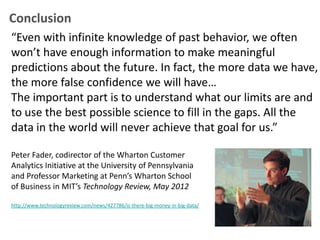
“Even with infinite knowledge of past behavior, we often
won’t have enough information to make meaningful
predictions about the future. In fact, the more data we have,
the more false confidence we will have…
The important part is to understand what our limits are and
to use the best possible science to fill in the gaps. All the
data in the world will never achieve that goal for us.”

Peter Fader, codirector of the Wharton Customer
Analytics Initiative at the University of Pennsylvania
and Professor Marketing at Penn’s Wharton School
of Business in MIT’s Technology Review, May 2012

http://www.technologyreview.com/news/427786/is-there-big-money-in-big-data/
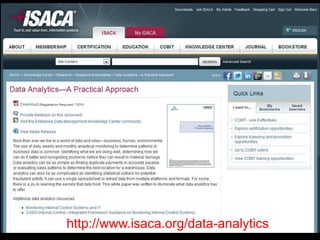
http://www.isaca.org/data-analytics
Contact information

  Marc Vael
  CISA, CISM, CISSP, CRISC, CGEIT, ITIL Service Manager
  Director Knowledge Board

  ISACA
  3701 Algonquin Road, Suite 1010
  Rolling Meadows
  IL 60008 USA
  http://www.isaca.org/

  marc@vael.net
  http://www.linkedin.com/in/marcvael
  http://twitter.com/marcvael

Securing big data (july 2012)

  • 1.
    Securing your BigData on its travels Marc Vael Vice-President
  • 7.
    Big Data IT leaderswill need to figure out • how to coax order out of the chaos from all those zeroes and ones • optimize ROI • manage data privacy.
  • 8.
    Big Data—Characteristics Very large,distributed aggregations of loosely structured data – often incomplete and inaccessible: • Petabytes/Exabytes of data, • Millions/billions of people, • Billions/trillions of records, • Loosely-structured and often distributed data, • Flat schemas with few complex interrelationships, • Coming from diverse sources, including social networks, sensor networks, chat sessions, etc., • Often involving time-stamped events, • Often made up of incomplete data, • Applications that involved big-data either Transactional or Analytics
  • 9.
  • 10.
    Big Data—Challenges • Increasingvolume of unstructured data • Range/variety of data types/sources • Complexity of individual data types • Speed/velocity of data • Providing analytics from a range of data sources • Cost of managing data • Data storage • Security of data • Data governance, regulatory compliance, risk management • Energy/power consumption of data • Providing business insight from massive amounts of data
  • 11.
    Big Data Within data,a lot of information is stored = desire to explore data and to use it for the benefit of both business and customer. All of this data creates new opportunities to "extract more value“ for any organisation. While some of the data can be considered "structured information", a big part of that information is unstructured, not following a predefined data model, but kept in log files, on file servers, in social networks and many other places and formats. Unstructured data will grow faster than any other information source and will therefore become crucial for any business the coming decades. .
  • 12.
    Big Data—Context Traditional relationaldatabases and business intelligence platforms have great difficulty coping with both the growing volume and the unstructured nature of the data. Producing reports and queries take more time than business users can afford, while changes to the structure of the database (to cope with unstructured information) are a bottleneck for your company's business agility. Big Data technologies describe a new generation of technologies and architectures, designed so organizations like yours can economically extract value from very large volumes of a wide variety of data by enabling high-velocity capture, discovery, and/or analysis.
  • 14.
    • Data Analytics—APractical Approach: organizations should aim for early success by • using analytics across many projects for greater insight, • performing ad hoc analysis to support key areas of risk, • defining measures of success along the way.
  • 15.
    • Data governancepractices : essential for managing data as an asset. These practices establish repeatable, measurable business processes and manageable policies for improving data quality. • Data governance helps companies meet regulatory compliance mandates while improving revenue opportunities and customer and partner relationships through the power of higher-quality information. • Despite the universal acceptance that data governance practices are worthwhile, businesses have historically bypassed the discipline in favor of other initiatives that more directly impact the bottom line or provide an immediate return on investment (ROI).
  • 16.
    • The growingrequirements for data privacy and security have altered this landscape for the modern organization. • Today's commercial businesses are being driven into data governance action by legislation. Even with these legislative motivators, data governance is, at best, inconsistent. Most businesses require a guiding hand to assist them with the best ways to achieve success. • Companies are discussing the value of data to their corporate operations and attempting to gain insight into corporate performance. However, legislative motivators have created a tipping point where companies must ensure that they are protecting consumer privacy preferences and other personal data.
  • 17.
    Why Companies Struggle •Why do companies continue to struggle with this practice when the proper management of company data will increase revenue, improve customer and partner relationships and company operations, and assist with regulatory compliance issues?
  • 18.
    Why Companies Struggle •1. many businesses are shortsighted because they operate on a quarter-by-quarter revenue model. In addition, most publicly traded companies are focused on ensuring strong short-term stock performance. These objectives conflict with data governance initiatives, which usually have a less-direct ROI cycle, and are competing for precious resources with other corporate programs that promise more immediate revenue, efficiency or profitability benefits.
  • 19.
    Why Companies Struggle •2. Data governance & sharing data among product groups or divisions of the same company can be highly political. Often, business leaders who become territorial about their customer data are unwilling to share data, even for the betterment of the greater good. This type of "turf war" happens frequently and extinguishes an opportunity for the company as a whole to perform to its best advantage.
  • 20.
    Why Companies Struggle •3. Most businesses that have tried to implement a data governance practice in their organization have taken the wrong approach. Some companies have tried assigning the program to a single individual who ultimately fails because the job is too big and broad for one person. Still other organizations have knitted together a coalition of interested director-level parties, which has resulted in limited success because this group typically does not have the budget authority needed for a proper data governance program, nor the influence to shift corporate priorities. The most successful initiatives have taken a top-down strategy of appointing an executive sponsor whose "day job" is to get a full
  • 21.
    Why Companies Struggle •4. many companies feel that to achieve data governance success, they must take a "boil the ocean" approach. Trying to tackle all of their data governance issues in one swoop often becomes overwhelming and requires a time investment of several years, with costs escalating before any true return is realized.
  • 22.
    Big Data—Barriers tofacilitate BD project • Lack of right mindset & culture • Lack of top management support & sponsorship • Lack of talent, expertise & experience, • Cost & availability of training • Lack of knowledge of big data framework & tool implementation • Lack of knowledge of available big data management • Resources & budget constraints • Lack of other resources (ICT, fiscal, etc.)
  • 23.
    Getting It Together •Effective data governance program includes the people, processes and policies necessary to create a single, consistent view of an organization's data. These programs require the coordination of myriad people across organizational and political boundaries, all of whom have other "day jobs." Enlisting senior executives and other employees into a data governance program requires a corporate priority shift, usually away from more "gratifying" tactical issue resolution toward more nebulous and difficult-to-quantify data-quality initiatives.
  • 24.
    Getting It Together •Instead of employing a top-down, "all or nothing" approach, which requires a complete shift in corporate culture, businesses are better served with an iterative approach to data governance. They should choose a smaller data set, such as customer or product data, and focus their efforts on investigating and fixing it, then determine what worked and establish policies that can be used to tackle another data set. This more cost-effective, iterative approach enables companies to secure immediate results within months instead of years, while putting into place the scaffolding needed to help manage data quality across all systems. An iterative approach also allows companies to keep an eye on the
  • 25.
    Getting It Together •Businesses that combine this bite-size strategy with a strong team approach to data governance are the most successful. The most sensible approach = appoint a senior executive as committee chair who reports directly to CEO and have the clout to dedicate budget, alter corporate priorities and eliminate "turf wars." The chair should oversee a board comprised of other executive leaders who have responsibility for each of the company's lines of business.
  • 26.
    Getting It Together •Effective data governance team should include individuals representing horizontal functions such as finance, human resources, IT, accounting and marketing; a group of data experts including a data owner, data steward, data architect and data modeler; and a group of data analysts: ‣ Data owner—Establishes policies and owns data quality for one or more master data domains, such as customer data, product data, portfolio data and location data ‣ Data steward—Implements and enforces policies and business rules, and corrects data quality problems including matching records, replacing bad data with good data and making "survivorship" decisions if more than one record for the same
  • 27.
    Getting It Together •Some basic committee guidelines. Team members should stay focused on the end result and avoid endless philosophical disagreements about the meaning of data vs. information, the exact definition of an entity or attribute, or what type of representation to use (entity-relationship diagrams or class diagrams). The program will be much more successful if the team can deliver something quickly, even though it might not be 100 percent perfect in its first iteration. The goal of the team should be to complete each iteration rapidly, learn as much as possible, employ a "just enough" process to plan and measure results, make adjustments for the next iteration, and improve the process with each iteration.
  • 28.
    Defining Data GovernanceProcesses • With an iterative approach and the right team in place, commercial businesses are ready to define their data governance processes. These processes typically begin with a business assessment phase and conclude with deployment and ongoing maintenance: ‣ Business assessment—Articulates various data problems and the value of improving them. This step maps to high-level business processes and helps companies prioritize the pain, issues, costs and value of data. Business assessment results in the definition of the biggest areas of pain, opportunity and risk, and quantifies the value of fixing problems. ‣ Data architecture—Explains the "ecosystem" in which data are
  • 29.
    • Businesses seethe value of a data governance initiative, but are hesitant to begin the process because of concerns about costs or ROI cycles, should employ an iterative approach that keeps the scope of the project small and focused on one portion of business data, such as customer or product information. A focused approach enables an organization to realize success quickly, while establishing policies and creating frameworks that can be applied to other parts of the business in the future. • A successful data governance initiative also requires a strong team from various business leadership positions and strong data resources. Although an incremental approach still requires system changes and results in integration and architectural challenges, these organizations have a much greater chance for success than those that try to "boil the ocean“.
  • 30.
    Big Data Corporate governance: ERM = COSO strategies Support from Board of Directors & Executive Management
  • 31.
    Big Data strategies Managingrisks appropriately
  • 32.
    Big Data strategies Policies & Standards
  • 33.
    Big Data strategies Project Management
  • 34.
    Big Data strategies Supply Chain Management
  • 35.
  • 36.
  • 37.
  • 38.
    Big Data strategies Measuring performance
  • 39.
    Big Data strategies Review / Audit
  • 40.
  • 41.
    Conclusion Organization’s data areamong its most valuable assets. Without a way to obtain, cleanse, organize and evaluate its data, the organization is left with a vast, chaotic pool of ones and zeroes. DA coaxes order from the Big Data chaos: helps explain patterns, which in turn help the organization identify what it is doing well, determine how to do it better and recognize problems before they spiral out of control. DA results can be used: • to identify areas of key risk, fraud, errors or misuse; • to improve business efficiencies; • to verify process effectiveness; • to influence business decisions.
  • 42.
    Conclusion Maximum benefits fromDA can not be achieved for any organization: • if DA is not aligned to the business, • if risk is not managed, • if the process is not effectively planned, designed, implemented, tested and governed. When used effectively, DA can play an integral role in helping an organization unlock the treasures hidden in its massive stores of Big Data.
  • 43.
    Conclusion “Even with infiniteknowledge of past behavior, we often won’t have enough information to make meaningful predictions about the future. In fact, the more data we have, the more false confidence we will have… The important part is to understand what our limits are and to use the best possible science to fill in the gaps. All the data in the world will never achieve that goal for us.” Peter Fader, codirector of the Wharton Customer Analytics Initiative at the University of Pennsylvania and Professor Marketing at Penn’s Wharton School of Business in MIT’s Technology Review, May 2012 http://www.technologyreview.com/news/427786/is-there-big-money-in-big-data/
  • 46.
  • 47.
    Contact information Marc Vael CISA, CISM, CISSP, CRISC, CGEIT, ITIL Service Manager Director Knowledge Board ISACA 3701 Algonquin Road, Suite 1010 Rolling Meadows IL 60008 USA http://www.isaca.org/ marc@vael.net http://www.linkedin.com/in/marcvael http://twitter.com/marcvael