Incorporating OAuth and data
access control into the
Anypoint Platform
Mike Moore
Customer Success Architect
All contents © MuleSoft Inc.
Modern Security Posture
2
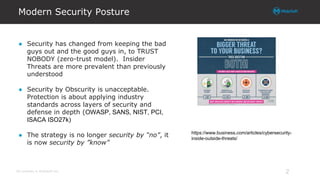
● Security has changed from keeping the bad
guys out and the good guys in, to TRUST
NOBODY (zero-trust model). Insider
Threats are more prevalent than previously
understood
● Security by Obscurity is unacceptable.
Protection is about applying industry
standards across layers of security and
defense in depth (OWASP, SANS, NIST, PCI,
ISACA ISO27k)
● The strategy is no longer security by “no”, it
is now security by ”know”
https://www.business.com/articles/cybersecurity-
inside-outside-threats/
All contents © MuleSoft Inc.
What is Zero-Trust?
• Take a capabilities-led view
– Bounded domains and functions
– Targeted and focused protections
• Deploy a distributed enforcement model
– Protect both the front-end presentation layer and the back-end connectivity to the
data source
• Asset discovery
– Know and understand assets in use and their relationships
• Adopt a continuous approach
– Monitor and iterate, surface anomalies
• Provide verifiable identities to APIs and Consumers
– Grant access based on what we know about the caller and its context
• The client and the user context
All contents © MuleSoft Inc.
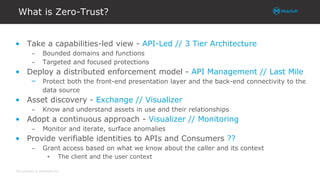
What is Zero-Trust?
• Take a capabilities-led view - API-Led // 3 Tier Architecture
– Bounded domains and functions
– Targeted and focused protections
• Deploy a distributed enforcement model - API Management // Last Mile
– Protect both the front-end presentation layer and the back-end connectivity to the
data source
• Asset discovery - Exchange // Visualizer
– Know and understand assets in use and their relationships
• Adopt a continuous approach - Visualizer // Monitoring
– Monitor and iterate, surface anomalies
• Provide verifiable identities to APIs and Consumers ??
– Grant access based on what we know about the caller and its context
• The client and the user context
All contents © MuleSoft Inc.
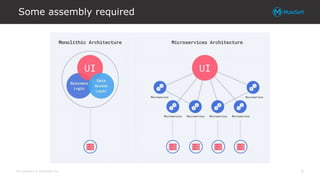
Some assembly required
5
All contents © MuleSoft Inc.
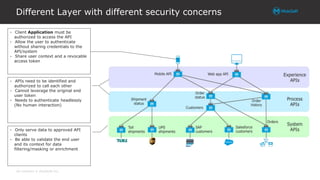
Different Layer with different security concerns
- Client Application must be
authorized to access the API
- Allow the user to authenticate
without sharing credentials to the
API/system
- Share user context and a revocable
access token
- APIs need to be identified and
authorized to call each other
- Cannot leverage the original end
user token
- Needs to authenticate headlessly
(No human interaction)
- Only serve data to approved API
clients
- Be able to validate the end user
and its context for data
filtering/masking or enrichment
All contents © MuleSoft Inc.
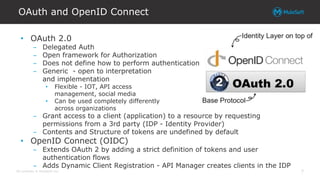
OAuth and OpenID Connect
7
• OAuth 2.0
– Delegated Auth
– Open framework for Authorization
– Does not define how to perform authentication
– Generic - open to interpretation
and implementation
• Flexible - IOT, API access
management, social media
• Can be used completely differently
across organizations
– Grant access to a client (application) to a resource by requesting
permissions from a 3rd party (IDP - Identity Provider)
– Contents and Structure of tokens are undefined by default
• OpenID Connect (OIDC)
– Extends OAuth 2 by adding a strict definition of tokens and user
authentication flows
– Adds Dynamic Client Registration - API Manager creates clients in the IDP
All contents © MuleSoft Inc.
OIDC Standards
8
• {{Auth-Provider-Base-Uri}}/.well-known/openid-configuration
– API Contract/Source of Truth for interacting with the IDP
• Platform bound to this contract
– Highly useful in troubleshooting interactions between Anypoint Platform and
the IDP
– Provides details on:
• Endpoints
– Authorize an application
– Obtain an access token
– Introspect/Validate an access token, ID token, or refresh token
– Register a client application
– Obtain user info
– Invalidate a session
• Grant Types
– How a Client Application will be Authorized and obtain an access token
• Supported Scopes and Claims
All contents © MuleSoft Inc.
OIDC/OAuth Standards
9
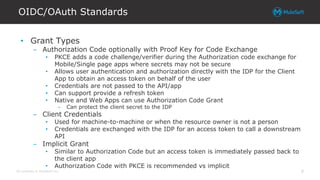
• Grant Types
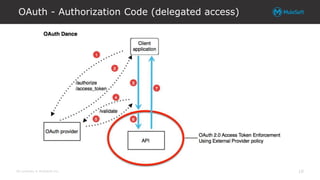
– Authorization Code optionally with Proof Key for Code Exchange
• PKCE adds a code challenge/verifier during the Authorization code exchange for
Mobile/Single page apps where secrets may not be secure
• Allows user authentication and authorization directly with the IDP for the Client
App to obtain an access token on behalf of the user
• Credentials are not passed to the API/app
• Can support provide a refresh token
• Native and Web Apps can use Authorization Code Grant
– Can protect the client secret to the IDP
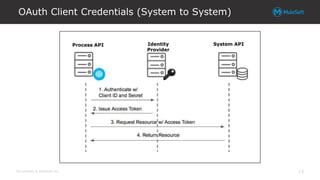
– Client Credentials
• Used for machine-to-machine or when the resource owner is not a person
• Credentials are exchanged with the IDP for an access token to call a downstream
API
– Implicit Grant
• Similar to Authorization Code but an access token is immediately passed back to
the client app
• Authorization Code with PKCE is recommended vs implicit
All contents © MuleSoft Inc.
OAuth - Authorization Code (delegated access)
10
All contents © MuleSoft Inc.
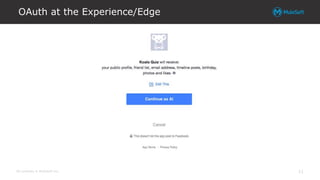
OAuth at the Experience/Edge
11
All contents © MuleSoft Inc.
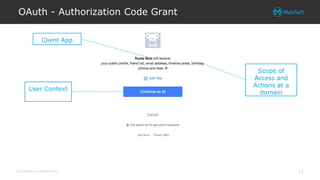
OAuth - Authorization Code Grant
12
Client App
User Context
Scope of
Access and
Actions at a
domain
All contents © MuleSoft Inc.
OAuth Client Credentials (System to System)
13
Process API Identity
Provider
System API
All contents © MuleSoft Inc.
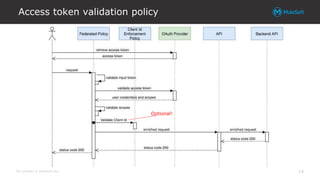
Access token validation policy
14
Optional!
All contents © MuleSoft Inc.
OIDC/OAuth Standards
15
• Scopes
– What information you can obtain or access about the authenticated user
– openid - required scope for OIDC clients
– Usually will be nouns and verbs that can map to API resources and methods
• accounts-read, orders-read, orders-write
• Claims
– Additional key/value pairs related to the user context
– Can be used for fine grained data access control/filtering
• Tokens
– Access Token
• Used to access a resource, possibly with a user context, and a specific set of
claims and scopes
• JWT - Signed or Unsigned, or Opaque Tokens
– ID Token
• Provides user context, claims and scopes
– Can be validated locally (JWT validation) or against the IDP introspection
endpoint (Opaque or JWT)
All contents © MuleSoft Inc.
Validating Tokens
16
• OpenID Connect Access Token Validation Policy
– Validates token in the Authorization header against the IDP (cannot reference a
different target)
– By default validates token issued to valid client app
• Can be disabled!
– Allows token to be validated by downstream API it was not issued for
– Expose Headers will make all claim/user info available to the API for RBAC/ABAC
• JWT Validation
– Locally validates the contents of the token against the configured policy and IDP
public key
– Can validate token was issued to the expected client app/ID
– Can validate custom claims against literals or DW expressions
• claim : vars.claimSet.claim == attributes.queryParams.claim
– Cannot be used if the IDP is issuing Opaque tokens
– Token can be encrypted, and signed (IDP configuration)
– Claim information passed to the API
#[authentication.properties.claims.<claimName>]
All contents © MuleSoft Inc.
Applying OAuth to all the layers
- Use Authorization Code Grant to
Authenticate the user directly to the IDP
and exchange an Authorization Code for an
Access token
- Access token Validation policy will
communicate and cache the IDP response
for the validity of the access token
- Optionally scopes and claims can be
extracted to headers for Experience or
downstream APIs
- Intra-VPC/Subnet API Calls can
leverage Client Credentials Grant
with OIDC Access Token
Enforcement Policy
- Client ID based policy enforcement
could be used for IDPs that do not
support Client Credentials Grant
(Not OAuth)
- RBAC or ABAC access control can
be enforced on any layer of API
- Customers may prefer at the
system API to avoid unnecessary
data transmission
- Extract user information from
Headers, ID Token, Access Token
via JWT validation or token
validation against IDP
Demo
All contents © MuleSoft Inc.
Pitfalls and Lessons learned
19
• Not even OIDC is consistent (Up to the IDP)
– +/- Dynamic Client Registration (OneLogin, Azure AD)
– +/- Support for Client Credentials Grants (Salesforce, Okta)
– Leverage what you can from OIDC and augment with other API Security controls
• Register system to system clients with Auth code grant types, but only use client
ID/secret policies, or add Client Credentials if supported
• Anypoint Platform depends on the well-known-configuration data
– You may have to build interactions directly to the IDP
– You may have to build custom validation policies
• Client Based policies can be driven by access token validation
– Reference #[authentication.principal]
• OAuth Spec has a gap that has not been addressed
– On-behalf-of tokens to allow systems to obtain tokens needed to fulfill an
experience call - In-draft
– Azure AD has implemented a flow to accomplish this
– Example presented today gets close
All contents © MuleSoft Inc.
Other Security methods
20
• Client ID/Secret
– Similar to client credentials grant
– Client ID/Secret validated by Anypoint Platform rather than an access token
from the IDP
• Basic Auth
– Delegate authentication to the service implementation using client
credentials
• SAML Token
• Additional security measures
– Two way SSL
– IP Filtering
– JSON/XML threat protection
– Rate limiting, throttling, spike arrests
Thank you
All contents © MuleSoft Inc.
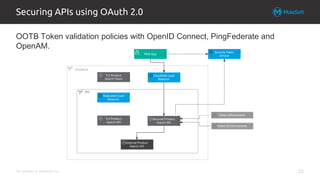
Securing APIs using OAuth 2.0
22
OOTB Token validation policies with OpenID Connect, PingFederate and
OpenAM.
All contents © MuleSoft Inc.
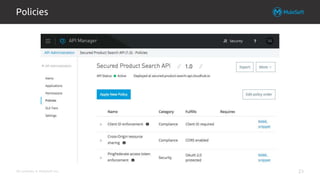
Policies
23
All contents © MuleSoft Inc.
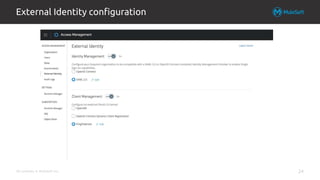
External Identity configuration
24
All contents © MuleSoft Inc.
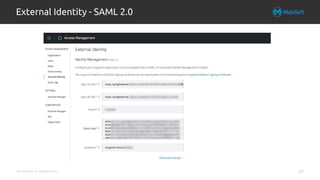
External Identity - SAML 2.0
25
All contents © MuleSoft Inc.
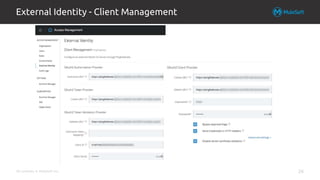
External Identity - Client Management
26

Securing ap is oauth and fine grained access control

  • 1.
    Incorporating OAuth anddata access control into the Anypoint Platform Mike Moore Customer Success Architect
  • 2.
    All contents ©MuleSoft Inc. Modern Security Posture 2 ● Security has changed from keeping the bad guys out and the good guys in, to TRUST NOBODY (zero-trust model). Insider Threats are more prevalent than previously understood ● Security by Obscurity is unacceptable. Protection is about applying industry standards across layers of security and defense in depth (OWASP, SANS, NIST, PCI, ISACA ISO27k) ● The strategy is no longer security by “no”, it is now security by ”know” https://www.business.com/articles/cybersecurity- inside-outside-threats/
  • 3.
    All contents ©MuleSoft Inc. What is Zero-Trust? • Take a capabilities-led view – Bounded domains and functions – Targeted and focused protections • Deploy a distributed enforcement model – Protect both the front-end presentation layer and the back-end connectivity to the data source • Asset discovery – Know and understand assets in use and their relationships • Adopt a continuous approach – Monitor and iterate, surface anomalies • Provide verifiable identities to APIs and Consumers – Grant access based on what we know about the caller and its context • The client and the user context
  • 4.
    All contents ©MuleSoft Inc. What is Zero-Trust? • Take a capabilities-led view - API-Led // 3 Tier Architecture – Bounded domains and functions – Targeted and focused protections • Deploy a distributed enforcement model - API Management // Last Mile – Protect both the front-end presentation layer and the back-end connectivity to the data source • Asset discovery - Exchange // Visualizer – Know and understand assets in use and their relationships • Adopt a continuous approach - Visualizer // Monitoring – Monitor and iterate, surface anomalies • Provide verifiable identities to APIs and Consumers ?? – Grant access based on what we know about the caller and its context • The client and the user context
  • 5.
    All contents ©MuleSoft Inc. Some assembly required 5
  • 6.
    All contents ©MuleSoft Inc. Different Layer with different security concerns - Client Application must be authorized to access the API - Allow the user to authenticate without sharing credentials to the API/system - Share user context and a revocable access token - APIs need to be identified and authorized to call each other - Cannot leverage the original end user token - Needs to authenticate headlessly (No human interaction) - Only serve data to approved API clients - Be able to validate the end user and its context for data filtering/masking or enrichment
  • 7.
    All contents ©MuleSoft Inc. OAuth and OpenID Connect 7 • OAuth 2.0 – Delegated Auth – Open framework for Authorization – Does not define how to perform authentication – Generic - open to interpretation and implementation • Flexible - IOT, API access management, social media • Can be used completely differently across organizations – Grant access to a client (application) to a resource by requesting permissions from a 3rd party (IDP - Identity Provider) – Contents and Structure of tokens are undefined by default • OpenID Connect (OIDC) – Extends OAuth 2 by adding a strict definition of tokens and user authentication flows – Adds Dynamic Client Registration - API Manager creates clients in the IDP
  • 8.
    All contents ©MuleSoft Inc. OIDC Standards 8 • {{Auth-Provider-Base-Uri}}/.well-known/openid-configuration – API Contract/Source of Truth for interacting with the IDP • Platform bound to this contract – Highly useful in troubleshooting interactions between Anypoint Platform and the IDP – Provides details on: • Endpoints – Authorize an application – Obtain an access token – Introspect/Validate an access token, ID token, or refresh token – Register a client application – Obtain user info – Invalidate a session • Grant Types – How a Client Application will be Authorized and obtain an access token • Supported Scopes and Claims
  • 9.
    All contents ©MuleSoft Inc. OIDC/OAuth Standards 9 • Grant Types – Authorization Code optionally with Proof Key for Code Exchange • PKCE adds a code challenge/verifier during the Authorization code exchange for Mobile/Single page apps where secrets may not be secure • Allows user authentication and authorization directly with the IDP for the Client App to obtain an access token on behalf of the user • Credentials are not passed to the API/app • Can support provide a refresh token • Native and Web Apps can use Authorization Code Grant – Can protect the client secret to the IDP – Client Credentials • Used for machine-to-machine or when the resource owner is not a person • Credentials are exchanged with the IDP for an access token to call a downstream API – Implicit Grant • Similar to Authorization Code but an access token is immediately passed back to the client app • Authorization Code with PKCE is recommended vs implicit
  • 10.
    All contents ©MuleSoft Inc. OAuth - Authorization Code (delegated access) 10
  • 11.
    All contents ©MuleSoft Inc. OAuth at the Experience/Edge 11
  • 12.
    All contents ©MuleSoft Inc. OAuth - Authorization Code Grant 12 Client App User Context Scope of Access and Actions at a domain
  • 13.
    All contents ©MuleSoft Inc. OAuth Client Credentials (System to System) 13 Process API Identity Provider System API
  • 14.
    All contents ©MuleSoft Inc. Access token validation policy 14 Optional!
  • 15.
    All contents ©MuleSoft Inc. OIDC/OAuth Standards 15 • Scopes – What information you can obtain or access about the authenticated user – openid - required scope for OIDC clients – Usually will be nouns and verbs that can map to API resources and methods • accounts-read, orders-read, orders-write • Claims – Additional key/value pairs related to the user context – Can be used for fine grained data access control/filtering • Tokens – Access Token • Used to access a resource, possibly with a user context, and a specific set of claims and scopes • JWT - Signed or Unsigned, or Opaque Tokens – ID Token • Provides user context, claims and scopes – Can be validated locally (JWT validation) or against the IDP introspection endpoint (Opaque or JWT)
  • 16.
    All contents ©MuleSoft Inc. Validating Tokens 16 • OpenID Connect Access Token Validation Policy – Validates token in the Authorization header against the IDP (cannot reference a different target) – By default validates token issued to valid client app • Can be disabled! – Allows token to be validated by downstream API it was not issued for – Expose Headers will make all claim/user info available to the API for RBAC/ABAC • JWT Validation – Locally validates the contents of the token against the configured policy and IDP public key – Can validate token was issued to the expected client app/ID – Can validate custom claims against literals or DW expressions • claim : vars.claimSet.claim == attributes.queryParams.claim – Cannot be used if the IDP is issuing Opaque tokens – Token can be encrypted, and signed (IDP configuration) – Claim information passed to the API #[authentication.properties.claims.<claimName>]
  • 17.
    All contents ©MuleSoft Inc. Applying OAuth to all the layers - Use Authorization Code Grant to Authenticate the user directly to the IDP and exchange an Authorization Code for an Access token - Access token Validation policy will communicate and cache the IDP response for the validity of the access token - Optionally scopes and claims can be extracted to headers for Experience or downstream APIs - Intra-VPC/Subnet API Calls can leverage Client Credentials Grant with OIDC Access Token Enforcement Policy - Client ID based policy enforcement could be used for IDPs that do not support Client Credentials Grant (Not OAuth) - RBAC or ABAC access control can be enforced on any layer of API - Customers may prefer at the system API to avoid unnecessary data transmission - Extract user information from Headers, ID Token, Access Token via JWT validation or token validation against IDP
  • 18.
  • 19.
    All contents ©MuleSoft Inc. Pitfalls and Lessons learned 19 • Not even OIDC is consistent (Up to the IDP) – +/- Dynamic Client Registration (OneLogin, Azure AD) – +/- Support for Client Credentials Grants (Salesforce, Okta) – Leverage what you can from OIDC and augment with other API Security controls • Register system to system clients with Auth code grant types, but only use client ID/secret policies, or add Client Credentials if supported • Anypoint Platform depends on the well-known-configuration data – You may have to build interactions directly to the IDP – You may have to build custom validation policies • Client Based policies can be driven by access token validation – Reference #[authentication.principal] • OAuth Spec has a gap that has not been addressed – On-behalf-of tokens to allow systems to obtain tokens needed to fulfill an experience call - In-draft – Azure AD has implemented a flow to accomplish this – Example presented today gets close
  • 20.
    All contents ©MuleSoft Inc. Other Security methods 20 • Client ID/Secret – Similar to client credentials grant – Client ID/Secret validated by Anypoint Platform rather than an access token from the IDP • Basic Auth – Delegate authentication to the service implementation using client credentials • SAML Token • Additional security measures – Two way SSL – IP Filtering – JSON/XML threat protection – Rate limiting, throttling, spike arrests
  • 21.
  • 22.
    All contents ©MuleSoft Inc. Securing APIs using OAuth 2.0 22 OOTB Token validation policies with OpenID Connect, PingFederate and OpenAM.
  • 23.
    All contents ©MuleSoft Inc. Policies 23
  • 24.
    All contents ©MuleSoft Inc. External Identity configuration 24
  • 25.
    All contents ©MuleSoft Inc. External Identity - SAML 2.0 25
  • 26.
    All contents ©MuleSoft Inc. External Identity - Client Management 26