Christos Matskas
Program Manager @ Microsoft
@christosmatskas
"Inspiring developers to build better,
more secure software"
Passionate about technology,
fitness and weightlifting
https://aka.ms/425show
PT ET UK CET
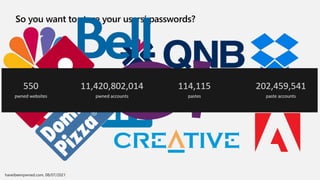
So you want to store your users’ passwords?
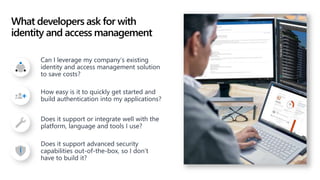
What developers ask for with
identity and access management
How easy is it to quickly get started and
build authentication into my applications?
Does it support or integrate well with the
platform, language and tools I use?
Does it support advanced security
capabilities out-of-the-box, so I don’t
have to build it?
Can I leverage my company’s existing
identity and access management solution
to save costs?
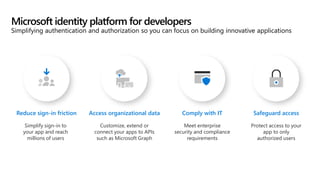
Microsoft identity platform for developers
Simplifying authentication and authorization so you can focus on building innovative applications
Simplify sign-in to
your app and reach
millions of users
Protect access to your
app to only
authorized users
Meet enterprise
security and compliance
requirements
Customize, extend or
connect your apps to APIs
such as Microsoft Graph
Reduce sign-in friction Safeguard access
Comply with IT
Access organizational data
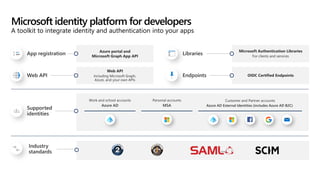
Microsoft identity platform for developers
A toolkit to integrate identity and authentication into your apps
Microsoft Authentication Libraries
For clients and services
Azure portal and
Microsoft Graph App API
OIDC Certified Endpoints
Web API
Including Microsoft Graph,
Azure, and your own APIs
Customer and Partner accounts
Azure AD External Identities (includes Azure AD B2C)
Personal accounts
MSA
Work and school accounts
Azure AD
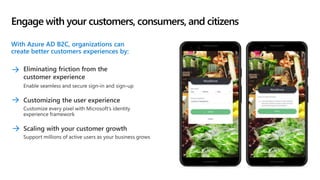
Engage with your customers, consumers, and citizens
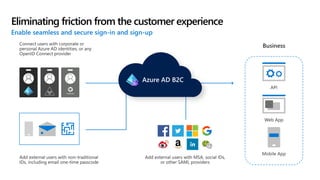
Eliminating friction from the customer experience
Demo: Authenticating users with Azure AD B2C
Come as you are
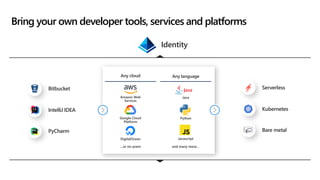
Bring your own developer tools, services &
platforms
Identity
Any language
Any cloud
Amazon Web
Services
Google Cloud
Platform
DigitalOcean
Bring your own developer tools, services and platforms
Java
Python
…or on-prem and many more…
Bitbucket
IntelliJ IDEA
PyCharm
Javascript
Serverless
Kubernetes
Bare metal
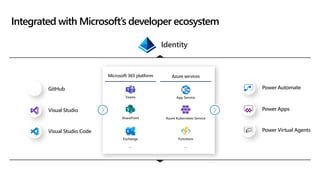
GitHub
Visual Studio
Visual Studio Code
Identity
Azure services
Microsoft 365 platform
Teams
SharePoint
Exchange
Integrated with Microsoft’s developer ecosystem
Power Automate
Power Apps
Power Virtual Agents
App Service
Azure Kubernetes Service
Functions
… …
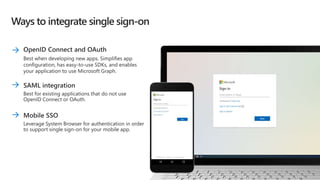
Leverage System Browser for authentication in order
to support single sign-on for your mobile app.
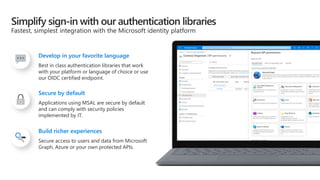
Best in class authentication libraries that work
with your platform or language of choice or use
our OIDC certified endpoint.
Develop in your favorite language
Applications using MSAL are secure by default
and can comply with security policies
implemented by IT.
Secure by default
Secure access to users and data from Microsoft
Graph, Azure or your own protected APIs.
Build richer experiences
Microsoft Graph API
Microsoft Graph
data connect
Connectors
Microsoft Identity
Azure platform
Your local data
Microsoft 365
People Chats Files Devices Mail Events
Lists Security Searc
h
Alerts
Search
Conversations Portals Timeline
Documents
Extend Microsoft 365 experiences
Web
apps
Bots and
agents
Device
and native
Daemon
apps
Workflow
automation
Analytics
apps
Build your experience
Microsoft.
Identity.Web
MSAL
OIDC & oauth2
compliant
• .net core 3.1+
• Blazor WASM/Server
• Web Apps/APIs
• gRPC
• .net
• Java
• Javascript
• Python
• iOS/macOS/Android
• Bring your own library
• e.g., openid_connect rubygem
• pyoidc
• oidc-client.js
• mod_auth_openidc
🆔Identity for all developers
😴 Tired: multiple libraries & APIs to learn,
protocols to understand
- Sign in: ASP.NET Core openid middleware
- You configure OpenIdConnect middleware
- You build controllers & views to initiate challenges
- Uses Azure AD v1 endpoints
- Build-your-own audience validator
- Getting tokens & calling APIs with MSAL
- Requires configuring MSAL yourself
- Requires a token cache
- Requires hooking into openid middleware events
- API developers validating incoming tokens
- JwtBearer middleware
- OBO API developers also need MSAL
⚡ Wired: single library for everyone, no
protocol intimacy required
- Sign in with Microsoft.Identity.Web
- OpenIdConnect middleware configured
- Controllers & views included
- Uses Azure AD v2 endpoints
- Includes audience validator for all Microsoft clouds
- Getting tokens & calling APIs with MSAL
- MSAL configured by Identity.Web
- In memory by default, also uses IDistributedCache
- authorization_code redemption already configured
- API developers validating incoming tokens
- JwtBearer middleware configured
- MSAL for OBO configured by Identity.Web
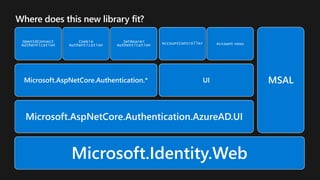
Where does this new library fit?
Microsoft.Identity.Web
Microsoft.AspNetCore.Authentication.AzureAD.UI
Microsoft.AspNetCore.Authentication.*
OpenIdConnect
Authentication
Cookie
Authentication
JwtBearer
Authentication
UI
AccountController Account views
MSAL
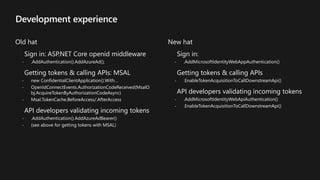
Development experience
Old hat
- Sign in: ASP.NET Core openid middleware
- .AddAuthentication().AddAzureAd();
- Getting tokens & calling APIs: MSAL
- new ConfidentialClientApplication().With…
- OpenIdConnectEvents.AuthorizationCodeReceived(MsalO
bj.AcquireTokenByAuthorizationCodeAsync)
- Msal.TokenCache.BeforeAccess/.AfterAccess
- API developers validating incoming tokens
- .AddAuthentication().AddAzureAdBearer()
- (see above for getting tokens with MSAL)
New hat
- Sign in:
- .AddMicrosoftIdentityWebAppAuthentication()
- Getting tokens & calling APIs
- .EnableTokenAcquisitionToCallDownstreamApi()
- API developers validating incoming tokens
- .AddMicrosoftIdentityWebApiAuthentication()
- .EnableTokenAcquisitionToCallDownstreamApi()
https://aka.ms/425show
PT ET UK CET

"Secure Mobile Apps with the Microsoft Identity Platform", Christos Matskas, John Patrick Dandison

  • 2.
    Christos Matskas Program Manager@ Microsoft @christosmatskas "Inspiring developers to build better, more secure software" Passionate about technology, fitness and weightlifting
  • 3.
  • 4.
    So you wantto store your users’ passwords?
  • 6.
    What developers askfor with identity and access management How easy is it to quickly get started and build authentication into my applications? Does it support or integrate well with the platform, language and tools I use? Does it support advanced security capabilities out-of-the-box, so I don’t have to build it? Can I leverage my company’s existing identity and access management solution to save costs?
  • 7.
    Microsoft identity platformfor developers Simplifying authentication and authorization so you can focus on building innovative applications Simplify sign-in to your app and reach millions of users Protect access to your app to only authorized users Meet enterprise security and compliance requirements Customize, extend or connect your apps to APIs such as Microsoft Graph Reduce sign-in friction Safeguard access Comply with IT Access organizational data
  • 8.
    Microsoft identity platformfor developers A toolkit to integrate identity and authentication into your apps Microsoft Authentication Libraries For clients and services Azure portal and Microsoft Graph App API OIDC Certified Endpoints Web API Including Microsoft Graph, Azure, and your own APIs Customer and Partner accounts Azure AD External Identities (includes Azure AD B2C) Personal accounts MSA Work and school accounts Azure AD
  • 9.
    Engage with yourcustomers, consumers, and citizens
  • 10.
    Eliminating friction fromthe customer experience
  • 11.
    Demo: Authenticating userswith Azure AD B2C
  • 18.
    Come as youare Bring your own developer tools, services & platforms
  • 19.
    Identity Any language Any cloud AmazonWeb Services Google Cloud Platform DigitalOcean Bring your own developer tools, services and platforms Java Python …or on-prem and many more… Bitbucket IntelliJ IDEA PyCharm Javascript Serverless Kubernetes Bare metal
  • 20.
    GitHub Visual Studio Visual StudioCode Identity Azure services Microsoft 365 platform Teams SharePoint Exchange Integrated with Microsoft’s developer ecosystem Power Automate Power Apps Power Virtual Agents App Service Azure Kubernetes Service Functions … …
  • 21.
    Leverage System Browserfor authentication in order to support single sign-on for your mobile app.
  • 22.
    Best in classauthentication libraries that work with your platform or language of choice or use our OIDC certified endpoint. Develop in your favorite language Applications using MSAL are secure by default and can comply with security policies implemented by IT. Secure by default Secure access to users and data from Microsoft Graph, Azure or your own protected APIs. Build richer experiences
  • 24.
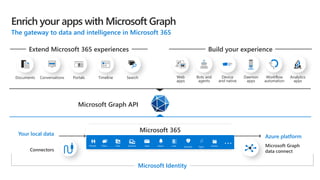
    Microsoft Graph API MicrosoftGraph data connect Connectors Microsoft Identity Azure platform Your local data Microsoft 365 People Chats Files Devices Mail Events Lists Security Searc h Alerts Search Conversations Portals Timeline Documents Extend Microsoft 365 experiences Web apps Bots and agents Device and native Daemon apps Workflow automation Analytics apps Build your experience
  • 27.
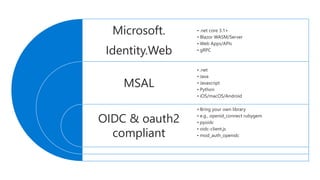
    Microsoft. Identity.Web MSAL OIDC & oauth2 compliant •.net core 3.1+ • Blazor WASM/Server • Web Apps/APIs • gRPC • .net • Java • Javascript • Python • iOS/macOS/Android • Bring your own library • e.g., openid_connect rubygem • pyoidc • oidc-client.js • mod_auth_openidc
  • 28.
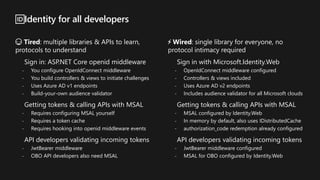
    🆔Identity for alldevelopers 😴 Tired: multiple libraries & APIs to learn, protocols to understand - Sign in: ASP.NET Core openid middleware - You configure OpenIdConnect middleware - You build controllers & views to initiate challenges - Uses Azure AD v1 endpoints - Build-your-own audience validator - Getting tokens & calling APIs with MSAL - Requires configuring MSAL yourself - Requires a token cache - Requires hooking into openid middleware events - API developers validating incoming tokens - JwtBearer middleware - OBO API developers also need MSAL ⚡ Wired: single library for everyone, no protocol intimacy required - Sign in with Microsoft.Identity.Web - OpenIdConnect middleware configured - Controllers & views included - Uses Azure AD v2 endpoints - Includes audience validator for all Microsoft clouds - Getting tokens & calling APIs with MSAL - MSAL configured by Identity.Web - In memory by default, also uses IDistributedCache - authorization_code redemption already configured - API developers validating incoming tokens - JwtBearer middleware configured - MSAL for OBO configured by Identity.Web
  • 29.
    Where does thisnew library fit? Microsoft.Identity.Web Microsoft.AspNetCore.Authentication.AzureAD.UI Microsoft.AspNetCore.Authentication.* OpenIdConnect Authentication Cookie Authentication JwtBearer Authentication UI AccountController Account views MSAL
  • 30.
    Development experience Old hat -Sign in: ASP.NET Core openid middleware - .AddAuthentication().AddAzureAd(); - Getting tokens & calling APIs: MSAL - new ConfidentialClientApplication().With… - OpenIdConnectEvents.AuthorizationCodeReceived(MsalO bj.AcquireTokenByAuthorizationCodeAsync) - Msal.TokenCache.BeforeAccess/.AfterAccess - API developers validating incoming tokens - .AddAuthentication().AddAzureAdBearer() - (see above for getting tokens with MSAL) New hat - Sign in: - .AddMicrosoftIdentityWebAppAuthentication() - Getting tokens & calling APIs - .EnableTokenAcquisitionToCallDownstreamApi() - API developers validating incoming tokens - .AddMicrosoftIdentityWebApiAuthentication() - .EnableTokenAcquisitionToCallDownstreamApi()
  • 32.

Editor's Notes

  • #5 First, if you have a password database, it’s time to not have that anymore, period. Move ASAP
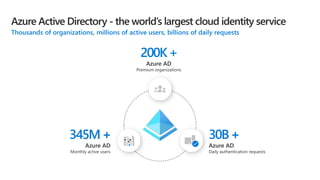
  • #6 DESIGN: potential visual refresh after data refreshed ADAM: confirm any data updates Talk Track: FUTURE-FACING Microsoft is one of the largest identity providers. The scale of our solution is vast: Azure AD is a truly global identity service that operates at hyper-scale Over 100 thousand organizations trust Azure AD We manage over 254M Monthly active users, with an average of 30 billion daily authentication requests [For comparison, Okta has about 8B authentications PER YEAR.]
  • #7 So let’s start with some of the asks and needs that developers have when it comes to identity and access management (IAM) solutions? Developers in your organization are likely looking for a couple things when it comes to sign-in and authentication: How quickly can I get started to build authentication into my apps. Authentication isn’t something many developers have expertise in. Developers are looking to get their app running with authentication and signing-in users quickly so they can focus on the core value of the app or services. Is the identity platform well integrated with the tools, languages and platforms I use. Does it support mobile platforms? Does it support the programming languages I use? And is it well integrated into my workflow and the dev tools services I use. Is the platform feature rich and will it support continuous identity innovation and security. Developers don’t want to get in the business of building IAM features into their app or storing username and passwords. That’s best left to experts. If my company is using an IAM solution for their employees, can I use that solution when building my applications to help save costs? Can I use the IAM solution that my company uses to sign-in users to Office 365 with my applications? Microsoft has the leading enterprise IAM solution with Azure AD, which is built-in with Office 365 that you can also leverage for the apps you build.
  • #8 Leverage the Microsoft identity platform when building applications. Why? Same time and focus on core product differentiation. Lower cost of development – no more building infra to store username and passwords Better user experience – allow users to use their preferred identity to sign in to their applications. Ensure Platform security and get the latest in identity innovation without building it And on top of that when you integrate with Microsoft identity platform, you’re able to access users and data in the MS cloud. Which enables you to build rich applications.
  • #9 So what does the Microsoft identity platform consist of? You have: One portal to register all your applications One set of Microsoft Authentication libraries for building web, mobile and desktop apps with your favorite programming langague One endpoint, that is standards compliant, that sign-in any Microsoft identity, which allows compatibility with third-party libraries. Secure access to APIs – from Microsoft Graph to Azure resources to your own protected APIs This gives you the ability to authenticate any Microsoft identity including work or school accounts or personal accounts. And your application can sign any external user such as customers and partners social identities and local accounts. And our platform supports open industry standards. So if you have an existing application based on industry standards it’s straightforward to connect your application.
  • #10 Depending on ISV…. talk about B2C if they it’s a qualified opportunity in that they are looking to embed auth system into an app they are building. Eliminating friction in the end-user experience is a top priority for organizations and developers engaging consumers, customers, or citizens. With Azure AD B2C, organizations and developers have the flexibility to tailor the identity experience of their customer-facing apps and services so it’s aligned with their brand and business requirements—without sacrificing security. Seamless and secure sign-in experiences: With Azure AD B2C, you can provide simple, reliable, and secure SSO access to customer-facing apps with customers using their preferred, already-established social, enterprise, or local account identities, while also protecting your customers and data. Customize the user journey: Azure AD B2C sign-up and sign-in policies allow you to control behavior by configuring settings, such as account types that consumers use, attributes that are collected from the consumer during sign-up, multi-factor authentication (MFA) usage, and the look and feel of all registration and authentication pages. Design the user experience: Designed to offer you flexibility and control, these customization capabilities include white-label features that allow you to design the entire user experience to blend seamlessly with your web and mobile applications.
  • #11 Organizations may leverage Azure AD B2C to connect external users to external web and mobile apps using a wide range of social identity providers, OpenID Connect, and OAuth 2.0.
  • #20 Every company wants to digitally transform and we see organizations reaping real, tangible benefits - the positive outcomes are truly amazing. One group of people that is a catalyst for digital transformation are developers. Developers are the builders of our era, creating the ideas and writing the code that enables digital transformation for organizations around the world. They are at the heart of innovation. It’s why the Microsoft identity platform is woven into the tools, service and platform developer use today. From IDEs like Visual Studio, to popular Azure services like App Service, Functions or Kubernetes to low code solution like power apps, the Microsoft identity platform is integrated into the workflows of these services. We want to enable any developer to easily get started with the Microsoft identity platform using the tools and services they know and love.
  • #21 Every company wants to digitally transform and we see organizations reaping real, tangible benefits - the positive outcomes are truly amazing. One group of people that is a catalyst for digital transformation are developers. Developers are the builders of our era, creating the ideas and writing the code that enables digital transformation for organizations around the world. They are at the heart of innovation. It’s why the Microsoft identity platform is woven into the tools, service and platform developer use today. From IDEs like Visual Studio, to popular Azure services like App Service, Functions or Kubernetes to low code solution like power apps, the Microsoft identity platform is integrated into the workflows of these services. We want to enable any developer to easily get started with the Microsoft identity platform using the tools and services they know and love.
  • #22 Here are some ways you can integrate and support SSO. You can use your protocol of choice. For OpenID Connect and OAuth: use OIDC and Oauth when developing new apps. This simplifies app configuration, has easy-to-use SDKs, and enables your application to use Microsoft Graph. For existing apps that are SAML based we support SAML integration. For your mobile apps – be sure to support system Browser for authentication in order to support single sign-on with Azure AD ----- Integrate single sign-on with OpenID Connect/OAuth or SAML https://docs.microsoft.com/en-us/azure/active-directory/manage-apps/what-is-single-sign-on Add sign-in with Microsoft button to your application https://docs.microsoft.com/en-us/azure/active-directory/develop/howto-add-branding-in-azure-ad-apps Customize sign-in and sign-up experiences with Azure AD B2C https://docs.microsoft.com/en-us/azure/active-directory/develop/howto-add-branding-in-azure-ad-apps
  • #23 With our Microsoft Authentication libraries – often referred to as MSAL – we’ve made adding authentication into your apps easy. With our MSAL libraries you can sign-in users and acquire security tokens to call protected APIs. The Microsoft Authentication Libraries represent our best developer experience for easily integrating authentication into a diverse set of applications. For building modern applications that authenticate Microsoft identities, your app should be using our most advanced and up-to-date libraries and protocols. Our MSAL libraries support a variety of platforms and languages - .NET, Javascript, Java, Python, Angular, iOS, Android and we also recently released Microsoft.identity.web which is the glue between ASP.NET Core and MSAL.NET. When you use our MSAL libraries you applications are secure by default. MSAL makes it easy to implement the right authentication protocols and allows developers to get the latest identity innovations such as passwordless, Conditional Access and additional security features into applications with just a few lines of code. On top of that you can securely access to users and data in the Microsoft Cloud such as data in Microsoft Graph or Azure. You can also call your own protected API. So let’s take a look how easy it is to get started. Use Microsoft Graph to build experiences around the user's unique context to help them be more productive. Imagine an app that...
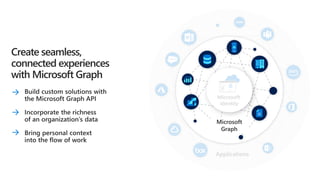
  • #24 As you may have noticed throughout the discussion and the others today, we are very focused on identity and it’s at the center of focus. And identity allows you to build new experiences by connecting to Microsoft Graph comes. Microsoft Graph is the Microsoft 365 data that describes patterns of productivity, identity, and security in an organization, accessed through a unified API endpoint. It connects apps and devices with powerful cloud services – and puts them all to work for you. With the Graph API, you can build custom solutions which both leverage a customers organization’s data, directly from the source, as well as create a personalized experience directly in the flow of your users’ work.
  • #25 Once you signed-in a user and authenticated you can start to access data in Microsoft Graph. It's best to think of Microsoft Graph as an API gateway that unifies the many REST API offerings we have as a company. Today, Microsoft Graph brings together more than 25 incredibly important APIs including Azure Active Directory, productivity APIs like Exchange and OneDrive, security and management APIs like Intune and Security Graph, Windows APIs like Rome and Cloud Print, and much, much more.  By leveraging the Microsoft Graph you can build better apps with: Rich context. Get rich context for your applications, such as who someone's manager is, whether they are out of office, or what documents they've been working on. Deep insights. Access deep insights generated from usage patterns, such as trending documents, best team meeting times, or who people typically work with. Real-time updates. Respond to changes in Microsoft Graph data in real time. Reschedule a meeting based on responses, notify others when a file is modified, or continue a process after it's been approved.