““ I will not say I failed 1000 times, I will say
I will not say I failed 1000 times, I will say
that I discovered there are 1000 ways that
can cause failure
can cause failure ””Thomas Edison
Thomas Edison
No
Cellphone
Principles Of Accounting (1)Principles Of Accounting (1)
Chapter 6Chapter 6
InventoriesInventories
Mohamed Mahmoud
mmahmoud@eelu.edu.eg
Tel: (+202) 33318449
O b je c t iv e s :
1. Calculation of Cost of Goods Sold
2. Lower-of-Cost-or-Market
3. Inventory turnover ratio
4. Inventory Cost Flow Methods
E x e r c is e s
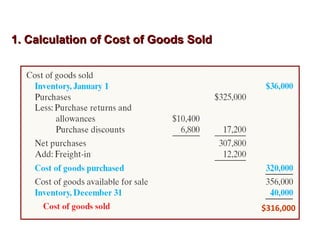
1. Calculation of Cost of Goods Sold1. Calculation of Cost of Goods Sold
$316,000
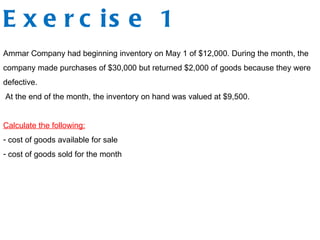
E x e r c is e 1
Ammar Company had beginning inventory on May 1 of $12,000. During the month, the
company made purchases of $30,000 but returned $2,000 of goods because they were
defective.
At the end of the month, the inventory on hand was valued at $9,500.
Calculate the following:
- cost of goods available for sale
- cost of goods sold for the month
A n s w e r s
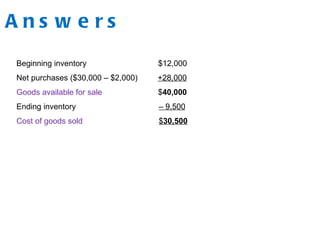
Beginning inventory $12,000
Net purchases ($30,000 – $2,000) +28,000
Goods available for sale $40,000
Ending inventory – 9,500
Cost of goods sold $30,500
2. Lower-of-Cost-or-Market
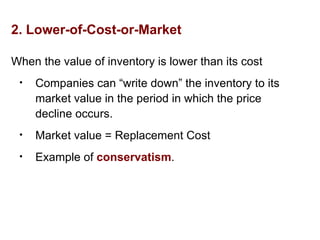
When the value of inventory is lower than its cost
• Companies can “write down” the inventory to its
market value in the period in which the price
decline occurs.
• Market value = Replacement Cost
• Example of conservatism.
E x e r c is
e 2
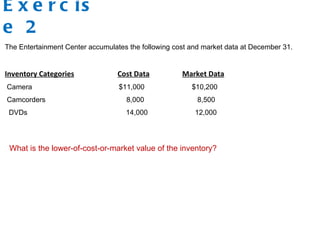
The Entertainment Center accumulates the following cost and market data at December 31.
Inventory Categories Cost Data Market Data
Camera $11,000 $10,200
Camcorders 8,000 8,500
DVDs 14,000 12,000
What is the lower-of-cost-or-market value of the inventory?
A n s w e r s
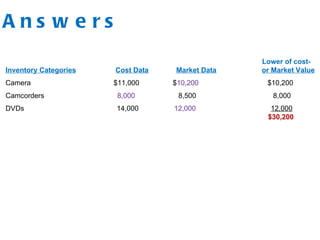
Lower of cost-
Inventory Categories Cost Data Market Data or Market Value
Camera $11,000 $10,200 $10,200
Camcorders 8,000 8,500 8,000
DVDs 14,000 12,000 12,000
$30,200
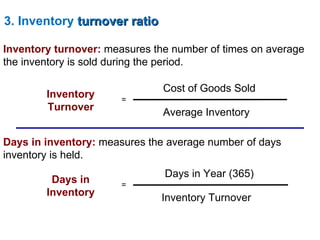
Inventory turnover: measures the number of times on average
the inventory is sold during the period.
Cost of Goods Sold
Average Inventory
Inventory
Turnover
=
Days in inventory: measures the average number of days
inventory is held.
Days in Year (365)
Inventory Turnover
Days in
Inventory
=
3. Inventory turnover ratioturnover ratio
E x e r c is e
3
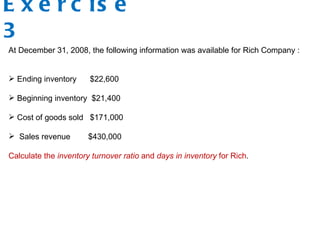
At December 31, 2008, the following information was available for Rich Company :
 Ending inventory $22,600
 Beginning inventory $21,400
 Cost of goods sold $171,000
 Sales revenue $430,000
Calculate the inventory turnover ratio and days in inventory for Rich.
A n s w e r s
- Inventory Turnover Ratio = $171,000 ÷ [($21,400 + $22,600) ÷ 2]
= 7.8 times
- Days in Inventory = 365 ÷ 7.8 = 46.8 days
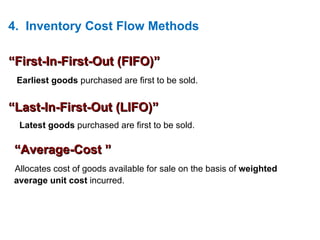
Earliest goods purchased are first to be sold.
““First-In-First-Out (FIFO)”First-In-First-Out (FIFO)”
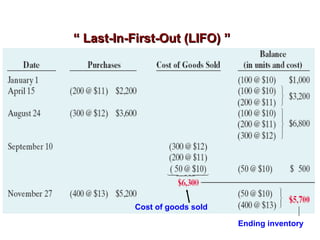
Latest goods purchased are first to be sold.
““Last-In-First-Out (LIFO)”Last-In-First-Out (LIFO)”
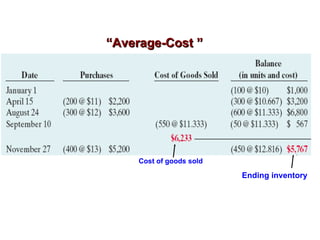
Allocates cost of goods available for sale on the basis of weighted
average unit cost incurred.
““Average-Cost ”Average-Cost ”
4. Inventory Cost Flow Methods
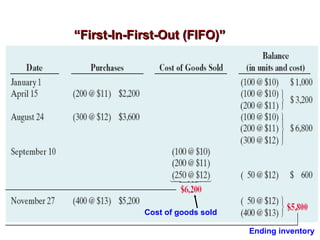
““First-In-First-Out (FIFO)”First-In-First-Out (FIFO)”
Cost of goods sold
Ending inventory
Ending inventory
Cost of goods sold
““ Last-In-First-Out (LIFO) ”Last-In-First-Out (LIFO) ”
Cost of goods sold
Ending inventory
““Average-Cost ”Average-Cost ”
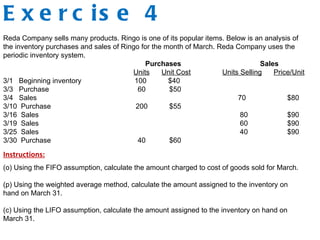
E x e r c is e 4
Reda Company sells many products. Ringo is one of its popular items. Below is an analysis of
the inventory purchases and sales of Ringo for the month of March. Reda Company uses the
periodic inventory system.
Purchases Sales
Units Unit Cost Units Selling Price/Unit
3/1 Beginning inventory 100 $40
3/3 Purchase 60 $50
3/4 Sales 70 $80
3/10 Purchase 200 $55
3/16 Sales 80 $90
3/19 Sales 60 $90
3/25 Sales 40 $90
3/30 Purchase 40 $60
Instructions:
(o) Using the FIFO assumption, calculate the amount charged to cost of goods sold for March.
(p) Using the weighted average method, calculate the amount assigned to the inventory on
hand on March 31.
(c) Using the LIFO assumption, calculate the amount assigned to the inventory on hand on
March 31.
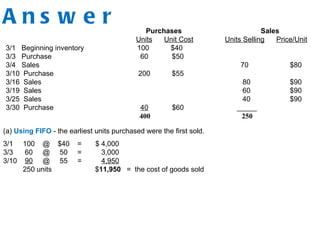
A n s w e r Purchases Sales
Units Unit Cost Units Selling Price/Unit
3/1 Beginning inventory 100 $40
3/3 Purchase 60 $50
3/4 Sales 70 $80
3/10 Purchase 200 $55
3/16 Sales 80 $90
3/19 Sales 60 $90
3/25 Sales 40 $90
3/30 Purchase 40 $60 _____
400 250
(a) Using FIFO - the earliest units purchased were the first sold.
3/1 100 @ $40 = $ 4,000
3/3 60 @ 50 = 3,000
3/10 90 @ 55 = 4,950
250 units $11,950 = the cost of goods sold
A n s w e r Purchases Sales
Units Unit Cost Units Selling Price/Unit
3/1 Beginning inventory 100 $40
3/3 Purchase 60 $50
3/4 Sales 70 $80
3/10 Purchase 200 $55
3/16 Sales 80 $90
3/19 Sales 60 $90
3/25 Sales 40 $90
3/30 Purchase 40 $60 _____
400 250
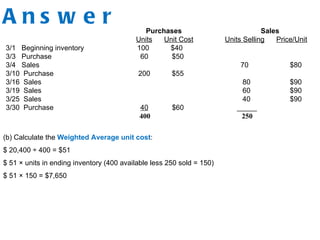
(b) Calculate the Weighted Average unit cost:
$ 20,400 ÷ 400 = $51
$ 51 × units in ending inventory (400 available less 250 sold = 150)
$ 51 × 150 = $7,650
A n s w e r Purchases Sales
Units Unit Cost Units Selling Price/Unit
3/1 Beginning inventory 100 $40
3/3 Purchase 60 $50
3/4 Sales 70 $80
3/10 Purchase 200 $55
3/16 Sales 80 $90
3/19 Sales 60 $90
3/25 Sales 40 $90
3/30 Purchase 40 $60 _____
400 250
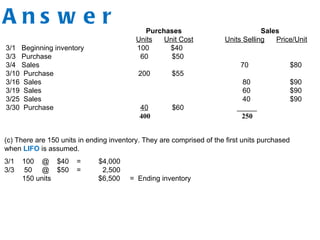
(c) There are 150 units in ending inventory. They are comprised of the first units purchased
when LIFO is assumed.
3/1 100 @ $40 = $4,000
3/3 50 @ $50 = 2,500
150 units $6,500 = Ending inventory
Section 8

Section 8

  • 1.
    ““ I willnot say I failed 1000 times, I will say I will not say I failed 1000 times, I will say that I discovered there are 1000 ways that that I discovered there are 1000 ways that can cause failure can cause failure ””Thomas Edison Thomas Edison
  • 2.
  • 3.
    Principles Of Accounting(1)Principles Of Accounting (1) Chapter 6Chapter 6 InventoriesInventories Mohamed Mahmoud mmahmoud@eelu.edu.eg Tel: (+202) 33318449
  • 4.
    O b jec t iv e s : 1. Calculation of Cost of Goods Sold 2. Lower-of-Cost-or-Market 3. Inventory turnover ratio 4. Inventory Cost Flow Methods
  • 5.
    E x er c is e s
  • 6.
    1. Calculation ofCost of Goods Sold1. Calculation of Cost of Goods Sold $316,000
  • 7.
    E x er c is e 1 Ammar Company had beginning inventory on May 1 of $12,000. During the month, the company made purchases of $30,000 but returned $2,000 of goods because they were defective. At the end of the month, the inventory on hand was valued at $9,500. Calculate the following: - cost of goods available for sale - cost of goods sold for the month
  • 8.
    A n sw e r s Beginning inventory $12,000 Net purchases ($30,000 – $2,000) +28,000 Goods available for sale $40,000 Ending inventory – 9,500 Cost of goods sold $30,500
  • 9.
    2. Lower-of-Cost-or-Market When thevalue of inventory is lower than its cost • Companies can “write down” the inventory to its market value in the period in which the price decline occurs. • Market value = Replacement Cost • Example of conservatism.
  • 10.
    E x er c is e 2 The Entertainment Center accumulates the following cost and market data at December 31. Inventory Categories Cost Data Market Data Camera $11,000 $10,200 Camcorders 8,000 8,500 DVDs 14,000 12,000 What is the lower-of-cost-or-market value of the inventory?
  • 11.
    A n sw e r s Lower of cost- Inventory Categories Cost Data Market Data or Market Value Camera $11,000 $10,200 $10,200 Camcorders 8,000 8,500 8,000 DVDs 14,000 12,000 12,000 $30,200
  • 12.
    Inventory turnover: measuresthe number of times on average the inventory is sold during the period. Cost of Goods Sold Average Inventory Inventory Turnover = Days in inventory: measures the average number of days inventory is held. Days in Year (365) Inventory Turnover Days in Inventory = 3. Inventory turnover ratioturnover ratio
  • 13.
    E x er c is e 3 At December 31, 2008, the following information was available for Rich Company :  Ending inventory $22,600  Beginning inventory $21,400  Cost of goods sold $171,000  Sales revenue $430,000 Calculate the inventory turnover ratio and days in inventory for Rich.
  • 14.
    A n sw e r s - Inventory Turnover Ratio = $171,000 ÷ [($21,400 + $22,600) ÷ 2] = 7.8 times - Days in Inventory = 365 ÷ 7.8 = 46.8 days
  • 15.
    Earliest goods purchasedare first to be sold. ““First-In-First-Out (FIFO)”First-In-First-Out (FIFO)” Latest goods purchased are first to be sold. ““Last-In-First-Out (LIFO)”Last-In-First-Out (LIFO)” Allocates cost of goods available for sale on the basis of weighted average unit cost incurred. ““Average-Cost ”Average-Cost ” 4. Inventory Cost Flow Methods
  • 16.
  • 17.
    Ending inventory Cost ofgoods sold ““ Last-In-First-Out (LIFO) ”Last-In-First-Out (LIFO) ”
  • 18.
    Cost of goodssold Ending inventory ““Average-Cost ”Average-Cost ”
  • 19.
    E x er c is e 4 Reda Company sells many products. Ringo is one of its popular items. Below is an analysis of the inventory purchases and sales of Ringo for the month of March. Reda Company uses the periodic inventory system. Purchases Sales Units Unit Cost Units Selling Price/Unit 3/1 Beginning inventory 100 $40 3/3 Purchase 60 $50 3/4 Sales 70 $80 3/10 Purchase 200 $55 3/16 Sales 80 $90 3/19 Sales 60 $90 3/25 Sales 40 $90 3/30 Purchase 40 $60 Instructions: (o) Using the FIFO assumption, calculate the amount charged to cost of goods sold for March. (p) Using the weighted average method, calculate the amount assigned to the inventory on hand on March 31. (c) Using the LIFO assumption, calculate the amount assigned to the inventory on hand on March 31.
  • 20.
    A n sw e r Purchases Sales Units Unit Cost Units Selling Price/Unit 3/1 Beginning inventory 100 $40 3/3 Purchase 60 $50 3/4 Sales 70 $80 3/10 Purchase 200 $55 3/16 Sales 80 $90 3/19 Sales 60 $90 3/25 Sales 40 $90 3/30 Purchase 40 $60 _____ 400 250 (a) Using FIFO - the earliest units purchased were the first sold. 3/1 100 @ $40 = $ 4,000 3/3 60 @ 50 = 3,000 3/10 90 @ 55 = 4,950 250 units $11,950 = the cost of goods sold
  • 21.
    A n sw e r Purchases Sales Units Unit Cost Units Selling Price/Unit 3/1 Beginning inventory 100 $40 3/3 Purchase 60 $50 3/4 Sales 70 $80 3/10 Purchase 200 $55 3/16 Sales 80 $90 3/19 Sales 60 $90 3/25 Sales 40 $90 3/30 Purchase 40 $60 _____ 400 250 (b) Calculate the Weighted Average unit cost: $ 20,400 ÷ 400 = $51 $ 51 × units in ending inventory (400 available less 250 sold = 150) $ 51 × 150 = $7,650
  • 22.
    A n sw e r Purchases Sales Units Unit Cost Units Selling Price/Unit 3/1 Beginning inventory 100 $40 3/3 Purchase 60 $50 3/4 Sales 70 $80 3/10 Purchase 200 $55 3/16 Sales 80 $90 3/19 Sales 60 $90 3/25 Sales 40 $90 3/30 Purchase 40 $60 _____ 400 250 (c) There are 150 units in ending inventory. They are comprised of the first units purchased when LIFO is assumed. 3/1 100 @ $40 = $4,000 3/3 50 @ $50 = 2,500 150 units $6,500 = Ending inventory