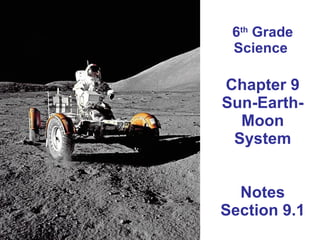
6 th  Grade Science  Chapter 9 Sun-Earth-Moon System Notes Section 9.1
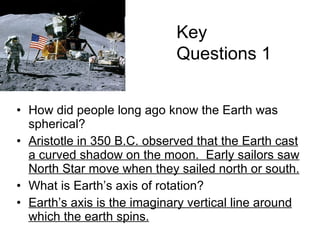
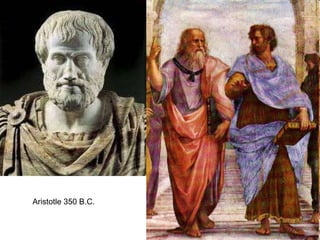
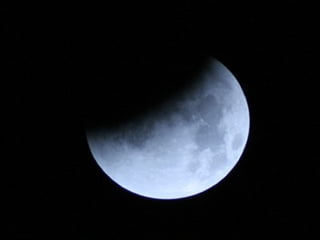
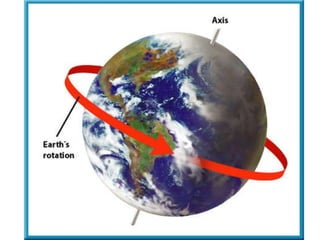
How did people long ago know the Earth was spherical? Aristotle in 350 B.C. observed that the Earth cast a curved shadow on the moon.  Early sailors saw North Star move when they sailed north or south. What is Earth’s axis of rotation? Earth’s axis is the imaginary vertical line around which the earth spins. Key Questions 1 The Tadpole Galaxy
Aristotle 350 B.C.
 
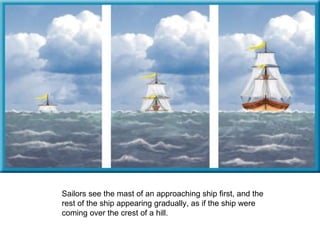
Sailors see the mast of an approaching ship first, and the rest of the ship appearing gradually, as if the ship were coming over the crest of a hill.
 
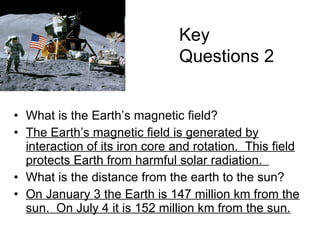
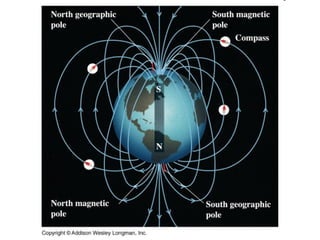
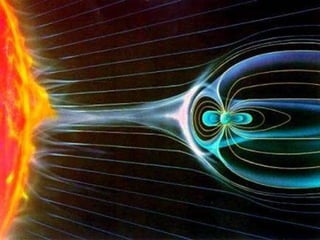
What is the Earth’s magnetic field? The Earth’s magnetic field is generated by interaction of its iron core and rotation.  This field protects Earth from harmful solar radiation.  What is the distance from the earth to the sun? On January 3 the Earth is 147 million km from the sun.  On July 4 it is 152 million km from the sun. Key Questions 2 The Sombrero Galaxy
 
 
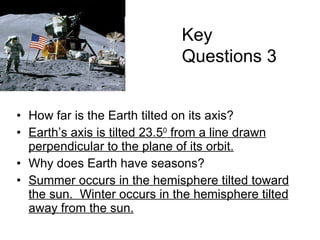
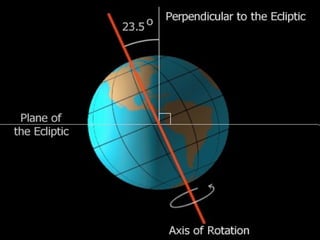
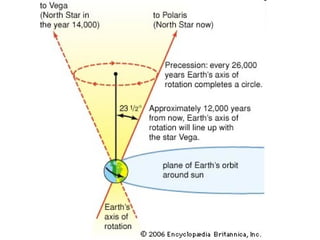
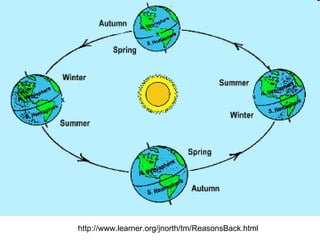
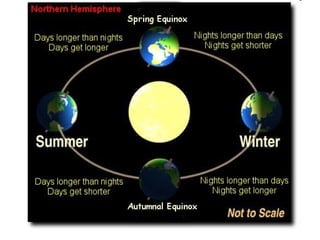
How far is the Earth tilted on its axis? Earth’s axis is tilted 23.5 0  from a line drawn perpendicular to the plane of its orbit. Why does Earth have seasons? Summer occurs in the hemisphere tilted toward the sun.  Winter occurs in the hemisphere tilted away from the sun. Key Questions 3
 
 
http://www.learner.org/jnorth/tm/ReasonsBack.html
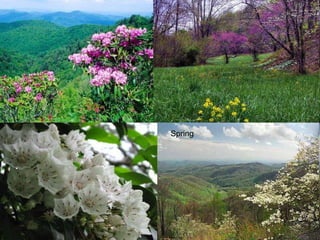
Spring
Summer
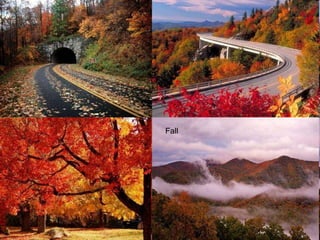
Fall
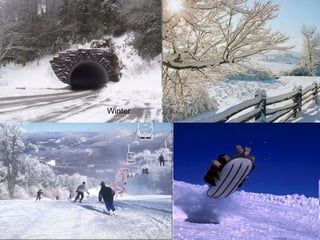
Winter
What is a solstice? The solstice is the day when the sun reaches its greatest distance north or south of the equator- summer solstice June 21, winter solstice Dec 21. What is an equinox? An equinox occurs when the Sun is directly above the Earth’s equator- spring equinox March 21, fall equinox is September 21. Key Questions 4
 
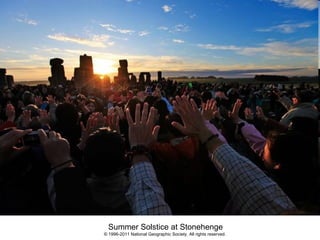
Project Apollo Summer Solstice at Stonehenge © 1996-2011 National Geographic Society. All rights reserved.
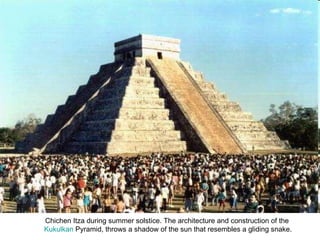
Chichen Itza during summer solstice. The architecture and construction of the  Kukulkan  Pyramid , throws a shadow of the sun that resembles a gliding snake.
Explain why Aristotle thought the Earth was spherical. Compare and contrast rotation and revolution. Describe how Earth’s distance from the Sun changes throughout the year.  When is Earth closest to the sun? Explain why it is summer in Earth’s northern hemisphere at the same time it is winter in the southern hemisphere? Table 1 lists distance from the Sun as an average.  Why isn’t an exact measurement available for this distance? Questions Section 9.1

Sect 9.1

  • 1.
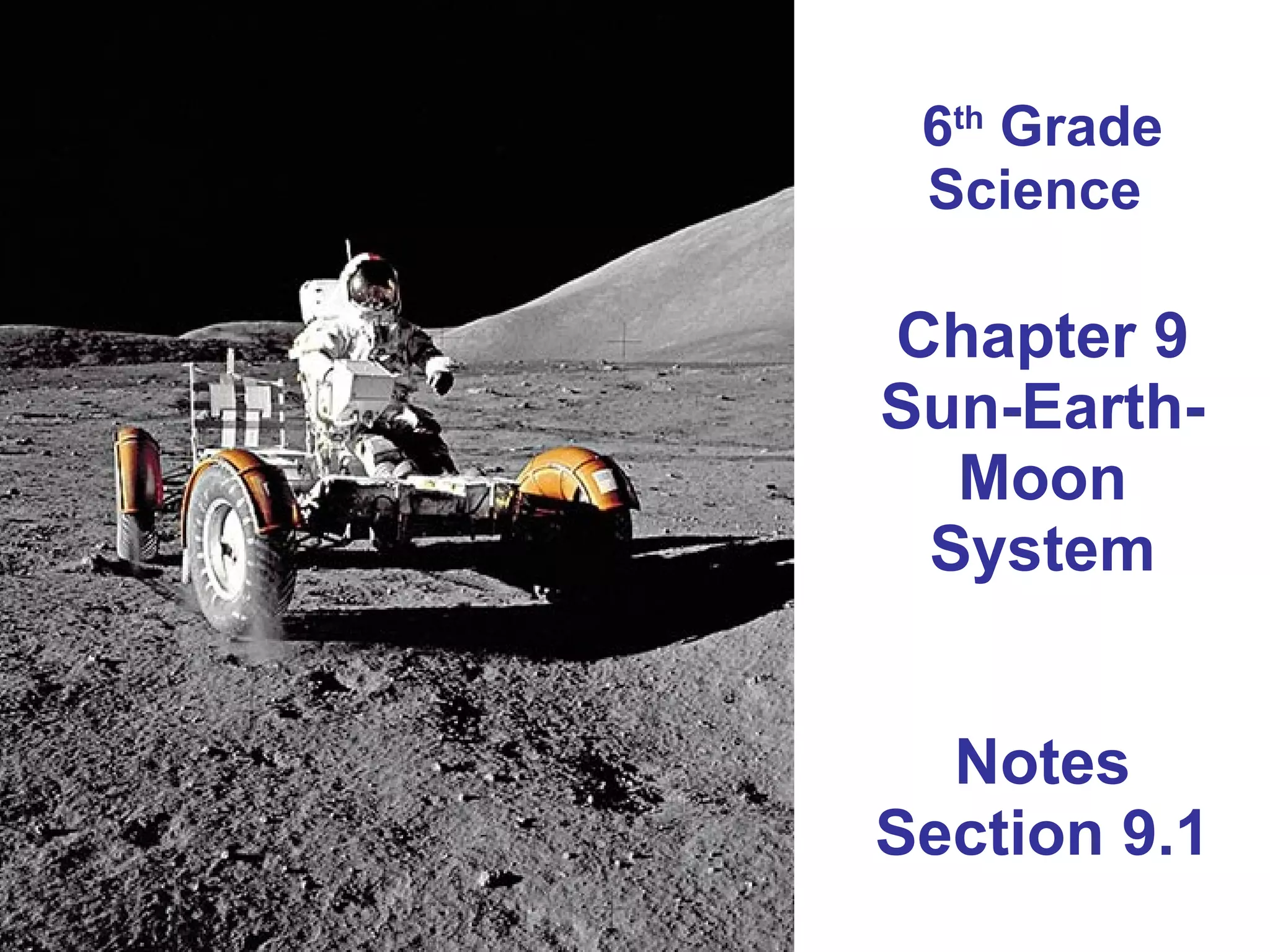
    6 th Grade Science Chapter 9 Sun-Earth-Moon System Notes Section 9.1
  • 2.
    How did peoplelong ago know the Earth was spherical? Aristotle in 350 B.C. observed that the Earth cast a curved shadow on the moon. Early sailors saw North Star move when they sailed north or south. What is Earth’s axis of rotation? Earth’s axis is the imaginary vertical line around which the earth spins. Key Questions 1 The Tadpole Galaxy
  • 3.
  • 4.
  • 5.
    Sailors see themast of an approaching ship first, and the rest of the ship appearing gradually, as if the ship were coming over the crest of a hill.
  • 6.
  • 7.
    What is theEarth’s magnetic field? The Earth’s magnetic field is generated by interaction of its iron core and rotation. This field protects Earth from harmful solar radiation. What is the distance from the earth to the sun? On January 3 the Earth is 147 million km from the sun. On July 4 it is 152 million km from the sun. Key Questions 2 The Sombrero Galaxy
  • 8.
  • 9.
  • 10.
    How far isthe Earth tilted on its axis? Earth’s axis is tilted 23.5 0 from a line drawn perpendicular to the plane of its orbit. Why does Earth have seasons? Summer occurs in the hemisphere tilted toward the sun. Winter occurs in the hemisphere tilted away from the sun. Key Questions 3
  • 11.
  • 12.
  • 13.
  • 14.
  • 15.
  • 16.
  • 17.
  • 18.
    What is asolstice? The solstice is the day when the sun reaches its greatest distance north or south of the equator- summer solstice June 21, winter solstice Dec 21. What is an equinox? An equinox occurs when the Sun is directly above the Earth’s equator- spring equinox March 21, fall equinox is September 21. Key Questions 4
  • 19.
  • 20.
    Project Apollo SummerSolstice at Stonehenge © 1996-2011 National Geographic Society. All rights reserved.
  • 21.
    Chichen Itza duringsummer solstice. The architecture and construction of the Kukulkan Pyramid , throws a shadow of the sun that resembles a gliding snake.
  • 22.
    Explain why Aristotlethought the Earth was spherical. Compare and contrast rotation and revolution. Describe how Earth’s distance from the Sun changes throughout the year. When is Earth closest to the sun? Explain why it is summer in Earth’s northern hemisphere at the same time it is winter in the southern hemisphere? Table 1 lists distance from the Sun as an average. Why isn’t an exact measurement available for this distance? Questions Section 9.1