SCIENCE 6
Parts and Functions of
Integumentary System
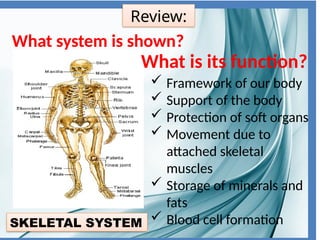
What system is shown?
SKELETAL SYSTEM
What is its function?
 Framework of our body
 Support of the body
 Protection of soft organs
 Movement due to
attached skeletal
muscles
 Storage of minerals and
fats
 Blood cell formation
Review:
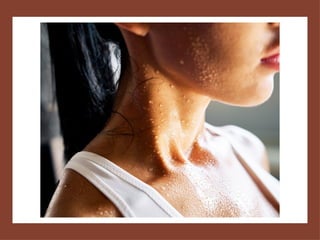
What can you see in the picture?
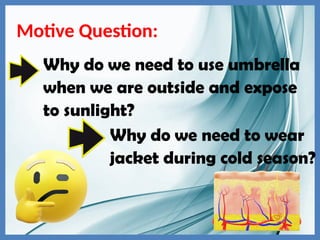
Motive Question:
Why do we need to use umbrella
when we are outside and expose
to sunlight?
Why do we need to wear
jacket during cold season?
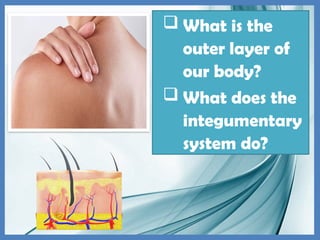
 What is the
outer layer of
our body?
 What does the
integumentary
system do?
Between you and the rest of the
world lies an interface that makes
up 16% of your physical weight this
is your skin the largest organ in
your body. Skin is the foundation of
the integumentary system.
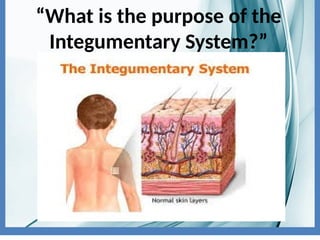
“What is the purpose of the
Integumentary System?”
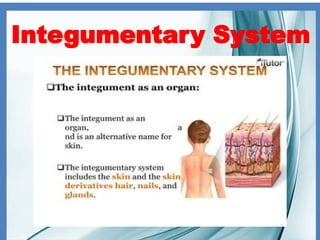
Integumentary System
The integumentary system
is divided into three major
parts the skin, the hair and
the nail.
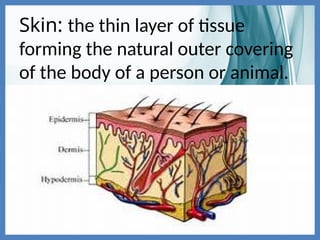
Skin: the thin layer of tissue
forming the natural outer covering
of the body of a person or animal.
The skin is only a few
millimeters thick yet is by far
the largest organ in the
body. ... Skin forms the body's
outer covering and forms a
barrier to protect the body
from chemicals, disease, UV
light, and physical damage.
the skin consists of two
layers: the epidermis and
the dermis. Beneath the
dermis lies the hypodermis
or subcutaneous fatty
tissue.
The epidermis is the outermost
layer of the skin on your body.
It is the thinnest layer of the
skin. It protects your body
from harm, keeps your body
hydrated, produces new skin
cells and contains melanin,
which determines the color of
your skin.
The dermis is the inner layer of the two
main layers of the skin. The dermis has
connective tissue, blood vessels, oil and
sweat glands, nerves, hair follicles, and
other structures.
The dermis is the thickest layer of skin and
arguably the most important. It plays
several key roles, including:
 Producing sweat and regulating the body's
temperature: Within the dermis are sweat
glands that produce sweat that comes out
of the pores. The body sweats as a way to
cool itself off, regulate temperature and
flush out toxins.
 Producing oil: The sebaceous glands
produce sebum or oil. Sebum inhibits
bacterial growth on the skin and conditions
the hair and skin.
 Growing hair: Hair follicles are located in the
dermis.
 Feeling: The dermis is full of nerve endings that
send signals to the brain about how things feel,
 Distributing blood: Blood vessels that are located
in the dermis feed the skin, remove toxins, and
supply the epidermis with blood.
 Protecting the rest of the body: The dermis
contains phagocytes, which are cells that consume
potentially harmful toxins and impurities, including
bacteria.
 Giving the skin structure so it holds its
shape.
Hypodermis (Subcutaneous Tissue)
Hypodermis is the bottom layer of skin in
your body. It has many functions, including
insulating your body, protecting your body
from harm, storing energy and connecting
your skin to your muscles and bones.
The hypodermis has many functions,
including:
Connection: The hypodermis connects
your dermis layer to your muscles and
bones.
Insulation: The hypodermis insulates
your body to protect you from the cold
and produces sweat to regulate your
body temperature, protecting you from
the heat.
Protecting your body: The hypodermis
allows your skin to move smoothly over
the tissues and muscles underneath it.
Without the hypodermis, your skin would
rub against those tissues and muscles. It
also acts as a shock absorber to protect
your organs, muscles and bones from
harm.
Storing energy: The hypodermis
produces fat cells (adipocytes), which
store energy.
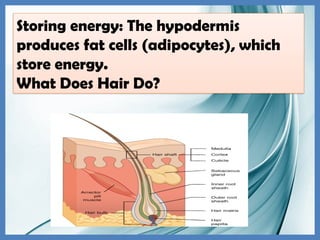
What Does Hair Do?
The hair on our heads doesn't just look nice.
It keeps us warm by preserving heat.
Hair in the nose, ears, and around the eyes
protects these sensitive areas from dust and
other small particles. Eyebrows and
eyelashes protect eyes by decreasing the
amount of light and particles that go into
them.
Nails can be an indicator of a person's general
health, and illness often affects their growth.
Health:
Keep Your Skin Healthy
Wash up.Bathe in warm—not hot—water; use
mild cleansers that don’t irritate; and wash
gently—don’t scrub.
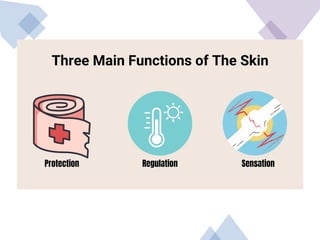
What does the integumentary
system do?
It protects the body’s internal living tissues
and organs.
It protects the body against
microorganismand invasion of infectious
organisms
It protects the body’s internal living tissues
and organs.
It protects the body from
dehydration and against
abrupt changes in
temperature.
It acts as a receptor of for
touch, pressure, pain, heat
and cold.
Which layer of skin contains blood
vessels, oil glands and sweat glands?
(the dermis)
Why is sweating important?
(helps lower body temperature)
Rubrics in Participation/Group Activities:
POINTS INDICATORS
Special Reminders to pupils before doing the activity:
•Be polite by listening attentively with each other during group activity.
•Group planning and sharing is 10 minutes only while group presentatio
is 2 minutes or less.
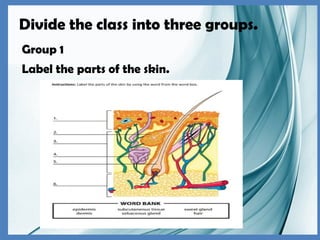
Divide the class into three groups.
Group 1
Label the parts of the skin.
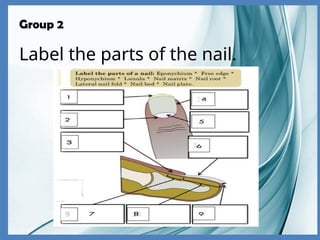
Group 2
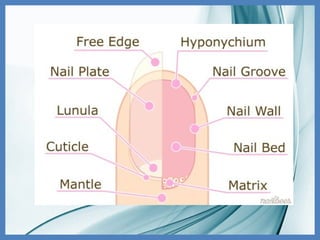
Label the parts of the nail.
Group 3
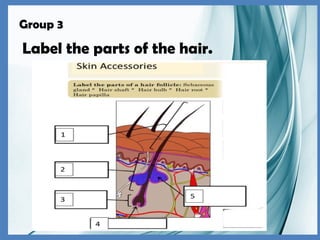
Label the parts of the hair.
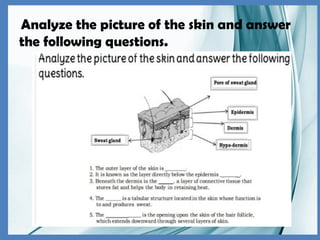
Analyze the picture of the skin and answer
the following questions.
1.The outer layer of the skin is ___.
2. It is known as the layer directly
after the epidermis ______.
3. Beneath the dermis is the _____.
4. The _____ is the tabulator structure
located in the skin whose function is
to produce sweat.
5. The ______ is the opening upon the
skin of hair follicle, which extends
downward through several layers of
skin.
II. Multiple Choices
1. ____The skin shields the body against ___________.
a. heat b. light c. injury d. all of the above.
____2. The epidermis contains ____________.
a. hair follicles b. blood vessels c. sweat glands d. keratin
3.___The dermis does not contain:
a. Sebaceous glands b. Hair follicles c. Mucous glands d.
nerves
4. ____The layer of skin that lacks blood vessels is:
a. Subcutaneous b. Dermis c. Integument d. Epidermis
5. ____Which is not a function of the skin?
a. Protection against mechanical injury
b. Protection against foreign invaders
c. Regulation of body heat
d. All of the above are functions
III. Answer the questions below.
1.What do acidic secretions from skin glands
do?
_______________________________________________
_________
2. What can the muscles do to help raise the
body’s temperature?
___________________________________________.
Ask:
1.What is the the largest organ in the
body?
2. What are the three main parts of
the integumentary system?
3. Why is the skin important?
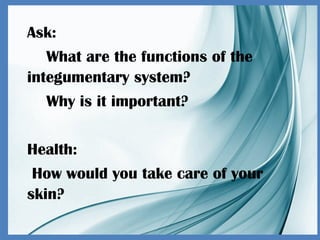
Ask:
What are the functions of the
integumentary system?
Why is it important?
Health:
How would you take care of your
skin?
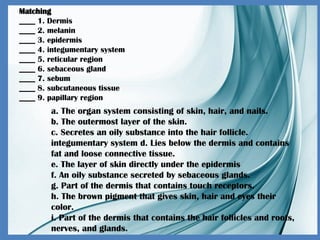
Matching
____ 1. Dermis
____ 2. melanin
____ 3. epidermis
____ 4. integumentary system
____ 5. reticular region
____ 6. sebaceous gland
____ 7. sebum
____ 8. subcutaneous tissue
____ 9. papillary region
a. The organ system consisting of skin, hair, and nails.
b. The outermost layer of the skin.
c. Secretes an oily substance into the hair follicle.
integumentary system d. Lies below the dermis and contains
fat and loose connective tissue.
e. The layer of skin directly under the epidermis
f. An oily substance secreted by sebaceous glands.
g. Part of the dermis that contains touch receptors.
h. The brown pigment that gives skin, hair and eyes their
color.
i. Part of the dermis that contains the hair follicles and roots,
nerves, and glands.
Health:
1. True or False: Skin makes vitamin C when the sun
shines on it.
2. True or False: You should put a bandage on a cut or
scrape on your skin.
3. True or False: Insect bites might be itchy, but they
won’t cause any real problems.
4. True or False:A doctor who specializes in treating skin
diseases is called a dermatologist.
5. True or False: You might have to see the doctor if you
have a severe case of acne.
True or False: Too much sun can damage your skin.
Integumentary System Worksheet
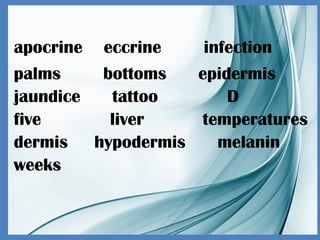
Fill in the blanks in the following sentences with words from the box below.
1. Your skin protects your body against ______________________ and extreme
______________________, maintains your balance of fluids, and even synthesizes
vitamin ______ for your own personal use.
2. The top layer of skin is called the ______________________. The middle layer is the
_____________ and the bottom layer is the __________________.
3. You lose skin cells every day. The epidermis is replaced every 4 to 6 __________.
4. Your thick skin can be found on the ___________ of your hands and the
___________ of your feet. This thick skin contains ________________ layers of skin.
5. The only way to make a ___________ permanent is for the ink to reach your dermis.
6. Yellowing of the skin is symptom of _____________________ and signifies problems
with your ___________________.
7. Skin color is determined by the amount of _________________ in the skin.
8. The most abundant sweat glands are found in your palms, forehead and soles of
your feet. These are called ______________________ sweat glands.
9. The _______________ sweat glands are much less abundant and are mainly in your
armpits and groin.
apocrine eccrine infection
palms bottoms epidermis
jaundice tattoo D
five liver temperatures
dermis hypodermis melanin
weeks
second quarter Integumentary-System-GRADE-6.pptx

second quarter Integumentary-System-GRADE-6.pptx

  • 2.
    SCIENCE 6 Parts andFunctions of Integumentary System
  • 3.
    What system isshown? SKELETAL SYSTEM What is its function?  Framework of our body  Support of the body  Protection of soft organs  Movement due to attached skeletal muscles  Storage of minerals and fats  Blood cell formation Review:
  • 4.
    What can yousee in the picture?
  • 5.
    Motive Question: Why dowe need to use umbrella when we are outside and expose to sunlight? Why do we need to wear jacket during cold season?
  • 6.
     What isthe outer layer of our body?  What does the integumentary system do?
  • 7.
    Between you andthe rest of the world lies an interface that makes up 16% of your physical weight this is your skin the largest organ in your body. Skin is the foundation of the integumentary system.
  • 8.
    “What is thepurpose of the Integumentary System?”
  • 9.
  • 10.
    Integumentary System The integumentarysystem is divided into three major parts the skin, the hair and the nail.
  • 11.
    Skin: the thinlayer of tissue forming the natural outer covering of the body of a person or animal.
  • 12.
    The skin isonly a few millimeters thick yet is by far the largest organ in the body. ... Skin forms the body's outer covering and forms a barrier to protect the body from chemicals, disease, UV light, and physical damage.
  • 13.
    the skin consistsof two layers: the epidermis and the dermis. Beneath the dermis lies the hypodermis or subcutaneous fatty tissue.
  • 15.
    The epidermis isthe outermost layer of the skin on your body. It is the thinnest layer of the skin. It protects your body from harm, keeps your body hydrated, produces new skin cells and contains melanin, which determines the color of your skin.
  • 16.
    The dermis isthe inner layer of the two main layers of the skin. The dermis has connective tissue, blood vessels, oil and sweat glands, nerves, hair follicles, and other structures. The dermis is the thickest layer of skin and arguably the most important. It plays several key roles, including:
  • 17.
     Producing sweatand regulating the body's temperature: Within the dermis are sweat glands that produce sweat that comes out of the pores. The body sweats as a way to cool itself off, regulate temperature and flush out toxins.  Producing oil: The sebaceous glands produce sebum or oil. Sebum inhibits bacterial growth on the skin and conditions the hair and skin.
  • 18.
     Growing hair:Hair follicles are located in the dermis.  Feeling: The dermis is full of nerve endings that send signals to the brain about how things feel,  Distributing blood: Blood vessels that are located in the dermis feed the skin, remove toxins, and supply the epidermis with blood.  Protecting the rest of the body: The dermis contains phagocytes, which are cells that consume potentially harmful toxins and impurities, including bacteria.
  • 19.
     Giving theskin structure so it holds its shape. Hypodermis (Subcutaneous Tissue) Hypodermis is the bottom layer of skin in your body. It has many functions, including insulating your body, protecting your body from harm, storing energy and connecting your skin to your muscles and bones. The hypodermis has many functions, including:
  • 20.
    Connection: The hypodermisconnects your dermis layer to your muscles and bones. Insulation: The hypodermis insulates your body to protect you from the cold and produces sweat to regulate your body temperature, protecting you from the heat.
  • 21.
    Protecting your body:The hypodermis allows your skin to move smoothly over the tissues and muscles underneath it. Without the hypodermis, your skin would rub against those tissues and muscles. It also acts as a shock absorber to protect your organs, muscles and bones from harm.
  • 22.
    Storing energy: Thehypodermis produces fat cells (adipocytes), which store energy. What Does Hair Do?
  • 23.
    The hair onour heads doesn't just look nice. It keeps us warm by preserving heat. Hair in the nose, ears, and around the eyes protects these sensitive areas from dust and other small particles. Eyebrows and eyelashes protect eyes by decreasing the amount of light and particles that go into them.
  • 25.
    Nails can bean indicator of a person's general health, and illness often affects their growth. Health: Keep Your Skin Healthy Wash up.Bathe in warm—not hot—water; use mild cleansers that don’t irritate; and wash gently—don’t scrub.
  • 26.
    What does theintegumentary system do? It protects the body’s internal living tissues and organs. It protects the body against microorganismand invasion of infectious organisms It protects the body’s internal living tissues and organs.
  • 27.
    It protects thebody from dehydration and against abrupt changes in temperature. It acts as a receptor of for touch, pressure, pain, heat and cold.
  • 28.
    Which layer ofskin contains blood vessels, oil glands and sweat glands? (the dermis) Why is sweating important? (helps lower body temperature)
  • 29.
    Rubrics in Participation/GroupActivities: POINTS INDICATORS Special Reminders to pupils before doing the activity: •Be polite by listening attentively with each other during group activity. •Group planning and sharing is 10 minutes only while group presentatio is 2 minutes or less.
  • 30.
    Divide the classinto three groups. Group 1 Label the parts of the skin.
  • 31.
    Group 2 Label theparts of the nail.
  • 32.
    Group 3 Label theparts of the hair.
  • 33.
    Analyze the pictureof the skin and answer the following questions.
  • 34.
    1.The outer layerof the skin is ___. 2. It is known as the layer directly after the epidermis ______. 3. Beneath the dermis is the _____. 4. The _____ is the tabulator structure located in the skin whose function is to produce sweat. 5. The ______ is the opening upon the skin of hair follicle, which extends downward through several layers of skin.
  • 35.
    II. Multiple Choices 1.____The skin shields the body against ___________. a. heat b. light c. injury d. all of the above. ____2. The epidermis contains ____________. a. hair follicles b. blood vessels c. sweat glands d. keratin 3.___The dermis does not contain: a. Sebaceous glands b. Hair follicles c. Mucous glands d. nerves 4. ____The layer of skin that lacks blood vessels is: a. Subcutaneous b. Dermis c. Integument d. Epidermis 5. ____Which is not a function of the skin? a. Protection against mechanical injury b. Protection against foreign invaders c. Regulation of body heat d. All of the above are functions
  • 36.
    III. Answer thequestions below. 1.What do acidic secretions from skin glands do? _______________________________________________ _________ 2. What can the muscles do to help raise the body’s temperature? ___________________________________________.
  • 37.
    Ask: 1.What is thethe largest organ in the body? 2. What are the three main parts of the integumentary system? 3. Why is the skin important?
  • 38.
    Ask: What are thefunctions of the integumentary system? Why is it important? Health: How would you take care of your skin?
  • 39.
    Matching ____ 1. Dermis ____2. melanin ____ 3. epidermis ____ 4. integumentary system ____ 5. reticular region ____ 6. sebaceous gland ____ 7. sebum ____ 8. subcutaneous tissue ____ 9. papillary region a. The organ system consisting of skin, hair, and nails. b. The outermost layer of the skin. c. Secretes an oily substance into the hair follicle. integumentary system d. Lies below the dermis and contains fat and loose connective tissue. e. The layer of skin directly under the epidermis f. An oily substance secreted by sebaceous glands. g. Part of the dermis that contains touch receptors. h. The brown pigment that gives skin, hair and eyes their color. i. Part of the dermis that contains the hair follicles and roots, nerves, and glands.
  • 40.
    Health: 1. True orFalse: Skin makes vitamin C when the sun shines on it. 2. True or False: You should put a bandage on a cut or scrape on your skin. 3. True or False: Insect bites might be itchy, but they won’t cause any real problems. 4. True or False:A doctor who specializes in treating skin diseases is called a dermatologist. 5. True or False: You might have to see the doctor if you have a severe case of acne. True or False: Too much sun can damage your skin.
  • 41.
    Integumentary System Worksheet Fillin the blanks in the following sentences with words from the box below. 1. Your skin protects your body against ______________________ and extreme ______________________, maintains your balance of fluids, and even synthesizes vitamin ______ for your own personal use. 2. The top layer of skin is called the ______________________. The middle layer is the _____________ and the bottom layer is the __________________. 3. You lose skin cells every day. The epidermis is replaced every 4 to 6 __________. 4. Your thick skin can be found on the ___________ of your hands and the ___________ of your feet. This thick skin contains ________________ layers of skin. 5. The only way to make a ___________ permanent is for the ink to reach your dermis. 6. Yellowing of the skin is symptom of _____________________ and signifies problems with your ___________________. 7. Skin color is determined by the amount of _________________ in the skin. 8. The most abundant sweat glands are found in your palms, forehead and soles of your feet. These are called ______________________ sweat glands. 9. The _______________ sweat glands are much less abundant and are mainly in your armpits and groin.
  • 42.
    apocrine eccrine infection palmsbottoms epidermis jaundice tattoo D five liver temperatures dermis hypodermis melanin weeks