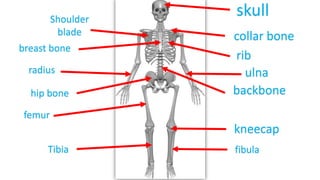
skull
collar bone
Shoulder
blade
breast bone
rib
backbone
hip bone
femur
radius ulna
kneecap
Tibia fibula
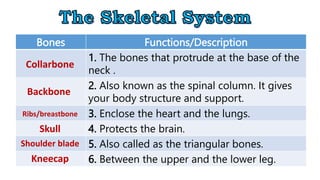
Bones Functions/Description
1. The bones that protrude at the base of the
neck .
2. Also known as the spinal column. It gives
your body structure and support.
3. Enclose the heart and the lungs.
4. Protects the brain.
5. Also called as the triangular bones.
6. Between the upper and the lower leg.
Collarbone
Backbone
Ribs/breastbone
Skull
Shoulder blade
Kneecap
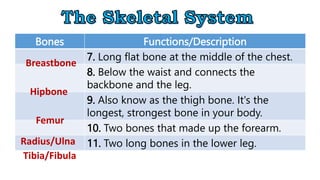
Bones Functions/Description
7. Long flat bone at the middle of the chest.
8. Below the waist and connects the
backbone and the leg.
9. Also know as the thigh bone. It's the
longest, strongest bone in your body.
10. Two bones that made up the forearm.
11. Two long bones in the lower leg.
Breastbone
Hipbone
Femur
Radius/Ulna
Tibia/Fibula
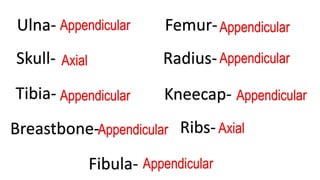
Kneecap-
Ribs-
Breastbone-
Femur-
Tibia-
Fibula-
Ulna-
Radius-
Skull-
Appendicular
Axial
Appendicular
Appendicular
Appendicular
Appendicular
Appendicular
Appendicular
Axial
What are the important functions of Skeletal System?
Form a word from the jumbled letters.
i S n k
SKIN
i a H r
HAIR
a i N l s
NAILS
l G a n d s
GLANDS
THE
INTEGUMENTARY
SYSTEM
THE INTEGUMENTARY SYSTEM
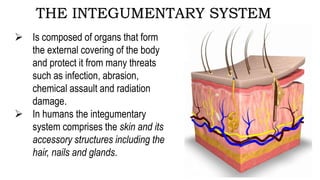
 Is composed of organs that form
the external covering of the body
and protect it from many threats
such as infection, abrasion,
chemical assault and radiation
damage.
 In humans the integumentary
system comprises the skin and its
accessory structures including the
hair, nails and glands.
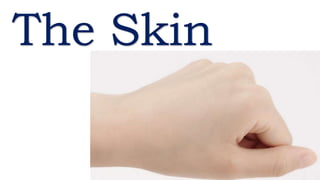
The Skin
THE SKIN
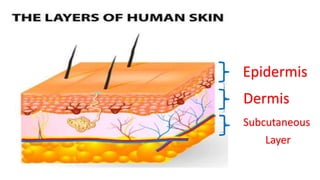
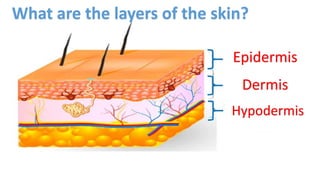
 The skin is composed of the
outer layer called epidermis, the
middle layer called dermis and
the innermost layer called
subcutaneous layer.
 Is the largest organ of the body, weighing more than twice the
brain.
Epidermis
Dermis
Subcutaneous
Layer
Layers of the Skin
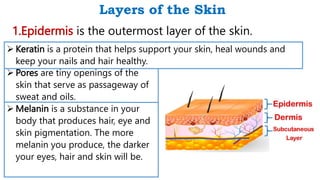
1.Epidermis is the outermost layer of the skin.
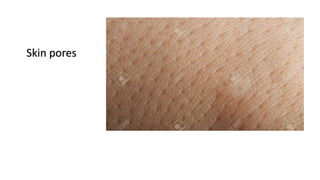
 Pores are tiny openings of the
skin that serve as passageway of
sweat and oils.
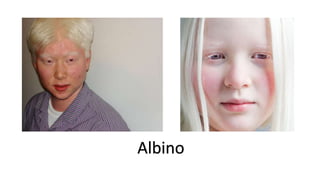
 Melanin is a substance in your
body that produces hair, eye and
skin pigmentation. The more
melanin you produce, the darker
your eyes, hair and skin will be.
 Keratin is a protein that helps support your skin, heal wounds and
keep your nails and hair healthy.
Skin pores
Albino
Layers of the Skin
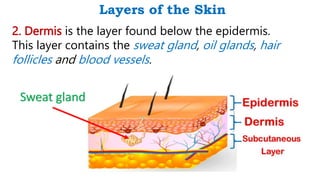
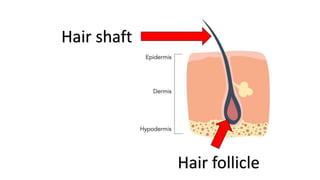
2. Dermis is the layer found below the epidermis.
This layer contains the sweat gland, oil glands, hair
follicles and blood vessels.
Sweat gland
Hair shaft
Hair follicle
Layers of the Skin
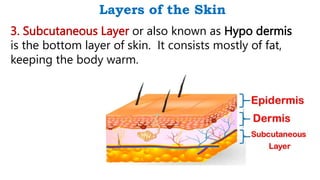
3. Subcutaneous Layer or also known as Hypo dermis
is the bottom layer of skin. It consists mostly of fat,
keeping the body warm.
Epidermis
Dermis
Hypodermis
What are the layers of the skin?
_________________________________1. What are the layers of the
skin?
Epidermis, Dermis, Hypodermis
_________________________________2. Name 3 things that are
found in the Dermis?
sweat gland, oil glands, hair follicles
and blood vessels.
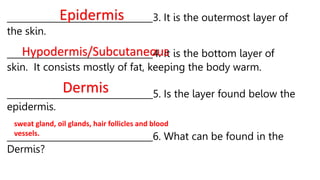
_________________________________3. It is the outermost layer of
the skin.
Epidermis
_________________________________4. It is the bottom layer of
skin. It consists mostly of fat, keeping the body warm.
Hypodermis/Subcutaneous
_________________________________5. Is the layer found below the
epidermis.
Dermis
_________________________________6. What can be found in the
Dermis?
sweat gland, oil glands, hair follicles and blood
vessels.
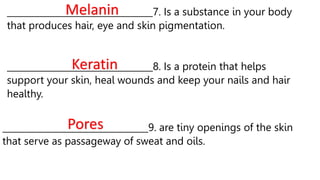
_________________________________7. Is a substance in your body
that produces hair, eye and skin pigmentation.
Melanin
_________________________________8. Is a protein that helps
support your skin, heal wounds and keep your nails and hair
healthy.
Keratin
_________________________________9. are tiny openings of the skin
that serve as passageway of sweat and oils.
Pores
Worksheet

REVIEW
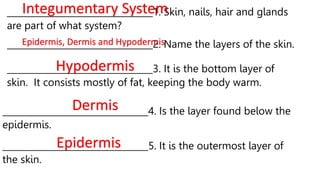
_________________________________1. Skin, nails, hair and glands
are part of what system?
Integumentary System
_________________________________2. Name the layers of the skin.
Epidermis, Dermis and Hypodermis
_________________________________3. It is the bottom layer of
skin. It consists mostly of fat, keeping the body warm.
Hypodermis
_________________________________4. Is the layer found below the
epidermis.
Dermis
_________________________________5. It is the outermost layer of
the skin.
Epidermis
_________________________________6. What can be found in the
Dermis?
________________7. The largest organ of the body.
sweat gland, oil glands, hair follicles and blood
vessels.
skin
_________________8. Is a substance in your body that produces
hair, eye and skin pigmentation.
Melanin
_________________9. Are tiny openings of the skin that serve as
passageway of sweat and oils.
Pores
_________________10. Are tiny openings of the skin that serve as
passageway of sweat and oils.
Keratin
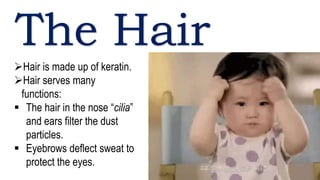
The Hair
Hair is made up of keratin.
Hair serves many
functions:
 The hair in the nose “cilia”
and ears filter the dust
particles.
 Eyebrows deflect sweat to
protect the eyes.
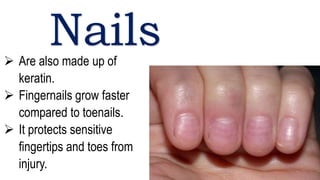
Nails
 Are also made up of
keratin.
 Fingernails grow faster
compared to toenails.
 It protects sensitive
fingertips and toes from
injury.
Glands
 The main glands of the skin: sweat gland and oil gland
Sweat glands help in the excretion of wastes by releasing the excess
water and salts produced by the body. They also function in the
regulation of the body temperature.
Oil glands, also called as sebaceous glands which secrete an oily
substance called sebum. Too much production of sebum may clog the
pores and may result to infection just like pimples.
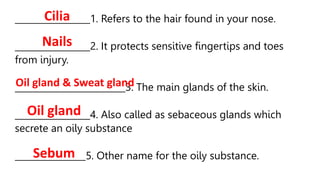
_________________1. Refers to the hair found in your nose.
_________________2. It protects sensitive fingertips and toes
from injury.
_________________________3. The main glands of the skin.
_________________4. Also called as sebaceous glands which
secrete an oily substance
________________5. Other name for the oily substance.
Cilia
Nails
Oil gland & Sweat gland
Oil gland
Sebum
_________________6. help in the excretion of wastes by releasing the
excess water and salts produced by the body.
Sweat gland
Worksheet

_________________________________1. Skin, nails, hair and glands
are part of what system?
_________________________________2. Name the layers of the skin.
_________________________________3. It is the bottom layer of
skin. It consists mostly of fat, keeping the body warm.
_________________________________4. Is the layer found below the
epidermis.
_________________________________5. It is the outermost layer of
the skin.
_________________________________6. Write two thngs that can be
found in the Dermis?
________________7. The largest organ of the body.
_________________8. Is a substance in your body that produces
hair, eye and skin pigmentation.
_________________9. Are tiny openings of the skin that serve as
passageway of sweat and oils.
_________________10. Are tiny openings of the skin that serve as
passageway of sweat and oils.
_________________11. Refers to the hair found in your nose.
_________________12. It protects sensitive fingertips and toes
from injury.
_________________________13. Two main glands of the skin.
_________________14. Also called as sebaceous glands which
secrete an oily substance
________________15. Other name for the oily substance.
_________________16. A gland that help in the excretion of wastes
by releasing the excess water and salts produced by the body.
Integumentary System

  • 2.
    skull collar bone Shoulder blade breast bone rib backbone hipbone femur radius ulna kneecap Tibia fibula
  • 3.
    Bones Functions/Description 1. Thebones that protrude at the base of the neck . 2. Also known as the spinal column. It gives your body structure and support. 3. Enclose the heart and the lungs. 4. Protects the brain. 5. Also called as the triangular bones. 6. Between the upper and the lower leg. Collarbone Backbone Ribs/breastbone Skull Shoulder blade Kneecap
  • 4.
    Bones Functions/Description 7. Longflat bone at the middle of the chest. 8. Below the waist and connects the backbone and the leg. 9. Also know as the thigh bone. It's the longest, strongest bone in your body. 10. Two bones that made up the forearm. 11. Two long bones in the lower leg. Breastbone Hipbone Femur Radius/Ulna Tibia/Fibula
  • 5.
  • 6.
    What are theimportant functions of Skeletal System?
  • 7.
    Form a wordfrom the jumbled letters.
  • 8.
    i S nk SKIN
  • 9.
    i a Hr HAIR
  • 10.
    a i Nl s NAILS
  • 11.
    l G an d s GLANDS
  • 12.
  • 13.
    THE INTEGUMENTARY SYSTEM Is composed of organs that form the external covering of the body and protect it from many threats such as infection, abrasion, chemical assault and radiation damage.  In humans the integumentary system comprises the skin and its accessory structures including the hair, nails and glands.
  • 14.
  • 15.
    THE SKIN  Theskin is composed of the outer layer called epidermis, the middle layer called dermis and the innermost layer called subcutaneous layer.  Is the largest organ of the body, weighing more than twice the brain.
  • 16.
  • 17.
    Layers of theSkin 1.Epidermis is the outermost layer of the skin.  Pores are tiny openings of the skin that serve as passageway of sweat and oils.  Melanin is a substance in your body that produces hair, eye and skin pigmentation. The more melanin you produce, the darker your eyes, hair and skin will be.  Keratin is a protein that helps support your skin, heal wounds and keep your nails and hair healthy.
  • 18.
  • 19.
  • 20.
    Layers of theSkin 2. Dermis is the layer found below the epidermis. This layer contains the sweat gland, oil glands, hair follicles and blood vessels. Sweat gland
  • 21.
  • 22.
    Layers of theSkin 3. Subcutaneous Layer or also known as Hypo dermis is the bottom layer of skin. It consists mostly of fat, keeping the body warm.
  • 23.
  • 24.
    _________________________________1. What arethe layers of the skin? Epidermis, Dermis, Hypodermis _________________________________2. Name 3 things that are found in the Dermis? sweat gland, oil glands, hair follicles and blood vessels.
  • 25.
    _________________________________3. It isthe outermost layer of the skin. Epidermis _________________________________4. It is the bottom layer of skin. It consists mostly of fat, keeping the body warm. Hypodermis/Subcutaneous _________________________________5. Is the layer found below the epidermis. Dermis _________________________________6. What can be found in the Dermis? sweat gland, oil glands, hair follicles and blood vessels.
  • 26.
    _________________________________7. Is asubstance in your body that produces hair, eye and skin pigmentation. Melanin _________________________________8. Is a protein that helps support your skin, heal wounds and keep your nails and hair healthy. Keratin _________________________________9. are tiny openings of the skin that serve as passageway of sweat and oils. Pores
  • 27.
  • 28.
  • 29.
    _________________________________1. Skin, nails,hair and glands are part of what system? Integumentary System _________________________________2. Name the layers of the skin. Epidermis, Dermis and Hypodermis _________________________________3. It is the bottom layer of skin. It consists mostly of fat, keeping the body warm. Hypodermis _________________________________4. Is the layer found below the epidermis. Dermis _________________________________5. It is the outermost layer of the skin. Epidermis
  • 30.
    _________________________________6. What canbe found in the Dermis? ________________7. The largest organ of the body. sweat gland, oil glands, hair follicles and blood vessels. skin _________________8. Is a substance in your body that produces hair, eye and skin pigmentation. Melanin _________________9. Are tiny openings of the skin that serve as passageway of sweat and oils. Pores
  • 31.
    _________________10. Are tinyopenings of the skin that serve as passageway of sweat and oils. Keratin
  • 32.
    The Hair Hair ismade up of keratin. Hair serves many functions:  The hair in the nose “cilia” and ears filter the dust particles.  Eyebrows deflect sweat to protect the eyes.
  • 33.
    Nails  Are alsomade up of keratin.  Fingernails grow faster compared to toenails.  It protects sensitive fingertips and toes from injury.
  • 34.
    Glands  The mainglands of the skin: sweat gland and oil gland Sweat glands help in the excretion of wastes by releasing the excess water and salts produced by the body. They also function in the regulation of the body temperature. Oil glands, also called as sebaceous glands which secrete an oily substance called sebum. Too much production of sebum may clog the pores and may result to infection just like pimples.

  • 35.
    _________________1. Refers tothe hair found in your nose. _________________2. It protects sensitive fingertips and toes from injury. _________________________3. The main glands of the skin. _________________4. Also called as sebaceous glands which secrete an oily substance ________________5. Other name for the oily substance. Cilia Nails Oil gland & Sweat gland Oil gland Sebum
  • 36.
    _________________6. help inthe excretion of wastes by releasing the excess water and salts produced by the body. Sweat gland
  • 37.
  • 38.
    _________________________________1. Skin, nails,hair and glands are part of what system? _________________________________2. Name the layers of the skin. _________________________________3. It is the bottom layer of skin. It consists mostly of fat, keeping the body warm. _________________________________4. Is the layer found below the epidermis. _________________________________5. It is the outermost layer of the skin.
  • 39.
    _________________________________6. Write twothngs that can be found in the Dermis? ________________7. The largest organ of the body. _________________8. Is a substance in your body that produces hair, eye and skin pigmentation. _________________9. Are tiny openings of the skin that serve as passageway of sweat and oils.
  • 40.
    _________________10. Are tinyopenings of the skin that serve as passageway of sweat and oils.
  • 41.
    _________________11. Refers tothe hair found in your nose. _________________12. It protects sensitive fingertips and toes from injury. _________________________13. Two main glands of the skin. _________________14. Also called as sebaceous glands which secrete an oily substance ________________15. Other name for the oily substance.
  • 42.
    _________________16. A glandthat help in the excretion of wastes by releasing the excess water and salts produced by the body.