GRADES 1 to 12
DAILY LESSON LOG
School: CARSADANG BAGO ELEMENTARY SCHOOL Grade Level: VI
Teacher: IRISH JOY V. CACHAPERO Learning Area: SCIENCE
Teaching Dates and
Time:
NOVEMBER 11 - 15, 2024 (WEEK 7)
Humanity – 6:45-7:30
Compassion – 7:30-8:15
Fortitude - 8:15-9:00
Persistence - 9:30-10:15
Diligence - 10:15-11:00 Quarter: 2ND
QUARTER
MONDAY TUESDAY WEDNESDAY THURSDAY FRIDAY
I. OBJECTIVES
A.(Content Standards) The learners demonstrate understanding of how non flowering plants reproduce
B. (Performance Standards) The learners should be able to make a multimedia presentation on how parts of the reproductive system of spore bearing and cone-bearing plants ensure their survival
Make a flyer on how plants can be propagated vegetative
C. ( Learning Competencies) Distinguish How spore bearing and non-cone bearing plants reproduce
S6LT-IIg-h-4
Describe the characteristics of
spore-bearing plants
Explain the life cycle of spore-
bearing plants.
Discuss the mechanism of reproduction among spore-bearing plants. Describe the characteristics of
cone-bearing plants
II. ( Content) Reproduction of Non Flowering plants
III. ( Learning Resources)
A. (References)
1. (Teacher’s Guide Pages)
2. (Learner’s Materials
pages)
3. (Textbook Pages) The New Science Links 6 pp.226-234 , Science and Technology 11pp.143-152
4. ( Additional Materials from
LR Portal)
K to 12 Basic Education Curriculum 6 p.91
B. (Other Learning
Resources)
Power point presentation, LCD Projector, Show me board, marking pen, pictures, sample cone, actual moss and fern
https://www.youtube.com/watch?v=bpYshQ7Ym_I, https://www.youtube.com/watch?v=eZ40LDWt678, https://www.youtube.com/watch?v=bYNiqAAuMnc,
https://www.youtube.com/watch?v=jlOPquKF4Mk, https://www.youtube.com/watch?v=TdiibRXXJ6g
IV. (Procedures)
A. ( Review previous
Lesson)
What are vertebrate animals?
Invertebrate animals?
What are the different groups of
vertebrate animals? Invertebrate
animals? Give examples of
animals that belong to each
group.
What are spore-bearing plants?
Give the characteristics of
spore-bearing plants.
Identify examples of spore-
bearing plants.
Who among in the class can
explain briefly the life cycle of a
fern?
What are the mechanism in
producing spore-bearing plants?
Ask the pupils if they bring the
materials assigned to them.
How spore-bearing plants are
reproducing?
B. (Establishing purpose for Have you visited a garden farm or Picture Loop: Present a picture of a plant Distributes to them the Activity Present /show a picture of a
the lesson/ Motivation) a forest?
What do you see in these places?
Let the pupils formed the jumbles
letters.
What is their work?
SONTABTI
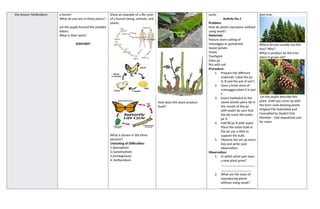
Show an example of a life cycle
of a human being, animals, and
plants.
What is shown in the three
pictures?
Unlocking of Difficulties:
1.Sporophyte
2.Gametophyte
3.Archegonium
4. Antheridium
How does this plant produce
itself?
cards.
Activity No.1
Problem:
How do plants reproduce without
using seeds?
Materials:
Mature stem cutting of
malunggay or gumamela
Sweet potato
Onion
Toothpick
Glass jar
Pot with soil
Procedure:
1. Prepare the different
materials. Label the jar
A, B and the pot of soil C
2. Have a fresh stem of
malunggay plant it in pot
C
3. Insert toothpick to the
sweet potato place tip in
the mouth of the jar
with water be sure that
the tip reach the water
jar A
4. Half fill jar B with water
Place the onion bulb in
the jar use a stick to
support the bulb.
5. Observe the set up every
day and write your
observation
Observation:
1. In which plant part does
a new plant grow?
____________________
__________________
2. What are the ways of
reproducing plants
without using seeds?
____________________
pine tree.
Where do you usually see this
tree? Why?
What is produce by this tree
when it grows old?
Let the pupils describe this
plant. Until you come up with
the term cone-bearing plants
Original File Submitted and
Formatted by DepEd Club
Member - visit depedclub.com
for more
__________________
3. The activity is an
example of vegetative
propagation. How will
you describe it?
____________________
__________________
Conclusion:
Make your conclusion based from
the given problem.
___________________________
___________________________
C. ( Presenting examples or
presentation/ instances of the
new lesson)
Present different pictures of
plants.
What are common in each group
of plants?
What do we call these plants that
do not make seeds and flowers?
Cooperative Grouping
(Differentiated instruction)
Group the class into 4
Group 1 – Explain the Life
cycle of a fern
Group 2 – Find a fern draw
identify the parts
Group 3 - – Explain the Life
cycle of a moss
Group 4 – Find a moss and
draw the parts
Distribution of materials per
group/ Setting of Standards/
rubrics
Problems:
1. What are the
mechanisms of
reproduction among
spore-bearing plants?
Describe.
Giving of hypothesis
Maybe the mechanism of
reproduction among spore-
bearing plants are
___________________________
___________________________
__________________
Setting of Standards/Rubrics
group activity
- Note down important
details
- Keep quite
- Share your ideas
Video watching:
https://www.youtube.com/
watch?v=jlOPquKF4Mk
Video viewing:
https://www.youtube.com/
watch?v=TdiibRXXJ6g
What does the video show to us?
Can you follow the steps shown
in the video?
Word Puzzle:
Present the jumbled letter
IEROFSCN
What word can you form out of
these letters?
Who can say something about
the word formed?
Think Pair Share:
Allow each pair of learner to
identify one(1) cone-bearing
plant and try to describe its
characteristics
Reporting:
Sharing of the learners about
their output
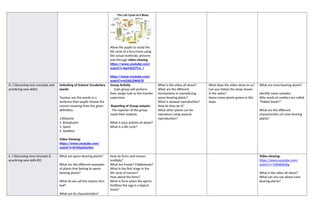
Allow the pupils to study the
life cycle of a fern/moss using
the actual materials, pictures
and through video viewing
https://www.youtube.com/
watch?v=bpYshQ7Ym_I
https://www.youtube.com/
watch?v=eZ40LDWt678
D. ( Discussing new concepts and
practicing new skills)
Unlocking of Science Vocabulary
words:
Teacher use the words in a
sentence then pupils choose the
correct meaning from the given
definition.
1.Rhizome
2. Bryophytes
3. Spore
4. Seedless
Video Viewing:
https://www.youtube.com/
watch?v=bYNiqAAuMnc
Group Activity
Each group will perform
their assign task as the teacher
supervises.
Reporting of Group outputs
The reporter of the group
reads their outputs.
What is your activity all about?
What is a life cycle?
What is the video all about?
What are the different
mechanisms in reproducing
spore-bearing plants?
What is asexual reproduction?
How do they do it?
What other plants can be
reproduce using asexual
reproduction?
What does the video show to us?
Can you follow the steps shown
in the video?
Name some plants grown in this
steps
What are cone-bearing plants?
Identify some samples.
Why seeds of conifers are called
“Naked Seeds?”
What are the different
characteristics of cone-bearing
plants?
E. ( Discussing new concepts &
practicing new skills #2)
What are spore-bearing plants?
What are the different examples
of plants that belong to spore-
bearing plants?
What do we call the mature fern
leaf?
What are its characteristics?
How do ferns and mosses
multiply?
What are fronds? Fiddleheads?
What is the first stage in the
life cycle of mosses?
How about the ferns?
What is form when the sperm
fertilizes the egg in a typical
mose?
Video viewing:
https://www.youtube.com/
watch?v=TdiibRXXJ6g
What is the video all about?
What can you say about cone-
bearing plants?
What are known as terrestrial
plants?
Describe mosses and give
samples.
F. Developing Mastery
(Leads to Formative Assessment
3)
Identify the group of spore-
bearing plants and describe its
characteristics.
Call on a pupil and allow
her/him to explain the life cycle
of spore-bearing plants using
the diagram
Let the pupils/learners draw the
method of asexual reproduction.
Let the pupils describe what they
have done.
Let the pupils identify the
characteristics of cone-bearing
plants.
Why are cone bearing plants
important?
G. ( Finding to Practical
Application of concepts and skills
in daily living/ Valuing)
How are we going to help in the
National Greening Program of the
Government in protecting
seedless plants or spore-bearing
We know that some ferns can
be serving as a viand. How can
we let them multiply?
Aside from source of food,
You have some potatoes at
home, how can you reproduce
some of it in your backyard?
How can you help propagate
more plants at home?
You have pine tree at home with
lots of cone produce and it’s
nearly Christmas season and you
don’t have money to buy
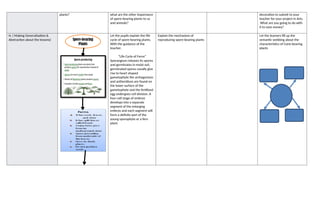
Ferns
It has roots, leaves, and
stem
It has split leaves called
fronts
Young ferns grow from
an underground stem
Spore procuding from
underside of the leaves
Grow in shady places
Do not produce seeds
Mosses
 No true roots No
conducting tubes
 They grow closes to
the ground to take in
water and nutrients
through their cell wall
of rhizoids
 Mostly found
growing in a damp
log or along streams
 Present of leaves and
stem
 Plants usually present
in tufts
 Average height 1-
5cms
 Produces spores
 Do not produce seeds
plants? what are the other importance
of spore-bearing plants to us
and animals?
decoration to submit to your
teacher for your project in Arts.
What are you going to do with
it to save money?
H. ( Making Generalization &
Abstraction about the lessons)
Let the pupils explain the life
cycle of spore-bearing plants.
With the guidance of the
teacher.
“Life Cycle of Ferns”
Sporangium releases its spores
and germinates in moist soil,
germinated spores usually give
rise to heart shaped
gametophyte the archegonium
and antheridium are found on
the lower surface of the
gametophyte and the fertilized
egg undergoes cell division. A
four-cell stage of embryo
develops into a separate
segment of the enlarging
embryo and each segment will
form a definite part of the
young sporophyte or a fern
plant.
Explain the mechanism of
reproducing spore-bearing plants
Let the learners fill up the
semantic webbing about the
characteristics of Cone-bearing
plants
Spore-bearing
Plants
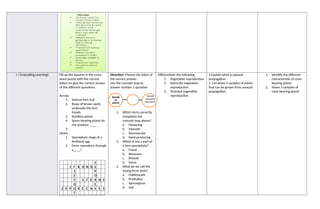
I. ( Evaluating Learning) Fill up the squares in the cross-
word puzzle with the correct
letters to give the correct answer
of the different questions.
Across:
1. Mature fern leaf
2. Rows of brown spots
underside the fern
fronds
3. Seedless plants
4. Spore-bearing plants do
not produce ____
5.
Down:
1. Sporophyte stage of a
fertilized egg
2. Ferns reproduce through
a____?
2
1 F R O N D S
1 P
Z O
Y 3 F E R N S
G E
2 S P O R E C A S E S
T
Direction: Choose the letter of
the correct answer.
Use the concept map to
answer number 1 question
1. Which term correctly
completes the
concept map above?
a. Flowering
b. Vascular
c. Nonvascular
d. Seed-producing
2. Which is not a part of
a fern sporophyte?
a. Frond
b. Rhizomes
c. Rhizoid
d. Surus
3. What do we call the
young ferns stem?
a. Fiddleheads
b. Prothallus
c. Sporangium
d. Sori
Differentiate the following
1. Vegetative reproduction
2. Naturally vegetative
reproduction
3. Directed vegetative
reproduction
1.Explain what is asexual
propagation
2. List down 5 samples of plants
that can be grown from asexual
propagation.
1. Identify the different
characteristic of cone-
bearing plants
2. Name 5 samples of
cone-bearing plants
Seedle
ss
plants
Mosses
Liverworts
Hornworts
S E E D S
J. ( Additional activities for
application or remediation)
Research about the life cycle of
spore-bearing plants
Draw life cycle of the moss and
write simple explanation about
how they reproduce.
Bring he following
1.Malunggay cutting
2. sweet potato
3.onion bulb
4. Toothpick or barbeque stick
5.2 glass jar
6. pot with soil
What are cone-bearing plants? Make / create an interactive
board game. It can be a jigsaw
puzzle, word search, snake and
ladder, and others, use the
concepts you learned in the
classifications of plants and
animals.
V. ( Remarks)
VI. ( Reflection)
A.( No. of learners who earned
80% in the evaluation)
B.( No. of learners who requires
additional acts for remediation
who scored below 80%)
C.( Did the remedial instruction
really work? No of learners who
caught up with the lesson)
D.( No. of learners who continue
to require remediation)
E. (Which of the strategies work
well? Why did this work?
F. (What difficulties did I
encounter which my principal/
supervisor can help me solve?)
G. ( What innovations or localized
materials did I used/ discover
which I wish to share with other
teacher?)
Prepared by: Checked by: Approved by:
IRISH JOY V. CACHAPERO MYLENE Q. RODRIGUEZ ANGELO A. UNAY
Teacher I Master Teacher II Principal II

Daily Lesson Log_SCIENCE 6_Quarter 2_W7.docx

  • 1.
    GRADES 1 to12 DAILY LESSON LOG School: CARSADANG BAGO ELEMENTARY SCHOOL Grade Level: VI Teacher: IRISH JOY V. CACHAPERO Learning Area: SCIENCE Teaching Dates and Time: NOVEMBER 11 - 15, 2024 (WEEK 7) Humanity – 6:45-7:30 Compassion – 7:30-8:15 Fortitude - 8:15-9:00 Persistence - 9:30-10:15 Diligence - 10:15-11:00 Quarter: 2ND QUARTER MONDAY TUESDAY WEDNESDAY THURSDAY FRIDAY I. OBJECTIVES A.(Content Standards) The learners demonstrate understanding of how non flowering plants reproduce B. (Performance Standards) The learners should be able to make a multimedia presentation on how parts of the reproductive system of spore bearing and cone-bearing plants ensure their survival Make a flyer on how plants can be propagated vegetative C. ( Learning Competencies) Distinguish How spore bearing and non-cone bearing plants reproduce S6LT-IIg-h-4 Describe the characteristics of spore-bearing plants Explain the life cycle of spore- bearing plants. Discuss the mechanism of reproduction among spore-bearing plants. Describe the characteristics of cone-bearing plants II. ( Content) Reproduction of Non Flowering plants III. ( Learning Resources) A. (References) 1. (Teacher’s Guide Pages) 2. (Learner’s Materials pages) 3. (Textbook Pages) The New Science Links 6 pp.226-234 , Science and Technology 11pp.143-152 4. ( Additional Materials from LR Portal) K to 12 Basic Education Curriculum 6 p.91 B. (Other Learning Resources) Power point presentation, LCD Projector, Show me board, marking pen, pictures, sample cone, actual moss and fern https://www.youtube.com/watch?v=bpYshQ7Ym_I, https://www.youtube.com/watch?v=eZ40LDWt678, https://www.youtube.com/watch?v=bYNiqAAuMnc, https://www.youtube.com/watch?v=jlOPquKF4Mk, https://www.youtube.com/watch?v=TdiibRXXJ6g IV. (Procedures) A. ( Review previous Lesson) What are vertebrate animals? Invertebrate animals? What are the different groups of vertebrate animals? Invertebrate animals? Give examples of animals that belong to each group. What are spore-bearing plants? Give the characteristics of spore-bearing plants. Identify examples of spore- bearing plants. Who among in the class can explain briefly the life cycle of a fern? What are the mechanism in producing spore-bearing plants? Ask the pupils if they bring the materials assigned to them. How spore-bearing plants are reproducing? B. (Establishing purpose for Have you visited a garden farm or Picture Loop: Present a picture of a plant Distributes to them the Activity Present /show a picture of a
  • 2.
    the lesson/ Motivation)a forest? What do you see in these places? Let the pupils formed the jumbles letters. What is their work? SONTABTI Show an example of a life cycle of a human being, animals, and plants. What is shown in the three pictures? Unlocking of Difficulties: 1.Sporophyte 2.Gametophyte 3.Archegonium 4. Antheridium How does this plant produce itself? cards. Activity No.1 Problem: How do plants reproduce without using seeds? Materials: Mature stem cutting of malunggay or gumamela Sweet potato Onion Toothpick Glass jar Pot with soil Procedure: 1. Prepare the different materials. Label the jar A, B and the pot of soil C 2. Have a fresh stem of malunggay plant it in pot C 3. Insert toothpick to the sweet potato place tip in the mouth of the jar with water be sure that the tip reach the water jar A 4. Half fill jar B with water Place the onion bulb in the jar use a stick to support the bulb. 5. Observe the set up every day and write your observation Observation: 1. In which plant part does a new plant grow? ____________________ __________________ 2. What are the ways of reproducing plants without using seeds? ____________________ pine tree. Where do you usually see this tree? Why? What is produce by this tree when it grows old? Let the pupils describe this plant. Until you come up with the term cone-bearing plants Original File Submitted and Formatted by DepEd Club Member - visit depedclub.com for more
  • 3.
    __________________ 3. The activityis an example of vegetative propagation. How will you describe it? ____________________ __________________ Conclusion: Make your conclusion based from the given problem. ___________________________ ___________________________ C. ( Presenting examples or presentation/ instances of the new lesson) Present different pictures of plants. What are common in each group of plants? What do we call these plants that do not make seeds and flowers? Cooperative Grouping (Differentiated instruction) Group the class into 4 Group 1 – Explain the Life cycle of a fern Group 2 – Find a fern draw identify the parts Group 3 - – Explain the Life cycle of a moss Group 4 – Find a moss and draw the parts Distribution of materials per group/ Setting of Standards/ rubrics Problems: 1. What are the mechanisms of reproduction among spore-bearing plants? Describe. Giving of hypothesis Maybe the mechanism of reproduction among spore- bearing plants are ___________________________ ___________________________ __________________ Setting of Standards/Rubrics group activity - Note down important details - Keep quite - Share your ideas Video watching: https://www.youtube.com/ watch?v=jlOPquKF4Mk Video viewing: https://www.youtube.com/ watch?v=TdiibRXXJ6g What does the video show to us? Can you follow the steps shown in the video? Word Puzzle: Present the jumbled letter IEROFSCN What word can you form out of these letters? Who can say something about the word formed? Think Pair Share: Allow each pair of learner to identify one(1) cone-bearing plant and try to describe its characteristics Reporting: Sharing of the learners about their output
  • 4.
    Allow the pupilsto study the life cycle of a fern/moss using the actual materials, pictures and through video viewing https://www.youtube.com/ watch?v=bpYshQ7Ym_I https://www.youtube.com/ watch?v=eZ40LDWt678 D. ( Discussing new concepts and practicing new skills) Unlocking of Science Vocabulary words: Teacher use the words in a sentence then pupils choose the correct meaning from the given definition. 1.Rhizome 2. Bryophytes 3. Spore 4. Seedless Video Viewing: https://www.youtube.com/ watch?v=bYNiqAAuMnc Group Activity Each group will perform their assign task as the teacher supervises. Reporting of Group outputs The reporter of the group reads their outputs. What is your activity all about? What is a life cycle? What is the video all about? What are the different mechanisms in reproducing spore-bearing plants? What is asexual reproduction? How do they do it? What other plants can be reproduce using asexual reproduction? What does the video show to us? Can you follow the steps shown in the video? Name some plants grown in this steps What are cone-bearing plants? Identify some samples. Why seeds of conifers are called “Naked Seeds?” What are the different characteristics of cone-bearing plants? E. ( Discussing new concepts & practicing new skills #2) What are spore-bearing plants? What are the different examples of plants that belong to spore- bearing plants? What do we call the mature fern leaf? What are its characteristics? How do ferns and mosses multiply? What are fronds? Fiddleheads? What is the first stage in the life cycle of mosses? How about the ferns? What is form when the sperm fertilizes the egg in a typical mose? Video viewing: https://www.youtube.com/ watch?v=TdiibRXXJ6g What is the video all about? What can you say about cone- bearing plants?
  • 5.
    What are knownas terrestrial plants? Describe mosses and give samples. F. Developing Mastery (Leads to Formative Assessment 3) Identify the group of spore- bearing plants and describe its characteristics. Call on a pupil and allow her/him to explain the life cycle of spore-bearing plants using the diagram Let the pupils/learners draw the method of asexual reproduction. Let the pupils describe what they have done. Let the pupils identify the characteristics of cone-bearing plants. Why are cone bearing plants important? G. ( Finding to Practical Application of concepts and skills in daily living/ Valuing) How are we going to help in the National Greening Program of the Government in protecting seedless plants or spore-bearing We know that some ferns can be serving as a viand. How can we let them multiply? Aside from source of food, You have some potatoes at home, how can you reproduce some of it in your backyard? How can you help propagate more plants at home? You have pine tree at home with lots of cone produce and it’s nearly Christmas season and you don’t have money to buy Ferns It has roots, leaves, and stem It has split leaves called fronts Young ferns grow from an underground stem Spore procuding from underside of the leaves Grow in shady places Do not produce seeds Mosses  No true roots No conducting tubes  They grow closes to the ground to take in water and nutrients through their cell wall of rhizoids  Mostly found growing in a damp log or along streams  Present of leaves and stem  Plants usually present in tufts  Average height 1- 5cms  Produces spores  Do not produce seeds
  • 6.
    plants? what arethe other importance of spore-bearing plants to us and animals? decoration to submit to your teacher for your project in Arts. What are you going to do with it to save money? H. ( Making Generalization & Abstraction about the lessons) Let the pupils explain the life cycle of spore-bearing plants. With the guidance of the teacher. “Life Cycle of Ferns” Sporangium releases its spores and germinates in moist soil, germinated spores usually give rise to heart shaped gametophyte the archegonium and antheridium are found on the lower surface of the gametophyte and the fertilized egg undergoes cell division. A four-cell stage of embryo develops into a separate segment of the enlarging embryo and each segment will form a definite part of the young sporophyte or a fern plant. Explain the mechanism of reproducing spore-bearing plants Let the learners fill up the semantic webbing about the characteristics of Cone-bearing plants Spore-bearing Plants
  • 7.
    I. ( EvaluatingLearning) Fill up the squares in the cross- word puzzle with the correct letters to give the correct answer of the different questions. Across: 1. Mature fern leaf 2. Rows of brown spots underside the fern fronds 3. Seedless plants 4. Spore-bearing plants do not produce ____ 5. Down: 1. Sporophyte stage of a fertilized egg 2. Ferns reproduce through a____? 2 1 F R O N D S 1 P Z O Y 3 F E R N S G E 2 S P O R E C A S E S T Direction: Choose the letter of the correct answer. Use the concept map to answer number 1 question 1. Which term correctly completes the concept map above? a. Flowering b. Vascular c. Nonvascular d. Seed-producing 2. Which is not a part of a fern sporophyte? a. Frond b. Rhizomes c. Rhizoid d. Surus 3. What do we call the young ferns stem? a. Fiddleheads b. Prothallus c. Sporangium d. Sori Differentiate the following 1. Vegetative reproduction 2. Naturally vegetative reproduction 3. Directed vegetative reproduction 1.Explain what is asexual propagation 2. List down 5 samples of plants that can be grown from asexual propagation. 1. Identify the different characteristic of cone- bearing plants 2. Name 5 samples of cone-bearing plants Seedle ss plants Mosses Liverworts Hornworts
  • 8.
    S E ED S J. ( Additional activities for application or remediation) Research about the life cycle of spore-bearing plants Draw life cycle of the moss and write simple explanation about how they reproduce. Bring he following 1.Malunggay cutting 2. sweet potato 3.onion bulb 4. Toothpick or barbeque stick 5.2 glass jar 6. pot with soil What are cone-bearing plants? Make / create an interactive board game. It can be a jigsaw puzzle, word search, snake and ladder, and others, use the concepts you learned in the classifications of plants and animals. V. ( Remarks) VI. ( Reflection) A.( No. of learners who earned 80% in the evaluation) B.( No. of learners who requires additional acts for remediation who scored below 80%) C.( Did the remedial instruction really work? No of learners who caught up with the lesson) D.( No. of learners who continue to require remediation) E. (Which of the strategies work well? Why did this work? F. (What difficulties did I encounter which my principal/ supervisor can help me solve?) G. ( What innovations or localized materials did I used/ discover which I wish to share with other teacher?) Prepared by: Checked by: Approved by: IRISH JOY V. CACHAPERO MYLENE Q. RODRIGUEZ ANGELO A. UNAY Teacher I Master Teacher II Principal II