The Integumentary System
The Skin
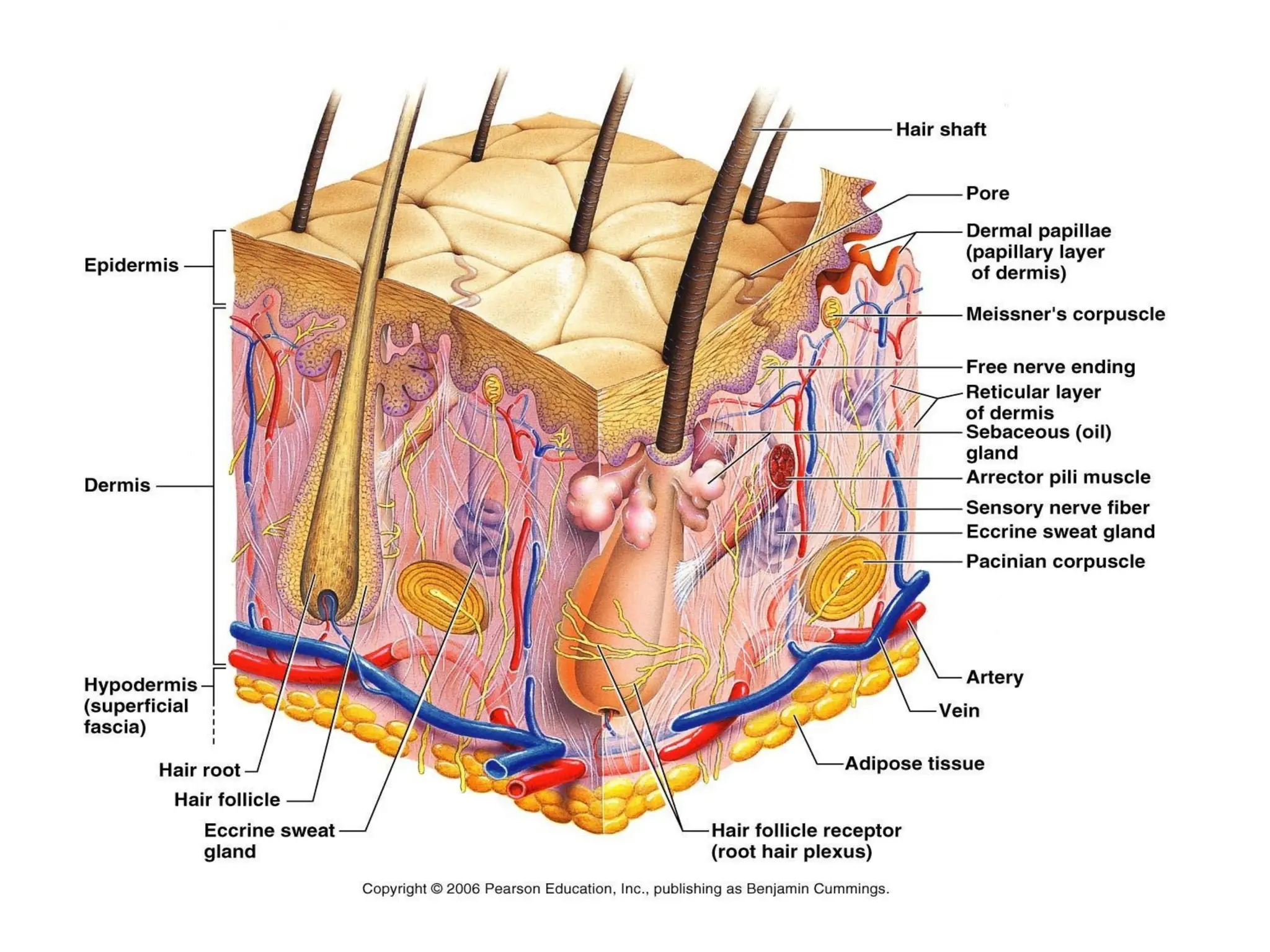
• The integument system consists of the skin (cutaneous
membrane) and its accessory organs.
• The skin is composed of three layers of tissue:-
• the outer epidermis
• the middle dermis and
• the inner subcutaneous layer or hypodermis
• Accessory organs include the hair (hair root and hair
shaft) ,
• hair follicle , pili arrector muscle, sebaceous gland ,
sudoriferous gland , nails , and mammary gland.
Functions of the Integumentary system
1. protection
chemical factors in the skin:
Sebum (or oil) from the sebaceous glands is
slightly acidic, retarding bacterial colonization on
the skin surface.
Sweat from the sudoriferous glands is slightly
hypertonic and can flush off most bacteria on the skin
surface.
Melanin (skin pigment ) from melonocytes avoids
excessive ultraviolet radiation from penetrating
the skin layers .
2. Excretion
waste materials such as ammonia , urea , and excessive
salt are eliminated from sweating .
3. Body temperature regulation
Sweating by the sweat glands promotes evaporation ,
resulting in a loss of excessive body heat.
Vasoconstriction by arterioles (small arteries ) in the
dermis layer provides a smaller surface area in the
blood vessels, resulting in less heat loss .
Vasodilatation by arterioles in the dermis layer
provides a larger surface area in the blood vessels ,
resulting in greater heat loss
4. Cutaneous sensation
Nerve receptors in the dermis layers detect
sensations such as heat, cold, pain, pressure,
and touch, allowing the body to be aware of
these stimuli.
5. Vitamin D synthesis
Ultraviolet radiation in the sunlight activates
a series of chemical reactions in the
epidermis layer, resulting in the synthesis of
vitamin D from the modification of
cholesterol for the absorption of calcium.
Functions of the skin
 maintains homeostasis.
 prevents the body from the penetration of
harmful substances.
 Prevents water loss(desiccation) .
 help to regulate body temperature .
 contains nerve receptors for various sensations .
 synthesizes chemical substances such as keratin,
melanin, and vitamin D.
 excretes waste materials such as ammonia , urea , and
salts.
 produces skin pigment (melanin) in the epidermis and
hair to avoid excessive penetration of UV radiation .
Epidermis
The outer layers of the skin .
There is no blood vessels to supply nutrients to its cells .
• Nutrients from the arterioles in the dermis layer diffuse upward
into the epidermis layer, especially to the stratum basale and
spinosum layers.
• By the time they form stratum corneum, the cells are dead and
will be shed off from the skin .
02/02/2025 10
• Four(4) layer of cells are found in the epidermis of the
body surface: stratum corneum , stratum
granulosum , stratum spinosum and stratum Basale
• In the palms and soles , an extra layer beneath stratum
coronium is formed , called stratum Lucidum.
• Specialized cells called melanocytes in the stratum
basale layer produce the skin pigment, melanin.
Dermis
• made of fibrous connective tissue that contains
arterioles for supplying nutrients (i.e. oxygen ,
glucose , water , and ions ) to its structures and to the
epidermis .
• also contains pili arrector muscles (made of skeletal
muscle, under involuntary control)
• contains nerves and nerve receptors to detect the
sensations of heat, cold, pressure, touch, and pain .
• also contains hair follicles to develop the hair .
• contains sebaceous gland to secrete sebum onto skin
surface, and sudoriferous glands to secrete sweat.
Hypodermis
– Made of adipose tissue and loose connective
tissue.
– Collagen and elastic fibers in the loose
connective tissue are continuous with the fibers
in the dermis layer.
– Adipose tissue serves as a heat insulator against
cold climate and as a fat storage.
– Loose connective tissue allows the skin to be
bound with underlying muscles.
– Also contains large blood vessels (arteries and
veins).
Accessory structures of the skin
1. Hair
– produced by epithelial cells at the hair papilla .
– made of keratinized cells .
– consists two regions: hair root (in the hair follicle
, embedded in the dermis layer), and
-hair shaft (protruded through the epidermis to the
outside).
– Hair pigment (melanin) is produced by
melonocyets in hair papilla .
– Hair growth is affected by nutrition and hormones.
02/02/2025 16
Hair
ebneshahidi
2. pili arrector muscle
• made of skeletal muscle , but
under involuntary control.
• attached to each hair follicle,
for erecting the hair.
• situations such as extreme
emotions or extreme
temperatures can activate its
involuntary
contraction,resulting in hair
erection or skin wrinkling.
3. Sebaceous gland
• Oil gland that is made of modified
cuboidal epithelium.
• Occurs all over the body except in
the palm and sole.
• Attached to each hair follicle, so
that sebum can be secreted into the
hair root and diffuse upward .
• Sebum helps the skin and hair to be
waterproof, and retards bacterial
growth on skin surface(due to its
acidity).
4. Sudoriferous gland
• sweat gland that secretes
sweat to promote
evaporation.
• found all over the body
except the lips, nipples,
and external genitalia.
• referred to as "tubular
gland" where it is a long
tubule coiled in the dermis
layer , and uses a long duct
to release sweat onto skin
surface through a pore.
5. Nails
• scale like modification of epithelial cells in the
epidermis.
• made of keratin.
• Protect ends of fingers and toes and prevent over
sensitization of the never receptors in extremities.
• Growing cells are derived form a region at base
of nail called "lunula".
02/02/2025 22
Each nail has three parts:-
 Body
 Free edge
 Root
The average growth of finger nails is about 1mm/0.4 inch/
per week.
Function of nails:
Grasp and manipulate small object
Provide protection to the ends of digits
Allow us to scratch various part of the body
02/02/2025 23
Burns
• First degree burns: only the epidermis
is damaged with redness and swelling .
• Second degree burns: epidermis & upper
region of dermis is involved. There is
Redness, swelling, and blisters.
• Third degree burns: all layers of skin burned
(most severe). Skin graft is necessary to repair.
Skin looks cherry red or blacken
Skin Cancer
• Most skin tumors are benign
• Cause of cancer is unknown, but probably due to
overexposure to ultraviolet radiation in the sunlight .
• Three main types of skin cancer :
• Basal cell carcinoma
• The most common type of skin tumor; usually
benign.
• Cells of stratum basale are affected , as a result they
cannot form keratin and begin to invade into the
dermis.
• Surgical removal (given that early detection is done)
is 99% successful .
Squamous Cell Carcinoma
• arises form keratinocytes in stratum spinosum .
• mostly in the scalp , ears , or hands.
• grows and migrates rapidly.
• early detection is critical for successful treatment.
Malignant Melanoma – most dangerous
• cancer of the melanocyets in stratum basale.
• only 5% of all skin cancer , but the frequency is increasing.
• grow and migrates extremely rapidly .
• usually deadly.
Note: To avoid these skin tumors , it is advised that we should stay
away from the sun during its most intense period: from 10 am to
2pm

Anatomy part II: Integumentary System.pptx

  • 1.
  • 2.
    The Skin • Theintegument system consists of the skin (cutaneous membrane) and its accessory organs. • The skin is composed of three layers of tissue:- • the outer epidermis • the middle dermis and • the inner subcutaneous layer or hypodermis • Accessory organs include the hair (hair root and hair shaft) , • hair follicle , pili arrector muscle, sebaceous gland , sudoriferous gland , nails , and mammary gland.
  • 4.
    Functions of theIntegumentary system 1. protection chemical factors in the skin: Sebum (or oil) from the sebaceous glands is slightly acidic, retarding bacterial colonization on the skin surface. Sweat from the sudoriferous glands is slightly hypertonic and can flush off most bacteria on the skin surface. Melanin (skin pigment ) from melonocytes avoids excessive ultraviolet radiation from penetrating the skin layers .
  • 5.
    2. Excretion waste materialssuch as ammonia , urea , and excessive salt are eliminated from sweating . 3. Body temperature regulation Sweating by the sweat glands promotes evaporation , resulting in a loss of excessive body heat. Vasoconstriction by arterioles (small arteries ) in the dermis layer provides a smaller surface area in the blood vessels, resulting in less heat loss . Vasodilatation by arterioles in the dermis layer provides a larger surface area in the blood vessels , resulting in greater heat loss
  • 6.
    4. Cutaneous sensation Nervereceptors in the dermis layers detect sensations such as heat, cold, pain, pressure, and touch, allowing the body to be aware of these stimuli. 5. Vitamin D synthesis Ultraviolet radiation in the sunlight activates a series of chemical reactions in the epidermis layer, resulting in the synthesis of vitamin D from the modification of cholesterol for the absorption of calcium.
  • 7.
    Functions of theskin  maintains homeostasis.  prevents the body from the penetration of harmful substances.  Prevents water loss(desiccation) .  help to regulate body temperature .  contains nerve receptors for various sensations .  synthesizes chemical substances such as keratin, melanin, and vitamin D.  excretes waste materials such as ammonia , urea , and salts.  produces skin pigment (melanin) in the epidermis and hair to avoid excessive penetration of UV radiation .
  • 8.
    Epidermis The outer layersof the skin . There is no blood vessels to supply nutrients to its cells . • Nutrients from the arterioles in the dermis layer diffuse upward into the epidermis layer, especially to the stratum basale and spinosum layers. • By the time they form stratum corneum, the cells are dead and will be shed off from the skin .
  • 10.
    02/02/2025 10 • Four(4)layer of cells are found in the epidermis of the body surface: stratum corneum , stratum granulosum , stratum spinosum and stratum Basale • In the palms and soles , an extra layer beneath stratum coronium is formed , called stratum Lucidum. • Specialized cells called melanocytes in the stratum basale layer produce the skin pigment, melanin.
  • 12.
    Dermis • made offibrous connective tissue that contains arterioles for supplying nutrients (i.e. oxygen , glucose , water , and ions ) to its structures and to the epidermis . • also contains pili arrector muscles (made of skeletal muscle, under involuntary control) • contains nerves and nerve receptors to detect the sensations of heat, cold, pressure, touch, and pain . • also contains hair follicles to develop the hair . • contains sebaceous gland to secrete sebum onto skin surface, and sudoriferous glands to secrete sweat.
  • 13.
    Hypodermis – Made ofadipose tissue and loose connective tissue. – Collagen and elastic fibers in the loose connective tissue are continuous with the fibers in the dermis layer. – Adipose tissue serves as a heat insulator against cold climate and as a fat storage. – Loose connective tissue allows the skin to be bound with underlying muscles. – Also contains large blood vessels (arteries and veins).
  • 15.
    Accessory structures ofthe skin 1. Hair – produced by epithelial cells at the hair papilla . – made of keratinized cells . – consists two regions: hair root (in the hair follicle , embedded in the dermis layer), and -hair shaft (protruded through the epidermis to the outside). – Hair pigment (melanin) is produced by melonocyets in hair papilla . – Hair growth is affected by nutrition and hormones.
  • 16.
  • 18.
    2. pili arrectormuscle • made of skeletal muscle , but under involuntary control. • attached to each hair follicle, for erecting the hair. • situations such as extreme emotions or extreme temperatures can activate its involuntary contraction,resulting in hair erection or skin wrinkling.
  • 19.
    3. Sebaceous gland •Oil gland that is made of modified cuboidal epithelium. • Occurs all over the body except in the palm and sole. • Attached to each hair follicle, so that sebum can be secreted into the hair root and diffuse upward . • Sebum helps the skin and hair to be waterproof, and retards bacterial growth on skin surface(due to its acidity).
  • 20.
    4. Sudoriferous gland •sweat gland that secretes sweat to promote evaporation. • found all over the body except the lips, nipples, and external genitalia. • referred to as "tubular gland" where it is a long tubule coiled in the dermis layer , and uses a long duct to release sweat onto skin surface through a pore.
  • 21.
    5. Nails • scalelike modification of epithelial cells in the epidermis. • made of keratin. • Protect ends of fingers and toes and prevent over sensitization of the never receptors in extremities. • Growing cells are derived form a region at base of nail called "lunula".
  • 22.
    02/02/2025 22 Each nailhas three parts:-  Body  Free edge  Root The average growth of finger nails is about 1mm/0.4 inch/ per week. Function of nails: Grasp and manipulate small object Provide protection to the ends of digits Allow us to scratch various part of the body
  • 23.
  • 24.
    Burns • First degreeburns: only the epidermis is damaged with redness and swelling . • Second degree burns: epidermis & upper region of dermis is involved. There is Redness, swelling, and blisters. • Third degree burns: all layers of skin burned (most severe). Skin graft is necessary to repair. Skin looks cherry red or blacken
  • 26.
    Skin Cancer • Mostskin tumors are benign • Cause of cancer is unknown, but probably due to overexposure to ultraviolet radiation in the sunlight . • Three main types of skin cancer : • Basal cell carcinoma • The most common type of skin tumor; usually benign. • Cells of stratum basale are affected , as a result they cannot form keratin and begin to invade into the dermis. • Surgical removal (given that early detection is done) is 99% successful .
  • 27.
    Squamous Cell Carcinoma •arises form keratinocytes in stratum spinosum . • mostly in the scalp , ears , or hands. • grows and migrates rapidly. • early detection is critical for successful treatment. Malignant Melanoma – most dangerous • cancer of the melanocyets in stratum basale. • only 5% of all skin cancer , but the frequency is increasing. • grow and migrates extremely rapidly . • usually deadly. Note: To avoid these skin tumors , it is advised that we should stay away from the sun during its most intense period: from 10 am to 2pm