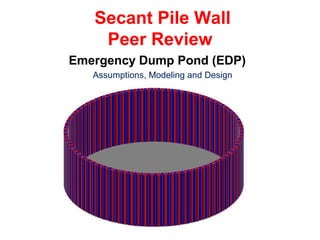
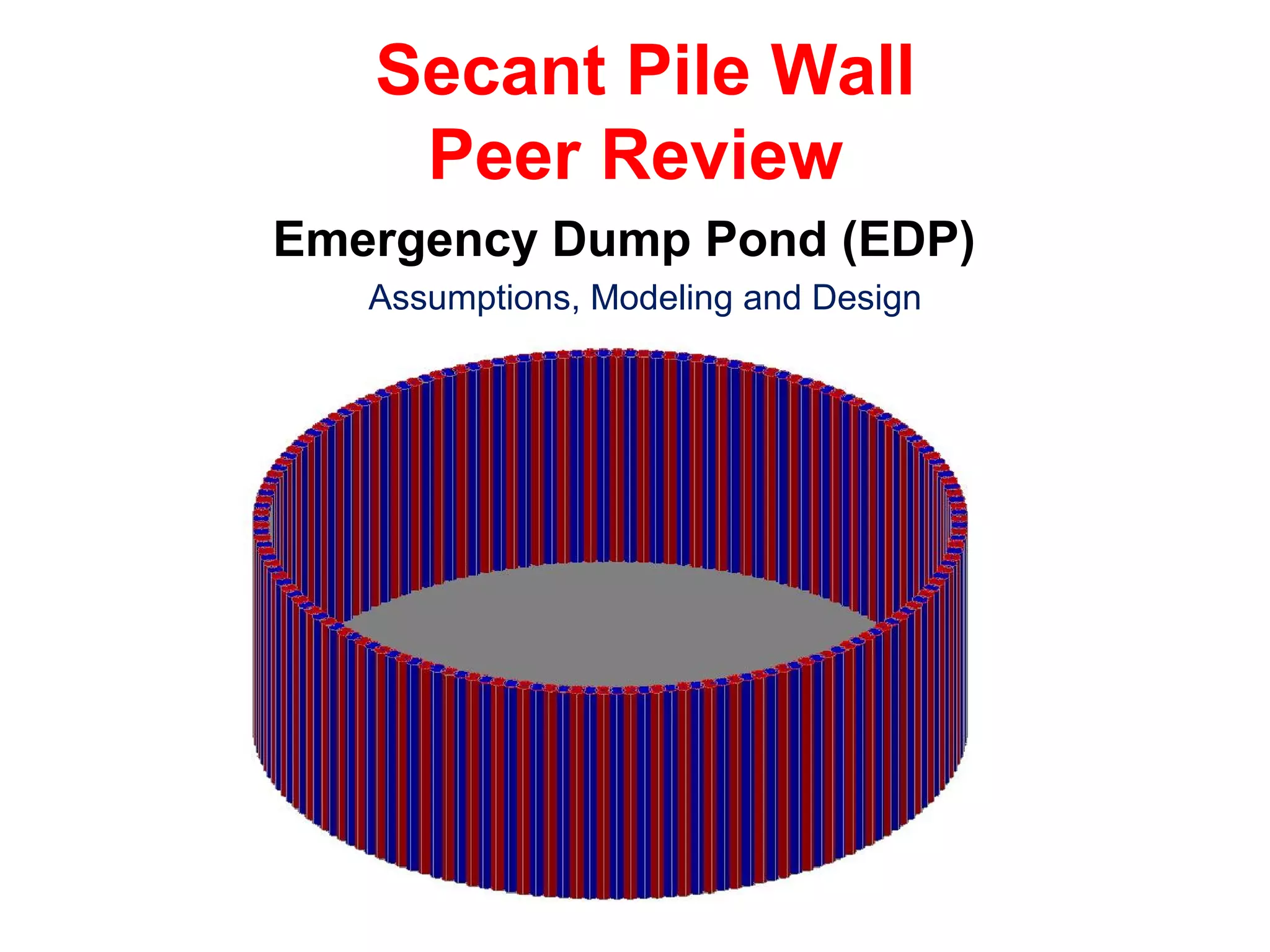
Secant Pile Wall
Peer Review
Assumptions, Modeling and Design
Emergency Dump Pond (EDP)
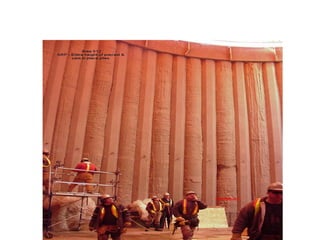
Secant pile walls are formed by drilling secondary piles
between previously installed primary piles to form a
continuous system with mechanical interlocking joints.
What are Secant Pile Walls?
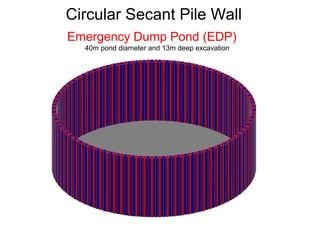
Circular Secant Pile Wall
Emergency Dump Pond (EDP)
40m pond diameter and 13m deep excavation
Project Requirements
• Dumping pond with vertical sides for cleanout. Earth
Ponds are difficult to clean out.
• Close to the primary separation cell (PSC).
• Construction of EDP cannot interfere with PSC erection.
• EDP Pond Required for 1.5 PSC Volume.
• Concern about soil profile (boulders) limited maximum
depth of EDP.
• Pond would be water resistant, not water tight.
Conceptualization
• There are two fundamental considerations that affect the
conceptualization of a secant system;
– Limiting Geometric Considerations:
– Analysis and Design Considerations:
• Some Analysis and Design Considerations are inter-related with the Geometric restraints
• Reinforce each section or reinforce alternate piles?
– Initial concept was not excessively deep and in compressive
hoop stress. Assumes arch develops to reinforced pile.
– Hoop Stress = Pressure X Radius/Thickness
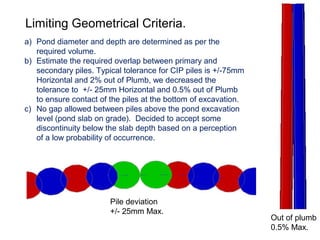
a) Pond diameter and depth are determined as per the
required volume.
b) Estimate the required overlap between primary and
secondary piles. Typical tolerance for CIP piles is +/-75mm
Horizontal and 2% out of Plumb, we decreased the
tolerance to +/- 25mm Horizontal and 0.5% out of Plumb
to ensure contact of the piles at the bottom of excavation.
c) No gap allowed between piles above the pond excavation
level (pond slab on grade). Decided to accept some
discontinuity below the slab depth based on a perception
of a low probability of occurrence.
Out of plumb
0.5% Max.
Pile deviation
+/- 25mm Max.
Limiting Geometrical Criteria.
Reinforce each section or reinforce alternate piles?
Initial concept was not excessively deep and assumed in
compressive hoop stress. Assumed arch develops to transfer
loads to reinforced pile, reinforce every second pile.
Fundamentals of the Design and Analysis: Hoop Stress = Pr/t,
Moment, Shear, Bearing, Active, Passive, At Rest.
Strength yes, but do we care about Serviceability?
Analysis and Design Considerations
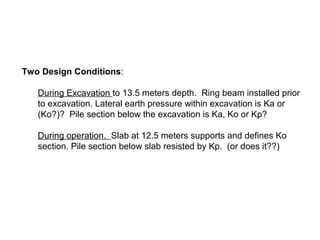
Two Design Conditions:
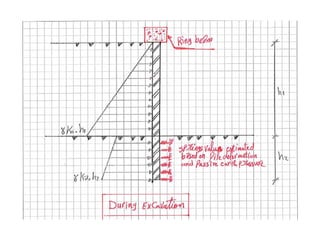
During Excavation to 13.5 meters depth. Ring beam installed prior
to excavation. Lateral earth pressure within excavation is Ka or
(Ko?)? Pile section below the excavation is Ka, Ko or Kp?
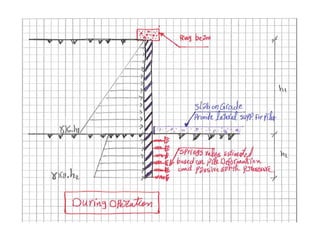
During operation. Slab at 12.5 meters supports and defines Ko
section. Pile section below slab resisted by Kp. (or does it??)
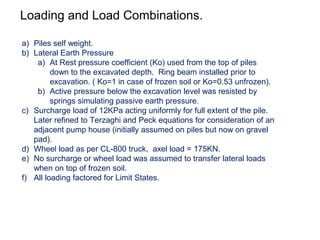
Loading and Load Combinations.
a) Piles self weight.
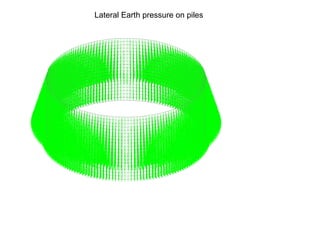
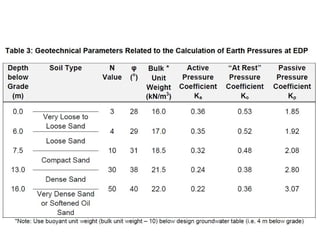
b) Lateral Earth Pressure
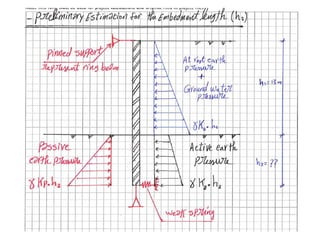
a) At Rest pressure coefficient (Ko) used from the top of piles
down to the excavated depth. Ring beam installed prior to
excavation. ( Ko=1 in case of frozen soil or Ko=0.53 unfrozen).
b) Active pressure below the excavation level was resisted by
springs simulating passive earth pressure.
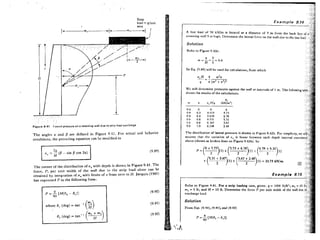
c) Surcharge load of 12KPa acting uniformly for full extent of the pile.
Later refined to Terzaghi and Peck equations for consideration of an
adjacent pump house (initially assumed on piles but now on gravel
pad).
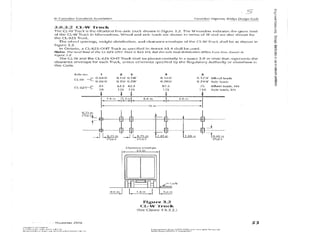
d) Wheel load as per CL-800 truck, axel load = 175KN.
e) No surcharge or wheel load was assumed to transfer lateral loads
when on top of frozen soil.
f) All loading factored for Limit States.
Lateral Earth pressure on piles
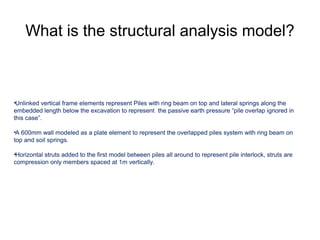
What is the structural analysis model?
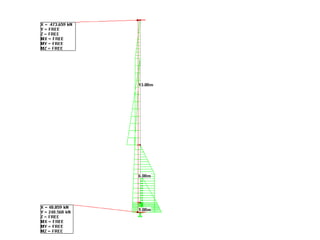
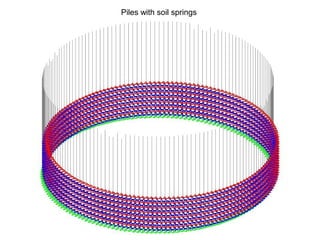
•Unlinked vertical frame elements represent Piles with ring beam on top and lateral springs along the
embedded length below the excavation to represent the passive earth pressure “pile overlap ignored in
this case”.
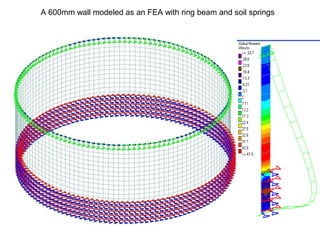
•A 600mm wall modeled as a plate element to represent the overlapped piles system with ring beam on
top and soil springs.
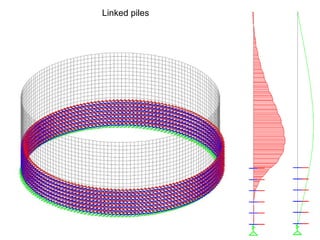
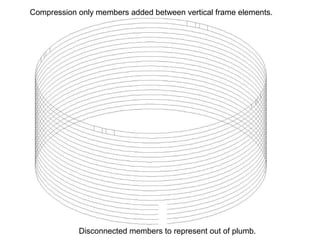
•Horizontal struts added to the first model between piles all around to represent pile interlock, struts are
compression only members spaced at 1m vertically.
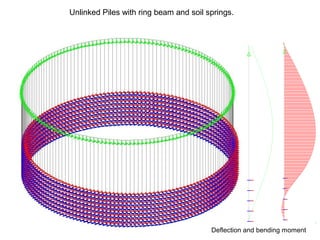
Unlinked Piles with ring beam and soil springs.
Deflection and bending moment
A 600mm wall modeled as an FEA with ring beam and soil springs
Linked piles
Piles with soil springs
Compression only members added between vertical frame elements.
Disconnected members to represent out of plumb.
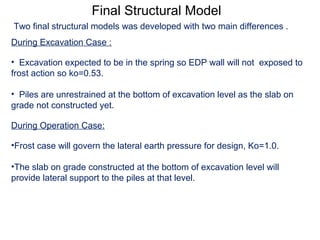
Final Structural Model
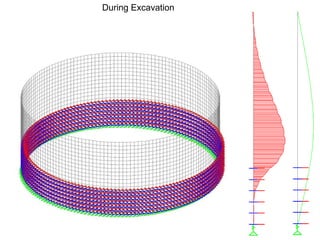
During Excavation Case :
• Excavation expected to be in the spring so EDP wall will not exposed to
frost action so ko=0.53.
• Piles are unrestrained at the bottom of excavation level as the slab on
grade not constructed yet.
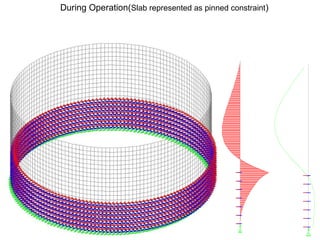
During Operation Case:
•Frost case will govern the lateral earth pressure for design, Ko=1.0.
•The slab on grade constructed at the bottom of excavation level will
provide lateral support to the piles at that level.
Two final structural models was developed with two main differences .
During Excavation
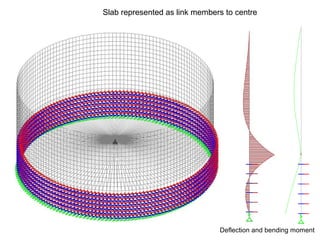
Slab represented as link members to centre
Deflection and bending moment
During Operation(Slab represented as pinned constraint)
Analysis and Design
• Do we trust the model? Is it representing Hoop Stress
contribution correctly?
• All sections must meet the fundamentals. What is
the hoop stress? Stress = Pr/t. Does the hoop
stress exceed the allowable bearing stress (clause
10.8.1- 0.85 Фc fc’ A)
• When we looked at the hoop stress it exceeded our
contact area. What to do?
– Increase pile size?
– Increase overlap by increasing number of piles
• All other considerations must be met, Shear, Moment
and deflection.
Final Design
• Meet the fundamentals – make sure transfer of
theoretical maximum hoop stress is possible. Bearing
governed the initial design, we increased the overlap by
adding piles to ensure the foundation of the design
philosophy, hoop stress, was maintained.
• Design is refined by establishing the extreme boundaries
to guide us toward acceptance of model results. Look at
no hoop stress and full hoop stress.
• There are no templates, the design relies heavily on
engineering judgement. Do not try this at home.

Secant pile wall for emergency dump pond

  • 1.
    Secant Pile Wall PeerReview Assumptions, Modeling and Design Emergency Dump Pond (EDP)
  • 2.
    Secant pile wallsare formed by drilling secondary piles between previously installed primary piles to form a continuous system with mechanical interlocking joints. What are Secant Pile Walls?
  • 4.
    Circular Secant PileWall Emergency Dump Pond (EDP) 40m pond diameter and 13m deep excavation
  • 5.
    Project Requirements • Dumpingpond with vertical sides for cleanout. Earth Ponds are difficult to clean out. • Close to the primary separation cell (PSC). • Construction of EDP cannot interfere with PSC erection. • EDP Pond Required for 1.5 PSC Volume. • Concern about soil profile (boulders) limited maximum depth of EDP. • Pond would be water resistant, not water tight.
  • 6.
    Conceptualization • There aretwo fundamental considerations that affect the conceptualization of a secant system; – Limiting Geometric Considerations: – Analysis and Design Considerations: • Some Analysis and Design Considerations are inter-related with the Geometric restraints • Reinforce each section or reinforce alternate piles? – Initial concept was not excessively deep and in compressive hoop stress. Assumes arch develops to reinforced pile. – Hoop Stress = Pressure X Radius/Thickness
  • 7.
    a) Pond diameterand depth are determined as per the required volume. b) Estimate the required overlap between primary and secondary piles. Typical tolerance for CIP piles is +/-75mm Horizontal and 2% out of Plumb, we decreased the tolerance to +/- 25mm Horizontal and 0.5% out of Plumb to ensure contact of the piles at the bottom of excavation. c) No gap allowed between piles above the pond excavation level (pond slab on grade). Decided to accept some discontinuity below the slab depth based on a perception of a low probability of occurrence. Out of plumb 0.5% Max. Pile deviation +/- 25mm Max. Limiting Geometrical Criteria.
  • 8.
    Reinforce each sectionor reinforce alternate piles? Initial concept was not excessively deep and assumed in compressive hoop stress. Assumed arch develops to transfer loads to reinforced pile, reinforce every second pile. Fundamentals of the Design and Analysis: Hoop Stress = Pr/t, Moment, Shear, Bearing, Active, Passive, At Rest. Strength yes, but do we care about Serviceability? Analysis and Design Considerations
  • 9.
    Two Design Conditions: DuringExcavation to 13.5 meters depth. Ring beam installed prior to excavation. Lateral earth pressure within excavation is Ka or (Ko?)? Pile section below the excavation is Ka, Ko or Kp? During operation. Slab at 12.5 meters supports and defines Ko section. Pile section below slab resisted by Kp. (or does it??)
  • 14.
    Loading and LoadCombinations. a) Piles self weight. b) Lateral Earth Pressure a) At Rest pressure coefficient (Ko) used from the top of piles down to the excavated depth. Ring beam installed prior to excavation. ( Ko=1 in case of frozen soil or Ko=0.53 unfrozen). b) Active pressure below the excavation level was resisted by springs simulating passive earth pressure. c) Surcharge load of 12KPa acting uniformly for full extent of the pile. Later refined to Terzaghi and Peck equations for consideration of an adjacent pump house (initially assumed on piles but now on gravel pad). d) Wheel load as per CL-800 truck, axel load = 175KN. e) No surcharge or wheel load was assumed to transfer lateral loads when on top of frozen soil. f) All loading factored for Limit States.
  • 15.
  • 19.
    What is thestructural analysis model? •Unlinked vertical frame elements represent Piles with ring beam on top and lateral springs along the embedded length below the excavation to represent the passive earth pressure “pile overlap ignored in this case”. •A 600mm wall modeled as a plate element to represent the overlapped piles system with ring beam on top and soil springs. •Horizontal struts added to the first model between piles all around to represent pile interlock, struts are compression only members spaced at 1m vertically.
  • 20.
    Unlinked Piles withring beam and soil springs. Deflection and bending moment
  • 21.
    A 600mm wallmodeled as an FEA with ring beam and soil springs
  • 22.
  • 23.
  • 24.
    Compression only membersadded between vertical frame elements. Disconnected members to represent out of plumb.
  • 25.
    Final Structural Model DuringExcavation Case : • Excavation expected to be in the spring so EDP wall will not exposed to frost action so ko=0.53. • Piles are unrestrained at the bottom of excavation level as the slab on grade not constructed yet. During Operation Case: •Frost case will govern the lateral earth pressure for design, Ko=1.0. •The slab on grade constructed at the bottom of excavation level will provide lateral support to the piles at that level. Two final structural models was developed with two main differences .
  • 26.
  • 27.
    Slab represented aslink members to centre Deflection and bending moment
  • 28.
    During Operation(Slab representedas pinned constraint)
  • 29.
    Analysis and Design •Do we trust the model? Is it representing Hoop Stress contribution correctly? • All sections must meet the fundamentals. What is the hoop stress? Stress = Pr/t. Does the hoop stress exceed the allowable bearing stress (clause 10.8.1- 0.85 Фc fc’ A) • When we looked at the hoop stress it exceeded our contact area. What to do? – Increase pile size? – Increase overlap by increasing number of piles • All other considerations must be met, Shear, Moment and deflection.
  • 30.
    Final Design • Meetthe fundamentals – make sure transfer of theoretical maximum hoop stress is possible. Bearing governed the initial design, we increased the overlap by adding piles to ensure the foundation of the design philosophy, hoop stress, was maintained. • Design is refined by establishing the extreme boundaries to guide us toward acceptance of model results. Look at no hoop stress and full hoop stress. • There are no templates, the design relies heavily on engineering judgement. Do not try this at home.

Editor's Notes

  • #3 Add what a Tangent Wall is.
  • #5 40 meters diameter, slab 12.5 meters from grade and 19 meter long piles. Ring beam cast at top tieing in all piles.
  • #6 Initial suggestion is to dump directly into EDP by placing under PSC. Rejected because of uncertainty in construction time, critical equipment risk. Boulders at 11 to 15 meters, suggested piles do not enter boulder zone.
  • #7 During Excavation: We used Ko within the excavation, Ka below the excavation and springs simulating Kp. Operation: We used Ko frozen to slab depth, Ka below and resisted by Kp. Hoop stress question: When is diameter so large that wall acts linear?? Getting close at 40m diameter.
  • #8 Diameter 40 meters, depth to base 10 meters plus trench allowance 2.5 meters. Initial pile length estimated at 16 meters, later revised to account for 2.5 meters of trench that enters the wall at grade. Initially the client did not allow the trench to be flooded (later revised to allow 1.0 meters of trench to be flooded..
  • #13 Based on the at rest and active earth pressure Versus Passive earth pressure, 2D staad model for a single pile used to indicate the resultant of these forces at the bottom of the pile.
  • #15 Explain discontinuity
  • #16 Explain why the discontinuity?????
  • #21 This is equivalent to the Tangent Pile system. Gives us a sensitivity to the extremes and guides us toward a refined solution.
  • #22 This is the Ideal case at which piles will behave as retaining wall. This is the other extreme. We lie somewhere in between.
  • #23 Next Two Slides are illustrating this slide.
  • #24 Tangent wall.
  • #25 The disconnected members were later deemed redundant.
  • #26 We have two modeling cases first is during excavation which means no floor slab to constraint the piles at the bottom of excavation level, second is during operation which means piles are restraint at the slab level.
  • #27 No floor slab to constraint the piles at the bottom of excavation level
  • #29 During Operation Model, piles are restraint at slab level at max. Moment.