SEARCH ENGINES  SEARCH ENGINESSearch enginesWeb Search Page-Specific SearchDefault searchSearch optionspicture dictionaryppt compiled by   Asha KrishnanDepartment of Management Studies Pondicherry Universityfhgrficerocket           People Searchwwikiasearchkrugle
The primary objective -  to understand what is a search engineAwareness about classification of search enginesTo learn about 6 different types of search enginesObjectives
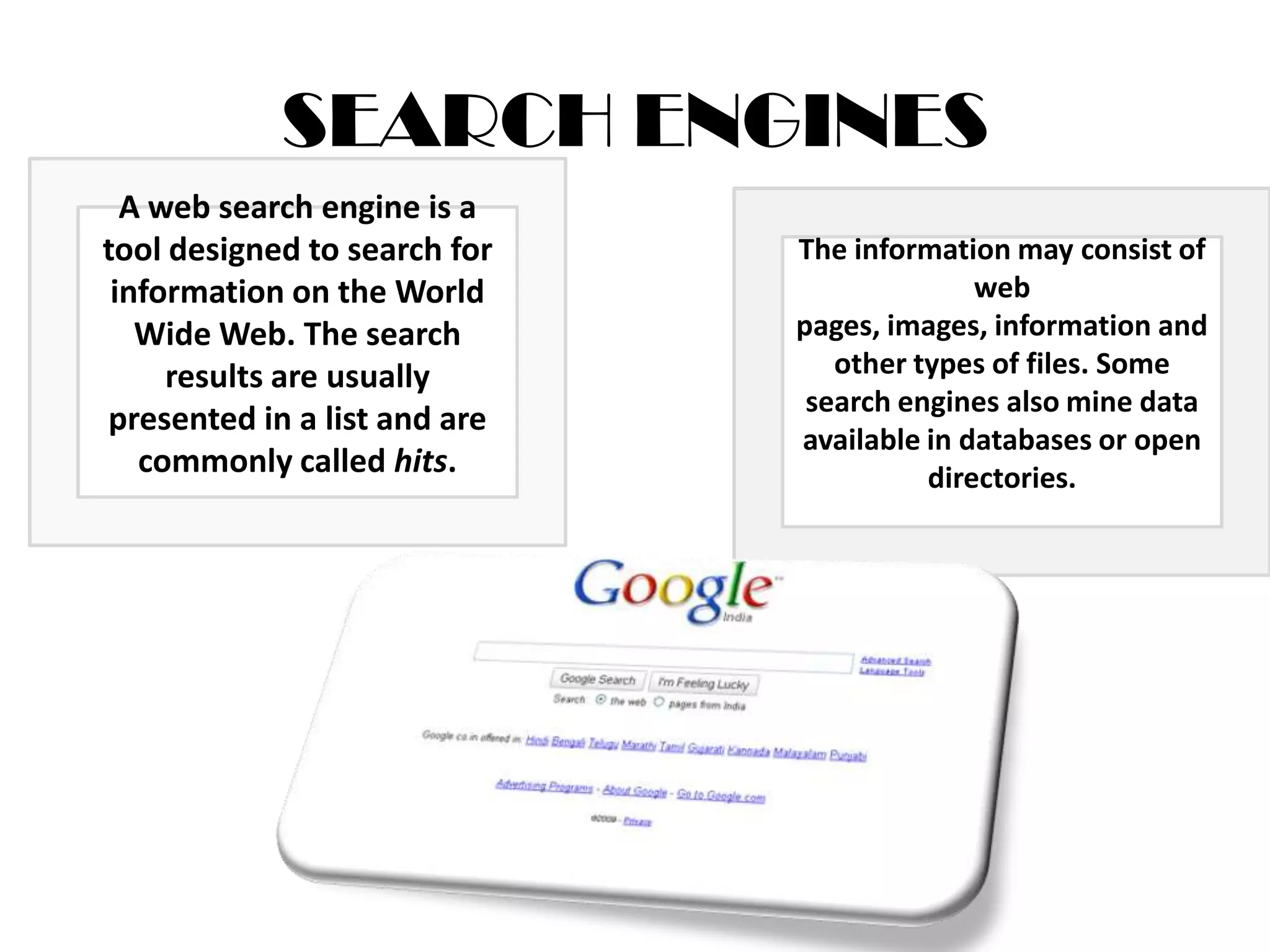
.SEARCH ENGINESA web search engine is a tool designed to search for information on the World Wide Web. The search results are usually presented in a list and are commonly called hits. The information may consist of web pages, images, information and other types of files. Some search engines also mine data available in databases or open directories.
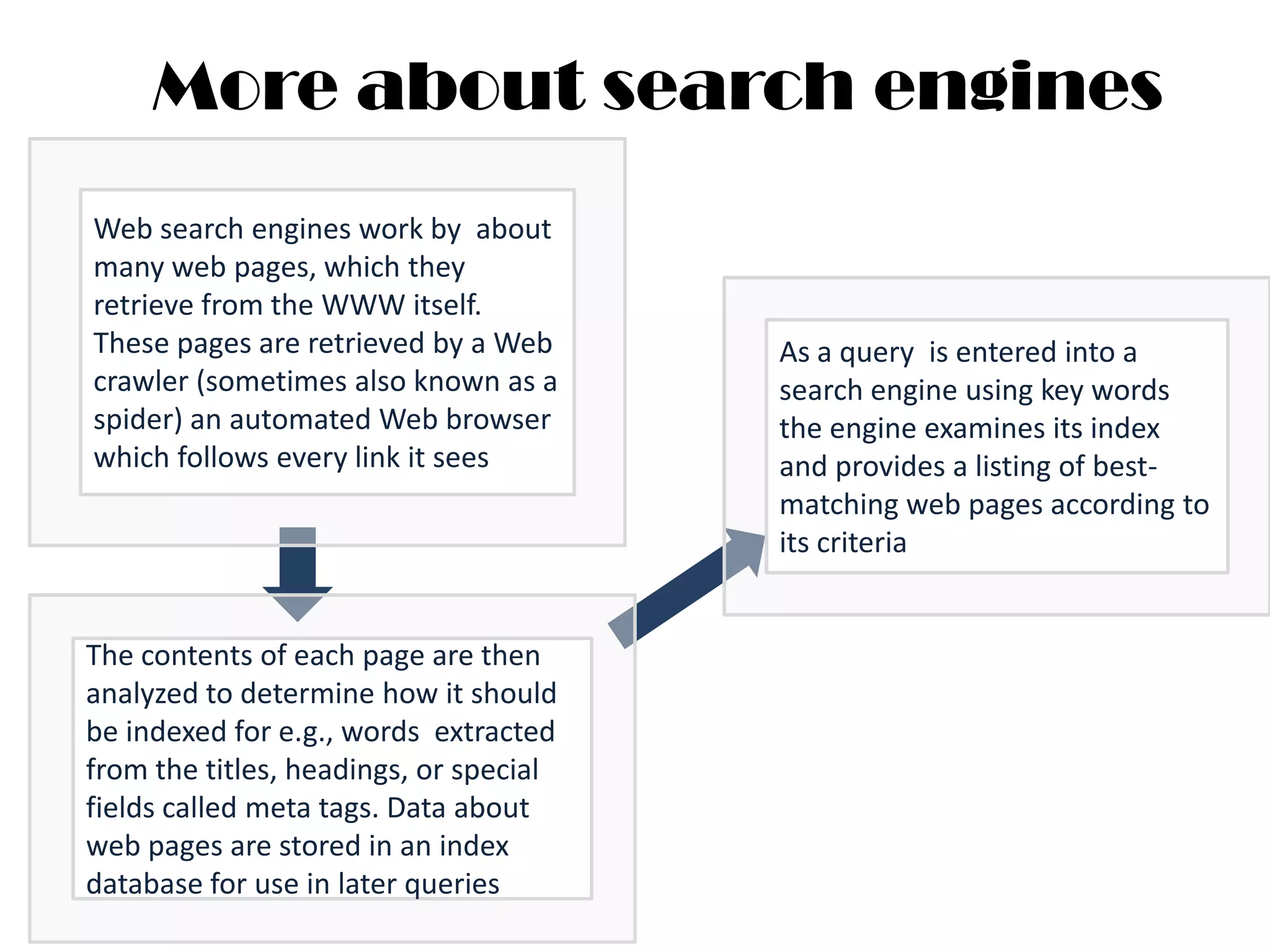
More about search enginesWeb search engines work by  about many web pages, which they retrieve from the WWW itself. These pages are retrieved by a Web crawler (sometimes also known as a spider) an automated Web browser which follows every link it sees.As a query  is entered into a search engine using key words the engine examines its index and provides a listing of best-matching web pages according to its criteriaThe contents of each page are then analyzed to determine how it should be indexed for e.g., words  extracted from the titles, headings, or special fields called meta tags. Data about web pages are stored in an index database for use in later queries
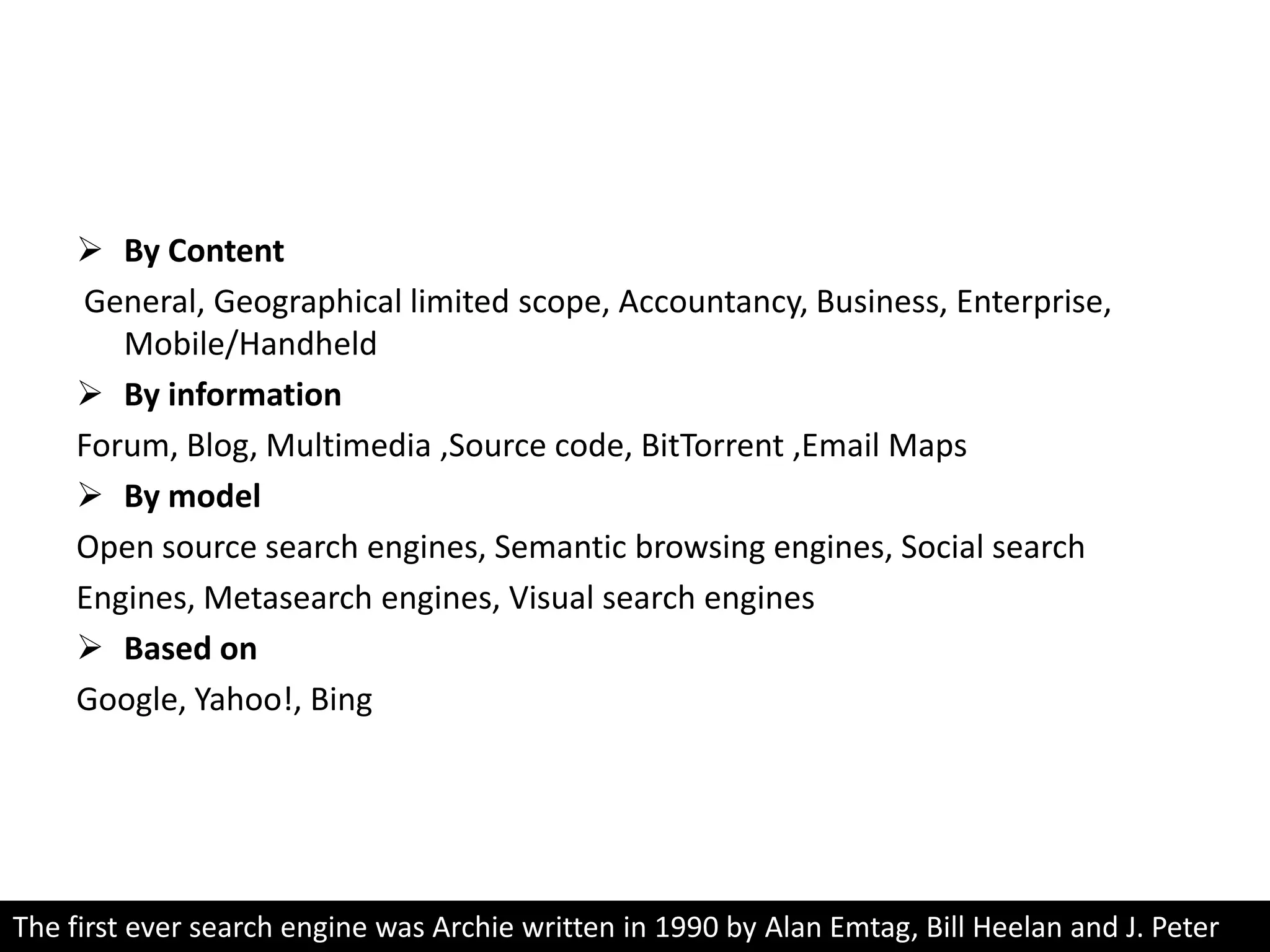
Classification of search enginesBy Content General, Geographical limited scope, Accountancy, Business, Enterprise, Mobile/HandheldBy informationForum, Blog, Multimedia ,Source code, BitTorrent ,Email MapsBy modelOpen source search engines, Semantic browsing engines, Social search Engines, Metasearch engines, Visual search enginesBased onGoogle, Yahoo!, BingThe first ever search engine was Archie written in 1990 by Alan Emtag, Bill Heelan and J. Peter Deutsch
Types of search engines Veronica (Very Easy Rodent-Oriented Net-wide Index to Computerized Archives) 1991 had its name inspired from Archie the first search engine
COLLABORATIVE SEARCH ENGINESCollaborative Search Engines(CSEs) are an emerging trend for Web search and search within company intranets.     CSEs let users concert their efforts in information retrieval (IR) activities and allow experts to guide less experienced people through their searches. Search terms and links clicked that are shared among users reveal their interests, habits, social relations and intentions.                                     CSEs put the privacy of the users at risk.
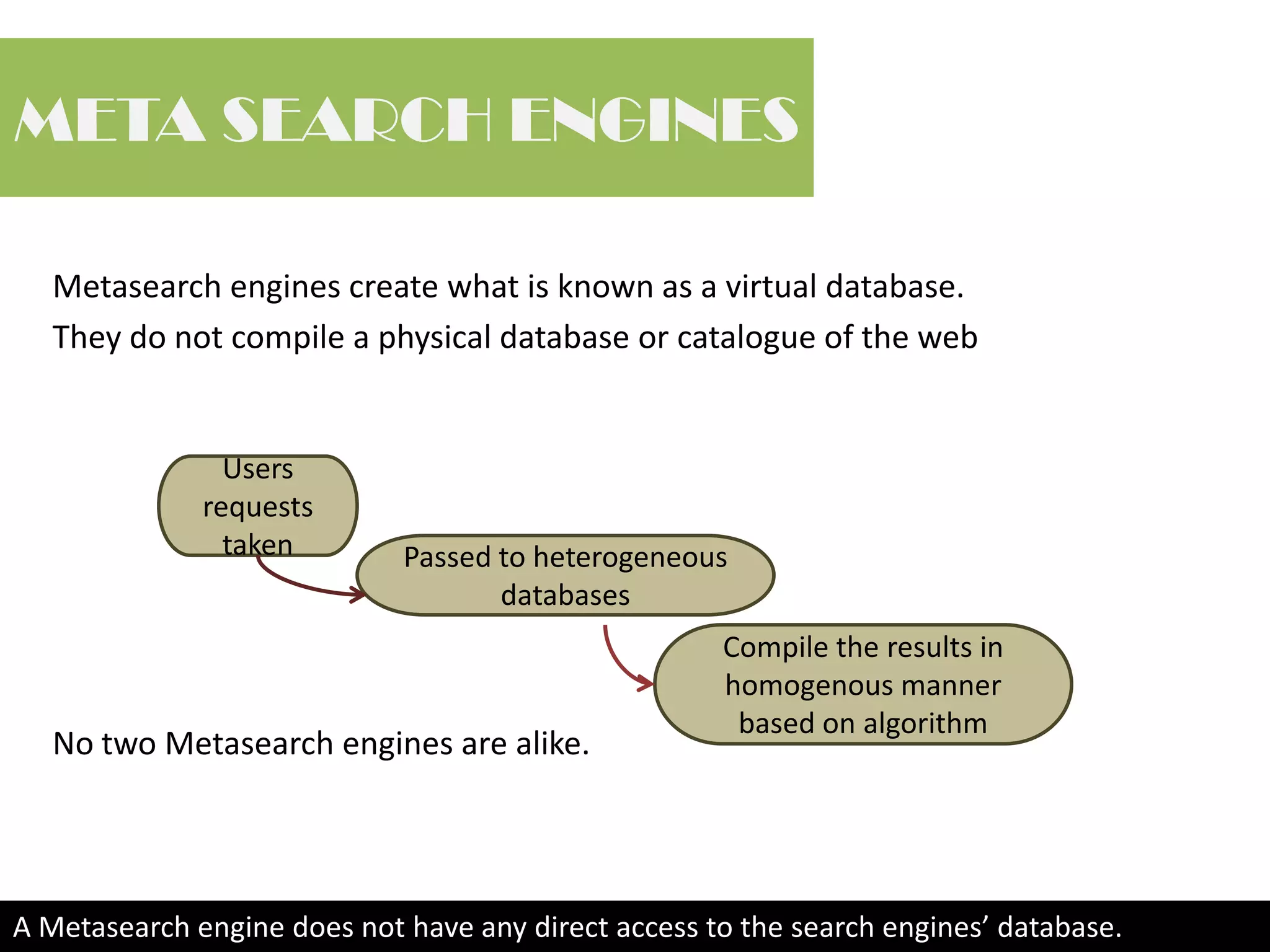
META SEARCH ENGINESMetasearch engines create what is known as a virtual database. They do not compile a physical database or catalogue of the webNo two Metasearch engines are alike.Users requests taken Passed to heterogeneous databasesCompile the results in homogenous manner based on algorithmA Metasearch engine does not have any direct access to the search engines’ database.
APPLICATIONS OF META SEARCH   Image meta search- search of images based on associated metadata such as keywords, text, etc."Reverse" image search- search for images using sophisticated abstractions of chromatic and other related information found   within the image.
A video search engine is a web-based search engine which crawls  the web for videocontent. Some video search engines parse externally hosted content while others allow content to be uploaded and hosted on their own servers. Some engines also allow users to search by video format type and by length of the clip. Search results are usually accompanied by a thumbnail view of the video.VIDEO SEARCH ENGINEYouTube receives a billion hits per day!
Agnostic searchSearch that is not affected by the hosting of video, where results are agnostic no matter where the video is located:E.g. AltaVista Video Search,Dabble.com, Picsearch Video SearchNon-agnostic SearchSearch results are modified, or suspect, due to the large hosted video being given preferential treatment in search resultsE.g. YouTube, Yahoo video searchTYPES OF VIDEO SEARCH
Enterprise search is the practice of identifying and enabling specific content across the enterprise to be indexed, searched, and displayed to authorized users. The term "enterprise search"  describes the application of search technology to information within an organizationENTERPRISE SEARCH
Major challenge faced by Enterprise searchthe need to index data and documents from a variety of   sources (file systems , intranets, document management systems, e-mail) and then present a consolidated list of relevance ranked resources from these various source .Vendors of proprietary enterprise search softwareAskMeNow,  Attivio, Google Search Appliance, IBM
SEMANTIC SEARCHSemantic search is a process used to improve online searching by using data from semantic networksto disambiguate queries and web text in order to generate more relevant resultsIt provides  an overview that lists semantic search systems and identifies other uses of semantics in the search process  Semantic Search uses semantics or the science of meaning in language to produce highly relevant search results. The Semantic Web is an evolving development of the World Wide Web where the meaning semantics of information and services on the web is defined, making it possible for the web to understand and satisfy the requests of people.
OPEN SEARCHOpenSearchis a collection of technologies that allow publishing of search results in a format suitable for syndication and aggregation    It is a way for websites and search engines to publish search results in a standard and accessible format.    OpenSearch was developed by Amazon.com subsidiary A9 and the first version, OpenSearch 1.0, was unveiled by Jeff Bezos at the Web 2.0 conference in March, 2005
Open search consists ofSearch engines and software that support OpenSearchOpenSearch Description filesOpenSearch Query Syntax: Open Search RSS (in OpenSearch 1.0) or OpenSearch Response (in Open Search 1.1)OpenSearch Aggregators OpenSearch "Auto-discovery”Wikipedia suggests articles matching a typed-in entry with incremental find. Internet Explorer 7  and above.
SOCIAL SEARCH      Social search or a social search engine is a type of web search method that determines the relevance of search results by considering the interactions or contributions of users. Its user-based approach to relevance is in contrast to established algorithmic or machine-based approaches where relevance is determined by analyzing the text of each document or the link structure of the documents
 Takes into account varying sources of metadata, such as collaborative discovery of web pages, tags, social ranking.      many forms - ranging from simple shared bookmarks or tagging of content with descriptive labels to more sophisticated approaches that combine human intelligence with computer algorithms..
Example forms of user input include social    bookmarking or direct interaction with the search results such as promoting or demoting results the user feels are more or less relevant to their queryCompanies in the social search space include Sproose, Parse.ly, Mahalo, Jumper 2.0, Wikia SearchIn 2008  a few start up companies began the technique of  focussing on ranking search results according to one's social graph on social network.
SELECTION BASED SEARCHA selection-based search system is a search engine system in which      the user invokes a search query using only the mouse.It allows the user to search the internet for more information about any keywordor phrase contained within a document or webpage in any software application on his desktop computer using the mouse.These search systems create what is known as a semantic database of trained terms. They do not compile a physical database or catalogue of the web on the users' desktop computer.
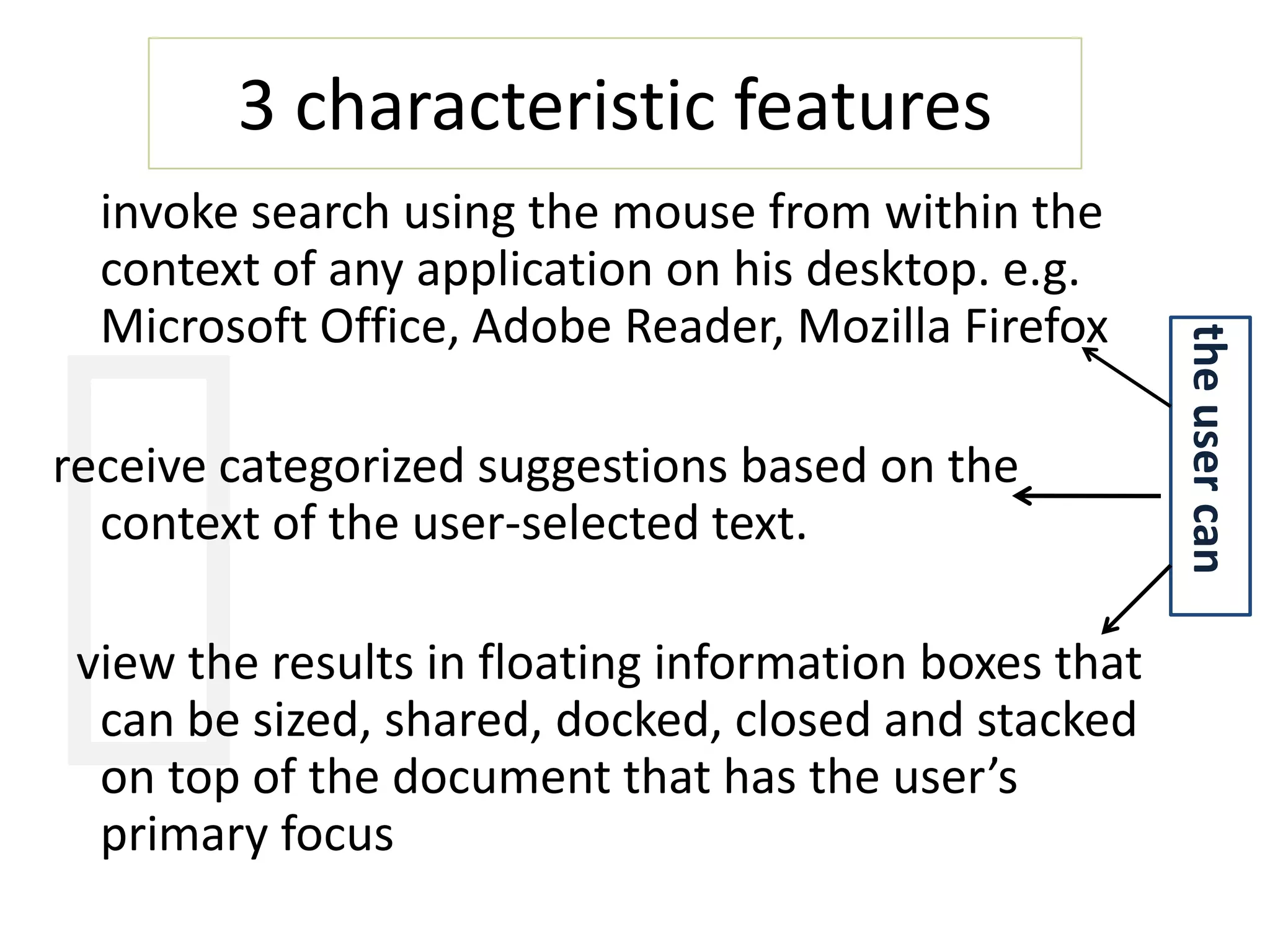
3 characteristic features     invoke search using the mouse from within the context of any application on his desktop. e.g. Microsoft Office, Adobe Reader, Mozilla Firefoxreceive categorized suggestions based on the context of the user-selected text. view the results in floating information boxes that can be sized, shared, docked, closed and stacked on top of the document that has the user’s primary focusthe user can
The other search engine types areDesktop search enginese.g. Ask.com, windows searchUsenet e.g. Google groupsSearch appliancesAcquired or defunct search enginese.g. Google answers, Wikia search
sourceshttp://en.wikipedia.org/wiki/Web_search_enginehttp://en.wikipedia.org/wiki/Video_search_enginehttp://en.wikipedia.org/wiki/List_of_search_engineshttp://en.wikipedia.org/wiki/Semantic_searchSearchenginez.com//www.multilingual-search.com/
Search engines are evolving as the technology leaps and the list will therefore condense but with expanded attributes.        Towards complexity or simplicity ?                                             ‘Halal’ Search Engine Launched for ‘Safe’ Internet Browsing!!

search engines

  • 1.
    SEARCH ENGINES SEARCH ENGINESSearch enginesWeb Search Page-Specific SearchDefault searchSearch optionspicture dictionaryppt compiled by Asha KrishnanDepartment of Management Studies Pondicherry Universityfhgrficerocket People Searchwwikiasearchkrugle
  • 2.
    The primary objective- to understand what is a search engineAwareness about classification of search enginesTo learn about 6 different types of search enginesObjectives
  • 3.
    .SEARCH ENGINESA websearch engine is a tool designed to search for information on the World Wide Web. The search results are usually presented in a list and are commonly called hits. The information may consist of web pages, images, information and other types of files. Some search engines also mine data available in databases or open directories.
  • 4.
    More about searchenginesWeb search engines work by about many web pages, which they retrieve from the WWW itself. These pages are retrieved by a Web crawler (sometimes also known as a spider) an automated Web browser which follows every link it sees.As a query is entered into a search engine using key words the engine examines its index and provides a listing of best-matching web pages according to its criteriaThe contents of each page are then analyzed to determine how it should be indexed for e.g., words extracted from the titles, headings, or special fields called meta tags. Data about web pages are stored in an index database for use in later queries
  • 5.
    Classification of searchenginesBy Content General, Geographical limited scope, Accountancy, Business, Enterprise, Mobile/HandheldBy informationForum, Blog, Multimedia ,Source code, BitTorrent ,Email MapsBy modelOpen source search engines, Semantic browsing engines, Social search Engines, Metasearch engines, Visual search enginesBased onGoogle, Yahoo!, BingThe first ever search engine was Archie written in 1990 by Alan Emtag, Bill Heelan and J. Peter Deutsch
  • 6.
    Types of searchengines Veronica (Very Easy Rodent-Oriented Net-wide Index to Computerized Archives) 1991 had its name inspired from Archie the first search engine
  • 7.
    COLLABORATIVE SEARCH ENGINESCollaborativeSearch Engines(CSEs) are an emerging trend for Web search and search within company intranets. CSEs let users concert their efforts in information retrieval (IR) activities and allow experts to guide less experienced people through their searches. Search terms and links clicked that are shared among users reveal their interests, habits, social relations and intentions. CSEs put the privacy of the users at risk.
  • 8.
    META SEARCH ENGINESMetasearchengines create what is known as a virtual database. They do not compile a physical database or catalogue of the webNo two Metasearch engines are alike.Users requests taken Passed to heterogeneous databasesCompile the results in homogenous manner based on algorithmA Metasearch engine does not have any direct access to the search engines’ database.
  • 9.
    APPLICATIONS OF METASEARCH Image meta search- search of images based on associated metadata such as keywords, text, etc."Reverse" image search- search for images using sophisticated abstractions of chromatic and other related information found within the image.
  • 10.
    A video searchengine is a web-based search engine which crawls the web for videocontent. Some video search engines parse externally hosted content while others allow content to be uploaded and hosted on their own servers. Some engines also allow users to search by video format type and by length of the clip. Search results are usually accompanied by a thumbnail view of the video.VIDEO SEARCH ENGINEYouTube receives a billion hits per day!
  • 11.
    Agnostic searchSearch thatis not affected by the hosting of video, where results are agnostic no matter where the video is located:E.g. AltaVista Video Search,Dabble.com, Picsearch Video SearchNon-agnostic SearchSearch results are modified, or suspect, due to the large hosted video being given preferential treatment in search resultsE.g. YouTube, Yahoo video searchTYPES OF VIDEO SEARCH
  • 12.
    Enterprise search isthe practice of identifying and enabling specific content across the enterprise to be indexed, searched, and displayed to authorized users. The term "enterprise search" describes the application of search technology to information within an organizationENTERPRISE SEARCH
  • 13.
    Major challenge facedby Enterprise searchthe need to index data and documents from a variety of sources (file systems , intranets, document management systems, e-mail) and then present a consolidated list of relevance ranked resources from these various source .Vendors of proprietary enterprise search softwareAskMeNow, Attivio, Google Search Appliance, IBM
  • 14.
    SEMANTIC SEARCHSemantic searchis a process used to improve online searching by using data from semantic networksto disambiguate queries and web text in order to generate more relevant resultsIt provides an overview that lists semantic search systems and identifies other uses of semantics in the search process Semantic Search uses semantics or the science of meaning in language to produce highly relevant search results. The Semantic Web is an evolving development of the World Wide Web where the meaning semantics of information and services on the web is defined, making it possible for the web to understand and satisfy the requests of people.
  • 15.
    OPEN SEARCHOpenSearchis acollection of technologies that allow publishing of search results in a format suitable for syndication and aggregation It is a way for websites and search engines to publish search results in a standard and accessible format. OpenSearch was developed by Amazon.com subsidiary A9 and the first version, OpenSearch 1.0, was unveiled by Jeff Bezos at the Web 2.0 conference in March, 2005
  • 16.
    Open search consistsofSearch engines and software that support OpenSearchOpenSearch Description filesOpenSearch Query Syntax: Open Search RSS (in OpenSearch 1.0) or OpenSearch Response (in Open Search 1.1)OpenSearch Aggregators OpenSearch "Auto-discovery”Wikipedia suggests articles matching a typed-in entry with incremental find. Internet Explorer 7 and above.
  • 17.
    SOCIAL SEARCH Social search or a social search engine is a type of web search method that determines the relevance of search results by considering the interactions or contributions of users. Its user-based approach to relevance is in contrast to established algorithmic or machine-based approaches where relevance is determined by analyzing the text of each document or the link structure of the documents
  • 18.
    Takes intoaccount varying sources of metadata, such as collaborative discovery of web pages, tags, social ranking. many forms - ranging from simple shared bookmarks or tagging of content with descriptive labels to more sophisticated approaches that combine human intelligence with computer algorithms..
  • 19.
    Example forms ofuser input include social bookmarking or direct interaction with the search results such as promoting or demoting results the user feels are more or less relevant to their queryCompanies in the social search space include Sproose, Parse.ly, Mahalo, Jumper 2.0, Wikia SearchIn 2008 a few start up companies began the technique of focussing on ranking search results according to one's social graph on social network.
  • 20.
    SELECTION BASED SEARCHAselection-based search system is a search engine system in which the user invokes a search query using only the mouse.It allows the user to search the internet for more information about any keywordor phrase contained within a document or webpage in any software application on his desktop computer using the mouse.These search systems create what is known as a semantic database of trained terms. They do not compile a physical database or catalogue of the web on the users' desktop computer.
  • 21.
    3 characteristic features invoke search using the mouse from within the context of any application on his desktop. e.g. Microsoft Office, Adobe Reader, Mozilla Firefoxreceive categorized suggestions based on the context of the user-selected text. view the results in floating information boxes that can be sized, shared, docked, closed and stacked on top of the document that has the user’s primary focusthe user can
  • 22.
    The other searchengine types areDesktop search enginese.g. Ask.com, windows searchUsenet e.g. Google groupsSearch appliancesAcquired or defunct search enginese.g. Google answers, Wikia search
  • 23.
  • 24.
    Search engines areevolving as the technology leaps and the list will therefore condense but with expanded attributes. Towards complexity or simplicity ?   ‘Halal’ Search Engine Launched for ‘Safe’ Internet Browsing!!