
Access Control and Encryption in Cloud EnvironmentsJames WernickeNew Mexico TechDepartment of Computer Science & EngineeringA Designated Center of Academic Excellence in Information Assurance by the National Security Agency
TerminologyAccess control:A system which enables an authority to control access to areas and resources in a given physical facility or computer-based information systemEncryption:The process of transforming information (“plaintext”) using an algorithm (“cipher”) to make it unreadable to anyone except those possessing special knowledge (“key”).Cloud:Computing system where shared resources, software, and information are provided to computers and other devices on demand like the electricity grid.A Designated Center of Academic Excellence in Information Assurance by the National Security Agency- 2 -
MotivationOrganizations no longer need to control the computing infrastructure that supports them. They just need a place to store, access, and manipulate their data.The usual cryptographic methods are limiting, inflexible, and don’t scale well.Access management has always been done internally.Research related to this semester’s projectsA Designated Center of Academic Excellence in Information Assurance by the National Security Agency- 3 -
ScenariosOutsourcing computations on sensitive dataQuerying large sets of encrypted dataElectronic votingSearch engine privacyTrend analysis on personal informationA Designated Center of Academic Excellence in Information Assurance by the National Security Agency- 4 -
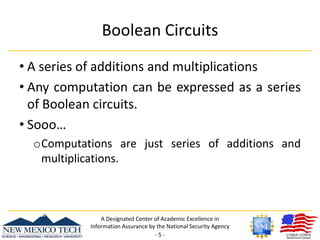
Boolean CircuitsA series of additions and multiplicationsAny computation can be expressed as a series of Boolean circuits.Sooo…Computations are just series of additions and multiplications.A Designated Center of Academic Excellence in Information Assurance by the National Security Agency- 5 -
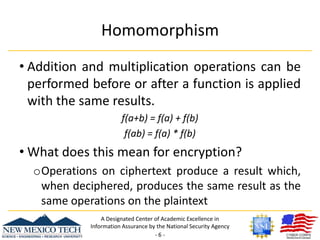
HomomorphismAddition and multiplication operations can be performed before or after a function is applied with the same results.f(a+b) = f(a) + f(b)f(ab) = f(a) * f(b)What does this mean for encryption?Operations on ciphertext produce a result which, when deciphered, produces the same result as the same operations on the plaintextA Designated Center of Academic Excellence in Information Assurance by the National Security Agency- 6 -
DES/AES EncryptionNot homomorphic at allEncrypt P to get C, multiply C by 2, decrypt 2C, get some gibberishA Designated Center of Academic Excellence in Information Assurance by the National Security Agency- 7 -
RSA EncryptionMultiplicatively homomorphicEncrypt P to get C, multiply C by 2, decrypt 2C, get 2PThis isn’t really helpful unless we just want to do a bunch of multiplicationsA Designated Center of Academic Excellence in Information Assurance by the National Security Agency- 8 -
Gentry’s Homomorphic EncryptionFully homomorphicEncrypt P to get C, do an arbitrary number of additions and multiplications on C to get C′, decrypt C′, get P′Awesome… in theoryA Designated Center of Academic Excellence in Information Assurance by the National Security Agency- 9 -
LimitationsEncrypted Google search takes one trillion times longerNumber of multiplications needs to be fixed when public key is generatedNeed to know what to compute before encryptingA Designated Center of Academic Excellence in Information Assurance by the National Security Agency- 10 -
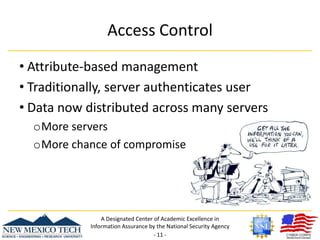
Access ControlAttribute-based managementTraditionally, server authenticates userData now distributed across many serversMore servers
More chance of compromiseA Designated Center of Academic Excellence in Information Assurance by the National Security Agency- 11 -
Ciphertext-Policy Attribute-Based Encryption (CP-ABE)Access policy associated with ciphertextPrivate keys associated with attributesSo why is this good?Encryptor enforces access policy, not server
Data can be decrypted by more than one userCollusion resistanceA Designated Center of Academic Excellence in Information Assurance by the National Security Agency- 12 -
ConclusionsMore research into fully homomorphic encryption could revolutionize the way cloud services are utilized for sensitive data.CP-ABE can provide a new approach to managing access control on untrusted servers.A Designated Center of Academic Excellence in Information Assurance by the National Security Agency- 13 -

Access Control & Encryption In Cloud Environments

  • 1.
    Access Control andEncryption in Cloud EnvironmentsJames WernickeNew Mexico TechDepartment of Computer Science & EngineeringA Designated Center of Academic Excellence in Information Assurance by the National Security Agency
  • 2.
    TerminologyAccess control:A systemwhich enables an authority to control access to areas and resources in a given physical facility or computer-based information systemEncryption:The process of transforming information (“plaintext”) using an algorithm (“cipher”) to make it unreadable to anyone except those possessing special knowledge (“key”).Cloud:Computing system where shared resources, software, and information are provided to computers and other devices on demand like the electricity grid.A Designated Center of Academic Excellence in Information Assurance by the National Security Agency- 2 -
  • 3.
    MotivationOrganizations no longerneed to control the computing infrastructure that supports them. They just need a place to store, access, and manipulate their data.The usual cryptographic methods are limiting, inflexible, and don’t scale well.Access management has always been done internally.Research related to this semester’s projectsA Designated Center of Academic Excellence in Information Assurance by the National Security Agency- 3 -
  • 4.
    ScenariosOutsourcing computations onsensitive dataQuerying large sets of encrypted dataElectronic votingSearch engine privacyTrend analysis on personal informationA Designated Center of Academic Excellence in Information Assurance by the National Security Agency- 4 -
  • 5.
    Boolean CircuitsA seriesof additions and multiplicationsAny computation can be expressed as a series of Boolean circuits.Sooo…Computations are just series of additions and multiplications.A Designated Center of Academic Excellence in Information Assurance by the National Security Agency- 5 -
  • 6.
    HomomorphismAddition and multiplicationoperations can be performed before or after a function is applied with the same results.f(a+b) = f(a) + f(b)f(ab) = f(a) * f(b)What does this mean for encryption?Operations on ciphertext produce a result which, when deciphered, produces the same result as the same operations on the plaintextA Designated Center of Academic Excellence in Information Assurance by the National Security Agency- 6 -
  • 7.
    DES/AES EncryptionNot homomorphicat allEncrypt P to get C, multiply C by 2, decrypt 2C, get some gibberishA Designated Center of Academic Excellence in Information Assurance by the National Security Agency- 7 -
  • 8.
    RSA EncryptionMultiplicatively homomorphicEncryptP to get C, multiply C by 2, decrypt 2C, get 2PThis isn’t really helpful unless we just want to do a bunch of multiplicationsA Designated Center of Academic Excellence in Information Assurance by the National Security Agency- 8 -
  • 9.
    Gentry’s Homomorphic EncryptionFullyhomomorphicEncrypt P to get C, do an arbitrary number of additions and multiplications on C to get C′, decrypt C′, get P′Awesome… in theoryA Designated Center of Academic Excellence in Information Assurance by the National Security Agency- 9 -
  • 10.
    LimitationsEncrypted Google searchtakes one trillion times longerNumber of multiplications needs to be fixed when public key is generatedNeed to know what to compute before encryptingA Designated Center of Academic Excellence in Information Assurance by the National Security Agency- 10 -
  • 11.
    Access ControlAttribute-based managementTraditionally,server authenticates userData now distributed across many serversMore servers
  • 12.
    More chance ofcompromiseA Designated Center of Academic Excellence in Information Assurance by the National Security Agency- 11 -
  • 13.
    Ciphertext-Policy Attribute-Based Encryption(CP-ABE)Access policy associated with ciphertextPrivate keys associated with attributesSo why is this good?Encryptor enforces access policy, not server
  • 14.
    Data can bedecrypted by more than one userCollusion resistanceA Designated Center of Academic Excellence in Information Assurance by the National Security Agency- 12 -
  • 15.
    ConclusionsMore research intofully homomorphic encryption could revolutionize the way cloud services are utilized for sensitive data.CP-ABE can provide a new approach to managing access control on untrusted servers.A Designated Center of Academic Excellence in Information Assurance by the National Security Agency- 13 -

Editor's Notes

  • #2 Good morning, everyone. Thanks for coming. My name is James Wernicke, and as part of my application for SFS, I’ll be giving a presentation today on access control and encryption in cloud environments.
  • #3 There are a few terms that we should be familiar with. When I talk about access control, I’m speaking about systems that control access specifically to data, networked resources, and physical locations. Encryption refers to the process of making information private between the sender and those authorized to view it. A cloud is a network of computers which, to the user, appear as one functional unit which is highly scalable for providing a number of services to many users simultaneously.
  • #4 There is a clear trend that organizations are shifting their IT resources to the cloud. We trust banks to keep our money secure while their customers come and go through their doors all day long. When we want our money, it’s available 24/7 through an ATM, debit card, or banking website. Likewise, datacenters are equipped to keep our data secure and make it available to us when we need it. However, there is still some room for improvement.Traditional cryptography doesn’t work that well in clouds. Sure, we can encrypt our data and store it on a public server, but as soon as we want to compute on that data, we have to download it to our local machine and decrypt it before we can do anything with it. This doesn’t work so well for large amounts of data.Traditional access management relies on firewalls, homogenous network environments, and system administrators to manage access control policies. In a cloud, firewalls are turned into swisscheese as users access their enterprise applications through the Internet from anywhere in the world on any device on any platform. Cloud users need a way to control access to their data that doesn’t require an in-house system administrator.
  • #5 Let’s say you have a bunch of classified data that needs to be processed. You want to use an unclassified compute cloud to do that processing without giving away the information within the encrypted data.You could also have a large encrypted database stored on a public server. Normally, you’d have to download the entire database and decrypt it to do any type of query on it. Instead, what if there was a way to do the query on the database server without revealing the information?It could also be used to collect and tally votes using encrypted data without knowing which votes are for who. Or imagine being able to do a search engine query without the search engine even knowing what you were searching for?
  • #6 All computing is based on boolean circuits. These are basically the mathematical building blocks for programs. So when we want to computer or manipulate data, we are basically just performing some set of additive and multiplicative operations, or boolean circuits.
  • #7 Homorphisms are a special type of function that has some interesting applications in cryptography. The unique property of homomorphisms is that the function can be applied before or after the additive or multiplicative operations are performed on the algebraic structures. What this means is that we can take ciphertext, perform some arbitrary number of operations on it, then decrypt the ciphertext and it would be the same as if we operated on the plaintext.
  • #8 With symmetric key encryption, there are no homomorphisms. If you could get 2P from 2C, there would certainly be some questions about the randomness, and the security, of your symmetric key encryption.
  • #9 RSA encryption is a partially homomorphic scheme, but only multiplicatively. Too bad we can’t really do anything interesting with this, though.
  • #10 In 2009, Craig Gentry announced a fully homomorphic encryption scheme using ideal lattices. This breakthrough allows complexcomputations to finally be performed on encrypted data and have the resulting ciphertext decrypted into something useful. But…
  • #11 Gentry’s scheme is not quite ready for primetime, though. For one, a program becomes exponentially more complex when converted into a series of additions and subtractions. Gentry himself said that the time to do a simple Google search is increased by a factor of one trillion. Another major issue is that his scheme requires that operations that will be done have to be known before encrypting the data. But still, his approach is still certainly an important breakthrough in cryptography.
  • #12 The other part of cloud security I want to talk about is access control. Encryption is great for keeping our data confidential, but we certainly don’t want anyone to get their hands on our data to decrypt at their leisure. We don’t always know the exact identities of everyone who should access data so it is desirable to be able to describe them in terms of descriptive attributes or credentials. This type of access control is typically enforced by a server that checks that a user present proper credentials before accessing data. The problem now is that our data is on the cloud, and we don’t necessarily have that much trust in the servers where our data is being stored. We would definitely sleep easier if we didn’t have to worry about them being compromised.
  • #13 CP-ABE addresses these issues. When a party encrypts a message, they specify an associated access structure. Each user’s private key is associated with a set of attributes. So what makes this so great? A message will only be able to be decrypted if the decryptor’s attributes satisfy the ciphertext’s access structure. This allows a user to not only maintain an access policy on an untrusted server, but also allow groups of users to access the data. Another important feature of this scheme is that two parties can’t combine their attributes, or collude, to access data that one couldn’t access on their own.
  • #14 So to recap, fully homomorphic encryption has the potential to change how cloud services are used. It just needs some more research. CP-ABE also can also improve cloud security by providing a more flexible way to manage access control in clouds.
  • #15 Here’s my references.
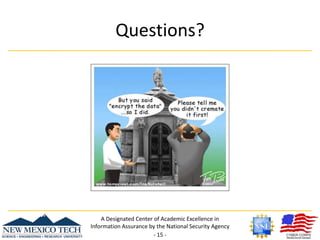
  • #16 Any questions?