SEO
(Search Engine Optimization)
By
Sai Shunmuga
SEO
• SEO is the process of maximizing the number of
visitors to a particular website by ensuring that
the site appears high on the list of results returned
by a search engine.
• There are two categories in SEO:
i. On page SEO
ii. Off page SEO
On Page SEO
• Page Titles
• Meta Descriptions
• Meta Tages
• URL Sturctuers
• Body Tags
• Keyword Density
• Image SEO
• Internal linking
Page Titles
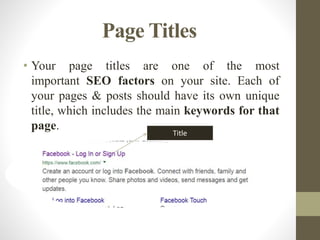
• Your page titles are one of the most
important SEO factors on your site. Each of
your pages & posts should have its own unique
title, which includes the main keywords for that
page.
Title
Meta Descriptions
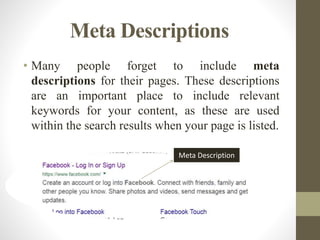
• Many people forget to include meta
descriptions for their pages. These descriptions
are an important place to include relevant
keywords for your content, as these are used
within the search results when your page is listed.
Meta Description
Meta Tages
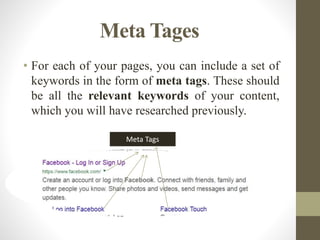
• For each of your pages, you can include a set of
keywords in the form of meta tags. These should
be all the relevant keywords of your content,
which you will have researched previously.
Meta Tags
URLSturctuers
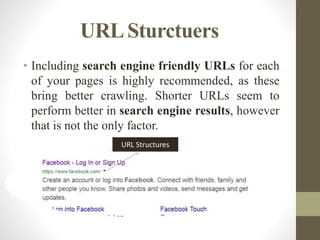
• Including search engine friendly URLs for each
of your pages is highly recommended, as these
bring better crawling. Shorter URLs seem to
perform better in search engine results, however
that is not the only factor.
URL Structures
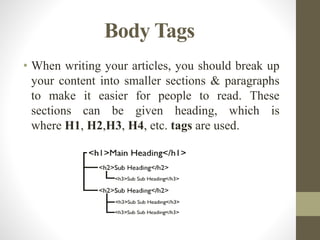
Body Tags
• When writing your articles, you should break up
your content into smaller sections & paragraphs
to make it easier for people to read. These
sections can be given heading, which is
where H1, H2,H3, H4, etc. tags are used.
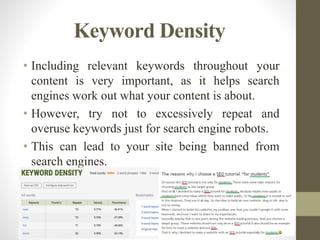
Keyword Density
• Including relevant keywords throughout your
content is very important, as it helps search
engines work out what your content is about.
• However, try not to excessively repeat and
overuse keywords just for search engine robots.
• This can lead to your site being banned from
search engines.
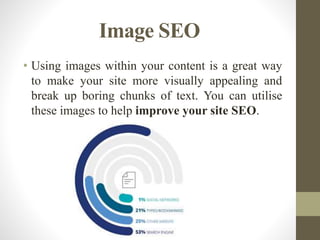
Image SEO
• Using images within your content is a great way
to make your site more visually appealing and
break up boring chunks of text. You can utilise
these images to help improve your site SEO.
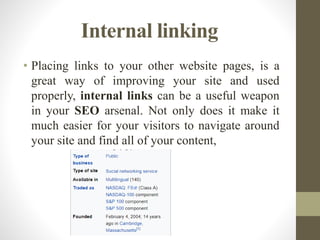
Internal linking
• Placing links to your other website pages, is a
great way of improving your site and used
properly, internal links can be a useful weapon
in your SEO arsenal. Not only does it make it
much easier for your visitors to navigate around
your site and find all of your content,
Off Page SEO
• Creating Shareable Content
• Influencer Outreach
• Contribute as Guest Author
• Social Media Engagement
• Social Bookmarking Sites
Creating Shareable Content
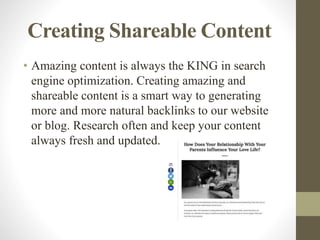
• Amazing content is always the KING in search
engine optimization. Creating amazing and
shareable content is a smart way to generating
more and more natural backlinks to our website
or blog. Research often and keep your content
always fresh and updated.
Influencer Outreach
• If you have created any kind of content which is
share worthy, then don’t hesitate to reach out
influencers in your industry. Tell them to check
your blog and ask for link backs from their blog.
Make sure you get the links from completely
relevant domains.
Contribute as Guest Author
• There are a number of good and quality blogs
that are open for guest post from various authors.
Write an amazing research piece and reach them
with the content for guest post. Don’t focus on
quantity of links but rather focus only on quality
links. Also don’t keep posting multiple times on
the same guest blog site.
Social Media Engagement
• A major Off-page SEO technique is social
media engagement. If you want to make your
business, website or blog popular, engage with
people on multiple social media platforms. Social
media presence will help grow your business and
also help you get more back links.
Social Bookmarking Sites
• Social bookmarking sites are one of the best
platforms to promote your website. When you
bookmark your webpage or blog post on popular
social bookmarking websites, you gain high
traffic to your webpage or blog.
Thank you

Search engine optimization (Introduction-SEO)

  • 1.
  • 2.
    SEO • SEO isthe process of maximizing the number of visitors to a particular website by ensuring that the site appears high on the list of results returned by a search engine. • There are two categories in SEO: i. On page SEO ii. Off page SEO
  • 3.
    On Page SEO •Page Titles • Meta Descriptions • Meta Tages • URL Sturctuers • Body Tags • Keyword Density • Image SEO • Internal linking
  • 4.
    Page Titles • Yourpage titles are one of the most important SEO factors on your site. Each of your pages & posts should have its own unique title, which includes the main keywords for that page. Title
  • 5.
    Meta Descriptions • Manypeople forget to include meta descriptions for their pages. These descriptions are an important place to include relevant keywords for your content, as these are used within the search results when your page is listed. Meta Description
  • 6.
    Meta Tages • Foreach of your pages, you can include a set of keywords in the form of meta tags. These should be all the relevant keywords of your content, which you will have researched previously. Meta Tags
  • 7.
    URLSturctuers • Including searchengine friendly URLs for each of your pages is highly recommended, as these bring better crawling. Shorter URLs seem to perform better in search engine results, however that is not the only factor. URL Structures
  • 8.
    Body Tags • Whenwriting your articles, you should break up your content into smaller sections & paragraphs to make it easier for people to read. These sections can be given heading, which is where H1, H2,H3, H4, etc. tags are used.
  • 9.
    Keyword Density • Includingrelevant keywords throughout your content is very important, as it helps search engines work out what your content is about. • However, try not to excessively repeat and overuse keywords just for search engine robots. • This can lead to your site being banned from search engines.
  • 10.
    Image SEO • Usingimages within your content is a great way to make your site more visually appealing and break up boring chunks of text. You can utilise these images to help improve your site SEO.
  • 11.
    Internal linking • Placinglinks to your other website pages, is a great way of improving your site and used properly, internal links can be a useful weapon in your SEO arsenal. Not only does it make it much easier for your visitors to navigate around your site and find all of your content,
  • 12.
    Off Page SEO •Creating Shareable Content • Influencer Outreach • Contribute as Guest Author • Social Media Engagement • Social Bookmarking Sites
  • 13.
    Creating Shareable Content •Amazing content is always the KING in search engine optimization. Creating amazing and shareable content is a smart way to generating more and more natural backlinks to our website or blog. Research often and keep your content always fresh and updated.
  • 14.
    Influencer Outreach • Ifyou have created any kind of content which is share worthy, then don’t hesitate to reach out influencers in your industry. Tell them to check your blog and ask for link backs from their blog. Make sure you get the links from completely relevant domains.
  • 15.
    Contribute as GuestAuthor • There are a number of good and quality blogs that are open for guest post from various authors. Write an amazing research piece and reach them with the content for guest post. Don’t focus on quantity of links but rather focus only on quality links. Also don’t keep posting multiple times on the same guest blog site.
  • 16.
    Social Media Engagement •A major Off-page SEO technique is social media engagement. If you want to make your business, website or blog popular, engage with people on multiple social media platforms. Social media presence will help grow your business and also help you get more back links.
  • 17.
    Social Bookmarking Sites •Social bookmarking sites are one of the best platforms to promote your website. When you bookmark your webpage or blog post on popular social bookmarking websites, you gain high traffic to your webpage or blog.
  • 18.