Case Study for SE Jason Roberts
Client Description SE: Student Employer (Job Corps) 20 yr old, caucasian male Currently enrolled in Carpentry program  Presents with anger management issues
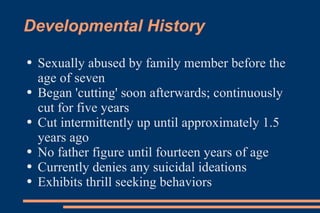
Developmental History Sexually abused by family member before the age of seven Began 'cutting' soon afterwards; continuously cut for five years Cut intermittently up until approximately 1.5 years ago No father figure until fourteen years of age Currently denies any suicidal ideations Exhibits thrill seeking behaviors
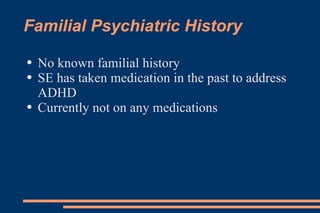
Familial Psychiatric History No known familial history SE has taken medication in the past to address ADHD Currently not on any medications
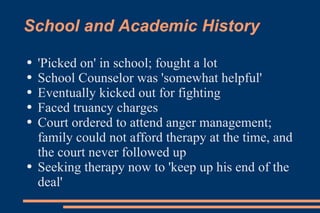
School and Academic History 'Picked on' in school; fought a lot School Counselor was 'somewhat helpful' Eventually kicked out for fighting Faced truancy charges Court ordered to attend anger management; family could not afford therapy at the time, and the court never followed up Seeking therapy now to 'keep up his end of the deal'
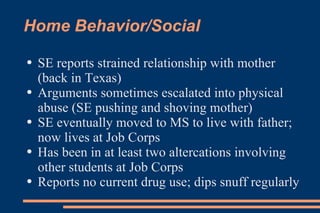
Home Behavior/Social SE reports strained relationship with mother (back in Texas) Arguments sometimes escalated into physical abuse (SE pushing and shoving mother) SE eventually moved to MS to live with father; now lives at Job Corps Has been in at least two altercations involving other students at Job Corps Reports no current drug use; dips snuff regularly
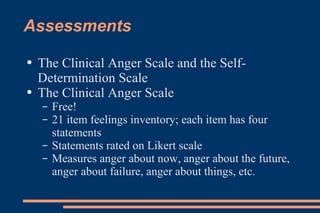
Assessments The Clinical Anger Scale and the Self-Determination Scale The Clinical Anger Scale Free! 21 item feelings inventory; each item has four statements Statements rated on Likert scale Measures anger about now, anger about the future, anger about failure, anger about things, etc.
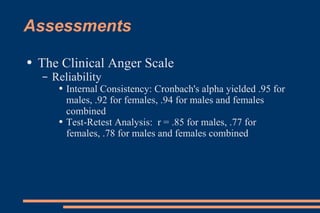
Assessments  The Clinical Anger Scale Reliability Internal Consistency: Cronbach's alpha yielded .95 for males, .92 for females, .94 for males and females combined Test-Retest Analysis:  r = .85 for males, .77 for females, .78 for males and females combined
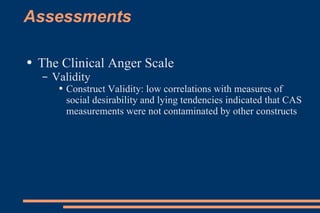
Assessments The Clinical Anger Scale Validity Construct Validity: low correlations with measures of social desirability and lying tendencies indicated that CAS measurements were not contaminated by other constructs
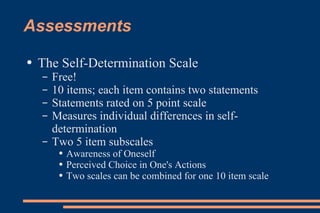
Assessments The Self-Determination Scale Free! 10 items; each item contains two statements Statements rated on 5 point scale Measures individual differences in self-determination Two 5 item subscales Awareness of Oneself Perceived Choice in One's Actions Two scales can be combined for one 10 item scale
Assessments The Self-Determination Scale Reliability Internal Consistency: alphas measured from .85-.93 Test-Retest Reliability: measured over 8 week period;  r = .77
Interpretations The Clinical Anger Scale Scales: 0-13 minimal clinical anger; 14-19 mild clinical anger; 20-28 moderate clinical anger; 29-63 severe clinical anger SE score totals 19, thus falling in the mild clinical anger range Highest scoring item: “I am so intensely angry that I can't get much sleep during the night. 3 points
Interpretations The Self-Determination Scale 5 item subscales totaled (one subscale is reverse scored), then averaged Awareness of Self: 3.8 of 5 possible points Perceived Choice: 4.2 of 5 possible points Scales combined: 8 of 10 possible points Scores indicate a moderately high sense of self-determination
Summary of Findings Both assessments confirm my experience of SE in session: low anger and moderately high self-determination SE has been attending both Anger Management Group and individual counseling sessions for approximately 10 weeks. This fact may account for the assessment scores. SE has reported 0 angered outbursts in the last 6 weeks
Treatment Plans and Recommendations Past individual sessions have underscored contingency management, stimulus control, counterconditioning, and reevaluation as paths to behavior change. Revaluation has been the focus of more recent sessions.  REBT, with its inherent focus on beliefs, has helped SE to understand how his own irrational thoughts have played an integral role in his angered outbursts...
Treatment Plans and Recommendations Thus increasing his awareness of self as well as his perceived choice, and thereby decreasing his measured anger

Se case study take 2

  • 1.
    Case Study forSE Jason Roberts
  • 2.
    Client Description SE:Student Employer (Job Corps) 20 yr old, caucasian male Currently enrolled in Carpentry program Presents with anger management issues
  • 3.
    Developmental History Sexuallyabused by family member before the age of seven Began 'cutting' soon afterwards; continuously cut for five years Cut intermittently up until approximately 1.5 years ago No father figure until fourteen years of age Currently denies any suicidal ideations Exhibits thrill seeking behaviors
  • 4.
    Familial Psychiatric HistoryNo known familial history SE has taken medication in the past to address ADHD Currently not on any medications
  • 5.
    School and AcademicHistory 'Picked on' in school; fought a lot School Counselor was 'somewhat helpful' Eventually kicked out for fighting Faced truancy charges Court ordered to attend anger management; family could not afford therapy at the time, and the court never followed up Seeking therapy now to 'keep up his end of the deal'
  • 6.
    Home Behavior/Social SEreports strained relationship with mother (back in Texas) Arguments sometimes escalated into physical abuse (SE pushing and shoving mother) SE eventually moved to MS to live with father; now lives at Job Corps Has been in at least two altercations involving other students at Job Corps Reports no current drug use; dips snuff regularly
  • 7.
    Assessments The ClinicalAnger Scale and the Self-Determination Scale The Clinical Anger Scale Free! 21 item feelings inventory; each item has four statements Statements rated on Likert scale Measures anger about now, anger about the future, anger about failure, anger about things, etc.
  • 8.
    Assessments TheClinical Anger Scale Reliability Internal Consistency: Cronbach's alpha yielded .95 for males, .92 for females, .94 for males and females combined Test-Retest Analysis: r = .85 for males, .77 for females, .78 for males and females combined
  • 9.
    Assessments The ClinicalAnger Scale Validity Construct Validity: low correlations with measures of social desirability and lying tendencies indicated that CAS measurements were not contaminated by other constructs
  • 10.
    Assessments The Self-DeterminationScale Free! 10 items; each item contains two statements Statements rated on 5 point scale Measures individual differences in self-determination Two 5 item subscales Awareness of Oneself Perceived Choice in One's Actions Two scales can be combined for one 10 item scale
  • 11.
    Assessments The Self-DeterminationScale Reliability Internal Consistency: alphas measured from .85-.93 Test-Retest Reliability: measured over 8 week period; r = .77
  • 12.
    Interpretations The ClinicalAnger Scale Scales: 0-13 minimal clinical anger; 14-19 mild clinical anger; 20-28 moderate clinical anger; 29-63 severe clinical anger SE score totals 19, thus falling in the mild clinical anger range Highest scoring item: “I am so intensely angry that I can't get much sleep during the night. 3 points
  • 13.
    Interpretations The Self-DeterminationScale 5 item subscales totaled (one subscale is reverse scored), then averaged Awareness of Self: 3.8 of 5 possible points Perceived Choice: 4.2 of 5 possible points Scales combined: 8 of 10 possible points Scores indicate a moderately high sense of self-determination
  • 14.
    Summary of FindingsBoth assessments confirm my experience of SE in session: low anger and moderately high self-determination SE has been attending both Anger Management Group and individual counseling sessions for approximately 10 weeks. This fact may account for the assessment scores. SE has reported 0 angered outbursts in the last 6 weeks
  • 15.
    Treatment Plans andRecommendations Past individual sessions have underscored contingency management, stimulus control, counterconditioning, and reevaluation as paths to behavior change. Revaluation has been the focus of more recent sessions. REBT, with its inherent focus on beliefs, has helped SE to understand how his own irrational thoughts have played an integral role in his angered outbursts...
  • 16.
    Treatment Plans andRecommendations Thus increasing his awareness of self as well as his perceived choice, and thereby decreasing his measured anger