Apache Mahout
Thursday, November 4, 2010
Apache Mahout
Now with extra whitening and classification powers!
Thursday, November 4, 2010
• Mahout intro
• Scalability in general
• Supervised learning recap
• The new SGD classifiers
Thursday, November 4, 2010
Mahout?
• Hebrew for “essence”
• Hindi for a guy who drives an elephant
Thursday, November 4, 2010
Mahout?
• Hebrew for “essence”
• Hindi for a guy who drives an elephant
Thursday, November 4, 2010
Mahout?
• Hebrew for “essence”
• Hindi for a guy who drives an elephant
Thursday, November 4, 2010
Mahout!
• Scalable data-mining and recommendations
• Not all data-mining
• Not the fanciest data-mining
• Just some of the scalable stuff
• Not a competitor for R or Weka
Thursday, November 4, 2010
General Areas
• Recommendations
• lots of support, lots of flexibility,
production ready
• Unsupervised learning (clustering)
• lots of options, lots of flexibility,
production ready (ish)
Thursday, November 4, 2010
General Areas
• Supervised learning (classification)
• multiple architectures, fair number of
options, somewhat inter-operable
• production ready (for the right definition
of production and ready)
• Large scale SVD
• larger scale coming, beware sharp edges
Thursday, November 4, 2010
Scalable?
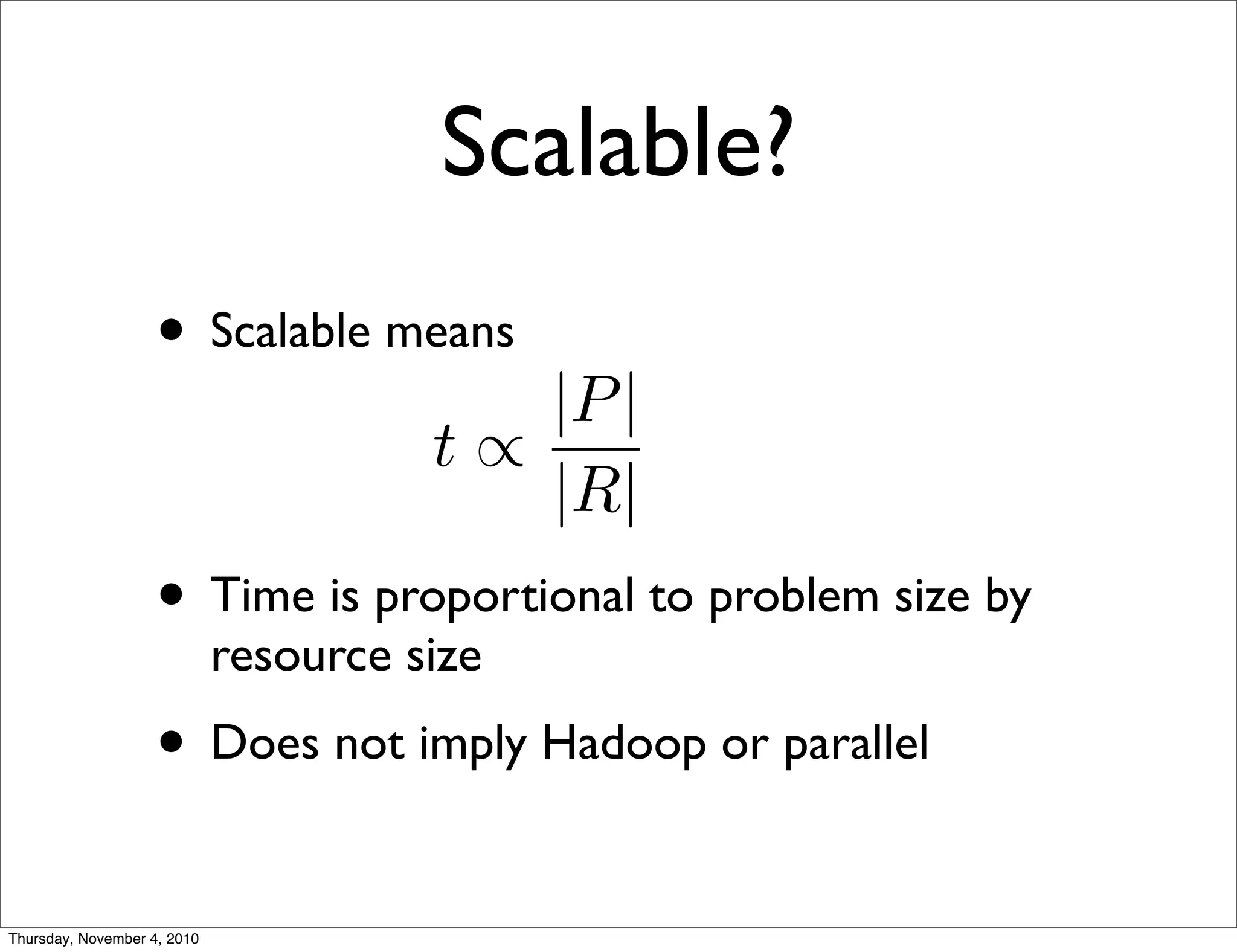
• Scalable means
• Time is proportional to problem size by
resource size
• Does not imply Hadoop or parallel
THE AUTHOR
t ∝
|P|
|R|
Thursday, November 4, 2010
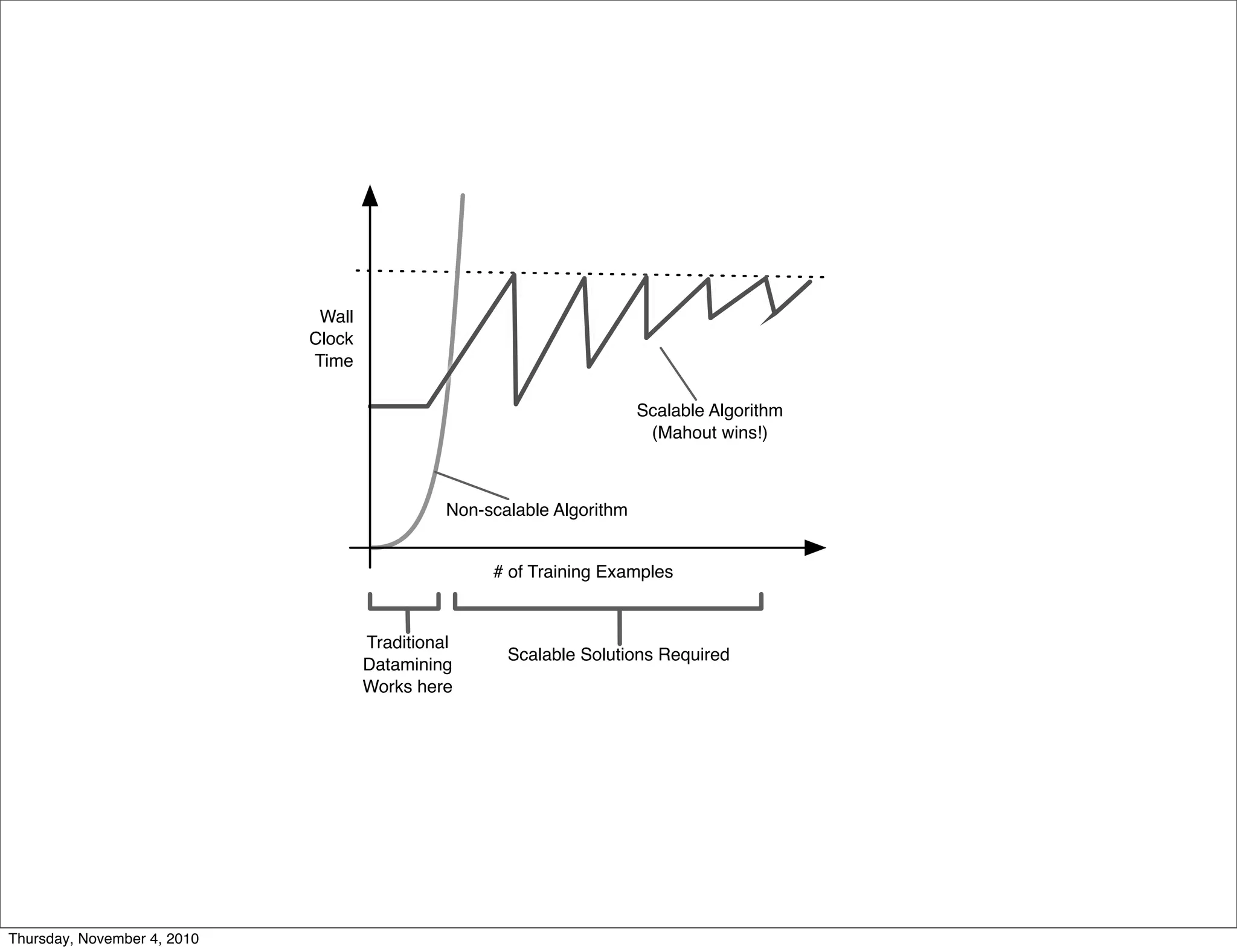
Wall
Clock
Time
# of Training Examples
Scalable Algorithm
(Mahout wins!)
Traditional
Datamining
Works here
Scalable Solutions Required
Non-scalable Algorithm
Thursday, November 4, 2010
Scalable means ...
• One unit of work requires about a unit of
time
• Not like the company store (bit.ly/22XVa4)
t ∝
|P|
|R|
|P| = O(1) =⇒ t = O(1)
Thursday, November 4, 2010
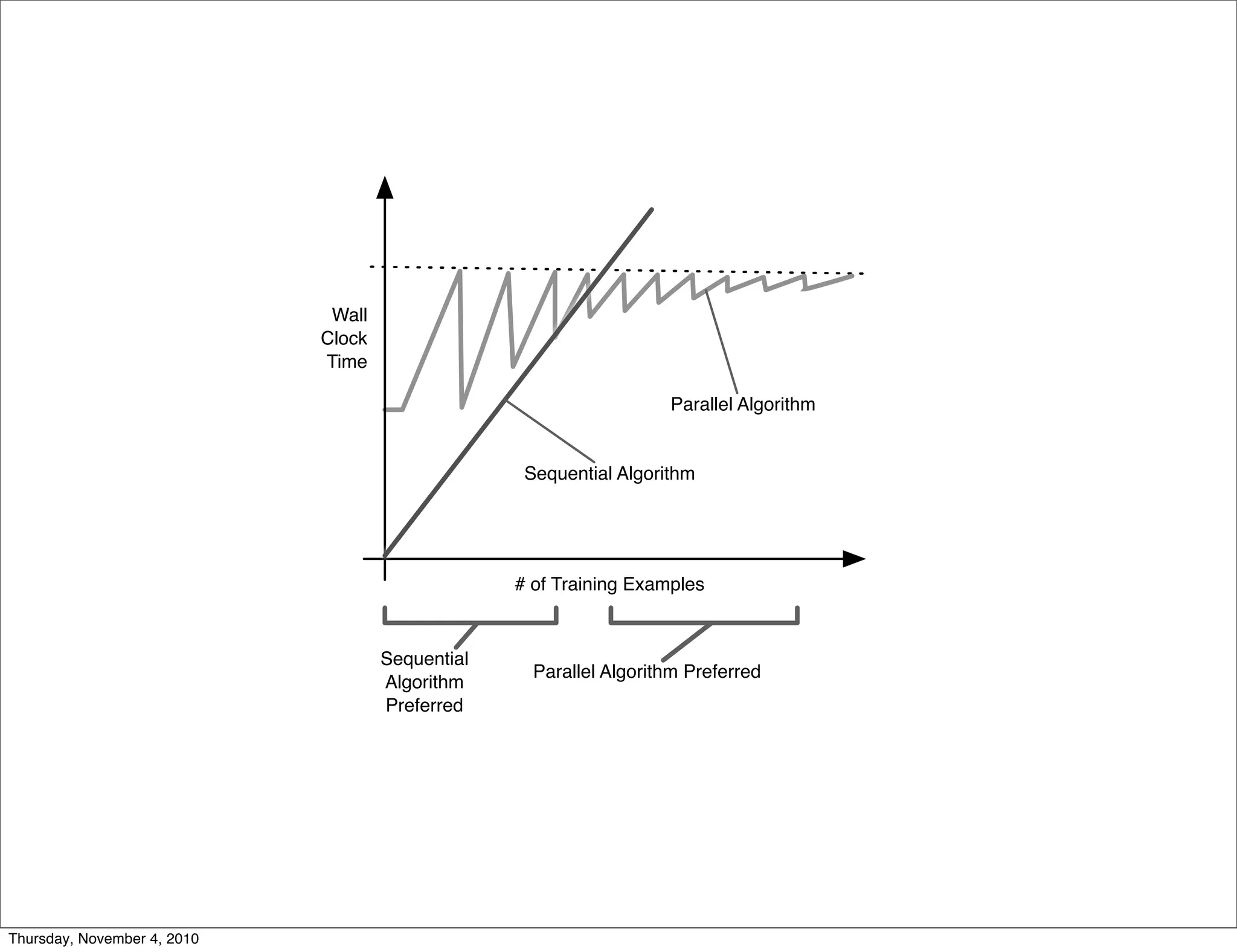
Wall
Clock
Time
# of Training Examples
Parallel Algorithm
Sequential
Algorithm
Preferred
Parallel Algorithm Preferred
Sequential Algorithm
Thursday, November 4, 2010
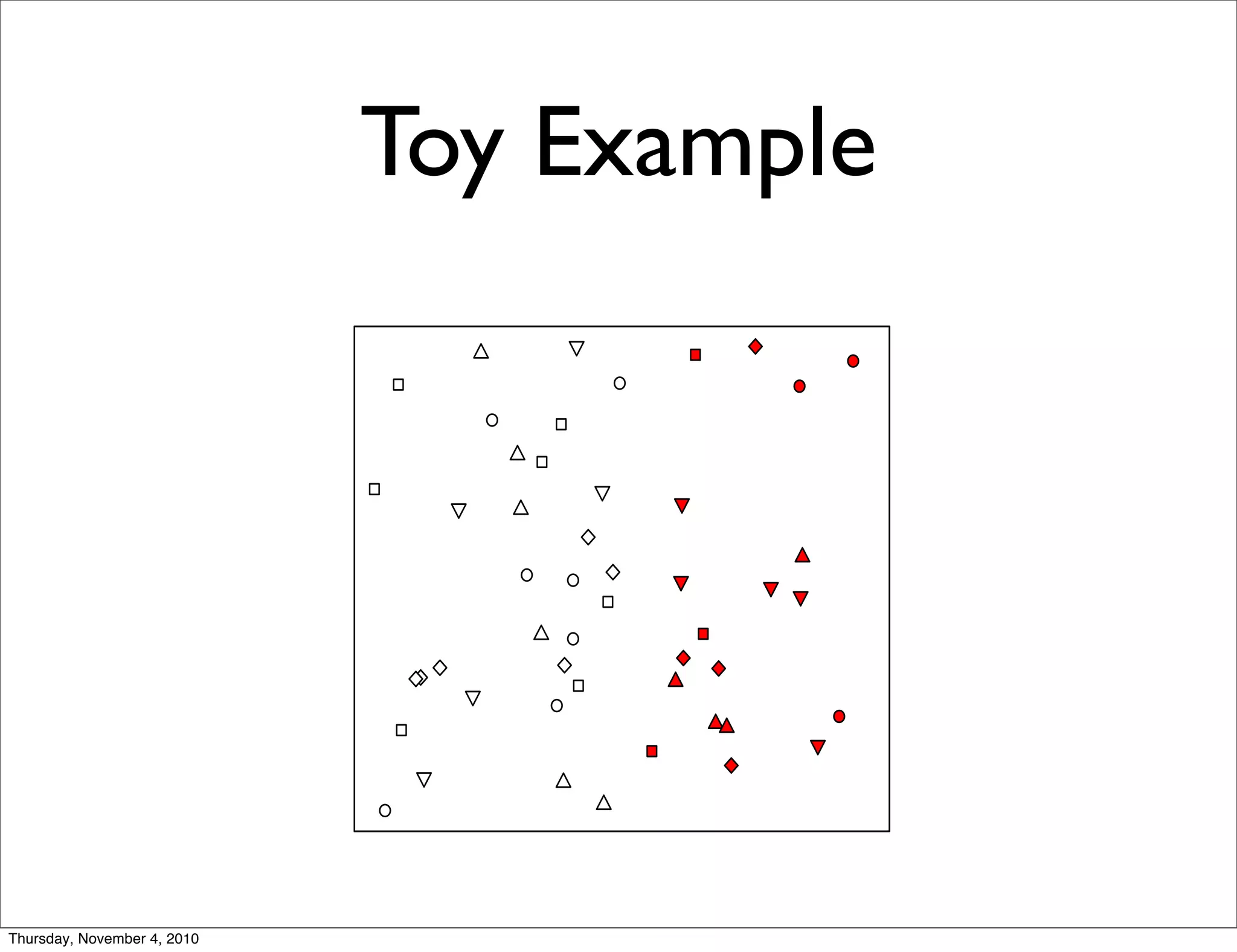
Toy Example
Thursday, November 4, 2010
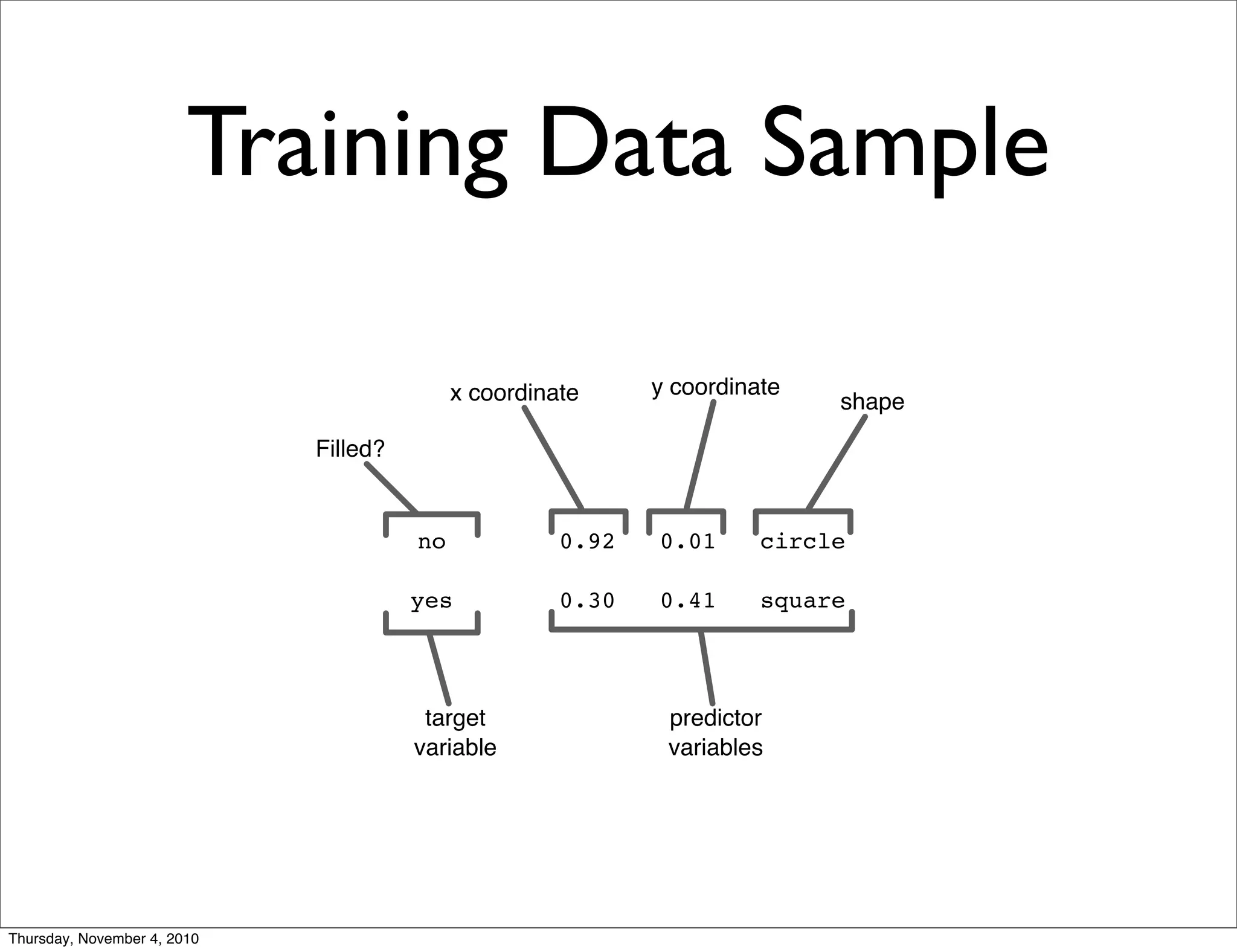
Training Data Sample
yes
no 0.92 0.01 circle
0.30 0.41 square
Filled?
x coordinate y coordinate
shape
predictor
variables
target
variable
Thursday, November 4, 2010
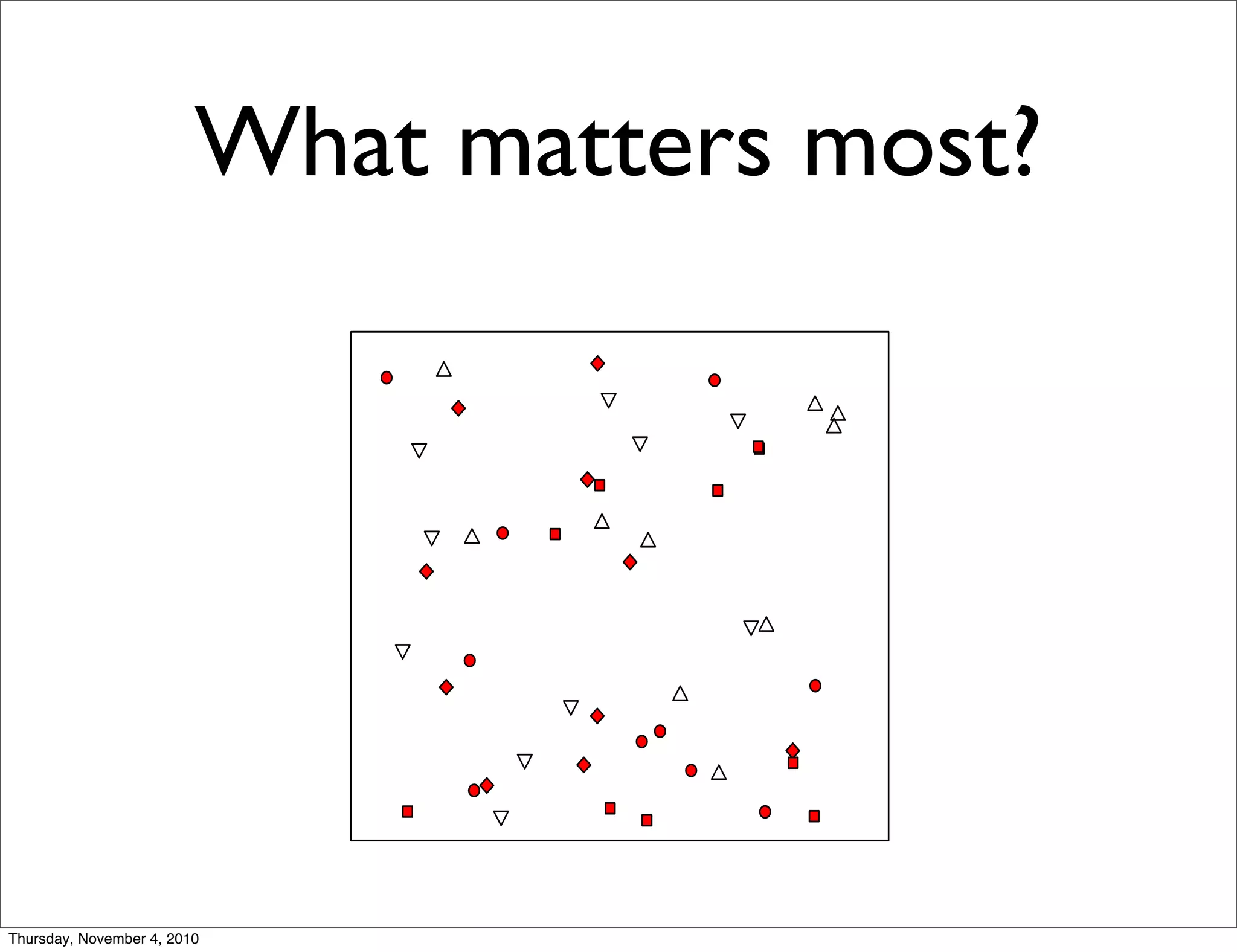
What matters most?
!
!
!
!
!
!
!
!
!
!
Thursday, November 4, 2010
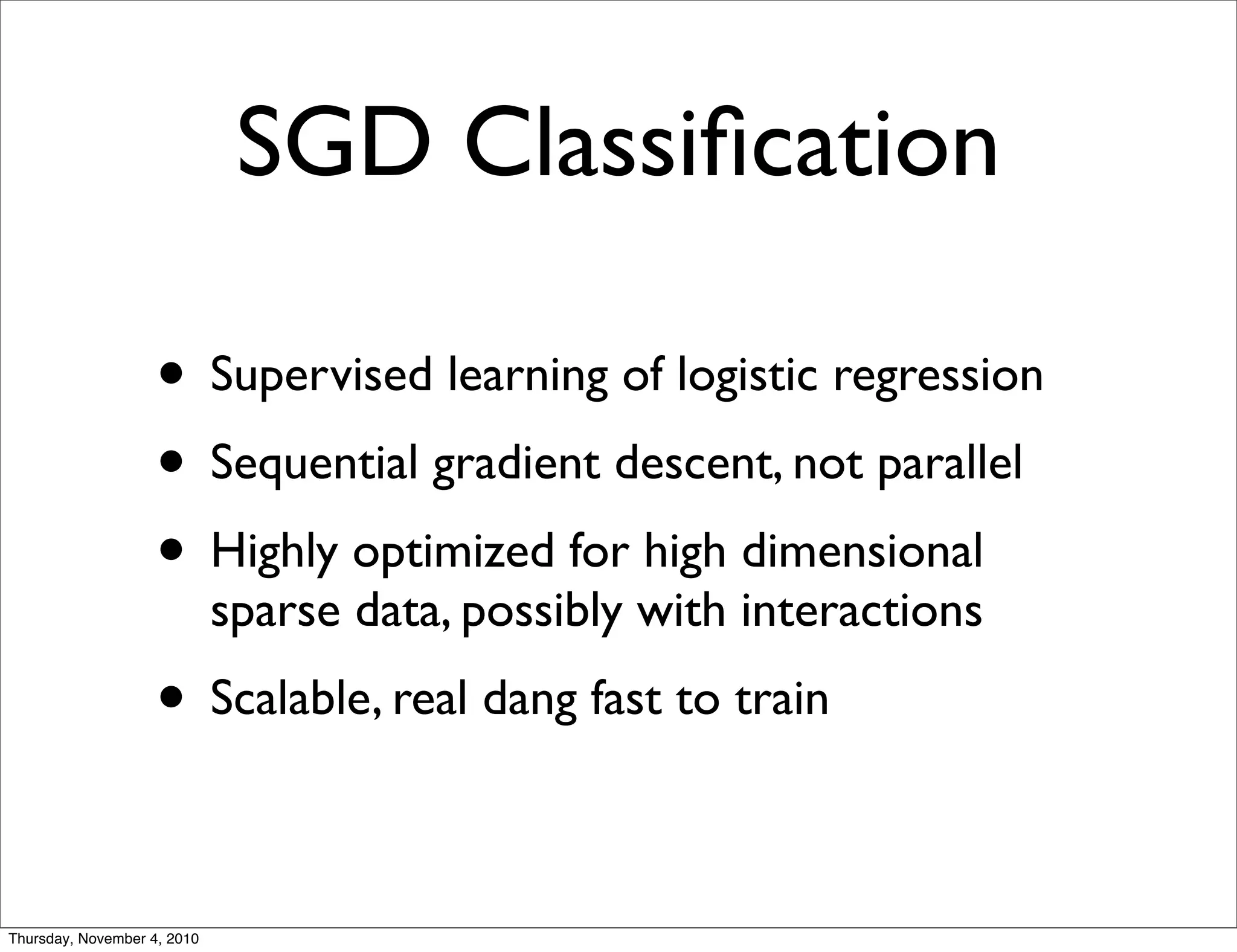
SGD Classification
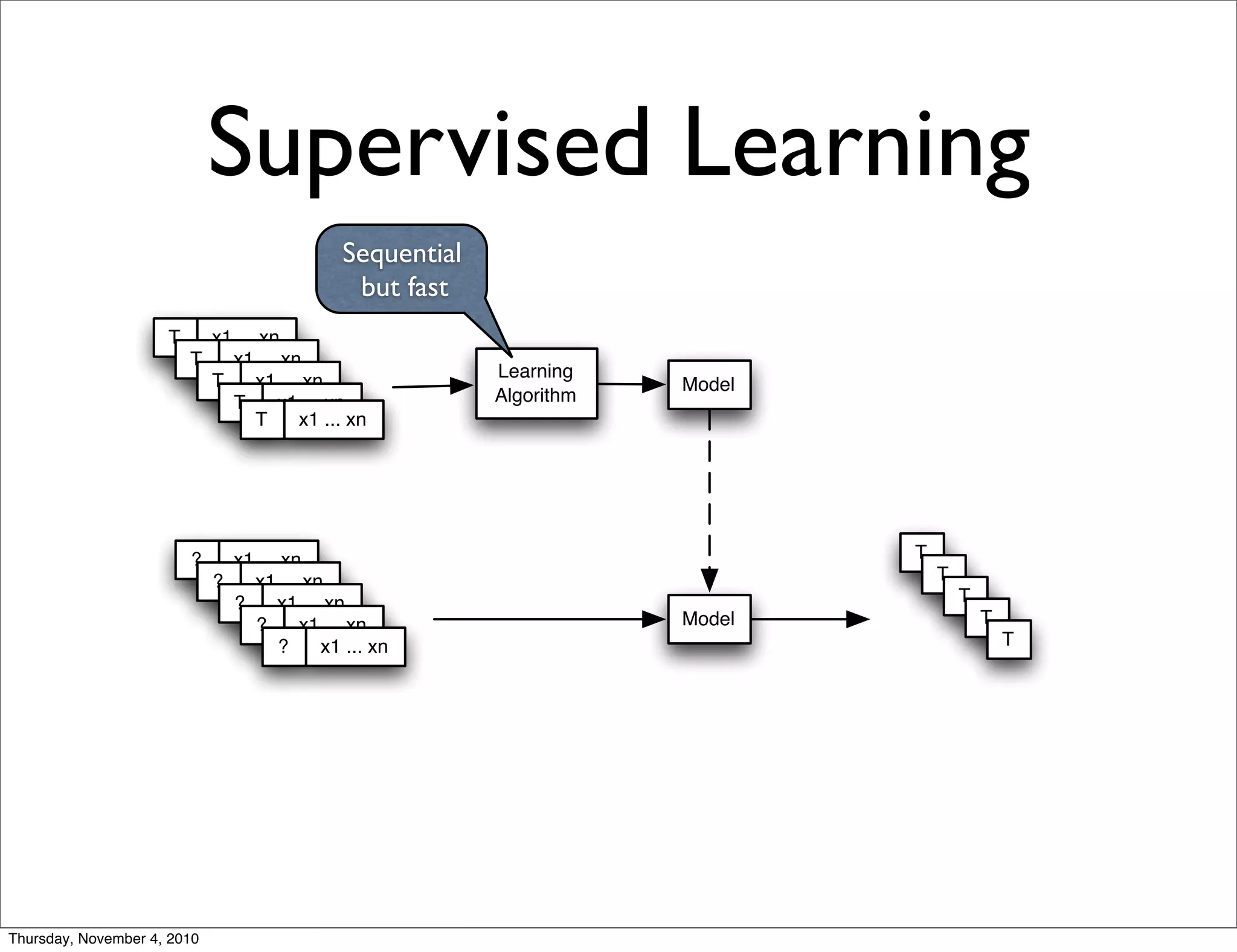
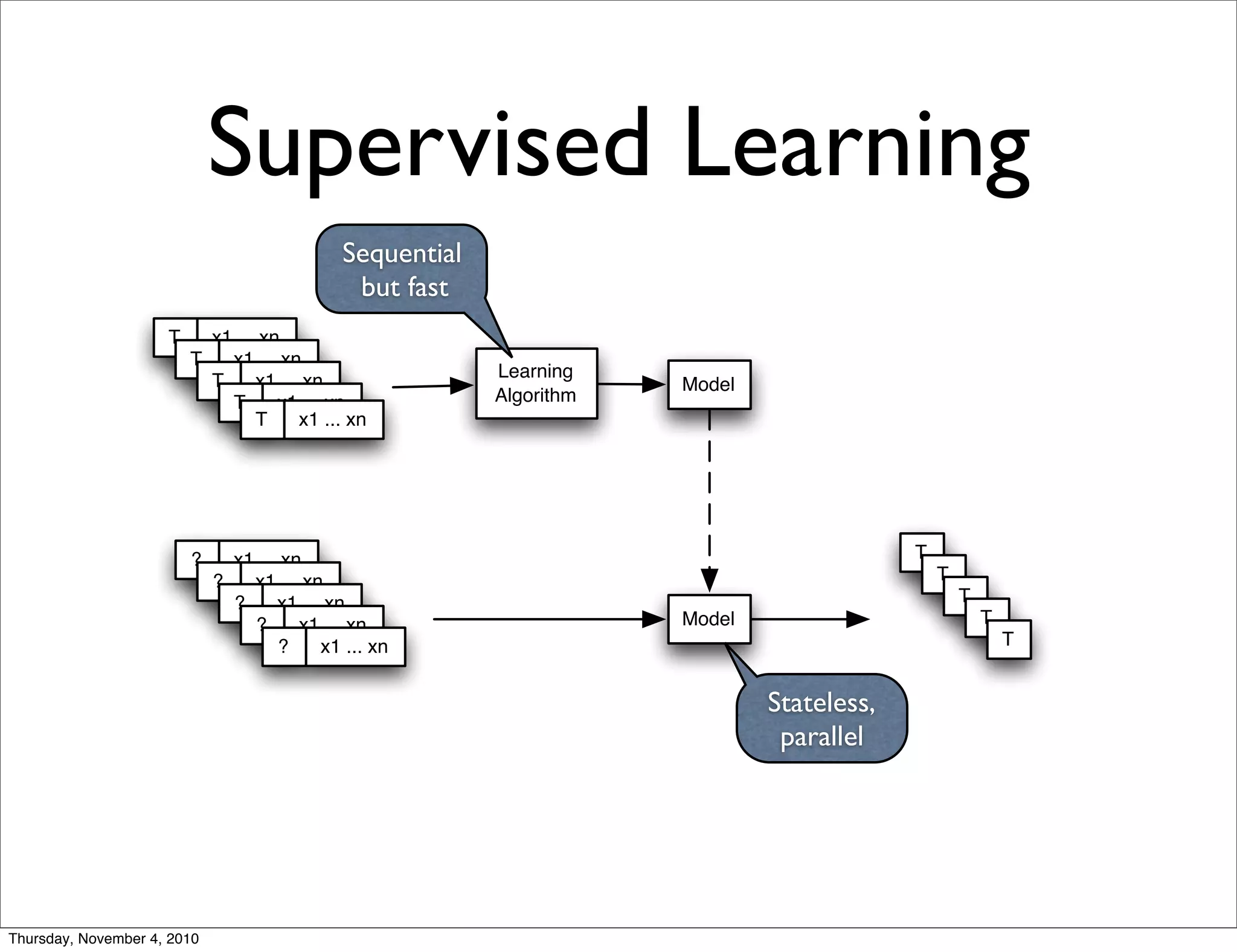
• Supervised learning of logistic regression
• Sequential gradient descent, not parallel
• Highly optimized for high dimensional
sparse data, possibly with interactions
• Scalable, real dang fast to train
Thursday, November 4, 2010
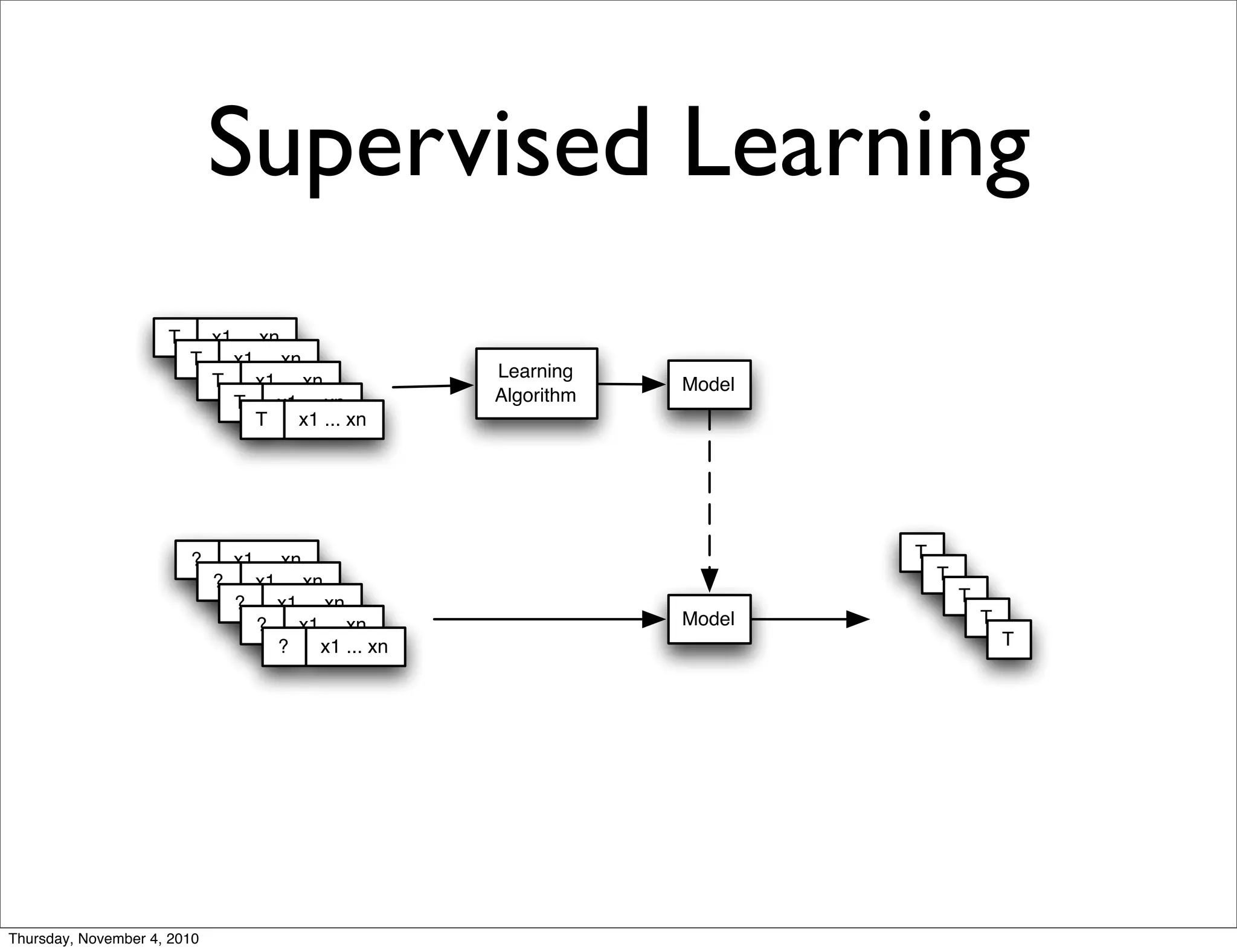
Supervised Learning
T x1 ... xn
T x1 ... xn
T x1 ... xn
T x1 ... xn
T x1 ... xn
Model
Model
T
T
T
T
T
Learning
Algorithm
? x1 ... xn
? x1 ... xn
? x1 ... xn
? x1 ... xn
? x1 ... xn
Thursday, November 4, 2010
Supervised Learning
T x1 ... xn
T x1 ... xn
T x1 ... xn
T x1 ... xn
T x1 ... xn
Model
Model
T
T
T
T
T
Learning
Algorithm
? x1 ... xn
? x1 ... xn
? x1 ... xn
? x1 ... xn
? x1 ... xn
Sequential
but fast
Thursday, November 4, 2010
Supervised Learning
T x1 ... xn
T x1 ... xn
T x1 ... xn
T x1 ... xn
T x1 ... xn
Model
Model
T
T
T
T
T
Learning
Algorithm
? x1 ... xn
? x1 ... xn
? x1 ... xn
? x1 ... xn
? x1 ... xn
Sequential
but fast
Stateless,
parallel
Thursday, November 4, 2010
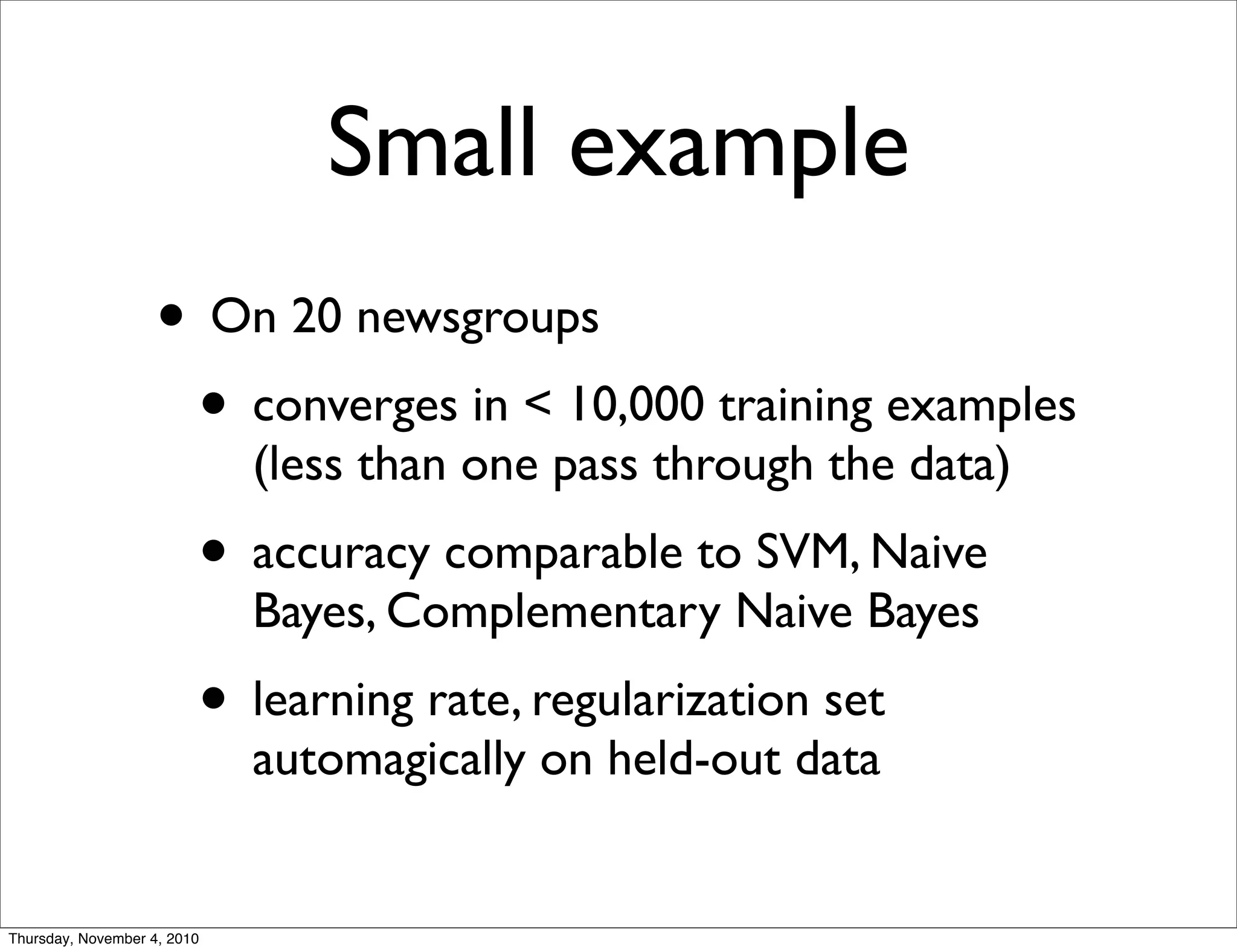
Small example
• On 20 newsgroups
• converges in < 10,000 training examples
(less than one pass through the data)
• accuracy comparable to SVM, Naive
Bayes, Complementary Naive Bayes
• learning rate, regularization set
automagically on held-out data
Thursday, November 4, 2010
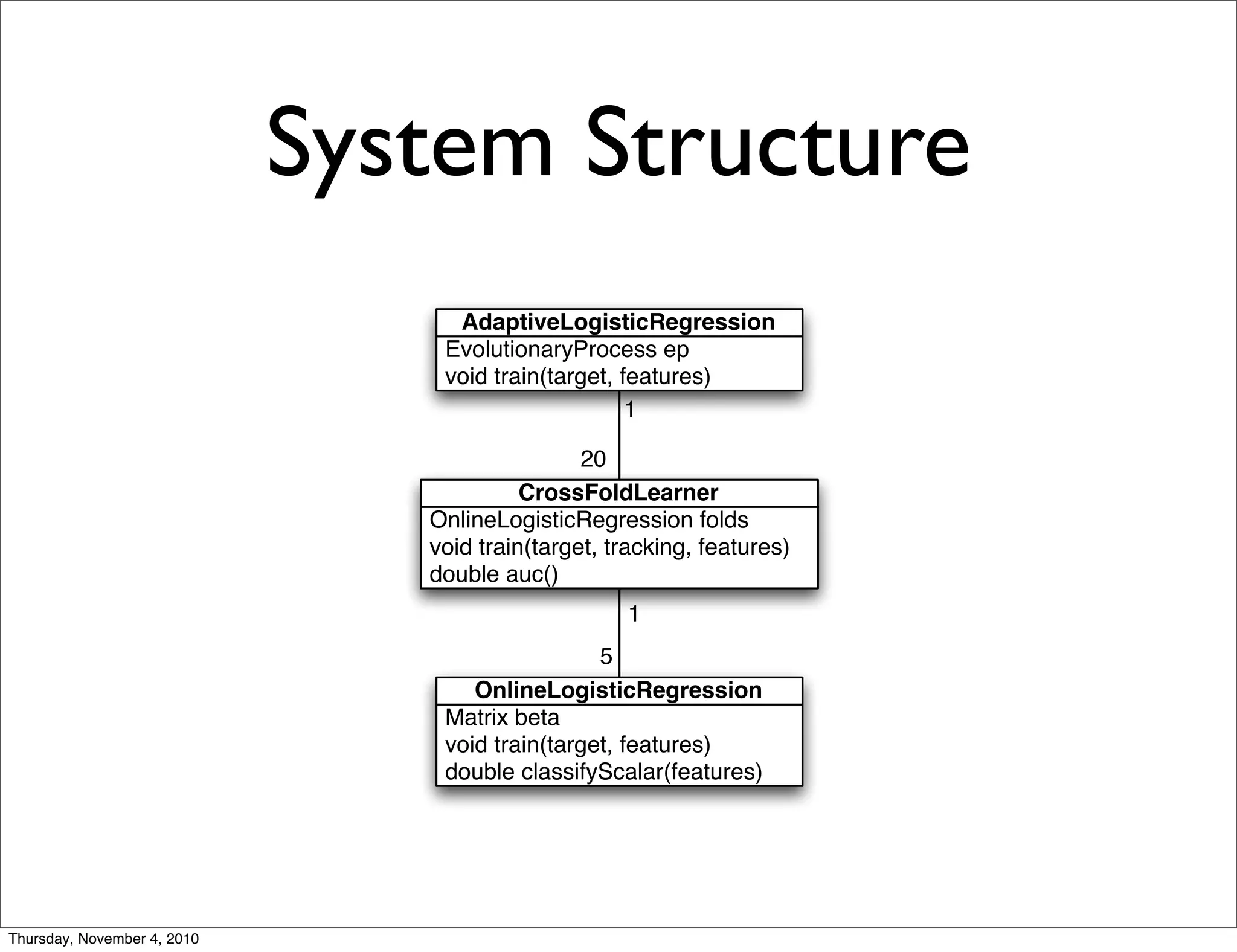
System Structure
EvolutionaryProcess ep
void train(target, features)
AdaptiveLogisticRegression
20
1
OnlineLogisticRegression folds
void train(target, tracking, features)
double auc()
CrossFoldLearner
5
1
Matrix beta
void train(target, features)
double classifyScalar(features)
OnlineLogisticRegression
Thursday, November 4, 2010
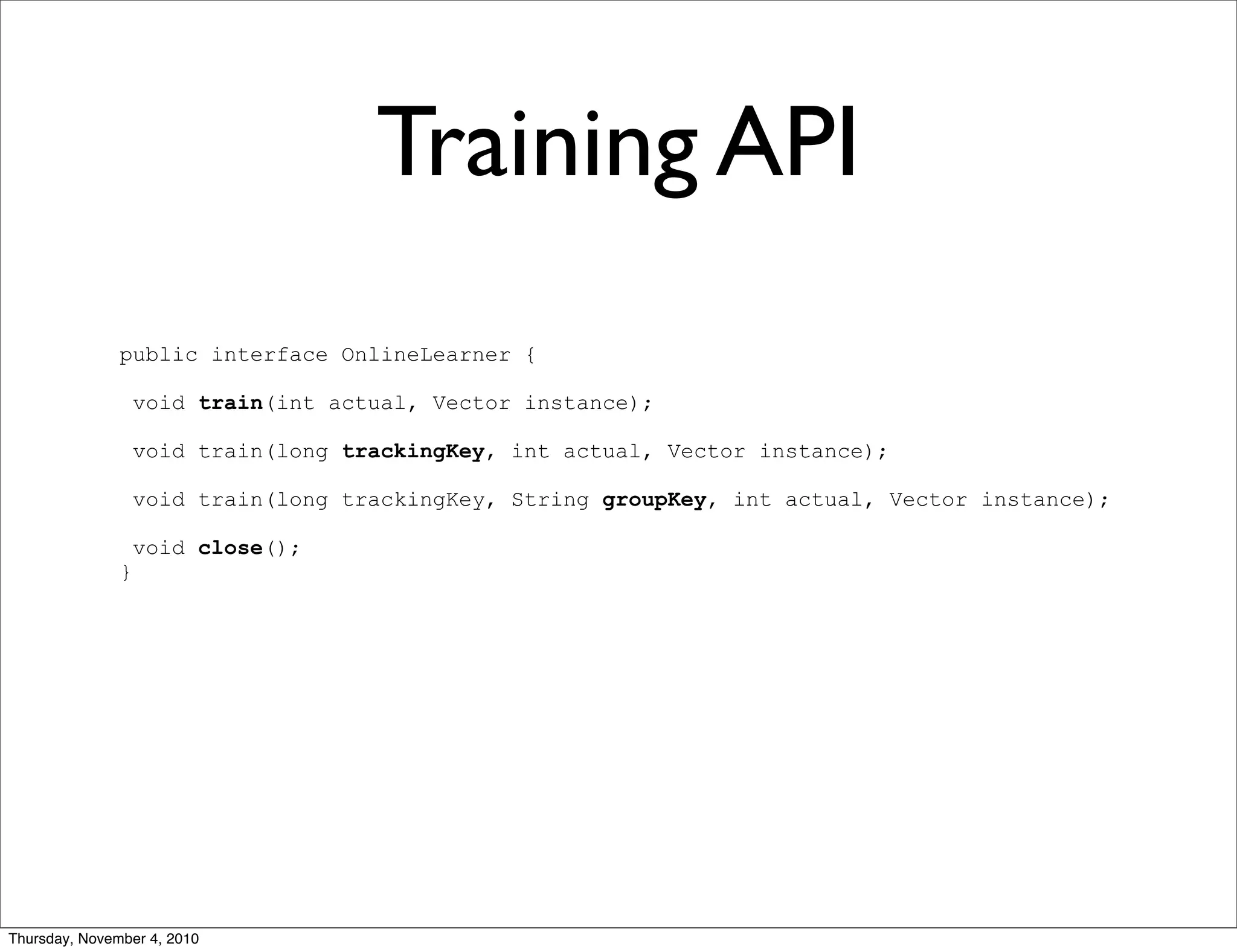
Training API
public interface OnlineLearner {
void train(int actual, Vector instance);
void train(long trackingKey, int actual, Vector instance);
void train(long trackingKey, String groupKey, int actual, Vector instance);
void close();
}
Thursday, November 4, 2010
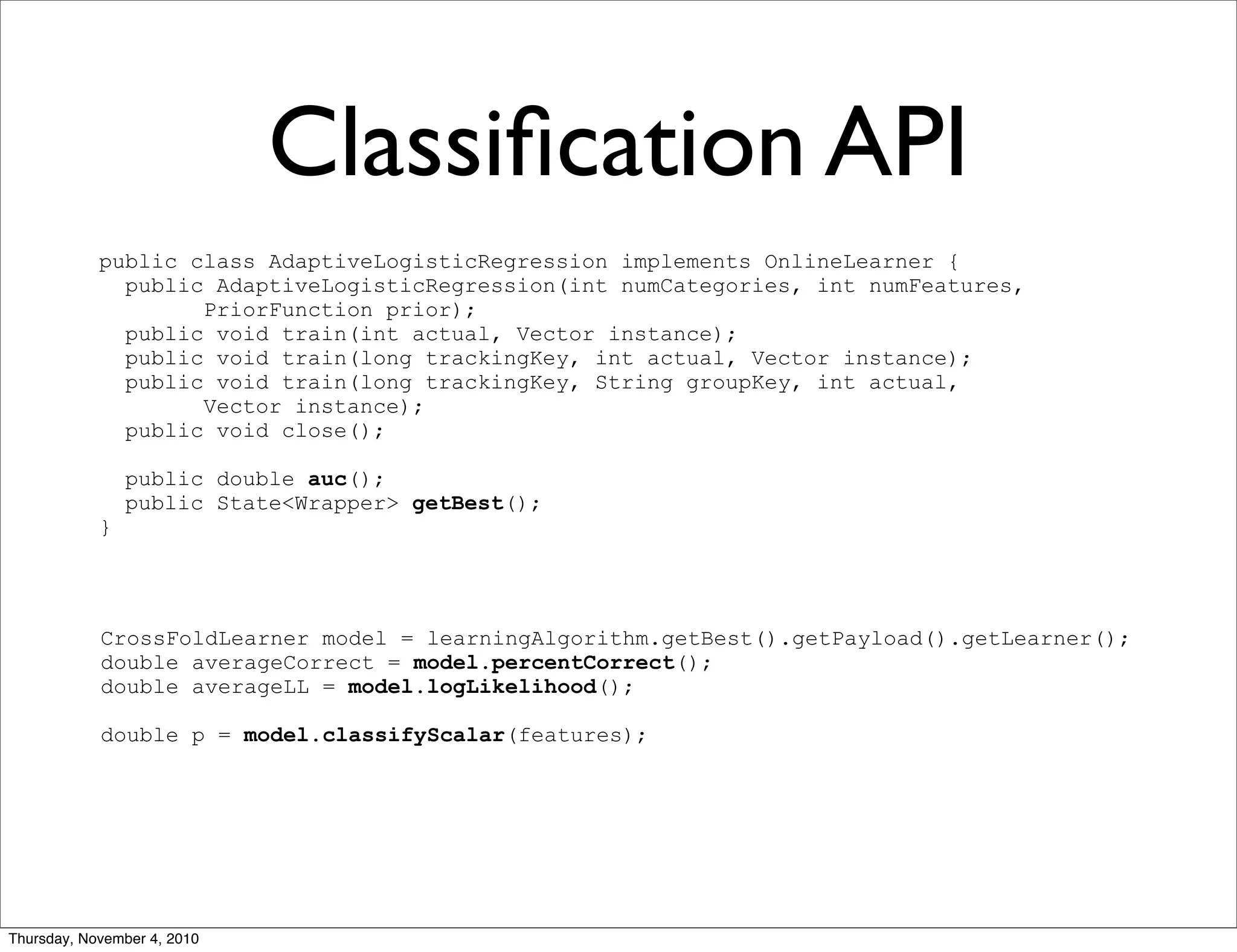
Classification API
public class AdaptiveLogisticRegression implements OnlineLearner {
public AdaptiveLogisticRegression(int numCategories, int numFeatures,
PriorFunction prior);
public void train(int actual, Vector instance);
public void train(long trackingKey, int actual, Vector instance);
public void train(long trackingKey, String groupKey, int actual,
Vector instance);
public void close();
public double auc();
public State<Wrapper> getBest();
}
CrossFoldLearner model = learningAlgorithm.getBest().getPayload().getLearner();
double averageCorrect = model.percentCorrect();
double averageLL = model.logLikelihood();
double p = model.classifyScalar(features);
Thursday, November 4, 2010
Speed?
• Encoding API for hashed feature vectors
• String, byte[] or double interfaces
• String allows simple parsing
• byte[] and double allows speed
• Abstract interactions supported
Thursday, November 4, 2010
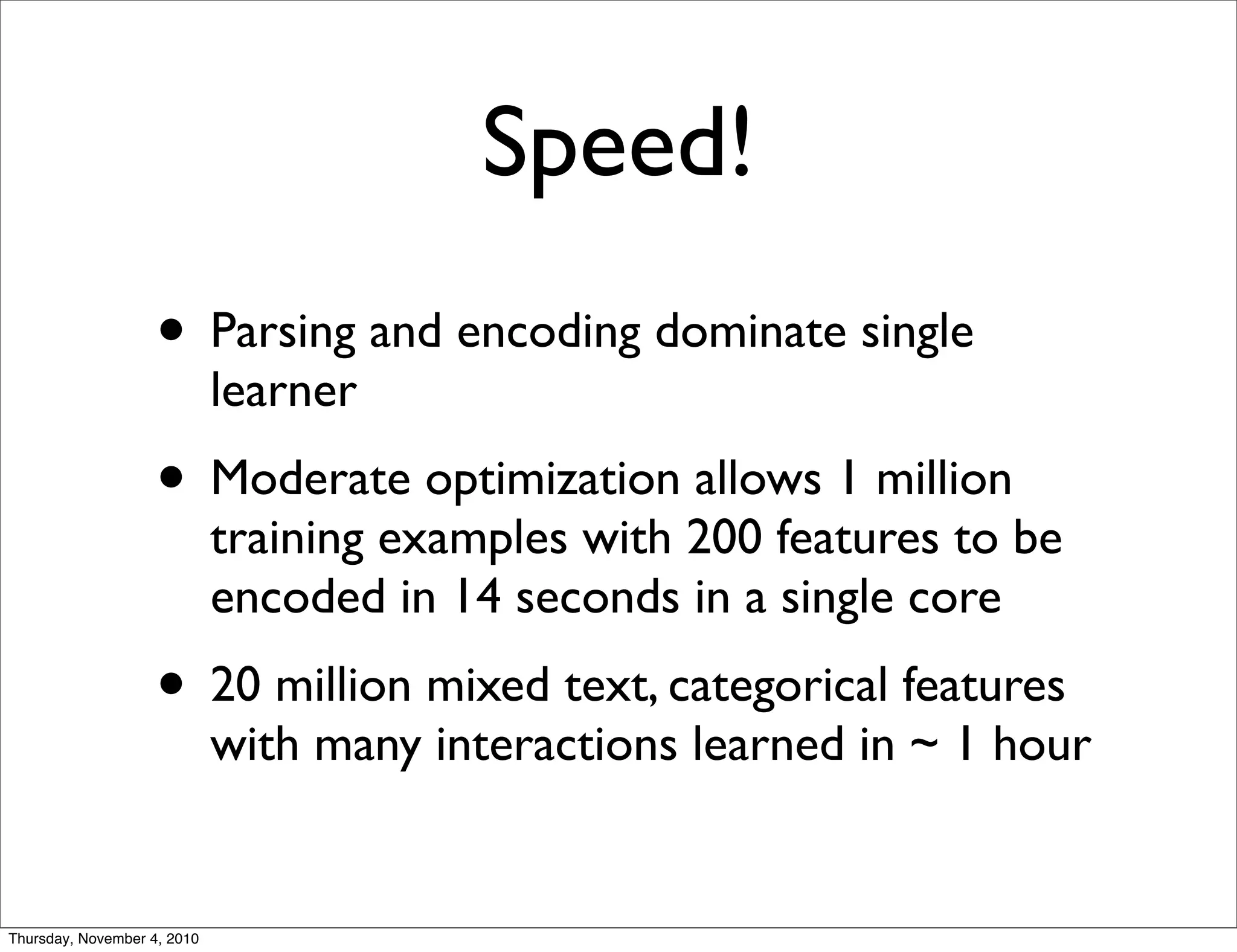
Speed!
• Parsing and encoding dominate single
learner
• Moderate optimization allows 1 million
training examples with 200 features to be
encoded in 14 seconds in a single core
• 20 million mixed text, categorical features
with many interactions learned in ~ 1 hour
Thursday, November 4, 2010
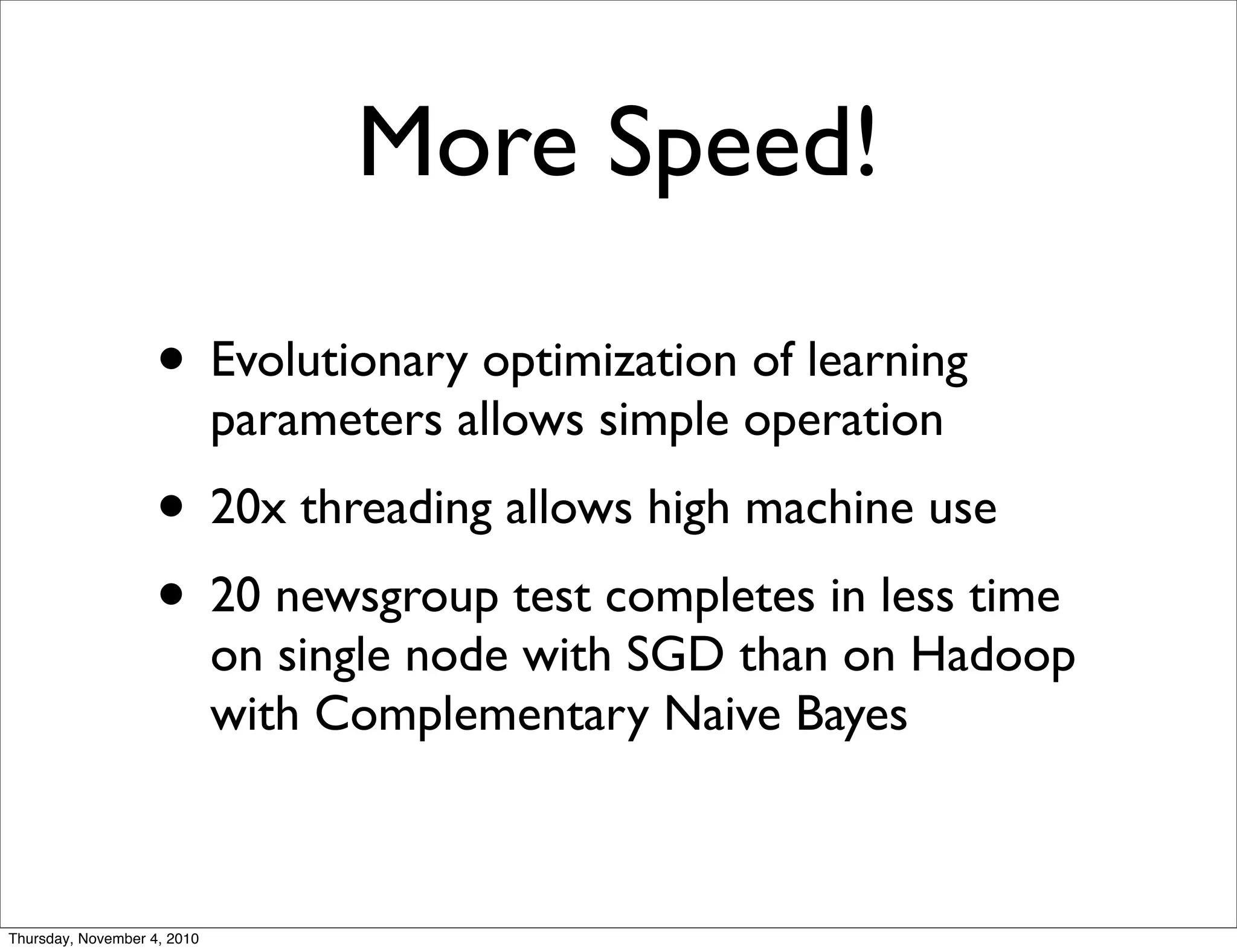
More Speed!
• Evolutionary optimization of learning
parameters allows simple operation
• 20x threading allows high machine use
• 20 newsgroup test completes in less time
on single node with SGD than on Hadoop
with Complementary Naive Bayes
Thursday, November 4, 2010
Summary
• Mahout provides early production quality
scalable data-mining
• New classification systems allow industrial
scale classification
Thursday, November 4, 2010
Contact Info
Ted Dunning
tdunning@maprtech.com
Thursday, November 4, 2010
Contact Info
Ted Dunning
tdunning@maprtech.com
or tdunning@apache.com
Thursday, November 4, 2010

Sdforum 11-04-2010

  • 1.
  • 2.
    Apache Mahout Now withextra whitening and classification powers! Thursday, November 4, 2010
  • 3.
    • Mahout intro •Scalability in general • Supervised learning recap • The new SGD classifiers Thursday, November 4, 2010
  • 4.
    Mahout? • Hebrew for“essence” • Hindi for a guy who drives an elephant Thursday, November 4, 2010
  • 5.
    Mahout? • Hebrew for“essence” • Hindi for a guy who drives an elephant Thursday, November 4, 2010
  • 6.
    Mahout? • Hebrew for“essence” • Hindi for a guy who drives an elephant Thursday, November 4, 2010
  • 7.
    Mahout! • Scalable data-miningand recommendations • Not all data-mining • Not the fanciest data-mining • Just some of the scalable stuff • Not a competitor for R or Weka Thursday, November 4, 2010
  • 8.
    General Areas • Recommendations •lots of support, lots of flexibility, production ready • Unsupervised learning (clustering) • lots of options, lots of flexibility, production ready (ish) Thursday, November 4, 2010
  • 9.
    General Areas • Supervisedlearning (classification) • multiple architectures, fair number of options, somewhat inter-operable • production ready (for the right definition of production and ready) • Large scale SVD • larger scale coming, beware sharp edges Thursday, November 4, 2010
  • 10.
    Scalable? • Scalable means •Time is proportional to problem size by resource size • Does not imply Hadoop or parallel THE AUTHOR t ∝ |P| |R| Thursday, November 4, 2010
  • 11.
    Wall Clock Time # of TrainingExamples Scalable Algorithm (Mahout wins!) Traditional Datamining Works here Scalable Solutions Required Non-scalable Algorithm Thursday, November 4, 2010
  • 12.
    Scalable means ... •One unit of work requires about a unit of time • Not like the company store (bit.ly/22XVa4) t ∝ |P| |R| |P| = O(1) =⇒ t = O(1) Thursday, November 4, 2010
  • 13.
    Wall Clock Time # of TrainingExamples Parallel Algorithm Sequential Algorithm Preferred Parallel Algorithm Preferred Sequential Algorithm Thursday, November 4, 2010
  • 14.
  • 15.
    Training Data Sample yes no0.92 0.01 circle 0.30 0.41 square Filled? x coordinate y coordinate shape predictor variables target variable Thursday, November 4, 2010
  • 16.
  • 17.
    SGD Classification • Supervisedlearning of logistic regression • Sequential gradient descent, not parallel • Highly optimized for high dimensional sparse data, possibly with interactions • Scalable, real dang fast to train Thursday, November 4, 2010
  • 18.
    Supervised Learning T x1... xn T x1 ... xn T x1 ... xn T x1 ... xn T x1 ... xn Model Model T T T T T Learning Algorithm ? x1 ... xn ? x1 ... xn ? x1 ... xn ? x1 ... xn ? x1 ... xn Thursday, November 4, 2010
  • 19.
    Supervised Learning T x1... xn T x1 ... xn T x1 ... xn T x1 ... xn T x1 ... xn Model Model T T T T T Learning Algorithm ? x1 ... xn ? x1 ... xn ? x1 ... xn ? x1 ... xn ? x1 ... xn Sequential but fast Thursday, November 4, 2010
  • 20.
    Supervised Learning T x1... xn T x1 ... xn T x1 ... xn T x1 ... xn T x1 ... xn Model Model T T T T T Learning Algorithm ? x1 ... xn ? x1 ... xn ? x1 ... xn ? x1 ... xn ? x1 ... xn Sequential but fast Stateless, parallel Thursday, November 4, 2010
  • 21.
    Small example • On20 newsgroups • converges in < 10,000 training examples (less than one pass through the data) • accuracy comparable to SVM, Naive Bayes, Complementary Naive Bayes • learning rate, regularization set automagically on held-out data Thursday, November 4, 2010
  • 22.
    System Structure EvolutionaryProcess ep voidtrain(target, features) AdaptiveLogisticRegression 20 1 OnlineLogisticRegression folds void train(target, tracking, features) double auc() CrossFoldLearner 5 1 Matrix beta void train(target, features) double classifyScalar(features) OnlineLogisticRegression Thursday, November 4, 2010
  • 23.
    Training API public interfaceOnlineLearner { void train(int actual, Vector instance); void train(long trackingKey, int actual, Vector instance); void train(long trackingKey, String groupKey, int actual, Vector instance); void close(); } Thursday, November 4, 2010
  • 24.
    Classification API public classAdaptiveLogisticRegression implements OnlineLearner { public AdaptiveLogisticRegression(int numCategories, int numFeatures, PriorFunction prior); public void train(int actual, Vector instance); public void train(long trackingKey, int actual, Vector instance); public void train(long trackingKey, String groupKey, int actual, Vector instance); public void close(); public double auc(); public State<Wrapper> getBest(); } CrossFoldLearner model = learningAlgorithm.getBest().getPayload().getLearner(); double averageCorrect = model.percentCorrect(); double averageLL = model.logLikelihood(); double p = model.classifyScalar(features); Thursday, November 4, 2010
  • 25.
    Speed? • Encoding APIfor hashed feature vectors • String, byte[] or double interfaces • String allows simple parsing • byte[] and double allows speed • Abstract interactions supported Thursday, November 4, 2010
  • 26.
    Speed! • Parsing andencoding dominate single learner • Moderate optimization allows 1 million training examples with 200 features to be encoded in 14 seconds in a single core • 20 million mixed text, categorical features with many interactions learned in ~ 1 hour Thursday, November 4, 2010
  • 27.
    More Speed! • Evolutionaryoptimization of learning parameters allows simple operation • 20x threading allows high machine use • 20 newsgroup test completes in less time on single node with SGD than on Hadoop with Complementary Naive Bayes Thursday, November 4, 2010
  • 28.
    Summary • Mahout providesearly production quality scalable data-mining • New classification systems allow industrial scale classification Thursday, November 4, 2010
  • 29.
  • 30.
    Contact Info Ted Dunning tdunning@maprtech.com ortdunning@apache.com Thursday, November 4, 2010