INTRODUCTION
TO DATA SCIENCE
J O S E P H I TO PA ( M L E N G I N E E R , O M D E N A & R A 3 6 5 )
F A V O R E D O N L I N E
OUTLINE
• What is Data Science? Branches of Data Science.
• Importing library
• Python in-built Methods: print, type, len, min, max.
• Data type and structures: Integer, Float, Strings, List, Dictionary, Tuple; indexing and
slicing.
• Python Functions: Methods and Classes
• Python Statements and Loops: For loop, while loop, if, if-else, break, continue.
WEEK - 1
WEEK - 1
 The ability to take data—to be able to understand it, to process it, to
extract value from it, to visualize it, to communicate it —that’s going to
be a hugely important skill in the next decades. – Han Varians
 The future belongs to the companies and people that turn data into
products - Mike Loukides (VP Content Strategy @ O’Reilly)
WHAT IS DATA SCIENCE?
WEEK - 1
https://www.google.com/url?sa=i&url=https%3A%2F%2Fwww.contino.io%2Finsights%2Fthe-future-of-artificial-intelligence-and-machine-learning-for-financial-services&psig=AOvVaw0Qa-
PssCxxGLxBPZd-6FYz&ust=1604048462298000&source=images&cd=vfe&ved=0CA0QjhxqFwoTCPCyl7i42ewCFQAAAAAdAAAAABAJ
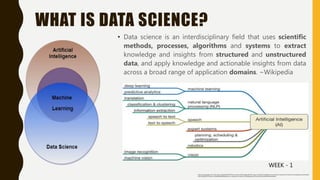
• Data science is an interdisciplinary field that uses scientific
methods, processes, algorithms and systems to extract
knowledge and insights from structured and unstructured
data, and apply knowledge and actionable insights from data
across a broad range of application domains. ~Wikipedia
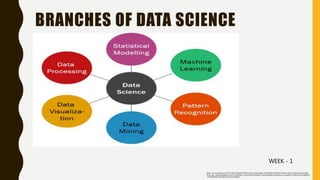
BRANCHES OF DATA SCIENCE
WEEK - 1
https://www.google.com/url?sa=i&url=https%3A%2F%2Fwww.researchgate.net%2Ffigure%2FData-Science-and-corresponding-scientific-
fields_fig2_332120693&psig=AOvVaw1QptKKxI_iyjmHhoMU01PO&ust=1620522869672000&source=images&cd=vfe&ved=0CA0QjhxqF
woTCIDztYH0uPACFQAAAAAdAAAAABAD
PROGRAMMING & ENVIRONMENT
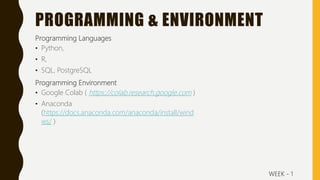
Programming Languages
• Python,
• R,
• SQL, PostgreSQL
Programming Environment
• Google Colab ( https://colab.research.google.com )
• Anaconda
(https://docs.anaconda.com/anaconda/install/wind
ws/ )
WEEK - 1
AN INTRODUCTION TO PYTHON
Importing library
• Pandas
• Numpy
Visualization libraries
Seaborn, matplotlib, bokeh
Python in-built Methods: print, type, len, min, max
WEEK - 1
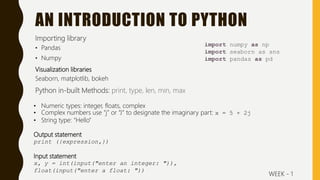
• Numeric types: integer, floats, complex
• Complex numbers use “j” or “J” to designate the imaginary part: x = 5 + 2j
• String type: “Hello”
Output statement
print ({expression,})
Input statement
x, y = int(input("enter an integer: ")),
float(input("enter a float: "))
import numpy as np
import seaborn as sns
import pandas as pd
AN INTRODUCTION TO PYTHON
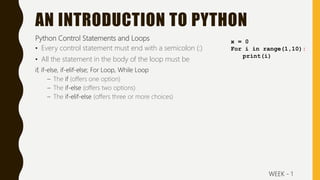
Python Control Statements and Loops
• Every control statement must end with a semicolon (:)
• All the statement in the body of the loop must be
if, if-else, if-elif-else; For Loop, While Loop
– The if (offers one option)
– The if-else (offers two options)
– The if-elif-else (offers three or more choices)
WEEK - 1
x = 0
For i in range(1,10):
print(i)
AN INTRODUCTION TO PYTHON
Python Functions/Methods and Classes
A function is a block of code meant for a specific
purpose and its reusable.
• Class = data + method
• An Object is the instance of a class.
• More on Python Classes:
• https://github.com/JosephItopa/Drop_of_my_Pyt
hon_Projects/blob/master/Intro_to_python_serie
s/Introduction_To_Python_Webinar_Series_4.ipyn
b
WEEK - 1
def function_name( parameters ):
"function_docstring"
function_suite
return [expression]
class ClassName:
'Optional class documentation string'
class_suite
AN INTRODUCTION TO PYTHON
Recap
• What is Data Science? Branches of Data Science.
• Importing library
• Python in-built Methods
• Data type and structures
• Python Methods and Classes
• Python Control Statements and Loop.
WEEK - 1
AN INTRODUCTION TO PYTHON
References
• http://www.cs.uah.edu/~weisskop/Notes424-524/ch12-Python.ppt
• https://www.bu.edu/tech/files/2017/09/Python-for-Data-Analysis.pptx
WEEK - 1
THANK YOU!
WEEK - 1

Introduction to data science

  • 1.
    INTRODUCTION TO DATA SCIENCE JO S E P H I TO PA ( M L E N G I N E E R , O M D E N A & R A 3 6 5 ) F A V O R E D O N L I N E
  • 2.
    OUTLINE • What isData Science? Branches of Data Science. • Importing library • Python in-built Methods: print, type, len, min, max. • Data type and structures: Integer, Float, Strings, List, Dictionary, Tuple; indexing and slicing. • Python Functions: Methods and Classes • Python Statements and Loops: For loop, while loop, if, if-else, break, continue. WEEK - 1
  • 3.
    WEEK - 1 The ability to take data—to be able to understand it, to process it, to extract value from it, to visualize it, to communicate it —that’s going to be a hugely important skill in the next decades. – Han Varians  The future belongs to the companies and people that turn data into products - Mike Loukides (VP Content Strategy @ O’Reilly)
  • 4.
    WHAT IS DATASCIENCE? WEEK - 1 https://www.google.com/url?sa=i&url=https%3A%2F%2Fwww.contino.io%2Finsights%2Fthe-future-of-artificial-intelligence-and-machine-learning-for-financial-services&psig=AOvVaw0Qa- PssCxxGLxBPZd-6FYz&ust=1604048462298000&source=images&cd=vfe&ved=0CA0QjhxqFwoTCPCyl7i42ewCFQAAAAAdAAAAABAJ • Data science is an interdisciplinary field that uses scientific methods, processes, algorithms and systems to extract knowledge and insights from structured and unstructured data, and apply knowledge and actionable insights from data across a broad range of application domains. ~Wikipedia
  • 5.
    BRANCHES OF DATASCIENCE WEEK - 1 https://www.google.com/url?sa=i&url=https%3A%2F%2Fwww.researchgate.net%2Ffigure%2FData-Science-and-corresponding-scientific- fields_fig2_332120693&psig=AOvVaw1QptKKxI_iyjmHhoMU01PO&ust=1620522869672000&source=images&cd=vfe&ved=0CA0QjhxqF woTCIDztYH0uPACFQAAAAAdAAAAABAD
  • 6.
    PROGRAMMING & ENVIRONMENT ProgrammingLanguages • Python, • R, • SQL, PostgreSQL Programming Environment • Google Colab ( https://colab.research.google.com ) • Anaconda (https://docs.anaconda.com/anaconda/install/wind ws/ ) WEEK - 1
  • 7.
    AN INTRODUCTION TOPYTHON Importing library • Pandas • Numpy Visualization libraries Seaborn, matplotlib, bokeh Python in-built Methods: print, type, len, min, max WEEK - 1 • Numeric types: integer, floats, complex • Complex numbers use “j” or “J” to designate the imaginary part: x = 5 + 2j • String type: “Hello” Output statement print ({expression,}) Input statement x, y = int(input("enter an integer: ")), float(input("enter a float: ")) import numpy as np import seaborn as sns import pandas as pd
  • 8.
    AN INTRODUCTION TOPYTHON Python Control Statements and Loops • Every control statement must end with a semicolon (:) • All the statement in the body of the loop must be if, if-else, if-elif-else; For Loop, While Loop – The if (offers one option) – The if-else (offers two options) – The if-elif-else (offers three or more choices) WEEK - 1 x = 0 For i in range(1,10): print(i)
  • 9.
    AN INTRODUCTION TOPYTHON Python Functions/Methods and Classes A function is a block of code meant for a specific purpose and its reusable. • Class = data + method • An Object is the instance of a class. • More on Python Classes: • https://github.com/JosephItopa/Drop_of_my_Pyt hon_Projects/blob/master/Intro_to_python_serie s/Introduction_To_Python_Webinar_Series_4.ipyn b WEEK - 1 def function_name( parameters ): "function_docstring" function_suite return [expression] class ClassName: 'Optional class documentation string' class_suite
  • 10.
    AN INTRODUCTION TOPYTHON Recap • What is Data Science? Branches of Data Science. • Importing library • Python in-built Methods • Data type and structures • Python Methods and Classes • Python Control Statements and Loop. WEEK - 1
  • 11.
    AN INTRODUCTION TOPYTHON References • http://www.cs.uah.edu/~weisskop/Notes424-524/ch12-Python.ppt • https://www.bu.edu/tech/files/2017/09/Python-for-Data-Analysis.pptx WEEK - 1
  • 12.