Data and Network Security:
Block Ciphers and DES
Adeel Akhtar
Agenda
• Stream Cipher & Block Cipher
• Modern Block Cipher
• Block Cipher components
• DES
• 3-DES
Stream Cipher & Block Cipher
• A stream cipher is one that encrypts a digital
data stream one bit or one byte at a time.
• A block cipher is an encryption/decryption
scheme in which a block of plaintext is treated
as a whole and used to produce a ciphertext
block of equal length.
– Modern algorithms are based on “block cipher”
Modern Block Cipher
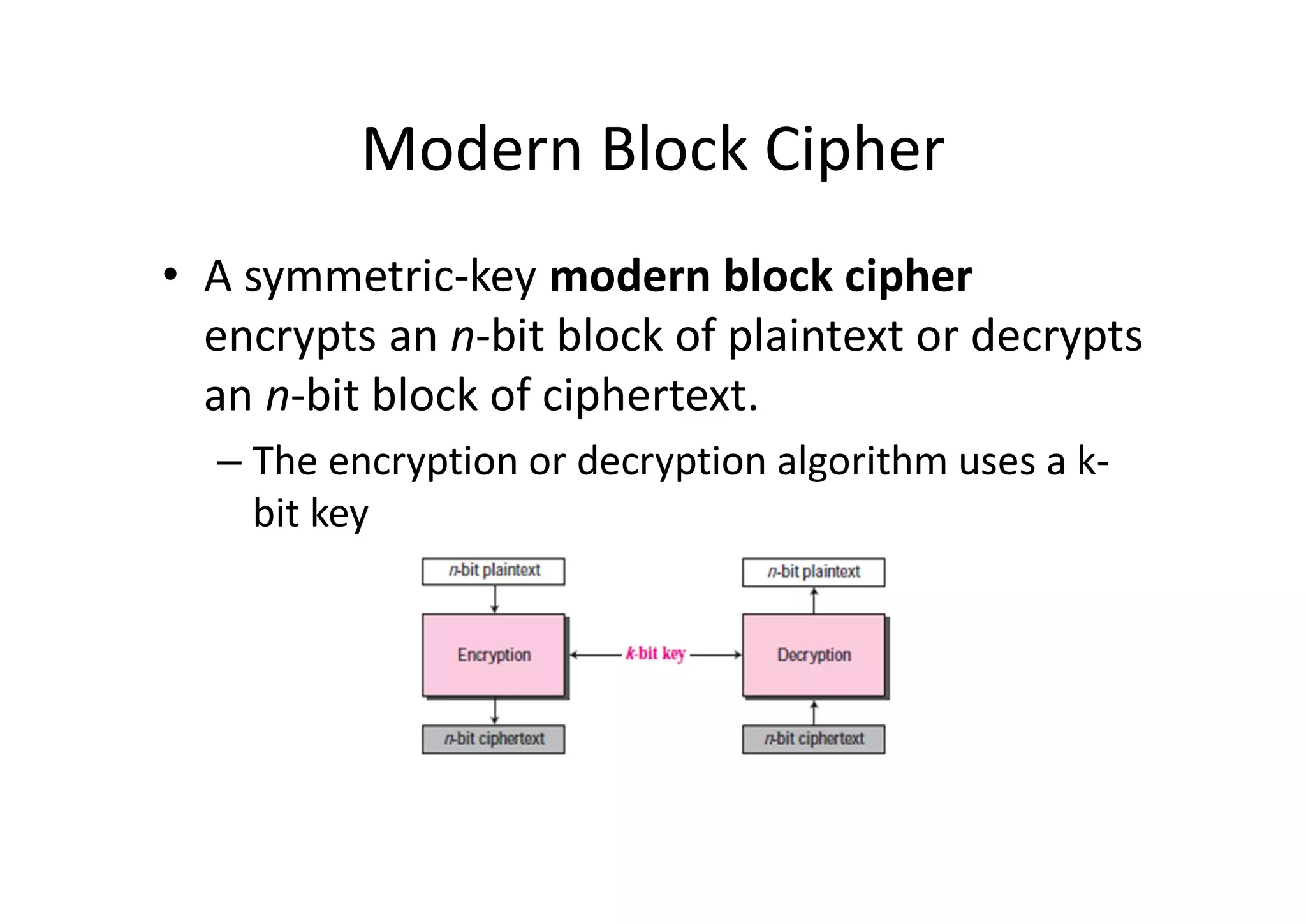
• A symmetric-key modern block cipher
encrypts an n-bit block of plaintext or decrypts
an n-bit block of ciphertext.
– The encryption or decryption algorithm uses a k-
bit key
Modern Block Cipher (2)
• If the message has fewer than n bits, padding
must be added to make it an n-bit block
• if the message has more than n bits, it should
be divided into n-bit blocks
– appropriate padding must be added to the last
block, if necessary.
– The common values for n are 64, 128, 256, and
512 bits
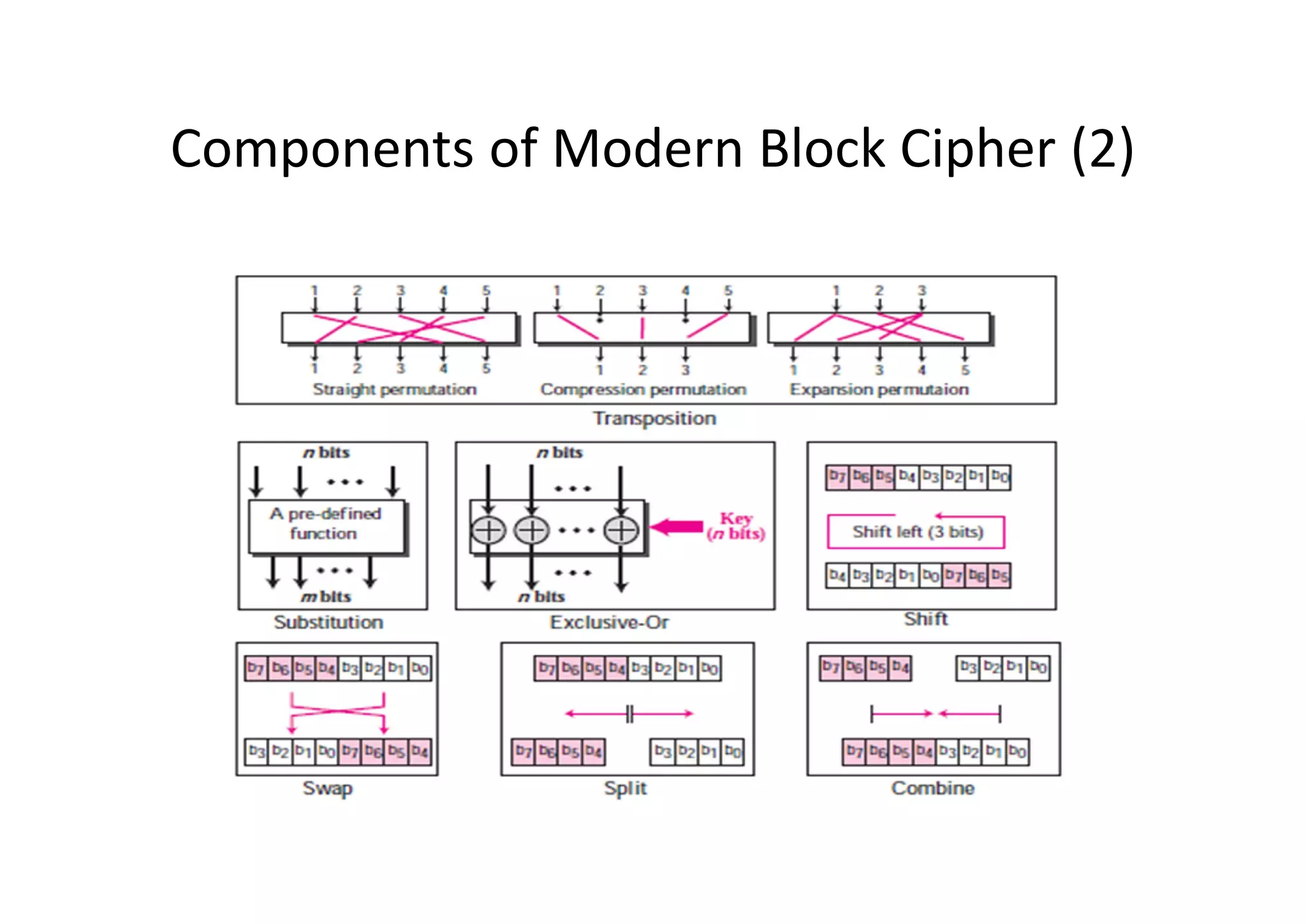
Components of Modern Block Cipher
• Transposition units (P-Boxes)
• Substitution units (S-Boxes)
• exclusive-or operations
• shifting elements
• swapping elements
• splitting elements
• combining elements
Components of Modern Block Cipher (2)
Permutation Box (P-Box)
• A P-box (permutation box) parallels the
traditional transposition cipher for characters,
but it transposes bits
• Three types of P-boxes in modern block
ciphers
– Straight P-boxes
– Expansion P-boxes
– Compression P-boxes
Substitution box (S-Box)
• An S-box can be thought of as a miniature
substitution cipher, but it substitutes bits.
• Unlike traditional substitution cipher, an S-box
can have a different number of inputs and
outputs.
• Exclusive-OR (XOR) function
– the output is 0 if the two inputs are the same
– the output is 1 if the two inputs are different
Other Functions
• circular shift operation
– Shifting can be to the left or to the right
– The circular left-shift operation shifts each bit in
an n-bit word k positions to the left
• the leftmost k bits are removed from the left and
become the rightmost bits
• swap operation
– special case of the circular shift operation where
the number of shifted bits k = n/2
• Split Operation
– The split operation splits an n-bit word in the
middle, creating two equal-length words
• Combine Operation
– The combine operation normally concatenates
two equal-length words to create an n-bit word.
Data Encryption Standard (DES)
• Adopted in 1977 by the National Bureau of
Standards
– data are encrypted in 64-bit blocks using a 56-bit
key
– The algorithm transforms 64-bit input in a series
of steps into a 64-bit output
• The same steps, with the same key, are used
to reverse the encryption
DES (Con’t)
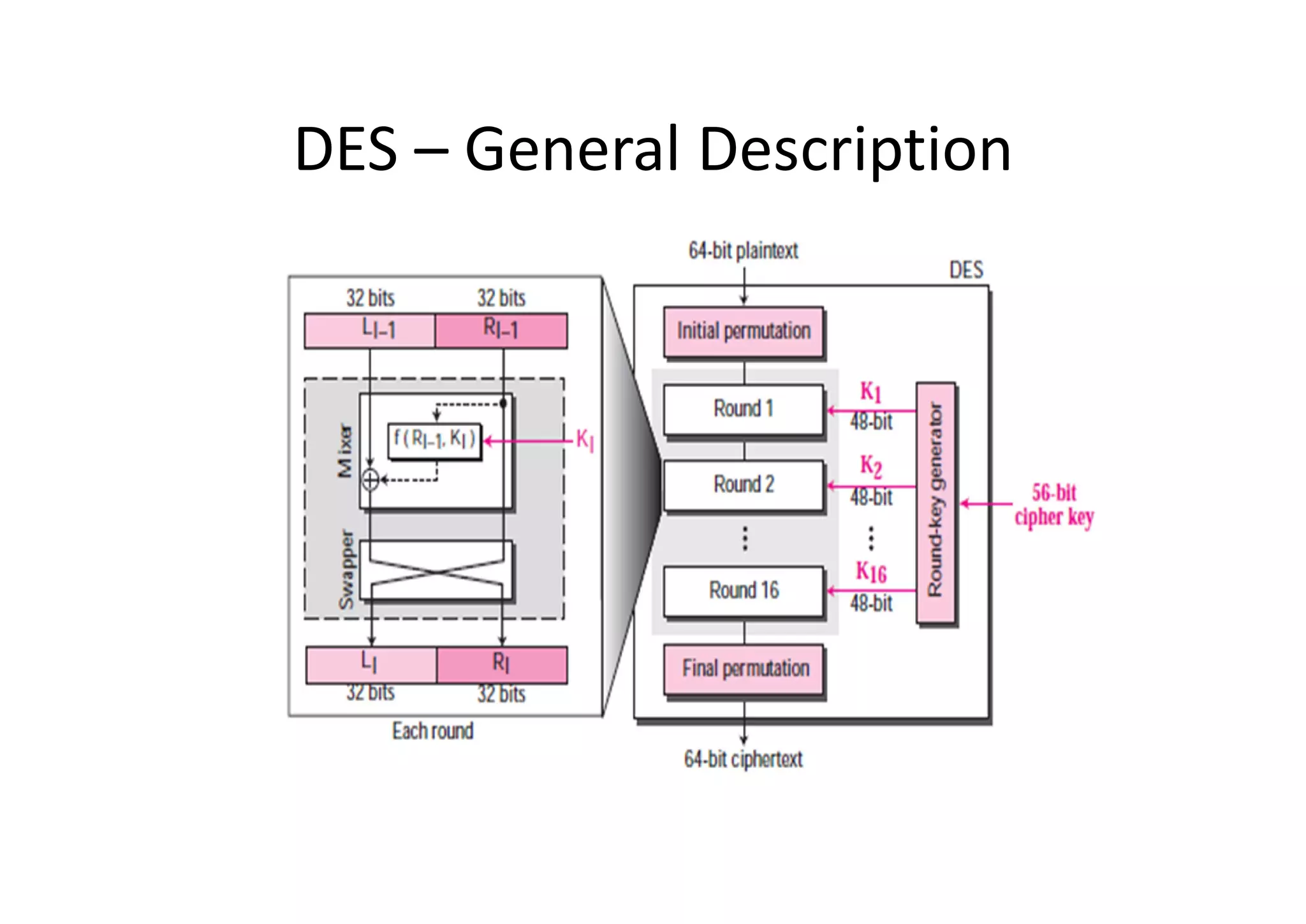
• Processing of the plaintext proceeds in three phases.
– 64-bit plaintext passes through an initial permutation (IP)
that rearranges the bits to produce the permuted input
– sixteen rounds of the same function which involves both
permutation and substitution functions.
• output of last round consists of 64 bits that is a function of the
input plaintext and the key
• Left and right halves of the output are swapped to produce the
preoutput
– Finally, the preoutput is passed through a permutation
that is the inverse of the initial permutation function, to
produce the 64-bit ciphertext.
DES – General Description
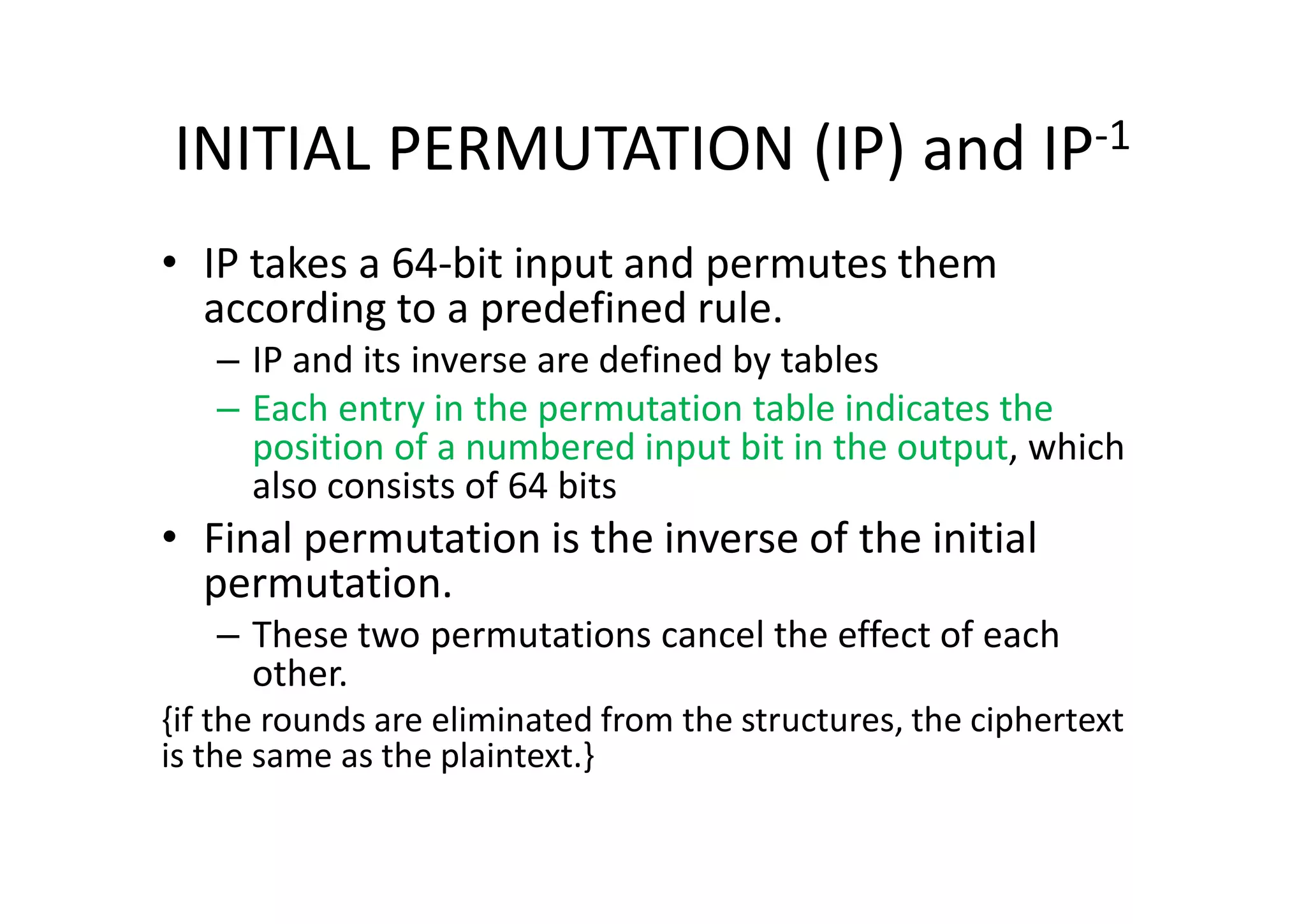
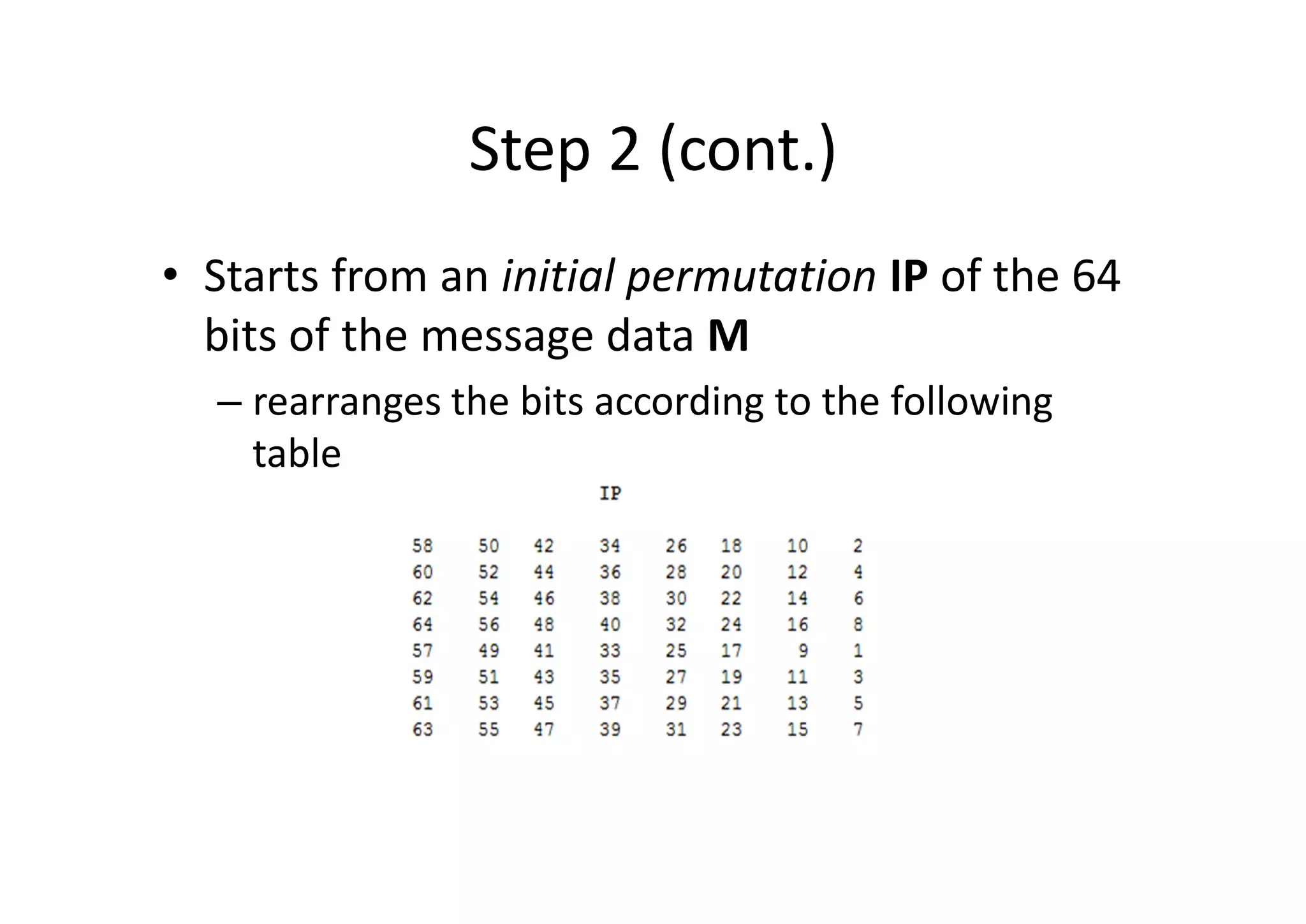
INITIAL PERMUTATION (IP) and IP-1
• IP takes a 64-bit input and permutes them
according to a predefined rule.
– IP and its inverse are defined by tables
– Each entry in the permutation table indicates the
position of a numbered input bit in the output, which
also consists of 64 bits
• Final permutation is the inverse of the initial
permutation.
– These two permutations cancel the effect of each
other.
{if the rounds are eliminated from the structures, the ciphertext
is the same as the plaintext.}
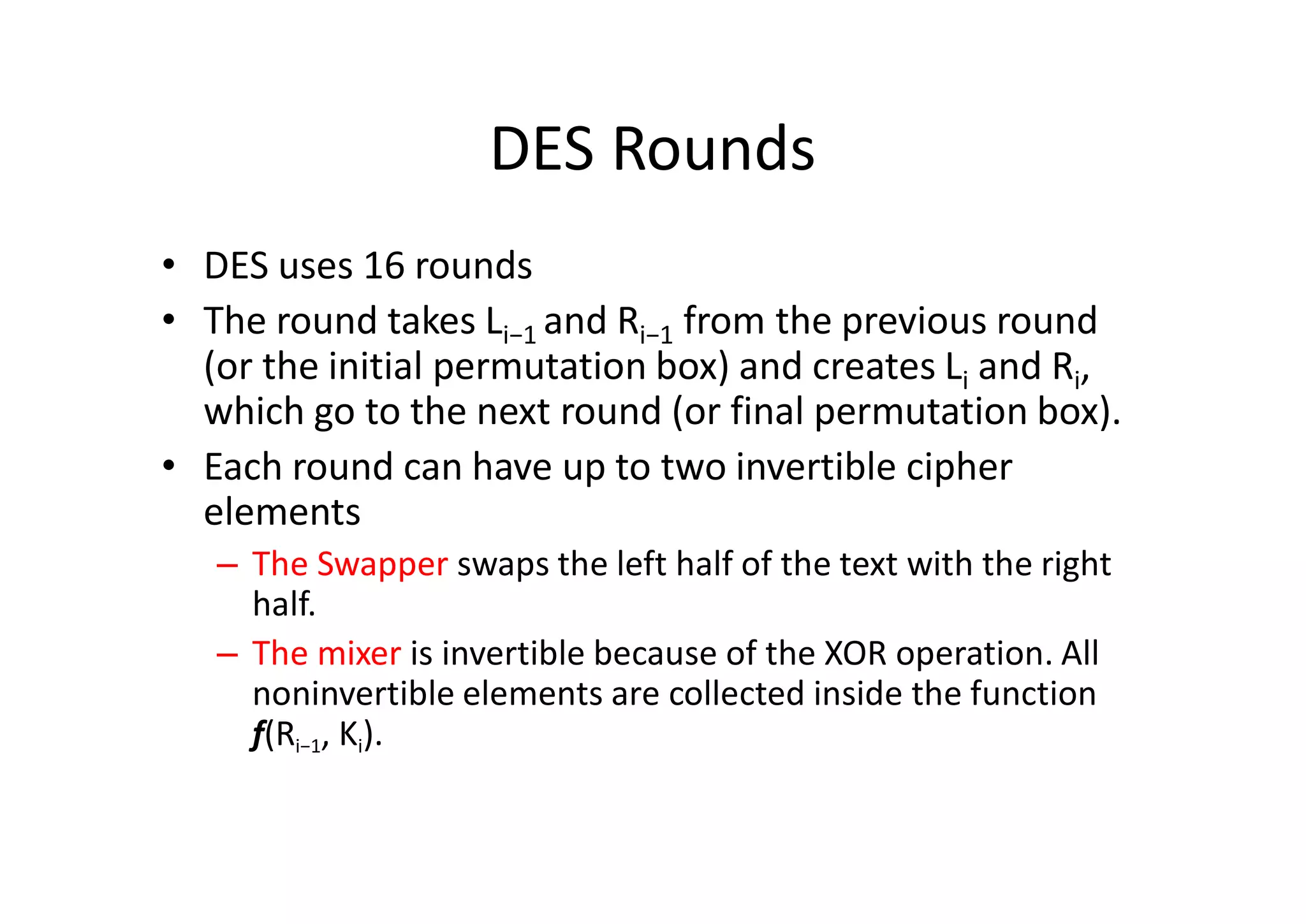
DES Rounds
• DES uses 16 rounds
• The round takes Li−1 and Ri−1 from the previous round
(or the initial permutation box) and creates Li and Ri,
which go to the next round (or final permutation box).
• Each round can have up to two invertible cipher
elements
– The Swapper swaps the left half of the text with the right
half.
– The mixer is invertible because of the XOR operation. All
noninvertible elements are collected inside the function
f(Ri−1, Ki).
DES Function
• Applies a 48-bit key to the rightmost 32 bits
(Ri−1) to produce a 32-bit output
• This function is made up of four sections:
– an expansion P-box
– an exclusive-OR component (that adds key)
– a group of S-boxes
– a straight P-box
DES Function (Cont)
• Since Ri−1 is a 32-bit input and Ki is a 48-bit key, we first
need to expand Ri−1 to 48 bits. This expansion
permutation follows a predetermined rule.
• After the expansion permutation, DES uses the XOR
operation on the expanded right section and the round
key. The S-boxes do the real mixing.
– DES uses 8 S-boxes
– each with a 6-bit input and a 4-bit output.
• The last operation in the DES function is a straight
permutation with a 32-bit input and a 32-bit output.
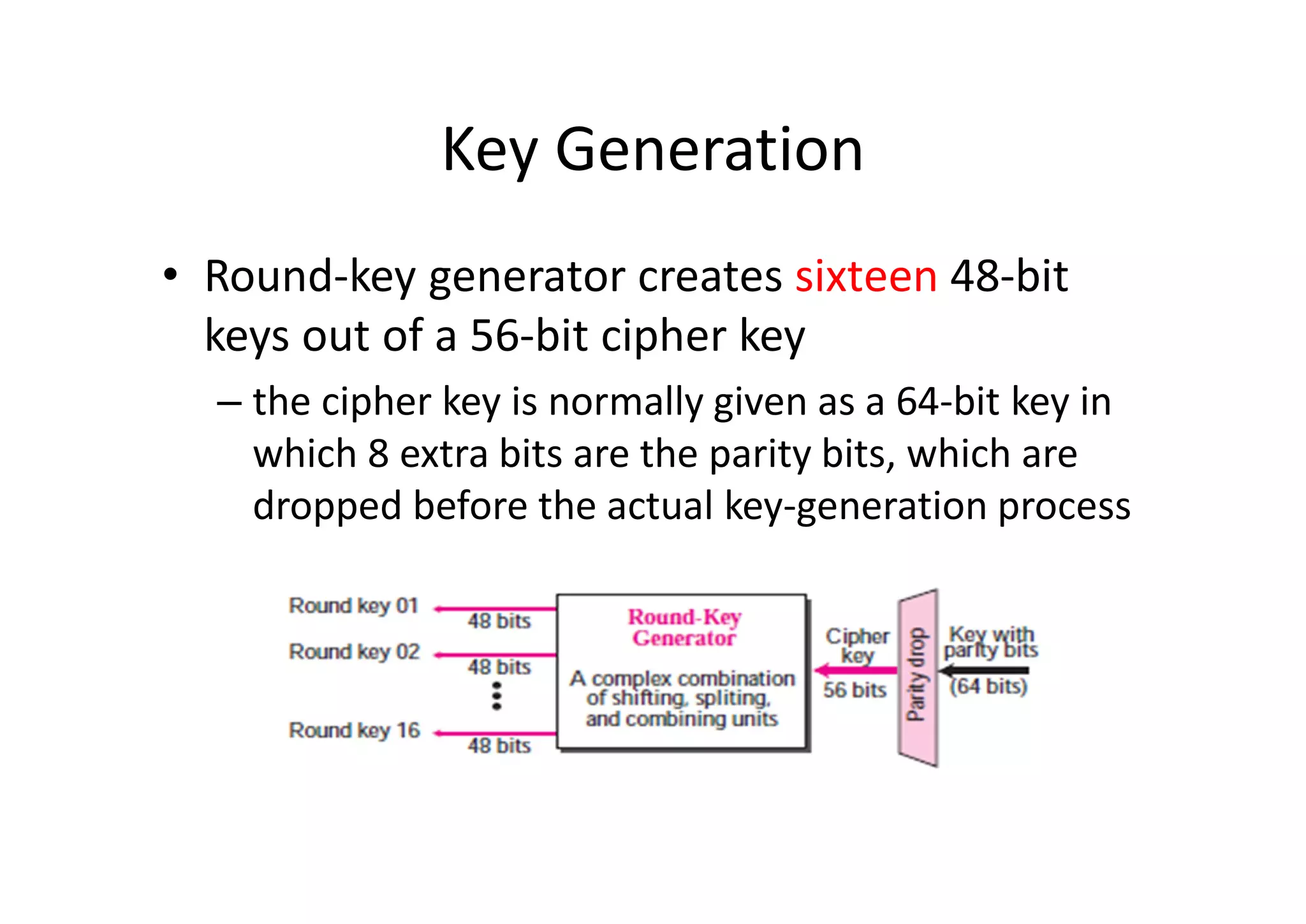
Key Generation
• Round-key generator creates sixteen 48-bit
keys out of a 56-bit cipher key
– the cipher key is normally given as a 64-bit key in
which 8 extra bits are the parity bits, which are
dropped before the actual key-generation process
DES: Step 1-Key Generation
• Key could be of 8 characters. i.e., BSCS2012 or MS CS012
– These characters will be converted in binary w.r.t.
their respective ASCII codes
– Can you explain other possible options?
• Let K be the hexadecimal key
K = 133457799BBCDFF1
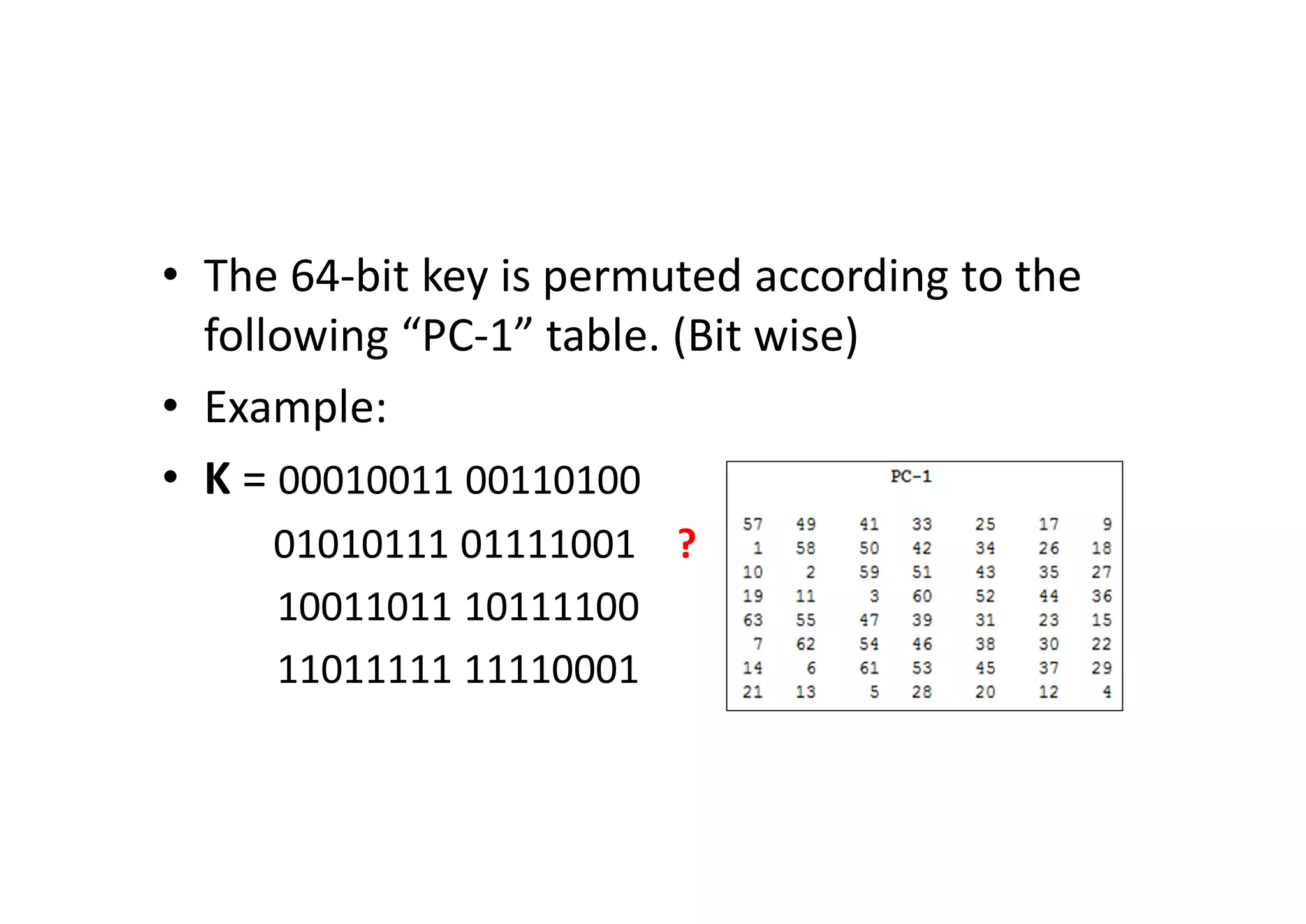
• The 64-bit key is permuted according to the
following “PC-1” table. (Bit wise)
• Example:
• K = 00010011 00110100
01010111 01111001 ?
10011011 10111100
11011111 11110001
Step 1 (cont.)
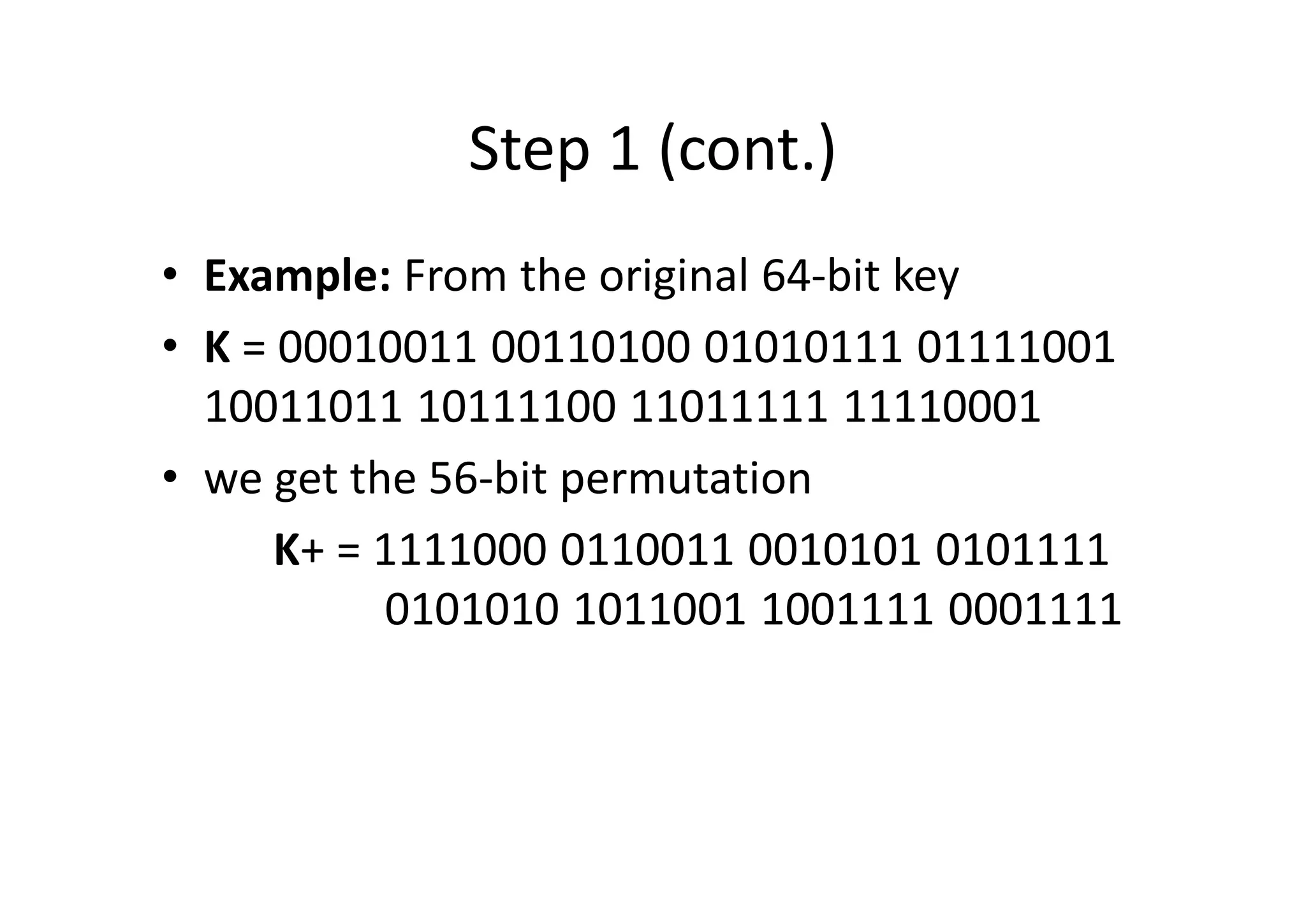
• Example: From the original 64-bit key
• K = 00010011 00110100 01010111 01111001
10011011 10111100 11011111 11110001
• we get the 56-bit permutation
K+ = 1111000 0110011 0010101 0101111
0101010 1011001 1001111 0001111
Step 1 (cont.)
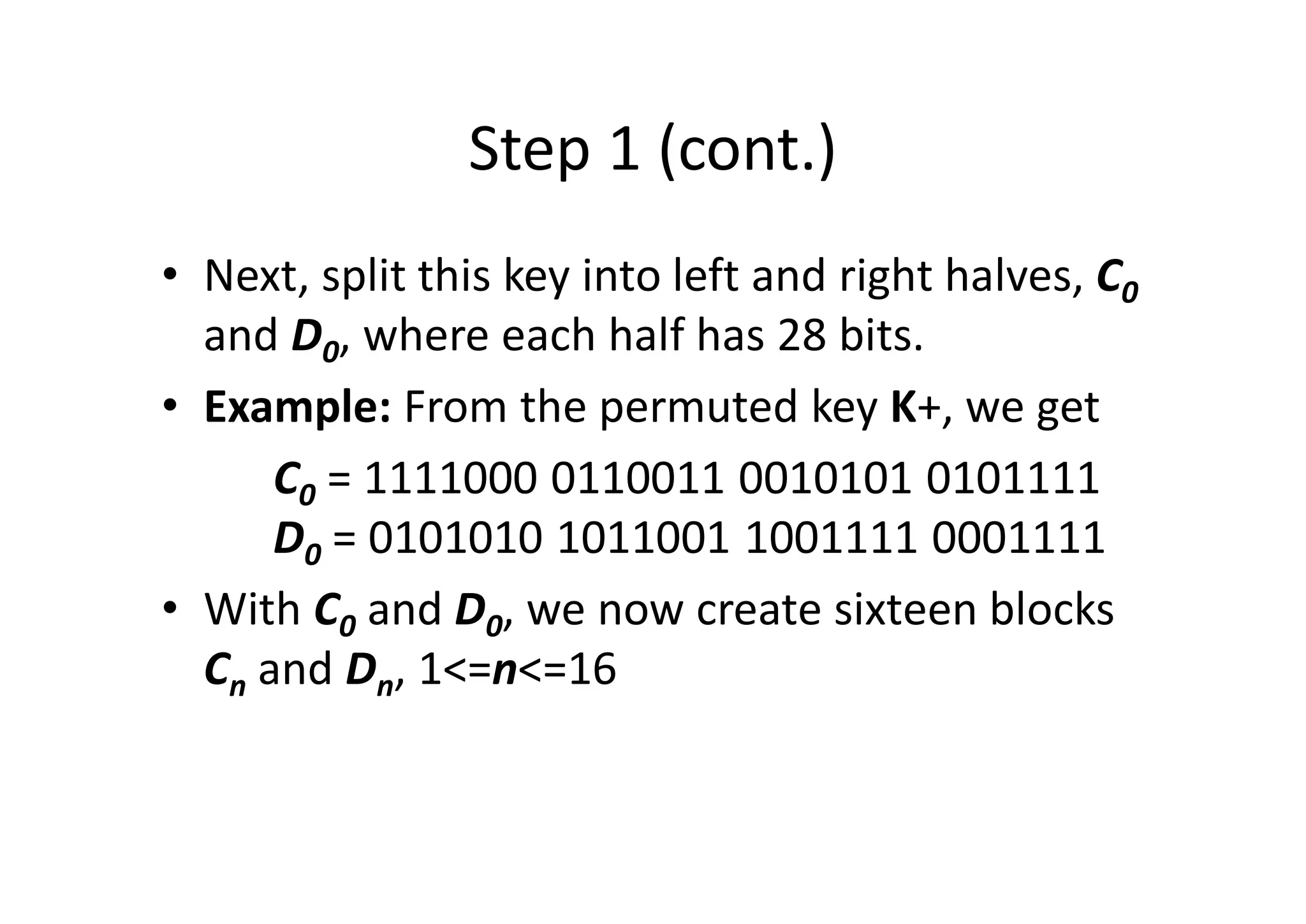
• Next, split this key into left and right halves, C0
and D0, where each half has 28 bits.
• Example: From the permuted key K+, we get
C0 = 1111000 0110011 0010101 0101111
D0 = 0101010 1011001 1001111 0001111
• With C0 and D0, we now create sixteen blocks
Cn and Dn, 1<=n<=16
Step 1 (Cont.)
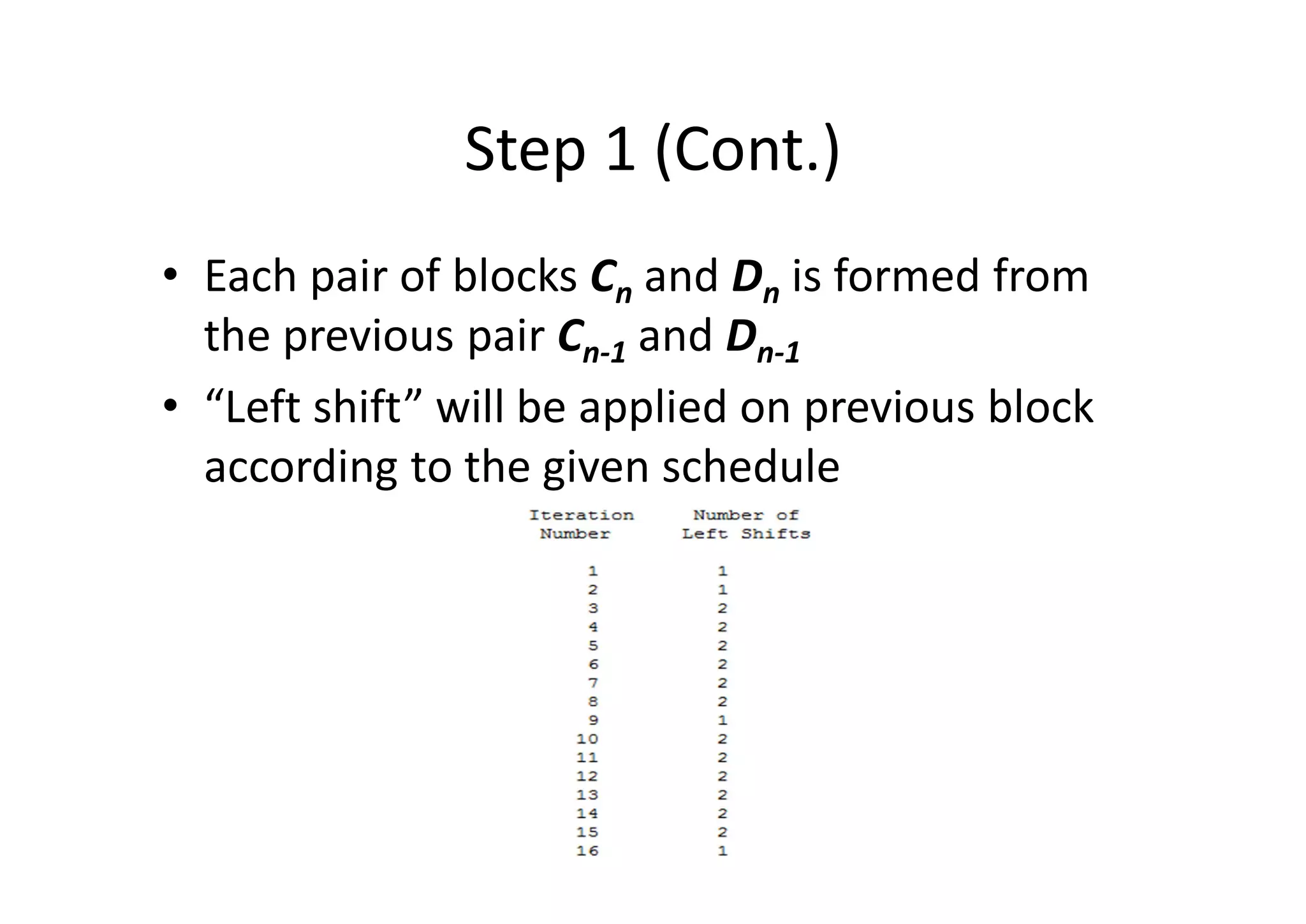
• Each pair of blocks Cn and Dn is formed from
the previous pair Cn-1 and Dn-1
• “Left shift” will be applied on previous block
according to the given schedule
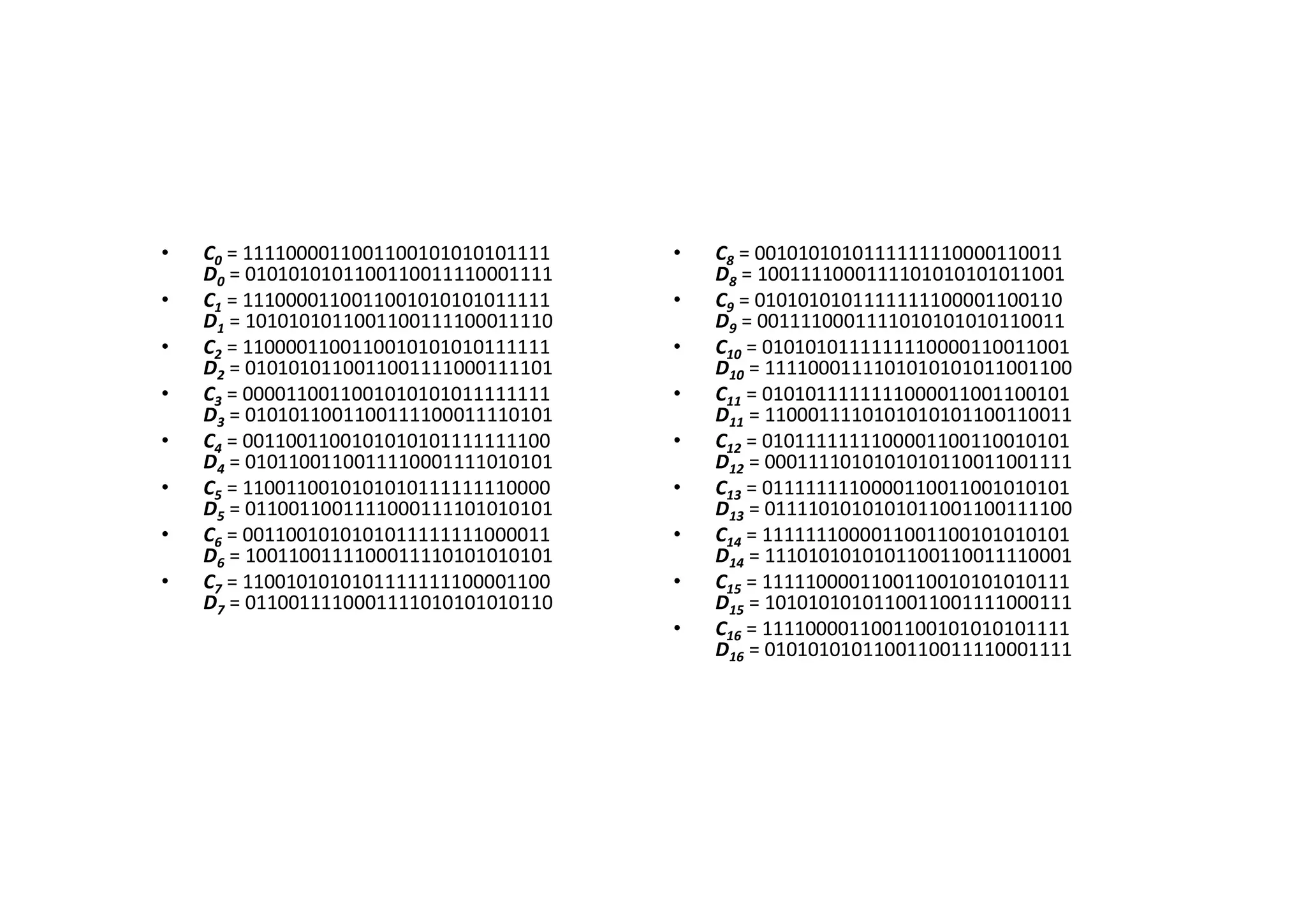
• C0 = 1111000011001100101010101111
D0 = 0101010101100110011110001111
• C1 = 1110000110011001010101011111
D1 = 1010101011001100111100011110
• C2 = 1100001100110010101010111111
D2 = 0101010110011001111000111101
• C3 = 0000110011001010101011111111
D3 = 0101011001100111100011110101
• C4 = 0011001100101010101111111100
D4 = 0101100110011110001111010101
• C5 = 1100110010101010111111110000
D5 = 0110011001111000111101010101
• C6 = 0011001010101011111111000011
D6 = 1001100111100011110101010101
• C7 = 1100101010101111111100001100
D7 = 0110011110001111010101010110
• C8 = 0010101010111111110000110011
D8 = 1001111000111101010101011001
• C9 = 0101010101111111100001100110
D9 = 0011110001111010101010110011
• C10 = 0101010111111110000110011001
D10 = 1111000111101010101011001100
• C11 = 0101011111111000011001100101
D11 = 1100011110101010101100110011
• C12 = 0101111111100001100110010101
D12 = 0001111010101010110011001111
• C13 = 0111111110000110011001010101
D13 = 0111101010101011001100111100
• C14 = 1111111000011001100101010101
D14 = 1110101010101100110011110001
• C15 = 1111100001100110010101010111
D15 = 1010101010110011001111000111
• C16 = 1111000011001100101010101111
D16 = 0101010101100110011110001111
Step 1 (Cont.)
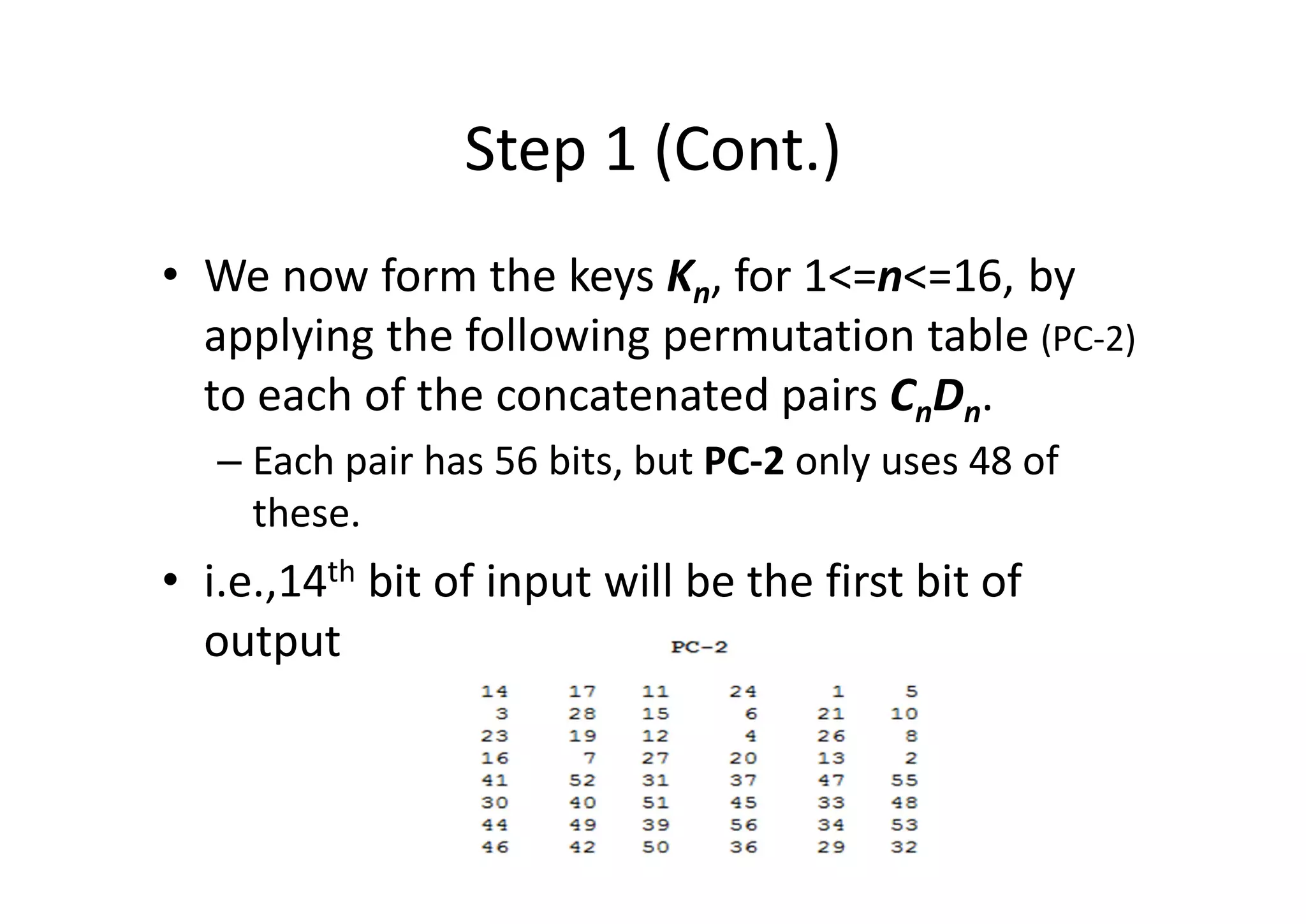
• We now form the keys Kn, for 1<=n<=16, by
applying the following permutation table (PC-2)
to each of the concatenated pairs CnDn.
– Each pair has 56 bits, but PC-2 only uses 48 of
these.
• i.e.,14th bit of input will be the first bit of
output
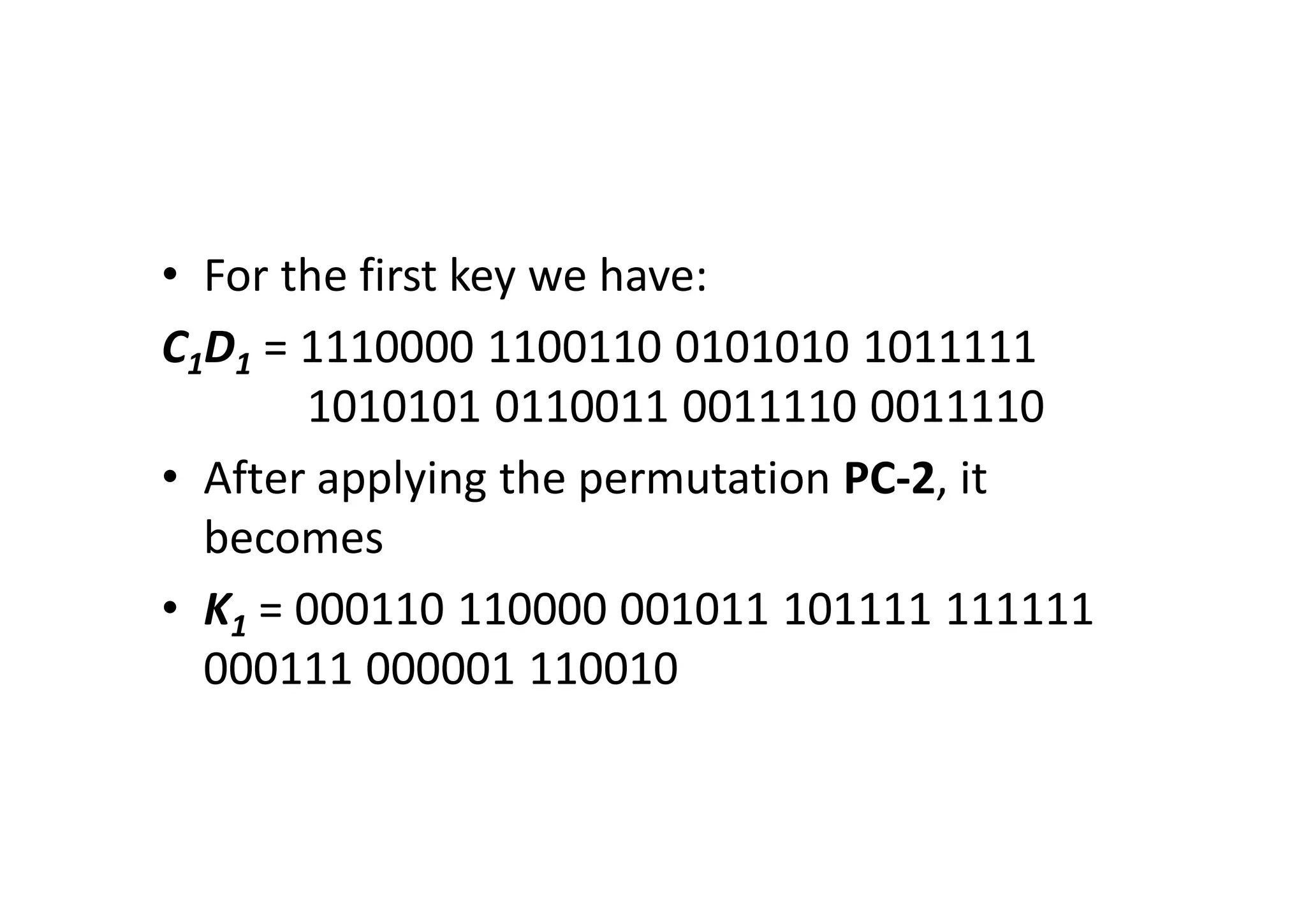
• For the first key we have:
C1D1 = 1110000 1100110 0101010 1011111
1010101 0110011 0011110 0011110
• After applying the permutation PC-2, it
becomes
• K1 = 000110 110000 001011 101111 111111
000111 000001 110010
Step 1 (Cont.)
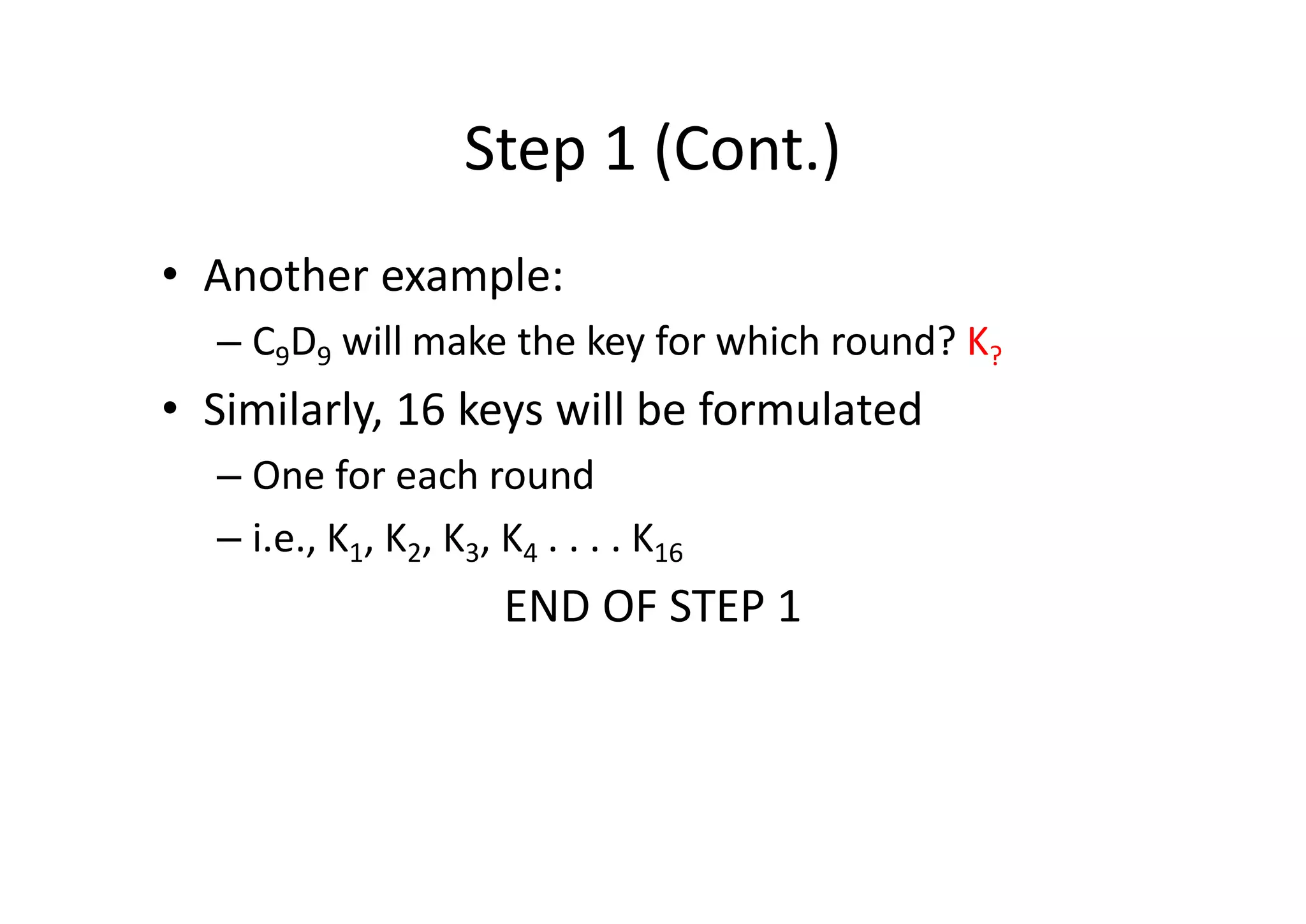
• Another example:
– C9D9 will make the key for which round? K?
• Similarly, 16 keys will be formulated
– One for each round
– i.e., K1, K2, K3, K4 . . . . K16
END OF STEP 1
Step 2: Encode each 64-bit block of data
• Any message of 8 characters i.e, M HANEEF
– Transformed into bits w.r.t ASCII codes
– Other possible options?
• Lets assume the “hexadecimal” plain text
M=0123456789ABCDEF
Step 2 (cont.)
• Starts from an initial permutation IP of the 64
bits of the message data M
– rearranges the bits according to the following
table
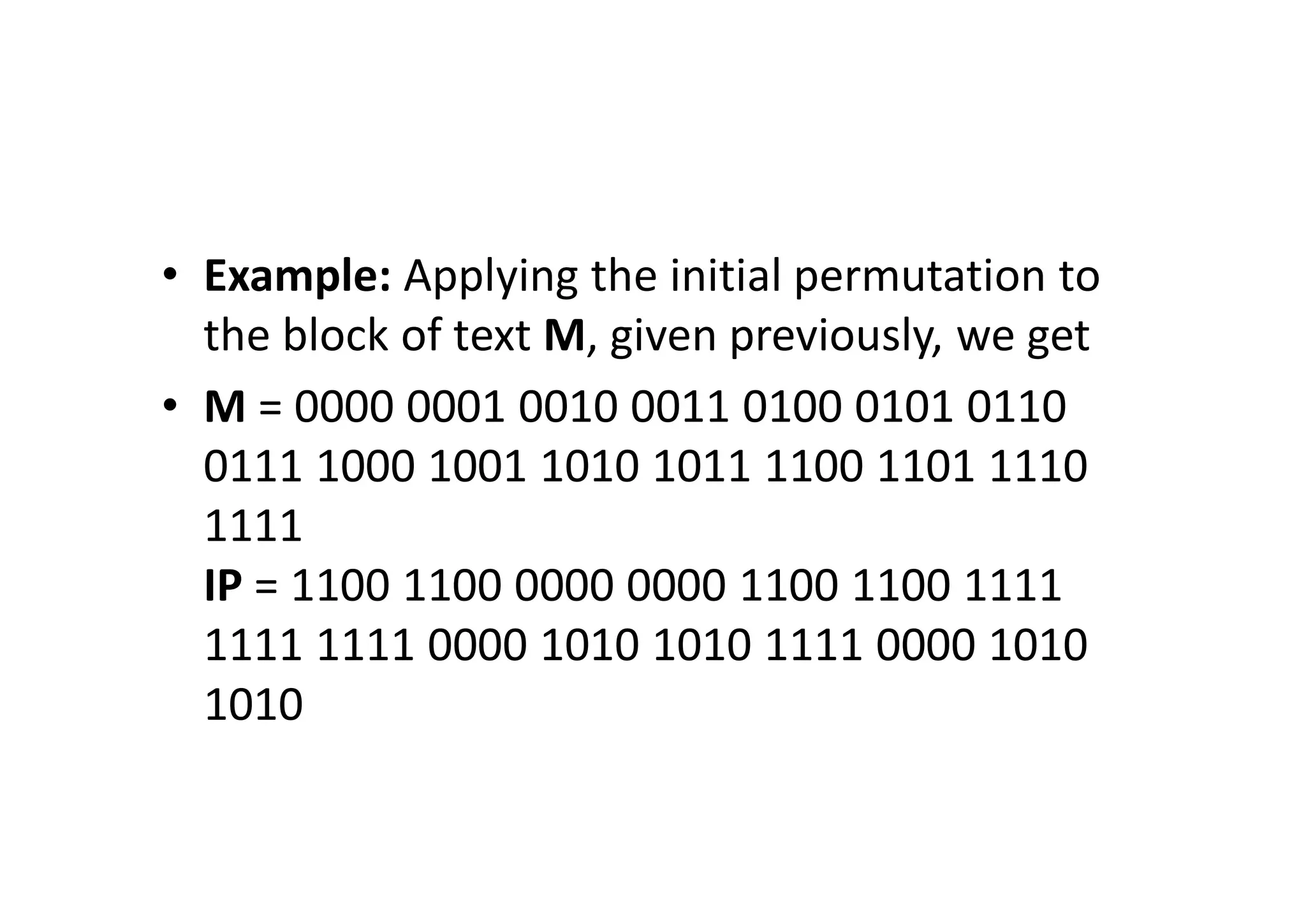
• Example: Applying the initial permutation to
the block of text M, given previously, we get
• M = 0000 0001 0010 0011 0100 0101 0110
0111 1000 1001 1010 1011 1100 1101 1110
1111
IP = 1100 1100 0000 0000 1100 1100 1111
1111 1111 0000 1010 1010 1111 0000 1010
1010
Step 2 (cont.)
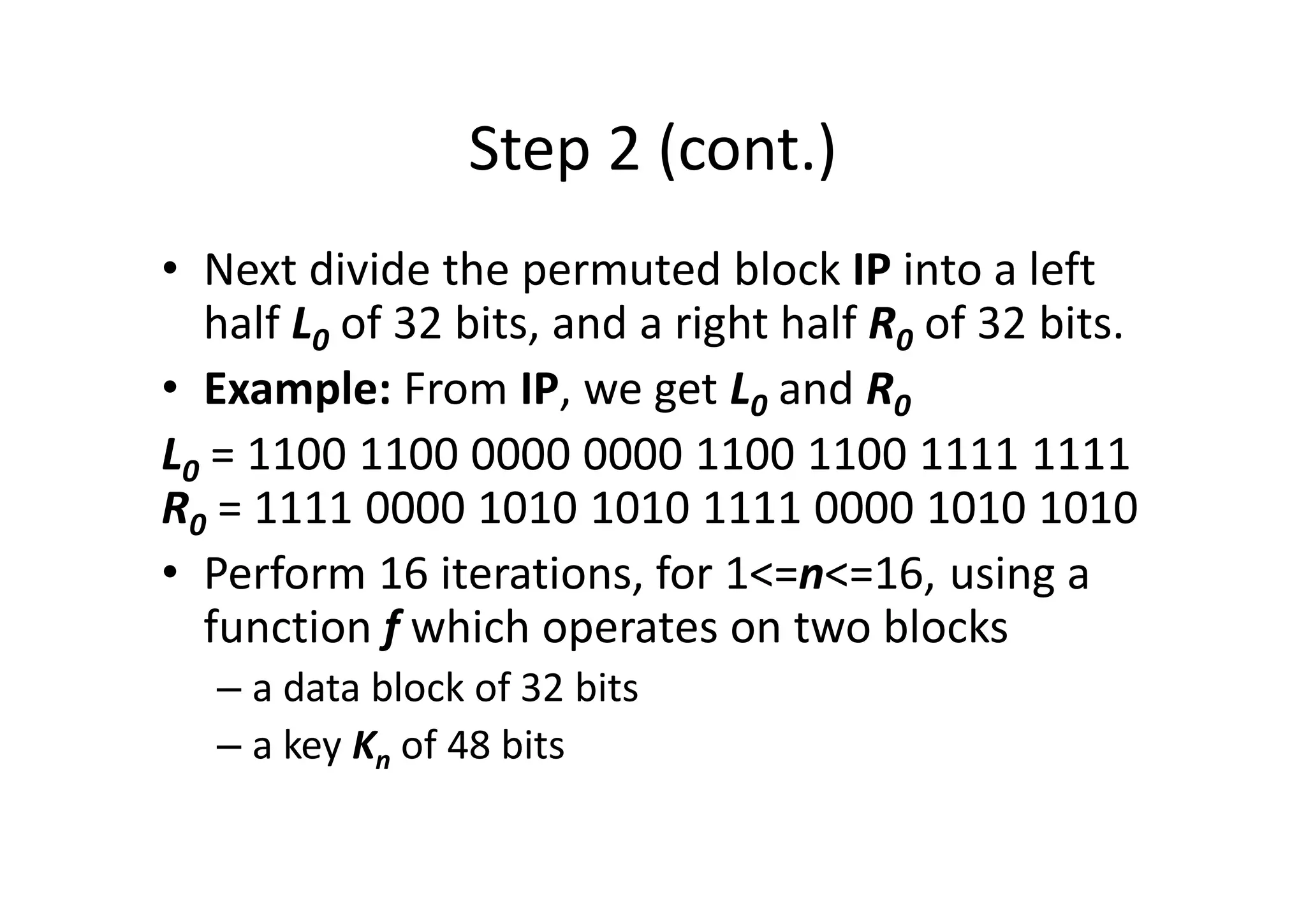
• Next divide the permuted block IP into a left
half L0 of 32 bits, and a right half R0 of 32 bits.
• Example: From IP, we get L0 and R0
L0 = 1100 1100 0000 0000 1100 1100 1111 1111
R0 = 1111 0000 1010 1010 1111 0000 1010 1010
• Perform 16 iterations, for 1<=n<=16, using a
function f which operates on two blocks
– a data block of 32 bits
– a key Kn of 48 bits
Step 2 (cont.)
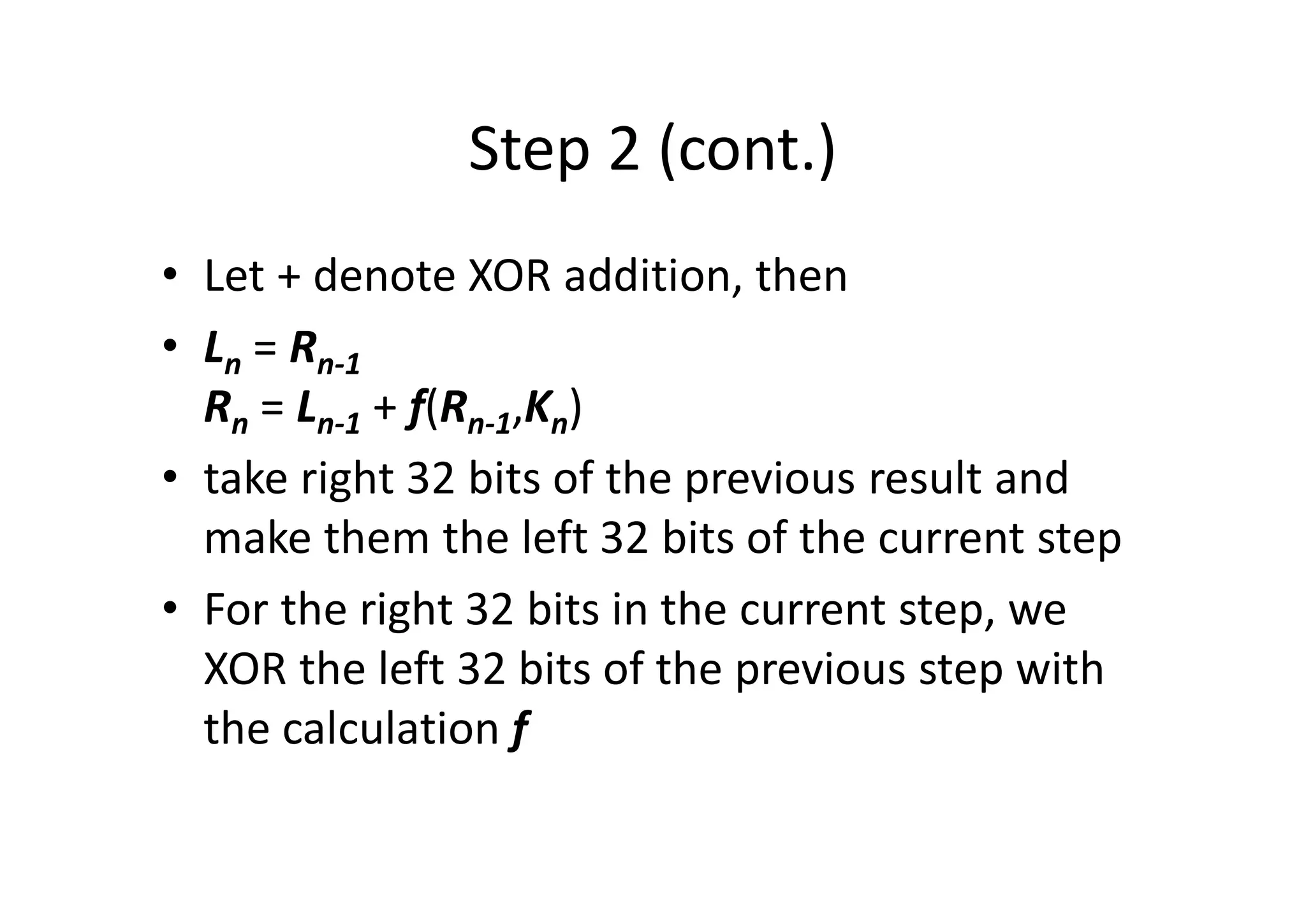
• Let + denote XOR addition, then
• Ln = Rn-1
Rn = Ln-1 + f(Rn-1,Kn)
• take right 32 bits of the previous result and
make them the left 32 bits of the current step
• For the right 32 bits in the current step, we
XOR the left 32 bits of the previous step with
the calculation f
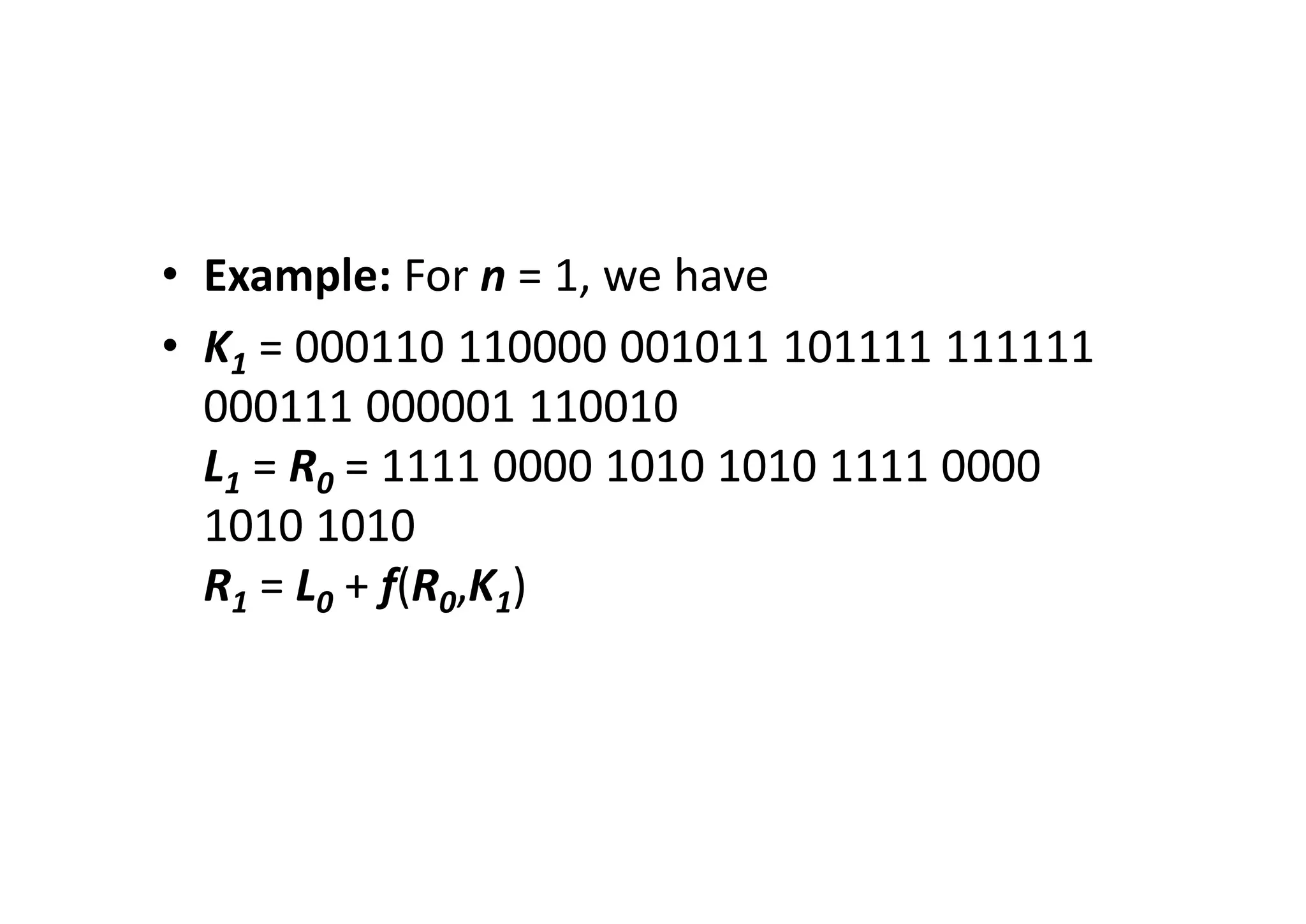
• Example: For n = 1, we have
• K1 = 000110 110000 001011 101111 111111
000111 000001 110010
L1 = R0 = 1111 0000 1010 1010 1111 0000
1010 1010
R1 = L0 + f(R0,K1)
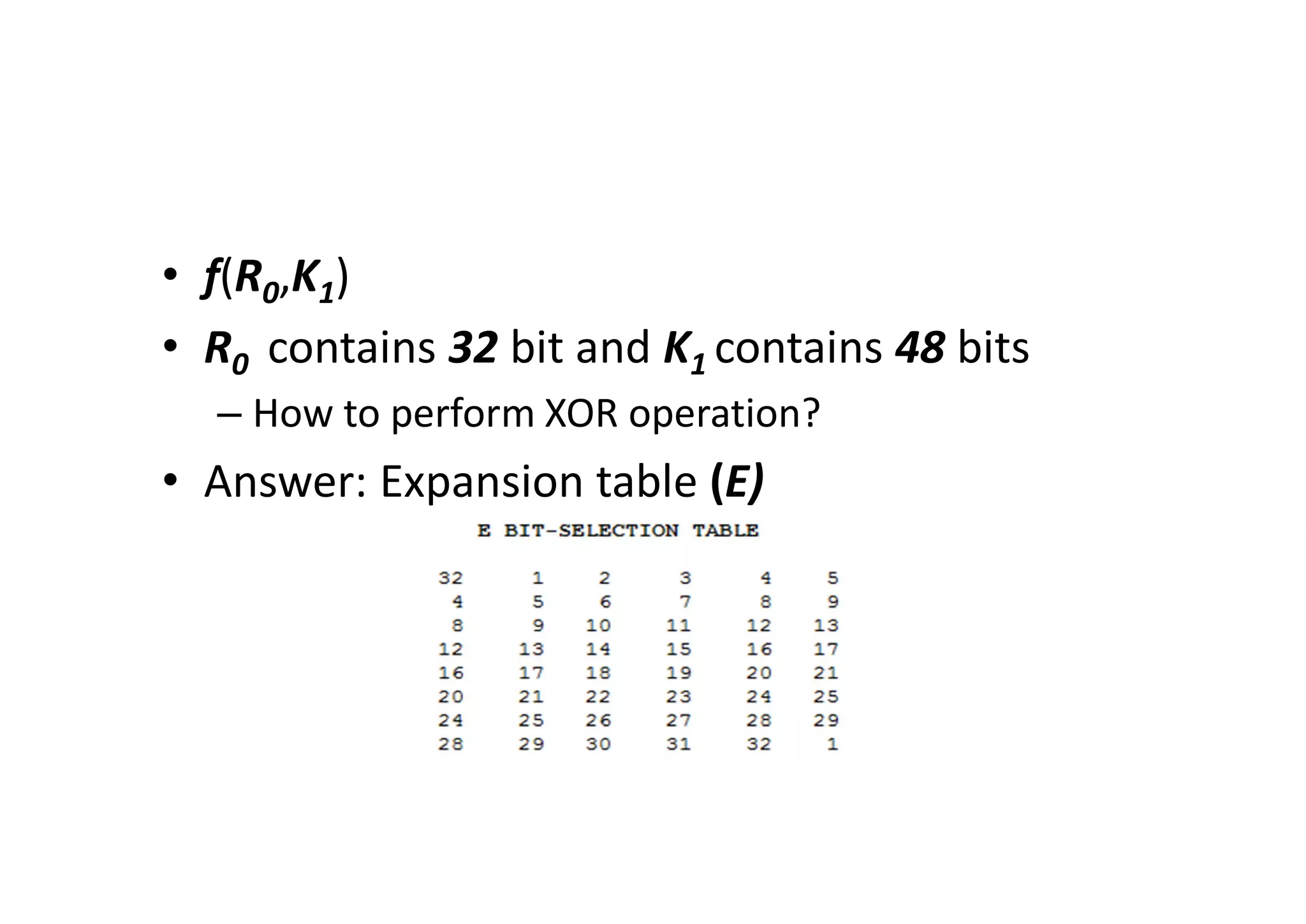
• f(R0,K1)
• R0 contains 32 bit and K1 contains 48 bits
– How to perform XOR operation?
• Answer: Expansion table (E)
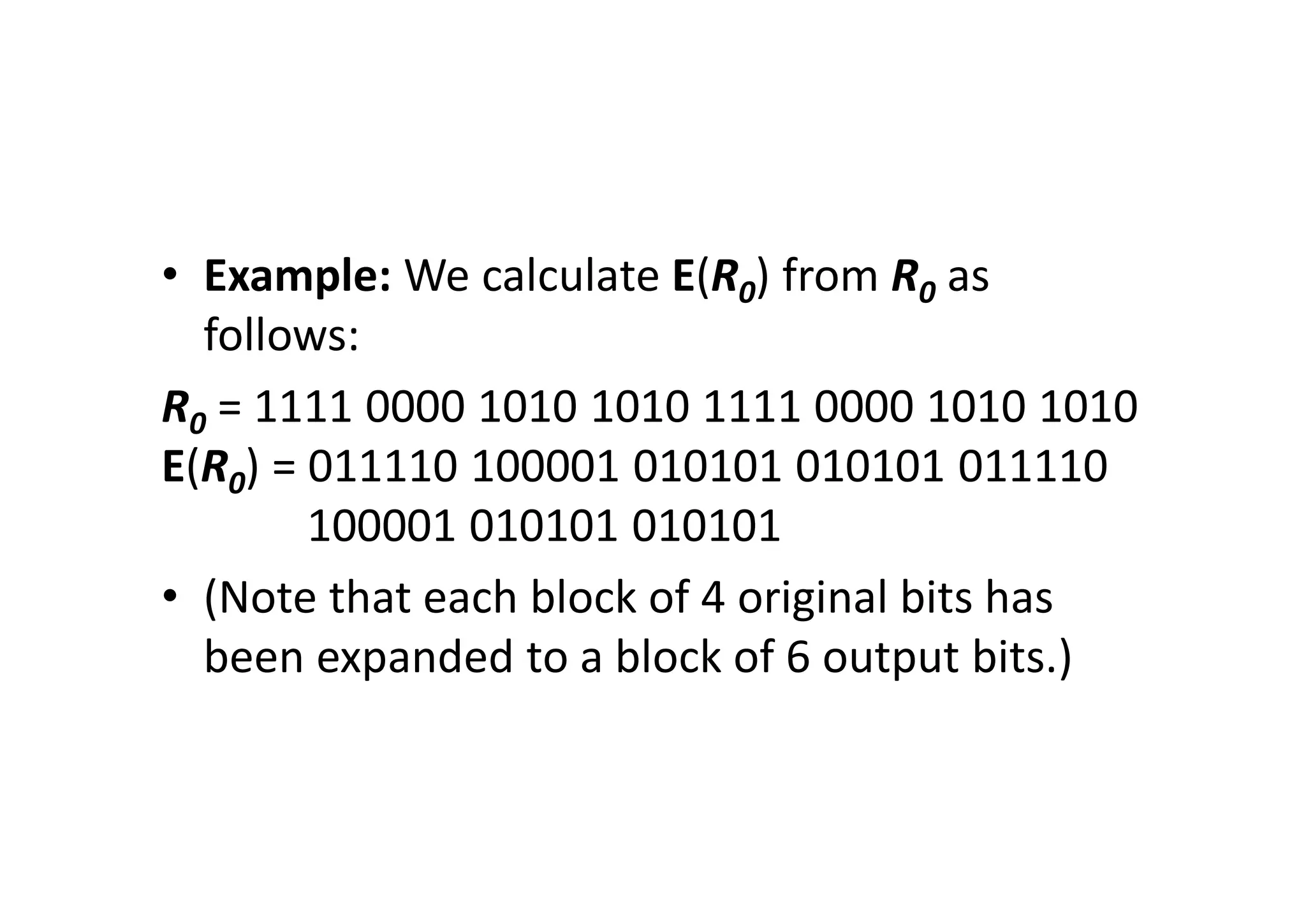
• Example: We calculate E(R0) from R0 as
follows:
R0 = 1111 0000 1010 1010 1111 0000 1010 1010
E(R0) = 011110 100001 010101 010101 011110
100001 010101 010101
• (Note that each block of 4 original bits has
been expanded to a block of 6 output bits.)
Step 2 (cont.)
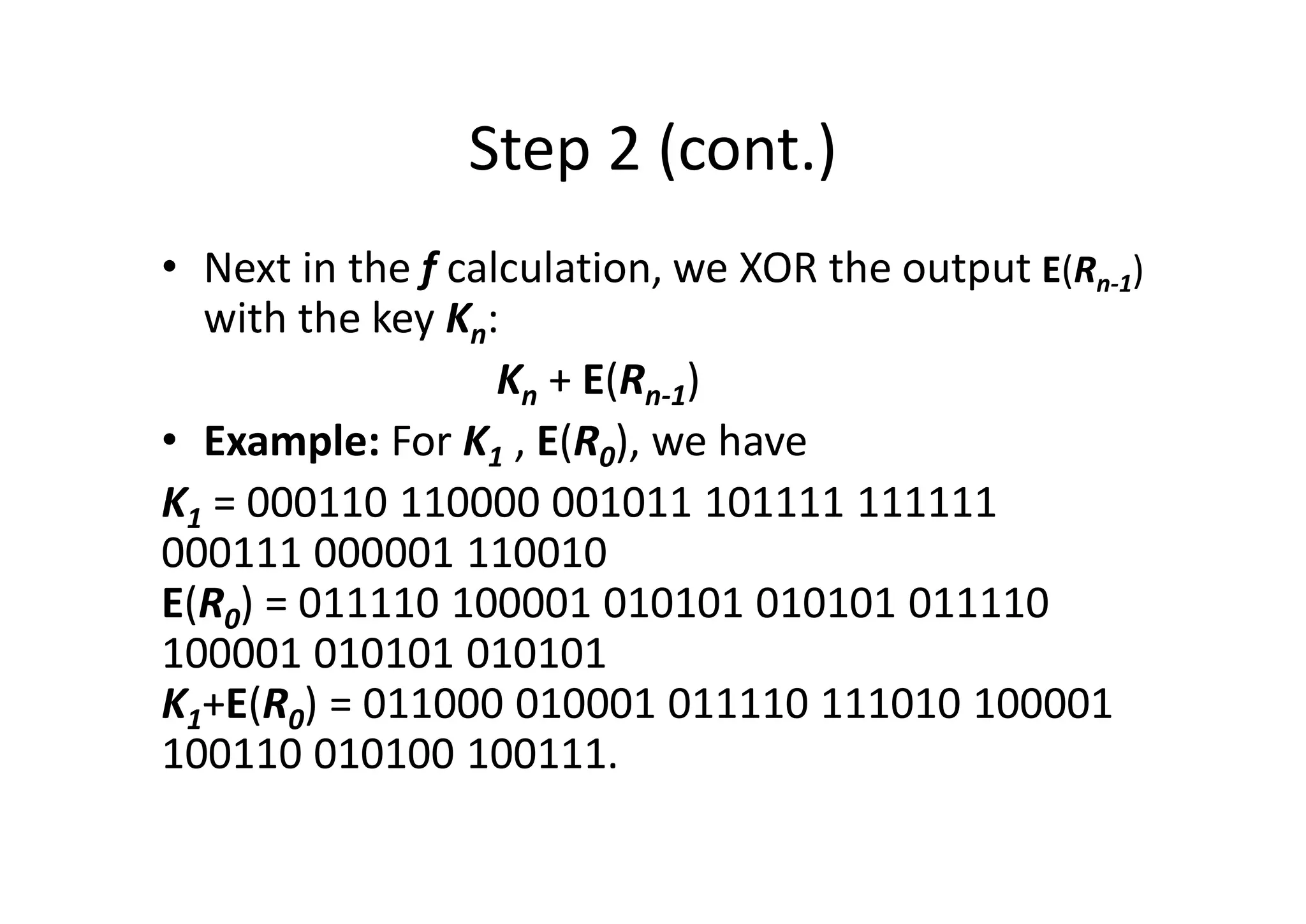
• Next in the f calculation, we XOR the output E(Rn-1)
with the key Kn:
Kn + E(Rn-1)
• Example: For K1 , E(R0), we have
K1 = 000110 110000 001011 101111 111111
000111 000001 110010
E(R0) = 011110 100001 010101 010101 011110
100001 010101 010101
K1+E(R0) = 011000 010001 011110 111010 100001
100110 010100 100111.
• We now have 48 bits but we need to reverse it
in 32 bits. How can we do this?
• Solution: S-boxes
– Each group of six bits will give us an address in a
different S box
– Six bits group will be converted into four bits block
Step 2 (cont.) – [S-Boxes]
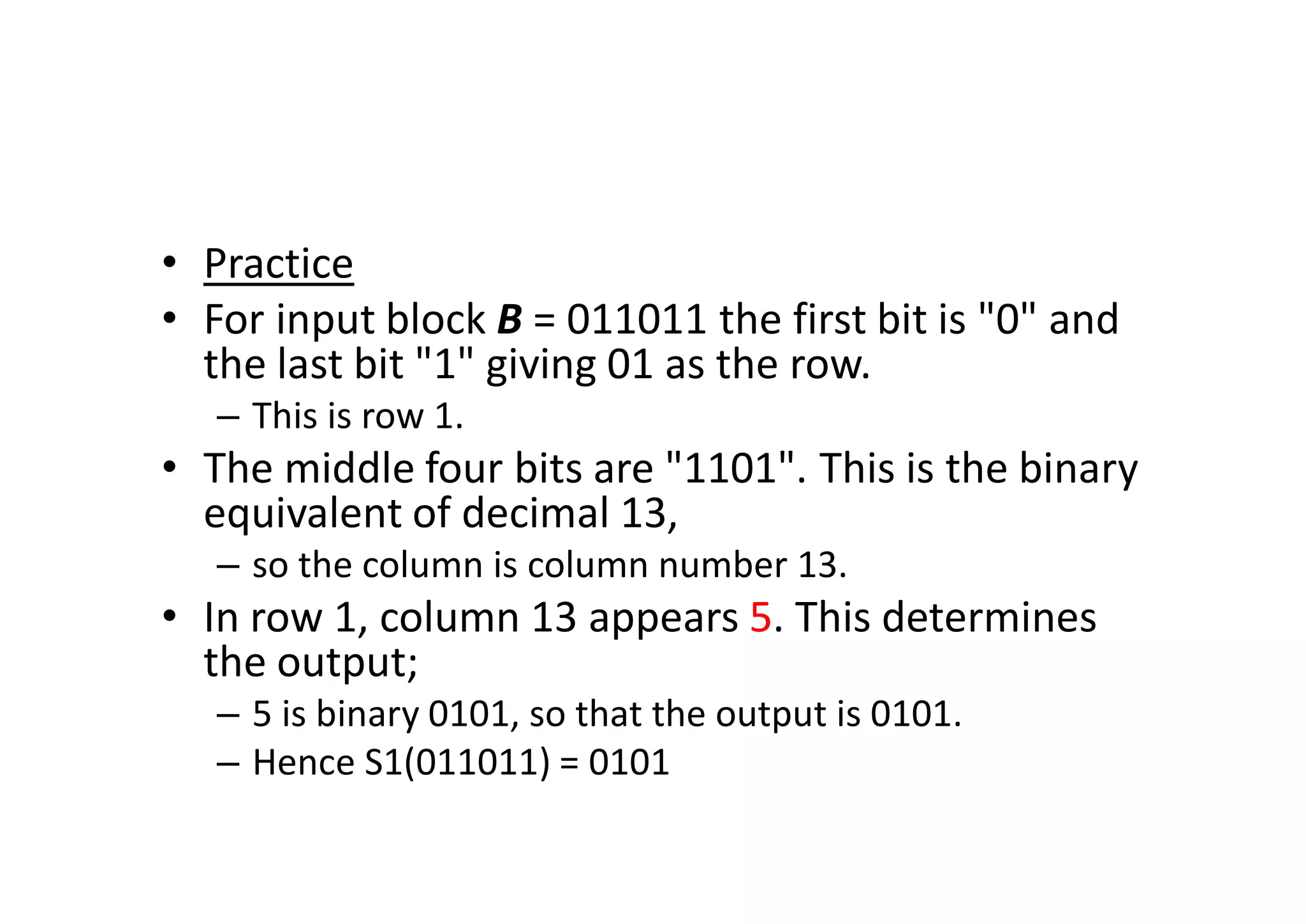
• Practice
• For input block B = 011011 the first bit is "0" and
the last bit "1" giving 01 as the row.
– This is row 1.
• The middle four bits are "1101". This is the binary
equivalent of decimal 13,
– so the column is column number 13.
• In row 1, column 13 appears 5. This determines
the output;
– 5 is binary 0101, so that the output is 0101.
– Hence S1(011011) = 0101
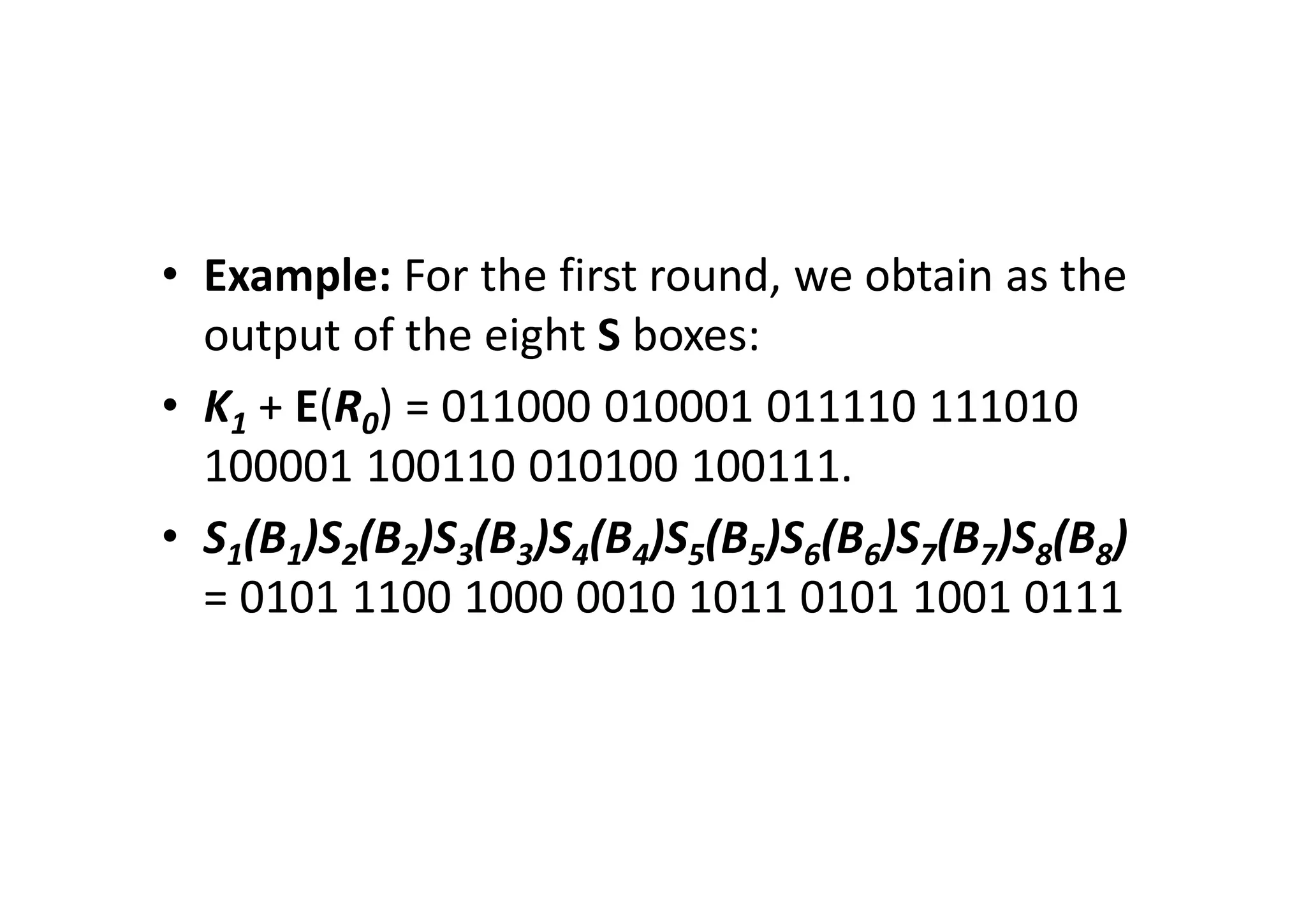
• Example: For the first round, we obtain as the
output of the eight S boxes:
• K1 + E(R0) = 011000 010001 011110 111010
100001 100110 010100 100111.
• S1(B1)S2(B2)S3(B3)S4(B4)S5(B5)S6(B6)S7(B7)S8(B8)
= 0101 1100 1000 0010 1011 0101 1001 0111
Step 2 (cont.)
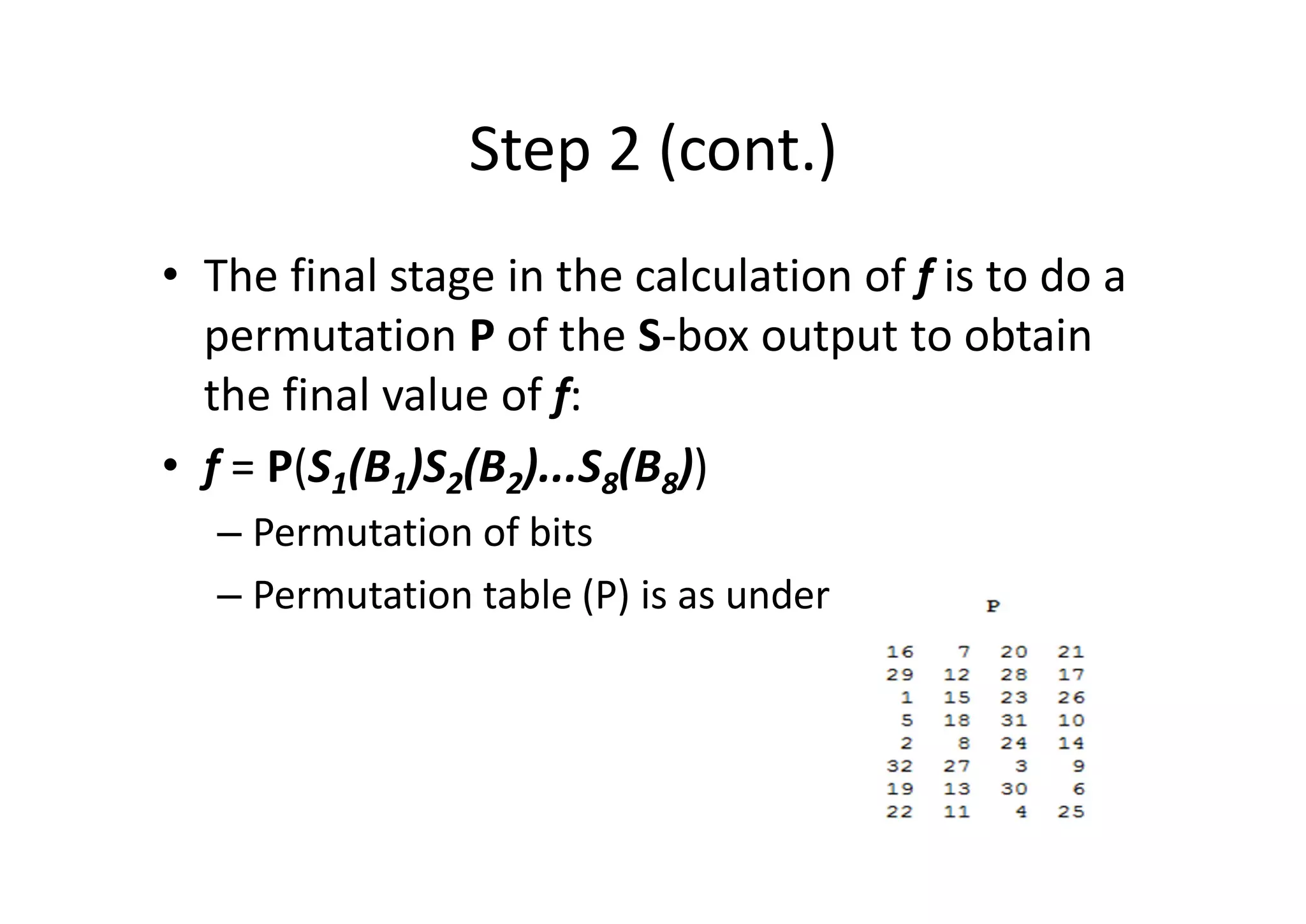
• The final stage in the calculation of f is to do a
permutation P of the S-box output to obtain
the final value of f:
• f = P(S1(B1)S2(B2)...S8(B8))
– Permutation of bits
– Permutation table (P) is as under
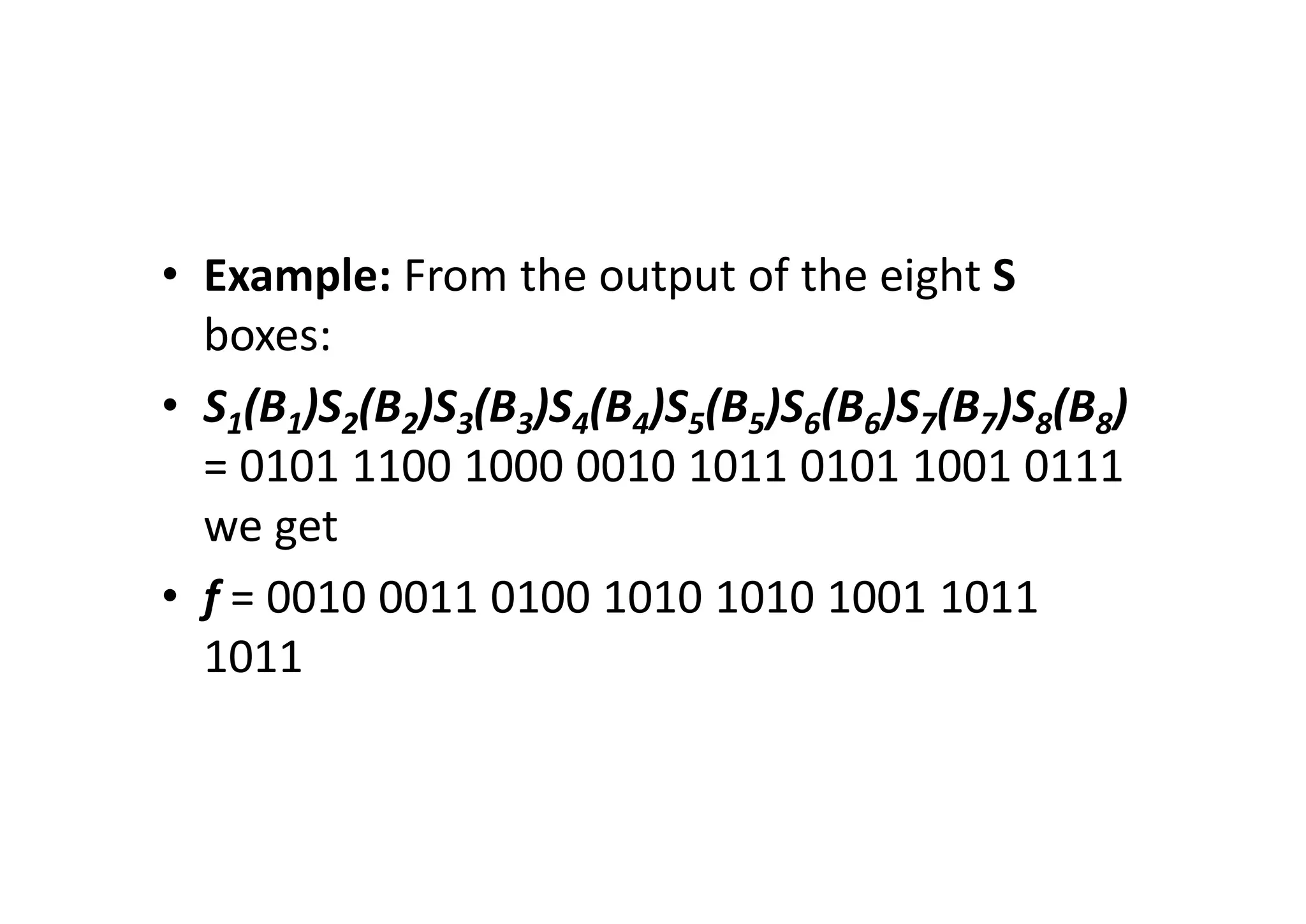
• Example: From the output of the eight S
boxes:
• S1(B1)S2(B2)S3(B3)S4(B4)S5(B5)S6(B6)S7(B7)S8(B8)
= 0101 1100 1000 0010 1011 0101 1001 0111
we get
• f = 0010 0011 0100 1010 1010 1001 1011
1011
Step 2 (cont.)
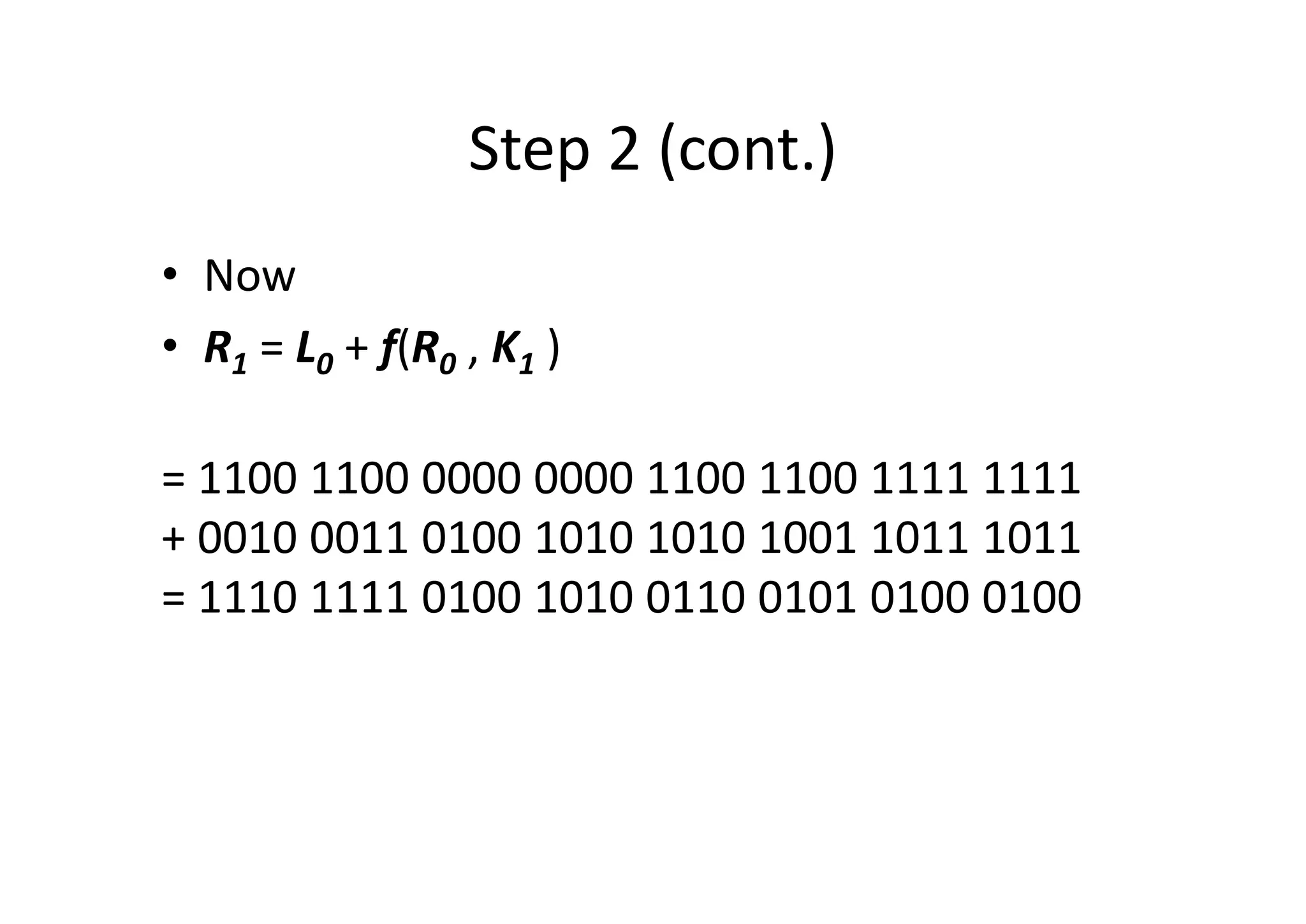
• Now
• R1 = L0 + f(R0 , K1 )
= 1100 1100 0000 0000 1100 1100 1111 1111
+ 0010 0011 0100 1010 1010 1001 1011 1011
= 1110 1111 0100 1010 0110 0101 0100 0100
Step 2 (cont.)
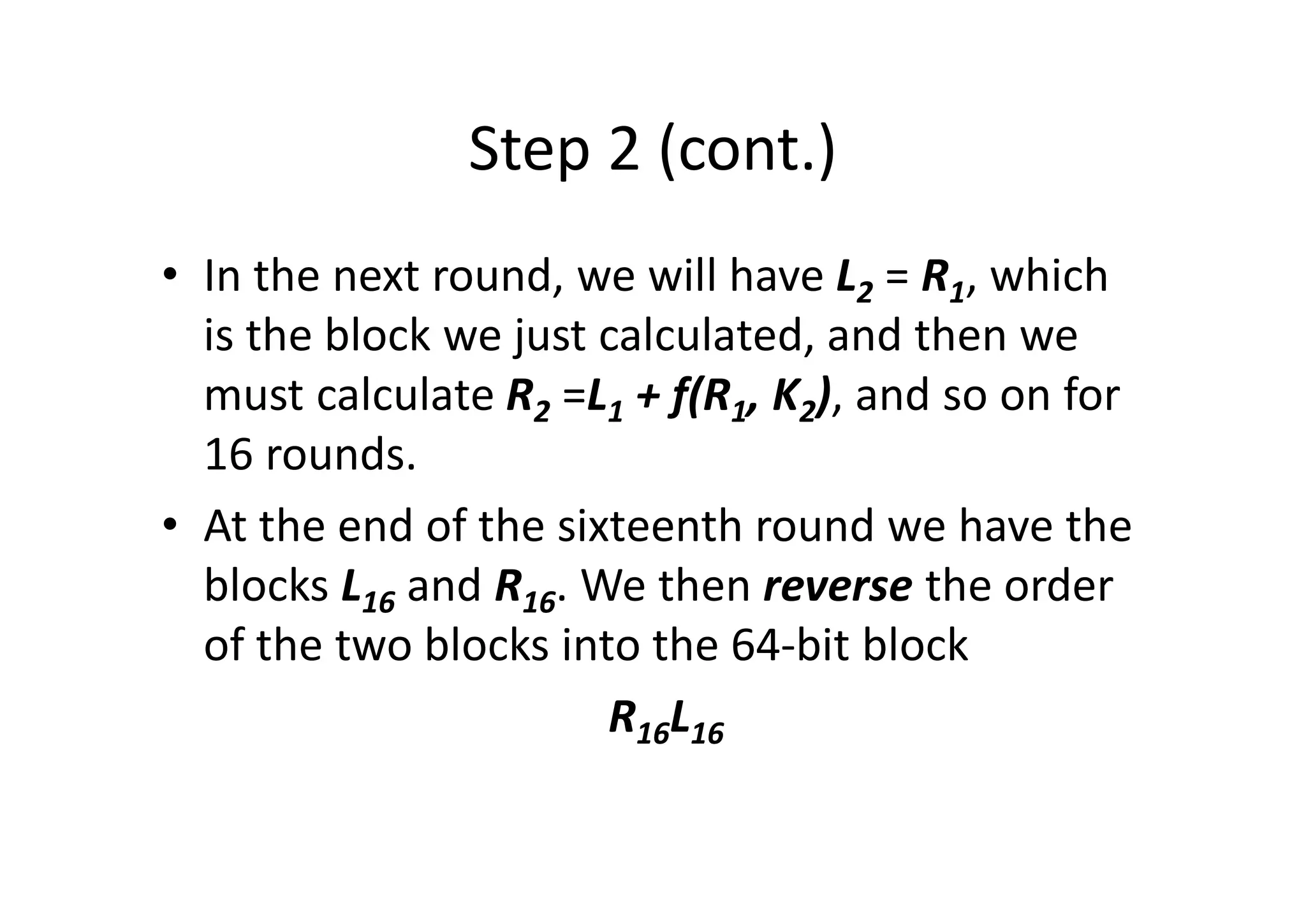
• In the next round, we will have L2 = R1, which
is the block we just calculated, and then we
must calculate R2 =L1 + f(R1, K2), and so on for
16 rounds.
• At the end of the sixteenth round we have the
blocks L16 and R16. We then reverse the order
of the two blocks into the 64-bit block
R16L16
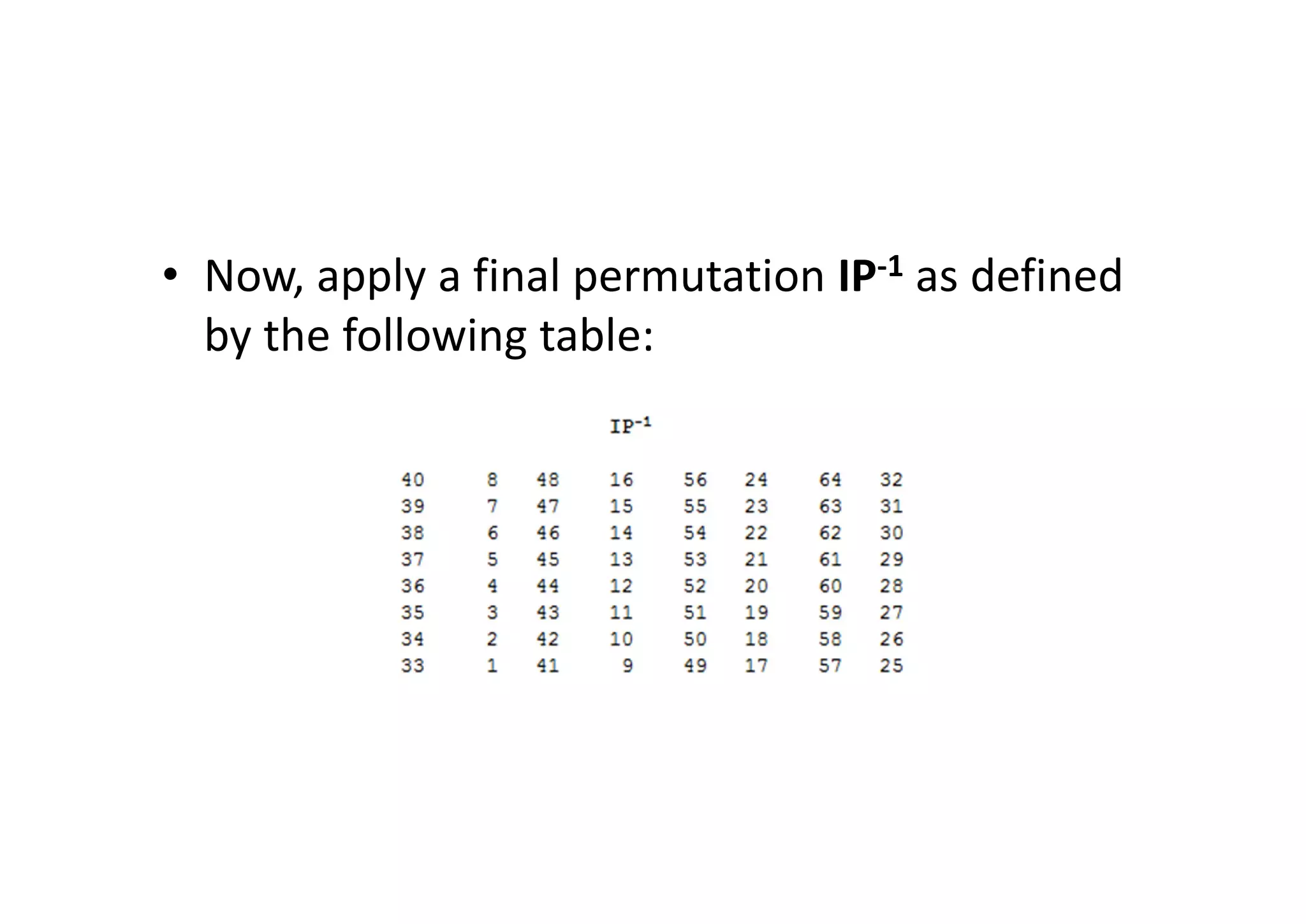
• Now, apply a final permutation IP-1 as defined
by the following table:
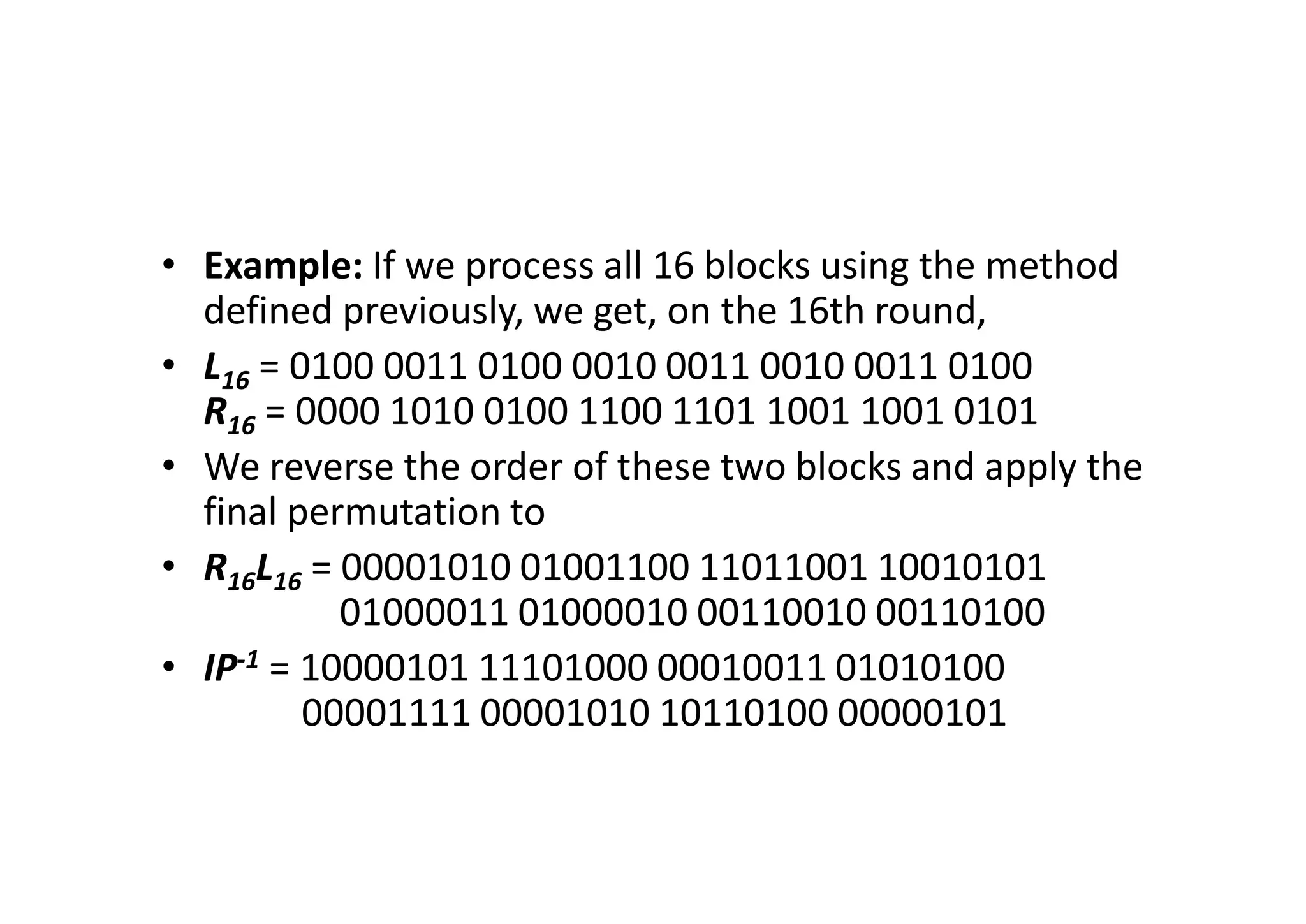
• Example: If we process all 16 blocks using the method
defined previously, we get, on the 16th round,
• L16 = 0100 0011 0100 0010 0011 0010 0011 0100
R16 = 0000 1010 0100 1100 1101 1001 1001 0101
• We reverse the order of these two blocks and apply the
final permutation to
• R16L16 = 00001010 01001100 11011001 10010101
01000011 01000010 00110010 00110100
• IP-1 = 10000101 11101000 00010011 01010100
00001111 00001010 10110100 00000101
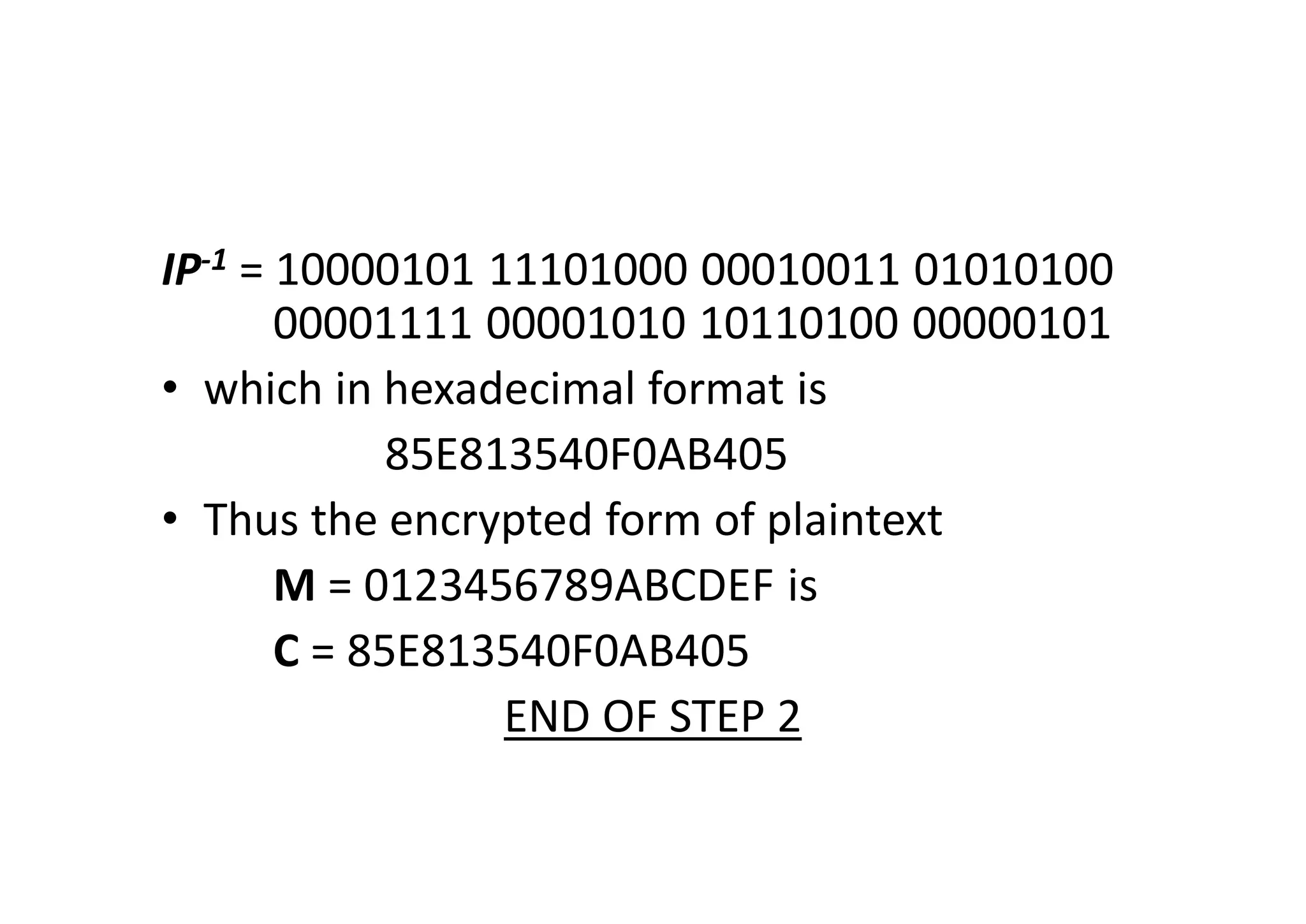
IP-1 = 10000101 11101000 00010011 01010100
00001111 00001010 10110100 00000101
• which in hexadecimal format is
85E813540F0AB405
• Thus the encrypted form of plaintext
M = 0123456789ABCDEF is
C = 85E813540F0AB405
END OF STEP 2
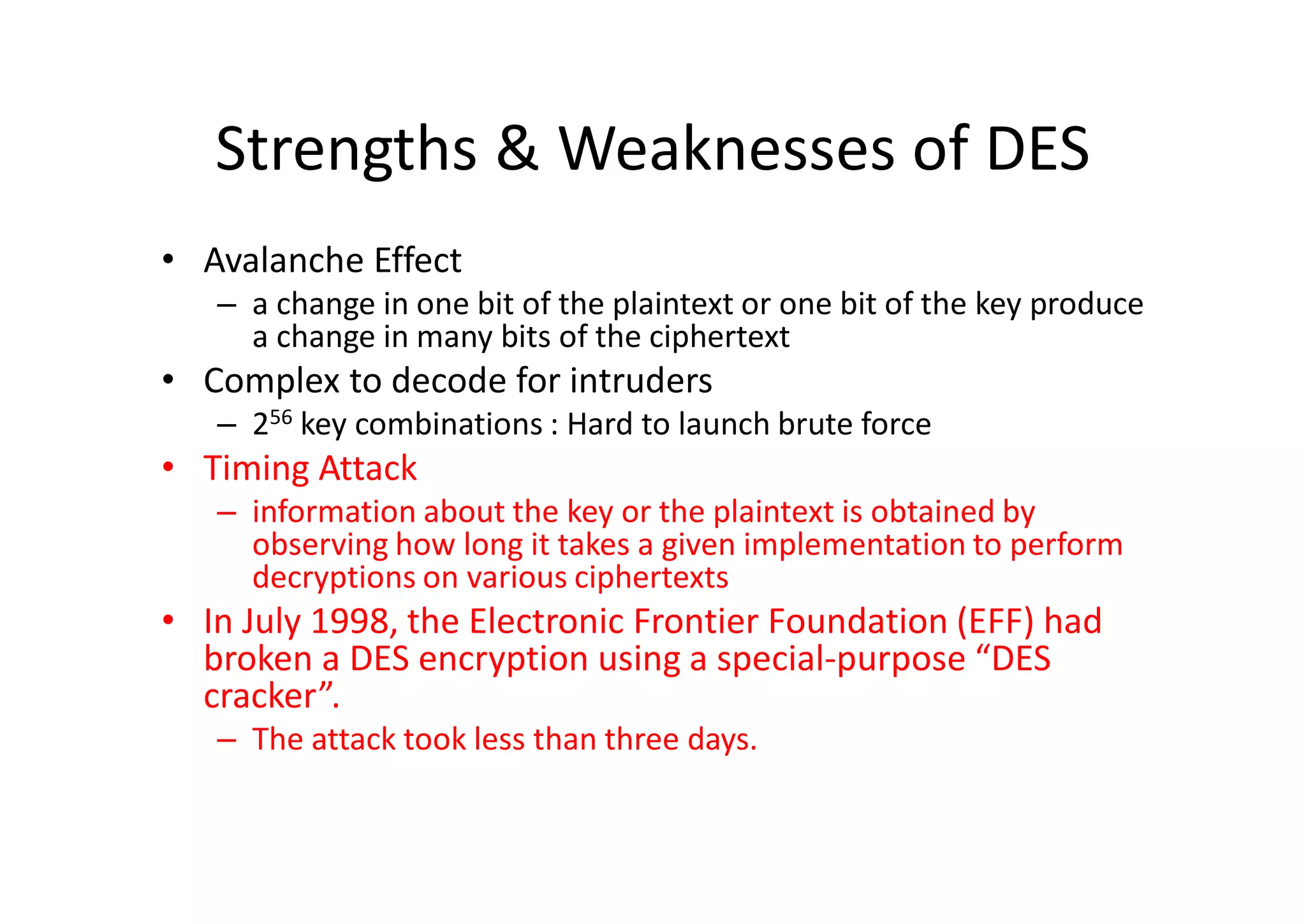
Strengths & Weaknesses of DES
• Avalanche Effect
– a change in one bit of the plaintext or one bit of the key produce
a change in many bits of the ciphertext
• Complex to decode for intruders
– 256 key combinations : Hard to launch brute force
• Timing Attack
– information about the key or the plaintext is obtained by
observing how long it takes a given implementation to perform
decryptions on various ciphertexts
• In July 1998, the Electronic Frontier Foundation (EFF) had
broken a DES encryption using a special-purpose “DES
cracker”.
– The attack took less than three days.
The 3-Data Encryption Standard
• "The only solution here is to pick an algorithm
with a longer key; there isn't enough silicon in
the galaxy or enough time before the sun
burns out to brute- force triple-DES"
(cryptography expert- Bruce Schneier)
The 3-Data Encryption Standard (2)
• Triple-DES is just DES with two 56-bit keys
– the first key is used to encrypt the message
– second key is used to decrypt the encrypted
message
• this decryption just scrambles the data further.
– The twice-scrambled message is then encrypted
again with the first key to yield the final ciphertext
• Triple-DES can also be done with three
separate keys
Feistel cipher
• Same as DES
– Eliminate first phase (IP) and third phase (IP-1)
from DES
That’s it: Feistel cipher

3-Block Ciphers and DES.pdf

  • 1.
    Data and NetworkSecurity: Block Ciphers and DES Adeel Akhtar
  • 2.
    Agenda • Stream Cipher& Block Cipher • Modern Block Cipher • Block Cipher components • DES • 3-DES
  • 3.
    Stream Cipher &Block Cipher • A stream cipher is one that encrypts a digital data stream one bit or one byte at a time. • A block cipher is an encryption/decryption scheme in which a block of plaintext is treated as a whole and used to produce a ciphertext block of equal length. – Modern algorithms are based on “block cipher”
  • 4.
    Modern Block Cipher •A symmetric-key modern block cipher encrypts an n-bit block of plaintext or decrypts an n-bit block of ciphertext. – The encryption or decryption algorithm uses a k- bit key
  • 5.
    Modern Block Cipher(2) • If the message has fewer than n bits, padding must be added to make it an n-bit block • if the message has more than n bits, it should be divided into n-bit blocks – appropriate padding must be added to the last block, if necessary. – The common values for n are 64, 128, 256, and 512 bits
  • 6.
    Components of ModernBlock Cipher • Transposition units (P-Boxes) • Substitution units (S-Boxes) • exclusive-or operations • shifting elements • swapping elements • splitting elements • combining elements
  • 7.
    Components of ModernBlock Cipher (2)
  • 8.
    Permutation Box (P-Box) •A P-box (permutation box) parallels the traditional transposition cipher for characters, but it transposes bits • Three types of P-boxes in modern block ciphers – Straight P-boxes – Expansion P-boxes – Compression P-boxes
  • 9.
    Substitution box (S-Box) •An S-box can be thought of as a miniature substitution cipher, but it substitutes bits. • Unlike traditional substitution cipher, an S-box can have a different number of inputs and outputs. • Exclusive-OR (XOR) function – the output is 0 if the two inputs are the same – the output is 1 if the two inputs are different
  • 10.
    Other Functions • circularshift operation – Shifting can be to the left or to the right – The circular left-shift operation shifts each bit in an n-bit word k positions to the left • the leftmost k bits are removed from the left and become the rightmost bits • swap operation – special case of the circular shift operation where the number of shifted bits k = n/2
  • 11.
    • Split Operation –The split operation splits an n-bit word in the middle, creating two equal-length words • Combine Operation – The combine operation normally concatenates two equal-length words to create an n-bit word.
  • 12.
    Data Encryption Standard(DES) • Adopted in 1977 by the National Bureau of Standards – data are encrypted in 64-bit blocks using a 56-bit key – The algorithm transforms 64-bit input in a series of steps into a 64-bit output • The same steps, with the same key, are used to reverse the encryption
  • 13.
    DES (Con’t) • Processingof the plaintext proceeds in three phases. – 64-bit plaintext passes through an initial permutation (IP) that rearranges the bits to produce the permuted input – sixteen rounds of the same function which involves both permutation and substitution functions. • output of last round consists of 64 bits that is a function of the input plaintext and the key • Left and right halves of the output are swapped to produce the preoutput – Finally, the preoutput is passed through a permutation that is the inverse of the initial permutation function, to produce the 64-bit ciphertext.
  • 14.
    DES – GeneralDescription
  • 15.
    INITIAL PERMUTATION (IP)and IP-1 • IP takes a 64-bit input and permutes them according to a predefined rule. – IP and its inverse are defined by tables – Each entry in the permutation table indicates the position of a numbered input bit in the output, which also consists of 64 bits • Final permutation is the inverse of the initial permutation. – These two permutations cancel the effect of each other. {if the rounds are eliminated from the structures, the ciphertext is the same as the plaintext.}
  • 16.
    DES Rounds • DESuses 16 rounds • The round takes Li−1 and Ri−1 from the previous round (or the initial permutation box) and creates Li and Ri, which go to the next round (or final permutation box). • Each round can have up to two invertible cipher elements – The Swapper swaps the left half of the text with the right half. – The mixer is invertible because of the XOR operation. All noninvertible elements are collected inside the function f(Ri−1, Ki).
  • 17.
    DES Function • Appliesa 48-bit key to the rightmost 32 bits (Ri−1) to produce a 32-bit output • This function is made up of four sections: – an expansion P-box – an exclusive-OR component (that adds key) – a group of S-boxes – a straight P-box
  • 18.
    DES Function (Cont) •Since Ri−1 is a 32-bit input and Ki is a 48-bit key, we first need to expand Ri−1 to 48 bits. This expansion permutation follows a predetermined rule. • After the expansion permutation, DES uses the XOR operation on the expanded right section and the round key. The S-boxes do the real mixing. – DES uses 8 S-boxes – each with a 6-bit input and a 4-bit output. • The last operation in the DES function is a straight permutation with a 32-bit input and a 32-bit output.
  • 19.
    Key Generation • Round-keygenerator creates sixteen 48-bit keys out of a 56-bit cipher key – the cipher key is normally given as a 64-bit key in which 8 extra bits are the parity bits, which are dropped before the actual key-generation process
  • 20.
    DES: Step 1-KeyGeneration • Key could be of 8 characters. i.e., BSCS2012 or MS CS012 – These characters will be converted in binary w.r.t. their respective ASCII codes – Can you explain other possible options? • Let K be the hexadecimal key K = 133457799BBCDFF1
  • 21.
    • The 64-bitkey is permuted according to the following “PC-1” table. (Bit wise) • Example: • K = 00010011 00110100 01010111 01111001 ? 10011011 10111100 11011111 11110001
  • 22.
    Step 1 (cont.) •Example: From the original 64-bit key • K = 00010011 00110100 01010111 01111001 10011011 10111100 11011111 11110001 • we get the 56-bit permutation K+ = 1111000 0110011 0010101 0101111 0101010 1011001 1001111 0001111
  • 23.
    Step 1 (cont.) •Next, split this key into left and right halves, C0 and D0, where each half has 28 bits. • Example: From the permuted key K+, we get C0 = 1111000 0110011 0010101 0101111 D0 = 0101010 1011001 1001111 0001111 • With C0 and D0, we now create sixteen blocks Cn and Dn, 1<=n<=16
  • 24.
    Step 1 (Cont.) •Each pair of blocks Cn and Dn is formed from the previous pair Cn-1 and Dn-1 • “Left shift” will be applied on previous block according to the given schedule
  • 25.
    • C0 =1111000011001100101010101111 D0 = 0101010101100110011110001111 • C1 = 1110000110011001010101011111 D1 = 1010101011001100111100011110 • C2 = 1100001100110010101010111111 D2 = 0101010110011001111000111101 • C3 = 0000110011001010101011111111 D3 = 0101011001100111100011110101 • C4 = 0011001100101010101111111100 D4 = 0101100110011110001111010101 • C5 = 1100110010101010111111110000 D5 = 0110011001111000111101010101 • C6 = 0011001010101011111111000011 D6 = 1001100111100011110101010101 • C7 = 1100101010101111111100001100 D7 = 0110011110001111010101010110 • C8 = 0010101010111111110000110011 D8 = 1001111000111101010101011001 • C9 = 0101010101111111100001100110 D9 = 0011110001111010101010110011 • C10 = 0101010111111110000110011001 D10 = 1111000111101010101011001100 • C11 = 0101011111111000011001100101 D11 = 1100011110101010101100110011 • C12 = 0101111111100001100110010101 D12 = 0001111010101010110011001111 • C13 = 0111111110000110011001010101 D13 = 0111101010101011001100111100 • C14 = 1111111000011001100101010101 D14 = 1110101010101100110011110001 • C15 = 1111100001100110010101010111 D15 = 1010101010110011001111000111 • C16 = 1111000011001100101010101111 D16 = 0101010101100110011110001111
  • 26.
    Step 1 (Cont.) •We now form the keys Kn, for 1<=n<=16, by applying the following permutation table (PC-2) to each of the concatenated pairs CnDn. – Each pair has 56 bits, but PC-2 only uses 48 of these. • i.e.,14th bit of input will be the first bit of output
  • 27.
    • For thefirst key we have: C1D1 = 1110000 1100110 0101010 1011111 1010101 0110011 0011110 0011110 • After applying the permutation PC-2, it becomes • K1 = 000110 110000 001011 101111 111111 000111 000001 110010
  • 28.
    Step 1 (Cont.) •Another example: – C9D9 will make the key for which round? K? • Similarly, 16 keys will be formulated – One for each round – i.e., K1, K2, K3, K4 . . . . K16 END OF STEP 1
  • 29.
    Step 2: Encodeeach 64-bit block of data • Any message of 8 characters i.e, M HANEEF – Transformed into bits w.r.t ASCII codes – Other possible options? • Lets assume the “hexadecimal” plain text M=0123456789ABCDEF
  • 30.
    Step 2 (cont.) •Starts from an initial permutation IP of the 64 bits of the message data M – rearranges the bits according to the following table
  • 31.
    • Example: Applyingthe initial permutation to the block of text M, given previously, we get • M = 0000 0001 0010 0011 0100 0101 0110 0111 1000 1001 1010 1011 1100 1101 1110 1111 IP = 1100 1100 0000 0000 1100 1100 1111 1111 1111 0000 1010 1010 1111 0000 1010 1010
  • 32.
    Step 2 (cont.) •Next divide the permuted block IP into a left half L0 of 32 bits, and a right half R0 of 32 bits. • Example: From IP, we get L0 and R0 L0 = 1100 1100 0000 0000 1100 1100 1111 1111 R0 = 1111 0000 1010 1010 1111 0000 1010 1010 • Perform 16 iterations, for 1<=n<=16, using a function f which operates on two blocks – a data block of 32 bits – a key Kn of 48 bits
  • 33.
    Step 2 (cont.) •Let + denote XOR addition, then • Ln = Rn-1 Rn = Ln-1 + f(Rn-1,Kn) • take right 32 bits of the previous result and make them the left 32 bits of the current step • For the right 32 bits in the current step, we XOR the left 32 bits of the previous step with the calculation f
  • 34.
    • Example: Forn = 1, we have • K1 = 000110 110000 001011 101111 111111 000111 000001 110010 L1 = R0 = 1111 0000 1010 1010 1111 0000 1010 1010 R1 = L0 + f(R0,K1)
  • 35.
    • f(R0,K1) • R0contains 32 bit and K1 contains 48 bits – How to perform XOR operation? • Answer: Expansion table (E)
  • 36.
    • Example: Wecalculate E(R0) from R0 as follows: R0 = 1111 0000 1010 1010 1111 0000 1010 1010 E(R0) = 011110 100001 010101 010101 011110 100001 010101 010101 • (Note that each block of 4 original bits has been expanded to a block of 6 output bits.)
  • 37.
    Step 2 (cont.) •Next in the f calculation, we XOR the output E(Rn-1) with the key Kn: Kn + E(Rn-1) • Example: For K1 , E(R0), we have K1 = 000110 110000 001011 101111 111111 000111 000001 110010 E(R0) = 011110 100001 010101 010101 011110 100001 010101 010101 K1+E(R0) = 011000 010001 011110 111010 100001 100110 010100 100111.
  • 38.
    • We nowhave 48 bits but we need to reverse it in 32 bits. How can we do this? • Solution: S-boxes – Each group of six bits will give us an address in a different S box – Six bits group will be converted into four bits block
  • 39.
    Step 2 (cont.)– [S-Boxes]
  • 40.
    • Practice • Forinput block B = 011011 the first bit is "0" and the last bit "1" giving 01 as the row. – This is row 1. • The middle four bits are "1101". This is the binary equivalent of decimal 13, – so the column is column number 13. • In row 1, column 13 appears 5. This determines the output; – 5 is binary 0101, so that the output is 0101. – Hence S1(011011) = 0101
  • 41.
    • Example: Forthe first round, we obtain as the output of the eight S boxes: • K1 + E(R0) = 011000 010001 011110 111010 100001 100110 010100 100111. • S1(B1)S2(B2)S3(B3)S4(B4)S5(B5)S6(B6)S7(B7)S8(B8) = 0101 1100 1000 0010 1011 0101 1001 0111
  • 42.
    Step 2 (cont.) •The final stage in the calculation of f is to do a permutation P of the S-box output to obtain the final value of f: • f = P(S1(B1)S2(B2)...S8(B8)) – Permutation of bits – Permutation table (P) is as under
  • 43.
    • Example: Fromthe output of the eight S boxes: • S1(B1)S2(B2)S3(B3)S4(B4)S5(B5)S6(B6)S7(B7)S8(B8) = 0101 1100 1000 0010 1011 0101 1001 0111 we get • f = 0010 0011 0100 1010 1010 1001 1011 1011
  • 44.
    Step 2 (cont.) •Now • R1 = L0 + f(R0 , K1 ) = 1100 1100 0000 0000 1100 1100 1111 1111 + 0010 0011 0100 1010 1010 1001 1011 1011 = 1110 1111 0100 1010 0110 0101 0100 0100
  • 45.
    Step 2 (cont.) •In the next round, we will have L2 = R1, which is the block we just calculated, and then we must calculate R2 =L1 + f(R1, K2), and so on for 16 rounds. • At the end of the sixteenth round we have the blocks L16 and R16. We then reverse the order of the two blocks into the 64-bit block R16L16
  • 46.
    • Now, applya final permutation IP-1 as defined by the following table:
  • 47.
    • Example: Ifwe process all 16 blocks using the method defined previously, we get, on the 16th round, • L16 = 0100 0011 0100 0010 0011 0010 0011 0100 R16 = 0000 1010 0100 1100 1101 1001 1001 0101 • We reverse the order of these two blocks and apply the final permutation to • R16L16 = 00001010 01001100 11011001 10010101 01000011 01000010 00110010 00110100 • IP-1 = 10000101 11101000 00010011 01010100 00001111 00001010 10110100 00000101
  • 48.
    IP-1 = 1000010111101000 00010011 01010100 00001111 00001010 10110100 00000101 • which in hexadecimal format is 85E813540F0AB405 • Thus the encrypted form of plaintext M = 0123456789ABCDEF is C = 85E813540F0AB405 END OF STEP 2
  • 49.
    Strengths & Weaknessesof DES • Avalanche Effect – a change in one bit of the plaintext or one bit of the key produce a change in many bits of the ciphertext • Complex to decode for intruders – 256 key combinations : Hard to launch brute force • Timing Attack – information about the key or the plaintext is obtained by observing how long it takes a given implementation to perform decryptions on various ciphertexts • In July 1998, the Electronic Frontier Foundation (EFF) had broken a DES encryption using a special-purpose “DES cracker”. – The attack took less than three days.
  • 50.
    The 3-Data EncryptionStandard • "The only solution here is to pick an algorithm with a longer key; there isn't enough silicon in the galaxy or enough time before the sun burns out to brute- force triple-DES" (cryptography expert- Bruce Schneier)
  • 51.
    The 3-Data EncryptionStandard (2) • Triple-DES is just DES with two 56-bit keys – the first key is used to encrypt the message – second key is used to decrypt the encrypted message • this decryption just scrambles the data further. – The twice-scrambled message is then encrypted again with the first key to yield the final ciphertext • Triple-DES can also be done with three separate keys
  • 52.
    Feistel cipher • Sameas DES – Eliminate first phase (IP) and third phase (IP-1) from DES That’s it: Feistel cipher